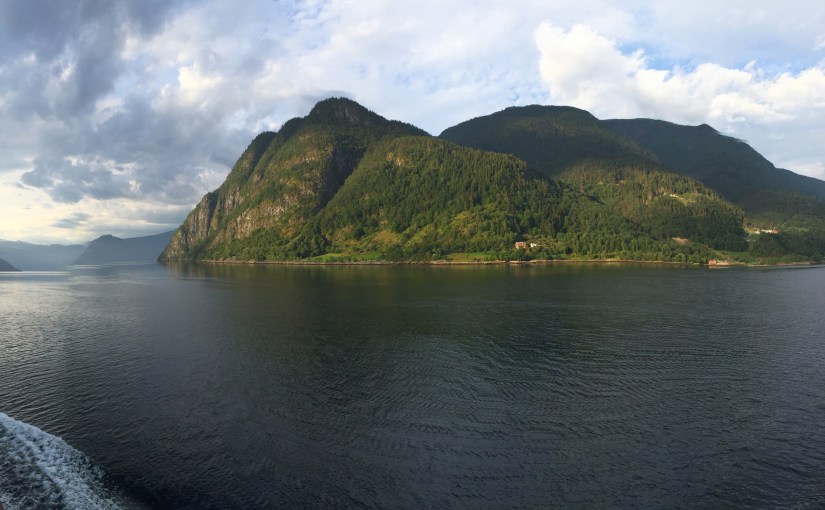
Imagine waking up to THIS spectacular scenery! Ahhhh…
If you did, you would be just outside the little village of Flam. It is peaceful, majestic, quiet and breathtakingly beautiful.
There isn’t much in the center of town–just a few shops and a train station, where you can buy tickets for one of the most scenic rides on this planet.
Viking offered a combined bike/train experience for $179 per person. You take the train up the mountain and part way down, then get on a bike and glide the rest of the way into town.
I tried repeatedly to enroll us in that excursion, but the website consistently listed it as sold out. Damn, I was deeply disappointed. That disappointment lasted about 15 minutes. Then I decided to do something about it, so I took to the internet.
Eventually, after much hunting and more than a few pokes around Trip Advisor and Cruise Critic, I discovered Cafe Rallaren. Located in Myrdal, the last stop for the Flamsbana train, it not only supplies food (that’s the cafe part), but also offers bikes for rent. You can ride the 12.5 miles down the mountain, then leave the bike in town. No need to lock the bike, you just leave it there. In town. What a concept. Try THAT in Boston or San Francisco!
Total cost for the train ticket plus bike (and helmet) rental for both of us was $161.50. Sold!
A closer look at Flam
We chose the 11:05 departure, which gave us time to enjoy a leisurely breakfast on the ship, and wander through the town. We would arrive in Myrdal at noon, just in time for lunch at the cafe. We were the only ship in port that morning, so Flam wasn’t crowded at all. That was about to change.
When our train pulled into Flam, literally thousands of tourists came rushing off–perhaps heading for the bathrooms? To get a window seat on one of the tour buses in the parking lot? Who knows? It was a Chinese tour group, so we weren’t able to ask anyone why they were in such a hurry or where they were coming from.
The good news is OUR ride up the mountain wasn’t crowded at all, and we all had our choice of seats.
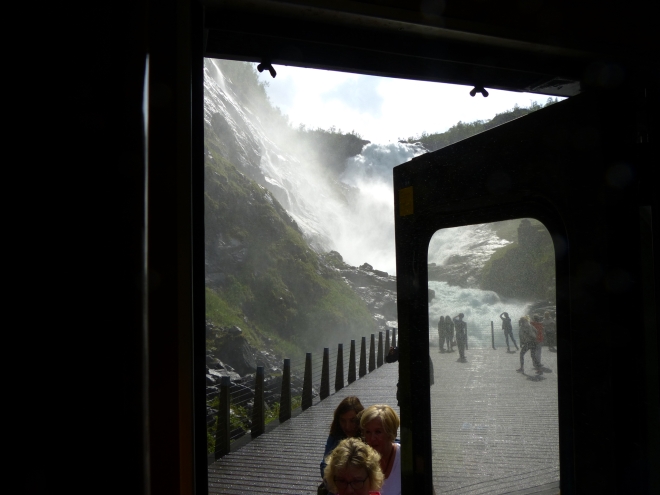
The train makes a stop at a waterfall, so the obligatory photos can be taken. That spray was COLD and powerful, so after about 10 seconds spent admiring the falls’ grandeur (and getting damp), I quickly reboarded the train to photograph the waterworks from the doorway. I know. I’m a wimp. I just hate discomfort of any kind. Especially when it is self inflicted.
What I didn’t see, but Mike (who is made of much stronger stuff) did, was the water nymph who appeared alongside the falls, waving her arms to the tourists. He took the next two photos.
Can you spot her?
How about now? Don’t you love a zoom lens?
Getting our bikes and helmet at the cafe was easy and uneventful. Not so for the rest of the trip. So how was it? It was incredibly beautiful.
It was incredibly steep, and rather rocky, for the first mile,
One of the many hairpin turns on our rideWe are smiling now, because we are standing on one of the flatter stretches during that first mile.Check out the rocks and ruts. Hitting one of those the wrong way while hurtling down a steep slope could be quite uncomfortable. See the drop on the left side of the road?
Best strategy? Walk your bike down the steep sections of that first mile. Unfortunately, Mike didn’t, and took a bad spill. He injured himself enough to made him uncomfortable for the rest of the cruise. To make matters worse, shortly thereafter, his bike got a flat tire. He soldiered on, NOW walking the bike. What else could he do? You don’t see any cell towers in these photos, do you? No houses or cars either. Put it all together and you end up with no bloody way to get help. It was bad, but it would have undoubtedly have been far worse if the drama queen member of our duo had gone down. (That would be me. Mike, on the other hand, never complains…)
Eventually we reached a more inhabited area, where both Mike and the bike were rescued and given a ride back to the ship.
The ship sponsored bike trip started at the flatter, paved section, about half way down the mountain. That’s something to keep in mind for the less adventurous. Unfortunately, I can’t give future Flam visitors any information on how THEY could get in touch with that particular bike vendor. I just spotted a trailer by the side of the road, with lots of bikes loaded onto it, but no signs or identifying information.
Of course, if you decide to do it on your own from the top of the mountain, you DO have the option of walking your bike down and around the hairpin curves. That worked quite well for other bikers (such as me).
I was in a bit of a hurry to get back to the ship to make sure my guy was doing okay, so I didn’t take many more photos.
In the US, we have speed bumps. Here in Flam, they have speed goats.
Although we didn’t encounter any Trolls, we met more than three Billy Goats Gruff
This guy either took a shine to me, or thought I was the “other” character in the fairy tale. All I know is he was repeatedly butting against my leg and followed me a while!
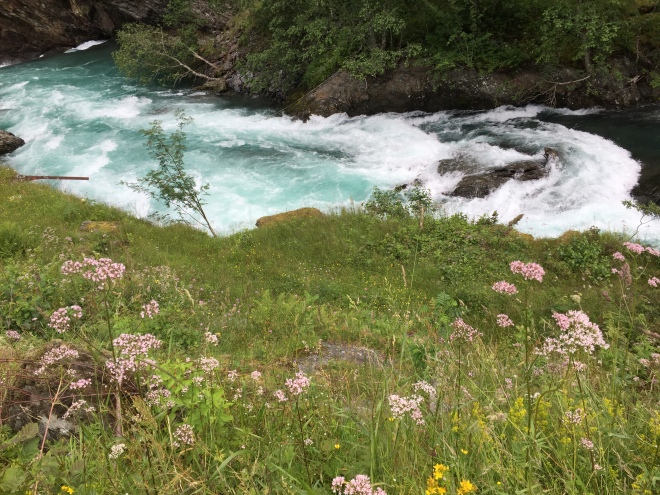
Beautiful flowers and clean water along the way. The perfect photo for a happy ending
Yes, there was a happy ending. Mike visited the ship’s doctor, who after determining that nothing was broken, sent him on his way with some happy pills.
No, we are NOT still on that Viking cruise we embarked upon last July. I am just a very lazy blogger, who only puts fingers to keyboard when the spirit moves me, and there clearly hasn’t been much movement lately. But this epic narrative will end shortly. Only one more country — Norway — and three more ports left, starting with Stavanger.
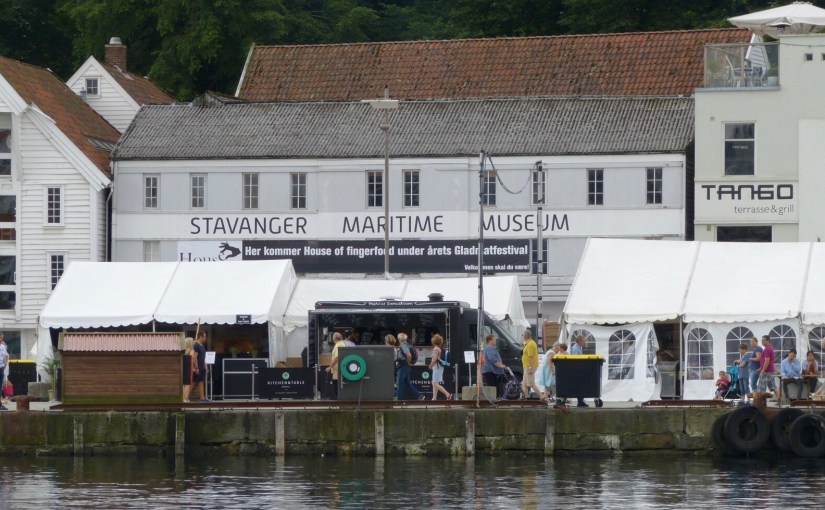
This lovely town features a Maritime Museum which could possibly be spectacular. I have no idea whether it is or it isn’t, because we didn’t get around to visiting it.
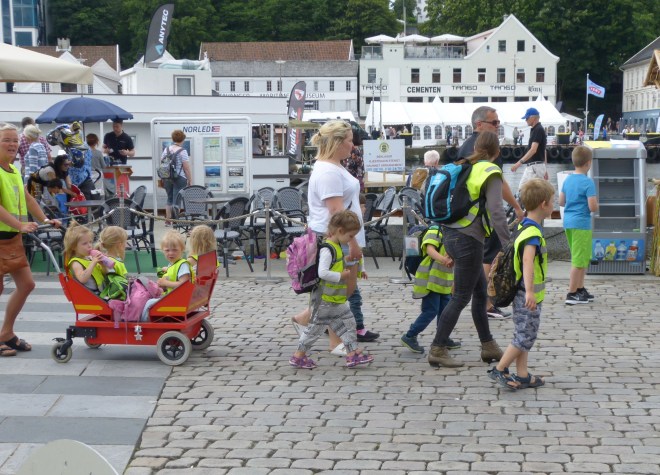
The port area is very pleasant for strolling and people watchingThe port of Stavanger as seen from town
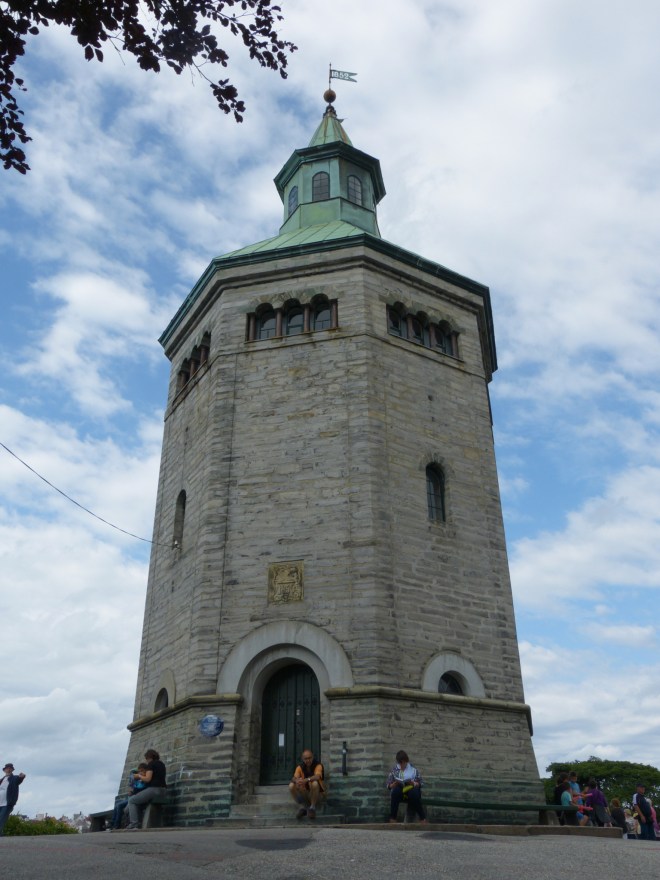
Can you make out the white tents around the harbor in the above photos? They were booths for the food festival that was in full swing the day we were in port. Given the abundance and the quality of the food on the ship, eating was the last thing on our minds, so we didn’t experience THAT either. What we did instead was climb the hill into town to get a better view of the harbor (seen from above) and the tower (seen from below).
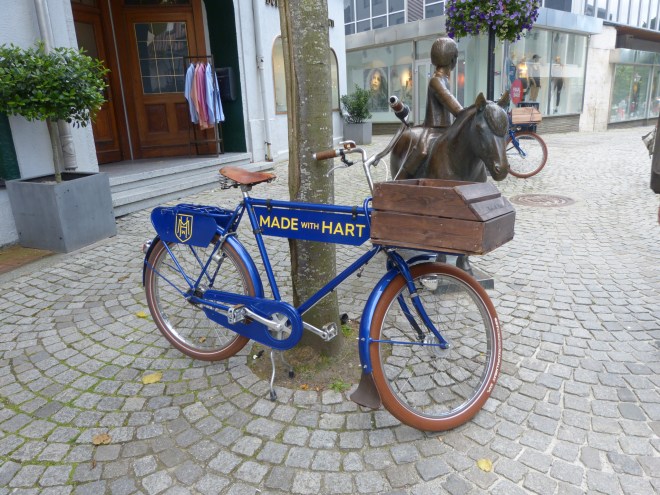
Every town needs a lookout tower.Is this a sculpture? Or is it a loaner for anyone in need of transportation? I think the latter, given the lack of locks and another identical bike in the background.
As usual, Viking offered an array of excursions, including a free walking tour of the port. Our choice was one of the other options: cruising Lysefjord and seeing the famous Pulpit Rock.
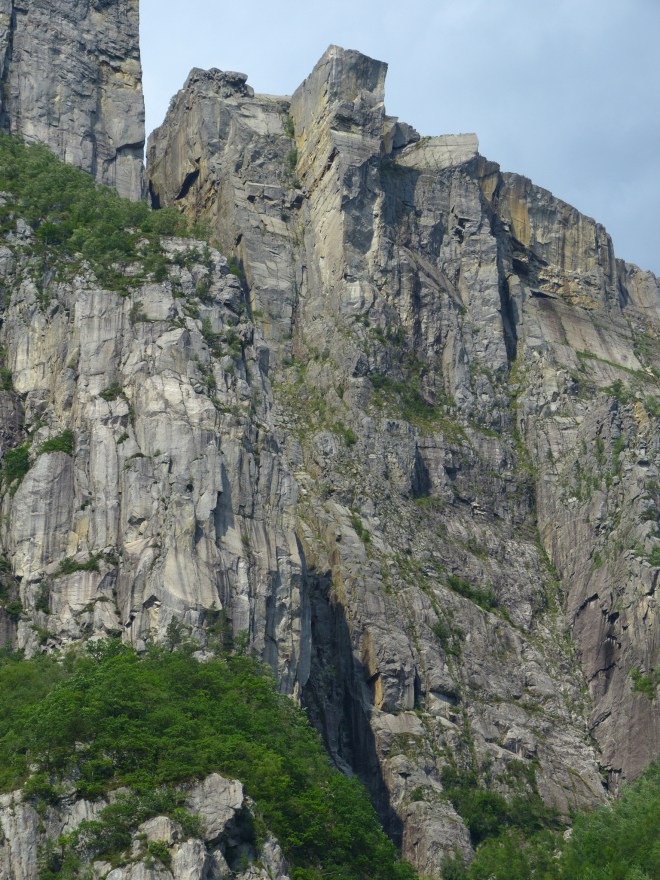
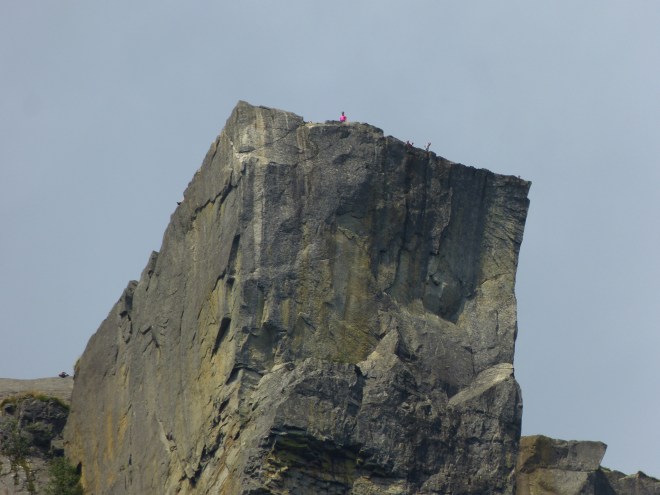
I had briefly considered hiking up Pulpit Rock, but was dissuaded by the comments from bloggers that had gone before. And boy oh boy, I’m so grateful they convinced me to sit this one out. Take a look!
That rectangular outcropping? THAT is Pulpit Rock. And that sucker is WAY high!My telephoto lens was able to confirm that there WERE some successful climbers
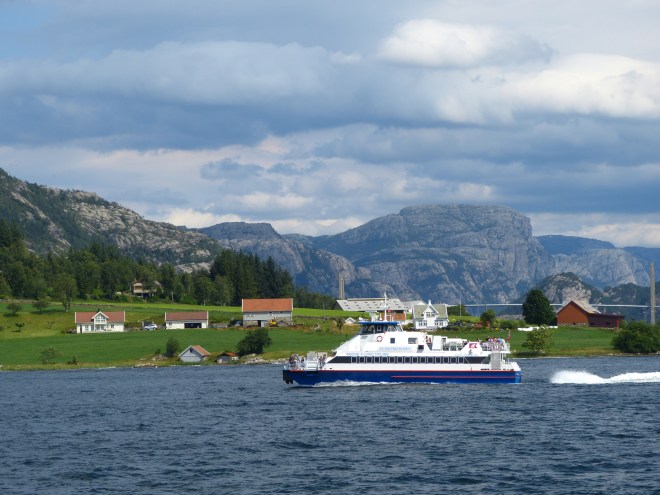
Here’s a tip for future cruisers visiting Stavanger. The Viking sponsored cruise to Pulpit Rock cost $149. per person. Instead, before leaving home, we booked directly with Rodne for $60 per person. (Clicking on the blue link will get you directly to their website). The ferries were identical, the routes were identical, only the price differed. I don’t mind a cruise line making a little money on the trips they put together, but this mark up seemed a bit excessive. I was a little concerned about the distance from our ship to the ferry, but the port is so small, it was a short distance to the boarding area, which was clearly marked.
We discovered we would have been able to buy a ticket at the Rodne office in the harbor, however even if I had known that, I probably would have bought the tickets in advance. We were only in Stavanger one day, so I wasn’t willing to take a chance that the time we wanted was sold out.
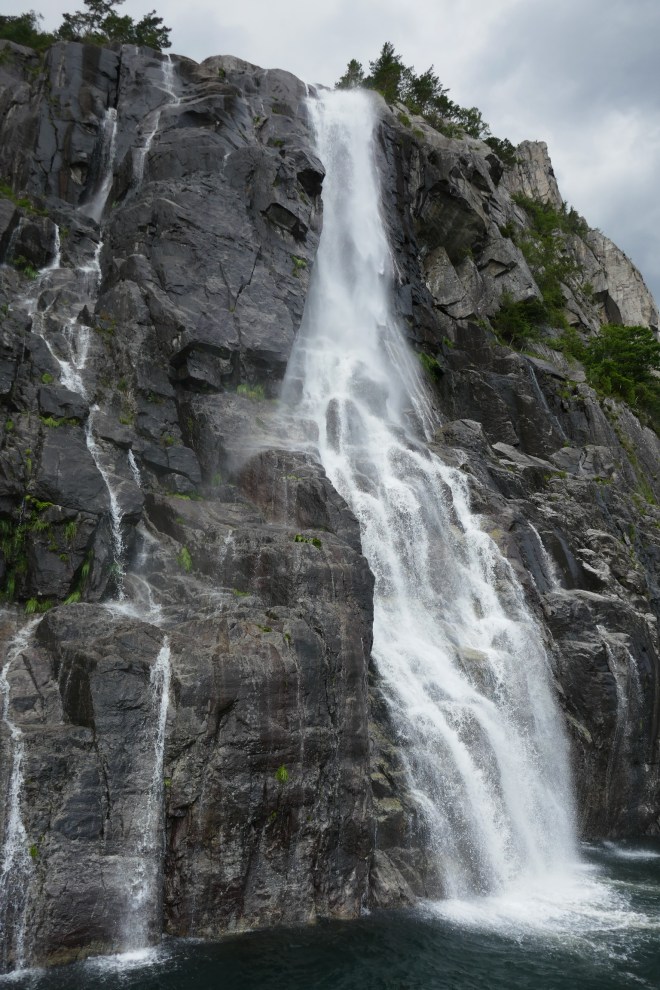
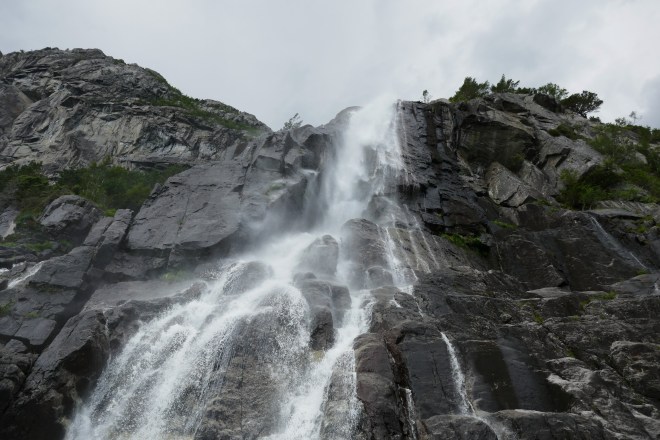
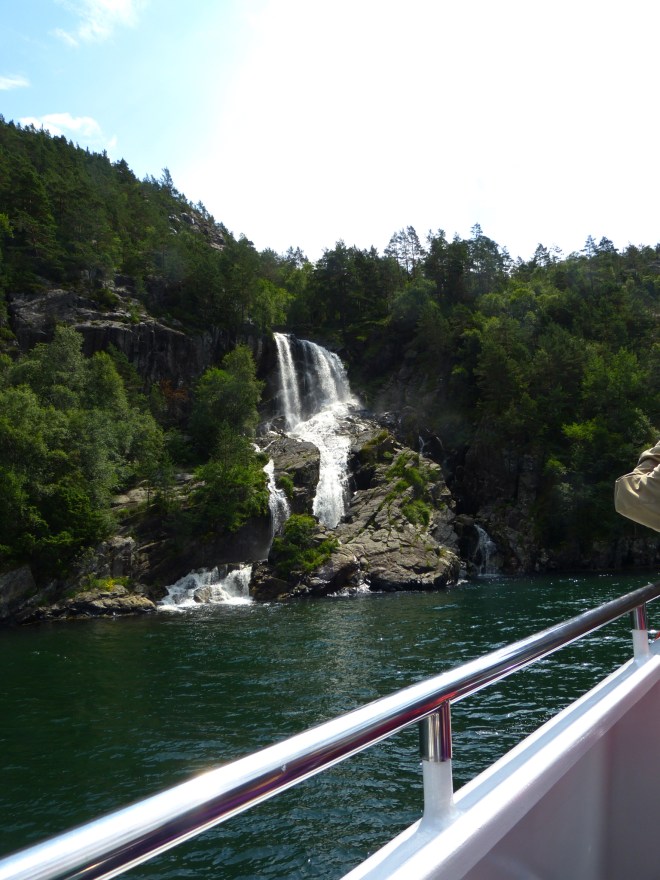
During our trip, we passed several Rodne ships identical to the one we were on. This photo gives you an idea of the ship’s size.Get in line early if you want a seat on the top deck, or a prime spot for photographyLots of waterfalls!Did I mention that there were lots of waterfalls?
Yet another advantage of cruising? You visit ports that you probably would not have found on your own. We had never heard of Aalborg before our Viking cruise.
Is Aalborg Europe’s happiest city? The tourist board certainly thinks so and after spending the morning with Jane, our cheerful–and informative– tour guide, I think it might just be.
Jane told us residents are happy because they feel safe and they have what they need. Although taxes are high, there is no charge for education, pensions are universal and health care is provided. University students live in cheap apartments, get a stipend and have free tuition. In Denmark, Jane told us, people are cared for.
What I found interesting is that although mothers get one year paid maternity leave, and families receive a per child payment, the average family size is less than two. Especially with those long winter nights…
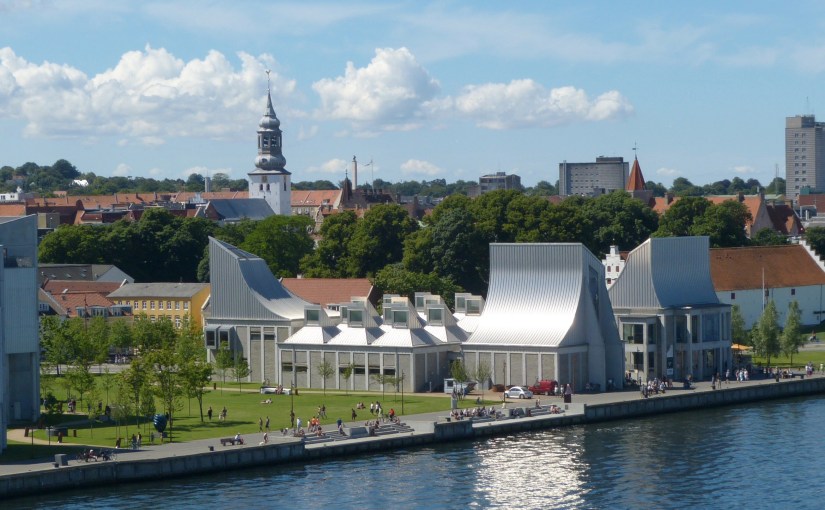
Aalborg is a lovely little city, very clean, artistic, and orderly, with a nice mix of old, preserved buildings along more modern edifices.
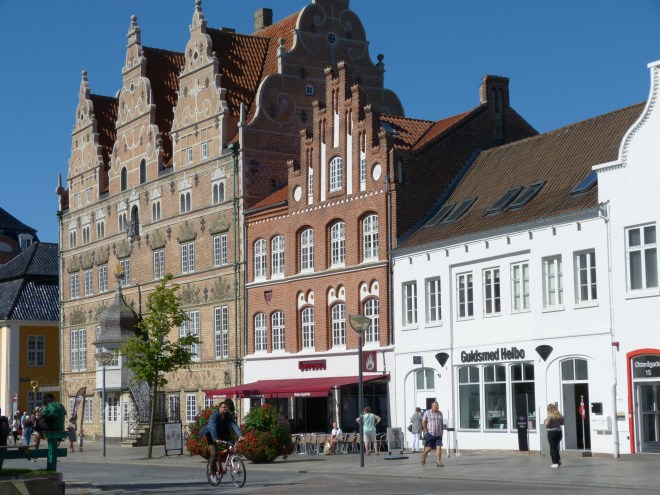
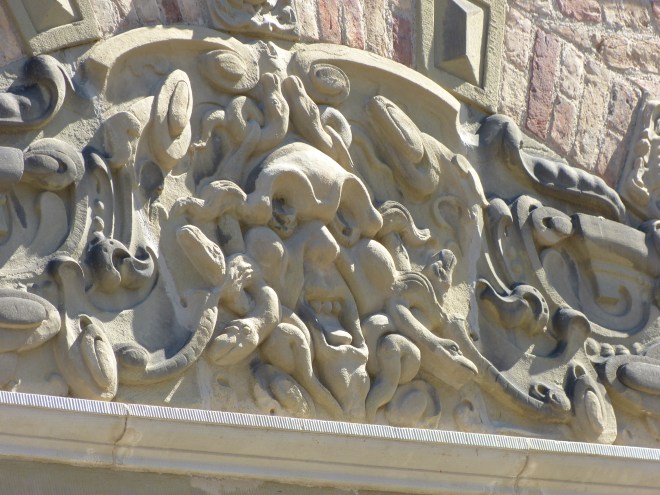
The Jens Bang house (on the left) was built in 1624. Mr Bang was a very successful merchant, but unfortunately was never accepted by the power structure.
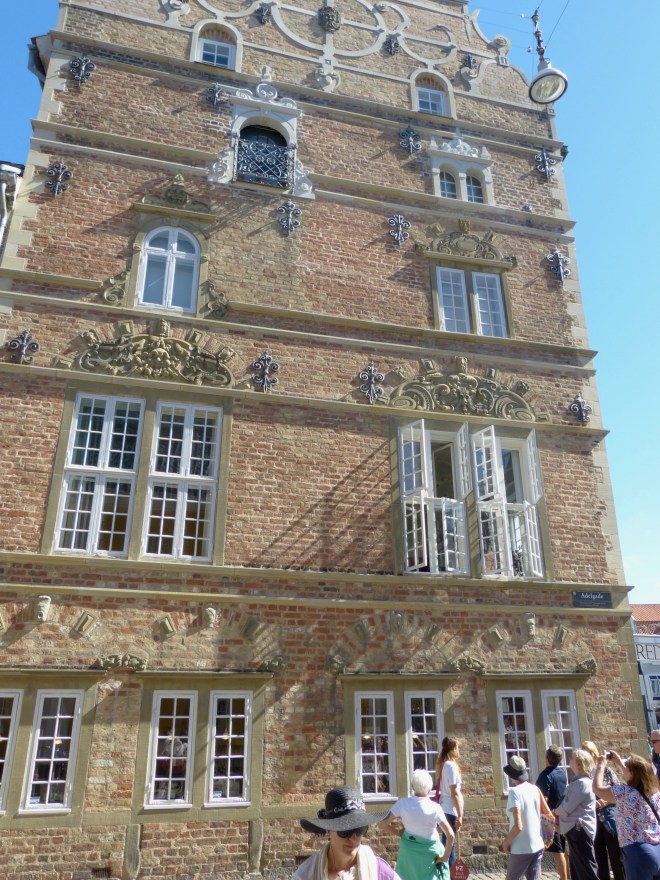
He took architectural revenge, however, by decorating the side facing city hall with these grimacing creatures, who are sticking their tongues out at the politicians of the day.
Here’s a closer look.
The rather irreverent Danish sense of humor continues to this day, as displayed in these figures found in a gift shop.
No, I didn’t buy any presents here.
Our tour included a visit to the monastery/nunnery, where proximity led to a flurry of construction. It seems that in the 1400’s, unplanned pregnancies were resolved by bricking up the nuns (into walls) where they (and their unborn children) were left to die.
What a difference a few centuries can make!
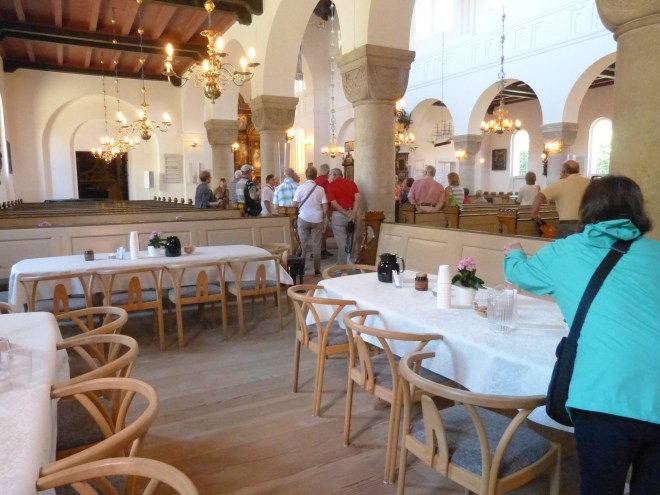
We also visited the local churches where we saw something rather novel: refreshments being offered in the church proper. They really ARE a very welcoming community!
Sign posted outside a church. I guess when you feel happy an cared for, that feeling can be extended to others that are less fortunate.
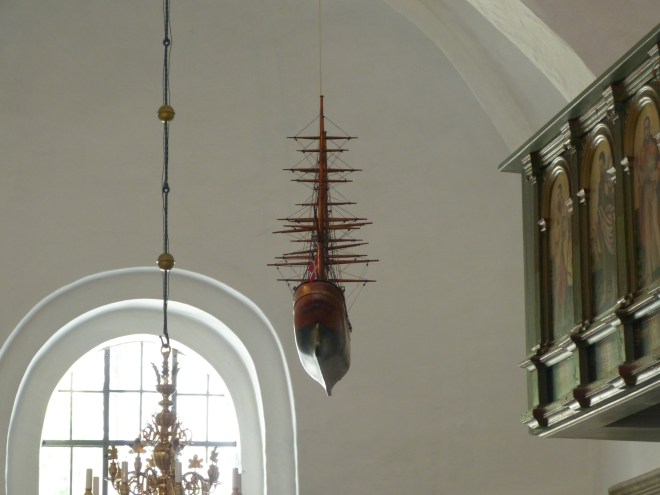
As with other Scandinavian churches, this one had a ship hanging from the ceiling, which we were told is meant to symbolize passage from this world into the next.
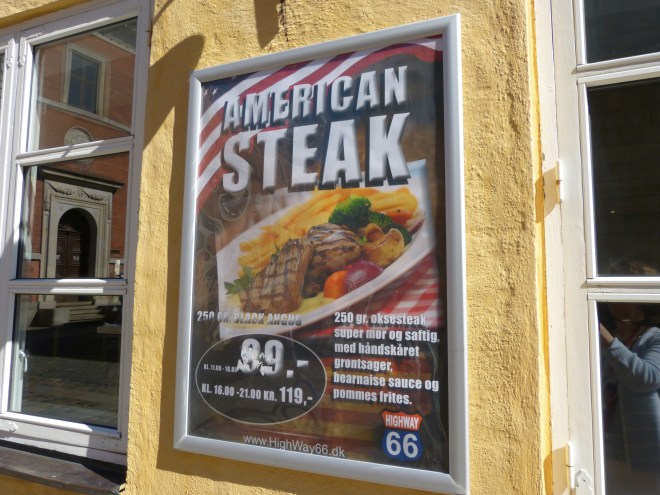
If you happen to visit Aalborg and have a hankering for some good ol’ American fare, not to worry. This wonderful town has you covered.
On our way back to the ship we were treated to a “reenactment”, something those of us in the northeast are all quite familiar with.
As the ship pulled out of port, residents gathered to bid us farewell, waving flags while loudspeakers broadcast Danish music.
Yep, they sure looked happy. And we were too, after spending the morning with them!
The great thing about cruising? You get to sample lots of different places without having to pack and unpack. The downside? Your stay in a fantastic country like Denmark is way too short. Not only that, but you are doing so much and seeing so much, your blogging gets delayed till you get home. Then, if you are me, months later you start looking at photos and trying to decipher your notes only to realize how much you have forgotten.
Our Viking itinerary included two stops in Denmark–a full day in Copenhagen and a half day in Alborg. For both stops, we opted to take the included Viking tours, and we were quite happy with our decision.
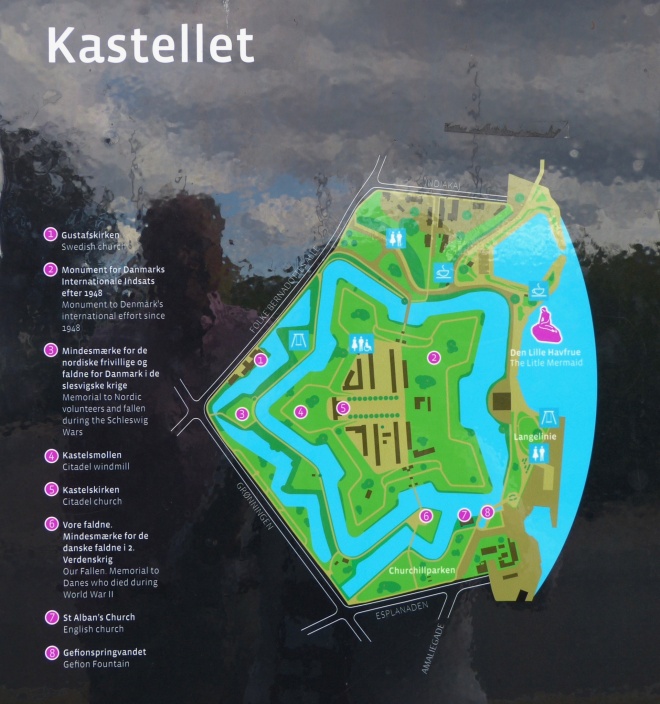
Of course, we knew we HAD to see the iconic Danish landmark, The Little Mermaid, which was within walking distance of our ship.
What was surprising to me was how close she is to the shore. It was possible to climb out to join her on the rock, an impulse our guide requested that we resist. Other tourists, however, did not feel so constrained. I’m thinking that I probably shouldn’t have waited till they cleared off to take my shot. It might have been a far more amusing photo to see them cavorting alongside her.
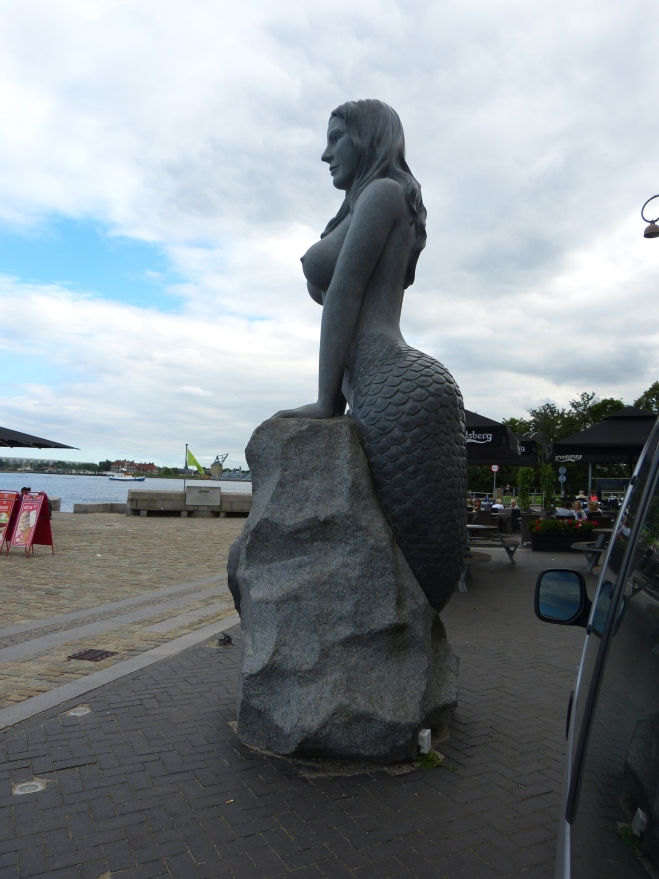
Our guide mentioned that the mermaid has a less famous sister down the road a bit, who is affectionately known as the “Dolly Parton version”. Hmmm, wonder why Walt Disney didn’t include HER in his movie?
Also alongside the harbor is the Opera House, a gift from Maersk Mc-Kinney Moeller, the Danish shipping magnate. The building design has been compared to a spaceship, the grill of a 55 Pontiac and a fly. Maersk Mc-Kinney Moeller’s response to suggestions for modifications? “I’m giving you a gift, not a gift certificate.”
The Danes are rightfully proud that the harbor is so clean that you can swim in it. In fact, someone used the roof of the opera house as a diving board to prove that very point. (Was it Maersk Mc-Kinney Moeller? Unfortunately, I don’t remember — but I DO remember that Maersk lived 98 years, so maybe. I certainly had fun envisioning the old guy balancing on the roof’s edge. )
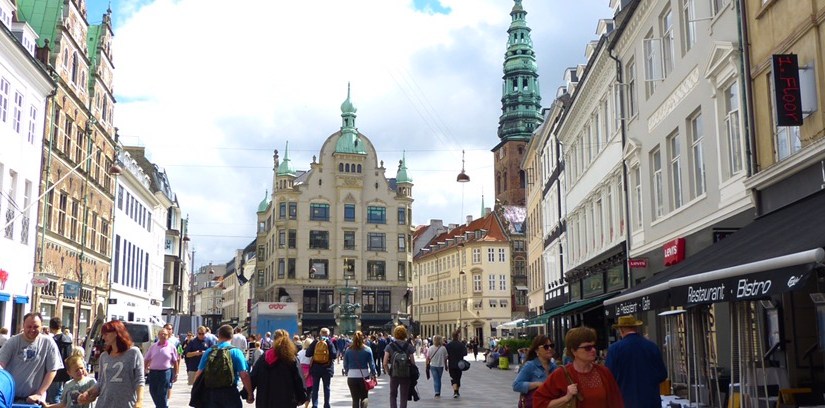
Copenhagen is a lovely city with the requisite number of palaces, towers, forts, churches and statues. Here are just a few of the images from our city tour.
This horseman is surrounded by four identical buildings, all housing members of the royal family.Notice the three crowns atop the tower. If my memory is accurate (and that is a pretty big “if”), they represent the three countries of Scandinavia.A profound quote from our former president, is as relevant today as it was a half century ago.
We were getting close to experiencing sensory overload, so after the tour concluded, we returned to the ship for lunch. The fortress was within walking distance of the ship and was the perfect place to spend the rest of our time in port.
Who knew that a fortress could be so peaceful?
Another beautiful departure, as we headed for our next stop: Aalborg.
Berlin showed up on our Viking itinerary as one of the ports of call. Geography never was my strong suit, but even I knew that Berlin has no oceanfront property. Although Viking arranged free transportation by train to Berlin, we decided that we didn’t want to spend approximately 6 hours traveling back and forth. Besides, we will probably never get back to Rostock and Warnemunde, but a few days in Berlin may indeed be in our future.
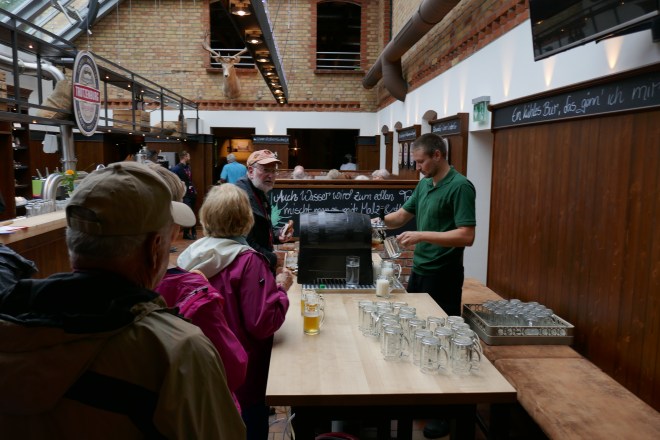
We did not regret our decision. Our day started with a German breakfast of pretzels and “liquid gold”, the German invention we Americans call beer.
Our brewery tour included a choice of light or dark beer.
Our guide, Enrico, shared lots of fun facts about 9th century beer consumption:
Beer was given to children because it was cleaner than the available water
It was drunk warm, like soup from a bowl
The monks consumed beer during their fasts; apparently it didn’t count because you didn’t chew it?
Beer was also thought of as liquid bread.
Fast forward to modern times:
Germans consume approximately 30 gallons of beer per person per year.
You can buy beer anywhere and consume it anywhere. It is okay to be intoxicated in public, just as long as you don’t do something stupid. (A drunk person doing something stupid? How often does THAT happen?)
Beer isn’t taxed, and the drinking age is 16. Sorry kiddies–that’s the down side of having access to clean water.
The last two weeks of September is Oktoberfest in Munich, where the locals don their Bavarian costumes and yodel a lot. If Enrico explained why Oktoberfest occurred in September, I have completely forgotten it. That’s what happens when you write a post months after a trip occurred!
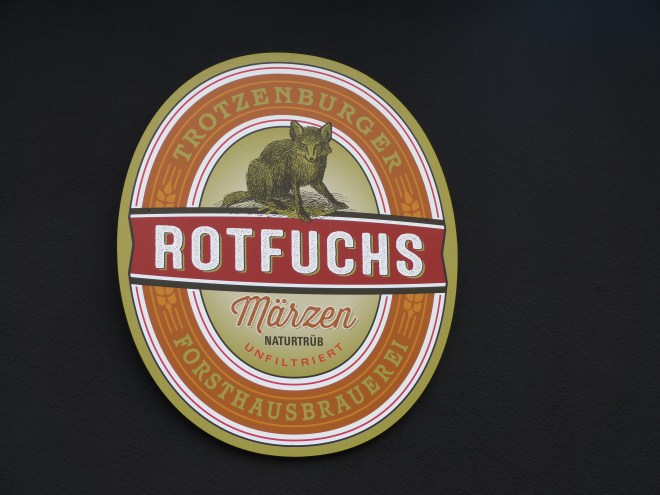
The beer labels at this brewery were quite interesting
Clearly this beer is not one that would be a huge success in the USA
Next stop was the lovely little town of Rostock, formerly part of East Germany. Enrico told us that on November 9, 1989, the citizens of Rostock danced on the wall in celebration of the peaceful revolution. Germans commemorate October 3rd, 1990 as their reunification date, with a festival at the Brandenburg Gate.
We didn’t see the Brandenburg Gate on THIS trip, but we DID see Rostock’s Stone Gate.
Enrico pointed out that there are no pigeons hanging out in this particular tower. The reason? The bricks were drenched with bulls’ blood. Why that makes a difference, I don’t know. I also don’t know whether cow’s blood–or any other animal’s blood would also do the trick. After my beer breakfast, my mind wasn’t sharp enough to ask such insightful questions.
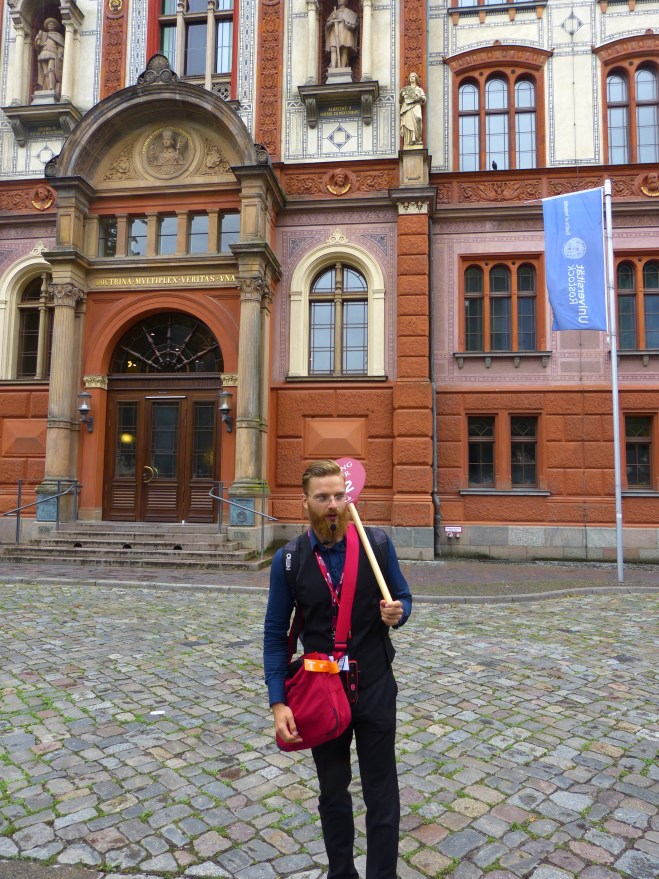
Other highlights of Rostock were its public University
Enrico in front of Rostock University, which was established in 1419.
Its lovely town square, surrounded by beautiful medieval buildings,
and playful fountains.
Kids enjoying the fountain in the town square
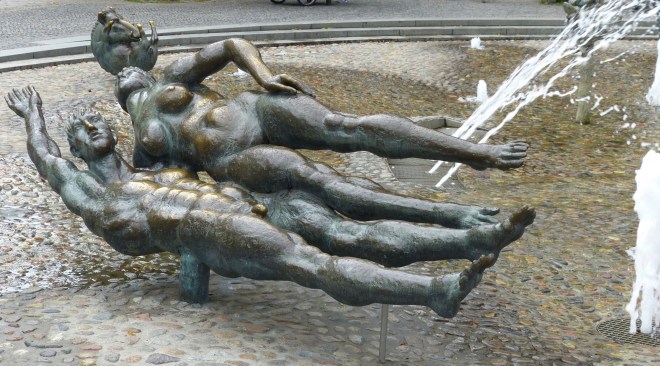
The Germans, like many Europeans, have a more open attitude about bodies and sexuality, as demonstrated by this bench in the fountain. (Yes indeed, it was IN the fountain)
What better way to follow up our time by the fountain than with a visit to St. Mary’s Church? Construction of this church initially took place in the 13th century, with renovations and restorations repairing subsequent damage that war and religious differences wreaked.
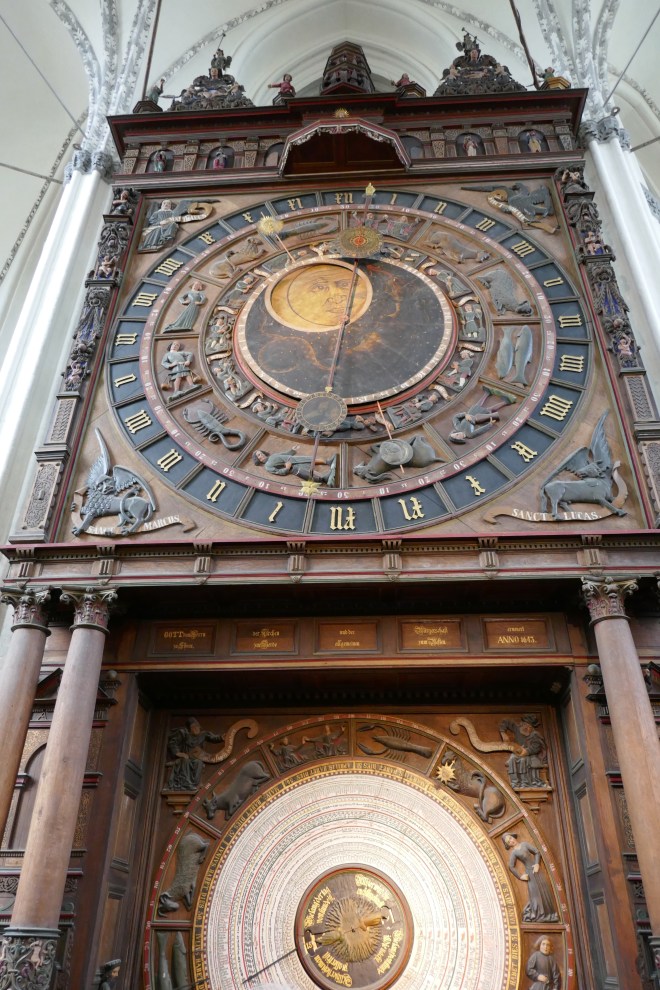
This was the first time we saw a ship dangling from a church ceiling, but it wasn’t the last.This clock inside St. Mary’s Church is incredible. The craftsman ship is amazing. So much detail!
We were fortunate to have a guide who is getting his degree in education. And what a wonderful teacher he will be. He shared information about German culture and society. Food in German is inexpensive, education is free and health care is free. The state pays 185 Euros per child per month to parents. All this is funded by a 35% income tax, with additional funding from taxes generated by exports.
One of the advantages of travel is learning how different societies address their problems. Enrico’s thesis is on what he termed America’s fascination with guns. As a contrast, he explained that 95% of the German police never fire their guns during their entire career. When they do, they aim for the culprit’s leg.
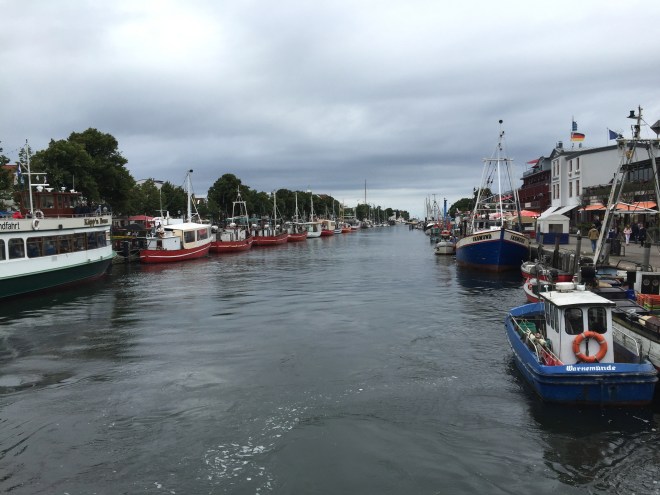
Our return to Warnemunde was via a ferry. Although the weather wasn’t the best, we wandered around this little seaside town, enjoying the sights.
WarnemundeWith skies like these, we decided not to linger
The best part of our decision to stay local was we had the rest of the afternoon to enjoy the beautiful Viking ship. We were welcomed back with open arms, and with glasses of champagne.
Another bonus? It was easy to get a reservation at The Chef’s Table, our favorite specialty restaurant.
Okay, just ONE food photo. This first of five courses, beef carpaccio, gives you an idea of the artistry of the Chef’s Table’s offerings. And yes, that red goblet by the plate is indeed a paired wine.
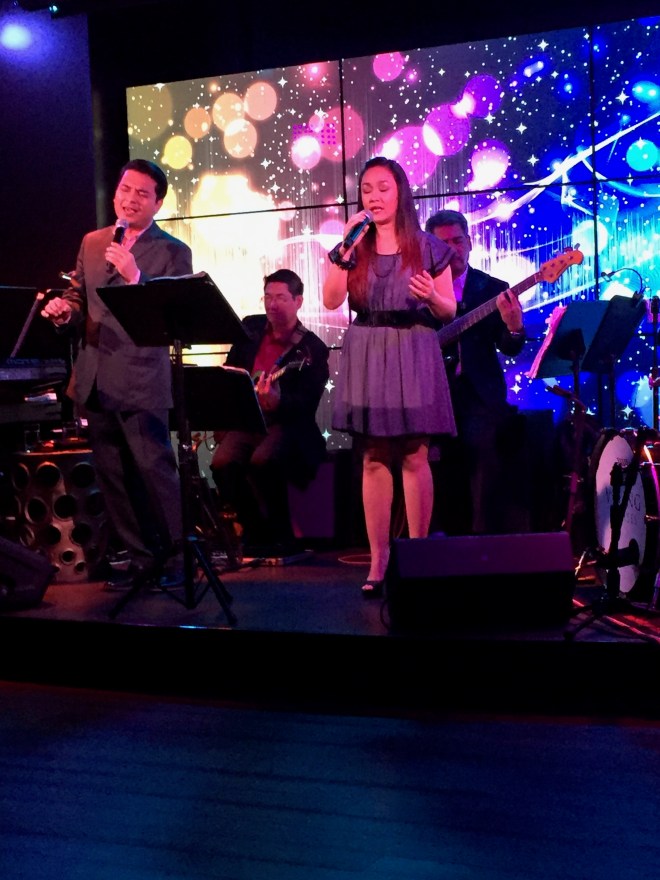
Because we weren’t exhausted from a long trip to Berlin, we had enough energy to visit Torshaven, Viking’s cozy little nightclub. Here’s the band belting out some Gloria Estevan songs that they learned at the request of our friend, Jeanne.
Our Viking tour had us scheduled for only a half day in Poland. We docked in Gdynia, which just happened to be the departure port for my husband’s grandmother, who was pregnant with his mother when she left Poland in 1923, searching for a better life in the USA. So that was kinda cool.
The tour choices were limited–a free city tour of Gdansk, or the optional tours to Stutthof Concentration Camp or Malbork Castle. Given that we had never been to Poland before, we chose the Gdansk city tour.
I’ll confess that I didn’t expect much. Squished between the two warring superpowers of Germany and Russia, it had been a battleground more times than I cared to count. Here’s what Gdansk looked like in 1945, after the Russians got through with it.
First surprise was the 45 minute ride to Gdansk. The main road was clean and green, with lovely trees, flowers and public buildings along the way. We stopped briefly at the Oliwa Cathedral, (which didn’t much impress me), drove by Lech Walesa’s house (I don’t think he was home), then arrived at the city that for a brief period was known as Danzig. (Until we arrived there I hadn’t made the connection. I really should have paid closer attention in World History, Freshman year.)
“Amazed” doesn’t quite capture what I felt when I saw how this city had been restored to its former glory. It is incredibly beautiful!
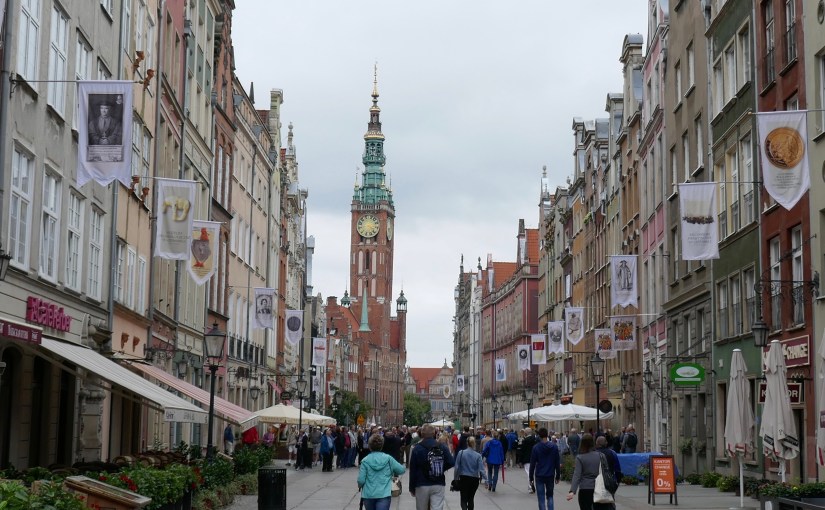
I love the pedestrian walkways in the old section of the city.
It was not too crowded, because it was relatively early on a Sunday morning
I also wasn’t aware that Daniel Farenheit was born in Gdansk– are we starting to see a trend here? In my defense, however, he lived most of his life in the Dutch Republic. Still, Gdansk is where he got his start and the city is rightfully proud of him.
Tribute to Farenheit in Gdansk
Another of Gdansk’s claims to fame is the 14th century human powered crane that was used to load and unload cargo, and is still in working condition. If you walk along the river, you will come to the brick building that houses the crane and its giant treadmill.
Here’s a scale model of the crane, the way it would appear from the river, a vantage point I didn’t have for my photographs.Workers would be strutting their stuff, inside this giant wheel shaped treadmill, which powered the crane. Am I the only one that sees a great opportunity for an exercise video? Just add music and spandex!
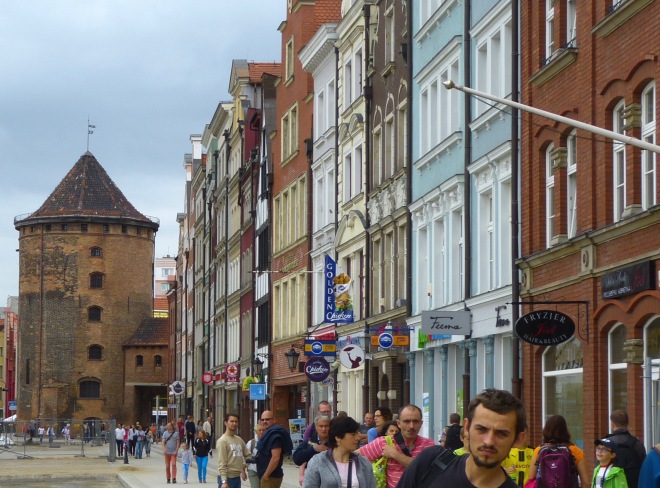
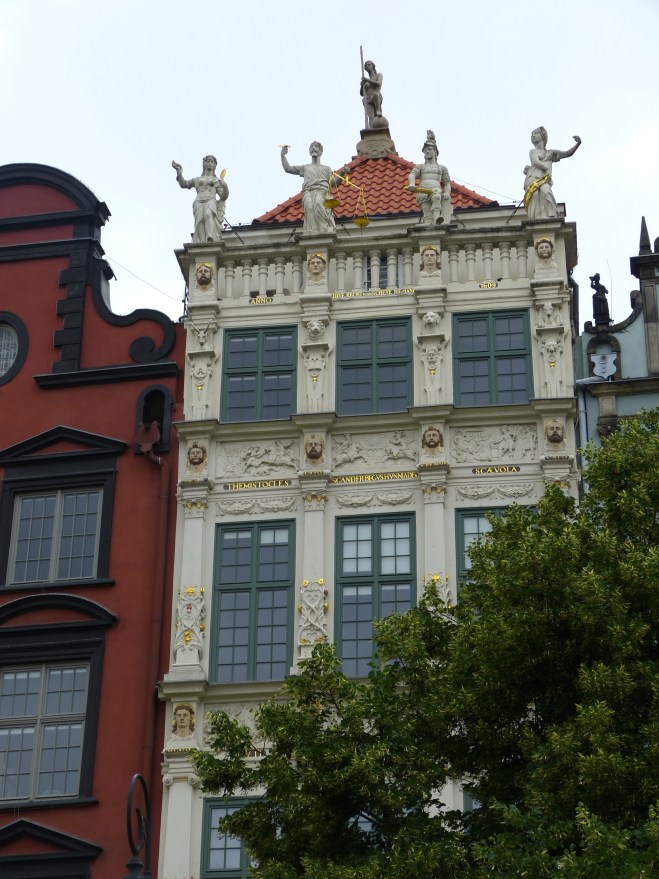
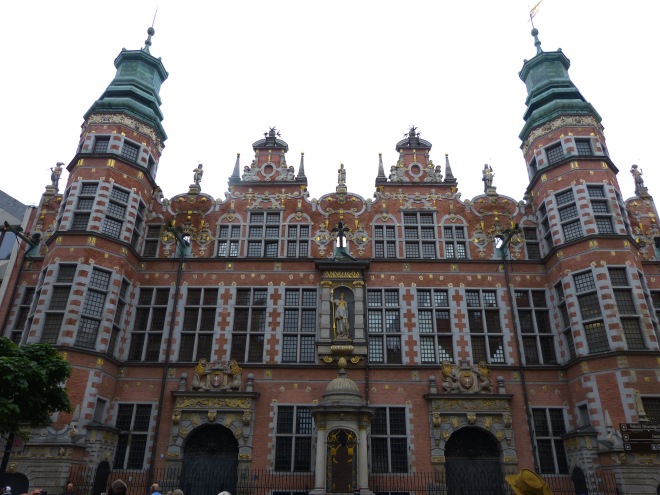
I loved the architecture–the attention to detail. Check out these beautiful buildings.
The building fas seen from a distanceA up close viewThe scales of justice appear atop several buildings
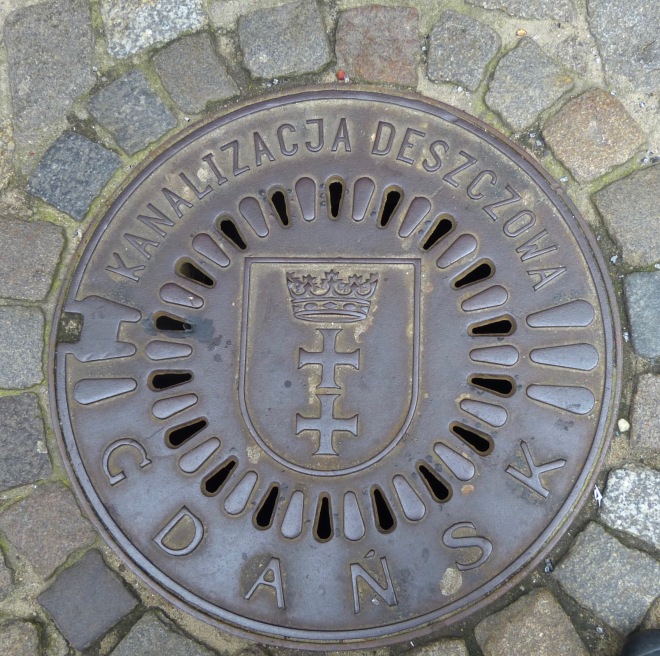
Everywhere you looked, you saw something beautiful. Even the sewer covers were artistic! If you click on the individual photos you should be able to get it to enlarge.
This restored building was originally built in 1605.
One of several gates to the city
And if you don’t think all of this is pretty bloody amazing, take another look at the 1945 photo to see the city after the Russians got through bombing it to kingdom come. The Poles have a lot to be proud of. (And I have a lot of Polish friends and relatives!)
Despite being well fed on the ship, we stopped in a little outdoor cafe, where I had the most incredible hot fudge sundae EVER. Now I’m regretting not taking a picture of it — it was so gorgeous, not to mention delicious. Oh well, you’ll just have to trust me on that one–till you can visit Gdansk and experience it for yourself.
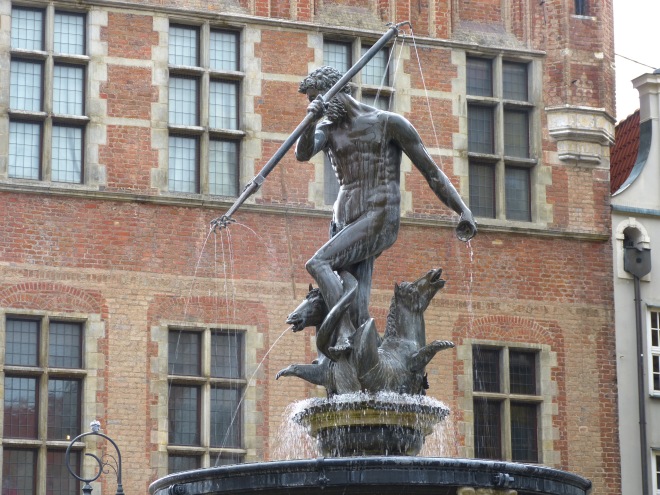
One last sight before I end this post. Neptune’s fountain. It is definitely worthy of multiple views.
One thing about the free Viking tours–it truly is the luck of the draw. We drove right by the Solidarity Monument without stopping. Friends that were on a later tour were able to get off the bus for a closer look, something that I would have liked to have done.
The take away? I have a much greater appreciation for Poland and all it has to offer. The great thing about a cruise is it helps you identify the places you want to visit again and linger.
Tallinn was the perfect respite from the opulence and grandeur of St. Petersburg. We boarded a bus early in the morning for Viking’s included walking tour of the old town. Our ship wasn’t scheduled to depart until 9 PM that evening, so my thinking was that the tour would give us an overview and we would return later to visit the sights that most interested us. At least that was the initial plan.
I don’t know whether it was the dreary weather, or the lingering effects of sensory overload from St. Petersburg, but after the tour concluded, WE concluded that the afternoon would be best spent partaking in some of the delights aboard our lovely ship. Still, we have a few photos to share:
Notice the umbrellas in the foreground. It rained off and on during the tour.View of the medieval “lower town” from a lookout in the “upper town”.
Cars and buses are not allowed inside Tallinn’s old town, so we followed the city wall down the hill to the town square,
main square
where we found an abundance of shops, cafes, and a medieval pharmacy, which is still in operation today.
We didn’t need to replenish our supply of wood louse infusions, earthworms in oil, or dried deer penises, so we left the pharmacy empty handed.
The Estonians seem to like three dimensional advertising. Here are just a few examples.
I loved the fire breathing dragon with the crown on his head, and the maiden advertising the “super sale”? She had lots of similarly attired companions scattered throughout the square.
That evening, we had dinner at one of Viking’s specialty restaurants, The Chef’s Table. This is a five course fixed menu, with wine pairings. That evening we enjoyed the “Asian Panorama” menu. The fixed menus change every three days, and we sampled three of them!
We started with chilled king crab made with coconut foam and curry, followed by lobster and chicken shu mai, which was a soft dumpling. Now ordinarily, I am not a fan of either of those seafood items, but these were delicious.
Next up was a lemongrass and red chili granita with lychee foam (there was a whole lot of foaming in this restaurant), followed by the main course–Peking duck with a mandarin pancake. Dessert was an Asian trilogy of chocolate banana spring roll, green tea cheesecake and yuzu creme brulee.
Unfortunately, I didn’t photograph the food–I was way too busy eating, drinking and talking, but if I had, you would have seen that the portions weren’t huge. At the end of the meal we were satisfied, not stuffed!
Our happy traveling companions, at the end of our dinner, after lots of wine!
Ahhh, Stockholm–there is so much to love about you! It’s a nice place to visit and I definitely would like to live here, but only in the summer. Arriving two days before we were scheduled to board the Viking Star was a very good decision indeed.
I haven’t done a numbered list in a while, so don’t you think it is time? Why not throw out 10 somewhat random reasons to love the city? There clearly are many, many more, but hey, we were a bit jet lagged and at our age, it is all about quality time. (Or was “quality time” what I told myself our kid was getting so I didn’t feel guilty about being a working mom? Doesn’t matter –both apply.)
1. THE INHABITANTS Everyone speaks English, and they do so willingly and cheerfully, without trying to make you feel stupid for being uni-lingual.
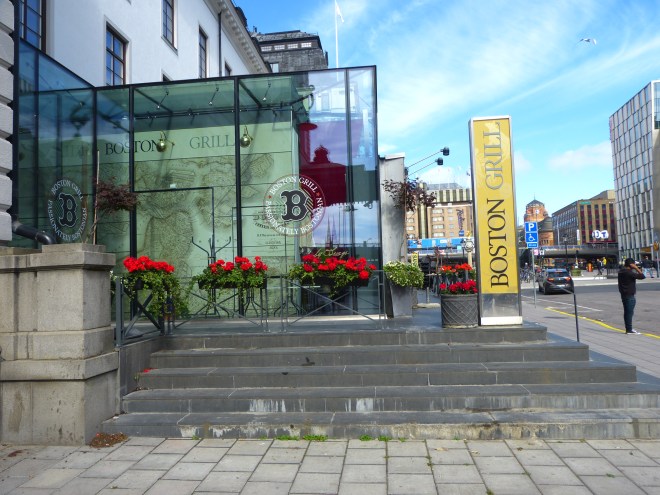
Boston Grill in Stockholm? They also had a TGI Fridays and a Texas Longhorn Steakhouse. We ate at none of them!They also like our music!
2. THE MASS TRANSIT SYSTEM Mass transit is easy to decipher, affordable, and appears to run constantly. We rarely had to wait more than 5 minutes, frequently less. Thanks to Rick Steves, we knew we should get the SL card, which was sold at Arlanda Airport. For about $16 (the Senior rate), we got a card good for 72 hours worth of rides on all modes of transportation: T-Bana, ferries and buses. When we departed, we still had 4 hours remaining, so we gave our cards (yes they are transferable) to our friends. What a deal!
Our friends, Edie and Ayhan, displaying the magic card as they get ready to board.
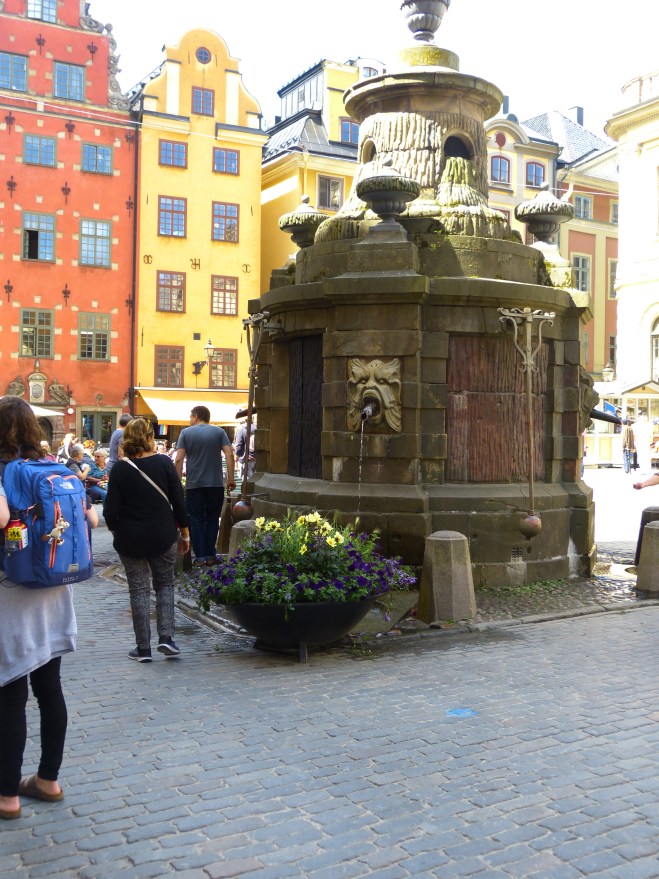
3. GAMLA STAN, THE OLD CITY The old town is absolutely charming. During the ’80s the government wanted to demolish the old buildings, replacing them with concrete and steel skyscrapers. Fortunately, the citizenry protested vigorously, and the idea was abandoned. Good thing, wouldn’t your say?
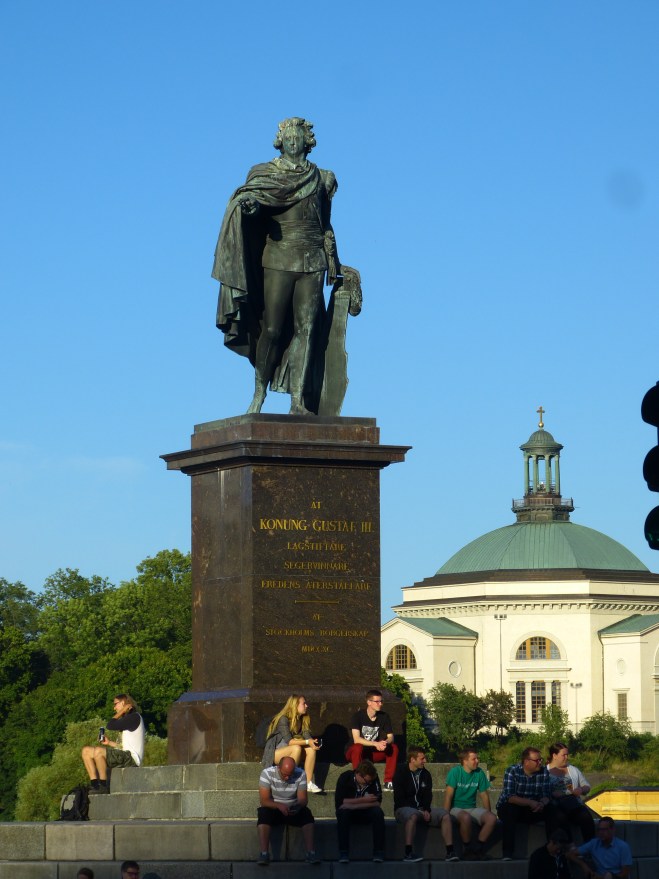
Former stock exchange, now Nobel MuseumIn this square, Swedish leaders were beheaded by the Danes. The son of one of the victims escaped, led a successful revolution and became Sweden’s first king.Tourists trying to distract the guard at the palaceThe King overlooks the harbor
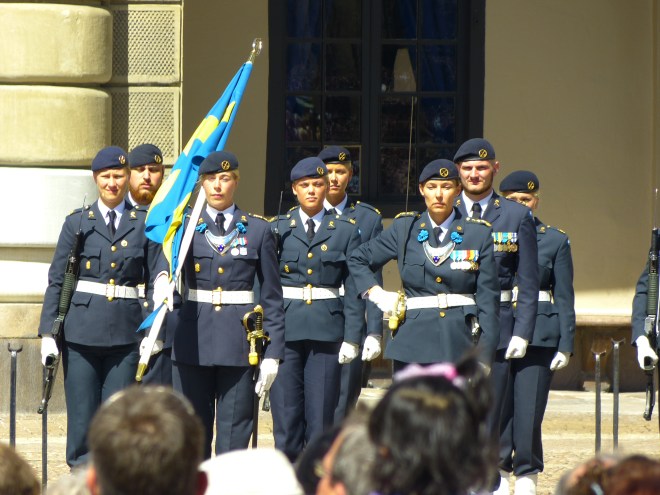
We followed part of Rick’s recommended walk, but after about 5 minutes worth of the Changing of the Guard, we’d had enough. My assessment? I wish we’d chosen another activity, like visiting the Nobel Museum. The Changing of the Guard consumed far too much time. It starts around noon, but you have to get their early enough to be able to see anything, especially if you want a bench in the shade. Benches were occupied, so we grabbed a column with a pedestal that we climbed upon. Even so, this was our view.
It helps to have a good zoom lensNotie the number of women in uniform?
4. THE RIVAL HOTEL
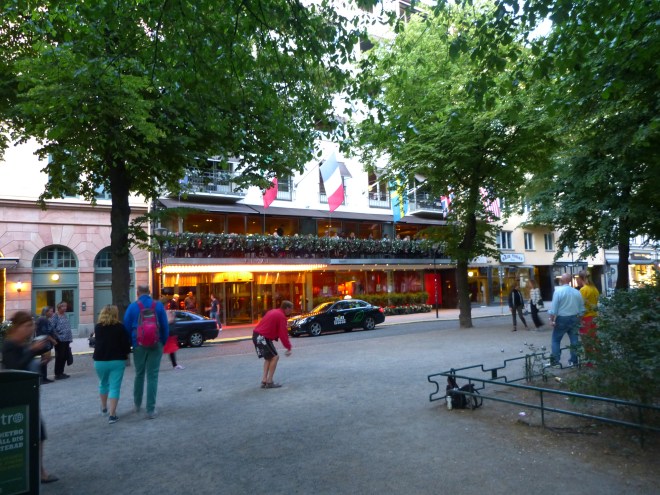
Less than three blocks from the T-Bana, in Sodermalm, this little boutique hotel is ideally located. You can sip wine on the restaurant’s balcony while you watch men play bocce in the park across the street.
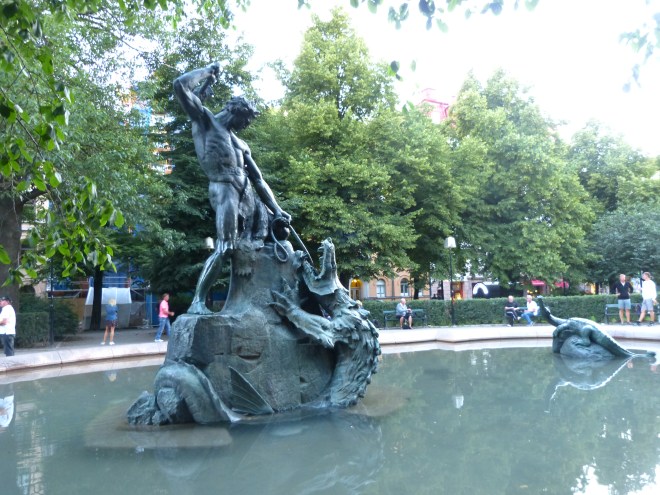
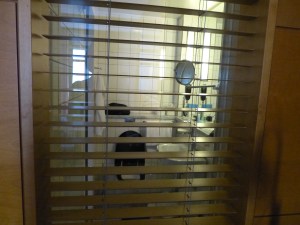
The Rival Hotel balconyStatue in the parkThe view from the room. Good thing the blinds closed!
We booked directly with the hotel, prepaid 6 months in advance, to get an amazing rate. The room was small, but very comfortable, although I must admit to being mystified by the strategic placement of the bathroom window. This is ONE throne room we didn’t want to view!
5. Kungsträdgärden
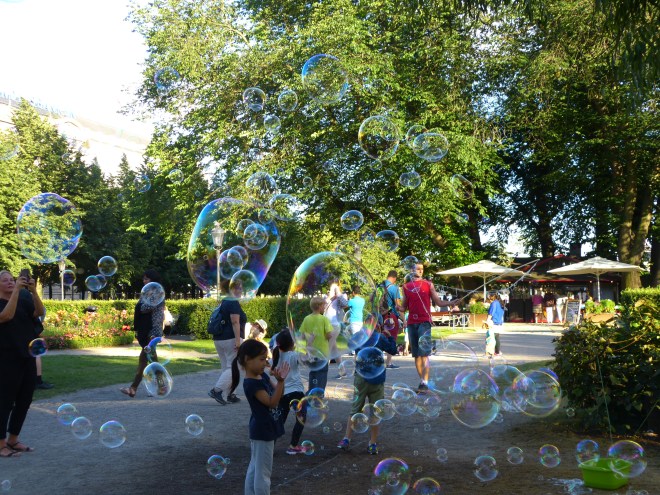
Perhaps those long winter months make the Swedes cherish these long, glorious summer days. It looked like EVERYONE was outside on this Saturday night, having a wonderful time.
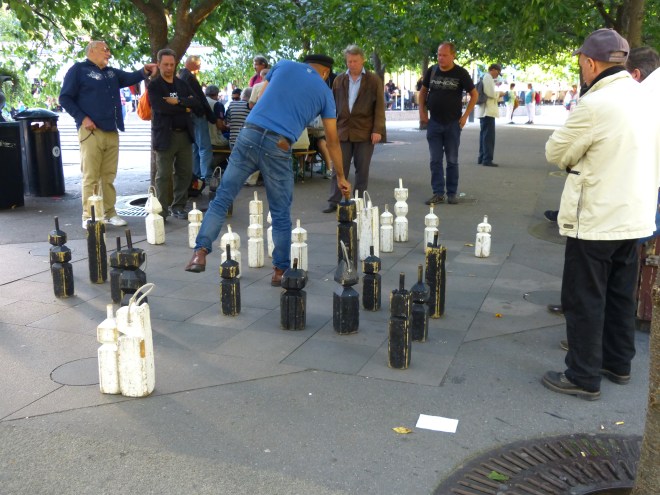
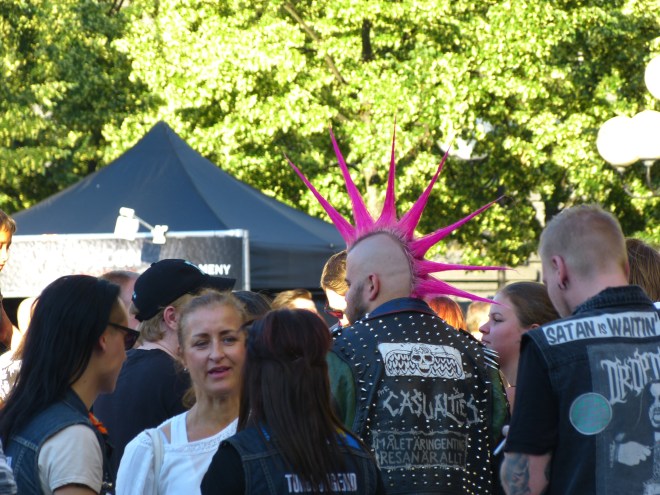
Kids love bubbles!Chess game in the parkFree rock concertHow did he DO that?
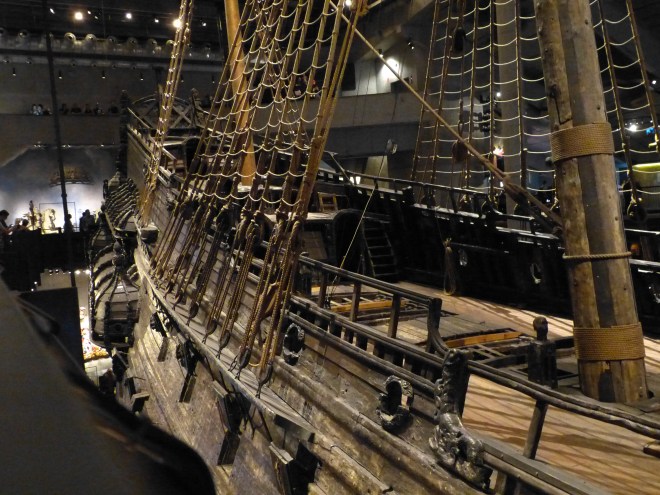
6. VASAMUSEUM Can you imagine spending months of your life creating glorious carvings that will ultimately become bulls-eyes for cannonballs? What were they thinking??? Fortunately, this ship was as top heavy as a playboy centerfold, and shortly after setting sail, it flipped on its side, then sank to the bottom of the harbor, where it remained for over 300 years.
Reproduction95% of the ship is the original!
The museum is absolutely fascinating, especially for those of us that grew up in a former whaling port. The admission price (It was less than $20), includes a film and a guided tour. I thought “Vasa” was Swedish for boat, because “Vaca” is the Maori word and “Barco” is the Spanish word. But no, the ship was named after Gustav Vasa. He was the son of one of the beheaded victims (at the fountain) who led the revolution against the Danes and became Sweden’s first king.
We used our SL ticket to catch the ferry to Djurgården, and used it again to ride a tram between the Vasa Museum and Skansen.
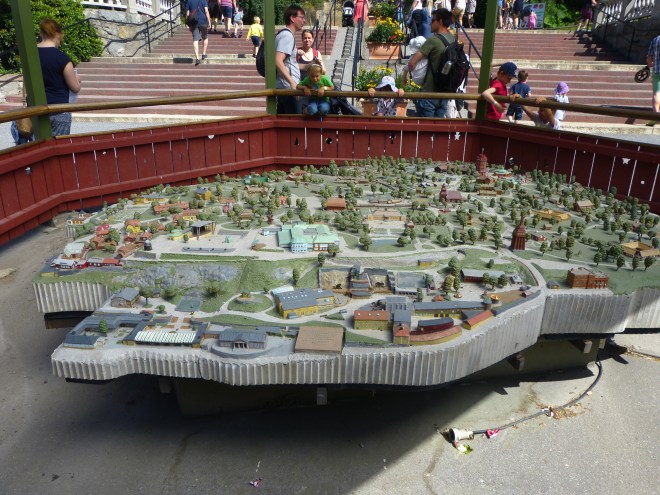
7. SKANSEN The Swedes call it an open air museum. WE called it the Swedish version of Plimoth Plantation and Waterloo Village. We had the perfect day and the perfect setting for strolling outdoors.
A model of SkansenWhat kid wouldn’t love these?Feeling adventurous?A beautiful garden with a beautiful view
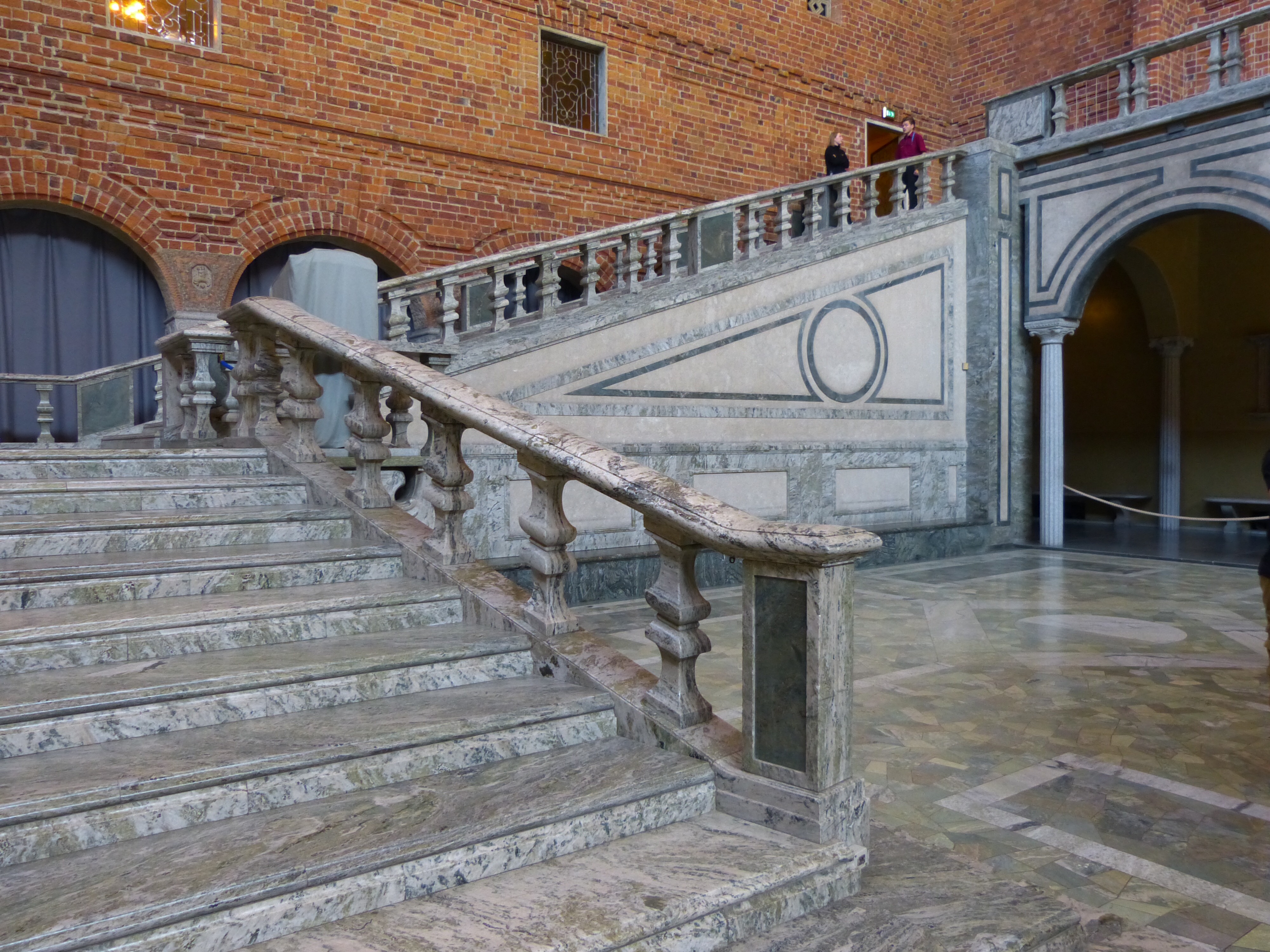
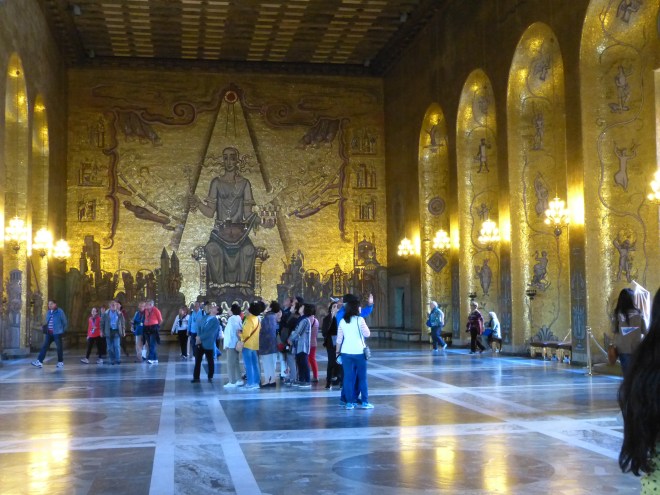
8. CITY HALL You may never win a Nobel prize, but that doesn’t mean you can’t visit the banquet hall and stand on the staircase where the presentations are made. The blue hall (which isn’t blue) is where the prize winners receive applause and a free meal.
Although I have not visited every city hall, I going to proclaim that this is one of the most (if not THE most) glorious one on this planet. The location, the mosaics, the architecture–all breathtaking!
It is hard to capture the beauty of the gold leaf mosaics in a photo. This hall was exquisite.
And if you have any breath left after touring city hall, you can climb #9.
9. CITY HALL TOWER Timed tickets ensure that the tower is not overcrowded. Yes, it IS 365 steps to get to the top, but it is SO worth the climb to for sn aerial view of Gamla Stan. Wouldn’t you agree? There are nine bells in the tower, and we made sure that we were not standing beneath them when they rang.
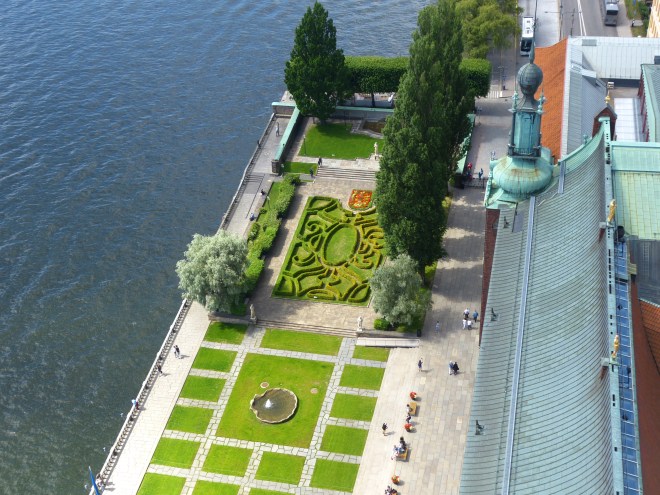
365 steps later, this is what we saw. And yes, that is our ship in the distance.The grounds surrounding city hall, as seen from the tower.
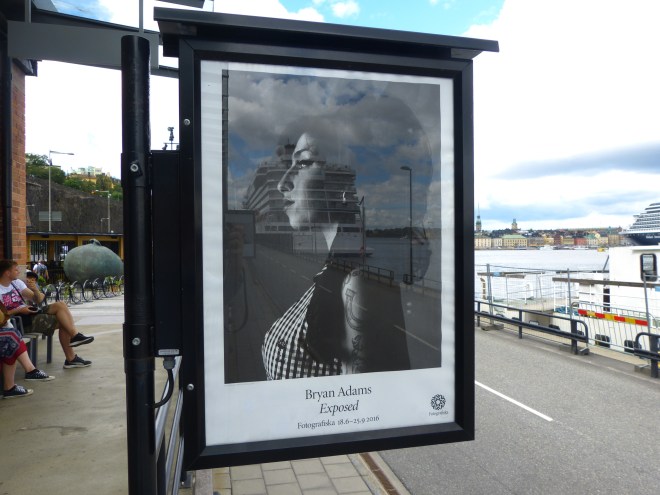
10. FOTOGRAFISKA MUSEUM Such luck! Our last day in port coincided with our friends’ arrival, allowing us just enough time to meet Edie and Ayhan in Gamla Stan for coffee. Right smack dab on our route to the Viking Star was the Fotografisca Museum, so of course we HAD to stop.
Our ship is reflected in this portrait of Amy Winehouse.
I had no idea that Bryan Adams was a Renaissance man–a musician AND a very talented photographer. I’m betting ( And it’s a petty safe bet) that his access to the celebrities was because of HIS fame. But for me, the most memorable part of the exhibit (and most emotional) were his photos of the British soldiers wounded in Afghanistan and Iraq.
Something tells me this won’t be our last visit to Stockholm!
My last post about Tibet was a bit of a downer, wasn’t it? As my friend Sally reminded me, “not every place is lovable”, but as with all travel, there are always positive elements, whether it be a greater understanding of a particular culture or country, or an increase in self knowledge.
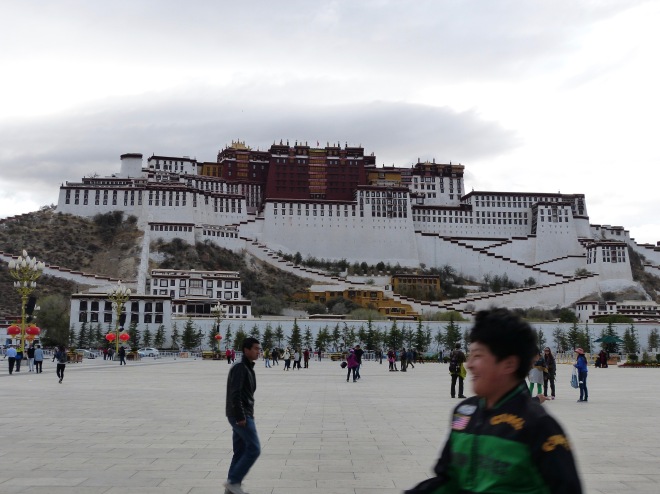
We not only saw the exterior of the iconic Potala Palace, we were also able to climb to the top and visit some of the interior on our way up. Built by the fifth Dalai Lama in the late 1600’s on the site of Songzen Gampo’s palace, it became the winter residence of successive Dalai Lamas. Photographs are not allowed of any of the interior rooms, but they were so dark, smoky and gloomy, it would have been difficult to get a good shot anyway.
The red sections were for religious studies; the white sections were the living quarters of the Dalai Lamas
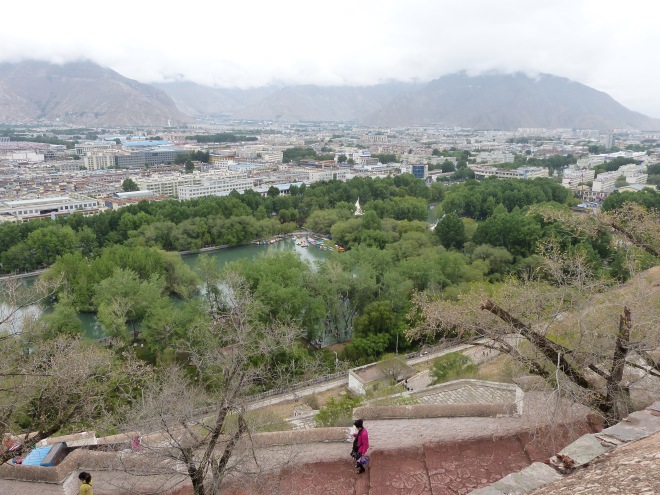
The palace, 13 stories high, offers a great view of the city of Lhasa.
The view from the top of the Potala
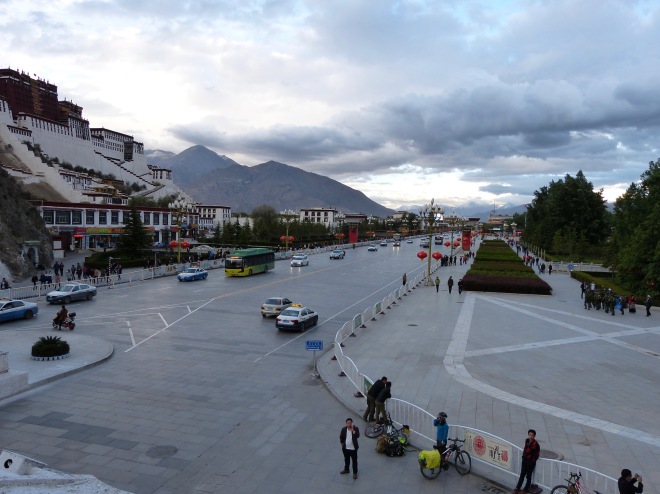
Here’s a different view, showing the modern city the Chinese have built around the Potala.
It was so hard to imagine a small child being taken from his family and brought to live in this massive place, surrounded by monks who were charged with his instruction. The current Dalai Lama was two years old when he was identified. He spent two years in a monastery near his family’s home in Amdo, then moved to the Potala two years later.
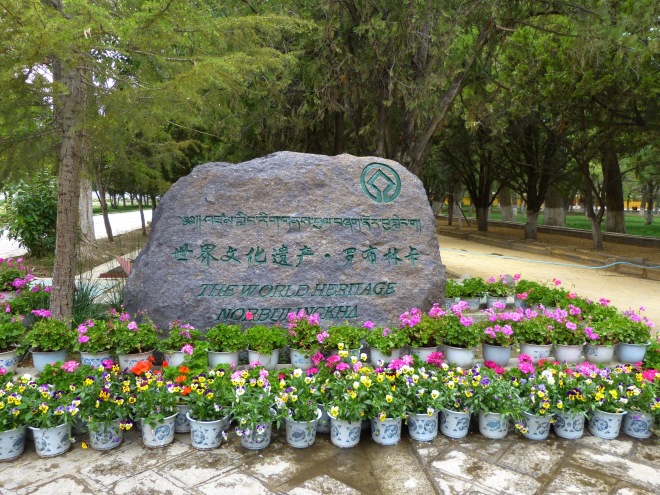
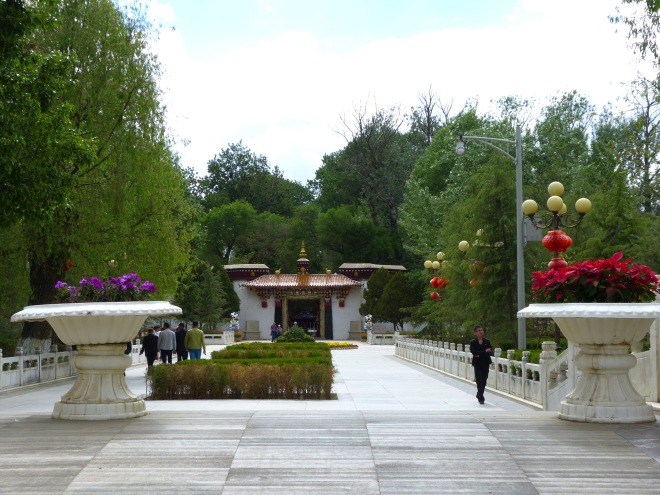
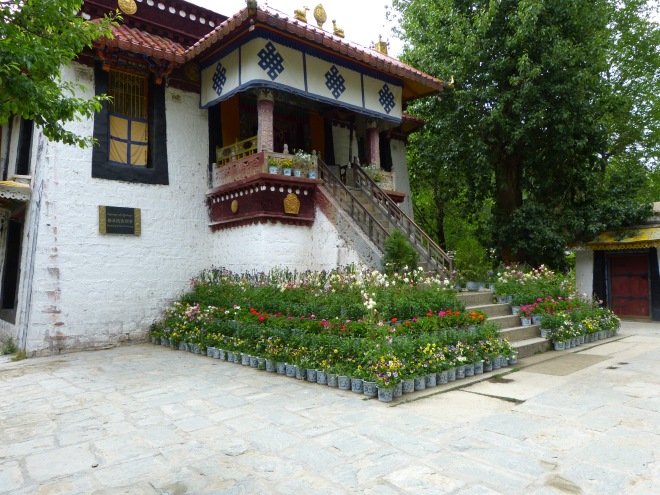
The summer palace, the Norbulingkha (Treasure Park) has a very different feel to it. This was built in the mid 18th century by the 7th Dalai Lama. It is actually quite close to the winter palace. The largest horticultural park in Tibet, it includes a private zoo, which wasn’t open when I visited. At one time it housed an elephant that was a gift from the Maharaja of Nepal.
Heinrich Harrer conducted lessons with the 14th (current) Dalai Lama in the summer palace. It was from this site that the Dalai Lama departed in 1959 to escape from the Chinese. Another fun fact: According to Harrer in his book “Seven Years in Tibet”, women were not allowed in the Norbulingkha because it was believed that they would have defiled the gardens.
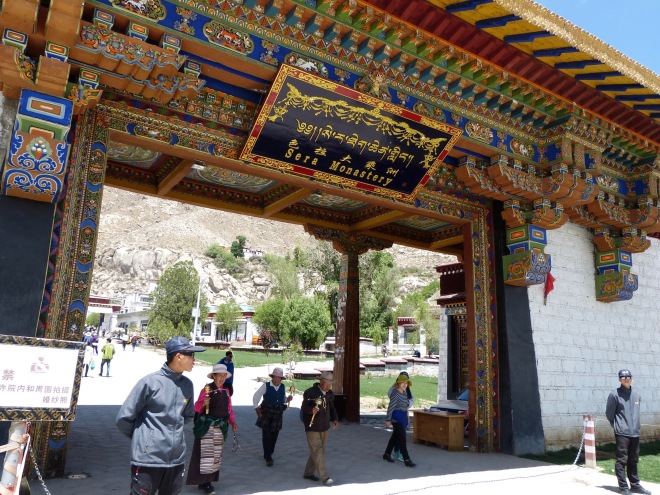
Two famous monasteries in Lhasa are located near the palaces. The Drepung monastery was being repaired, so we only visited the Sera Monastery. I was disappointed because I had learned in my pre trip reading that Tibet’s creation story was told in murals at the entrance of the Drepung Monastery, and I had hoped to see it.
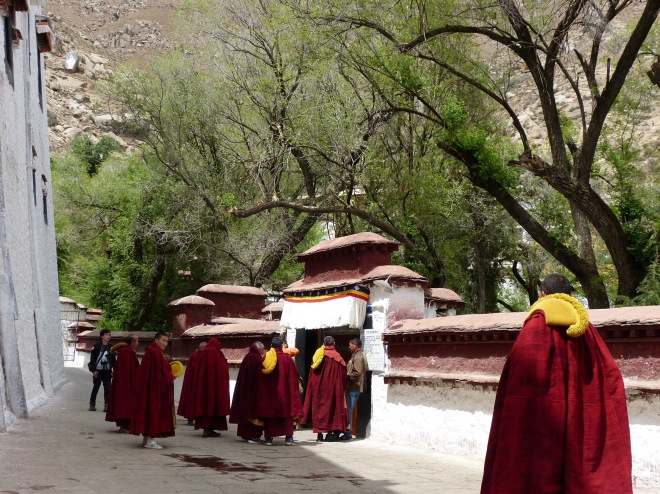
What we DID see were the Sera monks interacting in an outdoor courtyard. That yellow hats on their shoulders? It made me smile–all I could think of was Woodstock, Snoopy’s little friend.
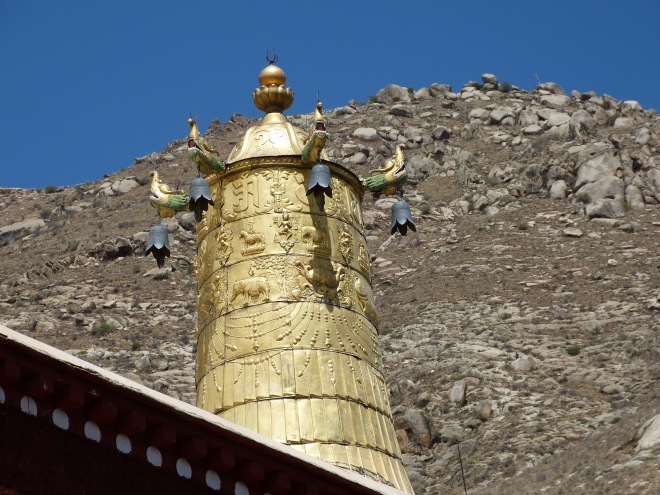
The detail on the exterior of the buildings was exquisite, however it was nothing compared to the tombs of the Dalai Lamas inside the Potala. Those looked like wedding cakes–5 to 7 tiers high, covered with carvings and encrusted with jewels and precious stones.
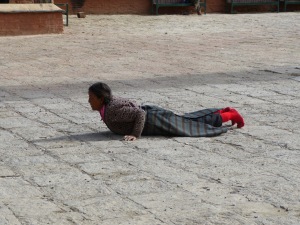
We arrived in Lhasa on 5/14, which was the start of a 15 day “festival” celebrating Buddha’s birthday. For Tibetans, a festival consisted of either walking around a sacred site, or prostrating themselves as they slowly made their way counterclockwise, praying as they went.
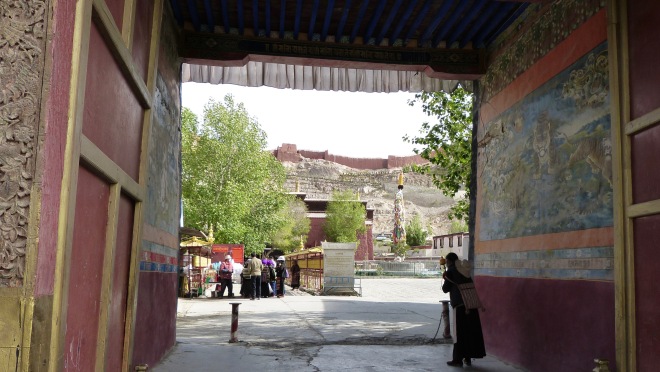
Leaving Lhasa, we traveled to Gyantse, where we visited the Palcho Monastery.
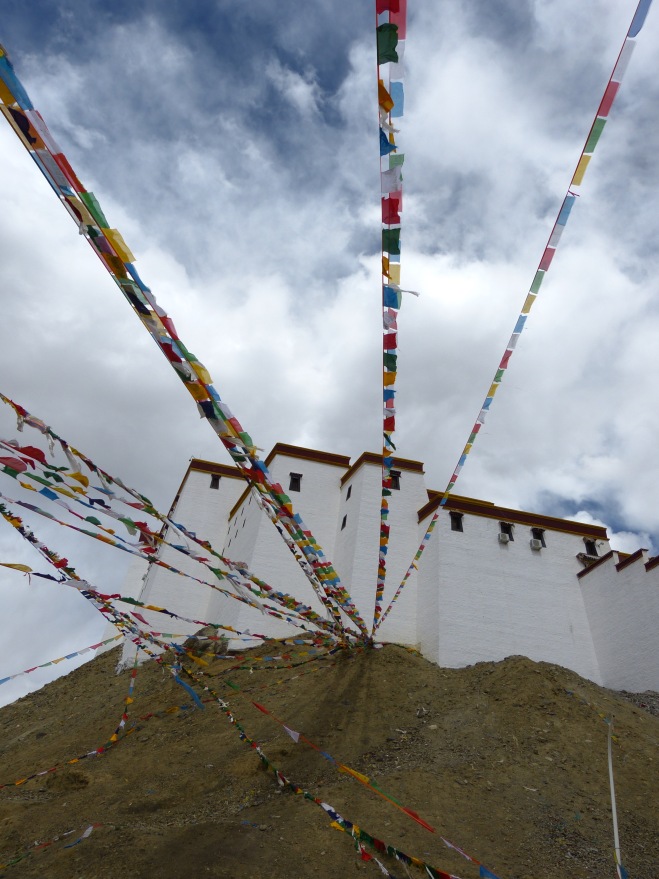
Here, you were allowed to take photos, as long as you paid a fee. In the distance, you can see the red fort that dominates the landscape.
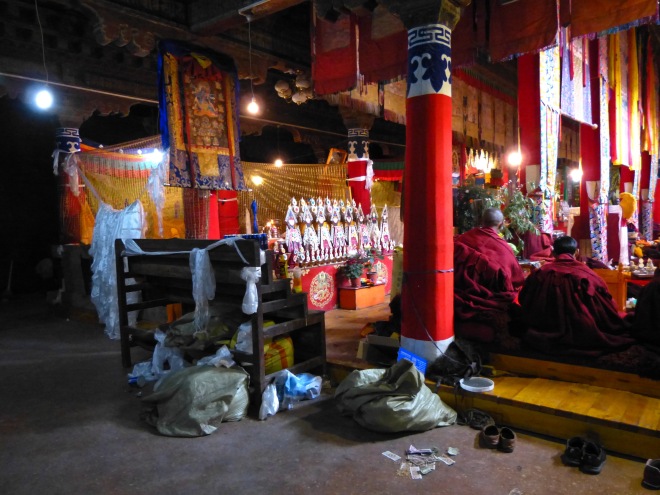
Plastic bags filled with offerings are scattered throughout the monastery. Devotees leave food, money, grain, white scarves (called Kata), whatever they have.
This monastery was built in the 1400’s; its interior looks very much like the interiors of the other monasteries, small chapels, very dark and smoky. I used a flash and the highest ISO possible to get these photos.
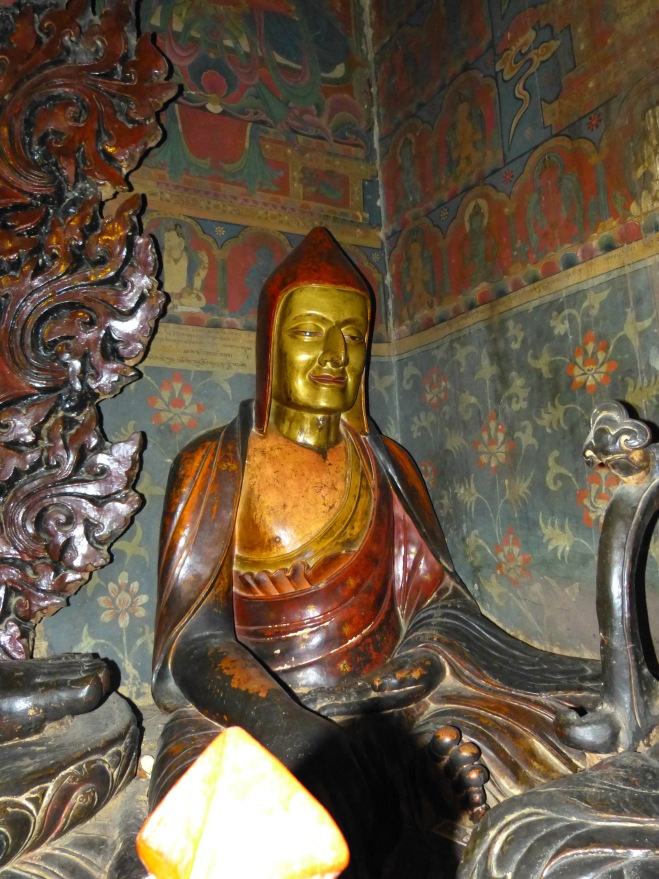
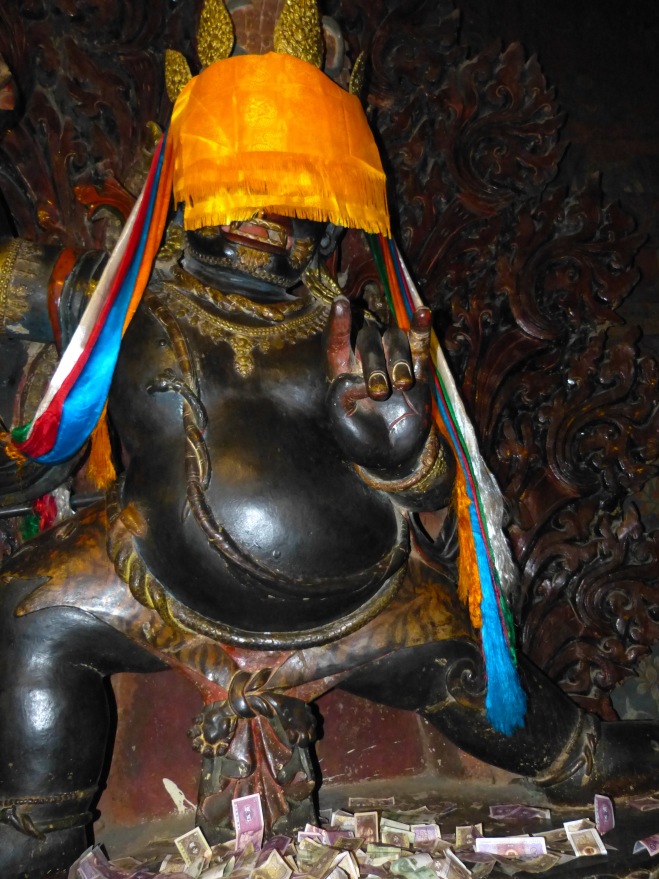
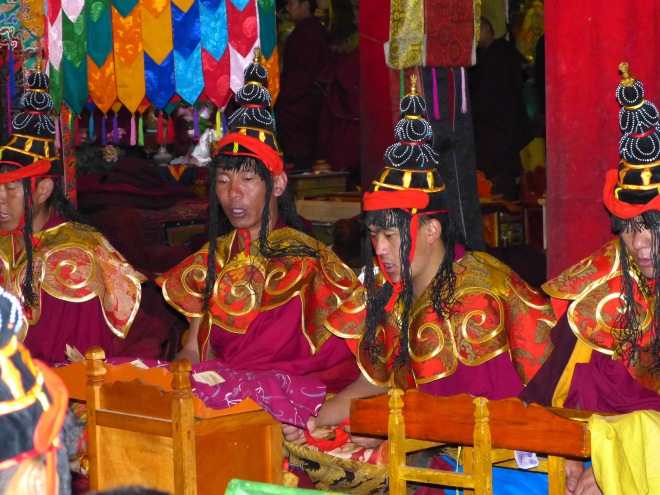
The founder of the “red hats”. Red hat monks are allowed to marry. “Yellow hats” are not. The Dalai Lama is a “yellow hat”.I asked why this statue’s face was covered. Our guide explained only those that complete a complex list of devotional activities are allowed to view his face.I have no idea which color hat these monks belong to–it looks like they hedged their bets with yellow, red and black. Plus, their hats come with bangs and braids.
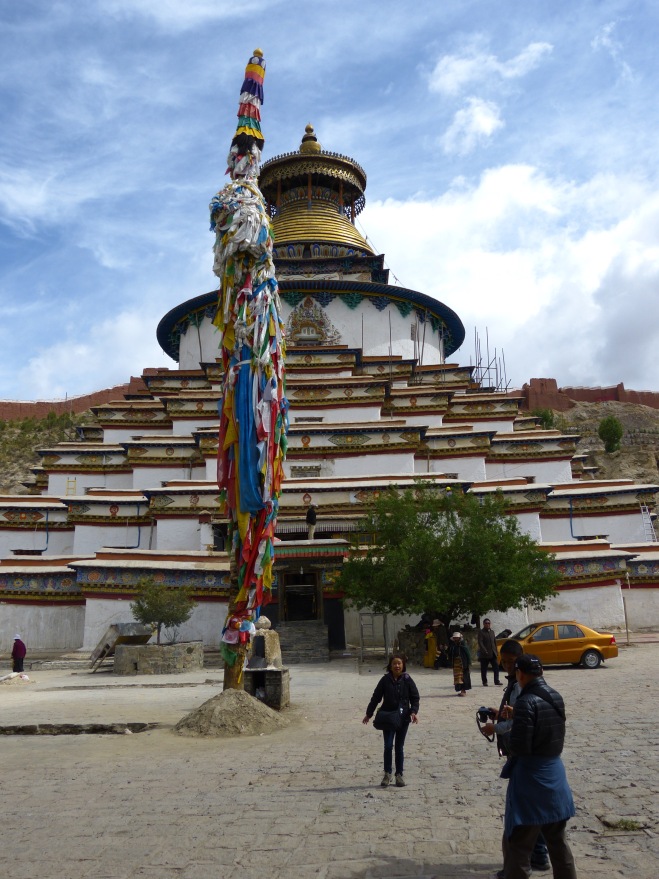
The other special feature of the Palcho monastery is the Kumbum Podang. (Don’t you love the name?) A Kumbum is a stupa that is also a three-dimensional mandala. The first five floors of this structure are square and the remaining four are circular.
Unfortunately, this building was also being repaired so we were unable to go inside, but according to Wikipedia, it has 76 chapels and shrines and is also known as the Ten Thousand Buddha Pagodas. Why? Because it contains ten thousand images and murals of Buddhas.
Gyantse is also notable because in 1904, the town and monastery were attacked by the British, led by Francis Younghusband. The Tibetans were armed with outdated weapons, but they had been assured by their religious leaders that their victory was preordained. In addition to their weapons, they were protected by talismans that they thought would repel bullets. They were mowed down, and the buildings were shelled.
In 1959, the Chinese attacked the complex and it was also damaged during the cultural revolution.
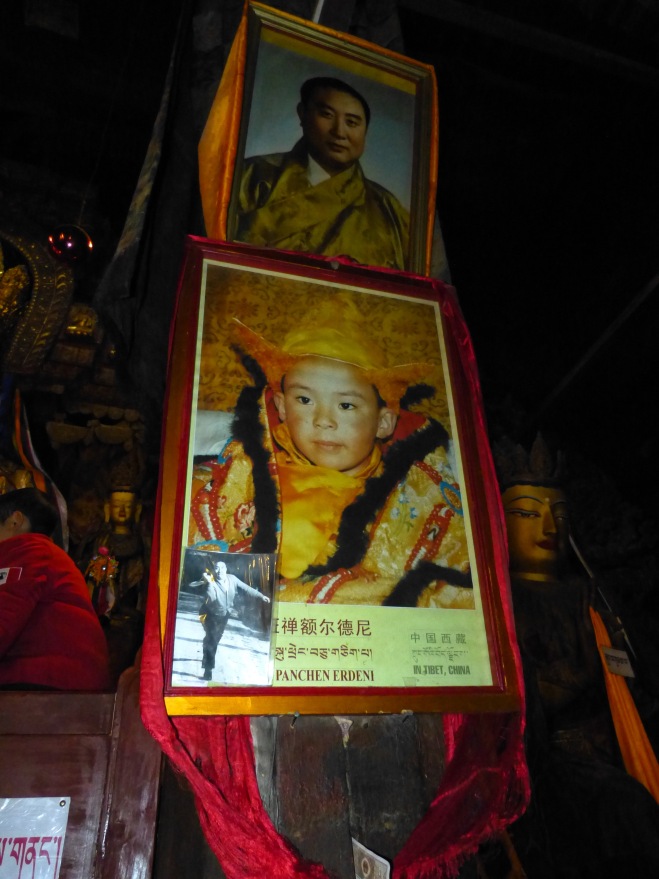
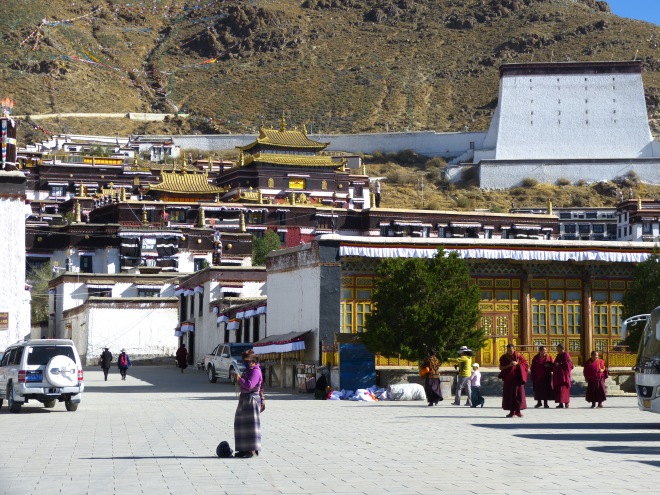
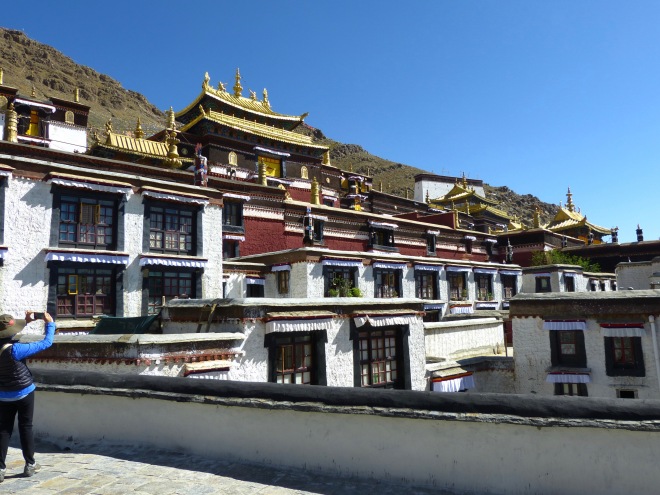
After one night in Gyantse, we traveled to Shigatse, Tibet’s second largest city and the location of the Tashilhunpo Monastery. This monastery has been the home of the Pachen Lama, the great scholar, and is where most of the prior Pachen Lamas are entombed.
This photo was taken in Gyantse–no interior photos were allowed in Tashilhunpo. The top photo is of the 10th Pachen Lama and the bottom is of the current (11th) as a child.
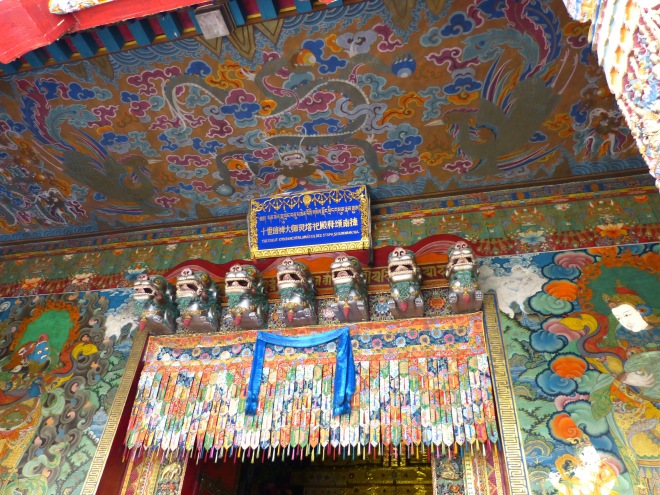
The 10th Pachen Lama was taken to China as a child to be educated. Although he initially supported the Chinese incursion into Tibet, after returning home and seeing the impact on his country, he began to speak out. This resulted in his being tortured and imprisoned in China for 16 years. After his release, he married a Han woman, had a child and returned to Tibet. He died suddenly in 1989, at the age of 51 shortly after giving a speech critical of the Chinese government. His resting place is an amazingly beautiful tomb, with gold carvings and jewels, similar to that of Dalai Lamas in the Potala.
The entrance to the tomb of the 10th Pachen Lama
There was considerable controversy over the selection of the 11th Pachen Lama. The Dalai Lama’s choice disappeared after being named and the Pachen Lama chosen by the Chinese, now in his 20’s, is still being educated in China.
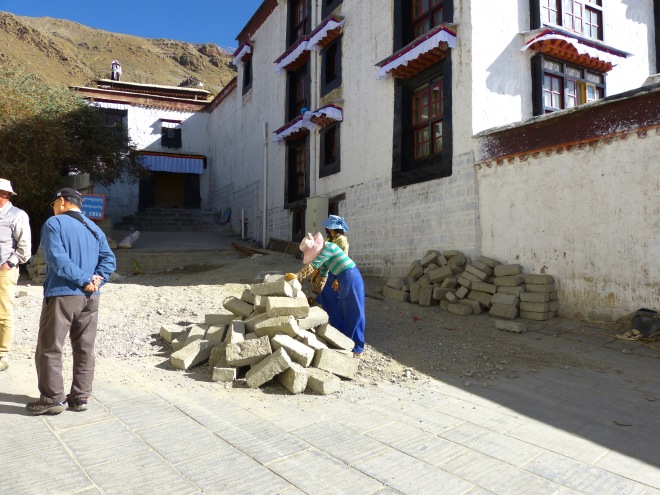
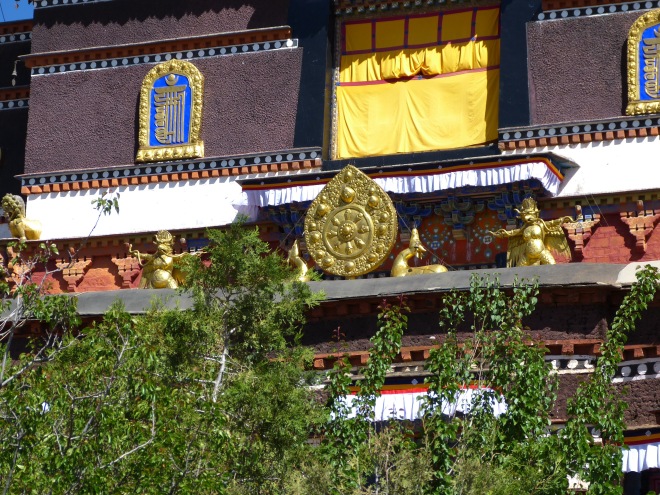
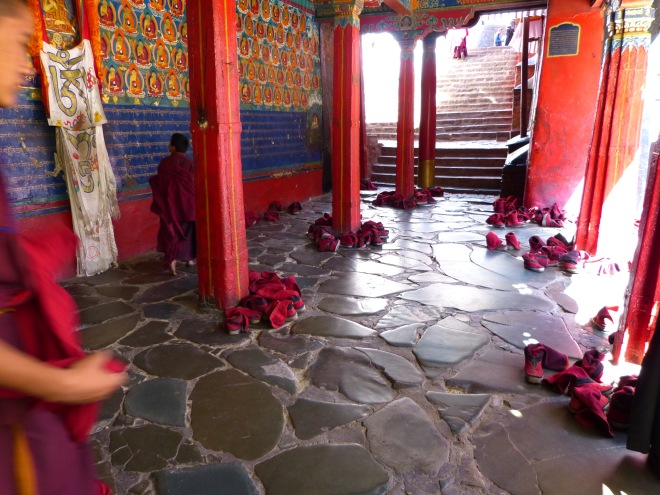
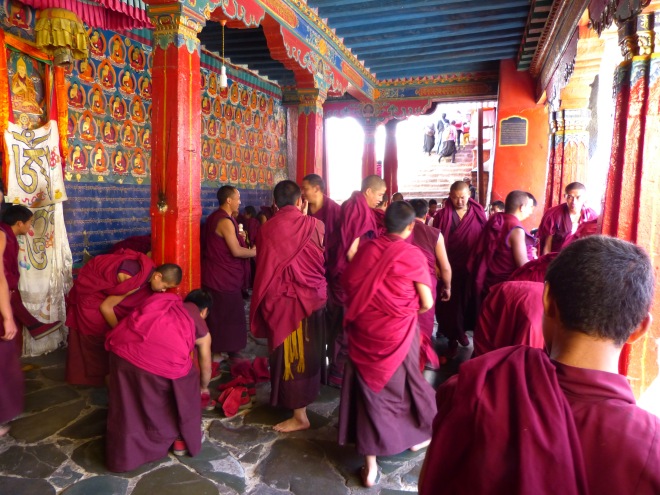
Entrance to the Tashilhunpo MonasteryInside the Monastery. No photography allowed inside the buildingsLook who is doing the manual laborThe Mandala surrounded by two deer is seen on most buildingsHow can you tell which shoes belong to whom?Apparently they are able to figure it out!
Because we were in Shigatse for two days, we were able to wander through the city on our own. Marilynn, my energetic buddy, and I climbed to the Shigatse fort that overlooked the city.
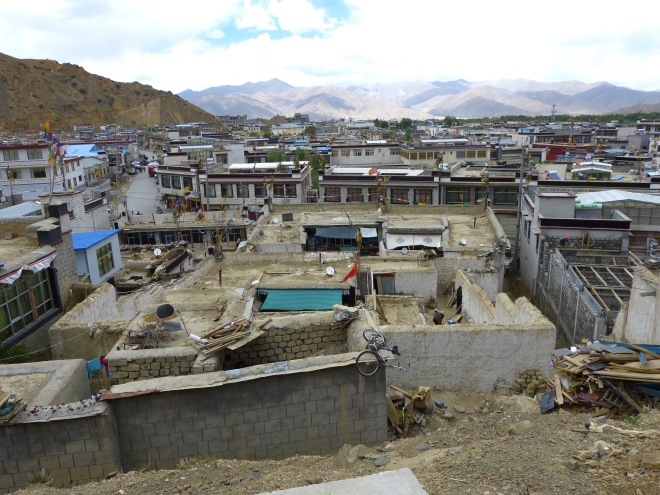
Shigatse Fort overlooks the city. As with many buildings in Tibet, it is being repaired, so no entry allowed.From the fort, you can get a good view of the city. Not sure what that bike is doing on top of the building!He was as interested in us as we were in him.
For some reason, the ride back seemed far more pleasant than the ride to the two cities. Perhaps it was because we traveled back along the river or maybe it was because we knew what to expect for toilet facilities?
Impromptu bathroom stopScenery along the way back to Lhasa
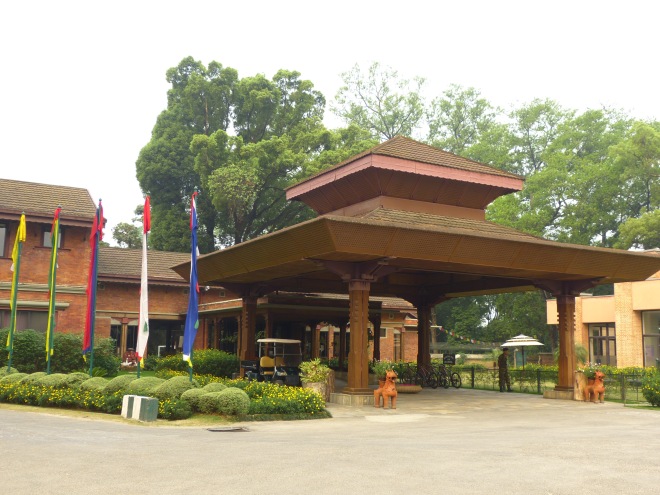
After Shigatse, it was back to Lhasa for our return to our gorgeous hotel in Nepal, the Gokarna Forest Resort. Great food, margaritas, beautiful surroundings, greeted by our wonderful Nepali guide Binoy– we were SO very glad to be back in Kathmandu!
I’ve been home for a little more than a week. It took almost that long to get back to normal after seven days in Tibet.
I expected to love Tibet. I WANTED to love Tibet. Sadly, very sadly, I didn’t.
Have I turned into an “ugly American”, critical of a country when it isn’t like home? I certainly hope not.
It is entirely possible that I was spoiled by the fantastic guides and the wonderful experiences we had in Bhutan and Nepal, and expected more of the same. Or maybe it was because for the first three days in Lhasa, I was fighting a cold and the Tibetan’s version of Montezuma’s revenge, adjusting to the altitude and possibly reacting to the Diamox I’d taken for altitude sickness. Whatever it was, I was not feeling great. I missed two afternoons of sightseeing in Lhasa so I could sleep my way to feeling better.
Although I had read up on Tibet and had checked the Overseas Adventure Forum before booking the trip, there were still a few surprises. After much soul searching, I’ve uncovered what might have influenced my feelings about Tibet, AND am offering some tips so that future travelers might make their experience more enjoyable.
The China Factor Knowing that China had taken over Tibet was not the same as experiencing the impact of that takeover. This is the closest I’ve ever come to being in a police state. Those two white objects on the dashboard are cameras–one pointed inward so the police could monitor what was going on in our van whenever they wanted.
Dashboard cameras
And yes, that IS a military convoy, in front of us, hauling big guns. Although you can’t see it in the photo, in every truck, two soldiers were pointing their weapons out the back. I was very grateful the road wasn’t bumpy!
Although the hotel in Lhasa offered free wifi, we quickly discovered that google, yahoo, safari, the New York Times, and many email accounts were blocked by the Chinese government.
Being under constant surveillance has to have an impact on the psyche of the population, and I believe it did. Unlike Bhutan and Nepal, the people in Tibet didn’t seem as interested in interacting with tourists. Or maybe they were afraid.
Tip: If it is important to stay in contact with family back home, set up a hotmail account. For some reason, that email service wasn’t blocked. Also, texting works. My iPhone allowed me to send free “imessages”!
Altitude and Air The air is very dry because of the altitude and very smoky from cigarettes and incense. Everyone smokes everywhere–in the hotels, restaurants, on the street. It was like being trapped in a Mad Men episode, but with different costumes. You can request a non-smoking hotel room, but there is no guarantee that you will get anything other than a smoking room sprayed with air freshener.
If the cigarette smoke doesn’t get you, then the incense and Yak butter candles in the temples will.
At times, inside the temples and monasteries, I found it challenging to breathe.
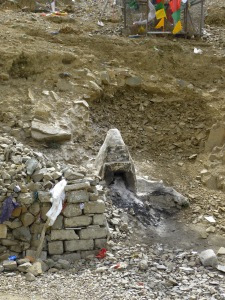
And if you think stepping outside to breathe in fresh air would help, think again. These little chimneys for burning incense are everywhere!
Tip: The 5th floor of the Xin Ding Hotel is the only nonsmoking floor. The other hotels don’t have that option, but 4 of the 7 nights are spent in the Xin Ding, so it is worth it to request a room on the 5th floor. If you’re lucky, you’ll get a wonderful view of the Potala from your room.
The hotel makes sure you can buy whatever you need without leaving the comfort of your room: toothpaste, manicure tools, condoms, mysterious things in plastic bags with Chinese writing on the front…
Long Drives in a Small Van over a Barren Landscape
Fortunately, no one in the group was very large. At 5’8″, I was the tallest. If my 6’3″ husband had been with us, the 8 hour drives from and to Lhasa would have been quite uncomfortable for him.
2 rows of three seats. Not a lot of leg room for tall people!
But the size of the van wasn’t the problem. No, the challenge was the lack of bathroom facilities along the way. Not only that, but we quickly discovered that squat toilets were the only option. The good news? You never had to ask for directions. All you had to do was follow your nose. Another plus? Many of them had no stalls or partitions, so you could make new friends while emptying your bladder. Let me tell you, it was much more pleasant to look at my neighbor’s backside than to look down at what had taken place before I arrived.
It didn’t take long for me to decide that a bush, a rock or a tree was far preferable to the few roadside bathroom facilities. Did I mention that I was drinking more water than usual because of my cold, the dry air and the altitude medication? Those were LOOONG drives!
Tip: Tiger Balm or Vicks applied under your nose blocks out all other smells. Unfortunately, I had neither with me. Women need to practice their squats before embarking on this trip!
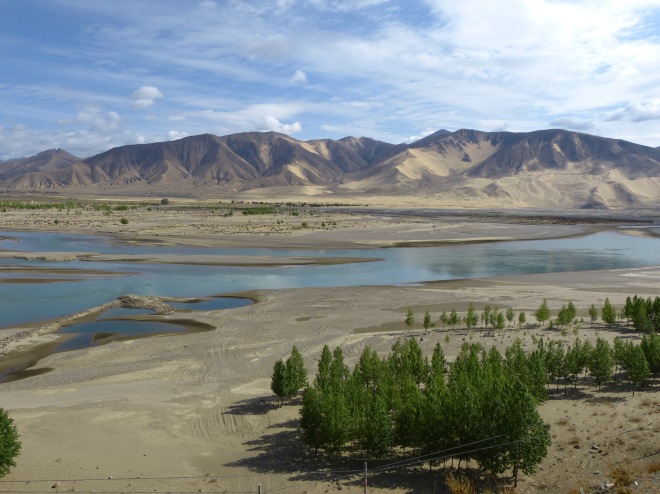
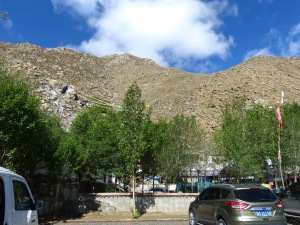
The landscape on the drive to Gyantse was rather stark.
Yes, we did indeed drive on that winding mountain road.
Our guide had to stop at multiple police check points along the way to show our passports and to complete paperwork, and to have our speed monitored. I didn’t think that was a bad thing, given the narrow winding mountain roads, but Marilynn disagreed. When our driver and guide took a cigarette break, leaving the keys in the van, she offered to take over and get us to the hotel in record time!
Here are the notable sights during our 8 hour drive to Gyantse.
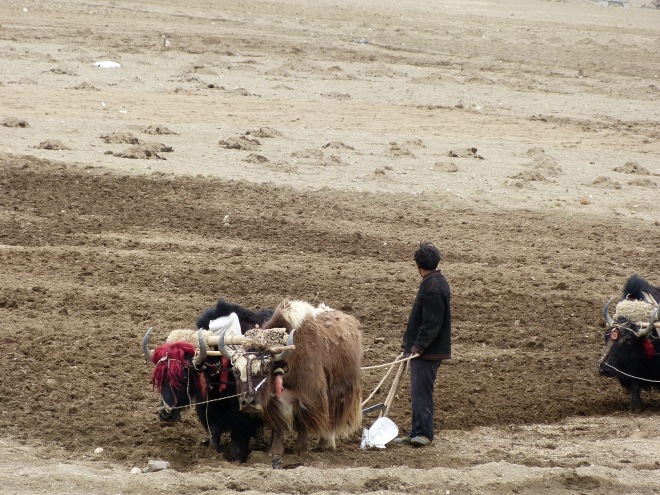
Prayer flags looked very different from the ones we saw in Bhutan.One of the two passes.Farmers, plowing with their yaks
Farmers, plowing with their yaks
Prayer flags looked very different from the ones we saw in Bhutan.
One of the two passes.
Tip: My iPod was my salvation; our guide and driver talked to each other in Tibetan for much of the way, so I was grateful I could plug in and listen to music instead.
Our Guide
Tibet has many wonderful myths and legends; I was looking forward to hearing our guide elaborate and offer the local version of the stories I’d read. Unfortunately, he either was not allowed to relate them to us, or perhaps during the 50+ years since China invaded, the legends stopped being passed along. He certainly couldn’t access Wikipedia to supplement his knowledge!
Mt Kalish? I don’t think so.
For example, our guide told us this unspectacular pile of rocks is Mt. Kalish. According to Google, Mt. Kalish is located in a very remote part of Tibet, and is visually spectacular. That “mountain” was neither. But Tibetans do circumambulate its perimeter, and it has been the locale for “sky burials”. (A few days after someone dies, the body is cut up, brought to the mountain top and left for the vultures to consume, thereby completing the circle of life.)
I had hoped to learn more about the Goddess that was transformed into Yamtrok Lake, but once again, our guide wasn’t able to elaborate, so here’s what I learned from my reading. After arguing with her husband, a goddess decided to leave him forever by turning herself into a lake. Boats are not allowed on Yamtrok because the vessel would slice her skin. I also learned that Tibetans believe if the Lake ever goes dry, all Tibetans will perish.
Yamtrok Lake
After returning home, I turned to Google, where I discovered that senior monks go to Yamtrok Lake after the Dalai Lama’s death. They throw sacred objects into the lake, then watch for a reflection that will tell them where to find the next (reincarnated) Dalai Lama.
Tip: Learn everything you can about the culture and myths before coming to Tibet. The information the guide imparts could be very limited.
Food
You don’t travel to Tibet for the food. There is a reason Tibetan restaurants aren’t popping up in major cities, still, we had hoped for great Chinese food. Two of our group were born in Hong Kong, spoke and read fluent Mandarin. They were not fans of the cuisine.
Be prepared for very basic meals, with no snacks in between. There isn’t much fruit, however I discovered that you CAN buy bananas.
Tip: I had brought granola bars, but shared them with the other travelers during our long rides in Bhutan and Nepal. By the time we reached Tibet, my stash was gone. Big mistake. It’s a good idea to bring packaged snacks.
The Locals
For me, interacting with the locals, especially children, is always a high point of my trips. Unlike in Bhutan and Nepal, opportunities to interact were limited.
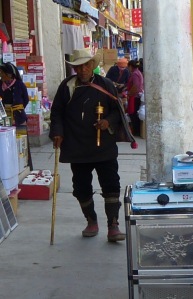
While in Shigatse, I spent our two free afternoons wandering through the city. I was taking photos of the street when I was accosted by an old man with a walking stick in one hand and a prayer wheel in the other.
I was afraid that stick was going to be used as a weapon against me!
He was yelling at me, and for a moment I was afraid he was going to hit me. He apparently thought I had photographed him–although the truth was I didn’t even notice him. I was more interested in the goods on the sidewalk. End result? There are no photos of Tibetan people.
But I didn’t let that one unfortunate incident keep me from trying to interact with the locals.
Did you see him in the above photo? Neither did I!
I had learned to say “Tra-shi-de-lay”, which is close enough to the Tibetan greeting to occasionally get a smile.
During my second afternoon purchasing bananas, I noticed a Tibetan trying to take a picture of me with her cell phone, so I posed for her. Out of the corner of my eye, I caught a young man attempting to get into the photo, so I turned, threw my arms around his neck and put my cheek next to him. And the crowd went wild! Not only that, but I got my bananas for half of what I had paid the day before. Sorry, no photos of that exchange because I had left MY camera back in the room. I didn’t want to take a chance of being smote with a stick!
Tip: Learn a couple of Tibetan words, smile and see if you can make a connection.
That’s all for today. Next post will be more upbeat, I promise. There will be photos of what made the trip special.












































 Tip: The 5th floor of the Xin Ding Hotel is the only nonsmoking floor. The other hotels don’t have that option, but 4 of the 7 nights are spent in the Xin Ding, so it is worth it to request a room on the 5th floor. If you’re lucky, you’ll get a wonderful view of the Potala from your room.

 Our guide had to stop at multiple police check points along the way to show our passports and to complete paperwork, and to have our speed monitored. I didn’t think that was a bad thing, given the narrow winding mountain roads, but Marilynn disagreed. When our driver and guide took a cigarette break, leaving the keys in the van, she offered to take over and get us to the hotel in record time!





 Destination NOW