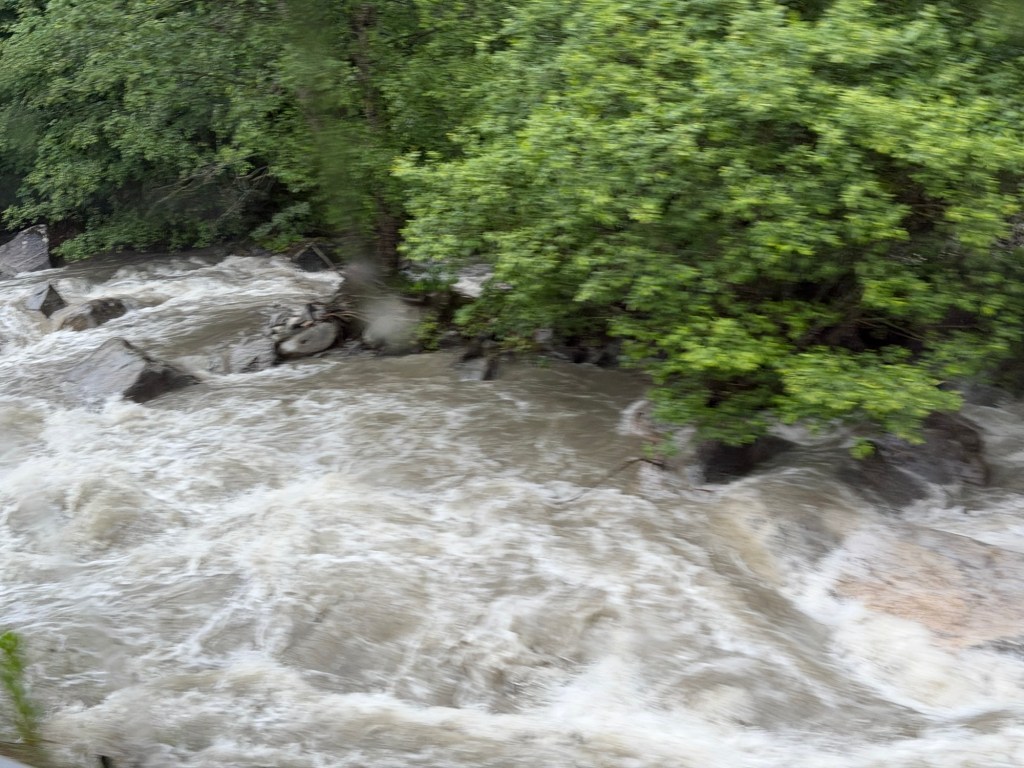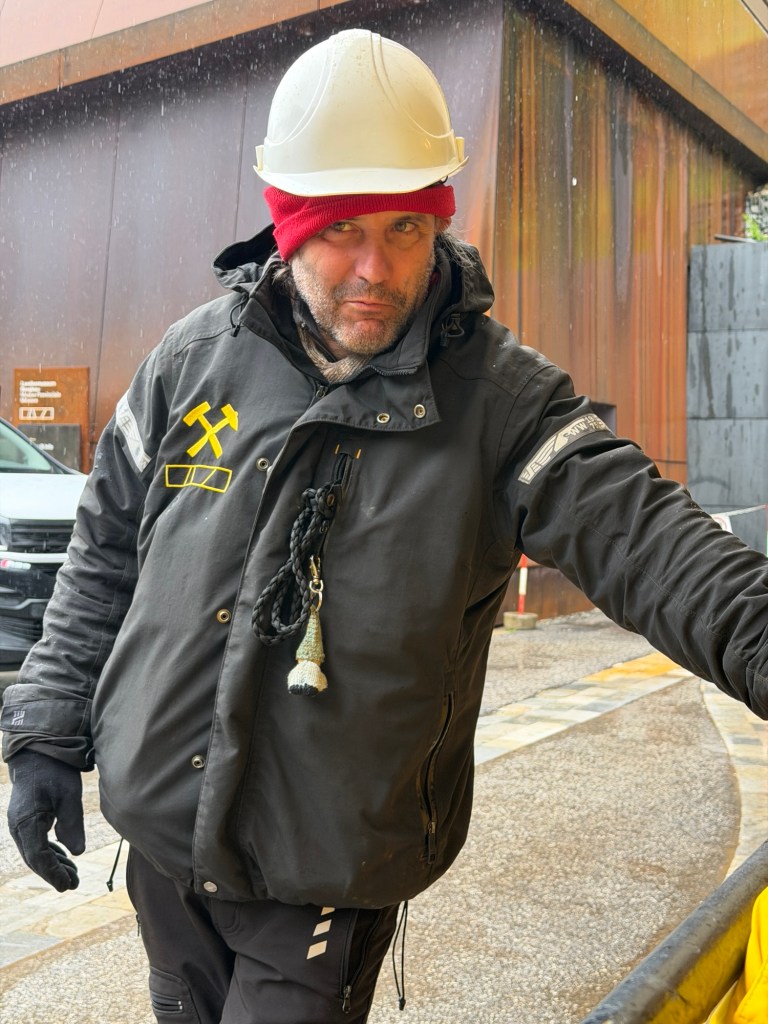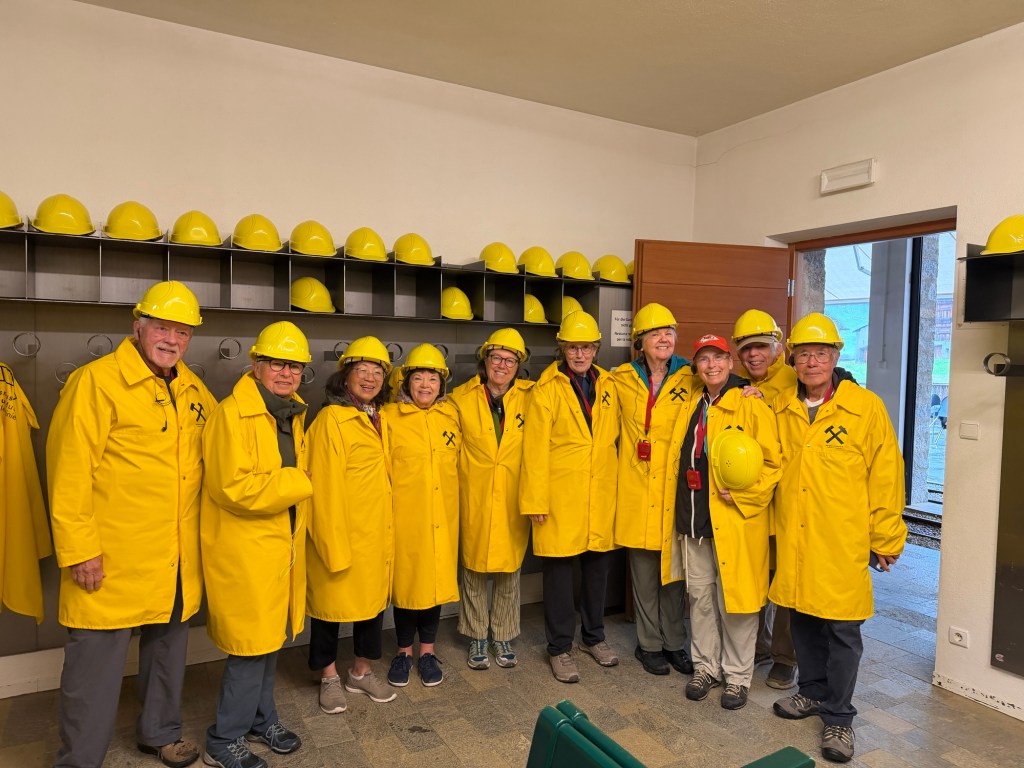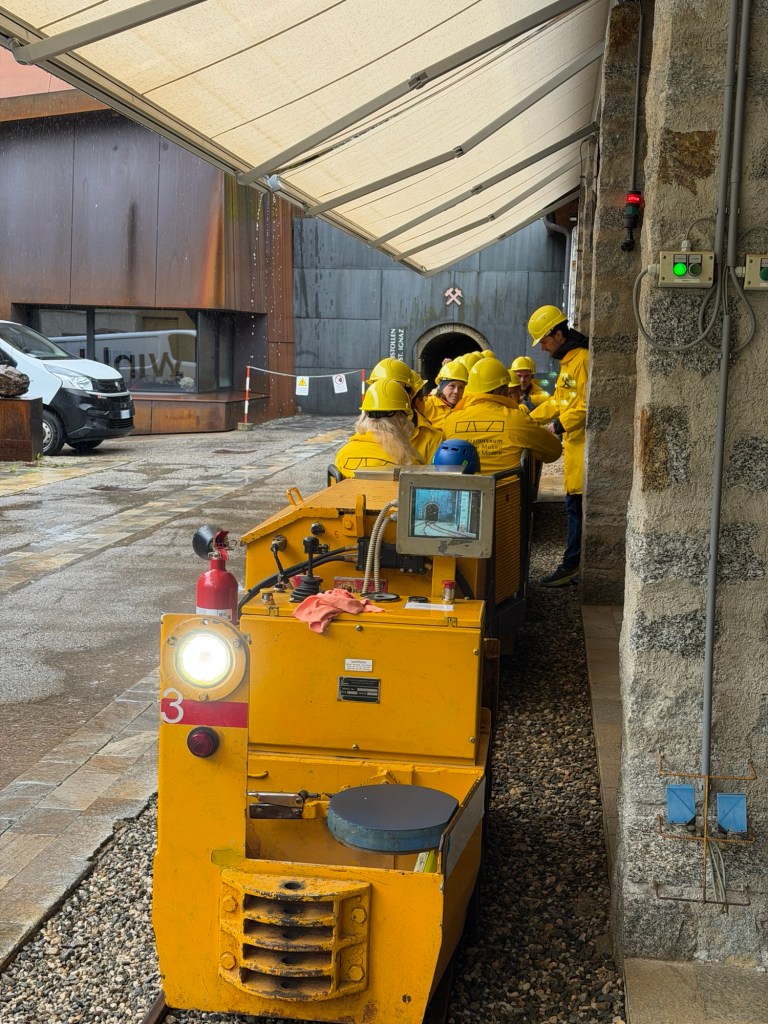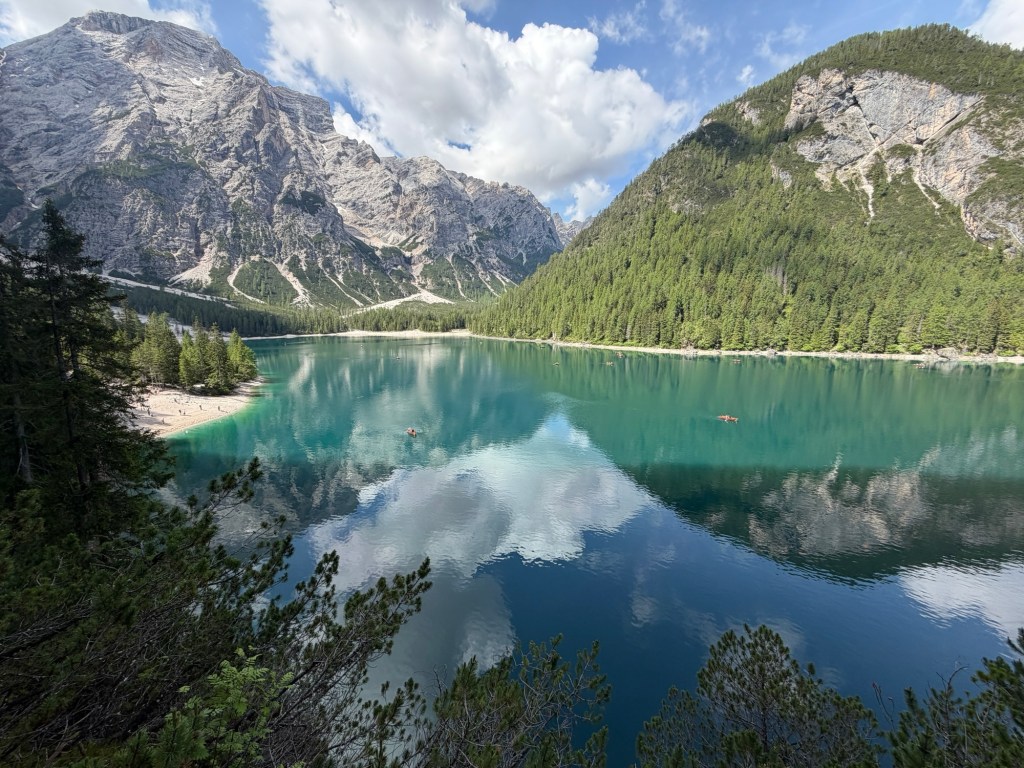
Bolzano

Although Mike and I visited Bolzano in 2018, I had absolutely no memory of anything except Otzi, the Iceman. And because I wasn’t traveling solo back then, I didn’t blog as often, — Mike tended to distract me —so I couldn’t even consult my “on-line” trip journal.

So, I’ll just have to wait till I get back home to see whether the photos on my computer jog my memory. Oh, a mind is a terrible thing to lose.

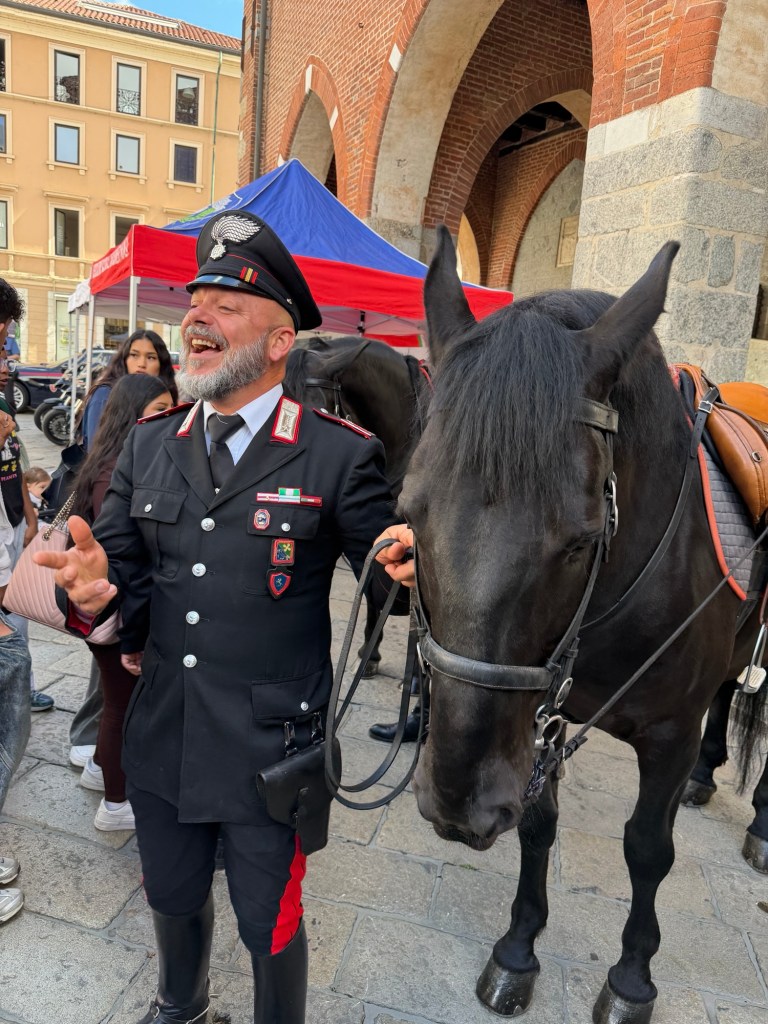
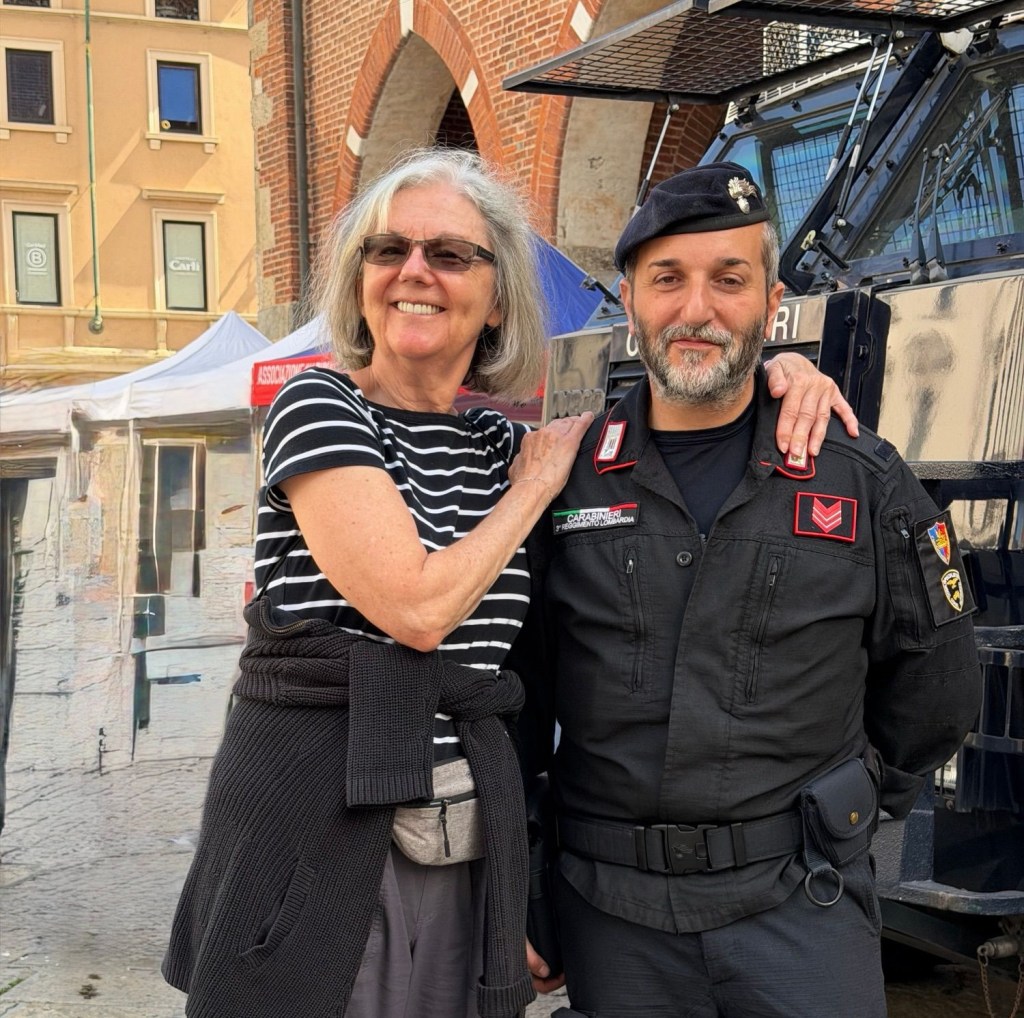
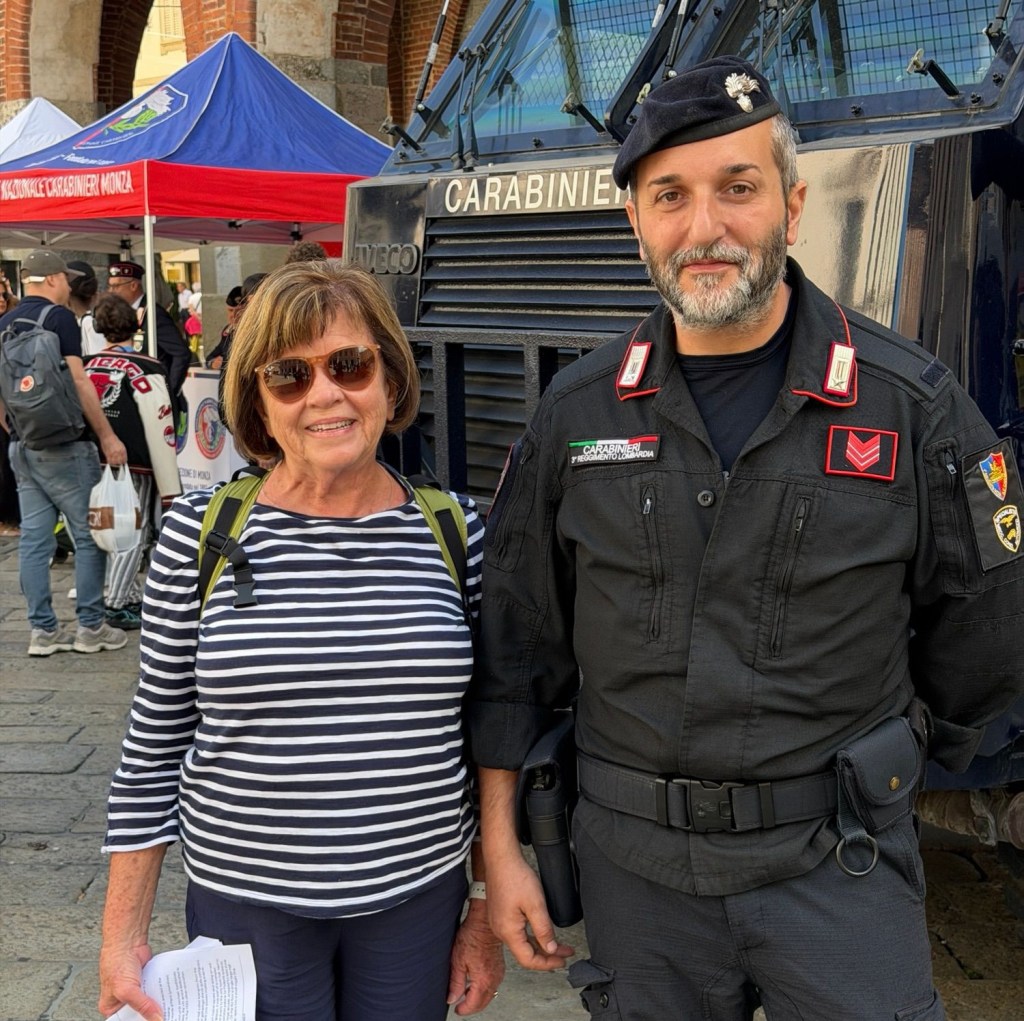
This time, the trip to Bolzano included a morning stop in the lovely village of Monza where the Carabinieri were having some sort of a convention.

The main attraction was supposed to be (what else?) the Monza Cathedral, which houses the iron crown that was used for Charlemagne’s coronation. The Italian policemen were an unexpected bonus.

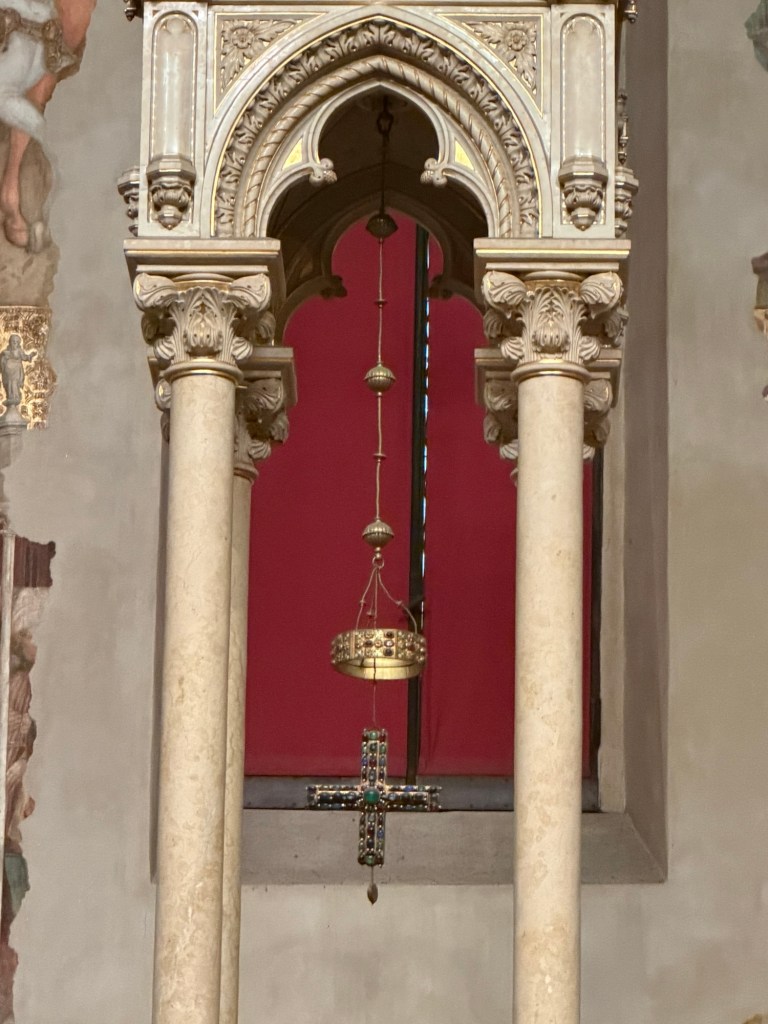
This is a replica. The real deal is locked up below.

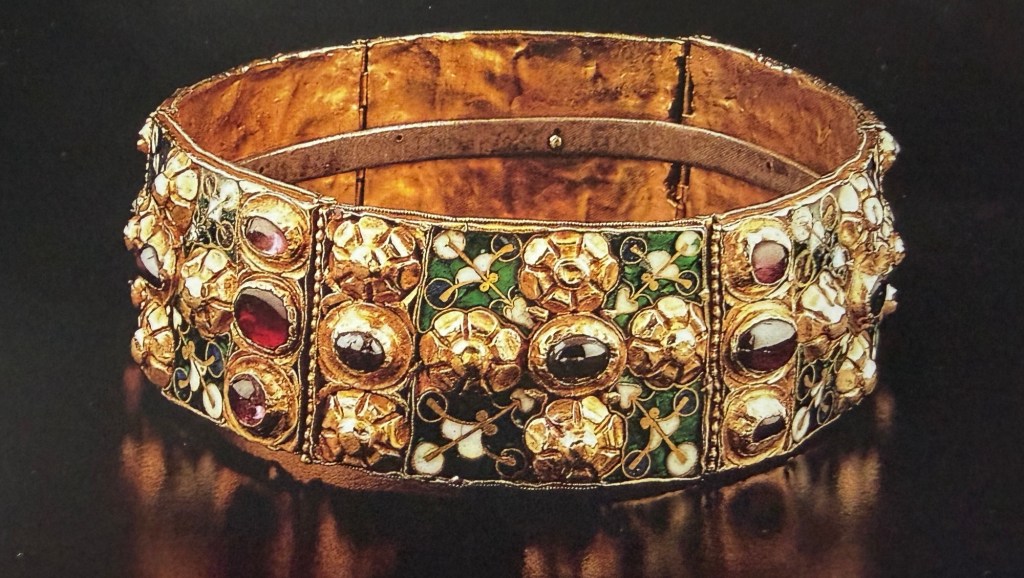
So what makes this crown so special? Well, in 324 AD, St Helena, mother of Charlemagne, traveled to the Holy Land. The enterprising locals quickly recognized an opportunity to make a few shekels, so they told this gullible woman that they found a nail that was used to crucify Jesus (in their grandpa’s attic, no doubt). Oh, and by the way, if she wanted—and had enough money—she could also purchase a piece of the cross on which Jesus hung. (She did. It is a relic someplace else—I forget where).

The centuries old nail was melted down and made a part of the interior of the crown. No photos of the relic were allowed, but that’s okay, because the crown made it into the cathedral’s brochure.

Must have been a really big nail to circle the interior of the crown. Something tells me it will never be carbon dated.

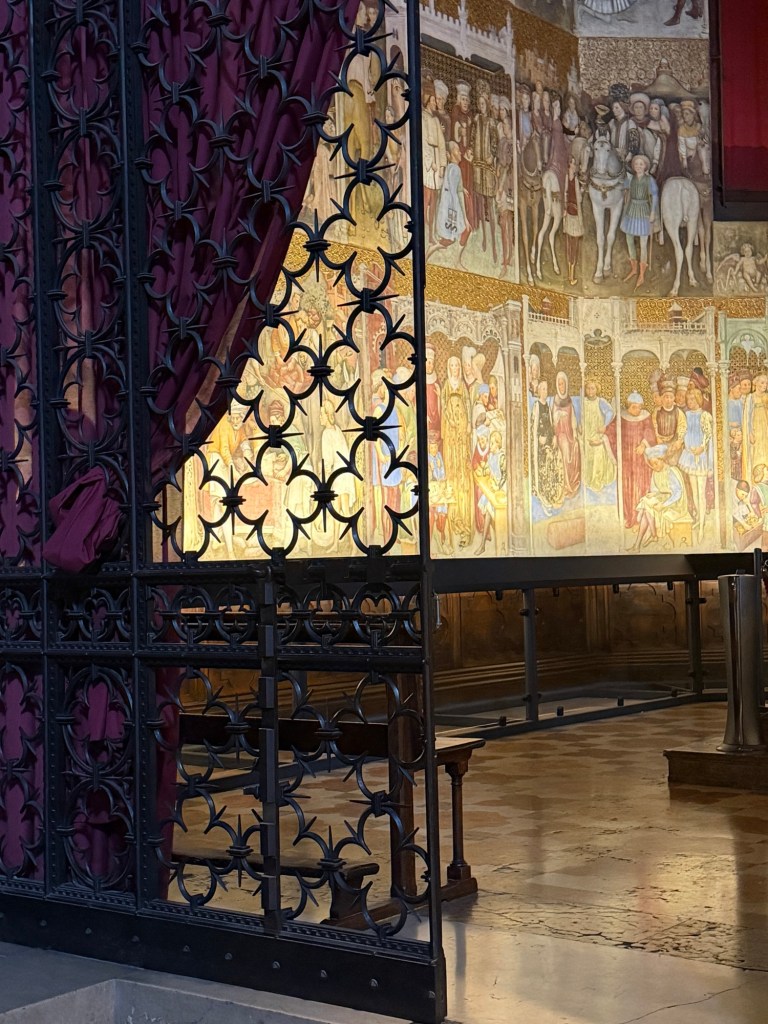
Theolinda’s chapel was totally covered with visually impressive frescoes, but photos were only allowed to be taken at a distance, outside the chapel.

Who was Theolinda, you ask? Well the frescoes tell the story of her life. She was a Bavarian princess, who outlived her two Lombard husbands ( no small feat, back then). There is more to her story than that, but I’ve forgotten the details. Supposedly, she is buried in that chapel.

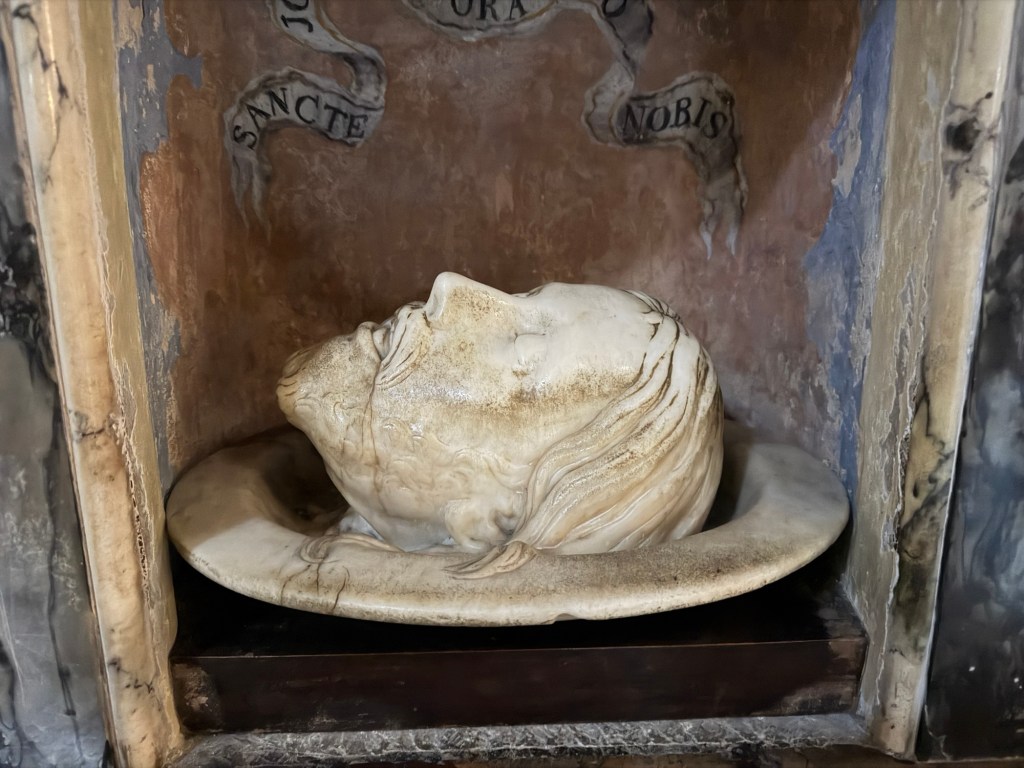
It wouldn’t be a Catholic house of worship without an image of a gruesome death, and this cathedral was no exception: John the Baptist’s severed head was prominently displayed.

We had time between our cathedral tour and lunch, to explore Monza. Here are a few of our sights.

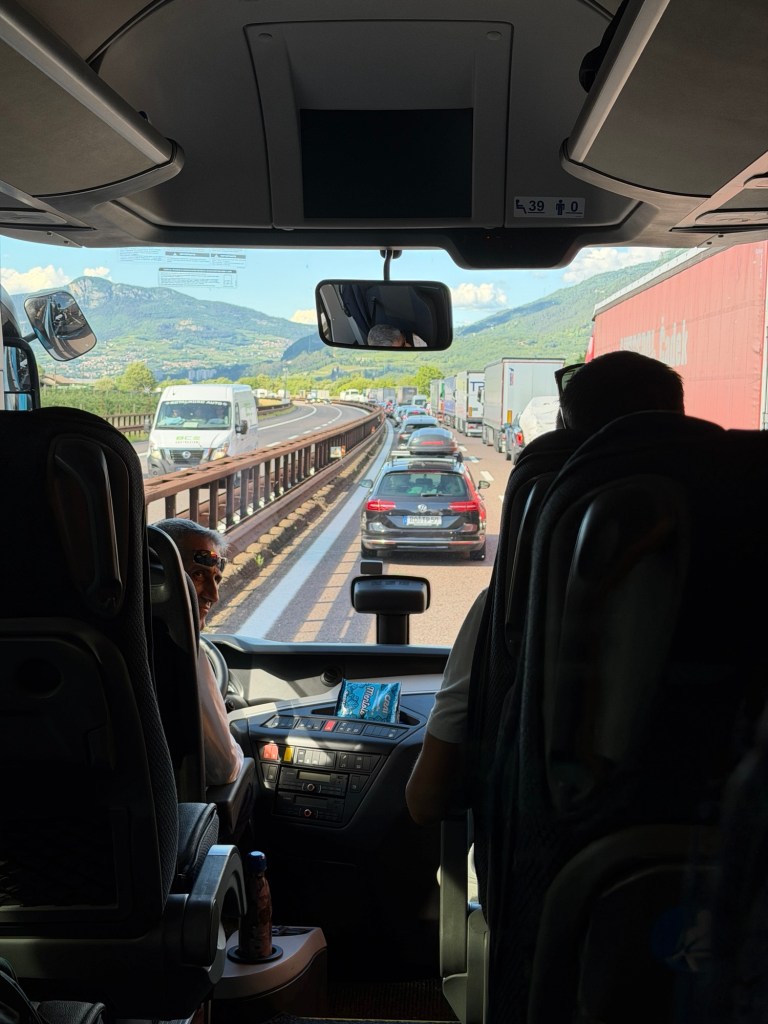
It’s a good thing that the morning was so delightful, because we spent the remainder of the day stuck in traffic, arriving at our hotel around 9PM.

We were lucky that our bus was super comfortable, we all had our entertainment centers (otherwise known as cellphones) and all bus seats had charging ports. Plus, we pulled into a comfort station to load up on snacks when it became apparent that we needed to cancel our dinner reservation. Fortunately, everyone rolled with it, without complaining.

As usual, we started our day with a local guide who pointed out what makes Bolzano special. Our tour ended at the archaeological museum, where we could visit Otzi. Although the iceman was fascinating, Susan and I had already seen him, so we chose to roam the streets of Bolzano instead.

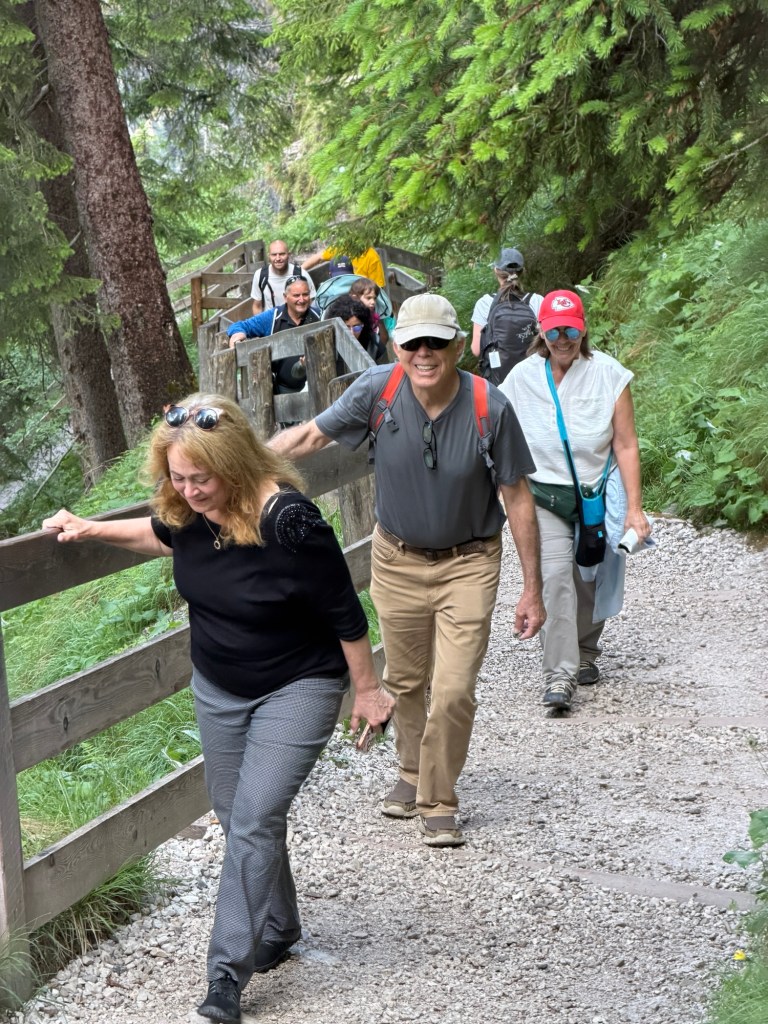
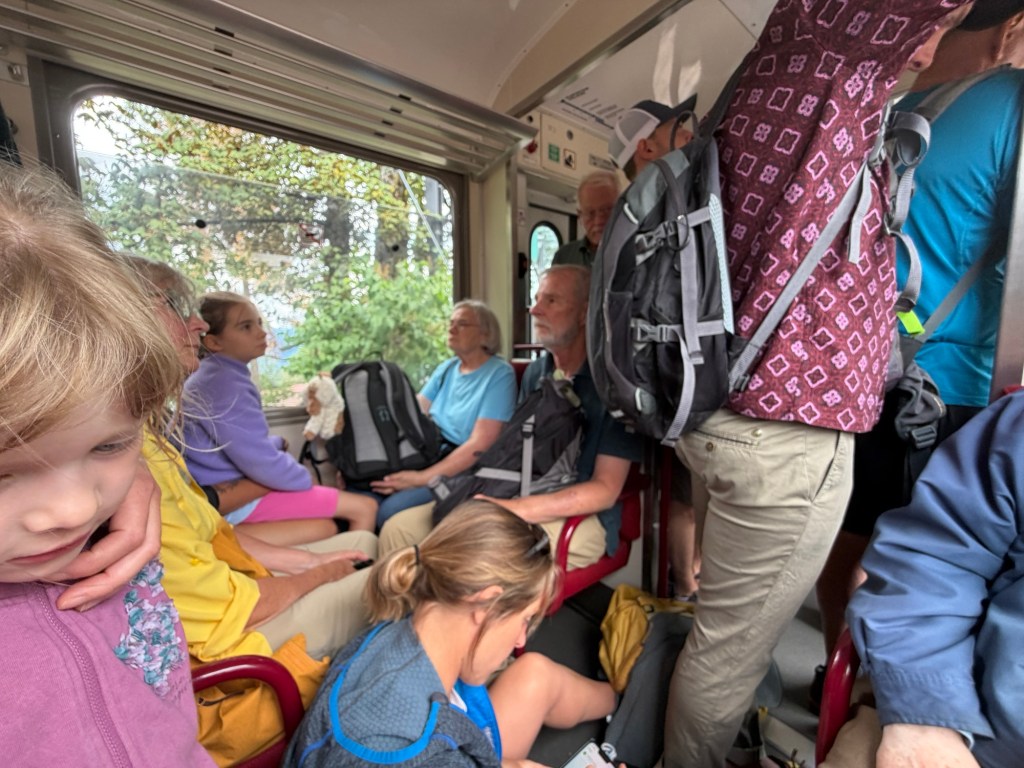
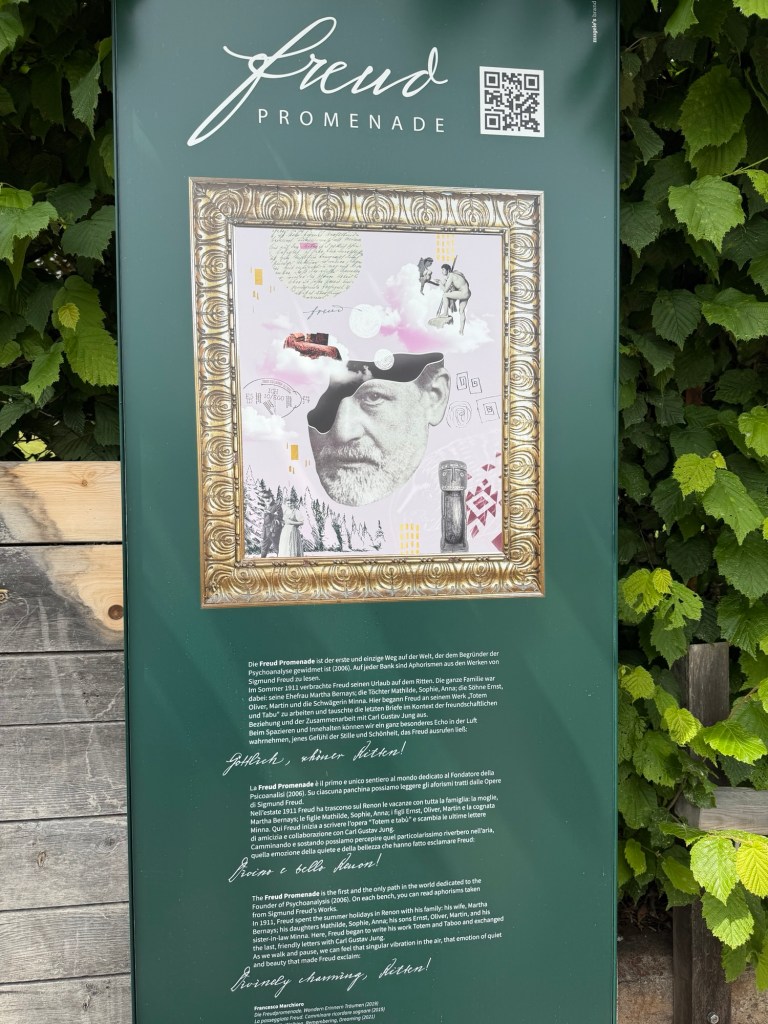
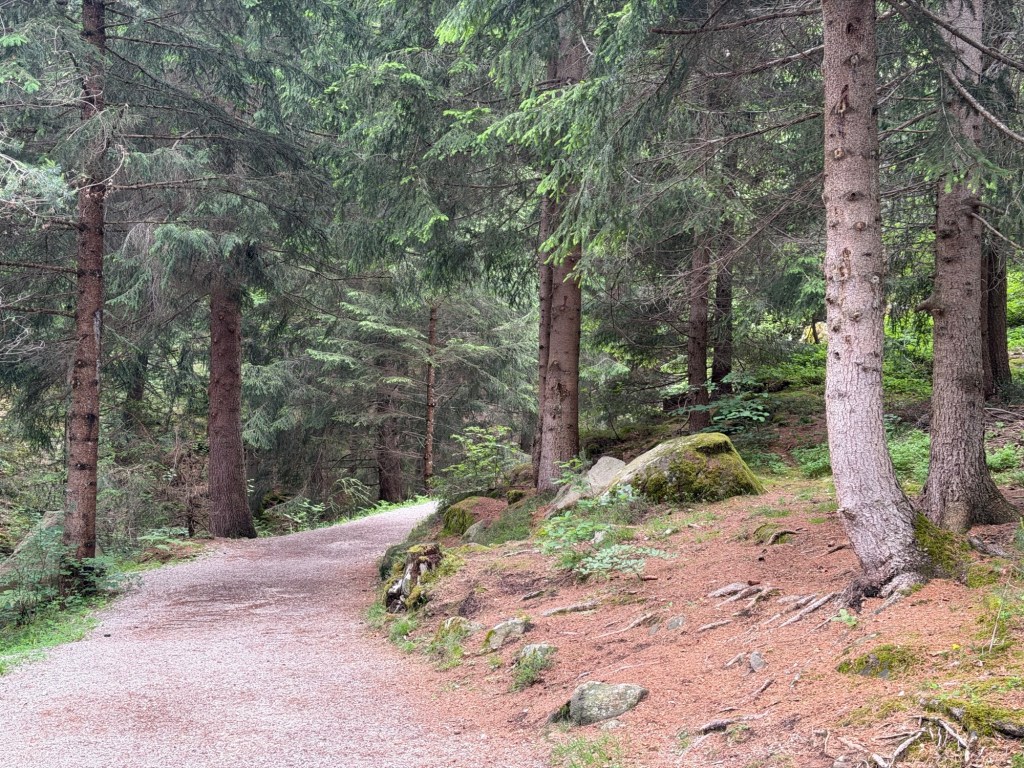
Though we only two nights in Bolzano, we packed a lot into our brief visit, including a hike on the Freud Promenade. To get there, we had to take a train that strongly resembled NYC mass transit during rush hour, which was definitely not a highlight. Like everything else in life, when you travel ya gotta take the good with the bad.

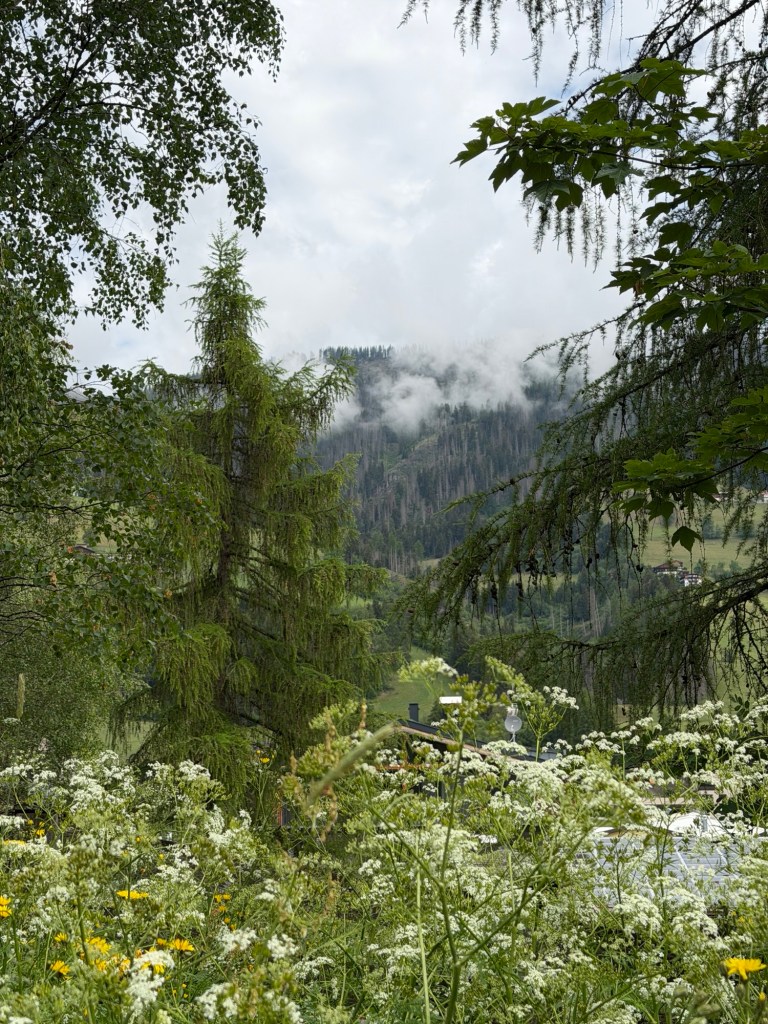
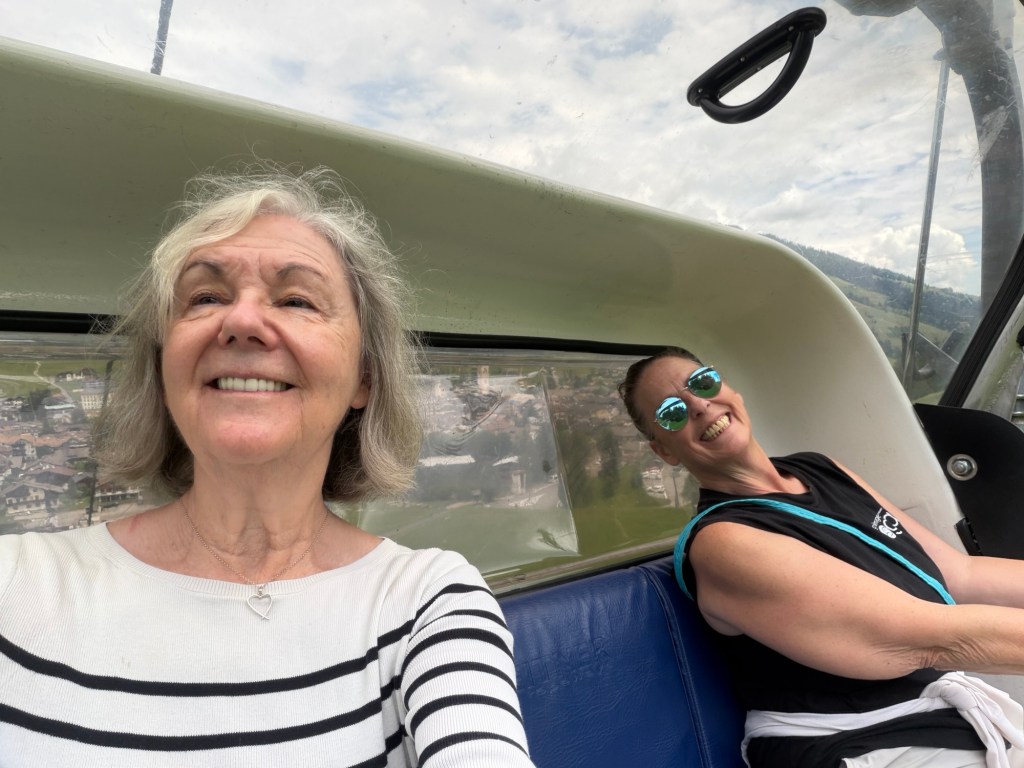
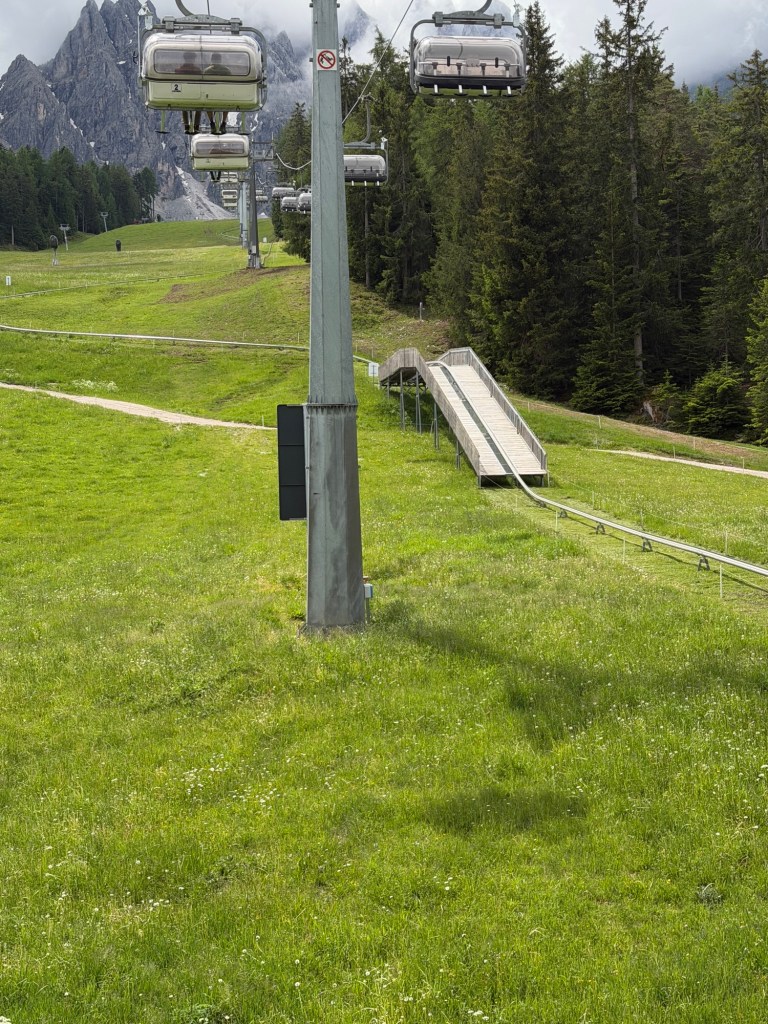
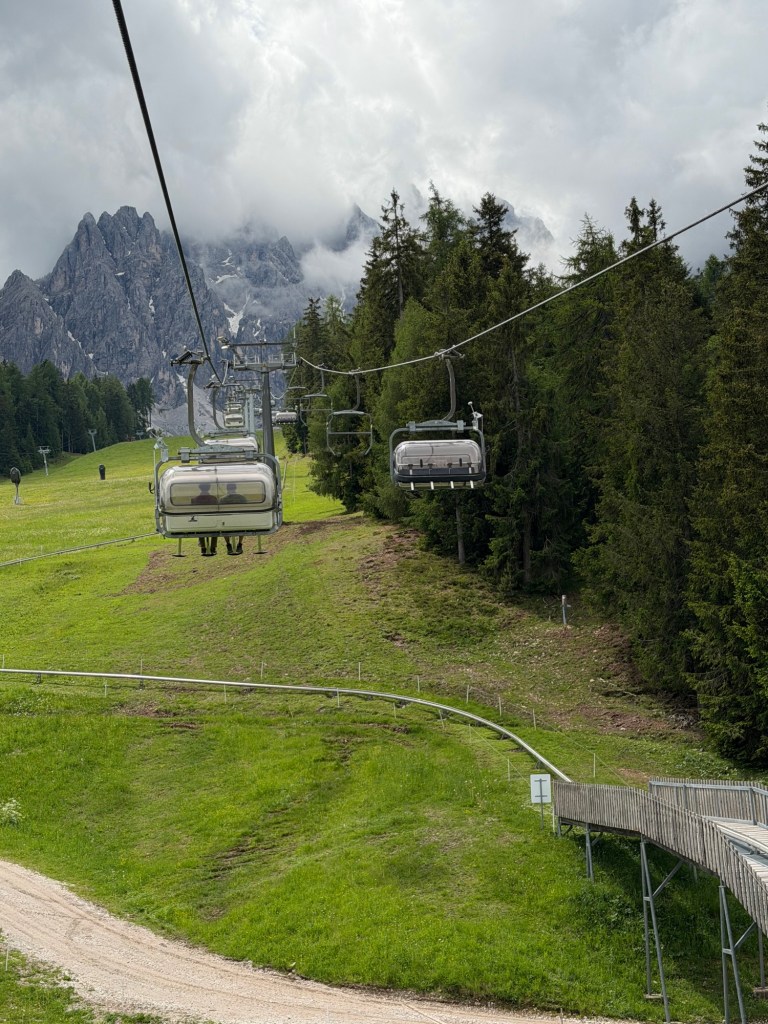
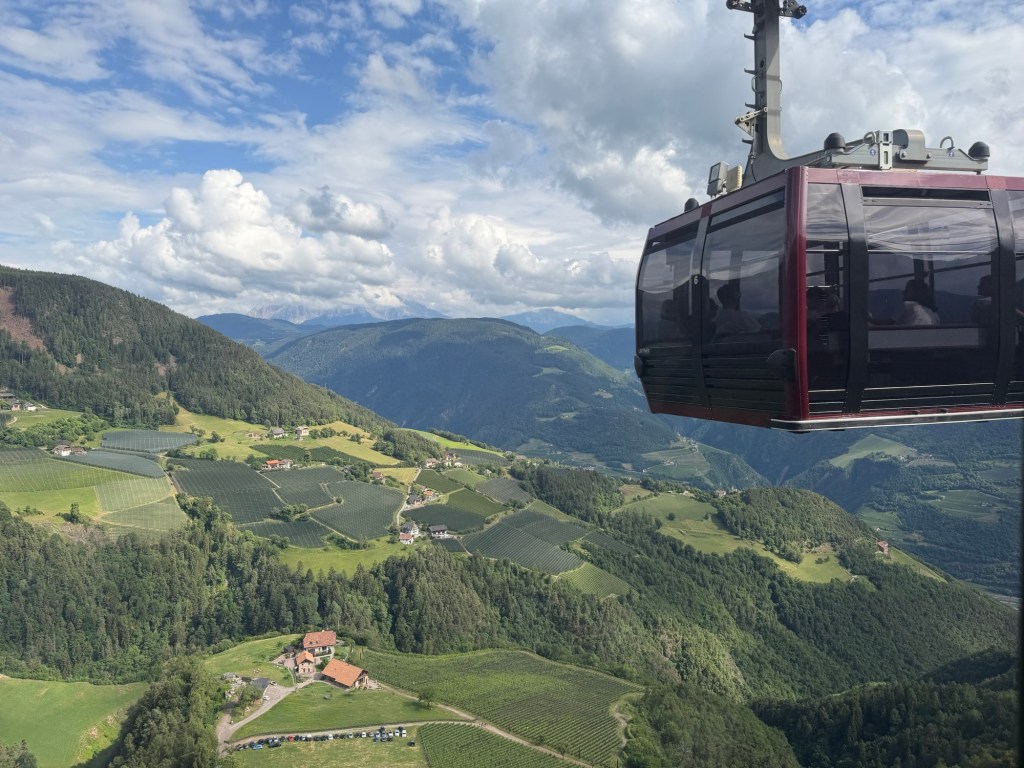
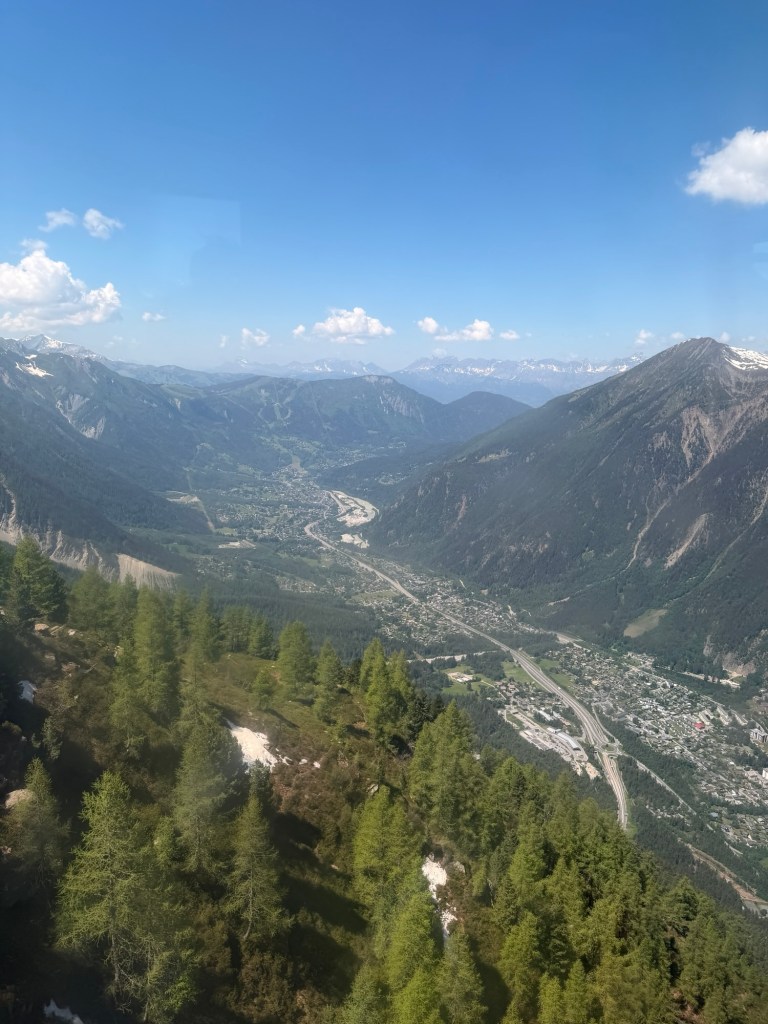
But the NEXT part of our journey more than made up for the crowded train ride. This fabulous gondola provided 360 degree views of the beautiful countryside.

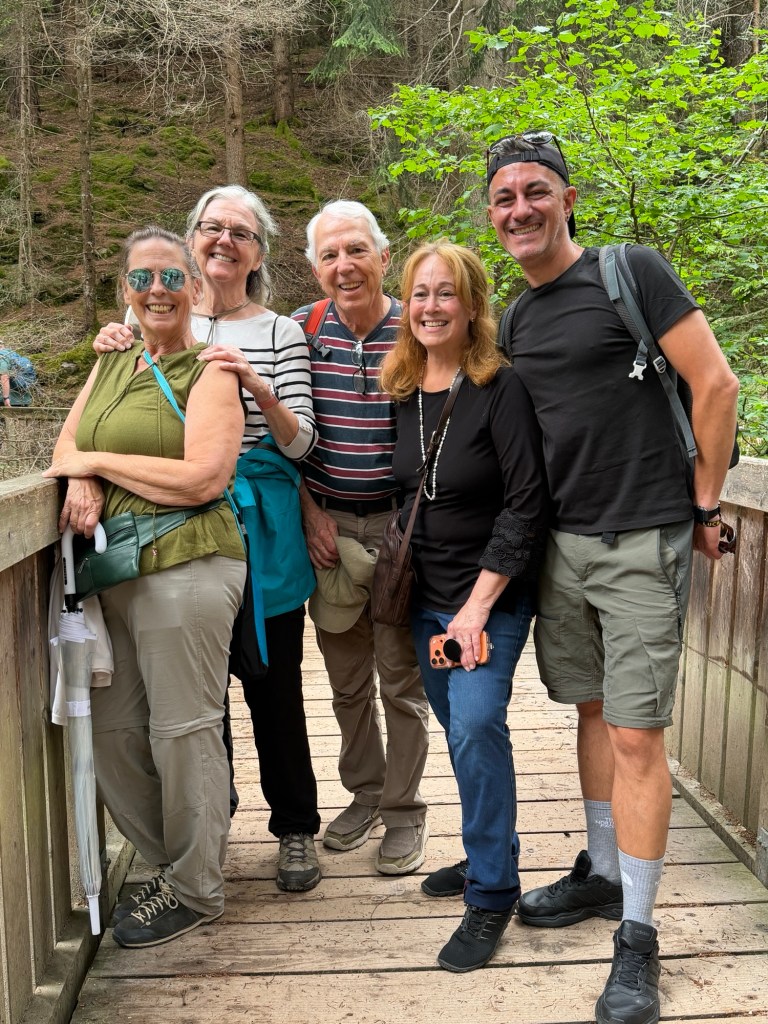
The walk was lovely, the weather was perfect, and by the time we finished, we had worked up quite an appetite.

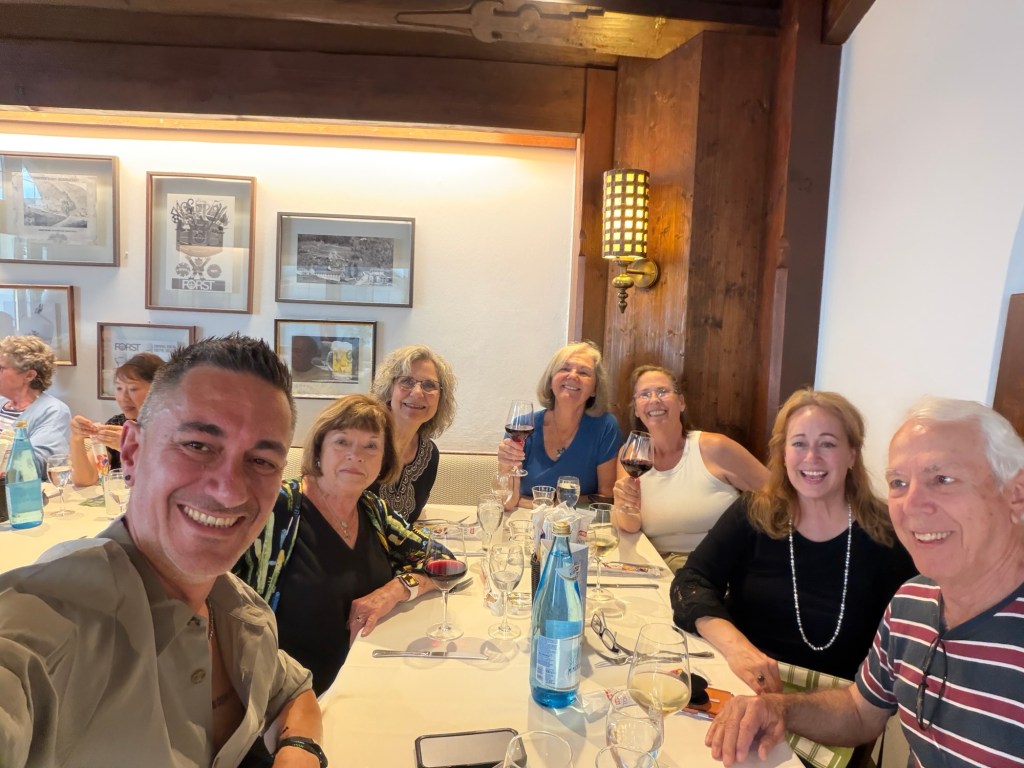
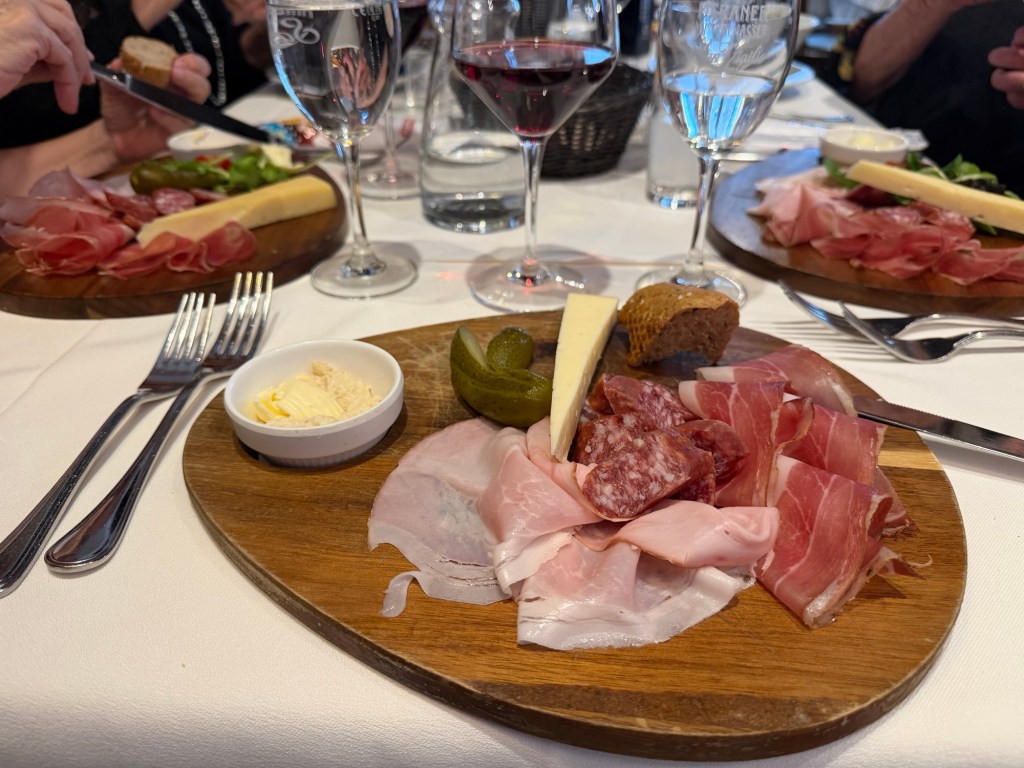
Once again, Luca chose a fantastic restaurant, where we were served our choice of three courses. I had delicious barbecued ribs, and ended up so full, I began to wonder whether I’m going to exceed my usual five trip pounds gain!

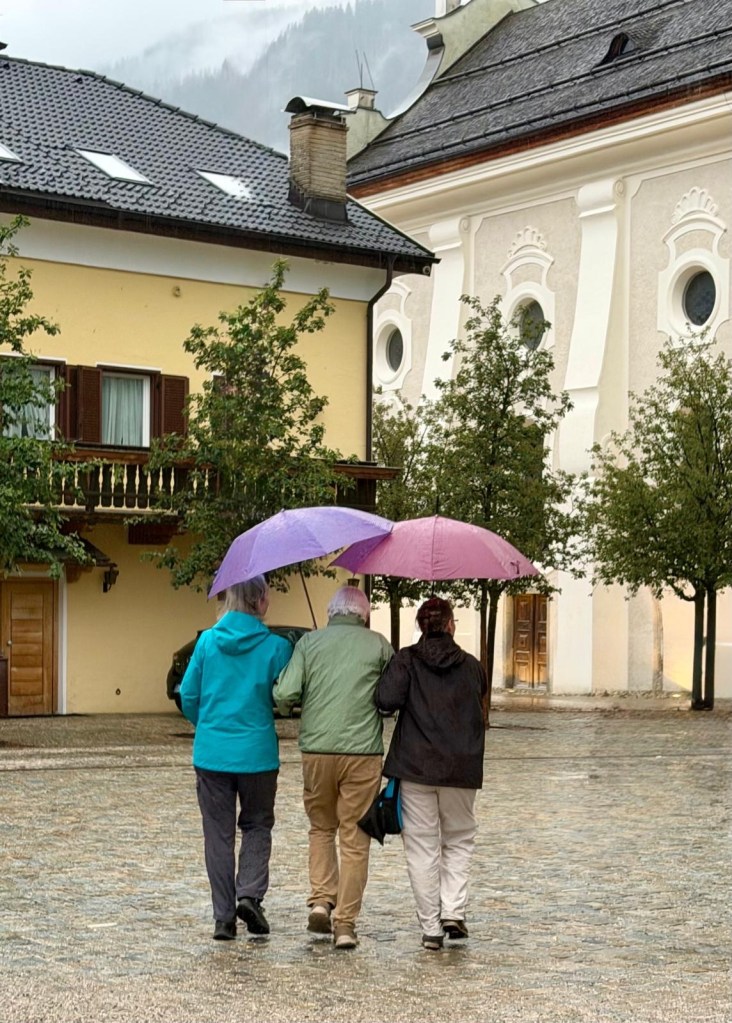
Our next stop will be in San Candido. I sure hope the weather report continues to be wrong, because it is predicting rain for all three days that we are there.

Arrivederci Switzerland, Ciao Italia

We have mainly lucked out with the weather during our stay in Lugano, Switzerland. The only exception was our arrival and departure nights, when it rained heavily. It wasn’t a problem for our departure night, because we were content to stay in the hotel, packing and resting. Arrival night, however, was another story. After checking into our hotel, we took a brief orientation walk. We got DRENCHED! No photos — just imagine what 15 wet rats looked like!

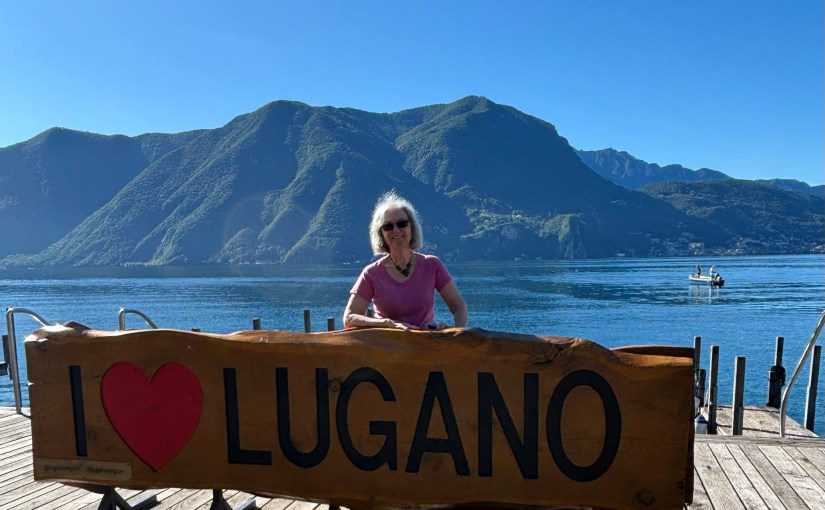
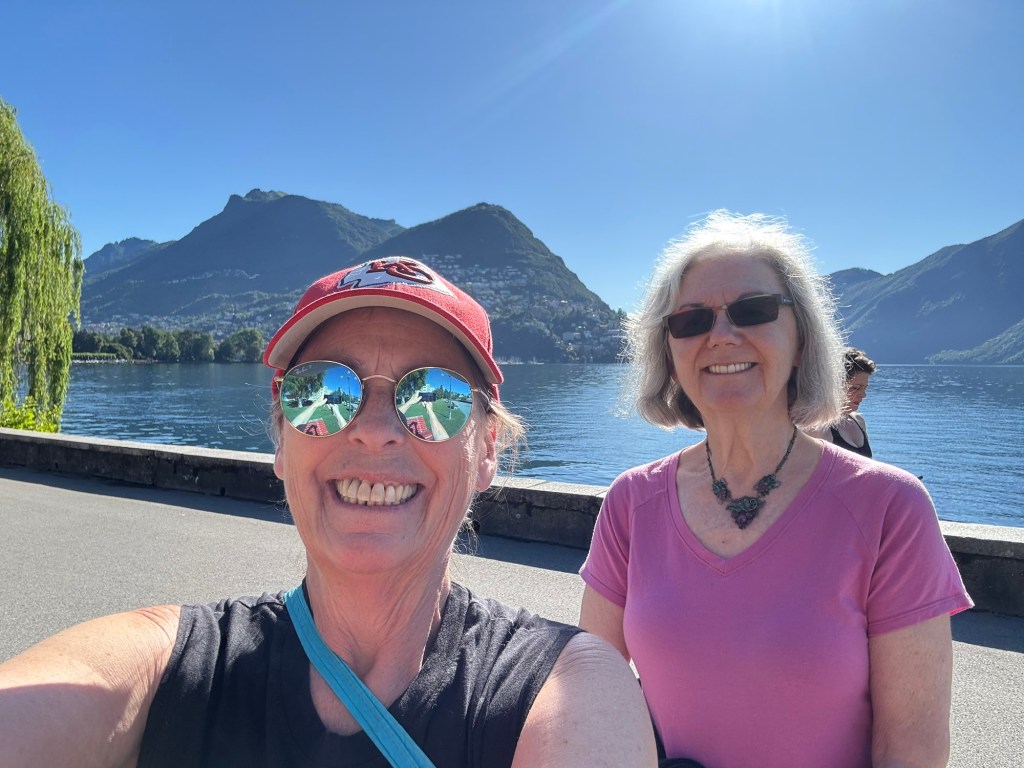
Luckily, the next morning was breathtakingly gorgeous, so Susan and I took advantage of our group’s 10 AM departure to take an early morning walk around Lake Lugano.

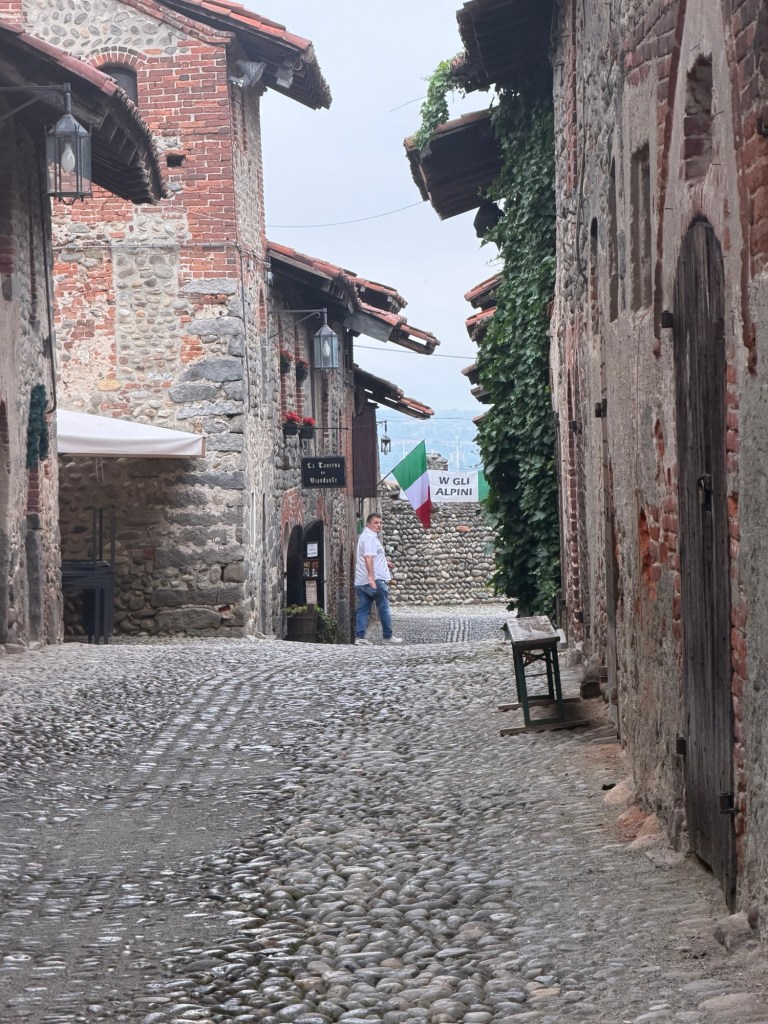
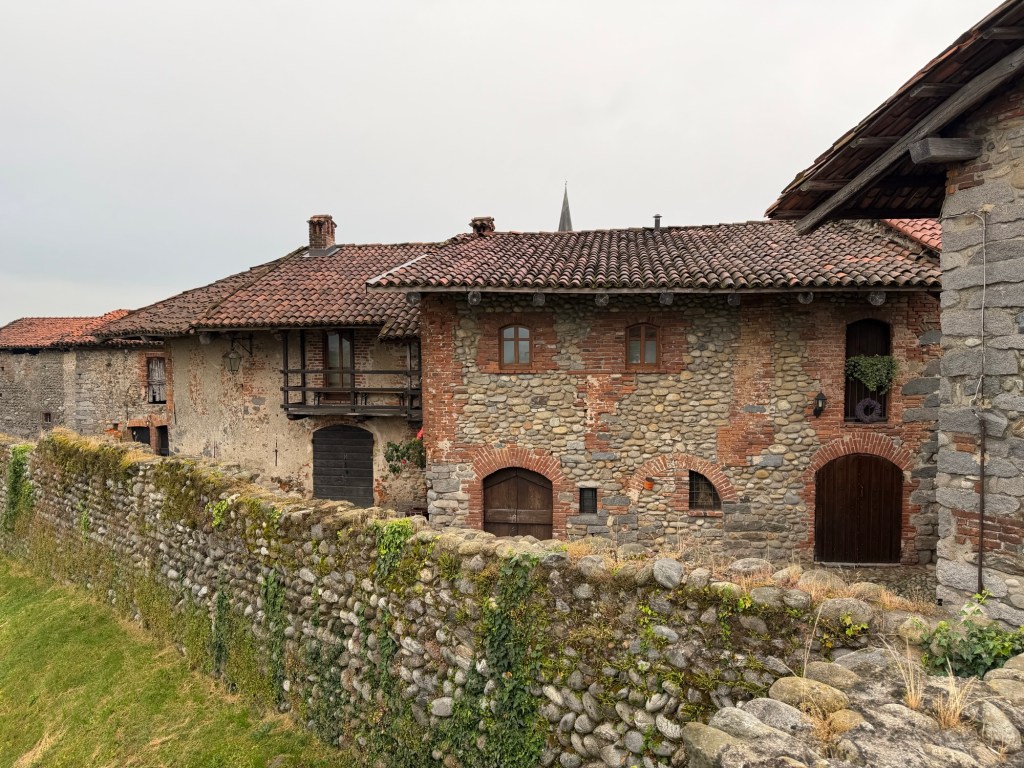
But wait…I almost forgot about our drive TO Lugano. As is usually the case with OAT trips, our drive was broken up by stops in interesting places. The first was Candelo, a very old walled village that was used as a refuge and to store food should marauding bands try to rape, pillage and plunder. Today, it is a refuge for shoppers and hungry travelers.

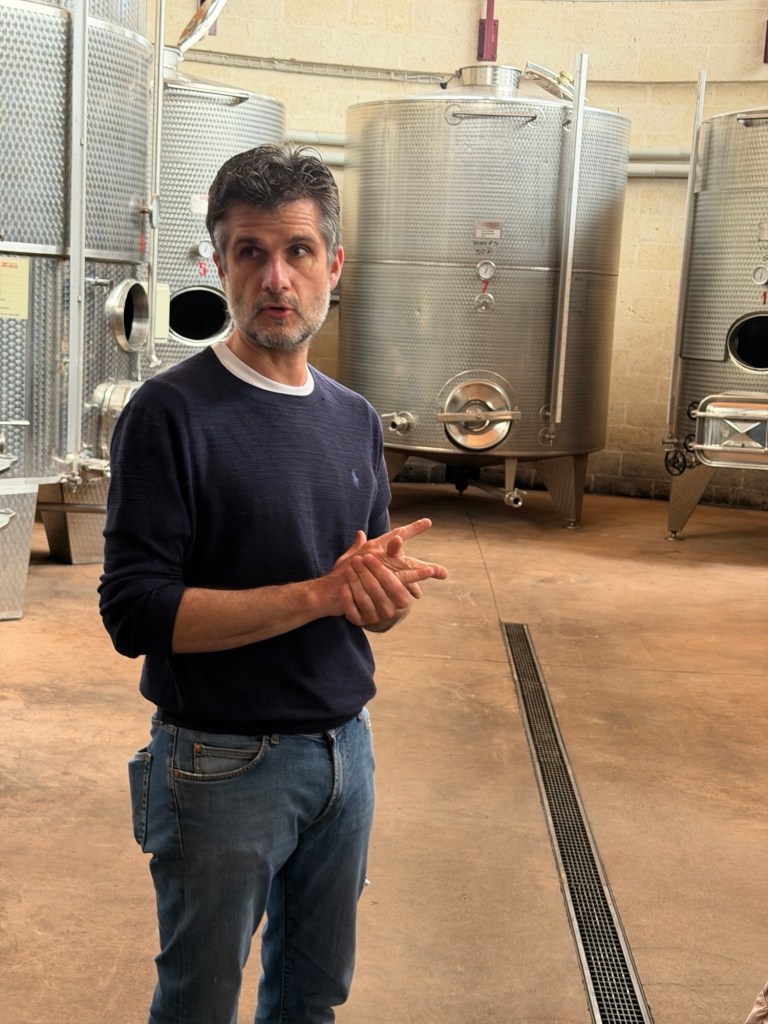
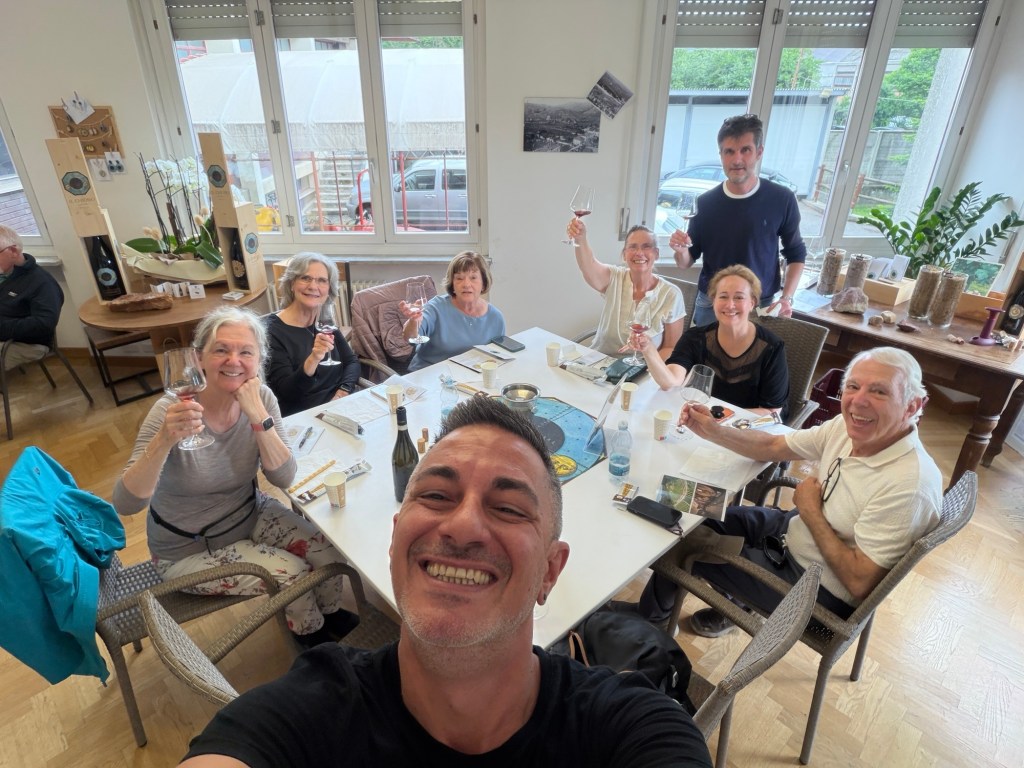
Our next stop was this small winery. If my sister, Sandy had been with us, she would have instantly fallen in love with the owner before the end of the tour.

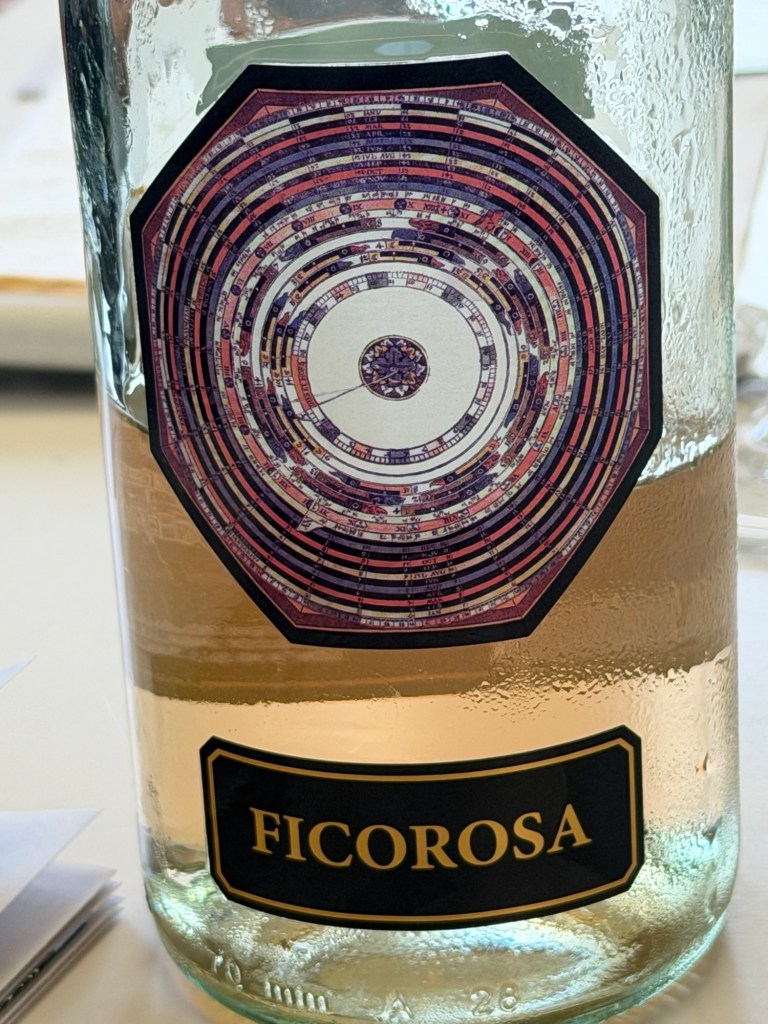
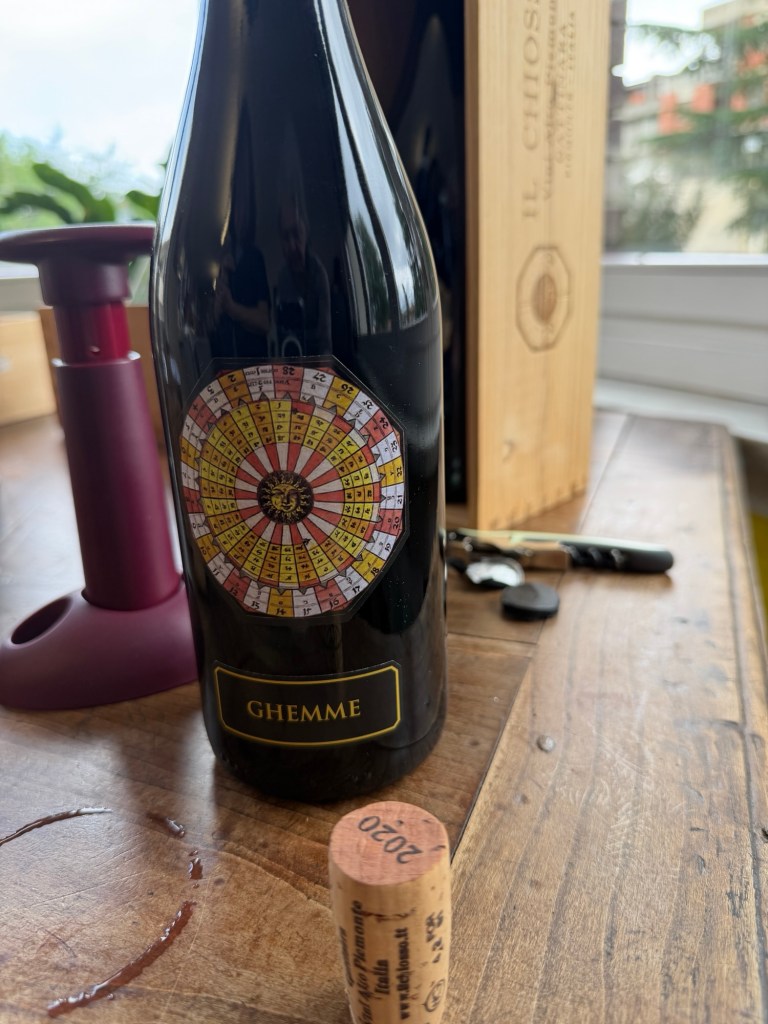
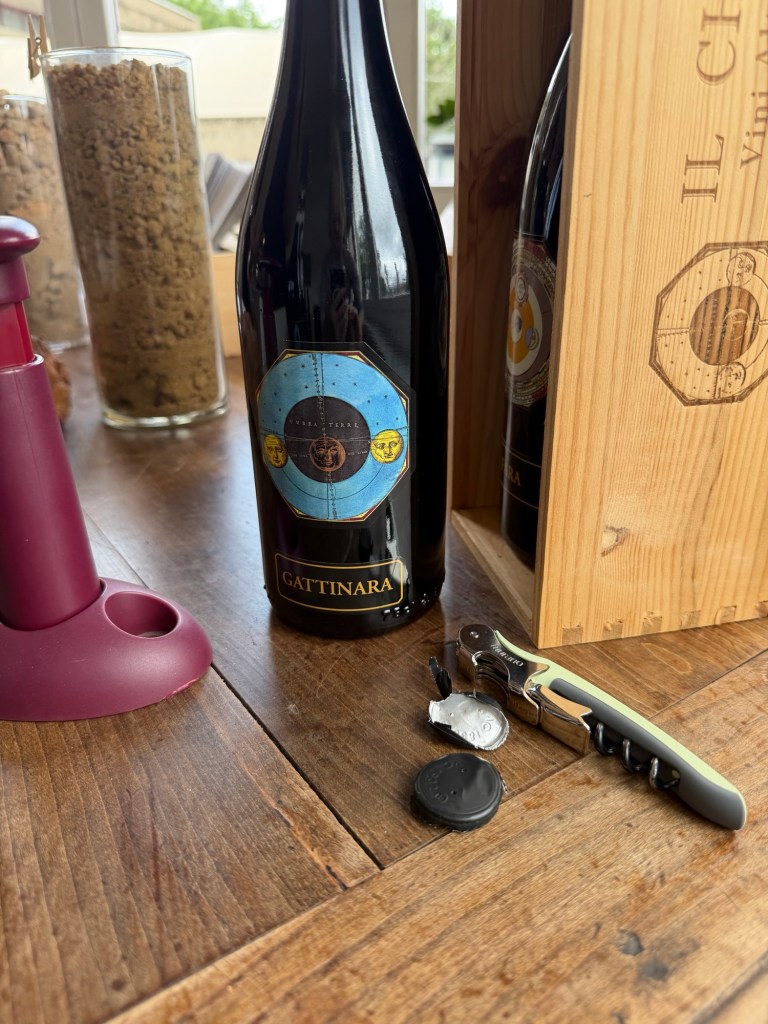
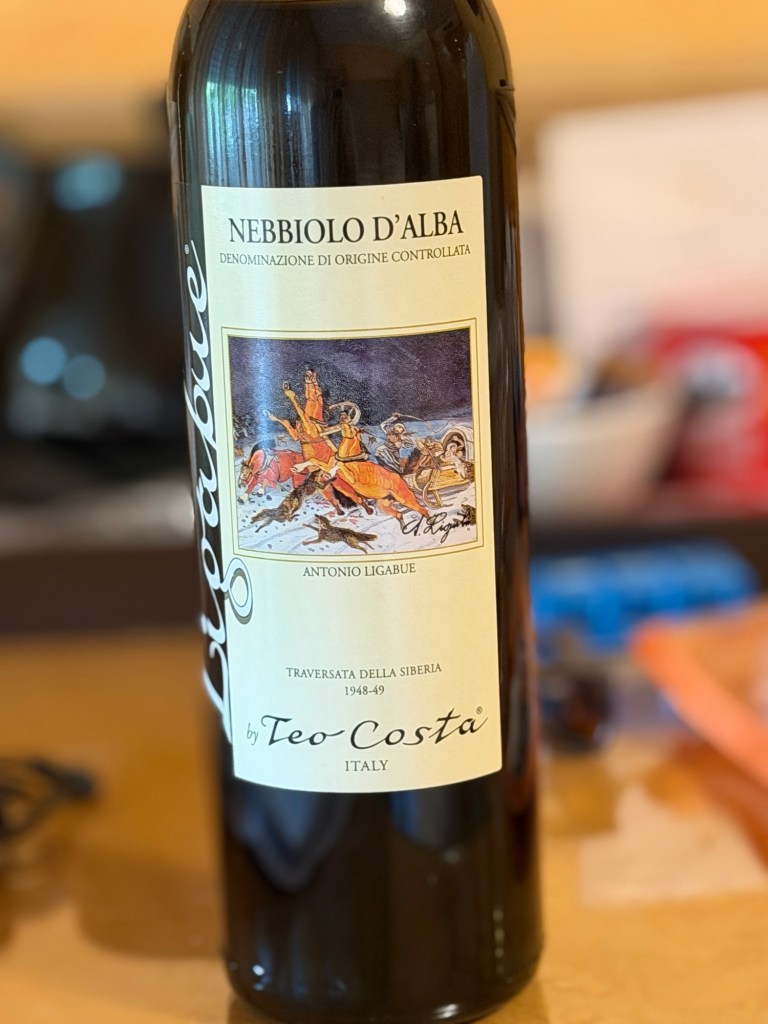
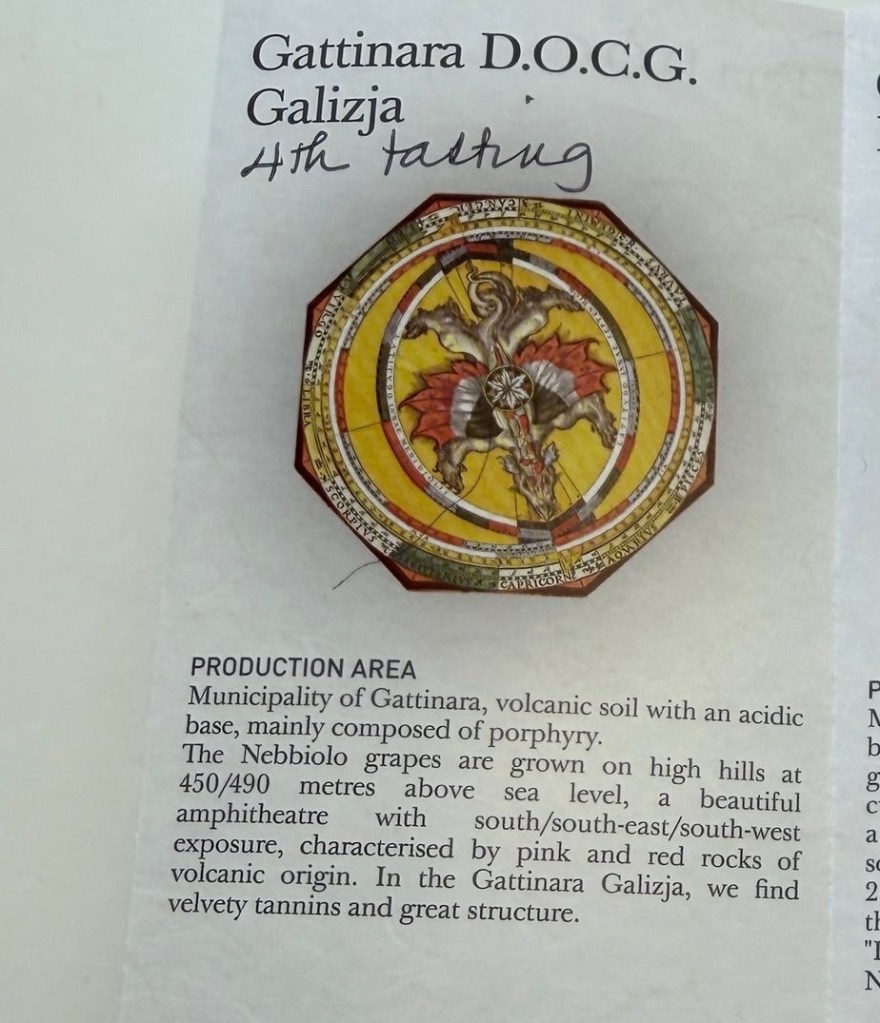
As for me, I was far more interested in the wine and its beautiful labels.

Of the four wines we tasted, my favorite was the last — the Gattinara, of which the winery only makes 3,000 bottles per year.

I decided it was the perfect gift for my favorite chef. When I get back to New Jersey, he promised to delight me with his excellent polenta, which is far more delicious than any a I’ve had here in Italy.

So once we got to Lugano. How did we spend our time?

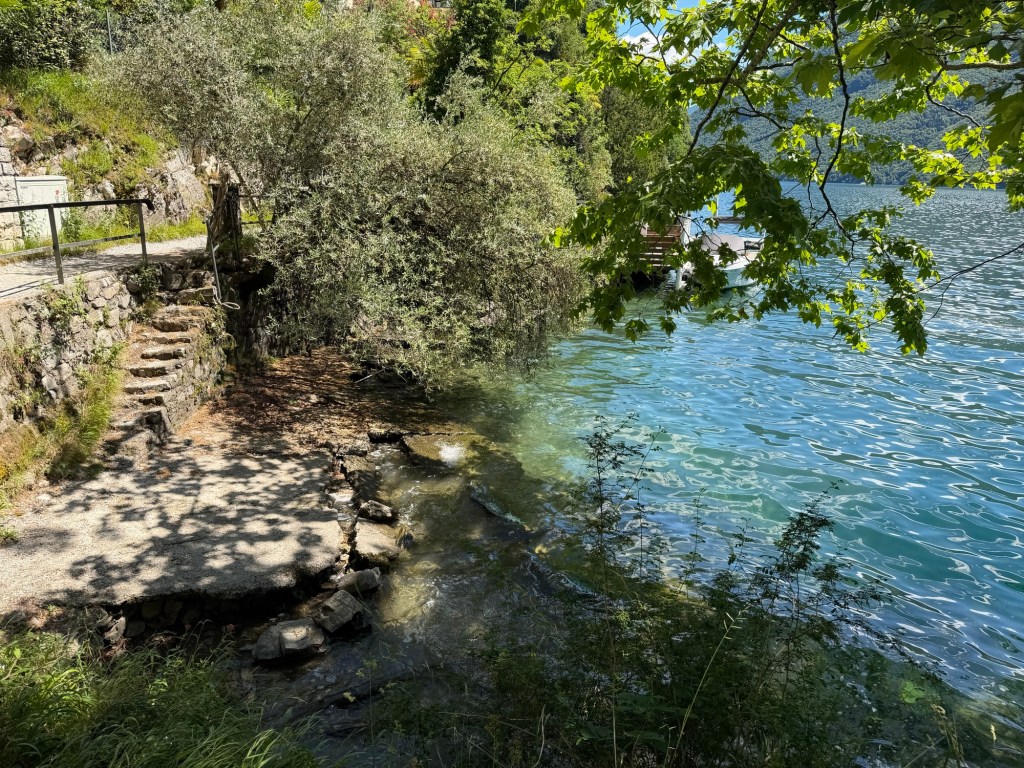
One day, we hiked along the “olive trail”, a beautiful , narrow mountain path along the lake. It was well worth climbing the 270 steps (yes, I counted, but only the steps UP; like my Apple Watch, I figured the down steps weren’t worth counting). Our reward? Four different kinds of chocolate, supplied by Luca.

According to my Apple Watch, I climbed the equivalent of 28 flights of stairs that day! (Thank you, Somerset Hills YMCA).

This isn’t a great photo, but I’m including it because Luca told us that on the OAT trip he guided last summer, the travelers stripped to their underwear and jumped into the lake right here! I imagine that was quite a sight. Fortunately, it wasn’t so hot, and I suspect none of our group was so inclined.

Good thing, because we wouldn’t have had time to dry off before our funicular ride to the very top of Monte Bre.

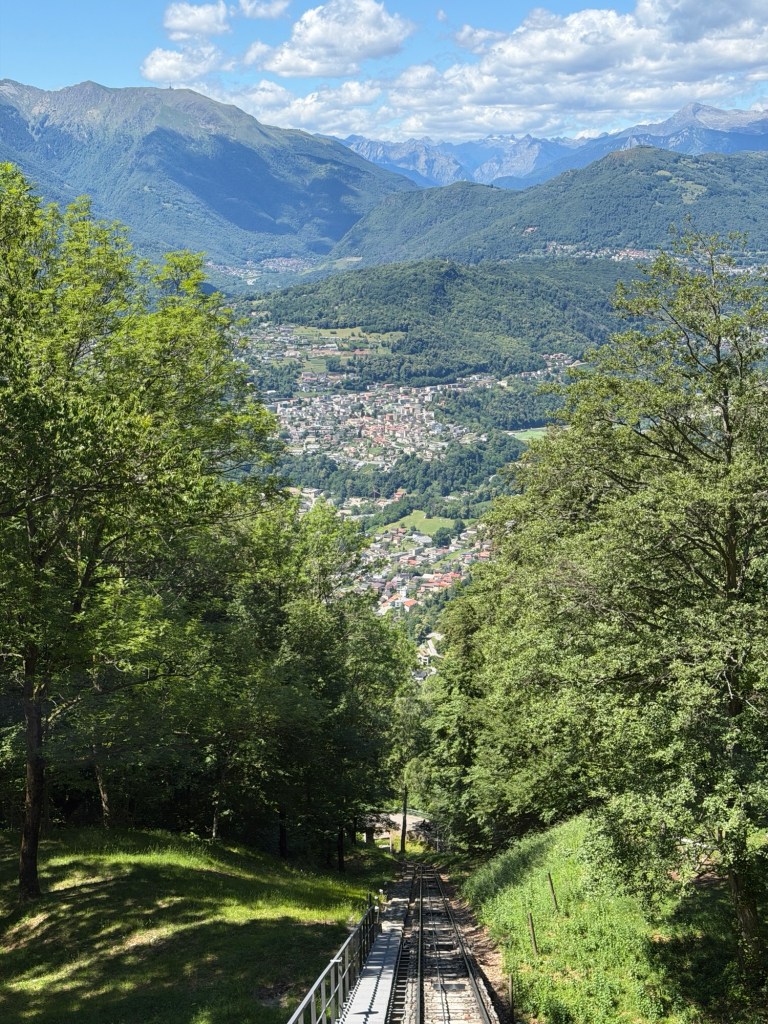
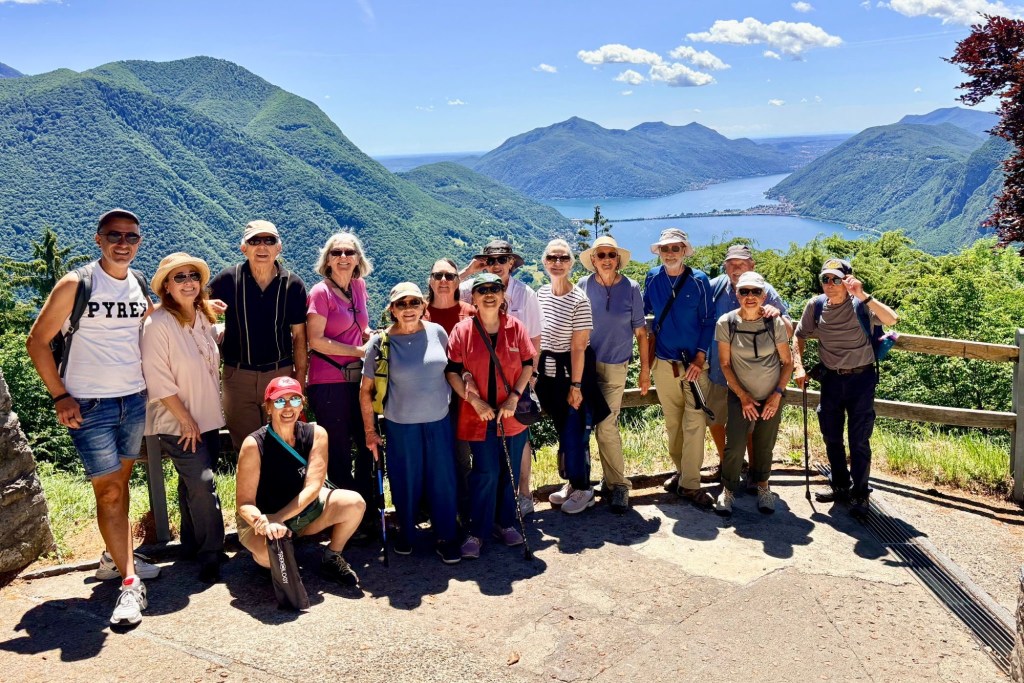
To be more accurate, we actually rode TWO funiculars to get to the top, where we enjoyed this majestic view ( and of course, took a group photo).

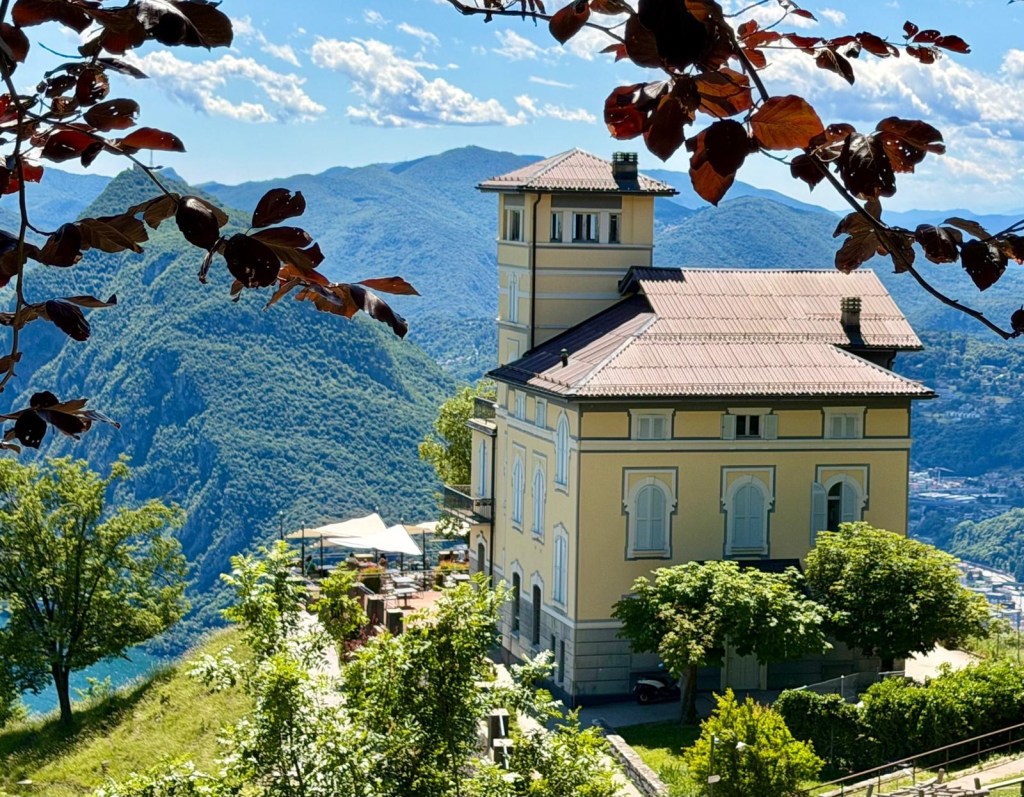
Jodie and Dan very graciously shared the food they had purchased earlier at the supermarket in town with Susan, Luca and I. To walk off the calories, we strolled down and back to the villa we spotted below.

Another of Jodie’s superb photos!

I know everyone is curious about the day’s step count: 21,157 steps, just a hair under 10 miles!

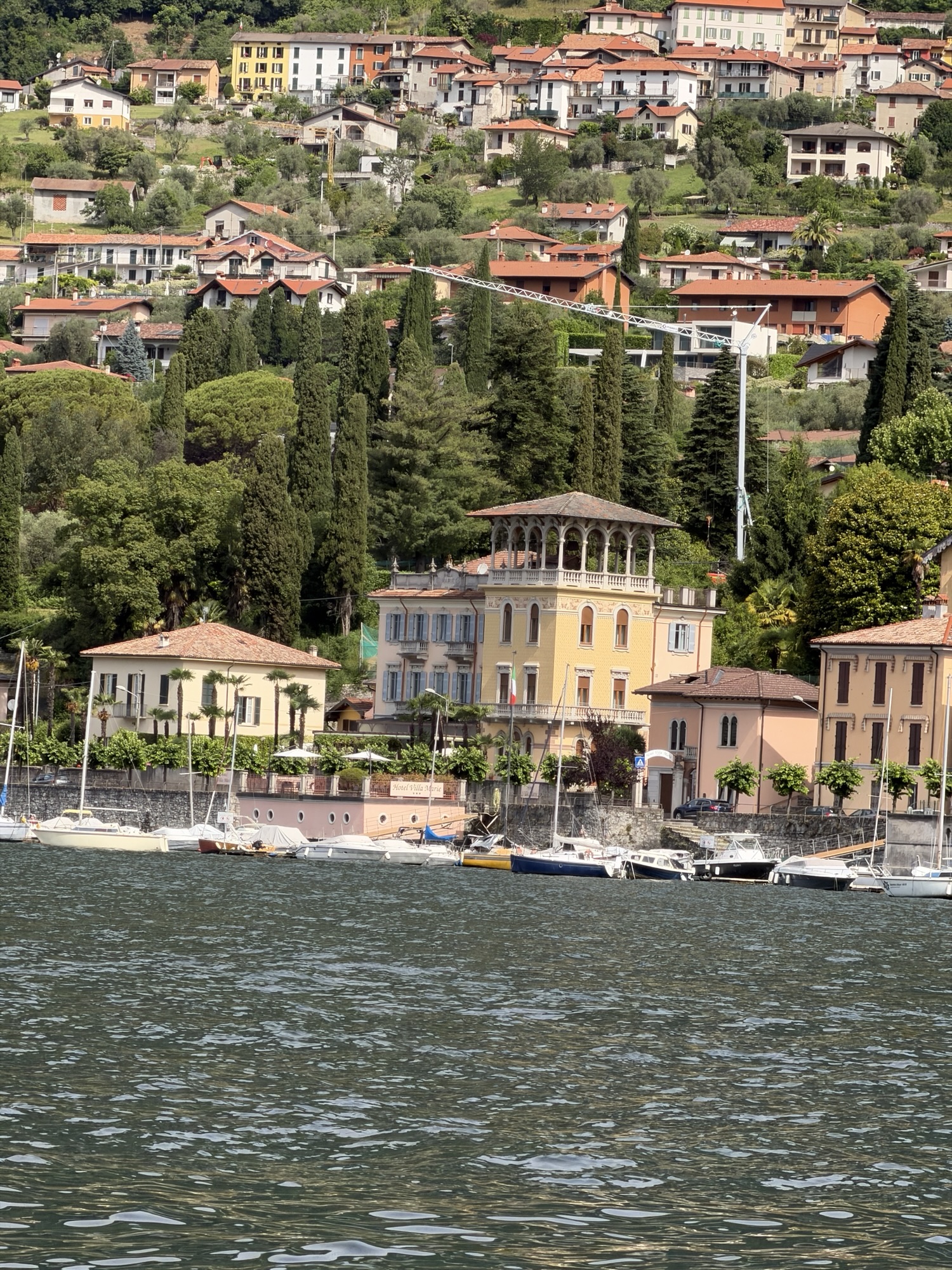
For our last full day in Lugano , 8 of us chose to take the optional trip to Lake Como. This was a particularly great day for me, because our ferry sailed by Tremezzo. Let me tell you, I was absolutely thrilled that I remember — and spotted the hotel where I stayed in 2018!

I recognized the hotel’s tower, which brought back memories of our wonderful trip to the Dolomites before Covid rocked our world. If you are interested, click on the underlined word in the paragraph above to access the 2018 post, which includes a photo of the tower’s interior.

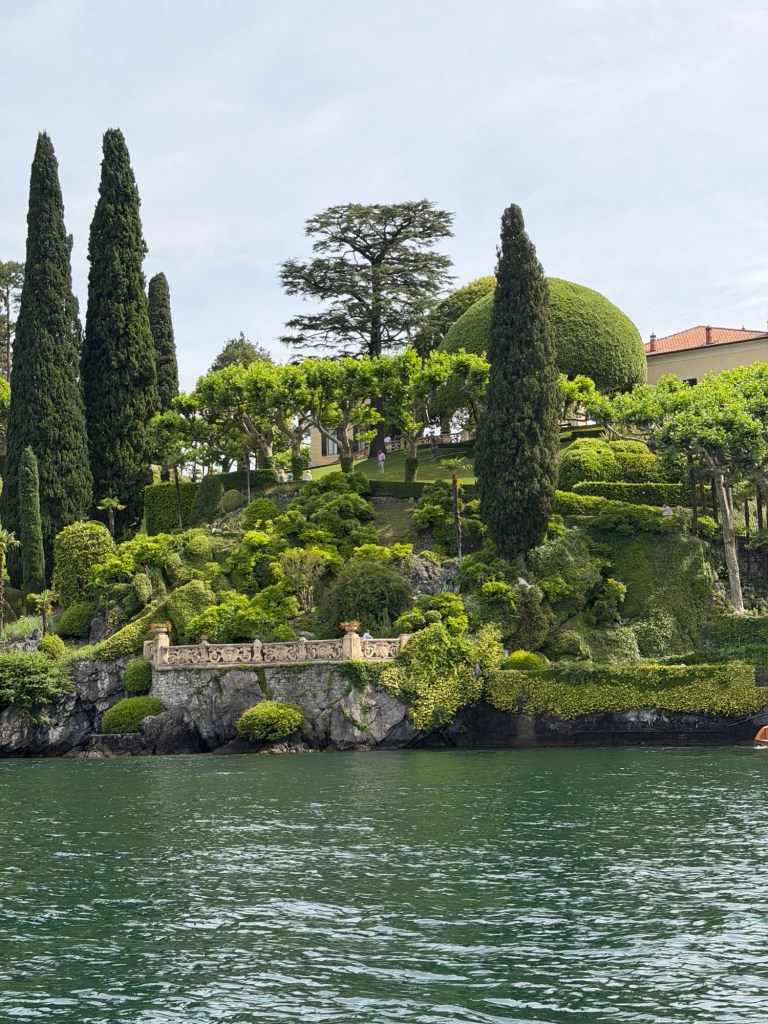
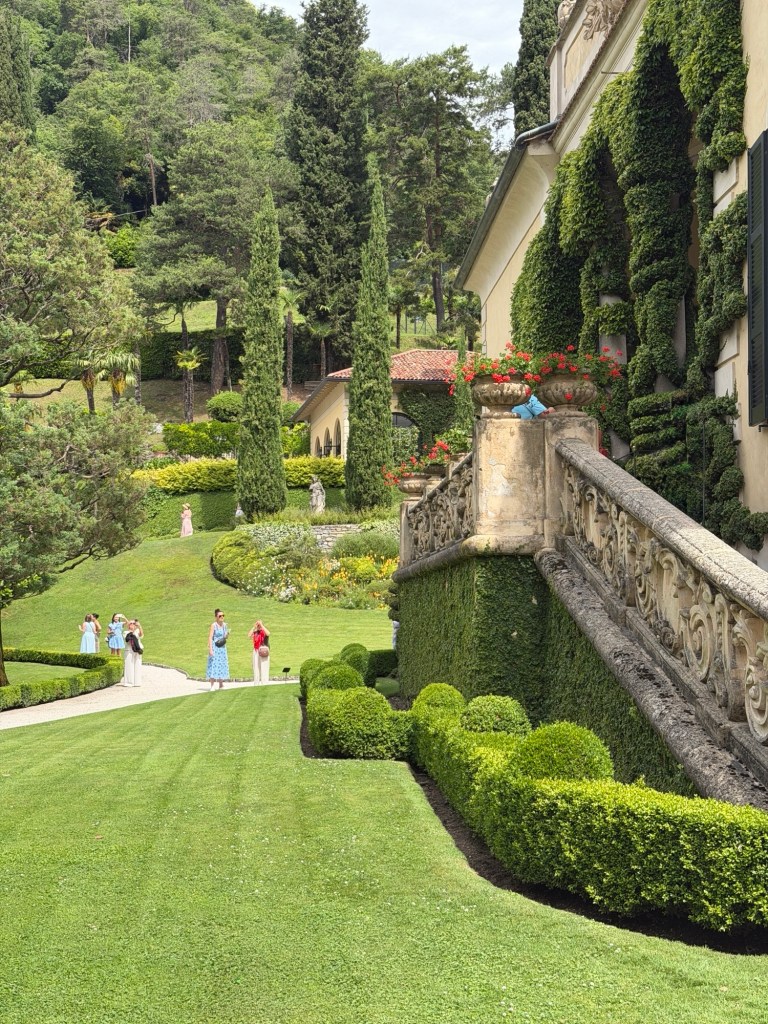
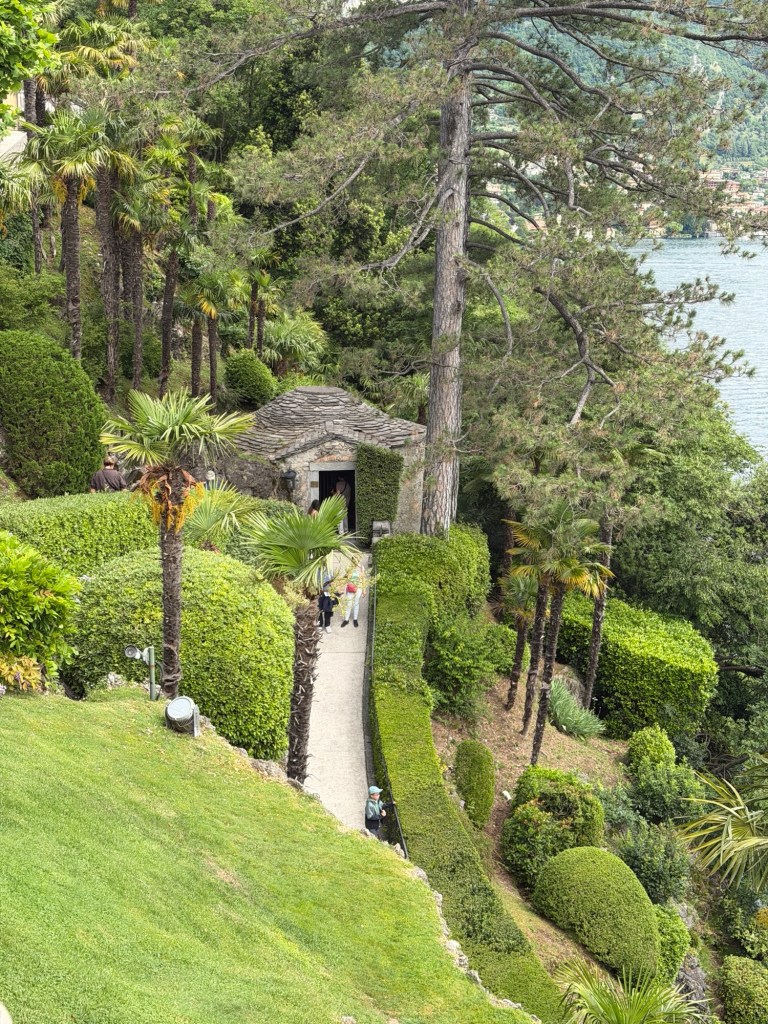
THIS time, we visited a different villa, the Villa del Balbianello.

This absolutely gorgeous villa was the setting for scenes in Casino Royale and Star Wars II.

James Bond recovered here

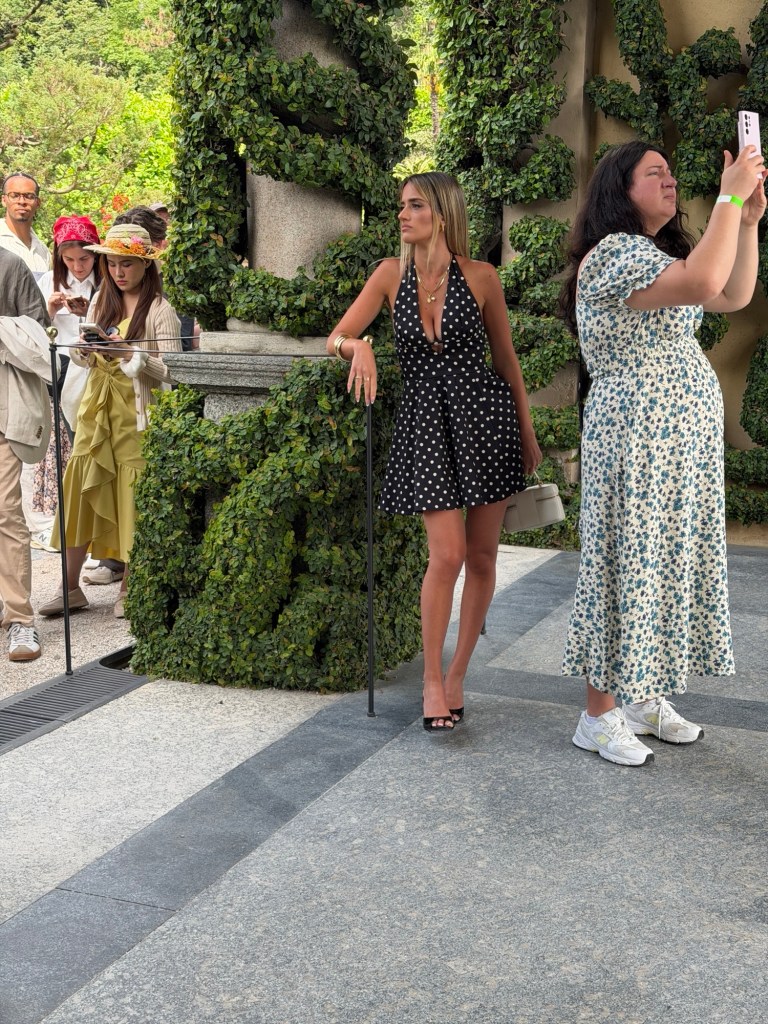
It is also a very popular spot for photos, with the “models” queuing up, patiently waiting for their turn, including these ladies. It wasn’t hard to figure out which was the photographer and which was the photographed.

There was a bit of drama, when a photographer asked a bystander to move out of the background. I was relieved to hear that the entitled, bitchy bystander had a German accent, not an American one, when she berated the photographer for what I considered to be a polite, reasonable request.

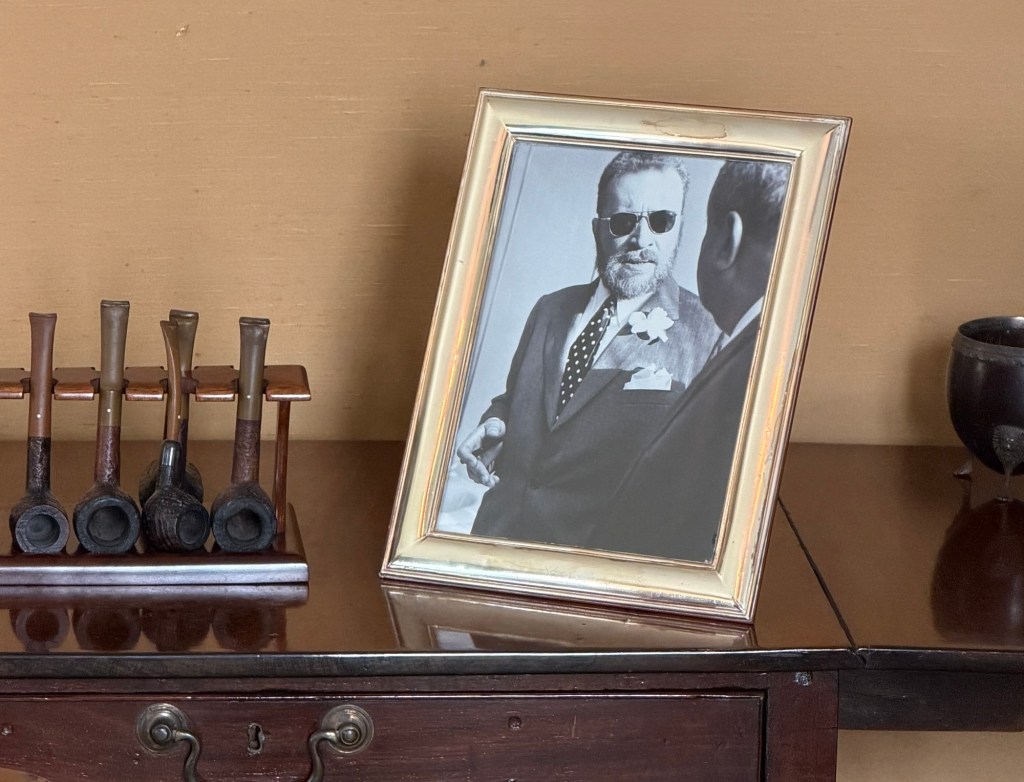
The last owner, Guido Monzino, never married, so he bequeathed the villa and its contents to the Italian National Trust when he died in 1988.

Our tour ended with an incredibly delicious lunch, that was SO filling, that even I who never misses a meal, skipped dinner that night.

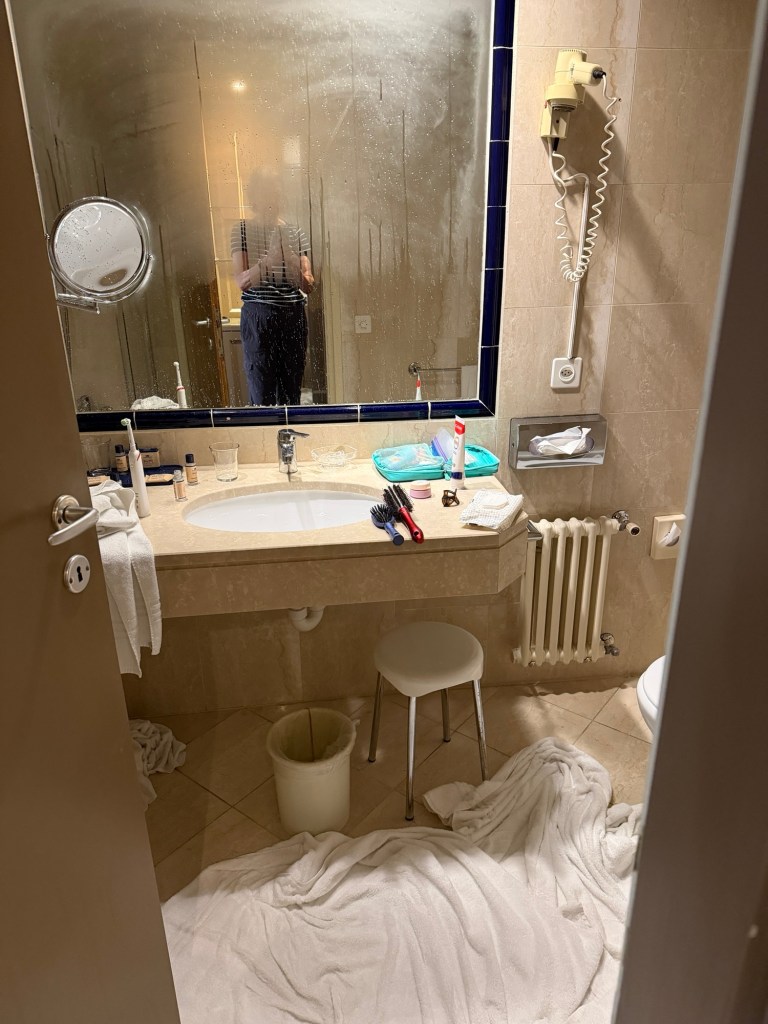
These last photos are designed to have you scratching your heads, thinking “what the …”

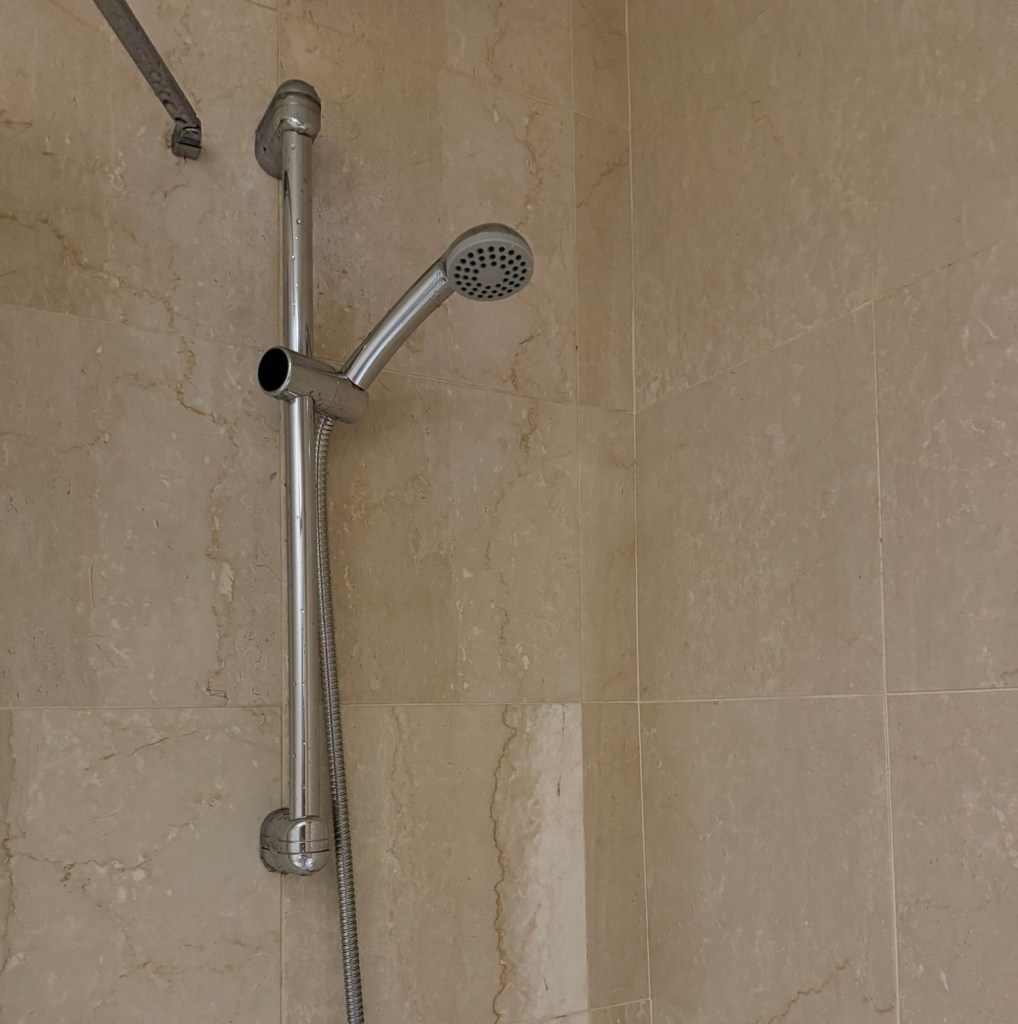
Here’s the story. I had thought that the shower head was in the same position I’d left it the day before. But no. The maid had turned it so it faced the ceiling. As a result, the entire bathroom got drenched, including the floor, door, mirror, toilet seat, etc. What a memorable way to end my stay in Lugano!
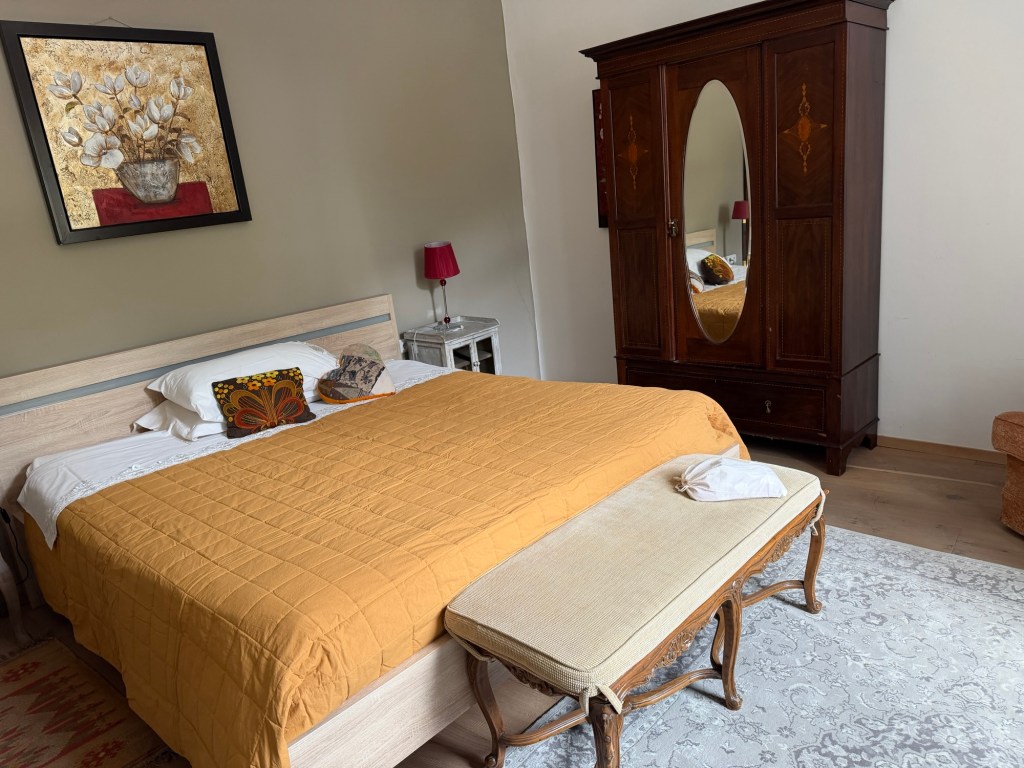
Biella, Italy

What?! You never heard of Biella? Before this trip, neither had I. That’s one of the many reasons I choose to travel with OAT. Their itineraries include places I didn’t know I wanted to visit until I got there.
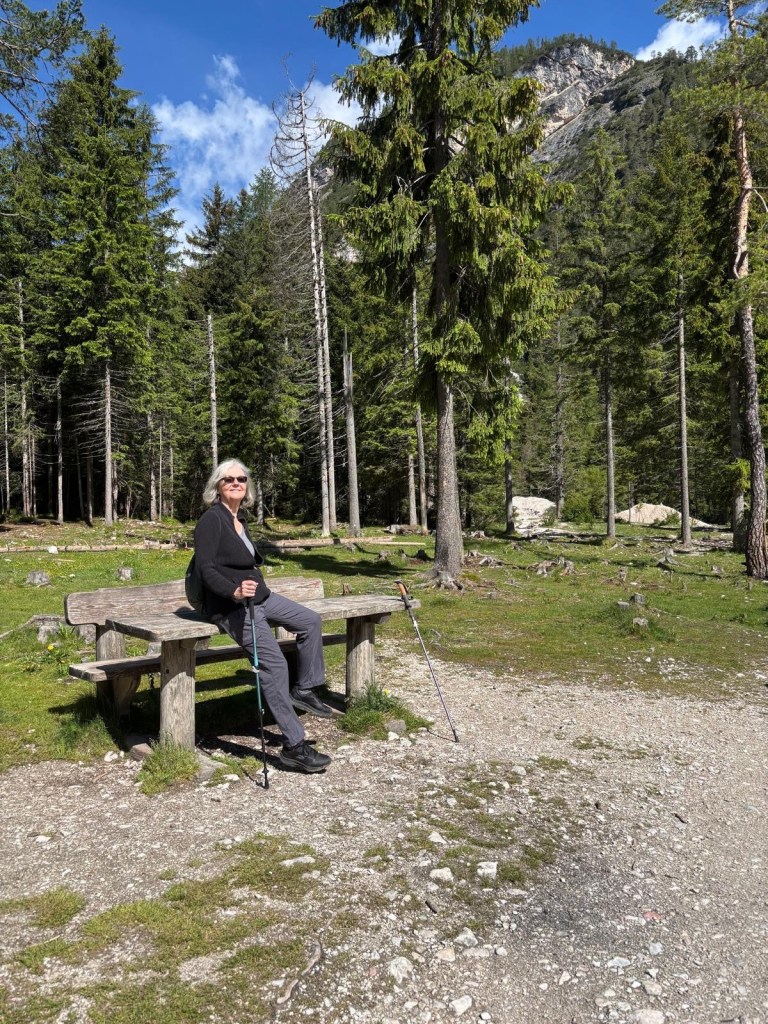
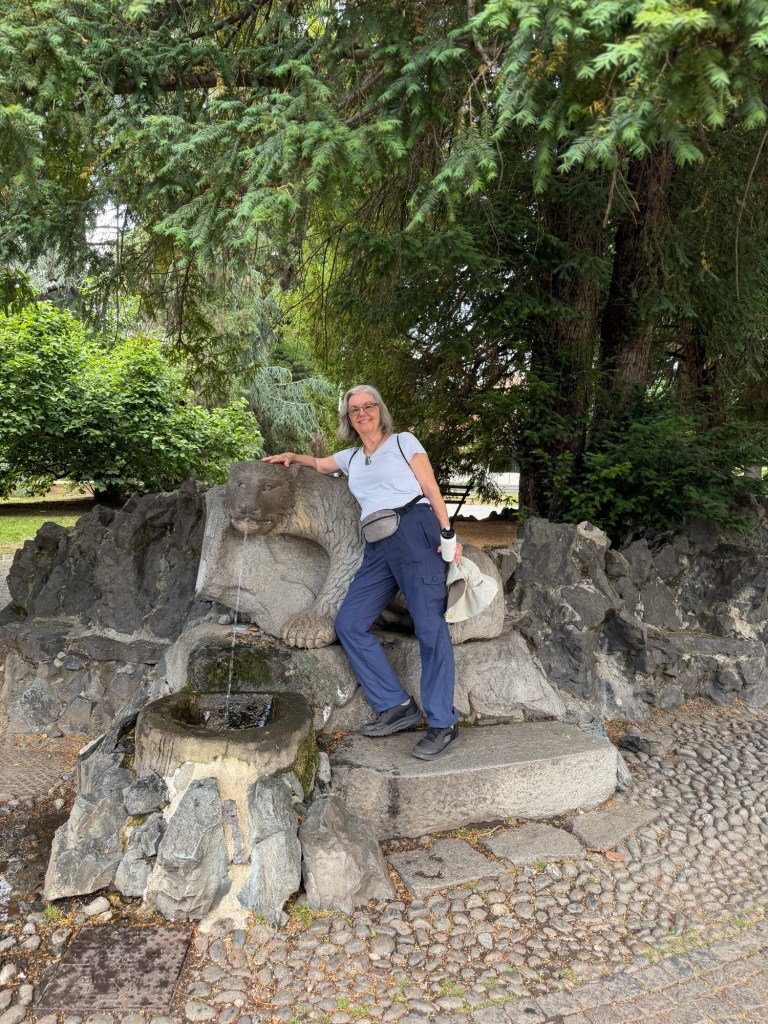
Our hotel, the Agora Palace, is across the street from a beautiful park. Unlike the USA, Biella has public sources of pure mountain water, like this one, from which you can fill your water bottle.

Also near our hotel is a small mall with a grocery store and an inexpensive clothing shop. Because the weather has been unseasonably warm, and we were ALL expecting cold temperatures, most of us went shopping for lightweight clothes. For 30 Euros, I got a tee shirt, shorts and a long skirt. I wasn’t crazy about the slit in the long skirt, but that’s all Piazza Italia had in stock. (That’s the name of the store).

Before we arrived, Luca explained Biella is a quiet town, without much going on, so we were a little surprised when we encountered this:

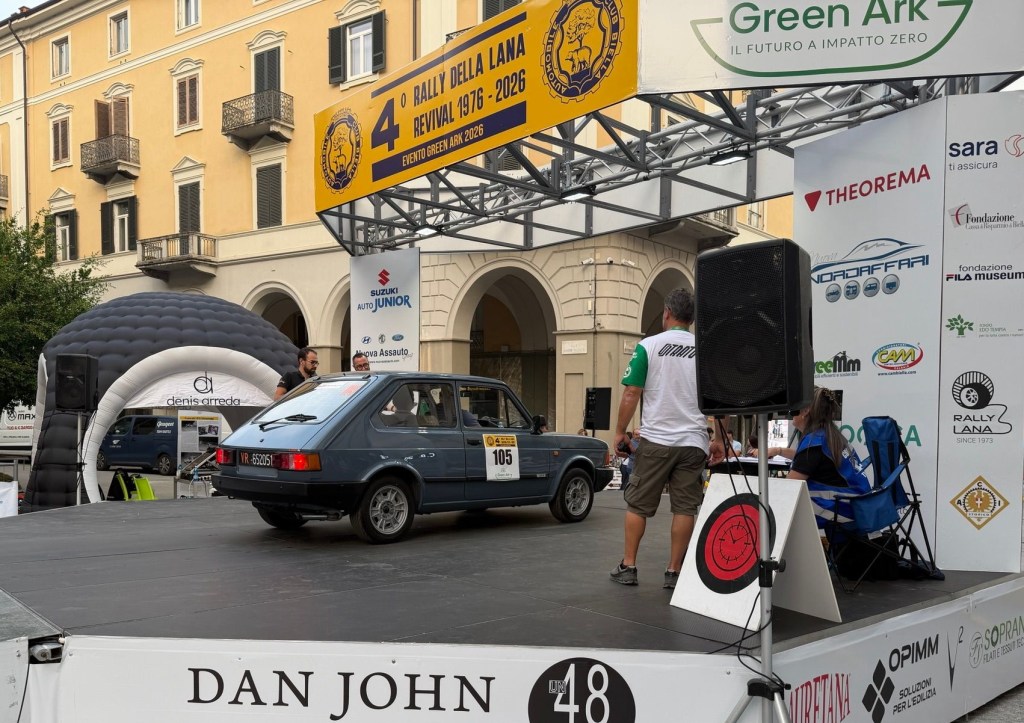
Turns out, an “old car” race with over 100 cars was taking place that night. We were a little puzzled by the cars departing one at a time, but we learned it was a TIMED race, and unlike most “races” , the speed was not the point. It was actually an opportunity to show off your old car. Supposedly, the race went on all night!
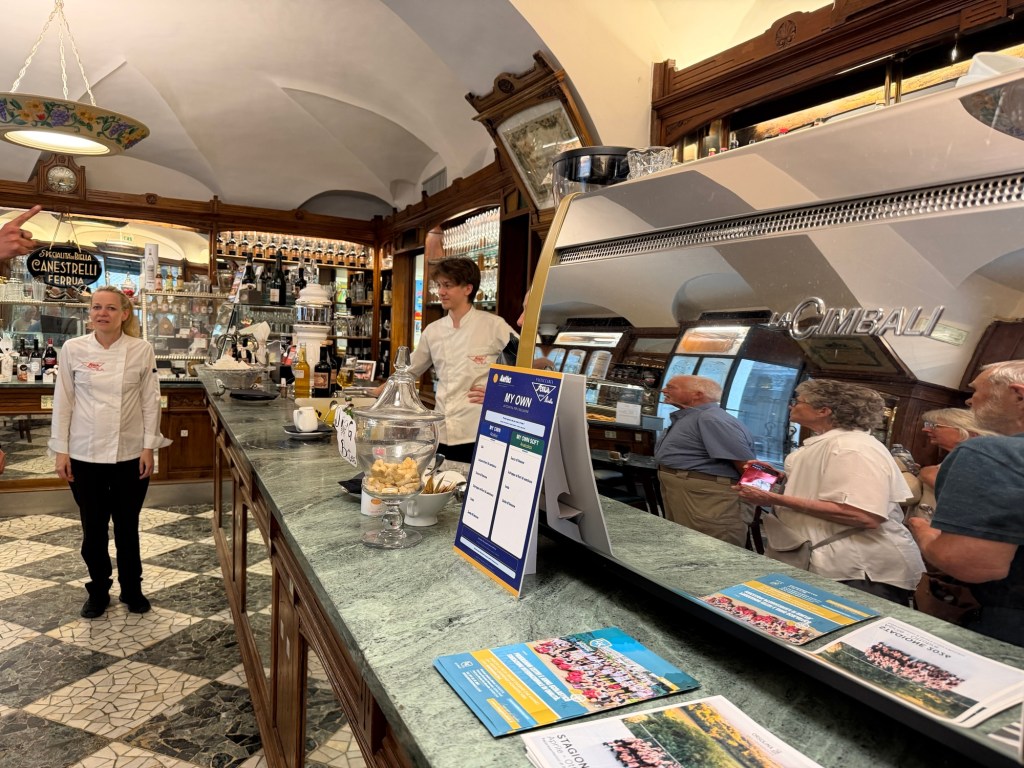
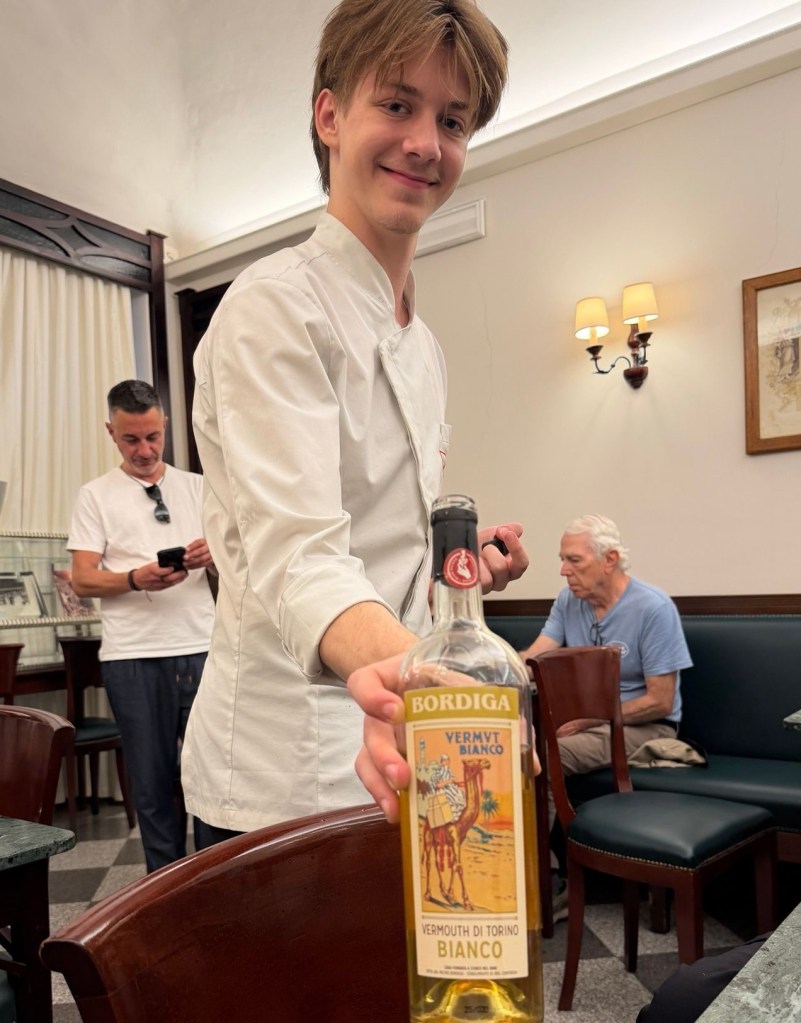
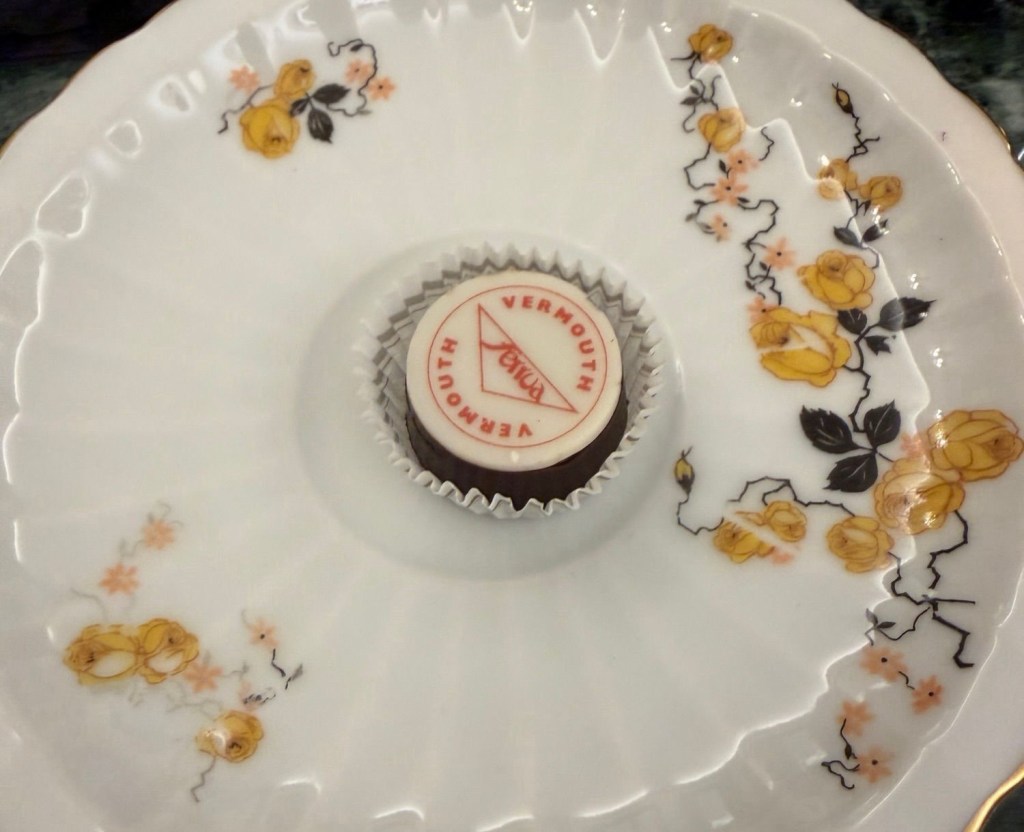
As I mentioned in an earlier post, we were unable to visit the ice cave in Chamonix, so Luca negotiated with the OAT office to replace THAT activity with vermouth tasting at a historic bar.

We were all quite delighted with the change in activities!

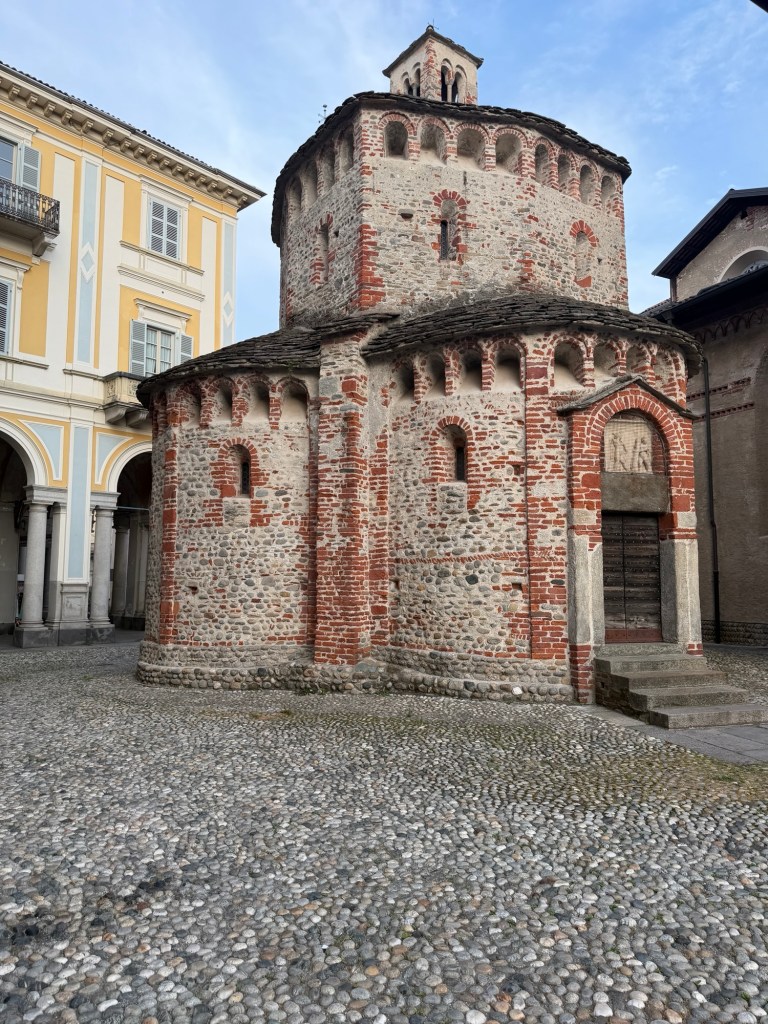
Our second day in Biella started with a guided tour of the city’s highlights, namely churches, including this baptistry.

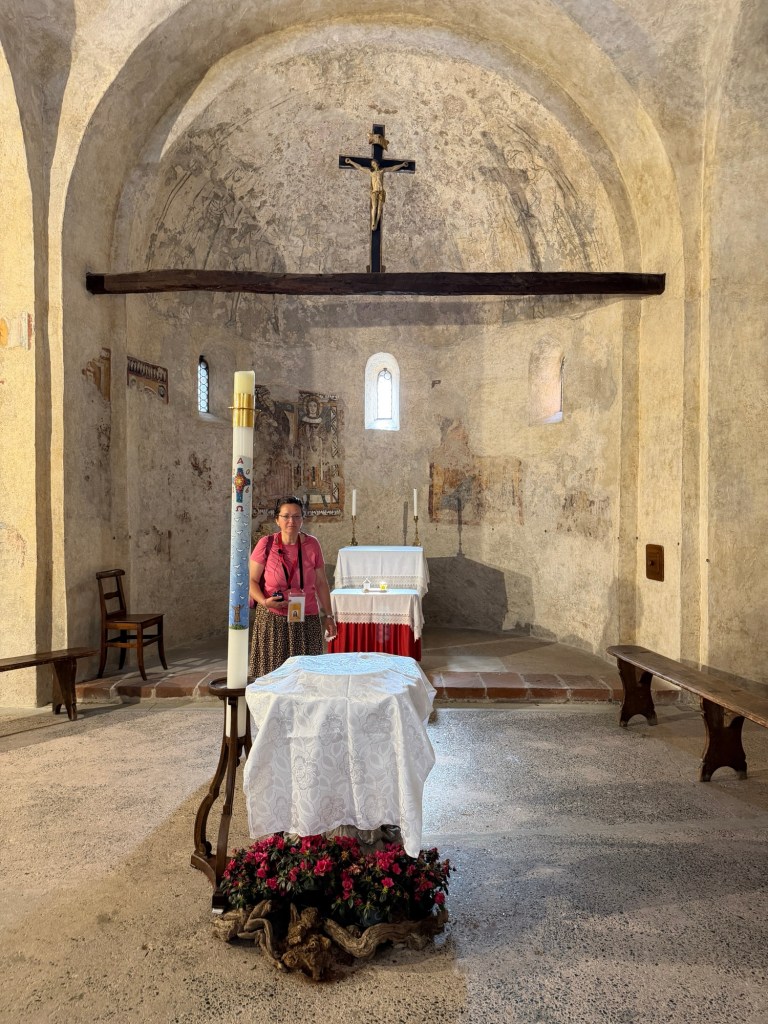
We’ve all seen churches, and the remainder looked like every other church I’ve visited, so I took no photos.

We then hopped onto a bus, which whisked us up to the old section of Biella, where we toured La Palazzo La Marmora. Here’s another reason I love OAT. The palace is normally closed on Sunday, but it was opened just for us.

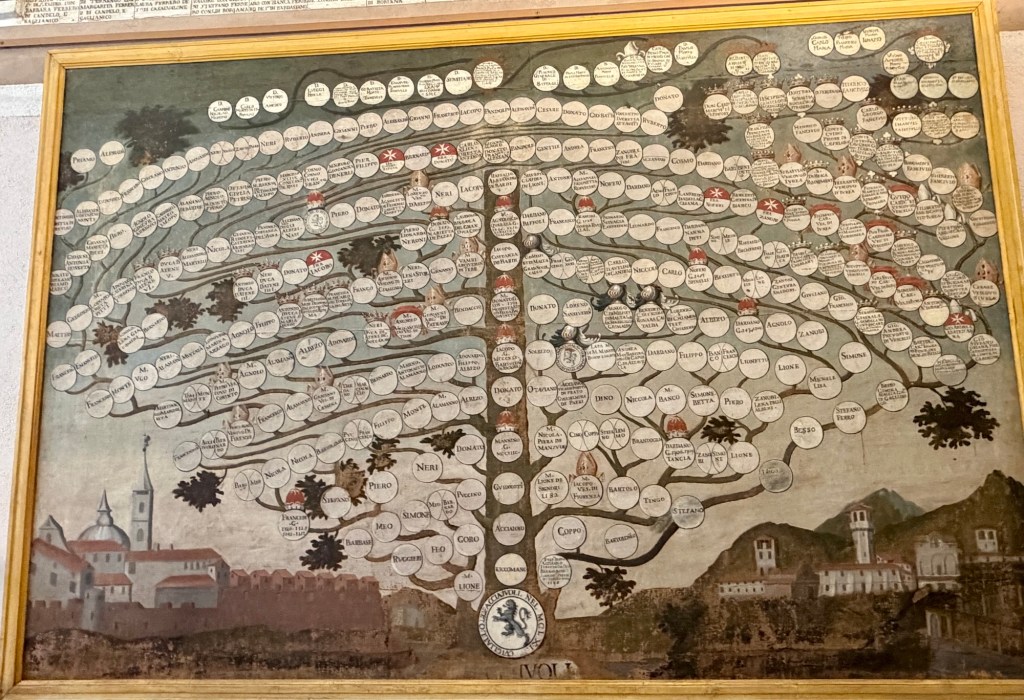
Our guide, the marquis, was a member of the illustrious family, whose tree adorned the dining room wall.

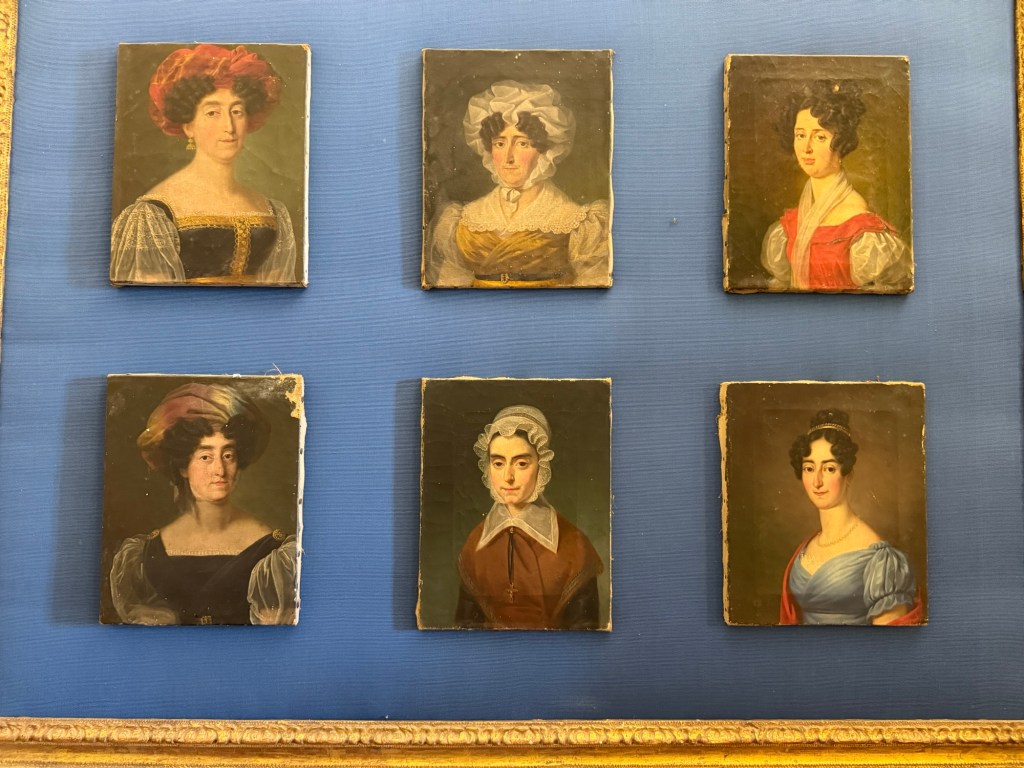
To say the artwork and antiques were interesting would be an understatement.

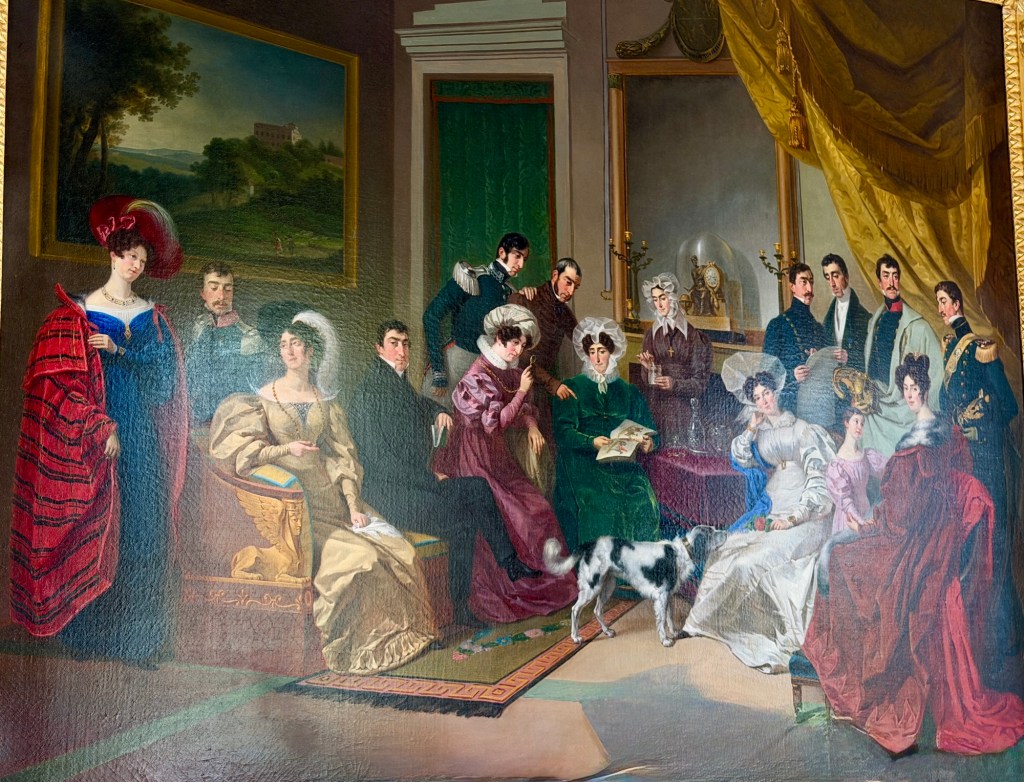
The matriarch who commissioned the following family portrait gave birth to 16 children. The girls all moved away after marriage, so the artist had to visit the homes of the daughters to create “sketches” that he later incorporated into the portrait. Of course, the gathering of all surviving children portrayed in the painting never occurred. (Was this the forerunner of Photoshop or AI?)

I thought I could figure out who was who by matching the clothing, but apparently the artist preferred different outfits.

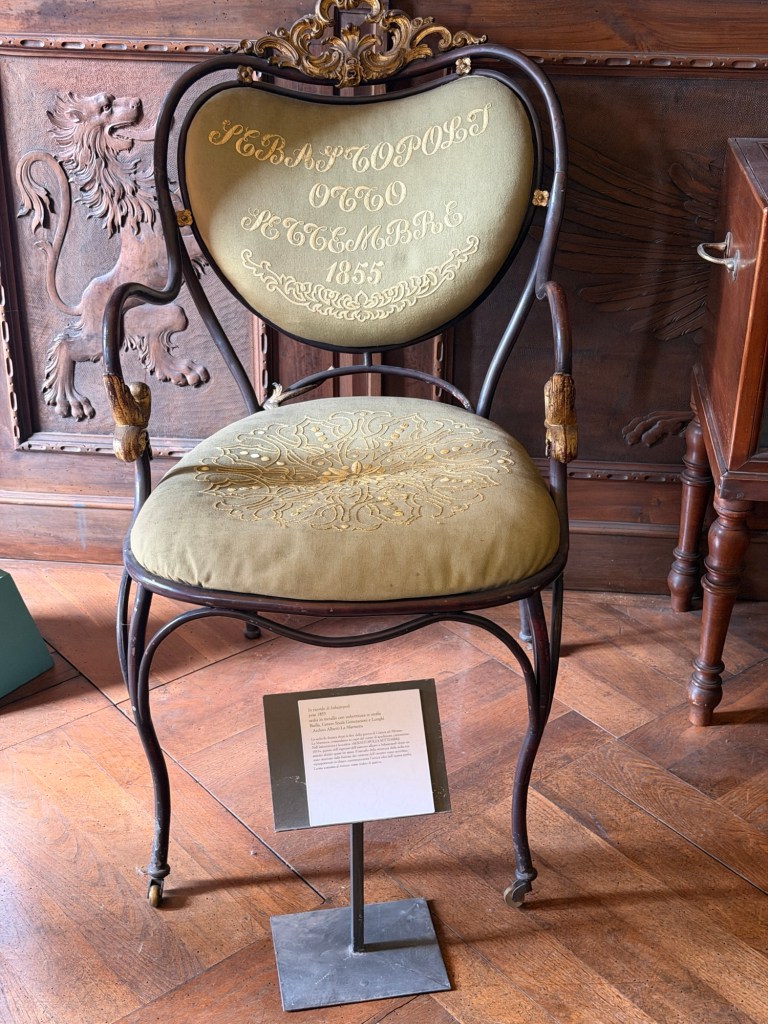
The 4 sons on the upper right were all generals in the Crimean war. So what do you do when a cannonball almost kills you? Why, if you are a member of nobility, you bring it home, melt it down and recycle it into a chair.

One final example of the artwork, before we move on.

For some unknown reason, the marquis didn’t point out this mural on the dining room wall. Perhaps he didn’t want to have to explain what his ancestors were thinking about while they were munching on their Cheerios?

After the tour, most of the group chose to take an optional cooking class, but Susan and I decided to skip it. Instead, we had lunch in upper Biella at the “Hasta La Polenta” restaurant. How could we resist a restaurant sporting a plaque that said ( in Italian) “Ernest Hemingway never was here”?

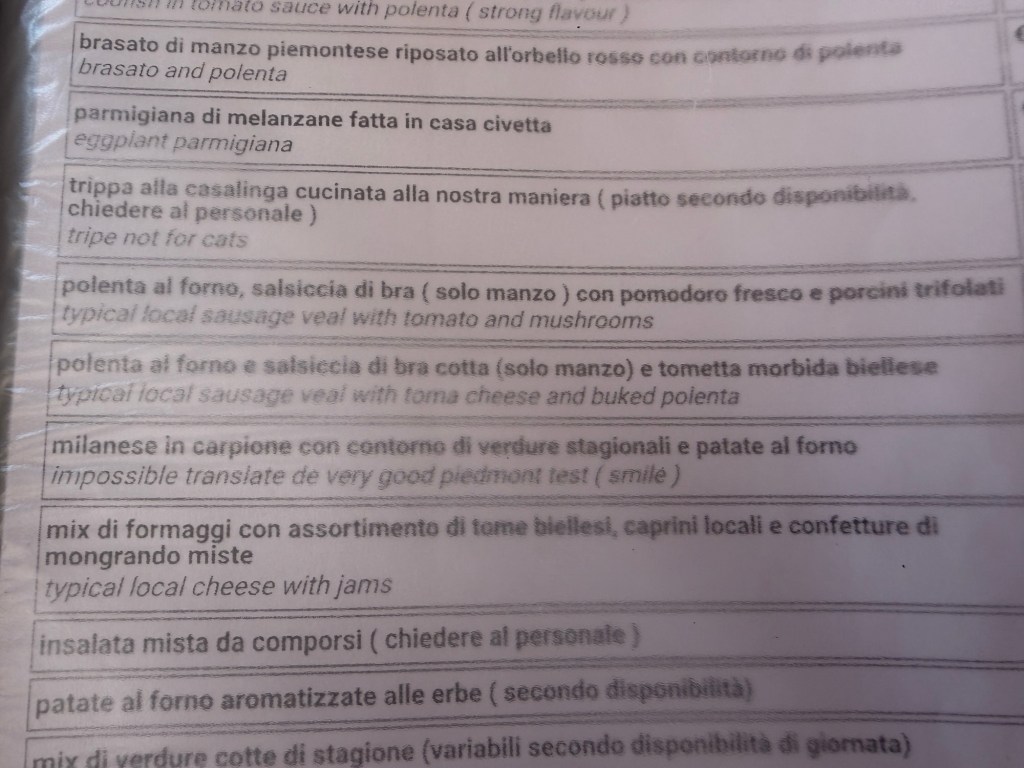
I absolutely LOVE the Italian sense of humor. Take a look at the English translations on their menu.

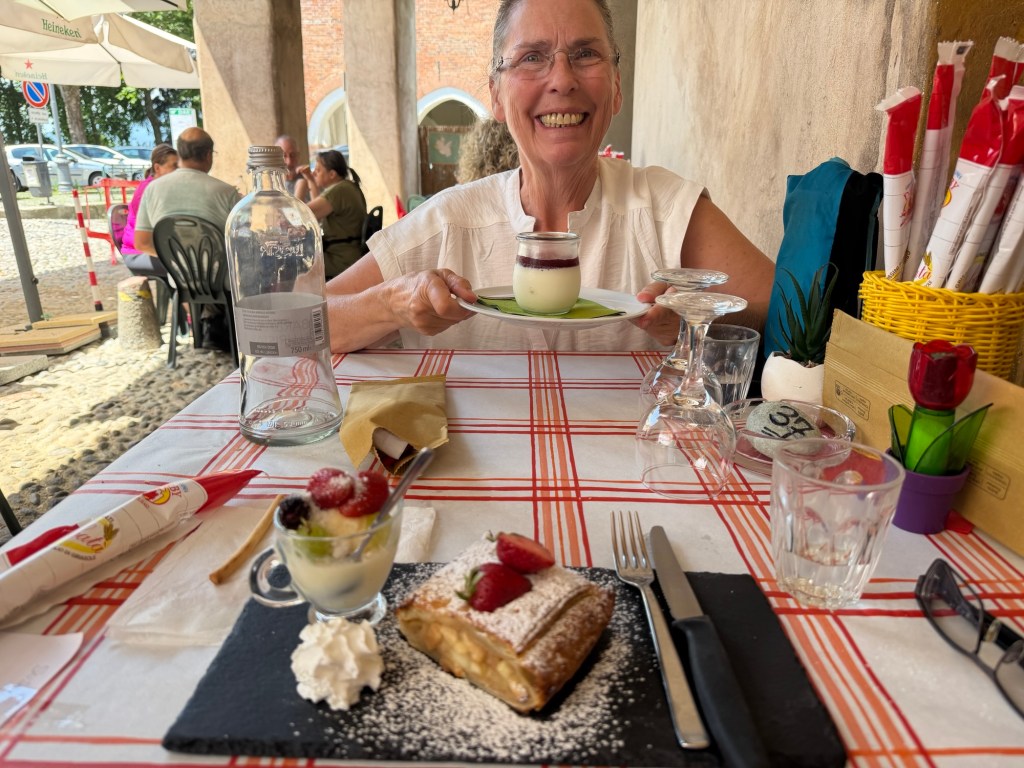
Of course, after our entree, we HAD to have dessert. Here’s Susan, showing off her selection.

After our wonderfully filling lunch, Susan and I worked off some of our dessert by walking back to the hotel.

By then it was time to get ready for a “home hosted” dinner with Marcelo and Claudia in their historical home, built in the 1800’s.

Our group of 14 split up to have dinner with 3 different families.

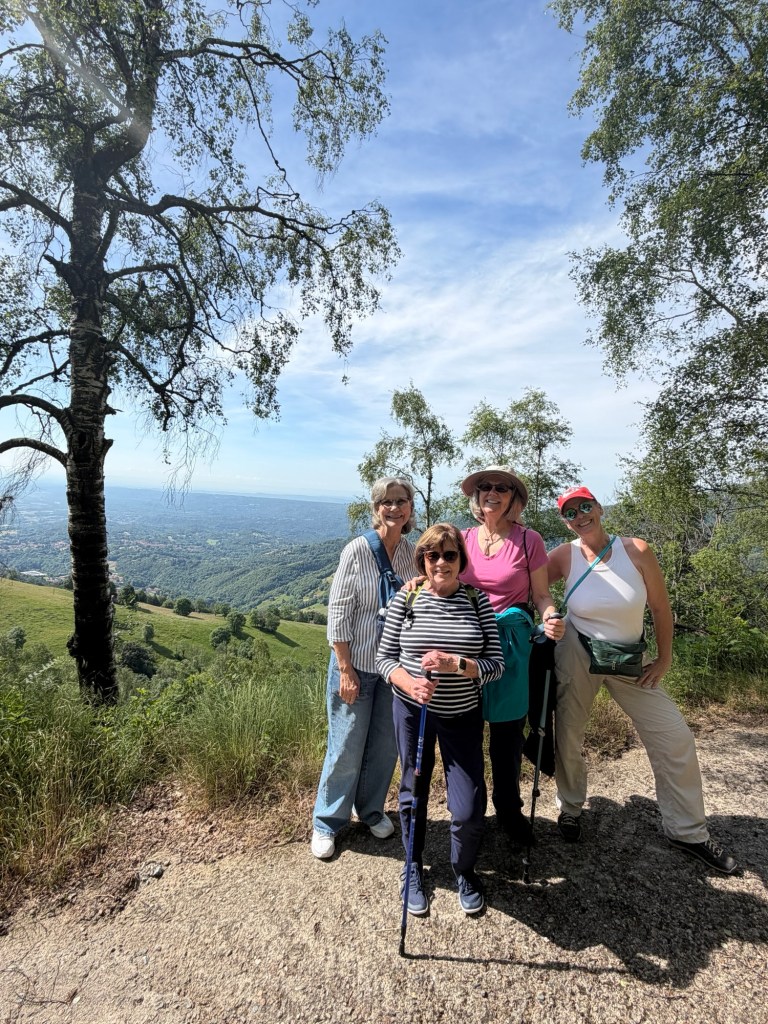
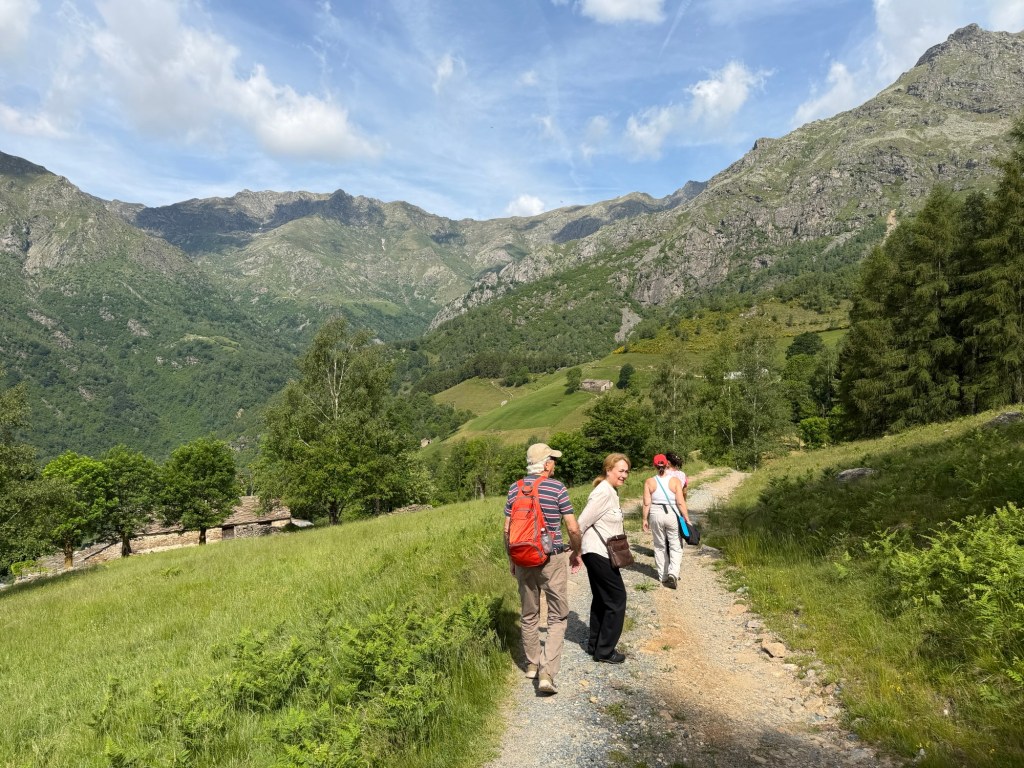
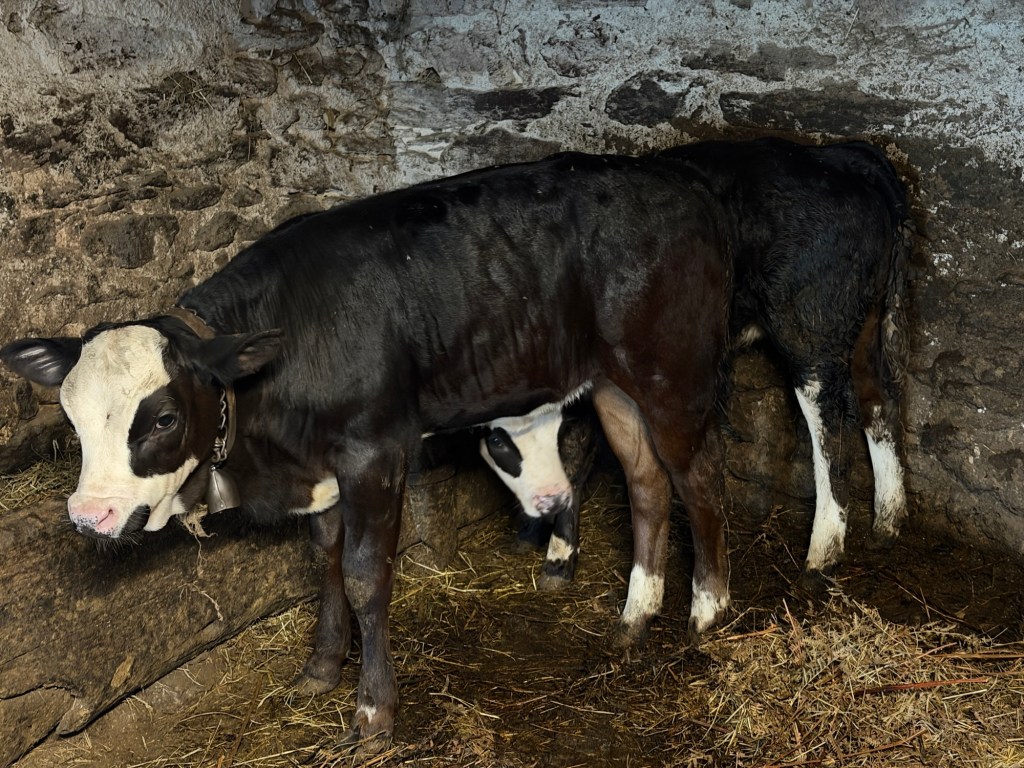
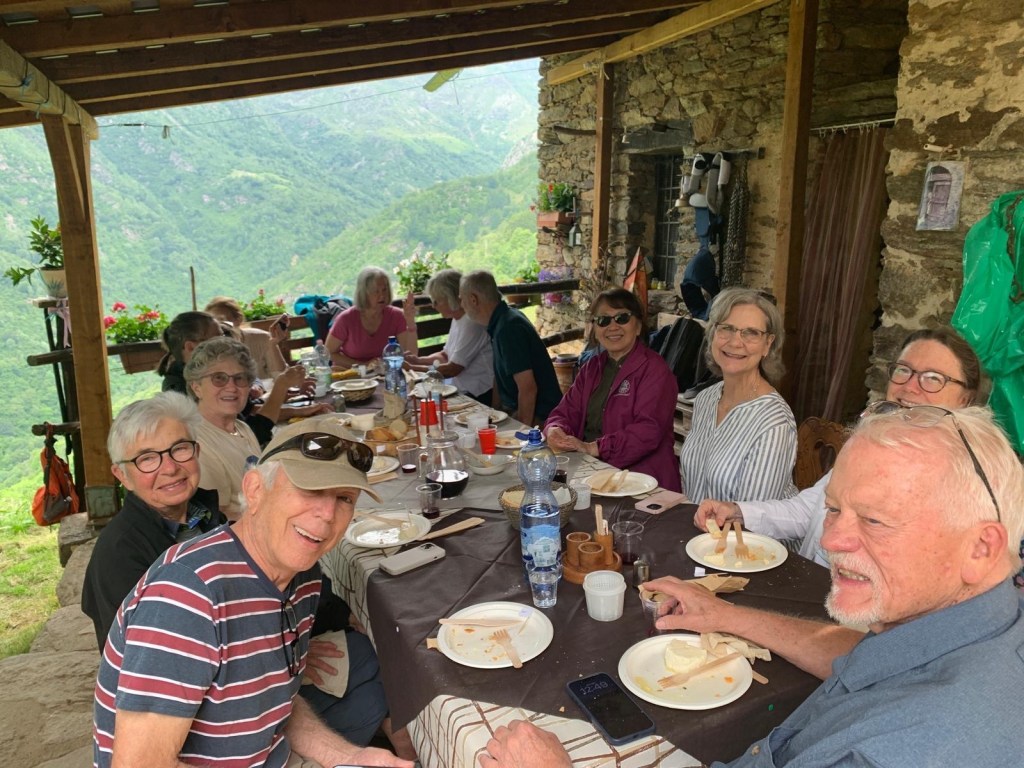
For final day we visited a cheese farm, to partake in what OAT calls “A day in the life”. As the name suggests, OAT travelers are given an opportunity to experience the area’s daily life. The best part? We walked part of the way there — and the weather was perfect!

Kay, Gail, me. Susan

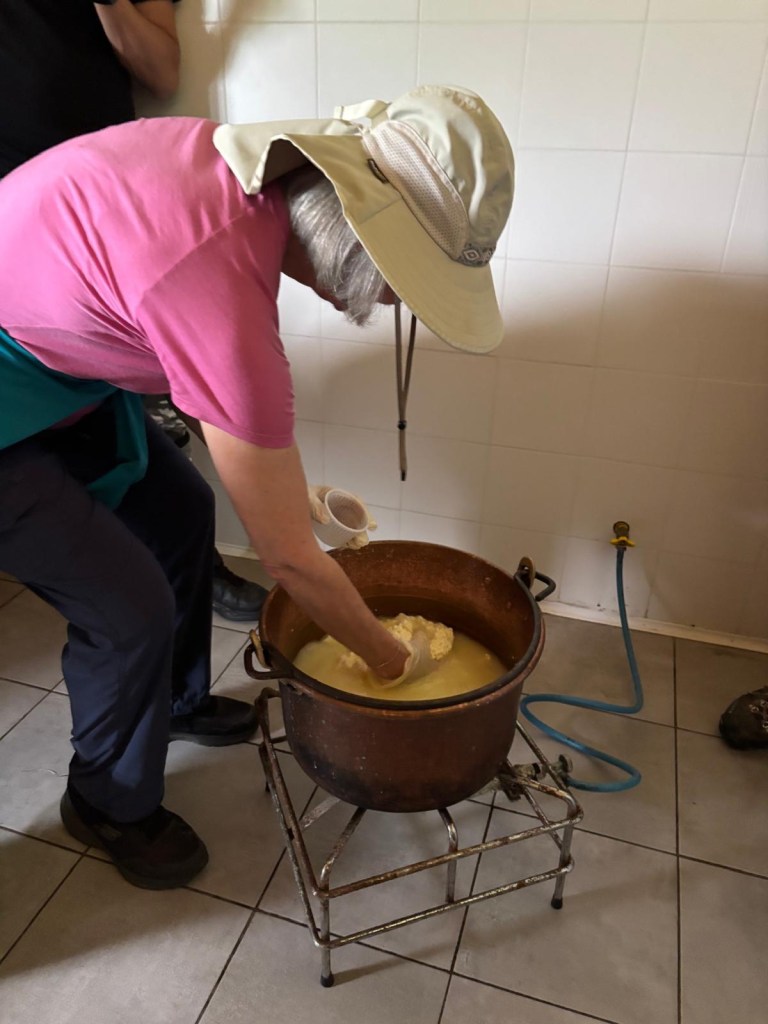
We all got a chance to “make” cheese, while we learned more about Elisa, our host. Although she has a degree in economics, Elisa decided she preferred to take over her grandparents’ cheese making business.

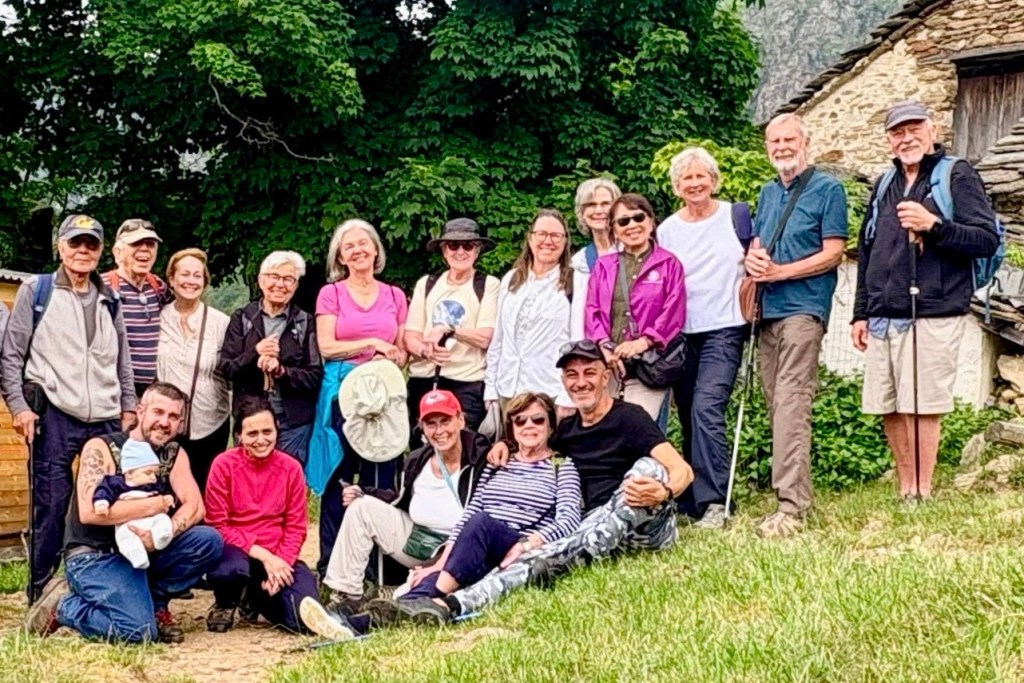
OAT group at a Day in the Life, with our hosts

We ended the day with a visit to (what else) the church complex at Oropa.

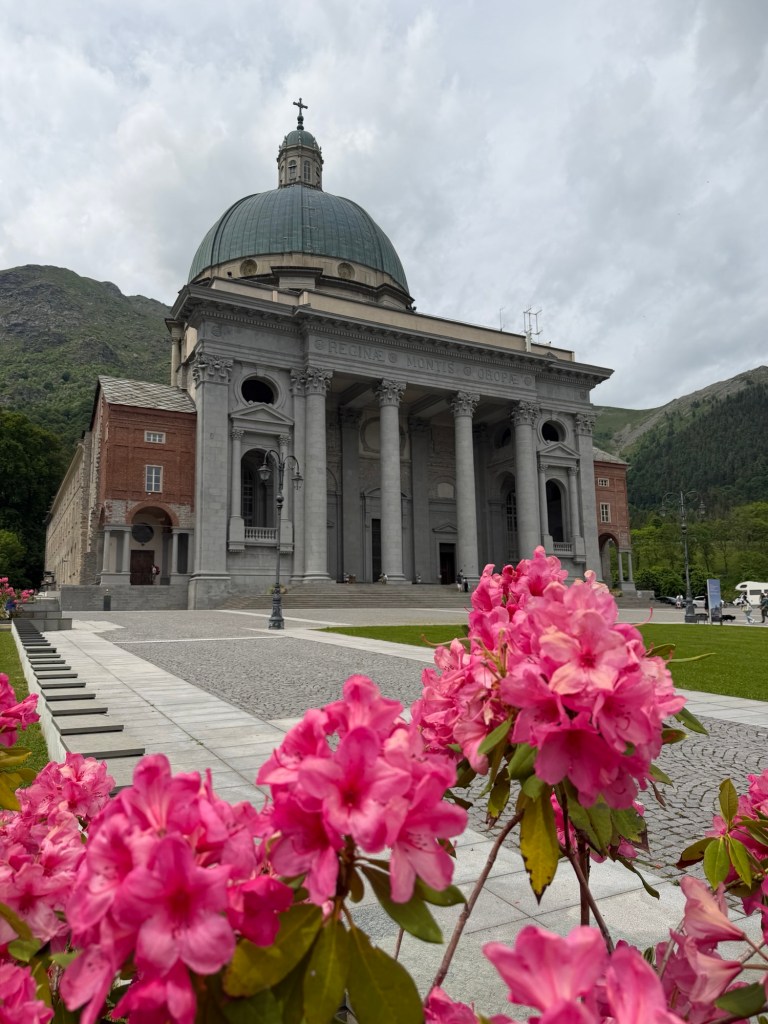
This “new” church was built for a papal visit

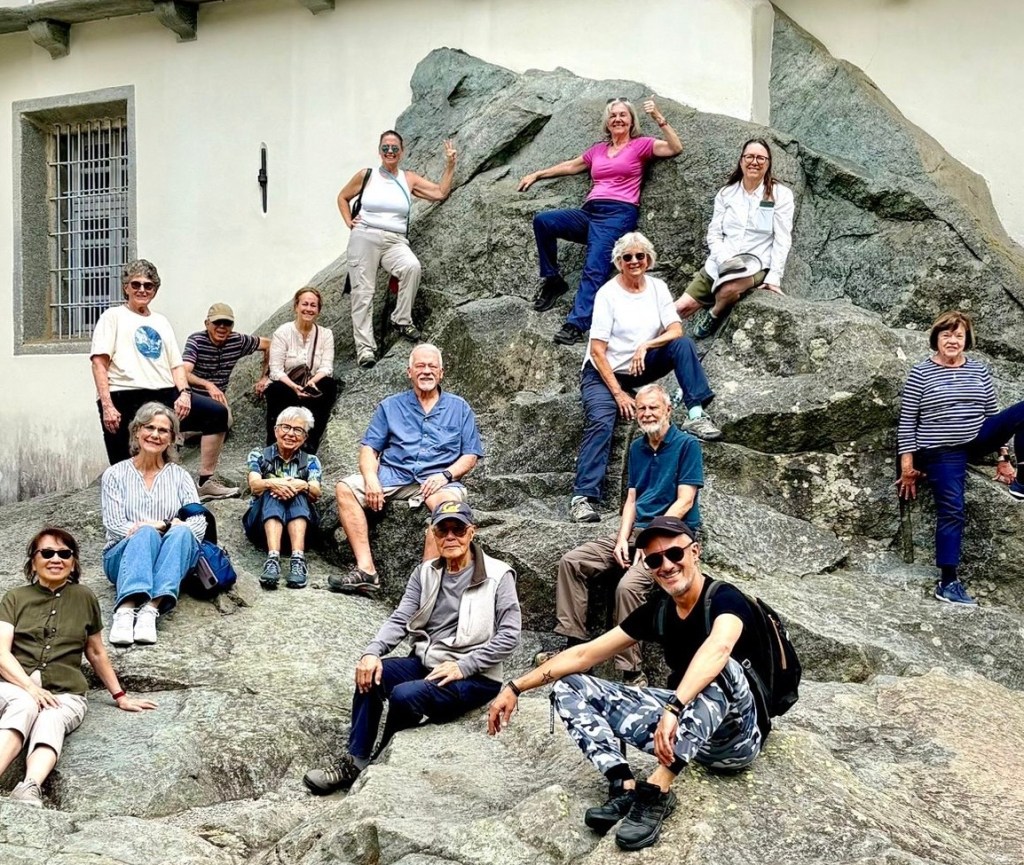
The original church incorporated this rock into its wall, presenting the perfect backdrop for yet another group photo.

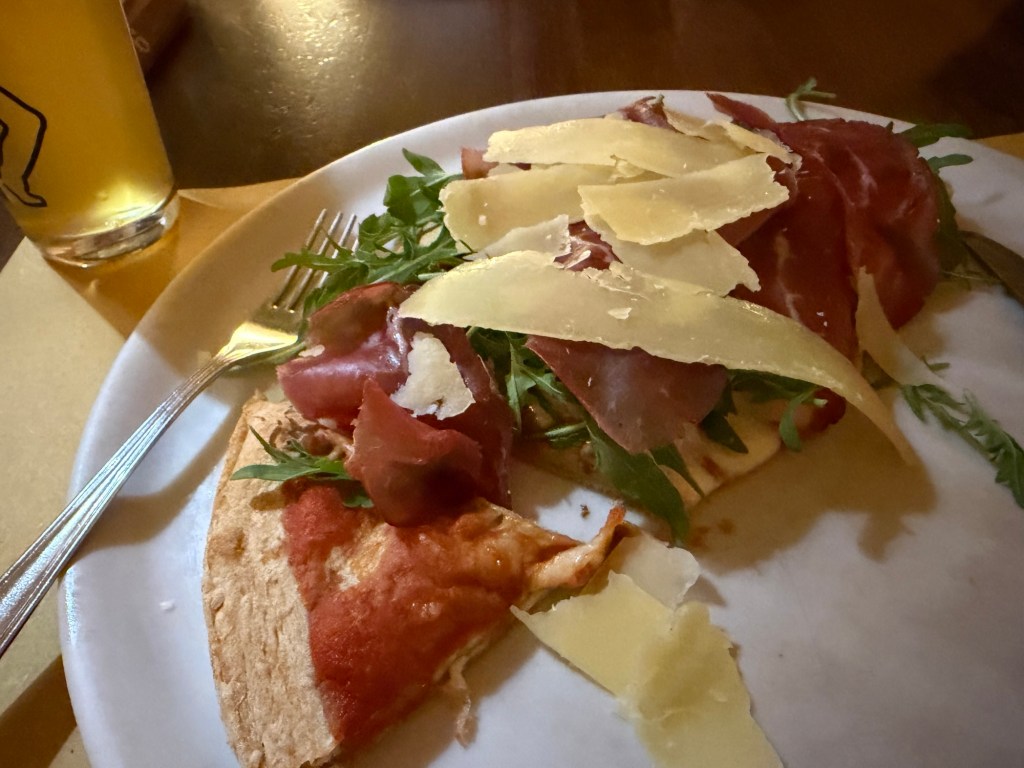
Dinner was on our own, so four of us went for pizza at Doppio Zero. It was very good, but very different.

Next stop Lugano, Switzerland.

Goodbye France, Hello Italy

OAT made the right decision to start this adventure in Chamonix! Our hotel, the Lykke, was ideally located. We could walk to the many restaurants, bars, trails and attractions. And we DID.

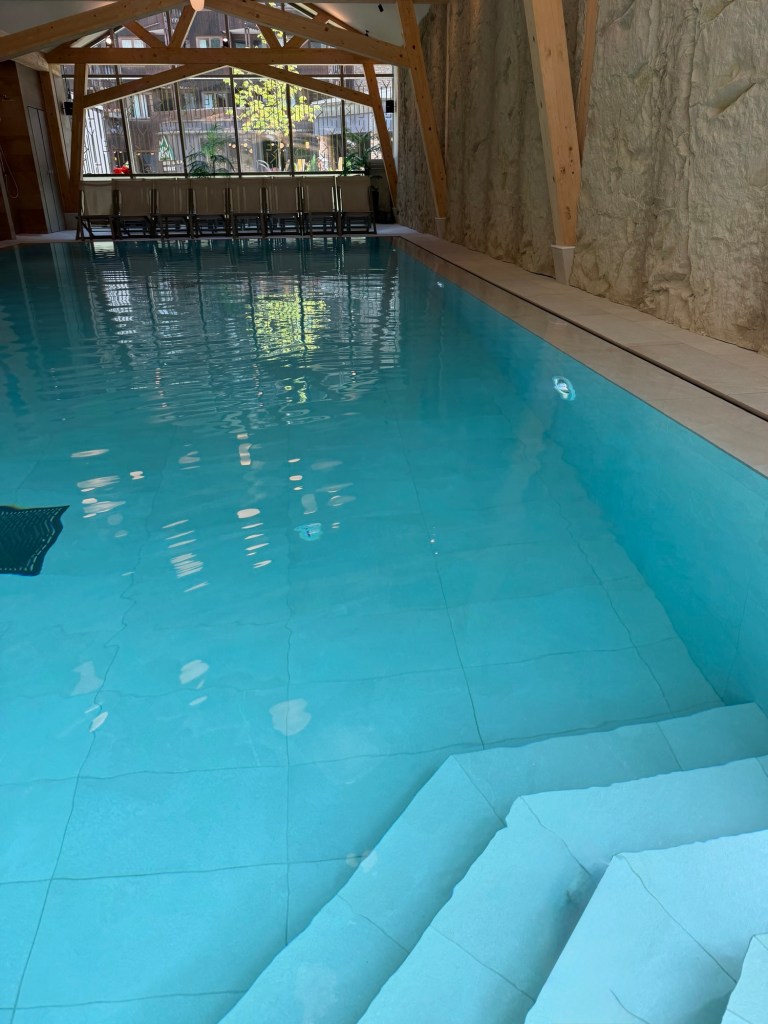
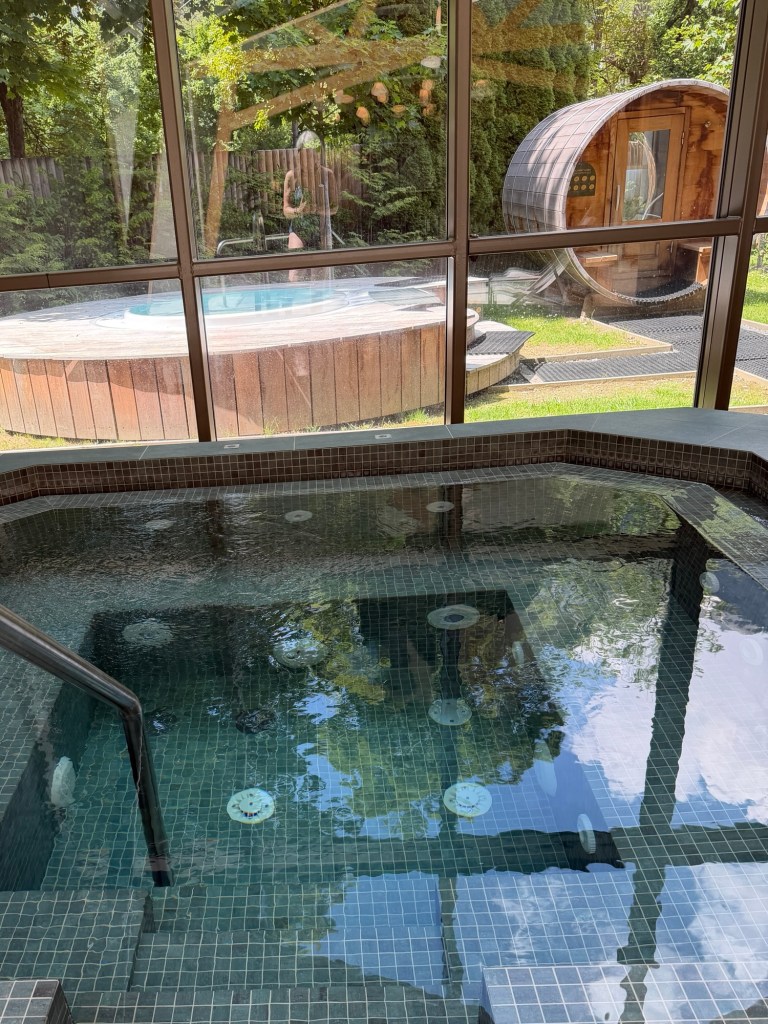
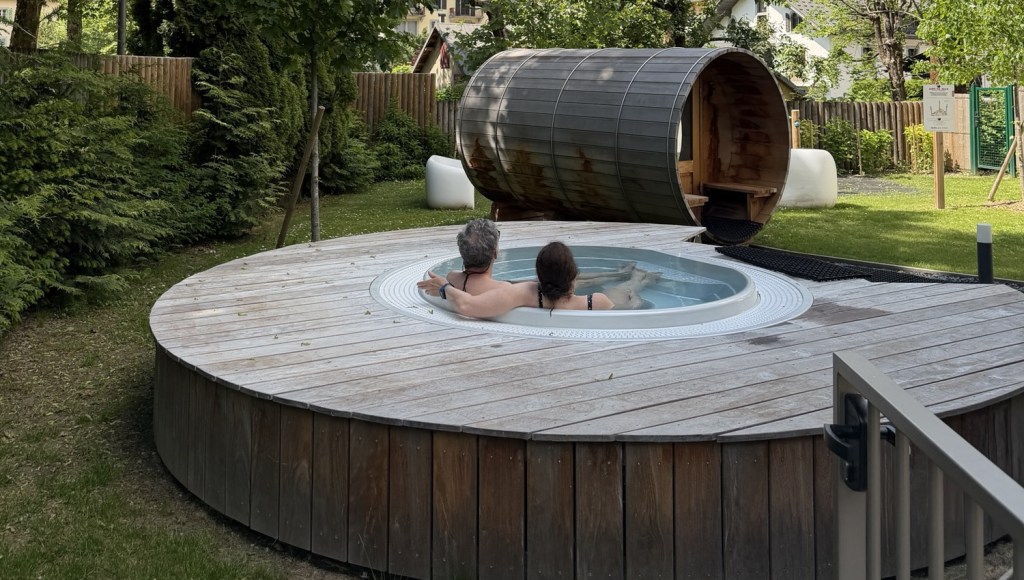
Not only that, but if you needed down time, the hotel’s pool/ whirlpool /sauna complex was the ideal spot to relax and recharge. I visited there twice during my four day stay.

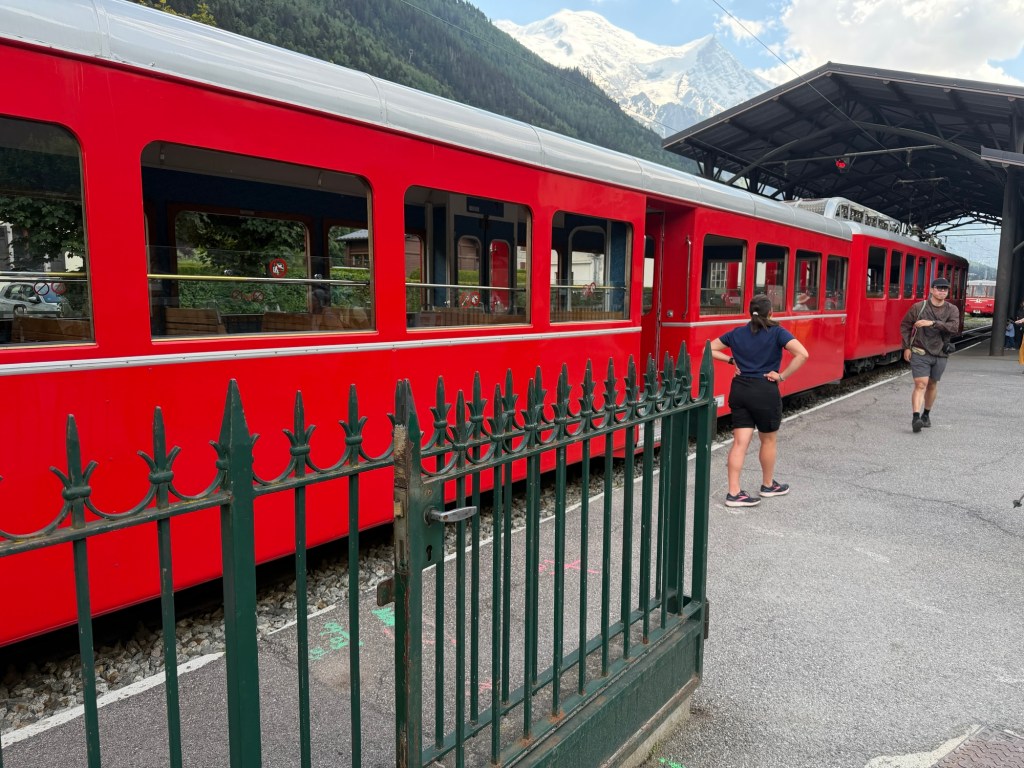
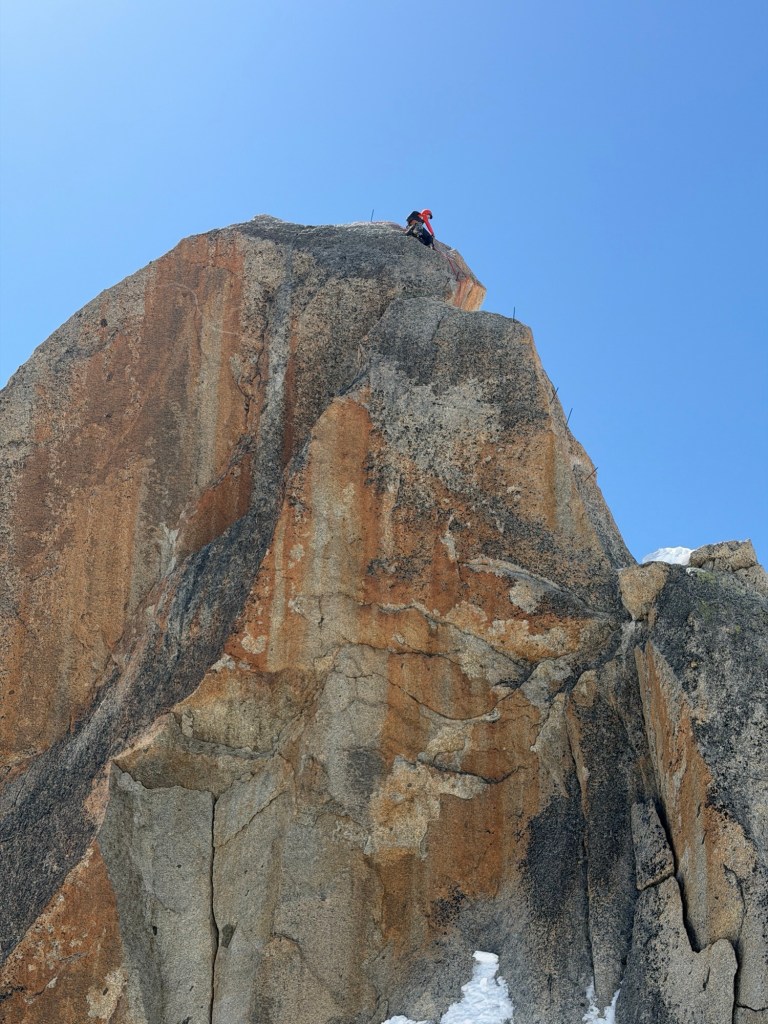
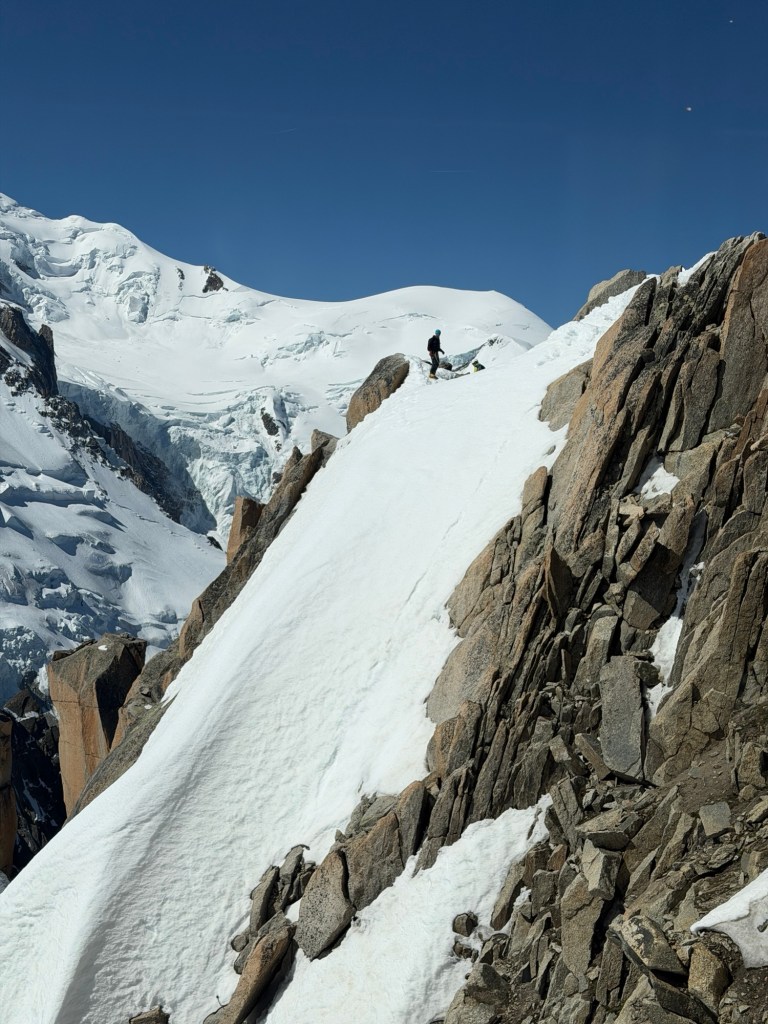
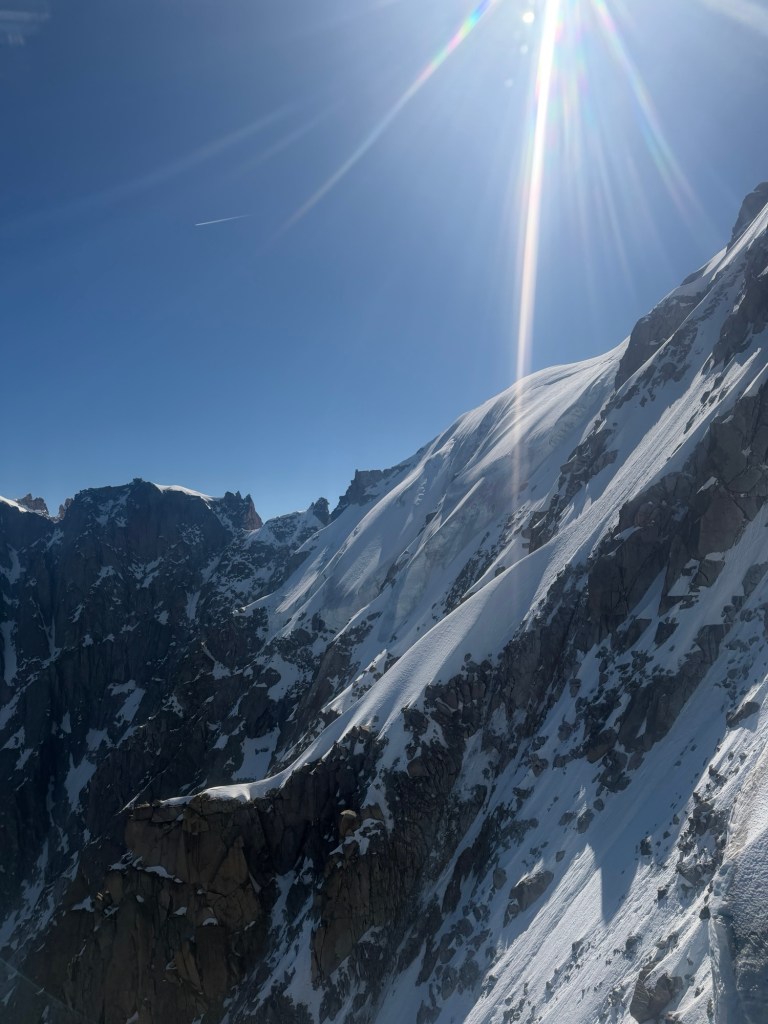
The MAIN attraction of Chamonix, however is the mountains in general, and Mont Blanc in particular. During our stay, we rode the classic cog train to view the glacier which either starts or ends at Mont Blanc. I forget. But really, who cares?

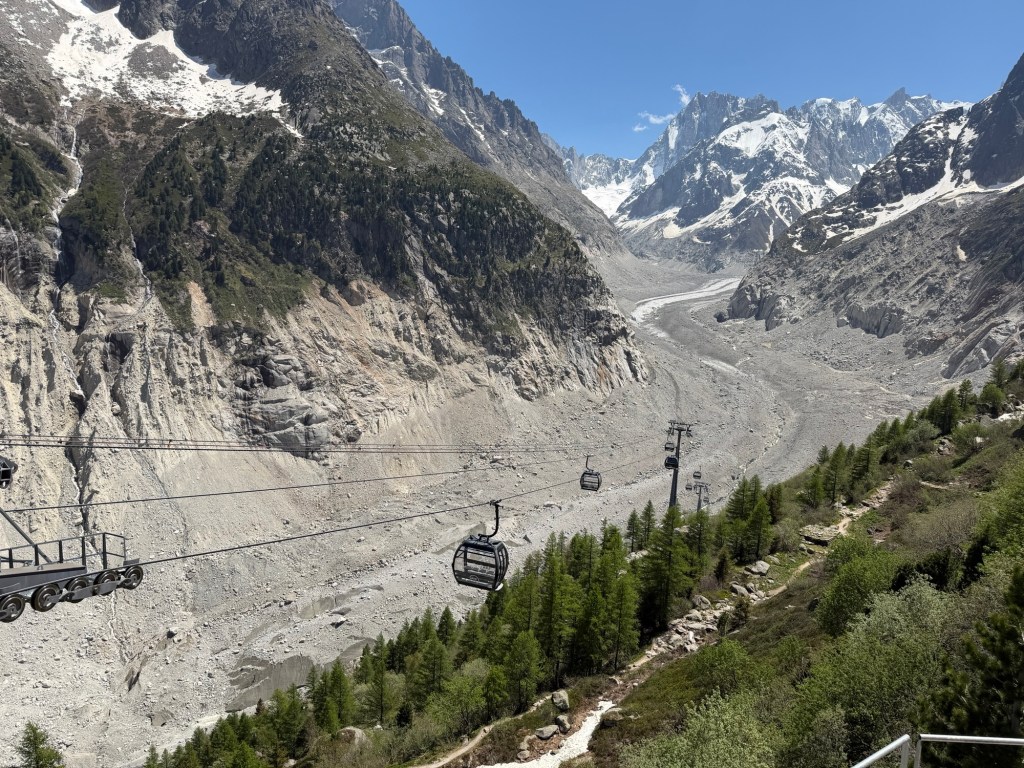
Unfortunately, the gondola was not accepting passengers, but we saw its practice run.

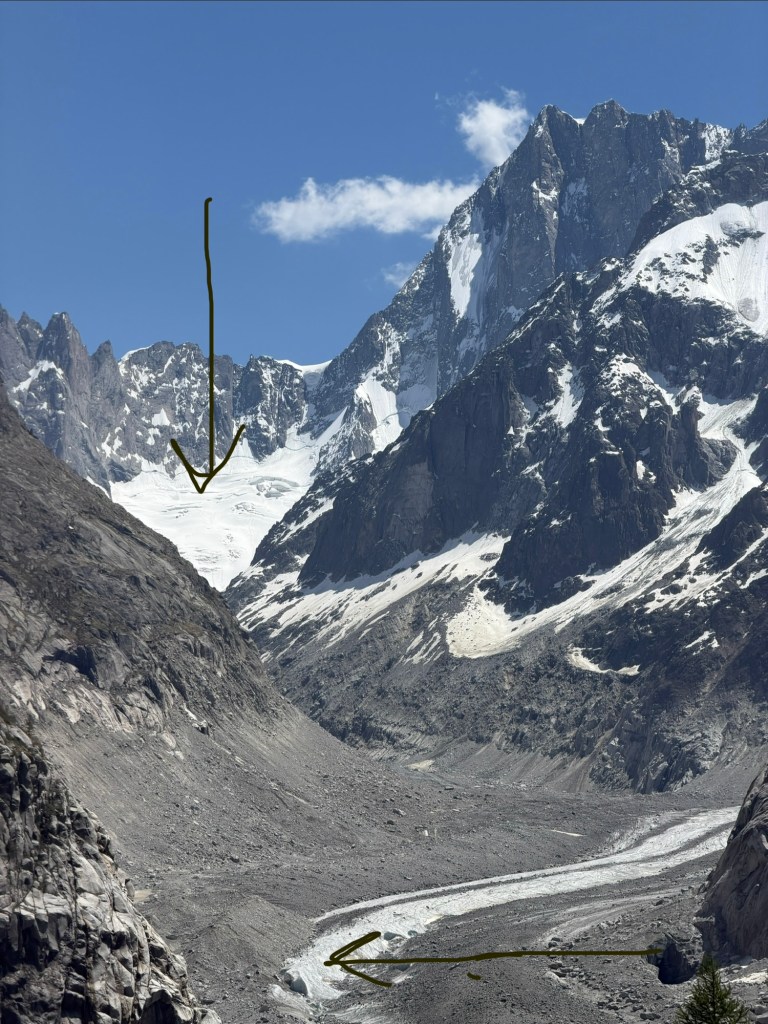
We were SUPPOSED to ride the gondola to an ice cave, but because of climate change, the cave was closed. A new ice cave had to be built nearer to the glacier. Because the pace of warming is escalating, our guide told us over the last few years, a new ice cave had to be constructed every year.

I find it hard to understand how someone cannot “believe” in global warming and climate change. Yes, I know, our planet has been through ice ages and warming trends, but those changes took centuries to occur, not years. But enough on that topic. For those of you who will never visit Chamonix, here’s what you would have seen.

The vertical arrow shows the current position of the glacier. The horizontal arrow near the bottom of the photo marks where the glacier ended four years ago.

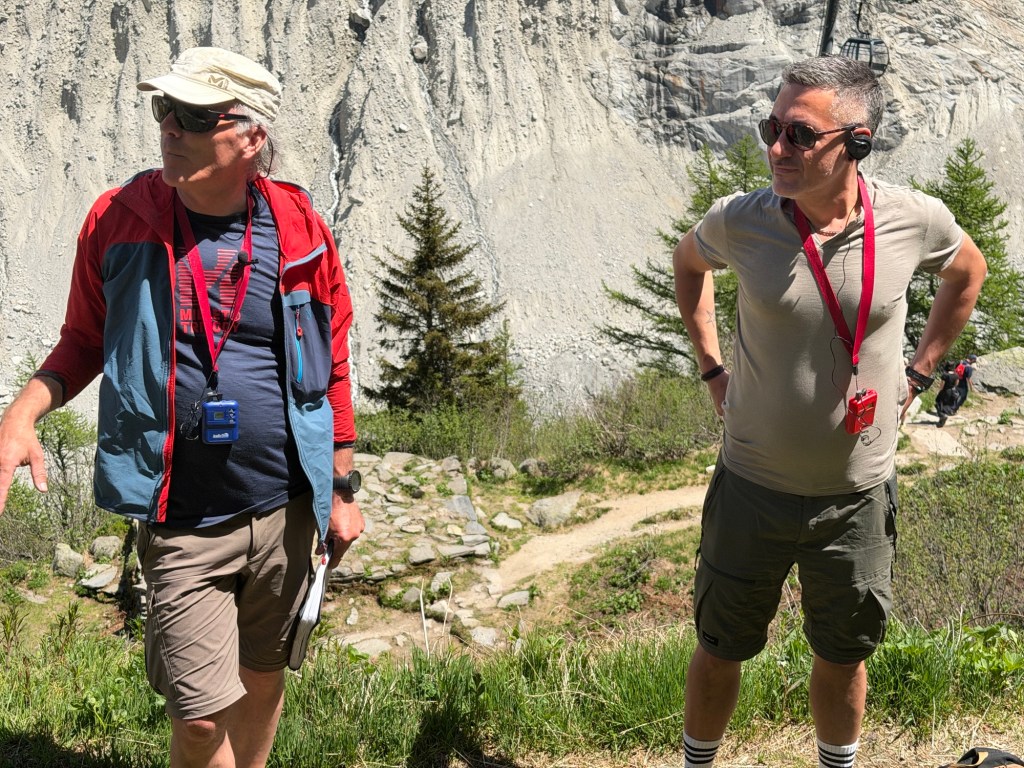
And if you were lucky enough to get Luca as your guide and Francois as the local guide, this is who you would have seen it with.

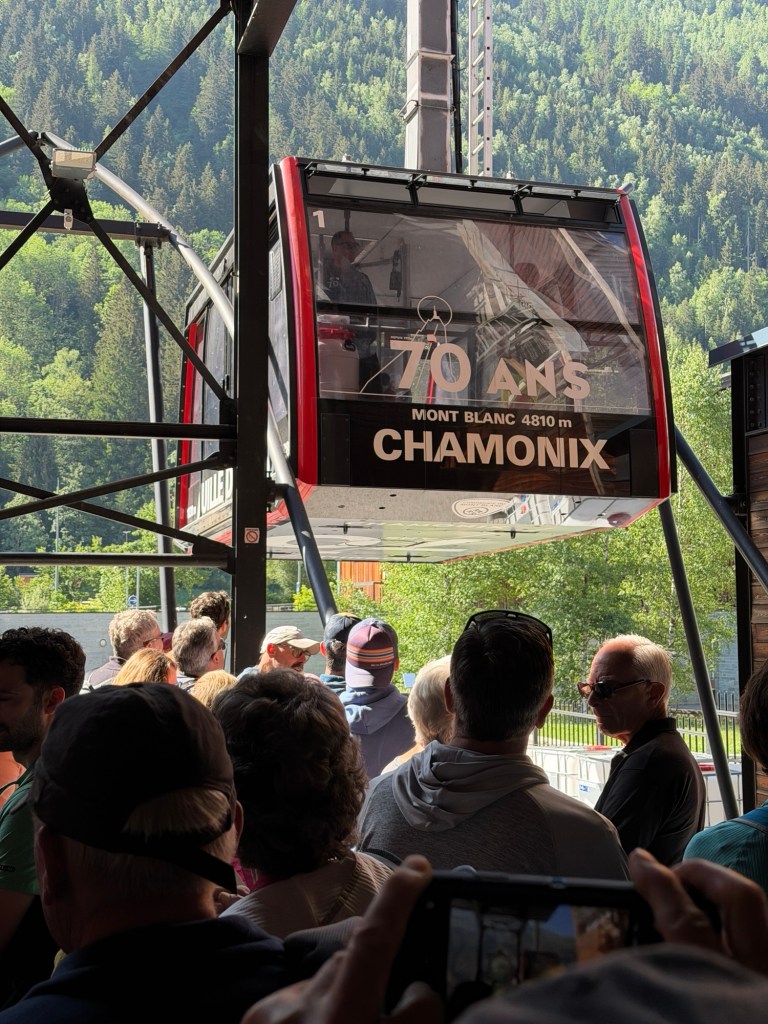
It wasn’t a problem that we missed out on the gondola ride, because the next day, we rode two huge gondolas to get to the Mont Blanc viewing platform.

60 of us were jammed into the gondola. It felt like a NYC subway, minus the hanging straps.

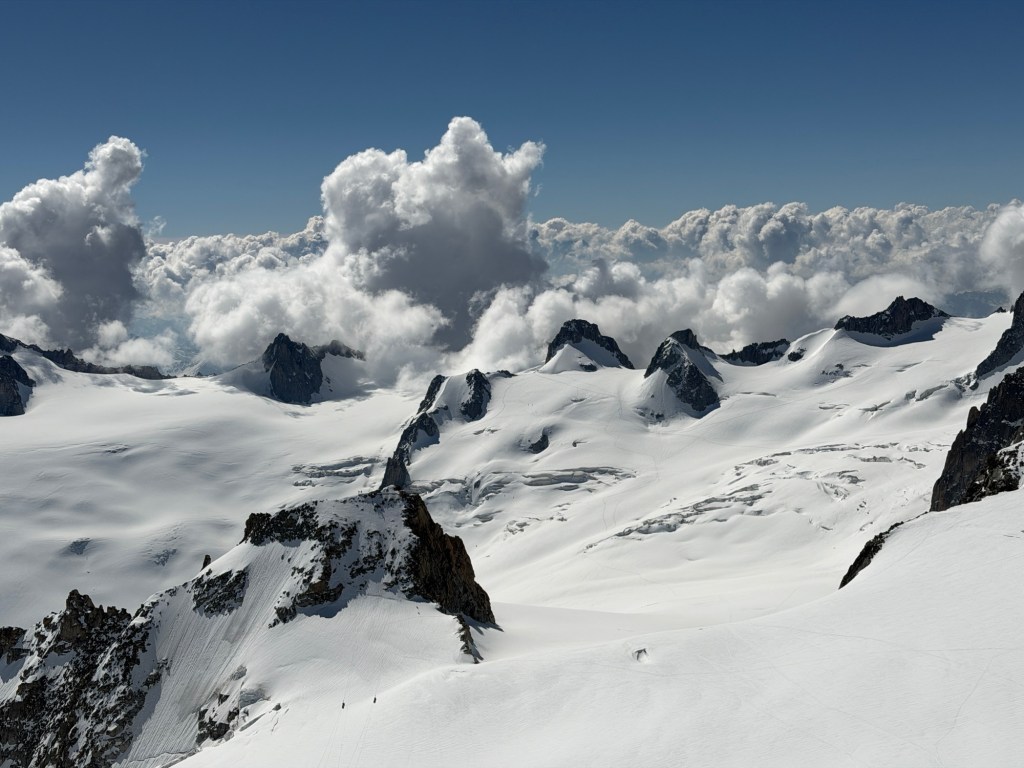
The photos can’t possibly capture the grandeur of the mountains. But those of you who have been following this blog know I’m going to try!

Yes, those ARE clouds in the photo below. That’s how high we were.

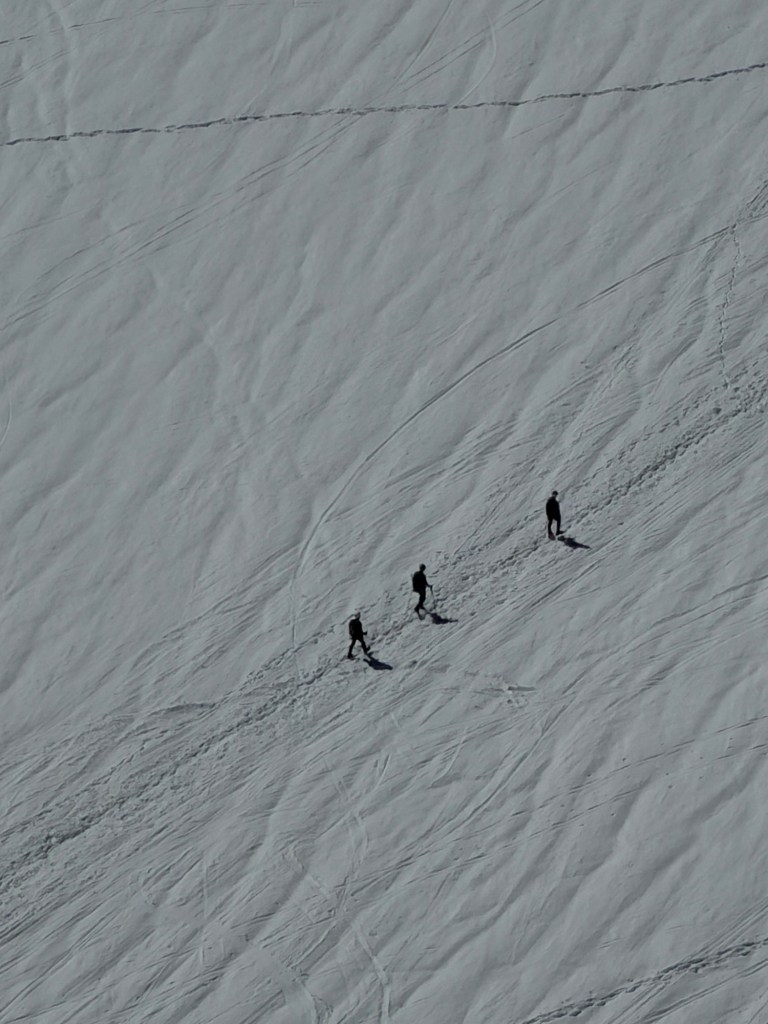
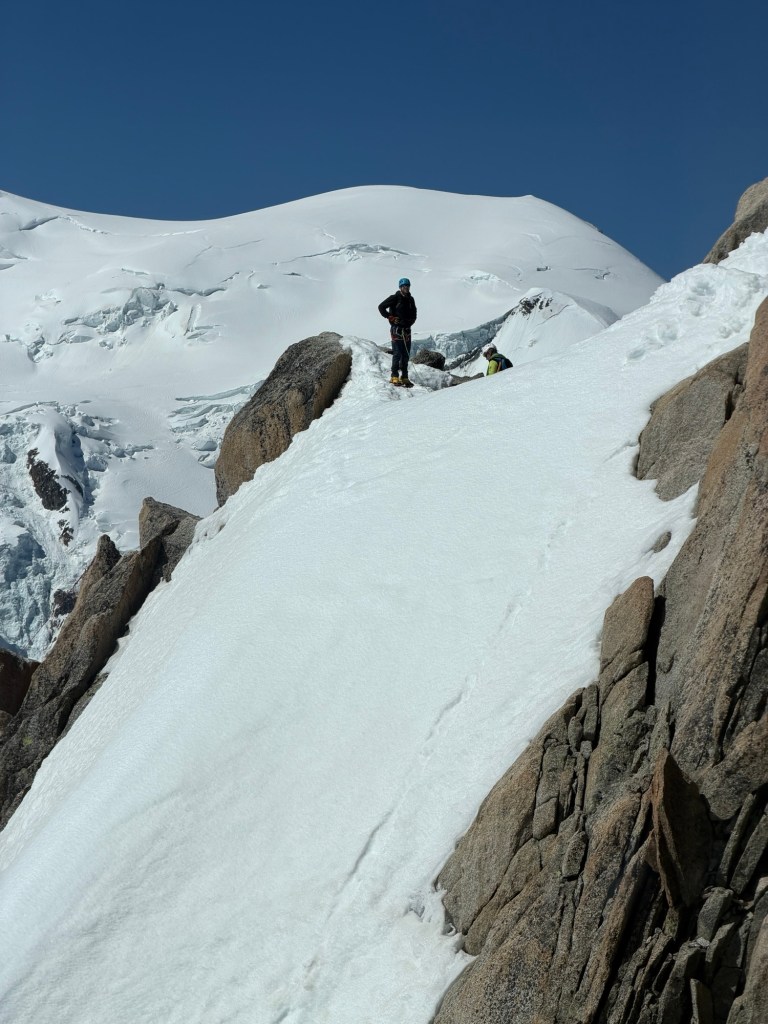
Although WE rode the gondolas, others chose a different method for getting to the top.

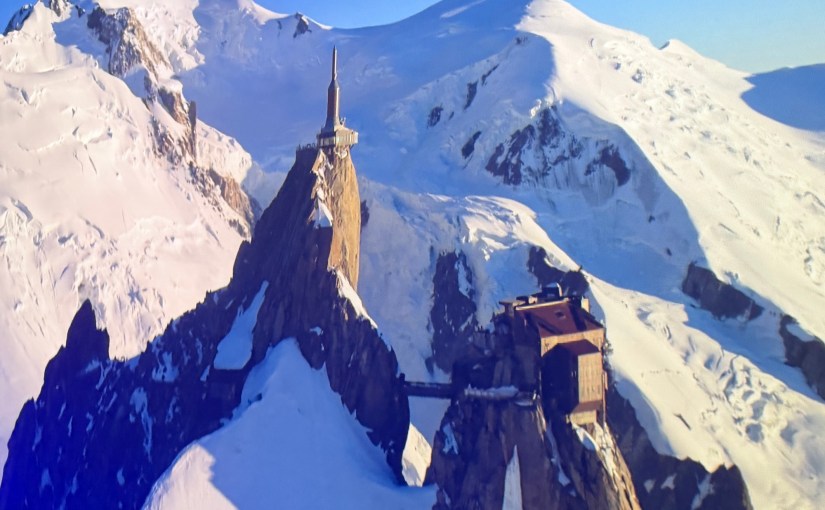
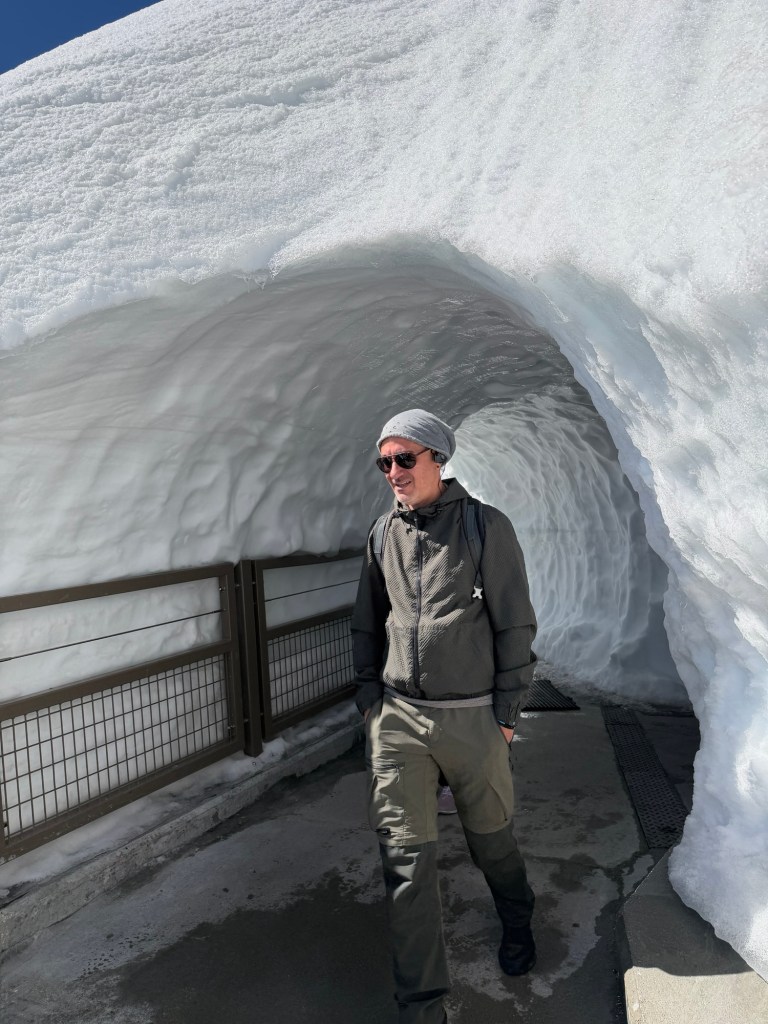
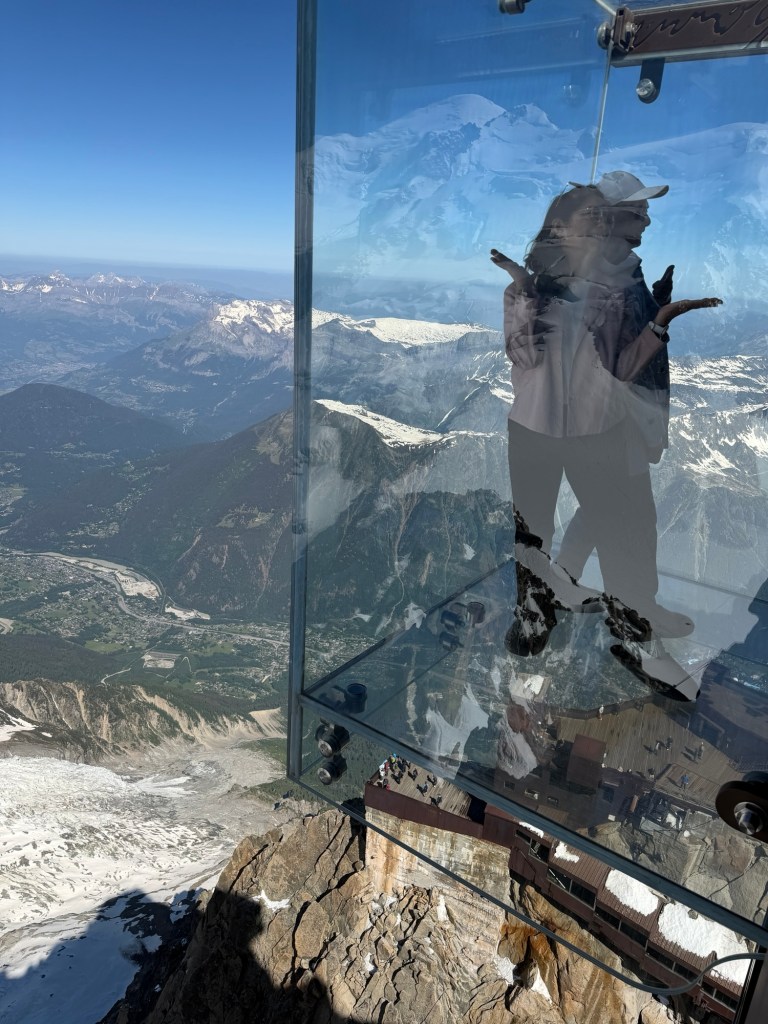
None of us had a death wish, so that’s why we chose the safer, more boring option. We DID manage to walk through an ice cave, AND we made it to BOTH viewing platforms shown in the header of this post, which required us to mount several flights of stairs.

Luca, our guide, emerging from the ice cave

If we wanted, we could stand in line for about an hour to step into “the void”, which was a transparent cube that allowed you to see to the bottom of the mountain. I imagine that on one’s instagram feed, it would look like the poster was suspended in mid air. The photo taking was undoubtedly why the wait to enter the cube was so long!

One of the MANY photos this couple took!

Since none of us have an instagram feed, we skipped that experience.

Instead, we used our eyes to take in the spectacular views.

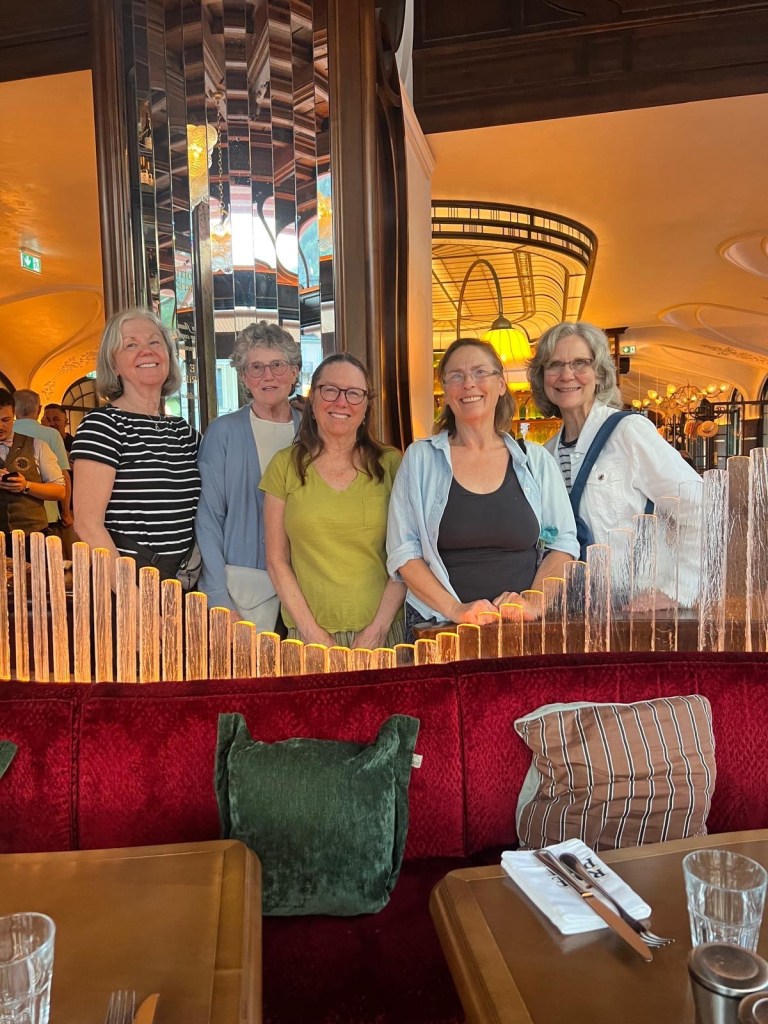
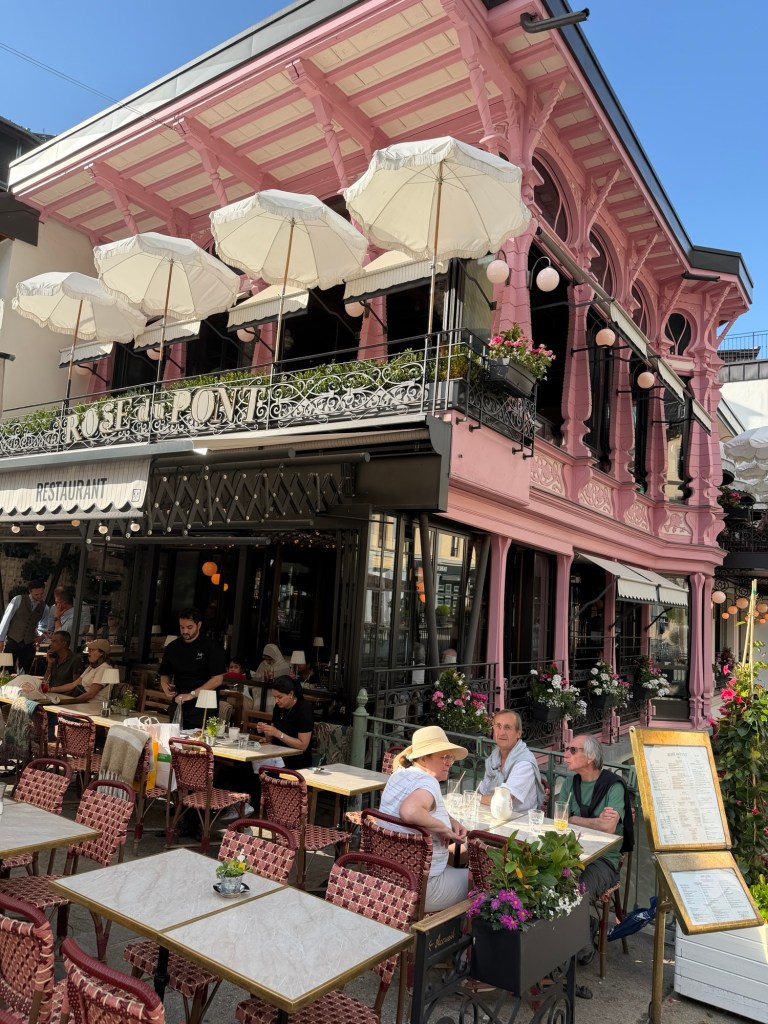
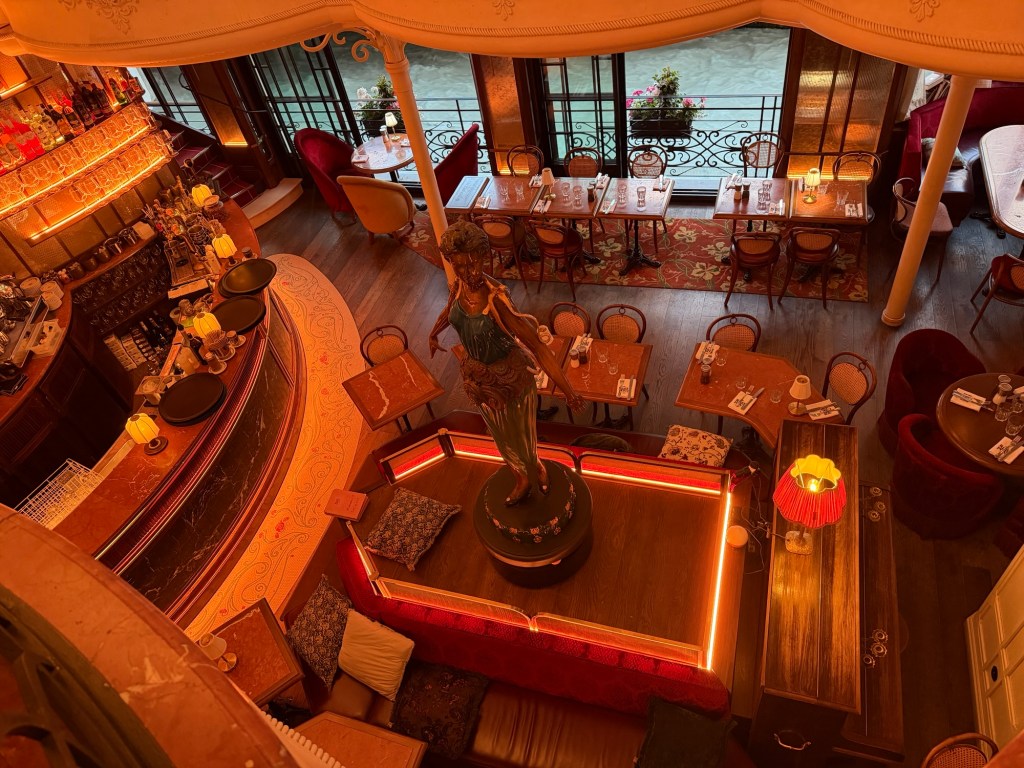
Before we leave Chamonix, one last photo of almost all of the single ladies at dinner at the Rose du Pont

Me, AB, Stephanie, Susan and Kay. We are missing Gail, the photographer

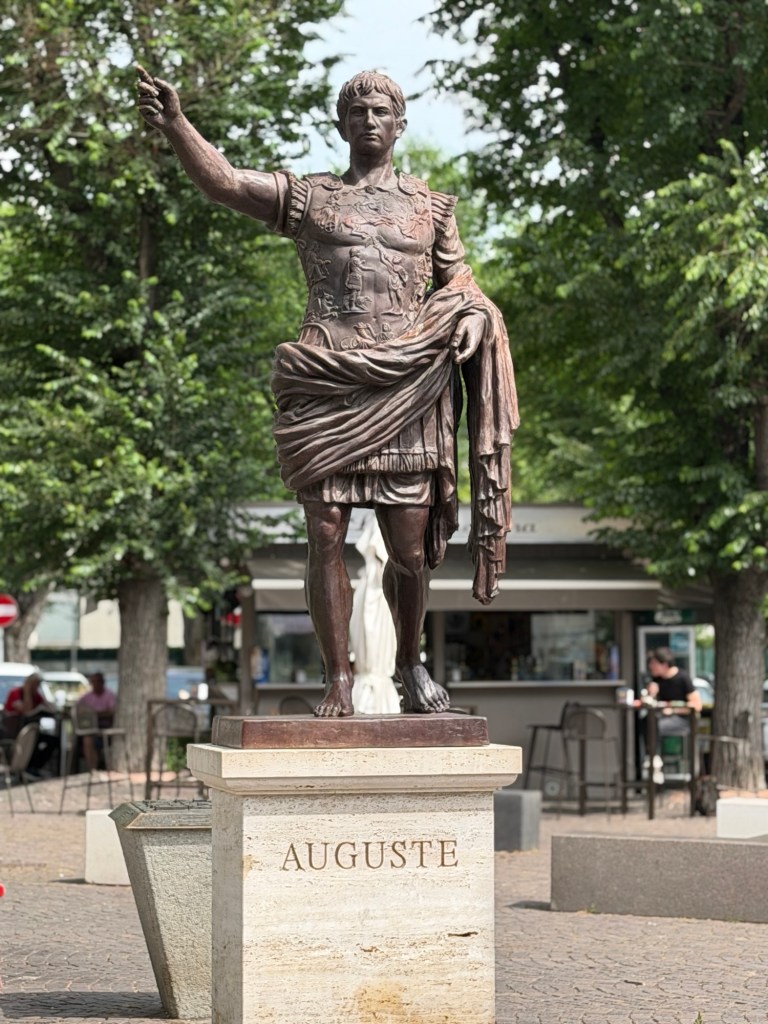
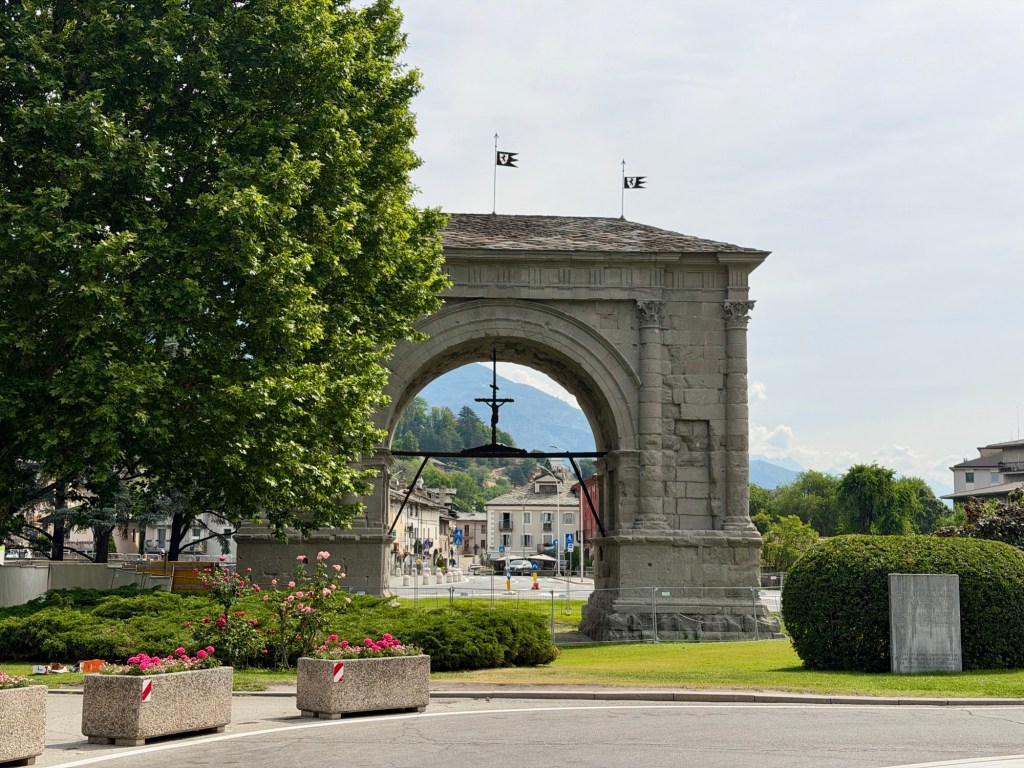
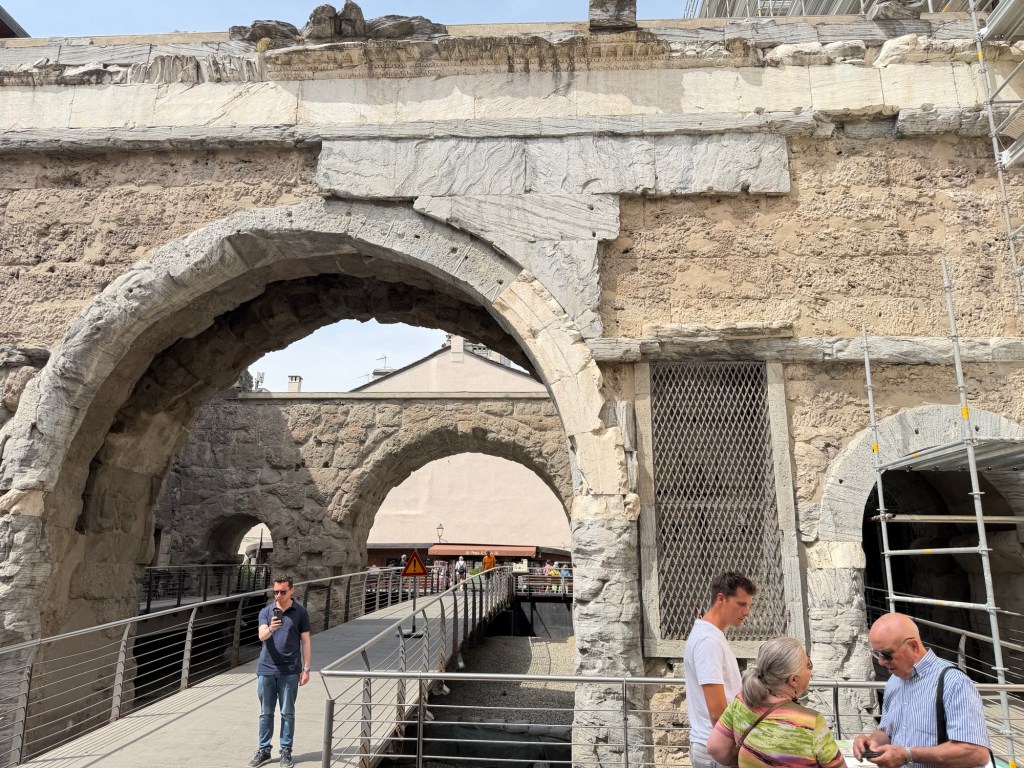
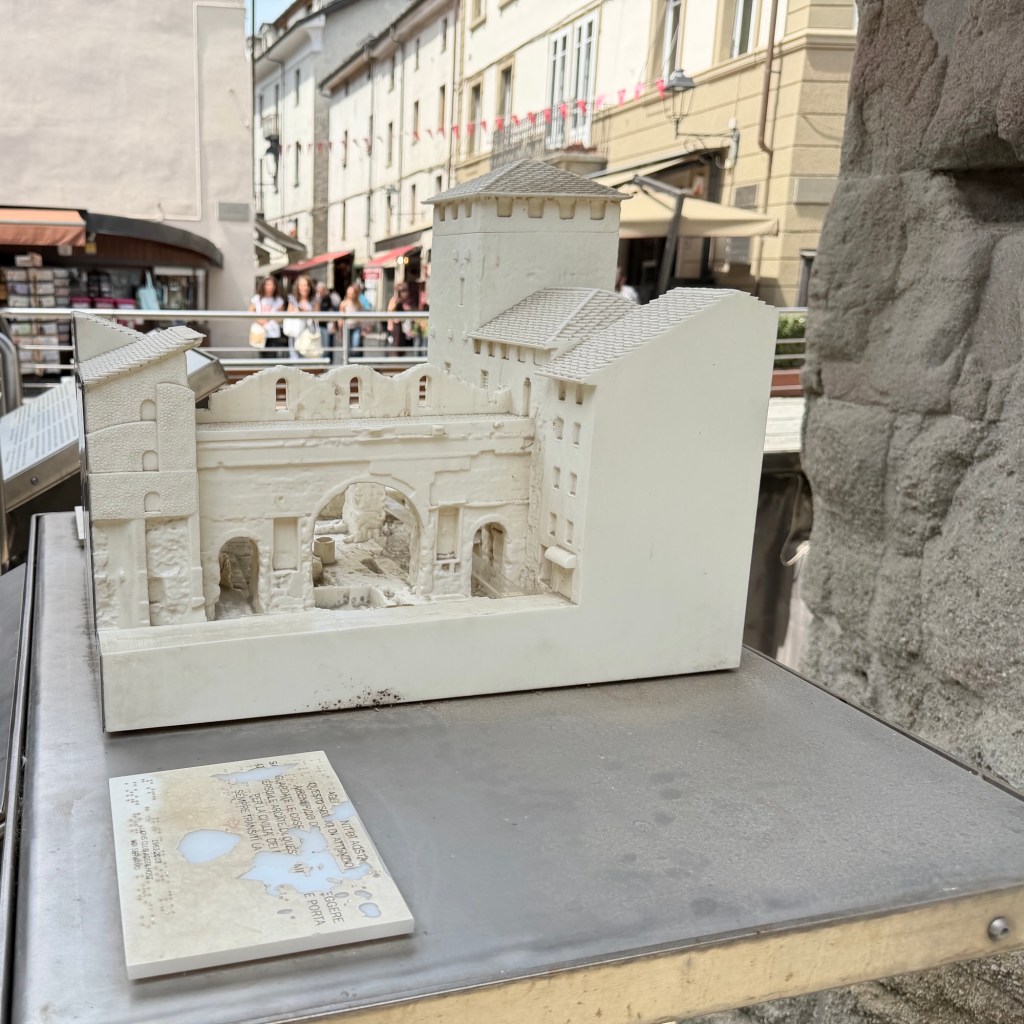
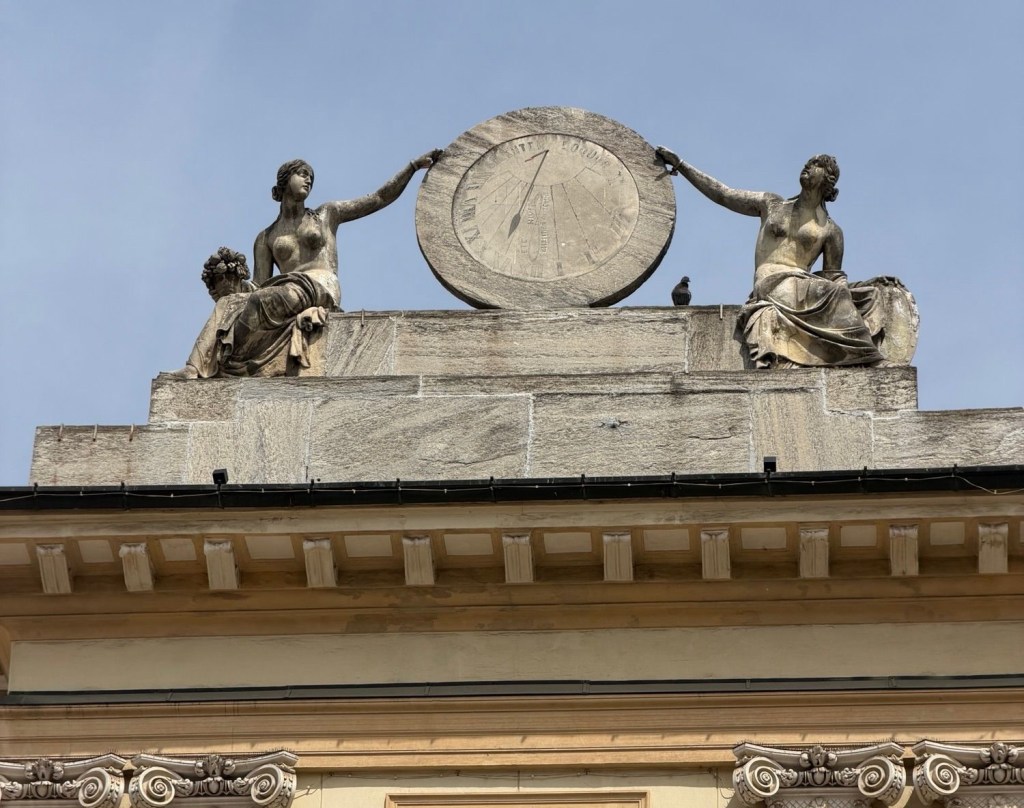
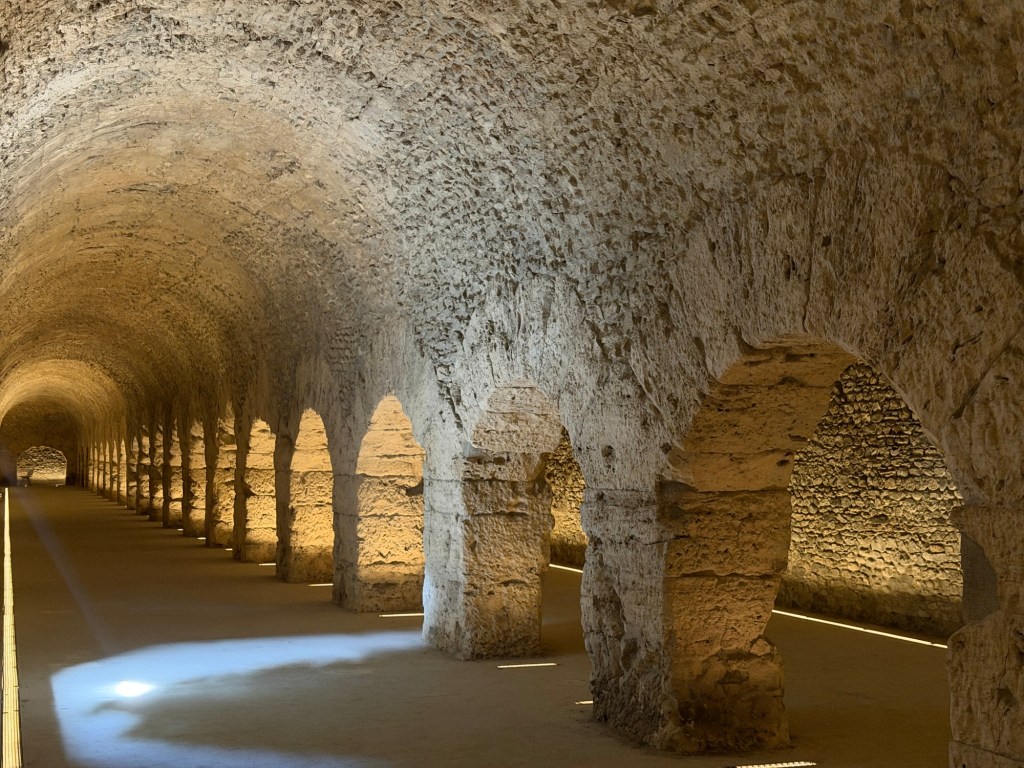
Although we ended up in Brielle, like most OAT trips, our bus ride was broken up by a stop in Aosta, a charming town along the way. Mike would have LOVED Aosta, because it was chock full of ancient Roman ruins. Back then, it was called Augusta Praetoria, shorten over the ages to Aosta.

He heard there was gold in them thar hills, so he decided to “ veni, vidi, vici”.

The original arches are 32 steps below the surface of the modern city. I don’t recall why or how they were preserved, but I’ll bet you don’t care either.

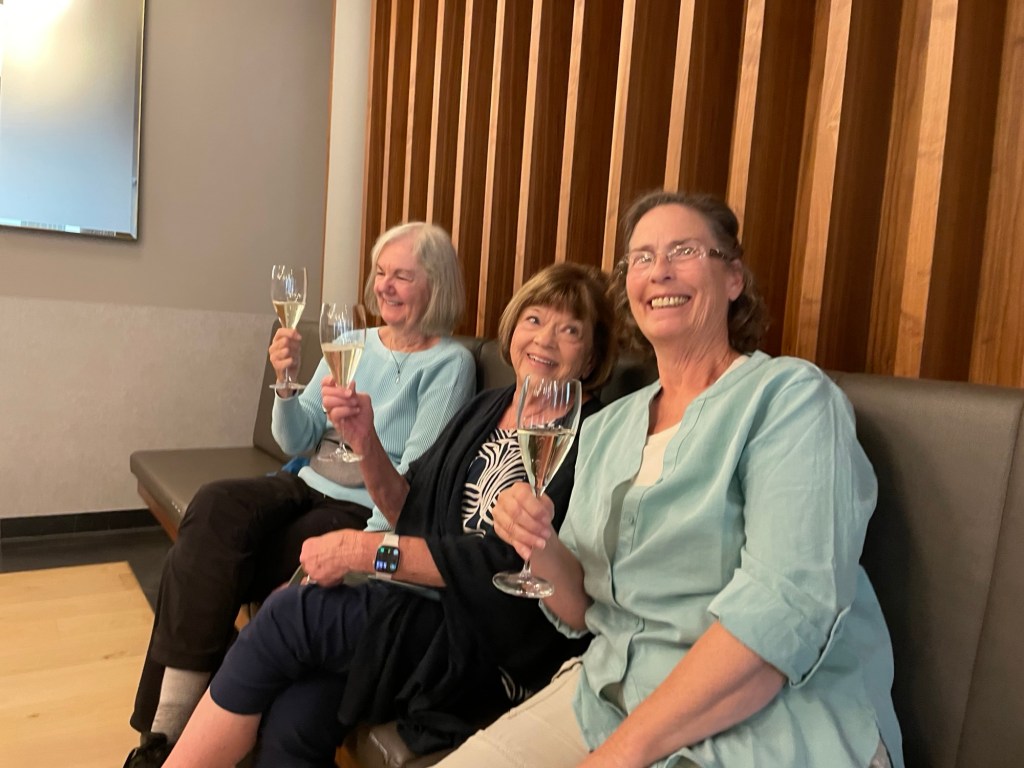
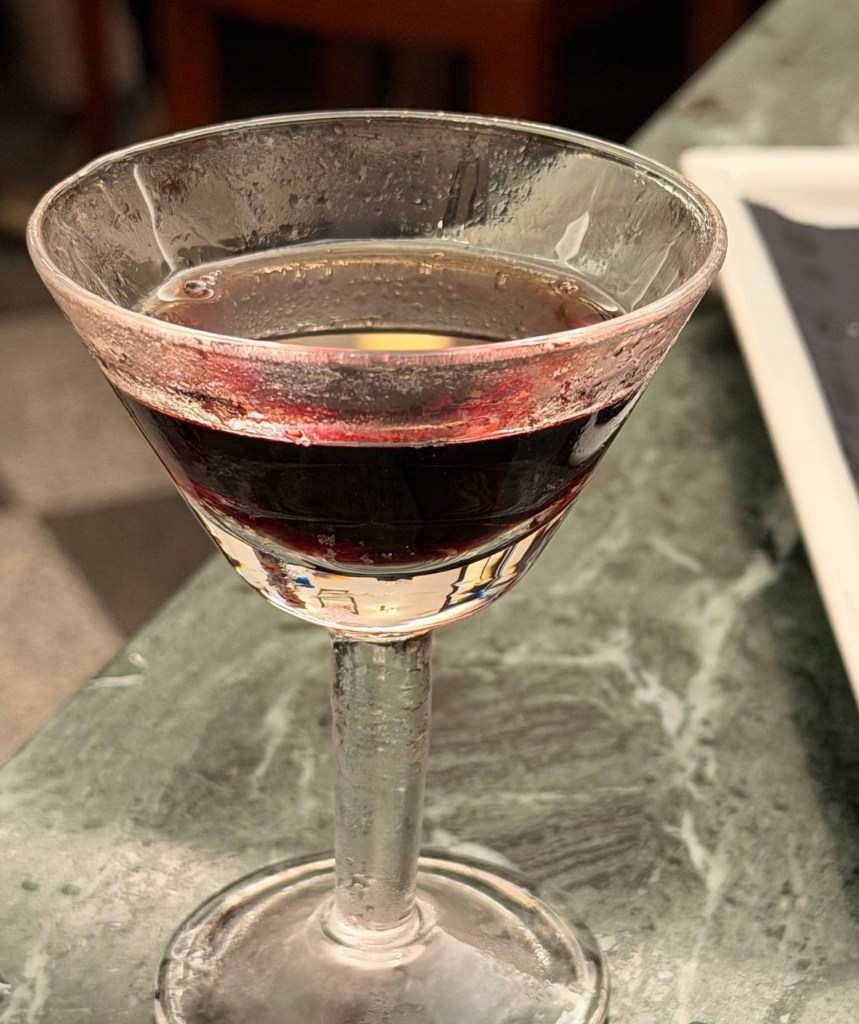
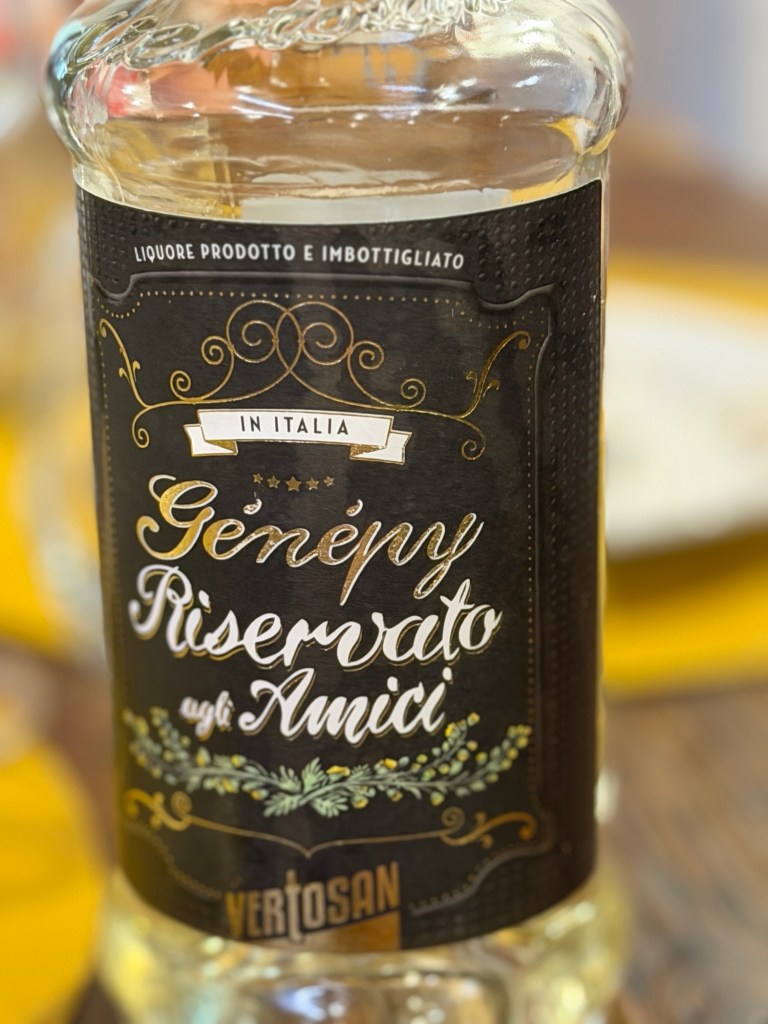
After sharing a half a bottle of this

with my new friend Sarah, I decided to press send without proof reading.

Biella deserves its own post, and once I sober up, I’ll get to it. But until then, happy reading and thanks for coming along.

The Alps with OAT

Okay, so plan A was to spend most of the month of May on the OAT trip to Azerbaijan and Turkey, but when OAT canceled the pre-tip to Azerbaijan because of its proximity to Iran, I decided it was time to activate Plan B. Turkey ALSO shares a small part of its eastern border with Iran, and because US leadership is wildly unpredictable these days, I decided not to take a chance. It’s too bad, because I was really looking forward to travel with my buddy Janis. Maybe we will travel to Turkey in the future, once things settle down.

I was really lucky to discover OAT’s Alpine Europe trip was not only deeply discounted, but it also had single availability AND the timing was perfect. This particular departure offers neither pre nor post trips, but that suited me just fine.

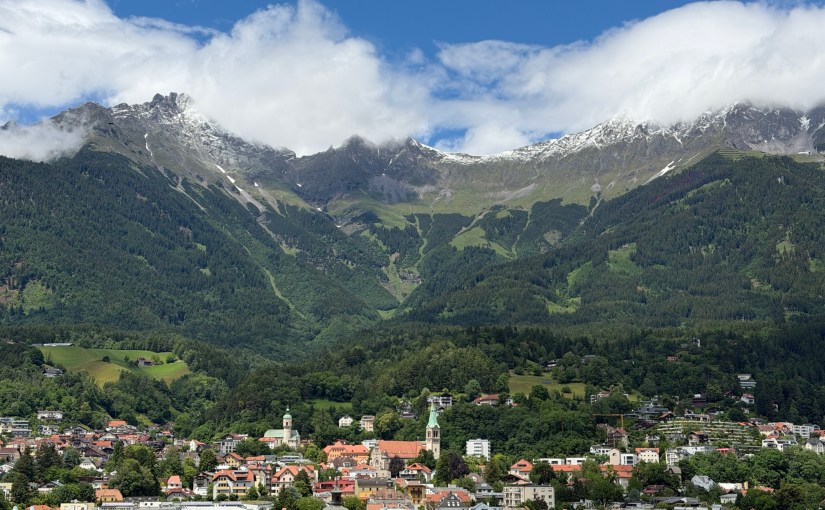
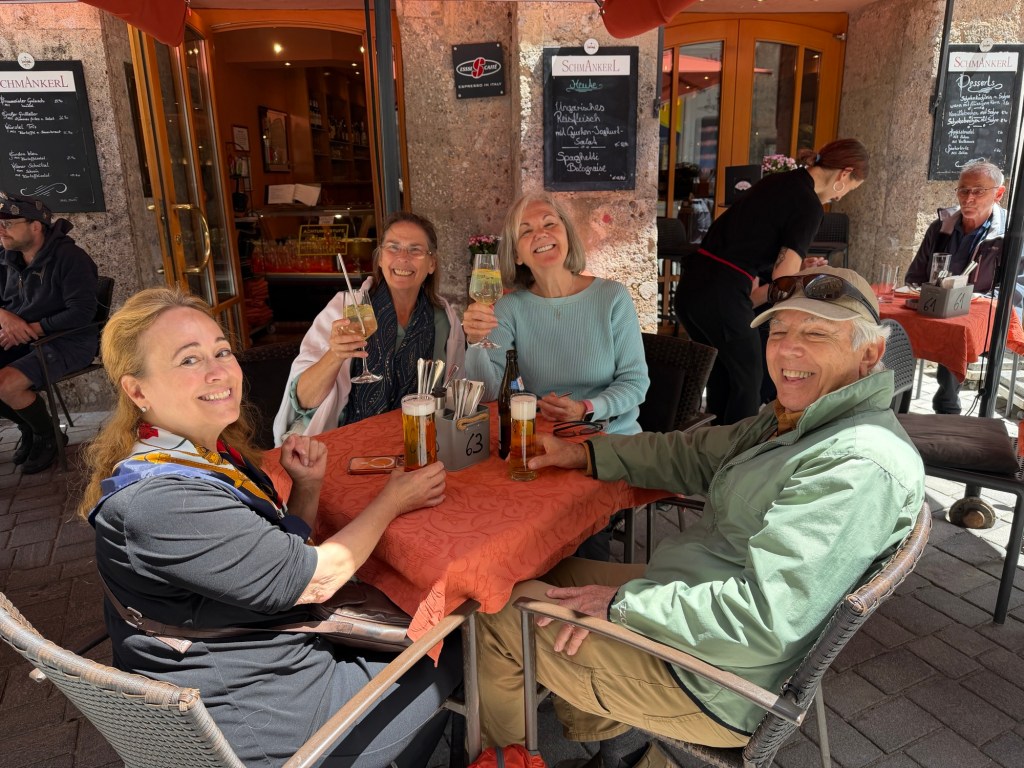
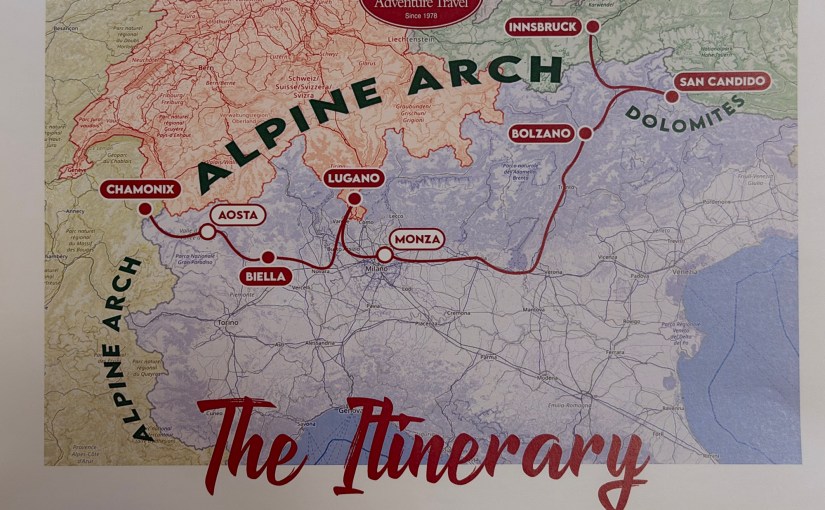
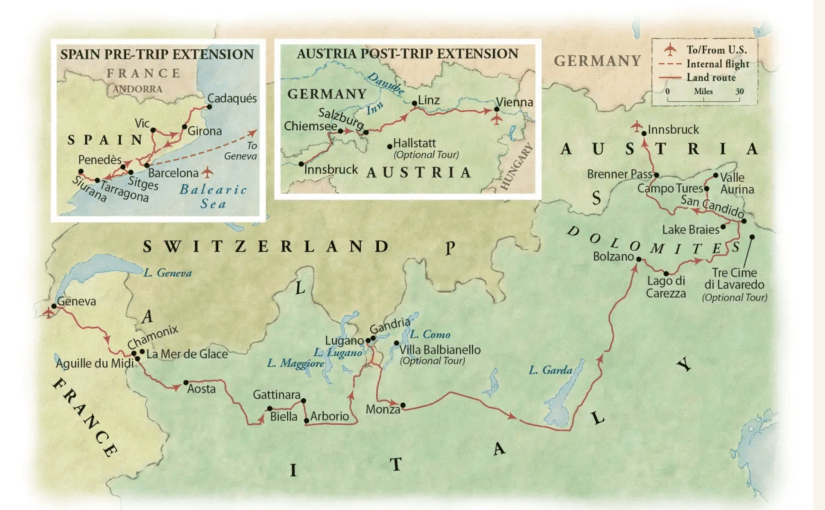
Ignore those boxes on the map at the top of this post. Instead, follow the red arrows. I flew into Geneva a day before the tour starts, got picked up at the airport and driven to Chamonix, a small town at the base of Mont Blanc, about an hour away. Eventually 18 days later I will end up in Innsbruck, Austria.

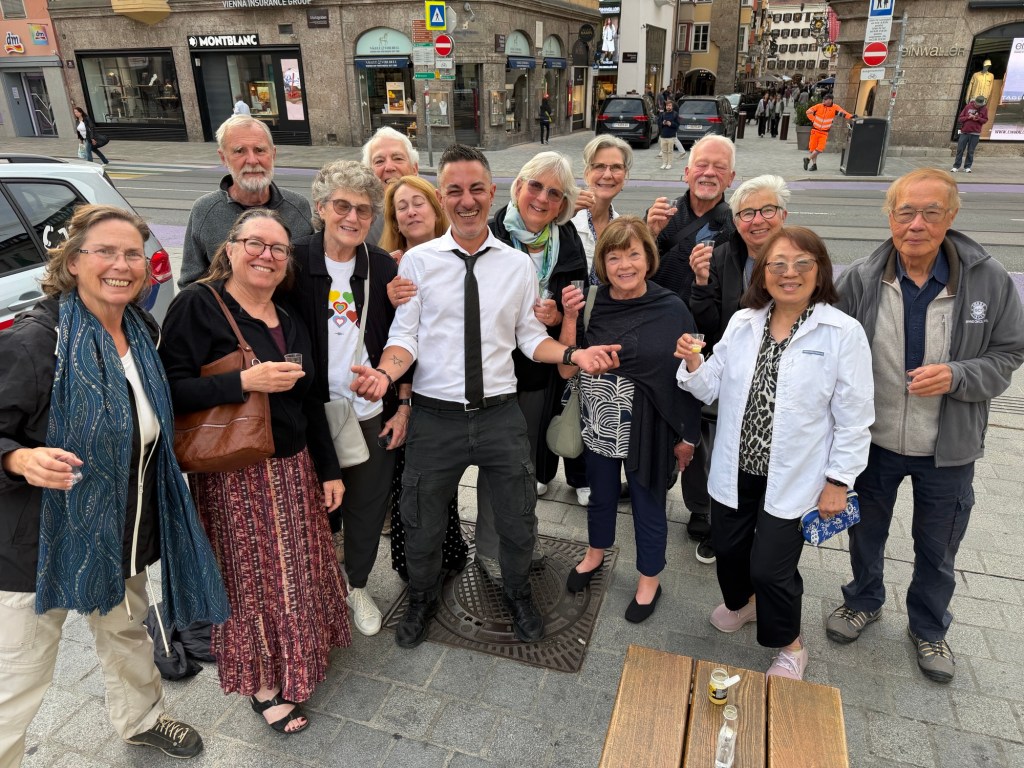
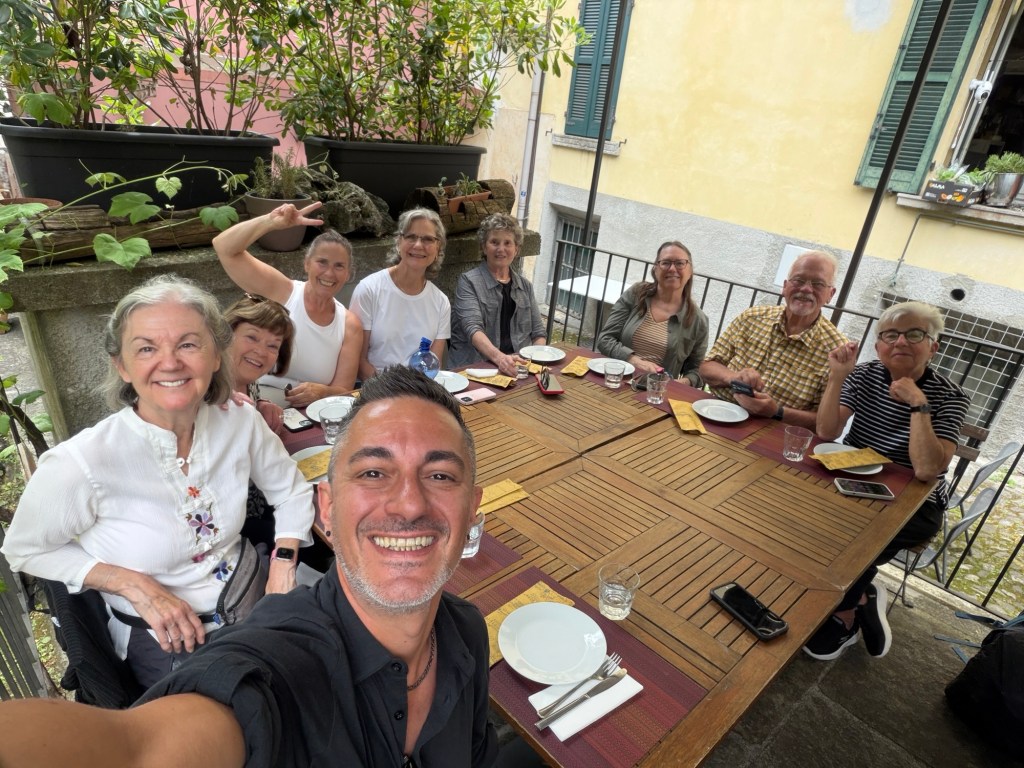
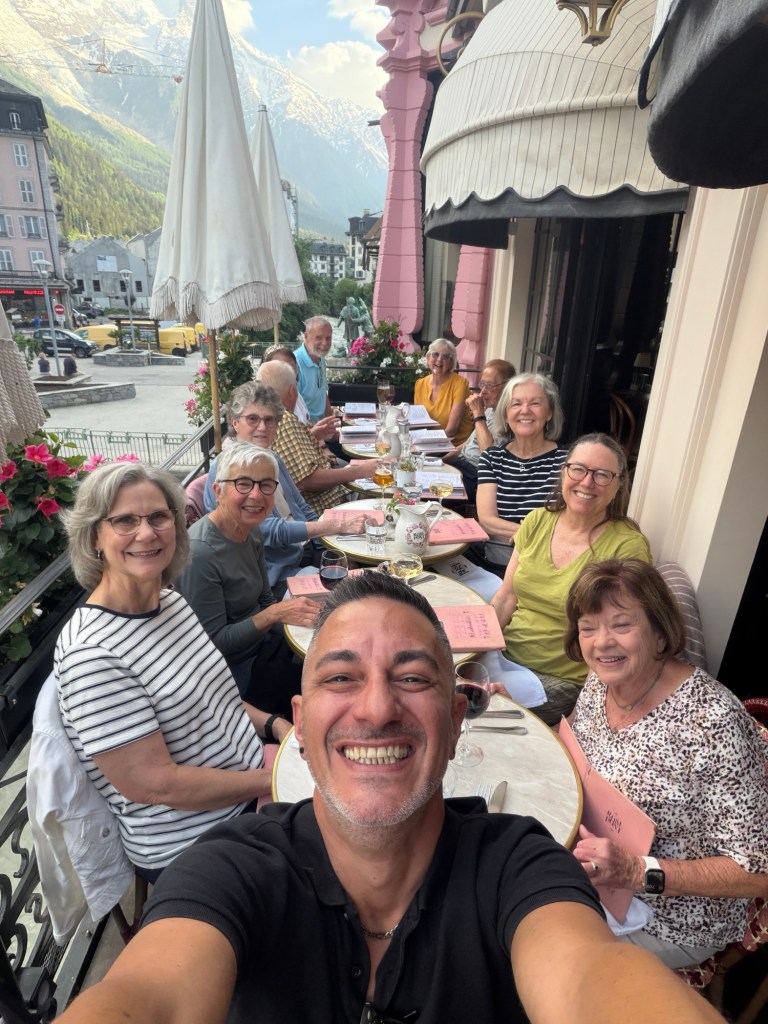
There are 14 of us on this trip, 4 couples, and 6 singles. We are already a very congenial group, with 12 of us choosing to have dinner together for what was supposed to be an “on your own” night.

Luca, our trip leader, took this “selfie”

The restaurant Luca chose, The Rose du Pont, is located right by the river, which winds thru the center of Chamonix.

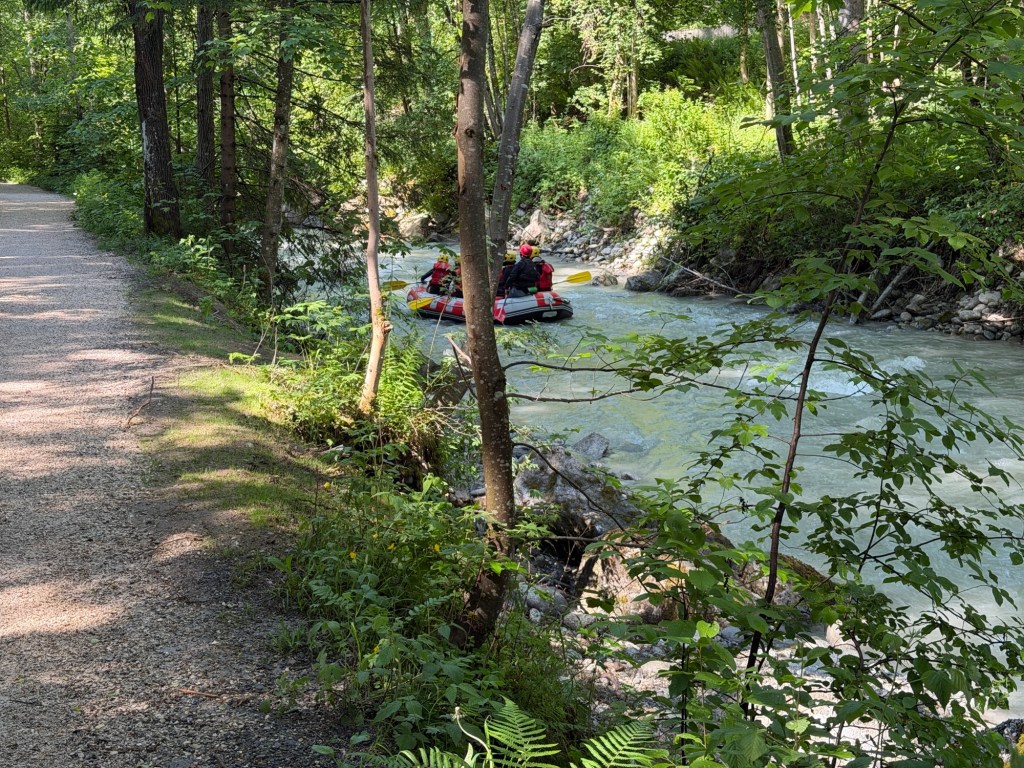
Earlier that day, I had hiked along the river walk and saw that I could have booked a river rafting trip,

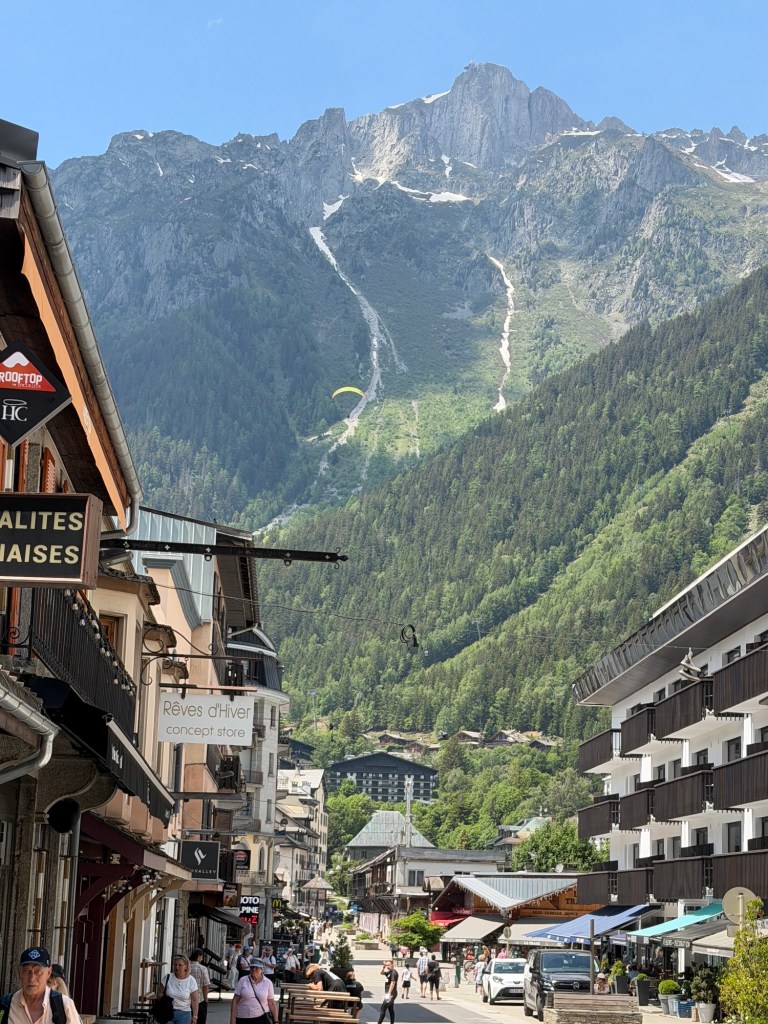
or gone paragliding, had I planned ahead.

Only joking…walking along the river is as adventurous as I get these days.

In the afternoon, I took advantage of the pool and whirlpool. The outdoor hot tub and sauna were being cleaned today, so I wasn’t able to use them, but we have another full day here, so maybe.

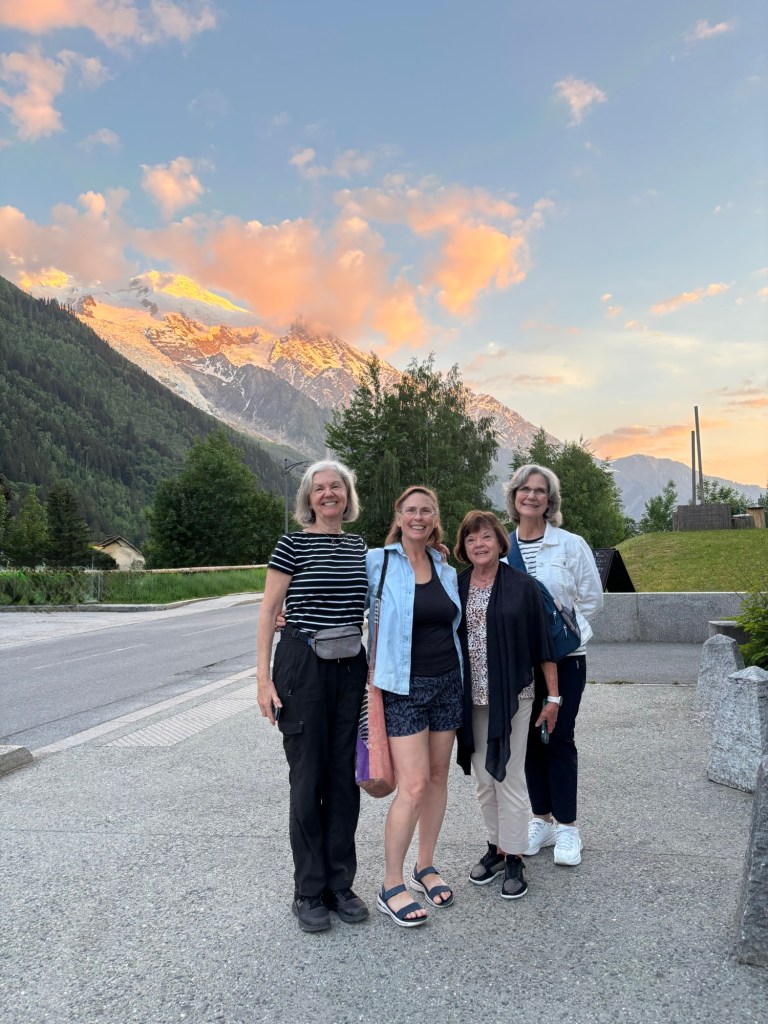
I’ll end the first day of our tour with two night shots. The first is of four of the “single ladies”, with Mont Blanc clearly visible behind us.

Me, Susan, Gail, & Kay

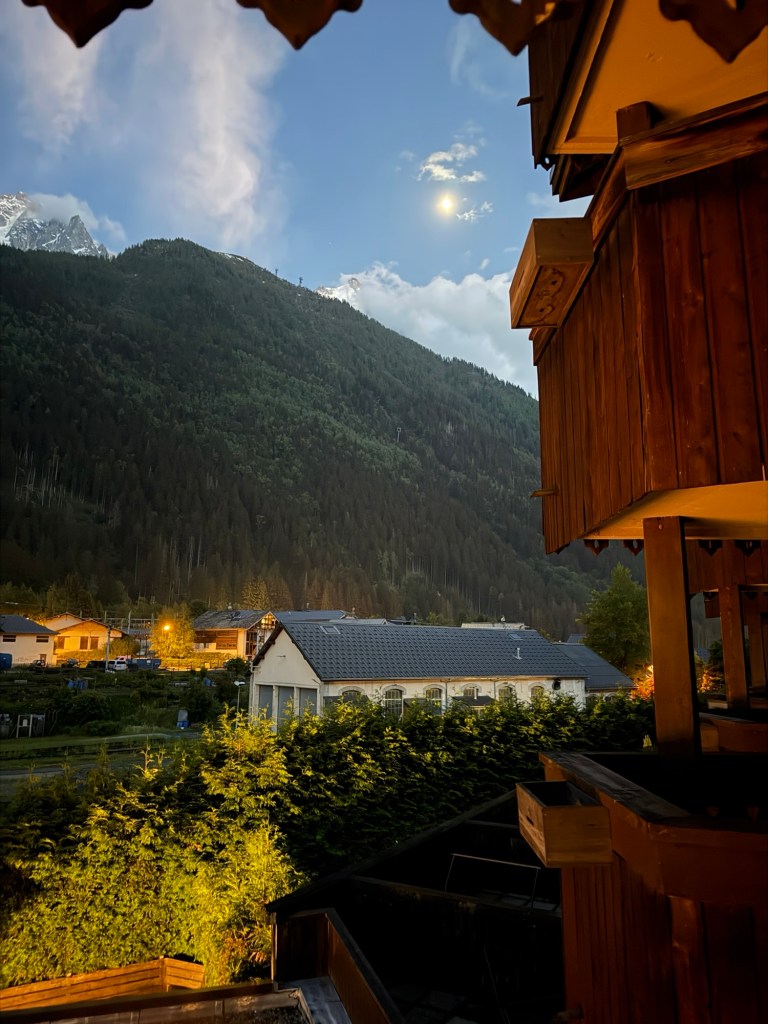
The second is the night view from my balcony.

Jewels of Bohemia

As usual, I was so busy having fun that my blogging got WAY behind my travels. I’m home now, getting ready to hit the road again, and I realized that if I don’t do a post about this trip, I will probably forget where I was and what I did. I have lost count of the number of times I’ve had to look up something on my blog to jog my memory. Oh, a mind is a terrible thing to lose.

As I mentioned in earlier posts, the pre-trip to Berlin was fantastic. We had one more stop, in Dresden, before we joined the rest of the group in Prague for the main trip.

It was hard to believe that so much of Dresden was destroyed by Allied bombs during WWII.

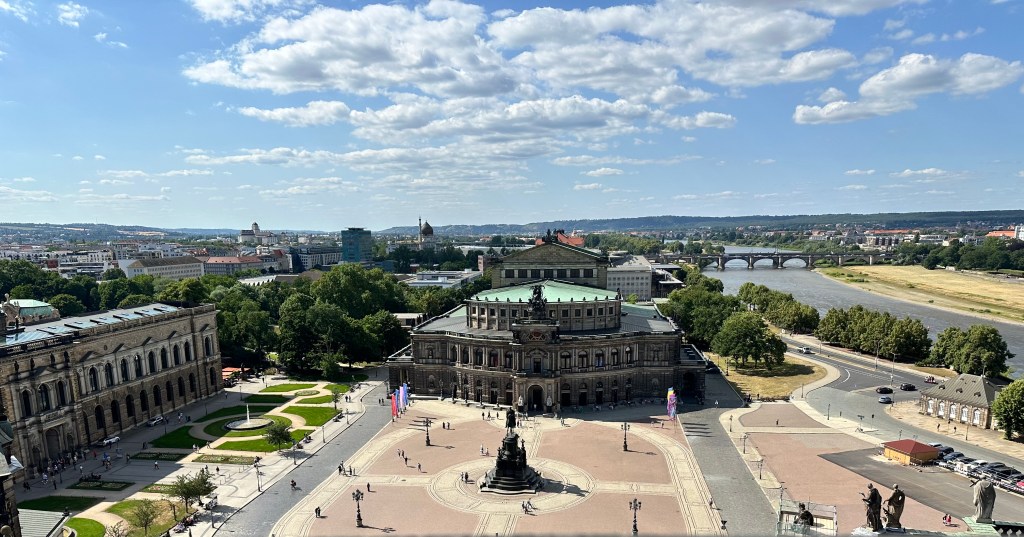
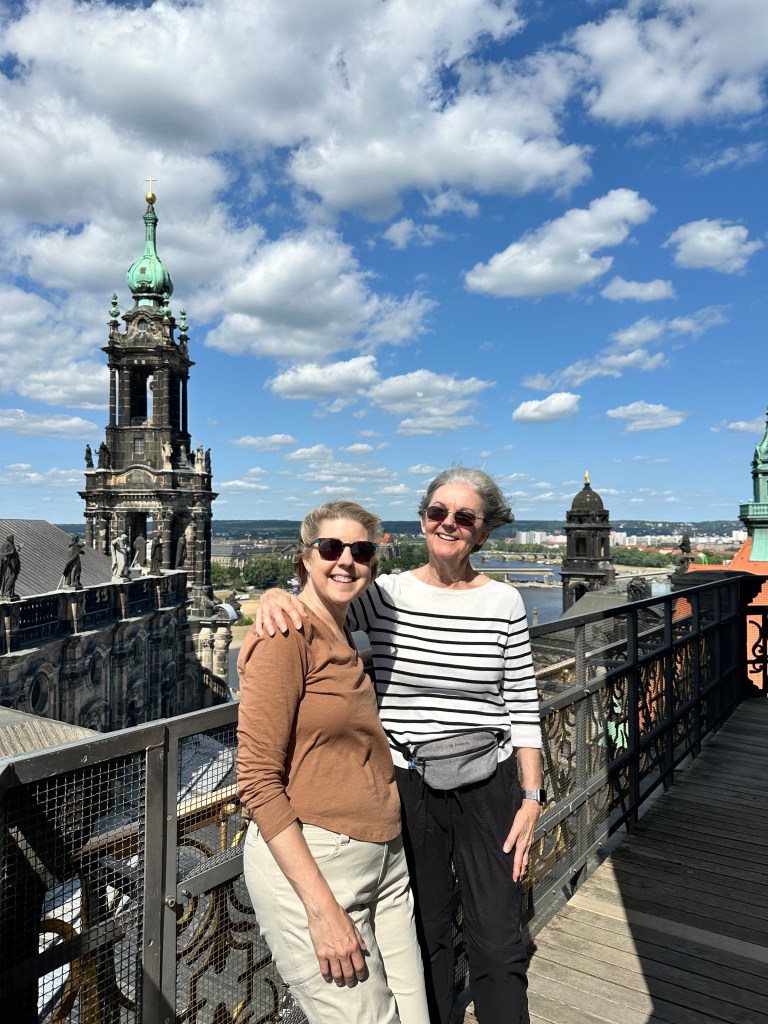
As usual, Barb and I found a high point in the castle that afforded us an excellent panoramic view of this delightful city.

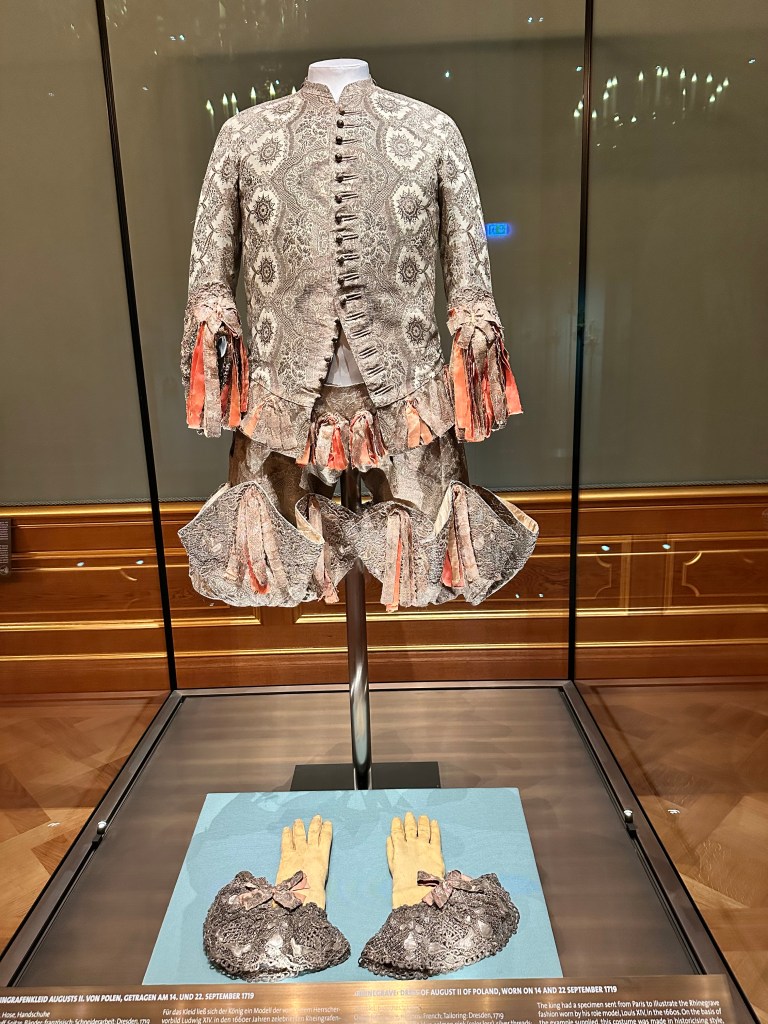
In addition to climbing the Castle tower, we also toured the Castle Museum. All I could think about when I saw the exhibits, was how many people must have died, either from starvation or in battle, for royalty to collect all these gold do-dads and fancy clothes.

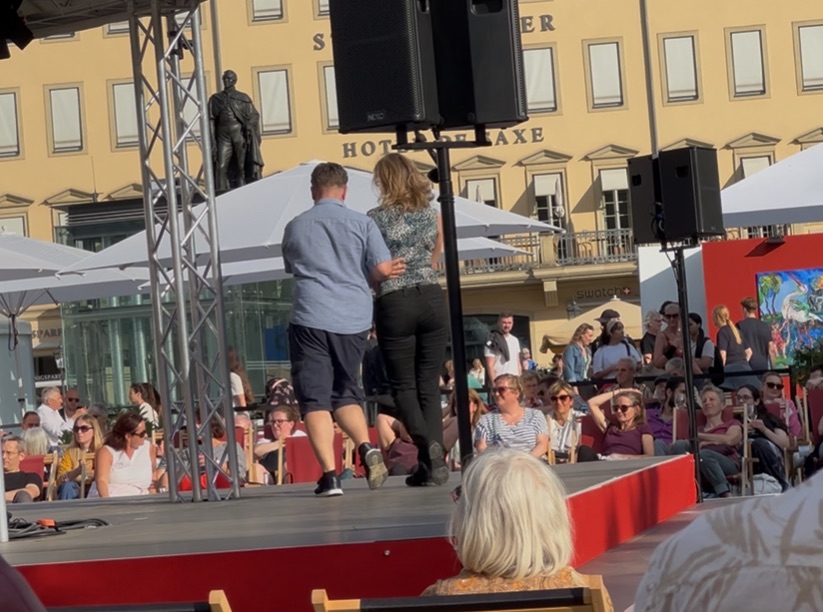
During the two evenings that we spent in Dresden, we enjoyed people watching in the main square, where there was live music and dancing.

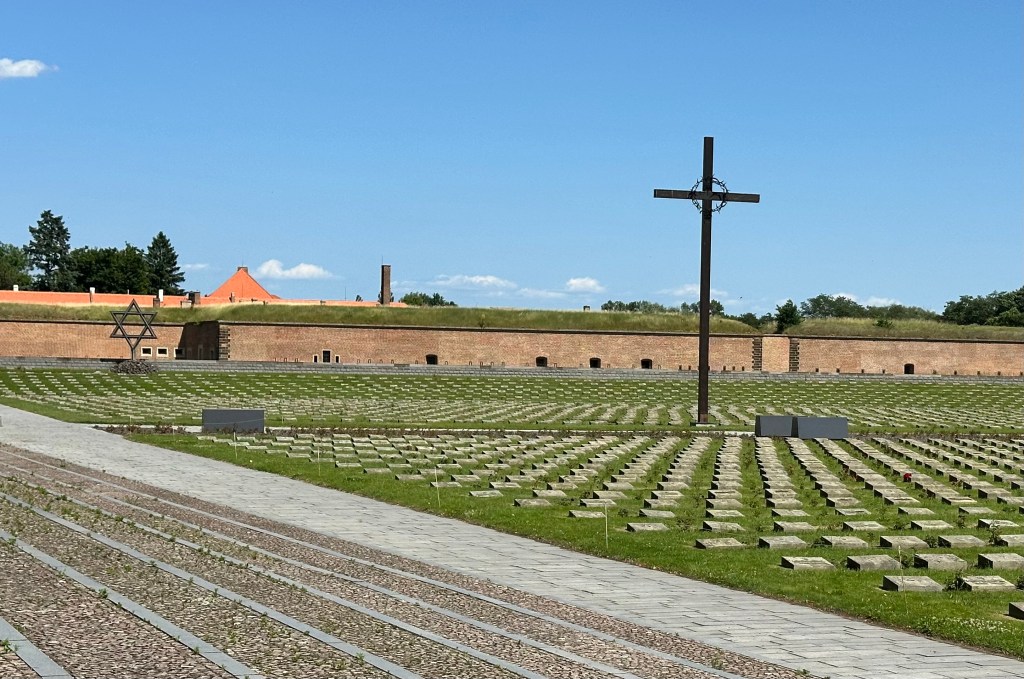
On our way to Prague, we stopped at Terazin, which was a Gestapo prison during WWII. It was sobering to see how widespread cruelty to other humans is.

Prague
I visited Prague for the first time in 2014 with Vermont Bike Trips. Although I did see some of the same sights again, like the Charles Bridge, the astronomical clock and the castle,

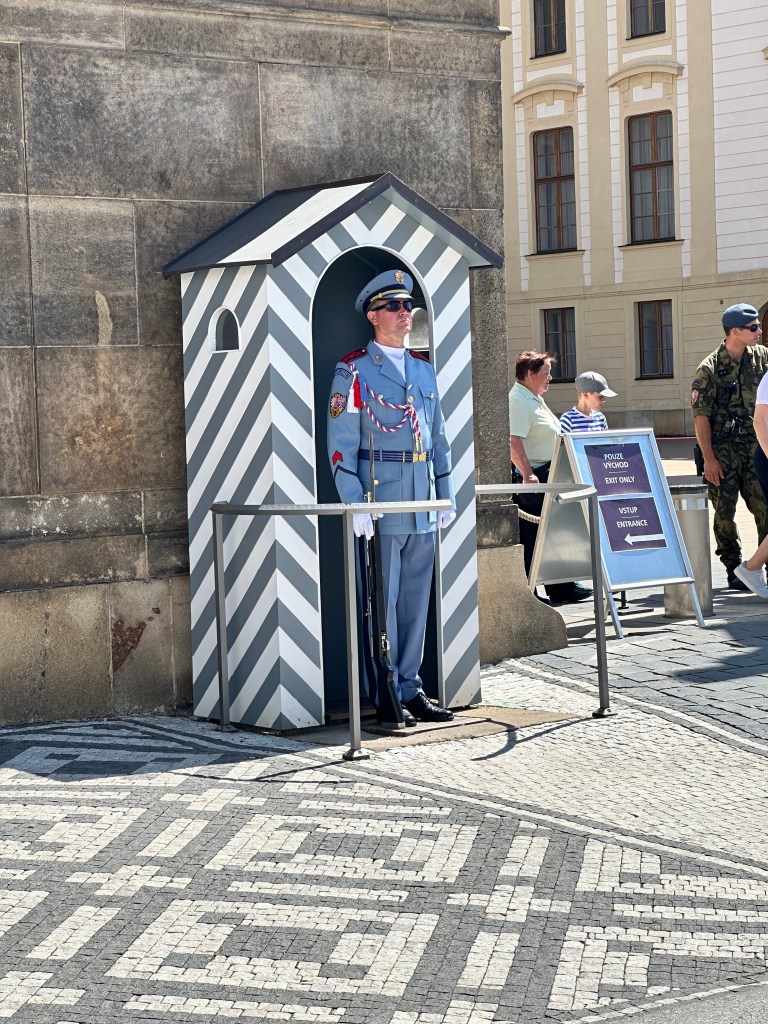
This soldier didn’t move at all, which led us to question whether he was real, or a mannequin. Turns out, he was VERY real, but capable of complete stillness.

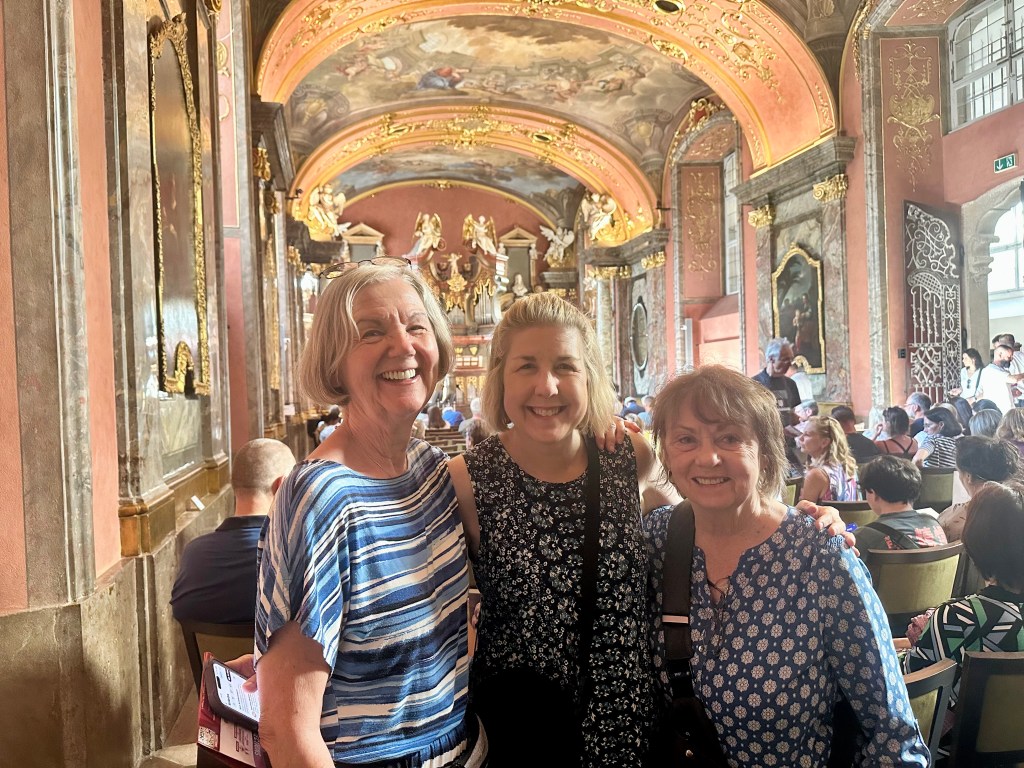
there were many new experiences, such as the delightful concert in the Mirror Chapel.

I love the blend of scheduled and unscheduled time on OAT trips.The free time allowed us to attend the concert and have dinner at the Blue Duckling, which was recommended by our dear friend Elena.

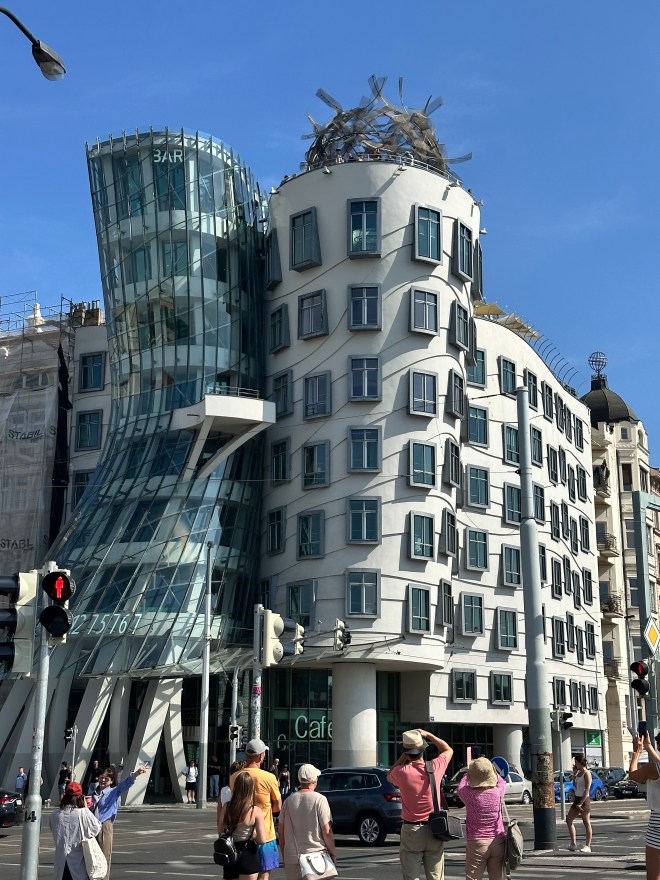
I recalled visiting the “Fred and Ginger” building on my VBT trip, and I enjoyed it enough to return. It has since been renamed The Dancing House. (Fred and Ginger was deemed “too American” a title).

When I visited in 2014, There was no elevator–but the walk up the stairs had lots of “interesting” art on the walls, such as this magazine cover.

Now, an elevator whisks you to the bar on the top floor, and if you want to go into the “hat” to enjoy the view, you now have to pay for that privilege.

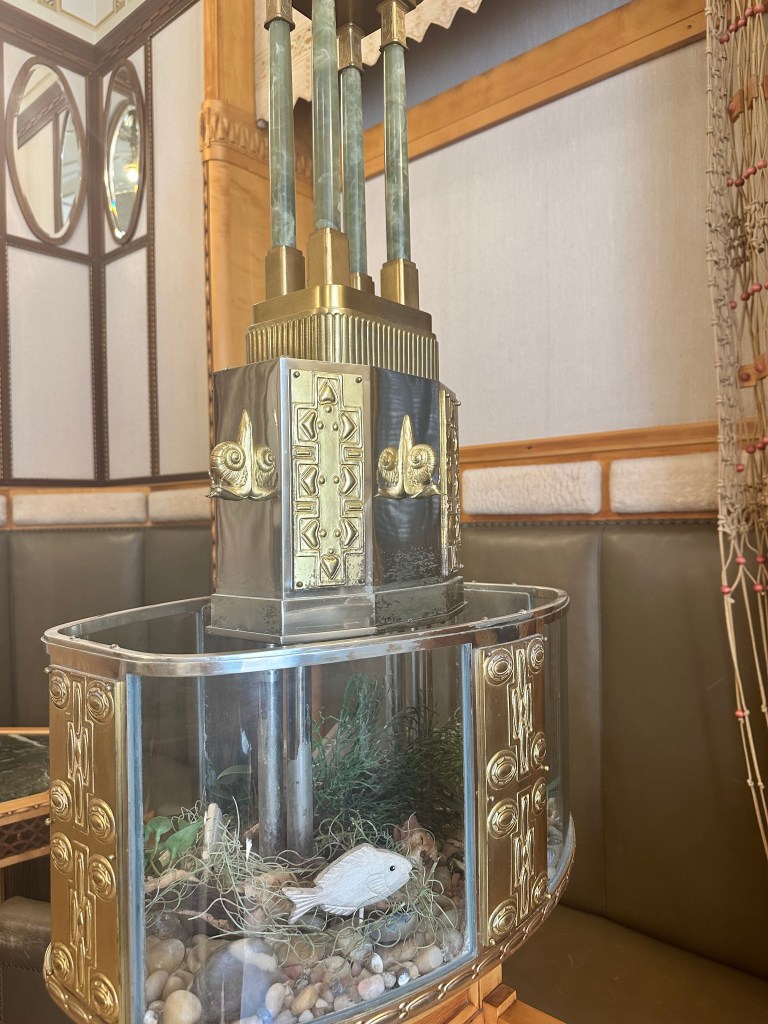
The hotel that OAT chose, the K+K Hotel, was centrally located and was quite beautifully decorated, with a quirky elevator that motivated me to take the stairs.

If Art Deco is your “thing” be sure to tour the Municipal House, which is LOADED with art deco treasures.

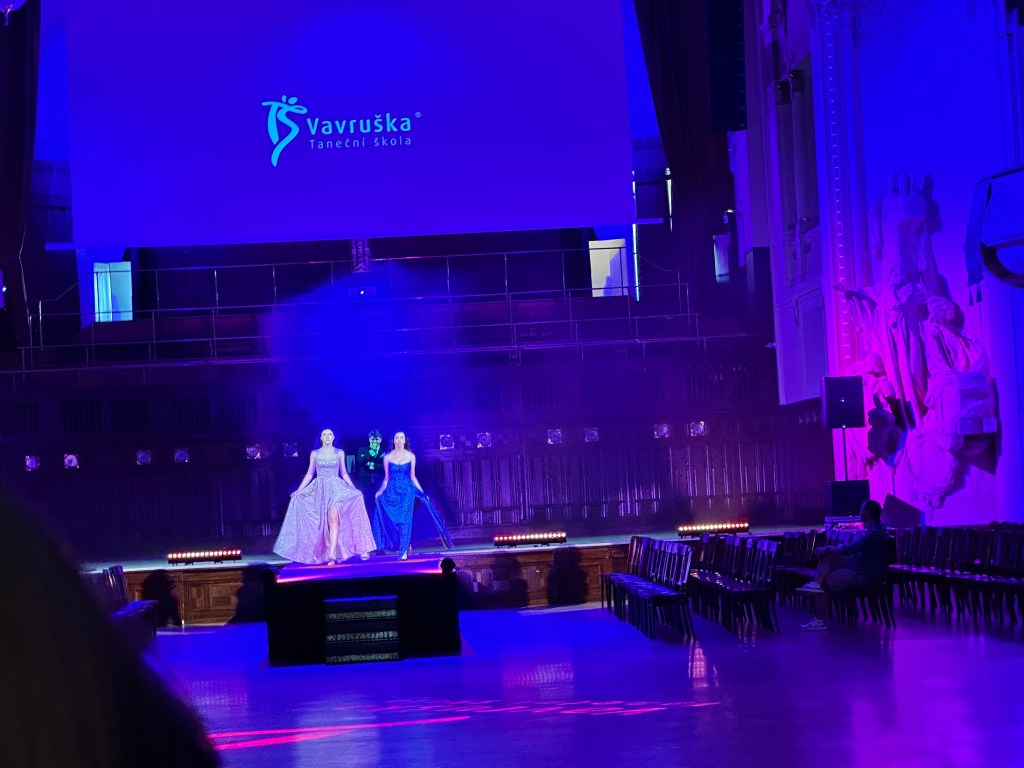
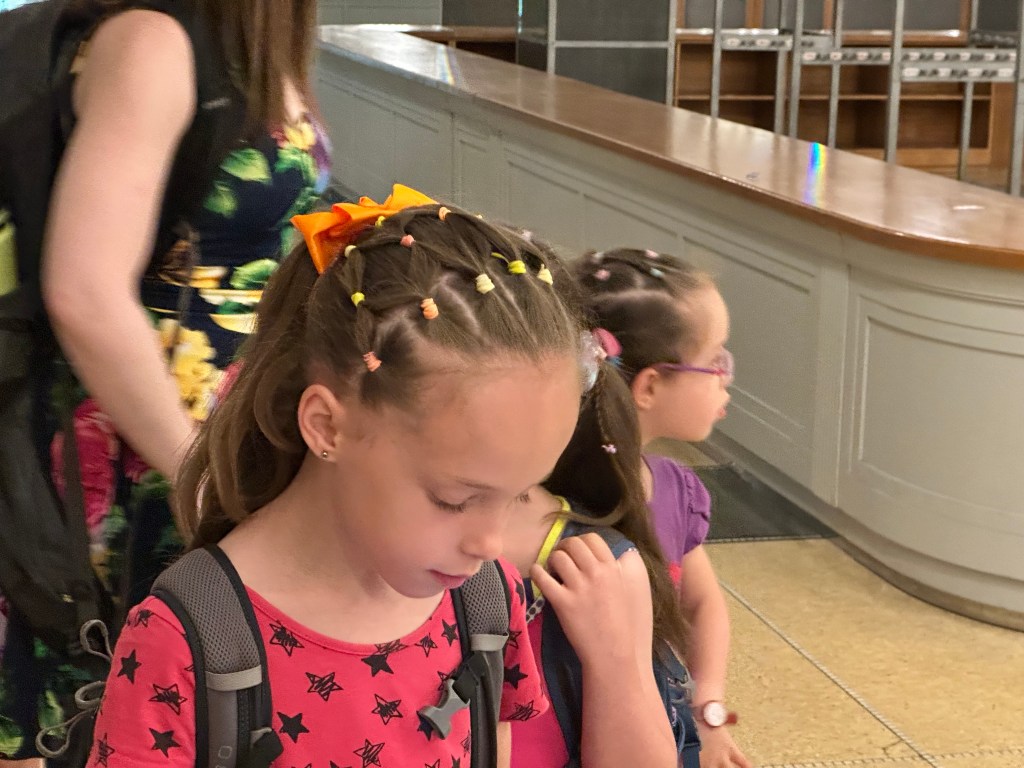
We were lucky enough to be there to catch a fashion show rehearsal, but I found the hairdos of the three little girls on the tour equally fascinating. I can’t imagine how long it took their mom to create those designs on her little girls’ heads!

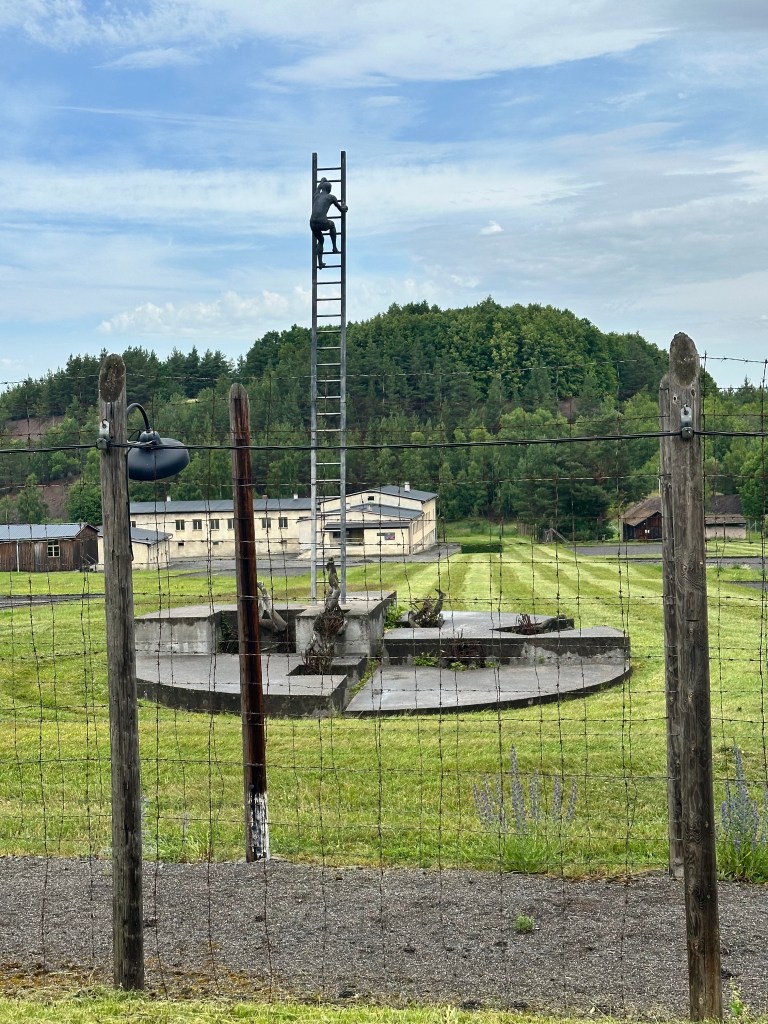
After three days in Prague, it was time to move on to Cesky Krumlov, but on the way, we had another grim stop, this time to a Soviet prison camp in Vojna. It was originally build by German POWs as a labor camp near the uranium mines, but then transitioned into a Communist labor camp for political prisoners. The poor Czech people were getting hammered from extremes on the left and the right!

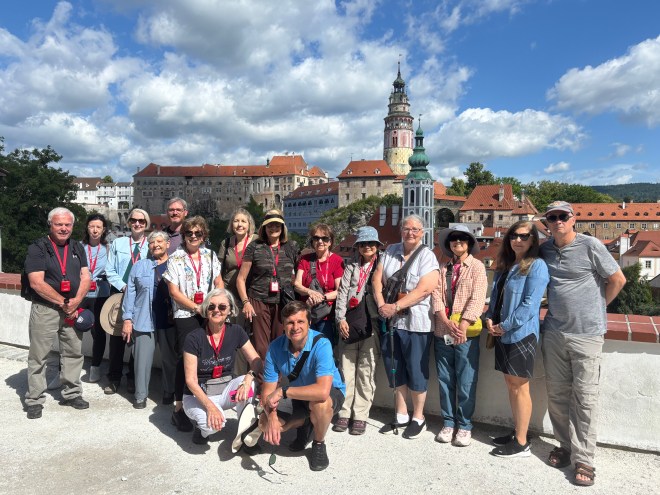
I visited Cesky Krumlov with VBT, but the emphasis was clearly on biking. It was nice to have time to explore the city on foot. Because I have discovered I have a strong preference for the OAT itinerary, I’ve decided that my biking days are over.

The hotel that OAT chose, the Ebersbach was perfectly located, so that we could walk everywhere. The included breakfast sucked, but the location was perfect and my room was lovely.

OAT gave us a voucher for entry into 5 area museums and enough free time for us to enjoy them on our own. Barb and I visited four of them, skipping the monastery.

Of course, after we had visited the Castle Museum, we had to climb to the top of the tower for a panoramic view.

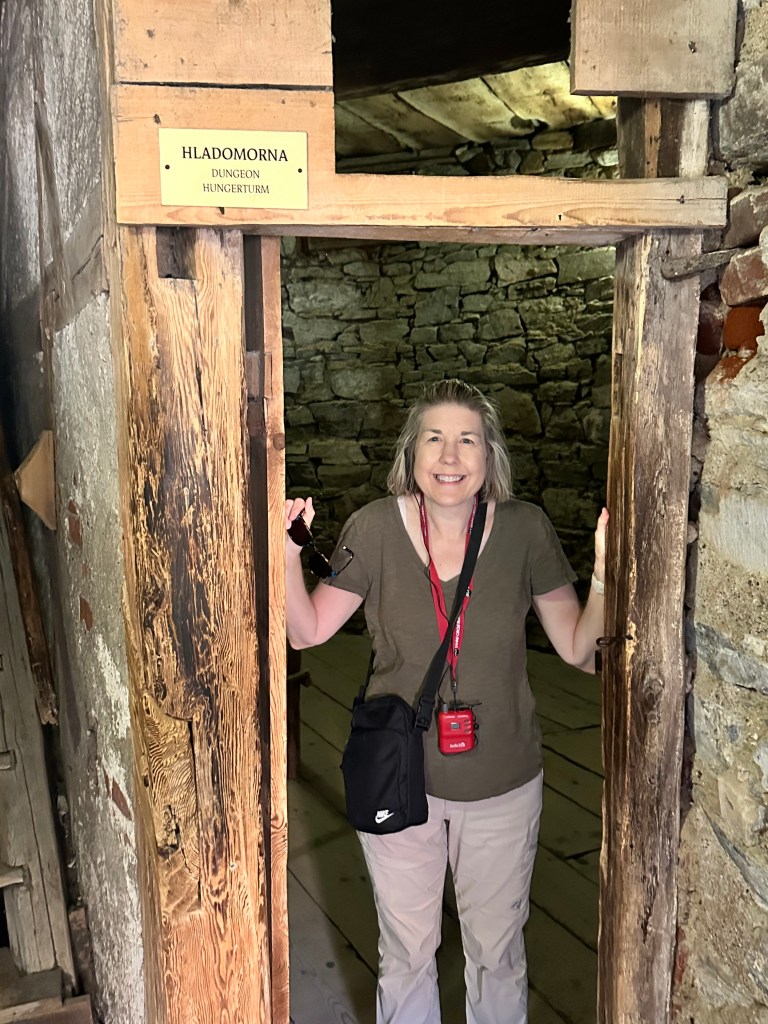
Let me tell ya, it was NOT an easy climb up those narrow, uneven stairs. Barb stopped to explore the dungeon and I caught my breath while I was taking her photo.

Bratislava
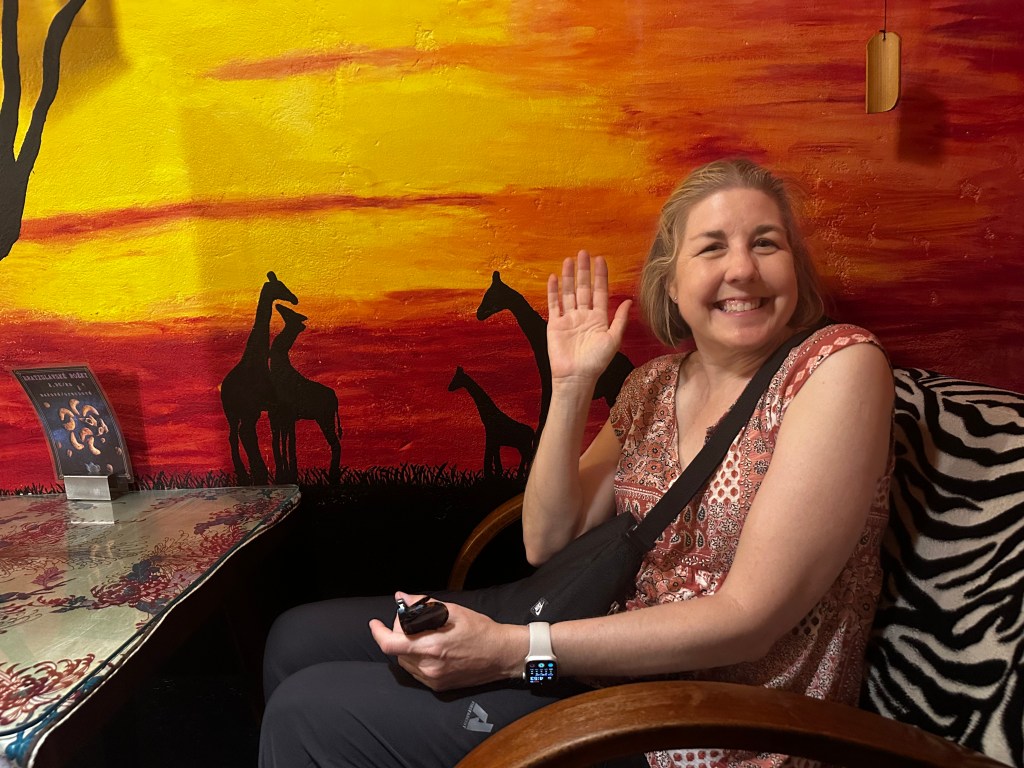
The next country we visited after our adventure in Slavonice, was Slovakia. I absolutely LOVED Bratislava. Where else can you have tea in a bomb shelter that has themed rooms? Can you tell that Barb and I were in the “Africa” room?

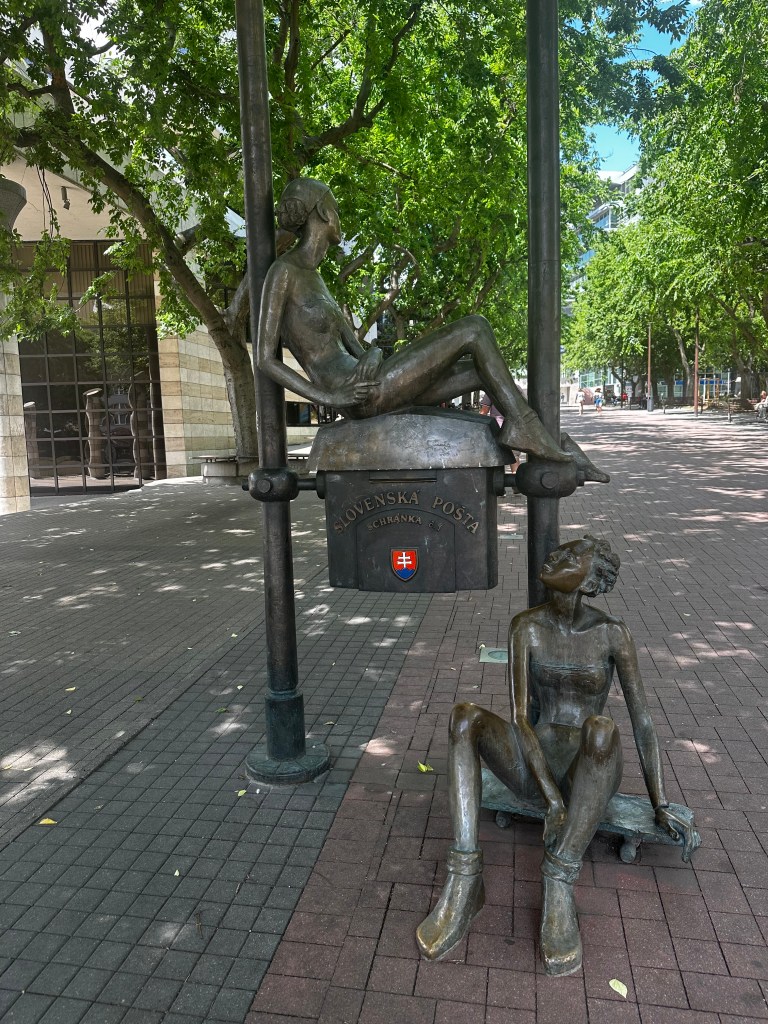
Whimsical art was EVERYWHERE in Bratislava. Check out their postal box. Now THAT’S creative.

I LOVED the Slovakian sense of humor!

As usual, our drive to Budapest was broken up by an interesting stop. This time, we visited Roman ruins at Carnuntum. Mike would have been in his glory here, but since I didn’t have him to explain the historical impact of this site, I had to rely on our guide and the signage.

Budapest
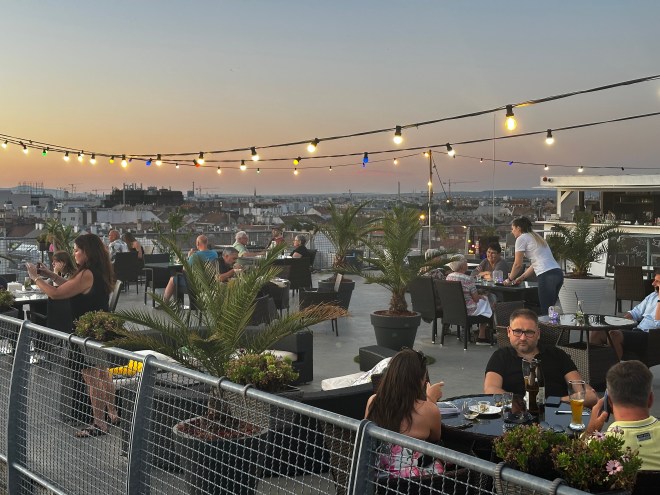
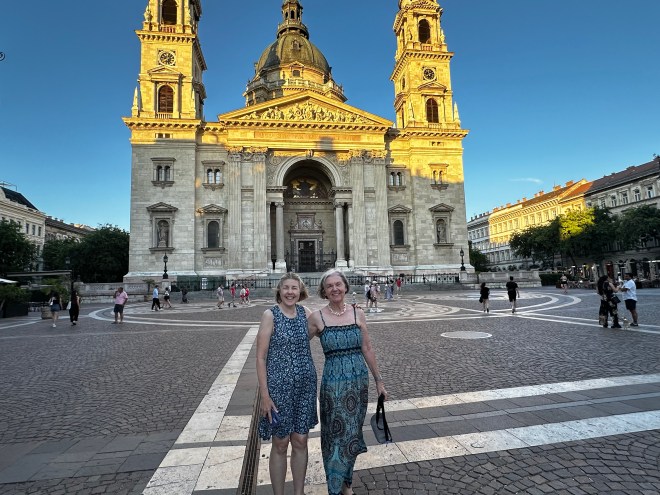
It is almost time for me to leave for the airport for the next trip, so Budapest will not get the attention it deserves. What a wonderful city! Not only was the Hotel President Budapest well located, but the delightful rooftop bar was the perfect gathering spot from which to watch the sun set.

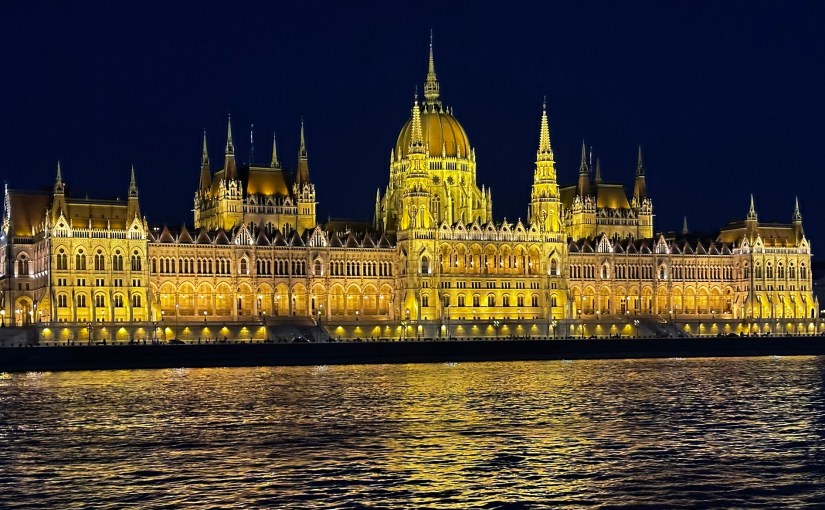
Speaking of sunset, we also experienced the Danube by night. The photo atop this post was taken on our evening cruise.

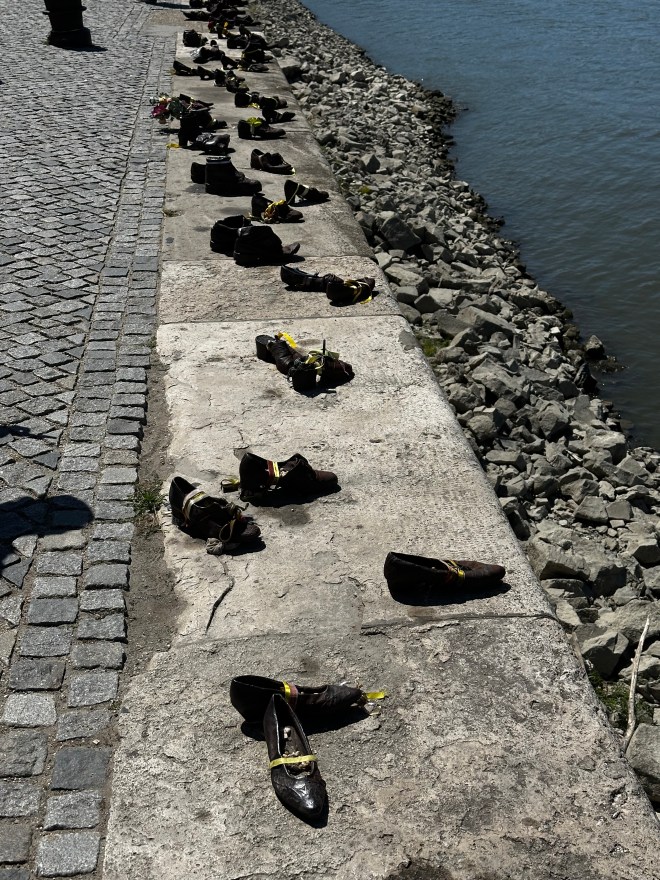
As was the case with the other countries we visited, Hungarians don’t shy away from the hard lessons of the past. This shoe monument memorializes the Jews that were forced to line up along the Danube, strip naked (during the winter) and hold hands. The Hungarian Nazis wanted to conserve bullets, so they only shot the second or third person, and because they were holding hands the others were pulled into the water by the ones that had been shot.

We were able to walk just about everywhere, which is probably why I didn’t gain my usual 5 “trip” pounds.

I have been lucky to find interesting companions on all my OAT trips. And this was no exception. For one of our nights in Budapest, Barb and I had dinner at a nearby restaurant with our new buddies, Linda, Marleen and Gail.

I had expected more reverence to be shown to Ronald Reagan because of his “Mr Gorbachev, tear down the wall”speech. FINALLY, as we were getting ready to head for home, we encountered a statue in his honor.

I’ll end this saga with a group photo. Next trip— Canada. I hope you’ll come along!

Our group: front me and Tomas Back row:Bill, Gail, Brenda, Jan, Brian, Diane, Barb, Marleen, Linda, Amy, Darlene, Patty, Lynn and Greg

Slavonice, Czech Republic

What? You never hear of Slavonice? Neither had I, until this trip. Centuries ago, however, Slavonice was a “happening” place. On the road between Prague and Vienna, it was a popular overnight stopping point for travelers.

Check out the “graffiti” that still exists on the buildings in “old town”.

One of the reasons I keep choosing to travel with OAT is because of hidden gems like Slavonice, places I would NEVER have discovered on my own.

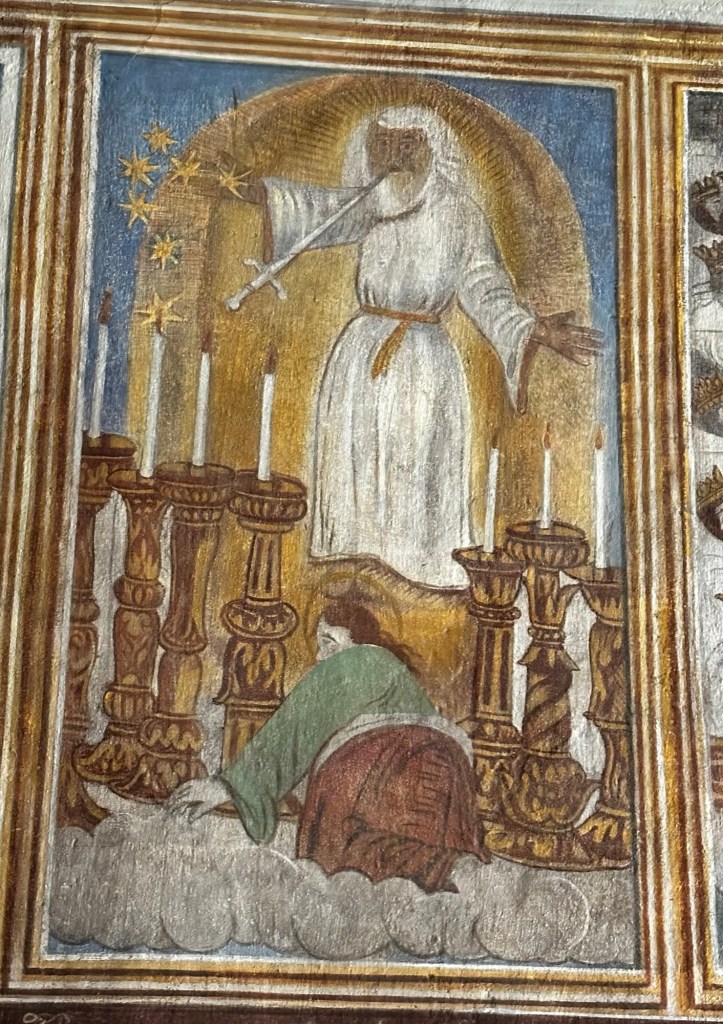
We were able to visit a beautiful restored building that was once used as a gathering place for the Lutherans. Supposedly this artwork illustrates that Jesus’ word is more powerful than the sword. Clearly this artwork was done well before both world wars.

Can you believe the ceiling in this building? How did they DO that?

We were the only guests in a lovely little hotel in old town, complete with a restaurant and wine cellar.

Here is Pavel, the owner, chef, wine merchant, cleaning crew, sommelier, ( he’s EVERYTHING!) greeting Tomas, our guide and welcoming us to his hotel.

Our first evening was memorable indeed. The town lost electricity during a hailstorm and with roads flooded, Pavel had to figure out how he was going to feed us. Fortunately, his wine cellar was very well stocked, so in addition to soup and bread we were offered unlimited beverages. SOME of us took FULL advantage of what life had thrown our way.

I took these photos of posters outside my room especially for my favorite sommelier (he knows who he is).

We were lucky that the 13th century wine cellar didn’t flood. The water from the storm that DID make it into the building had receded enough for us to enjoy a wine tasting on the second night of our stay.

The fact that the ceiling was dripping on us didn’t dampen our spirits one bit.

Yes, we are all bundled up— it was COLD in the centuries old basement.

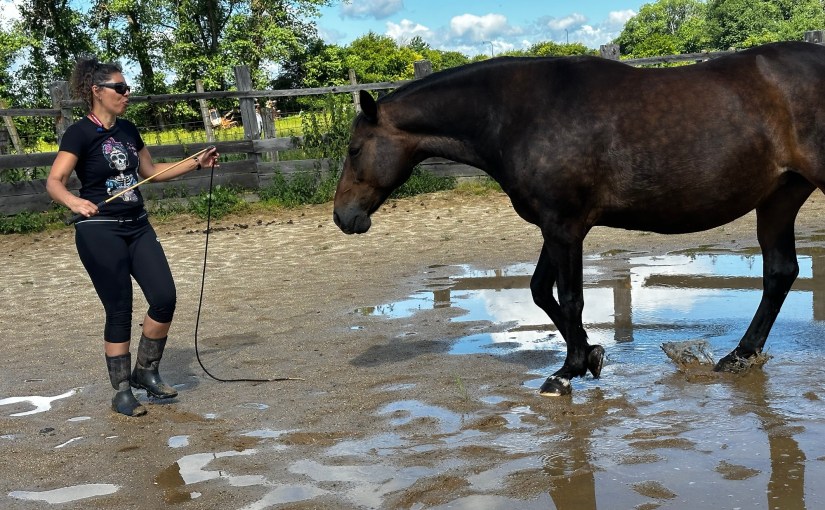
But once again, I’m getting ahead of myself, talking about dinner before describing our “day in the life” experience at a farm about an hour’s drive from Slavonice. Olga, our host, runs a horse farm.

Like my wonderful cousin Kristy, she provides a home for horses that can no longer be ridden. Her oldest horse is 30, which is significantly more than the average life span of a horse.

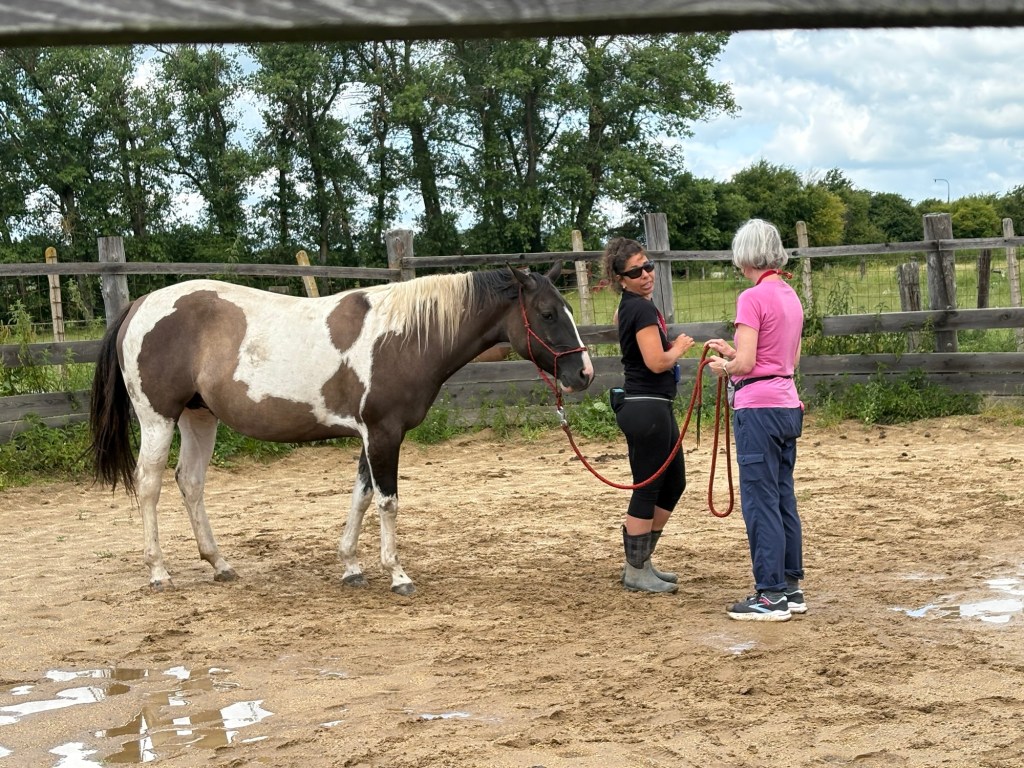
In addition to breeding horses, Olga also works with horses that are thought to be “difficult”. She demonstrated how she communicates with them using only her eyes and fingers. When she asked for a volunteer to learn the technique, I thought I was going to have lots of competition. I thought wrong.

Could the amount of water and mud have been the reason for my companions reluctance?

Being the ONLY volunteer, I got to get up close and personal with this magnificent creature, who was once thought to be “difficult”.

Olga is demonstrating the proper shoulder technique to get the horse to follow you. Nailed it!

Yes, our day time activities were fantastic, but there was even more awaiting us.

That night, we had the PLANNED dinner at the hotel,

complete with local musicians who got us singing along to “Country Roads” and “Roll out the barrel”.

Of course, the wine flowed freely, but the show stopper was when our host used a sword as his bottle opener.

On to Bratislava. Yes, I know. Add Cesky Krumlov to the list of places I’ve skipped over.

Pisek, Czech Republic

What a delightful surprise our lunch stop in Pisek turned out to be!

This blog is not a chronological record of my OAT itinerary. It continues to be whatever I feel like writing about. And I feel like writing about this sweet little undiscovered town.

We’ve been to Dresden, which was our final stop on the pre-trip, then we spent the first three days of the main trip in Prague. Both of these fascinating cities deserve posts of their own, and I’ll get to them eventually. There have just been far too many distractions for me to give them the attention they deserve.

Pisek is quite beautiful. Its old stone bridge predates Prague’s Charles Bridge by at least a century. Somehow, the bridge managed to survive several centuries worth of floods. The statues on the bridge weren’t so lucky. The originals were damaged and have since been repaired or replaced.

Don’t be fooled. Pisak also has MODERN attractions, like this one. I’ve seen pedal bars in Nashville, but I never have seen a Prosecco van. What a great concept!

Despite this vehicle’s obvious appeal, I found the sand sculptures even more compelling.

The header on this post describes the theme for this year’s sand sculptures — Freedom and Liberty, intended to commemorate the town’s 80th anniversary of their liberation after World War 2.

Did you recognize Gulliver, struggling to break free?

Lady Liberty has packed her bags. I’m hoping she’s not leaving the USA.

To me, the most compelling sculpture was this one, especially after being in Berlin. What a powerful demonstration of how much JFK’s words meant to the people in this part of our planet. .

Then I took a good look at the front of the sculpture. It shows Putin driving a car manufactured in East Germany by the Soviets. The Trabant had an engine that was likened to a lawn mower—about as powerful and just as smelly. East Germans would use trabants to escape to the Czech Republic, and then abandon the car in the street.

Take a close look at who is kissing up to Putin. Clearly he is not in the driver’s seat.

If you don’t recognize the iconic hair style, the sculptor has given us a hint. He has “king” written alongside his image. ( I would have added “wannabe” before the word “king”).

Why is it that Europeans can see so clearly what many Americans cannot? Perhaps because they have lived through Facism and Communism, they have a deep understanding of how fragile democracy can be and how important it is to preserve it, in every means possible, including the creation of sand sculptures.

Goodbye Berlin

My last post was about Berlin’s tragic past, and how frightening it is to recognize parallels to what is happening in the world now.

Today’s post is about Berlin’s glorious present and how it is making me optimistic about the future for our entire planet.

First, many thanks to my dear friend Chris and her wonderful sister Claudia for their very helpful suggestions on how to best use our time in Berlin. Thanks to them, we knew we needed to get tickets for the Reichstag tour at least a month in advance. For those of you not lucky enough to know Chris or Claudia, here’s the link for the free tour, in English: https://www.bundestag.de/en/visittheBundestag/dome/tours

The Bundestag building itself is architecturally gorgeous, filled with interesting artwork.

Our guide was a retired lawyer, who explained that although, prior to Hitler’s rise to power, Germany considered itself a democracy, it really wasn’t, because half of the population wasn’t allowed to vote. I wish I could remember her exact words because she said it far more elegantly than my paraphrase, but here’s the gist of her comments regarding women voters: They expected women to be grateful when they “gave” us the right we had been denied for so many years.

Here she is, explaining why the Russian soldiers’ graffiti in the Reichstag was preserved when the building was reconstructed after unification. (Once again, not a direct quote, just what I remembered her saying).

Imagine you are a young Russian soldier who spent the last few months being shot at and bombed. You have survived so far. You reach Berlin, but are still not safe. You want to leave your mark so that others recognize that you once existed.

The Germans left the graffiti so, to me, it has become a symbol of the compassion the Berliners felt for young Russian boys who were drafted and forced to kill young German boys.

She also gave us information about the way the German government currently operates, but because I wasn’t as interested, I promptly forgot everything she said.

I was, however, fascinated by the eagle on the wall behind her. That eagle hung in Bonn, when it was the capital of West Germany. It was installed at the reconstructed Reichstag after reunification.

I was also fascinated by the interior view of the dome from the parliamentary meeting room.

After the 90 minute guided tour, we were able to enter the dome and walk up the spiral ramp to the top.

The mirrors in the center reflect light into the building below.

I found it fascinating that the dome is completely open. What happens when it rains or snows? Inquiring minds want to know, so I asked one of the guards. He told me the top remains completely open, but rain only falls on the very top level, where drains capture it and carry it out of the building. Damn, those Germans are great at engineering!

From the Reichstag dome, we were able to see the TV tower. It was the proud creation of the Soviets in East Berlin, intended to demonstrate the superiority of Soviet construction. After reunification, however, the world had access to Stasi documents that showed most of the materials used to build the tower had to be imported from the west.

During our city tours both guides talked about the symbol of Christianity (a cross) appearing on this godless tower. We were completely mystified, because it was impossible for us to visualize anything that remotely resembled a cross. FINALLY, during our stroll around the dome, the sun was in the right position, so I hope my photo allows YOU to see it too.

If my personal astrophysicist had been by my side, he would have explained the scientific principles behind the phenomenon. Instead, I went with Barb’s explanation: it is magic.

Anyone who has read any of my prior posts knows that I cannot resist a tower, mountain, high point—anything that offers a panoramic view. Berlin has several, and we took advantage of every single one that we could find.

The view of the Brandenburg Gate from the dome

Our OAT trip leader suggested we visit the Humboldt Forum’s rooftop. In addition to the delightful cafe,

we were treated to another vantage point of the city.

Notice the roof of the Humboldt is planted with grasses and flowers.

The city was environmentally aware, which was so very encouraging to me.

None of the median strips were mowed. Instead, grasses and weeds were allowed to grow unhindered to protect and feed the bees.

From our vantage point on the roof, we could see the sustainability display. That’s the reddish tower in the photo below, in which reclaimed materials were used to fashion new structures.

We ended our night with a laser show at the Reichstag, which was created to commemorate the 30th anniversary of Christo’s art project.

With travel, sometimes you hit and sometimes you miss. The laser show was definitely a miss, but the sunset was lovely.

And the walk to the hotel gave us the opportunity to see Berlin buildings illuminated.

Lessons From Berlín

I’m so glad I was able to spend 5 days in this wonderful city. Those of you who have read my earlier posts may recall that initially I was not particularly enamored. Must have been because of jet lag, or the piss poor commentary on the City Circle / Gray Line HOHO. My recommendation—try a different HOHO in Berlin. There are four.

The Germans truly believe Those who fail to learn from history are doomed to repeat it”

Unlike us, they do not spin, whitewash or deny their history. Instead, they build monuments to the victims, and record the monstrous deeds of the perpetrators of violence—the Nazis.

The Topography of the Terrors is a free outdoor exhibit, built on the site of the former Gestapo headquarters. One of the photos shows Adolph Hitler’s military parade on his birthday.

I was viewing this exhibit on the very day something similar was happening in the USA. Fortunately, our wannabe dictator’s celebration was not as well attended. And even more fortunate—the “no kings” protests throughout the USA had far more participants.

Once the OAT pretrip started, we enjoyed a city tour where we learned the significance of some areas we had visited when Barb and I were on our own.

Following is a photo of Anne, our guide, showing us the location where over 20,000 banned books were burned. She also shared this prescient quote from 1820:

“those who start by burning books will also burn men”

After the war, Berlin was divided into 4 sections. Russia got East Berlin; West Berlin was shared by the Americans, the French and the British. West Berlin was completely surrounded by East Germany, which was held by the Russians.

1961 was the first time a wall was built to keep people IN. That’s because 3 million people (out of 18 million) had left East Berlin after the Soviet occupation. These were “essential” workers, so something had to be done to stop the brain drain.

Sections of the wall are exhibited in Potsdamer Platz

Throughout the city, we saw reminders of where the wall once stood. This is how the marker looks if you are on the West side of the wall.

There were actually two walls, with a strip of land in between, known as “ the death strip” and “no man’s land”. Both walls were painted white, to make it easier to spot people trying to escape.

Some statistics: Along the walls’ 100 miles, were 280 guard towers. No man’s land was patrolled by 1100 armed guards and 1000 dogs.

The stories of the 140 people who died while trying to escape are memorialized in the Terror exhibit.

After the wall came down, artists painted murals on the remaining sections.

Remember how Barb and I were mystified by the holocaust monument? Well, thanks to Anne, we now understand.

The architect wanted visitors to feel something as they walked through the exhibit. He succeeded. As the stones got taller and the ground became uneven, I felt uneasy and claustrophobic.

We learned that the memorial is composed of 2711 stones, to represent the number of pages in the Talmud. Viewed from above, it looks very much like an arial view of death camps’ barracks and a Jewish cemetery in Israel.

Next, we visited the “Disney” version of Checkpoint Charlie.

Knowing it is a tourist trap didn’t stop us from posing behind the sand bags.

We almost didn’t take the optional tour “Allies in Berlin” tour on our last full day in Berlin, because we mistakenly thought it would be a repeat of what we had already seen. Tomas, our trip leader, encouraged us to take the tour and I’m so glad he did.

It was extremely emotional for me. It harkened back to the time when we understood how important it was to win “hearts and minds”, back when we had leaders with integrity, foresight and wisdom.

The Soviets were trying to starve the West Berliners into submission, but the US, France and Great Britain began airlifting tons of food, coal, medicines and essential supplies to the people of West Berlin. The west Berliners were surprised that the people they were shooting at, just a few years earlier were now protecting them. That was the start of the strong friendship between Germany and the USA.

One American pilot decided to make small parachutes for rations, starting the “candy bombing” runs represented by the artwork on this bear.

Because France and Great Britain had been badly damaged by WWII , most of the aid came from the USA.

Years later, when the Berliners were feeling isolated and fearful, JFK visited. Although he only spent 8 hours in Berlin, his speech meant the world to the people of West Berlin:

“Two thousand years ago, the proudest boast was civis romanus sum [“I am a Roman citizen”]. Today, in the world of freedom, the proudest boast is “Ich bin ein Berliner!”… All free men, wherever they may live, are citizens of Berlin, and therefore, as a free man, I take pride in the words “Ich bin ein Berliner!”

I was surprised that Ronald Reagan was not as revered, so I asked Alex, our local guide about it. He told me that there is a plaque at the Brandenburg Gate for Reagan, but at the time he gave the “tear down the wall” speech, most Berliners thought it was an impossibility and that Reagan was just a “crazy old actor”.

At the American Museum, we saw the REAL checkpoint Charlie building, moved to this site when the wall came down. (It was one of three checkpoints: Alpha, Bravo, Charlie). These days, what was once barracks for American troops, have been transformed into condos.

To end this sobering post, here is a photo from the Sinti and Roma (Gypsy) memorial.

This child was separated from his parents, who had been employed, and had never been in trouble with the law. Their only “crime” —being born to the wrong parents.