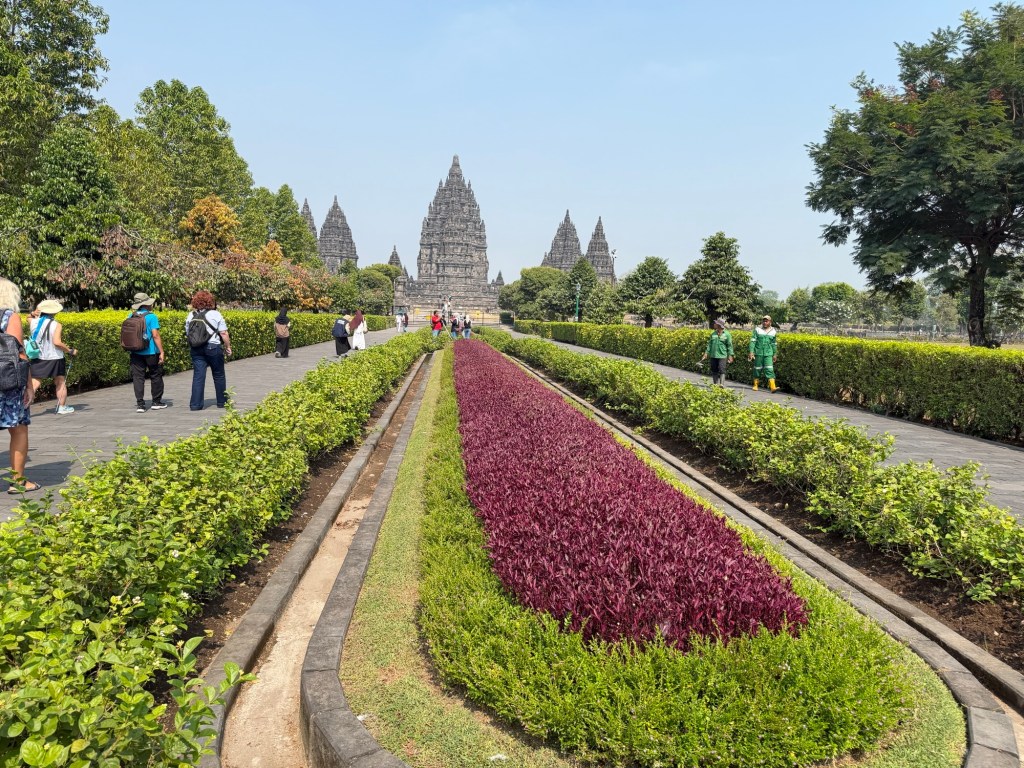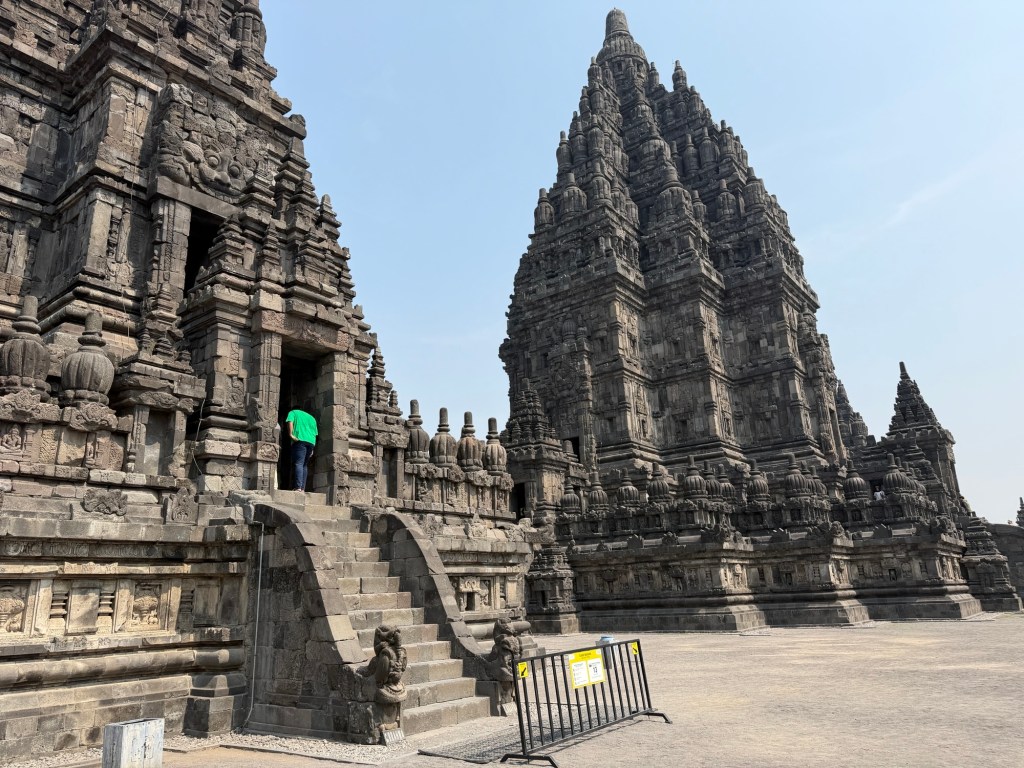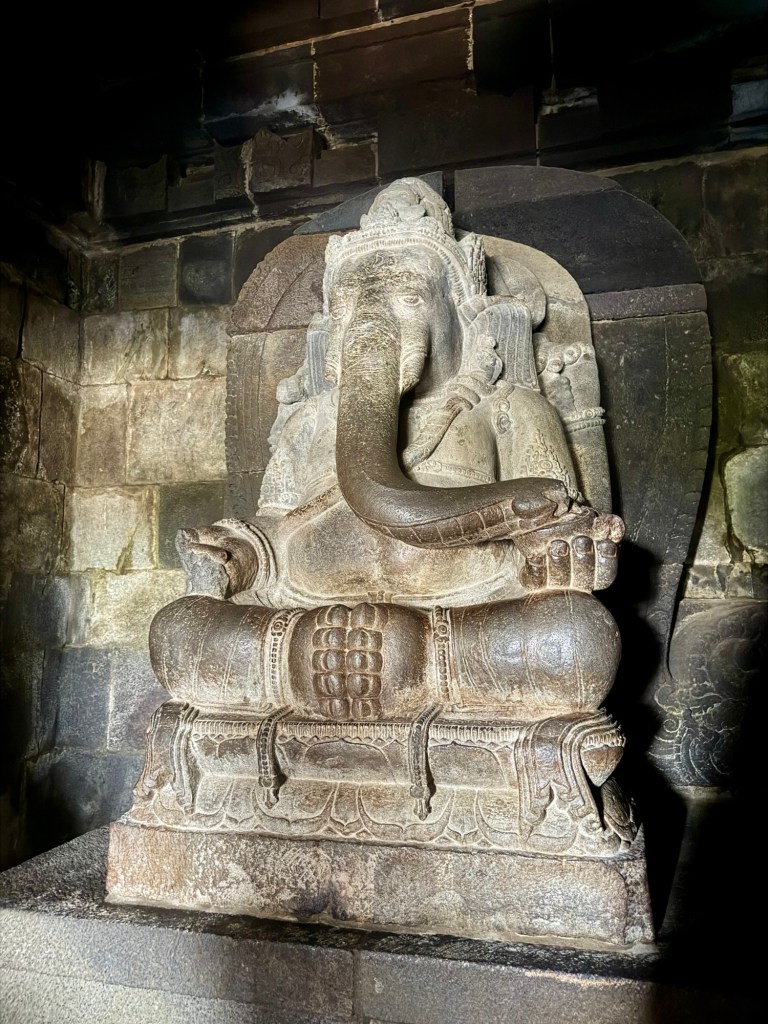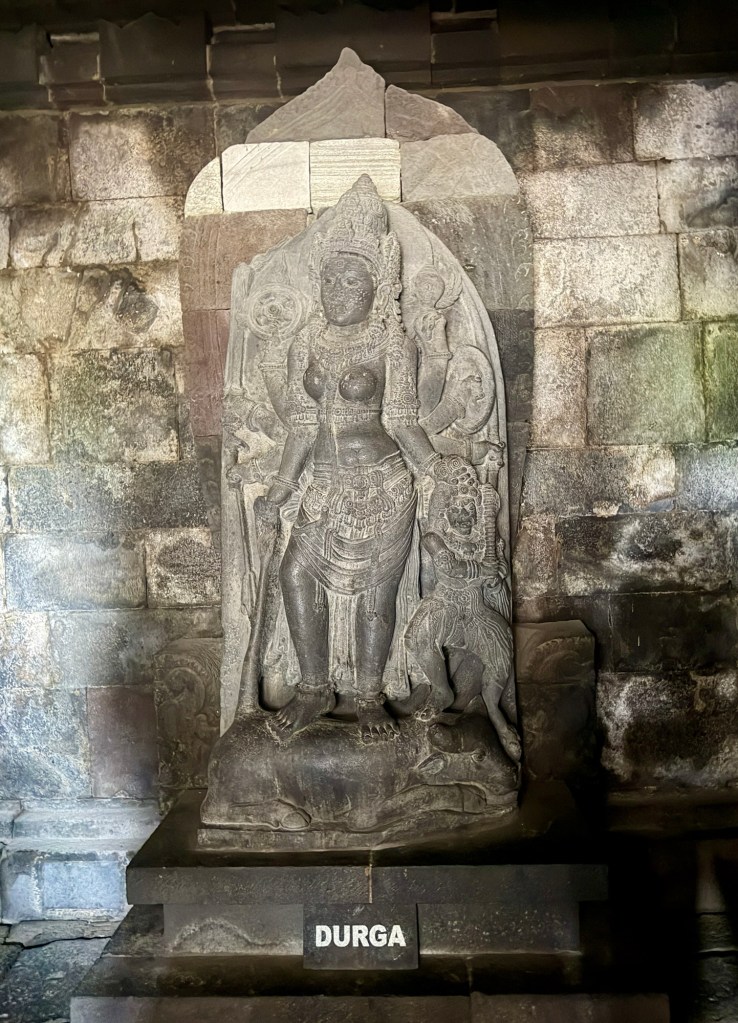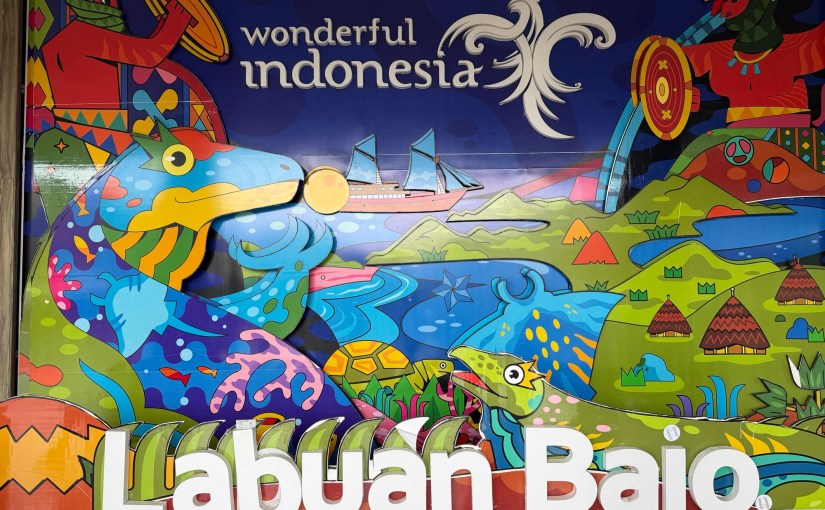
Three Nights in Jakarta

One of the many reasons that I enjoy traveling with OAT is they know how long we should allocate to a particular area, and they know how to appropriately fill that time.

Jakarta is a very large, crowded city, with lots of traffic. During our stay, thanks to OAT, we got a real sense of the history and culture of the area.

Although most of the OAT hotels include breakfast, we were pleasantly surprised to learn that Hotel Santika also offers a free buffet every evening, which was most welcome when we arrived from Borneo, tired and hungry.

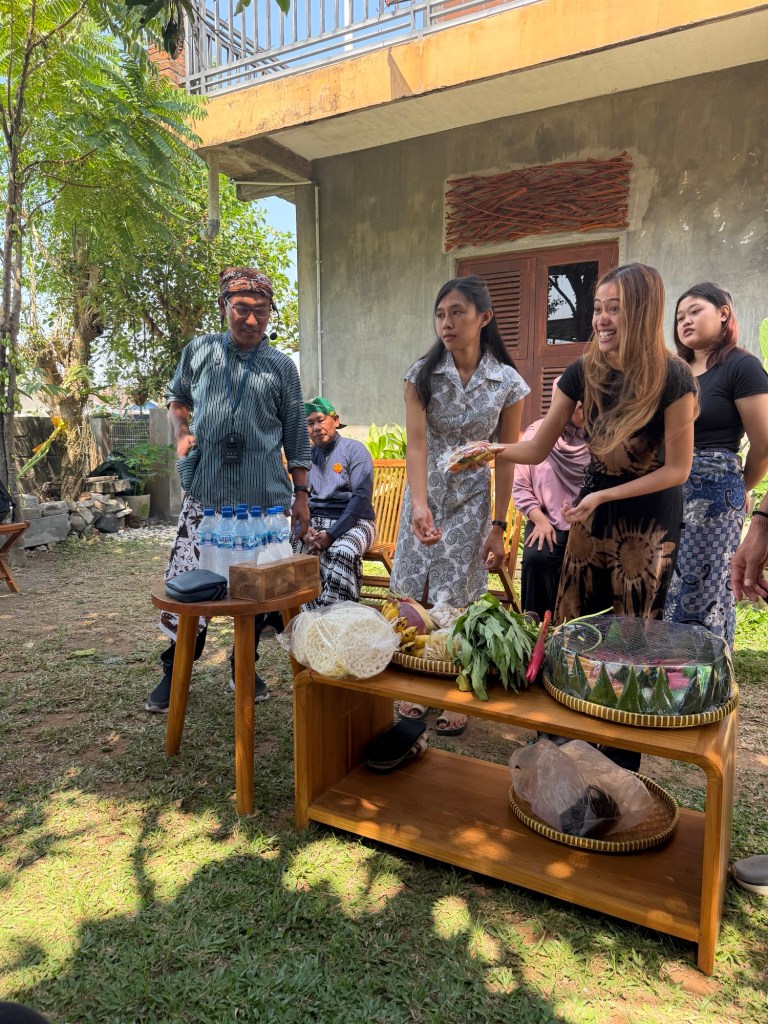
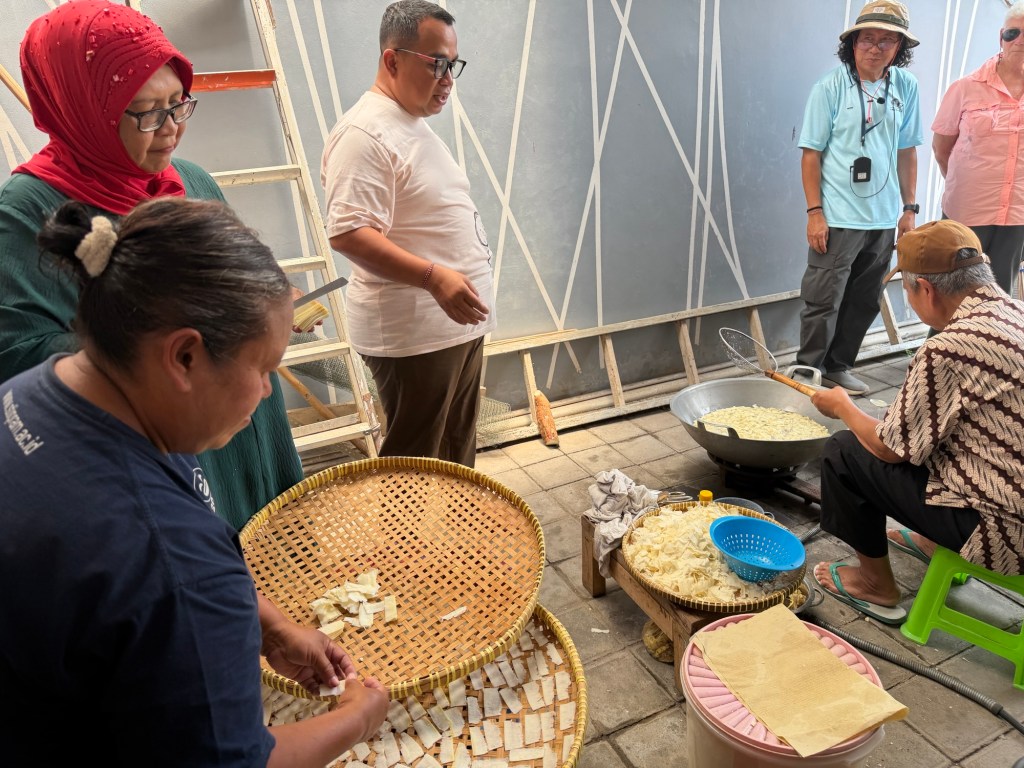
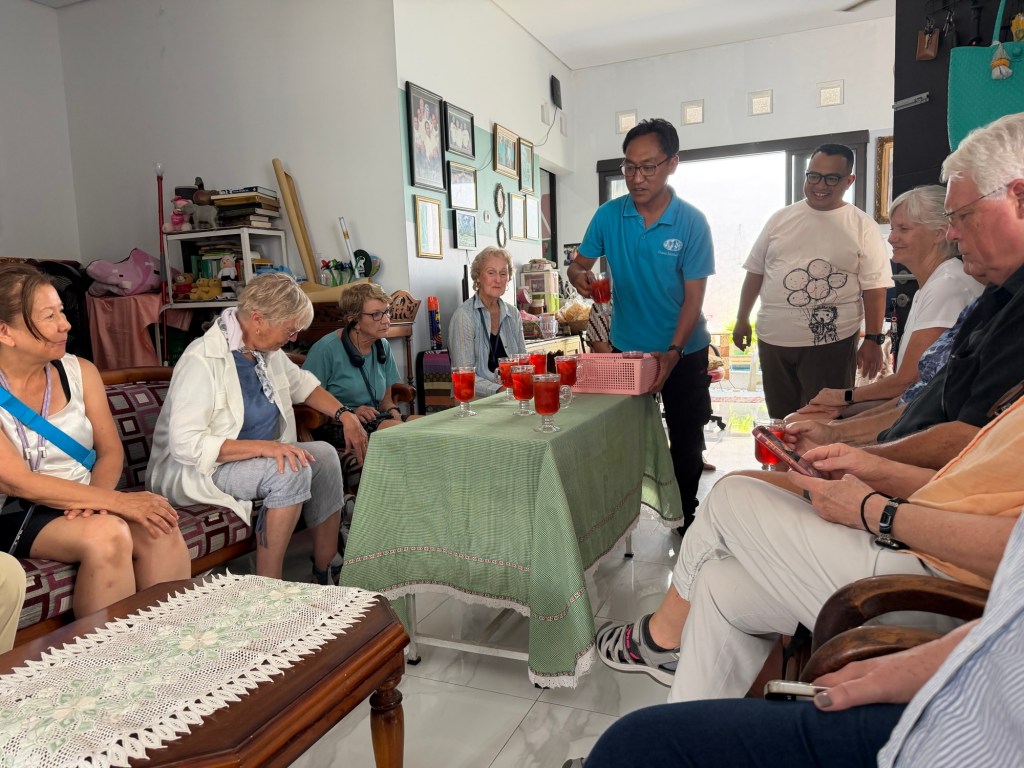
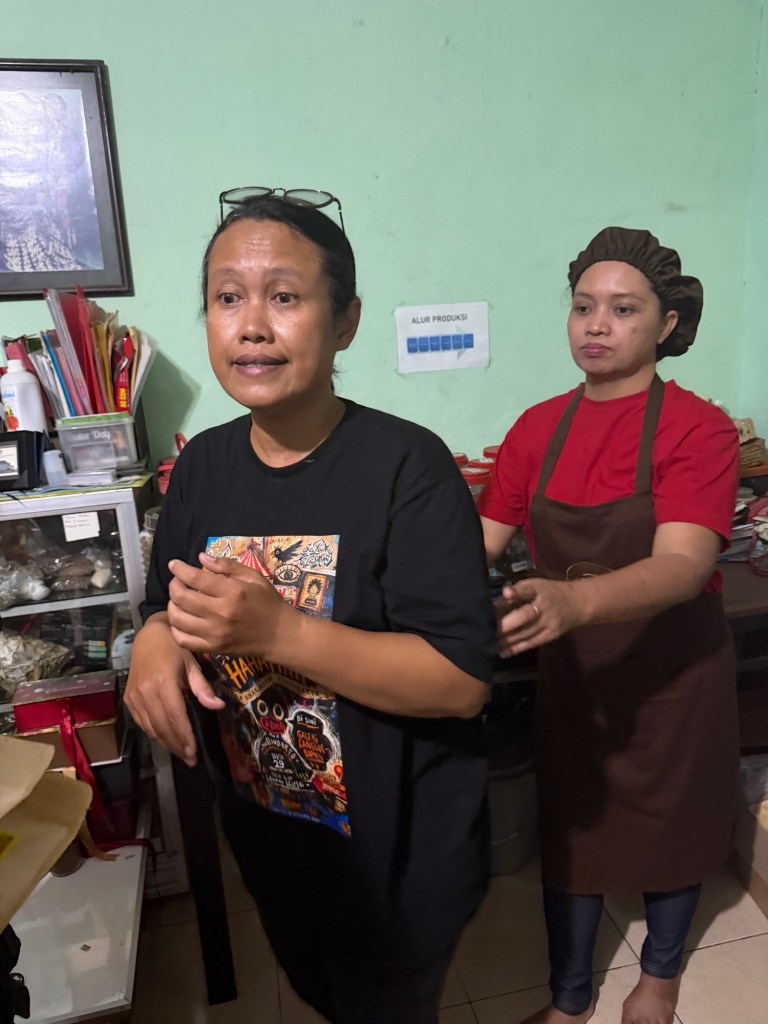
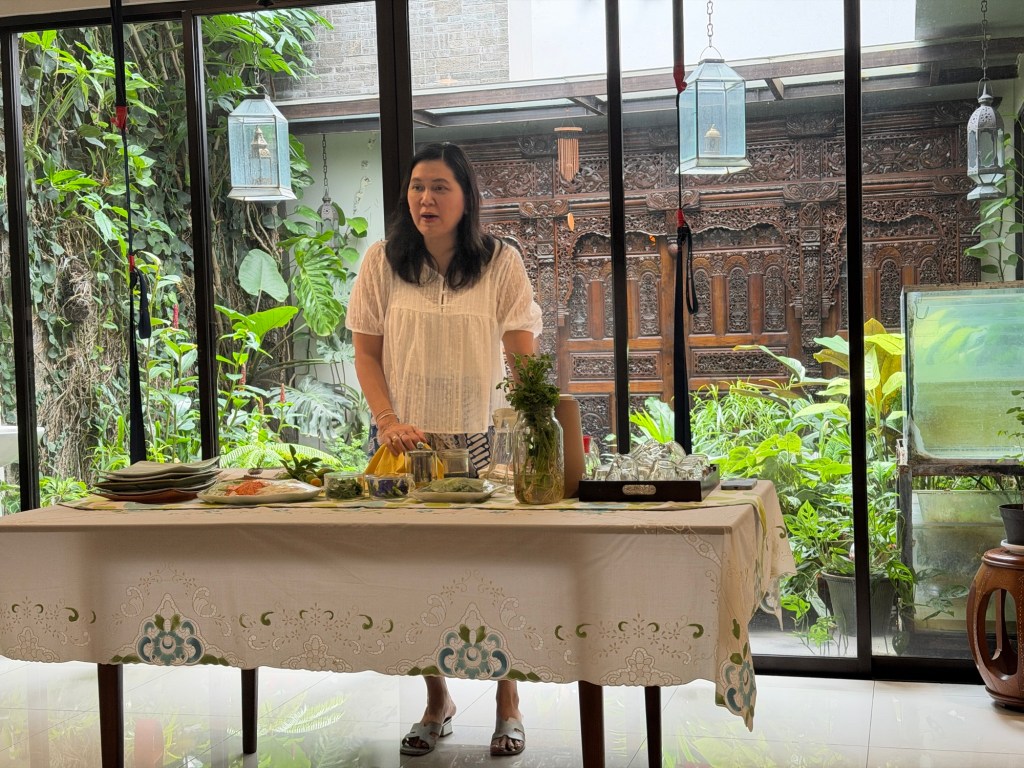
Our first full day began with a visit to Santi, who created an organic food business which operates out of her home.

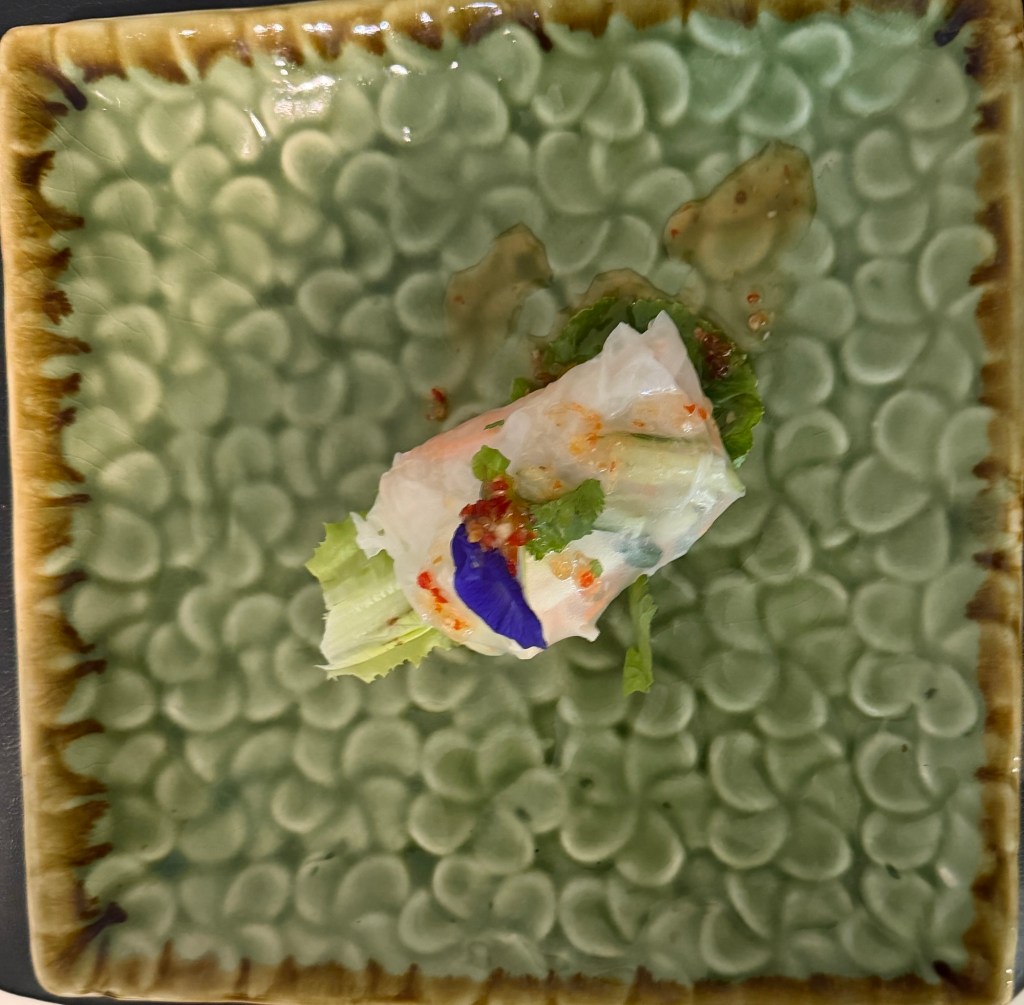
Santi taught us to make delicious vegetarian spring rolls, which we devoured.

Her home was a mix of modern and ancient. The beautiful, hand carved wooden screen in the central courtyard is hundreds of years old.

Santi had an export business until US tariffs made it impossible to continue operating, so we can no longer buy her organic products from the Internet.

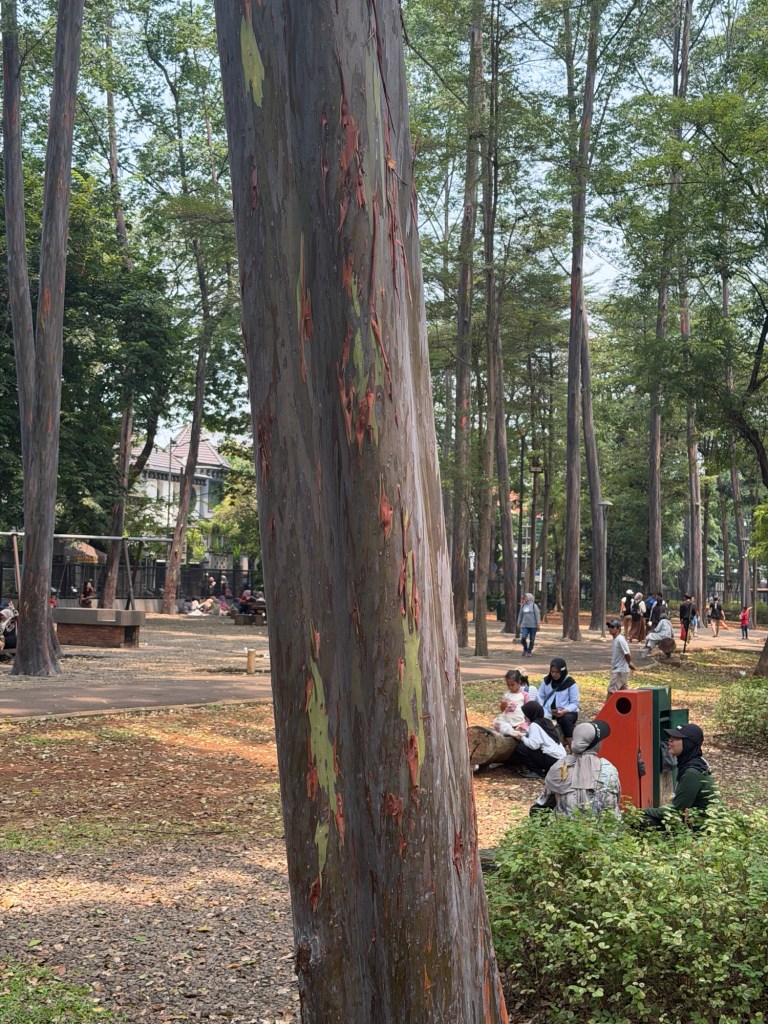
While Santi readied the room for our lunch, Era, our local guide, took us for a walk through the park across the street, where rainbow eucalyptus trees are growing. I MIGHT appear in an Indonesian TikTok video, because when I joined the local women dancing in the park, several of them filmed us.

Can you see how they got their name?

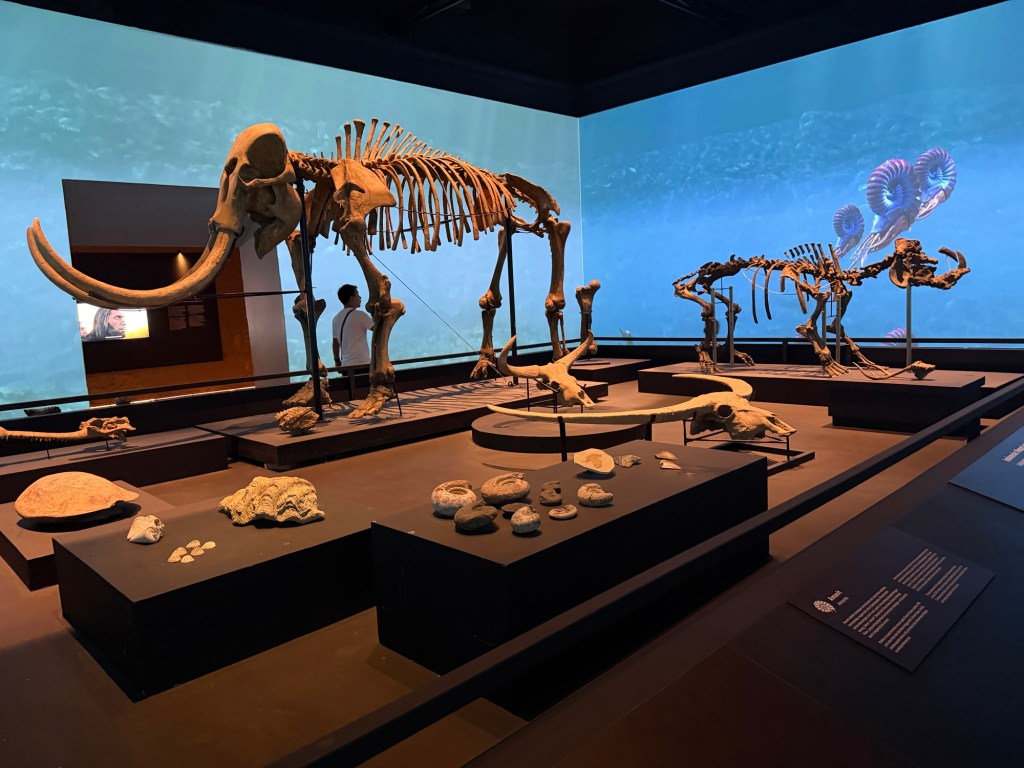
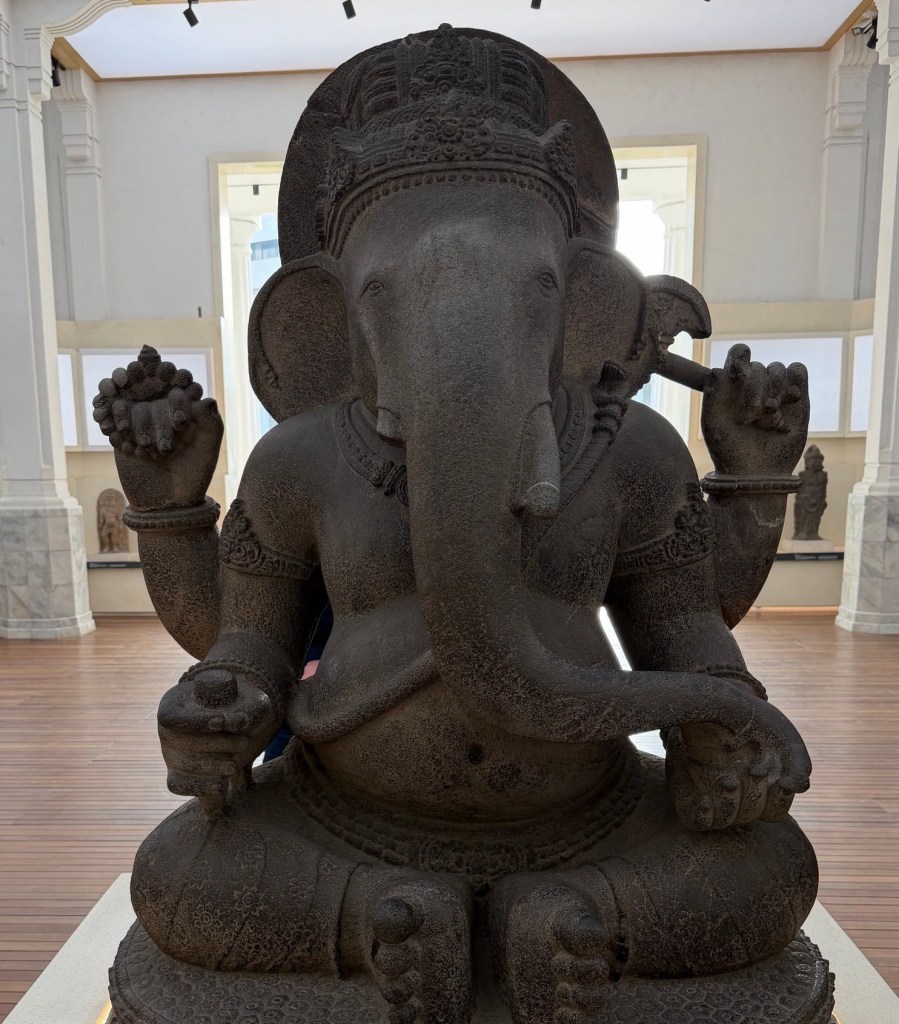
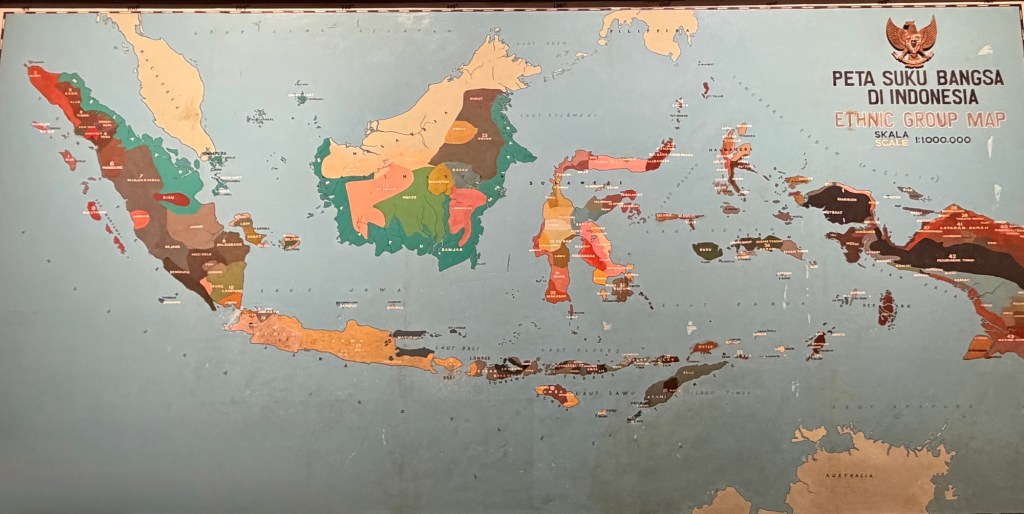
Although our itinerary had described the afternoon as “free time”, Widi gave us a choice. We could return to the hotel, or we could join him and Era for a visit to the Jakarta museum, transported by our bus. Because it was not part of the tour, we would have to buy our own ticket for 150,000 rupiahs ( or about $8.50). I’m bringing back Indonesian money for sweet Adam (my friend Levia’s son), so I jumped at the chance to get a bill smaller than 100,000 rupiahs.

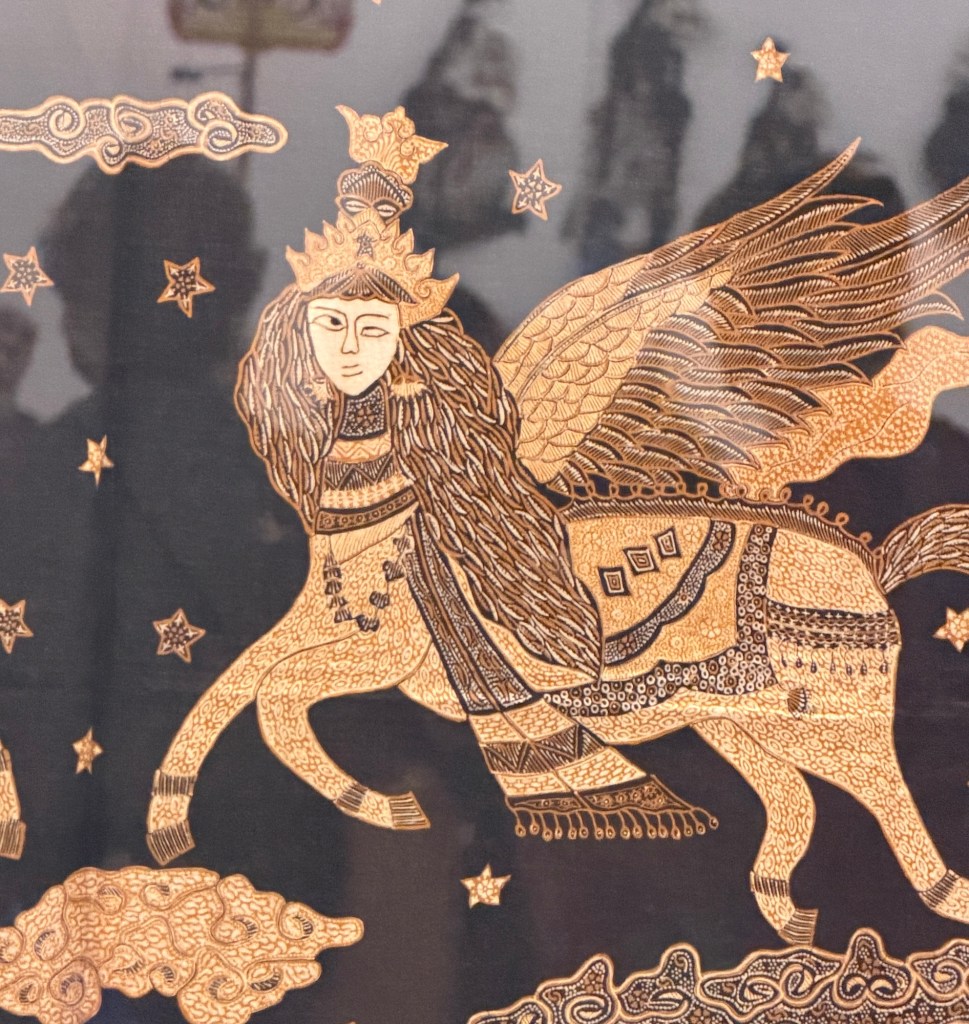
Is it just me, or does this ancient batik look like Picasso’s inspiration for his paintings?

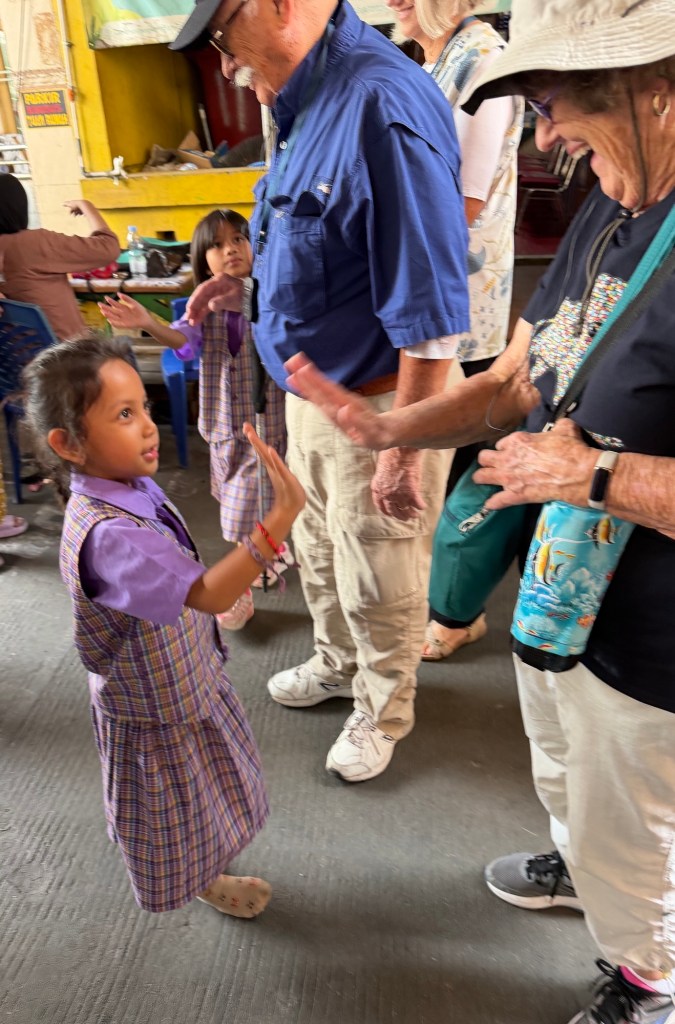
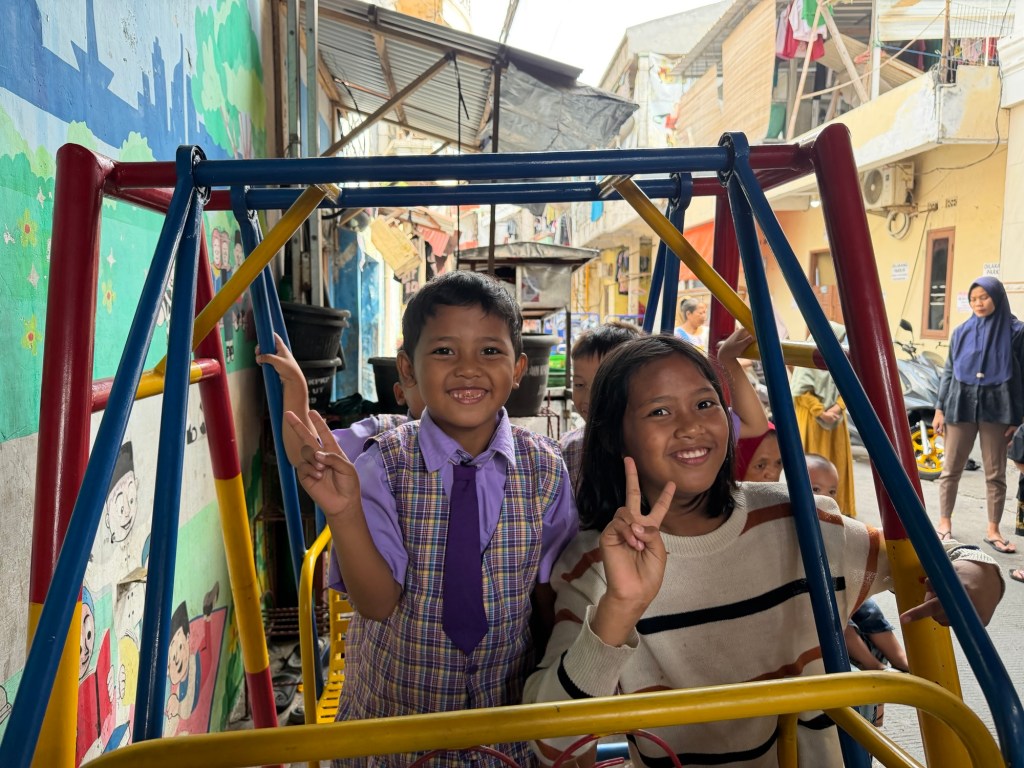
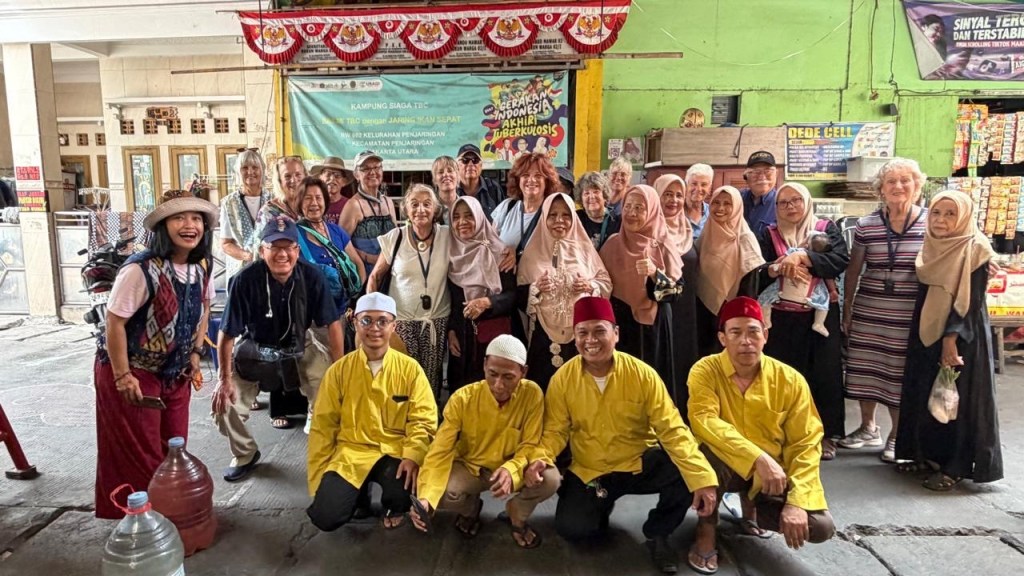
On dat two, we visited the Muslim area of Jakarta. I wish more Americans would travel outside of North America. If they did, they would see how beautiful and welcoming the children are and perhaps be less inclined to support wars against other nations.

All of the children wanted to high five us!

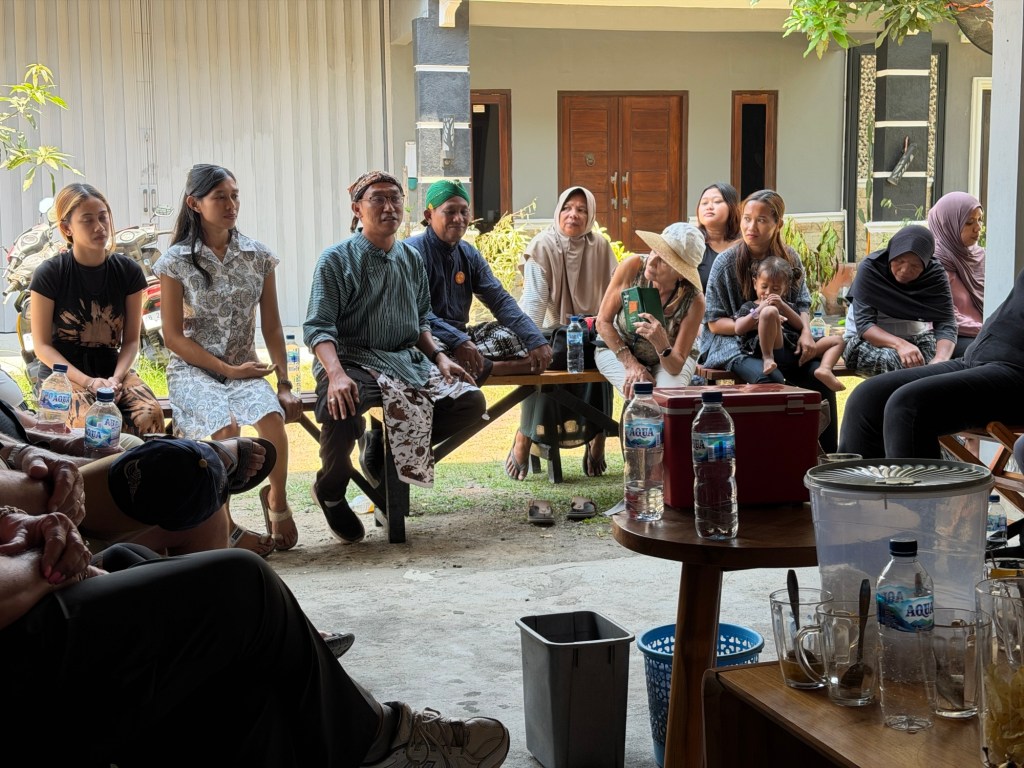
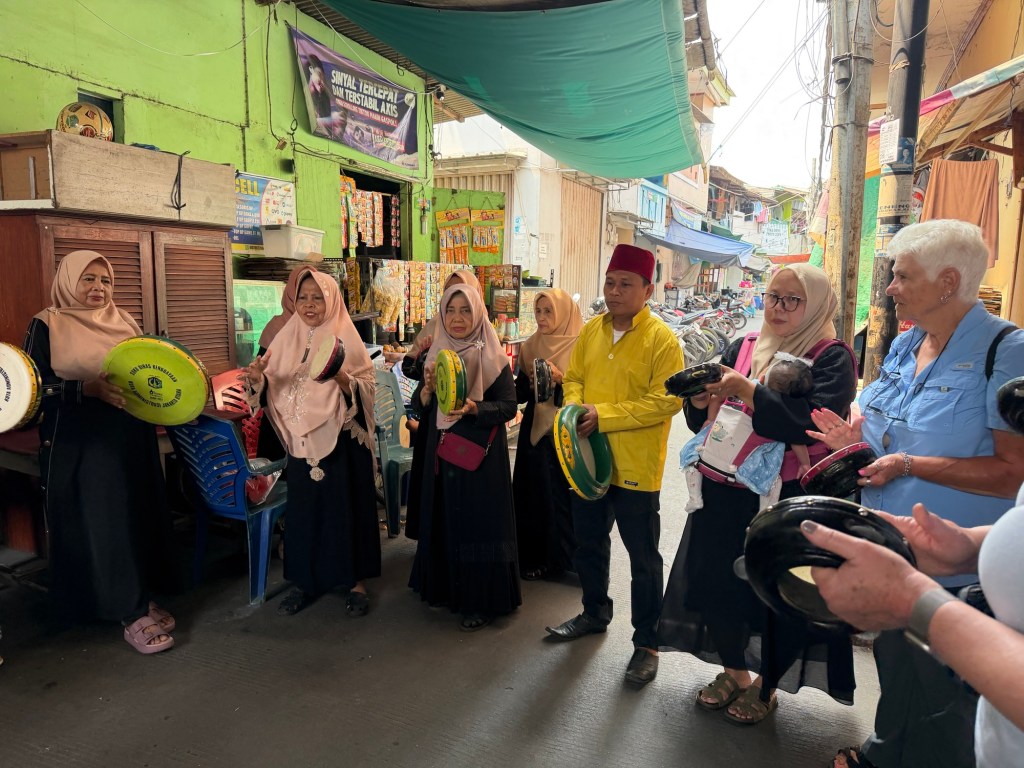
We were given the opportunity to ask questions during our meeting with the female village chief and a male teacher, which deepen our understanding of the Indonesian Muslims’ beliefs and way of life. When we left our meeting, we joined in a musical celebration with the villagers.

Sadly, my hands were occupied with my tambourine, so I was unable to video our stirring rendition of “ you are my sunshine”, but we ALL sang it with gusto in ENGLISH! Unfortunately, none of the Americans could join in for the Indonesian version of the song.

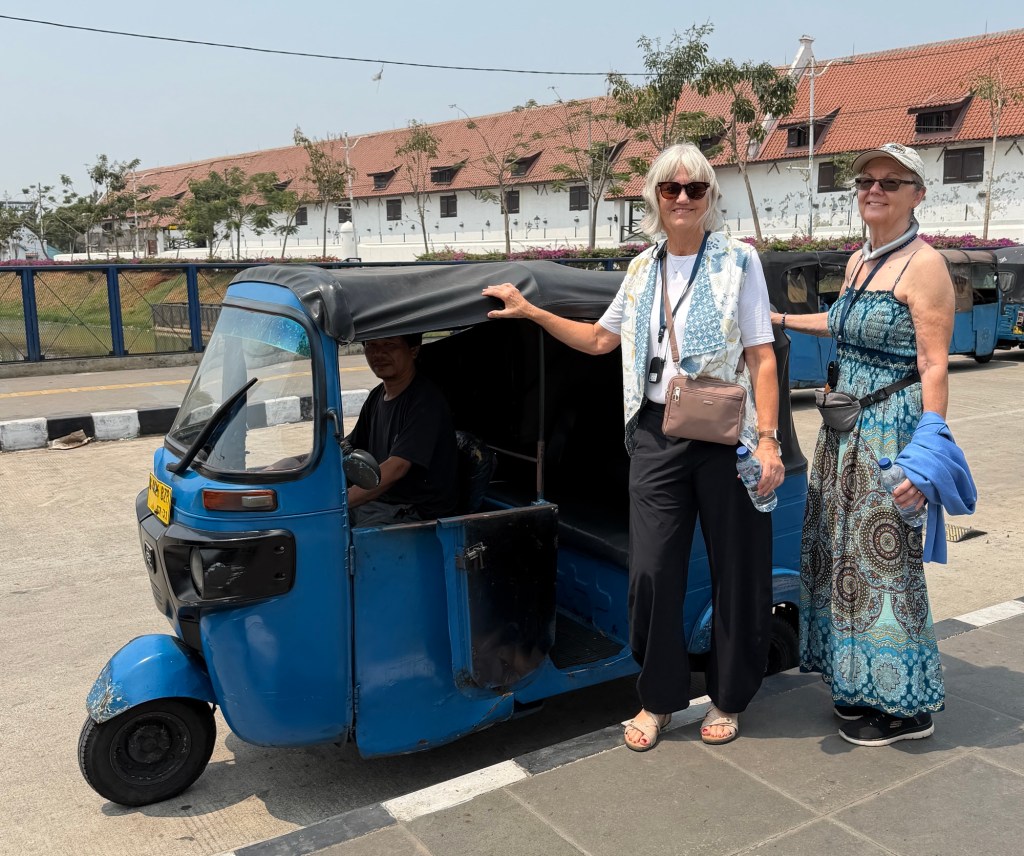
Our tuk tuk ride from the Muslim neighborhood to the historic square was, shall we say, “thrilling”.
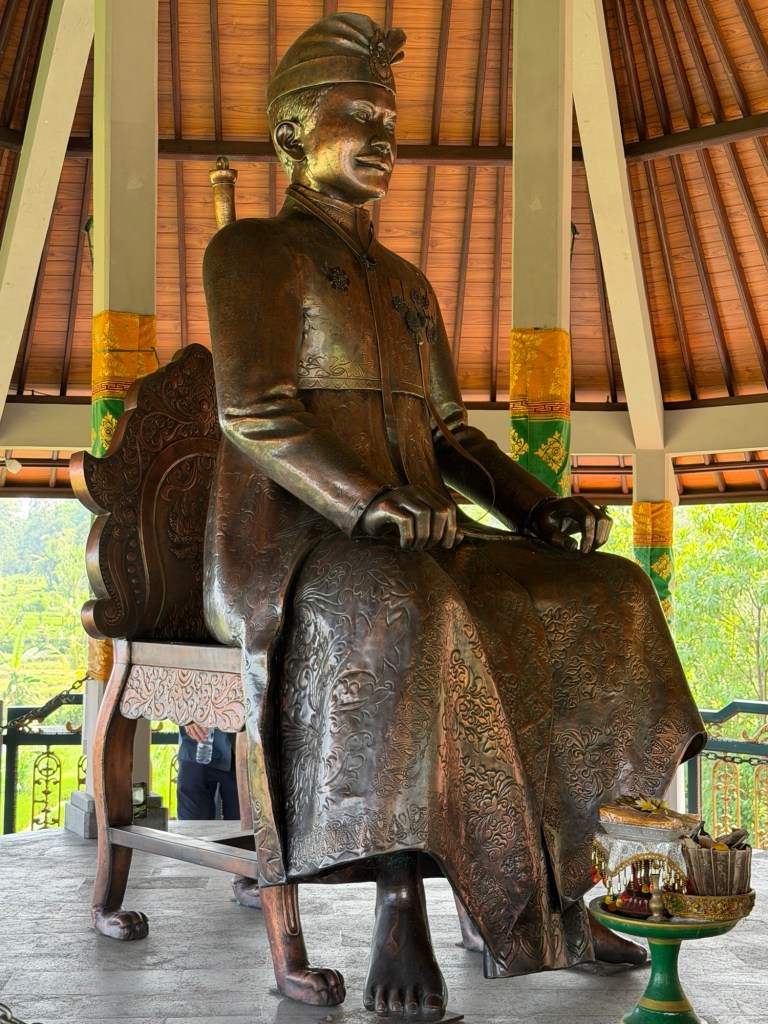
Laurie and I, the two big American women, stuffed into this little tuk tuk.

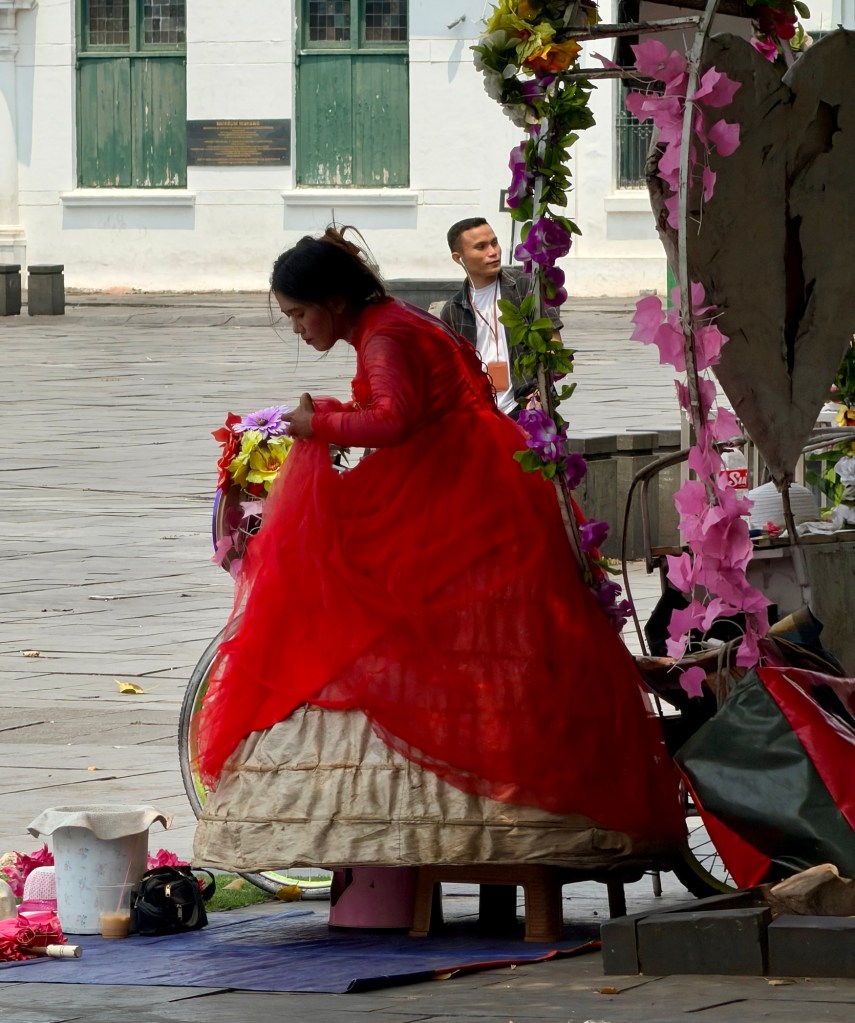
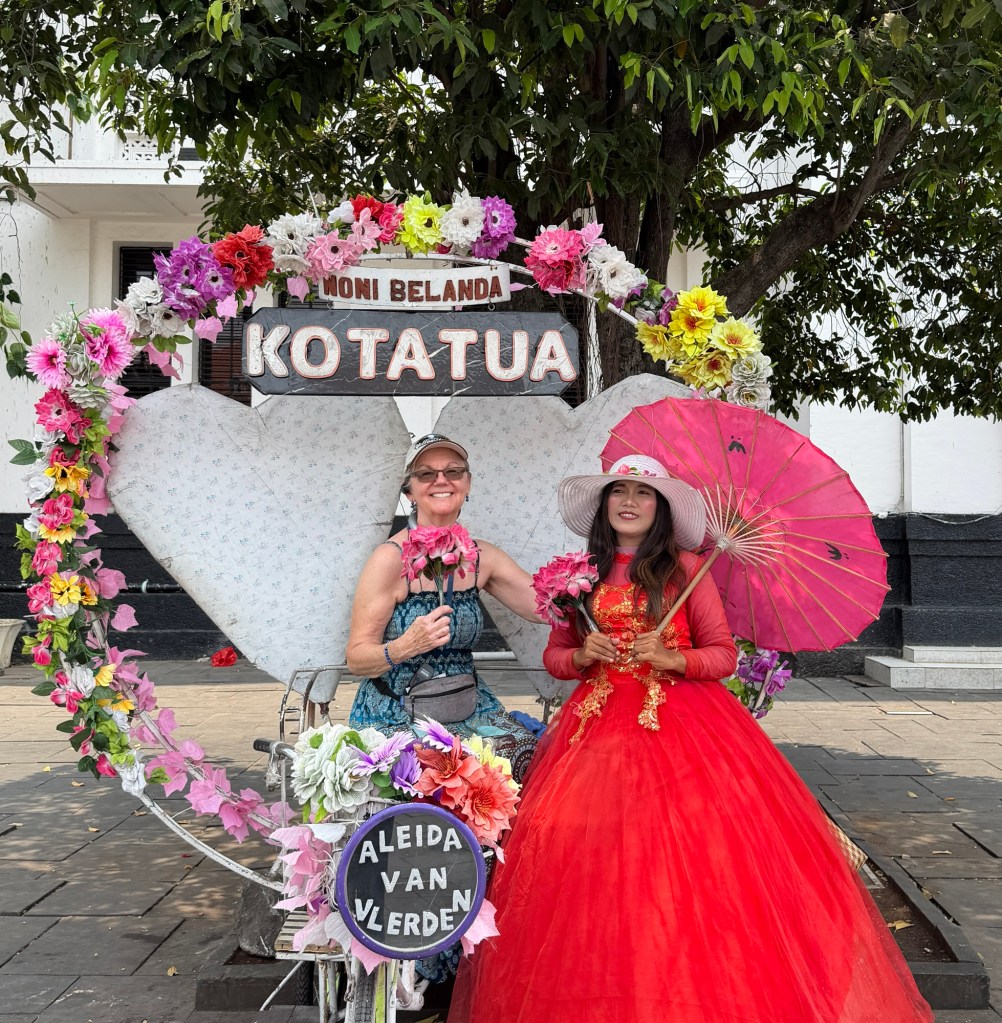
The square wasn’t all that interesting till I spotted this beautiful Indonesian girl dressing up as a Dutch woman. Widi explained that Indonesians had to find creative ways to earn money, so although I would never pose with Grover or Spider-Man in Times Square, I was highly motivated to support the local economy.

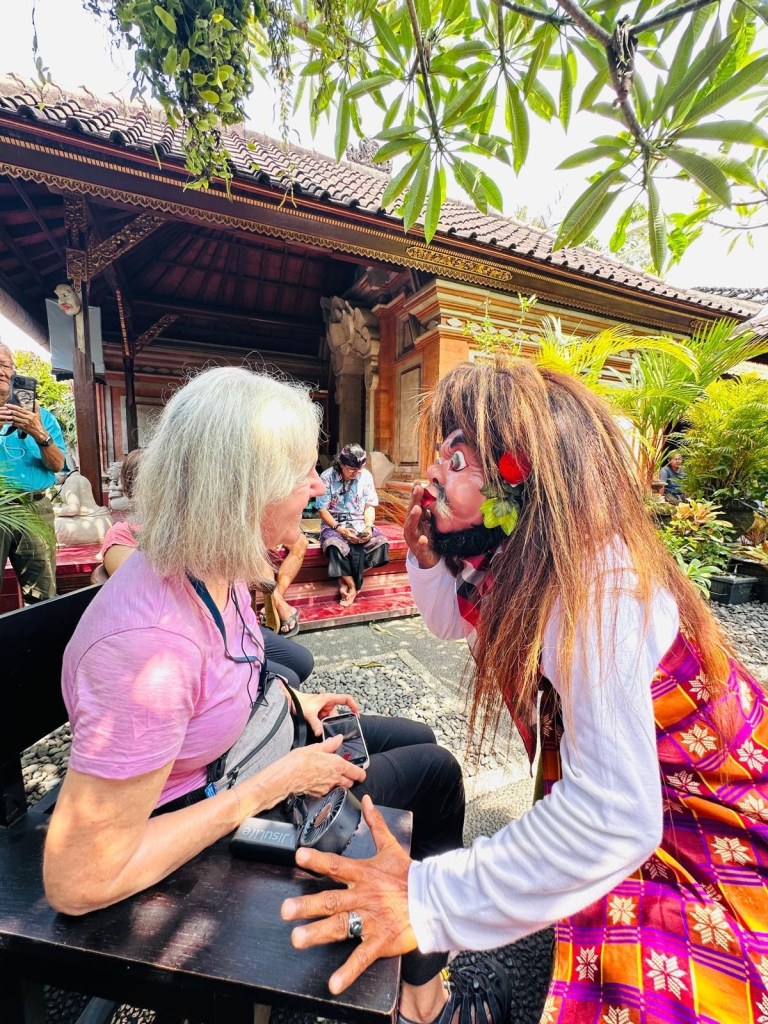
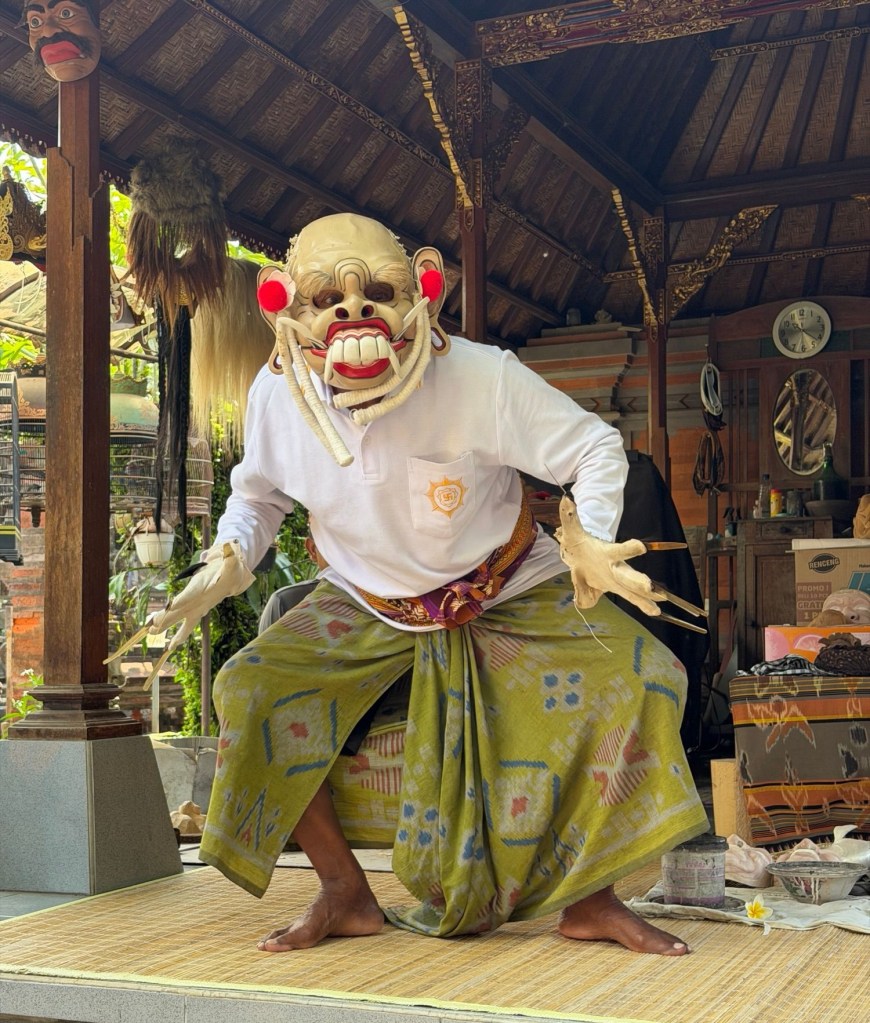
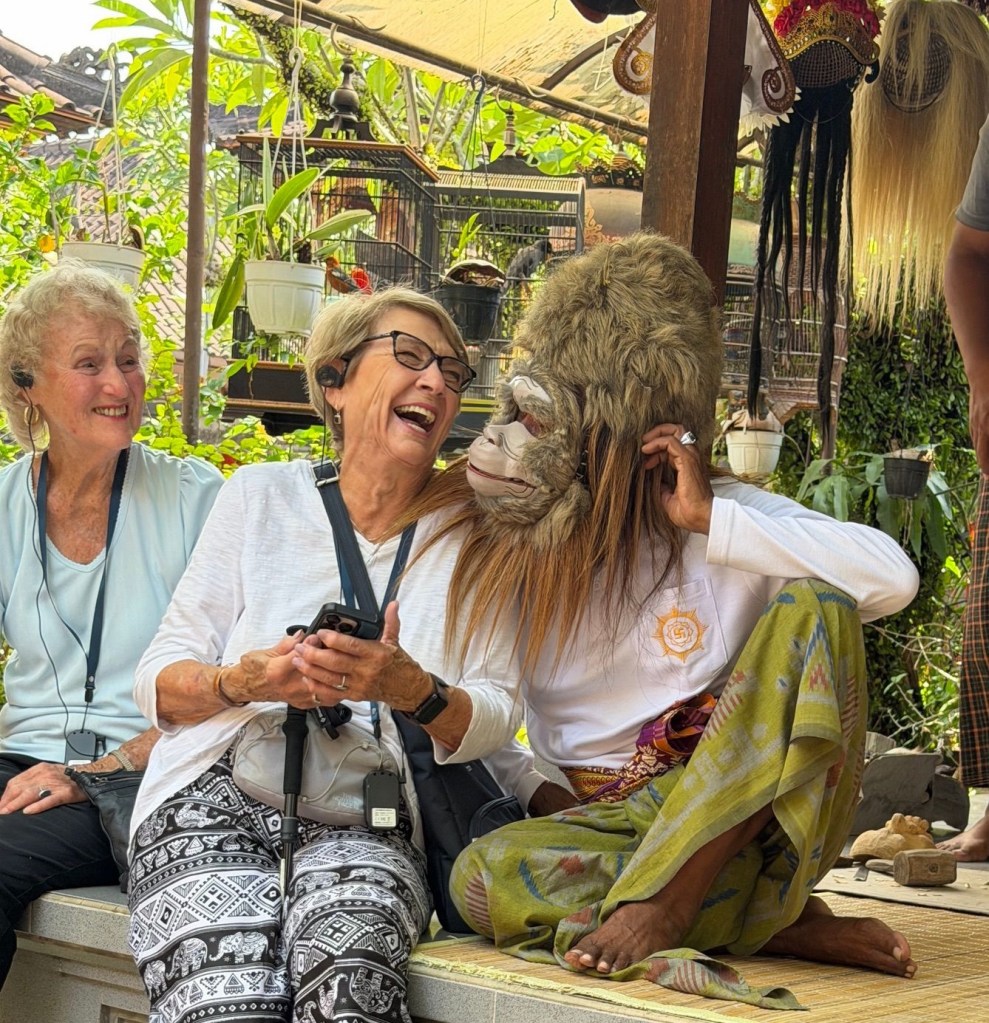
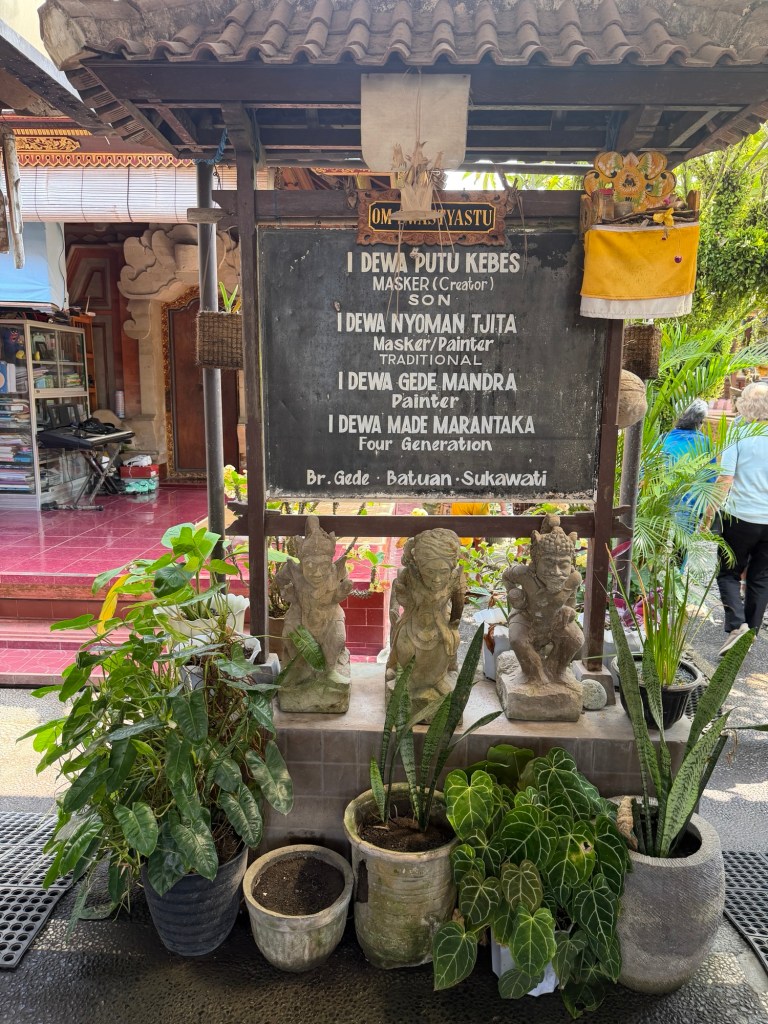
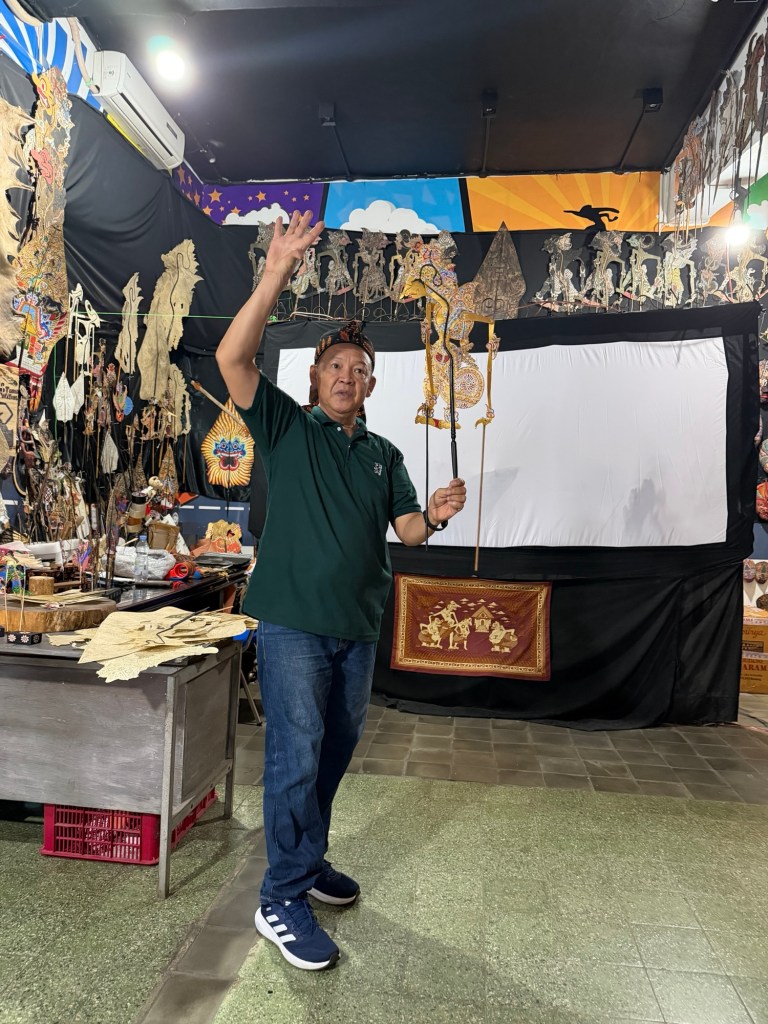
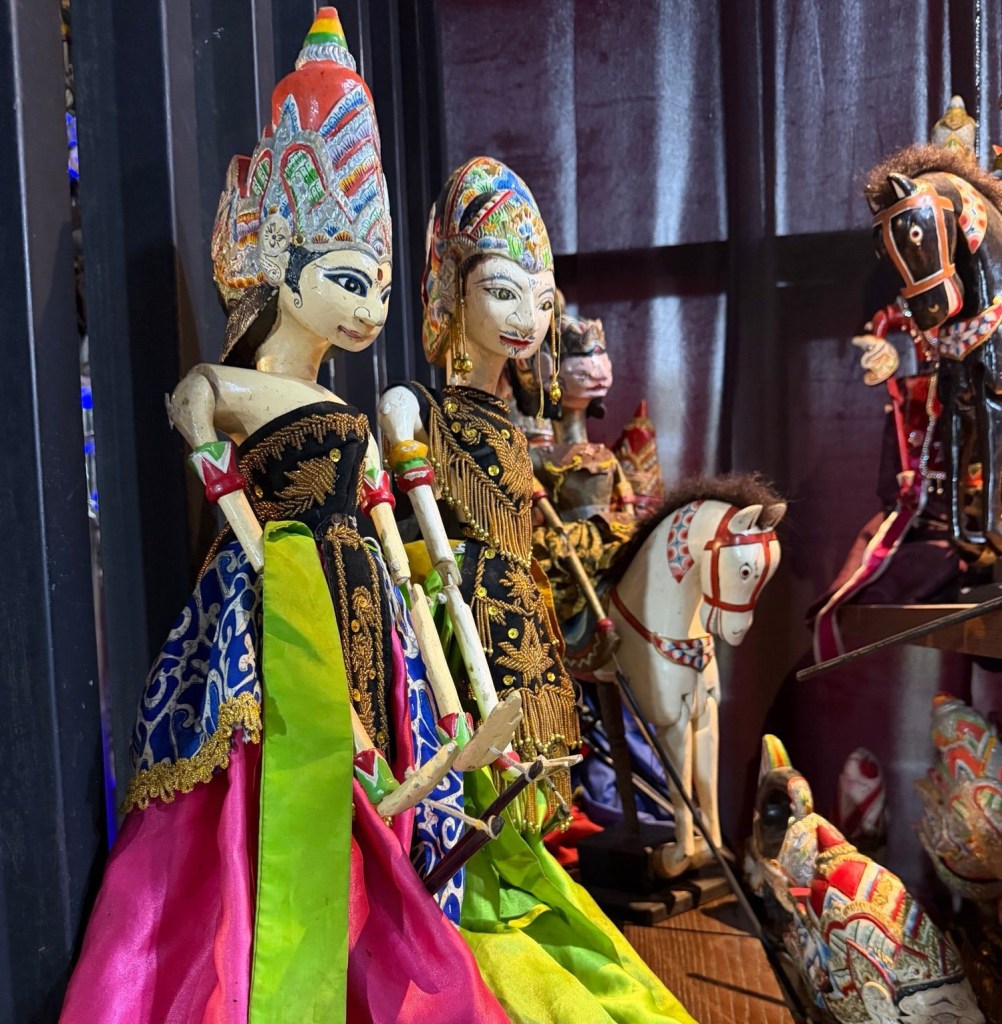
Next stop was a visit to Era’s friend, a puppet maker, who explained about his craft and entertained us with a brief show about the legend of Shinto, Rama and the monkey king ( Hamman?). It reminded me of US movies, but instead of car chases, there was a lot of fighting and punching. Our show lasted about 10 minutes, instead of the NINE HOURS that the local version lasts !

After lunch we were given the choice of how to spend our “free” afternoon: return to the hotel, visit the mosque, then visit Chinatown. I chose to visit the mosque, then return to the hotel to take advantage of the pool.

Widi and Era accompanied us to the mosque, which was great, because we traveled by public transportation (the train) and our bus picked us up after the visit. Indonesians are so polite, friendly and helpful, that I probably could have gotten there on my own (relying on the kindness of strangers), but I’m so very glad I didn’t have to.

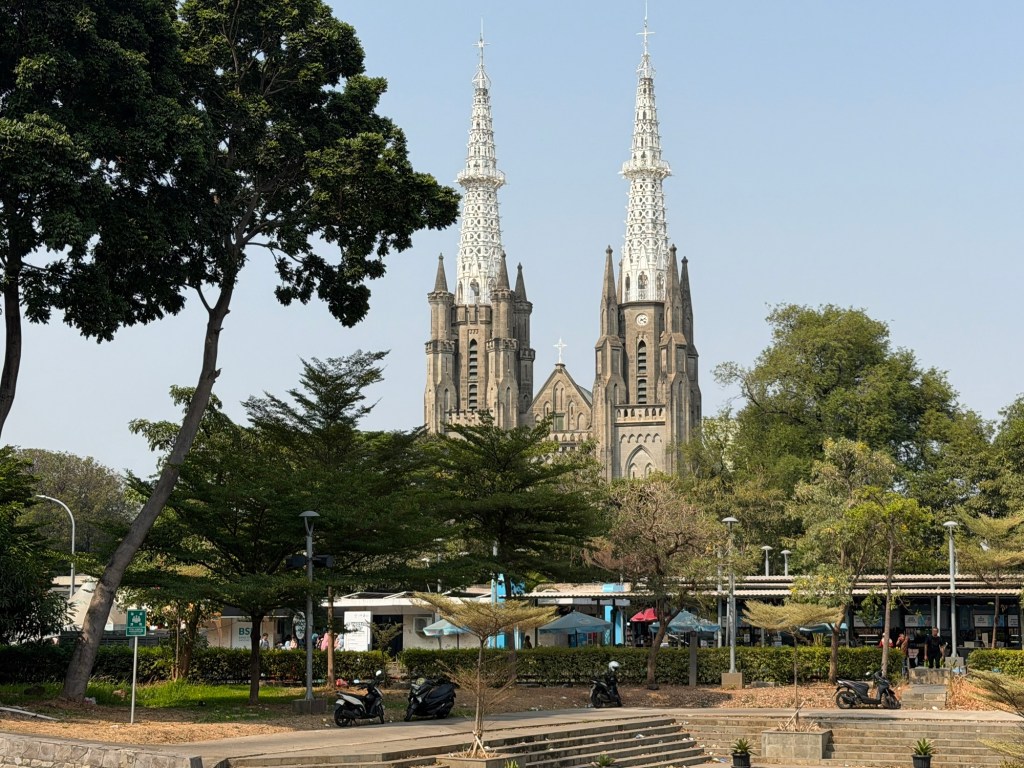
The mosque was built across the street from the cathedral, to symbolize the tolerance and acceptance of Indonesians toward those who think differently. If only we could imitate them, the world would be a better place— and happier— place.

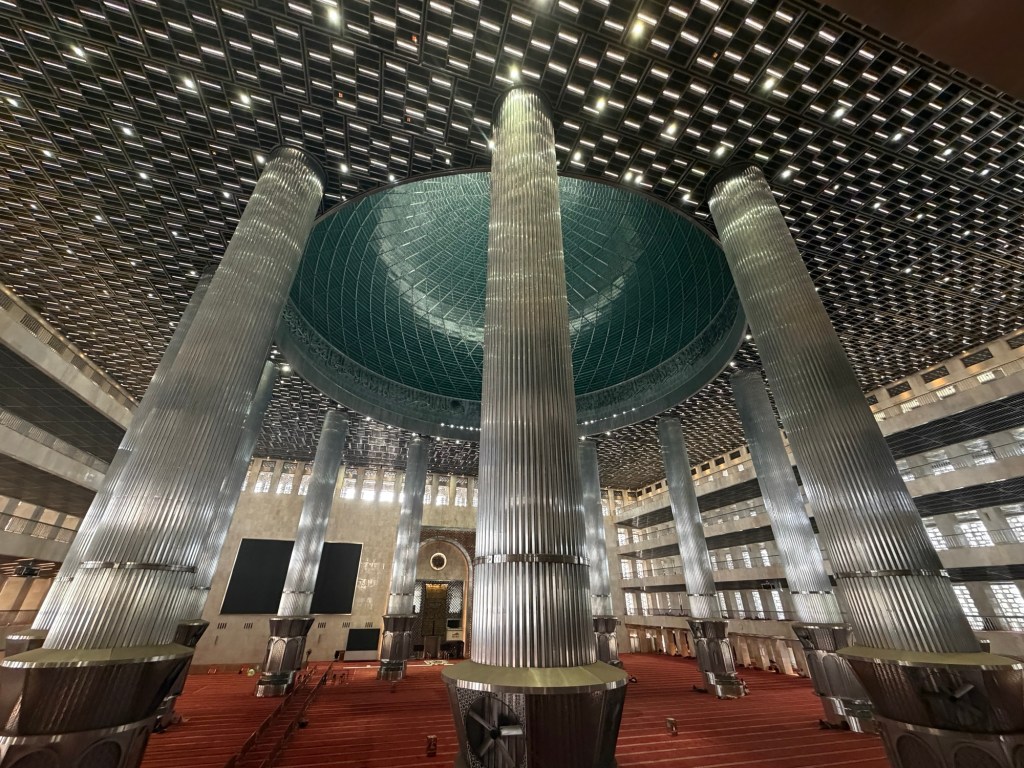
It was definitely not the most beautiful mosque I’ve ever visited, but I’m glad I went.

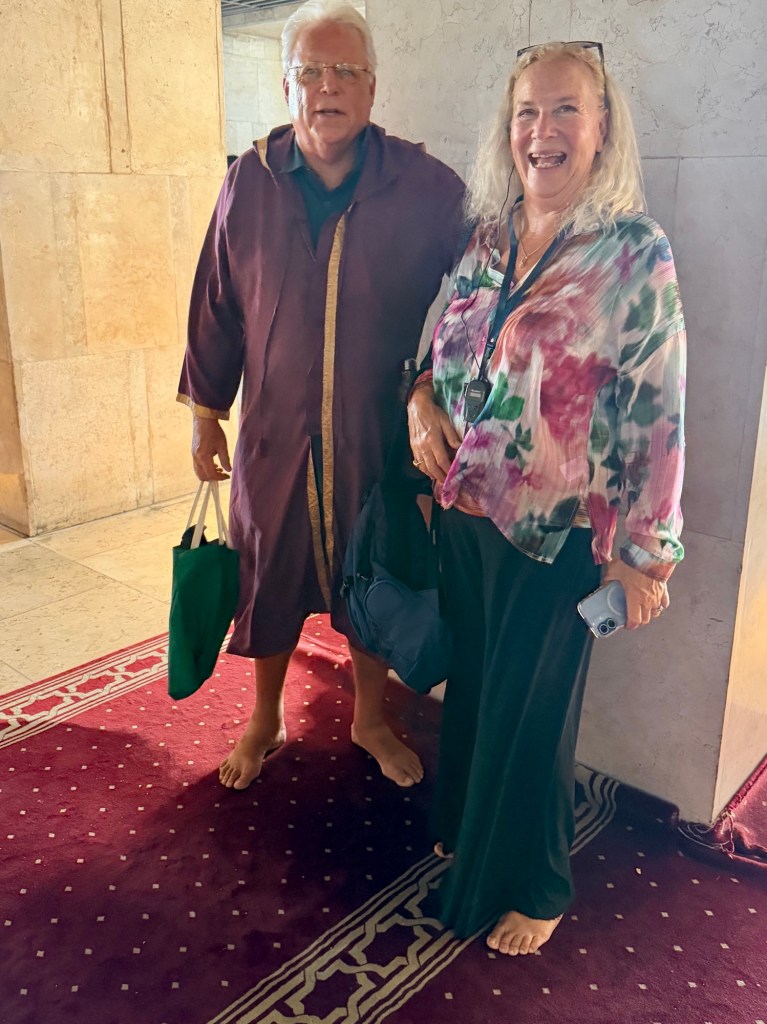
Jeff and Ruth. Jeff’s shorts were deemed too “ short” , so he was given this Jedi robe.

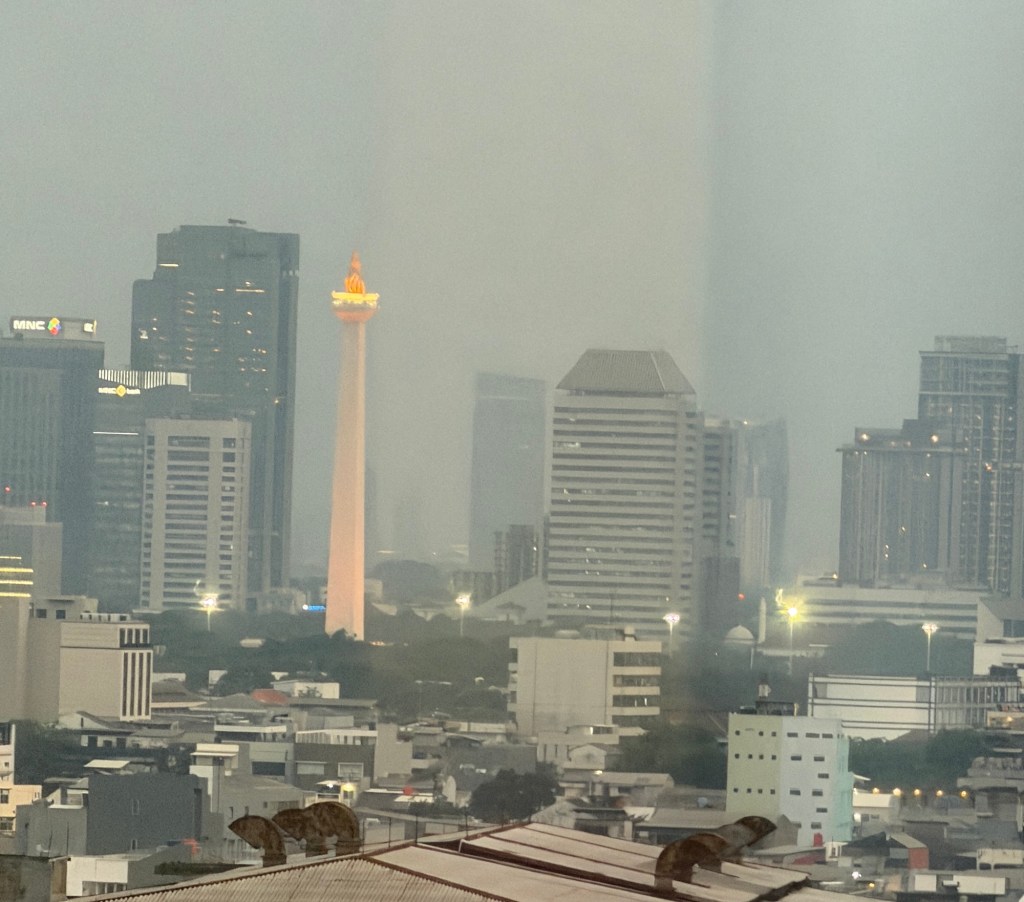
The pollution in Jakarta is severe. I took this photo shortly before 6 PM while waiting for the elevator, from the 15th floor.

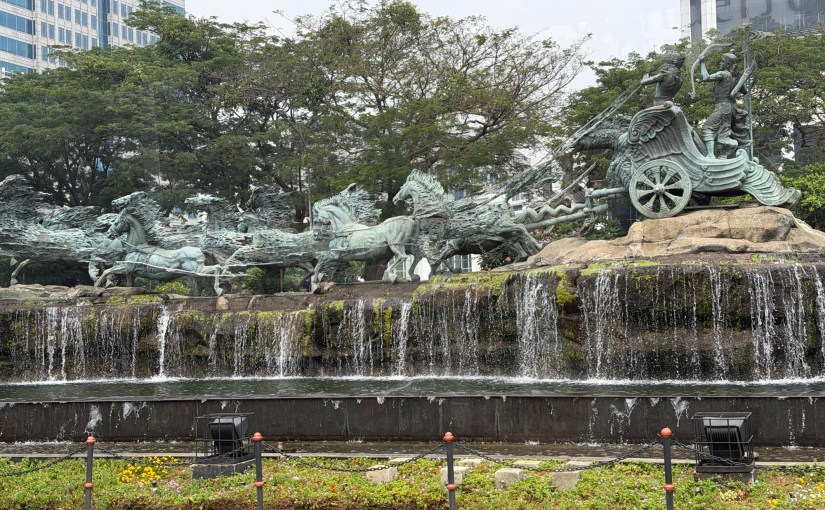
It seems every city must have its phallic symbol, and Jakarta is no exception, but they added a twist. Some see a flame, others see the shape of a woman. Era, our guide said the latter is appropriate for Soekarno, Indonesia’s first president and a notorious womanizer. Widi, our guide, pointed out Soekarno’s persuasive powers not only enabled him to unite all the various islands to form the nation of Indonesia, but also enabled him to convince NINE women to marry him!

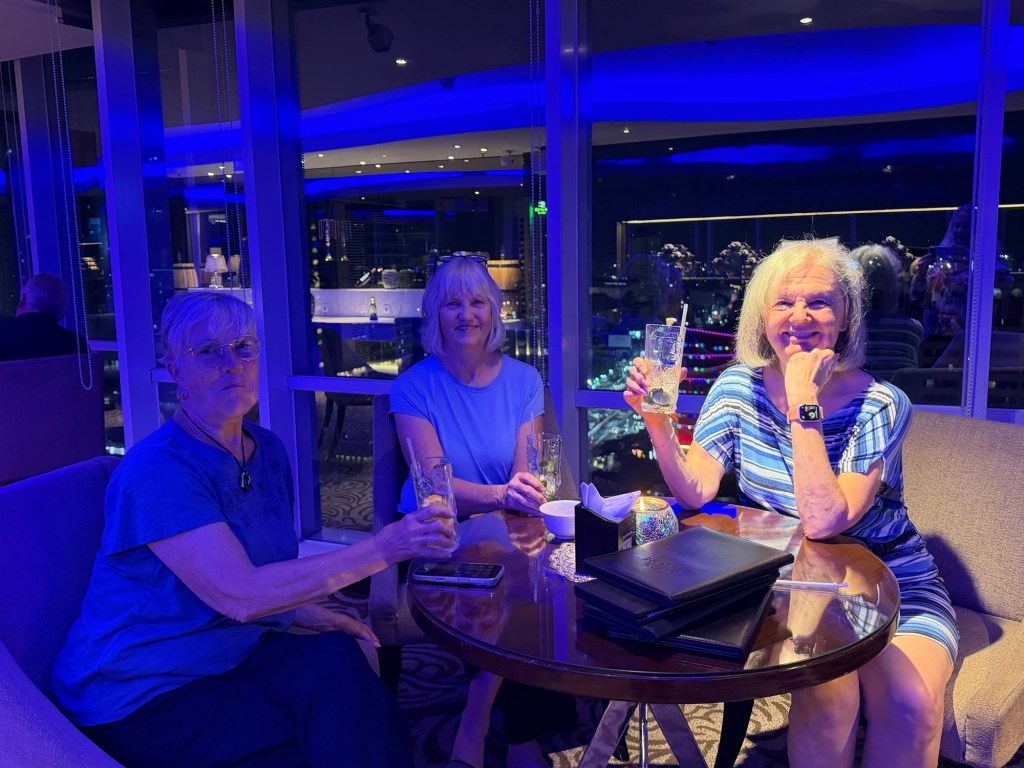
The evening ended just like the previous one, on the 22nd floor in the skybar.

With Jeanne and Laurie.

We are at the airport now, awaiting our flight to Yogyakarta, where we will spend the next four nights. I hope you’ll come along.

Forgive any typos. We are boarding now so I’m pressing publish without proofreading.

Borneo

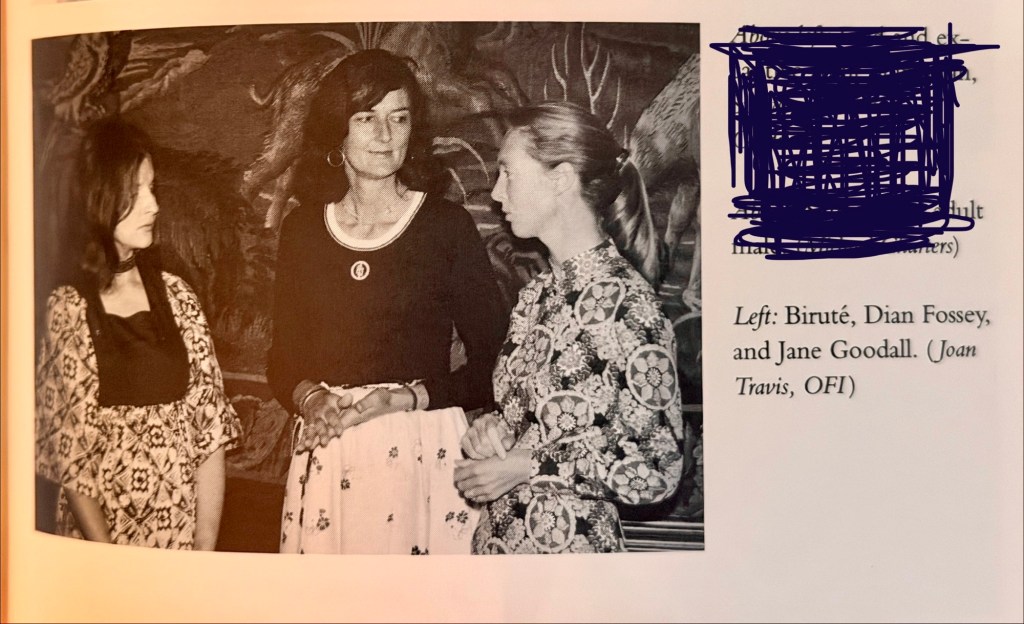
We all have heard about the work of Jane Goodall and Dian Fossey, but how many of us know that Louis Leakey had a THIRD woman researching the big apes? I sure didn’t. Jane Goodall focused on chimpanzees, while Dian Fossey researched gorillas. Biruté Galdikas was the third member of Leakey’s “Trimates”, studying the orangutans in Borneo.

Maybe we don’t know about her because her name is more difficult to spell, pronounce and remember? Anyway, OAT listed her book “Reflections of Eden” as a suggested reading. Because it was published in 1995, my local library didn’t have a copy, so I ordered it from Thrift Books for $12.49. (If you are interested in seeing what Thrift Books provides, just click on the link— the underlined words).

It is a wonderful book! If you are interested in what on site researchers go through, she tells all: the fevers, the mud, the rashes, the disappointments and triumphs, in an engaging and entertaining way.

Although Eros, our local guide, explained a lot about orangutan behavior, I was glad to have read about it earlier in Biruté’s well written book.

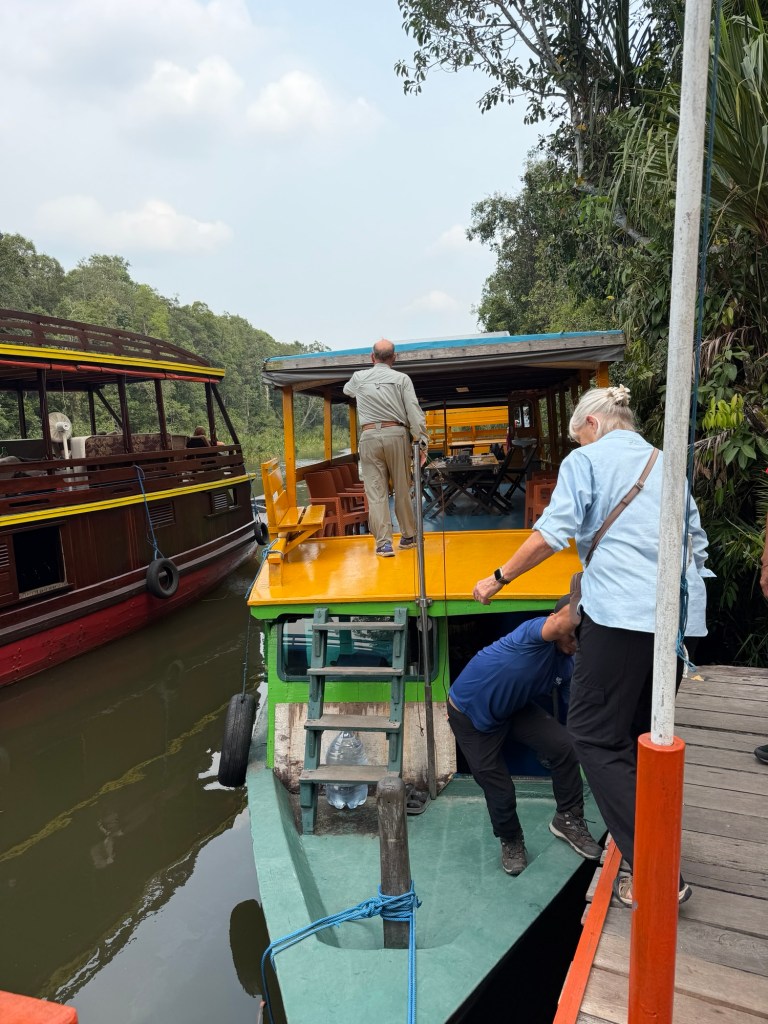
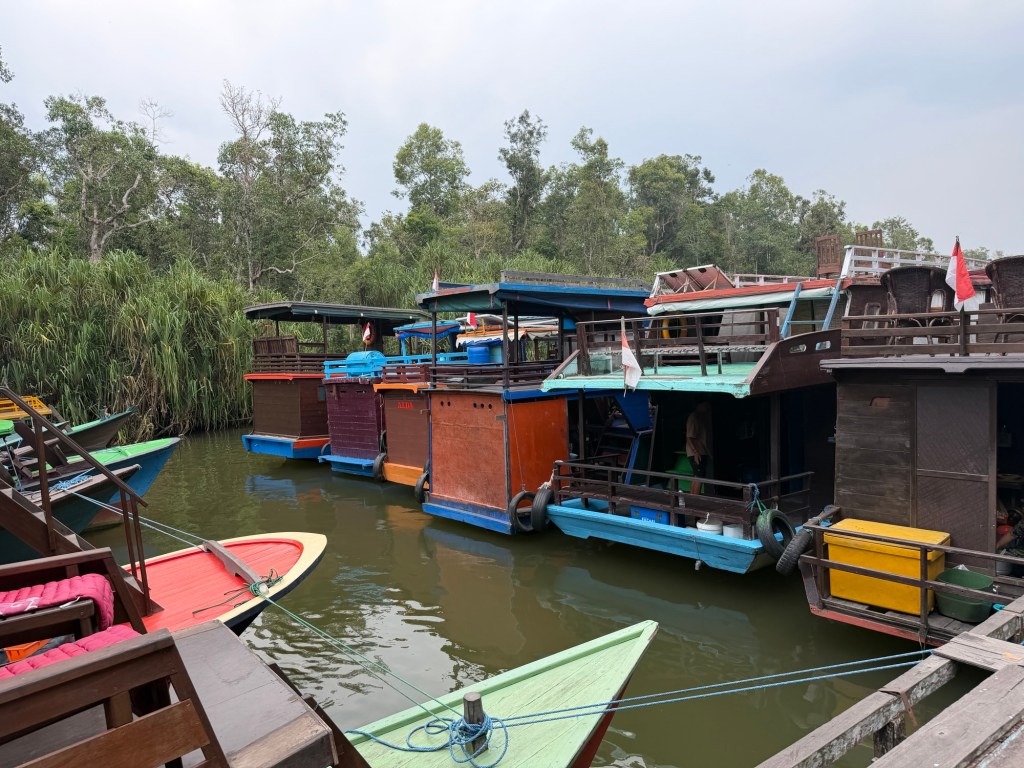
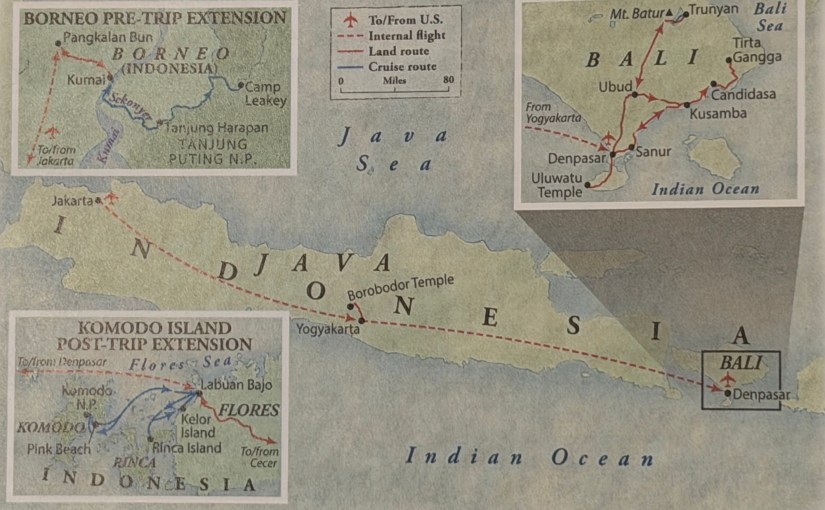
We started the pretrip to Borneo, leaving the hotel at 4:15 AM for our 6 AM flight to Pangkalan Bun. From there, we drove to the river, then boarded a Klotok ( which is a traditional Indonesian riverboat) that took us to our very rustic ecolodge.


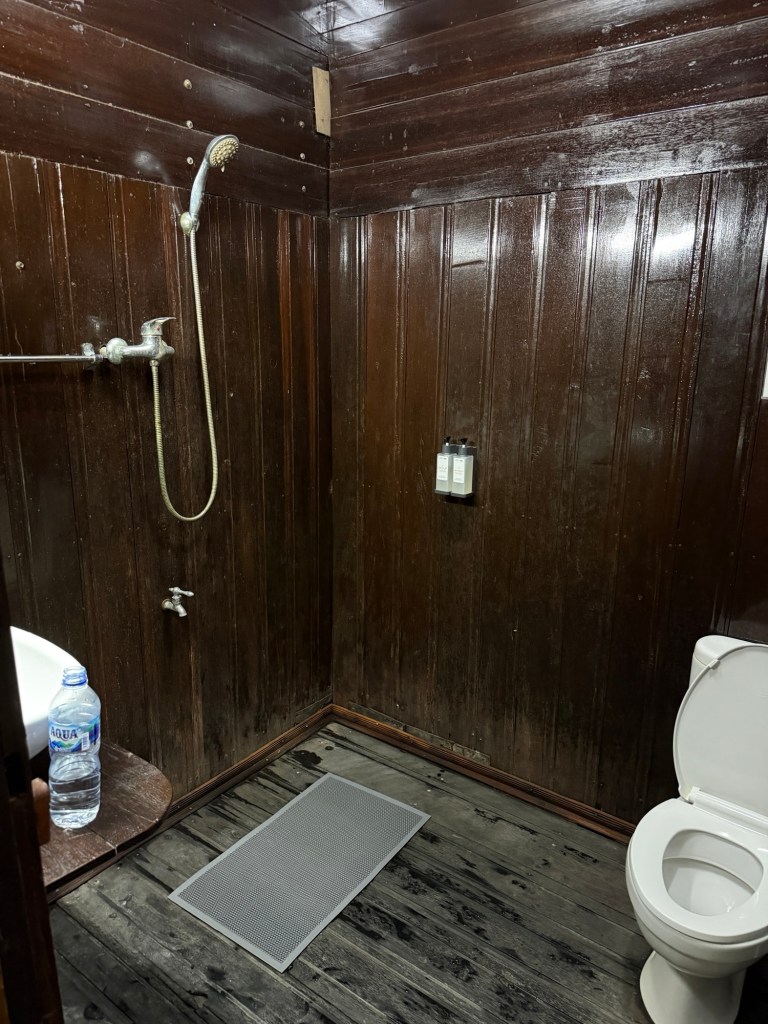
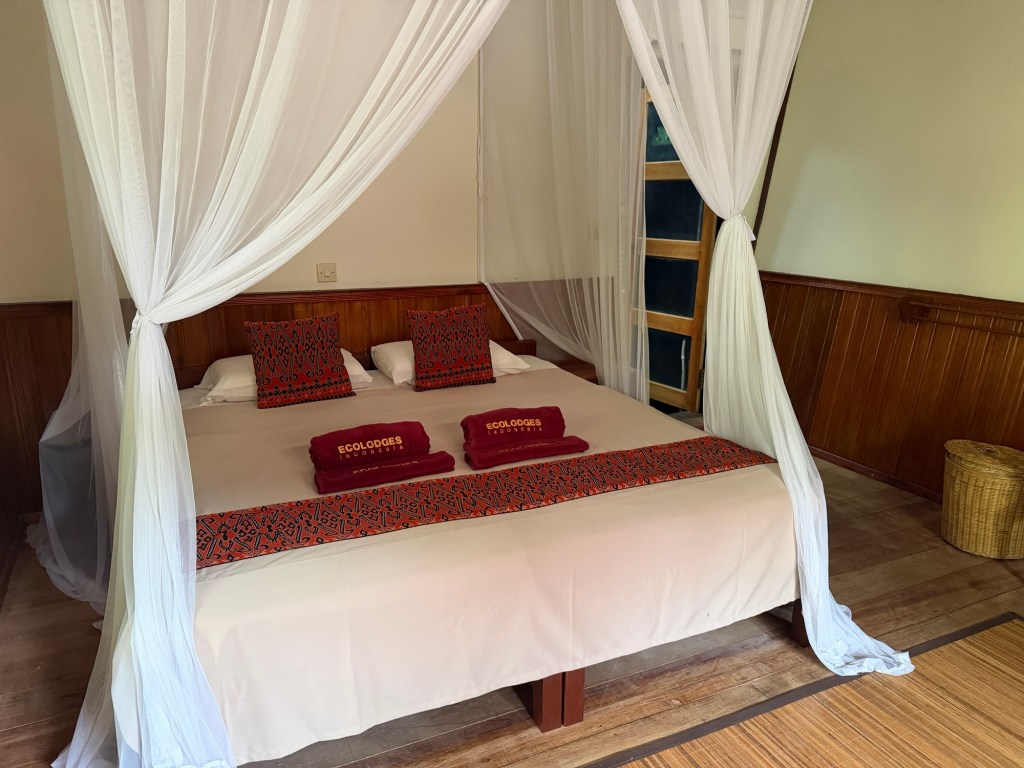
Widi is a master at managing expectations. He prepared us for flight delays ( which didn’t happen) then told us our ecolodge is simultaneously the best and the worst lodging in the area, simply because it is the ONLY lodging in the area! We spent two nights there, but all our meals were served on the river boat.

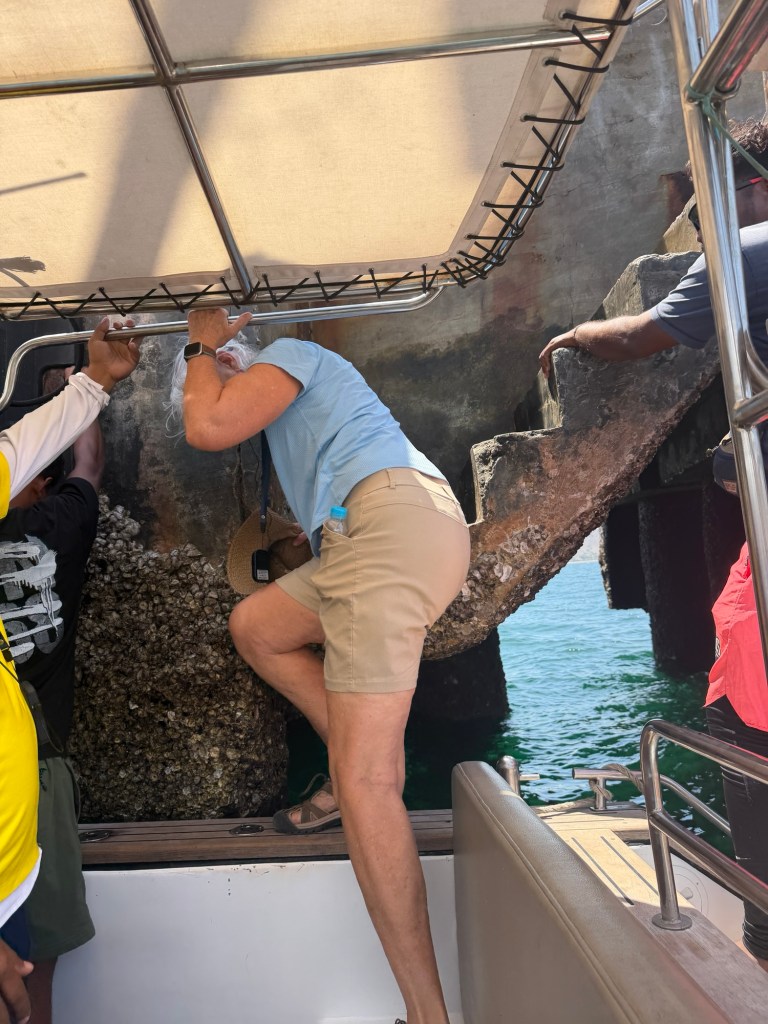
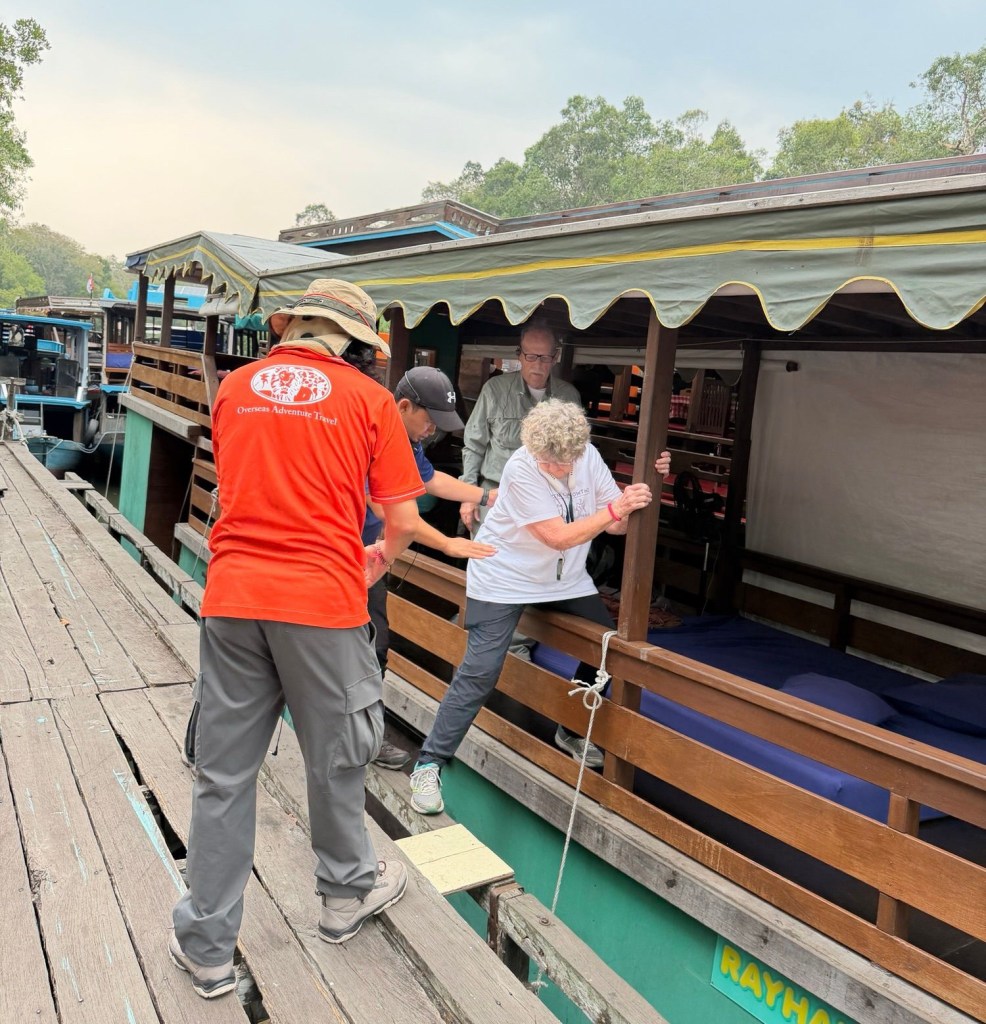
Our first orangutan encounter was at Tanjung Puting National Park. When we arrived at this popular spot, we learned that we would have to climb through FIVE other riverboats to get to the park.

My sister Sue will recall our jumping from fishing boat to fishing boat in our younger days. Let me tell ya, it was a whole lot easier when I was 12 years old! Still, we all did great. I was completely impressed by 90 year old Arthur, who navigated the boats like a champ.

Bonnie, demonstrating how it’s done.

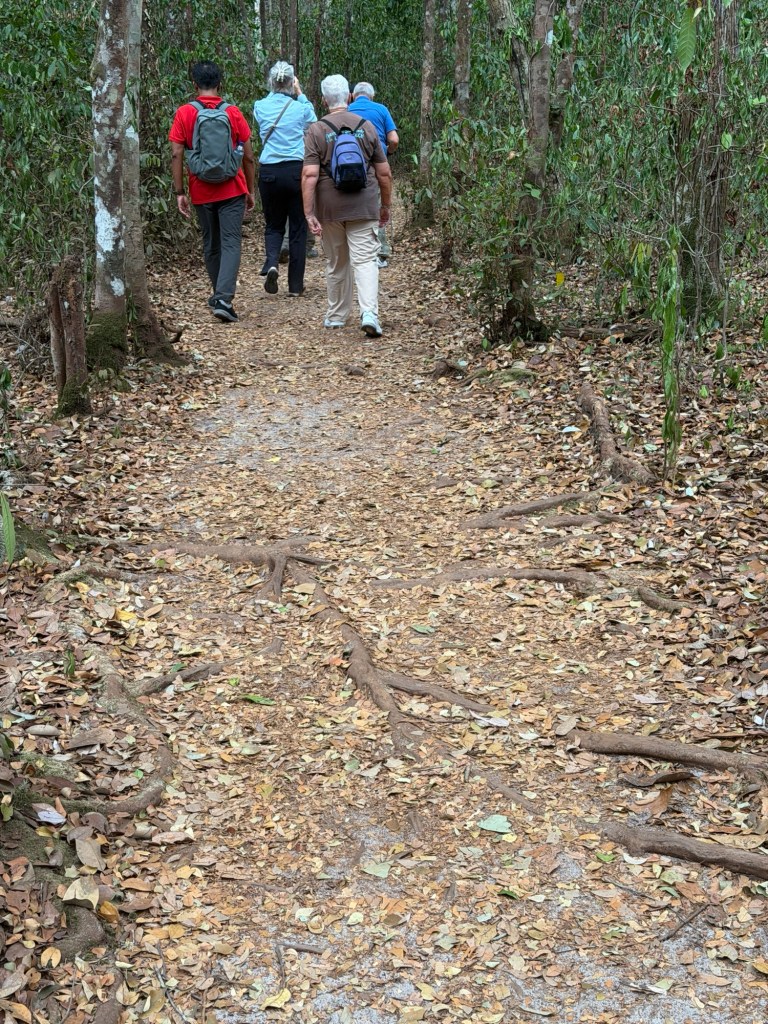
Next, we walked a little less than a mile to the feeding station, over a well maintained, flat path through the jungle. The only hazard were the many tree roots that could trip you up if you weren’t paying attention. I had my eyes on the road ahead and for once, made it back and forth without falling.

Was it worth getting up at 3AM? Hell yeah.

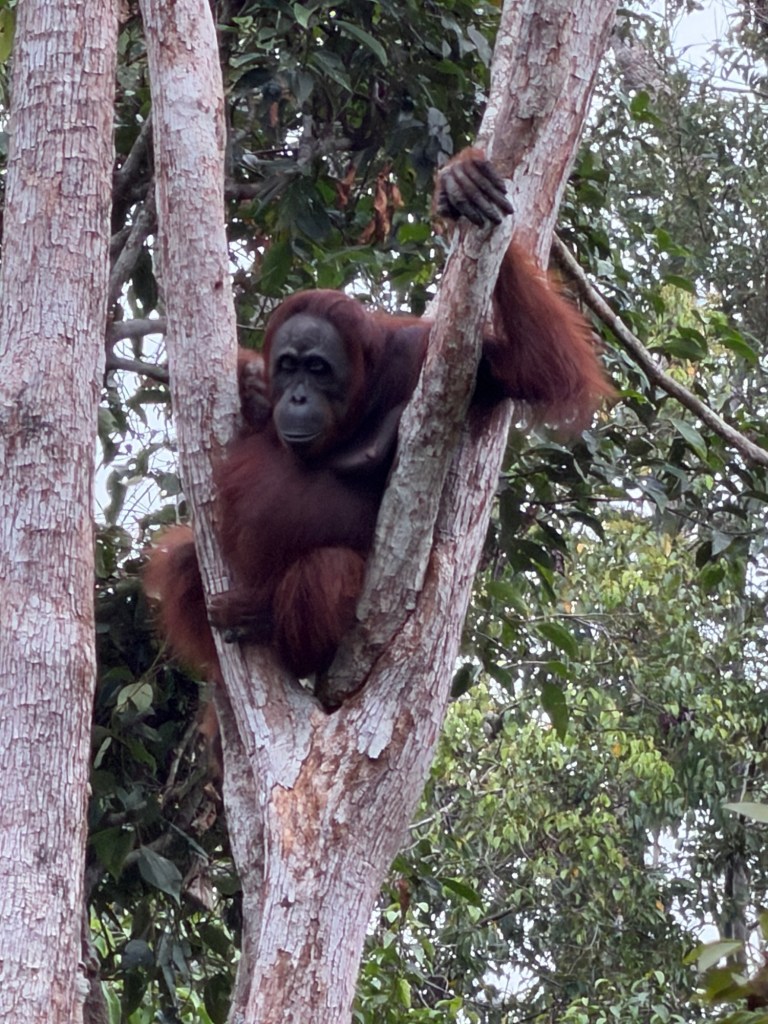
This lovely lady high in a nearby tree watched us watching the other orangutans on the feeding platform.

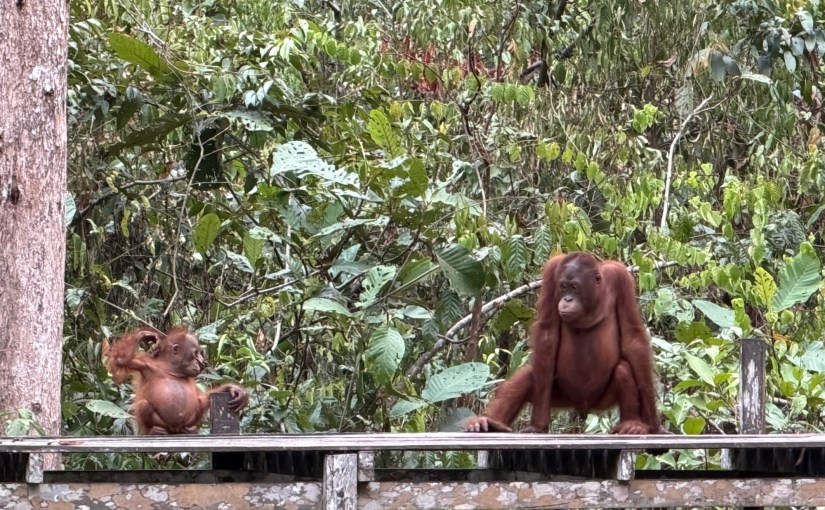
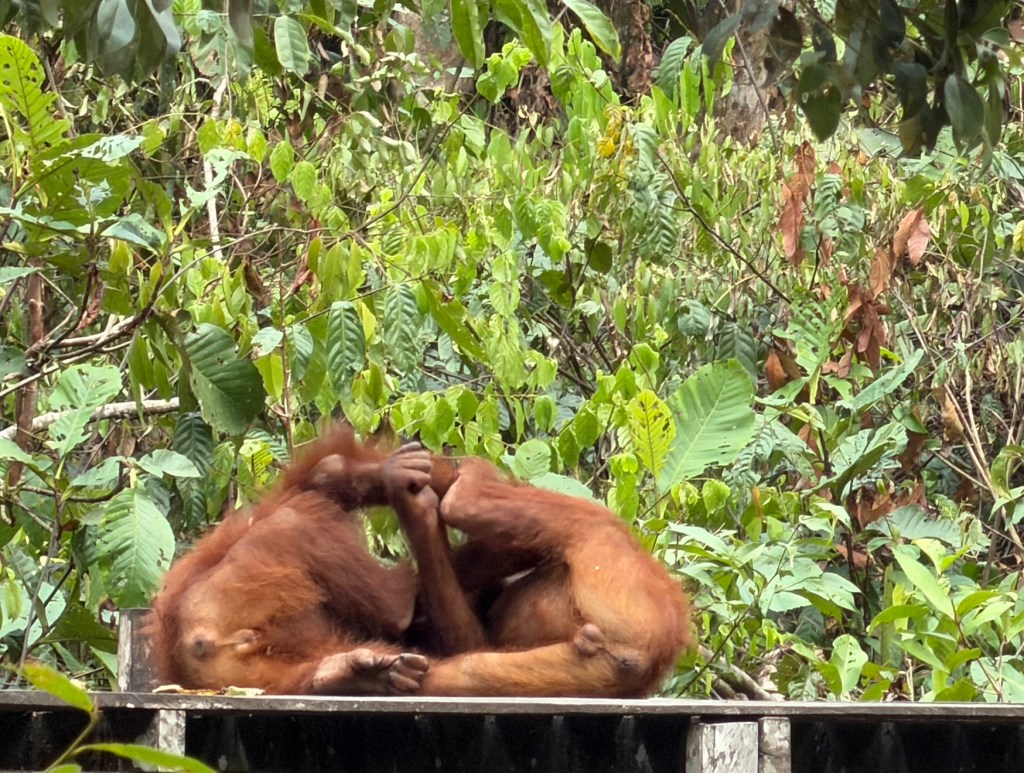
And what a show they put on! Here are a couple of them behaving like boys of all species.

It reminded me of my Rwanda trip where we watched as twin brother gorillas wrestled on the ground. However, in Rwanda, we were able to get MUCH closer to the primates. BUT, we had to hike two hours through the jungle to get there, and it was NOT on a well maintained trail. Plus we were only able to visit ONCE for an hour, whereas in Borneo, we made THREE visits to feeding stations on three different days.

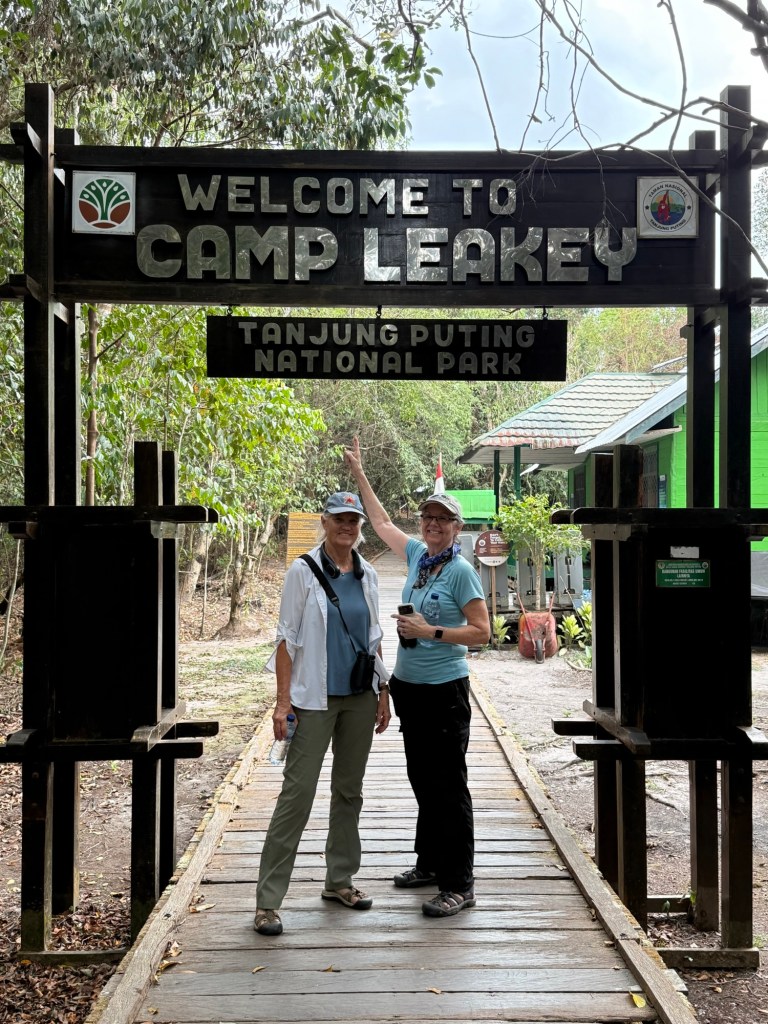
Our second visit was to the preserve that Biruté and her husband established in the early ‘70s. It was named in honor of her mentor, Louis Leakey.

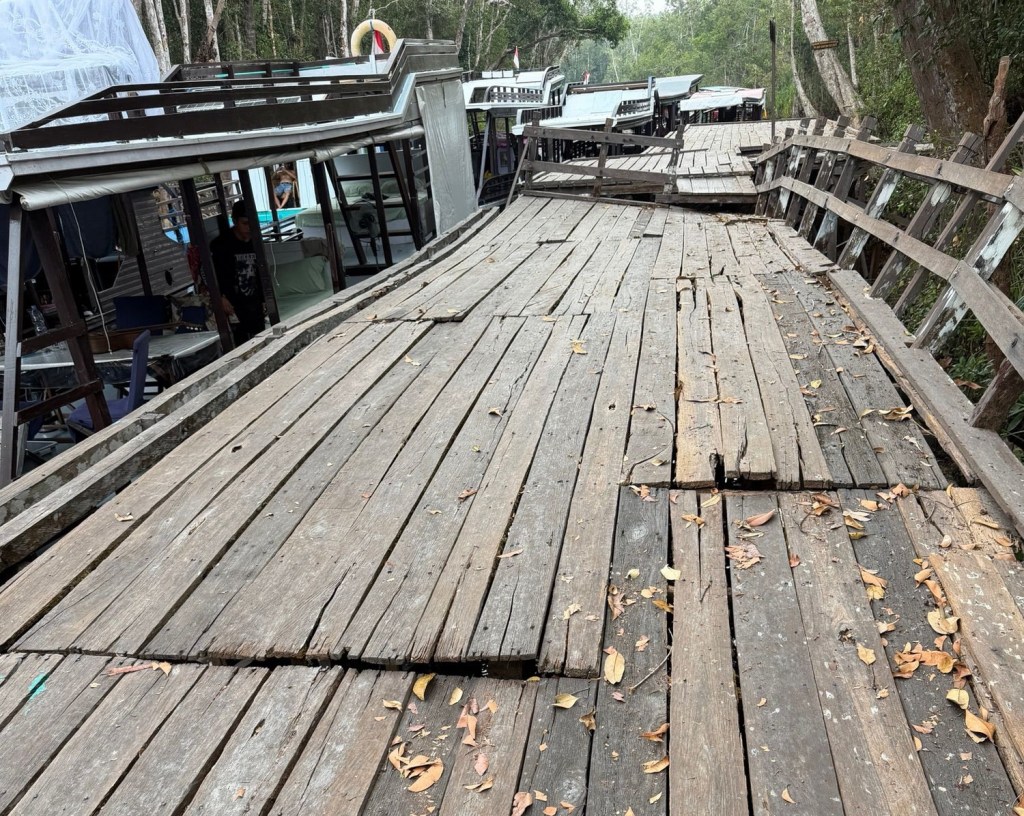
Once again, we had to climb through multiple boats to get to land. THIS time we walked on a “boardwalk” part of the way. Good thing we didn’t get too complacent. It was even more hazardous than the tree roots because some of the boards were loose, others had rotted areas, with holes and huge gaps between them. This was the BEST stretch. It got progressively worse.

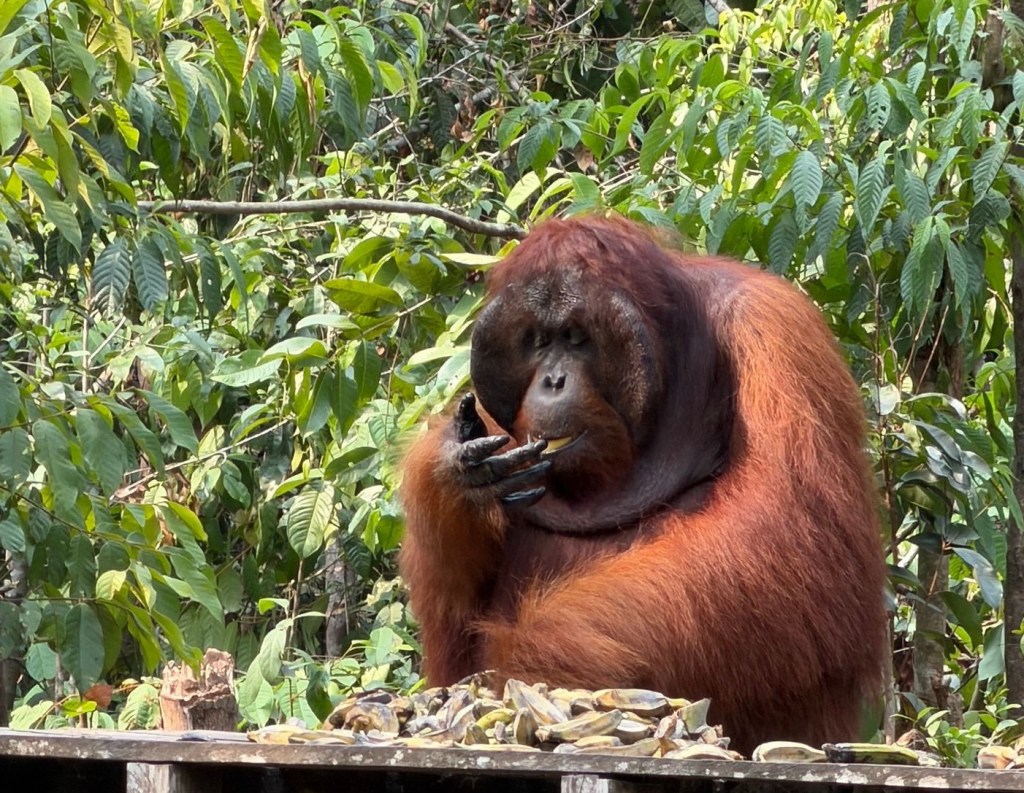
Once we arrived at the feeding station, we were able to watch our first adult male (Nova) as he leisurely devoured bananas.

No one else approached while he was there, EXCEPT his girlfriend with her baby. Could he have been the dad? Who knows?

It just so happened that our final orangutan visit, to Pondok Tangui, was the very best of the trip. On the way to the feeding station, I was glad I’d brought my binoculars with me, because to be able to watch orangutans swinging from the treetops was pretty spectacular. No photos, only the visuals imprinted on my brain.

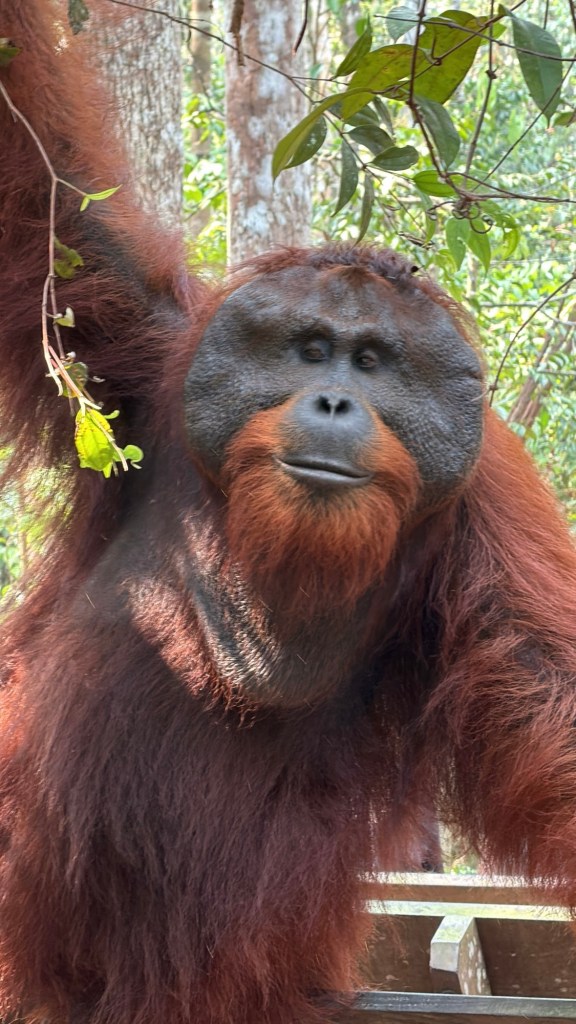
When we arrived at the feeding station, we realized that Atlas, the alpha male, decided to mingle with the peons (us) before consuming his brunch. He was so near, I was able to get this close up. Although initially I thought it would be challenging to tell the orangutans apart, after viewing photos of Nova and Atlas, I realized there are significant differences between these alpha males. Can YOU tell who’s who?

We were able to get pretty close to the big guy before he ambled over to the feeding platform.

Although Atlas dominated the feeding platform, keeping other males away, he was willing to share bananas with these monkeys.

We met with one of the rangers who explained that before he became the alpha male, Atlas hung out with these Macaque monkeys in the jungle, so they all became friends.

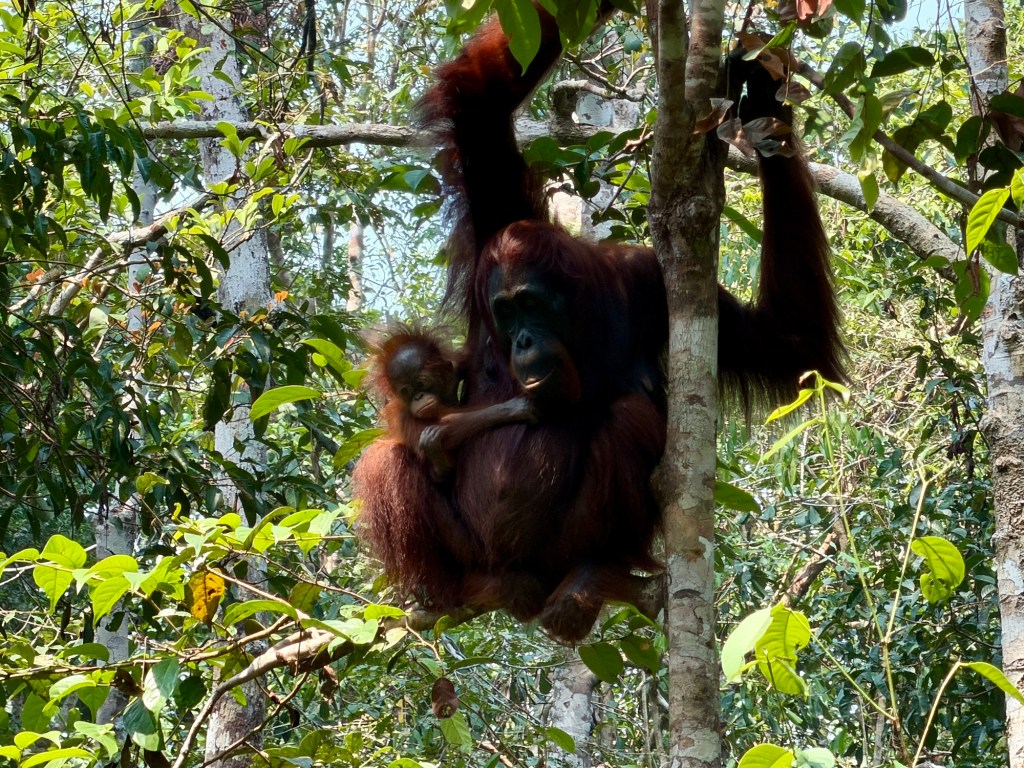
I have enough videos and photos of these fascinating primates to make your eyes roll back into your head, so I’ll stop with this photo of a mother and child, sharing a tender moment in a nearby tree. Using my binoculars I was able to watch them kissing, but wasn’t fast enough to capture it with my iPhone, so this will have to do.

Tomorrow we return to Jakarta to meet 8 more travelers that will be joining us on the main trip.

Indonesia

Remember that line of bull that they give new mothers about how you forget the pain of giving birth once you hold your baby in your arms? Yeah. That didn’t happen. I still can vividly remember that pain. But it sure works for travel. Once I arrive at my destination, I forget all about the long plane rides, the jet lag, and any difficulties I’ve encountered along the way. I’m just so thrilled to reach my destination!

Okay , so business class on Singapore Airlines was definitely NOT a hardship, but it STILL took nineteen LONG hours. After that I had to change planes for a two hour flight from Singapore to Jakarta on Scoot Airlines. When I booked the flight, I was concerned about having only 1 1/2 hours to change planes, but the airport was super efficient, so I even had time to brush my teeth before I boarded.

As usual, I initially purchased airfare from OAT, knowing that as long as I notified them at least 90 days before departure, I could cancel the airfare portion and get a full refund. The routing they offered had me departing on Saturday, arriving on Monday and involved multiple plane changes, so I decided to see if I could do better. Fortunately, my travel buddy, Jeanne, has a nephew who works in Singapore. He suggested I try Singapore Airlines, which I did. I got affordable business class, and was able to shave hours off my travel time, leaving a day later (Sunday) and arriving Monday night.

Normally, for a trip like this, I would do only carry-on. Unlike trips involving more than one climate, this time I only need to pack hot weather clothes, which are lightweight and much smaller than winter clothes. However, the Friends of Overseas Adventure Facebook group recommended bringing along a hiking stick, and mentioned that it might not be allowed as a carry-on. (It is left to the discretion of the TSA agent whether or not to confiscate the hiking stick). I decided not to take the chance.

Well, since I’m checking luggage anyway, I’m packing significantly more than I ordinarily would. For example, I’m bringing along a travel hairdryer, just in case some hotels have those horrible ones that are attached to the wall.

The allowance for checked luggage with Singapore Airlines is quite generous—88 pounds for checked. For carry-on I’m allowed two bags weighing 15 pounds each. Even with overpacking, I’m coming in WAY below ( 32 pounds checked and 12 for my ONE carry on). We shall see if I forgot something essential, although according to my check list, I’ve packed everything and then some.

So, how was business class with Singapore Air? It was worth every penny! As my friend Beth one told me, “ if you don’t fly business class, your kid will.” So I’m happily spending my son’s inheritance, with his complete support and encouragement.

The service on Singapore Airlines was excellent, the food was great, and the seats were super comfortable. The best part—like United’s Polaris flights, every seat had aisle access, so no need to climb over a fellow passenger to get to the bathroom.

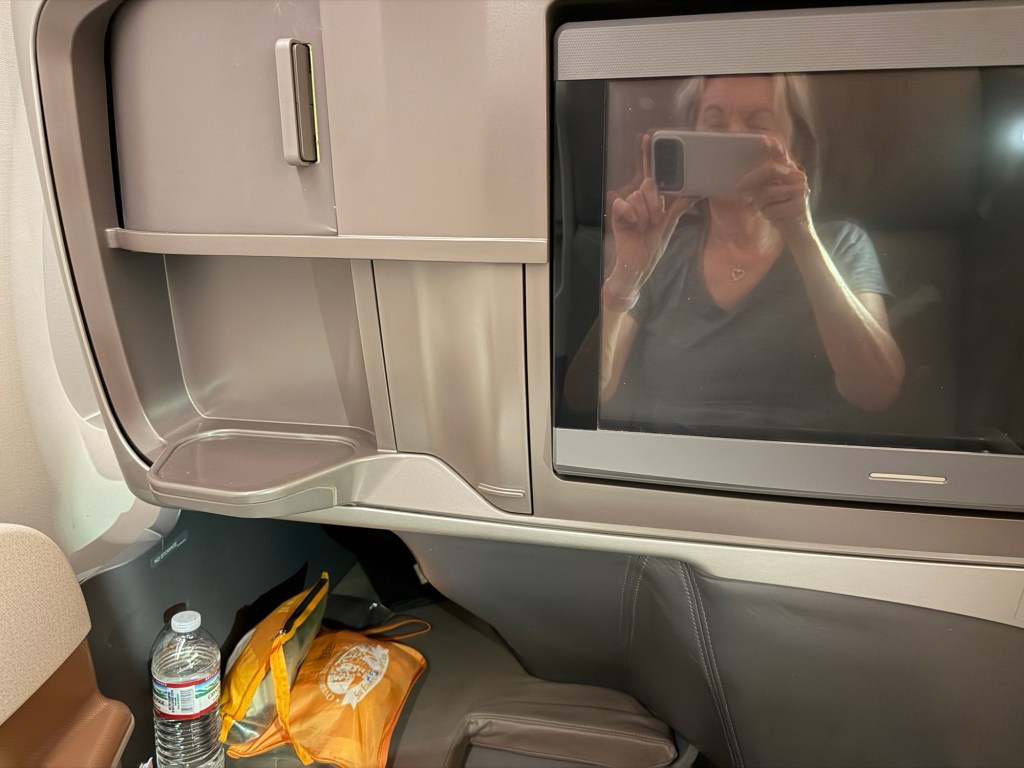
The “lay flat” seats were not as easy to operate as United’s. You have to get up, pull the seat back forward and do other things to get your bed made. A flight attendant made up my bed, so I have no idea what “other things” she did! I chose a window seat on the left, which had me sleeping with my head facing the aisle, and my feet by the window, on an angle.

I had to move the orange bags and water bottle to make room for my feet. Fortunately, there was plenty of storage space for my “stuff”.
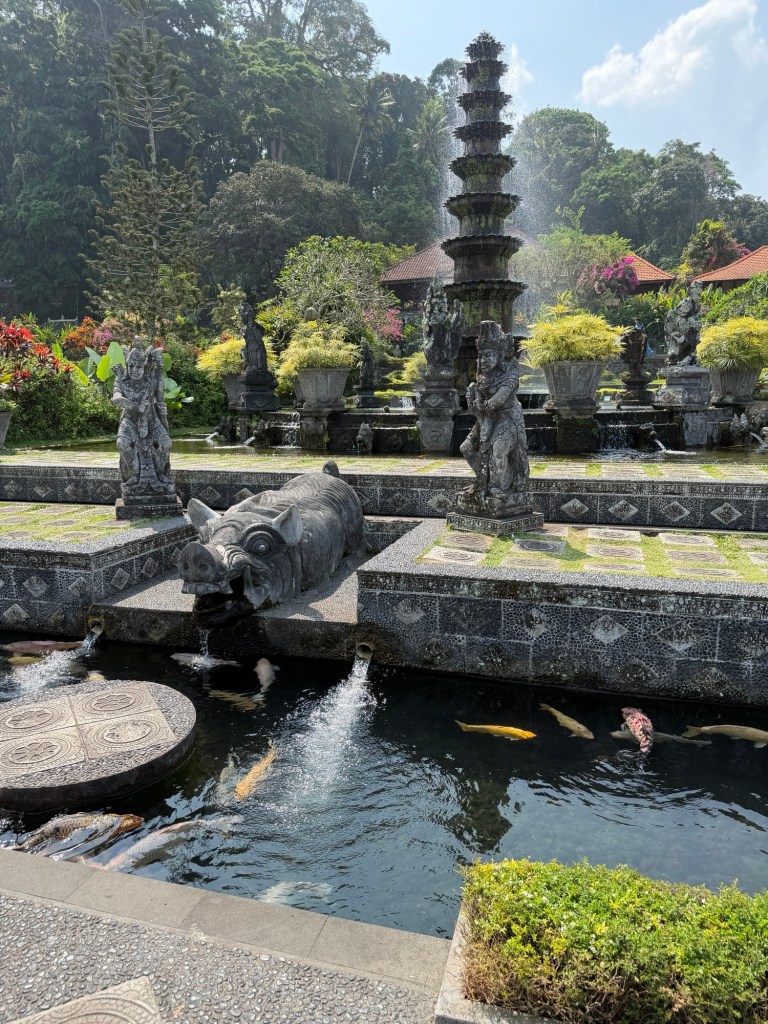
Although Singapore Airlines provides noise canceling headsets, they are NOT as effective as my Bose, so I’m definitely using my own on the return flight.
I was glad that I packed an adapter, because without it, I would have been unable to charge my electronics. The plugs required a European style C adapter.

Everything I read told me to avoid alcohol because doing so would help me fall asleep. Although I took an Ambien, and didn’t partake in the departure champagne, I wasn’t able to fall asleep so I figured what the hell, I’m having wine with dinner.

Before I left home, I had done an E-visa and gotten my arrival card on line, so I was able to go directly to passport control, but being me, I went the wrong way. ( my sister Sue will be thinking , “ at least she consistent” when she reads this ) I had walked a considerable distance before an airport worker stopped me and pointed in the opposite direction. Somehow she could tell I am not Indonesian and I needed to go through immigration.

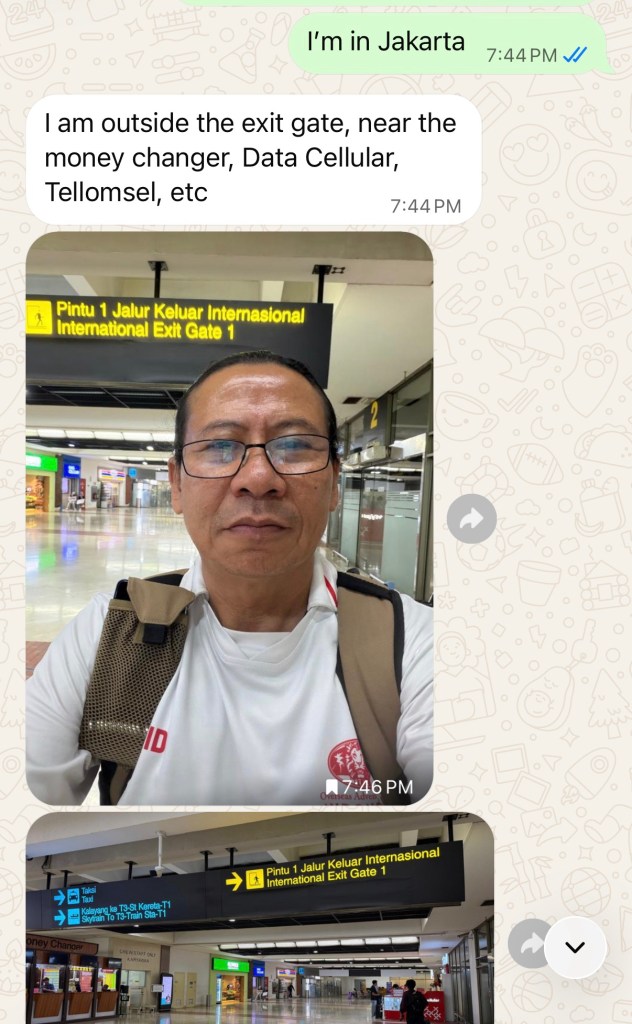
The Jakarta airport is HUGE! Although because I purchased my own airfare, technically my trip leader didn’t have to meet me at the airport. Therefore, I was surprised and pleased to get this WhatsApp message from Widi when I arrived.

Okay, so I’ll admit to being a bit spacey even when I’m NOT jet lagged, but try as I might, I couldn’t find him —Not even with that visual aid. Turns out, HE was in terminal 2 and I was in terminal 3. The airline had changed terminals but never updated the information.

Eventually we found each other, got on the shuttle and made our way to the gorgeous Sheraton.

Tonight we will have a group dinner, where I will meet the 3 couples who will be traveling to Borneo with Laurie and me tomorrow.

Today is going to be a pool day, where I will ( I hope) completely shake off any remnants of jet lag.

Mumbai/Bombay

Our trip ended with a three night stay in Mumbai, which up until 1995 was known as Bombay, the name the Portuguese gave it.

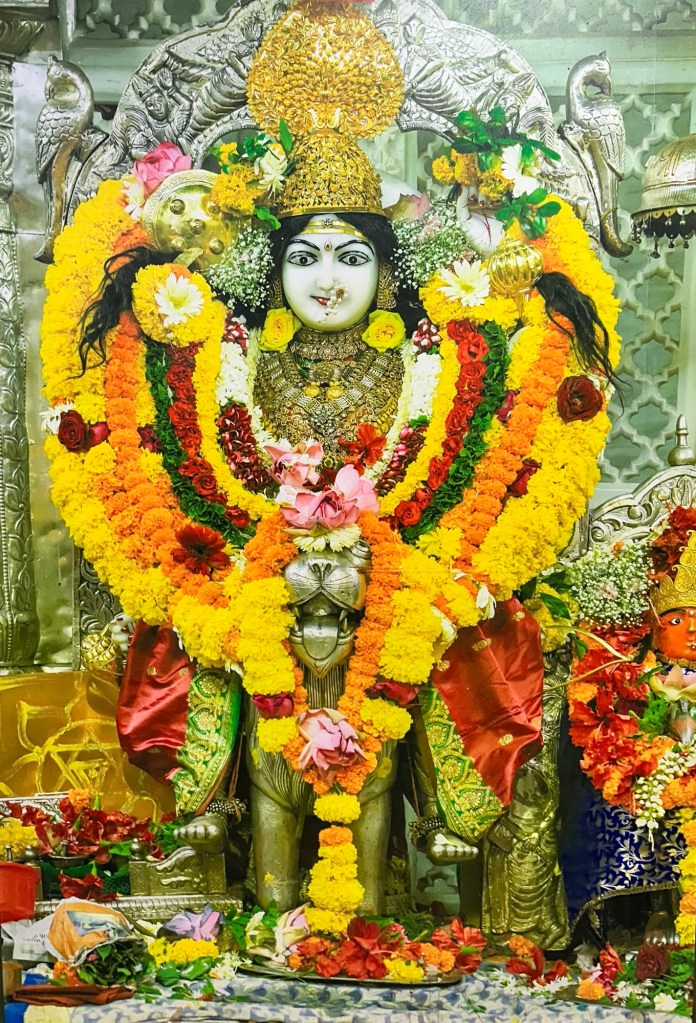
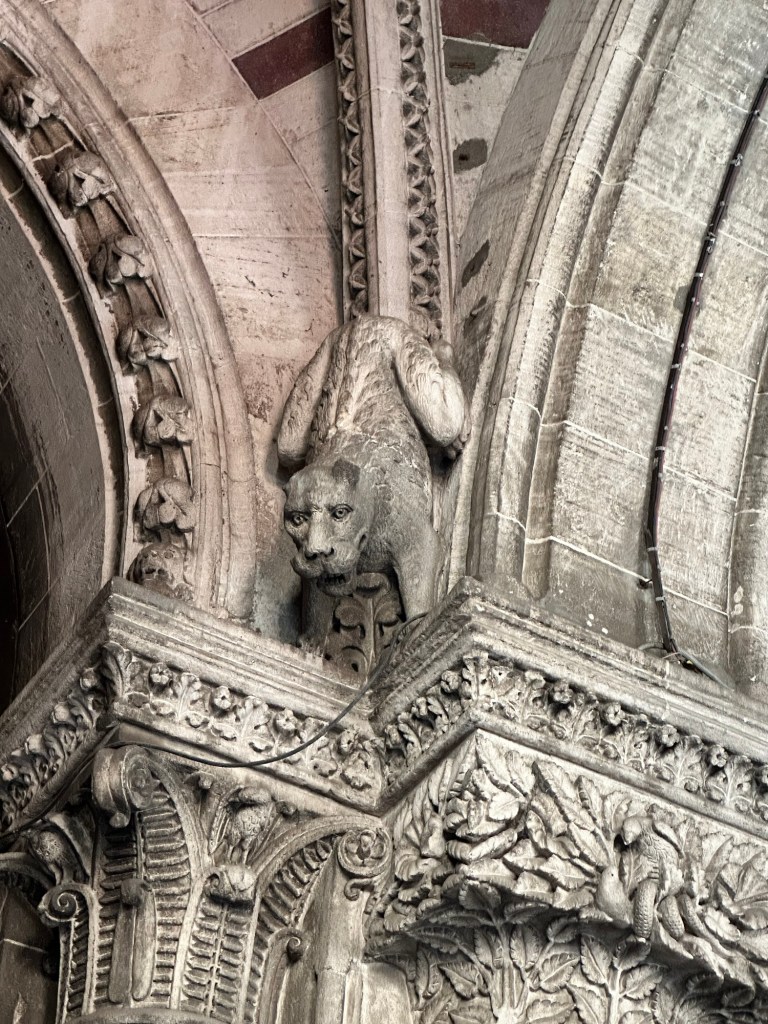
I always thought that Mumbai was the Indian pronunciation of Bombay. Shows what I know. In fact, the city was named for the Goddess Mumba Devi, whose image appears on the wall of Victoria Station.

Here are some other photos of Mumbai’s beautiful train station.

Our stay is at another Oberoi, and to tell the truth, I’ve gotten extremely spoiled. Although certainly more than adequate, this room isn’t over the top breathtaking, like the other hotels in the chain. It DID, however, have an amazing outdoor bar, from which we could watch the sun set over the ocean.

With Gloria, Sue and our fantastic trip leader, Jennifer

I hope that this blog helps dispel any preconceived notions about India. Yes, it can be crowded and dirty, and the traffic is CRAZY!

Our local guide (whose name I have forgotten) said that to drive in India you need three things:

“A good horn, good brakes and good luck”

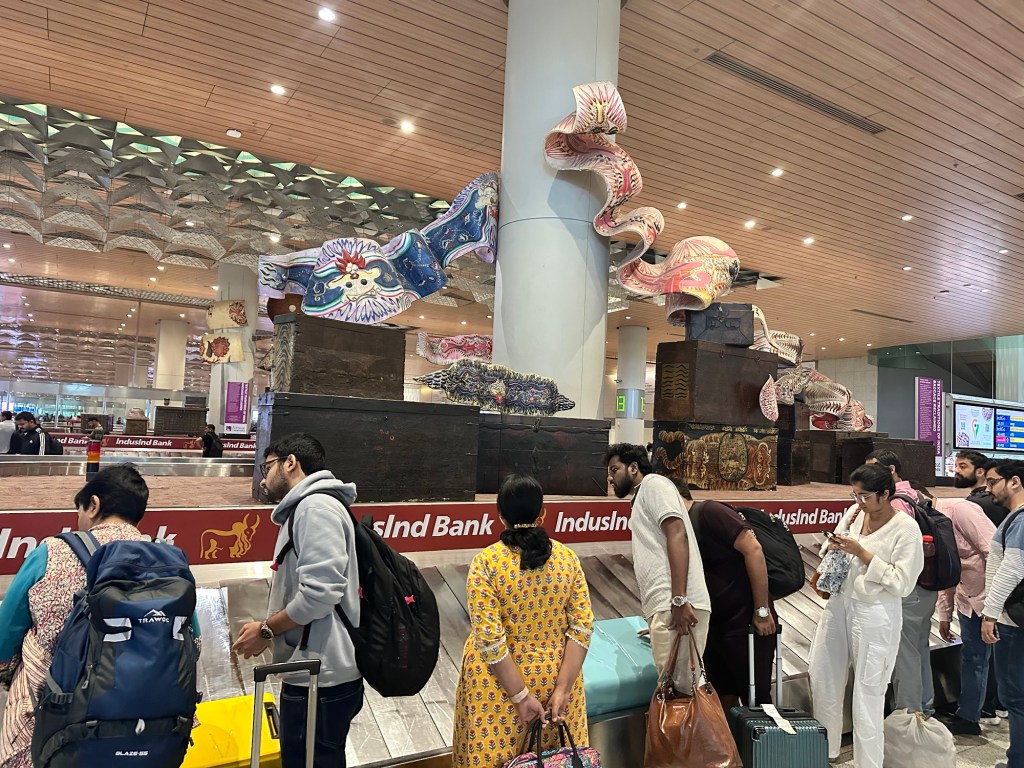
India is also pretty damn magnificent. I am so very grateful that I was able to experience its wonder and grandeur. Take a look at how Mumbai’s airport puts many American airports to shame.

During our stay, we had a delicious lunch at the Taj hotel, which was one of the locations where the 2008 terrorist attack occurred.

The “new” Taj Hotel has a memorial in its lobby. Beside the waterfall are carved the names of everyone who lost their life at the Taj during the attack.

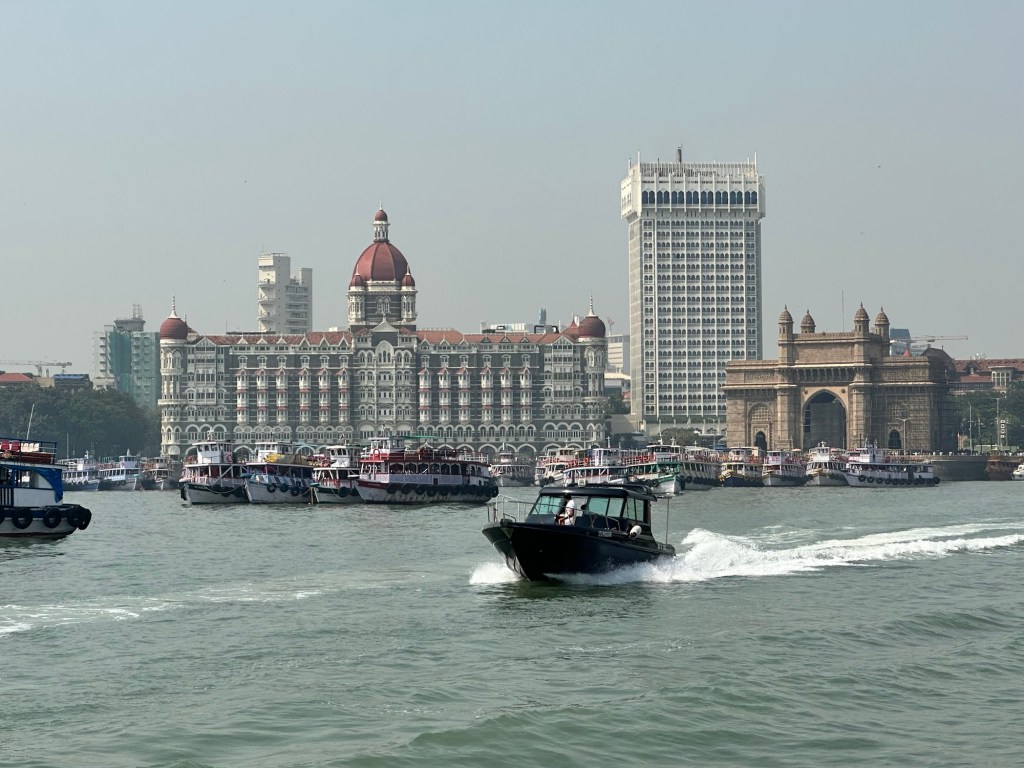
Our lunch was on the top floor of the new Taj, from which I was able to take this photo of the Arch (known as the Gateway of India) that was constructed for King George (whatever number he was—maybe George 5?) and Queen Mary’s visit.

Our boat ride to Elephanta Island gave us a a different view of the arch, plus the old and new Taj hotels.

Initially, what is now Mumbai was comprised of 7 islands, until the East India Company took possession, and decided to fill in the water between the islands, thus creating what has become today’s city. During our tour, our local guide pointed out areas that had been reclaimed from the sea.

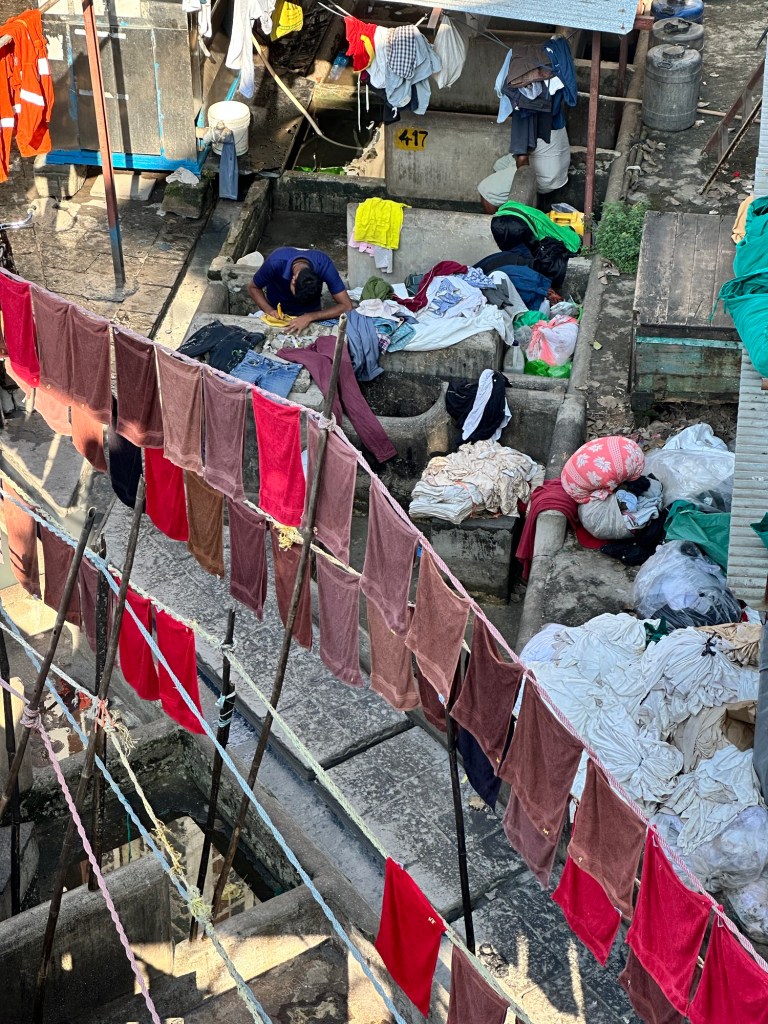
Other interesting sights included the Dhobi Ghat, where laundry is done in the open air. Our guide told us the water is only changed at the end of the day. Yikes! These days, many Indians have washers and dryers, so commercial enterprises are the ghat’s chief customers. I suspect that the Oberoi’s linens are NOT laundered here.

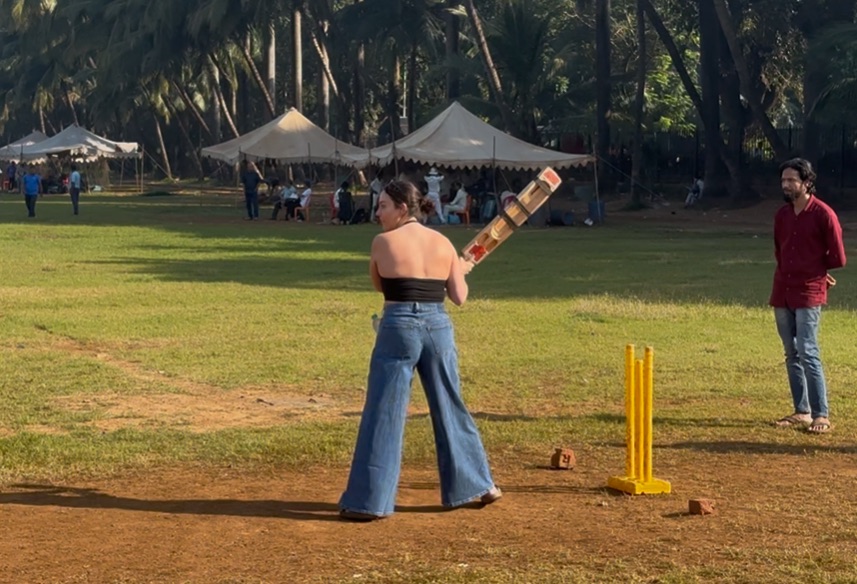
Other sights included Jeff, Tom and Whitney all trying their hand at cricket.

Some of the pews in St Thomas Cathedral were adorned with metal plaques identifying famous butts that were placed upon them, such as Mother Theresa and King George & Queen Mary. Guest preachers, however did not get similar recognition. But they certainly SHOULD have.

One of the most fun activities was feeding the “good luck” cow. Supposedly Indians who did so, would be guaranteed good luck. Their next stop was to the nearby stock exchange.

OUR next stop was to this jazzed up Starbucks, where we tried our luck at finding a clean bathroom. We were successful, so maybe feeding the cow does work.

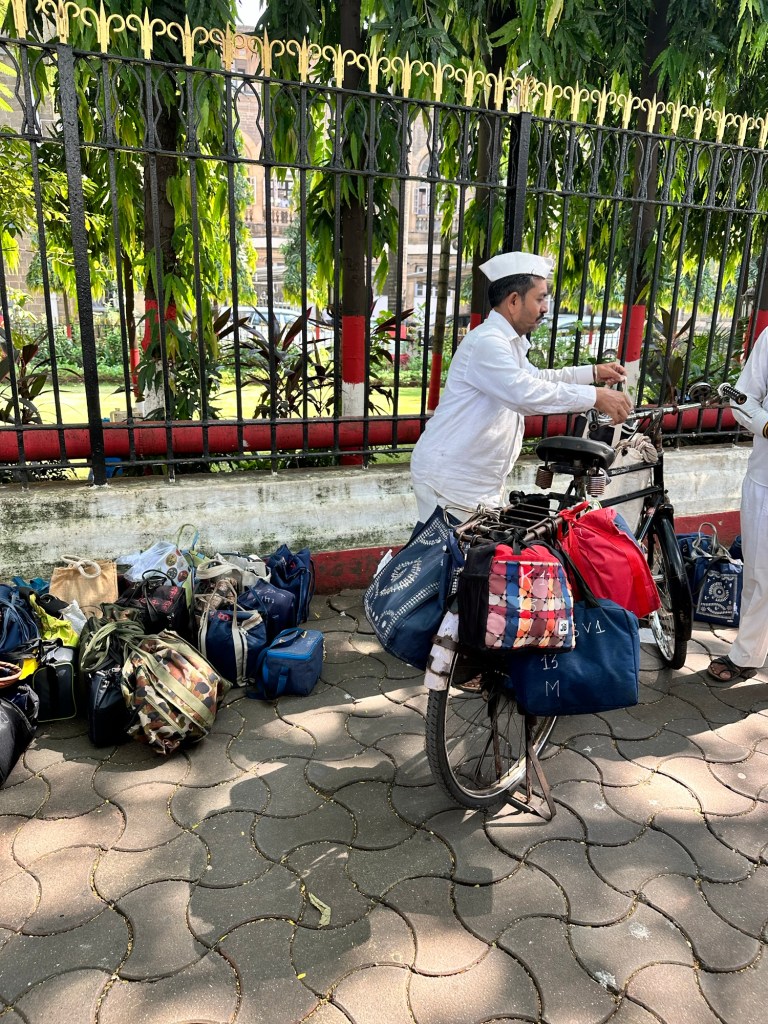
My final stop for the day was to watch the dabba wallahs decode which lunchbox gets delivered where. As you can see from the photo of one code, it is quite an elaborate system.

We asked why workers don’t simply take their lunchboxes with them when they leave for work.

The reason is the husband leaves work before his wife has cooked his lunch. It isn’t ready until around 10:30, which is when the dabba wallah picks it up. It gets delivered to the office before 1 PM. The dabba wallah returns later to bring the lunchbox back to the wife, arriving many hours before her husband returns home from work. That allows her to clean it so it is ready for the next day.

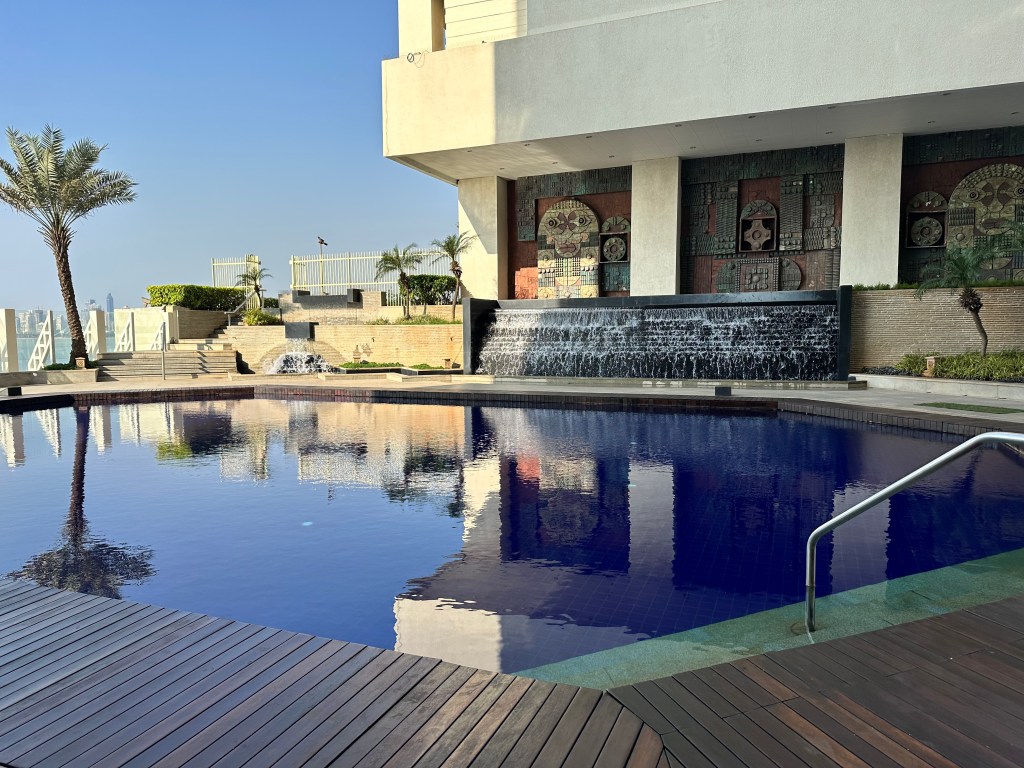
After lunch, most of the group visited the Dharavi slum. When in Nairobi during the summer of 2024, I had visited the Kibara Slum, which was a glorious experience, one that would have been difficult to replicate, in my opinion. I’ve also stayed in some rather humble lodgings while working on global volunteer projects. What I haven’t done is stay at many five star resorts, so I returned to the hotel to enjoy its rooftop pool.

Everyone who visited came back impressed by the work ethic of the residents of Dharavi.

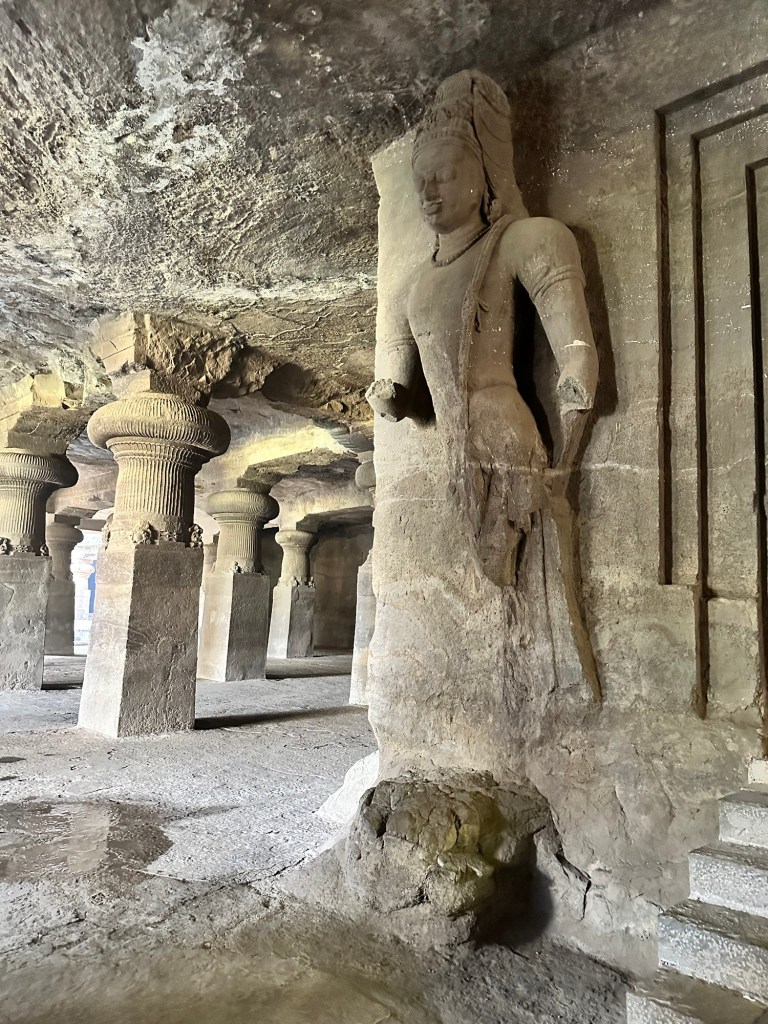
I mentioned Elephanta Island earlier in this post. Only seven of us chose to spend our last morning in Mumbai visiting this temple dedicated to Shiva.

Although it looked like the temple was constructed in an existing cave, that was not the case. The temple was carved out of a huge block of basalt, working from the top down, and the outside in. The columns that you see in the photo above are purely decorative. They are not needed to support the temple. Check out the ceiling and floor of the temple.

The 10 members of our group that chose to forgo the excursion did so because they were concerned about making it up the 126 steps to the temple.

For about $35, you could make the trip the way royalty did in the past, by hiring four men to carry you in one of these chairs.

Good thing Allison is slim, because Tom depleted his cash buying a beautiful ring for his lovely wife earlier in the trip. Being creative, Tom came up with an alternative method.

Others were turned off by the thought of a one hour boat ride each way, preferring instead to shop. In India, there is always an abundance of shopping opportunities, some for articles whose purpose was a mystery, at least to me.

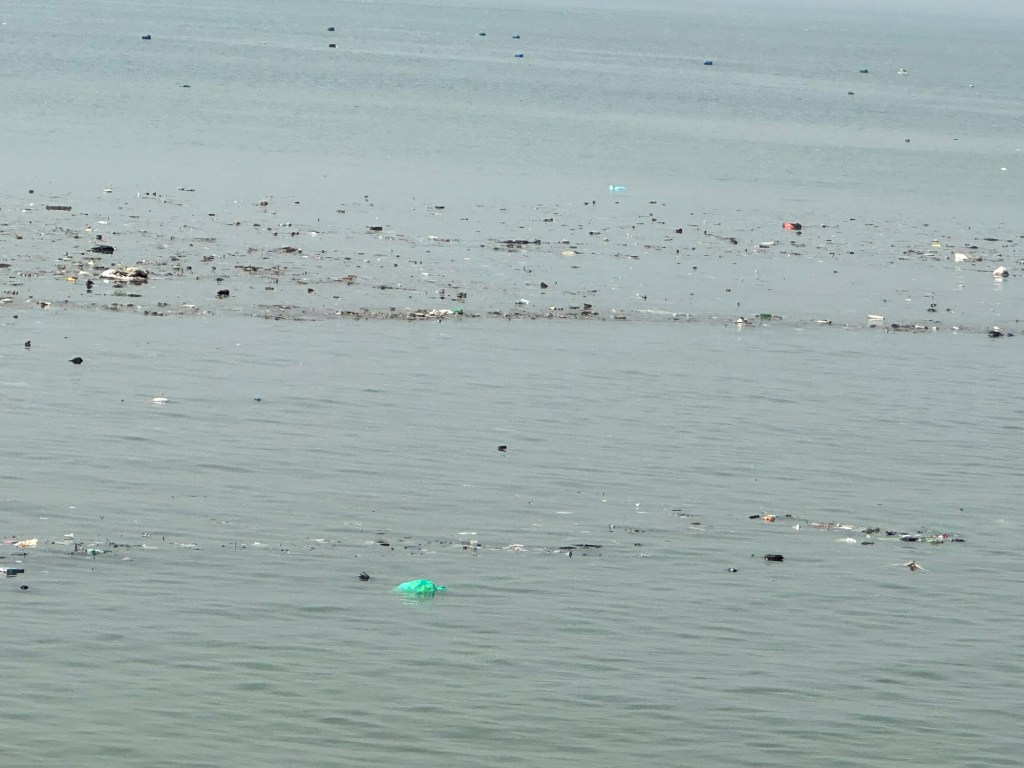
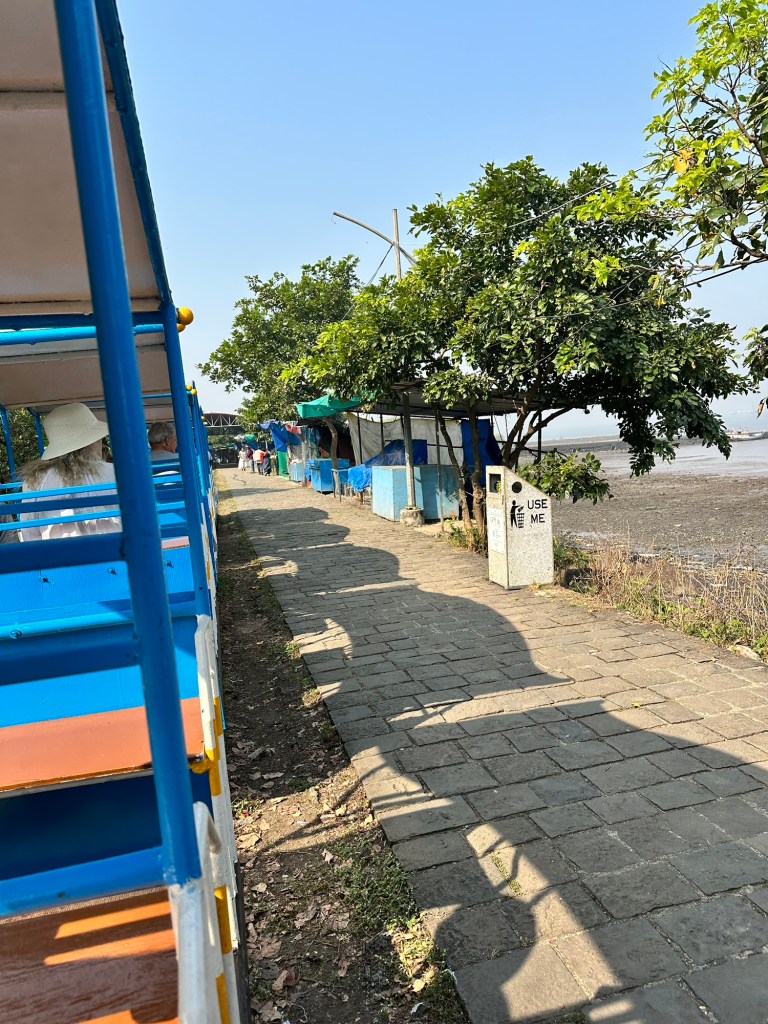
As with the other cities in the north, trash was everywhere. Despite the signs on receptacles exhorting people to “use me”, people obviously preferred to drop their garbage on the beaches where it was carried into the ocean.

I found the boat ride delightful, mainly because Joann and I chatted the entire way, which made the one hour journey whip by.

Tom, Allison, Jim, Sherrie, me, Joann and Don

Our guide did a terrific job explaining the meaning of the wall panels. We learned, for example, that before they were married, Pavarti was always depicted on Shiva’s right. After they wed, she moved to his left. Why? Our guide told us it was because Shiva kept his wallet on his left side. “No money, no honey”. Later she told us being on the left side made Pavarti closer to Shiva’s heart.
So can you tell who is married and who is still dating? Remember the photo is a mirror image. Hmmm, Joann is on MY left. In the photo atop this post’s heading, she got it right

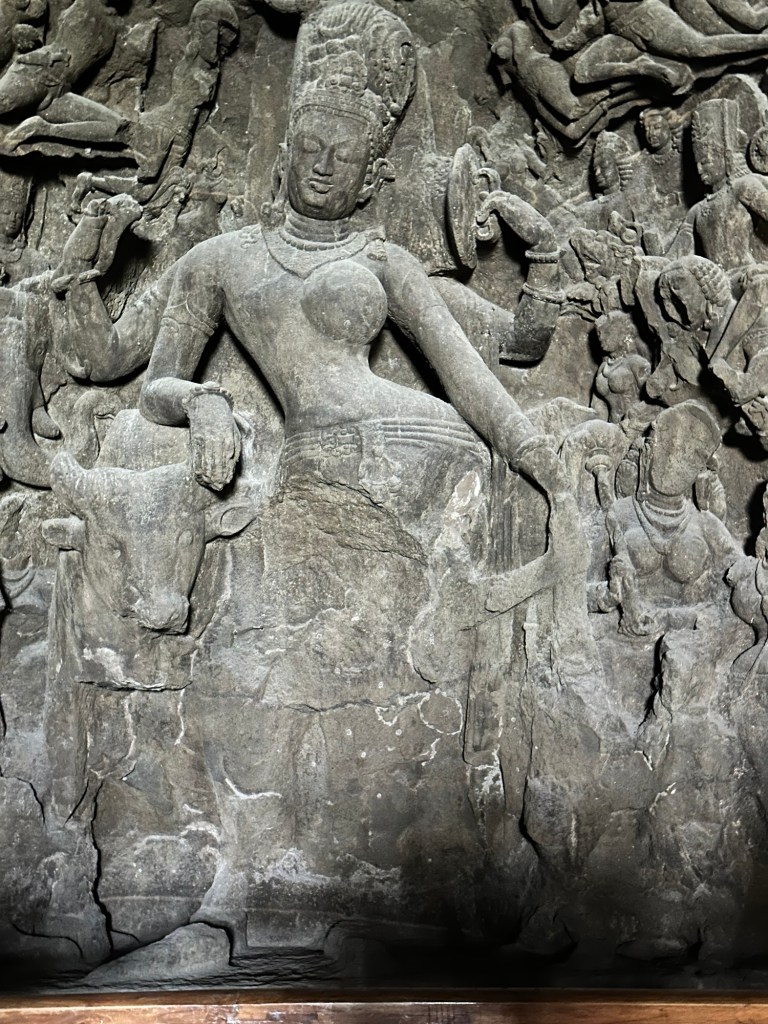
The photo below is of the wall panel showing the combination of male and female aspects of Shiva. If I had been viewing this panel on my own, I never would have gotten the significance. On the photo’s right, the top hand of Shiva is holding a mirror, which symbolizes beauty and is the emblem for Pavarti. On the photo’s left you can see Shiva’s hand resting on his trusty steed, Nandi the bull. There was a whole lot more that our guide told us, but the jet lag induced brain fog has caused me to forget what it was.

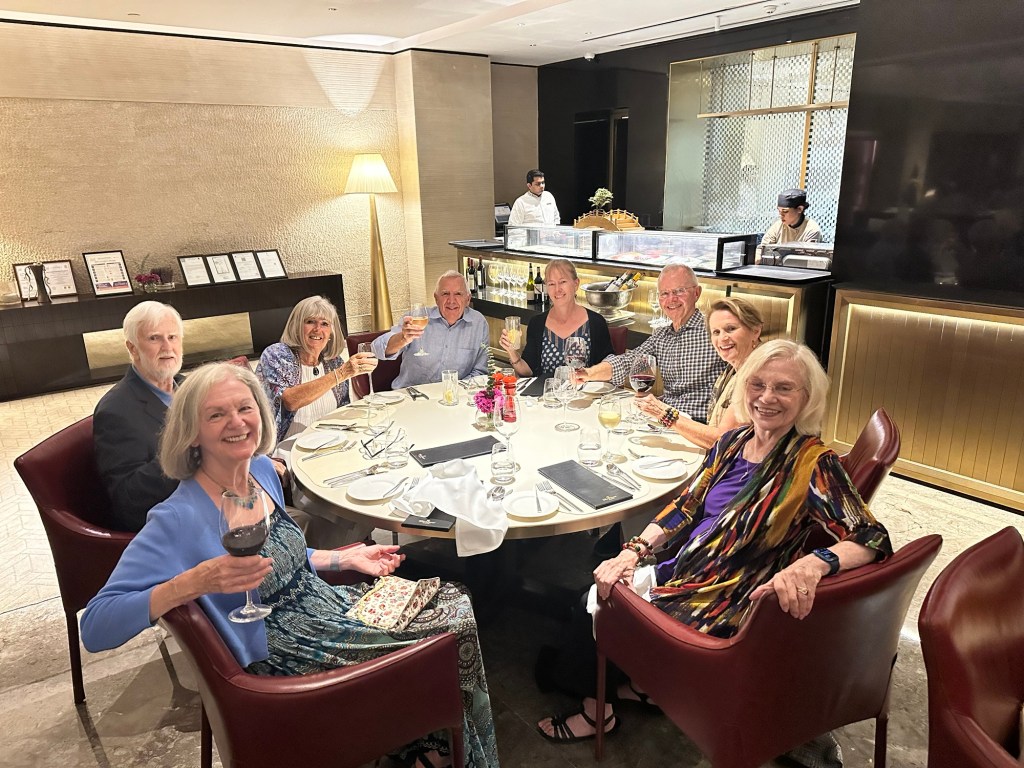
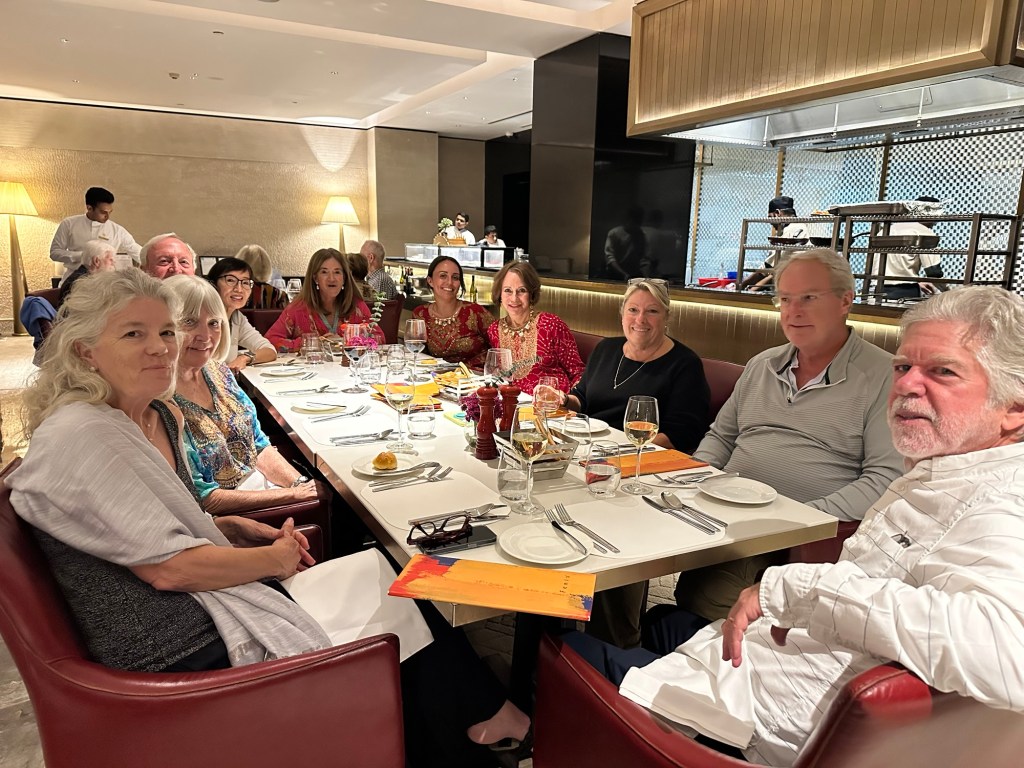
Our farewell dinner produced mixed emotions for me. I was sad to say goodbye to my new friends, but I was also happy to have spent the past two and a half weeks enjoying their company. What a magical group!

I couldn’t fit everyone at the big table into one photo, so I took two from different vantage points. Clearly the waiter did a better job than I.

If I have the time and the energy before I depart on my next trip, I’ll talk about our experience flying from Delhi. It was an adventure! Fortunately I got to share it with Joann and Don, which made it memorable, and almost fun.

Next trip is to Costa Rica, with OAT, in the beginning of December.

Southern India — Kerala

Name changes confuse me. I find myself slipping and saying Bombay instead of Mumbai. Even after spending time in Southern India, I’m not sure whether I should be saying Cochin or Kochi. I heard both. Maybe it doesn’t matter.

What DOES matter is the dramatic contrast between northern and Southern India! In the north, horn honking is encouraged. MANY of the vehicles we passed had signs like the one below on the back of their vehicles.

In southern India it was blissfully quiet. Although traffic wasn’t AS bad as it as in the north, there still were some interesting moments. Just no horn honking.

The south is so CLEAN! In the north, people drop their trash wherever—in the street, along highways, in parks, on lawns, inside buildings. It’s EVERYWHERE.

In the state of Kerala, they have either mastered the art of trash collection, or their residents actually CARE about their cities, or it truly IS God’s Country. Take your pick.

Although the itinerary showed us spending four days in Kerala, our first day was spent almost entirely traveling from Udaipur to Kochi, including a stop in Bangalore to change planes, and grab some airport food for lunch. Colonel Sanders has made his way to India, but I discovered that Starbucks offered fantastic sandwiches—better than we get in the USA, and probably cheaper. ( I still haven’t quite mastered exchange rate math). Good thing I ate because our flight was delayed, and we didn’t get to our hotel in Kochi until almost 6:30 PM.

What was great was that Tauck got us rooms with access to the club room. What was not so great was that the club room closed at 7 PM. Despite that, I managed to consume two glasses of white wine and sufficient food to make dinner unnecessary. It’s amazing what you can accomplish when you’re highly motivated.

This is the only American hotel we are frequenting during our trip— a Hyatt Regency overlooking the bay leading out to the Arabian Sea.

The curtains open automatically when you enter your room. I never bothered to learn how to close them, because I loved the magnificent view.

Of course, if you get tired of watching the river flow, you can always turn your head to look at the window into the bathroom. I wasn’t sharing a room, but those who were could watch their roommate do whatever they needed to do in the bathroom, without leaving the comfort of their bed.

Our second, and final day in Kochi, we were treated to a cooking demonstration by a woman who was discovered by The NY Times several years ago. Check out how her home is equipped, with tv screens, so you can watch while you theoretically master her technique. I imagine that before The NY Times discovered her, her kitchen looked very different.

In addition to her cooking commentary, Nimmy shared details about her marriage, including the fight she had with her husband that morning. She was QUITE entertaining!

Sue, me, Joann, Nimmy, Gloria and Don

Next up was a tour of a palace, synagogue and church, plus an opportunity to shop a bit.

We all thoroughly enjoyed the boat ride back, just in time to catch this spectacular sunset by the fishing nets.

Because we had a reasonable departure time (9AM the next morning), Gloria, Sue and I decided to try the restaurant on the top floor of the hotel.

Our final two days in the south were spent at the Kumarakom Resort. We drove about 2.5 hours to get to the houseboats that took us the final three hours of our journey.

Although we didn’t STAY on the houseboat, we certainly COULD have. Take a look at this luxurious bedroom. Instead, our houseboat experience included a delicious lunch on board.

Jennifer, our trip leader was on the second houseboat, but somehow she managed to convince the crew to pick up speed. It felt like we were on the Amazing Race. When her boat passed us, we decided that she and Whitney had complementary strengths that would have undoubtedly made them a winning team!

The Kumarakom resort was exactly what I needed at this point in the trip. I thoroughly appreciated the opportunity to slow down and completely relax for two days.

Once again, I had a magnificent room. But this time it was adjacent to what was called a meandering pool. I could meander across the way to visit with fellow travelers, so I did.

I loved the outdoor bathroom with the open air shower. I’d had one in Nepal and one in Colombia when traveling with OAT, so was used to showering in the open air.

Both nights, we were treated to outdoor cultural shows before dinner. This lovely young lady did a traditional dance,

The young men demonstrated martial arts, kicking and twirling swords and spears at each other. One segment of the show reminded me of majorettes performing in one of those old talent shows ( was it Ted Mack’s amateur hour?) See what you think.

Before the performances began, we got to drink wine and watch the sky change colors.

Pretty magnificent, wouldn’t you say?

On our last day, our group visited two villages alongside the river, waving to villagers along the way.

The experience was similar to what OAT calls “A Day in the Life”, where we visited two farming families, viewed their home and were invited to participate in activities. Gloria climbed for coconuts,

Was he getting ready to “goose” her?

Susie made coir rope from coconut fiber

Some of us got to play “dress up”

Pam and Jeff were dressed as a farming couple, Pat, Bill and I were getting married. Hey, back in the day, men could have multiple wives. At least Pat and I get along well!

Only three days left on the trip, all of which will be spent in Mumbai/Bombay, before our long flight home.

Udaipur

What an incredible hotel! I know, I know, I have been saying that about every hotel on this trip, but every time I say it, it’s the TRUTH and I have photos to prove it.

I’m running out of adjectives to describe how grand the Oberoi hotels are, so you’ll just have to see for yourself.

I’m so glad we are staying here for three nights because that gives us the opportunity to enjoy the beautiful pool area,

fully appreciate the interior of the hotel,

and stroll along the magnificent grounds by the lake.

We had fantastic outdoor dining at the hotel two of our three nights in Udaipur.

Dinner on our last night in Udaipur was at the home of the grandson of a former prime minister. The grandson is a chef, who prepared a selection of wonderful Indian foods, mostly vegetarian, but including mutton and chicken dishes.

The Drawing Room of our host’s home.

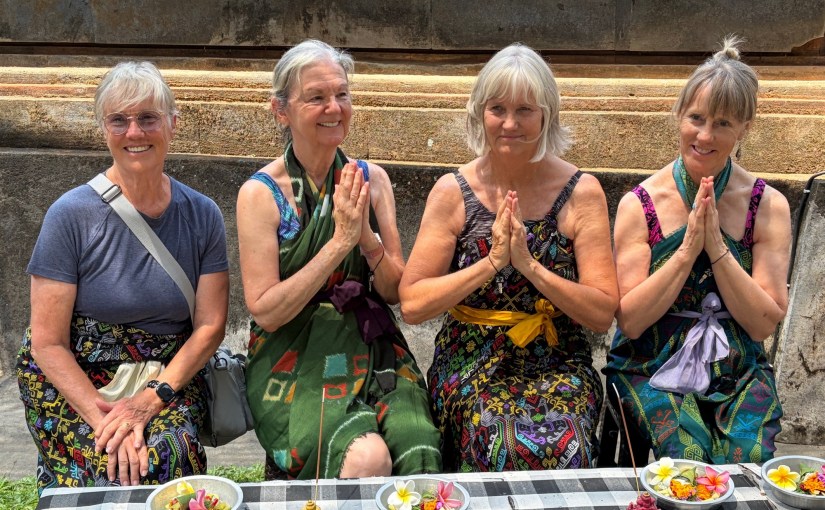
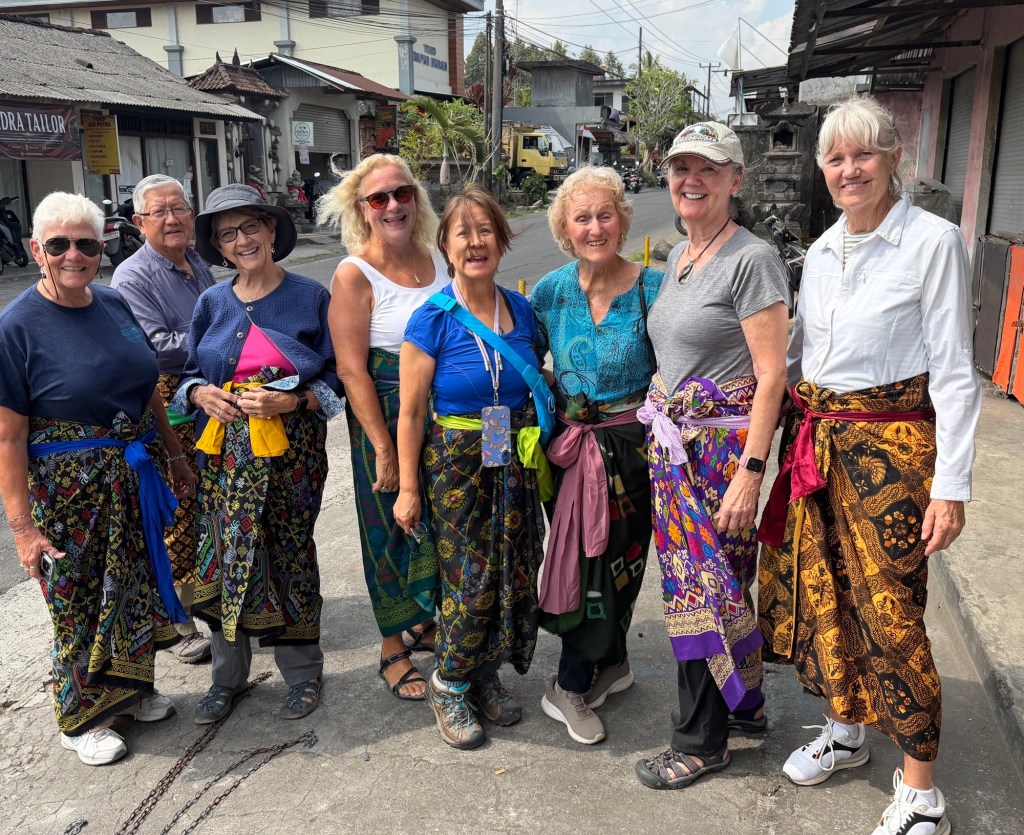
Prior to dinner, we were dressed in saris and turbans. Yes, we HAD to be dressed by an expert, because none of us would have been able to master the tucks and twirls on our own.

Our entire group

These are my new friends from Naples, Florida. You can see we each have been wrapped differently.

When we arrived in Udaipur, we immediately headed for lunch at the Lily Court, which was also an art gallery and sculpture garden. This was my favorite piece.

Next stop was the Nagda Temple, which was constructed in the 11th century, and partially destroyed by Muslims who objected to the erotic wall decorations.

This complex, dedicated to Vishnu, is known as the Sas-Bahu Temple.

On our second day, we strolled through the market, then headed for the garden constructed for the king’s harem.

We were so very lucky that the rain held off until we were back in our rickshaws. I shared my rickshaw with Jennifer, our trip leader, so I heard her talking to our local guide as they tried to figure out whether the downpour would continue, requiring them to cancel our walk through the garden.

Magically, the rain stopped, so we were able to enjoy the gardens with their beautiful fountains.

Each couple got their own rickshaw, so as a single, I got my own. The driver would take us wherever we wanted to go. We could choose to shop for jewelry, textiles, cashmere, or go to lunch, to an ATM, or back to the hotel.

Believe it or not, I was able to do all of the above, probably because I had zero interest in fine gems. I DID find a cashmere wrap that was different from anything I’d ever seen.

While in Udaipur, we enjoyed a cruise on Lake Pichola. It has some naturally occurring “islands” that are now sites for incredibly gorgeous hotels. Doesn’t it appear to float on the water?

After our boat ride, a tourist train took us to the city palace entrance.

Of course, the palace was richly decorated, with mosaics covering the walls.

The rooms were interconnected by very narrow winding passages, with head smashing doorways for the taller people in the group. (Bet you’ve figured out how I know that!)

What struck me was the distance between the Kings and the queen’s bedrooms.

I had assumed that the KING was making the journey along the dark passages to get to the Queen. Wrong. When I asked, our guide told me the king would SUMMON the Queen, and SHE would have to find her way along the dark, narrow passages.

In my defense, I thought the queen’s bedroom was far more interesting. I had no trouble imagining the king taking full advantage of that swing. Sorry. That’s just how my mind works.

Elephants were an important part of defense. This statue commemorates how they “worked out” every day.

We leave this wonderful location for an all day journey to Cochin, also known as Kochi, which requires two flights connecting in Bangalore.

Jaipur

Just when I thought “this trip couldn’t POSSIBLY get any better”, it does!

Our hotel, the Oberoi Rajvillas is even more magnificent than the Leela Palace in Delhi. How is that even possible? Well, check out my room.

That’s nothing. The bathroom is even more spectacular.

I was the only woman who chose to return to the hotel rather than shop for jewelry during our free afternoon.

Display at our hotel—a bit too ornate for me

Why? So I’d have time to take a bath and use the pool.

Although it LOOKS like a maharajah’s palace, the Oberoi Rajvillas is actually a luxury hotel that was built to resemble a palace.

The Rambagh Palace, where we had dinner, was the REAL deal. Built in 1835, it became the principal residence of Maharaja Sawai Man Singh II and his wife, Maharani Gayatri Devi. After India became independent in 1947, the Maharaja converted Rambagh Palace into India’s first luxury “palace hotel”.

Check out how we were greeted and escorted in for dinner.

As one might expect, dinner was incredible. The wine flowed freely, so freely that when Jennifer asked for a volunteer to dance with the professionals, I rose to the occasion, thinking other members of the group would join in. They didn’t. Instead my friend Bill, took this video.

This style of dancing is called Kathak and it is extremely difficult to follow, because the foot stomping pattern changes unexpectedly. I gave up trying and instead decided to go “free style”. At least my travel companions were amused.

Jaipur was noisy, crowded, chaotic and beautiful.

Crossing the street was even more hair raising than crossing in Hanoi, because in Vietnam the streets are not as wide.

I’ll confess to being challenged to find just a few photos of the many incredible things we experienced. This is my attempt to give a feel for the wonder of Jaipur without posting so many photos that your eyes roll back into your head.

Before our dinner at the Rambagh Palace, we took a jeep to the Amber Fort.

Every time we went over a bump, Jeff and I hit our heads on the jeep’s ceiling. We were glad it was made of cloth instead of metal!

On our way, we visited this water source.

The Amber Fort is a popular site for wedding photos. This was actually a “practice shoot” pre-wedding, to make sure the real thing turns out perfectly.

The “fort” contains a gorgeous garden with fountains.

Check out the mirrored designs on the fort’s walls.

You could get a panoramic view of Jaipur from the fort.

We toured the Jantar Mantar Observatory and the City Palace Museum on our second day in Jaipur. The photo atop this post is of the throne room in the palace.

Our lunch at the Raj Palace was extraordinary. My only regret was that I didn’t know the names of these wonderful dishes so that I could order them again.

We ended the evening by visiting the 18th-century Shiva temple, where this group photo was taken.

Next stop, Udaipur.

Agra

By the time we arrived in Agra, it was after 8 PM, too dark for the promised view of the Taj Mahal from my hotel’s window. Instead, I enjoyed the night view of the hotel’s entrance and pool area.

Here’s what I was able to see during daylight. My eyes are far better than my iPhone’s camera, but you get the idea.

My room was exactly what I needed after a very long day,

especially since our scheduled departure was at 6:10 AM, so we could get to the Taj Mahal in time for sunrise. Once again, the weather didn’t cooperate; it was too cloudy to see the sun, but it was still rather wonderful.

Yes, we all have seen many photos of this gorgeous building. But none of the photos I’ve ever seen have been able to capture the fine detail. Take a look at the exquisite carvings,

the colors of the precious stones forming the inlaid designs,

then try to visualize the complexity of the designs covering the entire edifice.

The interior was equally breathtaking. Although we were able to enter the mausoleum, us “common folks” aren’t allowed to photograph the cenotaphs of Shah Jahan and his wife, Mumtaz. Clearly someone was granted permission, because YouTube videos of the interior exist. If you want to sneak a peek, just do a google search.

When we arrived, we witnessed why we were told not to bring food into the grounds. This guy seemed to thoroughly enjoy his pilfered granola bar.

The red sandstone entrance housed a photographic history of the Taj Mahal.

I wasn’t aware that this wonder of the world had been abandoned during the late 1800’s. The vegetation that was growing wildly over the grounds almost obscured the mausoleum.

Sorry about the reflections on the photo


Next, we toured a very small percentage of the Agra Fort. That was where Shah Jahan was imprisoned by his youngest son until his death. That son also knocked off his brothers so that he could seize power and rule as emperor.

Shah Jahan was able to view the distant Taj Mahal from the windows of his quarters at the Agra Fort. Not bad for a prison cell, wouldn’t you say? One of his daughters was allowed to stay in the adjoining room to take care of dad.

For those unfamiliar with the story, Shah Jahan and his wife, Mumtaz Mahal were married for 20 years, during which she gave birth 14 times and had two miscarriages. Yikes! SIXTEEN pregnancies within 20 years! After she died giving birth to her 14th child, at age 39, Shah Jahan built the Taj Mahal as a reminder of the love they had shared.

Next stop, Jaipur, butts in the bus by 7:45 AM.

Our group

How lucky am I to be traveling with such a wonderful, interesting group! I’m thoroughly enjoying getting to know each one of them.

Varanasi

Initially I was NOT impressed with Varanasi, because of the crowds, traffic, trash in the streets, wandering cows and stray dogs. It was hard for me to believe that Varanasi is considered one of India’s most sacred cities. But after our evening and morning cruises on the Ganges, I changed my mind!

Hindus believe that if you are cremated on this special ghat ( the one with the “everlasting flame” ) by the Ganges, you are released from the cycle of death and rebirth, earning an “express pass” to nirvana. We witnessed the full cremation ceremony from our riverboat.

It reminded me of the Catholics’ belief in the 9 first Fridays. So, for those who didn’t go to Catholic school, here’s the scoop. If you go to mass and communion for the first Friday of the month, NINE times in a ROW, you are guaranteed that a priest would pop up just before you die to give you the last rites. That means you have the chance to confess your sins and be forgiven. You might have to spend a little time in Purgatory, but at least you won’t go to hell.

Varanasi is to devout Hindu what Mecca represents to Muslims, and Jerusalem to Jews. Supposedly, most Hindus want to make a pilgrimage to Varanasi, at least once in their lifetime, to take an early morning “dip” into the Ganges. For those unable to make the trip, perhaps they might persuade someone to do it for them; that person would have to go underwater multiple times to ensure their friends are completely purified.

After our flight from Delhi to Varanasi, and our evening cruise, I briefly considered skipping the sunrise rituals, which required getting up at 5 AM. I’m so glad that I didn’t!

Twenty five years ago my friend celebrated her birthday by submerging herself in the Ganges. Back then, the river was polluted with dead animals, ashes, and miscellaneous bacteria floating along among the multitudes of humans bathing there. Since then, treatment towers ( the yellow structures) have been built, so the water is much cleaner.

Good thing, because water from the Ganges is considered “purifying” and holy. Devout Hindus sprinkle Ganges water in their homes first thing in the morning and again before sunset, then blow a conch shell to banish negativity.

During our college years, my friend (the Ganges bather) celebrated St Patrick’s day by skinny dipping in Boston’s Charles River. Of course, that was after she consumed prodigious amounts of green beer. Sorry, no iPhones back then, so no video of Boston’s “ finest” plucking her from the river.

But I digress. Let’s get back to Varanasi. Not only is the city sacred to Hindus, it is also important to Buddhists because Buddha gave his first sermon in Varanasi, at Sarnath.

The following photos are of a Bodhi tree, which can be identified by its heart shaped leaves. When the Buddha stood underneath the Bodhi tree, he achieved enlightenment. Sadly, when I planted myself firmly under that same tree, no such thing happened to me. Maybe I needed to stand there longer?

The on site museum at Sarnath houses finds from Archaeological digs, including this statue of four lions.

Anyone who has visited the Alhambra in Granada, Spain might be reminded of the Lion Court which has similar statuary.

On the way to the sunrise ceremony, our guide warned us to be on the lookout for cow dung. He explained that the cows we have seen roaming the streets all have owners. The owners allow the cows to roam freely during the day, after they have been fed and milked. In the evening, the cows return home and are sheltered overnight.

Our guide told us the cows are fed during the day by some of the locals. If the cows are fed two or three times, they return to that house regularly, at the same time every day. If the residents aren’t waiting, with food, the cow uses its horns to knock on the door.

Sadly, it was a cloudy morning, so we didn’t get to see the sunrise. What I did get was a photo of the hotel where George Harrison stayed. He was there long enough to experience a gorgeous sunrise which inspired him to compose the song “ here comes the sun”. It was in Varanasi that Harrison met and collaborated with Ravi Shankar.

Our early morning walk through the center of Varanasi was a visual feast. The statues on the buildings presented opportunities for our guide to educate us about the three main Hindu gods: Brahma the creator, Vishnu, the maintainer and Shiva, the destroyer of evil.

After returning to the hotel for breakfast, we departed to visit a silk production center where we were able to view looms and engage in retail therapy. We then headed to the airport for a return flight to Delhi, and a long drive to Agra. We arrived at our beautiful hotel around 8 PM, with barely enough energy to have dinner, and go to bed.

We saw and experienced a lot during our less than 24 hour stay in Varanasi!

The Tauck Trip Commences!

After a quick lunch (I discovered that room service is the only way to get just a bowl of soup here!) I met up with the group and was pleased to learn that instead of the anticipated 25, there are only 17 of us.

Two couples are from Australia (Jeff & Pam, Dave & Dee) . Unlike my past OAT trips, I am the only solo traveler. I guess Tauck’s hefty single supplement encourages solo travelers to look elsewhere. There are two female friends traveling together ( Gloria and Sue from Naples, FL) and a mother/ daughter duo (Suzy and Whitney from Vail, CO).

Gloria, Sue and I enjoyed a fantastic welcome dinner at the hotel’s Indian restaurant. We shared the table with Jim & Sherrie and Tom & Alison, 2 couples from the greater Washington DC area, who travel together.

The menu. I wanted to remember the names of the food we had, because everything was delicious. I’d have it again!

The remaining couples are Joann & Don from Racine, WI and Pat & Bill from Brookline, MA.

Pat and Bill are a “ new” couple who got together after Pat’s husband died.

Yesterday afternoon, we toured the place where Gandhi was assassinated. By then, the morning’s Bollywood session and lack of sleep had caught up with me. I was exhausted, so instead of touring the site, I watched the monkeys, including this fine fellow.

Luckily, I got my second wind in time for the evening’s cocktail hour, and the aforementioned dinner, during which the wine flowed freely. So freely, that when I awoke at 11PM, I thought it was morning. It took me a while to realize the room was bright, not from the sun, but because I fell asleep ( passed out?) with the lights on. Fortunately, I was able to go right back to sleep. This time, with the lights out.

Our day was spent touring the cities that comprised old and new Delhi. Our guide explained about the 10 cities of Delhi, but it was confusing and frankly not all that interesting to me, so I didn’t pay attention. I was too busy being wowed by all the lush greenery, the gardens and the fabulous murals lining the roadway. It was NOT what I expected!

Our first stop was the UNESCO World Heritage site, Humayun’s Tomb. It dates back to the late 1500’s. The photo heading this post is of the tomb.

Here’s another view of this spectacular sandstone and marble building. Our guide told us it inspired the Taj Mahal.

The tomb contains 100 bodies, and since it was Muslim, the bodies were buried, not cremated.

Our next site visit was to the 18-story stone Qutub Minar Victory Tower. This minaret was built more than eight centuries ago, and is located in one of the earliest surviving mosque complexes in India.

What a ham!

By then, we had all worked up quite an appetite, so we were delighted by the feast at the Olive Restaurant. We all had slices of the wonderful thin crust pizza and tomato soup, but then we were able to choose our own entrees. I selected the roasted butternut squash, with Kalamata olives. It was so great, eating it was almost a religious experience! Everyone else was equally enthusiastic about their choices. By the time we had finished dessert, we were so full, ( and it was so late in the day) dinner seemed excessive. Sorry, no food photos. My phone’s battery was almost as exhausted as I was yesterday!

Tomorrow we fly to Varanasi, so had to separate our belongings, taking enough for an overnight, with the rest of our luggage being driven to Agra.