One month from today, I’ll be heading off for my sixth Global Volunteer Experience. Timing is everything in life, and given recent political events, some think it is not the best time to go traipsing around other parts of the globe. My opinion differs. What better time to do something positive, to at least try to improve America’s image in other parts of the world, than now?
For those of you new to Global Volunteers, here’s a little background. We go where we are invited, and do whatever we are asked to do, working closely with members of the host community. We don’t proselytize — we have no political or religious agenda, other than to make friends and learn about a culture different from our own. The only stated goal is to “wage peace and promote justice”. I love that.
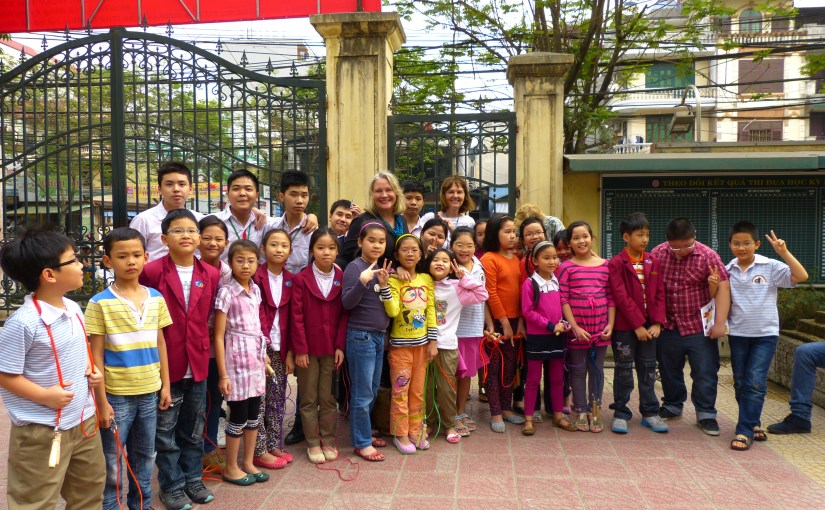
So far, I’ve worked in a preschool in Anse La Reye, St. Lucia, elementary schools in Hanoi, Vietnam and Rarotonga, Cook Islands and twice at a technical college in Queretaro, Mexico.
So, where to this time, you ask? Beja, Portugal, in the Alentejo region. Never heard of it? Neither had I until I signed up. And that’s one more thing to like about Global Volunteers: you get to live in areas you might never have thought of visiting.
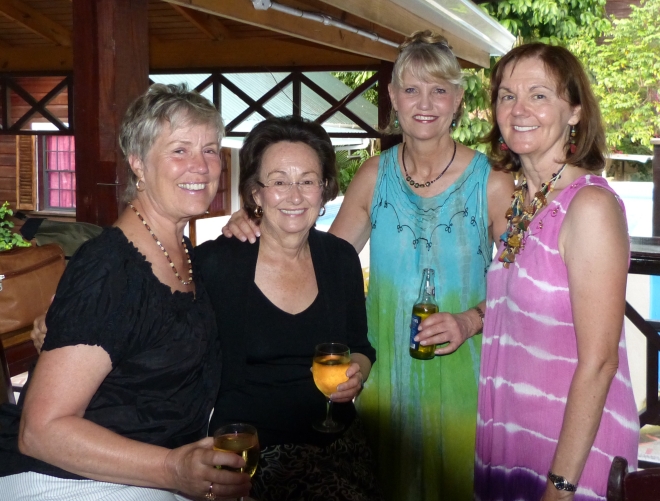
Another Global Volunteer plus is the wonderful friendships that you make. This trip will be a mini-reunion for three of us that served on my very first project in St Lucia.
Jeanne, Norina, Laurie and I in the bar at JJ’s Paradise Hotel, on our last evening in St. Lucia. I will be joining Jeanne and Laurie in Beja.
Not only that, but during our stay, we will be celebrating the 10th anniversary of the start of GV’s Portugal project. Seems like perfect timing to me!
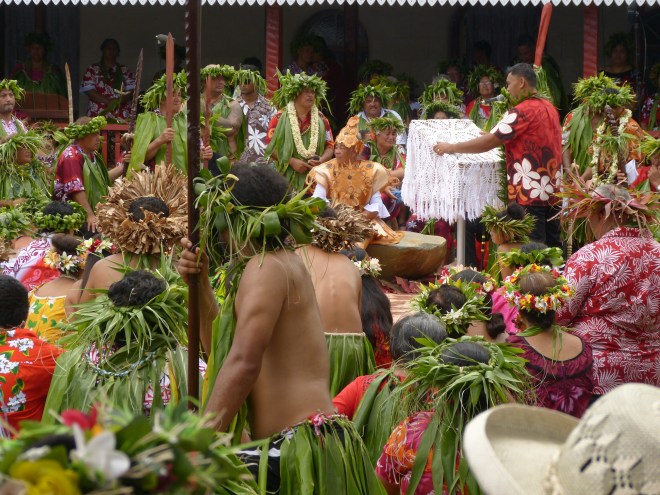
And that was the case for two of my other projects. In November of 2013, I was in Rarotonga when their new Queen was crowned. What a fantastic experience THAT was–the music, the food, the costumes–how lucky was I to be able to share this joyous celebration with the most gracious, friendly people on the planet!
The Queen is the one in gold
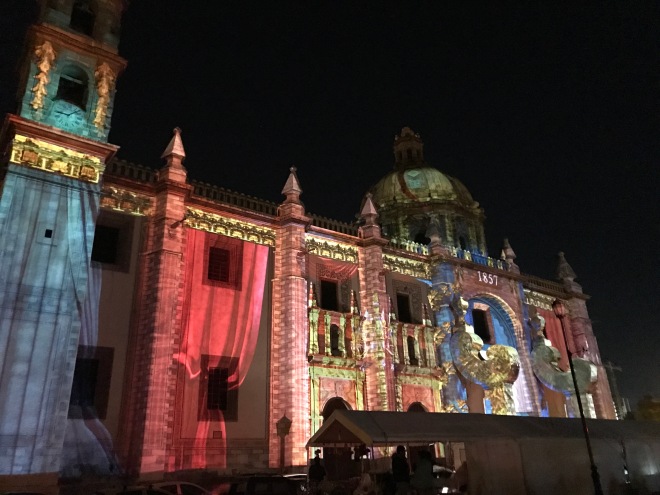
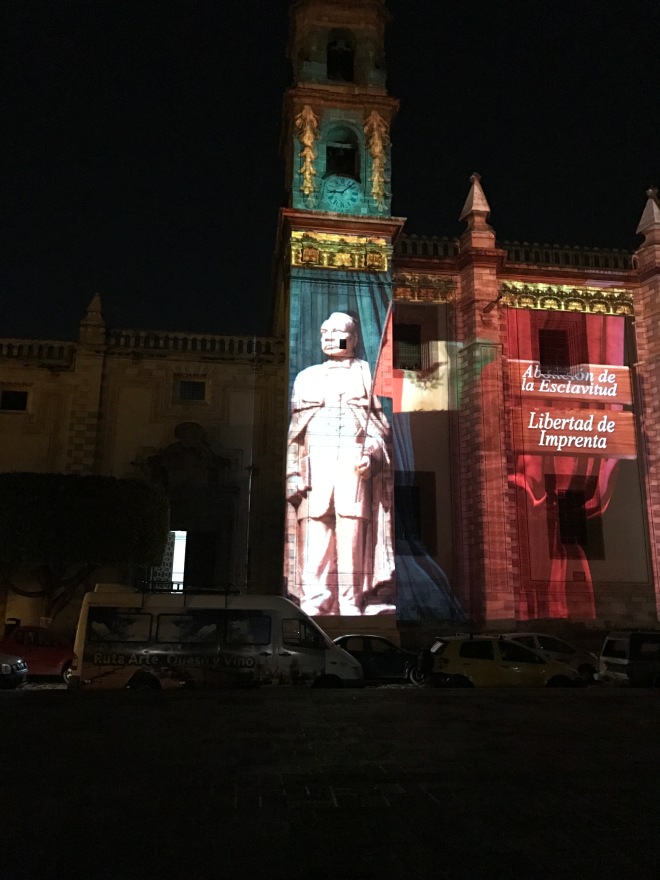
Jeanne and I lucked out in February, 2017, by being in Queretaro for 100th Anniversary of the signing of their constitution.
Queretaro was the actual site for this historical event, so there were all kinds of special celebrations. How cool is it to use the side of a centuries old cathedral as a screen for an outdoor multi media show? We liked it so much, we saw the show twice. These photos don’t do the display justice. Let me just say it was really, really wonderful.
If that wasn’t enough, another evening got to hear this stirring rendition of Elvis Presley’s “Wooden Heart” played on bagpipes, in Mexico!! Here’s a little bit of the sound track for your viewing pleasure. Irresistible, no?
So, who knows what awaits us in Beja?
I hope you will check back next month and join me, Laurie and Jeanne for a virtual Global Volunteers adventure. Adeus e obrigado!
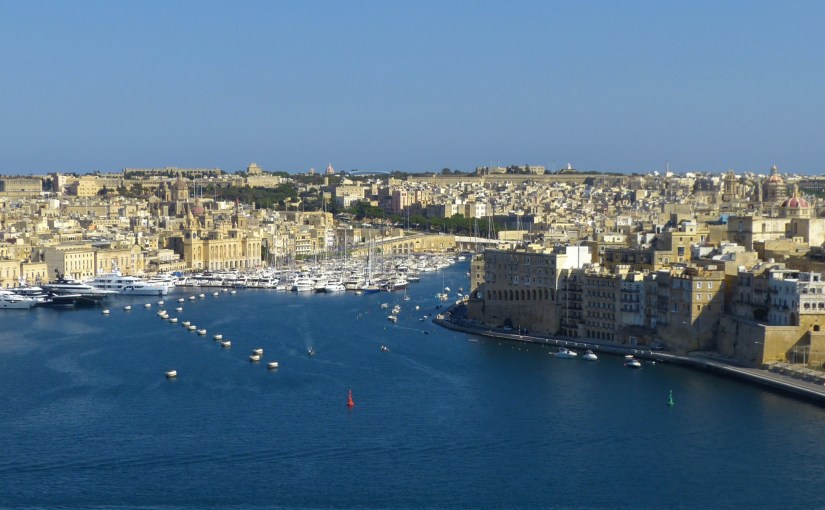
If you plan on vacationing in Italy, why not extend your visit a smidgen and hop over to Malta? This amazing little country has an abundance of things to see and do, especially if you are interested in history and archaeology. We spent five days there in late May, and felt that our timing was perfect…perfect weather, not too crowded, reasonably priced. Yep, there was a whole lot to like about Malta.
It is very easy to get to Malta from Italy. Although we could have taken a ferry from Catania, we opted for the less expensive, faster way, via Air Malta.
The title of this post is “RANDOM Reasons” to visit Malta and that’s exactly what you are getting. Not order of importance, or magnificence–just the order in which they popped into this lazy blogger’s head.
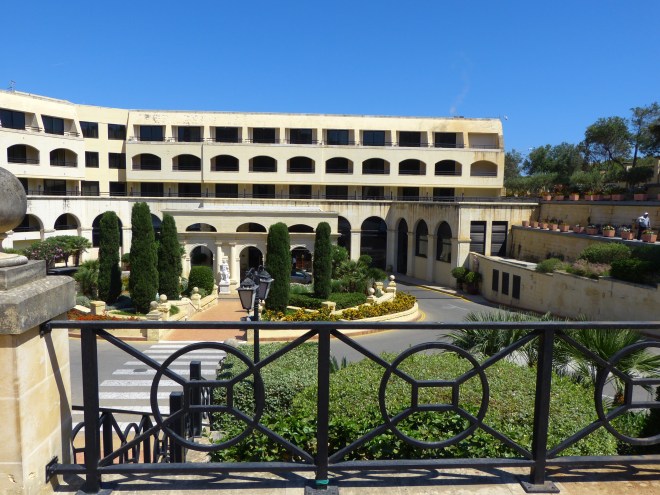
1. The Grand Excelsior Hotel
It’s beautiful, it’s just outside Valetta’s wall, it’s close to buses that can take you wherever you want to go, the service is great, the pool is fantastic, the views from the restaurant and bars are incredible, and it is relatively inexpensive (at least it was in May, with several months advance booking. )
The Excelsior’s pool at sunset
Be forewarned, though. The hotel is located below street level. 88 steps below, to be exact. The steps aren’t steep, but you WILL get your exercise. Which can be a good thing, if you eat as much as WE did.
The hike up those stairs is so worth it, because where else can you find…
2. Flower Shaped Gelato
Although there is an abundance of gelaterias in Malta, Amorino was our favorite. You can’t miss it–it is on Republic Street (the main street), on the right, if you are coming through the city gates. Your flower can have as many flavors as you want.
It doesn’t get much better than that!
And since we are on the subject of food, we discovered this wonderful restaurant close to the Blue Grotto.
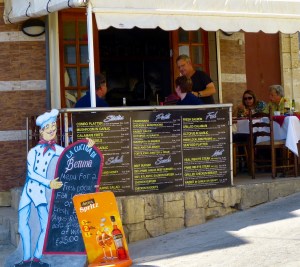
3. La Cucina de Bettina
The owner of the restaurant was also our waiter. That’s him, in the black tee, explaining the menu to customers.
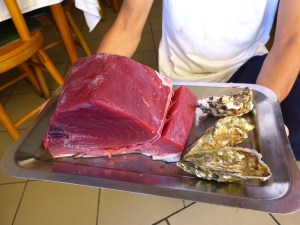
I’m ordinarily not a HUGE seafood fan, but this was incredible–the best tuna I have ever tasted! Fresh? Well, the owner told us our lunch had been swimming in the ocean just a few hours before. Take a look.
No, that was not the serving size, but close.
We also had a wonderful antipasto platter, and a bottle of wine recommended by the owner/waiter. I should have made a note of what we spent for this feast. All I can remember was that it cost MUCH less than we ever expected!
I could go on and on about the Malta food, but I’m sure you get the idea. It was delicious, varied and affordable.
4. Valetta
Let’s just start with the festive Republic Street.
Yes, it does look a bit crowded, but if you want a more peaceful experience, all you need to do is duck down a side street. Cruise ships dock in Valetta, so when multiple ships are in town, you do get throngs, but after 5, the city is yours.
The Grand Master’s Palace is on Republic Street, and there IS a guard changing ceremony every day.
Other activities in Valetta definitely deserve their OWN number, like…
5. The Malta Experience
Perhaps you arrived in Malta without doing any research at all. You know NOTHING about its history or the history of its many invaders. Not to worry. All you need to do is buy a ticket to The Malta Experience, then sit back and enjoy. You will be quickly brought up to speed! There are other options on the island, including one that promised you a 5D experience (moving seats, water spray, air blasts and leg ticklers) but this was the one we chose and we were not disappointed. Now if we had been traveling with children, we probably would have opted for the multi-sensory extravaganza.
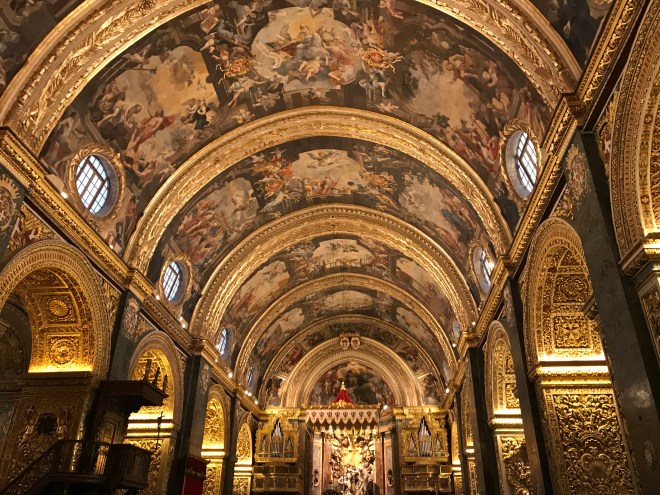
6. St John’s Co Cathedral
It is impossible to capture the majesty and magnificence of this building. It doesn’t look like much on the outside. In fact, we walked past it a couple of times without even noticing it. But walk inside and WOW!
We’ve hit a lot of churches and cathedrals throughout Europe, and the Americas, but this has to be the most jaw-dropping one I have ever encountered.
“The Beheading of John the Baptist by Caravaggio is in the Co-Cathedral, but just off to the side. I needed to ask directions to find it.
The painting is HUGE–it fills a wall. You can’t get close to it, so I was unable to verify whether Caravaggio’s signature was formed by the blood flowing from the Baptist’s neck. TIP: If you go, bring binoculars or opera glasses to get a better view.
You are not allowed to photograph the painting. If caught, supposedly they confiscate your photo card.
No, I did not break the rules. This is a photo of a postcard, purchased from the gift shop. A poor substitute, but better than nothing.
7. Transportation Alternatives
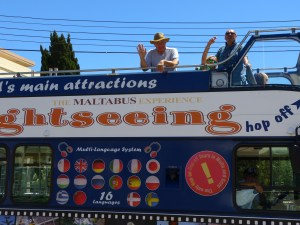
Here’s another tip: forget about the Hop On Hop Off buses here. You are better served riding the regular city buses. They are far less expensive, and more frequent. Normally we are huge fans of HOHO, but this one had a host of negatives. Its headsets were not reliable. Some worked–some didn’t, and the information they provided was not that great. There were long periods of silence, causing me to wonder whether the headset had stopped working. I was frequently consulting the brochure to try to figure out where we were.
We soon discovered the HOHO doesn’t necessarily stop in front of attractions listed in their brochure. But it DID stop at listed attractions that were closed.
We made the mistake of buying the two day, (red and blue) pass, so never tried out the city buses, but we sure saw a lot of them. Next time, city bus will be our preferred mode of transportation.
If you DO decide to go the way of the HOHO, you can get aboard near the bus station close to the Grand Excelsior.
8. Tarxien Temples
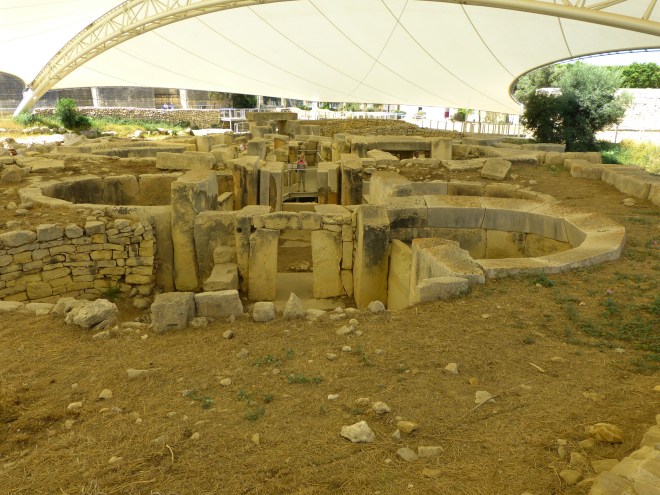
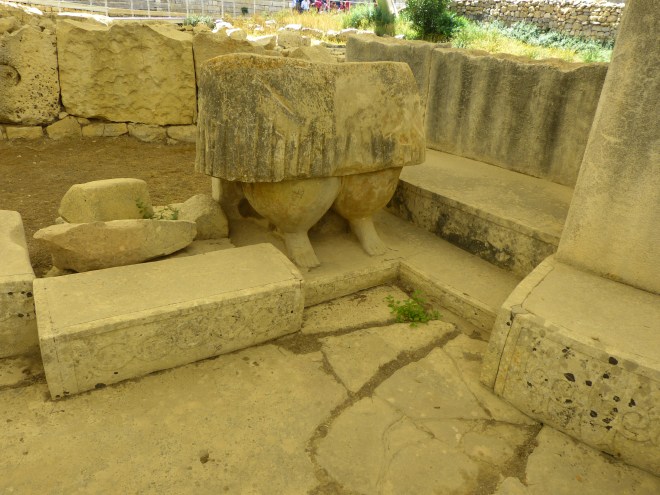
If you are into archaeology, you’ll love the Tarxien Temples. Full disclosure. We had wanted to see the Hypogeum, but that was completely booked. And the Tarxien Temples were supposedly on the HOHO route, (not exactly, as noted above, but we found our way), so why not?
These four temples date back to the Neolithic age (3600-2500 BC). The Romans, 2000 years later, used the site for agriculture. The original structures were discovered In 1913, when local farmers complained about the large blocks of stone they were striking while plowing.
There are other ruins for those that are really, REALLY into prehistory, but this was enough for us.
9. Gozo
We wanted to spend a day touring Gozo, and after our experience with HOHO, decided to book a private tour through the hotel. We were not disappointed with our choice. Marco picked us up at 8:30, drove us to and from the ferry and around Gozo, making sure we spent our time the way WE wanted.
View of Gozo harbor from the Ferry
We drove by Popeye’s village, now a tourist trap, formerly the set for Robin William’s 1980 movie, stopping just long enough to take a couple of photos.
I remember suffering through the Iliad and the Odyssey during my Freshman year in college. Maybe if I had known I’d be visiting the cave of the nymph who bewitched Odysseus, I would have enjoyed the books more. (But probably not). The cave was closed because of “geological movement”, so we could only look at a hole in the ground, partially hidden by bushes, but the view of the nearby beach with its red sand was quite lovely.
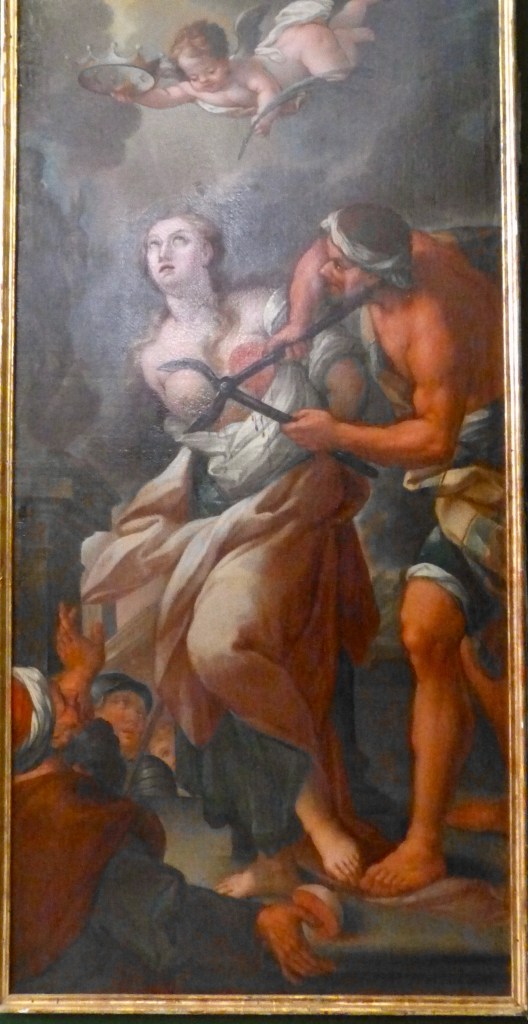
Gozo had lots of beautiful ocean vistas, a lovely cathedral, a great multimedia show in Rabat, (the old center also known as Victoria), fantastic food—AND this rather graphic painting of St. Agatha. Seems the Roman suitor she rejected got a bit miffed and decided to cut her breasts off in retaliation.
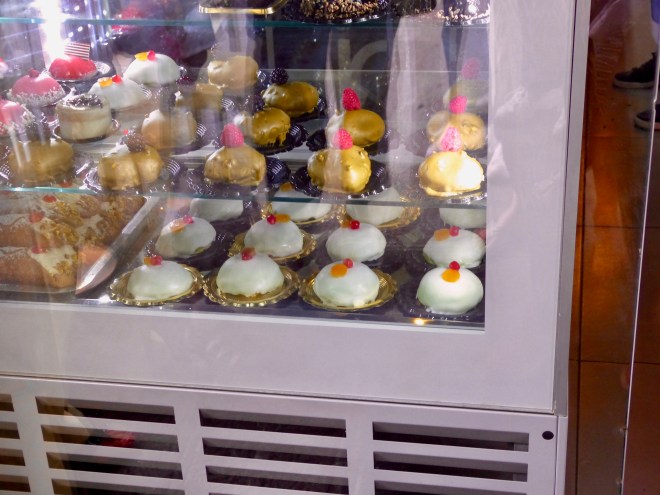
She looks remarkably unconcerned, maybe because the little angel hovering over her head (holding a crown) told her that in years to come, the Maltese and Sicilians would create a pastry in her honor. Think I’m kidding? Take a look. They are called “Minni di Sant Aita”. Honest.
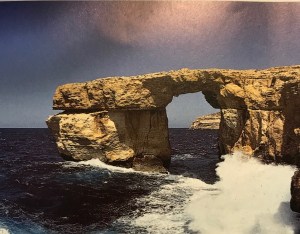
The Azure Window would definitely have made the list had we traveled to Gozo in 2016. Unfortunately for us, in March of 2017, the arch tumbled into the sea, so we had to content ourselves with this post card image, and a view of the site where it once stood. Still a scenic and lovely area, though.
10. Mdina
The oldest city on the island of Malta, Mdina was built and inhabited by Arabs until they were expelled by the Christians in 1250. Another fortified city, it has the mandatory moat and gates.
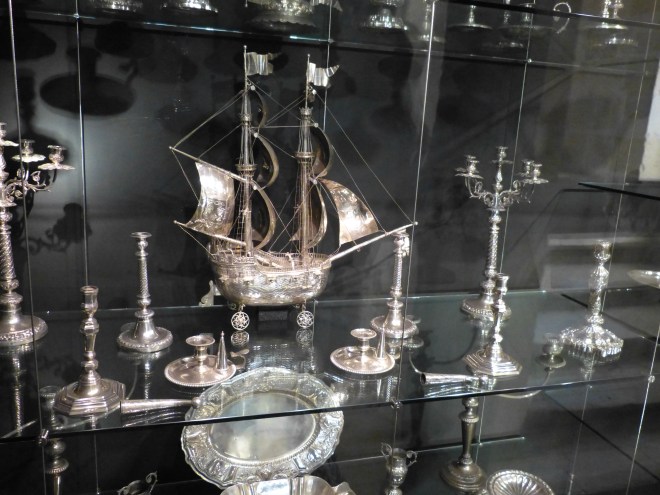
It also has the requisite cathedral, old buildings repurposed as cafes and gift shops, but MY favorite thing was the Palazzo Falzone, a 13th century building loaded with an incredible collection of antiques and the very coolest sound system ever.
You just put on the headset, point the wand at a plaque on the wall and voila, you have a narrative about the article/ room you are viewing!
Olof Gollcher, a Swedish philanthropist and heir to a shipping fortune, purchased the building in 1927, and used it as a repository for his collections of art, silver, furniture, weapons and books.
There you have it. This lazy, random blogger got you started. These ten highlights barely scratch the surface of all that is wonderful and glorious about Malta. The rest is up to you!
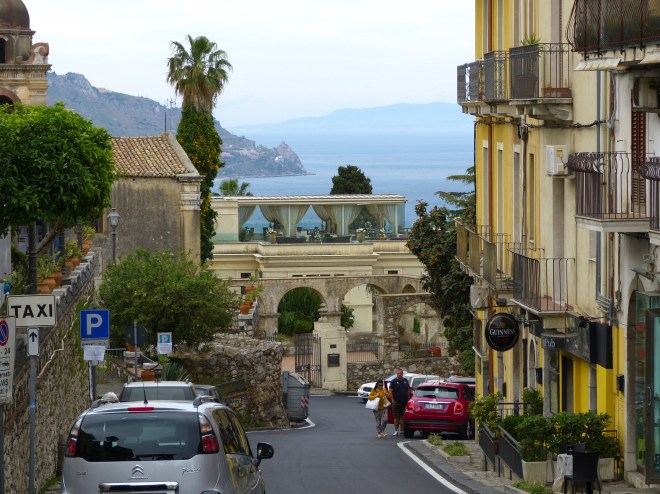
Okay, be honest. Before the G7 meeting, had you ever heard of Taormina? If I had, it didn’t register, until we booked this trip.
But before heading to Taormina, we still had lots to see and do in Catania. I’ll tell ya, I was totally unprepared for how much I enjoyed Catania. What a pleasant surprise. It was easy to get around, with lots to see, and of course, with an abundance of great restaurants.
The city was conquered by the Romans in 263 BC, and as with other areas in their empire, the Romans left their mark, which the city has wisely preserved.
I love the way the old and modern structures coexist. This amphitheater lies beneath the modern city
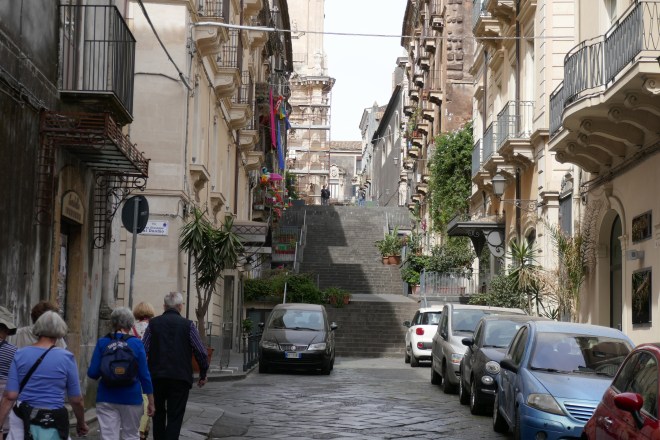
Yes, Catania has the requisite number of churches, fountains and statues. It also has lots of interesting streets, like this one. It isn’t immediately apparent, but as you climb all those stairs,
you are rewarded with views like this.
As one would expect of a city smack dab on the ocean, Catania’s fish market was HUGE, as were its products. Check out that swordfish.
Coming from coastal Massachusetts, however, this girl wasn’t all that impressed.
I DID get excited about the market’s fruit, though, especially those cherries. I don’t know who was more excited about my purchase–him or me? To show his appreciation, he gave me a slice of the most delicious cantaloupe I’ve ever tasted. Fresh, delicious fruit… aah, that’s what I call quality of life!
But I didn’t fill up on cherries. Good thing because we had yet another incredible lunch at a little outdoor cafe off of the main square, across from the cathedral. You’d think by now I would remember to write the cafe’s name down or take a picture of the menu, but I did neither. Sorry, future visitors to Catania. I believe it was on the corner, facing the elephant’s behind, where the tan umbrellas are.
On to Taormina, where security was tight. Good thing our group was in great shape, because we had to walk quite a distance. Bus access into the town and to the amphitheater was limited, even though the leaders would not be arriving for another week.
Notice the two different uniforms of the military/security people in this photo. I think every country must have sent their own people. There were LOTS more milling about!
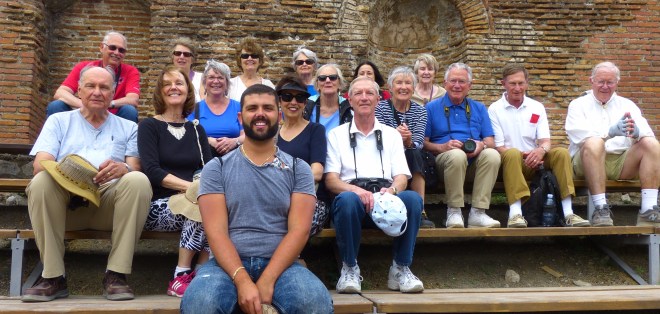
The amphitheater was the perfect spot for a group photo. And what a group we were! All seasoned travelers, everyone was considerate, friendly and easy to be with. Of course I had my favorites (and they know who they are), but I would be thrilled to see any of them on a future trip.
Great traveling companions! Back row: Tom, Maxine, Jane, Sharon, Ann, Carol. (Ann should have been in the front!) Middle row: Sue, Sue, Lavonne, Al, Joel and Henry Front row: Mike, me, Daniel (way in front), Shirley and Owen.
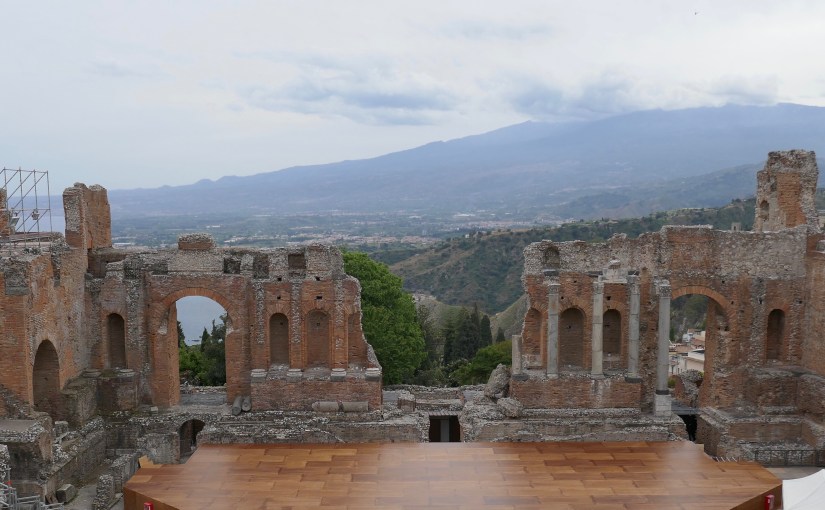
The Greek Amphitheater is still used for outdoor concerts, but those white plastic chairs are not normally in place. People usually sit on the stone steps, bleachers or the grassy sections. The plastic seats were set up for the following week’s G-7 conference.
The view from the site is unforgettable. See that cloud of smoke in the distance? That’s Mount Etna.
And that’s where we were headed on our last day in Catania. But first, one last shot of Taormina. Yes, the streets in the city are a bit steep, but none of our group needed a golf cart to get around. (I’m just sayin’…)
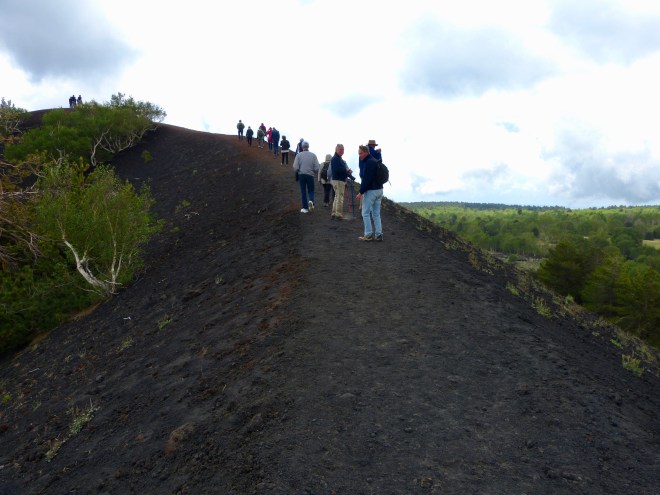
Okay, so I’ll admit it. I was absolutely thrilled to be able to hike on an active volcano. Of course, this being OAT, we were accompanied by Marco, our expert local guide who made sure we were safe at all times. Marco came equipped wth visual aids, walking sticks and hard hats!
We learned our group was unique, in that EVERYONE made the hike and descended into the lava tubes. Apparently this was a first for Marco. He said on all his other tours a couple of people waited at the base and didn’t take part in all the activities. Yay us!
Here’s one of our guide, Daniel’s, photos. As you can see from our clothing (and my hat) It was cold and windy on the volcano. I was glad I’d packed my fleece!
That’s not OUR group in the distance. I wasn’t that brave (foolhardy) to stay behind to get that shot! In fact, WE were up higher than they, as you can see from the angle of my shot.
So why did we need hard hats? Well, when you climbed down into a lava tube, it’s a good idea to protect your head and turn your head lamp on.
Yet another one of Daniel’s photos–the group inside the lava tube.
If you think this blog post was a whirlwind, you’d be right. And that’s how it felt to be on the trip. A very nice, interesting, FUN whirlwind. We definitely got a lot for our money!
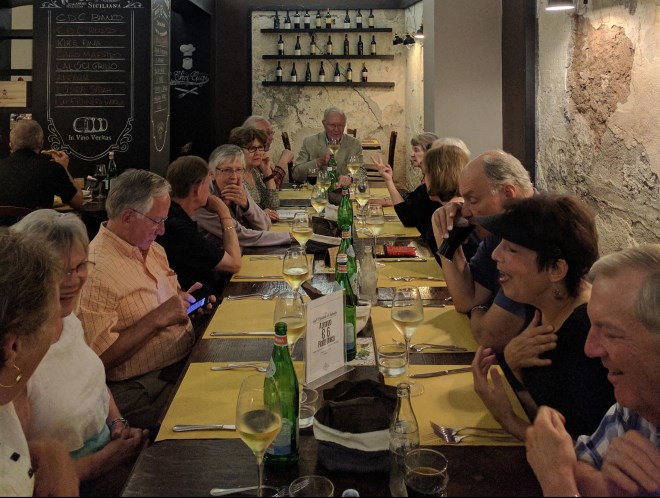
We said good-bye to our new friends at that night’s farewell dinner.
Once again, thank you Daniel!
Most were headed home, but very early the following morning (5 AM), Mike, Owen, Shirley and I started our Malta adventure, which I’ll be posting about next.
Full disclosure. This is no longer coming to you “live”. We have been home for a week. My blogging just couldn’t keep pace with our activities. We were BUSY! And when we weren’t busy, we were recuperating from the busyness… and drinking…and eating…and drinking.
Speaking of recuperation, the good news is that our friends recovered in time to join us the evening before we left for Ragusa. Daniel, our wonderful guide (We all love you, Daniel!) sent a doctor to the hotel in Palermo, then arranged for a driver to pick them up and bring them to our next lodging–the beautiful Agriturismo Berlingeri. AND while they were in Palermo, he had them moved to a larger room so they could be more comfortable. Pretty thoughtful!
Looking good after taking advantage of the Italian medical system!
So, about Ragusa. It is actually TWO towns–lower and upper Ragusa. After the earthquake in 1693, the majority of the population moved upward, but fortunately, some stayed behind to rebuild what is now Ragusa Ibla, the old town.
The two towns are connected by a LOOONG staircase. Graciela, our local guide, packed us onto a bus (and we were indeed packed) to the upper city so we could walk DOWN, which gave us ample opportunity to take in the panoramic views.
I didn’t count the steps, however it was NOT a strenuous stroll, especially given our frequent pauses–bathroom break, cold drinks, ogling everything. Graciela’s interesting stories kept us entertained and engaged all the way down.
See, not too bad.
Take a look at the underside of this balcony. Graciela pointed out that the top figure on the left is asking the top figure on the right for more food and drink. The figure on the left is responding with the universal hand signal for “go do something unmentionable to yourself.” Too bad the central figure is missing. Wonder what HE would have had to contribute to this interaction.
Lesson learned: take time to look UP. Cool things are EVERYWHERE!
Is it just me, or are some of these characters in dire need of dental care?
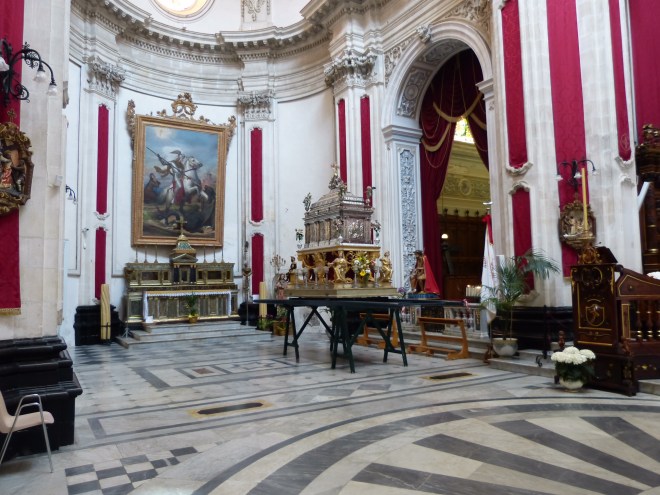
Our walk ended at the cathedral, where St. George plays a prominent role. Here’s HIS story. Initially, St. George was portrayed as a Roman soldier, who saw the light and ended up slaying the dragon. Graciela explained the dragon symbolized the pagans who were threatening the Christians.
Sometime during the middle ages, St. George got a make-over, becoming a medieval knight. This time the dragon was more specific; he represented the Muslims and Turks who were battling the Christians for control of the holy land. THAT St. George is portrayed in the huge painting on the cathedral wall. Nobody seemed bothered that George was killing dragons in two different centuries!
I bet you’re wondering what that silver and gold box in the middle of the cathedral is all about. Nope, it doesn’t hold the 10 Commandments and it isn’t a casket–but close. It holds 32 relics! Fingers, toes, pieces of the original cross–who knows? We didn’t get the specifics. One of our guides later commented “How many fingers and toes do you think the saints had?” Let’s ponder that for a while, and commend the entrepreneurs of the middle ages.
After our tour ended, we had free time to enjoy this lovely little mountain town.
Although there is a little trolley that can take you on a tour, we decided to walk off some of the great food and wine we had been consuming. Good thing, because the next day we headed off to a farm for a “Day in the Life” of a Sicilian family.
All OAT trips include a home visit or some kind of cultural exchange, and this trip was no exception. Here are Maria and her son John Baptiste, welcoming us to the family farm. John Baptiste, an archaeologist by training, is restoring the farm, which was his mother’s childhood home.
I know this looks like it could be an instrument of torture from the Spanish Inquisition, but it is actually the original wine press.
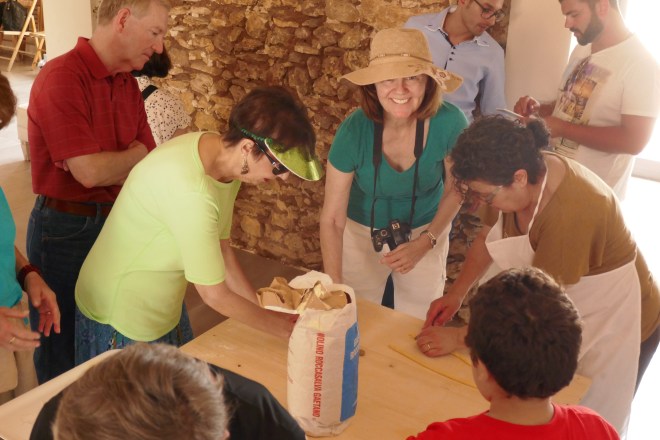
We didn’t make wine, but we DID help with the cooking, sorta the way my little 3 and 4 year old nieces help with cooking. The woman in the brown shirt and white apron? If it weren’t for her, the result would have been VERY different!
The food was magnificent! We could even tell ourselves that WE did some of the cooking.
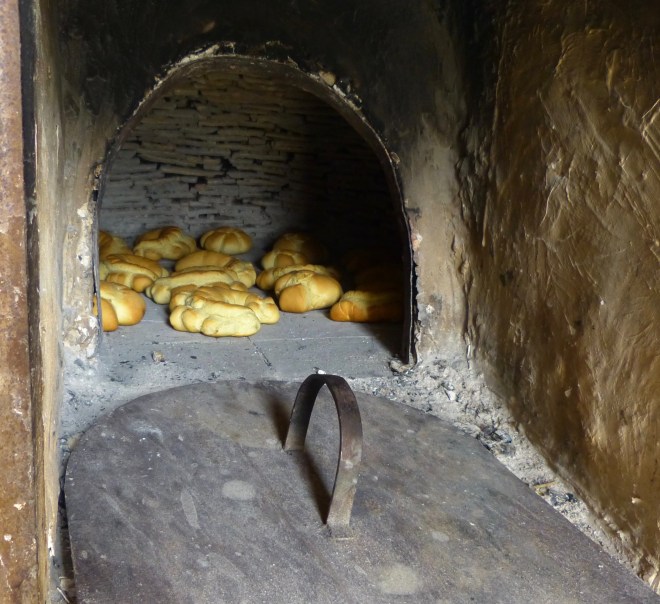
Check out the oven. Doesn’t get more authentic than this.
So what else would you need to know if you are going to visit Ragusa? Well, the hotel we stayed at–the San Giorgio Palace Hotel– is ideally located. It is at the edge of town, carved into the hillside, and is within walking distance of everything — all of the restaurants, shops, cathedral and park. There is a nice patio on the 4th floor, where you can sip a glass of wine and watch the sun go down over the hillside. It was quite wonderful.
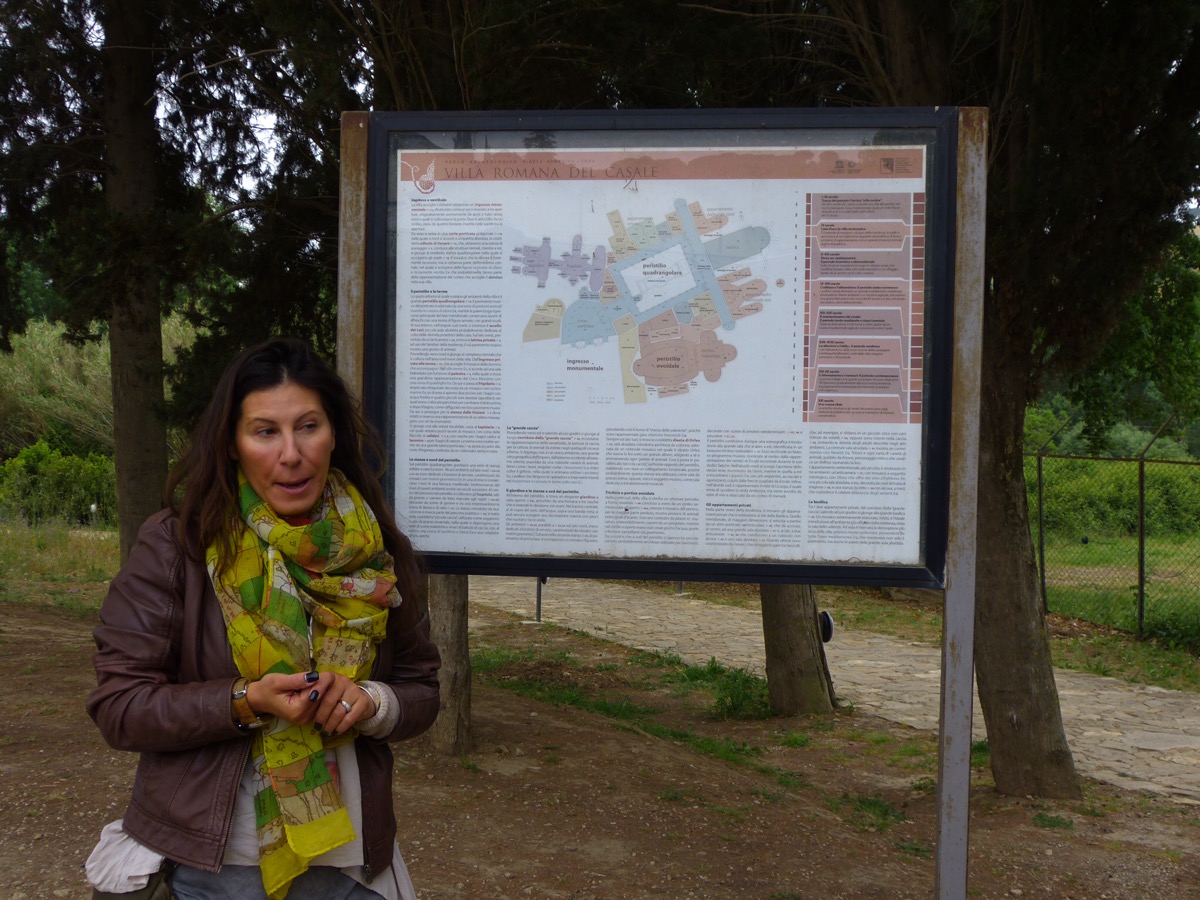
No one knows for sure who lived in the Villa Romana del Casale. Some think it might have been the country home of Roman Emperor Marcus Aurelius; others theorize a provincial governor lived and conducted administrative duties here.
It was constructed in the middle of the 4th century AD, and owes its remarkable preservation to the mudslide that covered the villa in the 12th century. The building remained hidden until the 1950’s excavations.
Katya, our local expert, explained that we were going to view some of the finest examples of Roman mosaics in all of Europe, with scenes ranging from Homeric escapades to depictions of daily life, at this UNESCO World Heritage Site.
Katya was excellent, and that was true of all the local guides on our trip. We learned that our main guide, Daniel, had a choice of 4 or 5 different local guides for each site, and I have to say, he chose very well. Katya was interesting and so informative, a delight to listen to.
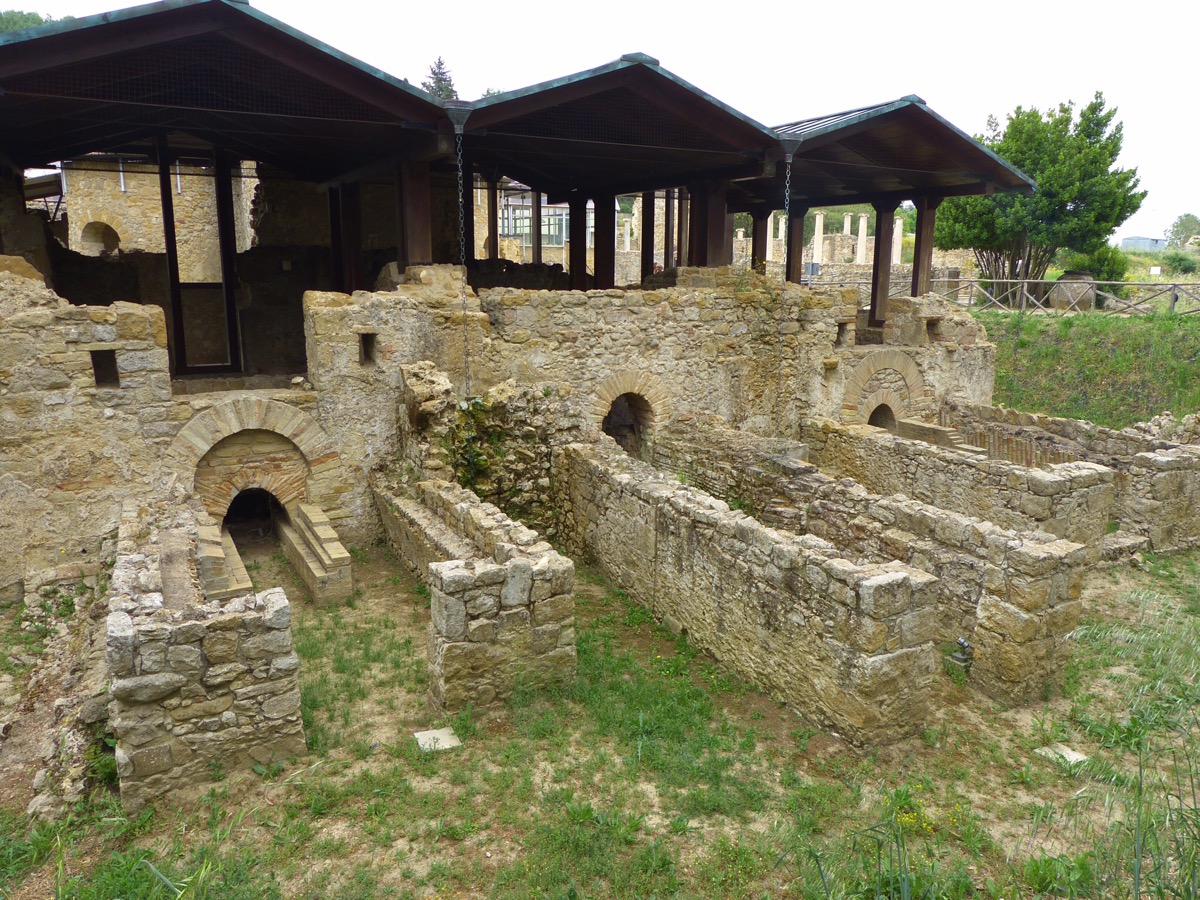
We began our tour by the aqueduct, which was the source of water for the baths–starting with the hot bath, and ending with the frigidarium, the cold bath.
The slaves kept the fires going in these ovens so that the baths were at the proper temperature.
I wasn’t taking notes, so don’t hold me to it, but I THINK this was the frigidarium. Or it was something else. Whatever. It was impressive.
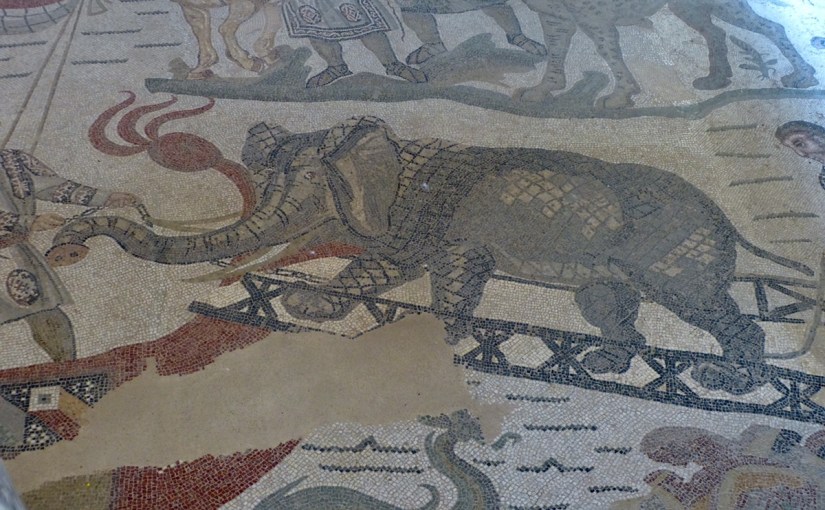
The main attraction of the villa is the floor mosaics, and they are absolutely magnificent.
Probably the most famous room, the 10 maidens are exercising, wearing the ancient version of bikinis. And look, someone appears to have won the swimsuit competition, earning her a crown and a palm leaf to wave around.
Not quite so famous, but certainly as intriguing were these: one example of the many scenes of a hunt.
This woman’s clothing indicates she was from the eastern empire, possibly Muslim. There is another mosaic of a similarly attired woman, being carried off by soldiers. It isn’t hard to imagine what that mosaic was illustrating.
No commentary necessary for this one.
I particularly liked the depiction of the theater. Looks like the legend of the Cyclops was being featured.
Those white squares on the mosaic–I thought someone had been littering, but no. They were placed there intentionally to absorb moisture.
Here’s a close up of Cyclops. I really DID like that mosaic! Isn’t it amazing what the craftsmen were able to do with little colored stones?
One last look at the countryside and we’ll be on our way. Our timing was fantastic. We were leaving, just as hoards of tourists were arriving!
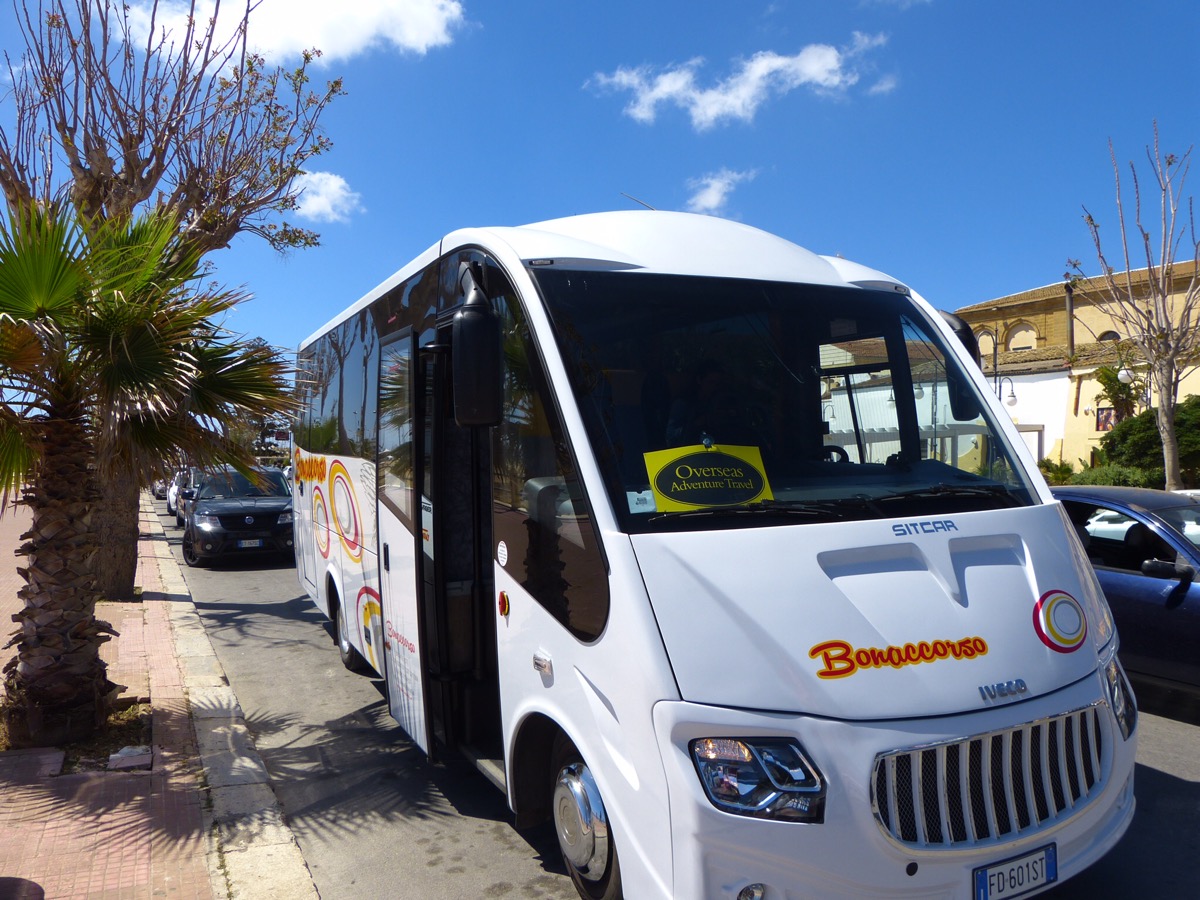
I know. You are all just itchin’ to find out how we are getting from point A to point B on this island. Well, itch no more, because not only will I TELL you, I’m also giving you the visual. We have been traveling in comfort on this lovely bus. There are only 16 of us, plus our guide, so we have LOTS of room to to spread out.
The view from these huge windows has been amazing. We definitely chose the right time to visit Sicily–the wild flowers are blooming, everything is lush and green, and the temperature has been perfect!
We are all so grateful that Marco, our bus driver, is manouvering along these winding, VERY narrow roads, up and down the hillsides. All we had to do is sit back, relax and take it all in.
Once again, we will be time traveling, all the way back to Ancient Greece. I don’t know why, but I just got a flash back to Mr. Peabody and his boy, Sherman, of the Rocky and Bullwinkle Show. (“Every dog should have a boy”. God, I loved that show! ) How sad that so much of my knowledge of history, at least what stuck, came from cartoons and Walt Disney! But I digress.
When we arrived at the Valley of the Temples, we were greeted by another Marco, our guide for the site. An archaeologist, he came equipped with maps, diagrams, and an abundance of enthusiasm.
Sadly, the site had been picked clean by those successive waves of conquerors, so it was difficult to extract much information about the lifestyle of the original Greek inhabitants of Akragas (as the area was once known) from artifacts, bones, shards, etc.
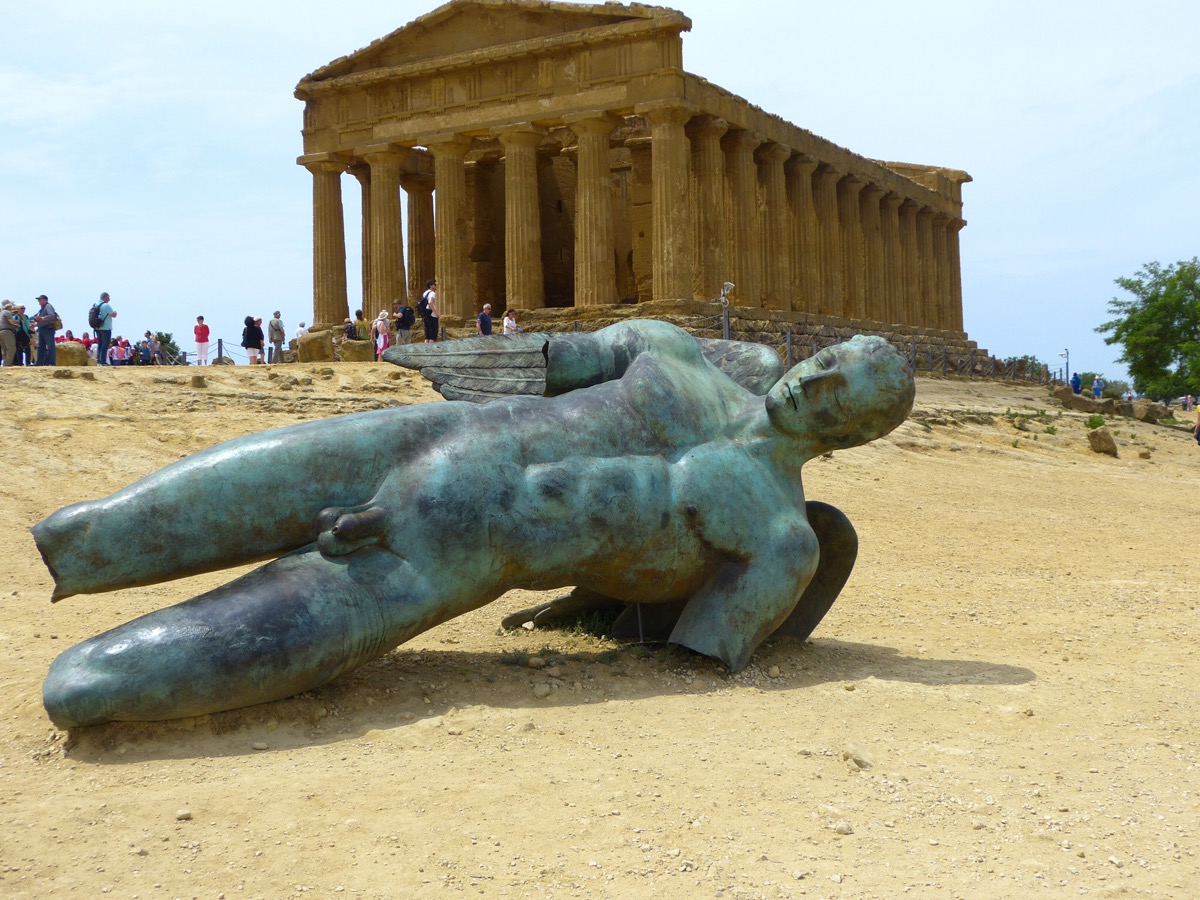
Fortunately, though, eight Greek temples remain at this UNESCO site, all built between 510 and 430 BC. The best preserved temple, called “Concordia” by the non-archaeologists, (because the archaeologists didn’t have sufficient info to determine the correct names of the temples) was saved from being scavenged by the locals because it was transformed into a church by the Normans. Walls were built between the pillars, and the entrance was changed, then at some point (and yeah, I forgot what Marco said. Sorry!) it was all changed back.
From the valley, you can see the modern city of Agrigento, just beyond Greek temple F (the archaeologists’ name for Concordia. )
What Marco COULD tell us was that these arches were once the entrance to Greek tombs, that were later repurposed by the Normans for shelter, with the actual grave used as a manger for their animals. The Greeks dug shallow graves — only about a foot and a half deep– and covered the hole with rocks. Who knows what the Norman’s did with the remains they found when they moved those rocks!
My favorite part of the site, however, was this incredible sculpture of Icarus, who fell from the skies because he flew too close to the sun. Clearly, HE hadn’t been under water for 2,000 years! Also clear was that he was a modern addition to the site.
After our tour, it was time for lunch at this lovely private home.
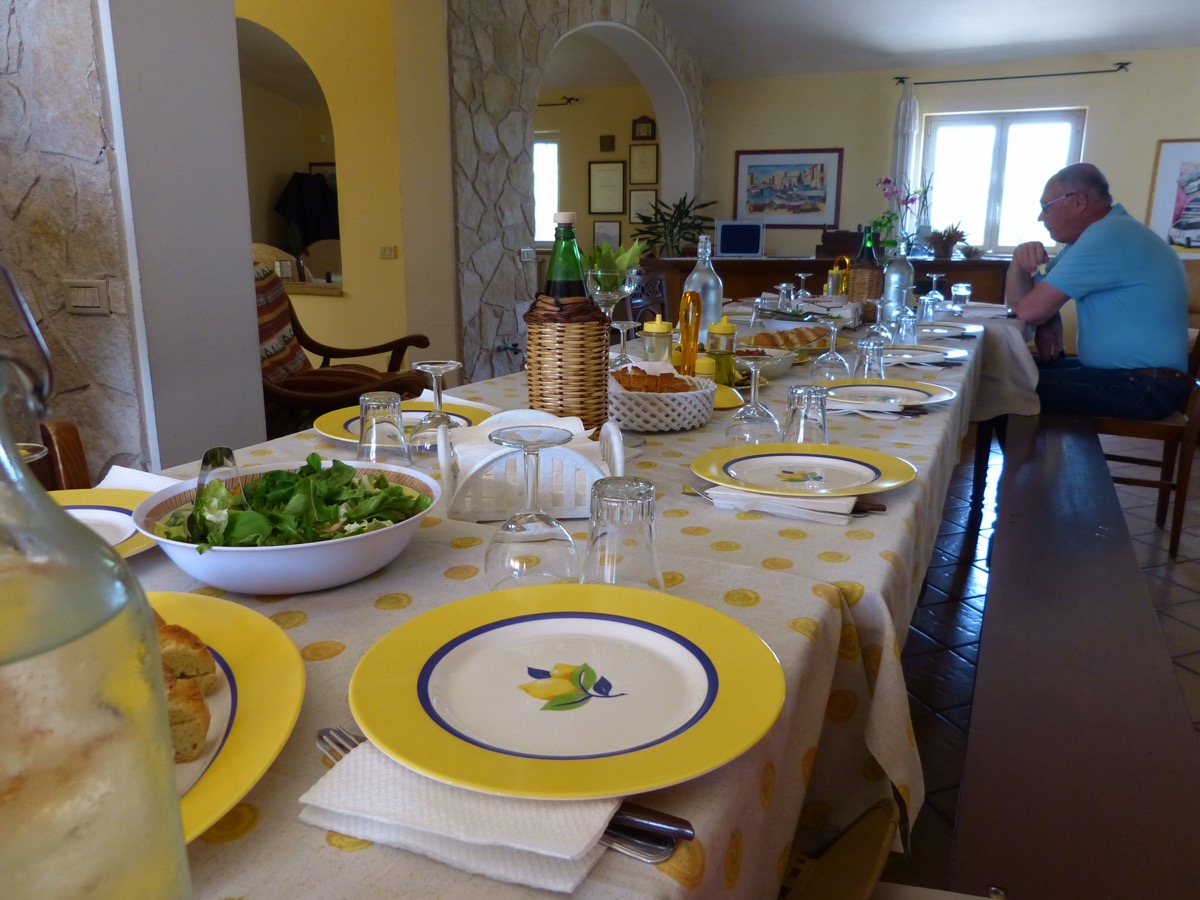
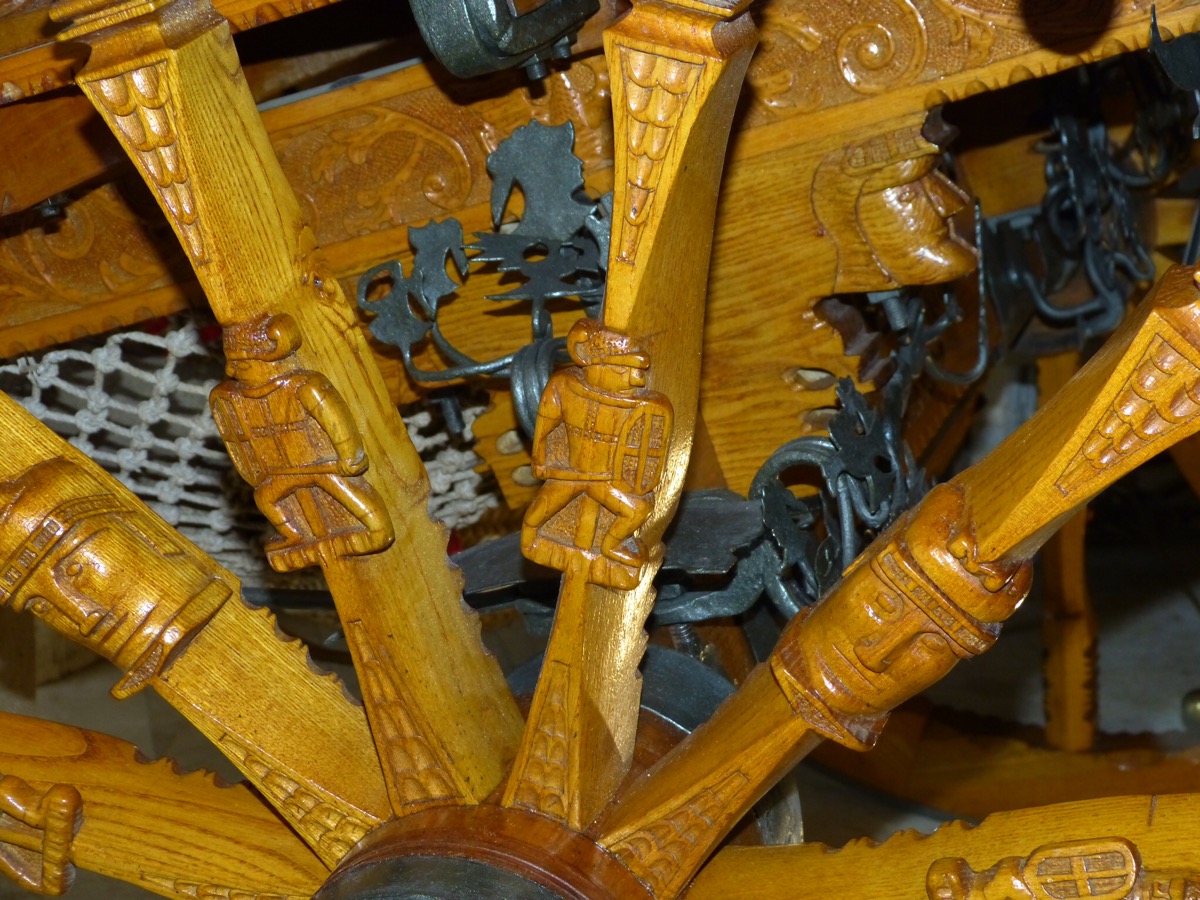
You’d think we would have figured it out by now. What we THOUGHT was the lunch, was actually just the antipasto, followed by several other courses. We have concluded that we need to get much better at pacing ourselves! But if the food wasn’t enough, there was yet another surprise in store for us: The owner’s grandfather had been a renown craftsman, creating donkey carts that were truly works of art.
The paintings on the sides of the carts were of historical events, like this one depicting the assassination of Julius Caesar.
Even the spokes on the wheels were intricately carved.
Here’s our hostess, who also functioned as guide, cook and server.
These magical interludes are a big reason that Mike and I travel with OAT. We NEVER would have been able to arrange for some of these fascinating encounters on our own!
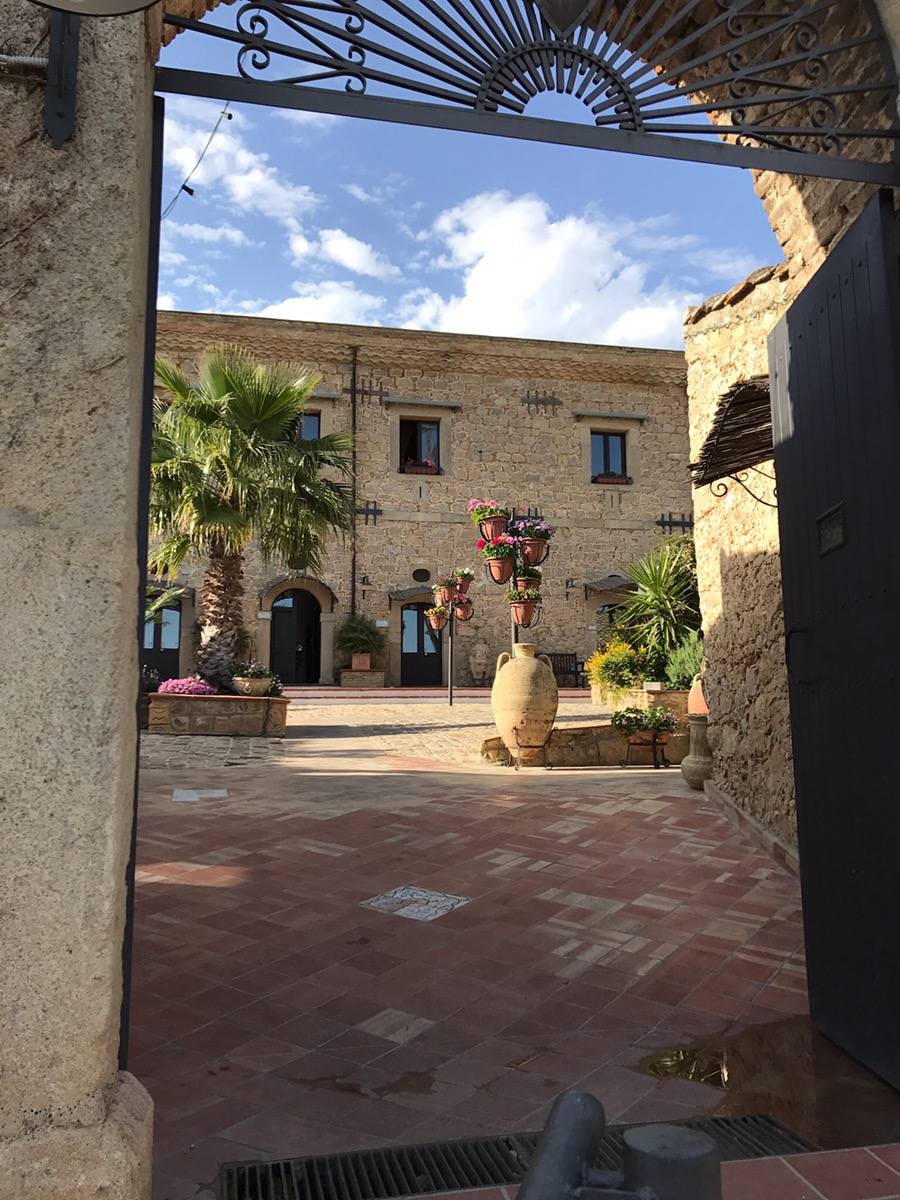
By now, we were completely sated with food and culture, ready for our one night stay at Vecchia Masseria in Piazza Amerina.
And yes, it really WAS that beautiful. Another agritourismo, in a pastoral setting with delicious, locally sourced food. Life is good.
What an island! Strategically placed between Africa and Europe, the east and the west, Sicily was home to successive waves of conquerors, and for our second day, we visited one of the conquering heroes’ settlements. The Phoenicians, originally from the area that is now Lebanon, were among the first waves.
But first, we took a close look at the commodity that gave us the word “salary”. Sal (salt) was once used by the Romans as currency. Unlike other parts of the world, where salt is mined, the salt here is extracted from the sea. The water evaporates from shallow beds, leaving behind a substance that is low in sodium, high in potassium and magnesium. The Trapani salt is practically a health food! The sea, the wind, the sun all work together, with a little help from human workers, to create this miracle ingredient. Doesn’t get more natural than that.
After learning more than I ever thought possible about salt, we boarded a boat for the little island of Mothya, where almost 3000 years ago, Phoenicians built a fortress and a settlement.
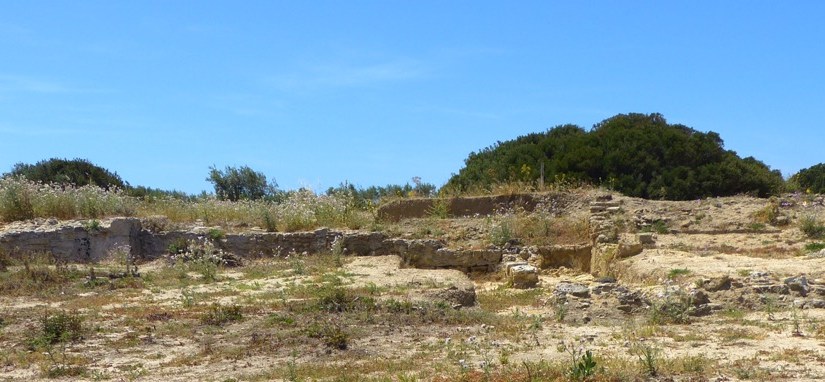
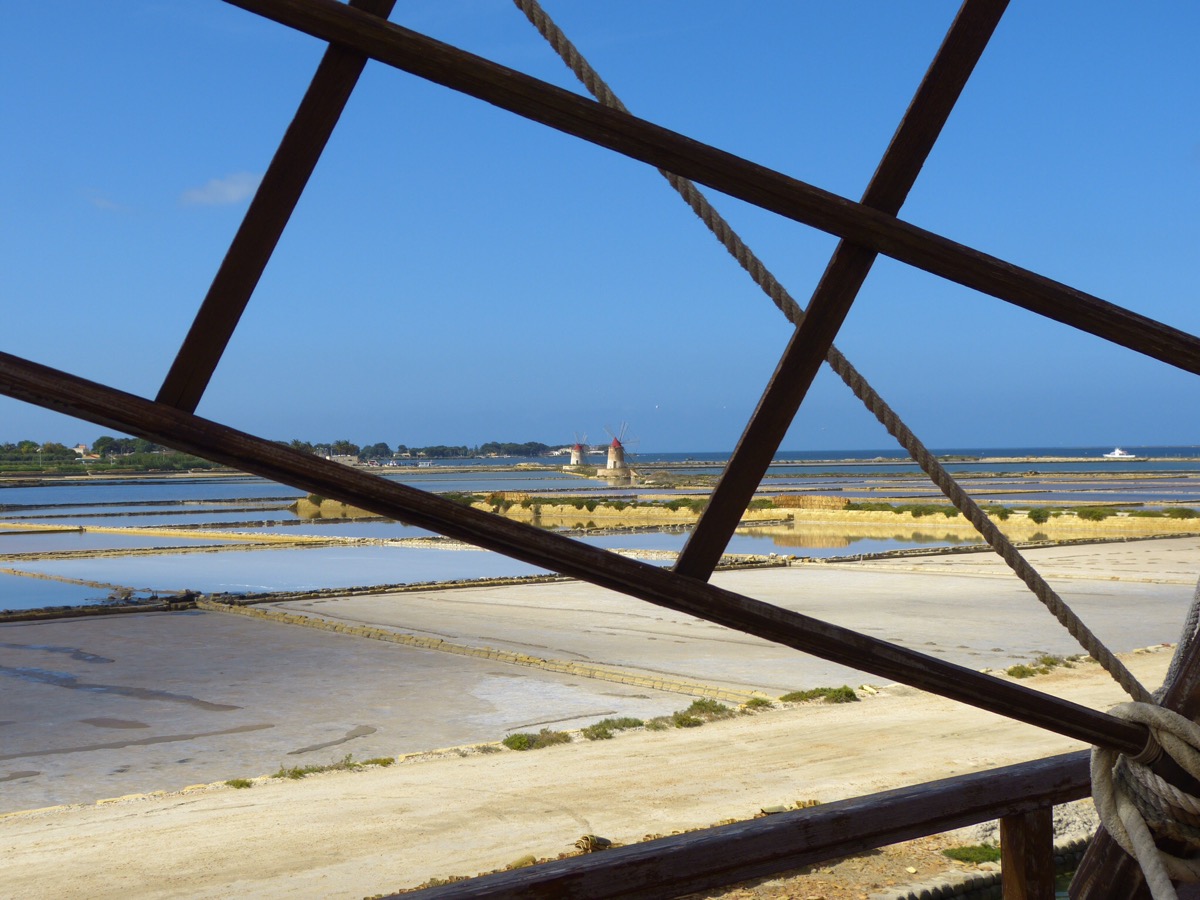
There’s not much left on Mothya, just some walls, (header photo) and a museum that once was the home of Giuseppe Whittaker. Whittaker, in fact, owned the entire island. Fortunately, he was interested in archaeology and history, left his home and property to the public.
The salt museum contained this rendition of what the settlement was imagined to be.
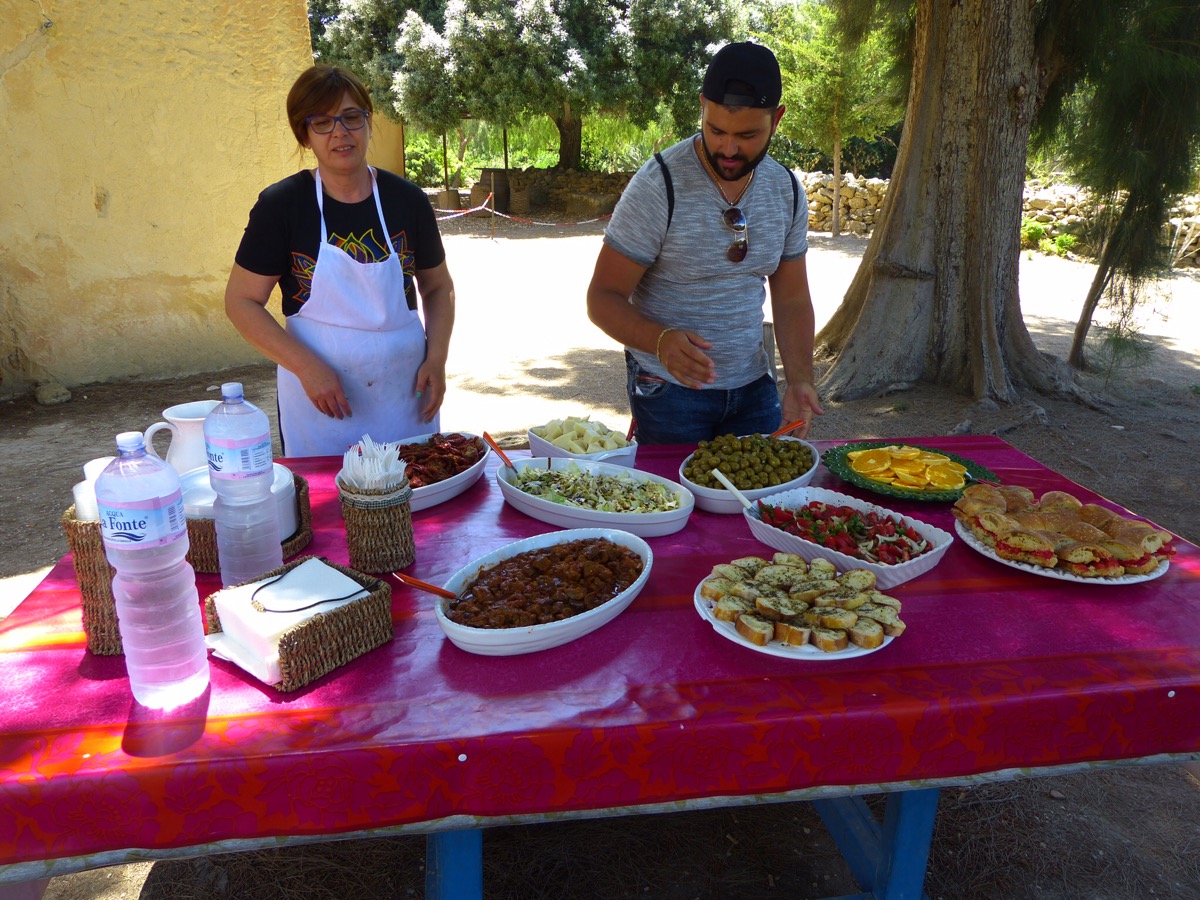
It’s not a big island; we were able to walk from one end to the other, working up an appetite for this amazing feast!
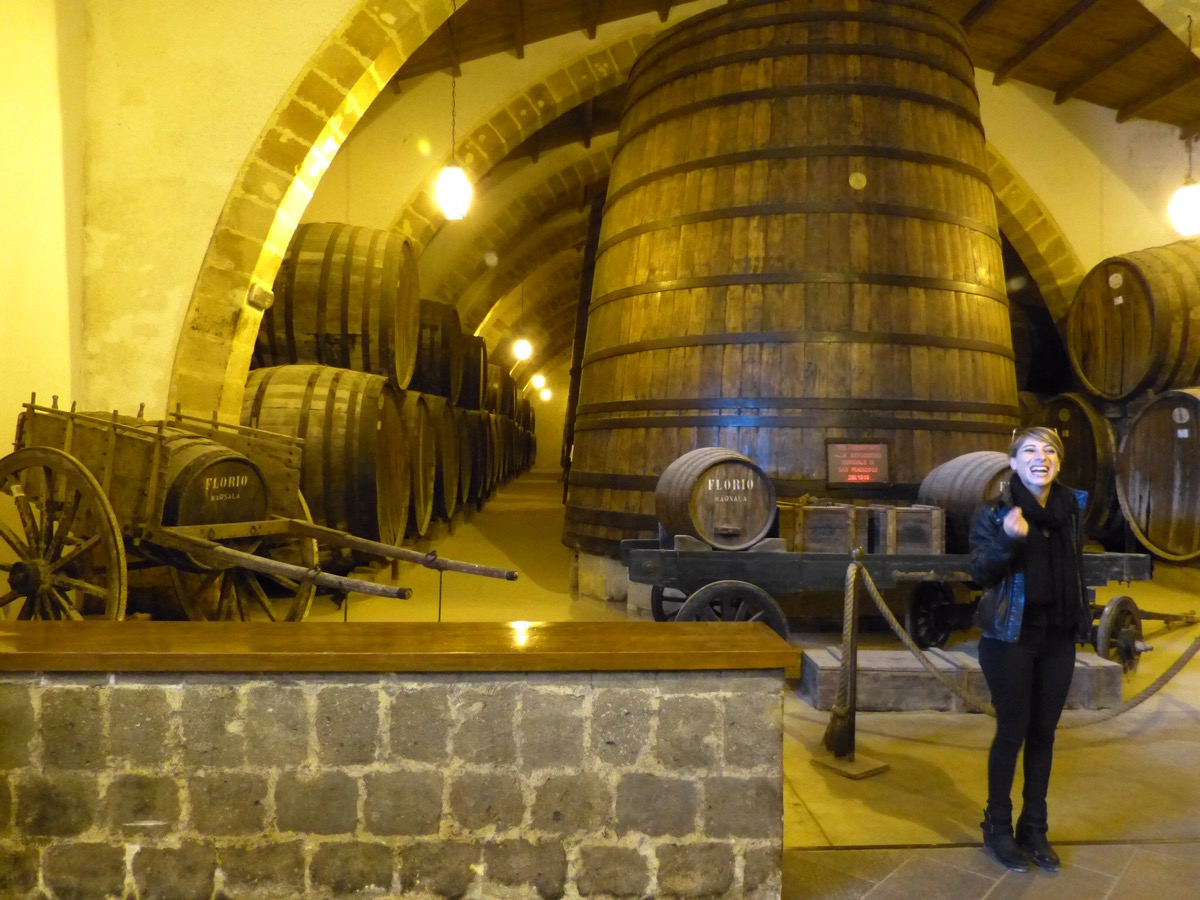
Our last stop was at the place the Arabs called “Marsa Allah”, the Port of God, now known as Marsala, for wine tasting. Check out the size of those barrels. That’s a whole lot of Chicken Marsala!
It is rare indeed that my wine glass is still full after a wine tasting. In fact, I would say that this was a first. To me, Marsala is way too sweet. Okay for cooking, but definitely not my choice for drinking.
Once again, my best laid plans have gone a bit astray. Somehow I managed to come down with a raging cold on the day we departed for Sicily. That undoubtedly earned me the hotly contested title of the flight’s Most Hated Passenger as I coughed my way across the Atlantic Ocean.
Ah well, one of the clear advantages of being older is you have learned to roll with whatever comes your way. Although, truth be told, there wasn’t much rolling, or any other kind of movement going on for the first two days we were in Palermo. I pretty much took to my bed, being unwilling to share whatever I had acquired with my fellow travelers. One definite advantage to group travel is Mike was able to enjoy sightseeing with the others while I rested up.
By day 3 (Saturday), I was able to venture forth, so we decided to strike out on our own.
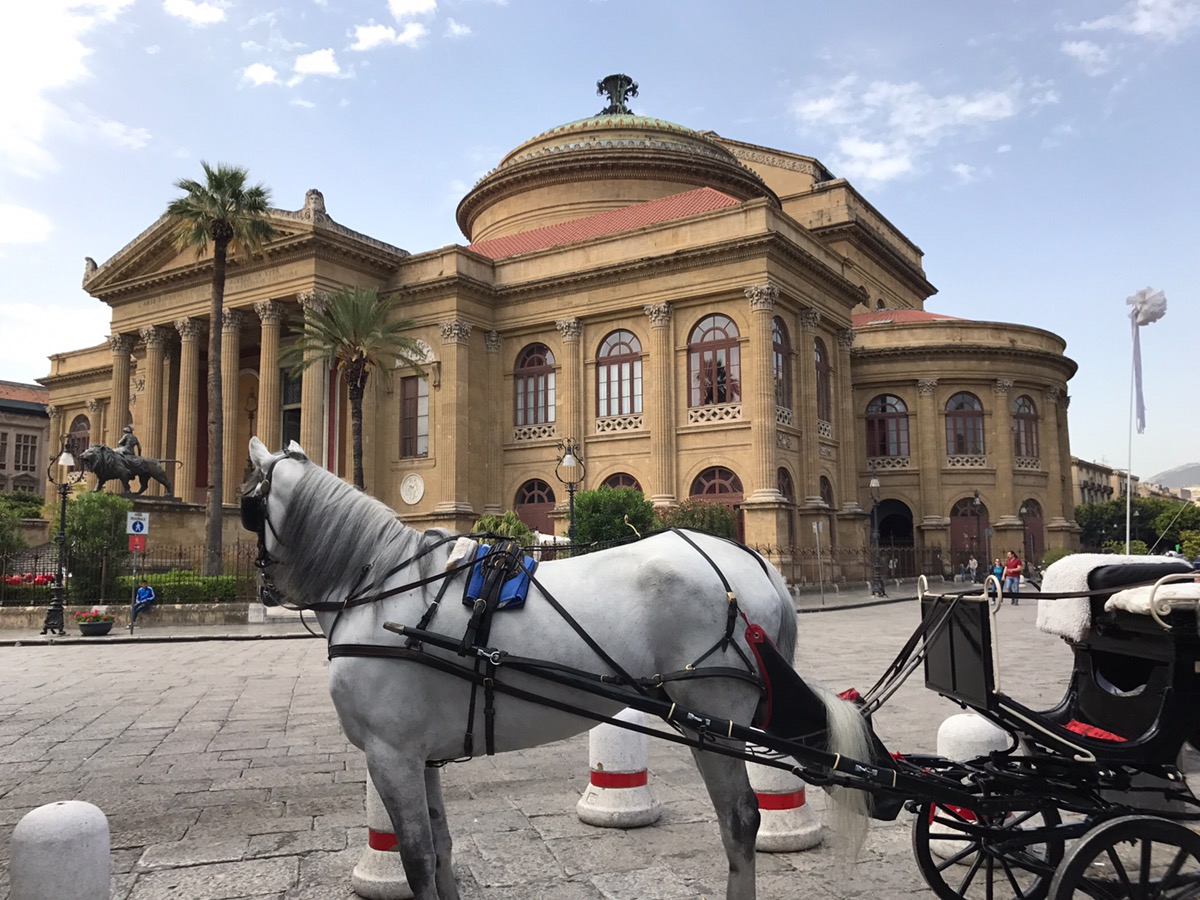
Right by the opera house, we hopped aboard the free trolley, to one buggy driver’s disappointment. Pretty amazing that Palermo offers free transportation around the city to everyone!
Our first stop was what is now known as the Norman Castle, which started out as an Arab fortress. In the 1100’s it became King Roger 2’s humble abode. King Roger 2 was quite an impressive guy. This Norman ruler managed to pull off what current world leaders haven’t been able to accomplish: Christians, Jews and Muslims coexisted in harmony during his reign, melding together the best of their cultures.
The geometric designs in the ceiling of his bedroom have a definite Islamic flavor. This is one small section of a very elaborate design. I wonder if those gold mosaics glow in they dark. Does the beast in the center remind you of Maurice Sendak’s book ” Where the Wild Things Are”? I guess that’s one way to prevent your kids from crawling into bed with you. Now why didn’t WE think of that?
To get to that royal apartment, you had to climb up several massive staircases. I counted 100 steps! No gym membership required for Roger. But he didn’t have to travel far for church services. The Palatine Chapel is on the floor below, so he could roll out of bed and be at mass in less time than it took to place his crown on his head. Like the Royal Apartment, the chapel is shiny and bright, with Christian and Muslim motifs covering every surface.
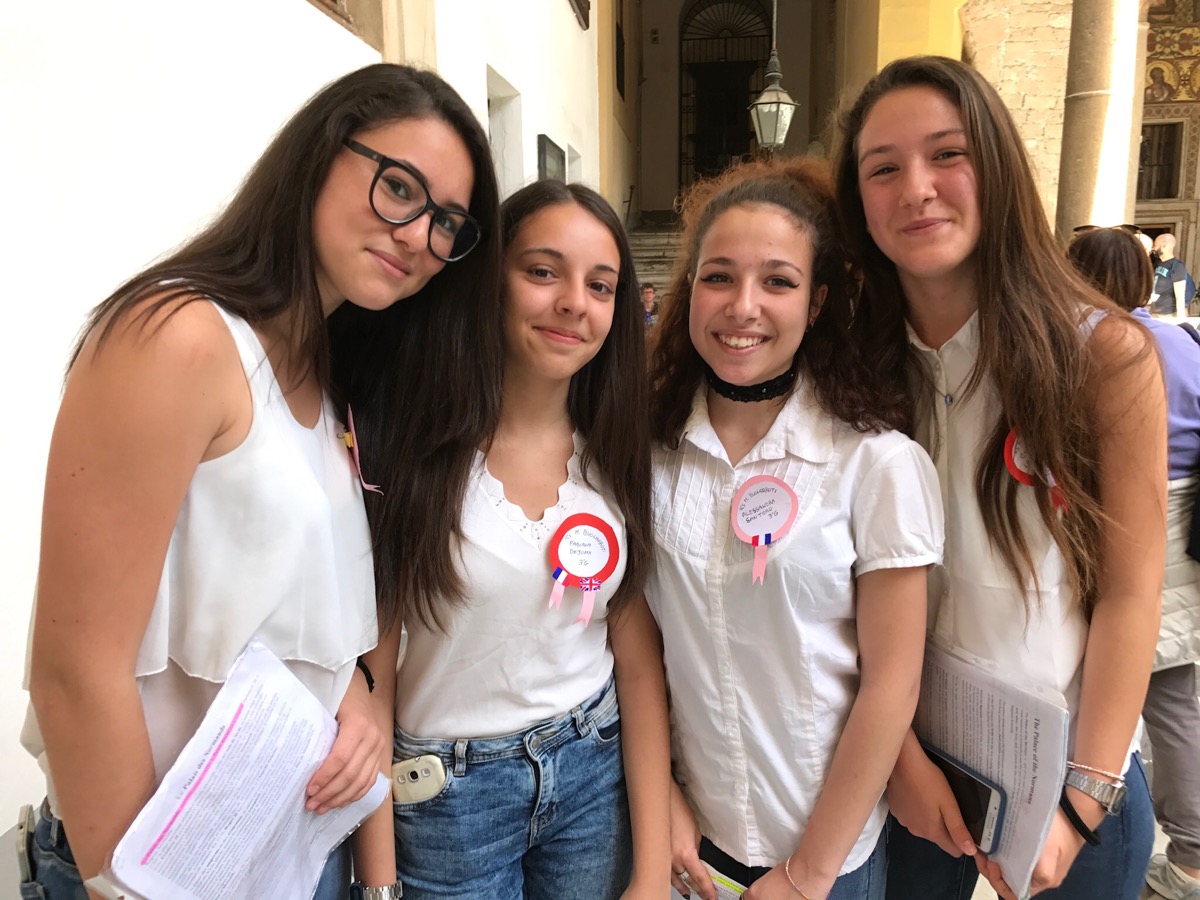
At the start of our visit, we were approached by a woman who asked if we would like a free guided tour in English. Her students, these four young girls, were eager to practice their English on us and earn extra credit. What a nice idea!
The building has been remodeled multiple times over the years. The courtyard outside the chapel, for example, was redecorated around 1600.
Pay close attention to the portraits on the bottom. They form a border around the perimeter of the courtyard. These were notable saints…every last one of them male. So, either there were no women saints deemed worthy of a spot on the wall OR women’s virtue was so taken for granted that it didn’t seem they had to put any effort into attaining sainthood. So why make a big deal about it? You decide which explanation rings true to you.
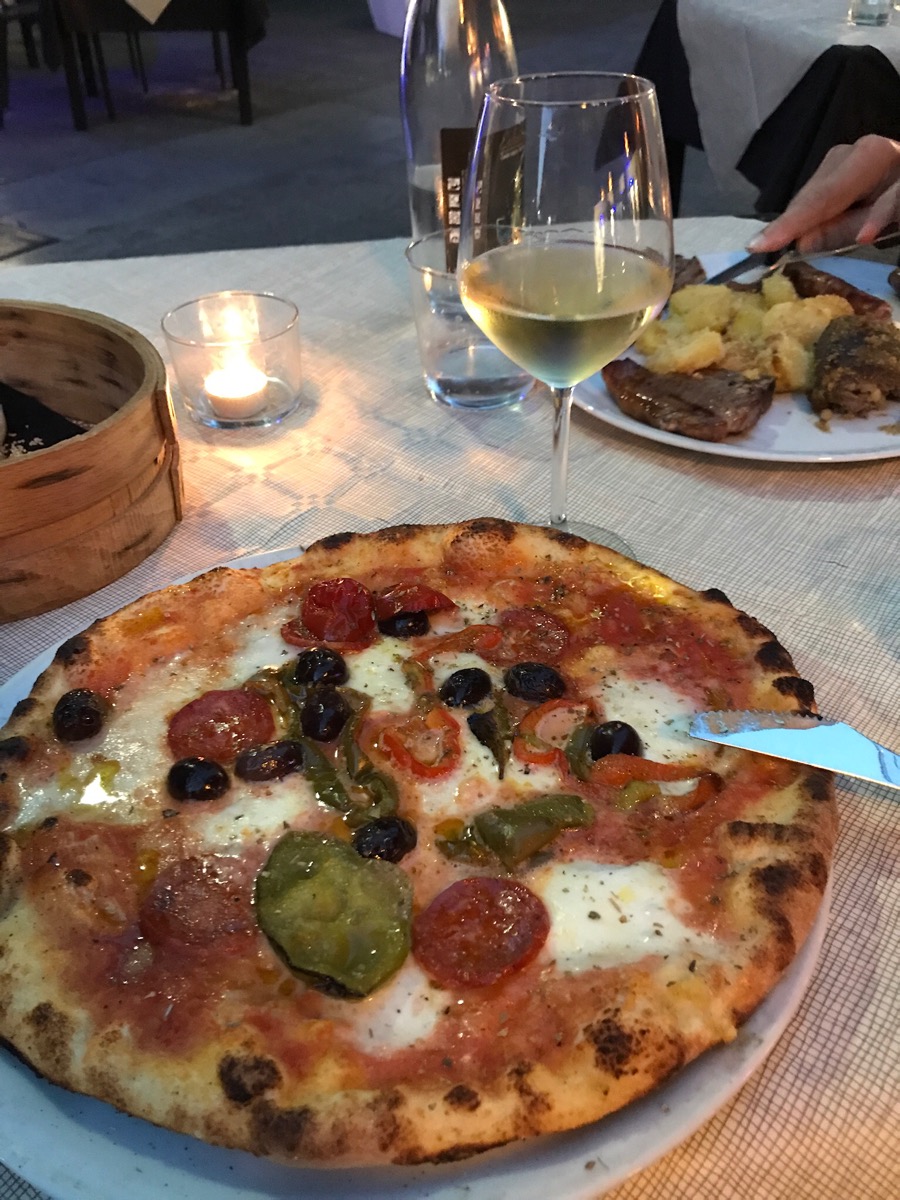
Rather than go into culture overload, we decided not to overdo it, so headed back to rest up before dinner at Vino y Pomadoro, a wonderful restaurant close to our hotel. The menu had English “subtitles” so I was very relieved. I have this fear that I would accidentally order something that would horrify me, like pizza with rabbit and horseradish. Here’s what I got.
Mike and I stopped giving each other “stuff” years ago. We already have more than enough future yard sale items. No more birthday, anniversary, Valentine’s, Christmas or Groundhog’s Day presents for us. Instead, we mark life’s milestones by making memories, mostly through traveling. Refusing to succumb to the tyranny of the calendar, we are free to celebrate whatever we want, whenever we want. If we happen to be traveling during an anniversary or birthday month, well then, that’s just a bonus. THIS year is one of those bonus years.
We will be in Sicily during May, our anniversary month, hoisting our glasses to toast 41 years of wedded bliss. Okay, full disclosure. Those years haven’t ALL been blissful (my sisters would add ” especially for poor Mike” ) but on the whole, it’s been pretty darn great!
We will be embarking on an OAT (Overseas Adventure Travel) trip with our good friends, Shirley and Owen. Two years ago we spent two weeks wandering through Tuscany and the Amalfi coast with OAT’s sister company, Grand Circle. They had never been on an organized tour before, but had such a wonderful time, it was not difficult to persuade them to come along again. What’s especially exciting is that Shirley’s grandfather hails from a small village two hours from Palermo. She and Owen plan to make their way to the village on one of our “free” days.
This is what our OAT itinerary looks like. As you can see, we are covering quite a lot of ground.
We will be staying for three nights in four of the cities: Palermo, Mazara, Ragusa and Catania, with a single night in Piazza Armerina. At the end of the OAT tour, the four of us will head to Malta. From Catania, we will fly to Valetta and will use that as our base during our five days in Malta.
As usual, I’ve been learning the history of the places we’ll be visiting, and I have to tell you, theose poor inhabitants of Sicily did not have an easy time of it. Here’s the Cliff’s Note version: There was a lot of fighting and conquering going on–with Greeks, Romans, Carthaginians, Arabs, Normans, and Spaniards taking turns raping, pillaging, plundering and selling inhabitants into slavery. Sicily isn’t at the bottom of “the boot” for nothing. It sure got kicked around a lot!
Augustus, Hannibal, Constantine, Archimedes, and several Williams, Charles and Fredericks all had starring roles in Sicily’s narrative. (Don’t you just hate it when the rulers all have the same name and you need to remember their numbers? At least for the Williams there was William the Bad and William the Good.) Throw in a couple of popes, an emperor or two, some knights plus a couple of earthquakes and an active volcano and you are guaranteed some interesting stories with even better ruins.
What fascinates me more than the political history is the mythology. Unlike the kings, whose moms sorely lacked imagination when it came time to name their offspring, the mythological figures have double names: Zeus and Jupiter, Ulysses and Odysseus, Venus and Aphrodite. So confusing to an already confused American, but that’s what happens when Greek and Roman cultures share the same territory.
For now, that’s all you need to know about Sicily’s history. More will be forthcoming, and there’s always the possibility of a pop quiz or two.
Preview of coming attractions:
Lots of cathedrals, temples, palaces, amphitheaters plus a dancing satyr
Eye popping mosaics, fit for an emperor, like maybe Marcus Aurelius?
an educational encounter with a member of the Mafia
a cooking class (hope we do better than the last time we tried this!)
“Come with me to the kasbah, where we will make ” whatever they make there. (If you got that reference, you are probably as old as I am!)
wine tasting at a Marsala vineyard
a day in the life of a Sicilian dairy farm family
a visit to Mt Etna to watch the volcano do its thing
Please join us for some armchair traveling. I’ll be posting whenever wi-fi and my energy levels allow. But I have to warn you, I plan to be toasting those 41 years a whole LOT! Expect typos.
Oh yeah, about that photo at the top of this post. It’s actually Sorrento, from our 2015 trip. I just wanted a little visual to start us all off.
The first time I visited our nation’s capital was in 1970, when I hopped on a plane (another first) to join with hundreds of thousands protesting the Vietnam War. My college roommate and I had no idea where we would be staying. and as typical college students, we had very little money, but somehow it all worked out. Like Blanche DuBois, we depended on the kindness of strangers, and we weren’t disappointed.
Fast forward 47 years. Sadly, so many of the issues we THOUGHT were being addressed are still problematic. Though we recite the pledge of allegiance, we still have to work to make “liberty and justice for ALL” more than just empty words. Surprisingly some of the truths that Tom Jefferson thought were “self evident”, today are not.
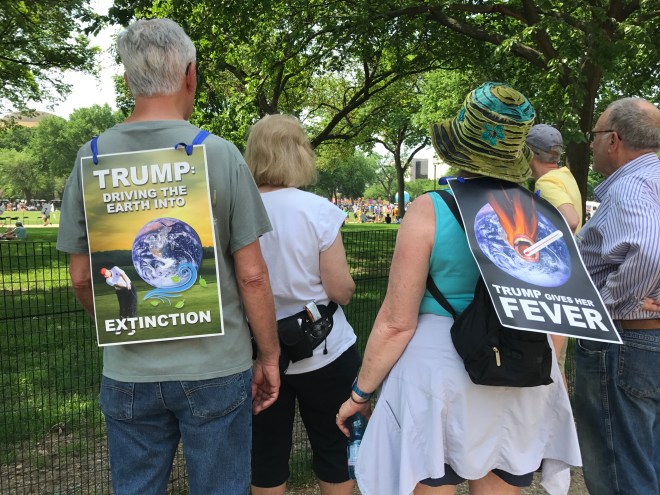
Yesterday, Mike and I arose at 4:30 AM to board a bus for D.C. with 50 like minded citizens to participate in the People’s Climate March. Spirits were high. On the drive down, Stacey, our efficient and amazing leader, reminded us of the rules of engagement established by the March organizers: No violence, verbal or physical toward anyone, be respectful toward all people and property, look out for each other, pick up after ourselves. Essentially, reminding us to behave the way we should every day. Got it.
It was not surprising that this year’s march had a bit of a political bent to it, given our current president’s assault on the environment.
Isn’t it hard to believe that it is necessary to demonstrate for clean air, clean water and the preservation of our planet for future generations? Who could possibly be against that?
Perhaps companies and innovators will view the masses of demonstrators as potential customers for their energy efficient products. Perhaps our legislators will recognize that they have a constituent or two (or a few thousand) that cares about our beautiful country. One can only hope.
I marvel that suddenly politicians are glorifying working in a coal mine. Is it worth defiling our nation’s waterways to allow miners the opportunity to get black lung disease? Loretta Lynn isn’t singing “Proud to be a coal miner’s grandmother”. Full disclosure. My knowledge of mining is limited to watching Loretta Lynn’s movie “Coal Miner’s Daughter”and reading the news, but I believe that miners are like the rest of us, wanting a good job, healthcare and a better life for their children. I also have a sneaking suspicion that Paul Ryan and Mitch McConnell wouldn’t be thrilled to have THEIR offspring going down into the mines doing those jobs they are hell bent on preserving, but I digress. Back to the march.
How wonderful to see all ages represented, from babies in strollers to seniors carrying pictures of their grandchildren and great grandchildren. Despite there being marches throughout the country, many marchers traveled great distances to surround the white house. We encountered travelers from Minnesota, Ohio and Iowa. Now that’s what I call commitment!
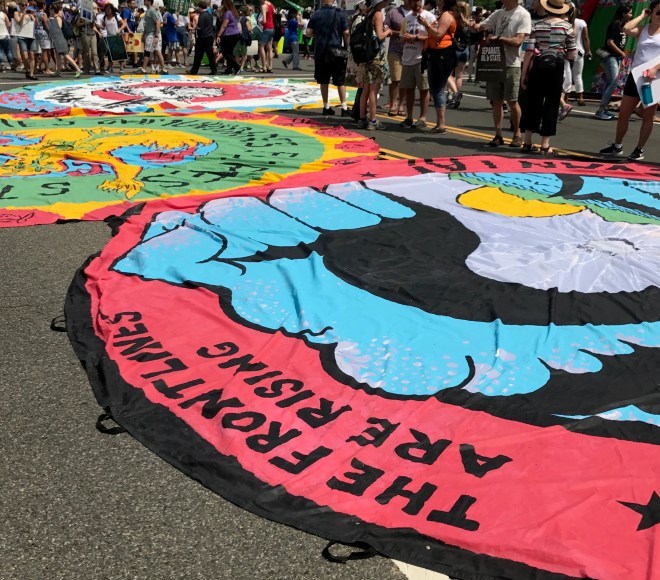
It was difficult to get a sense of the size of the crowd while we were in it. Fortunately, photographers along the route were capturing images like this one ( grabbed from 350.org’s facebook page). Despite a late start, and April temperatures that should have made believers out of any climate change deniers, the crowd was focused, disciplined, polite and spirited. “This is what Democracy looks like” was a popular chant, as we made our way to the White House.
I offer photos from this inspiring day in the hope that you will join us, in whatever capacity you can, as we all continue to protect Pachamama (the name given to the earth, by the indigenous people of the Andes–a goddess indeed). It isn’t a march, it’s a movement! Remember–
 It’s beautiful, it’s just outside Valetta’s wall, it’s close to buses that can take you wherever you want to go, the service is great, the pool is fantastic, the views from the restaurant and bars are incredible, and it is relatively inexpensive (at least it was in May, with several months advance booking. )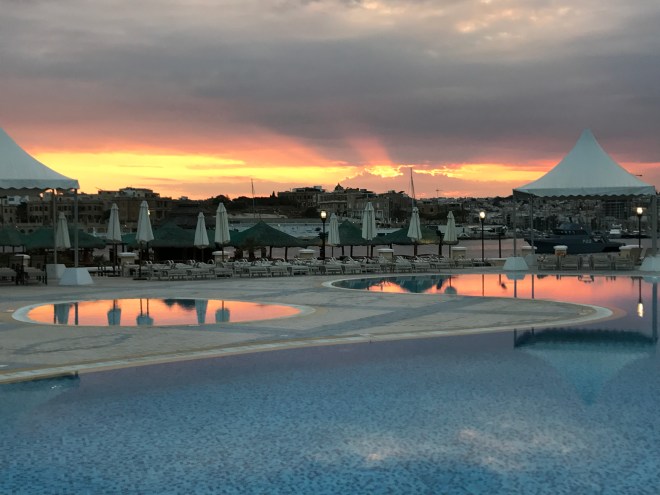




 Perhaps you arrived in Malta without doing any research at all. You know NOTHING about its history or the history of its many invaders. Not to worry. All you need to do is buy a ticket to The Malta Experience, then sit back and enjoy. You will be quickly brought up to speed! There are other options on the island, including one that promised you a 5D experience (moving seats, water spray, air blasts and leg ticklers) but this was the one we chose and we were not disappointed. Now if we had been traveling with children, we probably would have opted for the multi-sensory extravaganza.