Saving Nepal’s Best for Last

After our stay at the comfortable, but basic, Seti River Camp, it was a complete shock to our senses when we arrived at the Kasara Chitwan Resort.  We were experiencing luxury overload!
image
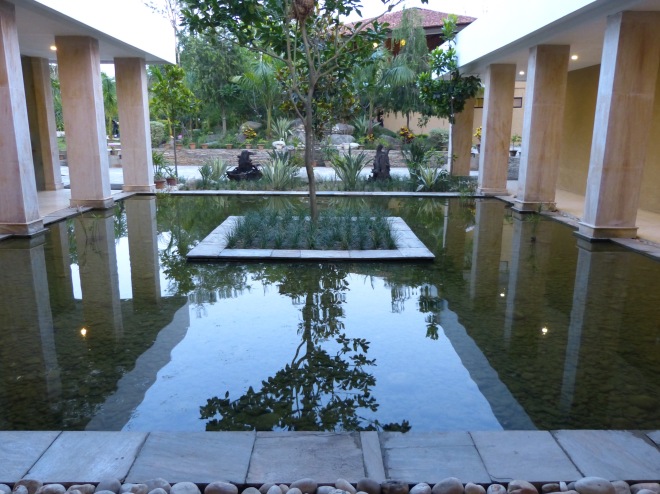
The reception area

I was expecting a room, not a stand alone suite.  When I opened my door, I entered this private courtyard.  The photo doesn’t do it justice, but I was too focused on enjoying my surroundings to put much energy into a photo shoot.
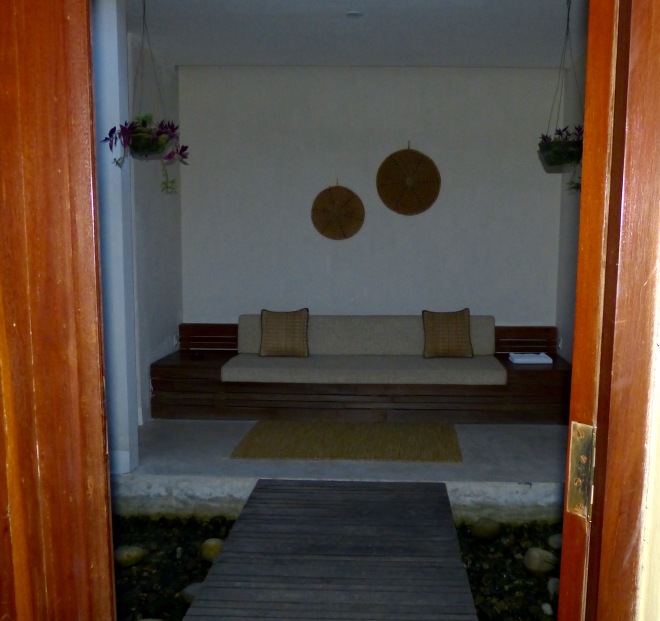
image.jpeg
Air conditioned bedroom on the left, bathroom with open air shower on the right, and a beautiful courtyard in between.  Those are little ponds on either side of the boardwalk, complete with resident frogs.

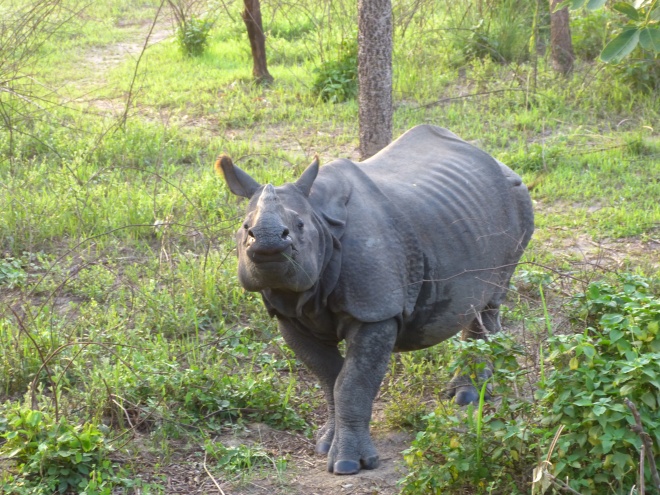
After getting settled, we headed out to hunt for  black rhinos.  Success!   We saw several.  My favorite is this shot, because he seemed a bit bored by us gawkers.
image
So what the heck are YOU looking at?

Our mode of transportation during our “safari” was a platform mounted on the elephant’s back.  It was not the most comfortable ride, for us, or probably for the elephant either, but it was a fun experience.
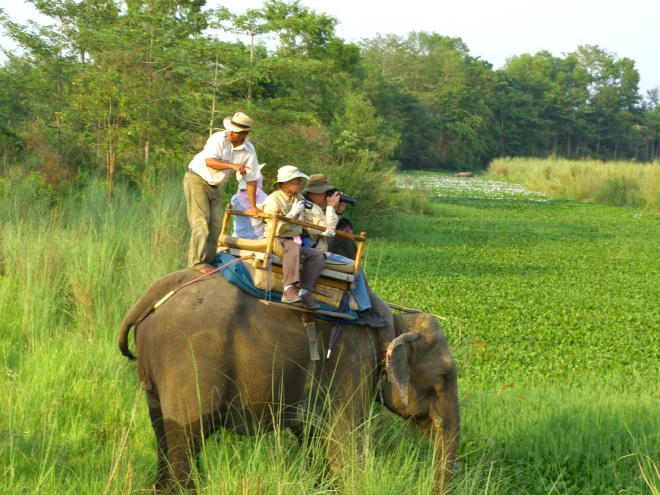
image

We didn’t see any tigers, but the group before us caught sight of one.  After hearing about the elephant’s reaction, I was just as glad that we hadn’t.  There was a whole lot of stomping, bouncing and trumpeting going on!

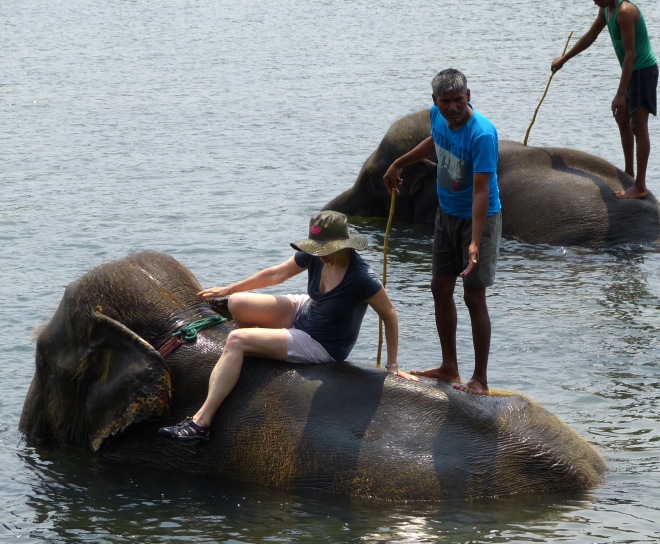
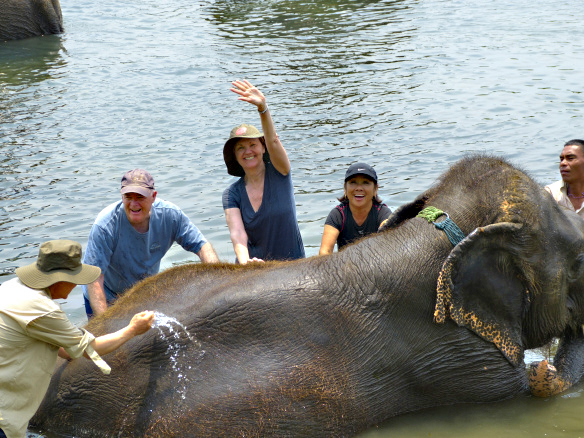
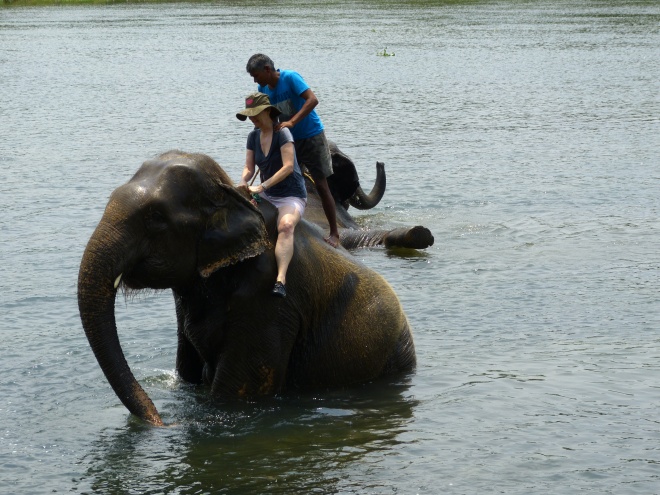
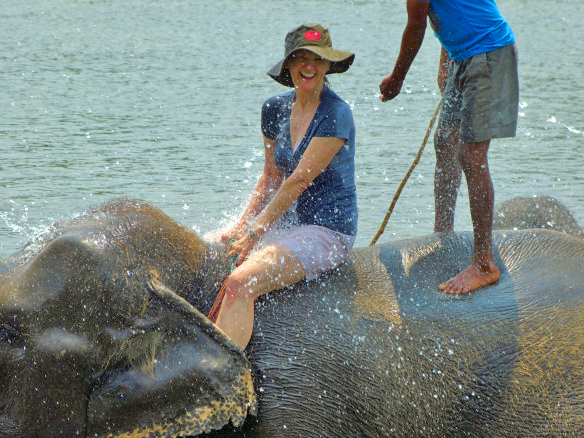
For me, the best part of our visit was when we were able to interact with the elephants in the water.

The rest of the group had heard all about my nephew Jack, and how much he LOVES elephants, so Jim was gracious enough to take stills with my camera, while Binoy, our wonderful guide, shot video with my iPhone.
image
First trick was getting on
image66
Wait, I thought I was going to be washing–not getting washed!
image
Now I have to get down
image68
Peter, Marilyn and I giving our buddy a nice massage, using smooth stones.

These are such beautiful, intelligent and gentle creatures.  What a privilege to send time with them.

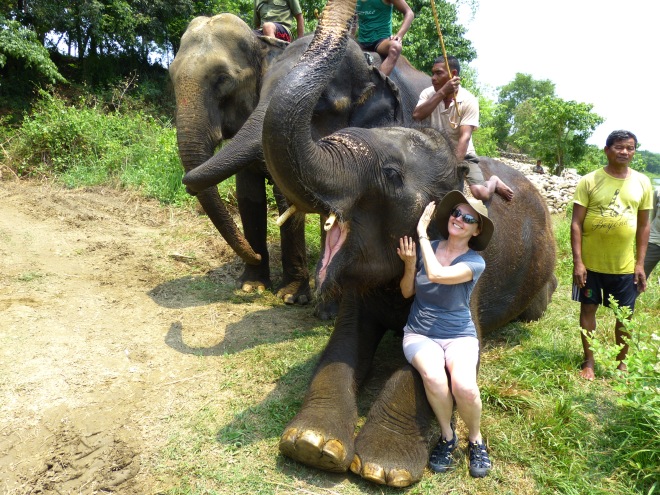
Check out the toenails on her.  Fun fact–elephants sweat through their toenails.
image
Mike, can I keep her?

While at Kasara, I kept thinking about these lines from the song “Camelot”.  “The rain will never fall till after sundown; By 8 the morning clouds must disappear”, because that’s exactly how it worked during our two days there.  In fact, we were extremely lucky during our entire trip.  We couldn’t have asked for better weather–slightly overcast when we were trekking, which is much more comfortable than walking under a hot sun.

The resort has a lovely pool, so I was very glad I’d packed my bathing suit.  Again, no photos.  Sometimes you have to put the camera down and just soak in your surroundings (literally).

It also has a great second story bar overlooking the pool.  I decided to skip the ox cart ride  through the village, and partake in a margarita instead.  That’s what my sisters, hermaña preferida, and cousins would have wanted me to do, and I couldn’t let them down.

Time to fly back to Kathmandu, and another lovely hotel, The Gokarna Forest Resort.

During our Nepal trip, we added three travelers, Ann from Indianapolis, was born in Indonesia.  She and her Turkish husband met in veterinary school.  Karl is a retired navy chaplain who served in Iraq.  He and Eugenia were born in Hong Kong, but have lived in San Diego when they are not traveling the world.  Their fluency in Chinese was much appreciated by all of us when we got to Tibet.
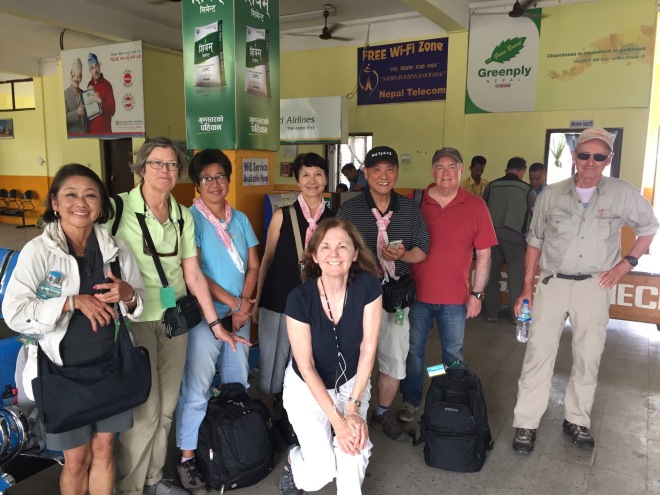
image
Standing, left to right: Marilynn, Marie, Ann, Eugenia, Karl, Peter, Dick.  Me, practicing my squat, an essential skill for the airport rest rooms.  Jim is missing because he is the photographer.

Here are Marie and Dick, enjoying their first class seats.
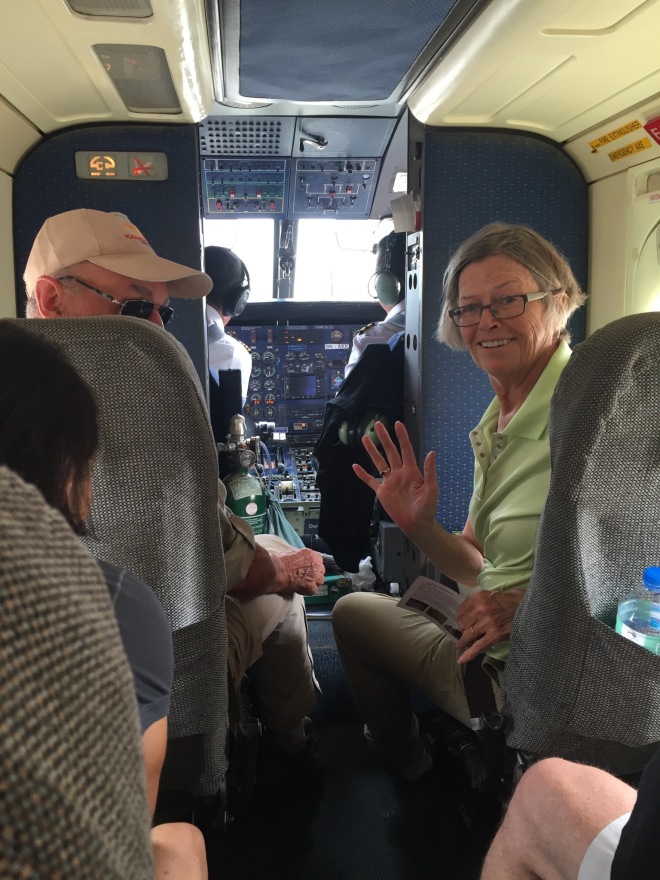
image

Jim, Peter and Marie will be returning to the USA after our last night together at the Gokarna, while the remaining six of us head off to Tibet.  The farewell dinner is an OAT tradition when the main trip ends, and what a farewell dinner it was!
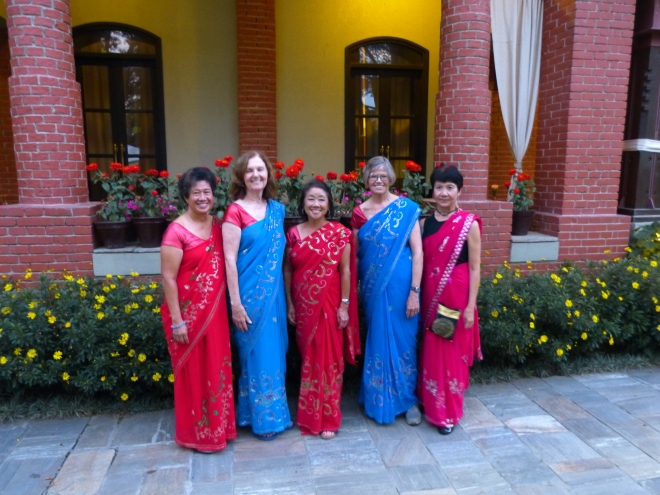
image
Ann, me, Marilyn, Marie and Eugenia

Yes, we needed help getting dressed, and no, we didn’t get to keep the saris.

Some of the men played dress up too.
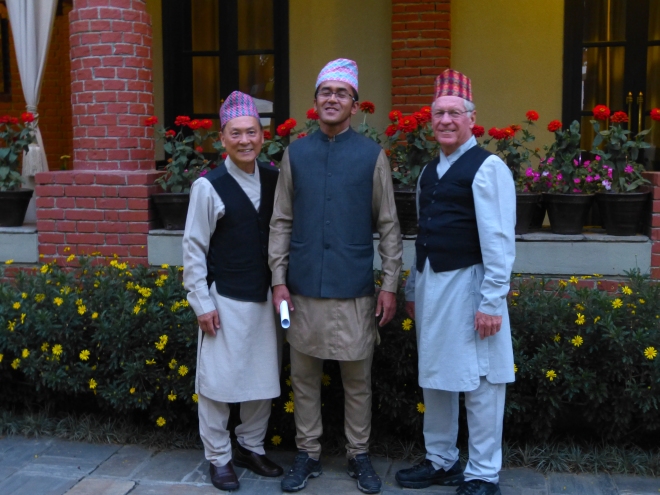
image
Karl, Binoy, Jim

It was the perfect ending for three fantastic weeks together.  Little did we know, but the remaining six of us were going to have a very different experience in Tibet.
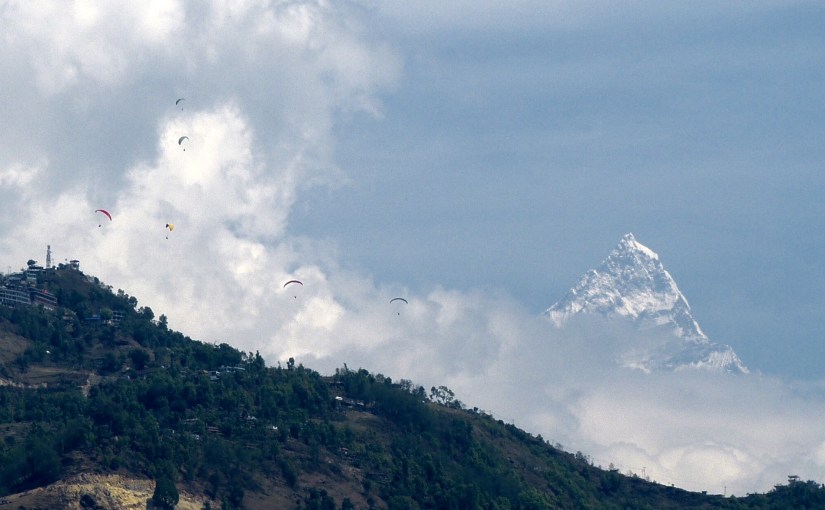


Pokhara

What a fun city!  Unlike Kathmandu, you can actually walk alone along the streets of Pokhara  without fear of never finding your way back to your hotel.

What to do during our three nights there?

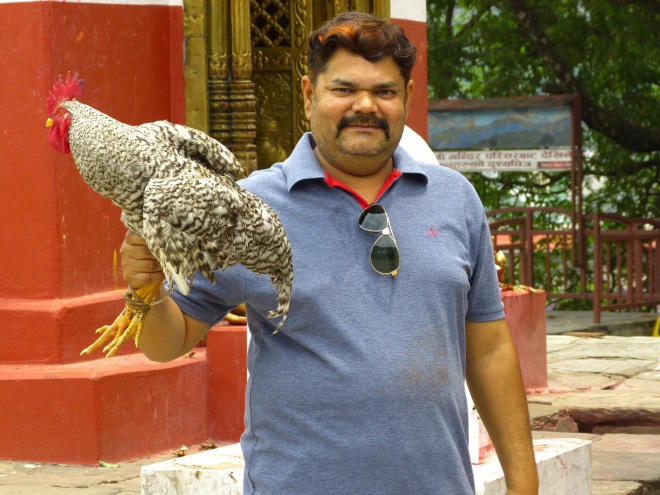
Of course there were temples to visit.  This poor rooster seemed to know his minutes were numbered. Yes, Hindus still do animal sacrifices.  But maybe he’ll get lucky and be reincarnated as a cow.

p1150236
When this guy saw my camera, he insisted that I photograph him and the rooster.

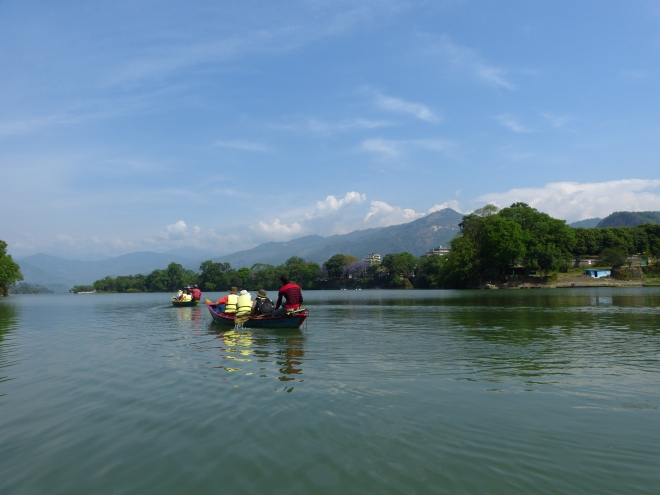
The next temple could only be reached by boat.

image
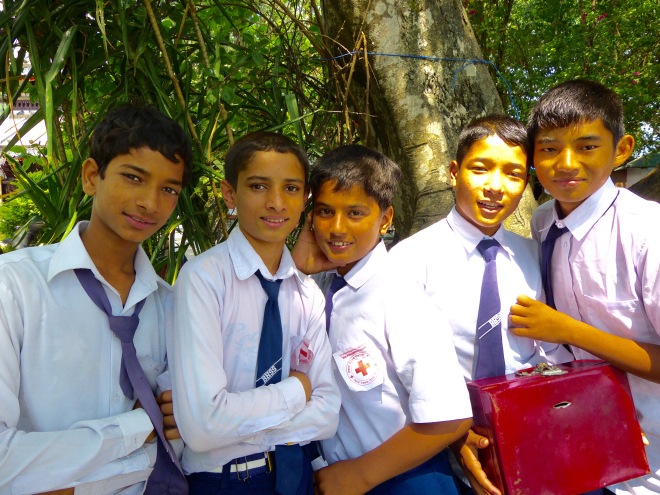
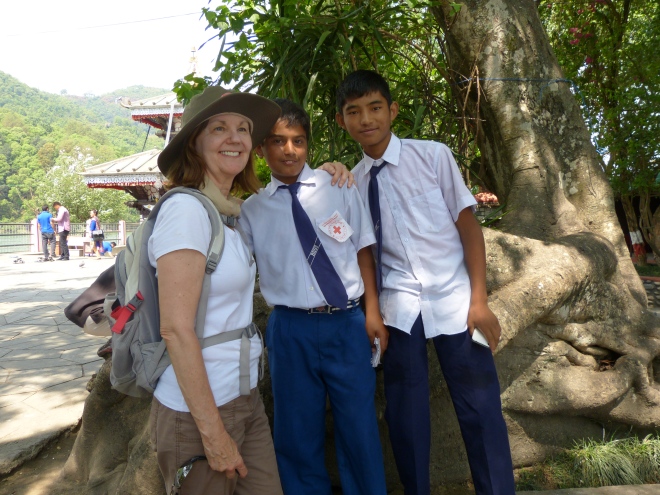
What made this visit special were the sweet boys collecting money for the Red Cross.

“50 rupees, madam?”

“Okay”, and as I’m reaching for my money I hear, “100 rupees, madam?”

“But you said 50”

“Okay madam, 50”.

He had such a sweet smile, I gave him 1,000 rupees, the equivalent of $10.  THAT guaranteed me a photo shoot with the entire group, who then insisted upon taking MY picture.  My sweet negotiator is the one in the middle.

The one in the middle was my salesman

image
Next up, a visit to the Parakhawking Project.  Please do a YouTube search to learn more  about the vulture and hawk rescue project.

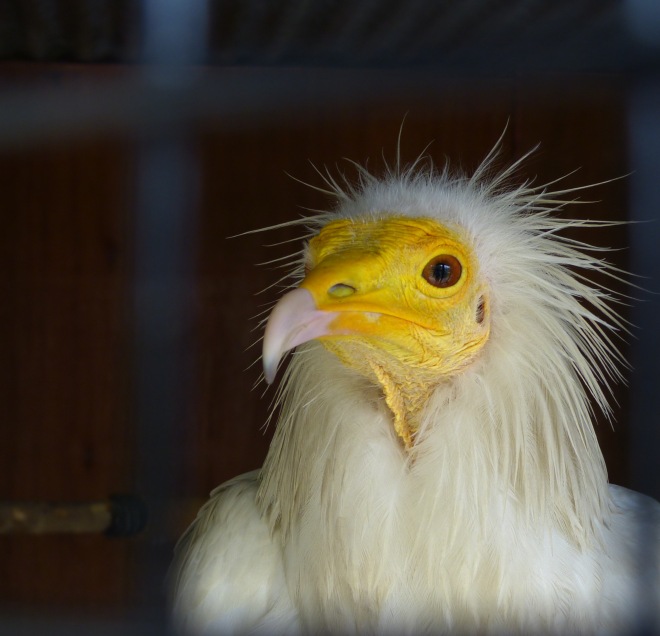
Believe  it or not,  this beautiful creature is a vulture, who, if you decide to leap off a mountain, will fly  with you, locating the  updrafts, thereby  guaranteeing you’ll have a spectacular flight..

image

Unfortunately, he was molting, so he has been grounded for the next few months.   What a disappointment– I was SO ready to sign up!  So since parasailing was not an option, what else could I do with my free afternoon?   Oh so many options…how to choose?
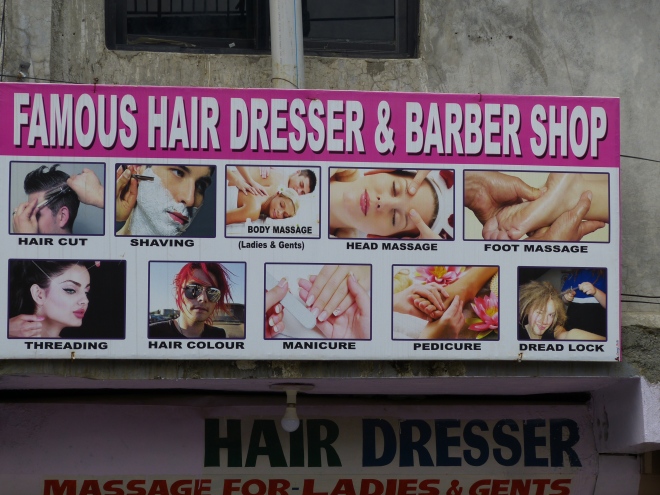
Who could resist this menu of services?  Certainly not I!

image

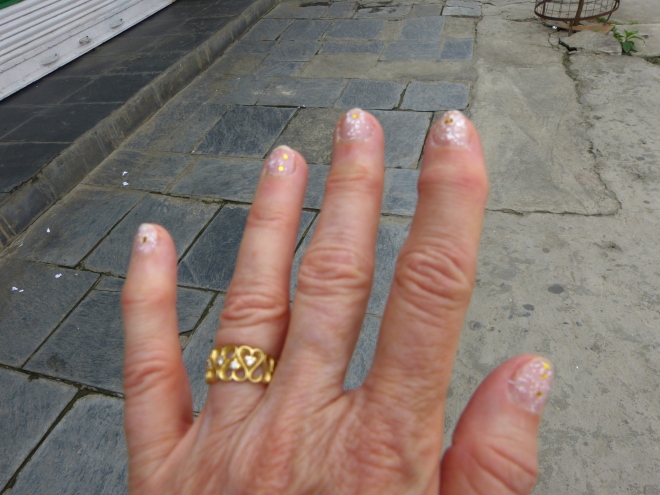
As tempting as it was to come home with dreadlocks, I decided to be a little less adventurous and settled for a manicure. It WAS an interesting experience.  I’d never had my cuticles pushed back with a coin before.    And the choice of polish was greatly simplified when there are only three  colors, all with sparkles.

image

It sorta made me wonder what my hair would have looked like if I’d chosen a dye job.

The  best part was my manicurist dried my nails by waving a magazine back and forth over my fingers.  Again, I thought of my hair…and what might have been.

After a round of shopping, it was clearly time for music.  Initially, we thought the Bollywood Dance Club had potential, until we gave their sign a more thorough inspection.  Let’s put it this way. Although we didn’t go inside to verify, we suspected the club might have fit right in with New York’s pre-Guliani Times Square or Boston’s combat zone.

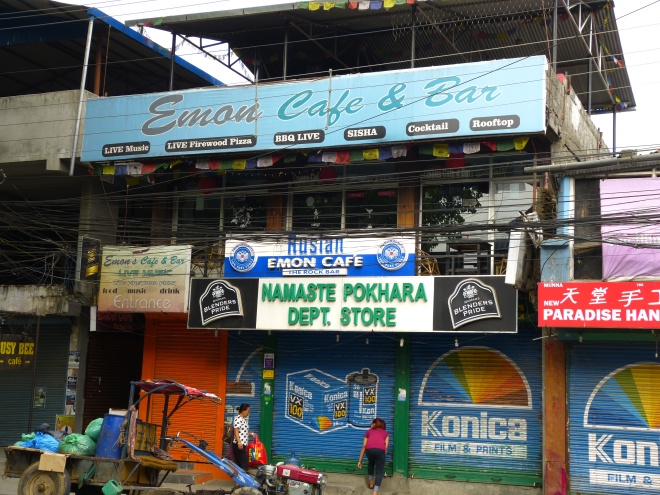
Instead, we opted for Emon’s Rooftop Cafe.  We ended up being the sole (but enthusiastic) customers here.

image

Sitting on the balcony overlooking the street, sucking down a local beer, we enjoyed a rendition of “I want to hold your hand”, Nepalese style.   It doesn’t get much better than that!

Three Days in Kathmandu

Kathmandu assaults your senses.  It is dusty, dirty, noisy, chaotic, crowded.  Take a deep breath and you will get a lungful of incense, enough to keep you coughing for a few minutes.

We toured the three major cities of the ancient Malla kingdom: Kathmandu, Patan and Bhaktapur.  (That’s what happened when you had three sons–you split up your kingdom so they could each have a place to rule. )

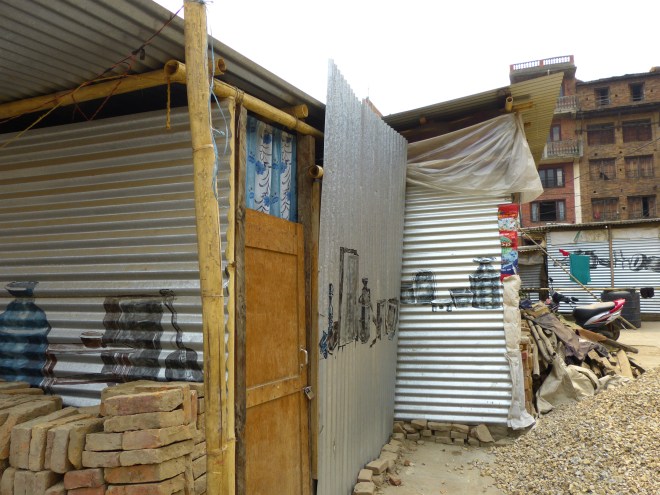
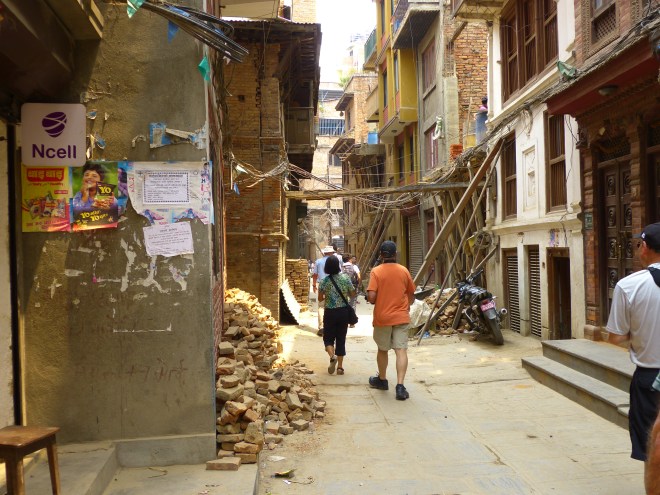
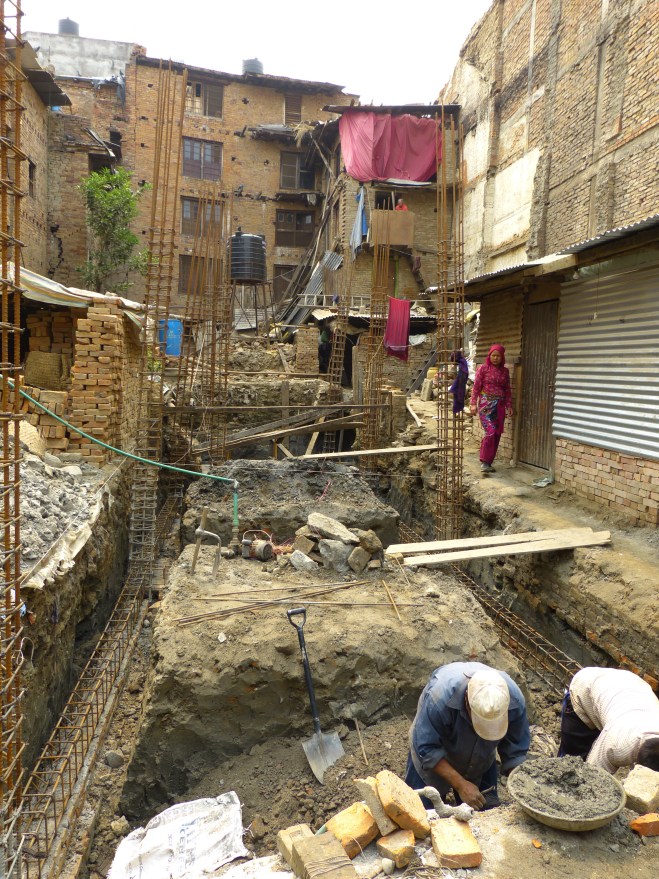
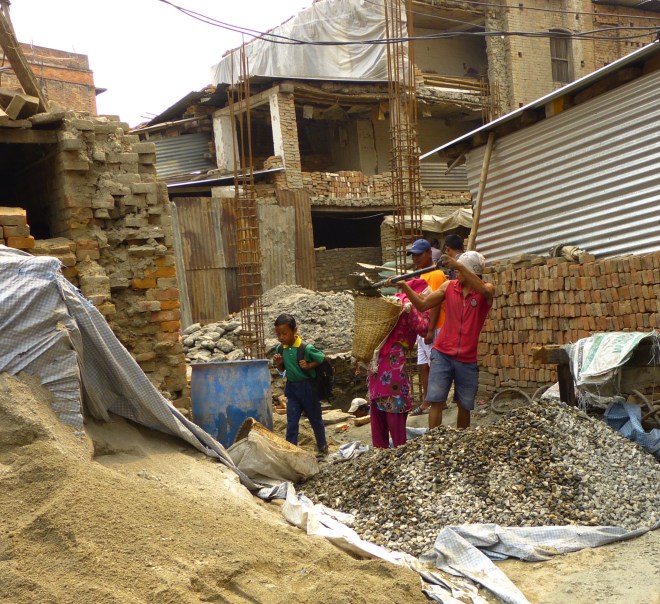
We saw the impact of the earthquake everywhere.  It is heartbreaking  to see that one year later, people are still living in makeshift shelters.

Home for a family
Home for a family
Boudhanath Stupa
Boudhanath Stupa
Timber supporting Kathmandu buildings
Bhaktapur
Bhaktapur
Rebuilding by hand
Rebuilding by hand

Still, there are parts of the cities that were not damaged, allowing you to experience their grandeur and the beauty.

image
Plaza in Bhaktapur as seen from the balcony of the New Cafe Nuatapola, where we had a delicious lunch
image
The Five Level Temple
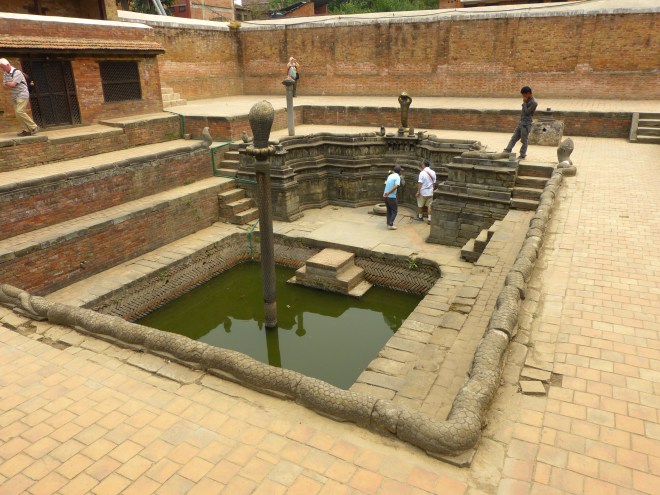
The royal family's bathtub
The royal family’s bathtub
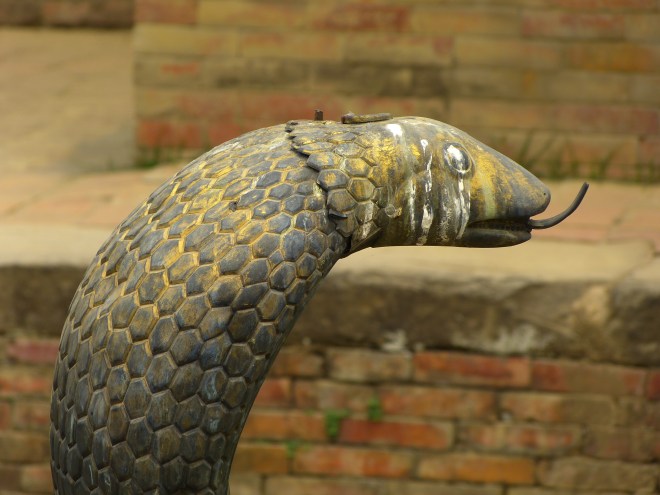
Complete with snake sculptures

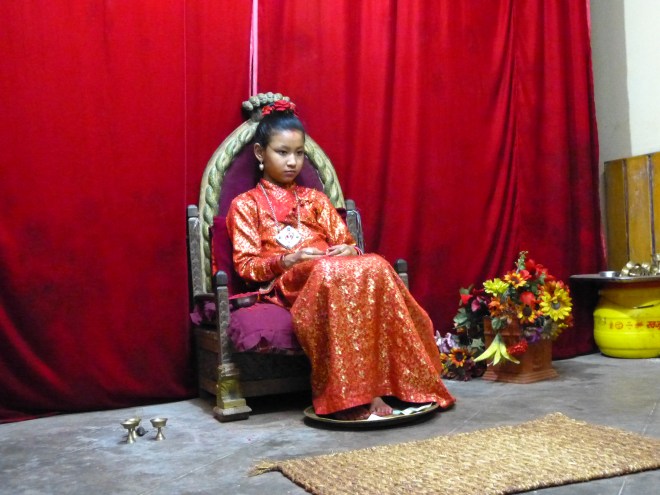
While preparing for this trip, I read about the living goddesses, known as the Kumari.  (The post  “Follow the Yellow Brick Road, Part Two has more information about the goddess.)

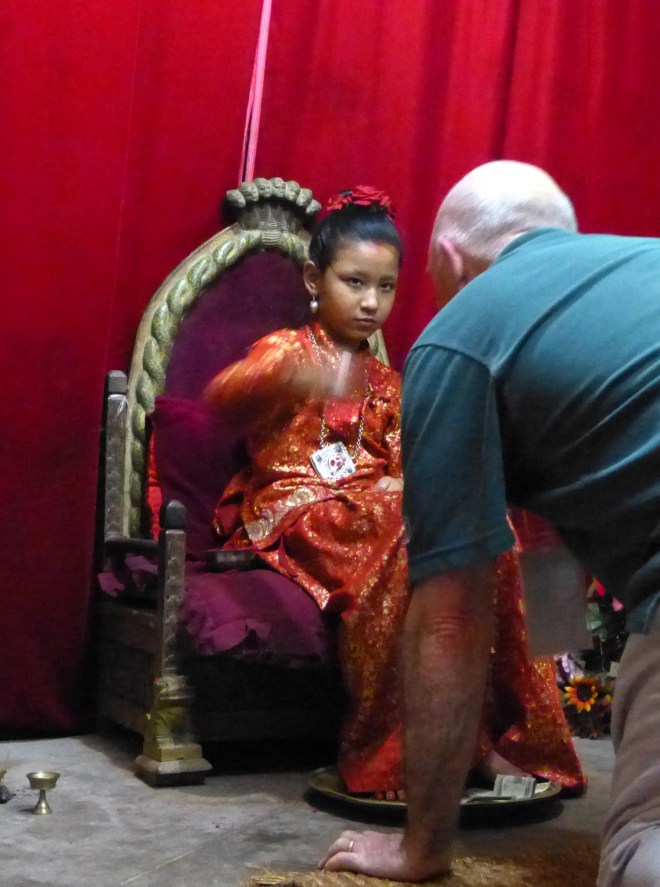
After our visit, all of the women in our group felt so sorry for this sad looking little girl, who was chosen when she was three years old.  I couldn’t help but compare her to my happy, active nieces.  Of course, we don’t know what other options were available to her.  Maybe sitting on a “throne” placing tikkas on the foreheads of gawkers was the better alternative.

The Kumari is not allowed to walk
Peter is receiving her blessing.

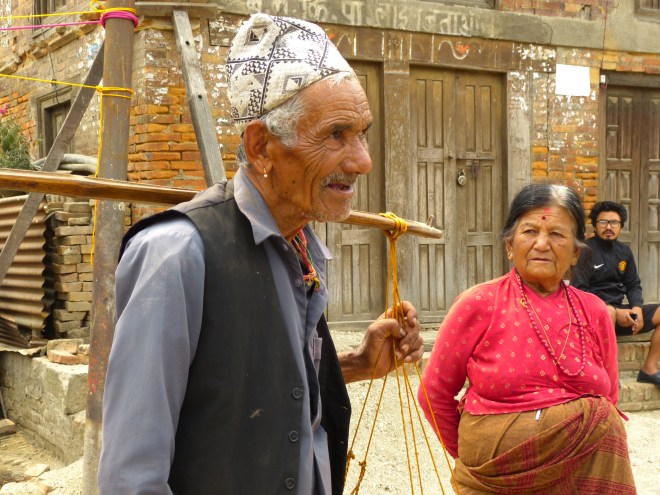
Despite the hardships they have endured, the Nepali people’s beautiful spirit shines through.

image

image

image

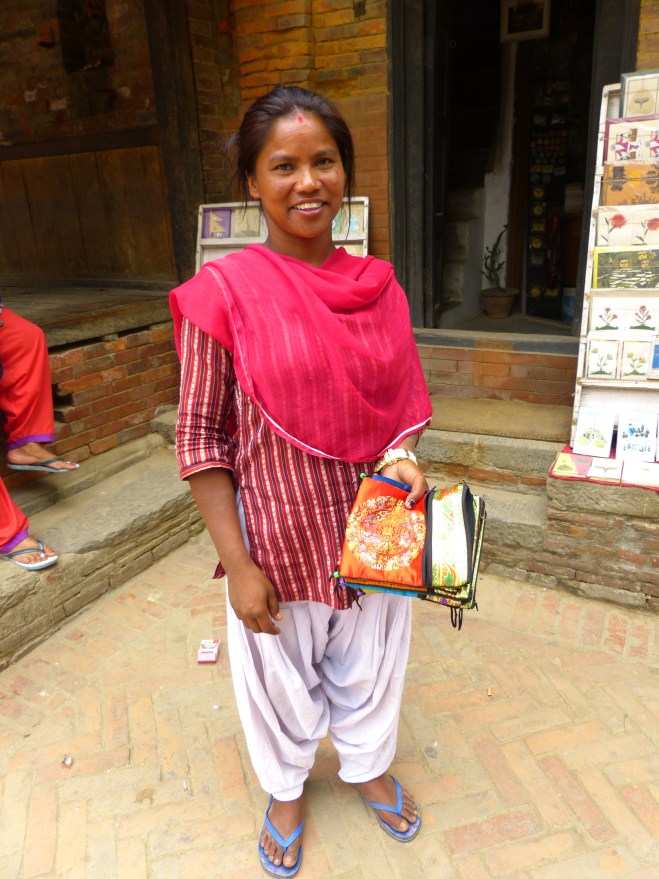
The hawkers are everywhere.  The problem is if you buy from one, you are mobbed by many others.  Still, I couldn’t resist this woman’s sweet  smile, especially after she told me if  I wanted to buy more than one, there would be no problem.

image

Okay, so I bought more than one.  Sisters, cousins, nieces, friends…you know the drill…gifts are coming your way, but you may have to earn them.  There may be a quiz!

This next one was more of a hard sell.  “Madam, blessings for you, blessings for me”, chanted continuously while she walked beside me for the equivalent of five city blocks.

imageOkay, so I got blessed.  I now own the necklace the lady on the right is holding.  I expect those blessings to be coming my way!
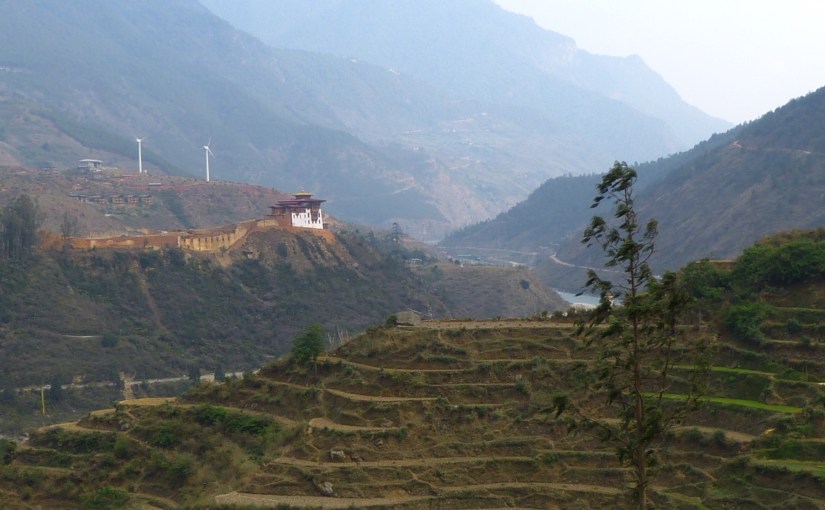
Six Days In Happy Land

We are now in Nepal; quirky Internet connectivity made it difficult to do justice to beautiful Bhutan, so this post will be a quick collection of photos and memories of Happy Land.

THIMPHU

A few years ago, Rio’s Christ the Redeemer was chosen as one of the seven new wonders of the world.  Thimphu’s gigantic Buddha didn’t exist at that time.  If it had, I’m convinced Buddha would be giving Rio’s statue some serious competition.

image
Buddha sits atop a mountain overlooking Thimphu

The base of the statue contains a temple, filled with hundreds of thousands of smaller Buddhas, butter lamps and butter sculptures. Yes, you read that right–sculptures are made of colored butter!

image
Just the artwork on the base would get MY vote

Dedicated to teaching Bhutanese arts and crafts, this school focuses on 18 traditional crafts including painting, woodcarving, metal work and embroidery.

image

image

Whenever I visit a country, particularly one whose economy is dependent on the tourist trade, I like to drop some dollars by buying gifts, so a stop in the school’s small shop was a definite requirement.

Handmade paper is another traditional Bhutanese craft.  We watched the entire process: the raw materials being delivered, heated, compressed, made into sheets and dried.

image

image

Notice how hard these young women are working?  They were all smiling as they were lifting those heavy bundles!  And yes, I most certainly did make a purchase at their tiny gift shop.

The modern world is rapidly creeping into Bhutan.  Construction is everywhere.  But it isn’t just new buildings and new technology.  Since the introduction of television in 1999, the western world has slowly been influencing Bhutan’s youth.

Thimphu’s clock tower plaza, right beside our hotel was the site of what looked like an  auto exhibit, but it was a whole lot more.image

Young Bhutanese shed their traditional clothes, donning jeans and tee shirts to dance to Lady Gaga’s “Poker Face”.   Unfortunately, my camera’s software is incompatible with my iPad, so you won’t be able to see the beautiful young girls I videoed dancing, but with any luck, I’ll be able to link a YouTube video of the boys doing their hip hop routine when I get back home.
image

You may be wondering what kind of audience the entertainment drew. Well, wonder no more, because when my personal paparazzi used his long lens to capture me unawares, he also photographed the crowd.

A bit sparse, no?

PUNAKHA

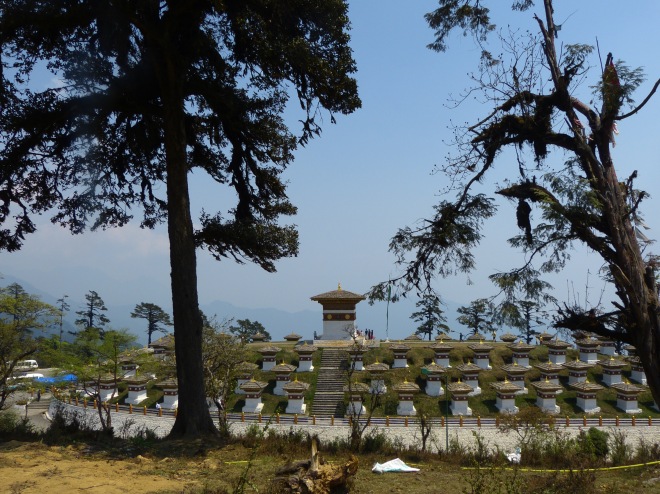
Much of the road between Thimphu and Punakha is under construction, making travel slooooow and very dusty.  We stopped at the Dochula Pass on the way to and from Punakha.

image
108 Stupas of the Dochula Pass

The Dochula Pass memorial honors the 15 Bhutanese that were killed fighting the Indian separatists from Assam.  The separatists were creeping across the Bhutanese border, creating training camps.  The fourth king actually led his troops into battle and was victorious.  No wonder he is so beloved!

The pass is 10,000 feet above sea level, so Tashi thought it would be good practice for the Tiger’s Nest if we took a hike in the Royal Botanical Park that adjoins the memorial.

image
The rhododendron were in bloom–they weren’t bushes, they were trees.

The jacaranda were also in bloom, outside the Palace of Great Happiness.

image
Notice the covered wooden bridge in the distance.

This is the entrance to the Palace’s temple.  Inside Tashi gave us a fantastic lecture about Buddhism, using the artwork that covered the temple walls as an ancient Power Point Presentation.image

image
I was so glad to see these monks, enjoying themselves by the river bank outside the Palace of Great Happiness.

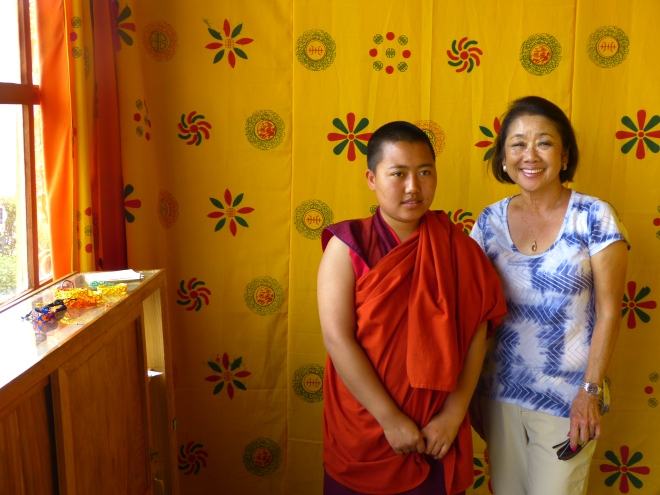
We also visited a nunnery located atop a mountain, where I purchased some bracelets from this sweet 21 year old nun, who spoke perfect English.

image
Marilynn from San Francisco on the right, bracelets on the window sill on the left.

No visit to Punakha would be complete without a stop at the Chhimi Lhakhang Monastery.  To get there you need to hike through rice fields, a village and up a hill.

image
The shingles on roofs are held down with stones instead of nails.
image
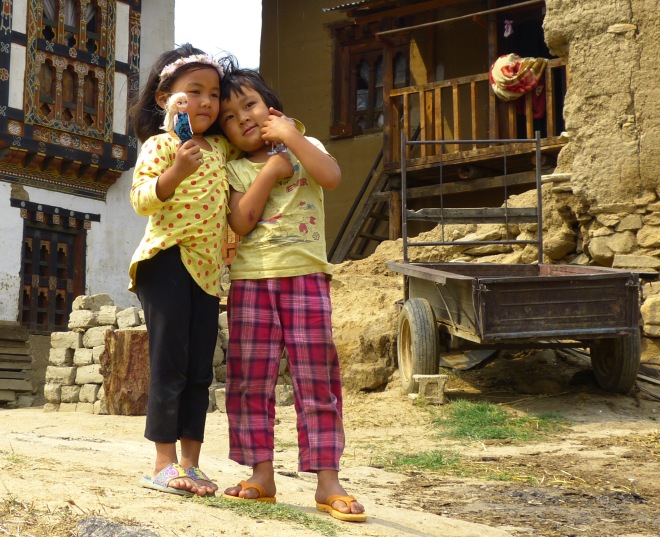
These sweet villagers were happy to pose for me
image
Christmas presents for everyone!

imageThis monastery was founded by Drupka Kinley, the Divine Madman, whose “Thunderbolt of Wisdom”, also known as his “Flaming Thunderbolt” , brought his own special form of enlightenment to local women.  Infertile couples visit the monastery where the woman is doinked on the head with a huge wooden “thunderbolt”.  Could that be the Bhutanese version of IVF?
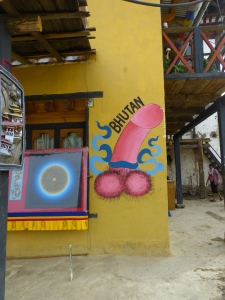
The Divine Madman is the inspiration behind the artwork that festoons the area’s houses.

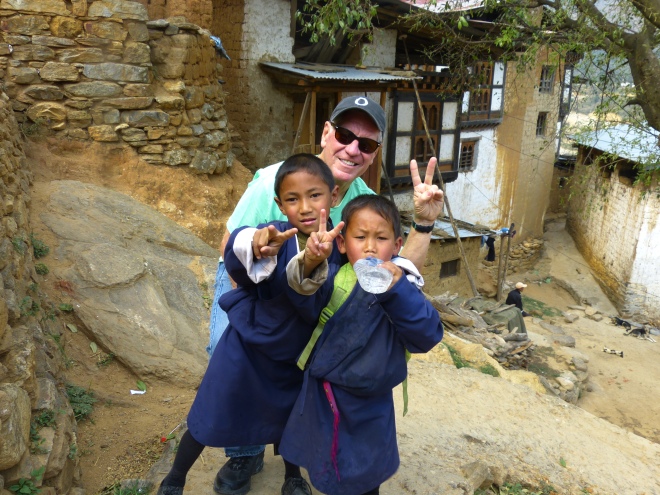
Although not part of the “official” itinerary, our wonderful guide thought we might enjoy a visit to the 17th century village of Rinchen Gong.  These villagers are definitely not used to having visitors!  Our arrival was quite an occasion, especially for the children, who chased our van up the steep dirt road.

Like me, Jim enjoys photographing the locals
These boys loved seeing their pictures
Shy at first, they warmed up when they saw the shots.

Our last stop was in Paro, where we climbed to the Tiger’s Nest and visited Bhutan’s  very first temple.  It was built in the 7th century by Tibet’s great ruler, Songtsen Gampo, and it is where he pinned the left foot of an ogress who once covered all of Bhutan and part of Tibet.

image
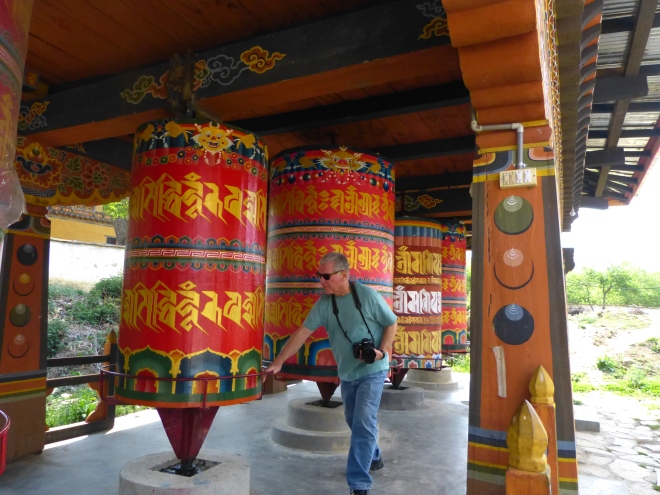
Jim, spinning the prayer wheel outside the sacred Kyichu Lakhang


The Cast of Characters

The Cast of Characters
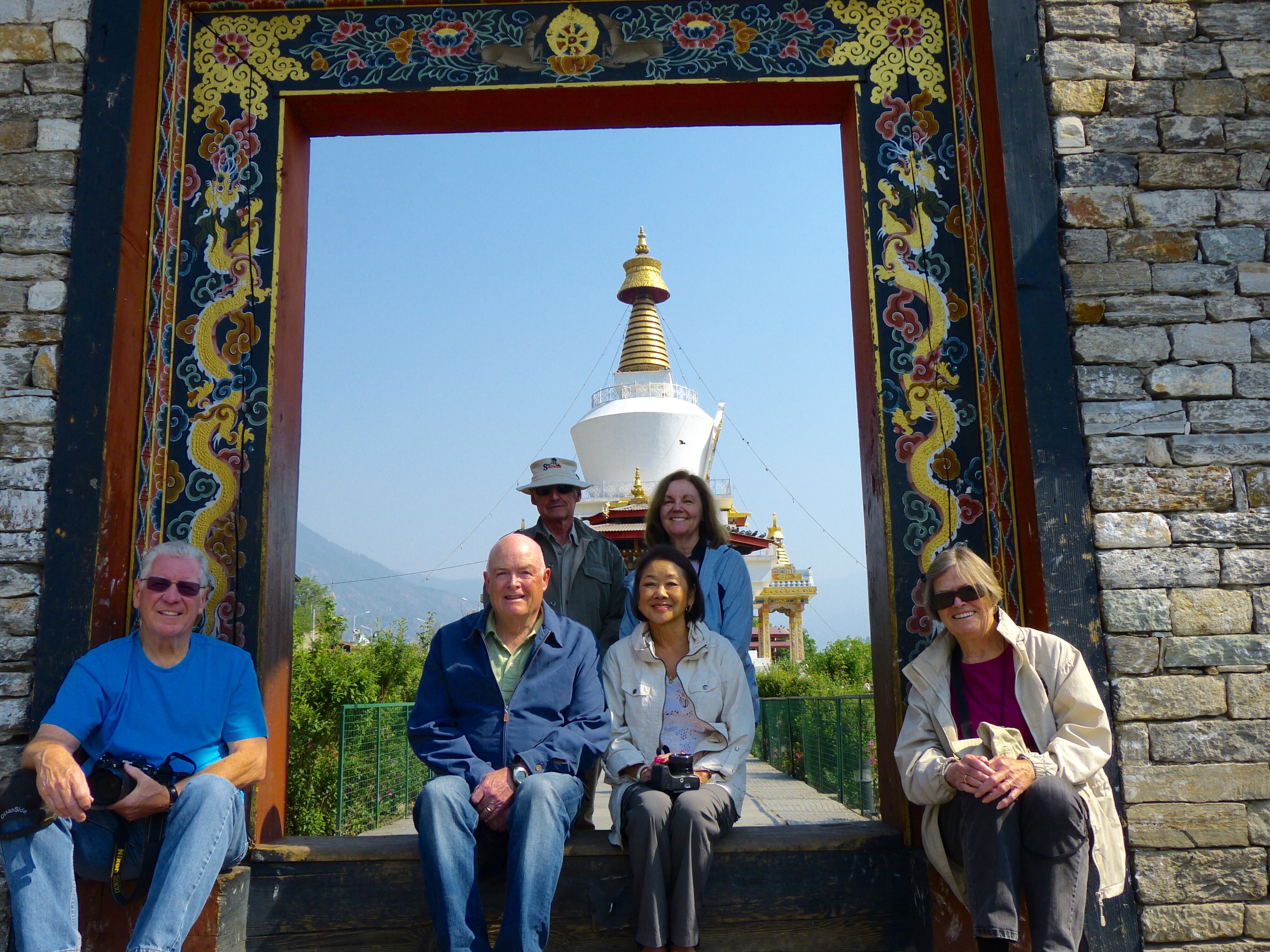
For those of you who expressed concern about my traveling alone, after Mike and Greg had to cancel, have no fear. I now have five new friends. Here we are at the National Memorial Chorten, which was built to honor Bhutan’s third King, Jigme Dorji Wangchuk .

first row: Jim, Peter, Marilyn, Marie. Back row, Dick, me

Jim is a former hotel and restaurant owner from the greater San Diego area. His family used to own Marty’s restaurant and hotel, an establishment frequented by yestereyear’s stars, such as Lucy and Desi, Frank Sinatra, Dean Martin.

Peter and Marie are from the greater Boston area. They retired from the financial industry, and have been traveling the world ever since. Prior to arriving in Delhi, they had taken another OAT tour through the Balkans, then spent a few days in Dubai. Jim, Peter and Marie will be heading home after Nepal.

Marilyn, a retired nurse from San Francisco, is like the little energizer bunny. She walks faster than I do!

Dick, from Seattle, retired from Boeing. He’s the most widely traveled of our group, having been on 27 OAT trips, plus tours with numerous other companies. Marilyn, Dick and I are the only members of the group that will be visiting all three countries. In Nepal, we will be joined by three new travelers.

Although not actually traveling with us, we see the royals EVERYWHERE.  Photos of them are on hotel and restaurant walls, on the sides of buildings, in museums and temples.   This official portrait is of the fourth King, known as the “Royal Fourth” with his four wives ( all sisters), the ten children they produced, (including the “Royal Fifth”) and the first grandchild. Since that photo was taken, the Royal Fifth has married.  He and his stunningly beautiful wife have produced an heir,  the Royal Sixth.

Tashi has identified which member of the royal family is in the motorcade when they go whizzing by.  So far, we have seen one of the four queens, and a royal uncle.

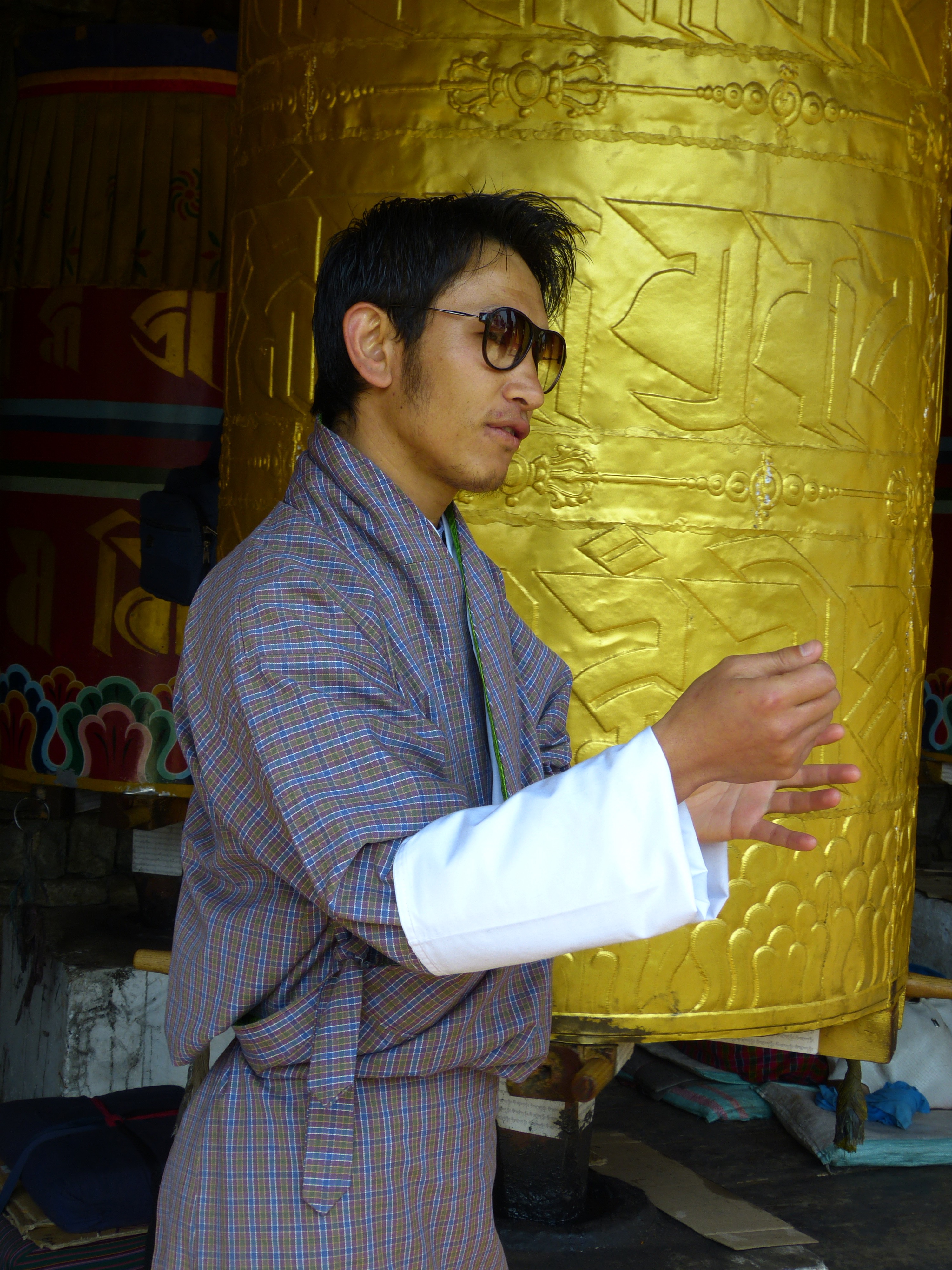
This photo of Tashi was taken at the Memorial Chorten.  He’s  instructing us on the proper way to circumambulate a prayer wheel.  Walking in a clockwise direction, you give each wheel a good spin as you pass by.  If we had been carrying rosaries, we would be using them to keep track of our prayers while we walked.

Tashi

As with all mountain roads, Bhutan’s have their fair share of hairpin turns.  What they don’t  have are guard rails.  This tour is NOT for the faint of heart or the queasy stomached.  We have come so close to passing vehicles, we could have flossed the other driver’s teeth.  What a relief to have an excellent driver like Gembo getting us to the top of the mountain and back down again.

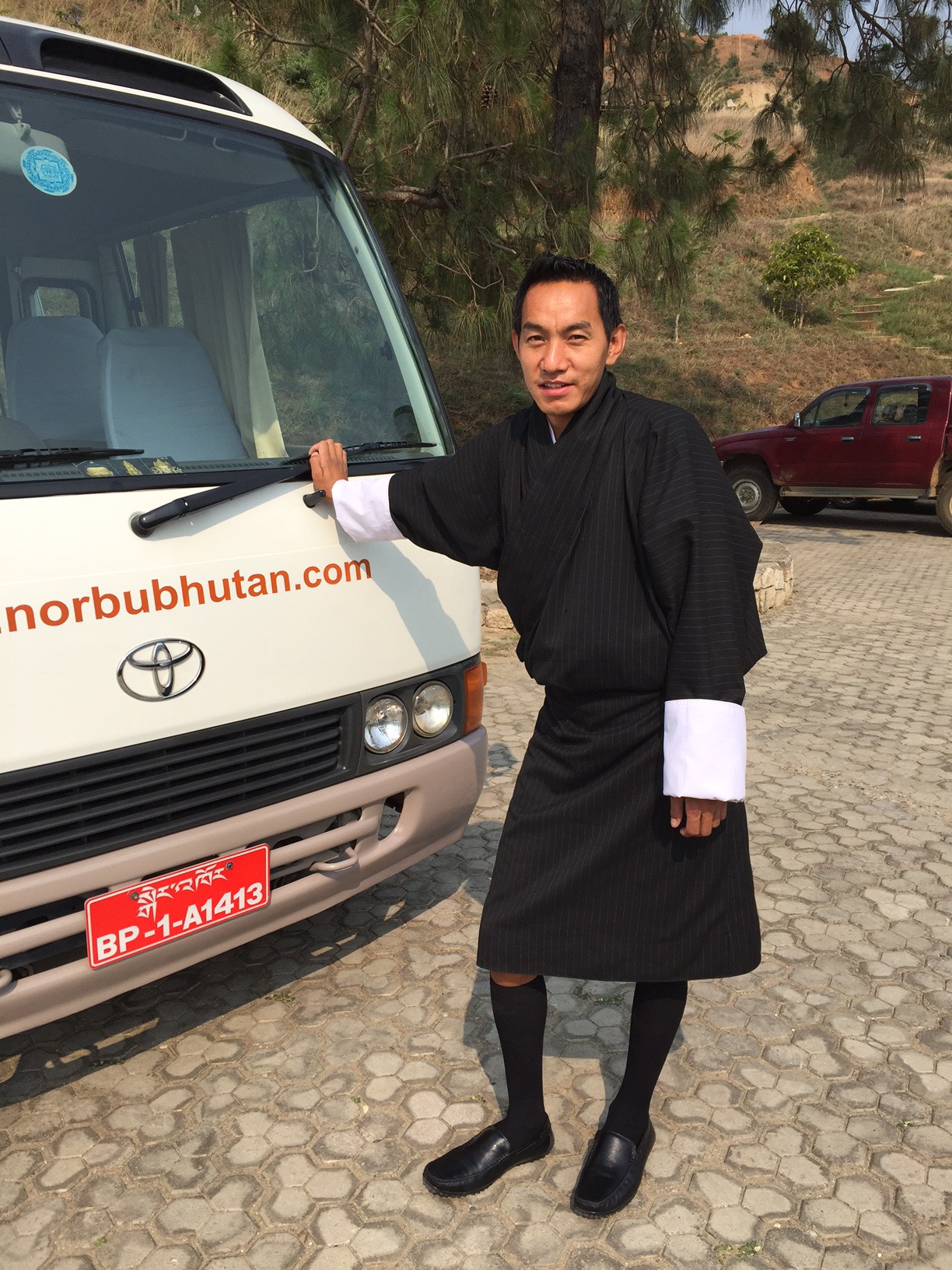
Gembo, our very skillful driver

An unexpected delight was the owner of our hotel in Thimphu.  Her story deserves an entire post, but that will have to wait till I get home, or until YOU stay at the Thimphu Tower.

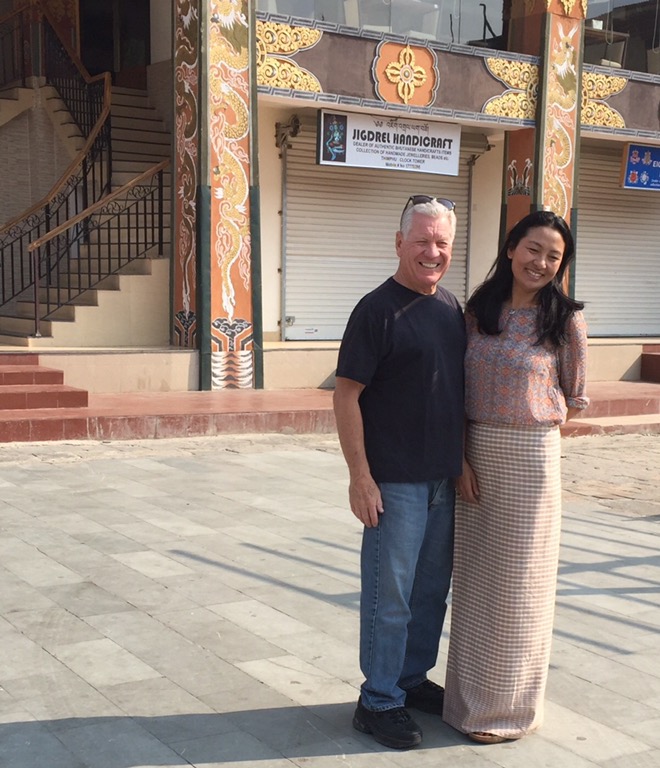
Jim and Tshering, the owner of Thimphu Tower


Follow the Yellow Brick Road to the Roof of the World – Part 3

When you hear “Seven Years in Tibet” what comes to mind?  The movie starring Brad Pitt?

Well, I never saw the movie but I HAVE read the book  by Heinrich Harrer, and I must say, it was pretty phenomenal.   Harrar escaped from a British POW camp in India during World War II.  Interestingly enough, POWs back then were able to keep their money and  supplies, so when he escaped, he had a rucksack, some provisions, and enough money to trade with Tibetans as he made his way through the Himalayas to Lhasa.

The Tibetans were gracious hosts, providing Harrer and his traveling companion,  Peter Aufschnaiter (another escaped POW) with shelter and, when they ran out of money, gifts of food.  Harrer and Aufschnaiter were able to repay this kindness by generously sharing their scientific and engineering knowledge with a country that at that time was closed off to the rest of the world.  In addition to helping with flood control, translating foreign news, providing agricultural advice, they also introduced  the Tibetans to a new sport,”walking on knives”, what we call ice skating.    Eventually, Harrer met the young Dalai Lama, becoming a trusted friend and tutor of the isolated adolescent.  Harrer not only oversaw the construction of a movie theater in the Dalai Lama’s summer palace, he also created the films that were shown there, using a 50’s era movie camera to photograph Tibetan festivals.

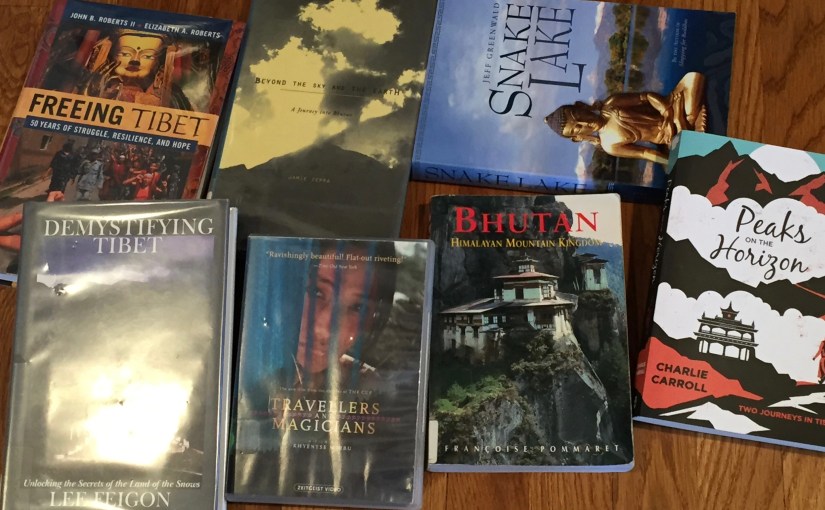
After Charlie Carroll discovered Seven Years in Tibet in his elementary school library, he became fascinated with this remote Himalayan kingdom.  It was a bit like me and the Wizard of Oz, except HE could actually visit HIS magical kingdom.  And he did, in 2009.  The end product of his journey is the wonderful narrative Peaks on the Horizon.  Two parallel stories alternate chapters, chronicling Charlie’s travels, and that of a young Tibetan refugee he met just before leaving the country.

Seven Years in Tibet and Peaks on the Horizon are great introductions to Tibetan religion, history and culture.  Although I quickly skimmed through  Demystifying Tibet by Lee Feigon and Conversations with the Dalai Lama by Thomas Laird, I found them more difficult to get through and not as entertaining.  I’ll admit it.  I’m a sucker for the personal narrative.

So, if you have been following along The Yellow Brick Road to Asia, you know that now is the time for ten very random, fun facts uncovered through reading about Tibet:

  1. At 13,000 feet above sea level, Tibet’s nickname, “The Roof of the World” is fitting.  It is the highest inhabited area in the WORLD.  Yikes.  I’ve packed a supply of Diamox to make sure I don’t have a problem with the altitude.  
  2. The first major character in its recorded history is Songtsen Gampo, who conquered and united a multitude of tribes to create the nation of Tibet.  Sources claim he became king at the age of 13.  I guess during the the seventh century, they dealt with adolescent angst by sending the boys off to pillage, plunder and start a new nation.  Before he died in 649, he managed to acquire one wife from China, one from Nepal and four from among the local girls.  There are two versions of the Chinese bride story.  Songtsen Gampo  ordered the king of China to send him one of his daughters and when his “request” was refused,  he attacked and pillaged.  Version two describes Songtsen Gampo as a lovesick warrior who became a vassal of the Chinese emperor to obtain his lovely wife.  See if you can figure out which explanation belongs to which nation.
  3. But it wasn’t ALL fun and games.  Songtsen Gampo is also credited with bringing Buddhism to Tibet (and to Bhutan).  He built the first Buddhist temple in Tibet, the Jokhang, to house the statue of the Buddha his Chinese wife, Wencheng,  brought from China as part of her dowery.  One account mentioned that the Nepali wife also brought a Buddha with her, but the Chinese one appears to be more sacred and more famous.  it will be interesting to see what we are told when we are in Lhasa.
  4. There was a gap of almost a century until the next important emperor came on the scene.  Trisong Detsen (755-797) conquered the areas along the Silk Road.  But he too was more than just a warrior.  He also  built Tibet’s first monastery at Samye and invited Padmasambhava (Remember him from the Nepal post?  Also known as Guru Rimpoche, he emerged from a Lotus in a lake) to come to Tibet to help spread the word about Buddhism.
    Unfortunately, Trisong Detsen met an untimely end.  Rumor has it that he was 
    poisoned by his wife, who may also have disposed of her son in a similar manner a mere two years after he was crowned.   Talk about dysfunctional families.  Even Dr. Phil would have had trouble fixing THEIR problems.  
  5. The next notable character appears in 838.  Lang Darma joined with members of the Bon religion to strangle his brother, the current king.  He tried to reinstitute Bon, the local religion, by suppressing Buddhism.  Here’s the interesting part. Lang Darma was thought to be a devil, complete with horns on his head.  After forcing girls to comb his hair, he used his horns to kill them, then ate them.  Lhalung Palgyi Dorje, a monk, came to the rescue, killing Lang Darma by shooting an arrow through his heart.   
  6. Remember Ghengis Khan and the Mongol Hoards?  I sure do.  I have a strong visual of him and his buddies, galloping across the steppes, flags flying in front, long hair streaming behind.  So, what has that got to do with Tibet, you ask?  Well, bet you didn’t know that the term “Dalai Lama” came from the Mongols.  I certainly didn’t.  Altan Khan, who ruled Mongolia in the 1500’s (yes, we’re skipping WAY ahead!) invited Sonam Gyatso, the abbott of Tibet’s largest monastery, to his country to spread Buddhism throughout Mongolia.  Dalai Lama is the Mongol translation of Sonam Gyatso’s name, which in English means “Great Ocean”.  Tibetans, however, refer to their their spiritual leader as “Kundun”, which means “the presence of Buddha”, but since I’m not Tibetan,  I’m going to stick with Dalai Lama.
  7. Tibetans believe they are descendants of Chenrizi (also spelled Chenrezi, Chenresig and Chenrezig, depending on the source), who took the form of a monkey to seduce a demon.  The demon gave birth to six “long haired children” complete with tails (the first Tibetans) that disappeared when they grew to adulthood.   The Tibetan creation story explains human behavior by uniting the pure (Chenrizi is the Buddha of compassion) with the animalistic (the demon/ogress).  And all we westerners get is a talking snake and an apple.  I like their story better!  It even has evolution going for it.
  8. The current Dalai Lama is believed to be the fourteenth reincarnation of Chenrizi.  The THIRD Dalai Lama was the first granted the title by Altan Khan.  That Dalai Lama decided to declare his two deceased predecessors as the first and second Dalai Lamas.  After the third Dalai Lama’s  death,  Altan Khan’s grandson (surprise, surprise)  was declared to be next reincarnate — the fourth Dalai Lama.  He didn’t last long–he was dead before he was 28.
  9. The NEXT Dalai Lama was a powerhouse. The “Great Fifth” started construction of the Potala, Tibet’s iconic building.  He died before the building was completed, but his death was kept a secret for 10 years to ensure that construction would continue.  This huge complex is 13 stories high and contains color coded administrative (red) and religious (white) sections, which include the winter quarters for the Dalai Lama,  prison cells, torture chambers and stupas where prior Dalai Lamas are entombed.
  10. Yaks are as important to the Tibetans as Buffalo were to the Native Americans.  Yak butter is the main ingredient in yak tea, which is consumed by everyone, many times every day.  Yak butter is also used for the candles that are burned throughout all three Himalayan countries.  Yak dung is burned for fuel and is also used as an ink substitute.  The burnt yak dung becomes soot, which was used as ink for books during Heinrich Harrer’s seven years.  By the time Charlie Carroll visited a few years ago, Yaks had become endangered.  What is common now is a cross between a yak and a cow, called a dzo.  

How’s that for random facts?

There is so very much more to say about Tibet, but as with the posts on Bhutan and Nepal, I need to save something for when we are there, don’t I?

Follow The Yellow Brick Road- Part Two

You ready to climb aboard the bookmobile express for a trip to Nepal?

A few years ago, when Borders broke my heart by going belly up, I softened the blow just a tad by randomly grabbing books from the travel section, one of which was Snake Lake by Jeff Greenwald.  At that time, I had no idea the book was about Nepal. Not only that, but the thought of visiting Nepal never crossed my mind.  I didn’t even have the vaguest idea of where it was. As I mentioned in the last post, elementary school KILLED any interest in geography.  Good thing I’m a firm believer in lifelong learning!

Snake Lake is about Nepal’s political turmoil, starting with the student riots in 1979, thru India’s 1989 trade embargo, ending with the April 6, 2000 protest at Ratna Park.  It’s about more than just politics, though.  This very personal account has it all— romance, loss, and a spiritual journey that allows you to view Buddhism through Greenwald’s American eyes.

Two Australian writers, Amy Wilsee and Mark Whittaker, were fascinated by the 2001 murders and suicide of Nepal’s royal family.  Their quest for the back story leading to that gory night is documented in Life and Death in Kathmandu.  What I found most compelling, however, wasn’t the main event,  but two of their interviews:  one with a former Kumari (a living goddess- more on that later) and the other with a Maoist guerilla.  Initially, the Maoists were a group of committed idealists, focused on stopping the corruption and violence inflicted on villagers by the power structure.  Over time, as more joined the movement, the Maoists devolved into an unruly mob that inflicted as much violence and terror as they had initially fought against.

Although Jeff Rasley’s book  Bringing Progress to Paradise raises some interesting questions about the ethics of culture change and the impact first world intrusion into third world has on these remote villages, I don’t recommend the book.  Much of it chronicled his trek to the remote village of Basa and quite honestly, I thought he was a bit of a jerk to the friends that made the trek with him.

Little Princes by Conor Grennan, is a better choice if you want to learn how good intentions can sometimes lead to undesirable consequences.   After graduating from college, Conor decided to volunteer in an orphanage outside of Kathmandu.   Over time, he was surprised to discover that the children actually weren’t orphans at all.  

During the political turmoil, the Maoists had been entering the villages, abducting children and forcing them to fight.  When approached by a man who offered to bring their child to safety, families scraped together money, selling what little they had.  Unfortunately, the man who promised to care for their children was a trafficker who either sold them to be servants, or forced them to beg on the streets of Kathmandu.  The children were told that their families had all been killed.   Little Princes describes Conor’s efforts to return the children to their remote villages so they could be reunited with their families.  The book also made it clear that well-meaning tourists can inadvertently contribute to the problem by giving money and clothing to the child beggars.  Many times the children are forced to turn everything over to a trafficker, so the tourists are unwittingly contributing to child trafficking, making it profitable for the trafficker to continue.  Little Princes was a thought-provoking book that gets to the heart of the issue that many travelers to third world countries face–how to help without creating unintended negative consequences.  

So, what did I learn from my Nepali reading?  Well, I’ll share 10 of my discoveries now, again, not in any particular order–just random facts that caught my attention.  There’s much more, but  like my Bhutan post, I will save the rest for when we are on site.

  1. Nepalis believe the goddess Taleju takes up residence in a young girl (who then becomes known as a Kumari ), until the girl reaches puberty.  At that time, the goddess moves on to inhabit the body of another pre-pubescent girl.  What happens to the dethroned goddess, the young child, who had been taken from her family, placed in a palace, her feet not allowed to touch the ground, carried through the streets during festivals, decked out in red, with a third eye painted on her forehead?  Why she becomes mortal again, returns to her family and is expected to live a normal life, happily (?) ever after.
  2. What are the job specifications to become a goddess, you might ask?  Well, for starters, this 2 or 3 year old girl needs to have: a neck like a conch shell, a body like a banyan tree, eyelashes like a cow, thighs like a deer, a chest like a lion, a voice soft and clear as a duck’s…there’s more, but you get the idea.
  3. While in the Kathmandu area, we will be staying at the Gokarna Forest Resort.  Gokarna Forest used to be the hunting reserve for the Nepali royal family.  Not only that, but at the entrance to the Resort, there is a 200 year old pipal tree, where, in the very sappy movie, Little Buddha, under that very tree, Keanu Reeves was tempted by the demon Mara.
  4. Yes, I did indeed borrow the Little Buddha DVD from the library, and sat through the whole thing, including Keneau Reeves portrayal of Buddha, complete with his pre-enlightenment long, stringy hair.  What can I say?   It was a cold gray day.  I had nothing better to do.  The sad part?  I didn’t learn about the pipal tree until AFTER I had seen the movie, and trust me, I wasn’t going to go back to look for it.
  5. Swayanbhunath, also known as the Monkey Temple, is one of the oldest Buddhist sites in Nepal.  As you might guess, wild monkeys have inhabited the temple complex for many years.  And why not?  The food offerings that the pilgrims leave are mighty attractive.  Unfortunately,the temple was damaged by the 2015 earthquake, so I don’t know whether we will have the opportunity to visit it when we are in Kathmandu.
  6. Speaking of offerings at Swayvanbhunath  pilgrims always leave a portion for Hariti, the world’s grandmother and protector of children. Legend has it that Hariti originally was an ogress who lived during Buddha’s time.  To feed her 500 children,  she kidnapped other people’s children and turned them into dinner.  Buddha decided to teach her what it felt like to lose a child, so he kidnapped her youngest.  (With 500 kids, I wonder how she realized one was missing–but maybe that’s just me?) After Hariti learned her lesson about compassion, Buddha returned the child, then helped Hariti with her food problem by sharing with her the offerings from  his followers, the start of the practice that continues to this day.  
  7. Another Buddhist legend tells the story of the birth of Padmasambhava, who was also known also known as Guru Rinpoche.  Padmasambhava means “lotus born” because he emerged fully formed from a red lotus blossom that appeared in the center of a lake. The Lotus is the symbol of enlightenment.  Preview of coming attractions:  You will hear about Padmasambhava again when we get to Bhutan.
  8. The oldest Hindu Temple, Pashupatinath, fortunately was not damaged by the earthquake, so if we visit it, I’ll be sure to look for the magnificent sculpture of Nandi, the bull that Shiva rides.  Hindus come to this temple when they are ready to die, believing that dying on this sacred site guarantees that they will be reborn as a human.  Cremations take place on banks of the Bagmati River, which flows by the temple.
  9. The royal family’s palace is now open to the public.  It is a rather dismal abode, with lots of animal heads hanging from the walls.  (Most likely the animals they killed in their royal preserve at Gokarna Forest, which would seem to be a violation of Hindu–and Buddhist beliefs.)  Anyway, the palace sounds like a major disappointment–sorta like Graceland, not at all what you would imagine– which may be why it didn’t make it into our itinerary.
  10. Chez Caroline’s, a restaurant that was mentioned in one of the books I read (I can’t for the life of me remember which one), still exists.  According to the internet, the restaurant is in a “historic Rana Palace”.  I sure hope it isn’t the one with all the stuffed dead animals!  Who knows, maybe on one of “dinner on own” evenings, we’ll venture there.  If we do, I’ll be sure to report back.

Well, I warned you these were random facts that caught my fancy.

Our last and final stop along the yellow brick road will be Tibet.  Hope you come along!

Follow The Yellow Brick Road, Part One

I’ve been traveling all my life.  I can’t remember whether my first trip was to Neverland or to Oz, but I DO know that I returned to both places countless times.

For many, many years all my travel took place solely between my ears.  Although school did its best to smother any interest in geography by forcing us to memorize products, capitals, and other bone crushingly boring trivia, I never lost my enthusiasm for the exotic places I discovered through our local library.  Books were my magic carpet, whisking me to wondrous places a small town girl like me never dreamed she’d ever be able to actually visit.

Maybe that’s why today, before I set foot in another country, I try to read as much as I can about its culture, religion, politics, history and yes, even geography.  I want to experience in it my head first.  It sounds crazy, even to me,  but a place seems more REAL if I have read about it.

Our next trip will be to the Himalayan countries of Bhutan, Nepal and Tibet.  Here’s a map courtesy of Overseas Adventure Travel, roughly showing where we will be easin’ on down the road. Notice the red line stops at the Seti River?  That’s where the rafting starts, because there ain’t no road to get where we are going, yellow brick or otherwise.

Overseas Adventure Travel Itinerary


So about those books I’ve been reading– lets start with Bhutan.

My interest in that country began several years ago when I stumbled across The Geography of Bliss by Eric Weiner.  It introduced me to Bhutan’s concept of Gross National Happiness.   Also around that time, we’d had the good fortune to meet and travel with Dr. Peter Steele.  In 1967, at a time when it was closed to most of the western world, he and his wife were invited to visit Bhutan by the royal family.  After reading his account of the trip, Two and Two Halves in Bhutan, I became even more interested in visiting that fascinating country.

OAT provides a list of “additional resources” for each country on the tour.  That list was my starting point, supplemented by what I could find on Overdrive, an online resource available through our library and of course, by random internet searches.

What follows is nothing even close to a book report, mainly I am somewhat lazy, but also because you will get better summaries by clicking on the blue words in this post.  The Amazon and Good Reads reviewers will do a much better job filling you in than I would have done.

I had no idea that in addition to Peter Steele, Shirley Maclaine also visited Bhutan in the ’60s.  In her 1970 autobiography, Don’t Fall Off the Mountain,  she explains that she had gone to India to learn to meditate, and while there met the new Prime Minister, Lhendup Dorji.  He had assumed that position after the prior Prime Minister (his brother) was assassinated  by a member of the military.   She accepted Dorji’s invitation to visit Bhutan, but unfortunately there was still political unrest in the country, so her visit was cut short.  Still, she was there long enough to give me a feel for what Bhutan was like during that period.  Plus, she DID make it to the famous Tiger’s Nest Monastery in Paro.  And so will I.

Jamie Zeppa’s book, Beyond the Sky and Earth is a wonderful description of life in Bhutan during the late ’80s.  She spent two years as a teacher, first with elementary students in a remote village, then teaching college students at Sherubtse College near Trashigang. Yeah, I’d never heard of those places either.

Jamie married one of her students,Tshewang Dendup. Why did I feel compelled to tell you his name?  Well there is a reason.  In 2003,  he had a starring role in the lovely Bhutanese movie, Travellers and Magicians.  I got the DVD from my library; it’s a great way to  sneak a peek at the beautiful Bhutanese scenery (and to check out Jamie’s ex- husband, if you are so inclined.)

Lisa Napoli”s book, Radio Shangri-La  is about her volunteer work at Kuzoo FM, Bhutan’s “youth based” radio station.  Established in 2006 as one of the king’s projects, Kuzoo broadcasts in both Dzongkha and English.  Lisa’s several years with NPR made her a valuable resource for this young radio station.

Those 4 books gave me glimpses of Bhutan’s evolution from a closed Himalayan kingdom of the ’60s up to around 2009.  What did I learn from my reading?

Ten Fun Facts About Bhutan (Not in order of importance, or any other kind of order, for that matter)

  1. Bhutan is also known as Druk Yul, the Land of the Thunder Dragon
  2. Marijuana grows wild in Bhutan, and is fed to the pigs because (surprise, surprise) it increases their appetite.
  3. Ara is the local moonshine; its a clear wine made from rice. ( Now that we’ve gotten the local stimulants out of the way, let’s move on)
  4. All doctors visits and health care is free
  5. Drukpa Kinley, a Tibetan monk who lived in the late 1400’s,  made his way to Bhutan.  He was also known as the Divine Madman who used his “flaming thunderbolt” to bless women and to bestow “enlightenment”.   He was so successful in his endeavors, he became the patron saint of fertility.
  6. Thanks to the Divine Madman, many Bhutanese houses sport paintings and sculptures of phalluses.  Who knows, photos of the artwork may be a coming attraction of this blog.
  7. Jigme Singye Wangchuck, the 4th king of Bhutan, voluntarily gave up absolute power in 1998.  (When does THAT ever happen??)  He guided the nation from a hereditary monarchy (which had been established in 1907) to its current status as a parliamentary democracy.
  8. Okay, so now the”People Magazine” type information: The 4th king had 4 wives, all of them sisters.
  9. His son, the 5th king, Jigme Khesar Namgyel Wangchuck, was crowned in November of 2008.  That king has only ONE wife, who he met at a picnic when he was 17 and she was 7.  According to legend, he said  ‘When you grow up, if I am not married and if you are not married, I would like you to be my wife, provided we still feel the same.’
  10. Men wear the Gho, and women wear the Kira; these two articles comprise Bhutan’s national dress.  Jamie’s book mentions that all Bhutanese were required to wear the national dress.  This dress code was an issue for the Nepalese immigrants living in the southern part of the country.  I don’t know whether the requirement still exists today, but it will be pretty apparent once we get there whether it does or not.

I actually learned a whole lot more, but I have to save SOMETHING for when we get there, right?

Next stop on our book tour – Nepal.


The Final Ingredient for a Happy Retirement

Okay, so far, we’ve talked about sufficient financial resources, good health and strong personal relationships as being three essential ingredients for a happy retirement.  What’s left?

Drum roll, please…

According to  Viktor Frankl, the key is finding meaning in life.   Some lucky individuals find meaning in their work, and are able to make a living following their bliss.  They aren’t interested in retiring.  And why should they?  How great is it to get paid for doing what you enjoy?  They will continue to “work” for as long as they are able. But this post isn’t about them.  It’s about the rest of us, primarily motivated by the bimonthly love notes that appeared in our bank account via direct deposit, for whom retirement is a welcome change from the 40 to 60 hours we spent toiling away.

If “finding meaning in life” sounds a bit too lofty, how about this?  Let’s call the fourth critical ingredient  “oomph” or “pizzazz” or whatever term you bestow on that special something that makes you want to jump out of bed in the morning.

Some embark on a second career, working fewer hours, but because they are doing what they thoroughly enjoy, it doesn’t FEEL like work.  When he retired, my husband started making violins.  Although he has sold a couple, and given away even more, the end product is not the point.  A researcher who loves learning and sharing knowledge with like minded individuals, he’s focused on decoding Stradivari’s secrets and reproducing the sound and appearance of a master violin.

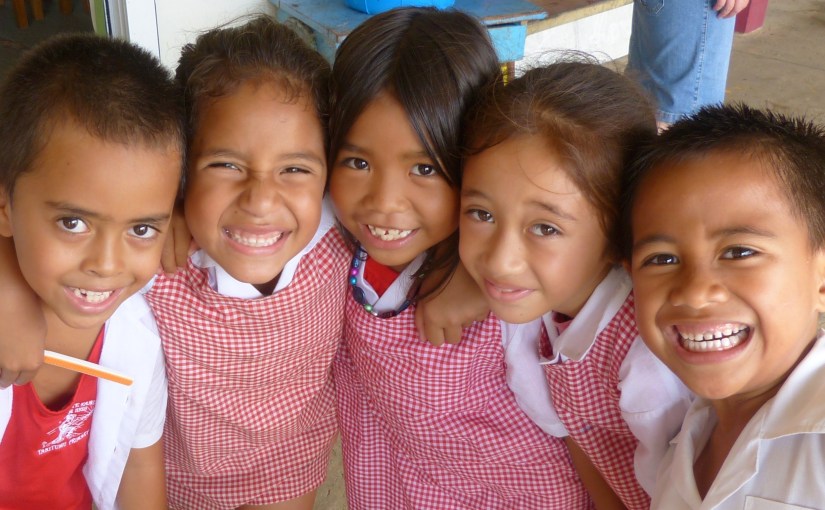
As for ME, my favorite things happen to dovetail nicely with ingredients 2 and 3.  I’m now doing all of the things that I wanted to do during my work life, but rarely had enough time for:  Exercise, book clubs, social events, travel, spending time with my family, Global Volunteer projects (The photo atop this post is from my time in the Cook Islands.  Who could resist those beautiful children?), cooking — the list goes on and on.

My guess is that we all have different “oomph” factors.  What’s important is to start thinking about what your special something is LONG before your last day at work.  How you plan to structure your days during this wonderful stage of life’s journey is almost as important as financial planning.  In fact, the two are directly linked.  If you have expensive habits and desires, then you’d best be building a BIG nest egg.  If you are a minimalist, however, then you don’t need as much.

So, there you have it.  Simple to say, harder to execute–but SO worth the effort.  Happy trails to all you current and future retirees.

Please feel free to share what is working for YOU!


“All You Need Is Love” The Beatles

“Love is all you need”.   Turns out, those four British boys were definitely on to something.

This blog post is about that THIRD essential ingredient for a happy retirement — strong personal relationships.  Nothing new or revolutionary about that.  Erich Fromm’s book, “The Art of Loving” published more than 50 years ago, informed us that the key to a happy life is love and work.  (We’ll address the “work” part in the next post)

Fast forward to 2016.  Robert Waldinger’s excellent Ted Talk describes findings from a 75 year Harvard study on adult development.  Guess what?  Researchers discovered the most important factor in determining whether someone is happy is not fame or wealth, but the quality of their relationships.  Not only were people with strong, positive relationships happier, but they were healthier–both physically and mentally.

During the 30+ years I was in the workforce, I was lucky enough to have jobs that paid me for establishing positive relationships with other people.  (Which, of course, is very different from being paid to have relations with other people.  Not that I’m judging…)  So, when I retired, I was not only saying goodbye to my co-workers, but also to customers that, in most cases, had become friends. Unfortunately, most of them are long distance friends.  And are still working.

Although I still think of my husband as my “boyfriend”, I don’t expect him to fill all of my companionship needs.   Perhaps part of the reason we are still going strong after 4 decades together is we both understand our mutual need for other interests and for time apart. Our relationship is very much like a Venn Diagram–my interests – his interests, with a nice big intersection of OUR interests.  Surprisingly, I have encountered people that find this a bit strange.  So, when I read this  Wall Street Journal article shortly after retiring, I was pleased to find that there are others out there like us.  Why I find it gratifying to discover that we aren’t so different is probably a subject for a therapist, or at least a future post.  But I digress.   Which happens a lot.  

Anyway, I have spent the last four years figuring out how to exchange “work mates” for “play mates”, and I’m happy to share what I learned with you, my newly retired, soon to be retired, or hoping to one day be retired readers.

Here’s what’s been working for me:

  1. Meet-Ups This on-line application allows you to select by  geographic area and areas of interest.  After you make your selections, you get notifications of gatherings of like minded individuals.  You can get even more specific, narrowing it down by age or marital status.  I’ve made friends via book club, biking, and boomer dining meet-ups–and there are lots of other options.  Plus, if you are so inclined, you can start your own meet up group.
  2. The Local Y   It is indeed fun to go to the YMCA!  But don’t just  hang out on the treadmill.  Join classes, and attend regularly.  And don’t worry about being out of shape.  There are no mean girls here!  The women (and most of the class attendees ARE women) are friendly, welcoming and caring.  In many ways, the Y “family” has been a wonderful substitute for my workplace “family”.
  3. Volunteer I’ve made some incredible friends during my Global Volunteer Projects. See the world, make new friends, learn about another culture!  Check out that wonderful organization!
    If you prefer something local, AARP offers an on-line application designed to link retirees with nearby organizations in need of their skills, and aligned with their interests.
  4. The Local Library  Mine offers an array of programs, including book clubs and educational seminars.
  5. Welcome Wagon  Yes, I know, this is supposed to be for newcomers.  BUT the local contact can be a great resource for area clubs and gatherings.  It took me 32 years before I stumbled across our Neighbors and Newcomers Club, but I’m so glad I did!
  6. Reconnections  Maybe you have been too busy to stay in contact with friends from high school or college.  Why not reach out?  I attended my first college reunion five years ago, and am looking forward to the next one this spring.  It was a wonderful trip down memory lane, an opportunity to reconnect with old friends and a chance to make new ones.  Ditto for high school.
  7. Travel  Okay, so this probably isn’t going to help you with day to day connections, but we met some fantastic, fascinating people on our trips with Road Scholar, OAT, and Grand Circle.  In 2016, our new Zealand friends will be visiting us and we will be taking a trip with friends we met in Peru and on a Global Volunteer experience.
  8. Virtual Buddies I put this one last, because a computer relationship is no substitute for face to face, hand to hand connections.  Still, email, facebook and blogging can be wonderful ways to complement your other relationships.  I loved having pen pals back in the dark ages when I was a child.  My Blog Buddies to me are the 21st century version of pen pals. The best part, however, was when I met a blog buddy when we both happened to be in San Francisco, visiting our kids.  With luck, she and I will be able to synchronize travel again.

What about YOU?  What has helped YOU make the social transition from workto retirement?