Druk Yul, Land of the Thunder Dragon

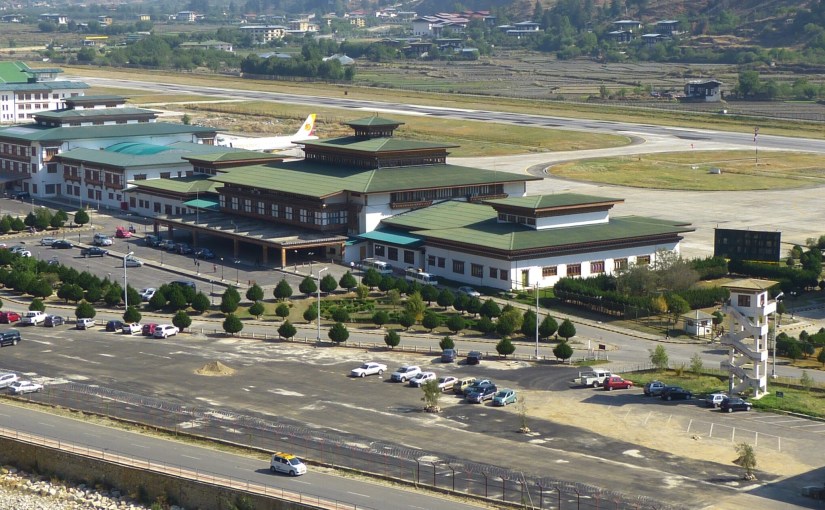
Bhutan’s airport looks like it was designed by Walt Disney.  The buildings are covered with carvings of dragons (Druk means dragon in Bhutanese) and the windows are highly decorative.  It is the country’s sole airport, because Paro is the only area flat enough to accommodate a runway.  It’s a very SHORT runway, but a runway nonetheless.


The mountains that surround the runway make landing quite exciting.  So exciting, that only 8 pilots are skilled enough to fly into and out of Paro.  Fortunately one of those 8 was flying our plane today.
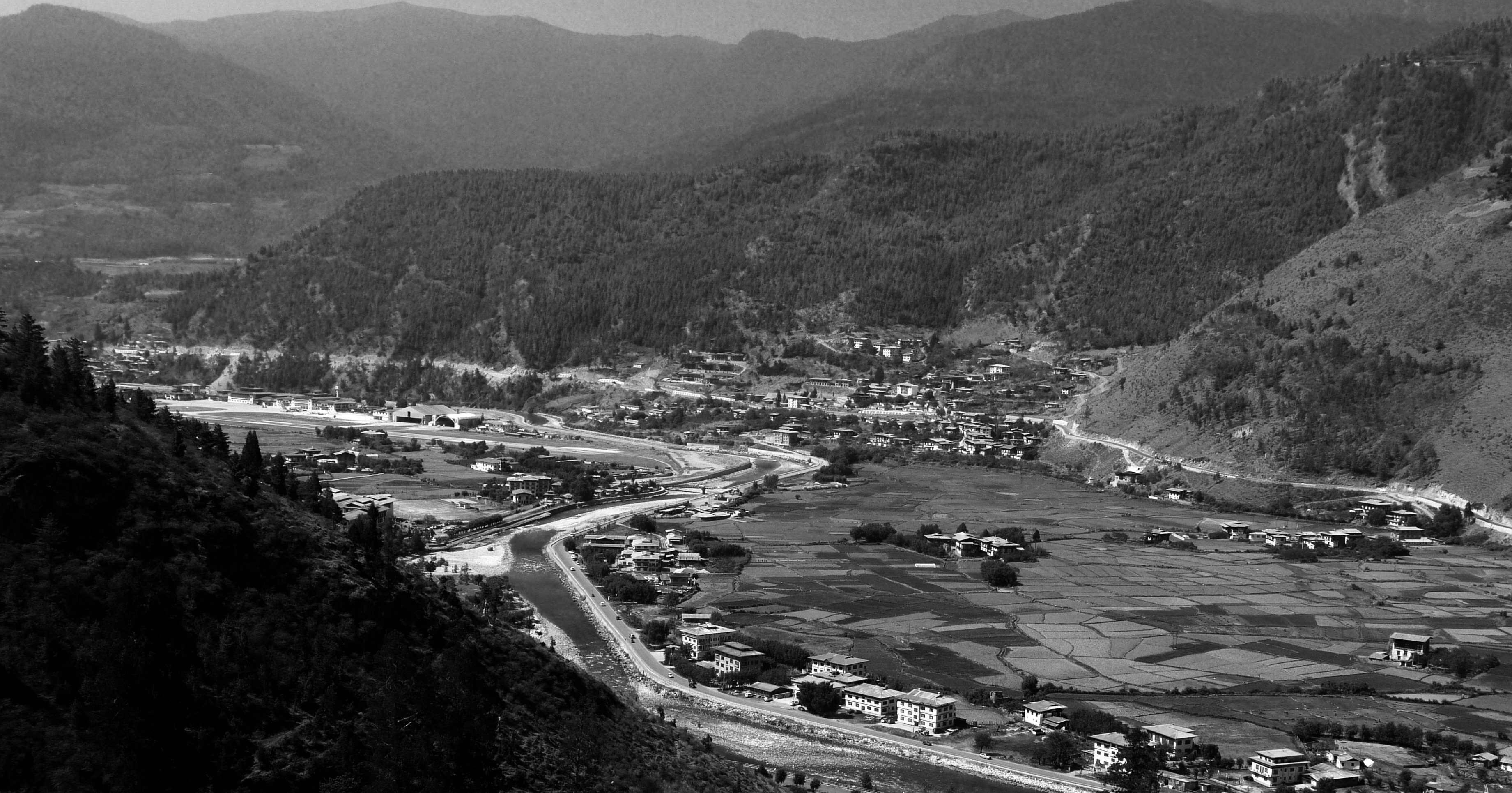
The airport is on the left. Take a look at those mountains

Tashi, our guide, and Gembo, our driver were waiting for us outside the terminal, ready to get this party started. First stop, Paro’s dzong. Every city/community had its own dzong. Back in the day when the Tibetans’ favorite leisure activity was invading their neighbors, the dzongs were fortresses. Today they have been repurposed into administrative and religious buildings.  
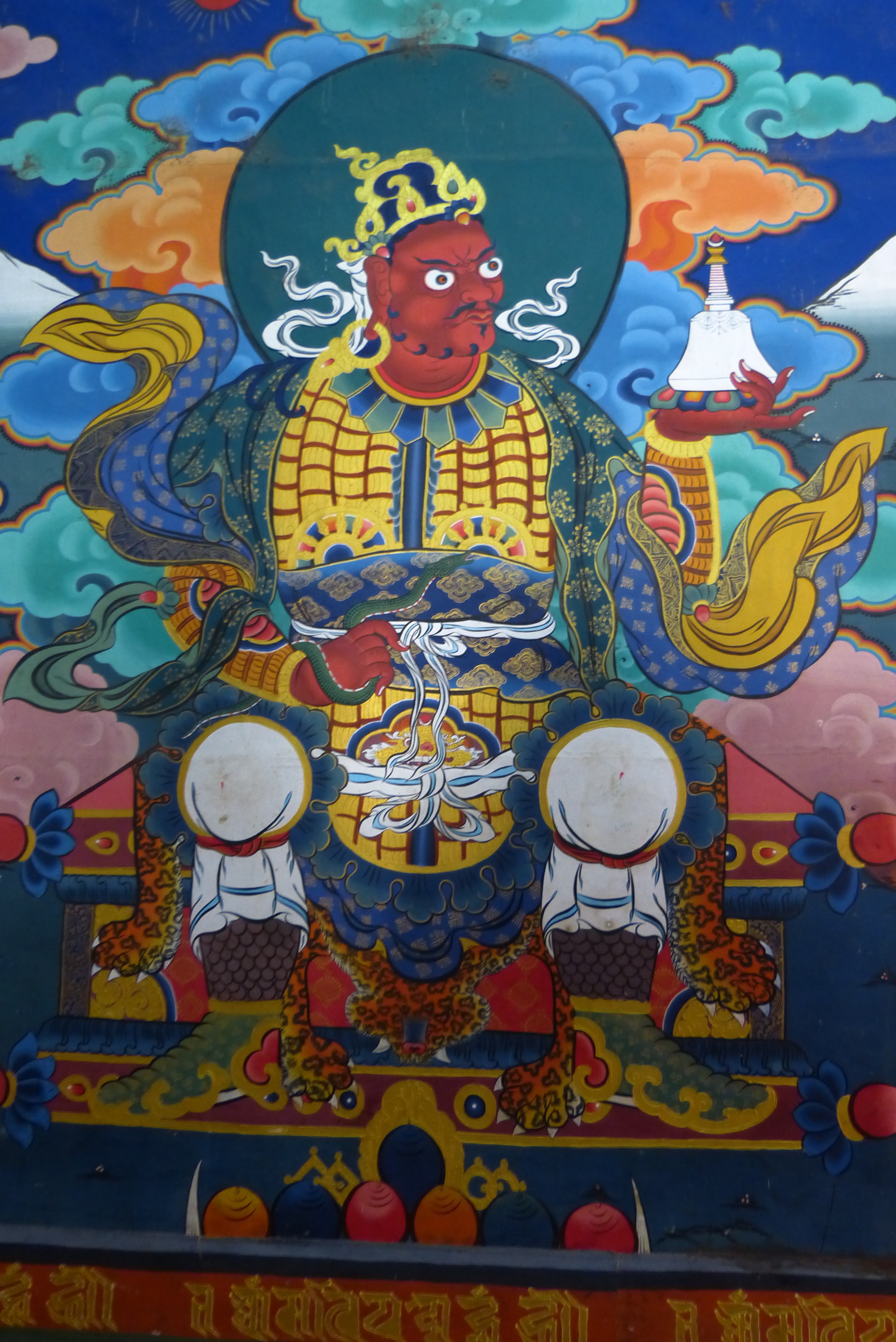
the demon of the west
The dzong courtyard
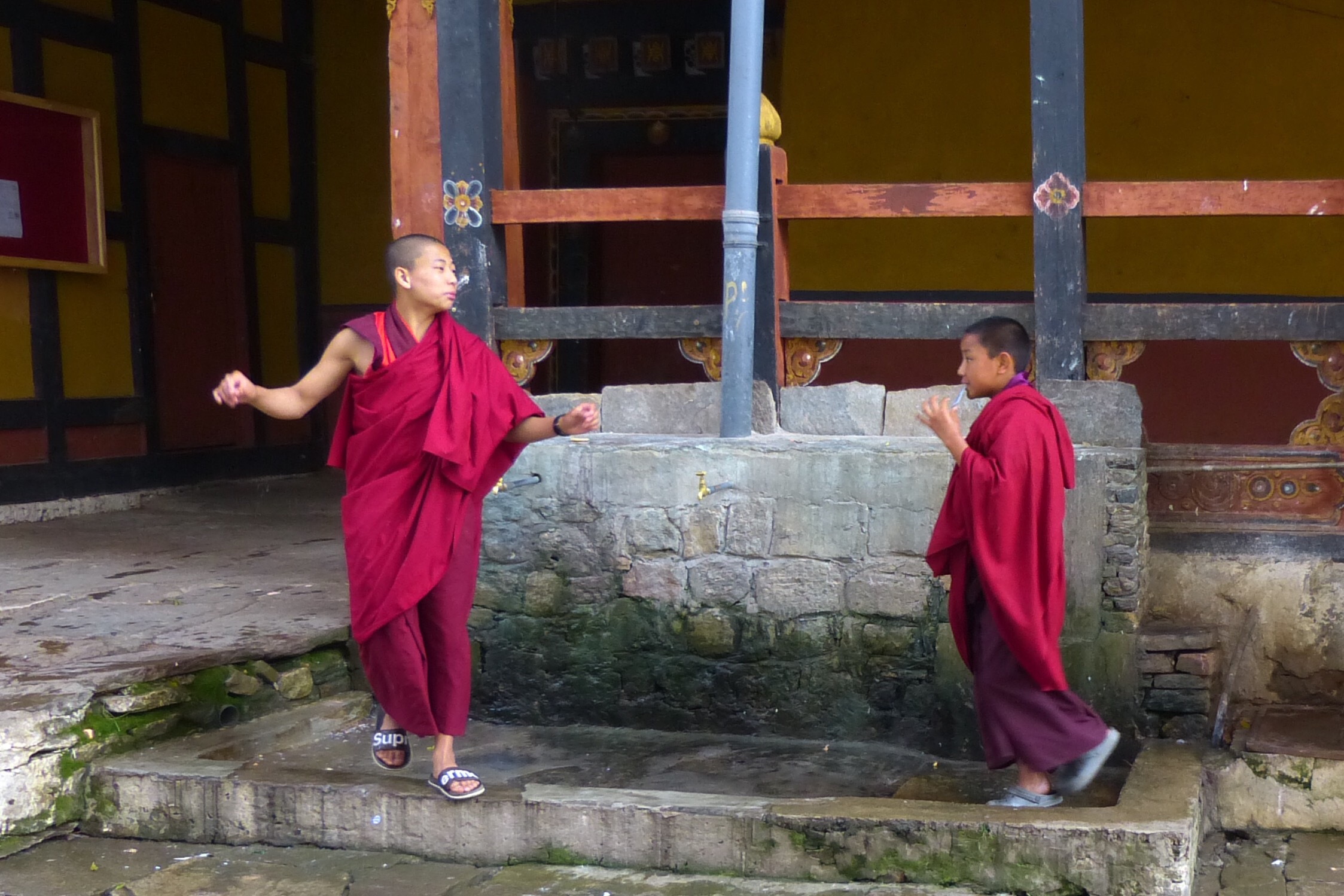
Young monks

Anyone thinking about visiting Bhutan should take a close look at those stairs.  They are steep, uneven, and lacking handrails.  And they are everywhere!
 

good thing i spent time at the Y before this trip!


After touring the dzong and the national museum, we stopped for lunch at a typical farmhouse.   In a “typical farmhouse” the ground floor is where the cows sleep.  They are protected from predators, yes, but this arrangement is multipurpose.  They also act as the home’s furnace, generating heat (among other things) for the floors above.  The second floor is used for storage, mainly food.  The room we viewed was loaded with drying rice.  The top floor contains the bedrooms, the kitchen/gathering spot and the altar.  

check put the floor boards!


Our hostess served us a delicious meal, complete with butter tea, into which you tossed grains of toasted rice. Okay, so maybe that last part wasn’t so delicious–at least not to me–but the fresh spring asparagus was particularly wonderful.
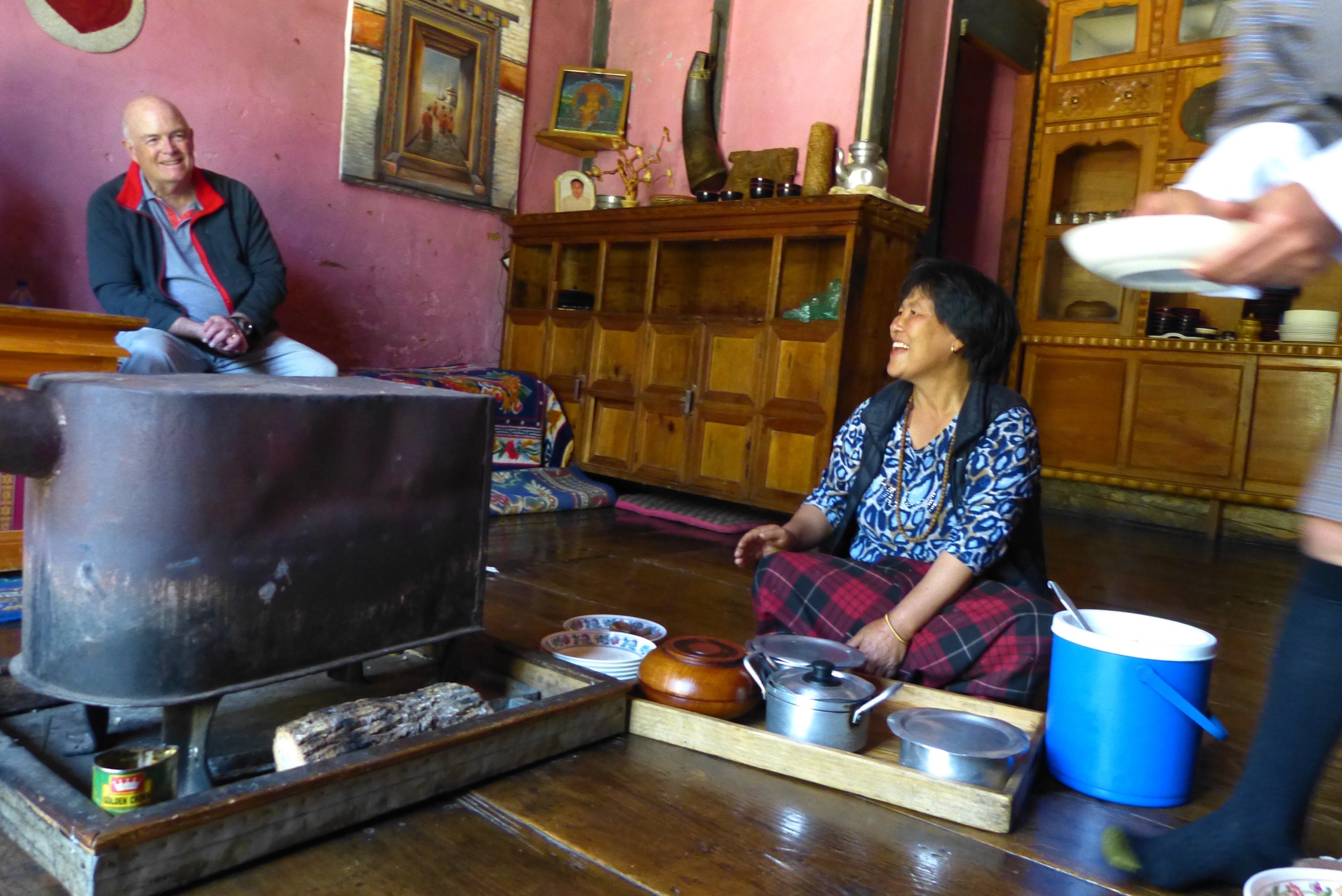
Benches were provided for thise that didn’t want to sit on the floor


Our hotel, the Thimpu Tower, is smack dab in the center of town, right by the historic clock tower.  It was very easy to stroll through the capital city and check out  their version of a traffic light.  
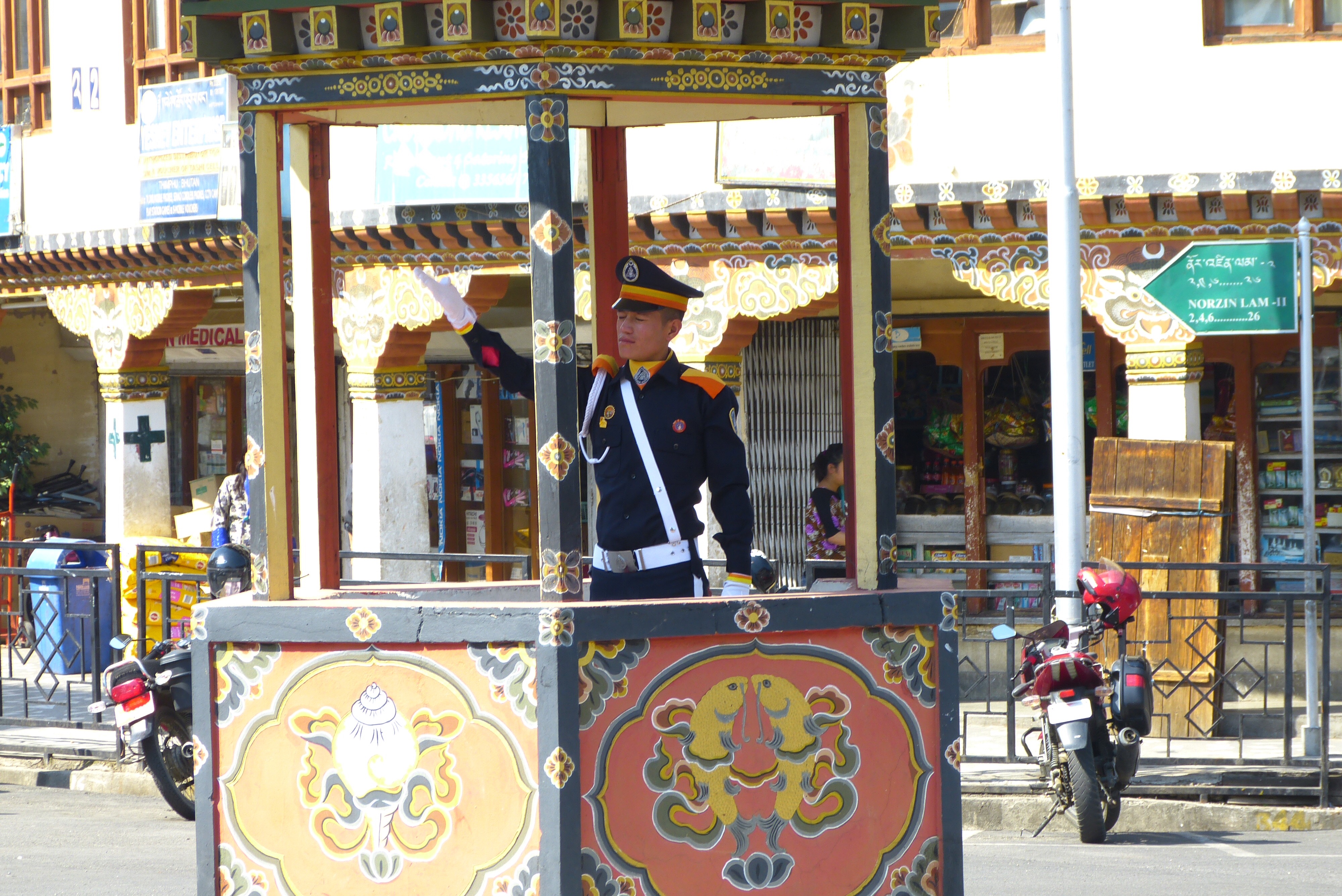
Bhutanese traffic light
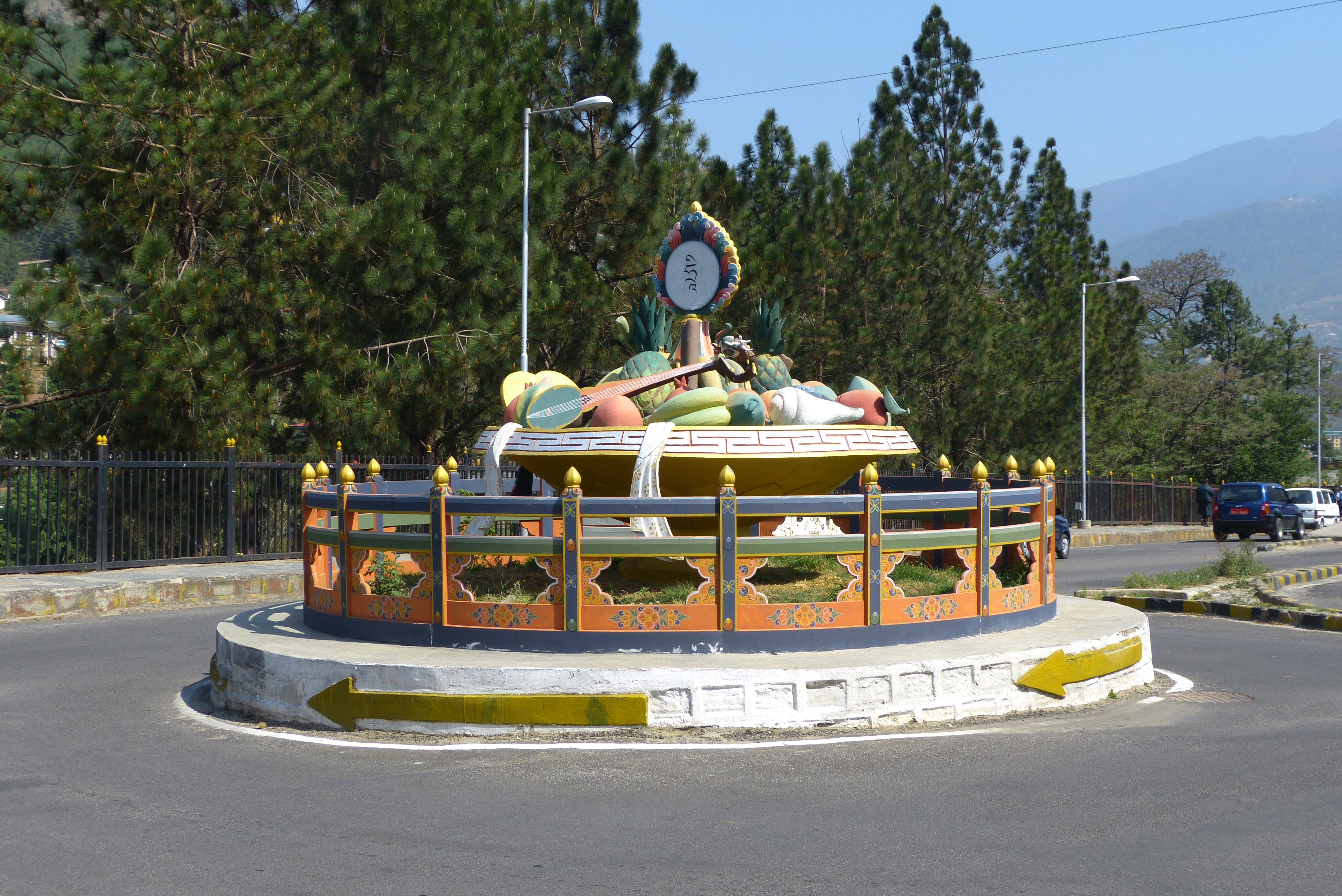
the rotary


By the way, that’s the ONLY “traffic light” in Thimphu.  Like Massachusetts and New Jersey, they DO have “rotaries”, but their traffic circles are a bit more decorative.  

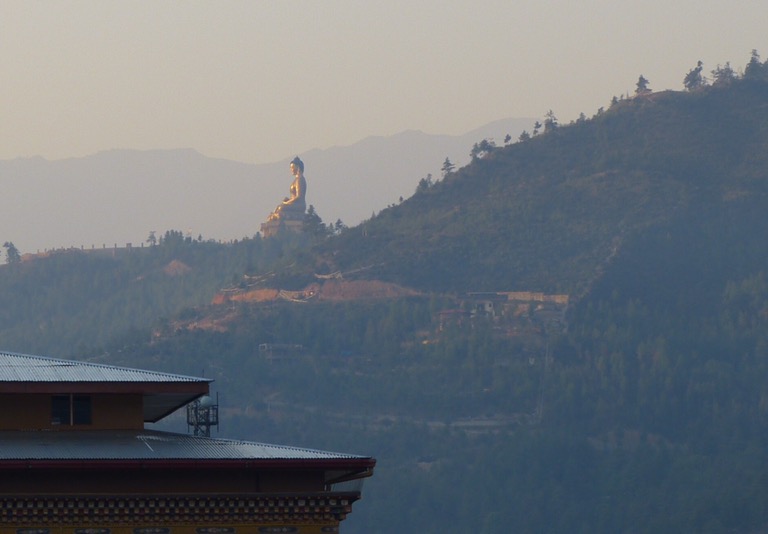
My lovely room overlooks the “clock tower plaza” and from my window, you can see the largest Buddha (in that particular contemplation pose) in the world.  Tashi tells us its construction is being completely funded by Asian Buddhists from Singapore, Thailand, China and Indonesia.  A much more up close and personal view will follow.  

There is construction everywhere in Thimphu. I needed to watch my step at all times to avoid the uneven pavement and the frequent holes in the sidewalks.  (I sure was missing Mike, who normally does all the watching for me, making sure I don’t trip over my own feet or fall into one of those holes!)
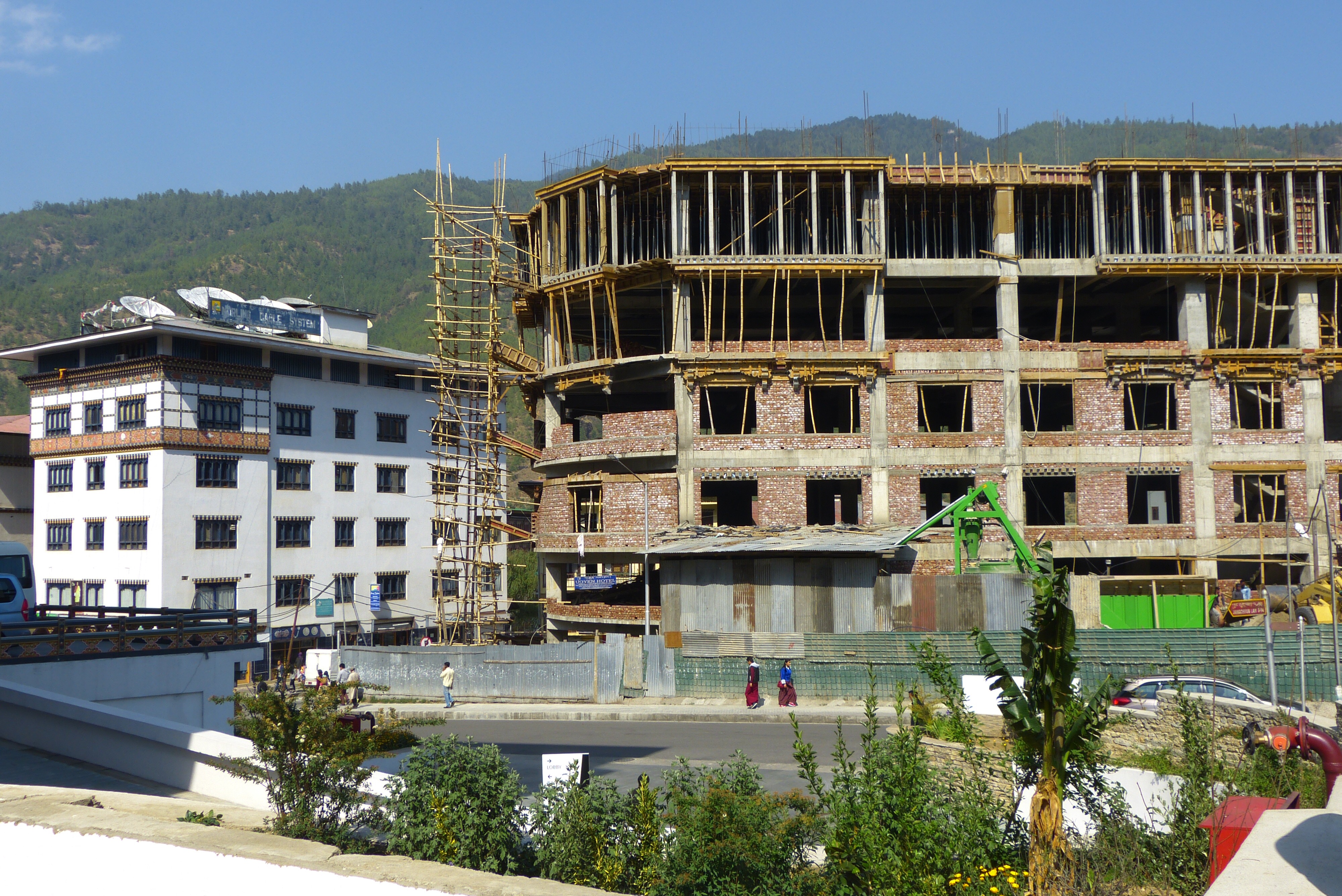
i wouldnt want to depend on THAT scaffolding


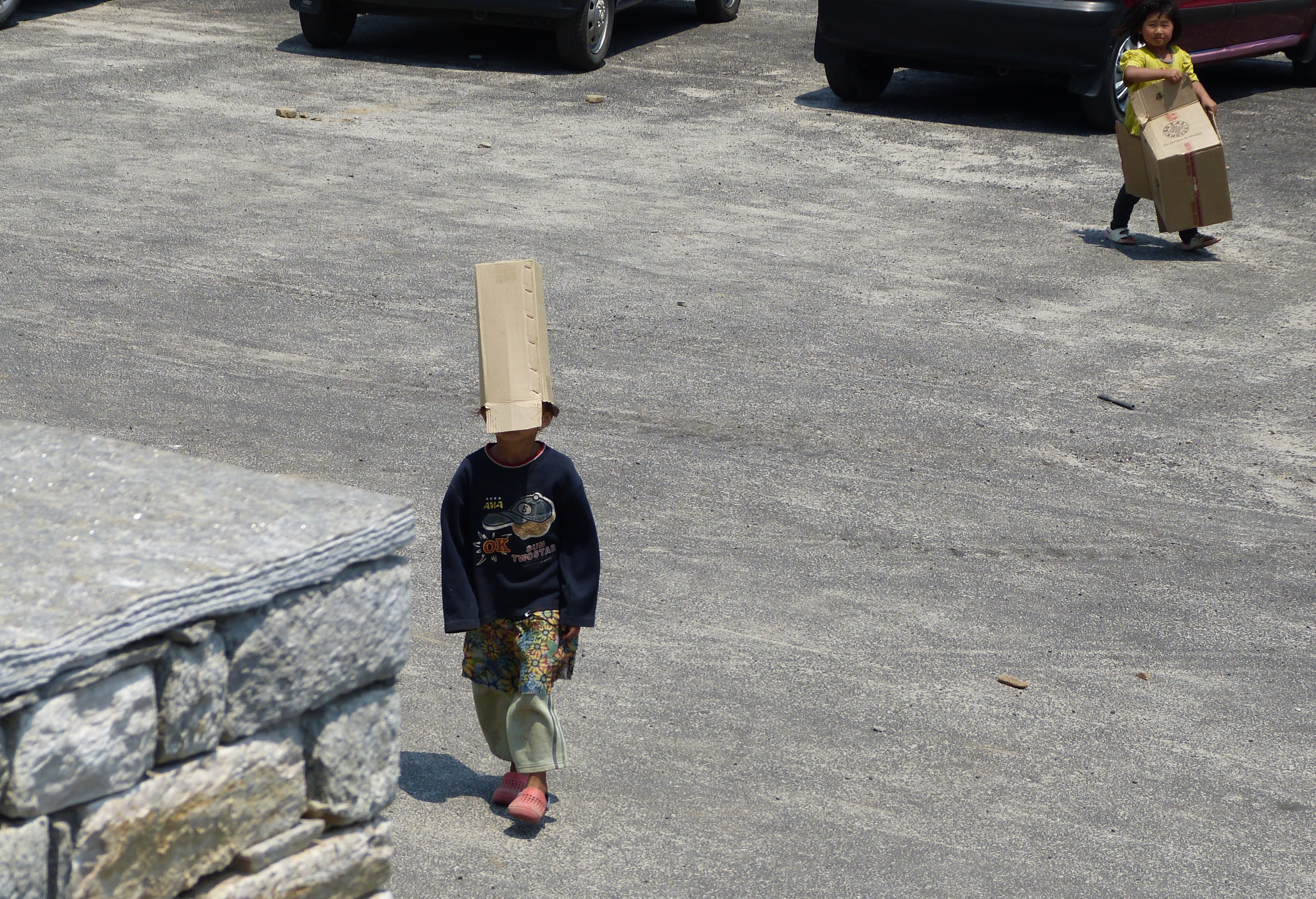
The kids roam freely in the land of gross national happiness.  These two were moving so quickly, I couldn’t get a good shot, but you’ll get the idea.  What better toy than a box and paper bag?  They were having a blast!  
A Day in Delhi

 Might one of those peaks be Mount Everest?   Your guess is as good as mine.  One thing I know for certain, those babies ARE the Himalayas and the view from the left side of the plane, even from my middle seat over the wing, was majestic.  But I’m getting ahead of myself.  This post is supposed to be about Delhi, so I need to back up a little.  Truth is,  I just wanted to use the photo.

On my flight to Delhi, my intention was to get to sleep as fast as possible.  That quickly changed when I realized my seat mate was quite fascinating.   He was starting a speaking speaking tour in several cities throughout Asia about the “soft side” of medical care.  If that weren’t interesting enough,  his son, Ashok Rajamani, wrote “The Day My Brain Exploded”  a memoir about his stroke at age 25 and his come back when he emerged from a coma.   The end result?  I got so engrossed in our conversation, it became too late to take a sleeping pill, so I landed in Delhi a bit more jet lagged than I’d hoped.

For those of you that view me as being organized, I have a confession to make.  I forgot to bring my hotel confirmation with me, so I didn’t have its exact address.  I figured that would be no big deal, given that the Pride Plaza Hotel was right at the airport.  Wrong.  The cab driver had no idea where it was, so he stopped periodically to ask random people for directions.  You might suspect it was a ploy to run up the meter, but the fare was prepaid.  What’s going through my jet lagged, brain while we are driving aimlessly around, chatting up strangers?   I’m thinking it’s a good thing I’m not in The Amazing Race.  For sure, I’d be hearing Phil say, “you are team #10, and I’m sorry to tell you, you have just ‘bean’ (yes, that’s how he pronounces it) eliminated.”

When we finally made it to the hotel, I was pleased to discover that it was quite lovely, and I congratulated myself on my decision to arrive in Delhi a day before the start of the OAT tour, to allow myself time to acclimate.  I am very aware that a well rested me is a happier me, and an overtired me, well, let’s just say it isn’t pretty.

Delhi is chock full of amazing temples, tombs, museums, bazaars, historical and cultural sites.  One could easily spend a day visiting  Humayun’s Tomb, the India Gate, the Lotus Temple, the Red Fort –the list goes on.

I did none of that.

One huge benefit of retirement is I finally figured out I don’t have to cram everything into one day.  No,  I have EARNED the right to be selective and to do fewer things, but to choose the things that put a smile on my face.

So, what did I choose?  Well, I toddled over to the Delhi Dance Academy’s Gurgaon location to shake, shake, shake in my best Bollywood fashion with my charming dance instructor, Vishnu.  Marcus, Pride Plaza’s very knowledgeable concierge, arranged for a hotel driver to take me to Gurgaon, wait the 2 hours I was there, and bring me back–all for about $25.  After the night before’s taxi experience,  I figured it was the best, nay, the ONLY way to travel.

Next question– how’d it go?  Well, although I had thought I would be joining a class, I discovered that the Delhi Dance Academy had arranged for a private lesson.  For about $30, I got a welcome ceremony, refreshments, instruction in three different dances, and lots and lots of laughs.  I’m supposed to get a video of my endeavors within the next couple of weeks.   I’ll be sure to post it so everyone can share in the fun.

And now some lessons learned,  for future OAT travelers taking the Bhutan, Nepal, Tibet trip.

  1. Prepay for your taxi inside the terminal.  It is a whole lot easier if, unlike me, you have the actual address with you.
  2. i wasn’t the only one with a clueless cabbie.  Even WITH the hotel address,  one of the other travelers had a similar experience, stopping several times to ask for directions to a hotel that was in the bloody airport area.  Don’t panic if it happens to you.
  3. The ATMS in the terminal are not as user friendly as they are in other countries.  At least they weren’t for me.  After having difficulty with two different ATMs, I ended up using the currency exchange at the airport.  Not the most cost effective choice.
  4. I probably COULD have paid for the taxi with dollars.  The guy at the terminal’s taxi desk told me he would have given me a much better exchange rate.  Who knows?
  5. Our flight to Bhutan was scheduled for a 5 AM departure.  We had to be in the hotel lobby at 2 AM to be sure we’d get through passport control and security in time.
  6. if you CAN go a day early, it is well worth the additional cost of the hotel room.  And the hotel can help you do whatever puts a smile on YOUR face.


Follow the Yellow Brick Road to the Roof of the World – Part 3

When you hear “Seven Years in Tibet” what comes to mind?  The movie starring Brad Pitt?

Well, I never saw the movie but I HAVE read the book  by Heinrich Harrer, and I must say, it was pretty phenomenal.   Harrar escaped from a British POW camp in India during World War II.  Interestingly enough, POWs back then were able to keep their money and  supplies, so when he escaped, he had a rucksack, some provisions, and enough money to trade with Tibetans as he made his way through the Himalayas to Lhasa.

The Tibetans were gracious hosts, providing Harrer and his traveling companion,  Peter Aufschnaiter (another escaped POW) with shelter and, when they ran out of money, gifts of food.  Harrer and Aufschnaiter were able to repay this kindness by generously sharing their scientific and engineering knowledge with a country that at that time was closed off to the rest of the world.  In addition to helping with flood control, translating foreign news, providing agricultural advice, they also introduced  the Tibetans to a new sport,”walking on knives”, what we call ice skating.    Eventually, Harrer met the young Dalai Lama, becoming a trusted friend and tutor of the isolated adolescent.  Harrer not only oversaw the construction of a movie theater in the Dalai Lama’s summer palace, he also created the films that were shown there, using a 50’s era movie camera to photograph Tibetan festivals.

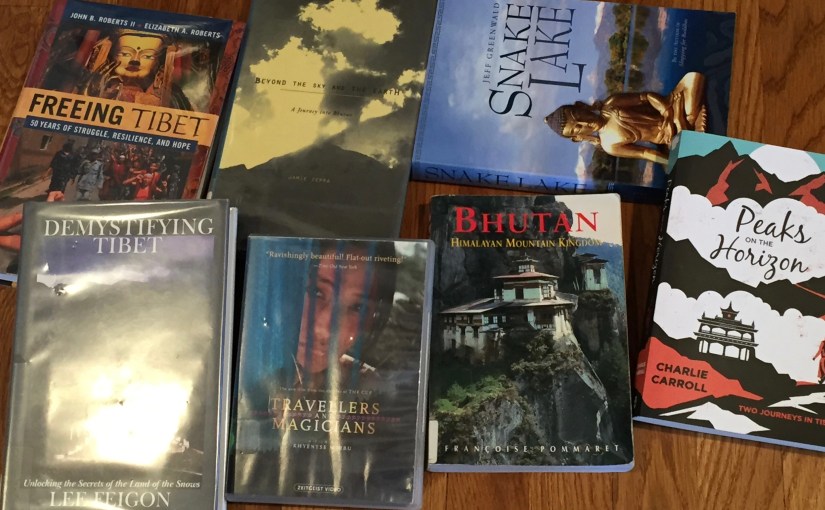
After Charlie Carroll discovered Seven Years in Tibet in his elementary school library, he became fascinated with this remote Himalayan kingdom.  It was a bit like me and the Wizard of Oz, except HE could actually visit HIS magical kingdom.  And he did, in 2009.  The end product of his journey is the wonderful narrative Peaks on the Horizon.  Two parallel stories alternate chapters, chronicling Charlie’s travels, and that of a young Tibetan refugee he met just before leaving the country.

Seven Years in Tibet and Peaks on the Horizon are great introductions to Tibetan religion, history and culture.  Although I quickly skimmed through  Demystifying Tibet by Lee Feigon and Conversations with the Dalai Lama by Thomas Laird, I found them more difficult to get through and not as entertaining.  I’ll admit it.  I’m a sucker for the personal narrative.

So, if you have been following along The Yellow Brick Road to Asia, you know that now is the time for ten very random, fun facts uncovered through reading about Tibet:

  1. At 13,000 feet above sea level, Tibet’s nickname, “The Roof of the World” is fitting.  It is the highest inhabited area in the WORLD.  Yikes.  I’ve packed a supply of Diamox to make sure I don’t have a problem with the altitude.  
  2. The first major character in its recorded history is Songtsen Gampo, who conquered and united a multitude of tribes to create the nation of Tibet.  Sources claim he became king at the age of 13.  I guess during the the seventh century, they dealt with adolescent angst by sending the boys off to pillage, plunder and start a new nation.  Before he died in 649, he managed to acquire one wife from China, one from Nepal and four from among the local girls.  There are two versions of the Chinese bride story.  Songtsen Gampo  ordered the king of China to send him one of his daughters and when his “request” was refused,  he attacked and pillaged.  Version two describes Songtsen Gampo as a lovesick warrior who became a vassal of the Chinese emperor to obtain his lovely wife.  See if you can figure out which explanation belongs to which nation.
  3. But it wasn’t ALL fun and games.  Songtsen Gampo is also credited with bringing Buddhism to Tibet (and to Bhutan).  He built the first Buddhist temple in Tibet, the Jokhang, to house the statue of the Buddha his Chinese wife, Wencheng,  brought from China as part of her dowery.  One account mentioned that the Nepali wife also brought a Buddha with her, but the Chinese one appears to be more sacred and more famous.  it will be interesting to see what we are told when we are in Lhasa.
  4. There was a gap of almost a century until the next important emperor came on the scene.  Trisong Detsen (755-797) conquered the areas along the Silk Road.  But he too was more than just a warrior.  He also  built Tibet’s first monastery at Samye and invited Padmasambhava (Remember him from the Nepal post?  Also known as Guru Rimpoche, he emerged from a Lotus in a lake) to come to Tibet to help spread the word about Buddhism.
    Unfortunately, Trisong Detsen met an untimely end.  Rumor has it that he was 
    poisoned by his wife, who may also have disposed of her son in a similar manner a mere two years after he was crowned.   Talk about dysfunctional families.  Even Dr. Phil would have had trouble fixing THEIR problems.  
  5. The next notable character appears in 838.  Lang Darma joined with members of the Bon religion to strangle his brother, the current king.  He tried to reinstitute Bon, the local religion, by suppressing Buddhism.  Here’s the interesting part. Lang Darma was thought to be a devil, complete with horns on his head.  After forcing girls to comb his hair, he used his horns to kill them, then ate them.  Lhalung Palgyi Dorje, a monk, came to the rescue, killing Lang Darma by shooting an arrow through his heart.   
  6. Remember Ghengis Khan and the Mongol Hoards?  I sure do.  I have a strong visual of him and his buddies, galloping across the steppes, flags flying in front, long hair streaming behind.  So, what has that got to do with Tibet, you ask?  Well, bet you didn’t know that the term “Dalai Lama” came from the Mongols.  I certainly didn’t.  Altan Khan, who ruled Mongolia in the 1500’s (yes, we’re skipping WAY ahead!) invited Sonam Gyatso, the abbott of Tibet’s largest monastery, to his country to spread Buddhism throughout Mongolia.  Dalai Lama is the Mongol translation of Sonam Gyatso’s name, which in English means “Great Ocean”.  Tibetans, however, refer to their their spiritual leader as “Kundun”, which means “the presence of Buddha”, but since I’m not Tibetan,  I’m going to stick with Dalai Lama.
  7. Tibetans believe they are descendants of Chenrizi (also spelled Chenrezi, Chenresig and Chenrezig, depending on the source), who took the form of a monkey to seduce a demon.  The demon gave birth to six “long haired children” complete with tails (the first Tibetans) that disappeared when they grew to adulthood.   The Tibetan creation story explains human behavior by uniting the pure (Chenrizi is the Buddha of compassion) with the animalistic (the demon/ogress).  And all we westerners get is a talking snake and an apple.  I like their story better!  It even has evolution going for it.
  8. The current Dalai Lama is believed to be the fourteenth reincarnation of Chenrizi.  The THIRD Dalai Lama was the first granted the title by Altan Khan.  That Dalai Lama decided to declare his two deceased predecessors as the first and second Dalai Lamas.  After the third Dalai Lama’s  death,  Altan Khan’s grandson (surprise, surprise)  was declared to be next reincarnate — the fourth Dalai Lama.  He didn’t last long–he was dead before he was 28.
  9. The NEXT Dalai Lama was a powerhouse. The “Great Fifth” started construction of the Potala, Tibet’s iconic building.  He died before the building was completed, but his death was kept a secret for 10 years to ensure that construction would continue.  This huge complex is 13 stories high and contains color coded administrative (red) and religious (white) sections, which include the winter quarters for the Dalai Lama,  prison cells, torture chambers and stupas where prior Dalai Lamas are entombed.
  10. Yaks are as important to the Tibetans as Buffalo were to the Native Americans.  Yak butter is the main ingredient in yak tea, which is consumed by everyone, many times every day.  Yak butter is also used for the candles that are burned throughout all three Himalayan countries.  Yak dung is burned for fuel and is also used as an ink substitute.  The burnt yak dung becomes soot, which was used as ink for books during Heinrich Harrer’s seven years.  By the time Charlie Carroll visited a few years ago, Yaks had become endangered.  What is common now is a cross between a yak and a cow, called a dzo.  

How’s that for random facts?

There is so very much more to say about Tibet, but as with the posts on Bhutan and Nepal, I need to save something for when we are there, don’t I?

Follow The Yellow Brick Road- Part Two

You ready to climb aboard the bookmobile express for a trip to Nepal?

A few years ago, when Borders broke my heart by going belly up, I softened the blow just a tad by randomly grabbing books from the travel section, one of which was Snake Lake by Jeff Greenwald.  At that time, I had no idea the book was about Nepal. Not only that, but the thought of visiting Nepal never crossed my mind.  I didn’t even have the vaguest idea of where it was. As I mentioned in the last post, elementary school KILLED any interest in geography.  Good thing I’m a firm believer in lifelong learning!

Snake Lake is about Nepal’s political turmoil, starting with the student riots in 1979, thru India’s 1989 trade embargo, ending with the April 6, 2000 protest at Ratna Park.  It’s about more than just politics, though.  This very personal account has it all— romance, loss, and a spiritual journey that allows you to view Buddhism through Greenwald’s American eyes.

Two Australian writers, Amy Wilsee and Mark Whittaker, were fascinated by the 2001 murders and suicide of Nepal’s royal family.  Their quest for the back story leading to that gory night is documented in Life and Death in Kathmandu.  What I found most compelling, however, wasn’t the main event,  but two of their interviews:  one with a former Kumari (a living goddess- more on that later) and the other with a Maoist guerilla.  Initially, the Maoists were a group of committed idealists, focused on stopping the corruption and violence inflicted on villagers by the power structure.  Over time, as more joined the movement, the Maoists devolved into an unruly mob that inflicted as much violence and terror as they had initially fought against.

Although Jeff Rasley’s book  Bringing Progress to Paradise raises some interesting questions about the ethics of culture change and the impact first world intrusion into third world has on these remote villages, I don’t recommend the book.  Much of it chronicled his trek to the remote village of Basa and quite honestly, I thought he was a bit of a jerk to the friends that made the trek with him.

Little Princes by Conor Grennan, is a better choice if you want to learn how good intentions can sometimes lead to undesirable consequences.   After graduating from college, Conor decided to volunteer in an orphanage outside of Kathmandu.   Over time, he was surprised to discover that the children actually weren’t orphans at all.  

During the political turmoil, the Maoists had been entering the villages, abducting children and forcing them to fight.  When approached by a man who offered to bring their child to safety, families scraped together money, selling what little they had.  Unfortunately, the man who promised to care for their children was a trafficker who either sold them to be servants, or forced them to beg on the streets of Kathmandu.  The children were told that their families had all been killed.   Little Princes describes Conor’s efforts to return the children to their remote villages so they could be reunited with their families.  The book also made it clear that well-meaning tourists can inadvertently contribute to the problem by giving money and clothing to the child beggars.  Many times the children are forced to turn everything over to a trafficker, so the tourists are unwittingly contributing to child trafficking, making it profitable for the trafficker to continue.  Little Princes was a thought-provoking book that gets to the heart of the issue that many travelers to third world countries face–how to help without creating unintended negative consequences.  

So, what did I learn from my Nepali reading?  Well, I’ll share 10 of my discoveries now, again, not in any particular order–just random facts that caught my attention.  There’s much more, but  like my Bhutan post, I will save the rest for when we are on site.

  1. Nepalis believe the goddess Taleju takes up residence in a young girl (who then becomes known as a Kumari ), until the girl reaches puberty.  At that time, the goddess moves on to inhabit the body of another pre-pubescent girl.  What happens to the dethroned goddess, the young child, who had been taken from her family, placed in a palace, her feet not allowed to touch the ground, carried through the streets during festivals, decked out in red, with a third eye painted on her forehead?  Why she becomes mortal again, returns to her family and is expected to live a normal life, happily (?) ever after.
  2. What are the job specifications to become a goddess, you might ask?  Well, for starters, this 2 or 3 year old girl needs to have: a neck like a conch shell, a body like a banyan tree, eyelashes like a cow, thighs like a deer, a chest like a lion, a voice soft and clear as a duck’s…there’s more, but you get the idea.
  3. While in the Kathmandu area, we will be staying at the Gokarna Forest Resort.  Gokarna Forest used to be the hunting reserve for the Nepali royal family.  Not only that, but at the entrance to the Resort, there is a 200 year old pipal tree, where, in the very sappy movie, Little Buddha, under that very tree, Keanu Reeves was tempted by the demon Mara.
  4. Yes, I did indeed borrow the Little Buddha DVD from the library, and sat through the whole thing, including Keneau Reeves portrayal of Buddha, complete with his pre-enlightenment long, stringy hair.  What can I say?   It was a cold gray day.  I had nothing better to do.  The sad part?  I didn’t learn about the pipal tree until AFTER I had seen the movie, and trust me, I wasn’t going to go back to look for it.
  5. Swayanbhunath, also known as the Monkey Temple, is one of the oldest Buddhist sites in Nepal.  As you might guess, wild monkeys have inhabited the temple complex for many years.  And why not?  The food offerings that the pilgrims leave are mighty attractive.  Unfortunately,the temple was damaged by the 2015 earthquake, so I don’t know whether we will have the opportunity to visit it when we are in Kathmandu.
  6. Speaking of offerings at Swayvanbhunath  pilgrims always leave a portion for Hariti, the world’s grandmother and protector of children. Legend has it that Hariti originally was an ogress who lived during Buddha’s time.  To feed her 500 children,  she kidnapped other people’s children and turned them into dinner.  Buddha decided to teach her what it felt like to lose a child, so he kidnapped her youngest.  (With 500 kids, I wonder how she realized one was missing–but maybe that’s just me?) After Hariti learned her lesson about compassion, Buddha returned the child, then helped Hariti with her food problem by sharing with her the offerings from  his followers, the start of the practice that continues to this day.  
  7. Another Buddhist legend tells the story of the birth of Padmasambhava, who was also known also known as Guru Rinpoche.  Padmasambhava means “lotus born” because he emerged fully formed from a red lotus blossom that appeared in the center of a lake. The Lotus is the symbol of enlightenment.  Preview of coming attractions:  You will hear about Padmasambhava again when we get to Bhutan.
  8. The oldest Hindu Temple, Pashupatinath, fortunately was not damaged by the earthquake, so if we visit it, I’ll be sure to look for the magnificent sculpture of Nandi, the bull that Shiva rides.  Hindus come to this temple when they are ready to die, believing that dying on this sacred site guarantees that they will be reborn as a human.  Cremations take place on banks of the Bagmati River, which flows by the temple.
  9. The royal family’s palace is now open to the public.  It is a rather dismal abode, with lots of animal heads hanging from the walls.  (Most likely the animals they killed in their royal preserve at Gokarna Forest, which would seem to be a violation of Hindu–and Buddhist beliefs.)  Anyway, the palace sounds like a major disappointment–sorta like Graceland, not at all what you would imagine– which may be why it didn’t make it into our itinerary.
  10. Chez Caroline’s, a restaurant that was mentioned in one of the books I read (I can’t for the life of me remember which one), still exists.  According to the internet, the restaurant is in a “historic Rana Palace”.  I sure hope it isn’t the one with all the stuffed dead animals!  Who knows, maybe on one of “dinner on own” evenings, we’ll venture there.  If we do, I’ll be sure to report back.

Well, I warned you these were random facts that caught my fancy.

Our last and final stop along the yellow brick road will be Tibet.  Hope you come along!

Follow The Yellow Brick Road, Part One

I’ve been traveling all my life.  I can’t remember whether my first trip was to Neverland or to Oz, but I DO know that I returned to both places countless times.

For many, many years all my travel took place solely between my ears.  Although school did its best to smother any interest in geography by forcing us to memorize products, capitals, and other bone crushingly boring trivia, I never lost my enthusiasm for the exotic places I discovered through our local library.  Books were my magic carpet, whisking me to wondrous places a small town girl like me never dreamed she’d ever be able to actually visit.

Maybe that’s why today, before I set foot in another country, I try to read as much as I can about its culture, religion, politics, history and yes, even geography.  I want to experience in it my head first.  It sounds crazy, even to me,  but a place seems more REAL if I have read about it.

Our next trip will be to the Himalayan countries of Bhutan, Nepal and Tibet.  Here’s a map courtesy of Overseas Adventure Travel, roughly showing where we will be easin’ on down the road. Notice the red line stops at the Seti River?  That’s where the rafting starts, because there ain’t no road to get where we are going, yellow brick or otherwise.

Overseas Adventure Travel Itinerary


So about those books I’ve been reading– lets start with Bhutan.

My interest in that country began several years ago when I stumbled across The Geography of Bliss by Eric Weiner.  It introduced me to Bhutan’s concept of Gross National Happiness.   Also around that time, we’d had the good fortune to meet and travel with Dr. Peter Steele.  In 1967, at a time when it was closed to most of the western world, he and his wife were invited to visit Bhutan by the royal family.  After reading his account of the trip, Two and Two Halves in Bhutan, I became even more interested in visiting that fascinating country.

OAT provides a list of “additional resources” for each country on the tour.  That list was my starting point, supplemented by what I could find on Overdrive, an online resource available through our library and of course, by random internet searches.

What follows is nothing even close to a book report, mainly I am somewhat lazy, but also because you will get better summaries by clicking on the blue words in this post.  The Amazon and Good Reads reviewers will do a much better job filling you in than I would have done.

I had no idea that in addition to Peter Steele, Shirley Maclaine also visited Bhutan in the ’60s.  In her 1970 autobiography, Don’t Fall Off the Mountain,  she explains that she had gone to India to learn to meditate, and while there met the new Prime Minister, Lhendup Dorji.  He had assumed that position after the prior Prime Minister (his brother) was assassinated  by a member of the military.   She accepted Dorji’s invitation to visit Bhutan, but unfortunately there was still political unrest in the country, so her visit was cut short.  Still, she was there long enough to give me a feel for what Bhutan was like during that period.  Plus, she DID make it to the famous Tiger’s Nest Monastery in Paro.  And so will I.

Jamie Zeppa’s book, Beyond the Sky and Earth is a wonderful description of life in Bhutan during the late ’80s.  She spent two years as a teacher, first with elementary students in a remote village, then teaching college students at Sherubtse College near Trashigang. Yeah, I’d never heard of those places either.

Jamie married one of her students,Tshewang Dendup. Why did I feel compelled to tell you his name?  Well there is a reason.  In 2003,  he had a starring role in the lovely Bhutanese movie, Travellers and Magicians.  I got the DVD from my library; it’s a great way to  sneak a peek at the beautiful Bhutanese scenery (and to check out Jamie’s ex- husband, if you are so inclined.)

Lisa Napoli”s book, Radio Shangri-La  is about her volunteer work at Kuzoo FM, Bhutan’s “youth based” radio station.  Established in 2006 as one of the king’s projects, Kuzoo broadcasts in both Dzongkha and English.  Lisa’s several years with NPR made her a valuable resource for this young radio station.

Those 4 books gave me glimpses of Bhutan’s evolution from a closed Himalayan kingdom of the ’60s up to around 2009.  What did I learn from my reading?

Ten Fun Facts About Bhutan (Not in order of importance, or any other kind of order, for that matter)

  1. Bhutan is also known as Druk Yul, the Land of the Thunder Dragon
  2. Marijuana grows wild in Bhutan, and is fed to the pigs because (surprise, surprise) it increases their appetite.
  3. Ara is the local moonshine; its a clear wine made from rice. ( Now that we’ve gotten the local stimulants out of the way, let’s move on)
  4. All doctors visits and health care is free
  5. Drukpa Kinley, a Tibetan monk who lived in the late 1400’s,  made his way to Bhutan.  He was also known as the Divine Madman who used his “flaming thunderbolt” to bless women and to bestow “enlightenment”.   He was so successful in his endeavors, he became the patron saint of fertility.
  6. Thanks to the Divine Madman, many Bhutanese houses sport paintings and sculptures of phalluses.  Who knows, photos of the artwork may be a coming attraction of this blog.
  7. Jigme Singye Wangchuck, the 4th king of Bhutan, voluntarily gave up absolute power in 1998.  (When does THAT ever happen??)  He guided the nation from a hereditary monarchy (which had been established in 1907) to its current status as a parliamentary democracy.
  8. Okay, so now the”People Magazine” type information: The 4th king had 4 wives, all of them sisters.
  9. His son, the 5th king, Jigme Khesar Namgyel Wangchuck, was crowned in November of 2008.  That king has only ONE wife, who he met at a picnic when he was 17 and she was 7.  According to legend, he said  ‘When you grow up, if I am not married and if you are not married, I would like you to be my wife, provided we still feel the same.’
  10. Men wear the Gho, and women wear the Kira; these two articles comprise Bhutan’s national dress.  Jamie’s book mentions that all Bhutanese were required to wear the national dress.  This dress code was an issue for the Nepalese immigrants living in the southern part of the country.  I don’t know whether the requirement still exists today, but it will be pretty apparent once we get there whether it does or not.

I actually learned a whole lot more, but I have to save SOMETHING for when we get there, right?

Next stop on our book tour – Nepal.


Four Visas, Three Countries

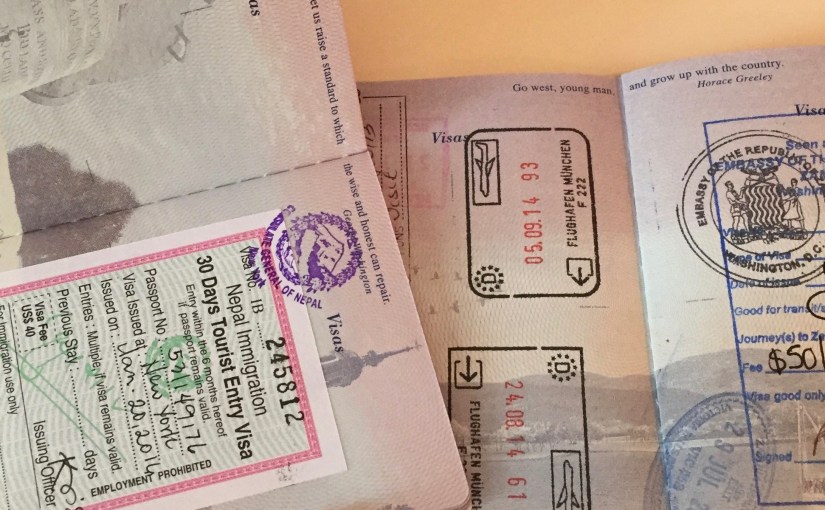
We will be visiting three countries–Bhutan, Nepal and Tibet.  So why do we need FOUR visas?  Fair warning–this post will likely only interest those that are taking a similar trip, or are planning to visit India.

For the three of you that are still reading, here goes.

We fly into and out of Delhi, so since we have at least one overnight stay in India, we need a visa.  A visa that costs (depending on the service used) anywhere from $135 to $173, per person.  A visa that requires you to complete an on-line application that is challenging to decipher.  But there IS a positive aspect.  The visa is good for 10 years.  So, should we decide to spend more than an overnight in India, it will be best to do so before 2026.

If you are anything like me, you are probably wondering how to score the $135 charge.  Well, Cox and Kings is India’s approved visa grantor, so you get the best price if you opt to go direct to them.

Our travel company, OAT, sent out a package with very helpful, clear instructions.  Good thing, because there are lots of hoops you need to jump through for that India online application.

OAT recommends PVS, a visa processing company located in DC, probably because you can send your passport to one service and they take care of visas for both India and Nepal, which is not the case with Cox and Kings.  PVS is convenient, yes, but as with everything, you pay for that convenience.  If we had used PVS, we would have paid a total of $566 for both visas, including mailing charges.

Instead, our total cost was $362, a savings of $204.  How did I pull that off?  In addition to using Cox and Kings, I dealt directly with the Nepali Embassy.

I happened to be traveling to NYC to meet a friend for lunch and a show, so I figured, what the heck, I’ll just go in a little earlier and stop by the embassy.  Located at 216 East 49th St, it is only open between 9:30 and 1:30 during the week.   Right between these two restaurants,
IMG_2241
you’ll find this sign on the side of the building:
IMG_2240 (1)You have to press the button on the side of the wall to get buzzed in.  I walked up to their tiny office on the 4th floor, but there IS an elevator.  The visas cost $40 per person versus $90 for PVS, so that represented half of our $200 in savings.
One thing that is important to know if you decide to go–they ONLY take money orders.  No cash, no personal check, no credit or debit cards.  Of course, I had everything that they didn’t take, but all was not lost because there is a place that sells money orders on the next block.  I have no idea what a money order costs, because my bank had a branch on the same block, so my money order was free.   If I had been smart, I would have found this website  before I left home.  It EXPLAINS the money order requirement and tells you what is needed to submit by express mail or courier–good news for those of you that have no intention of traveling to NYC.

It took 30 minutes for processing to be completed.  Passports and visas clutched in one hand, my other raised to hail a taxi, I was off for the Cox and King office 23 blocks away.

I thought I might be able to drop off my package (to be mailed to my home when processing was completed) and still be on time for lunch.  I was delusional.  It was a total waste of time and cab fare.  The smart thing would have been just to express mail the damn thing in the first place and be done with it.  Which is what I ultimately did.  Less than 2 weeks later, our passports arrived.

Two down, two to go.

Bhutan and Tibet both require that you send them a color copy of the first two pages of your passport in advance of trip. (OAT , bless them, is handling this part).  The actual visas are provided when you arrive, but only if you have 2 color passport type photos (2 for each country, 4 in total),  ANOTHER copy of our passport pages (for Tibet) and approximately $70 for Bhutan and $190 for Tibet, per person, in cash.  Cash means pristine bills–no wrinkles, tears or marks.  OAT recommends we bring more, because these fees are subject to change without notice.  See why we use a travel company when we venture to more non-traditional locales?  Knowing me, I  would have missed one or more of the requirements.

So, what did I learn from this adventure?  If you have enough time to submit directly to the embassy and Cox and Kings by express mail (or Fedex or UPS–whatever) you can save a bundle.  You just need to send for one, wait for the passports to be returned, then send to the other.   If, however, money is no object (that’s definitely not ME), and you prize convenience, or are short on time, then a service, like PVS is the way to go.

Next post will be about something other than this future trip.  I promise!


Memories of Global Volunteers

I’ve been back almost three weeks from my Global Volunteers experience in Hanoi. As with the last Global Volunteers project, I accumulated lots of wonderful memories–but this time, only a few photographs. This post is a bit random, but here goes.

All Global Volunteers follow this tradition:  We start each day with a “thought for the day”  and a journal reading summarizing the events of the previous day.  Volunteers take turns contributing thoughts and journal entries.

My thought, the motto of a Bangkok Wat, kicked off our two weeks of service in Hanoi.
“Enlarge your vision and be fascinated by the people surrounding you.”
The people surrounding me (volunteers, teachers and students) were indeed fascinating, and I benefited greatly from spending time with such interesting individuals.

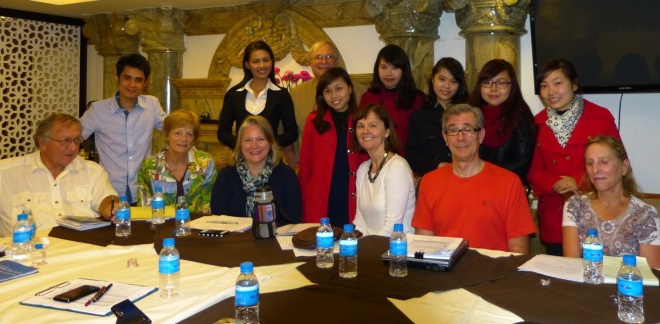
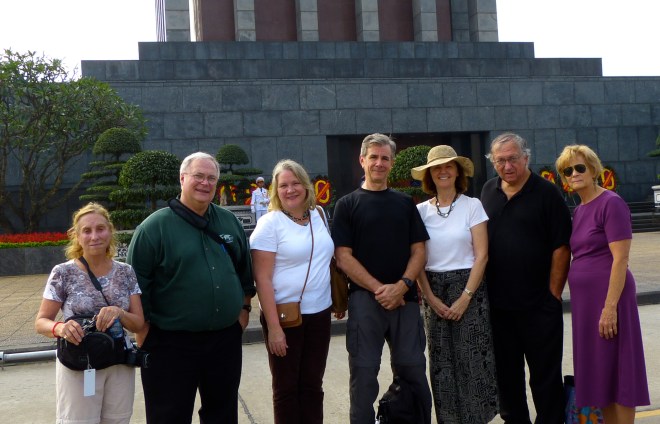
The volunteers:  Jeanne, Jim, Sally, Tom, Shelley, Bob and Judy
The volunteers: Jeanne, Jim, Sally, Tom, Shelley, Bob and Judy at Ho Chi Minh Mausoleum

We were the 21st Global Volunteers team to serve in Vietnam.  The first NGO to be welcomed into Vietnam, Global Volunteers started in the southern part of the country in 1993.  Initially the focus was on building schools, but it soon became apparent that what the people really desired was help learning English.

Jim, our very talented and extremely patient team leader,  reminded us that although teaching English is important, it is really a means to the ultimate goal of developing friendships.  We are all aware that our most important role is that of Goodwill Ambassador.  For some Vietnamese, we may be the first American they meet, so we will be supplementing the knowledge of the USA that they have gotten from TV.  (Yikes. That’s a big job!  But we were up to the task of taking on The Sopranos, the “Real Housewives” and Donald Trump! . )

The six of us volunteers had different backgrounds and different strengths, but we all shared a desire to make our time together a positive, fulfilling experience for students, teachers and ourselves.

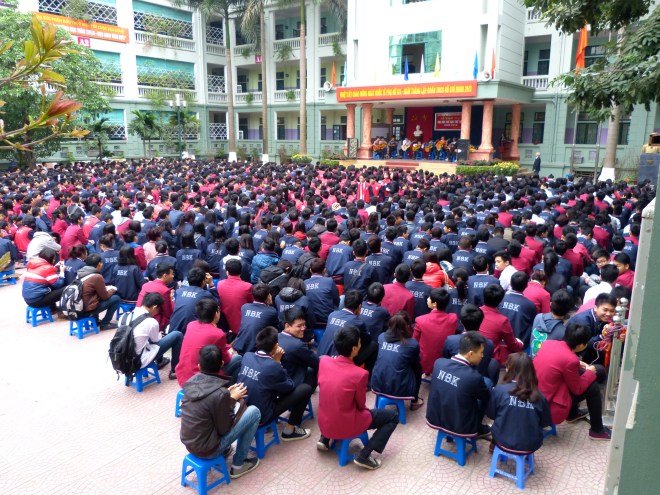
On our first day, we attended the Monday morning assembly, where the students  welcomed us with a guitar rendition of jingle bells.

P1020620

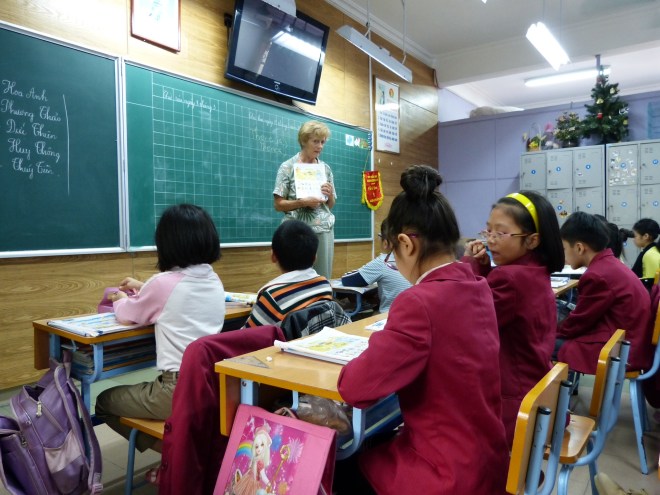
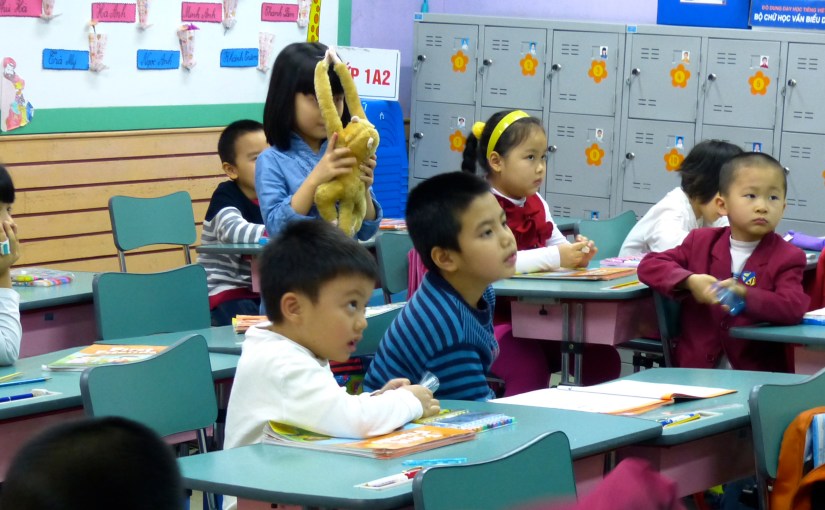
Judy, Sally and I worked with the English teachers in the primary school.

Mrs. Vananh and Miss Lan
Mrs. Vananh (who was due a week after we left) and Miss Lan

On our first day, Mrs. Vananh’s third grade class sang “We are the world” for us. For those of us that lived through the Vietnam War, it was quite an emotional experience, listening to these sweet, beautiful children and thinking that forty some odd years ago, we were dropping bombs on their city.
During our second week, we asked Mrs. Vananh if the children could sing it again, and when they did, I grabbed my iPhone and videoed them. Although I was sick the last two days of the project and missed seeing the kids watch the posting on You Tube, Sally and Judy reported that it was something to behold. The boys were high fiving each other, the girls were covering their faces, they were all pointing and laughing, enjoying viewing themselves on the classroom TV.

"We are the world, we are the children"
“We are the world, we are the children”

Some classroom memories:

Miss Judy at work
Miss Judy in action.
Miss Sally teaching the "apples and bananas" song, a real crowd pleaser!
Miss Sally teaching Miss Linh’s class the “apples and bananas” song, a real crowd pleaser!

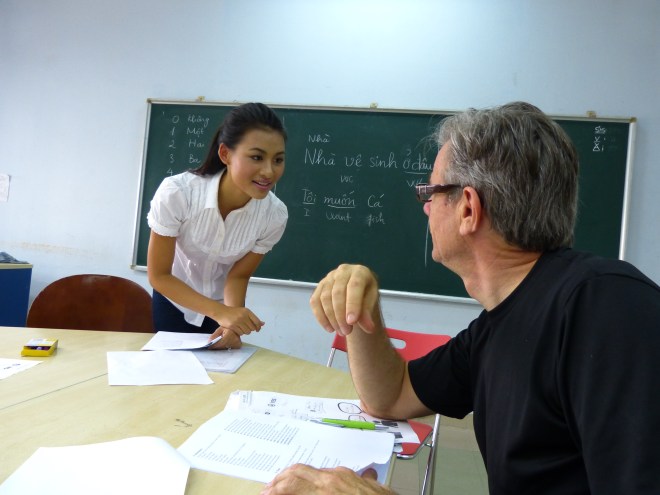
We weren’t just teachers–we were also students.  We were lucky to have the very patient Mai as our teacher.  She attempted to help us master the six different tones used in Vietnamese, with varying degrees of success.  (Bob was the star pupil–and I was his polar opposite).

Tom, getting additional help from Mai

Jeanne, Bob and Tom all worked with the intermediate and secondary students. We were all captivated by Zac, a very friendly and extremely articulate intermediate student. He is quite proficient with electronics, offering to protect my iPad with 4 levels of security. (I can barely remember ONE password–never mind FOUR!)

Sally and Jeanne with Zac

Zac’s grandfather taught him a lot about photography, so I let him play around with my camera. He decided to use the manual controls for this shot of me.

Modeling for Zac
Modeling for Zac

Zac was so impressed by my Vietnamese proficiency that he summoned one of his friends to hear me speak.  I’m sure their hysterical laughter at my pronunciation was their special way of saying “good job”.

Our time in Hanoi wasn’t ALL  work. One of the many high points of our time in Hanoi was an excursion to the Ethnology Museum with Lan and several of the student teachers. The museum was only a 15 minute walk from the school, but walking the streets of Hanoi is always an adventure. These beautiful young girls literally took us by the hand and walked on the outside to make sure that we were safe!  We must have been a sight–the seven of us big Americans parading down the street with our petite escorts protecting us from random motor scooters.

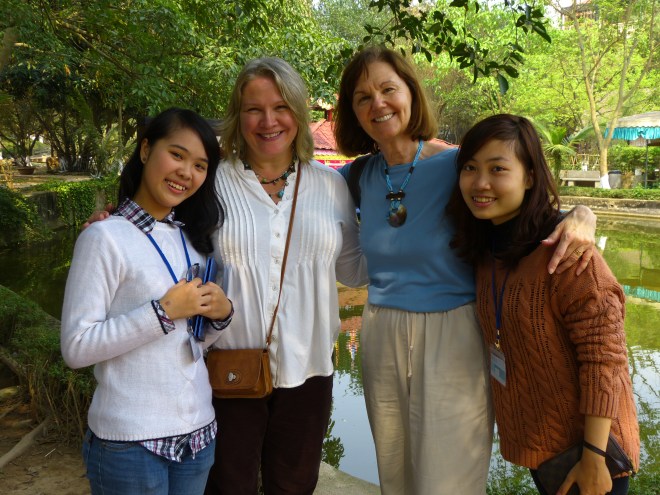
Our leader Jim, with our teachers/guides

P1020658
P1020663
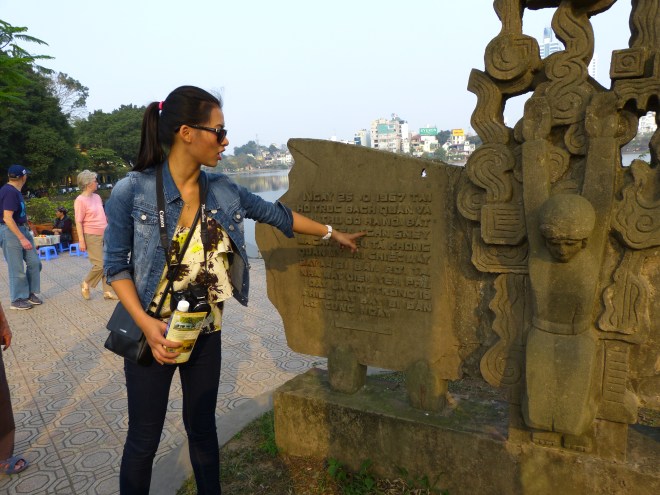
During our second week, we made it to West lake, the site of  John McCain’s crash. This monument is relatively new, and was probably put up to honor McCain for his role in normalizing US/Vietnamese relationships in the 1990’s.
P1020741

I had planned on taking lots of photos of the kids and teachers during the last two days of school, but although I was healthy through four countries and for almost 6 weeks, I spent those last days in bed…luckily recovering in time for the plane ride home.  My big disappointment was that I wasn’t able to say goodbye to the teachers and students, and have a farewell dinner with the team…so this post will have to function as my official thank you and ’till we meet again’ to all of the fascinating people that surrounded me.

Sidewalks of Hanoi

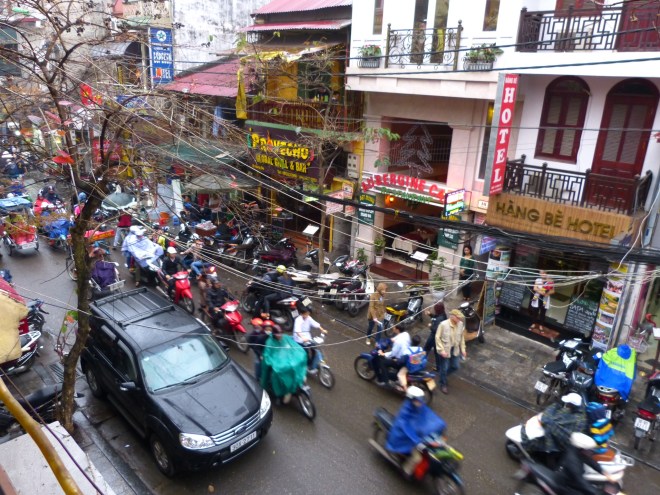
I wasn’t in Hanoi long before I realized “sidewalks” is a misnomer. “Beside walk” or “alongside walk” would be far more accurate, because THAT is what you do.

Photo taken from a second floor cafe/bar.
Photo taken from a second floor cafe/bar. Check out the wiring.

Although it LOOKED like one, this wasn’t a parade. They were just getting from point A to point B, and making MY point!

Notice the "bike rental" shop on the "beside walk"
Notice the “bike rental” shop on the “beside walk”

The old quarter is quite crowded, and the Vietnamese are very industrious, so every square inch is utilized.

You can expand your retail space
He's really pushing it!
He’s really pushing it! He’s spilling into the street.
The cases in the right foreground, less than a foot wide, are the local liquor store.
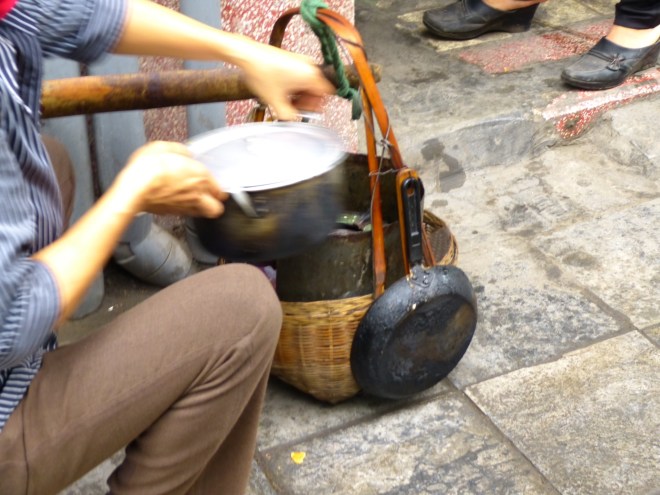
What better place for food prep?  Sorry for the blurriness.  I was dodging scooters while shooting.
What better place for food prep?
You can cook dinner...
You can cook dinner…
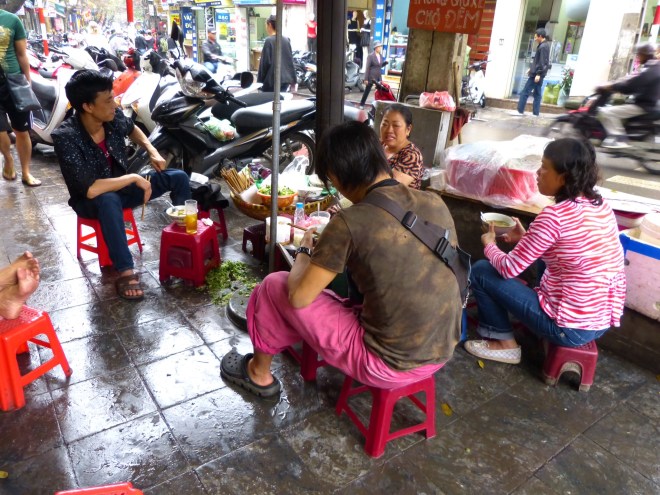
Gather with the family for dinner
gather with the family in the dining room
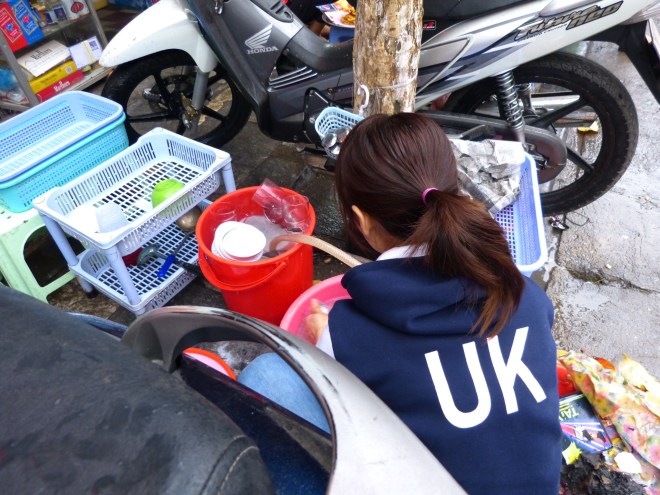
Wash dishes
Then after dinner, it is as good a place as any to wash dishes

Hang with your friends and watch the traffic whiz by
Like young men the world over, the corner is the perfect place to hang with your friends and watch the traffic whiz by

Whoever manufactures those plastic stools must be incredibly rich. They were everywhere!

Hanoi on the Weekend

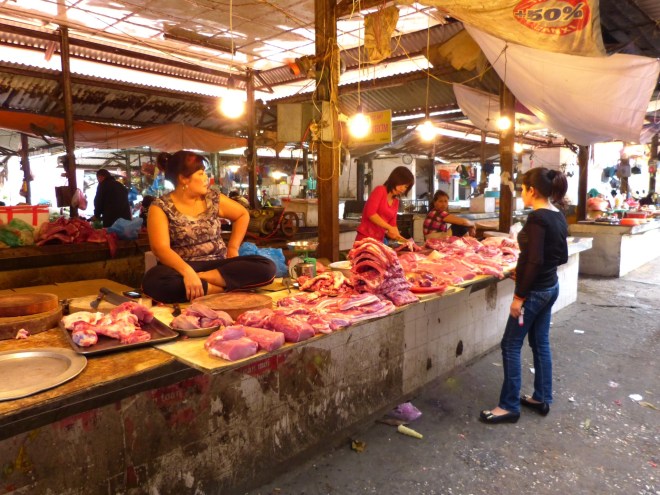
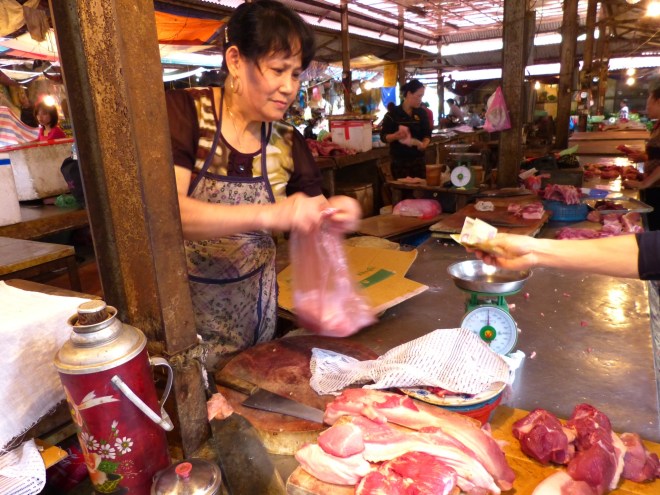
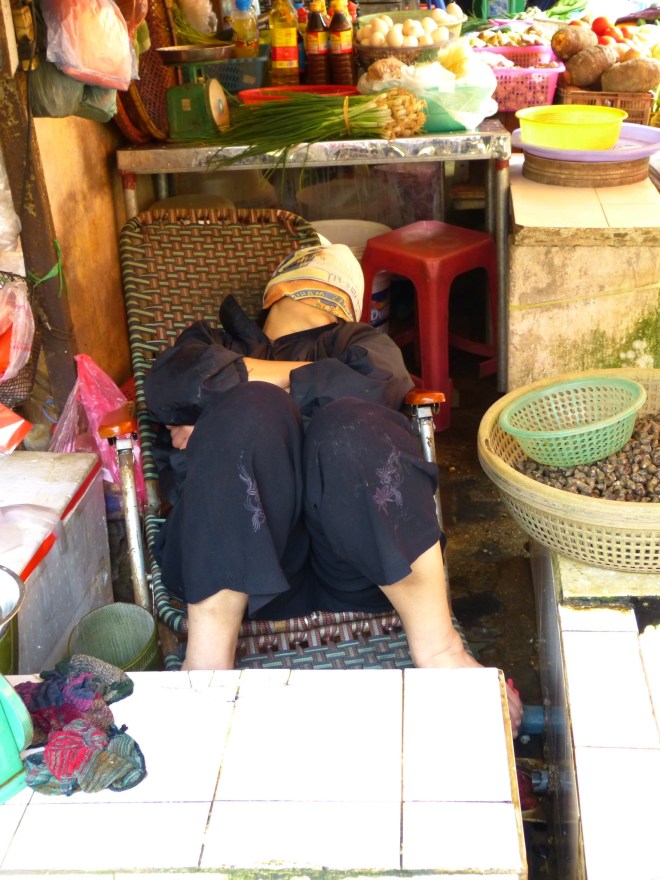
What do we fun loving volunteers do on a weekend in Hanoi? Well, on Saturday we took a cooking class, beginning with a visit to the local market to buy ingredients for our Caramel Pork dish.

"Get off the showcase!"
“Get off the showcase!” Bonus points to whoever can identify who said that.
We decided on a different vendor.
For some reason, we decided on a different vendor.
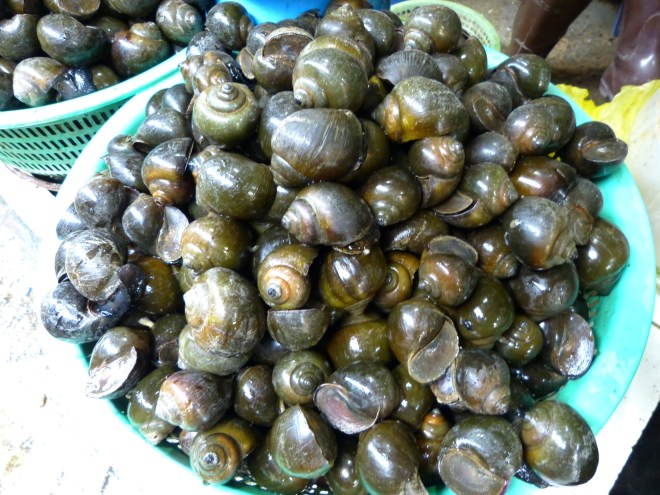
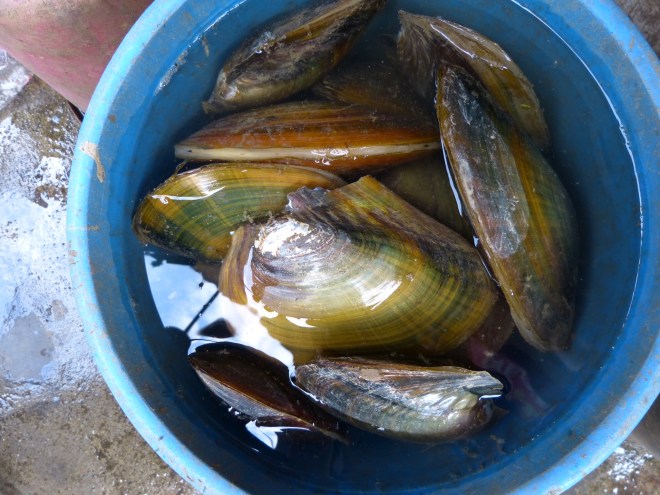
This guy reminded me of the lobsters in the bathtub!
Didn't we pick these off rocks?
Didn’t we pick these off rocks?
What would the Massachusetts term for these guys be?
Slap a little paint on these shells, and you’ve got yourself an ashtray!
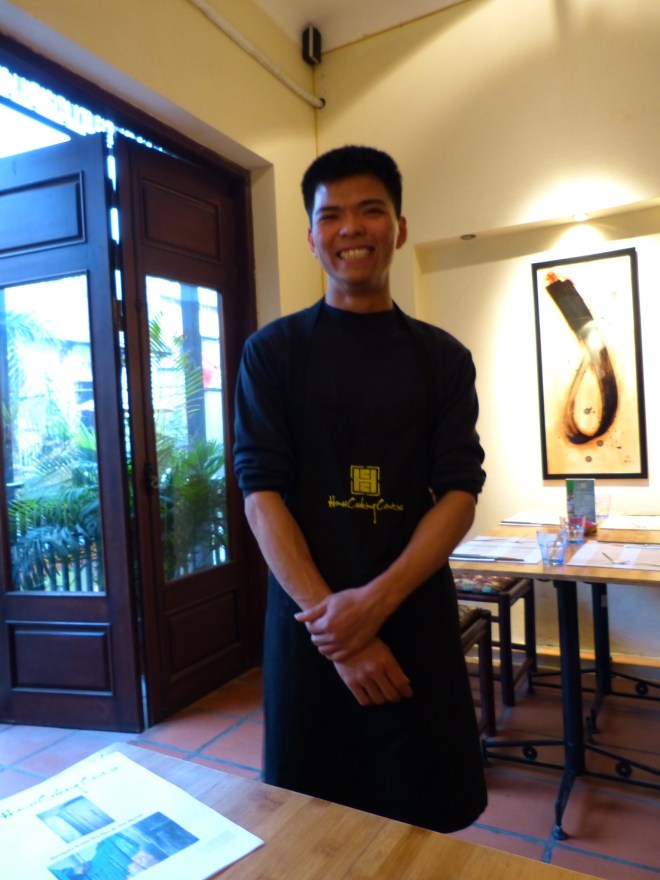
Our teacher had excellent English. In addition to cooking, he taught  us important Vietnamese  phrases.
Our teacher had excellent English. In addition to cooking, he taught us the Vietnamese equivalents for “cheers” and “bottoms up”.
If cooking gets too strenuous, I'm coming back here!
If cooking (or drinking) gets too strenuous, I’m coming back here!
Miss Shelley and Miss Sally,  who both answer to Ms Shally
Miss Shelley and Miss Sally, super chefs
Our waiter was happy to keep us supplied with free flowing wine
Our waiter was happy to keep us supplied with the “free flowing wine” mentioned in the brochure.

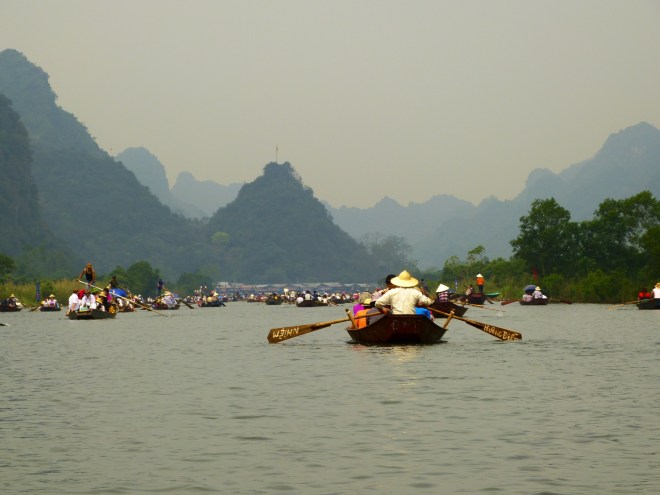
On Sunday, Jeannie, Sally and I made a day trip to the Perfume Pagoda, which we subsequently learned is Vietnam’s Mecca. We had thought that a boat ride on the river, into the mountains, would be a respite from the energy and dynamism of Hanoi. And had we visited during the summer, that is exactly what we would have experienced. Instead, we figured that it would have been more peaceful had we stayed in Hanoi, because it sure seemed like everyone in the city decided to visit the Pagoda with us.

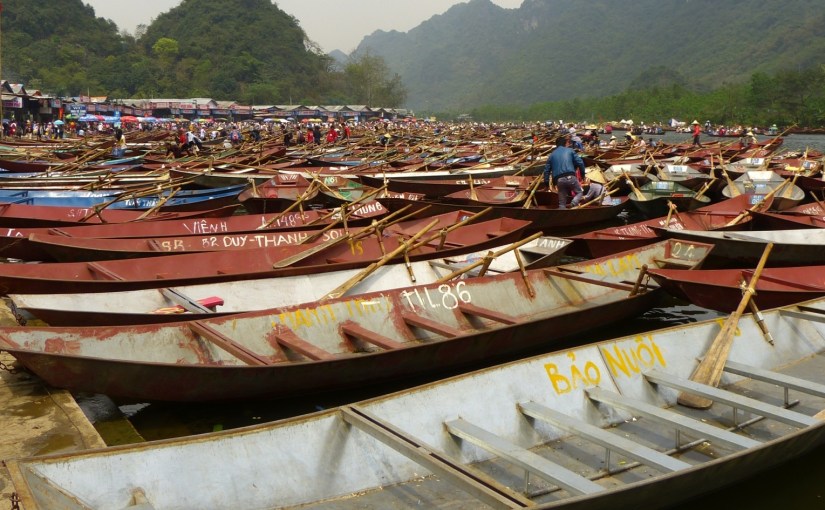
Beautiful scenery; quite a bit of traffic on the river.
A Vietnamese Starbucks
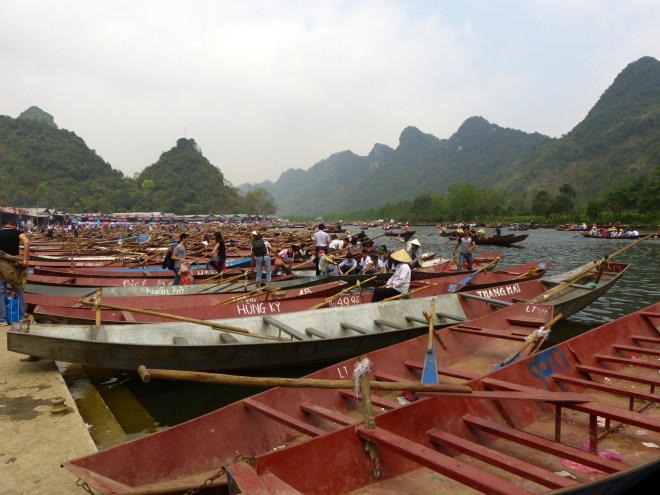
I thought there were a lot of boats on the river; I had NO IDEA how many boats were already there!
Vietnam has no shortage of shopping opportunities, and religious sites are no exception.

It is difficult to capture the sea of humanity at the Pagoda.  As it got more crowded, it was impossible to photograph.
It is difficult to capture the sea of humanity at the Pagoda. I took this photo before it got crowded. Later, I couldn’t get my arms up to take a picture without bopping people around me.

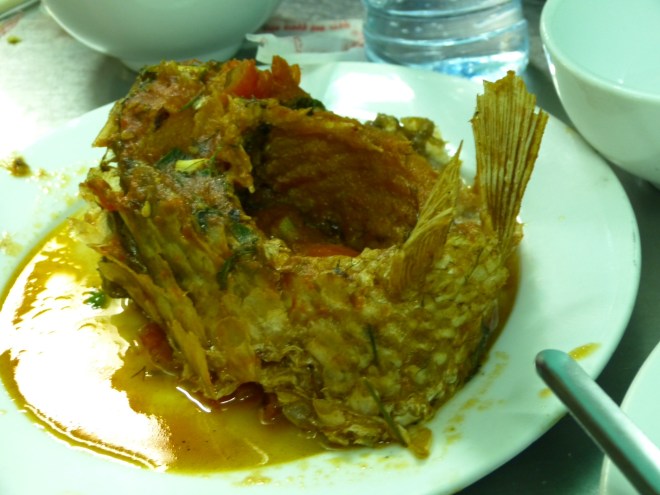
One of the lunch options
There's a lot to be said for vegetarianism.
There’s a lot to be said for vegetarianism.

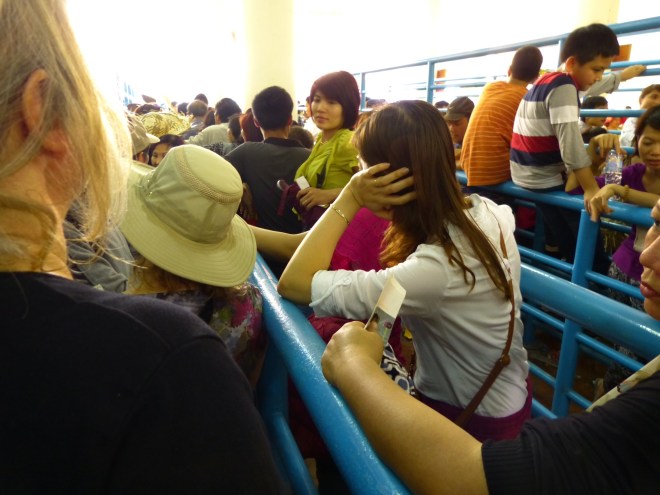
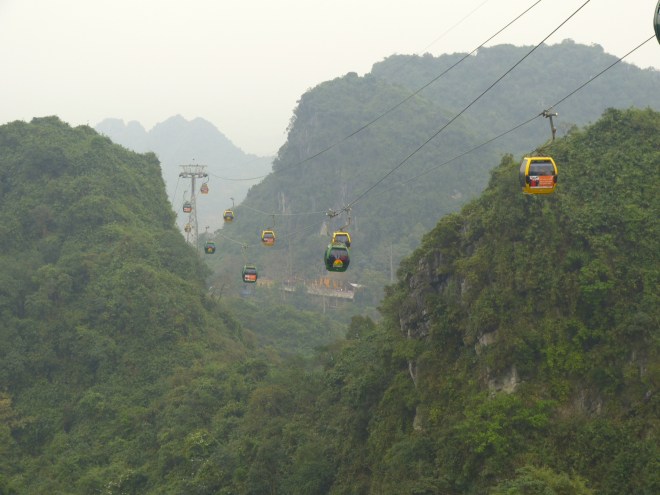
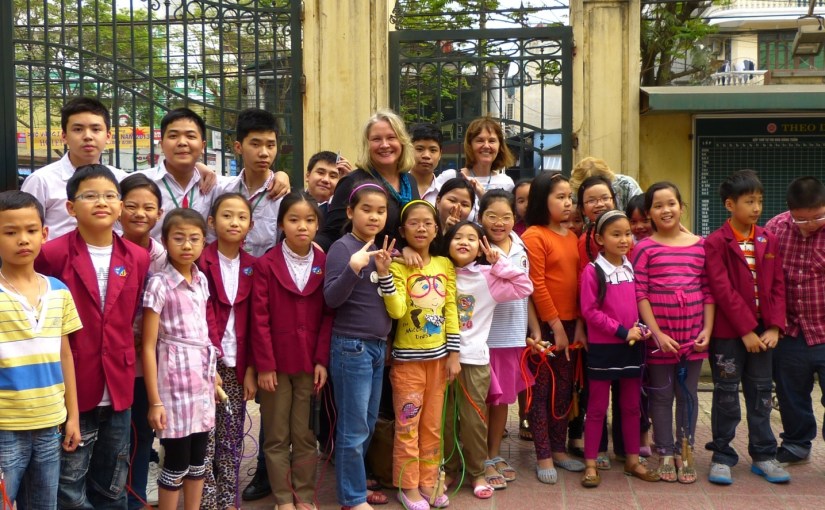
After lunch, we headed for the gondola. It didn’t take long for us to realize we were the only non-Asians in the very long line. During the one hour wait, the children used the opportunity to practice their English. Everyone wanted to say “hello” to us. Once again, I was impressed with the warmth and friendliness of the Vietnamese.
image
You jump into and out of these.  They don't stop for passenger entry and exit.
You jump into and out of these. They don’t stop for passenger entry and exit. And if you take too long, the attendant gives you a little push to send you on your way.

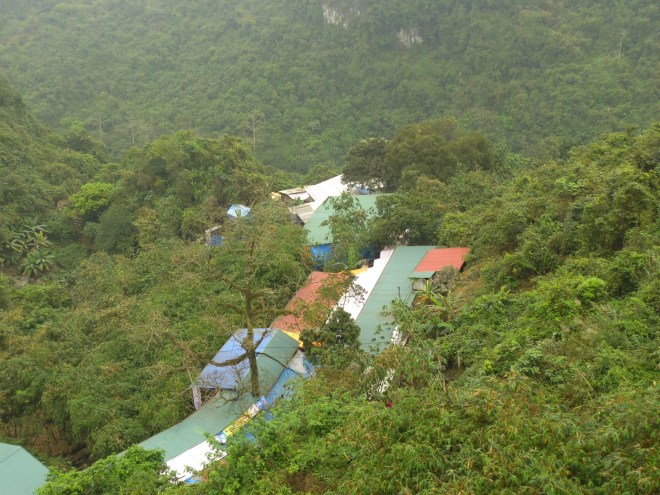
A sweet young French girl who was on our tour decided to walk up, and arrived at the top before we did. (I wasn’t kidding about the long lines!) She reported that the way up was very hot and crowded, with gift and food stands lining the road the entire way. We know exactly what she meant. We SAW the rooftops during our gondola ride. So much for fresh mountain air.
image
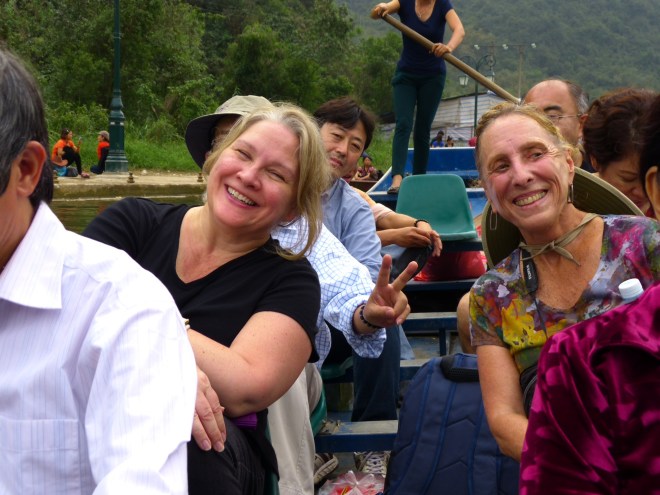
Sally and Jeannie, smiling on the boat ride back.
Sally and Jeannie, smiling on the boat ride back. You can’t keep those intrepid travelers down!

Hanoi

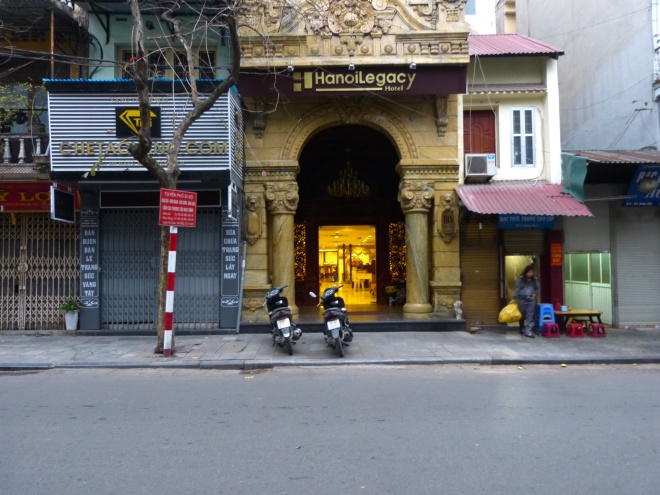
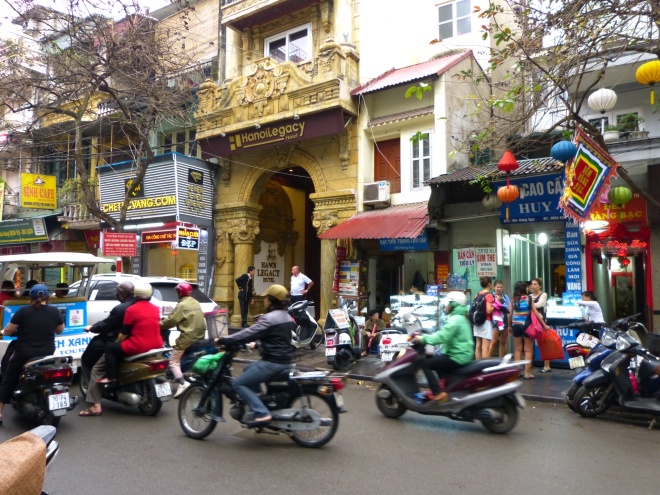
Finally, the blog and my location are in synch! Mike and I returned to Hanoi on March 1. On March 2, I started the solo phase of my Asian Adventure. As I was having dinner with team leader Jim and the other Global Volunteers at the Hanoi Legacy Hotel, Mike was heading to the airport. I was glad that he’d been able to spend time in my “neighborhood”, and meet a couple of the other volunteers.

My boyfriend
My boyfriend

Judy and Bob, the only married couple in the group, are from Cleveland Ohio. Jeannie is originally from Lancaster, Pa, but now lives in DC. Sally is from Michigan; both Tom and Jim are from Minnesota. All of the volunteers except Tom have been in Southeast Asia for at least three weeks, so we have adjusted to the time change. Jeannie has been here the longest, having left the US in mid January. Like Mike and me, she traveled with Road Scholar, but she took two back-to-back trips with them.

Sunday was orientation for us volunteers. We started by getting to know each other, discussed why we were volunteering, learned about Global Volunteers’ activities in Vietnam and had a brief meeting with the administrator and teachers at Nuguyen Binh Khiem School.
image

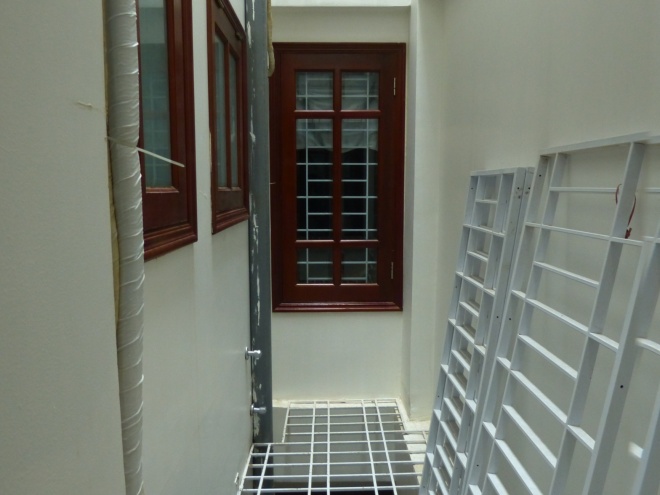
And now a little about our “home” for the next two weeks. Many of the buildings in Vietnam are extremely narrow and deep, and our hotel is no exception. As with the USA, the tax code has an impact beyond collection and disbursement of revenue. Taxes on buildings in Vietnam are determined by the width of the first floor.

The hotel at 6:30 AM
image
So, to bring light into the rooms in the middle of the building, there is a small opening, the width of a window. The advantage to being in an interior room is you are sheltered from all of the street noise. A very big plus indeed.
The view from my room.

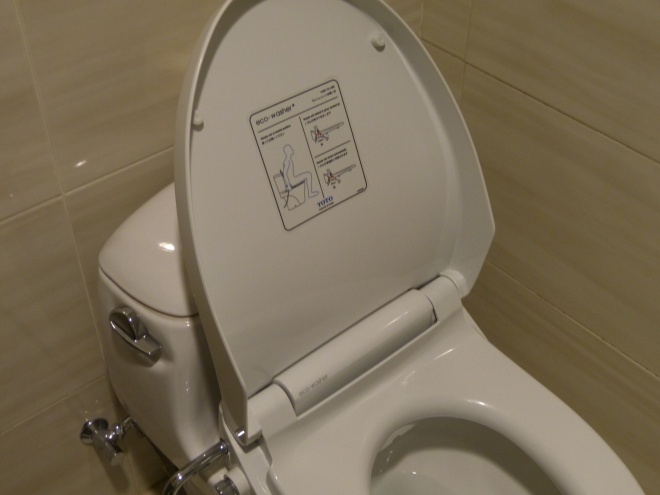
Although the building is old, the bathroom is decidedly modern. I don’t usually get excited about a toilet, but this one is AMAZING! It has a bidet built right into it. My new friend Sally and I have declared that one of these will definitely be a part of our lives in the near future. (Are you reading this, Mike?). It even comes with instructions!
A gadget that cleans your gadidgit

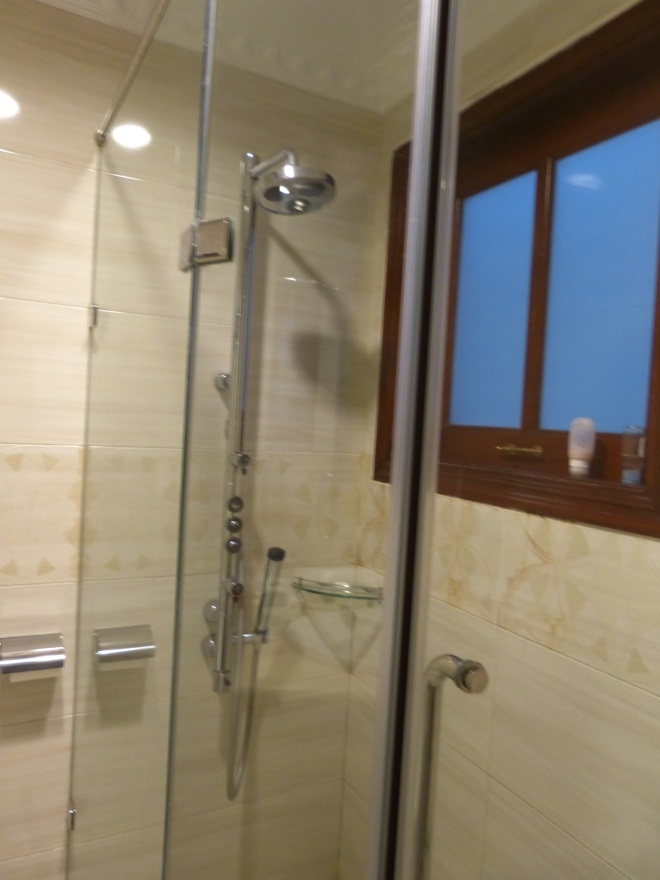
The shower is quite spectacular as well. We had something similar in Italy last summer, but this one has enough water pressure so that you could actually USE all the nozzles at the same time. Ahhhh, a great way to start or end your day.
image
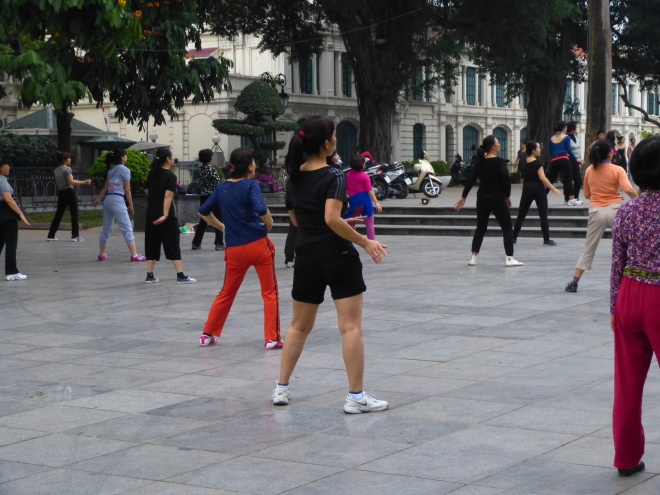
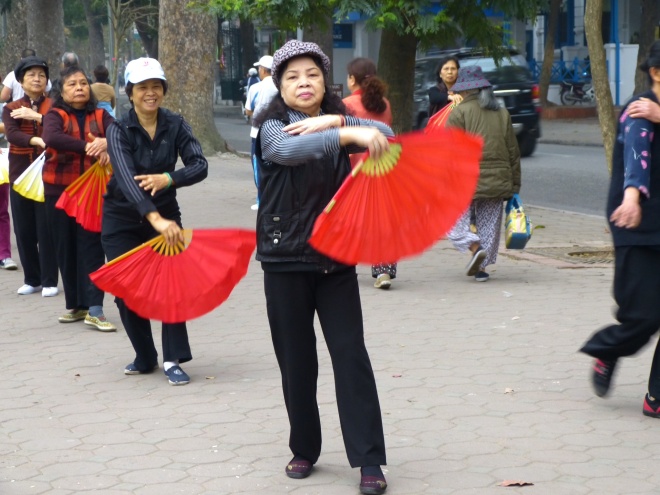
Another great thing about this hotel is its location near Hoan Kiem lake. I love walking around the lake early in the morning; the locals are out dancing, exercising, massaging each other. Because there aren’t a lot of foreigners around in the morning I’ve been invited to participate in the activities.
image

image

image
One morning Sally joined me, making us prime candidates to participate in the “chicken dance”. Although I don’t have a photo of that stellar performance, judging from the number of cameras that were whipped out, countless Hanoi locals DO.

I’m thoroughly enjoying being with these friendly, gracious people. The kids are wonderful…curious, bright, fun. The older boys like using my camera, so when some of the children ran over to say hello, I handed the camera to one of the boys, and this was the result.
image
Only three more days till I head home.