I had always thought that all there was to creating bonsai was diligently clipping a young plant. As usual, I was oh, so very wrong.
You begin by carefully selecting a tree from the mountain area, because its growth has already been stunted by the poor, rocky soil. THEN you slowly start clipping away, attempting to form an asymmetrical triangle. You help it along by wiring branches into position and by grafting shoots where you need a little extra oomph (sorta like what humans do when they want a little more ‘junk in the trunk” , to quote my friend Kathleen).
But if you have more money than time and patience, you just drop a million dollars and the 600 year old black pine on the left will be all yours. I preferred the one on the right, which was equally old, but a few hundred thousand dollars less.
I continued to demonstrate my total lack of sophistication and fine taste by being more captivated by OTHER sights at the site, like this beautifully simple floral arrangement in an exquisite vase.
I won’t tell you how much time I spent at the koi pond. Let’s say my little friend in the blue jacket got bored before I did. I couldn’t help but notice the gold one with the big mouth and think about a human version who continues to make a splash.
The National Museum
One could easily spend a full day admiring the ceramics, samurai swords and scrolls in Tokyo’s National Museum. MY favorite objects were the Buddhas and clothing.
I absolutely LOVE his facial expression. Yes, that guy’s a Buddha. In case you don’t believe me, here’s proof.
Of course, there were more traditional Buddhas, like this one
One final Buddhism photo, before I move to the clothing displays.
Now, whenever you see an onion shaped object, you should make a wish. If it comes true, then you will know that you had encountered a “ wish granting jewel”.
KIMONO
Back in the day, they had to figure out a way to keep that intricately embroidered clothing clean. Voila! The drying rack! But this one has a twist. You see that little object under the rack? That’s for burning incense. I couldn’t help but wonder how many kimonos went up in flames.
Fortunately, THIS kimono survived.
But not all of the beautiful kimonos were in glass cases.
Later, while admiring the stunning architecture of this building,
we noticed a flurry of kimonos, so we dashed to where they were gathering for several photo ops.
Cherry Blossoms
Okay, it’s still early, but every time we’d see a tree in bloom, we got super excited. we didn’t care if it was in front of a fence!
Notice our attire. That was one VERY COLD and windy day.
Mike, Renee, me and PatsySee what I mean about packing for extremes in temperatures?
Famous “fish”market
I’ll be honest. This was my least favorite experience. The market extended over several streets and they were all pretty much like this.
The crowd gave me the perfect opportunity to practice my Zen breathing.
I was pleased to discover that the market offered a whole lot more than just seafood. I didn’t leave there empty-handed.
Today is the last day of our pretrip, so I’ll close with a photo of our fantastic group, taken by Mori in front of the national Museum.
Tonight, five more women will be joining us for the start of the main trip.
Okay, so we may have gotten off to a rough start, but man oh man, Tokyo is so WORTH the 14 hours of travel (even with a three hour flight delay).
Seven of us eager beavers arrived a day before the pre-trip started, so usually that would mean we’d be on our own for the arrival night and first day.
Did I mention that we hit the travel guide jack pot when we got Mori? We were delighted to see him waiting for us at the hotel, to take us to dinner. First, we helped shake off jet lag by walking to the Ginza area, ending up at the Ginza Six mall. And what a mall it was! Feast your eyes on some of the beautifully unique goods for sale here.
The mall had an abundance of restaurants featuring cuisine from all over the world.
My favorite mall feature, however, was the rooftop garden that offered a spectacular view of the street below.
Despite the abundance of options at the mall, we decided to go for an authentic Japanese dinner of ramen noodles, pot stickers and beer —for about $10—at a tiny restaurant on one of the side streets, where we all sat at the counter. If anyone has ever seen The Midnight Diner, you would understand why we felt like we had wandered onto its set.
By the time we returned to our hotel, we were all more than ready for bed.
When I awoke I thought I had vanquished jet lag. Then I looked at the clock. 11:30 PM. Damn. After trying mightily to fall back asleep, at 2:30 AM I admitted defeat and popped a sleeping pill, which powered me through Saturday’s morning events.
As Mori suggested, we headed out early for the local “fish” market near our hotel. Although they certainly had plenty of fish, I was pleased to see they had a whole lot more. The ceramics were gorgeous, the paper place mats were beautifully painted, kitchen equipment was plentiful AND you could even get dried grasshoppers, if that was your thing!
As it got later, the crowds at the market got bigger, so we decided it was time for the peace and serenity of the “nearby” Hama-Riku Garden. But of course, we took a couple of wrong turns and ended up discovering this gorgeous temple.
The cards give instructions on the correct way to offer incense.
The Tsukili Hongwanji’s main hall houses the Amida Buddha. Sorry, I didn’t want to be disrespectful so I contented myself with this one quick photo. Trust me when I tell you Amida Buddha is beautiful.
I remember as a child, growing up in a Catholic school environment, I was urged to give my money to “purchase” a pagan baby in Japan. It tickled me to see that the Buddhists have missionary activities in the USA. I wonder if Japanese kids are trying to save the “ heathen” Christian children in the USA?
After leaving the main hall, we purified ourselves before entering the more intimate, empty hall.
A lovely Japanese lady demonstrated the proper purification method which Janis and Ruth performed
Relaxed and refreshed ( and purified) after our unplanned detour, we were ready for the Gardens.
Upon arrival, we learned there was a tour in English starting shortly. How lucky were we to get this fantastic guide! She provided the history of the gardens from the Shogun era (the mid 1600’s), to the Meiji restoration, then up to post WWII , when the emperor’s property was given to the municipal government. (She used visual aids, and rewarded those who gave correct answers to her questions.)
We learned that the property was originally a fort, until the Shogun decided to build a hunting ground for his falcons.
Throughout the grounds, canals brought in salt water from the nearby bay, attracting wild duck for the falcons to catch.
The traveling buddies: me, Kris, Janis, Ruth and Patsy. I scrunched down so I wouldn’t look “freakishly tall” as my dear friend Elena described it.
There’s so much more to say about our second day, but we are getting ready to start day 3 in this glorious city…more to follow.
I feel SO very lucky to have the privilege to experience this vibrant city. And I’m SO glad I decided to arrive 4 days before the start of the main trip!
My last post about Tibet was a bit of a downer, wasn’t it? As my friend Sally reminded me, “not every place is lovable”, but as with all travel, there are always positive elements, whether it be a greater understanding of a particular culture or country, or an increase in self knowledge.
We not only saw the exterior of the iconic Potala Palace, we were also able to climb to the top and visit some of the interior on our way up. Built by the fifth Dalai Lama in the late 1600’s on the site of Songzen Gampo’s palace, it became the winter residence of successive Dalai Lamas. Photographs are not allowed of any of the interior rooms, but they were so dark, smoky and gloomy, it would have been difficult to get a good shot anyway.
The red sections were for religious studies; the white sections were the living quarters of the Dalai Lamas
The palace, 13 stories high, offers a great view of the city of Lhasa.
The view from the top of the Potala
Here’s a different view, showing the modern city the Chinese have built around the Potala.
It was so hard to imagine a small child being taken from his family and brought to live in this massive place, surrounded by monks who were charged with his instruction. The current Dalai Lama was two years old when he was identified. He spent two years in a monastery near his family’s home in Amdo, then moved to the Potala two years later.
The summer palace, the Norbulingkha (Treasure Park) has a very different feel to it. This was built in the mid 18th century by the 7th Dalai Lama. It is actually quite close to the winter palace. The largest horticultural park in Tibet, it includes a private zoo, which wasn’t open when I visited. At one time it housed an elephant that was a gift from the Maharaja of Nepal.
Heinrich Harrer conducted lessons with the 14th (current) Dalai Lama in the summer palace. It was from this site that the Dalai Lama departed in 1959 to escape from the Chinese. Another fun fact: According to Harrer in his book “Seven Years in Tibet”, women were not allowed in the Norbulingkha because it was believed that they would have defiled the gardens.
Two famous monasteries in Lhasa are located near the palaces. The Drepung monastery was being repaired, so we only visited the Sera Monastery. I was disappointed because I had learned in my pre trip reading that Tibet’s creation story was told in murals at the entrance of the Drepung Monastery, and I had hoped to see it.
What we DID see were the Sera monks interacting in an outdoor courtyard. That yellow hats on their shoulders? It made me smile–all I could think of was Woodstock, Snoopy’s little friend.
The detail on the exterior of the buildings was exquisite, however it was nothing compared to the tombs of the Dalai Lamas inside the Potala. Those looked like wedding cakes–5 to 7 tiers high, covered with carvings and encrusted with jewels and precious stones.
We arrived in Lhasa on 5/14, which was the start of a 15 day “festival” celebrating Buddha’s birthday. For Tibetans, a festival consisted of either walking around a sacred site, or prostrating themselves as they slowly made their way counterclockwise, praying as they went.
Leaving Lhasa, we traveled to Gyantse, where we visited the Palcho Monastery.
Here, you were allowed to take photos, as long as you paid a fee. In the distance, you can see the red fort that dominates the landscape.
Plastic bags filled with offerings are scattered throughout the monastery. Devotees leave food, money, grain, white scarves (called Kata), whatever they have.
This monastery was built in the 1400’s; its interior looks very much like the interiors of the other monasteries, small chapels, very dark and smoky. I used a flash and the highest ISO possible to get these photos.
The founder of the “red hats”. Red hat monks are allowed to marry. “Yellow hats” are not. The Dalai Lama is a “yellow hat”.
I asked why this statue’s face was covered. Our guide explained only those that complete a complex list of devotional activities are allowed to view his face.
I have no idea which color hat these monks belong to–it looks like they hedged their bets with yellow, red and black. Plus, their hats come with bangs and braids.
The other special feature of the Palcho monastery is the Kumbum Podang. (Don’t you love the name?) A Kumbum is a stupa that is also a three-dimensional mandala. The first five floors of this structure are square and the remaining four are circular.
Unfortunately, this building was also being repaired so we were unable to go inside, but according to Wikipedia, it has 76 chapels and shrines and is also known as the Ten Thousand Buddha Pagodas. Why? Because it contains ten thousand images and murals of Buddhas.
Gyantse is also notable because in 1904, the town and monastery were attacked by the British, led by Francis Younghusband. The Tibetans were armed with outdated weapons, but they had been assured by their religious leaders that their victory was preordained. In addition to their weapons, they were protected by talismans that they thought would repel bullets. They were mowed down, and the buildings were shelled.
In 1959, the Chinese attacked the complex and it was also damaged during the cultural revolution.
After one night in Gyantse, we traveled to Shigatse, Tibet’s second largest city and the location of the Tashilhunpo Monastery. This monastery has been the home of the Pachen Lama, the great scholar, and is where most of the prior Pachen Lamas are entombed.
This photo was taken in Gyantse–no interior photos were allowed in Tashilhunpo. The top photo is of the 10th Pachen Lama and the bottom is of the current (11th) as a child.
The 10th Pachen Lama was taken to China as a child to be educated. Although he initially supported the Chinese incursion into Tibet, after returning home and seeing the impact on his country, he began to speak out. This resulted in his being tortured and imprisoned in China for 16 years. After his release, he married a Han woman, had a child and returned to Tibet. He died suddenly in 1989, at the age of 51 shortly after giving a speech critical of the Chinese government. His resting place is an amazingly beautiful tomb, with gold carvings and jewels, similar to that of Dalai Lamas in the Potala.
The entrance to the tomb of the 10th Pachen Lama
There was considerable controversy over the selection of the 11th Pachen Lama. The Dalai Lama’s choice disappeared after being named and the Pachen Lama chosen by the Chinese, now in his 20’s, is still being educated in China.
Entrance to the Tashilhunpo Monastery
Inside the Monastery. No photography allowed inside the buildings
Look who is doing the manual labor
The Mandala surrounded by two deer is seen on most buildings
How can you tell which shoes belong to whom?
Apparently they are able to figure it out!
Because we were in Shigatse for two days, we were able to wander through the city on our own. Marilynn, my energetic buddy, and I climbed to the Shigatse fort that overlooked the city.
Shigatse Fort overlooks the city. As with many buildings in Tibet, it is being repaired, so no entry allowed.
From the fort, you can get a good view of the city. Not sure what that bike is doing on top of the building!
He was as interested in us as we were in him.
For some reason, the ride back seemed far more pleasant than the ride to the two cities. Perhaps it was because we traveled back along the river or maybe it was because we knew what to expect for toilet facilities?
Impromptu bathroom stop
Scenery along the way back to Lhasa
After Shigatse, it was back to Lhasa for our return to our gorgeous hotel in Nepal, the Gokarna Forest Resort. Great food, margaritas, beautiful surroundings, greeted by our wonderful Nepali guide Binoy– we were SO very glad to be back in Kathmandu!
I’ve been home for a little more than a week. It took almost that long to get back to normal after seven days in Tibet.
I expected to love Tibet. I WANTED to love Tibet. Sadly, very sadly, I didn’t.
Have I turned into an “ugly American”, critical of a country when it isn’t like home? I certainly hope not.
It is entirely possible that I was spoiled by the fantastic guides and the wonderful experiences we had in Bhutan and Nepal, and expected more of the same. Or maybe it was because for the first three days in Lhasa, I was fighting a cold and the Tibetan’s version of Montezuma’s revenge, adjusting to the altitude and possibly reacting to the Diamox I’d taken for altitude sickness. Whatever it was, I was not feeling great. I missed two afternoons of sightseeing in Lhasa so I could sleep my way to feeling better.
Although I had read up on Tibet and had checked the Overseas Adventure Forum before booking the trip, there were still a few surprises. After much soul searching, I’ve uncovered what might have influenced my feelings about Tibet, AND am offering some tips so that future travelers might make their experience more enjoyable.
The China Factor Knowing that China had taken over Tibet was not the same as experiencing the impact of that takeover. This is the closest I’ve ever come to being in a police state. Those two white objects on the dashboard are cameras–one pointed inward so the police could monitor what was going on in our van whenever they wanted.
Dashboard cameras
And yes, that IS a military convoy, in front of us, hauling big guns. Although you can’t see it in the photo, in every truck, two soldiers were pointing their weapons out the back. I was very grateful the road wasn’t bumpy!
Although the hotel in Lhasa offered free wifi, we quickly discovered that google, yahoo, safari, the New York Times, and many email accounts were blocked by the Chinese government.
Being under constant surveillance has to have an impact on the psyche of the population, and I believe it did. Unlike Bhutan and Nepal, the people in Tibet didn’t seem as interested in interacting with tourists. Or maybe they were afraid.
Tip: If it is important to stay in contact with family back home, set up a hotmail account. For some reason, that email service wasn’t blocked. Also, texting works. My iPhone allowed me to send free “imessages”!
Altitude and Air The air is very dry because of the altitude and very smoky from cigarettes and incense. Everyone smokes everywhere–in the hotels, restaurants, on the street. It was like being trapped in a Mad Men episode, but with different costumes. You can request a non-smoking hotel room, but there is no guarantee that you will get anything other than a smoking room sprayed with air freshener.
If the cigarette smoke doesn’t get you, then the incense and Yak butter candles in the temples will.
At times, inside the temples and monasteries, I found it challenging to breathe.
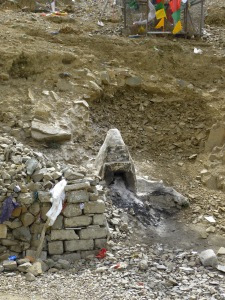
And if you think stepping outside to breathe in fresh air would help, think again. These little chimneys for burning incense are everywhere!
Tip: The 5th floor of the Xin Ding Hotel is the only nonsmoking floor. The other hotels don’t have that option, but 4 of the 7 nights are spent in the Xin Ding, so it is worth it to request a room on the 5th floor. If you’re lucky, you’ll get a wonderful view of the Potala from your room.
The hotel makes sure you can buy whatever you need without leaving the comfort of your room: toothpaste, manicure tools, condoms, mysterious things in plastic bags with Chinese writing on the front…
Long Drives in a Small Van over a Barren Landscape
Fortunately, no one in the group was very large. At 5’8″, I was the tallest. If my 6’3″ husband had been with us, the 8 hour drives from and to Lhasa would have been quite uncomfortable for him.
2 rows of three seats. Not a lot of leg room for tall people!
But the size of the van wasn’t the problem. No, the challenge was the lack of bathroom facilities along the way. Not only that, but we quickly discovered that squat toilets were the only option. The good news? You never had to ask for directions. All you had to do was follow your nose. Another plus? Many of them had no stalls or partitions, so you could make new friends while emptying your bladder. Let me tell you, it was much more pleasant to look at my neighbor’s backside than to look down at what had taken place before I arrived.
It didn’t take long for me to decide that a bush, a rock or a tree was far preferable to the few roadside bathroom facilities. Did I mention that I was drinking more water than usual because of my cold, the dry air and the altitude medication? Those were LOOONG drives!
Tip: Tiger Balm or Vicks applied under your nose blocks out all other smells. Unfortunately, I had neither with me. Women need to practice their squats before embarking on this trip!
The landscape on the drive to Gyantse was rather stark.
Yes, we did indeed drive on that winding mountain road.
Our guide had to stop at multiple police check points along the way to show our passports and to complete paperwork, and to have our speed monitored. I didn’t think that was a bad thing, given the narrow winding mountain roads, but Marilynn disagreed. When our driver and guide took a cigarette break, leaving the keys in the van, she offered to take over and get us to the hotel in record time!
Here are the notable sights during our 8 hour drive to Gyantse.
Prayer flags looked very different from the ones we saw in Bhutan.
One of the two passes.
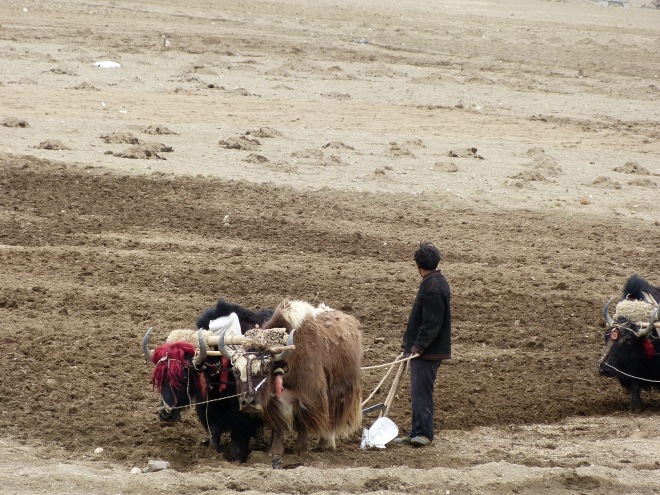
Farmers, plowing with their yaks
Prayer flags looked very different from the ones we saw in Bhutan.
One of the two passes.
Tip: My iPod was my salvation; our guide and driver talked to each other in Tibetan for much of the way, so I was grateful I could plug in and listen to music instead.
Our Guide
Tibet has many wonderful myths and legends; I was looking forward to hearing our guide elaborate and offer the local version of the stories I’d read. Unfortunately, he either was not allowed to relate them to us, or perhaps during the 50+ years since China invaded, the legends stopped being passed along. He certainly couldn’t access Wikipedia to supplement his knowledge!
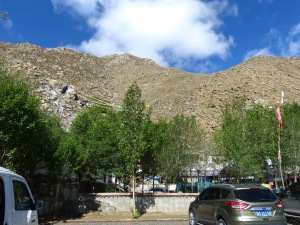
Mt Kalish? I don’t think so.
For example, our guide told us this unspectacular pile of rocks is Mt. Kalish. According to Google, Mt. Kalish is located in a very remote part of Tibet, and is visually spectacular. That “mountain” was neither. But Tibetans do circumambulate its perimeter, and it has been the locale for “sky burials”. (A few days after someone dies, the body is cut up, brought to the mountain top and left for the vultures to consume, thereby completing the circle of life.)
I had hoped to learn more about the Goddess that was transformed into Yamtrok Lake, but once again, our guide wasn’t able to elaborate, so here’s what I learned from my reading. After arguing with her husband, a goddess decided to leave him forever by turning herself into a lake. Boats are not allowed on Yamtrok because the vessel would slice her skin. I also learned that Tibetans believe if the Lake ever goes dry, all Tibetans will perish.
Yamtrok Lake
After returning home, I turned to Google, where I discovered that senior monks go to Yamtrok Lake after the Dalai Lama’s death. They throw sacred objects into the lake, then watch for a reflection that will tell them where to find the next (reincarnated) Dalai Lama.
Tip: Learn everything you can about the culture and myths before coming to Tibet. The information the guide imparts could be very limited.
Food
You don’t travel to Tibet for the food. There is a reason Tibetan restaurants aren’t popping up in major cities, still, we had hoped for great Chinese food. Two of our group were born in Hong Kong, spoke and read fluent Mandarin. They were not fans of the cuisine.
Be prepared for very basic meals, with no snacks in between. There isn’t much fruit, however I discovered that you CAN buy bananas.
Tip: I had brought granola bars, but shared them with the other travelers during our long rides in Bhutan and Nepal. By the time we reached Tibet, my stash was gone. Big mistake. It’s a good idea to bring packaged snacks.
The Locals
For me, interacting with the locals, especially children, is always a high point of my trips. Unlike in Bhutan and Nepal, opportunities to interact were limited.
While in Shigatse, I spent our two free afternoons wandering through the city. I was taking photos of the street when I was accosted by an old man with a walking stick in one hand and a prayer wheel in the other.
I was afraid that stick was going to be used as a weapon against me!
He was yelling at me, and for a moment I was afraid he was going to hit me. He apparently thought I had photographed him–although the truth was I didn’t even notice him. I was more interested in the goods on the sidewalk. End result? There are no photos of Tibetan people.
But I didn’t let that one unfortunate incident keep me from trying to interact with the locals.
Did you see him in the above photo? Neither did I!
I had learned to say “Tra-shi-de-lay”, which is close enough to the Tibetan greeting to occasionally get a smile.
During my second afternoon purchasing bananas, I noticed a Tibetan trying to take a picture of me with her cell phone, so I posed for her. Out of the corner of my eye, I caught a young man attempting to get into the photo, so I turned, threw my arms around his neck and put my cheek next to him. And the crowd went wild! Not only that, but I got my bananas for half of what I had paid the day before. Sorry, no photos of that exchange because I had left MY camera back in the room. I didn’t want to take a chance of being smote with a stick!
Tip: Learn a couple of Tibetan words, smile and see if you can make a connection.
That’s all for today. Next post will be more upbeat, I promise. There will be photos of what made the trip special.
After our stay at the comfortable, but basic, Seti River Camp, it was a complete shock to our senses when we arrived at the Kasara Chitwan Resort. We were experiencing luxury overload!
The reception area
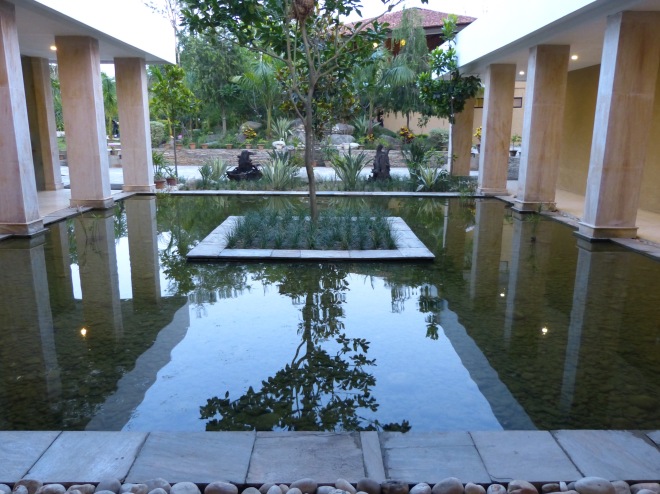
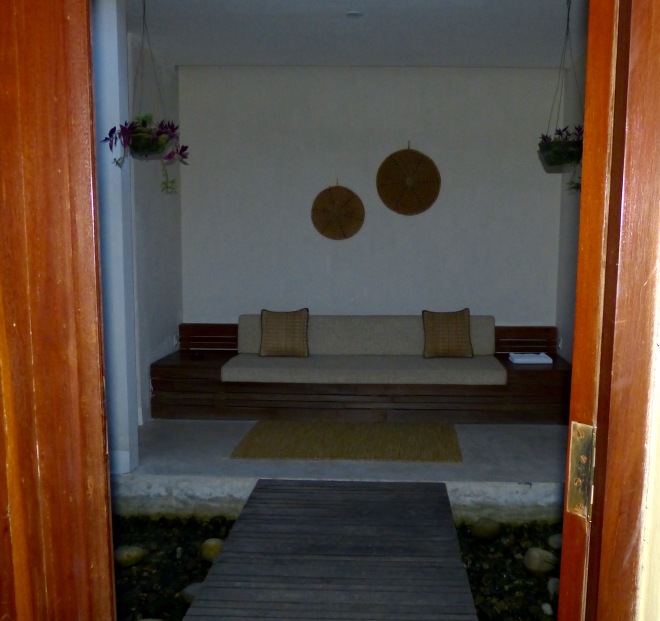
I was expecting a room, not a stand alone suite. When I opened my door, I entered this private courtyard. The photo doesn’t do it justice, but I was too focused on enjoying my surroundings to put much energy into a photo shoot.
Air conditioned bedroom on the left, bathroom with open air shower on the right, and a beautiful courtyard in between. Those are little ponds on either side of the boardwalk, complete with resident frogs.
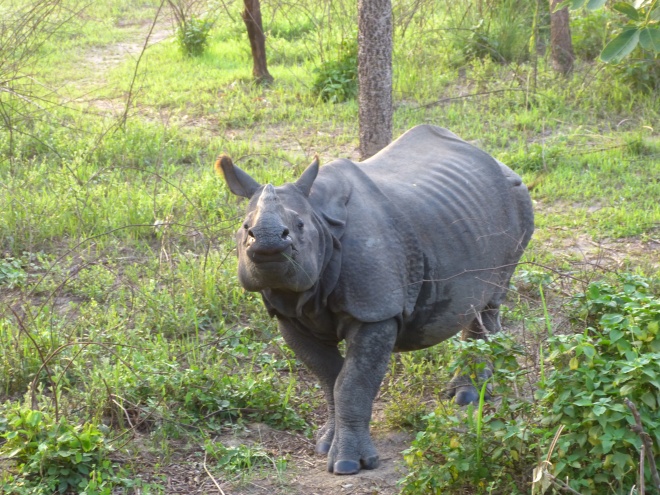
After getting settled, we headed out to hunt for black rhinos. Success! We saw several. My favorite is this shot, because he seemed a bit bored by us gawkers.
So what the heck are YOU looking at?
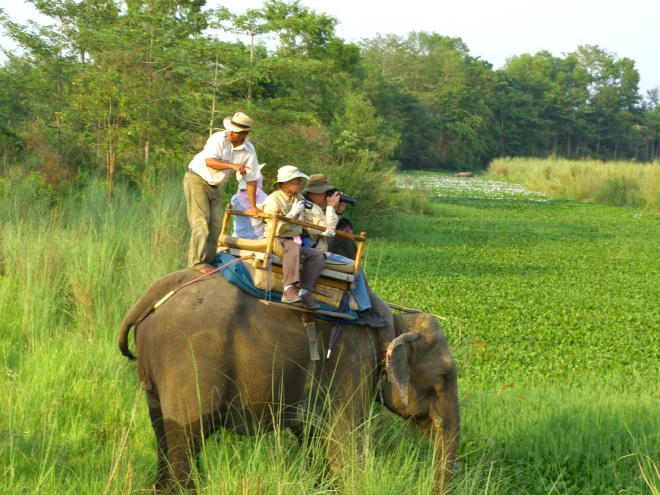
Our mode of transportation during our “safari” was a platform mounted on the elephant’s back. It was not the most comfortable ride, for us, or probably for the elephant either, but it was a fun experience.
We didn’t see any tigers, but the group before us caught sight of one. After hearing about the elephant’s reaction, I was just as glad that we hadn’t. There was a whole lot of stomping, bouncing and trumpeting going on!
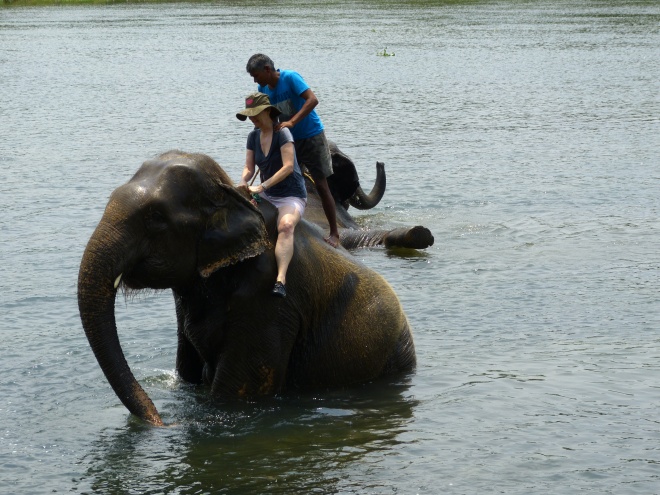
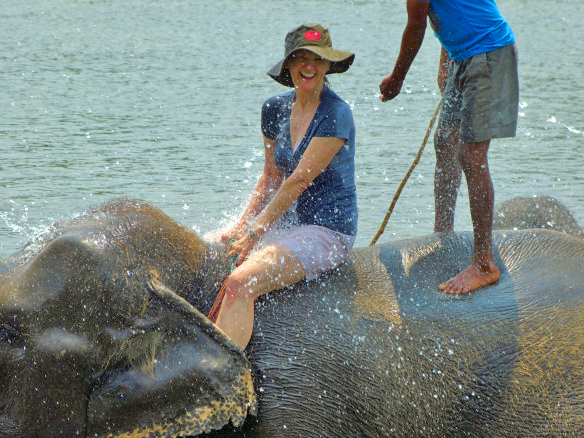
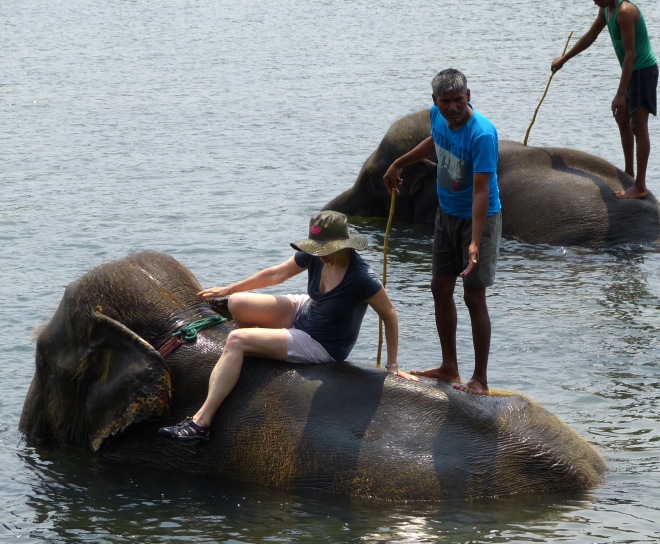
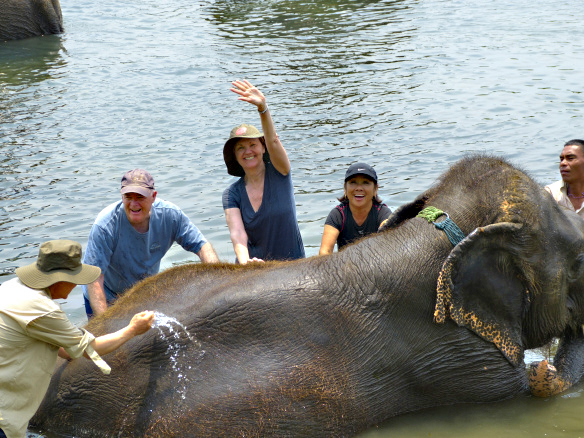
For me, the best part of our visit was when we were able to interact with the elephants in the water.
The rest of the group had heard all about my nephew Jack, and how much he LOVES elephants, so Jim was gracious enough to take stills with my camera, while Binoy, our wonderful guide, shot video with my iPhone.
First trick was getting on
Wait, I thought I was going to be washing–not getting washed!
Now I have to get down
Peter, Marilyn and I giving our buddy a nice massage, using smooth stones.
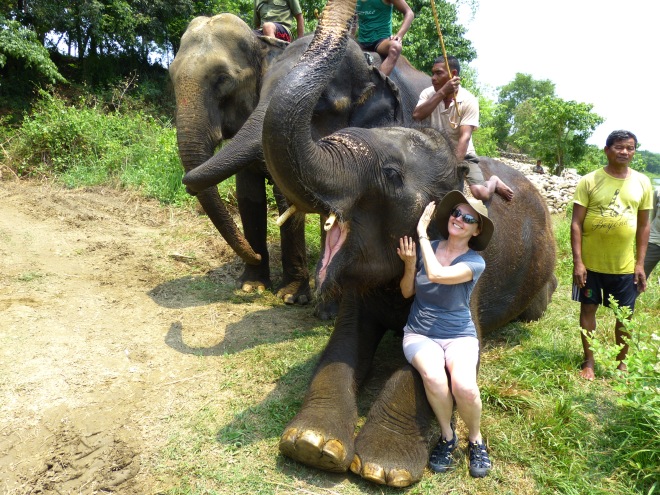
These are such beautiful, intelligent and gentle creatures. What a privilege to send time with them.
Check out the toenails on her. Fun fact–elephants sweat through their toenails.
Mike, can I keep her?
While at Kasara, I kept thinking about these lines from the song “Camelot”. “The rain will never fall till after sundown; By 8 the morning clouds must disappear”, because that’s exactly how it worked during our two days there. In fact, we were extremely lucky during our entire trip. We couldn’t have asked for better weather–slightly overcast when we were trekking, which is much more comfortable than walking under a hot sun.
The resort has a lovely pool, so I was very glad I’d packed my bathing suit. Again, no photos. Sometimes you have to put the camera down and just soak in your surroundings (literally).
It also has a great second story bar overlooking the pool. I decided to skip the ox cart ride through the village, and partake in a margarita instead. That’s what my sisters, hermaña preferida, and cousins would have wanted me to do, and I couldn’t let them down.
Time to fly back to Kathmandu, and another lovely hotel, The Gokarna Forest Resort.
During our Nepal trip, we added three travelers, Ann from Indianapolis, was born in Indonesia. She and her Turkish husband met in veterinary school. Karl is a retired navy chaplain who served in Iraq. He and Eugenia were born in Hong Kong, but have lived in San Diego when they are not traveling the world. Their fluency in Chinese was much appreciated by all of us when we got to Tibet.
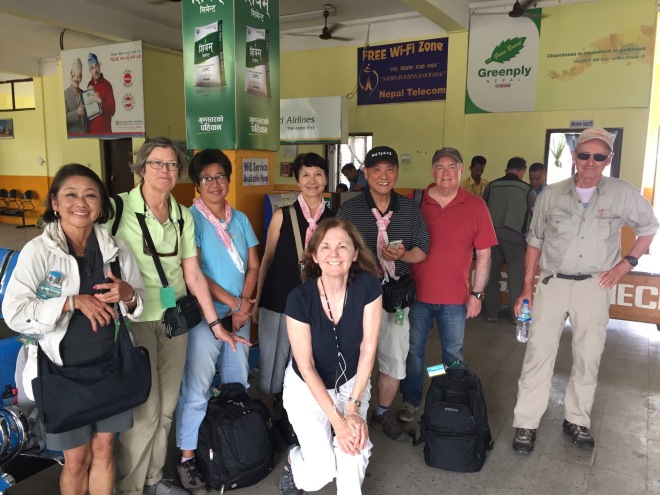
Standing, left to right: Marilynn, Marie, Ann, Eugenia, Karl, Peter, Dick. Me, practicing my squat, an essential skill for the airport rest rooms. Jim is missing because he is the photographer.
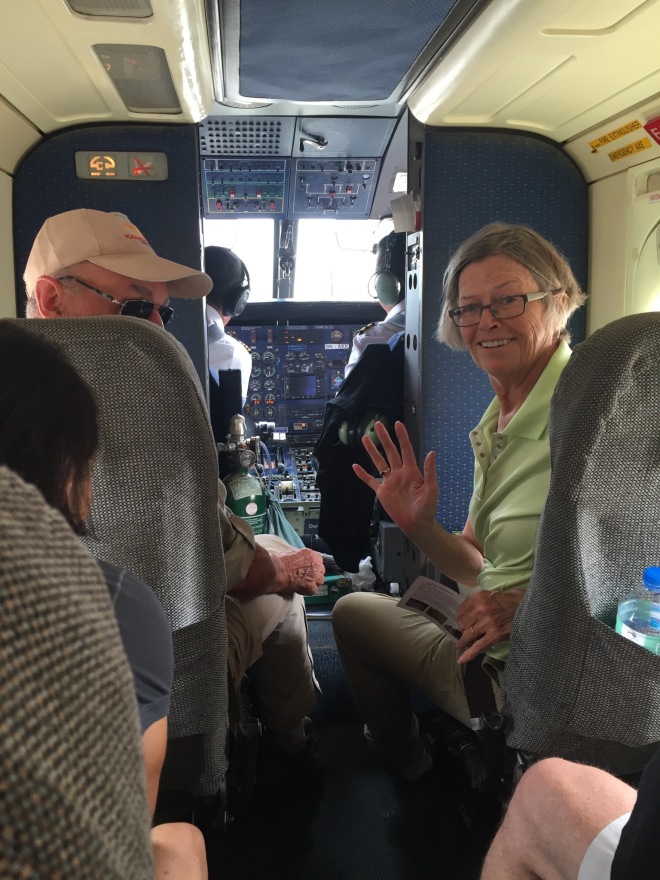
Here are Marie and Dick, enjoying their first class seats.
Jim, Peter and Marie will be returning to the USA after our last night together at the Gokarna, while the remaining six of us head off to Tibet. The farewell dinner is an OAT tradition when the main trip ends, and what a farewell dinner it was!
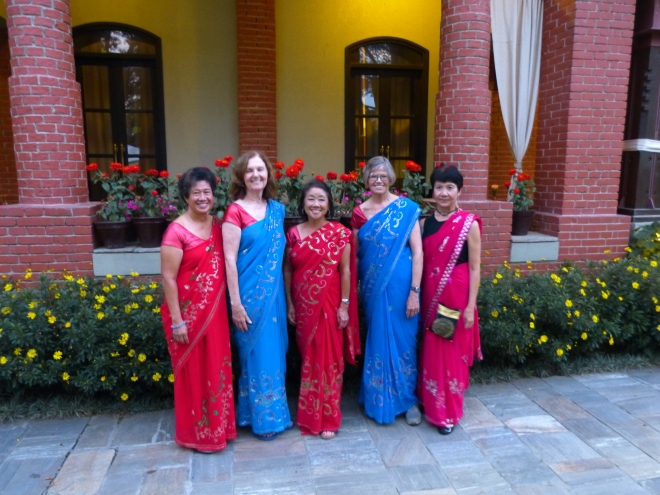
Ann, me, Marilyn, Marie and Eugenia
Yes, we needed help getting dressed, and no, we didn’t get to keep the saris.
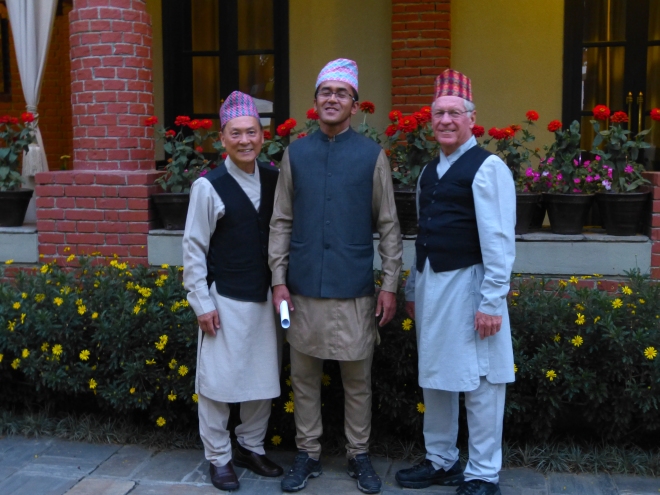
Some of the men played dress up too.
Karl, Binoy, Jim
It was the perfect ending for three fantastic weeks together. Little did we know, but the remaining six of us were going to have a very different experience in Tibet.
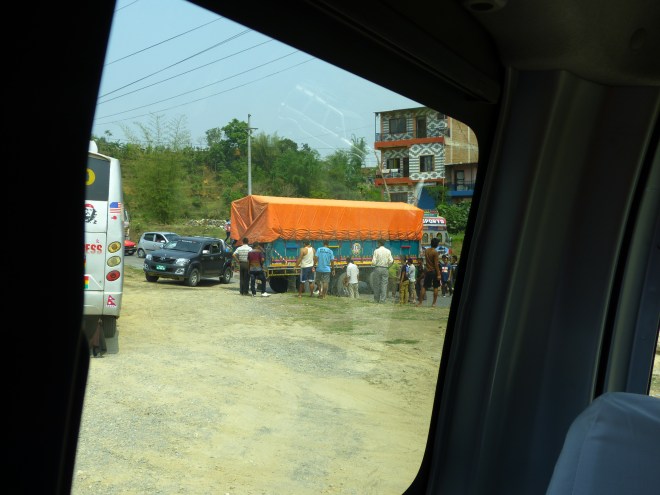
Our adventure started even before we reached the Seti River. A truck straddled the road, blocking traffic on both sides. What to do? Well, every bus, car, truck and motorcycle raced to claim any available open spot on the road, along the road, in the private property beside the road, creating gridlock that easily rivaled New York City at Christmas time.
Binoy, our amazing guide jumped out of our van, using his considerable powers of persuasion to clear a path. He was like Moses, parting the Red Sea, okay–on a somewhat smaller scale, but it was still miraculous. It took a very skilled driver to squeeze through the opening, and ours was up to the challenge.
Did I mention how grateful I am to be on an organized tour?
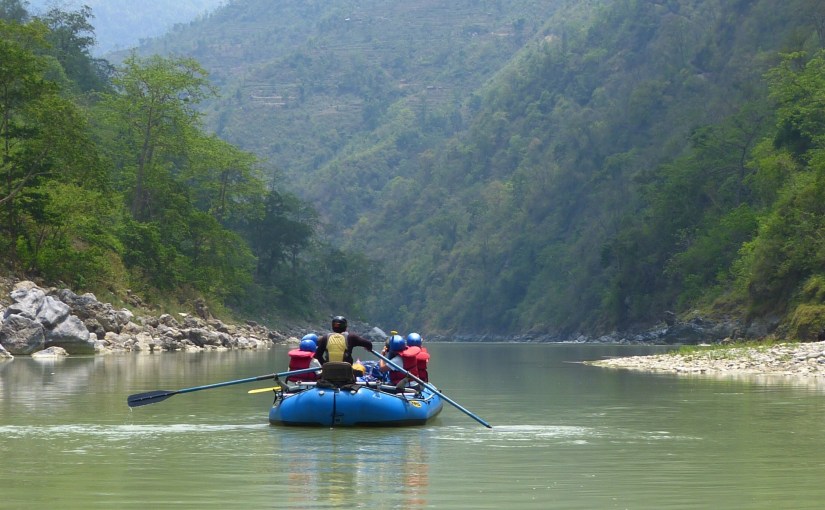
The Seti River is low this time of year. Bimal, our River guide, told us that after the monsoons it is a much faster, and more exciting ride. Still, he managed to hit every single rapid, manouvering our raft to give us the maximum dousing, which was greatly appreciated on a hot day.
Anyone that knows me knows that camping is not high on my list of fun things to do. In fact it would not even make it to my top 10,000 Things To Do Before I Die. I require a bed, a toilet with a seat, easy access to running water and protection from bugs. Luckily, the Seti River Camp provided all that, plus slightly cool beer. We even had a fan in our tents which was good because it is hot, hot, HOT in Nepal in May.
You have to leave the tent to go to the bathroom across the opening. Good news! The toilet has a seat, and the bathroom has a shower.
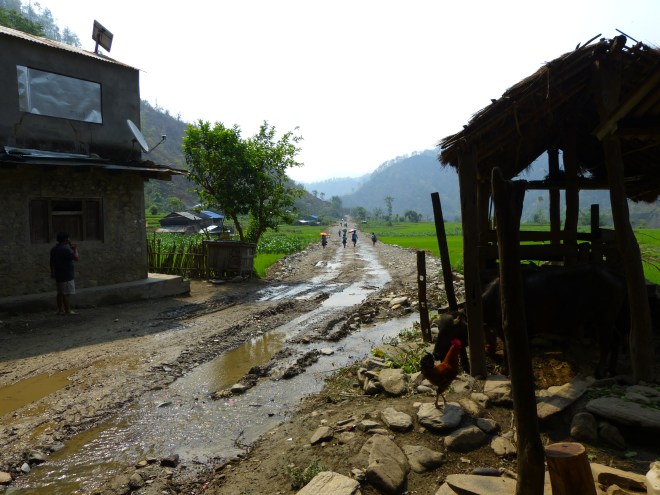
Here are some of the sights from our morning hike.
Can you spot the woman working in the field?
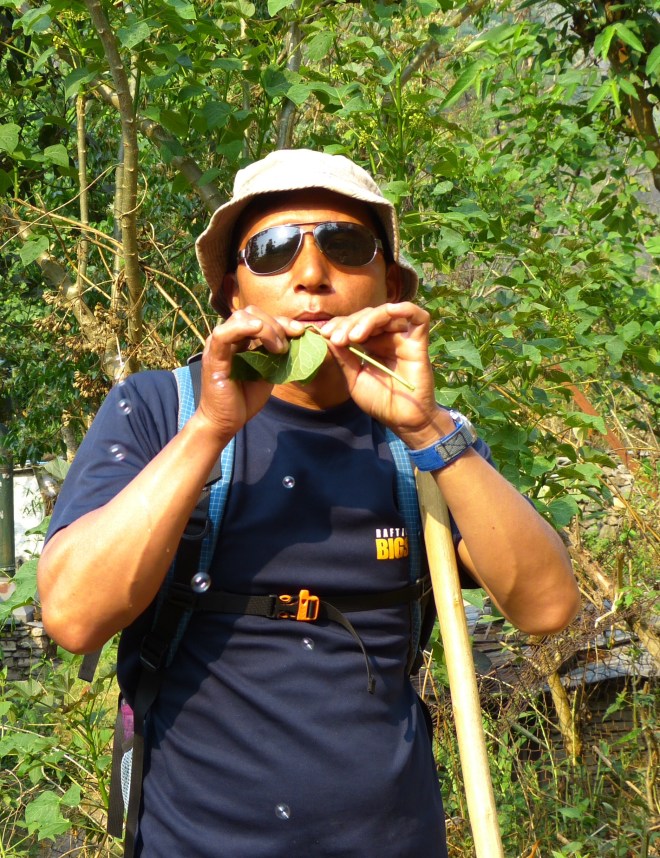
Hari, demonstrating the special properties of the bubble plant.
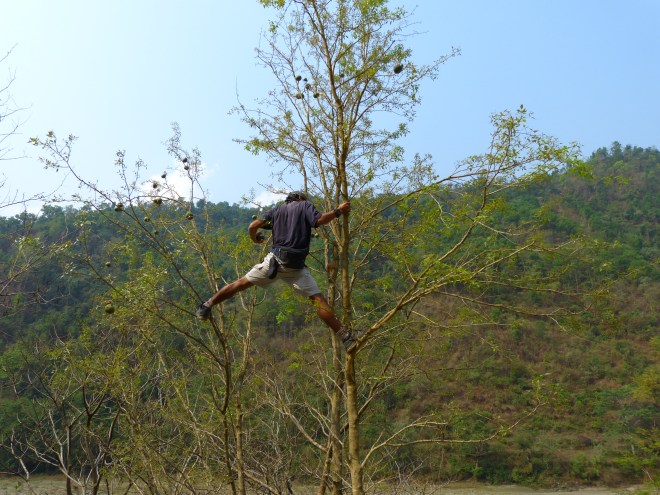
Bimal getting a “hard apple” from the tree. All of the women were saying, “That’s okay, you don’t have to climb up there”
These kids walk miles everyday to get to school.
Binoy, our guide, asked if we wanted to take a turn guiding the oxen around the field. We declined.
What do you want to bet Jim had a vehicle like that in his past?
This village had a still for making millet wine.
Our last stop in Nepal will be at Chitwan National Forest. We are moving much faster than my blog, but that is usually the case.
What a fun city! Unlike Kathmandu, you can actually walk alone along the streets of Pokhara without fear of never finding your way back to your hotel.
What to do during our three nights there?
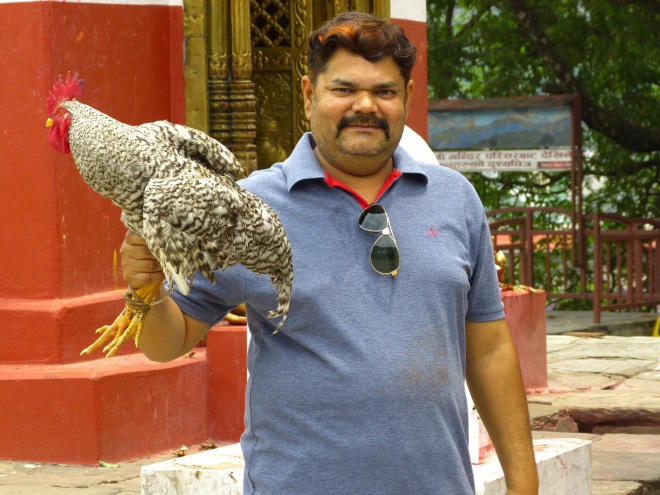
Of course there were temples to visit. This poor rooster seemed to know his minutes were numbered. Yes, Hindus still do animal sacrifices. But maybe he’ll get lucky and be reincarnated as a cow.
When this guy saw my camera, he insisted that I photograph him and the rooster.
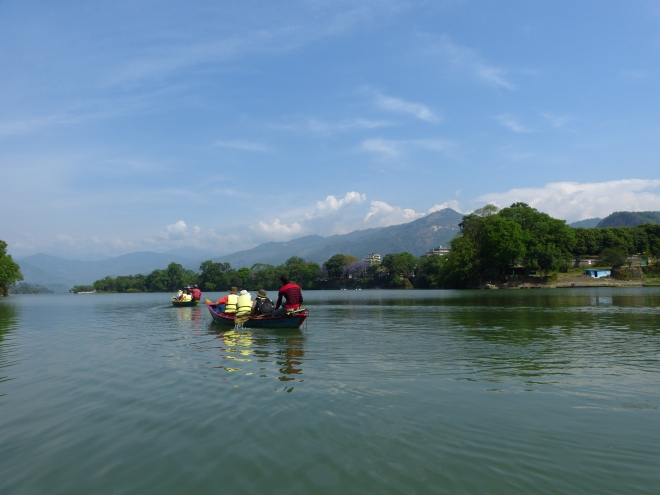
The next temple could only be reached by boat.
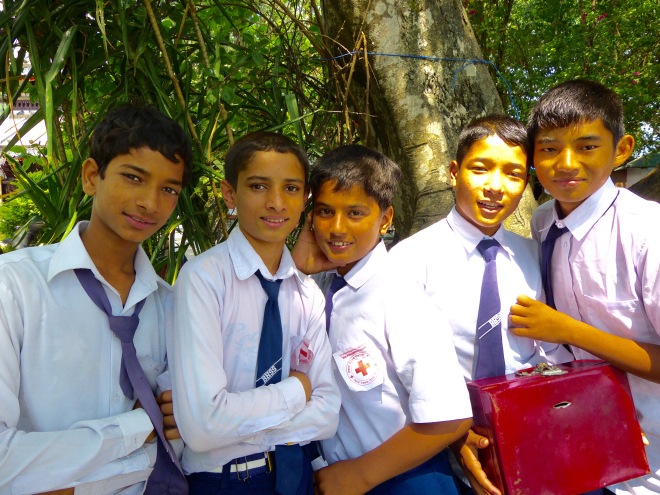
What made this visit special were the sweet boys collecting money for the Red Cross.
“50 rupees, madam?”
“Okay”, and as I’m reaching for my money I hear, “100 rupees, madam?”
“But you said 50”
“Okay madam, 50”.
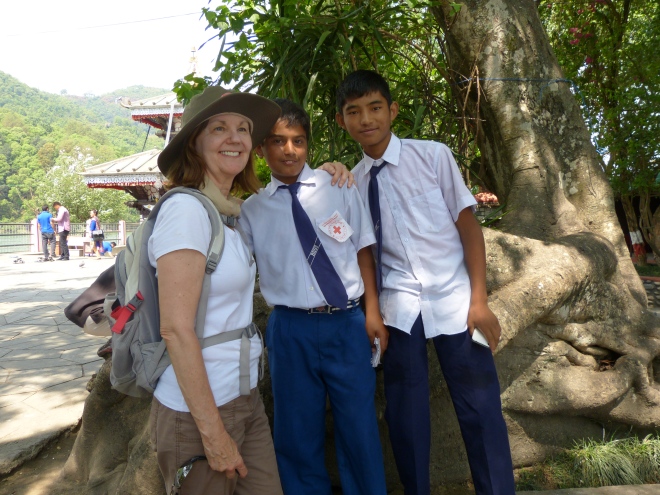
He had such a sweet smile, I gave him 1,000 rupees, the equivalent of $10. THAT guaranteed me a photo shoot with the entire group, who then insisted upon taking MY picture. My sweet negotiator is the one in the middle.
The one in the middle was my salesman
Next up, a visit to the Parakhawking Project. Please do a YouTube search to learn more about the vulture and hawk rescue project.
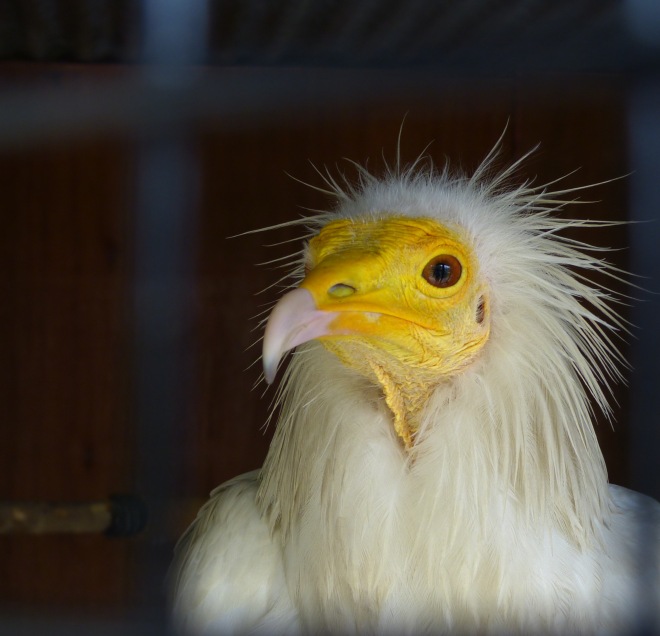
Believe it or not, this beautiful creature is a vulture, who, if you decide to leap off a mountain, will fly with you, locating the updrafts, thereby guaranteeing you’ll have a spectacular flight..
Unfortunately, he was molting, so he has been grounded for the next few months. What a disappointment– I was SO ready to sign up! So since parasailing was not an option, what else could I do with my free afternoon? Oh so many options…how to choose?
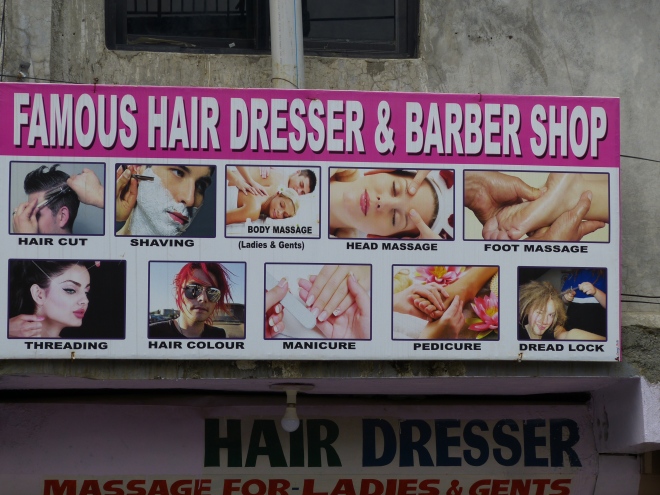
Who could resist this menu of services? Certainly not I!
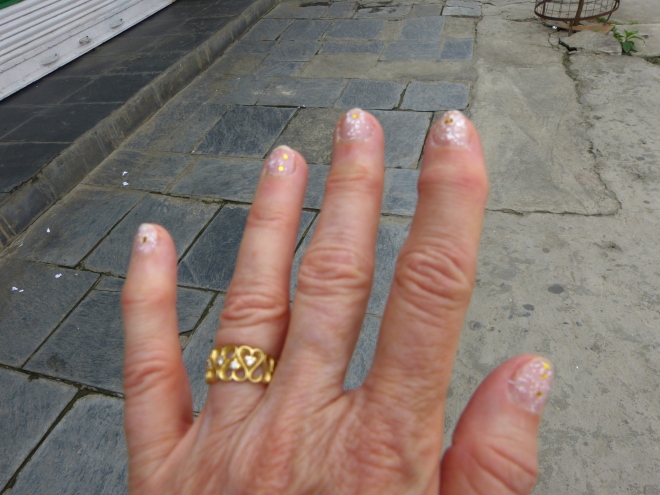
As tempting as it was to come home with dreadlocks, I decided to be a little less adventurous and settled for a manicure. It WAS an interesting experience. I’d never had my cuticles pushed back with a coin before. And the choice of polish was greatly simplified when there are only three colors, all with sparkles.
It sorta made me wonder what my hair would have looked like if I’d chosen a dye job.
The best part was my manicurist dried my nails by waving a magazine back and forth over my fingers. Again, I thought of my hair…and what might have been.
After a round of shopping, it was clearly time for music. Initially, we thought the Bollywood Dance Club had potential, until we gave their sign a more thorough inspection. Let’s put it this way. Although we didn’t go inside to verify, we suspected the club might have fit right in with New York’s pre-Guliani Times Square or Boston’s combat zone.
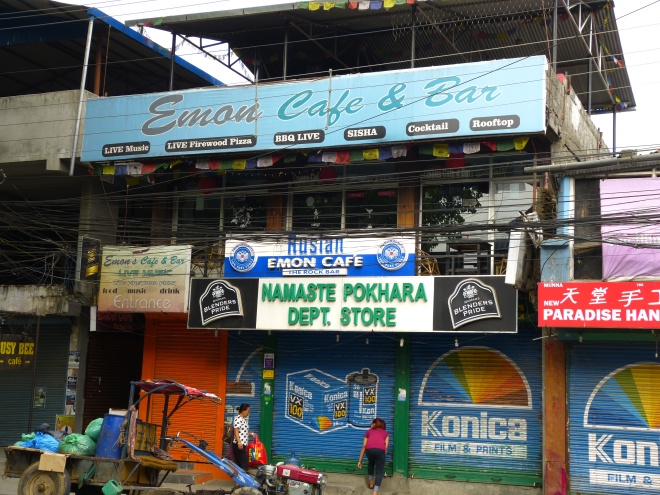
Instead, we opted for Emon’s Rooftop Cafe. We ended up being the sole (but enthusiastic) customers here.
Sitting on the balcony overlooking the street, sucking down a local beer, we enjoyed a rendition of “I want to hold your hand”, Nepalese style. It doesn’t get much better than that!
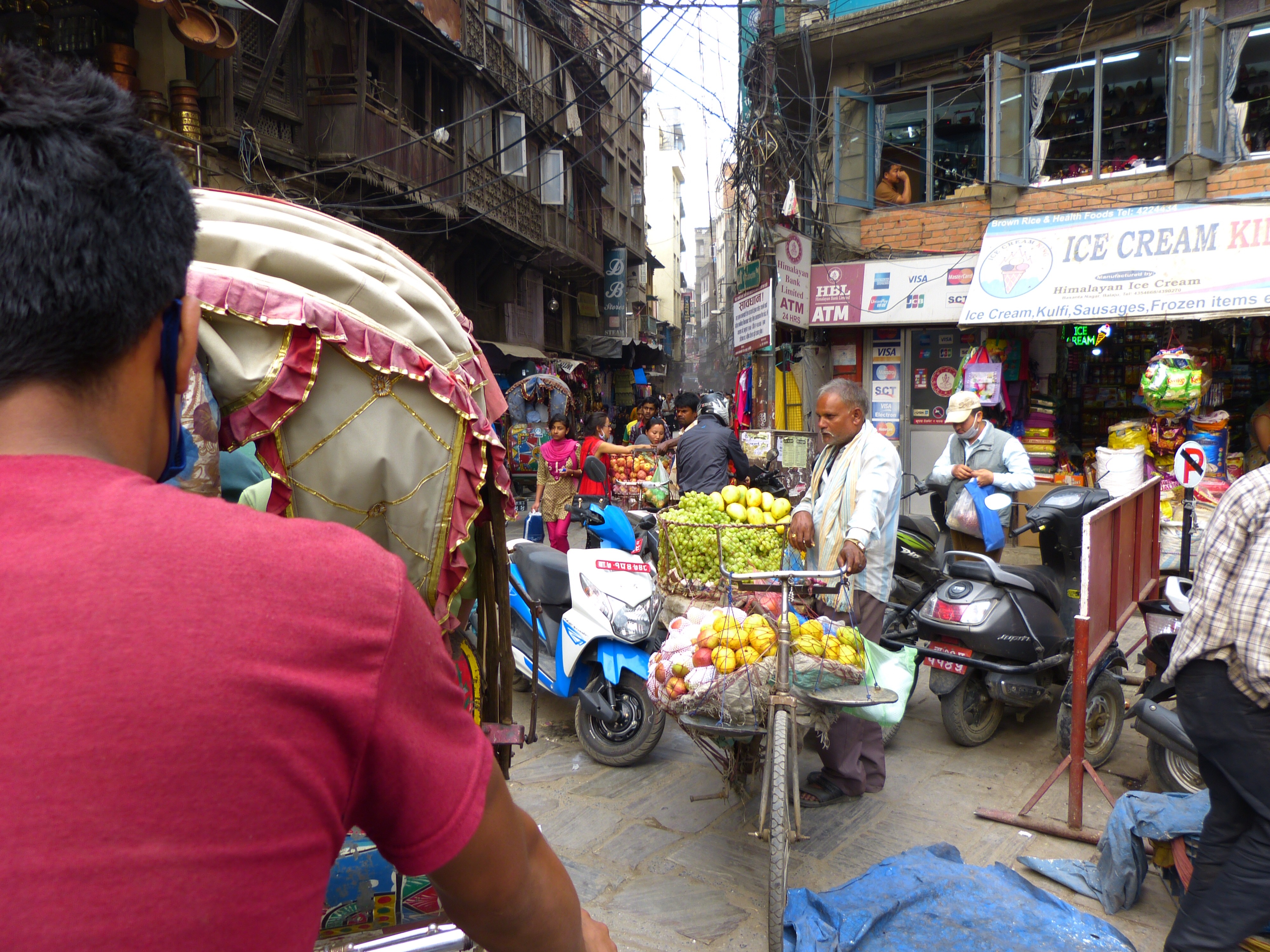
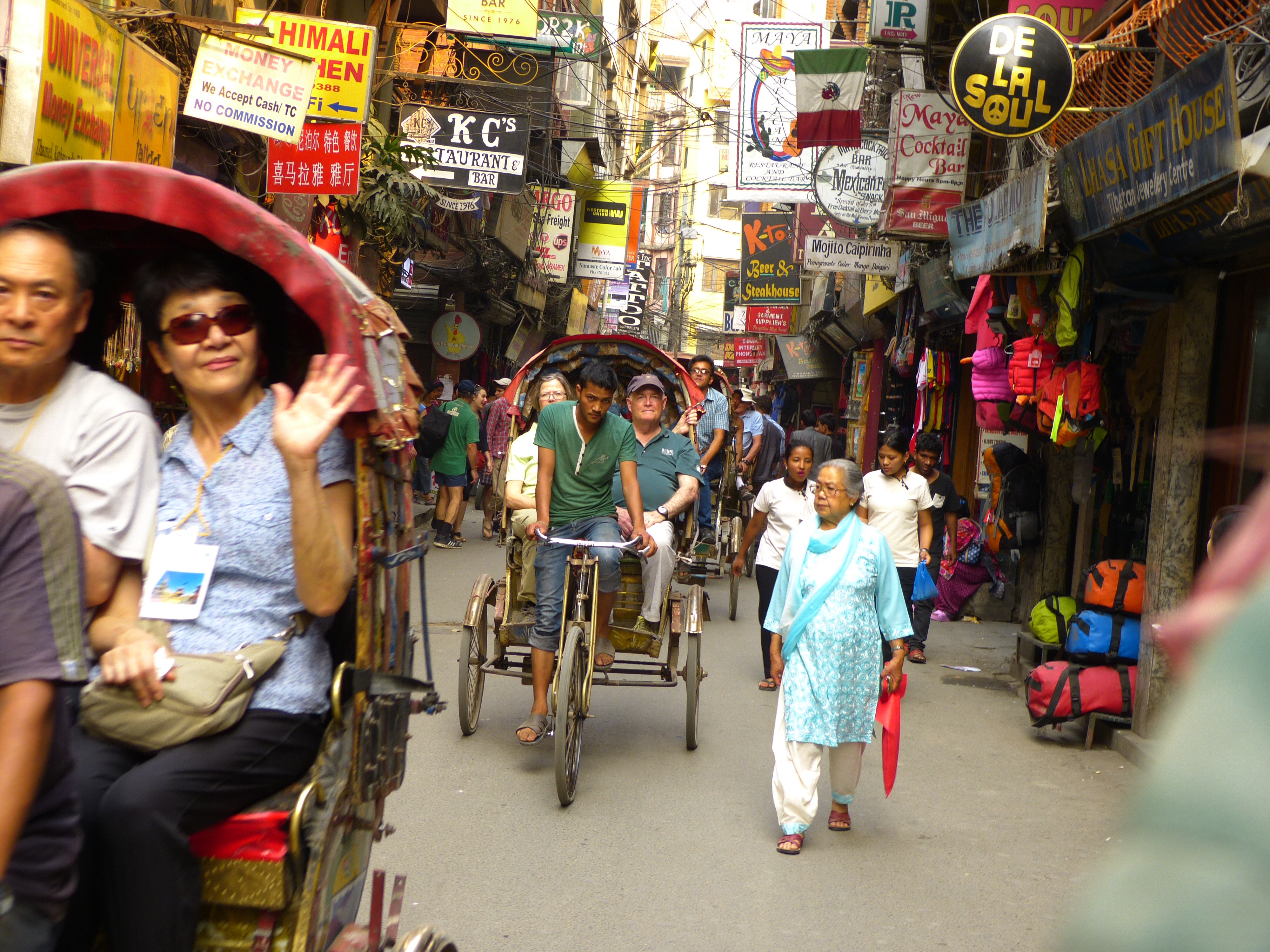
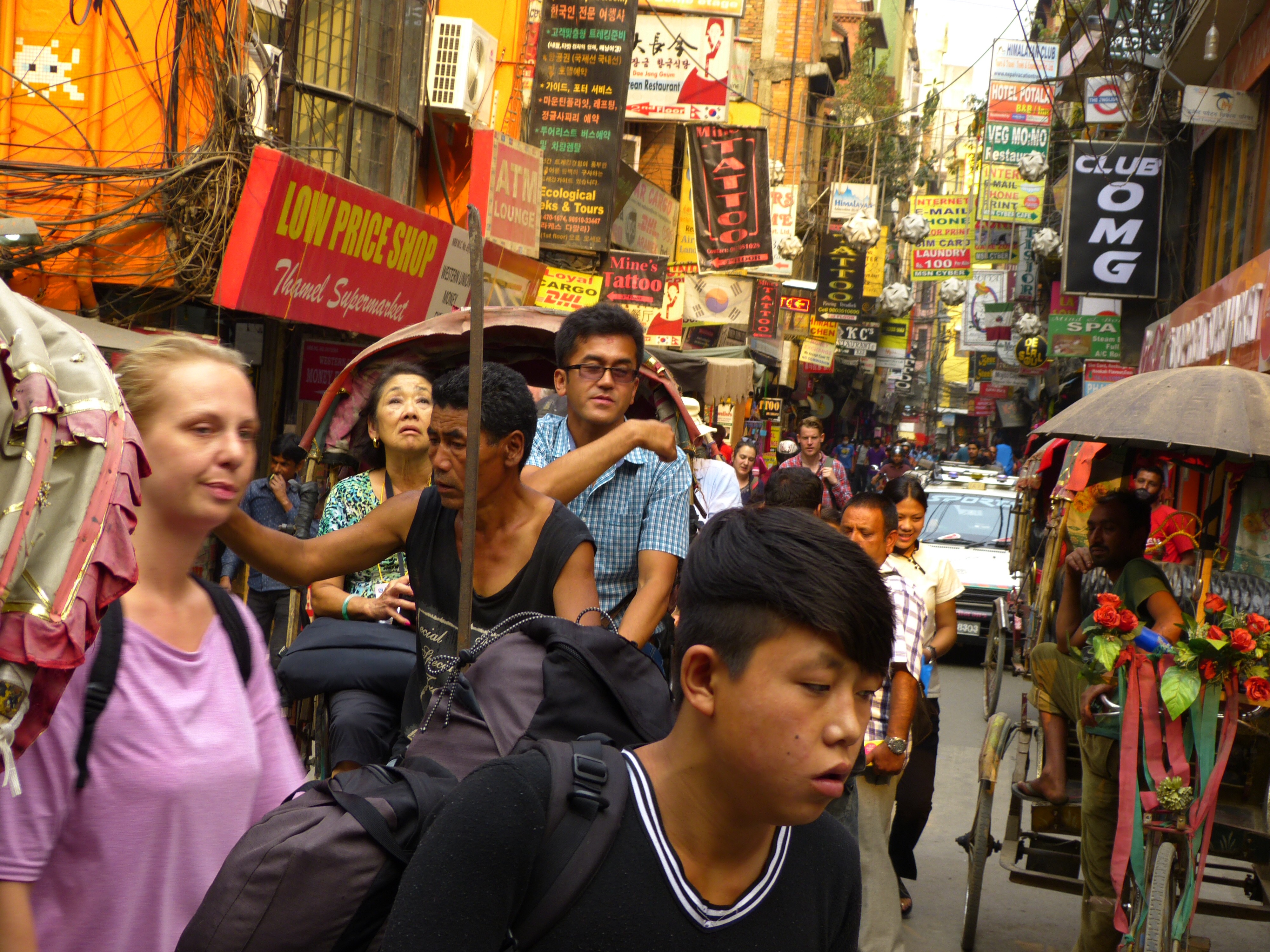
Not even a pedicab ride through Hanoi’s old town could prepare me for the rickshaw tour of Thamel, the tourist section of Kathmandu. There is no way these photos can capture the experience–the bumpy roads, the breakneck speed, the sounds and smells. It was quite a ride!
My viewEugenia and Karl in front, Peter and Marie close behindMarilynn and our guide BinoyMy driver–i survived, and am still smiling!
It’s a 17 minute flight from Kathmandu to Pokara if the planes are able to take off. Otherwise, it is a 5 hour drive on bumpy mountain roads. We were in luck. After a 45 minute delay, it was clear enough to fly.
We stopped at the Pokhara office to load what we would need for the next three days into the OAT supplied duffels, leaving our big bags behind. After lunch atop a mountain, we drove for about an hour, then hit the trail, to walk the last three miles to our lodge.
Could this be what the OAT description means by “uneven steps”?
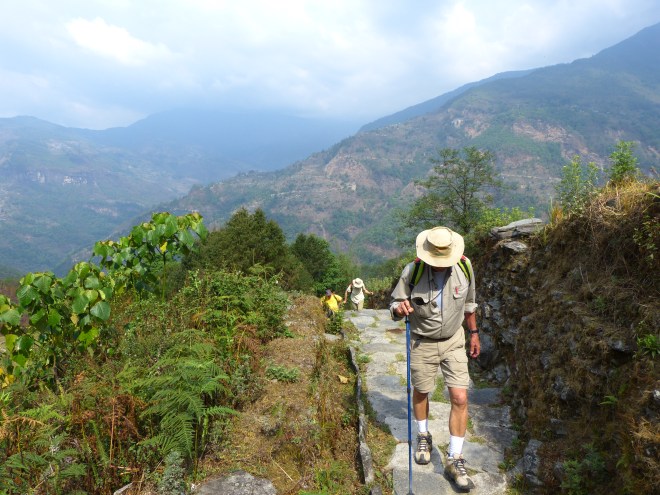
As I was walking up and down the mountain trail, I was thinking about my gym buddies at Somerset Hills Y. Knowing that they would all be in class was the extra motivation that got me to Zumba, AOA, Yoga and Barre— and boy oh boy, were those classes necessary. Our treks were far more enjoyable because I’d been “training” for the past 6 months. It also helped that the heavy lifting was done by village women, who carried our bags in baskets on their backs, attached to a strap across their foreheads.
That’s our luggage inside those baskets!
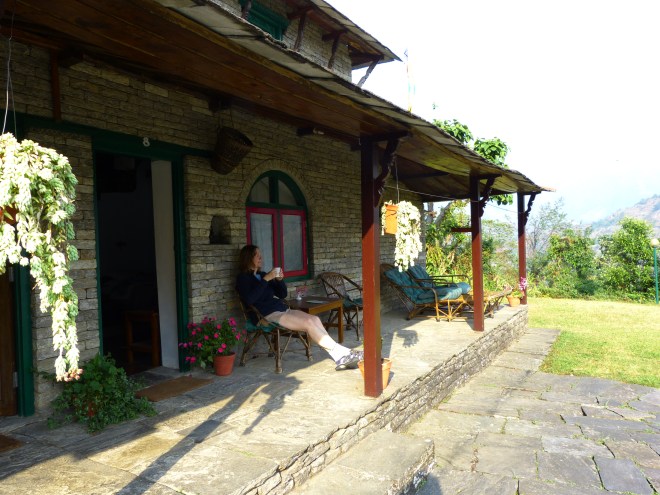
After the chaos of Kathmandu, we were so very ready for the beautiful and peacefully remote Gurung Lodge in Annapurna. And what a fantastic lodge it was. Our clean, comfortable rooms were stocked with umbrellas, warm hats and gloves, a north face parka, flashlight, and crocs. The lounge chairs on our front porches were perfect for naps after our hikes through the villages, to the school, the mother’s cooperative, the museum and the two room health center.
Okay, no comments about the white legs. In some parts of the world, pasty white skin is considered quite beautiful. So there, Sue and Sandy.
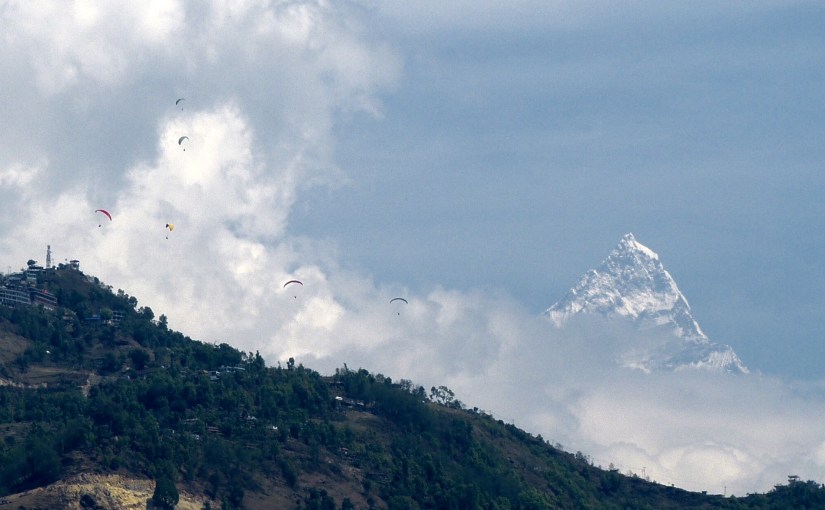
During our stay, smoke from wildfires in India caused the sky to cloud up, so we only occasionally got a glimpse of the Annapurna Mountains. Despite the clouds and mist, the view was still jaw dropping. It was impossible to capture the magnificence of this mountain range in a photo, although we all tried. As with so much in life, you just had to be there.
The view from our cabins
Our lodge had electricity for a few hours every day, just long enough to charge our camera batteries. Solar power heated the water, so we took our showers in the afternoon. As for our hair, the only blow dryer in the camp comes courtesy of the afternoon breeze.
Despite a complete lack of so many of the modern conveniences that we take for granted, we had tasty and healthy meals. I so appreciated how hard the villagers and the lodge staff had to work to ensure that we were well fed and comfortable.
We got a little surprise on our village trek. When we arrived, we were greeted by this group of women. It took us a while to realize that ONE of them looked VERY familiar.
Can you identify the nurse from San Francisco?
Here’s a clue
Marilynn, our power walker, had arrived far in advance of the rest of our group, so the village ladies decided to dress her up and make her part of the welcoming committee.
A flower garland and “Namaste”
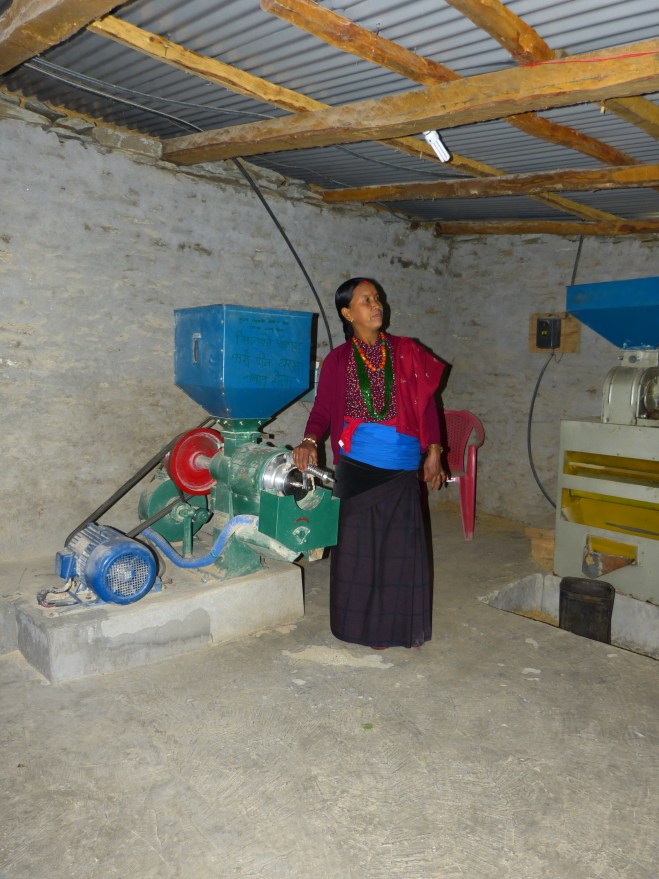
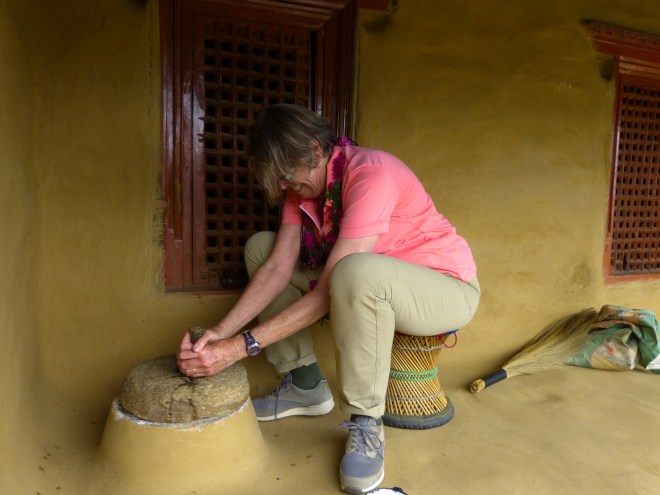
It made me feel good to see how our contributions to the OAT Foundation are making life easier forthe communities we visit. Before OAT donated the machinery, grain was ground by hand. Not an easy task, as Marie is demonstrating.
If my iPhone counted accurately, the walk to the village is the equivalent of 103 flights of stairs ONE WAY! And we couldn’t get the ladies to carry us in their baskets for the return trip.
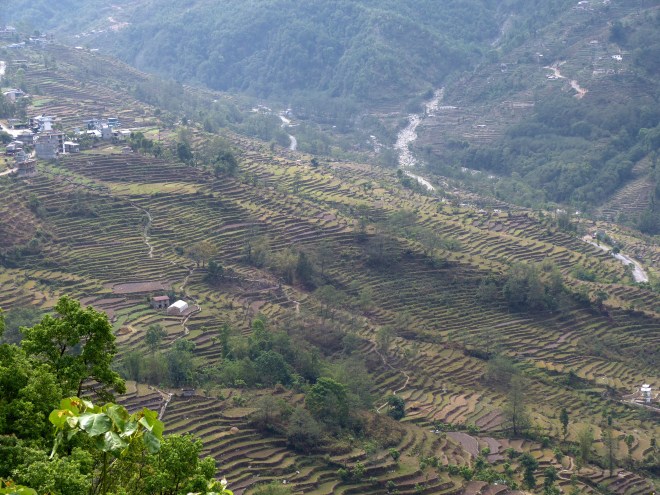
But it was worth it, because the scenery was spectacular!
Kathmandu assaults your senses. It is dusty, dirty, noisy, chaotic, crowded. Take a deep breath and you will get a lungful of incense, enough to keep you coughing for a few minutes.
We toured the three major cities of the ancient Malla kingdom: Kathmandu, Patan and Bhaktapur. (That’s what happened when you had three sons–you split up your kingdom so they could each have a place to rule. )
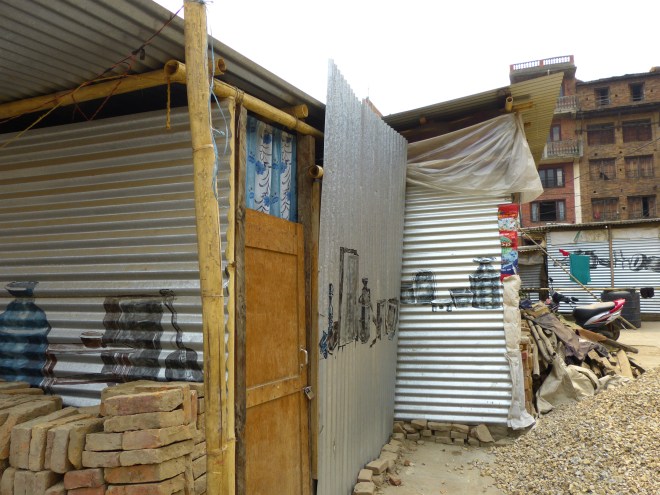
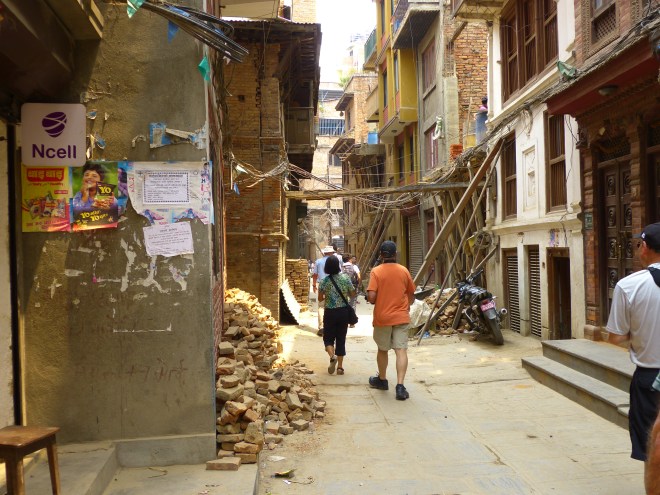
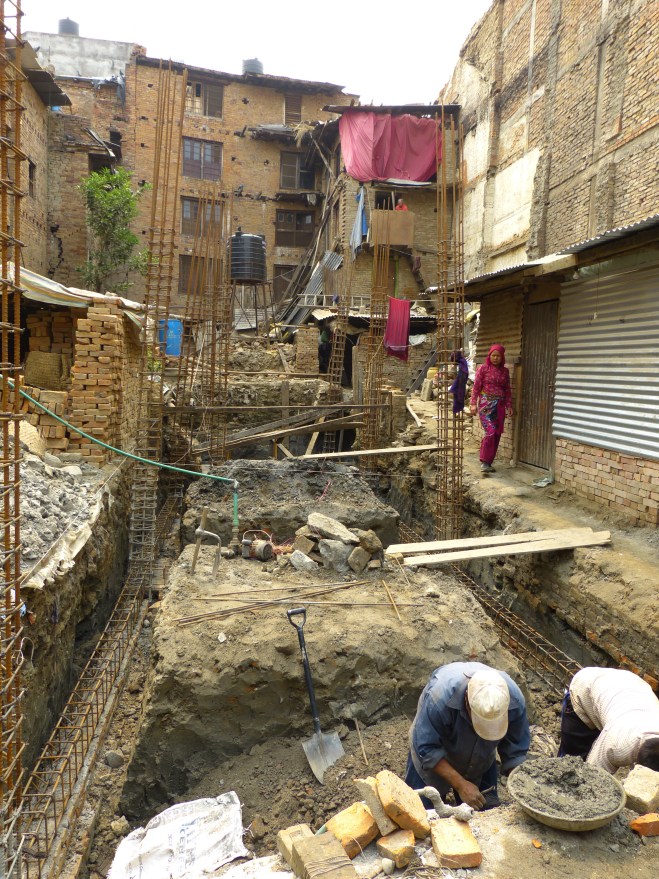
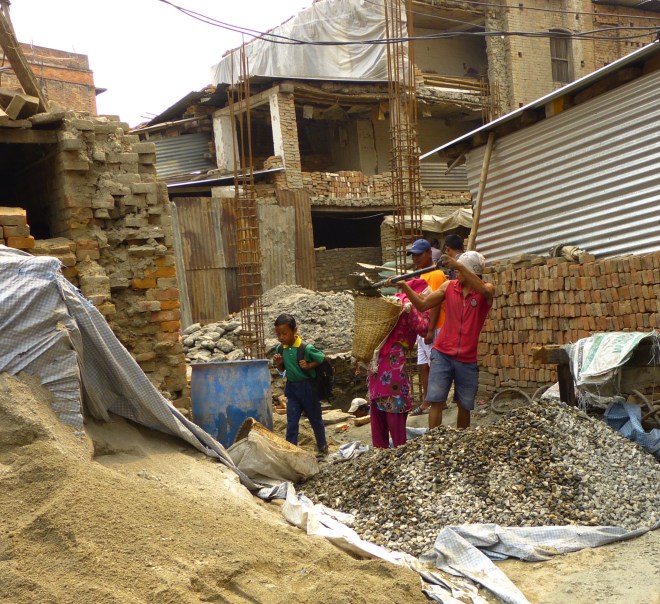
We saw the impact of the earthquake everywhere. It is heartbreaking to see that one year later, people are still living in makeshift shelters.
Home for a family
Boudhanath Stupa
Timber supporting Kathmandu buildings
Bhaktapur
Rebuilding by hand
Still, there are parts of the cities that were not damaged, allowing you to experience their grandeur and the beauty.
Plaza in Bhaktapur as seen from the balcony of the New Cafe Nuatapola, where we had a delicious lunch
The Five Level Temple
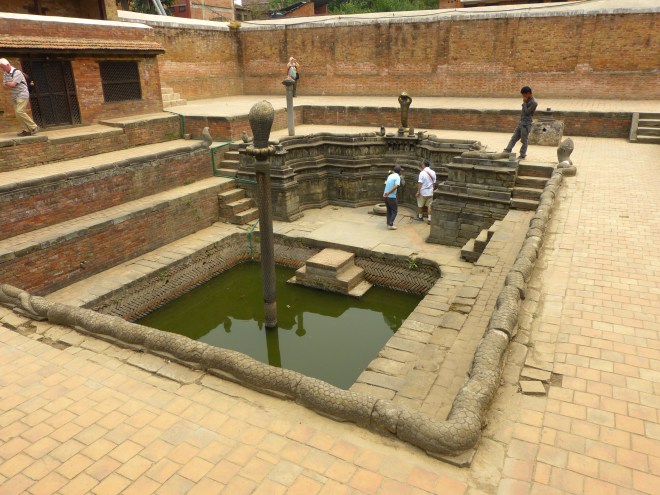
The royal family’s bathtub
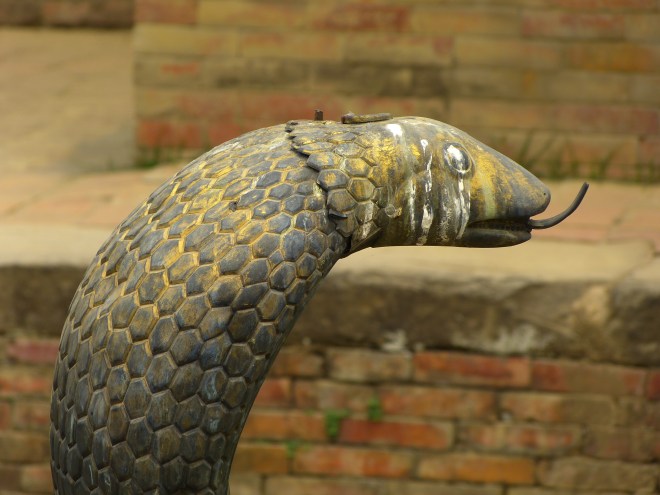
Complete with snake sculptures
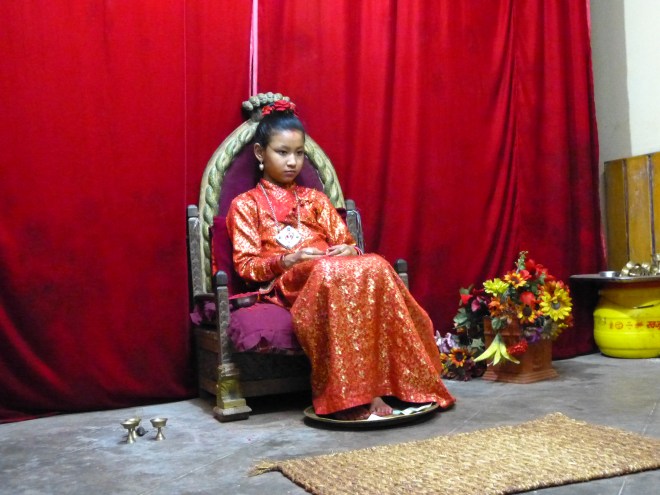
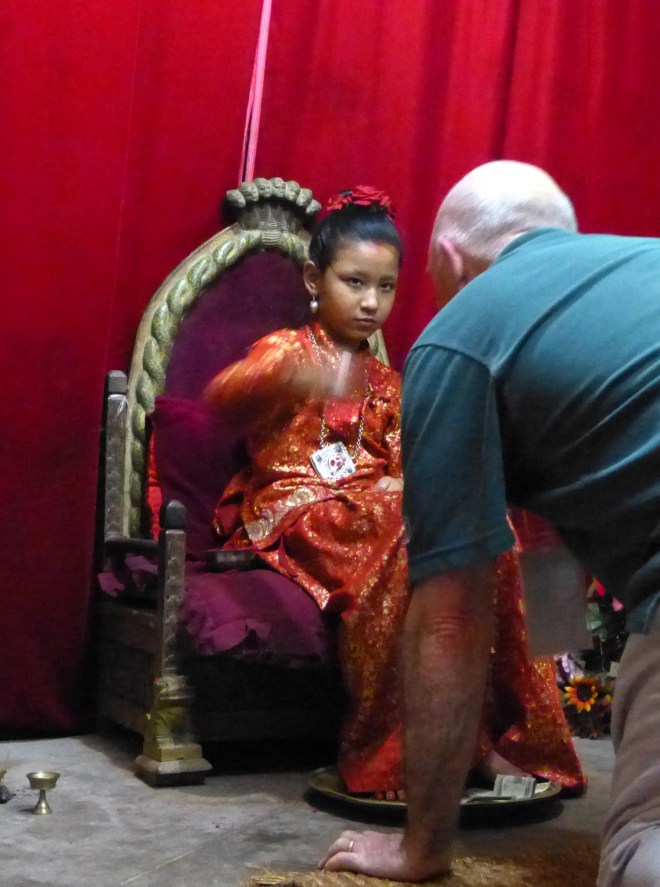
While preparing for this trip, I read about the living goddesses, known as the Kumari. (The post “Follow the Yellow Brick Road, Part Two has more information about the goddess.)
After our visit, all of the women in our group felt so sorry for this sad looking little girl, who was chosen when she was three years old. I couldn’t help but compare her to my happy, active nieces. Of course, we don’t know what other options were available to her. Maybe sitting on a “throne” placing tikkas on the foreheads of gawkers was the better alternative.
The Kumari is not allowed to walk
Peter is receiving her blessing.
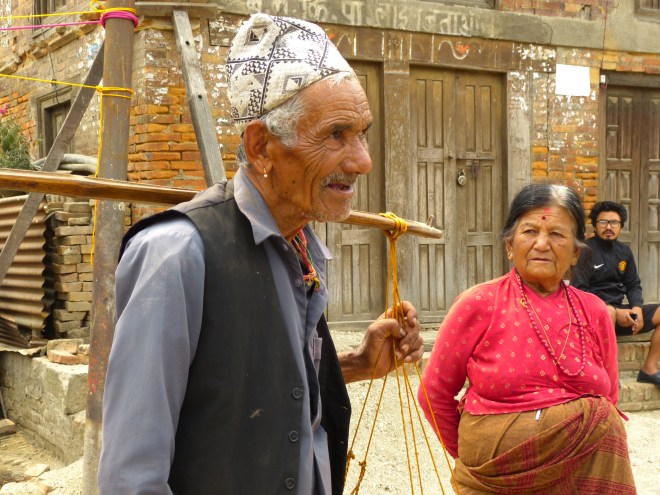
Despite the hardships they have endured, the Nepali people’s beautiful spirit shines through.
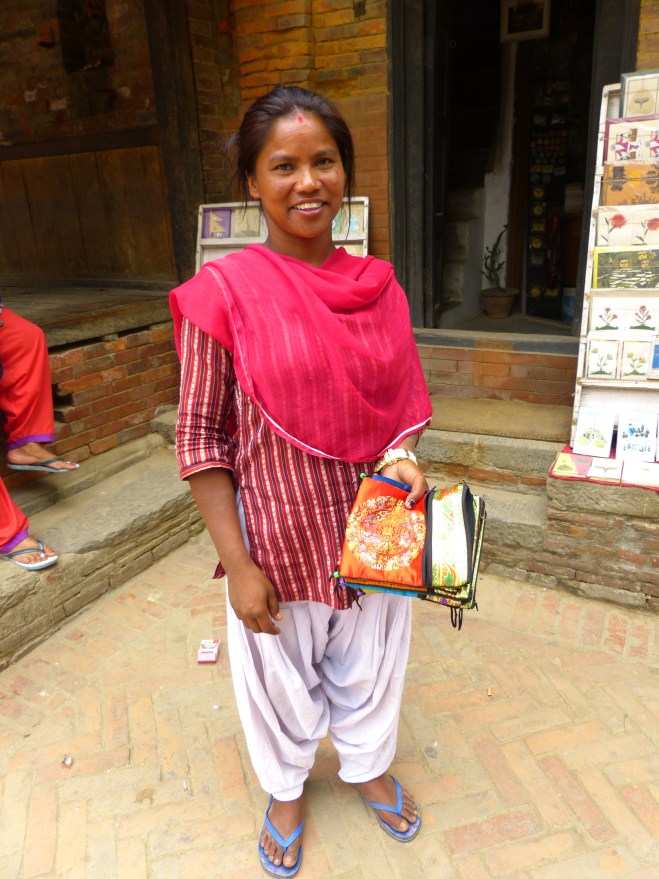
The hawkers are everywhere. The problem is if you buy from one, you are mobbed by many others. Still, I couldn’t resist this woman’s sweet smile, especially after she told me if I wanted to buy more than one, there would be no problem.
Okay, so I bought more than one. Sisters, cousins, nieces, friends…you know the drill…gifts are coming your way, but you may have to earn them. There may be a quiz!
This next one was more of a hard sell. “Madam, blessings for you, blessings for me”, chanted continuously while she walked beside me for the equivalent of five city blocks.
Okay, so I got blessed. I now own the necklace the lady on the right is holding. I expect those blessings to be coming my way!