It would not be accurate to say we spent three DAYS in Chefchaouen because during our stay, we spent one day in a local northern village and another in Tetouan.
I can understand why other OAT travelers are so enthusiastic about this pre-trip. (For non-OAT travelers, OAT always offered the opportunity to add additional days before and after their main trips). The scenery is beautiful, the food is wonderful and inexpensive, the accommodations are gorgeous, and the people are so happy to see American visitors. As we were walking through the Medina, the locals were yelling “welcome”, “hello”, and different phrases, including “happy wife, happy life”.
Moroccans are very proud that their country was the first to recognize the brand new United States right after we achieved independence.
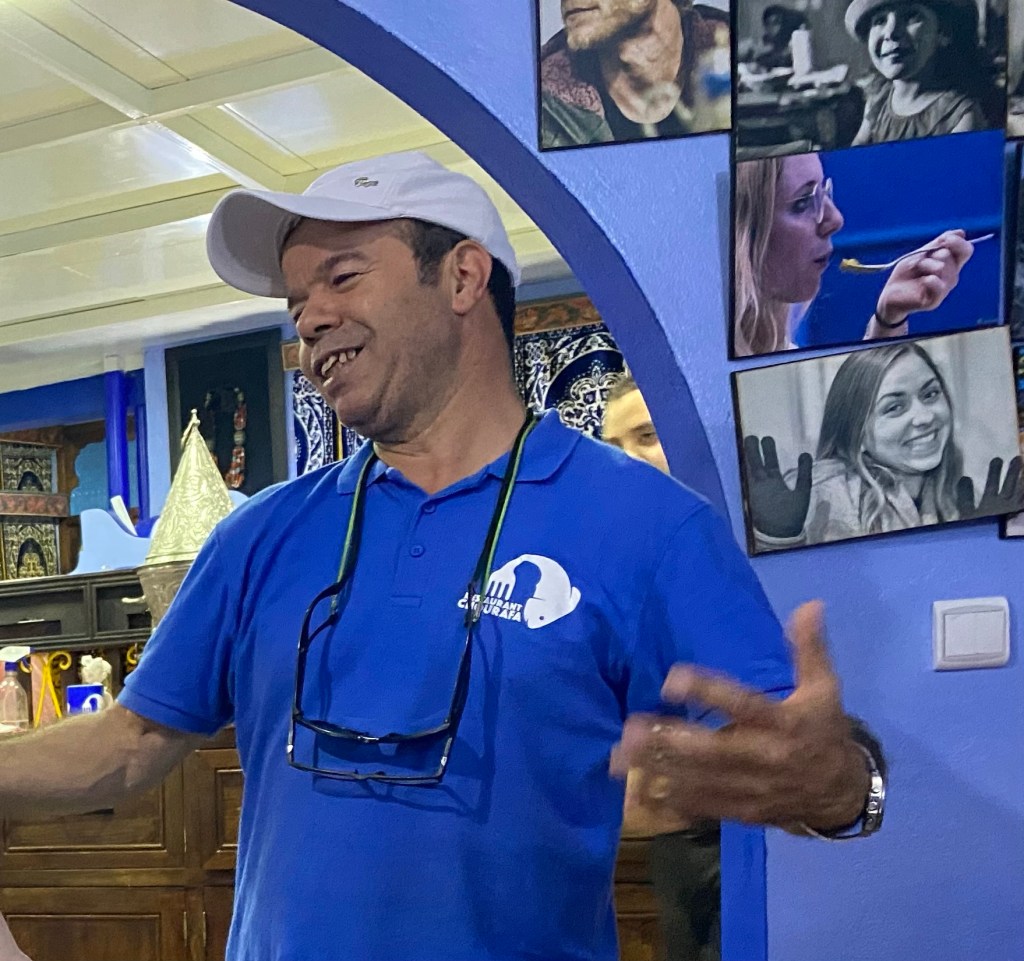
At Chourafa, the owner told us that Eisenhower stayed in that very dwelling during World War II, back before it was transformed from a private house to a restaurant.
Owner of Chourafa, entertaining us with his stories.
One feature of OAT is home visits, where we have the opportunity to spend time with a local family, sharing a meal and learning about their day to day lives. Our visit was with Mohammed, his lovely wife Ishhane, and their two daughters, where we enjoyed this fabulous feast made from ingredients grown on their farm in a little village so remote even Google hasn’t found it!
TagineKris and Ishhane with their assistant. Mohammed and his family built their house, including this kitchen.
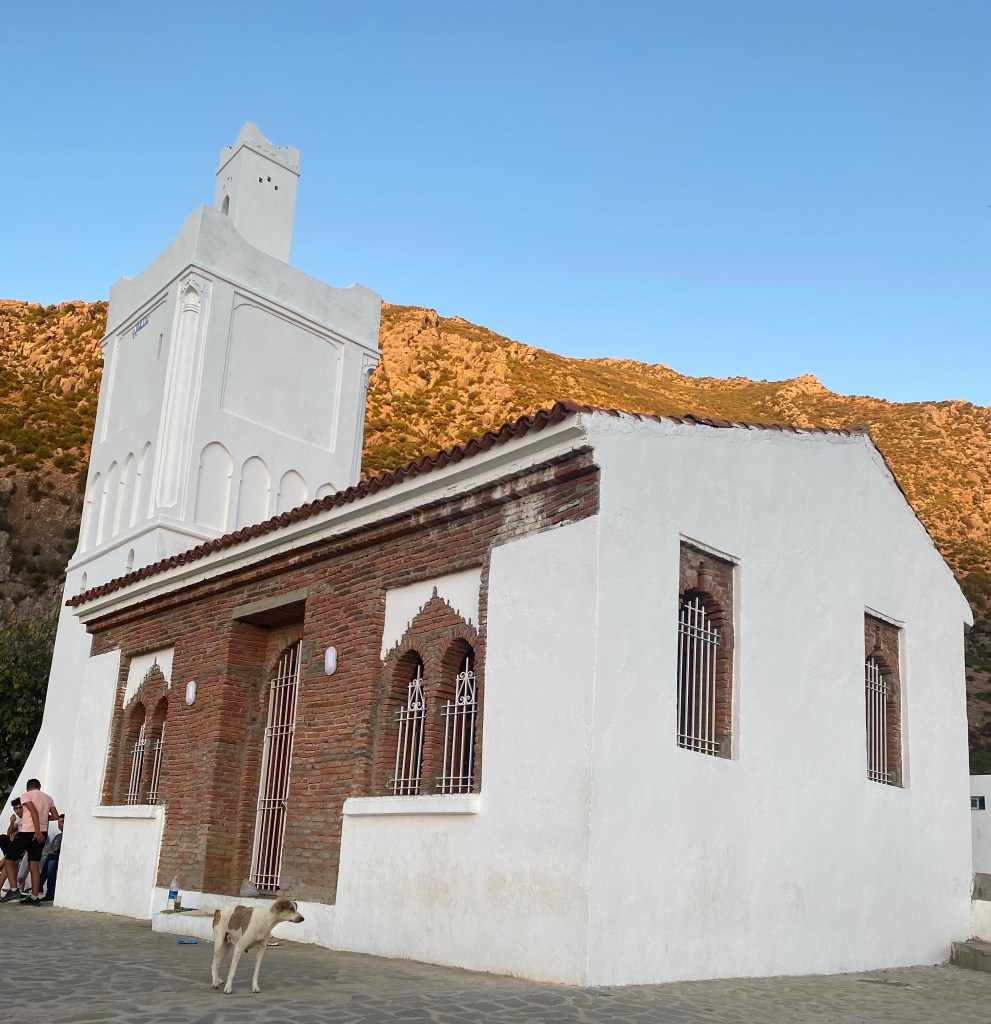
It’s good we were so well fed, because after we left the village to return to Chefchaouen, we did a LOT of walking. It is a bit of a hike to get to Boulazaafar, the mosque that overlooks the city. Built by the Spaniards in the 1930’s as a way to make up both for the expulsion of Muslims after the fall of Andalusia in the late 1400’s, and for the Spanish invasions during the late 1800’s, it has never been used. Understandably, the Moroccans were a bit suspicious of the Spanish military’s attempt to make friends. Maybe they heard about the Trojan horse?
Okay, so it isn’t Hagia Sophia, but the location is pretty spectacular.
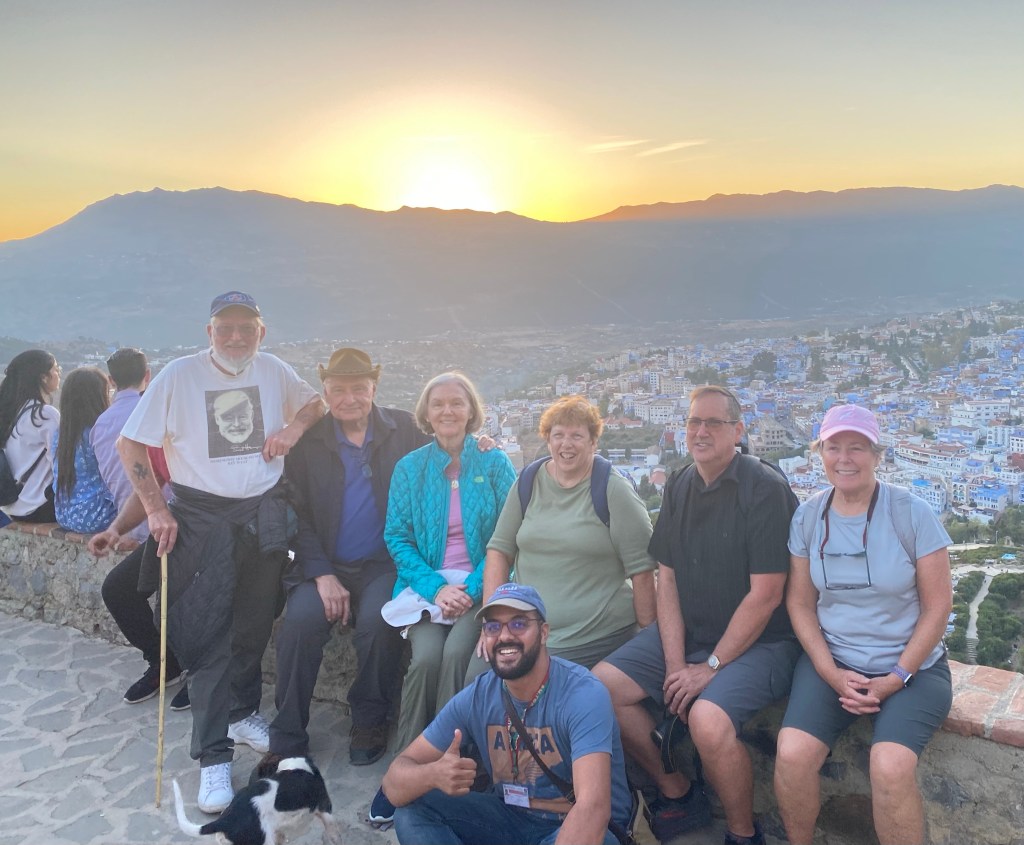
It is SO worth the 30 minute uphill stroll to get there in time to watch the sun drop behind the mountains.
From that vantage point, we could hear the call to prayer issuing forth from the 30+ mosques scattered throughout city.
Most of the other hikers were a bit younger than we were, by roughly 4 or 5 decades Another view of Chefchaouen: Different centuries coexisting. Women are doing their laundry in the stream and taking photos with their cell phones.
We were offered an optional trip to Tetouan, which all of us, except Mike took. Although the scenery on the drive was spectacular, in retrospect, I think I would have preferred to spend that time in Chefchaouen instead.
The optional tour consisted of a stop in a small Roman Museum, a walk by the palace, and through the Medina, the Jewish quarter and mella, and a seafood lunch in a restaurant across from the beach. Although enjoyable, I’d had similar experiences on other tours, so for me, additional time in Chefchaouen would have been preferable.
When we signed up for this Overseas Adventure Travel trip in August of 2019, the world was certainly a different place. Even 20 months after shutdown, Covid STILL has a significant impact on our daily lives. I will admit, we had some reservations about leaving home, even after being fully vaccinated, but through Facebook, I was able to connect with Rocky and Julie who traveled to Morocco with OAT in September. They kindly “friended” me, and because of their photos and posts, we felt comfortable forging ahead. My goal is to do likewise, but rather than posting on Facebook, I’ll be communicating via this blog. So, if you want to tag along with us to see whether you’d feel safe visiting Morocco, just sign up and you’ll get a notification via email whenever I post.
This first post might be boring for those who are not planning to become future Morocco travelers. It’s really a compilation of information I would have found helpful, prior to leaving home.
Getting there
Initially, we were flying to Casablanca via Paris on Air France, stopping in Paris for four days. Although we normally enjoy being on our own, because of Covid, we realized that we wanted the comfort of having a guide look out for us. Plus, with different countries having different rules, we figured those four days were a complication we could do without, so I hit the internet, to determine whether it was possible to get from JFK to Casablanca non-stop.
The only non-stop I could find was via Royal Air Maroc, which has one daily round-trip flight. It is a codeshare with American Airlines, but unfortunately OAT does not have an agreement with those airlines, so we were on our own. I’ll be honest—it was a little complicated, because with the code share, we had two different flight and booking numbers, and two different customer service phone lines. AND, although we booked and paid through the American site, we couldn’t use that site to select our seats. We also were unable to check in on-line, and print our boarding passes, something we normally do. A hassle, yes, but we avoided changing planes in Paris, and we arrived in Casablanca seven hours earlier than we would have if we’d stayed with Air France.
Royal Air Maroc
Our flight was scheduled to leave JFK at 8:40 PM, so we left our house at 3:45 PM because of NY traffic. It took almost 2 hours to get to the airport, but checking in and getting through security was relatively easy.
Our flight would arrive in Casablanca at 8:30 AM local time, 3:30 AM our bodies’ time. (It actually departed and arrived on time!) Knowing how poorly I do with sleep deprivation and jet lag, (picture a toddler who needs a nap) we decided to book business class on the way over so we could stretch out and sleep.
Business Class also included admission to the Primeclass Lounge in terminal 1. I’m not sure if Covid is responsible for the food offerings, but let’s just say that particular perk was not a selling feature.
Like USA Airlines, Air Maroc has lay flat seats in business class
I was surprised that dinner was provided on an 8:40 PM departure. In fact, I thought the appetizer was the whole deal and it was enough for me, so I skipped the hot entree. All I can tell you is there were three choices. We also got a decent breakfast. The business class perks that WERE selling features were a special line in passport control and priority luggage handling, so it was waiting for us when we arrived in baggage claim. In fact, the whole process went so fast and so smoothly, we were off the plane, through passport control, baggage claim and customs, had gotten money at the ATM and were outside the terminal in 25 minutes. To make the cost reasonable, we opted for economy on the way back. I promise to report on THAT flight too, so you, dear reader, will know what to expect from each option, should Air Maroc be in your future. Our return flight departs shortly before 1:00 PM, versus 7:30 AM (the Air France option), so we should be rested enough to deal with whatever version of economy Air Maroc offers.
Arrival
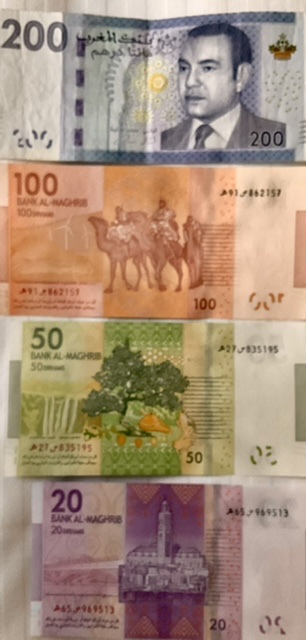
Our hotel, the Radisson Blu, arranged for a car to pick us up at the airport. The cost was 500 MAD and we were able to pay with our credit card. Our guide had warned us that only passengers are allowed inside the terminal, so we knew to look outside for our driver, right after we hit the airport ATM for some local currency. He also told us the most we could withdraw is 2000 MAD, ($235.22) delivered in 100 and 200 bills, so we were prepared for that. It took about an hour to get from the airport to the hotel, because of traffic and a couple of accidents.
Mohammed VI’s image is on the front of all bills, but the reverse varies. The hotel changed a large bill for us
Packing
Mostafa, our guide, sent us a wonderful welcome email, full of useful information, like where we would be able to have laundry done, (Fes, Ourazazade and Marrakech), and what to pack (bathing suit and hairdryer, among other essentials.) For a while, we seriously considered traveling with carry on only. After very carefully reading the luggage allowances on Royal Air Maroc’s website, I became concerned that ONE carry on meant just that, with no “personal item” allowed. We would have been really bummed if we had eliminated things that we wanted to bring, only to learn at the airport that one of our two carry-ons would have to be checked. So, out came the duffle, and in went more ”stuff”. Mike was able to easily include his laser pointer and binoculars, in anticipation of the dark skies in the Sahara. He’s an astrophysicist, so interested fellow travelers can look forward to a professional explanation of what we are seeing in the heavens.
Map
The image at the top of this post was created courtesy of Google maps. The cities we will be visiting are listed in order, with the blue pins giving you an idea of the ground we will be covering. Are any map aficionados out there? If so, this link will allow you to get additional information about the cities we are visiting by clicking on the blue pins. https://goo.gl/maps/Np8GEL1ripWqEgx57
For the past two years, we have been “Wishin’ and hopin’ and thinkin’ and prayin’, plannin’ and dreamin’ “ about traveling to Morocco. (Who remembers that song? Extra credit if you remember who sang it.) Right now, dreamin’ is Mike’s choice, but I’m going to check out the pool so I’ll be sunnin’ and swimmin’.
Happy 2021 everyone. One of my resolutions is to write several Tesla posts relating “the good, the bad and the ugly” aspects of ownership. So, here goes. Let’s see how long THIS resolution lasts!
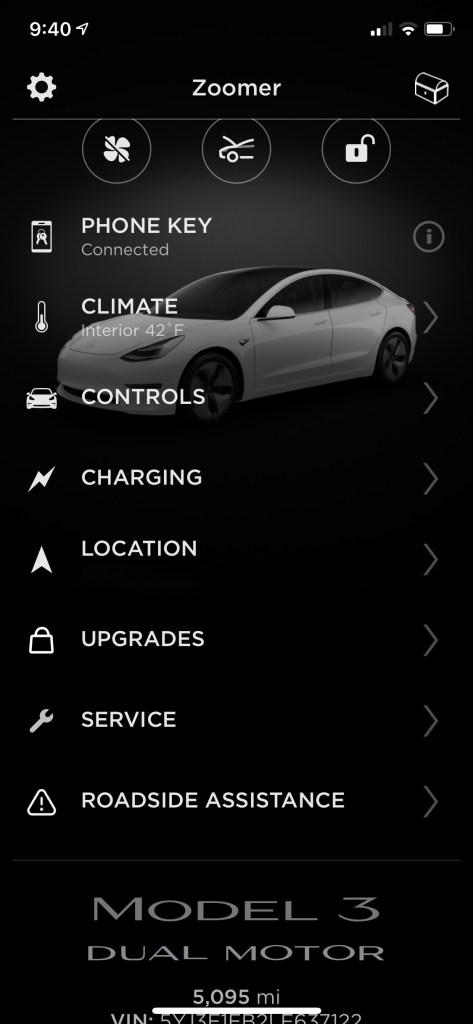
After you buy a Tesla, you simultaneously enter into a very intense relationship with your smartphone. Pre-purchase, I usually had a vague idea where my iPhone might be. Now, it is rarely out of my sight. Why? Because my iPhone is also my car key and the way to access all of the wonderful functions on the Tesla app. Check it out.
Yes, many cars allow you to remotely turn on your heat and air-conditioning. but can you also choose your desired temperature? Does it allow you to turn on the seat warmers? It only takes a swipe of “climate” to do both. Of course, you have to REMEMBER that function exists, which for me, is somewhat of a challenge.
“Controls” allows you to flash your lights, blow the horn, remotely start the car, lock and unlock the doors, open the front and rear trunks, activate “sentry mode” (which turns on cameras so any activity around your car is captured on video). If by any chance you allow someone else to drive your car, you can limit the maximum speed limit and if you choose “valet mode“, you also prevent access to the glove box.
“Charging” seems self explanatory, but it will be the subject of a future chronicle. (Bet you can’t wait)
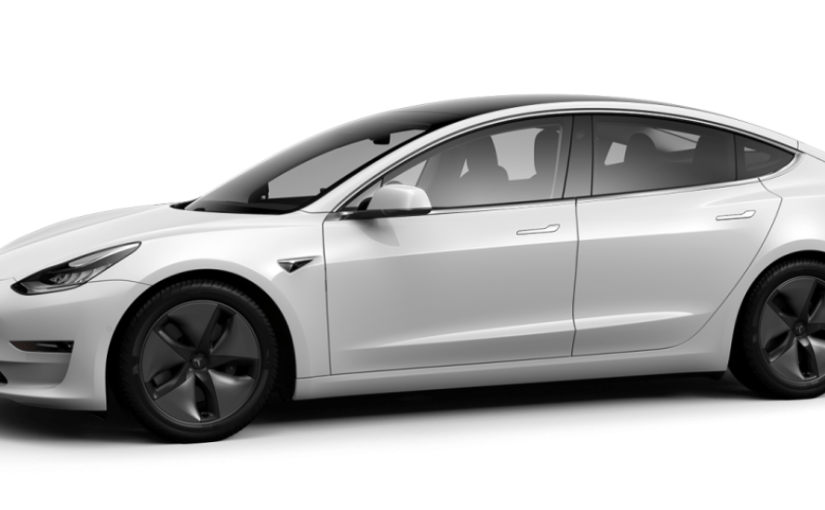
“Location” made me comfortable choosing a white car. My last three vehicles have all been red, because that is, by far, the very BEST color for finding a car in parking lots. (I have trouble localizing sound, so the noise button on many cars doesn’t help me much). Sadly, red Teslas cost $2,000 more, so I opted for the only color that didn’t increase the price. Because location shows you exactly where your car is at any time, that feature (and the inability to hot wire it) makes theft of your Tesla a bit challenging.
Those of us who didn’t pay extra for Full Self Driving (FSD), at time of purchase can change our mind at any time by swiping “Upgrades” and forking over an additional $10,000. FSD allows you to input your destination to let navigation take over. You literally can leave the driving to the car because FSD allows it to change lanes, exit highways, stop at traffic lights and stop signs- whatever is necessary to get you to where you want to go. It will even park itself upon arrival at your destination.
Let’s say when you arrive, the sun is shining but the weather takes a turn for the worse, and now the rain is coming down hard. No worries. With FSD, you can SUMMON the car to drive itself to pick you up. It might be worth $10,000 to see the expression on others’ faces as they watch the driverless car come rolling your way. Not to me, but I’ll bet there are others for whom it would be worth the $$$. As for me, I’m quite fine with the “less than full” self driving capabilities I currently have. If you think that might be the topic for another post, you could be right.
Another current upgrade: An acceleration boost. Instead of taking a whole 4.2 seconds to go from 0 to 60, for a mere $2,000, you can cut the time to 3.7 seconds. Who would care about half a second difference? Who would even notice? Certainly not members of MY demographic. I’m convinced, however, that there IS a particular demographic Tesla designers/engineers keep in mind. Hint: my son is definitely a member of their target market.
We still aren’t done with all of the app’s features. You can schedule “Service“, (another future topic) or call for “Road side assistance” (fortunately, so far I have no experience with THAT feature).
At the very bottom of the app is the odometer, the VIN and the software version. Yeah, here comes the BAD part. You can’t seesaw many miles you’ve driven unless you look at the app, or go through a screen or two on the “iPad looking thingie” in the car. Maybe it’s just me, but I LIKE being able to easily check how many miles I’ve gone.
Now let’s move to the TOP of the app. Tapping the gear box at the top left brings you to “Settings“, where you get emails and notifications about software updates (another future topic) from Tesla, access video guides, and synch your calendar.
The little arrow at the top performs the same function as location.
Finally, in the upper right hand corner are the wi-fi, internet and battery indicators, plus the “loot box”. The loot box is where your free supercharger miles show up whenever someone uses your referral link. If someone uses a referral link when they buy their Tesla, they also get 1,000 miles of free charging at a SuperCharger. If you happen to be in the market for a Tesla and don’t have a friend with a referral code, I’d be delighted to share mine.
So there is a whole lot of GOOD going on, but I promised Bad and Ugly so I’ll end with that: The BAD (and Ugly) is the supercharger miles expire. If you do most of your charging at home, which I do, then the only time you would use a supercharger is on a long trip. During Covid, there haven’t been many of those!
At last. I can finally check “have mug shot taken” off my bucket list. So how did I happen to get in front of a police camera, holding a white board in front of my chest, with my name and date printed on it? And was I able to smile?
I’ll answer the second question first: Yes, I did indeed smile. So, those of you who are mug shot experts will know from THAT answer that I didn’t get there by robbing a bank, committing arson or assaulting a president. Because, as the officer/photographer explained to me, criminals aren’t allowed to smile.
And no, I wasn’t picked up for protesting (peacefully or otherwise). Instead, I was there being fingerprinted and photographed because I offered to help out with the upcoming election’s mail in vote. You see, I figured the very nice people working in the Board of Elections Office are going to be bombarded this November. Not only that, but they are going to be subjected to all kinds of criticism, and speculation of misdeeds that will appear on Facebook as ‘fact”, most likely posted by people who wouldn’t know a fact if it bit them on the ass.
Caring deeply about our country, and recognizing how important voting is to our democracy, I figured it would be patriotic to help out.
In our area, at least, you have to be highly motivated to volunteer because after you fill out two forms, you have to make an appointment for 7:30 PM at the county sheriff’s department to get your glamour shot and fingerprints done. Of course, when I arrived at what I THOUGHT was the sheriff’s office, the building was locked up, and there was no one in sight. But I am resourceful–I saw the next building had lights on, so I pressed the button to be admitted. Once inside, I saw a young male counting out a huge wad of money, which I found to be interesting and slightly unusual, but eventually figured out it he was probably bailing someone out. Yep, I was standing in the entry to the county jail. After further instructions and a phone call, I returned to the main building and eventually was let in to be “processed” by the very friendly and helpful officer.
The best part? They no longer smear all that black gunk over your fingers to take your prints. (I hated that) But that’s not all. I also learned that because I am not (so far) a criminal, a teacher, an officer of the law, or a politician, my finger prints are not kept on file in some database. Once a background check is completed, your digits are deleted. (I know, you’re probably thinking “what an educational and enlightening this post turned out to be”. You’re welcome.)
Next step was completing the background check, which I imagined in addition to being bone jarringly boring — I was FAR more intriguing during my college days — included a glance at my voting record. I had been asked whether I was able to be non-partisan, and although I CLEARLY have strong opinions about the current administration, that is probably true of 95% of the American population. (The other 5% is most likely in a coma.) Still, I can put my feelings aside to do a job professionally and ethically. Out of curiosity, however, I looked on line at my voting record and was surprised to see that I had registered as a Republican three times, as a Democrat four times and as an independent TWENTY EIGHT times for the last thirty five elections I’ve voted in.
So, after all that, what has my volunteer work entailed? So far I have completed two days on the job. The first day I spent detaching the signature “flap” from the sealed envelope containing the ballot. This protects the confidentiality of the vote. The next day, I took ballots (from a different city) out of envelopes and inspected them to make sure they could be processed by machine. If not, then I put them aside to be hand counted and I completed a tally sheet to ensure that all ballots (and envelopes) are accounted for. The ballots are kept by voting district to be machine counted, and the flaps and envelopes are retained, in case there are any questions down the road.
I’m glad that New Jersey is able to start the process 10 days before Election Day, because there is a lot of work involved. I was impressed by the multiple checks and counts to ensure that all ballots are protected. People are working hard to make this election a successful and fair process. Plus, I’m gaining additional respect for those who do repetitive, manual labor. Let me tell you, it takes its toll–at least it has on me!
In late February, when I wrote my post about ordering my Tesla 3, the world was a different place. Although we vaguely knew there was something going on in China, back then, it didn’t seem like it was going to have much of an impact on us.
Boy were WE wrong.
There are plenty of posts, news items, tweets about the Coronavirus already, so no need to say more. Instead let’s focus on the positive: My induction into the Tesla Lovers’ Club. (Cult? Club?? You be the judge.)
As of today, I have owned my Tesla for one whole month. When I picked it up, my plan was to drive it short distances for a week, get used to its differences and features, then take it for its first long journey: a trip to Massachusetts and back, to visit my family. I had every intention of describing my experience of recharging on the road.
That plan, along with MANY other plans, went poof. Still, there is no shortage of things to say about my new “hot wheels”. Here are some things I have learned, after driving a total of 356 miles (but who’s counting?).
Things I Didn’t Know Before I Ordered *There is no spare tire. If you have a flat, you call Tesla Roadside Assistance, which is available without charge for the duration of your warranty — 4 years or 50,000 miles, whichever comes first, and at the rate I’m going, we know which one it will be. The Tesla shop sells two different tire repair kits ($25 or $80). I’ve got 4 years to determine whether or not I need to have a do-it yourself option stored on board.
*When your car gets dirty, you have to find either a “touchless” car wash to protect the sensors and cameras, or you’ll be hand washing the exterior yourself. No problem yet. It’s hard to get a car dirty when it spends its days sitting in the garage.
*My (no longer owned) Prius and my husband’s Camry both had built in garage door openers. That feature is not included with the Tesla, but it can be purchased for an additional $300. Even if you purchase it in advance, however, “HomeLink” is not installed when you pick the car up. The good news–when I finally get HomeLink (because I DID buy it)–the garage door will know I’m arriving (or departing) and will automatically open (or close) for me. The side mirrors will fold in, giving me additional space on either side of the garage. I’m sure I’ll appreciate this feature even more when I’m in my 80’s. Let’s hope Homelink gets installed before then.
*Your smart phone functions as your car key, plus you receive a credit card sized back up “key” in case your battery dies. You can also purchase a key fob for $150. So far, the phone has been working just fine for me. I feel like I’m going through a second adolescence, though. My phone has almost become a part of my body. These days, I need to know where my phone actually IS, because you can do so many Tesla functions remotely, using it.
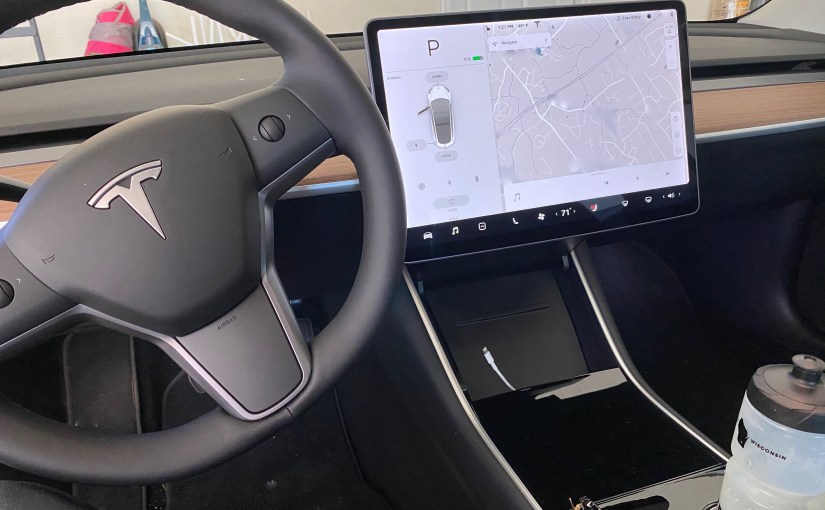
Starting Out The interior looks VERY different from every car I ever owned. If you’ve never been inside a Tesla, here’s what awaits you. Instead of the usual dashboard, Teslas have a touchscreen that looks very much like an iPad. (Oh yeah, you can buy a charging pad, so you don’t have to have your charger sticking up on the console. )
The glove compartment includes two manuals: one with safety information, and one on the proper way to be towed, should the need arise. What it did NOT have was what one (“one” in this case being ME) would consider a standard user’s manual. Instead, the manual is “on line”, accessed by pressing the Tesla logo on the top of your touch screen.
If you long for the comfort of those printed pages, you can always download a manual from the internet and print the 230 pages yourself. I was okay with reading it on-line. And that is what I did, for the five weeks between ordering and delivery. I was like a new mom, awaiting the delivery of her first born, preparing by reading everything available. I must confess, I was almost as excited about THIS delivery as the birth one, plus it was a whole lot less painful, but equally expensive.
What was NOT clear from the manual was how many “self driving” features were included with my long distance model 3, versus the $7,000 upgrade package. Let’s just say that I was pleasantly surprised that I have more features than I expected, which means there were just enough to only mildly terrify me. Of course, you can operate it without activating any of the self driving features, but what fun would THAT be? Here’s a cool example: if I have Assisted Cruise Control activated, and am stopped behind a car at a red light, when THAT car goes, so does my Tesla, without my having to put my foot on the accelerator. Was I surprised the first time that happened? Hell ya.
The Learning Curve Almost EVERYTHING in a Tesla is different: Opening the car doors, working the radio, adjusting the heat and side mirrors, opening the glove compartment, using–or not using –the brakes, stopping the car from “farting” after you activate that fun feature…
Think I’m exaggerating? Take a look at the recessed door handle. It took me a while to coordinate the “press and pull” maneuver.
And once you’re inside? How do you get OUT? Take a look. Can you find the handle? If you figured out you press that single button on the top of the door, you’re smarter than I. Of course, the flash on my iPhone helped by making the interior look grey. It is actually black, so locating that little button was a bit of a challenge for me– a challenge that I am proud to say I have since mastered.
Almost everything else is controlled by the touch screen to the right of the steering wheel. Some functions can be accessed directly, but others are hidden behind drop down menus. As with everything else, once you learn the menu options, it’s easy. But imagine if you haven’t driven for a while, perhaps because you have been “sheltering in place” for three weeks. What do you think might happen? If you’re like me, your right back well below the midpoint of that learning curve.
Still, it only takes a little practice. Like using the brakes. Or NOT using the brakes, because you don’t have to very often. You just take your foot off what I used to think of as the “gas pedal” and if you had been going slowly, you stop. Right away. If you were whipping along at a nice clip, you slow down a little more gradually. But most of the time you stop without braking at all. As you are slowing down, you are also recharging the battery.
Okay, so I’ve held you in suspense long enough. The farting? All Teslas come with something called “Easter Eggs”. These are little toys that I’ll bet the engineers had great fun creating. Our son, during his elementary school years thought that whoopee cushions were the funniest thing ever. Clearly, so do some of the Tesla engineers, because one of the “Easter Eggs” gets the car to sound like a passenger has eaten three cans of beans. Being the mature adult that I am, I felt compelled to demonstrate this particular feature to a friend. That’s when I discovered how difficult it was to make it stop! But enough of the bathroom humor.
Bottom Line I LOVE my Tesla. I love that software updates regularly occur over wifi. I love the smooth ride, the amazing acceleration, the ability to warm (and cool) it remotely via my iPhone, the security features, the entertainment options, the maps directing you to charging stations, the list goes on and on. I am looking forward to the day when I can actually GO someplace with it.
Stay safe and sane everyone, and remember all of those who are working every day under very stressful conditions, providing medical care and essential services to us all. Love and virtual hugs all around.
In September of 2018, we signed up with Overseas Adventure Travel for a March 2020 trip to Morocco. Why plan so far in advance? We wanted to travel with friends, OAT limits their groups to 16, and popular trips sell out quickly. We had no difficulty recruiting 11 friends to go on the tour with us. So far so good. Fast forward to today, with departure date rapidly approaching. As my favorite philosopher, John Lennon, once said, “Life is what happens when you’re busy making other plans.”
Well ol’ John was right. “Life” has certainly jumped up and slapped us in the face. Within the last two months three travel buddies had to drop out. One member of a couple was diagnosed with a serious medical issue, then another fell and fractured her knee. Their future absence made us realize how much we were looking forward to spending time with them.
Because the trip is so popular, their spots were quickly taken by other OAT travelers –also known as friends we haven’t met yet. So, there will still be 16 of us on the trip. But wait, we aren’t finished. Unless you are in a coma, you have probably heard about the coronavirus. So far, none of us has allowed it to disrupt our plans.
Fortunately, according to our State Department, Morocco is looking safe. Still, we have to fly to get there and back, and our plans include a three day stopover in Paris before we enter Morocco. Although the State Department hasn’t identified France as a “do not travel” country, another source indicated that several cases have popped up in France.
What to do? Sadly, we have to acknowledge that being over 65, we have aged into the “at risk” group. Fortunately, we are relatively healthy, and are up to date on all of our shots. Still, we recently experienced another country’s health care system, and although the outcome was positive, visiting my spouse in the Alice Springs Hospital was not a high point of our trip to Australia. (Clearly, it wasn’t my spouse’s either.) On a positive note, although we learned just how wonderful our medicare supplement coverage is when we are outside of the USA, we hope to never have to use it again!
As of today, according to the US State Department, Morocco and Paris have only the usual warnings about terrorist activities, but that is the world we live in. Given our record of gun violence in schools, churches, shopping malls, movie theaters, we could just as easily be mowed down by a home grown terrorist shooting his assault weapon. I refuse to let terrorists, either here or elsewhere, win. A virus, however, is another matter.
As of today, Morocco has reported its first case of the coronavirus; its victim, a man who returned from a visit to Italy, is being treated in a Casablanca hospital.
In Paris, a protest by workers closed the Louvre for two days, until the Museum staff assured the workers that “proper measures” to ensure their safety were being taken.
What happens if we get to Paris, and Morocco decides not to let anyone into the country from France –or from the USA? Let’s face it, several states have reported outbreaks, with many of the victims having no known source of contact. Our response is being managed by Mike Pence, who is not noted for his expertise in the medical and scientific arena. Maybe other countries will view US as being problematic? What if we make it to Morocco, an outbreak occurs and we can’t fly home? What if we catch a cold or some other nasty thing on the flights, either to or from our destination and we have to be quarantined until we are tested and certified as okay? So many “what ifs”. One thing that’s certain, if we go, my plan to travel with “carry on only” has been abandoned. I want to be sure we have enough clean clothes to get us through any “what ifs” that come our way.
In addition to cancelling all trips to China, South Korea and Mongolia, OAT has allowed travelers that signed up for their Italy trips the option to cancel right up to the date of departure, choosing either to apply their payment to a future OAT trip or to get a refund, minus a small processing fee. That gives us peace of mind.
What will we do? We will prepare as if we are going to take the trip, watch the news, check the internet and wait to see how it all unfolds.
Am I having a midlife crisis? Or did I just join a cult? I’m way too old for either, but here we are.
I feel like I have done the car buying equivalent of bungee jumping, except I haven’t jumped YET. I’ve been strapped in, led to the edge, and am waiting to either jump or be pushed. My emotions keep swinging from exhilaration to terror. What have I done? The bigger question: Does every future Tesla owner go through this while awaiting delivery?
First, let me say that although I am still in shock that a car can cost almost as much as our first house, I didn’t buy one of the super expensive Teslas. And our little first house, bought decades ago, was in Ohio, a much cheaper area of the country. Still, for someone who views a car solely as a means of transportation, it’s a LOT of money, even for the Tesla 3, which is the least expensive model. (I DID spring for the mid priced 3–the one with the battery that lets you go a longer distance. The top of the line, the Performance 3 is DEFINITELY for those with a need for speed.)
So, how did this happen? How did a non-car aficionado end up ordering a cool set of wheels? Simple. My son guilted me. He took the number of miles that I drove last year plus the amount that I spent on gasoline, and converted it into how much carbon I released into the atmosphere. Not as much as most, because for the last 11 years, I’ve driven a Prius. Even so, he calculated that in 2019, I was responsible for one TON of emissions. He’s an electrical engineer, so the odds are good that his calculation was accurate. But then again, he knows I don’t have the skills needed to check his math.
He knows my vulnerabilities. I am passionate about protecting the environment. For years, I’ve carried a reusable water bottle, reusable grocery bags (including reusable produce bags). I recycle, reuse and refrain whenever I can to minimize my carbon footprint. Because I love to travel, I figure I need to do whatever I can to offset my the carbon from the flights I take.
I also really liked the Tesla’s safety features, such as blind spot monitoring, and assisted cruise control. For an additional $7,000, I could have had the self driving feature. I didn’t get it, and not just because of the cost. Quite honestly, when I tried it out, I was terrified. What is REALLY cool, however, is that all of Tesla’s model 3’s (built after 10/2016) have all of the sensors, cameras and radar needed for self driving already built in. Should I become comfortable enough to add that feature in the future, all I have to do is pay for it, then download the software via wifi. And that’s another cool thing: Tesla updates the software regularly, so once you own a Tesla, you benefit from the updates that flow over your wifi network. Sometimes a blessing, sometimes a curse. Only time will tell.
But back to those safety features. Even if you don’t spring for the super duper self driving feature, you still get “auto pilot”. If you are like me, and get into your zen mode while listening to the radio, you know that sometimes your foot gets heavy and you lose track of space and time – or maybe just the speed at which you are traveling. Am I right? Auto Pilot KNOWS the speed limits of the road you are zipping along, and will limit you to a number that you choose ( like +5 MPH over the limit). You can override the limit, but usually my problem comes from going too fast, not too slow.
Anyway, I am 4 days away from picking up the car that I ordered 5 weeks ago. What have I done while waiting? I’ve been reading the manual. Mike has been busy too. He oversaw turning our garage into a charging station. His mission was accomplished today.
Meanwhile, I’ve been hanging out on the Tesla Message Boards. I wanted to find out things like, does it get hot in the car because of the glass roof? Approximately how far can you go on 1 Kilowatt of electricity? (And is it a Kilowatt or a Kilowatt hour? ) How much does it cost to use a Tesla Supercharger? Stuff like that. Instead I found posts like this one, chosen at random and cut and pasted:
I have a pair of Model S non-P caliper in my garage just for that purpose. However, I’m on the fence about it once I did more research. The big gain for the RB S caliper option is the increase thermal capacity of the larger and thicker rotor. On the other hand, the P3D pad is slightly larger than S pad. And there are already a number of track oriented pad on the market for P3D. Whereas the S pad is available in street pad only, the only other car that uses the same pad shape is Chevy Cruise econobox.
Did it scare me. You bet. Even though I am generally fluent in English, I had no bloody idea what that post was about! But then I realized that many of the Tesla buyers are engineers or car enthusiasts — most likely both. I am neither. I’ll stick to reading the manual. And keep my fingers crossed. Four more days, but who’s counting.
As a kid, I was always fascinated by the Wizard of Oz. In addition to watching the movie multiple times, I read every single Oz book our library carried. So, I was quite excited when I stumbled upon the PBS series entitled The Magical Land of Oz . To my surprise, it wasn’t about Dorothy or the wizard at all, but was instead three wonderful shows about Australia, where we will be heading shortly. (No tornado required, and, I hope, none expected).
Why is Australia called the Land of Oz? I didn’t know, so I asked Mr. Google, the source of much of my wisdom. Turns out, it has to do with the way it sounds when you say the first three letters of the continent’s name. Give it a try. Anyway, the shows are visually spectacular, much better than anything I can hope to capture with my photos.
Speaking of photos, this is the first trip I will make without bringing a camera. Yes, I will still take photos, but I will be using my new iPhone 11 pro. After our son sent us photos he had taken with the wide angle, telephoto and regular lenses, and showed us what the camera can do with night shots, I was intrigued. It was definitely worth a trip to the nearby Apple store to just take a look. Silly me. I really thought I would be able to leave the store without making a purchase!
Another purchase for the trip was a “lipstick” charger from Amazon. My friend Sally had been using one on our recent bike trip and I was quite taken with the little gadget. Even though the iPhone 11 is supposed to have a robust battery, I didn’t want to take a chance of running out of juice should I encounter a once in a lifetime photo op.
Of course, that wasn’t the only gadget that captured my attention. I also HAD to have the Lencent adaptor I stumbled upon when purchasing the lipstick charger. They both come with cute little storage sacks and don’t take up much room in my gadget bag.
Because my replaced iPhone is few generations old, I decided not to turn it in, but instead plan to purchase a prepaid sim card for use in Australia. (Yes, my buying frenzy continues). After learning that, like New Zealand, free, unlimited WiFi isn’t widely available in Australia, I figured it was worthwhile to give a foreign sim card a try, using THAT older phone for accessing the internet. (An idea I picked up from one of the travel forums I follow).
Here’s what my research uncovered: you need to pay attention to “credit validity”, which was a new term for me. I have since learned that it refers to the number of days the prepayment option has purchased, starting from the day you first use it. So, if you purchase a card with a credit validity of 7 days, and you use it on the 1st of the month, regardless of the gigabytes purchased, you are done on the 8th, and need to “recharge” (pay more).
Why not go with Verizon’s travel pass? Well, if you use the internet ONCE during a 24 hour period, you get charged $10 for that day. It seemed like a better deal to get a prepaid sim card for 28 days for $30 Australian dollars (about $20 US, or two days worth of Verizon Travel Pass.
Why wouldn’t I just use the Australian sim card, in my new iPhone, you ask? Good question. Here’s why: I know myself well enough to recognize that it is entirely possible for me to lose my original sim card, a significant concern.
There are three mobile phone networks in Australia. Telestra, Optus and Vodaphone all offer coverage in the most traveled parts of Australia. Of the three, Optus is the only network that has a store in Melbourne Airport. So, given that this is a new experience for me, I decided that I wanted to interact with a human rather than purchase a card in advance from the internet (Amazon)and hope for the best. That way, I can have someone exchange the cards for me, and make sure that the phone is functioning correctly before we leave the airport.
Thanks to the internet, I was able to check the coverage map for Optus, where I learned that coverage varies by type of device, something I never would have considered. It appears that the iPhone 7 may not have great coverage throughout Tasmania and parts of the interior where we will be visiting. Big decision: will I decide to be without WiFi when in those uncovered areas? Or will I trust myself not to lose my original sim card and just use my new iPhone? Bet you can’t wait for this cliff hanger to be resolved in a future post.
Another cliff hanger: Will we get off the wait list for an upgrade to United’s business class? Here’s the deal. A free round trip ticket would have cost 240,000 miles each, whereas an upgrade is only 60,000 miles each, plus the price of an economy ticket and an additional cash payment. Given that we had nowhere near the miles needed for a free ticket, we opted for the upgrade, resulting in our waiting to see whether United can sell those seats for more than what we paid in cash and miles. It’s a gamble–one that does not make me a happy, loyal United customer. BUT, the other option would have been paying almost $8,000 each for business class. Of course, we could always stuff ourselves into economy for 6 hours to LA and 16 more hours to Melbourne. Yeah, we sure HOPE that’s not happening.
Finally, we learned from our trip leader that during our tour, we can expect temperatures to vary from a potential low of 30 F to highs in the 90’s, with varying degrees of humidity. Hey, its a big continent, and we are covering a lot of ground. That makes packing even more of a challenge. This time, I’m using different packing cubes for cold, temperate and hot areas.
Theoretically, the blue cubes can be compressed. Realistically, the plastic compression bags do a much better job so that’s what I used for my jacket. It is great for travel because the lining zips out, transforming the shell into a light weight rain jacket. Plus, the lining can be worn alone for cool days and shell plus lining will keep me toasty during those 30 F days and nights. Yes, it all fit into my duffel, was under 50 pounds, PLUS my backpack (carry on) had plenty of room to spare.
Here’s the route we, and 10 other travelers, will be taking on our Overseas Adventure Travel (OAT) tour. Six of us have opted for the pre trip to Tasmania.
Do you know where you find a section of the Berlin Wall, Peter Fonda’s motorcycle with Captain America helmet, Steve McQueen’s airplane, the Fort where the French and Indian War started, several Frank Lloyd Wright masterpieces, and a five diamond restaurant? Hint: check out the map above, specifically the Ohiopyle area. It doesn’t look like there is much in the area, does it? At least that’s what I thought till I got there.
Did you ever plan a trip, thinking that it would be all about a particular site, then discover that the area had a whole lot more to offer? Enough for two posts, even?
We were drawn to the area by a newspaper article I had clipped about Frank Lloyd Wright’s Fallingwater decades ago. It sat in my “Fun Things To Do” folder until earlier this year, when I figured we either needed to visit the damn place or throw out the clipping. If I had done the latter, you wouldn’t be reading this post.
A quick internet search uncovered a special Fallingwater experience–a sunset tour, lasting three hours, ending with appetizers on one of the decks. The tours are only offered on Friday and Saturday nights, are limited to 10 participants, allow interior photography, and include parts of the house not shown on the other tours. For $150 per person, you can pretend that you are a guest of the owners. Just our kind of gig.
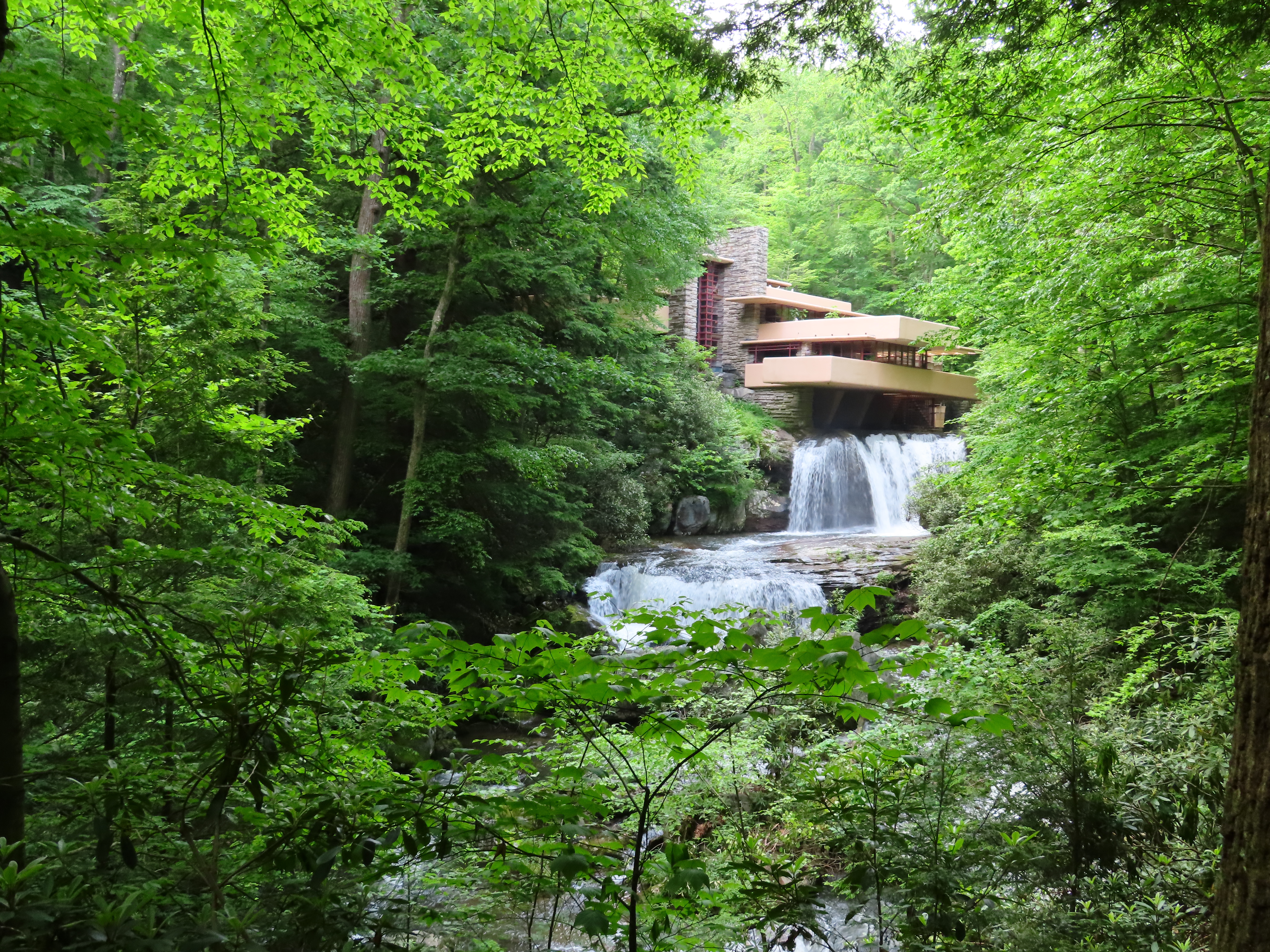
The newspaper article included a photo similar to this one
So how was it, you ask? Well, the house was quite fascinating, especially given that it was completed in 1937. As you can see from the photo above, the house was built over a waterfall. When the windows are open, you can definitely HEAR that water falling! Closing the windows successfully shuts out most of the noise…and also the cooling breezes. Fallingwater, you see, is not air conditioned. Did they even HAVE AC back in the late ’30s?
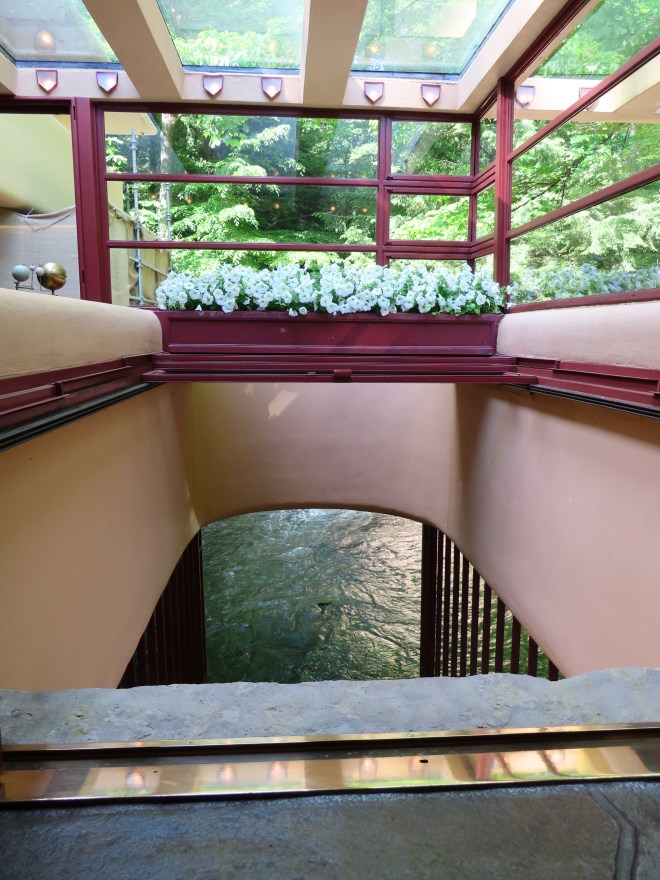
You’re probably thinking “What’s the point of living over a waterfall if you can’t stick your 10 little piggies into it”? Right? Well, Frank was also thinking just that, so here’s what he did.
The stairway leading down to the water is pretty cool, but what is even more impressive is the way the glass panels slide away.
Do you think he accomplished his goal, which was to bring the outside in?
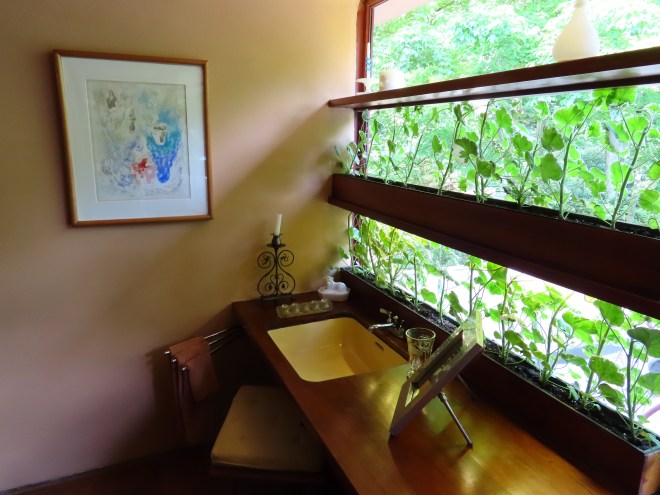
Here’s another example. You are out in the middle of nowhere, so window coverings are not needed, but in the bathroom, why not have planters built into the window to form a natural curtain?
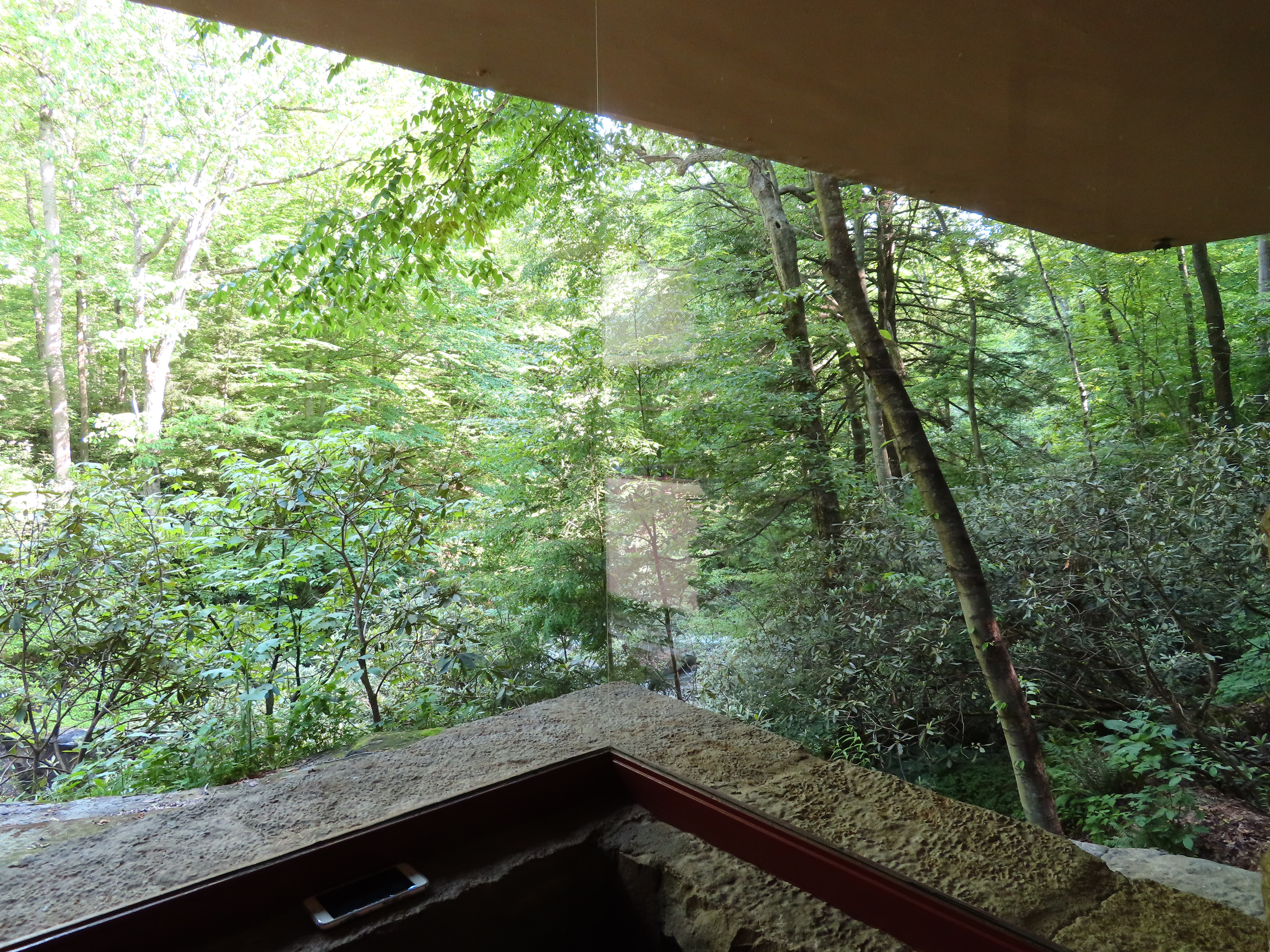
When we first entered the living room, it looked like the corner was completely open. It took a while to see what is obvious from the reflection on the window–that two panes of glass are joined in the corner.
Wright not only designed the building, he also created all the furniture throughout the house. I was surprised to see a king sized bed in the master bedroom. Our guide explained that it was actually two twins pushed together and united by a single headboard and bedspread, something TV in the 1950’s would never have shown. (It isn’t that visually interesting, so I didn’t bother posting a photo of it–everyone knows what a king sized bed looks like.) How surprising that it took about three decades for that great concept to catch on!
The kitchen, bedrooms and bathrooms are all very small. The focus is on the large living/dining room and the outside balconies. Check out the banquettes in the living room. Not what I consider the most comfortable seating, but maybe if you imbibe enough from those nearby bottles, you won’t notice.
At the other end of the living room is the dining area. Are you expecting the tour to turn left or right into the kitchen? Well, it doesn’t. The kitchen is a tiny space down a flight of stairs and through a very narrow hallway. The owners clearly didn’t spend much time there. That was the domain of the servants. There are no photos, because the kitchen was so tiny, I couldn’t figure out how to frame it.
I was quite happy that our appetizers were not served in the dining room; instead, we enjoyed our hummus, crackers, cheese and veggies on one of the decks.
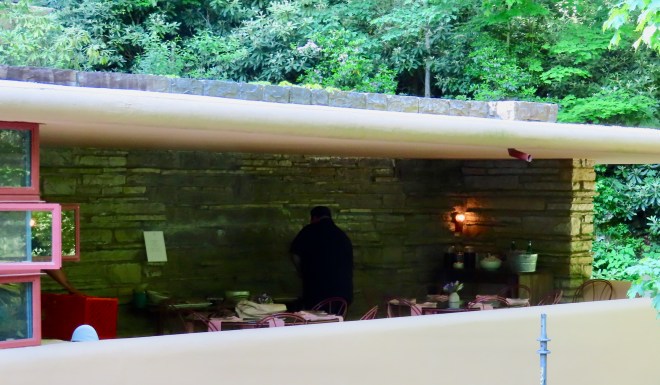
A staff member was getting everything ready for us. You can see from that blue pole in the foreground of this photo that necessary repairs are being made on the building.
While enjoying our appetizers, one of the other guests strongly recommended that we visit another of Wright’s nearby buildings. Kentuck Knob was built about 20 years later, for friends who were frequent guests of the Kaufmann family, the owners of Fallingwater.
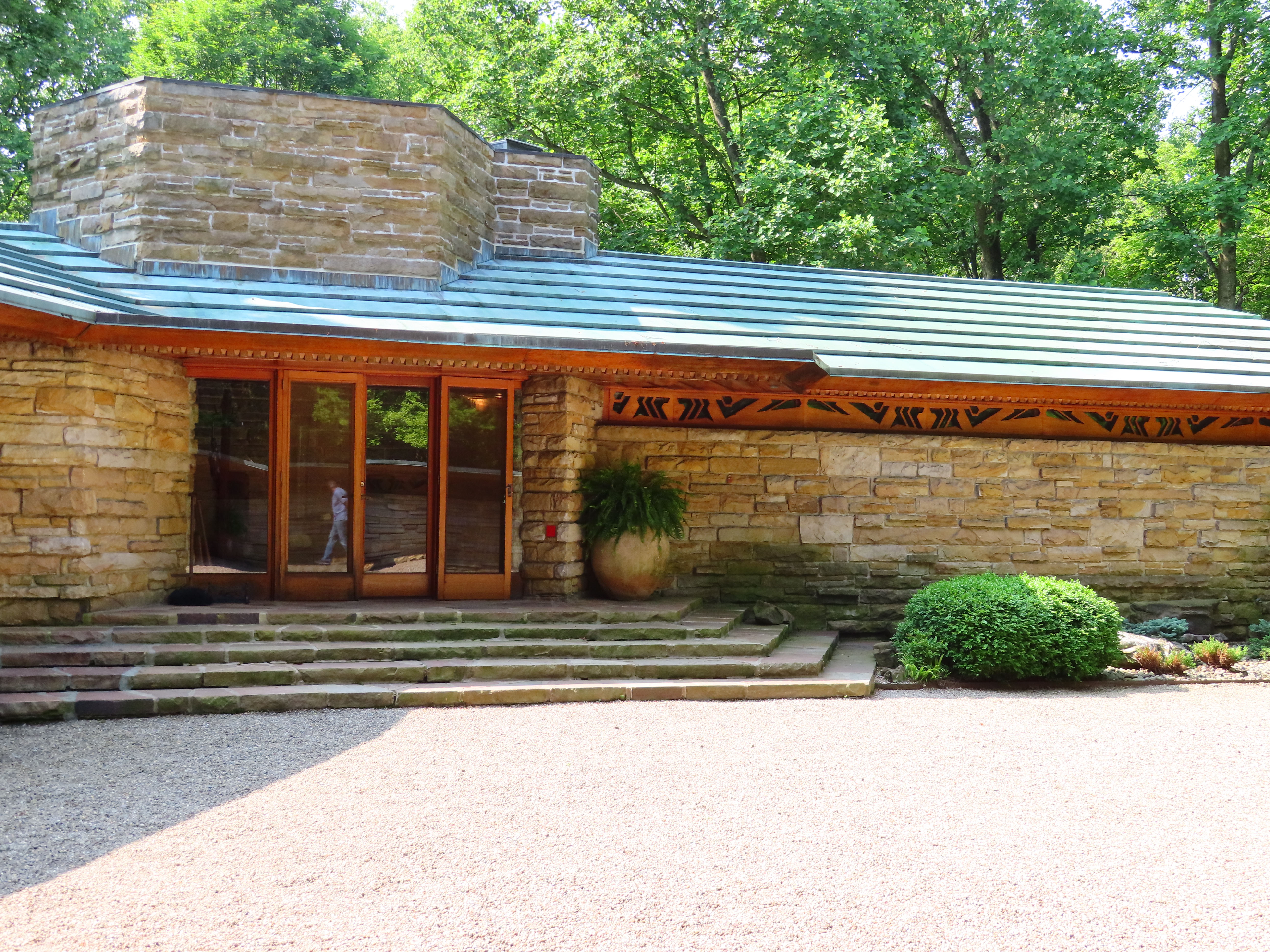
Okay, so I know this is heresy, but I actually liked Kentuck Knob BETTER than Fallingwater. It has all of the usual Wright features, but it just seems more LIVEABLE. Interestingly enough, it is considered “usonian” (Frank’s term for his “middle income” houses.) This “middle income’ house was built for the Hagans, the owners of the ice cream company in Uniontown PA, and was sold to its current owner, Lord Peter Palumbo, who, since 1996, when not using it as his vacation home, opens it to the public.
A photo of the Lord and Diana (wearing her “screw you, Charles” dress) appears in the house. I grabbed this from the internet
Take a look at the cutouts under the eaves. They are a source of light into the living room and supposedly repeat design elements found in the building. (I’m taking that on the guide’s word. I couldn’t spot any of those elements.)
Notice how the carports–Wright’s invention — are nestled into the landscape. The hill behind forms a partial roof.
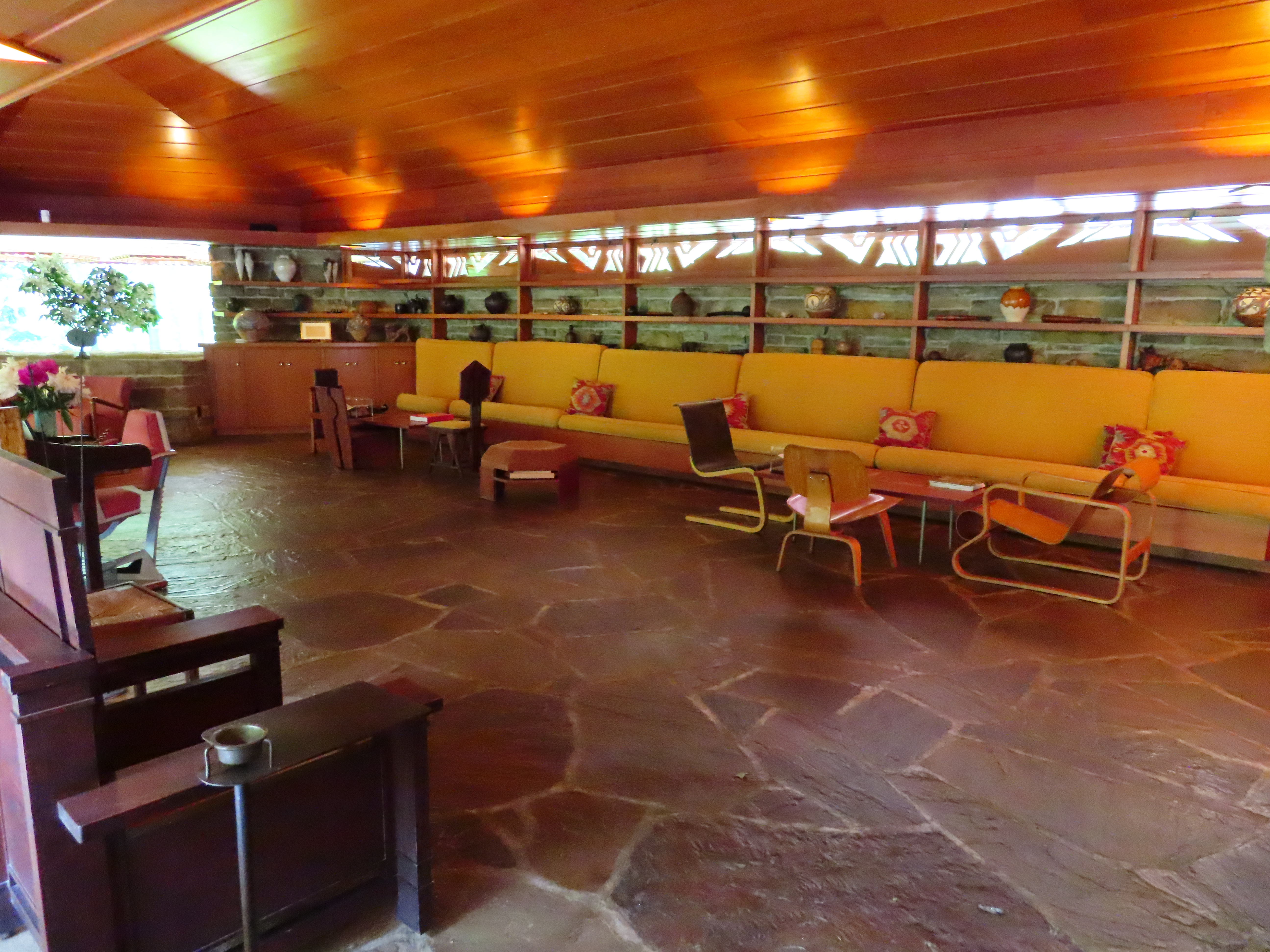
Although we weren’t allowed to take photos INSIDE the house, there was no rule against shooting through the windows into the interior, which is what I did.
Now take a look at the role the cutouts play in the interior space.
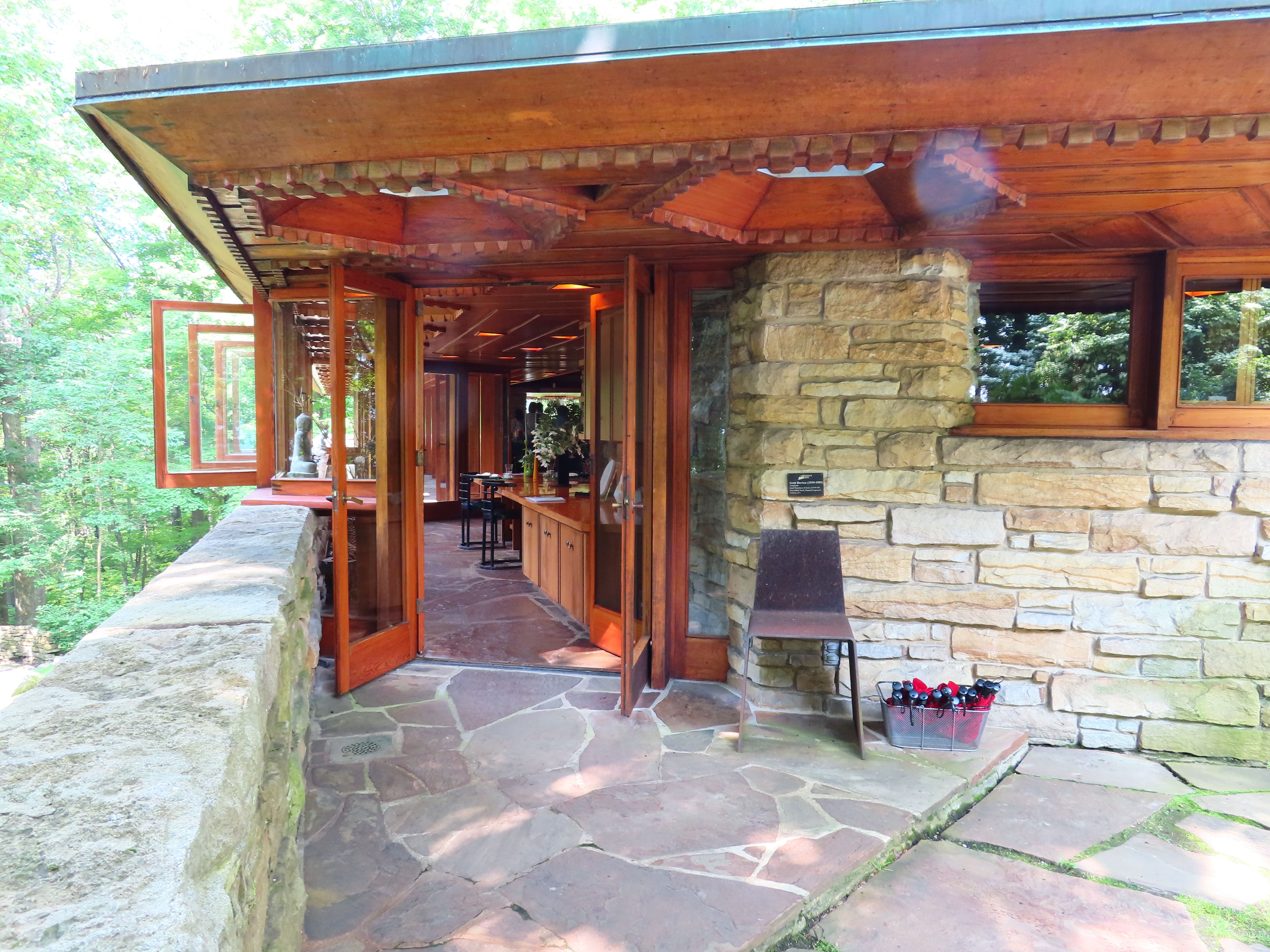
The wall opposite the banquettes is all windows and glass doors, offering access to a walkway and a spectacular view of the valley below.
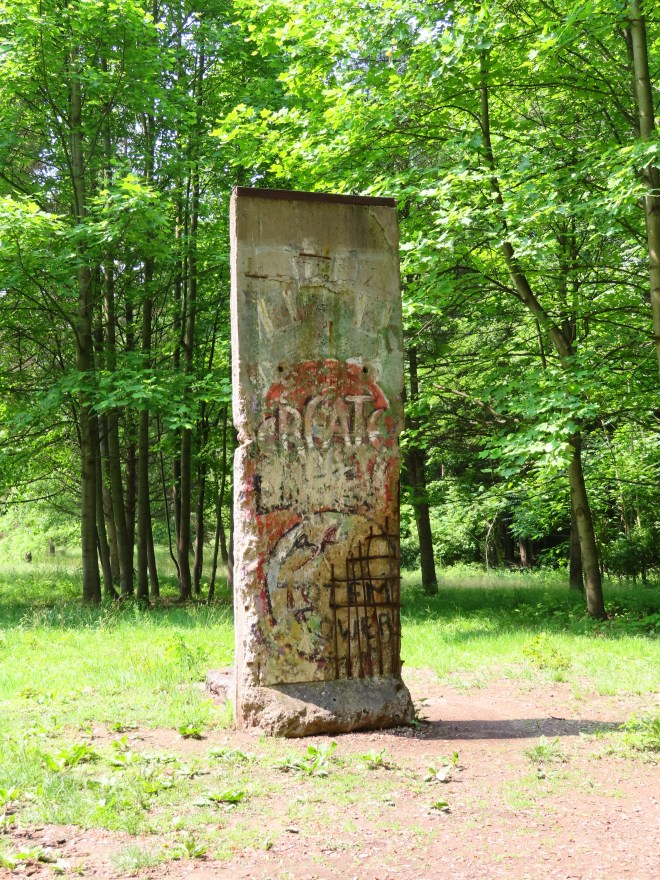
The price of your admission allows you to wander through Lord Palumbo’s spectacular sculpture meadow. I was particularly taken with the part of the Berlin Wall. His collection also includes three red British phone booths at the visitors center.
A Section of the Berlin WallI don’t think these phone booths work!
I’m tired of writing and you are probably tired of reading so the rest of the area attractions I promised in the first paragraph will have to wait until the next time I post.
I’ll admit it. I am a lazy blogger. It seems it always happen this way. I start out with great intentions, keeping friends and family updated as to our whereabouts, but toward the end of every trip, I run out of steam. Then, re-entry into our world takes a few weeks. So here we are, back home, reliving our wonderful time in Patagonia via photos.
Our last several days have not been recorded, so let’s start there. If you recall the map from the Punta Arenas post, you’ll remember that we had some very long travel days.
With a bus like this, however, you travel in comfort, and you really get to experience the countryside. There were only 12 travelers (plus guides) on a bus that could carry over 40 passengers! With multiple interesting stops along the way, time passed quickly.
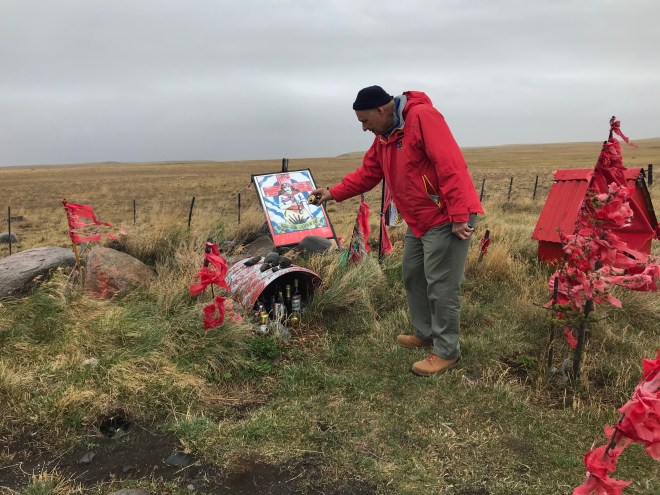
On our way to cross the border back into Argentina, we stopped to pay tribute to Gauchito Gil.
Here’s his story: Gil joined the Argentinian army to fight against Paraguay. He returned to his village as a hero, but soon after, the Argentine Civil War broke out. He refused to fight against his countrymen, so he deserted. He was found in the forest, by the police, who tortured him and hung him upside down from a tree. As a policeman was about to kill him, Gil said, “your son is very ill. If you give me a proper burial and pray to me, your son will live. If not, he will die.” Despite the prediction, the policeman cut Gil’s throat. When he arrived home, the policeman discovered his son was indeed very ill, so he heeded Gil’s prophecy–gave him the proper burial, said a prayer or two, and (wait for it–dramatic pause) the son was CURED!
SO, today’s travelers offer a beer or some other tribute to Gil, as an extra insurance policy for a safe trip. As you can see, we were no exception. Hey, why not.
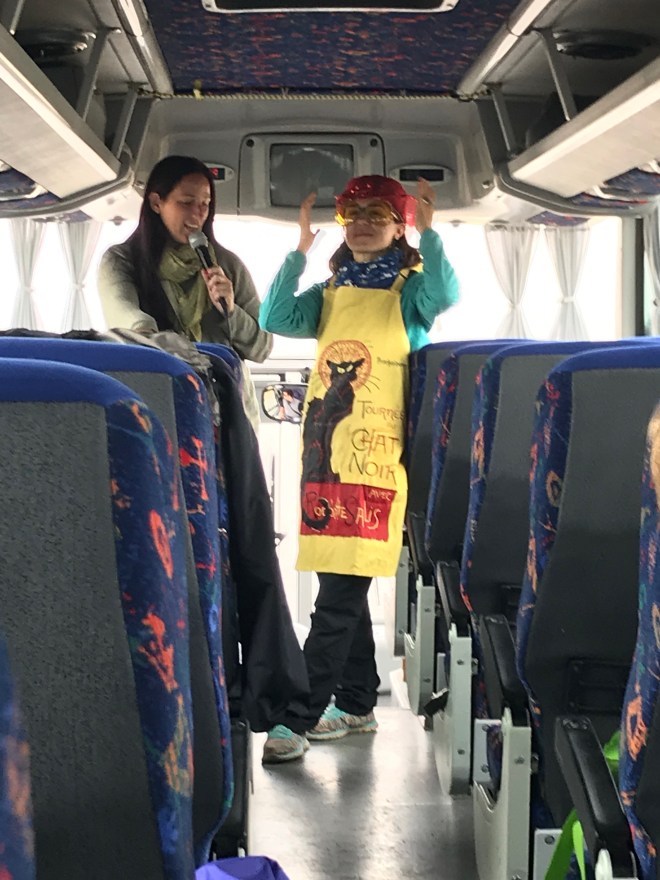
In addition to educational stops along the way, our guides kept boredom at bay by entertaining and feeding us. Laura, our guia excelente, donned that costume before she served us a wonderful treat. Yeah, I forgot what it is called, but I certainly remember the wonderful taste.
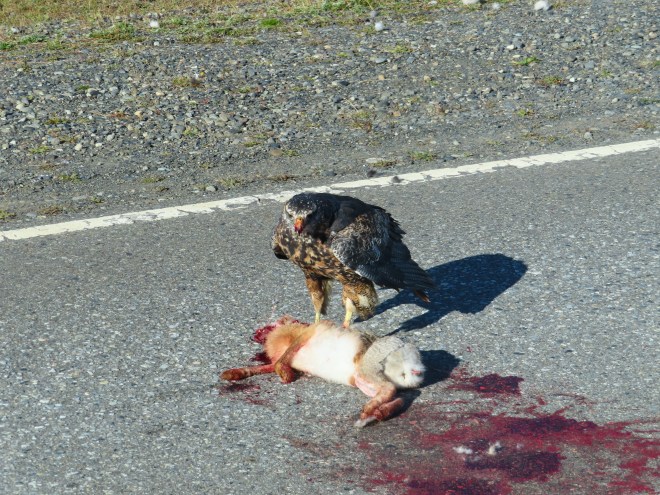
We were not without our national Geographic moments. As we drive the highways and by ways, we noticed several eagles and other large birds of prey sitting on fence posts. Were they watching the cars go by, as an avian form of TV? No, they had figured out that it was just a matter of time before some tasty road kill would make their grocery shopping much easier. Take a look.
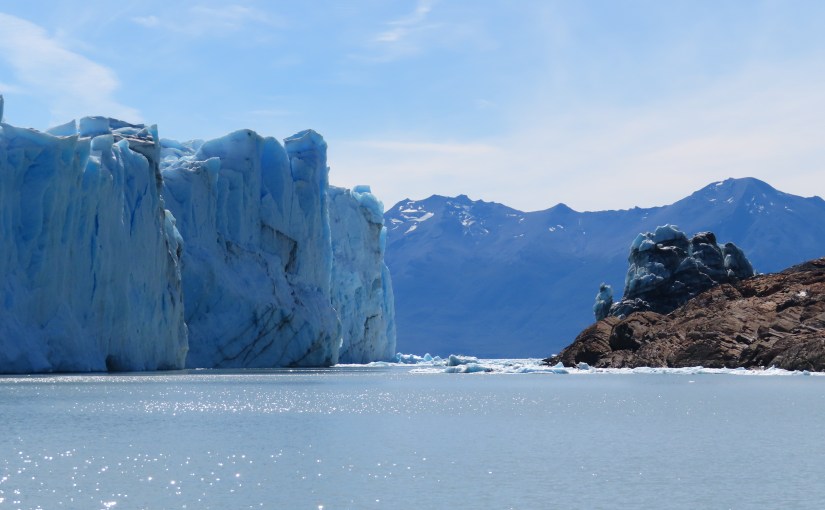
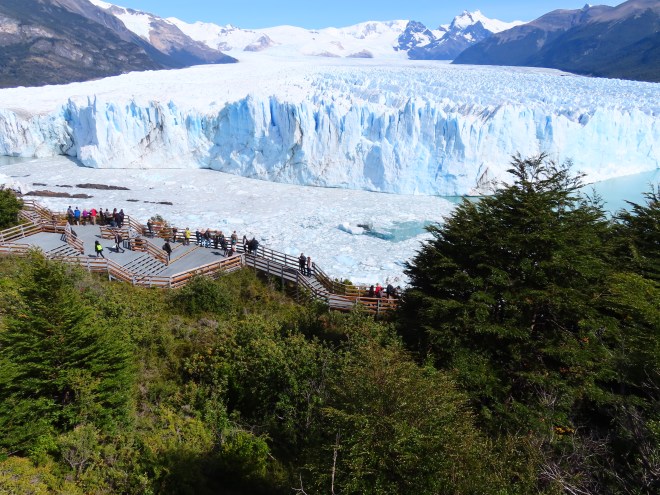
Before we knew it we were in El Calafate, Argentina. The main purpose of our 2 night stay here was to view the Perito Moreno Glacier in the National Park.
We certainly did that, both from a ship and from land. It was quite a majestic sight. The experience wasn’t just visual, however. It was also auditory. We could actually hear the glacier groan and thunder, as parts of it crashed off into the sea below.
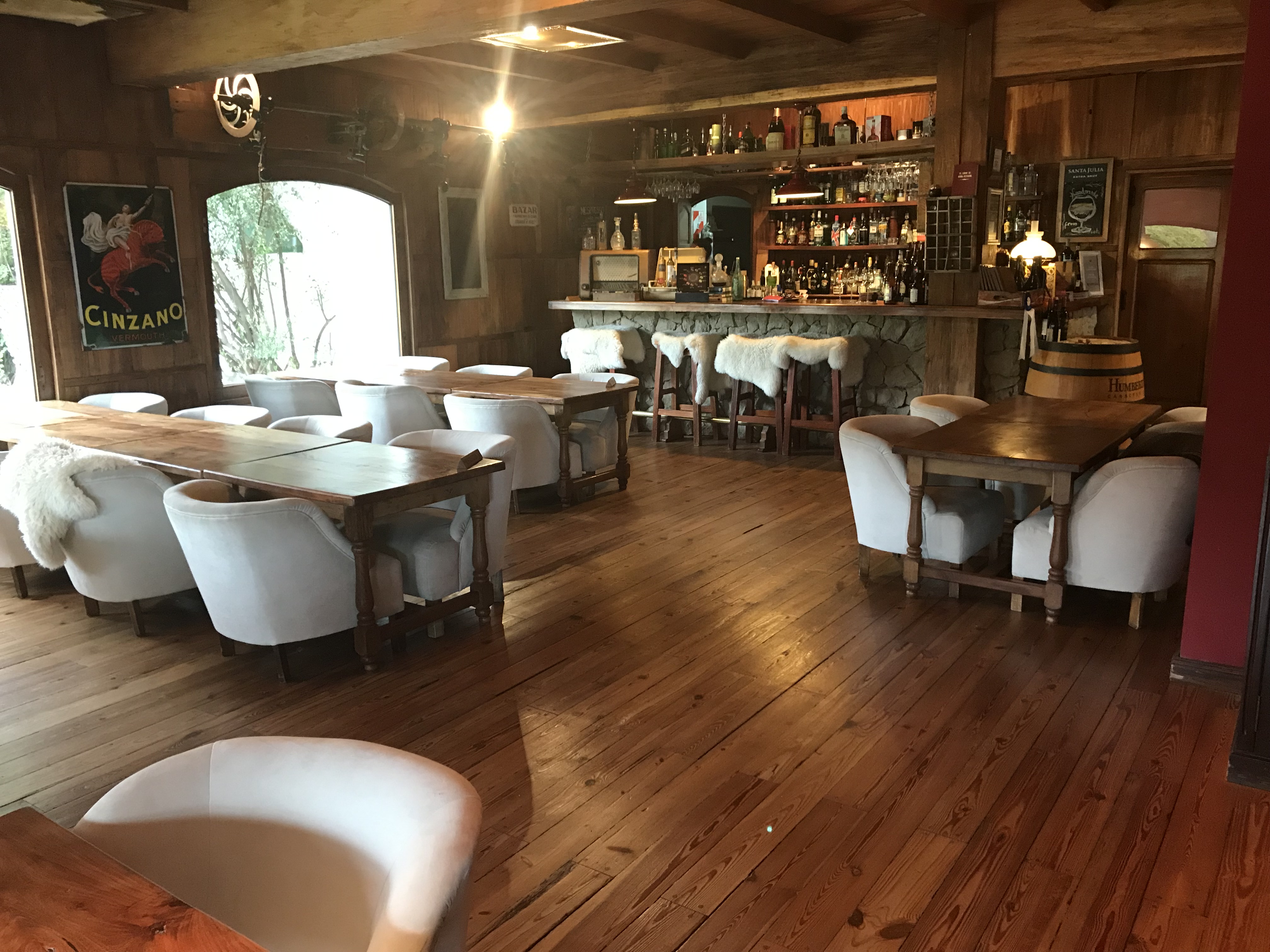
While in El Calafate, we stayed at the Kauyatun, a gorgeous hotel reincarnated from a former sheep ranch. Best of all, it is within walking distance of El Calafate’s charming center.
Beautiful grounds
The restaurant/ lounge
Herding demo
Our trip ended in Buenos Aires, where we had our farewell dinner, then flights home the next afternoon.
A toast to Laura
Saying goodbye is never easy, especially when you have such an interesting, caring, informed, fantastic guide like Laura. We all truly appreciated how hard she worked to make this trip extra special for all of us. Her energy was amazing!
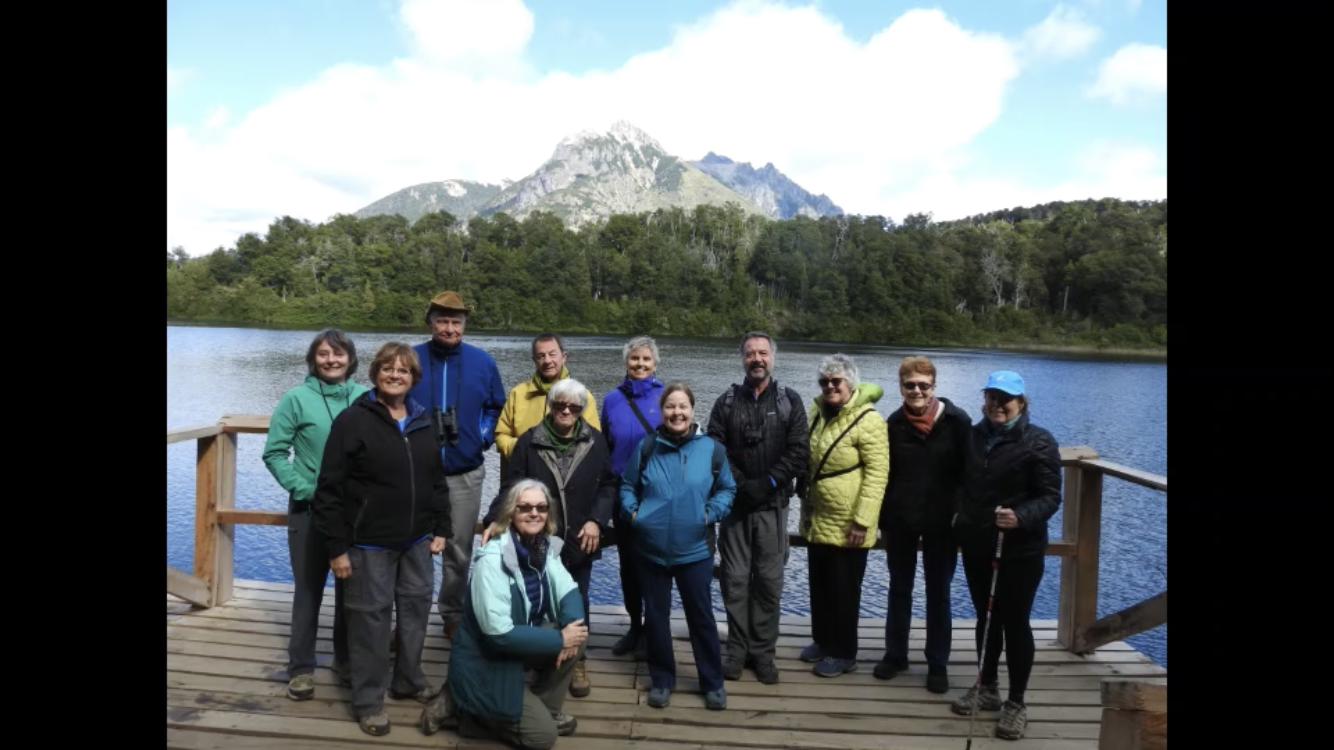
We also felt so fortunate to be a part of an extraordinarily compatible group. Our hope is that this will not be the last time we see these wonderful, smiling faces!





















 Destination NOW