No, I am not raiding tombs–Lara Croft was. We started our temple tour with a visit to Ta Prohm, the site of the Tomb Raider movie. It has been left close to its natural state so visitors can experience the power of the jungle. Tree roots wrapped around the temple stone
Temple detail
These apsaras look very perky, despite no visible means of support, centuries before the invention of plastic surgery.
There will be more temple photos over the coming days, so I don’t want to get you all “templed out”. Instead, I’ll show you the village that we visited.
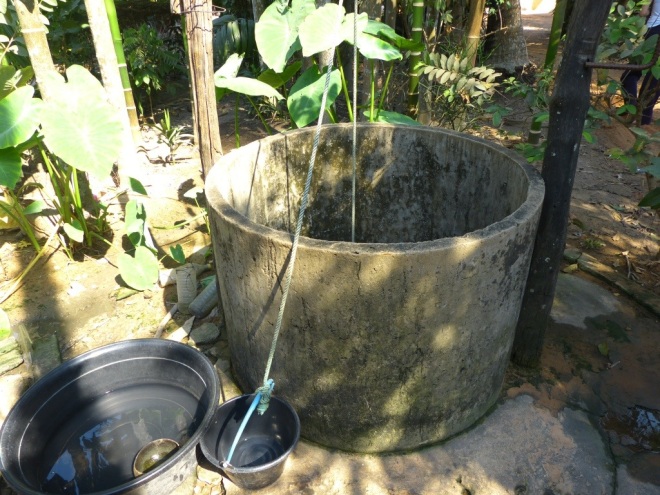
If anyone in the US is looking for something to be grateful for, you can start with our water supply. This is theirs.
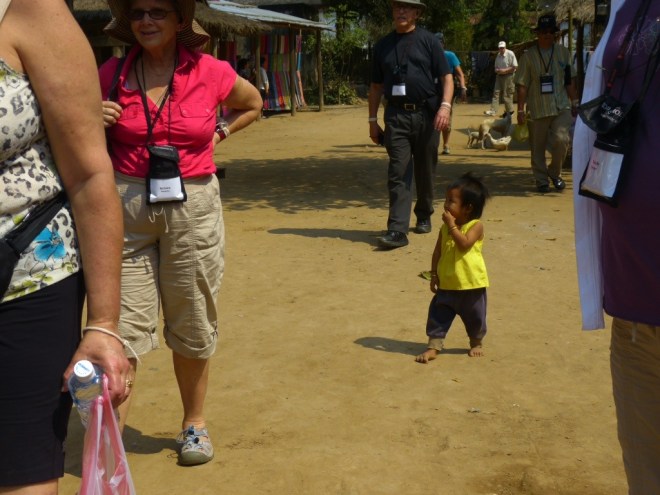
The children follow us through the village, trying to sell us trinkets. It is hard to say no, but if you buy from one, you are immediately engulfed. Bet you can guess how I know.
We had an amazing lunch in the village, in one of the houses. This is a milk apple, and it is delicious!
Here are Mike, one of the 4 Lindas,and one of the two Gregs, getting ready to chow down.
Another Linda, with our guide. Man is from Vietnam. Hmmmm, looks like a lot of empty beer cans in front of them.
My new friends from Philadelphia left their husbands home. They had “lunch meetings” for over a year to plan this trip.
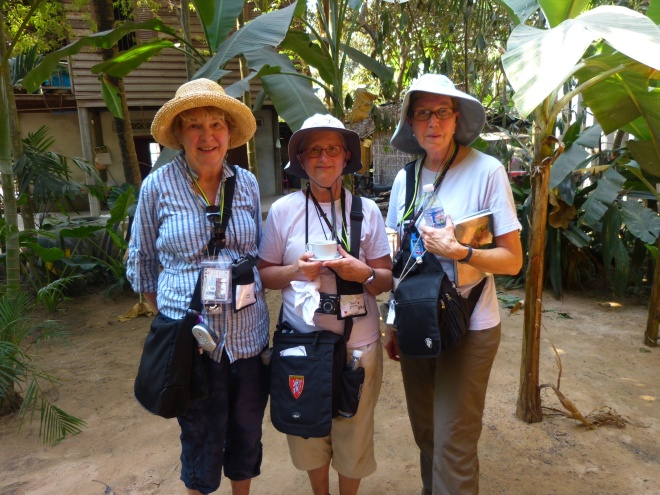
Kitty, One of the Barbaras, Linda #3
Incidentally, the American pilots visited this village in the late ’60’s. The bomb craters are still there.
More highlights from Laos. The city of Luang Prabang is lovely, a nice mix of old and new…the “sometimes” nature of wifi was a reminder that we were in a developing country.
We visited a village along the Mekong, delivering gifts from Road Scholar: tin and wood for the school-house roof.
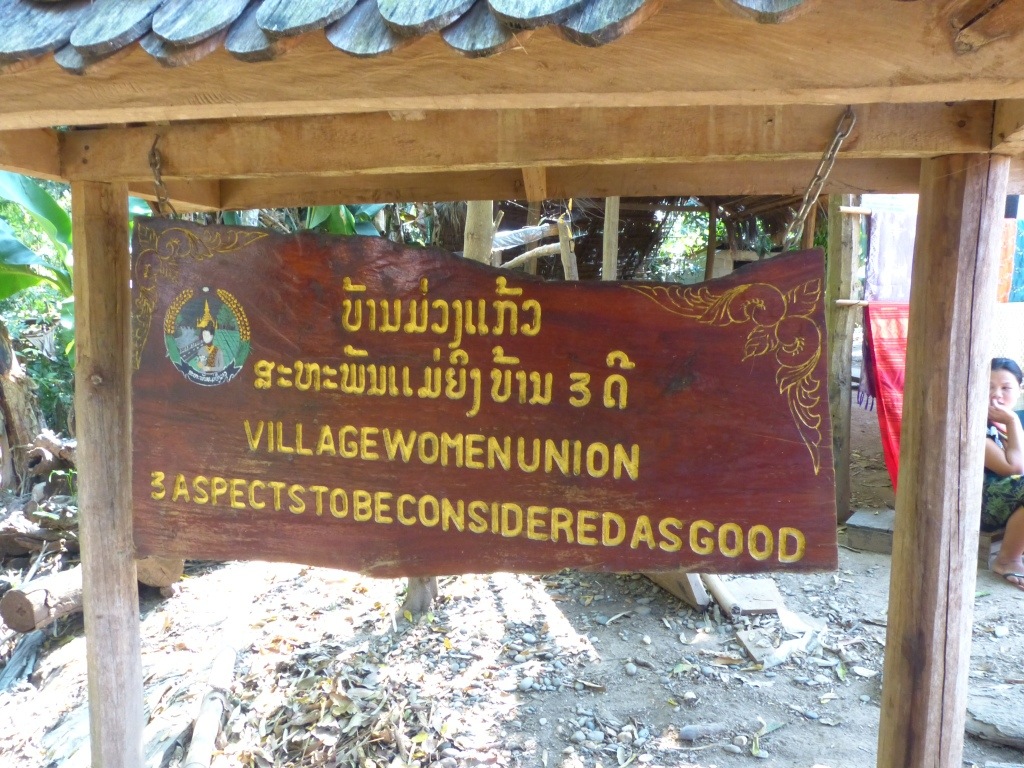
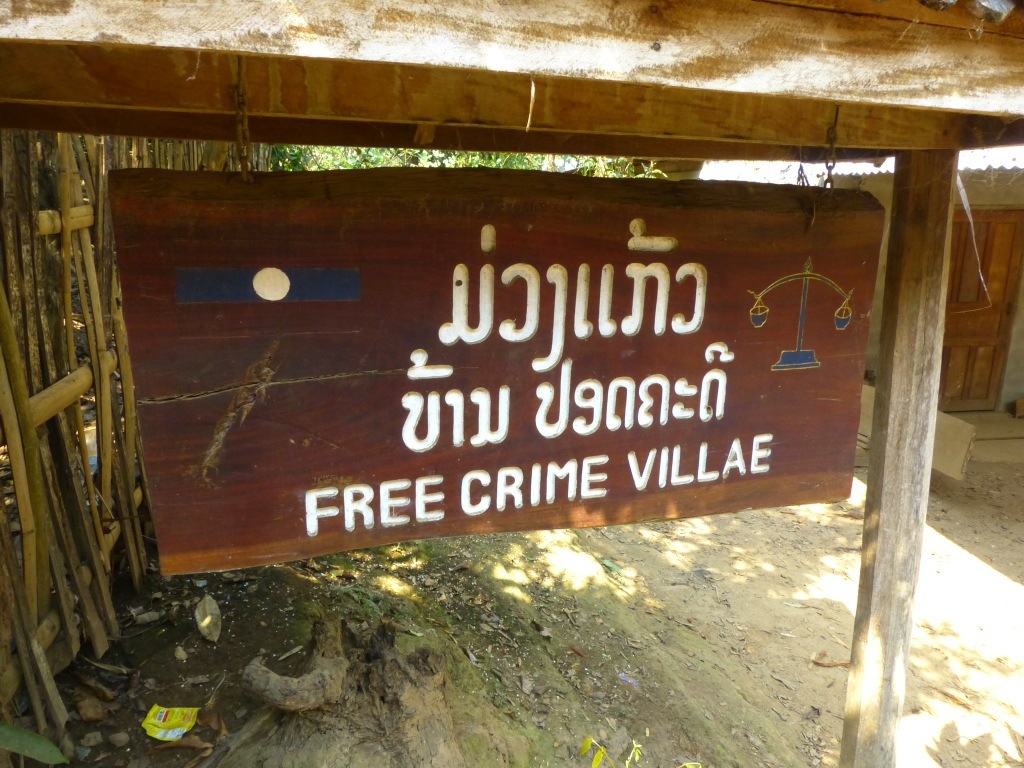
I found the village signs interesting. As you can see, the Lao aren’t big on spaces between words, which make it an extremely challenging language to learn.
Their English is way better than MY Laotian. I have barely learned how to say “hello”.
Our young guide escorted us to the schoolhouse.
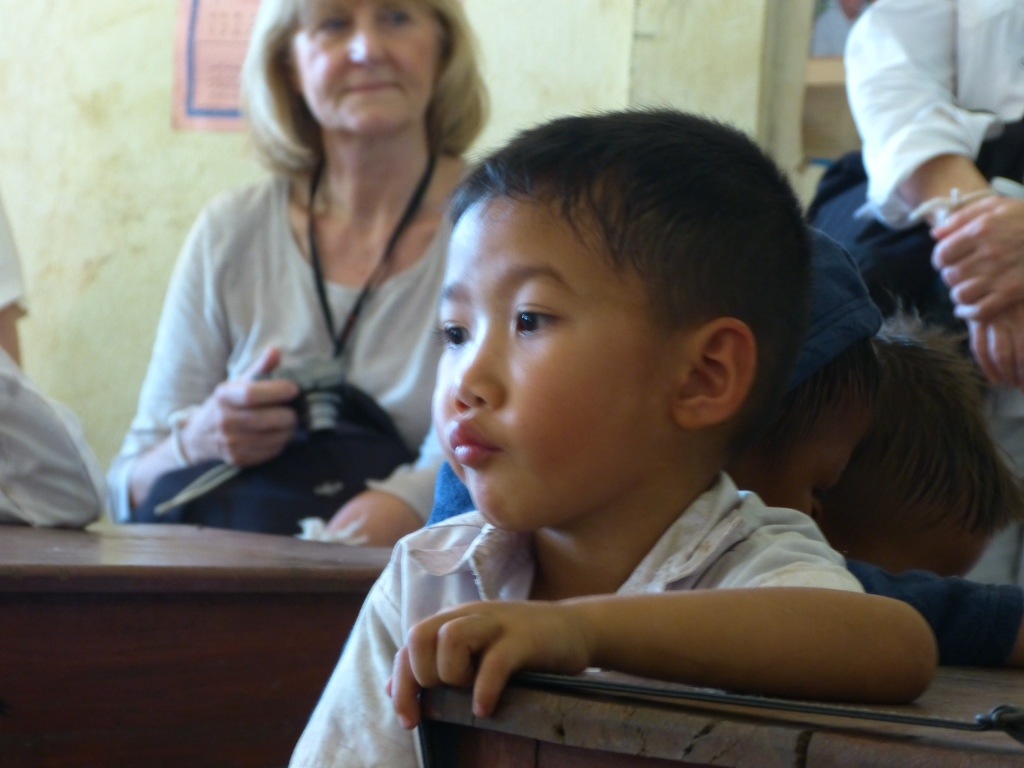
The kiddies were on their lunch break, but they gathered to sing to us. We reciprocated with a rousing chorus of “row, row, row your boat.”
How could I not buy something from this sweet boy? I think Low Price Lenny might like a snail with a Buddha painted on his back.
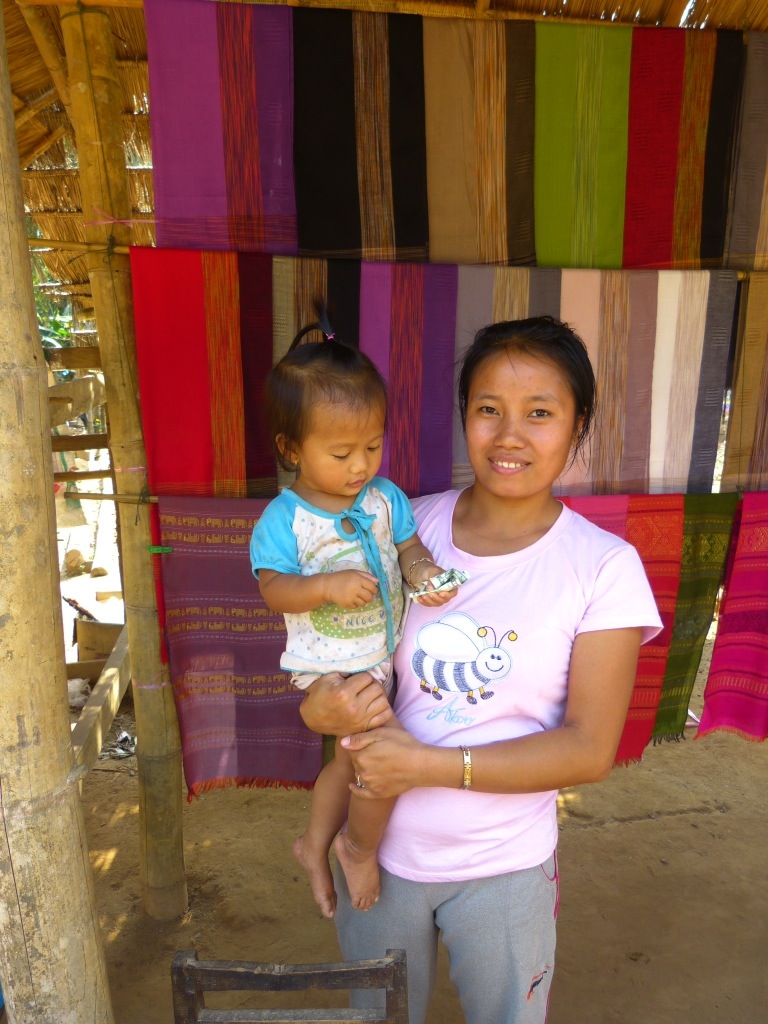
Notice the bill in the baby’s hand? She helped her mother sell me a scarf so she demanded HER cut!
One more view of the Mekong, then we were on our way back to Luang Prabang.
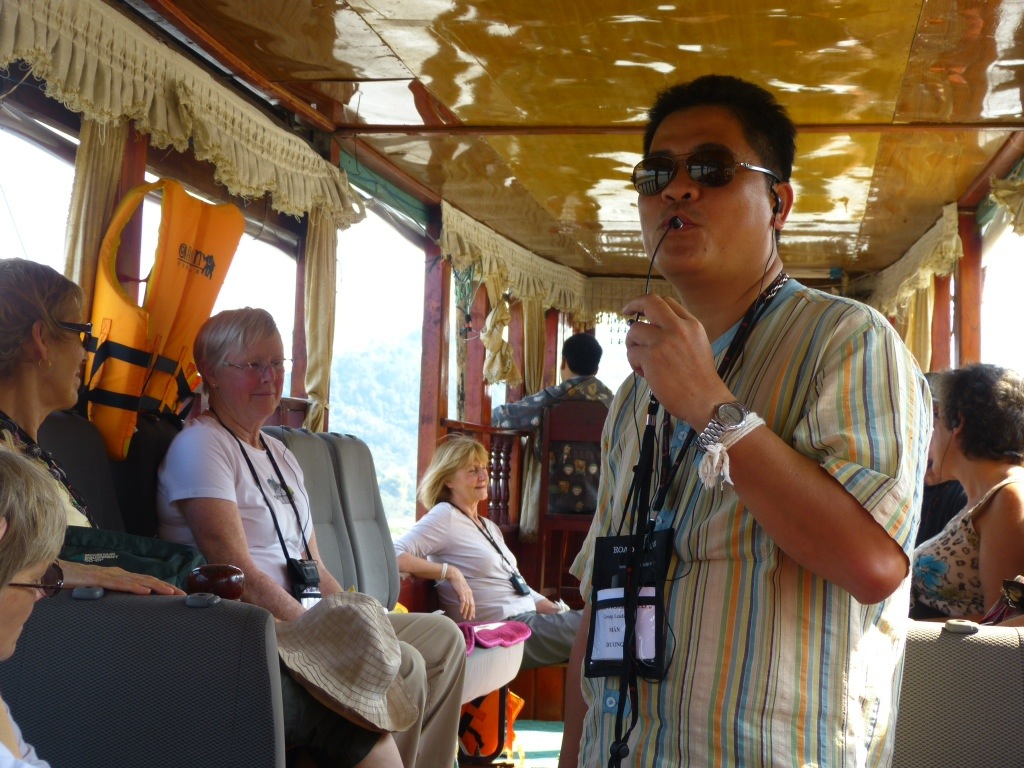
First our guide Man (that’s his name, not a description) serenaded us, then he turned into a bartender, whipping up some killer gin and tonics. What a great way to end the trip!
Several of the ladies decided we could fit in another trip to the night market and a relaxing drink at the Villa Santi if we got ourselves to The Indestructible Rock (that night’s restaurant) on our own. No photos of that excursion…just great memories.
The Internet is a “sometimes” thing in Laos, which makes blogging a challenge. So, that’s why these posts are being uploaded in Cambodia. But I sure did love our time in Luang Prabang. Get ready for some highlights.
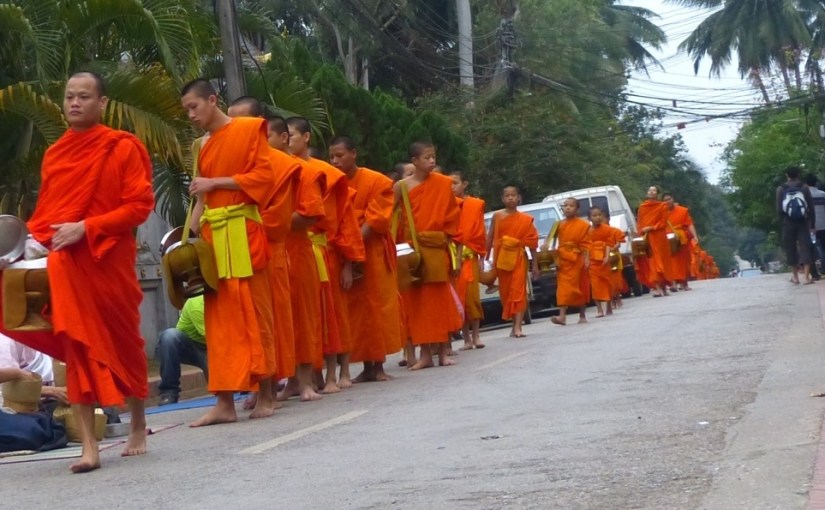
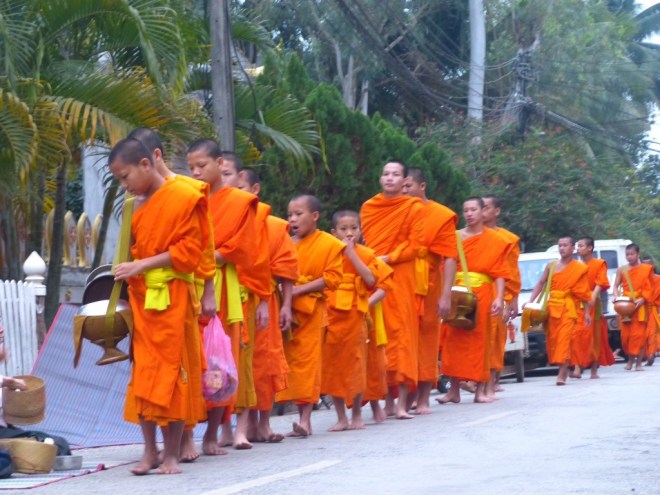
Monks get up at 4 AM every day. They are not allowed to eat after noon; all their food comes from donations so they hit the road early every morning. The head monk leads the way, followed by the “novices”. I don’t blame this little guy for yawning…so was I.
Back View, heading to the WAT
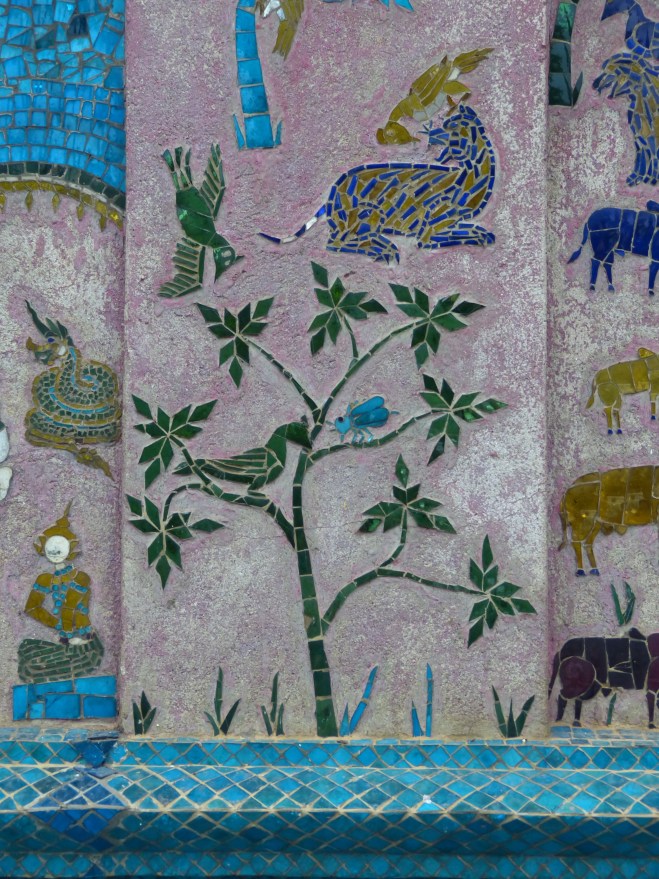
We followed them to Wat Xiang Thong, formerly the Royal Palace back when Luang Prabang was the capital of Laos. When the king decided to move the capital to Vientiane, he donated his home to the monks.
The techniques to create the beautiful glass mosaics were learned from the Japanese.
Similar mosaics cover the walls of the Throne Room in the National Museum, but we weren’t allowed to photograph there. In the National Museum, the walls and ceilings are a deep Chinese red, which makes the glass mosaics even more stunning. The National Museum was built by the French for the last King of Thailand, who ended up in a reeducation camp after the 1975 revolution.
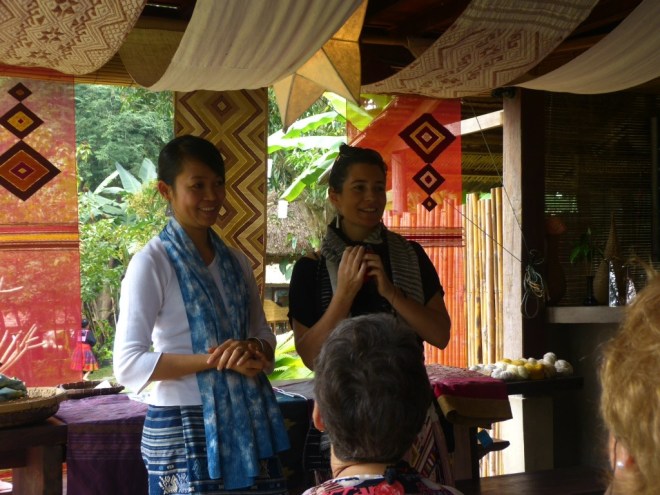
We visited Ock Pop Tok (East meets West) where we met Jo and Val, who demonstrated how their beautiful silk garments were made, starting from the silkworm, through weaving and dying.
Val and Jo
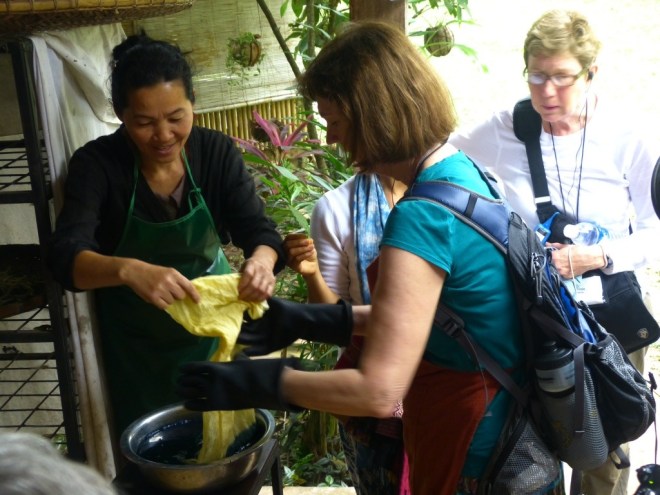
Do you recognize one of the workers, busily (and professionally) dying a silk scarf?
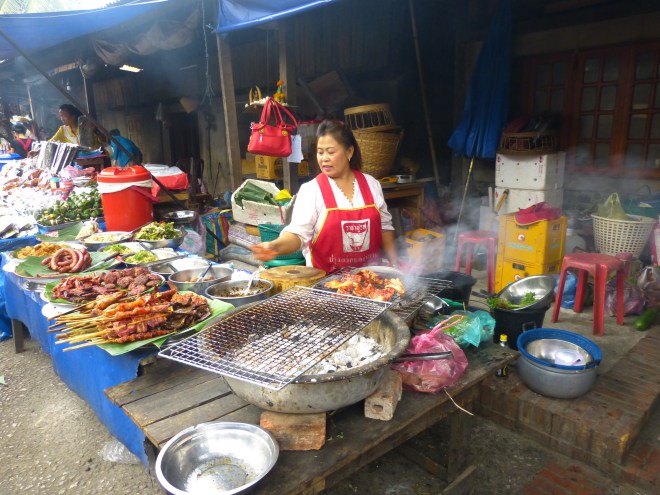
We managed to cruise through both the night and the morning markets. These markets are set up and taken down every day!
Speaking of cruising, we did just that, along the Mekong, to the Pak Ou caves, an important religious site for Laos.
Mike, intently studying the map of the Mekong
The view of the river from the cave
Barbara left a small Buddha in the cave, just like a local.
Could that be Indiana Jones, looking for Buddha?
Getting to and from our vessel took balance, as demonstrated by Linda.
What better way to spend our last morning in Thailand than at a cooking class?
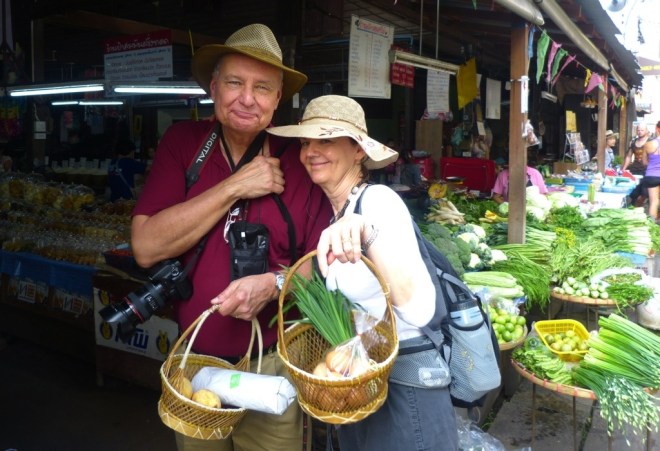
But first, these little piggies went to market, and what a market it was!
The vegetables were so fresh, the bees think they are still growing.
Thai “fast food” – all the necessary vegetables for soup, packaged together.
No wonder Thai food is so amazing–the ingredients are incredibly fresh!
Check out these master chefs.
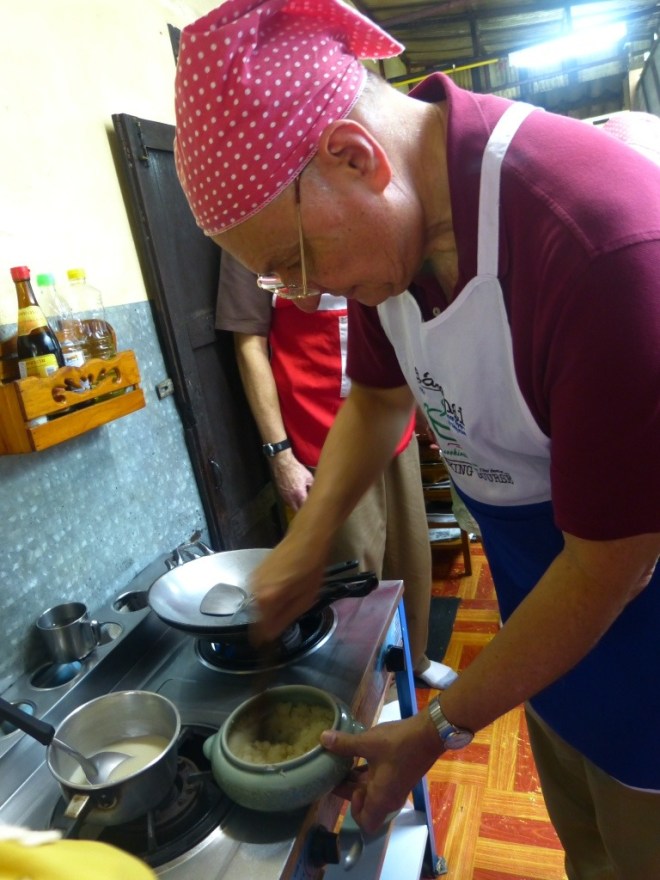
Could that be Mike wearing a “do” rag??? Yes, it could, and it was.
The spring rolls were so delicious, I didn’t stop to photograph them–I think I might have inhaled them…but I DID capture our other glorious creations for your viewing pleasure.
Pad Thai
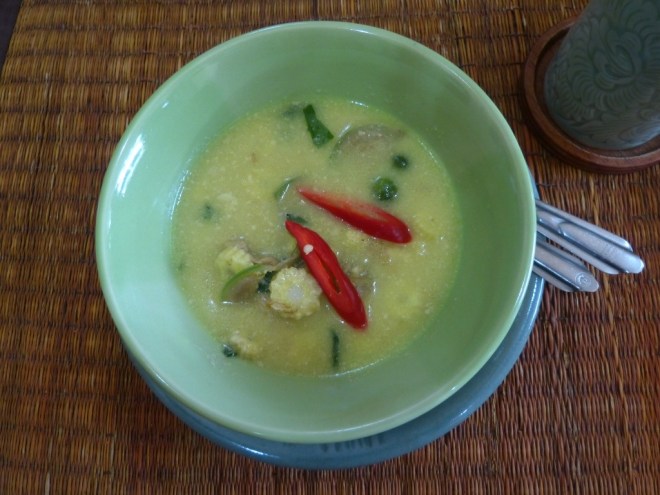
Green curry–we all were coughing as we were stir frying this dish. Not sure what ingredient caused that reaction.
And the grand finale–sticky rice with mango. I have never, ever tasted such scrumptious mangoes. They were perfectly ripened, sweet and juicy.
Our group: 4 Lindas, 2 Barbaras,2 Marys, Shelley, Sue, Sandy, Caroline, Karen, Kitty
2 Gregs, Alex, Al, Hal, Mike, Owen, and Rod, obviously not in any particular order.
Good news, folks back home. When I return, I won’t be empty handed. There will be a cookbook in my chubby fist!
After class, we were loaded into vehicles that resembled army trucks. Caroline pointed out this comforting sign. Good to know our driver was trained!
Learning was never this much fun during my school years! Why couldn’t all of my lecturers be like those on Road Scholar trips? Or could it be that I have changed?
Our first two lecturers, Jim Lehman and Tony Zola, were both peace corp volunteers, who stayed in Southeast Asia. Jim was a Buddhist Monk for three months, because he didn’t want to be “unripe”, or as our guide Tippy says, “uncooked rice”. Those are the terms for Thai men that do not spend at least a little time as a monk. If you marry someone who is “uncooked” or “unripe” the Thais believe the marriage will not work out, so it was off to the temple for Jim, so that his Thai wife’s family would approve of the union.
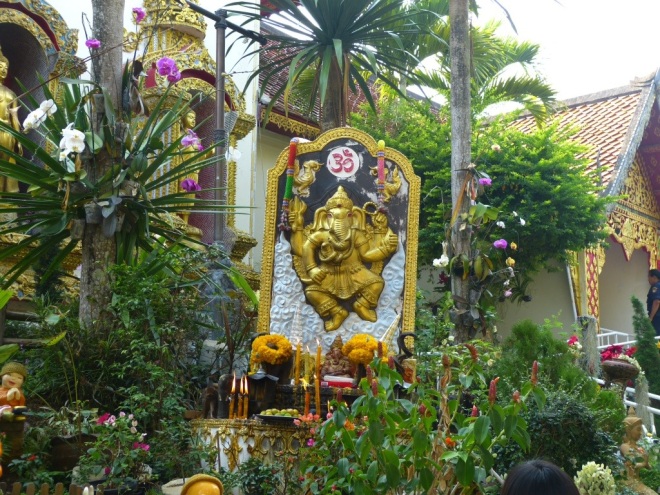
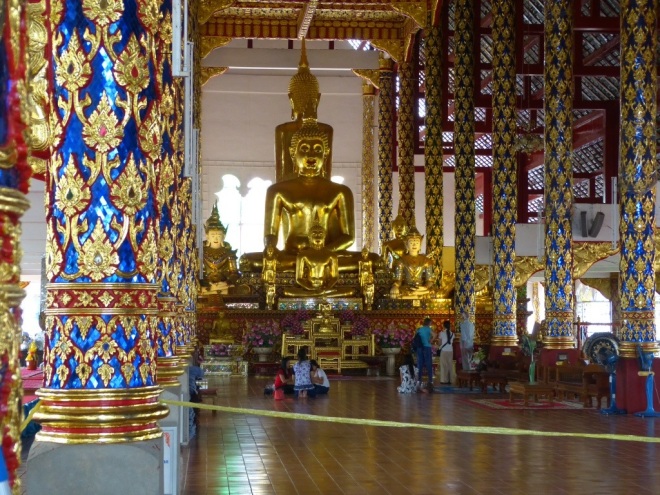
Jim explained that Theravada Buddhists don’t believe in god, however anyone visiting a Wat cant help but notice the Buddhists are deep into Hindu mythology.
Ganesha, son of Shiva and Parvati, at Wat Prathap Doi Suthep in Chiang Mai
In fact, they believe Buddha was the last incarnation of Vishnu. When I asked how Theravada Buddhists reconcile “no god” with their belief in Hindu gods, Jim gave me the answer he got from his Buddhist teacher. “When you have an arrow in your chest, you don’t ask how it got there.” In other words, Buddhism teaches us the way forward. It is not concerned with how we got to where we are. I, on the other hand, would DEFINITELY want to know who shot that damn arrow!
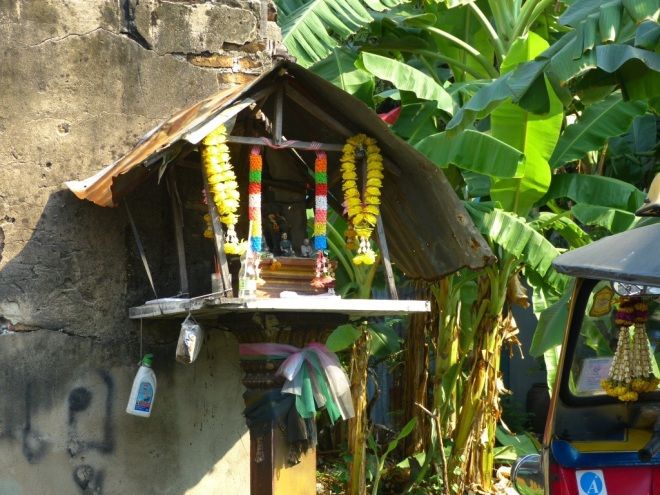
In addition to blending Hinduism with Buddhism, Thais throw animism into the mix. Spirit houses are everywhere, and have varying degrees of grandeur. We saw this one on our daily walk to the SkyTrain from the Loft Hotel. I think my dad might have one just like this in his back yard. (Right, Sue and San?)
This fancier spirit house is far more typical.
Our second lecturer, Tony Zola, talked about the socio-economic-political climate of the countries along the Mekong River, which flows from Tibet to the South China Sea. Sixty million people depend on it for food. They receive 80% of their protein from fish, so the “health” of the river directly impacts the health of the people.
Two of the countries we are visiting are constitutional monarchies (Thailand and Cambodia); Laos and Vietnam are People’s Republics. Per capita income ranges from a high of $8,700 in Thailand to $2,100 to $3,100 in the three other countries. One last demographic fact: half of the population of Southeast Asia is under the age of 25.
Tony didn’t just give us facts and figures; he also told us interesting stories. Thailand’s former Prime Minister received a degree in criminology from the USA. He had a creative way of solving Thailand’s rising drug problem. Somehow, the word got out to rival gangs that each was encroaching on the other’s turf. The resulting murders remain unsolved, which triggered a protest at the United Nations. Again, the Thais had a novel solution. The Thai ambassador’s wife utilized her staff’s cooking abilities to prepare delicious Thai food, which was set up on tables in of the demonstrators. It’s hard to be angry with a stomach full of Thai food. Problem solved…demonstration over. We can learn a lot from the Thais.
Did i mention that my posts are not necessarily in chronological order? Random…that’s the way my brain works. After Tony’s lecture, we headed off to the airport for our flight to Chiang Mai. And what an airport it is! Comfortable lounge open to all ticket holders,. With free wifi, drinks and food. No need to belong to a president’s club here.
At Wat Suan Dok, we had a “monk chat”, a discussion of Buddhism from a monk that was not just passing through, doing time so he could become “ripe”. He was a wonderful speaker, who explained that the goal of Buddhism is to be happy right here and now, to relieve suffering by learning detachment. To a Buddhist, the test of a religion should be whether it helps us to be able to live together peacefully. (I’m thinking there are a whole lot of religions that are scoring big red F’s on that particular test. After showing us how to wrap yourself in an orange robe (or as my cousin Kristy would say “rock his robe”)’ we received a crash course in meditation, and I left with an increased fondness for Buddhism.
Wat Suan Dok
Wat Prathap Doi Suthep is located about 40 minutes from Chiang Mai, atop a mountain. This wat is renown because the pagoda contains ashes of the Buddha.
A couple more photos for your viewing pleasure.
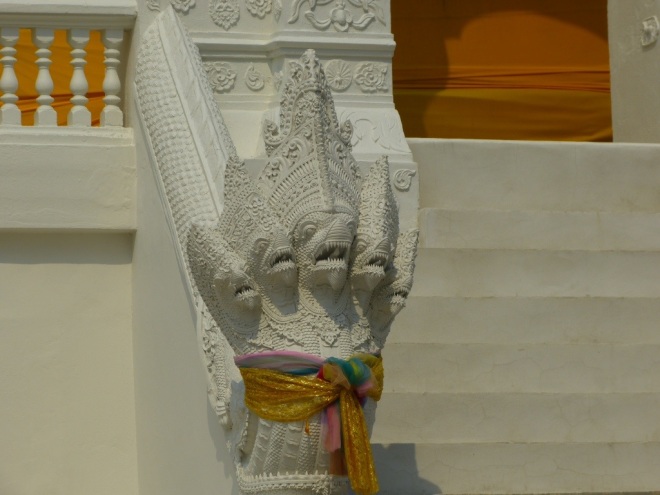
Another Naga, a multithreaded snakeI love the animal statues!
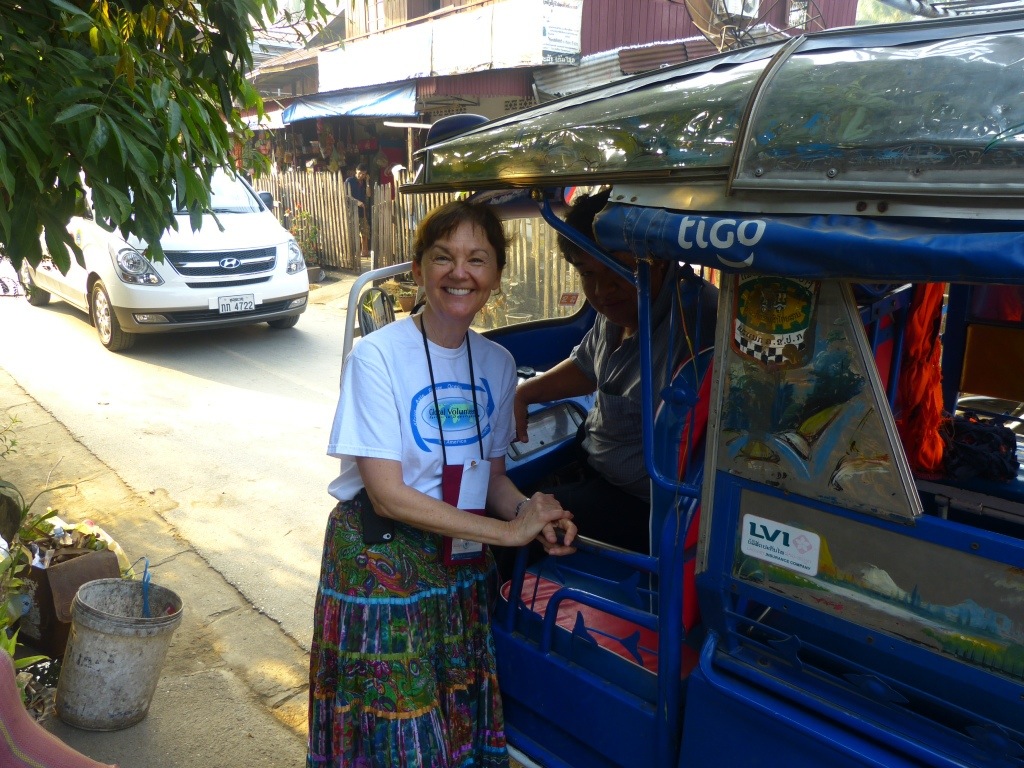
We had a free hour and a half before we left for the airport, so I flagged down a man driving his truck in front of our hotel. He agreed to drive us around Luang Prabang for an hour for $15.00. But first, we had to stop off to deliver eggs and vegetables to a local store.
Here I am with our friendly driver.
Mike wasn’t feeling adventurous but my new friend Caroline was rarin to go. (Nancy, meet your new friend).
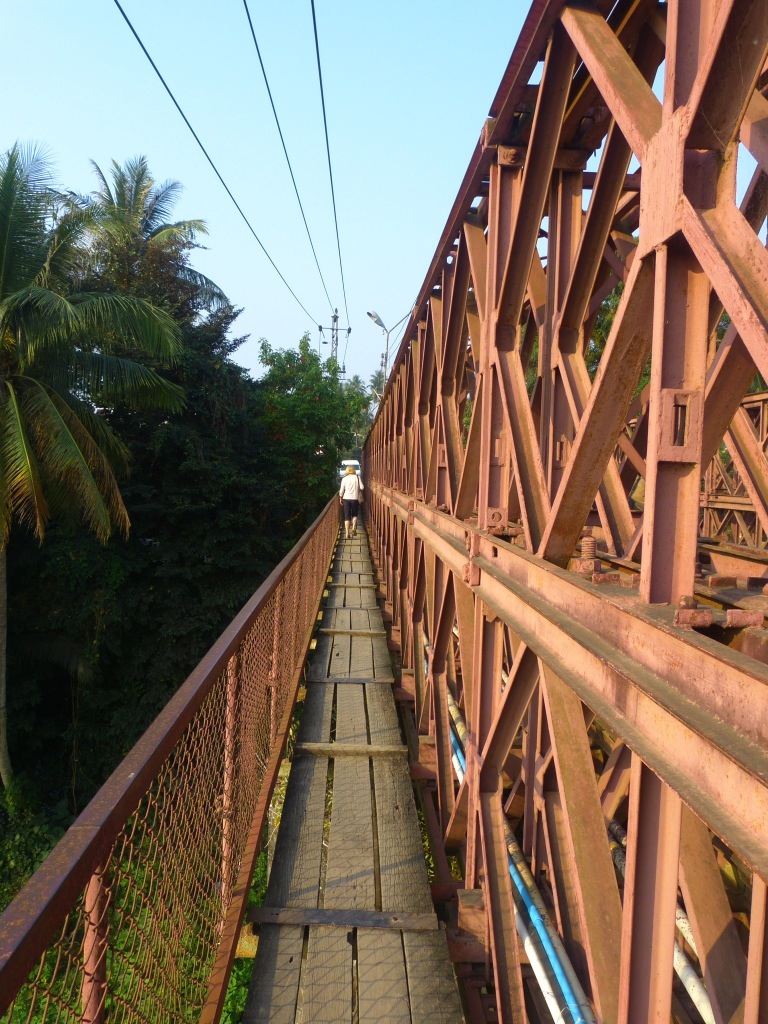
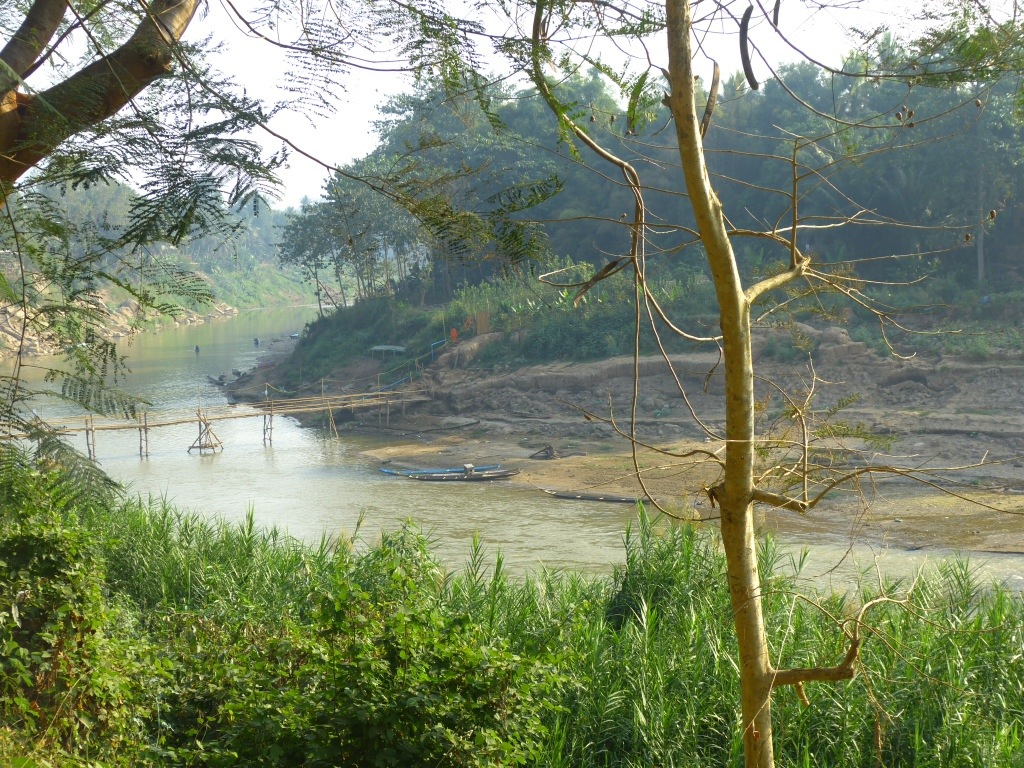
Check out the boards on the walkway, not the most secure…but the view of the Mekong was so worth it!
We climbed Phusi Hill, but didn’t have time to make it up to the top (all 350+steps) because we were running out of time. We got about 3/4 of the way up and figured we’d better not miss the bus to the airport.
We DID catch some unusual sights along the way. Any future Road Scholars travelers reading this, a quick spin around the city in the back of a truck in the early morning is a great way to travel!
I always wanted to mount a Naga, and this one looked agreeable.
This is a Chinese Buddha. How can I tell? He is fat and smiling. The Thai and Lao Buddhas a thin and serious.
And now some views from the hill.
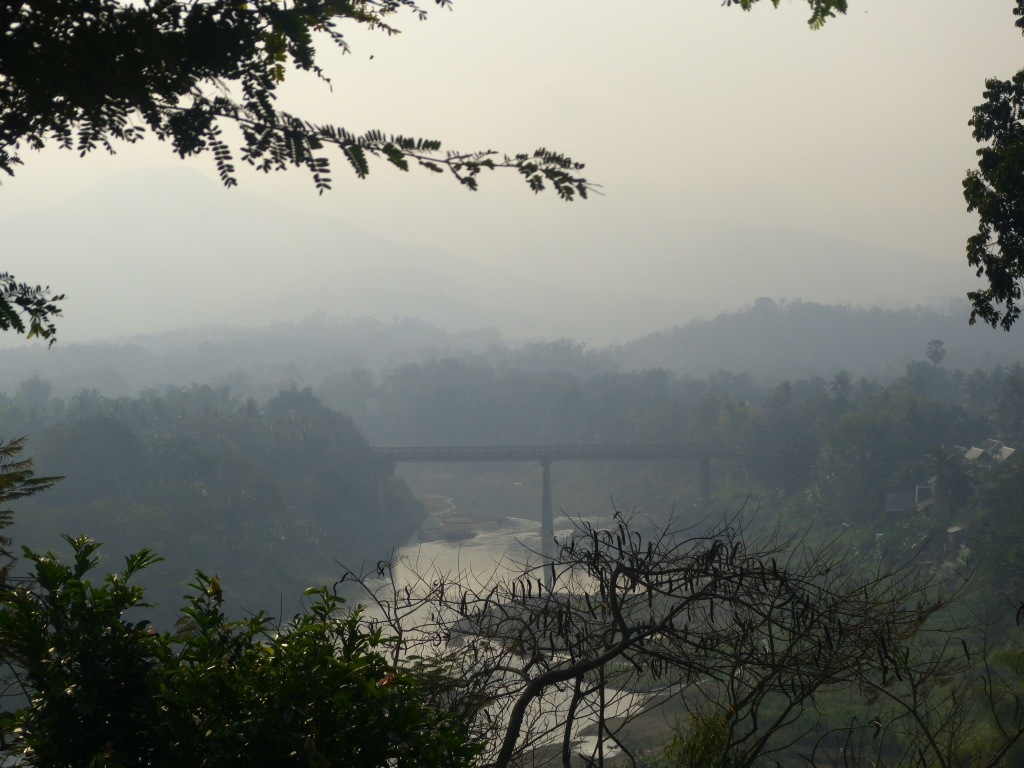
Those orange dots in the distance are monks that have just crossed the bamboo bridge.
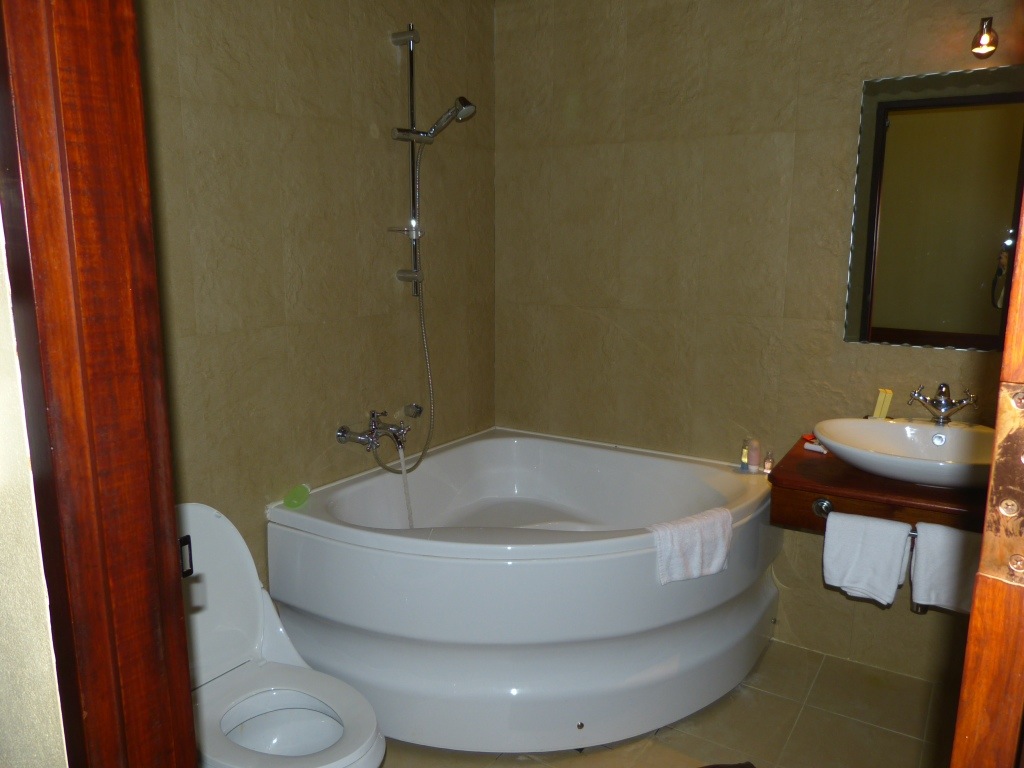
The last image of the day…our bathroom, with the huge tub and no shower curtain. It made showering an adventure. I was glad I brought my bath oil!
I’ve finally acknowledged that my blogging just can’t keep pace with our activities. So rather than try to record all of the things we have done over the last couple of days, I’ll just share one highlight…our visit to the elephant camp.
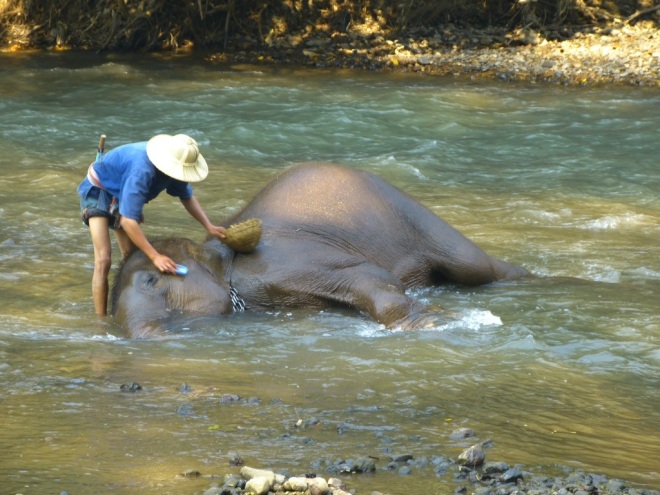
I didn’t realize our guide was joking when he said we needed our bathing suits to help the mahouts bathe the elephants. I was so ready!
The mahouts are showing us how we’ll be mounting the elephants for our ride thru the jungle.
Okay, so I was kidding about the mounting part, but not about the jungle ride.
It took about 40 minutes to get to the village. I bought a few treasures from this sweet young girl.
On the ride back, we took a short cut thru the river.
Going downhill was a bit harrowing. No photos of that experience…I was hanging on with both hands.
What a great adventure!
I’m so glad we arrived in Bangkok a few days before the Road Scholar tour started. Doing so gave us an opportunity to adjust to the time difference (although if truth be told, I STILL haven’t completely switched over to Asia time) and to slowly savor this magnificent city. Bangkok is amazingly affordable, so the extra days didn’t increase the cost of the trip by much. Four nights at the Bangkok Loft Hotel, for example, cost $175 TOTAL, and that included airport pick up, plus great breakfasts. The Loft was an excellent choice–within walking distance of the SkyTrain, just two stops from the river. It was quiet, clean, very comfortable, with all the amenities that are important to us: firm mattress, good water pressure, plenty of hot water, free wi-fi, perfect temperature control, excellent free breakfast, and helpful, friendly English speaking staff. Thank you, Trip Advisor!
Before leaving home, I had gotten $250 worth of Bhat from our bank. Had we steered clear of the resort hotels (lunch at the Mandarin Oriental, drinks at the SkyBar, dinner at the Shangra-La), that amount would have been more than enough for our transportation, entrance fees to attractions and food during our stay.
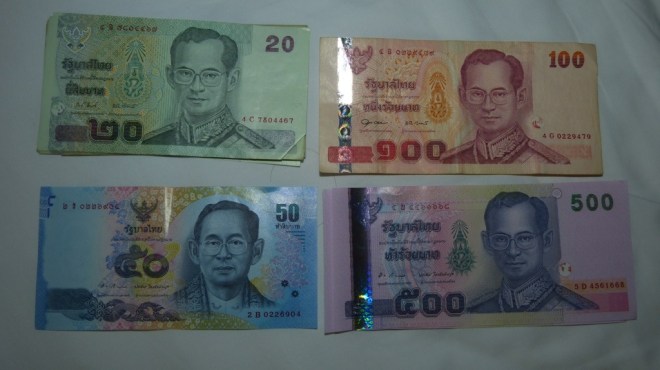
Rama IX’s portrait is on Thai money. He looks pretty good for an 86 year old man. But why does one denomination have a different portrait?
The hotel chosen by Road Scholar, the Majestic Grande was also quite lovely, in the business section of town.
Thursday night, we met our fellow travelers. The group is composed of 5 Canadians, 8 from Washington state, 2 from California, 2 from NY, 3 from PA, and the two of us from NJ. As with other Road Scholar Trips we’ve taken, the women outnumber the men, 14 to 8. I love making new female friends! In fact, one of the reasons we keep choosing Road Scholar is it seems to attract interesting, friendly, curious travelers who are fun to be with. Mike and I are looking forward to getting to know everyone better over the next few days.
Friday was an action packed day, with visits to Wat Po and the Grand Palace, followed by lunch at the Supatra River House. After a lecture on Buddhism by Jim Lehman, we returned to the hotel. By then, all we wanted was some cold water and some cold air on our sweaty bodies!
Here are some visual highlights from Wat Po.
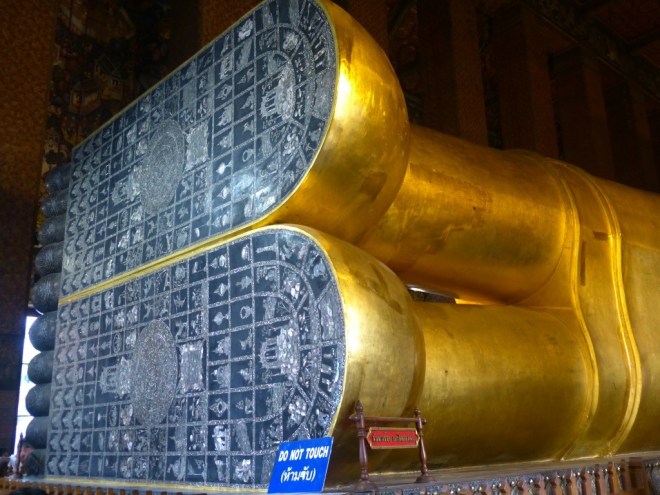
The Reclining Buddha is enormous–150 feet long by 50 feet high.
It’s hard to get all of him into one shot.
This gives you an idea of the size of both the Buddha and the crowd at Wat Po. The place was mobbed!
Do you think these qualify as “Happy Feet”? The bottom of the Buddha’s feet are covered with mother of pearl. Talk about having big shoes to fill!
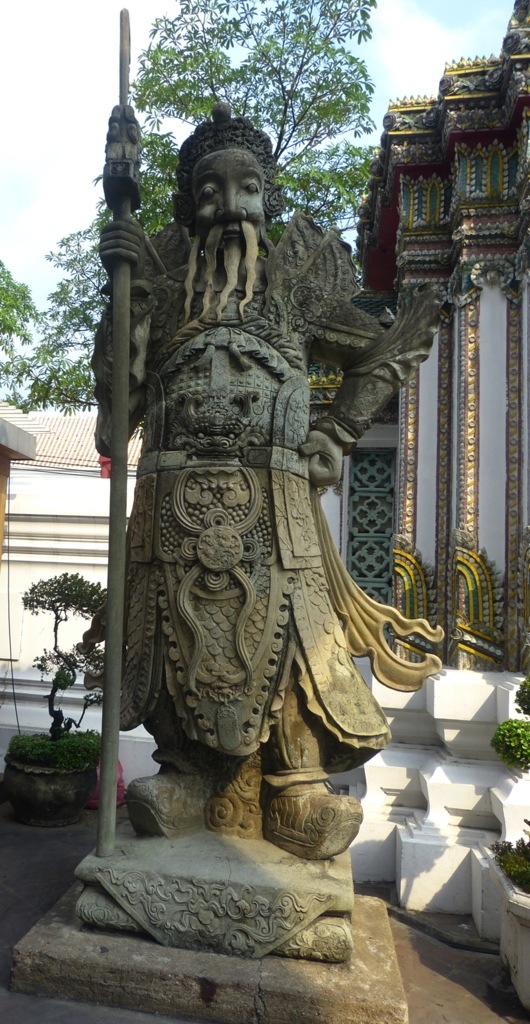
The Wat Po grounds are filled with gold Buddhas, temple guards, and interesting statues. This temple guard is clearly Chinese.
But what about him? To me, he looks like a cross between Charlie Chaplin and John Wayne.
Our return to the Grand Palace was a different experience. We traveled by bus, which gave us a chance to get a different glimpse of the city. Road Scholar provides ear pieces, so that we can easily hear the guide. What a godsend in these crowded sites! Mike and I were glad that we had been able to spend time on our own, and leisurely wander the grounds; having a second go-round with a guide allowed us to see things a little more deeply, and catch some of what was missed the first time. For example, the gallery surrounding the religious section of the Grand Palace is painted with scenes from the Ramayama, and the yellow “paint” in the scenes is liquid gold.
My blog is lagging behind our activities, but I need to end this so I can get myself together for the start of our day. More to come!
Many years ago, Mike and I saw the musical “Chess”, which was memorable for two reasons:
1. it is the only musical that Mike and I disliked enough to leave at intermission, BUT
2. it had a really catchy theme song by Tim Rice, whose lyrics I remember to this day.
One night in Bangkok makes a hard man humble,
Not much between despair and ecstasy,
One night in Bangkok and the tough guys tumble,
Can’t be too careful with your company,
I can feel the devil walking next to me.
Well, now…MY man has been here for THREE nights and he hasn’t tumbled yet. Let’s see what night number four has in store for him.
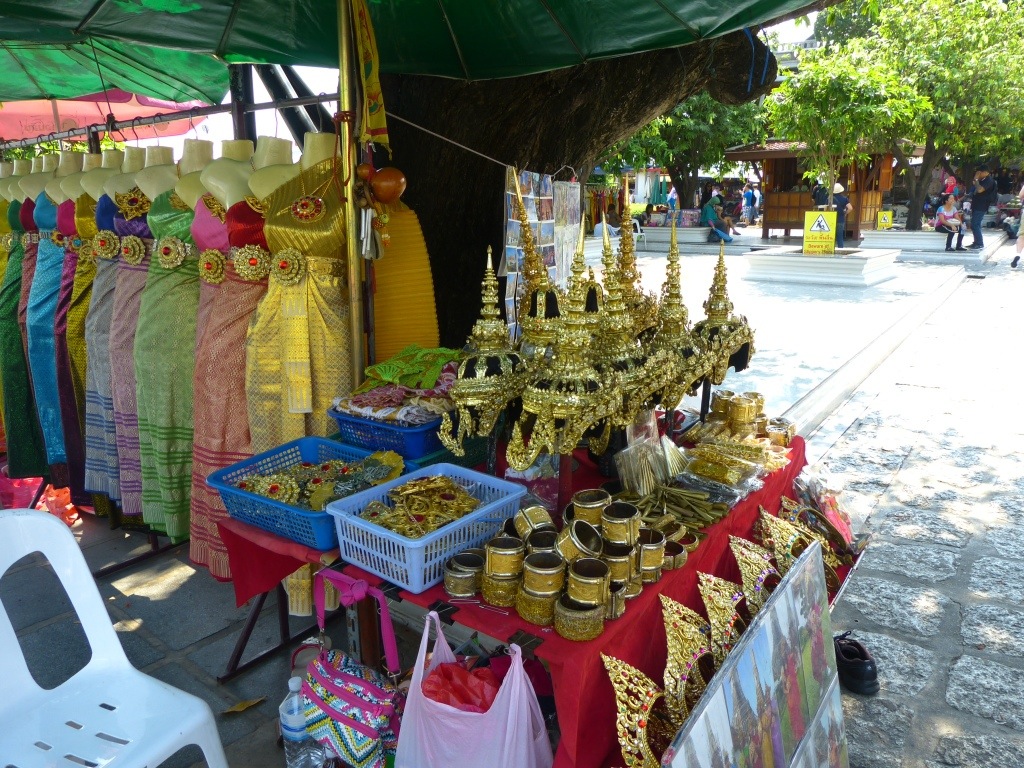
First decision–what to wear? While at Wat Arun, I saw some possibilities.
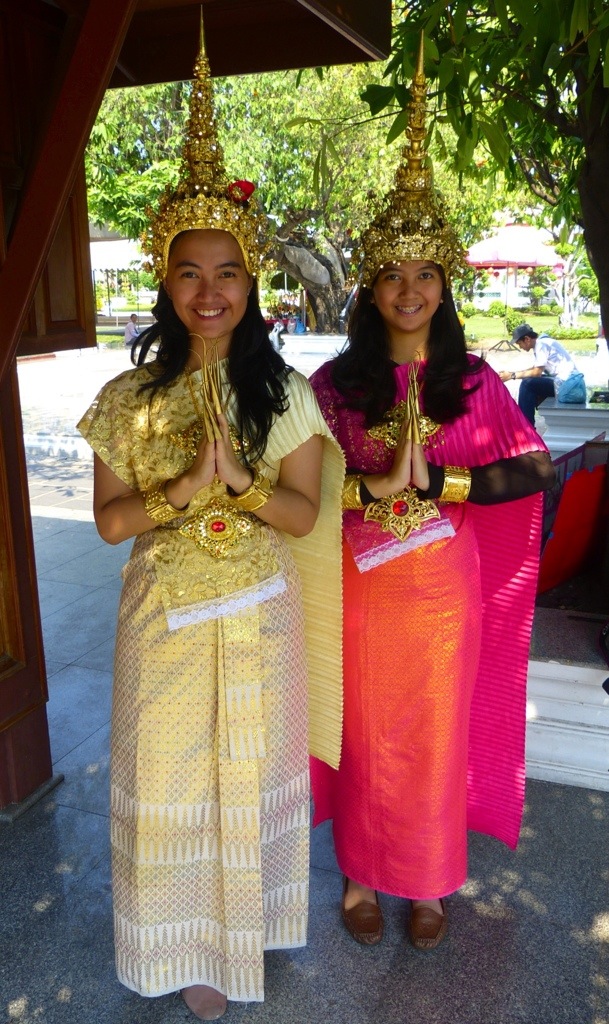
Had one of my female traveling buddies (you know who you are…) been by my side, this next photo might have been us in our evening attire. (These sweet young girls were also touring Wat Arun, decided to purchase the full outfit, fingernails and all, and allowed me to photograph them).
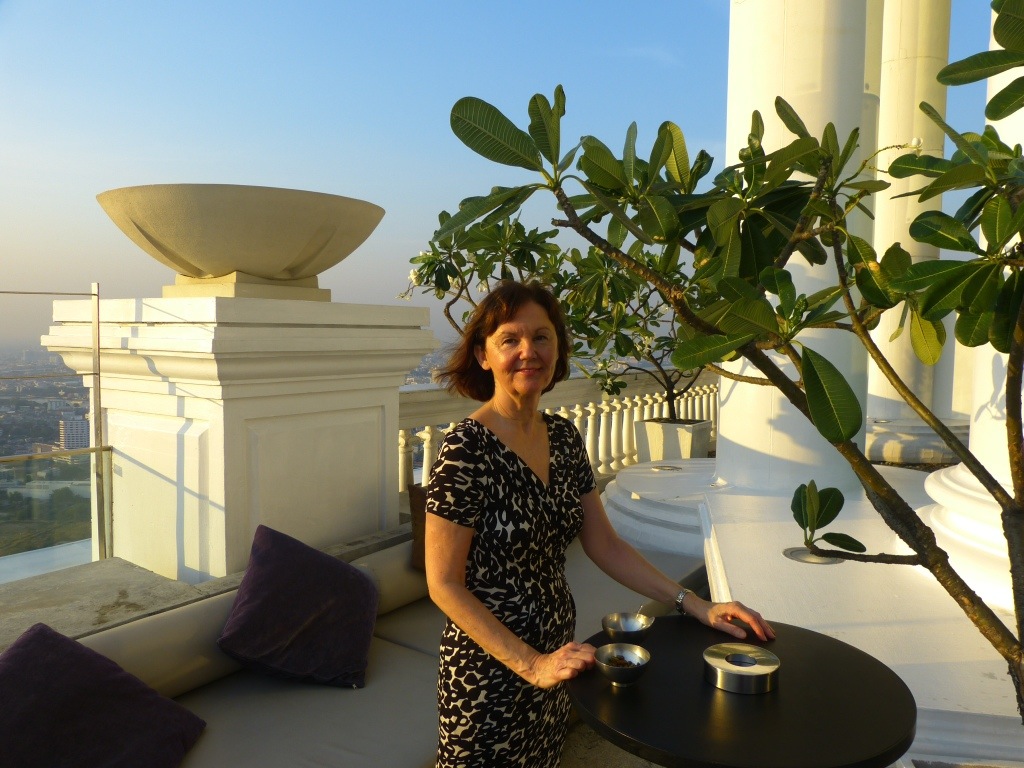
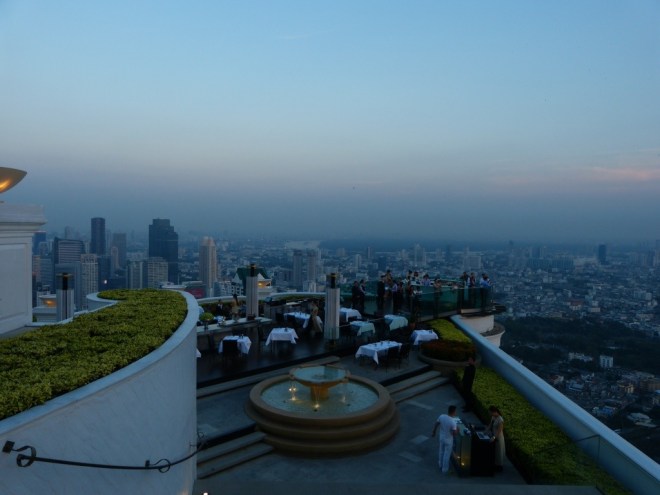
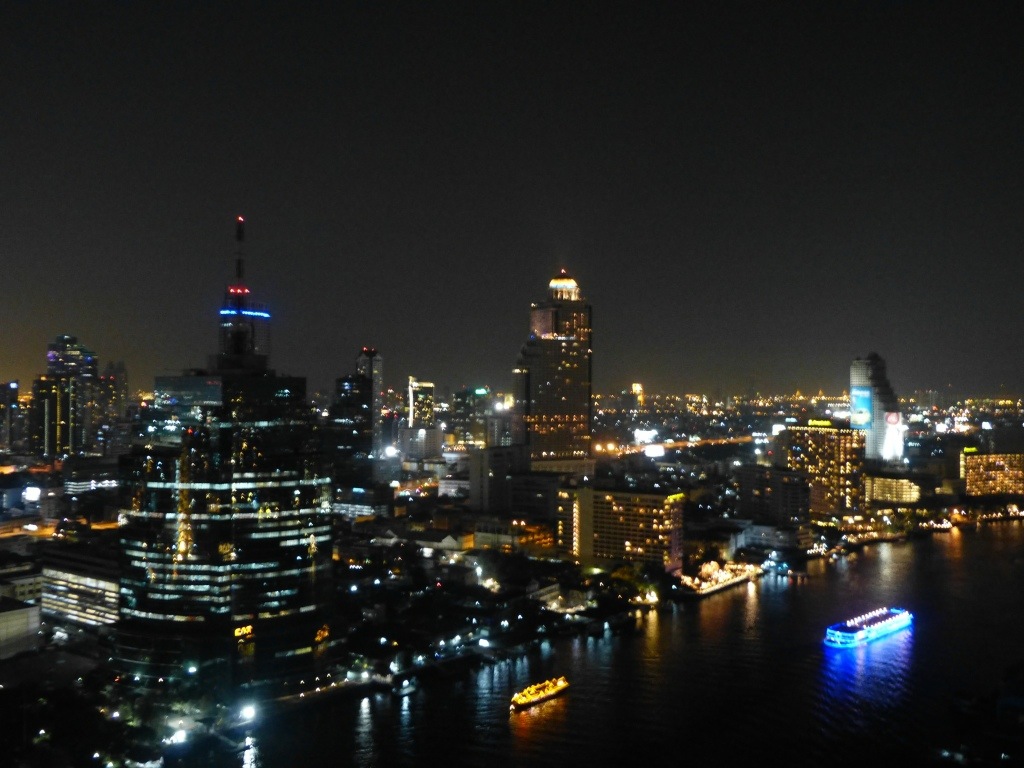
But I digress. Back to last night. Our first stop was Distil Bar on the 64th floor at the Lebua Hotel, where for the equivalent of about $40, I had a rose apple martini and Mike had a beer.
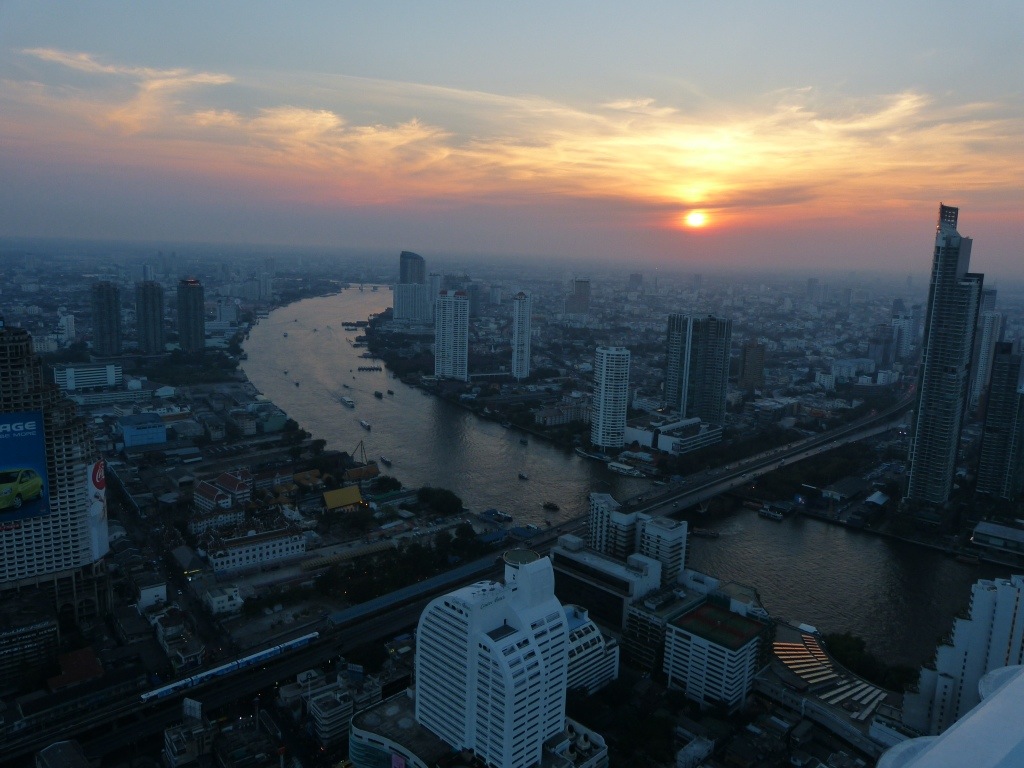
That might sound a bit pricy, but the olives and pistachio nuts were free, and we were able to relocate to the SkyBar when it opened. I’ve been told that this place was prominently featured in the movie Hangover Two. Since we saw neither that nor Hangover One, that wasn’t our reason for going there–it was, what else, the amazing view.
It would have been wonderful to have dinner at the restaurant, but it is booked months in advance, so we needed to go elsewhere.
That gold blur in the center of the next photo is indeed McDonald’s Golden Arches; Kentucky Fried Chicken is a few yards further down.
As tempting as those options were, we decided to walk on by, and headed for “Flow”, a restaurant on the river.
Last stop, the 360 bar atop the Millennium Hilton, from which you can see the Dome at the Lebua Hotel. A great way to end our time “on our own”. We join the Road Scholar tour on Thursday evening, moving from the Loft Hotel to the Majestic Grande.
And now, as promised, the answer to yesterday’s question. There may actually be SEVERAL correct answers, but here’s the one I had in mind when I posed the question.
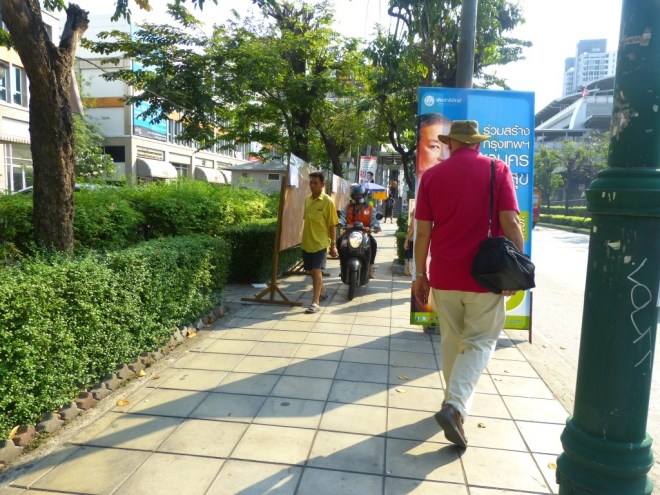
Thais, like the Brits, Aussies, Kiwis, Japanese, Indians and South Africans, drive on the left side of the road. If you think that wouldn’t make a difference to non-drivers, you would be wrong. We kept heading for the escalators, doors, and turnstiles on the right, not the left. So, wouldn’t you think walkers should bear left? Sometimes…but most of the time it didn’t matter what side of the sidewalk you chose, it was guaranteed to be wrong. And if you think motor scooters should only be ridden on the road, you’d be wrong again! We have been wrong a lot.
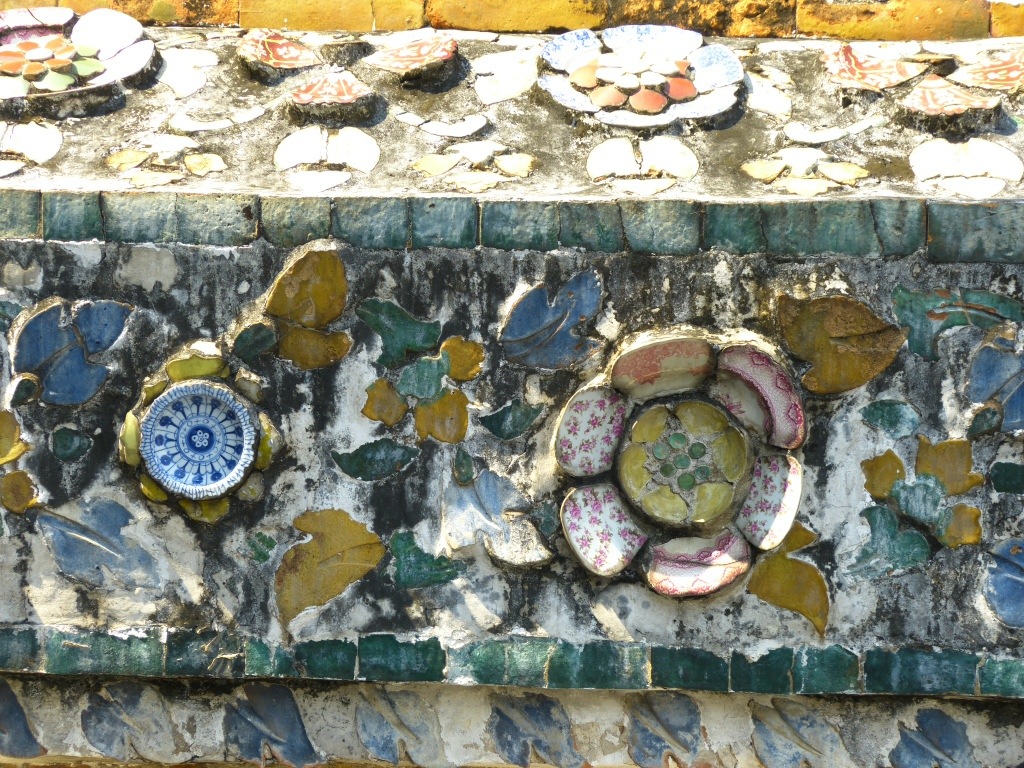
Question: What do you do with your defective porcelain?
Answer: If you are Chinese, and it is the 1800’s, you use it as ballast in your cargo ships; however if you are Siamese, you realize it makes ideal building materials for your next temple.
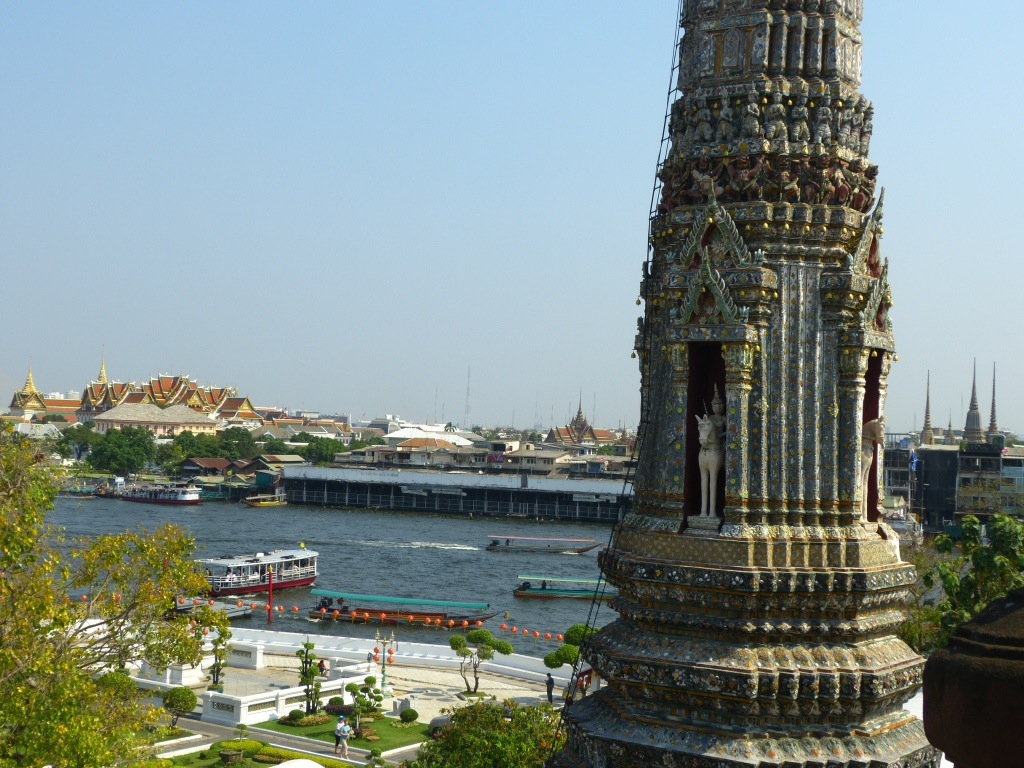
Although Wat Arun is called the Temple of the Dawn, supposedly it is best viewed at sunset, when the light makes all of the porcelain glow, and the temple slowly turns into a silhouette against the crimson sky. Mike and I had another location in mind for our sunset hours, so we visited in the morning. The view from across the river was spectacular enough for us, even without a dramatic sky.
If you are game enough to climb the steep steps (check out the relationship between that guy’s leg and the step behind him to get a feel for it), you are rewarded with a spectacular view.
Oh wait–those weren’t the steep steps, these are the steep steps, and someone thoughtfully left a bottle on one of them to provide scale. They are SHALLOW, steep steps, not designed for big western feet!
Going up was like climbing a ladder; coming down was a bit harder, but the view was so worth it.
On the top left, you can see the rooftops of the Grand Palace.
The view looking up was pretty great too. Erawan, the elephant that the Hindu god Indra rides, is standing on the ledge above us. (Don’t see Indra, though).
The grounds surrounding the temple, normally lovely, are even more so, because they are being decorated for Chinese New Year with red lanterns everywhere. Can you see the two Yakshas guarding the entrance? These spirit “monsters” were at the grand palace and also had green and white faces.
I’ll end this post with a question:
What do Thais have in common with the Brits, Aussies, Kiwis (New Zealanders), Indians, Japanese and South Africans? This is a hard one. The answer will be in the next post.




































 Destination NOW