I am intensely curious, with a spirit of adventure that is tempered by my very strong aversion to anything with potential to cause pain. I love travel, photography, reading, gardening, yoga, music and propelling myself through space (biking, dancing, walking, dancing while walking). I've never considered a lack of proficiency in any of the previous activities to be a hindrance, counting on abundant enthusiasm to make up for my shortcomings.
So what if it rains in Spain? Seville is still glorious! I LOVE this city. Yes, we did get caught in a cloudburst or two, or three, but that just made us appreciate the sun even more.
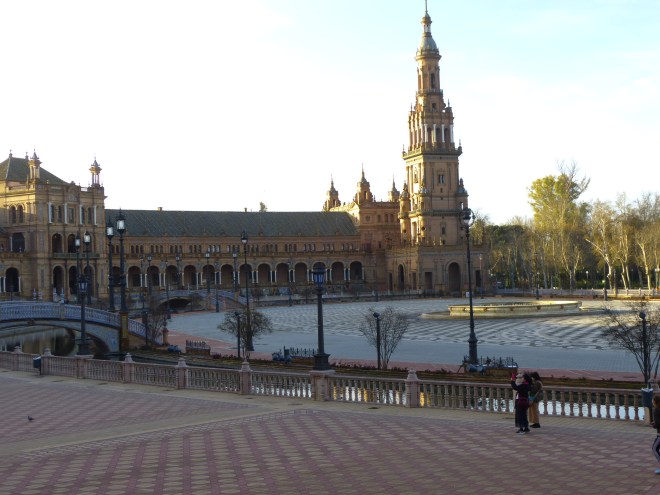
High winds prevented us from entering the Plaza de España at the scheduled time, but we got lucky. As we were leaving Seville, JuanJo noticed that the plaza had been reopened, so off we went. Because we were there so early, we had the plaza to ourselves.
JuanJo explaining the significance of the tiles in the Plaza de España
What made Sevilla so wonderful? Well, the city preserved the incredibly beautiful buildings from the 1929 World Exposition. The architecture is beautiful— even better than Disney World!
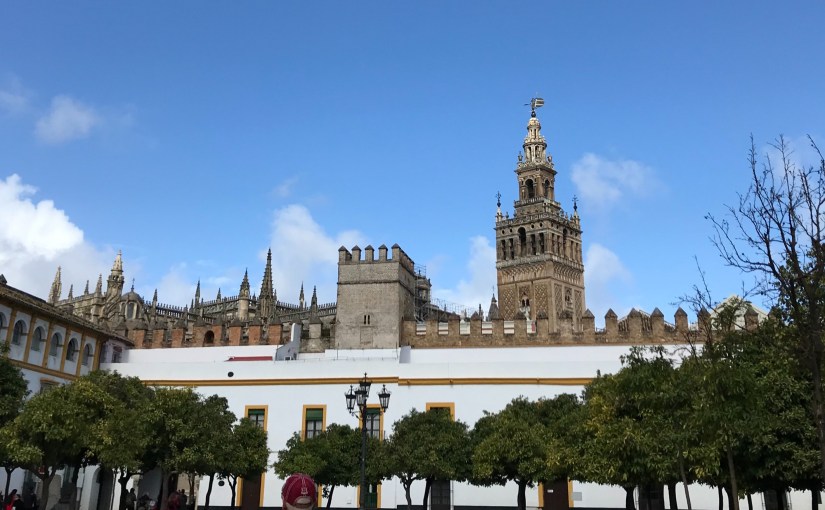
For the history lovers, a visit to the Cathedral is a must.
Yet another recycled mosque, with a minaret converted to bell tower. This one has a Phoenician goddess atop
It is here that you will find the massive tomb of Columbus. And yes, he really IS in that big box. National Geographic did a story about the DNA analysis that was performed on the box’s contents. It matched the DNA of Chris’ son and brother. (There had been some doubt about who those bones REALLY belonged to).
The people standing beside the tomb will give you an idea of how enormous this memorial is.
Columbus set sail for the new world from Seville, and it was here that he (and others) brought all the gold plundered from south and Central America.
It was impossible to capture ALL of the grandeur of the main altar in a photo
Seville has its legendary martyrs. Justa and Rufina, two sisters, are honored with a stained glass window and in a painting.
Their story? They refused to sell their pottery for a pagan festival, so after much crockery breakage, (on both sides), the sisters were imprisoned, stretched on the rack, made to walk barefoot to the nearest mountain range without water or granola bars. Justa died of hunger and thirst,
but Rufina hung in, only to be tossed to the lions.
As you can see from the painting, the lion didn’t finish her off. Finally, she was either strangled or beheaded (or both, it isn’t clear). It was hard to keep a good woman down back then!
If history and religion doesn’t do it for you, not to worry. Seville offers much more:
Cobblestone streets lined with shops and restaurants,
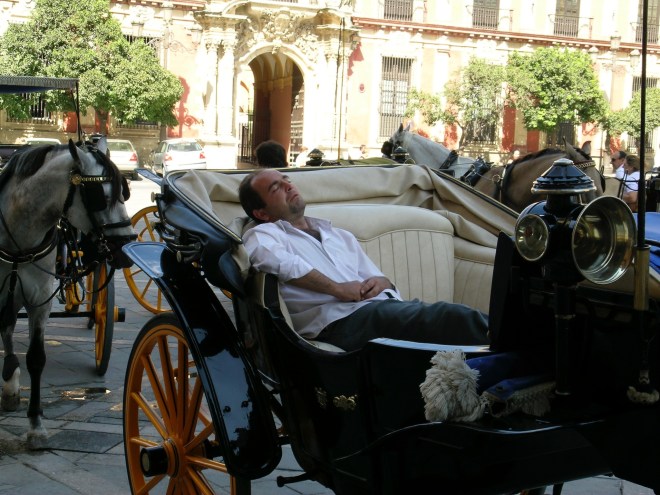
Carriage rides around the old town,
and FLAMENCO!
We weren’t here long enough. Seems like I’m saying that a lot on this trip.
By the 8th day of our Grand Circle tour, we had visited Madrid, Toledo, Granada, Cordoba, and Torremolinos, with a side trip to the very British Gibraltar. Next on our itinerary was Malaga, but Mike and I decided to engage in an Australian tradition and “Chuck A Sickie”. For those of you that didn’t have the pleasure of spending two weeks with an Australian Global Volunteer, that term roughly translates to “Playing Hooky”.
Although the Costa del Sol averages over 300 days of sunshine per year, today was the first time I needed to wear my sun hat.
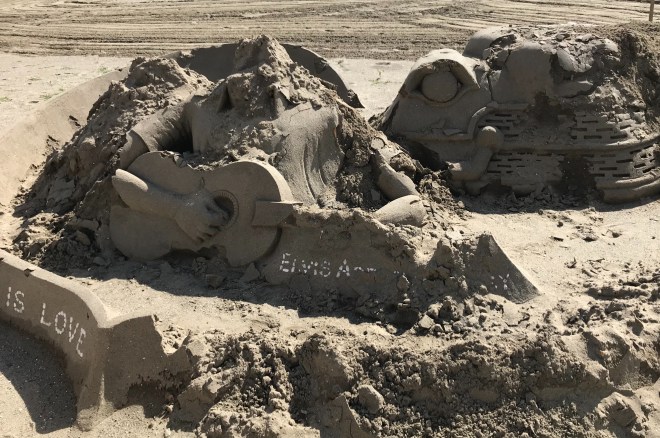
I’m sure our fellow travelers had a perfectly marvelous day enjoying the sights of Malaga, and the home hosted lunch in a nearby village as much as Mike and I enjoyed spending the morning strolling along the beach, taking in sights like this.
I would have loved to see what this tribute to Elvis looked like before the rain decapitated him.
But what about those other glorious cities? Don’t worry, I’ll do a little flashback, with visuals.
We got just enough of a taste to determine that one of these days, we will be back to those lovely cities, and next time, we will linger.
Our time in Toledo was limited to a few hours enroute to Granada. The old city sits 6 escalator rides above the new city, and let me tell you, we were all very grateful we didn’t have to climb all the way up the hill in the rain.
Even after we arrived at the “top”, we still had some hills to climb.
Our stroll through Toledo’s Jewish quarter ended at the oldest synagogue in Europe. This unique building was constructed by Moors, because at that time they were reputed to be the best builders. Of course, they were not familiar with synagogue construction, so the Jews ended up with a building that had a distinctive Muslim flavor.
Notice the cross? This building is a reminder that at one time, all three religions were able to peacefully coexist—pre Ferdinand and Isabella reign.
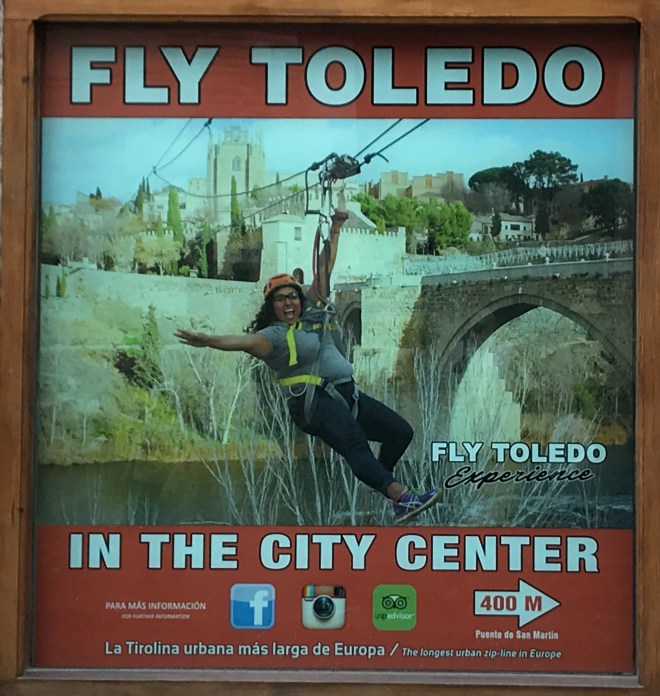
For anyone planning a trip to Toledo, please be aware it is much more than amazing history, great food and panoramic vistas. Thrill seekers, take a look.
Maybe next time, if it isn’t raining…
One of the many things that I love about traveling with Grand Circle and OAT is the unexpected stops along the way. We had a bathroom and refreshment break in Puerto Lápice, a little village in Castille La Mancha, where we discovered a three room Don Quixote museum.
I love that Don Quixote is sculptured out of words
Who would expect such art in a little village museum? Not me.
Because I spent so much time in the museum, I had to order my glass of wine “to go”, which I proudly did in Spanish. An important phrase: “para llevar”. But the effect was spoiled, just a bit, when the bartender started speaking to me in perfect English.
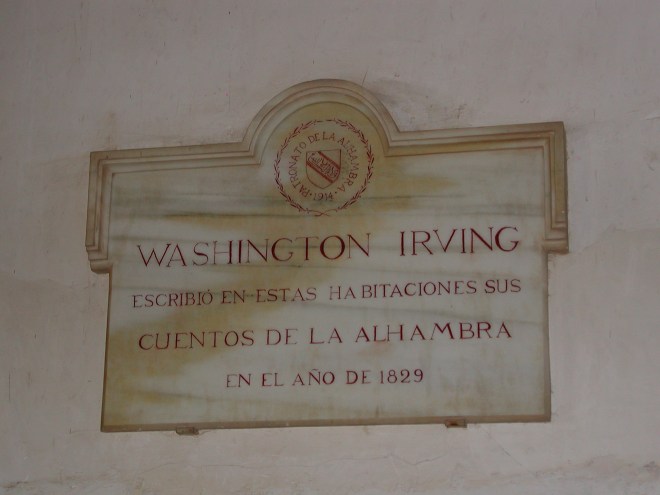
Not surprisingly, most of our time in Granada was spent at the Alhambra. Okay, so we all know that Washington Irving wrote “The Legend of Sleepy Hollow”, but how many know that he also was instrumental in saving the Alhambra from being destroyed? His “Tales of the Alhambra” caused the Spaniards to take a second look at what is now the most visited attraction in Spain.
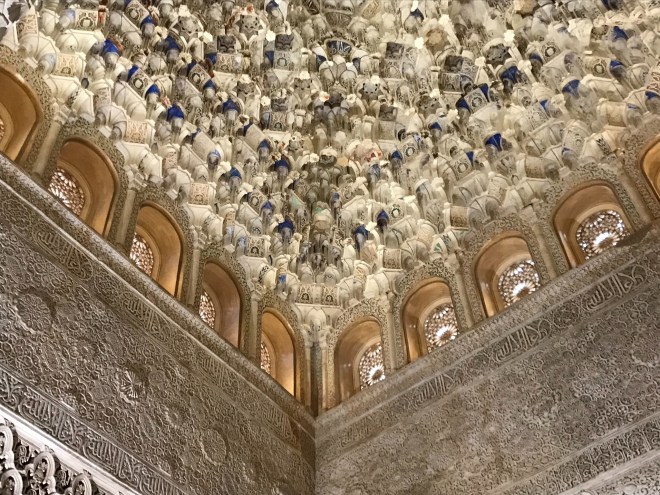
Alhambra ( Al = “the” in Arabic ) is a palace, a fortress, a small city, overlooking Granada. Unfortunately, when Napoleon conquered Spain, his soldiers removed all of the furniture, rugs and tapestries, ( I believe the correct term is “looted”) but the walls, ceilings and courtyards give you a hint of the grandeur that once existed. Check out the ceiling in the women’s quarters.
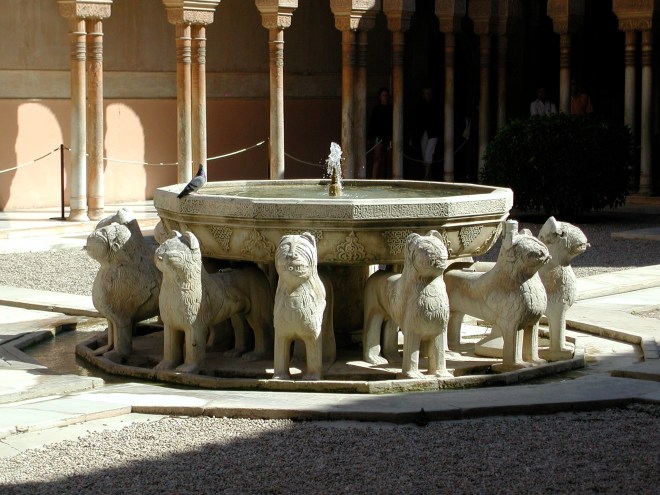
The exteriors of Moorish buildings were very plain. All of the ornamentation was inside, in the private spaces, like these beautiful courtyards.
The Moors ruled Spain for almost 800 years, and their impact on the Spanish language continues today. Many places begin with “Gua”, like Guadalcanal, Guatemala, Guanajuato — all derived from the Arabic word for water.
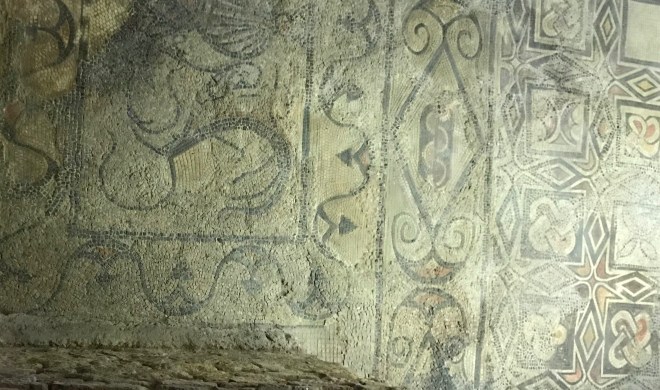
Another city with beautiful Moslem architecture is Cordoba. The Roman temple/Church/Mosque/Cathedral is an architectural wonder. Walking through its spacious interior, you literally travel through time, starting with the preserved Roman tiles, below the existing floor—
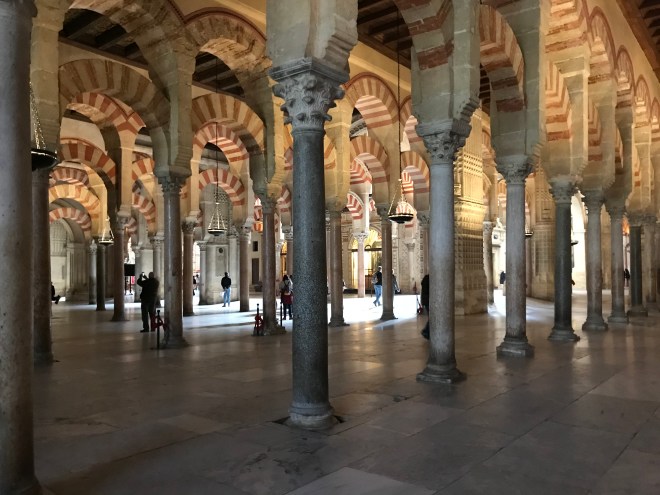
to the former mosque, built with recycled columns, which was wisely preserved by the Catholics —
and now is in the center of the mosque.
In this photo, you can see the Mosque’s red and white arches next to the cathedral’s main altar.
Cordoba is magnificent!
The church’s bell tower was constructed around the minaret.
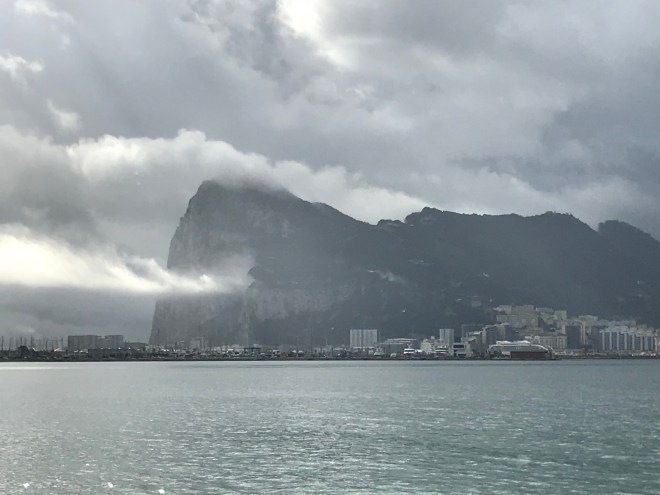
I guess some place has to be the least favorite, and for me, Gibraltar gets that honor. Maybe it was because the limestone WW2 tunnels were dripping water, and were dark and gloomy,
One of the few places that wasn’t too dark or wet to photograph
as was the weather.
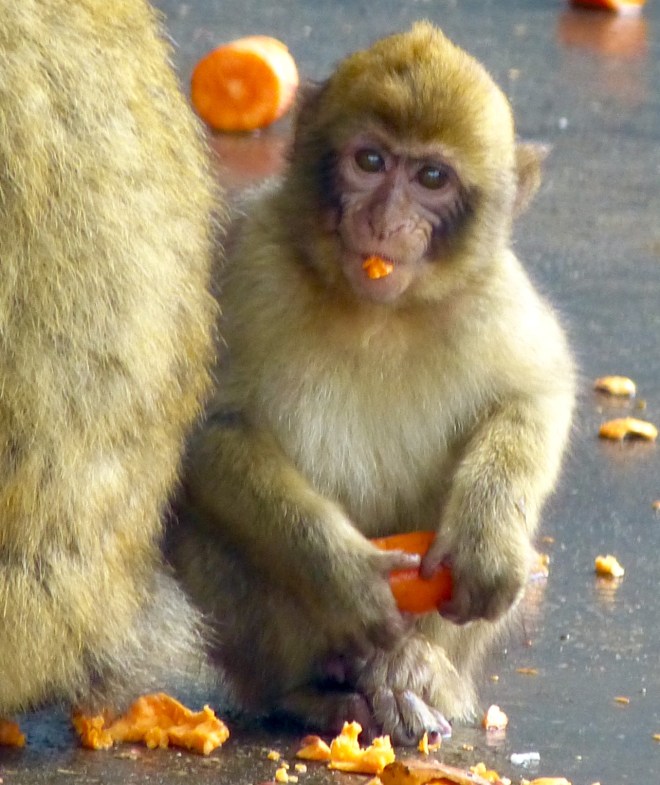
Whatever the reason, I was not as wowed as I was by the other places we’d visited. Even the Barbary apes were a disappointment. We only saw four.
Two more days in Spain, three in Portugal, and then we are back to the USA.
It was raining when I boarded the bus in Beja for the two and a half ride to Lisbon. The weather matched my mood–I was sad to leave all the new friends I’d made in Beja: the wonderful students I’d gotten to know during our two weeks together, the great “Team of Ten” Volunteers, our fantastic team leader. There were lots and lots of goodbye hugs.
Note to future visitors to Portugal–it costs only 14 Euros for a bus ride from Lisbon to Beja, on a super comfortable bus with free Wi-Fi. If you are visiting Lisbon, why not spend a night or two in Beja? Escape the traffic and crowds, enjoy the history, archaeology and cultural treasure of this intriguing Alentejo town.
Two cab rides and a flight later, I was in Madrid, reunited with my main man.
Here’s where we will be traveling over the next two weeks. First stop is Madrid. ( I lifted the map off the Grand Circle website. THEY are the ones that cut Madrid a little too closely.) The star is my feeble attempt to show the approximate location of Beja. You now have a rough idea of where this “don’t miss” town is located. Okay, so I would never be a successful map maker, but I give myself an A for effort.
The long, unusually dry period Portugal and Spain had been going through ended during our second week in Beja. The rain is expected to continue during most of our remaining trip. Oh well. They need the water, so the rain is a blessing. Or at least that’s what I keep telling myself.
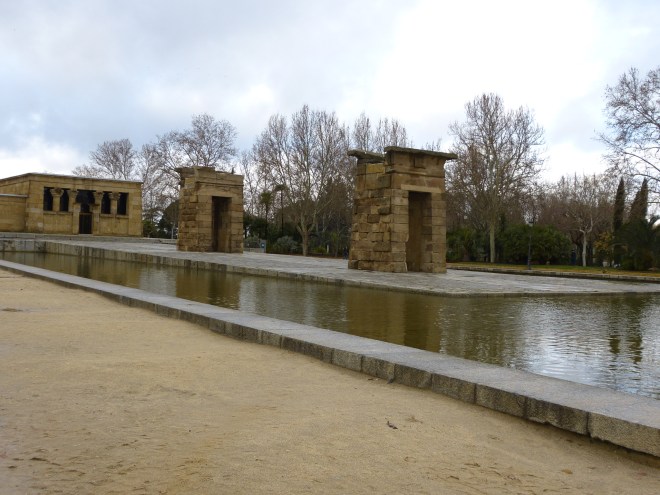
We spent the morning of our first full day in Madrid on a bus tour around the city. First stop, the Egyptian temple of Denbod. No, this was not stolen during a military campaign. Had it not been moved, stone by stone, when the Aswan Dam was created, it would have been under water, just like the Temple of Dendur, in New York’s Metropolitan Museum.
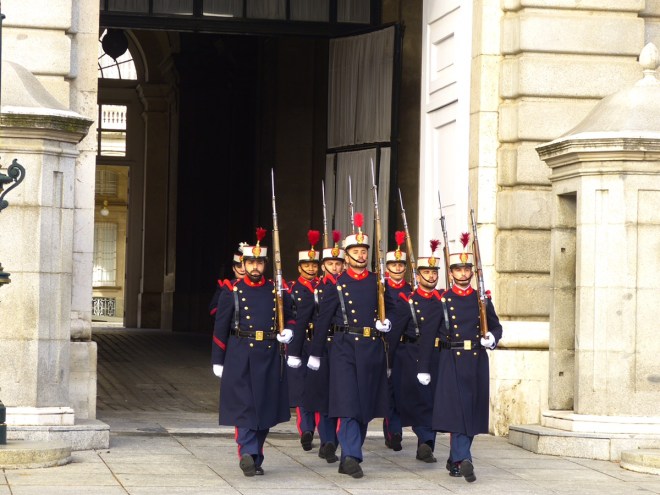
Next stop– the royal palace, where we arrived just in time for the changing of the guard.
Juanjo, our guide, had warned us to be on the lookout for pick pockets. He explained they usually look like tourists, holding maps or cameras with one hand and reaching into your backpack with the other. Well, Linda, a member of our group, saw one doing just that, to a Chinese tourist. She was close enough to slap the pick pocket’s hand away.
A lot of good those guards were! A sharp eyed American woman with quick reflexes foiled the thief. Did I witness any of the excitement? No, I was my usual oblivious self.
Unfortunately, we didn’t have time to wander through any of the 2,800 rooms in this Versailles inspired palace. Instead, we decided to spend the afternoon in the Prado Museum, ogling the artwork by Goya, el Greco, Rubens and others.
Small part of the royal palace
My only regret: I wish I had researched the Prado more thoroughly, so I could have focused on certain pieces, and figured out the most efficient way to get to them. Talk about sensory overload! No photos were allowed inside the museum. I just have to be content with the images inside my head.
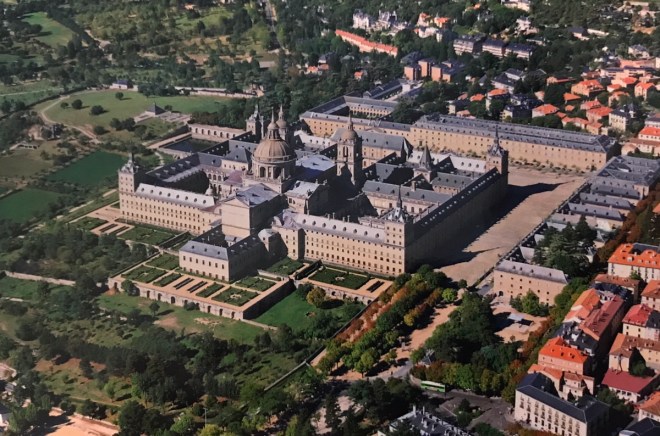
Although we could have spent our second day exploring more of Madrid, we chose the optional guided tour to El Escorial. This palace/ monastery/ school/ church was constructed by King Francis II, son of Charles V, one of the Holy Roman Emperors. The Escorial is shaped like a grill (yes, as in George Forman) to honor Spain’s own St. Lawrence. Why a grill, you ask? Well, that is how he met his end, by being roasted to death. (Yes, humans are strange and savage creatures)
Philip II had the building designed so that he could lay in his bed and see the altar in the cathedral. All he had to do was open his bedroom door and he was in church. Because his bedroom was off to the side, the rest of the congregation couldn’t see HIM in his pajamas (or whatever Kings wore back then).
Philip’s chamber, including the bed he died in, and his chamber pot, were all part of the tour, in case you’re wondering, as is a huge painting of St. Lawrence on the griddle.
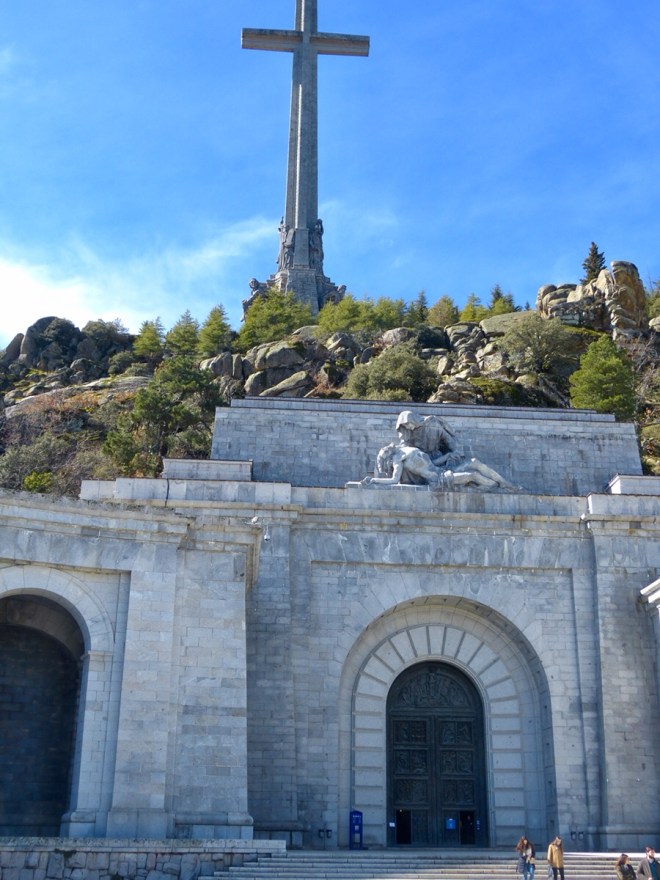
We also visited the Valley of the Fallen, a memorial to those who died during the Spanish Civil War. This was a truly impressive and very moving site.
The memorial consists of the largest cross in the world, under which a Basilica has been carved — out of the hillside. It is hard to gauge the size of the memorial from this photo, but to give you an idea, the cross alone is 500 feet high.
The bones of around 40,000 people are buried In the basilica. One more example of man’s inhumanity to man.
Time to move on, to Toledo and Granada, even though there was much more to see and do in the beautiful city of Madrid.
Tired of touristy places? Want an “authentic”experience, where the locals are friendly, gracious and actually happy to see you? Yet ANOTHER advantage of serving as a Global Volunteer is the organization finds these places FOR you –places I would probably never would have discovered on my own.
I feel like I’ve been dropped into a magical spot. The lovely city of Beja just oozes charm. Its cobblestone streets haphazardly lead in many different directions, much worse than in Boston. Who would have thought that was even possible? Fortunately, in Beja, you can WALK everywhere–to work assignments, to dinner, for coffee, to the bus station, to its many attractions.
Streets are pretty quiet before 9 AM, but things liven up around 10:30, the “official” coffee break time.
Art is EVERYWHERE. Here are just a few examples. This sculpture is controversial. It reminds me of trees. What do YOU see?]
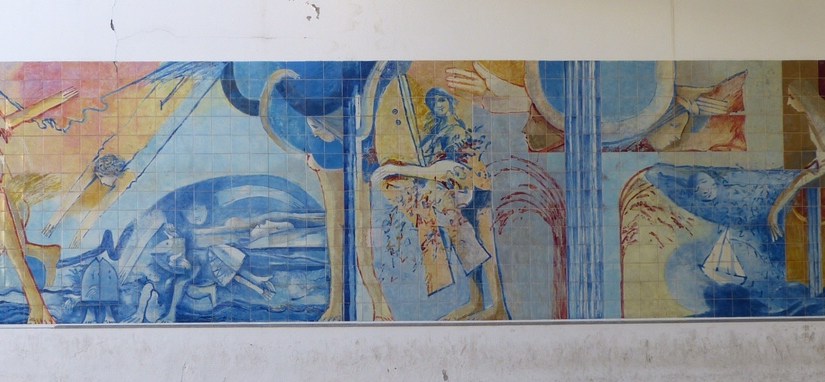
Even the tunnels are artistic.
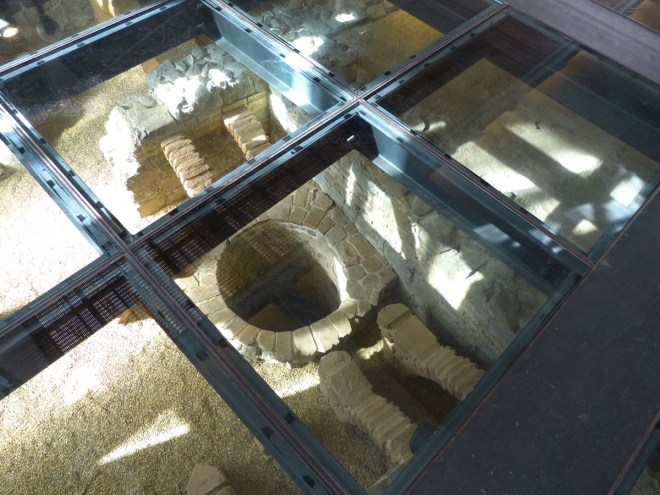
In 1983, while excavating for a house’s foundation, Roman ruins were uncovered. The property’s owner was persuaded to build his house elsewhere, and voila, by 2004, this architecturally intriguing museum was created. Okay, so in Italy you can visit all kinds of ruins, but in Beja you can walk OVER them, atop a glass floor. For those whose eyes glaze over at the thought of another museum visit, this is the right place for you. Small, but oh so interesting.
I couldn’t figure out how to photograph the dwelling’s private bath. Here’s my poor attempt. Guess you’ll just have to go there.
Although the residents were aware of Pax Julia’s importance to the Romans, (Beja’s name back then), they didn’t know that the area had been inhabited much, much earlier. The museum contains artifacts dating back to 3000 BC. The Nucleo Muselogogico ( The name is almost as big as the museum) is free, as are the blue booties you wear to protect the glass floor.
Close by is the Regional Museum, which was originally a convent for women. Across the street is the theater, formerly the convent for men. The passageway that once ran between the two buildings (no doubt only used by the servants, to carry supplies back and forth), no longer exists.
The Regional Museum is the only one that charges a fee–just two Euros, and it is well worth it. In addition to all of the precious church items,
St John the Baptist
there is also a fine exhibit showing the process for restoring paintings. If seeing how St. Bartholomew was flayed is your thing, then you definitely need to find your way to the paintings room.
If instead, you are a literature buff, you can go upstairs to view the window through which Sr. Mariana gazed longingly, awaiting the return of her knight in shining armor. Yes, the author of the famous “Letters of a Portuguese Nun” lived in this very convent.
I mistakenly thought that being sent off to a convent was not a fate I would have desired. But that was BEFORE our guide pointed out its many advantages: unlike married women, who became their husband’s servants, rich girls got to bring THEIR servants WITH them to the convent. Freed from toil, they were educated, spending their days praying, reading and being waited on. I never thought of it quite like that. An additional bonus? You didn’t die in childbirth. Of course, there was always a chance you could be bricked into a wall, if you made a real good friend across the passageway, who got to know you in the biblical sense.
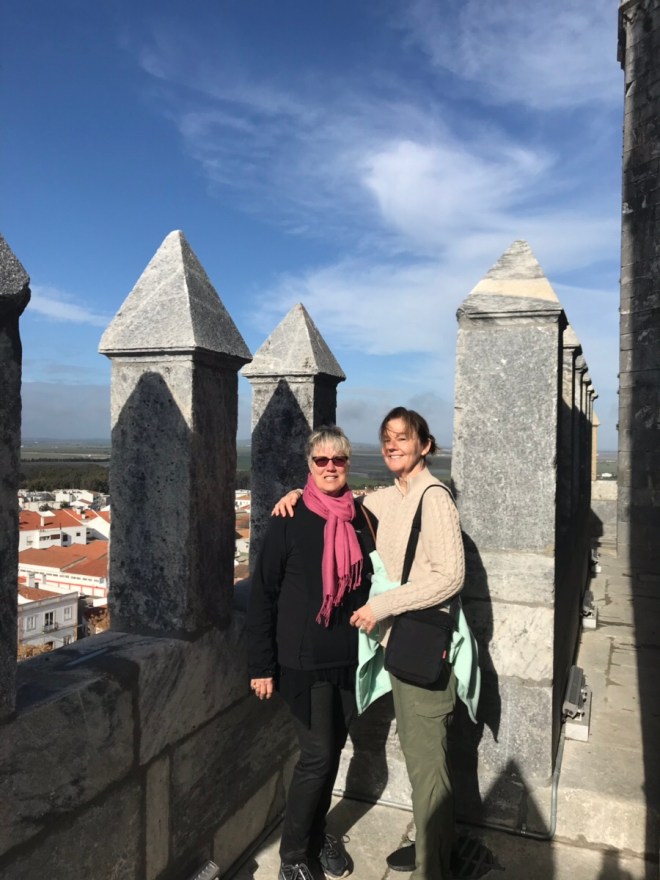
On the outskirts of town is the fortress (they refer to it as a castle) with the tallest tower on the Iberian peninsula. It has 198 steps and is 40 meters high (or 131 feet, but it is already on a hill, so it feels even higher).
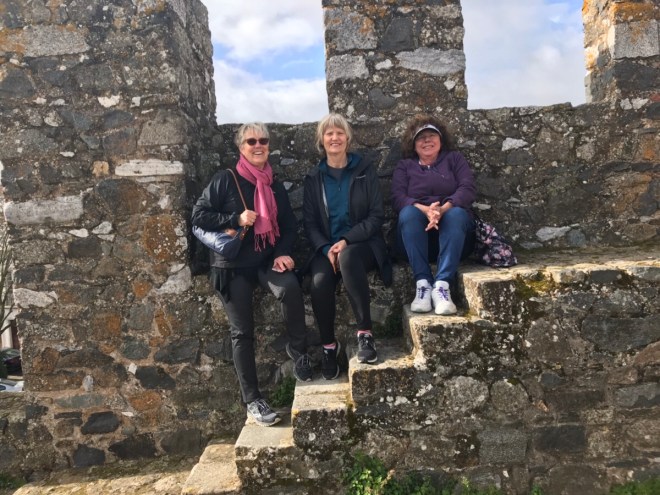
Jeanne, Laurie and Heidi
Can you imagine trying to navigate these steps, wearing your armor while trying to dodge arrows and rocks, or whatever they were using back then?
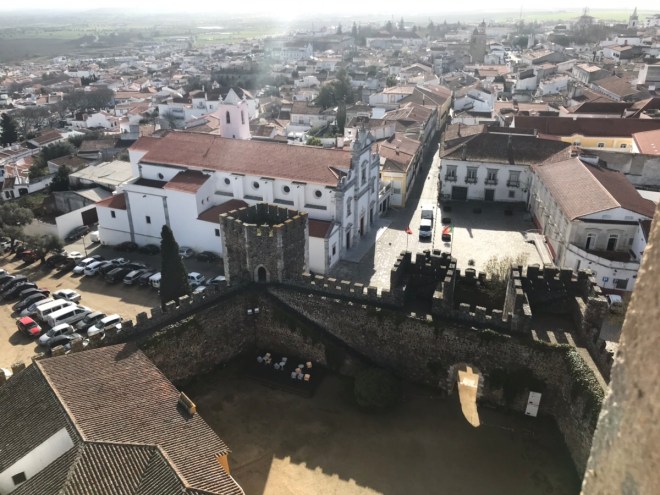
I’ve been told you can see Spain from the top. But then, they could tell me I could see Russia from there, and I probably would have believed them.
The view from the top. Could that be Spain on the horizon?
The Hotel Bejense is a great choice if you are looking for the 3C’s: clean, comfortable, cheap. For about $57 a night, you get a small room, with a private bath (complete with hair dryer, and towel warmers), breakfast, great Wi-Fi, a flat screenTV with many English channels, on a pedestrian walkway. Right next door a pastry shop with incredibly delicious offerings. Good thing we walk so much, because we are visiting the pastry shop at least once a day, sometimes more.
Entrance to the Hotel Bejense.
If you want to splurge and spend almost $90 per night, (off season rate ) you can always stay at the nearby Pousada de Sao Francisco, another former convent.
Four of us opted to have lunch there and to conduct our own self guided tour. I know what my sisters are thinking, so I will answer the question. YES, we WERE allowed to wander through the convent.
Speaking of food, you won’t go hungry in Beja. You have LOTS of choices, from the rather expensive (non Global Volunteer lunch at the Pousada) to the incredibly affordable and everything in between. My favorite restaurant is Les Infantes, where we were served fantastic “Tuscan Pasta Salad”. Take my word for it, if you are in Beja, you HAVE to try it.
Les Infantes, early in the evening, before it got busy.
Our first week in Beja has concluded, and what a wonderful week it was!
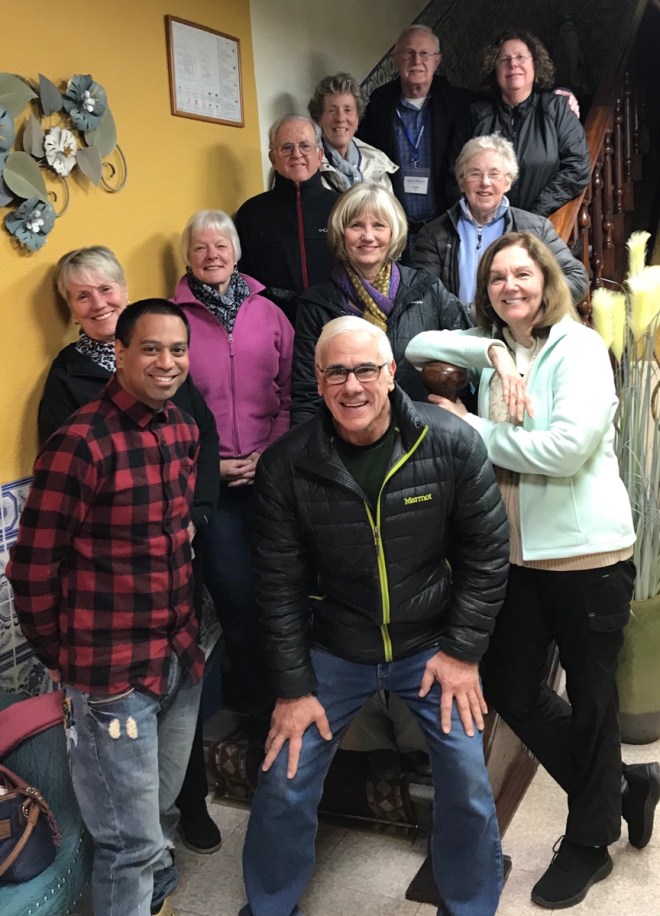
I’ve been asked many times about the kind of person who does a Global Volunteer project, so here’s a brief description of the 10 fantastic people with whom I’ve had the pleasure of working, complete with a visual.
Cisco (front row) is the first Australian Global Volunteer I’ve ever encountered. (He could possibly be the first Australian in Global Volunteer’s history). We all LOVE this extremely creative and talented guy. A graphic art designer by training, he has done so many other things, it is hard to believe he is only 31 years old. I suspect his Beja students are most impressed by his disc jockey experience, but I love hearing about the awards he won while working on a Disney cruise ship. He is “bloody ripper”. (Yes, Cisco is teaching me to speak Aussie).
Also in the front row is our fearless leader, Joe. It feels like EVERYBODY in Beja knows Joe. Coming here for ten years, leading two teams per year (February and September), Joe knows all of the assignments, and has done an amazing job matching us up so everyone is happy.
Joe has sampled just about every eating establishment in the area, so we are enjoying a wide variety of delicious cuisines.
Weekends are usually free time, however Joe very graciously organized a guided tour of Beja on Saturday morning, followed by an excursion to the Serpa cheese festival in the afternoon. Sunday we spent the day visiting the historic town of Evora.
My dear friend Jeanne is in row 2. Jeanne has decades of middle school experience, so she was paired with Heidi ( back row), who is a first time volunteer. Any trip with Jeanne is guaranteed to be fun. Her positive outlook on life is the gift that keeps on giving.
Next to Jeanne is Cindy, from Connecticut. She is a retired Spanish teacher, who has spent last week working in a variety of schools with Dale (last row, Heidi’s husband). Cindy has done a number of GV trips, and is returning to Queretaro, Mexico this October. For those of you who wonder if you could volunteer as a single woman, Cindy is your role model.
In my last post, I blogged about jamming a month’s worth of apparel into my carry on. But can I do better? What about just a backpack? What about just a backpack that was initially intended to accompany a carry on? Well, we shall find out, because Lufthansa lost my luggage. How could that be, you wonder? Isn’t the point of a carry on that you carry it on to the plane so that it is always close to you? Wonder no more, because I’m going to tell you.
When I learned that my connecting flight had been changed because of snow in Frankfurt, I envisioned several inches of wet slush. Jetways are not guaranteed in Frankfort. Sometimes you have to walk from the plane down steep metal stairs, to a bus that drives you to a door where you find yet more stairs, and if you are lucky, a working escalator. Carrying 26 pounds, plus backpack, through all that was not an appealing prospect. So, I checked said bag. But only to Frankfort. I’m no fool. What if the snow was so bad I was stuck overnight in Frankfort? I’d definitely want my jammies.
I was feeling pretty good about my decision as I walked down the stairs and onto the bus (yep, no jetway– but not much snow), but those feelings quickly evaporated as I watched bag after bag arrive. None of them being mine. How could you lose a bag that got on a plane in Newark, that landed in Frankfort? The list of life’s mysteries just got one item longer.
Here’s what immediately went through my jet lagged mind:
good thing I bought travel insurance
For once in my life, I have a complete record of everything my bag contained. Who knew blogging could be so very helpful?
Everything that is not easily replaced is in my backpack: my iPad, iPhone, chargers, camera, passport, money and charge cards
I’m so glad I only checked the bag through to Frankfort, because when Lufthansa changed my flight they put me on TAP Portugal. Can you imagine what a nightmare it might have been trying to figure out which airline was responsible for losing my bag? I know Lufthansa is responsible, and more importantly, so do they.
Let’s see how I do with this challenge. I only have the clothes that I am wearing and no toiletries. Snacks and a flight pillow aren’t all that helpful now, but the Motrin may come in handy.
Will my Amazon Prime work for deliveries in Portugal?
The line for customer service at Lufthansa was surprisingly short. When I asked the rep about the probability my bag would be found the same day, she said it was slim. So, since I was only going to be in Lisbon one night, I gave her the address of my hotel in Beja. She said they would call and email me with updates.
So what little pearls of wisdom can I share from my science experiment?
Lisbon has amazing malls, and the staff there actually HELP you, which was important in figuring out my size. I didn’t have the time or the energy to try things on. In Italy, I was saddened to learn only “molto grosso” fit; in Argentina, it was “muy grande”. In Lisbon, I was “medium”.
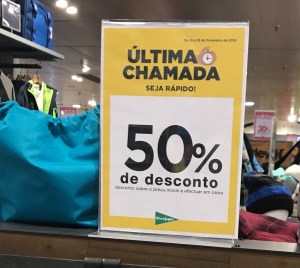
I didn’t need to know Portuguese to translate this sign. Bet you can figure it out too.
I CAN get by with one change of underwear, just not THIS one…
A tee shirt is still great for sleeping, just like in college
Next time, put an adapter in my backpack. Luckily, the mail had an electronics shop, but you can’t always count on that, plus they aren’t cheap – €20 or about $25 for a basic model.
My toiletry essentials are toothpaste (the hotel gave me a tiny tube but it tasted terrible), deodorant, a comb and brush
Shampoo works fine as laundry detergent
Although my underwear was perfectly dry by morning, my shirt was not. Wrapping it in a towel did NOT work. I tried the hair dryer, but it kept switching off after a few minutes. The front desk explained it was a “safety feature” to keep it from overheating. Good thing I kept the plastic bag from my shopping extravaganza for my damp shirt.
Not all hotels supply conditioner. It is wise to read labels so you don’t put body lotion in your hair
Conditioner DOES make a difference
In the future, avoid Frankfort airport. The gate for my flight to Lisbon changed THREE times.
Losing luggage caused my adrenaline to kick in. I was able to go without sleep for over 40 hours, then wake up completely jet lag free. Despite that happy side effect, I do NOT recommend you voluntarily replicate this experiment.
Bet you’re perched on the edge of your recliner, wondering how this saga ends? How long will our heroine have to wear the same corduroy pants and Keen sandals with socks? Are her air-cooled, memory foam Sketchers gone forever?
The good news? I got an email Saturday at 6 PM telling me the bag had arrived in Lisbon. The bad news? There was no way for me to get in touch with the courier to tell them to bring it to my Lisbon hotel. No phone number, no email address. The courier promised that EVENTUALLY it will make its way to Beja. I figure I can last a couple more days with what I have.
DRUM ROLL, PLEASE…
It’s ALL good. My bag arrived in Beja before I did. Not only that, but it was waiting for me in my room, so I didn’t have to carry it up a flight of stairs in this elevator deprived hotel.
Lufthansa has not mentioned any compensation for delayed baggage, however I have saved my receipts, and so far, they owe me €99.90, or about $125. Travel Insurance would cover up to $100, but I’m going to call Lufthansa customer service to inquire where I should send my receipts and how long before I’m reimbursed.
Packing is one of my biggest travel challenges. I always intend to travel light, but sometimes I get carried away at the last minute.
I’ve been able to go for two weeks with just a carry on. But a month? Can I get everything I will need into my trusty eagle creek carry on and my backpack? I’m going to try. I hope others find my attempt helpful. If not, at least this post will allow ME to remember what the heck I stuck in my bag.
For the past couple of weeks, I’ve been “auditioning” my clothes to see whether they dry quickly, are versatile enough for weather that will vary between the 40’s and 70’s and, most importantly, can be crammed into my bag. I’ve tried out different combinations to see how comfortable I am at NJ’s current cooler temperatures. My discovery is that lightweight pants, when paired with silk long underwear work out just fine.
For past trips, I have either used local laundry facilities or I packed enough to get me through the entire trip.
In Pokhara, Nepal, doing the laundry was a cultural experience. The promised “tumble dry” only works if the government doesn’t shut off the electricity for several hours every day. Bet you know what happened while I was there.
THIS time, my plan is to wash as I go. I don’t normally hand wash clothes at home, so I gave it a whirl. I wanted to see how long it took for different items to dry, and I was also curious as to how my duds would look after I had sloshed and wrung them out. The verdict: I figured my technique needed a little work. Then I remembered a tip from a fellow traveler. She nixed the wringing, instead opting to gently squeeze, then wrap her garments in a microfiber towel. She swore her clothes were dry by the next morning. So, I ordered a microfiber towel from Amazon and gave it a try. My technique still needs work.
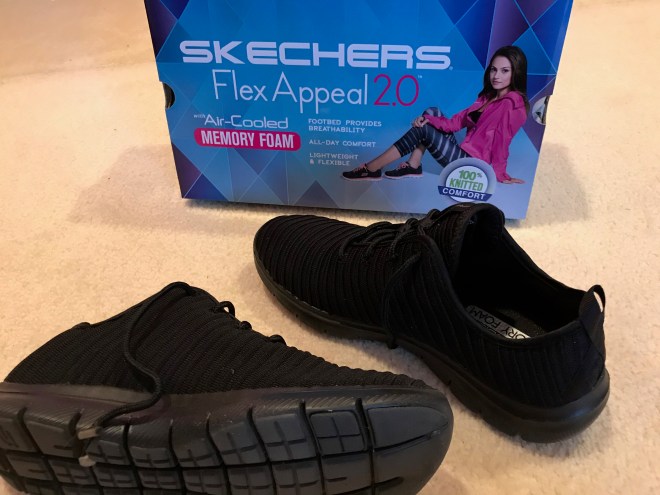
Because I expect to do a lot of walking, I wanted to make sure that I had comfortable shoes. I found a pair of Sketchers that should do the trick. Air cooled? Memory foam? My feet may be in better shape than my head.
I have super sensitive feet, so I am reluctant to put all my toes into one basket–or one pair of shoes– so I’ll be wearing my trusty Keens on the plane. Yes, I WILL wear those Keen sandals with a pair of socks, and YES, I DO know that is a huge fashion faux pas, but hey I’m old enough not to care.
Here’s how I started out:
Then I had to make some choices. One white knit top and pink bathing suit – out. (I found another bathing suit that squishes up smaller) Hanging toiletries bag, replaced by a zip lock bag, which also freed up space for my hair dryer and adaptors.
There are those that swear by rolling clothes, so I thought I’d give it a try. Some might think I am REALLY obsessive compulsive, to take everything out, and try to put it all back without rolling. Others would realize that I am completely committed to the scientific method. YOU can pick whichever explanation you prefer, but I’m going with the latter.
Want to know the result of my “science” project? Both methods produced the exact same result. Conclusion? Do whatever brings you joy. I wasn’t going to take everything out and roll it up again. I’m not THAT crazy, so I left everything packed flat. Here’s what made it into the bag.
6 long pants – 1 corduroy, 1 jeans, 4 quick drying (one lined, three lightweight)
6 long sleeved cotton tops. 1 knit, plus 2 short sleeve shirts
1 pajamas and 1 long underwear set that can double as pajamas
2 long underwear bottoms and 7 underwear, 2 bras, 8 socks
2 scarves
hair dryer (which I can use to dry clothes, if needed) and toiletries
laundry kit
1 Sketchers black air cooled shoes, with memory foam and flip flops for shower (or if I’m lucky, pool)
index cards (for teaching). According to our team leader, former volunteers have left supplies behind, so i don’t need to bring a white board or other teaching materials.
1 waterproof windbreaker with hood
Plus, of course, I’ll have the clothes I wear on the plane, like my fleece and the zip up sweater that would have fit in the bag if I had unzipped the expandable part. (But then, it might have been hard to get the bag into the overhead.)
My back pack will carry my money, credit cards, passport, travel info, iPhone, iPad, chargers, my mobile “pharmacy”, camera, , pens, snacks, sun glasses, water bottle and travel pillow.
Total weight of carry on–26.5 pounds, something I can easily hoist into that overhead bin. I think I’m all set. We shall see.
One month from today, I’ll be heading off for my sixth Global Volunteer Experience. Timing is everything in life, and given recent political events, some think it is not the best time to go traipsing around other parts of the globe. My opinion differs. What better time to do something positive, to at least try to improve America’s image in other parts of the world, than now?
For those of you new to Global Volunteers, here’s a little background. We go where we are invited, and do whatever we are asked to do, working closely with members of the host community. We don’t proselytize — we have no political or religious agenda, other than to make friends and learn about a culture different from our own. The only stated goal is to “wage peace and promote justice”. I love that.
So far, I’ve worked in a preschool in Anse La Reye, St. Lucia, elementary schools in Hanoi, Vietnam and Rarotonga, Cook Islands and twice at a technical college in Queretaro, Mexico.
So, where to this time, you ask? Beja, Portugal, in the Alentejo region. Never heard of it? Neither had I until I signed up. And that’s one more thing to like about Global Volunteers: you get to live in areas you might never have thought of visiting.
Another Global Volunteer plus is the wonderful friendships that you make. This trip will be a mini-reunion for three of us that served on my very first project in St Lucia.
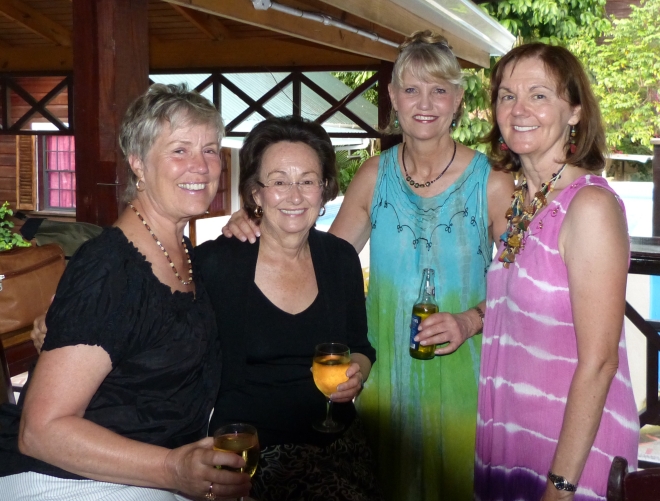
Jeanne, Norina, Laurie and I in the bar at JJ’s Paradise Hotel, on our last evening in St. Lucia. I will be joining Jeanne and Laurie in Beja.
Not only that, but during our stay, we will be celebrating the 10th anniversary of the start of GV’s Portugal project. Seems like perfect timing to me!
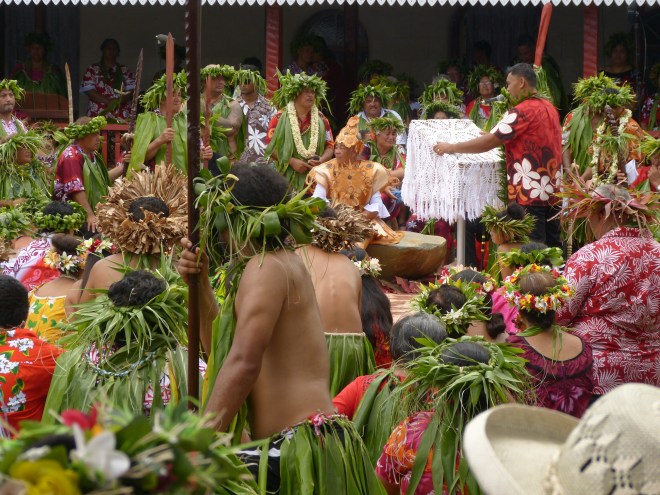
And that was the case for two of my other projects. In November of 2013, I was in Rarotonga when their new Queen was crowned. What a fantastic experience THAT was–the music, the food, the costumes–how lucky was I to be able to share this joyous celebration with the most gracious, friendly people on the planet!
The Queen is the one in gold
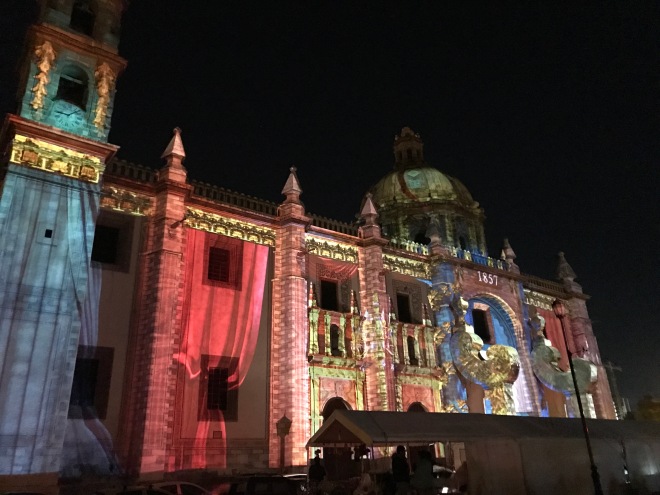
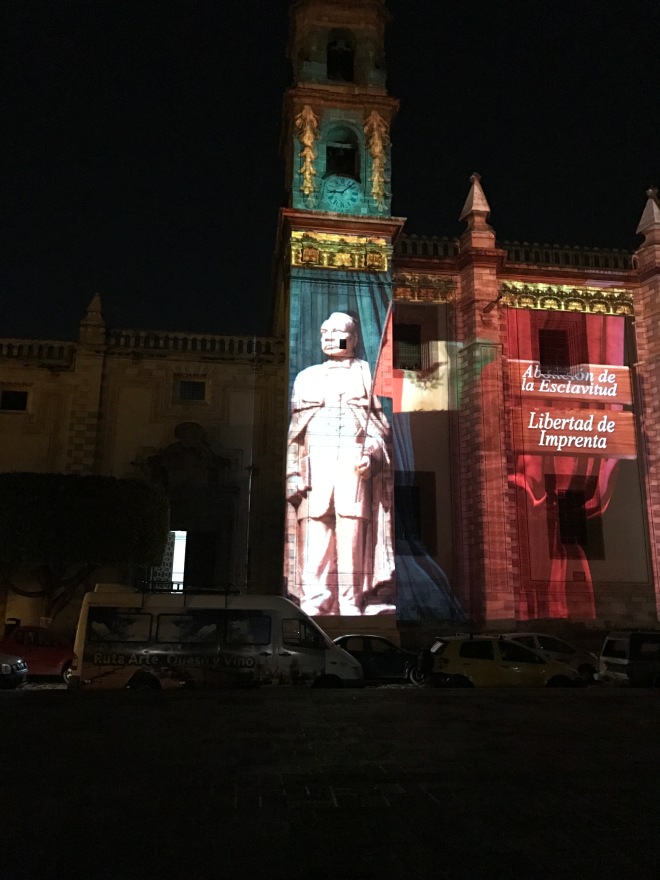
Jeanne and I lucked out in February, 2017, by being in Queretaro for 100th Anniversary of the signing of their constitution.
Queretaro was the actual site for this historical event, so there were all kinds of special celebrations. How cool is it to use the side of a centuries old cathedral as a screen for an outdoor multi media show? We liked it so much, we saw the show twice. These photos don’t do the display justice. Let me just say it was really, really wonderful.
If that wasn’t enough, another evening got to hear this stirring rendition of Elvis Presley’s “Wooden Heart” played on bagpipes, in Mexico!! Here’s a little bit of the sound track for your viewing pleasure. Irresistible, no?
So, who knows what awaits us in Beja?
I hope you will check back next month and join me, Laurie and Jeanne for a virtual Global Volunteers adventure. Adeus e obrigado!
I had started writing about Napa and Sonoma while visiting there in August. I got distracted (which is not uncommon for me) and completely forgot about this post, leaving it to languish in my drafts folder until now.
Since then, fire has destroyed parts of some of the areas we had visited. Sadly, right now, southern California is also burning.
According to this Forbes article, the percentage of wineries damaged fortunately was low. So, time to publish this lost post to remind everyone of the glories of California wine country. Please visit, and bring your tourist dollars to an area that needs our support. You’ll have fun doing so–as we did last August.
My “lost post” follows:
It has become abundantly clear that our one and only offspring has become a Californian. As with everything in life, there is an upside to having our son three time zones away. We now have yet another reason to visit the greater San Francisco area.
So here’s the sad truth. My memory is definitely NOT what It used to be. I realized that I have been using my WordPress Posts as my memory bank, helping me to figure out where I was and when. Unfortunately, I neglected to post about our past California winery trips–and was dismayed to discover that I couldn’t remember which ones we visited, and which ones were favorites, worthy of a return trip. SO, this post is designed to correct that shortcoming. If it is helpful to others that plan to visit wine country and the greater San Francisco area, so much the better. It’s my way of giving back to all the generous bloggers and posters who offer travel tips, answer my questions on forums, share information on Trip Advisor. Thank you!
Let’s start with the airport. Whether you are renting a car, or taking mass transit, you will take the terminal’s elevator to the third floor, follow the signs for the skybridge and hop on the blue Sky Train. That same train will take you to the BART and Caltrain, if you opt for that mode of transportation. Last time, we took the BART. As I vaguely recall, it was relatively easy to use the machines to buy tickets. (Next time, I’ll pay attention and post about it.) THIS time, we were heading to Santa Rosa, so we rented a car. All of the rental car desks are at the same BART stop.
Note to self: Next time we rent a car, be sure to pre-register for the express option (or whatever the car company calls it). We cooled our heels for about an hour waiting in line for our Budget rental. Ah, the things you forget when you haven’t had an assistant arranging your business travel in almost six years!
For lodging, we did a mix of hotel and vacation rental. In the past, I only used VRBO, and was very pleased with our selections. This time, inspired by Janis over at Retirementally Challenged we decided to try AirBNB. I had had the mistaken impression that with AirBNB you rented rooms in people’s houses. In the past, the rentals I viewed had fewer photos than the rentals on VRBO. As with most things in life, it is good to update your perceptions every now and then. We were delighted with this beautiful little house in Santa Rosa.
For about $300 a night, we had a “serene, centrally located 1500 square foot” 2 bedroom, 2 bath house in a nice neighborhood in Santa Rosa, within walking distance of a few restaurants, a good wine store (that sold killer chocolate truffles) and close enough to the county fair grounds that you could sit outside and listen to the evening concerts, if you were so inclined. We LOVED it!
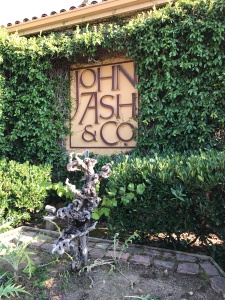
Santa Rosa has more than its fair share of great restaurants. Our first night, before our son joined us, we dined at John Ash & Co.
Parkside Cafe
The setting was lovely, with lots of windows, overlooking gorgeous gardens. The food and wine were good, but was it worth $250 for 2 appetizers, 2 entrees, one desert and one bottle of not expensive wine? The answer is a resounding “NO”! Good thing our son wasn’t with us. We would have blown our entire travel budget on that meal alone. Fortunately, much better values were awaiting us.
Both the Parkside Cafe and Two Spinsters offered wonderful breakfasts. We thoroughly enjoyed our lunch at LoCoco’s Cucina Rustica in downtown Santa Rosa. But MY very favorite meal was at Francis Ford Coppola’s restaurant, Rustica, in Geyersville. (The Californians sure do like the name “Rustica”, don’t they?)
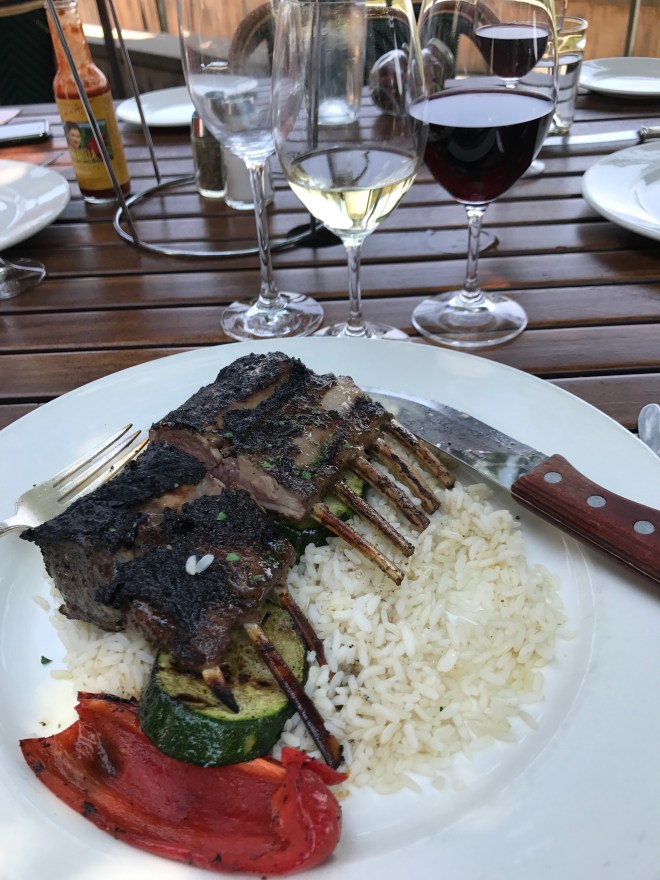
I opted for the Menu Di Stagione, which was 4 courses with paired wines for $69 (plus tax and tip). What a feast! I started with gazpacho, followed by caesar salad, then this delicious rack of lamb, ending with chocolate mouse.
as you can see from the glasses, I was having a hard time keeping up with the wine pairings
According to the menu, each course was accompanied by 3 oz. wine pairings, but my perception was those were very generous 3 ounces. The only mistake we made was doing a wine tasting BEFORE lunch. To say I was happy by the time the chocolate mousse rolled around, would have been an understatement.
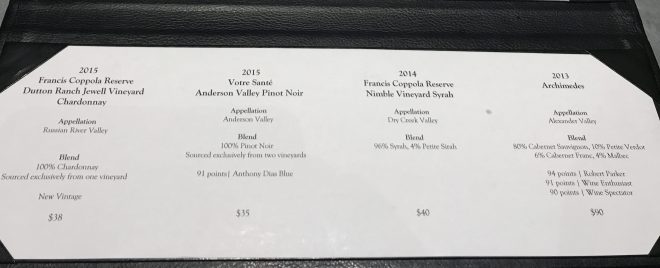
We had never spent $90 for a bottle of wine, and after tasting this expensive stuff, I’ve concluded we aren’t missing much.
It was fun seeing the movie memorabilia. In addition to photos, posters and other props, you can get up close and personal with the godfather’s desk. Well, not too close. You aren’t allowed to sit in his chair and put your feet on the desk. Don’t ask how I know that.
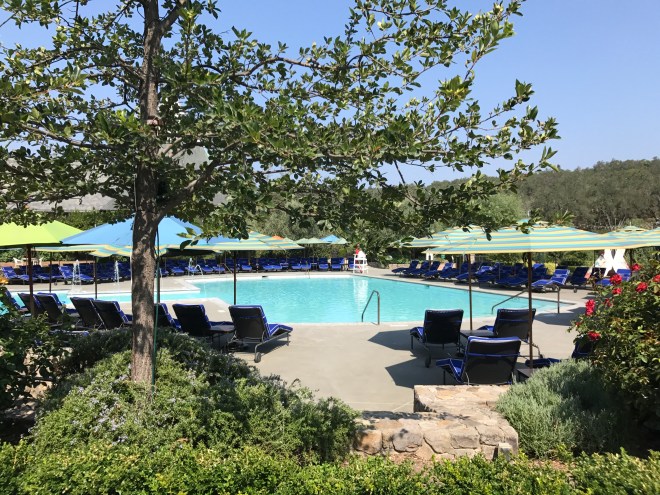
The winery grounds are absolutely beautiful. If you want, you can make a day of it, by renting a cabana and hanging out by the pool. If you plan on swimming, it might be an excellent idea to wait till later for the wine tasting.
This is definitely a winery I’d visit again. I’d just skip the tasting and go directly to lunch or dinner. Speaking of dinner, after our huge lunch, we were all satisfied with a snack that night.
Our other favorite winery was actually one we had visited before. I recognized it as soon as we arrived there. Beringers has a fantastic tour of its winery.
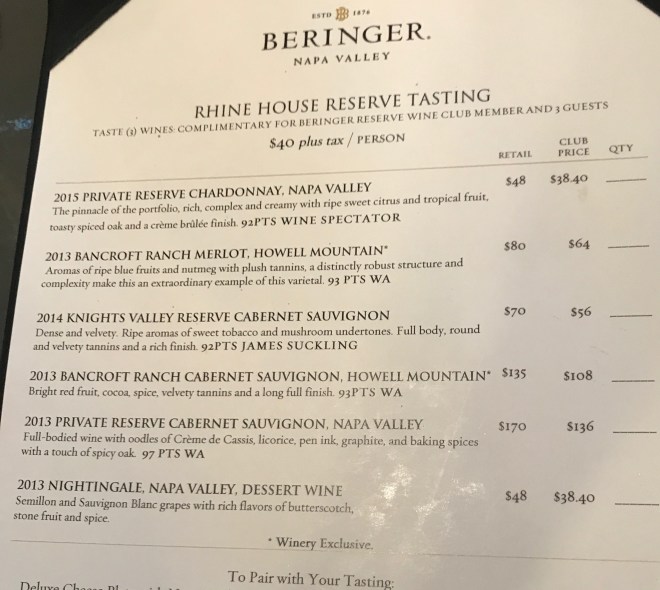
We took it years ago and greatly enjoyed the experience. THIS time, we just went for the tasting. What we learned: If you are a member of their wine club, (our son is) the “basic” wine tasting is free for up to four people.
Sadly, this tasting proved beyond a shadow of a doubt that I am indeed a peasant. Can I tell the difference between $70 and $170 bottles of Cabernet Sauvignon? I cannot. I can’t even tell the difference between their $48 bottle of wine and the $10 bottles we normally consume.
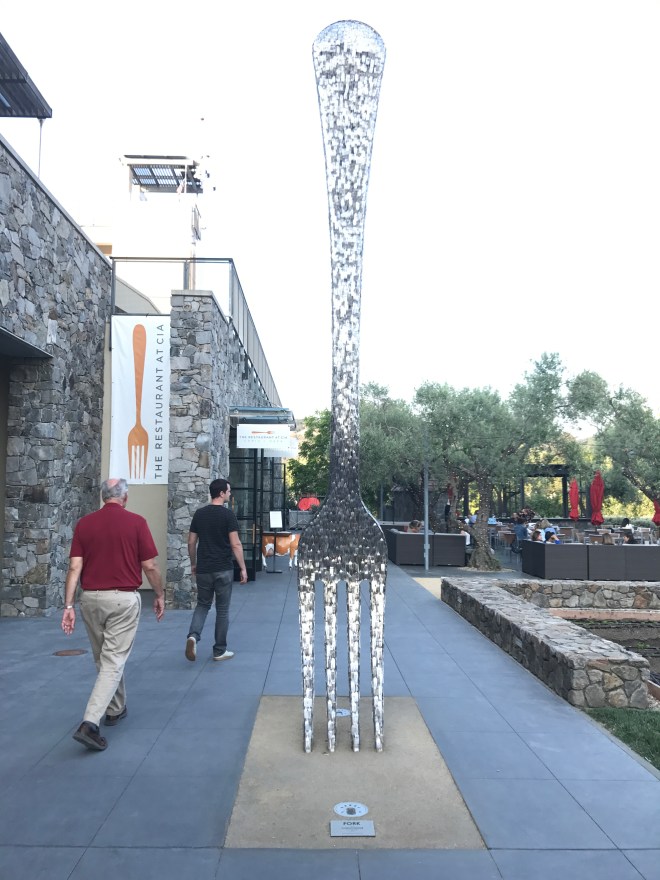
For our final evening, we switched from our airBNB to a hotel. The River Terrace Inn, as the name suggests, is right on the river that runs through Napa. It is ideally located–you can stroll along the path that hugs the river to the nearby CIA, where we feasted on a wonderful, and inexpensive dinner. (That’s Culinary Institute of America, not the spy organization–although their food is probably delicious too.)
Yes, that big fork is made up of thousands of little forks!
Also nearby is Oxbow Public Market, site of the Kitchen Door Restaurant, which makes the most amazing mushroom soup on this planet. That soup alone would justify a trip to Napa.
We didn’t make it to Mike’s favorite restaurant, the Rutherford Grill (in Rutherford, of course), but there’s always next time. I hope there’s a next time (or a first time) in wine country for you too.
Our family is like a little solar system. At our center is our sun, my sister Sue, radiating warmth and love that sustains her six siblings, who, like planets, revolve around her. Although she never had children of her own, she is a second mom (and now grand-mom) to satellite nieces, nephews, cousins’ and friends’ children.
Although four of the seven “kids” have moved away, Sue, our sister Sandy and brother Tom have all lived in the same area their entire lives, accumulating a glorious galaxy of friends. (See how you think after being married to an astronomer for four decades?)
Recently, Tom’s daughter gave birth to premature twins. Sadly, one died shortly after birth, but thanks to the wonderful medical team in Providence, his twin has grown from 1 pound 6 ounces to just under 4 pounds.
Modern medicine is truly amazing; it is also really, really expensive. Even with insurance, the high deductible, coinsurance, and uncovered expenses all equate to huge bills, as any parent with a sick child can attest. So, Sue decided to gather the troops to create a benefit dinner– “Pasta with a Purpose”.
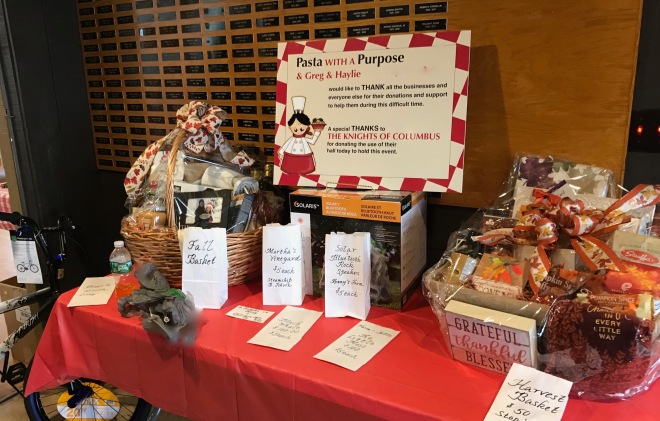
Just a small sample of the raffle items
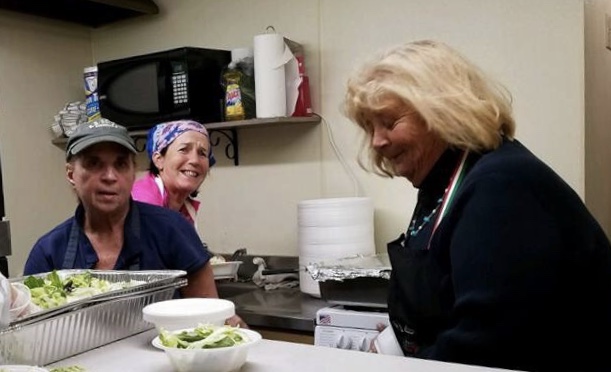
Fortunately, Sue has a talent for choosing loyal and giving friends, that are just like her. Sheila, an elementary school buddy, has worked in the restaurant business for years, and like our brother Tom, is an amazing chef. Who expects benefit food to be good? It was at THIS benefit, thanks to a team of cooks.
But the real stroke of genius was making friends with Debbie, who like other elementary school teachers, is a force to be reckoned with. Teachers know how to create something out of nothing, how to get the unruly to behave and how to keep calm in the midst of chaos, and how to make great displays. Let’s hear it for the teachers!
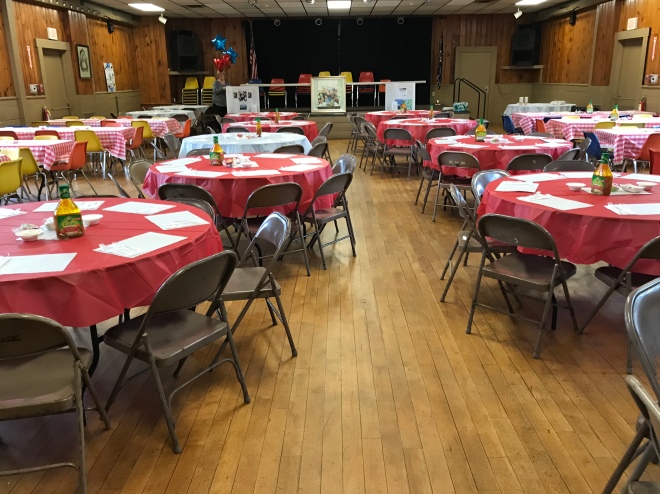
Within three weeks, family and friends had secured the Knights of Columbus hall,
The “elves” worked hard to get this all set up and orgnized
gotten food and raffle donations,
As the evening progressed, donations kept coming in– we were running out of space!
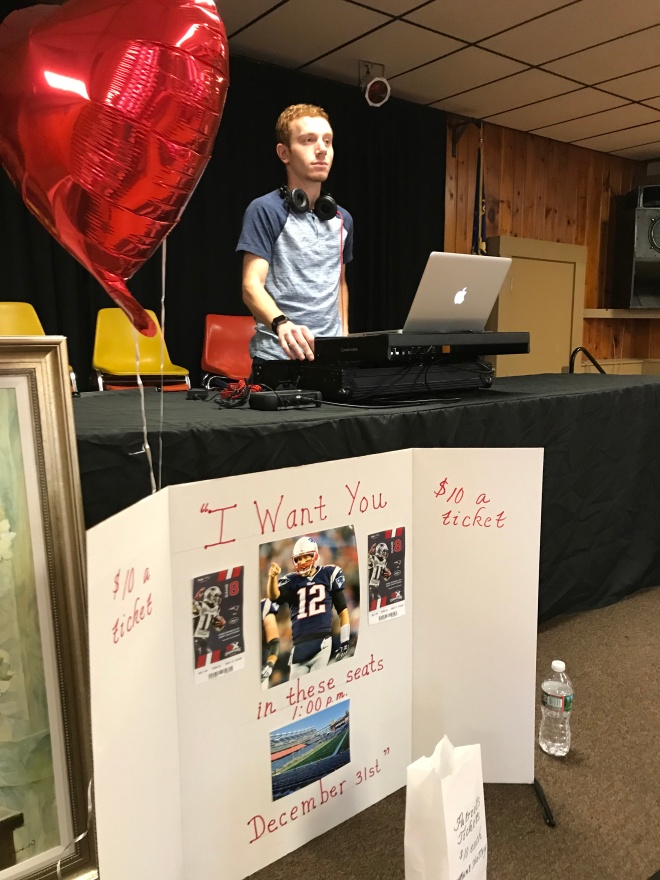
found a DJ,
sold hundreds of tickets, enlisted student volunteers to serve food,
These kids were “on it”, serving, clearing, and setting up for the next round of diners
and taken care of the hundreds of tiny details necessary to make the event a success.
And what a success it was! All to help this little guy and his loving parents.
With so much negativity and violence these days, it is heartening to see how people can come together to support each other in time of need.
Our family includes the normal mix of in-laws, out-laws, and sheep of all colors. If you were to chart us — along economic, political, and religious lines, you’d find someone on just about any point in the spectrum. But when it comes to things that really matter, that all gets put aside. It is family and friends, all the way.
So in addition to paying tribute to my amazing sister, Sue, this is a huge thank you to all you small town inhabitants with big hearts, who came out on November 5th to show the love for Haylie, Greg and Baby Spencer. Forgive me for not mentioning or photographing all of you who did so much to make the day so special. You know who you are, and so do we.
Could this be the start of another lifelong friendship?












 Two more days in Spain, three in Portugal, and then we are back to the USA.



 This sculpture is controversial. It reminds me of trees. What do YOU see?]