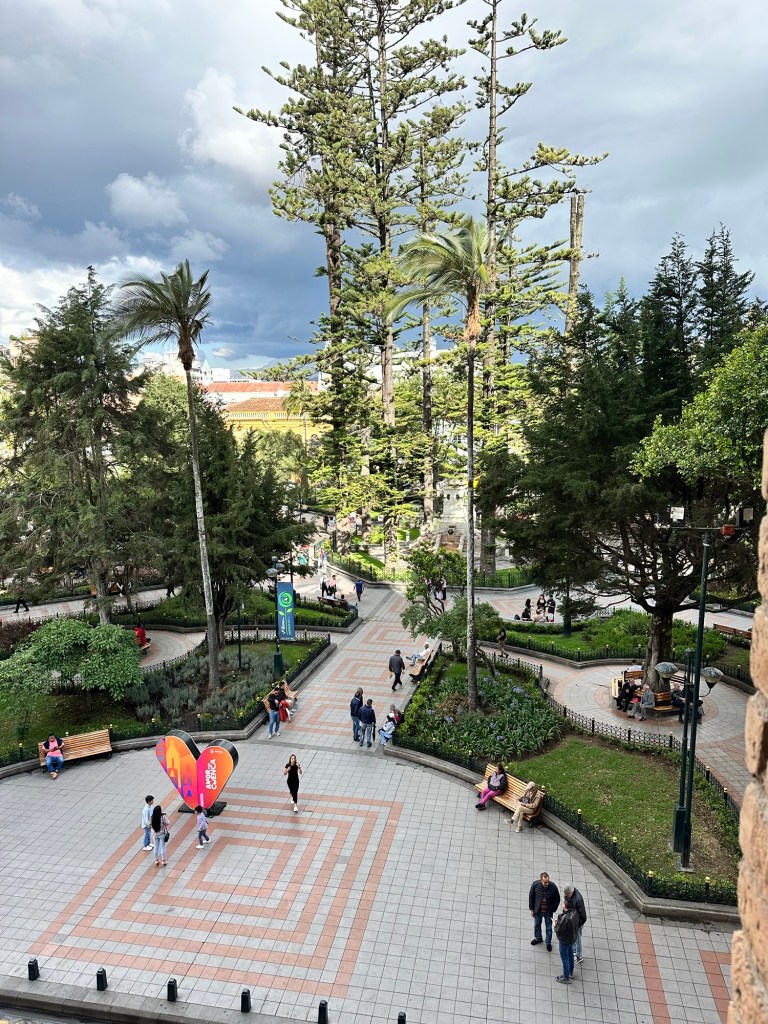
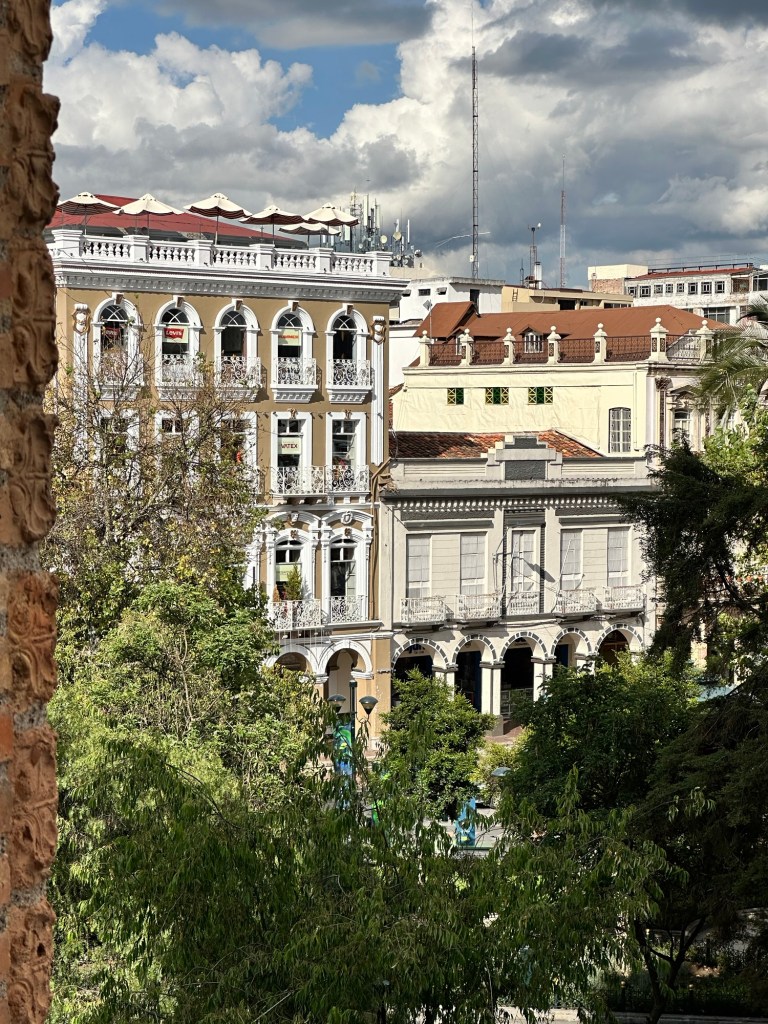
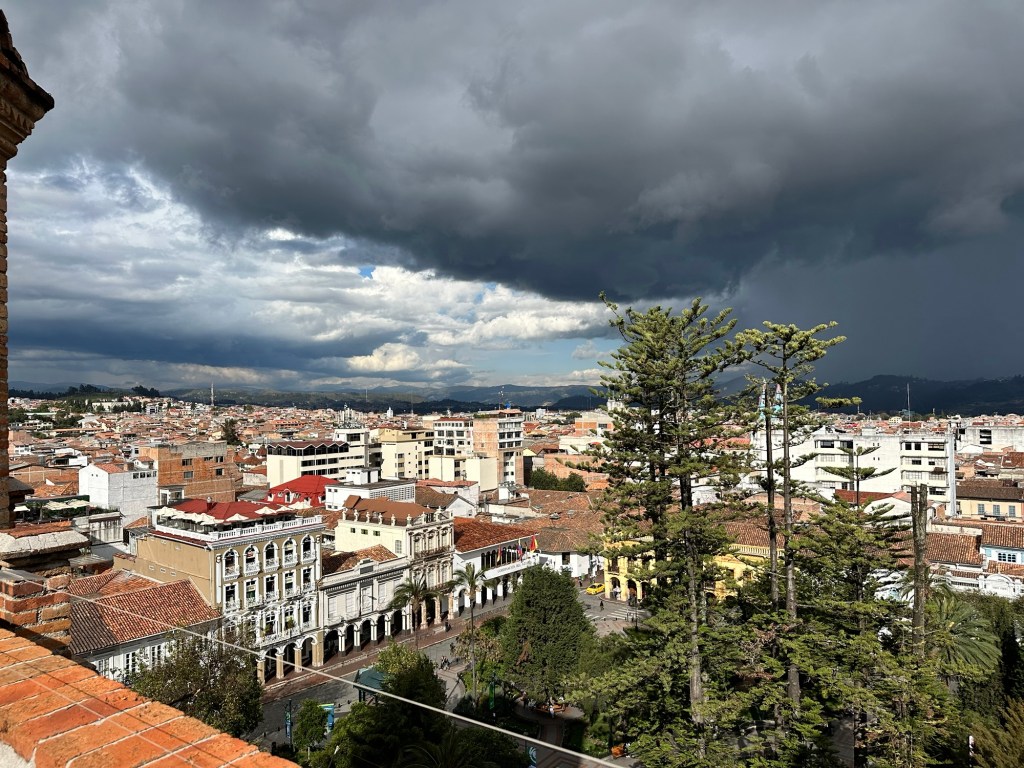
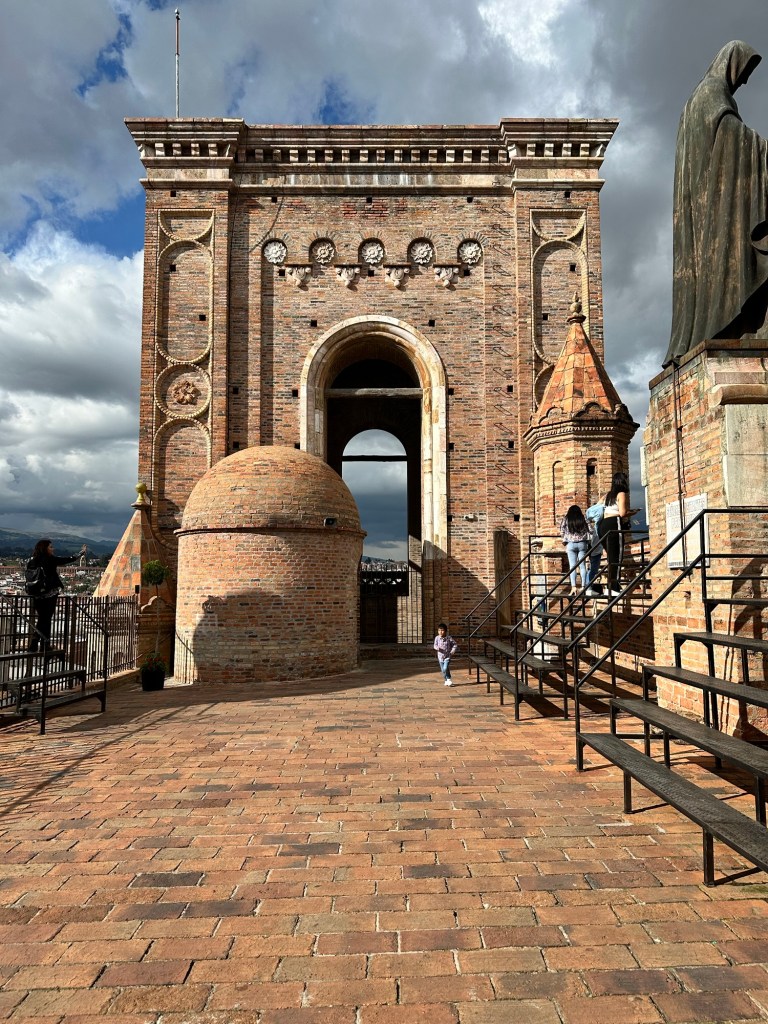
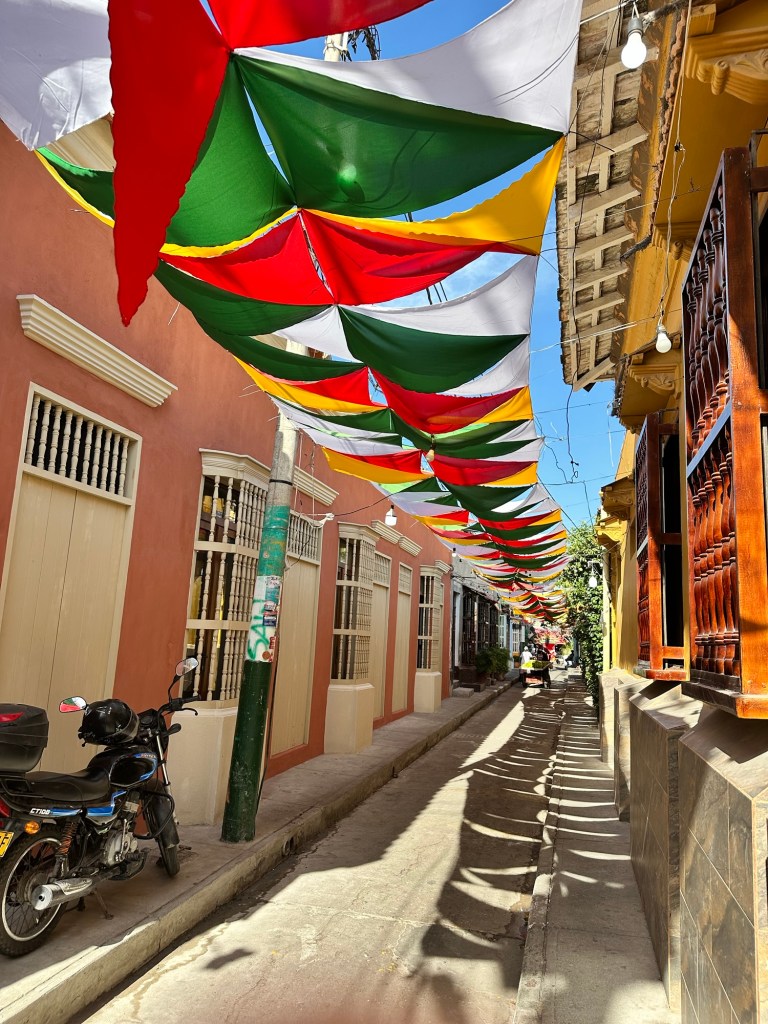
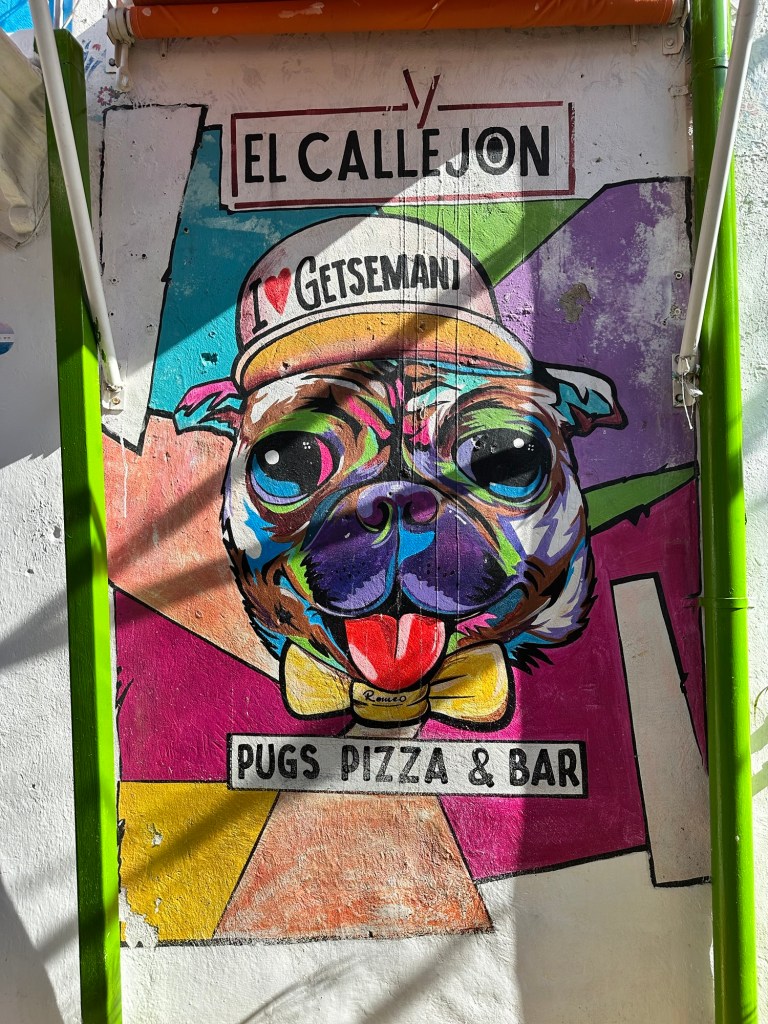
If you like history, nature, handicrafts, museums, architecture, great restaurants, quaint coffee shops and shopping all within walking distance — come to Cuenca, because it has it all! Initially, I thought I could do one post for our three days in Cuenca, but I have since realized that’s impossible. So here’s episode one.
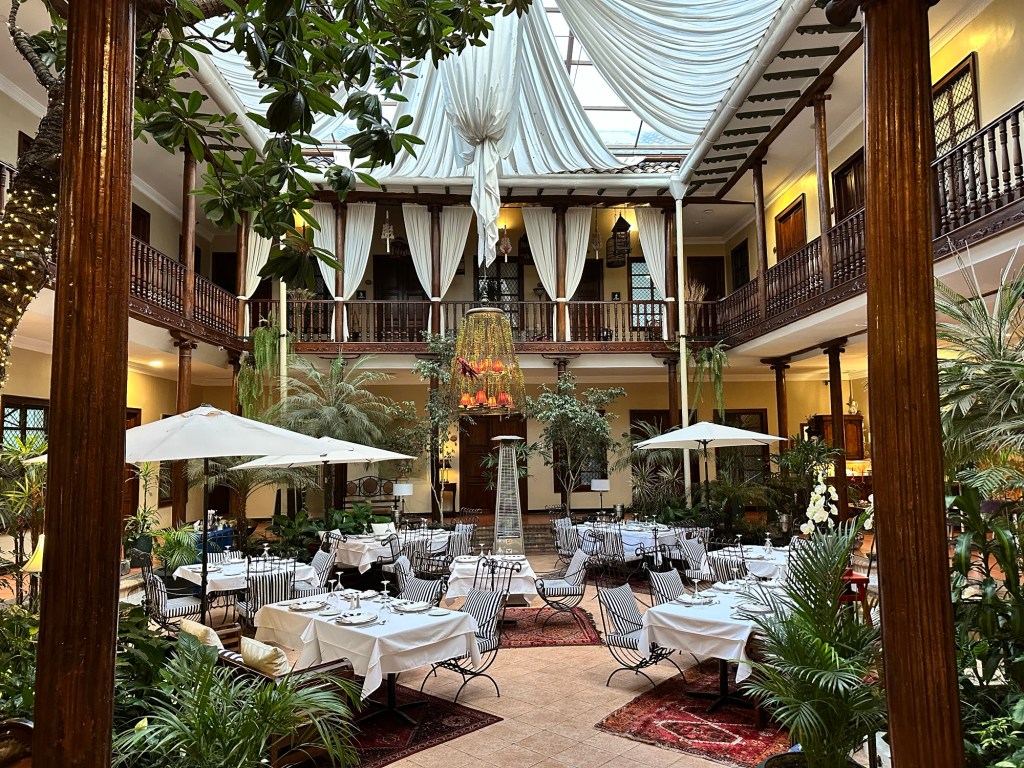
As usual, OAT has us staying in a strategically located boutique hotel. Once a private home for a large family, all the rooms are clustered around a central courtyard, which is now the reception area and restaurant.
Because this area was declared a world heritage site in 1999, the buildings have all been preserved, but many have been converted into hotels, restaurants, and shops.
One woman decided to rent her home, complete with all its furnishings; it is now a restaurant.
Before dinner, Lorena took us on a quick tour. What made this especially interesting was knowing this was how the former owner lived! Take a look at the opulence of just two of her rooms.
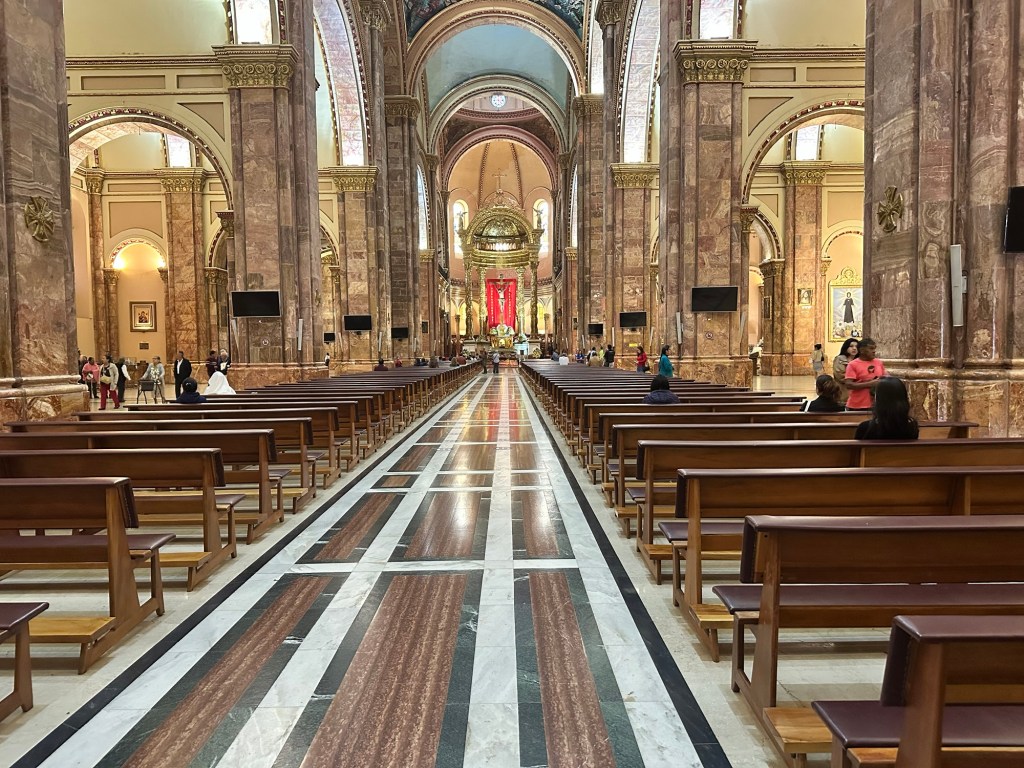
On our first morning in Cuenca, we enjoyed a walking tour of the city. Of course, the cathedral occupies a prominent spot on the main square. As you have probably guessed, the header of this post is a photo I took of the cathedral at night from the Negroni Restaurant.
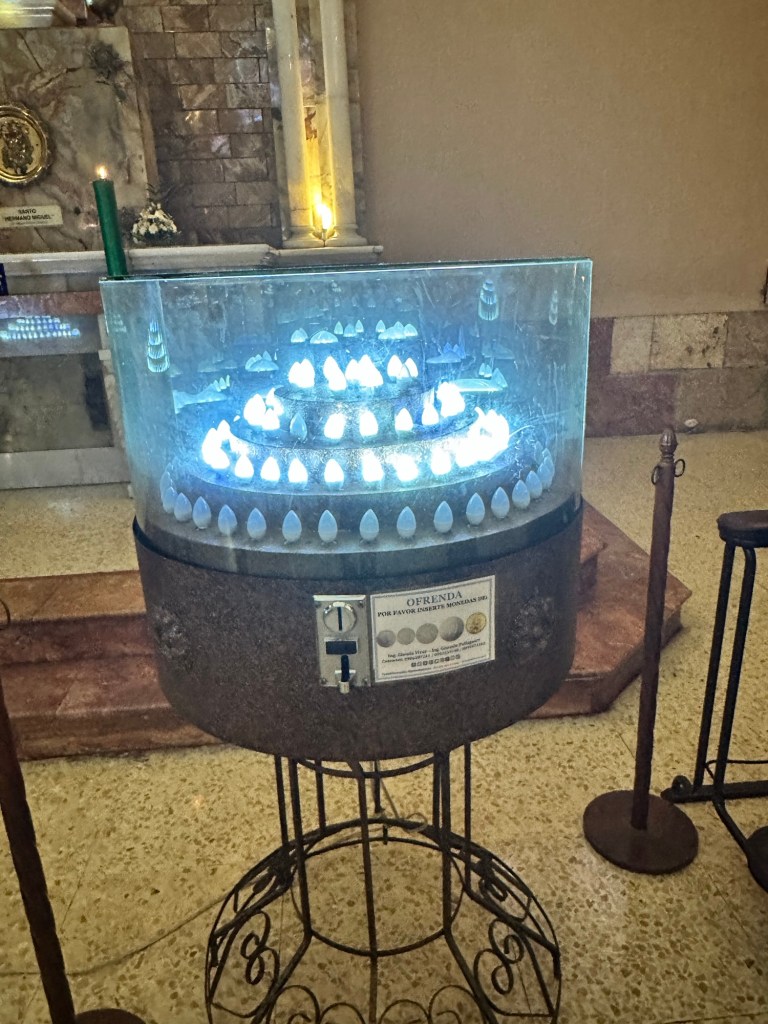
My friend Jeanne always lights a candle for her husband whenever she visits a church, so I decided to light one for both our husbands. See that bottom row? My $1 coin lit that ENTIRE row of electric candles—sufficient to cover ALL the loved ones we both recently lost!
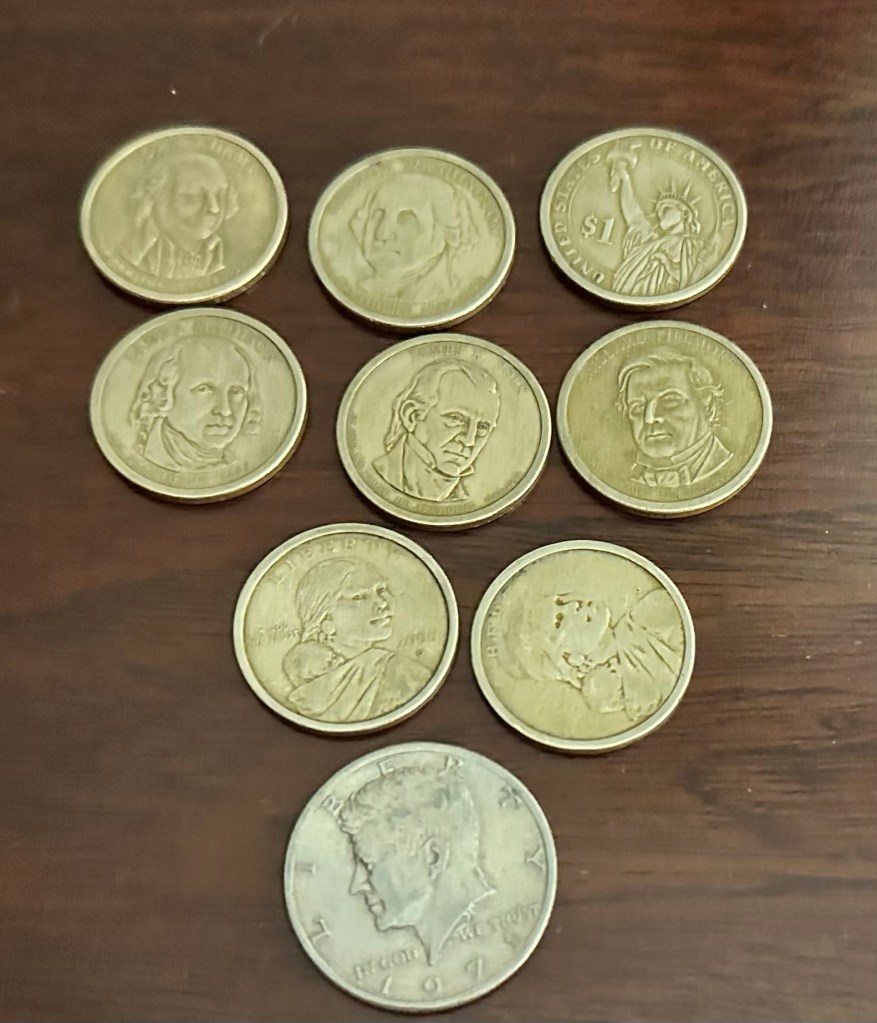
And yes, you read that last line right. I deposited a $1 US COIN. No longer will you lie awake at night wondering “whatever happened to all those $1.00 coins the US minted years ago that Americans refused to use”? We exported them to Ecuador, and from the worn looks of them, they are widely used.
During our walking tour, Lorena pointed out the entrance to the cathedral tower, so naturally, during our free time, I spent the $1.50 admission fee and climbed to the top. You can get a decent view of the square from the first landing.
Take a look at the umbrellas atop the building in the next photo. That’s Negroni Restaurant—it has great food, but it’s a bit of a challenge to find. Eric, Gail and I had dinner there on our “free” night. It took us a while to figure out you had to enter a clothing store, walk to the revealing women’s tops section, which is where the elevator hides out, then ride to the top floor.
I climbed all 162 of the tower’s spiraled stairs. My reward? This panoramic view of the surrounding area.
I pretended I couldn’t understand Spanish, so I ignored the sign that said “for your safety, seniors keep off” and claimed right up those metal bleachers.
SOME people might have noticed those menacing storm clouds, but my family won’t be surprised to learn I wasn’t one of them. Did I seek shelter? Go back to the hotel to get my umbrella or raincoat? I think we all know the answer to that.
Instead, I decided to support the local economy by buying gifts for friends and family.
So far, we had been unbelievably lucky with the weather. Up until Cuenca, the two times the heavens opened, we had been on the bus, and by the time we arrived at our destination, the sun was shining brightly. Not this time. I got SOAKED!
Cuenca gets most of its electricity from hydroelectric power, so last year’s drought had a severe impact on the city. When it rains, people here rejoice. So, of course I rejoiced along with them.
We have a flight tonight, so the next episode of Cuenca will probably be written at the airport…
I first visited Cartagena in 2010, when Mike, Greg and I took an Oceania cruise through the Panama Canal. I was immediately charmed by this fascinating city, and became determined to return to Cartagena and to explore more of Colombia.
For most of the ports, we opted to go off on our own, rather than take a cruise sponsored tour. That was the case in Cartagena, where we were able to cover most of the high points in the old city, during our too brief time in port.
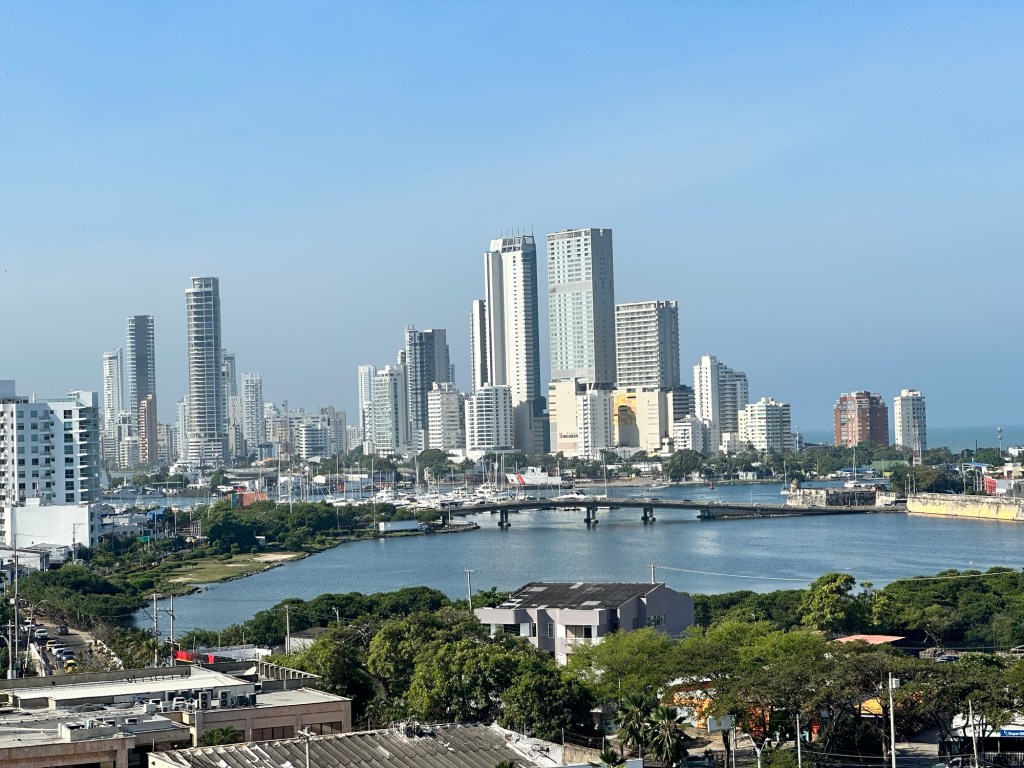
Here is what the “new” section of Cartagena looked like in 2010.
Fast forward to 2025. Both photos were taken from the enormous fort the Spaniards built to protect the area from pirates. Can you tell which photo was taken with a camera, and which was taken with my iPhone?
It is possible to travel from the top of the fort to the bottom through narrow, low tunnels. When we visited in 2010, we attempted to do just that, but as we approached the exit, our guide discovered it was flooded, so we had to walk ALL the way back to the top. Poor Mike was unable to stand upright!
I know many people have strong opinions about cruises versus land travel. It was interesting to experience both in the same city. Although vastly different, I discovered I thoroughly enjoyed both, but for very different reasons. As with everything in life, both travel modes have advantages.
When we cruised, we always opted for a smaller ship, chosen for its fabulous itinerary. Cruising allowed us to unpack once, travel while we slept and awaken someplace great every single day. It provided us with a taste of many different areas, so we could determine which country we might want to explore in more depth in the future. And, if you happened to get sick, or have an accident, the ship had a fully equipped medical center on board. But your time in port is limited; you normally have to be back aboard the ship around 5PM, unless you chose a cruise that spent more than one night in a particular port. And there ain’t many of those.
For the OAT land trip, we spent three nights in Cartagena, which allowed us to slow down and savor our time there . We saw SOME of the areas we visited on our whirlwind day in 2010, like the former convent of the Sisters of the Poor Clares, but instead of just driving by it, Leslie ( another new friend) and I went to the bar to watch the sunset.
Those of you who read my pre-trip post may recall the special drinks and the tours of the former convent described on the hotel’s website. Well, although getting lost while searching for the rooftop bar allowed us to see a whole lot of the convent, it certainly didn’t qualify as a tour (they don’t give them any more), and although my pisco sour was delicious, it didn’t have what the website called “magical” properties.
What the rooftop bar DID have was a DJ, and lots of young people, staring at their phones.
So, we took our sunset photos, admired the view, and that pisco sour? It was consumed in a quiet, “historical” bar on the first floor.
The view of the ocean, and the only spot at the bar from which you can see the sunset.
Remember the popular image of Colombia as a dangerous place? Well, Leslie and I were perfectly comfortable walking the streets at night and when he noticed we were hopelessly lost, this sweet young Colombian approached us, offered help and walked us back to our hotel.
This was a very common experience: a waitress chased me down the street because I had left my hat in the restaurant, street vendors accepted your “no, gracias” when they approached you, but then engaged you in conversation so they could practice speaking English. Everyone we encountered was friendly, gracious and oh so welcoming.
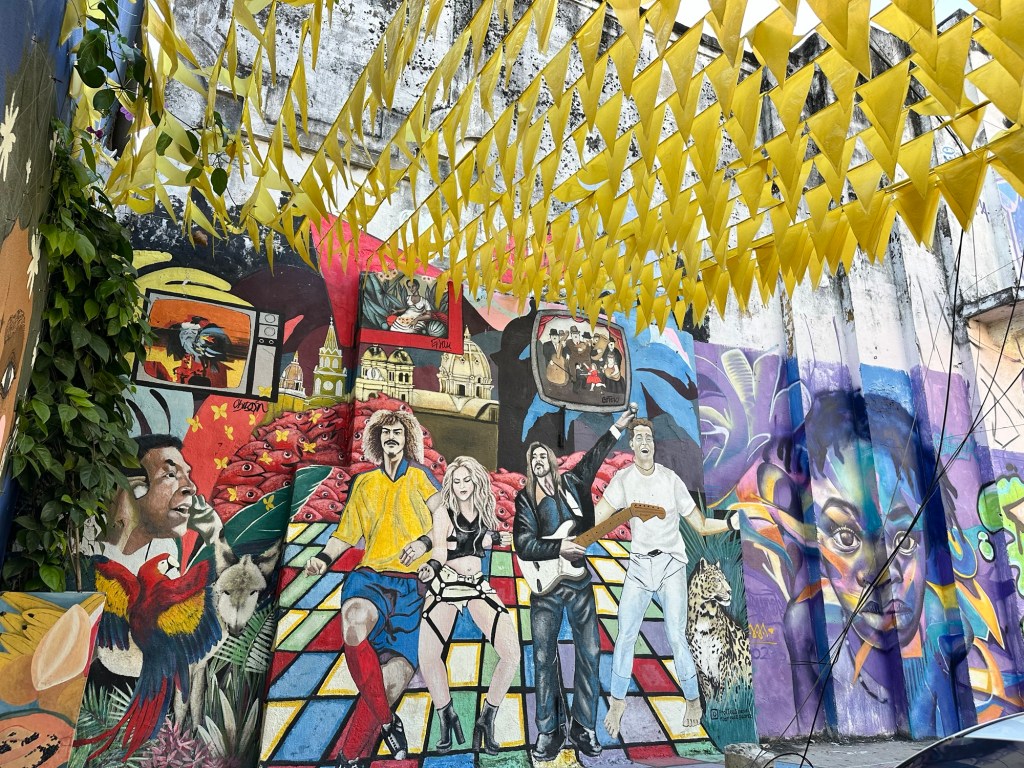
As you have seen in my earlier posts, the streets of Colombia are very colorful , and Cartagena is no exception.
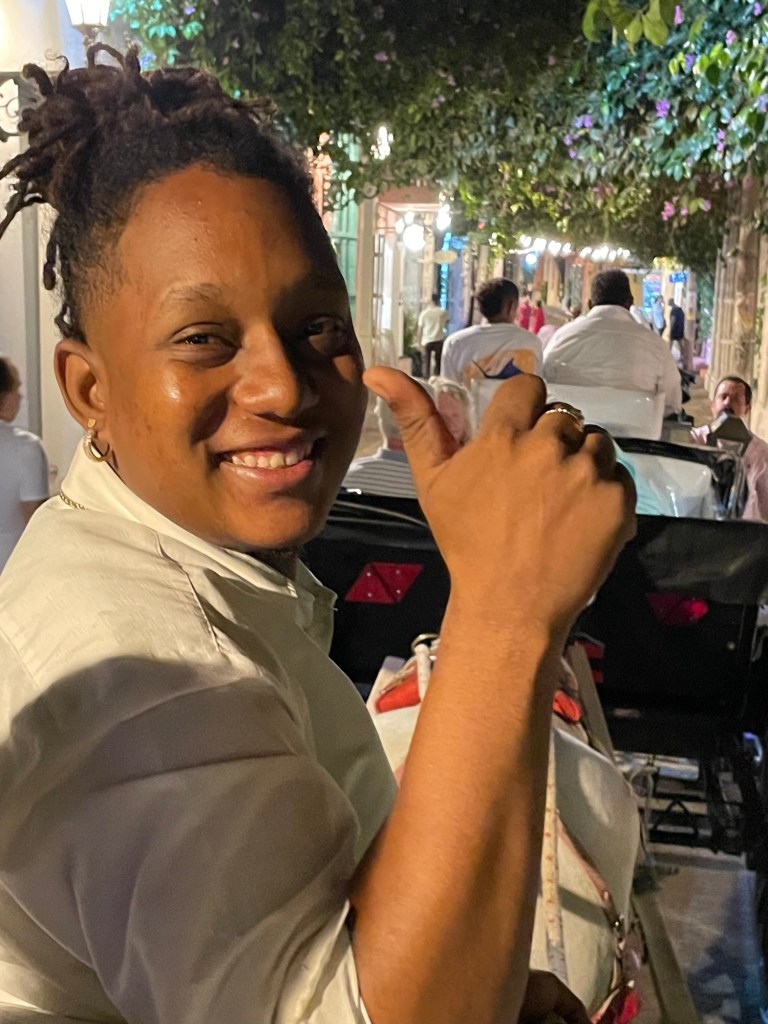
The woman in the black leather “bondage” outfit is Shakira, who has an apartment in Cartagena, overlooking the ocean. Our carriage driver pointed it out as we rode along the ocean on our way to our farewell dinner. He also claimed he was Shakira’s novio ( boyfriend— see, those Spanish lessons DID come in handy!)
Did you know that Colombia was the inspiration for Disney’s movie, Encanto? I sure didn’t.
Sorry, the sun was in the wrong spot when I took this photo. Anyone who saw the movie will recognize the cartoon character immortalized on the wall, but did you know her image was based on an actual resident of Colombia?
There was so much to see in the neighborhood of Getsemaní, I had difficulty choosing the most compelling street image, so I decided to include several.
During our trip we experienced MANY different modes of transportation- boats, metro system, cable cars, jeeps, tuk tuks and best of all, the PARTY bus,
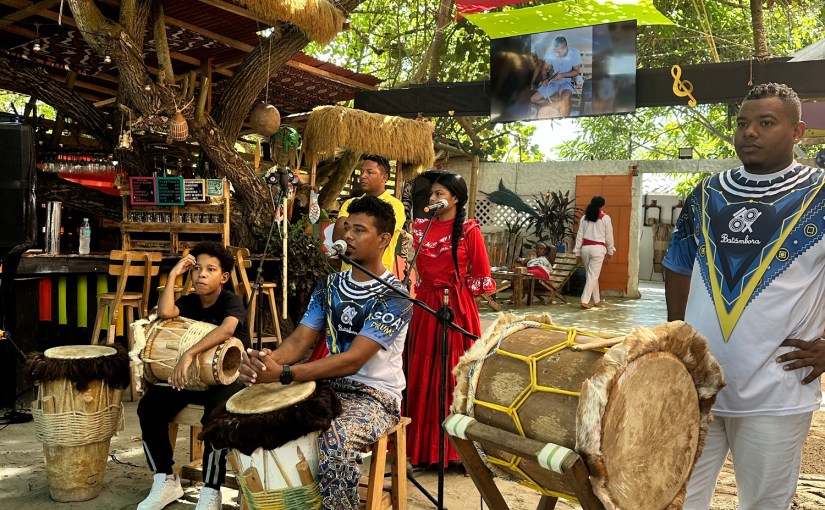
which came fully equipped with live music, so we were serenaded all the way to Bocavilla, an African Colombian community located on the beach.
Our musicians played European, African and Caribbean instruments
While in Bocavilla, we had drumming and dance lessons which were SO much fun! The musicians and dancers were students at a school established to preserve their African/Caribbean culture.
Seven of us are at the airport heading off to Quito for a week in Ecuador, so it’s time to press publish and hope for the best.
Mike and I spent our three week honeymoon traveling thru Europe, and then stayed within the USA’s borders until our 25th wedding anniversary in 2001. To celebrate that milestone we took our first cruise, which started with two days in Istanbul.
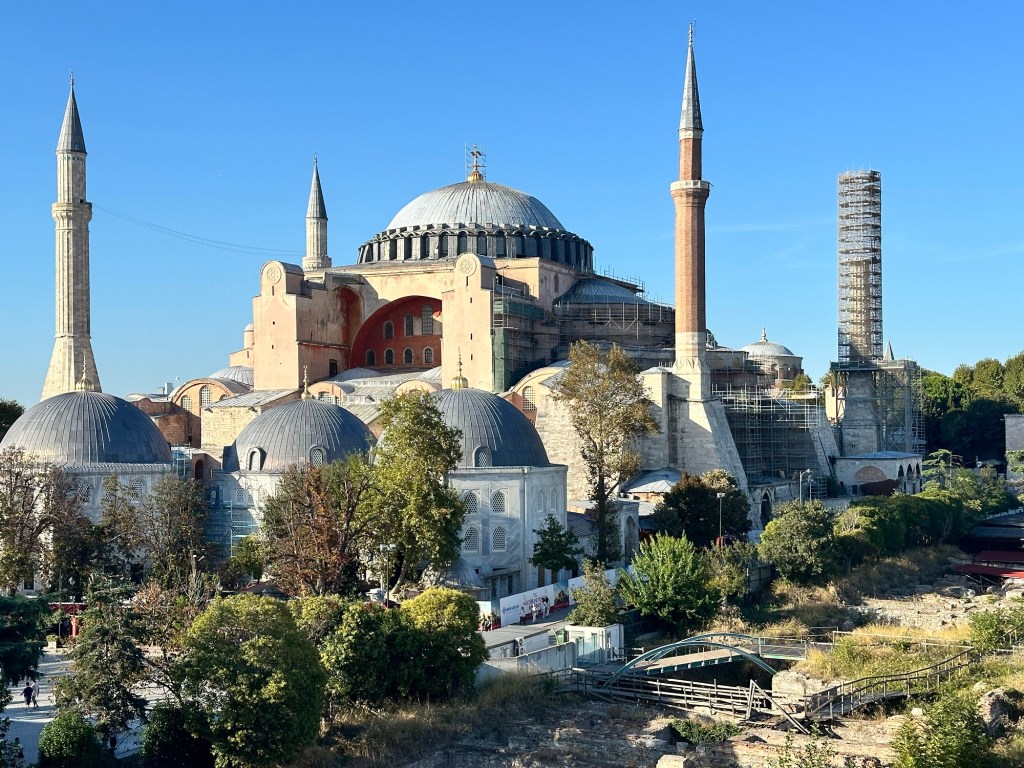
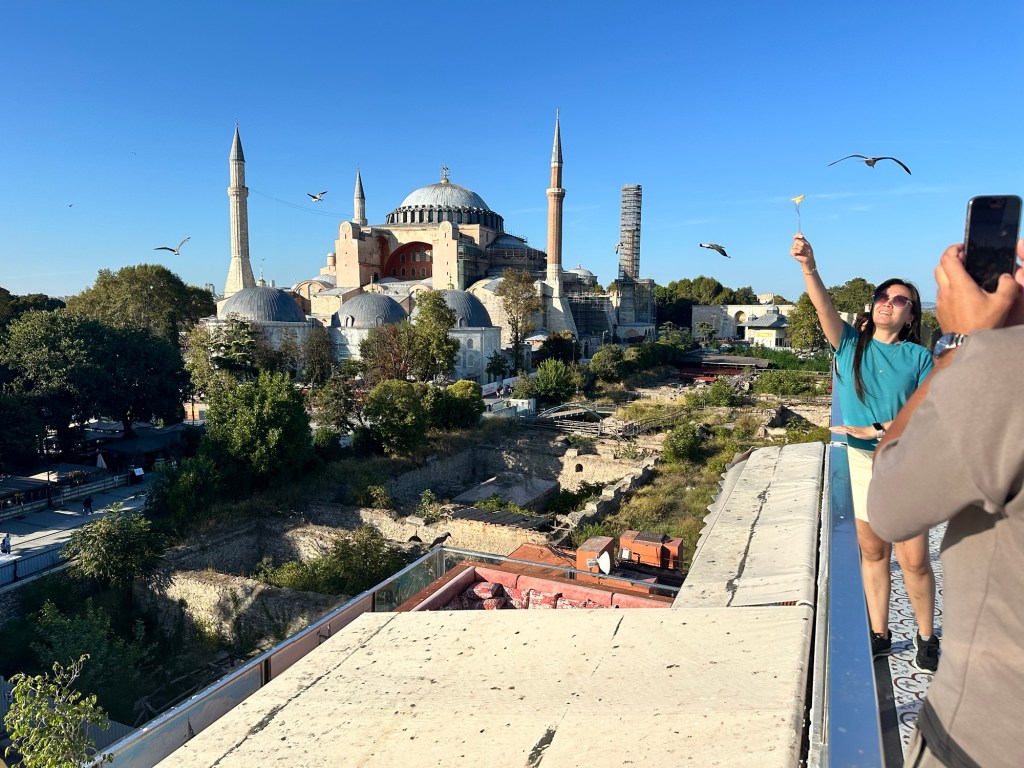
View of Hagia Sophia from the terrace of the Seven Hills restaurant
I had thought that we would return to Turkey to celebrate our 50th, but as the John Lennon song goes “Life is what happens to you when you’re busy making other plans”.
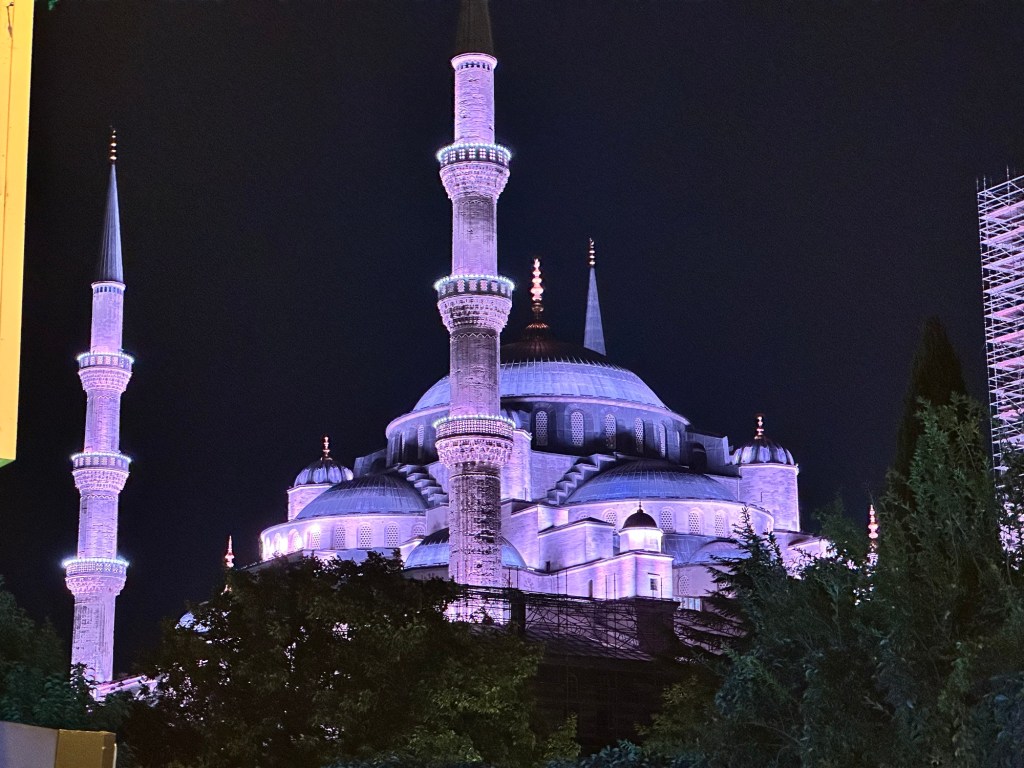
Night view of the blue mosque.
Instead, I’ll be visiting Turkey on Mike’s and my anniversary accompanied by Janis, Shirley, Renee and Renee’s husband Mike, all friends I met on prior OAT trips.
Ahmed III‘s Fountain, built in 1729.
On the way home from my Africa trip, I opted to stop in Istanbul for two nights. I’m not seeing many of the usual tourist sights—I either saw them in 2001 or will see them when I visit in May of 2026. Instead, I’ve primarily been on a recognizance mission, checking out restaurants and the hammam, so I can make “free time” recommendations for my travel companions.
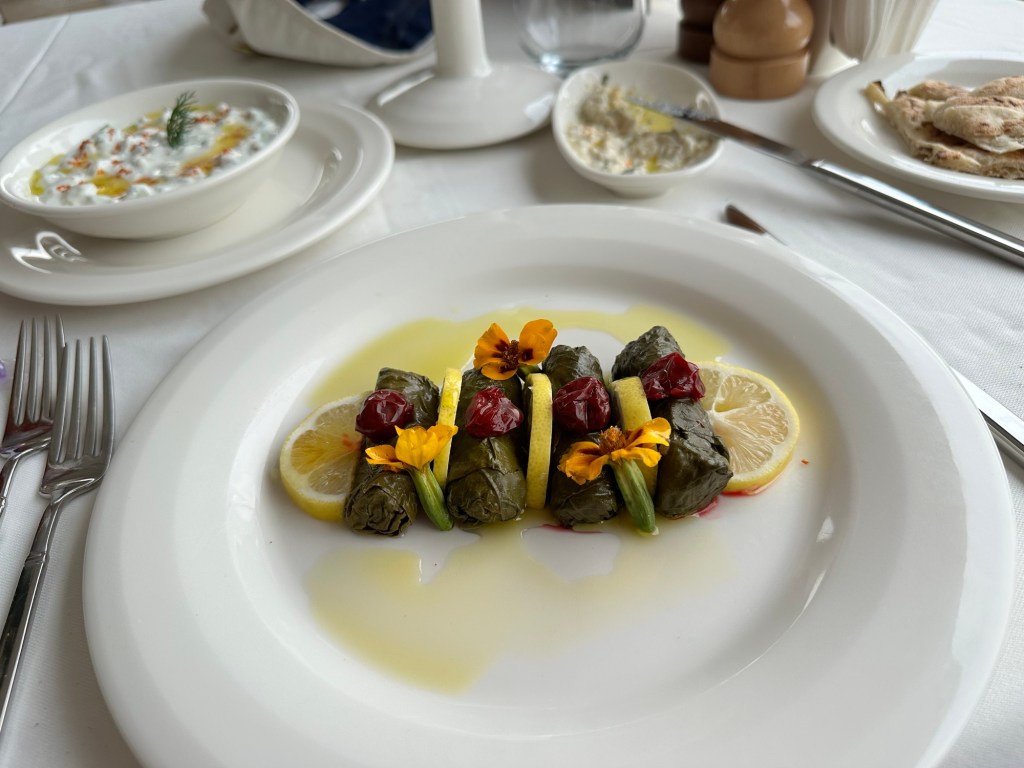
The lunch at Matbah was WONDERFUL! I opted for an appetizer (grape leaves and sour cherries) and the yogurt and cucumber salad. The complimentary baba ganoush, warm pita bread and pomegranate juice were an unexpected treat. I can fully understand how this place got its Michelin rating.
Last night I visited Seven Hills restaurant. The terrace has a spectacular view BUT stupid people were feeding the seagulls. Don’t they understand that what goes in eventually must come OUT? I happen to know that the poop doesn’t necessarily land on the head of the person feeding the gulls; sometimes it’s an innocent bystander that’s the target.
There’s a French fry on the end of the fork she’s holding aloft.
I decided to patronize the Seven Hills restaurant on the floor below the terrace, which was MUCH quieter and had an equally compelling view of the Bosporus. The food? Well, it was expensive and average. I wouldn’t go back the next time I’m in Istanbul.
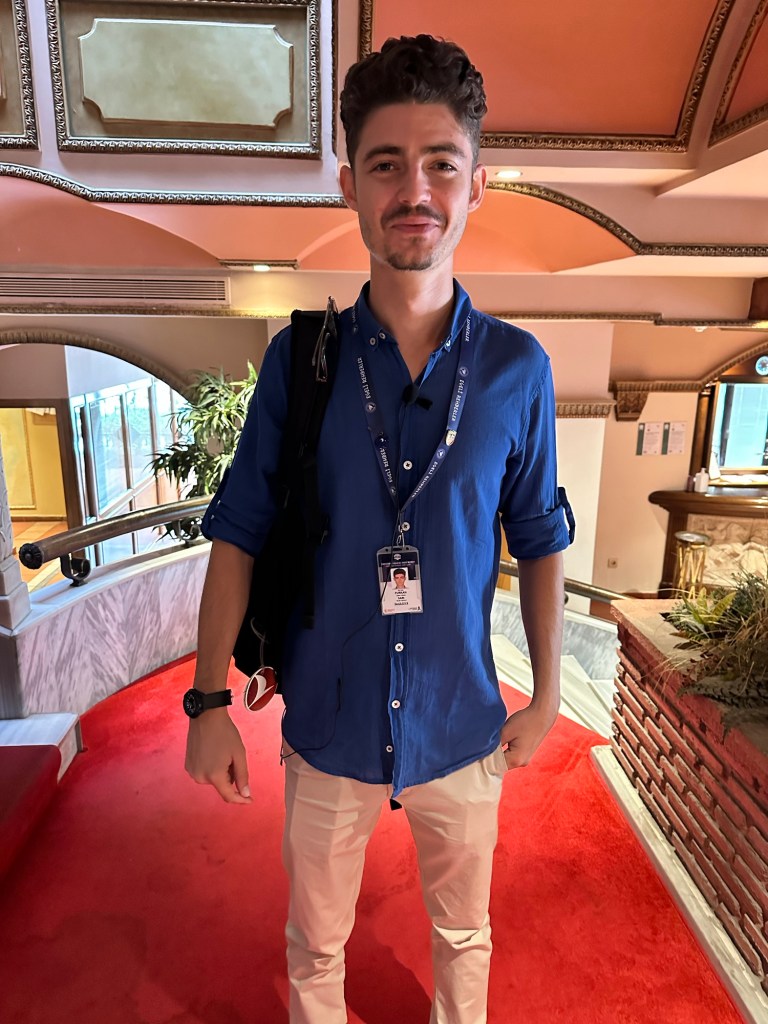
On the morning of my only full day in Istanbul, I encountered an OAT group taking Turkey’s Magical Hideaways (my 2026 trip) in the hotel lobby. I decided to eavesdrop as Sari, the trip leader, held the morning briefing. After he finished, I introduced myself and asked if I could have a copy of the four pages of helpful hints that he’d handed out to the group.
Sari. Maybe he’ll be my trip leader in 2026?
And let me tell you, they came in VERY handy.
For example, I hate to be rude, so I find it impossible to ignore someone who is talking to me. One of the hints said “Do not be polite”, and told us to walk away from offers for help or invitations to shop.
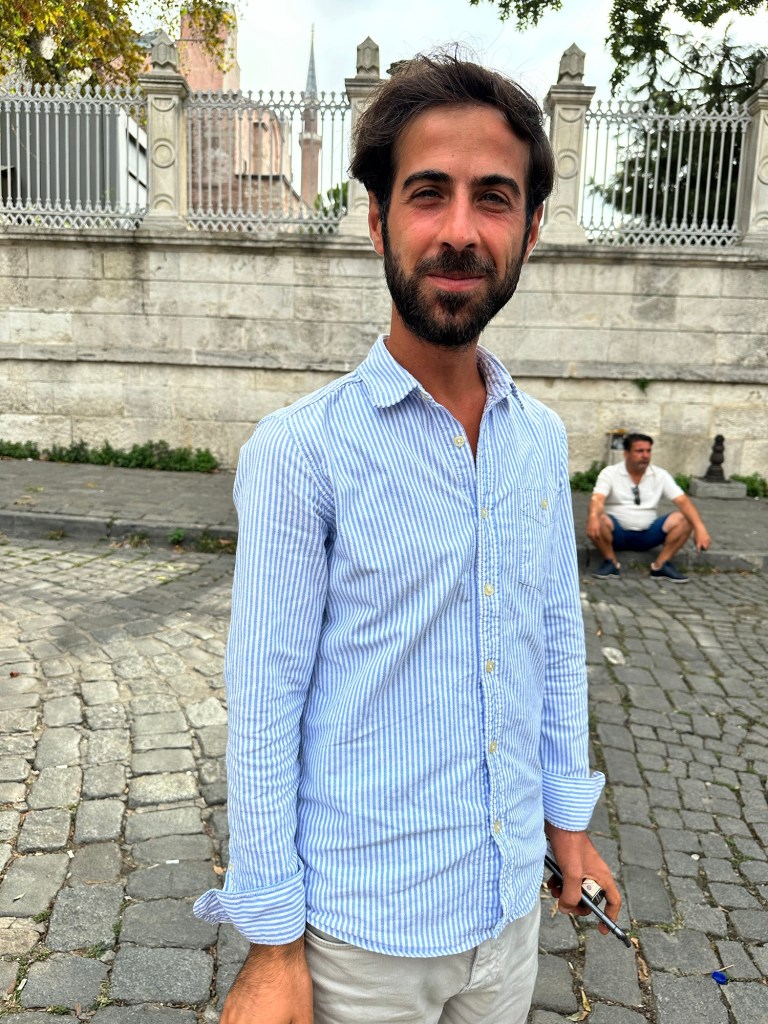
Despite being cautioned, I still engaged in conversations. It seems I can’t help it. This young man tried more than once to get me to visit his shop, calling “Hey, New Jersey” when he encountered me the second time. Yes, I DID tell him where I was from the first time we met. AND I took his picture.
I keep telling the young men (and it’s ALWAYS young guys) “I’m old. I’m not acquiring stuff any more—I’m getting RID of stuff. Go after the young ‘uns. They’re more likely to buy from you”. That seems to work rather well.
So my morning was spent crashing a meeting, hanging out, and wandering aimlessly. For the afternoon, I fruitlessly searched for gifts for the boys in my life. Gifts for girls abound, but boys? I came up empty.
My trip to the Hamam, on the other hand, was a smashing success. Not only was I in a historic building, but I also managed to shed about a pound of dead skin cells and African grit.
I’m usually not a fan of massages, but this experience was incredible. I immediately checked the OAT itinerary, and was glad to see that we are going to have a free afternoon in Istanbul on our 2026 trip. You better believe I’m coming back!
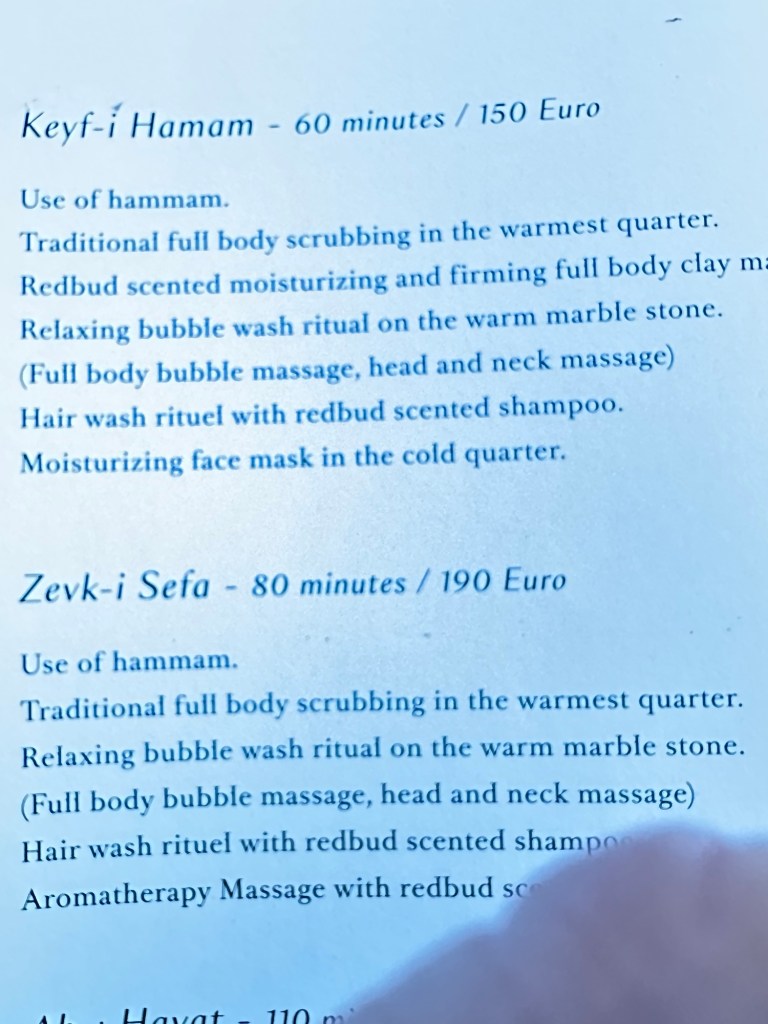
I can’t tell whether the description of the hammam is readable, but just in case it isn’t, here’s the gist.
The “Hagia Sophia bathhouse” as it was called back then, was built in 1556. Over the centuries, it was repurposed, then restored in 1957. So why didn’t I delete the photos of the description after I wrote the summary? Because I found the description absolutely charming—incomprehensible, but charming.
Fortunately, the photo of the available services came through clearly. I bought the one hour of services and it was worth every Euro!
I wasn’t sure whether the “warmest quarter” referred to my body or the section of the building. It was the latter.
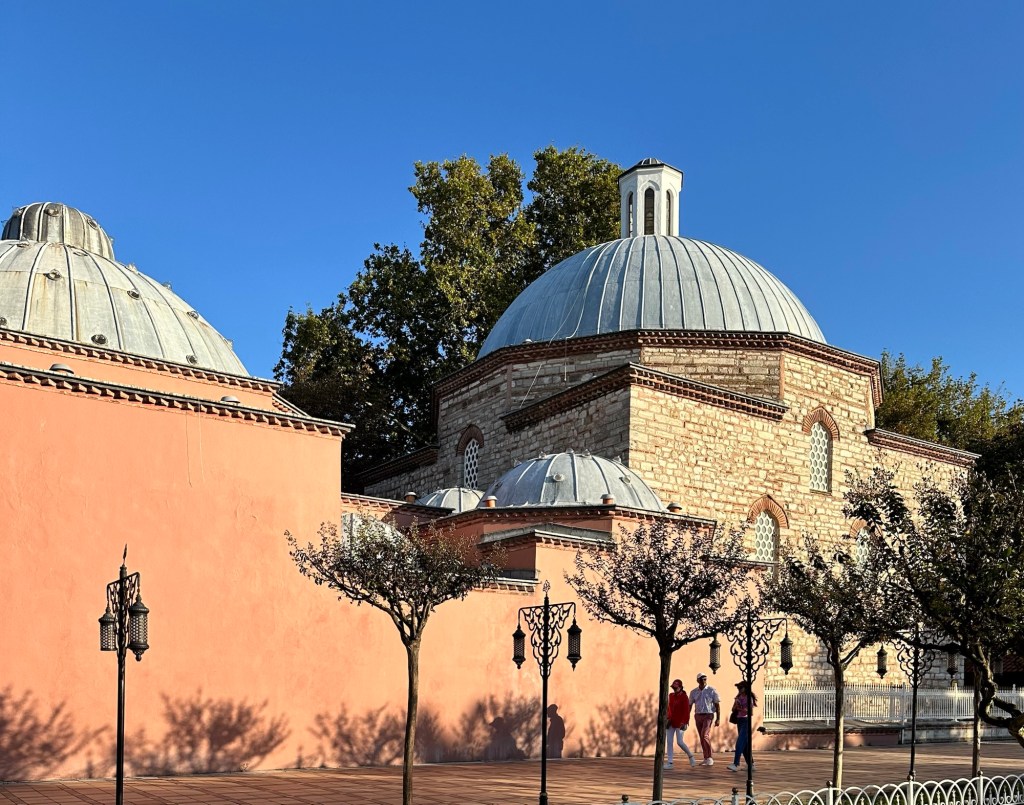
The photo atop this blog post shows what’s under the huge dome on the right, in the photo below. The little domes are private areas where you get covered with mud, then rinsed off. After that, you mosey on over to the dome on the left to get enveloped in bubbles (it was fantastic) and massaged.
You start and end up in the room under the big dome on the right
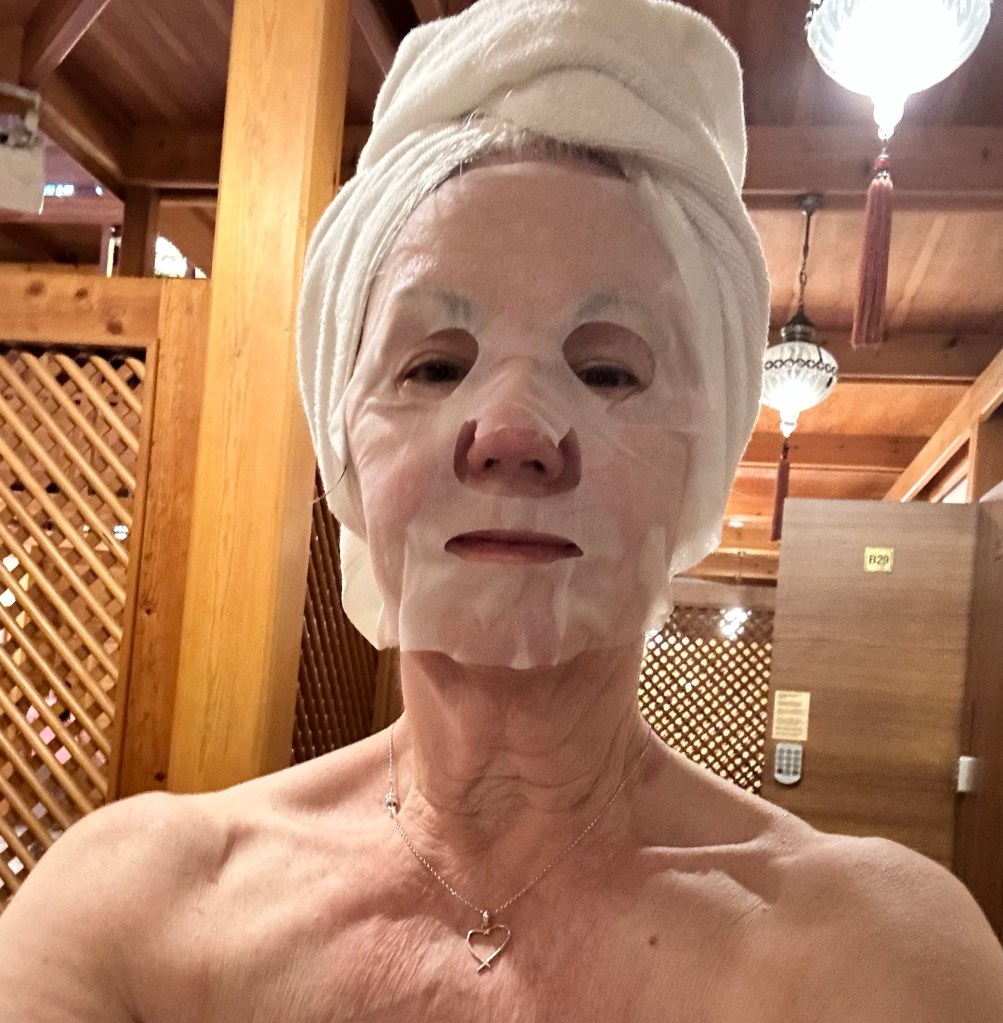
That’s where you sip your tea, while wearing your Hannibal Lecter mask.
The ONLY photo taken of me in the hammam.
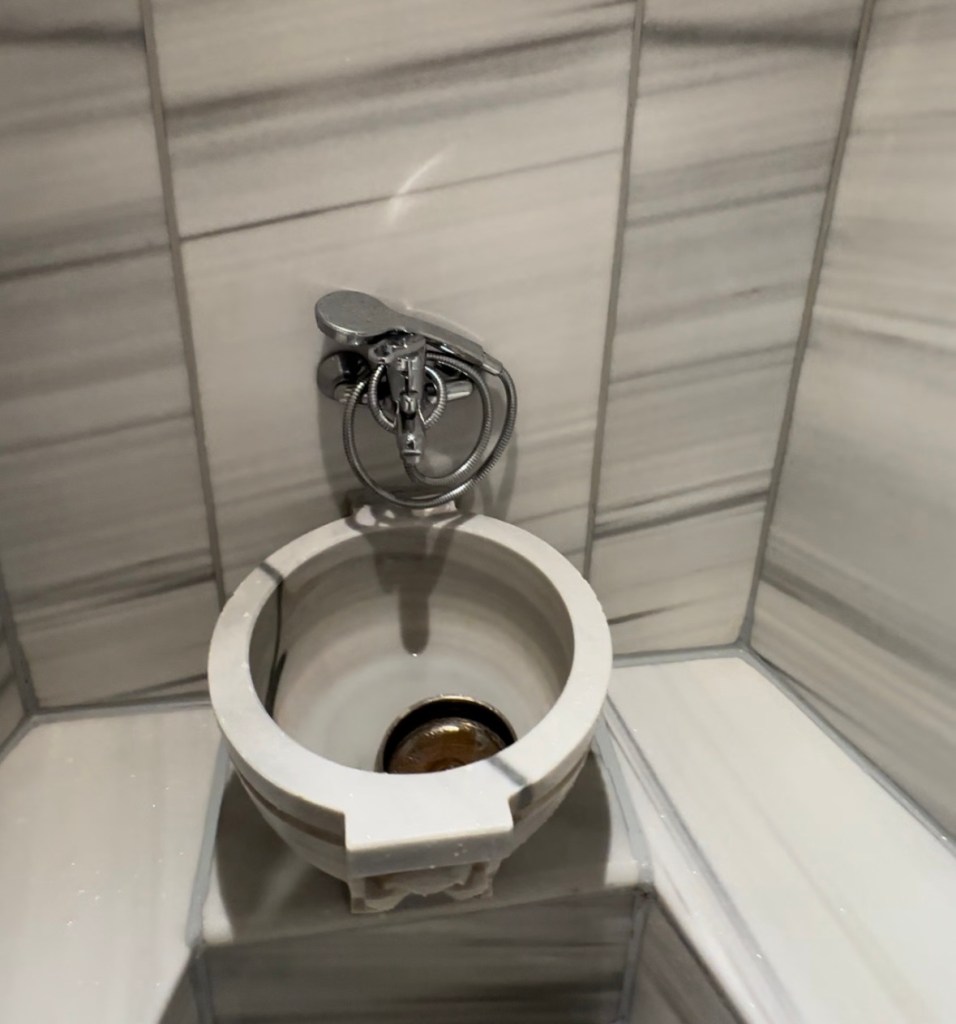
I’ll admit to being so puzzled by my hotel’s bathroom configuration that I actually did a video of it for the folks back home.
The mystery of the basin and round metal bowl was solved during my visit to the hammam, because the private spaces were similarly constructed. One exception— the ones in the hammam didn’t have a showerhead. That was probably a concession to the western guests.
But back to the basin, bowl and bench.
Here’s what you do. You fill the basin with water heated to your desired temperature. You sit on the bench and use the small metal bowl to dump water all over your body. Now, why didn’t I figure that out?
For my last morning in Istanbul, I visited the Topkapi Palace, which was within walking distance of our hotel. It is on 2026 itinerary, but sometimes it’s nice to take your time, wandering unescorted. This was definitely not one of those times. I kept getting lost. (I know, hard to believe…) I was especially sorry that I wasn’t with a guide who would steer me away from the boring and depressing areas and focus solely on what was worth seeing.
On a positive note, I left the “palace“ convinced that I am currently living better — and more comfortably —than yesteryear’s Ottoman Empire sultan. We ALL are.
Check out the throne room, theoretically the best digs in the palace. I’ll take my living room over this one, ANY day!
I DID like the library, but I’ll bet my iPhone has a better selection of reading materials.
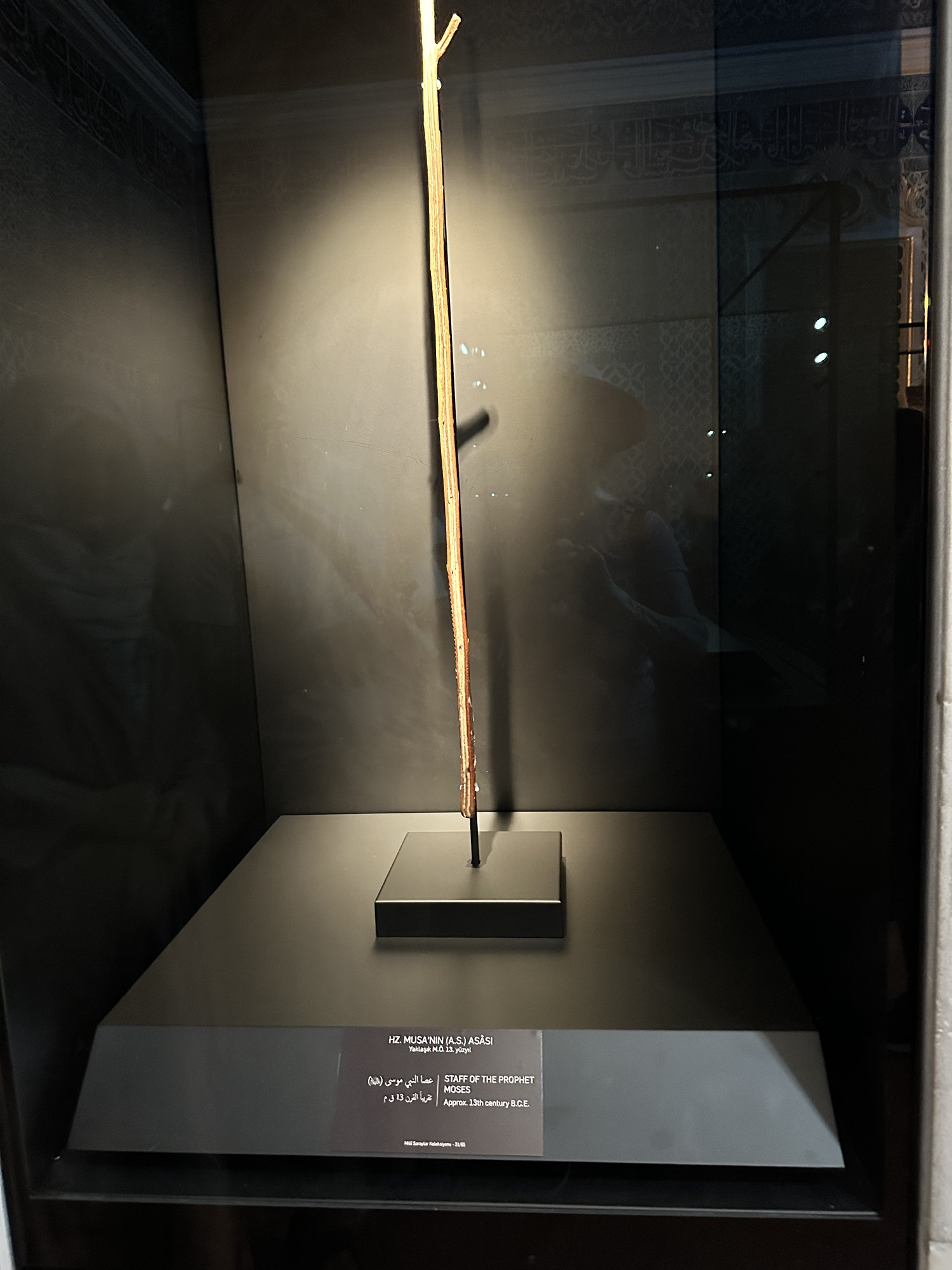
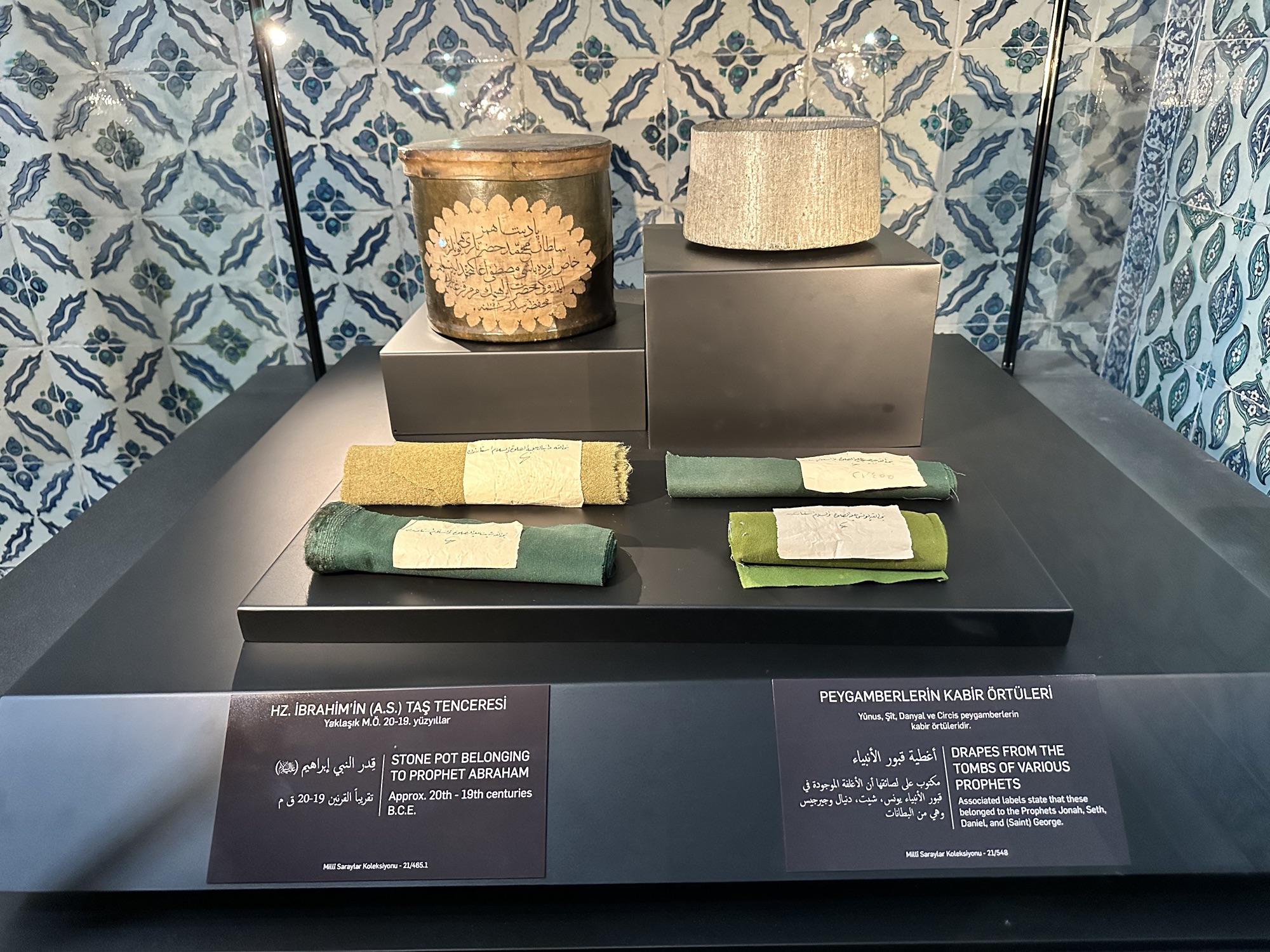
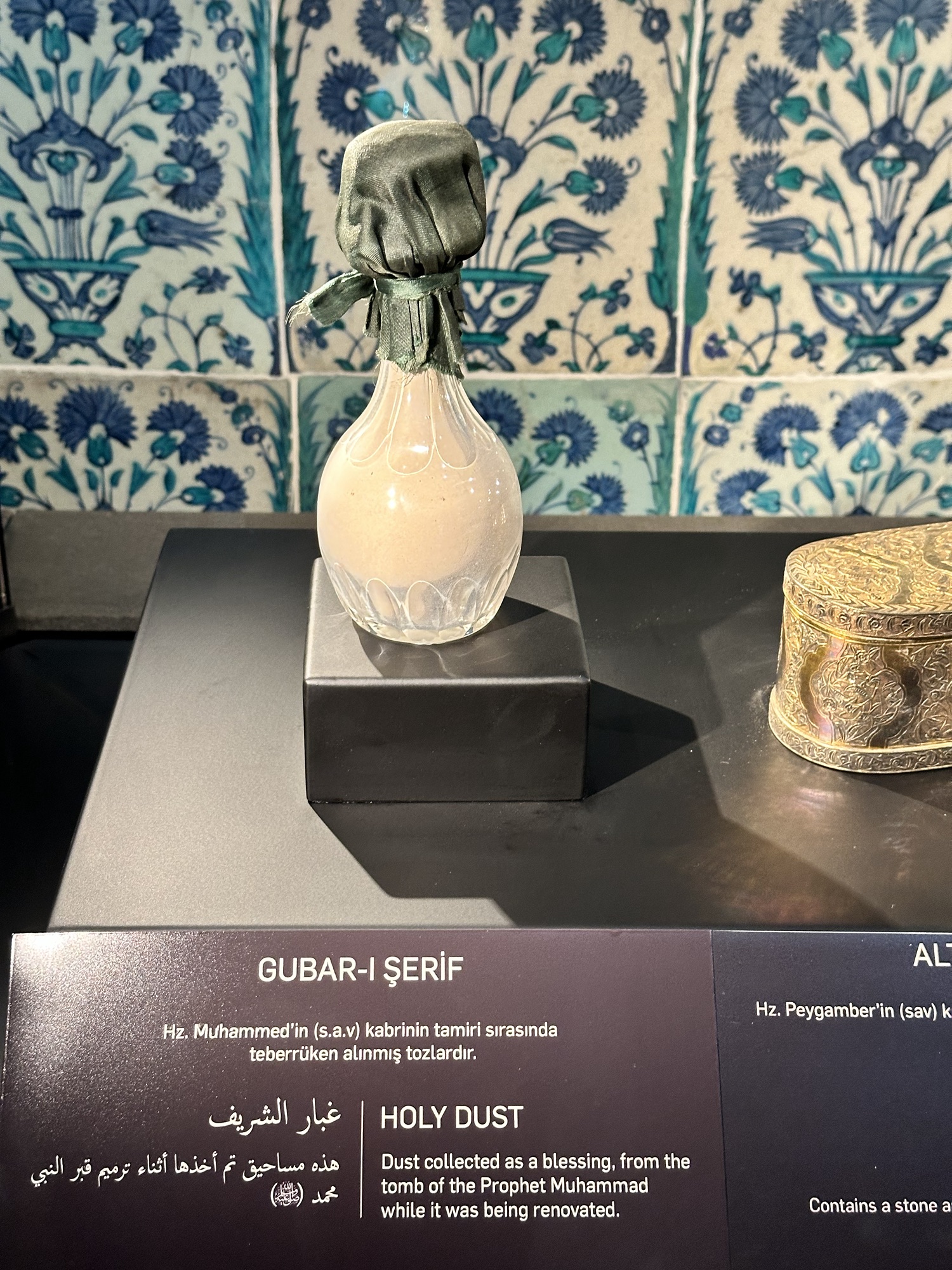
What I don’t have is a room housing relics, at least not yet. The Chamber of the Sacred Relics is purported to contain the staff that Moses used to part the Red Sea, a pot that once belonged to Abraham (probably it was Sara’s, but back then, I’ll bet women weren’t allowed to own anything), bones from St John the Baptist’s skull and forearm, and dust from Mohammed’s tomb.
Moses’ rodAbe’s potJohn the Baptist’s bonesMohammed’s tomb dust
As it got closer to noon, the palace became hot and crowded. It took a while, but eventually I found my way out of the maze, checked out of the hotel, and made my way to the airport, which was a little over an hour’s taxi ride away.
This will be my last blog post for a while. No more international trips till 2025.
Sometimes when things don’t go according to plan, you end up with something even better. That was definitely the case for me and my ballooning buddies.
We dutifully arose at 3:45 AM, to be ready for our 4:15 escort. Why would we need an escort to get from our tents to the balloon company van, you ask? Well, because after dark one night, 4 lions wandered into our camp and positioned themselves between two of the tents, staying until daybreak. My family won’t be surprised to learn that I completely slept through their snorting and huffing.
Our 90 minute drive to the balloon launch site turned into a game drive, because while our driver Simon ( pronounced SEE-moan) was zipping along the bumpy roads, he was also on the lookout for critters.
The high point was when Simon spotted this young leopard easin’ on down the road. When he crossed in front of the jeep, a passenger in the front seat quickly snapped this photo. I just as quickly conducted an impromptu class on airdropping, so we could all share this reminder of our encounter.
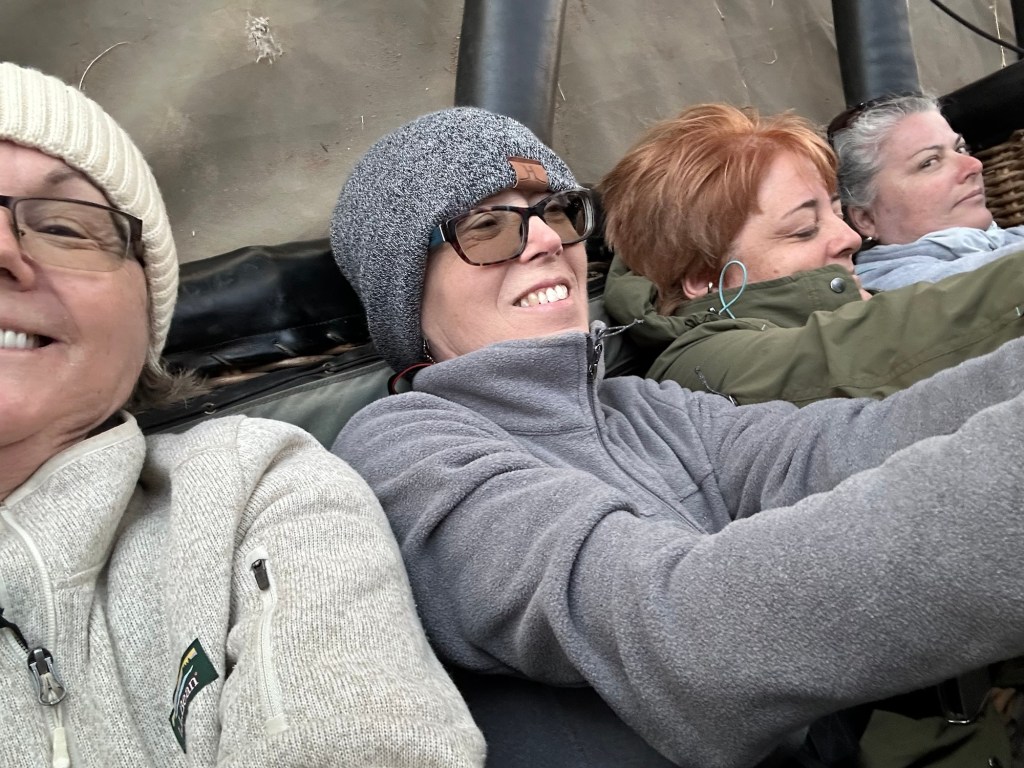
We were hopeful as we settled into the basket, lying on our backs.
Okay, so maybe my selfie skills need a little work.
After being loaded into the balloon basket, “snug as bugs in a rug” ( as my mother used to say) the pilots decided it was too windy to fly.
We were given a choice of either trying again the next day or getting our money back. Hell, yeah, we’re all gonna try again. So what if we had to get up at 3:45 AM two days in a row? We got to see spectacular sunrises, drive with Simon again and scarf down yet another breakfast at the Miracle Experience camp. What’s not to like?
Besides, we already posed for this photo, so we felt committed.
Rachel, the youngest, Sue and Hannah, and me, the oldest (and biggest—I scrunched a lot) of our group.
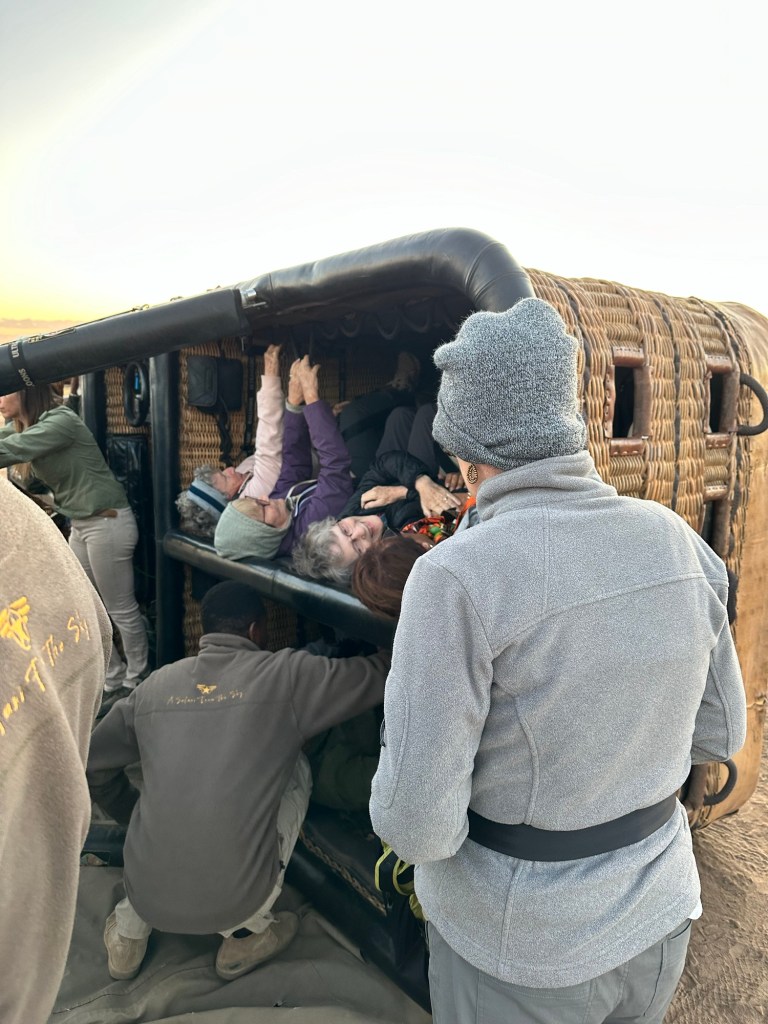
On day 2, we already knew the drill. THIS time, I got a photo BEFORE we entered the basket, so the friends back home could see what I was trying to describe. Our new pals from the OAT group traveling a day behind us were in the “mezzanine”, while we scored the balloon’s “orchestra” seats on the bottom level.
This was our last chance for a balloon ride because the following day we were leaving the Serengeti. Fortunately, we all were chillin’, having a “que será, será” attitude. Whatever happened, we were good with the outcome. That’s what made these ladies such great travel companions.
Rosa, our Spanish pilot explained that there are three types of landings: smooth, bumpy, and drag. The first two terms are self explanatory. DRAG is when you bump several times before coming to a stop with the basket on its side, the way we started. Bet you can’t guess which one WE experienced.
What Rosa neglected to mention was that sometimes take off can also be a “drag”. We bounced up and down a couple of times before the balloon righted itself. Rachel, our selfie queen, captured our happy faces during our glorious lift off.
When we got completely upright, our new OAT friends took this one.
yes, it was cold at daybreak.
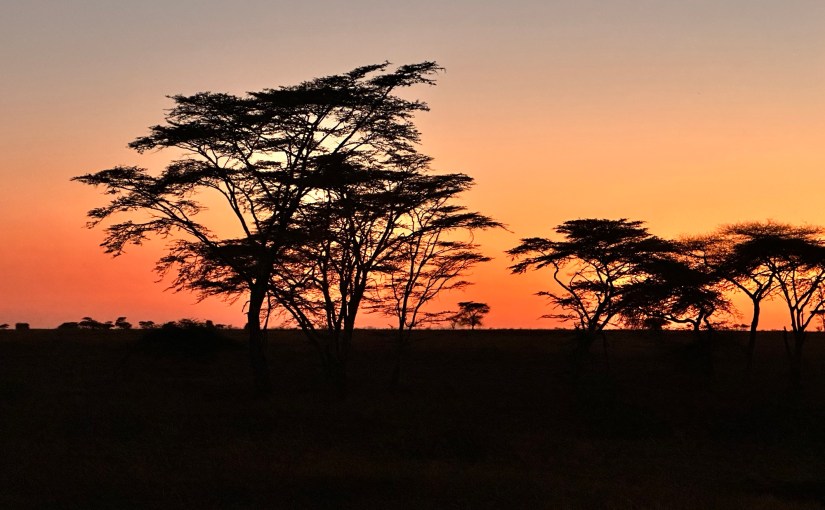
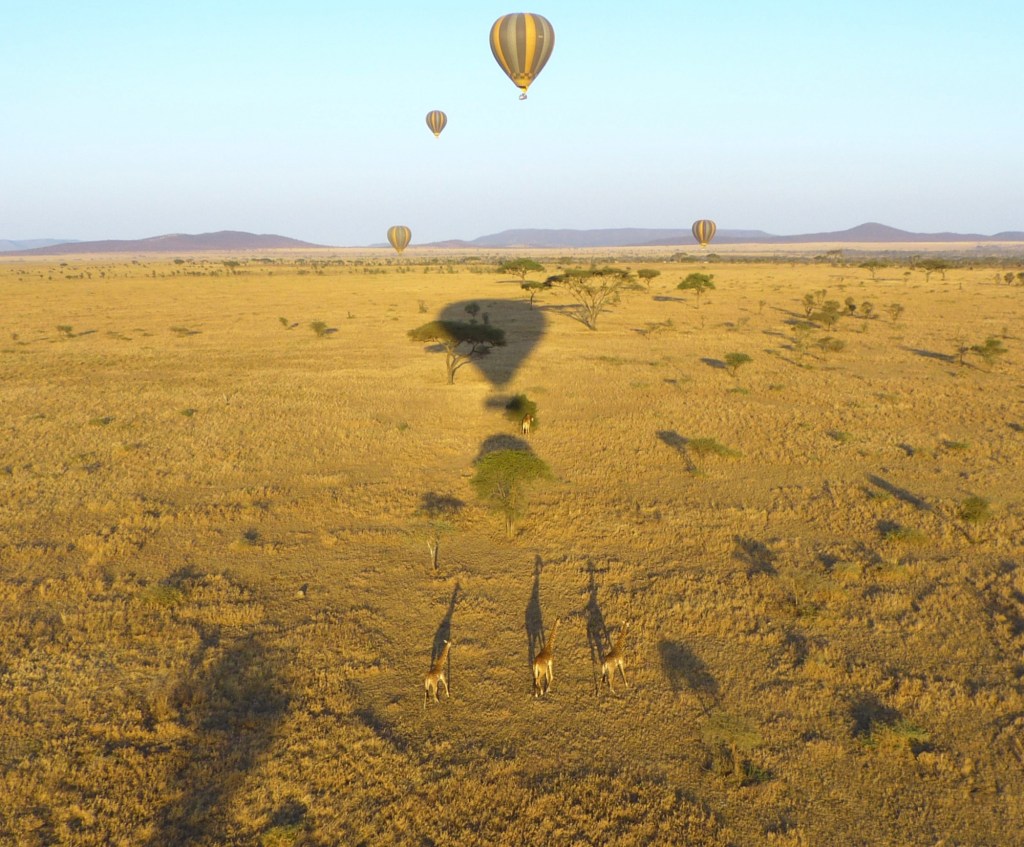
So what was it like? Pretty damn magnificent. It is very apparent that our eyes are indeed miraculous. My photos in no way do justice to what we viewed on the “Endless Plain”, which is the English translation of the Maasai word Serengeti.
Two last game drives, then on to my solo trip to Istanbul.
It may LOOK like rocks, but those are all hippos, including the butt pillow.
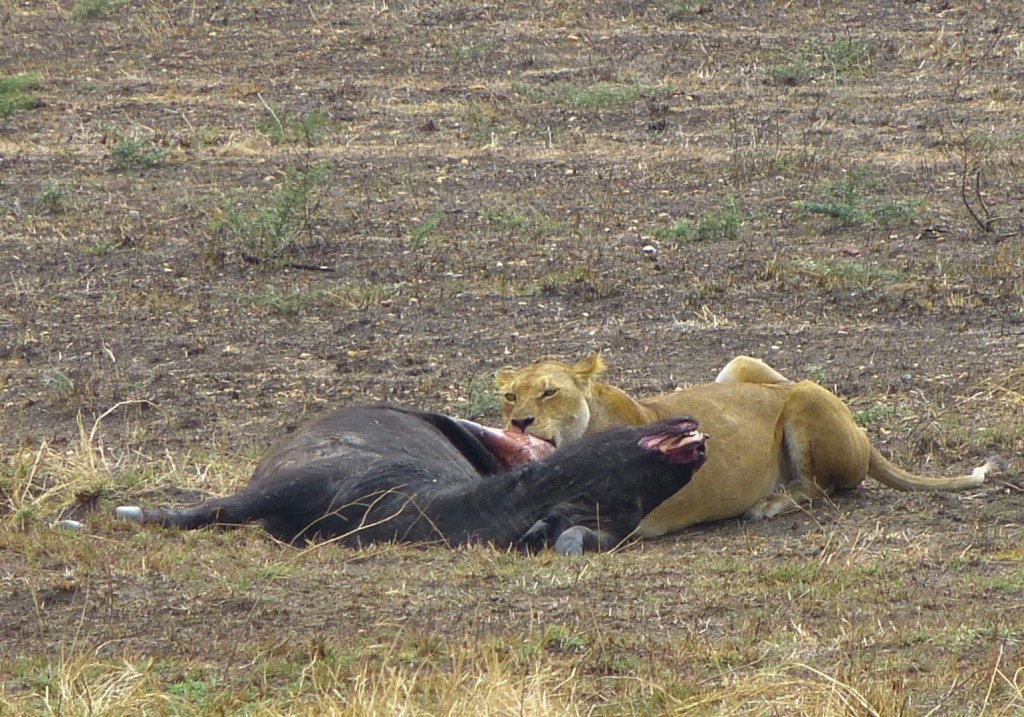
It took a group effort to bring this Cape buffalo down.
Now what made me think of Thanksgiving dinner? Except WE all gorge ourselves together. Lions take turns. See, one has been patiently waiting her turn, and now it’s time.
It was clearly worth the wait.
I’ll end this post with a shot of Mount Kilimanjaro for Tom, Jean’s husband. It was taken in Kenya, earlier in the trip. I had hoped to get a better shot from the Tanzania side, but my only view was from an airplane, and the propeller was in the way.
It’s just as well that I had to abruptly end my last post before all of the photos uploaded, because my Serengeti pictures are so much better than the ones from the Ngorongoro Crater.
We left the beautiful Tloma Lodge in Karatu at 7 AM for an all day drive to our tented camp deep within the Serengeti.
I’ll be honest. I was NOT looking forward to 8 hours of rockin’ and rollin’. The road along the dusty, misty rim of the Ngorongoro Crater was very narrow, the drop into the caldera was steep, and visibility was poor. We were ALL very grateful that our drivers (Freddie and David) were experienced and skillful.
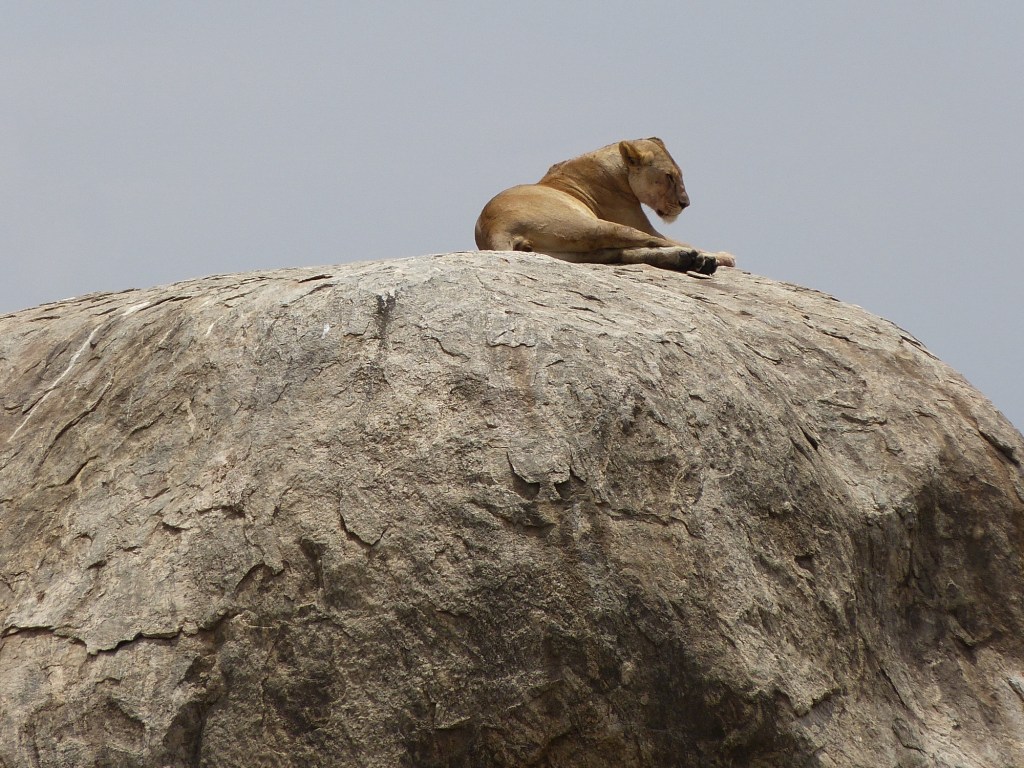
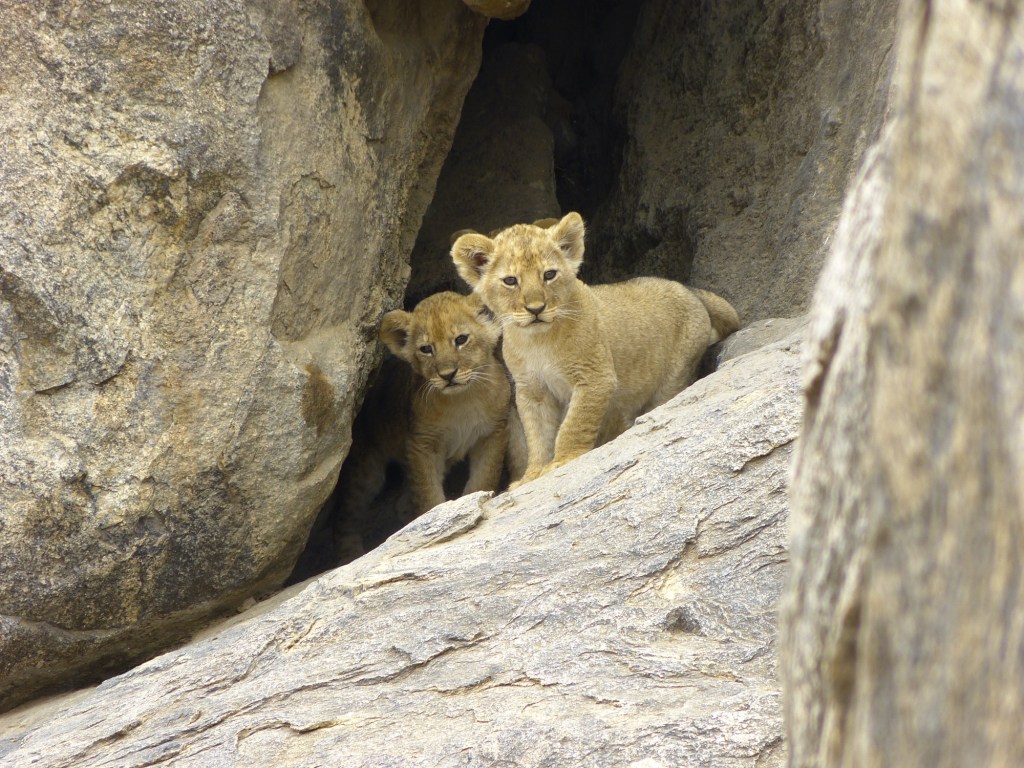
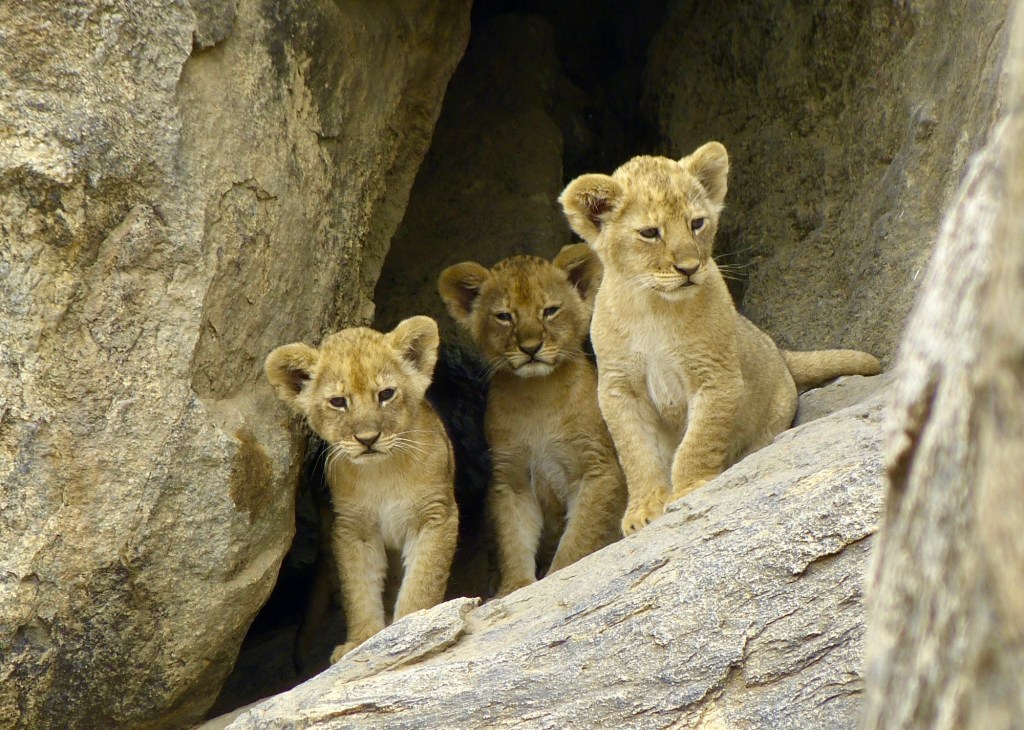
After a few stops and a picnic lunch, things started to get interesting. When we spotted a lioness standing guard on a big rock, we figured she must be protecting SOMETHING, but what?
First, one little head popped out in the crevice.
then a second one,
JACKPOT! We couldn’t believe our luck.
That must have been auntie on lookout duty, because here comes mom.
But wait…it gets better.
Remember the discussion about the differences between cheetahs and leopards a few posts earlier? Which one is this?
What about this one? It was REALLY far away, so the photo may be pixilated, still, you might be able to figure it out.
Suddenly the drive didn’t seem long, or bumpy or dusty. We were ALL thrilled.
Despite being out in the middle of nowhere, our tents are quite comfortable. Best of all, the bucket showers are so easy to operate, compared to some of the complicated faucet configurations we’ve encountered.
You pull the one with the wooden handle to get the water flowing, and pull the metal one to make it stop. The temperature is Goldilocks perfect, because the camp staff has heated the water to baby bear “just right”.
If you need more than 5 gallons, you yell and a staff member will bring it to you, but I didn’t ever use all 5 gallons. Hey, water is a precious resource, so when I was clean, I pulled that metal chain.
My tent was the next to the last one, right beside the party animals, Rachel and Hannah, two of my new best friends. Their tent was the gathering spot for those who wished to drink wine before happy hour.
But let’s get back to the animals:
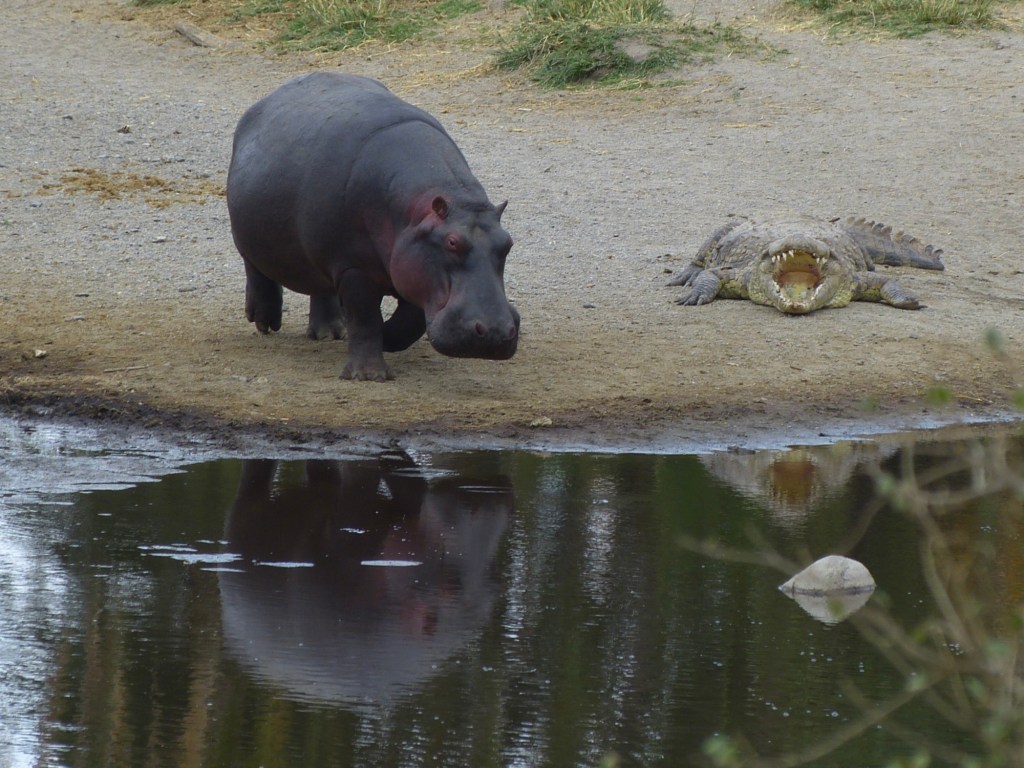
There were so many great hippo shots, I struggled to choose just one, but settled on the one that captured both the hippo AND the crocodile.
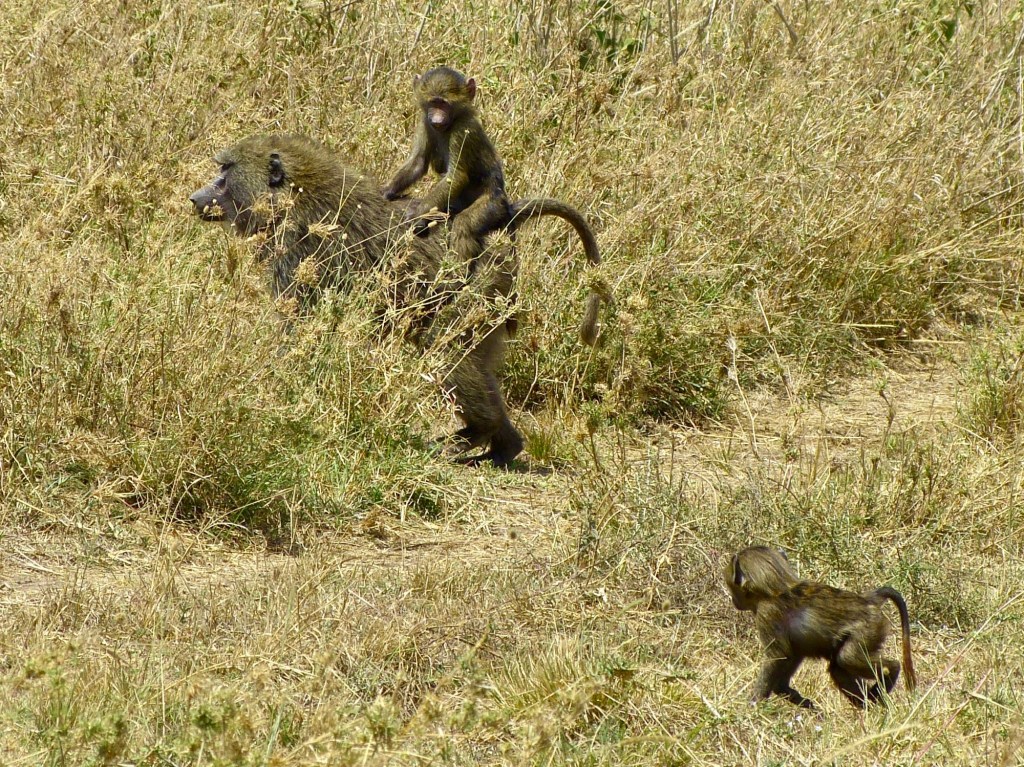
Babies are always popular, so here’s one hitching a ride on mom, with the second one shouting “hey, wait for meeee”.
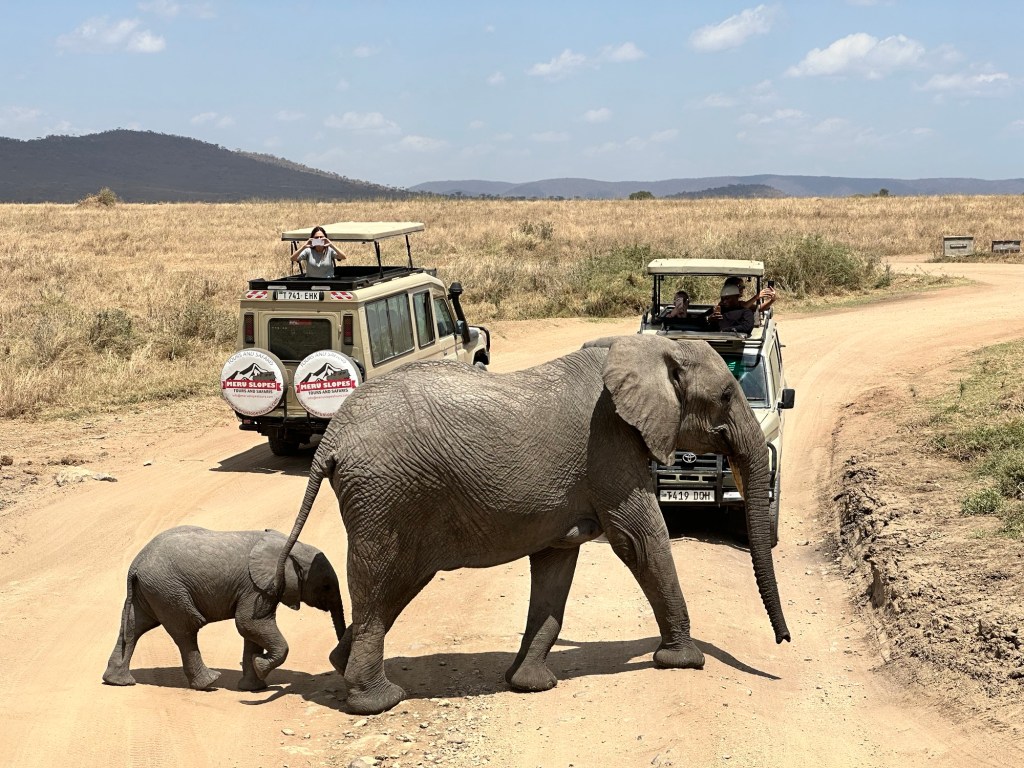
Mom and baby elephant walked right in front of us.
We can’t forget about the birds. I don’t have time to look up the name but it is a lilac something or other.
We are at the airstrip waiting to board our flight from the Serengeti airstrip to Arusha, so forgive any typos or autocorrect. I’m pressing publish without proofing.
Warning: This might not be a good post to read to children.
Yet another reason I choose to travel with OAT is the opportunity to learn about the culture of the places we visit. I also love that a portion of our payment for the trip goes back to the communities with whom we interact.
Our morning in a Maasai village was VERY educational. So, of course I feel compelled to share what I learned with you.
Did you ever wonder how you get goats to practice birth control? Let this Maasai chief show you. That yellow barrier strapped behind the goat’s forelegs stops his “love potion” from reaching its intended target.
I confess that I was slightly confused. I thought it was a GOOD thing to have lots of goats and sheep. Seleman, our wonderful trip leader, explained that for goats, like humans, timing is everything in life. The Maasai want to make sure baby goats are born when their likelihood of survival is maximized, so when the timing is right, the shield comes off.
Next the Assistant Chief explained (in perfect English) the tribal hierarchy. He described some of the Maasai rituals, the most memorable (to me) being circumcision. It is performed in public, without anesthesia, on a group of 12 to 14 year old boys. If they don’t cry out or even flinch, they are deemed worthy to become warriors. After surviving the ritual, the group goes into the bush for three months. When they return to the tribe they are then considered to be men.
Before climate change decimated their herd of cattle, reducing it from 290 to 10, the Maasai used to drink cow’s blood every morning. They made a shallow incision into the cow’s jugular, collecting at least a liter before they stuffed the cow’s wound with herbs.
If you ever doubt the impact that one amazing woman can have, let me introduce you to Lucy. For the past 13 years, Lucy has visited over 100 villages, providing health education, including speaking out against what WE call FGM ( female genital mutilation). What THEY call “the cut” was deeply imbedded in the culture and traditions. They believed undergoing this public procedure transformed a girl into a woman, and thus enabled her to be married. Like circumcision, removal of the clitorus and labia was done without anesthesia, by a “midwife” and women were expected to endure the pain without crying out. Lucy underwent “the cut” when she was 14. (She admitted to crying and screaming).
Although the government banned FGM in 2003, there was no follow up, so the practice continued. It certainly wasn’t easy, but after years of hard work, Lucy succeeded in eliminating FGM for about 99% of the girls in the villages she visited.
Lucy understood she had to “humble herself” in order to get her message across. To ME, however, Lucy is the embodiment of Katy Perry’s song “Roar”, especially these lines:
“ You held me down, but I got up, already brushing off the dust, I went from zero to my own hero…
I am the champion and you’re gonna hear me ROAR”
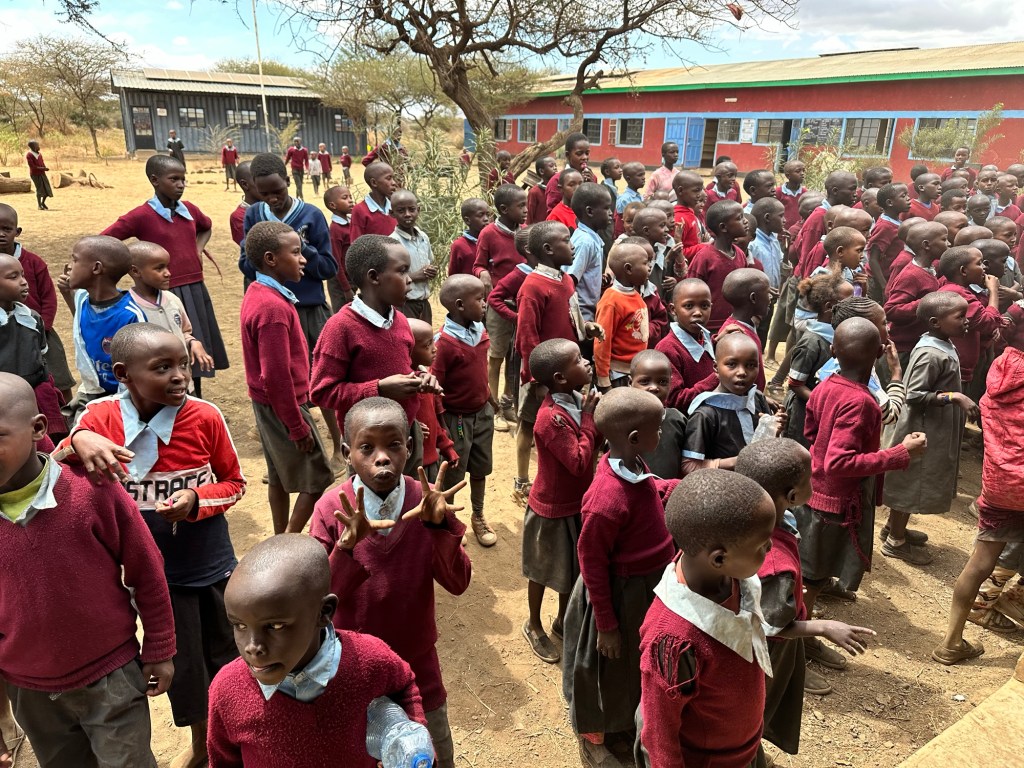
After the Maasai village visit, we headed to an elementary school that has been a recipient of funds from OAT’s Grand Circle’s foundation.
There are only 12 teachers for 183 girls and 230 boys. That’s quite a teacher/student ratio! .
While there, we learned how the Foundation‘s money was used. The first purchase was a copy machine, so the teachers wouldn’t have to walk for 45 minutes to the closest copier.
Under construction were bathrooms with flush toilets that will replace the two squat toilets currently being shared by all the students (and that some of us used during our visit).
During our interaction with the children, we told them a little about ourselves, where we were from (notice the map of the USA on the wall) and what our occupations were.
Fellow traveler Kalpana was by far the most inspirational. She told the students that she had attended a school just like theirs when she was growing up in India. Her hard work enabled her to become a doctor. Kalpana encouraged the kids to study, work hard and dream big.
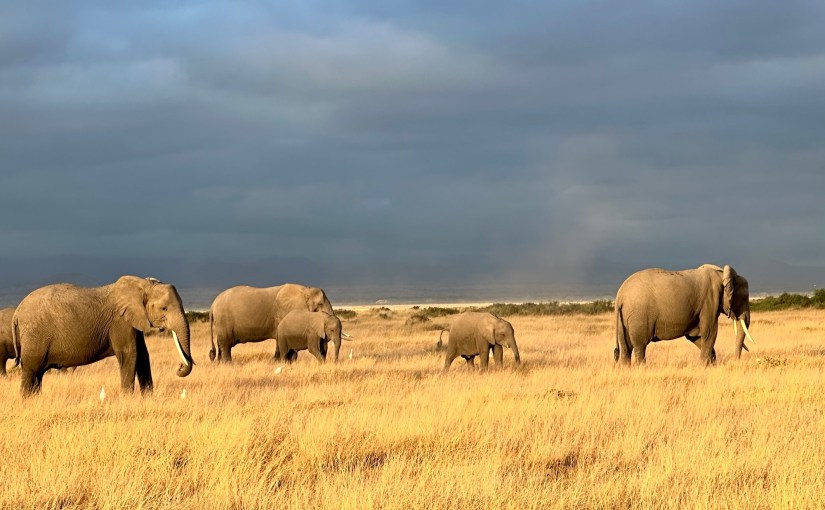
I know, I know. I lured you in with that elephant photo atop this post. We will get to the elephants, cheetahs, lions and monkeys…and that post WILL be suitable to read to the kiddies. I promise, but first I wanted to share these meaningful and inspiring moments.
I’ll end this post with a photo of our group hanging out in a baobab tree.
Our 5 days in Rwanda have been absolutely glorious. Believe me, I KNOW how extremely fortunate I am to be able to have these amazing experiences and I am so very, very grateful.
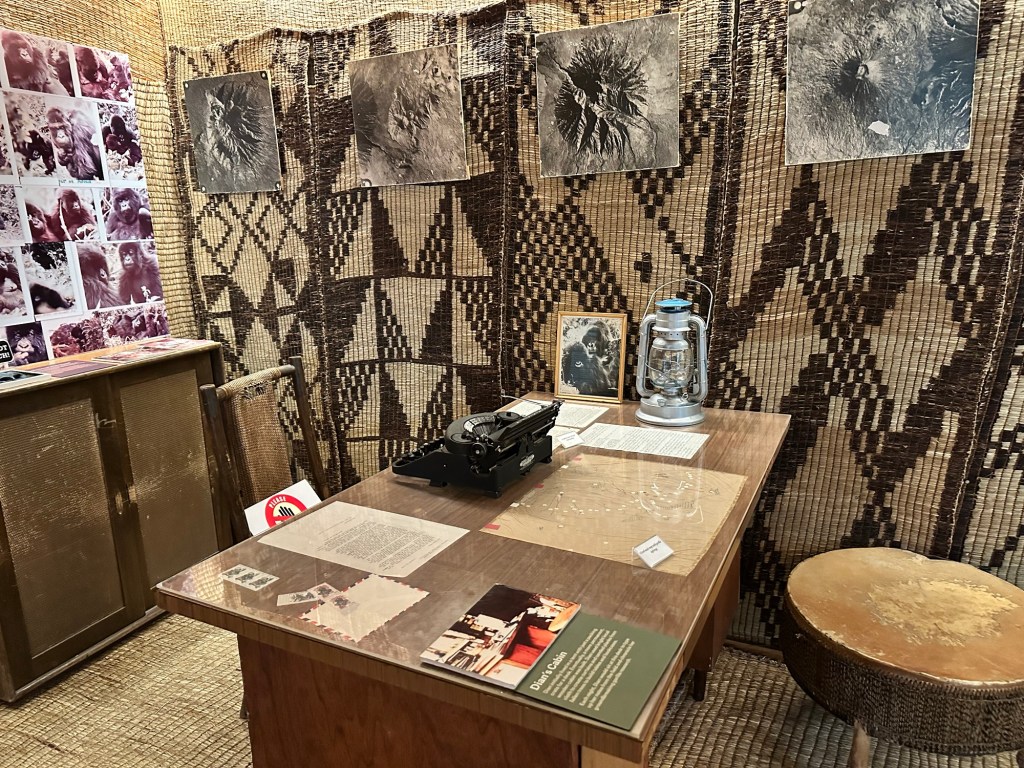
We were able to see first hand the difference one person can make when we visited the Ellen DeGeneres Center, which honors the work of Dian Fossey.
Prior to Dian’s arrival in 1966, the mountain gorillas were close to extinction. Thanks to her tireless work and advocacy, which continued until her murder in 1985, these magnificent creatures have been protected.
Sigourney Weaver’s generous donation made it possible for us to view Dian Fossey’s cabin—sorta like Julia Child’s kitchen in the Smithsonian.
The center has fantastic hands on exhibits, a 360 degree theater, and virtual reality.
I’m VERY glad that I had the virtual reality experience AFTER the REAL gorilla trek because the virtual reality trip had a silverback coming right up into my face, and let me tell ya, it was SCARY.
For the ACTUAL trek, I thought I was prepared. I had spent many hours at the YMCA, because I expected to be walking uphill, at a high altitude, for several hours. The weather could have been hot and humid … or cold and damp. It was actually all of the above, and then some.
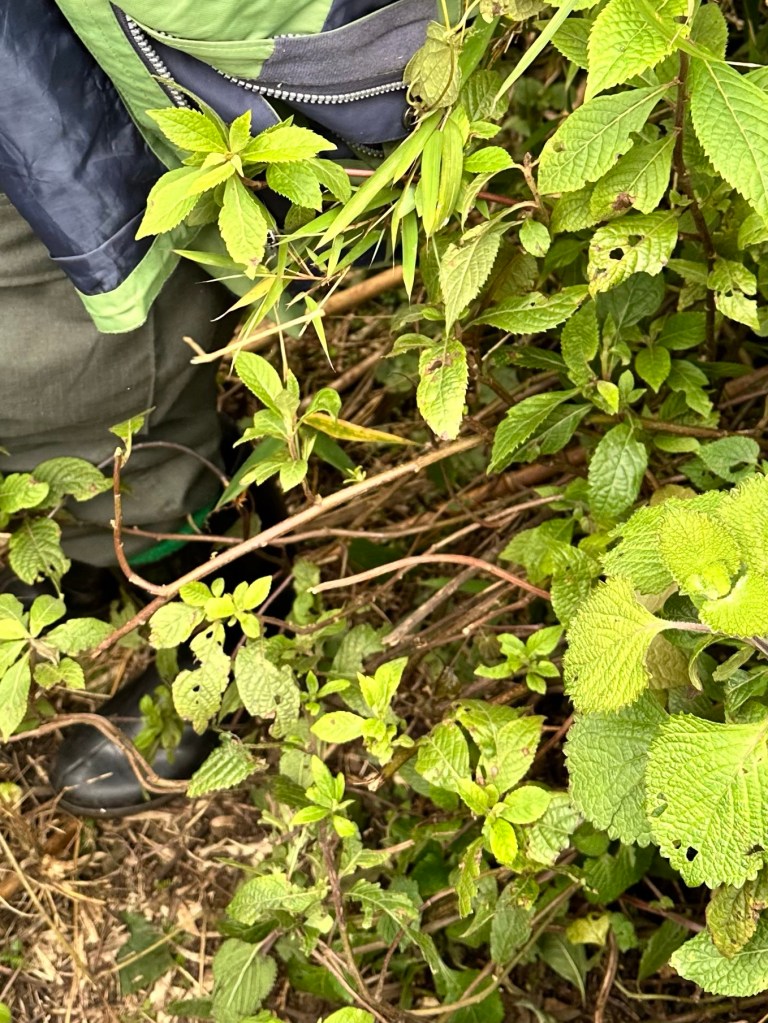
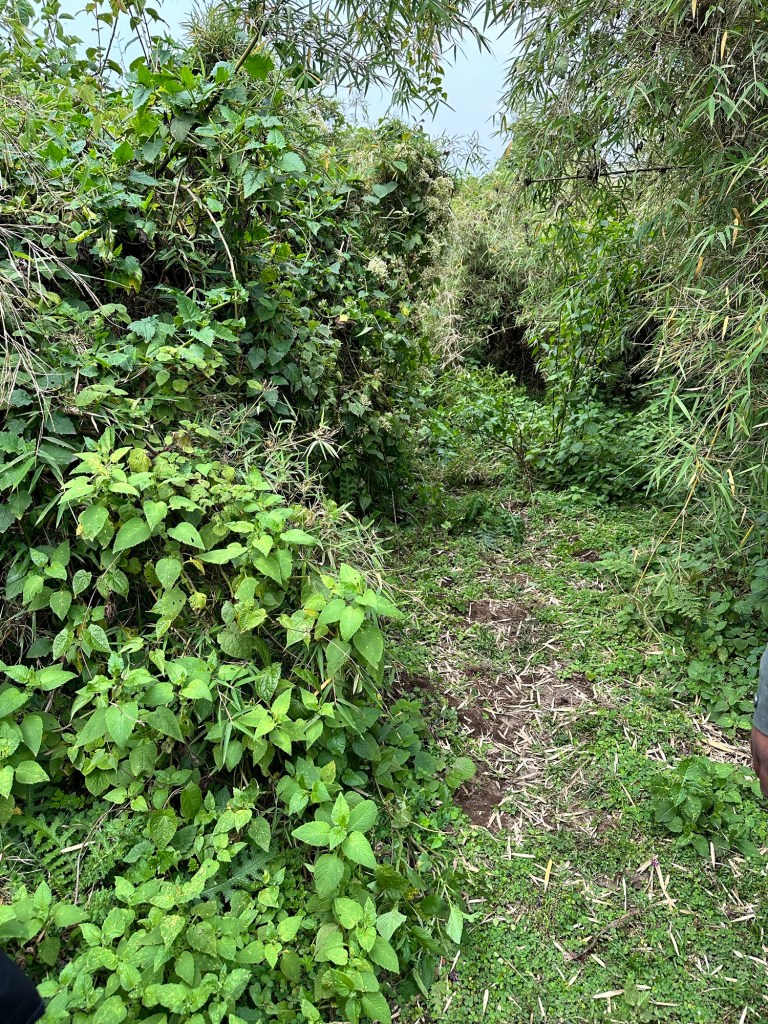
What I was NOT prepared for were the vines that grabbed my shoes and wouldn’t let go without a fight. This was not a photo of MY foot, but it gives you the idea of what walking along the “trail” was like. (Yes, that was the trail).
Okay so I’ll confess that more than once during our 2 hour trek, I had a “ what the hell was I thinking” moment. It also occurred to me that after we found the gorillas and spent our hour with them, we would have to walk DOWN the exact same way we had come.
Our porters did much more than carry our packs. They also held our hands during particularly treacherous stretches, for which I was especially grateful. There are no hand rails in the jungle, folks! Or bathrooms either.
Would I recommend gorilla trekking? HELL YES! I realize how incredibly fortunate I was to be able to spend an hour watching these majestic creatures in their natural habitat.
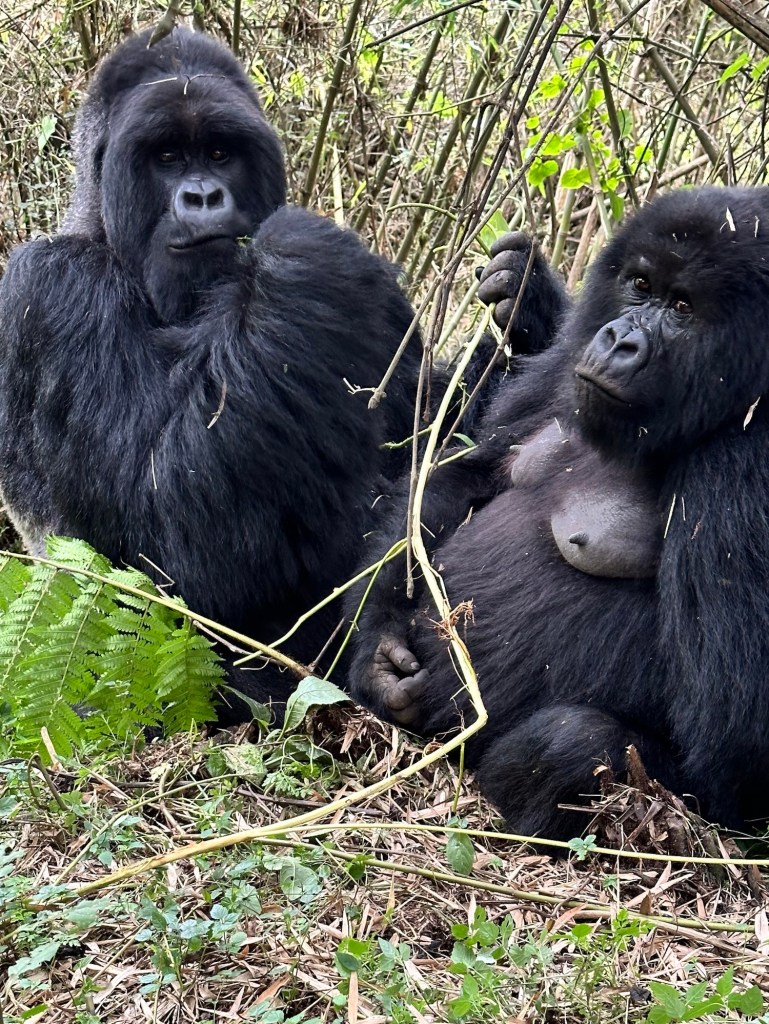
We spent the full hour with the “Lucky” Family, so named because their group included twin boys.
There are currently 24 “habituated” families living in Volcanoes National Park. Although there are several more families living on the mountain, the remainder are not used to human contact. It takes about 5 years of gradual exposure before tourists can spend time with them.
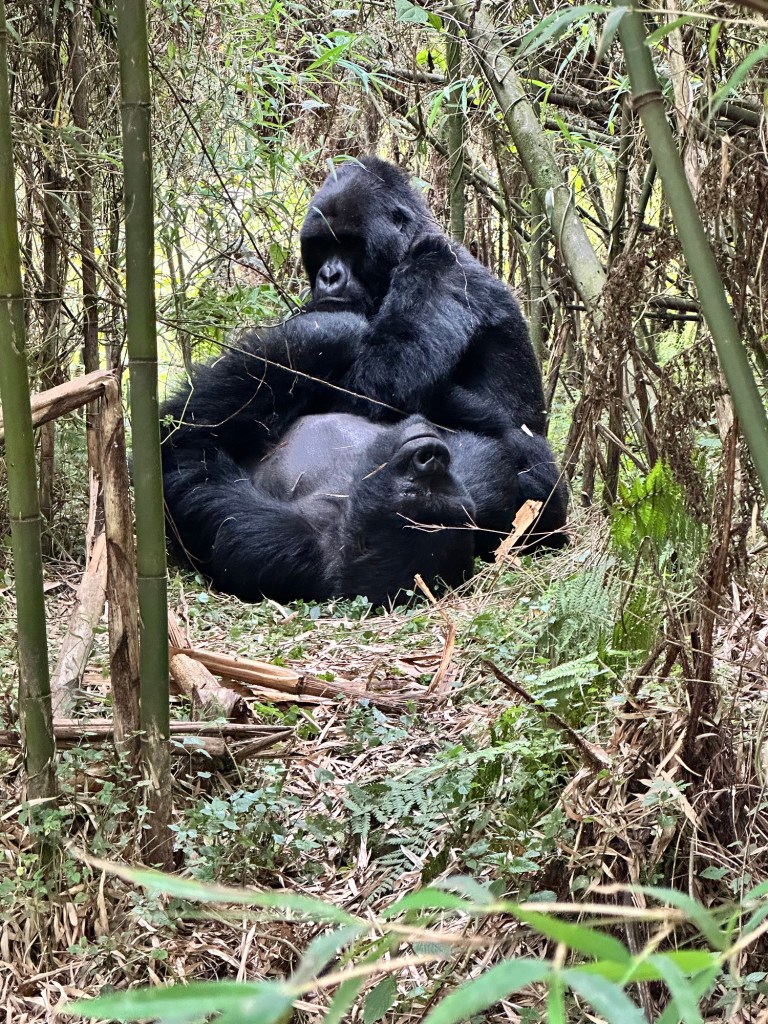
Was the experience worth it? You be the judge. How many people get to watch a silverback twerk?
Eventually we met most of the family: here’s one of the moms and her baby,
the twins, doing what brothers tend to do,
If you’d like to see them in action, just hop on over to YouTube.
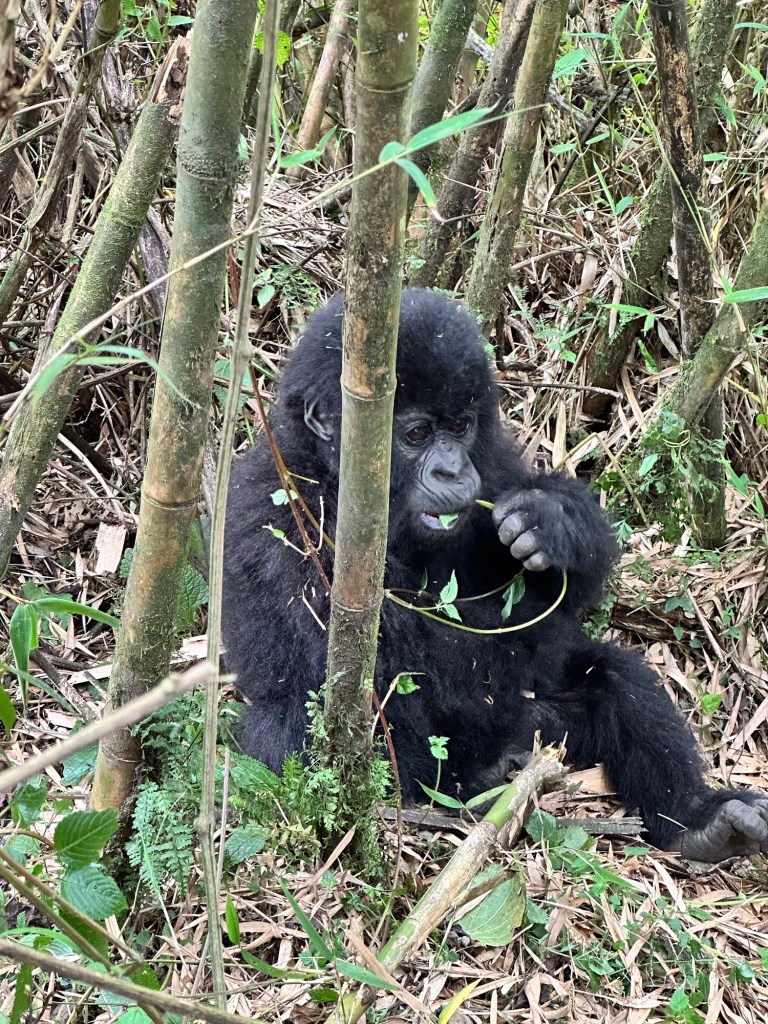
And the adventurous toddler, exploring on her own.
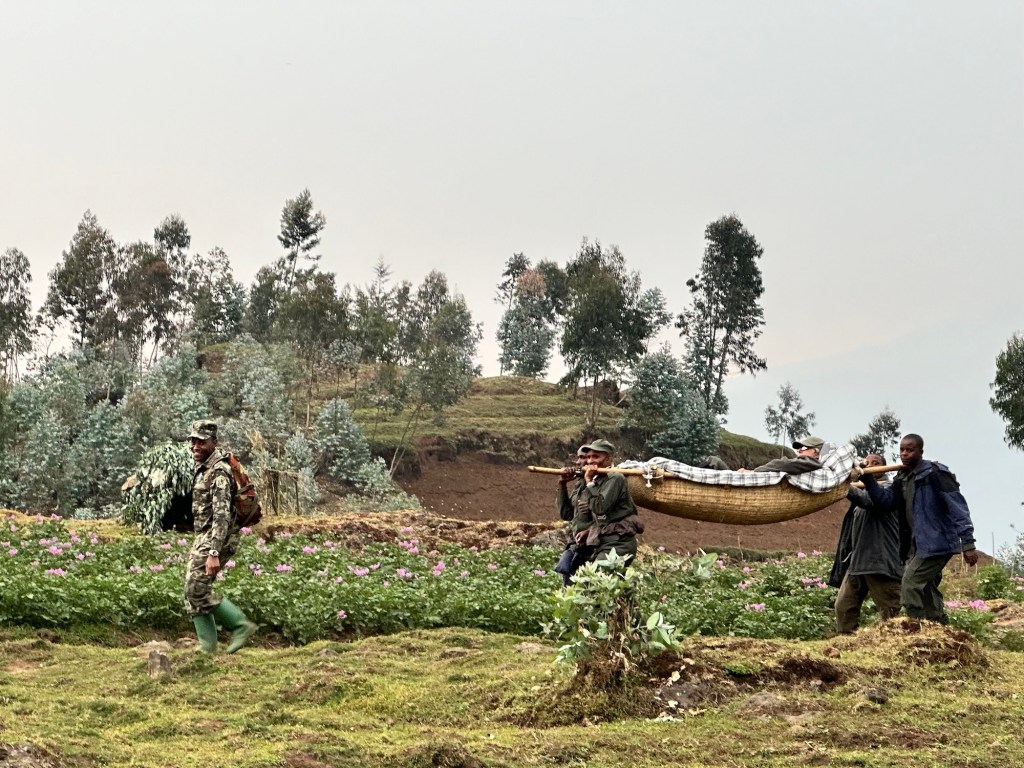
If you think this trek would be too arduous for you, fear not. Rwandans have a solution that a member of our group used. Take a look at this alternative mode of transportation.
Not surprisingly, you pay extra to be carried like royalty, but for a once in a lifetime experience like this, I think it would be well worth the extra money.
My family would not be shocked to learn that I got lost while on the trail. Fortunately, one of my new best friends heard me calling out, and helped me find my way back to the group.
I know. I get lost a whole lot. But come on. Take a look at this trail.
As we were preparing to leave at the end of our hour, the family was also (as the Billy Joel song went) “movin out” .
So what else was memorable?
Seeing women work as porters, trackers, and protectors. Just in case we encountered an angry buffalo or rogue elephant, this beautiful young woman was prepared to guard us,
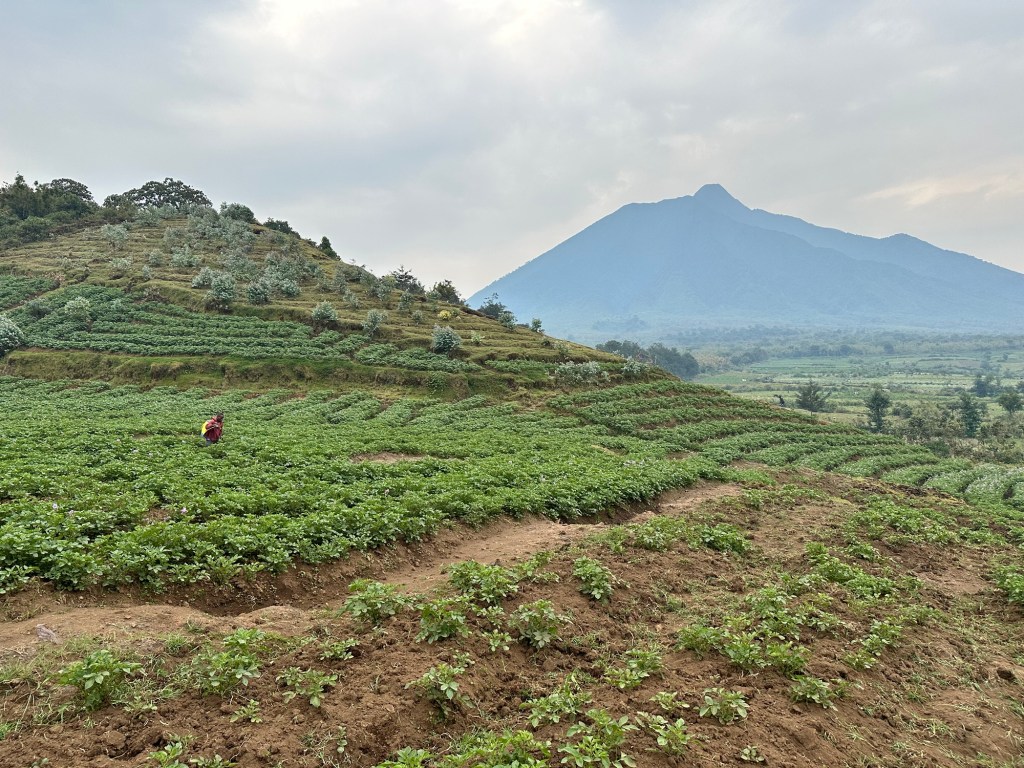
the gorgeous scenery on our way to the mountain,
returning to our fantastic hotel,
and best of all, being able to share the experience with a wonderful group of people, my new friends.
Next stop, Kenya, where our group will gain an additional member.
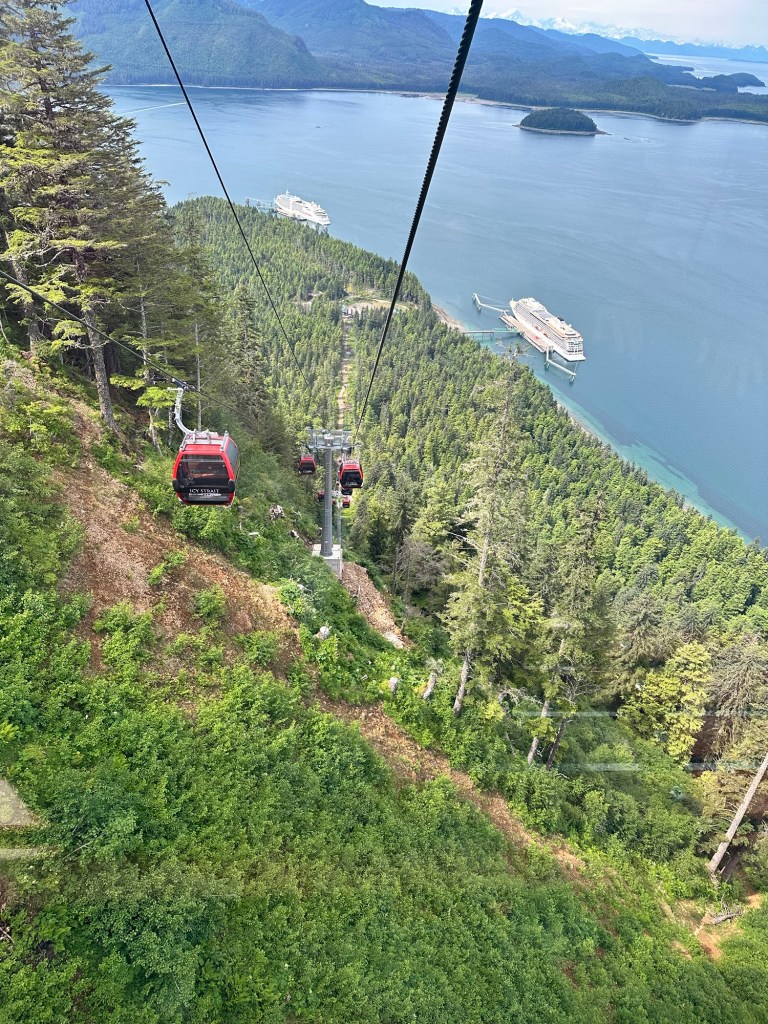
Once again, we are sharing the port with only one other mid sized ship, Silverseas. We each had our own dock, so Icy Strait Point was very peaceful and uncrowded.
My day started early, on the deck with Richard, the naturalist. Although we spotted some porpoises, they only briefly popped out of the water, disappearing before I could capture their image.
Viking offers one free excursion in every port. For THIS port, we got a ticket to the red gondola, which allowed us to go to the top of a mountain and enjoy a panoramic view.
Earlier that day, Jean and I chose what was described in the cruise literature as a “ demanding” hike through the Tongass National Forest. Demanding, like beauty, is definitely in the eye (or feet) of the beholder. It was less than a mile, and although there were a few slight inclines, the hike was mainly flat. But Tess, our guide, made it really special. Not only did she know about wildlife and vegetation, she also took great photos.
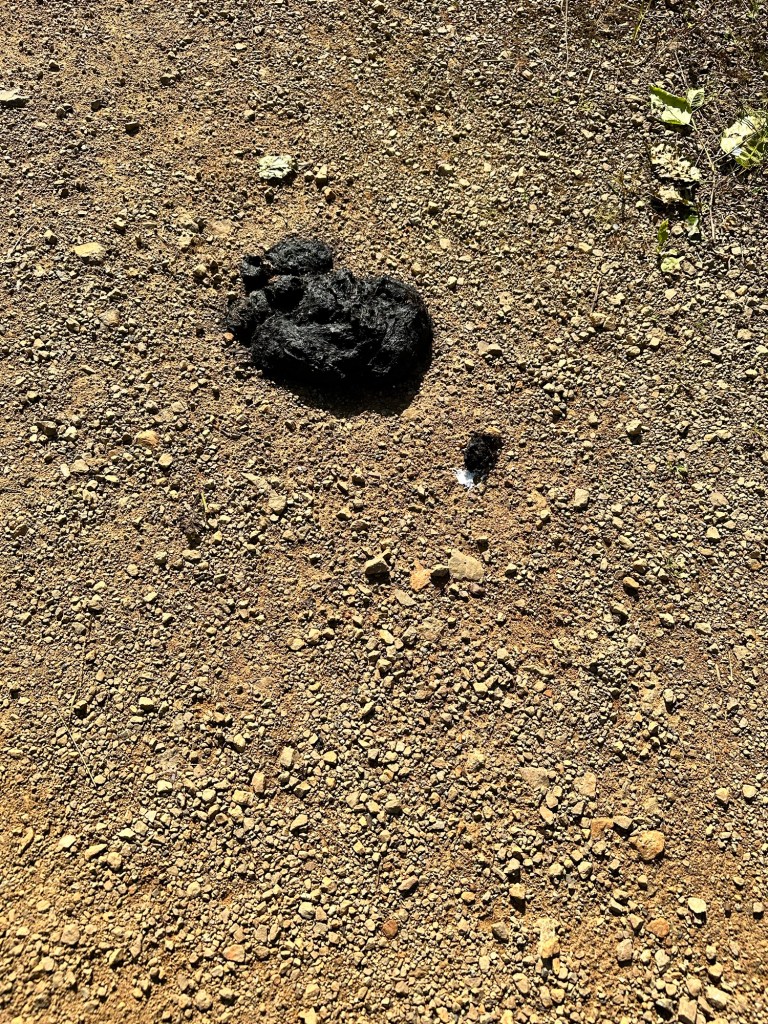
Thanks to Tess, we can now look at bear droppings and immediately determine the gender of the bear.
The first pile was deposited by a female, because the ladies STOP to relieve themselves. The males, on the other hand, don’t waste any time. They are “full speed ahead” so their “torpedoes” are scattered all along the trail.
Bet you didn’t know this post was going to be so educational.
But wait…there’s more!
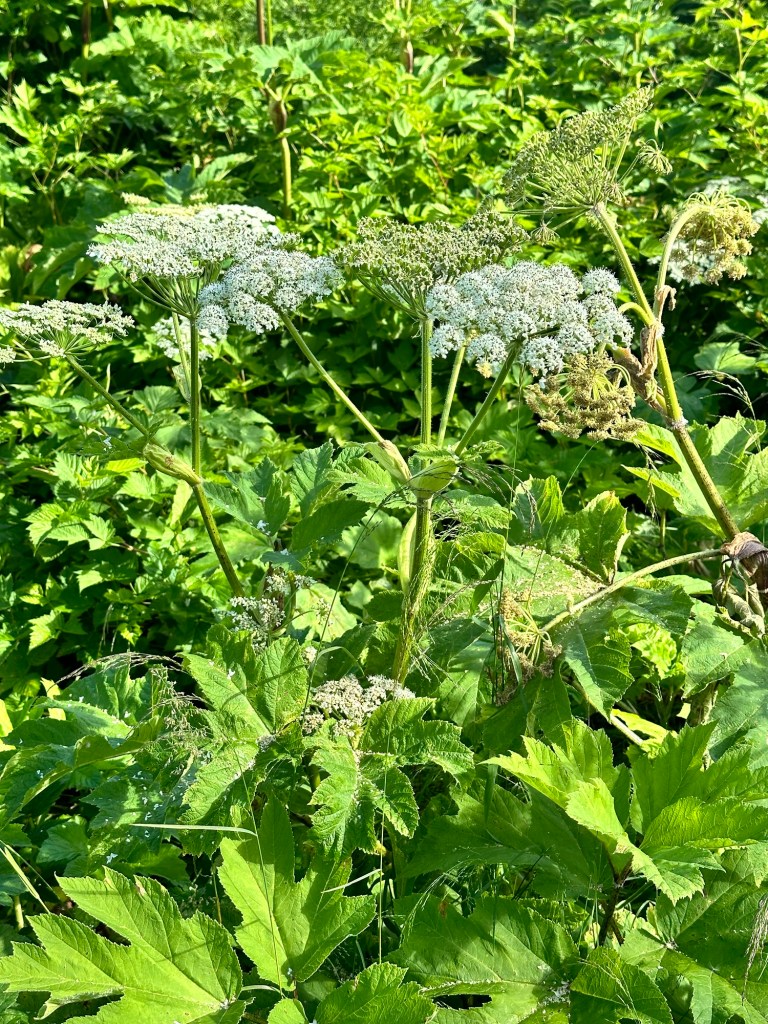
We saw this plant EVERYWHERE.
It looks a lot like Queen Anne’s lace, but it’s not. If you touch it, a substance on the plant reacts with sunlight to produce a somewhat nasty rash. Tess pulled up her sleeve to show us how she came by that knowledge.
At the end of our hike, we were left off by the Hoonah Cannery, near the green “free” gondola, which provides one way to get from one dock to the other.
Or, you can opt to walk along the beautiful nature trail, which was a little longer than our “demanding “ hike.
My reward for taking the road less traveled? I got to watch this eagle hang out on a branch WAY high up in a tree. Yeah, I know. The zoom wasn’t great, so I had to crop the photo a lot, but you get the idea. That bad boy was swiveling his head and looking every bit as regal as the one on our dollar bill.
Eagles are plentiful in Juneau. One guide estimated there are about 30,000 eagles in Juneau alone, which makes them as common as a sea gull. Still, seeing this guy on the nature walk was really special to me.
Did you know that Southern Alaska gets a LOT of rain? We sure didn’t. Brett, our guide in Juneau, told us the area averages only about 30 sunny days per YEAR!
I’m so glad we took full advantage of the great weather in the other ports. Another difference when we got to Juneau— we also are no longer one of only two ships visiting the area. Take a look at Juneau’s harbor. The enormous cruise ships — Princess, Norwegian, Crystal, Holland America all docked at the port. We were moored in the bay and took a tender in to the port.
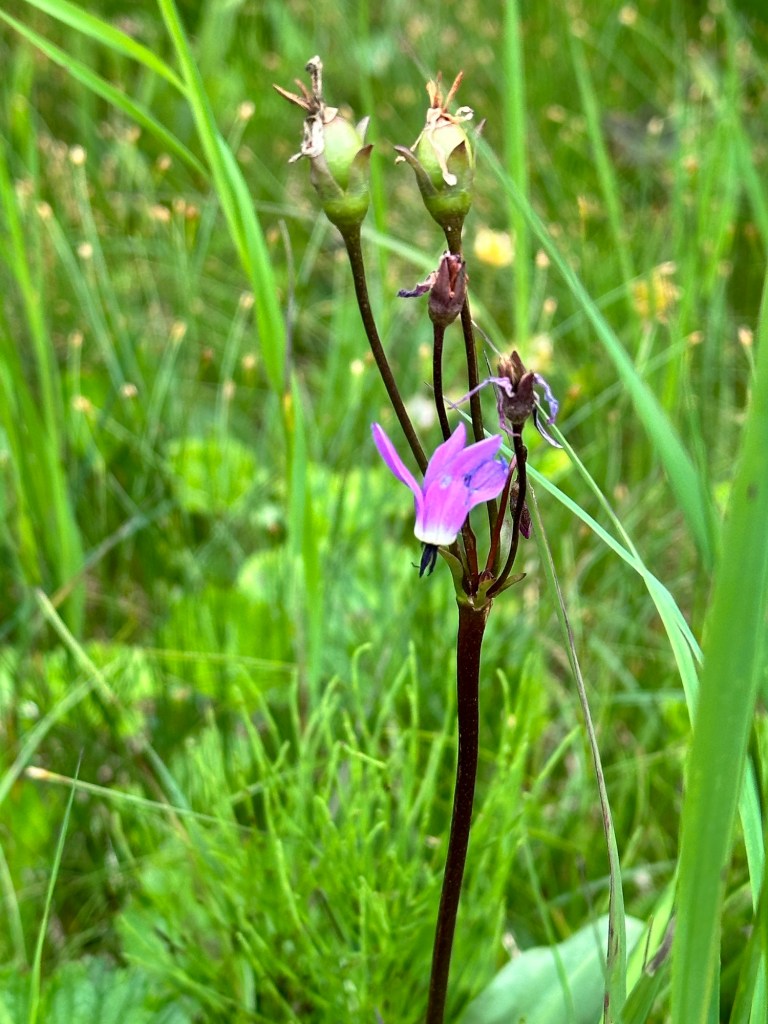
We lucked out with the morning weather for our “hike” with Brett in the Eagle Crest ski resort. This “hike” was only about a fourth of a mile long, but at least we got to see lots of wild flowers.
Jean and I were concerned about being late for our helicopter ride to the Herbert Glacier, so we got off the bus and walked the mile into town, arriving with enough time to grab lunch in a waterfront restaurant.
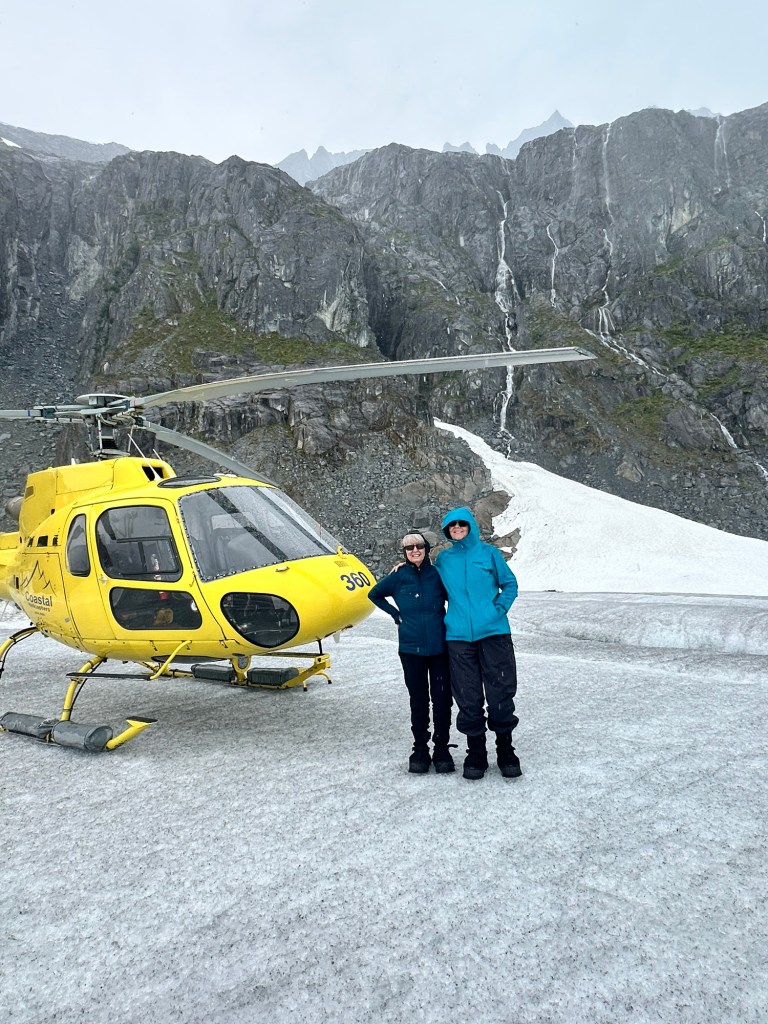
Although it rained during our ride and while we were in the glacier, it still was a pretty spectacular experience. I got to sit up front with Tom, the pilot.
The colors were brilliant.
We were cautioned to only walk on the ice, not the snowy patches, because you didn’t know what the snow was covering. It could be a 20 foot hole!
I’m signing off with two last now and then photos— taken 50 years apart.
The LAST time we spent more than a week together was in my first apartment in Bridgewater, Massachusetts. (I stuck this shot in especially for Tom, Jean’s husband, who didn’t know us way back then.)
Those are the only photos I have from the pre-cell phone, film era.
Mike and I visited Lyon and Paris in 1976. Although I vividly remember Paris: visiting the Louvre, Napoleon’s Tomb, Notre Dame and the Eiffel Tower, I have absolutely NO memory of Lyon. There was never anything that kindled even a little spark of recognition.
Looks like I’m not the only one with a memory problem.
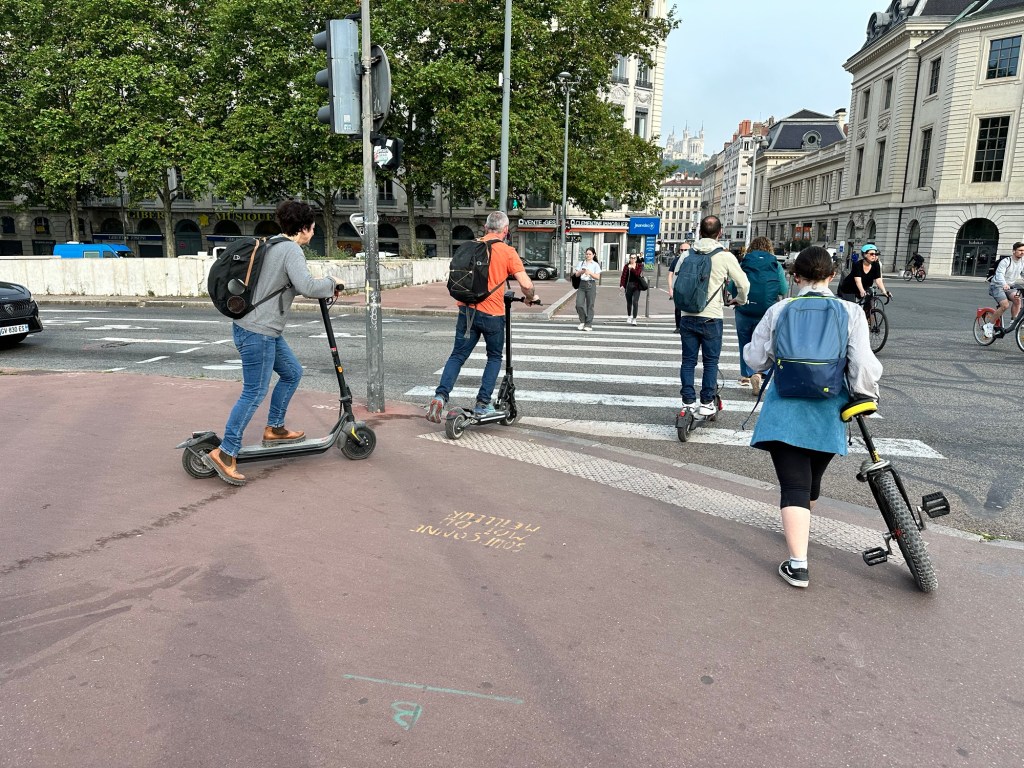
Our hotel is a short block from the Rhône River, and within walking distance to the old city. People in Lyon use EVERY mode of transportation—bikes, unicycles, scooters, so you aren’t just dodging cars, buses and motorcycles when you cross the street.
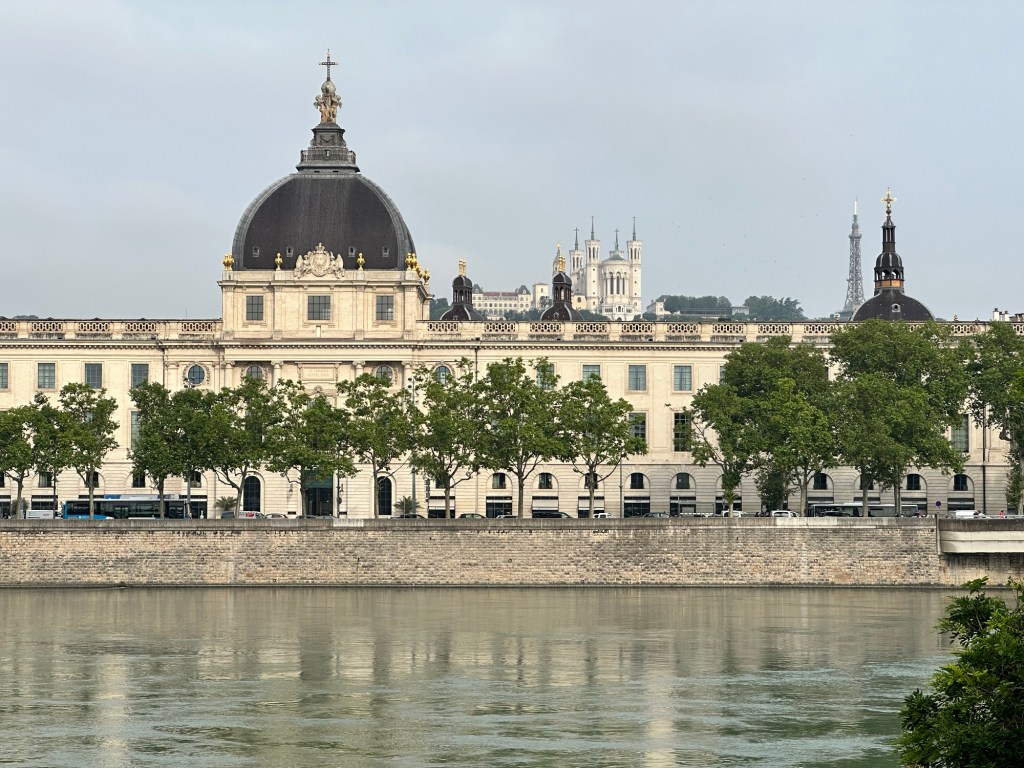
It is difficult to get lost in Lyon, even for me. From the river banks, it is easy to find three important landmarks. The black domes are atop the Hotel Dieu. Now a luxury hotel, from the late 1400’s until 2010, that large building was a hospital. The white building to the right (in the distance) is the cathedral and barely visible, on the far right, behind the dome is a fake Eiffel Tower.
Now why would there be a second Eiffel Tower? Well, back in the day, tourists would visit the outskirts of Lyon, but never bothered to visit the city proper. So, knowing how poorly educated people are about geography, the town fathers rightfully guessed that people were aware that there was an Eiffel Tower in France, but had no idea in which city it was located. Voila! The tourists did indeed come into the city center to view the “imposter” tower. And a tourist trap was born. Clearly that was well before the advent of Ms Google.
The “tourist trap” needed a better photo, so here it is.
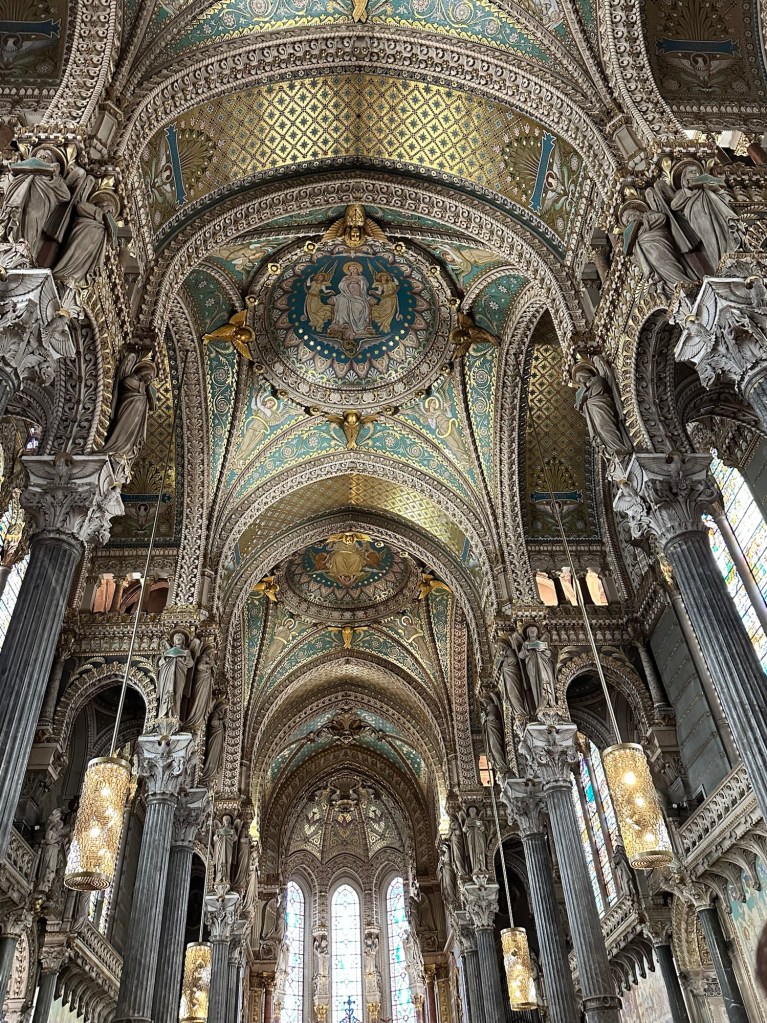
We took the funicular up to the cathedral. I know, yet ANOTHER church. But this one had some rather interesting features.
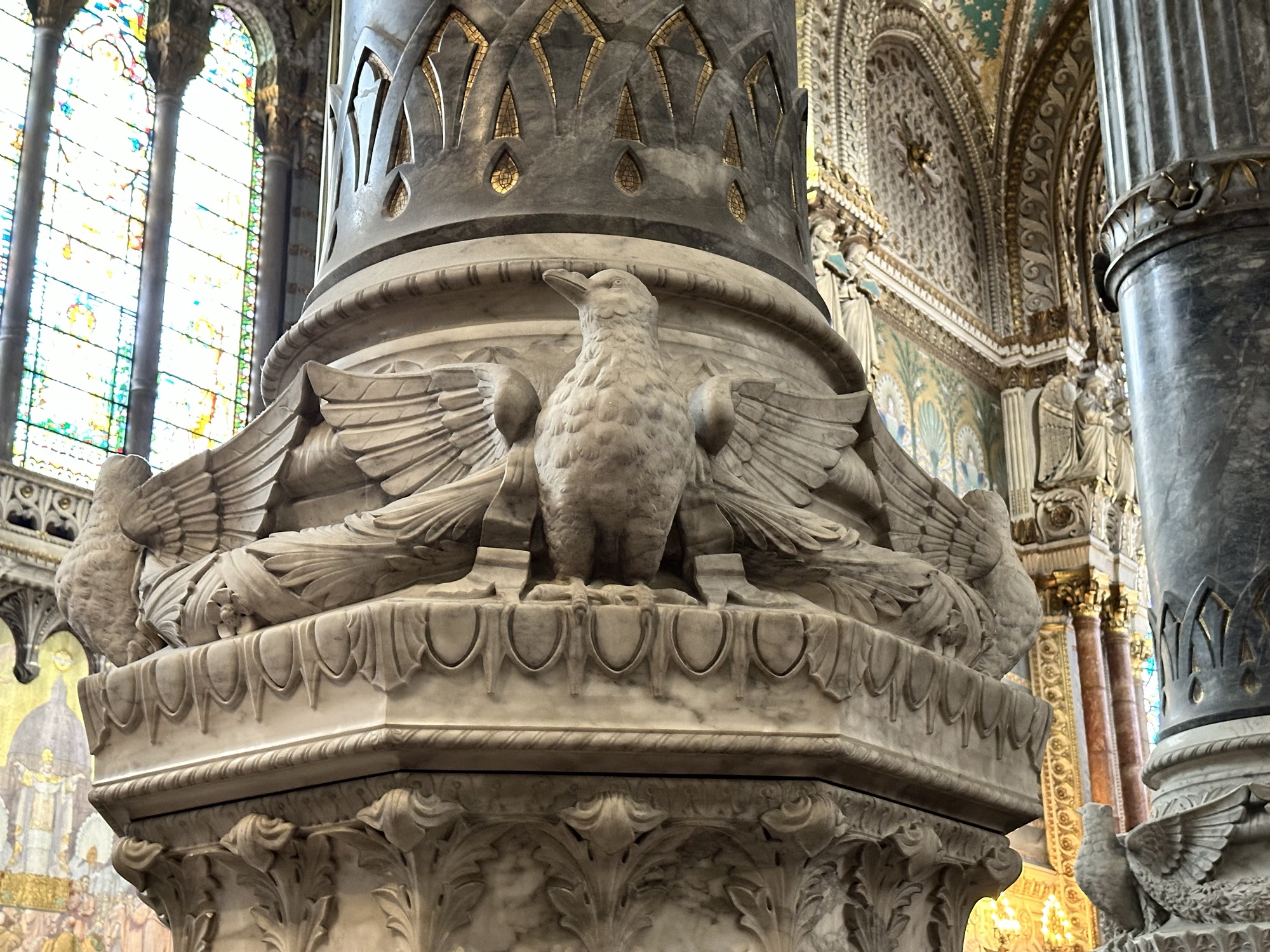
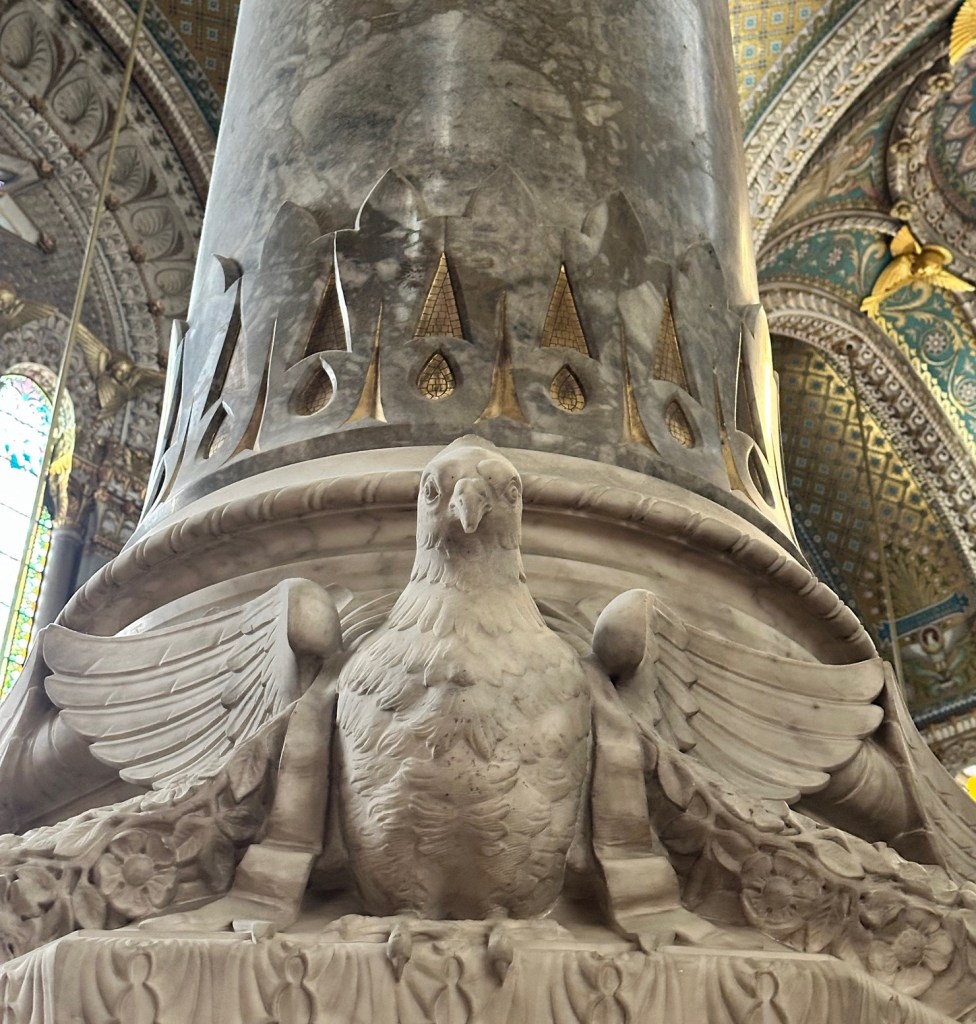
Check out the number of columns in this cathedral—and how ornately decorated they are, with different statues standing on the top. At the base of each pillar are birds, all slightly different. Some of them are looking straight at you, others have their beaks lifted at varying angles. Admit it—have you EVER seen birds on a church column? On the INSIDE of a church, that is. I sure hadn’t. Perhaps they symbolize the Holy Ghost?
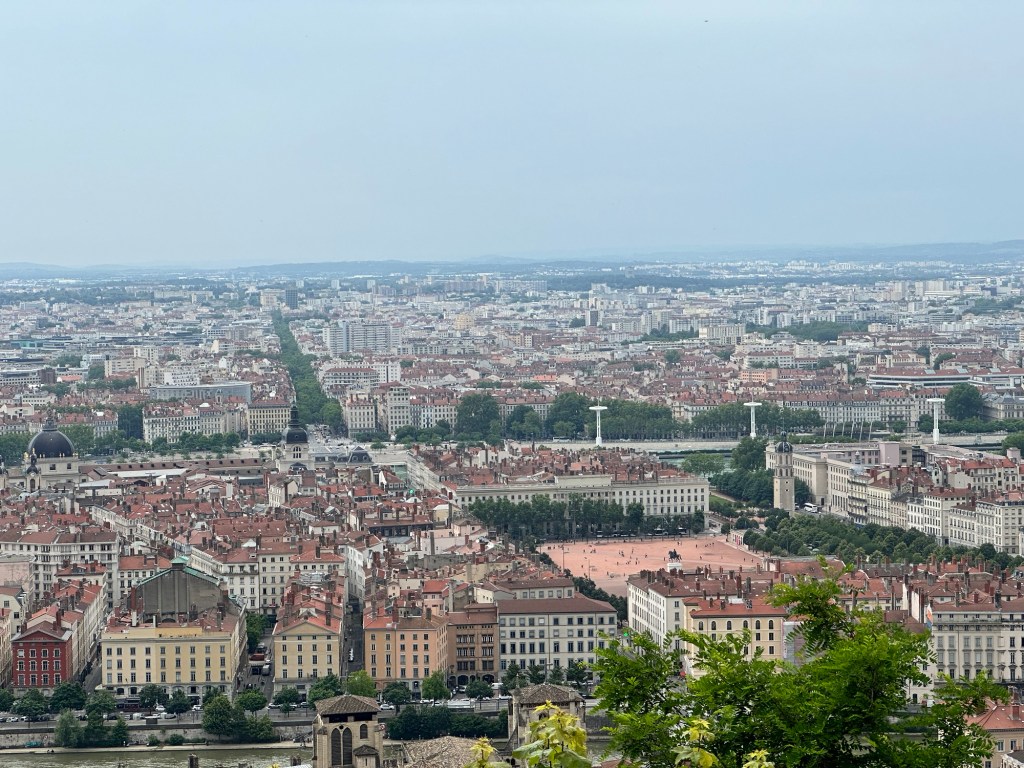
Before we descended, we had to check out the incredible view. More later about the three white towers in the distance .
During our time in Lyon, we had two scheduled activities. The first, a food tour, brought us through the old city, and consisted of tasting stops at a chocolate shop, a bouchon and a pastry store. The food wasn’t wonderful ( fish soufflé at the bouchon, overly sweet pie at the pastry stop) but the guide was.
Our local guide explained that the hospital (now Hotel Dieu) was located at what was once the border to France. At that time, our hotel would have been in Germany! Why was a hospital located there? So that the medical team could examine all travelers before they were allowed to enter France.
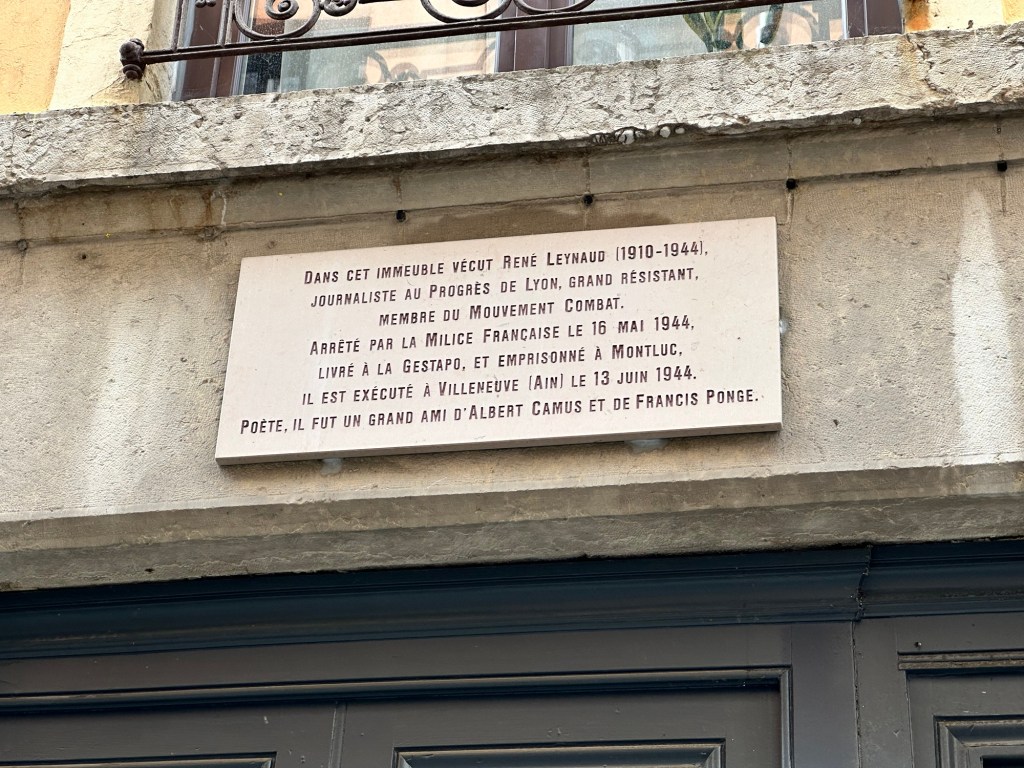
The second tour which focused on the Resistance, took us to a different part of Lyon. This tour consisted of walking up and down narrow cobblestone streets to view plaques affixed to various buildings.
We also went thru passages the resistance workers took to evade the Gestapo. Now the buildings are covered with graffiti and the passageways are entrances to apartments and function as storage areas for trash cans. The walk was uninspiring, however once again, the guide was great. Although I was listening intently to her description of the mind sets of the French during World War II, I found myself more interested in the abundant street art than the plaques.
Take a look.
I initially thought someone stuffed a funky gorilla into a hole in this building, so of course I had to examine more closely. This very talented artist somehow achieved a three dimensional effect on a flat building wall. Wow.
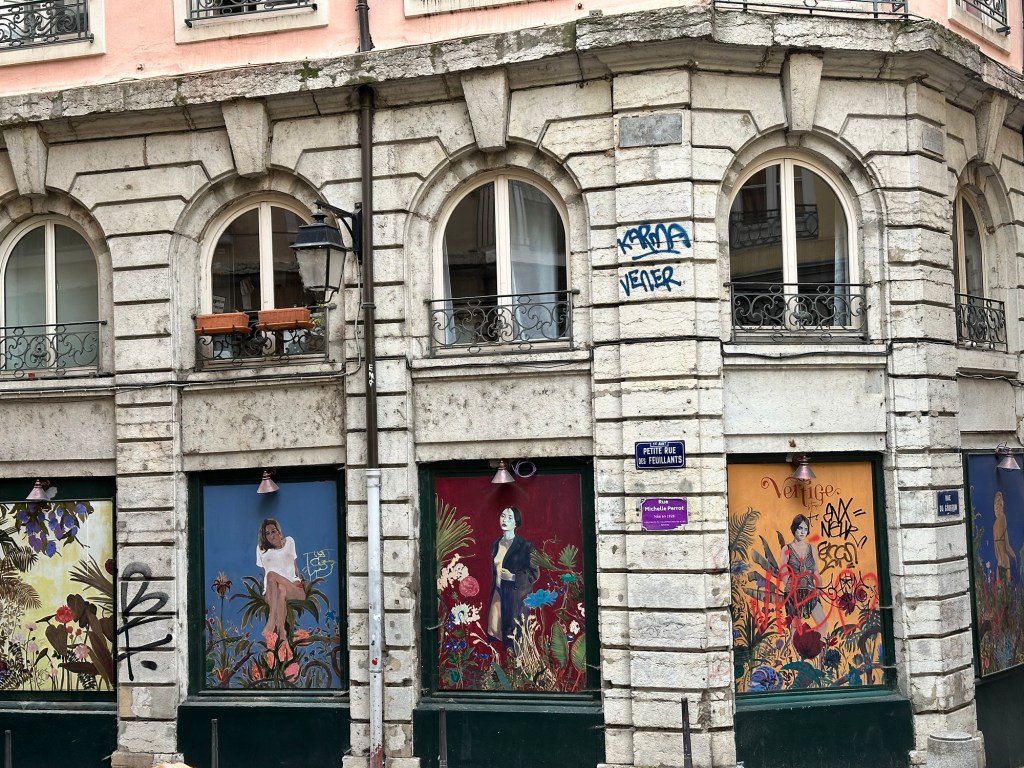
When the guide asked if there were any questions, did I ask about Marshall Petain or the Vichy French? Hell no, I wanted to know what kind of business had paintings of “come thither” women in the windows.
The answer: a strip club. And now more street art.
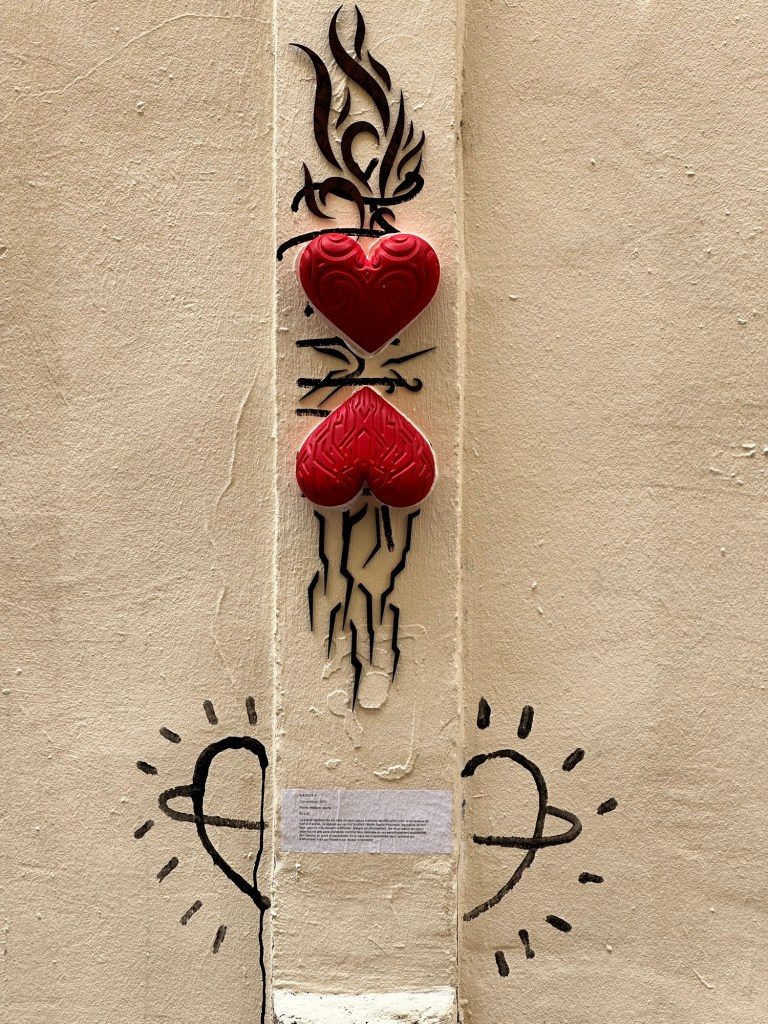
Ms Google translated the artist’s intent, which was written in French below the artwork. Here’s the “ readers digest” version. The hearts, facing each other, have different motifs. Despite differences, the two hearts can find understanding and coexist.
Believe it or not, the above is a message to Macron. The words “straight into the wall” doesn’t mean anything to me, but apparently the French get it.
Lyon is a very walkable city so I did some solitary exploring. Remember those white towers visible from the Cathedral ? Lyon had hoped to be selected to host the Summer Olympics, so a swimming complex was built. I’m not sure what the function of the towers was because they seemed too high ( to me ) to be diving platforms. But then, I’ve never seen Olympic diving platforms other than on TV, so maybe they were.
Unfortunately, Lyon wasn’t chosen, but at least the residents ended up with a great place to cool off during the hot summer months.
In front of the towers is a skate park, where I watched a young man perform amazing feats on his bicycle.
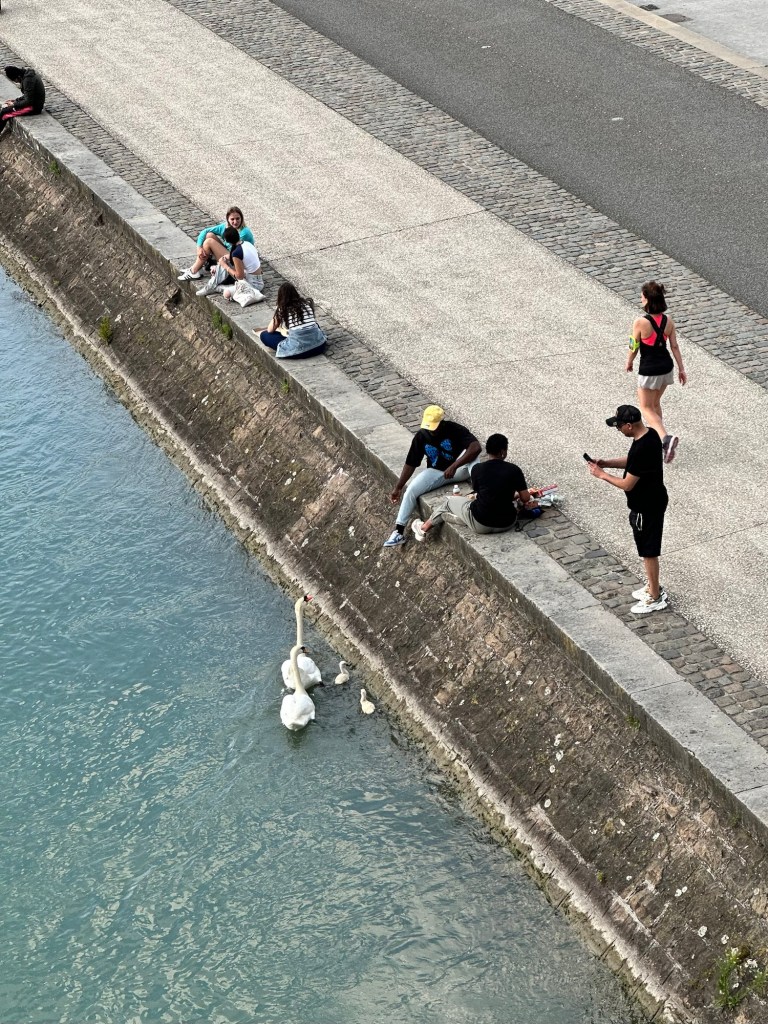
The river banks were a favorite gathering spot for people AND swans.
What can I say about Paris? Our time there was very short – just a day and a half. But I didn’t regret not staying longer. Instead, I figure at some future time, I’ll visit Paris on my own for several days, probably at a less popular time of the year, when the city isn’t crowded and the weather is less beautiful.
I really didn’t want to spend a gorgeous day wandering through a museum when I could be strolling down the Champs Elysees. And that’s exactly what I did on our only full day in Paris.
Photo by Jean
But first, let me tell you about our arrival.
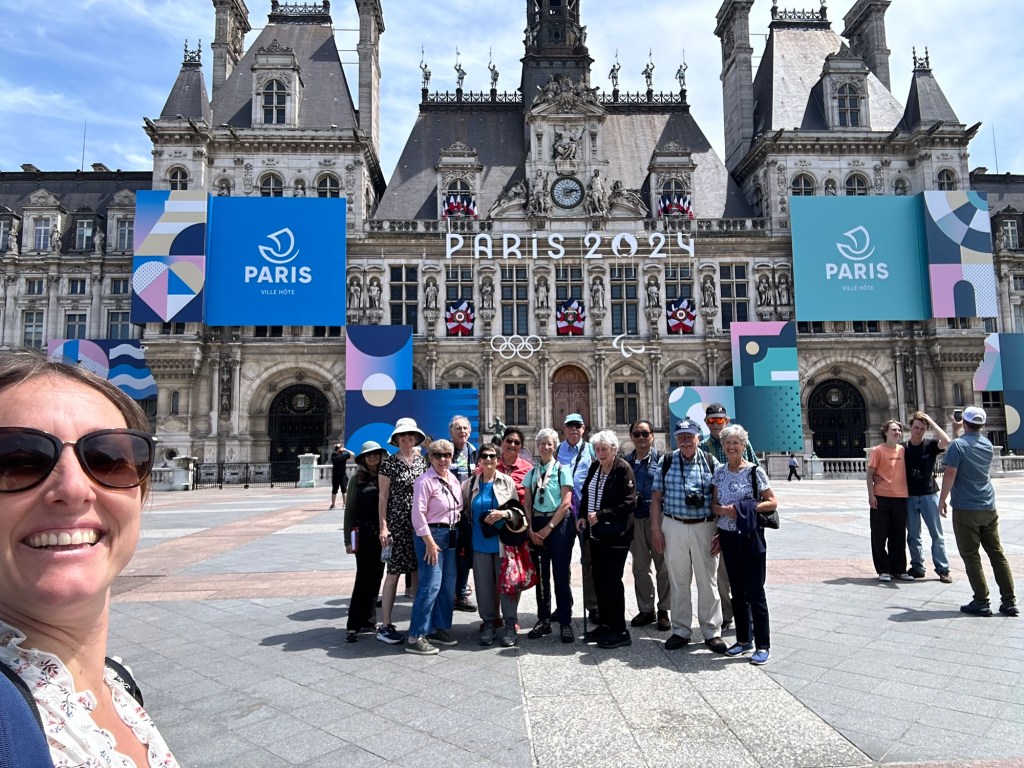
Laetitia took this selfie.
Our train from Lyon pulled into the Paris station in time for a late lunch (or in my case, a glass of wine and appetizers, because I ate on the train). Some of us were lucky to have Laetitia, our very lovely tour guide, join us. Side note: despite being 4 months pregnant, Laetitia had boundless energy. I figure our group was perfect training for future class trips with her child, except a bunch of elementary school kids will probably be much easier to manage.
During the afternoon, we experienced two different modes of transportation: the metro system and a boat ride on the Seine.
Richard very graciously gave us a demonstration of what not to do on the metro. Unlike elevators, metro doors do NOT reopen when you stick your hand between them. Fortunately, a metro worker responded to our shouts and Richard was able to get on board, with his hand still attached to his body.
We were never able to figure out what Annie (Richard’s companion) did wrong trying to get thru the turnstile, but a French woman took pity on her, put her arm around Annie, and they went thru the turnstile together. So much for the stereotype of the unfriendly French!
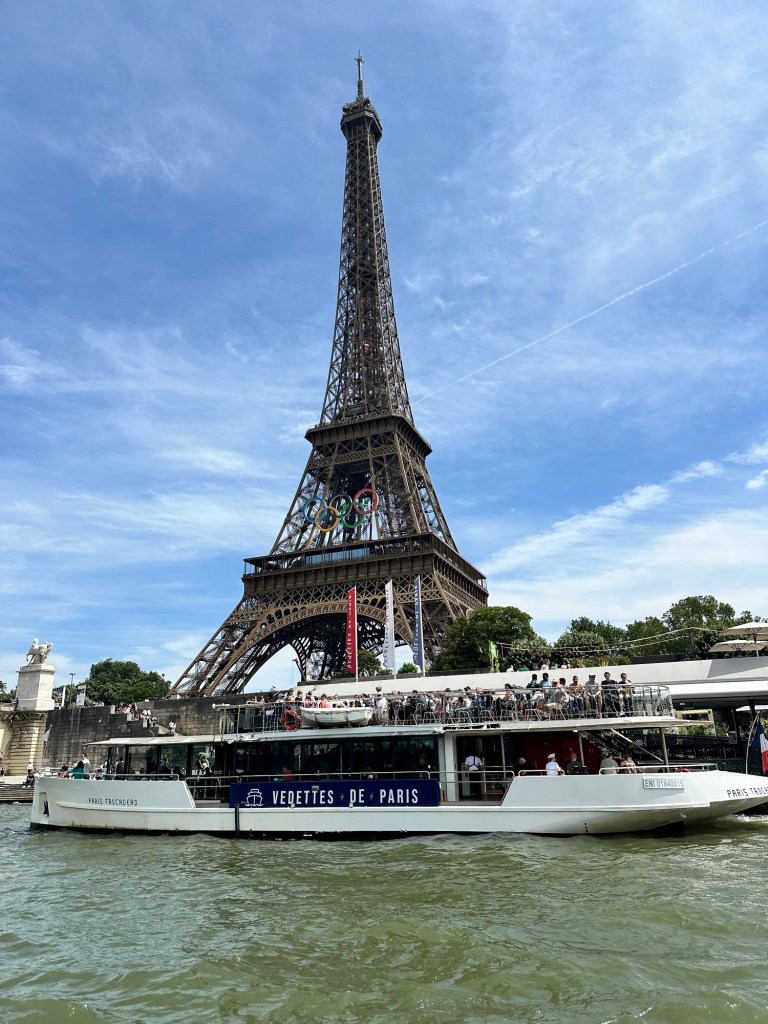
Luckily the boat ride was very relaxing and mishap free.
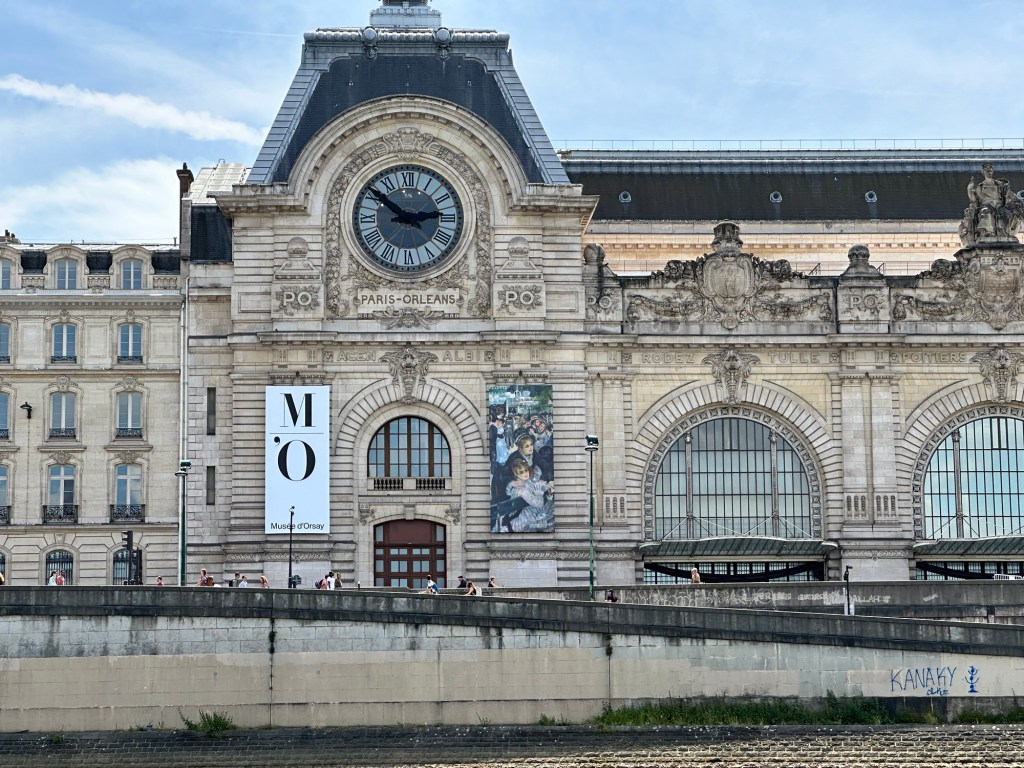
These are just a few of the landmarks we saw on the boat ride.
For our last “dinner on our own, Nancy, Steve and I walked through the neighborhood in search of a suitable restaurant. There were lots but most were jammed with young adults smoking and drinking beer.
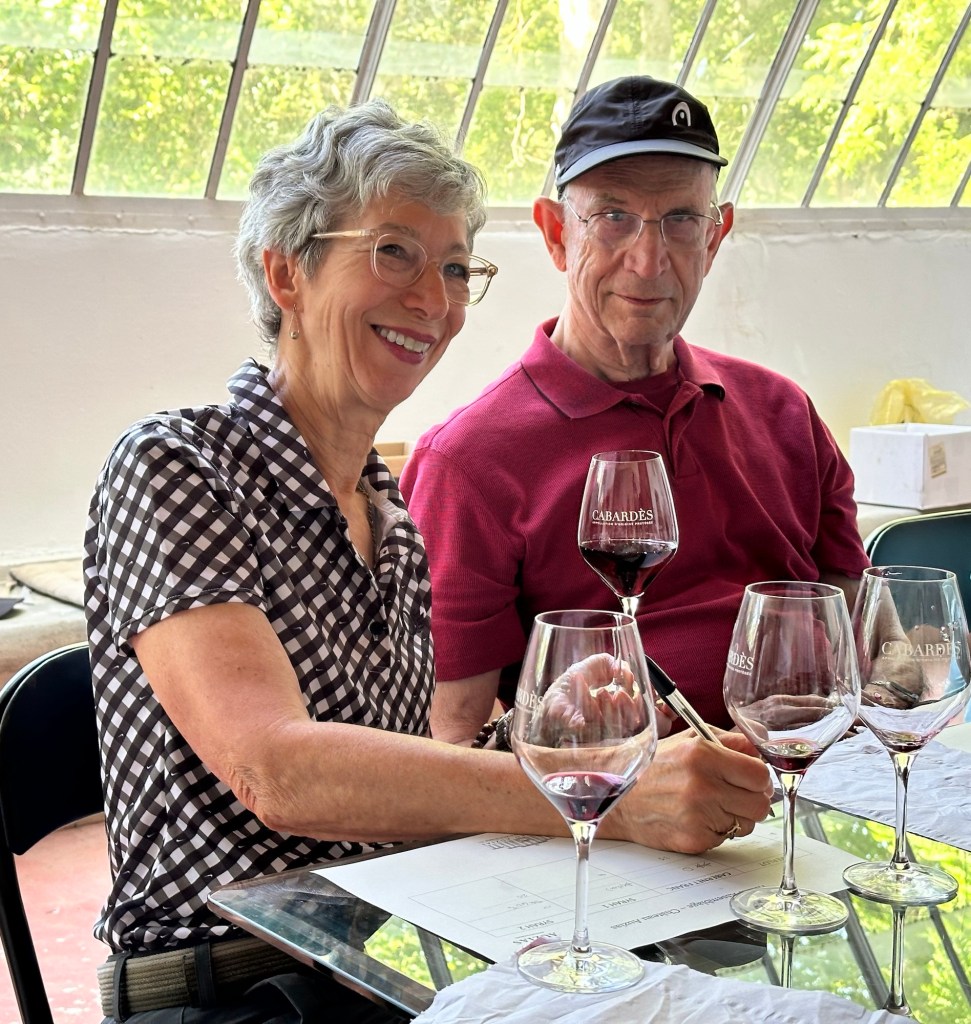
Photo of Steve and Nancy taken at the winery—NOT at dinner.
We finally settled on a delightful cafe, where we enjoyed a fabulous dinner, seated by a large open window. When Steve asked me if I knew where the hotel was, I responded with my usual answer: “I have no idea”. He then pointed to a HOTEL sign about three buildings away, thereby confirming I had the very worst sense of direction of anyone on the trip.
I was very grateful that Jean and Jim had a similar vision of the perfect last day in Paris, because if I didn’t have them guiding me, odds are I’d still be wandering around the city, looking for our hotel.
Jim and Jean
Our hotel wasn’t far from the Bastille metro stop, so that was our starting point for our Sunday adventure.
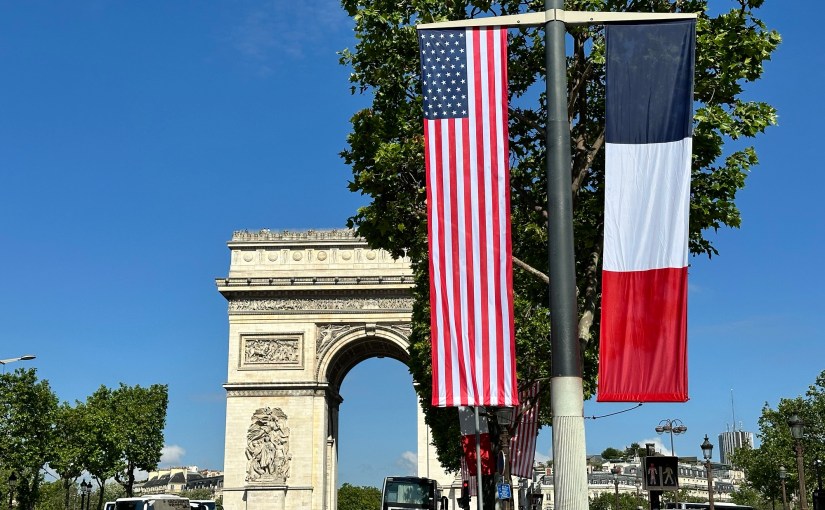
Because of the upcoming summer Olympics, several metro stops were blocked, so we rode to the Charles de Gaulle stop and backtracked to visit the Arc de Triomphe.
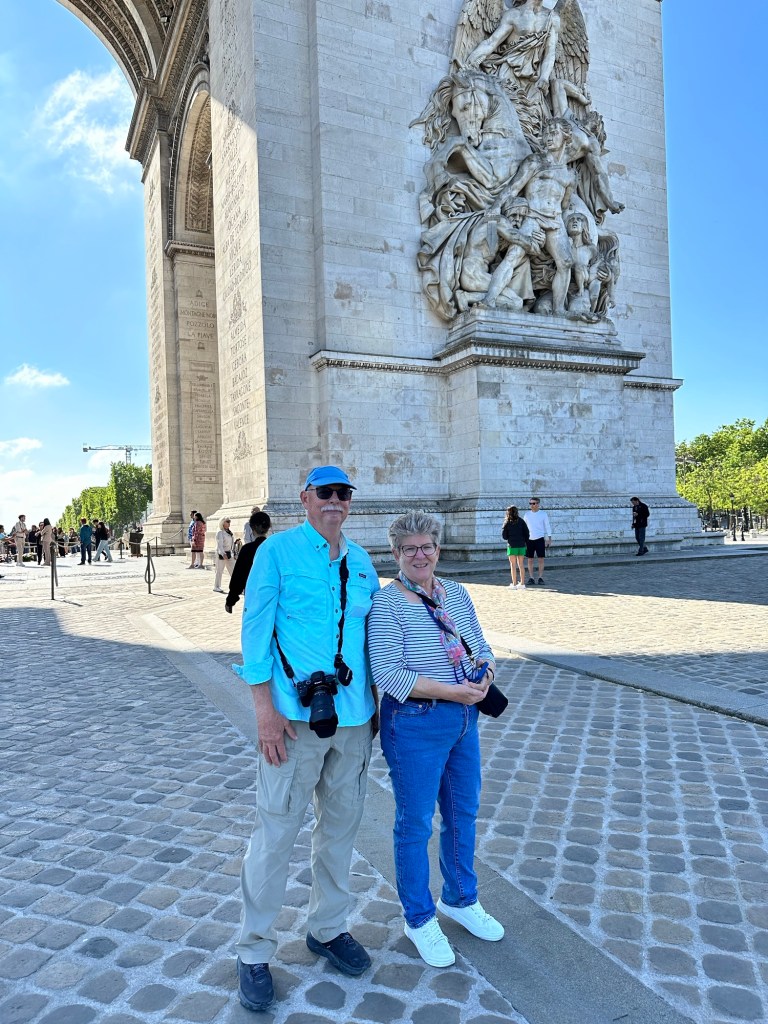
The Arc’s chaotic traffic circle is where I channeled my inner Grammy (my family knows what I mean) and convinced my travel companions to brave the oncoming traffic, rather than use the pedestrian tunnel.
We decided our RETURN trip would be less exciting, so smartened up and used the tunnel.
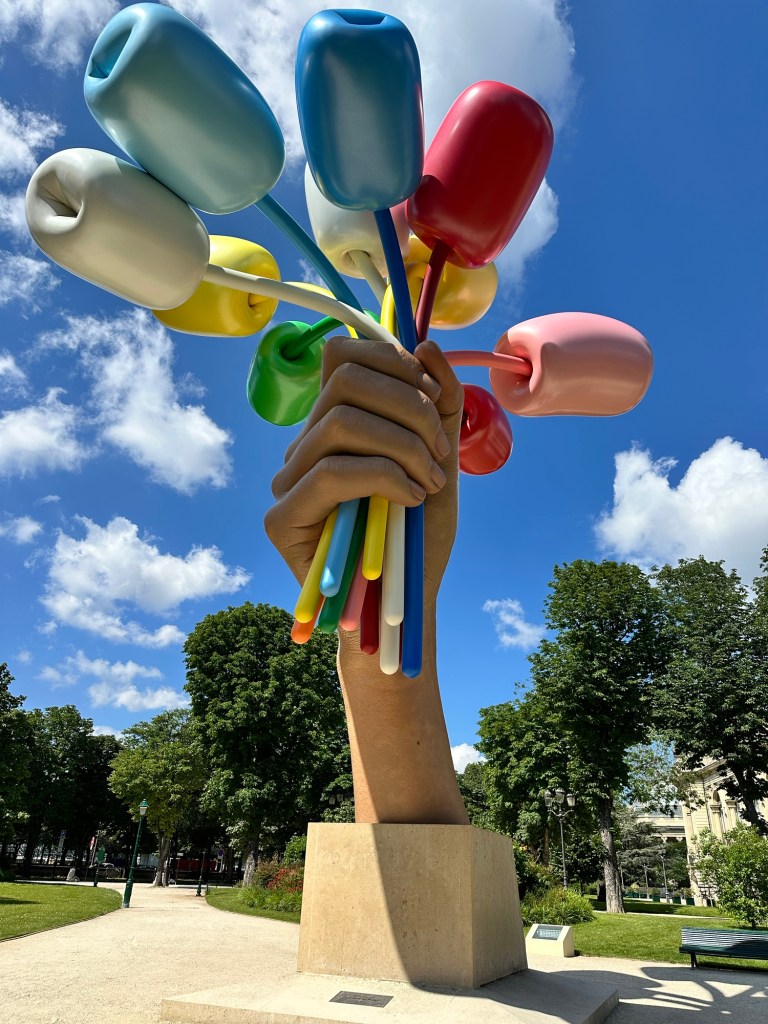
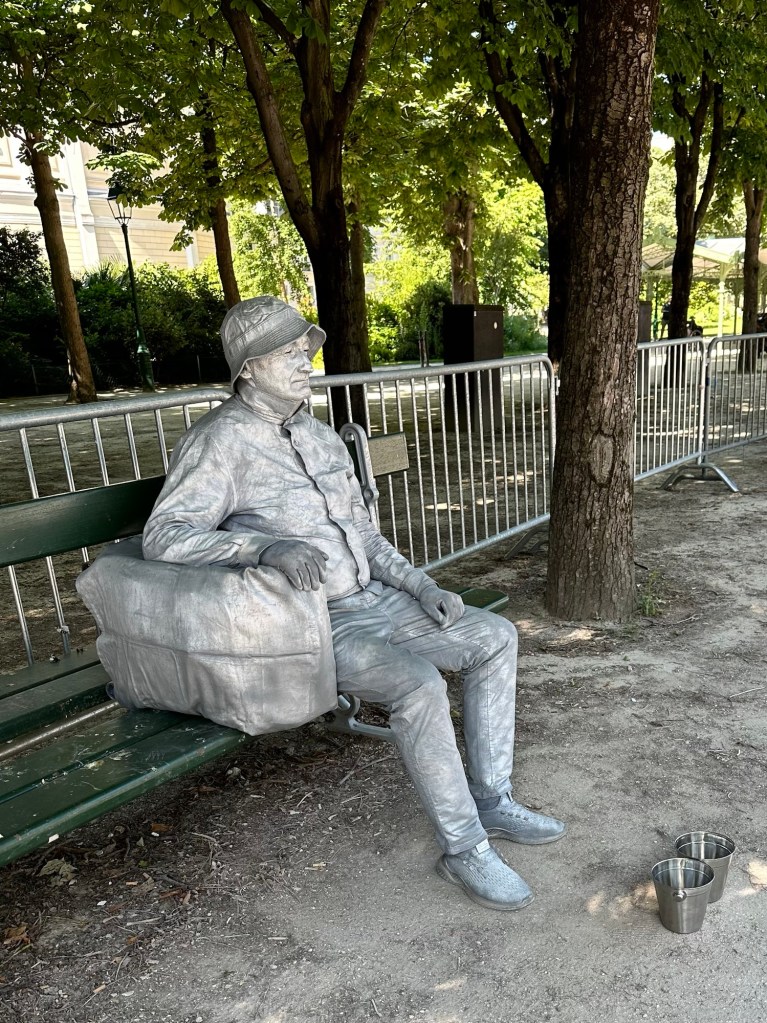
There were so many beautiful, whimsical sights along the way. Here are just a few:
These gold medallions swayed in the breeze and sparkled in the sun.
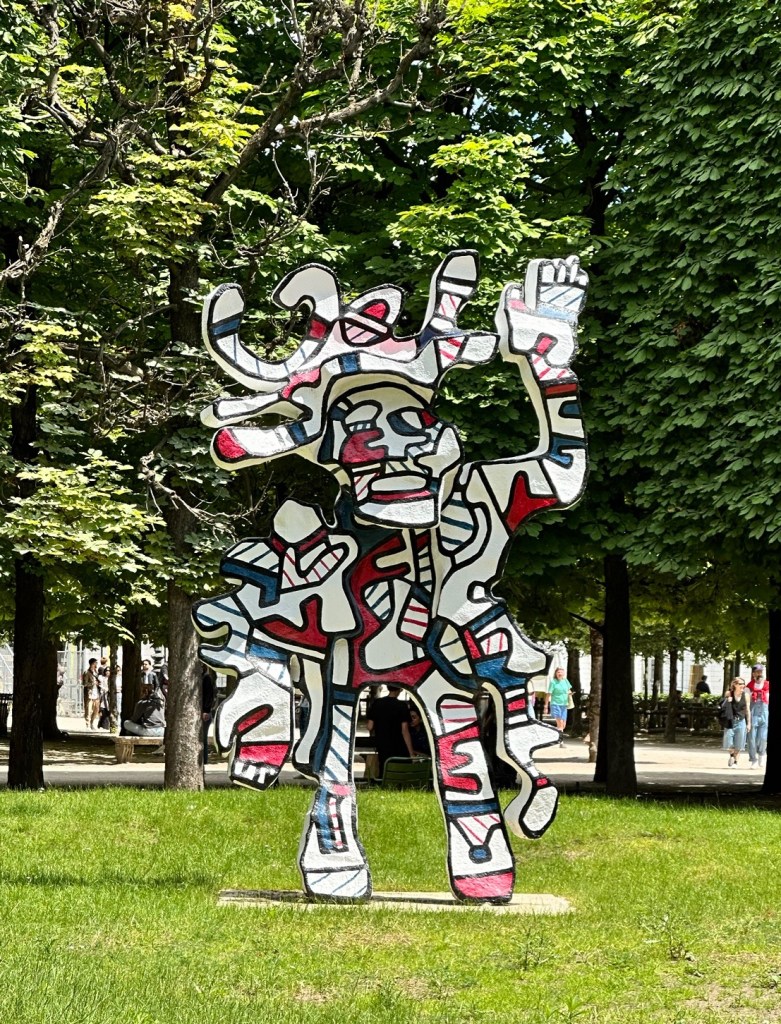
This sculpture reminded me of Seward Johnson’s work in New Jersey’s Grounds for Sculpture.
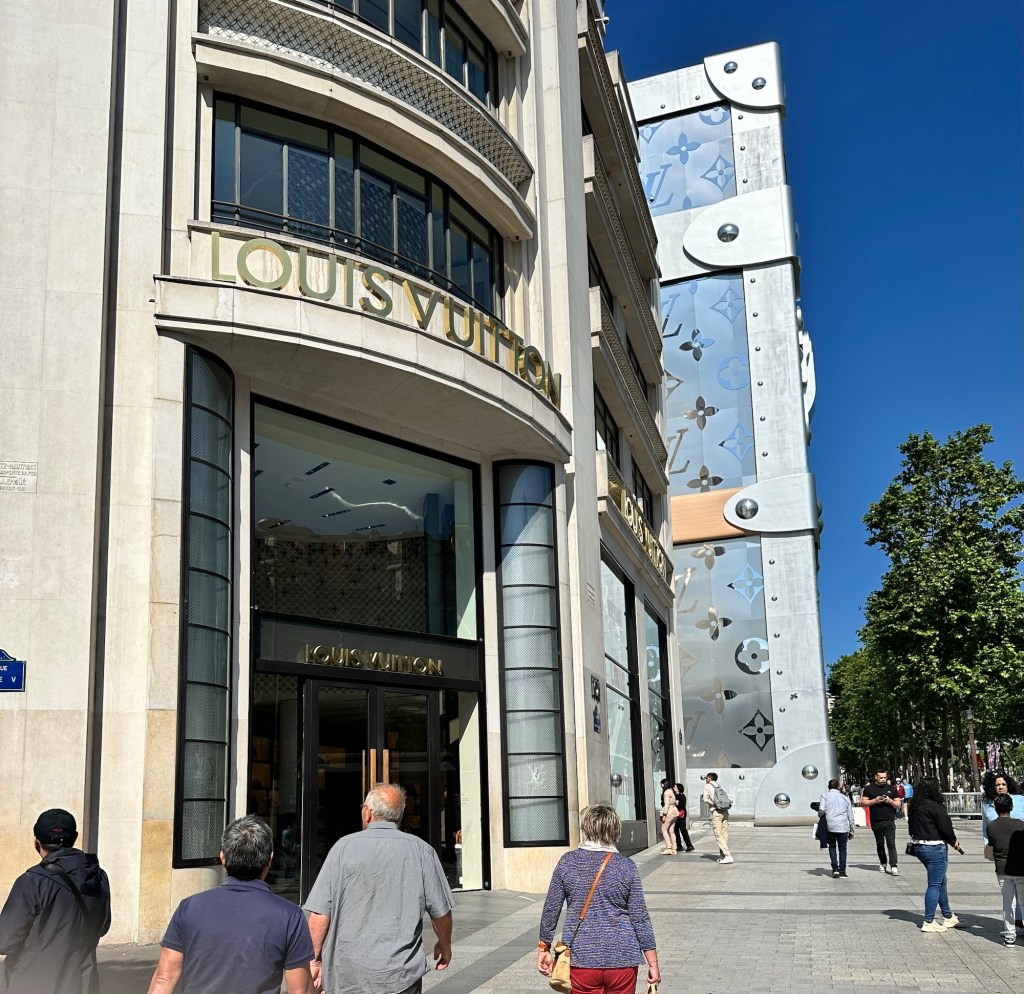
Of course, all the high end stores lined both sides of the Champs Elysees. I found the Vuitton store particularly clever, because because part of the building was designed to look like their signature bag.
We spent the day meandering aimlessly, stopping whenever we felt like it, taking detours to side streets, having lunch outside in a quiet, smoke free cafe. It was heavenly!
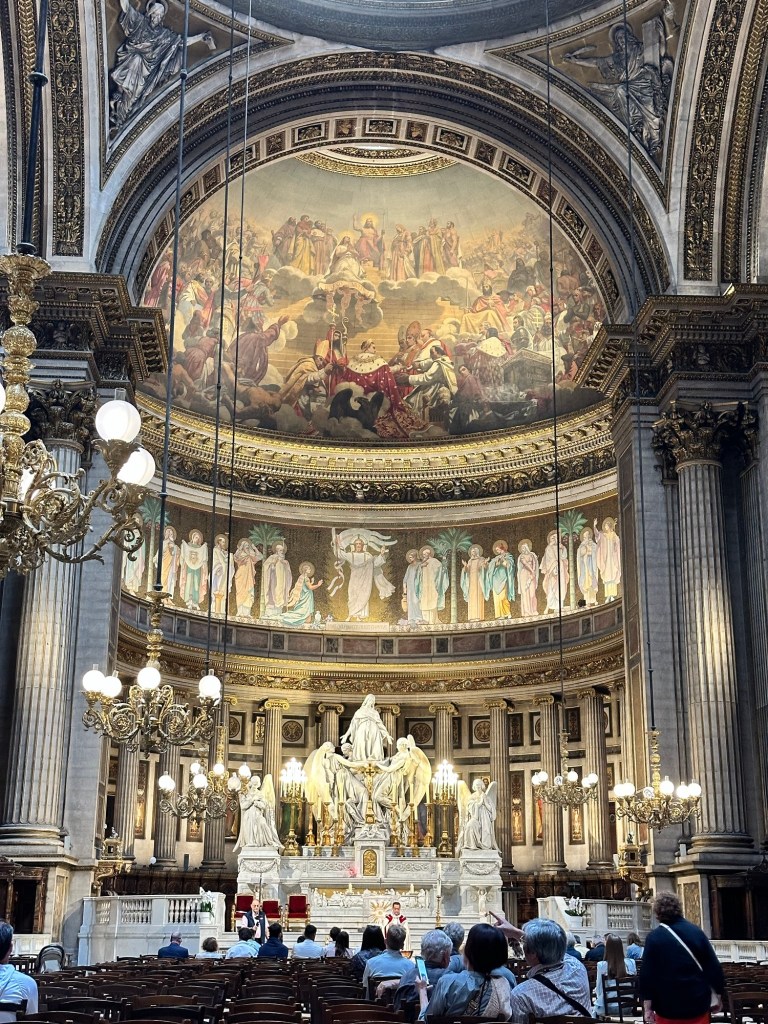
What Jean thought might be Pantheon, was actually the Church of Mary Magdalene. Even though the church bears her name, you’ll see that Napoleon got the top center spot in the artwork, and the most brilliant clothing. Everyone’s eye is naturally drawn to the red robe, right? Even Jesus’s clothes look like they could use a wash, compared to Napoleon’s. You might have to zoom in to get the full effect. I guess every age and culture has its Narcissists.
The prep work for the summer Olympics was visible everywhere, but we still managed to find some unsullied vistas.
By the time we reached the Louvre, we were ready to hop on the metro. There was wine to be shared, and the hotel was the perfect gathering spot!
How many bottles of wine are on that table?Photo by Nancy
It was sad to say goodbye to the wonderful friends I made on the trip, but it’s good to be home again.