Hakone, Part 1

Every time I think this trip couldn’t possibly get better, it does.

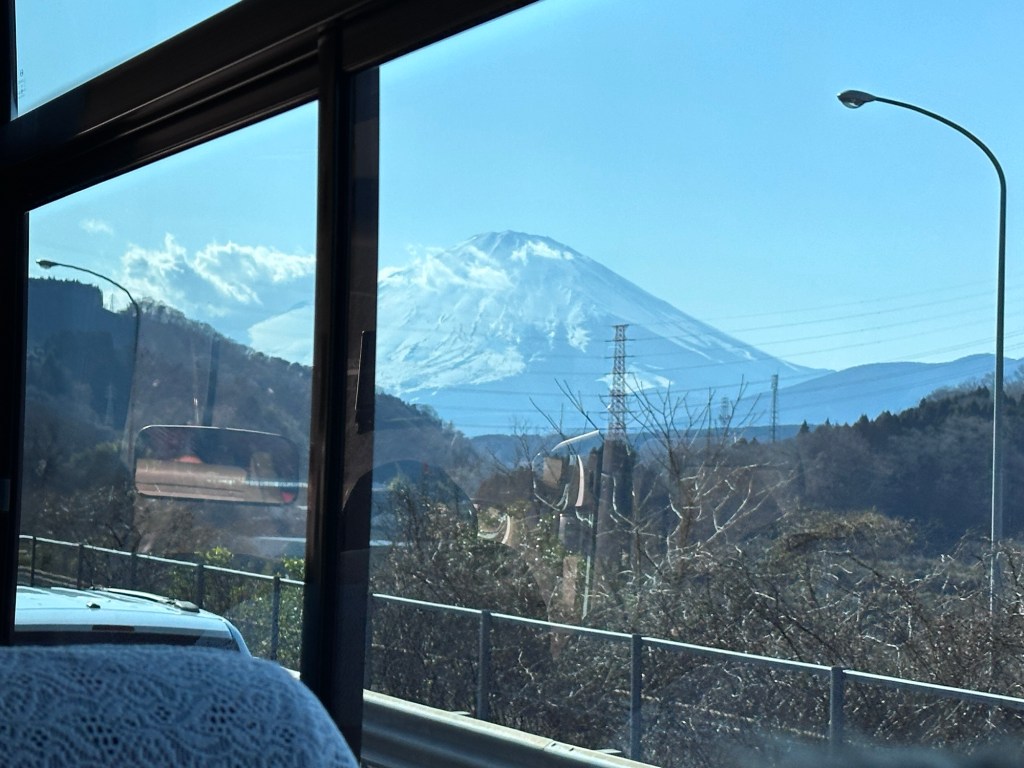
On our bus ride to Hakone, we were treated to multiple views of the elusive Mt Fuji. We watched as it progressed from crystal clear to cloudy.

10:30 AM at the rest stop
The clouds started rolling in around 3 PM.
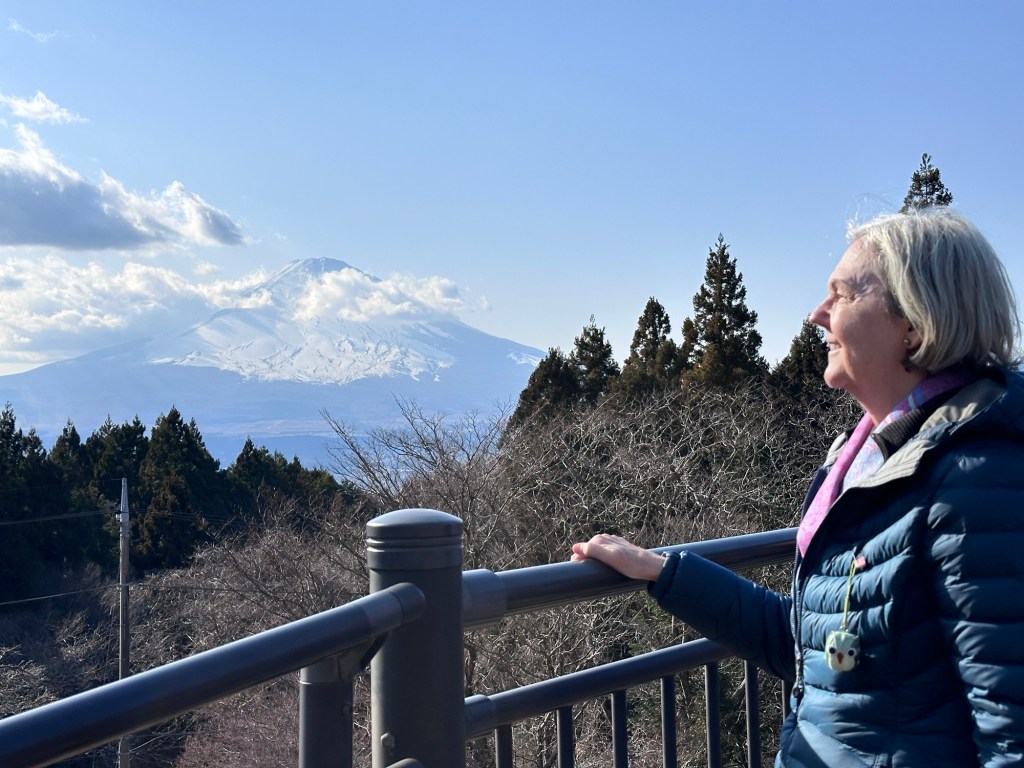
3:30 PM. Our driver took us to this special look out that gave us a phenomenal view of the mountain.

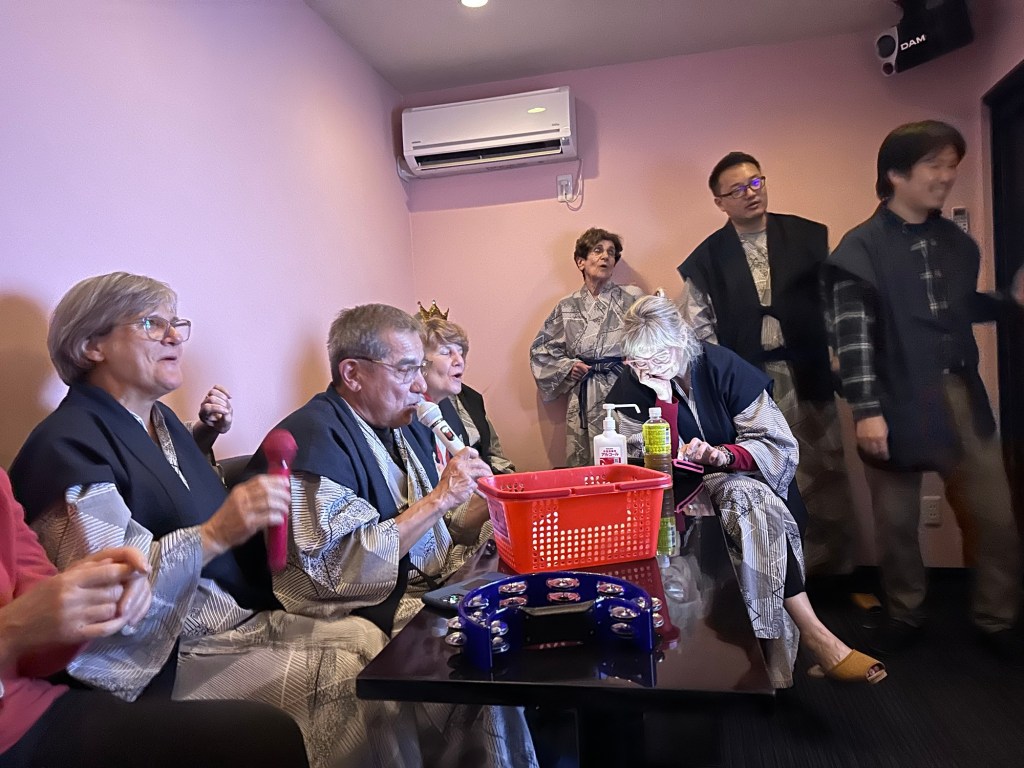
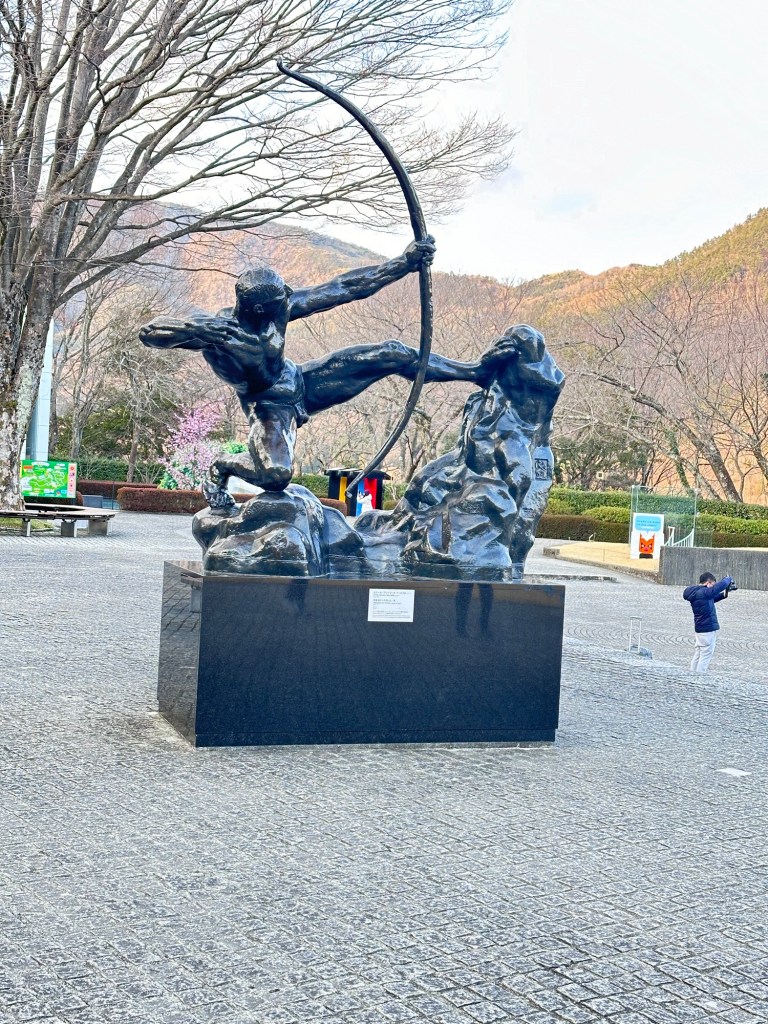
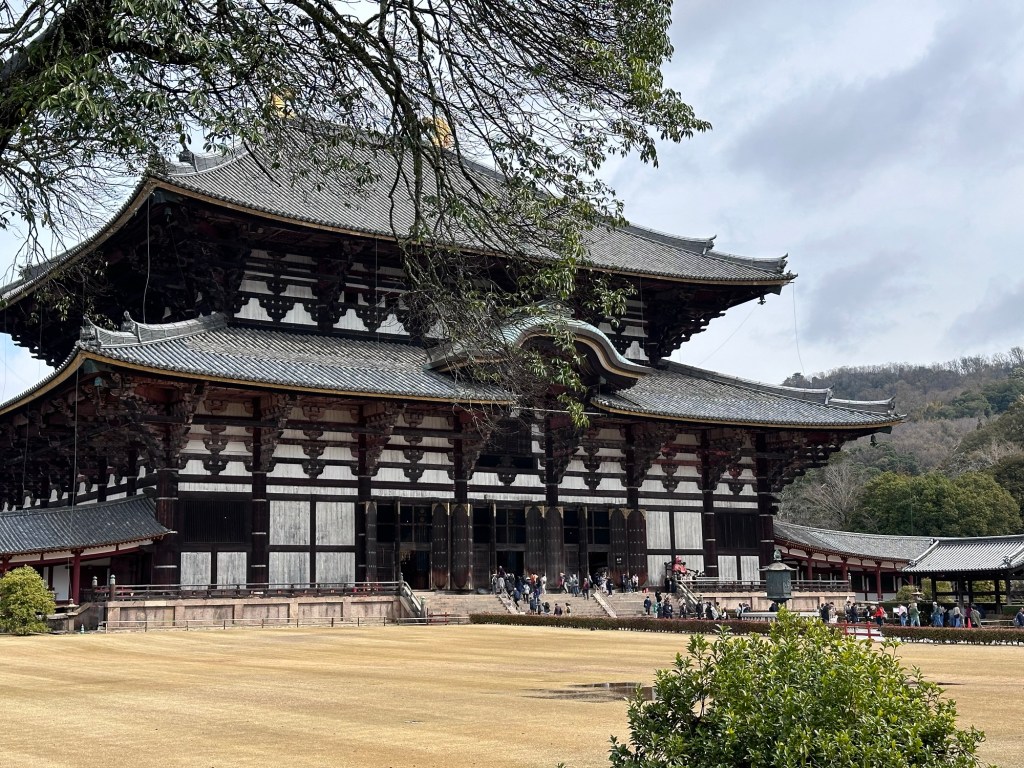
Although it is wasn’t on the itinerary, I had told Mori I really wanted to experience the Open Air Museum in Hakone and he made it happen. Turns out 12 out of the 14 of us wanted to visit. We made the most of our hour at the museum. Here are a few of my favorites.

It may not look like much from the outside but wait till you step inside.

But there was so much more to see, like this piece which was inspired by the myth of Narcissus.

The sculpture was trying to view her reflection in the water, but her tears were blurring her image.
Can you believe how perfectly balanced that sculpture is? And check out the gorgeous setting.

We lucked out with the weather because our second day in Hakone was rainy.

On My Own in Tirana, Albania

I spent the majority of my first full day in Tirana walking around the city, exploring two of the attractions recommended in my OAT Final Documents booklet. First stop was at the Komiteti-Kafe Museum for an “American coffee” and a look at what was described as Soviet Era artifacts. I don’t know whether what I found qualified as Soviet “stuff”. It appeared much too whimsical and colorful, two adjectives that I suspect were never used to describe the USSR.

I probably wouldn’t put the coffee shop on a list of top attractions, but the walk getting there and back was fun. Tirana has lots of green space, bike lanes and pedestrian walkways— and I do love to explore on foot.

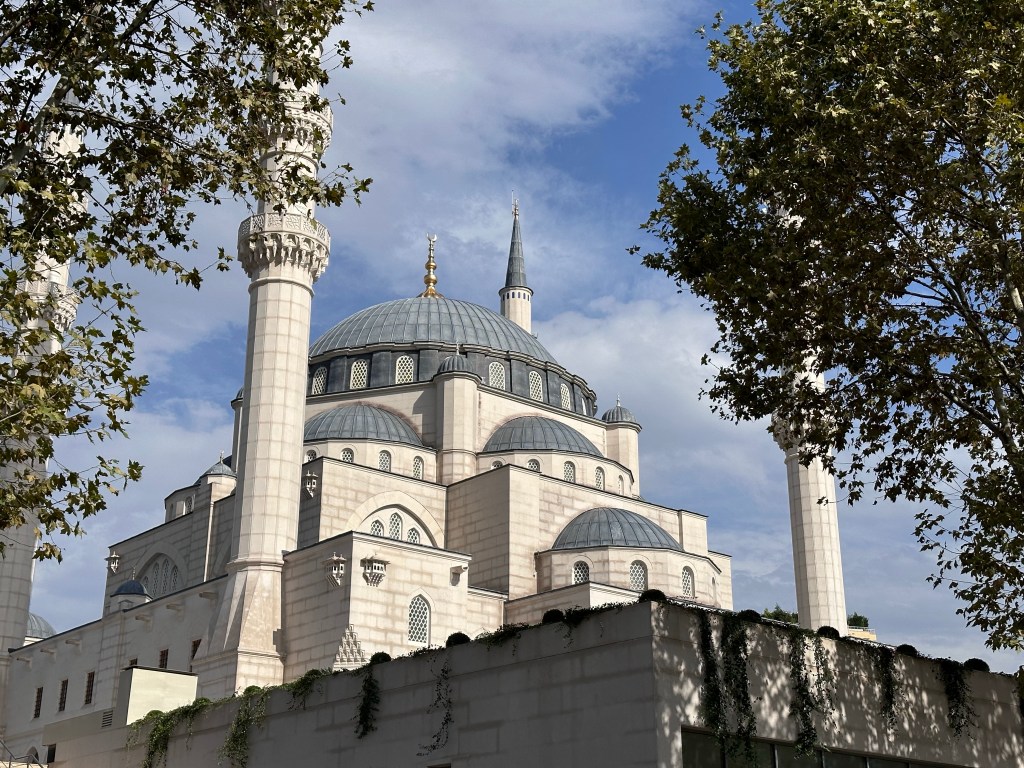
I had to get closer to the beautiful mosque appearing in the distance. A gift from the Turkish government, it is, and will remain, closed until Erdogan arrives for a dedication ceremony.

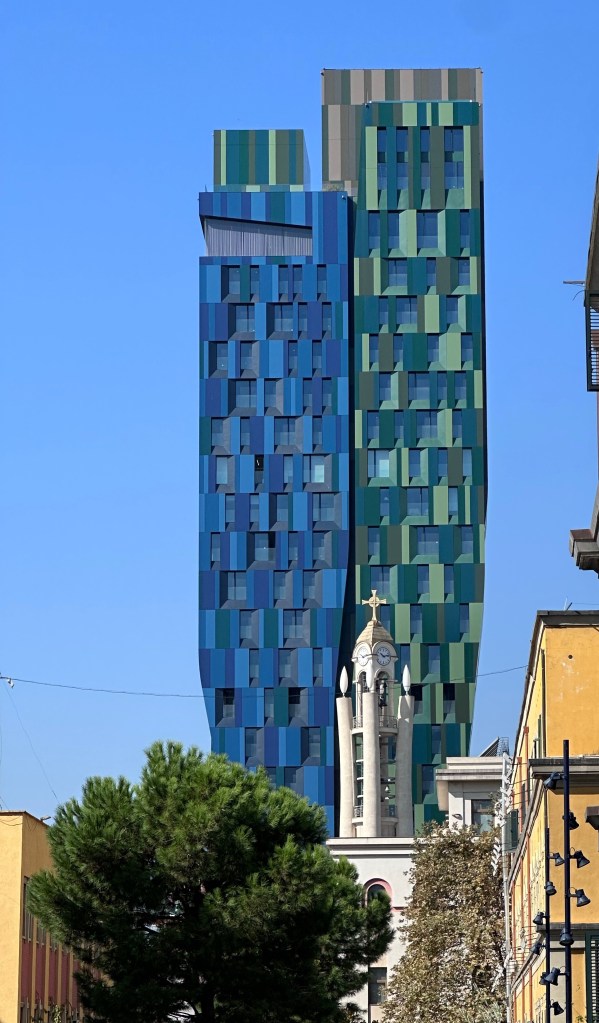
Man oh man, Tirana is BOOMING! Lots of new construction everywhere. During the ride from the airport, I noticed the very drab, but functional architecture, presumably from the Soviet era. The current construction is colorful, joyous and oh, so interesting!

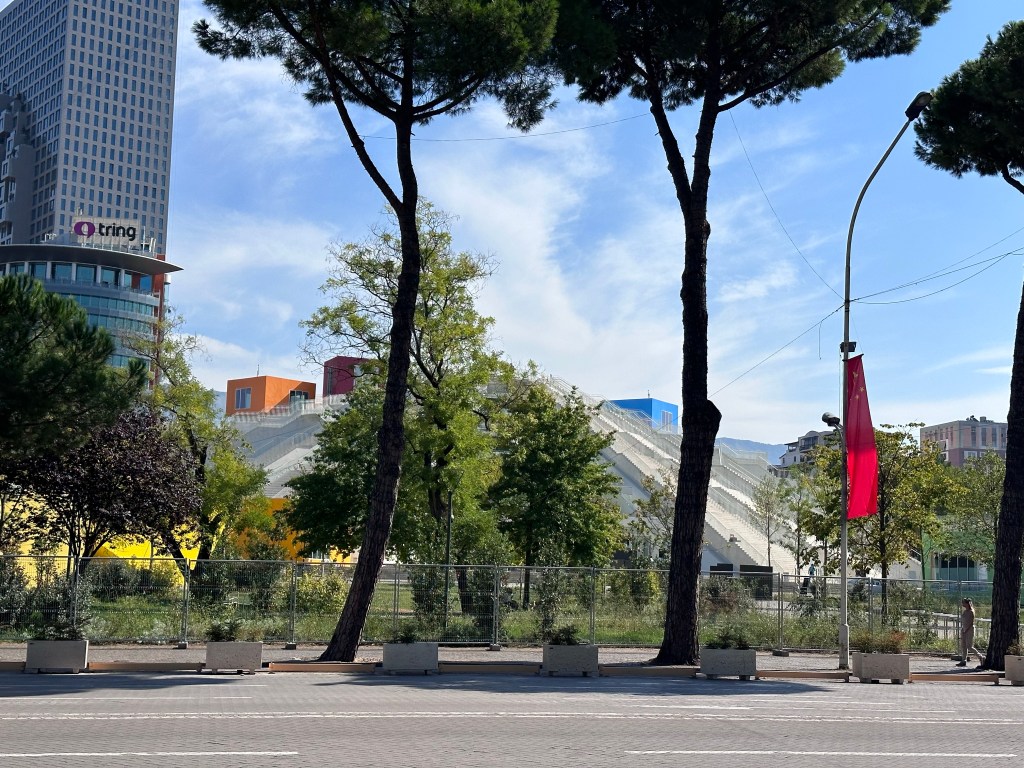
I had no idea what this building would become until our tour on my second day with our pre-trip guide. Ilir took us along a different street. He told us the colored squares will become classrooms in this future digital center.

It is difficult to see the pyramid behind the trees. If you’d like a better view and a history of the pyramid, click here. https://en.m.wikipedia.org/wiki/Pyramid_of_Tirana. The steps were added to allow people to safely climb to the top. Previously they were clambering up the smooth sides, then sliding down!

One advantage to being on your own is you can stop to take photos whenever you like, and I liked to do that a lot. I loved this bridge. While on it, you have access to free wi-fi, which I didn’t need because I had switched to TMobile. Unlike Verizon, international access is free for everything except voice calls. (Thanks to the Facebook page “Friends of OAT” for educating me about internet access outside of the USA). Knowing I could consult google maps whenever I wanted enabled me to wander freely without fear of getting lost.

As I made my way to the Sali Shijaku House (OAT’s other recommendation), I walked thru Tirana’s Castle, which was taken over by the Topani family in 1798. I had seen the Topani name everywhere, most prominently at the nearby mall entrance, and wondered what the word meant. A plaque before the castle explained that Topani is the name of a noble family “rich and educated with strong ties to the Ottoman Empire and the west which they used to help the country while it took the independence road.” The plaque goes on to explain the rivalry between the Topanis and the Barginis which was ultimately resolved by intermarriage. Just think, if the Montagues and Capulets had used intermarriage to resolve their disputes Shakespeare wouldn’t have had material for Romeo and Juliet.

Not much remains of the original castle structure other than these walls and something called a “Bailey”. (You won’t see a photo of the Bailey because I have no idea what it is). Walking thru that arch brings you to a walkway with lovely shops and an abundance of restaurants, one of which I chose for lunch.

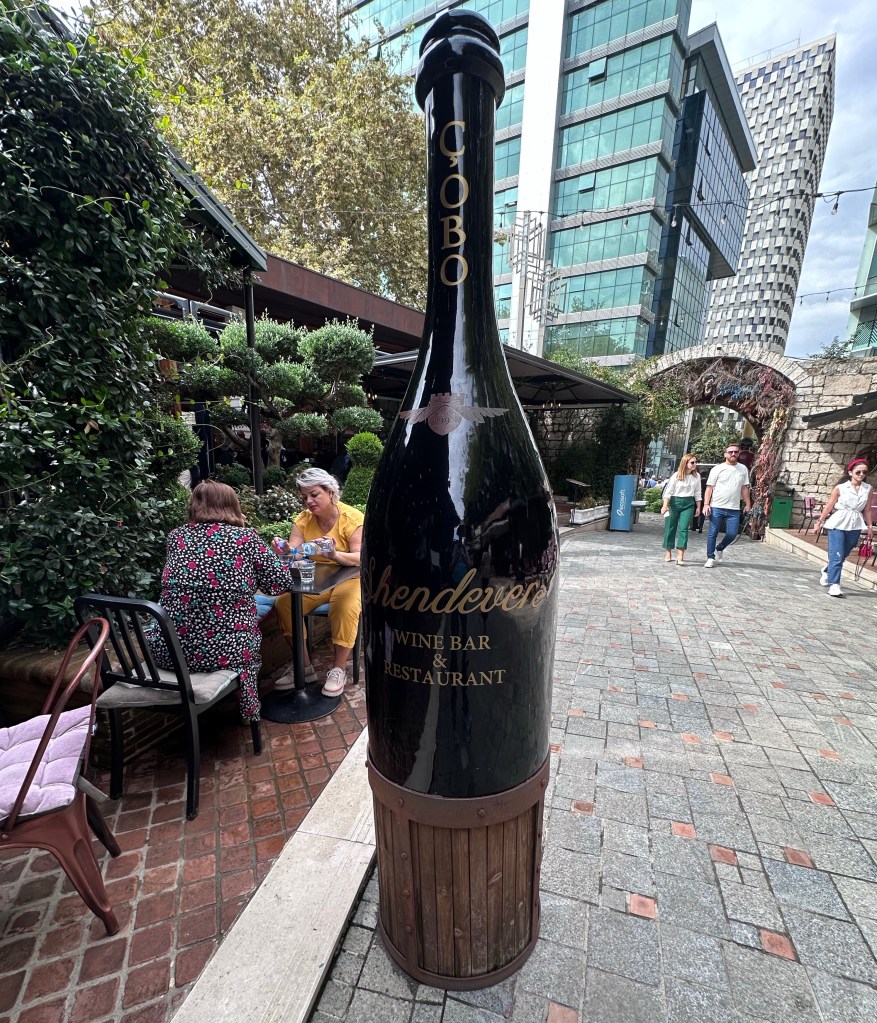
I had a wonderful inexpensive lunch with a glass of sparkling wine at this restaurant.

But back to the home of the artist Sali Shijaku, my second destination. After exploring his residence, which is filled with his paintings, I sat in the garden and enjoyed the ambiance while sipping a cup of tea. It’s hard to believe that over the years, this 300 year old structure has been a hospital, women’s prison and military building.

Some other sights from my walk thru Tirana:

Topani Mall across from our hotel.
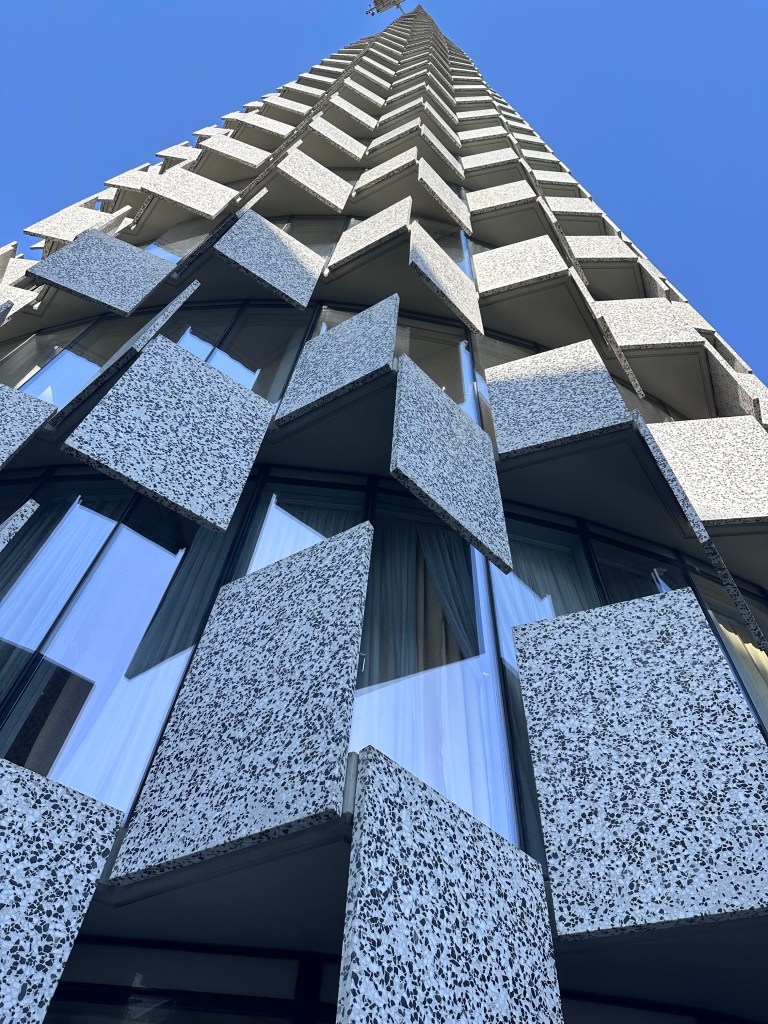
Although not colorful, this building’s three dimensional structure appealed to me.
The new building towers over the old church tower.

After exploring, I returned to the hotel to meet 4 of my traveling companions. After a brief walk with our guide, we got to know each other over dinner at Roxana Tuna House. As is often the case on OAT trips, they are all friendly and so very interesting. That’s another reason I enjoy traveling with OAT—congenial companions. We will meet the last couple tomorrow because they encountered flight delays.

Time to stop babbling about this wonderful city and get some rest.

Ouarzazate

I know you are probably wondering how in the world to pronounce the name of this Moroccan city. Well, wonder no more. “Ou” sounds like our “W”, so when you come to Morocco and want to stay near the movie set for Game of Thrones, book a riad in “ WAR-za-zat”.

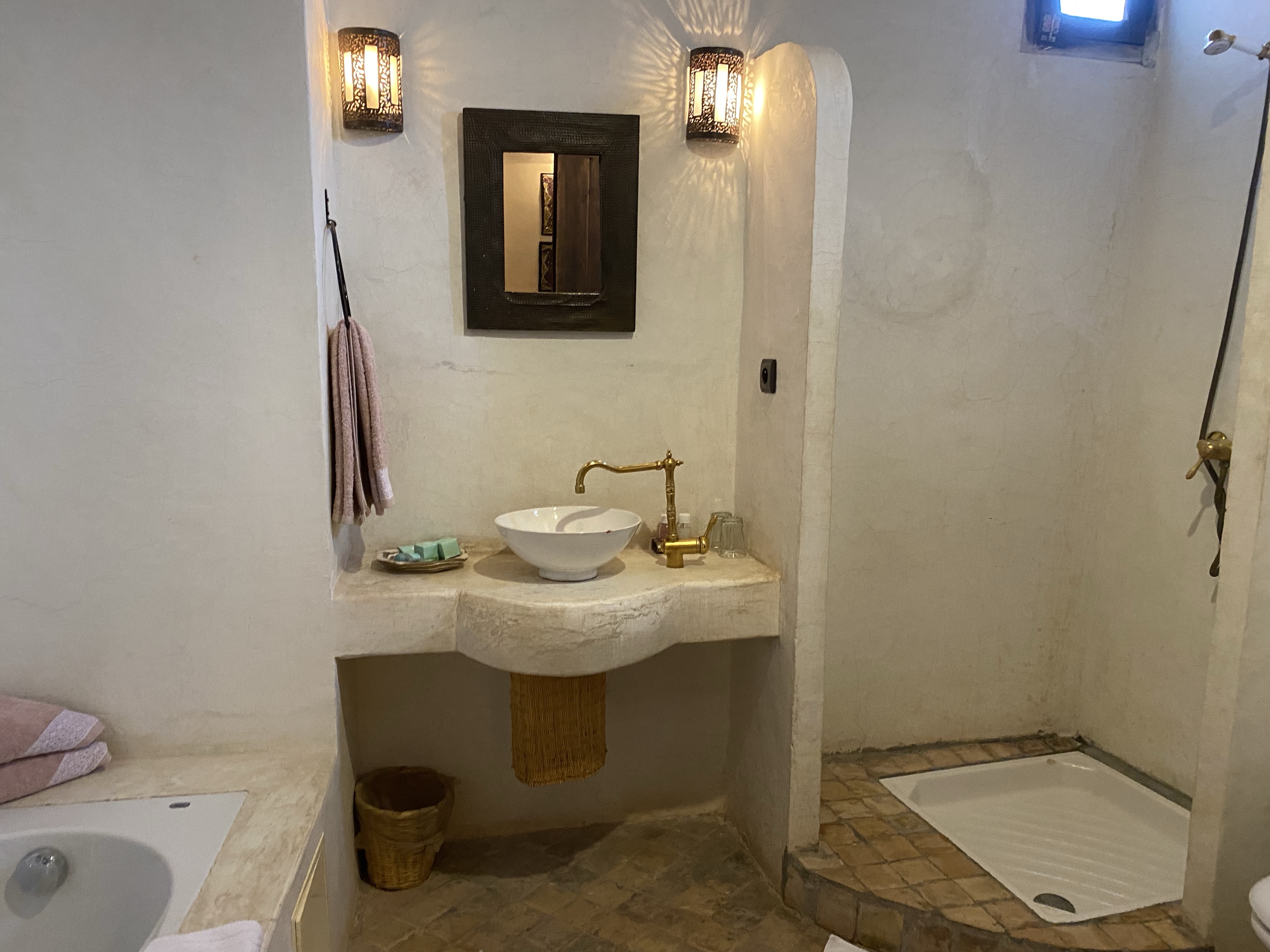
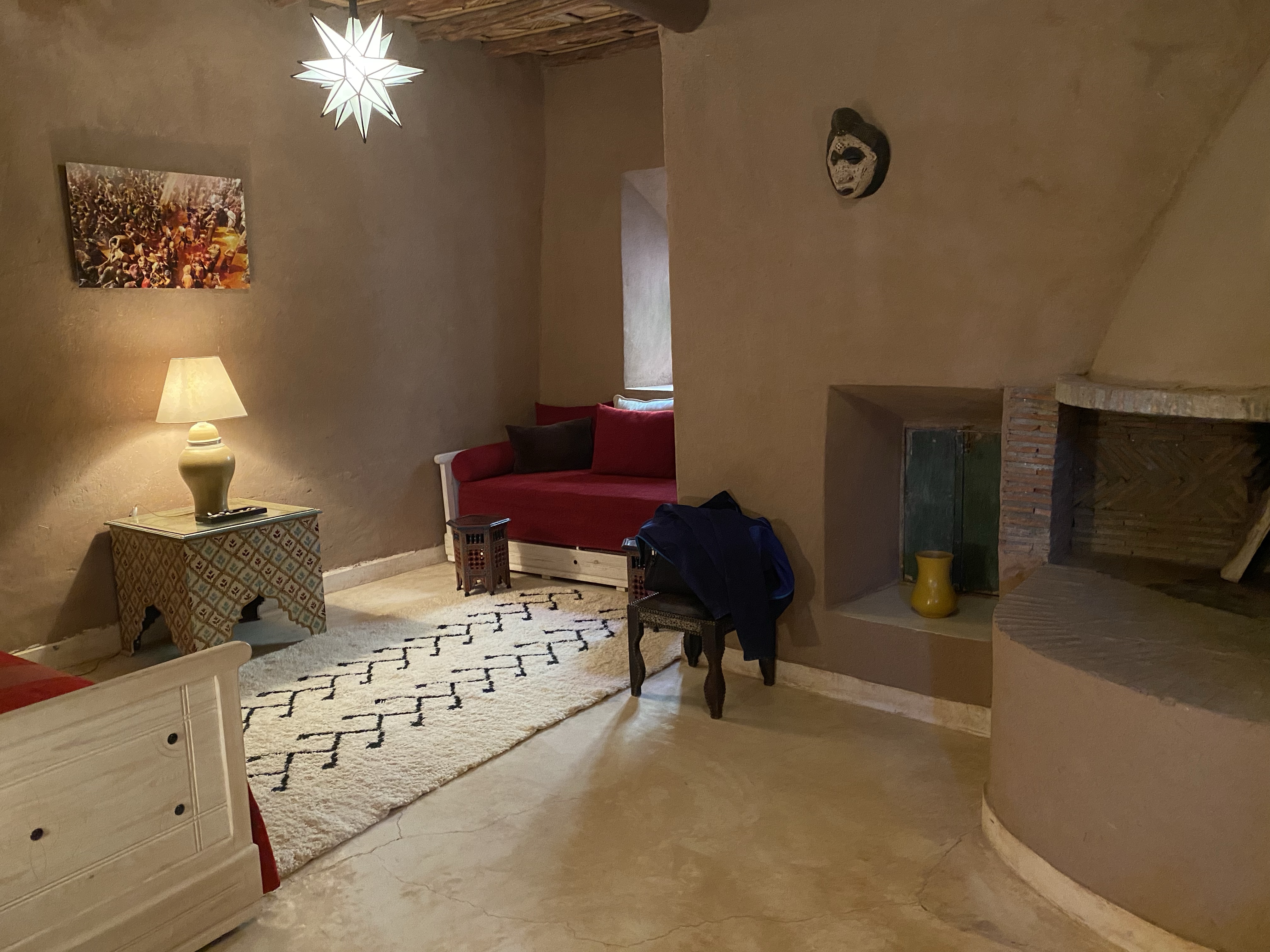
We spent two nights in Ouarzazate, staying at the beautiful Dar Kalifa. During the 1900’s our riad was the court house of Pasha Glaoui. This very powerful Bedouin chieftain was France’s ally against Sultan Mohammed V, and was instrumental in getting the Sultan exiled to Madagascar in 1953.

Unfortunately for France and the Pasha, the Sultan was beloved by many Moroccans. His removal resulted in unrest and uprisings in Morocco. As a result, de Gaulle reinstated Mohammed V (who changed his title from sultan to king) in 1956; simultaneously Morocco gained its independence. Pasha Glaoui had clearly made the wrong choice. So what became of this traitor? He traveled to Paris, knelt at the feet of in submission to Mohammed V, who forgave him. Their actions reunited the warring factions and made it easier for Mohammed V to regain his throne. Glaoui died of cancer in 1956, Mohammed V died in 1961.

I have to admit, it was pretty thrilling to think about all the history that must have taken place within the walls of our riad. It isn’t easy to find—you walk along some narrow passages to get there, but it is worth the walk to discover this spectacular dwelling.

Be forewarned: there are MANY steps in Dar Kalifa, and they all seem to be a different size.

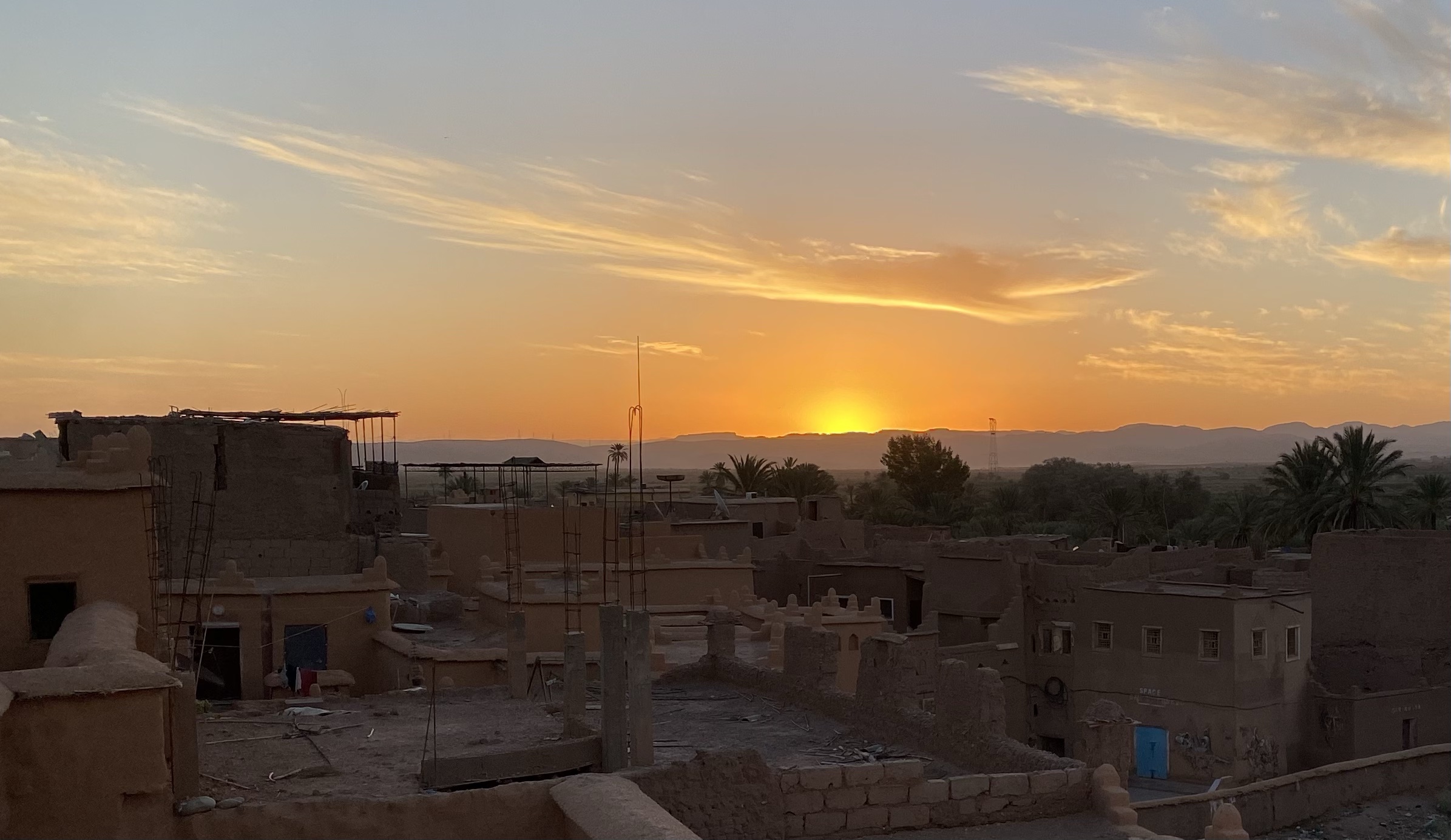
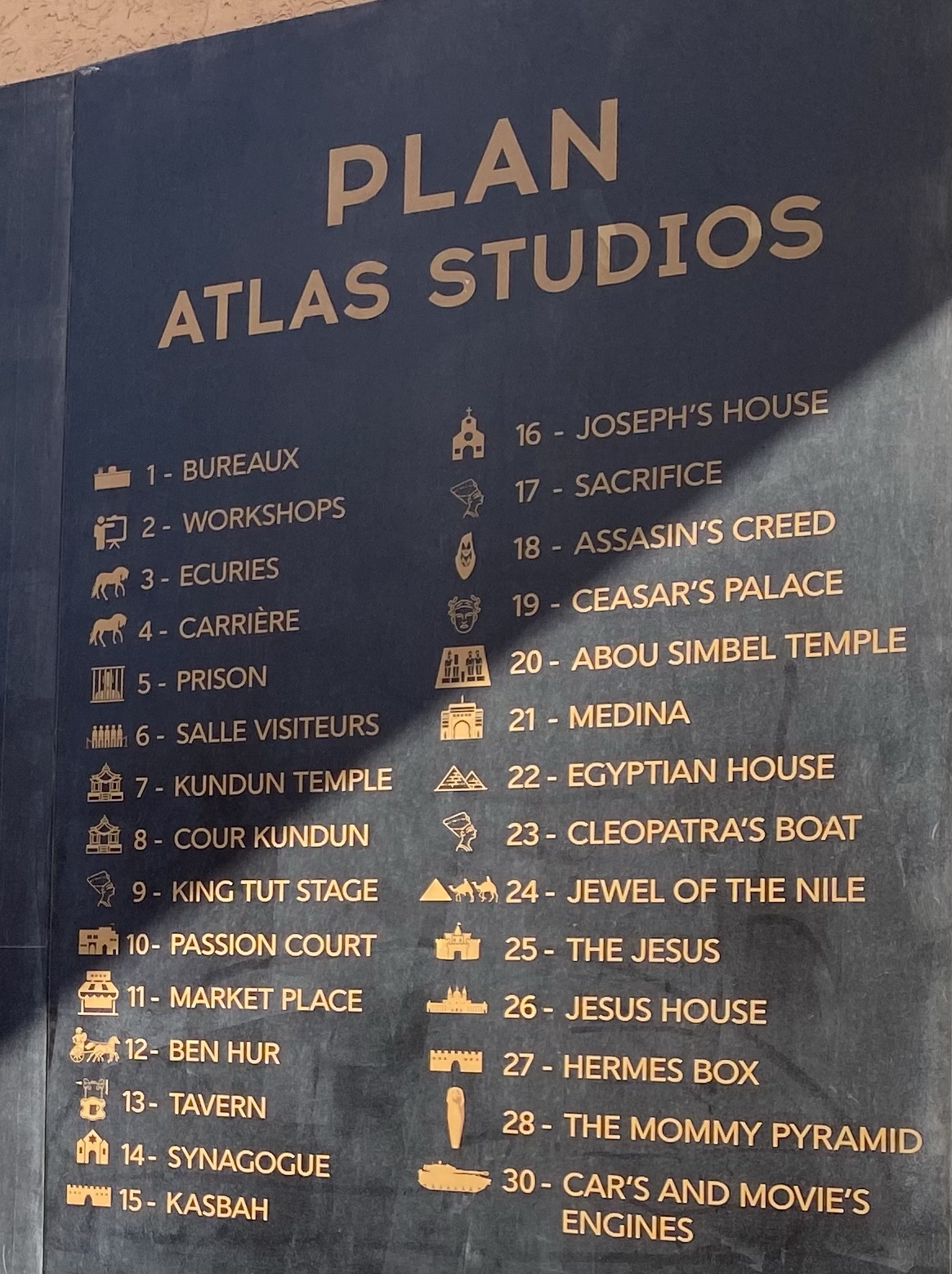
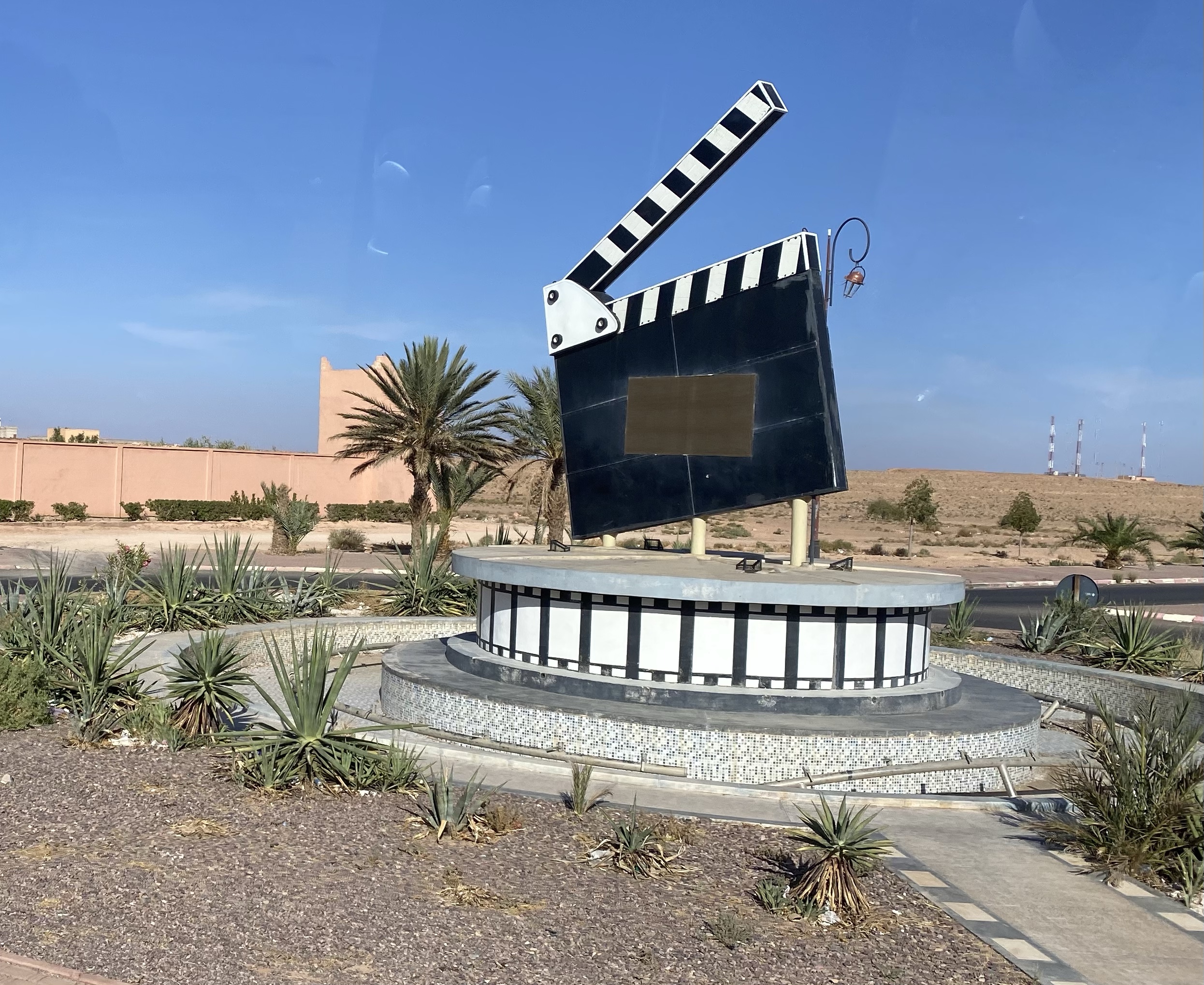
Can you guess why Ouarzazate’s nickname is WallyWood? The dramatic scenery and the perfect lighting from sun filled days have made it a favorite spot for film makers.

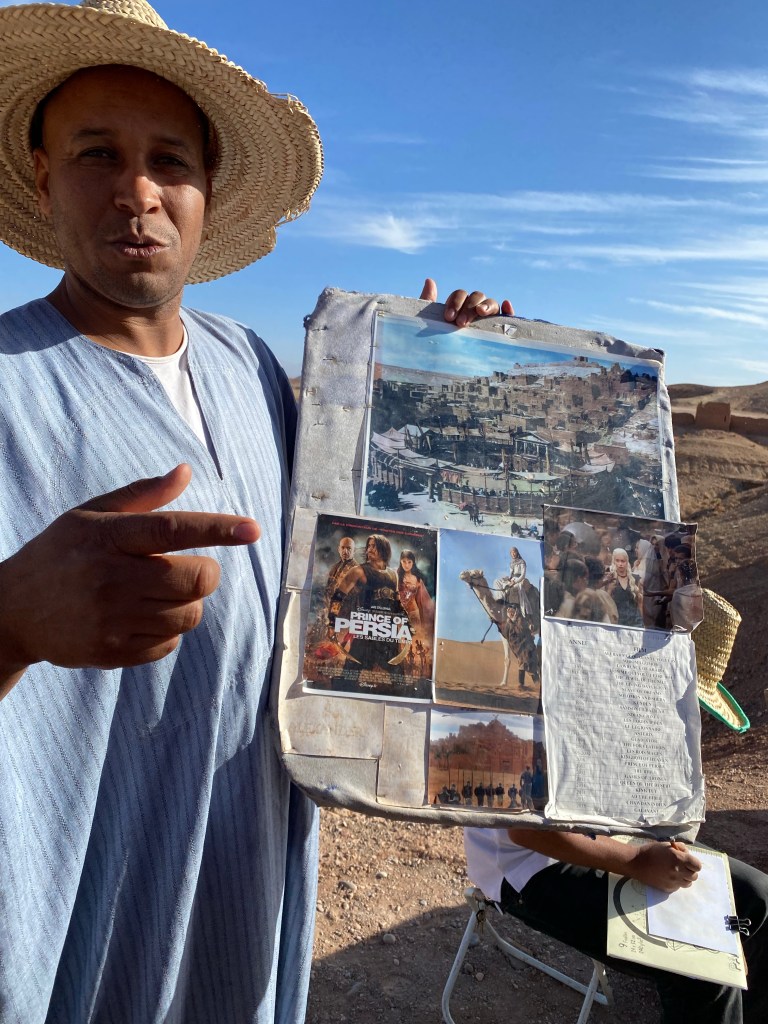
Many of the locals work as “extras” in movies like Gladiator. Our local guide, Mohammed has been in several movies. Here’s his picture, so you can look for him in Season 4 of Game of Thrones.

Mohammed with his visual resume

Mohammed never had the opportunity to attend school. He spent his childhood ferrying tourists across the river on his donkey. Although he was never taught to read and write, he became fluent in English, French, Spanish and a few other languages, by listening to tourists he transported. I find that amazing—what an impressive and intelligent man!

Mohammed’s children: 2 girls, aged 13 and 6 and 1 boy aged 10, all attend school, and are teaching their dad to read. Mohammed told us he thought his family was complete, but his “coronavirus baby” arrived 8 months ago!

Most tourists visiting the area want to spend time in Ait Benhaddou, stopping at one of the two studios in town. Before Covid, Mohammed told us during high season Ait Benhaddou received more than 1,000 tourists per day.

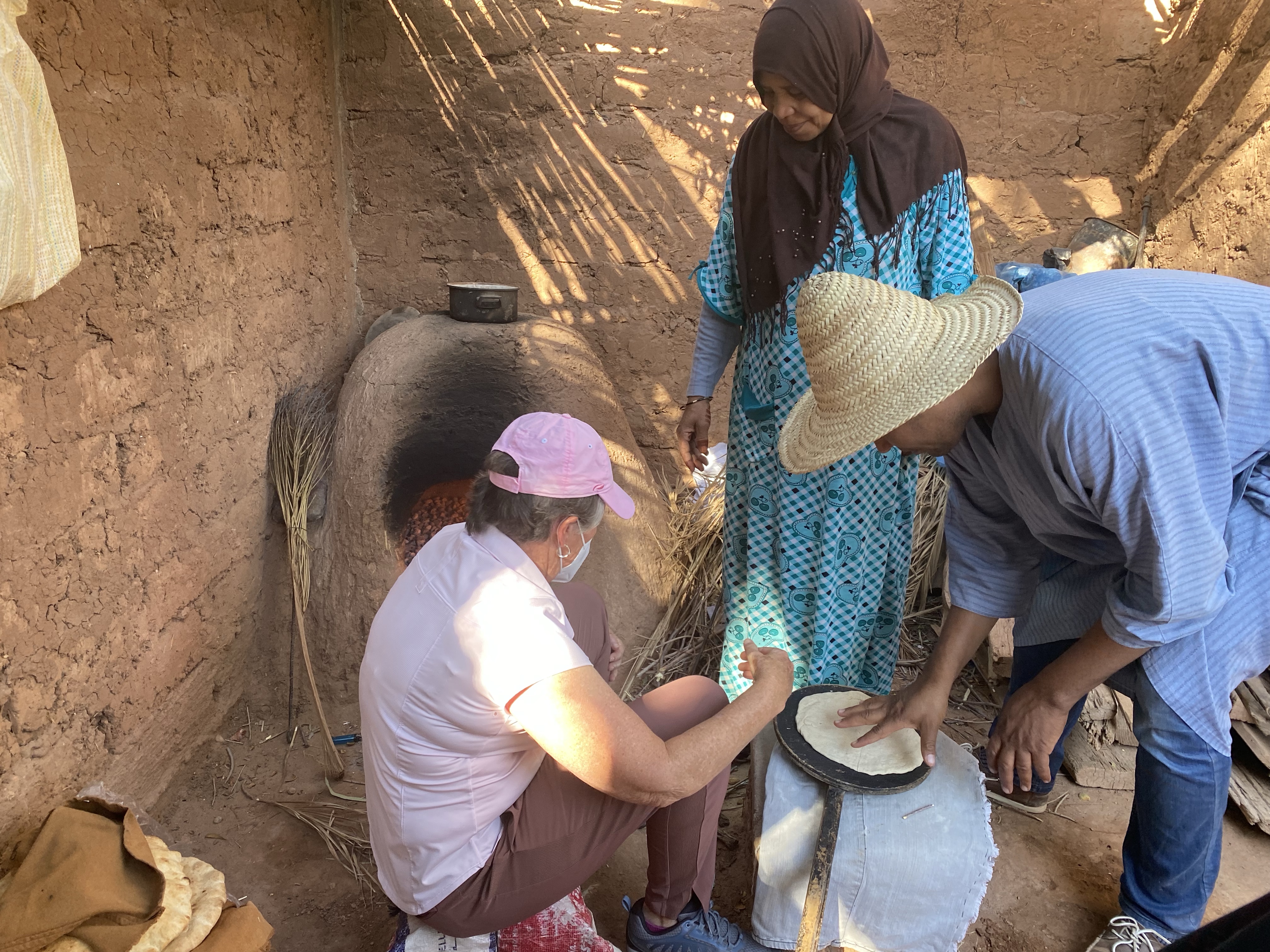
Instead, we visited Asfalou Village, for what OAT calls “A Day in the Life”. There, we spent the morning with an extended family, visit their home, learning how the women make bread and the men make bricks.

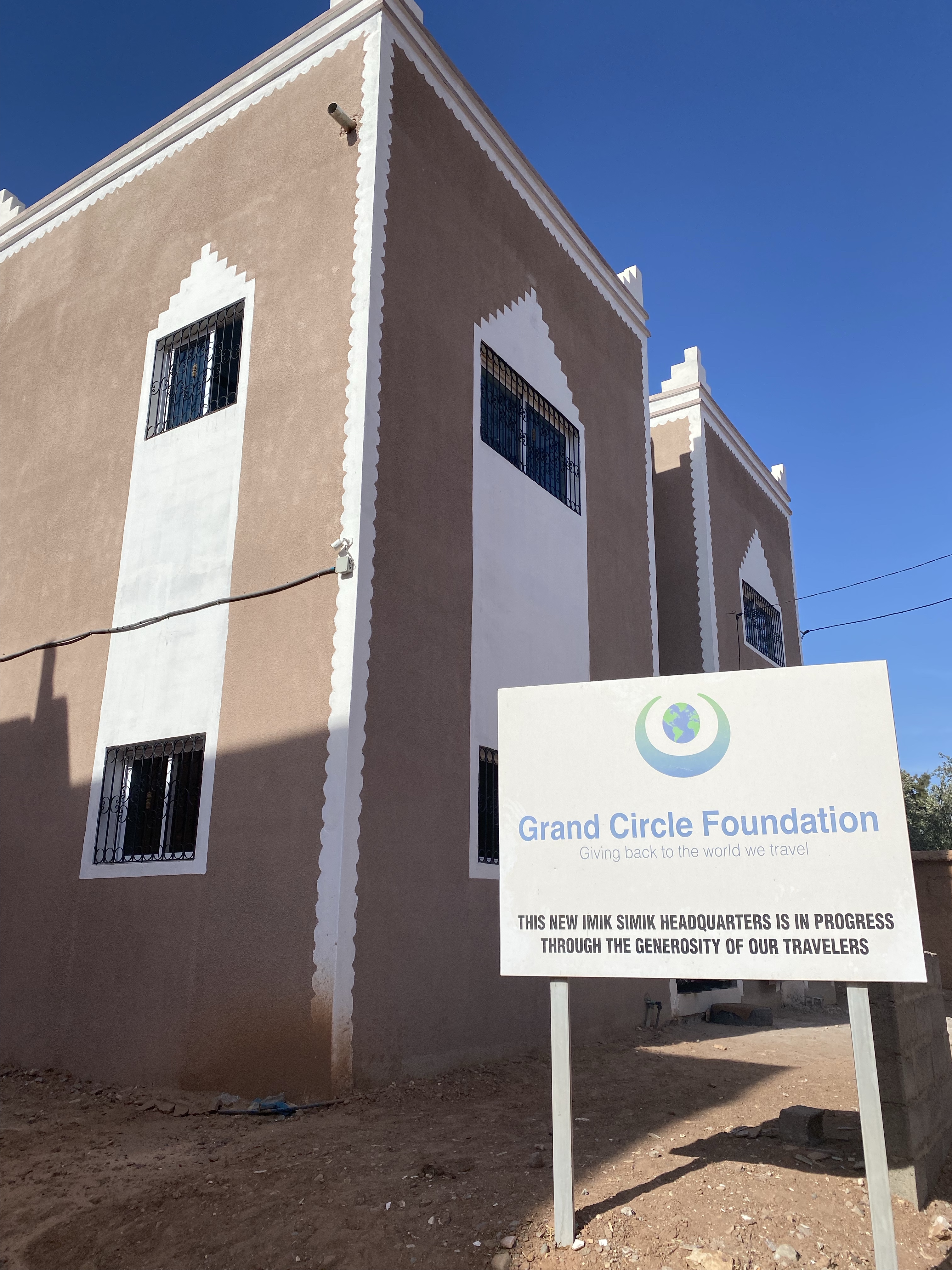
For the afternoon, we visited the Women’s Association, a beneficiary of the Grand Circle Foundation. The Association’s objectives are to build women’s self confidence and to empower them. The women learn to bake cookies, which are sold to hotels and to tourists. We sampled some during our visit and they were so delicious, we all bought more.

While there, we all decorated our bodies with henna—even the men.

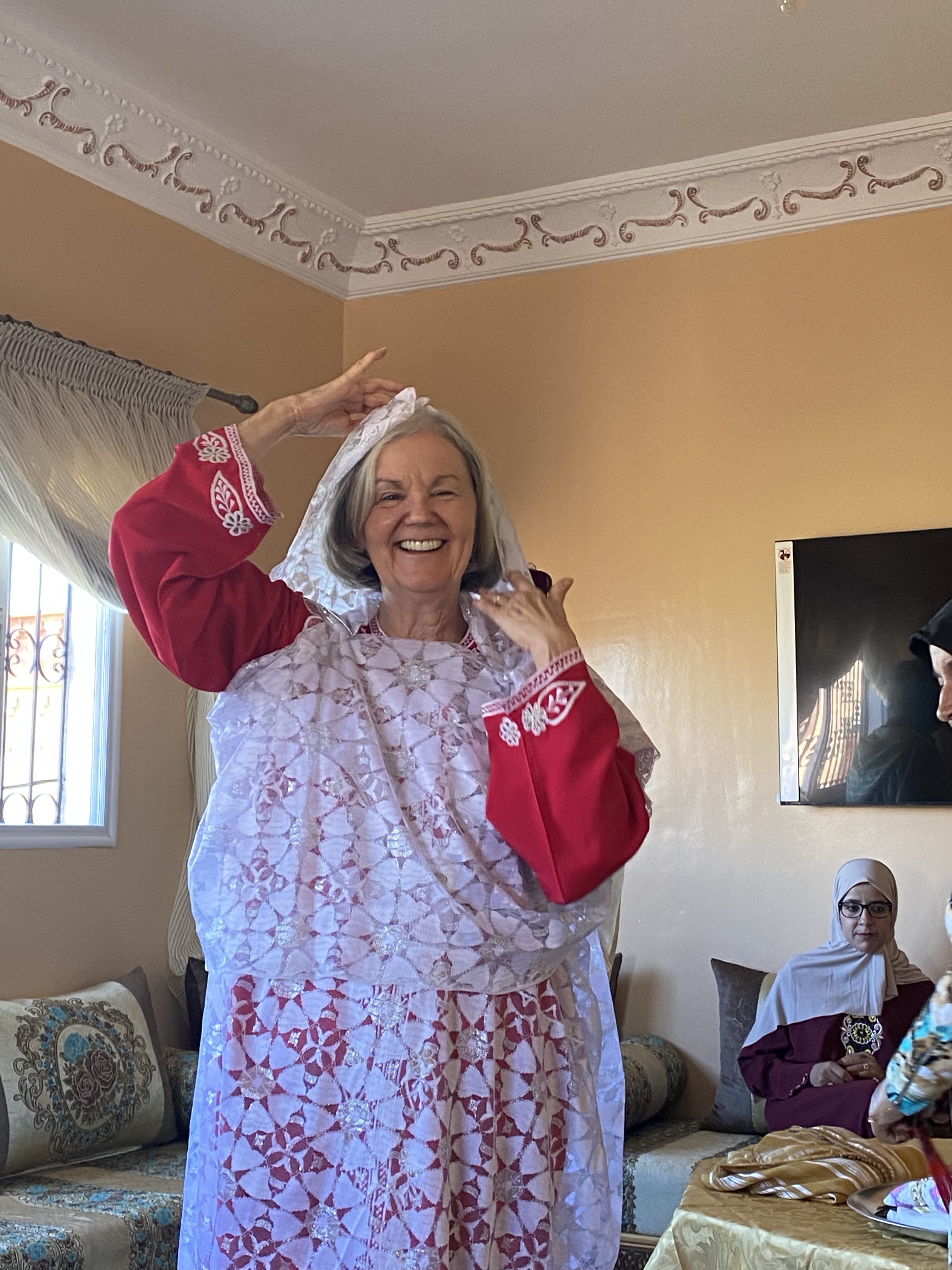
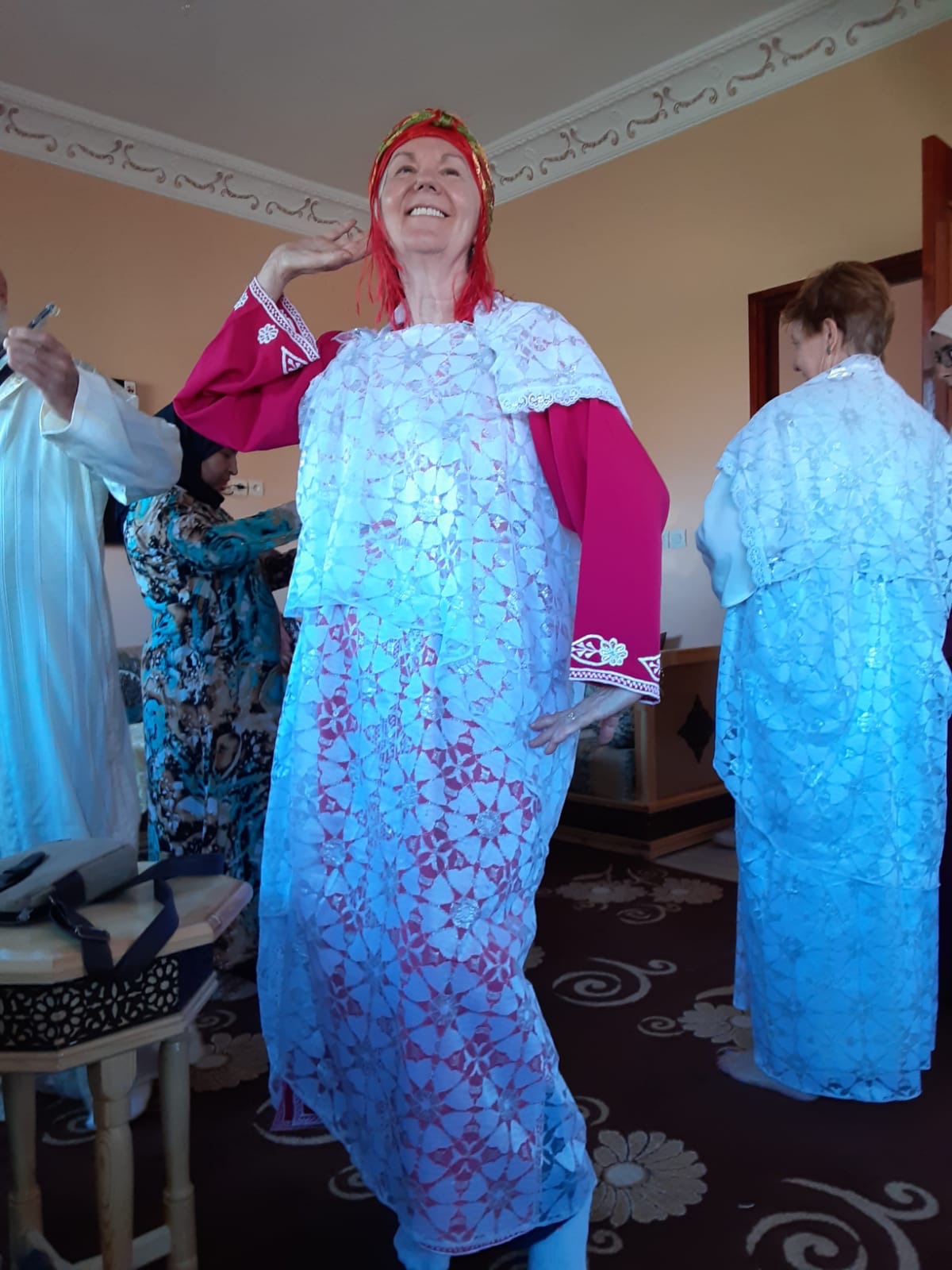
But the highlight, for me at least, was playing dress up. Unfortunately, my first choice for spouse was feeling under the weather that day, so I had to go with a substitute for this Berber wedding.

For you movie buffs, I’ll end with a list of some of the movies and TV shows filmed in this area.

  • Lawrence of Arabia (1962) Sodom and Gomorrah (1962) The Man Who Wished To Be King (1975)
  • The Message (1976)
  • Jesus of Nazareth (1977) Bandits, Bandits (1981)
  • The Diamond of the Nile (1985)
  • Killing is not playing (1987) The Last Temptation of Christ (1988)
  • Tea in the Sahara (1990) Kundun (1997)
  • The Mummy (1999)
  • Gladiator (2000)
  • Alexander (2004)
  • Kingdom of Heaven (2005) Babel (2006)
  • Prince of Persia: The Sands of Time (2010)
  • Game of Thrones (season 3, 2013)
  • Game of Thrones (season 4)

For the curious—the photo at the top of this post shows the artist doing paintings using a sort of “invisible ink”. He heats the paper over the flame to make the colors appear. This “invisible ink” , used for secret messages sent during French occupation, has been repurposed!

The Sahara

Once again, my image of what the Sahara Desert would be like only slightly reflects reality.

I didn’t expect to find this very productive farm amidst sand dunes.

The farmer’s father, once a member of a nomadic tribe, used ancient techniques to find water. The family hand dug two wells: one with salty water and the other with “sweet” water for drinking. They combine water from both wells for irrigation and livestock.

Farmer and friends. How many do you recognize? One outfit (caftan and scarf) was purchased in the Rissani market for about $20 US.

You might recognize Goldie from an earlier post. She given to me by Bonnie, my grand-niece, before the start of our trip. Photos of Goldie’s escapades have been making their way back to Massachusetts on a regular basis.

As you can see, one of the farmer’s goats was quite taken with Goldie.

Our camp was very comfortable. Although we didn’t have Wi-Fi, cellular service surprisingly, is available in the desert.

I expected the sunrises and sunsets to be jaw dropping, and they were. What I didn’t expect was to be drinking wine while watching the sun go down.

Mike went to another dune to take this shot of our group
Kris, Burke and Mike after the sun had set.
Sunrise, by the camp

Of course, a visit to the Sahara wouldn’t be complete without a camel ride.

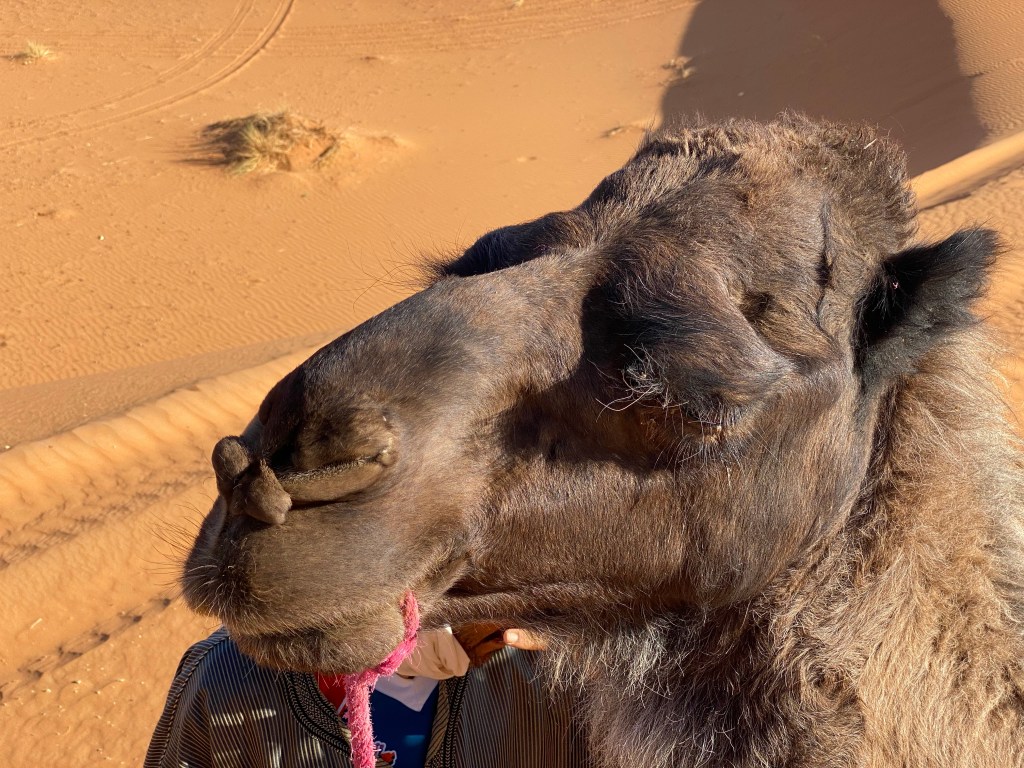
Check out the eyelashes!

But who would have expected to find this swimming pool in the desert?

For 100 dirhams you can use the pool, get a non-alcoholic drink and use a towel.

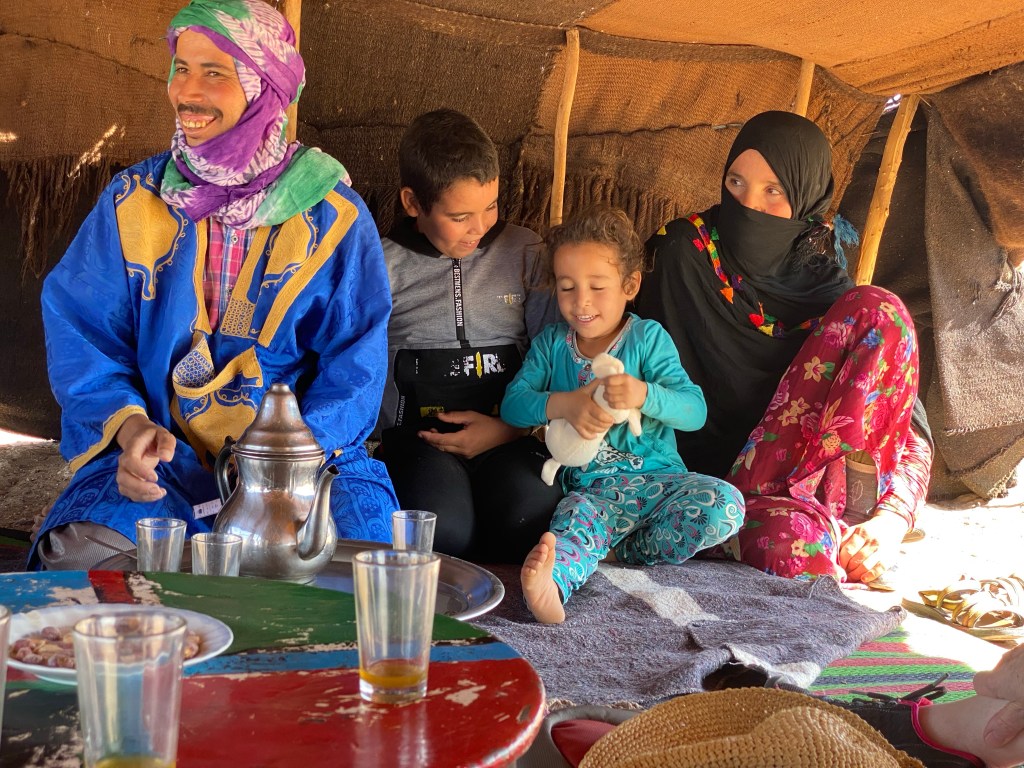
We also visited another nomadic family. Unlike the farmer, this family doesn’t own the land they are living on.

According to Moroccan law, if someone can find 12 witnesses to attest that the family has lived on the land for 10 years, then the squatters become landowners. The catch? The 12 witnesses have to be around when the 10 years commence.

Say good-bye to Goldie. She found a new little girl to love.

There is so much more to say about this incredible experience, but I’m going to stop now and invite you to put the Sahara on YOUR bucket list.

On The Road Again

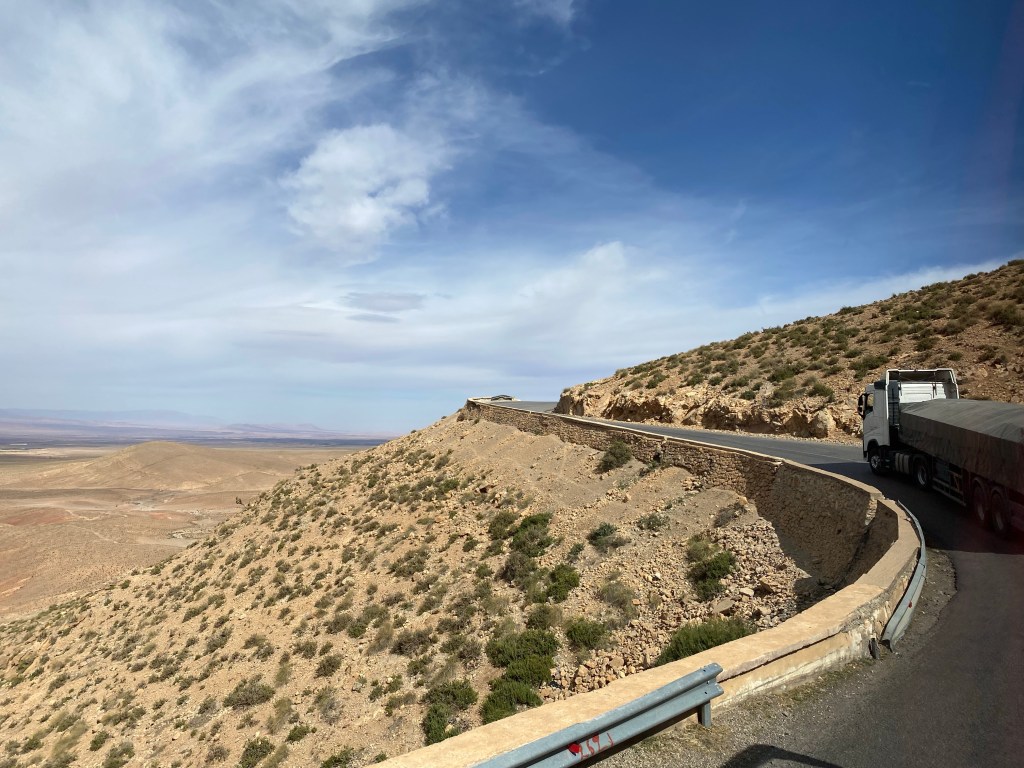
Who knew that driving all day could be so delightful? The scenery between Fes and the Sahara is varied and spectacular. It also doesn’t hurt that the nine of us are traveling in a bus that could transport more than forty passengers. We are up high, so we all get panoramic views.

This photo was taken from the window of the bus.

We had several stops along the way, including an opportunity to stroll through a forest.

Mike provides scale, to give an idea of the size of this Lebanon cedar.

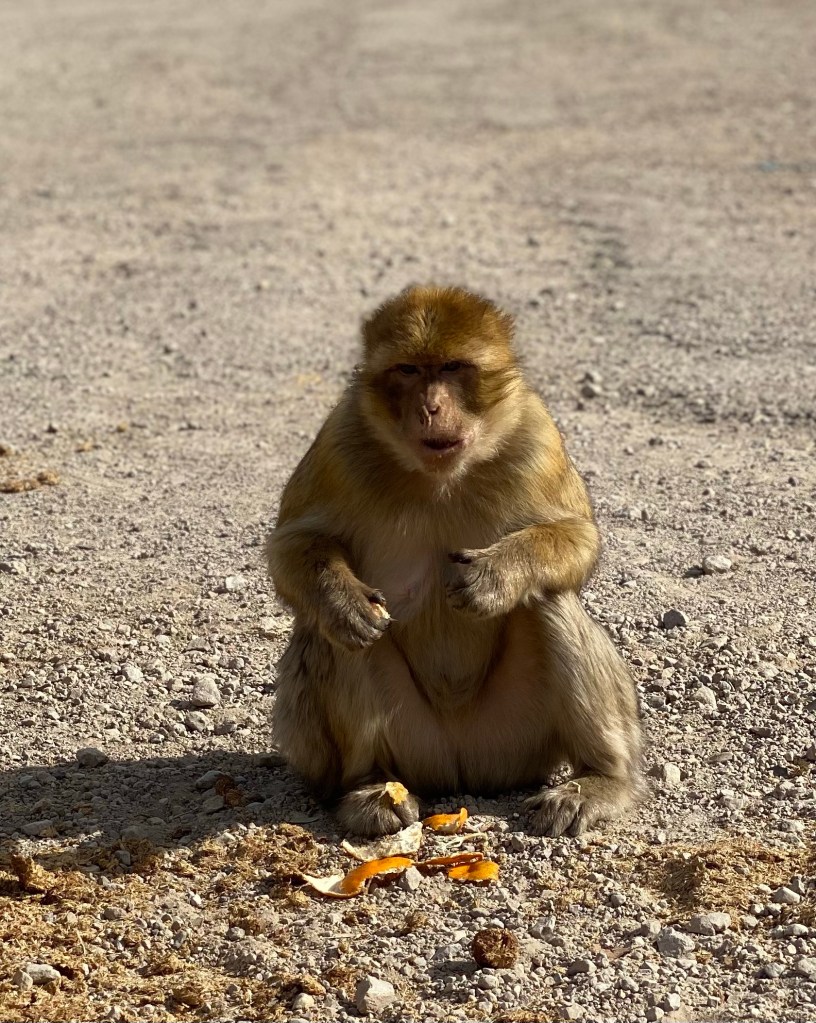
My favorite stop, however, was our visit with the Barbary monkeys.

Don’t even THINK about touching that tangerine!
This monkey was much friendlier. She was fine as long as I was at her level, but when I stood up, I frightened her and she scampered off.

The hotel where we stopped for lunch had this beautiful map, which included our departure and destination, and stops along the way. I’d mark our route out for you, but it is too difficult to do on an iPhone. But I’ll give you a rough idea of our route: we started at Fes, on the top, by the palm trees and ended in what the map calls ‘Arfoud’, (Erfoud) near the bottom. Ultimate destination: off the map on the bottom, near the camels.

Outside of major cities, Morocco has few traffic lights. Instead, they have numerous traffic circles, (if you’re from Massachusetts the correct name is ‘rotaries’. We Massachusetts natives have our own special language).

I particularly liked the circle in Midelt, which highlights their #1 product. Can you guest what it is?

If you guessed “surgical masks” , you’d be wrong. Mostafa had our driver (Mohammed) go around the circle twice so we could all snap a photo of the “Big Apple”.

Our stay was at a lovely hotel close to the Sahara Desert. Although I am so sorry for the Moroccans working in tourism, I must confess it HAS been rather nice having these beautiful hotels and pools all to ourselves.

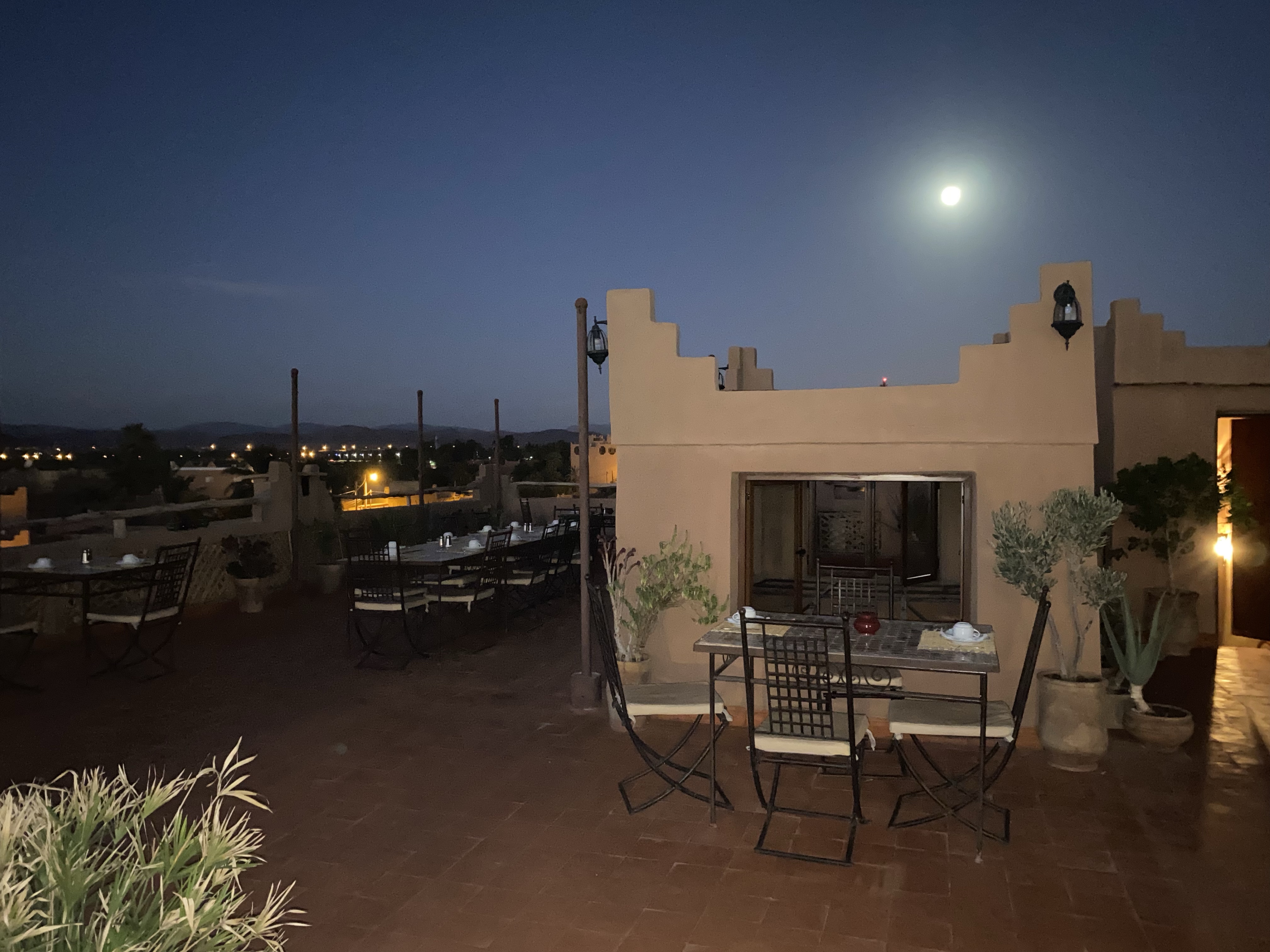
Most people would be delighted to see that huge, luminous full moon. Not us. Why? We were hoping for dark desert skies for our resident astronomer’s lecture the following night.

If you’re wondering why in the world I’m blogging rather than experiencing the majesty of Morocco, fear not. This is being written while on the bus heading to Ouarzazate. I’m using Verizon’s Travel Pass for internet connectivity. And I’m looking up from my phone frequently. And yes, as usual, my blog is several days behind our experiences.

Fes: Did a Sultán Sleep Here?

There is oh so much to say about Fes, but it will have to wait till we get back to New Jersey. Instead, this post will focus solely on the incredible Riad Salaam Fes.

Although the neighborhood dates back to the ninth century, our riad is far more modern than that. Built in the seventeenth century, it is still owned by the same family. It WAS restored about thirty years ago, so like the country of Morocco, it successfully melds the old with the new. Even though the ceilings are high, and the courtyards cool the building, our room is equipped with air conditioning.

If you have ever visited the Alhambra, wouldn’t you agree that this riad resembles that beautiful fortress in Granada? The best part—our riad has all the modern conveniences, like up to date bathrooms and wifi.

It is not surprising that it took 16 years to complete the restoration. The attention to detail is mind boggling.

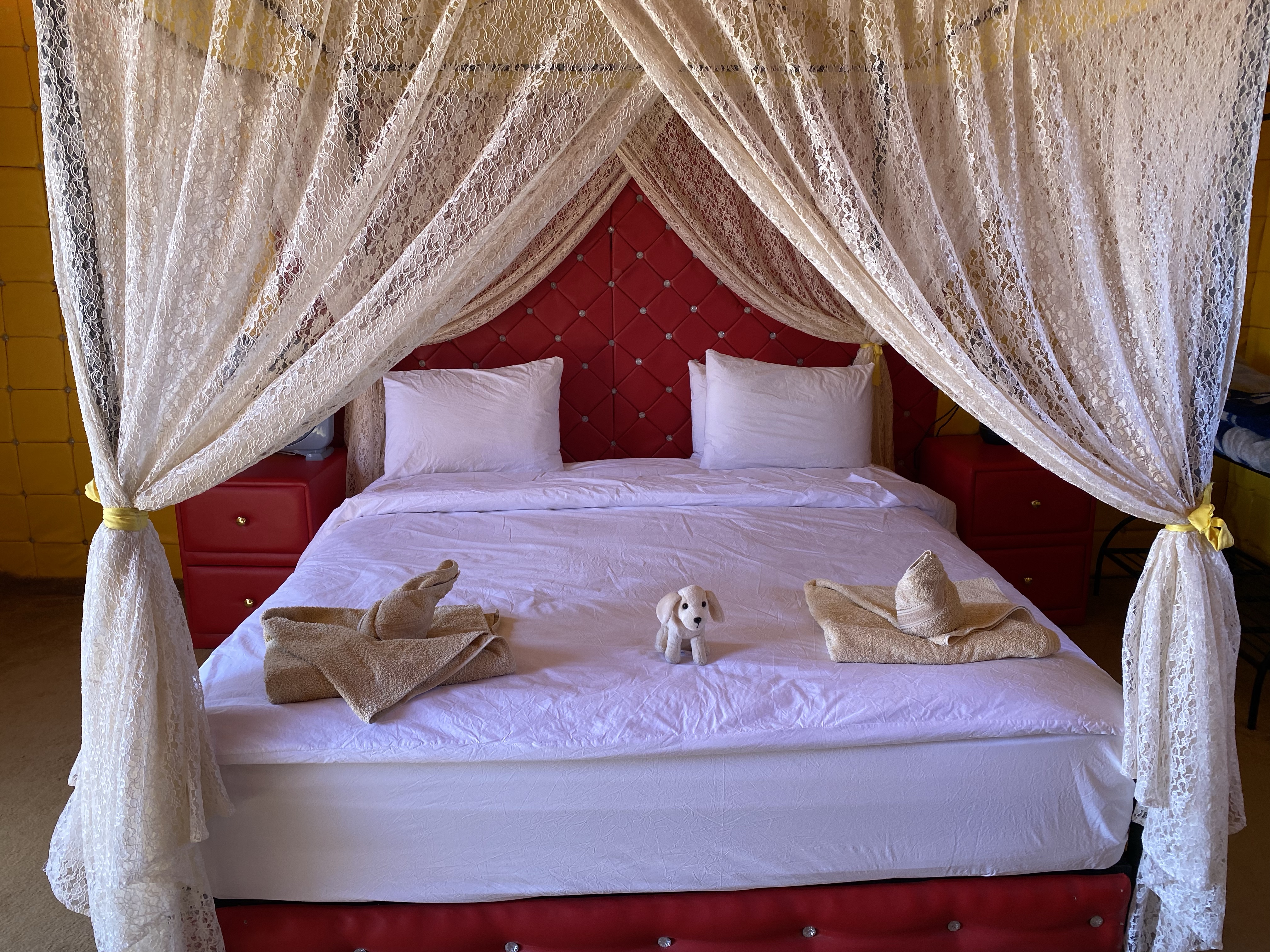
Check out our room. I ask you, is this not a bed befitting a sultan?

Half of the room. I couldn’t fit the sitting area into one photo.

Another modern convenience? A liquor license. Yes, in some Moroccan cities, you CAN enjoy wine and beer.

The panoramic view from the rooftop terrace, taken earlier in the day. No photos from our “happy hour”. By then, it was too dark and we were far too busy drinking to stop for a photo op.

You notice I said SOME Moroccan cities allow alcohol? Well, get ready for a story. When we arrived in Casablanca, Mostafa suggested that we buy wine there because it would not be available in Chefchaouen. Only problem: the Casablanca wine store was closed because of some sort of a COVID violation. Successfully reading the mood of the group, Mostafa went on a mission to get us some wine. On our way to Chefchaouen, we made a slight detour to Kenitra, coming up empty at three locations before Mostafa decided to change tactics. He started calling around to all his friends until he found one willing to purchase wine for us and deliver it to our riad. Is that not a truly dedicated and professional tour guide? We all feel very lucky to have him.

Bacchus smiled upon us in Rabat, where we were able to purchase a sufficient supply for our stays in the desert and Marrakech. Because both Rabat and Fes allow alcohol to be served, we couldn’t BYOB in those cities. Our Rabat purchases are sealed and stowed in the bus, to emerge as the need arises.

What better way to end this post than with a photo of Mohammed VI and his family?

So, did a sultan sleep in Fes? The answer is definitely yes. Not only was Fes once a capital city, but the King is here now!

Melbourne, Part Two

Okay, I’ll admit it, I felt really, really guilty, when I learned that while I was having a grand old time on the Great Ocean Road, my beloved husband was suffering in a Melbourne hospital, as I confessed in my last blog post.

After seven days in a town that is hotter than hell ( well, maybe not hell, but definitely purgatory), I feel my penance has been completed and I am free to share the rest of the photos from our glorious time in Melbourne.

Originally called The Sow and the Piglets, these rock formations were wisely renamed The Twelve Apostles, despite their originally being only nine of them. One has since crumbled, so now there are only eight. I spent most of my career in marketing, so hey, I get it. Nine was close enough, if you just round up.

Not surprisingly, the gambit worked, and the rest is history. The Apostles are definitely a beloved Australian tourist attraction.

The beach is lovely too, and if you are willing to walk down (and climb back up) eighty steps, you too can get your picture taken on this gorgeous beach.


I was definitely game. My favorite photographer was otherwise occupied, but one of our fellow travelers offered to take my picture. Foolishly, I neglected to check my phone until I got all the way back to the top, only to discover a technical glitch. No photo. Andy, who you will soon meet, wearing a bird for a hat, offered to go back down with me, so he and I got to climb down (and UP) 160 steps!

Given that I’m looking a bit chunky, that extra exercise was probably a GOOD thing!

Our stop at the bird hangout was great fun, although I will admit it’s a bit of a jolt when one of these guys unexpectedly lands on you, but Andy took it all in stride.

Paul, our tour guide, (shown instructing Jenny, a member of our OAT group) , kept us enlightened and entertained during our entire day together.

He told us The Great Ocean Road was built to employ returning war veterans. (Sorta like FDR’s CCC during the Great Depression).

About 3,000 former soldiers labored to build the road for almost thirteen years. Because of what we now call PTSD, dynamite couldn’t be used to break through rock; construction was done with pick and shovel.

This war memorial was built to honor the thousands who never came back from the war.

Other highlights from our time in Melbourne included a visit to the Mornington Peninsula, where we visited the Moonlit Sanctuary.

Unlike the Tasmanian Koala, this guy was awake. These animals sleep twenty hours per day, so somehow we managed to time it just right.

We didn’t have as much luck with the wallabies and kangaroos. They clearly were used to being fed frequently, and weren’t motivated to hop over for a snack. But the ducks and birds were quite happy to take a handout.

And this wombat? All we could see were his feet and hands! I think he had a “Do Not Disturb” tag hanging on his barrel!


Another notable visit was to the Abbotsford Convent. Now art studios and an educational center, it was once a “Magdalen Asylum” where up to 400 women and girls were sheltered. They were either orphans,”fallen women” or had no where else to go. They were also a source of free labor.

For “three hots and a cot”, they worked doing laundry for hotels and the weathy of Melbourne. As you might expect of a Catholic institution, prayer and chapel attendance were mandatory, as was penitence. This went on until 1975.
Today, the convent is beautified by art. I was particularly intrigued by these hand painted fabrics, which were very creatively displayed. I leave it to your imagination as to what this artwork symbolizes. It certainly has meaning for ME.

Here’s a close up of one of the fabrics. They were all different and were all exquisite.

Tomorrow we head for Sydney, our final destination on this slightly modified tour of our seventh continent, so I’ll leave you with one last example of what my new iPhone 11 camera can do.

The Land of Oz

As a kid, I was always fascinated by the Wizard of Oz. In addition to watching the movie multiple times, I read every single Oz book our library carried. So, I was quite excited when I stumbled upon the PBS series entitled The Magical Land of Oz . To my surprise, it wasn’t about Dorothy or the wizard at all, but was instead three wonderful shows about Australia, where we will be heading shortly. (No tornado required, and, I hope, none expected).

Why is Australia called the Land of Oz? I didn’t know, so I asked Mr. Google, the source of much of my wisdom. Turns out, it has to do with the way it sounds when you say the first three letters of the continent’s name. Give it a try. Anyway, the shows are visually spectacular, much better than anything I can hope to capture with my photos.

Speaking of photos, this is the first trip I will make without bringing a camera. Yes, I will still take photos, but I will be using my new iPhone 11 pro. After our son sent us photos he had taken with the wide angle, telephoto and regular lenses, and showed us what the camera can do with night shots, I was intrigued. It was definitely worth a trip to the nearby Apple store to just take a look. Silly me. I really thought I would be able to leave the store without making a purchase!

Another purchase for the trip was a “lipstick” charger from Amazon. My friend Sally had been using one on our recent bike trip and I was quite taken with the little gadget. Even though the iPhone 11 is supposed to have a robust battery, I didn’t want to take a chance of running out of juice should I encounter a once in a lifetime photo op.

Of course, that wasn’t the only gadget that captured my attention. I also HAD to have the Lencent adaptor I stumbled upon when purchasing the lipstick charger. They both come with cute little storage sacks and don’t take up much room in my gadget bag.

Because my replaced iPhone is few generations old, I decided not to turn it in, but instead plan to purchase a prepaid sim card for use in Australia. (Yes, my buying frenzy continues). After learning that, like New Zealand, free, unlimited WiFi isn’t widely available in Australia, I figured it was worthwhile to give a foreign sim card a try, using THAT older phone for accessing the internet. (An idea I picked up from one of the travel forums I follow).

Here’s what my research uncovered: you need to pay attention to “credit validity”, which was a new term for me. I have since learned that it refers to the number of days the prepayment option has purchased, starting from the day you first use it. So, if you purchase a card with a credit validity of 7 days, and you use it on the 1st of the month, regardless of the gigabytes purchased, you are done on the 8th, and need to “recharge” (pay more).

Why not go with Verizon’s travel pass? Well, if you use the internet ONCE during a 24 hour period, you get charged $10 for that day. It seemed like a better deal to get a prepaid sim card for 28 days for $30 Australian dollars (about $20 US, or two days worth of Verizon Travel Pass.

Why wouldn’t I just use the Australian sim card, in my new iPhone, you ask? Good question. Here’s why: I know myself well enough to recognize that it is entirely possible for me to lose my original sim card, a significant concern.

There are three mobile phone networks in Australia. Telestra, Optus and Vodaphone all offer coverage in the most traveled parts of Australia. Of the three, Optus is the only network that has a store in Melbourne Airport. So, given that this is a new experience for me, I decided that I wanted to interact with a human rather than purchase a card in advance from the internet (Amazon)and hope for the best. That way, I can have someone exchange the cards for me, and make sure that the phone is functioning correctly before we leave the airport.

Thanks to the internet, I was able to check the coverage map for Optus, where I learned that coverage varies by type of device, something I never would have considered. It appears that the iPhone 7 may not have great coverage throughout Tasmania and parts of the interior where we will be visiting. Big decision: will I decide to be without WiFi when in those uncovered areas? Or will I trust myself not to lose my original sim card and just use my new iPhone? Bet you can’t wait for this cliff hanger to be resolved in a future post.

Another cliff hanger: Will we get off the wait list for an upgrade to United’s business class? Here’s the deal. A free round trip ticket would have cost 240,000 miles each, whereas an upgrade is only 60,000 miles each, plus the price of an economy ticket and an additional cash payment. Given that we had nowhere near the miles needed for a free ticket, we opted for the upgrade, resulting in our waiting to see whether United can sell those seats for more than what we paid in cash and miles. It’s a gamble–one that does not make me a happy, loyal United customer. BUT, the other option would have been paying almost $8,000 each for business class. Of course, we could always stuff ourselves into economy for 6 hours to LA and 16 more hours to Melbourne. Yeah, we sure HOPE that’s not happening.

Finally, we learned from our trip leader that during our tour, we can expect temperatures to vary from a potential low of 30 F to highs in the 90’s, with varying degrees of humidity. Hey, its a big continent, and we are covering a lot of ground. That makes packing even more of a challenge. This time, I’m using different packing cubes for cold, temperate and hot areas.

Theoretically, the blue cubes can be compressed. Realistically, the plastic compression bags do a much better job so that’s what I used for my jacket. It is great for travel because the lining zips out, transforming the shell into a light weight rain jacket. Plus, the lining can be worn alone for cool days and shell plus lining will keep me toasty during those 30 F days and nights. Yes, it all fit into my duffel, was under 50 pounds, PLUS my backpack (carry on) had plenty of room to spare.

Here’s the route we, and 10 other travelers, will be taking on our Overseas Adventure Travel (OAT) tour. Six of us have opted for the pre trip to Tasmania.

See you in Oz!

Towers of the Emerald Blue

“Paine” is a Mapuche word meaning emerald blue, or, if you prefer, blue green. So “Torres del Paine” gets its name from the towering, unusually shaped mountains and the icy clear Lake Pehoe.

Normally, this area is buffeted by high winds and lots of rain. Laura and Maria, our guides, have reminded us how very fortunate we are to be experiencing this incredible weather. It could change at any moment, but so far we have beaten the odds.

Last night we took advantage of having an astrophysicist in our midst and persuaded Mike to give the group an impromptu lecture on the southern skies. We were so very lucky: the phase of the moon was perfect for viewing. It wasn’t so bright that it obscured the stars. We saw the Milky Way and the Magellanic Cloud, a rare treat. Too dark for photos–you just have to take my word that it was magnificent. And Mike was really pretty amazing too.

I DO have other photos that will give you an idea of the grandeur and beauty of this National Park.

During yesterday afternoon’s first hike, we battled head winds that made those two miles feel a whole lot longer.

The sun wasn’t in the best position for photos, but I liked this shot of some of our group admiring the view.

One advantage of staying at one of the three hotels within the park was getting an early start. THAT allowed us to hike to the perfect spot so we could catch this gorgeous reflection on the lake.

It was a 4 mile hike that, according to my Fitbit, was the equivalent of climbing 43 flights of stairs. Believe it or not, it was a much easier than yesterday’s shorter hike because the wind wasn’t blowing.

We were able to see this waterfall from a distance AND up close.

Once again, our timing was perfect. On our return trip the light was just right for the mist to create rainbow after rainbow.

Okay, so the surrounding area wasn’t picture perfect, but that was the best angle to capture the rainbow.

Another amazing day in Patagonia, and it’s not even over yet. One more hike this afternoon.

Punta Arenas

Trivia question for you. Where can you find replicas of the ships of Magellan and Darwin, the ship used to claim this area for Chile, and the lifeboat that Shackleton used to get to the mainland to get help for his crew stranded in Antarctica? I’ll give you a hint. It’s the title of this post.

Magellan’s ship, Victoria

Darwin’s ship, The Beagle.

The small boat in the foreground was the one Shackleton used after The Endurance sank. The bigger one got the Chileans to this area so they could claim it for Chile.

Other notable images from Punta Arenas follow:

The huge monument to Magellan in the main square across from our hotel has carvings on all four sides, with a rather arrogant Magellan atop.

Punta Arenas was a very wealthy area at one time, and the cemetery reflects that abundance.

This mural honoring Gabriela Mistral is on the side of the school she founded (more about her later)

Sara Braun’s mansion faces the main square. This is ANOTHER good story that has to wait till I get home.

This morning, we are heading to remote areas where Wi-Fi could be nonexistent.

Although the distances don’t appear to be great, this appearance definitely IS deceiving. We will spend most of today traveling to Torres del Paine, stopping along the way for a hike, weather permitting.

Two days later, we will be on a longer drive, to El Calafate. From there we fly to Buenos Aires.

For all the map lovers, that one is for you. ❤️