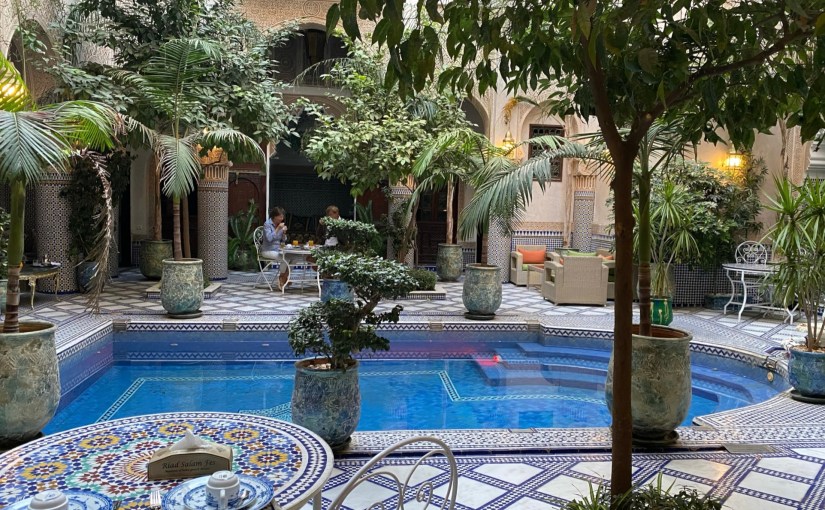
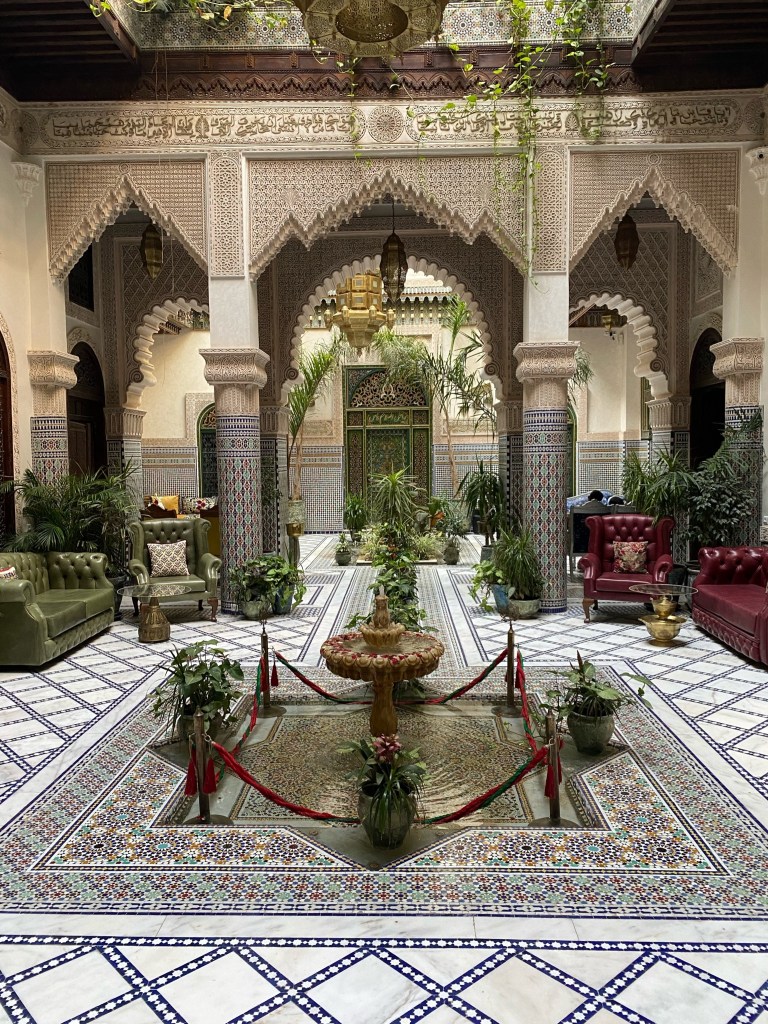
There is oh so much to say about Fes, but it will have to wait till we get back to New Jersey. Instead, this post will focus solely on the incredible Riad Salaam Fes.
Although the neighborhood dates back to the ninth century, our riad is far more modern than that. Built in the seventeenth century, it is still owned by the same family. It WAS restored about thirty years ago, so like the country of Morocco, it successfully melds the old with the new. Even though the ceilings are high, and the courtyards cool the building, our room is equipped with air conditioning.
If you have ever visited the Alhambra, wouldn’t you agree that this riad resembles that beautiful fortress in Granada? The best part—our riad has all the modern conveniences, like up to date bathrooms and wifi.
It is not surprising that it took 16 years to complete the restoration. The attention to detail is mind boggling.
Check out our room. I ask you, is this not a bed befitting a sultan?
Half of the room. I couldn’t fit the sitting area into one photo.
Another modern convenience? A liquor license. Yes, in some Moroccan cities, you CAN enjoy wine and beer.
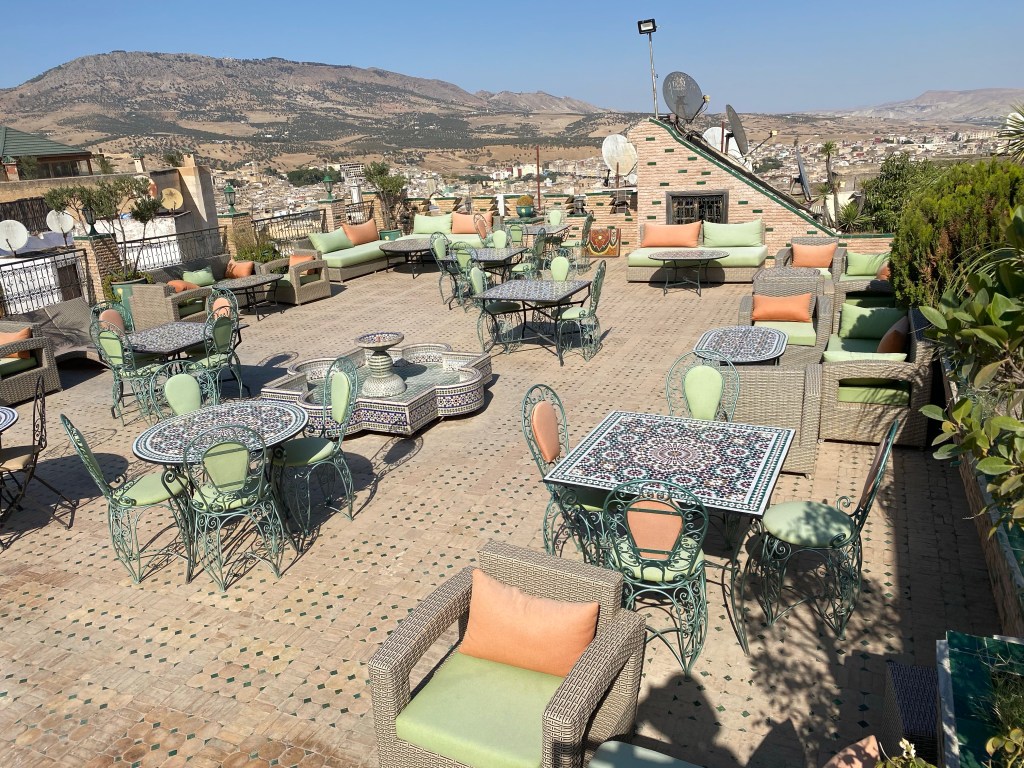
The panoramic view from the rooftop terrace, taken earlier in the day. No photos from our “happy hour”. By then, it was too dark and we were far too busy drinking to stop for a photo op.
You notice I said SOME Moroccan cities allow alcohol? Well, get ready for a story. When we arrived in Casablanca, Mostafa suggested that we buy wine there because it would not be available in Chefchaouen. Only problem: the Casablanca wine store was closed because of some sort of a COVID violation. Successfully reading the mood of the group, Mostafa went on a mission to get us some wine. On our way to Chefchaouen, we made a slight detour to Kenitra, coming up empty at three locations before Mostafa decided to change tactics. He started calling around to all his friends until he found one willing to purchase wine for us and deliver it to our riad. Is that not a truly dedicated and professional tour guide? We all feel very lucky to have him.
Bacchus smiled upon us in Rabat, where we were able to purchase a sufficient supply for our stays in the desert and Marrakech. Because both Rabat and Fes allow alcohol to be served, we couldn’t BYOB in those cities. Our Rabat purchases are sealed and stowed in the bus, to emerge as the need arises.
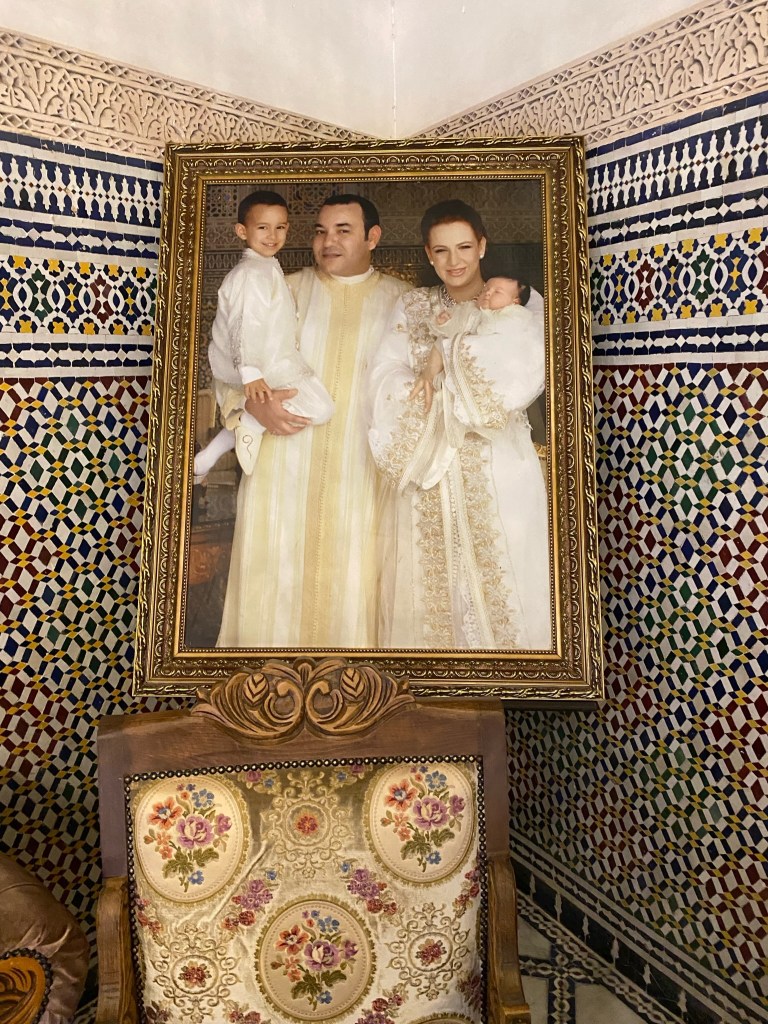
What better way to end this post than with a photo of Mohammed VI and his family?
So, did a sultan sleep in Fes? The answer is definitely yes. Not only was Fes once a capital city, but the King is here now!
I love that OAT allows their guides the flexibility to modify the itinerary. Yesterday, instead of driving directly to Tangier, we took the scenic route. We returned to Tetouan, driving through the lovely modern section, then along the coast, stopping in the resort of Smir.
It was off season, so all the shops and restaurants were closed, still it was easy to see why Smir would be a popular vacation spot. Sadly, the self cleaning, solar public toilet was also closed, so no video of its operation. You’ll just have to use your imagination.
Until this trip, I had no idea that Spain retained control of two cities in Morocco. Ceuta is almost directly across from Gibraltar, so ships passing through the Straits have to pay Spain for the use of that passage. We were able to see Ceuta off in the distance from a roadside stop, but weren’t able to visit this heavily guarded border.
The other Spanish city, for those with inquiring minds, is Melilla. You can Google it.
We stopped to catch a glimpse of the Rock of Gibraltar, but it was only visible through binoculars, so again, no photo, but that’s okay, because Tangier is more visually compelling.
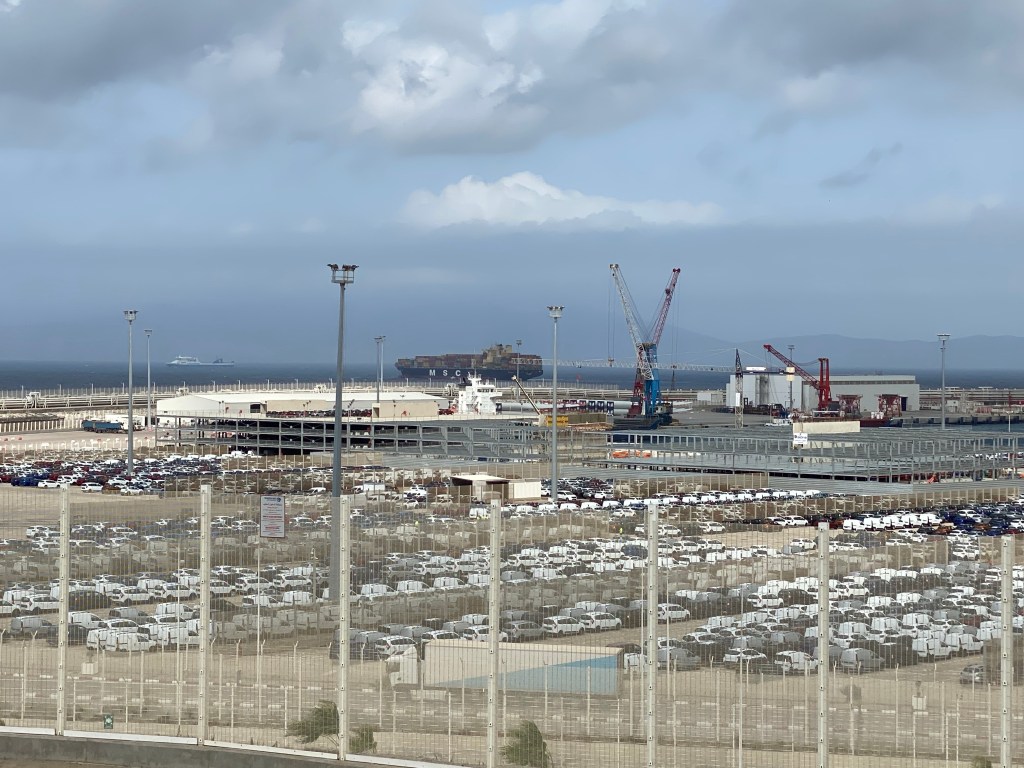
Morocco is definitely a country on the move. Their new port in Tangier is the largest in Africa and is shipping out huge quantities of cars every day. We were able to view some of the Renaults and Peugeots manufactured in Morocco from a distance.
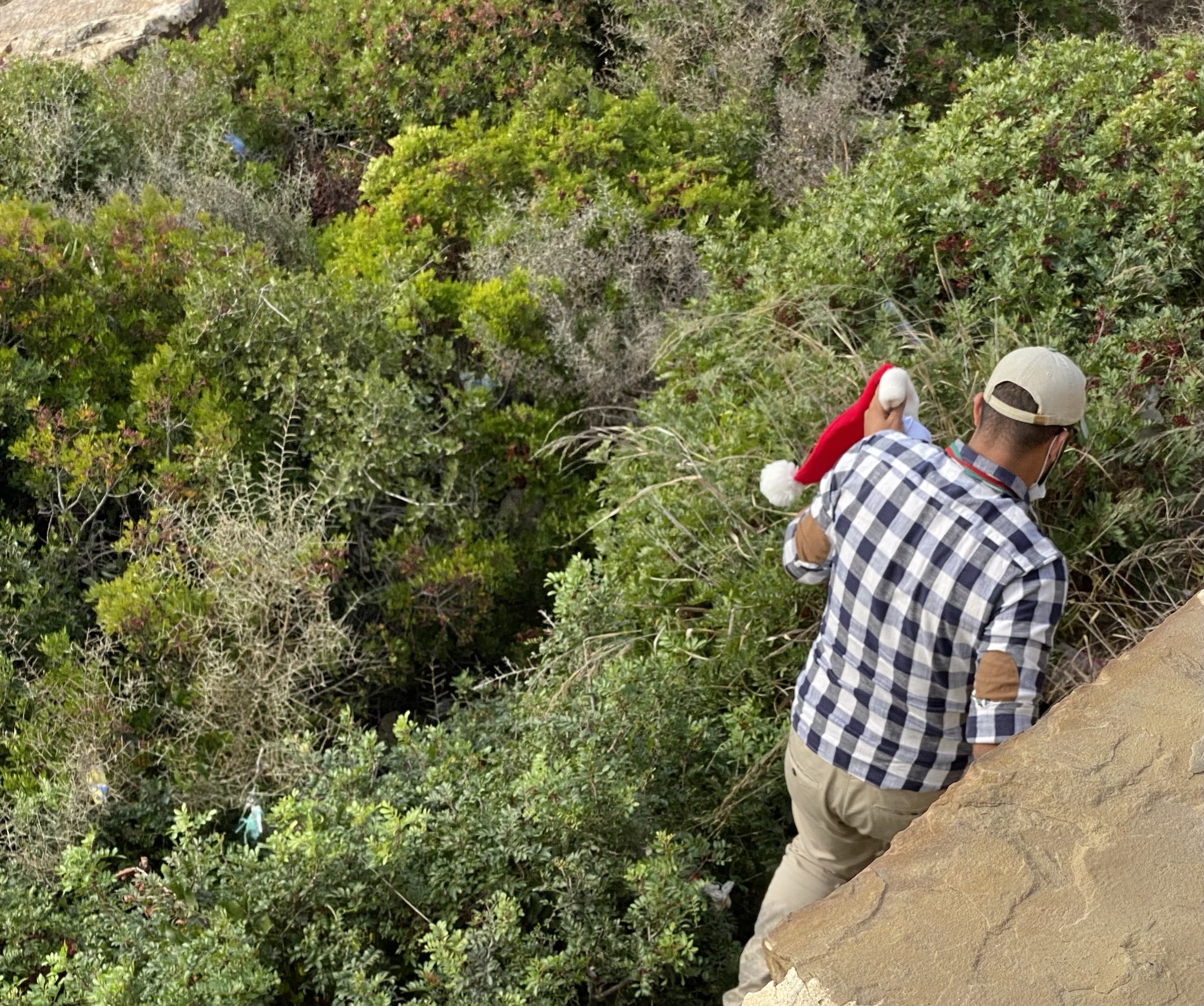
Our drive took us to the very windy spot where the Mediterranean and Atlantic Ocean meet. Dave’s elf hat was on his head long enough for this shot to be taken before it went sailing over the cliff. And yes, it WAS a very steep cliff, but fortunately Mostafa is athletic, and heroically retrieved Dave’s hat.
Before the trip, I’d been warned that Tangier was dirty, crowded and a somewhat scary place. That may have been the case years ago, but it was not our experience.
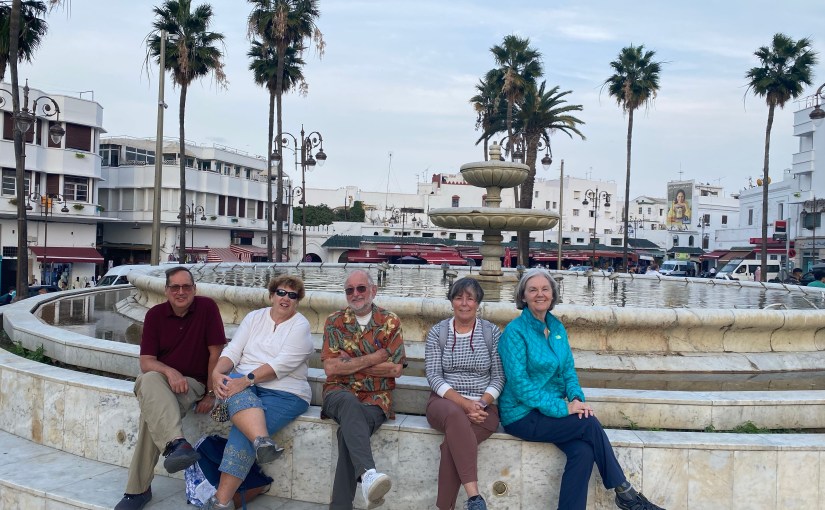
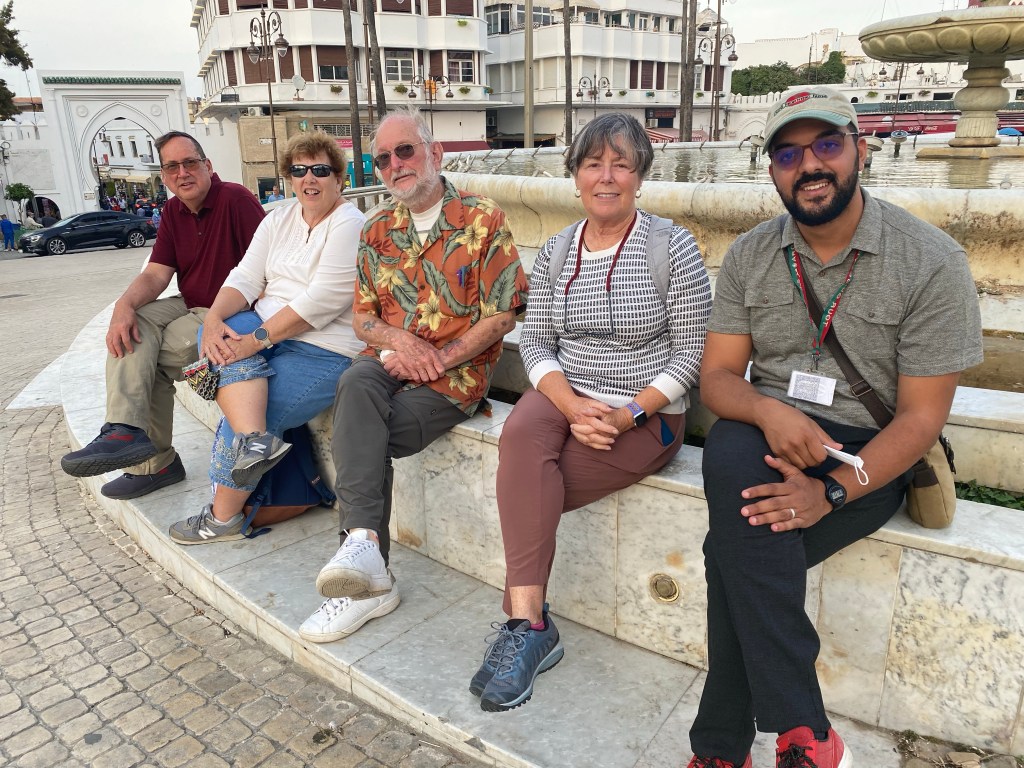
Relaxing in the square in the medina
We walked up a very steep hill to visit the old Portuguese fortress and were rewarded with several spectacular views.
On our way to the fortressTangier’s old port can be seen from the fortress
Morocco really treasures their long, positive relationship with the USA. Our visit to the American legation offered further proof.
I sure hope this comes up as a trivia question one of these days!
As usual, my posts lag behind our experiences. Tomorrow we leave Rabat for Fes. Forgive any typos…no time to proofread.
It would not be accurate to say we spent three DAYS in Chefchaouen because during our stay, we spent one day in a local northern village and another in Tetouan.
I can understand why other OAT travelers are so enthusiastic about this pre-trip. (For non-OAT travelers, OAT always offered the opportunity to add additional days before and after their main trips). The scenery is beautiful, the food is wonderful and inexpensive, the accommodations are gorgeous, and the people are so happy to see American visitors. As we were walking through the Medina, the locals were yelling “welcome”, “hello”, and different phrases, including “happy wife, happy life”.
Moroccans are very proud that their country was the first to recognize the brand new United States right after we achieved independence.
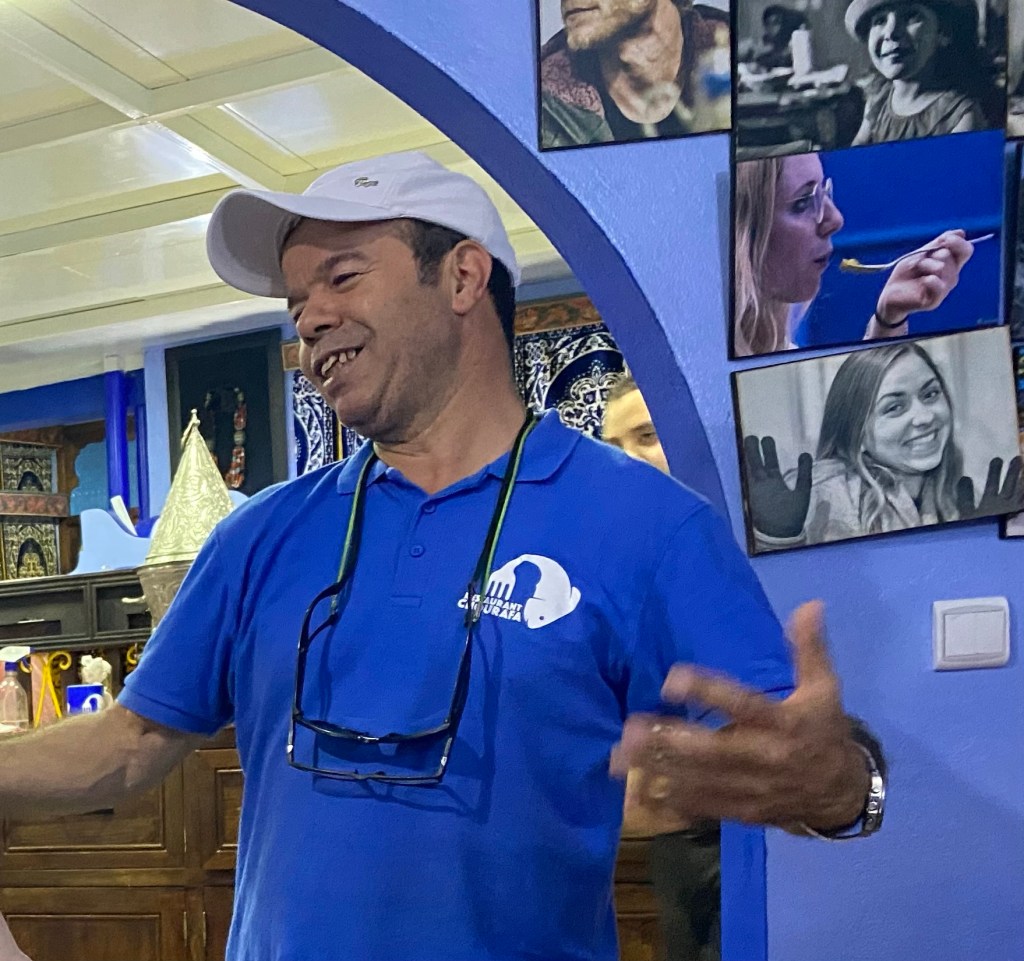
At Chourafa, the owner told us that Eisenhower stayed in that very dwelling during World War II, back before it was transformed from a private house to a restaurant.
Owner of Chourafa, entertaining us with his stories.
One feature of OAT is home visits, where we have the opportunity to spend time with a local family, sharing a meal and learning about their day to day lives. Our visit was with Mohammed, his lovely wife Ishhane, and their two daughters, where we enjoyed this fabulous feast made from ingredients grown on their farm in a little village so remote even Google hasn’t found it!
TagineKris and Ishhane with their assistant. Mohammed and his family built their house, including this kitchen.
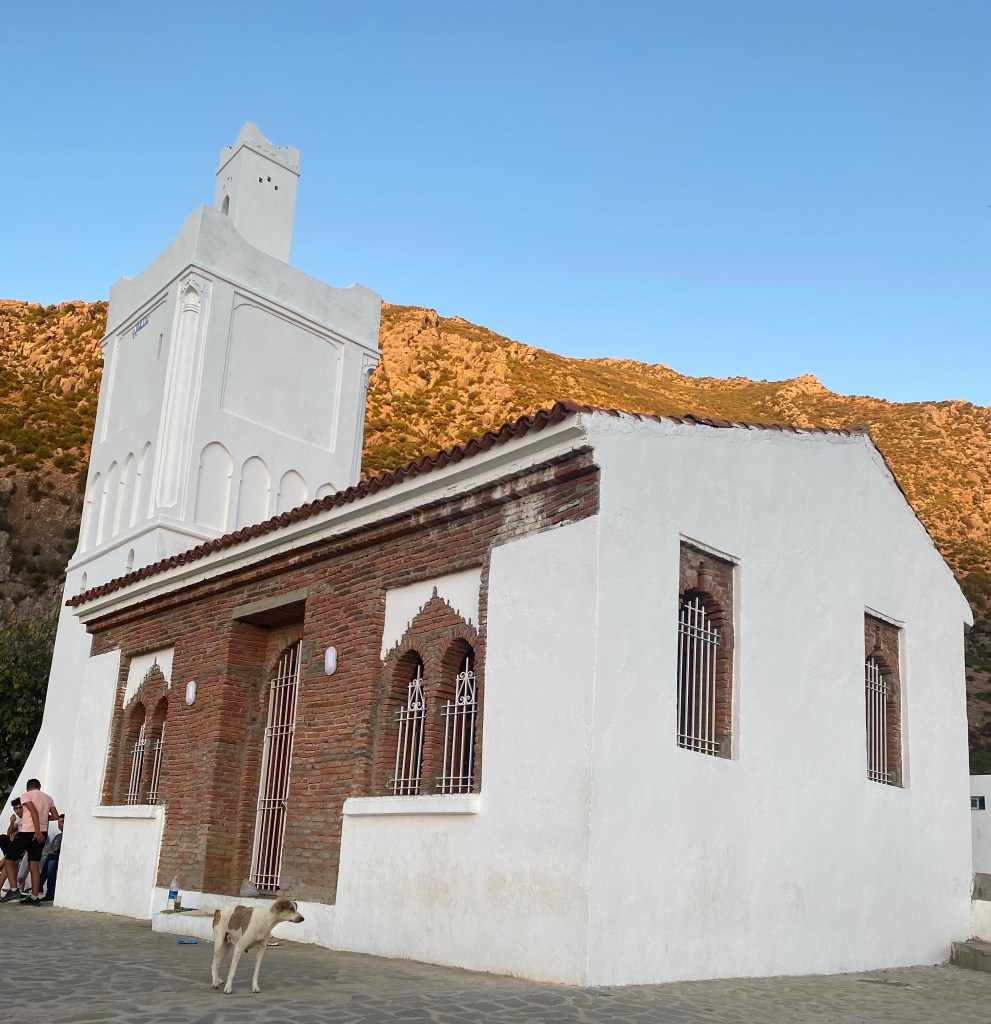
It’s good we were so well fed, because after we left the village to return to Chefchaouen, we did a LOT of walking. It is a bit of a hike to get to Boulazaafar, the mosque that overlooks the city. Built by the Spaniards in the 1930’s as a way to make up both for the expulsion of Muslims after the fall of Andalusia in the late 1400’s, and for the Spanish invasions during the late 1800’s, it has never been used. Understandably, the Moroccans were a bit suspicious of the Spanish military’s attempt to make friends. Maybe they heard about the Trojan horse?
Okay, so it isn’t Hagia Sophia, but the location is pretty spectacular.
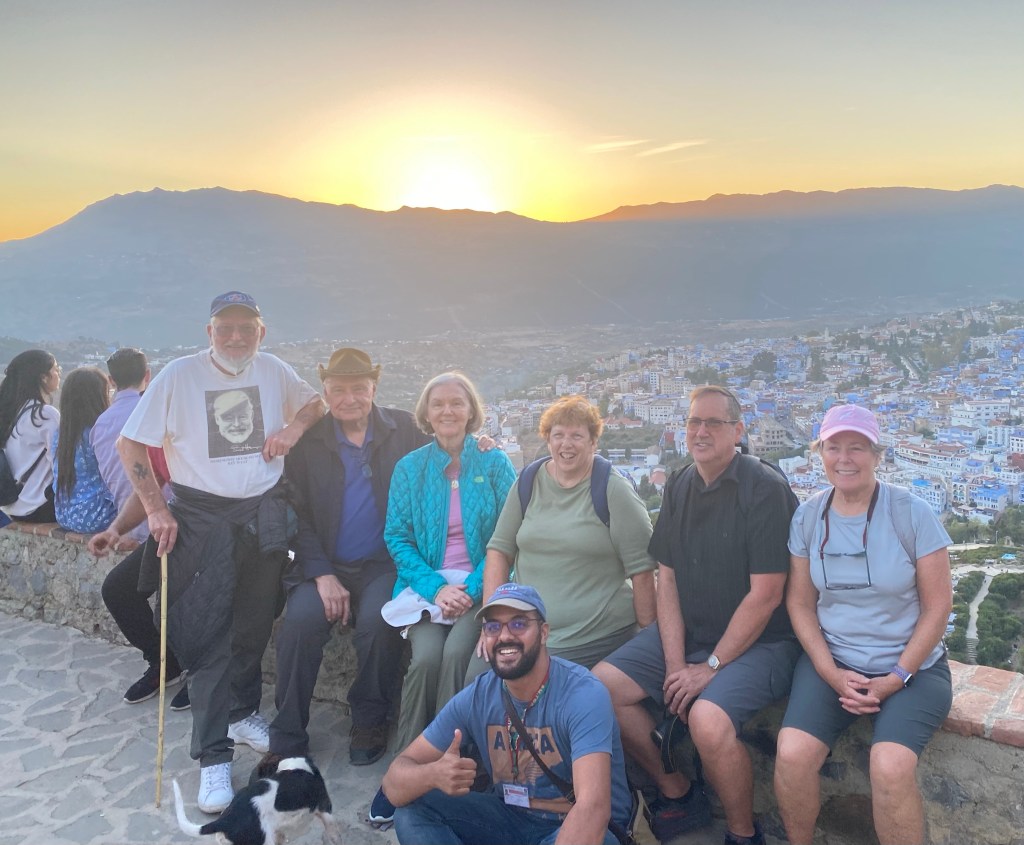
It is SO worth the 30 minute uphill stroll to get there in time to watch the sun drop behind the mountains.
From that vantage point, we could hear the call to prayer issuing forth from the 30+ mosques scattered throughout city.
Most of the other hikers were a bit younger than we were, by roughly 4 or 5 decades Another view of Chefchaouen: Different centuries coexisting. Women are doing their laundry in the stream and taking photos with their cell phones.
We were offered an optional trip to Tetouan, which all of us, except Mike took. Although the scenery on the drive was spectacular, in retrospect, I think I would have preferred to spend that time in Chefchaouen instead.
The optional tour consisted of a stop in a small Roman Museum, a walk by the palace, and through the Medina, the Jewish quarter and mella, and a seafood lunch in a restaurant across from the beach. Although enjoyable, I’d had similar experiences on other tours, so for me, additional time in Chefchaouen would have been preferable.
When we signed up for this Overseas Adventure Travel trip in August of 2019, the world was certainly a different place. Even 20 months after shutdown, Covid STILL has a significant impact on our daily lives. I will admit, we had some reservations about leaving home, even after being fully vaccinated, but through Facebook, I was able to connect with Rocky and Julie who traveled to Morocco with OAT in September. They kindly “friended” me, and because of their photos and posts, we felt comfortable forging ahead. My goal is to do likewise, but rather than posting on Facebook, I’ll be communicating via this blog. So, if you want to tag along with us to see whether you’d feel safe visiting Morocco, just sign up and you’ll get a notification via email whenever I post.
This first post might be boring for those who are not planning to become future Morocco travelers. It’s really a compilation of information I would have found helpful, prior to leaving home.
Getting there
Initially, we were flying to Casablanca via Paris on Air France, stopping in Paris for four days. Although we normally enjoy being on our own, because of Covid, we realized that we wanted the comfort of having a guide look out for us. Plus, with different countries having different rules, we figured those four days were a complication we could do without, so I hit the internet, to determine whether it was possible to get from JFK to Casablanca non-stop.
The only non-stop I could find was via Royal Air Maroc, which has one daily round-trip flight. It is a codeshare with American Airlines, but unfortunately OAT does not have an agreement with those airlines, so we were on our own. I’ll be honest—it was a little complicated, because with the code share, we had two different flight and booking numbers, and two different customer service phone lines. AND, although we booked and paid through the American site, we couldn’t use that site to select our seats. We also were unable to check in on-line, and print our boarding passes, something we normally do. A hassle, yes, but we avoided changing planes in Paris, and we arrived in Casablanca seven hours earlier than we would have if we’d stayed with Air France.
Royal Air Maroc
Our flight was scheduled to leave JFK at 8:40 PM, so we left our house at 3:45 PM because of NY traffic. It took almost 2 hours to get to the airport, but checking in and getting through security was relatively easy.
Our flight would arrive in Casablanca at 8:30 AM local time, 3:30 AM our bodies’ time. (It actually departed and arrived on time!) Knowing how poorly I do with sleep deprivation and jet lag, (picture a toddler who needs a nap) we decided to book business class on the way over so we could stretch out and sleep.
Business Class also included admission to the Primeclass Lounge in terminal 1. I’m not sure if Covid is responsible for the food offerings, but let’s just say that particular perk was not a selling feature.
Like USA Airlines, Air Maroc has lay flat seats in business class
I was surprised that dinner was provided on an 8:40 PM departure. In fact, I thought the appetizer was the whole deal and it was enough for me, so I skipped the hot entree. All I can tell you is there were three choices. We also got a decent breakfast. The business class perks that WERE selling features were a special line in passport control and priority luggage handling, so it was waiting for us when we arrived in baggage claim. In fact, the whole process went so fast and so smoothly, we were off the plane, through passport control, baggage claim and customs, had gotten money at the ATM and were outside the terminal in 25 minutes. To make the cost reasonable, we opted for economy on the way back. I promise to report on THAT flight too, so you, dear reader, will know what to expect from each option, should Air Maroc be in your future. Our return flight departs shortly before 1:00 PM, versus 7:30 AM (the Air France option), so we should be rested enough to deal with whatever version of economy Air Maroc offers.
Arrival
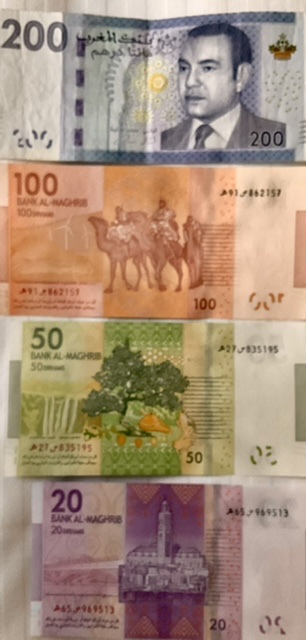
Our hotel, the Radisson Blu, arranged for a car to pick us up at the airport. The cost was 500 MAD and we were able to pay with our credit card. Our guide had warned us that only passengers are allowed inside the terminal, so we knew to look outside for our driver, right after we hit the airport ATM for some local currency. He also told us the most we could withdraw is 2000 MAD, ($235.22) delivered in 100 and 200 bills, so we were prepared for that. It took about an hour to get from the airport to the hotel, because of traffic and a couple of accidents.
Mohammed VI’s image is on the front of all bills, but the reverse varies. The hotel changed a large bill for us
Packing
Mostafa, our guide, sent us a wonderful welcome email, full of useful information, like where we would be able to have laundry done, (Fes, Ourazazade and Marrakech), and what to pack (bathing suit and hairdryer, among other essentials.) For a while, we seriously considered traveling with carry on only. After very carefully reading the luggage allowances on Royal Air Maroc’s website, I became concerned that ONE carry on meant just that, with no “personal item” allowed. We would have been really bummed if we had eliminated things that we wanted to bring, only to learn at the airport that one of our two carry-ons would have to be checked. So, out came the duffle, and in went more ”stuff”. Mike was able to easily include his laser pointer and binoculars, in anticipation of the dark skies in the Sahara. He’s an astrophysicist, so interested fellow travelers can look forward to a professional explanation of what we are seeing in the heavens.
Map
The image at the top of this post was created courtesy of Google maps. The cities we will be visiting are listed in order, with the blue pins giving you an idea of the ground we will be covering. Are any map aficionados out there? If so, this link will allow you to get additional information about the cities we are visiting by clicking on the blue pins. https://goo.gl/maps/Np8GEL1ripWqEgx57
For the past two years, we have been “Wishin’ and hopin’ and thinkin’ and prayin’, plannin’ and dreamin’ “ about traveling to Morocco. (Who remembers that song? Extra credit if you remember who sang it.) Right now, dreamin’ is Mike’s choice, but I’m going to check out the pool so I’ll be sunnin’ and swimmin’.
We were originally scheduled to fly to Morocco on March 30, 2020. Well, we all know how THAT went. As late as March 3, 2020, we pondered canceling our trip, still uncertain as to whether or not it was safe to travel. Fortunately, the decision was made for us, so we were spared the anxiety and turmoil that other travelers experienced when they had to cut their trips short before everything closed completely down.
We had planned to take three other trips in 2020, our most ambitious travel schedule ever. So much for well laid plans. Like all the other travel enthusiasts out there, we discovered that 2020 would be the year that our big travel plans centered around obtaining groceries.
Fortunately, all our trips were with OAT and the company made rebooking painless, with generous travel credits. In fact, our rebooked trip is even better than the original, because we are including the pre-trip to Chefchaouen, an option that was not offered for our 2020 departure. Our fingers are crossed that in about three months, we will be doing an instant replay: packing and getting geared up for our trip.
So what do you do when you have about a year and a half interlude? If you’re me, you read a whole lot. The photo atop this post shows just some of the books I’ve read in preparation for our trip. These were all purchased from Thrift Books, an on line store that has an abundance of affordable second hand travel books in great shape.
If you are only going to read one book, I highly recommend “Dreams of Trespass” by Fatima Mernissi. Written in 1994, when she was 54 years old, Mernissi takes us back to her childhood and introduces us to two very different harems: the Fez home of her paternal grandparents and the country farm of her maternal grandparents. What I loved most about the book is it is written in the voice of a 9 year old girl. She asks “what makes a harem”? Do you need to have multiple wives (“farm” grandfather had 9) or can you have only 1 wife (like her father and uncle) and still be a harem? Does the harem have to have high walls (like in the city of Fez) or can it be wall-less like in the country? Ultimately, she concluded that unless you are a sultan, a harem was simply the home for an extended family; it offered a refuge for divorced and widowed women.
When Mernissi was a child, Morocco was a French “protectorate”. Remember that famous scene from the movie, Casablanca, where the Germans are out-sung by the French, who stand up and belt out La Marseillaise? Were there any Moroccans in that scene? If you are wondering what life was like for those conquered by the European “Christians”, Mernissi gives us this glimpse: “Christians, just like Muslims, fight each other all the time, and the Spanish and the French almost killed one another when they crossed our frontier. Then, when neither was able to exterminate the other, they decided to cut Morocco in half. They put soldiers near Arbaoua and said that from now on, to go north, you needed a pass because you are crossing into Spanish Morocco. To go south, you needed another pass because you are crossing into French Morocco.” I wonder what song the Moroccans would have sung had THEY been in Rick’s cafe?
Mernisi learned about World War II by listening to her male relatives who “talked about the Allemane, or Germans, a new breed of Christians who were giving a beating to the French and British, and they talked about a bomb that the Americans across the sea had dropped on Japan, which was one of the Asian nations near China, thousands of kilometers east of Mecca. The news about that bomb plunged father, Uncle Ali and my young cousins into deep despair, for if the Christians had thrown that bomb on the Asians who lived so far away, it was only a matter of time before they attacked the Arabs”
That’s the beauty of travel. It allows you to connect with people who, on the surface, seem so very different only to learn how much of our hopes, fears and desires are shared.
In September of 2018, we signed up with Overseas Adventure Travel for a March 2020 trip to Morocco. Why plan so far in advance? We wanted to travel with friends, OAT limits their groups to 16, and popular trips sell out quickly. We had no difficulty recruiting 11 friends to go on the tour with us. So far so good. Fast forward to today, with departure date rapidly approaching. As my favorite philosopher, John Lennon, once said, “Life is what happens when you’re busy making other plans.”
Well ol’ John was right. “Life” has certainly jumped up and slapped us in the face. Within the last two months three travel buddies had to drop out. One member of a couple was diagnosed with a serious medical issue, then another fell and fractured her knee. Their future absence made us realize how much we were looking forward to spending time with them.
Because the trip is so popular, their spots were quickly taken by other OAT travelers –also known as friends we haven’t met yet. So, there will still be 16 of us on the trip. But wait, we aren’t finished. Unless you are in a coma, you have probably heard about the coronavirus. So far, none of us has allowed it to disrupt our plans.
Fortunately, according to our State Department, Morocco is looking safe. Still, we have to fly to get there and back, and our plans include a three day stopover in Paris before we enter Morocco. Although the State Department hasn’t identified France as a “do not travel” country, another source indicated that several cases have popped up in France.
What to do? Sadly, we have to acknowledge that being over 65, we have aged into the “at risk” group. Fortunately, we are relatively healthy, and are up to date on all of our shots. Still, we recently experienced another country’s health care system, and although the outcome was positive, visiting my spouse in the Alice Springs Hospital was not a high point of our trip to Australia. (Clearly, it wasn’t my spouse’s either.) On a positive note, although we learned just how wonderful our medicare supplement coverage is when we are outside of the USA, we hope to never have to use it again!
As of today, according to the US State Department, Morocco and Paris have only the usual warnings about terrorist activities, but that is the world we live in. Given our record of gun violence in schools, churches, shopping malls, movie theaters, we could just as easily be mowed down by a home grown terrorist shooting his assault weapon. I refuse to let terrorists, either here or elsewhere, win. A virus, however, is another matter.
As of today, Morocco has reported its first case of the coronavirus; its victim, a man who returned from a visit to Italy, is being treated in a Casablanca hospital.
In Paris, a protest by workers closed the Louvre for two days, until the Museum staff assured the workers that “proper measures” to ensure their safety were being taken.
What happens if we get to Paris, and Morocco decides not to let anyone into the country from France –or from the USA? Let’s face it, several states have reported outbreaks, with many of the victims having no known source of contact. Our response is being managed by Mike Pence, who is not noted for his expertise in the medical and scientific arena. Maybe other countries will view US as being problematic? What if we make it to Morocco, an outbreak occurs and we can’t fly home? What if we catch a cold or some other nasty thing on the flights, either to or from our destination and we have to be quarantined until we are tested and certified as okay? So many “what ifs”. One thing that’s certain, if we go, my plan to travel with “carry on only” has been abandoned. I want to be sure we have enough clean clothes to get us through any “what ifs” that come our way.
In addition to cancelling all trips to China, South Korea and Mongolia, OAT has allowed travelers that signed up for their Italy trips the option to cancel right up to the date of departure, choosing either to apply their payment to a future OAT trip or to get a refund, minus a small processing fee. That gives us peace of mind.
What will we do? We will prepare as if we are going to take the trip, watch the news, check the internet and wait to see how it all unfolds.
Okay, I’ll admit it, I felt really, really guilty, when I learned that while I was having a grand old time on the Great Ocean Road, my beloved husband was suffering in a Melbourne hospital, as I confessed in my last blog post.
After seven days in a town that is hotter than hell ( well, maybe not hell, but definitely purgatory), I feel my penance has been completed and I am free to share the rest of the photos from our glorious time in Melbourne.
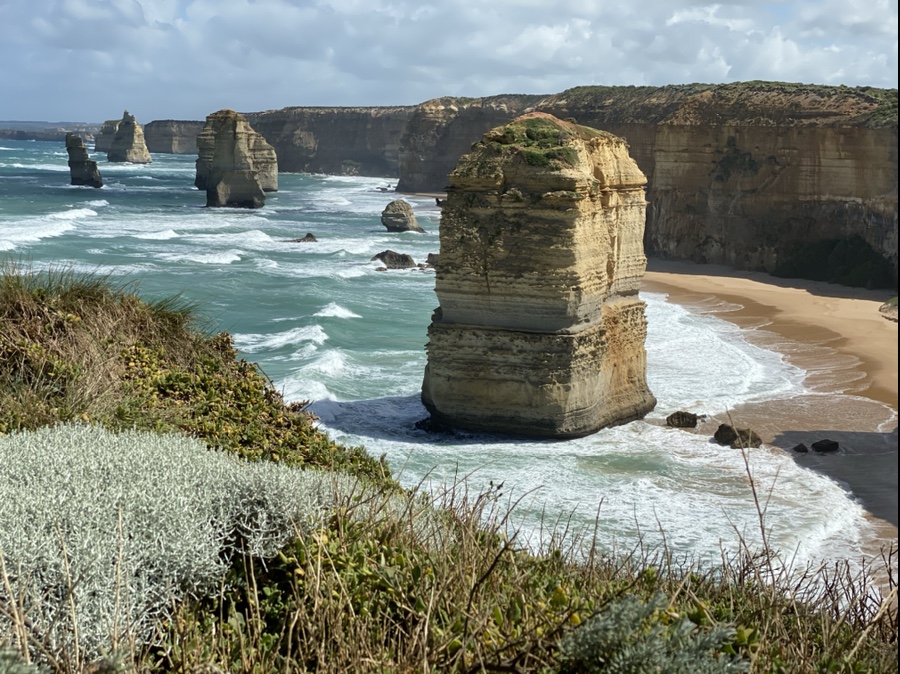
Originally called The Sow and the Piglets, these rock formations were wisely renamed The Twelve Apostles, despite their originally being only nine of them. One has since crumbled, so now there are only eight. I spent most of my career in marketing, so hey, I get it. Nine was close enough, if you just round up.
Not surprisingly, the gambit worked, and the rest is history. The Apostles are definitely a beloved Australian tourist attraction.
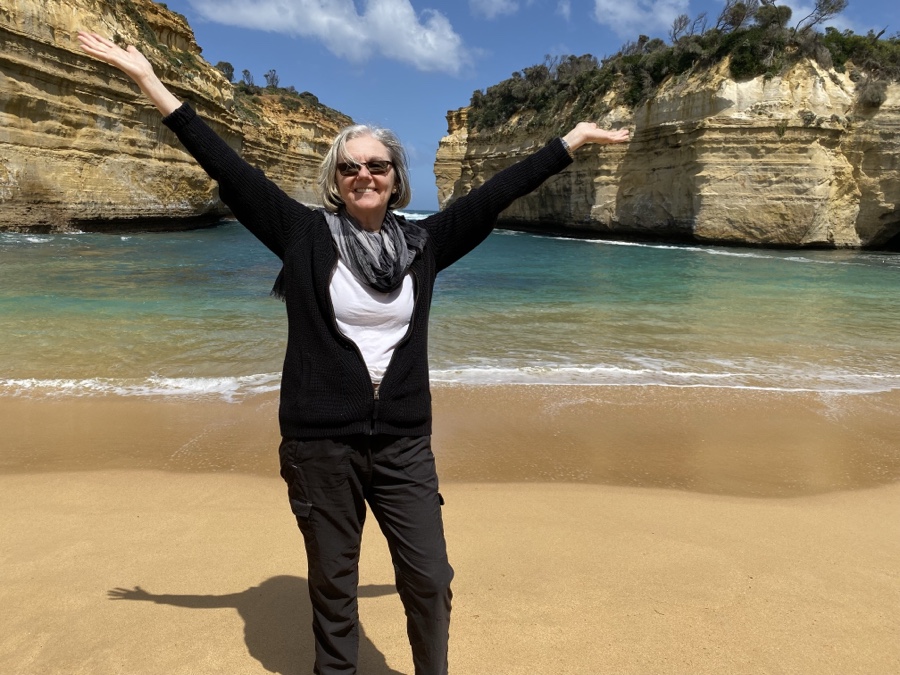
The beach is lovely too, and if you are willing to walk down (and climb back up) eighty steps, you too can get your picture taken on this gorgeous beach.
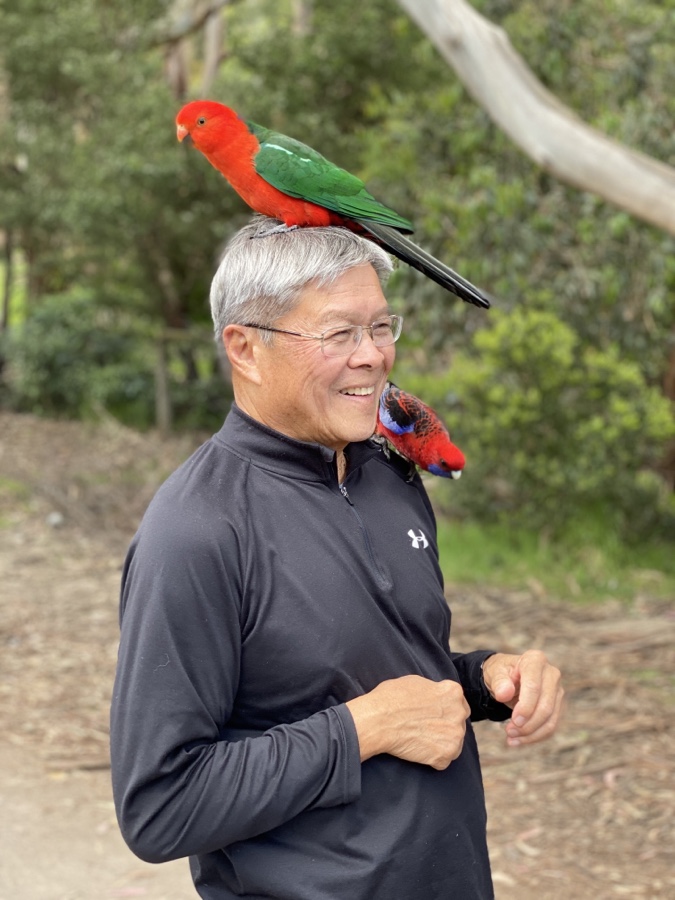
I was definitely game. My favorite photographer was otherwise occupied, but one of our fellow travelers offered to take my picture. Foolishly, I neglected to check my phone until I got all the way back to the top, only to discover a technical glitch. No photo. Andy, who you will soon meet, wearing a bird for a hat, offered to go back down with me, so he and I got to climb down (and UP) 160 steps!
Given that I’m looking a bit chunky, that extra exercise was probably a GOOD thing!
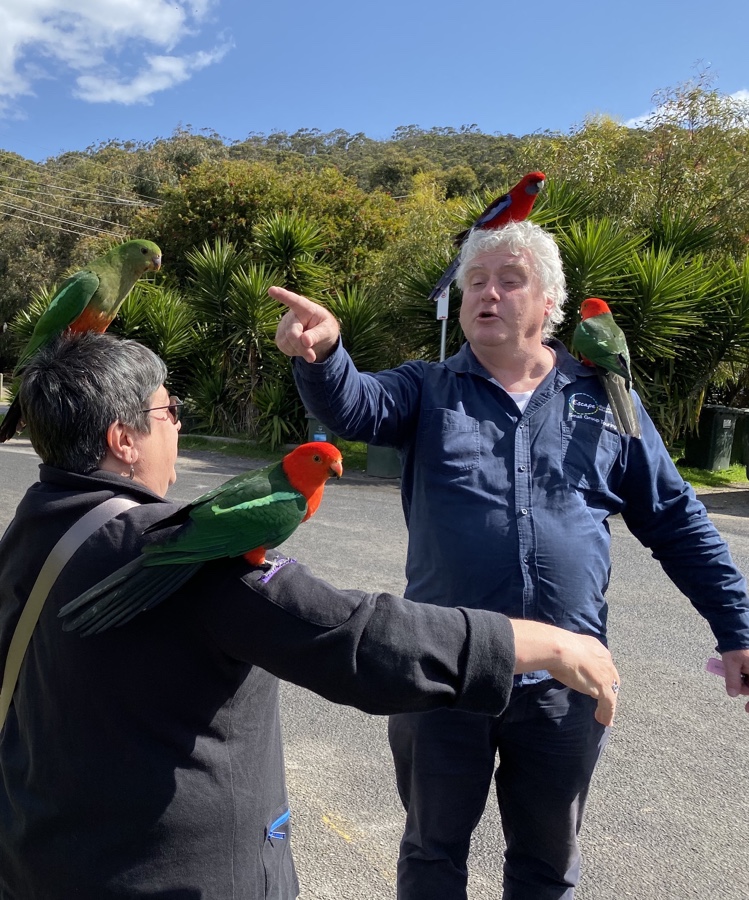
Our stop at the bird hangout was great fun, although I will admit it’s a bit of a jolt when one of these guys unexpectedly lands on you, but Andy took it all in stride.
Paul, our tour guide, (shown instructing Jenny, a member of our OAT group) , kept us enlightened and entertained during our entire day together.
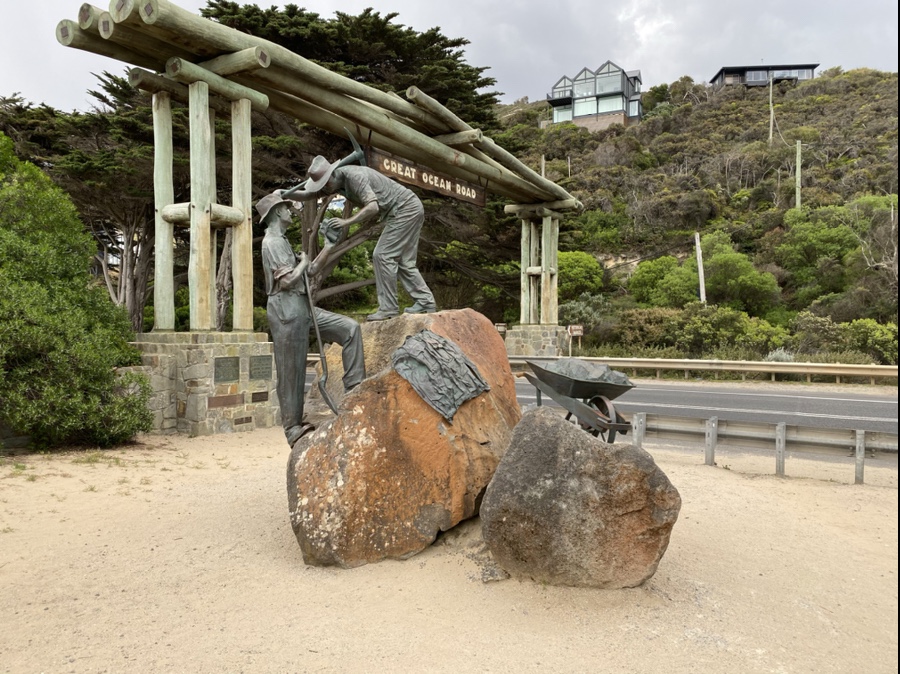
He told us The Great Ocean Road was built to employ returning war veterans. (Sorta like FDR’s CCC during the Great Depression).
About 3,000 former soldiers labored to build the road for almost thirteen years. Because of what we now call PTSD, dynamite couldn’t be used to break through rock; construction was done with pick and shovel.
This war memorial was built to honor the thousands who never came back from the war.
Other highlights from our time in Melbourne included a visit to the Mornington Peninsula, where we visited the Moonlit Sanctuary.
Unlike the Tasmanian Koala, this guy was awake. These animals sleep twenty hours per day, so somehow we managed to time it just right.
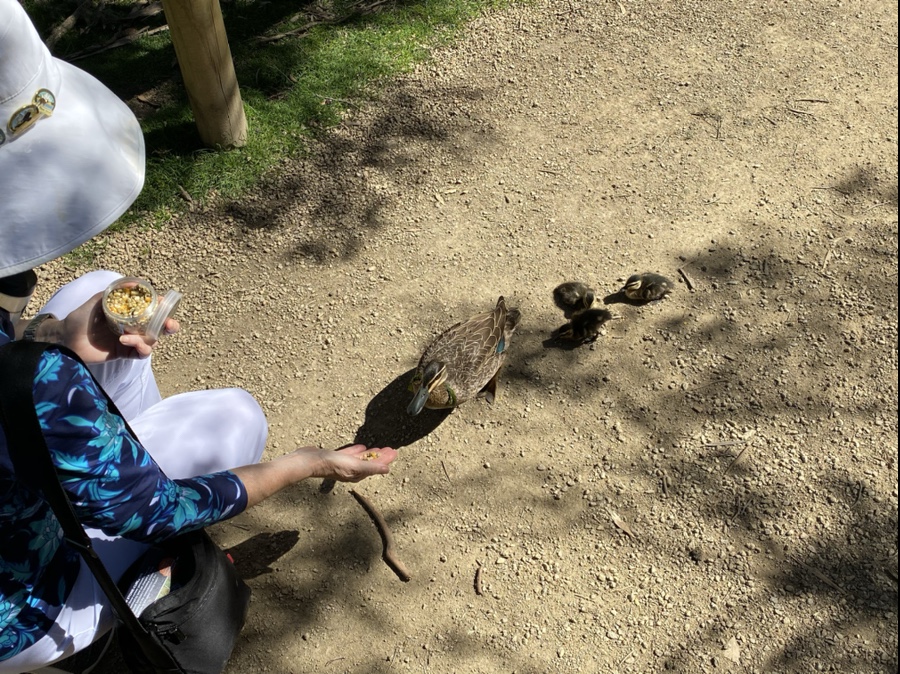
We didn’t have as much luck with the wallabies and kangaroos. They clearly were used to being fed frequently, and weren’t motivated to hop over for a snack. But the ducks and birds were quite happy to take a handout.
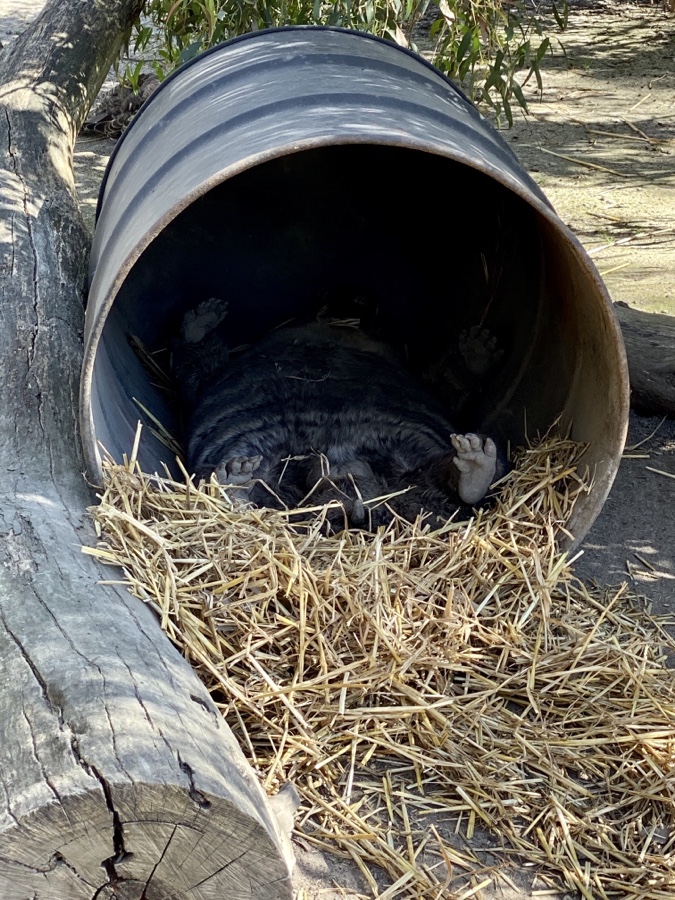
And this wombat? All we could see were his feet and hands! I think he had a “Do Not Disturb” tag hanging on his barrel!
Another notable visit was to the Abbotsford Convent. Now art studios and an educational center, it was once a “Magdalen Asylum” where up to 400 women and girls were sheltered. They were either orphans,”fallen women” or had no where else to go. They were also a source of free labor.
For “three hots and a cot”, they worked doing laundry for hotels and the weathy of Melbourne. As you might expect of a Catholic institution, prayer and chapel attendance were mandatory, as was penitence. This went on until 1975.
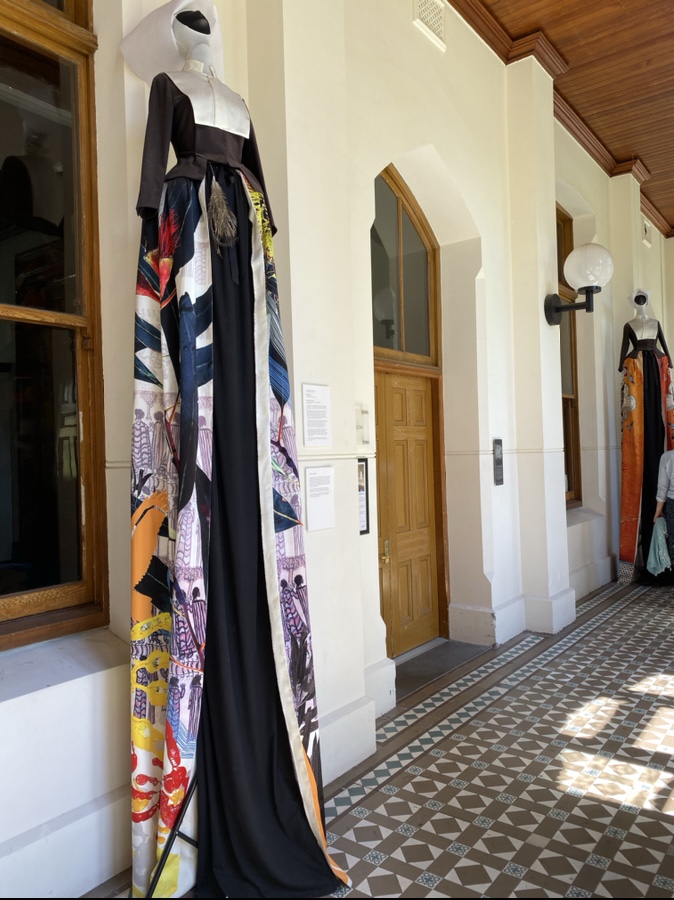
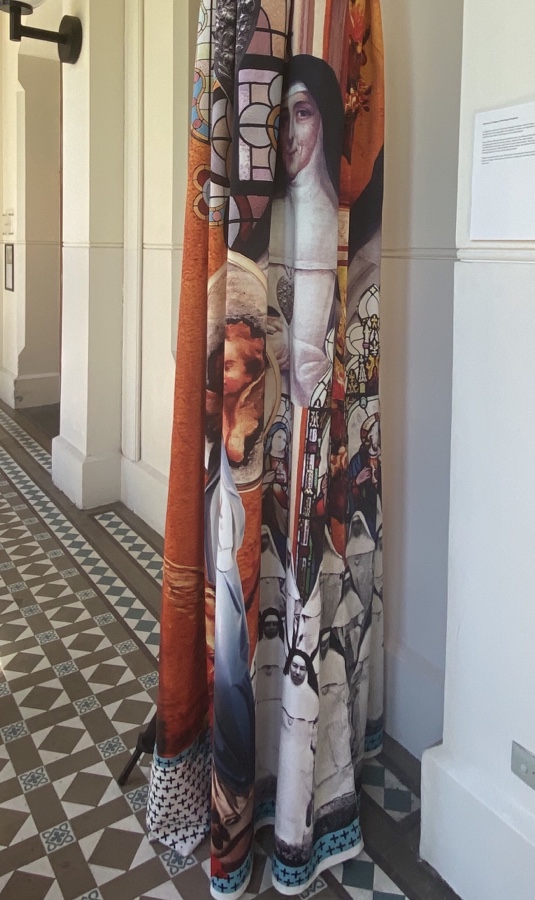
Today, the convent is beautified by art. I was particularly intrigued by these hand painted fabrics, which were very creatively displayed. I leave it to your imagination as to what this artwork symbolizes. It certainly has meaning for ME.
Here’s a close up of one of the fabrics. They were all different and were all exquisite.
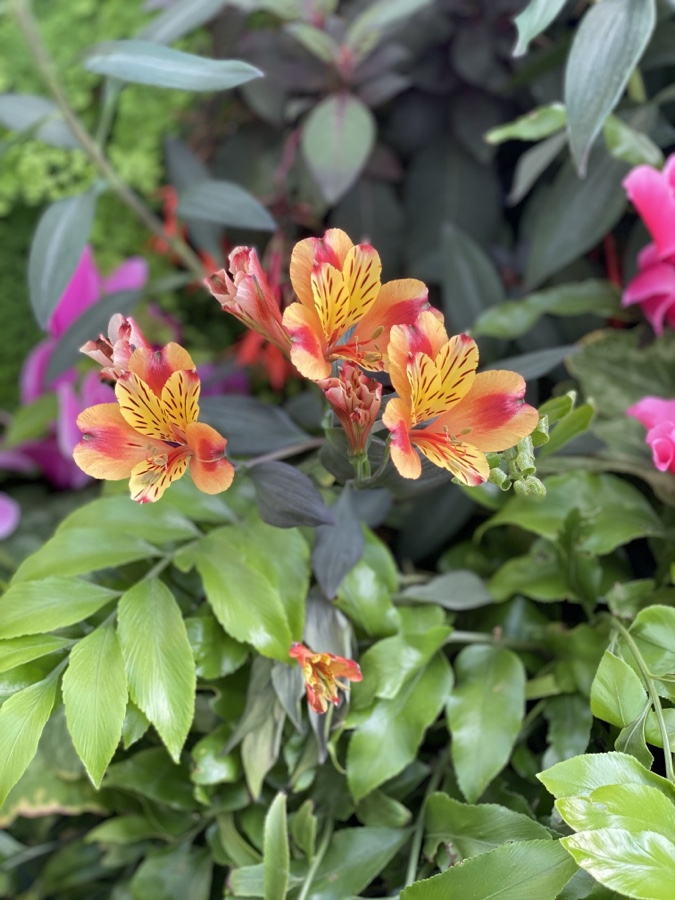
Tomorrow we head for Sydney, our final destination on this slightly modified tour of our seventh continent, so I’ll leave you with one last example of what my new iPhone 11 camera can do.
In the early ’80s I was captivated by a Masterpiece Theater Miniseries, “A Town Like Alice”, so much so that I read the book upon which the series was based. Who knew that about 35 years later we’d be spending two nights in this “bonza” town in the Northern Territory, right after our stay in Melbourne.
There is still so much more to say about Melbourne, and I will eventually get to that, but first, I bring you Alice Springs with a summary of why this is a town we will never forget.
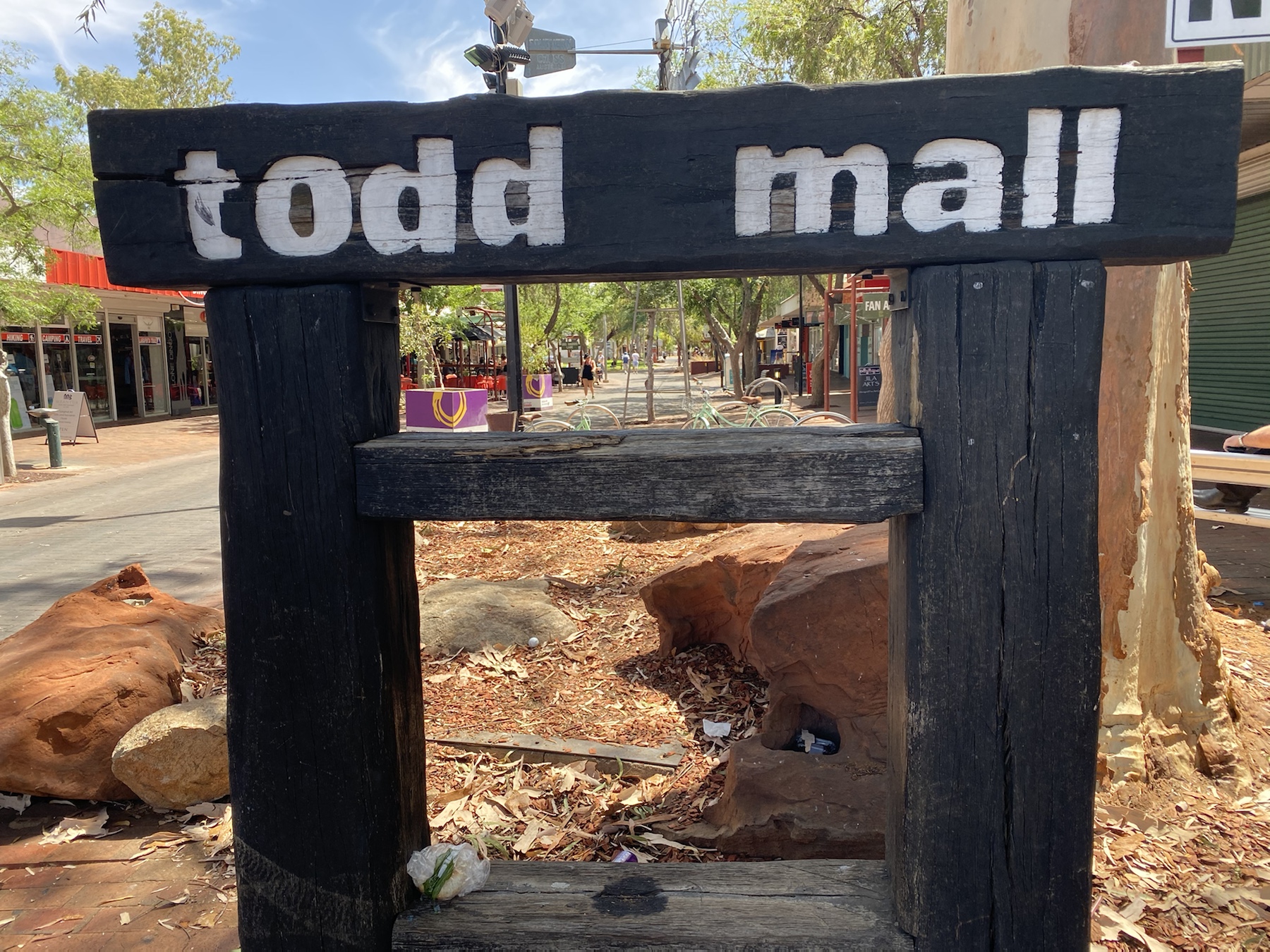
Our hotel, the Doubletree, is located right across from the Todd River. Both the river and the mall (among other things) are named after Sir Charles Todd, who brought communications to the area by constructing telegraph wires or stations or something along those lines. (Clearly I wasn’t all that interested). His wife’s name was Alice, and I’m guessing that at one time the area had a lot of natural springs?
Check out the Todd River.
What, you’re having trouble finding it? That may be because the “river” is bone dry. You see, this area can go for YEARS without rain. It actually looks a whole lot better on Google maps, portrayed as a blue ribbon surrounded by green borders. But no. It is all brown and dry. But the walkway is nice.
So, why did Mike and I decide to skip Uluru and the Great Barrier Reef to spend an additional five nights ( count ’em, FIVE nights !!!) in Alice Springs?
It was a nose bleed. Yes, you read that right. But WHAT a nosebleed! Enough to warrant a 3AM ambulance ride, a hospital stay of three nights, with a trip to the operating room thrown in for good measure. Thanks to the wonderful doctors and nurses in Alice Springs, our hero is out of the hospital and on the mend. But he needs to rest up, so we are hanging out in Alice Springs for those extra days, then flying to Sydney, where, if all goes well, we will be able to rendezvous one last time with our wonderful group before we all fly home.
Exactly HOW did Mike get that geyser of a nosebleed?
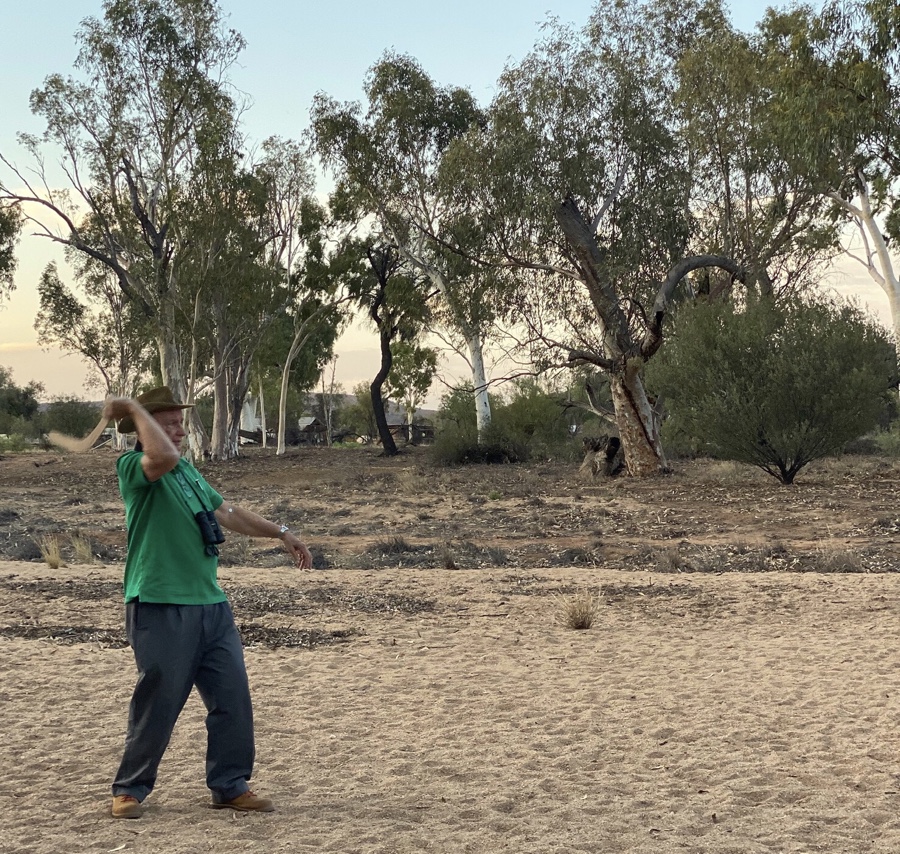
No, his boomerang did NOT circle back and whomp him in the nose!
It all started in Melbourne. He awoke very, very early with what he thought was strep throat. (It wasn’t). Being the considerate, resourceful guy that he is, he didn’t want to wake me or our tour guide, so he surfed the net to find St Vincent’s Hospital was close by. (Bad idea). I woke as he was headed out the door, unfortunately not alert enough to shout “NOOO. Don’t do it.” But then I figured he knew what he was doing, he’d get his antibiotics, then return to the hotel to spend the rest of the day sleeping off his illness.
While I was enjoying the magnificence of the Great Ocean Road, Mike was having his nasal passage assaulted. A nurse decided to ram a swab up his nose to do a flu test. That caused his FIRST nosebleed. (The afore mentioned nosebleed in Alice Springs was the SECOND one). The doctor cauterized the wound, (but not well enough) kept him in the hospital overnight and discharged him early Saturday morning, clearing him to fly to Alice Springs.
Although if we’d had our druthers, Mike would have skipped learning about another country’s health care system, however there WERE a few positives.
We felt lucky we weren’t in a remote area devoid of medical facilities AND grateful we both understood the local language (sort of).
We HAD purchased trip insurance plus we have high spending limits on our credit card, so we were okay paying (charging) up front.
We learned more than we ever wanted to know about travel insurance, electronic devices (phones, SIM cards, hot spots) which provides me with lots of material for future blog posts.
The hospital was only a mile away, so I got plenty of exercise walking along the “river”, from hotel to hospital and back, a couple of times a day.
I was able to download “A Town Like Alice” to my phone and reread it while waiting for Mike to get out of surgery. I had forgotten that I had liked the miniseries so much more than the book. Still it was a good distraction and it reintroduced me to the word “bonza”. What do YOU think it means?
We discovered how tuned in Australians are to what is happening in America, and how well informed they are about Trump, Pence, even Mike Pompeo! Some of them probably know more than many Americans. The nurses were curious about what Americans think of Trump, so we gave them our views and others’ views. Being liberals, that’s what we try to do. Present the facts. We had no idea how much other countries are counting on us to vote him out, something we heard frequently on our trip.
The hotel has a pool, so I could imagine I was taking a “sit in the sun and do nothing” kind of vacation. It didn’t take long for me to remember why I never go on that kind of vacation any more!
So, that’s why I haven’t been posting much these past few days. I know. A blog is an unusual way to inform friends and family of a somewhat traumatic event. (Mike’s nose was traumatized, as was my psyche).
Thankfully, all is well now. Happier posts will follow with better photos!
I’ll admit it. I am a lazy blogger. It seems it always happen this way. I start out with great intentions, keeping friends and family updated as to our whereabouts, but toward the end of every trip, I run out of steam. Then, re-entry into our world takes a few weeks. So here we are, back home, reliving our wonderful time in Patagonia via photos.
Our last several days have not been recorded, so let’s start there. If you recall the map from the Punta Arenas post, you’ll remember that we had some very long travel days.
With a bus like this, however, you travel in comfort, and you really get to experience the countryside. There were only 12 travelers (plus guides) on a bus that could carry over 40 passengers! With multiple interesting stops along the way, time passed quickly.
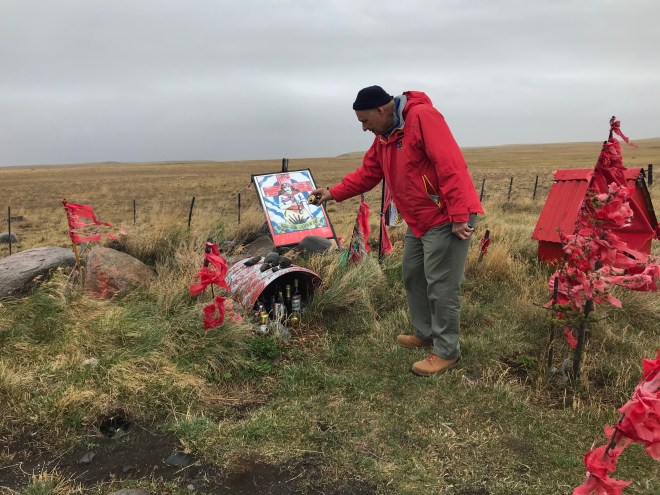
On our way to cross the border back into Argentina, we stopped to pay tribute to Gauchito Gil.
Here’s his story: Gil joined the Argentinian army to fight against Paraguay. He returned to his village as a hero, but soon after, the Argentine Civil War broke out. He refused to fight against his countrymen, so he deserted. He was found in the forest, by the police, who tortured him and hung him upside down from a tree. As a policeman was about to kill him, Gil said, “your son is very ill. If you give me a proper burial and pray to me, your son will live. If not, he will die.” Despite the prediction, the policeman cut Gil’s throat. When he arrived home, the policeman discovered his son was indeed very ill, so he heeded Gil’s prophecy–gave him the proper burial, said a prayer or two, and (wait for it–dramatic pause) the son was CURED!
SO, today’s travelers offer a beer or some other tribute to Gil, as an extra insurance policy for a safe trip. As you can see, we were no exception. Hey, why not.
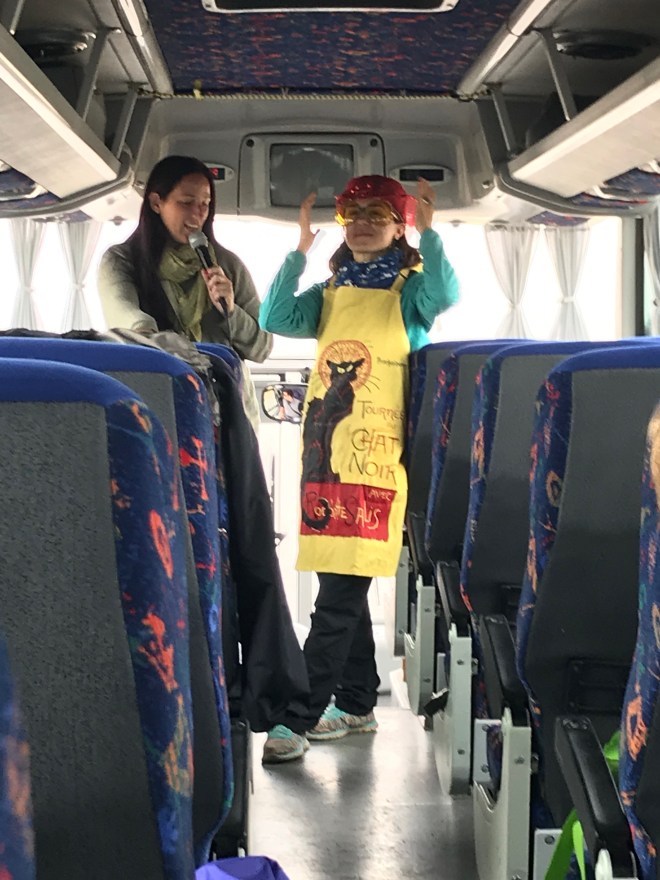
In addition to educational stops along the way, our guides kept boredom at bay by entertaining and feeding us. Laura, our guia excelente, donned that costume before she served us a wonderful treat. Yeah, I forgot what it is called, but I certainly remember the wonderful taste.
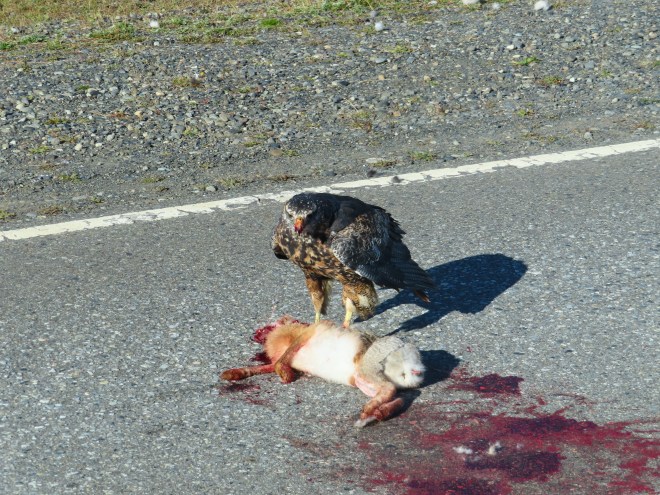
We were not without our national Geographic moments. As we drive the highways and by ways, we noticed several eagles and other large birds of prey sitting on fence posts. Were they watching the cars go by, as an avian form of TV? No, they had figured out that it was just a matter of time before some tasty road kill would make their grocery shopping much easier. Take a look.
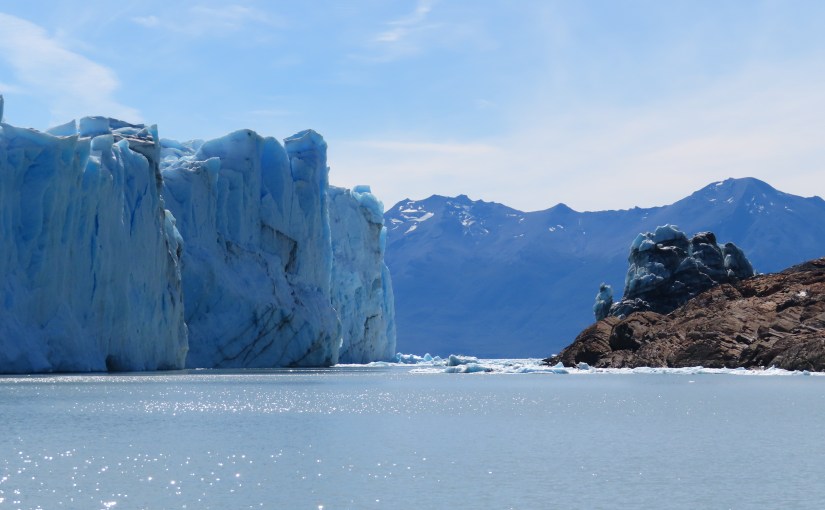
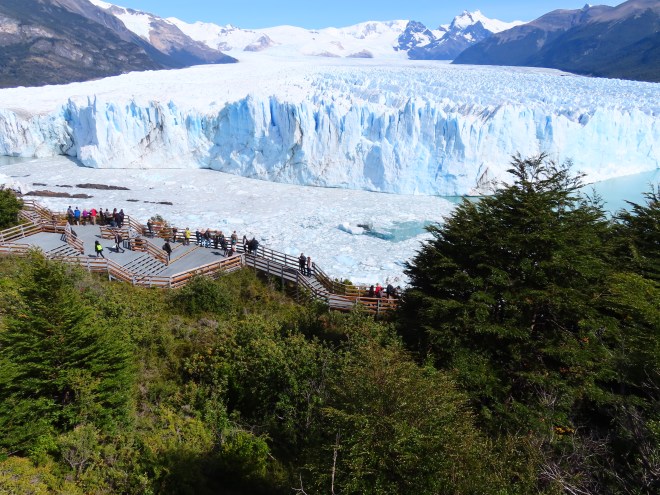
Before we knew it we were in El Calafate, Argentina. The main purpose of our 2 night stay here was to view the Perito Moreno Glacier in the National Park.
We certainly did that, both from a ship and from land. It was quite a majestic sight. The experience wasn’t just visual, however. It was also auditory. We could actually hear the glacier groan and thunder, as parts of it crashed off into the sea below.
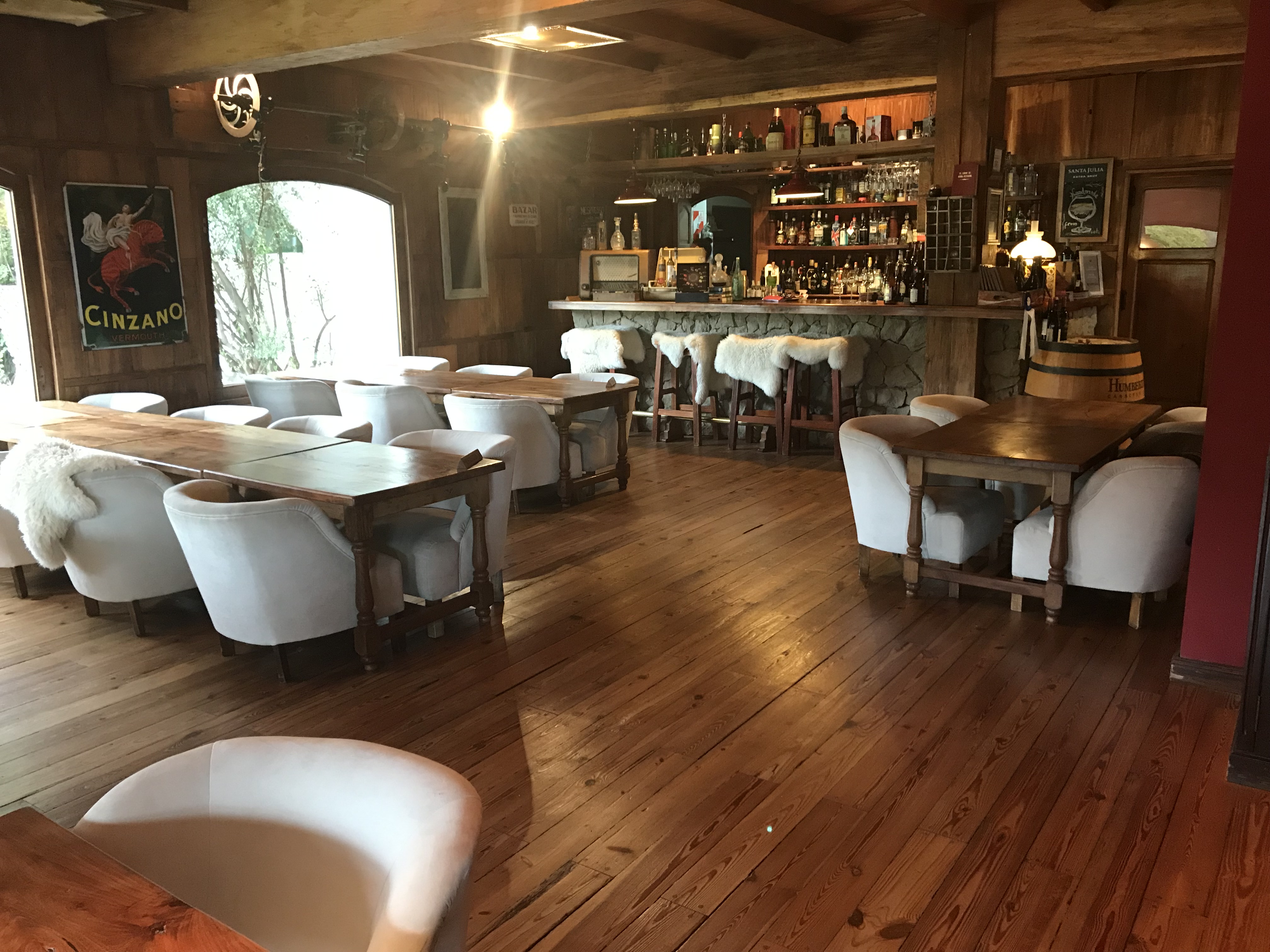
While in El Calafate, we stayed at the Kauyatun, a gorgeous hotel reincarnated from a former sheep ranch. Best of all, it is within walking distance of El Calafate’s charming center.
Beautiful grounds
The restaurant/ lounge
Herding demo
Our trip ended in Buenos Aires, where we had our farewell dinner, then flights home the next afternoon.
A toast to Laura
Saying goodbye is never easy, especially when you have such an interesting, caring, informed, fantastic guide like Laura. We all truly appreciated how hard she worked to make this trip extra special for all of us. Her energy was amazing!
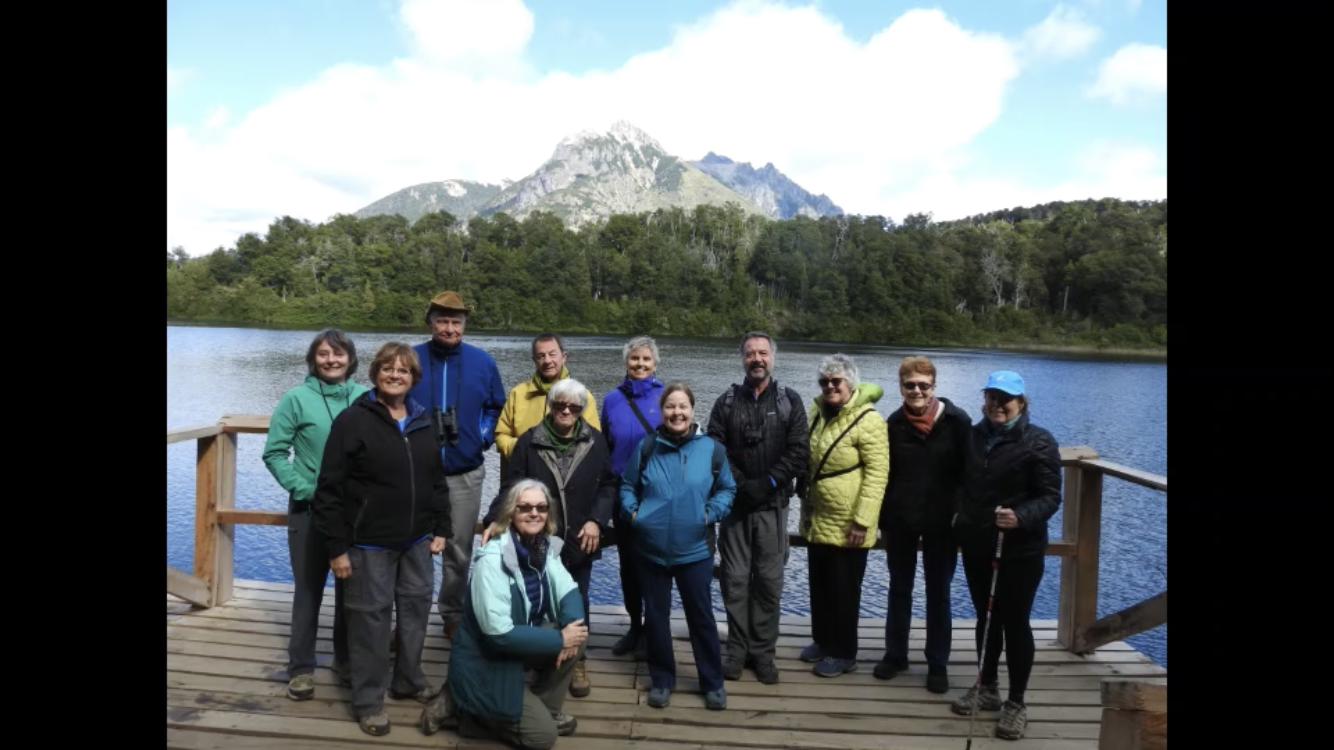
We also felt so fortunate to be a part of an extraordinarily compatible group. Our hope is that this will not be the last time we see these wonderful, smiling faces!
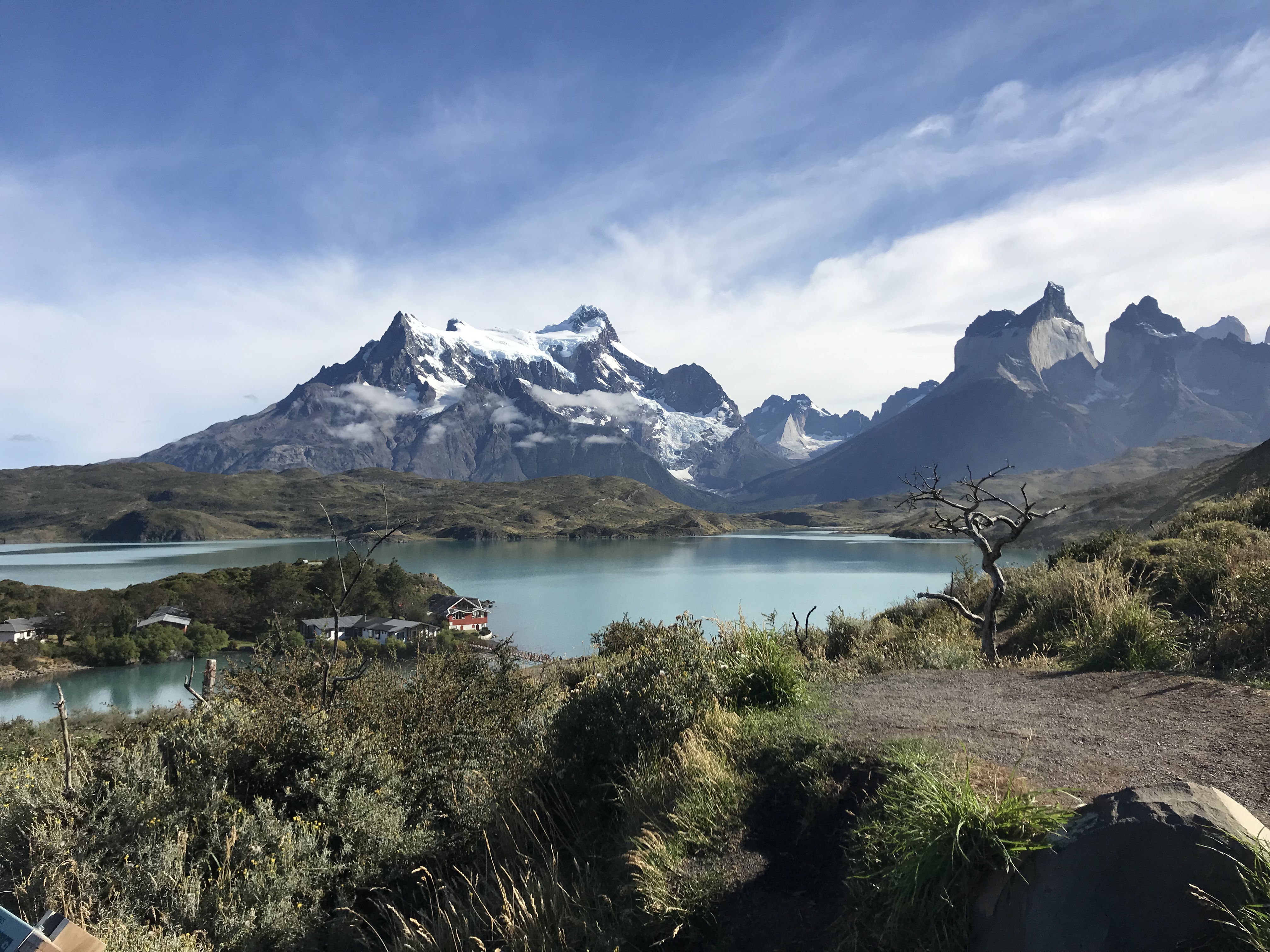
“Paine” is a Mapuche word meaning emerald blue, or, if you prefer, blue green. So “Torres del Paine” gets its name from the towering, unusually shaped mountains and the icy clear Lake Pehoe.
Normally, this area is buffeted by high winds and lots of rain. Laura and Maria, our guides, have reminded us how very fortunate we are to be experiencing this incredible weather. It could change at any moment, but so far we have beaten the odds.
Last night we took advantage of having an astrophysicist in our midst and persuaded Mike to give the group an impromptu lecture on the southern skies. We were so very lucky: the phase of the moon was perfect for viewing. It wasn’t so bright that it obscured the stars. We saw the Milky Way and the Magellanic Cloud, a rare treat. Too dark for photos–you just have to take my word that it was magnificent. And Mike was really pretty amazing too.
I DO have other photos that will give you an idea of the grandeur and beauty of this National Park.
During yesterday afternoon’s first hike, we battled head winds that made those two miles feel a whole lot longer.
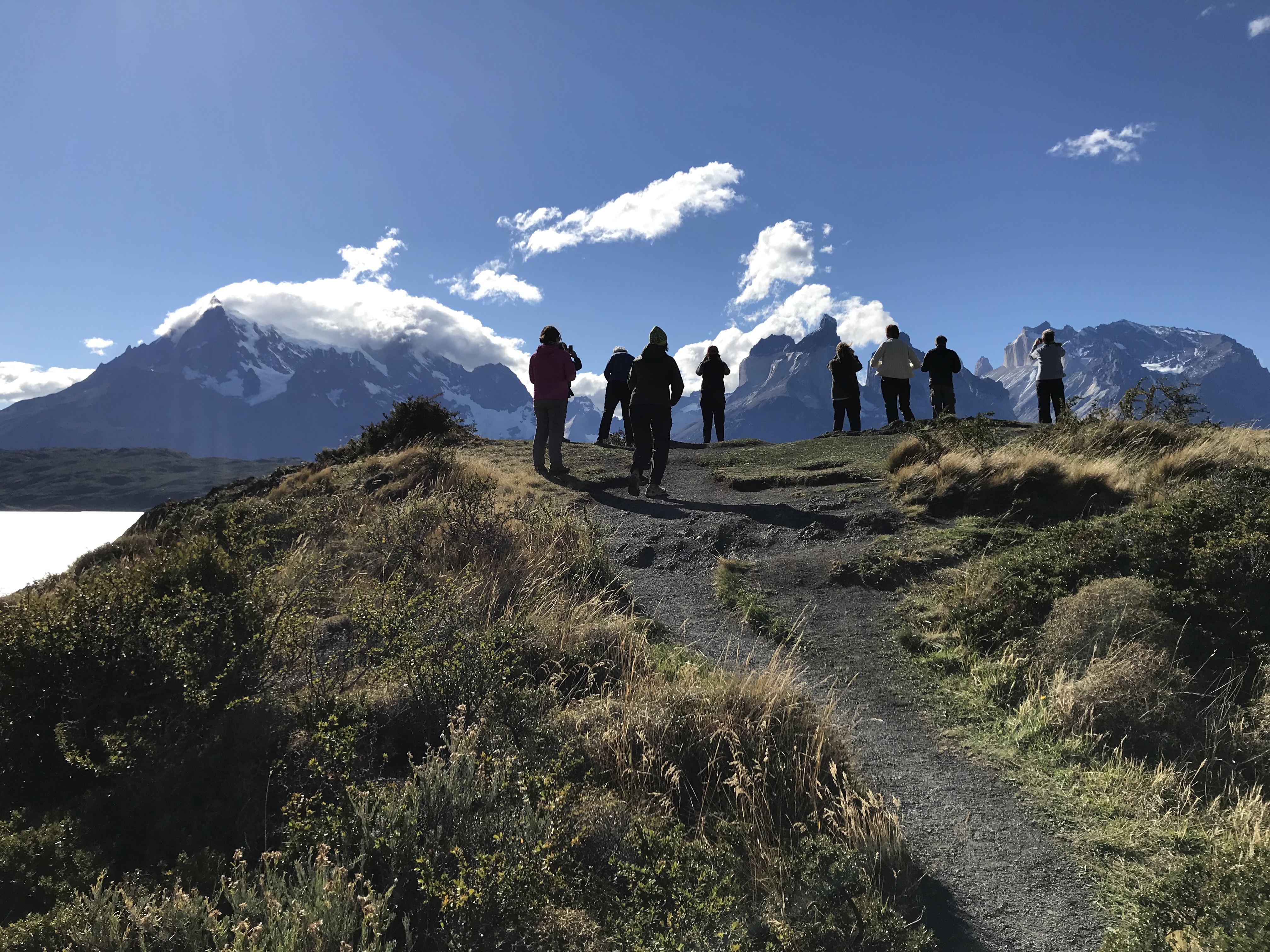
The sun wasn’t in the best position for photos, but I liked this shot of some of our group admiring the view.
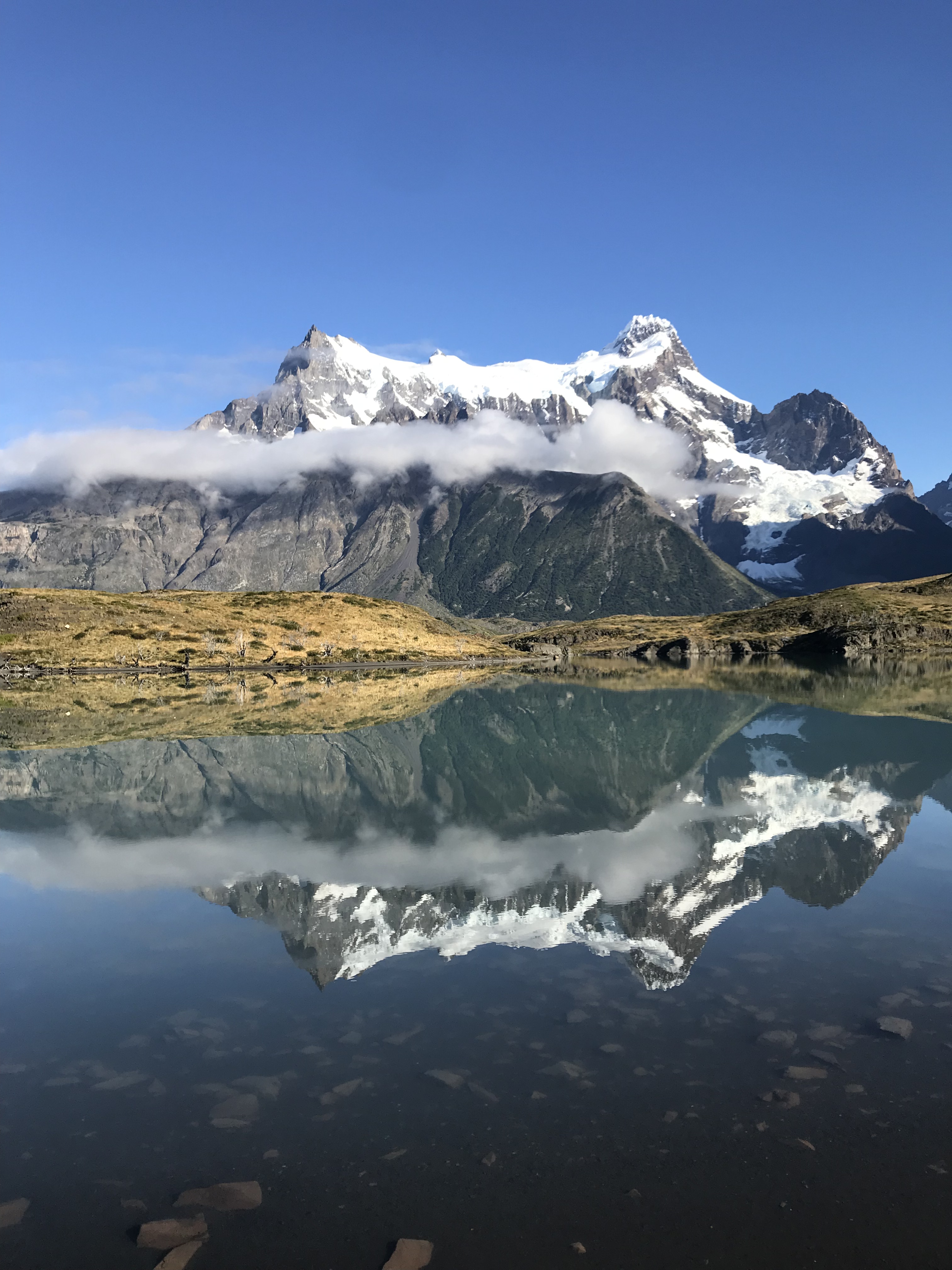
One advantage of staying at one of the three hotels within the park was getting an early start. THAT allowed us to hike to the perfect spot so we could catch this gorgeous reflection on the lake.
It was a 4 mile hike that, according to my Fitbit, was the equivalent of climbing 43 flights of stairs. Believe it or not, it was a much easier than yesterday’s shorter hike because the wind wasn’t blowing.
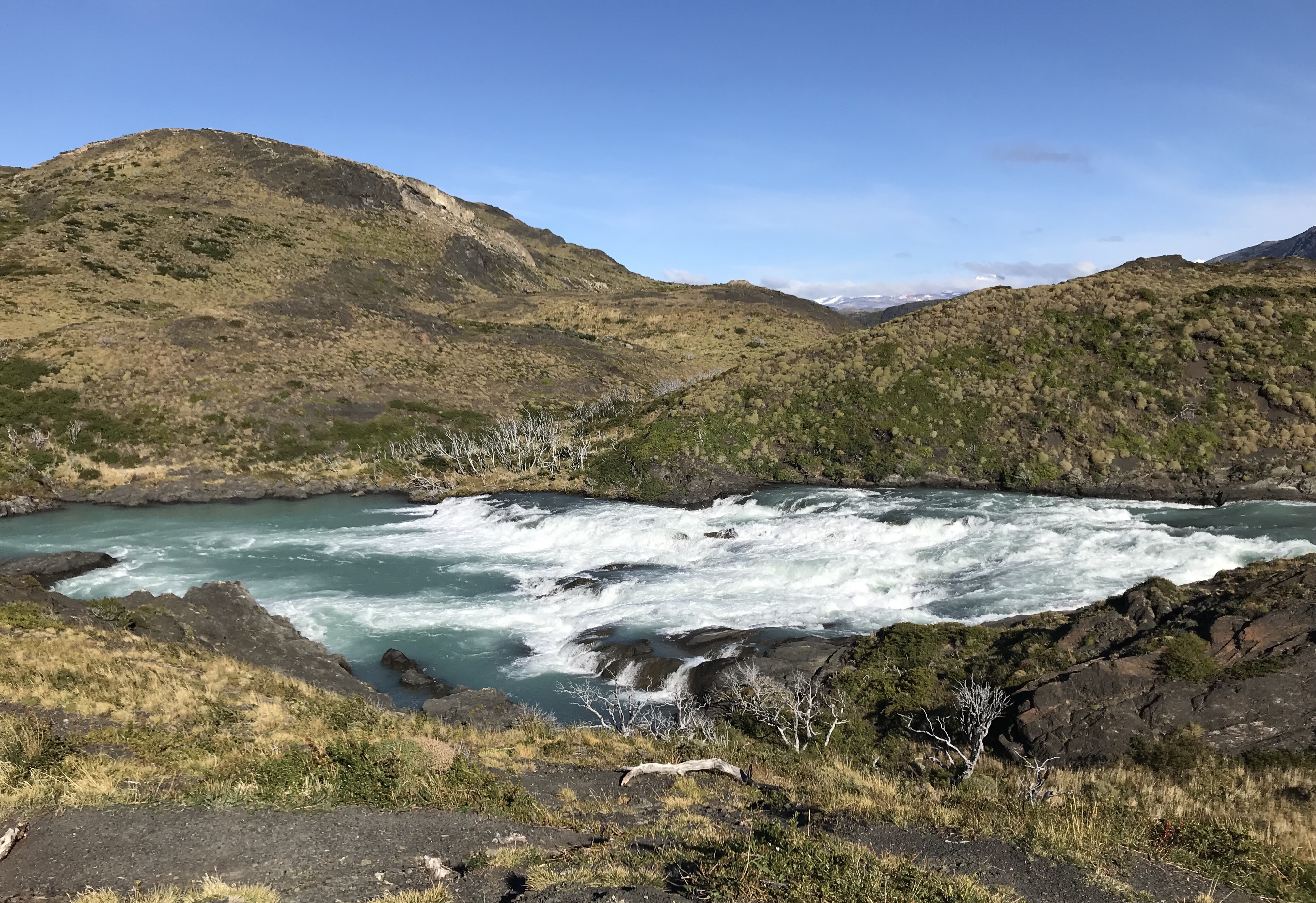
We were able to see this waterfall from a distance AND up close.
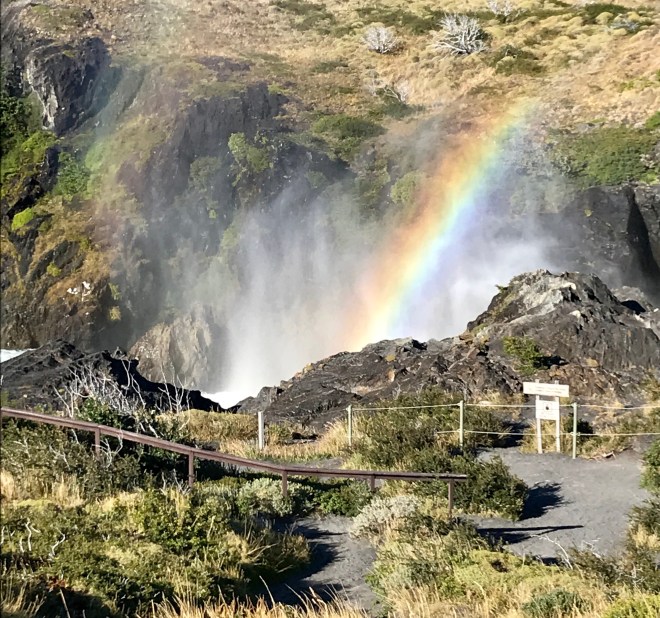
Once again, our timing was perfect. On our return trip the light was just right for the mist to create rainbow after rainbow.
Okay, so the surrounding area wasn’t picture perfect, but that was the best angle to capture the rainbow.
Another amazing day in Patagonia, and it’s not even over yet. One more hike this afternoon.
























 Destination NOW