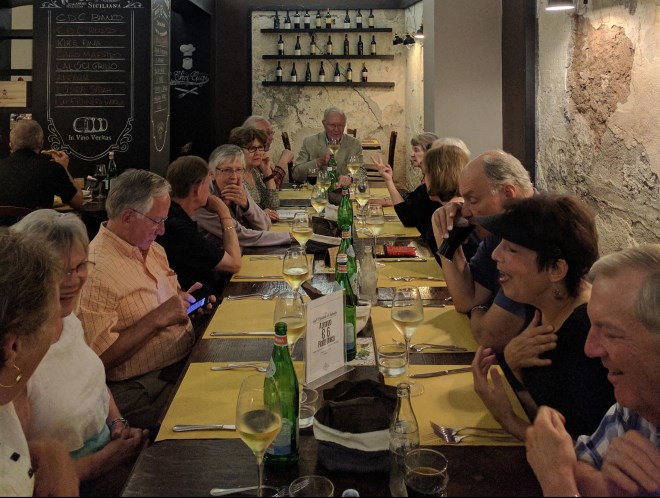
Some people collect stamps or coins or shoes. Me, I collect people. Once I decide I like someone, it is hard to get me to let go. So what do you do when people you really like are scattered all over North America? Why, you plan a trip with that assortment of very interesting souls.
Are you curious about what happens when you put 15 friends together for 12 days on an island, coming within 40 miles south of the Arctic Circle? Me too. For all you inquiring minds out there, I have good news. One of my traveling buddies is also a blogging buddy, so for THIS trip, you will have two, yes TWO blogs to peruse–this one, and the Canadian version of our Iceland Adventure. Nancy is a fantastic photographer who always provides excellent information about the places she visits. Another plus: her blog keeps pace with the trip, while I usually lag far behind. (Translated: Nancy will likely be doing MOST of the blogging). If you sign up to follow her posts, they will be delivered automatically to your in-basket, just click on that blue link above to be transferred over.
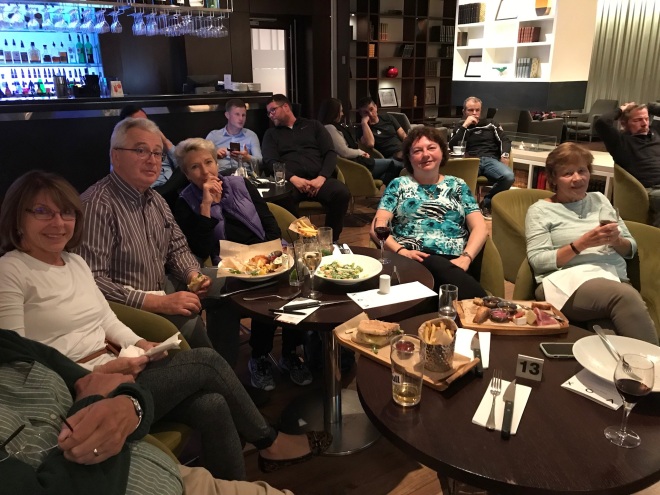
Some demographics: Our group is composed of 5 men and 10 women: 4 from Boston, 4 from New Jersey, 2 from Ohio, 2 from California, 1 from Oregon and 2 from British Columbia. 6 have never been on a group trip before, and 8 have never been on an OAT trip before. 11 of us are retired. 2 of the husbands were foreign-born: (Argentina and Jordan). I’ve known some members of the group for decades (the longest friendship is 53 years,) but others are newer relationships, including 1 traveler who I’ll be meeting for the first time when we arrive in Iceland.
Where will we be going, you ask? After exploring Reykjavik, we will be traveling west and north to places with unpronounceable names. Akureyri, I am told, is located just 40 miles off the Arctic Circle, in case you were wondering. We then are flying back to Reykjavik, for a visit to the Golden Circle, before heading home.
For all you visual people out there, I have included a map, of sorts.
I’m excited about seeing the wonders of Iceland–the land of fire and ice. But I’m equally excited about spending time with this great group.
Several of us decided to fly in a day early, arriving at Keflavik airport around (groan) 6 AM. It takes about an hour to get luggage and emerge from customs, then roughly another hour to get to our hotel. I think it is a pretty safe bet that our rooms won’t be available at 8 AM, or for at LEAST several hours, so I have loaded up on suggestions from the OAT Forum of what to do in Reykjavik till we can crash in our hotel rooms.
Hope you join us for what we expect to be a very fun party!
If Lisbon isn’t on your bucket list, you need to get it on there. Right now.
Why? Great food, amazing history, beautiful sights, wonderful side trips, friendly people, affordable hotels, great public transportation, and relatively painless flights–what more could you want?
Our stay in Lisbon was just long enough to convince us that we have to return to spend more time taking in everything that it has to offer.
Although the weather wasn’t perfect during our visit, it certainly was better than what we are experiencing today, the day after Easter, here in New Jersey! But then, snow days are made for us retirees to look through our travel photos and blog about our sojourn. Am I right?
Because we were on a Grand Circle Tour (Sister company of Overseas Adventure) our time was planned for us, with a guided tour that included Lisbon’s more popular sights.
The Parque of Eduardo VII was a great vantage point, offering a panoramic view of the city and the Tagus River.
Of course, it wouldn’t be a European city tour unless you stopped at a cathedral. This one, at the Jeronimos Monastery, happens to be Vasco de Gama’s final resting spot. It is also the place where explorers and sailors went to pray before heading off on their journeys to the edge of the earth.
To honor those seamen, the cathedral roof was designed to resemble sailors ropes and knots. You can’t tell from the photo–you’ll just have to trust me on that one.
At the end of our visit, JuanJo, our tour guide, surprised us with a special treat, the custard tart for which Portugal is famous. This particular bakery is supposedly the one that does it best because it was the sole recipient of a super secret recipe, developed by monks. This recipe is as closely guarded as the coca cola formula, or so we were told. I didn’t have the heart to share that I had equally delicious custard tarts from a bakery in Beja. I was told the nuns developed THEIR recipe to use up egg yokes. Why? Because they used the egg whites to starch their colors and headgear, so had a mountain of excess yokes they didn’t want to waste. On our drive to Belem Tower, we passed this street art, made entirely of garbage. The raccoon’s eyes are discarded tires!
Sorry the photo is so pixilated–it was shot from the bus, with my iPhone. But I hope you can see that this is a beautiful and imaginative piece. The artist, Artur Bordalo, has created many murals throughout Lisbon. What I didn’t realize was that I had seen his work already, in beautiful Beja. Remember the rooster from my earlier post? Check out Bordalo’s signature at the bottom right. I loved that rooster even BEFORE I learned it was constructed out of cast off materials.
The Belem Tower was built in the early 1500’s near the mouth of the Tagus river to defend Lisbon from the bad guys. Really? THIS is what their fortress looks like? All decorative and ornate? It looks more like Cinderella’s Castle than Fort Apache!
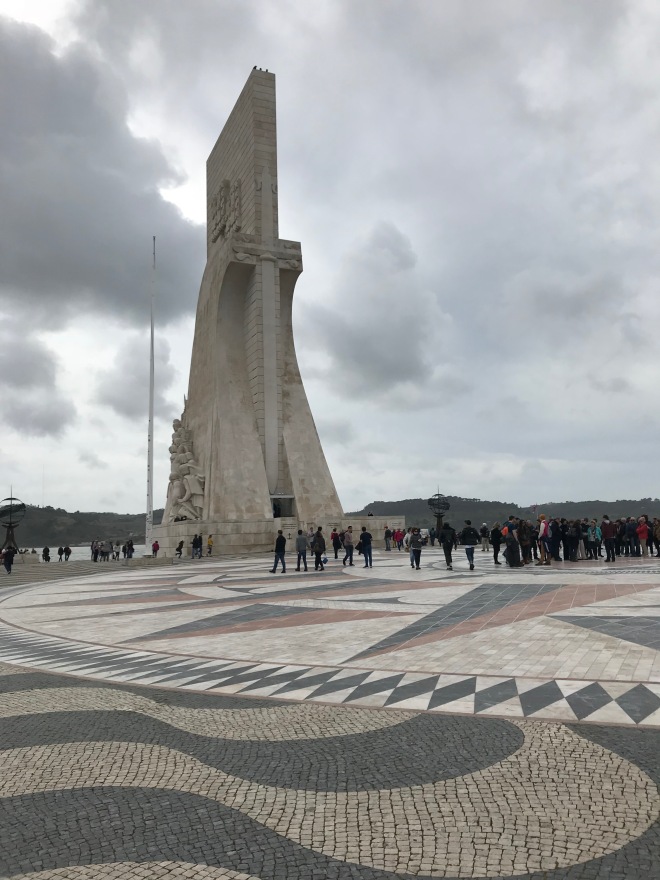
The second landmark on this side of the Targus River is the Monument to the Discoveries, created in 1960 to commemorate the 500th anniversary of the death of Prince Henry the Navigator.
What is really cool is the pavement in front of the monument, a mosaic map of the world, complete with ships and mermaids.
Climbing the sides of the monument are important Portuguese historical figures, like Vasco da Gama, Magellan and of course, Prince Henry at the front. St Francis Xavier made it onto the monument, but not into my photo.
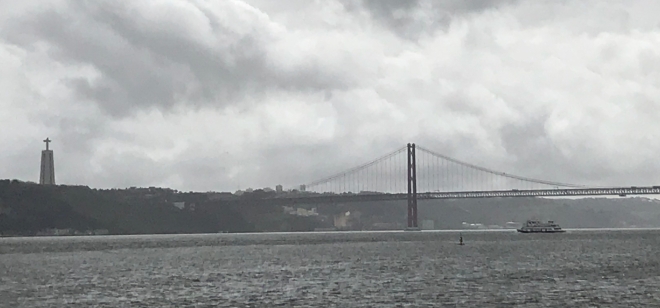
Across the Tagus you can see what looks like a cross. It is actually a statue of Christ, with arms outspread like the one in Brazil.
Also notice the bridge. Remind you of any place in the USA?
After hitting many of Lisbon’s “must see” attractions in the morning, we had the afternoon to wander. Our hotel, the Mundial, was ideally located near cafes, shops, restaurants, and beautiful squares, perfect for people watching while munching on one of those delightful pastries.
Believe it or not, this square is perfectly flat. Those “waves” are a pavement optical illusion!Loved the sand sculpturesSchool outing, maybe?
Dinner that evening was in a former Moorish palace that was briefly a casino before becoming the restaurant– La Casa Do Alentejo. We dined in the gorgeous private room on the third floor.
Okay, so I had a little wine before taking this picture, but I at least I DID get the decorative ceiling and the mirrors on the walls!The second floor was beautiful too, with tiled walls
The next day we visited the Royal Palace in Sintra. Sintra is a lovely little city an easy day trip from Lisbon.
As one would expect, the Royal Palace was filled with beautiful art and treasures of all kinds. I particularly liked this chandelier. Hard to believe, but my iPhone 7 took a better photo than my Panasonic Lumix.
The other unique item that caught my eye was this painting. That sure looks like a negligee that he’s (our guide said it was St. John the Baptist–but who knows) either wearing or holding in front of him, and is that a toy horse? If not, then what is it? This has to be one of the strangest paintings I’ve seen in a LOOOONG time!
On our way back to Lisbon, we stopped at Cascais, a lovely seaside town, which is even closer to Lisbon, and is serviced by frequent trains. We arrived just in time for the heavens to open in a colossal downpour, but no biggie. We were with 36 new friends, so several of us ducked into a restaurant where we enjoyed delicious roasted chicken, great wine and even better companionship. No photos of our bedraggled, sodden group will ever be posted. I promise!
Because I had spent two weeks with Global Volunteers before joining the tour, I was able to visit Evora, another great site about an hour by bus from Lisbon. But I’ll save that for another post.
Portugal in general and Lisbon in particular will not disappoint!
It was raining when I boarded the bus in Beja for the two and a half ride to Lisbon. The weather matched my mood–I was sad to leave all the new friends I’d made in Beja: the wonderful students I’d gotten to know during our two weeks together, the great “Team of Ten” Volunteers, our fantastic team leader. There were lots and lots of goodbye hugs.
Note to future visitors to Portugal–it costs only 14 Euros for a bus ride from Lisbon to Beja, on a super comfortable bus with free Wi-Fi. If you are visiting Lisbon, why not spend a night or two in Beja? Escape the traffic and crowds, enjoy the history, archaeology and cultural treasure of this intriguing Alentejo town.
Two cab rides and a flight later, I was in Madrid, reunited with my main man.
Here’s where we will be traveling over the next two weeks. First stop is Madrid. ( I lifted the map off the Grand Circle website. THEY are the ones that cut Madrid a little too closely.) The star is my feeble attempt to show the approximate location of Beja. You now have a rough idea of where this “don’t miss” town is located. Okay, so I would never be a successful map maker, but I give myself an A for effort.
The long, unusually dry period Portugal and Spain had been going through ended during our second week in Beja. The rain is expected to continue during most of our remaining trip. Oh well. They need the water, so the rain is a blessing. Or at least that’s what I keep telling myself.
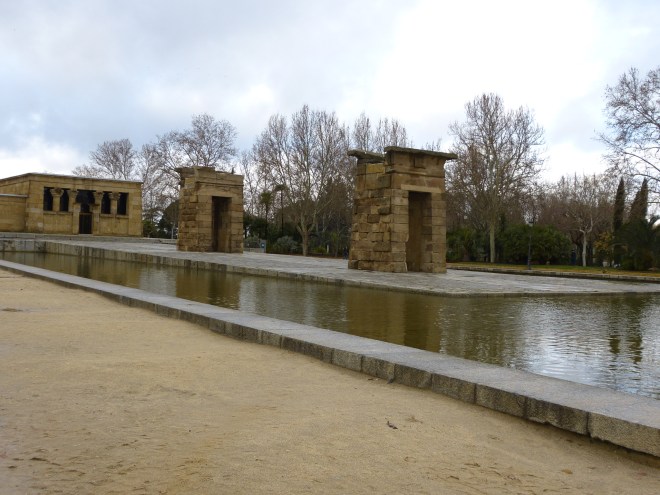
We spent the morning of our first full day in Madrid on a bus tour around the city. First stop, the Egyptian temple of Denbod. No, this was not stolen during a military campaign. Had it not been moved, stone by stone, when the Aswan Dam was created, it would have been under water, just like the Temple of Dendur, in New York’s Metropolitan Museum.
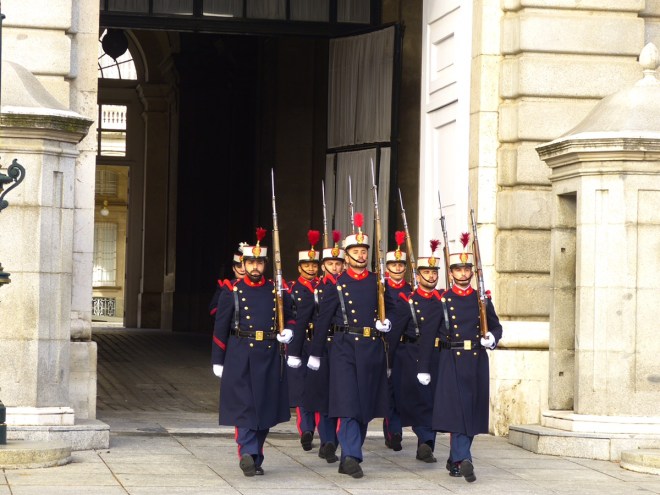
Next stop– the royal palace, where we arrived just in time for the changing of the guard.
Juanjo, our guide, had warned us to be on the lookout for pick pockets. He explained they usually look like tourists, holding maps or cameras with one hand and reaching into your backpack with the other. Well, Linda, a member of our group, saw one doing just that, to a Chinese tourist. She was close enough to slap the pick pocket’s hand away.
A lot of good those guards were! A sharp eyed American woman with quick reflexes foiled the thief. Did I witness any of the excitement? No, I was my usual oblivious self.
Unfortunately, we didn’t have time to wander through any of the 2,800 rooms in this Versailles inspired palace. Instead, we decided to spend the afternoon in the Prado Museum, ogling the artwork by Goya, el Greco, Rubens and others.
Small part of the royal palace
My only regret: I wish I had researched the Prado more thoroughly, so I could have focused on certain pieces, and figured out the most efficient way to get to them. Talk about sensory overload! No photos were allowed inside the museum. I just have to be content with the images inside my head.
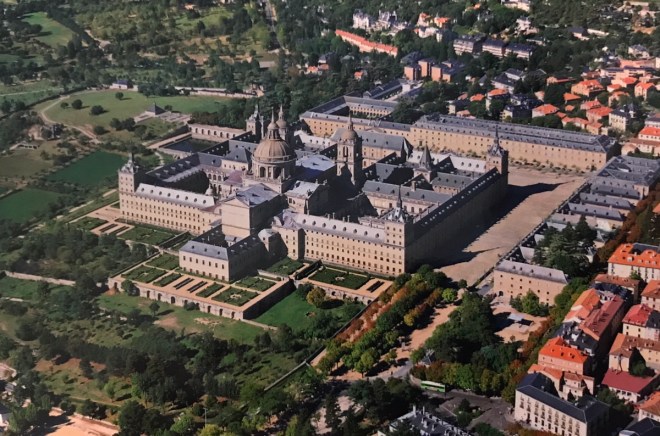
Although we could have spent our second day exploring more of Madrid, we chose the optional guided tour to El Escorial. This palace/ monastery/ school/ church was constructed by King Francis II, son of Charles V, one of the Holy Roman Emperors. The Escorial is shaped like a grill (yes, as in George Forman) to honor Spain’s own St. Lawrence. Why a grill, you ask? Well, that is how he met his end, by being roasted to death. (Yes, humans are strange and savage creatures)
Philip II had the building designed so that he could lay in his bed and see the altar in the cathedral. All he had to do was open his bedroom door and he was in church. Because his bedroom was off to the side, the rest of the congregation couldn’t see HIM in his pajamas (or whatever Kings wore back then).
Philip’s chamber, including the bed he died in, and his chamber pot, were all part of the tour, in case you’re wondering, as is a huge painting of St. Lawrence on the griddle.
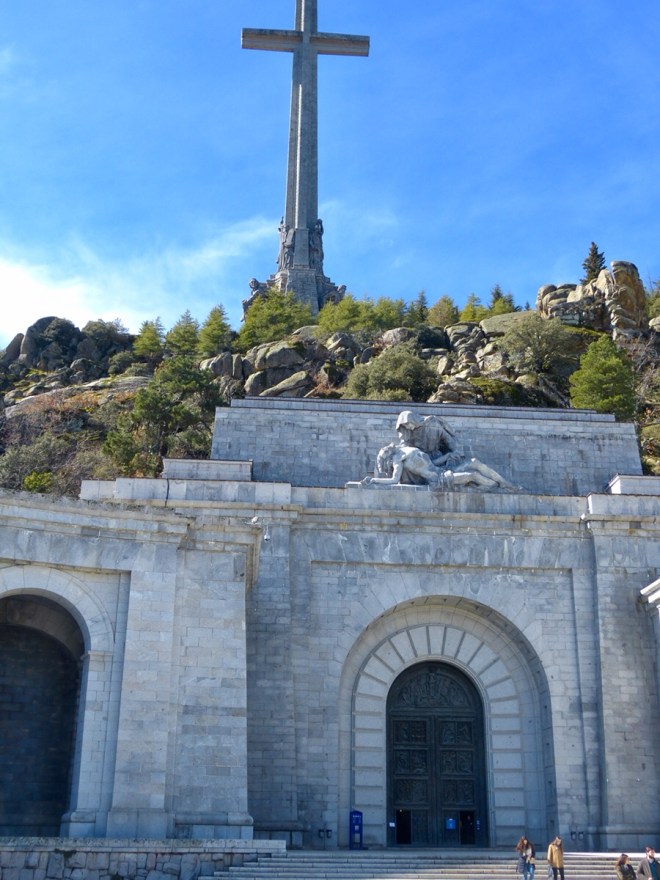
We also visited the Valley of the Fallen, a memorial to those who died during the Spanish Civil War. This was a truly impressive and very moving site.
The memorial consists of the largest cross in the world, under which a Basilica has been carved — out of the hillside. It is hard to gauge the size of the memorial from this photo, but to give you an idea, the cross alone is 500 feet high.
The bones of around 40,000 people are buried In the basilica. One more example of man’s inhumanity to man.
Time to move on, to Toledo and Granada, even though there was much more to see and do in the beautiful city of Madrid.
Okay, be honest. Before the G7 meeting, had you ever heard of Taormina? If I had, it didn’t register, until we booked this trip.
But before heading to Taormina, we still had lots to see and do in Catania. I’ll tell ya, I was totally unprepared for how much I enjoyed Catania. What a pleasant surprise. It was easy to get around, with lots to see, and of course, with an abundance of great restaurants.
The city was conquered by the Romans in 263 BC, and as with other areas in their empire, the Romans left their mark, which the city has wisely preserved.
I love the way the old and modern structures coexist. This amphitheater lies beneath the modern city
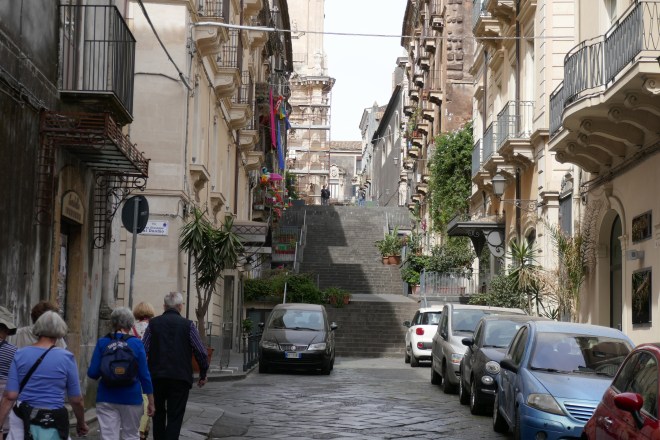
Yes, Catania has the requisite number of churches, fountains and statues. It also has lots of interesting streets, like this one. It isn’t immediately apparent, but as you climb all those stairs,
you are rewarded with views like this.
As one would expect of a city smack dab on the ocean, Catania’s fish market was HUGE, as were its products. Check out that swordfish.
Coming from coastal Massachusetts, however, this girl wasn’t all that impressed.
I DID get excited about the market’s fruit, though, especially those cherries. I don’t know who was more excited about my purchase–him or me? To show his appreciation, he gave me a slice of the most delicious cantaloupe I’ve ever tasted. Fresh, delicious fruit… aah, that’s what I call quality of life!
But I didn’t fill up on cherries. Good thing because we had yet another incredible lunch at a little outdoor cafe off of the main square, across from the cathedral. You’d think by now I would remember to write the cafe’s name down or take a picture of the menu, but I did neither. Sorry, future visitors to Catania. I believe it was on the corner, facing the elephant’s behind, where the tan umbrellas are.
On to Taormina, where security was tight. Good thing our group was in great shape, because we had to walk quite a distance. Bus access into the town and to the amphitheater was limited, even though the leaders would not be arriving for another week.
Notice the two different uniforms of the military/security people in this photo. I think every country must have sent their own people. There were LOTS more milling about!
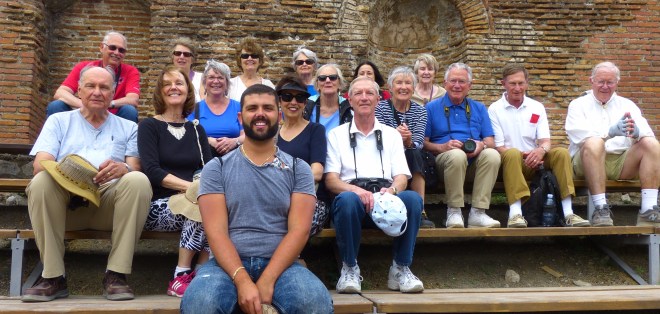
The amphitheater was the perfect spot for a group photo. And what a group we were! All seasoned travelers, everyone was considerate, friendly and easy to be with. Of course I had my favorites (and they know who they are), but I would be thrilled to see any of them on a future trip.
Great traveling companions! Back row: Tom, Maxine, Jane, Sharon, Ann, Carol. (Ann should have been in the front!) Middle row: Sue, Sue, Lavonne, Al, Joel and Henry Front row: Mike, me, Daniel (way in front), Shirley and Owen.
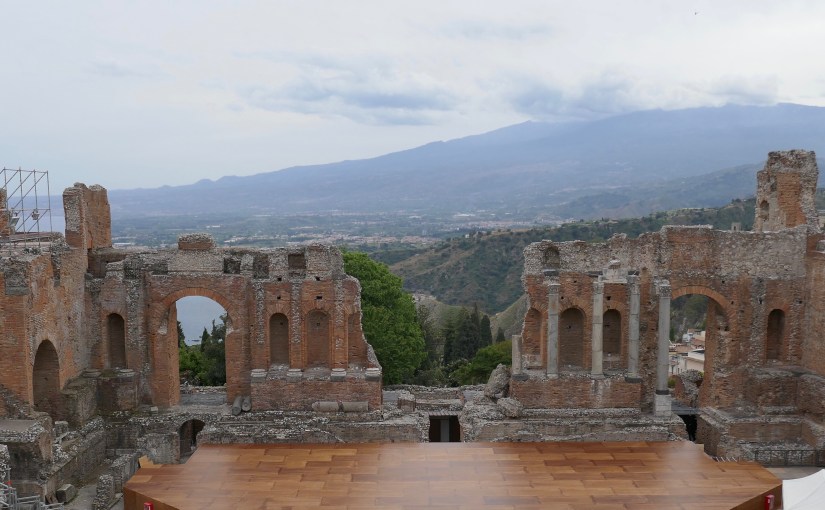
The Greek Amphitheater is still used for outdoor concerts, but those white plastic chairs are not normally in place. People usually sit on the stone steps, bleachers or the grassy sections. The plastic seats were set up for the following week’s G-7 conference.
The view from the site is unforgettable. See that cloud of smoke in the distance? That’s Mount Etna.
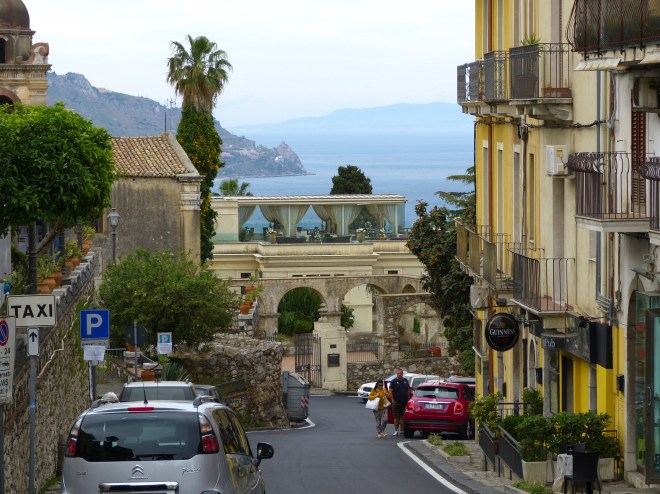
And that’s where we were headed on our last day in Catania. But first, one last shot of Taormina. Yes, the streets in the city are a bit steep, but none of our group needed a golf cart to get around. (I’m just sayin’…)
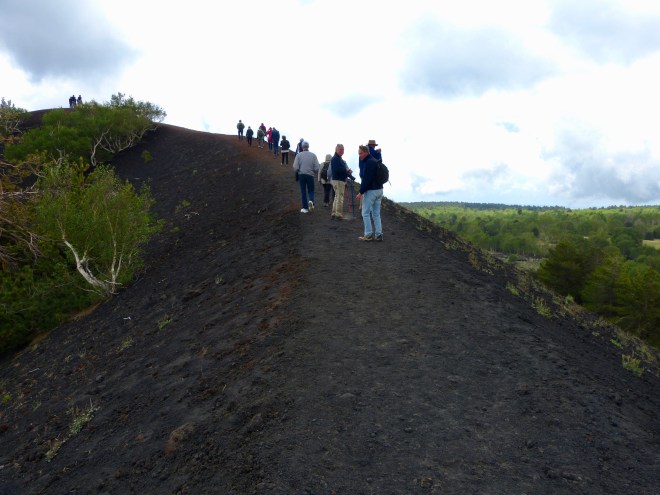
Okay, so I’ll admit it. I was absolutely thrilled to be able to hike on an active volcano. Of course, this being OAT, we were accompanied by Marco, our expert local guide who made sure we were safe at all times. Marco came equipped wth visual aids, walking sticks and hard hats!
We learned our group was unique, in that EVERYONE made the hike and descended into the lava tubes. Apparently this was a first for Marco. He said on all his other tours a couple of people waited at the base and didn’t take part in all the activities. Yay us!
Here’s one of our guide, Daniel’s, photos. As you can see from our clothing (and my hat) It was cold and windy on the volcano. I was glad I’d packed my fleece!
That’s not OUR group in the distance. I wasn’t that brave (foolhardy) to stay behind to get that shot! In fact, WE were up higher than they, as you can see from the angle of my shot.
So why did we need hard hats? Well, when you climbed down into a lava tube, it’s a good idea to protect your head and turn your head lamp on.
Yet another one of Daniel’s photos–the group inside the lava tube.
If you think this blog post was a whirlwind, you’d be right. And that’s how it felt to be on the trip. A very nice, interesting, FUN whirlwind. We definitely got a lot for our money!
We said good-bye to our new friends at that night’s farewell dinner.
Once again, thank you Daniel!
Most were headed home, but very early the following morning (5 AM), Mike, Owen, Shirley and I started our Malta adventure, which I’ll be posting about next.
For the last three days of our OAT tour, we were based in Catania. Enroute, we stopped in Syracusa, the birthplace of Archimedes. Remember him? He’s the guy in the bathtub, who shouted “eureka” when he discovered something of great importance? I don’t remember what he discovered, but I sure did like his word choice.
If you’re anything like me, you’re probably wondering why he’s holding a mirror, instead of sitting in a bathtub, like a Cialis commercial. Well, there are a couple of stories: The original legend was that Archimedes developed a parabolic mirror that captured the sun’s rays and then directed them toward the invaders’ wooden ships, setting them ablaze. Valeria, our local guide, said it was more likely that the mirror was indeed used to capture the sun’s rays, but was probably more effective temporarily blinding the enemy. You are free to pick whichever version you prefer. Archimedes also invented a crane with a metal hook that could pull a ship out of the water, known as “Archimedes Claw”. Now THAT would have made one hell of a statue!
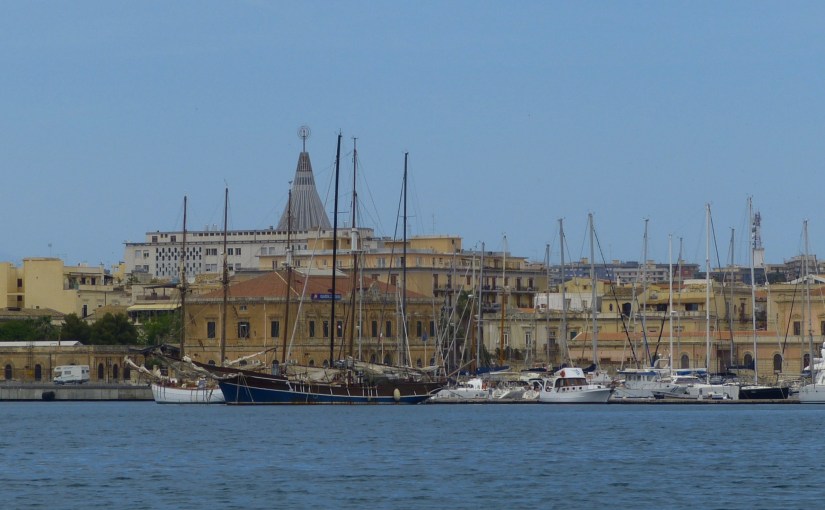
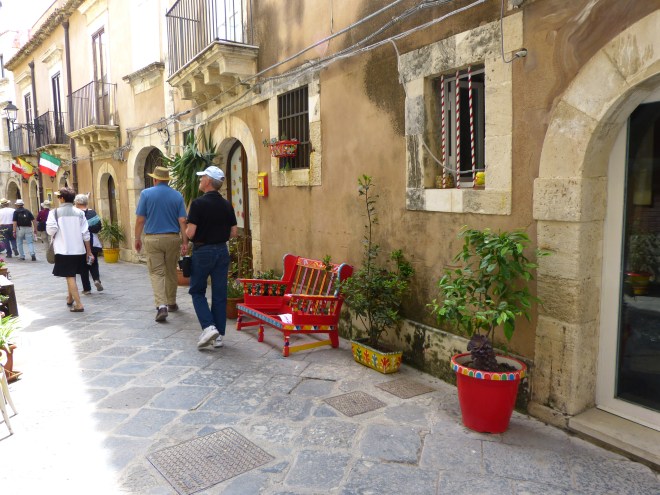
We didn’t spend much time in Syracuse, instead moving to the fortress island of Ortigia, another lovely Sicilian town just packed with Greek and Roman ruins, Medieval Norman structures, and Baroque buildings, plus great restaurants and lovely boutiques. We weren’t there long enough!
Typical street in Ortigia. Lots of pedestrian only walkways.
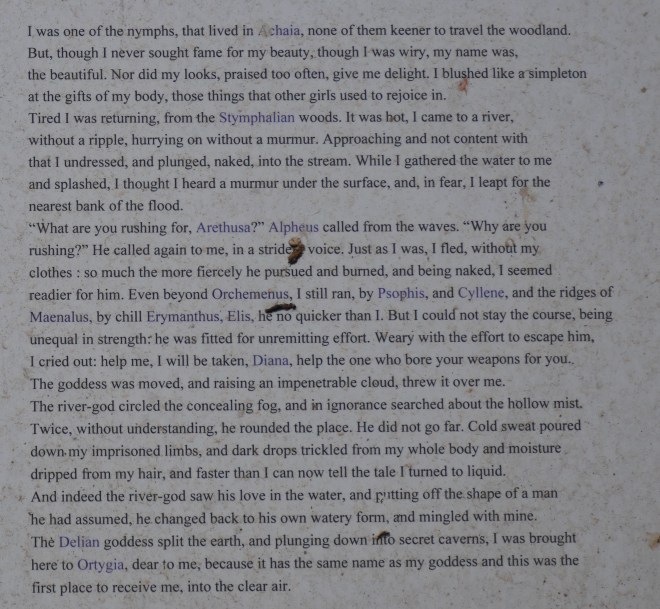
We made a stop by the Fountain of Arethusa. You’ve all seen fountains before, so I decided to share a photo of this plaque instead. Don’t you just love it when there is an English translation? I hope it comes through large enough for you to read it!
Arethusa was one “wiry” nymph who didn’t rejoice in the “gifts of her body”. What a great translation!
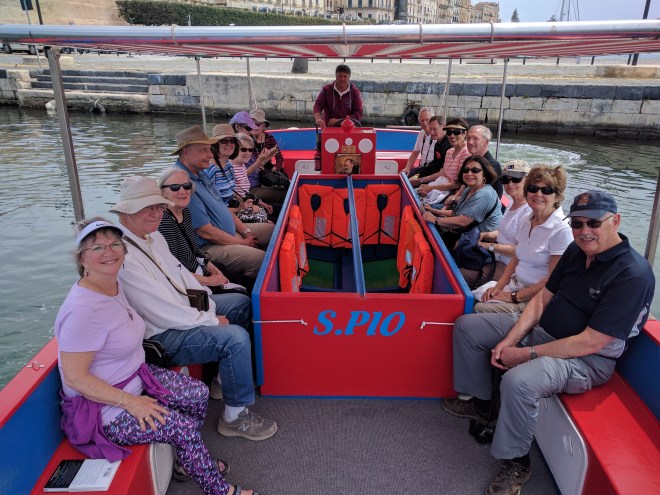
After lunch we took a boat ride around Ortigia Bay. (This photo is courtesy of sweet Daniel, our guide, who shared the photos he’d been taking of us during the entire trip.)See that bridge? Wonder how we were able to fit under it?
Don’t worry. I’m going to show you…
Our captain instructed us all to scrunch down, then the awning was lowered. Okay, so it isn’t the best photo I’ve ever taken, but I’ll bet got the idea!
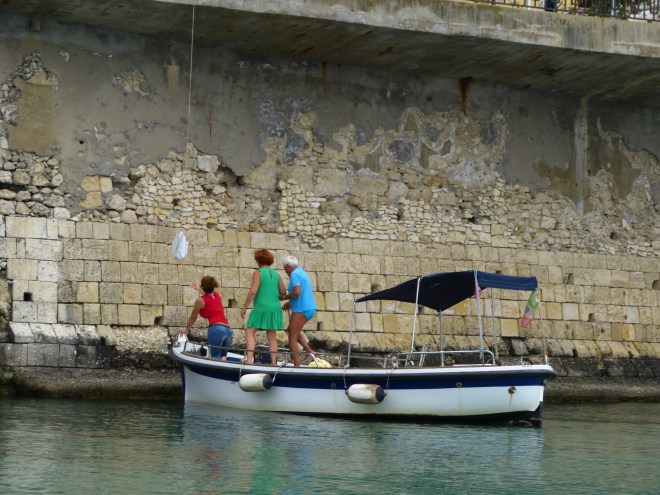
Something else to wonder. How do people on boats get take-out delivered? Wonder no more, because once again, I’m going to show you.
Yes indeed. That IS a pizza being lowered.
Our day wasn’t over. We had one more stop before we checked into the hotel. The World War II Museum commemorated the allies landing in Sicily. My favorite part of the museum was entering the replica of a Sicilian town, hearing the air raid sirens go off, piling in to the bomb shelter (which shook as the “bombs” went off) then exiting to see the devastation that took place.
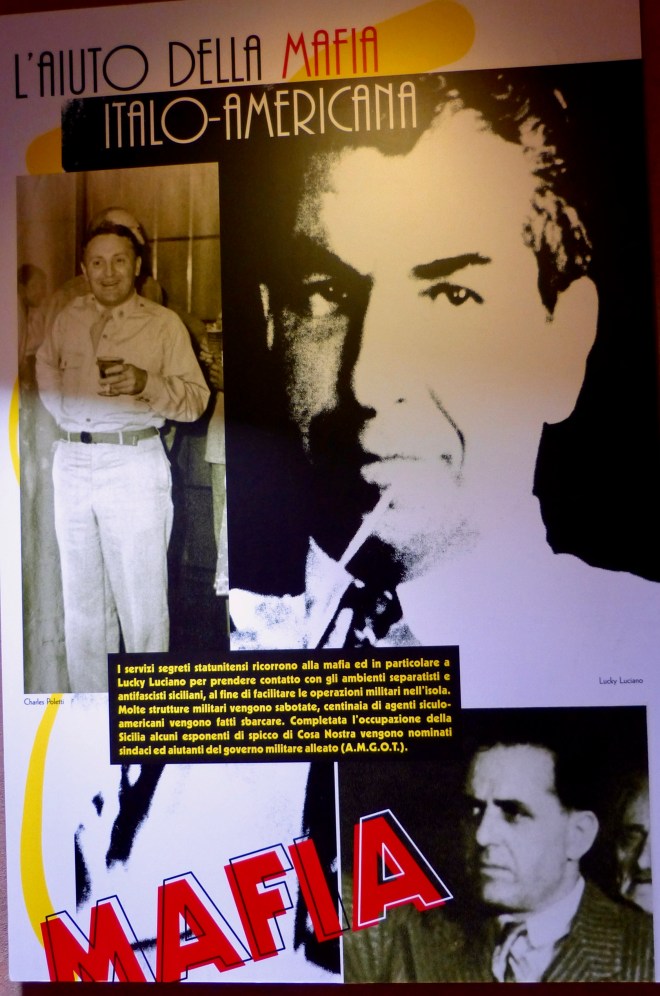
There was lots more to see, but I decided to share this poster with the folks back home.
Lucky Luciano was sprung from a US prison so that he could communicate with his Sicilian Cosa Nostra connections to ensure that the US knew exactly where to land. As you can imagine, this was somewhat controversial, especially because some claim the US support of the Cosa Nostra leaders only strengthened their hold on the region after the war ended.
After settling in to the Katane Palace Hotel, Daniel took us for a quick tour, pointing out Catania’s version of “Restaurant Row”, where we had a wonderful dinner.
The perfect ending to a fantastic first day in Catania.
Full disclosure. This is no longer coming to you “live”. We have been home for a week. My blogging just couldn’t keep pace with our activities. We were BUSY! And when we weren’t busy, we were recuperating from the busyness… and drinking…and eating…and drinking.
Speaking of recuperation, the good news is that our friends recovered in time to join us the evening before we left for Ragusa. Daniel, our wonderful guide (We all love you, Daniel!) sent a doctor to the hotel in Palermo, then arranged for a driver to pick them up and bring them to our next lodging–the beautiful Agriturismo Berlingeri. AND while they were in Palermo, he had them moved to a larger room so they could be more comfortable. Pretty thoughtful!
Looking good after taking advantage of the Italian medical system!
So, about Ragusa. It is actually TWO towns–lower and upper Ragusa. After the earthquake in 1693, the majority of the population moved upward, but fortunately, some stayed behind to rebuild what is now Ragusa Ibla, the old town.
The two towns are connected by a LOOONG staircase. Graciela, our local guide, packed us onto a bus (and we were indeed packed) to the upper city so we could walk DOWN, which gave us ample opportunity to take in the panoramic views.
I didn’t count the steps, however it was NOT a strenuous stroll, especially given our frequent pauses–bathroom break, cold drinks, ogling everything. Graciela’s interesting stories kept us entertained and engaged all the way down.
See, not too bad.
Take a look at the underside of this balcony. Graciela pointed out that the top figure on the left is asking the top figure on the right for more food and drink. The figure on the left is responding with the universal hand signal for “go do something unmentionable to yourself.” Too bad the central figure is missing. Wonder what HE would have had to contribute to this interaction.
Lesson learned: take time to look UP. Cool things are EVERYWHERE!
Is it just me, or are some of these characters in dire need of dental care?
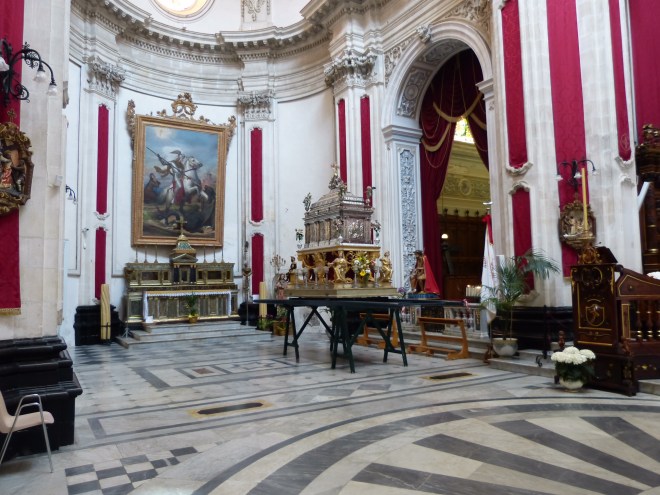
Our walk ended at the cathedral, where St. George plays a prominent role. Here’s HIS story. Initially, St. George was portrayed as a Roman soldier, who saw the light and ended up slaying the dragon. Graciela explained the dragon symbolized the pagans who were threatening the Christians.
Sometime during the middle ages, St. George got a make-over, becoming a medieval knight. This time the dragon was more specific; he represented the Muslims and Turks who were battling the Christians for control of the holy land. THAT St. George is portrayed in the huge painting on the cathedral wall. Nobody seemed bothered that George was killing dragons in two different centuries!
I bet you’re wondering what that silver and gold box in the middle of the cathedral is all about. Nope, it doesn’t hold the 10 Commandments and it isn’t a casket–but close. It holds 32 relics! Fingers, toes, pieces of the original cross–who knows? We didn’t get the specifics. One of our guides later commented “How many fingers and toes do you think the saints had?” Let’s ponder that for a while, and commend the entrepreneurs of the middle ages.
After our tour ended, we had free time to enjoy this lovely little mountain town.
Although there is a little trolley that can take you on a tour, we decided to walk off some of the great food and wine we had been consuming. Good thing, because the next day we headed off to a farm for a “Day in the Life” of a Sicilian family.
All OAT trips include a home visit or some kind of cultural exchange, and this trip was no exception. Here are Maria and her son John Baptiste, welcoming us to the family farm. John Baptiste, an archaeologist by training, is restoring the farm, which was his mother’s childhood home.
I know this looks like it could be an instrument of torture from the Spanish Inquisition, but it is actually the original wine press.
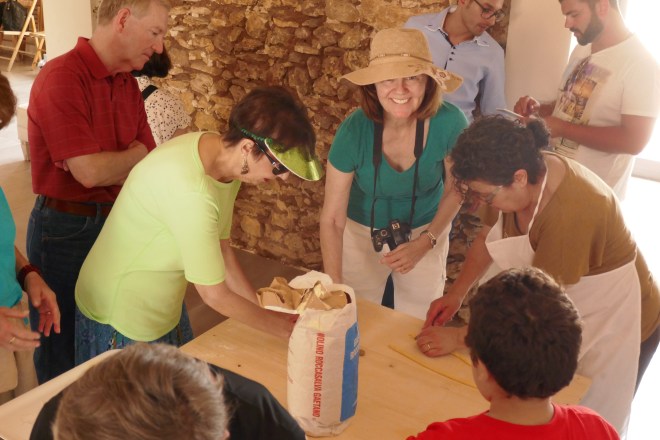
We didn’t make wine, but we DID help with the cooking, sorta the way my little 3 and 4 year old nieces help with cooking. The woman in the brown shirt and white apron? If it weren’t for her, the result would have been VERY different!
The food was magnificent! We could even tell ourselves that WE did some of the cooking.
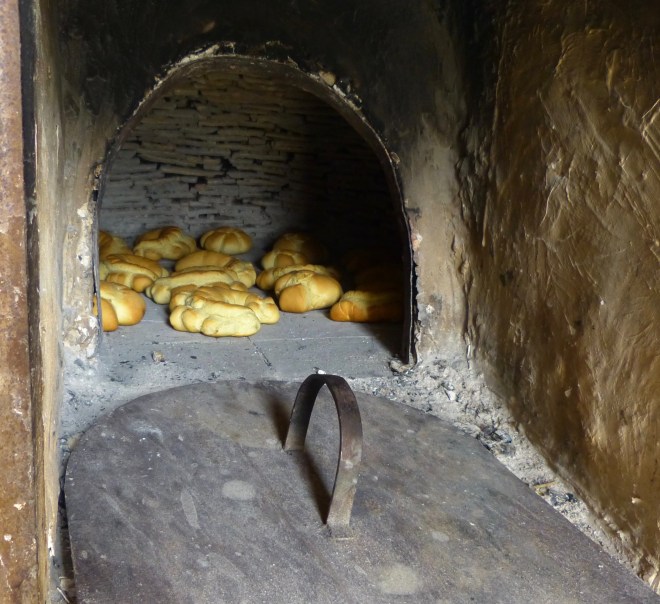
Check out the oven. Doesn’t get more authentic than this.
So what else would you need to know if you are going to visit Ragusa? Well, the hotel we stayed at–the San Giorgio Palace Hotel– is ideally located. It is at the edge of town, carved into the hillside, and is within walking distance of everything — all of the restaurants, shops, cathedral and park. There is a nice patio on the 4th floor, where you can sip a glass of wine and watch the sun go down over the hillside. It was quite wonderful.
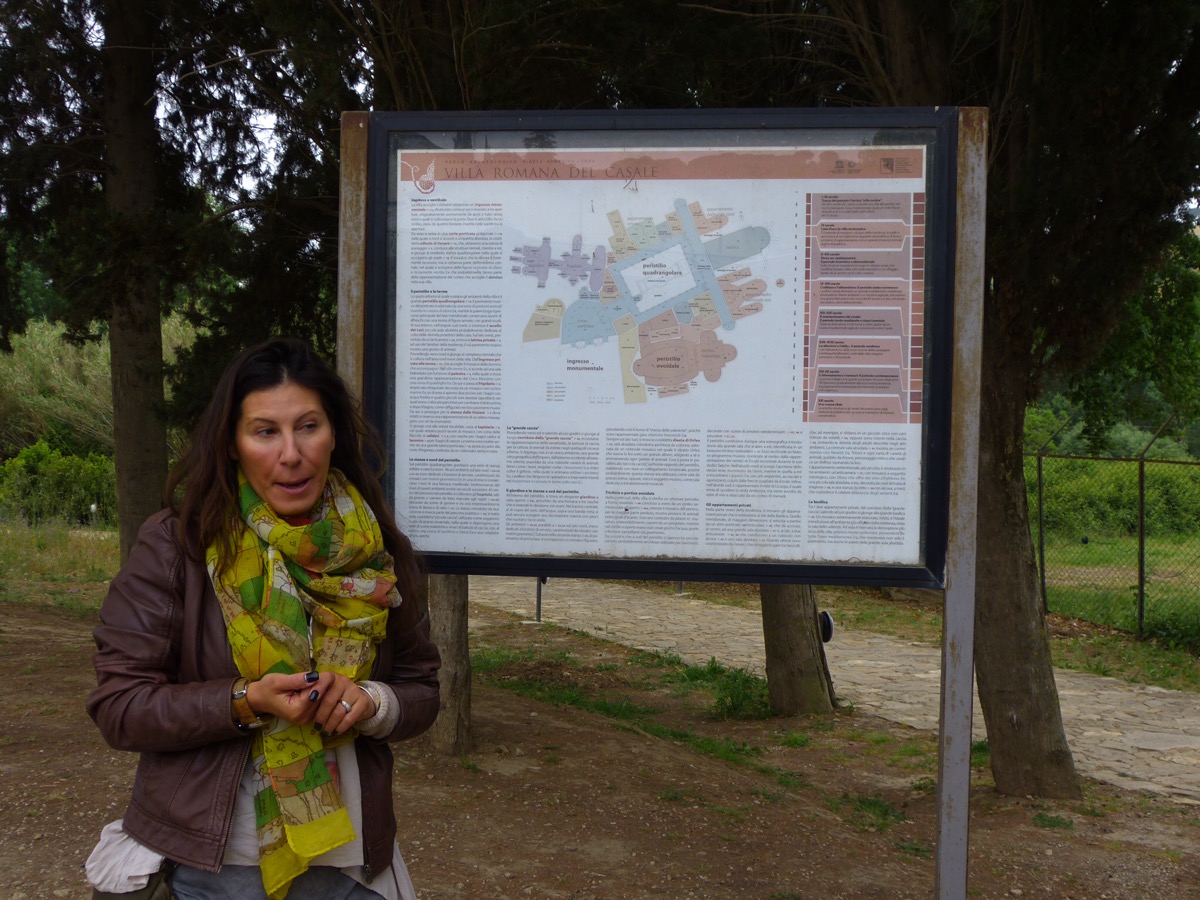
No one knows for sure who lived in the Villa Romana del Casale. Some think it might have been the country home of Roman Emperor Marcus Aurelius; others theorize a provincial governor lived and conducted administrative duties here.
It was constructed in the middle of the 4th century AD, and owes its remarkable preservation to the mudslide that covered the villa in the 12th century. The building remained hidden until the 1950’s excavations.
Katya, our local expert, explained that we were going to view some of the finest examples of Roman mosaics in all of Europe, with scenes ranging from Homeric escapades to depictions of daily life, at this UNESCO World Heritage Site.
Katya was excellent, and that was true of all the local guides on our trip. We learned that our main guide, Daniel, had a choice of 4 or 5 different local guides for each site, and I have to say, he chose very well. Katya was interesting and so informative, a delight to listen to.
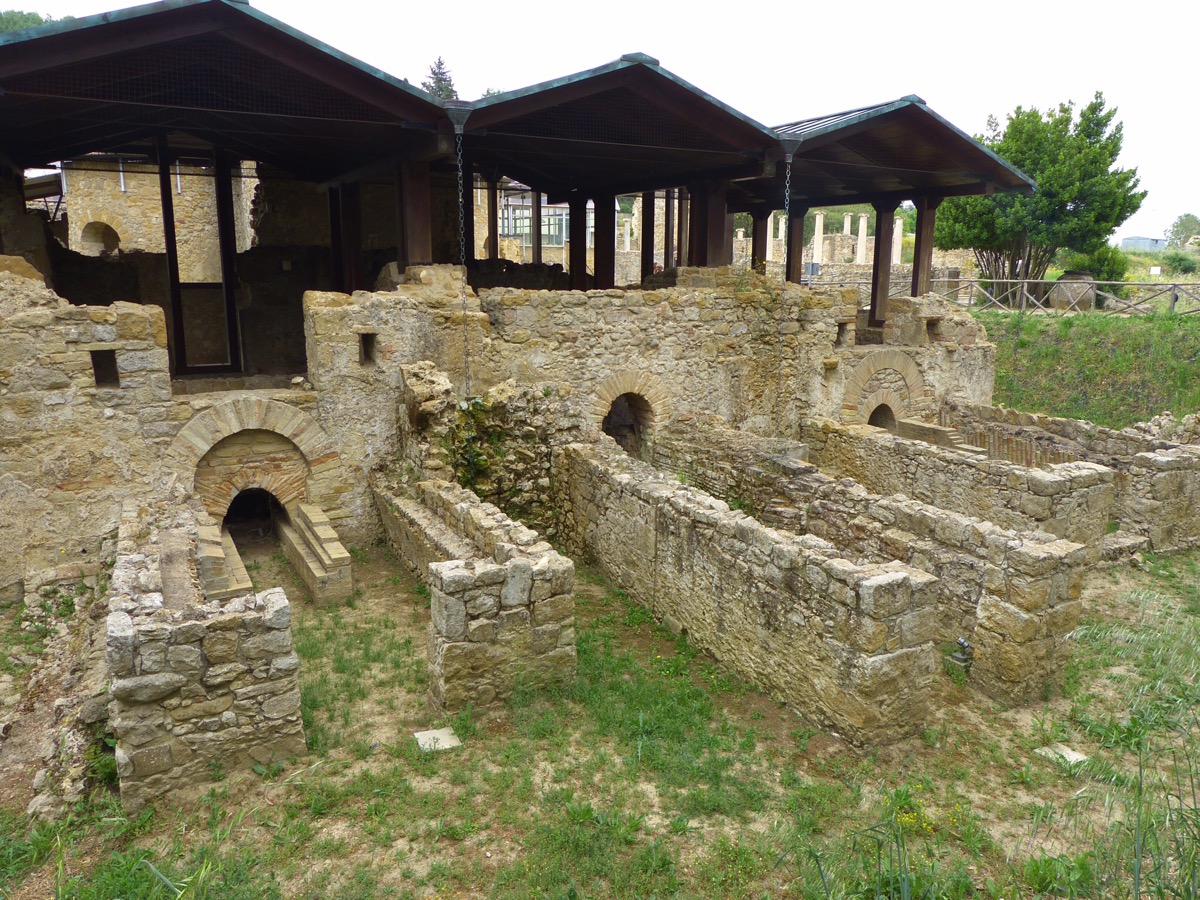
We began our tour by the aqueduct, which was the source of water for the baths–starting with the hot bath, and ending with the frigidarium, the cold bath.
The slaves kept the fires going in these ovens so that the baths were at the proper temperature.
I wasn’t taking notes, so don’t hold me to it, but I THINK this was the frigidarium. Or it was something else. Whatever. It was impressive.
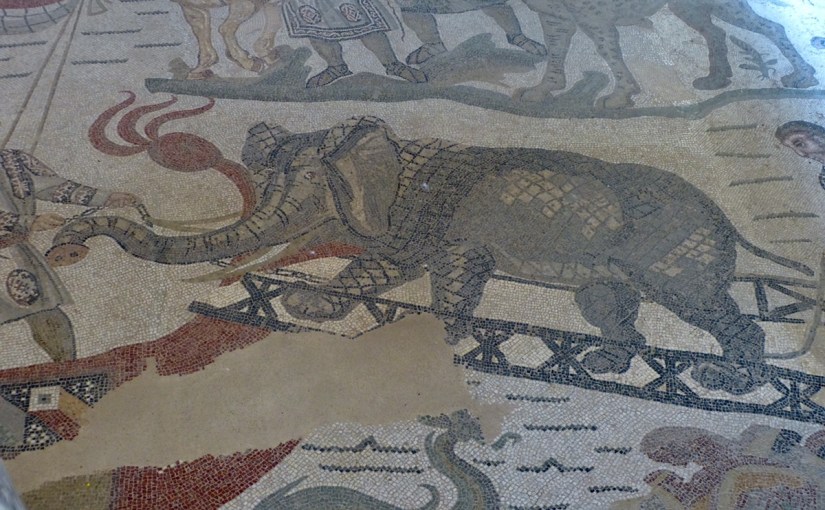
The main attraction of the villa is the floor mosaics, and they are absolutely magnificent.
Probably the most famous room, the 10 maidens are exercising, wearing the ancient version of bikinis. And look, someone appears to have won the swimsuit competition, earning her a crown and a palm leaf to wave around.
Not quite so famous, but certainly as intriguing were these: one example of the many scenes of a hunt.
This woman’s clothing indicates she was from the eastern empire, possibly Muslim. There is another mosaic of a similarly attired woman, being carried off by soldiers. It isn’t hard to imagine what that mosaic was illustrating.
No commentary necessary for this one.
I particularly liked the depiction of the theater. Looks like the legend of the Cyclops was being featured.
Those white squares on the mosaic–I thought someone had been littering, but no. They were placed there intentionally to absorb moisture.
Here’s a close up of Cyclops. I really DID like that mosaic! Isn’t it amazing what the craftsmen were able to do with little colored stones?
One last look at the countryside and we’ll be on our way. Our timing was fantastic. We were leaving, just as hoards of tourists were arriving!
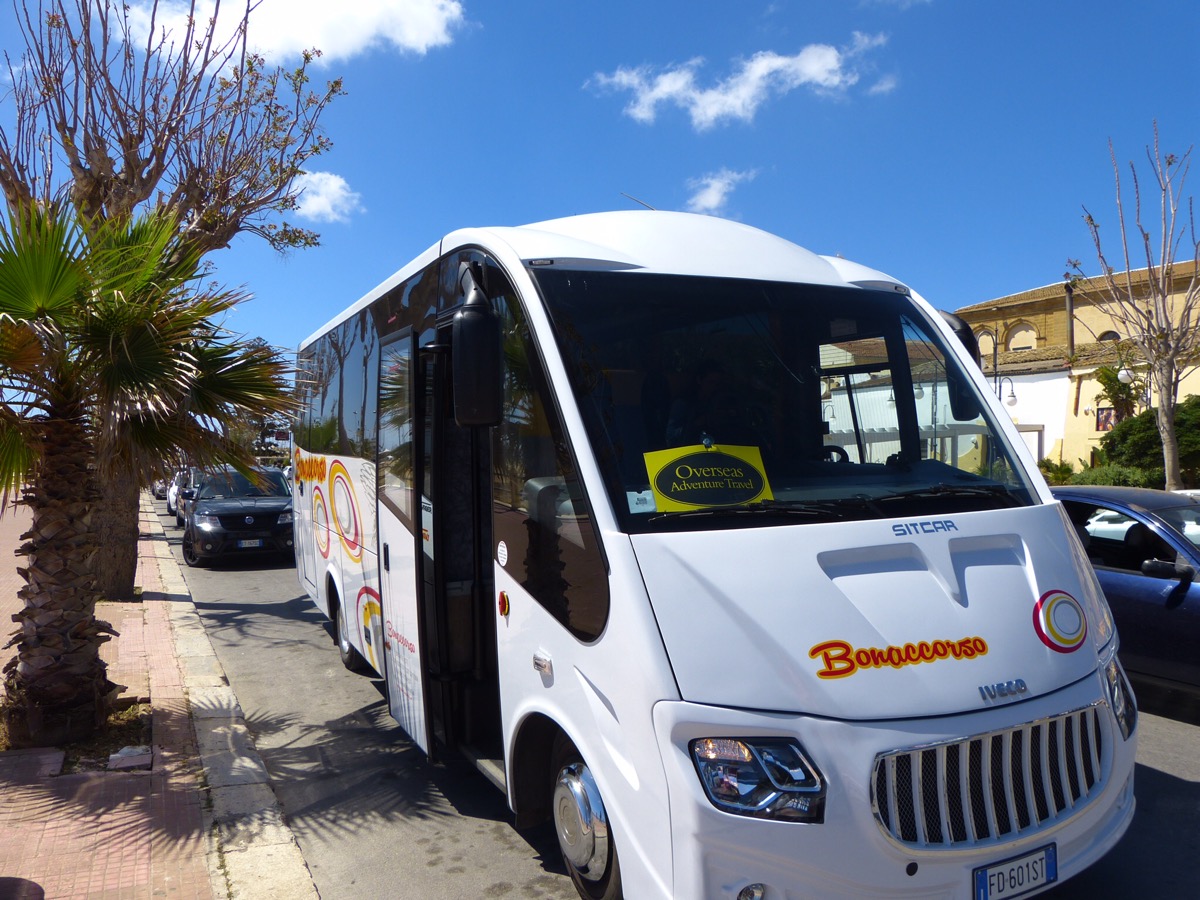
I know. You are all just itchin’ to find out how we are getting from point A to point B on this island. Well, itch no more, because not only will I TELL you, I’m also giving you the visual. We have been traveling in comfort on this lovely bus. There are only 16 of us, plus our guide, so we have LOTS of room to to spread out.
The view from these huge windows has been amazing. We definitely chose the right time to visit Sicily–the wild flowers are blooming, everything is lush and green, and the temperature has been perfect!
We are all so grateful that Marco, our bus driver, is manouvering along these winding, VERY narrow roads, up and down the hillsides. All we had to do is sit back, relax and take it all in.
Once again, we will be time traveling, all the way back to Ancient Greece. I don’t know why, but I just got a flash back to Mr. Peabody and his boy, Sherman, of the Rocky and Bullwinkle Show. (“Every dog should have a boy”. God, I loved that show! ) How sad that so much of my knowledge of history, at least what stuck, came from cartoons and Walt Disney! But I digress.
When we arrived at the Valley of the Temples, we were greeted by another Marco, our guide for the site. An archaeologist, he came equipped with maps, diagrams, and an abundance of enthusiasm.
Sadly, the site had been picked clean by those successive waves of conquerors, so it was difficult to extract much information about the lifestyle of the original Greek inhabitants of Akragas (as the area was once known) from artifacts, bones, shards, etc.
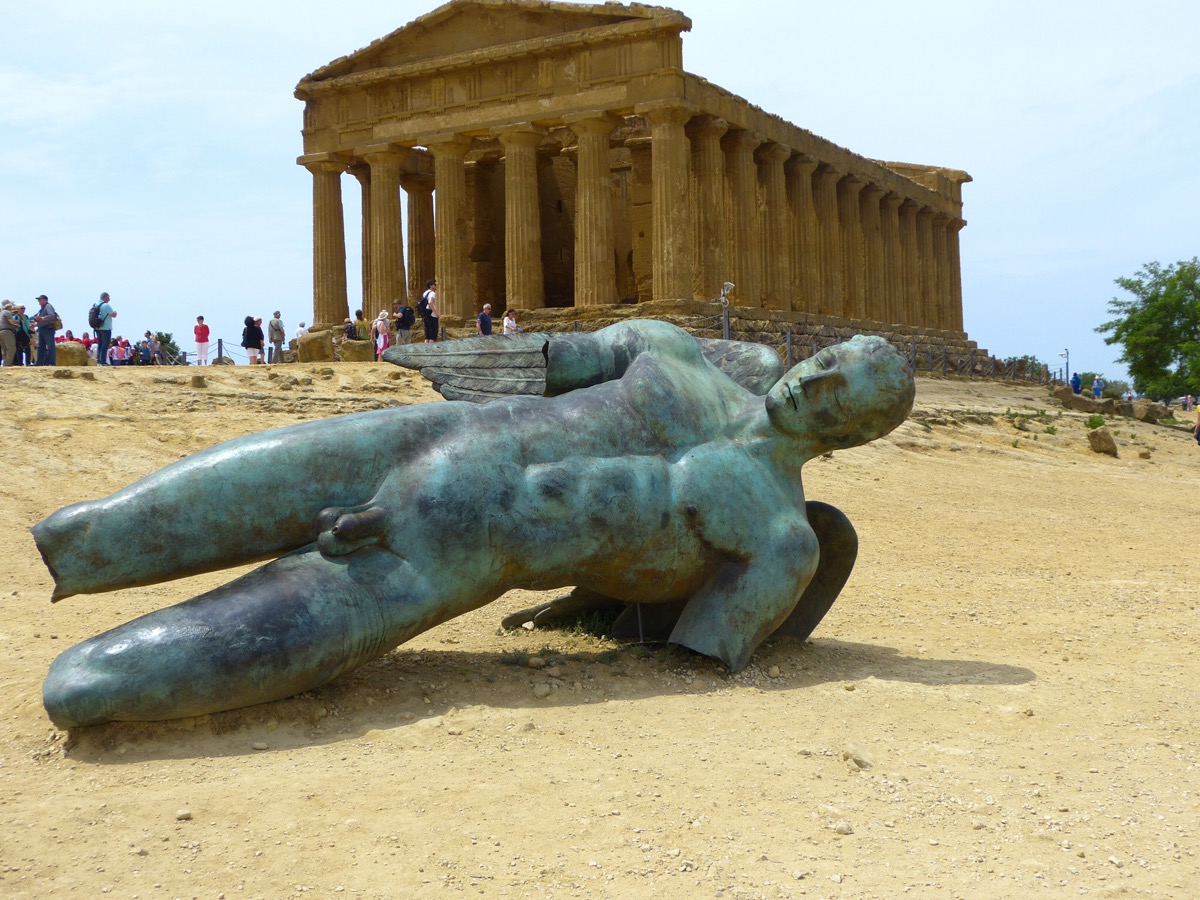
Fortunately, though, eight Greek temples remain at this UNESCO site, all built between 510 and 430 BC. The best preserved temple, called “Concordia” by the non-archaeologists, (because the archaeologists didn’t have sufficient info to determine the correct names of the temples) was saved from being scavenged by the locals because it was transformed into a church by the Normans. Walls were built between the pillars, and the entrance was changed, then at some point (and yeah, I forgot what Marco said. Sorry!) it was all changed back.
From the valley, you can see the modern city of Agrigento, just beyond Greek temple F (the archaeologists’ name for Concordia. )
What Marco COULD tell us was that these arches were once the entrance to Greek tombs, that were later repurposed by the Normans for shelter, with the actual grave used as a manger for their animals. The Greeks dug shallow graves — only about a foot and a half deep– and covered the hole with rocks. Who knows what the Norman’s did with the remains they found when they moved those rocks!
My favorite part of the site, however, was this incredible sculpture of Icarus, who fell from the skies because he flew too close to the sun. Clearly, HE hadn’t been under water for 2,000 years! Also clear was that he was a modern addition to the site.
After our tour, it was time for lunch at this lovely private home.
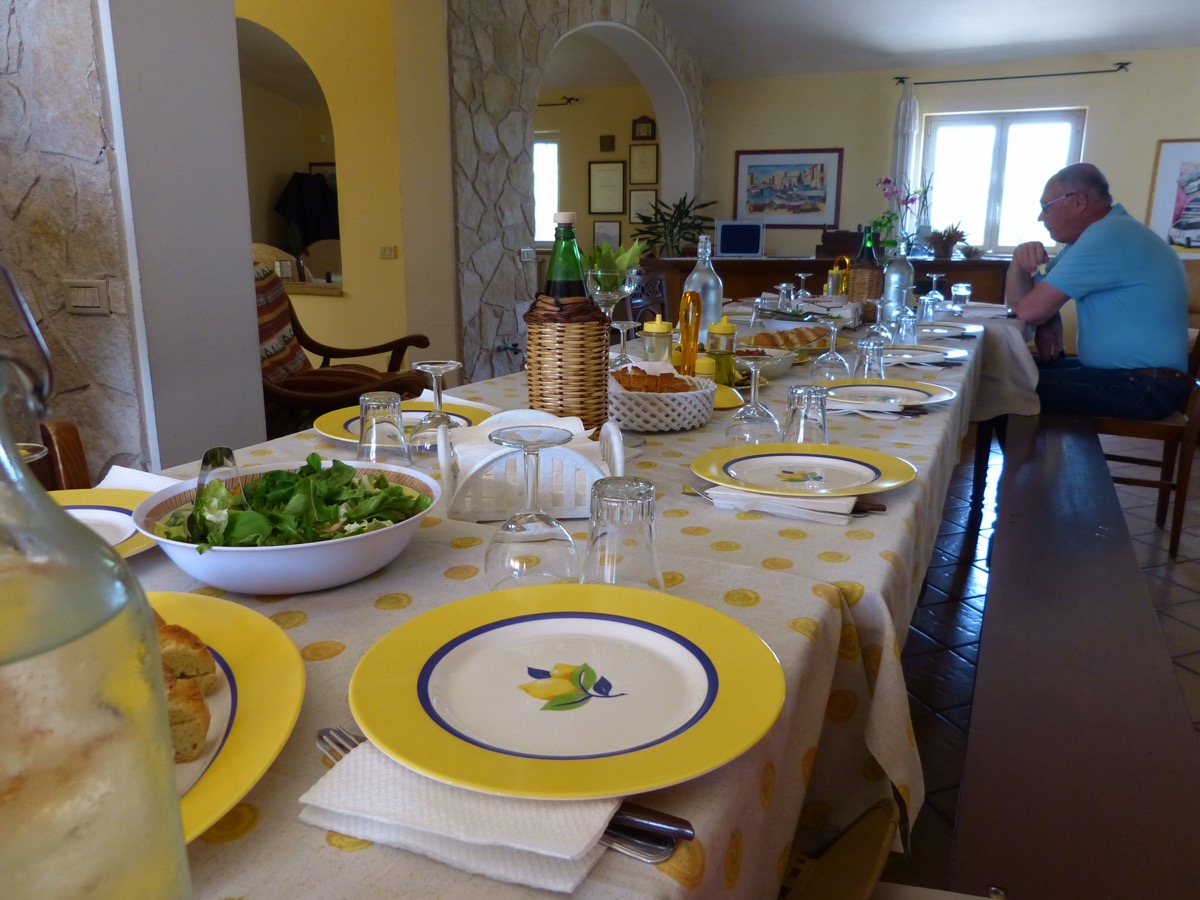
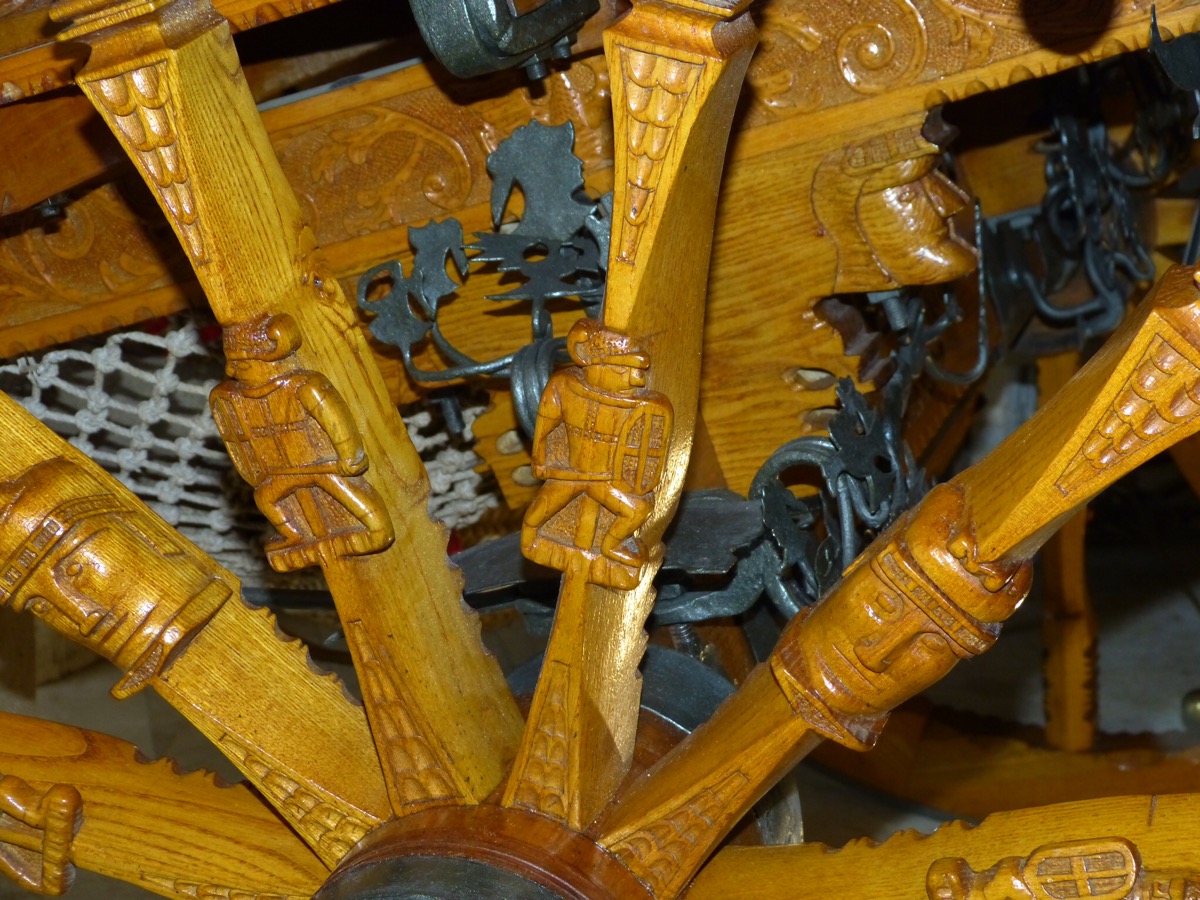
You’d think we would have figured it out by now. What we THOUGHT was the lunch, was actually just the antipasto, followed by several other courses. We have concluded that we need to get much better at pacing ourselves! But if the food wasn’t enough, there was yet another surprise in store for us: The owner’s grandfather had been a renown craftsman, creating donkey carts that were truly works of art.
The paintings on the sides of the carts were of historical events, like this one depicting the assassination of Julius Caesar.
Even the spokes on the wheels were intricately carved.
Here’s our hostess, who also functioned as guide, cook and server.
These magical interludes are a big reason that Mike and I travel with OAT. We NEVER would have been able to arrange for some of these fascinating encounters on our own!
By now, we were completely sated with food and culture, ready for our one night stay at Vecchia Masseria in Piazza Amerina.
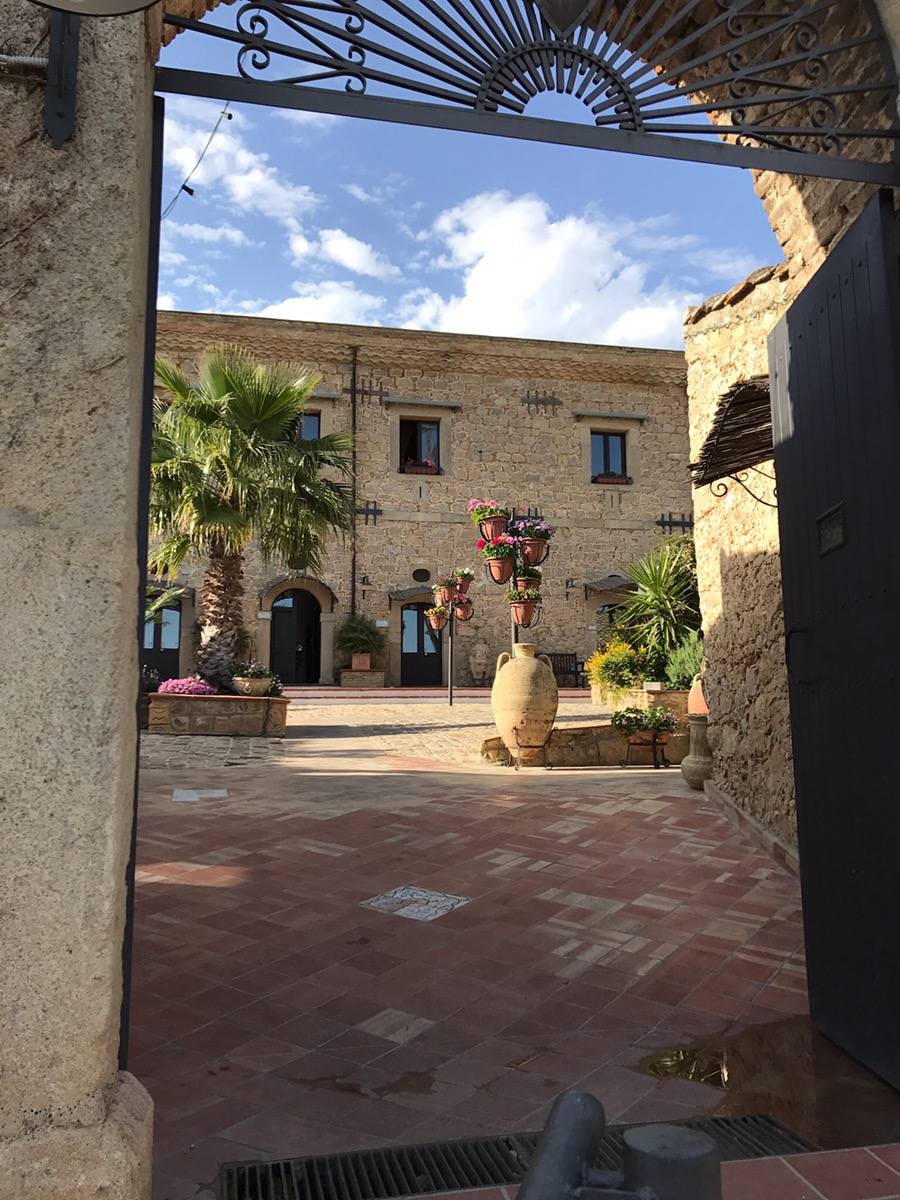
And yes, it really WAS that beautiful. Another agritourismo, in a pastoral setting with delicious, locally sourced food. Life is good.
Once again, my best laid plans have gone a bit astray. Somehow I managed to come down with a raging cold on the day we departed for Sicily. That undoubtedly earned me the hotly contested title of the flight’s Most Hated Passenger as I coughed my way across the Atlantic Ocean.
Ah well, one of the clear advantages of being older is you have learned to roll with whatever comes your way. Although, truth be told, there wasn’t much rolling, or any other kind of movement going on for the first two days we were in Palermo. I pretty much took to my bed, being unwilling to share whatever I had acquired with my fellow travelers. One definite advantage to group travel is Mike was able to enjoy sightseeing with the others while I rested up.
By day 3 (Saturday), I was able to venture forth, so we decided to strike out on our own.
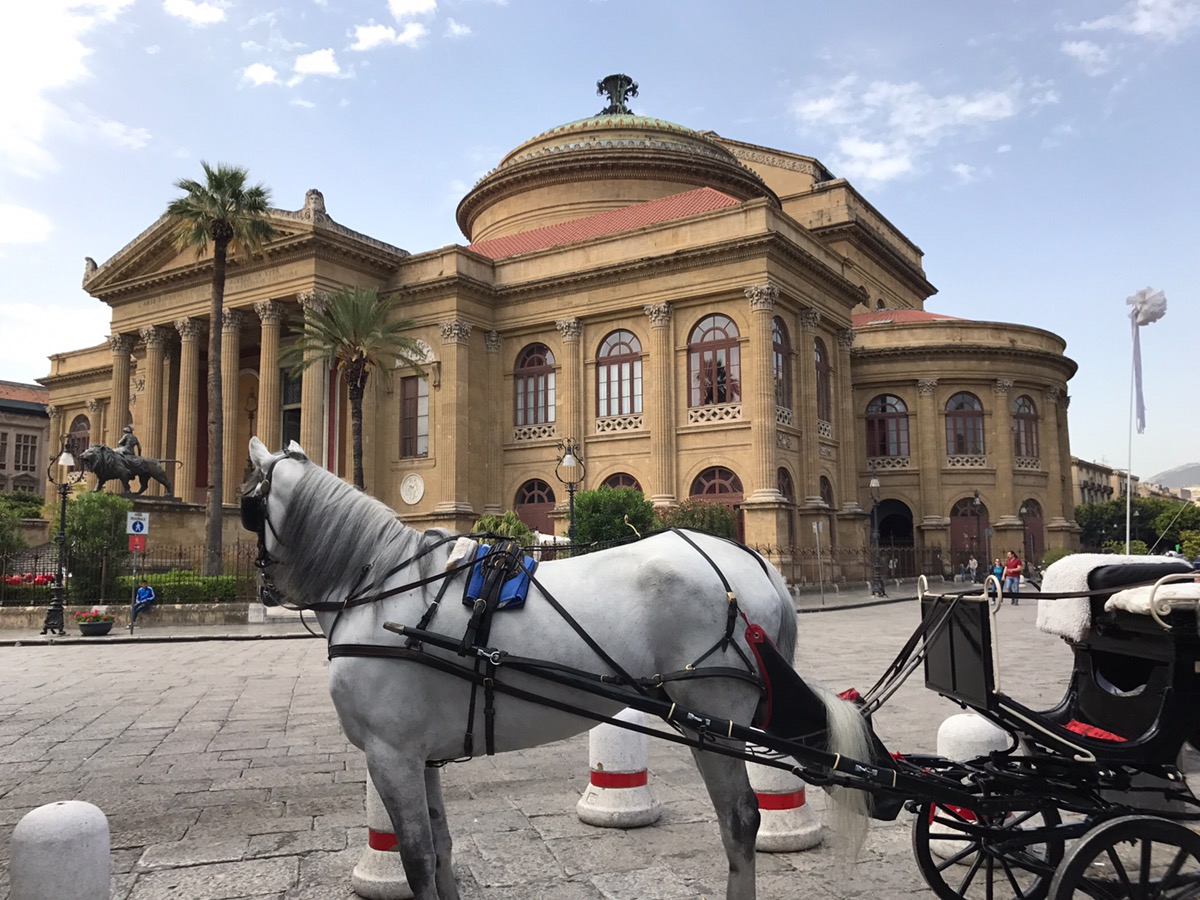
Right by the opera house, we hopped aboard the free trolley, to one buggy driver’s disappointment. Pretty amazing that Palermo offers free transportation around the city to everyone!
Our first stop was what is now known as the Norman Castle, which started out as an Arab fortress. In the 1100’s it became King Roger 2’s humble abode. King Roger 2 was quite an impressive guy. This Norman ruler managed to pull off what current world leaders haven’t been able to accomplish: Christians, Jews and Muslims coexisted in harmony during his reign, melding together the best of their cultures.
The geometric designs in the ceiling of his bedroom have a definite Islamic flavor. This is one small section of a very elaborate design. I wonder if those gold mosaics glow in they dark. Does the beast in the center remind you of Maurice Sendak’s book ” Where the Wild Things Are”? I guess that’s one way to prevent your kids from crawling into bed with you. Now why didn’t WE think of that?
To get to that royal apartment, you had to climb up several massive staircases. I counted 100 steps! No gym membership required for Roger. But he didn’t have to travel far for church services. The Palatine Chapel is on the floor below, so he could roll out of bed and be at mass in less time than it took to place his crown on his head. Like the Royal Apartment, the chapel is shiny and bright, with Christian and Muslim motifs covering every surface.
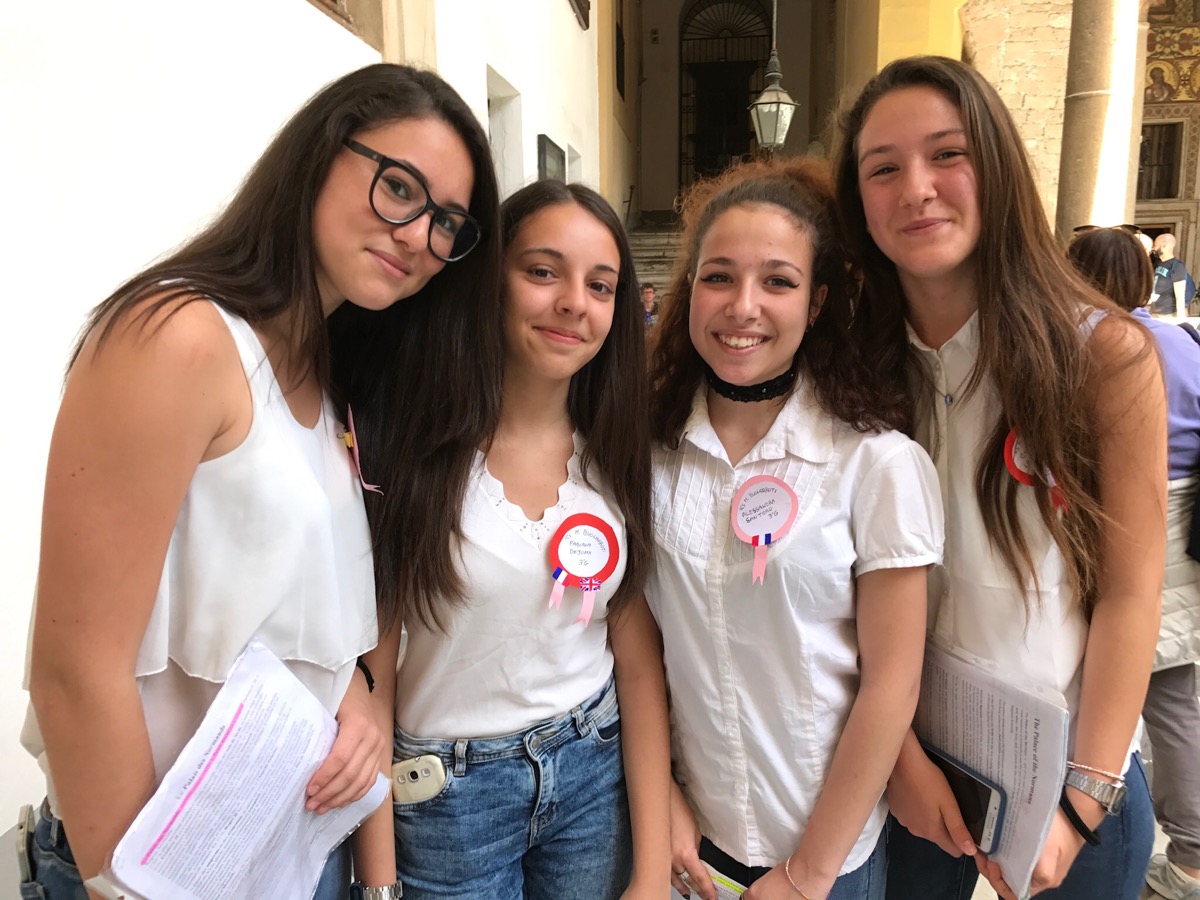
At the start of our visit, we were approached by a woman who asked if we would like a free guided tour in English. Her students, these four young girls, were eager to practice their English on us and earn extra credit. What a nice idea!
The building has been remodeled multiple times over the years. The courtyard outside the chapel, for example, was redecorated around 1600.
Pay close attention to the portraits on the bottom. They form a border around the perimeter of the courtyard. These were notable saints…every last one of them male. So, either there were no women saints deemed worthy of a spot on the wall OR women’s virtue was so taken for granted that it didn’t seem they had to put any effort into attaining sainthood. So why make a big deal about it? You decide which explanation rings true to you.
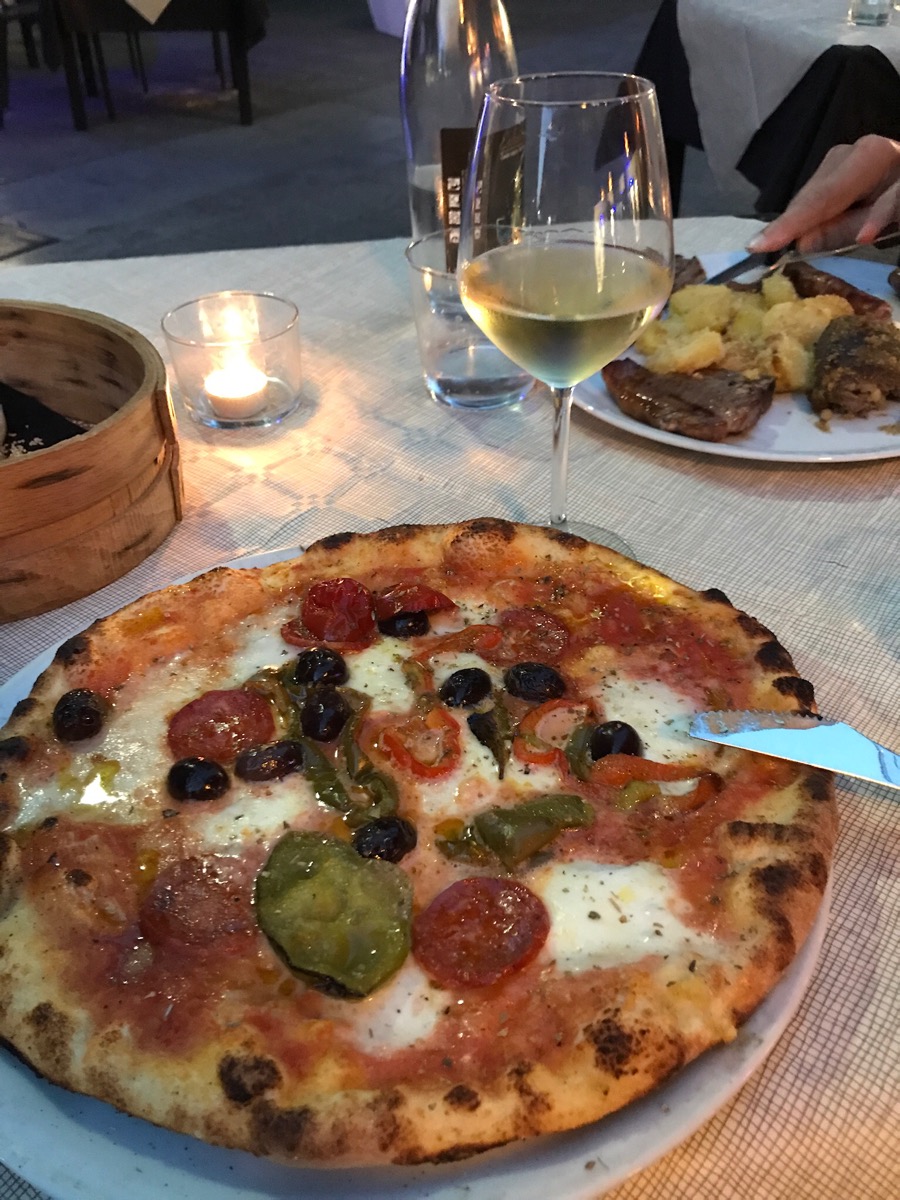
Rather than go into culture overload, we decided not to overdo it, so headed back to rest up before dinner at Vino y Pomadoro, a wonderful restaurant close to our hotel. The menu had English “subtitles” so I was very relieved. I have this fear that I would accidentally order something that would horrify me, like pizza with rabbit and horseradish. Here’s what I got.
Mike and I stopped giving each other “stuff” years ago. We already have more than enough future yard sale items. No more birthday, anniversary, Valentine’s, Christmas or Groundhog’s Day presents for us. Instead, we mark life’s milestones by making memories, mostly through traveling. Refusing to succumb to the tyranny of the calendar, we are free to celebrate whatever we want, whenever we want. If we happen to be traveling during an anniversary or birthday month, well then, that’s just a bonus. THIS year is one of those bonus years.
We will be in Sicily during May, our anniversary month, hoisting our glasses to toast 41 years of wedded bliss. Okay, full disclosure. Those years haven’t ALL been blissful (my sisters would add ” especially for poor Mike” ) but on the whole, it’s been pretty darn great!
We will be embarking on an OAT (Overseas Adventure Travel) trip with our good friends, Shirley and Owen. Two years ago we spent two weeks wandering through Tuscany and the Amalfi coast with OAT’s sister company, Grand Circle. They had never been on an organized tour before, but had such a wonderful time, it was not difficult to persuade them to come along again. What’s especially exciting is that Shirley’s grandfather hails from a small village two hours from Palermo. She and Owen plan to make their way to the village on one of our “free” days.
This is what our OAT itinerary looks like. As you can see, we are covering quite a lot of ground.
We will be staying for three nights in four of the cities: Palermo, Mazara, Ragusa and Catania, with a single night in Piazza Armerina. At the end of the OAT tour, the four of us will head to Malta. From Catania, we will fly to Valetta and will use that as our base during our five days in Malta.
As usual, I’ve been learning the history of the places we’ll be visiting, and I have to tell you, theose poor inhabitants of Sicily did not have an easy time of it. Here’s the Cliff’s Note version: There was a lot of fighting and conquering going on–with Greeks, Romans, Carthaginians, Arabs, Normans, and Spaniards taking turns raping, pillaging, plundering and selling inhabitants into slavery. Sicily isn’t at the bottom of “the boot” for nothing. It sure got kicked around a lot!
Augustus, Hannibal, Constantine, Archimedes, and several Williams, Charles and Fredericks all had starring roles in Sicily’s narrative. (Don’t you just hate it when the rulers all have the same name and you need to remember their numbers? At least for the Williams there was William the Bad and William the Good.) Throw in a couple of popes, an emperor or two, some knights plus a couple of earthquakes and an active volcano and you are guaranteed some interesting stories with even better ruins.
What fascinates me more than the political history is the mythology. Unlike the kings, whose moms sorely lacked imagination when it came time to name their offspring, the mythological figures have double names: Zeus and Jupiter, Ulysses and Odysseus, Venus and Aphrodite. So confusing to an already confused American, but that’s what happens when Greek and Roman cultures share the same territory.
For now, that’s all you need to know about Sicily’s history. More will be forthcoming, and there’s always the possibility of a pop quiz or two.
Preview of coming attractions:
Lots of cathedrals, temples, palaces, amphitheaters plus a dancing satyr
Eye popping mosaics, fit for an emperor, like maybe Marcus Aurelius?
an educational encounter with a member of the Mafia
a cooking class (hope we do better than the last time we tried this!)
“Come with me to the kasbah, where we will make ” whatever they make there. (If you got that reference, you are probably as old as I am!)
wine tasting at a Marsala vineyard
a day in the life of a Sicilian dairy farm family
a visit to Mt Etna to watch the volcano do its thing
Please join us for some armchair traveling. I’ll be posting whenever wi-fi and my energy levels allow. But I have to warn you, I plan to be toasting those 41 years a whole LOT! Expect typos.
Oh yeah, about that photo at the top of this post. It’s actually Sorrento, from our 2015 trip. I just wanted a little visual to start us all off.