Follow The Yellow Brick Road- Part Two

You ready to climb aboard the bookmobile express for a trip to Nepal?

A few years ago, when Borders broke my heart by going belly up, I softened the blow just a tad by randomly grabbing books from the travel section, one of which was Snake Lake by Jeff Greenwald.  At that time, I had no idea the book was about Nepal. Not only that, but the thought of visiting Nepal never crossed my mind.  I didn’t even have the vaguest idea of where it was. As I mentioned in the last post, elementary school KILLED any interest in geography.  Good thing I’m a firm believer in lifelong learning!

Snake Lake is about Nepal’s political turmoil, starting with the student riots in 1979, thru India’s 1989 trade embargo, ending with the April 6, 2000 protest at Ratna Park.  It’s about more than just politics, though.  This very personal account has it all— romance, loss, and a spiritual journey that allows you to view Buddhism through Greenwald’s American eyes.

Two Australian writers, Amy Wilsee and Mark Whittaker, were fascinated by the 2001 murders and suicide of Nepal’s royal family.  Their quest for the back story leading to that gory night is documented in Life and Death in Kathmandu.  What I found most compelling, however, wasn’t the main event,  but two of their interviews:  one with a former Kumari (a living goddess- more on that later) and the other with a Maoist guerilla.  Initially, the Maoists were a group of committed idealists, focused on stopping the corruption and violence inflicted on villagers by the power structure.  Over time, as more joined the movement, the Maoists devolved into an unruly mob that inflicted as much violence and terror as they had initially fought against.

Although Jeff Rasley’s book  Bringing Progress to Paradise raises some interesting questions about the ethics of culture change and the impact first world intrusion into third world has on these remote villages, I don’t recommend the book.  Much of it chronicled his trek to the remote village of Basa and quite honestly, I thought he was a bit of a jerk to the friends that made the trek with him.

Little Princes by Conor Grennan, is a better choice if you want to learn how good intentions can sometimes lead to undesirable consequences.   After graduating from college, Conor decided to volunteer in an orphanage outside of Kathmandu.   Over time, he was surprised to discover that the children actually weren’t orphans at all.  

During the political turmoil, the Maoists had been entering the villages, abducting children and forcing them to fight.  When approached by a man who offered to bring their child to safety, families scraped together money, selling what little they had.  Unfortunately, the man who promised to care for their children was a trafficker who either sold them to be servants, or forced them to beg on the streets of Kathmandu.  The children were told that their families had all been killed.   Little Princes describes Conor’s efforts to return the children to their remote villages so they could be reunited with their families.  The book also made it clear that well-meaning tourists can inadvertently contribute to the problem by giving money and clothing to the child beggars.  Many times the children are forced to turn everything over to a trafficker, so the tourists are unwittingly contributing to child trafficking, making it profitable for the trafficker to continue.  Little Princes was a thought-provoking book that gets to the heart of the issue that many travelers to third world countries face–how to help without creating unintended negative consequences.  

So, what did I learn from my Nepali reading?  Well, I’ll share 10 of my discoveries now, again, not in any particular order–just random facts that caught my attention.  There’s much more, but  like my Bhutan post, I will save the rest for when we are on site.

  1. Nepalis believe the goddess Taleju takes up residence in a young girl (who then becomes known as a Kumari ), until the girl reaches puberty.  At that time, the goddess moves on to inhabit the body of another pre-pubescent girl.  What happens to the dethroned goddess, the young child, who had been taken from her family, placed in a palace, her feet not allowed to touch the ground, carried through the streets during festivals, decked out in red, with a third eye painted on her forehead?  Why she becomes mortal again, returns to her family and is expected to live a normal life, happily (?) ever after.
  2. What are the job specifications to become a goddess, you might ask?  Well, for starters, this 2 or 3 year old girl needs to have: a neck like a conch shell, a body like a banyan tree, eyelashes like a cow, thighs like a deer, a chest like a lion, a voice soft and clear as a duck’s…there’s more, but you get the idea.
  3. While in the Kathmandu area, we will be staying at the Gokarna Forest Resort.  Gokarna Forest used to be the hunting reserve for the Nepali royal family.  Not only that, but at the entrance to the Resort, there is a 200 year old pipal tree, where, in the very sappy movie, Little Buddha, under that very tree, Keanu Reeves was tempted by the demon Mara.
  4. Yes, I did indeed borrow the Little Buddha DVD from the library, and sat through the whole thing, including Keneau Reeves portrayal of Buddha, complete with his pre-enlightenment long, stringy hair.  What can I say?   It was a cold gray day.  I had nothing better to do.  The sad part?  I didn’t learn about the pipal tree until AFTER I had seen the movie, and trust me, I wasn’t going to go back to look for it.
  5. Swayanbhunath, also known as the Monkey Temple, is one of the oldest Buddhist sites in Nepal.  As you might guess, wild monkeys have inhabited the temple complex for many years.  And why not?  The food offerings that the pilgrims leave are mighty attractive.  Unfortunately,the temple was damaged by the 2015 earthquake, so I don’t know whether we will have the opportunity to visit it when we are in Kathmandu.
  6. Speaking of offerings at Swayvanbhunath  pilgrims always leave a portion for Hariti, the world’s grandmother and protector of children. Legend has it that Hariti originally was an ogress who lived during Buddha’s time.  To feed her 500 children,  she kidnapped other people’s children and turned them into dinner.  Buddha decided to teach her what it felt like to lose a child, so he kidnapped her youngest.  (With 500 kids, I wonder how she realized one was missing–but maybe that’s just me?) After Hariti learned her lesson about compassion, Buddha returned the child, then helped Hariti with her food problem by sharing with her the offerings from  his followers, the start of the practice that continues to this day.  
  7. Another Buddhist legend tells the story of the birth of Padmasambhava, who was also known also known as Guru Rinpoche.  Padmasambhava means “lotus born” because he emerged fully formed from a red lotus blossom that appeared in the center of a lake. The Lotus is the symbol of enlightenment.  Preview of coming attractions:  You will hear about Padmasambhava again when we get to Bhutan.
  8. The oldest Hindu Temple, Pashupatinath, fortunately was not damaged by the earthquake, so if we visit it, I’ll be sure to look for the magnificent sculpture of Nandi, the bull that Shiva rides.  Hindus come to this temple when they are ready to die, believing that dying on this sacred site guarantees that they will be reborn as a human.  Cremations take place on banks of the Bagmati River, which flows by the temple.
  9. The royal family’s palace is now open to the public.  It is a rather dismal abode, with lots of animal heads hanging from the walls.  (Most likely the animals they killed in their royal preserve at Gokarna Forest, which would seem to be a violation of Hindu–and Buddhist beliefs.)  Anyway, the palace sounds like a major disappointment–sorta like Graceland, not at all what you would imagine– which may be why it didn’t make it into our itinerary.
  10. Chez Caroline’s, a restaurant that was mentioned in one of the books I read (I can’t for the life of me remember which one), still exists.  According to the internet, the restaurant is in a “historic Rana Palace”.  I sure hope it isn’t the one with all the stuffed dead animals!  Who knows, maybe on one of “dinner on own” evenings, we’ll venture there.  If we do, I’ll be sure to report back.

Well, I warned you these were random facts that caught my fancy.

Our last and final stop along the yellow brick road will be Tibet.  Hope you come along!

Follow The Yellow Brick Road, Part One

I’ve been traveling all my life.  I can’t remember whether my first trip was to Neverland or to Oz, but I DO know that I returned to both places countless times.

For many, many years all my travel took place solely between my ears.  Although school did its best to smother any interest in geography by forcing us to memorize products, capitals, and other bone crushingly boring trivia, I never lost my enthusiasm for the exotic places I discovered through our local library.  Books were my magic carpet, whisking me to wondrous places a small town girl like me never dreamed she’d ever be able to actually visit.

Maybe that’s why today, before I set foot in another country, I try to read as much as I can about its culture, religion, politics, history and yes, even geography.  I want to experience in it my head first.  It sounds crazy, even to me,  but a place seems more REAL if I have read about it.

Our next trip will be to the Himalayan countries of Bhutan, Nepal and Tibet.  Here’s a map courtesy of Overseas Adventure Travel, roughly showing where we will be easin’ on down the road. Notice the red line stops at the Seti River?  That’s where the rafting starts, because there ain’t no road to get where we are going, yellow brick or otherwise.

Overseas Adventure Travel Itinerary


So about those books I’ve been reading– lets start with Bhutan.

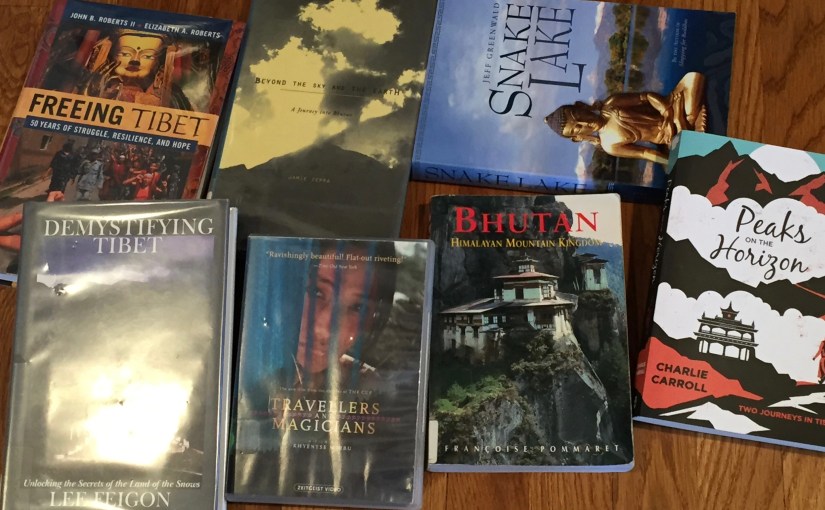
My interest in that country began several years ago when I stumbled across The Geography of Bliss by Eric Weiner.  It introduced me to Bhutan’s concept of Gross National Happiness.   Also around that time, we’d had the good fortune to meet and travel with Dr. Peter Steele.  In 1967, at a time when it was closed to most of the western world, he and his wife were invited to visit Bhutan by the royal family.  After reading his account of the trip, Two and Two Halves in Bhutan, I became even more interested in visiting that fascinating country.

OAT provides a list of “additional resources” for each country on the tour.  That list was my starting point, supplemented by what I could find on Overdrive, an online resource available through our library and of course, by random internet searches.

What follows is nothing even close to a book report, mainly I am somewhat lazy, but also because you will get better summaries by clicking on the blue words in this post.  The Amazon and Good Reads reviewers will do a much better job filling you in than I would have done.

I had no idea that in addition to Peter Steele, Shirley Maclaine also visited Bhutan in the ’60s.  In her 1970 autobiography, Don’t Fall Off the Mountain,  she explains that she had gone to India to learn to meditate, and while there met the new Prime Minister, Lhendup Dorji.  He had assumed that position after the prior Prime Minister (his brother) was assassinated  by a member of the military.   She accepted Dorji’s invitation to visit Bhutan, but unfortunately there was still political unrest in the country, so her visit was cut short.  Still, she was there long enough to give me a feel for what Bhutan was like during that period.  Plus, she DID make it to the famous Tiger’s Nest Monastery in Paro.  And so will I.

Jamie Zeppa’s book, Beyond the Sky and Earth is a wonderful description of life in Bhutan during the late ’80s.  She spent two years as a teacher, first with elementary students in a remote village, then teaching college students at Sherubtse College near Trashigang. Yeah, I’d never heard of those places either.

Jamie married one of her students,Tshewang Dendup. Why did I feel compelled to tell you his name?  Well there is a reason.  In 2003,  he had a starring role in the lovely Bhutanese movie, Travellers and Magicians.  I got the DVD from my library; it’s a great way to  sneak a peek at the beautiful Bhutanese scenery (and to check out Jamie’s ex- husband, if you are so inclined.)

Lisa Napoli”s book, Radio Shangri-La  is about her volunteer work at Kuzoo FM, Bhutan’s “youth based” radio station.  Established in 2006 as one of the king’s projects, Kuzoo broadcasts in both Dzongkha and English.  Lisa’s several years with NPR made her a valuable resource for this young radio station.

Those 4 books gave me glimpses of Bhutan’s evolution from a closed Himalayan kingdom of the ’60s up to around 2009.  What did I learn from my reading?

Ten Fun Facts About Bhutan (Not in order of importance, or any other kind of order, for that matter)

  1. Bhutan is also known as Druk Yul, the Land of the Thunder Dragon
  2. Marijuana grows wild in Bhutan, and is fed to the pigs because (surprise, surprise) it increases their appetite.
  3. Ara is the local moonshine; its a clear wine made from rice. ( Now that we’ve gotten the local stimulants out of the way, let’s move on)
  4. All doctors visits and health care is free
  5. Drukpa Kinley, a Tibetan monk who lived in the late 1400’s,  made his way to Bhutan.  He was also known as the Divine Madman who used his “flaming thunderbolt” to bless women and to bestow “enlightenment”.   He was so successful in his endeavors, he became the patron saint of fertility.
  6. Thanks to the Divine Madman, many Bhutanese houses sport paintings and sculptures of phalluses.  Who knows, photos of the artwork may be a coming attraction of this blog.
  7. Jigme Singye Wangchuck, the 4th king of Bhutan, voluntarily gave up absolute power in 1998.  (When does THAT ever happen??)  He guided the nation from a hereditary monarchy (which had been established in 1907) to its current status as a parliamentary democracy.
  8. Okay, so now the”People Magazine” type information: The 4th king had 4 wives, all of them sisters.
  9. His son, the 5th king, Jigme Khesar Namgyel Wangchuck, was crowned in November of 2008.  That king has only ONE wife, who he met at a picnic when he was 17 and she was 7.  According to legend, he said  ‘When you grow up, if I am not married and if you are not married, I would like you to be my wife, provided we still feel the same.’
  10. Men wear the Gho, and women wear the Kira; these two articles comprise Bhutan’s national dress.  Jamie’s book mentions that all Bhutanese were required to wear the national dress.  This dress code was an issue for the Nepalese immigrants living in the southern part of the country.  I don’t know whether the requirement still exists today, but it will be pretty apparent once we get there whether it does or not.

I actually learned a whole lot more, but I have to save SOMETHING for when we get there, right?

Next stop on our book tour – Nepal.


Two Hours Till Blast Off

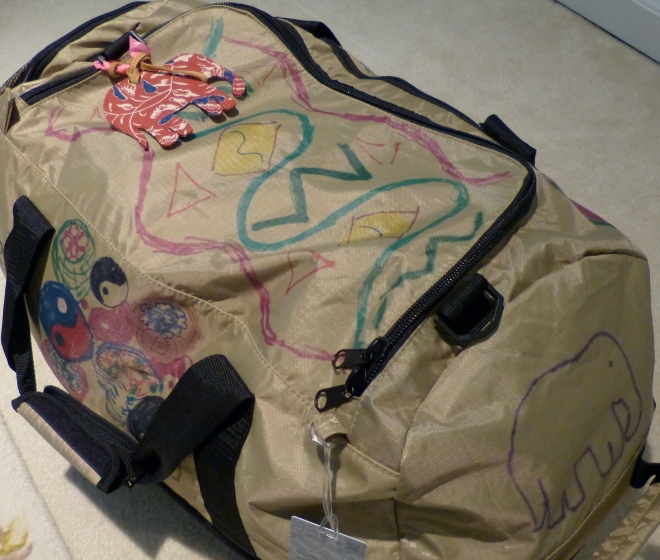
Remember that standard issue duffel bag?  The one that all OAT travelers get?  I decided I didn’t want to waste time at baggage areas determining which of the identical bags belonged to me,  so I did a bit of “bag enhancement”.P1060071I know, I know…I probably should have given it some thought BEFORE I went wild with the sharpie markers, but hey, I figured I dramatically decreased the odds that this bag will be stolen.   What self respecting thief would want to be seen dragging this along?  Besides, a smart thief would suspect the bag’s contents would be equally jumbled and lacking in style.

I very thoughtfully had a “go” at Mike’s bag.  A bit less exuberantly, but enough to provide the afore mentioned advantages.

We will be flying almost 8,000 miles.  To put that into perspective, it is the equivalent of 2.5 flights from NJ to California, and it will take about the same length of time–15 hours.

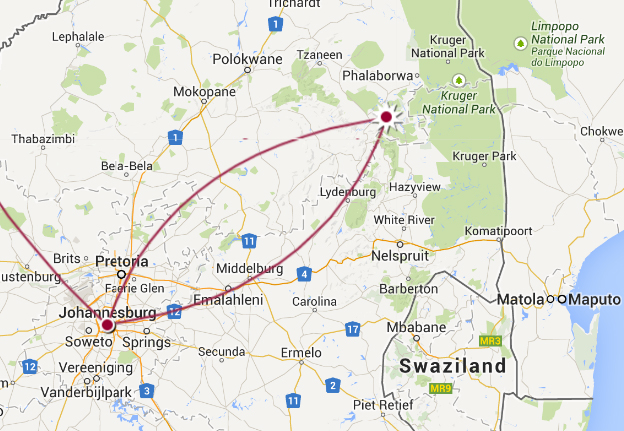
We spend the night in Johannesburg then leave the following morning for Karongwe, a game reserve close to Kruger National Park.  For all the map lovers, here’s a visual.

karongwe

Three nights later, we return to Johannesburg.  If I’m lucky, I’ll have wildlife photos to post.

Over and out!

Packing for A Month in Africa

OAT’s (Overseas Adventure Travel’s) wonderfully helpful website is loaded with lots of hints from those that have gone before.  Thanks to them, I have a good idea of what to pack, and equally important, what NOT to pack.

I need to be prepared for cold mornings and evenings, high mid-day temperatures,  and a school visit.  Then after the tour ends, Mike and I are on our own in Cape Town for several days.

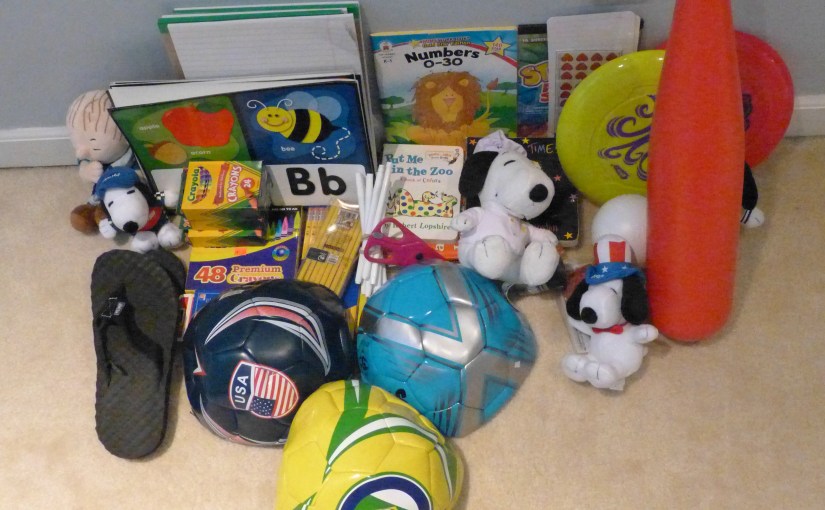
Suggestions for what to bring for the school visit included uninflated soccer balls and flip-flops plus the usual books, crayons, paper, pens and pencils.  I also like to bring along a few frivolous things, like small stuffed animals.

P1060058

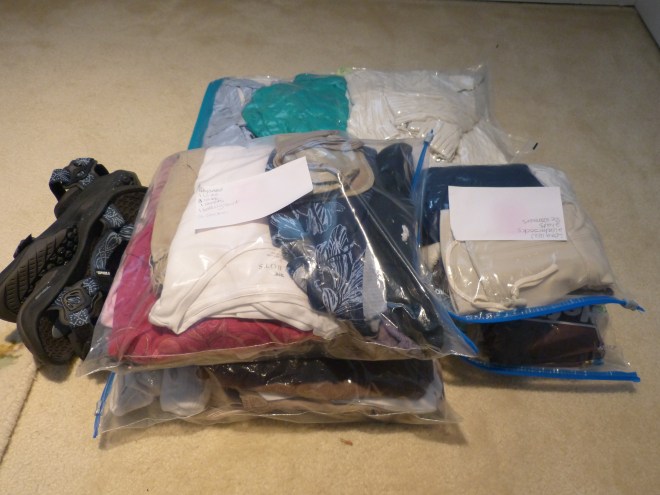
The camps do our laundry every night, so 3 changes of clothes will do the trick, but I also needed a warm jacket, a hat, gloves, plus shorts and tee shirts and a bathing suit.  Dressing in layers is key.  I also need to plan for our time in Cape Town when we will be without daily laundry service.

P1060063

I found jumbo zip lock bags at the supermarket and am using them to organize my wardrobe.  But will all this, plus toiletries, fit into the duffel bag?

Fortunately, it doesn’t have to.  One traveler suggested putting the duffel inside a much bigger bag, then packing everything into that one large suitcase.  I tried that, but I easily exceeded the 50 pound weight limit.  THEN I decided to check out South African Air’s luggage rules and was very excited to learn that in addition to my carry on, I can have TWO checked bags!!!  I’m so used to the United Airlines restrictions, it didn’t occur to me that another airline’s checked baggage policy could be more liberal.

Being able to bring that second bag meant another trip to the Dollar Store for toothbrushes, combs and LOTS more school supplies, plus any odds and ends that I thought might be useful.  I packed it all in an old suitcase that I plan to leave in Africa.

P1060064

So, now my duffel will only contain MY stuff–plus another small duffel that I will use to bring back any purchases I make–good news for sisters, hermana preferida, cousins and other loved ones!

Geography Lesson


Geography was never a favorite subject of mine.  Memorizing capitals and products was excruciatingly mind numbing.  At the time, knowing where to plop countries on a mimeographed map didn’t appear to be knowledge I’d ever find useful.  Back when I considered a one hour trip to Boston a thrilling excursion, it was hard to imagine that I would ever be lucky enough to set foot any place outside of the continental USA.

I’ll admit that I wasn’t disappointed when Sister Pauline explained that there was no point in studying the geography of Africa, because everything was changing.  How sad that statement is one of the few things I remember from my geography studies!

Fast forward a half a century.  I will soon be filling that gaping hole in my knowledge of the world with a trip to that continent I didn’t have to learn about in elementary school.  Well, only the southern part of Africa.  But you gotta start somewhere.

This will be the first trip that Mike and I take with Overseas Adventure Travel (OAT).   Although we have had wonderful experiences with Road Scholar, and RS has a similar trip, we decided to go with OAT for the following reasons:

  • If you pay the full amount in cash a year in advance, you get a 10% discount (and I SO love a bargain)!
  • If you take another trip with them within the next 12 months, you get a 5% credit.
  • They have an amazing website, with very informative reviews and an incredibly helpful forum in which travelers share information and helpful hints.
  • They offer options:  you can do only the trip, or you can add pre and/or post trip excursions.
  • There is a maximum of 16 participants

Mike and I figured if we were going to shell out the money for airfare,  and subject our bodies to a total of 30 hours (round trip) in the air, we might as well stay a while, so we are doing the pre and then visiting Cape Town on our own.  Who knows if we will ever be able to get back to this part of the globe?

We start in Johannesburg,  then fly to Karongwe Game Reserve for the pre-trip.  Four days later, we return to  Johannesburg for the main trip, going first to two camps in Botswana, then one in Zambia, one in Zimbabwe, ending with a few days in Victoria Falls, before we fly back to  Johannesburg.   At that point, Mike and I will leave the tour and fly to Cape Town for a few days on our own, before returning to Johannesburg for a flight home.  All told, we will be gone for 26 days.

Oat created this very helpful map,  with the trip extensions in the insert.


africa trip

While on safari, we will be staying in tents in the national parks.  WiFi will therefore be limited to the few times we are in cities.  (So, sisters and cousins, when you don’t see a post, it will not be because I have met with foul play…it will just mean I am still off the grid).

We will be flying in very small planes, which limits both the weight and the type of luggage allowed.  One duffel bag each, without an internal frame, weighing no more than 44 pounds, plus one carry on. Here’s a visual of my duffel bag,  supplied by OAT, and my new (larger) back pack.   Previous travelers had experienced problems with the duffel splitting open (I told you the forum was helpful), but fortunately that appears to be old news.  Nevertheless, I’m packing some duct tape…just in case.luggage

Years of business travel trained me to travel light, but we will be visiting a school, so once I assemble the minimum amount of clothing and supplies needed, I’ll be cramming books, pencils, crayons and other odds and ends into the remaining space up to the weight limit.

Next post will be about pre-trip readings.