Varanasi

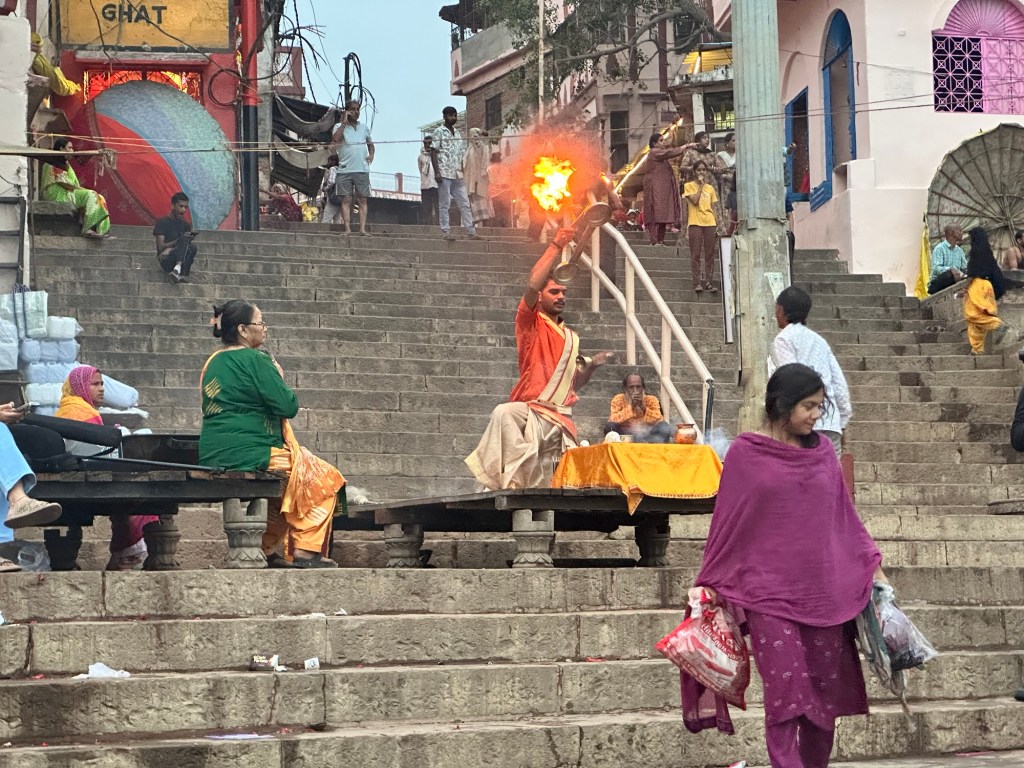
Initially I was NOT impressed with Varanasi, because of the crowds, traffic, trash in the streets, wandering cows and stray dogs. It was hard for me to believe that Varanasi is considered one of India’s most sacred cities. But after our evening and morning cruises on the Ganges, I changed my mind!

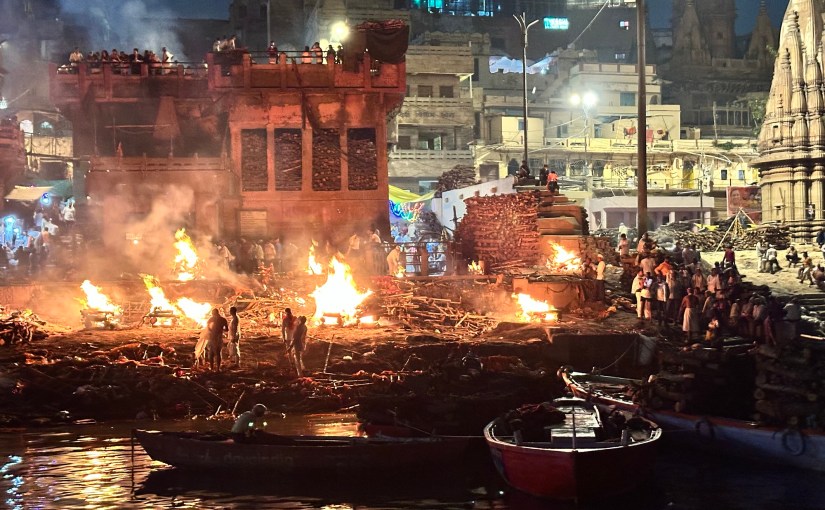
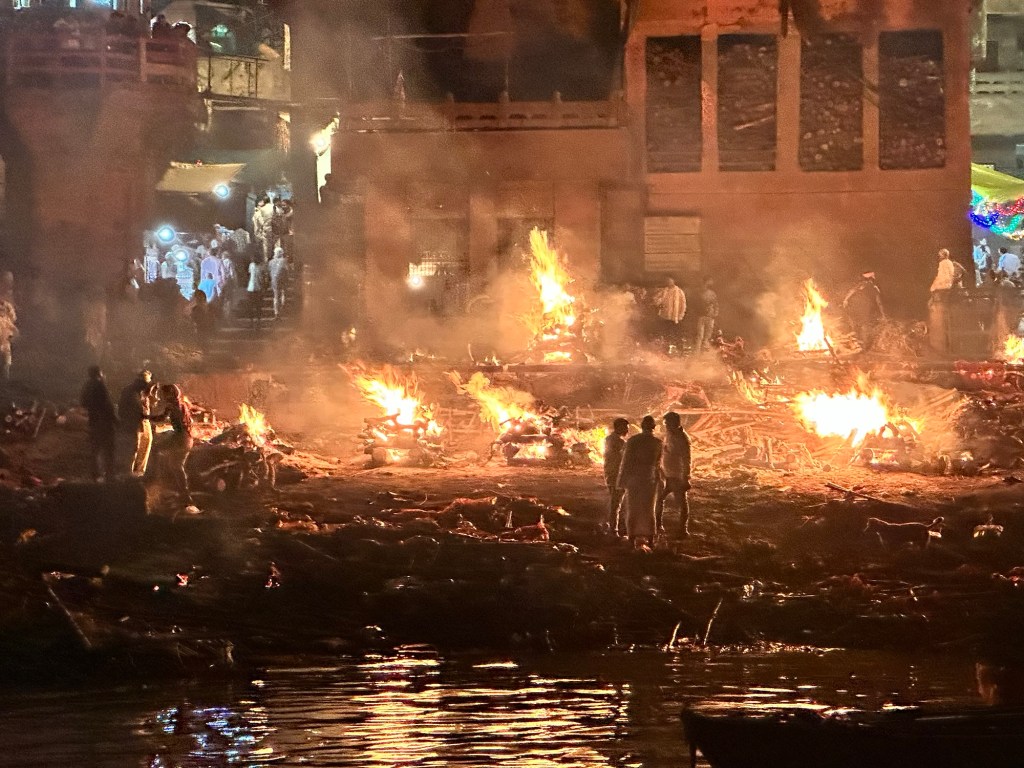
Hindus believe that if you are cremated on this special ghat ( the one with the “everlasting flame” ) by the Ganges, you are released from the cycle of death and rebirth, earning an “express pass” to nirvana. We witnessed the full cremation ceremony from our riverboat.
It reminded me of the Catholics’ belief in the 9 first Fridays. So, for those who didn’t go to Catholic school, here’s the scoop. If you go to mass and communion for the first Friday of the month, NINE times in a ROW, you are guaranteed that a priest would pop up just before you die to give you the last rites. That means you have the chance to confess your sins and be forgiven. You might have to spend a little time in Purgatory, but at least you won’t go to hell.

Varanasi is to devout Hindu what Mecca represents to Muslims, and Jerusalem to Jews. Supposedly, most Hindus want to make a pilgrimage to Varanasi, at least once in their lifetime, to take an early morning “dip” into the Ganges. For those unable to make the trip, perhaps they might persuade someone to do it for them; that person would have to go underwater multiple times to ensure their friends are completely purified.

After our flight from Delhi to Varanasi, and our evening cruise, I briefly considered skipping the sunrise rituals, which required getting up at 5 AM. I’m so glad that I didn’t!

Twenty five years ago my friend celebrated her birthday by submerging herself in the Ganges. Back then, the river was polluted with dead animals, ashes, and miscellaneous bacteria floating along among the multitudes of humans bathing there. Since then, treatment towers ( the yellow structures) have been built, so the water is much cleaner.

Good thing, because water from the Ganges is considered “purifying” and holy. Devout Hindus sprinkle Ganges water in their homes first thing in the morning and again before sunset, then blow a conch shell to banish negativity.

During our college years, my friend (the Ganges bather) celebrated St Patrick’s day by skinny dipping in Boston’s Charles River. Of course, that was after she consumed prodigious amounts of green beer. Sorry, no iPhones back then, so no video of Boston’s “ finest” plucking her from the river.

But I digress. Let’s get back to Varanasi. Not only is the city sacred to Hindus, it is also important to Buddhists because Buddha gave his first sermon in Varanasi, at Sarnath.

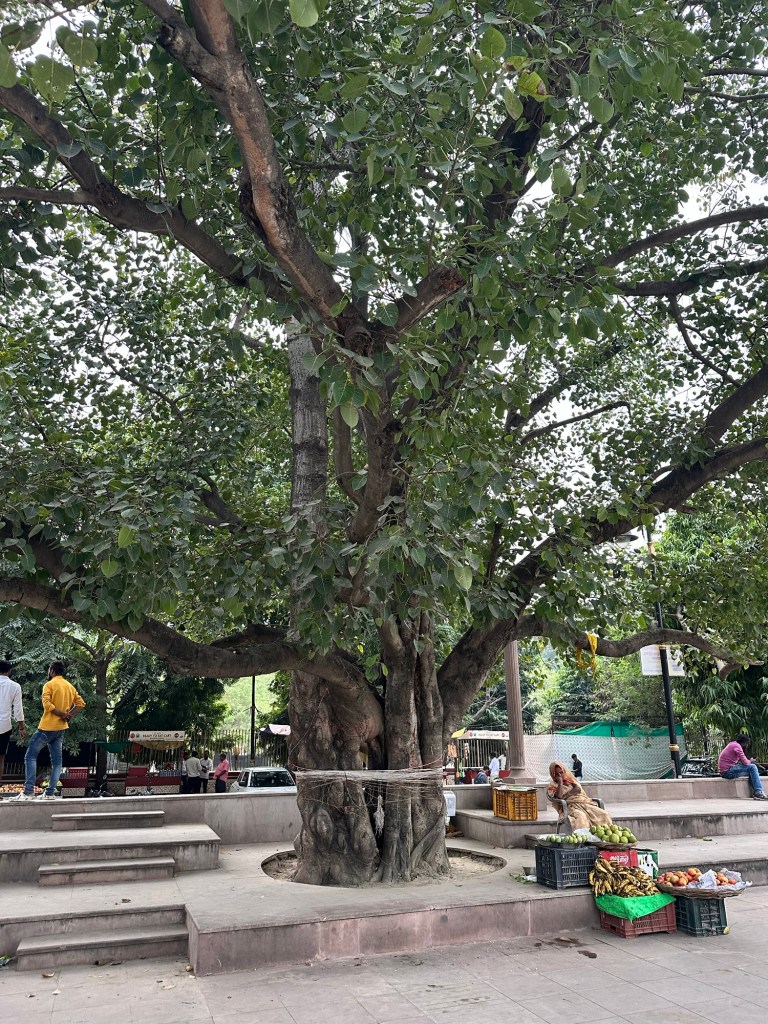
The following photos are of a Bodhi tree, which can be identified by its heart shaped leaves. When the Buddha stood underneath the Bodhi tree, he achieved enlightenment. Sadly, when I planted myself firmly under that same tree, no such thing happened to me. Maybe I needed to stand there longer?
The on site museum at Sarnath houses finds from Archaeological digs, including this statue of four lions.

Anyone who has visited the Alhambra in Granada, Spain might be reminded of the Lion Court which has similar statuary.

On the way to the sunrise ceremony, our guide warned us to be on the lookout for cow dung. He explained that the cows we have seen roaming the streets all have owners. The owners allow the cows to roam freely during the day, after they have been fed and milked. In the evening, the cows return home and are sheltered overnight.

Our guide told us the cows are fed during the day by some of the locals. If the cows are fed two or three times, they return to that house regularly, at the same time every day. If the residents aren’t waiting, with food, the cow uses its horns to knock on the door.

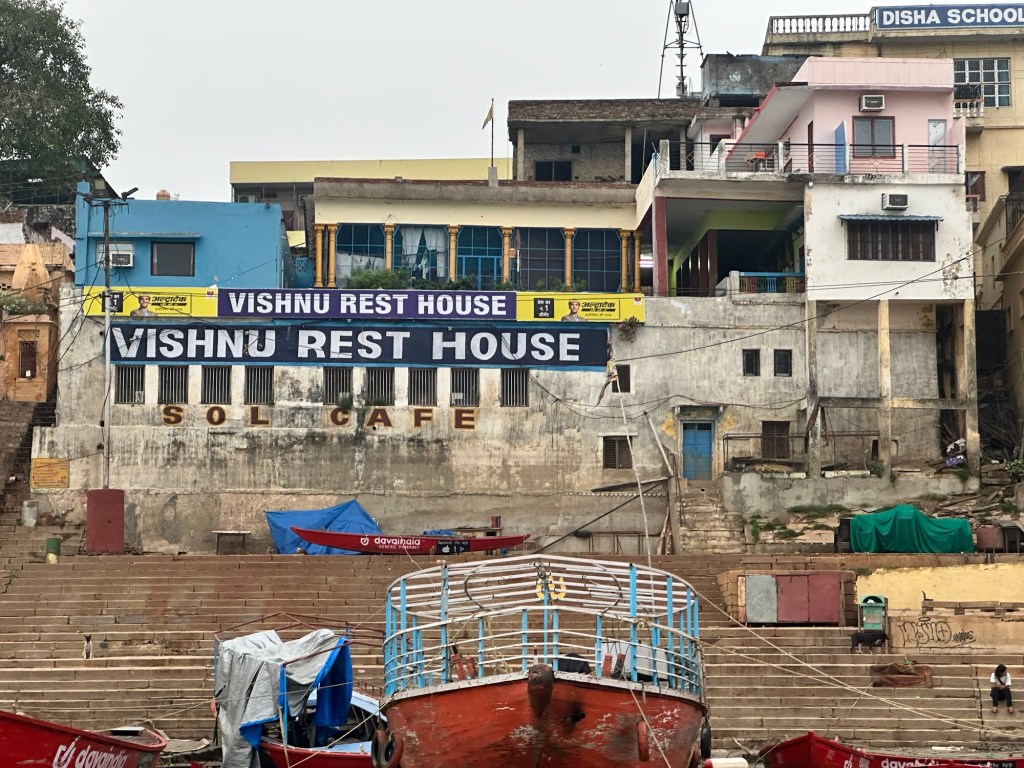
Sadly, it was a cloudy morning, so we didn’t get to see the sunrise. What I did get was a photo of the hotel where George Harrison stayed. He was there long enough to experience a gorgeous sunrise which inspired him to compose the song “ here comes the sun”. It was in Varanasi that Harrison met and collaborated with Ravi Shankar.
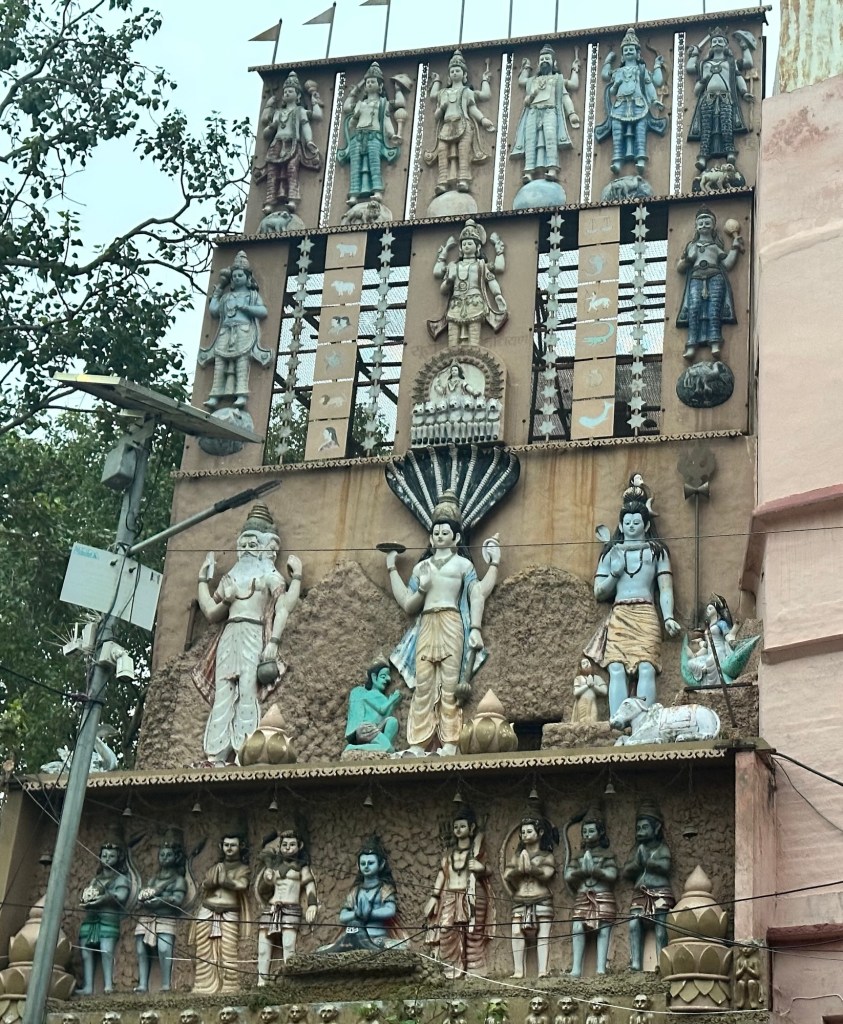
Our early morning walk through the center of Varanasi was a visual feast. The statues on the buildings presented opportunities for our guide to educate us about the three main Hindu gods: Brahma the creator, Vishnu, the maintainer and Shiva, the destroyer of evil.
After returning to the hotel for breakfast, we departed to visit a silk production center where we were able to view looms and engage in retail therapy. We then headed to the airport for a return flight to Delhi, and a long drive to Agra. We arrived at our beautiful hotel around 8 PM, with barely enough energy to have dinner, and go to bed.
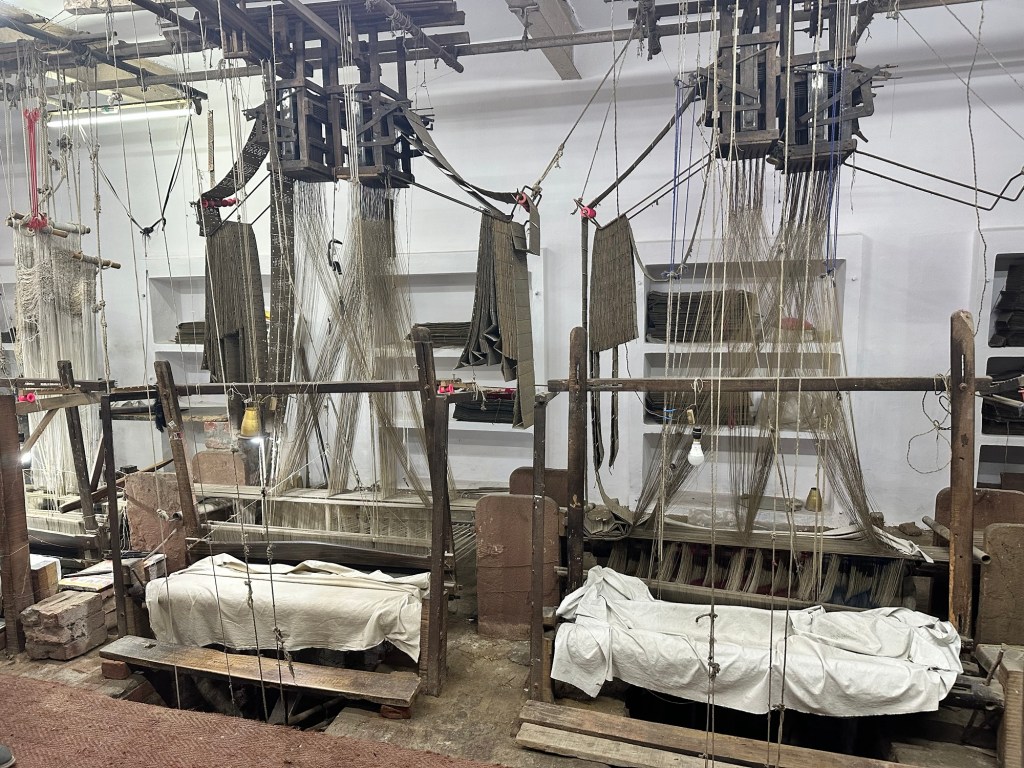
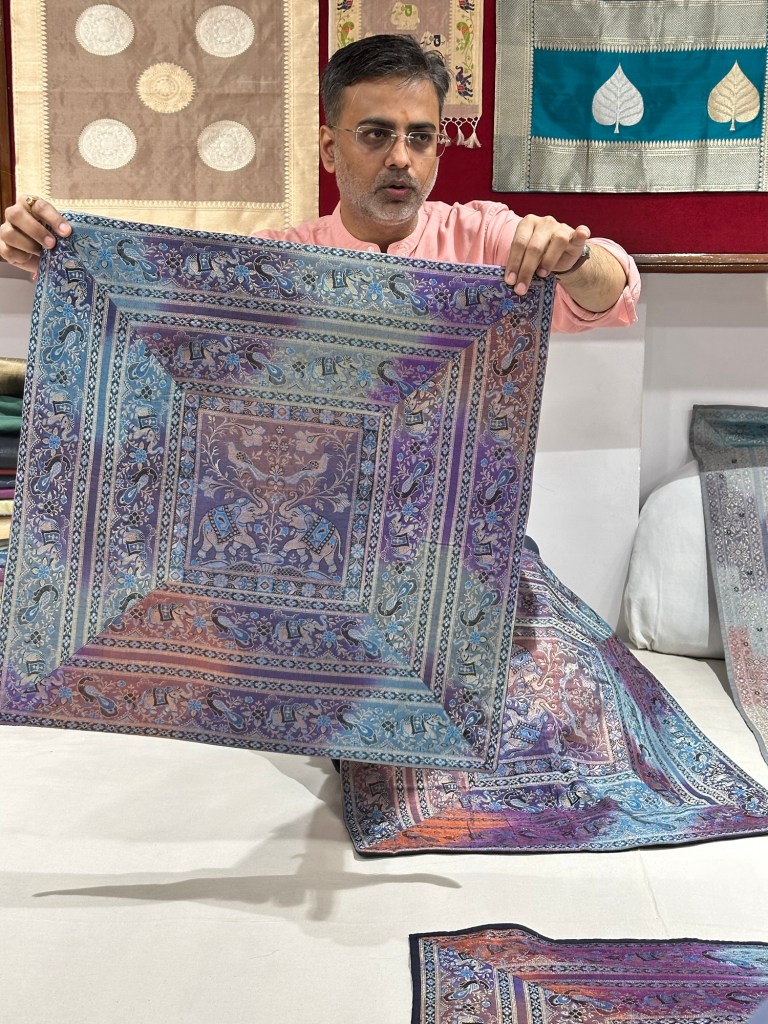
We saw and experienced a lot during our less than 24 hour stay in Varanasi!

OAT’s Kyoto Itinerary

There was so much to see and do in Kyoto, I decided Kyoto required two posts. This one describes the “official” OAT activities. The next post is all the “extras” sweet Mori made sure we experienced.

After Covid cancelled my 2020 Japan trip, I comforted myself with an on-line “tour” of Kyoto. From that, I got the mistaken impression that Kyoto was a rather compact city with all of the sights clustered together.

I was TOTALLY unprepared for how big Kyoto is and how scattered the points of interest are.

My iPhone photos will give you a rough idea of how much ground OAT’s itinerary covered during our 5 day stay. I was very grateful that Mori handled all of the logistics.

The Shinkansen brought us swiftly and smoothly to Kyoto. Because we had ridden the bullet train from Tokyo to Kanazawa, we were familiar with the drill: you pack a small overnight bag to tide you over until the larger luggage ( which was shipped) arrives a day later. The bullet train is super comfortable, but storage space is quite limited.

I was glad that I was traveling with only a backpack, because unlike our arrival in Kanazawa, in Kyoto we had to swim through an ocean of humanity to get through the train station.

I’m wondering what was easier to follow—Taco, or my gray head sticking up above the crowd.

What a multisensory extravaganza the Kyoto train station was! We were bombarded with sounds, sights and wonderful smells, but as you’ll see in a later post, it is even more thrilling at night, so no more daytime station photos.

But first, here’s a whirlwind tour of my favorite things on OAT’s itinerary, which successfully hit Kyoto’s traditional hot spots.

The majestic Arashiyama Bamboo Forest

It is hard to describe the peaceful feeling one gets while walking through these towering plants.

Cemetery beside the bamboo forest

The Tenryu-ji Temple

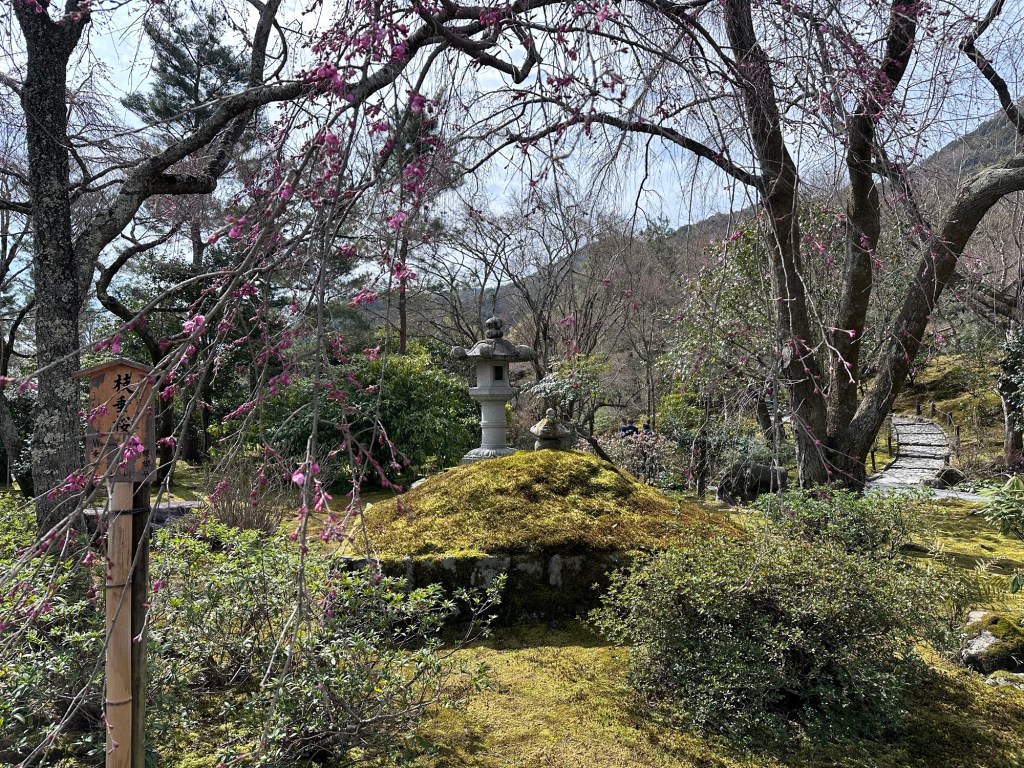
A brief stroll away from the forest was a beautiful garden and Buddhist temple. We were so excited to see the cherry blossoms were starting to open.

I managed to pitch a coin right into the ring in front of the frog. I keep making the same wish. One of these times it should work.

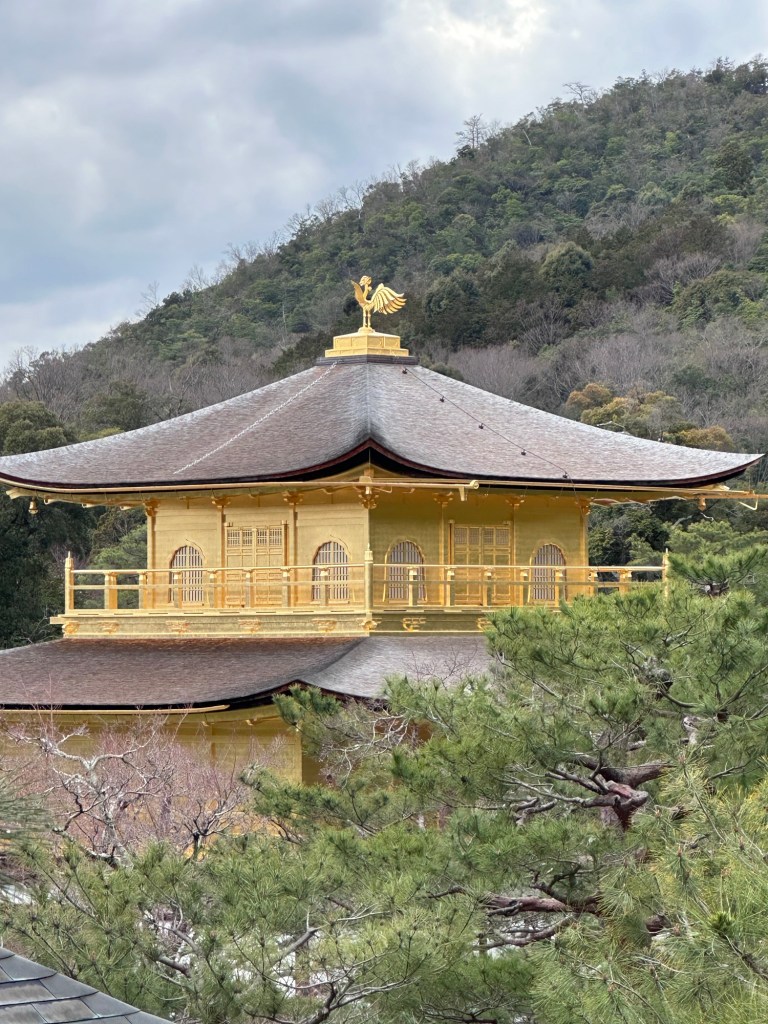
Kinkaku-ji Temple (Temple of the Golden Pavilion)

The original temple was constructed around 1400, but was rebuilt in the 1950’s after it was burned to the ground by a crazed monk.

Wasn’t it fitting that the phoenix atop the temple was the only part of the original that managed to arise from the ashes of the burned building?

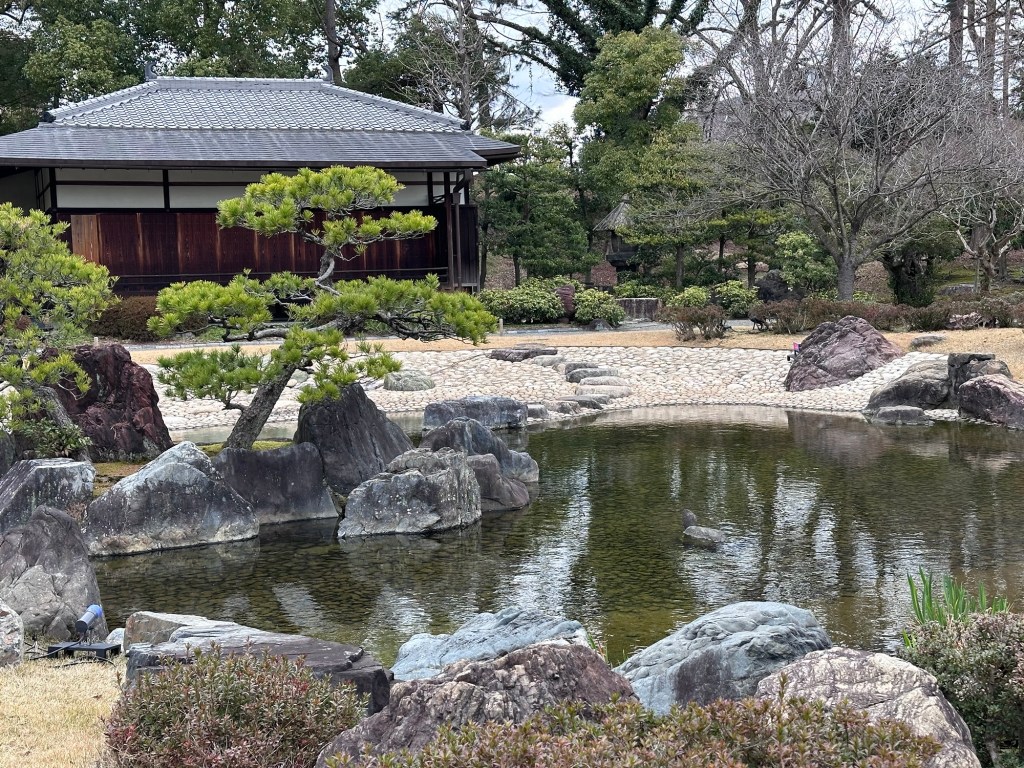
Nijo Castle

We toured the interior of Nijo Castle, but we weren’t allowed to take photos. That’s okay. I found the exterior far more compelling—especially at night (and yes, you are going to have to wait for a future post to see how glorious it is).

Nara

India has its sacred cows; Japan has its deer.

Kathleen is bowing to the sacred deer

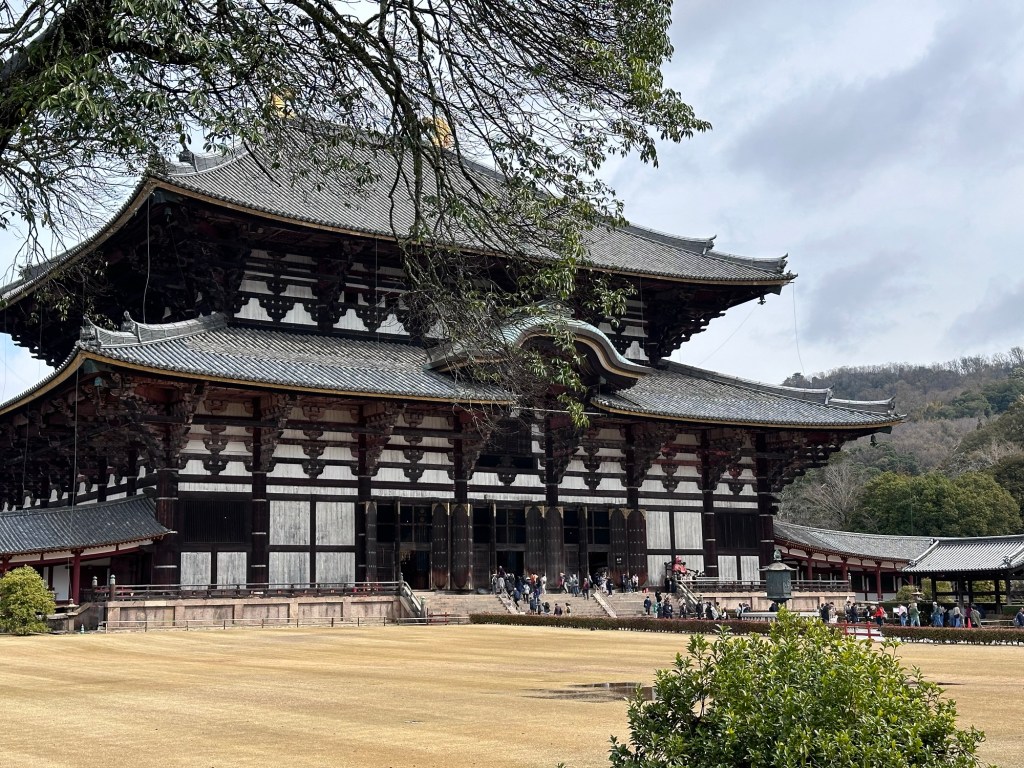
Todaiji Temple

This is the home of the world’s largest wooden Buddha.

He was so enormous, it was difficult to photograph him. Besides, we’ve all seen Buddha photos.

As you may have noticed from earlier posts, I’m rather fond of the Guardians. Even though this one has a fierce facial expression, he’s holding a scroll and pen, so how scary can he be? Maybe his message is “the pen is mightier than the sword”?

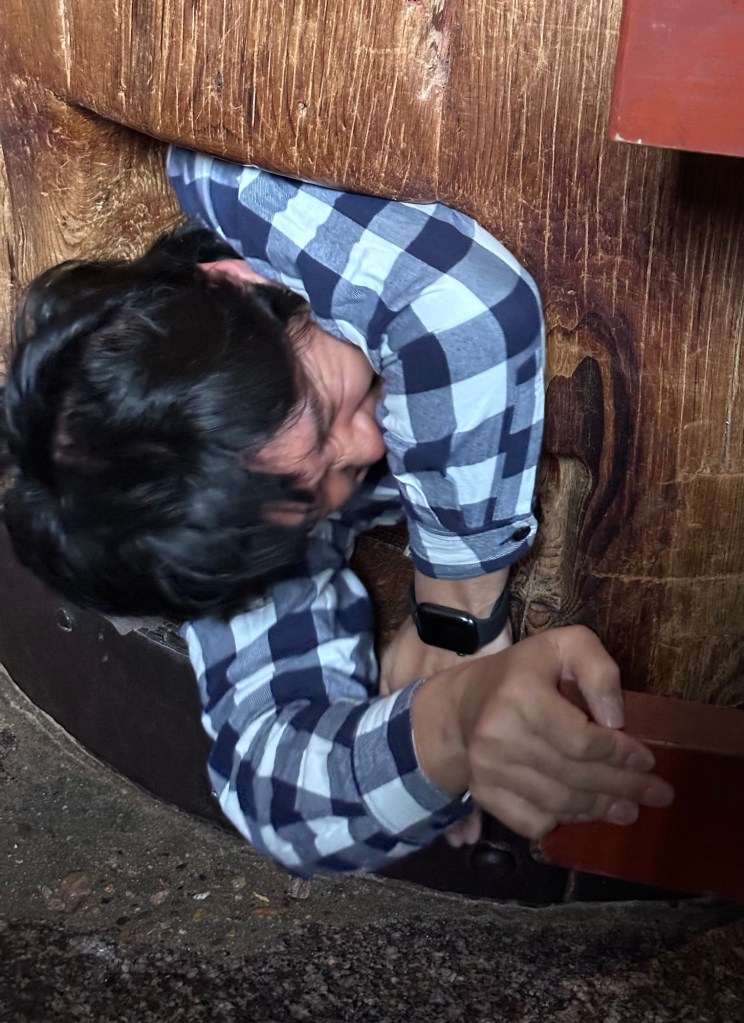
This next photo requires an explanation, but first take a look and see if you can figure out what is happening.

There is a wooden block in the temple, with an opening that supposedly is the size of Buddha’s nose (the statue, not the human). The belief is that anyone able to squeeze through Buddha’s nose (or the passage) would have a good life. I’m pleased to say that although he initially struggled, Mori made it thru.

Zen Temple

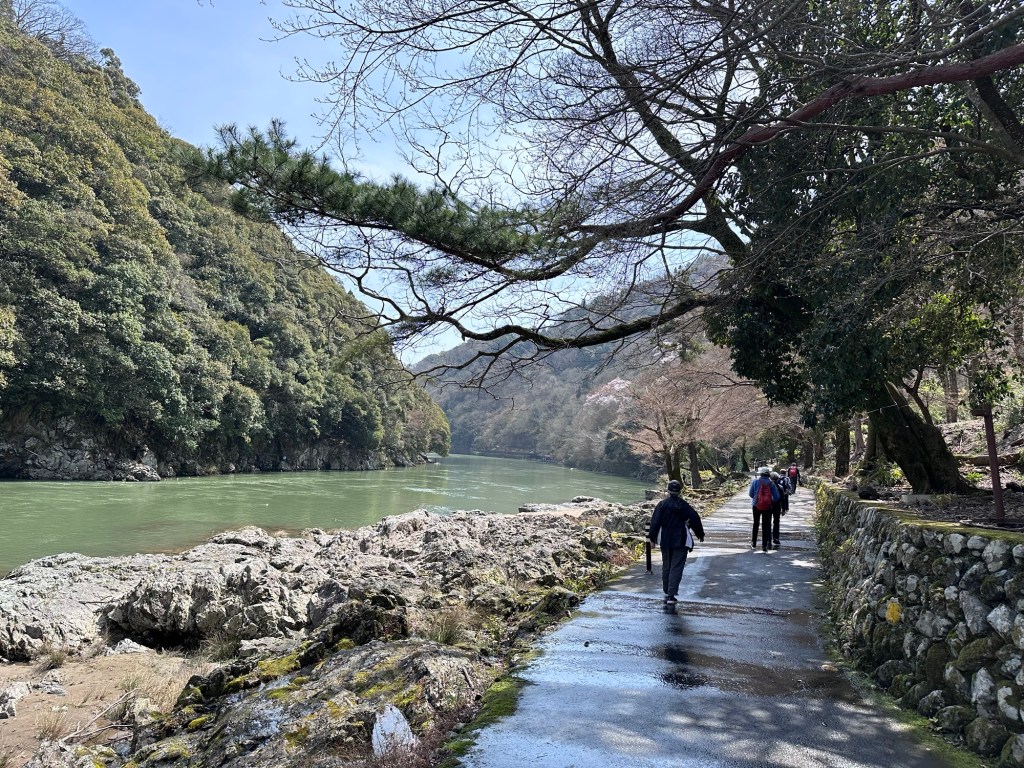
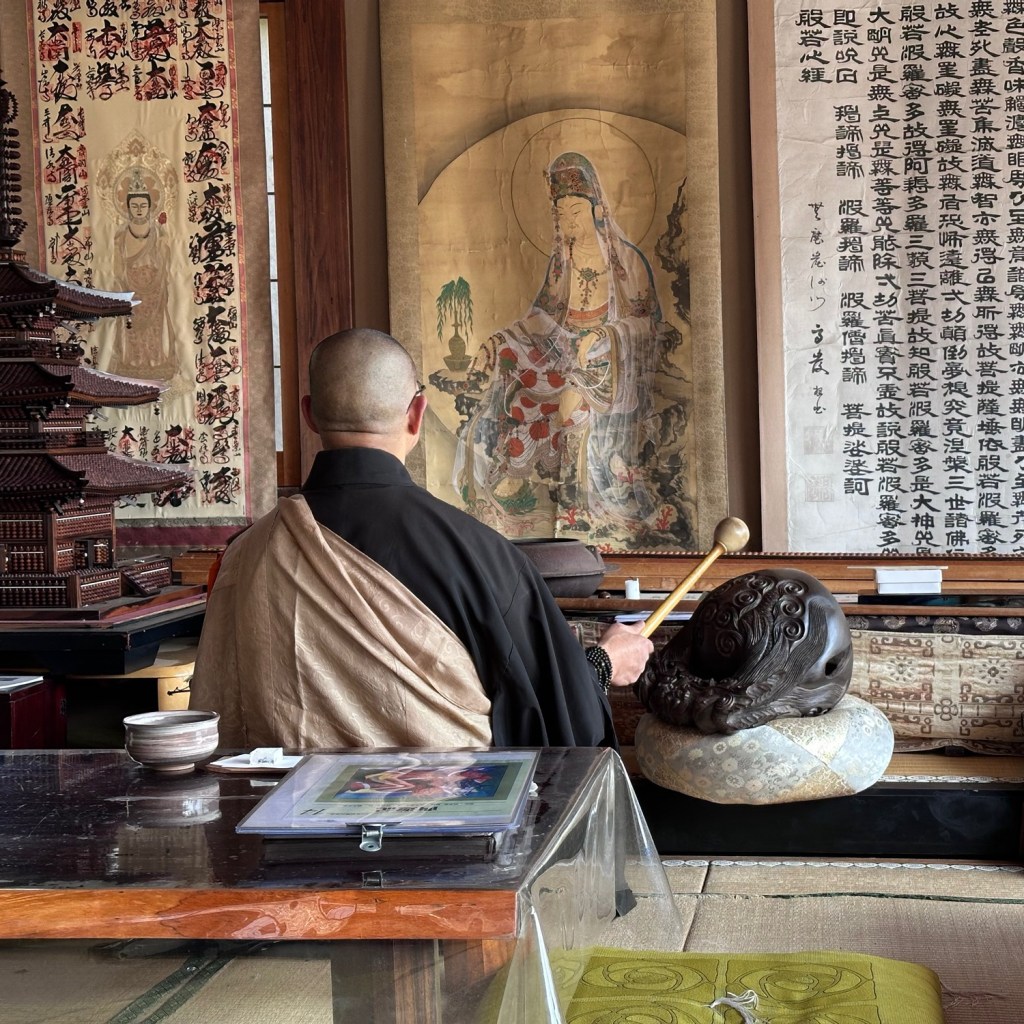
After walking alongside this beautiful river, we climbed 200 steps ( I didn’t count; I took Mori’s word for it) to meet a zen master, with whom we meditated.

We left, totally at peace, feeling “zero”. It’s fortunate that l learned to let go, because that hat on my head and I were soon to go our separate ways.

Fushimi Inari Shrine

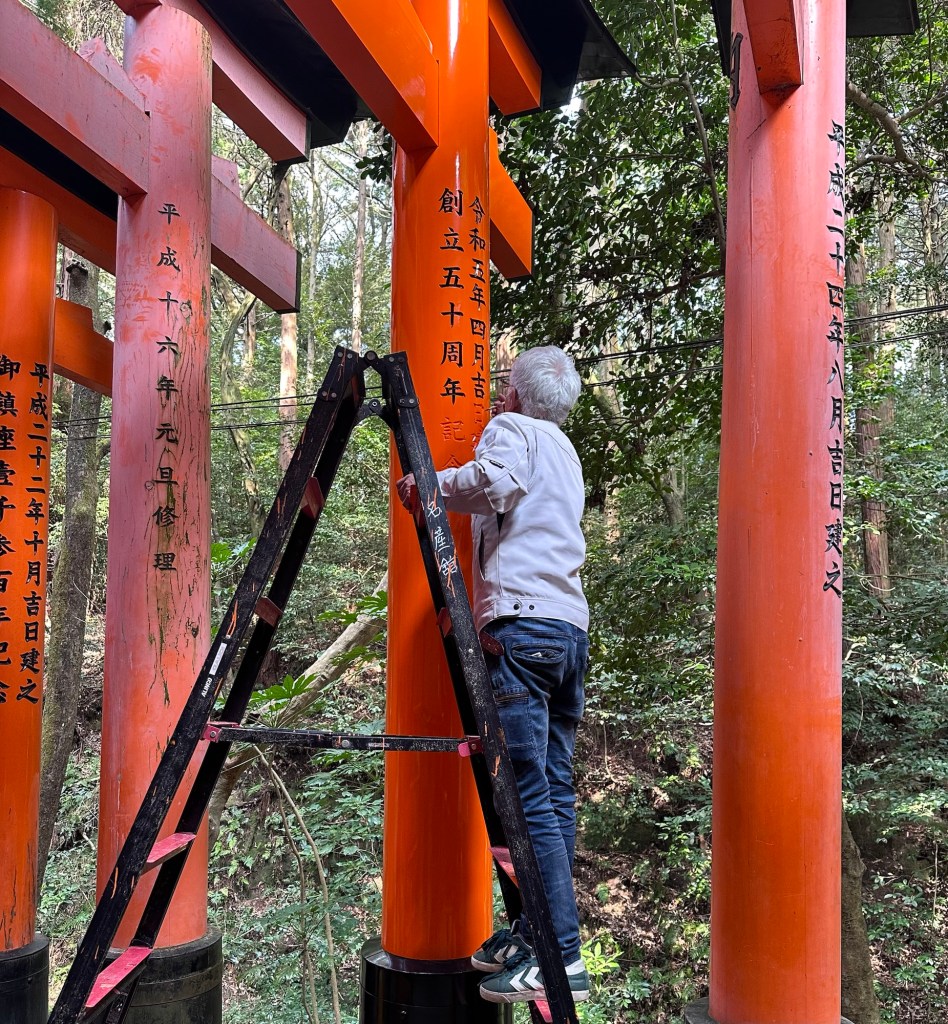
After experiencing Buddhism, we moved on to the famous Shinto shrine with its beautiful vermillion Torii Gates.

We didn’t have time to climb to the top, so this map will have to suffice to give you an idea of the immensity of the shrine.

When Christo did “The Gates” in NYC’s Central Parking 2005, Mike and I spent an enjoyable February afternoon strolling through them. Could Christo have gotten his inspiration from Japan? I think he did.

Sushi Making

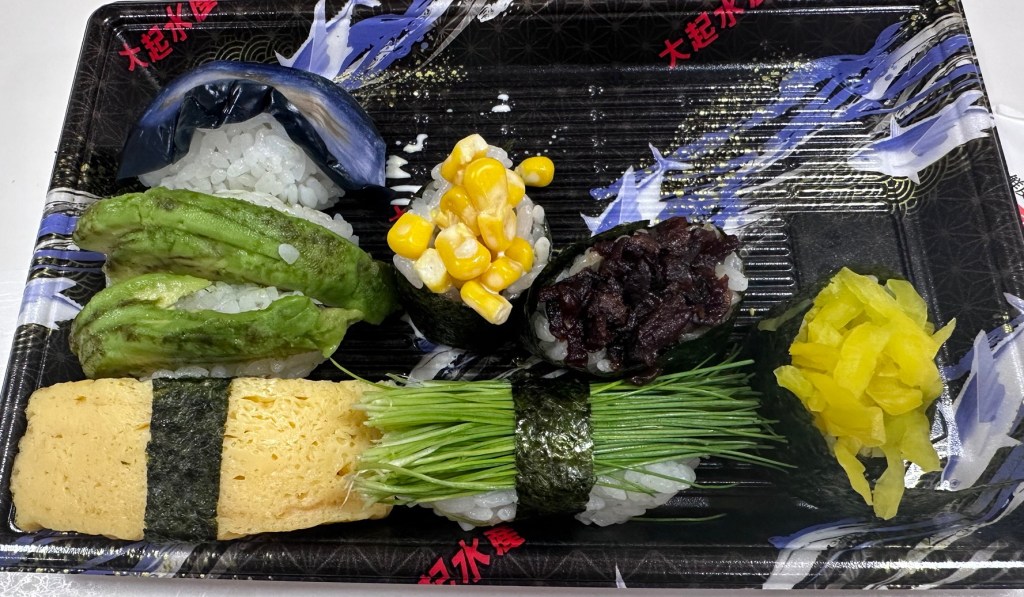
I will say up front that raw fish wrapped in seaweed does not meet my definition of delicious. Still, I was determined to keep an open mind. I was quite happy to learn that we had a vegetable option.

My son Greg would have loved the discussion about knives and whet stones.

Okay, so maybe it didn’t look like much, but it sure was tasty.

What better way to end this post than with a photo of a beautiful blossom…

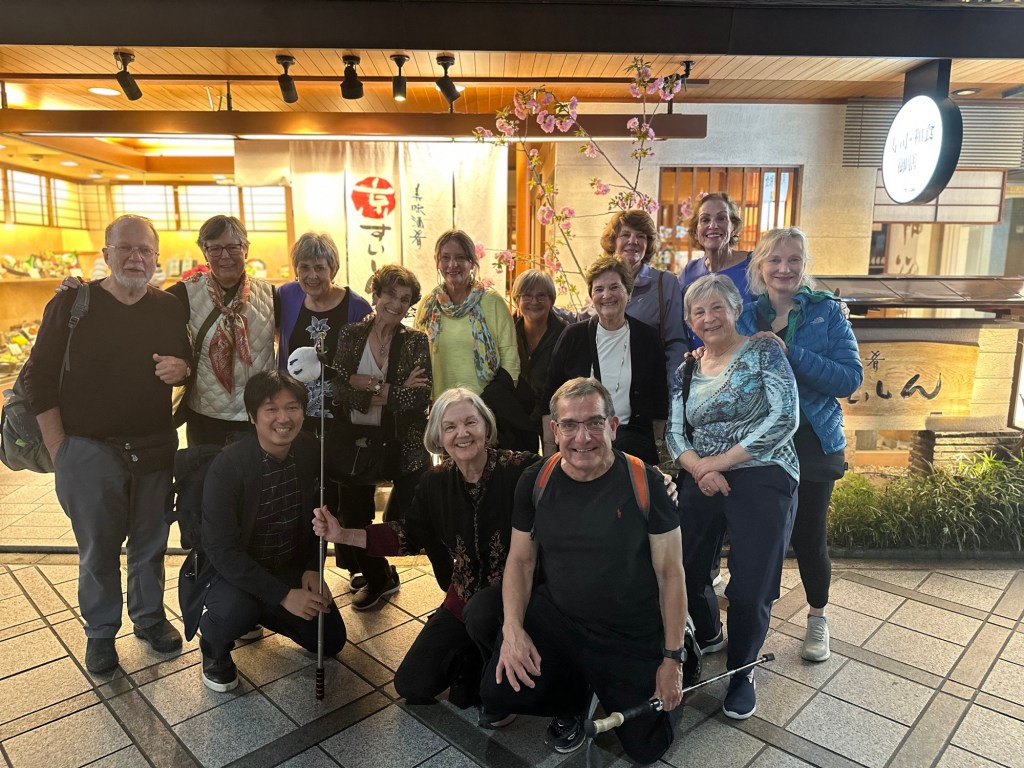
and a group shot taken after our farewell dinner. Sadly, Mary, Jim, Kathleen and Cathy, weren’t joining us on the post trip to Hiroshima.

Tibet, Part Two

My last post about Tibet was a bit of a downer, wasn’t it?  As my friend Sally reminded me, “not every place is lovable”, but as with all travel, there are always positive elements, whether it be a greater understanding of a particular culture or country, or an increase in self knowledge.

We not only saw the exterior of the iconic Potala Palace, we were also able to climb to the top and visit some of the interior on our way up.  Built by the fifth Dalai Lama in the late 1600’s on the site of Songzen Gampo’s palace, it became the winter residence of successive Dalai Lamas.  Photographs are not allowed of any of the interior rooms, but they were so dark, smoky and gloomy, it would have been difficult to get a good shot anyway.

The red sections were administrative; the white sections were religious
The red sections were for religious studies; the white sections were the living quarters of the Dalai Lamas

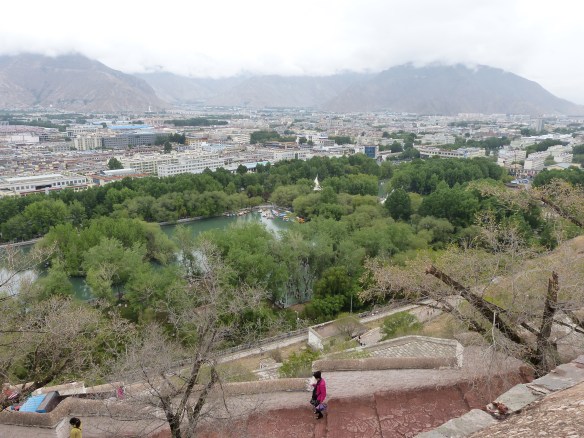
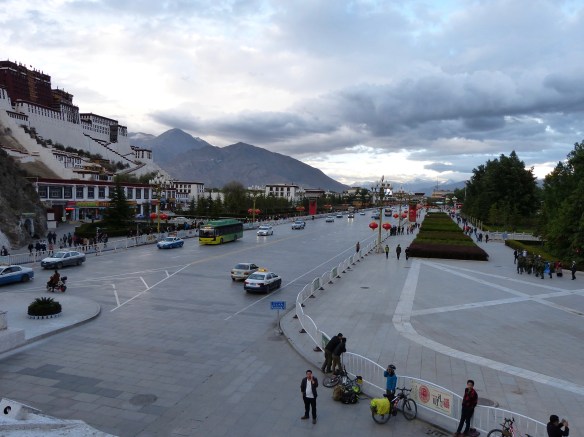
The palace, 13 stories high, offers a great view of the city of Lhasa.

The view from the top of the Potala

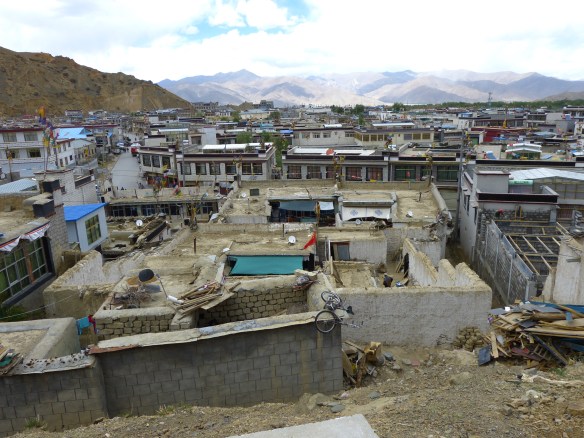
Here’s a different view, showing the  modern city the Chinese have built around the Potala.

P1150658

It was so hard to imagine a small child being taken from his family and brought to live in this massive place, surrounded by monks who were charged with his instruction.   The current Dalai Lama was two years old when he was identified.  He spent two years in a monastery near his family’s home in Amdo, then moved to the Potala two years later.

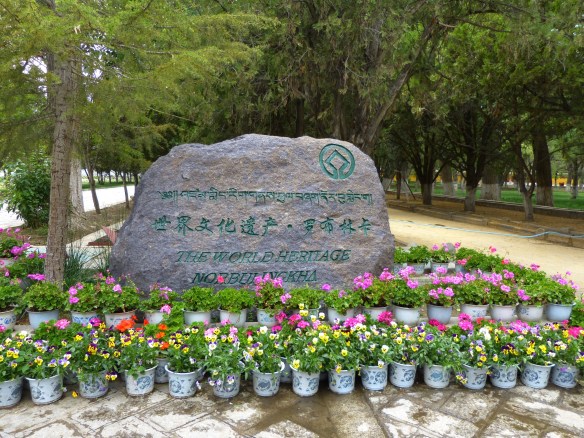
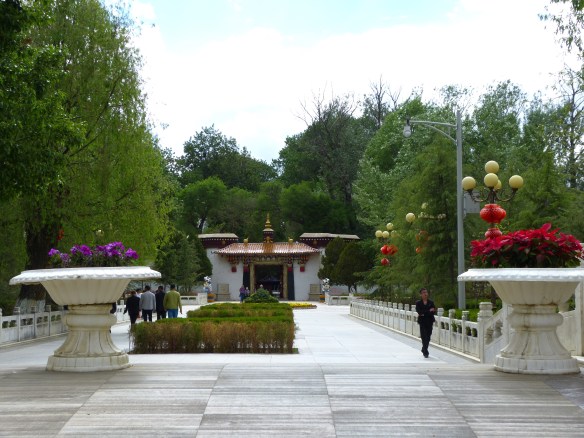
The summer palace, the Norbulingkha (Treasure Park) has a very different feel to it.  This was built in the mid 18th century by the 7th Dalai Lama.  It is actually quite close to the winter palace. The largest horticultural park in Tibet,  it includes a private zoo, which wasn’t open when I visited.  At one time it housed an elephant that was a gift from the Maharaja of Nepal.  P1150883

P1150896

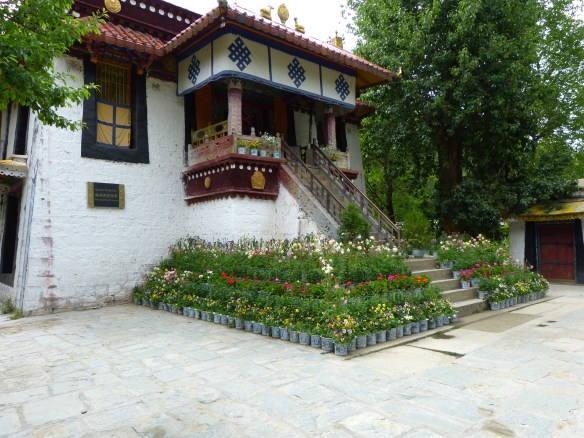
Heinrich Harrer conducted lessons with the 14th (current) Dalai Lama in the summer palace.  It was from this site that the Dalai Lama departed in 1959 to escape from the Chinese.  Another fun fact:  According to Harrer in his book “Seven Years in Tibet”, women were not allowed in the Norbulingkha because it was believed that they would have defiled the gardens.  P1150890

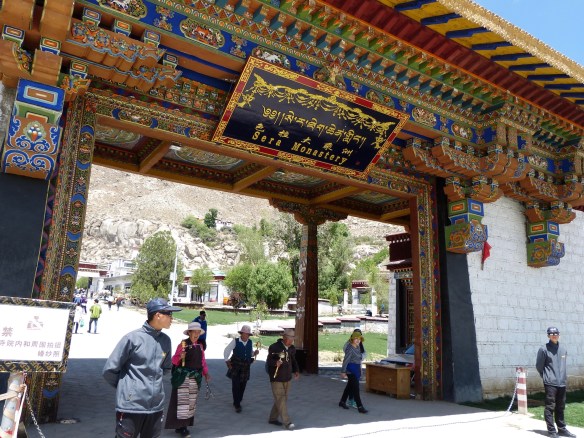
Two famous monasteries in Lhasa are located near the palaces.  The Drepung monastery was being repaired, so we only visited the Sera Monastery.  I was disappointed because I had learned in my pre trip reading that Tibet’s creation story was told in murals at the entrance of the Drepung Monastery, and I had hoped to see it.  P1150660

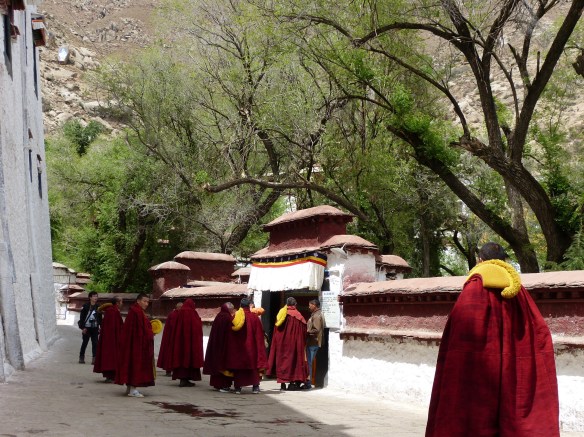
What we DID see were the Sera monks interacting in an outdoor courtyard.  That yellow hats on their shoulders?  It made me smile–all I could think of was Woodstock, Snoopy’s little friend.  P1150673

The detail on the exterior of the buildings was exquisite, however it was nothing compared to the tombs of the Dalai Lamas inside the Potala.  Those looked like wedding cakes–5 to 7 tiers high, covered with carvings and encrusted with jewels and precious stones.  P1150668

P1150719


We arrived in Lhasa on 5/14, which was the start of a 15 day “festival” celebrating Buddha’s birthday.  For Tibetans, a festival consisted of either walking around a sacred site, or prostrating themselves as they slowly made their way counterclockwise, praying as they went.


Leaving Lhasa, we traveled to Gyantse, where we visited the Palcho Monastery.

P1150713

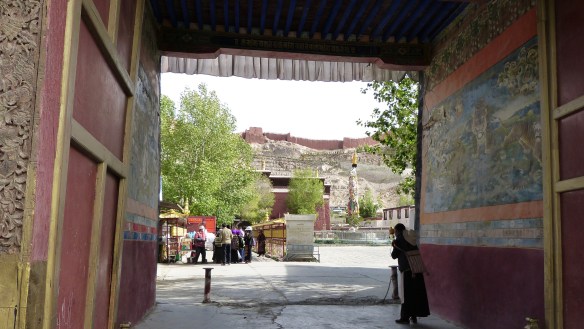
Here, you were allowed to take photos, as long as you paid a fee.  In the distance, you can see the red fort that dominates the landscape.

P1150733
Plastic bags filled with offerings are scattered throughout the monastery.  Devotees leave food, money, grain, white scarves (called Kata), whatever they have.

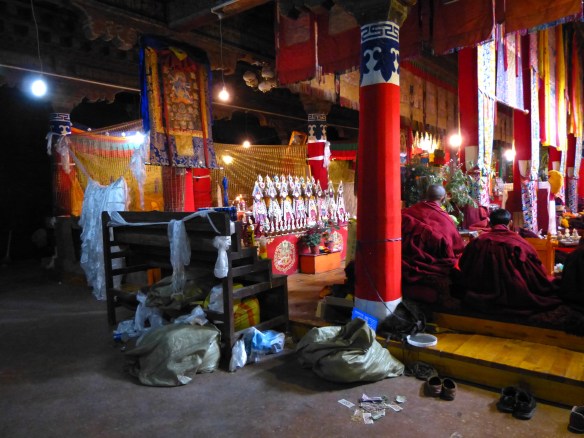
This monastery was built in the 1400’s; its interior looks very much like the interiors of the other monasteries, small chapels, very dark and smoky.  I used a flash and the highest ISO possible to get these photos.

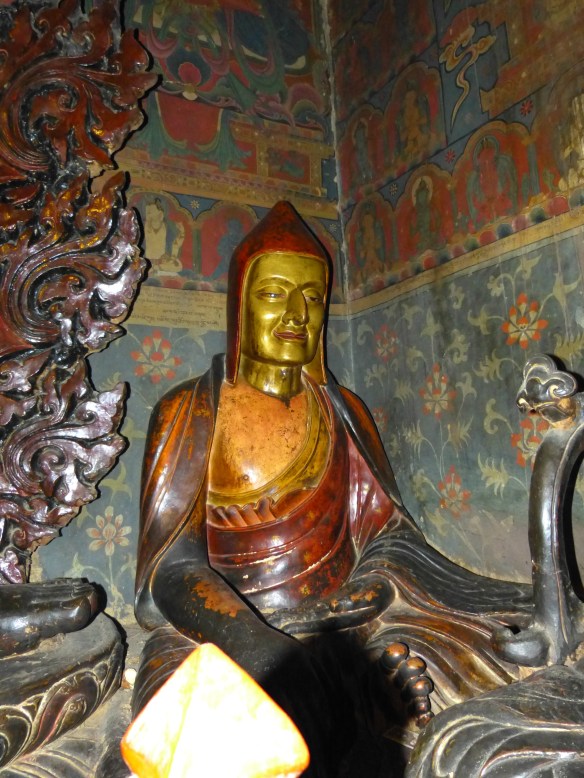
P1150757
The founder of the “red hats”. Red hat monks are allowed to marry. “Yellow hats” are not. The Dalai Lama is a “yellow hat”.

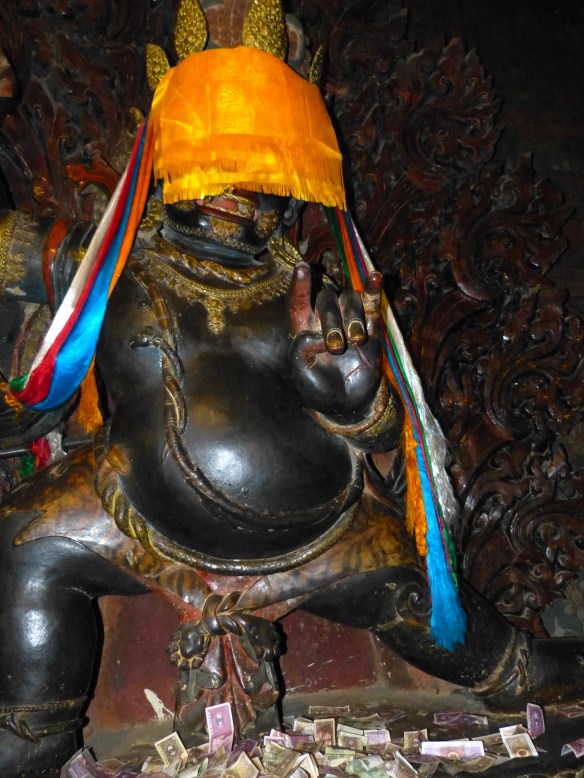
I asked why this statue's face was covered. Our guide said he can only be seen by those that complete a complex list of devotional activities.
I asked why this statue’s face was covered. Our guide explained only those that complete a complex list of devotional activities are allowed to view his face.

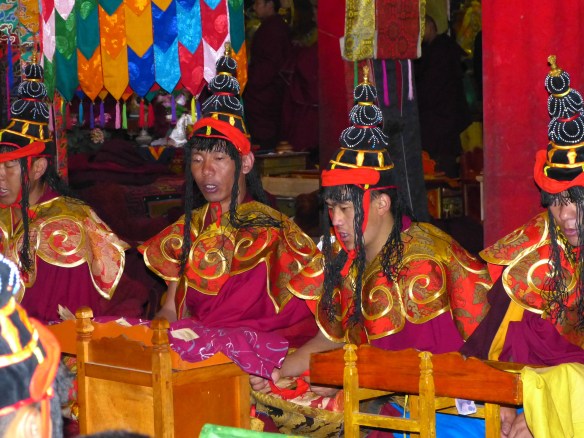
P1150727
I have no idea which color hat these monks belong to–it looks like they hedged their bets with yellow, red and black. Plus, their hats come with bangs and braids.

The other special feature of the Palcho monastery is the Kumbum Podang.  (Don’t you love the name?)  A Kumbum is a stupa that is also a  three-dimensional mandala. The first five floors of this structure are square and the remaining four are circular.

Unfortunately, this building was also being repaired so we were unable to go inside, but according to Wikipedia, it has 76 chapels and shrines and is also known as the Ten Thousand Buddha Pagodas.  Why?  Because it contains ten thousand images and murals of Buddhas.

P1150772

Gyantse is also notable because in 1904, the town and monastery were attacked by the British, led by Francis Younghusband.  The Tibetans were armed with outdated weapons, but they had been assured by their religious leaders that their victory was preordained.  In addition to their weapons,  they were protected by talismans that they thought would repel bullets.  They were mowed down, and the buildings were shelled.  

In 1959, the Chinese attacked the complex and it was also damaged during the cultural revolution.

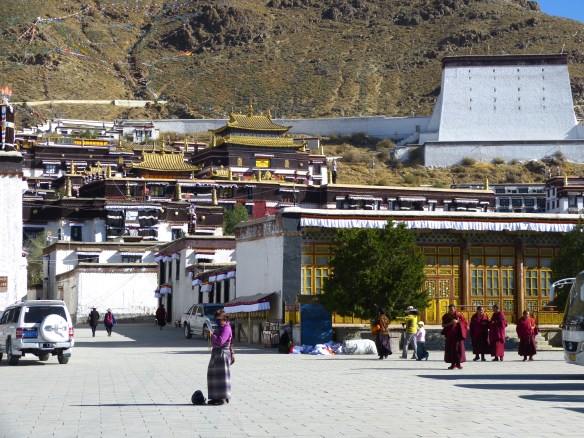
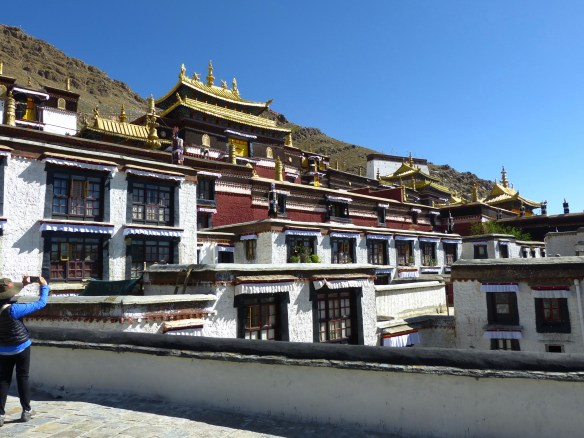
After one night in Gyantse, we traveled to Shigatse, Tibet’s second largest city and the location of the Tashilhunpo Monastery.  This monastery has been the home of the Pachen Lama, the great scholar, and is where most of the prior Pachen Lamas are entombed.

This photo was taken in Gyantse--no interior photos were allowed in Tashilhunpo.  The top photo is of the 10th Pachen Lama and the bottom is of the 11th as a child.

This photo was taken in Gyantse–no interior photos were allowed in Tashilhunpo.  The top photo is of the 10th Pachen Lama and the bottom is of the current (11th) as a child.

The 10th Pachen Lama was taken to China as a child to be educated.  Although he initially supported the Chinese incursion into Tibet, after returning home and seeing the impact on his country, he began to speak out.  This resulted in his being tortured and imprisoned in China for 16 years.  After his release, he married a Han woman, had a child and returned to Tibet.  He died suddenly in 1989, at the age of 51 shortly after giving a speech critical of the Chinese government.  His resting place is an amazingly beautiful tomb, with gold carvings and jewels, similar to that of Dalai Lamas in the Potala.

P1150836
The entrance to the tomb of the 10th Pachen Lama

There was considerable controversy over the selection of the 11th Pachen Lama.  The Dalai Lama’s choice disappeared after being named and the Pachen Lama chosen by the Chinese, now in his 20’s, is still being educated in China.

Entrance to the Tashilhunpo Monastery

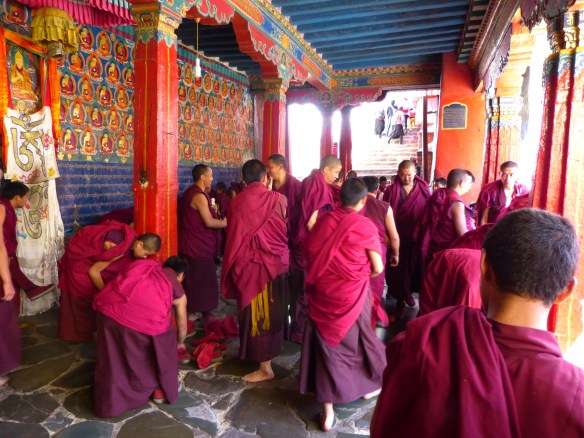
Inside the Monastery.  No photography allowed inside the buildings
Inside the Monastery. No photography allowed inside the buildings

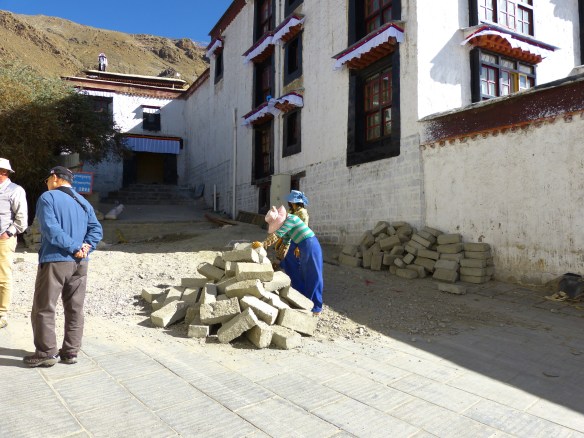
Look who is doing the manual labor

The Mandala surrounded by two deer is seen on most buildings

How can you tell which shoes belong to whom?

Apparently they are able to figure it out!

Because we were in Shigatse for two days, we were able to wander through the city on our own.  Marilynn, my energetic buddy, and I climbed to the Shigatse fort that overlooked the city.

Shigatse Fort overlooks the city.  As with many buildings in Tibet, it is being repaired, so no entry allowed.
Shigatse Fort overlooks the city. As with many buildings in Tibet, it is being repaired, so no entry allowed.

From the fort, you can get a good view of the city.  Not sure what that bike is doing on top of the building!
From the fort, you can get a good view of the city. Not sure what that bike is doing on top of the building!

He was as interested in us as we were in him.

For some reason, the ride back seemed far more pleasant than the ride to the two cities.  Perhaps it was because we traveled  back along the river or maybe it was because  we knew what to expect for toilet facilities?

Impromptu bathroom stop

P1150873
Scenery along the way back to Lhasa


After Shigatse, it was back to Lhasa for our return to our gorgeous hotel in Nepal, the Gokarna Forest Resort.  Great food, margaritas, beautiful surroundings, greeted by our wonderful Nepali guide Binoy– we were SO very glad to be back in Kathmandu!

P1140870


Three Days in Kathmandu

Kathmandu assaults your senses.  It is dusty, dirty, noisy, chaotic, crowded.  Take a deep breath and you will get a lungful of incense, enough to keep you coughing for a few minutes.

We toured the three major cities of the ancient Malla kingdom: Kathmandu, Patan and Bhaktapur.  (That’s what happened when you had three sons–you split up your kingdom so they could each have a place to rule. )

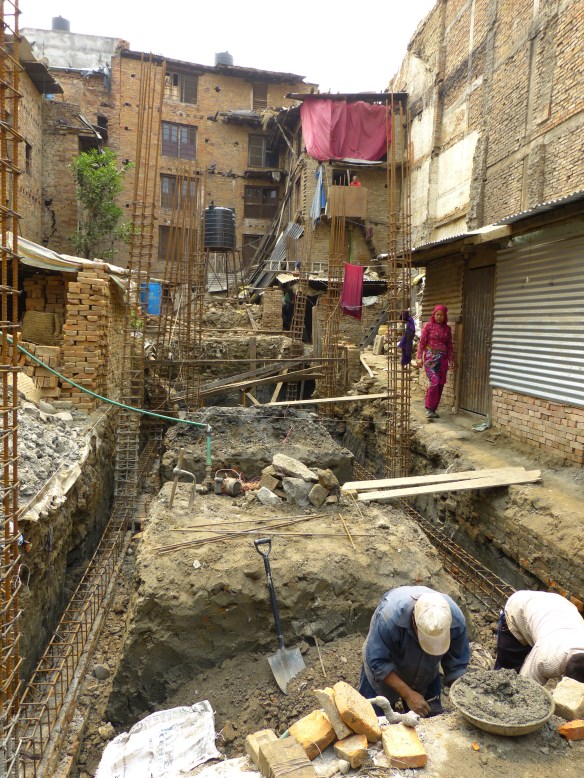
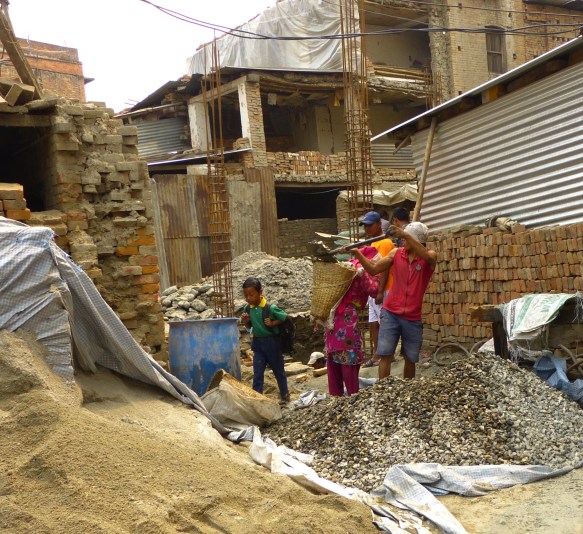
We saw the impact of the earthquake everywhere.  It is heartbreaking  to see that one year later, people are still living in makeshift shelters.

Home for a family
Home for a family

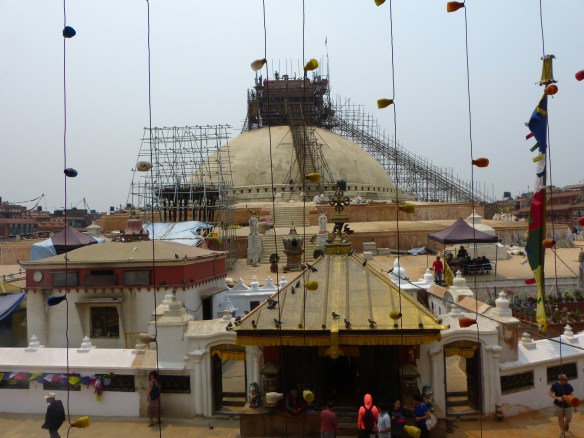
Boudhanath Stupa
Boudhanath Stupa

Timber supporting Kathmandu buildings

Bhaktapur
Bhaktapur

Rebuilding by hand
Rebuilding by hand

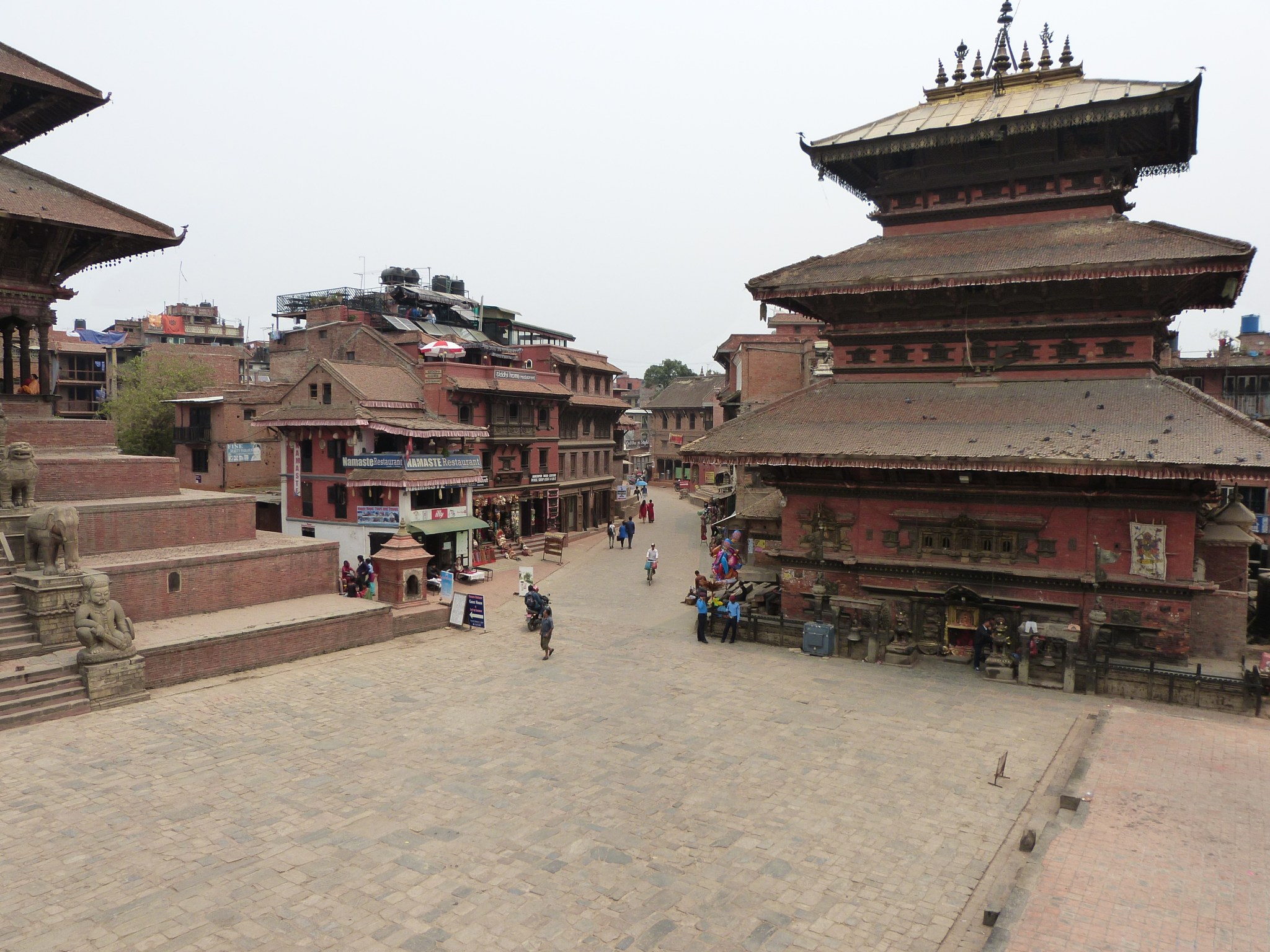
Still, there are parts of the cities that were not damaged, allowing you to experience their grandeur and the beauty.

image
Plaza in Bhaktapur as seen from the balcony of the New Cafe Nuatapola, where we had a delicious lunch

image
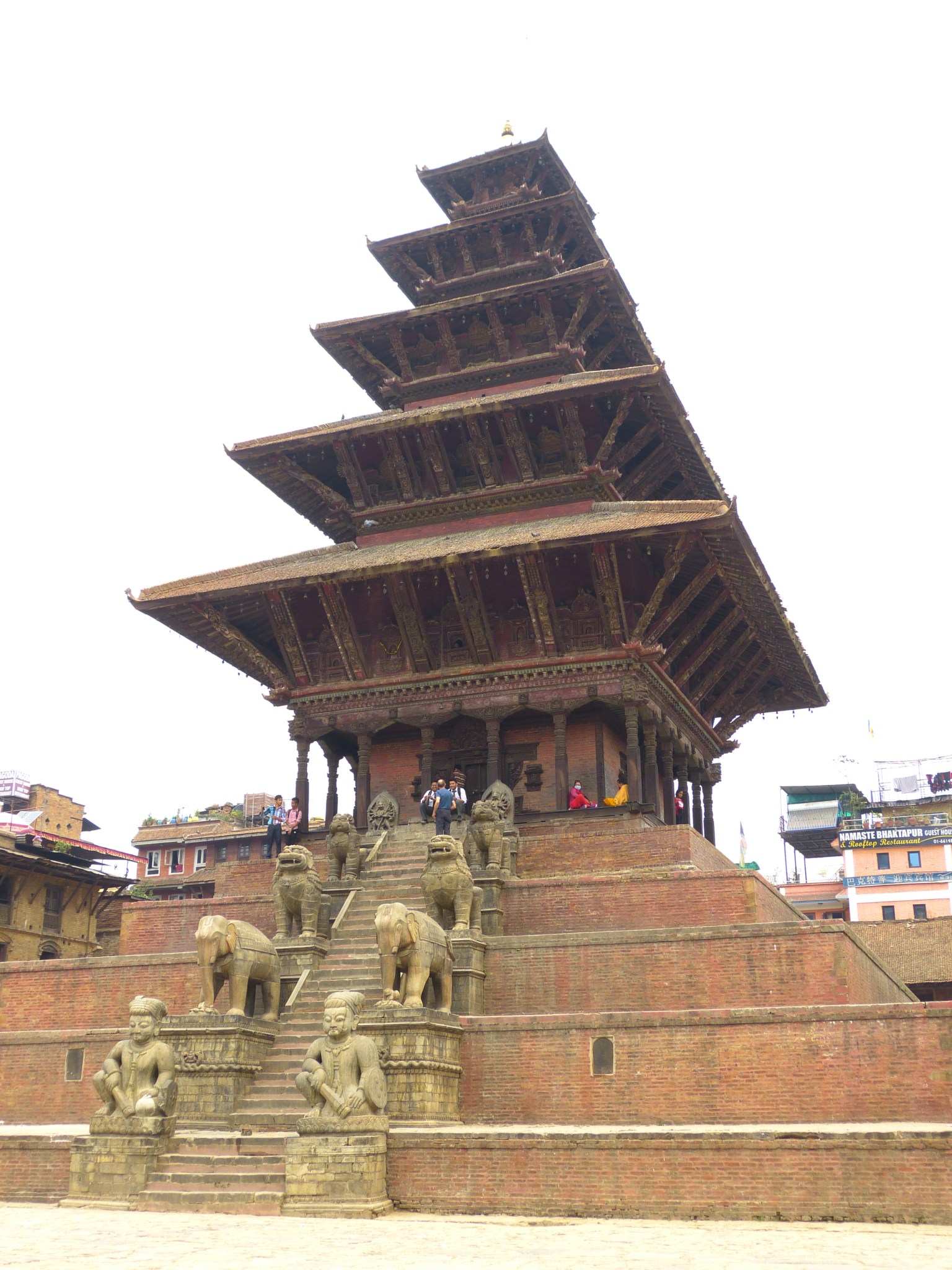
The Five Level Temple

The royal family's bathtub
The royal family’s bathtub

Complete with snake sculptures

While preparing for this trip, I read about the living goddesses, known as the Kumari.  (The post  “Follow the Yellow Brick Road, Part Two has more information about the goddess.)

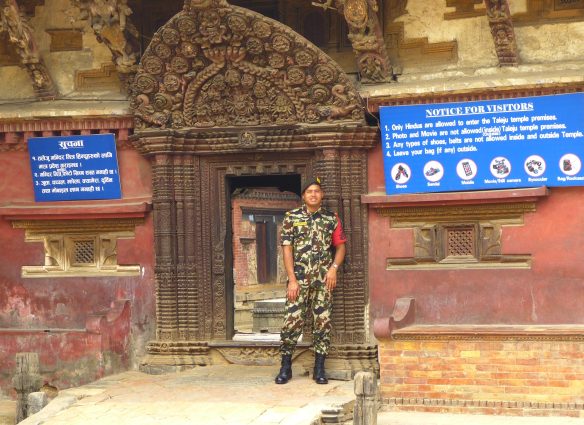
After our visit, all of the women in our group felt so sorry for this sad looking little girl, who was chosen when she was three years old.  I couldn’t help but compare her to my happy, active nieces.  Of course, we don’t know what other options were available to her.  Maybe sitting on a “throne” placing tikkas on the foreheads of gawkers was the better alternative.

The Kumari is not allowed to walk

Peter is receiving her blessing.

Despite the hardships they have endured, the Nepali people’s beautiful spirit shines through.

image

image

image

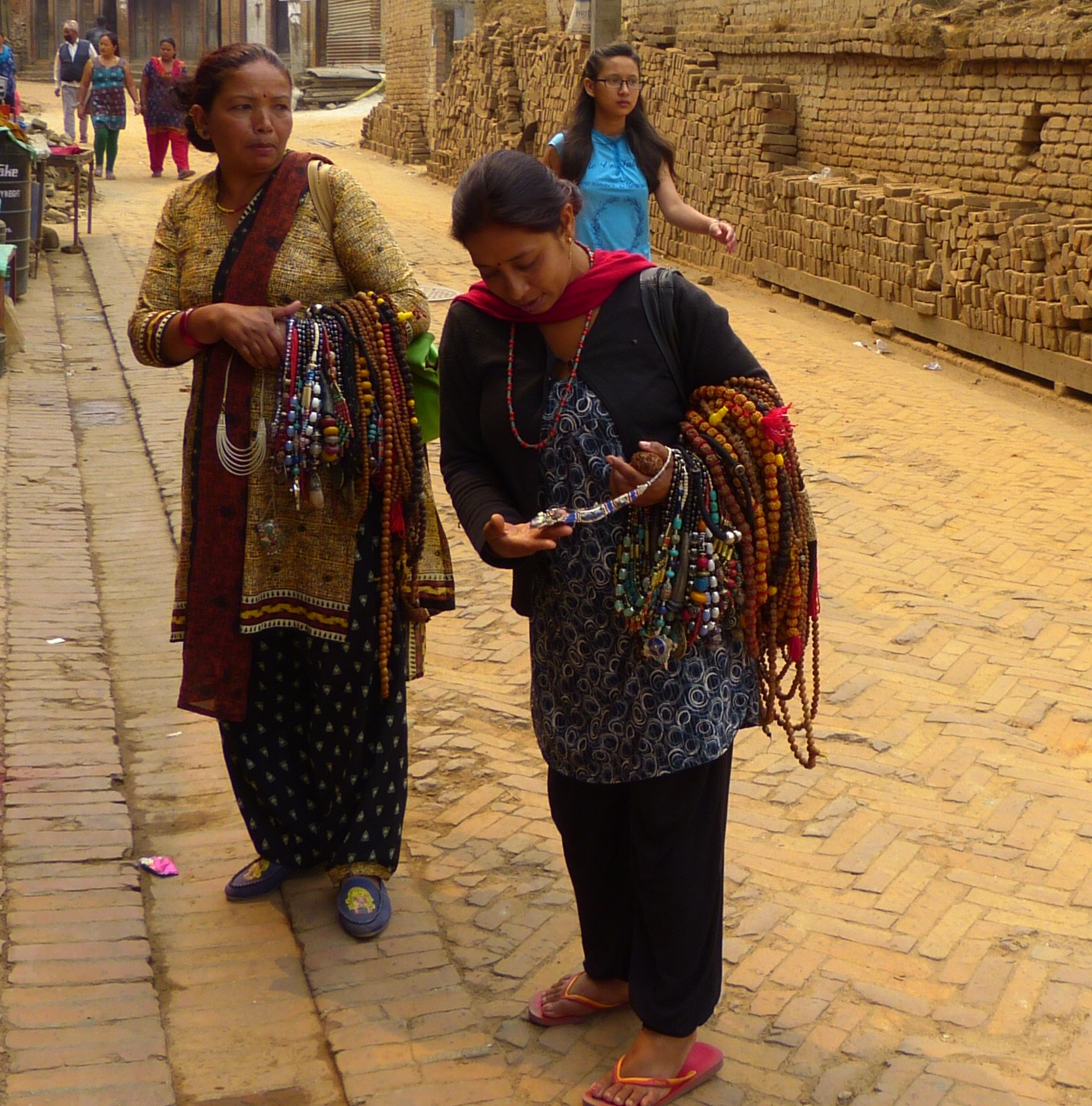
The hawkers are everywhere.  The problem is if you buy from one, you are mobbed by many others.  Still, I couldn’t resist this woman’s sweet  smile, especially after she told me if  I wanted to buy more than one, there would be no problem.

image

Okay, so I bought more than one.  Sisters, cousins, nieces, friends…you know the drill…gifts are coming your way, but you may have to earn them.  There may be a quiz!

This next one was more of a hard sell.  “Madam, blessings for you, blessings for me”, chanted continuously while she walked beside me for the equivalent of five city blocks.

imageOkay, so I got blessed.  I now own the necklace the lady on the right is holding.  I expect those blessings to be coming my way!
Follow The Yellow Brick Road- Part Two

You ready to climb aboard the bookmobile express for a trip to Nepal?

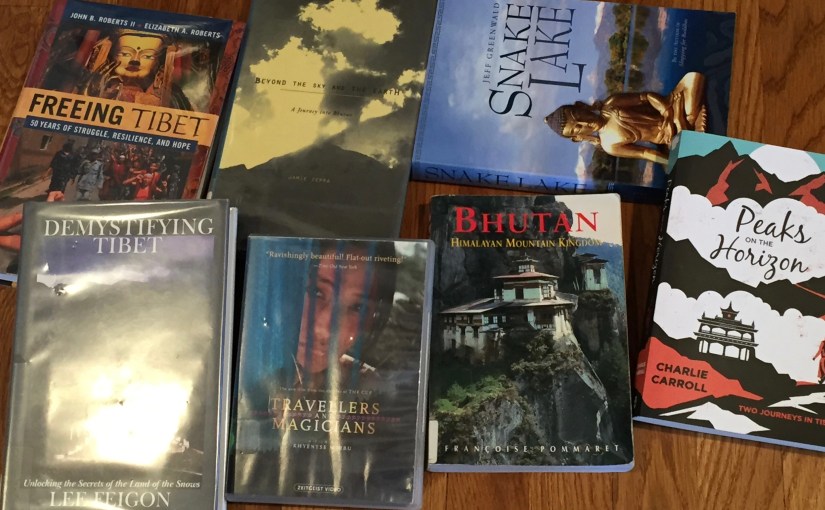
A few years ago, when Borders broke my heart by going belly up, I softened the blow just a tad by randomly grabbing books from the travel section, one of which was Snake Lake by Jeff Greenwald.  At that time, I had no idea the book was about Nepal. Not only that, but the thought of visiting Nepal never crossed my mind.  I didn’t even have the vaguest idea of where it was. As I mentioned in the last post, elementary school KILLED any interest in geography.  Good thing I’m a firm believer in lifelong learning!

Snake Lake is about Nepal’s political turmoil, starting with the student riots in 1979, thru India’s 1989 trade embargo, ending with the April 6, 2000 protest at Ratna Park.  It’s about more than just politics, though.  This very personal account has it all— romance, loss, and a spiritual journey that allows you to view Buddhism through Greenwald’s American eyes.

Two Australian writers, Amy Wilsee and Mark Whittaker, were fascinated by the 2001 murders and suicide of Nepal’s royal family.  Their quest for the back story leading to that gory night is documented in Life and Death in Kathmandu.  What I found most compelling, however, wasn’t the main event,  but two of their interviews:  one with a former Kumari (a living goddess- more on that later) and the other with a Maoist guerilla.  Initially, the Maoists were a group of committed idealists, focused on stopping the corruption and violence inflicted on villagers by the power structure.  Over time, as more joined the movement, the Maoists devolved into an unruly mob that inflicted as much violence and terror as they had initially fought against.

Although Jeff Rasley’s book  Bringing Progress to Paradise raises some interesting questions about the ethics of culture change and the impact first world intrusion into third world has on these remote villages, I don’t recommend the book.  Much of it chronicled his trek to the remote village of Basa and quite honestly, I thought he was a bit of a jerk to the friends that made the trek with him.

Little Princes by Conor Grennan, is a better choice if you want to learn how good intentions can sometimes lead to undesirable consequences.   After graduating from college, Conor decided to volunteer in an orphanage outside of Kathmandu.   Over time, he was surprised to discover that the children actually weren’t orphans at all.  

During the political turmoil, the Maoists had been entering the villages, abducting children and forcing them to fight.  When approached by a man who offered to bring their child to safety, families scraped together money, selling what little they had.  Unfortunately, the man who promised to care for their children was a trafficker who either sold them to be servants, or forced them to beg on the streets of Kathmandu.  The children were told that their families had all been killed.   Little Princes describes Conor’s efforts to return the children to their remote villages so they could be reunited with their families.  The book also made it clear that well-meaning tourists can inadvertently contribute to the problem by giving money and clothing to the child beggars.  Many times the children are forced to turn everything over to a trafficker, so the tourists are unwittingly contributing to child trafficking, making it profitable for the trafficker to continue.  Little Princes was a thought-provoking book that gets to the heart of the issue that many travelers to third world countries face–how to help without creating unintended negative consequences.  

So, what did I learn from my Nepali reading?  Well, I’ll share 10 of my discoveries now, again, not in any particular order–just random facts that caught my attention.  There’s much more, but  like my Bhutan post, I will save the rest for when we are on site.

  1. Nepalis believe the goddess Taleju takes up residence in a young girl (who then becomes known as a Kumari ), until the girl reaches puberty.  At that time, the goddess moves on to inhabit the body of another pre-pubescent girl.  What happens to the dethroned goddess, the young child, who had been taken from her family, placed in a palace, her feet not allowed to touch the ground, carried through the streets during festivals, decked out in red, with a third eye painted on her forehead?  Why she becomes mortal again, returns to her family and is expected to live a normal life, happily (?) ever after.
  2. What are the job specifications to become a goddess, you might ask?  Well, for starters, this 2 or 3 year old girl needs to have: a neck like a conch shell, a body like a banyan tree, eyelashes like a cow, thighs like a deer, a chest like a lion, a voice soft and clear as a duck’s…there’s more, but you get the idea.
  3. While in the Kathmandu area, we will be staying at the Gokarna Forest Resort.  Gokarna Forest used to be the hunting reserve for the Nepali royal family.  Not only that, but at the entrance to the Resort, there is a 200 year old pipal tree, where, in the very sappy movie, Little Buddha, under that very tree, Keanu Reeves was tempted by the demon Mara.
  4. Yes, I did indeed borrow the Little Buddha DVD from the library, and sat through the whole thing, including Keneau Reeves portrayal of Buddha, complete with his pre-enlightenment long, stringy hair.  What can I say?   It was a cold gray day.  I had nothing better to do.  The sad part?  I didn’t learn about the pipal tree until AFTER I had seen the movie, and trust me, I wasn’t going to go back to look for it.
  5. Swayanbhunath, also known as the Monkey Temple, is one of the oldest Buddhist sites in Nepal.  As you might guess, wild monkeys have inhabited the temple complex for many years.  And why not?  The food offerings that the pilgrims leave are mighty attractive.  Unfortunately,the temple was damaged by the 2015 earthquake, so I don’t know whether we will have the opportunity to visit it when we are in Kathmandu.
  6. Speaking of offerings at Swayvanbhunath  pilgrims always leave a portion for Hariti, the world’s grandmother and protector of children. Legend has it that Hariti originally was an ogress who lived during Buddha’s time.  To feed her 500 children,  she kidnapped other people’s children and turned them into dinner.  Buddha decided to teach her what it felt like to lose a child, so he kidnapped her youngest.  (With 500 kids, I wonder how she realized one was missing–but maybe that’s just me?) After Hariti learned her lesson about compassion, Buddha returned the child, then helped Hariti with her food problem by sharing with her the offerings from  his followers, the start of the practice that continues to this day.  
  7. Another Buddhist legend tells the story of the birth of Padmasambhava, who was also known also known as Guru Rinpoche.  Padmasambhava means “lotus born” because he emerged fully formed from a red lotus blossom that appeared in the center of a lake. The Lotus is the symbol of enlightenment.  Preview of coming attractions:  You will hear about Padmasambhava again when we get to Bhutan.
  8. The oldest Hindu Temple, Pashupatinath, fortunately was not damaged by the earthquake, so if we visit it, I’ll be sure to look for the magnificent sculpture of Nandi, the bull that Shiva rides.  Hindus come to this temple when they are ready to die, believing that dying on this sacred site guarantees that they will be reborn as a human.  Cremations take place on banks of the Bagmati River, which flows by the temple.
  9. The royal family’s palace is now open to the public.  It is a rather dismal abode, with lots of animal heads hanging from the walls.  (Most likely the animals they killed in their royal preserve at Gokarna Forest, which would seem to be a violation of Hindu–and Buddhist beliefs.)  Anyway, the palace sounds like a major disappointment–sorta like Graceland, not at all what you would imagine– which may be why it didn’t make it into our itinerary.
  10. Chez Caroline’s, a restaurant that was mentioned in one of the books I read (I can’t for the life of me remember which one), still exists.  According to the internet, the restaurant is in a “historic Rana Palace”.  I sure hope it isn’t the one with all the stuffed dead animals!  Who knows, maybe on one of “dinner on own” evenings, we’ll venture there.  If we do, I’ll be sure to report back.

Well, I warned you these were random facts that caught my fancy.

Our last and final stop along the yellow brick road will be Tibet.  Hope you come along!

Angkor Wat at Dawn

image
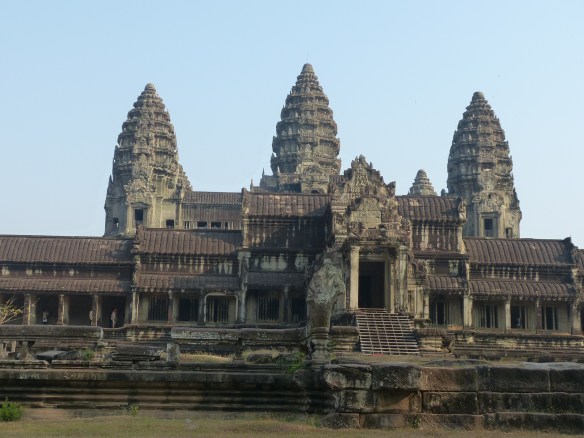
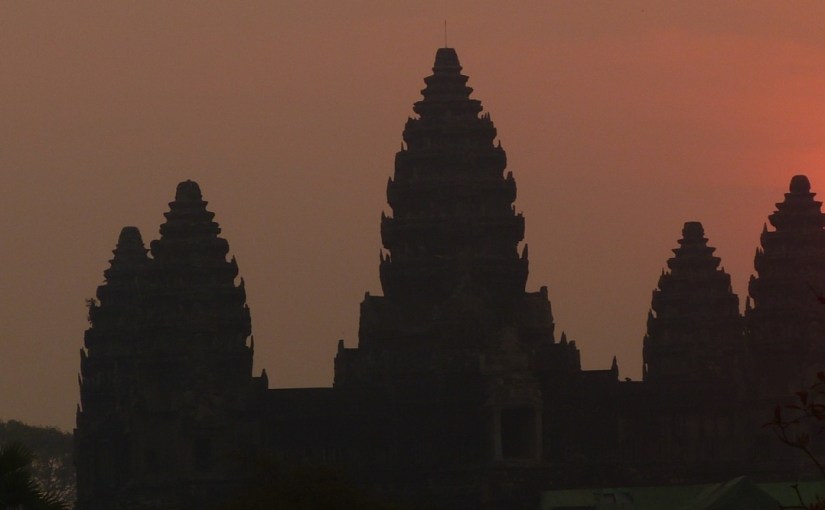
I don’t have enough adjectives to describe what it wa like to watch the sun rise over Angkor Wat. Although my photos don’t do it justice, they will give you a rough idea of the grandeur of this sacred spot. It was worth getting up at 4:30 in the morning to view this remnant of an amazing civilization!
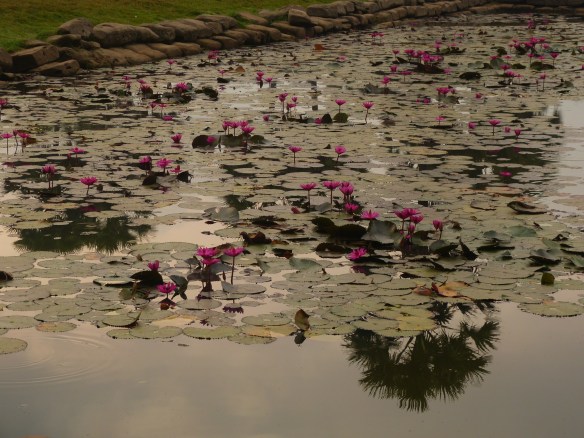
image The moat surrounding Angkor Wat represents the ocean you cross to enter heaven; it also serves as a wonderful mirror, heightening the beauty of the structure.
image
Although we did a lot more today, there are only photos of Angkor Wat because anything else would look puny by comparison.

The five towers were constructed to resemble closed Lotus buds. The central tower represents Mount Meru, the home of the gods.
image
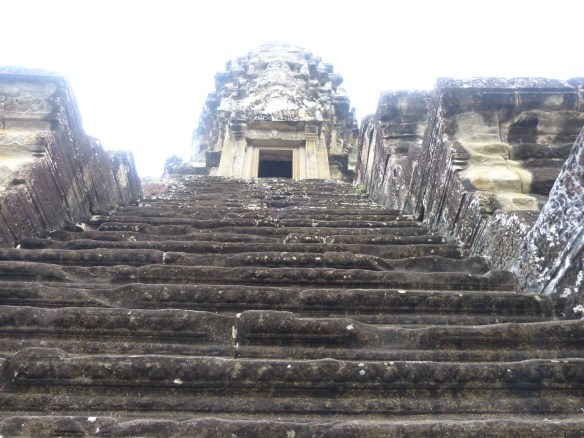
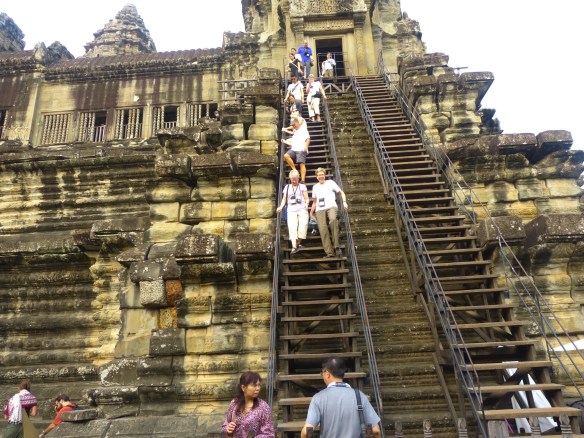
Only the king and monks were allowed on the third level of Angkor Wat and they were required to CRAWL up to show respect for the gods, so the stairs were suitably steep.
image
Although I don’t smoke cigarettes or eat products with hydrogenated oil, I HAVE been known to occasionally engage in risky behavior. Besides, I wanted to get in touch with my inner goddess, so of course I was climbing to the third level. The view was spectacular!
image
I think I might have even had a vision of the Buddha. image Or could it be that the altitude produced hallucinations?
What a relief that I didn’t have to crawl up. After a few people fell from the stone steps, this wooden staircase was constructed. Only 43 steps to the top, but like the original, they were quite steep.

Two of my Pennsylvania pals, strutting their stuff

Another view of the moat

Since this is a shorter post, why not have a little contest? This one is fairly easy.

1. During this trip we have visited two places that were settings for movies. What were the movies,
2. and where were the locations?
3. Of the 4 countries we are visiting, which are constitutional monarchies and which are people’s republics?
4. Whose picture is on the Bhat?
5. What is the difference between the Chinese Buddha and the Buddha in the other Southeast Asian countries?
6. What precious stone is the emerald Buddha made of?
7. Who taught her granddaughter to cross streets fearlessly?

What a way to learn!

Learning was never this much fun during my school years! Why couldn’t all of my lecturers be like those on Road Scholar trips? Or could it be that I have changed?

Our first two lecturers, Jim Lehman and Tony Zola, were both peace corp volunteers, who stayed in Southeast Asia. Jim was a Buddhist Monk for three months, because he didn’t want to be “unripe”, or as our guide Tippy says, “uncooked rice”. Those are the terms for Thai men that do not spend at least a little time as a monk. If you marry someone who is “uncooked” or “unripe” the Thais believe the marriage will not work out, so it was off to the temple for Jim, so that his Thai wife’s family would approve of the union.

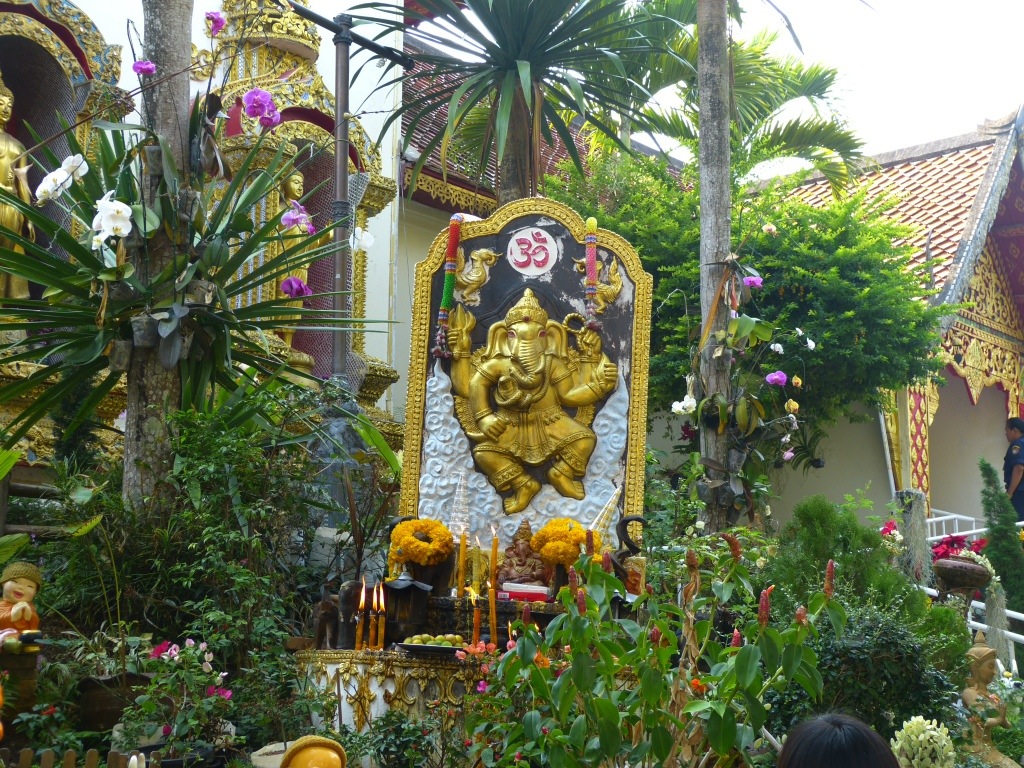
Jim explained that Theravada Buddhists don’t believe in god, however anyone visiting a Wat cant help but notice the Buddhists are deep into Hindu mythology.

Ganesha, son of Shiva and Parvati, at Wat Prathap Doi Suthep in Chiang Mai

In fact, they believe Buddha was the last incarnation of Vishnu. When I asked how Theravada Buddhists reconcile “no god” with their belief in Hindu gods, Jim gave me the answer he got from his Buddhist teacher. “When you have an arrow in your chest, you don’t ask how it got there.” In other words, Buddhism teaches us the way forward. It is not concerned with how we got to where we are. I, on the other hand, would DEFINITELY want to know who shot that damn arrow!

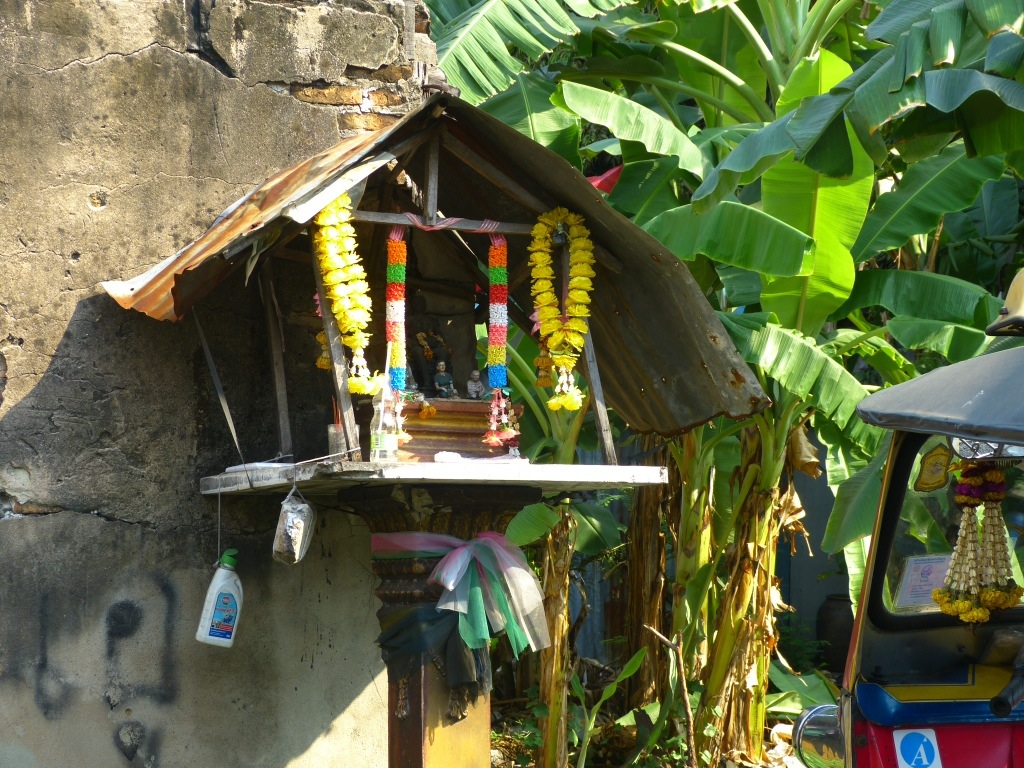
In addition to blending Hinduism with Buddhism, Thais throw animism into the mix. Spirit houses are everywhere, and have varying degrees of grandeur. We saw this one on our daily walk to the SkyTrain from the Loft Hotel. I think my dad might have one just like this in his back yard. (Right, Sue and San?)
20130210-080102.jpg

This fancier spirit house is far more typical.
20130211-212830.jpg

Our second lecturer, Tony Zola, talked about the socio-economic-political climate of the countries along the Mekong River, which flows from Tibet to the South China Sea. Sixty million people depend on it for food. They receive 80% of their protein from fish, so the “health” of the river directly impacts the health of the people.

Two of the countries we are visiting are constitutional monarchies (Thailand and Cambodia); Laos and Vietnam are People’s Republics. Per capita income ranges from a high of $8,700 in Thailand to $2,100 to $3,100 in the three other countries. One last demographic fact: half of the population of Southeast Asia is under the age of 25.

Tony didn’t just give us facts and figures; he also told us interesting stories. Thailand’s former Prime Minister received a degree in criminology from the USA. He had a creative way of solving Thailand’s rising drug problem. Somehow, the word got out to rival gangs that each was encroaching on the other’s turf. The resulting murders remain unsolved, which triggered a protest at the United Nations. Again, the Thais had a novel solution. The Thai ambassador’s wife utilized her staff’s cooking abilities to prepare delicious Thai food, which was set up on tables in of the demonstrators. It’s hard to be angry with a stomach full of Thai food. Problem solved…demonstration over. We can learn a lot from the Thais.

Did i mention that my posts are not necessarily in chronological order? Random…that’s the way my brain works. After Tony’s lecture, we headed off to the airport for our flight to Chiang Mai. And what an airport it is! Comfortable lounge open to all ticket holders,. With free wifi, drinks and food. No need to belong to a president’s club here.

At Wat Suan Dok, we had a “monk chat”, a discussion of Buddhism from a monk that was not just passing through, doing time so he could become “ripe”. He was a wonderful speaker, who explained that the goal of Buddhism is to be happy right here and now, to relieve suffering by learning detachment. To a Buddhist, the test of a religion should be whether it helps us to be able to live together peacefully. (I’m thinking there are a whole lot of religions that are scoring big red F’s on that particular test. After showing us how to wrap yourself in an orange robe (or as my cousin Kristy would say “rock his robe”)’ we received a crash course in meditation, and I left with an increased fondness for Buddhism.

Wat Suan Dok
Wat Suan Dok

Wat Prathap Doi Suthep is located about 40 minutes from Chiang Mai, atop a mountain. This wat is renown because the pagoda contains ashes of the Buddha.
20130211-210043.jpg

A couple more photos for your viewing pleasure.

Another Naga, a multithreaded snake

I love the animal statues!