Follow The Yellow Brick Road- Part Two

You ready to climb aboard the bookmobile express for a trip to Nepal?

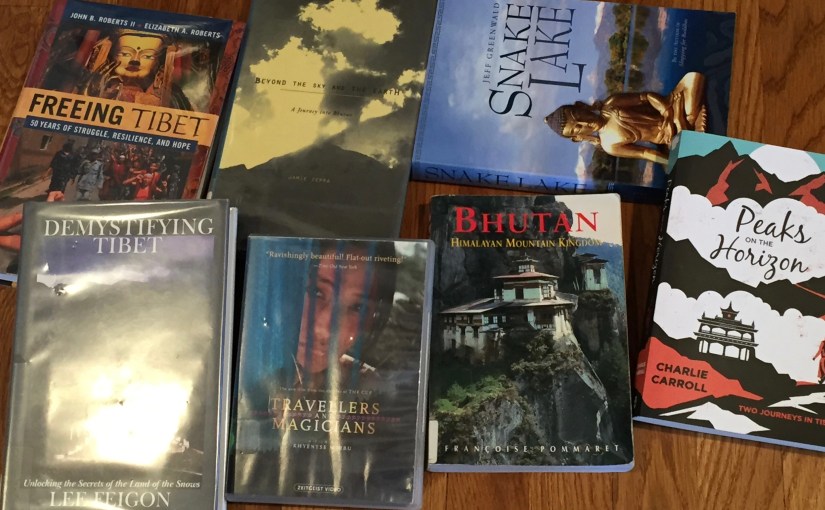
A few years ago, when Borders broke my heart by going belly up, I softened the blow just a tad by randomly grabbing books from the travel section, one of which was Snake Lake by Jeff Greenwald.  At that time, I had no idea the book was about Nepal. Not only that, but the thought of visiting Nepal never crossed my mind.  I didn’t even have the vaguest idea of where it was. As I mentioned in the last post, elementary school KILLED any interest in geography.  Good thing I’m a firm believer in lifelong learning!

Snake Lake is about Nepal’s political turmoil, starting with the student riots in 1979, thru India’s 1989 trade embargo, ending with the April 6, 2000 protest at Ratna Park.  It’s about more than just politics, though.  This very personal account has it all— romance, loss, and a spiritual journey that allows you to view Buddhism through Greenwald’s American eyes.

Two Australian writers, Amy Wilsee and Mark Whittaker, were fascinated by the 2001 murders and suicide of Nepal’s royal family.  Their quest for the back story leading to that gory night is documented in Life and Death in Kathmandu.  What I found most compelling, however, wasn’t the main event,  but two of their interviews:  one with a former Kumari (a living goddess- more on that later) and the other with a Maoist guerilla.  Initially, the Maoists were a group of committed idealists, focused on stopping the corruption and violence inflicted on villagers by the power structure.  Over time, as more joined the movement, the Maoists devolved into an unruly mob that inflicted as much violence and terror as they had initially fought against.

Although Jeff Rasley’s book  Bringing Progress to Paradise raises some interesting questions about the ethics of culture change and the impact first world intrusion into third world has on these remote villages, I don’t recommend the book.  Much of it chronicled his trek to the remote village of Basa and quite honestly, I thought he was a bit of a jerk to the friends that made the trek with him.

Little Princes by Conor Grennan, is a better choice if you want to learn how good intentions can sometimes lead to undesirable consequences.   After graduating from college, Conor decided to volunteer in an orphanage outside of Kathmandu.   Over time, he was surprised to discover that the children actually weren’t orphans at all.  

During the political turmoil, the Maoists had been entering the villages, abducting children and forcing them to fight.  When approached by a man who offered to bring their child to safety, families scraped together money, selling what little they had.  Unfortunately, the man who promised to care for their children was a trafficker who either sold them to be servants, or forced them to beg on the streets of Kathmandu.  The children were told that their families had all been killed.   Little Princes describes Conor’s efforts to return the children to their remote villages so they could be reunited with their families.  The book also made it clear that well-meaning tourists can inadvertently contribute to the problem by giving money and clothing to the child beggars.  Many times the children are forced to turn everything over to a trafficker, so the tourists are unwittingly contributing to child trafficking, making it profitable for the trafficker to continue.  Little Princes was a thought-provoking book that gets to the heart of the issue that many travelers to third world countries face–how to help without creating unintended negative consequences.  

So, what did I learn from my Nepali reading?  Well, I’ll share 10 of my discoveries now, again, not in any particular order–just random facts that caught my attention.  There’s much more, but  like my Bhutan post, I will save the rest for when we are on site.

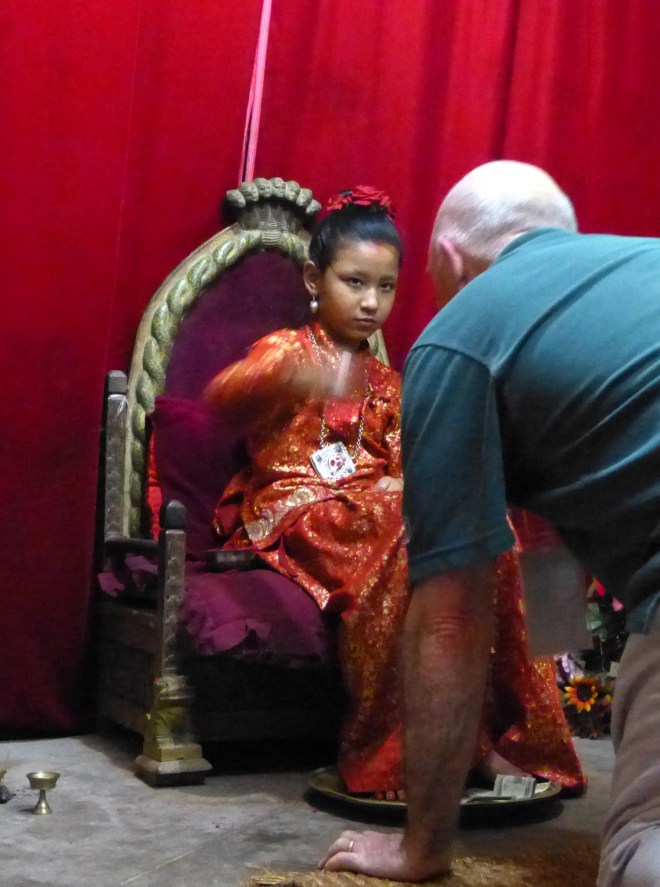
  1. Nepalis believe the goddess Taleju takes up residence in a young girl (who then becomes known as a Kumari ), until the girl reaches puberty.  At that time, the goddess moves on to inhabit the body of another pre-pubescent girl.  What happens to the dethroned goddess, the young child, who had been taken from her family, placed in a palace, her feet not allowed to touch the ground, carried through the streets during festivals, decked out in red, with a third eye painted on her forehead?  Why she becomes mortal again, returns to her family and is expected to live a normal life, happily (?) ever after.
  2. What are the job specifications to become a goddess, you might ask?  Well, for starters, this 2 or 3 year old girl needs to have: a neck like a conch shell, a body like a banyan tree, eyelashes like a cow, thighs like a deer, a chest like a lion, a voice soft and clear as a duck’s…there’s more, but you get the idea.
  3. While in the Kathmandu area, we will be staying at the Gokarna Forest Resort.  Gokarna Forest used to be the hunting reserve for the Nepali royal family.  Not only that, but at the entrance to the Resort, there is a 200 year old pipal tree, where, in the very sappy movie, Little Buddha, under that very tree, Keanu Reeves was tempted by the demon Mara.
  4. Yes, I did indeed borrow the Little Buddha DVD from the library, and sat through the whole thing, including Keneau Reeves portrayal of Buddha, complete with his pre-enlightenment long, stringy hair.  What can I say?   It was a cold gray day.  I had nothing better to do.  The sad part?  I didn’t learn about the pipal tree until AFTER I had seen the movie, and trust me, I wasn’t going to go back to look for it.
  5. Swayanbhunath, also known as the Monkey Temple, is one of the oldest Buddhist sites in Nepal.  As you might guess, wild monkeys have inhabited the temple complex for many years.  And why not?  The food offerings that the pilgrims leave are mighty attractive.  Unfortunately,the temple was damaged by the 2015 earthquake, so I don’t know whether we will have the opportunity to visit it when we are in Kathmandu.
  6. Speaking of offerings at Swayvanbhunath  pilgrims always leave a portion for Hariti, the world’s grandmother and protector of children. Legend has it that Hariti originally was an ogress who lived during Buddha’s time.  To feed her 500 children,  she kidnapped other people’s children and turned them into dinner.  Buddha decided to teach her what it felt like to lose a child, so he kidnapped her youngest.  (With 500 kids, I wonder how she realized one was missing–but maybe that’s just me?) After Hariti learned her lesson about compassion, Buddha returned the child, then helped Hariti with her food problem by sharing with her the offerings from  his followers, the start of the practice that continues to this day.  
  7. Another Buddhist legend tells the story of the birth of Padmasambhava, who was also known also known as Guru Rinpoche.  Padmasambhava means “lotus born” because he emerged fully formed from a red lotus blossom that appeared in the center of a lake. The Lotus is the symbol of enlightenment.  Preview of coming attractions:  You will hear about Padmasambhava again when we get to Bhutan.
  8. The oldest Hindu Temple, Pashupatinath, fortunately was not damaged by the earthquake, so if we visit it, I’ll be sure to look for the magnificent sculpture of Nandi, the bull that Shiva rides.  Hindus come to this temple when they are ready to die, believing that dying on this sacred site guarantees that they will be reborn as a human.  Cremations take place on banks of the Bagmati River, which flows by the temple.
  9. The royal family’s palace is now open to the public.  It is a rather dismal abode, with lots of animal heads hanging from the walls.  (Most likely the animals they killed in their royal preserve at Gokarna Forest, which would seem to be a violation of Hindu–and Buddhist beliefs.)  Anyway, the palace sounds like a major disappointment–sorta like Graceland, not at all what you would imagine– which may be why it didn’t make it into our itinerary.
  10. Chez Caroline’s, a restaurant that was mentioned in one of the books I read (I can’t for the life of me remember which one), still exists.  According to the internet, the restaurant is in a “historic Rana Palace”.  I sure hope it isn’t the one with all the stuffed dead animals!  Who knows, maybe on one of “dinner on own” evenings, we’ll venture there.  If we do, I’ll be sure to report back.

Well, I warned you these were random facts that caught my fancy.

Our last and final stop along the yellow brick road will be Tibet.  Hope you come along!

Follow The Yellow Brick Road, Part One

I’ve been traveling all my life.  I can’t remember whether my first trip was to Neverland or to Oz, but I DO know that I returned to both places countless times.

For many, many years all my travel took place solely between my ears.  Although school did its best to smother any interest in geography by forcing us to memorize products, capitals, and other bone crushingly boring trivia, I never lost my enthusiasm for the exotic places I discovered through our local library.  Books were my magic carpet, whisking me to wondrous places a small town girl like me never dreamed she’d ever be able to actually visit.

Maybe that’s why today, before I set foot in another country, I try to read as much as I can about its culture, religion, politics, history and yes, even geography.  I want to experience in it my head first.  It sounds crazy, even to me,  but a place seems more REAL if I have read about it.

Our next trip will be to the Himalayan countries of Bhutan, Nepal and Tibet.  Here’s a map courtesy of Overseas Adventure Travel, roughly showing where we will be easin’ on down the road. Notice the red line stops at the Seti River?  That’s where the rafting starts, because there ain’t no road to get where we are going, yellow brick or otherwise.

Overseas Adventure Travel Itinerary


So about those books I’ve been reading– lets start with Bhutan.

My interest in that country began several years ago when I stumbled across The Geography of Bliss by Eric Weiner.  It introduced me to Bhutan’s concept of Gross National Happiness.   Also around that time, we’d had the good fortune to meet and travel with Dr. Peter Steele.  In 1967, at a time when it was closed to most of the western world, he and his wife were invited to visit Bhutan by the royal family.  After reading his account of the trip, Two and Two Halves in Bhutan, I became even more interested in visiting that fascinating country.

OAT provides a list of “additional resources” for each country on the tour.  That list was my starting point, supplemented by what I could find on Overdrive, an online resource available through our library and of course, by random internet searches.

What follows is nothing even close to a book report, mainly I am somewhat lazy, but also because you will get better summaries by clicking on the blue words in this post.  The Amazon and Good Reads reviewers will do a much better job filling you in than I would have done.

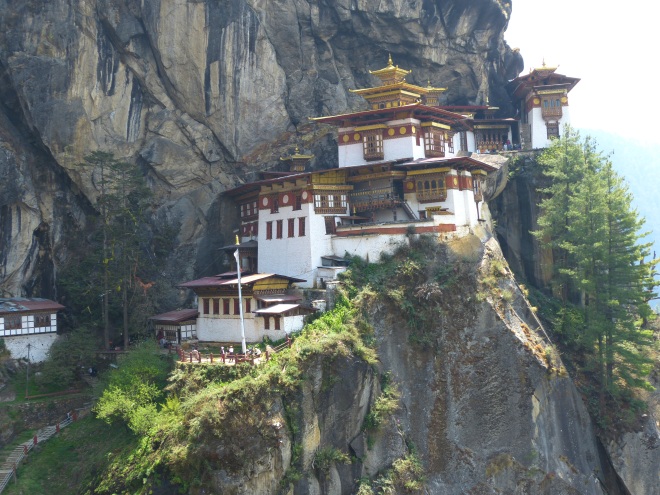
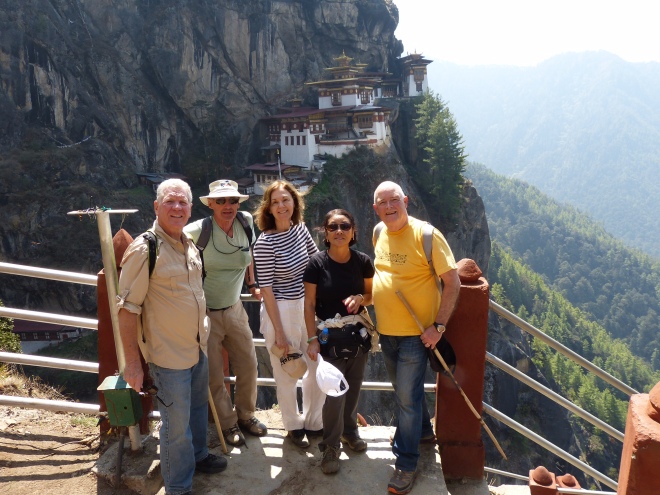
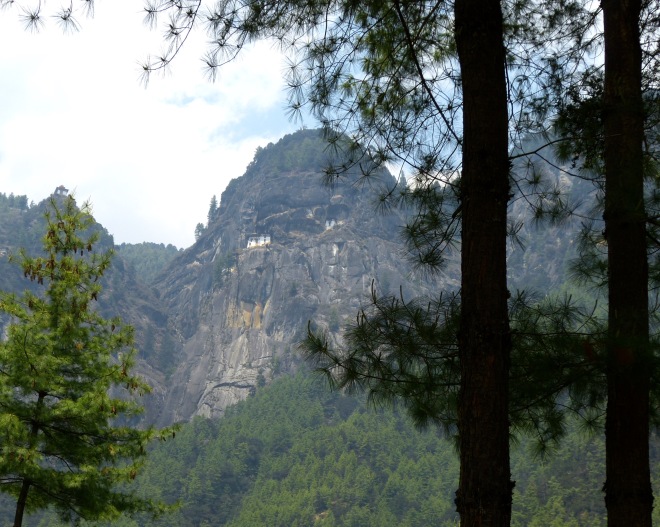
I had no idea that in addition to Peter Steele, Shirley Maclaine also visited Bhutan in the ’60s.  In her 1970 autobiography, Don’t Fall Off the Mountain,  she explains that she had gone to India to learn to meditate, and while there met the new Prime Minister, Lhendup Dorji.  He had assumed that position after the prior Prime Minister (his brother) was assassinated  by a member of the military.   She accepted Dorji’s invitation to visit Bhutan, but unfortunately there was still political unrest in the country, so her visit was cut short.  Still, she was there long enough to give me a feel for what Bhutan was like during that period.  Plus, she DID make it to the famous Tiger’s Nest Monastery in Paro.  And so will I.

Jamie Zeppa’s book, Beyond the Sky and Earth is a wonderful description of life in Bhutan during the late ’80s.  She spent two years as a teacher, first with elementary students in a remote village, then teaching college students at Sherubtse College near Trashigang. Yeah, I’d never heard of those places either.

Jamie married one of her students,Tshewang Dendup. Why did I feel compelled to tell you his name?  Well there is a reason.  In 2003,  he had a starring role in the lovely Bhutanese movie, Travellers and Magicians.  I got the DVD from my library; it’s a great way to  sneak a peek at the beautiful Bhutanese scenery (and to check out Jamie’s ex- husband, if you are so inclined.)

Lisa Napoli”s book, Radio Shangri-La  is about her volunteer work at Kuzoo FM, Bhutan’s “youth based” radio station.  Established in 2006 as one of the king’s projects, Kuzoo broadcasts in both Dzongkha and English.  Lisa’s several years with NPR made her a valuable resource for this young radio station.

Those 4 books gave me glimpses of Bhutan’s evolution from a closed Himalayan kingdom of the ’60s up to around 2009.  What did I learn from my reading?

Ten Fun Facts About Bhutan (Not in order of importance, or any other kind of order, for that matter)

  1. Bhutan is also known as Druk Yul, the Land of the Thunder Dragon
  2. Marijuana grows wild in Bhutan, and is fed to the pigs because (surprise, surprise) it increases their appetite.
  3. Ara is the local moonshine; its a clear wine made from rice. ( Now that we’ve gotten the local stimulants out of the way, let’s move on)
  4. All doctors visits and health care is free
  5. Drukpa Kinley, a Tibetan monk who lived in the late 1400’s,  made his way to Bhutan.  He was also known as the Divine Madman who used his “flaming thunderbolt” to bless women and to bestow “enlightenment”.   He was so successful in his endeavors, he became the patron saint of fertility.
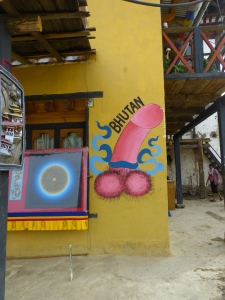
  6. Thanks to the Divine Madman, many Bhutanese houses sport paintings and sculptures of phalluses.  Who knows, photos of the artwork may be a coming attraction of this blog.
  7. Jigme Singye Wangchuck, the 4th king of Bhutan, voluntarily gave up absolute power in 1998.  (When does THAT ever happen??)  He guided the nation from a hereditary monarchy (which had been established in 1907) to its current status as a parliamentary democracy.
  8. Okay, so now the”People Magazine” type information: The 4th king had 4 wives, all of them sisters.
  9. His son, the 5th king, Jigme Khesar Namgyel Wangchuck, was crowned in November of 2008.  That king has only ONE wife, who he met at a picnic when he was 17 and she was 7.  According to legend, he said  ‘When you grow up, if I am not married and if you are not married, I would like you to be my wife, provided we still feel the same.’
  10. Men wear the Gho, and women wear the Kira; these two articles comprise Bhutan’s national dress.  Jamie’s book mentions that all Bhutanese were required to wear the national dress.  This dress code was an issue for the Nepalese immigrants living in the southern part of the country.  I don’t know whether the requirement still exists today, but it will be pretty apparent once we get there whether it does or not.

I actually learned a whole lot more, but I have to save SOMETHING for when we get there, right?

Next stop on our book tour – Nepal.


Getting All Charged Up!

IO Magic, from Staples

Wouldn’t it be nice if every country in the world had identical electrical outlets, so us wanderers could plug in anywhere, without any problem?  I can dream, can’t I?

Up until now, we have always carried a bunch of different adapters.  Although this worked, we were always afraid of losing one, or leaving the exact one we needed at home.

Recently, I came across this little beauty.  It’s compact, lightweight, and claims to work in over 150 countries.

The little green tab slides down to release one of the four plug options, which the manufacturer claims correspond to what the  World Standards has designated as A, B, C and D   type plugs.

USB slots , with the C adapter extended.
USB slots, with the C adapter extended.

I’m not so sure about that–the pictures on the website look different from the plugs in my gadget, but I guess I’ll find out.  What I like best is the addition of  two USB ports.  This allows me to charge an iPhone, an iPad and my camera battery–all at the same time, using just one outlet.

Because one of the included plugs is designed for use for the USA, I decided to take it for a spin while still at home, and yay, it worked beautifully.  All three items charged quickly.

I got mine at Staples, because I had a coupon, (I do so love a bargain!) but you can also buy direct from the manufacturer via the internet.  Either way, it will cost about $30.

By the way, this is NOT a converter, so if your appliances can’t accept a variety of voltages you will need a converter along with your adapter.  My iPhone and iPad so far have worked quite happily in the US (120 volts) and everywhere else I’ve plugged in, like Slovenia and Zimbabwe (220), South Africa and Italy (230).  I have no idea what that all means–I just know if the volts don’t get along, you end up with a fried appliance–and I have the hair dryer to prove it!

The Skies May Be Friendly, But United Sure Isn’t!

Our 40th Anniversary trip starts with a multi-day adventure, known as “getting there”.

For the first leg of the trip, OAT’s proposed itinerary included a stop in Dubai, landing in Delhi after being in transit for 18 hours.  Not what I call ideal, particularly when I saw our return flight would depart at 4 AM.

Letting my fingers flutter over my keyboard, I was thrilled to discover that United has a direct flight between Newark and Delhi for about the same price, but only (!?!) 14 hours travel time.  Best of all, the return flight departed at 11:30 PM.  So, instead of sitting miserably at the airport, waiting to board that 4 AM flight, we’d leave the night before, and would be several hours into winging our way home.  Sweet!  Not only that, but for years, I had been hoarding frequent flier miles for an occasion exactly like this.  Business class, here we come!

EXCEPT

When I tried to upgrade on line, I got a message that we were put on a “waiting list”.  How could that be? The flight was five months out, and our flight’s seat maps showed only one seat in business class was occupied.  Clearly not a lot of OTHER frequent fliers had already upgraded on OUR flight.  I thought it was strange that the same seat was occupied, coming and going, so I did a little checking.  Seat 5D  was the only one occupied on every flight that I checked.  Perhaps reserved for a member of the crew?   Well, I was confident that a quick call to United’s customer service would fix everything right up.  Did I mention that I’m a hopeless optimist?

Here’s what happened.  The customer service rep confirmed that we were indeed put on a waiting list.  Okay.  When I asked how many others were on the list, he explained he couldn’t tell me for “security” reasons.  (Security??? I didn’t want to know names or home phone numbers.  Just tell me where I am in line so I can figure the odds of getting the bloody upgrade!)  He also was going to charge me $20 for the pleasure of speaking with him, but after we exchanged “pleasantries”, he thought better of it.

Those frequent flier miles that we accumulate, expecting one day to trade in to make a long trip both pleasant AND affordable?  Well, it appears that United reserves the right to let us know at the very last minute whether or not they are going to allow us to redeem the miles, perhaps because they MIGHT be able to sell the seat we covet for the full price. They just don’t know yet.   By the way, in addition to redeeming 140,000 miles, our roundtrip upgrades weren’t free.  We paid an additional $2,400 for them.  To me, that’s a whole LOT of money!  

United took our money and deducted the miles from our account, which sure felt like we had purchased seats, EXCEPT we couldn’t choose which ones they would be.  We will find out the day of the flight whether or not we get the upgrade, and where we will sit.  There is no guarantee that we will even be next to each other.  Normally that would not be a big deal, but 14 hours is a long time.  Call us crazy, but given the price we paid (in dollars and miles) we’d like to be able to choose who we sleep with.  If we don’t get the upgrade,  United WILL refund our money and will redeposit our frequent flier miles, without charging a penalty.  (Yes, the representative actually did say that.)  If we had paid for the tickets with a United credit card, would they also refund any interest?  I think we all know the answer to that one.

As luck would have it, at the end of December, I received an email “signed” by Sandra Pineau-Boddison, the Sr. Vice President of Customer Relations, asking for feedback on a United flight we’d just taken.  Now that I had a name, it wasn’t difficult to find her personal email, so I shared my tale of woe with her.  How about that?  FREE feedback from a long time former Continental Airlines frequent flier.  No need to hire a market research company or do a focus group to find out how they are doing.

So what happened?  Nothing.  After almost two months.  Not even an automated acknowledgement.  From the SR. Vice President?  Of Customer Relations?  That speaks volumes.

Let this serve as a precautionary tale to all you Mileage Plus Members out there.  United doesn’t care a bit about you or your miles or your loyalty.  Think about that the next time you book a flight or get a solicitation for a United credit card that offers points for “free” travel.

But if anything changes between now and our flight, I’ll certainly let everyone know.  Come on Sandra, do your job!


Four Visas, Three Countries

We will be visiting three countries–Bhutan, Nepal and Tibet.  So why do we need FOUR visas?  Fair warning–this post will likely only interest those that are taking a similar trip, or are planning to visit India.

For the three of you that are still reading, here goes.

We fly into and out of Delhi, so since we have at least one overnight stay in India, we need a visa.  A visa that costs (depending on the service used) anywhere from $135 to $173, per person.  A visa that requires you to complete an on-line application that is challenging to decipher.  But there IS a positive aspect.  The visa is good for 10 years.  So, should we decide to spend more than an overnight in India, it will be best to do so before 2026.

If you are anything like me, you are probably wondering how to score the $135 charge.  Well, Cox and Kings is India’s approved visa grantor, so you get the best price if you opt to go direct to them.

Our travel company, OAT, sent out a package with very helpful, clear instructions.  Good thing, because there are lots of hoops you need to jump through for that India online application.

OAT recommends PVS, a visa processing company located in DC, probably because you can send your passport to one service and they take care of visas for both India and Nepal, which is not the case with Cox and Kings.  PVS is convenient, yes, but as with everything, you pay for that convenience.  If we had used PVS, we would have paid a total of $566 for both visas, including mailing charges.

Instead, our total cost was $362, a savings of $204.  How did I pull that off?  In addition to using Cox and Kings, I dealt directly with the Nepali Embassy.

I happened to be traveling to NYC to meet a friend for lunch and a show, so I figured, what the heck, I’ll just go in a little earlier and stop by the embassy.  Located at 216 East 49th St, it is only open between 9:30 and 1:30 during the week.   Right between these two restaurants,
IMG_2241
you’ll find this sign on the side of the building:
IMG_2240 (1)You have to press the button on the side of the wall to get buzzed in.  I walked up to their tiny office on the 4th floor, but there IS an elevator.  The visas cost $40 per person versus $90 for PVS, so that represented half of our $200 in savings.

One thing that is important to know if you decide to go–they ONLY take money orders.  No cash, no personal check, no credit or debit cards.  Of course, I had everything that they didn’t take, but all was not lost because there is a place that sells money orders on the next block.  I have no idea what a money order costs, because my bank had a branch on the same block, so my money order was free.   If I had been smart, I would have found this website  before I left home.  It EXPLAINS the money order requirement and tells you what is needed to submit by express mail or courier–good news for those of you that have no intention of traveling to NYC.

It took 30 minutes for processing to be completed.  Passports and visas clutched in one hand, my other raised to hail a taxi, I was off for the Cox and King office 23 blocks away.

I thought I might be able to drop off my package (to be mailed to my home when processing was completed) and still be on time for lunch.  I was delusional.  It was a total waste of time and cab fare.  The smart thing would have been just to express mail the damn thing in the first place and be done with it.  Which is what I ultimately did.  Less than 2 weeks later, our passports arrived.

Two down, two to go.

Bhutan and Tibet both require that you send them a color copy of the first two pages of your passport in advance of trip. (OAT , bless them, is handling this part).  The actual visas are provided when you arrive, but only if you have 2 color passport type photos (2 for each country, 4 in total),  ANOTHER copy of our passport pages (for Tibet) and approximately $70 for Bhutan and $190 for Tibet, per person, in cash.  Cash means pristine bills–no wrinkles, tears or marks.  OAT recommends we bring more, because these fees are subject to change without notice.  See why we use a travel company when we venture to more non-traditional locales?  Knowing me, I  would have missed one or more of the requirements.

So, what did I learn from this adventure?  If you have enough time to submit directly to the embassy and Cox and Kings by express mail (or Fedex or UPS–whatever) you can save a bundle.  You just need to send for one, wait for the passports to be returned, then send to the other.   If, however, money is no object (that’s definitely not ME), and you prize convenience, or are short on time, then a service, like PVS is the way to go.

Next post will be about something other than this future trip.  I promise!


Celebrating the Big Four Oh

No, not my 40th birthday.  That happened a LONG time ago, and quite honestly, I have no recollection of how we marked that milestone.

THIS big event is our 40th wedding anniversary, and yes, that photo is indeed 40 years old.  This year, our anniversary happens to be on Memorial Day, same as the day we eloped.  Of course, true to form, our way of celebrating doesn’t coincide with the actual DATE, but that’s just the way we roll.

We have never been big party people, partly because so many of those near and dear to us are geographically scattered.  Years ago, we stopped giving gifts, instead opting to collect memories rather than objects.  Okay, so that’s the build-up.  You ready for the “reveal”?

To mark our 4 decades together, we decided to travel to Bhutan, Nepal and Tibet with Overseas Adventure Travel (OAT). Yes, I know Nepal had a devastating earthquake last May, with a full complement of aftershocks.  For a country that depends on the tourist trade, we decided a way to support the Nepali was to visit their country, then share what we see and experience.  We hope blog and Facebook posts might encourage others to do likewise.  Or at least prepare those that come after us for what lies ahead.

I recognize that given the infrastructure of these three countries, I probably won’t be posting while traveling.  That will have to wait till our return, but in the meantime, I’ll share what we have learned during the preparation stage, and believe me, there is a lot to learn.

I have been checking out air options, collecting visas, figuring out what to pack that will get us through a month away, with temperatures ranging from a high of over 100 in Chitwan National Park to lows of 19 in Lhasa, and everything in between, while also staying within the prescribed weight limits.  I’ve also been busy reading everything I can get my hands on about the three countries.

So, fair warning.  If you aren’t interested in that little corner of the world, subsequent posts are going to be bone crushingly boring to you.

For those that are considering traveling with OAT, this is my way to pay it forward.  I have benefitted greatly from the kind people who have taken the time to post information on the OAT forum, and want to do likewise.

More to follow!


The Final Ingredient for a Happy Retirement

Okay, so far, we’ve talked about sufficient financial resources, good health and strong personal relationships as being three essential ingredients for a happy retirement.  What’s left?

Drum roll, please…

According to  Viktor Frankl, the key is finding meaning in life.   Some lucky individuals find meaning in their work, and are able to make a living following their bliss.  They aren’t interested in retiring.  And why should they?  How great is it to get paid for doing what you enjoy?  They will continue to “work” for as long as they are able. But this post isn’t about them.  It’s about the rest of us, primarily motivated by the bimonthly love notes that appeared in our bank account via direct deposit, for whom retirement is a welcome change from the 40 to 60 hours we spent toiling away.

If “finding meaning in life” sounds a bit too lofty, how about this?  Let’s call the fourth critical ingredient  “oomph” or “pizzazz” or whatever term you bestow on that special something that makes you want to jump out of bed in the morning.

Some embark on a second career, working fewer hours, but because they are doing what they thoroughly enjoy, it doesn’t FEEL like work.  When he retired, my husband started making violins.  Although he has sold a couple, and given away even more, the end product is not the point.  A researcher who loves learning and sharing knowledge with like minded individuals, he’s focused on decoding Stradivari’s secrets and reproducing the sound and appearance of a master violin.

As for ME, my favorite things happen to dovetail nicely with ingredients 2 and 3.  I’m now doing all of the things that I wanted to do during my work life, but rarely had enough time for:  Exercise, book clubs, social events, travel, spending time with my family, Global Volunteer projects (The photo atop this post is from my time in the Cook Islands.  Who could resist those beautiful children?), cooking — the list goes on and on.

My guess is that we all have different “oomph” factors.  What’s important is to start thinking about what your special something is LONG before your last day at work.  How you plan to structure your days during this wonderful stage of life’s journey is almost as important as financial planning.  In fact, the two are directly linked.  If you have expensive habits and desires, then you’d best be building a BIG nest egg.  If you are a minimalist, however, then you don’t need as much.

So, there you have it.  Simple to say, harder to execute–but SO worth the effort.  Happy trails to all you current and future retirees.

Please feel free to share what is working for YOU!


“All You Need Is Love” The Beatles

“Love is all you need”.   Turns out, those four British boys were definitely on to something.

This blog post is about that THIRD essential ingredient for a happy retirement — strong personal relationships.  Nothing new or revolutionary about that.  Erich Fromm’s book, “The Art of Loving” published more than 50 years ago, informed us that the key to a happy life is love and work.  (We’ll address the “work” part in the next post)

Fast forward to 2016.  Robert Waldinger’s excellent Ted Talk describes findings from a 75 year Harvard study on adult development.  Guess what?  Researchers discovered the most important factor in determining whether someone is happy is not fame or wealth, but the quality of their relationships.  Not only were people with strong, positive relationships happier, but they were healthier–both physically and mentally.

During the 30+ years I was in the workforce, I was lucky enough to have jobs that paid me for establishing positive relationships with other people.  (Which, of course, is very different from being paid to have relations with other people.  Not that I’m judging…)  So, when I retired, I was not only saying goodbye to my co-workers, but also to customers that, in most cases, had become friends. Unfortunately, most of them are long distance friends.  And are still working.

Although I still think of my husband as my “boyfriend”, I don’t expect him to fill all of my companionship needs.   Perhaps part of the reason we are still going strong after 4 decades together is we both understand our mutual need for other interests and for time apart. Our relationship is very much like a Venn Diagram–my interests – his interests, with a nice big intersection of OUR interests.  Surprisingly, I have encountered people that find this a bit strange.  So, when I read this  Wall Street Journal article shortly after retiring, I was pleased to find that there are others out there like us.  Why I find it gratifying to discover that we aren’t so different is probably a subject for a therapist, or at least a future post.  But I digress.   Which happens a lot.  

Anyway, I have spent the last four years figuring out how to exchange “work mates” for “play mates”, and I’m happy to share what I learned with you, my newly retired, soon to be retired, or hoping to one day be retired readers.

Here’s what’s been working for me:

  1. Meet-Ups This on-line application allows you to select by  geographic area and areas of interest.  After you make your selections, you get notifications of gatherings of like minded individuals.  You can get even more specific, narrowing it down by age or marital status.  I’ve made friends via book club, biking, and boomer dining meet-ups–and there are lots of other options.  Plus, if you are so inclined, you can start your own meet up group.
  2. The Local Y   It is indeed fun to go to the YMCA!  But don’t just  hang out on the treadmill.  Join classes, and attend regularly.  And don’t worry about being out of shape.  There are no mean girls here!  The women (and most of the class attendees ARE women) are friendly, welcoming and caring.  In many ways, the Y “family” has been a wonderful substitute for my workplace “family”.
  3. Volunteer I’ve made some incredible friends during my Global Volunteer Projects. See the world, make new friends, learn about another culture!  Check out that wonderful organization!
    If you prefer something local, AARP offers an on-line application designed to link retirees with nearby organizations in need of their skills, and aligned with their interests.
  4. The Local Library  Mine offers an array of programs, including book clubs and educational seminars.
  5. Welcome Wagon  Yes, I know, this is supposed to be for newcomers.  BUT the local contact can be a great resource for area clubs and gatherings.  It took me 32 years before I stumbled across our Neighbors and Newcomers Club, but I’m so glad I did!
  6. Reconnections  Maybe you have been too busy to stay in contact with friends from high school or college.  Why not reach out?  I attended my first college reunion five years ago, and am looking forward to the next one this spring.  It was a wonderful trip down memory lane, an opportunity to reconnect with old friends and a chance to make new ones.  Ditto for high school.
  7. Travel  Okay, so this probably isn’t going to help you with day to day connections, but we met some fantastic, fascinating people on our trips with Road Scholar, OAT, and Grand Circle.  In 2016, our new Zealand friends will be visiting us and we will be taking a trip with friends we met in Peru and on a Global Volunteer experience.
  8. Virtual Buddies I put this one last, because a computer relationship is no substitute for face to face, hand to hand connections.  Still, email, facebook and blogging can be wonderful ways to complement your other relationships.  I loved having pen pals back in the dark ages when I was a child.  My Blog Buddies to me are the 21st century version of pen pals. The best part, however, was when I met a blog buddy when we both happened to be in San Francisco, visiting our kids.  With luck, she and I will be able to synchronize travel again.

What about YOU?  What has helped YOU make the social transition from workto retirement?

“Get On Your Feet” Gloria Estefan

No, this post isn’t about Gloria Estefan’s Broadway musical, although that may be a future post, if I make my way into NYC to see it.  Nope, this  is about that second essential ingredient for a happy retirement:  Good Health.

Yes, we all SAY we want good health, but what do we DO?  We overeat, and what we are stuffing into our mouths is usually the worst possible choice.  We smoke (well, I never did, but I am related to people that still do.  Yeesh.)  We act like The Cat in the Hat children.  “All we could do was sit, sit, sit, sit”.  We keep on electing NRA sponsored candidates that refuse to do anything about crazy people owning weapons of mass destruction, also known as assault weapons.  (Whoops, got carried away by current events–that too belongs in a different, possibly future, post.)

Yes, it helps to be born with the right genes, but research continues to uncover the very strong link between lifestyle and good health, which is something that we “lifestyle managers” believe and preach enthusiastically to anyone that will listen.

About those genes: If our parents’ lifespans are any indication, there is a strong probability that Mike and I have inherited “longevity genes”.  His made it into their ’90s.  Mine are close to that milestone.  But what about the quality of those later years?   I’ve seen first-hand what lack of exercise can do to a person–both mentally and physically, and it isn’t pretty.

So, why wait for the calendar to flip to do something wonderful for yourself?   Who says resolutions can only be made on New Year’s?

Full disclosure.  I hate the thought of exercising.  During my college years, I cut more of the required gym classes than I attended.  Lucky for me the gym teacher sucked at taking attendance.  So, when even an external requirement couldn’t get me into the gym in my younger days, how do I now get my sagging butt out the door?  Major psych up.  I tell myself I’m doing my part to keep Medicare costs down.  (You’re welcome, Gen X,  Y, and Millenniums).  I remind myself of the places that I want to visit and the things I want to do once I get there.  (Bhutan, Nepal and Tibet in the spring.  Yeah baby).   I look at what the total absence of exercise has done to my mother, and realize that I wouldn’t want my one child to have the responsibilities for care that are currently being shared by me and my siblings.

During my work years, I had a community of co-workers and a structured week.  By joining the YMCA, I discovered the retirement equivalent of both.  The variety of classes offered provides structure, and the friendly and welcoming  attendees (mostly women) have become part of my community.

Notice I didn’t mention six pack abs in my reasons for exercising.  Truth be told, if those three words appeared in a sentence about me, it would be this one.   “Check out her abs–looks like she drank a whole six pack in one sitting”.  No,  at my age, exercise isn’t about looking better.  It’s about staying the same.  And that’s a great goal for someone who will be 70 in 4 years!

How about you?  Wanna join me?  I’m off to zumba right after I push the publish button.


Mix These Four Essential Ingredients to Cook Up a Happy Retirement

Recently I attended a colleague’s retirement party.  It was the first time I had seen many  co-workers since I left the workforce four years ago.  I was surprised that so many of them were surprised by how happy and relaxed I appeared.  Several asked me what “my secret” is.  I didn’t have an answer then, because I hadn’t given the matter much thought.  But given my current abundance of free time,  I’ve been able to ponder the subject deeply and have come to the conclusion that the “secret” isn’t so secret at all.  It all boils down to four really simple ingredients.  I hope you are enjoying the cooking analogy–after years of “on my radar, teeing things up, drilling down, hitting the ground running, and pushing the envelope”, I figured it’s time for a change.

You ready?  The essential ingredients for a happy retirement are:

  • Strong personal relationships
  • Adequate financial resources
  • Good health
  • Oomph

I told you it was simple, but hey,  Tom Jefferson got a lot of mileage out of stating ‘self evident’  truths, so let’s see how it will work for me.  Besides, ‘knowing’ and ‘doing’ are two very different things.  I think we all know that family and health are important, but how do we behave?   I certainly was guilty of letting the work day spill over into family and friend time.  I skipped exercising and ate far too many fast, easy (and less nutritious) meals.  So, today’s post will start with the ingredient that has a tendency to crowd out the others:

Adequate Financial Resources
Isn’t that the reason we put in all those hours–to ensure that we have “adequate financial resources”?   Over time, I learned that the most important word in that phrase is “adequate”.

Although I benefited greatly from working for insurance companies that regularly flooded me with information about financial planning, saving, & pensions, what was probably most helpful was a wonderful book by Joe Dominguez and Vicki Robin, “Your Money or Your Life”.   This easy to read book helps you become aware of the trade offs that you unknowingly make by overspending. My favorite quote:

Rich only exists in comparison to others, but financial independence means that you have enough and then some.

Without trying hard, I’ll bet we can easily think of someone that has greater financial resources than 95% of the world’s population, but they always seem to want more.  They haven’t quite grasped the concept of enough.

Two of my closest friends have traveled all over the world on very little money.  For example, they managed to spend a month in Greece and two weeks in Ireland on what they had saved from two years of Peace Corp salary!  They know what is important to them, and their spending reflects what they value.

When I was growing up, my dad  used to tell me  “Your wants are many, but your needs are few”.  He was so right.

So, for all you young ‘uns out there, before you slap down your credit card, you might want to take a minute to think about to how you are allocating your dollars and your “life’s energy”, as Dominguez and Robin put it.

How did we get those resources?
I’ll admit it–we have been lucky.  We haven’t had any major illnesses or financial catastrophes.  And, although we both were impacted by mergers and acquisitions, we were able to find other employment relatively easily.

We also decided to give Lady Luck a helping hand.  As our incomes rose, we didn’t increase our spending.  Instead we opted to increase our contributions to our no-load mutual funds.  We didn’t run up credit card debt, only charging what we could pay off by the time the bill arrived.  We saved so that we could pay cash for our cars, maintained them and kept them well past their first decade.  Instead of a monthly car payment, we made those “payments” to ourselves, so we weren’t paying interest, we were earning it.  And guess what?  We never felt deprived.

It all goes back to knowing what is important to you, and making sure that your behavior aligns with your objectives.  Simple in concept, sometimes challenging to do.  But SO very worth it!

Next post–Good Health!