Tesla’s Maiden “Voyage”

I’ve already confessed in prior posts that I am not a “car person”.  I’m not an engineer, or scientist or mathematician either.  So, my observations about my first long distance drive will seem really basic to those who ARE any of the things that I am not.  If any of the aforementioned happen to stumble upon this blog, PLEASE feel free to comment.  I would be enormously grateful for your insights, corrections and helpful hints.

The Driving Experience
From my 1,450 miles of driving during my 5 months of ownership, I already knew my Tesla was pretty damn amazing, well before I set off on my first long distance journey.   What I DIDN’T know was how incredibly relaxing a trip can be even when you’re the driver.  Want to take your hands off the wheel to get a cold drink, or rummage through your cooler?  No problem.  Self drive has it under control.  Are you usually tense when you are in stop and go traffic?  That’s a thing of the past, because the car stops and goes with traffic, allowing you, the driver to enjoy your surroundings, eat, change up your music – whatever you want.

When I missed the turn off for the Tappan Zee (now Mario Cuomo Bridge, but old habits are hard to shake) I was forced to drive over the GW Bridge.  What would normally be harrowing was just a long and least favorite experience.  I didn’t have to worry about being hemmed in on all sides by trucks.  The Tesla kept me safely in the middle of my lane.  

About being in the middle of the lane, I have learned I normally drive much closer to the right side of the road, so as I was learning the ins and outs of self drive, I freaked out when the Tesla pulled me to the left.  I was afraid it wasn’t going to self correct in time.  I’m glad that I practiced using the self driving feature on the winding, hilly country roads in my area so I could gain confidence in its safety.  

Trip Planning
When I used the Tesla trip planning app, it assumed that I would be starting on the trip at the current charge level. I had never charged to 100% before (the physicists know why, but WE don’t need to get into the technical details here) so the app led me to believe that I wouldn’t be able to make the 260 mile trip without stopping to recharge.  Wrong.  If I chose to do so, I discovered I could have easily made it the entire way, with at least 20% battery to spare.  

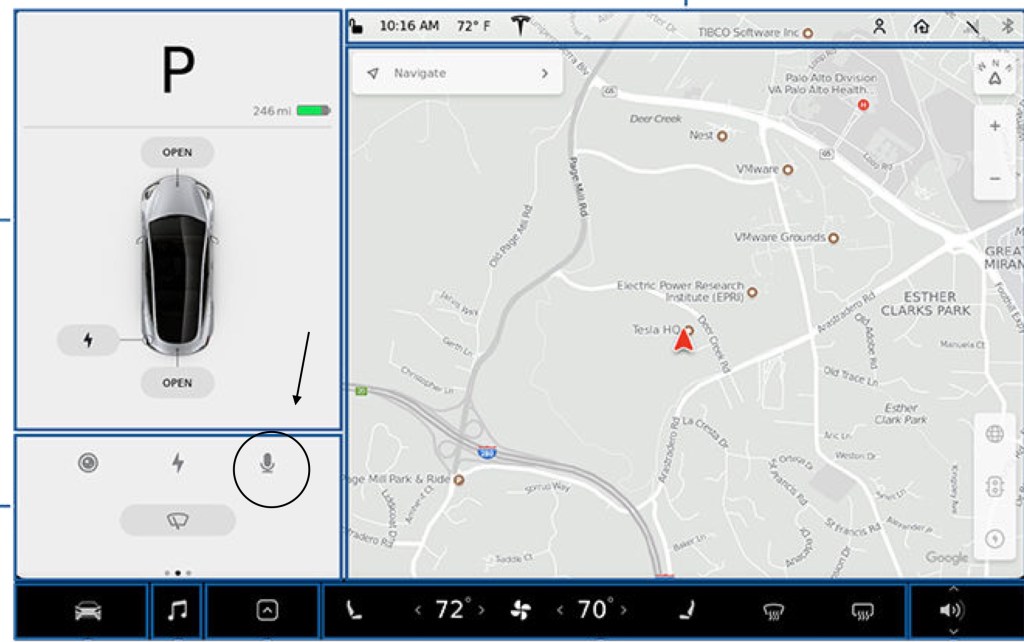
The Tesla navigation app recommends charging stops along your route. Take a look at the information the app provides for each charging station:

The app is designed to minimize charging times, so for the return, the trip planner suggested just one stop of 15 minutes. (I started my return with less than a full charge). Here’s the thing.  If you let the car sit after charging is completed, you get a 5 minute grace period.  If you linger longer,  as shown in the photo, you are charged $1 a minute idling fees.  That’s one way to make sure that the charging stations are available to everyone who needs them.  But, if you plan on stopping to have lunch and a bathroom break, you may WANT a longer charge time.  

Sad to say, I discovered the battery has a much longer range than my kidneys.  MY need to stop occurred WAY before I needed to charge.  Here’s another thing: for a reason that is obvious to the physicists and engineers, (but a mystery to me) a battery charges faster when it is closer to empty than when it is closer to full, so that’s something else to factor when planning your stops. So many things to consider.  I’m proud to reveal that I did somewhat better on the return trip mastering the car/body connection. One unanticipated snag was the charging station in Madison was “temporarily out of service”, disrupting my plan to charge while visiting with a friend. Fortunately, I knew that BEFORE I headed back, so was able to reconfigure my stops.  All these “discoveries” will make my next trip stops so much easier to plan.  

The “other’ charging stations
None of my family members have an outdoor outlet, so I couldn’t charge overnight using a regular household current. The closest chargers were two EvGo stations offering both slow and fast chargers. I had planned to use the fast CHAdeMO option but instead I experienced rude awakening #1: the adapter that came with the car didn’t fit. I would have needed to purchase the correct adapter for $450 from the Tesla store. I also discovered that the charging speed of even the FAST (CHAdeMO) connection was significantly less than what I would experience at a supercharger. (DEFINITELY not worth spending $450!) Next came rude awakening #2: I couldn’t get the included J1172 adapter to fit on the nozzle of the slower option. I was afraid of damaging one (or both) so I gave up and decided this would be something I would try once I got home (and had my trusty husband by my side). Luckily, there WAS a Tesla Supercharger about 15 minutes away, so that’s the one I used. The whole point of this stream of consciousness rambling is that home charging is essential for electric vehicle owners AND you need to give some thought to charging stops BEFORE you head off. It isn’t QUITE as easy and convenient as stopping for gas. At least not yet. So, no cross country trips in the Tesla will be in our near future.  I’d rather plan our stops around where we want to be, rather than where we have to charge.  

Supercharger options

Energy Consumption
The discoveries keep coming. Here’s another. When you let the car drive itself, energy consumption improves. At least it did for me. Here’s how I could tell. The energy app shows average consumption over three different ranges. 300 watt hours per mile is the expected average, but the thick solid line in the graph below shows the expected average when the terrain (and possibly external temperature?) is taken into consideration. The dotted line shows my actual results for the past 30 miles. If it is below the solid line, I’m doing better than expected. (This is one example where being “above average” ISN’T a good thing). Notice the little green triangle? That’s when the battery was recharging itself. If I continued to drive the way I had for the past 30 miles,  I would have sufficient energy to go another 157 miles. What’s puzzling is when you add the averages (actual and projected) you come up with 390 miles, which is far greater than the EPA range of 322.
This, by the way, was not my graph from the actual trip. Self driving widened the gap between the solid and dotted lines in a very positive way.

Everything Else
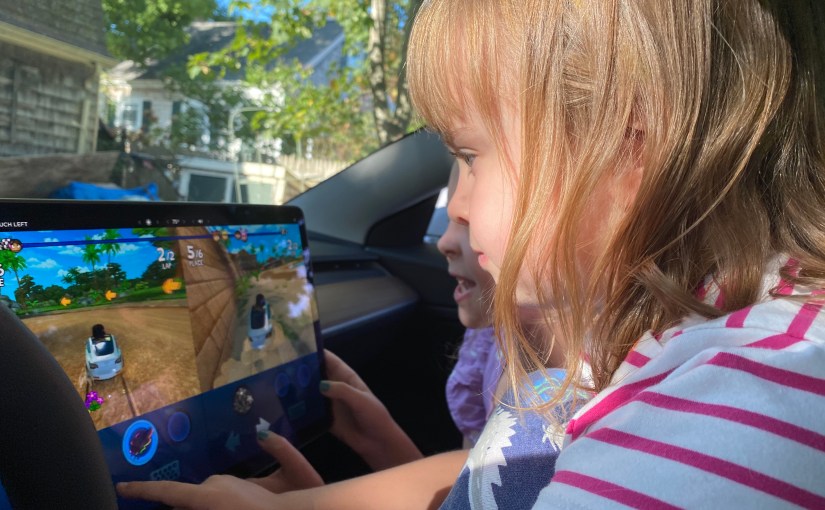
My 6 and 7 year old grand nieces proclaimed me their “coolest aunt” strictly on the basis of my car ownership. The ability of the car to fart upon command was definitely a huge hit, as was its ability to go from 0 to 60 in 4 seconds. They dubbed the fast acceleration “the rocket” and requested that I do “the rocket” again and again.

One final observation.  Having self drive and navigation, however does NOT eliminate the “back seat” driver, even when he (and so far it has ALWAYS been a “he”) sits in front.

Love ya, dad, but one driver per car is sufficient


My Tesla’s First Long Distance Road Trip

I had no idea when I picked up my “long distance” Tesla Model 3, on March 6, 2020, that it would be 5 months before I found out how far I could drive without stopping to recharge. In the 22 weeks that I have owned my hot wheels, I’ve driven less than 1,500 miles, which averages out to less than 10 miles a day. Our longest excursion, so far, has been our drive to the Delaware River, which is about 70 miles round trip.  Yes, I lead an exciting life.  

But all that is about to change. Shortly, my Tesla and I will be embarking on our very first long distance drive. Let me stop you before you conjure up a coast to coast road trip. In the age of covid, I define long distance as any drive that requires recharging somewhere other than our garage. My first trip will be to visit family in Massachusetts. That was the main reason for purchasing the long distance Tesla– my frequent family visits.  

Foolishly, I thought a range of 322 miles meant that I could drive the 260 mile trip on one charge.  Nope, the 322 miles is the EPA estimate, and like all the EPA estimates you see stuck on new car windows, it doesn’t consider speed, hills, weather, use of air conditioning, etc.  Knowing my  tendency to press the pedal to the metal, even starting fully charged,  I would expect a 260 mile trip to require a stop.  

First let me confess that prior to purchase, I was very concerned about the availability of charging stations. That fear was put to rest when my friend Laura gave me a tutorial from the front seat of her Tesla Model S.  She showed me that all you need to do is type in your destination on your display, and the computer not only maps out the route, but it also tells you where to stop to recharge, how LONG you will need to stop at the station, and how much of a charge will remain once you reach your destination. You want to see what the display looks like?  Check out the header photo of this post, which maps a route from home to the Fairhaven Library, assuming a starting charge of 80%. (WordPress just “improved” its software, so in the off chance that you can’t see the heading, here it is again.)

As of March, 2020, Tesla had 25,000 charging stations in the USA. Only Tesla owners are able to use these stations, which generally are located along major highways, and in places where you would want to stop, with bathrooms, food and/or shopping. But Tesla owners are not restricted to just these superchargers. The Tesla comes equipped with an adapter ( CHAdeMO –no I have NO idea what that means — just think of it as a piece of equipment named Chad) which allows you to connect at OTHER public charging stations that use”Chad” for hooking up.

Because there are a couple of EvGo stations  that are located more conveniently than the Tesla Supercharger, in the area I’ll be visiting, I signed up for an EvGo account. I found the EvGo website VERY user friendly and informative, especially for a non-engineer like me.   After reading its tutorial, I finally understood the three different levels of charging–which was formerly a mystery to me. 

EvGo offers two plans: a monthly membership, or a pay as you go option. You also can choose between “super fast” or  “faster than plugging into a standard wall outlet” chargers.  Obviously, the faster one is more expensive.  These numbers are approximate, calculated from the estimates on the EvGo page: $.30 per minute or $18 per hour for 180 miles of charge ($.10 per mile) versus $1.50 per hour for 20 miles of charge (or $.075 per mile).  Because no one in my family has a charging station (or a garage), I expect to be using that EvGo charging station at least once while in Massachusetts and will describe the experience in my usual painstaking detail.    

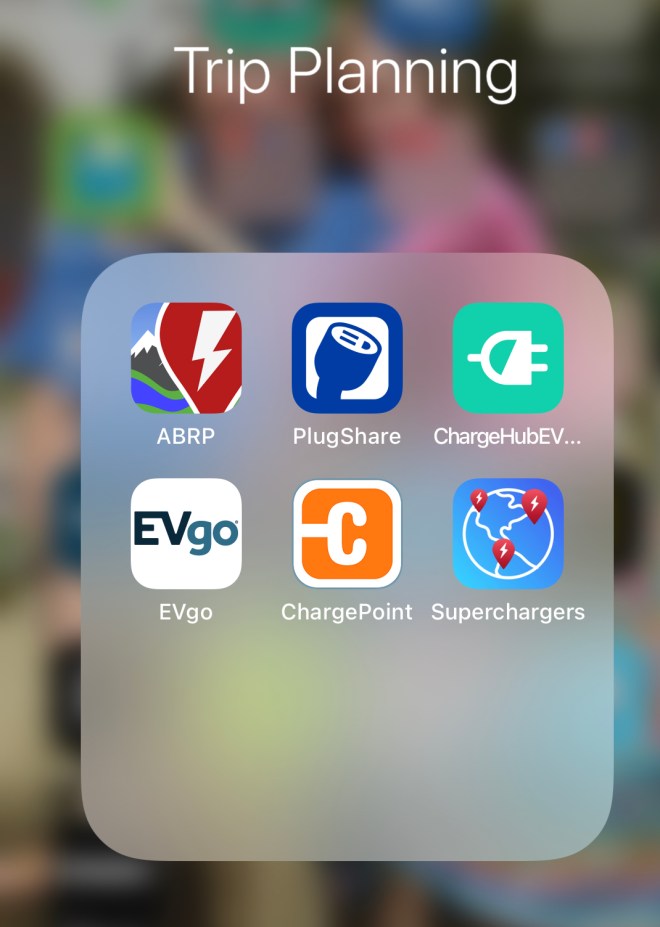
Back to my obsessive compulsiveness.  As my friends and family know, I am a planner, at least when it comes to travel.  Although I can do many things from my phone’s Tesla App, it doesn’t allow me to do any navigation or trip planning.  That can only be done from the car’s display. Maybe some people enjoy sitting in a parked car, but I don’t happen to be one of them.  Fortunately, the Tesla Motors Club website has very helpful and friendly posters who directed me to A Better Route Planner (which can be downloaded to your phone from the app store, or even viewed on your desktop.) Let me tell you, it’s much more fun planning imaginary trips from the comfort of your couch than from the front seat of your car!  At least it is to me. 

The information on ABRP (A Better Route Planner)is much the same as what you get from the Tesla Display, except that it also includes public charging stations, and provides estimates of cost and length of time for charging.  You start by inputting the your destination, % of charge (called “SOC” or state of charge), and the application does the rest.  Here’s a screen shot from my phone.  


You can include the desired “SOC” for  when you arrive at your destination, and can plot out your stops for your return trip, but you’ve seen enough shots of screens, haven’t you?    

For some reason that is clear to the technical members of the family, but not to me, the battery should be kept between 20% and 80% charged.  I don’t need to know why.  I went to Catholic school.  I do as I’m told.  Well, most of the time, or maybe some of the time, and this was one of those times.  Tonight, however, that sucker is getting charged all the way up to 100%, so tomorrow, I’ll be charged up and raring to go.  

To GO or Not TO GO, THAT is the Question

In September of 2018, we signed up with Overseas Adventure Travel for a March 2020 trip to Morocco. Why plan so far in advance? We wanted to travel with friends, OAT limits their groups to 16, and popular trips sell out quickly. We had no difficulty recruiting 11 friends to go on the tour with us. So far so good. Fast forward to today, with departure date rapidly approaching. As my favorite philosopher, John Lennon, once said, “Life is what happens when you’re busy making other plans.”

Well ol’ John was right. “Life” has certainly jumped up and slapped us in the face. Within the last two months three travel buddies had to drop out. One member of a couple was diagnosed with a serious medical issue, then another fell and fractured her knee. Their future absence made us realize how much we were looking forward to spending time with them.

Because the trip is so popular, their spots were quickly taken by other OAT travelers –also known as friends we haven’t met yet. So, there will still be 16 of us on the trip. But wait, we aren’t finished. Unless you are in a coma, you have probably heard about the coronavirus. So far, none of us has allowed it to disrupt our plans.

Fortunately, according to our State Department, Morocco is looking safe. Still, we have to fly to get there and back, and our plans include a three day stopover in Paris before we enter Morocco. Although the State Department hasn’t identified France as a “do not travel” country, another source indicated that several cases have popped up in France.

What to do? Sadly, we have to acknowledge that being over 65, we have aged into the “at risk” group. Fortunately, we are relatively healthy, and are up to date on all of our shots. Still, we recently experienced another country’s health care system, and although the outcome was positive, visiting my spouse in the Alice Springs Hospital was not a high point of our trip to Australia. (Clearly, it wasn’t my spouse’s either.) On a positive note, although we learned just how wonderful our medicare supplement coverage is when we are outside of the USA, we hope to never have to use it again!

As of today, according to the US State Department, Morocco and Paris have only the usual warnings about terrorist activities, but that is the world we live in. Given our record of gun violence in schools, churches, shopping malls, movie theaters, we could just as easily be mowed down by a home grown terrorist shooting his assault weapon. I refuse to let terrorists, either here or elsewhere, win. A virus, however, is another matter.

As of today, Morocco has reported its first case of the coronavirus; its victim, a man who returned from a visit to Italy, is being treated in a Casablanca hospital.

In Paris, a protest by workers closed the Louvre for two days, until the Museum staff assured the workers that “proper measures” to ensure their safety were being taken.

What happens if we get to Paris, and Morocco decides not to let anyone into the country from France –or from the USA? Let’s face it, several states have reported outbreaks, with many of the victims having no known source of contact. Our response is being managed by Mike Pence, who is not noted for his expertise in the medical and scientific arena. Maybe other countries will view US as being problematic? What if we make it to Morocco, an outbreak occurs and we can’t fly home? What if we catch a cold or some other nasty thing on the flights, either to or from our destination and we have to be quarantined until we are tested and certified as okay? So many “what ifs”. One thing that’s certain, if we go, my plan to travel with “carry on only” has been abandoned. I want to be sure we have enough clean clothes to get us through any “what ifs” that come our way.

In addition to cancelling all trips to China, South Korea and Mongolia, OAT has allowed travelers that signed up for their Italy trips the option to cancel right up to the date of departure, choosing either to apply their payment to a future OAT trip or to get a refund, minus a small processing fee. That gives us peace of mind.

What will we do? We will prepare as if we are going to take the trip, watch the news, check the internet and wait to see how it all unfolds.

Melbourne, Part Two

Okay, I’ll admit it, I felt really, really guilty, when I learned that while I was having a grand old time on the Great Ocean Road, my beloved husband was suffering in a Melbourne hospital, as I confessed in my last blog post.

After seven days in a town that is hotter than hell ( well, maybe not hell, but definitely purgatory), I feel my penance has been completed and I am free to share the rest of the photos from our glorious time in Melbourne.

Originally called The Sow and the Piglets, these rock formations were wisely renamed The Twelve Apostles, despite their originally being only nine of them. One has since crumbled, so now there are only eight. I spent most of my career in marketing, so hey, I get it. Nine was close enough, if you just round up.

Not surprisingly, the gambit worked, and the rest is history. The Apostles are definitely a beloved Australian tourist attraction.

The beach is lovely too, and if you are willing to walk down (and climb back up) eighty steps, you too can get your picture taken on this gorgeous beach.


I was definitely game. My favorite photographer was otherwise occupied, but one of our fellow travelers offered to take my picture. Foolishly, I neglected to check my phone until I got all the way back to the top, only to discover a technical glitch. No photo. Andy, who you will soon meet, wearing a bird for a hat, offered to go back down with me, so he and I got to climb down (and UP) 160 steps!


Given that I’m looking a bit chunky, that extra exercise was probably a GOOD thing!

Our stop at the bird hangout was great fun, although I will admit it’s a bit of a jolt when one of these guys unexpectedly lands on you, but Andy took it all in stride.

Paul, our tour guide, (shown instructing Jenny, a member of our OAT group) , kept us enlightened and entertained during our entire day together.

He told us The Great Ocean Road was built to employ returning war veterans. (Sorta like FDR’s CCC during the Great Depression).

About 3,000 former soldiers labored to build the road for almost thirteen years. Because of what we now call PTSD, dynamite couldn’t be used to break through rock; construction was done with pick and shovel.

This war memorial was built to honor the thousands who never came back from the war.

Other highlights from our time in Melbourne included a visit to the Mornington Peninsula, where we visited the Moonlit Sanctuary.

Unlike the Tasmanian Koala, this guy was awake. These animals sleep twenty hours per day, so somehow we managed to time it just right.

We didn’t have as much luck with the wallabies and kangaroos. They clearly were used to being fed frequently, and weren’t motivated to hop over for a snack. But the ducks and birds were quite happy to take a handout.

And this wombat? All we could see were his feet and hands! I think he had a “Do Not Disturb” tag hanging on his barrel!


Another notable visit was to the Abbotsford Convent. Now art studios and an educational center, it was once a “Magdalen Asylum” where up to 400 women and girls were sheltered. They were either orphans,”fallen women” or had no where else to go. They were also a source of free labor.

For “three hots and a cot”, they worked doing laundry for hotels and the weathy of Melbourne. As you might expect of a Catholic institution, prayer and chapel attendance were mandatory, as was penitence. This went on until 1975.

Today, the convent is beautified by art. I was particularly intrigued by these hand painted fabrics, which were very creatively displayed. I leave it to your imagination as to what this artwork symbolizes. It certainly has meaning for ME.

Here’s a close up of one of the fabrics. They were all different and were all exquisite.

Tomorrow we head for Sydney, our final destination on this slightly modified tour of our seventh continent, so I’ll leave you with one last example of what my new iPhone 11 camera can do.

Alice Springs, Australia

In the early ’80s I was captivated by a Masterpiece Theater Miniseries, “A Town Like Alice”, so much so that I read the book upon which the series was based. Who knew that about 35 years later we’d be spending two nights in this “bonza” town in the Northern Territory, right after our stay in Melbourne.

There is still so much more to say about Melbourne, and I will eventually get to that, but first, I bring you Alice Springs with a summary of why this is a town we will never forget.

Our hotel, the Doubletree, is located right across from the Todd River. Both the river and the mall (among other things) are named after Sir Charles Todd, who brought communications to the area by constructing telegraph wires or stations or something along those lines. (Clearly I wasn’t all that interested). His wife’s name was Alice, and I’m guessing that at one time the area had a lot of natural springs?

Check out the Todd River.

What, you’re having trouble finding it? That may be because the “river” is bone dry. You see, this area can go for YEARS without rain. It actually looks a whole lot better on Google maps, portrayed as a blue ribbon surrounded by green borders. But no. It is all brown and dry. But the walkway is nice.

So, why did Mike and I decide to skip Uluru and the Great Barrier Reef to spend an additional five nights ( count ’em, FIVE nights !!!) in Alice Springs?

It was a nose bleed. Yes, you read that right. But WHAT a nosebleed! Enough to warrant a 3AM ambulance ride, a hospital stay of three nights, with a trip to the operating room thrown in for good measure. Thanks to the wonderful doctors and nurses in Alice Springs, our hero is out of the hospital and on the mend. But he needs to rest up, so we are hanging out in Alice Springs for those extra days, then flying to Sydney, where, if all goes well, we will be able to rendezvous one last time with our wonderful group before we all fly home.

Exactly HOW did Mike get that geyser of a nosebleed?

No, his boomerang did NOT circle back and whomp him in the nose!

It all started in Melbourne. He awoke very, very early with what he thought was strep throat. (It wasn’t). Being the considerate, resourceful guy that he is, he didn’t want to wake me or our tour guide, so he surfed the net to find St Vincent’s Hospital was close by. (Bad idea). I woke as he was headed out the door, unfortunately not alert enough to shout “NOOO. Don’t do it.” But then I figured he knew what he was doing, he’d get his antibiotics, then return to the hotel to spend the rest of the day sleeping off his illness.

While I was enjoying the magnificence of the Great Ocean Road, Mike was having his nasal passage assaulted. A nurse decided to ram a swab up his nose to do a flu test. That caused his FIRST nosebleed. (The afore mentioned nosebleed in Alice Springs was the SECOND one). The doctor cauterized the wound, (but not well enough) kept him in the hospital overnight and discharged him early Saturday morning, clearing him to fly to Alice Springs.

Although if we’d had our druthers, Mike would have skipped learning about another country’s health care system, however there WERE a few positives.

  • We felt lucky we weren’t in a remote area devoid of medical facilities AND grateful we both understood the local language (sort of).
  • We HAD purchased trip insurance plus we have high spending limits on our credit card, so we were okay paying (charging) up front.
  • We learned more than we ever wanted to know about travel insurance, electronic devices (phones, SIM cards, hot spots) which provides me with lots of material for future blog posts.
  • The hospital was only a mile away, so I got plenty of exercise walking along the “river”, from hotel to hospital and back, a couple of times a day.
  • I was able to download “A Town Like Alice” to my phone and reread it while waiting for Mike to get out of surgery. I had forgotten that I had liked the miniseries so much more than the book. Still it was a good distraction and it reintroduced me to the word “bonza”. What do YOU think it means?
  • We discovered how tuned in Australians are to what is happening in America, and how well informed they are about Trump, Pence, even Mike Pompeo! Some of them probably know more than many Americans. The nurses were curious about what Americans think of Trump, so we gave them our views and others’ views. Being liberals, that’s what we try to do. Present the facts. We had no idea how much other countries are counting on us to vote him out, something we heard frequently on our trip.
  • The hotel has a pool, so I could imagine I was taking a “sit in the sun and do nothing” kind of vacation. It didn’t take long for me to remember why I never go on that kind of vacation any more!
  • So, that’s why I haven’t been posting much these past few days. I know. A blog is an unusual way to inform friends and family of a somewhat traumatic event. (Mike’s nose was traumatized, as was my psyche).
  • Thankfully, all is well now. Happier posts will follow with better photos!
  • The Land of Oz

    As a kid, I was always fascinated by the Wizard of Oz. In addition to watching the movie multiple times, I read every single Oz book our library carried. So, I was quite excited when I stumbled upon the PBS series entitled The Magical Land of Oz . To my surprise, it wasn’t about Dorothy or the wizard at all, but was instead three wonderful shows about Australia, where we will be heading shortly. (No tornado required, and, I hope, none expected).

    Why is Australia called the Land of Oz? I didn’t know, so I asked Mr. Google, the source of much of my wisdom. Turns out, it has to do with the way it sounds when you say the first three letters of the continent’s name. Give it a try. Anyway, the shows are visually spectacular, much better than anything I can hope to capture with my photos.

    Speaking of photos, this is the first trip I will make without bringing a camera. Yes, I will still take photos, but I will be using my new iPhone 11 pro. After our son sent us photos he had taken with the wide angle, telephoto and regular lenses, and showed us what the camera can do with night shots, I was intrigued. It was definitely worth a trip to the nearby Apple store to just take a look. Silly me. I really thought I would be able to leave the store without making a purchase!

    Another purchase for the trip was a “lipstick” charger from Amazon. My friend Sally had been using one on our recent bike trip and I was quite taken with the little gadget. Even though the iPhone 11 is supposed to have a robust battery, I didn’t want to take a chance of running out of juice should I encounter a once in a lifetime photo op.

    Of course, that wasn’t the only gadget that captured my attention. I also HAD to have the Lencent adaptor I stumbled upon when purchasing the lipstick charger. They both come with cute little storage sacks and don’t take up much room in my gadget bag.

    Because my replaced iPhone is few generations old, I decided not to turn it in, but instead plan to purchase a prepaid sim card for use in Australia. (Yes, my buying frenzy continues). After learning that, like New Zealand, free, unlimited WiFi isn’t widely available in Australia, I figured it was worthwhile to give a foreign sim card a try, using THAT older phone for accessing the internet. (An idea I picked up from one of the travel forums I follow).

    Here’s what my research uncovered: you need to pay attention to “credit validity”, which was a new term for me. I have since learned that it refers to the number of days the prepayment option has purchased, starting from the day you first use it. So, if you purchase a card with a credit validity of 7 days, and you use it on the 1st of the month, regardless of the gigabytes purchased, you are done on the 8th, and need to “recharge” (pay more).

    Why not go with Verizon’s travel pass? Well, if you use the internet ONCE during a 24 hour period, you get charged $10 for that day. It seemed like a better deal to get a prepaid sim card for 28 days for $30 Australian dollars (about $20 US, or two days worth of Verizon Travel Pass.

    Why wouldn’t I just use the Australian sim card, in my new iPhone, you ask? Good question. Here’s why: I know myself well enough to recognize that it is entirely possible for me to lose my original sim card, a significant concern.

    There are three mobile phone networks in Australia. Telestra, Optus and Vodaphone all offer coverage in the most traveled parts of Australia. Of the three, Optus is the only network that has a store in Melbourne Airport. So, given that this is a new experience for me, I decided that I wanted to interact with a human rather than purchase a card in advance from the internet (Amazon)and hope for the best. That way, I can have someone exchange the cards for me, and make sure that the phone is functioning correctly before we leave the airport.

    Thanks to the internet, I was able to check the coverage map for Optus, where I learned that coverage varies by type of device, something I never would have considered. It appears that the iPhone 7 may not have great coverage throughout Tasmania and parts of the interior where we will be visiting. Big decision: will I decide to be without WiFi when in those uncovered areas? Or will I trust myself not to lose my original sim card and just use my new iPhone? Bet you can’t wait for this cliff hanger to be resolved in a future post.

    Another cliff hanger: Will we get off the wait list for an upgrade to United’s business class? Here’s the deal. A free round trip ticket would have cost 240,000 miles each, whereas an upgrade is only 60,000 miles each, plus the price of an economy ticket and an additional cash payment. Given that we had nowhere near the miles needed for a free ticket, we opted for the upgrade, resulting in our waiting to see whether United can sell those seats for more than what we paid in cash and miles. It’s a gamble–one that does not make me a happy, loyal United customer. BUT, the other option would have been paying almost $8,000 each for business class. Of course, we could always stuff ourselves into economy for 6 hours to LA and 16 more hours to Melbourne. Yeah, we sure HOPE that’s not happening.

    Finally, we learned from our trip leader that during our tour, we can expect temperatures to vary from a potential low of 30 F to highs in the 90’s, with varying degrees of humidity. Hey, its a big continent, and we are covering a lot of ground. That makes packing even more of a challenge. This time, I’m using different packing cubes for cold, temperate and hot areas.

    Theoretically, the blue cubes can be compressed. Realistically, the plastic compression bags do a much better job so that’s what I used for my jacket. It is great for travel because the lining zips out, transforming the shell into a light weight rain jacket. Plus, the lining can be worn alone for cool days and shell plus lining will keep me toasty during those 30 F days and nights. Yes, it all fit into my duffel, was under 50 pounds, PLUS my backpack (carry on) had plenty of room to spare.

    Here’s the route we, and 10 other travelers, will be taking on our Overseas Adventure Travel (OAT) tour. Six of us have opted for the pre trip to Tasmania.

    See you in Oz!

    Western Pennsylvania’s Surprises – Part 2

    I know, I know–there has been a bit of a gap between Western Pennsylvania’s Part 1 and Part 2. That’s what happens when you follow a lazy blogger.

    So, to review: my last post pointed out our mistaken belief that Fallingwater would be the only attraction the Ohiopyle area had to offer. Were WE ever wrong. Instead, we discovered multiple highlights, many of them located at the Nemacolin Resort.

    If you have never heard of the Nemacolin resort, join the club. Neither had we. The Fallingwater website listed several area hotels, beds & breakfasts and inns. Because this trip was an anniversary celebration, a Ramada, Holiday Inn Express or Days Inn was not what we had in mind. Okay, the Nemacolin Woodlands Resort was a splurge, but was it ever worth it!

    First some background information: The resort is privately owned by 96 year old Joseph Hardy III, who still has a home somewhere on its 2,000 acres. He leaves its day to day operation to his daughter Maggie, who also is the CEO of 84 Lumber, the source of Joe’s wealth. You can read all about Joe’s history in the lobby of the Lodge.

    We stayed in The Lodge, one of several hotels on the property.

    Well, not exactly ALL. You need to go to Wikipedia to learn that he had FIVE wives instead of the three the display fessed up to. His first marriage to Dorothy lasted more than 50 years, which means that from his 70’s until now, he made up for lost time by wedding 4 more lovely ladies. Three of his brides were in their 20’s, which made the 50 something woman he wed (wife #4) appear age appropriate. Unfortunately, THAT marriage went the way of the three before, and Joe’s last (possibly current?) Mrs. Hardy was under 30 when he married her. The display tells about his founding of 84 Lumber and its financial success, but somehow I find his marital history far more intriguing. Admit it, you probably do too.

    Joe’s interest was not confined to women. He also was fond of classic cars, which are displayed in a “museum” on the property. Here are just a few of Joe’s toys. Notice the motorcycle? That is a replica of Peter Fonda’s wheels, built from parts of the motorcycles used in the movie “Easy Rider”. The Captain America helmet is perched on the back.

    Right by the private airstrip is a hangar containing classic planes, including Steve McQueen’s, from a movie I didn’t see and don’t recall. Sorry. THAT museum was locked up, but if you have a burning desire to get up close and personal with those babies, you can call security from the phone helpfully placed by the entrance and they will let you in. We weren’t that curious, so the photo was shot through the window. I’m confident you get the idea.

    Although there are many diversions to thrill children and teens, we didn’t partake in any of those.

    Instead, we rode the “free” shuttle to the Frank Lloyd Wright “tribute” restaurant located in another hotel (each room at THIS hotel comes with your personal butler. If you are anything like me, you probably are wondering “what does the butler DO??? Hand you your slippers, floss your teeth? ). Lunch outside was lovely, but probably not worth the price.

    The view from the outdoor restaurant

    The walk back to our hotel, however was pretty delightful. In addition to stopping to visit the two museums, we enjoyed looking at the extensive sculpture collection scattered along the walkways.

    My favorite thing, however, was our anniversary dinner. Pricy, yes, but very delicious and quite an elegant experience. Can you tell from the photos below which was the main course?

    I chose the Wagu Beef, which is shown in the upper right hand corner. Makes one recall that commercial “where’s the beef”? Yes, I am old enough to remember both the original commercial and the political ad that used the phrase.

    Enough about Nemacolin. I’m sure you’ve gotten the idea by now. ANOTHER big area attraction is Fort Necessity. I’m married to a man who never saw a fort that he didn’t love. Although this Fort Necessity isn’t very big, and is a replica of the original, the visitor’s center is fantastic.

    I probably was taught this in either elementary or high school, but I had forgotten this fort was where George Washington started the French and Indian War. Here’s what happened: either the French or the British fired the first shot at Fort Necessity. The well done video makes it clear that each side claimed the other was the aggressor. What is important was the way the battle ended. The British had to surrender, and the terms were written in French, a language Washington didn’t understand. his translator wasn’t all that fluent either, and to make matters worse, it had been raining and the ink had run.

    What Washington didn’t realize was that he had admitted to assassinating the French commander, and the rest is history.

    One final note: if you are visiting the area, The Bittersweet Cafe is a great choice for breakfast. Don’t miss it!

    Western Pennsylvania’s Surprises

    Do you know where you find a section of the Berlin Wall, Peter Fonda’s motorcycle with Captain America helmet, Steve McQueen’s airplane, the Fort where the French and Indian War started, several Frank Lloyd Wright masterpieces, and a five diamond restaurant? Hint: check out the map above, specifically the Ohiopyle area. It doesn’t look like there is much in the area, does it? At least that’s what I thought till I got there.

    Did you ever plan a trip, thinking that it would be all about a particular site, then discover that the area had a whole lot more to offer? Enough for two posts, even?

    We were drawn to the area by a newspaper article I had clipped about Frank Lloyd Wright’s Fallingwater decades ago. It sat in my “Fun Things To Do” folder until earlier this year, when I figured we either needed to visit the damn place or throw out the clipping. If I had done the latter, you wouldn’t be reading this post.

    A quick internet search uncovered a special Fallingwater experience–a sunset tour, lasting three hours, ending with appetizers on one of the decks. The tours are only offered on Friday and Saturday nights, are limited to 10 participants, allow interior photography, and include parts of the house not shown on the other tours. For $150 per person, you can pretend that you are a guest of the owners. Just our kind of gig.

    The newspaper article included a photo similar to this one

    So how was it, you ask? Well, the house was quite fascinating, especially given that it was completed in 1937. As you can see from the photo above, the house was built over a waterfall. When the windows are open, you can definitely HEAR that water falling! Closing the windows successfully shuts out most of the noise…and also the cooling breezes. Fallingwater, you see, is not air conditioned. Did they even HAVE AC back in the late ’30s?

    You’re probably thinking “What’s the point of living over a waterfall if you can’t stick your 10 little piggies into it”? Right? Well, Frank was also thinking just that, so here’s what he did.

    The stairway leading down to the water is pretty cool, but what is even more impressive is the way the glass panels slide away.

    Do you think he accomplished his goal, which was to bring the outside in?

    Here’s another example. You are out in the middle of nowhere, so window coverings are not needed, but in the bathroom, why not have planters built into the window to form a natural curtain?†

    When we first entered the living room, it looked like the corner was completely open. It took a while to see what is obvious from the reflection on the window–that two panes of glass are joined in the corner.

    Wright not only designed the building, he also created all the furniture throughout the house. I was surprised to see a king sized bed in the master bedroom. Our guide explained that it was actually two twins pushed together and united by a single headboard and bedspread, something TV in the 1950’s would never have shown. (It isn’t that visually interesting, so I didn’t bother posting a photo of it–everyone knows what a king sized bed looks like.) How surprising that it took about three decades for that great concept to catch on!

    The kitchen, bedrooms and bathrooms are all very small. The focus is on the large living/dining room and the outside balconies. Check out the banquettes in the living room. Not what I consider the most comfortable seating, but maybe if you imbibe enough from those nearby bottles, you won’t notice.

    At the other end of the living room is the dining area. Are you expecting the tour to turn left or right into the kitchen? Well, it doesn’t. The kitchen is a tiny space down a flight of stairs and through a very narrow hallway. The owners clearly didn’t spend much time there. That was the domain of the servants. There are no photos, because the kitchen was so tiny, I couldn’t figure out how to frame it.

    I was quite happy that our appetizers were not served in the dining room; instead, we enjoyed our hummus, crackers, cheese and veggies on one of the decks.

    A staff member was getting everything ready for us. You can see from that blue pole in the foreground of this photo that necessary repairs are being made on the building.

    While enjoying our appetizers, one of the other guests strongly recommended that we visit another of Wright’s nearby buildings. Kentuck Knob was built about 20 years later, for friends who were frequent guests of the Kaufmann family, the owners of Fallingwater.

    Okay, so I know this is heresy, but I actually liked Kentuck Knob BETTER than Fallingwater. It has all of the usual Wright features, but it just seems more LIVEABLE. Interestingly enough, it is considered “usonian” (Frank’s term for his “middle income” houses.) This “middle income’ house was built for the Hagans, the owners of the ice cream company in Uniontown PA, and was sold to its current owner, Lord Peter Palumbo, who, since 1996, when not using it as his vacation home, opens it to the public.

    A photo of the Lord and Diana (wearing her “screw you, Charles” dress) appears in the house. I grabbed this from the internet

    Take a look at the cutouts under the eaves. They are a source of light into the living room and supposedly repeat design elements found in the building. (I’m taking that on the guide’s word. I couldn’t spot any of those elements.)

    Notice how the carports–Wright’s invention — are nestled into the landscape. The hill behind forms a partial roof.

    Although we weren’t allowed to take photos INSIDE the house, there was no rule against shooting through the windows into the interior, which is what I did.

    Now take a look at the role the cutouts play in the interior space.

    The wall opposite the banquettes is all windows and glass doors, offering access to a walkway and a spectacular view of the valley below.

    The price of your admission allows you to wander through Lord Palumbo’s spectacular sculpture meadow. I was particularly taken with the part of the Berlin Wall. His collection also includes three red British phone booths at the visitors center.

    I’m tired of writing and you are probably tired of reading so the rest of the area attractions I promised in the first paragraph will have to wait until the next time I post.

    Patagonia – Our Final Days

    I’ll admit it. I am a lazy blogger. It seems it always happen this way. I start out with great intentions, keeping friends and family updated as to our whereabouts, but toward the end of every trip, I run out of steam. Then, re-entry into our world takes a few weeks. So here we are, back home, reliving our wonderful time in Patagonia via photos.

    Our last several days have not been recorded, so let’s start there. If you recall the map from the Punta Arenas post, you’ll remember that we had some very long travel days.

    With a bus like this, however, you travel in comfort, and you really get to experience the countryside. There were only 12 travelers (plus guides) on a bus that could carry over 40 passengers! With multiple interesting stops along the way, time passed quickly.

    On our way to cross the border back into Argentina, we stopped to pay tribute to Gauchito Gil.

    Here’s his story: Gil joined the Argentinian army to fight against Paraguay. He returned to his village as a hero, but soon after, the Argentine Civil War broke out. He refused to fight against his countrymen, so he deserted. He was found in the forest, by the police, who tortured him and hung him upside down from a tree. As a policeman was about to kill him, Gil said, “your son is very ill. If you give me a proper burial and pray to me, your son will live. If not, he will die.” Despite the prediction, the policeman cut Gil’s throat. When he arrived home, the policeman discovered his son was indeed very ill, so he heeded Gil’s prophecy–gave him the proper burial, said a prayer or two, and (wait for it–dramatic pause) the son was CURED!

    SO, today’s travelers offer a beer or some other tribute to Gil, as an extra insurance policy for a safe trip. As you can see, we were no exception. Hey, why not.


    In addition to educational stops along the way, our guides kept boredom at bay by entertaining and feeding us. Laura, our guia excelente, donned that costume before she served us a wonderful treat. Yeah, I forgot what it is called, but I certainly remember the wonderful taste.

    We were not without our national Geographic moments. As we drive the highways and by ways, we noticed several eagles and other large birds of prey sitting on fence posts. Were they watching the cars go by, as an avian form of TV? No, they had figured out that it was just a matter of time before some tasty road kill would make their grocery shopping much easier. Take a look.

    Before we knew it we were in El Calafate, Argentina. The main purpose of our 2 night stay here was to view the Perito Moreno Glacier in the National Park.

    We certainly did that, both from a ship and from land. It was quite a majestic sight. The experience wasn’t just visual, however. It was also auditory. We could actually hear the glacier groan and thunder, as parts of it crashed off into the sea below.

    While in El Calafate, we stayed at the Kauyatun, a gorgeous hotel reincarnated from a former sheep ranch. Best of all, it is within walking distance of El Calafate’s charming center.

    Our trip ended in Buenos Aires, where we had our farewell dinner, then flights home the next afternoon.

    A toast to Laura

    Saying goodbye is never easy, especially when you have such an interesting, caring, informed, fantastic guide like Laura. We all truly appreciated how hard she worked to make this trip extra special for all of us. Her energy was amazing!

    We also felt so fortunate to be a part of an extraordinarily compatible group. Our hope is that this will not be the last time we see these wonderful, smiling faces!

    The terrific twelve

    Towers of the Emerald Blue

    “Paine” is a Mapuche word meaning emerald blue, or, if you prefer, blue green. So “Torres del Paine” gets its name from the towering, unusually shaped mountains and the icy clear Lake Pehoe.

    Normally, this area is buffeted by high winds and lots of rain. Laura and Maria, our guides, have reminded us how very fortunate we are to be experiencing this incredible weather. It could change at any moment, but so far we have beaten the odds.

    Last night we took advantage of having an astrophysicist in our midst and persuaded Mike to give the group an impromptu lecture on the southern skies. We were so very lucky: the phase of the moon was perfect for viewing. It wasn’t so bright that it obscured the stars. We saw the Milky Way and the Magellanic Cloud, a rare treat. Too dark for photos–you just have to take my word that it was magnificent. And Mike was really pretty amazing too.

    I DO have other photos that will give you an idea of the grandeur and beauty of this National Park.

    During yesterday afternoon’s first hike, we battled head winds that made those two miles feel a whole lot longer.

    The sun wasn’t in the best position for photos, but I liked this shot of some of our group admiring the view.

    One advantage of staying at one of the three hotels within the park was getting an early start. THAT allowed us to hike to the perfect spot so we could catch this gorgeous reflection on the lake.

    It was a 4 mile hike that, according to my Fitbit, was the equivalent of climbing 43 flights of stairs. Believe it or not, it was a much easier than yesterday’s shorter hike because the wind wasn’t blowing.

    We were able to see this waterfall from a distance AND up close.

    Once again, our timing was perfect. On our return trip the light was just right for the mist to create rainbow after rainbow.

    Okay, so the surrounding area wasn’t picture perfect, but that was the best angle to capture the rainbow.

    Another amazing day in Patagonia, and it’s not even over yet. One more hike this afternoon.