Leaving Northern Ireland

On our return to the Republic of Ireland, we made one last stop in Northern Ireland, to the walled city of Derry, where we visited the Museum of Free Derry for a history lesson.

On January 30,1972, inspired by the civil rights marches and peace protests that occurred in the USA, about 15,000 Catholics staged a march to call attention to the discrimination they were experiencing. British soldiers shot indiscriminately into the crowd, killing 14 unarmed protesters. The day after what became known as Bloody Sunday, 2,000 men joined the IRA, which up until that time had not been very active.

Although attempts were made to portray the peaceful marchers as terrorists, a film crew was there, recorded what actually happened, and smuggled the film out (in their underwear!) to the Republic of Ireland where it was broadcast around the world. Despite the visual evidence to the contrary, the false narrative that some march participants were terrorists persisted until 2016, when an inquiry finally revealed the truth. The result was a long overdue apology by Britain’s prime minister, David Cameron. An excellent video in the Museum shows the huge emotional impact that historic apology had on the people of Derry. Sadly, the guilty soldiers still have not been brought to justice.
While on the Black Cab tour in Belfast, our driver showed us the size of rubber bullets that were used for crowd control. These were fired on Bloody Sunday, and contributed to the injuries many protestors suffered. Can you imagine being hit by one of these?

We couldn’t leave Derry without touring its city walls, and learning about its history, most of which I promptly forgot. Of course, the wall had the requisite cannons, strategically interspersed.

Our border crossing into the Republic of Ireland was seamless. No check points, no guards, no showing of passports, just a change of currency, back to the Euro. Ireland has sworn that it will never have a border dividing it again. Boris Johnson declared the Irish Sea will be the border, but many wonder exactly how that will work post Brexit. No one quite knows.

And now for a little perspective: the population of Northern Ireland is a wee bit under 2 million. The population of The Republic of Ireland is almost 5 million. Compare that to the population on NYC, which is over 8 million, and you can understand why much of this glorious island is comprised of rolling green hills and picturesque landscapes, perfect for raising sheep.

Typical view from my bus window.

Which brings me to the next subject: the Irish Diaspora. We all know that millions of Irish left during the potato famine, but I never knew that many lost their homes when they were evicted.

This beautiful castle was built by John Adair, who evicted 244 of his Irish tenants because he thought raising sheep would be more profitable than allowing his tenants to continue farming. By the way, the Irish became tenants on their own land, after Oliver Cromwell conquered them, and seized their property so he could use the land as payment to his soldiers.

Adair was the first of three owners of Glenveagh. The third, Henry McIlhenny, was an Irish American. His grandfather, John McIlhenny settled in Philadelphia, where he became very wealthy from his invention—the coin operated gas meter. Henry was an art aficionado, who donated his family’s extensive collection to the Philadelphia Museum of Art. His generosity extended to Ireland, when he donated the castle and its gardens as a gift to the nation. It is now a national park.

Touring the grounds of Glenveagh with a naturalist, who demonstrated the depth of the bogs, and explained why the people sacrificed in the bogs were so well preserved.

I had originally planned to write a bit about Donegal, but that will have to wait for a future post, because I have run out of time.

From Ireland’s Capitols to its Countryside

We’ve thoroughly enjoyed our time in this island’s two capitols: Dublin and Belfast. But now it’s time for a change of pace, so we hit the road to experience the castles and cliffs of the beautiful Irish countryside.

We departed from Belfast by way of the “leafy suburbs”. As is the case in most countries, the wealthier areas were spared the violence and disruption of “the troubles” discussed in earlier posts. The beautiful homes facing the water were much like those in many of the wealthier neighborhoods in the USA.

At one time, oh so many years ago, I could never have imagined that I’d be taking a bus tour. But let me tell you, at this stage in my life, it’s a great way to travel. No getting lost, no speeding tickets, no fruitless searches for rest rooms. It’s all taken care of. All I have to do is sit back, gaze out the window and chat with my fellow travelers.

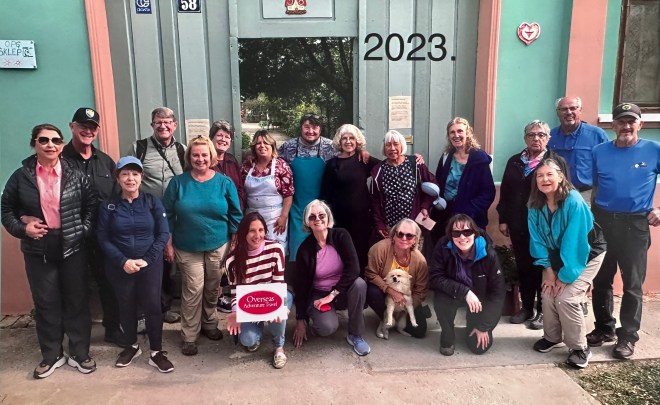
Our group

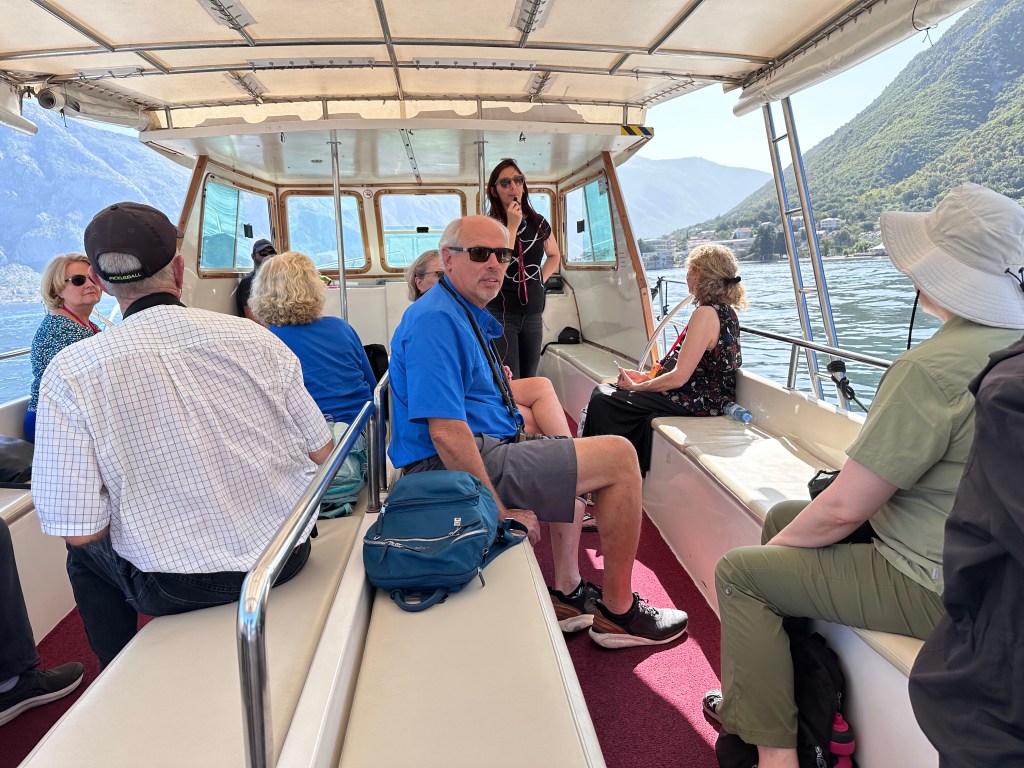
We really lucked out, with a huge, comfortable bus for only 11 of us, and a delightful driver, Michael, who clearly loves his job. The repartee between Joe and Michael keeps all of us entertained and laughing.

Our drive to Ballycastle was broken up with multiple stops. At the first one, Joe, our guide, pointed out that this white rock is composed of the exact same material as the White Cliffs of Dover. About 350 million years ago, this very rock was being formed somewhere south of the equator. I don’t know about you, but I find that little fact fascinating. I’m sure my geologist neighbor, Ed, would agree. He would undoubtedly have been able to identify the dark streaks in the rock as flint, which was highly prized for its sharpness, and its fire making properties.

Our route along the Antrim coast took us past picturesque little fishing villages like this one.

I loved that the windows of this vacant building were painted to look like they were festooned with flower boxes.

Our final stop before Ballycastle was at the Glenariff Forest Park, which gave us the opportunity to get out of the bus and stroll along the river to our restaurant.

One of the waterfalls in Glenariff Forest

Ballycastle’s Marine Hotel was a bit quirky, but the entire staff was so friendly and accommodating, and the location across from the beach was fantastic.

Because the weather was so wonderful, we couldn’t resist a walk along the beach, before we strolled into town for a delicious and inexpensive dinner at the Anzac Restaurant.

Ballycastle was the perfect jumping off point for the following day’s excursions to Dunluce Castle and The Giants Causeway. Although Dunluce Castle is in ruins, you get a feel for what life was like way back in the 1600’s. The castle was built high on a cliff, surrounded by water, with access only via a drawbridge. Clearly, those were scary times!
Joe quickly figured out that Janet and I are the walkers in this group, so he always made sure to tell us about more challenging hikes. The Giant’s Causeway offers several trails, plus a shuttle bus for those who prefer to ride. We chose the red course, labeled the most difficult, because of the spectacular views Joe promised us. He was right!

Even if you do opt for the easier trail, the scenery is still pretty dramatic, especially if you are intrigued by rocks, volcanic activity and ocean views.

Our last stop in Northern Ireland will be Derry —or Londonderry, if you are aligned with the British, or the Protestants, before heading back into the Republic of Ireland and to our hotel in Donegal.

Belfast: The Troubles and The Titanic

We left the Republic of Ireland, crossing into Northern Ireland two days ago, just in time to get our first experience with legendary Irish weather. Our walking tour was soggy, and although we were undaunted, we were grateful when our Tour Leader took us on a quick detour into the nearby mall. Not only did we get a chance to dry off, we also ascended to the mall’s top floor to take in this magnificent view.

Okay, so maybe THAT day’s view wasn’t all that magnificent, but you have to admit, it is pretty cool to have a glass dome atop a shopping mall.
The next day’s panoramic view was significantly better because we were higher up, and the weather cooperated.

This photo was taken from the Grand Central Hotel’s cocktail lounge. No, we didn’t have a drink there, because I suspect the cost of a cocktail would have been as much as our full dinner at a nearby pub. Joe, our tour leader, took us there for a “ gawk”, and that’s exactly what we did.

Although the city is lovely, and I have many photos to prove that, the real highlight of our time in Belfast was our visit to The Felon’s Club. We spent the morning with three men who, back in the day, were formerly enemies: a loyalist, a British soldier, and an IRA member. They each told us a little about themselves, their backgrounds, their activities during “the troubles”, their time in prison and what their lives are like today. It was a riveting discussion that was particularly relevant now, given the divisiveness we are currently experiencing in our own country. What was encouraging was where they are NOW. All three have been working toward reconciliation and educating others about “the troubles”. All three are committed to the peace process.

I had forgotten the important role George Mitchell and Bill Clinton played during peace negotiations. One key element of the negotiations was a referendum (with no date specified) on whether or not Ireland should be reunited. When asked if the referendum were held today, only the former member of the IRA was able to say for sure how he would vote. The other two wanted to know more about the impact the change would have on their lives. Their focus was on the issues, not on former identities as a member of a particular group. I would have loved to spend more time with them, but our Black Cab Tour was scheduled, so off we went to view the murals painted on Belfast’s walls.

During our tour, the final song from the Broadway musical “Hamilton” kept playing in my head: “Who lives, who dies, who tells our story”.

In the photo below, our cab driver is holding a rubber bullet, to show us how huge they were. He then pointed out the names of civilians, carved into the wall, who died after being hit by rubber bullets. By telling their stories, the black cab drivers and the members of the Felons Club are keeping their memories alive.

The afternoon was spent at the Titanic Museum, an experiential museum, where another sad story was told—not only about those who went down with the ship. We also learned about the workers who built the ship.

It was a rather poignant day, so we were only too glad the sun was shining as we walked back to our hotel.

We are all quite happy that we were leaving Belfast BEFORE King Charles III arrived. Yes, I know it is a historic event, but the crowds and traffic might have made it difficult to see as much as we did.

Three Glorious Days in Dublin

Spending our last night in Dublin at the Castle Vaults Pub was a wise decision indeed. I had my best sleep yet, and am feeling grand this morning.

I’ve either been too busy or too tired to write, so this is a stream of consciousness, unproof-read post, hastily done before we board our coach to Belfast.

The Belvedere Hotel is perfectly located, close to a HOHO stop, and within walking distance of all the sights, but away from the madness of Temple Bar. Although it has great WiFi, I was glad that I had purchased the Aíralo eSim, because I used it frequently while walking around Dublin. My sense of direction is legendary, and I soon discovered my travel buddy, Janet’s, is equally bad. Fortunately, Aíralo has been working great and it has helped us to avoid wrong turns more than once.

About the HOHO: in an earlier post, I talked about the three different Dublin options, and my research pointed me in the direction of Do Dublin, the green bus. It was the perfect choice for us. We spent our jet lagged arrival day hopping on, and didn’t hop off till the end of the route. It gave us exactly what we needed, a very helpful overview of Dublin’s most important sights, and it was over just when we were ready for lunch. The Parnell Pub was recommended by the driver who picked me up at the airport, and he didn’t steer us wrong. The soup of the day was wonderful and the bread was out of this world, but the chicken wings could have been skipped. Best of all, the price was right—only 11 Euros.

Our HOHO ticket included two freebies. We used the ticket to The Little Museum on our jet lag day. It is located in a Georgian House, near St. Stephen’s Green, and is packed with memorabilia, including a room devoted to the band U2.

I’m not a fan, so instead, here’s the model of Admiral Nelson’s column, which was blown up in the ‘60s.

It was replaced by the Spire, affectionately dubbed by the locals “the stiffy by the Liffey” or “the stiletto in the ghetto”. I didn’t find the Spire visually pleasing, so haven’t included a photo. The nick names, however, should give you a really good idea of what the Spire looks like!

We spent the rest of the afternoon walking around the Trinity area, until it was time for the early bird special at a restaurant recommended by my blogging buddy, over at Aging Gracefully My Ass. Thank you, AGMA.

This was NOT false advertising. The food WAS great, the service friendly, and their Early Bird Special offered excellent options. Luckily, we went with the 2 course option because their portions were so generous, we were unable to finish them. In fact, weliked this restaurant so much, we actually toyed with returning, but Dublin offers far too many attractive alternatives.

The other freebie that came with the Do Dublin HOHO was the “Paddy Liddy Walking Tour”. Here in Ireland, though, it is called the PAT Liddy Walking Tour. And yes, there really IS a Pat Liddy, who is now in his 80’s. We saved that for our second day in Dublin and we were SO glad we did. Jim, our tour guide was AMAZING! He knew so much about the history of Dublin, and walked us around to spots we never would have found on our own.

Here’s Jim, standing in front of a Clery’s department Store, which will be reopening in October. He’s explaining that, back in the day, the favorite Friday night meeting spot for his contemporaries, was under the Clery clock at at 7 PM. (The clock is that black thing on the building, right behind his head). If, by 7:30, your date hadn’t shown up, that meant you were being stood up. Sometimes, though,when you looked around, there were members of the opposite gender who shared a similar fate, which presented an opportunity to make a new friend and possibly experience a Hollywood ending.

As you walk through Dublin, be sure to look down occasionally. You’ll see plaques like this one, which shows Viking artifacts that were taken from the ground below. When I did 23 and me, and discovered that I had Viking ancestry, I had assumed that it was from a “rape, pillage and plunder” Viking excursion into Ireland. Maybe not. Apparently, the Vikings had a trading settlement in Dublin.

I couldn’t get a good shot of the Music Hall where Handel’s Messiah debuted. Every year, since 1772, it is played on April 13 at 1 PM to commemorate its first concert. During COVID, on that date and time, one of the area residents placed her speakers in her open window to keep up the tradition. Can’t you just hear the hallelujah chorus blasting through the neighborhood? That must have lifted the spirits of her neighbors at a time when spirits definitely needed to be lifted.

During our tour, Jim walked us through the Temple Bar area. Prior to coming to Dublin, I had mistakenly thought there was ONE bar, called Temple. Nope, it is the name of the land, formerly owned by a guy named Temple, and the “Bar” part was shortened from the “Barricades”, which were built along the Liffey River.

I was horrified to see that the hotel I had booked for my return trip to Dublin was in “ party central”, right next to a Hard Rock Cafe. After listening to Jim’s description of what the area was like on most weekends, I decided to look elsewhere, so at the end of the tour, I asked Jim for hotel recommendations. Well,that question turned into a delightful 2 hour lunch with our wonderful, fascinating guide at his favorite pub. At the end, we followed his recommendation to visit the National Portrait Gallery, before heading back to the hotel for the official start of our OAT trip.

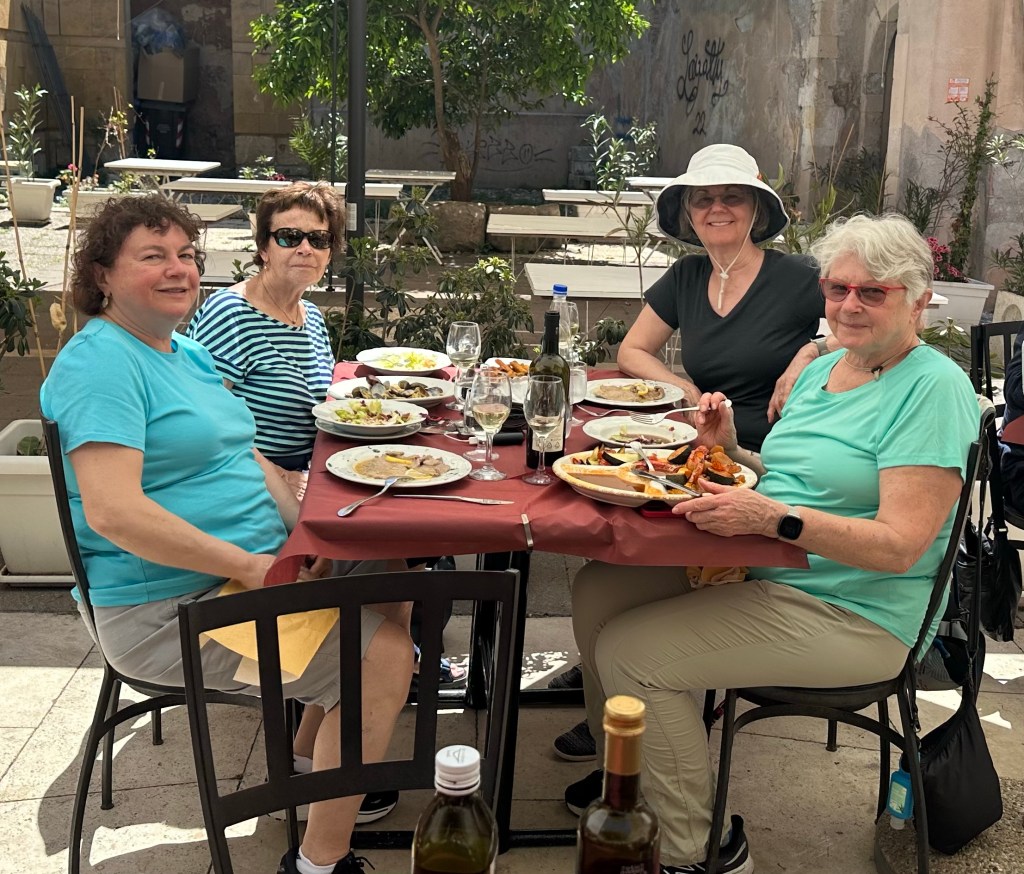
There are 11 of us on the tour: 3 couples and 5 singles. We had an opportunity to converse over our welcome dinner, and I feel very lucky to have joined such an interesting and congenial group. I’m looking forward to getting to know them better over the next two weeks.

We started our final day in Dublin with a brief tour of the city. It wasn’t as in depth as the Pat Liddy walking tour, and because there was only a slight overlap, I was glad we were able to do both. As you can see from the photo of the Oscar Wilde statue atop this blog, we were blessed with fantastic weather.

Our next stop was a tour of the fascinating, multi media EPIC Museum.

This beautiful sculpture shows the evolution of transportation from the early ships to modern aircraft
Recognize any Irish Americans in this collage?

There is so much more to say about this fascinating city, but I’ll end this post by saying I’m so very glad I’ll be returning to Dublin in 2 weeks!

Five and a Half Weeks, Carry On Only

This fall, I will be experiencing three different kinds of travel: a sixteen day OAT trip to Ireland, two weeks with friends at two different vacation rentals in England and eight days on my own in London and Paris. After reading about the problems with lost luggage and flight cancellations, it seems prudent to forgo checking luggage.

It can be done. I know, because I’ve done it before, but the aging process has killed a whole lot of memory cells. (Or was it copious amounts of wine? Or both?) Covid has put a damper on the frequency of our travel, and climate change has made it very difficult to predict what weather will be like in September and October. All of the above has made me feel like a travel newbie, so this blog post is primarily for me (as a memory aid) and for my travel buddy, Sally, who asked for packing tips. Okay, so that was fair warning that this will be a stream of consciousness post–but I hope others will find the information helpful.

It all starts with the right luggage. Back in the day when I was traveling regularly, I saw many travelers using a 4 wheeled clamshell carryon, so I ordered a cheap one from Amazon, in a very distinctive color. I’ve used it many times since my 2018 purchase and have been very pleased with the amount of stuff it can hold.

The blue bag was a recent purchase, made after I saw it demonstrated on a very misleading Facebook video. The video showed the bag standing upright, which made it very easy to pack, with double zippers on the bottom, so it could be compressed and used as a shoulder bag. You’ve probably seen it too. Take a look at what it REALLY is like. Although the photo doesn’t show there is no 2nd zipper on the bottom (so no shoulder bag option), trust me. It doesn’t have one. You CAN see that it CLEARLY is incapable of standing upright. Having said that, I’m finding its light weight and many pockets make it an attractive 2nd bag. Plus I discovered a “work around”. If you stick a full packing cube in the bottom compartment, the bag WILL stand upright (sorta), making it much easier to load. That bottom compartment is jammed with clothing that I don’t expect to use during my first 8-10 days traveling.

Okay: Luggage chosen. Everything I take has to fit into those two bags. Next step: what are the airline rules? For the international flight, I decided to cash in my miles and fly business. Ordinarily, I would have saved those miles for a much longer flight, but during covid, I figured the additional space business offers was worth using those miles, plus two carryons will be no problem. My regional flight from Dublin to Newquay, however, is a different story. The best I could do was buy a slightly more expensive ticket that allows one carry on and one checked bag, so I just need to make sure that my carryon is not too heavy. With less than 80 people on the flight, a small destination airport, and a little luck, all should go well, but just in case, I have purchased an Apple Air Tag so, if necessary, I can hunt down my checked luggage.

I always make a packing list, which helps me remember what I need to pack, what I HAVE packed, and serves as an inventory for insurance purposes should my luggage get lost or stolen. I start laying out everything in the guest room a couple weeks before departure. I sort items into two piles: need to have, nice to have. I won’t insert everything into my luggage until the day before departure, but this advanced gathering helps me identify any gaps that a shopping trip needs to rectify.

In addition to packing cubes, I also use jumbo zip lock bags, which allow me to see the contents AND if you sit on them, they compress very nicely. Jumbo zip lock bags also can be used as a washing machine. All you need is a little soap and water, some dirty clothes, then zip and shake, shake shake. My OTHER friend named Sally recommended the various clips and hangers–all available through Amazon. The microfiber towel is a “nice to have” that may or may not make it past the final cut.

I expect that I will only have to hand wash during the 16 day OAT trip, because the following two weeks will be spent in vacation rentals (one with VRBO and one with AirBNB, so I will have access to washers and dryers.)

Dressing in layers is always good advice, especially for longer trips and particularly with the climate changes we have been experiencing. Although I’ll do a last minute weather check before packing, with a trip this length, it makes sense to be prepared for warm, cool and wet weather.

Because my iPhone 11 takes photos that suit my purposes (internet posts, memory jogs, and photo book creation), I no longer carry a camera. But my electronic devices keep increasing, along with their various cables and connectors. My Apple Watch and iPad both use the new USB C, while my iPhone uses the Lightening charger, which has a USB A dangling on the end of it. And of course, because I will be in the UK and Northern Europe, I need two different types of plug adapters–a G for the UK (that sucker is HUGE) and an F for France. I have those. But what if I want to charge multiple devices? I don’t want to carry an adapter for each. And what if there aren’t a lot of outlets in the room? Well, take a look at this very cool, very compact “power strip” that accommodates both kinds of USBs. And it only requires ONE G plug. Being obsessive compulsive, I had to try it out at home to make sure I could fit everything in, and that I had the correct combo of electrical “thingies”. It may look like spaghetti to the untrained eye, but to ME it looks like success. (I took the photo with my iPhone, which is why the lightening cable is just dangling there.) Best of all–these plugs and wires take up less room than my camera did.

So now that I have space efficient charging equipment–the next step is finding affordable internet connections. In the past, I have used a variety of plans: for short trips, I used Verizon’s Travel Pass, which charged $10 for every 24 hours you accessed the internet. For our trip to Australia in 2019, I purchased a local plan, which required me to install a different physical SIM card on my phone. That was much less expensive than the $100 Verizon monthly international plan with 5 GB.

Now there is a MUCH better option that Ann Bouey (who I’ve never met) posted about on the Friends of OAT Facebook page. She suggested that I check out Airalo. For $20, I was able to purchase an eSIM with 5 GB of data that would work in 39 European countries (I only need 3!) for 30 days. Best of all, I will be able to “top up” another GB for $5 to have access for 7 more days– all for 1/4 of the cost of a monthly Verizon plan.

Here’s the catch: You have to have an unlocked phone that will accommodate an eSIM. Airalo only provides access to the internet, no phone line. I rarely use voice while traveling anyway, but if the need arises, I can use WhatsApp or some other application–like FaceTime, or Google Duo.

Remember a few sentences ago, I mentioned that I used a physical SIM card in Australia? I knew that the iPhone 11 allows owners to have two different phone numbers via a physical SIM and an eSIM. So, I figured I’d set the phone up so that I could add a physical SIM card when traveling, with my Verizon phone and internet connection utilizing the eSIM slot. (Yeah, I don’t know what it is either–I just know the words and what it does). That caused a bit of a kerfuffle when I downloaded the Airalo eSIM. After consulting with Airalo customer service, then spending time in both the Apple and Verizon stores, the Verizon rep finally figured out that she had to replace my current SIM card and start again. If that all sounds like technical mumbo jumbo, it is. Here’s hoping that it is information you never need! If you don’t, then the Airalo download is very, very easy. The 30 days don’t start until I arrive in one of the European countries, and turn it on.

What else have I learned during my trip preparation? I discovered the Rick Steves app, which allowed me to download talks, including, for example, a guided tour of the Orsay Museum, and a Dublin City Walk, complete with a map–and a whole lot of other stuff.

Well, the consciousness lingers, but the stream has run dry.

Travel in the Time Of Covid Part II – Marrakesh

The northeast is being hammered with yet another snowstorm today, so it’s the perfect time for me to reminisce about what our guide told us is the “Las Vegas of the Arab world”, Marrakesh. (That’s the English way to spell it; the French spelling is Marrakech).

Once again, we stayed in a unique and charming riad. It had a rather unimpressive exterior, but as with the other riads on our tour, the interior was absolutely beautiful. Take particular notice of my favorite spot, the rooftop pool and bar.

How lucky for us that the riad was also a SPA, or more accurately, a hammam. In case you are wondering, according to Wikipedia, a hammam is a “type of steam bath or a place of public bathing associated with the Islamic world. It is a prominent feature in the culture of the Muslim world and was inherited from the model of the Roman thermae”. Man, oh man, is it ever WONDERFUL! Fortunately, our schedule allowed for sufficient free time, so Kris and I were able to experience the full effect: a massage, steam bath and total body scrub that left us feeling magnificent. (And undoubtedly, we LOOKED magnificent…but to keep this from being an x rated post, there are no photos of our argan oil coated, naked bodies.)

Our riad was ideally located, within walking distance to the Bahia Palace, and DJemaa El Fna, which in the days of old, was the site for executions. They must have had a LOT of them, because the place is HUGE.

During normal times, the square is a “happening” place, crowded with a very different form of public entertainment: vendors, performers, fire eaters, snake charmers, dancers–you name it. Perhaps this is where Marrakesh earned the name of Las Vegas of the Arab world? But not during Covid. Although Morocco has done an amazing job vaccinating its citizens, tourists were still staying away while we were there in October.

The view from the second floor balcony of the Argana Restaurant

In some respects, the lack of crowds was an advantage, making it easier for us to navigate through the Medina, where we again saw the juxtaposition of the old and the new.

You’ll see that many of the women are wearing headscarves, probably more so in Marrakesh than in the other cities that we visited. A young woman explained to me that Moroccan women wear headscarfs for one of three reasons: 1. religion, 2. as a fashion statement, or 3. because of a “bad hair” day. My guess is that the lovely lady on the motorbike was making a fashion statement. What do YOU think?

Do you think the ladies on the left will be shopping at any of these stores on the right?

My favorite spot in the Medina was the beautifully restored Le Garden Secret. Photos of the “before” version were displayed in the on-site museum. (Sorry about the reflection. the lighting situation was far from ideal.)

No trip to the Medina would be complete without a stop at a rug shop. Most of us spent our time there sipping mint tea, but Dave was on a mission to find something special for his dining room, and he made a very significant purchase.

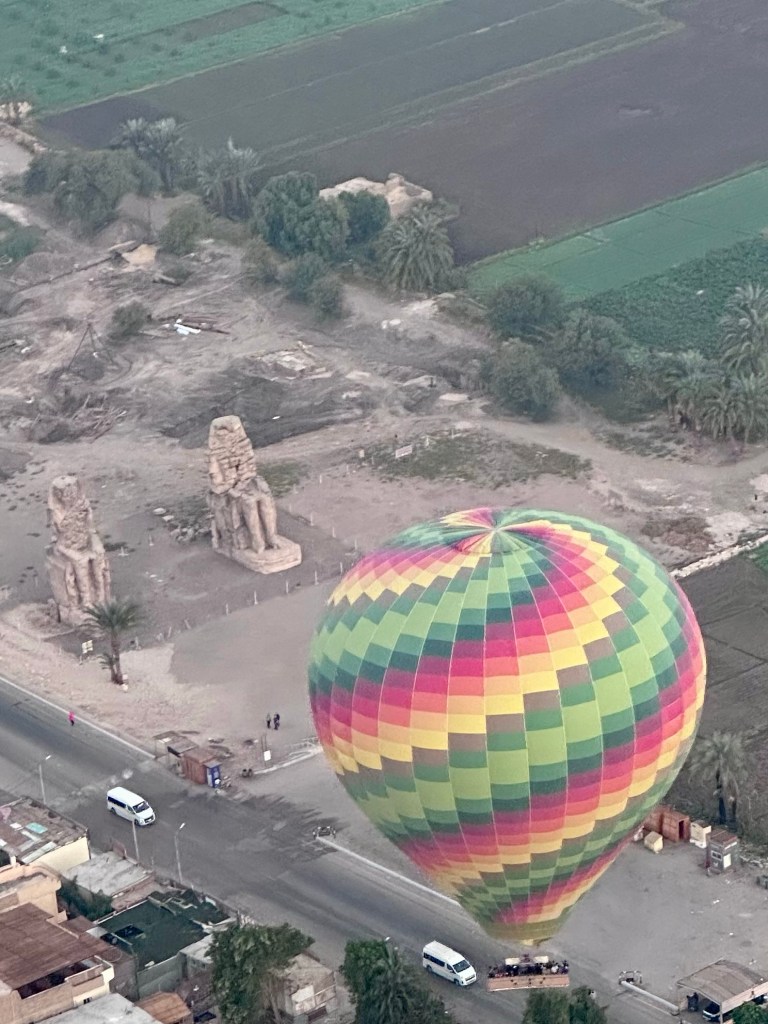
For our last day in Marrakesh, OAT offered us two optional tours: a hot air balloon ride and museum visits. I highly recommend both!

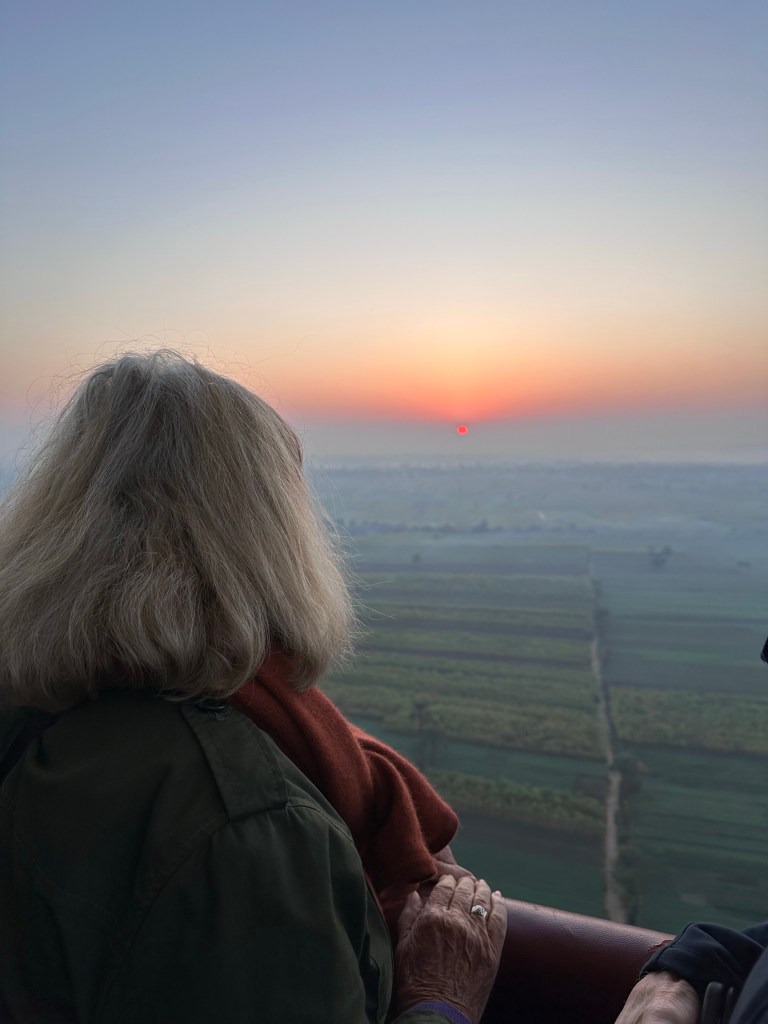
Was it worth getting up at 5:15 AM to watch the sun rise over the mountains, from the vantage of a hot air balloon? I’ll let you be the judge.

6 out of 9 of us opted for the balloon ride. Our Spanish pilot kept us entertained with his commentary. He was almost as wonderful as the view.

Now the museums: Although Trip Advisor rated Garden Majorelle as the top attraction in Marrakesh, I happen to disagree. Yes, it was nice and all that, but quite honestly, we have better gardens in the USA. They just weren’t owned by Yves St. Laurent

I much preferred the Museum of Water Civilization, because I have never seen anything quite like it.

I loved everything: its architecture, the exhibits, the stories.

Is this not a gorgeous building?

It was chock full of wonderful legends. I chose just a couple to share to give you a feel for how delightful the museum is.

This seems like a lot more fun than sacrificing a virgin to make it rain.
Here’s an example of Morocco’s progressive attitude toward women. Notice women get to choose whether or not to wear a headscarf.

There is so much more to say about this fascinating city, but I’ll stop now and encourage everyone to go and see for yourself. Be prepared to have your preconceived notions shattered.

Travel In The Time of Covid – Moroccan City of Fes

Because of omicron, our only “traveling” these days is in our minds, with a memory boost from photos of days gone by.

We fully recognized how fortunate we were to be able to have ONE international trip in 2021. Before the borders slammed shut two months later, we spent three glorious October weeks touring Morocco. Sadly, as of late January, 2022, Morocco’s borders remain closed.

During our trip, our focus was on experiencing this fabulous country, so my blogging fell way behind. What better time to write about the three previously neglected cities of Fes, Marrakech and Casablanca than over the next few days, when there is little else to do in New Jersey but cook, eat, read or shiver.

Fes

Although I devoted one blog post to our spectacular Fes riad, we were too busy enjoying the wonder and glory of that city for me to blog about it.

Every souk in Morocco is quite an experience, but I think the one in Fes is the most elaborate and labyrinthine. Even Mostafa, our excellent guide, needed help from a local guide to get us through the marketplace.

You see just about everything in the Fes souk. Take a look: The head mounted outside the stall is thought to be proof that the vendor sells authentic camel meat.

Somehow, we managed to make it through the trip without being offered a sample.

You are probably wondering why I included the next visually unimpressive photo. Don’t worry. I’m going to tell you. That equipment you see on the trucks is for shooting the next Indiana Jones movie. Timing, however, is everything in life. Had we arrived a day later, Harrison Ford might have been on site, and perhaps we would have caught a glimpse of the action. Of course, what is far more likely is that the entire area would have been blocked off–probably with those barriers you see on the left. Anyway, watch for that cafe in the movie, and remember, you saw it here first.

Weddings are a HUGE deal in Morocco. Like Indian weddings, they go on forever…and necessitate multiple clothing changes. The souk has a whole area devoted to shops like this one, selling wedding caftans, which, as you can see, are LOADED with bling.

Weddings are expensive events, and not just for the bride and her family. You see, it is customary for the future groom to present his intended with baubles, including a jewel encrusted gold belt, as part of the marriage proposal. That is her “insurance policy” in case the marriage goes south.

During our time in Fes, we had dinner with a Moroccan family, who graciously showed us the video from their niece’s wedding. The bride changed her caftan SIX times during the many, many hours of the ceremony! Because of the colossal expense, our hosts told us many brides opt to rent their outfits.

Take a look at how narrow some of the passages are in the souk. They veer off into different directions, acting as natural protection from foreign invaders, of which there were many, back in the day.

Hint for future travelers: When I purchased my Sketchers, my purchase was placed in a bag that can also function as a backpack. When I tossed it into my luggage at the last minute, I had no idea how much I would use it! My regular backpack proved to be too heavy and HOT on my back, and this freebie from Sketchers was perfect for the trip.

Here’s another hint for future travelers:
When you visit the tannery, bring along either Vicks or Tiger Balm to dab under your nose, unless, of course, you think the stench is part of the experience that you don’t want to miss. Although the guide will give you a sprig of mint to hold under your nose, I definitely needed something much stronger. I don’t know how the workers can stand the smell of the hides being dyed and softened with materials like pigeon urine!

Like the rest of Morocco, Fes is a city of contrasts. After spending the day in the centuries old souk, we felt like we had time traveled when we arrived in the modern part of the city. Look at this beautiful avenue, complete with motorized vehicles the kiddies can drive. When we visited Ouarzazate a few days later, THEIR avenue included larger play vehicles, for kids of ALL sizes.

Our evening ended with a walk through this beautiful gate (one of MANY beautiful gates in the city) into another marketplace near our riad.

Our group can’t resist a photo op!

Volubilis and Meknes

During our three day stay, we had the choice of remaining in Fes, on our own, or taking the optional trip to view the ancient Roman ruins at Volubilis, then visit Meknes, the imperial capital of the late, great Mouley Ishmael.

Since Mike has never met a Roman ruin that he didn’t love, it’s not hard to guess which option we chose.

Although it was interesting, I have seen many Roman ruins and mosaics, so I was more fascinated by Meknes.

Sultan Mouley Ishmael started Morocco on the road to greatness, after he ejected the British from Tangier. But that’s not his only claim to fame. He made The Guinness Book of World Records for fathering more children (888) than any other human, at least so far. No doubt it helped that he had about 500 concubines and 4 wives to share that monumental task! But what I want to know is whether he remembered all those names — of the kids AND their mothers. And how did he have the time or the energy to conquer so much territory?

With that huge a family, it is not surprise that the sultan went on a building rampage, utilizing Christian slaves to help construct his enormous structures in Meknes. When the slaves were exhausted, and thoughtlessly died on the job, he simply had their bodies tossed into the walls, to become part of the structure. To me, that’s taking recycling to the extreme.

I can’t remember whether this door was in Moulay’s stables or the granary (that’s what happens when you blog months after the fact–you forget so many details!) Whichever it was, it was massive, as you can see from the photo of one of the doors. It dwarfs my 6’3″ husband.

That’s all for today. Next post will be our memories of Marrakech.

Ouarzazate

I know you are probably wondering how in the world to pronounce the name of this Moroccan city. Well, wonder no more. “Ou” sounds like our “W”, so when you come to Morocco and want to stay near the movie set for Game of Thrones, book a riad in “ WAR-za-zat”.

We spent two nights in Ouarzazate, staying at the beautiful Dar Kalifa. During the 1900’s our riad was the court house of Pasha Glaoui. This very powerful Bedouin chieftain was France’s ally against Sultan Mohammed V, and was instrumental in getting the Sultan exiled to Madagascar in 1953.

Unfortunately for France and the Pasha, the Sultan was beloved by many Moroccans. His removal resulted in unrest and uprisings in Morocco. As a result, de Gaulle reinstated Mohammed V (who changed his title from sultan to king) in 1956; simultaneously Morocco gained its independence. Pasha Glaoui had clearly made the wrong choice. So what became of this traitor? He traveled to Paris, knelt at the feet of in submission to Mohammed V, who forgave him. Their actions reunited the warring factions and made it easier for Mohammed V to regain his throne. Glaoui died of cancer in 1956, Mohammed V died in 1961.

I have to admit, it was pretty thrilling to think about all the history that must have taken place within the walls of our riad. It isn’t easy to find—you walk along some narrow passages to get there, but it is worth the walk to discover this spectacular dwelling.

Be forewarned: there are MANY steps in Dar Kalifa, and they all seem to be a different size.

Can you guess why Ouarzazate’s nickname is WallyWood? The dramatic scenery and the perfect lighting from sun filled days have made it a favorite spot for film makers.

Many of the locals work as “extras” in movies like Gladiator. Our local guide, Mohammed has been in several movies. Here’s his picture, so you can look for him in Season 4 of Game of Thrones.

Mohammed with his visual resume

Mohammed never had the opportunity to attend school. He spent his childhood ferrying tourists across the river on his donkey. Although he was never taught to read and write, he became fluent in English, French, Spanish and a few other languages, by listening to tourists he transported. I find that amazing—what an impressive and intelligent man!

Mohammed’s children: 2 girls, aged 13 and 6 and 1 boy aged 10, all attend school, and are teaching their dad to read. Mohammed told us he thought his family was complete, but his “coronavirus baby” arrived 8 months ago!

Most tourists visiting the area want to spend time in Ait Benhaddou, stopping at one of the two studios in town. Before Covid, Mohammed told us during high season Ait Benhaddou received more than 1,000 tourists per day.

Instead, we visited Asfalou Village, for what OAT calls “A Day in the Life”. There, we spent the morning with an extended family, visit their home, learning how the women make bread and the men make bricks.

For the afternoon, we visited the Women’s Association, a beneficiary of the Grand Circle Foundation. The Association’s objectives are to build women’s self confidence and to empower them. The women learn to bake cookies, which are sold to hotels and to tourists. We sampled some during our visit and they were so delicious, we all bought more.

While there, we all decorated our bodies with henna—even the men.

But the highlight, for me at least, was playing dress up. Unfortunately, my first choice for spouse was feeling under the weather that day, so I had to go with a substitute for this Berber wedding.

For you movie buffs, I’ll end with a list of some of the movies and TV shows filmed in this area.

  • Lawrence of Arabia (1962) Sodom and Gomorrah (1962) The Man Who Wished To Be King (1975)
  • The Message (1976)
  • Jesus of Nazareth (1977) Bandits, Bandits (1981)
  • The Diamond of the Nile (1985)
  • Killing is not playing (1987) The Last Temptation of Christ (1988)
  • Tea in the Sahara (1990) Kundun (1997)
  • The Mummy (1999)
  • Gladiator (2000)
  • Alexander (2004)
  • Kingdom of Heaven (2005) Babel (2006)
  • Prince of Persia: The Sands of Time (2010)
  • Game of Thrones (season 3, 2013)
  • Game of Thrones (season 4)

For the curious—the photo at the top of this post shows the artist doing paintings using a sort of “invisible ink”. He heats the paper over the flame to make the colors appear. This “invisible ink” , used for secret messages sent during French occupation, has been repurposed!

The Sahara

Once again, my image of what the Sahara Desert would be like only slightly reflects reality.

I didn’t expect to find this very productive farm amidst sand dunes.

The farmer’s father, once a member of a nomadic tribe, used ancient techniques to find water. The family hand dug two wells: one with salty water and the other with “sweet” water for drinking. They combine water from both wells for irrigation and livestock.

Farmer and friends. How many do you recognize? One outfit (caftan and scarf) was purchased in the Rissani market for about $20 US.

You might recognize Goldie from an earlier post. She given to me by Bonnie, my grand-niece, before the start of our trip. Photos of Goldie’s escapades have been making their way back to Massachusetts on a regular basis.

As you can see, one of the farmer’s goats was quite taken with Goldie.

Our camp was very comfortable. Although we didn’t have Wi-Fi, cellular service surprisingly, is available in the desert.

I expected the sunrises and sunsets to be jaw dropping, and they were. What I didn’t expect was to be drinking wine while watching the sun go down.

Mike went to another dune to take this shot of our group
Kris, Burke and Mike after the sun had set.
Sunrise, by the camp

Of course, a visit to the Sahara wouldn’t be complete without a camel ride.

Check out the eyelashes!

But who would have expected to find this swimming pool in the desert?

For 100 dirhams you can use the pool, get a non-alcoholic drink and use a towel.

We also visited another nomadic family. Unlike the farmer, this family doesn’t own the land they are living on.

According to Moroccan law, if someone can find 12 witnesses to attest that the family has lived on the land for 10 years, then the squatters become landowners. The catch? The 12 witnesses have to be around when the 10 years commence.

Say good-bye to Goldie. She found a new little girl to love.

There is so much more to say about this incredible experience, but I’m going to stop now and invite you to put the Sahara on YOUR bucket list.

On The Road Again

Who knew that driving all day could be so delightful? The scenery between Fes and the Sahara is varied and spectacular. It also doesn’t hurt that the nine of us are traveling in a bus that could transport more than forty passengers. We are up high, so we all get panoramic views.

This photo was taken from the window of the bus.

We had several stops along the way, including an opportunity to stroll through a forest.

Mike provides scale, to give an idea of the size of this Lebanon cedar.

My favorite stop, however, was our visit with the Barbary monkeys.

Don’t even THINK about touching that tangerine!
This monkey was much friendlier. She was fine as long as I was at her level, but when I stood up, I frightened her and she scampered off.

The hotel where we stopped for lunch had this beautiful map, which included our departure and destination, and stops along the way. I’d mark our route out for you, but it is too difficult to do on an iPhone. But I’ll give you a rough idea of our route: we started at Fes, on the top, by the palm trees and ended in what the map calls ‘Arfoud’, (Erfoud) near the bottom. Ultimate destination: off the map on the bottom, near the camels.

Outside of major cities, Morocco has few traffic lights. Instead, they have numerous traffic circles, (if you’re from Massachusetts the correct name is ‘rotaries’. We Massachusetts natives have our own special language).

I particularly liked the circle in Midelt, which highlights their #1 product. Can you guest what it is?

If you guessed “surgical masks” , you’d be wrong. Mostafa had our driver (Mohammed) go around the circle twice so we could all snap a photo of the “Big Apple”.

Our stay was at a lovely hotel close to the Sahara Desert. Although I am so sorry for the Moroccans working in tourism, I must confess it HAS been rather nice having these beautiful hotels and pools all to ourselves.

Most people would be delighted to see that huge, luminous full moon. Not us. Why? We were hoping for dark desert skies for our resident astronomer’s lecture the following night.

If you’re wondering why in the world I’m blogging rather than experiencing the majesty of Morocco, fear not. This is being written while on the bus heading to Ouarzazate. I’m using Verizon’s Travel Pass for internet connectivity. And I’m looking up from my phone frequently. And yes, as usual, my blog is several days behind our experiences.