Self knowledge is a wonderful thing. Being aware of one’s weaknesses allows one to build in the necessary safeguards. But when the “one” in that sentence happens to be me? Did I build in safeguards? I’ll let YOU be the judge.
On my last trip, my luggage was left in Munich, when I changed planes, so THIS time I decided to do carry on only, even though we had a direct flight. I still managed to “lose” my luggage. How is that even possible, you might ask?I remembered to check the overhead compartment, so my carry on and backpack DID make it safely OFF the plane.
Fortunately, I had the foresight to take a photo of my bags. Yes, that piece of paper on the floor is indeed a checklist of my luggage’s contents. ( Self knowledge in action— I KNOW I have a tendency to forget stuff, so maybe I DID build in a couple of safeguards).
Perhaps I shouldn’t have drunk so much Prosecco?
Barb, my travel companion, checked her bag, so we agreed to meet at baggage claim. That way I could use the bathroom and brush my teeth while she was waiting for her bag to fly down the chute.
Well, at Berlin’s airport, to get to baggage claim, you walk through 3 doors with little gates that open and close automatically. As soon as the last door closed behind me, I realized that both my hands were free. I had left my pink carry on in the stall in the bathroom. Not a problem. I’d do what I have done in other airports—wait for someone to come thru, and quickly jump in, heading in the opposite direction. Except with multiple doors, that doesn’t work so well.
Plan B. Approach a random airport worker and admit to colossal stupidly. He very kindly walked me to the information desk, where they promptly and emphatically told me there was no way I could go back through those doors to retrieve my bag. No alternative was offered.
Plan C. Approach someone else with my tale of woe. His solution: when someone reports the bag to security, it will be sent to lost and found, and I could get it then. But who knows how long that would take? Hours? Days?
Plan D. Hunt down a group of friendly looking police officers standing around, doing nothing. Repeat yet again, my sad story and confession of a mental lapse. Although initially reluctant, ultimately, a female police officer came to my rescue— walked out of the airport, around to the other side and emerged through those dreaded doors with my luggage in tow. Good thing I had taken that photo!
But that’s not the only memorable part of this journey. At passport control, the officer searched through the pages of my new passport, then proceeded to ask me NUMEROUS questions. The only stamp he could find was from that famous stop in Munich, where my luggage stayed longer than I did. It seems I was missing an EXIT stamp, so according to him, I could have spent the last few months wandering thru Germany, wreaking havoc. Good thing I’m old and look harmless. After enduring his lecture, my full bladder and I were FINALLY allowed to be on our way. So maybe it was HIS fault? His questioning got me so upset that I left my luggage in the bathroom? Hey, it was worth a try.
When we got to the Marriott, we discovered the lobby is being renovated, but at least the ONE available room was far from the atrium and noise.
We stowed our stuff in that room, then we headed for the HOHO (Hop on hop off bus) to see if we could stay awake long enough to get a feel for the city. Believe it or not, Berlin has 4, HOHOs, so we chose the one the hotel concierge recommended.
Barbara, enjoying the ride
We were far too tired to do much hopping off today, so we spent our morning riding around. We did stop to grab some lunch at 11 AM, which was a bit of a challenge because most eateries weren’t open yet.
So what do we think of Berlin? Initially, not much. Like our hotel lobby, lots of Berlin appears to be under construction.
Graffiti is spray painted everywhere—but it sure isn’t like the street art I saw in Columbia and Ecuador! It’s random, ugly squiggles.
Then, as we headed west, things started looking up.
We had a nice mix of old and new architecture. Sorry, I don’t as too tired to remember what was said about these two buildings.
I DO recall the Reichstag, Germany’s parliament building. We have tickets for a tour next Tuesday night.
This is the 30th anniversary of the building being “wrapped” by Christo and Jean Claude. To commemorate the anniversary, every evening until June 20th there will be a light show from 9:30PM until 1 AM.
There is much more to say, but exhaustion has taken hold.
This post is for all the wonderful OAT travelers who took the time to post on Friends of Overseas Adventure’s Facebook page. I benefited greatly from your advice and hints, so this is my way of giving back. My apologies to regular subscribers who might not find this post very interesting. BUT if others traveling to the Northern Iberian Peninsula in the spring find these hints helpful, well that’s a bonus.
I took the “Northern Spain and Portugal: Pilgrimage into the Past” trip in April of 2025. My departure didn’t offer pre or post trips so this information only applies to the main trip.
I wore a mask on flights to Bilbao, but didn’t on the return trip. Big mistake. I’m quarantining now, which is why I have plenty of time to write this post.
The OAT trip started in Bilbao, which is an absolutely fantastic city. If you are able to do so, I highly recommend arriving a day or two early.
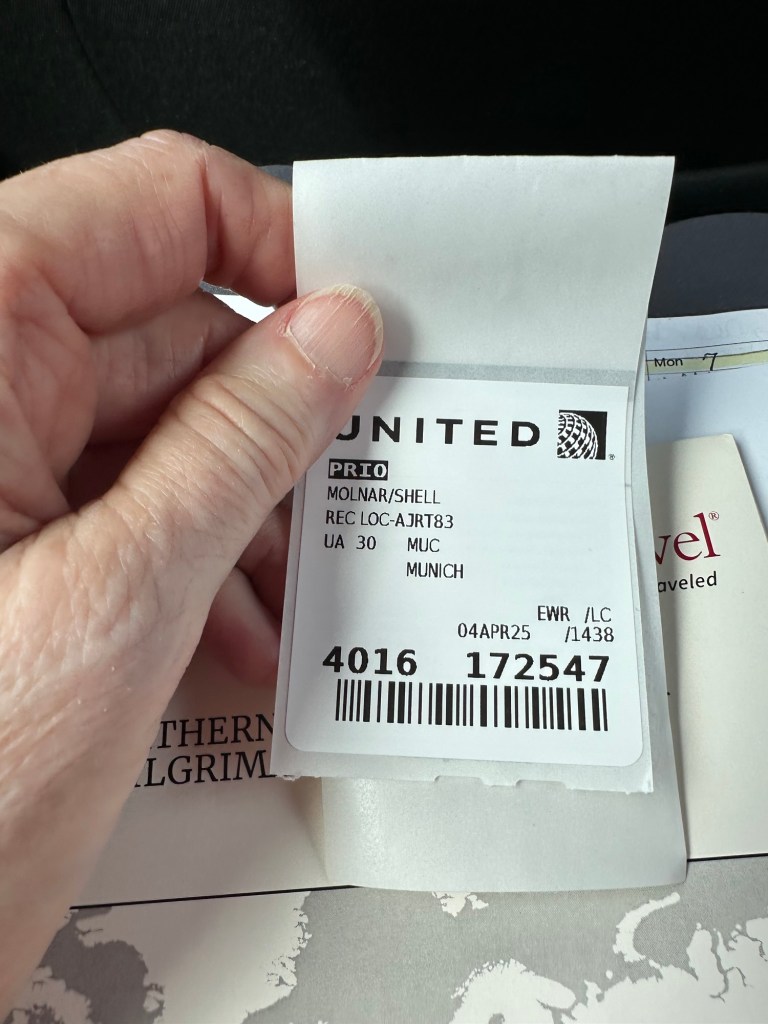
If you are changing planes, and you are checking luggage, be sure to carefully examine your luggage receipt. I didn’t and I wasted almost a half a day tracking down my bag, which was left in Munich. I’m so very glad I used an AirTag!
Although Bilbao is a very walkable city, the bus system is excellent. Best of all, busses are frequent and easy to use. No special card is required. You simply get on the bus and pay with your credit card. Easy, and CHEAP!
The Guggenheim is closed on Mondays, however, the OAT itinerary has sufficient free time built in. If your trip has the museum scheduled on a Monday, you still can visit at another time. Even if you are not a museum aficionado, the architecture of the building is pretty spectacular. It’s also worth walking around outside the museum to view the sculptures.
All of the hotels OAT chose were centrally located, which made it very easy for anyone who wanted to explore on their own. Here is the list of the hotels we used: **Hotel Abando, Bilbao **Hotel Tres Reyes, Pamplona **Alfonso V, Leon **Hotel Compostela, Santiago **Lamego Hotel, Lamego **Turim Oporto Hotel, Porto
If you don’t want to wash your hair and body with the same soap, or you don’t like to use the bottles attached to the wall, bring your own.
Most of the hotels’ hair dryers were attached to the wall, and you needed to keep your finger on the button to get the dryer to operate. That can be uncomfortable if you have arthritis in your hands. Someone suggested bringing duct tape to keep the button down. Of course, I didn’t recall that hint until I was on the trip, staring at the button!
The hair dryer in the Lemigo Hotel died after a couple of minutes use. After resting for a few minutes, it could be used again. (Others had a similar experience). Fortunately that didn’t happen in Santiago, where I used the hair dryer on my sodden shoes.
Apparently, Northern Spain normally gets a lot of rain. During our visit, we mainly experienced intermittent showers. Keep in mind the unevenness of cobblestones results in lots of puddles, and sometimes those puddles are DEEP. Oh and by the way, those cobblestones are very slippery when wet.
We all got drenched on our walk into Santiago. Fortunately, our hotel had a heated towel bar. After being convinced that I was a complete idiot for being unable to get the heat turned on, I swallowed my pride, asked for help at the front desk and learned that the heat is centrally controlled and doesn’t turn on till 7:30 PM.
The only option our team leader gave us to do laundry was at the hotels, but it was rather expensive, especially with the terrible exchange rate. We were there when the tariffs went into effect, so what was once a strong dollar had plummeted. The heated towel bar was perfect for drying laundry. Santiago was the only hotel with that option, and it was roughly midway through the trip, so keep that in mind if you are rinsing out clothes.
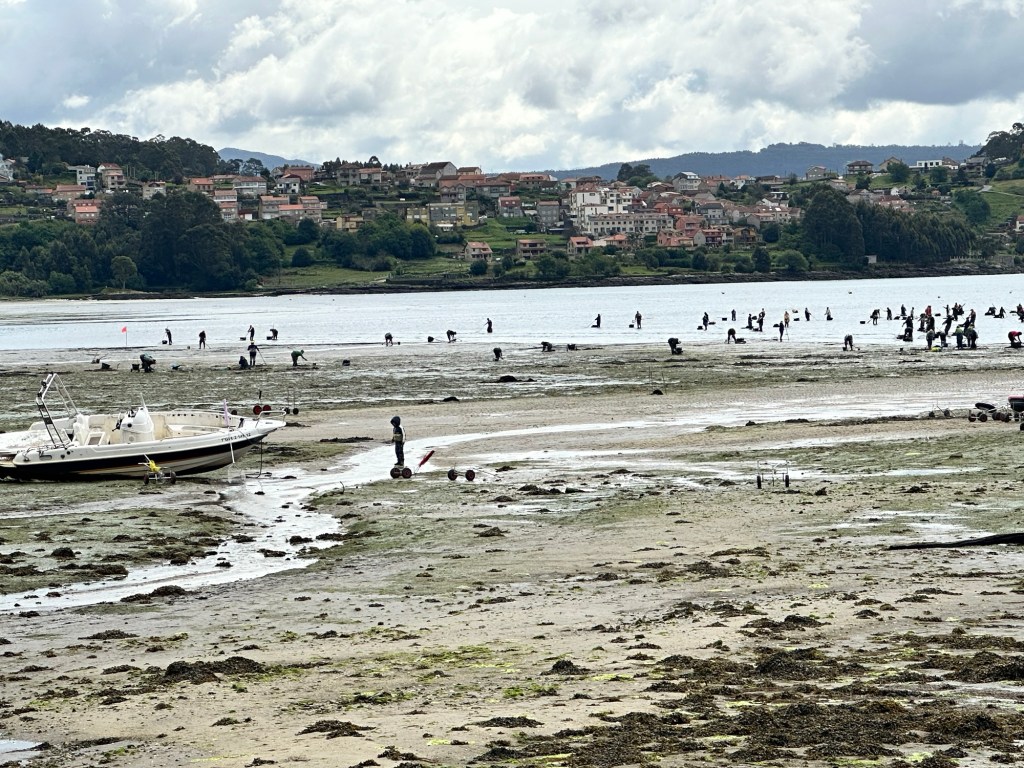
The optional excursion offered during our time in Santiago was okay. If you didn’t grow up by the ocean (I did), it might be great because you got to watch locals digging up clams and mussels, something my family did on a regular basis. The lunch was fantastic and although I was glad I went, if you can only choose one optional, I would recommend the one in Portugal if you are a walker and love nature.
After the optional trip, we returned to Santiago in time to visit the Pilgrim Museum, which had been closed the day before. Unfortunately it was closed again, for unspecified “technical” reasons. Too bad, because the members of our group who didn’t take the optional, visited the Pilgrim’s Museum that morning and said it was worthwhile.
It was way too cold to use an outdoor pool, and although the Lemigo hotel had an indoor pool, you had to pay 20 Euros per person, per day to use it (and the gym). None of us thought it was worth it. The outdoor pool is free and lovely, so if you go when the weather is warm, it might be worth packing a bathing suit.
Be sure to get your Pilgrim’s Passport stamped! Mine is the header of this post.
Portugal was fantastic! Because Porto has been discovered, you may want to make dinner reservations while you are still in Spain. Check with your TL to make sure you have the correct schedule, because sometimes the TLs have plans that are not part of the official itinerary.
My post about Porto provides the name of a wonderful restaurant close to our hotel. Rather than repeat what I wrote elsewhere, just click on the link to get the name of the restaurant and other sights that you can do in your free time. It also includes a description of the optional trip.
I wasn’t able to visit the Porto Library because it requires tickets for the timed entry, and no tickets were available while we were in Porto. Two of our traveling companions stayed an extra day in Porto and were able to visit the library. Based on their photos, it was quite wonderful!
I thoroughly enjoyed the WOW Museum complex. I bought a day pass for 40 Euros because I wanted to visit three museums and separate entries were each 20 Euros.
I have done posts for each place we visited, so if you want more info, check out the post that interests you. Those posts include photos.
On our way to Porto, we were convinced our luck had REALLY run out. According to the weather reports, we weren’t merely encountering rain, we were headed into a huge storm! We were all glad the forecast was wrong yet again.
Although it rained during our bus ride from Lemigo, by the time we reached Porto and had finished our city bus tour, the rain had briefly stopped. The sun even came out during our walk along the river.
Before I left home, I had loaded photos from Mike’s and my 2003 day trip to Porto onto my iPhone. I was surprised to see how much the city had changed, and how much remained the same.
2003 Panasonic LUMIX2025, iPhone 14I only carry my lumix to places like Africa and Antarctica. The zoom is key for animal shots. Otherwise, my phone does fine.
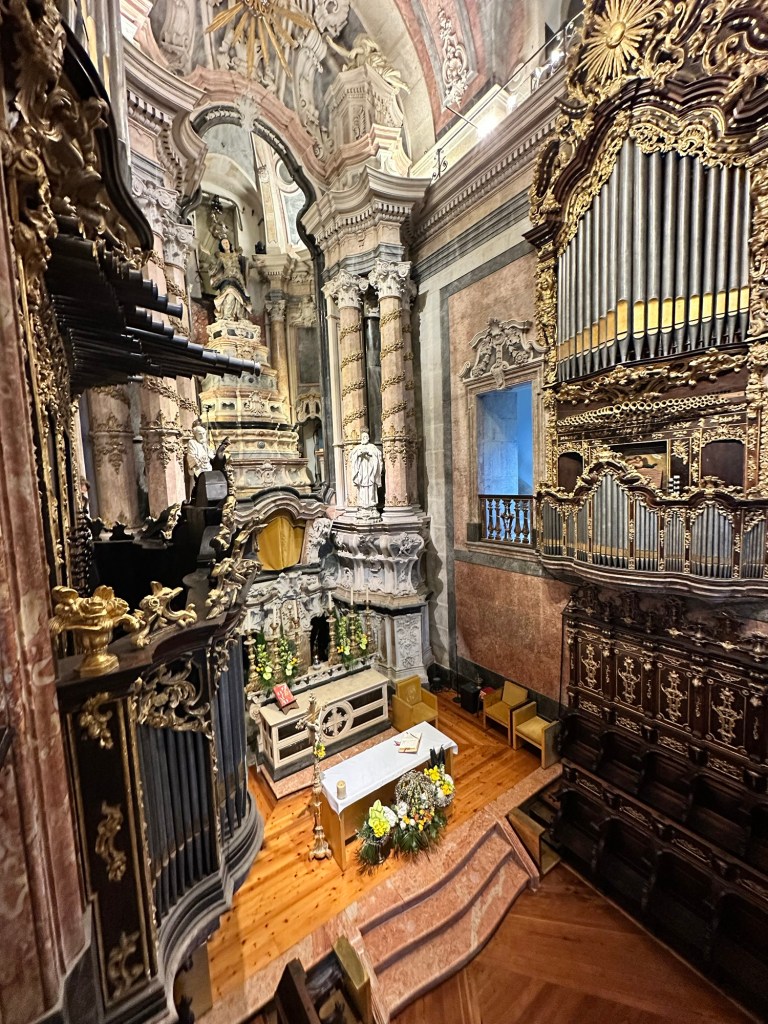
The tower that Mike and I climbed for free in 2003 was restored and updated in 2014. Tickets are required to visit what is now the Clérigos architectural complex .
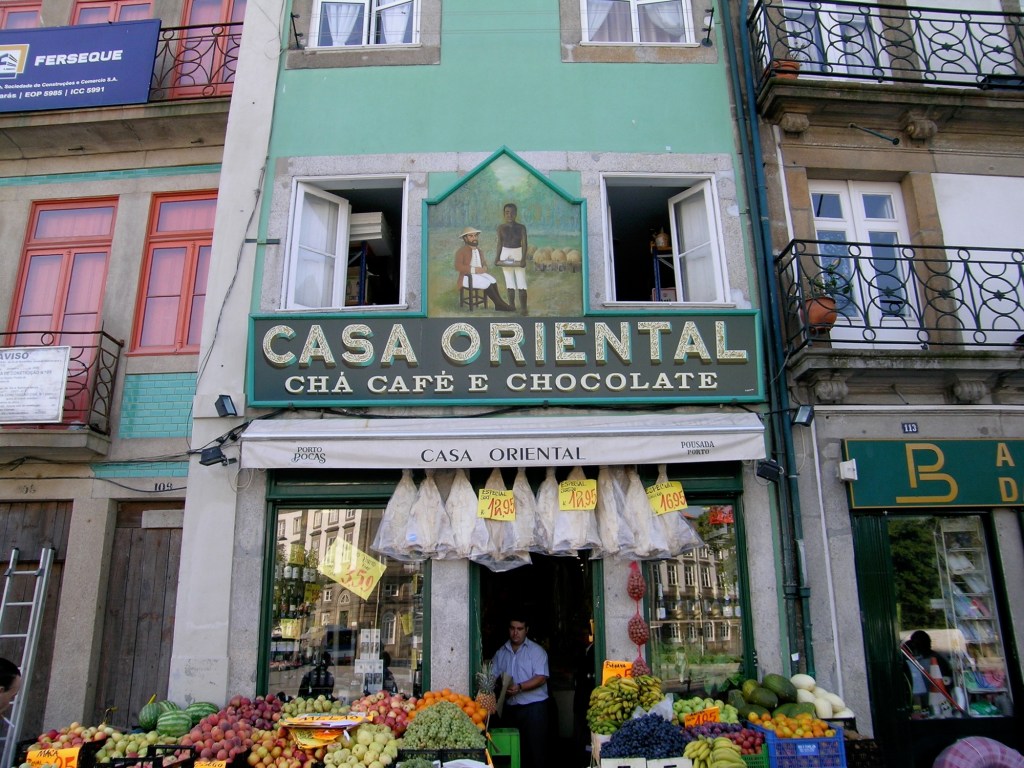
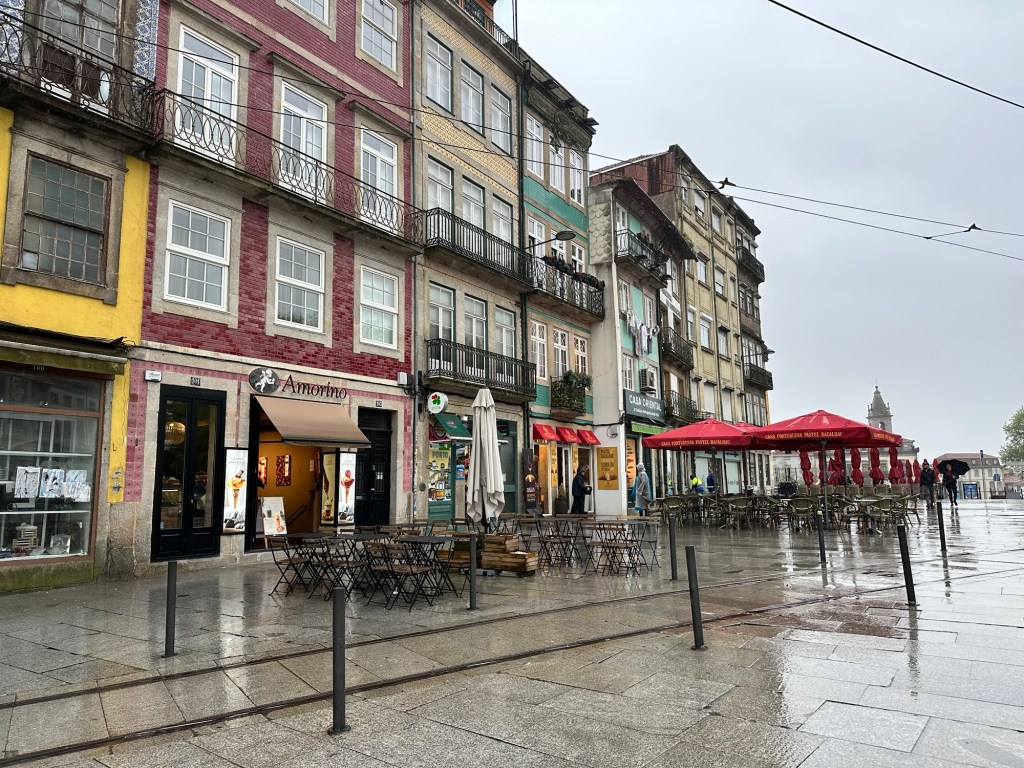
9/20034/20259/20034/2025Believe it or not “casa Oriental” still exists, but you have to click on the current photo and zoom it to see how it has changed.
Because Mike and I climbed to the very top of the tower, I thought it was the perfect spot to leave some of his ashes.
When we were there in 2003, there weren’t any “love locks”. I didn’t have a lock today, but leaving his ashes was MY way of saying “I love you”.
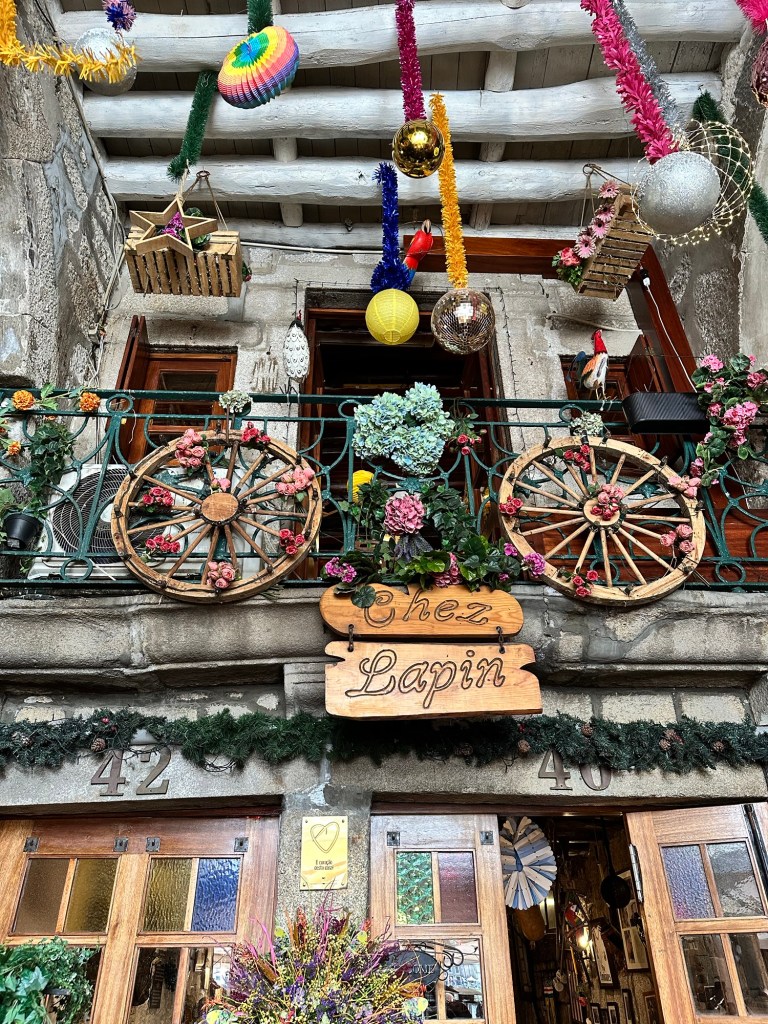
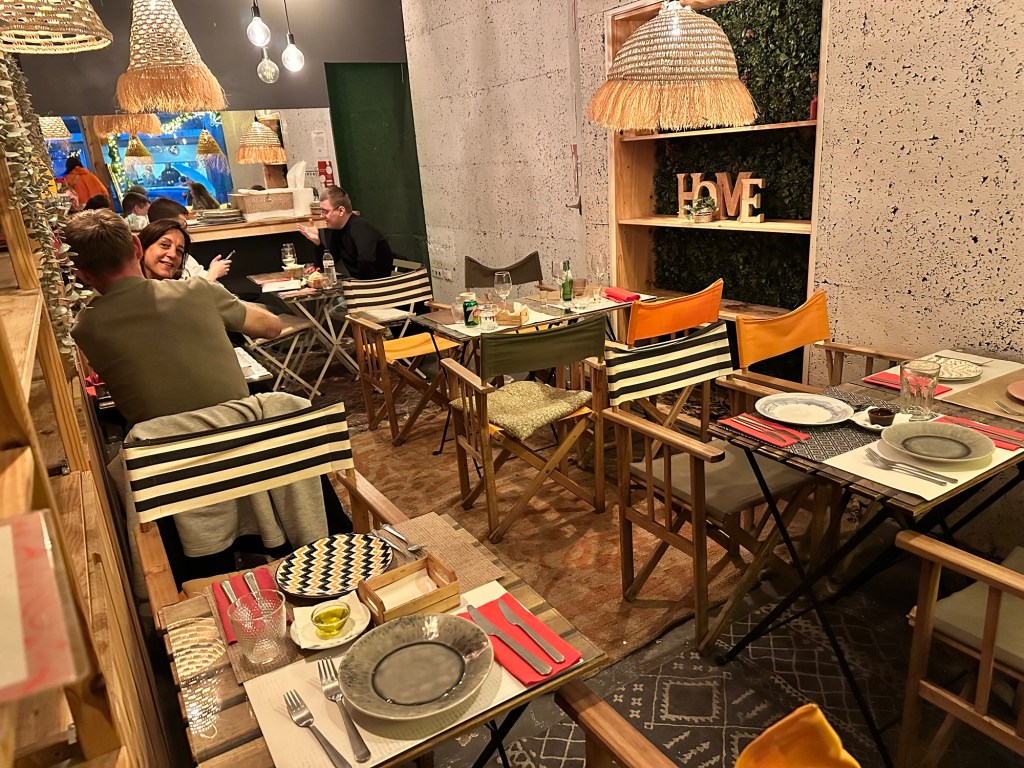
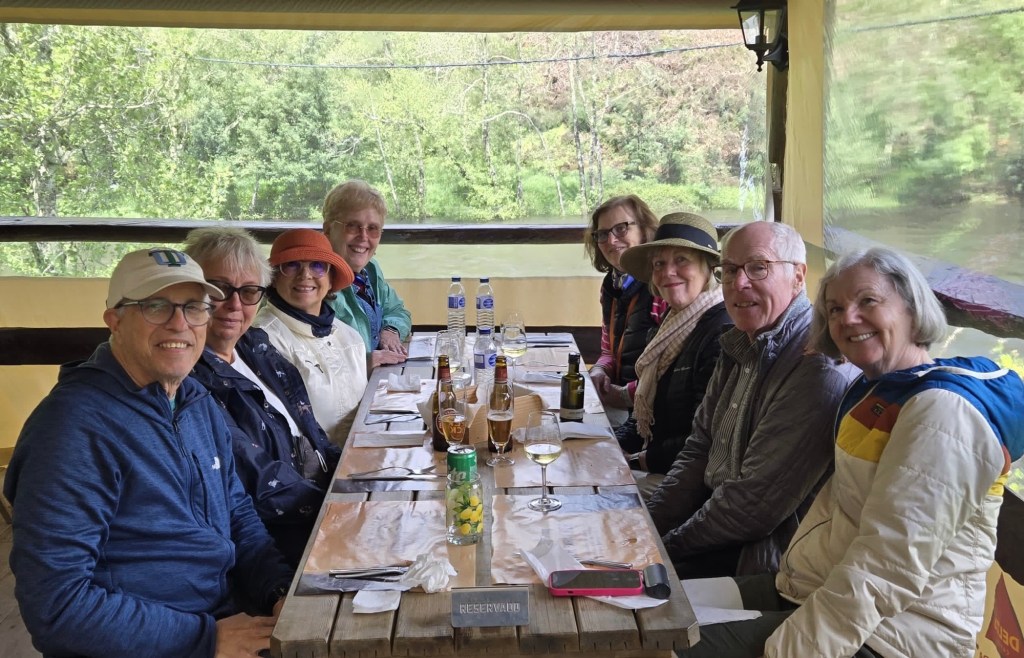
But I digress. Back to day 1 and our lunch stop at an interesting restaurant. Check out the large wooden object dangling over our table.
I’m pretty certain “the world’s most beautiful McDonalds” wasn’t here when we visited in 2003! Quite different from what we have in the USA, wouldn’t you say?
No, none of us ATE there, although the place was PACKED!
Instead, three of us had dinner at Almada 331, a tiny restaurant close to our hotel, the Turim. The food was incredible, yes. The menu was in English, yes. The cork walls made conversation enjoyable. But what REALLY made the experience off the charts was Fernando, the owner.
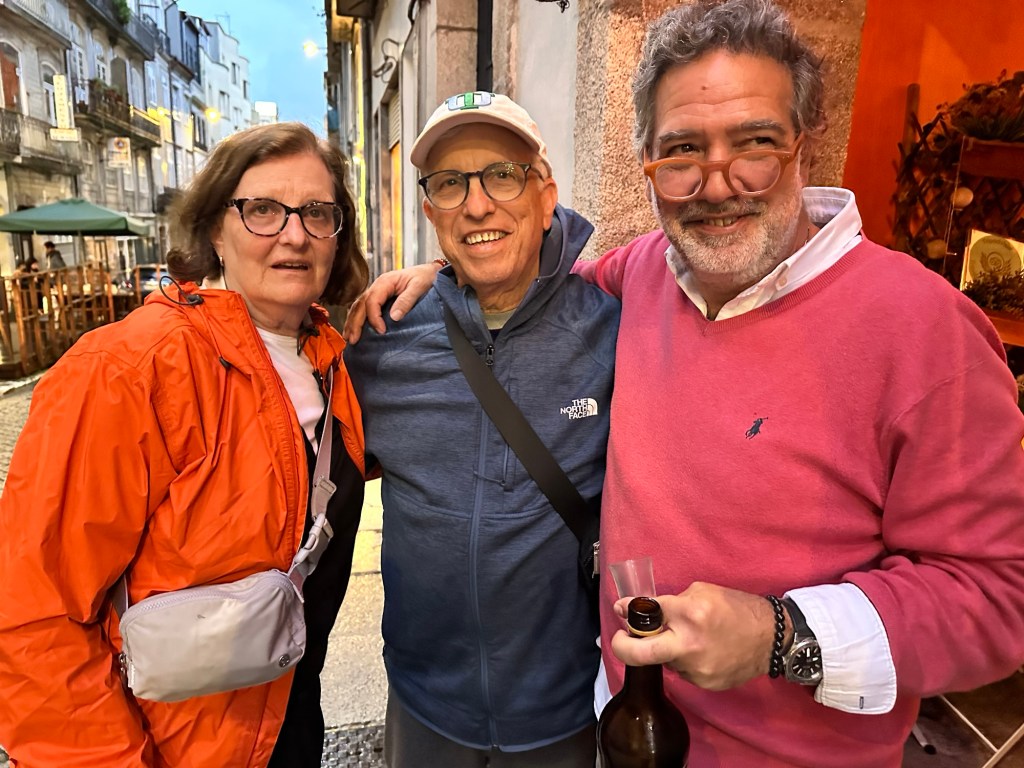
Loren, Sheldon & FernandoThe restaurant consists of two adjacent, cozy rooms.
Both “Shelly” and Fernando had lived in Pittsburgh, so we all became instant friends. But so did the Belgians, Ukrainians, Indians and the woman from Singapore (Singaporean?) who were also dining at the restaurant. It is that kind of place. When you enter, Fernando asks where you are from, and then points out all the different countries represented in his tiny restaurant. It was truly a magical night.
In case you’re wondering, yes, it was confusing to have a male Shelly on the trip, especially because his wife Loren was one of my very favorite fellow travelers, so we spent a lot of time together.
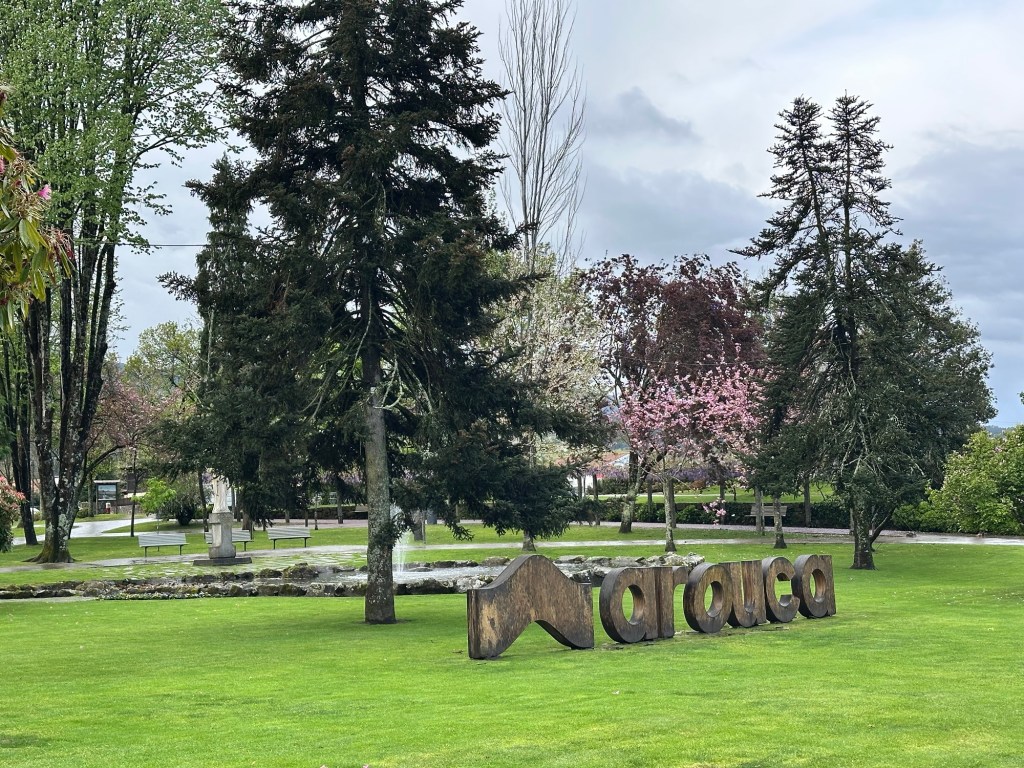
We had the option of exploring the city on our own during one of our three days in Porto, or paying $145 to visit Arouca, a UNESCO World Heritage Site. Bet you already know which option I chose.
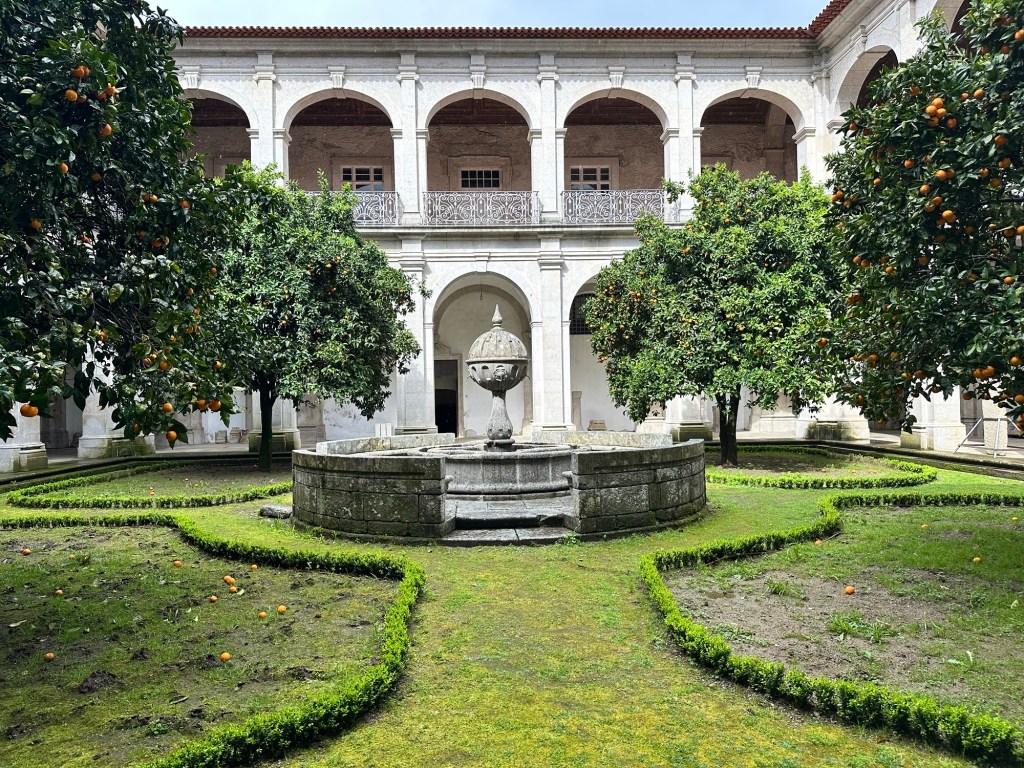
First, we visited the monastery. In the USA, monasteries are where the monks live; convents are for nuns. In Portugal, however, it isn’t gender that defines the naming convention, it’s location. Monasteries are built in remote areas, outside of cities; convents are built inside the city walls. So, although initially the Arouca Monastery was inhabited by men, by the 14th century the nuns had taken it over.
But not just ANY nuns. No, these were noble ladies from families of wealth and power, for whom a suitable match had not been found. What to do with your 18 year old unmarried daughter? Why, you pack the old maid (and one or two servants) off to the nearest convent, along with a very generous donation.
She will never be allowed to leave the convent. But don’t feel too badly for her, because rather than being her husband’s servant, she gets to meditate, walk around the garden, read, and boss her servants around. Best of all, she won’t die in childbirth, unless she uses one of the legendary tunnels to meet up with a friendly monk.
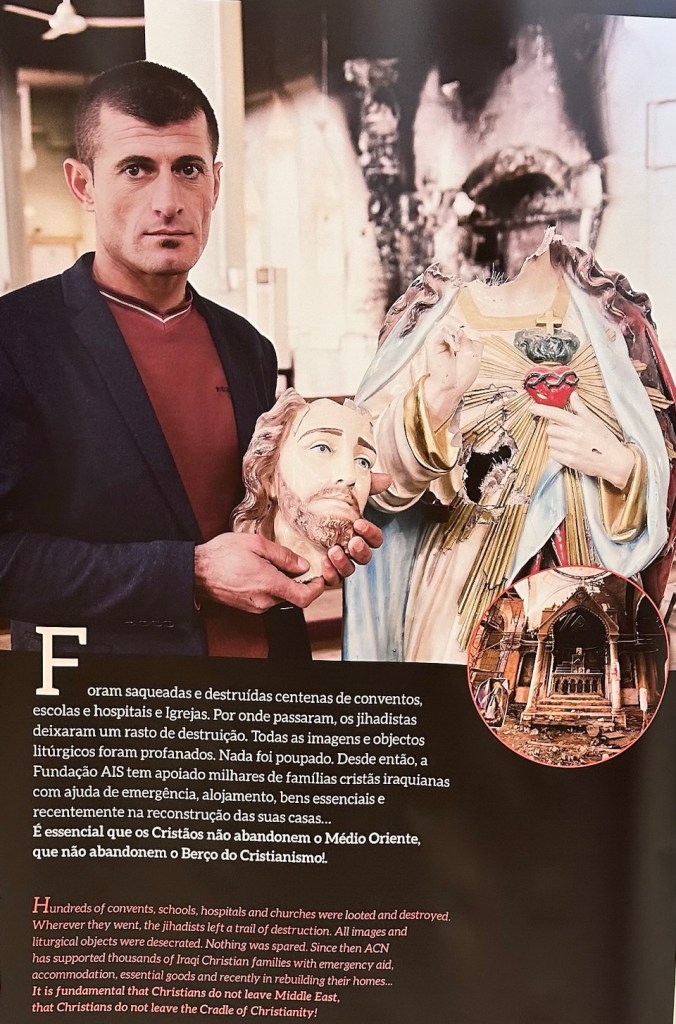
You can’t see them in the above photo, but the courtyard is lined with banners describing the persecution of Christians, like this one:
Surprisingly, no mention was made of the Inquisition, probably because it happened in Spain?
Although this “lazy Susan” was normally used for food and other contributions, occasionally a baby was placed on the shelf. Our guide told us that maybe the turnstile was occasionally spun 360 degrees. That way, it would appear the baby had been brought by a townsperson, even if it had originated inside the monastery. That’s the upside of wearing those bulky robes.
One noble lady, Queen Mafalda, was briefly married to 10 year old Henry I of Castille. When the Vatican annulled the marriage, she voluntarily entered the Arouca Monastery, where she is currently on display in the chapel.
My favorite part of the day was our visit to the suspension bridge. To get there, we drove along beautiful, winding mountain roads for about 45 minutes. It was a visual feast! By the time we arrived, we were all eager to walk through the woods, over the bridge and back.
Okay, so it rained off and on, which added to the adventure. It also made us really appreciate the intermittent sunshine.
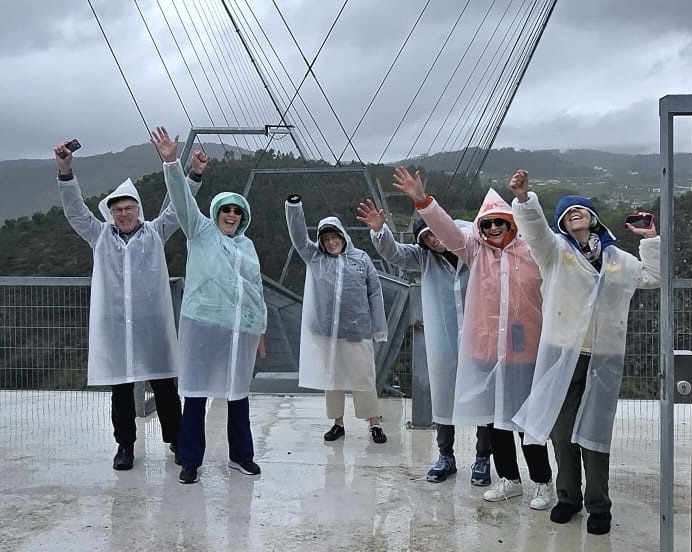
Ines, our local guide, thoughtfully supplied us with white rain ponchos to put over our jackets. The bridge was wet and slippery initially, but our spirits were as high as that bridge!
It case you’re wondering, the bridge is almost 1700 feet, or about a third of a mile each way. It opened in 2021, and only cost 2.3 million Euros to build. According to Ines, it is the highest and most beautiful suspension bridge in the world. It used to be the longest, until the Czech Republic one-upped them.
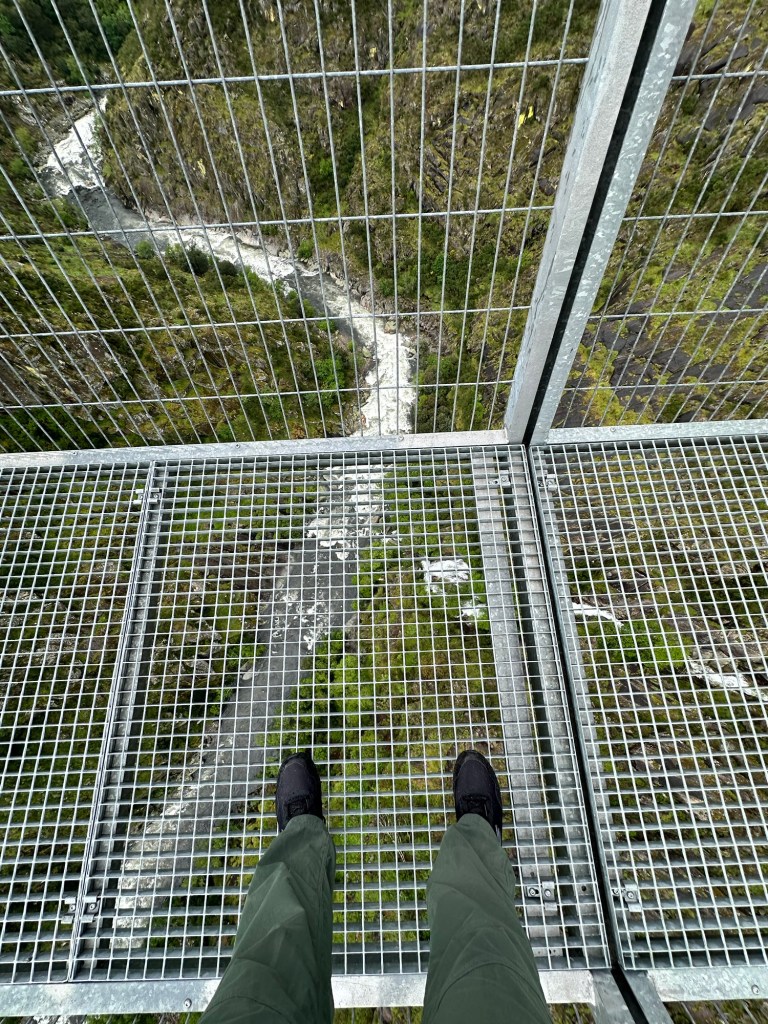
If you’re afraid of heights, it’s probably better if you don’t look down.
I’m not afraid of heights, so I did. Was it thrilling? Hell, yes!
The walk to the bridge was down a very steep slope.
As you know, what goes down, must come up, but those who had had enough fun for the day were able to ride a jeep to the top. Four of us opted to walk back—the equivalent of 15 flights of stairs —according to my Apple Watch. Not bad for four people over 70!
We had worked up quite an appetite, so we were ready for our wonderful lunch by the river, where we could watch the rafts heading toward white waters.
When I went for my bathroom break, I thought I had inadvertently walked into the men’s locker room, but no. The half naked guy in the skimpy towel was very friendly and wasn’t at all surprised to see me. I guess the area right in front of the bathrooms is the where the “rafters” suit up. Sorry, no photos.
Another thing I love about OAT is the ability to customize the trip. For our second night in Porto, I decided it was too windy and rainy for me to venture out, so I enjoyed a solo dinner in the hotel. Unlike most USA hotel restaurants, the food was great and reasonably priced.
I guess at this stage in my life, I’ve completely conquered FOMO (Fear of Missing Out). Instead, I only do things that I want to do.
Look at the size of that glass of sangria!
Because it was important for me to retrace the steps Mike and I took in 2003, I decided to skip the planned activities for our last day in Porto. Instead, I visited the previously described restored Clérigos complex, where I was reminded of the splendid life members of the clergy led, back in the “dark ages”.
I still had enough time to walk across the Douro River to visit three of the seven magnificent WOW Museums. And they were indeed a wow!
Even the museum’s floors are visually appealing. This floor is perfectly flat. Optical illusions in the pavement are a Portuguese “thing”. Lisbon and Rio de Janeiro have similar beautiful walkways.
I have visited many wineries, so the history of wine making wasn’t as interesting as the interactive exhibits. Where else can you stick your nose over a tube to try to identify a wine smell? I was only able to correctly “smokey” and “chocolate” scents. If I ever had any doubts that my palate was unsophisticated, that exercise dispelled them!
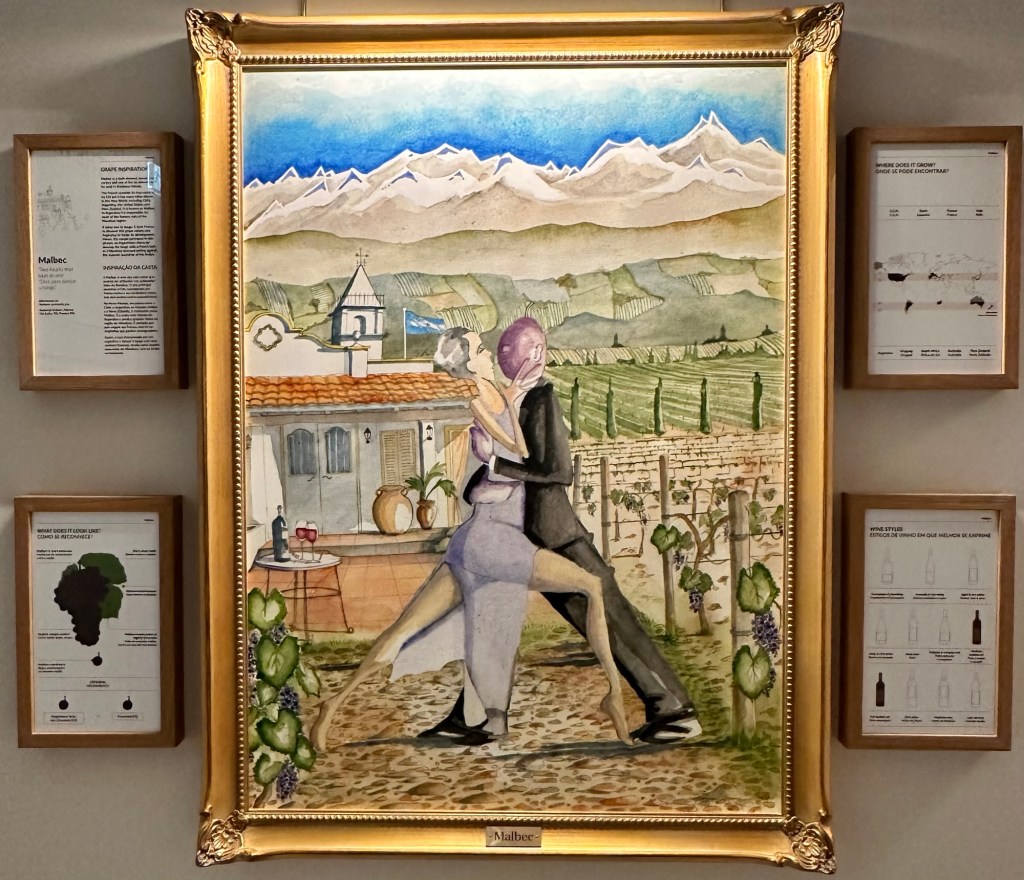
A corridor was lined with fun information about the different varietals. This is the artist’s vision for Argentina’s Malbec.
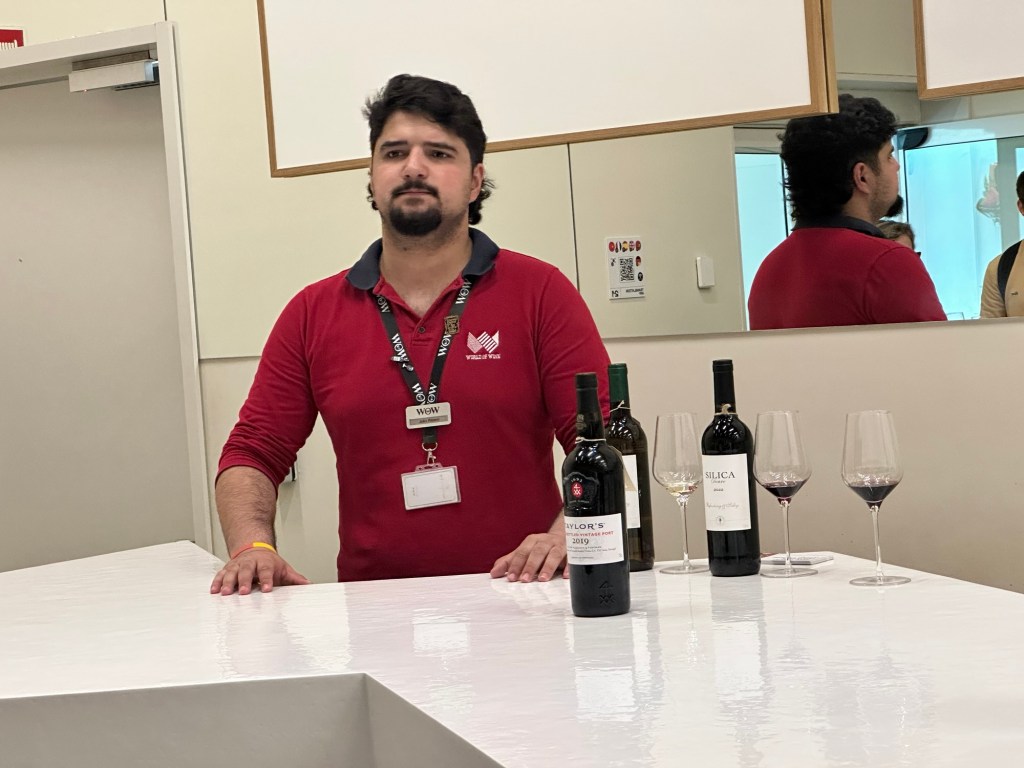
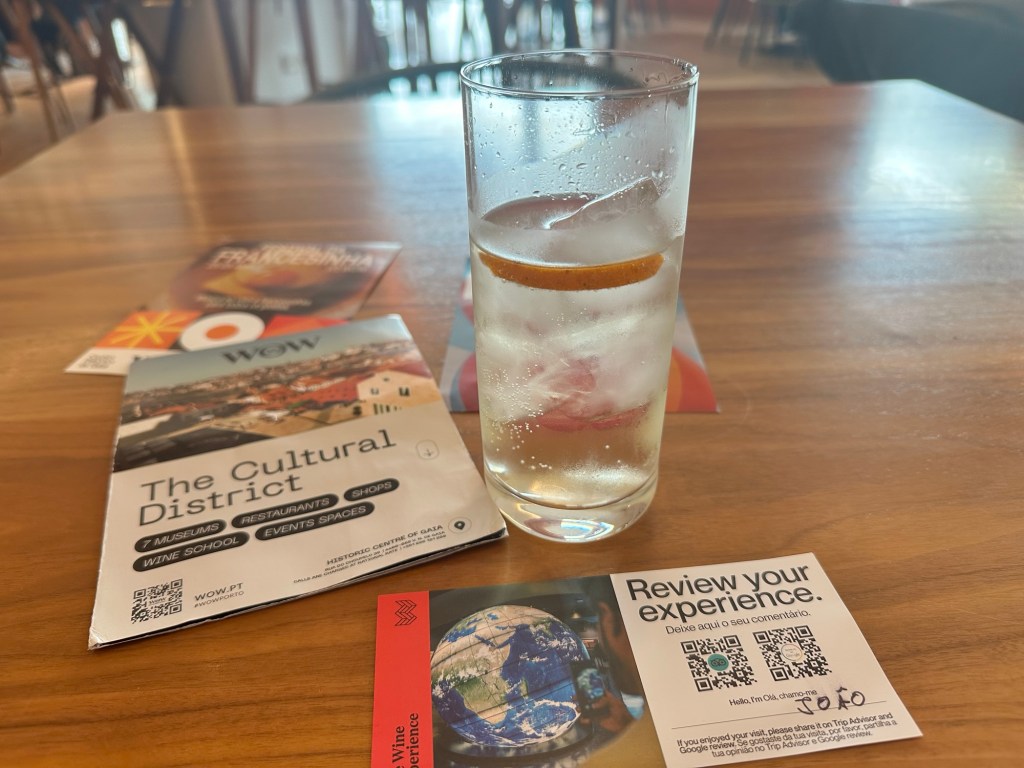
The wine museum’s admission price included a tasting of three different wines, with an explanation of what you are drinking, plus a coupon for a free port tonic in one of the museum’s many restaurants.
Of the cork and chocolate museums, can you guess which was my favorite? Which one had the best free samples?
I found the chocolate museum’s South American creation myth video so delightful, I stood there and recorded it for those of you who will never visit Porto. (You’re welcome)
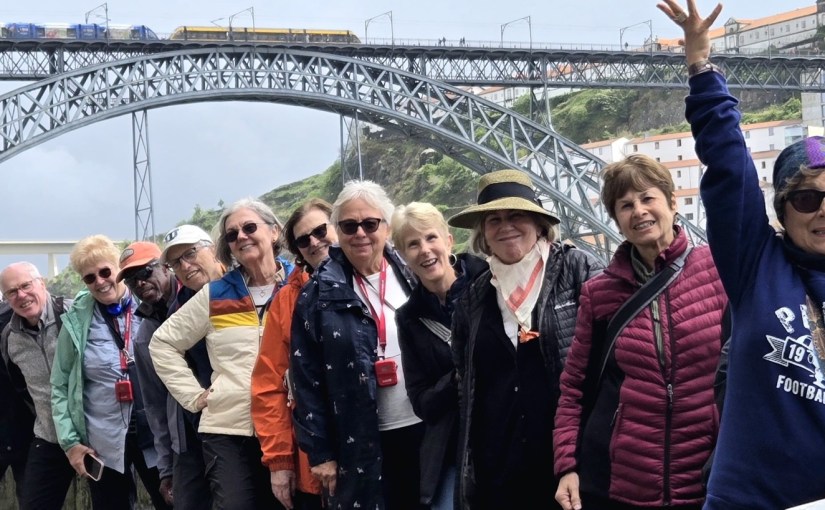
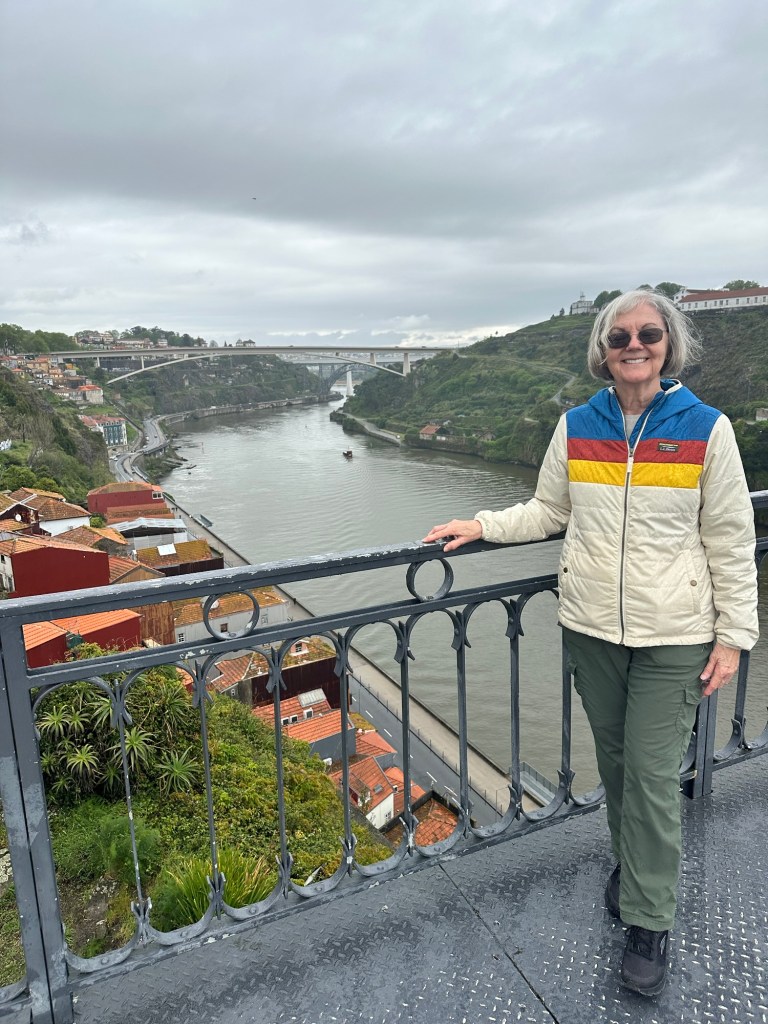
The museum was across the river from our hotel, so I walked across both levels of the bridge…the top, with its panoramic view.
On the way back, I took the “low road” so I could deposit the remainder of Mike’s ashes in the Douro River, because we had also stopped there in 2003. Back then, we had the bridge all to ourselves, and cameras didn’t have “selfie” options.
September 2003
Barb, Pam and I are being picked up at 9 AM for our 12:30 direct flight to Newark. Because breakfast is at 7 and the market opens at 8, I figured I’d have enough time to do a quick swing through. Despite the rain, I made the 7 minute walk to Bolhão. Although the posted hours indicated the market was open, it appears no one bothered to tell the vendors.
Not a problem. I know where I can find dry clothes, and I still have enough time to change into them!
Although there is much more to say about this wonderful city, our fantastic tour and my amazing travel companions, this post is already quite long and we are on our way to the airport.
I absolutely LOVE Portugal! There is SO much to see and do. Although we made the most of our transit day, by crossing the border into Portugal at 10:15 Spain time, 9:15 Portugal time, it still feels like five days in this fabulous country is not nearly enough.
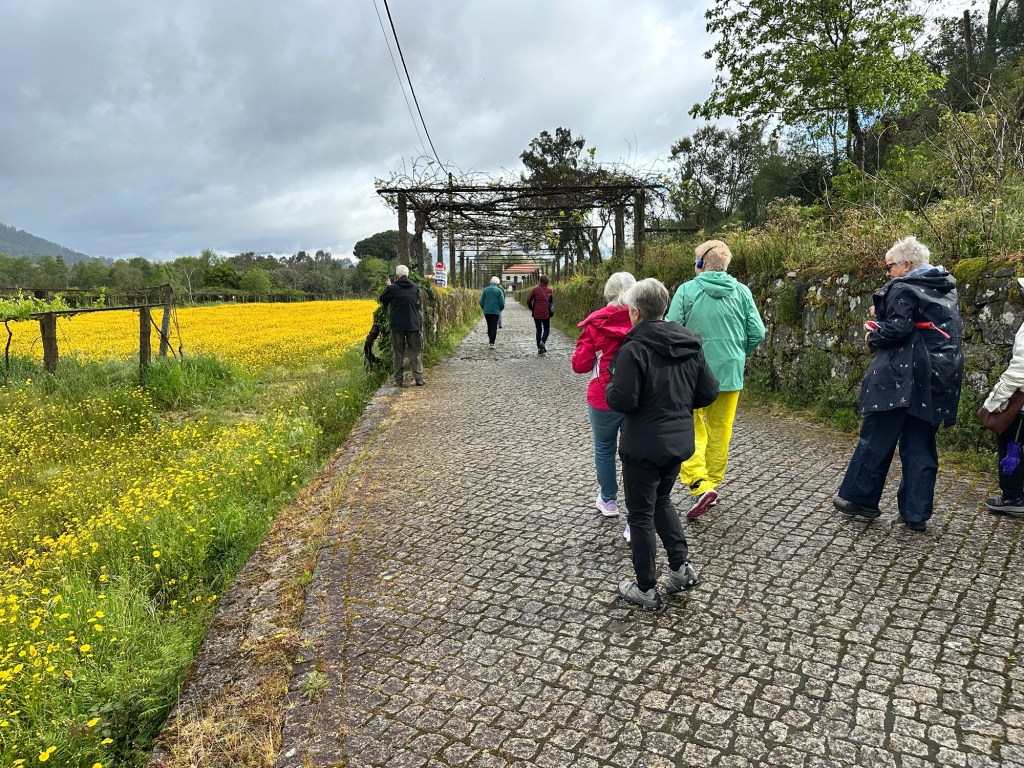
We started our transit day by walking the Portuguese El Camino, alongside the river leading into the town of Ponte de Lima.
I’m so happy the weatherman was wrong about the 100% probability of rain. Might it have been smarter for him to hedge his bets a teeny bit with a 90% probability?
The cloud cover made photos more interesting and more importantly, made our walk very pleasant.
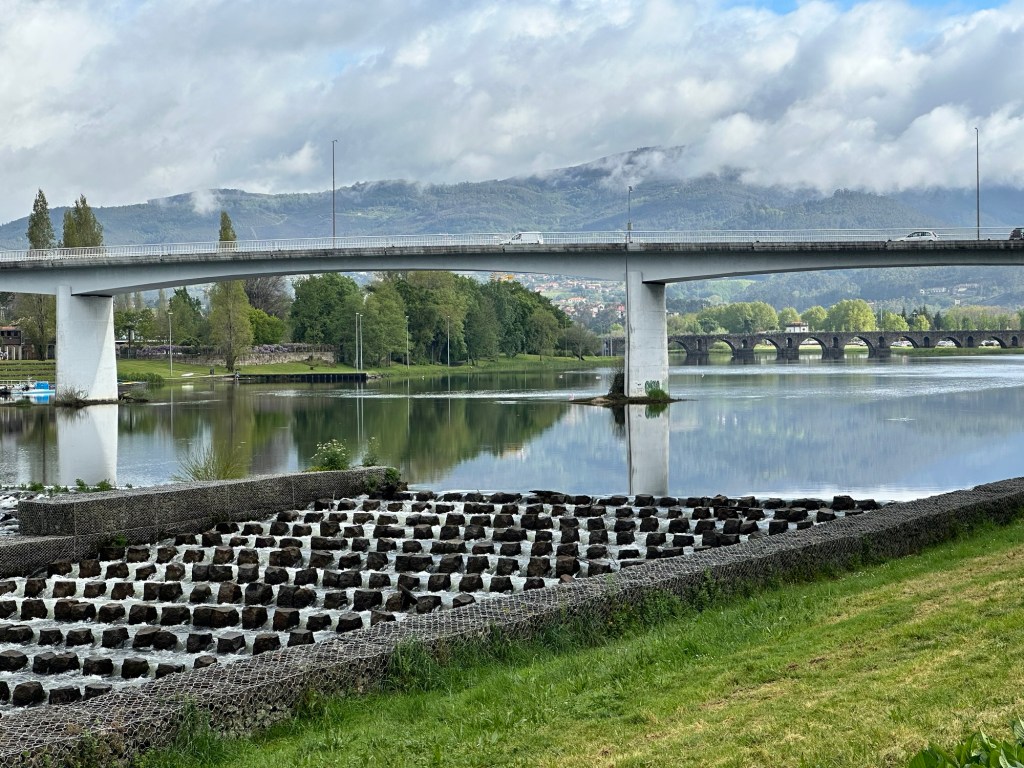
This river’s legend dates back to Roman times.
Roman soldiers on a campaign to conquer the world mistook the Lima River for the River Lethe, the mythological River of forgetfulness. Because there was no bridge, they had to enter the river to get across. Believing that doing so would erase all their memories, they refused. I can’t blame them. Who wants what is known today as a “senior moment” ( except it would be more like a senior decade)?
The general (that’s him on the horse by the river bank) crossed first, then commanded each of his soldiers, by name, to come across, thereby shattering the “memory loss” legend.
After we crossed the bridge, we easily located where we could add stamps to our Pilgrim Passport.
Yes, we have become obsessed with collecting stamps wherever we stop. I’ll talk about that in a future post. But right now it’s time to share photos of Guimarães, a beautiful village that has some historical significance —but what that significance is currently escapes me. Hey, I have the perfect excuse. I crossed over the River of Forgetfulness.
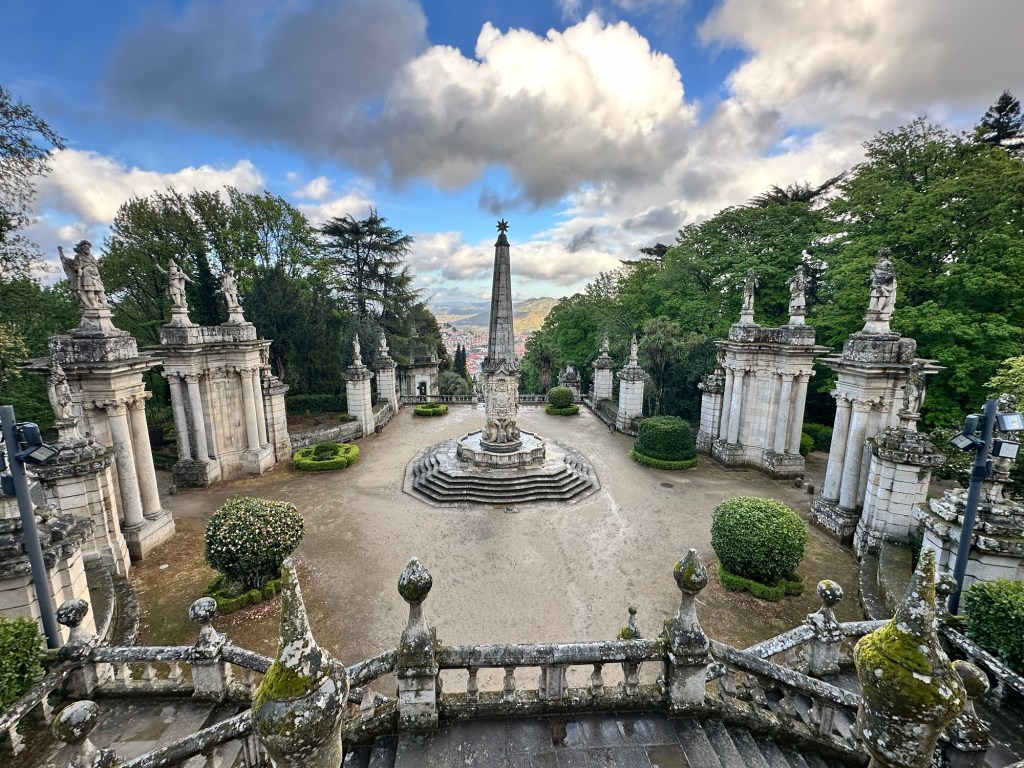
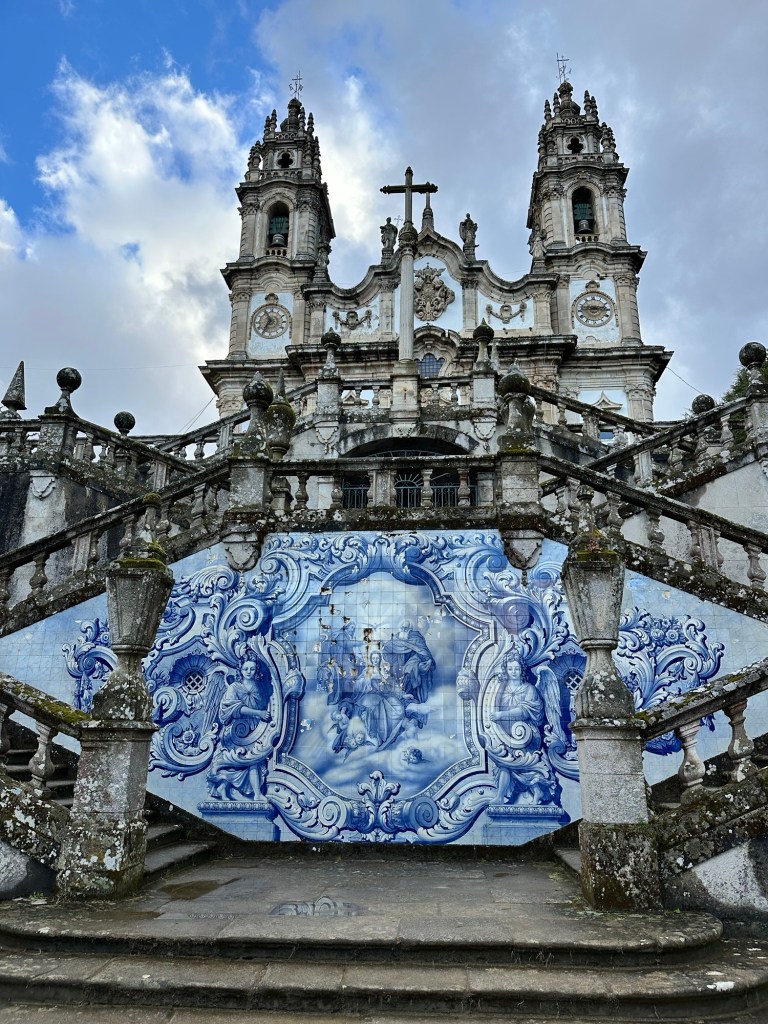
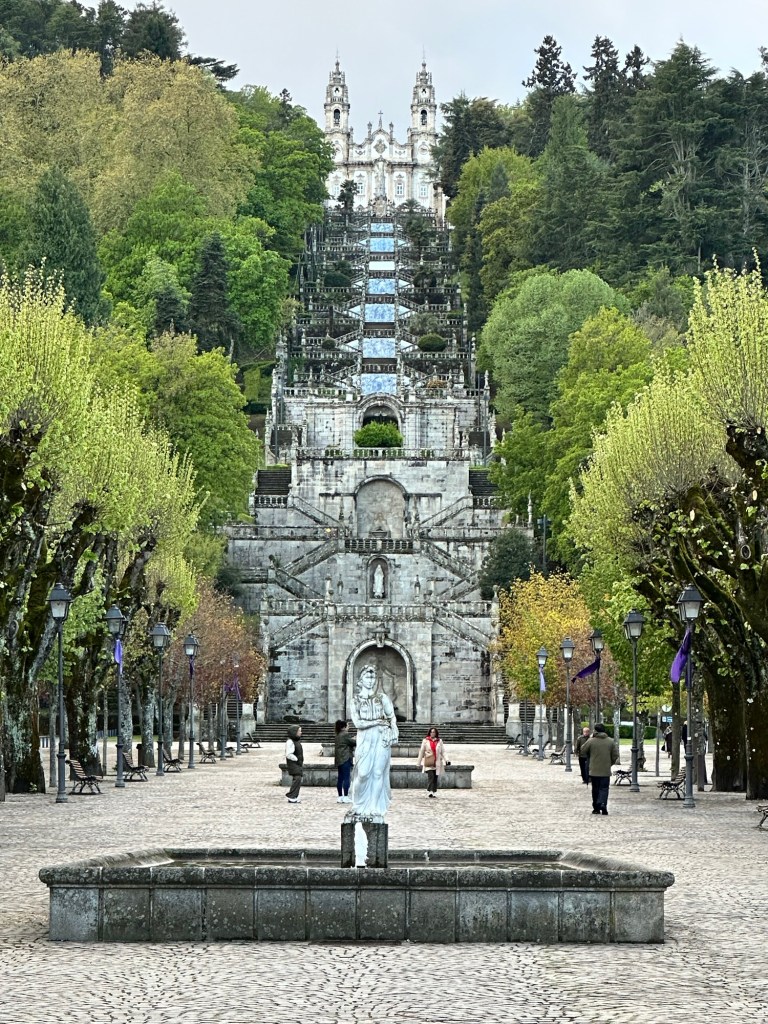
We finished our transit day by walking down the 608 steps (that was MY count; Wikipedia claims there are 686 steps) to dinner at a restaurant in Lamego. And what a beautiful walk it was!
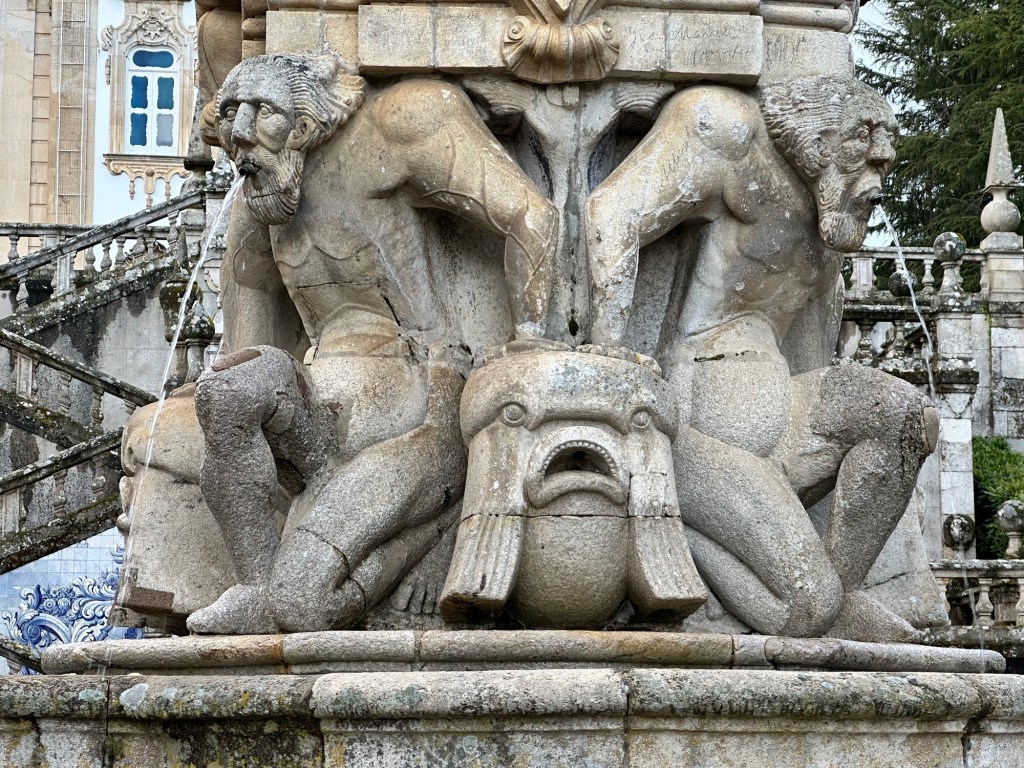
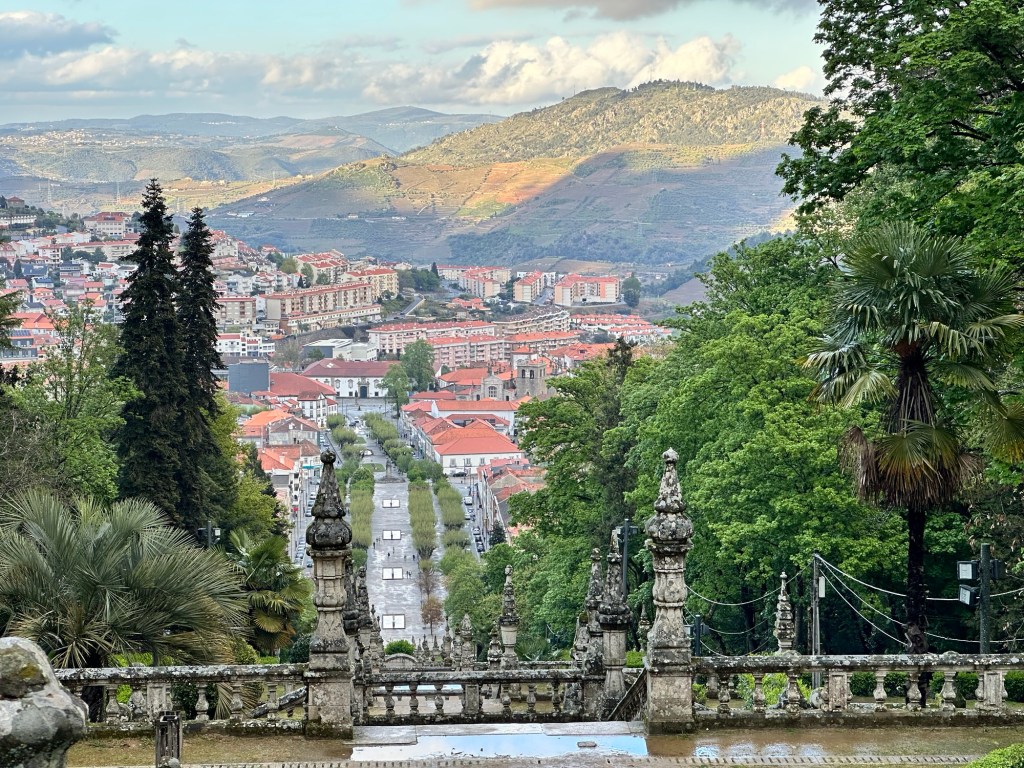
Our starting point Beautiful wall tiles decorated every landingThe fountains were also spectacular Look at this incredible view!
Okay, there are many, many more photos from this fantastic walk, but I will end with the view from the bottom, because we still have some fantastic sights from our Douro River cruise.
WOW!
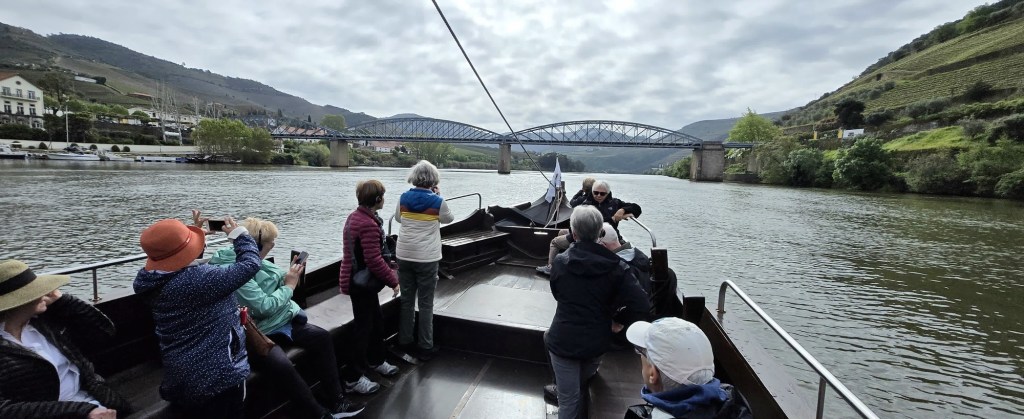
We had the boat all to ourselves,
Photo by Shahin, our guide
and there weren’t many other vessels on the river. We only saw one river cruise ship.
Just when you thought the day couldn’t possibly get any better, it did.
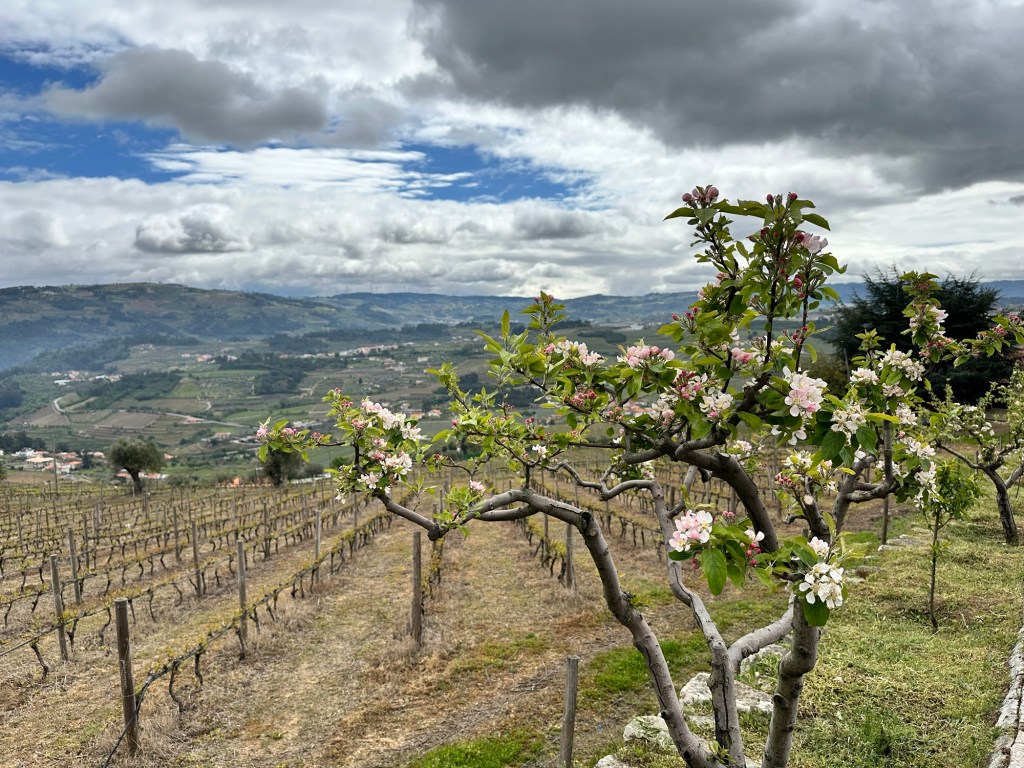
The Quinta da Portela de Baixo is not just a museum; it is also a vineyard carved into the side of a hill overlooking the Douro River,
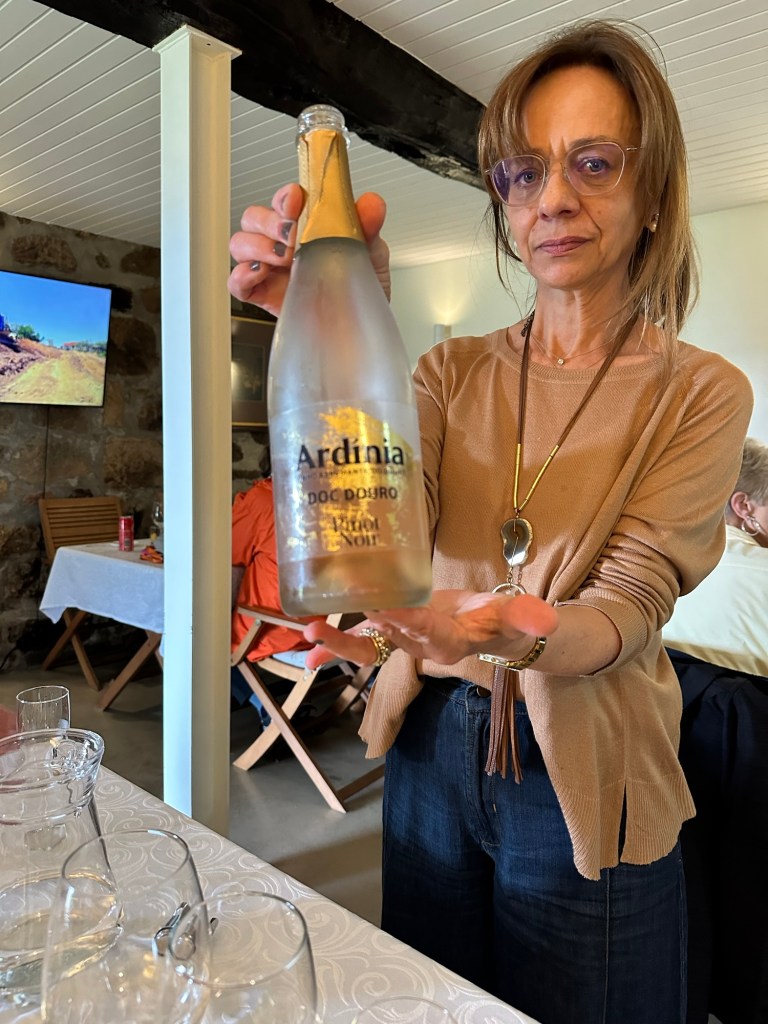
where we had lunch and sampled port wine. I had no idea that so many different kinds of port existed! Did you?
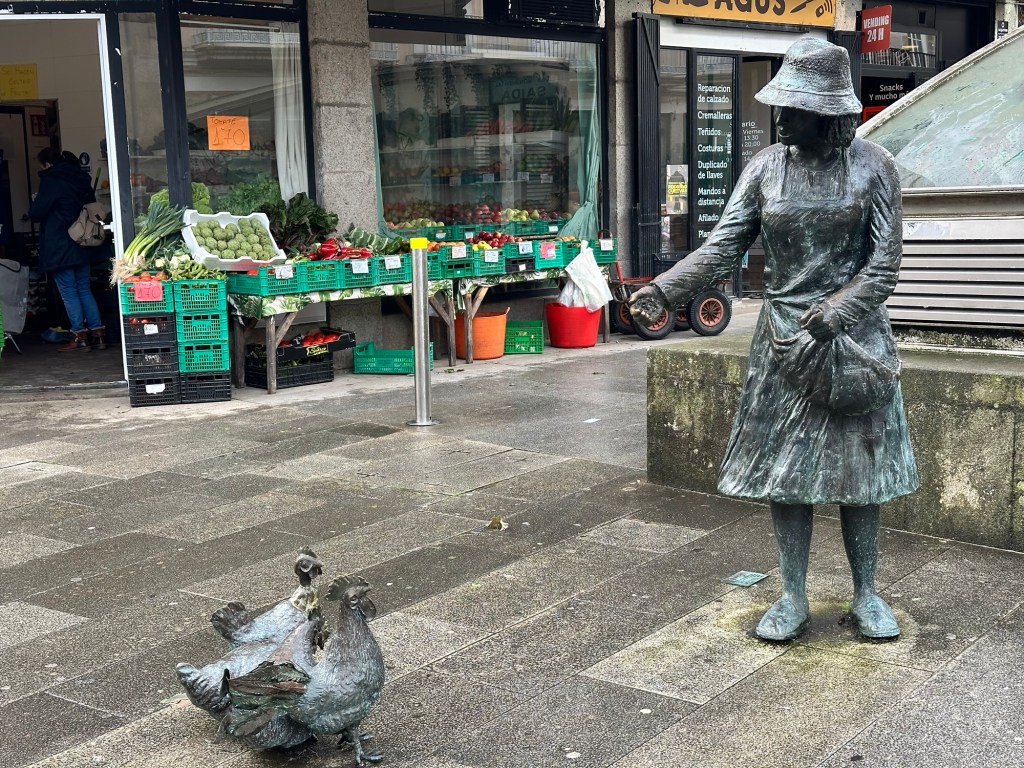
Our final stop will be Porto, which Mike and I visited in September of 2003. I wonder if women will still be carrying live chickens on their heads, the way they did back then?
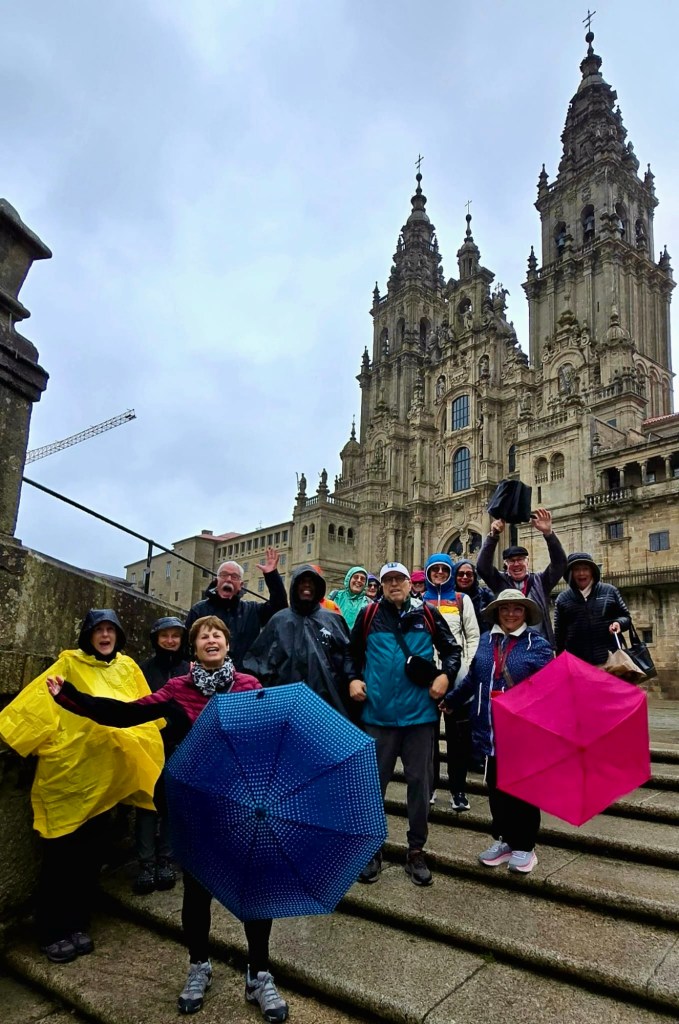
I didn’t know until I got there that Galicia normally gets an abundance of rain, which is why it is such a lush, green region. I THOUGHT I was adequately prepared for wet weather, because I had packed two hooded jackets, fleece lined pants and silk long underwear, but I forgot the most important item: zapatos impermeables (waterproof shoes). Luckily, our hotel was across from a sports store that carried waterproof sketchers in my size. Prior to that purchase, however, (as I mentioned in an earlier post), we walked the last five kilometers of the Camino in a downpour. Let me tell ya, medieval cobblestone streets retain lots of water between those rocks!
I bought the umbrella in Bilbao when my luggage was lost.
I had the full Pilgrim experience; I was soaked and completely miserable. It was definitely NOT one would consider a spiritual feeling. By the time we got to the hotel, my feet were so wet, I had to dry them with a towel. On a positive note—the hotel had a heated towel bar in the bathroom, but sadly it only functioned between 7 and 11 pm. Still, that was long enough to dry out my sodden socks, clothes and backpack.
If someone forced me (at gunpoint) to choose between walking El Camino or running with the bulls, that day I would have taken my chances with the bulls. (I would have carefully chosen a stretch that allowed for a speedy exit.) But, then again, if I had done so, I would not have earned the right to sport one of these lovely pilgrim tattoos.
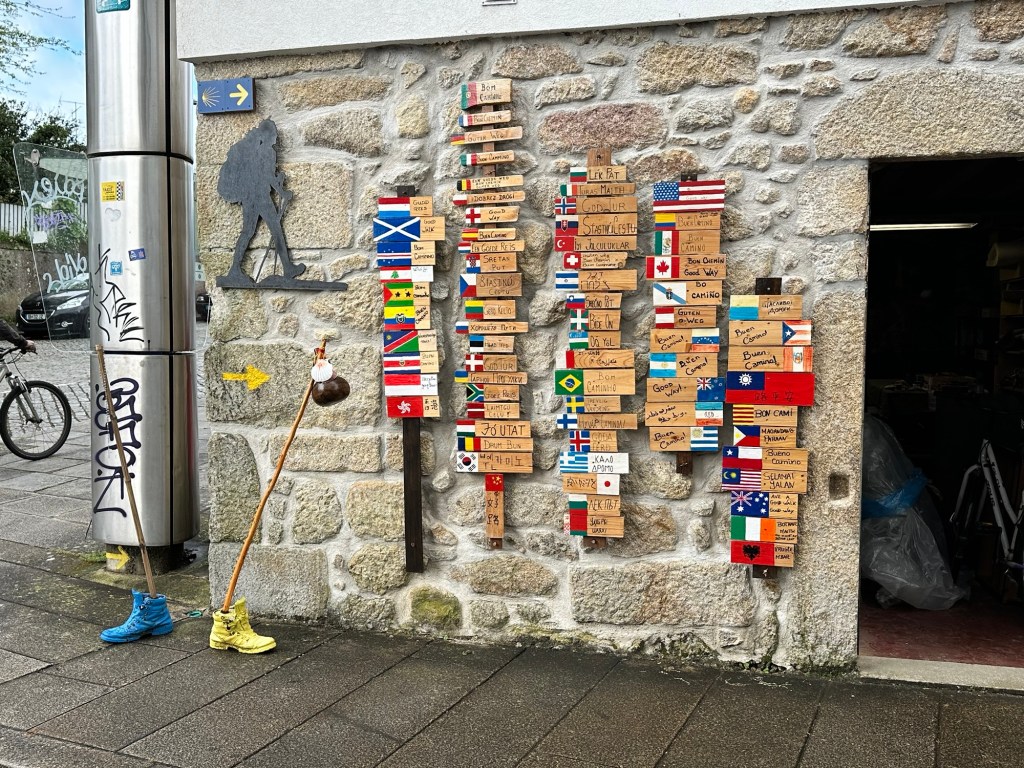
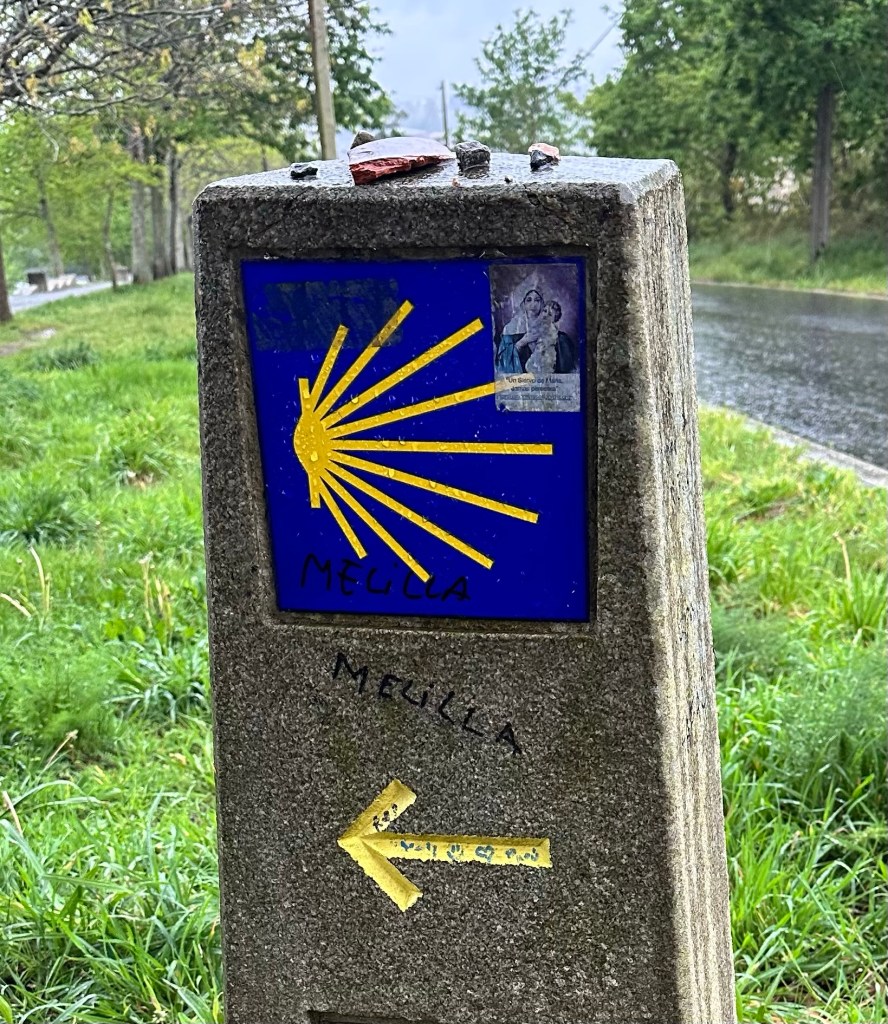
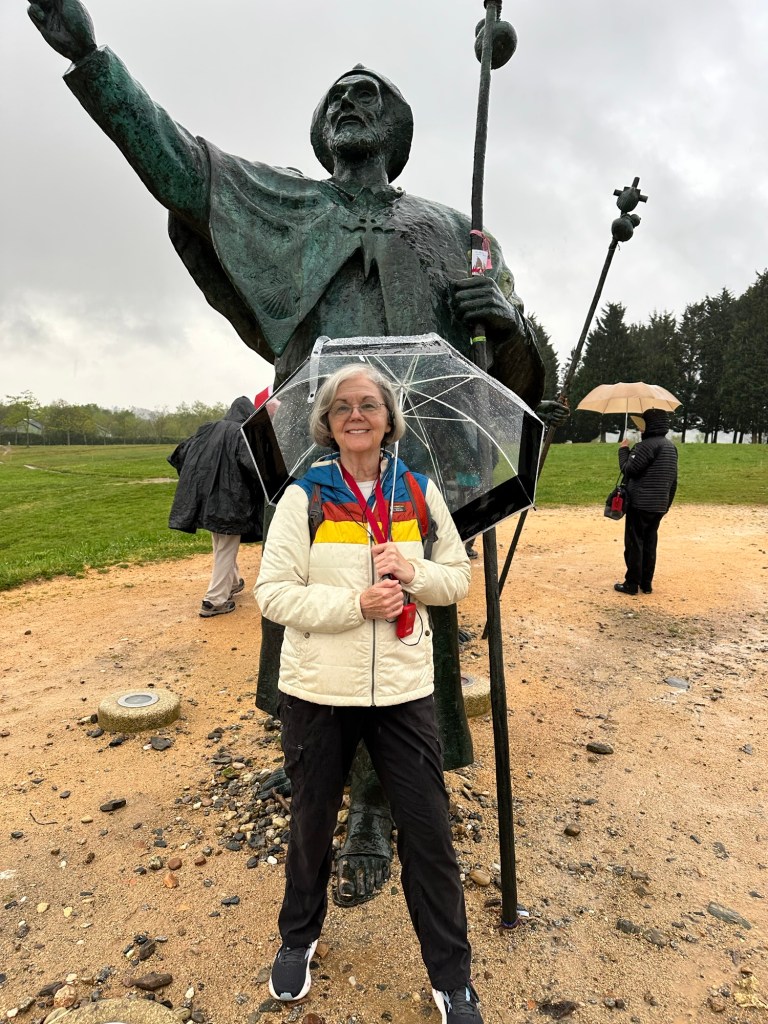
It’s hard to get lost on El Camino because the scallop shells point the way. They are EVERYWHERE. This sign also marks distance from the start of the French Way —4,790 kilometers—of which we did about 32 KM, or less than 10%
Before this trip, I had thought that there was ONE El Camino. NOW I know there are several: The French, the Portuguese, — we walked segments of both—the Via de la Plata (silver way), the Camino del Norte, the Primitive Way, to name a few. Regardless of which Camino you select, the destination is the same, the Cathedral of Saint James (Santiago).
Beneath that yellow umbrella is our local guide, Marian, regaling us with the legend of St James. WE were a shivering mass, huddled together under a nearby portico.
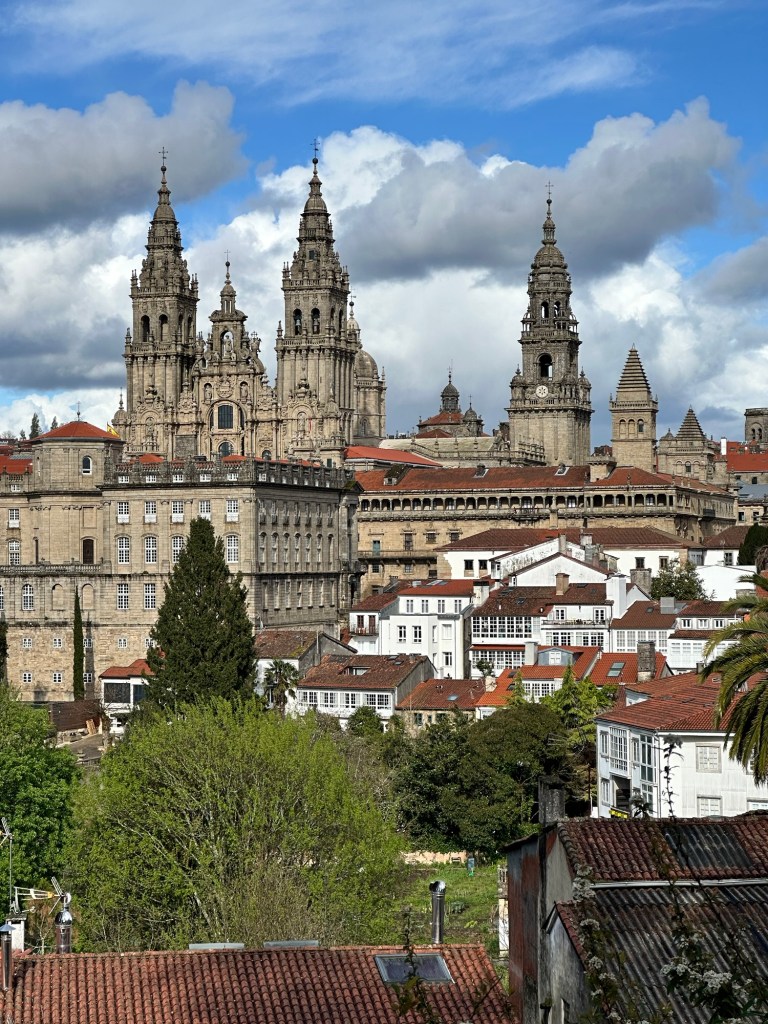
The cathedral from a different vantage point, a public park. Photo taken in between showers.
With all the wind and rain, I couldn’t take notes, so I’m operating strictly on memory. Here’s the part of the legend that I recall: a peasant (fisherman? shepherd? Some random guy?) in the first century (around 820 AD) saw a light shining down from the heavens several nights in a row, in the exact same spot. He recognized it as a message from God instructing him to dig, and when he did, he discovered the bones of a skeleton who had been beheaded. The church leaders made a rather large leap of faith and deduced that since St James had been beheaded, the skeleton must be that apostle. Over the ensuing centuries a cathedral was built and over time, the city of Santiago de Compostela grew around the cathedral.
Back then, pilgrims made the journey for religious reasons, to get a plenary indulgence (skip purgatory) or to avoid jail time. Yes, you read that right. Marian explained that people who committed minor crimes back then were given a choice…walk several hundred miles or go to jail.
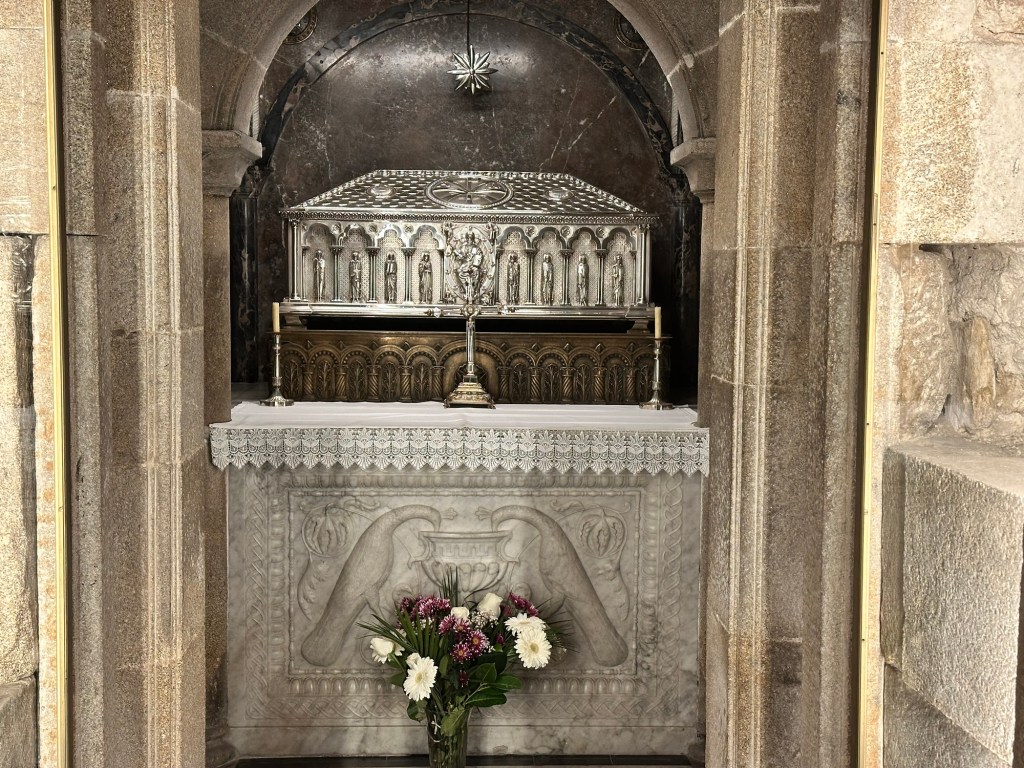
Fast forward a few centuries—today’s visitors can view this silver box that contains what the faithful believe is St James bones,
and can admire the cathedral’s beautiful interior.
My cell phone’s zoom isn’t very powerful, so I’ll describe the central image of the main altar. It’s St. James, riding a horse and brandishing a sword, which wasn’t exactly how the apostles were described in the Bible.
Santiago’s old town is a maze of narrow cobblestone streets, filled with restaurants, bars and souvenir shops, so after our first day in Santiago, I’d seen enough of the city. I welcomed the opportunity to spend the day in Pontevedra and Combarro on an optional trip OAT offered.
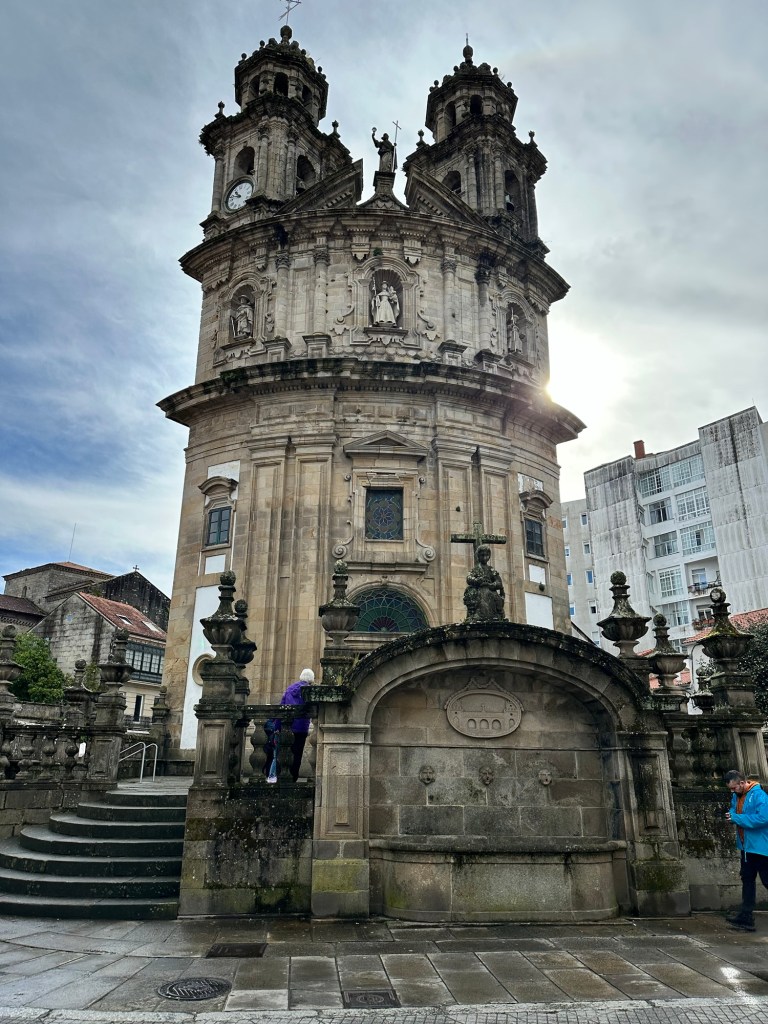
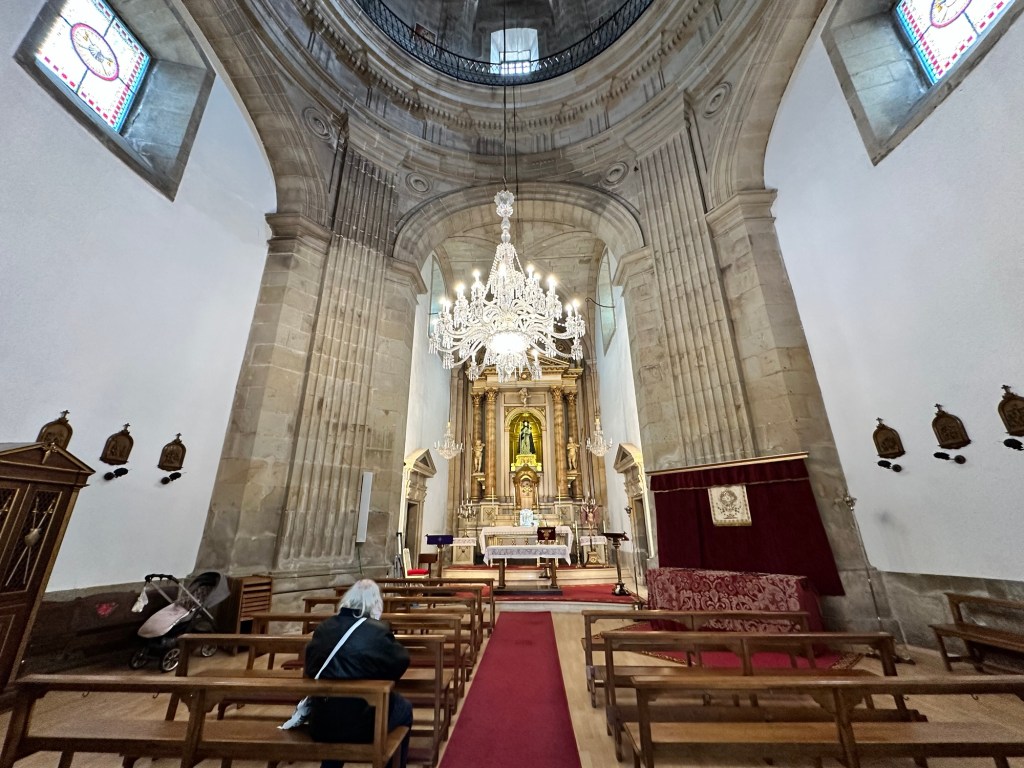
Pontevedra, founded by the Romans, gave us a break from the crowded streets of Santiago. It is also the site of an unusual church, with a floor shaped like a scallop shell. Or so I was told.
I’ll be honest. The church was clearly round, unlike any I’ve ever seen before. But I wasn’t able to pick up any resemblance to a scallop shell in the interior. Take a look. Maybe you’ll have better luck.
Despite the intermittent showers, it was a delightful day.
Combarro reminded me of Southeastern Massachusetts. I recall watching Sandy, my sister, digging up clams and quahogs with her toes in Mattapoisett bay.
Here in Combarro, it’s a highly regulated business, with strictly enforced limits on what can be harvested.
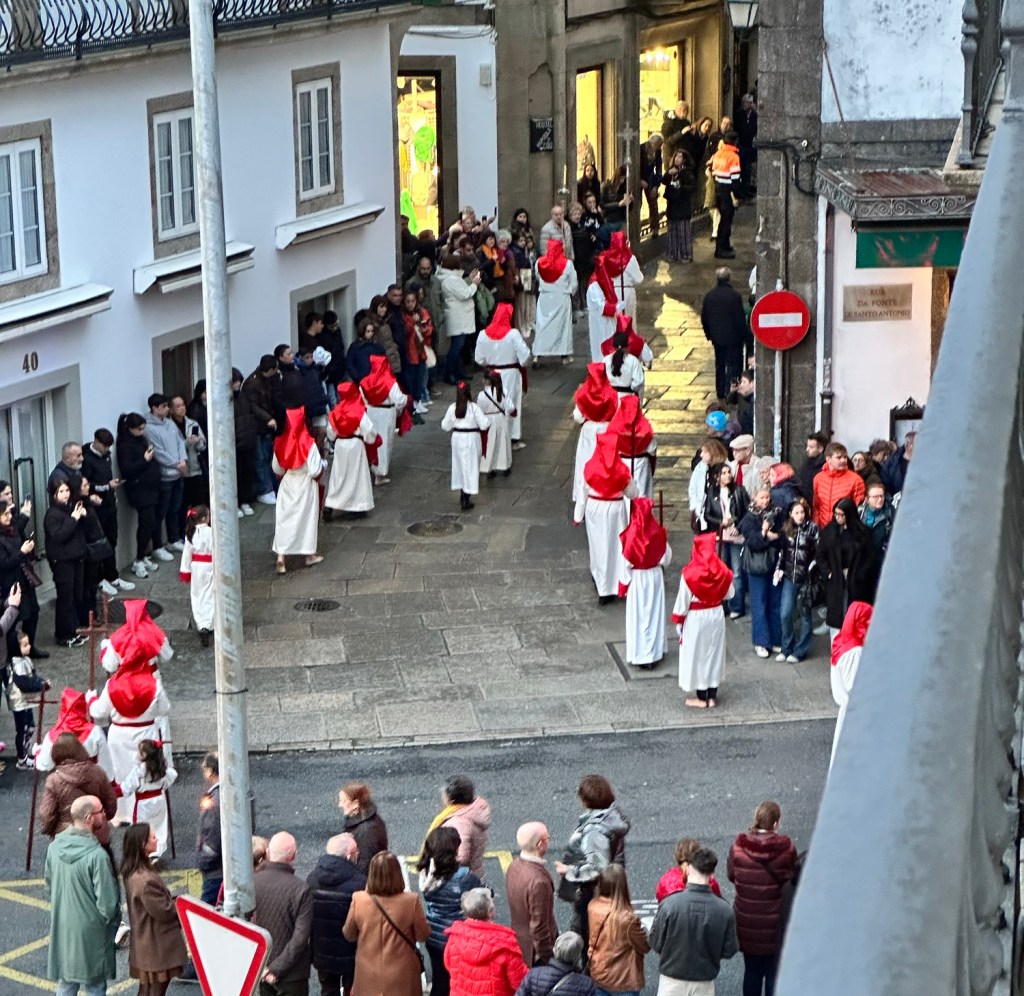
Our day ended with a pleasant surprise—a procession outside our hotel. I was already in my jammies, but when I heard the drums, I dashed onto my balcony to take this photo.
Fortunately, our trip leader was on the street and sent us a video.
Is it just me or does that statue of Jesus make it look like he needs a foundational garment?
When I booked this trip, I had no idea that I’d be in Spain for Semana Santa, or as we call it in the USA, Holy Week.
I will confess our group was more than a little surprised to see what looked like (to us) the Ku Klux Klan everywhere. But no, these are the different “brotherhoods” who hold processions every evening during Holy Week.
Their version of action figures were in shop windows.
Members of my family will not be shocked to learn that I accidentally stumbled into a church where one brotherhood was assembling. I had wanted to see the interior of the Church of San Isidoro after I learned this door was where you entered to get “indulgences”.
For those who didn’t spend your youth in Catholic school, I will explain. Indulgences are sorta like a “get out of jail free” card. You give the church a sum of money, and regardless of the sins you committed, indulgences get you on the escalator to heaven. Fortunately, the middle ages were chock full of sinners. How else do you think the church could afford all that art and gold stuff?
Can you imagine my surprise when I opened the door to find a PACKED church? EVERY bloody pew was filled with people wearing the same color coordinated outfit. My cream jacket stood out in a sea of purple, so when the door creaked open, and the assembled all turned to stare, it was easy to figure out who really didn’t belong.
I wasn’t gauche enough to take a photo then. I waited till they were all almost out the door. Hey, I wanted my friends back home to share in the experience. So here ya go.
Notice that THIS brotherhood allowed sisters to join in the fun, but instead of hoods, they wore a “thingie” to hold their mantillas high atop their heads. Also notice, they were at the very end of the procession.
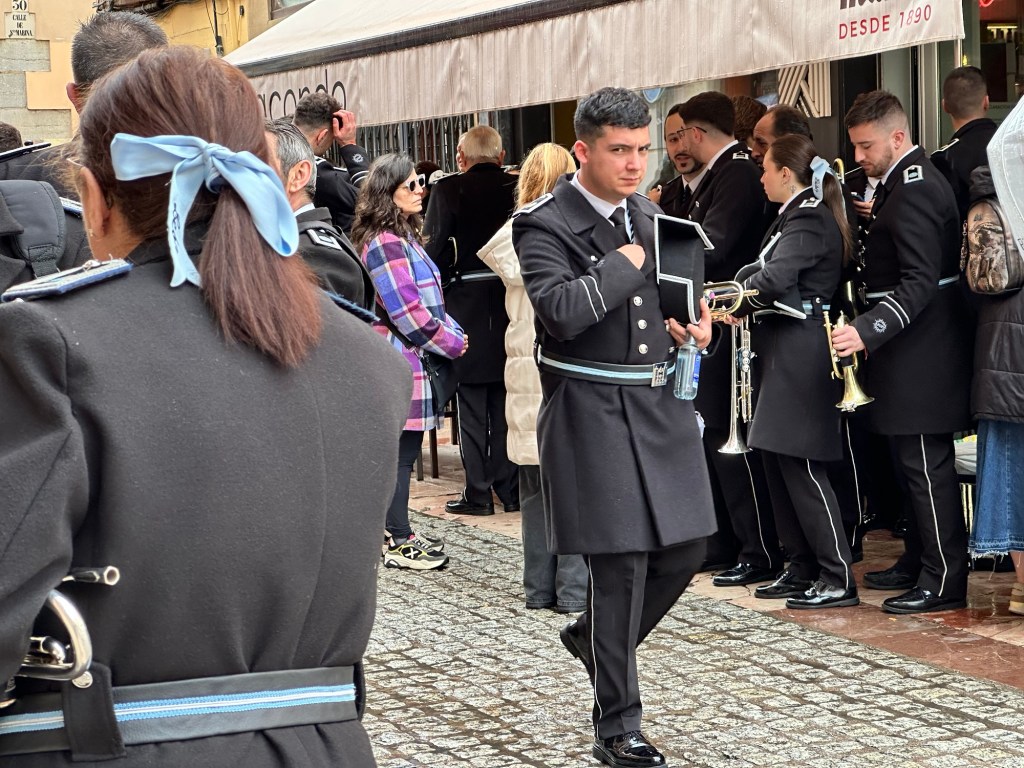
As I exited the church, I spotted some people wearing uniforms, carrying instruments, so I followed them to their assembly point — a bar.
Doing so earned me a primo spot when they started to play. I haven’t quite mastered the ability to imbed a link, but if you click below you should get a feel for Holy Week in Leon.
Despite the mob scene, fellow traveler Camille managed to spot me in the crowd. Equally surprising, I heard her call my name.
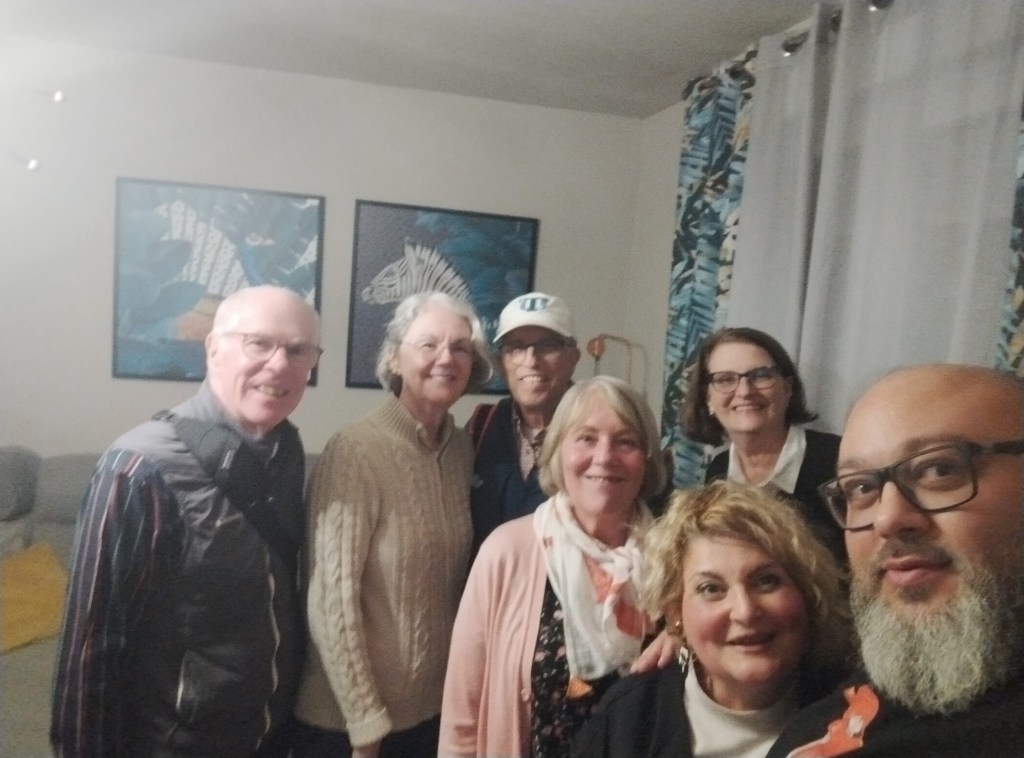
Somehow, in spite of the madness, four of us managed to link up with Shahin, our trip leader, who took the photo of Loren, me, Sheldon and Camille atop this post.
Before we went bar hopping, we saw a man standing in front of a building, swinging around a silver incense container, so we HAD to go inside. Much to our surprise, we found these elaborate “floats” that the devout carry on their shoulders during processions.
This is only ONE of many floats stored in the building
Sorry, there are no photos of our bar hopping extravaganza. We were far too busy drinking “lemonada”— red wine, lemons, cinnamon and seltzer water— León’s official “Holy Week drink, to take pictures
Our second day in the area was spent outside of León in the little village of Morgovejo, for what OAT calls a “Day in the Life” , another unique feature of OAT travel. We spend time with local inhabitants, visiting them in their homes, sometimes participating in their daily activities.
Carmín teaching us how to make cheese
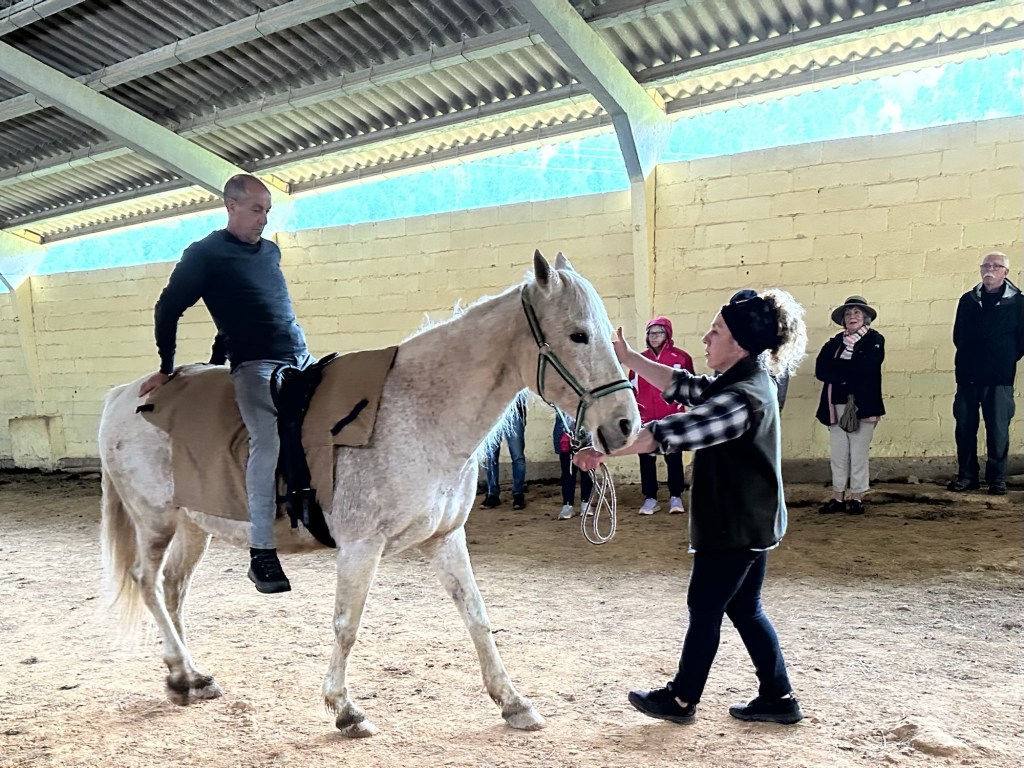
During our visit, Carmen showed us how she works with disabled children and adults, using a horse she rescued and trained. Her partner, Emelio demonstrated the various exercises that can be done by riding bareback .
Emilio demonstrating stretches.
The farm has horses, sheep, goats and dogs. Some of us were thrilled to be able to hold this baby lamb.
León was a fantastic stop, and it was over far too quickly. Next stop — Santiago de Compostela, the final destination of pilgrims on “The Way”.
One of the many reasons I absolutely love traveling with OAT is the company finds experiences I would never have discovered on my own.
For example, en route to León we made two delightful stops. The first was at an archaeological lab in Ubide, where Michaela, an Australian osteoarcheologist, fascinated us with stories about her dig at the Roncesvalles burial pit.
Can you figure out which one is Michaela? Hint: she doesn’t have gray hair. She’s in the back row, directly behind me.
It was truly amazing how much can be learned from bones. So far, they have dug down to the level of the Napoleonic wars, where they found an older soldier, whose jacket was used as a shroud. His jacket’s button is shown in the top right of the following photo. Can you see the Spanish word “Rey” (king)?
Because of his skeleton’s position in the pit, his age, his wound and the button, the archaeologists deduced the bones belonged to a high ranking member of the Spanish army who died fighting against Napoleon.
When the archaeologists reach the bottom of the pit, legend has it they will find a horse, a horn and the exploded head of Roland, a member of Charlemagne’s army, who was immortalized in the “Song of Roland”.
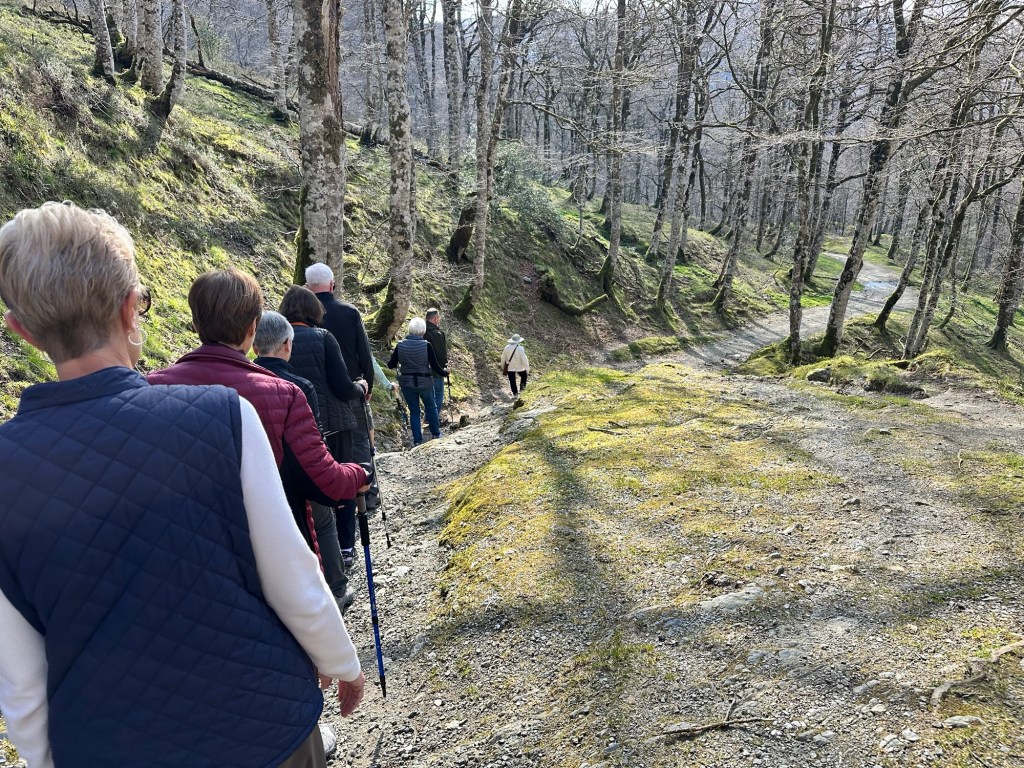
After he sacked Pamplona, Charlemagne headed back to France, using the route we followed through Roncesvalles (now part of El Camino). As you can see, the path through the forest is very narrow, so the soldiers had to travel single file, making them easy targets for the more than slightly annoyed Saracens.
For those of you who never read “The Song of Roland” and have no desire to ever do so, here’s the scoop. When Roland sounded the horn to warn Charlemagne of the attack, he blew so hard, the legend claims that he literally blew his brains out.
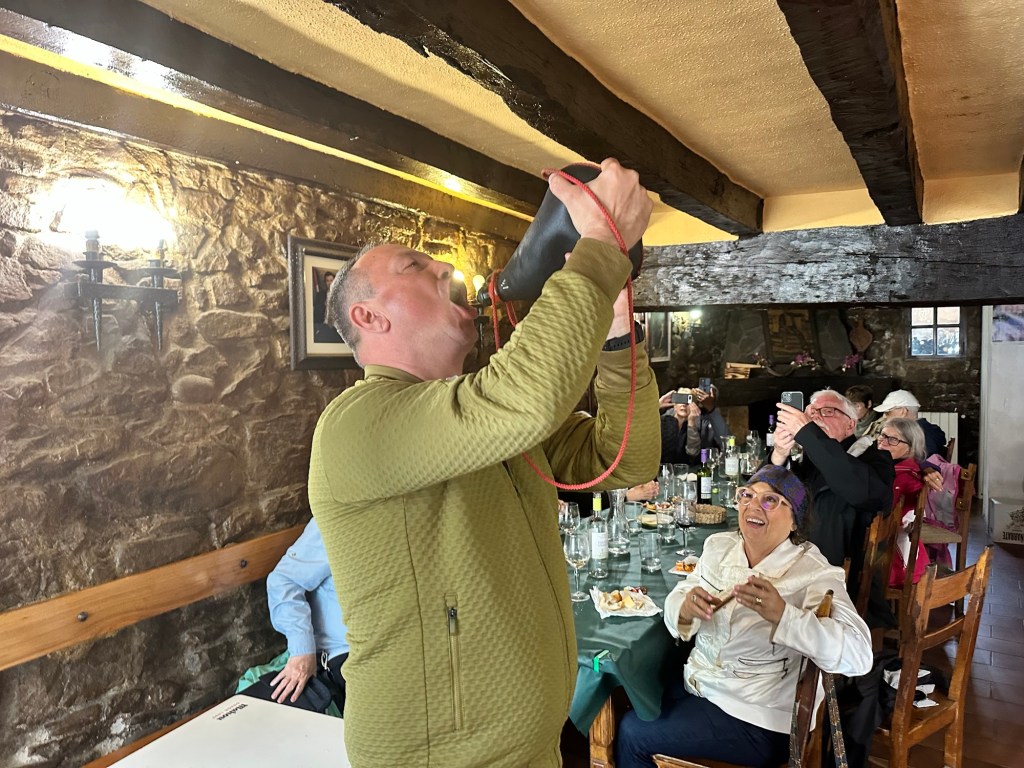
Our lunch was at a charming tavern along our route. This trip IS turning me into a “day drinker”, but it hasn’t come to THIS, at least not yet.
Shahin, demonstrating how to shoot red wine directly into your mouth
We were able to walk off some of our lunch’s calories when we reached the next stretch of our “El Camino” experience. This time, we walked through the medieval village of Castrojeriz, population about 100.
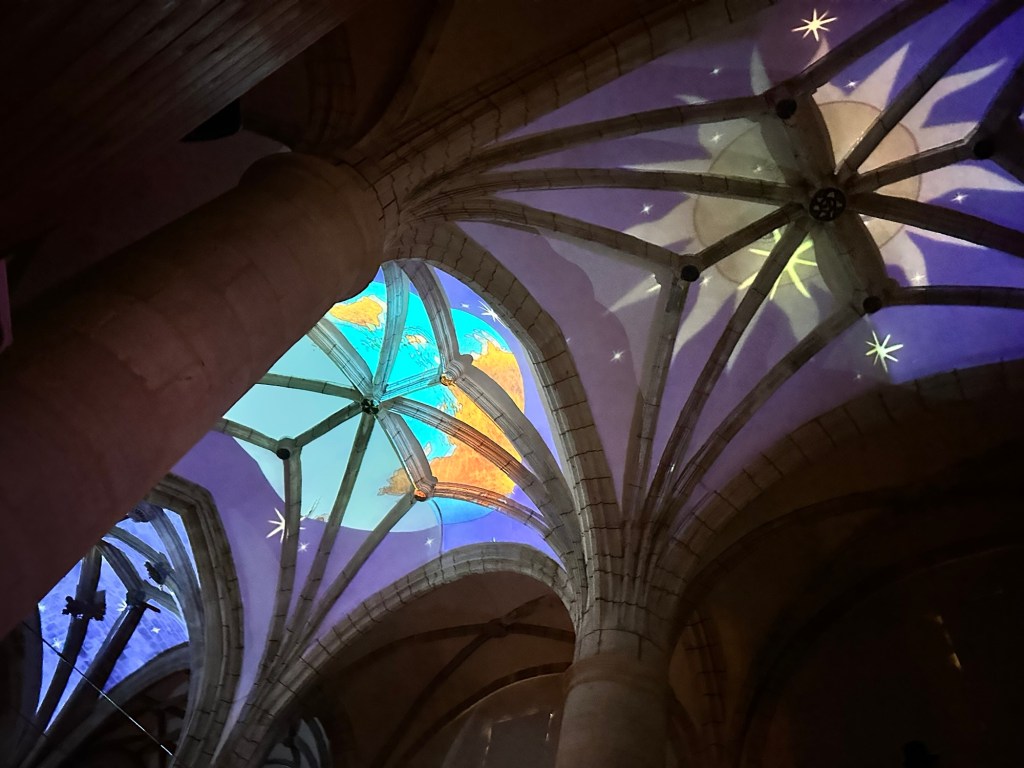
Had I been on my own, I would have walked right by this church and missed its amazing multimedia shows, including the story of creation, which was projected onto the ceiling.
If we were REAL pilgrims, walking El Camino, it would have taken us anywhere from three to about seven days to walk from León to Santiago. Instead, the 3.5 hour bus ride took us a day, because of our multiple stops.
The first stop was in Astorga, to view the castle and cathedral designed by Gaudi.
Unfortunately, the building didn’t open until 10, so we weren’t able to go inside, but don’t you agree that the outside was pretty spectacular?
The entrance to the palace is on this side. Can you believe the number of windows? On the left (barely visible) is the cathedral.
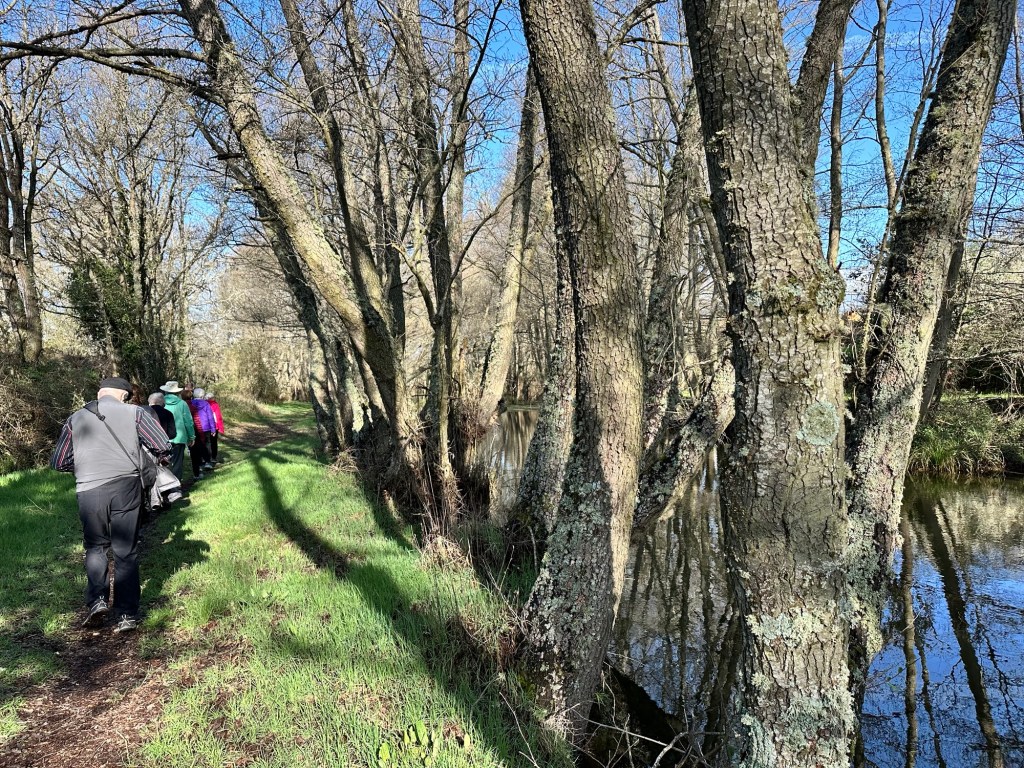
We weren’t able to linger because we didn’t want to be late for our visit to the beekeeper. To get to there, we strolled along the river for about a half a mile.
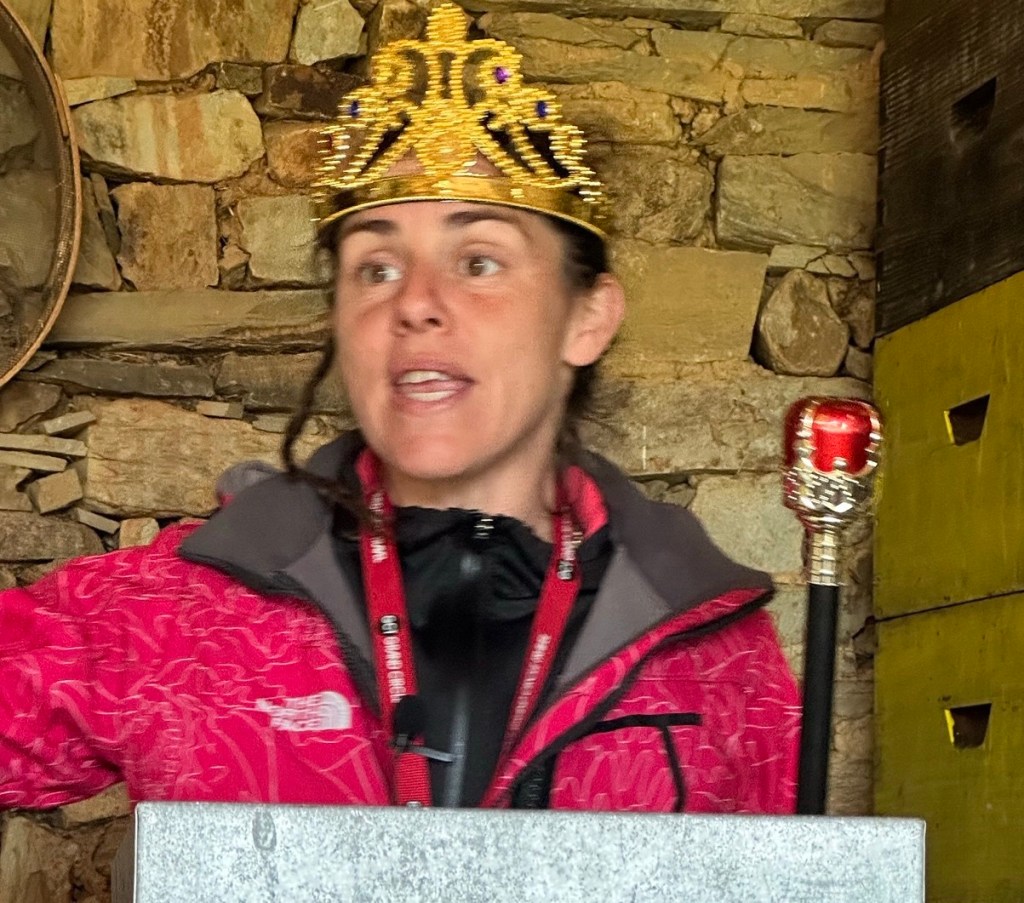
This very animated and entertaining young woman gave us the adult version of her presentation for school children.
The Queen beeThe drone
Did you know that you should never put honey in the microwave because it destroys the beneficial enzymes? Or that you should never use a metal spoon to remove honey from its container— only use wood? (sorry, I don’t remember the reason).
After all that learning, we were ready for lunch in the village.
This building dates back to the 1750’s; it was the home of a merchant who conducted trade between the coast and León.
We were very fortunate to have such great weather during this area’s rainy season.
But our luck was about to end. For the last stretch of El Camino, we had an “authentic” pilgrim experience. We walked to the cathedral in a downpour.
That smile on my face was VERY short lived. I neglected to pack waterproof shoes, so by the time we finished our 5 kilometer walk and got to our hotel my shoes, socks and all 10 toes were soaking, sopping wet. Good thing I know how to say “I want to buy waterproof shoes” in Spanish!
Looks like the weather goddess is sending more of the same for our time in Santiago and Portugal. But at least with my new 100% waterproof Sketchers, my feet will be dry!
After the day we had, we decided we all needed at least one glass of wine — perhaps more. How lucky am I to be with such a great group of people!
Briefly, the rain stopped, allowing Shahin to take this group photo.
When I told my friend (and of course by now, I’ve forgotten which one) that I was going to Bilbao, she said that she’d visited years ago and that it was “very industrial”. Indeed it was. Shipbuilding and mining produced so much pollution that, according to our trip leader, when his mother hung laundry out to dry, it would become gray tinged. But what a difference a couple of decades and a natural disaster can make.
In August of 1983, two weeks of torrential rainfall produced flooding that devastated the area. Fortunately, the city’s leaders were able to turn that disaster into an opportunity. They determined rebuilding would focus on what would benefit the entire community. They decided that emphasizing CULTURE and infrastructure would be the key to Bilbao’s future.
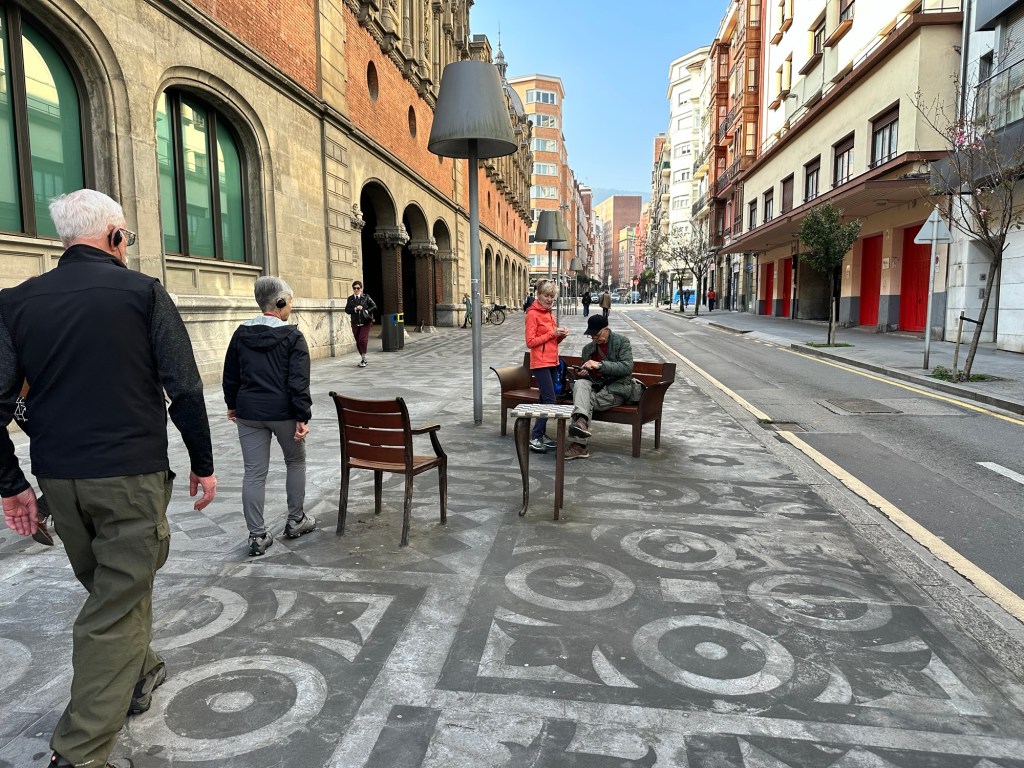
And what a magnificent city it is now! In addition to the wonderful green spaces and playgrounds mentioned in an earlier post, Bilbao also has a huge sports stadium, a concert hall, a metro, tram —and my personal favorite —an incredible building known affectionately as “the living room”.
The pavement leading to the entrance has been designed to look like a carpet. Notice the street lights resemble table lamps and the benches look like living room furniture.
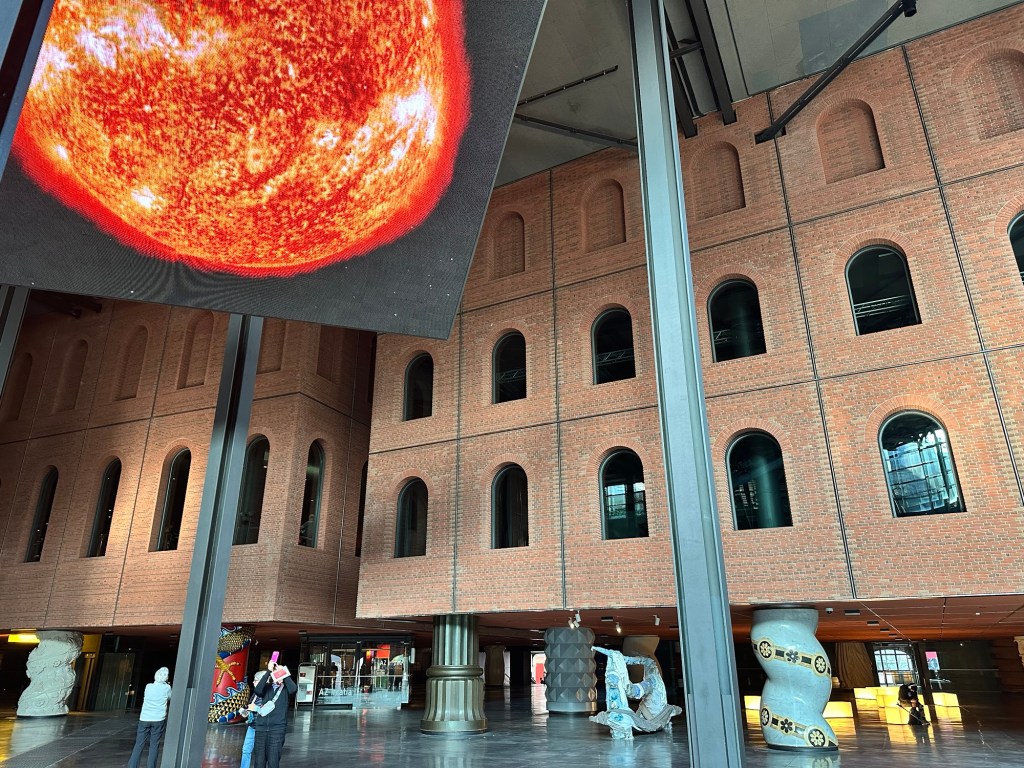
Originally built in 1909, the building was abandoned in the 1970’s and was almost demolished. Instead, it now is a “culture and leisure center” housing a gym, with a pool,
That’s the ceiling. If you’re on the ground floor, you can look up and watch people swim!
a library, an auditorium, a restaurant, showrooms, shops and in the basement (which we didn’t visit) a multiplex cinema.
The ground floor was filled with art
Other notable Bilbao sights:
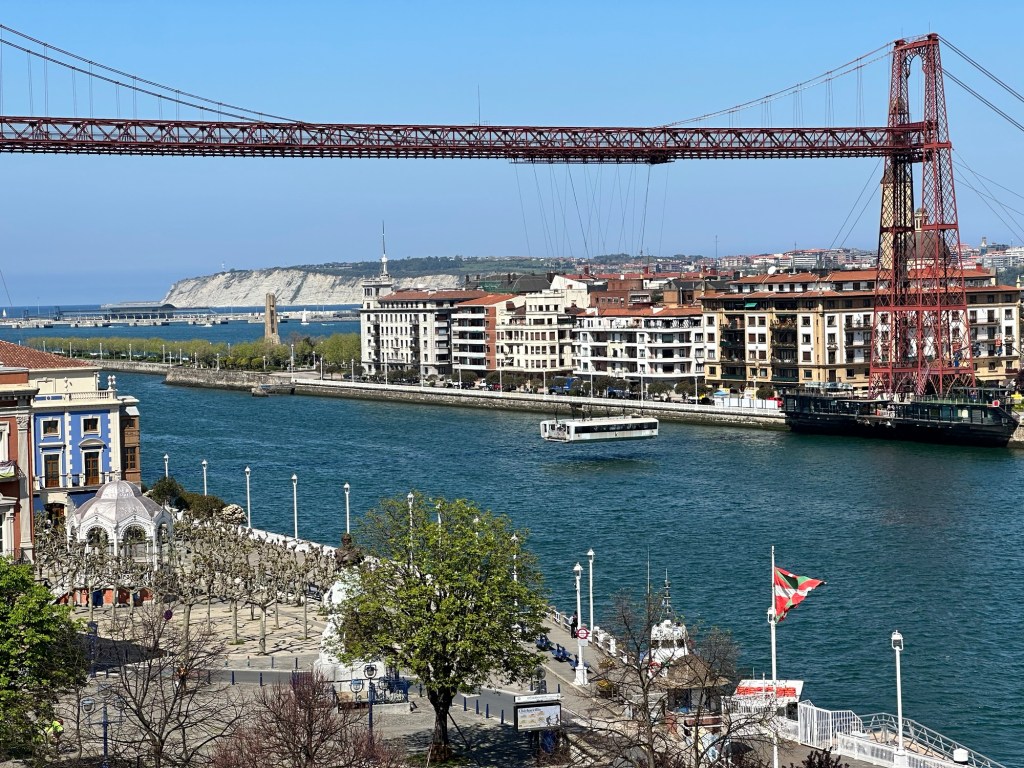
The Vizcaya Bridge was designed by one of Eiffel’s associates, Alberto Palacio
I was SO excited when our trip leader told us we’d be walking across this bridge. Elevators could take us to the top, so I was ready for the adventure. You can only imagine the depth of my disappointment when I realized he was just joking.
Instead we rode across on this “transporter. It dangled from wires attached to the structure that I thought we’d be strolling across. It skimmed just above the river. Later, we visited a cathedral atop a hill, from which we could view the mouth of the river, the Atlantic, and those cliffs.
This was not our only panoramic view. Later, we rode Bilbao’s funicular to a cafe where we enjoyed a glass of wine and this spectacular view.
The Guggenheim is to the left of the red bridge and in front of the skyscraper
I could have spent a whole lot more time in Bilbao, but the next morning, we walked through the city of Guernica, which was destroyed during World War II.
Our group in front of a replica of Picasso’s famous paintingThe latest recruit, ready to fight for democracy in her own country
Fortunately, we had “free time” in the afternoon, so most of us spent it inside the Guggenheim. The architecture is absolutely spectacular!
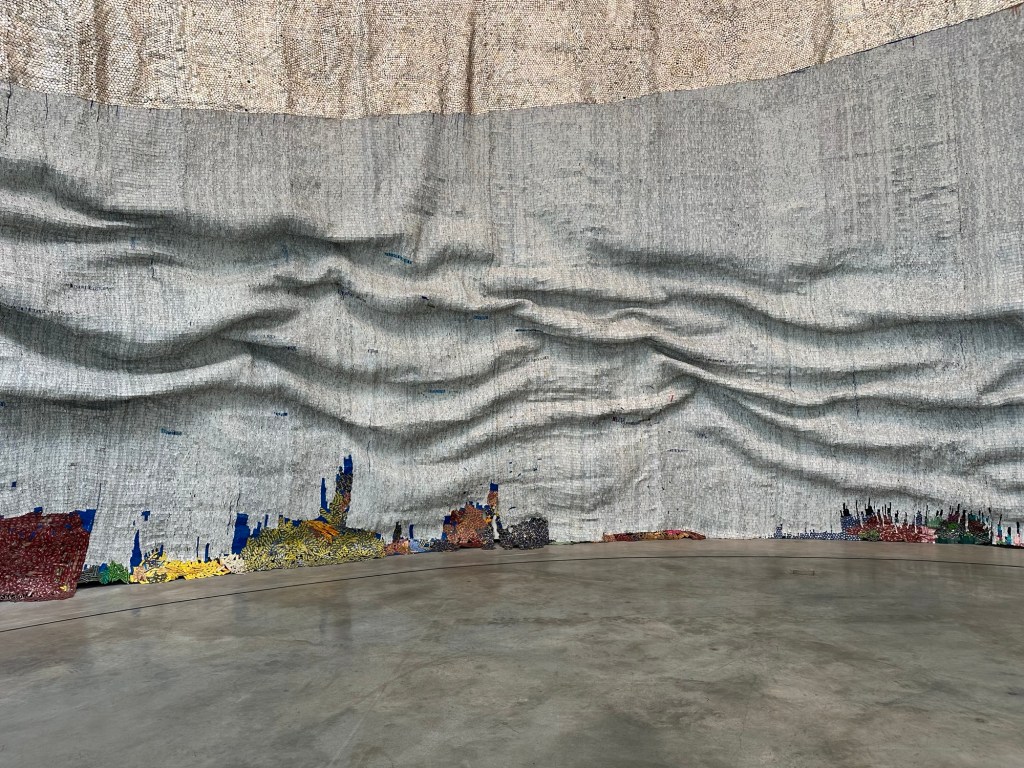
This in no way captures the grandeur of the space or my favorite piece, “Shuttlecock”
I also loved art made from “reclaimed” objects, like these pieces of cars,
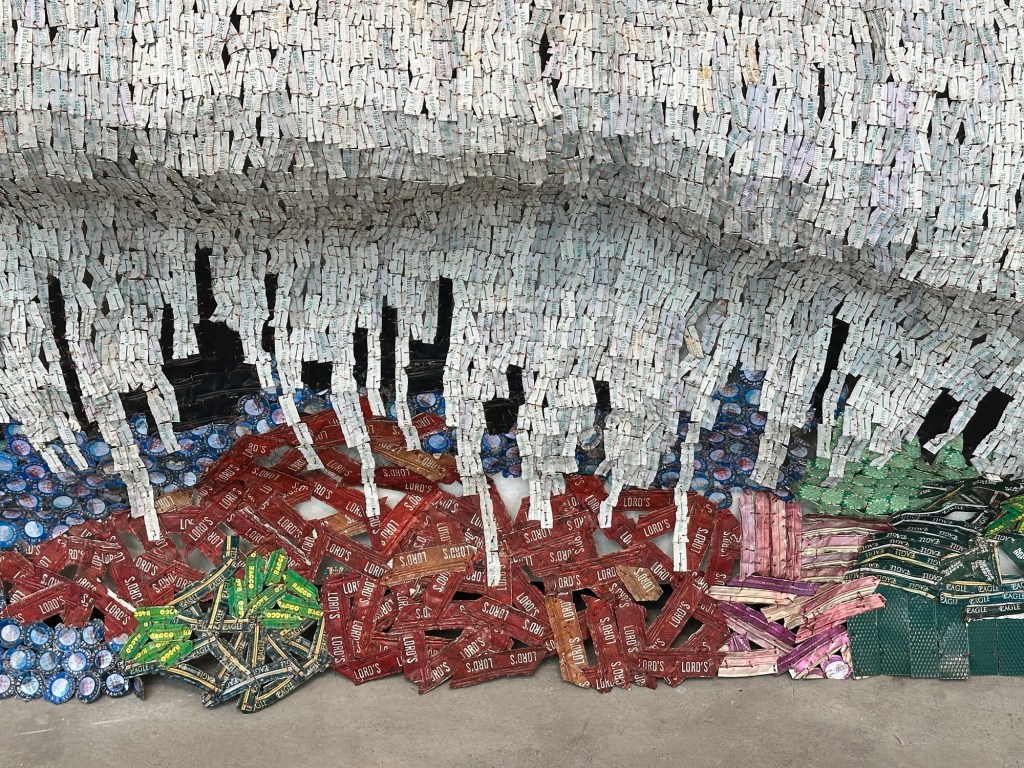
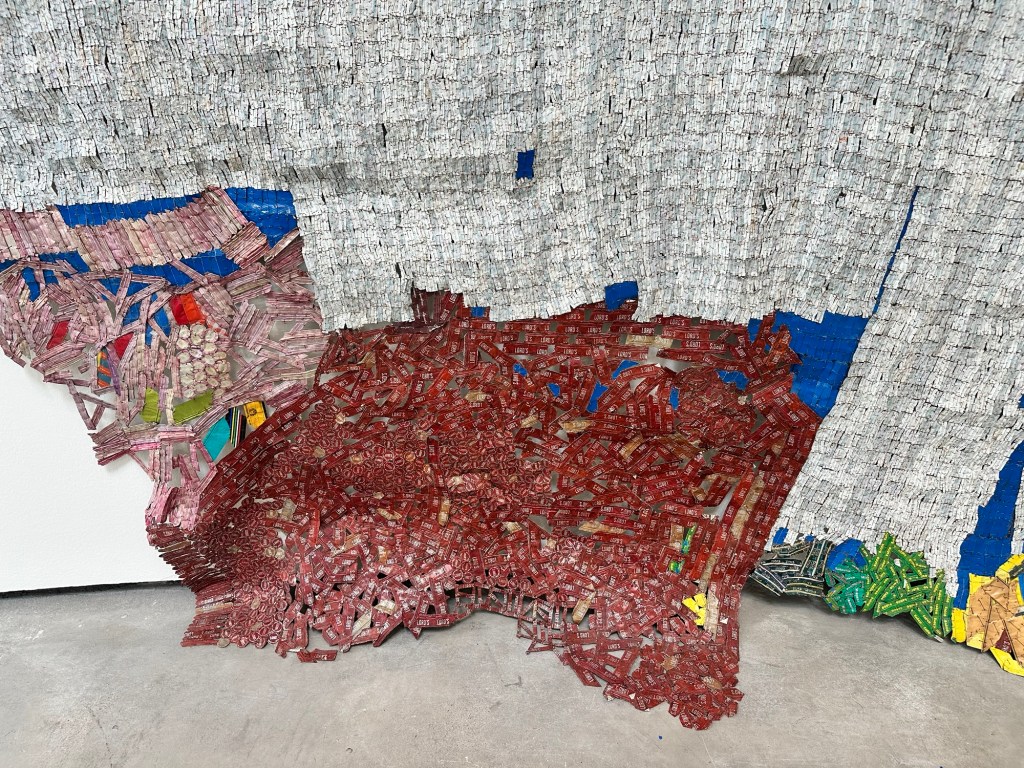
and flattened bottle caps with wrappers from liquor bottles
Here are some “close ups” of the piece so you can see the intricacies. It’s a WOW.
That evening, we broke up into three groups of five for a “home hosted” dinner.
Blanca and David were absolutely delightful hosts, and the dinner was spectacular. Although their English was at the level of my Spanish, we were able to communicate. I think the wine and the chocolate liqueur might have helped.
Later, I learned that Shahin put me in this group because he overheard me speaking to a tattooed Spanish biker that we met when we stopped to admire the Bay of Biscay. He figured that ONE of us needed to know a little Spanish. And in MY case, it is DAMN little, but it was enough.
We are on the bus now heading to Pamplona, with a stop in San Sebastián. It looks like our run of perfect weather is about to end.
The photo above shows the itinerary for this trip. Ignore the boxes. I’m not doing a pre or post trip this time.
The name of my favorite tour company is Overseas ADVENTURE Travel, and so far, it’s living up to its name! The tour promises participants will have “learning and discovery” experiences and so far I’ve had both.
I now know how to shop for ropa interior (underwear), how to translate sizes (take your US size and add 32, so a size 8 becomes size 40). I learned to never EVER buy “Brazilian” underwear, how to pay for a bus ticket to the airport (credit card, paid ON the bus) how to get thru the “Do Not Enter” doors at Bilbao airport ( wait for someone to leave and dash thru).
I came to this knowledge when I arrived in Bilbao and my AirTag told me my luggage was still in Munich.
Why, oh why did I check luggage? Well…
In the past, connections in parts of Europe, especially Germany, have been a tad unpleasant. I hate it when my plane parks far from the terminal. I have to walk down the rollaway stairs, carrying luggage, then get stuffed into a bus, which drives for 5 to 10 minutes to get to the terminal. On past occasions, the escalators weren’t working, so I had to carry my bags up several flights of stairs.
As a bonus, if I checked a bag, I could bring enough clothes so I wouldn’t have to do laundry. I would also have room for a bathing suit so I could enjoy any hot tubs I encounter along the way. Checked bag it was. Thankfully, I had the presence of mind to include my AirTag, just in case.
I’ll admit it. I was feeling a little smug while I was walking down 4 flights of stairs (with only a light backpack) to the crowded bus that would drive us to the plane that would take us to Bilbao. That feeling was QUITE short lived!
But at least I had the good sense to arrive a day before the tour started, because I spent HOURS of my first afternoon on the phone getting bounced between United ( Newark departure) and Lufthansa (Bilbao arrival). I’ll spare you the details, mainly because I don’t want to relive them, and also because they are bone crushingly boring.
But I WILL share this important tip: ALWAYS check your baggage receipt. Had I done so in Newark, I would have noticed that it said “Munich”, not Bilbao. So because I missed that important detail, it was determined that I was at fault and my bag would NOT be delivered to the hotel. Instead, I would have to go to the airport to fetch it.
And here’s another tip: ask to speak to a supervisor or manager as soon as you hear the same unhelpful info for the second time. I certainly wish I had.
Just about every situation has an upside, if you look hard enough. So I did. Here’s what I came up with: In addition to my various “learnings” described earlier, I might not otherwise have been out so early on a Sunday morning. I LOVED my early morning walk and I felt like such a big girl riding the bus all by myself.
Plus, I got to buy a Disney tee shirt that doubles as a nightgown. In case you don’t read backwards, that says “Ratatouille”. NO photos of Brazilian “ropa interior”. You’re welcome.
I was back early enough from my airport jaunt to join my new friends Pam, Barbara and Camille for a walk along the river.
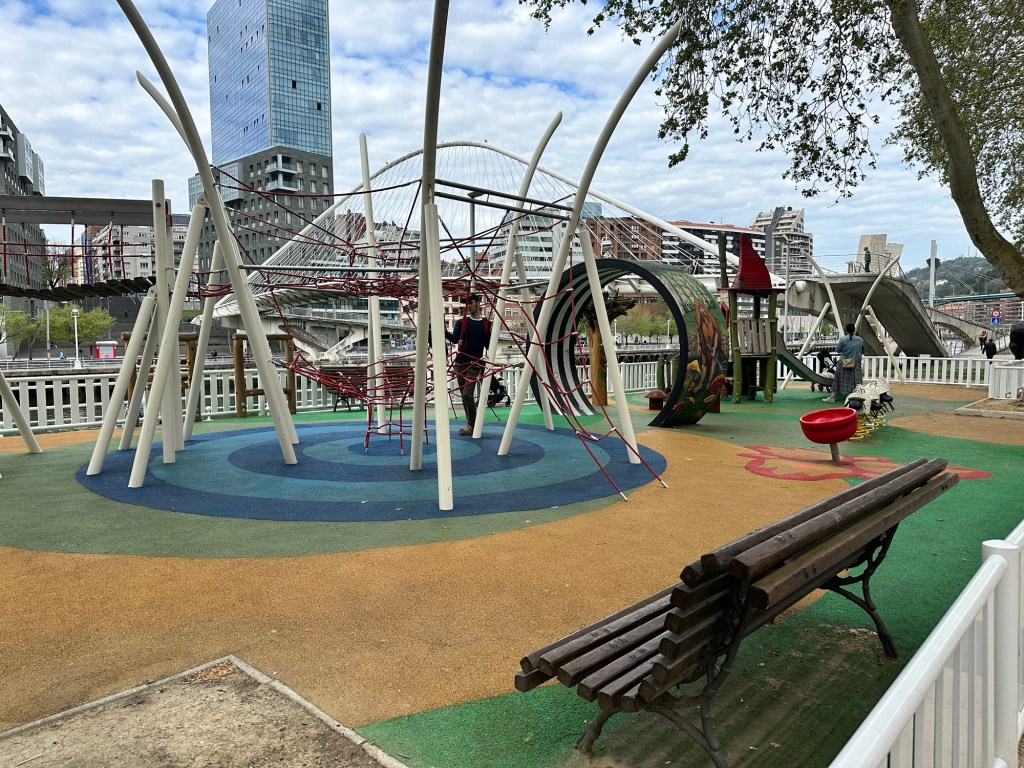
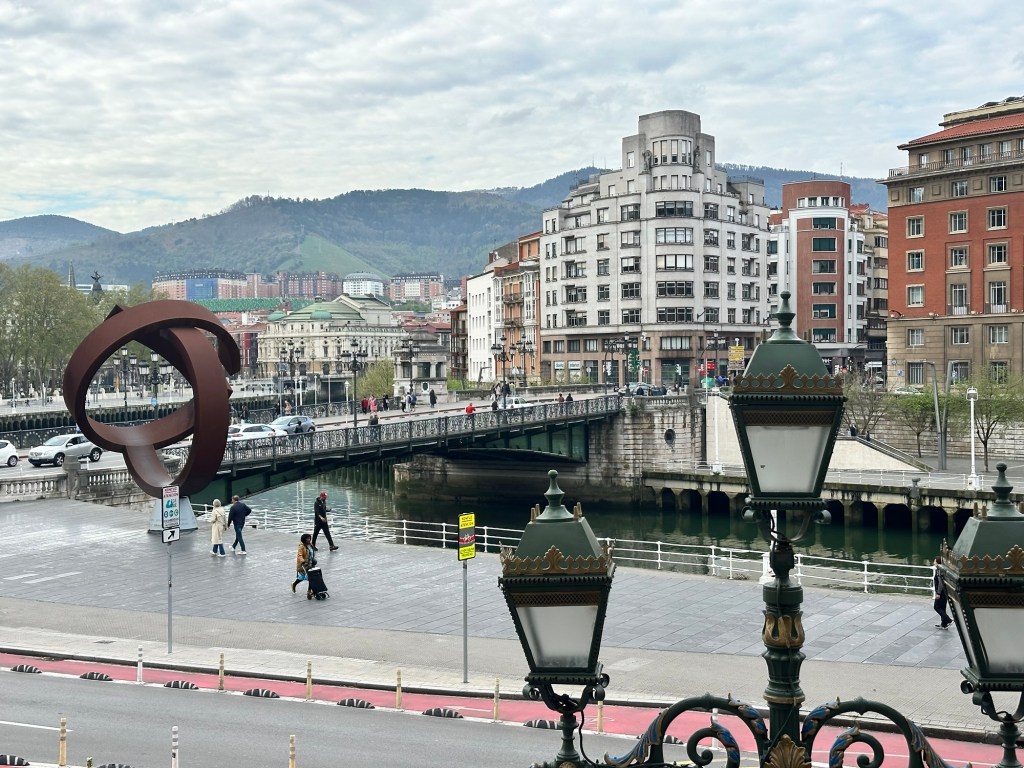
Bilbao is a WONDERFUL city, with lots of green space, playgrounds, artworks and pedestrian walkways.
The playgrounds had unusual, imaginative structures The many bridges are all beautiful in different ways.
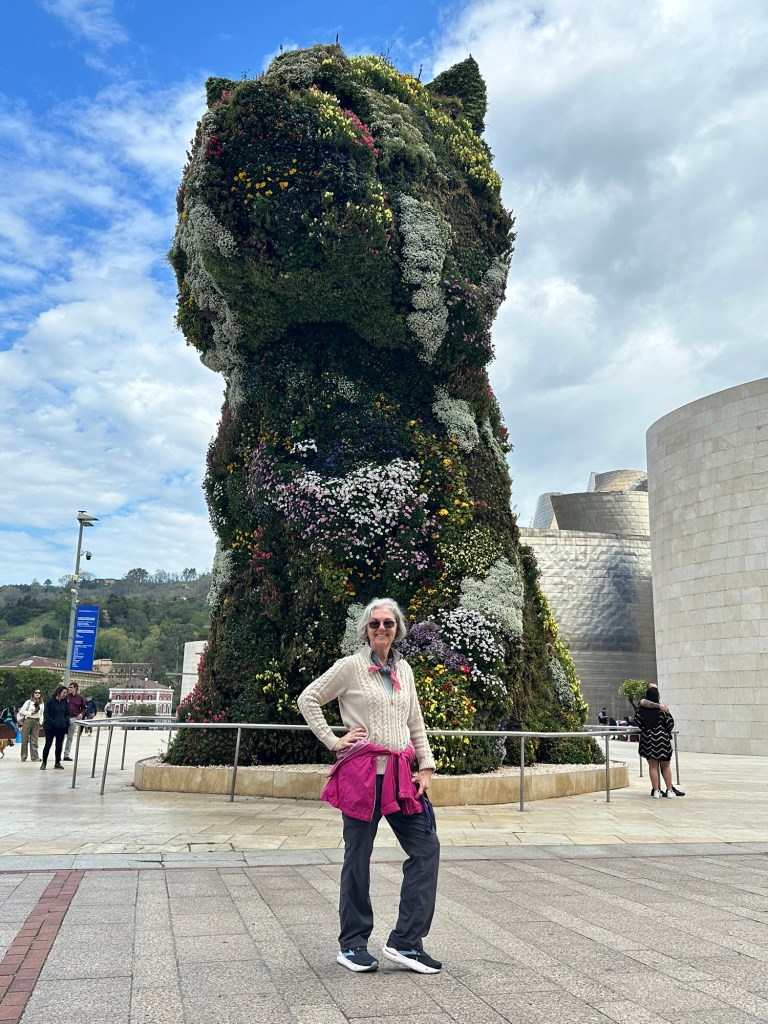
The other three ladies wanted to explore churches and cathedrals, but since I’ve already exceeded my lifetime quota for such structures, I ambled on down to the Guggenheim. I had just enough time before our afternoon boat ride to explore the exterior of this amazing building.
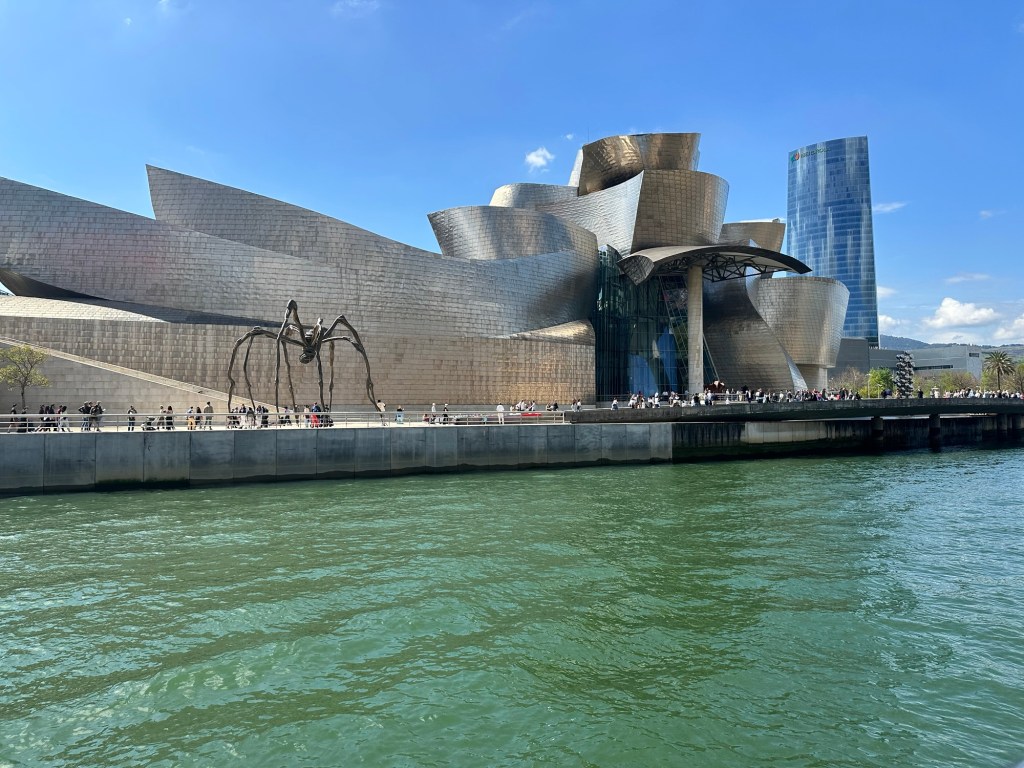
Yes, that puppy is made entirely of different flowersI took another photo of this sculpture from the boat. Which do you prefer?
I highly recommend the 1 hour boat ride for anyone who is interested in architecture. There is a QR code on the back of all seats on the boat. If you scan it with your phone, you have access to a narrative (in your chosen language), describing what you are viewing while you pass by on the boat ride.
The Guggenheim as seen from the boat, comingAnd goingI loved the tiger atop a building
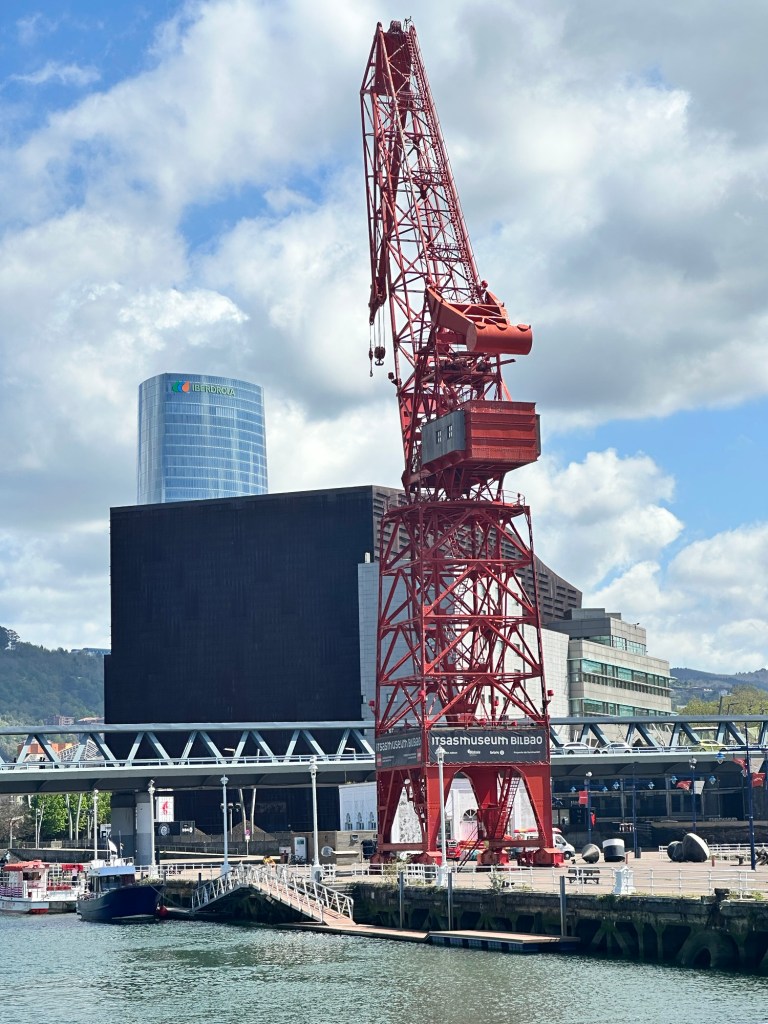
There was a “girl from Ipanema” type of story about this crane. I THINK it went something like this: Everything would stop so that men could stare when a certain young girl came across the river 4x a day to operate the crane. They should have written a song…
There was a whole lot more to day 1, but I’ve done enough blogging for today.
I first visited Cartagena in 2010, when Mike, Greg and I took an Oceania cruise through the Panama Canal. I was immediately charmed by this fascinating city, and became determined to return to Cartagena and to explore more of Colombia.
For most of the ports, we opted to go off on our own, rather than take a cruise sponsored tour. That was the case in Cartagena, where we were able to cover most of the high points in the old city, during our too brief time in port.
Here is what the “new” section of Cartagena looked like in 2010.
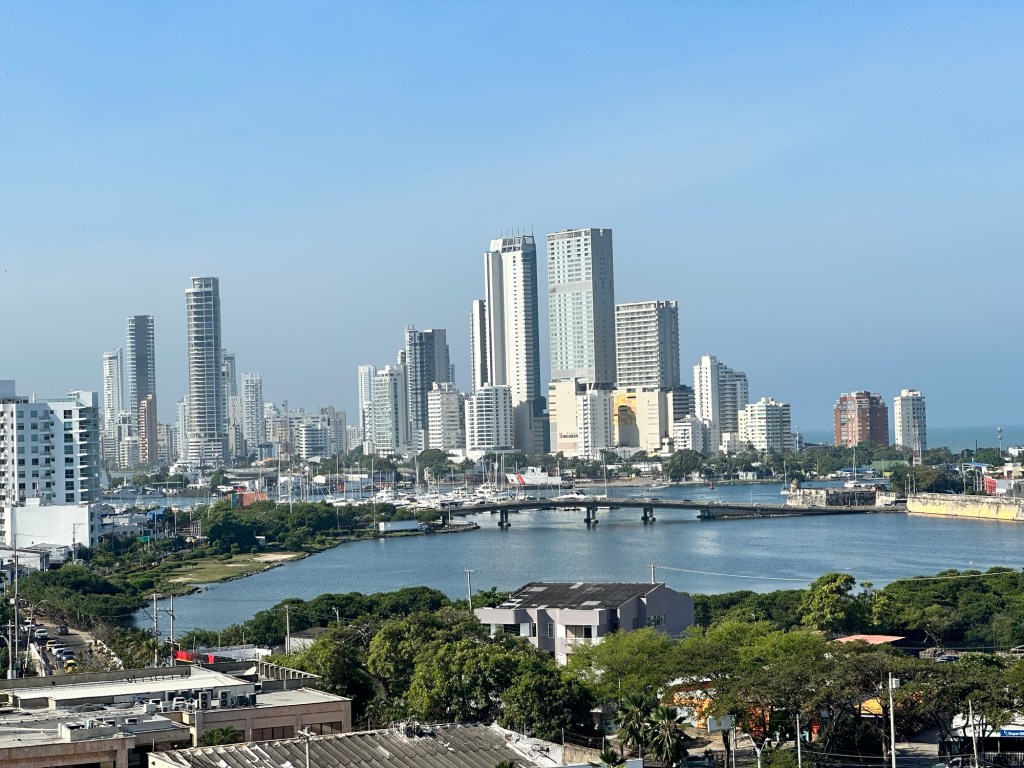
Fast forward to 2025. Both photos were taken from the enormous fort the Spaniards built to protect the area from pirates. Can you tell which photo was taken with a camera, and which was taken with my iPhone?
It is possible to travel from the top of the fort to the bottom through narrow, low tunnels. When we visited in 2010, we attempted to do just that, but as we approached the exit, our guide discovered it was flooded, so we had to walk ALL the way back to the top. Poor Mike was unable to stand upright!
I know many people have strong opinions about cruises versus land travel. It was interesting to experience both in the same city. Although vastly different, I discovered I thoroughly enjoyed both, but for very different reasons. As with everything in life, both travel modes have advantages.
When we cruised, we always opted for a smaller ship, chosen for its fabulous itinerary. Cruising allowed us to unpack once, travel while we slept and awaken someplace great every single day. It provided us with a taste of many different areas, so we could determine which country we might want to explore in more depth in the future. And, if you happened to get sick, or have an accident, the ship had a fully equipped medical center on board. But your time in port is limited; you normally have to be back aboard the ship around 5PM, unless you chose a cruise that spent more than one night in a particular port. And there ain’t many of those.
For the OAT land trip, we spent three nights in Cartagena, which allowed us to slow down and savor our time there . We saw SOME of the areas we visited on our whirlwind day in 2010, like the former convent of the Sisters of the Poor Clares, but instead of just driving by it, Leslie ( another new friend) and I went to the bar to watch the sunset.
Those of you who read my pre-trip post may recall the special drinks and the tours of the former convent described on the hotel’s website. Well, although getting lost while searching for the rooftop bar allowed us to see a whole lot of the convent, it certainly didn’t qualify as a tour (they don’t give them any more), and although my pisco sour was delicious, it didn’t have what the website called “magical” properties.
What the rooftop bar DID have was a DJ, and lots of young people, staring at their phones.
So, we took our sunset photos, admired the view, and that pisco sour? It was consumed in a quiet, “historical” bar on the first floor.
The view of the ocean, and the only spot at the bar from which you can see the sunset.
Remember the popular image of Colombia as a dangerous place? Well, Leslie and I were perfectly comfortable walking the streets at night and when he noticed we were hopelessly lost, this sweet young Colombian approached us, offered help and walked us back to our hotel.
This was a very common experience: a waitress chased me down the street because I had left my hat in the restaurant, street vendors accepted your “no, gracias” when they approached you, but then engaged you in conversation so they could practice speaking English. Everyone we encountered was friendly, gracious and oh so welcoming.
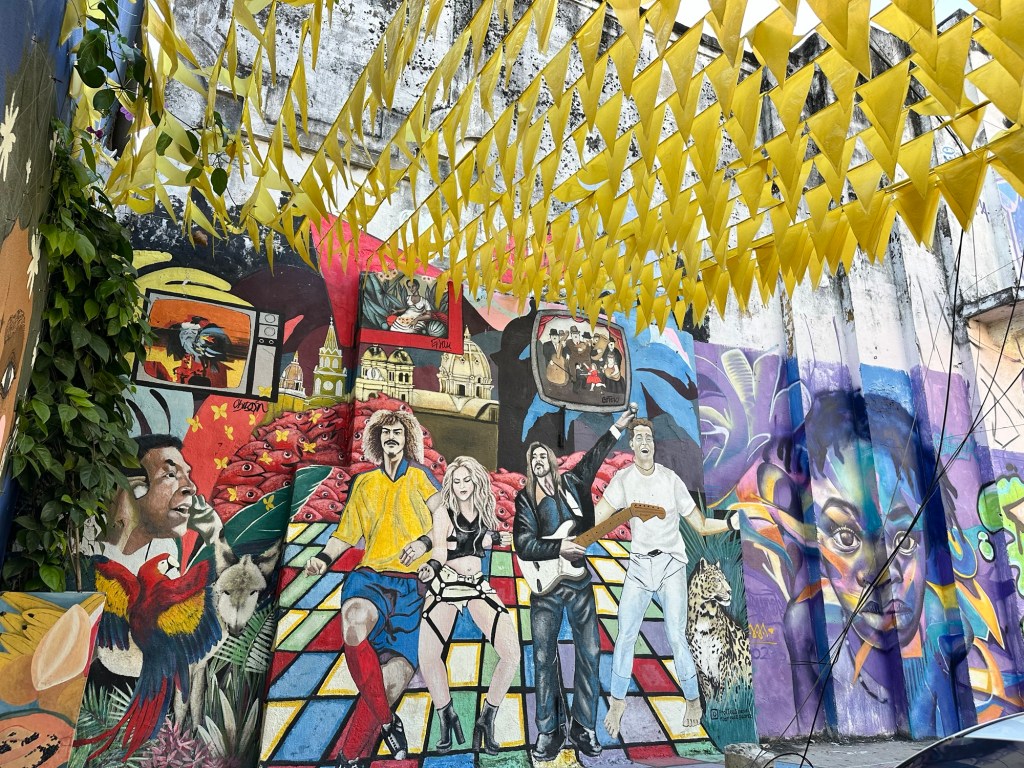
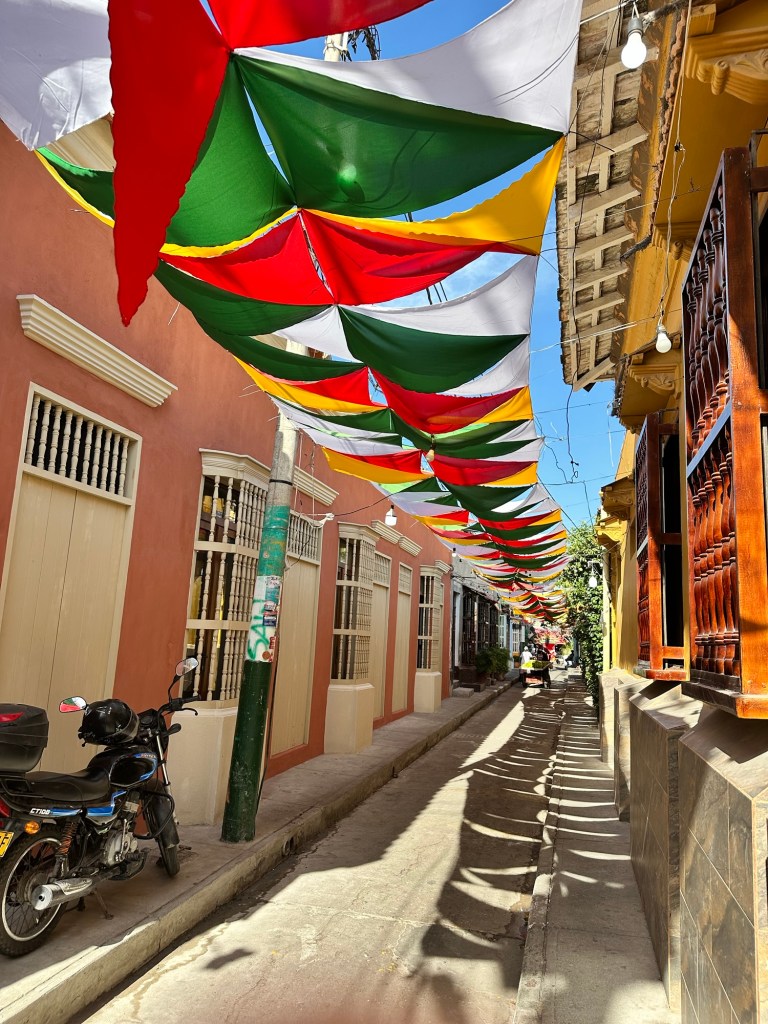
As you have seen in my earlier posts, the streets of Colombia are very colorful , and Cartagena is no exception.
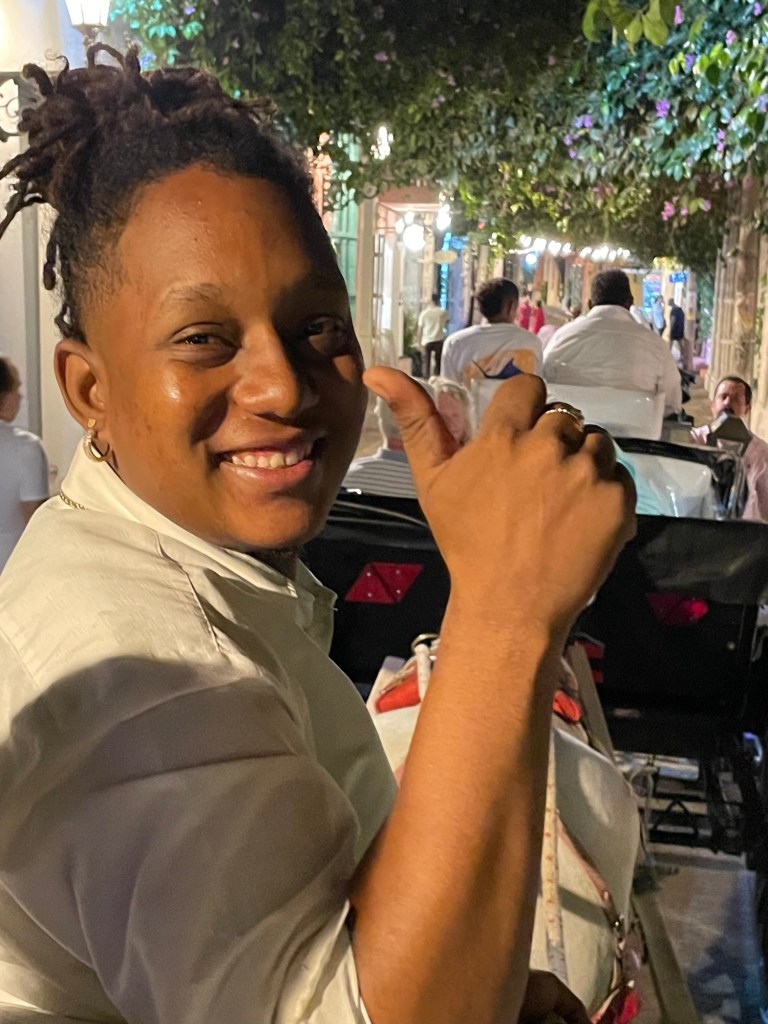
The woman in the black leather “bondage” outfit is Shakira, who has an apartment in Cartagena, overlooking the ocean. Our carriage driver pointed it out as we rode along the ocean on our way to our farewell dinner. He also claimed he was Shakira’s novio ( boyfriend— see, those Spanish lessons DID come in handy!)
Did you know that Colombia was the inspiration for Disney’s movie, Encanto? I sure didn’t.
Sorry, the sun was in the wrong spot when I took this photo. Anyone who saw the movie will recognize the cartoon character immortalized on the wall, but did you know her image was based on an actual resident of Colombia?
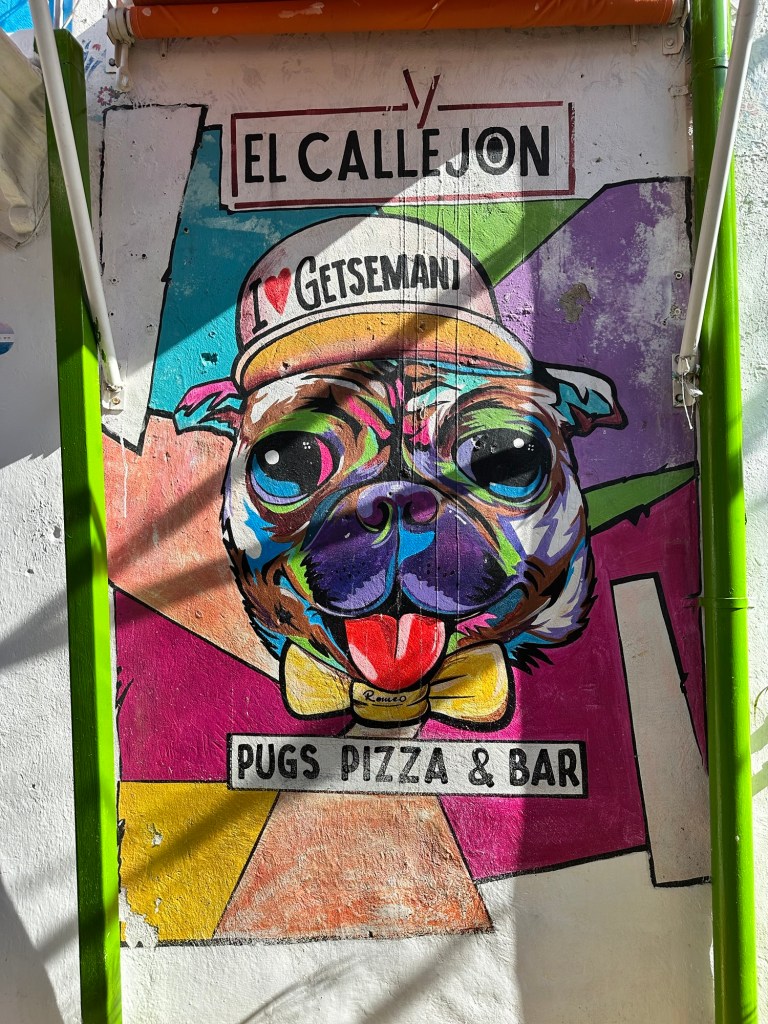
There was so much to see in the neighborhood of Getsemaní, I had difficulty choosing the most compelling street image, so I decided to include several.
During our trip we experienced MANY different modes of transportation- boats, metro system, cable cars, jeeps, tuk tuks and best of all, the PARTY bus,
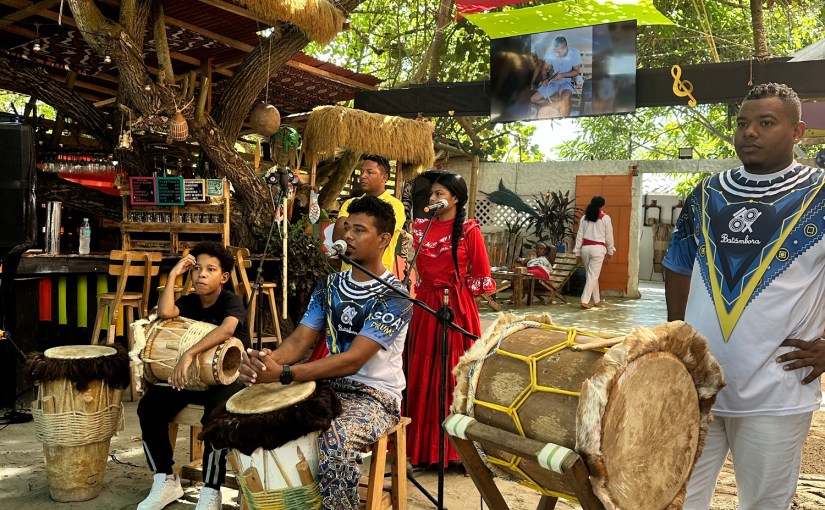
which came fully equipped with live music, so we were serenaded all the way to Bocavilla, an African Colombian community located on the beach.
Our musicians played European, African and Caribbean instruments
While in Bocavilla, we had drumming and dance lessons which were SO much fun! The musicians and dancers were students at a school established to preserve their African/Caribbean culture.
Seven of us are at the airport heading off to Quito for a week in Ecuador, so it’s time to press publish and hope for the best.