Helpful Hints-Northern Spain and Portugal

This post is for all the wonderful OAT travelers who took the time to post on Friends of Overseas Adventure’s Facebook page. I benefited greatly from your advice and hints, so this is my way of giving back. My apologies to regular subscribers who might not find this post very interesting. BUT if others traveling to the Northern Iberian Peninsula in the spring find these hints helpful, well that’s a bonus.

I took the “Northern Spain and Portugal: Pilgrimage into the Past” trip in April of 2025. My departure didn’t offer pre or post trips so this information only applies to the main trip.

  • I wore a mask on flights to Bilbao, but didn’t on the return trip. Big mistake. I’m quarantining now, which is why I have plenty of time to write this post.
  • The OAT trip started in Bilbao, which is an absolutely fantastic city. If you are able to do so, I highly recommend arriving a day or two early.
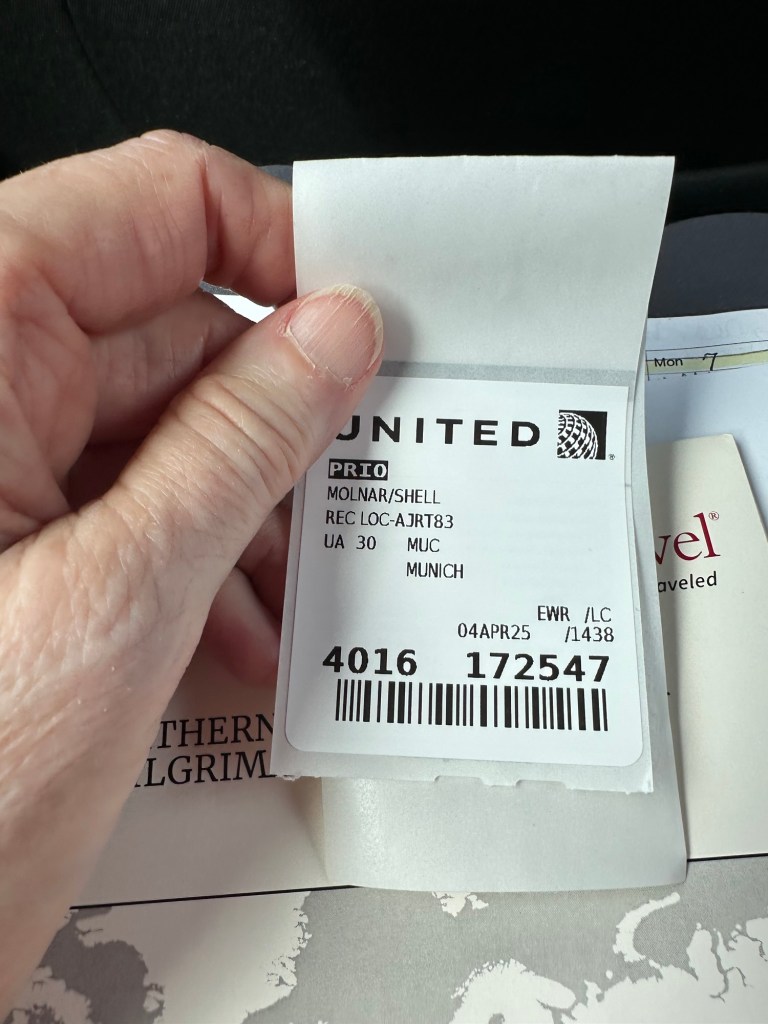
  • If you are changing planes, and you are checking luggage, be sure to carefully examine your luggage receipt. I didn’t and I wasted almost a half a day tracking down my bag, which was left in Munich. I’m so very glad I used an AirTag!
  • Although Bilbao is a very walkable city, the bus system is excellent. Best of all, busses are frequent and easy to use. No special card is required. You simply get on the bus and pay with your credit card. Easy, and CHEAP!
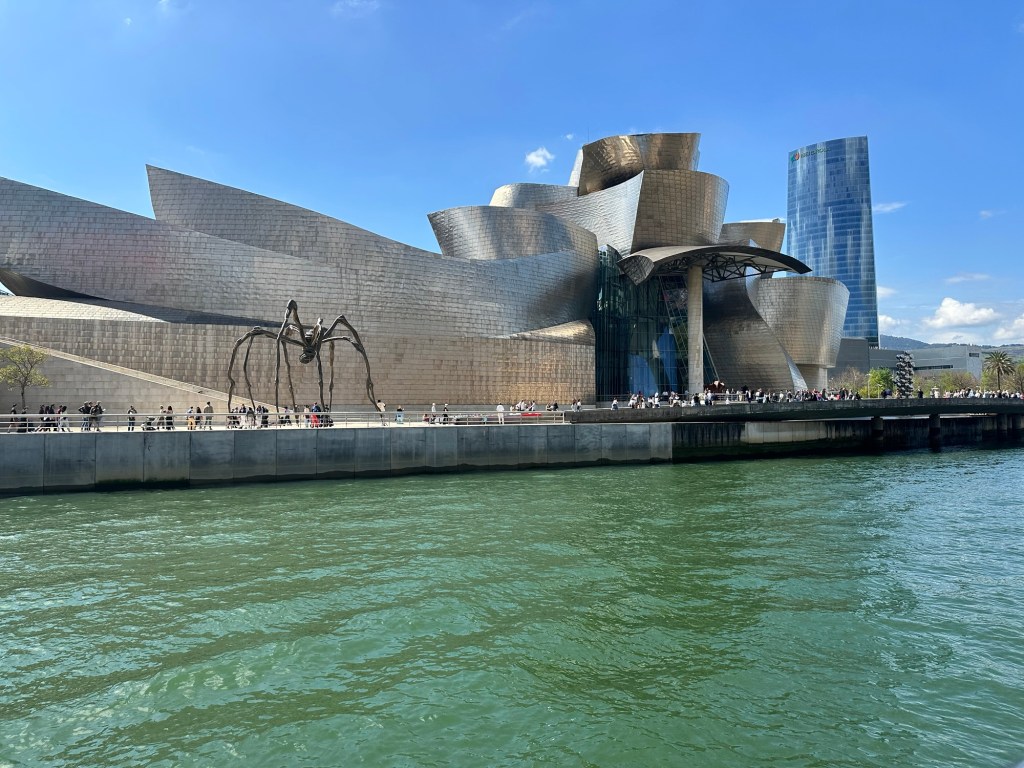
  • The Guggenheim is closed on Mondays, however, the OAT itinerary has sufficient free time built in. If your trip has the museum scheduled on a Monday, you still can visit at another time. Even if you are not a museum aficionado, the architecture of the building is pretty spectacular. It’s also worth walking around outside the museum to view the sculptures.
  • All of the hotels OAT chose were centrally located, which made it very easy for anyone who wanted to explore on their own.
    Here is the list of the hotels we used:
    **Hotel Abando, Bilbao
    **Hotel Tres Reyes, Pamplona
    **Alfonso V, Leon
    **Hotel Compostela, Santiago
    **Lamego Hotel, Lamego
    **Turim Oporto Hotel, Porto
  • If you don’t want to wash your hair and body with the same soap, or you don’t like to use the bottles attached to the wall, bring your own.
  • Most of the hotels’ hair dryers were attached to the wall, and you needed to keep your finger on the button to get the dryer to operate. That can be uncomfortable if you have arthritis in your hands. Someone suggested bringing duct tape to keep the button down. Of course, I didn’t recall that hint until I was on the trip, staring at the button!
  • The hair dryer in the Lemigo Hotel died after a couple of minutes use. After resting for a few minutes, it could be used again. (Others had a similar experience). Fortunately that didn’t happen in Santiago, where I used the hair dryer on my sodden shoes.
  • Apparently, Northern Spain normally gets a lot of rain. During our visit, we mainly experienced intermittent showers. Keep in mind the unevenness of cobblestones results in lots of puddles, and sometimes those puddles are DEEP. Oh and by the way, those cobblestones are very slippery when wet.
  • We all got drenched on our walk into Santiago. Fortunately, our hotel had a heated towel bar. After being convinced that I was a complete idiot for being unable to get the heat turned on, I swallowed my pride, asked for help at the front desk and learned that the heat is centrally controlled and doesn’t turn on till 7:30 PM.
  • The only option our team leader gave us to do laundry was at the hotels, but it was rather expensive, especially with the terrible exchange rate. We were there when the tariffs went into effect, so what was once a strong dollar had plummeted.
    The heated towel bar was perfect for drying laundry. Santiago was the only hotel with that option, and it was roughly midway through the trip, so keep that in mind if you are rinsing out clothes.
  • The optional excursion offered during our time in Santiago was okay. If you didn’t grow up by the ocean (I did), it might be great because you got to watch locals digging up clams and mussels, something my family did on a regular basis. The lunch was fantastic and although I was glad I went, if you can only choose one optional, I would recommend the one in Portugal if you are a walker and love nature.
  • After the optional trip, we returned to Santiago in time to visit the Pilgrim Museum, which had been closed the day before. Unfortunately it was closed again, for unspecified “technical” reasons. Too bad, because the members of our group who didn’t take the optional, visited the Pilgrim’s Museum that morning and said it was worthwhile.
  • It was way too cold to use an outdoor pool, and although the Lemigo hotel had an indoor pool, you had to pay 20 Euros per person, per day to use it (and the gym). None of us thought it was worth it. The outdoor pool is free and lovely, so if you go when the weather is warm, it might be worth packing a bathing suit.
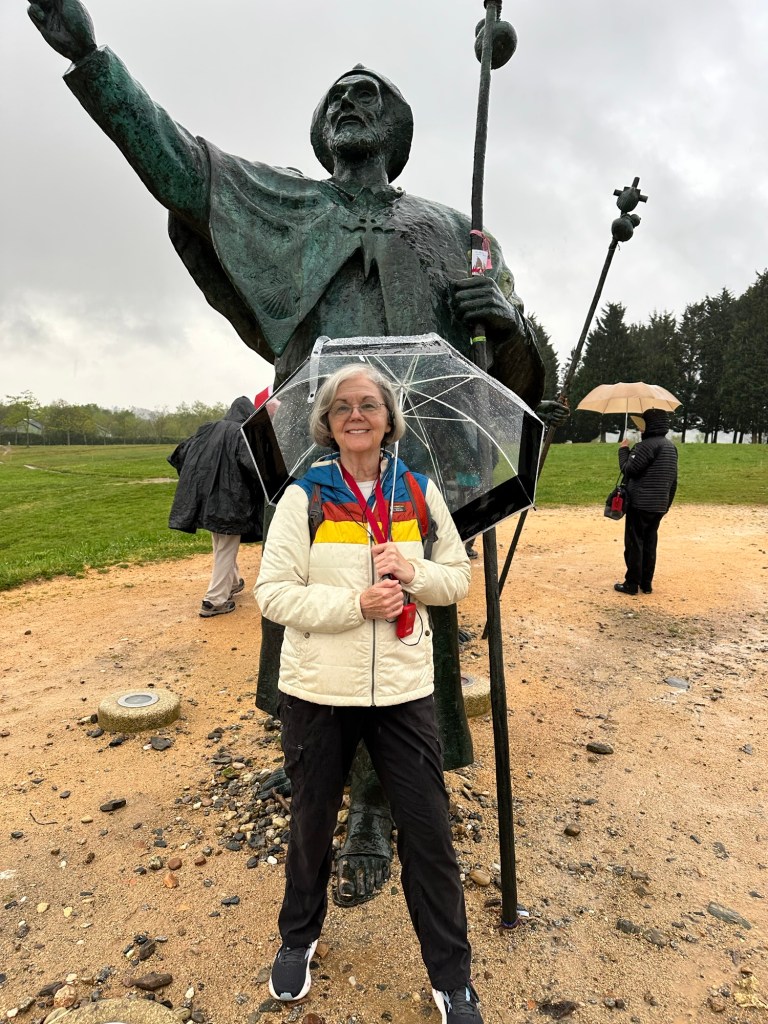
  • Be sure to get your Pilgrim’s Passport stamped! Mine is the header of this post.
  • Portugal was fantastic! Because Porto has been discovered, you may want to make dinner reservations while you are still in Spain. Check with your TL to make sure you have the correct schedule, because sometimes the TLs have plans that are not part of the official itinerary.
  • My post about Porto provides the name of a wonderful restaurant close to our hotel. Rather than repeat what I wrote elsewhere, just click on the link to get the name of the restaurant and other sights that you can do in your free time. It also includes a description of the optional trip.
  • I wasn’t able to visit the Porto Library because it requires tickets for the timed entry, and no tickets were available while we were in Porto. Two of our traveling companions stayed an extra day in Porto and were able to visit the library. Based on their photos, it was quite wonderful!
  • I thoroughly enjoyed the WOW Museum complex. I bought a day pass for 40 Euros because I wanted to visit three museums and separate entries were each 20 Euros.
  • I have done posts for each place we visited, so if you want more info, check out the post that interests you. Those posts include photos.

Happy travels! Next trip is in June.

Leon, Spain

When I booked this trip, I had no idea that I’d be in Spain for Semana Santa, or as we call it in the USA, Holy Week.

I will confess our group was more than a little surprised to see what looked like (to us) the Ku Klux Klan everywhere. But no, these are the different “brotherhoods” who hold processions every evening during Holy Week.

Their version of action figures were in shop windows.

Members of my family will not be shocked to learn that I accidentally stumbled into a church where one brotherhood was assembling. I had wanted to see the interior of the Church of San Isidoro after I learned this door was where you entered to get “indulgences”.

For those who didn’t spend your youth in Catholic school, I will explain. Indulgences are sorta like a “get out of jail free” card. You give the church a sum of money, and regardless of the sins you committed, indulgences get you on the escalator to heaven. Fortunately, the middle ages were chock full of sinners. How else do you think the church could afford all that art and gold stuff?

Can you imagine my surprise when I opened the door to find a PACKED church? EVERY bloody pew was filled with people wearing the same color coordinated outfit. My cream jacket stood out in a sea of purple, so when the door creaked open, and the assembled all turned to stare, it was easy to figure out who really didn’t belong.

I wasn’t gauche enough to take a photo then. I waited till they were all almost out the door. Hey, I wanted my friends back home to share in the experience. So here ya go.

Notice that THIS brotherhood allowed sisters to join in the fun, but instead of hoods, they wore a “thingie” to hold their mantillas high atop their heads. Also notice, they were at the very end of the procession.

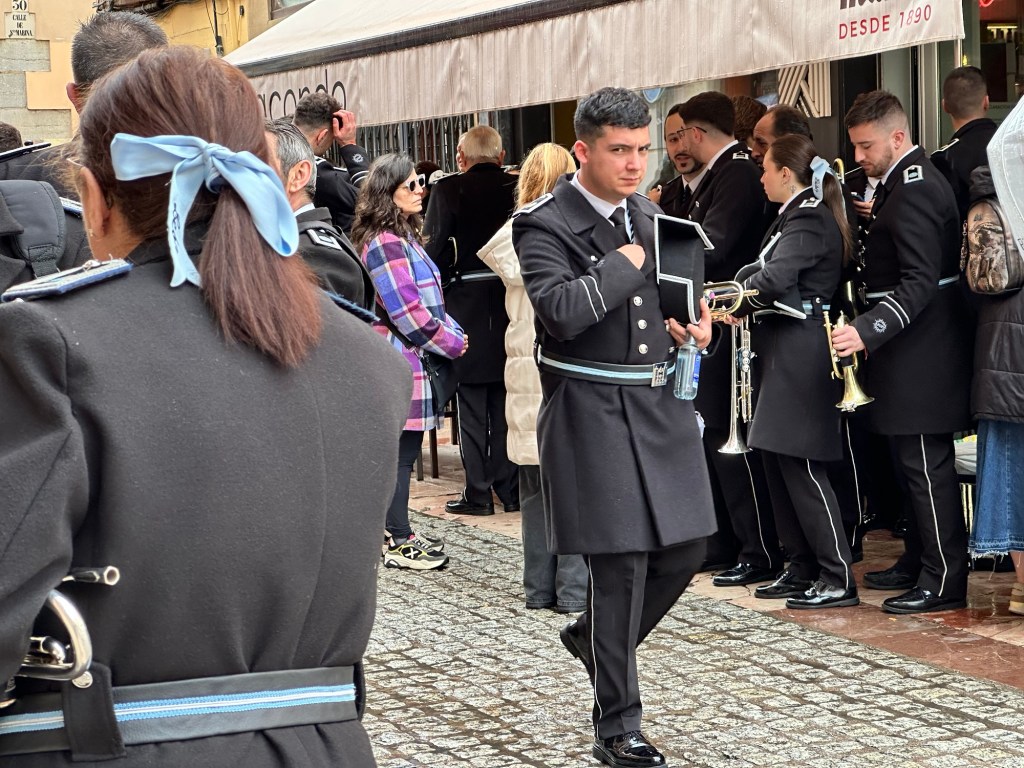
As I exited the church, I spotted some people wearing uniforms, carrying instruments, so I followed them to their assembly point — a bar.

Doing so earned me a primo spot when they started to play. I haven’t quite mastered the ability to imbed a link, but if you click below you should get a feel for Holy Week in Leon.

Despite the mob scene, fellow traveler Camille managed to spot me in the crowd. Equally surprising, I heard her call my name.

Somehow, in spite of the madness, four of us managed to link up with Shahin, our trip leader, who took the photo of Loren, me, Sheldon and Camille atop this post.

Before we went bar hopping, we saw a man standing in front of a building, swinging around a silver incense container, so we HAD to go inside. Much to our surprise, we found these elaborate “floats” that the devout carry on their shoulders during processions.

This is only ONE of many floats stored in the building

Sorry, there are no photos of our bar hopping extravaganza. We were far too busy drinking “lemonada”— red wine, lemons, cinnamon and seltzer water— León’s official “Holy Week drink, to take pictures

Our second day in the area was spent outside of León in the little village of Morgovejo, for what OAT calls a “Day in the Life” , another unique feature of OAT travel. We spend time with local inhabitants, visiting them in their homes, sometimes participating in their daily activities.

Carmín teaching us how to make cheese

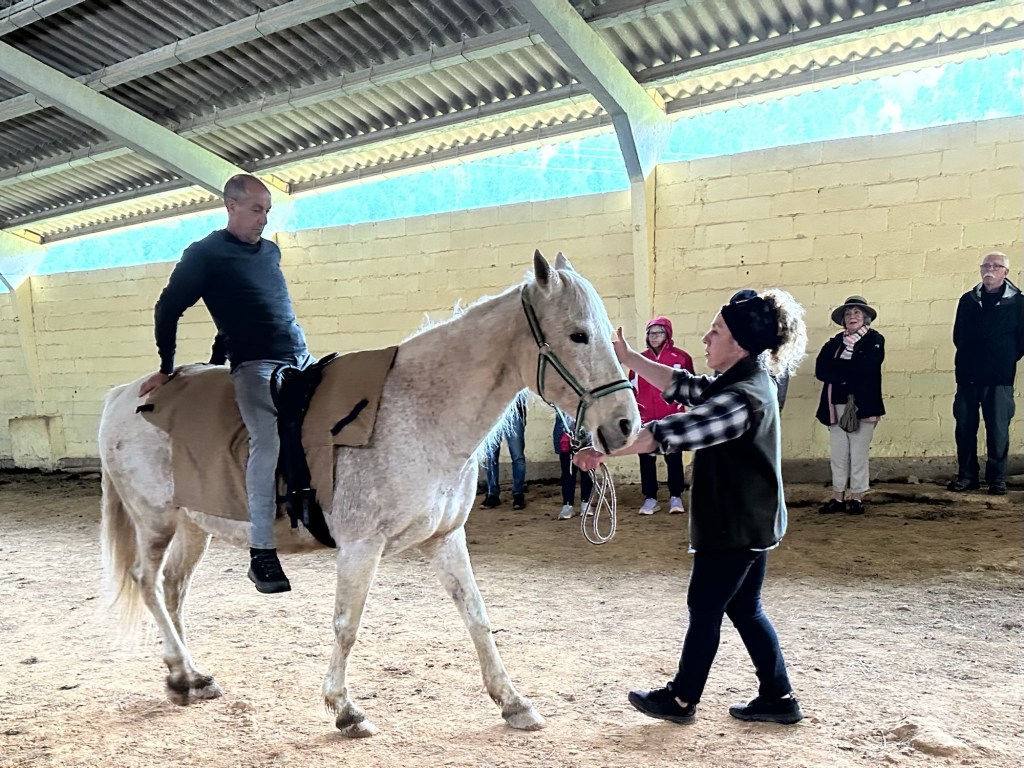
During our visit, Carmen showed us how she works with disabled children and adults, using a horse she rescued and trained. Her partner, Emelio demonstrated the various exercises that can be done by riding bareback .

Emilio demonstrating stretches.

The farm has horses, sheep, goats and dogs. Some of us were thrilled to be able to hold this baby lamb.

León was a fantastic stop, and it was over far too quickly. Next stop — Santiago de Compostela, the final destination of pilgrims on “The Way”.

Stops Along the Way

One of the many reasons I absolutely love traveling with OAT is the company finds experiences I would never have discovered on my own.

For example, en route to León we made two delightful stops. The first was at an archaeological lab in Ubide, where Michaela, an Australian osteoarcheologist, fascinated us with stories about her dig at the Roncesvalles burial pit.

Can you figure out which one is Michaela?
Hint: she doesn’t have gray hair.
She’s in the back row, directly behind me.

It was truly amazing how much can be learned from bones. So far, they have dug down to the level of the Napoleonic wars, where they found an older soldier, whose jacket was used as a shroud. His jacket’s button is shown in the top right of the following photo. Can you see the Spanish word “Rey” (king)?

Because of his skeleton’s position in the pit, his age, his wound and the button, the archaeologists deduced the bones belonged to a high ranking member of the Spanish army who died fighting against Napoleon.

When the archaeologists reach the bottom of the pit, legend has it they will find a horse, a horn and the exploded head of Roland, a member of Charlemagne’s army, who was immortalized in the “Song of Roland”.

After he sacked Pamplona, Charlemagne headed back to France, using the route we followed through Roncesvalles (now part of El Camino). As you can see, the path through the forest is very narrow, so the soldiers had to travel single file, making them easy targets for the more than slightly annoyed Saracens.

For those of you who never read “The Song of Roland” and have no desire to ever do so, here’s the scoop. When Roland sounded the horn to warn Charlemagne of the attack, he blew so hard, the legend claims that he literally blew his brains out.

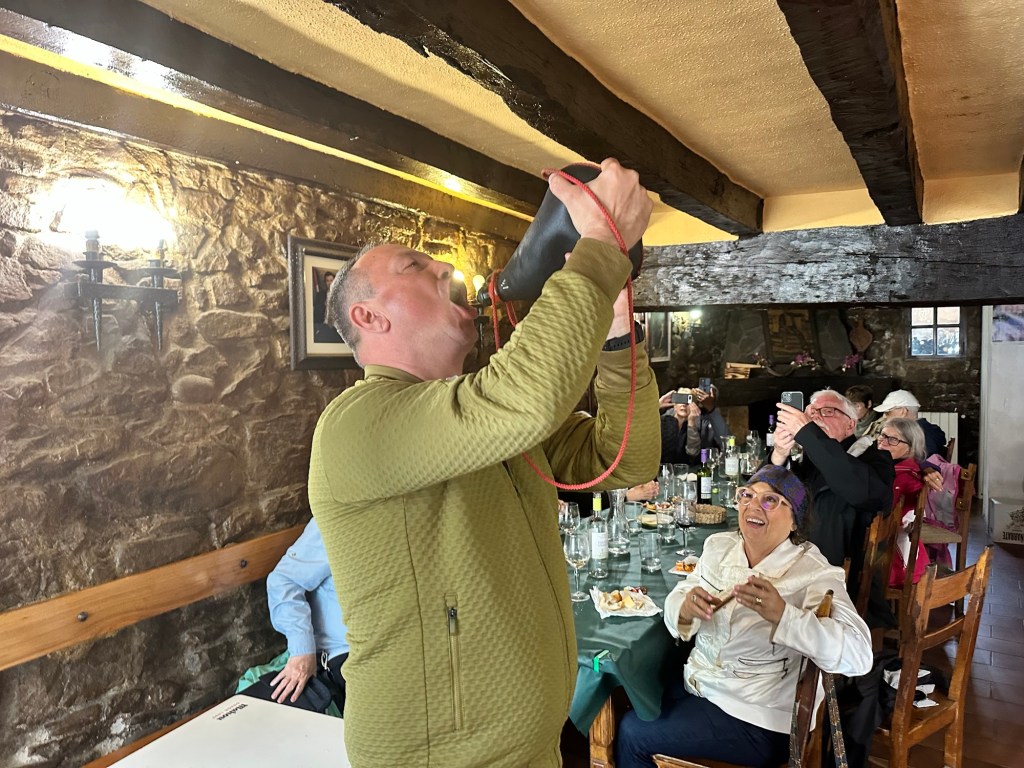
Our lunch was at a charming tavern along our route. This trip IS turning me into a “day drinker”, but it hasn’t come to THIS, at least not yet.

Shahin, demonstrating how to shoot red wine directly into your mouth

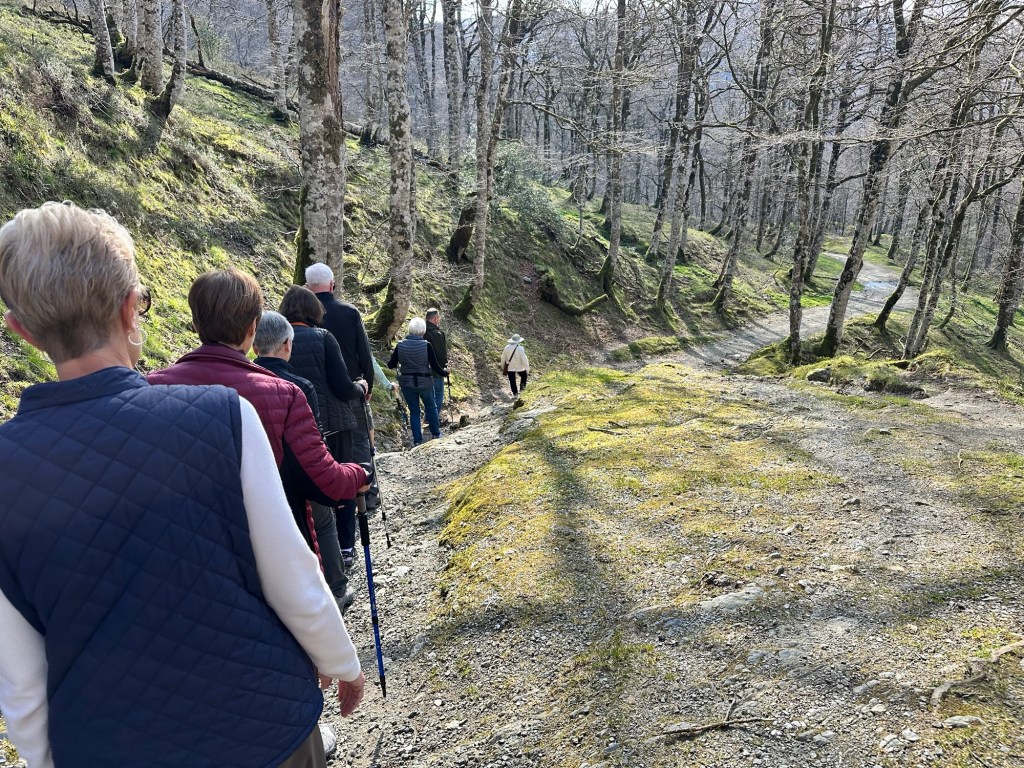
We were able to walk off some of our lunch’s calories when we reached the next stretch of our “El Camino” experience. This time, we walked through the medieval village of Castrojeriz, population about 100.

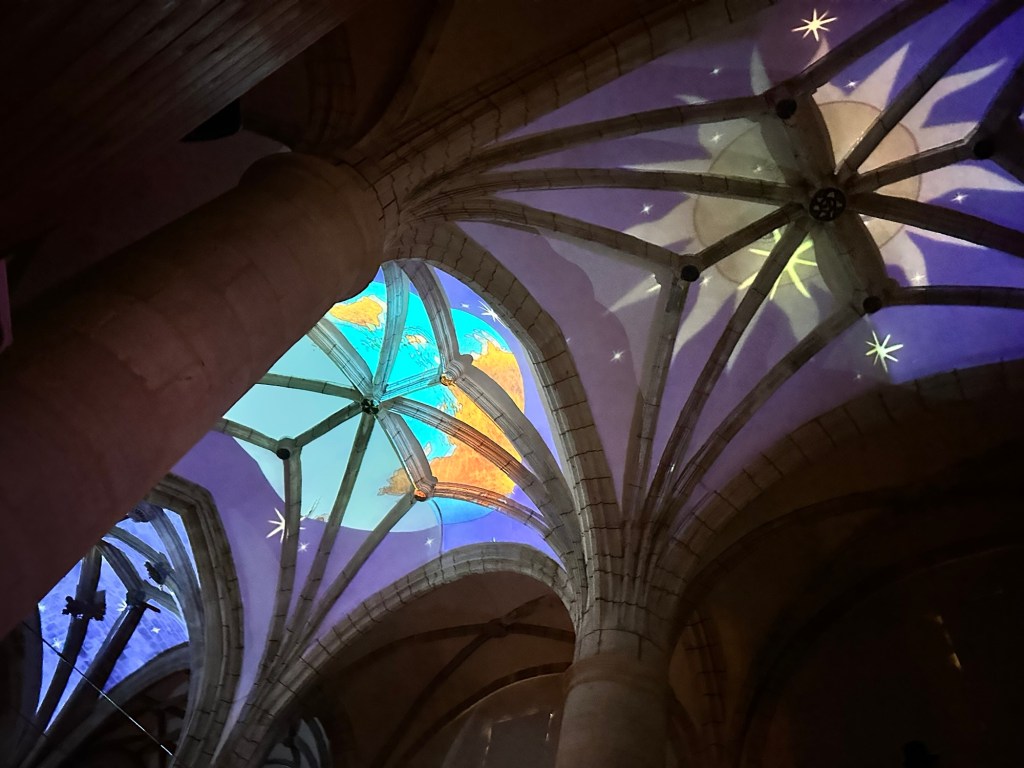
Had I been on my own, I would have walked right by this church and missed its amazing multimedia shows, including the story of creation, which was projected onto the ceiling.

If we were REAL pilgrims, walking El Camino, it would have taken us anywhere from three to about seven days to walk from León to Santiago. Instead, the 3.5 hour bus ride took us a day, because of our multiple stops.

The first stop was in Astorga, to view the castle and cathedral designed by Gaudi.

Unfortunately, the building didn’t open until 10, so we weren’t able to go inside, but don’t you agree that the outside was pretty spectacular?

The entrance to the palace is on this side. Can you believe the number of windows?
On the left (barely visible) is the cathedral.

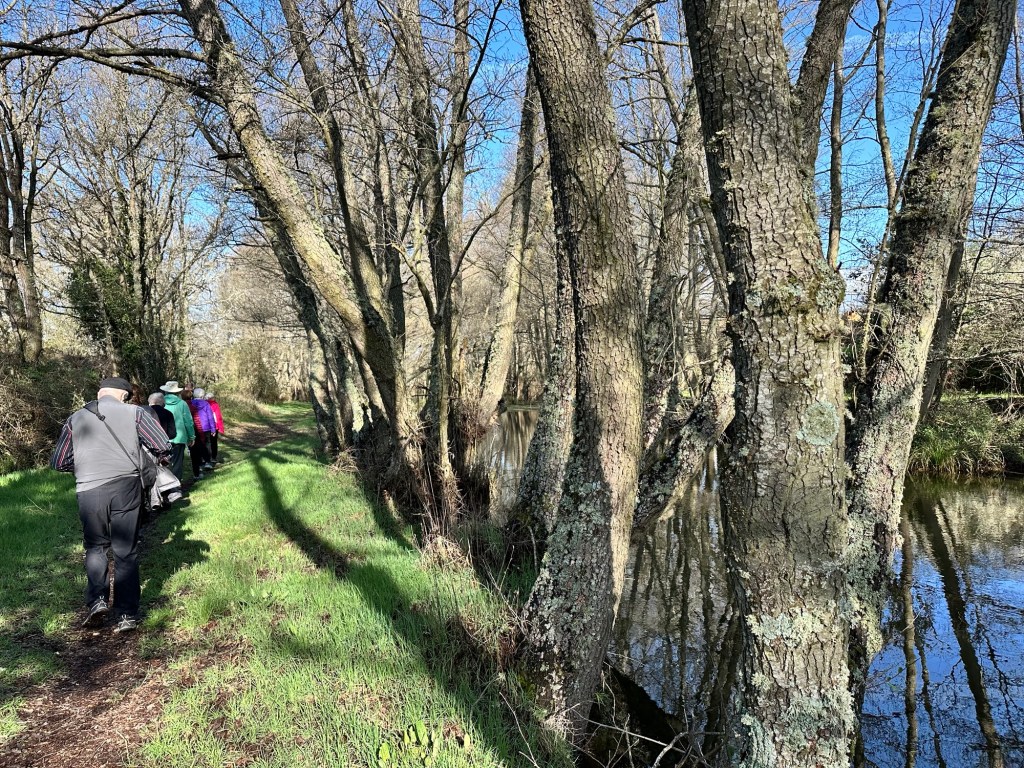
We weren’t able to linger because we didn’t want to be late for our visit to the beekeeper. To get to there, we strolled along the river for about a half a mile.

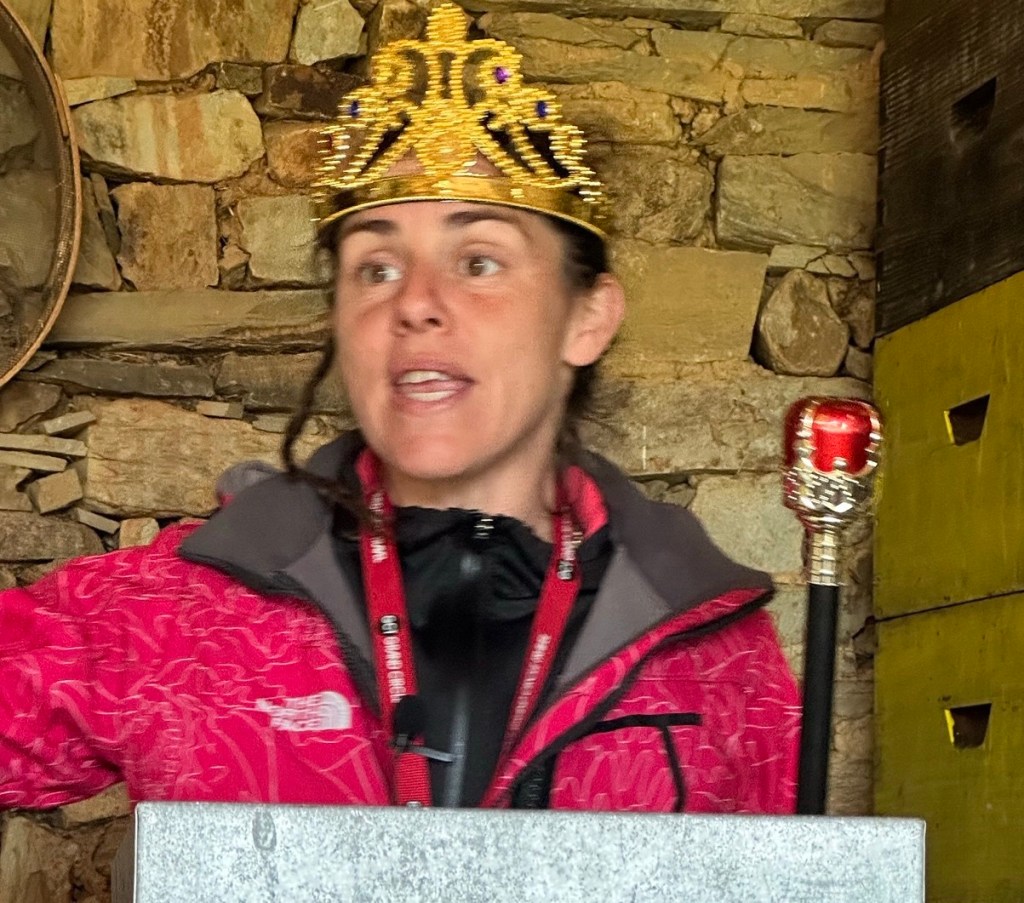
This very animated and entertaining young woman gave us the adult version of her presentation for school children.

Did you know that you should never put honey in the microwave because it destroys the beneficial enzymes? Or that you should never use a metal spoon to remove honey from its container— only use wood? (sorry, I don’t remember the reason).

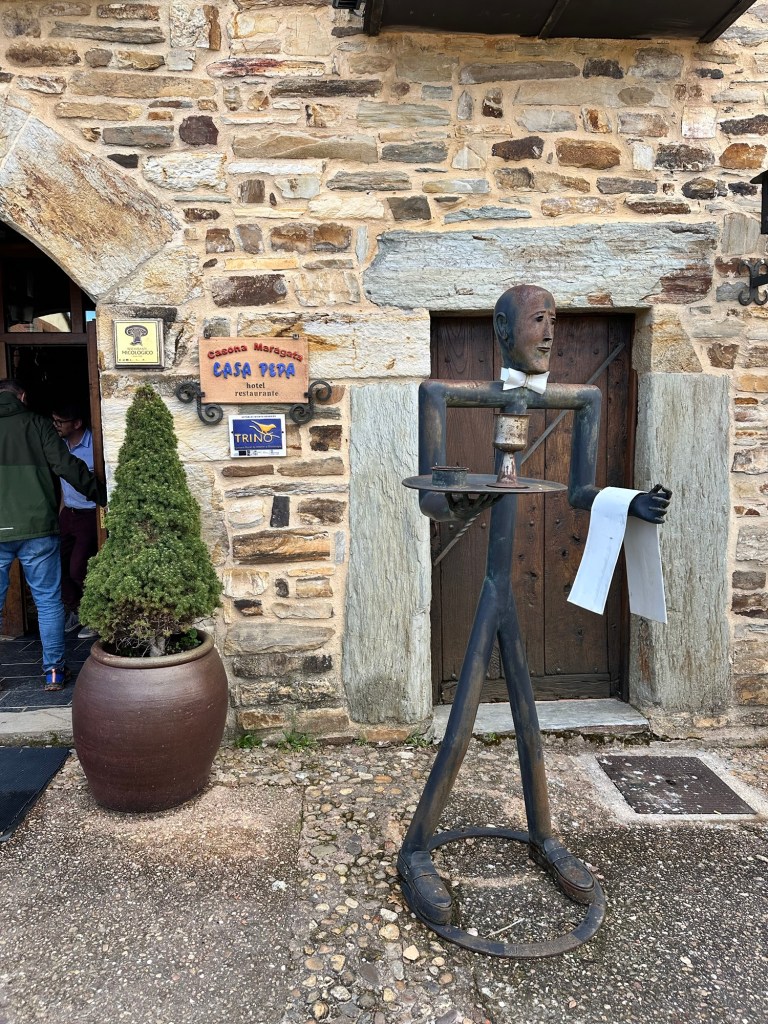
After all that learning, we were ready for lunch in the village.

This building dates back to the 1750’s; it was the home of a merchant who conducted trade between the coast and León.

We were very fortunate to have such great weather during this area’s rainy season.

But our luck was about to end. For the last stretch of El Camino, we had an “authentic” pilgrim experience. We walked to the cathedral in a downpour.

That smile on my face was VERY short lived. I neglected to pack waterproof shoes, so by the time we finished our 5 kilometer walk and got to our hotel my shoes, socks and all 10 toes were soaking, sopping wet. Good thing I know how to say “I want to buy waterproof shoes” in Spanish!

Looks like the weather goddess is sending more of the same for our time in Santiago and Portugal. But at least with my new 100% waterproof Sketchers, my feet will be dry!

After the day we had, we decided we all needed at least one glass of wine — perhaps more. How lucky am I to be with such a great group of people!

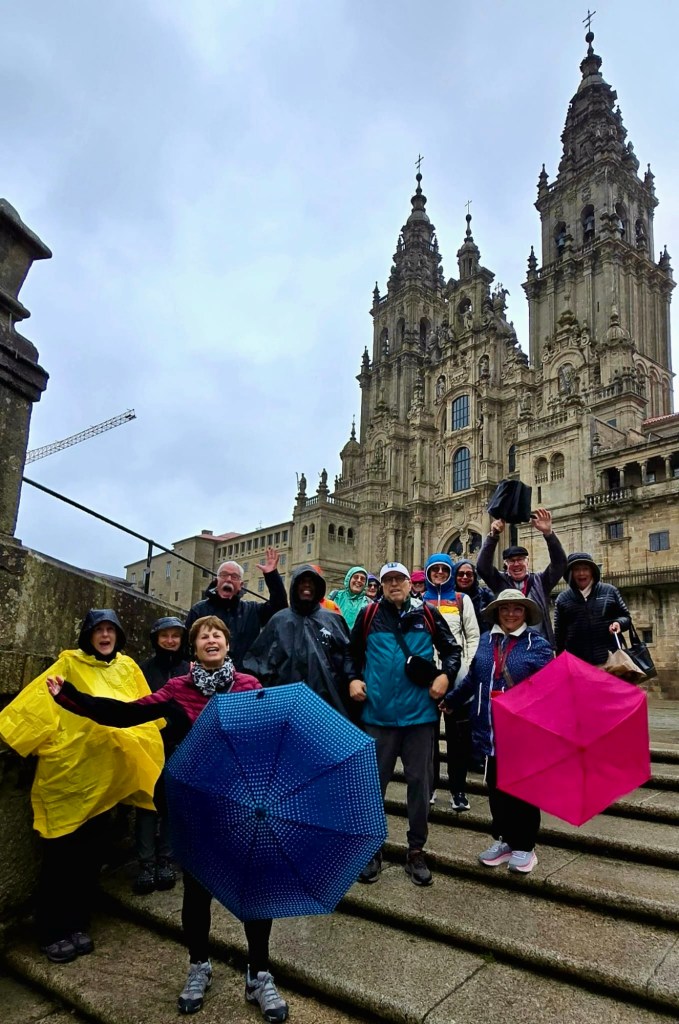
Briefly, the rain stopped, allowing Shahin to take this group photo.

Bilbao and Guernica

When I told my friend (and of course by now, I’ve forgotten which one) that I was going to Bilbao, she said that she’d visited years ago and that it was “very industrial”. Indeed it was. Shipbuilding and mining produced so much pollution that, according to our trip leader, when his mother hung laundry out to dry, it would become gray tinged. But what a difference a couple of decades and a natural disaster can make.

In August of 1983, two weeks of torrential rainfall produced flooding that devastated the area. Fortunately, the city’s leaders were able to turn that disaster into an opportunity. They determined rebuilding would focus on what would benefit the entire community. They decided that emphasizing CULTURE and infrastructure would be the key to Bilbao’s future.

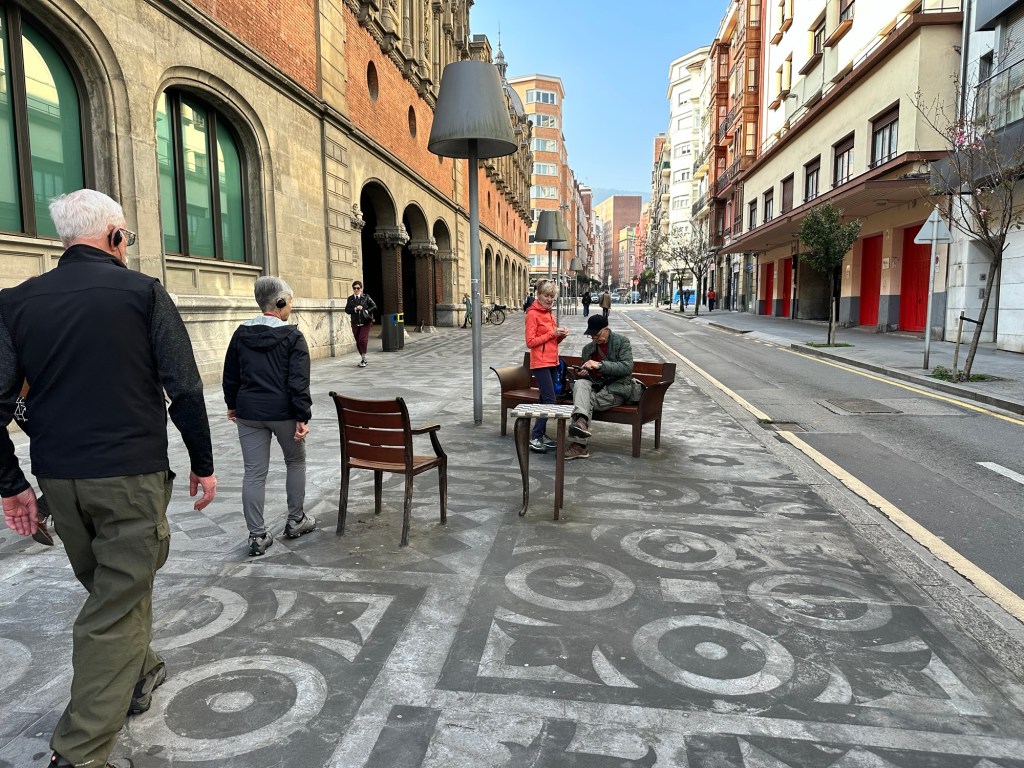
And what a magnificent city it is now! In addition to the wonderful green spaces and playgrounds mentioned in an earlier post, Bilbao also has a huge sports stadium, a concert hall, a metro, tram —and my personal favorite —an incredible building known affectionately as “the living room”.

The pavement leading to the entrance has been designed to look like a carpet. Notice the street lights resemble table lamps and the benches look like living room furniture.

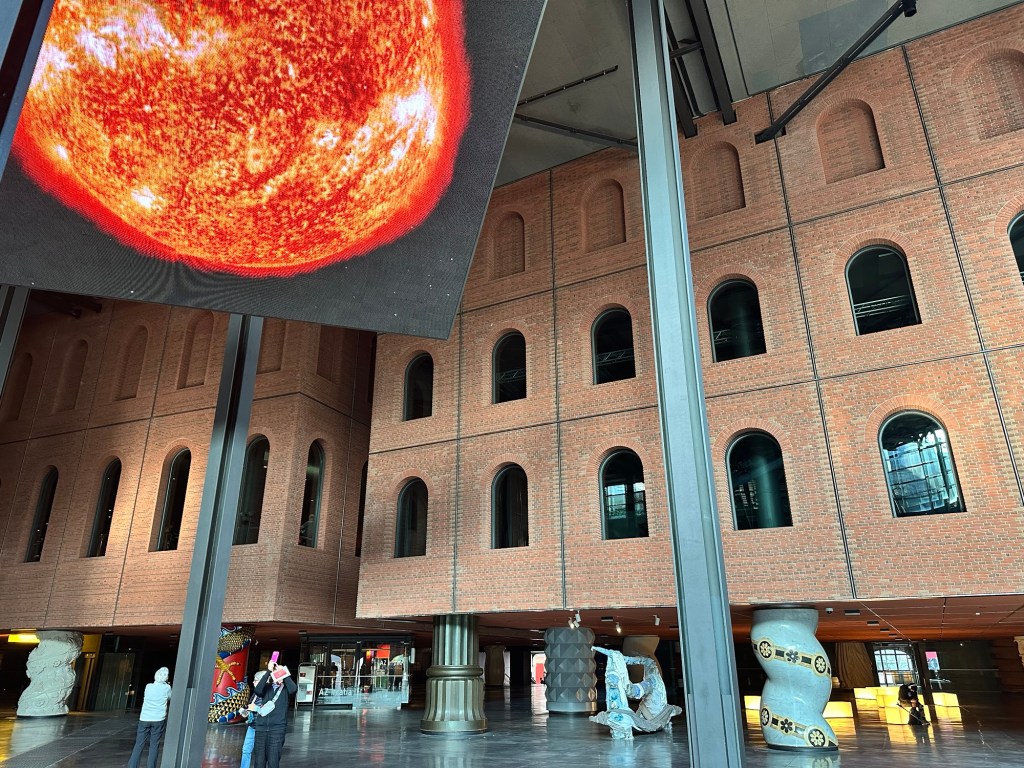
Originally built in 1909, the building was abandoned in the 1970’s and was almost demolished. Instead, it now is a “culture and leisure center” housing a gym, with a pool,

That’s the ceiling. If you’re on the ground floor, you can look up and watch people swim!

a library, an auditorium, a restaurant, showrooms, shops and in the basement (which we didn’t visit) a multiplex cinema.

Other notable Bilbao sights:

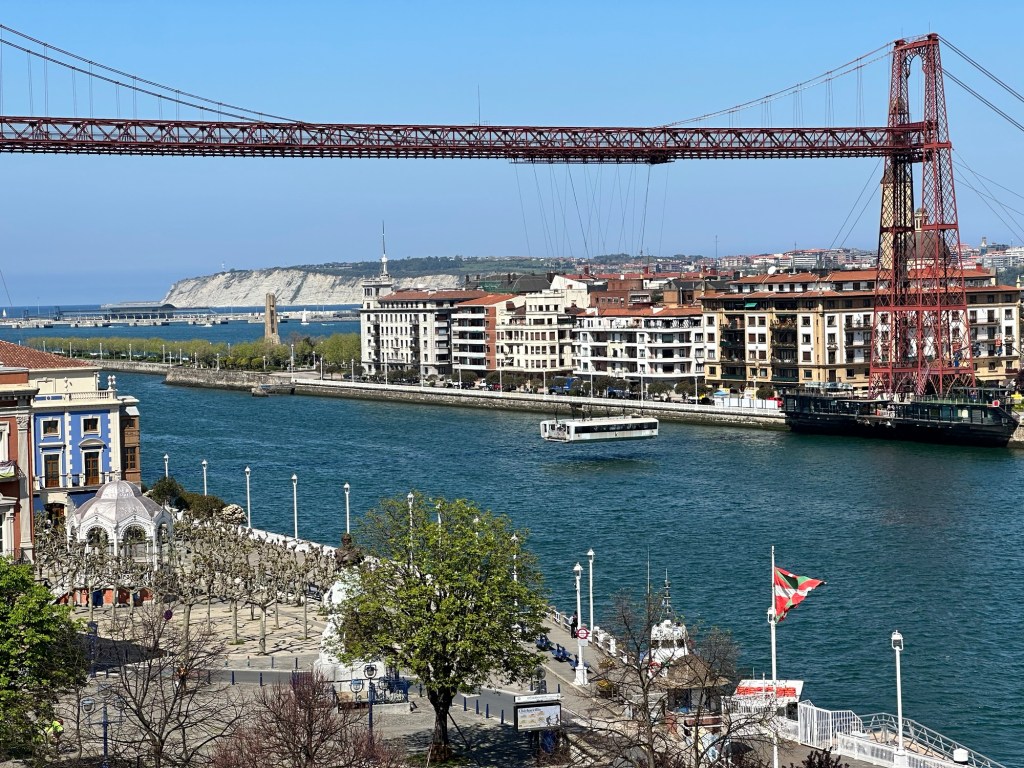
The Vizcaya Bridge was designed by one of Eiffel’s associates, Alberto Palacio

I was SO excited when our trip leader told us we’d be walking across this bridge. Elevators could take us to the top, so I was ready for the adventure. You can only imagine the depth of my disappointment when I realized he was just joking.

Instead we rode across on this “transporter. It dangled from wires attached to the structure that I thought we’d be strolling across. It skimmed just above the river. Later, we visited a cathedral atop a hill, from which we could view the mouth of the river, the Atlantic, and those cliffs.

This was not our only panoramic view. Later, we rode Bilbao’s funicular to a cafe where we enjoyed a glass of wine and this spectacular view.

The Guggenheim is to the left of the red bridge and in front of the skyscraper

I could have spent a whole lot more time in Bilbao, but the next morning, we walked through the city of Guernica, which was destroyed during World War II.

Our group in front of a replica of Picasso’s famous painting
The latest recruit, ready to fight for democracy in her own country

Fortunately, we had “free time” in the afternoon, so most of us spent it inside the Guggenheim. The architecture is absolutely spectacular!

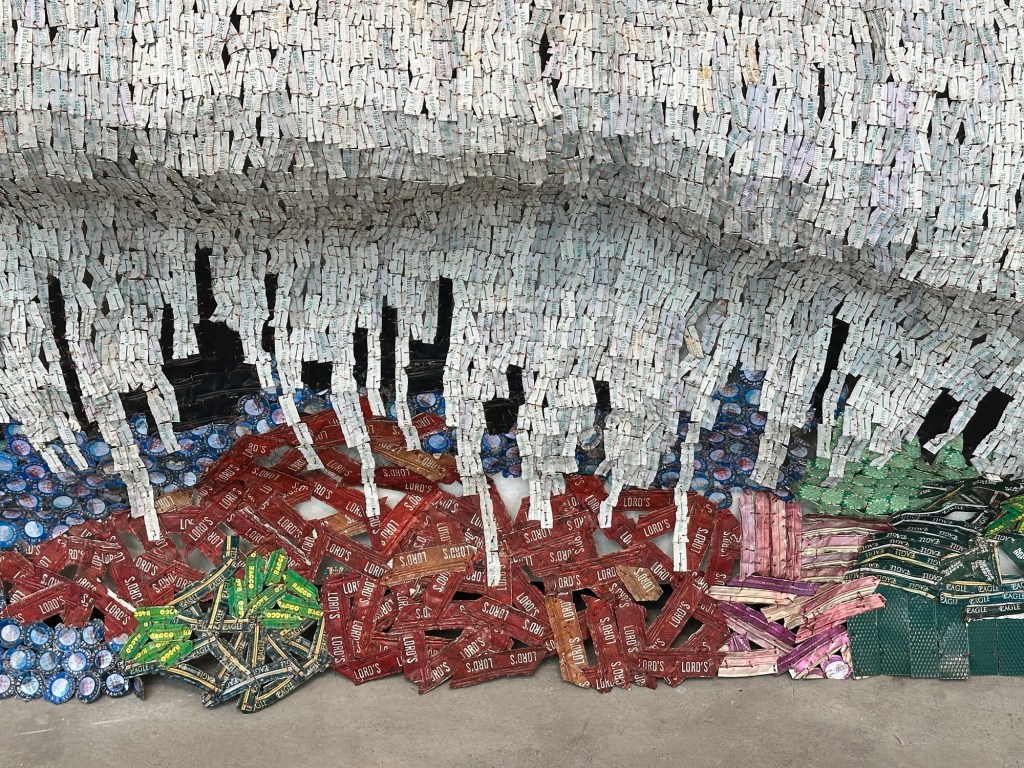
This in no way captures the grandeur of the space or my favorite piece, “Shuttlecock”

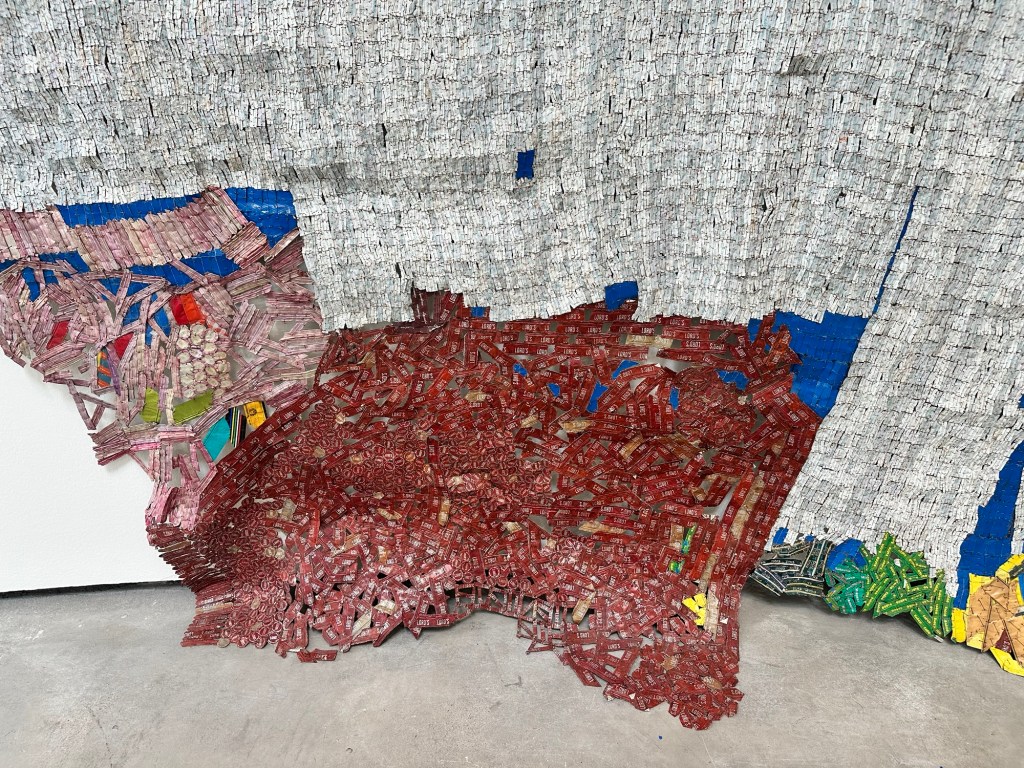
I also loved art made from “reclaimed” objects, like these pieces of cars,

and flattened bottle caps with wrappers from liquor bottles

Here are some “close ups” of the piece so you can see the intricacies. It’s a WOW.

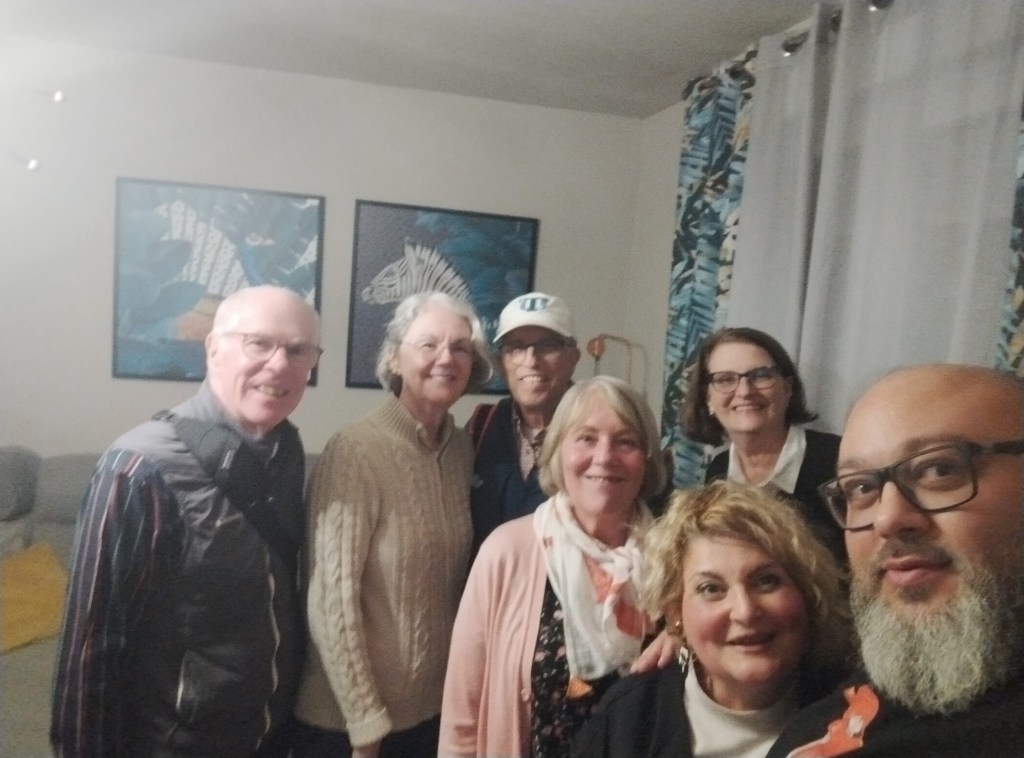
That evening, we broke up into three groups of five for a “home hosted” dinner.

Blanca and David were absolutely delightful hosts, and the dinner was spectacular. Although their English was at the level of my Spanish, we were able to communicate. I think the wine and the chocolate liqueur might have helped.

Later, I learned that Shahin put me in this group because he overheard me speaking to a tattooed Spanish biker that we met when we stopped to admire the Bay of Biscay. He figured that ONE of us needed to know a little Spanish. And in MY case, it is DAMN little, but it was enough.

We are on the bus now heading to Pamplona, with a stop in San Sebastián. It looks like our run of perfect weather is about to end.

Spain and Portugal Adventure Travel

The photo above shows the itinerary for this trip. Ignore the boxes. I’m not doing a pre or post trip this time.

The name of my favorite tour company is Overseas ADVENTURE Travel, and so far, it’s living up to its name! The tour promises participants will have “learning and discovery” experiences and so far I’ve had both.

I now know how to shop for ropa interior (underwear), how to translate sizes (take your US size and add 32, so a size 8 becomes size 40). I learned to never EVER buy “Brazilian” underwear, how to pay for a bus ticket to the airport (credit card, paid ON the bus) how to get thru the “Do Not Enter” doors at Bilbao airport ( wait for someone to leave and dash thru).

I came to this knowledge when I arrived in Bilbao and my AirTag told me my luggage was still in Munich.

Why, oh why did I check luggage? Well…

In the past, connections in parts of Europe, especially Germany, have been a tad unpleasant. I hate it when my plane parks far from the terminal. I have to walk down the rollaway stairs, carrying luggage, then get stuffed into a bus, which drives for 5 to 10 minutes to get to the terminal. On past occasions, the escalators weren’t working, so I had to carry my bags up several flights of stairs.

As a bonus, if I checked a bag, I could bring enough clothes so I wouldn’t have to do laundry. I would also have room for a bathing suit so I could enjoy any hot tubs I encounter along the way. Checked bag it was. Thankfully, I had the presence of mind to include my AirTag, just in case.

I’ll admit it. I was feeling a little smug while I was walking down 4 flights of stairs (with only a light backpack) to the crowded bus that would drive us to the plane that would take us to Bilbao. That feeling was QUITE short lived!

But at least I had the good sense to arrive a day before the tour started, because I spent HOURS of my first afternoon on the phone getting bounced between United ( Newark departure) and Lufthansa (Bilbao arrival). I’ll spare you the details, mainly because I don’t want to relive them, and also because they are bone crushingly boring.

But I WILL share this important tip: ALWAYS check your baggage receipt. Had I done so in Newark, I would have noticed that it said “Munich”, not Bilbao. So because I missed that important detail, it was determined that I was at fault and my bag would NOT be delivered to the hotel. Instead, I would have to go to the airport to fetch it.

And here’s another tip: ask to speak to a supervisor or manager as soon as you hear the same unhelpful info for the second time. I certainly wish I had.

Just about every situation has an upside, if you look hard enough. So I did. Here’s what I came up with: In addition to my various “learnings” described earlier, I might not otherwise have been out so early on a Sunday morning. I LOVED my early morning walk and I felt like such a big girl riding the bus all by myself.

Plus, I got to buy a Disney tee shirt that doubles as a nightgown. In case you don’t read backwards, that says “Ratatouille”. NO photos of Brazilian “ropa interior”. You’re welcome.

I was back early enough from my airport jaunt to join my new friends Pam, Barbara and Camille for a walk along the river.

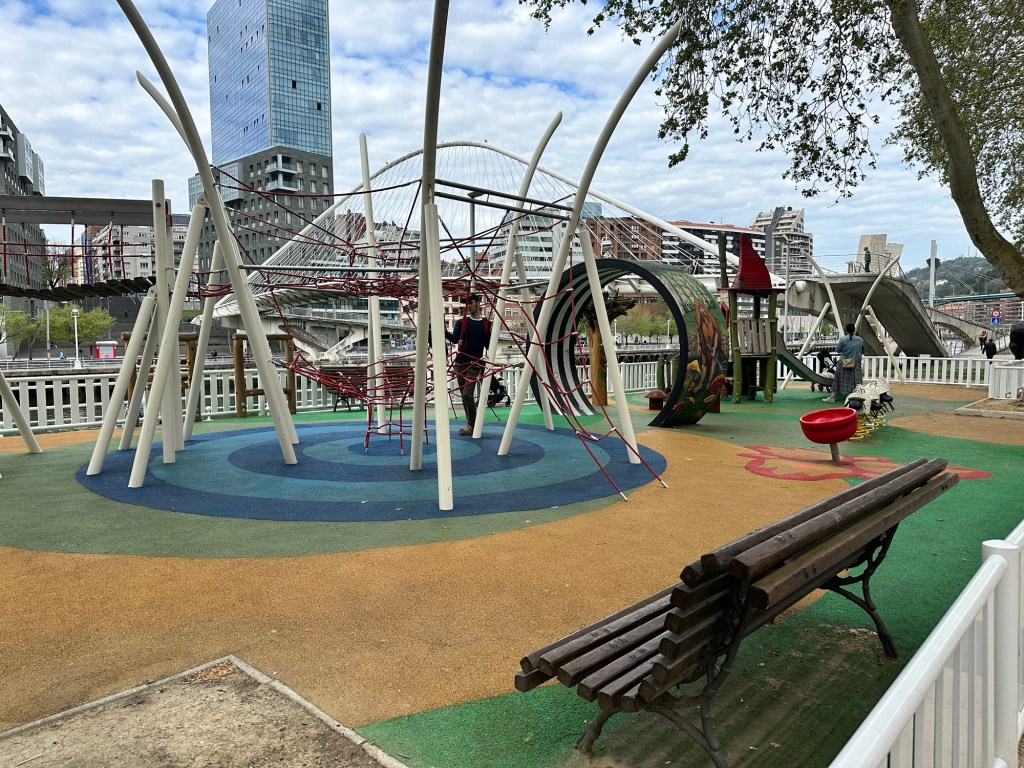
Bilbao is a WONDERFUL city, with lots of green space, playgrounds, artworks and pedestrian walkways.

The playgrounds had unusual, imaginative structures
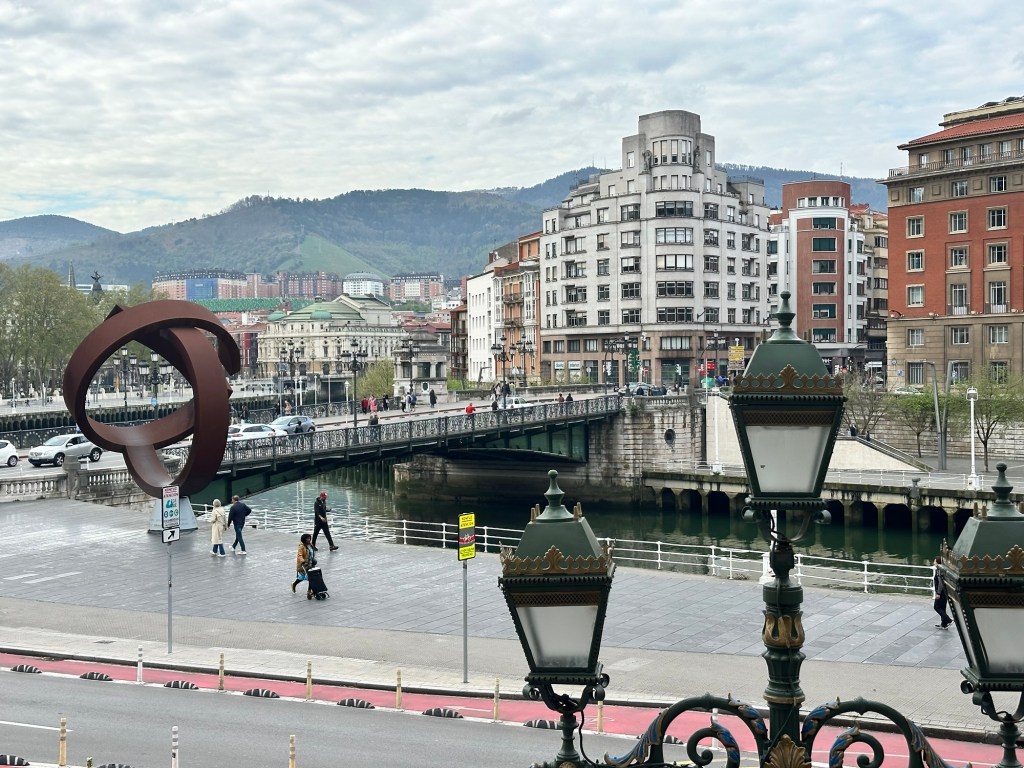
The many bridges are all beautiful in different ways.

The other three ladies wanted to explore churches and cathedrals, but since I’ve already exceeded my lifetime quota for such structures, I ambled on down to the Guggenheim. I had just enough time before our afternoon boat ride to explore the exterior of this amazing building.

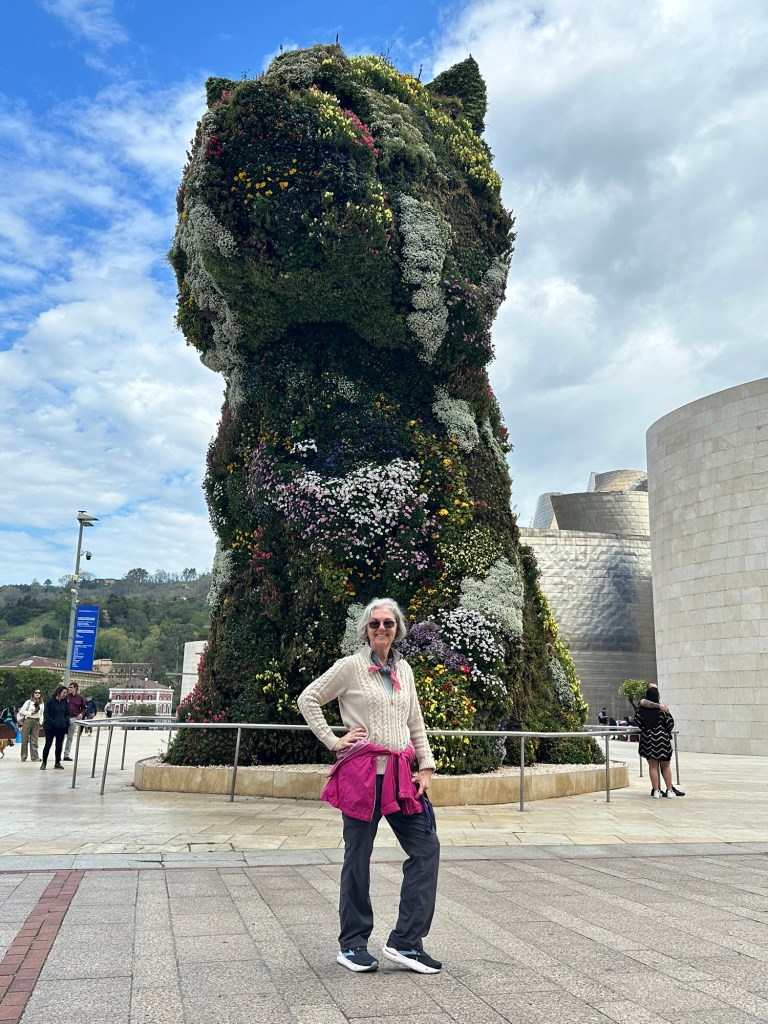
Yes, that puppy is made entirely of different flowers
I took another photo of this sculpture from the boat. Which do you prefer?

I highly recommend the 1 hour boat ride for anyone who is interested in architecture. There is a QR code on the back of all seats on the boat. If you scan it with your phone, you have access to a narrative (in your chosen language), describing what you are viewing while you pass by on the boat ride.

The Guggenheim as seen from the boat, coming
And going

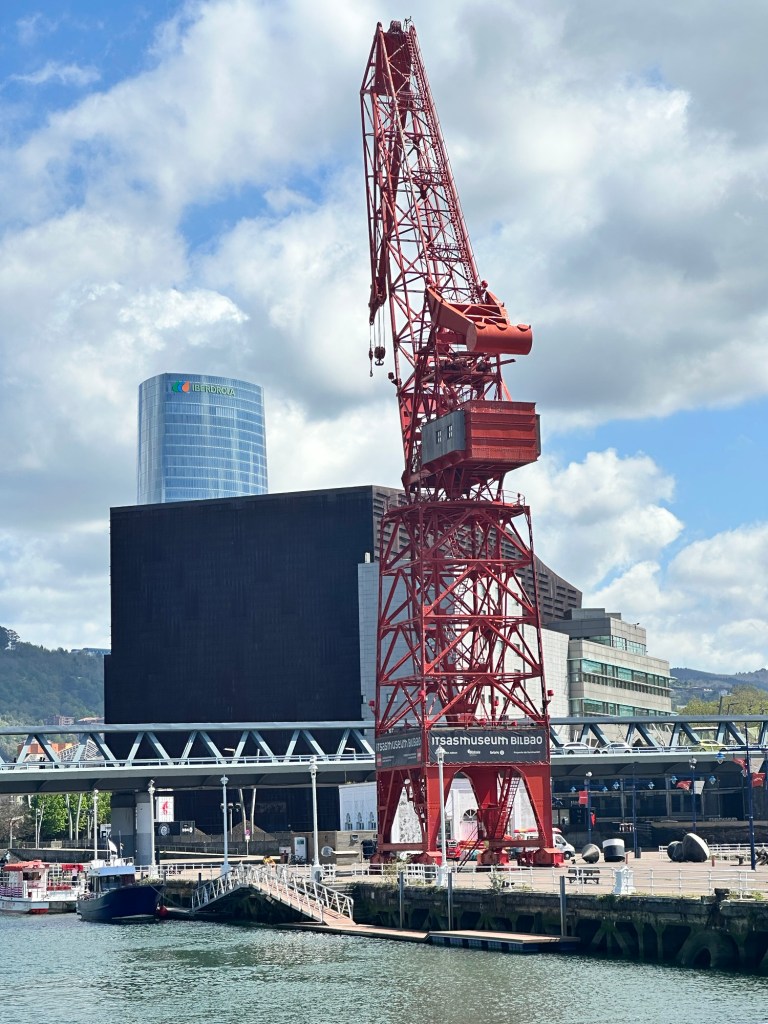
There was a “girl from Ipanema” type of story about this crane. I THINK it went something like this: Everything would stop so that men could stare when a certain young girl came across the river 4x a day to operate the crane. They should have written a song…

There was a whole lot more to day 1, but I’ve done enough blogging for today.
Spain Smorgasbord

By the 8th day of our Grand Circle tour, we had visited Madrid, Toledo, Granada, Cordoba, and Torremolinos, with a side trip to the very British Gibraltar. Next on our itinerary was Malaga, but Mike and I decided to engage in an Australian tradition and “Chuck A Sickie”. For those of you that didn’t have the pleasure of spending two weeks with an Australian Global Volunteer, that term roughly translates to “Playing Hooky”.

Although the Costa del Sol averages over 300 days of sunshine per year, today was the first time I needed to wear my sun hat.

I’m sure our fellow travelers had a perfectly marvelous day enjoying the sights of Malaga, and the home hosted lunch in a nearby village as much as Mike and I enjoyed spending the morning strolling along the beach, taking in sights like this.

I would have loved to see what this tribute to Elvis looked like before the rain decapitated him.

But what about those other glorious cities?  Don’t worry, I’ll do a little flashback, with visuals.

We got just enough of a taste to determine that one of these days, we will be back to those lovely cities, and next time, we will linger.  

Our time in Toledo was limited to a few hours enroute to Granada. The old city sits 6 escalator rides above the new city, and let me tell you, we were all very grateful we didn’t have to climb all the way up the hill in the rain.

9EC9D2D3-D3E3-4239-9EA4-B8A19B2B2A8C

89F0FDF4-3849-4C49-9C3B-456075D8304B
Even after we arrived at the “top”, we still had some hills to climb.

Our stroll through Toledo’s Jewish quarter ended at the oldest synagogue in Europe. This unique building was constructed by Moors, because at that time they were reputed to be the best builders.   Of course, they were not familiar with synagogue construction, so the Jews ended up with a building that had a distinctive Muslim flavor.

E8355D59-2D68-482E-811D-B74CD818E62B
Notice the cross?  This building is a reminder that at one time, all three religions were able to peacefully coexist—pre Ferdinand and Isabella reign.

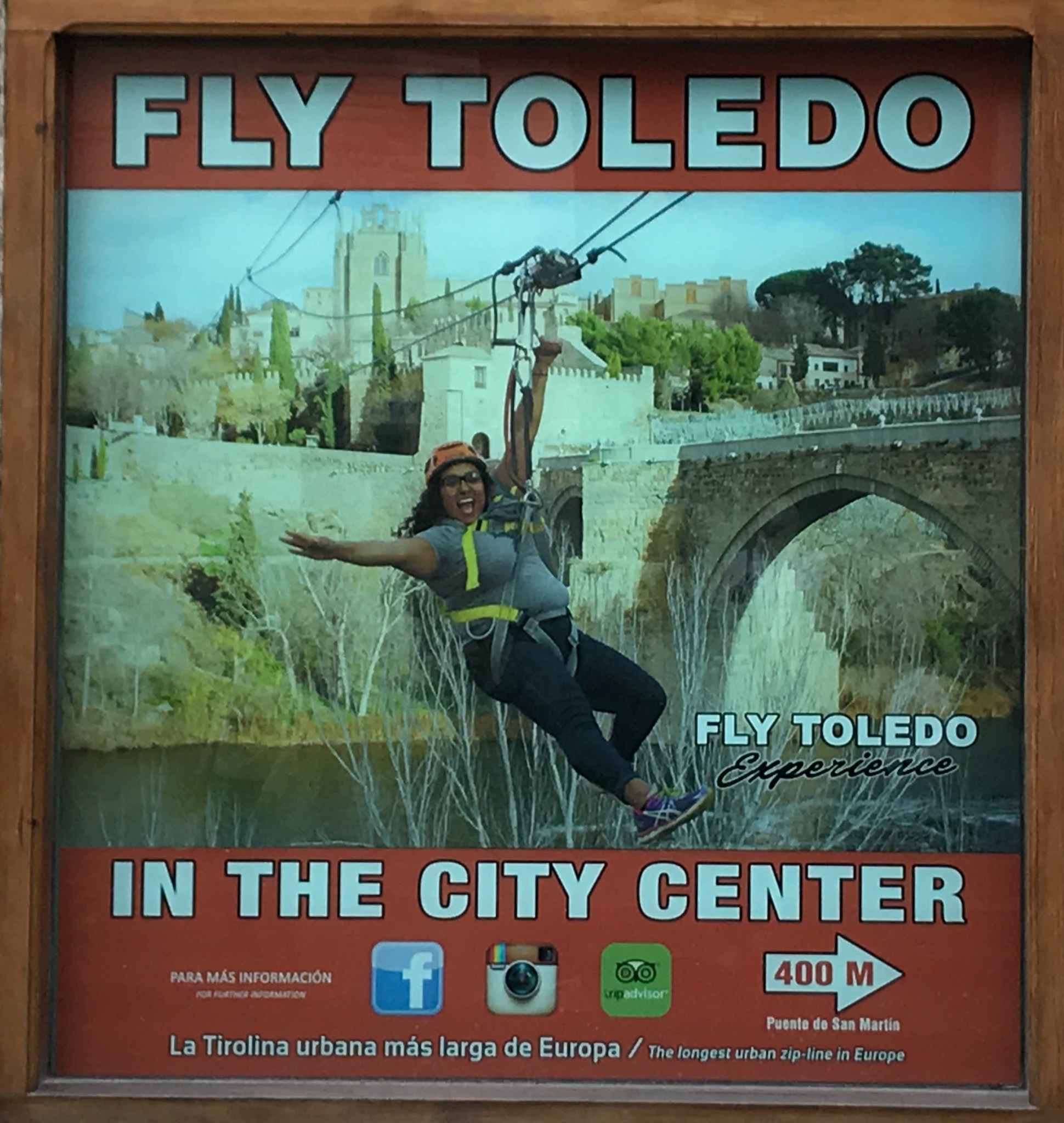
For anyone planning a trip to Toledo, please be aware it is much more than amazing history, great food and panoramic vistas.  Thrill seekers, take a look.

46619F4D-03D6-4F01-A66F-07326B9C9868
Maybe next time, if it isn’t raining…

One of the many things that I love about traveling with Grand Circle and OAT is the unexpected stops along the way.  We had a bathroom and refreshment break in Puerto Lápice, a little village in Castille La Mancha, where we discovered a three room Don Quixote museum.

Because I spent so much time in the museum, I had to order my glass of wine “to go”, which I proudly did in Spanish.   An important phrase: “para llevar”.  But the effect was spoiled, just a bit, when the bartender started speaking to me in perfect English.

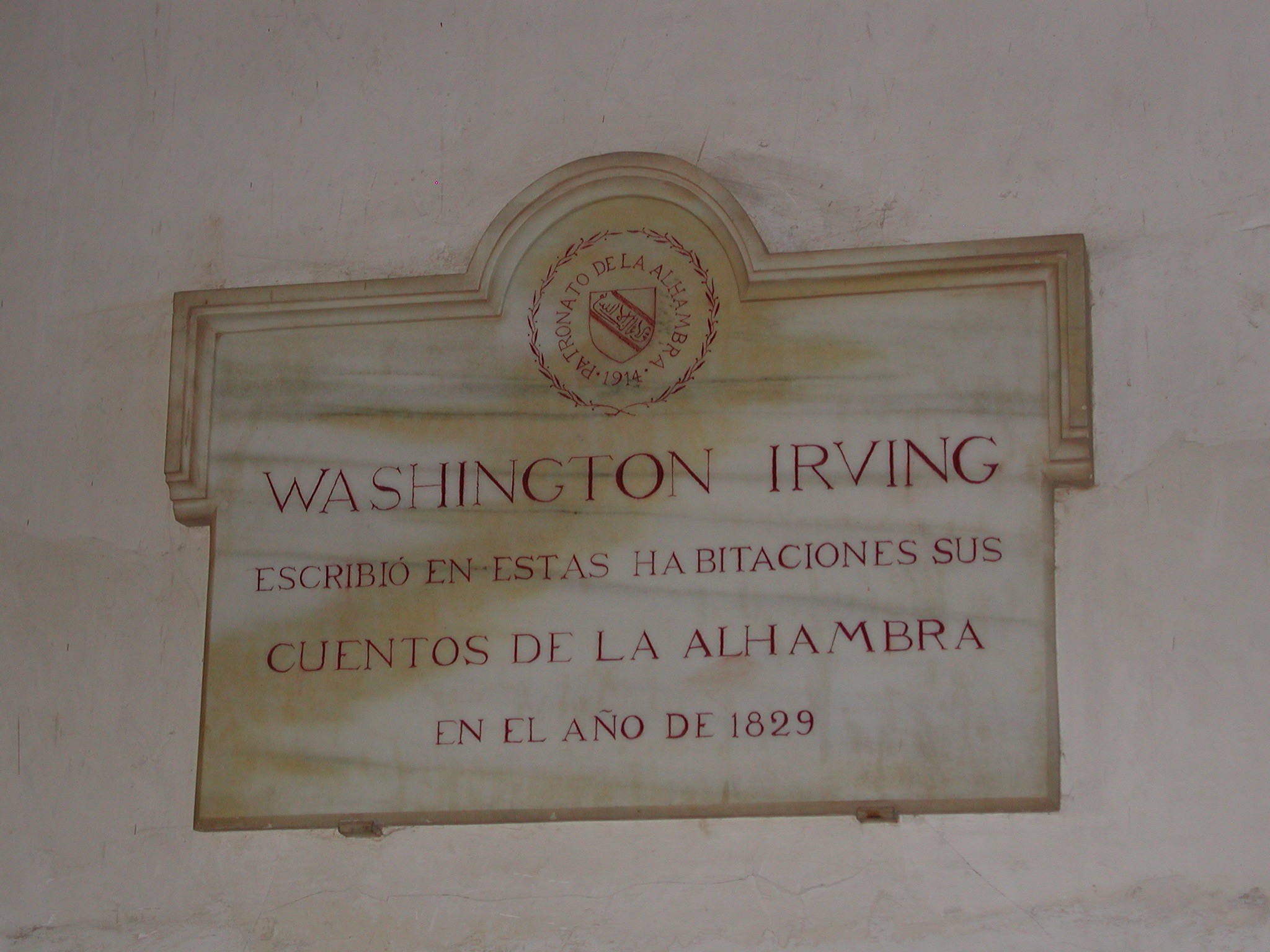
Not surprisingly, most of our time in Granada was spent at the Alhambra.  Okay, so we all know that Washington Irving wrote “The Legend of Sleepy Hollow”, but how many know that he also was instrumental in saving the Alhambra from being destroyed?  His “Tales of the Alhambra” caused the Spaniards to take a second look at what is now the most visited attraction in Spain.

8BD8360A-0680-40C5-8408-24C7B789D61B

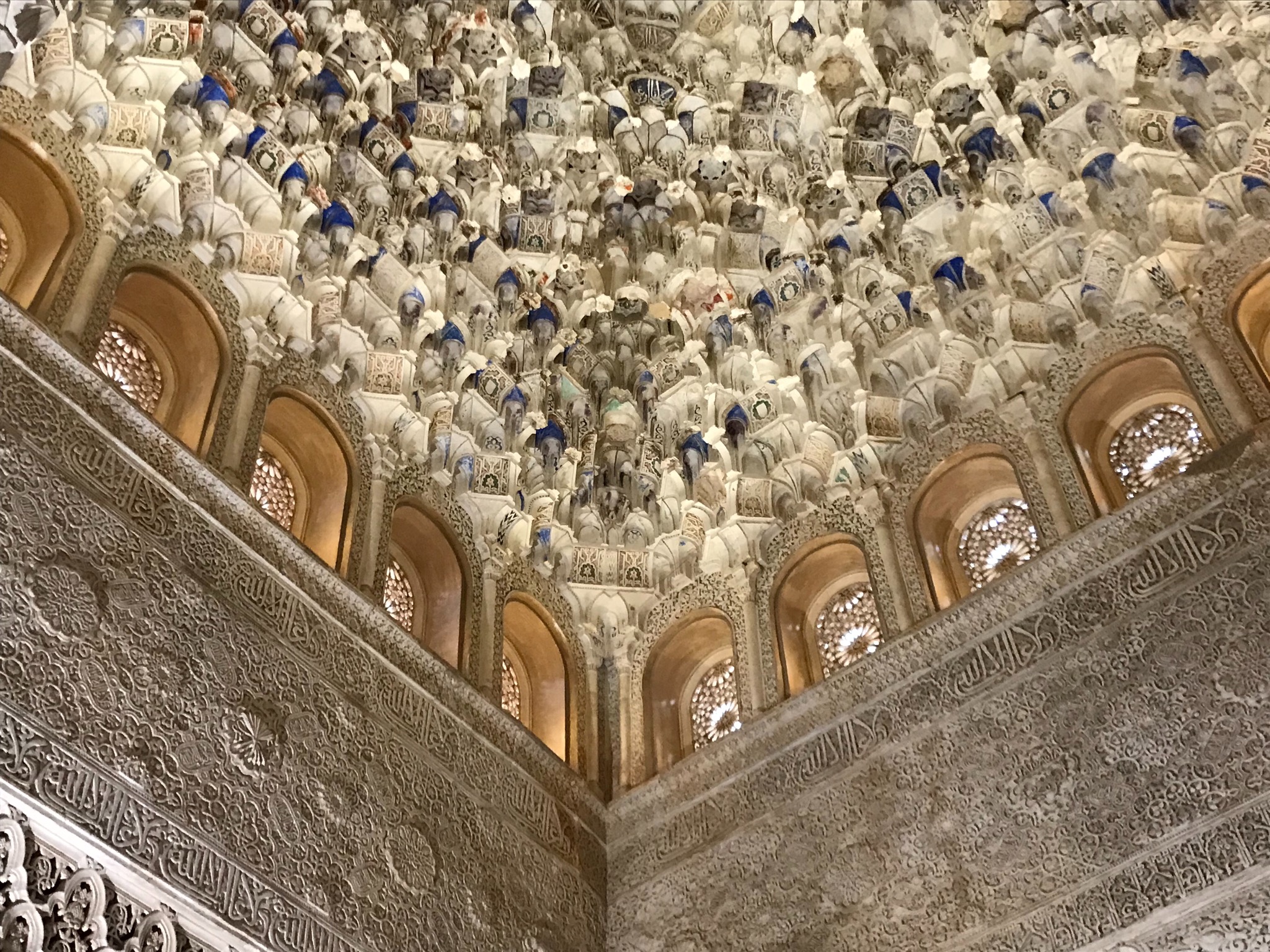
Alhambra ( Al = “the” in Arabic ) is a palace, a fortress, a small city, overlooking Granada.  Unfortunately, when Napoleon conquered Spain, his soldiers removed all of the furniture, rugs and tapestries, ( I believe the correct term is “looted”) but the walls, ceilings and courtyards give you a hint of the grandeur that once existed.   Check out the ceiling in the women’s quarters.

2AB5FE22-54F8-48E9-B303-86F089D73F56

The exteriors of Moorish buildings were very plain. All of the ornamentation was inside, in the private spaces, like these beautiful courtyards.

3B9BD482-0553-4434-B6B1-5387F5DA6524

D851FED7-4EA0-4DDA-8E1D-35E1EB136BB3

The Moors ruled Spain for almost 800 years, and their impact on the Spanish language continues today.  Many places begin with “Gua”, like Guadalcanal, Guatemala, Guanajuato — all derived from the Arabic word for water.

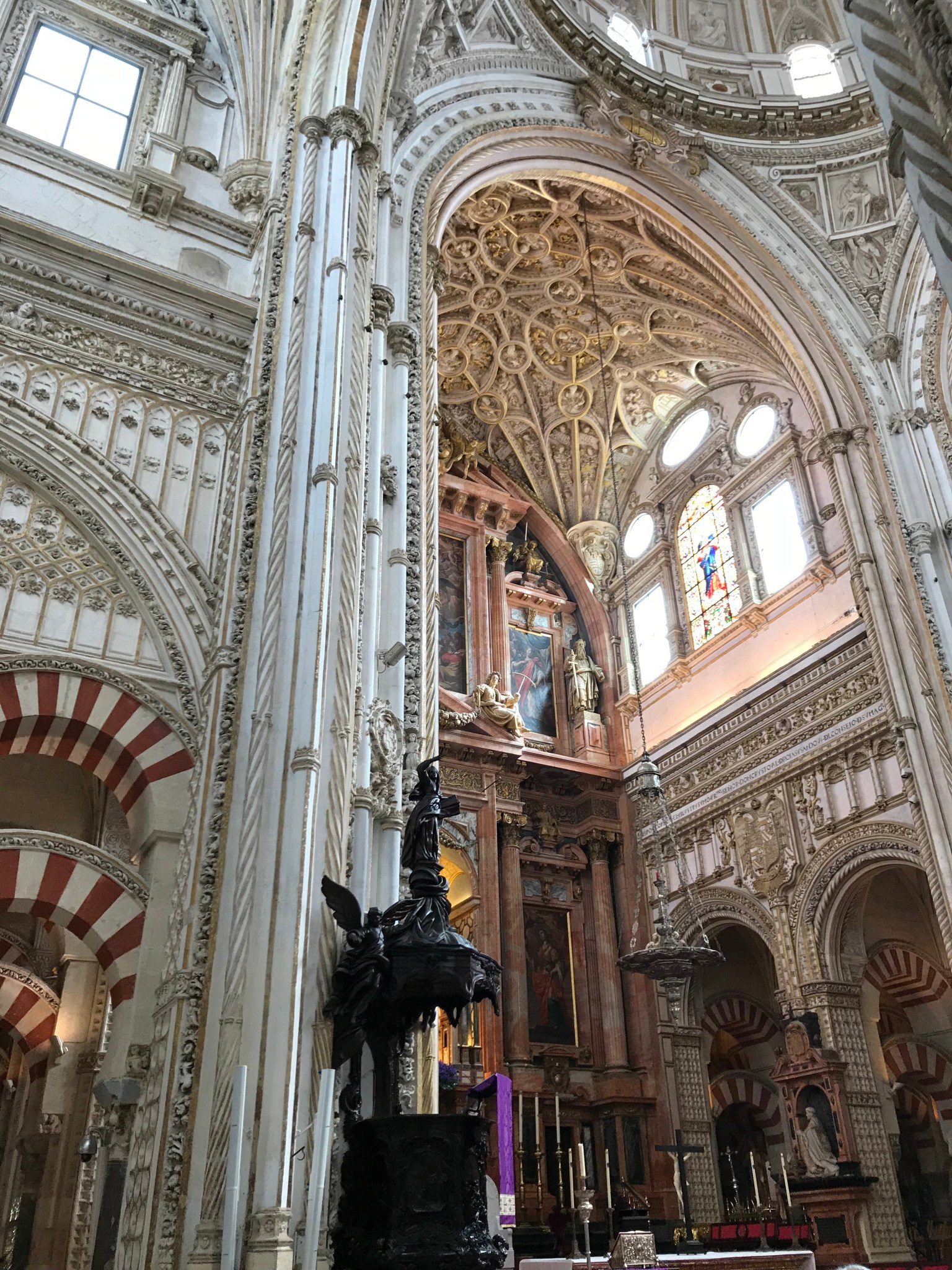
Another city with beautiful Moslem architecture is Cordoba.  The Roman temple/Church/Mosque/Cathedral is an architectural wonder.  Walking through its spacious interior, you literally travel through time, starting with the preserved Roman tiles, below the existing floor—

117fd81f-1304-4e2e-ab39-d92f33fc3642.jpeg

to the former mosque, built with recycled columns, which was wisely preserved by the Catholics —

F1D76363-86F6-4785-A5CB-FEF95BD600DDAED4DACB-5FD1-4B6C-B160-81D0ECCFEEF4

and now is in the center of the mosque.

6AA5DFC2-3591-4072-A721-B998D76F6B2C
In this photo, you can see the Mosque’s red and white arches next to the cathedral’s main altar.

Cordoba is magnificent!

888B3959-5065-4EB2-A63B-EE68B3F22773
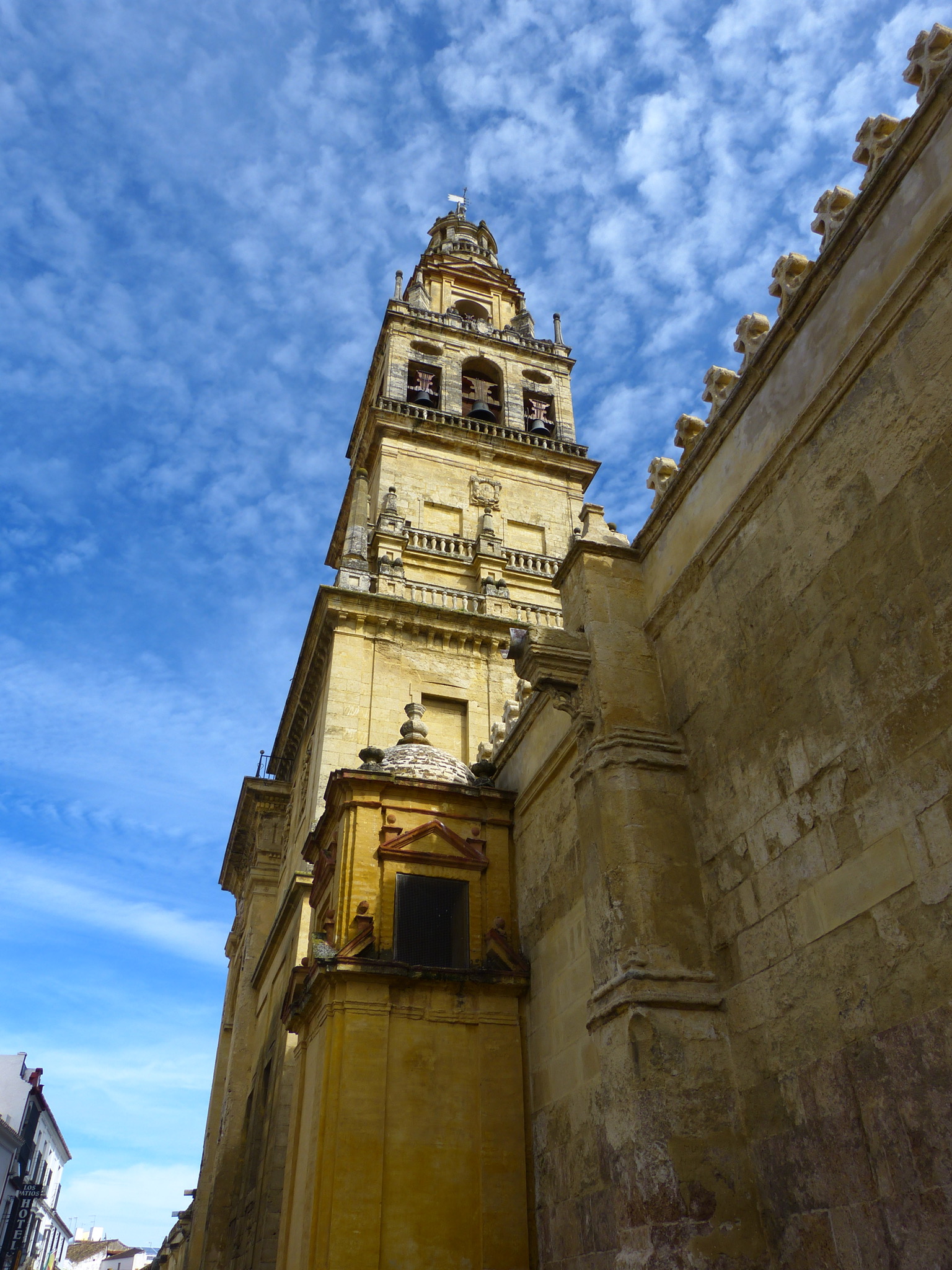
The church’s bell tower was constructed around the minaret.

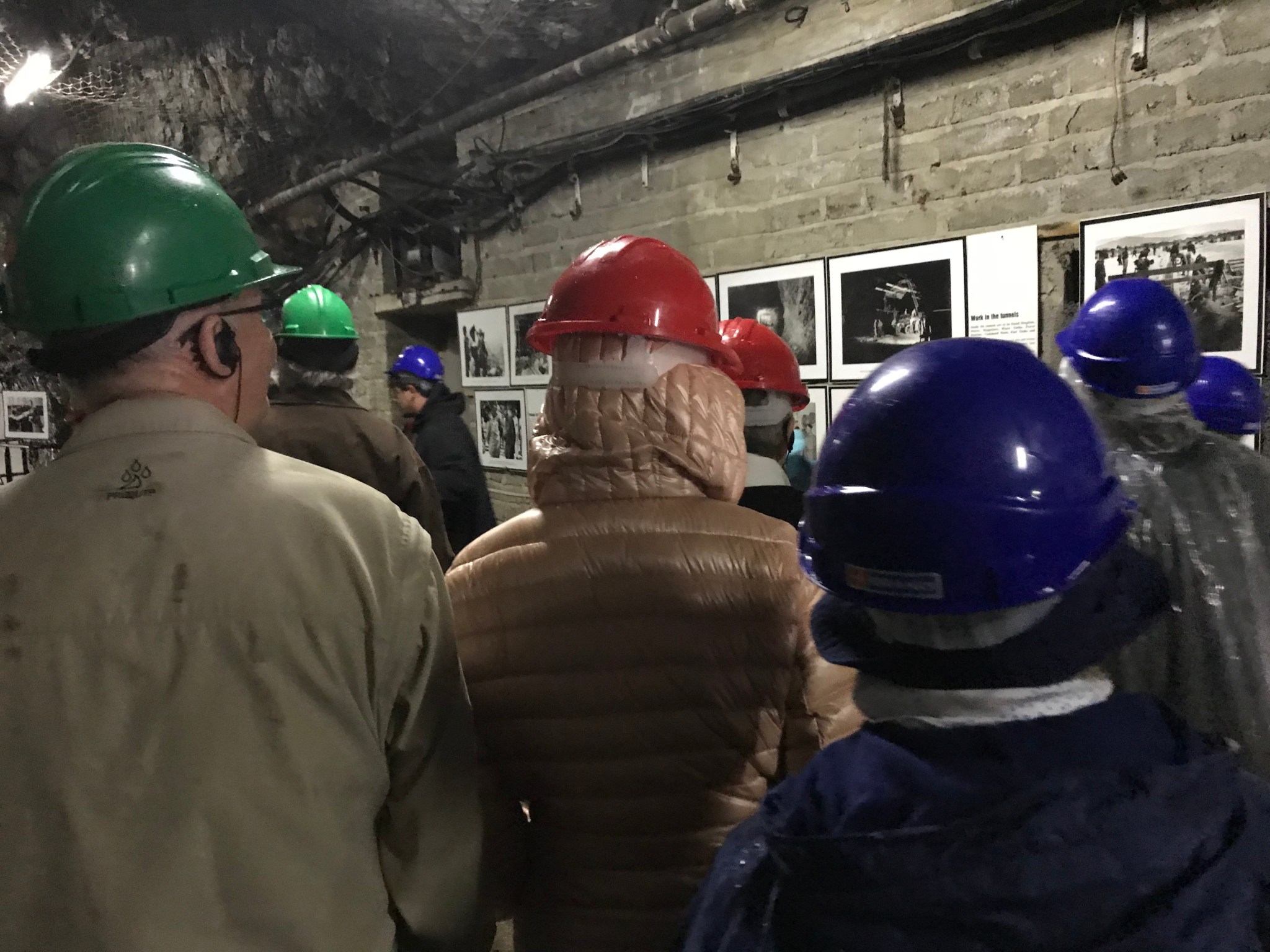
I guess some place has to be the least favorite, and for me, Gibraltar gets that honor.  Maybe it was because the limestone WW2 tunnels were dripping water, and were dark and gloomy,

10D2E378-922D-4EE3-8D99-55E710F3883D
One of the few places that wasn’t too dark or wet to photograph

as was the weather.

888F2622-ECC9-49EB-A7C9-442007396075

Whatever the reason, I was not as wowed as I was by the other places we’d visited.  Even the Barbary apes were a disappointment.  We only saw four.

78E241BD-2388-4088-9601-C9A028433F2BTwo more days in Spain, three in Portugal, and then we are back to the USA.

Goodbye Beja, Hello Madrid

It was raining when I boarded the bus in Beja for the two and a half ride to Lisbon. The weather matched my mood–I was sad to leave all the new friends I’d made in Beja: the wonderful students I’d gotten to know during our two weeks together, the great “Team of Ten” Volunteers, our fantastic team leader. There were lots and lots of goodbye hugs.

Note to future visitors to Portugal–it costs only 14 Euros for a bus ride from Lisbon to Beja, on a super comfortable bus with free Wi-Fi. If you are visiting Lisbon, why not spend a night or two in Beja? Escape the traffic and crowds, enjoy the history, archaeology and cultural treasure of this intriguing Alentejo town.

Two cab rides and a flight later, I was in Madrid, reunited with my main man.

Here’s where we will be traveling over the next two weeks. First stop is Madrid. ( I lifted the map off the Grand Circle website. THEY are the ones that cut Madrid a little too closely.) The star is my feeble attempt to show the approximate location of Beja. You now have a rough idea of where this “don’t miss” town is located. Okay, so I would never be a successful map maker, but I give myself an A for effort.

The long, unusually dry period Portugal and Spain had been going through ended during our second week in Beja. The rain is expected to continue during most of our remaining trip. Oh well. They need the water, so the rain is a blessing. Or at least that’s what I keep telling myself.

We spent the morning of our first full day in Madrid on a bus tour around the city. First stop, the Egyptian temple of Denbod. No, this was not stolen during a military campaign. Had it not been moved, stone by stone, when the Aswan Dam was created, it would have been under water, just like the Temple of Dendur, in New York’s Metropolitan Museum.

9A8BF0C8-F6F1-4F8C-82EA-4DB93B4D4AA0

Next stop– the royal palace, where we arrived just in time for the changing of the guard.

Juanjo, our guide, had warned us to be on the lookout for pick pockets. He explained they usually look like tourists, holding maps or cameras with one hand and reaching into your backpack with the other. Well, Linda, a member of our group, saw one doing just that, to a Chinese tourist. She was close enough to slap the pick pocket’s hand away.

A lot of good those guards were! A sharp eyed American woman with quick reflexes foiled the thief. Did I witness any of the excitement? No, I was my usual oblivious self.

Unfortunately, we didn’t have time to wander through any of the 2,800 rooms in this Versailles inspired palace. Instead, we decided to spend the afternoon in the Prado Museum, ogling the artwork by Goya, el Greco, Rubens and others.

Small part of the royal palace

My only regret: I wish I had researched the Prado more thoroughly, so I could have focused on certain pieces, and figured out the most efficient way to get to them. Talk about sensory overload! No photos were allowed inside the museum. I just have to be content with the images inside my head.

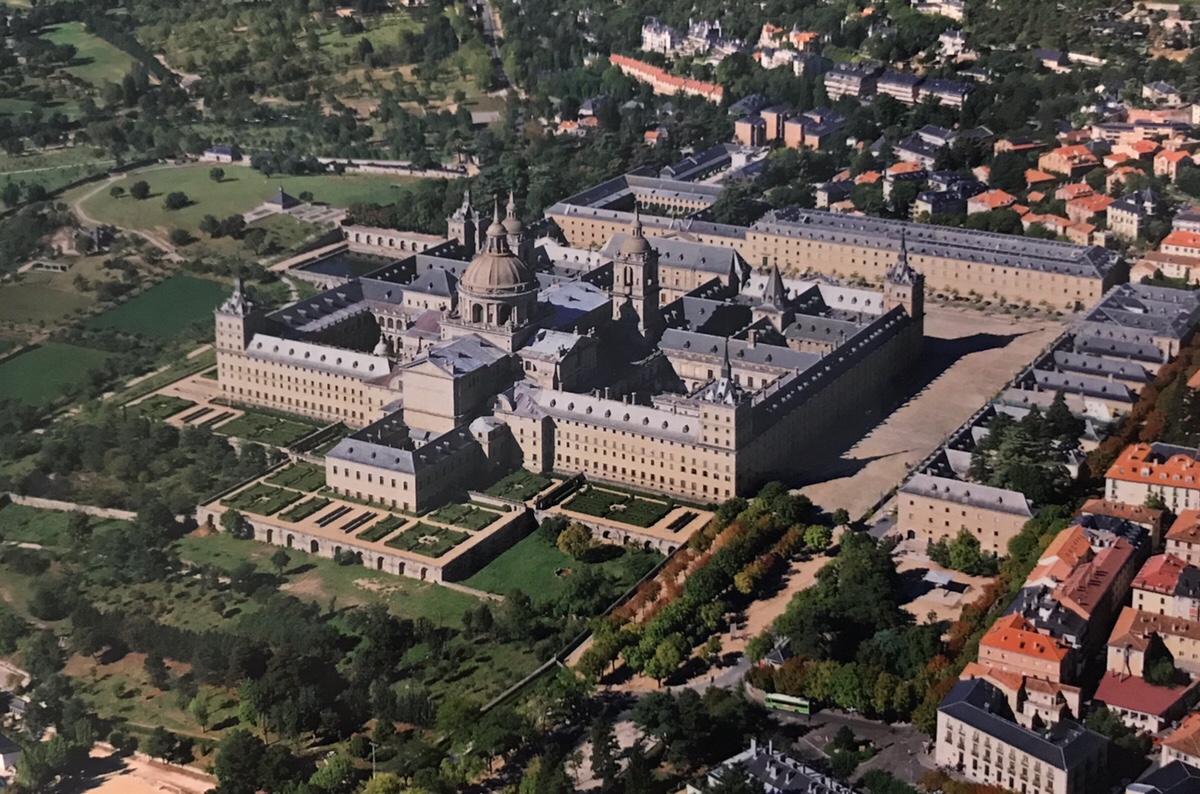
Although we could have spent our second day exploring more of Madrid, we chose the optional guided tour to El Escorial. This palace/ monastery/ school/ church was constructed by King Francis II, son of Charles V, one of the Holy Roman Emperors. The Escorial is shaped like a grill (yes, as in George Forman) to honor Spain’s own St. Lawrence. Why a grill, you ask? Well, that is how he met his end, by being roasted to death. (Yes, humans are strange and savage creatures)

I didn’t use a drone. I bought a postcard and photographed it.

Philip II had the building designed  so that he could lay in his bed and see the altar in the cathedral.  All he had to do was open his bedroom door and he was in church. Because his bedroom was off to the side, the rest of the congregation couldn’t see HIM in his pajamas (or whatever Kings wore back then).

Philip’s chamber, including the bed he died in, and his chamber pot, were all part of the tour, in case you’re wondering, as is a huge painting of St. Lawrence on the griddle.

We also visited the Valley of the Fallen, a memorial to those who died during the Spanish Civil War. This was a truly impressive and very moving site.

The memorial consists of the largest cross in the world, under which a Basilica has been carved — out of the hillside.  It is hard to gauge the size of the memorial from this photo, but to give you an idea, the cross alone is 500 feet high.

The bones of around 40,000 people are buried In the basilica.  One more example of man’s inhumanity to man.

Time to move on, to Toledo and Granada, even though there was much more to see and do in the beautiful city of Madrid.