On My Own in Tirana, Albania

I spent the majority of my first full day in Tirana walking around the city, exploring two of the attractions recommended in my OAT Final Documents booklet. First stop was at the Komiteti-Kafe Museum for an “American coffee” and a look at what was described as Soviet Era artifacts. I don’t know whether what I found qualified as Soviet “stuff”. It appeared much too whimsical and colorful, two adjectives that I suspect were never used to describe the USSR.

I probably wouldn’t put the coffee shop on a list of top attractions, but the walk getting there and back was fun. Tirana has lots of green space, bike lanes and pedestrian walkways— and I do love to explore on foot.

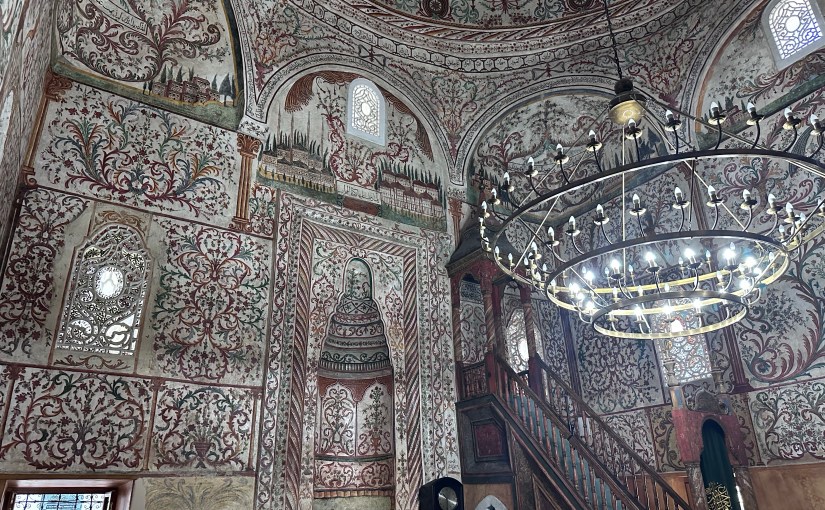
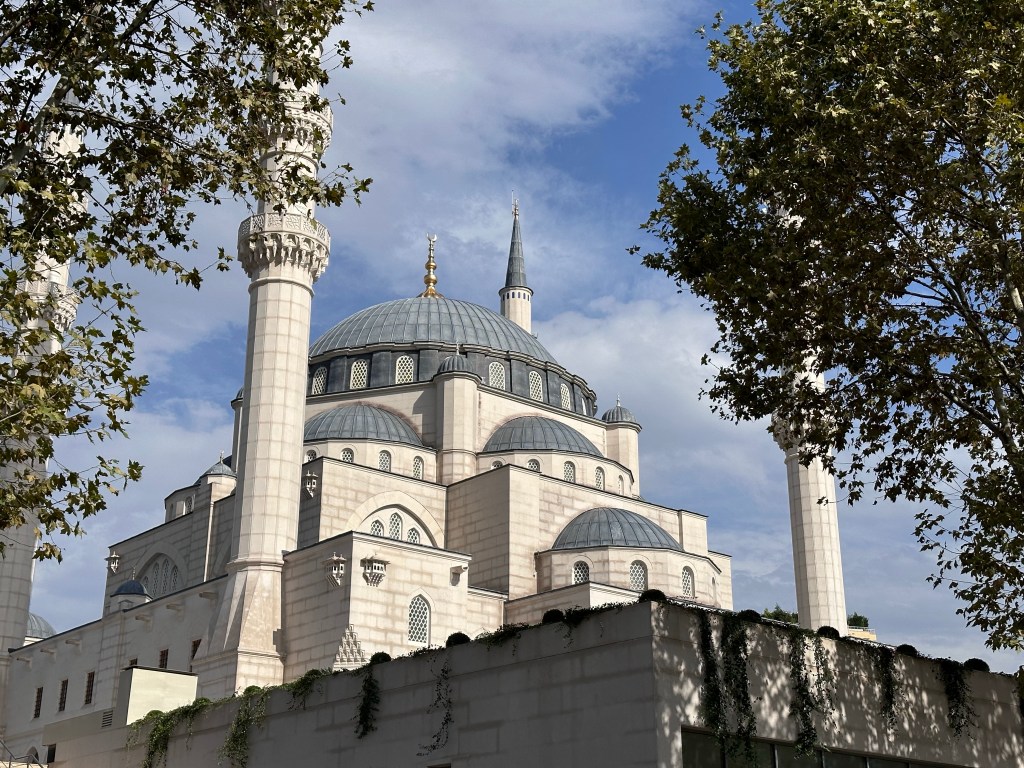
I had to get closer to the beautiful mosque appearing in the distance. A gift from the Turkish government, it is, and will remain, closed until Erdogan arrives for a dedication ceremony.

Man oh man, Tirana is BOOMING! Lots of new construction everywhere. During the ride from the airport, I noticed the very drab, but functional architecture, presumably from the Soviet era. The current construction is colorful, joyous and oh, so interesting!

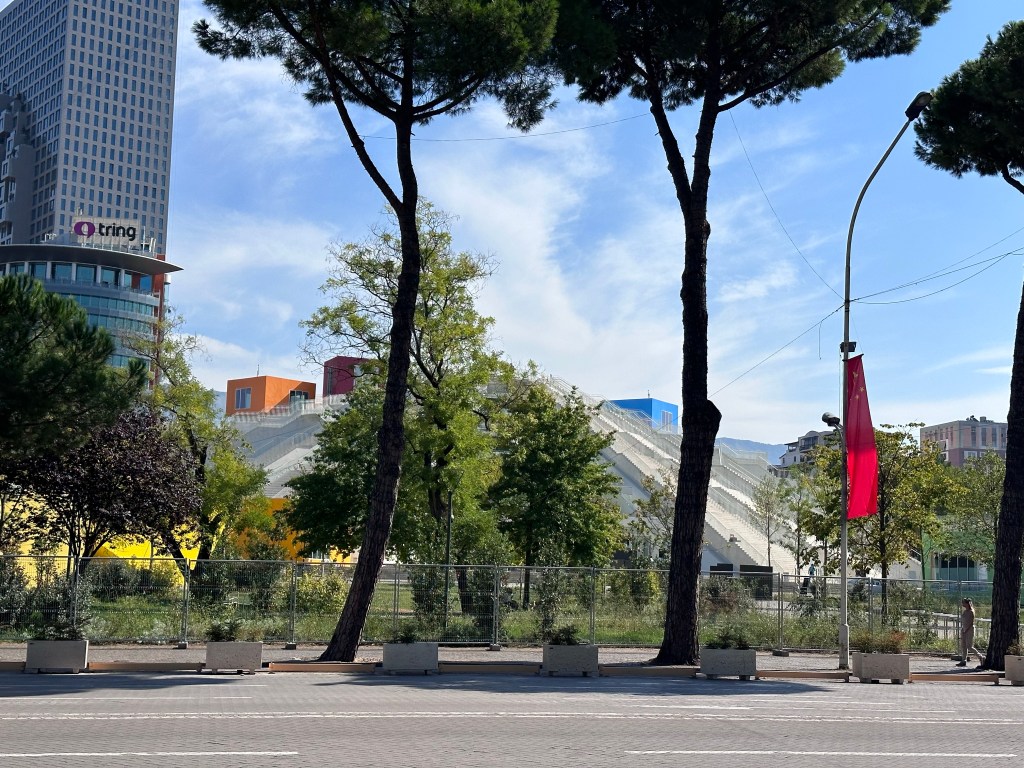
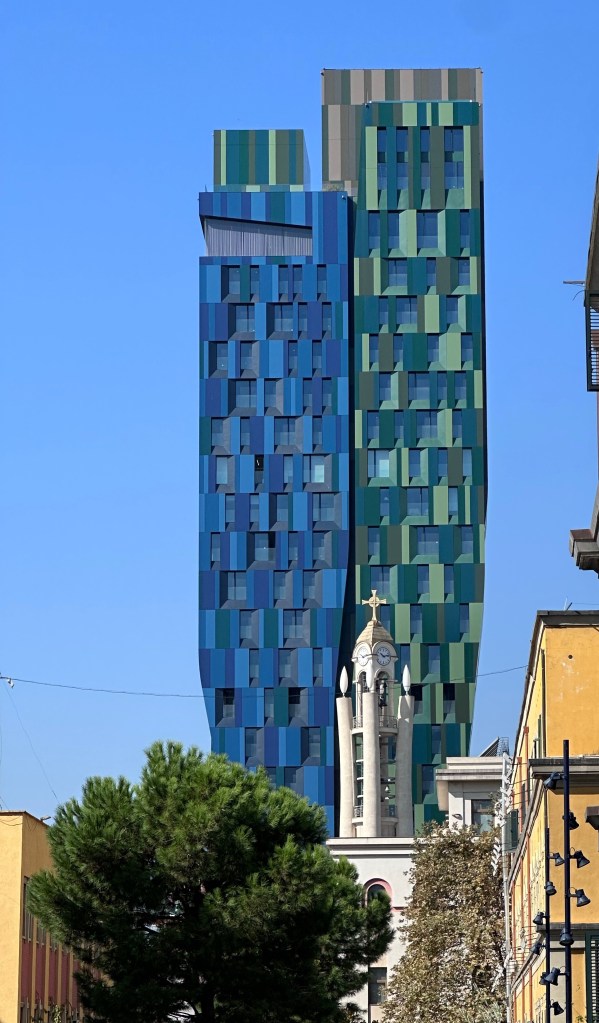
I had no idea what this building would become until our tour on my second day with our pre-trip guide. Ilir took us along a different street. He told us the colored squares will become classrooms in this future digital center.

It is difficult to see the pyramid behind the trees. If you’d like a better view and a history of the pyramid, click here. https://en.m.wikipedia.org/wiki/Pyramid_of_Tirana. The steps were added to allow people to safely climb to the top. Previously they were clambering up the smooth sides, then sliding down!

One advantage to being on your own is you can stop to take photos whenever you like, and I liked to do that a lot. I loved this bridge. While on it, you have access to free wi-fi, which I didn’t need because I had switched to TMobile. Unlike Verizon, international access is free for everything except voice calls. (Thanks to the Facebook page “Friends of OAT” for educating me about internet access outside of the USA). Knowing I could consult google maps whenever I wanted enabled me to wander freely without fear of getting lost.

As I made my way to the Sali Shijaku House (OAT’s other recommendation), I walked thru Tirana’s Castle, which was taken over by the Topani family in 1798. I had seen the Topani name everywhere, most prominently at the nearby mall entrance, and wondered what the word meant. A plaque before the castle explained that Topani is the name of a noble family “rich and educated with strong ties to the Ottoman Empire and the west which they used to help the country while it took the independence road.” The plaque goes on to explain the rivalry between the Topanis and the Barginis which was ultimately resolved by intermarriage. Just think, if the Montagues and Capulets had used intermarriage to resolve their disputes Shakespeare wouldn’t have had material for Romeo and Juliet.

Not much remains of the original castle structure other than these walls and something called a “Bailey”. (You won’t see a photo of the Bailey because I have no idea what it is). Walking thru that arch brings you to a walkway with lovely shops and an abundance of restaurants, one of which I chose for lunch.

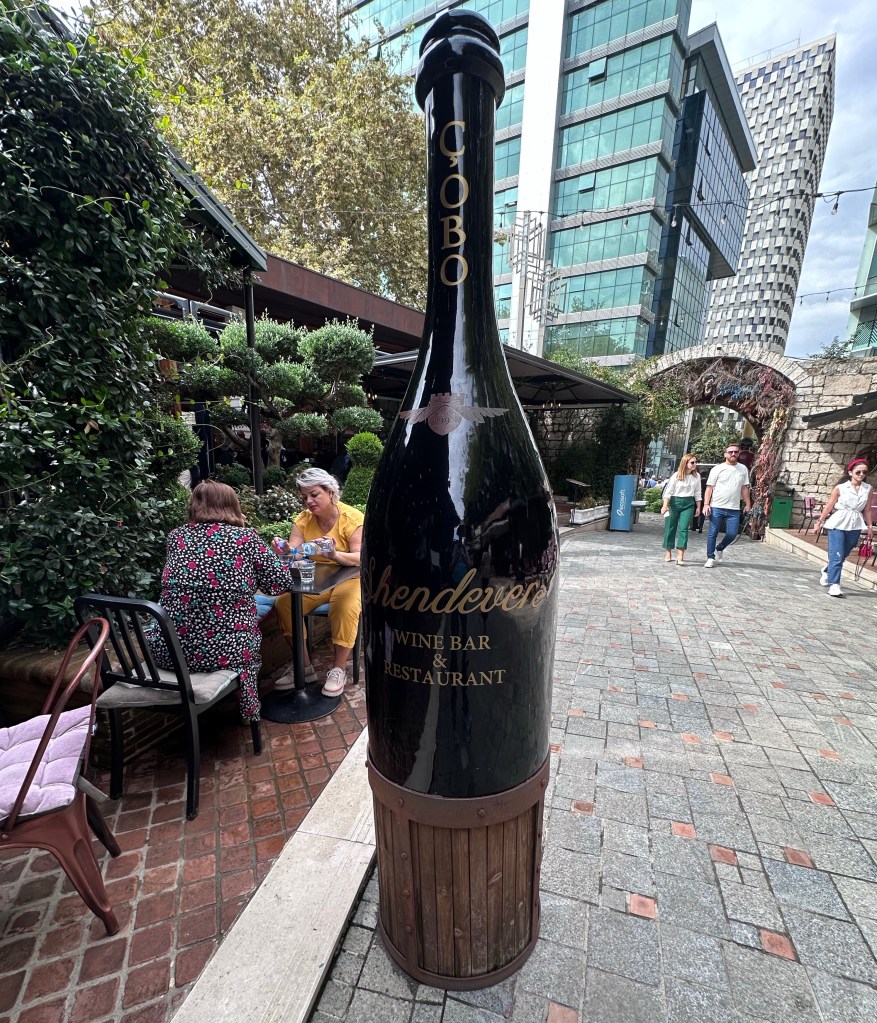
I had a wonderful inexpensive lunch with a glass of sparkling wine at this restaurant.

But back to the home of the artist Sali Shijaku, my second destination. After exploring his residence, which is filled with his paintings, I sat in the garden and enjoyed the ambiance while sipping a cup of tea. It’s hard to believe that over the years, this 300 year old structure has been a hospital, women’s prison and military building.

Some other sights from my walk thru Tirana:

Topani Mall across from our hotel.
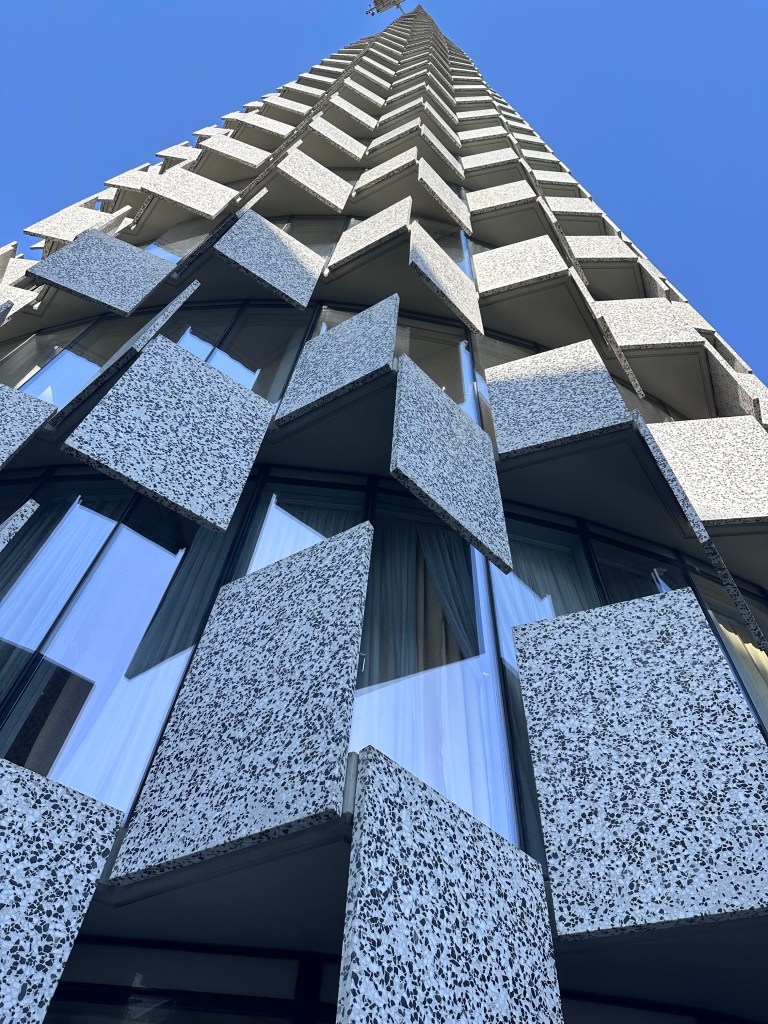
Although not colorful, this building’s three dimensional structure appealed to me.
The new building towers over the old church tower.

After exploring, I returned to the hotel to meet 4 of my traveling companions. After a brief walk with our guide, we got to know each other over dinner at Roxana Tuna House. As is often the case on OAT trips, they are all friendly and so very interesting. That’s another reason I enjoy traveling with OAT—congenial companions. We will meet the last couple tomorrow because they encountered flight delays.

Time to stop babbling about this wonderful city and get some rest.

Tirana, Albania

2020 was supposed to be Mike’s and my biggest travel year ever. It feels like a lifetime ago that we booked trips to Croatia, Germany, Japan and Egypt. We (more likely the optimist of this twosome) were so confident that covid would be over in several months that we didn’t take a cash refund. Instead we opted for travel credits with bonus incentives.

Fast forward three and a half years. I’m now working my way through those credits, beginning with this trip to Eastern Europe, which starts with OAT’s pre-trip to Tirana, Albania.

One of the many reasons I enjoy traveling with Overseas Adventure Travel (OAT) is the ability to customize my trip. I figure if I’m going to subject my body and my money to a cross Atlantic flight, I’m going to stay for as long as I can, so in addition to the pre-trip, I decided to fly in a day early to get acclimated.

So far, everything has gone smoothly, starting with a great experience on Austrian Air. Passport control at Tirana’s airport was incredibly efficient. You scan your passport, which opens a gate, then get your picture taken, which opens a second gate and you’re DONE. It was so FAST. But the time I gained at passport control, I lost in bumper to bumper traffic on the way to the Oxford hotel. It took over an hour to go 11 miles, making me feel like I was back in Houston, Texas. The timing actually worked out fine, because by the time I got to the hotel, I only had to wait about 10 minutes for my room to be ready.

The room is small, but lovely, with a shower that makes the standard size in cruises look huge by comparison. I suspect I’ll be missing Mike even more than usual tomorrow morning, because when we traveled, he always showered first, figuring out how the fixtures worked, and setting the temperature just right for me. (It’s always those little things that do you in when you lose your spouse).

Take a look—no need for a bidet in this bathroom. All you have to do is swivel and lift your butt. That is, if you can figure out which faucet turns on which of the two shower heads. Yes, tomorrow will indeed be interesting because there’s not a lot of room for error. Fortunately we learned the ‘towel on the shower floor’ trick because I’ll bet that marble makes the floor extremely slippery when wet! I just hope that floor drain isn’t clogged!

But enough bathroom humor. What about the town, you ask? I remember Laura, our guide in Patagonia telling us, “There’s no such thing as bad weather; only inappropriate clothing choices.” Fortunately, I packed appropriately, and checked the weather so I wasn’t daunted by the rain. It also helps that the Oxford is perfectly located—right across from a mall ( where I bought 3 liters of water for less than $1), close to ATMS, cafes and restaurants, squares and sights. I love the art on the sides of buildings.

Wonder which of these books would be banned in America?
This is a very strange image. What is the artist trying to say?

I was surprised that George W Bush had a major street named after him in Tirana. I recall the people in Africa revered him because of his involvement during the AIDS crisis. But Albania? Clearly he has his admirers—and some detractors— who covered his name with stickers.

Tirana is full of surprises—here’s another: The Italian Institute of Culture building. I know from experience that Albanians make fantastic Italian food. My favorite Italian restaurant is run by Albanians. Clearly there is a bond between those two countries that I will explore with my guide when I meet him tomorrow.

What’s with that zig-zaggy structure in front of the building? Is it a picnic table? A runway? An altar for sacrificing virgins?

This area was once part of the Ottoman Empire, so I was not surprised when I passed a mosque just in time for the call to prayer. If you want to check out the weather and share in the mosque experience, here’s the YouTube link. I wasn’t successful uploading the video to WordPress. Maybe this will work. https://youtube.com/shorts/RXIjSq3ElqM?si=BxfwMJnXN6hBMHFd

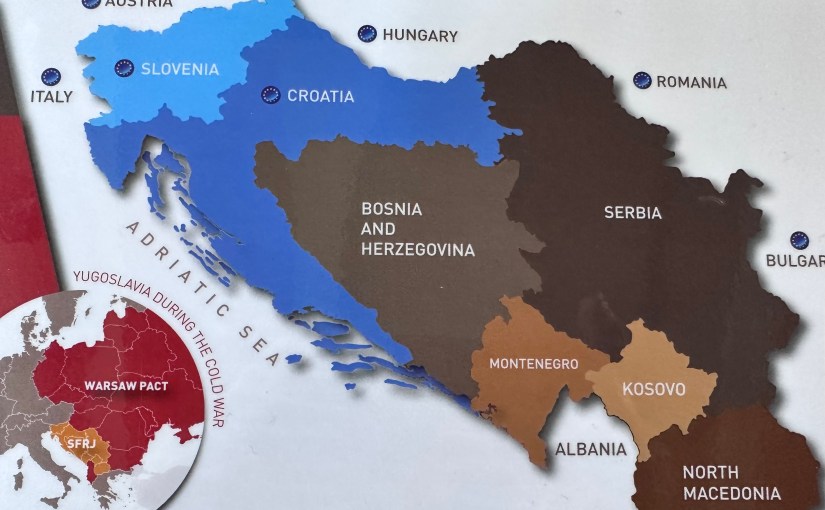
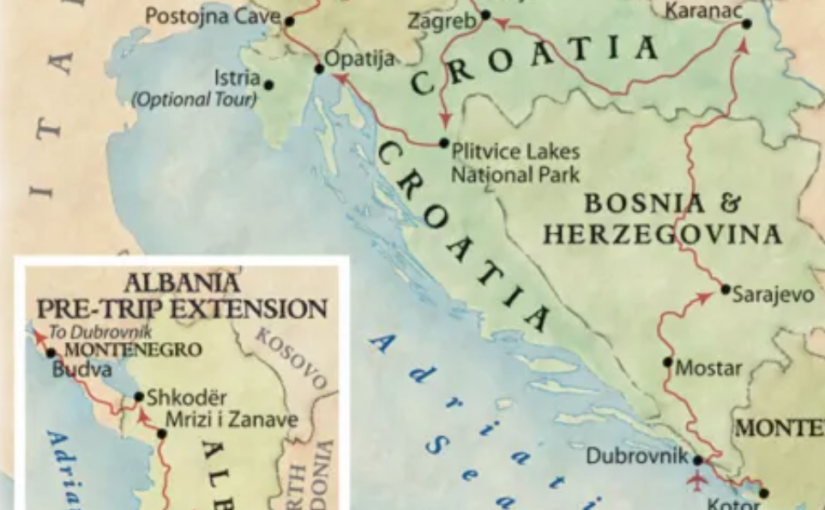
On the MAIN trip, which starts on Sunday, we will travel to Croatia, Montenegro, Bosnia & Herzegovina, ending up in Slovenia. My friend Augusta will be joining me in Dubrovnik for the main trip. She frequently traveled with Mike and me in the past, prompting one of our fellow travelers to dub Mike “the man who travels with two wives”.

Below is a visual of our journey through some of the former Yugoslavian countries.

Tomorrow or Wednesday, I will connect with the 6 travelers that opted for the pre-trip, then on Sunday, we will join with the remaining 9 travelers in our group of 16.

Leaving Northern Ireland

On our return to the Republic of Ireland, we made one last stop in Northern Ireland, to the walled city of Derry, where we visited the Museum of Free Derry for a history lesson.

On January 30,1972, inspired by the civil rights marches and peace protests that occurred in the USA, about 15,000 Catholics staged a march to call attention to the discrimination they were experiencing. British soldiers shot indiscriminately into the crowd, killing 14 unarmed protesters. The day after what became known as Bloody Sunday, 2,000 men joined the IRA, which up until that time had not been very active.

Although attempts were made to portray the peaceful marchers as terrorists, a film crew was there, recorded what actually happened, and smuggled the film out (in their underwear!) to the Republic of Ireland where it was broadcast around the world. Despite the visual evidence to the contrary, the false narrative that some march participants were terrorists persisted until 2016, when an inquiry finally revealed the truth. The result was a long overdue apology by Britain’s prime minister, David Cameron. An excellent video in the Museum shows the huge emotional impact that historic apology had on the people of Derry. Sadly, the guilty soldiers still have not been brought to justice.

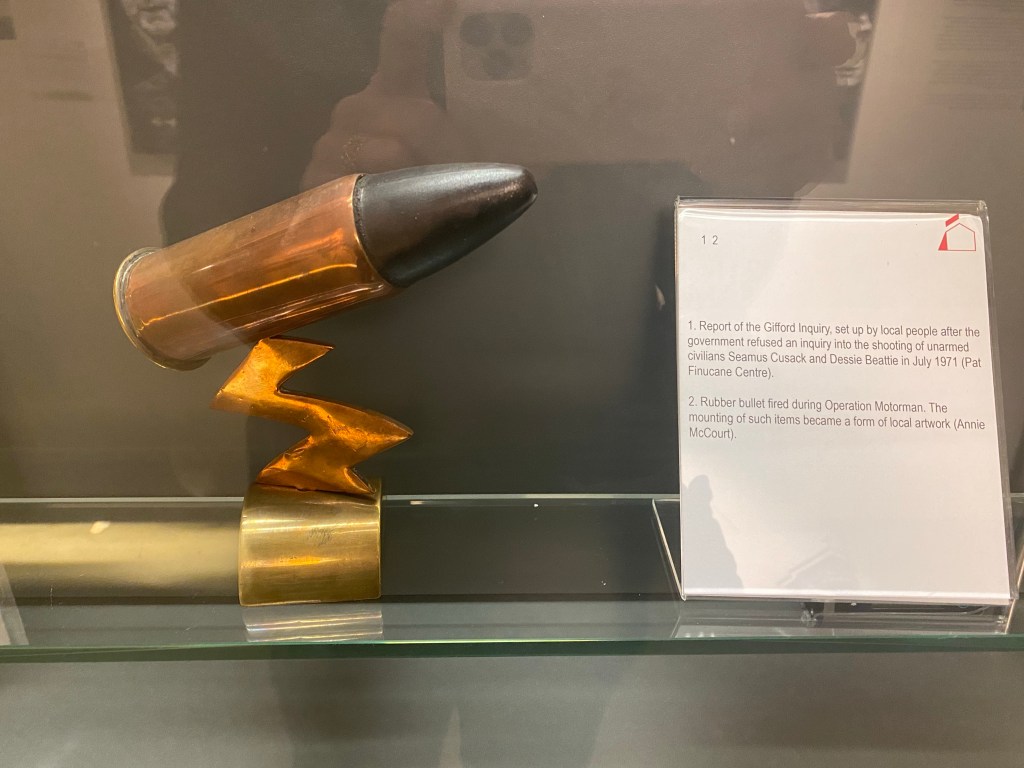
While on the Black Cab tour in Belfast, our driver showed us the size of rubber bullets that were used for crowd control. These were fired on Bloody Sunday, and contributed to the injuries many protestors suffered. Can you imagine being hit by one of these?

We couldn’t leave Derry without touring its city walls, and learning about its history, most of which I promptly forgot. Of course, the wall had the requisite cannons, strategically interspersed.

Our border crossing into the Republic of Ireland was seamless. No check points, no guards, no showing of passports, just a change of currency, back to the Euro. Ireland has sworn that it will never have a border dividing it again. Boris Johnson declared the Irish Sea will be the border, but many wonder exactly how that will work post Brexit. No one quite knows.

And now for a little perspective: the population of Northern Ireland is a wee bit under 2 million. The population of The Republic of Ireland is almost 5 million. Compare that to the population on NYC, which is over 8 million, and you can understand why much of this glorious island is comprised of rolling green hills and picturesque landscapes, perfect for raising sheep.

Typical view from my bus window.

Which brings me to the next subject: the Irish Diaspora. We all know that millions of Irish left during the potato famine, but I never knew that many lost their homes when they were evicted.

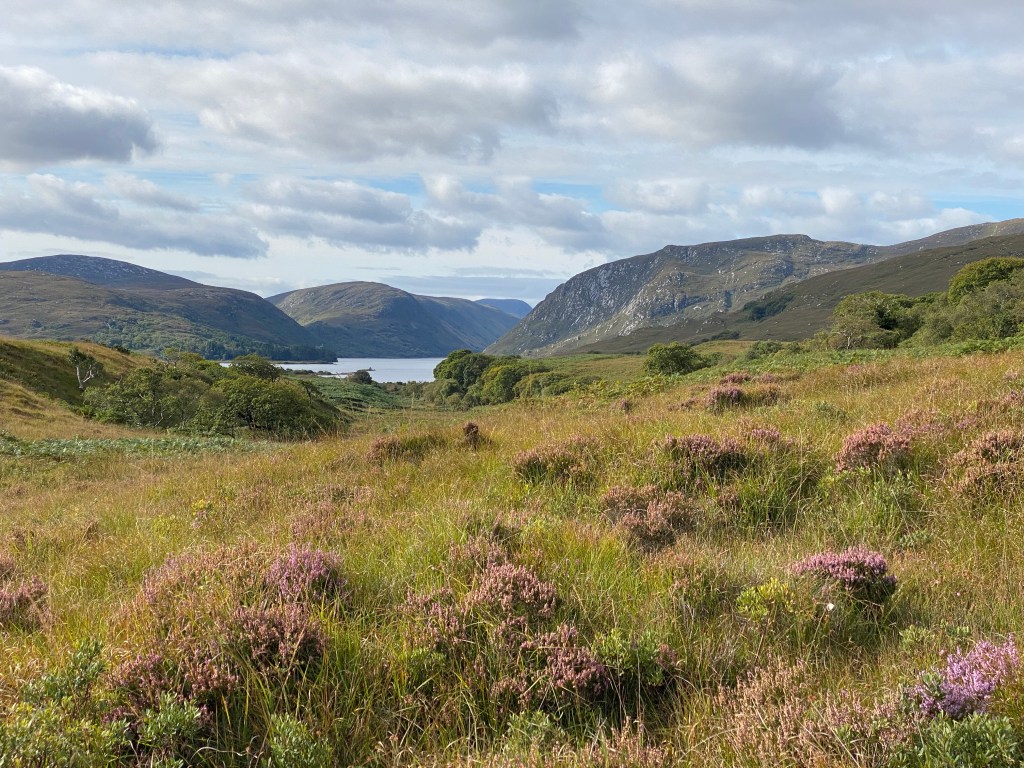
This beautiful castle was built by John Adair, who evicted 244 of his Irish tenants because he thought raising sheep would be more profitable than allowing his tenants to continue farming. By the way, the Irish became tenants on their own land, after Oliver Cromwell conquered them, and seized their property so he could use the land as payment to his soldiers.

Adair was the first of three owners of Glenveagh. The third, Henry McIlhenny, was an Irish American. His grandfather, John McIlhenny settled in Philadelphia, where he became very wealthy from his invention—the coin operated gas meter. Henry was an art aficionado, who donated his family’s extensive collection to the Philadelphia Museum of Art. His generosity extended to Ireland, when he donated the castle and its gardens as a gift to the nation. It is now a national park.

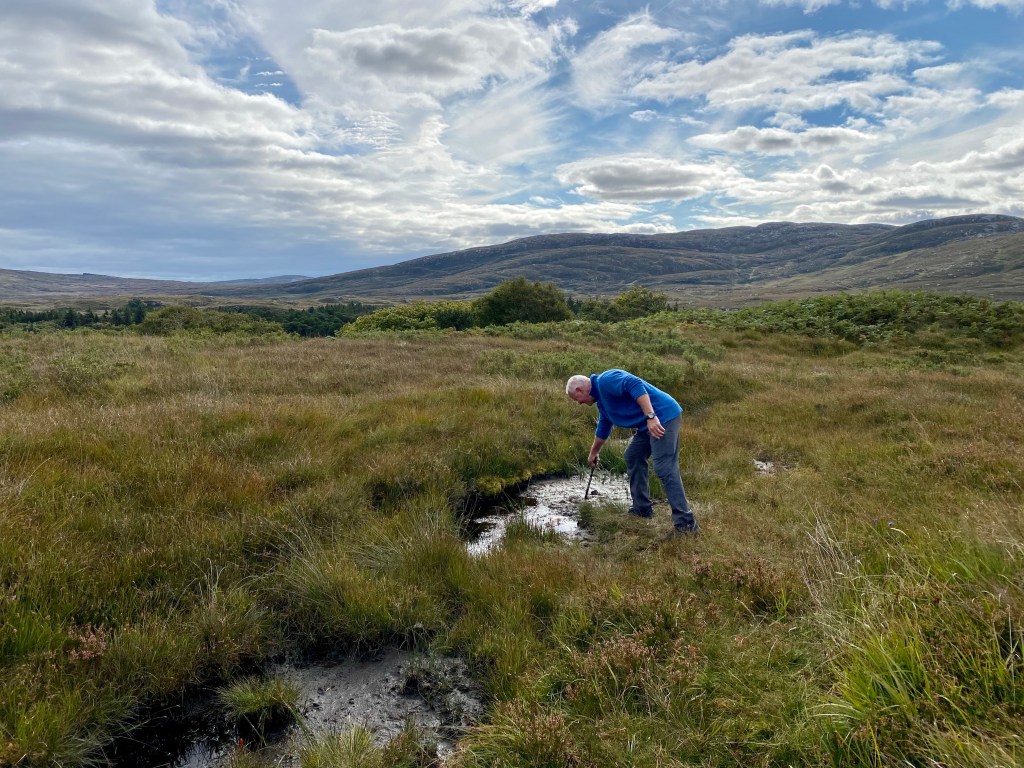
Touring the grounds of Glenveagh with a naturalist, who demonstrated the depth of the bogs, and explained why the people sacrificed in the bogs were so well preserved.

I had originally planned to write a bit about Donegal, but that will have to wait for a future post, because I have run out of time.

From Ireland’s Capitols to its Countryside

We’ve thoroughly enjoyed our time in this island’s two capitols: Dublin and Belfast. But now it’s time for a change of pace, so we hit the road to experience the castles and cliffs of the beautiful Irish countryside.

We departed from Belfast by way of the “leafy suburbs”. As is the case in most countries, the wealthier areas were spared the violence and disruption of “the troubles” discussed in earlier posts. The beautiful homes facing the water were much like those in many of the wealthier neighborhoods in the USA.

At one time, oh so many years ago, I could never have imagined that I’d be taking a bus tour. But let me tell you, at this stage in my life, it’s a great way to travel. No getting lost, no speeding tickets, no fruitless searches for rest rooms. It’s all taken care of. All I have to do is sit back, gaze out the window and chat with my fellow travelers.

Our group

We really lucked out, with a huge, comfortable bus for only 11 of us, and a delightful driver, Michael, who clearly loves his job. The repartee between Joe and Michael keeps all of us entertained and laughing.

Our drive to Ballycastle was broken up with multiple stops. At the first one, Joe, our guide, pointed out that this white rock is composed of the exact same material as the White Cliffs of Dover. About 350 million years ago, this very rock was being formed somewhere south of the equator. I don’t know about you, but I find that little fact fascinating. I’m sure my geologist neighbor, Ed, would agree. He would undoubtedly have been able to identify the dark streaks in the rock as flint, which was highly prized for its sharpness, and its fire making properties.

Our route along the Antrim coast took us past picturesque little fishing villages like this one.

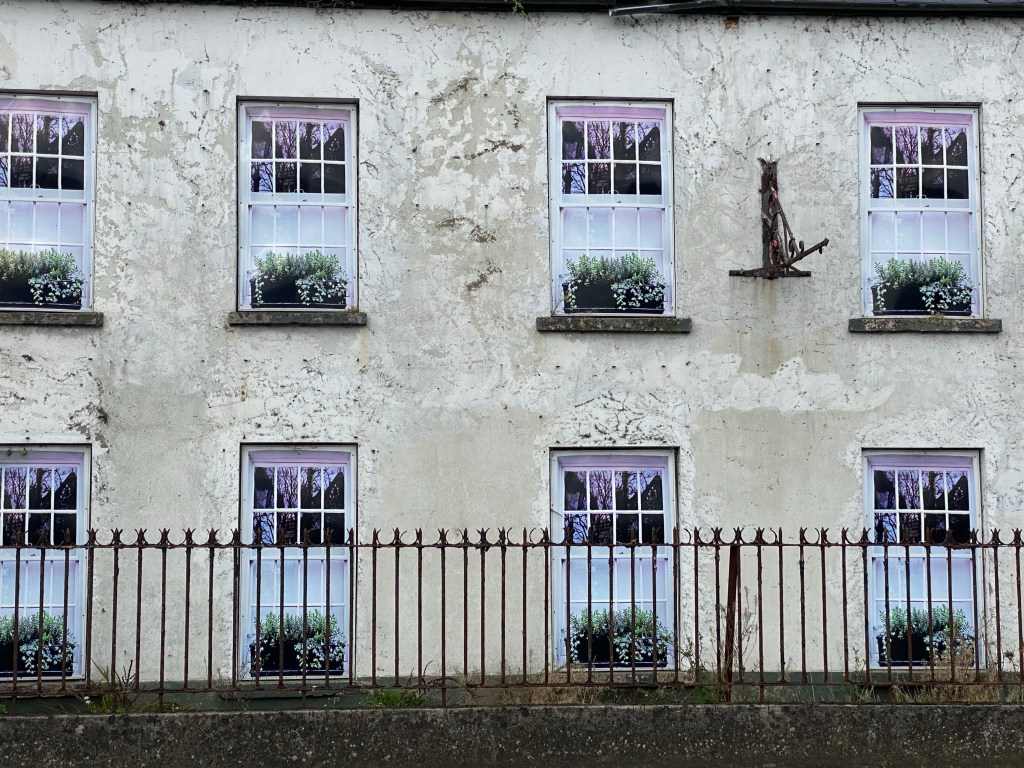
I loved that the windows of this vacant building were painted to look like they were festooned with flower boxes.

Our final stop before Ballycastle was at the Glenariff Forest Park, which gave us the opportunity to get out of the bus and stroll along the river to our restaurant.

One of the waterfalls in Glenariff Forest

Ballycastle’s Marine Hotel was a bit quirky, but the entire staff was so friendly and accommodating, and the location across from the beach was fantastic.

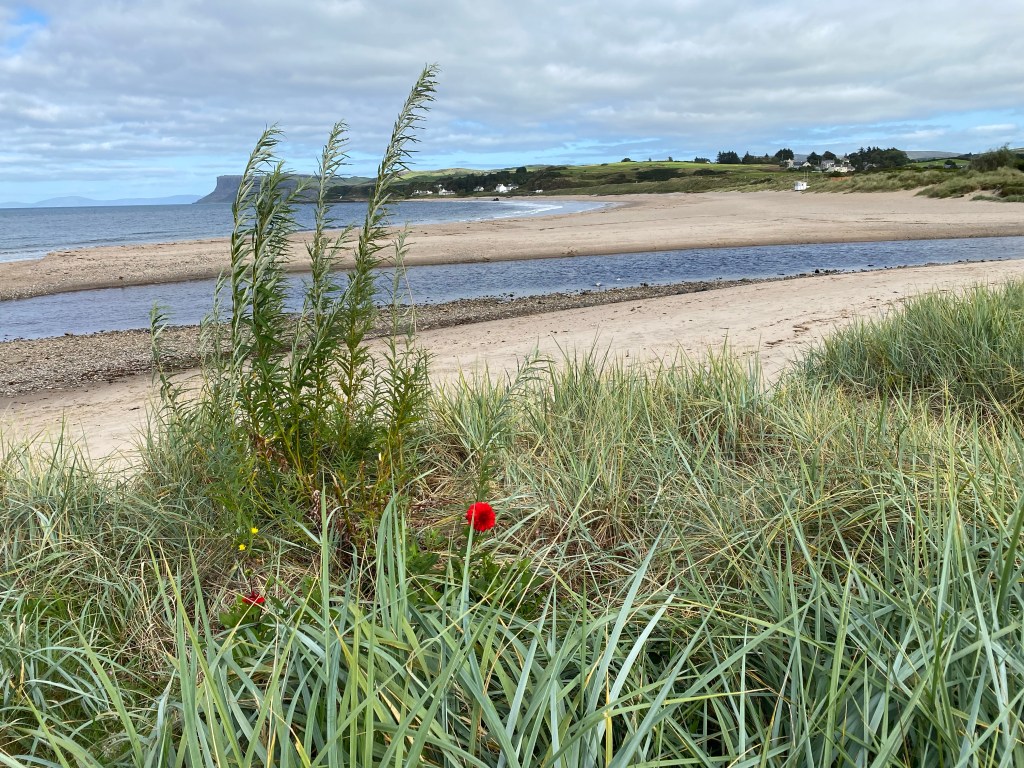
Because the weather was so wonderful, we couldn’t resist a walk along the beach, before we strolled into town for a delicious and inexpensive dinner at the Anzac Restaurant.

Ballycastle was the perfect jumping off point for the following day’s excursions to Dunluce Castle and The Giants Causeway. Although Dunluce Castle is in ruins, you get a feel for what life was like way back in the 1600’s. The castle was built high on a cliff, surrounded by water, with access only via a drawbridge. Clearly, those were scary times!

Joe quickly figured out that Janet and I are the walkers in this group, so he always made sure to tell us about more challenging hikes. The Giant’s Causeway offers several trails, plus a shuttle bus for those who prefer to ride. We chose the red course, labeled the most difficult, because of the spectacular views Joe promised us. He was right!

Even if you do opt for the easier trail, the scenery is still pretty dramatic, especially if you are intrigued by rocks, volcanic activity and ocean views.

Our last stop in Northern Ireland will be Derry —or Londonderry, if you are aligned with the British, or the Protestants, before heading back into the Republic of Ireland and to our hotel in Donegal.

Belfast: The Troubles and The Titanic

We left the Republic of Ireland, crossing into Northern Ireland two days ago, just in time to get our first experience with legendary Irish weather. Our walking tour was soggy, and although we were undaunted, we were grateful when our Tour Leader took us on a quick detour into the nearby mall. Not only did we get a chance to dry off, we also ascended to the mall’s top floor to take in this magnificent view.

Okay, so maybe THAT day’s view wasn’t all that magnificent, but you have to admit, it is pretty cool to have a glass dome atop a shopping mall.
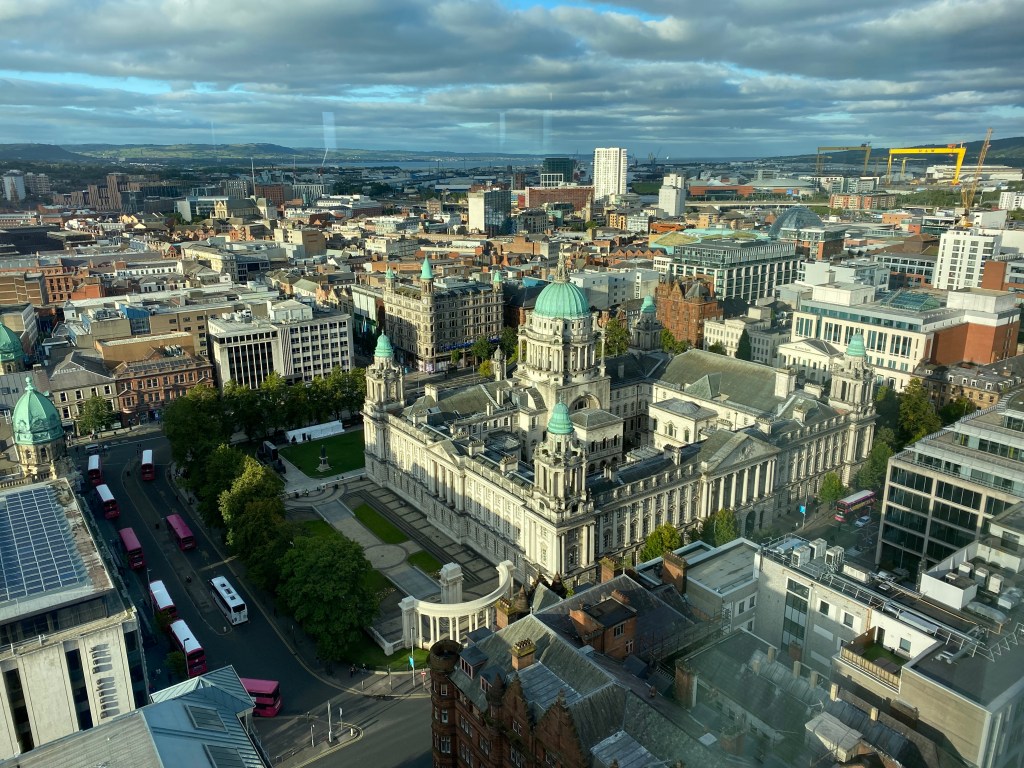
The next day’s panoramic view was significantly better because we were higher up, and the weather cooperated.

This photo was taken from the Grand Central Hotel’s cocktail lounge. No, we didn’t have a drink there, because I suspect the cost of a cocktail would have been as much as our full dinner at a nearby pub. Joe, our tour leader, took us there for a “ gawk”, and that’s exactly what we did.

Although the city is lovely, and I have many photos to prove that, the real highlight of our time in Belfast was our visit to The Felon’s Club. We spent the morning with three men who, back in the day, were formerly enemies: a loyalist, a British soldier, and an IRA member. They each told us a little about themselves, their backgrounds, their activities during “the troubles”, their time in prison and what their lives are like today. It was a riveting discussion that was particularly relevant now, given the divisiveness we are currently experiencing in our own country. What was encouraging was where they are NOW. All three have been working toward reconciliation and educating others about “the troubles”. All three are committed to the peace process.

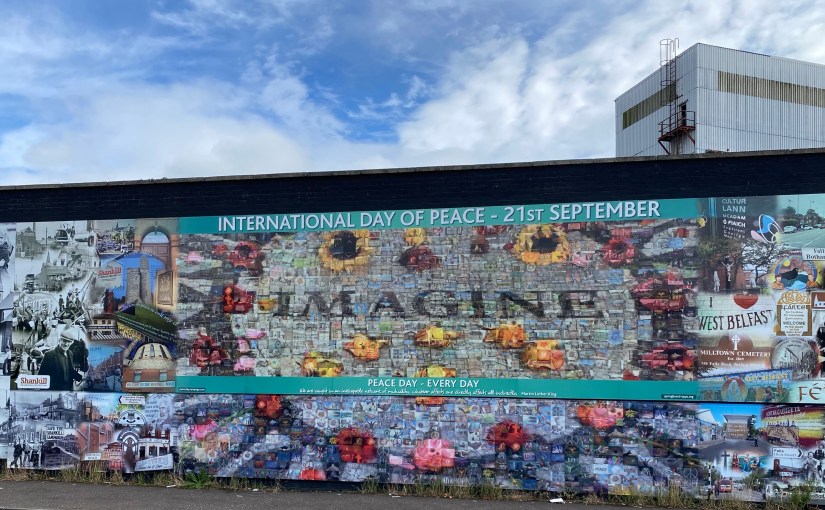
I had forgotten the important role George Mitchell and Bill Clinton played during peace negotiations. One key element of the negotiations was a referendum (with no date specified) on whether or not Ireland should be reunited. When asked if the referendum were held today, only the former member of the IRA was able to say for sure how he would vote. The other two wanted to know more about the impact the change would have on their lives. Their focus was on the issues, not on former identities as a member of a particular group. I would have loved to spend more time with them, but our Black Cab Tour was scheduled, so off we went to view the murals painted on Belfast’s walls.

During our tour, the final song from the Broadway musical “Hamilton” kept playing in my head: “Who lives, who dies, who tells our story”.

In the photo below, our cab driver is holding a rubber bullet, to show us how huge they were. He then pointed out the names of civilians, carved into the wall, who died after being hit by rubber bullets. By telling their stories, the black cab drivers and the members of the Felons Club are keeping their memories alive.

The afternoon was spent at the Titanic Museum, an experiential museum, where another sad story was told—not only about those who went down with the ship. We also learned about the workers who built the ship.

It was a rather poignant day, so we were only too glad the sun was shining as we walked back to our hotel.

We are all quite happy that we were leaving Belfast BEFORE King Charles III arrived. Yes, I know it is a historic event, but the crowds and traffic might have made it difficult to see as much as we did.

Five and a Half Weeks, Carry On Only

This fall, I will be experiencing three different kinds of travel: a sixteen day OAT trip to Ireland, two weeks with friends at two different vacation rentals in England and eight days on my own in London and Paris. After reading about the problems with lost luggage and flight cancellations, it seems prudent to forgo checking luggage.

It can be done. I know, because I’ve done it before, but the aging process has killed a whole lot of memory cells. (Or was it copious amounts of wine? Or both?) Covid has put a damper on the frequency of our travel, and climate change has made it very difficult to predict what weather will be like in September and October. All of the above has made me feel like a travel newbie, so this blog post is primarily for me (as a memory aid) and for my travel buddy, Sally, who asked for packing tips. Okay, so that was fair warning that this will be a stream of consciousness post–but I hope others will find the information helpful.

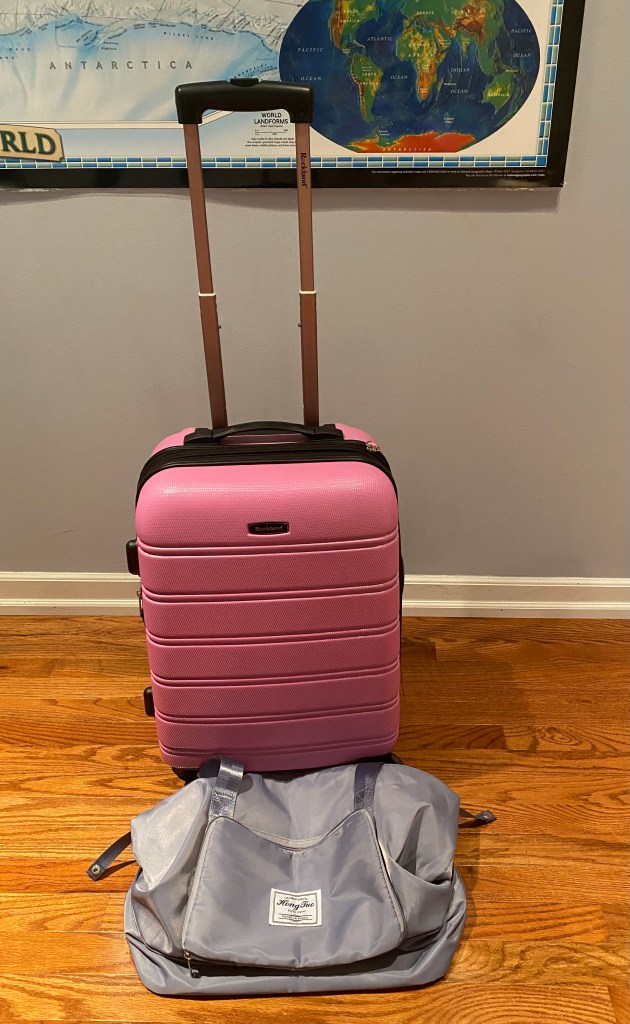
It all starts with the right luggage. Back in the day when I was traveling regularly, I saw many travelers using a 4 wheeled clamshell carryon, so I ordered a cheap one from Amazon, in a very distinctive color. I’ve used it many times since my 2018 purchase and have been very pleased with the amount of stuff it can hold.

The blue bag was a recent purchase, made after I saw it demonstrated on a very misleading Facebook video. The video showed the bag standing upright, which made it very easy to pack, with double zippers on the bottom, so it could be compressed and used as a shoulder bag. You’ve probably seen it too. Take a look at what it REALLY is like. Although the photo doesn’t show there is no 2nd zipper on the bottom (so no shoulder bag option), trust me. It doesn’t have one. You CAN see that it CLEARLY is incapable of standing upright. Having said that, I’m finding its light weight and many pockets make it an attractive 2nd bag. Plus I discovered a “work around”. If you stick a full packing cube in the bottom compartment, the bag WILL stand upright (sorta), making it much easier to load. That bottom compartment is jammed with clothing that I don’t expect to use during my first 8-10 days traveling.

Okay: Luggage chosen. Everything I take has to fit into those two bags. Next step: what are the airline rules? For the international flight, I decided to cash in my miles and fly business. Ordinarily, I would have saved those miles for a much longer flight, but during covid, I figured the additional space business offers was worth using those miles, plus two carryons will be no problem. My regional flight from Dublin to Newquay, however, is a different story. The best I could do was buy a slightly more expensive ticket that allows one carry on and one checked bag, so I just need to make sure that my carryon is not too heavy. With less than 80 people on the flight, a small destination airport, and a little luck, all should go well, but just in case, I have purchased an Apple Air Tag so, if necessary, I can hunt down my checked luggage.

I always make a packing list, which helps me remember what I need to pack, what I HAVE packed, and serves as an inventory for insurance purposes should my luggage get lost or stolen. I start laying out everything in the guest room a couple weeks before departure. I sort items into two piles: need to have, nice to have. I won’t insert everything into my luggage until the day before departure, but this advanced gathering helps me identify any gaps that a shopping trip needs to rectify.

In addition to packing cubes, I also use jumbo zip lock bags, which allow me to see the contents AND if you sit on them, they compress very nicely. Jumbo zip lock bags also can be used as a washing machine. All you need is a little soap and water, some dirty clothes, then zip and shake, shake shake. My OTHER friend named Sally recommended the various clips and hangers–all available through Amazon. The microfiber towel is a “nice to have” that may or may not make it past the final cut.

I expect that I will only have to hand wash during the 16 day OAT trip, because the following two weeks will be spent in vacation rentals (one with VRBO and one with AirBNB, so I will have access to washers and dryers.)

Dressing in layers is always good advice, especially for longer trips and particularly with the climate changes we have been experiencing. Although I’ll do a last minute weather check before packing, with a trip this length, it makes sense to be prepared for warm, cool and wet weather.

Because my iPhone 11 takes photos that suit my purposes (internet posts, memory jogs, and photo book creation), I no longer carry a camera. But my electronic devices keep increasing, along with their various cables and connectors. My Apple Watch and iPad both use the new USB C, while my iPhone uses the Lightening charger, which has a USB A dangling on the end of it. And of course, because I will be in the UK and Northern Europe, I need two different types of plug adapters–a G for the UK (that sucker is HUGE) and an F for France. I have those. But what if I want to charge multiple devices? I don’t want to carry an adapter for each. And what if there aren’t a lot of outlets in the room? Well, take a look at this very cool, very compact “power strip” that accommodates both kinds of USBs. And it only requires ONE G plug. Being obsessive compulsive, I had to try it out at home to make sure I could fit everything in, and that I had the correct combo of electrical “thingies”. It may look like spaghetti to the untrained eye, but to ME it looks like success. (I took the photo with my iPhone, which is why the lightening cable is just dangling there.) Best of all–these plugs and wires take up less room than my camera did.

So now that I have space efficient charging equipment–the next step is finding affordable internet connections. In the past, I have used a variety of plans: for short trips, I used Verizon’s Travel Pass, which charged $10 for every 24 hours you accessed the internet. For our trip to Australia in 2019, I purchased a local plan, which required me to install a different physical SIM card on my phone. That was much less expensive than the $100 Verizon monthly international plan with 5 GB.

Now there is a MUCH better option that Ann Bouey (who I’ve never met) posted about on the Friends of OAT Facebook page. She suggested that I check out Airalo. For $20, I was able to purchase an eSIM with 5 GB of data that would work in 39 European countries (I only need 3!) for 30 days. Best of all, I will be able to “top up” another GB for $5 to have access for 7 more days– all for 1/4 of the cost of a monthly Verizon plan.

Here’s the catch: You have to have an unlocked phone that will accommodate an eSIM. Airalo only provides access to the internet, no phone line. I rarely use voice while traveling anyway, but if the need arises, I can use WhatsApp or some other application–like FaceTime, or Google Duo.

Remember a few sentences ago, I mentioned that I used a physical SIM card in Australia? I knew that the iPhone 11 allows owners to have two different phone numbers via a physical SIM and an eSIM. So, I figured I’d set the phone up so that I could add a physical SIM card when traveling, with my Verizon phone and internet connection utilizing the eSIM slot. (Yeah, I don’t know what it is either–I just know the words and what it does). That caused a bit of a kerfuffle when I downloaded the Airalo eSIM. After consulting with Airalo customer service, then spending time in both the Apple and Verizon stores, the Verizon rep finally figured out that she had to replace my current SIM card and start again. If that all sounds like technical mumbo jumbo, it is. Here’s hoping that it is information you never need! If you don’t, then the Airalo download is very, very easy. The 30 days don’t start until I arrive in one of the European countries, and turn it on.

What else have I learned during my trip preparation? I discovered the Rick Steves app, which allowed me to download talks, including, for example, a guided tour of the Orsay Museum, and a Dublin City Walk, complete with a map–and a whole lot of other stuff.

Well, the consciousness lingers, but the stream has run dry.

Travel in the Time Of Covid Part II – Marrakesh

The northeast is being hammered with yet another snowstorm today, so it’s the perfect time for me to reminisce about what our guide told us is the “Las Vegas of the Arab world”, Marrakesh. (That’s the English way to spell it; the French spelling is Marrakech).

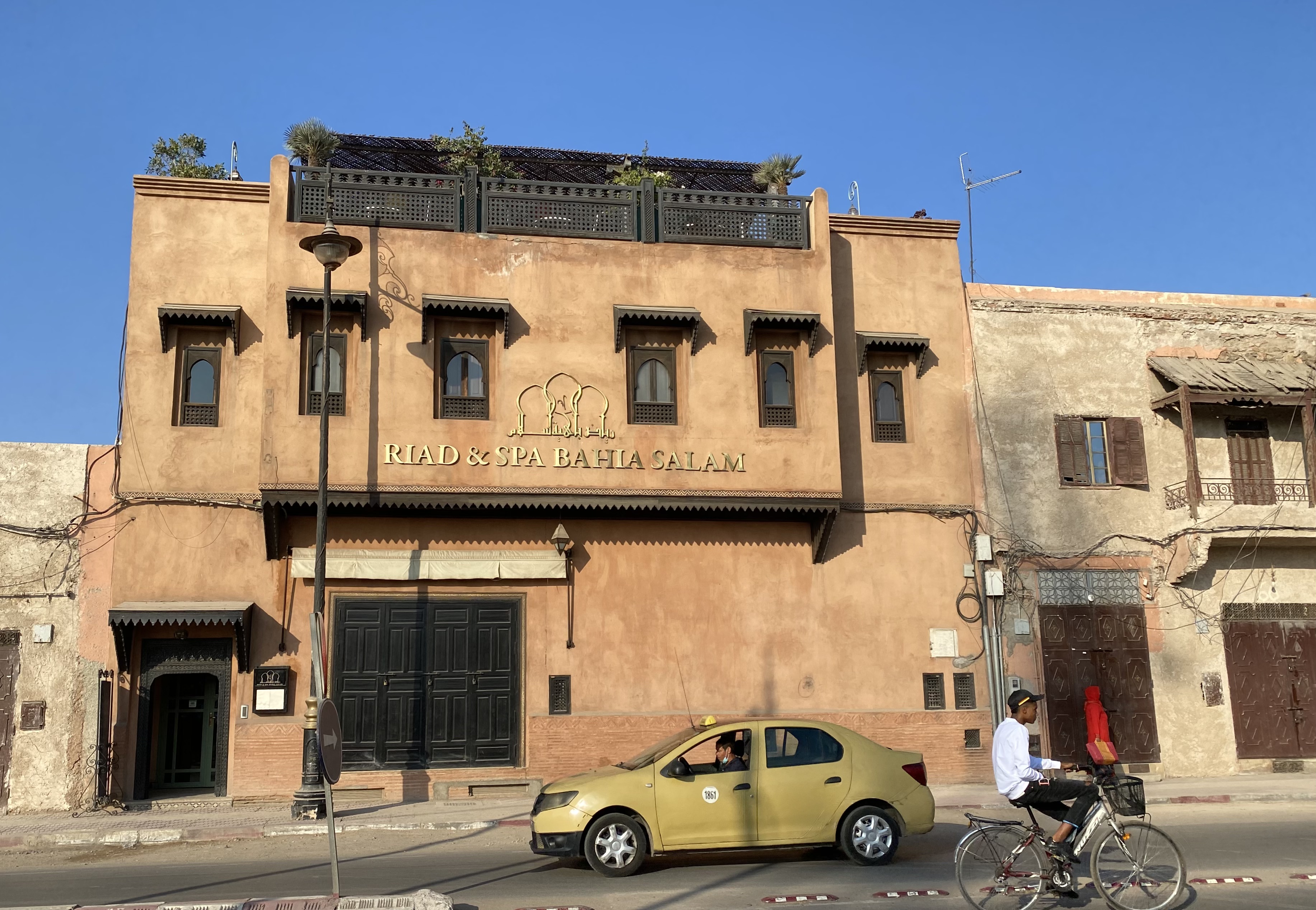
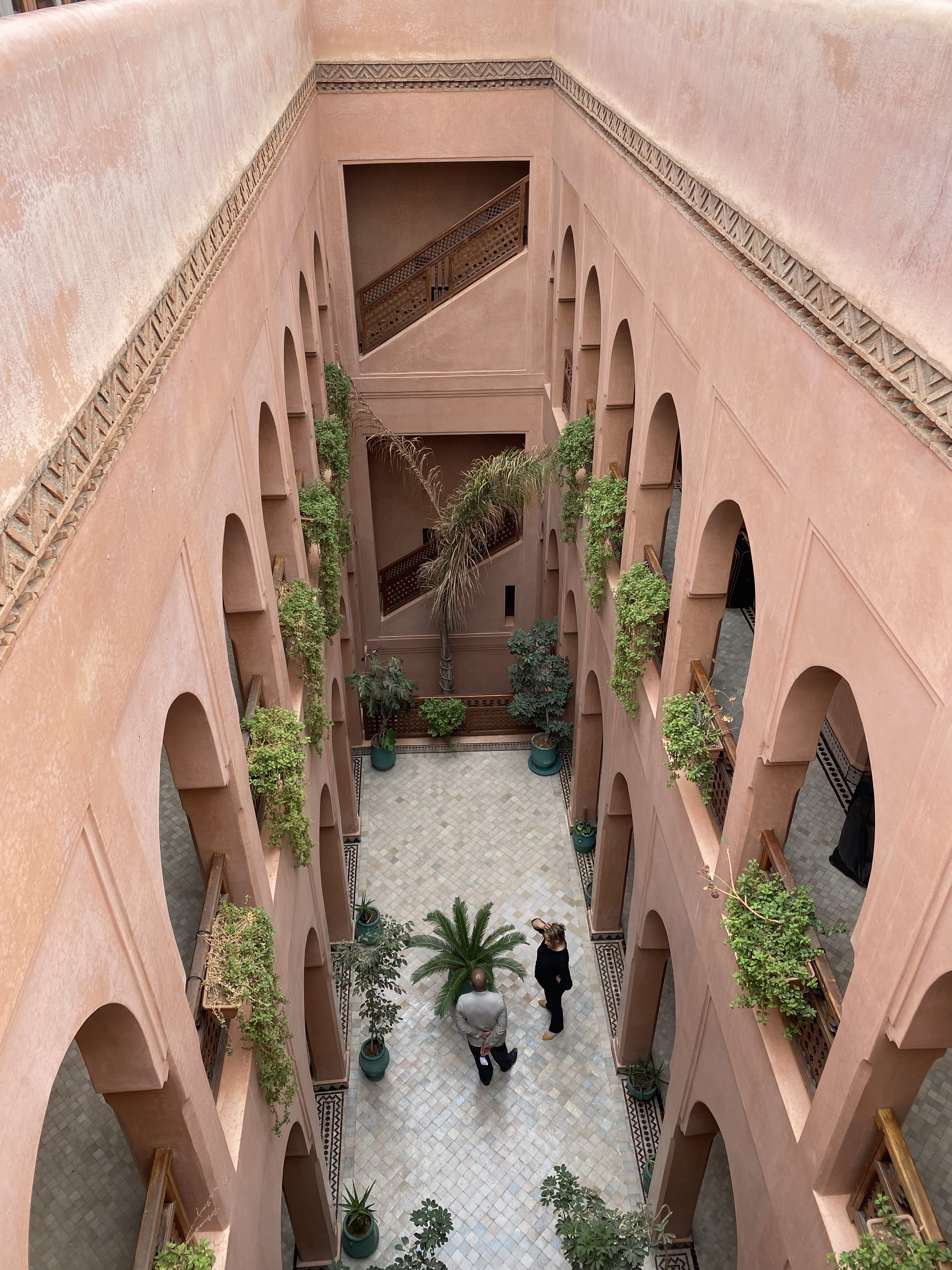
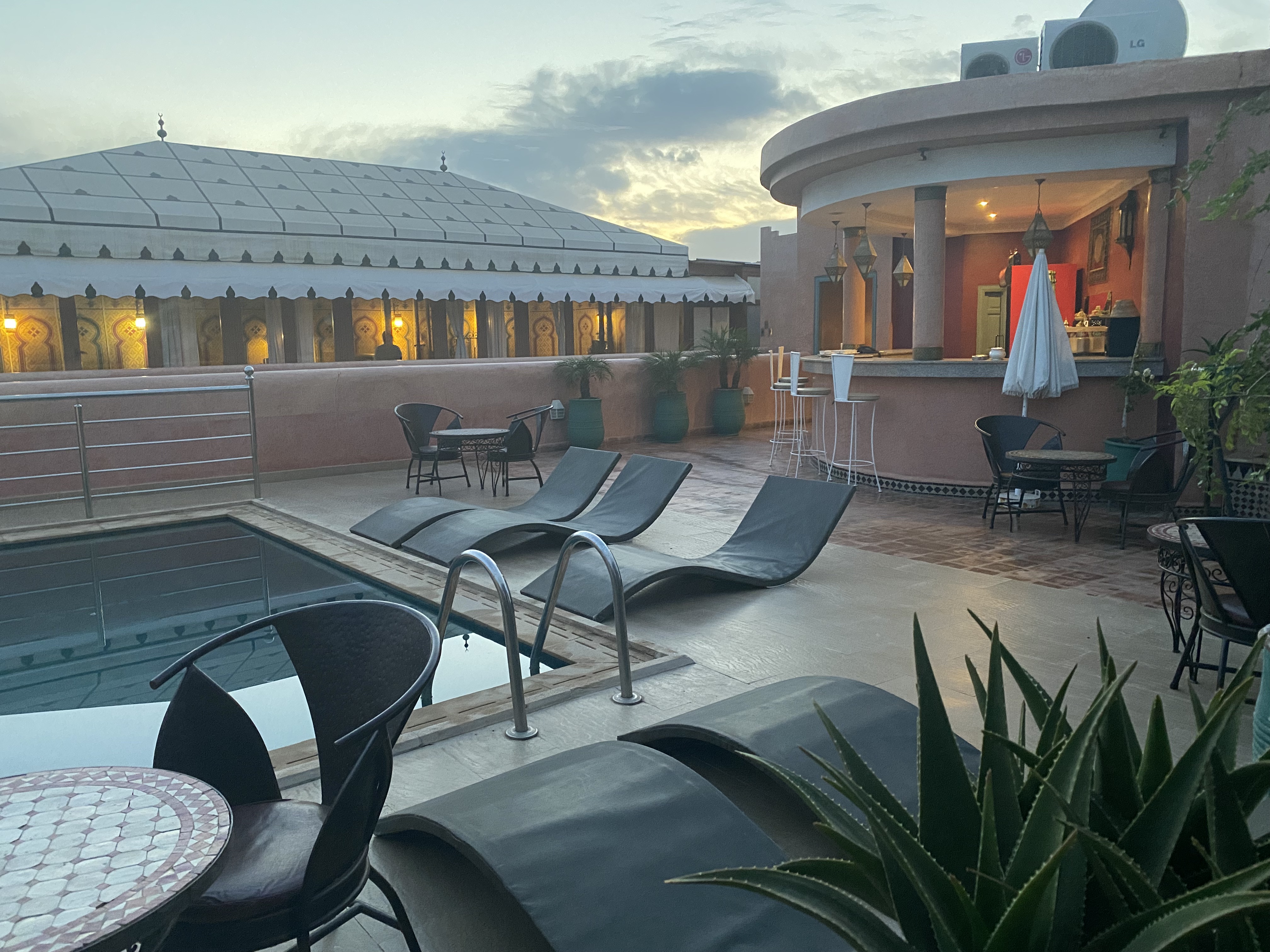
Once again, we stayed in a unique and charming riad. It had a rather unimpressive exterior, but as with the other riads on our tour, the interior was absolutely beautiful. Take particular notice of my favorite spot, the rooftop pool and bar.

How lucky for us that the riad was also a SPA, or more accurately, a hammam. In case you are wondering, according to Wikipedia, a hammam is a “type of steam bath or a place of public bathing associated with the Islamic world. It is a prominent feature in the culture of the Muslim world and was inherited from the model of the Roman thermae”. Man, oh man, is it ever WONDERFUL! Fortunately, our schedule allowed for sufficient free time, so Kris and I were able to experience the full effect: a massage, steam bath and total body scrub that left us feeling magnificent. (And undoubtedly, we LOOKED magnificent…but to keep this from being an x rated post, there are no photos of our argan oil coated, naked bodies.)

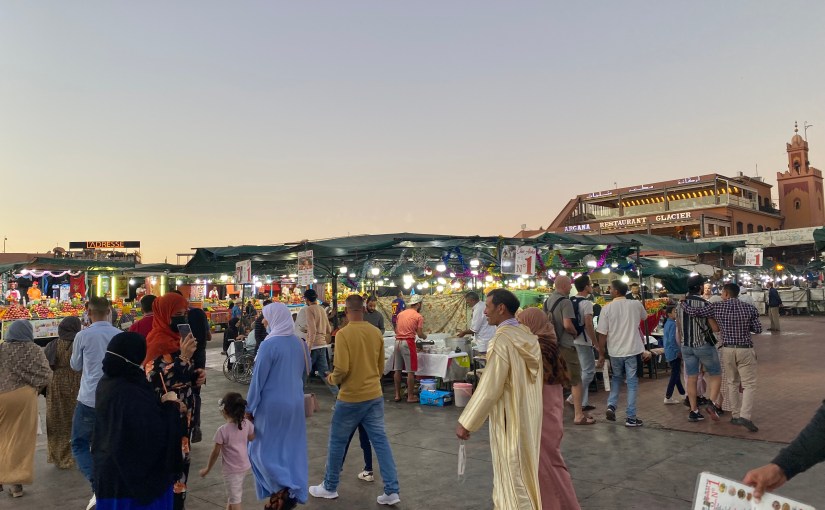
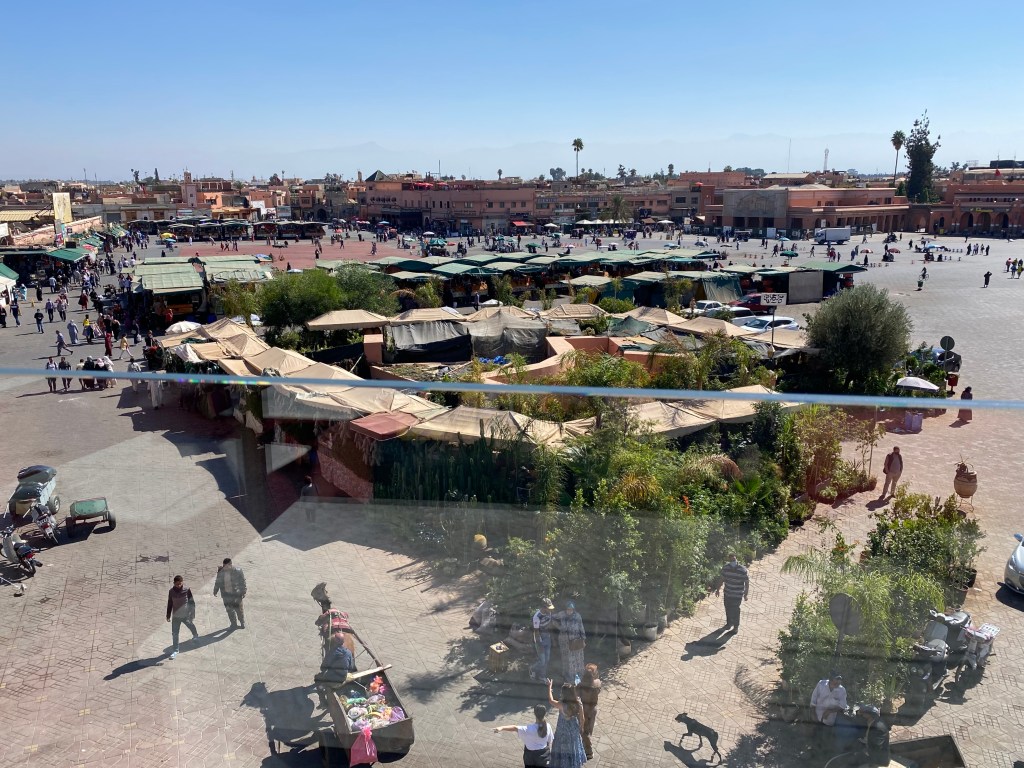
Our riad was ideally located, within walking distance to the Bahia Palace, and DJemaa El Fna, which in the days of old, was the site for executions. They must have had a LOT of them, because the place is HUGE.

During normal times, the square is a “happening” place, crowded with a very different form of public entertainment: vendors, performers, fire eaters, snake charmers, dancers–you name it. Perhaps this is where Marrakesh earned the name of Las Vegas of the Arab world? But not during Covid. Although Morocco has done an amazing job vaccinating its citizens, tourists were still staying away while we were there in October.

The view from the second floor balcony of the Argana Restaurant

In some respects, the lack of crowds was an advantage, making it easier for us to navigate through the Medina, where we again saw the juxtaposition of the old and the new.

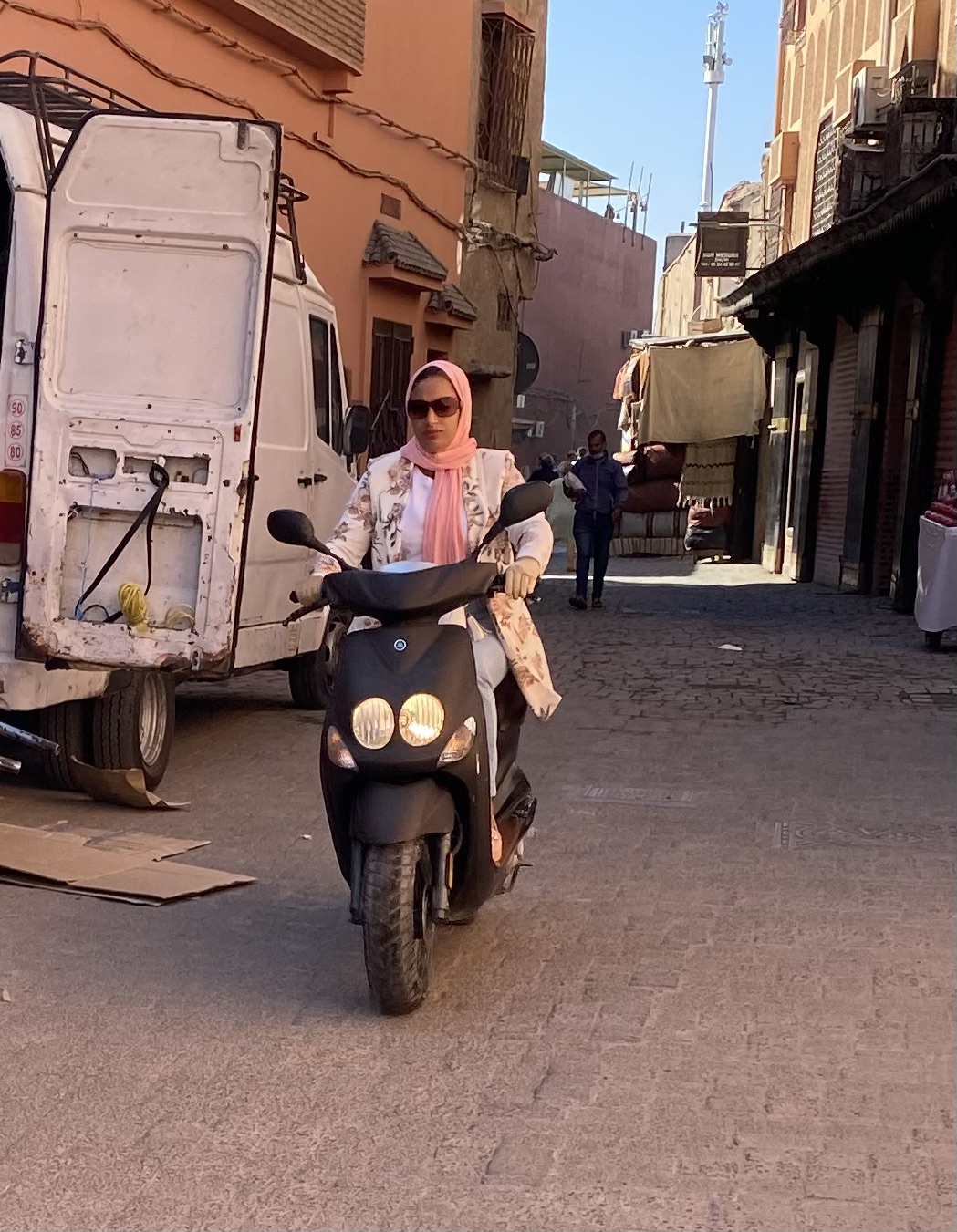
You’ll see that many of the women are wearing headscarves, probably more so in Marrakesh than in the other cities that we visited. A young woman explained to me that Moroccan women wear headscarfs for one of three reasons: 1. religion, 2. as a fashion statement, or 3. because of a “bad hair” day. My guess is that the lovely lady on the motorbike was making a fashion statement. What do YOU think?

Do you think the ladies on the left will be shopping at any of these stores on the right?

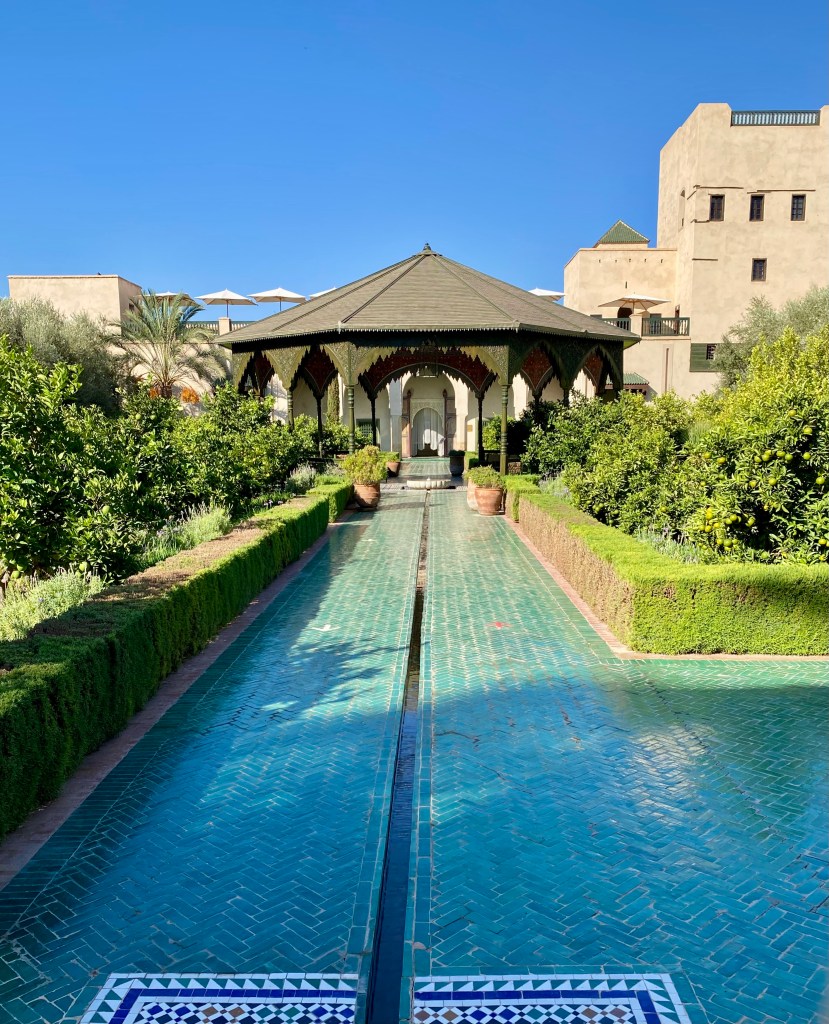
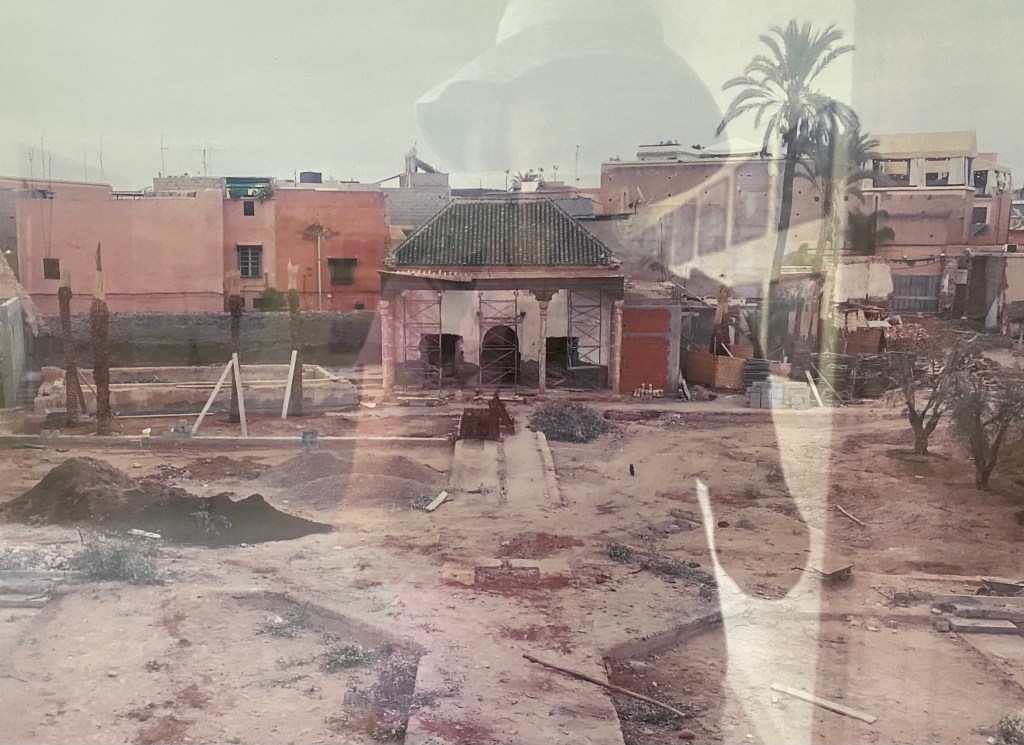
My favorite spot in the Medina was the beautifully restored Le Garden Secret. Photos of the “before” version were displayed in the on-site museum. (Sorry about the reflection. the lighting situation was far from ideal.)

No trip to the Medina would be complete without a stop at a rug shop. Most of us spent our time there sipping mint tea, but Dave was on a mission to find something special for his dining room, and he made a very significant purchase.

For our last day in Marrakesh, OAT offered us two optional tours: a hot air balloon ride and museum visits. I highly recommend both!

Was it worth getting up at 5:15 AM to watch the sun rise over the mountains, from the vantage of a hot air balloon? I’ll let you be the judge.

6 out of 9 of us opted for the balloon ride. Our Spanish pilot kept us entertained with his commentary. He was almost as wonderful as the view.

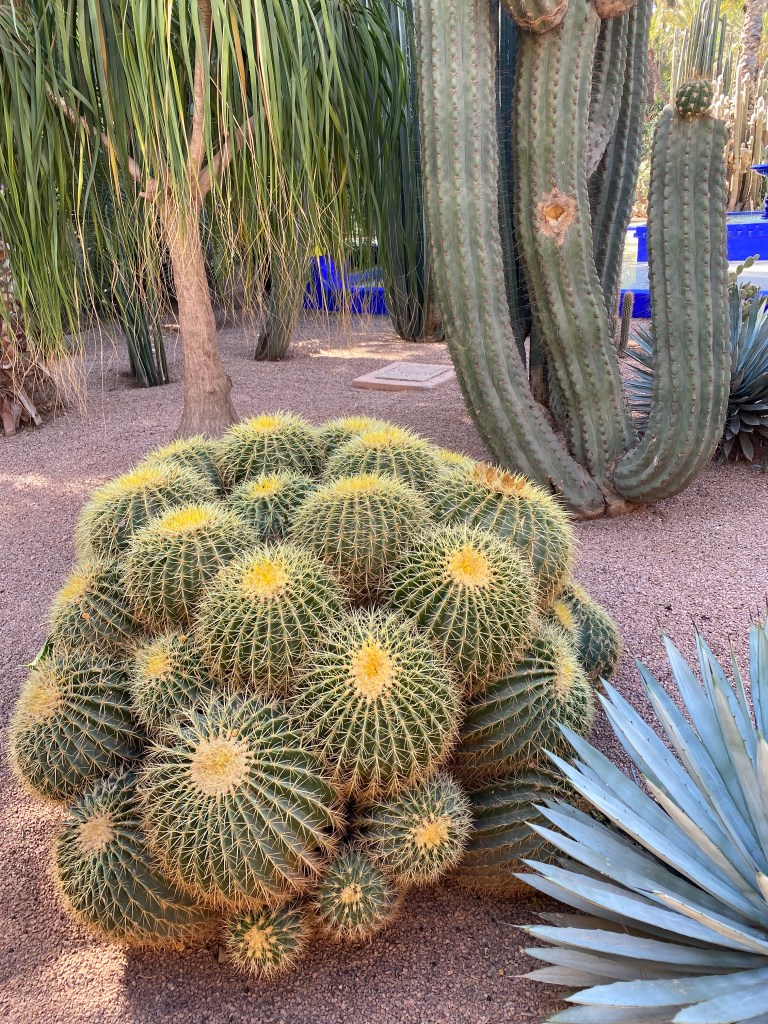
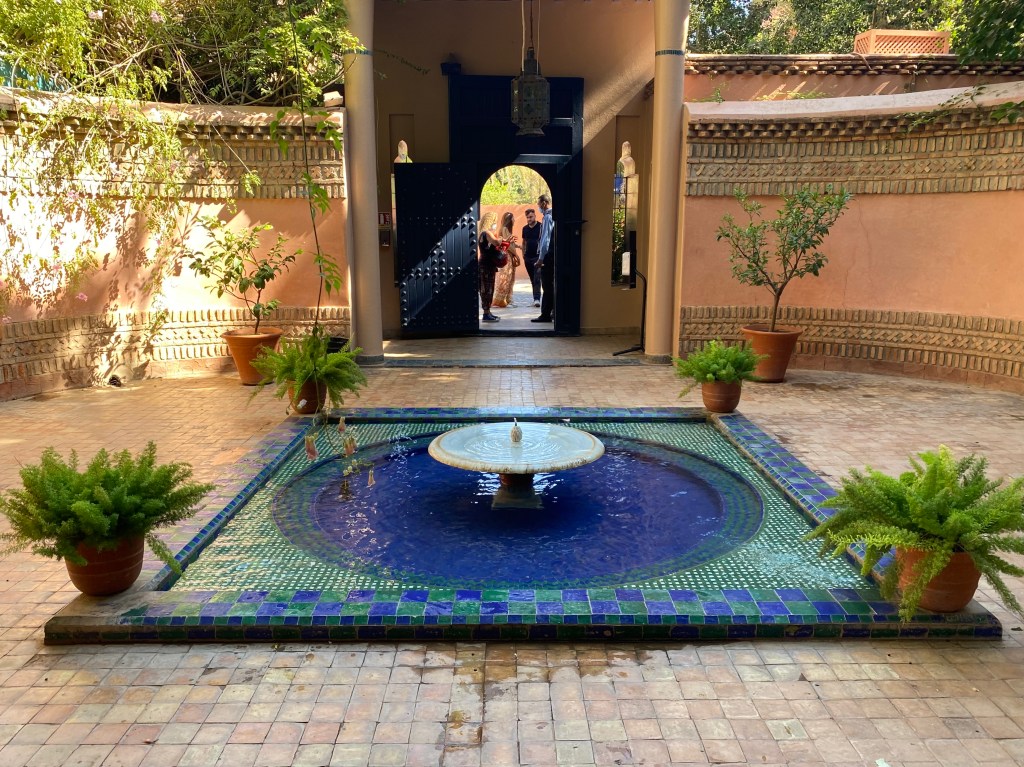
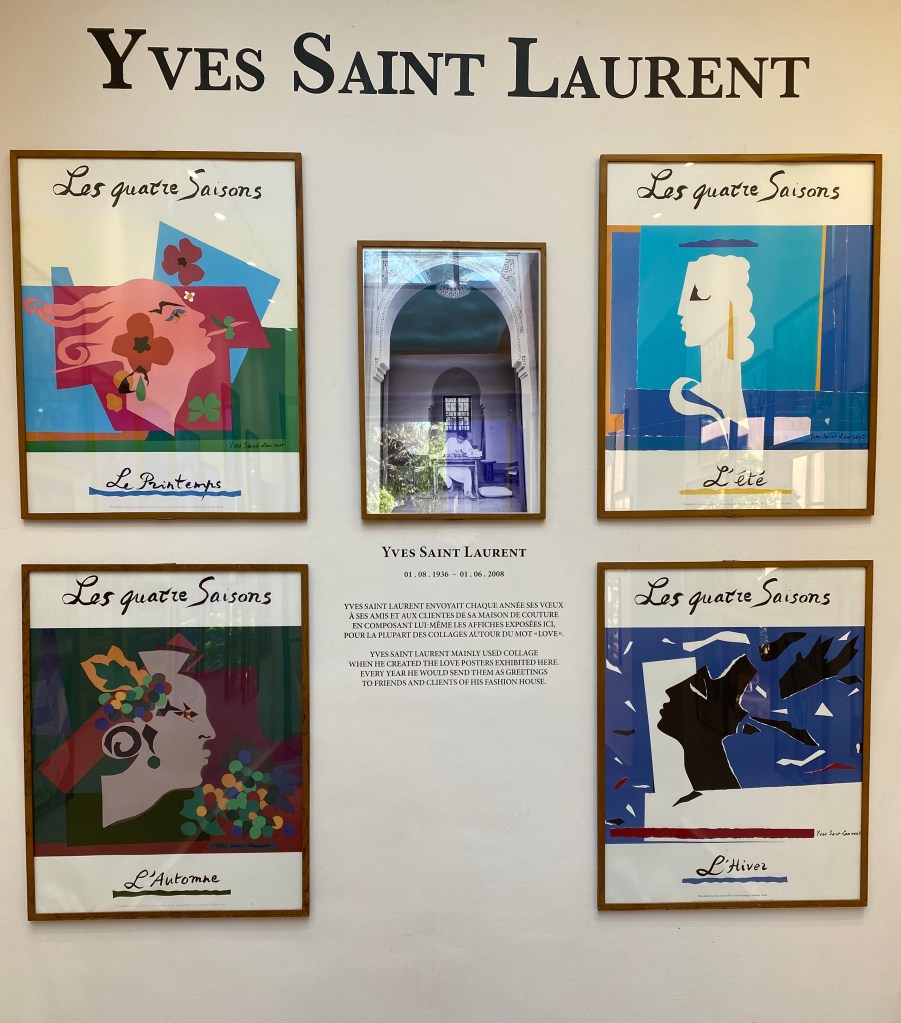
Now the museums: Although Trip Advisor rated Garden Majorelle as the top attraction in Marrakesh, I happen to disagree. Yes, it was nice and all that, but quite honestly, we have better gardens in the USA. They just weren’t owned by Yves St. Laurent

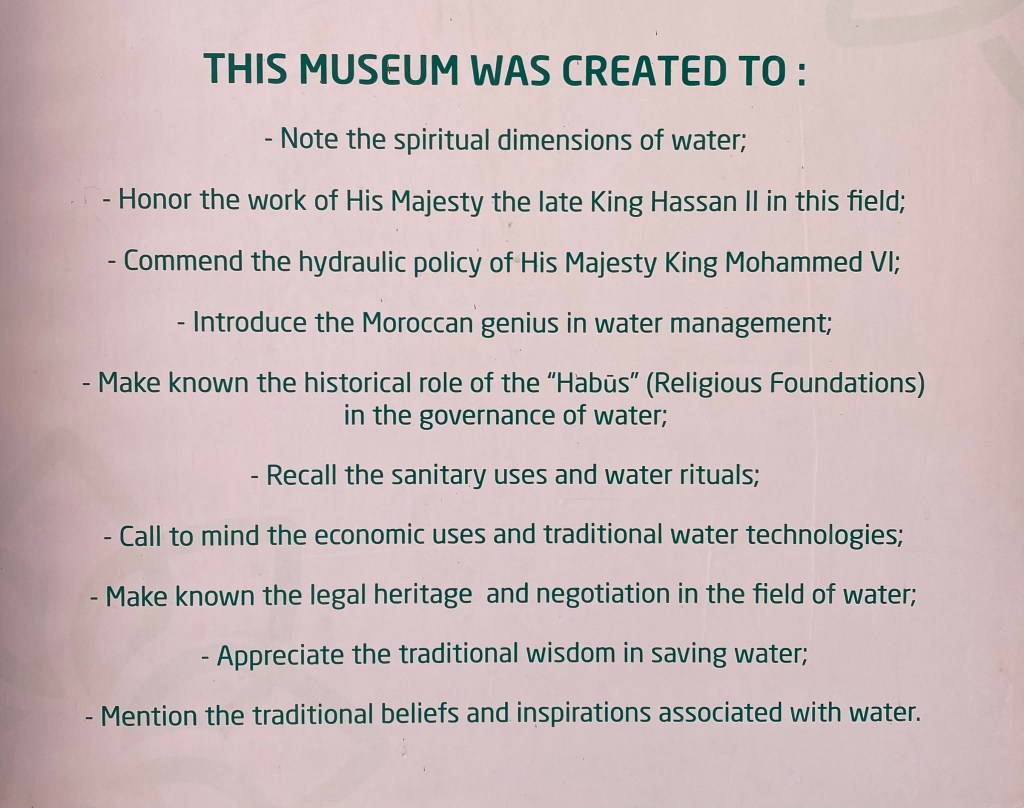
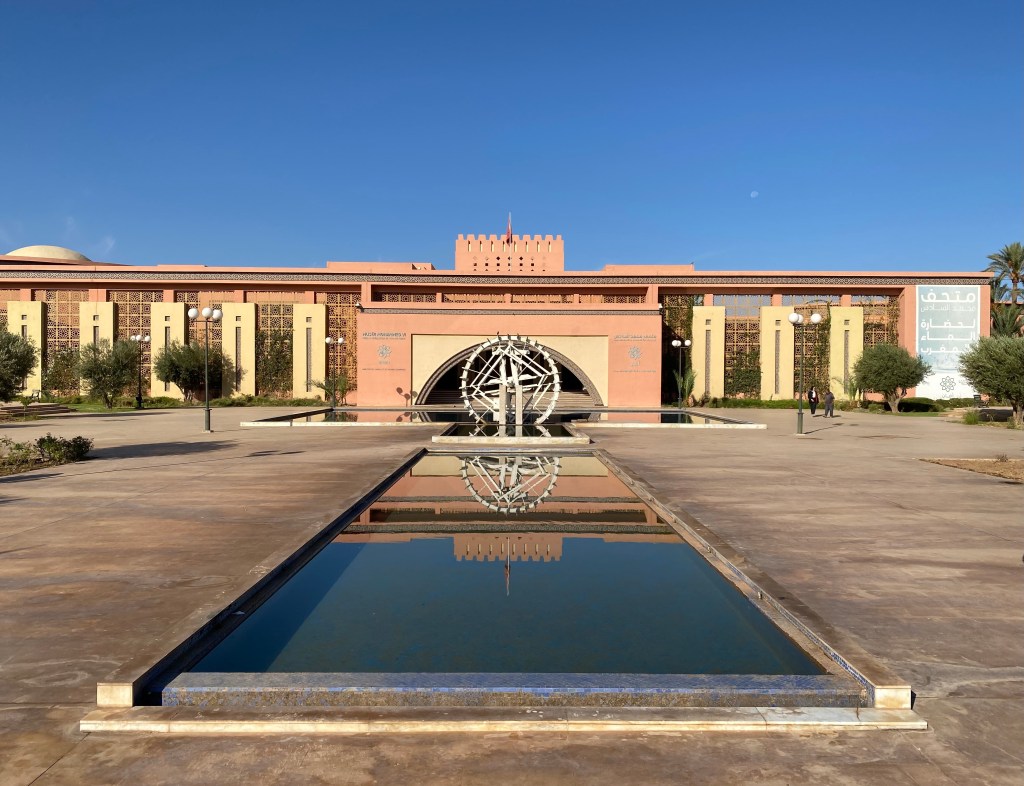
I much preferred the Museum of Water Civilization, because I have never seen anything quite like it.

I loved everything: its architecture, the exhibits, the stories.

Is this not a gorgeous building?

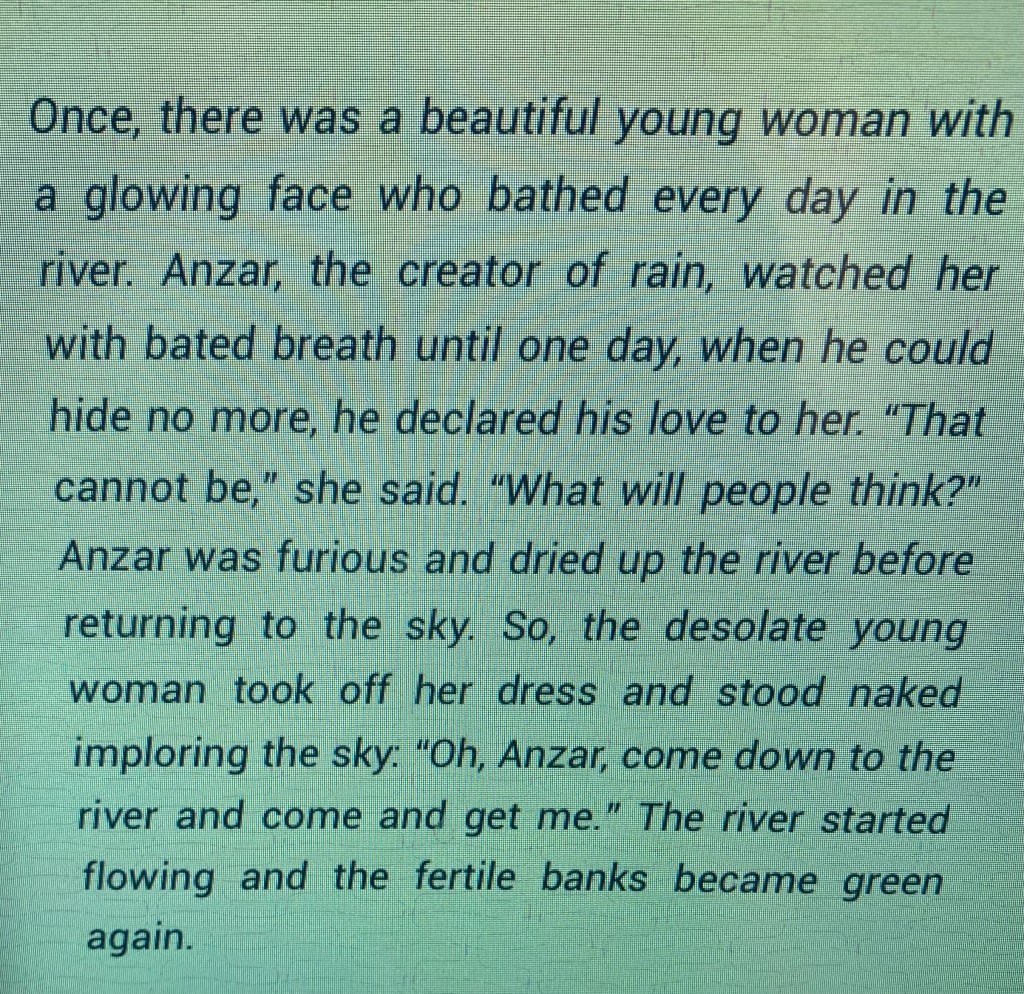
It was chock full of wonderful legends. I chose just a couple to share to give you a feel for how delightful the museum is.

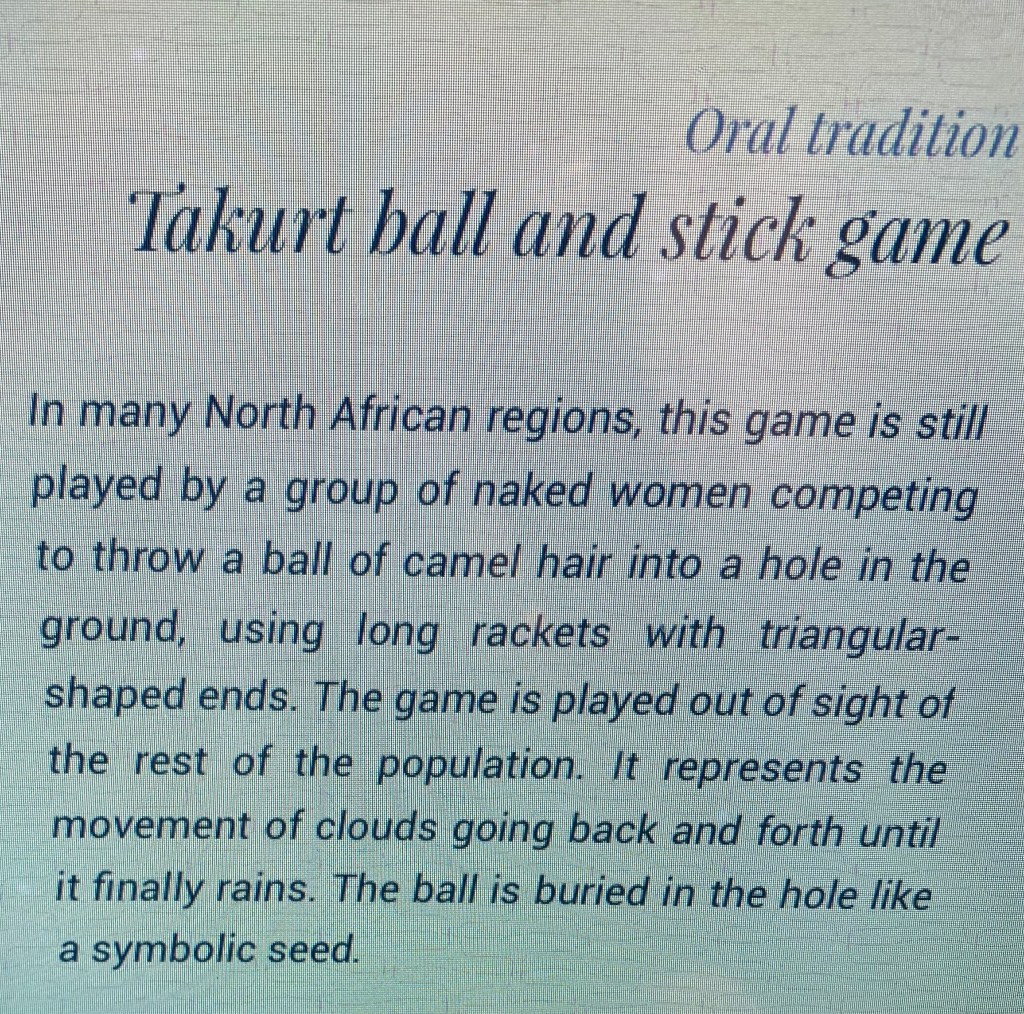
This seems like a lot more fun than sacrificing a virgin to make it rain.
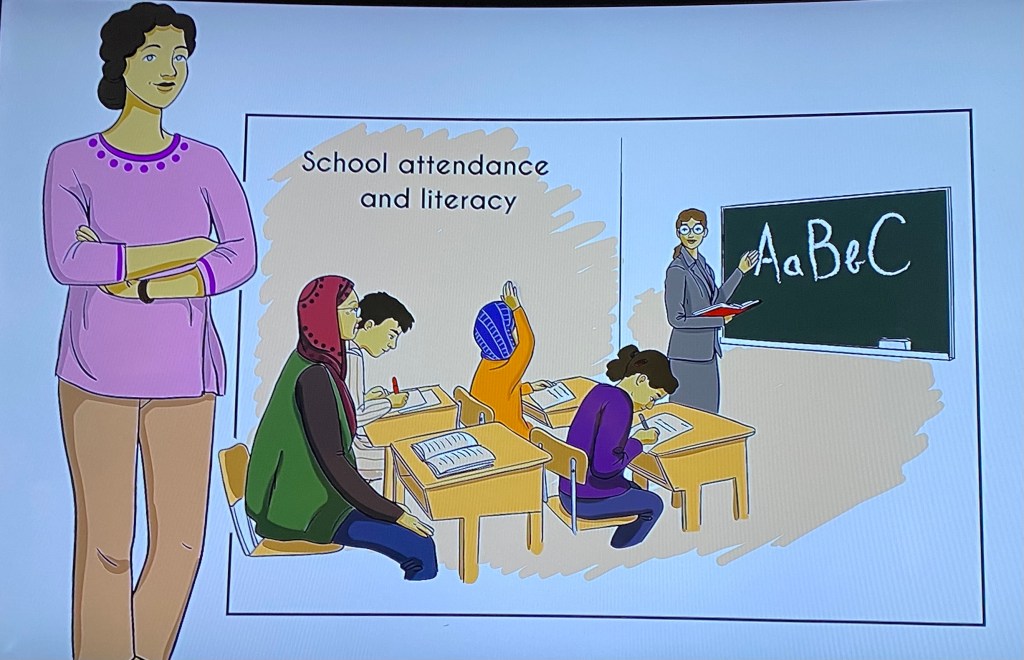
Here’s an example of Morocco’s progressive attitude toward women. Notice women get to choose whether or not to wear a headscarf.

There is so much more to say about this fascinating city, but I’ll stop now and encourage everyone to go and see for yourself. Be prepared to have your preconceived notions shattered.

On The Road Again

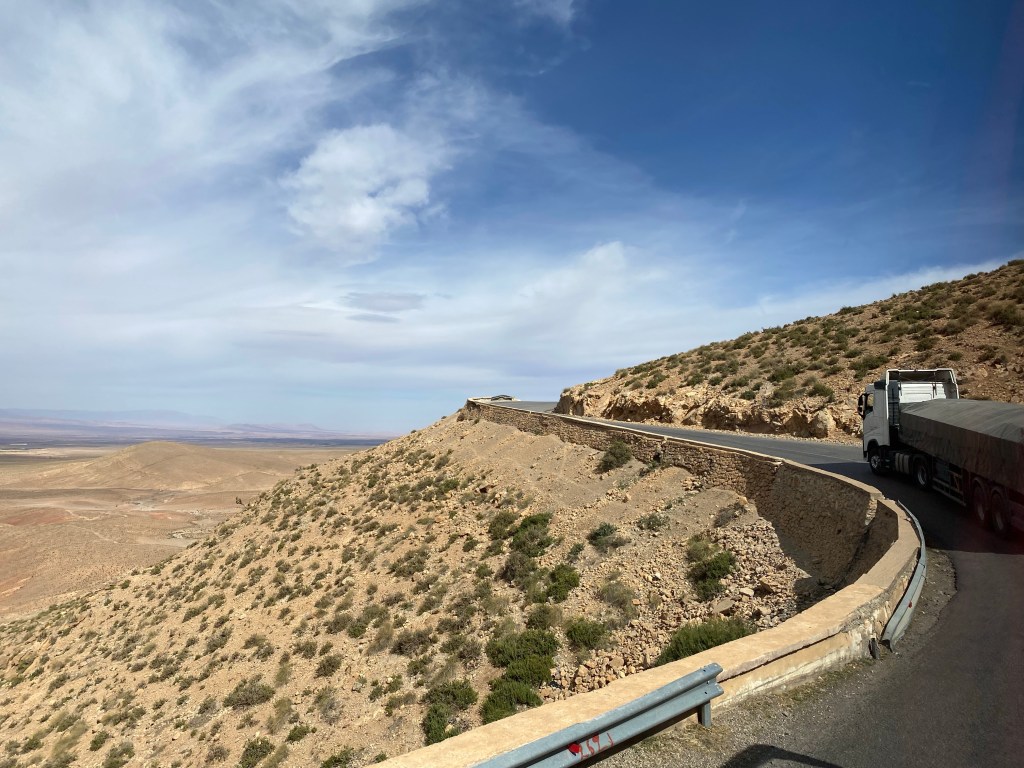
Who knew that driving all day could be so delightful? The scenery between Fes and the Sahara is varied and spectacular. It also doesn’t hurt that the nine of us are traveling in a bus that could transport more than forty passengers. We are up high, so we all get panoramic views.

This photo was taken from the window of the bus.

We had several stops along the way, including an opportunity to stroll through a forest.

Mike provides scale, to give an idea of the size of this Lebanon cedar.

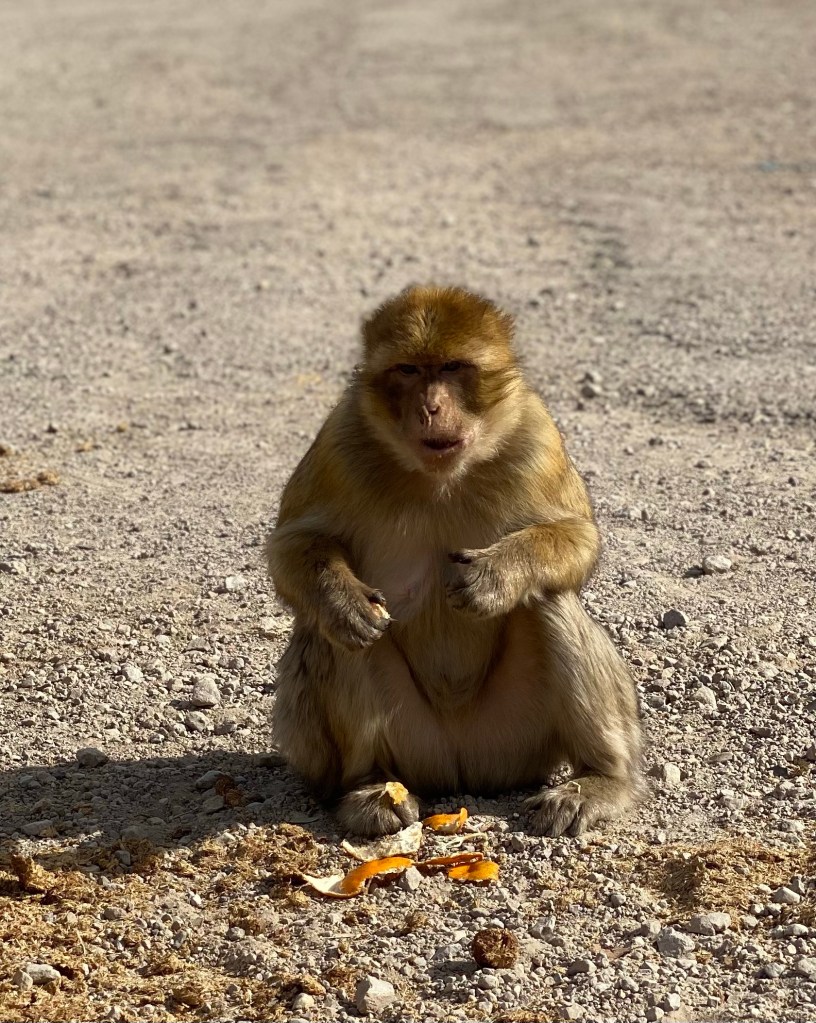
My favorite stop, however, was our visit with the Barbary monkeys.

Don’t even THINK about touching that tangerine!
This monkey was much friendlier. She was fine as long as I was at her level, but when I stood up, I frightened her and she scampered off.

The hotel where we stopped for lunch had this beautiful map, which included our departure and destination, and stops along the way. I’d mark our route out for you, but it is too difficult to do on an iPhone. But I’ll give you a rough idea of our route: we started at Fes, on the top, by the palm trees and ended in what the map calls ‘Arfoud’, (Erfoud) near the bottom. Ultimate destination: off the map on the bottom, near the camels.

Outside of major cities, Morocco has few traffic lights. Instead, they have numerous traffic circles, (if you’re from Massachusetts the correct name is ‘rotaries’. We Massachusetts natives have our own special language).

I particularly liked the circle in Midelt, which highlights their #1 product. Can you guest what it is?

If you guessed “surgical masks” , you’d be wrong. Mostafa had our driver (Mohammed) go around the circle twice so we could all snap a photo of the “Big Apple”.

Our stay was at a lovely hotel close to the Sahara Desert. Although I am so sorry for the Moroccans working in tourism, I must confess it HAS been rather nice having these beautiful hotels and pools all to ourselves.

Most people would be delighted to see that huge, luminous full moon. Not us. Why? We were hoping for dark desert skies for our resident astronomer’s lecture the following night.

If you’re wondering why in the world I’m blogging rather than experiencing the majesty of Morocco, fear not. This is being written while on the bus heading to Ouarzazate. I’m using Verizon’s Travel Pass for internet connectivity. And I’m looking up from my phone frequently. And yes, as usual, my blog is several days behind our experiences.

Three Nights in Chefchaouen

It would not be accurate to say we spent three DAYS in Chefchaouen because during our stay, we spent one day in a local northern village and another in Tetouan.

I can understand why other OAT travelers are so enthusiastic about this pre-trip. (For non-OAT travelers, OAT always offered the opportunity to add additional days before and after their main trips). The scenery is beautiful, the food is wonderful and inexpensive, the accommodations are gorgeous, and the people are so happy to see American visitors. As we were walking through the Medina, the locals were yelling “welcome”, “hello”, and different phrases, including “happy wife, happy life”.

Moroccans are very proud that their country was the first to recognize the brand new United States right after we achieved independence.

At Chourafa, the owner told us that Eisenhower stayed in that very dwelling during World War II, back before it was transformed from a private house to a restaurant.

Owner of Chourafa, entertaining us with his stories.

One feature of OAT is home visits, where we have the opportunity to spend time with a local family, sharing a meal and learning about their day to day lives. Our visit was with Mohammed, his lovely wife Ishhane, and their two daughters, where we enjoyed this fabulous feast made from ingredients grown on their farm in a little village so remote even Google hasn’t found it!

Tagine
Kris and Ishhane with their assistant. Mohammed and his family built their house, including this kitchen.

It’s good we were so well fed, because after we left the village to return to Chefchaouen, we did a LOT of walking. It is a bit of a hike to get to Boulazaafar, the mosque that overlooks the city. Built by the Spaniards in the 1930’s as a way to make up both for the expulsion of Muslims after the fall of Andalusia in the late 1400’s, and for the Spanish invasions during the late 1800’s, it has never been used. Understandably, the Moroccans were a bit suspicious of the Spanish military’s attempt to make friends. Maybe they heard about the Trojan horse?

Okay, so it isn’t Hagia Sophia, but the location is pretty spectacular.

It is SO worth the 30 minute uphill stroll to get there in time to watch the sun drop behind the mountains.

From that vantage point, we could hear the call to prayer issuing forth from the 30+ mosques scattered throughout city.

Most of the other hikers were a bit younger than we were, by roughly 4 or 5 decades
Another view of Chefchaouen: Different centuries coexisting. Women are doing their laundry in the stream and taking photos with their cell phones.

We were offered an optional trip to Tetouan, which all of us, except Mike took. Although the scenery on the drive was spectacular, in retrospect, I think I would have preferred to spend that time in Chefchaouen instead.

The optional tour consisted of a stop in a small Roman Museum, a walk by the palace, and through the Medina, the Jewish quarter and mella, and a seafood lunch in a restaurant across from the beach. Although enjoyable, I’d had similar experiences on other tours, so for me, additional time in Chefchaouen would have been preferable.

Next stop, Tangiers!

Morocco, FINALLY!

When we signed up for this Overseas Adventure Travel trip in August of 2019, the world was certainly a different place. Even 20 months after shutdown, Covid STILL has a significant impact on our daily lives. I will admit, we had some reservations about leaving home, even after being fully vaccinated, but through Facebook, I was able to connect with Rocky and Julie who traveled to Morocco with OAT in September. They kindly “friended” me, and because of their photos and posts, we felt comfortable forging ahead. My goal is to do likewise, but rather than posting on Facebook, I’ll be communicating via this blog. So, if you want to tag along with us to see whether you’d feel safe visiting Morocco, just sign up and you’ll get a notification via email whenever I post.

This first post might be boring for those who are not planning to become future Morocco travelers. It’s really a compilation of information I would have found helpful, prior to leaving home.

Getting there

Initially, we were flying to Casablanca via Paris on Air France, stopping in Paris for four days. Although we normally enjoy being on our own, because of Covid, we realized that we wanted the comfort of having a guide look out for us. Plus, with different countries having different rules, we figured those four days were a complication we could do without, so I hit the internet, to determine whether it was possible to get from JFK to Casablanca non-stop.

The only non-stop I could find was via Royal Air Maroc, which has one daily round-trip flight. It is a codeshare with American Airlines, but unfortunately OAT does not have an agreement with those airlines, so we were on our own. I’ll be honest—it was a little complicated, because with the code share, we had two different flight and booking numbers, and two different customer service phone lines. AND, although we booked and paid through the American site, we couldn’t use that site to select our seats. We also were unable to check in on-line, and print our boarding passes, something we normally do. A hassle, yes, but we avoided changing planes in Paris, and we arrived in Casablanca seven hours earlier than we would have if we’d stayed with Air France.

Royal Air Maroc

Our flight was scheduled to leave JFK at 8:40 PM, so we left our house at 3:45 PM because of NY traffic. It took almost 2 hours to get to the airport, but checking in and getting through security was relatively easy.

Our flight would arrive in Casablanca at 8:30 AM local time, 3:30 AM our bodies’ time. (It actually departed and arrived on time!) Knowing how poorly I do with sleep deprivation and jet lag, (picture a toddler who needs a nap) we decided to book business class on the way over so we could stretch out and sleep.

Business Class also included admission to the Primeclass Lounge in terminal 1. I’m not sure if Covid is responsible for the food offerings, but let’s just say that particular perk was not a selling feature.

Like USA Airlines, Air Maroc has lay flat seats in business class

I was surprised that dinner was provided on an 8:40 PM departure. In fact, I thought the appetizer was the whole deal and it was enough for me, so I skipped the hot entree. All I can tell you is there were three choices. We also got a decent breakfast.
The business class perks that WERE selling features were a special line in passport control and priority luggage handling, so it was waiting for us when we arrived in baggage claim. In fact, the whole process went so fast and so smoothly, we were off the plane, through passport control, baggage claim and customs, had gotten money at the ATM and were outside the terminal in 25 minutes.
To make the cost reasonable, we opted for economy on the way back. I promise to report on THAT flight too, so you, dear reader, will know what to expect from each option, should Air Maroc be in your future. Our return flight departs shortly before 1:00 PM, versus 7:30 AM (the Air France option), so we should be rested enough to deal with whatever version of economy Air Maroc offers.

Arrival

Our hotel, the Radisson Blu, arranged for a car to pick us up at the airport. The cost was 500 MAD and we were able to pay with our credit card. Our guide had warned us that only passengers are allowed inside the terminal, so we knew to look outside for our driver, right after we hit the airport ATM for some local currency. He also told us the most we could withdraw is 2000 MAD, ($235.22) delivered in 100 and 200 bills, so we were prepared for that.
It took about an hour to get from the airport to the hotel, because of traffic and a couple of accidents.

Mohammed VI’s image is on the front of all bills, but the reverse varies. The hotel changed a large bill for us

Packing

Mostafa, our guide, sent us a wonderful welcome email, full of useful information, like where we would be able to have laundry done, (Fes, Ourazazade and Marrakech), and what to pack (bathing suit and hairdryer, among other essentials.) For a while, we seriously considered traveling with carry on only. After very carefully reading the luggage allowances on Royal Air Maroc’s website, I became concerned that ONE carry on meant just that, with no “personal item” allowed. We would have been really bummed if we had eliminated things that we wanted to bring, only to learn at the airport that one of our two carry-ons would have to be checked. So, out came the duffle, and in went more ”stuff”. Mike was able to easily include his laser pointer and binoculars, in anticipation of the dark skies in the Sahara. He’s an astrophysicist, so interested fellow travelers can look forward to a professional explanation of what we are seeing in the heavens.

Map

The image at the top of this post was created courtesy of Google maps. The cities we will be visiting are listed in order, with the blue pins giving you an idea of the ground we will be covering. Are any map aficionados out there? If so, this link will allow you to get additional information about the cities we are visiting by clicking on the blue pins.
https://goo.gl/maps/Np8GEL1ripWqEgx57

For the past two years, we have been “Wishin’ and hopin’ and thinkin’ and prayin’, plannin’ and dreamin’ “ about traveling to Morocco. (Who remembers that song? Extra credit if you remember who sang it.) Right now, dreamin’ is Mike’s choice, but I’m going to check out the pool so I’ll be sunnin’ and swimmin’.