Baddeck, Canada

We didn’t know the impact of the Air Canada strike until we left Halifax for Baddeck ( Pronounced ba-DECK). Our group has shrunk from 40 to only 26.

I know, I’ve completely skipped over Halifax. It’s not that I didn’t love the city. I did. It’s because we are spending our final two days there, so if time and energy permit, I will post about Halifax when we return there.

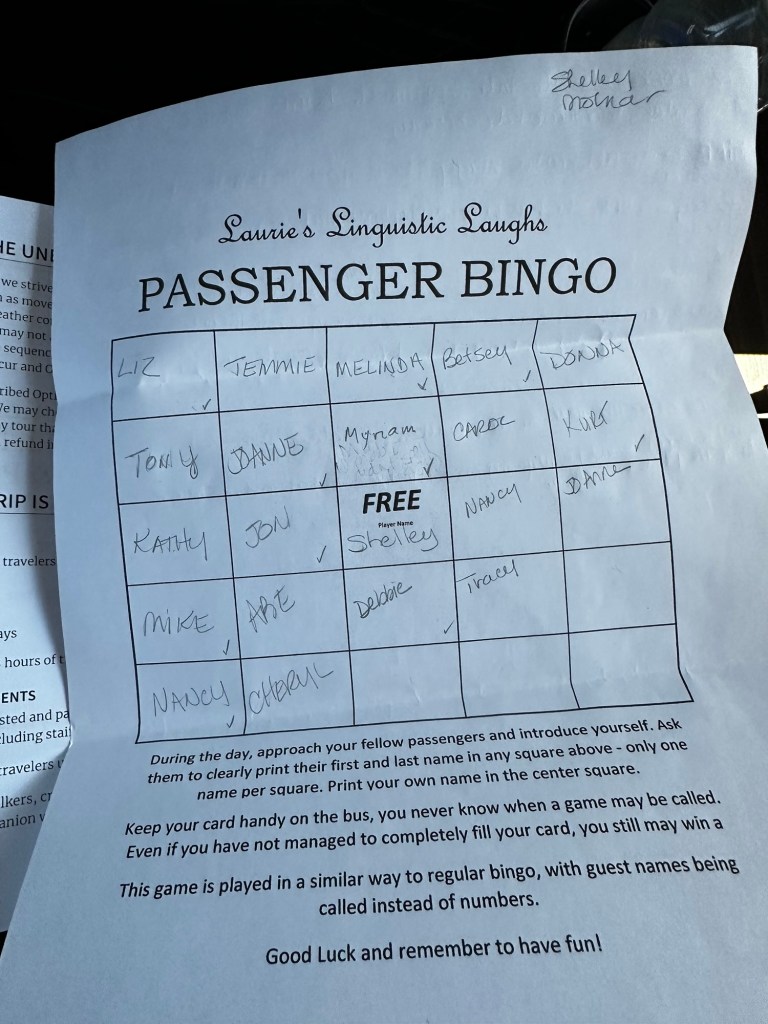
Laurie, our amazing trip leader, has devised a very creative way to break the ice and to keep us entertained during our bus ride. We are going to be playing “Passenger Bingo” for PRIZES! I don’t care if the prize is a rusted tricycle, with a wheel missing. If it’s a contest, I’m in it to win it. That’s just my nature.
Since I started this post, we have completed THREE different games, and I’m quite proud to say I was the winner of the first, which was a challenge to name all of the 14 people that did NOT make it to Halifax. Nailed it!
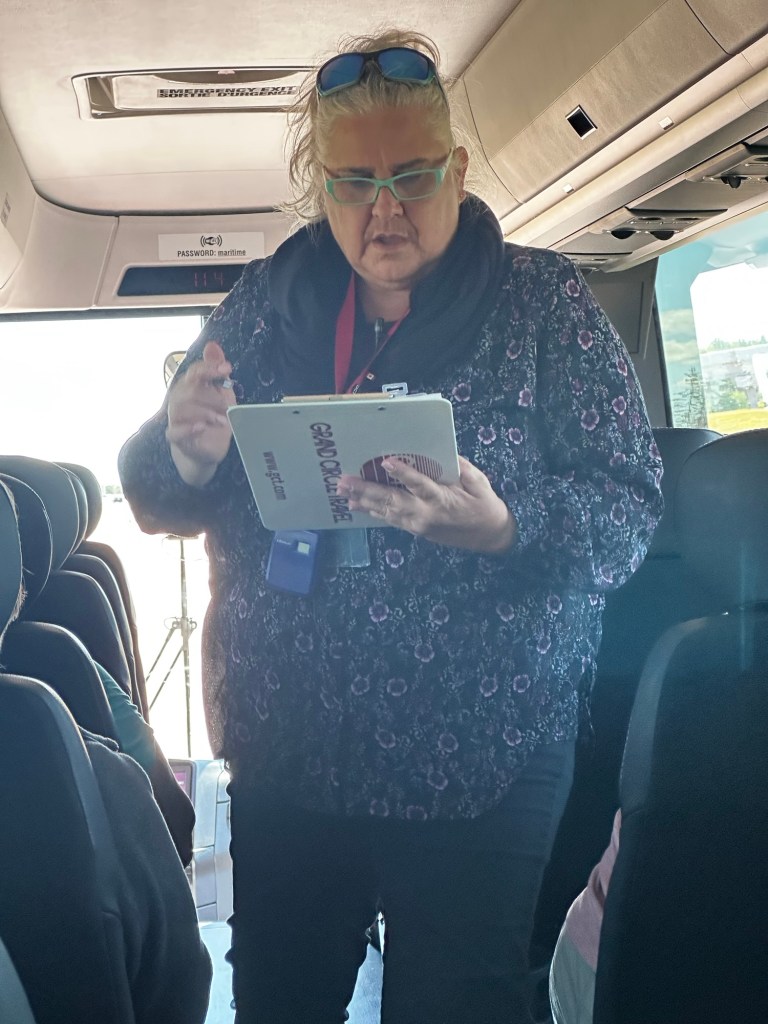
Laurie, our hard working, creative trip leader

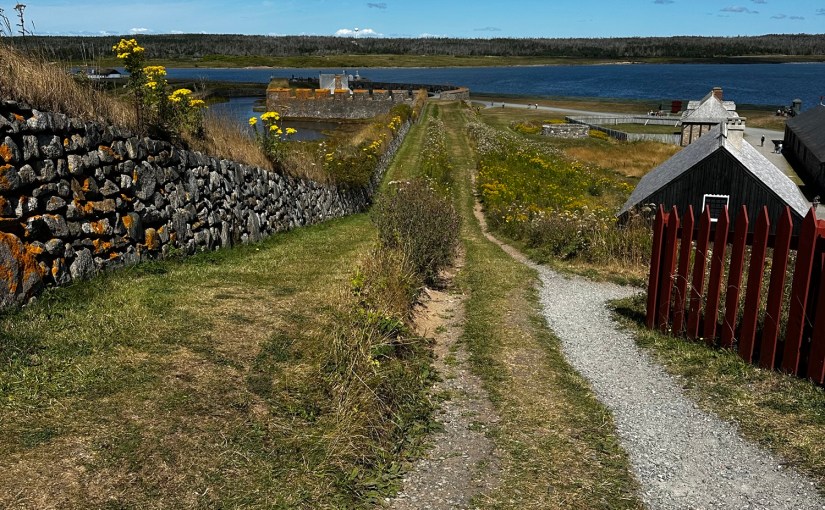
But back to Baddeck. As usual, our drive to the next city was broken up by interesting stops, starting with the Millbrook Cultural and Heritage Center.

Glooscap, a mythical figure

There, we learned about the indigenous people who had inhabited the land for over 13,000 years, ( according to archaeological digs) the Mi’kmaq (pronounced mig-MAH).

Apparently, the French and the indigenous had a positive relationship; not so, with the British, which was probably why we fought the French AND Indian War.

The indigenous were given identity numbers by the Canadian government, with the final number indicating how many children were in the family. That made it easier for the government to find the children, take them from their families and force them to attend government run boarding schools. The schools were designed to wipe out the indigenous language and culture. Over 176,000 children between the ages of 4 and 16 were taken from their families. Of that number there were over 6,000 recorded deaths from disease, abuse and suicide. Before anyone thinks that the mistreatment of indigenous children happened centuries ago, I need to inform you that the last school closed in 1998 in Manitoba.

This speech was given during Canada’s 100 year anniversary.

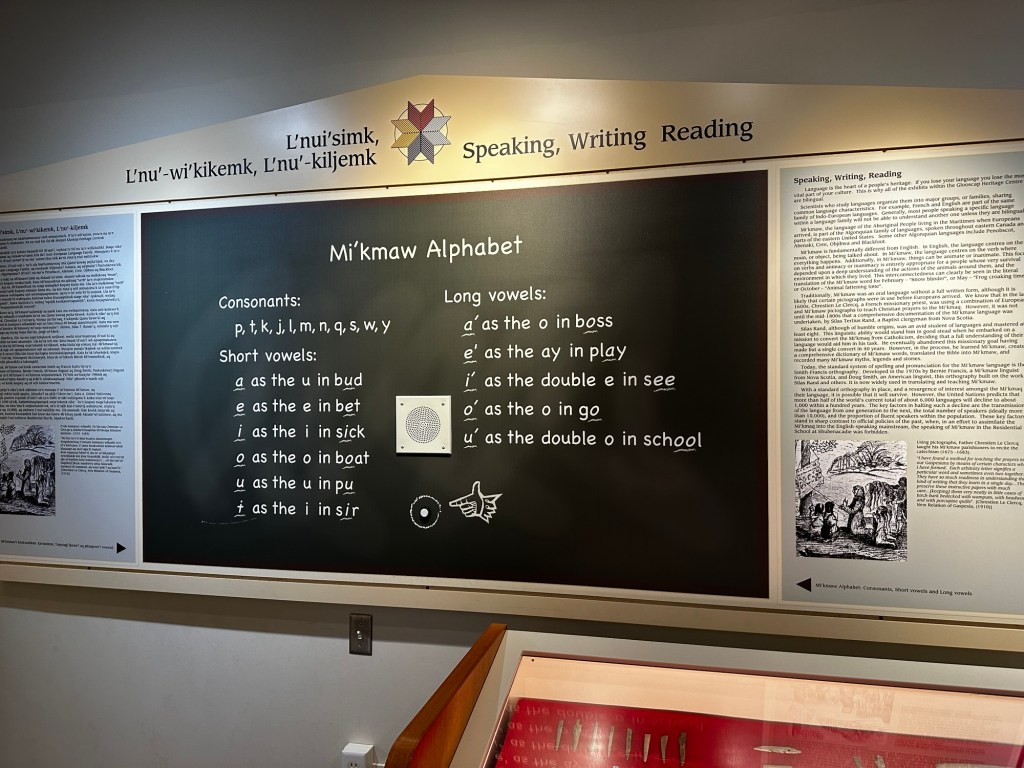
We learned that the Mi’mkaq language is a tonal one.

Depending on how you elongate the vowels, the same word could mean:

I love you OR I want to hurt you OR I want to throw you in the fire. THAT word could start some serious misunderstandings!

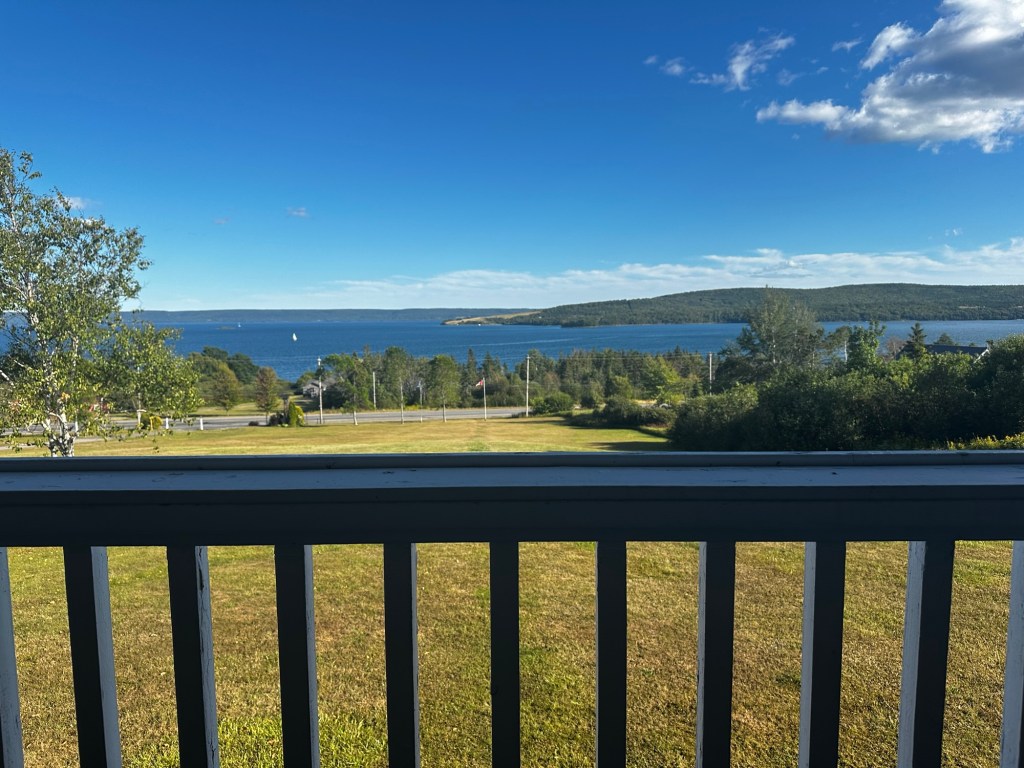
We spent our three nights in Baddeck at the Silver Dart Lodge, which overlooked a beautiful lake.

Laurie was initially concerned that we would find the Lodge too “rustic”. Instead, we all agreed it was absolutely charming. Because of the volume of business Grand Circle does with the lodge, we all got rooms facing the lake.

This spectacular view is what I saw from the lovely deck outside my room, the perfect place for happy hour. How great was THAT? It took all three nights for me to finish the wine that I was not allowed to drink on the bus.

The area is so beautiful that Alexander Graham Bell and his wife, Mabel built their summer home in Baddeck. Their “castle” wasn’t visible from the museum bearing his name, but there was plenty of other “stuff” to see.

I had no idea that Alexander Graham Bell taught deaf students in Boston or that Mabel became deaf at the age of 5 after a bout with scarlet fever.

I also didn’t know that Bell’s parents immigrated to the USA from Scotland after two of their sons died from tuberculosis. They didn’t want to chance losing their last son.

We all know about his invention of the telephone , but I wasn’t aware of his interest in aviation and hydrofoils until I visited the museum.

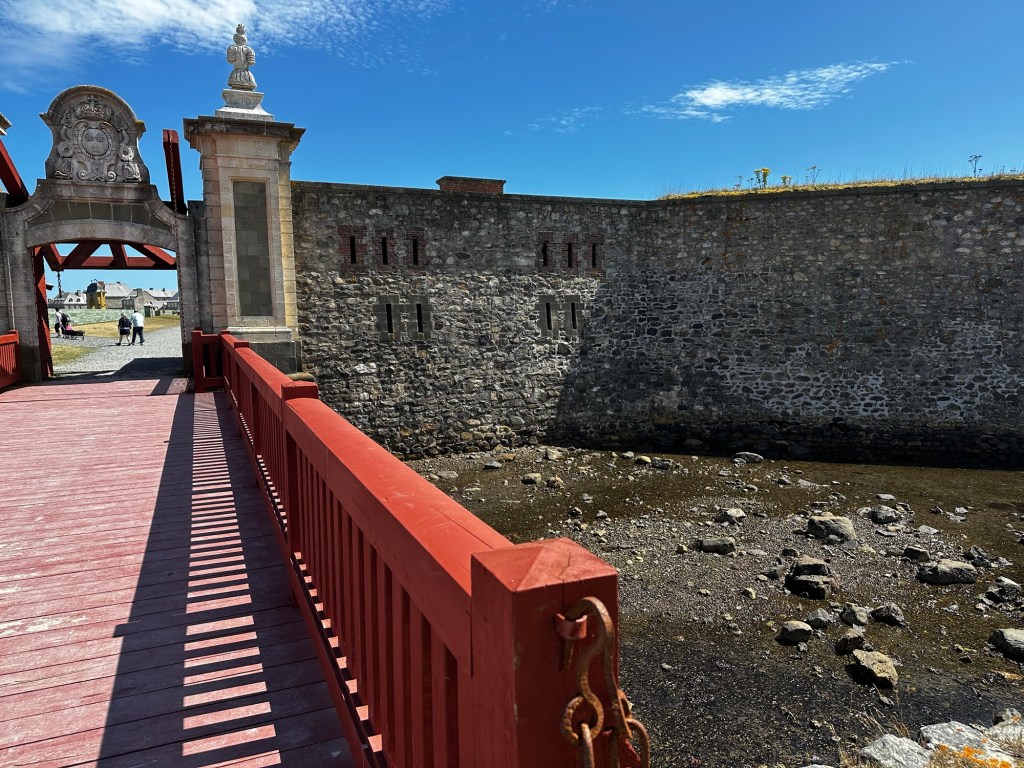
We spent the next day touring the fortress at Louisbourg, where I was once again reminded of my educational deficiencies. Why did I never learn that in 1745 a group of untrained “ soldiers” from New England successfully took the fortress in 6 weeks time? You see, the French had expected all attacks would come from the sea, so that area was heavily fortified and protected. But the 6,000 ragtag New Englanders didn’t know the rules of engagement, and they were undaunted by forests or swamps, so they attacked from the land, which was unprotected.

The entrance to Louisbourg

The crown decided to return the fort to the French in 1749 exchange for Madras, India which was a source of extreme irritation to the New Englanders. They had lost about 900 men capturing the fort.

In 1758, the British determined that they wanted Louisbourg after all, so they laid siege the “professional” way, by sea, without the help of the New Englanders, and guess what? It took them a WHOLE lot longer.

This time they completely destroyed the fortress, so what exists today is a reconstruction, based on documents and plans that were preserved off site.

The view from the protective wall

Like Williamsburg, Sturbridge Village, and Plymouth Plantation, re-enactors in period costumes demonstrate what life was like in the 1700s.

I particularly enjoyed watching a prisoner being marched through town to the iron collar.

All of the neighbors were invited to ridicule the prisoner as he made the “walk of shame“ to the center of town.

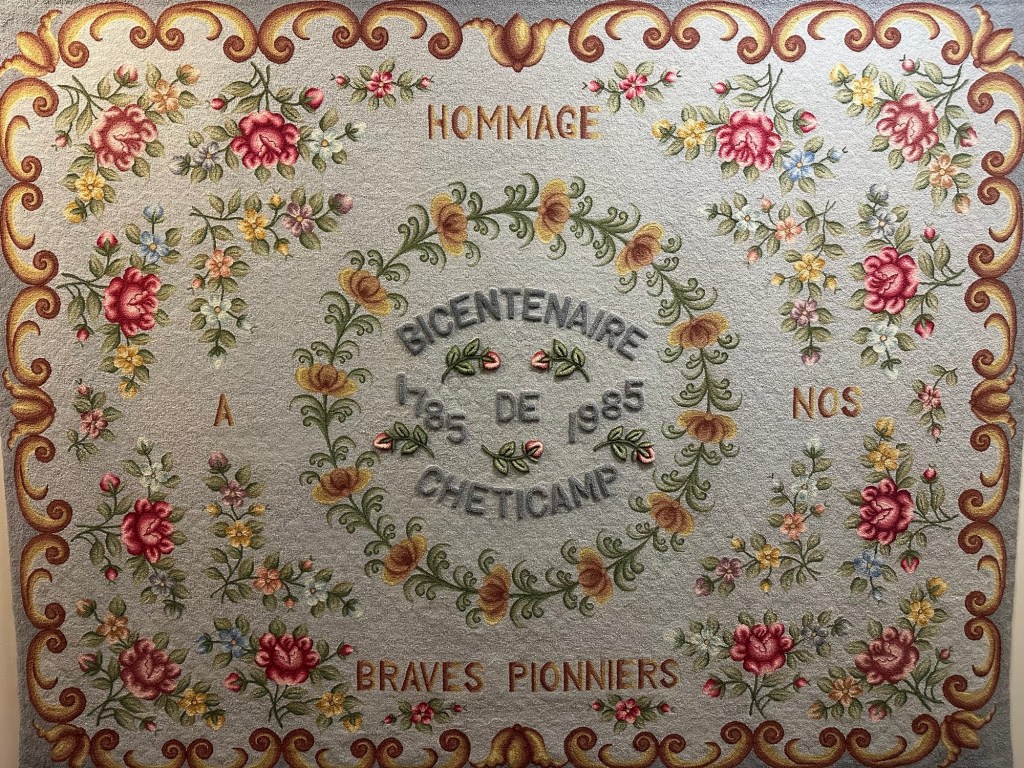
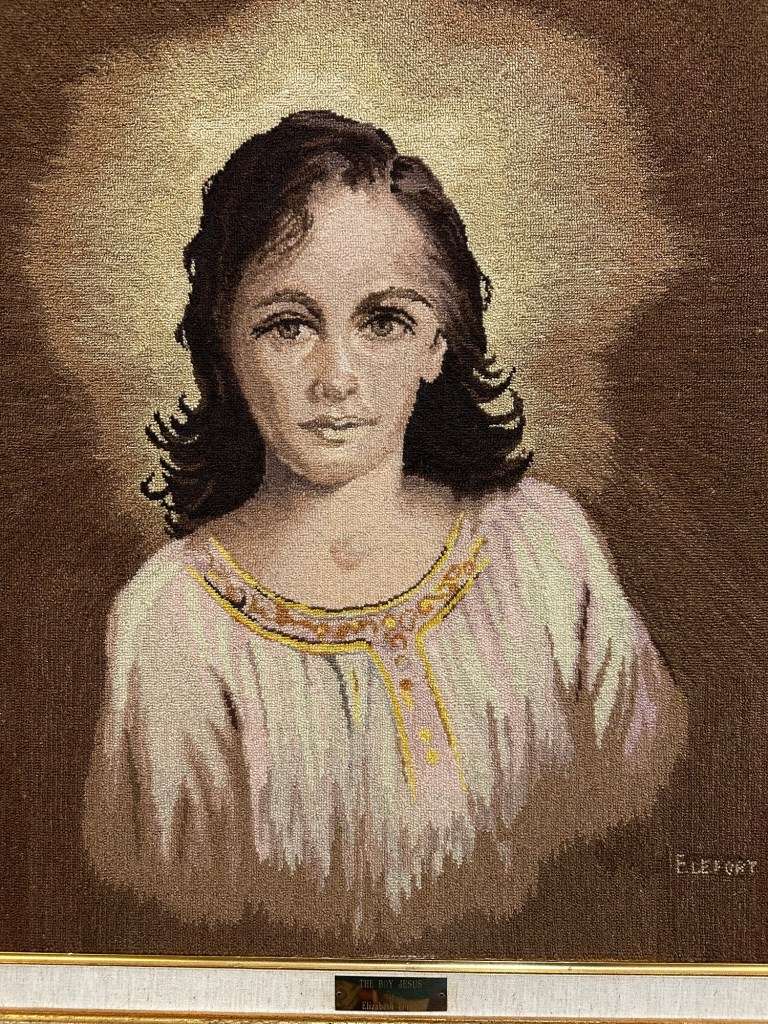
Our final day was to be spent traveling along the Cabot Trail. Because of climate change ( yeah, the Canadians don’t think it’s a “hoax”), all the trails are closed to hikers. The risk of fire is too great. So, instead we were going to drive the entire route, after stopping to visit a church and a hooker museum. Don’t get excited. It was a museum for RUGS not ladies of the night.

While in the museum, Josh discovered there was a problem with the bus, so we had to hang out long enough that the full trip along the Cabot Trail was impossible.

We were lucky to have Laurie as our trip leader, who decided to treat us all to coffee and pastry at the shop up the street. Instead of doing the full route, we ended up stopping at a beautiful little beach

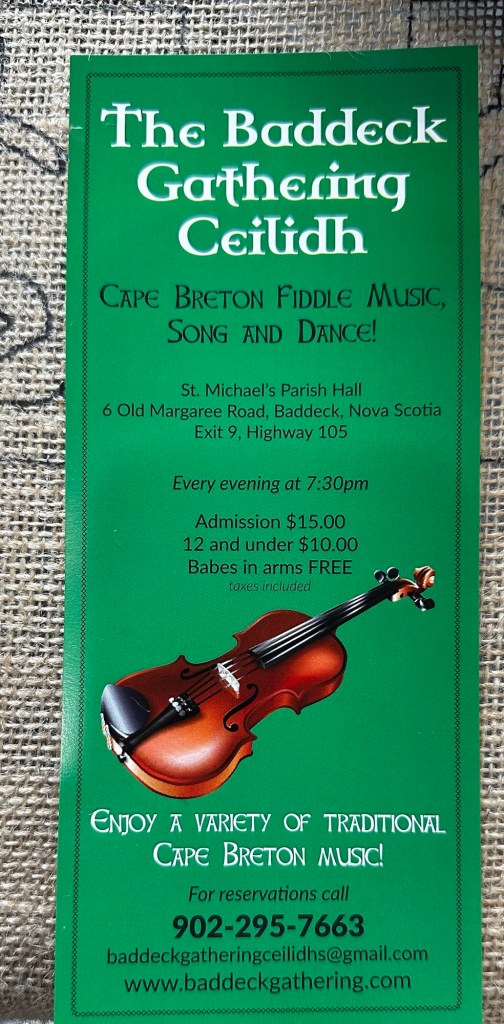
Our last night was spent at a ceilidh (pronounced Kay-Lee).

Although there is so much more to say about Baddeck, this post is already quite long, so I’ll stop.

Oh Canada!

Normally, when I travel I arrive a day before the tour begins, but not THIS time. I figured I wasn’t changing time zones, so no jet lag to overcome, and with the short flight, I would arrive in the early afternoon. What could possibly go wrong? Well, I knew I didn’t have to worry about snowstorms closing the airport, but I completely forgot about thunderstorms and possible flooding. Oh yeah, I also forgot about airline strikes.

I don’t know whether it was the strike or the weather that got my flight canceled, but I was VERY grateful that United notified me the night before I was due to depart. That gave me enough time to notify my driver, rebook my flight from home and best of all, I avoided hanging out at the airport for hours, desperately hoping that the planes would fly again sometime soon.

Actually, the delay worked out for me, because on my recent trip to Massachusetts, my friend Jean and I inadvertently picked up each other’s credit cards. Although Jean attempted to overnight my card, the post office only CHARGED her for 1 day delivery–it actually took TWO days, so I was at home when my card finally arrived.

The header of this post is the map for the main trip. I am now on the pre-trip, which originally comprised three nights in Quebec City (now 2 for me), then Montreal for 2 nights. Whether the flight attendants’ strike will be settled by the time we are due to fly to Halifax is anybody’s guess. That’s why I’m glad I’m on a tour. I don’t have to figure anything out. That’s the trip leader’s job.

There are eight of us on the pre-trip, so finding alternative modes of transportation should be a lot easier than making sure the 30 main trip participants are able to get into Halifax.

But enough about the future—let’s focus on the present.

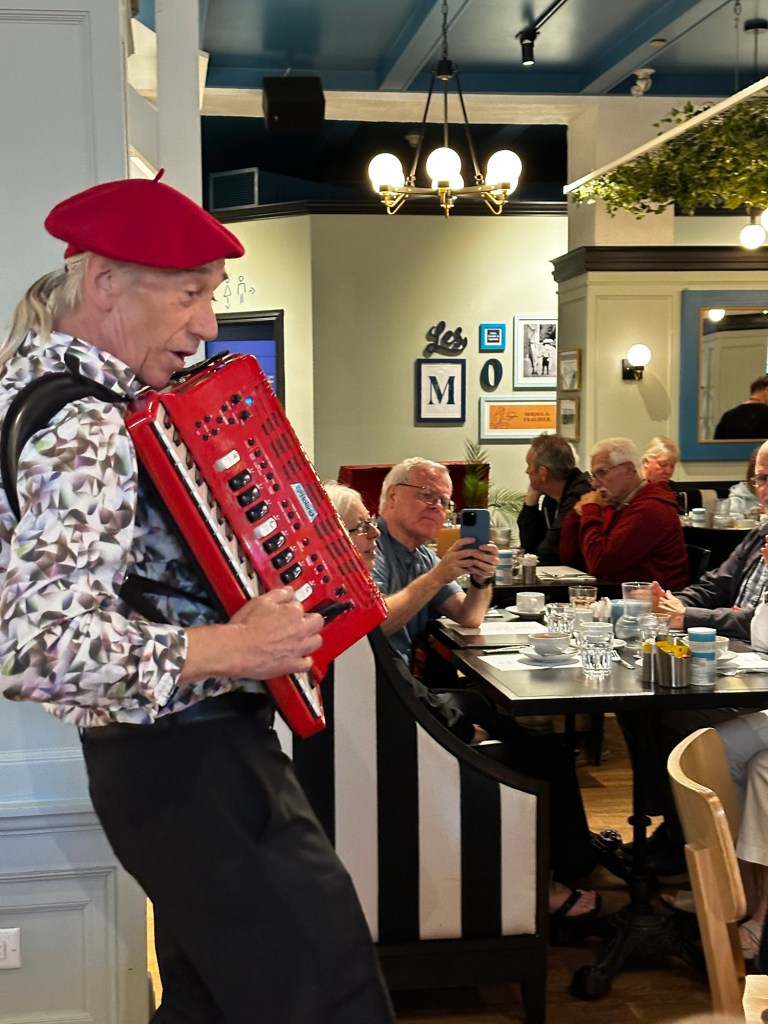
Our welcome dinner took place in the Hotel Clarendon, where we enjoyed singing along with the accordion player.

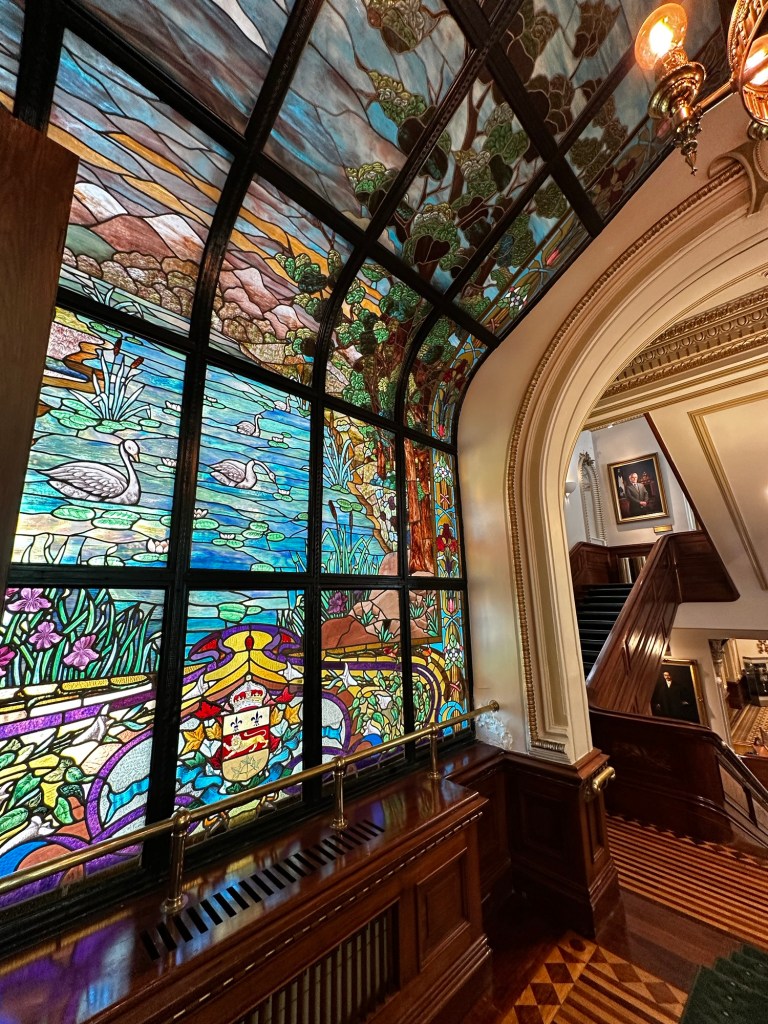
The morning of my one full day in Quebec City was spent the touring the parliament building, which was architecturally interesting. I loved the stained glass archway.

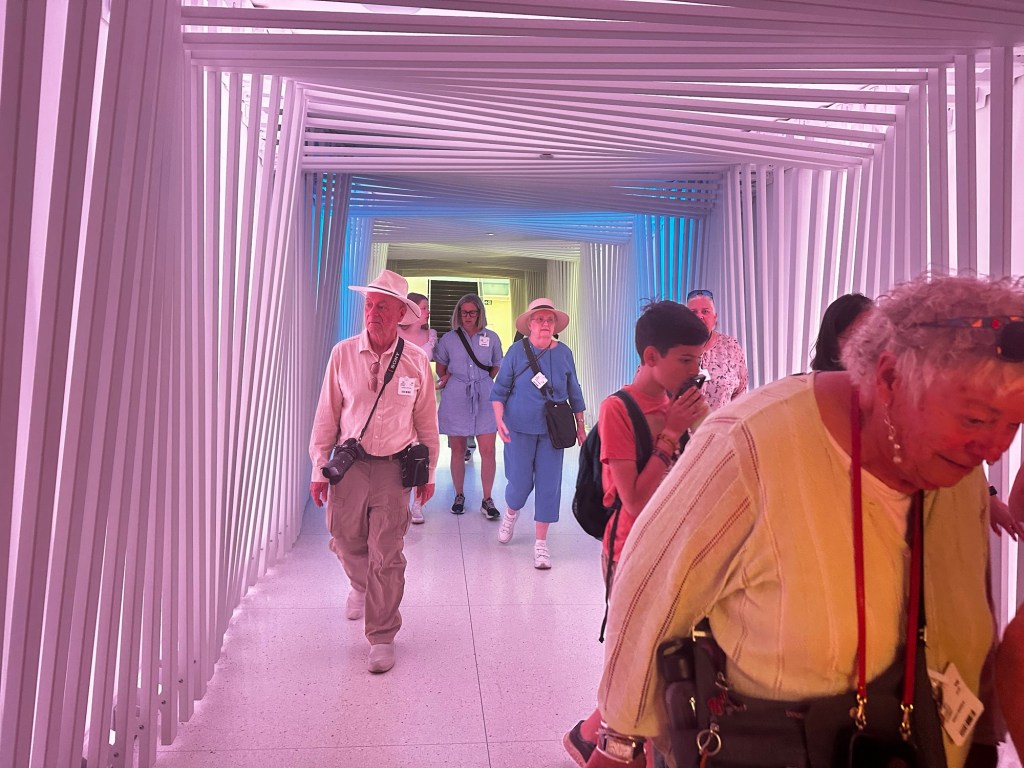
This corridor linking the old and new buildings synthesized art, music, architecture and technology . As people walked through the corridor, music played and flashing lights changed color.

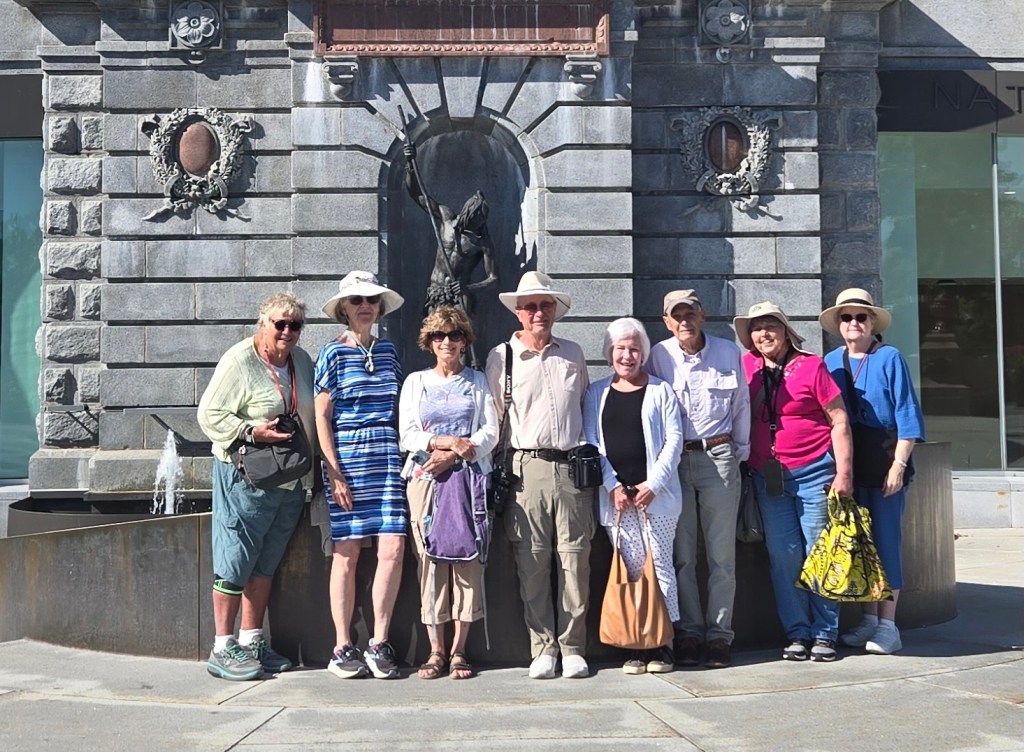
Laurie, our trip leader took our first group shot outside of the parliament building.

Joanne, me, Kathy, Tony, Betsy, Mike, Nancy, Melinda

I had heard so much about poutine, I decided to try it for lunch at the Fairmont Hotel. What is poutine, you ask? Well, you take French fries, dump some kind of brown sauce all over them, then top with cheese curds and bacon bits. After a few forkfuls, I’d had enough, so I offered the rest to my travel buddies. They shared my side dish AND my lack of enthusiasm for this “delicacy”.

After lunch we were on our own, so I took advantage of the perfect weather to explore the city, walking atop the city walls. It took me a while to figure out how to get up there. Hint: There are steps along the city gates.

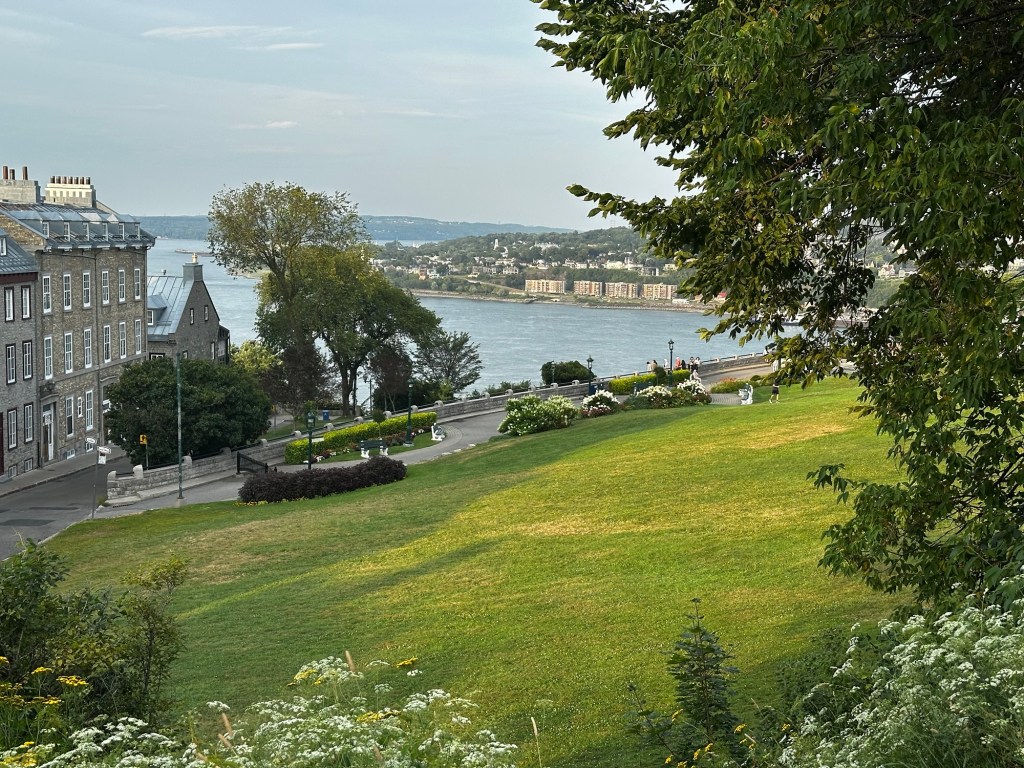
The view of the St Lawrence River was spectacular.

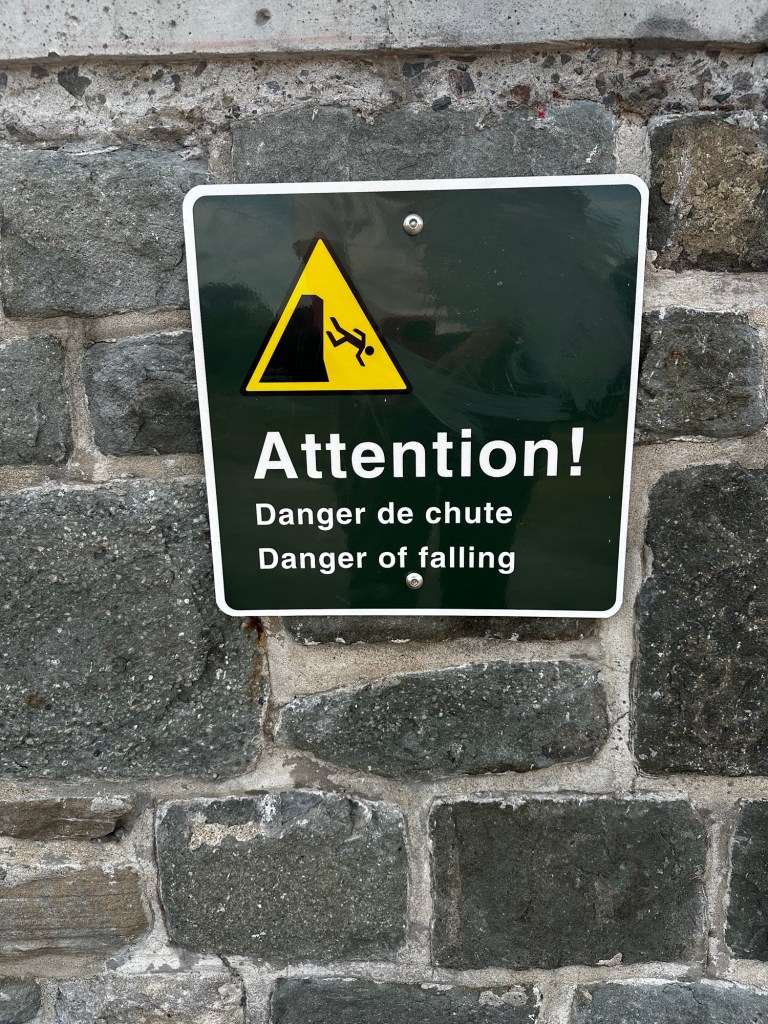
Instead of railings, we had signs.

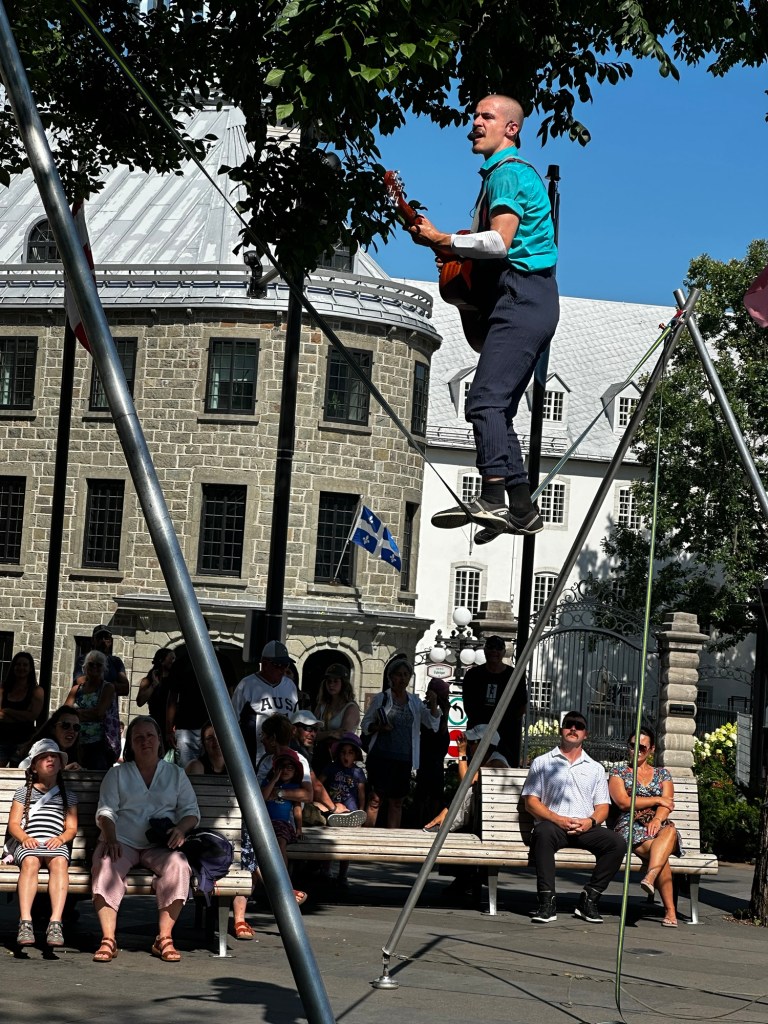
Because we were here in the weekend, there were lots of street musicians and entertainers.

My assessment: Quebec City is lovely in the summer, and a great place to visit, but once is enough for me.

On to Montreal!

Jewels of Bohemia

As usual, I was so busy having fun that my blogging got WAY behind my travels. I’m home now, getting ready to hit the road again, and I realized that if I don’t do a post about this trip, I will probably forget where I was and what I did. I have lost count of the number of times I’ve had to look up something on my blog to jog my memory. Oh, a mind is a terrible thing to lose.

As I mentioned in earlier posts, the pre-trip to Berlin was fantastic. We had one more stop, in Dresden, before we joined the rest of the group in Prague for the main trip.

It was hard to believe that so much of Dresden was destroyed by Allied bombs during WWII.

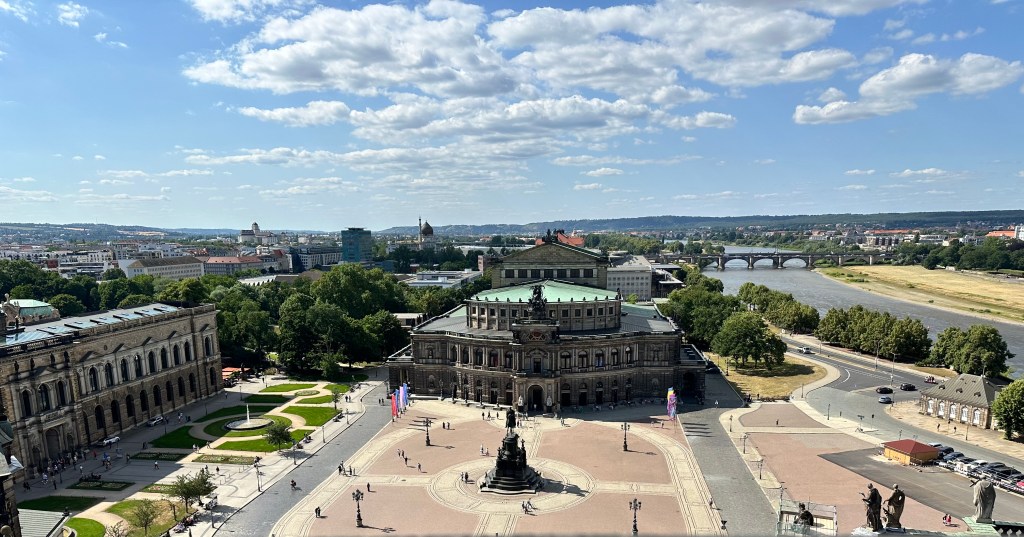
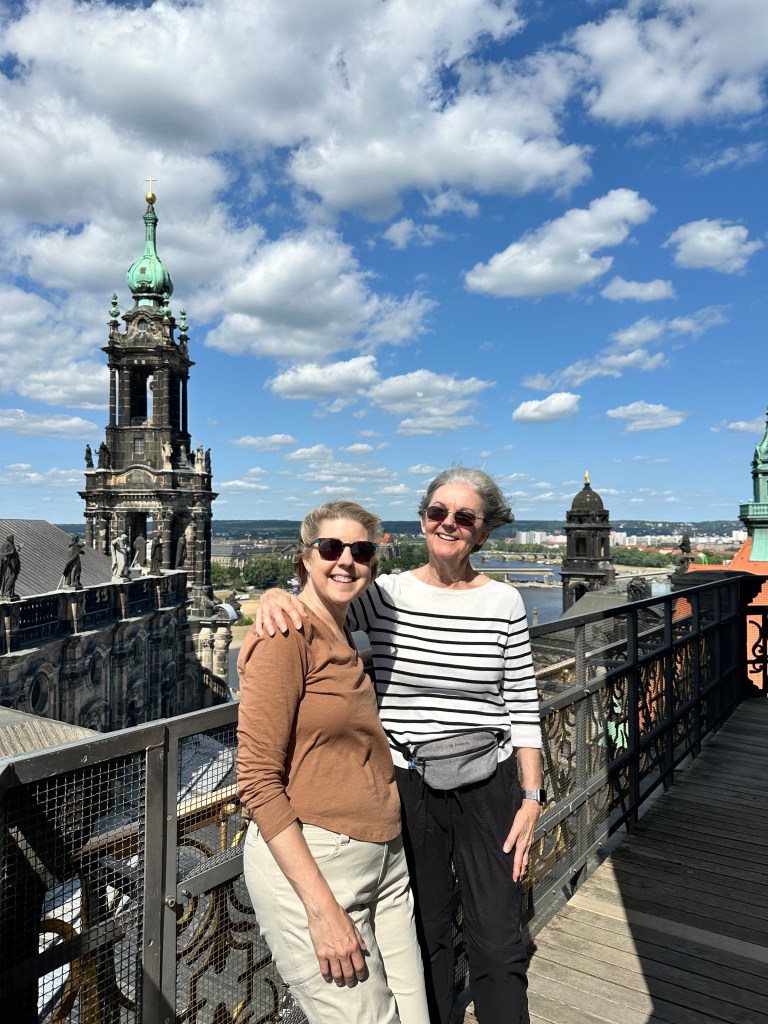
As usual, Barb and I found a high point in the castle that afforded us an excellent panoramic view of this delightful city.

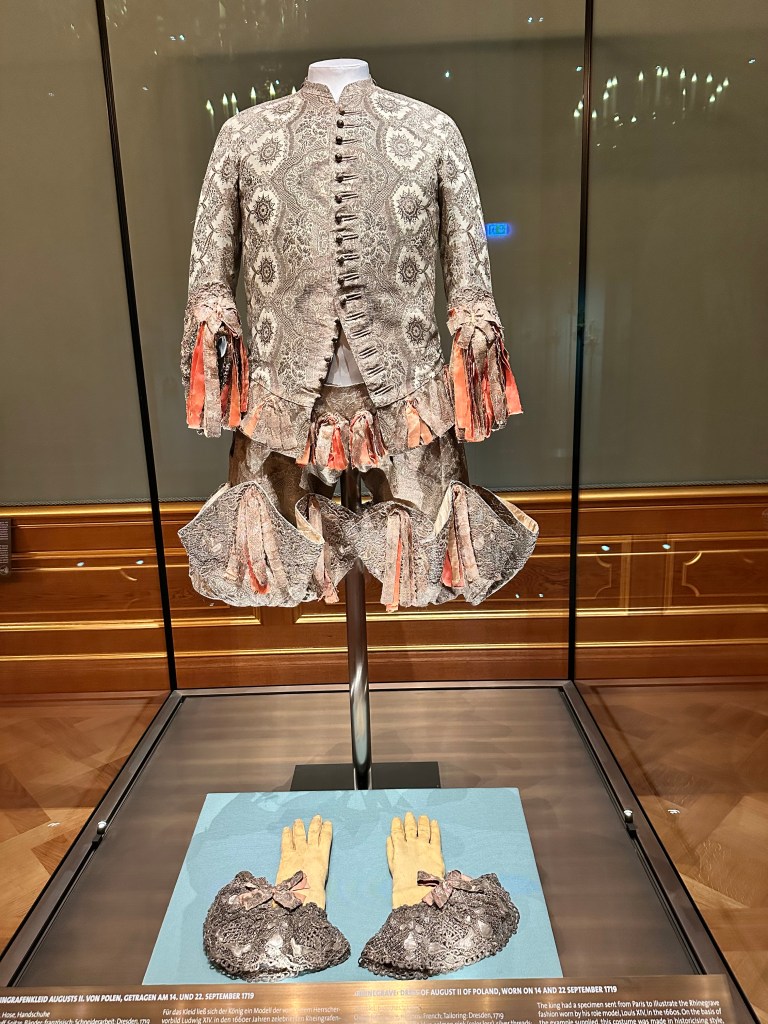
In addition to climbing the Castle tower, we also toured the Castle Museum. All I could think about when I saw the exhibits, was how many people must have died, either from starvation or in battle, for royalty to collect all these gold do-dads and fancy clothes.

During the two evenings that we spent in Dresden, we enjoyed people watching in the main square, where there was live music and dancing.

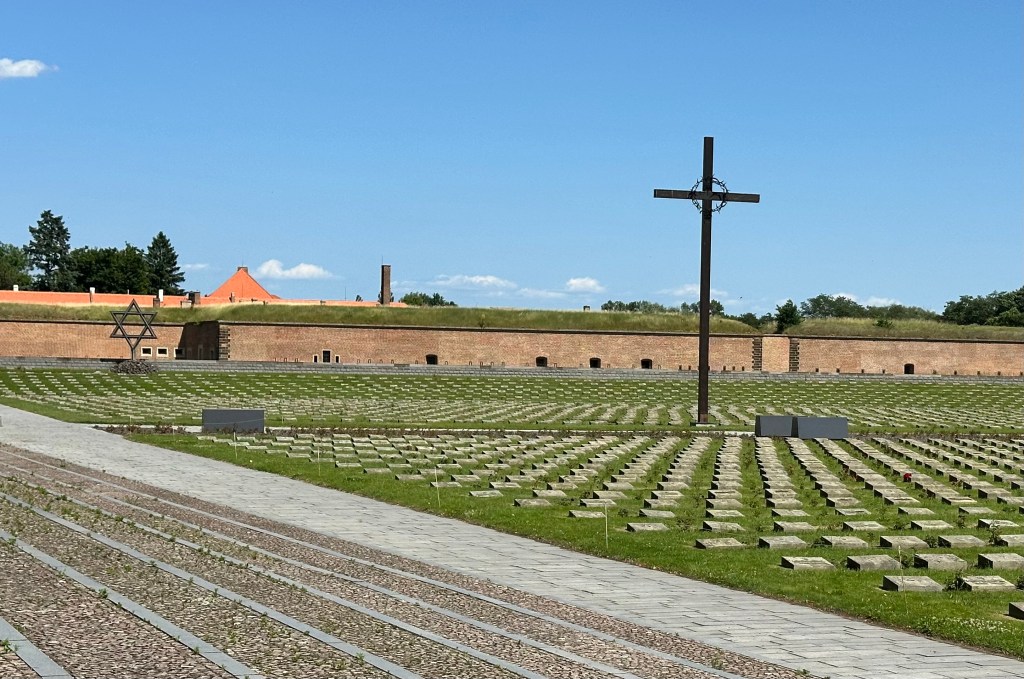
On our way to Prague, we stopped at Terazin, which was a Gestapo prison during WWII. It was sobering to see how widespread cruelty to other humans is.

Prague
I visited Prague for the first time in 2014 with Vermont Bike Trips. Although I did see some of the same sights again, like the Charles Bridge, the astronomical clock and the castle,

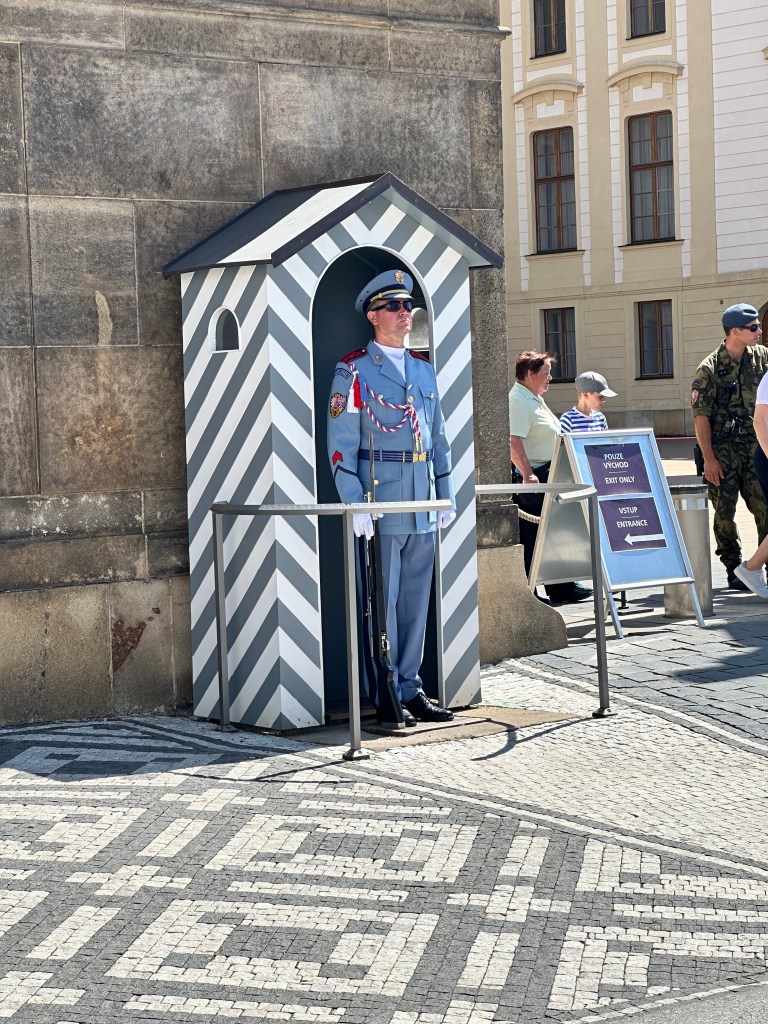
This soldier didn’t move at all, which led us to question whether he was real, or a mannequin. Turns out, he was VERY real, but capable of complete stillness.

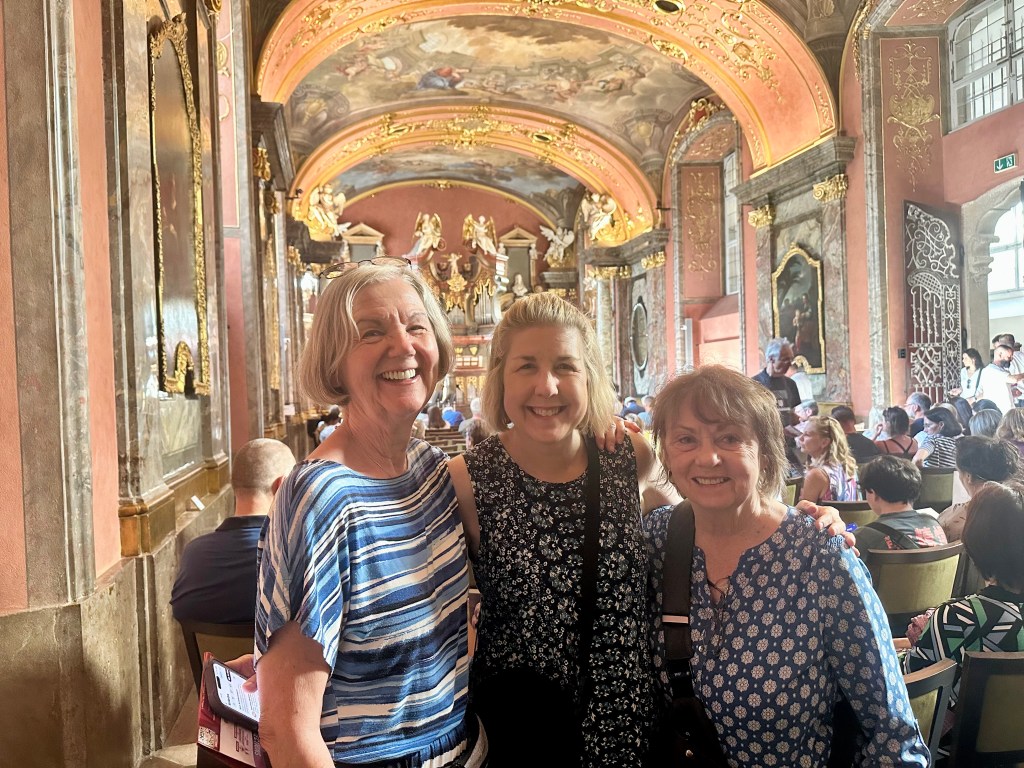
there were many new experiences, such as the delightful concert in the Mirror Chapel.

I love the blend of scheduled and unscheduled time on OAT trips.The free time allowed us to attend the concert and have dinner at the Blue Duckling, which was recommended by our dear friend Elena.

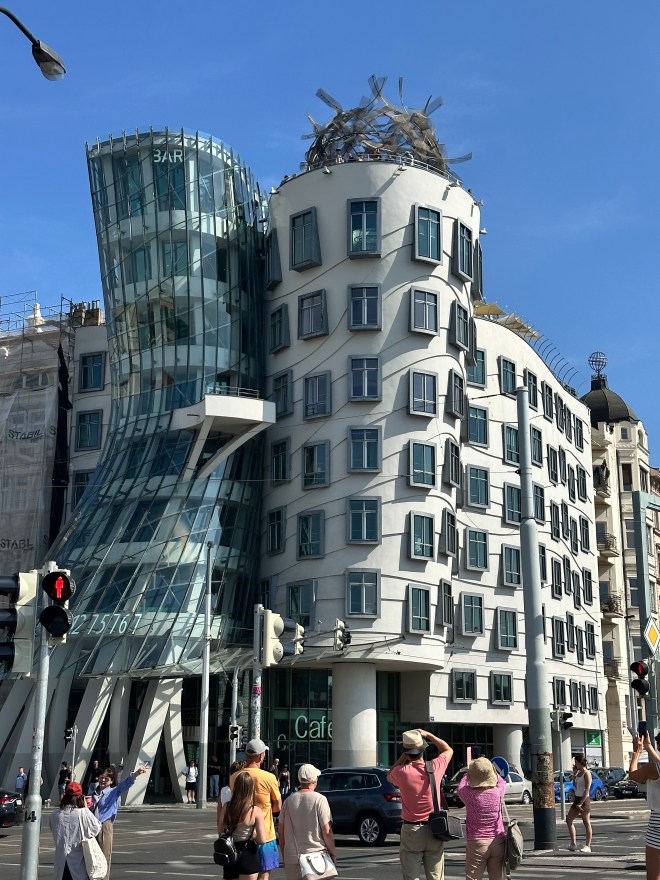
I recalled visiting the “Fred and Ginger” building on my VBT trip, and I enjoyed it enough to return. It has since been renamed The Dancing House. (Fred and Ginger was deemed “too American” a title).

When I visited in 2014, There was no elevator–but the walk up the stairs had lots of “interesting” art on the walls, such as this magazine cover.

Now, an elevator whisks you to the bar on the top floor, and if you want to go into the “hat” to enjoy the view, you now have to pay for that privilege.

The hotel that OAT chose, the K+K Hotel, was centrally located and was quite beautifully decorated, with a quirky elevator that motivated me to take the stairs.

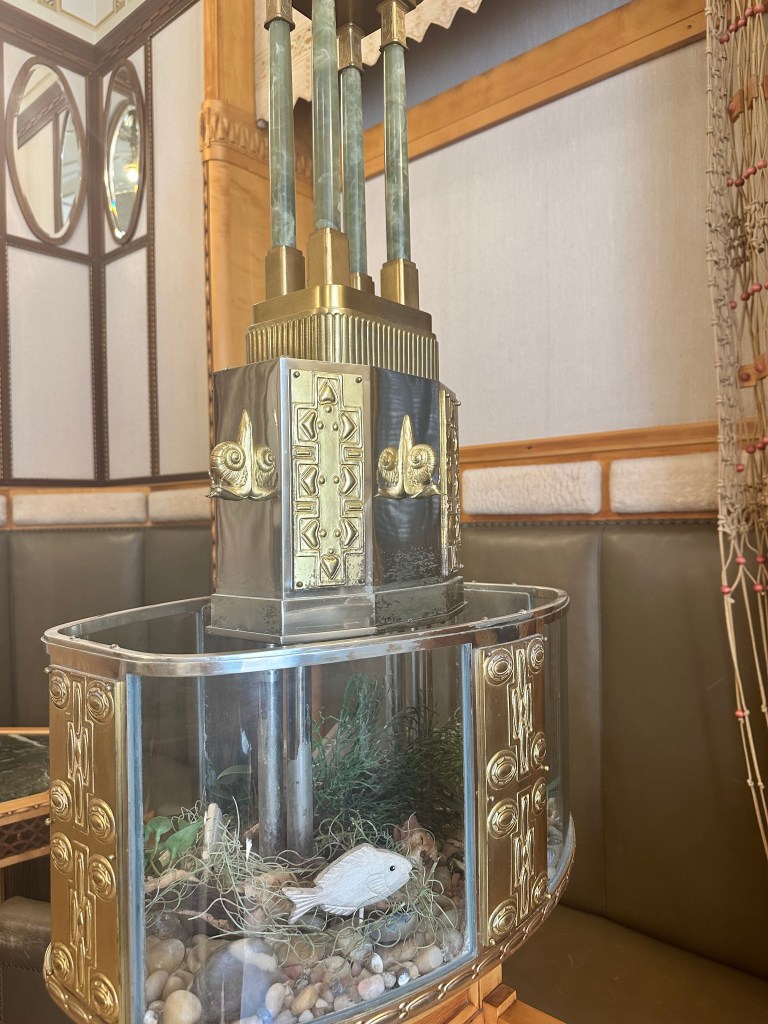
If Art Deco is your “thing” be sure to tour the Municipal House, which is LOADED with art deco treasures.

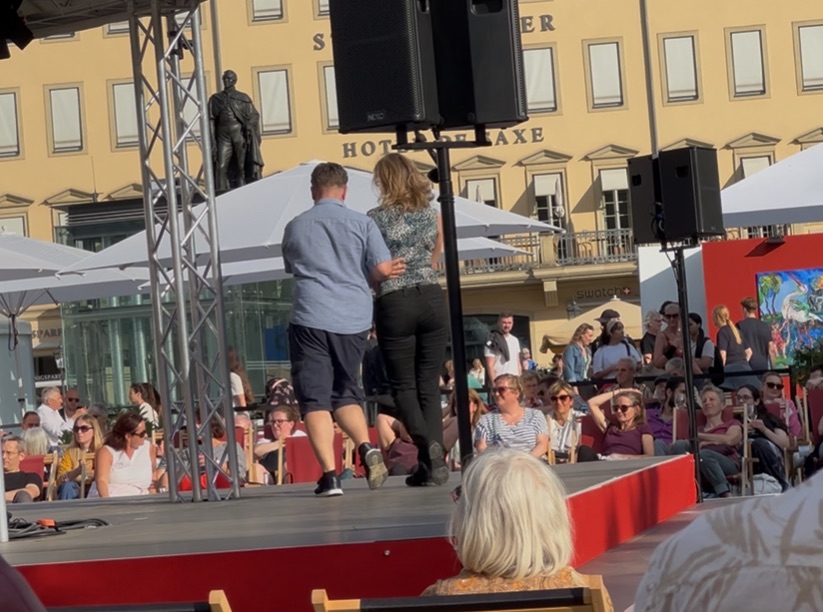
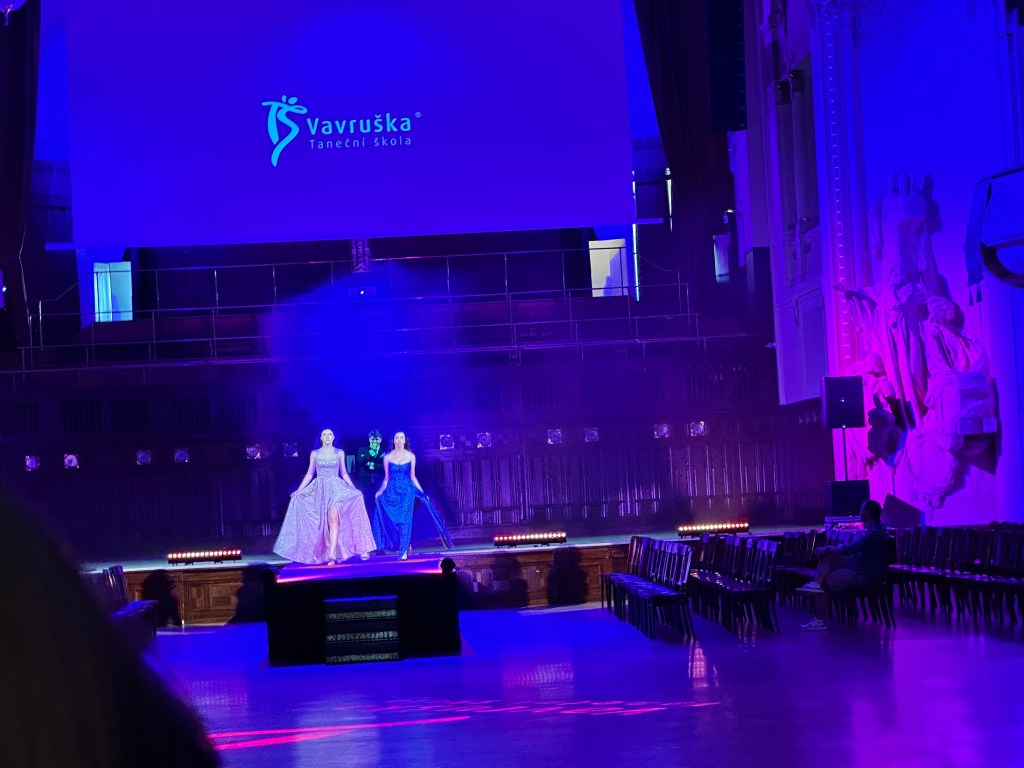
We were lucky enough to be there to catch a fashion show rehearsal, but I found the hairdos of the three little girls on the tour equally fascinating. I can’t imagine how long it took their mom to create those designs on her little girls’ heads!

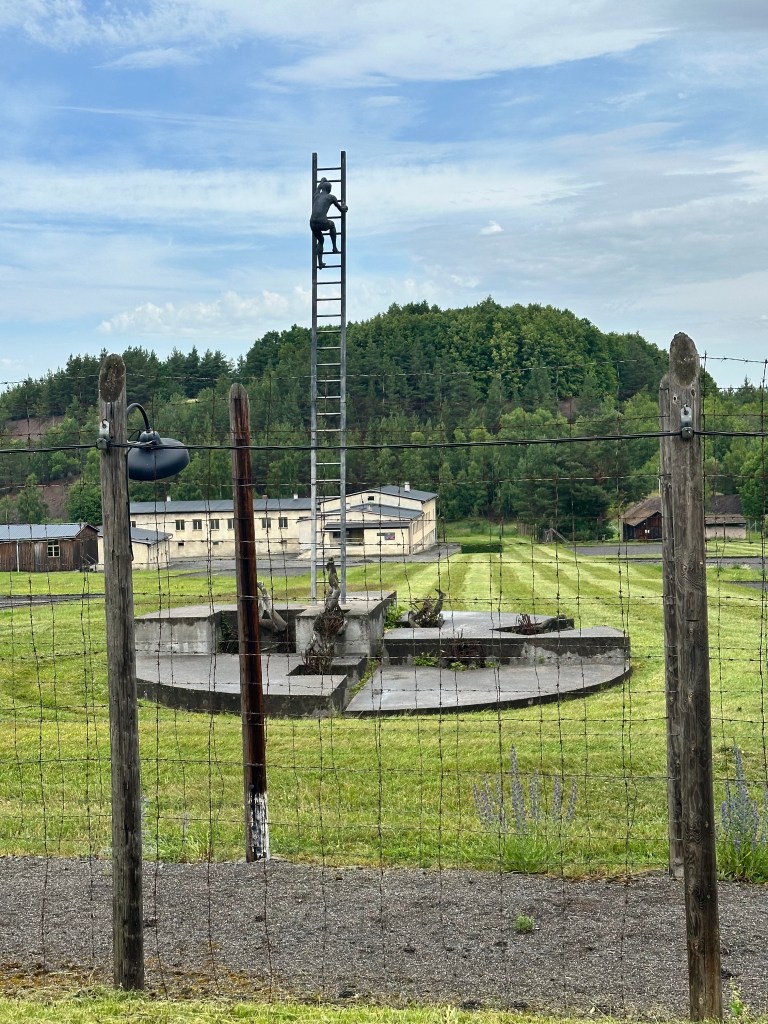
After three days in Prague, it was time to move on to Cesky Krumlov, but on the way, we had another grim stop, this time to a Soviet prison camp in Vojna. It was originally build by German POWs as a labor camp near the uranium mines, but then transitioned into a Communist labor camp for political prisoners. The poor Czech people were getting hammered from extremes on the left and the right!

I visited Cesky Krumlov with VBT, but the emphasis was clearly on biking. It was nice to have time to explore the city on foot. Because I have discovered I have a strong preference for the OAT itinerary, I’ve decided that my biking days are over.

The hotel that OAT chose, the Ebersbach was perfectly located, so that we could walk everywhere. The included breakfast sucked, but the location was perfect and my room was lovely.

OAT gave us a voucher for entry into 5 area museums and enough free time for us to enjoy them on our own. Barb and I visited four of them, skipping the monastery.

Of course, after we had visited the Castle Museum, we had to climb to the top of the tower for a panoramic view.

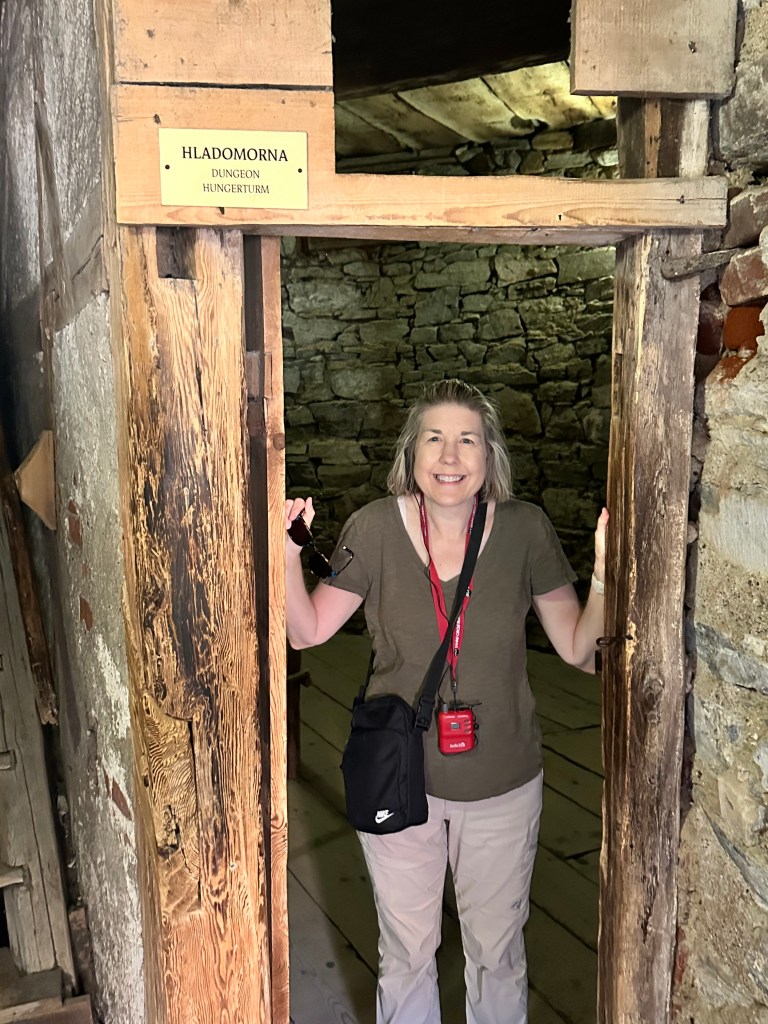
Let me tell ya, it was NOT an easy climb up those narrow, uneven stairs. Barb stopped to explore the dungeon and I caught my breath while I was taking her photo.

Bratislava
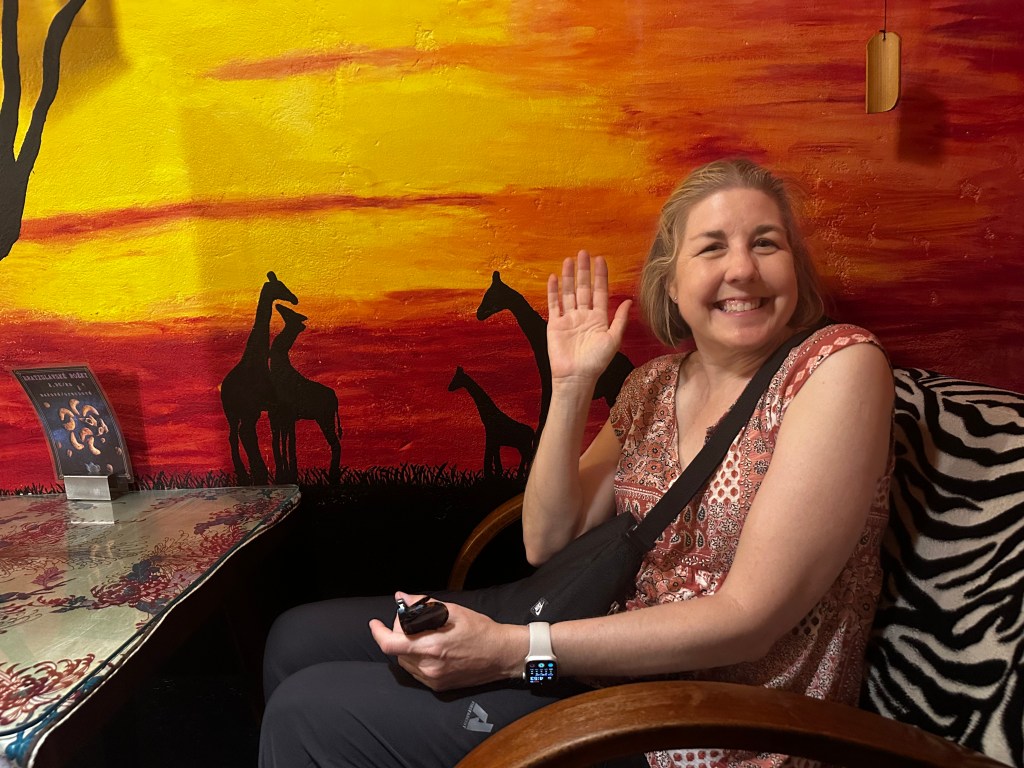
The next country we visited after our adventure in Slavonice, was Slovakia. I absolutely LOVED Bratislava. Where else can you have tea in a bomb shelter that has themed rooms? Can you tell that Barb and I were in the “Africa” room?

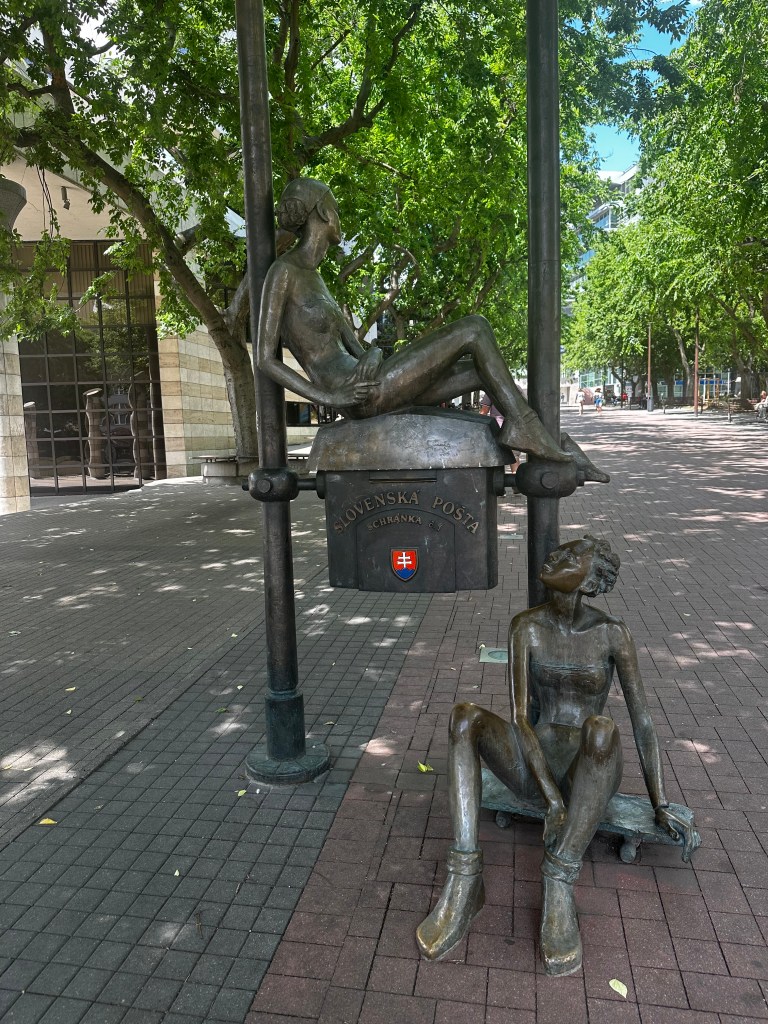
Whimsical art was EVERYWHERE in Bratislava. Check out their postal box. Now THAT’S creative.

I LOVED the Slovakian sense of humor!

As usual, our drive to Budapest was broken up by an interesting stop. This time, we visited Roman ruins at Carnuntum. Mike would have been in his glory here, but since I didn’t have him to explain the historical impact of this site, I had to rely on our guide and the signage.

Budapest
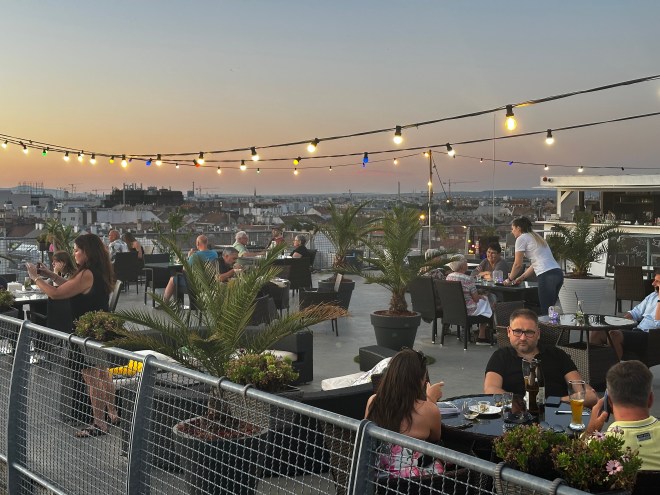
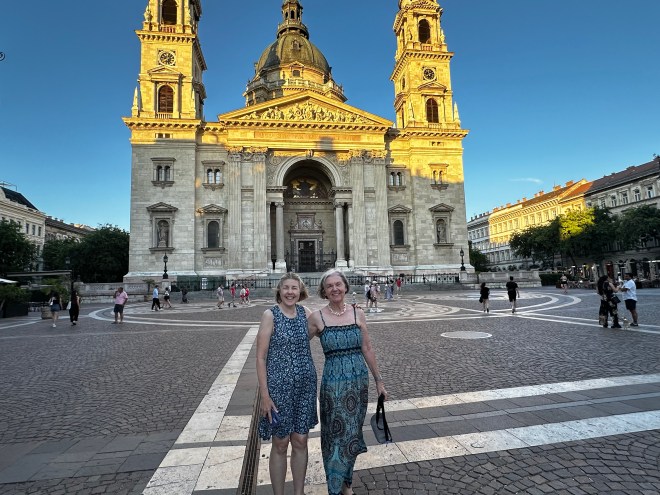
It is almost time for me to leave for the airport for the next trip, so Budapest will not get the attention it deserves. What a wonderful city! Not only was the Hotel President Budapest well located, but the delightful rooftop bar was the perfect gathering spot from which to watch the sun set.

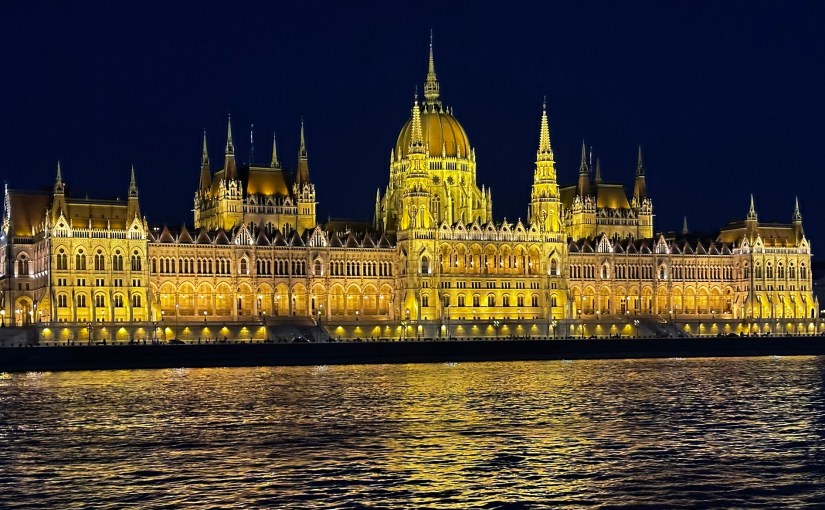
Speaking of sunset, we also experienced the Danube by night. The photo atop this post was taken on our evening cruise.

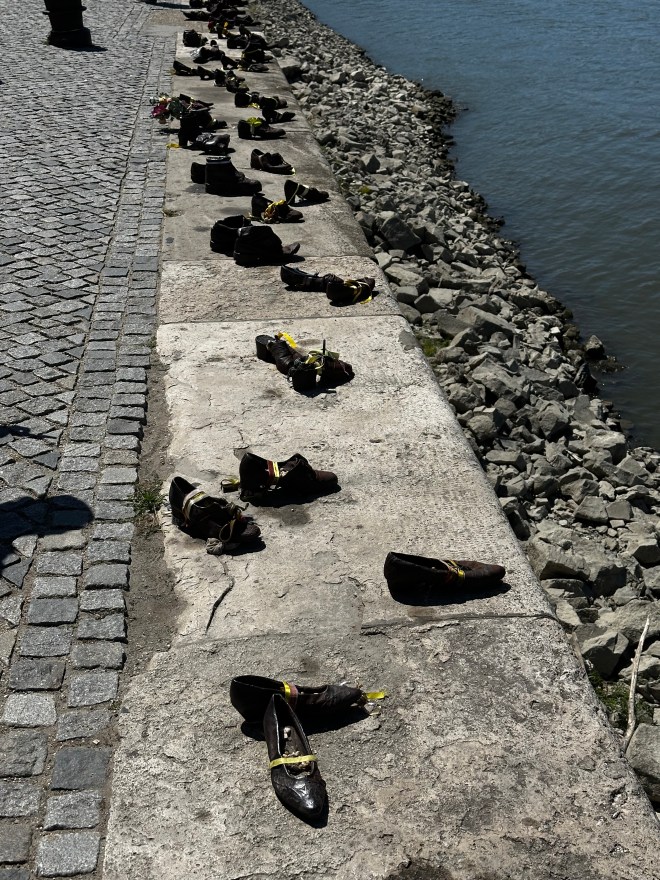
As was the case with the other countries we visited, Hungarians don’t shy away from the hard lessons of the past. This shoe monument memorializes the Jews that were forced to line up along the Danube, strip naked (during the winter) and hold hands. The Hungarian Nazis wanted to conserve bullets, so they only shot the second or third person, and because they were holding hands the others were pulled into the water by the ones that had been shot.

We were able to walk just about everywhere, which is probably why I didn’t gain my usual 5 “trip” pounds.

I have been lucky to find interesting companions on all my OAT trips. And this was no exception. For one of our nights in Budapest, Barb and I had dinner at a nearby restaurant with our new buddies, Linda, Marleen and Gail.

I had expected more reverence to be shown to Ronald Reagan because of his “Mr Gorbachev, tear down the wall”speech. FINALLY, as we were getting ready to head for home, we encountered a statue in his honor.

I’ll end this saga with a group photo. Next trip— Canada. I hope you’ll come along!

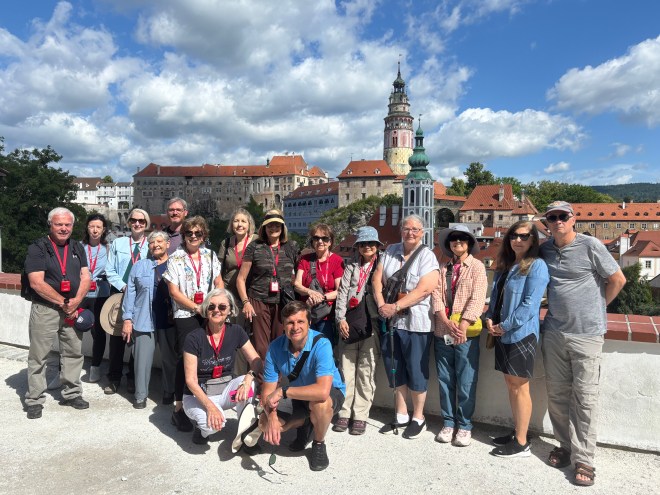
Our group: front me and Tomas Back row:Bill, Gail, Brenda, Jan, Brian, Diane, Barb, Marleen, Linda, Amy, Darlene, Patty, Lynn and Greg

Slavonice, Czech Republic

What? You never hear of Slavonice? Neither had I, until this trip. Centuries ago, however, Slavonice was a “happening” place. On the road between Prague and Vienna, it was a popular overnight stopping point for travelers.

Check out the “graffiti” that still exists on the buildings in “old town”.

One of the reasons I keep choosing to travel with OAT is because of hidden gems like Slavonice, places I would NEVER have discovered on my own.

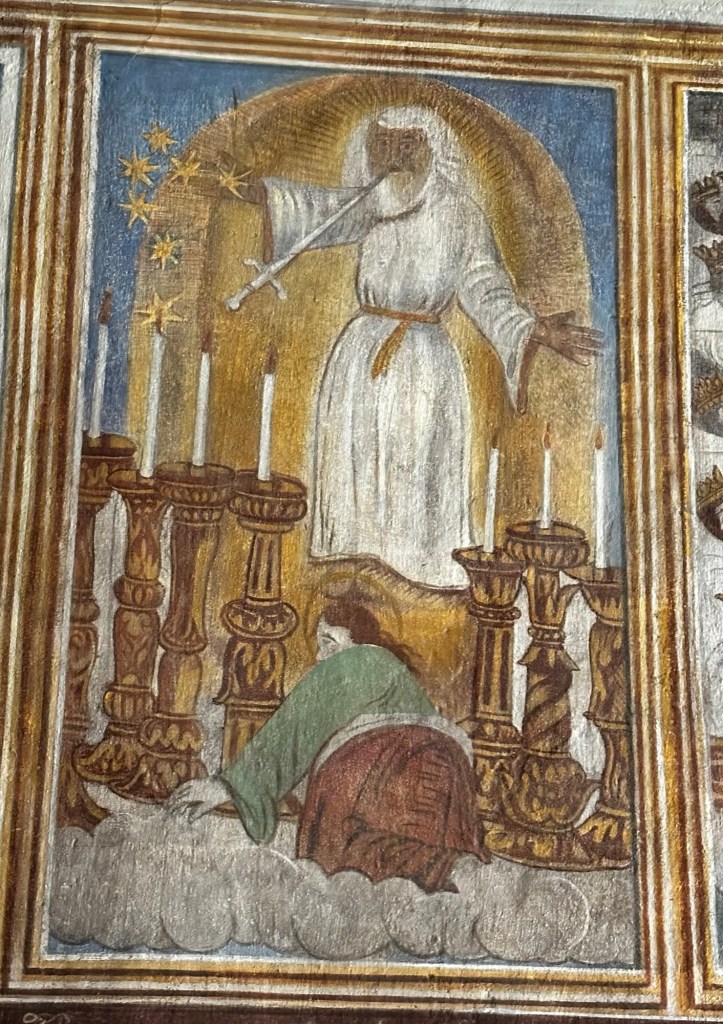
We were able to visit a beautiful restored building that was once used as a gathering place for the Lutherans. Supposedly this artwork illustrates that Jesus’ word is more powerful than the sword. Clearly this artwork was done well before both world wars.

Can you believe the ceiling in this building? How did they DO that?

We were the only guests in a lovely little hotel in old town, complete with a restaurant and wine cellar.

Here is Pavel, the owner, chef, wine merchant, cleaning crew, sommelier, ( he’s EVERYTHING!) greeting Tomas, our guide and welcoming us to his hotel.

Our first evening was memorable indeed. The town lost electricity during a hailstorm and with roads flooded, Pavel had to figure out how he was going to feed us. Fortunately, his wine cellar was very well stocked, so in addition to soup and bread we were offered unlimited beverages. SOME of us took FULL advantage of what life had thrown our way.

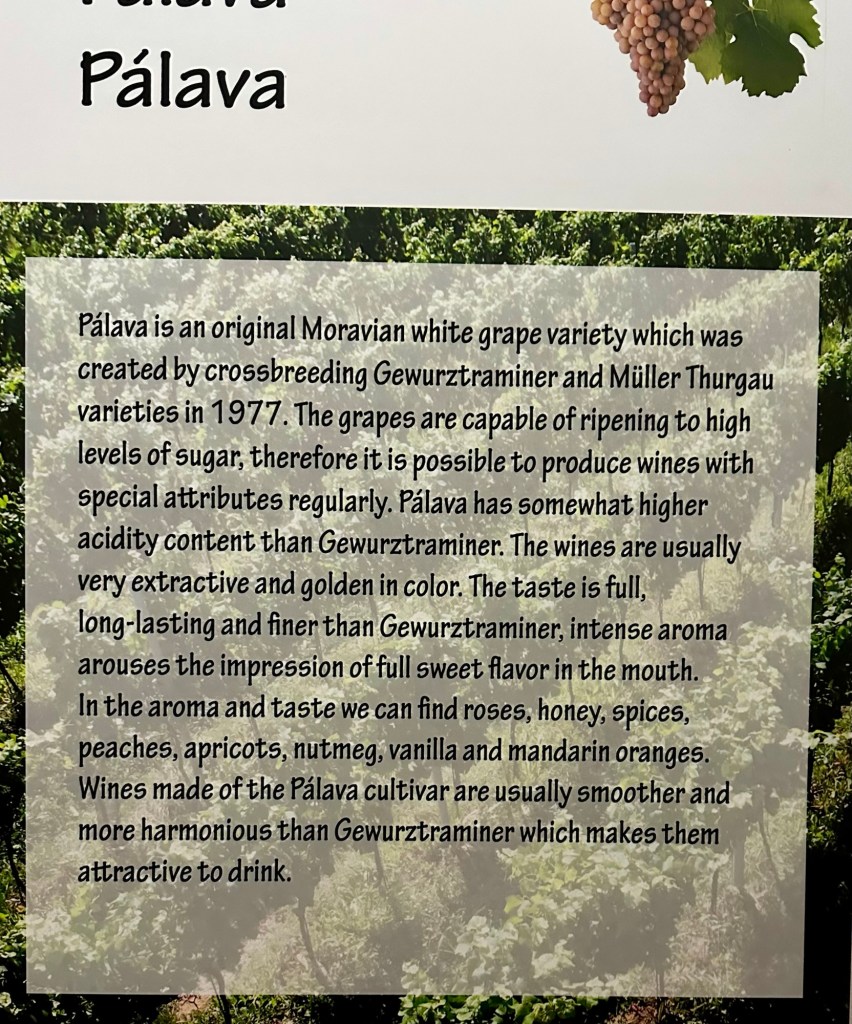
I took these photos of posters outside my room especially for my favorite sommelier (he knows who he is).

We were lucky that the 13th century wine cellar didn’t flood. The water from the storm that DID make it into the building had receded enough for us to enjoy a wine tasting on the second night of our stay.

The fact that the ceiling was dripping on us didn’t dampen our spirits one bit.

Yes, we are all bundled up— it was COLD in the centuries old basement.

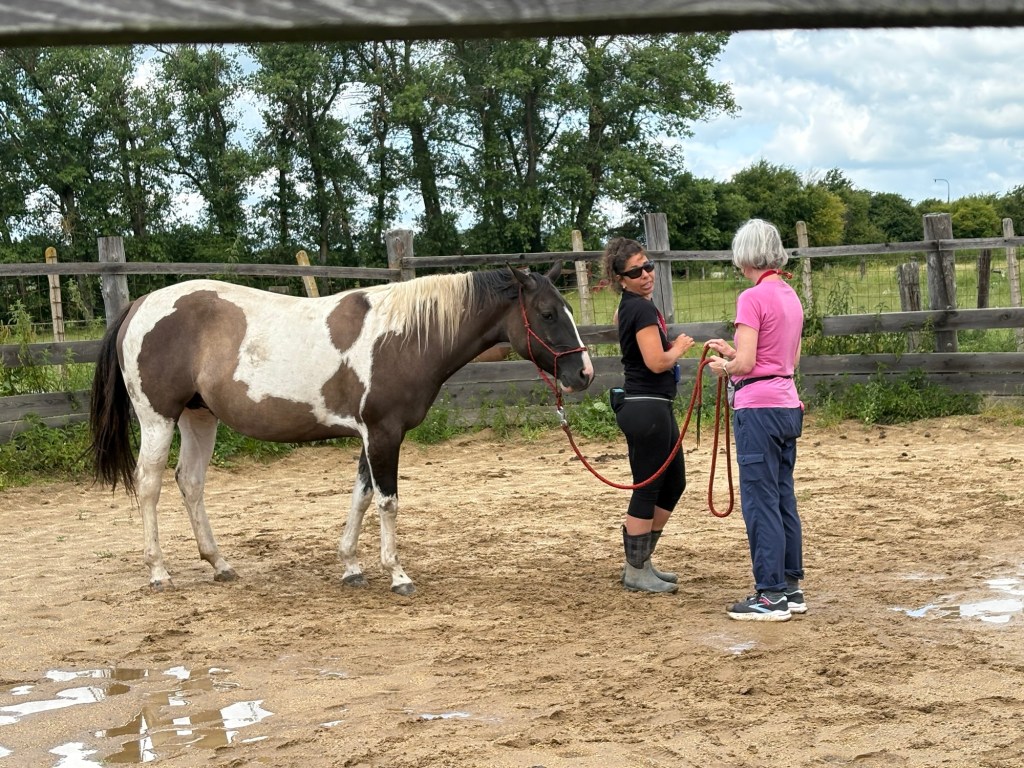
But once again, I’m getting ahead of myself, talking about dinner before describing our “day in the life” experience at a farm about an hour’s drive from Slavonice. Olga, our host, runs a horse farm.

Like my wonderful cousin Kristy, she provides a home for horses that can no longer be ridden. Her oldest horse is 30, which is significantly more than the average life span of a horse.

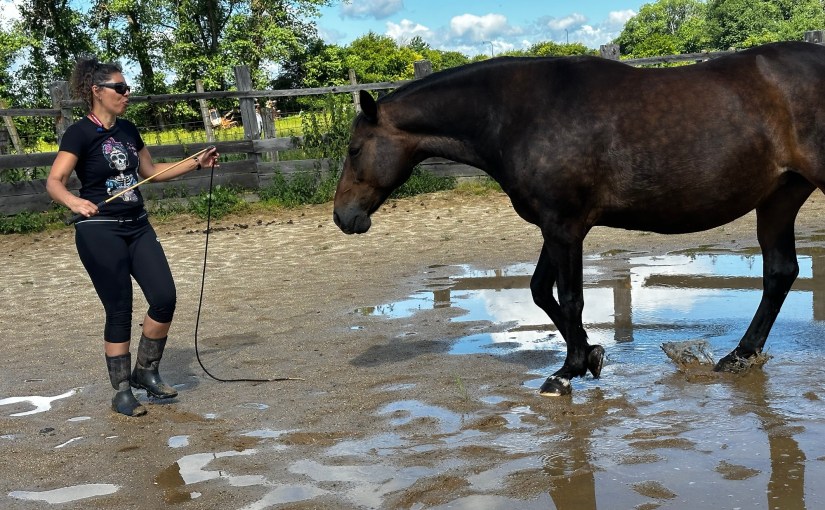
In addition to breeding horses, Olga also works with horses that are thought to be “difficult”. She demonstrated how she communicates with them using only her eyes and fingers. When she asked for a volunteer to learn the technique, I thought I was going to have lots of competition. I thought wrong.

Could the amount of water and mud have been the reason for my companions reluctance?

Being the ONLY volunteer, I got to get up close and personal with this magnificent creature, who was once thought to be “difficult”.

Olga is demonstrating the proper shoulder technique to get the horse to follow you. Nailed it!

Yes, our day time activities were fantastic, but there was even more awaiting us.

That night, we had the PLANNED dinner at the hotel,

complete with local musicians who got us singing along to “Country Roads” and “Roll out the barrel”.

Of course, the wine flowed freely, but the show stopper was when our host used a sword as his bottle opener.

On to Bratislava. Yes, I know. Add Cesky Krumlov to the list of places I’ve skipped over.

Berlin, Day 2

What a difference a good night’s sleep makes! Barb and I managed to fight off jet lag and stay awake until after 8 PM on our arrival day, so when we awoke on day 2, we were energized.

We left our hotel at 10 AM, completely prepared for whatever the day would throw at us. Sun, rain, high winds, pestilence…we were ready!

Here are some highlights of our next 12 hours.

Believe it or not, these blocks of varying heights are the Holocaust Memorial. Don’t ask me what they symbolize. Our diligent search for an explanation didn’t turn up a single plaque anywhere.

Yesterday while riding the HOHO, we saw many important buildings. Did either of us remember anything about them? Well, we DID remember seeing them, but that’s about it.

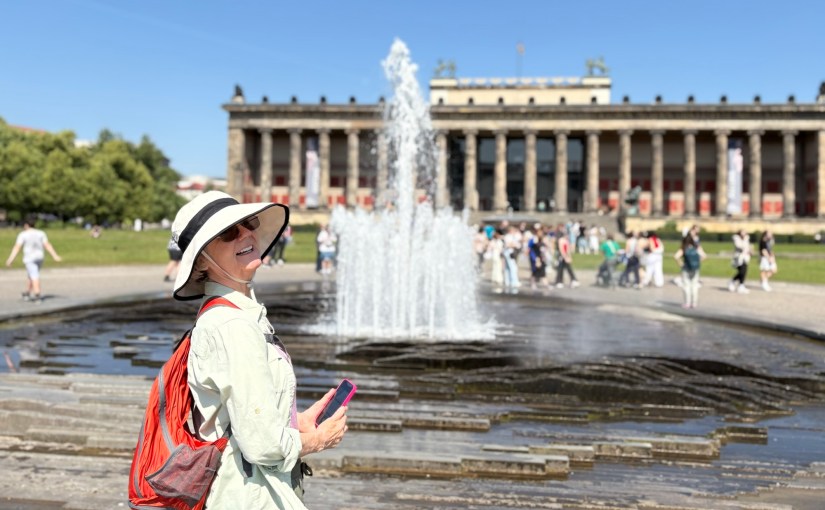
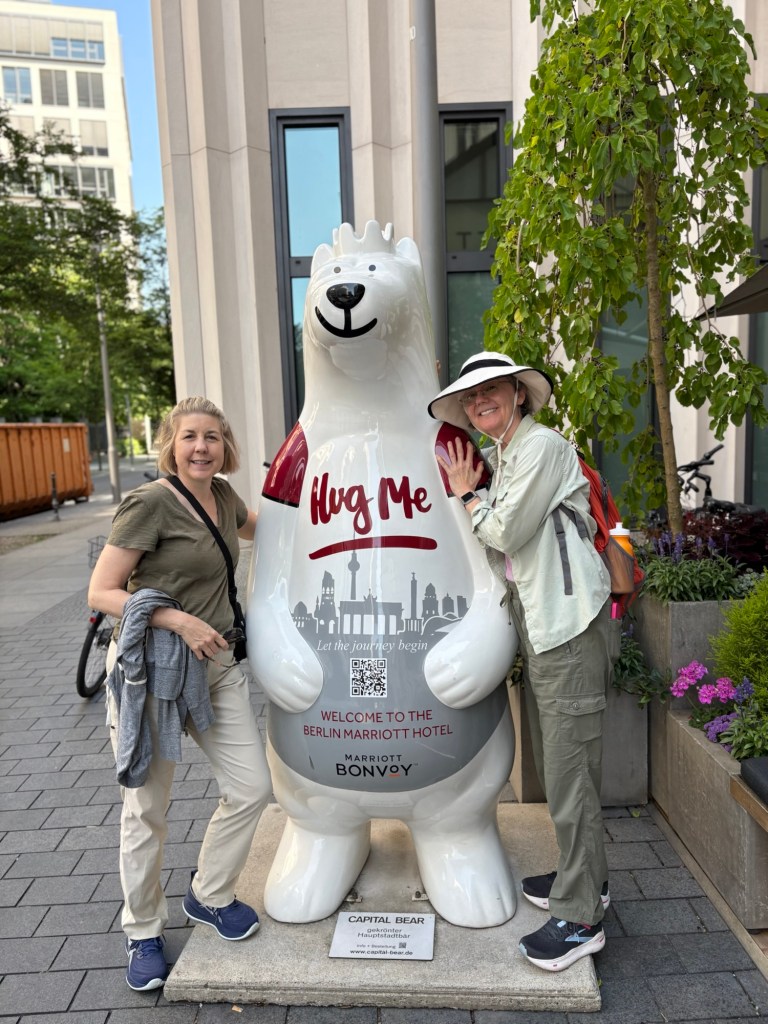
The Berliners are very fond of domes…and columns…and bears.

We thoroughly enjoyed Museum Island, even though we only visited one —the Neues Museum. Let’s face it: we have pretty fantastic museums in New York, Boston and DC. Still, the Neues Museum had some artifacts that were really spectacular. Click on the image if you want to see more.

Did you see the little Lego figure in the boat? It’s good to know museum staff members have a sense of humor.

One advantage to traveling on foot is you can stop to enjoy your surroundings. And we did. Frequently. But we still managed to walk almost 10 miles, according to my Apple Watch.

What is it about men and cars? if a hood is open, they simply HAVE to gaze inside.

I had no idea there were so many bridges in Berlin. Yesterday’s HOHO audio guide claimed that Berlin has more bridges than Venice!

I’m sure this tower commemorates some victory, but I can’t recall which one. Not a problem, because I’ll bet you really don’t care either.

The museum on the ground floor contains tiny reproductions of famous buildings from around the world, like the Roman colosseum, the Statue of Liberty and the Brandenburg Gate.

The first viewing platform has gorgeous mosaics, depicting humans attacking each other. I’m gonna take a wild guess and speculate that the artist wasn’t a woman.

The BEST part is you can climb to the tower’s top for a panoramic view of Berlin. Was it worth climbing 282 steps (I counted) up a spiral staircase?

We had a few hours till we were due to board our boat for our sunset river cruise, so we ambled along the Tiergarten, a beautiful oasis in the midst of all the concrete and high rises.

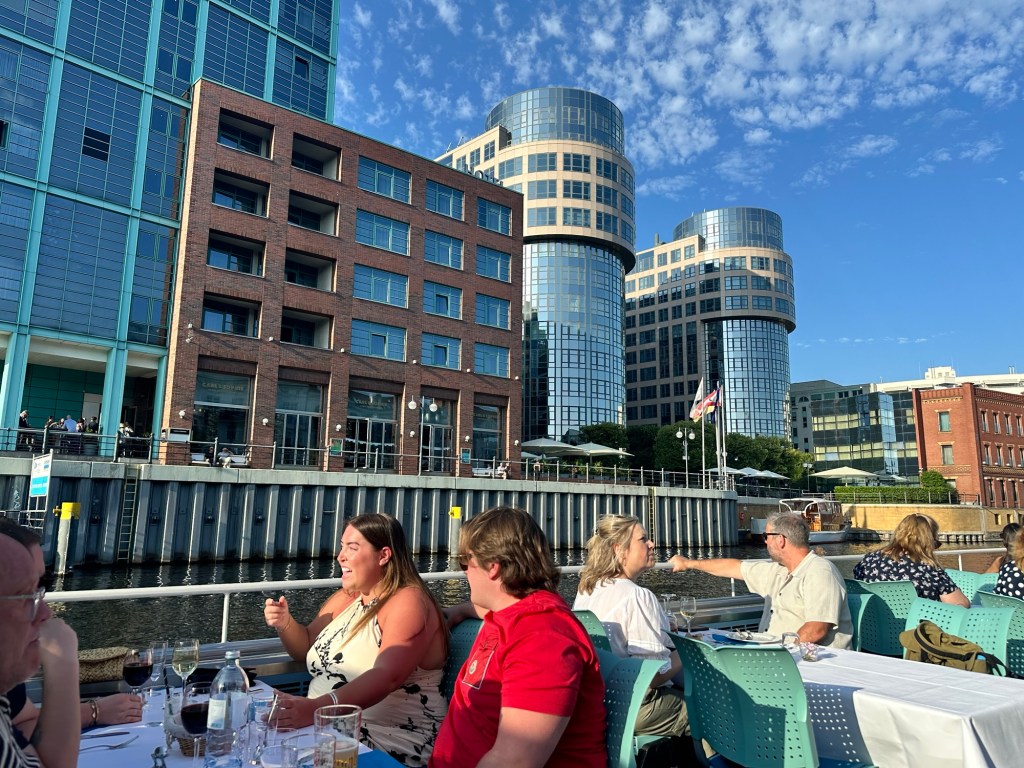
How was the boat ride? Well, it was a beautiful evening, the wine was unlimited, the 4 course meal was delicious, and we got to see Berlin from a different vantage point.

As usual, my posts are done on the fly, and lag a bit behind my activity.

Barb and I are completing our final “on our own” activity and will be joining the group tour later this PM.

Porto, Portugal

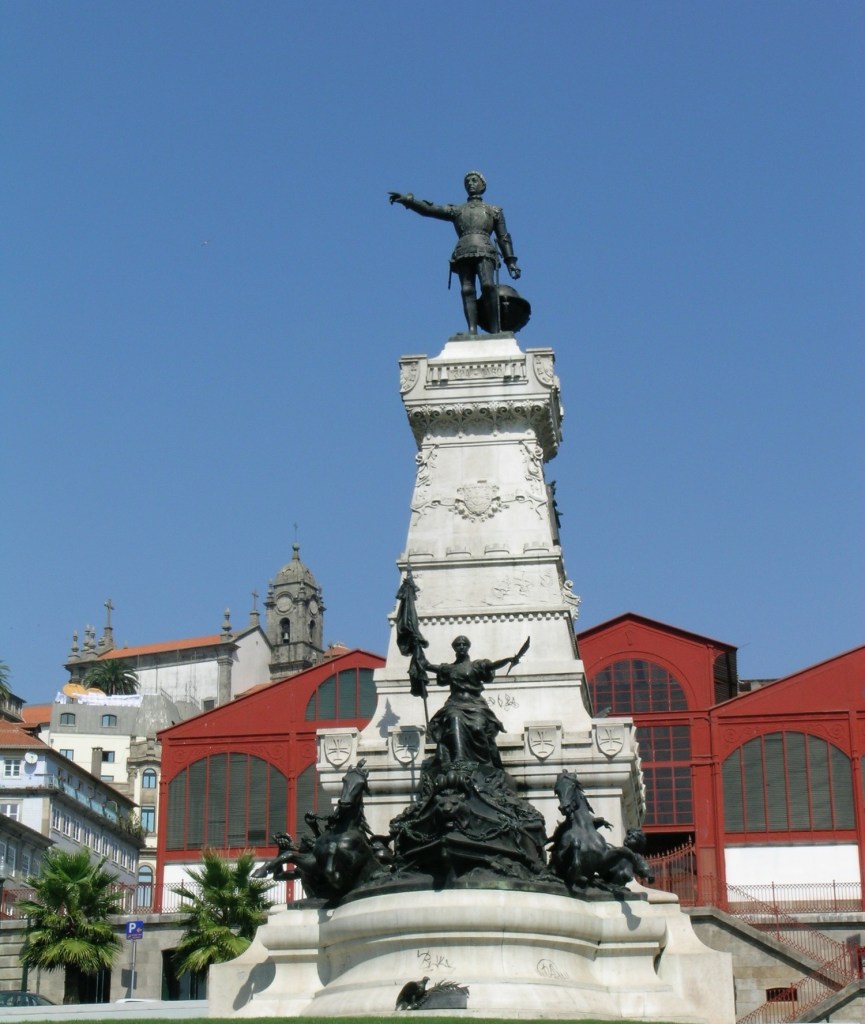
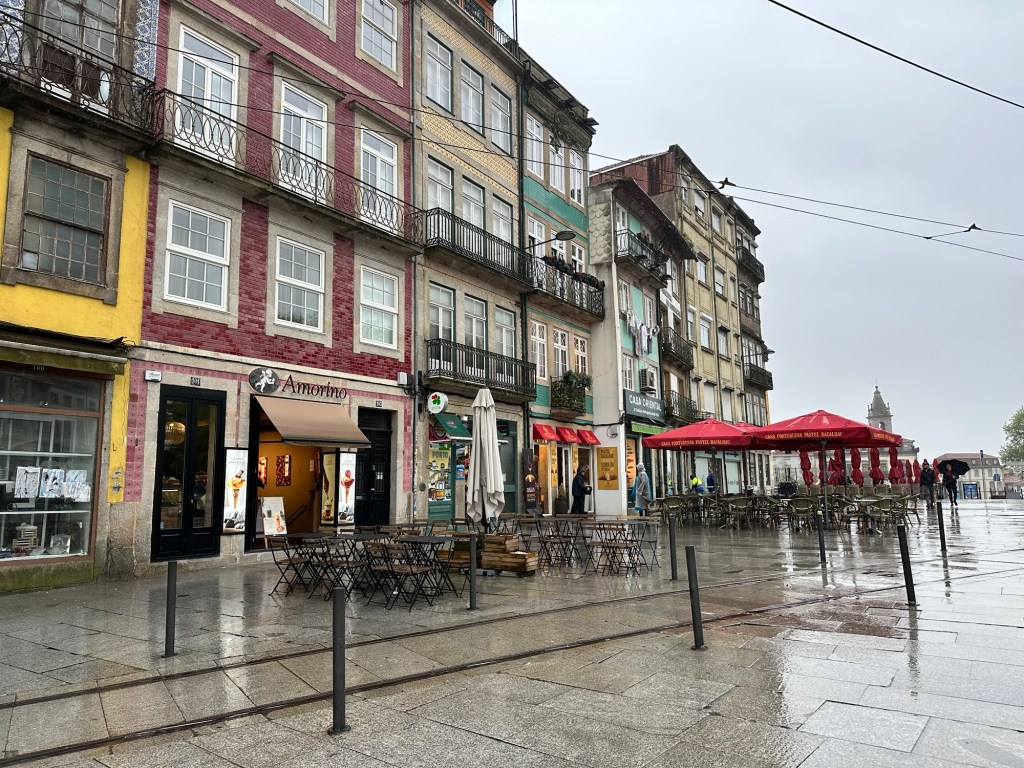
On our way to Porto, we were convinced our luck had REALLY run out. According to the weather reports, we weren’t merely encountering rain, we were headed into a huge storm! We were all glad the forecast was wrong yet again.

Although it rained during our bus ride from Lemigo, by the time we reached Porto and had finished our city bus tour, the rain had briefly stopped. The sun even came out during our walk along the river.

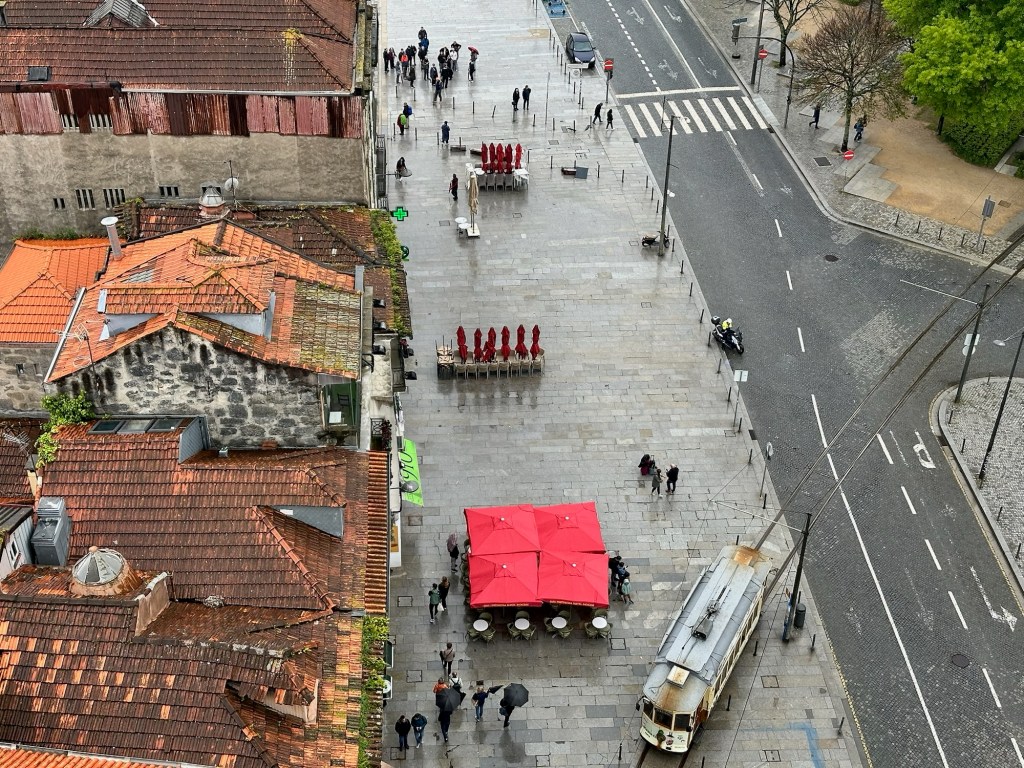
Before I left home, I had loaded photos from Mike’s and my 2003 day trip to Porto onto my iPhone. I was surprised to see how much the city had changed, and how much remained the same.

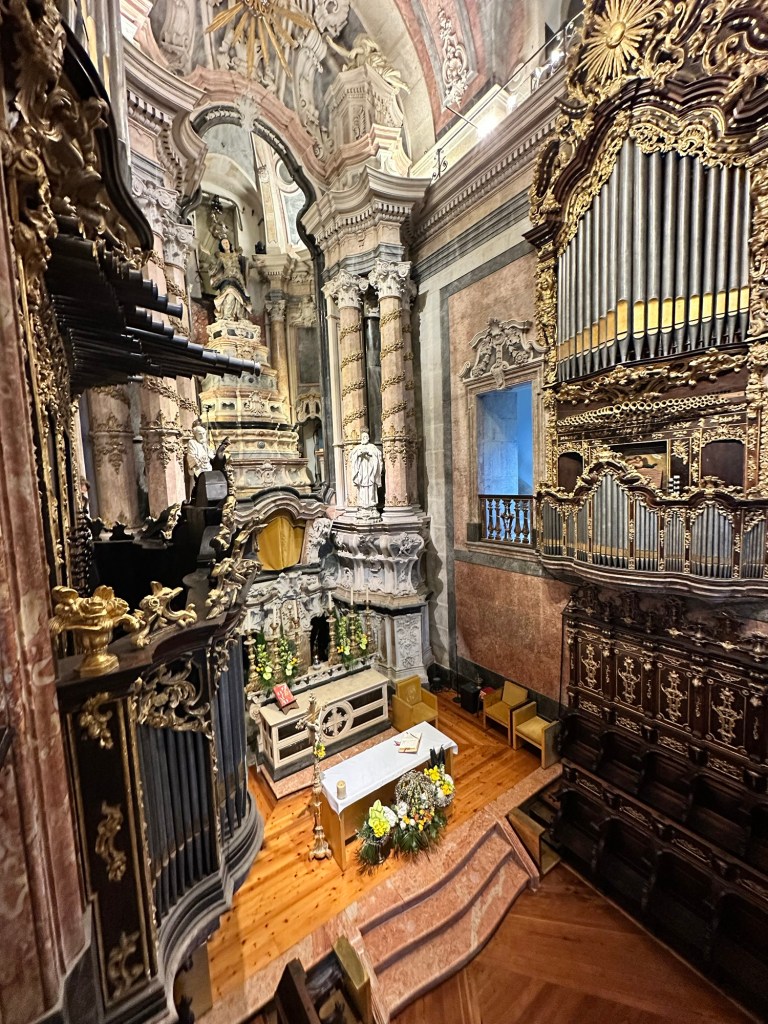
The tower that Mike and I climbed for free in 2003 was restored and updated in 2014. Tickets are required to visit what is now the Clérigos architectural complex .

Because Mike and I climbed to the very top of the tower, I thought it was the perfect spot to leave some of his ashes.

When we were there in 2003, there weren’t any “love locks”. I didn’t have a lock today, but leaving his ashes was MY way of saying “I love you”.

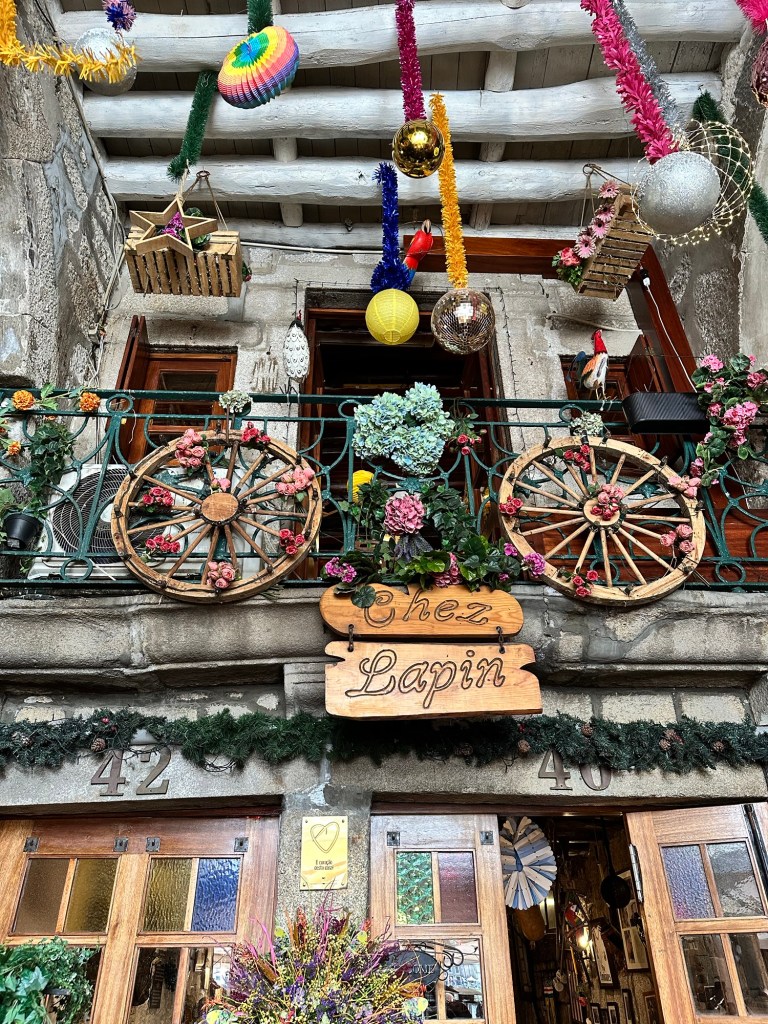
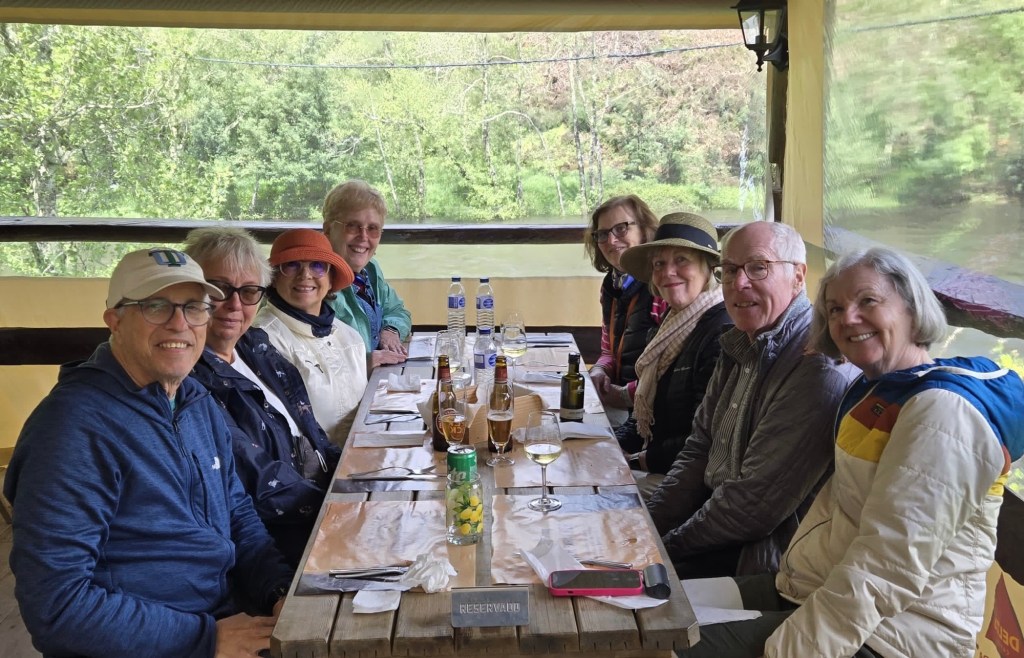
But I digress. Back to day 1 and our lunch stop at an interesting restaurant. Check out the large wooden object dangling over our table.

I’m pretty certain “the world’s most beautiful McDonalds” wasn’t here when we visited in 2003! Quite different from what we have in the USA, wouldn’t you say?

No, none of us ATE there, although the place was PACKED!

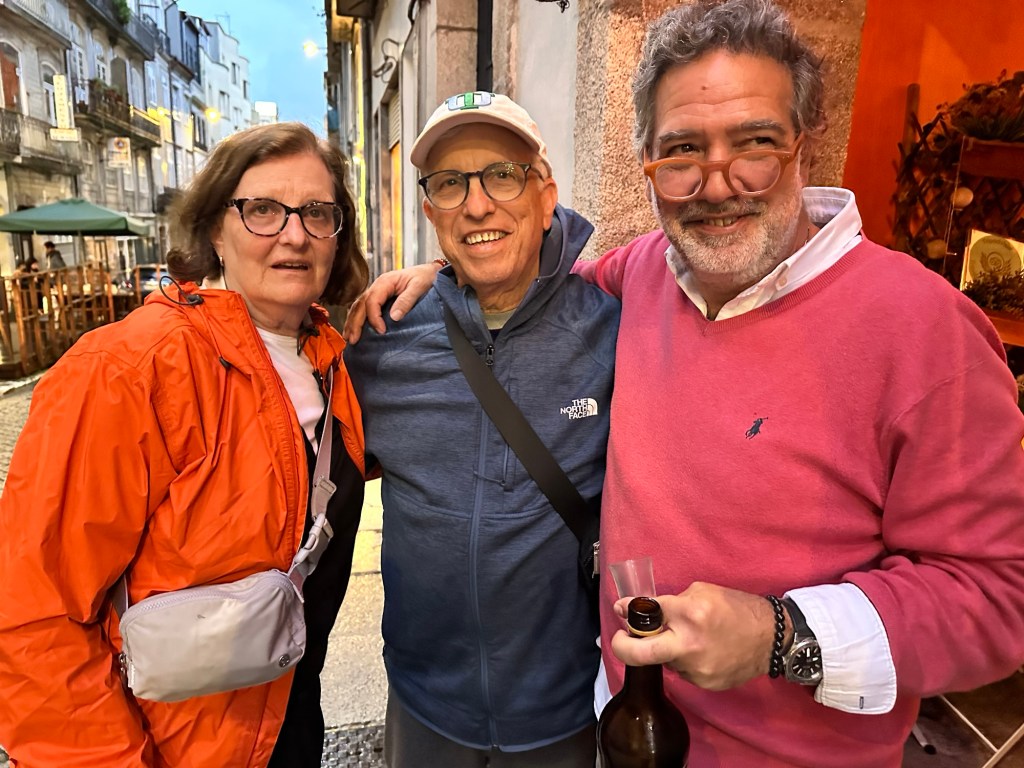
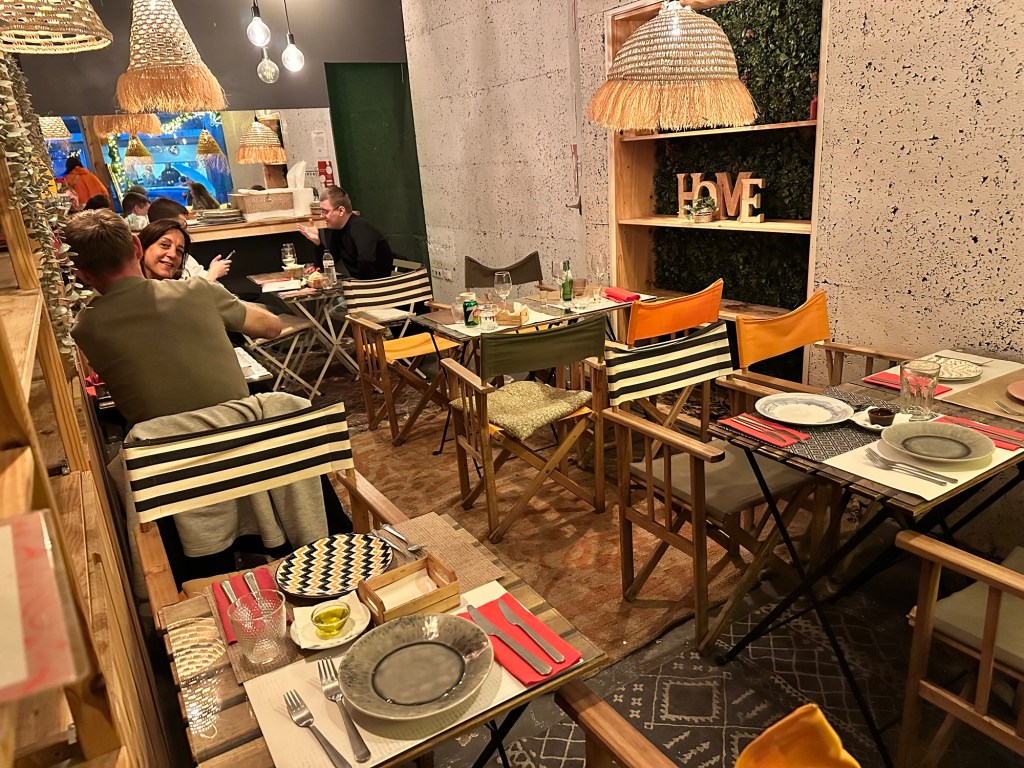
Instead, three of us had dinner at Almada 331, a tiny restaurant close to our hotel, the Turim. The food was incredible, yes. The menu was in English, yes. The cork walls made conversation enjoyable. But what REALLY made the experience off the charts was Fernando, the owner.

Both “Shelly” and Fernando had lived in Pittsburgh, so we all became instant friends. But so did the Belgians, Ukrainians, Indians and the woman from Singapore (Singaporean?) who were also dining at the restaurant. It is that kind of place. When you enter, Fernando asks where you are from, and then points out all the different countries represented in his tiny restaurant. It was truly a magical night.

In case you’re wondering, yes, it was confusing to have a male Shelly on the trip, especially because his wife Loren was one of my very favorite fellow travelers, so we spent a lot of time together.

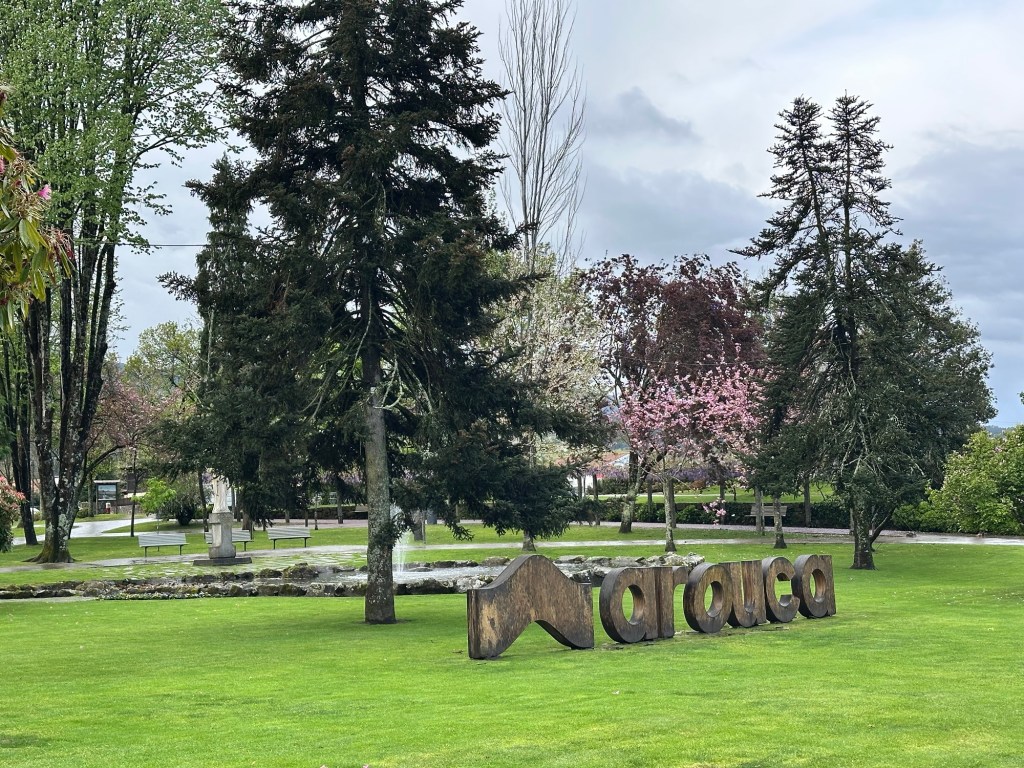
We had the option of exploring the city on our own during one of our three days in Porto, or paying $145 to visit Arouca, a UNESCO World Heritage Site. Bet you already know which option I chose.

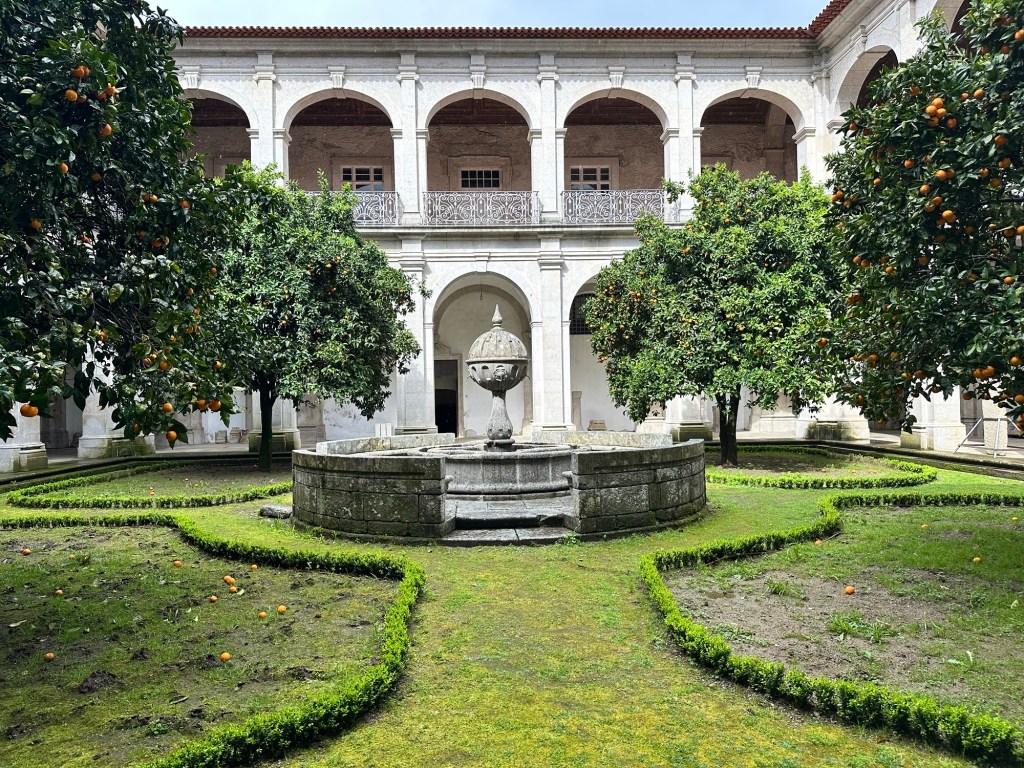
First, we visited the monastery. In the USA, monasteries are where the monks live; convents are for nuns. In Portugal, however, it isn’t gender that defines the naming convention, it’s location. Monasteries are built in remote areas, outside of cities; convents are built inside the city walls. So, although initially the Arouca Monastery was inhabited by men, by the 14th century the nuns had taken it over.

But not just ANY nuns. No, these were noble ladies from families of wealth and power, for whom a suitable match had not been found. What to do with your 18 year old unmarried daughter? Why, you pack the old maid (and one or two servants) off to the nearest convent, along with a very generous donation.

She will never be allowed to leave the convent. But don’t feel too badly for her, because rather than being her husband’s servant, she gets to meditate, walk around the garden, read, and boss her servants around. Best of all, she won’t die in childbirth, unless she uses one of the legendary tunnels to meet up with a friendly monk.

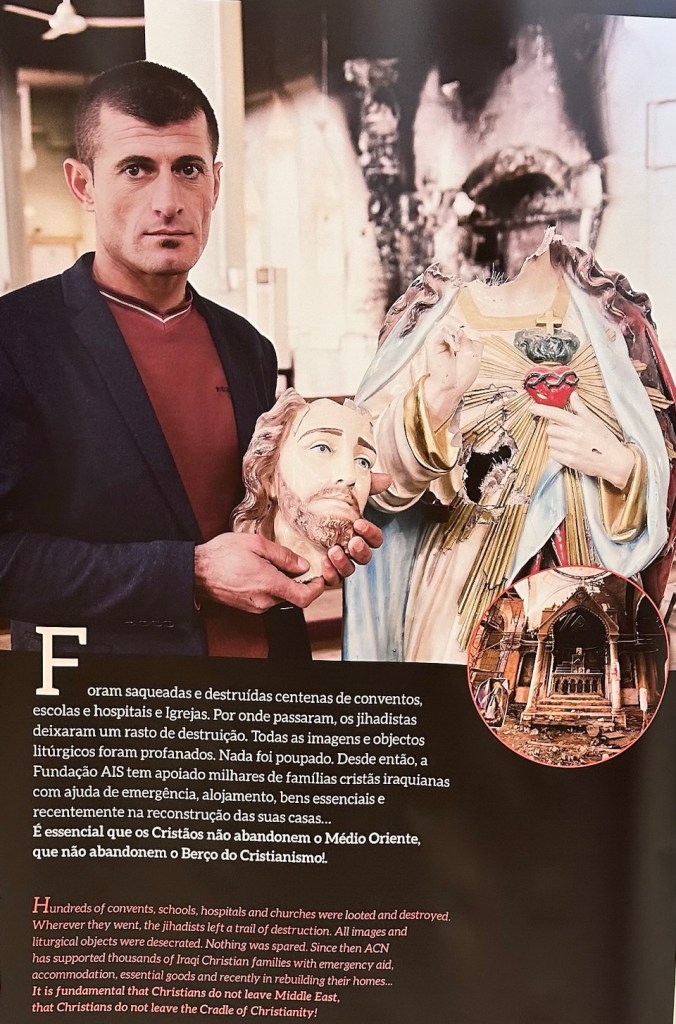
You can’t see them in the above photo, but the courtyard is lined with banners describing the persecution of Christians, like this one:

Surprisingly, no mention was made of the Inquisition, probably because it happened in Spain?

Although this “lazy Susan” was normally used for food and other contributions, occasionally a baby was placed on the shelf. Our guide told us that maybe the turnstile was occasionally spun 360 degrees. That way, it would appear the baby had been brought by a townsperson, even if it had originated inside the monastery. That’s the upside of wearing those bulky robes.

One noble lady, Queen Mafalda, was briefly married to 10 year old Henry I of Castille. When the Vatican annulled the marriage, she voluntarily entered the Arouca Monastery, where she is currently on display in the chapel.

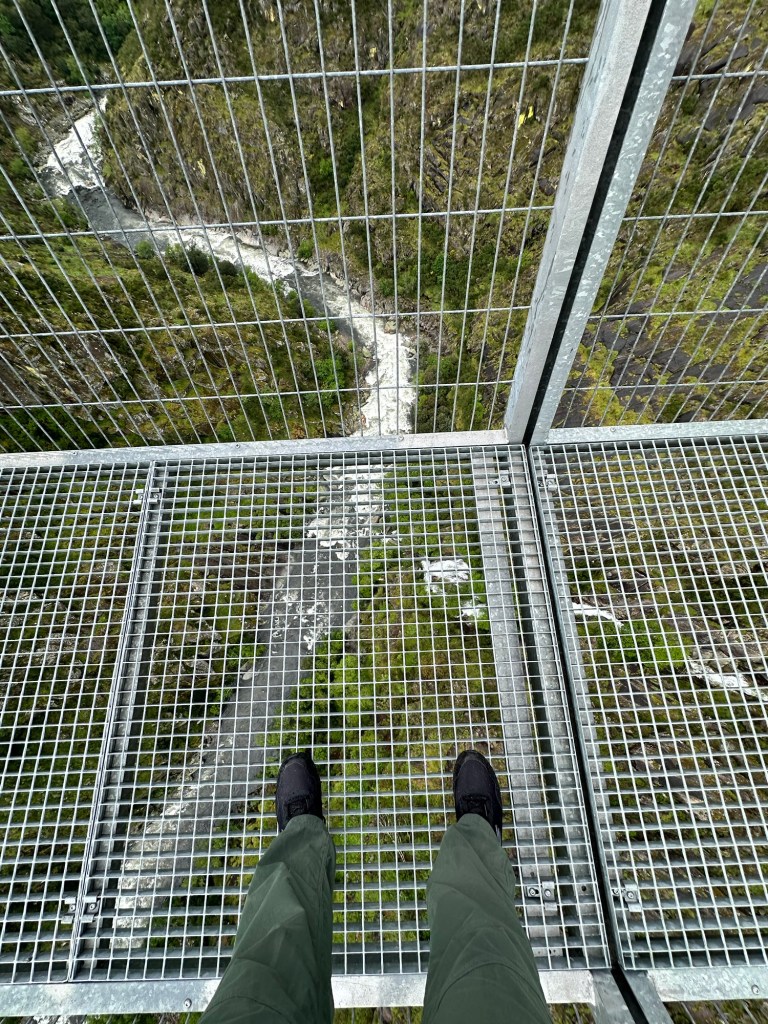
My favorite part of the day was our visit to the suspension bridge. To get there, we drove along beautiful, winding mountain roads for about 45 minutes. It was a visual feast! By the time we arrived, we were all eager to walk through the woods, over the bridge and back.

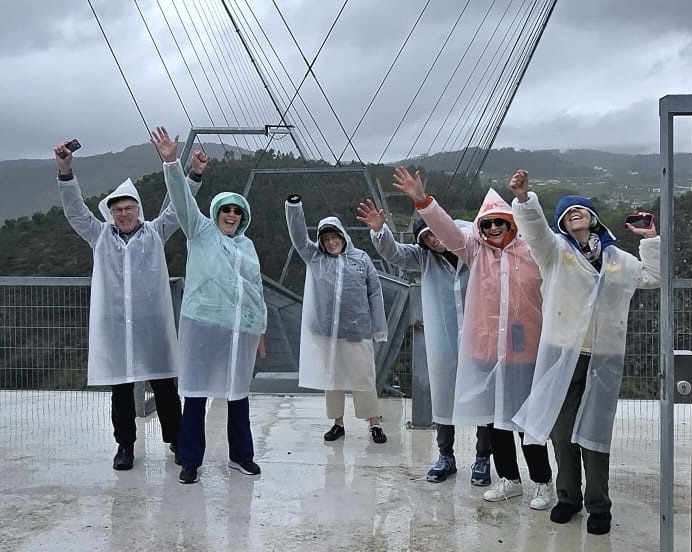
Okay, so it rained off and on, which added to the adventure. It also made us really appreciate the intermittent sunshine.

Ines, our local guide, thoughtfully supplied us with white rain ponchos to put over our jackets. The bridge was wet and slippery initially, but our spirits were as high as that bridge!

It case you’re wondering, the bridge is almost 1700 feet, or about a third of a mile each way. It opened in 2021, and only cost 2.3 million Euros to build. According to Ines, it is the highest and most beautiful suspension bridge in the world. It used to be the longest, until the Czech Republic one-upped them.

If you’re afraid of heights, it’s probably better if you don’t look down.

I’m not afraid of heights, so I did. Was it thrilling? Hell, yes!

The walk to the bridge was down a very steep slope.

As you know, what goes down, must come up, but those who had had enough fun for the day were able to ride a jeep to the top. Four of us opted to walk back—the equivalent of 15 flights of stairs —according to my Apple Watch. Not bad for four people over 70!

We had worked up quite an appetite, so we were ready for our wonderful lunch by the river, where we could watch the rafts heading toward white waters.

When I went for my bathroom break, I thought I had inadvertently walked into the men’s locker room, but no. The half naked guy in the skimpy towel was very friendly and wasn’t at all surprised to see me. I guess the area right in front of the bathrooms is the where the “rafters” suit up. Sorry, no photos.

Another thing I love about OAT is the ability to customize the trip. For our second night in Porto, I decided it was too windy and rainy for me to venture out, so I enjoyed a solo dinner in the hotel. Unlike most USA hotel restaurants, the food was great and reasonably priced.

I guess at this stage in my life, I’ve completely conquered FOMO (Fear of Missing Out). Instead, I only do things that I want to do.

Look at the size of that glass of sangria!

Because it was important for me to retrace the steps Mike and I took in 2003, I decided to skip the planned activities for our last day in Porto. Instead, I visited the previously described restored Clérigos complex, where I was reminded of the splendid life members of the clergy led, back in the “dark ages”.

I still had enough time to walk across the Douro River to visit three of the seven magnificent WOW Museums. And they were indeed a wow!

Even the museum’s floors are visually appealing. This floor is perfectly flat. Optical illusions in the pavement are a Portuguese “thing”. Lisbon and Rio de Janeiro have similar beautiful walkways.

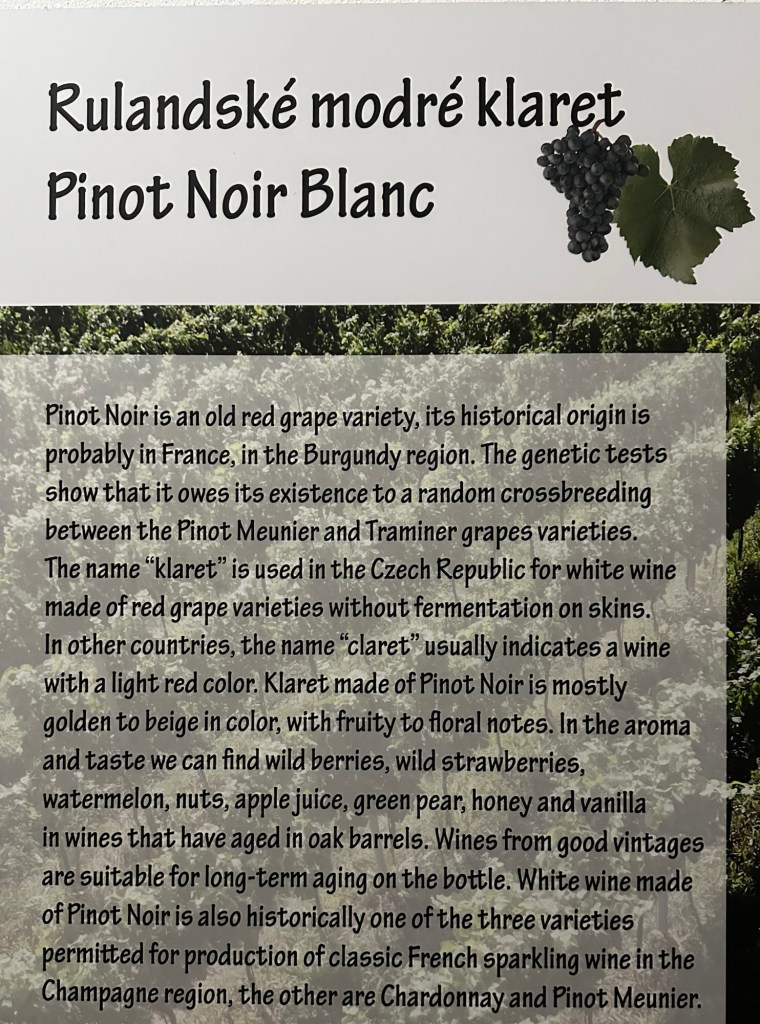
I have visited many wineries, so the history of wine making wasn’t as interesting as the interactive exhibits. Where else can you stick your nose over a tube to try to identify a wine smell? I was only able to correctly “smokey” and “chocolate” scents. If I ever had any doubts that my palate was unsophisticated, that exercise dispelled them!

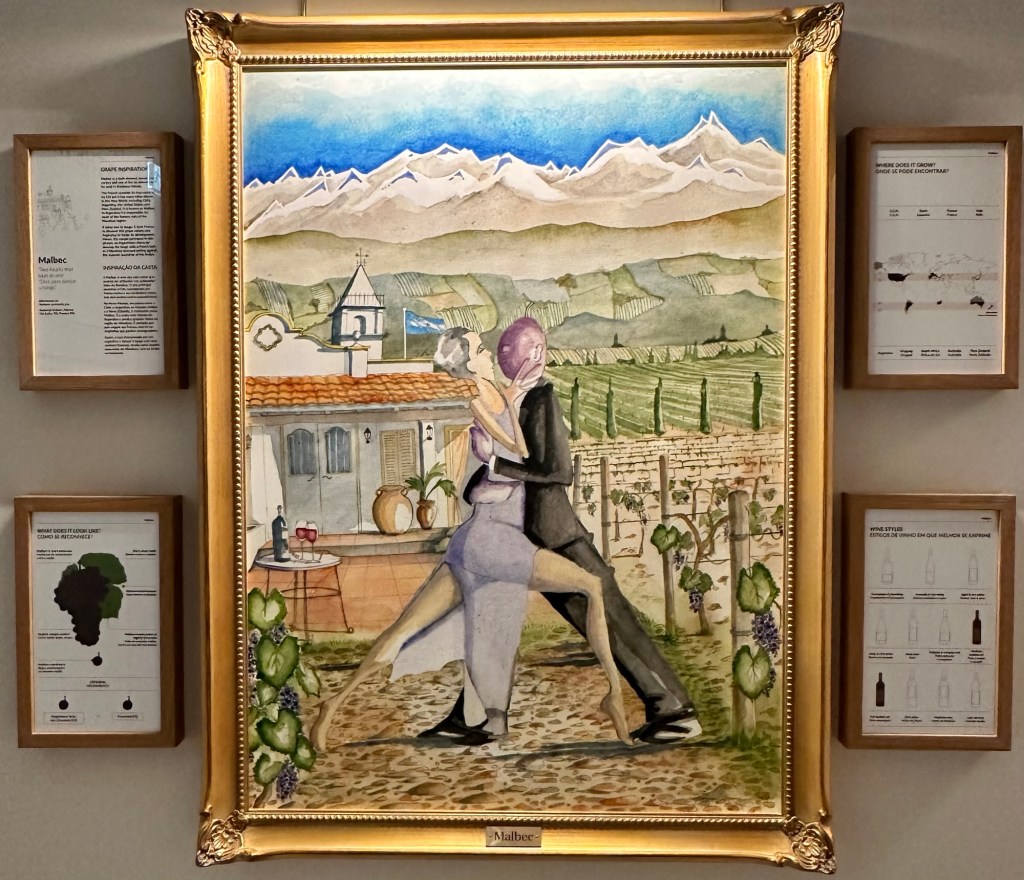
A corridor was lined with fun information about the different varietals. This is the artist’s vision for Argentina’s Malbec.

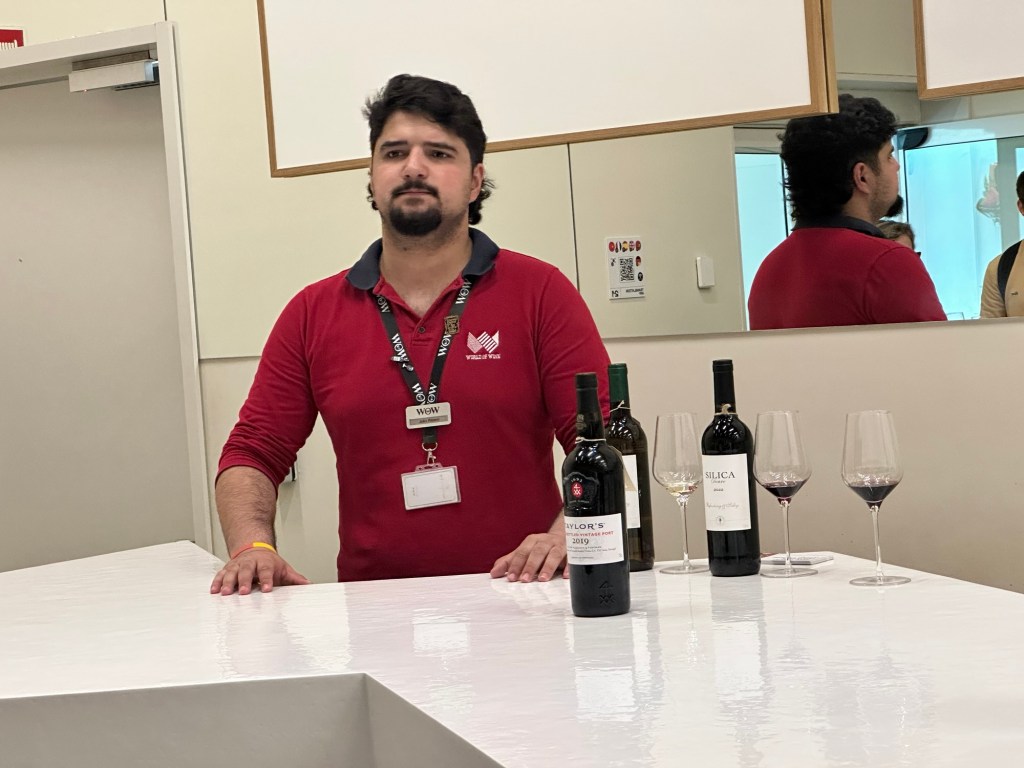
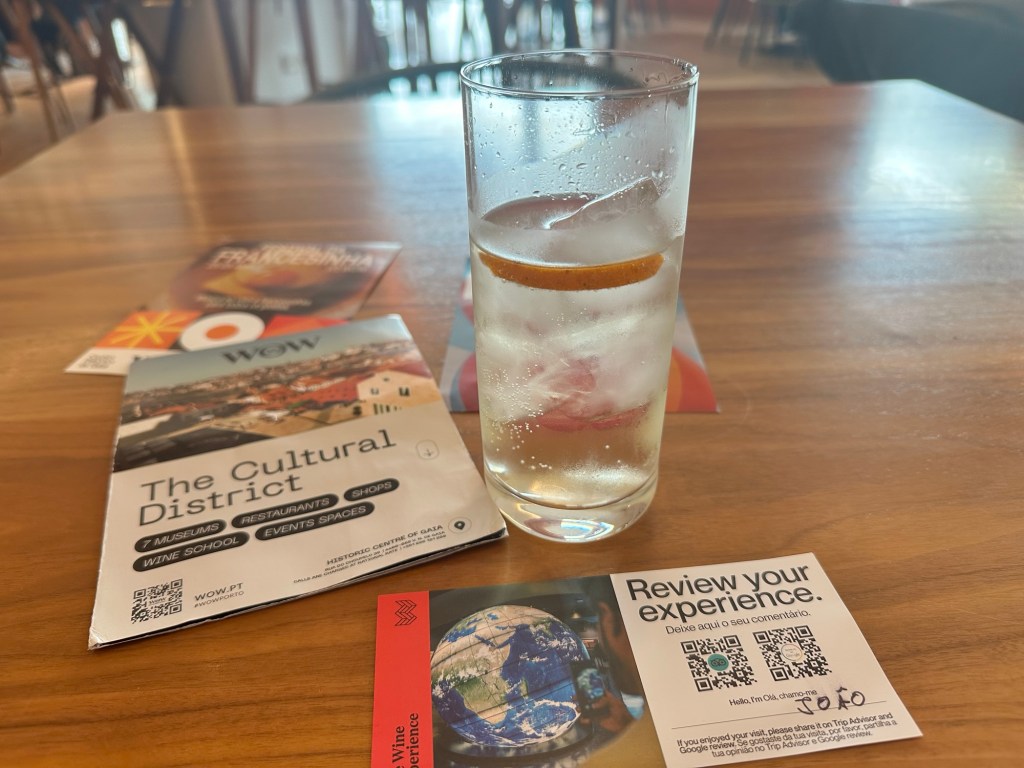
The wine museum’s admission price included a tasting of three different wines, with an explanation of what you are drinking, plus a coupon for a free port tonic in one of the museum’s many restaurants.

Of the cork and chocolate museums, can you guess which was my favorite? Which one had the best free samples?

I found the chocolate museum’s South American creation myth video so delightful, I stood there and recorded it for those of you who will never visit Porto. (You’re welcome)

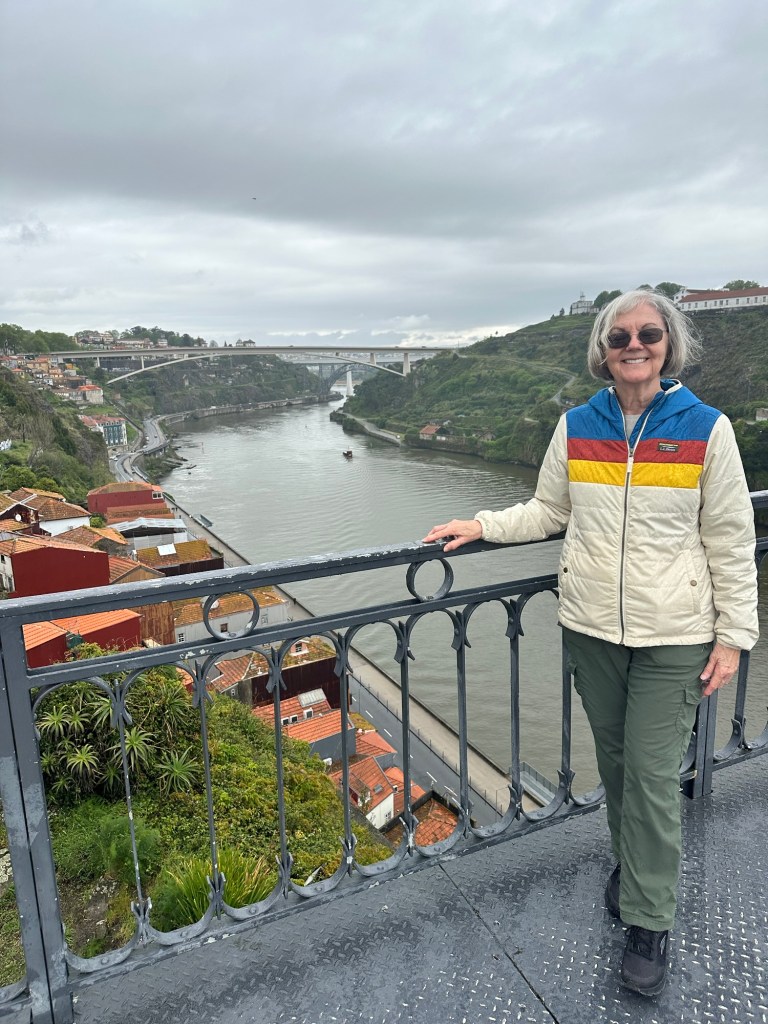
The museum was across the river from our hotel, so I walked across both levels of the bridge…the top, with its panoramic view.

On the way back, I took the “low road” so I could deposit the remainder of Mike’s ashes in the Douro River, because we had also stopped there in 2003. Back then, we had the bridge all to ourselves, and cameras didn’t have “selfie” options.

September 2003

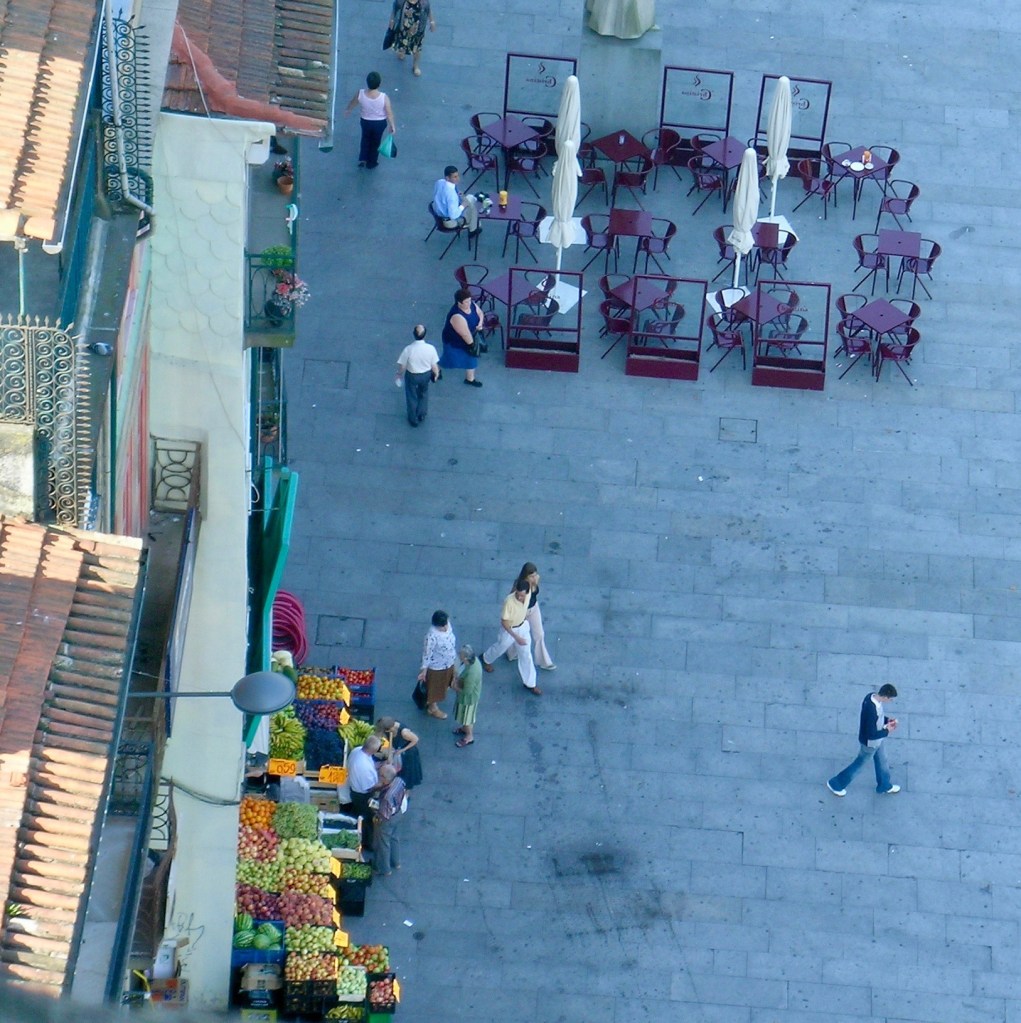
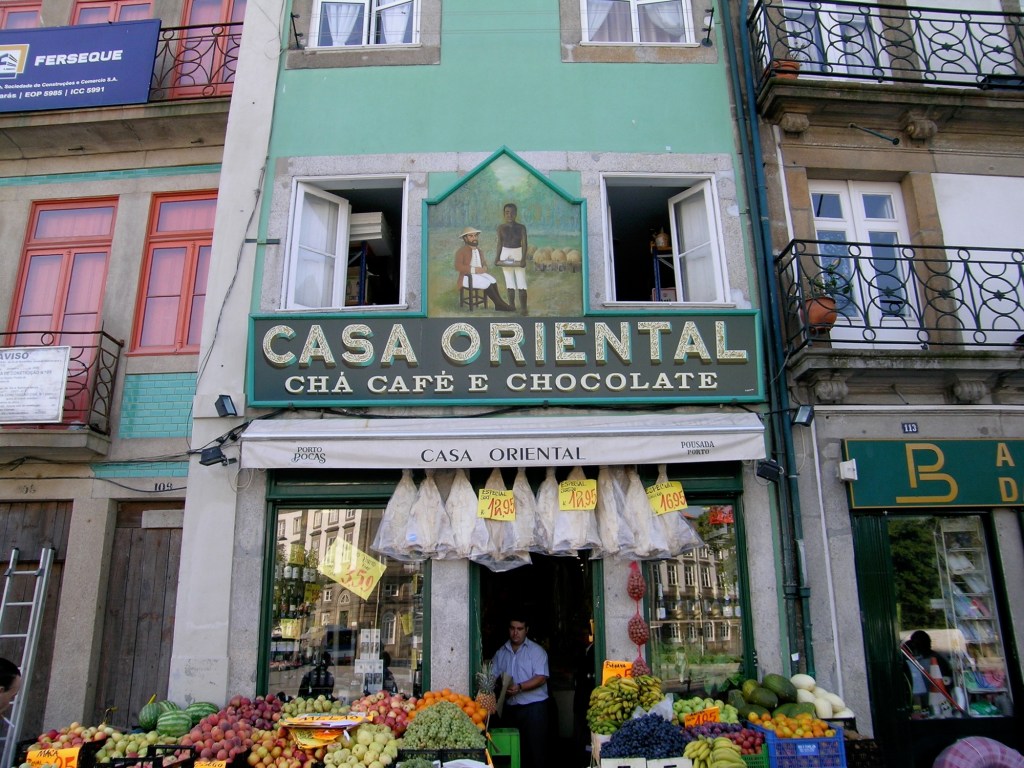
Barb, Pam and I are being picked up at 9 AM for our 12:30 direct flight to Newark. Because breakfast is at 7 and the market opens at 8, I figured I’d have enough time to do a quick swing through. Despite the rain, I made the 7 minute walk to Bolhão. Although the posted hours indicated the market was open, it appears no one bothered to tell the vendors.

Not a problem. I know where I can find dry clothes, and I still have enough time to change into them!

Although there is much more to say about this wonderful city, our fantastic tour and my amazing travel companions, this post is already quite long and we are on our way to the airport.

Lemigo and the Douro River

I absolutely LOVE Portugal! There is SO much to see and do. Although we made the most of our transit day, by crossing the border into Portugal at 10:15 Spain time, 9:15 Portugal time, it still feels like five days in this fabulous country is not nearly enough.

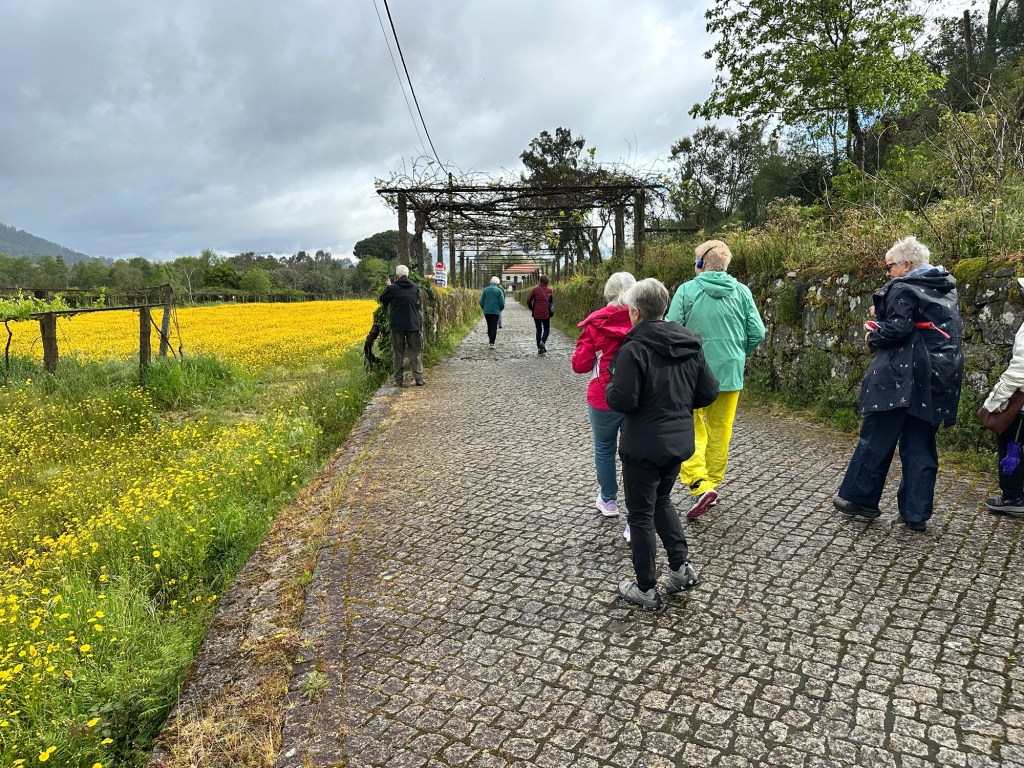
We started our transit day by walking the Portuguese El Camino, alongside the river leading into the town of Ponte de Lima.

I’m so happy the weatherman was wrong about the 100% probability of rain. Might it have been smarter for him to hedge his bets a teeny bit with a 90% probability?

The cloud cover made photos more interesting and more importantly, made our walk very pleasant.

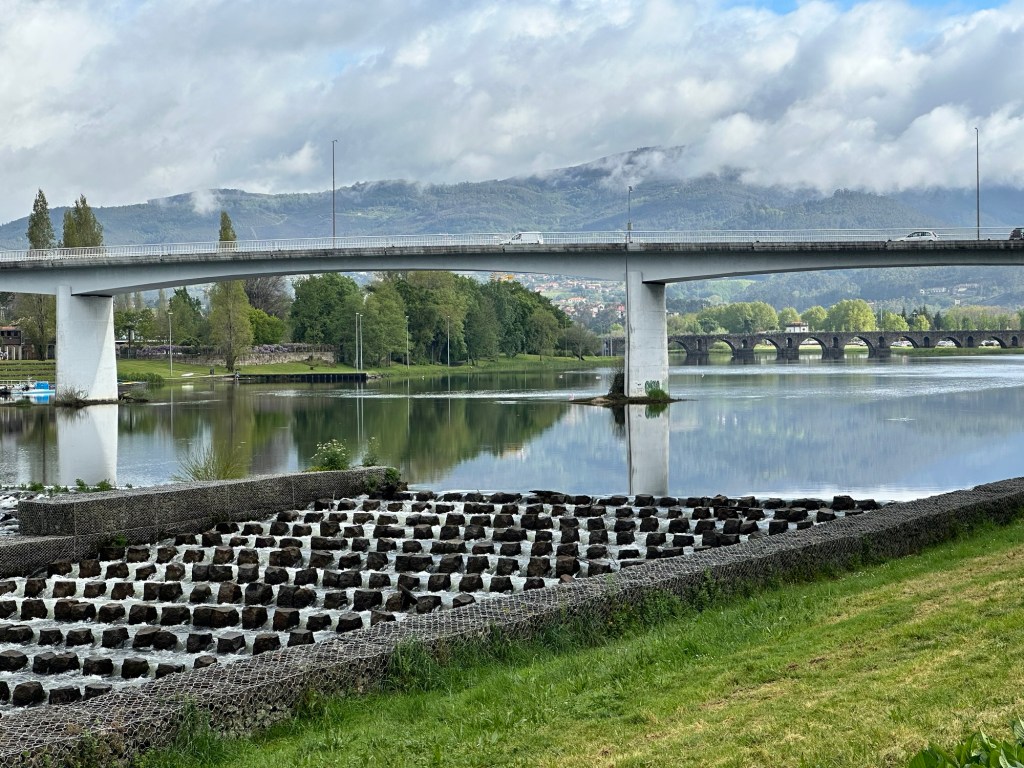
This river’s legend dates back to Roman times.

Roman soldiers on a campaign to conquer the world mistook the Lima River for the River Lethe, the mythological River of forgetfulness. Because there was no bridge, they had to enter the river to get across. Believing that doing so would erase all their memories, they refused. I can’t blame them. Who wants what is known today as a “senior moment” ( except it would be more like a senior decade)?

The general (that’s him on the horse by the river bank) crossed first, then commanded each of his soldiers, by name, to come across, thereby shattering the “memory loss” legend.

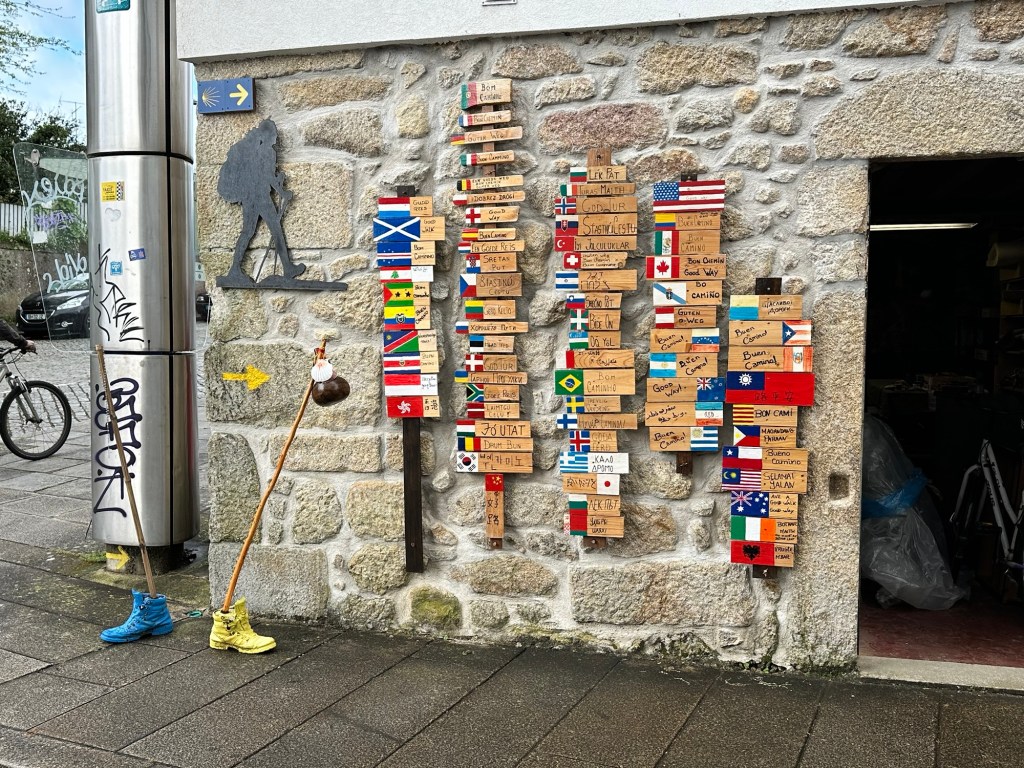
After we crossed the bridge, we easily located where we could add stamps to our Pilgrim Passport.

Yes, we have become obsessed with collecting stamps wherever we stop. I’ll talk about that in a future post. But right now it’s time to share photos of Guimarães, a beautiful village that has some historical significance —but what that significance is currently escapes me. Hey, I have the perfect excuse. I crossed over the River of Forgetfulness.

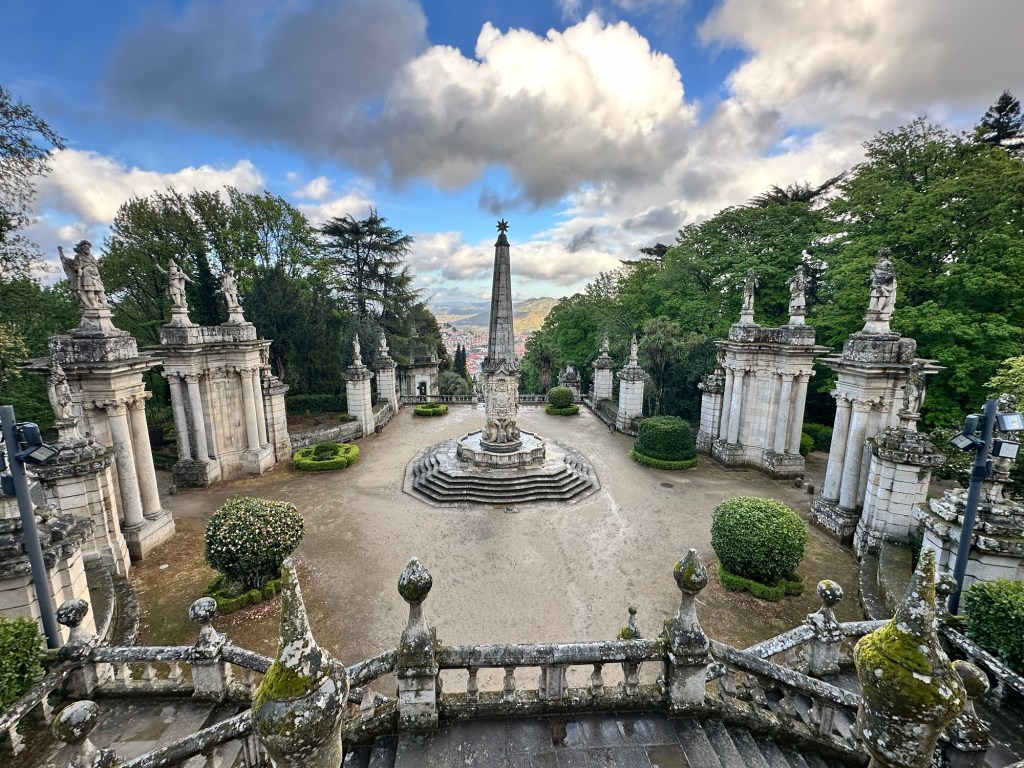
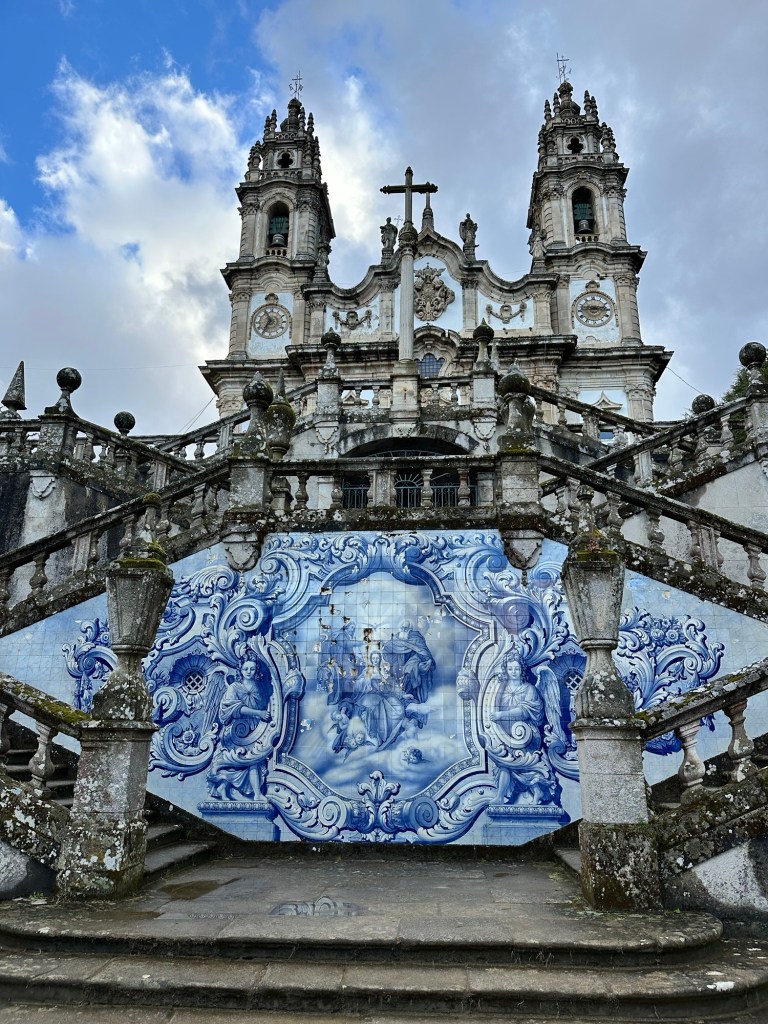
We finished our transit day by walking down the 608 steps (that was MY count; Wikipedia claims there are 686 steps) to dinner at a restaurant in Lamego. And what a beautiful walk it was!

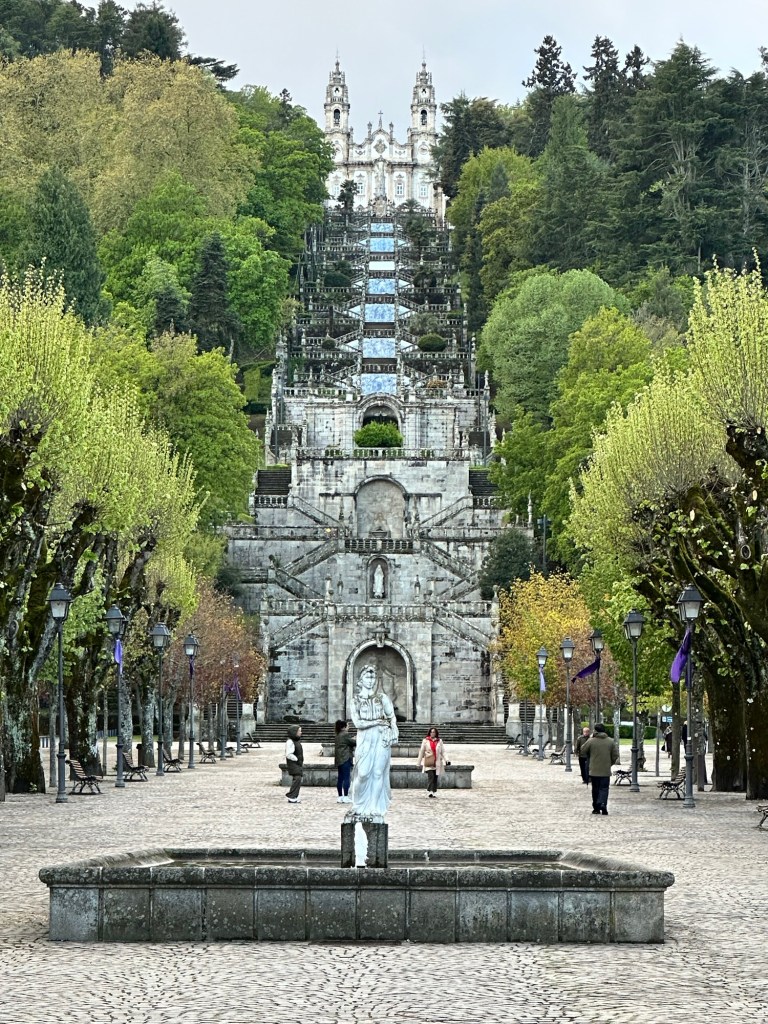
Our starting point
Beautiful wall tiles decorated every landing
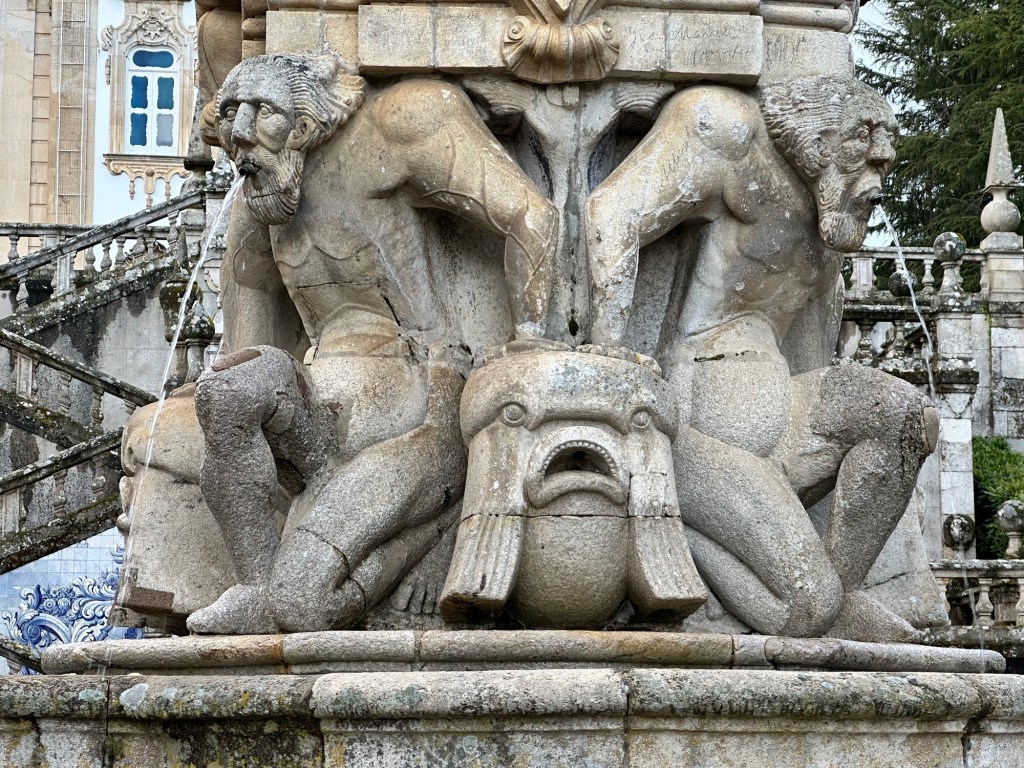
The fountains were also spectacular
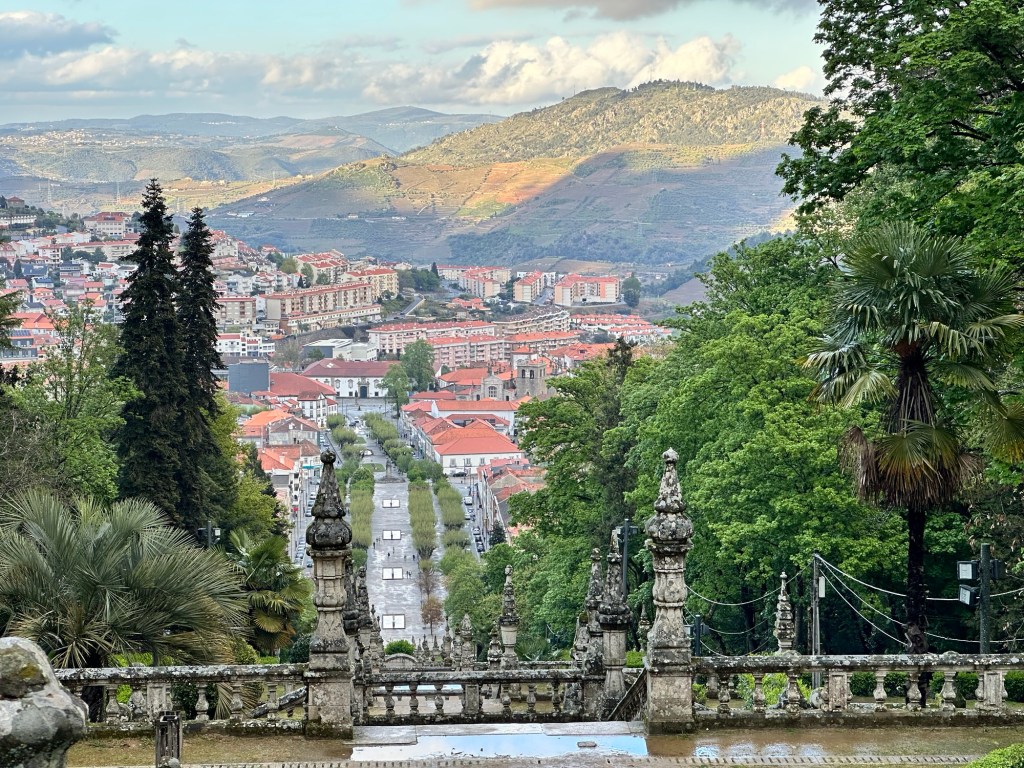
Look at this incredible view!

Okay, there are many, many more photos from this fantastic walk, but I will end with the view from the bottom, because we still have some fantastic sights from our Douro River cruise.

WOW!

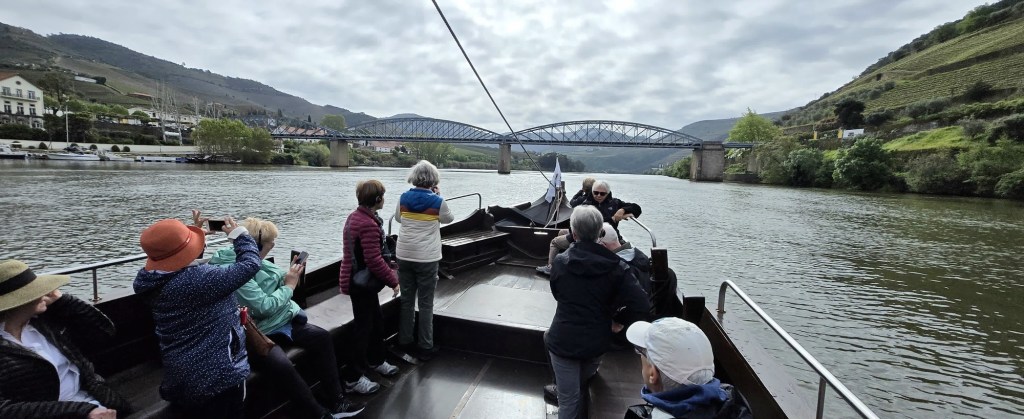
We had the boat all to ourselves,

Photo by Shahin, our guide

and there weren’t many other vessels on the river. We only saw one river cruise ship.

Just when you thought the day couldn’t possibly get any better, it did.

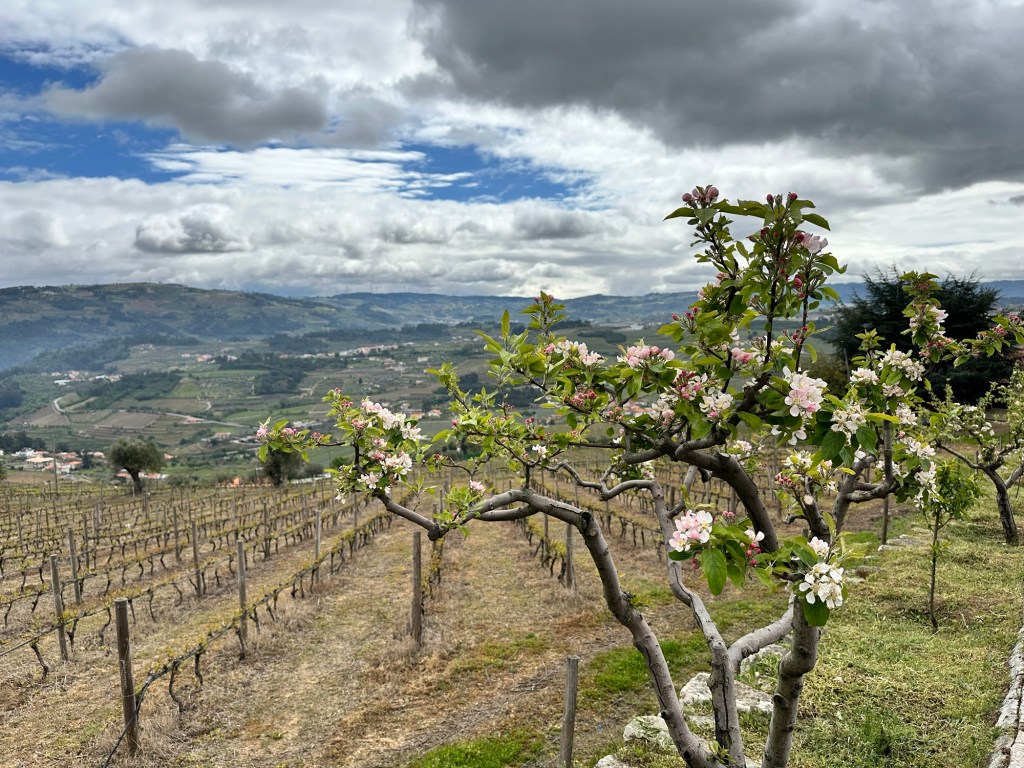
The Quinta da Portela de Baixo is not just a museum; it is also a vineyard carved into the side of a hill overlooking the Douro River,

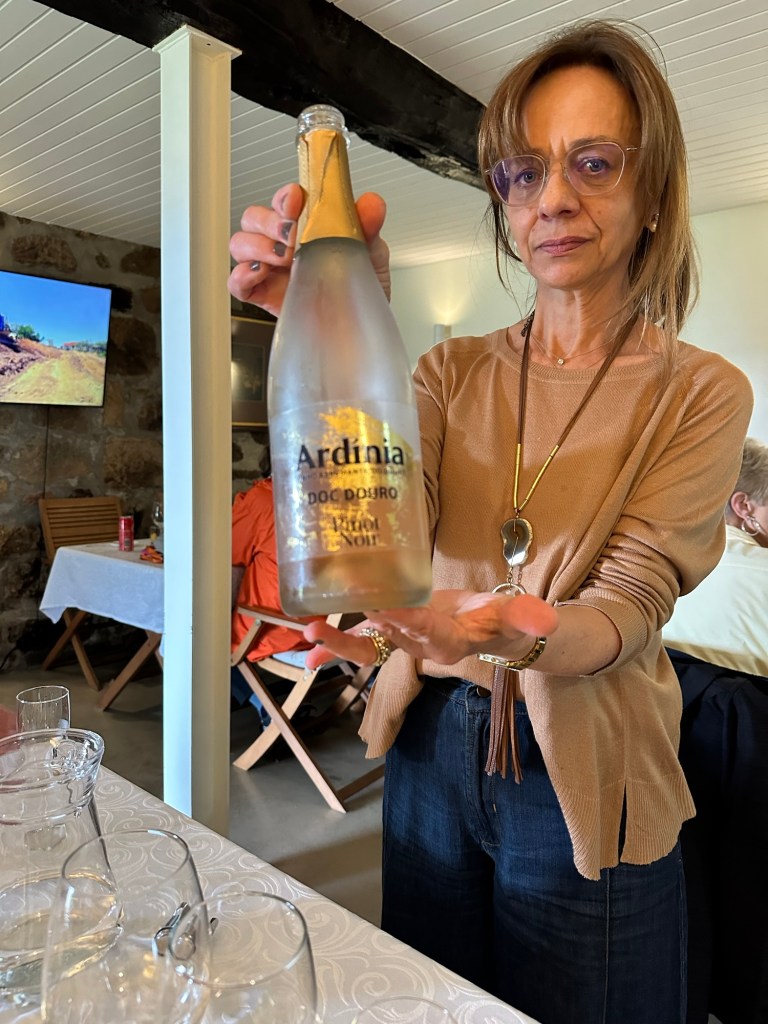
where we had lunch and sampled port wine. I had no idea that so many different kinds of port existed! Did you?

Our final stop will be Porto, which Mike and I visited in September of 2003. I wonder if women will still be carrying live chickens on their heads, the way they did back then?

Santiago de Compostela

I didn’t know until I got there that Galicia normally gets an abundance of rain, which is why it is such a lush, green region. I THOUGHT I was adequately prepared for wet weather, because I had packed two hooded jackets, fleece lined pants and silk long underwear, but I forgot the most important item: zapatos impermeables (waterproof shoes). Luckily, our hotel was across from a sports store that carried waterproof sketchers in my size. Prior to that purchase, however, (as I mentioned in an earlier post), we walked the last five kilometers of the Camino in a downpour. Let me tell ya, medieval cobblestone streets retain lots of water between those rocks!

I bought the umbrella in Bilbao when my luggage was lost.

I had the full Pilgrim experience; I was soaked and completely miserable. It was definitely NOT one would consider a spiritual feeling. By the time we got to the hotel, my feet were so wet, I had to dry them with a towel. On a positive note—the hotel had a heated towel bar in the bathroom, but sadly it only functioned between 7 and 11 pm. Still, that was long enough to dry out my sodden socks, clothes and backpack.

If someone forced me (at gunpoint) to choose between walking El Camino or running with the bulls, that day I would have taken my chances with the bulls. (I would have carefully chosen a stretch that allowed for a speedy exit.) But, then again, if I had done so, I would not have earned the right to sport one of these lovely pilgrim tattoos.

Before this trip, I had thought that there was ONE El Camino. NOW I know there are several: The French, the Portuguese, — we walked segments of both—the Via de la Plata (silver way), the Camino del Norte, the Primitive Way, to name a few. Regardless of which Camino you select, the destination is the same, the Cathedral of Saint James (Santiago).

Beneath that yellow umbrella is our local guide, Marian, regaling us with the legend of St James. WE were a shivering mass, huddled together under a nearby portico.

The cathedral from a different vantage point, a public park. Photo taken in between showers.

With all the wind and rain, I couldn’t take notes, so I’m operating strictly on memory. Here’s the part of the legend that I recall: a peasant (fisherman? shepherd? Some random guy?) in the first century (around 820 AD) saw a light shining down from the heavens several nights in a row, in the exact same spot. He recognized it as a message from God instructing him to dig, and when he did, he discovered the bones of a skeleton who had been beheaded. The church leaders made a rather large leap of faith and deduced that since St James had been beheaded, the skeleton must be that apostle. Over the ensuing centuries a cathedral was built and over time, the city of Santiago de Compostela grew around the cathedral.

Back then, pilgrims made the journey for religious reasons, to get a plenary indulgence (skip purgatory) or to avoid jail time. Yes, you read that right. Marian explained that people who committed minor crimes back then were given a choice…walk several hundred miles or go to jail.

Fast forward a few centuries—today’s visitors can view this silver box that contains what the faithful believe is St James bones,

and can admire the cathedral’s beautiful interior.

My cell phone’s zoom isn’t very powerful, so I’ll describe the central image of the main altar. It’s St. James, riding a horse and brandishing a sword, which wasn’t exactly how the apostles were described in the Bible.

Santiago’s old town is a maze of narrow cobblestone streets, filled with restaurants, bars and souvenir shops, so after our first day in Santiago, I’d seen enough of the city. I welcomed the opportunity to spend the day in Pontevedra and Combarro on an optional trip OAT offered.

Pontevedra, founded by the Romans, gave us a break from the crowded streets of Santiago. It is also the site of an unusual church, with a floor shaped like a scallop shell. Or so I was told.

I’ll be honest. The church was clearly round, unlike any I’ve ever seen before. But I wasn’t able to pick up any resemblance to a scallop shell in the interior. Take a look. Maybe you’ll have better luck.

Despite the intermittent showers, it was a delightful day.

Combarro reminded me of Southeastern Massachusetts. I recall watching Sandy, my sister, digging up clams and quahogs with her toes in Mattapoisett bay.

Here in Combarro, it’s a highly regulated business, with strictly enforced limits on what can be harvested.

Our day ended with a pleasant surprise—a procession outside our hotel. I was already in my jammies, but when I heard the drums, I dashed onto my balcony to take this photo.

Fortunately, our trip leader was on the street and sent us a video.

Is it just me or does that statue of Jesus make it look like he needs a foundational garment?

Next stop, Portugal for 5 days, then home.

Leon, Spain

When I booked this trip, I had no idea that I’d be in Spain for Semana Santa, or as we call it in the USA, Holy Week.

I will confess our group was more than a little surprised to see what looked like (to us) the Ku Klux Klan everywhere. But no, these are the different “brotherhoods” who hold processions every evening during Holy Week.

Their version of action figures were in shop windows.

Members of my family will not be shocked to learn that I accidentally stumbled into a church where one brotherhood was assembling. I had wanted to see the interior of the Church of San Isidoro after I learned this door was where you entered to get “indulgences”.

For those who didn’t spend your youth in Catholic school, I will explain. Indulgences are sorta like a “get out of jail free” card. You give the church a sum of money, and regardless of the sins you committed, indulgences get you on the escalator to heaven. Fortunately, the middle ages were chock full of sinners. How else do you think the church could afford all that art and gold stuff?

Can you imagine my surprise when I opened the door to find a PACKED church? EVERY bloody pew was filled with people wearing the same color coordinated outfit. My cream jacket stood out in a sea of purple, so when the door creaked open, and the assembled all turned to stare, it was easy to figure out who really didn’t belong.

I wasn’t gauche enough to take a photo then. I waited till they were all almost out the door. Hey, I wanted my friends back home to share in the experience. So here ya go.

Notice that THIS brotherhood allowed sisters to join in the fun, but instead of hoods, they wore a “thingie” to hold their mantillas high atop their heads. Also notice, they were at the very end of the procession.

As I exited the church, I spotted some people wearing uniforms, carrying instruments, so I followed them to their assembly point — a bar.

Doing so earned me a primo spot when they started to play. I haven’t quite mastered the ability to imbed a link, but if you click below you should get a feel for Holy Week in Leon.

Despite the mob scene, fellow traveler Camille managed to spot me in the crowd. Equally surprising, I heard her call my name.

Somehow, in spite of the madness, four of us managed to link up with Shahin, our trip leader, who took the photo of Loren, me, Sheldon and Camille atop this post.

Before we went bar hopping, we saw a man standing in front of a building, swinging around a silver incense container, so we HAD to go inside. Much to our surprise, we found these elaborate “floats” that the devout carry on their shoulders during processions.

This is only ONE of many floats stored in the building

Sorry, there are no photos of our bar hopping extravaganza. We were far too busy drinking “lemonada”— red wine, lemons, cinnamon and seltzer water— León’s official “Holy Week drink, to take pictures

Our second day in the area was spent outside of León in the little village of Morgovejo, for what OAT calls a “Day in the Life” , another unique feature of OAT travel. We spend time with local inhabitants, visiting them in their homes, sometimes participating in their daily activities.

Carmín teaching us how to make cheese

During our visit, Carmen showed us how she works with disabled children and adults, using a horse she rescued and trained. Her partner, Emelio demonstrated the various exercises that can be done by riding bareback .

Emilio demonstrating stretches.

The farm has horses, sheep, goats and dogs. Some of us were thrilled to be able to hold this baby lamb.

León was a fantastic stop, and it was over far too quickly. Next stop — Santiago de Compostela, the final destination of pilgrims on “The Way”.

Stops Along the Way

One of the many reasons I absolutely love traveling with OAT is the company finds experiences I would never have discovered on my own.

For example, en route to León we made two delightful stops. The first was at an archaeological lab in Ubide, where Michaela, an Australian osteoarcheologist, fascinated us with stories about her dig at the Roncesvalles burial pit.

Can you figure out which one is Michaela?
Hint: she doesn’t have gray hair.
She’s in the back row, directly behind me.

It was truly amazing how much can be learned from bones. So far, they have dug down to the level of the Napoleonic wars, where they found an older soldier, whose jacket was used as a shroud. His jacket’s button is shown in the top right of the following photo. Can you see the Spanish word “Rey” (king)?

Because of his skeleton’s position in the pit, his age, his wound and the button, the archaeologists deduced the bones belonged to a high ranking member of the Spanish army who died fighting against Napoleon.

When the archaeologists reach the bottom of the pit, legend has it they will find a horse, a horn and the exploded head of Roland, a member of Charlemagne’s army, who was immortalized in the “Song of Roland”.

After he sacked Pamplona, Charlemagne headed back to France, using the route we followed through Roncesvalles (now part of El Camino). As you can see, the path through the forest is very narrow, so the soldiers had to travel single file, making them easy targets for the more than slightly annoyed Saracens.

For those of you who never read “The Song of Roland” and have no desire to ever do so, here’s the scoop. When Roland sounded the horn to warn Charlemagne of the attack, he blew so hard, the legend claims that he literally blew his brains out.

Our lunch was at a charming tavern along our route. This trip IS turning me into a “day drinker”, but it hasn’t come to THIS, at least not yet.

Shahin, demonstrating how to shoot red wine directly into your mouth

We were able to walk off some of our lunch’s calories when we reached the next stretch of our “El Camino” experience. This time, we walked through the medieval village of Castrojeriz, population about 100.

Had I been on my own, I would have walked right by this church and missed its amazing multimedia shows, including the story of creation, which was projected onto the ceiling.

If we were REAL pilgrims, walking El Camino, it would have taken us anywhere from three to about seven days to walk from León to Santiago. Instead, the 3.5 hour bus ride took us a day, because of our multiple stops.

The first stop was in Astorga, to view the castle and cathedral designed by Gaudi.

Unfortunately, the building didn’t open until 10, so we weren’t able to go inside, but don’t you agree that the outside was pretty spectacular?

The entrance to the palace is on this side. Can you believe the number of windows?
On the left (barely visible) is the cathedral.

We weren’t able to linger because we didn’t want to be late for our visit to the beekeeper. To get to there, we strolled along the river for about a half a mile.

This very animated and entertaining young woman gave us the adult version of her presentation for school children.

Did you know that you should never put honey in the microwave because it destroys the beneficial enzymes? Or that you should never use a metal spoon to remove honey from its container— only use wood? (sorry, I don’t remember the reason).

After all that learning, we were ready for lunch in the village.

This building dates back to the 1750’s; it was the home of a merchant who conducted trade between the coast and León.

We were very fortunate to have such great weather during this area’s rainy season.

But our luck was about to end. For the last stretch of El Camino, we had an “authentic” pilgrim experience. We walked to the cathedral in a downpour.

That smile on my face was VERY short lived. I neglected to pack waterproof shoes, so by the time we finished our 5 kilometer walk and got to our hotel my shoes, socks and all 10 toes were soaking, sopping wet. Good thing I know how to say “I want to buy waterproof shoes” in Spanish!

Looks like the weather goddess is sending more of the same for our time in Santiago and Portugal. But at least with my new 100% waterproof Sketchers, my feet will be dry!

After the day we had, we decided we all needed at least one glass of wine — perhaps more. How lucky am I to be with such a great group of people!

Briefly, the rain stopped, allowing Shahin to take this group photo.