Rollin’ Round Rarotonga

Remember the John Candy movie “Planes Trains and Automobiles”?  If it had been filmed in Rarotonga it would have been called “Buses, Scooters and Pick Up Trucks”– and we rode them all.

Where else does the bus driver stop to pick up his breakfast and come back with a load of bananas for everyone on the bus?  The food stand owner knew we were all going to church, so she wanted to show us a little love.

"Superman",  one of my favorite bus drivers--with our gift from "Mama"
“Superman”, one of my favorite bus drivers–with our gift from “Mama”

There are two bus routes on Rarotonga.  The Clockwise bus leaves from the center of Avarua on the hour; the Anti-clockwise bus leaves on the half hour.  Their only route is the circle around the island that is Rarotonga’s one main road.  Although technically there ARE bus stops, standing anywhere by the side of the road and waving enthusiastically works too. And there if there is one thing I have plenty of, it’s enthusiasm!

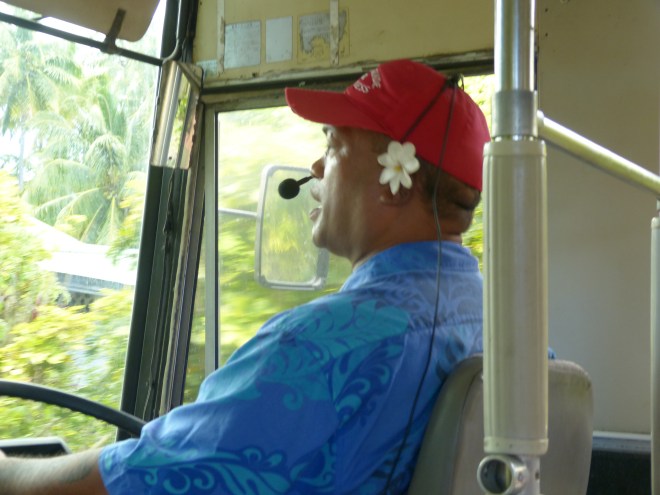
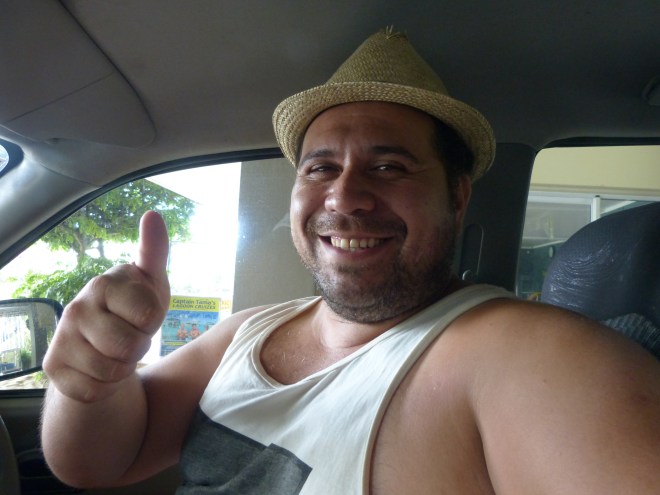
My other favorite driver was Bob Hopeless, who turns a bus ride into a bona fide tourist attraction.

Bob Hopeless
Bob Hopeless

If you’d like 30 seconds of the Bob Hopeless experience,  click this link. If you want more, you’ll just have to visit Rarotonga.  And yes, the road was that bumpy, which is one reason I decided against renting a bicycle.  The other was bus rides were so bloody much fun!

Maybe in Boston, (at least according to “Cheers”) everyone in the local bar knows who you are; on Rarotonga, it was the bus drivers.

Because we are workers, we get a special red bus pass–10 rides for $20–which almost functioned as an ID badge, differentiating us from the other Pakeha (non-Maori) on the island.  Our Global Volunteers fee covers transportation to and from the worksite; any non-work related travel (even going to church) we fund ourselves.   Anyway, before too long the drivers were greeting us and they knew exactly where we were headed.

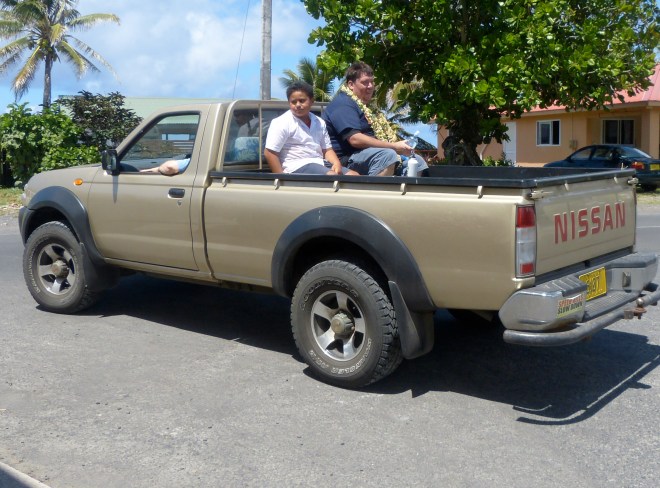
But buses were only one method of transportation.  This is a VERY friendly island.  Sometimes we’d decide to walk back from school. We’d start off but before we got too far, we’d hear someone shouting our names and we were hopping onto or into one vehicle or another.  One day a pick up truck, the next a scooter.
Niki and I jumped out to get ice cream while Patrick (in the front seat) and Willy continued on the last few “blocks” to the KiiKii Motel.  My seat was right over the left rear wheel.

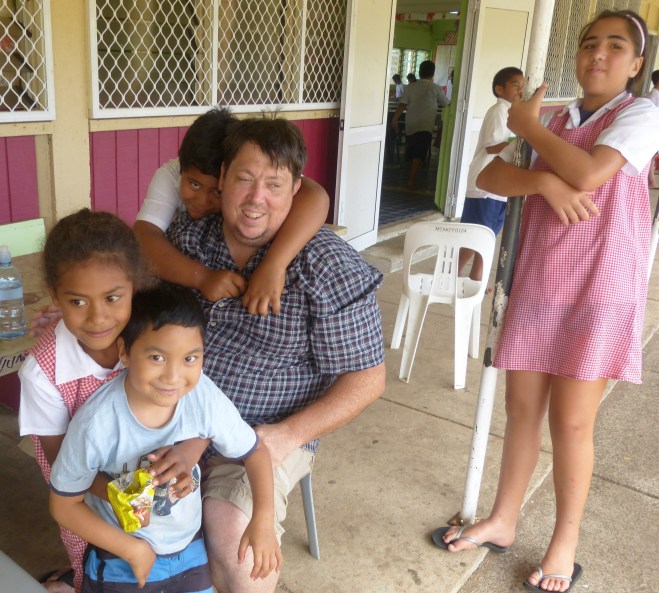
Note the water bottle in Willy's hands; note the disappointed look on the boy;s face.  Willy had promised to squirt Niki and me, then thought better of it.
Note the water bottle in Willy’s hands; note the disappointed look on the boy’s face. Willy had promised to squirt Niki and me, then reconsidered.

No photos exist of my rides on the back of Engia’s (the principal of Takitumu) motor scooter, but Niki did take this one of me hitching a ride with Bud before our hike up the mountain.
IMG_3493

We also got offered rides in regular cars, but what made those trips memorable were the conversations with the drivers.  Tora is a Maori who emigrated to Australia and joined the army.  He was a military attache to the US army who had served in Afghanistan.

Tora
Tora

Tora clued us in to the controversy surrounding the upcoming coronation. It seems that a former king had three wives and some thought that the wrong line had been selected to replace the prior queen. He explained that the dissenters would be letting their feelings known at the coronation.

Okay, so NEXT post will be about the coronation. I promise!

There was ONE more method of island transportation that us “three weekers” experienced vicariously. The 10th Annual Vaca Eiva went from November 23 until November 29 and drew rowers from all over the Pacific region: Tahiti, New Zealand, Australia, even one team from Hawaii, and of course The Cook Islands. The racers rowed right by my hotel room, giving me great opportunities to capture the action. Because they all wore event tee shirts and not their team shirts, it was a little tricky to determine who was who. Fortunately, the KiiKii was also home to a Kiwi team and when their supporters started cheering wildly, I started shooting.

The young Kiwis staying at our hotel came in third!

The Tahitians were #1 and 2, but our Kiwi friends did quite well, and were thrilled I had managed to capture the moment for them. And I was thrilled to be able to show MY appreciation for the warmth, friendship and hospitality I experienced while visiting their country by giving something to them. And isn’t that what Global Volunteers is all about?

Global Volunteers, Cook Islands

Let me introduce you to Global Volunteer’s Vaca 139. Why “Vaca”?  Because it is the Maori word for boat, and  it serves as a reminder that we are all in the same boat–we’re in this together.

The 139 is self explanatory:  we are the 139th group of Global Volunteers to serve in Rarotonga. Of Vaca 139’s ten volunteers, six have been here before, which speaks volumes about this assignment. Half of the group will be staying for two weeks.  I am one of the five that opted for three weeks.

Standing:  Dave, Larry, Willy Middle: James, Lynda, Shelley, Bud Front: Robyn, Patrick, Sally, Niki
Standing: Dave, Larry, Willy
Middle: James, the country manager,  Lynda, Shelley, Bud
Front: Robyn, Patrick, Sally, Niki

So what were we going to do during our stay?  Larry and Sally split their time between the prison and the high school.  When she was not in jail, Sally was a one woman “beautifier”, sprucing up the exterior of Tereora College.  She was leaving HER mark in flowers, while Larry, a former math teacher, gave his students practical skills, such as learning how to calculate nutritional values and convert celsius to fahrenheit.

Robyn and Dave worked in Titikavaka College. Bud, an Ob/Gyn, returned to the hospital to offer his assistance, and Lynda worked with the Ministry of Education, developing plans for special needs children.

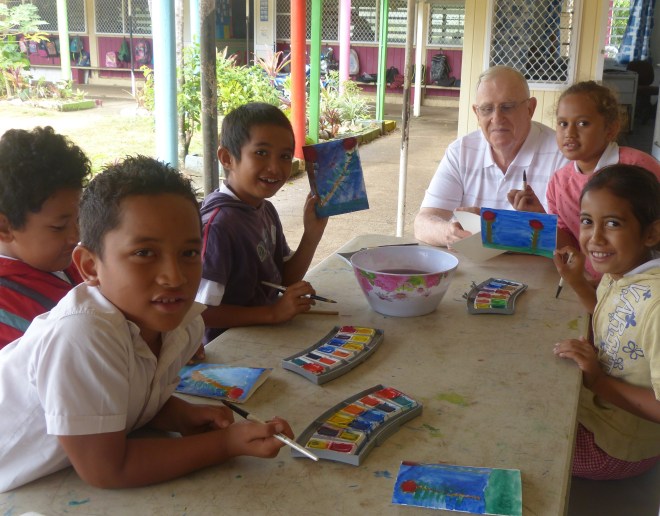
Willy and Niki, Patrick and I were delighted to be assigned to an elementary school.  Papa Patrick, an artist from Florida, very thoughtfully brought along a suitcase full of watercolors and paper.  He spent the first two of the three weeks at the school, helping the children make cards; the last week he taught disabled adults at the Creative Center with Lynda.

P1040222

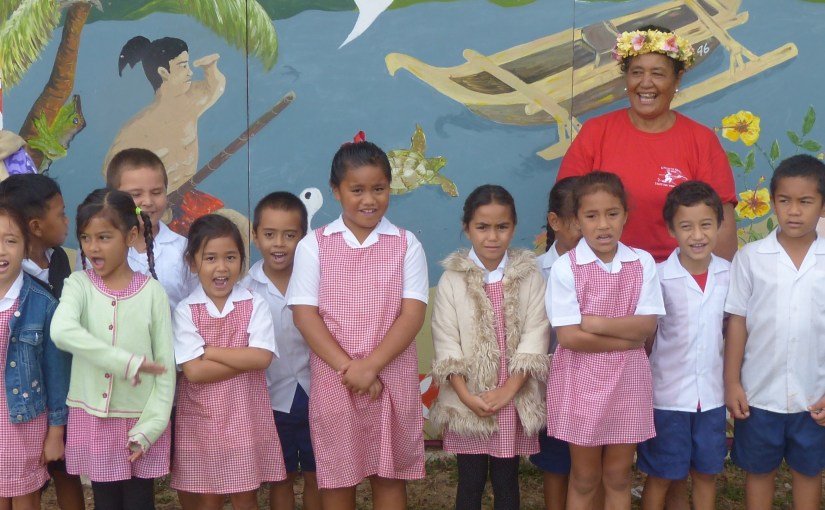
Uncle Willy worked with the third graders during class time.

Uncle Willy with the third grade class.
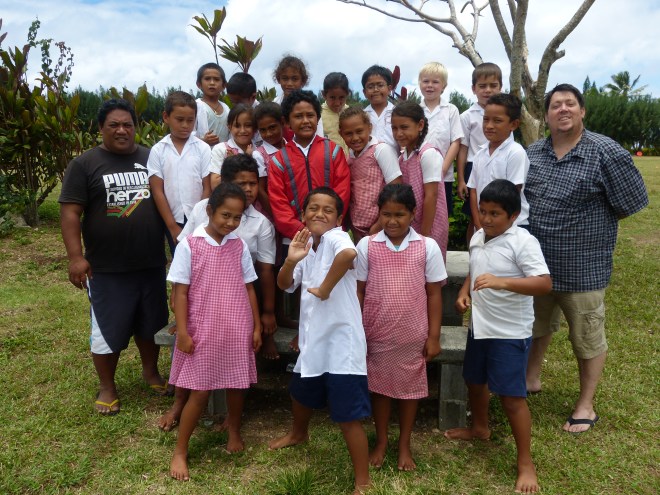
Can you see why it required more than one attempt to photograph THIS group?

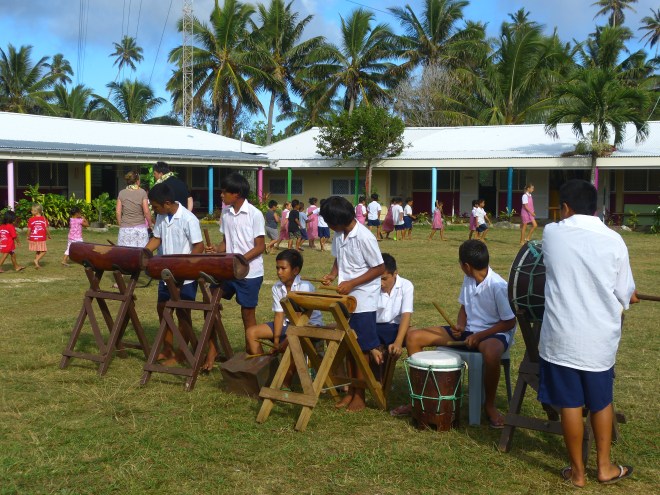
Once the drums started beating (yes, that’s right–there are no bells, there are drums that mark the start and finish of school periods) he was out in the field, playing soccer with boys of ALL ages, regardless of the heat and humidity.

Time to get into your classroom!

If you would like a more vivid drumming experience, Just click on this YouTube link.

Niki and I preferred more sedentary (and cooler) ways to interact with the children during “free” time.  During the school day, she worked one on one with fourth and fifth graders.
P1040256

My first week was spent helping out in the office.  Their secretary had abruptly quit right before we arrived, leaving a mountain of unfinished paperwork.  A basic principle of Global Volunteers is that you do whatever you are asked to do, so I got busy copying, doing excel spreadsheets, data entry, and report cards.   James figured that my years in the insurance industry would mean I was good at office work.  I didn’t bother to tell him that wasn’t quite what I did, and once I left the world of paid employment, I said goodbye to PCs to become an Apple devotee.  I was shocked at how much windows and excel had changed in just a couple of years!  Fortunately, speed was not important, and I was able to figure it out–although the copy machine WAS a bit of a struggle.

The best part of my assignment was I shared the principal’s office, so I got to know this warm, gracious, interesting woman. Because she had recently married, she generously shared her wedding photos and the stories about people in them, her extended family.

In the principal's office
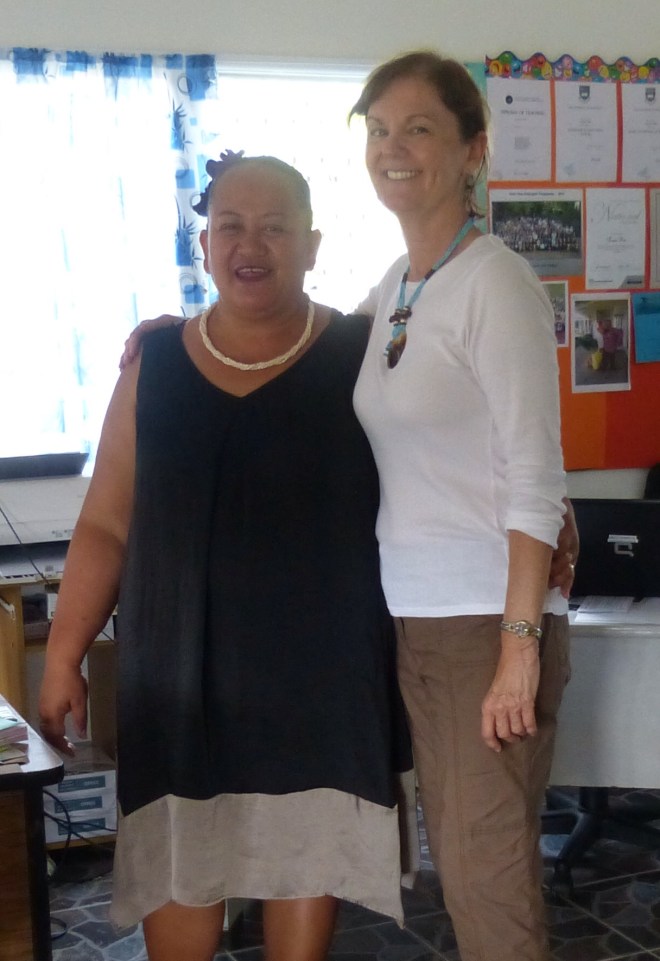
Engia, the principal, and her new secretary

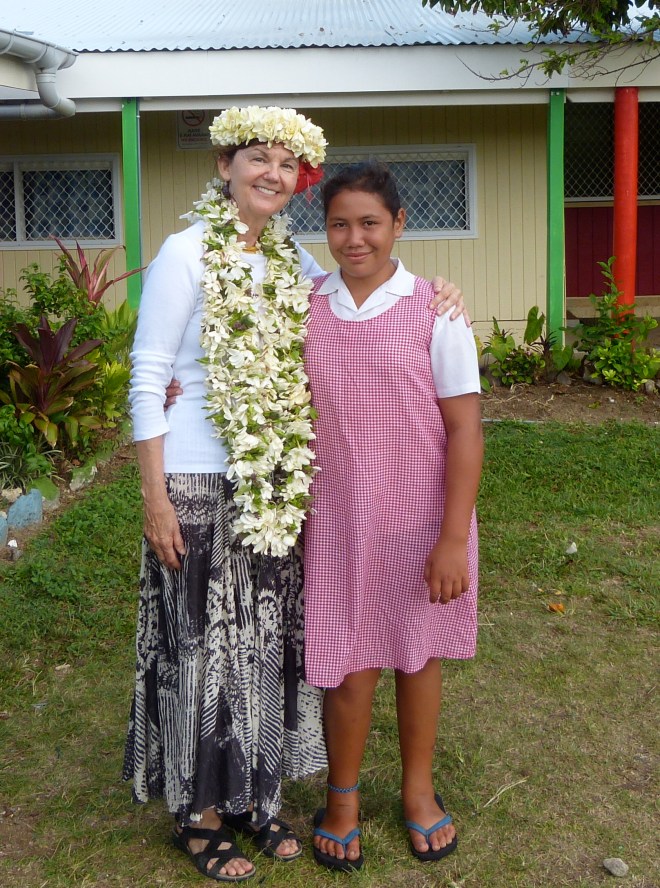
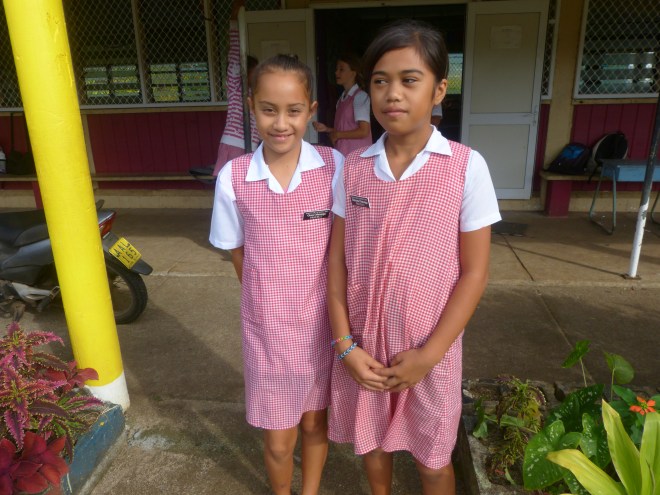
Of course, I was able to take several breaks during the day to play and read with the children, who LOVED to have their photos taken, AND to take photos.   Here are a few schoolyard shots.

P1040252

P1040458

P1040456_2 P1040212_2

Stay tuned for the next post–the coronation!

Geologic Wonders

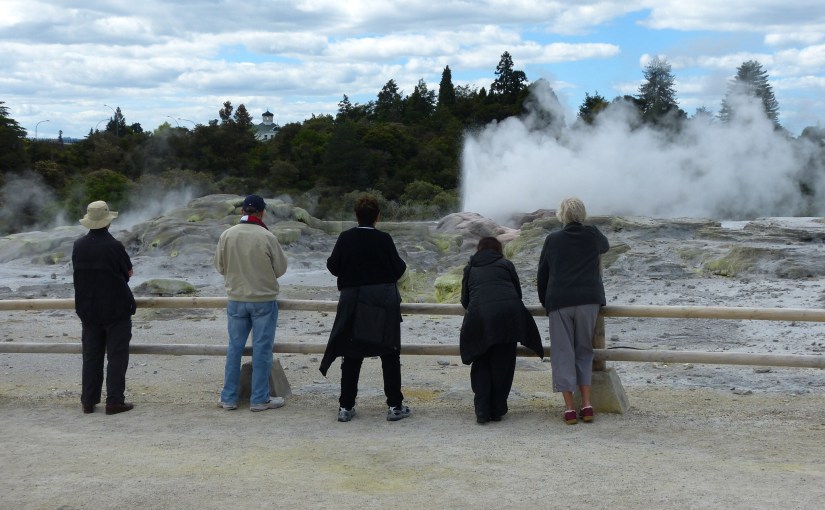
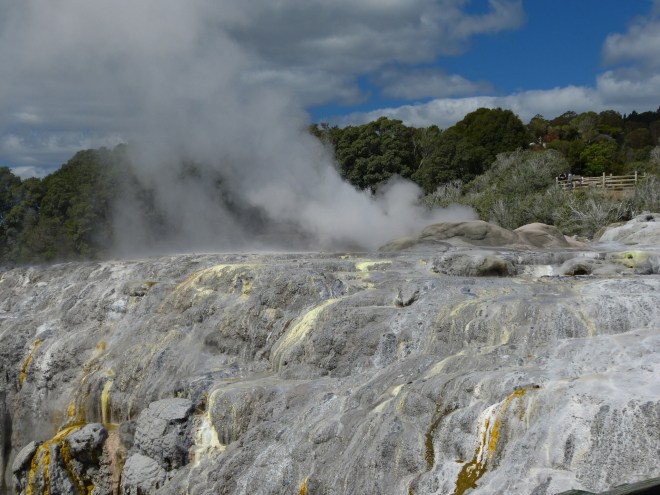
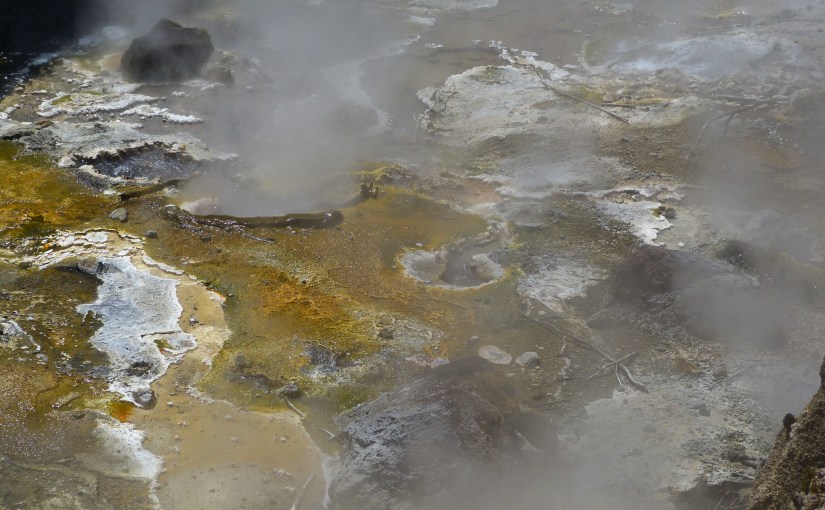
A photo just doesn’t do the Te Puia bubbling mud pools justice. I was mesmerized, watching them pop up and flatten down. If there were such things as witches’ cauldrons, I imagine they would look exactly like this.
image

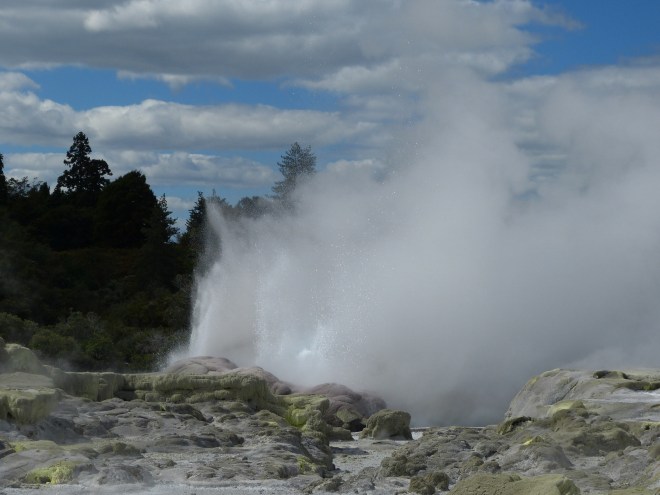
But the real show was the Pohutu Geyser.
image
Hmmm, that wasn’t all that special…but wait…
image
It’s getting better…
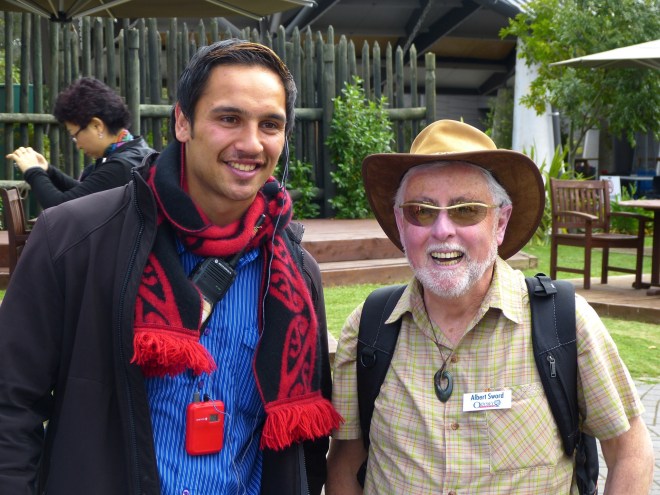
Our guide, Albert, took this photo of Mike.
image
Mike’s quite a distance from the geyser, so it gives you an idea of the size of the water column. But there is more to come.
NOW you’re talking!
image
Speaking of Albert, here he is with our Maori guide.
image
While I was busy photographing Albert, Mike was surrounded by a crowd of Asian women. Just like in Thailand, but this time only one wanted to be photographed with him, so I wasn’t fast enough to capture the scene. Mike was only to happy to explain to me that his new friend told him he was very handsome…
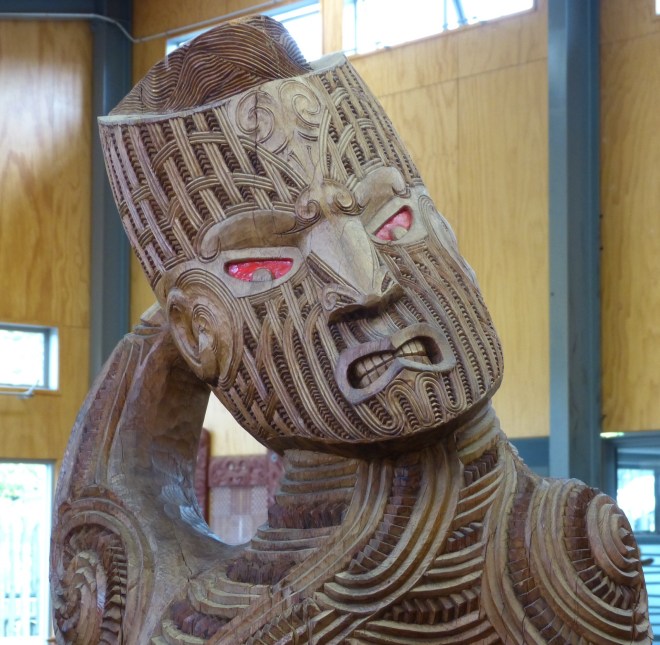
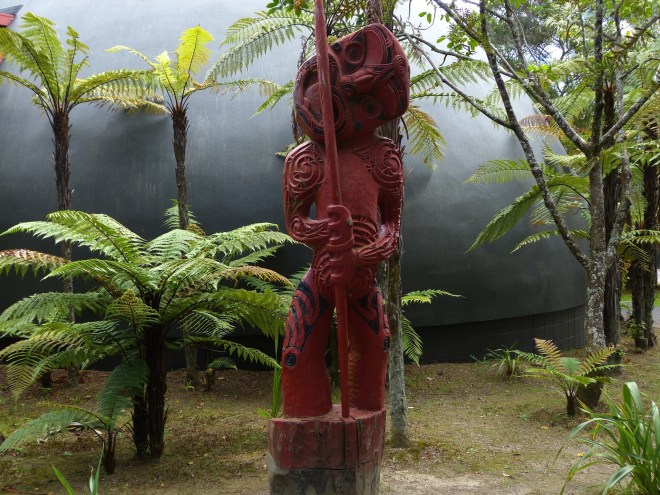
But back to the tour. After viewing the geological wonders, we visited the woodworking school.
image
This one is my favorite.
image

Blowing Off Steam

I didn’t think that anything could come close to being as glorious as yesterday’s experience in the Waitomo Caves. I was wrong. The Waimangu Valley Geothermal Site was equally magnificent, but in a very different way. This valley is the only geothermal system on the planet that was created by a volcano–the Tarawera eruption of 1886.

The result was Lake Rotomohana. Our group was divided in two, with half cruising the lake first while the other half hiked, and then we switched. image Our boat was the only one on the lake that morning, and with only 18 passengers, it was easy to get an unobstructed view of all the geothermal phenomenon.   Before the volcano erupted, what is now Patiti Island was part of a small hill. It became a lava plug, cooled, and is now home to cormorants. imageimage
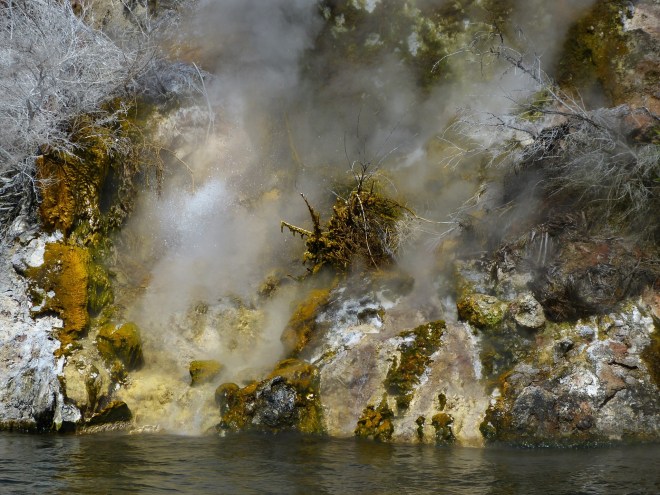
The steam vents fascinated me, so I kept snapping away.
image
The hike gave us the opportunity to get close to craters and geysers.
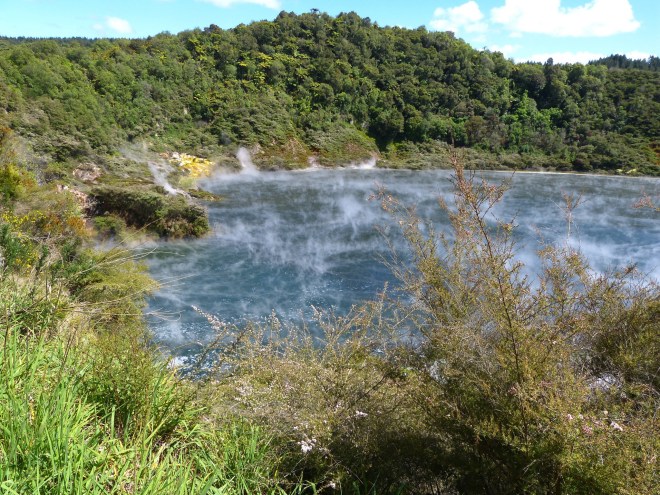
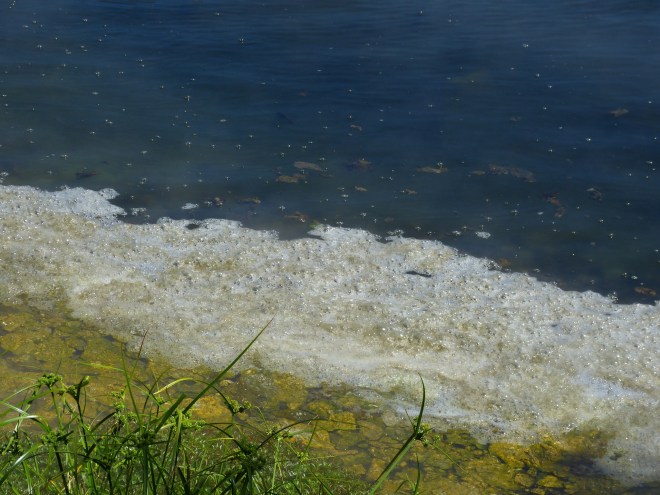
imageThe lake water is acidic. It looks like it is boiling because of the gases (carbon dioxide and hydrogen sulphide) bubbling up to the surface.
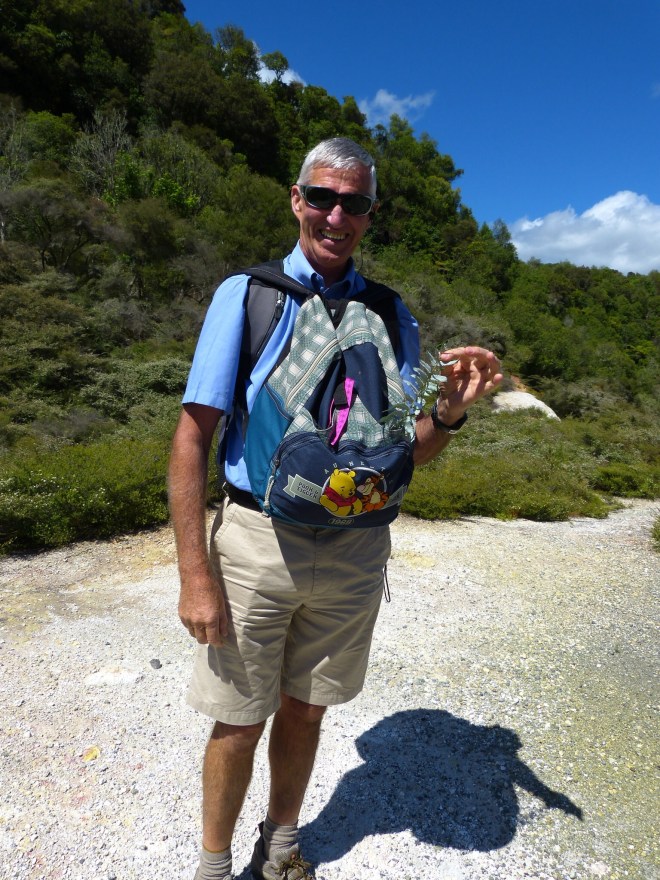
Here is our smiling guide Chas, holding a silver fern, one of New Zealand’s symbols. Do you think he usually carries a Winnie the Pooh back pack in front? Something to look for in future installments.
image More bubbles, then time to head back for lunch.
image
image
Pretty amazing, right?
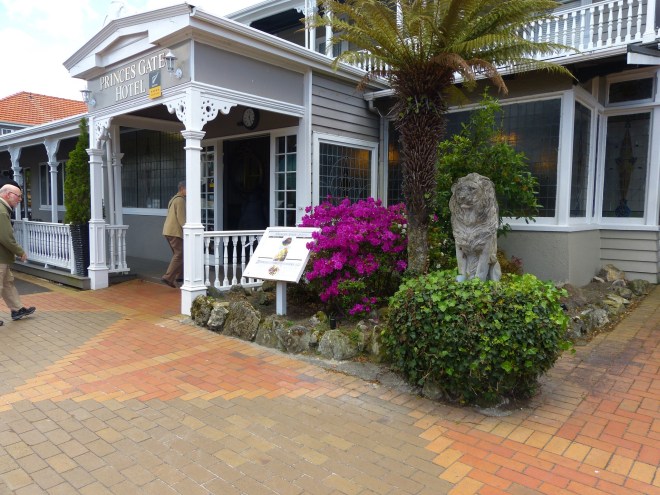
Once again, our guides came up with a great lunch venue. The Princess Gate Hotel has it all: an owner that welcomed us with a brief history of the hotel, fantastic food, wonderful ambiance, and a location close to the most beautiful section of Rotorua.
image
After lunch, we had time to stroll through the gardens, and ogle the beautiful buildings.
image

Amazing Auckland, Road Scholar Day One

The Road Scholar portion of our journey began on Tuesday, October 29, with a walking tour of downtown Auckland. This city has lots of interesting architecture, much of it newly constructed, so that it is earthquake-proof.

20131104-061455.jpg

20131104-061850.jpg

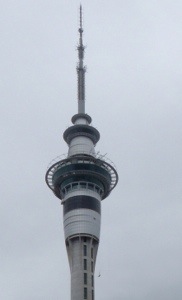
The sky tower is visible from just about everywhere in Auckland, but during our stroll we managed to catch someone jumping from the tower.  See that little black speck in the lower right hand corner?  That’s him, and yes, it IS an approved activity.  The Kiwi are very big on bungee jumping.   And no, I had absolutely no desire to “give it a go”, as they say down here.

20131104-061957.jpg

We ended our walk at the Art Museum, which has a wonderful gallery of Maori portraits.  We weren’t allowed to take photos there, but this postcard gives you an idea of what a tattooed face looks like.

image

As one might expect, the facial swelling from face carving is fairly severe.  the guide showed us a large funnel, which functioned as a feeding tube while the facial wounds healed.

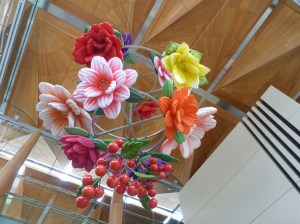
I as quite captivated by the flower sculpture hanging from the ceiling in the entryway.  The petals move!

image

Auckland has a number of incredibly beautiful parks.  The museum is next to one–Albert Park has this interesting entryway, and we did a quick walk by after our excellent lunch at the museum cafe.

20131104-062013.jpg

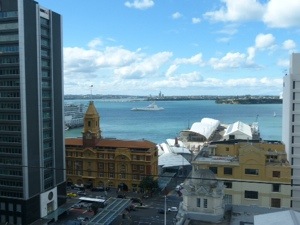
Our hotel has two things going for it: a great location near the harbor, and a spectacular view from the restaurant on the 13th floor.

20131104-062038.jpg

20131104-062051.jpg

I told told you you could see the sky tower from everywhere!

20131104-062106.jpg

We had just enough time for a brief walk around the waterfront before joining our group for dinner.  This picture is for our former host, Norman, to show him that we actually DID see some tall ships!

20131104-062124.jpg

New Zealand is an amazing country with many things the USA could learn from, but their wifi isn’t one of them. It is very limited, and blogging is a challenge. So, uploads are being done on the fly, and proof reading is a luxury to be reserved for better connections and more time. Typos will become a regular feature!

New Zealand

Time to hit the road again! For years, Mike and I have wanted to visit New Zealand, but we knew that a twenty hour plane ride could only be justified by a loooong stay. So, visiting that wonderful corner of the world had to wait until my retirement. Although I had been able to get away for three weeks while working, SIX weeks didn’t seem do-able.

Mike and I were so lucky to meet Davina and Norman on a river cruise in 2008. Our fellow cruisers were were almost evenly divided into thirds, from the USA, Canada and Australia, with Davina and Norman being the sole Kiwis. It was during a presidential election year, which made dinner discussions VERY interesting.

I’m amazed at how well informed other citizens of Planet Earth are! Makes me want to listen to the BBC more frequently, so I don’t embarrass myself with my ignorance of events outside our borders. Of course, Ted Cruz has done a good job of making me embarrassed by what has happened INSIDE our borders!

And yes, there actually IS a reason for that digression. Mike and I will be staying with Davina and Norman in Auckland for several days before our Road Scholar trip commences. I’m excited about spending time with them again, and have been blown away by their gracious hospitality. Davina offered to pick us up at the airport at the ungodly hour of 6 AM! And she has planned several days of sightseeing for us.

Getting maps into WordPress is a multi step process, easier done from my computer than iPad, so I figured I’d get it completed before we head to the airport.
First a map of the ground we will be covering during our Road Scholar trip.

Our New Zealand Adventure

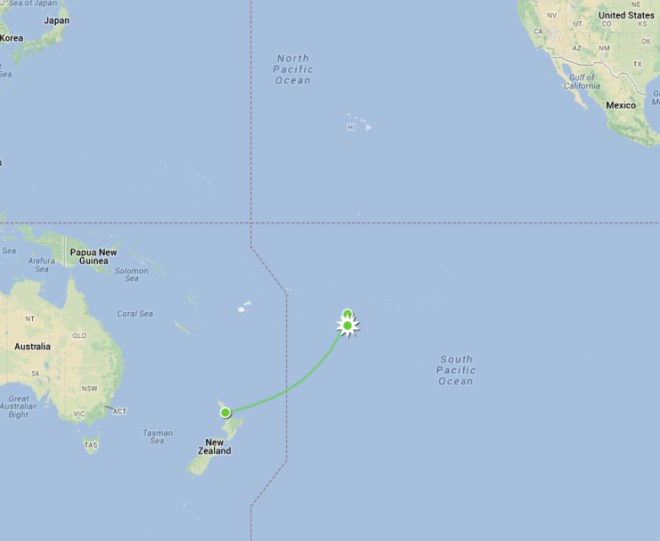
At the end of that trip, Mike heads back to the USA and I start a three week project with Global Volunteers in the Cook Islands. So, where ARE the Cook Islands, you ask?

The Cook Islands
The Cook Islands

Because I will be crossing the date line, I’ll be arriving before I leave. Given that I have always been calendar challenged, this will not be a problem for me.

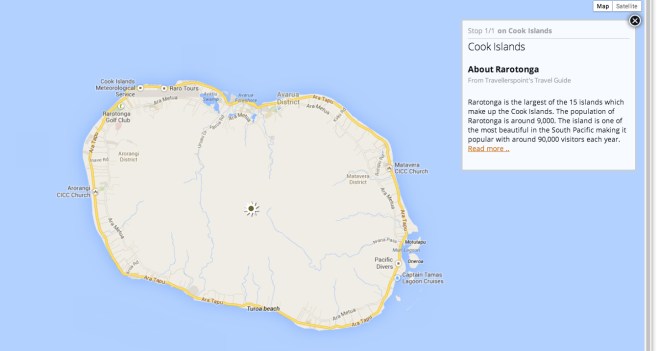
If you look at a map of the world, the Cook Islands show up as fifteen tiny dots, so here’s a close up of “my” island.

My home for three weeks

I’ll be staying in Rarotonga, the largest of the islands, which has a population of around 9,000. That’s about twice as many people as my home town.

I found this description of Rarotonga on the internet:
“The island is one of the most beautiful in the South Pacific making it popular with around 90,000 visitors each year. The volcanic peaks and white sandy beaches with overhanging palm trees, inside a coral reef make Rarotonga a paradise island.
Pretty tough duty, wouldn’t you say?

So, over the coming weeks, Mike and I will be hanging out in gloriously beautiful places, and I will be doing my best to capture all that fantastic beauty for your viewing pleasure. Who knows…maybe a contest down the road?

Come on along! And feel free to comment, so I stay connected with everyone!

Off to The Grand Canyon

Colin Fletcher called the Grand Canyon a “huge natural museum of the earth’s history”. Okay, so I didn’t know who Colin Fletcher was either, until I signed us up for this Road Scholar trip. Now that I am a retiree (excuse me, “lifestyle manager”), I have time to actually READ the suggested background materials.

Colin Fletcher wrote “The Man who Walked Through Time: The Story of the First Trip Afoot Through The Grand Canyon”. Given that the canyon was inhabited by Native Americans for about 10,000 years before the first Europeans arrived, it isn’t hard to imagine that one or two of them might have sauntered from one end of the canyon to the other before he did, but then again, THEY never published their adventures and thoughts. I shouldn’t be too hard on Mr. Fletcher, though. After all, his book was written in the early 1900’s; half a century later, when I was in school, we still were being taught that Columbus “discovered” America, as if it were completely devoid of human inhabitants when he arrived.

So, now that I’ve gotten beyond the title, what did I learn from his book? Other than that I would never, ever even CONSIDER hiking through the canyon, I learned that you can tell the age of the rocks from their colors. I created this little chart so I’d know what I was looking at when we get there, starting from the rim and moving on down to the bottom:

Rock Color Thickness Age
Limestone White 400 feet 225 million years
Sandstone Pale brown 350 feet 250 million years
Shale and Sandstone Red 1,000 feet 275 million years
“The Esplanade”, Limestone Blue gray, stained red 800 feet 450 million years
Bright Angel Shale Layered greenish gray and purple 600 feet 475 million years
“Tonto Platform”Tapeats Sandstone Brown 225 feet 500 million years
Schists Dark gray with granite Depth is unknown Almost 2 billion years

Okay, so I have no concept of what 400 feet (or any of the other number of feet, for that matter) looks like–but when I get there, and take photos, and post them, well, then we’ll ALL know. And we’ll also know how long those bloody rocks have been plopped there.

I do better with visuals. So here’s a picture of where we will be for the week, starting and ending in Phoenix.

grand canyon

This trip will have an added element of adventure. The original plan was that this trip would be my father’s day present to my dad. He and Mike were going to room together, and I would be rooming with my “childhood” friend, Augusta. My dad’s knee became uncooperative, causing him to have to cancel out. Well, I notified Road Scholar and told them to change my roommate to Mike. I then learned that doing so would mean that Augusta might be assigned a female roommate, which wasn’t quite what she’d had in mind. So, Mike being an all around wonderful guy, decided to ‘take one for the team’ and agreed he’d be the solo traveler. No, that doesn’t mean HE gets the female roommate. He will only be matched up if there is another solo male traveler. The adventure part? We won’t know how this will shake out till we arrive tomorrow night.

Just think of the possibilities… Mike’s assigned roommate is a Sean Connery look alike, who gazes upon the lovely Augusta and is immediately smitten, causing us to swap roommates faster than your average college freshman. Beautiful sunsets, the canyon as a backdrop..could this be a made for TV movie, or what? Lifetime channel, perhaps?

More likely, Mike will be roommate-less. Hmmm. Maybe we shouldn’t mention that we’ve been married for 37 years. That way, if I am spotted doing the “walk of shame” out of his room some morning, it might liven up breakfast discussions.

So, which part of the blog did YOU find more interesting– rock colors and ages or the possibility of “seniors gone wild”?

Retirement Redefined

P1030219

Sometimes the most valuable insights are the ones you stumble upon.

I’ve been very fortunate to be able to spend time in other countries, learning about different cultures, values and philosophies.  Doing so brought American culture into sharper focus, but what really helped me examine our way of life from a different vantage point was a piece written by Dr. L Robert Kohls, the Director of International Programs at San Francisco State University.  Entitled “Why do Americans Act Like That”, it was intended to help international students deal with culture shock.

Here comes the insight part.  It struck me that four of Kohls’ thirteen points provide a great explanation of American attitudes toward retirement.  See what you think.  I’ve changed the order of the points  and slightly shortened some of them, but otherwise directly quoted.

Action/Work Orientation

“Don’t just stand there, do something!”  This expression, though normally used in a crisis situation, in a sense describes most Americans’ waking life, where action – any action – is seen as superior to inaction.  Americans routinely schedule an extremely active day.  Any relaxation must be limited in time and aimed at “recreating” so that they can work harder once their “recreation” is over.  Such a “no nonsense” attitude toward life has created a class of people known as “workaholics” – people addicted to, and often wholly identified with, their job or profession. The first question people often ask when they meet each other in the U.S. is related to work: “what do you do?”

Self-Help Initiative

Americans take credit for only what they accomplish as individuals.  In an English-Language dictionary, there are more than 100 composite words that have the word “self” as a prefix: self-aware, self-confident, self control.  The equivalent of these words cannot be found in most other languages.

Time and Its Control 

Time is of utmost importance to most Americans.  It is something to be on, kept, filled, saved, used, spent, wasted, lost, gained, planned, given, even killed.  Americans are more concerned about getting things accomplished on time than they are with developing interpersonal relations.  Their lives seem controlled by the little machines they wear on their wrists.

Future Orientation

Americans value the culture and the improvements the future will surely bring.  They devalue the past and are, to a large extent, unconscious of the present.  Even a happy present goes largely unnoticed because Americans are hopeful that the future will bring even greater happiness.

Wow.  That sure got ME thinking!  Or should I say, becoming more “self aware”?

When I announced my intention to retire, the most frequent question I was asked  (can you guess?) was  “what are you going to do all day”.   There you have it–the perfect display of our “work/action orientation”.  I’ll admit that after almost 40 years of “to do lists”, objectives, project plans and performance reviews, it took a while for me to truly realize that I don’t HAVE to do anything.  A day can be perfect even if at the end of it, I can’t point to a single significant accomplishment. Okay, did you just get a mental image of me plopped on the couch, glassy eyed, with remote in one hand and cheese doodles in the other?

If your ‘self worth” is defined by what you have “made” of yourself,  which is generally taken to mean what occupation you have, then retirement can indeed feel like a loss of identity.  Couple that with our notions of time and our future orientation, and it becomes clear why many Americans fear the unstructured time that retirement provides.

I realize how fortunate I am to have been able to  choose to retire, rather than having retirement thrust upon me because of poor health or job elimination.  But for those of you with negative stereotypes about retirement, well, maybe the term “retirement” needs a make-over.  Hey, I’ve spent the last 6 decades being bombarded by advertising.  I know  Madison Avenue can help with this.  So, here’s how Peggy Olsen and Don Draper would wordsmith my answer to the question, “what do you do”?

I am the CEO of Destination Now, (well, as its only employee, I am also its receptionist, administrative assistant and janitor, although my husband Mike might argue that last job title belongs to him.  But hey, this is MY blog so I get to say what I want) a “lifestyle management” company (whose only customers are Mike and me, although occasionally my bossiness–I mean “management skills”– expand to engulf close friends, sisters and cousins).

Our current projects include containing health care costs,  (Okay, so we go to the Y regularly, and I cook healthy meals–no high fructose corn syrup for us, and I swear the red wine and dark chocolate are only consumed for their health benefits)  supporting the global economy,  (I take my obligation to buy from local vendors very seriously when we travel.  That’s where my contest prizes come from!) and promoting early childhood literacy (this last one is real).  How’s that?  Better?

Now, about that “Future Orientation”…this blog is entitled “Destination Now” to remind me that I have arrived.  The first 30  years of my life was preparation: getting educated, finding a life partner, starting on a career path, becoming a mother.  The next 30 was implementation: putting all that preparation to work.  And now it is fruition: enjoying all of the fruits of prior labors, focusing on the here and now, making the most of every day, even if that means allowing the day to unfold without any plan or need for accomplishments.

Way back during my high school days, one of my closest friends shared with me this definition of success.  (Maybe Emerson was the author, maybe not, but does it really matter?)  I think it is the perfect ending to today’s post.

Success

To laugh often and love much; to win the respect of intelligent persons and the affection of children; to earn the approbation of honest citizens and endure the betrayal of false friends; to appreciate beauty; to find the best in others; to give of one’s self; to leave the world a bit better, whether by a healthy child, a garden patch or a redeemed social condition; to have played and laughed with enthusiasm and sung with exultation; to know even one life has breathed easier because you have lived—this is to have succeeded.
Home Town Hero

Every town should have its very own super hero. Henry Huttleston Rogers was Fairhaven’s.  If you’ve never heard of him, that’s an indication that you don’t live in Fairhaven  and you probably took I-195 from Providence to Cape Cod, instead of the more scenic Route 6. Sure, I-195 will get you to the beach faster, but what you miss is a chance to see the impact one of Standard Oil’s “robber barons” can have on a sweet little town.

Henry Huttleston Rogers Memorial on Huttleston Avenue

After you clear the bridge from New Bedford, the highway’s name changes to Huttleston Avenue, and if you look to your left, you’ll see one of the many reasons the town has chosen to honor its home town hero.

Fairhaven High School

The gorgeous Elizabethan stone structure, completed in 1906, is actually Fairhaven High School, Henry Huttleston Rogers’ last gift to the town before his death in 1909. I have never been inside–I attended a regional high school–but my sister Sue (the source of all my inside information) tells me the school has marble floors, wood paneling, and carved gargoyles in the auditorium.  The adolescent version of me probably wouldn’t have noticed these grand architectural features anyway.  I would have been too busy hoping one of the other auditorium “creatures” would ask me out after the assembly ended.

I DID pass many afternoons during my teen years as a volunteer at Our Lady’s Haven.

P1000086

Completed in 1905, the building was originally known as the Tabitha Inn.  Designed to resemble a Shakespearian era Inn, it was described as the grandest hotel outside of New York and Boston.  Samuel Clements, better known as Mark Twain, was one of its frequent guests. It became a home for “the elderly and infirm” after it was purchased by the Catholic Diocese in 1944.

I stopped in to say hello and to take a look around the lobby.  Back in my day, it was run by the Carmelite nuns, but today only one nun remains.  Lovely Sr. Eileen from Ireland is now running the show, making sure Fairhaven’s senior citizens receive tender loving care.

Next to the Tabitha Inn is  a red brick schoolhouse, another gift from Rogers.  The school’s last class graduated this year, and the building is now closed, so all future students will be studying in a more modern building.

Rogers Elementary School, closed in 2013

From June through September, on Tuesdays and Thursdays, the Fairhaven office of tourism offers 90 minute guided tours, starting at 10 AM  from the town hall — and yes, Rogers donated that too.  Click on this link for more information about the tour and the town.

Fairhaven Town Hall
Fairhaven Town Hall

I wasn’t crass enough to photograph the interior of Our Lady’s Haven, (not everyone enjoys getting their image blasted into cyberspace) but the interior architecture of the town hall is very similar…so you get the idea of how lovely both places are.

Town Hall Interior--grand staircase, with arches and carved wooden railings
Town Hall Interior–grand staircase, with arches and carved wooden railings

My very special childhood place is across the street from the town hall.  The Millicent Library was built in 1890 as a memorial to one of Rogers’ daughter’s, who was 17 when she died.
Millicent Library
Millicent Library

I don’t think this is a statue of Millicent.  Pretty racy for a small town in the 1900’s, wouldn’t you say?

Statue in the library reading room

My summer days were spent in the children’s reading room, where  I discovered that “The Wonderful Wizard of Oz” was only the first in an entire series L Frank Baum wrote about the magical land of Oz.  Those books kept the 9 year old me entertained for an entire summer!

As I was leaving the library, one of the friendly residents (did I mention that Fairhaven people are VERY friendly?) asked whether I had noticed Dante atop the library.  I never had before–but here he is, for your viewing pleasure.

P1000079

So, who was Henry Huttleston Rogers–and how did he amass such a huge fortune? Rogers got his start in Pennsylvania, where, in 1861, he and a partner started a small business refining oil. By 1885, he had joined with John D Rockefeller, eventually becoming one of the three key men of Standard Oil. Known as “the Brains of Standard Oil Trust” and “Hell Hound Rogers”, he was a captain of industry.

He was also a generous man who befriended Booker T Washington and paid for Helen Keller’s Radcliffe education.

The “giving” tradition continued with Rogers’ granddaughter, (official name when she died: Mary Millicent Abigail Rogers von Salm-Hoogstraeten de Peralta-Ramos Balcom, but she went by Millicent Rogers–and who can blame her?) who founded the Millicent Rogers museum in Taos, New Mexico to house native American art.  The daughter of Rogers’ only son, she was quite a fascinating character–but that’s a subject for another time.

Visitors to Fairhaven should stop at Margaret’s or Elizabeth’s for a great meal. The restaurants are side by side, near the waterfront.  If you are lucky, you might get lovely Kristen for your server, and Kevin may be your chef!


Home Town Tourist

Whenever we travel to another country, we pay close attention to everything the area has to offer. We ogle the architecture, read all the signs at monuments (well, Mike does) visit museums, battlefields, parks, churches–anything and everything that could possibly be of interest.

But what about our own surroundings? I realized that I certainly take them for granted. Now that I am a retiree, however, I have the wonderful gift of time, so I can slow down, and really LOOK at everything I never fully noticed before. Mike and I won’t be traveling for a few more months, so in the interim, I’m going to be a “day tripper”, a local tourist.
First stop, my childhood town of Fairhaven, Massachusetts.

In 1775, shortly after the battles of Lexington and Concord, General Gage sent the British ship Falcon to Martha’s Vineyard to rustle up some food and supplies. Something tells me he left his MasterCard at home, figuring this “shopping excursion” would indeed be price-less, or at least payment-less.

When the Fairhaven militia discovered two of the Falcon’s tenders anchored off nearby Buzzards Bay, they grabbed their muskets, set sail and returned with “more than 25” members of His Royal Majesty’s marines as their captives. According to local lore and immortalized on a stone tablet, this was the first naval battle of the revolution. Would it not therefore be the first naval battle of what would eventually become the United States of America? Why didn’t THAT fact make it into the history books? We Americans are inordinately fond of firsts. So, we Fairhavenites should all feel rightfully proud!

The Fairhaven locals soon realized they needed to protect their harbor and nearby New Bedford, so they spent the next two years building this fort.

P1030225

General Gage, understandably miffed at the township for the ignominious defeat his mighty navy suffered at the hands of the Fairhaven militia, waited till the fort was finished. In September of 1778, he returned with 4,000 troops to set the town and its ships aflame. He really must have been intimidated by those plucky militia men, because it was highly unlikely that the entire Fairhaven population back then was anywhere close to 4,000–even counting the chickens and cows.

Although the vengeful Gage succeeded in destroying the fort and, in general, creating a huge mess, he was stopped from sacking Fairhaven by a great soldier with an even better name. Major Israel Fearing marched 15 miles from Wareham to save the day–and the town. Try as I might, I couldn’t get a head count for Major Fearing’s fighting force. But I DID confirm the distance between Wareham and Fairhaven with Mapquest, so it has to be right. Funny, as a kid, I always thought Wareham was a lot further away than a mere 15 miles. Maybe it only FEELS further on a Sunday drive, when you are sitting in the back seat, being tormented by your younger brother. P1030227

You can’t keep a Fairhavenite–or a fort–down, so in record time, like the mythical Phoenix, it arose from the ashes, ergo its name. Despite living in Fairhaven for over 20 years, I never made the connection until I read yet another on site stone tablet. P1030239

Right by the fort is another important protective structure, the hurricane dike. It might not be as big as the Great Wall of China, but like that other wall, you can stroll along it to get a view of the surrounding area and watch the fishing boats sail through.

P1030229

The dike also allows you to peer into the back side of the stately old homes near the Fort. The one below has”widow’s watch”, a small room at the top of the house with windows on all four sides. The story goes that back in the whaling days, the lady of the house would scan the horizon, watching for her husband’s ship.

P1030240