
I’m so glad I was able to spend 5 days in this wonderful city. Those of you who have read my earlier posts may recall that initially I was not particularly enamored. Must have been because of jet lag, or the piss poor commentary on the City Circle / Gray Line HOHO. My recommendation—try a different HOHO in Berlin. There are four.
The Germans truly believe “Those who fail to learn from history are doomed to repeat it”
Unlike us, they do not spin, whitewash or deny their history. Instead, they build monuments to the victims, and record the monstrous deeds of the perpetrators of violence—the Nazis.
The Topography of the Terrors is a free outdoor exhibit, built on the site of the former Gestapo headquarters. One of the photos shows Adolph Hitler’s military parade on his birthday.

I was viewing this exhibit on the very day something similar was happening in the USA. Fortunately, our wannabe dictator’s celebration was not as well attended. And even more fortunate—the “no kings” protests throughout the USA had far more participants.
Once the OAT pretrip started, we enjoyed a city tour where we learned the significance of some areas we had visited when Barb and I were on our own.
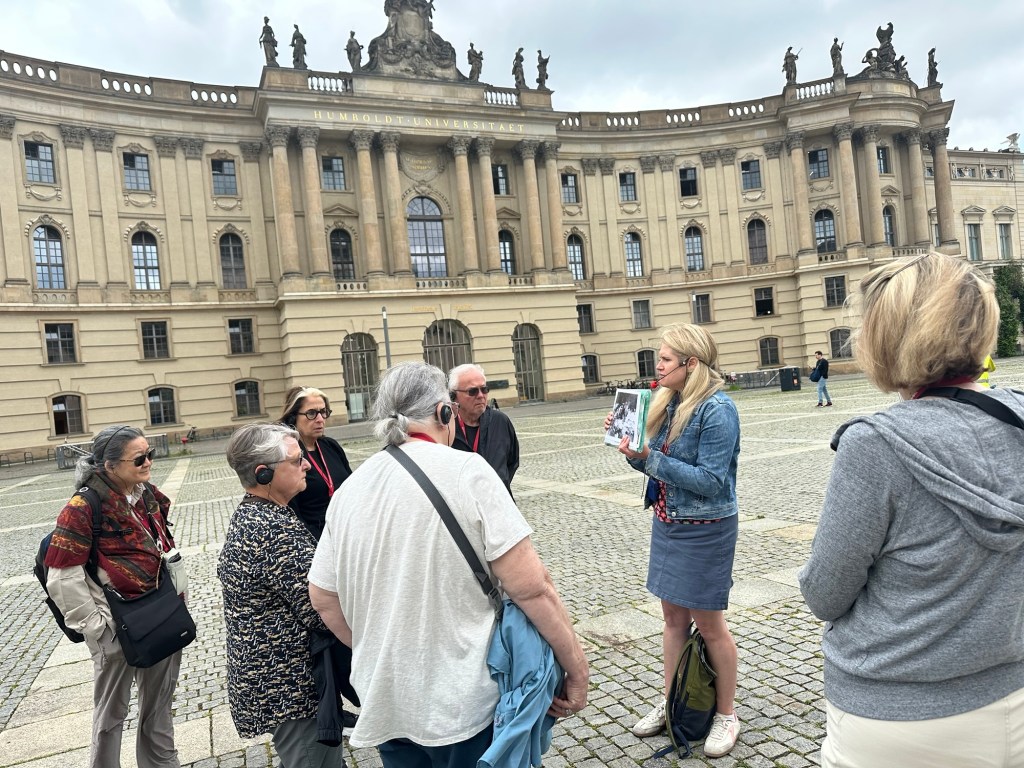
Following is a photo of Anne, our guide, showing us the location where over 20,000 banned books were burned. She also shared this prescient quote from 1820:
“those who start by burning books will also burn men”
After the war, Berlin was divided into 4 sections. Russia got East Berlin; West Berlin was shared by the Americans, the French and the British. West Berlin was completely surrounded by East Germany, which was held by the Russians.
1961 was the first time a wall was built to keep people IN. That’s because 3 million people (out of 18 million) had left East Berlin after the Soviet occupation. These were “essential” workers, so something had to be done to stop the brain drain.

Throughout the city, we saw reminders of where the wall once stood. This is how the marker looks if you are on the West side of the wall.

There were actually two walls, with a strip of land in between, known as “ the death strip” and “no man’s land”. Both walls were painted white, to make it easier to spot people trying to escape.
Some statistics: Along the walls’ 100 miles, were 280 guard towers. No man’s land was patrolled by 1100 armed guards and 1000 dogs.
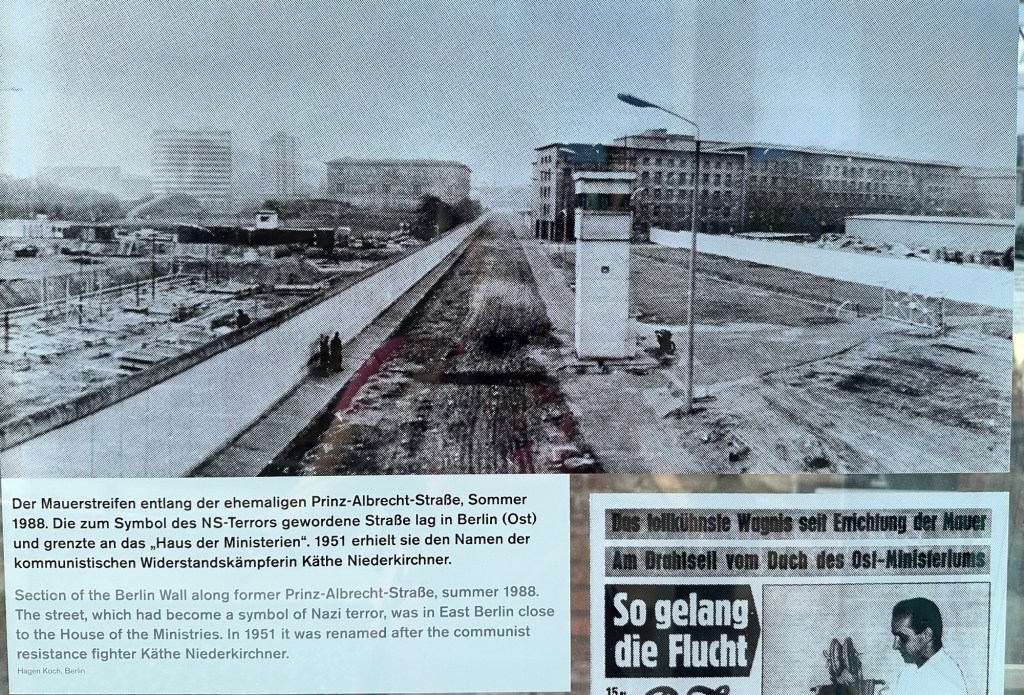
The stories of the 140 people who died while trying to escape are memorialized in the Terror exhibit.

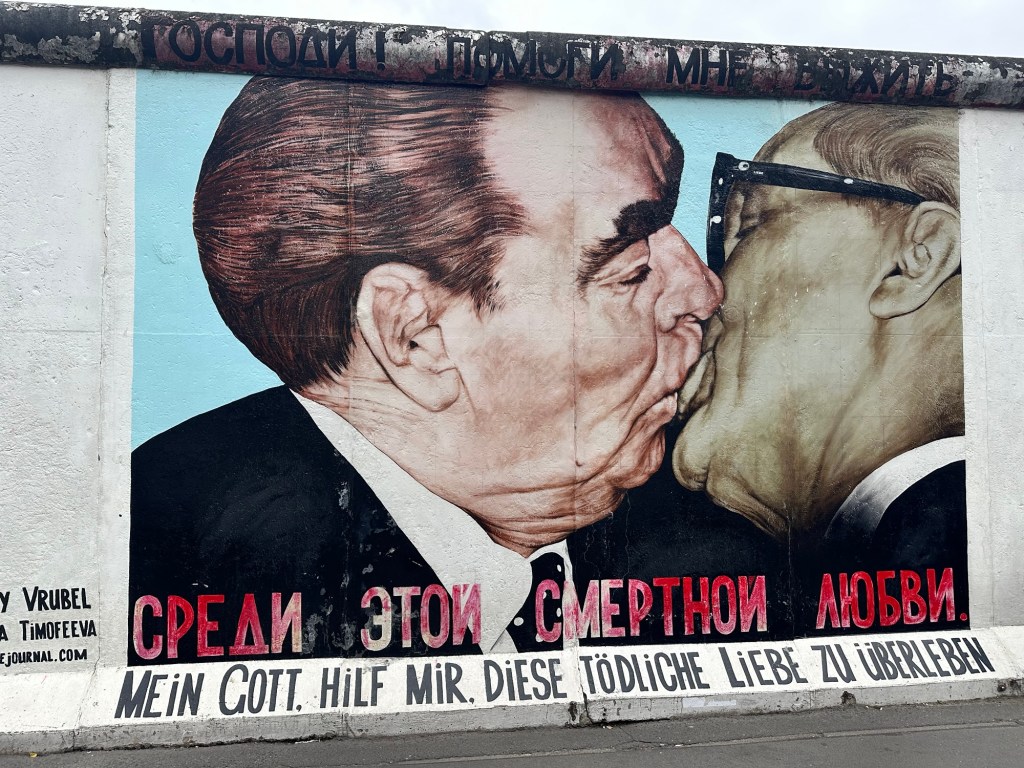
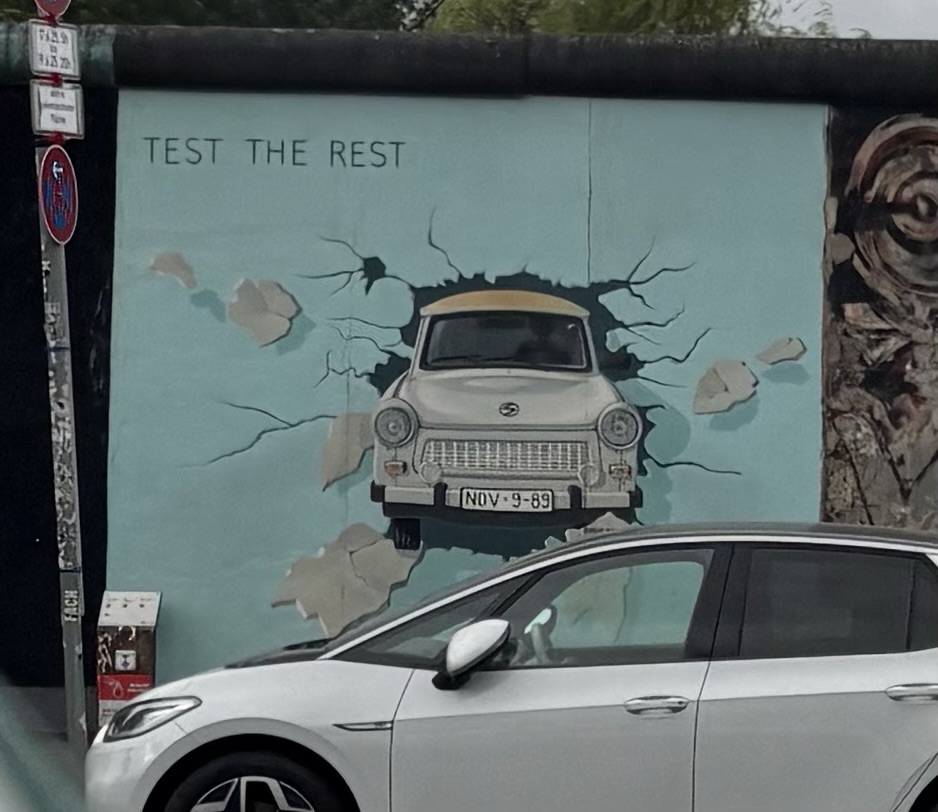
After the wall came down, artists painted murals on the remaining sections.


Remember how Barb and I were mystified by the holocaust monument? Well, thanks to Anne, we now understand.
The architect wanted visitors to feel something as they walked through the exhibit. He succeeded. As the stones got taller and the ground became uneven, I felt uneasy and claustrophobic.

We learned that the memorial is composed of 2711 stones, to represent the number of pages in the Talmud. Viewed from above, it looks very much like an arial view of death camps’ barracks and a Jewish cemetery in Israel.
Next, we visited the “Disney” version of Checkpoint Charlie.
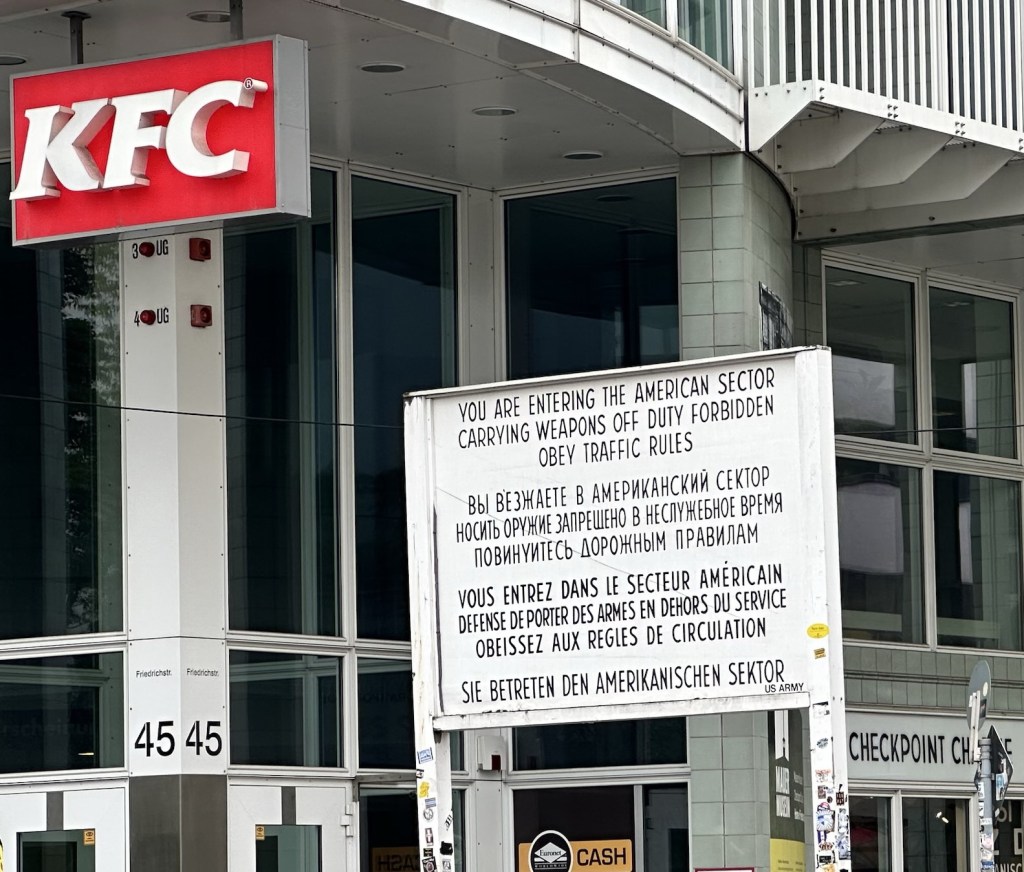

Knowing it is a tourist trap didn’t stop us from posing behind the sand bags.
We almost didn’t take the optional tour “Allies in Berlin” tour on our last full day in Berlin, because we mistakenly thought it would be a repeat of what we had already seen. Tomas, our trip leader, encouraged us to take the tour and I’m so glad he did.
It was extremely emotional for me. It harkened back to the time when we understood how important it was to win “hearts and minds”, back when we had leaders with integrity, foresight and wisdom.
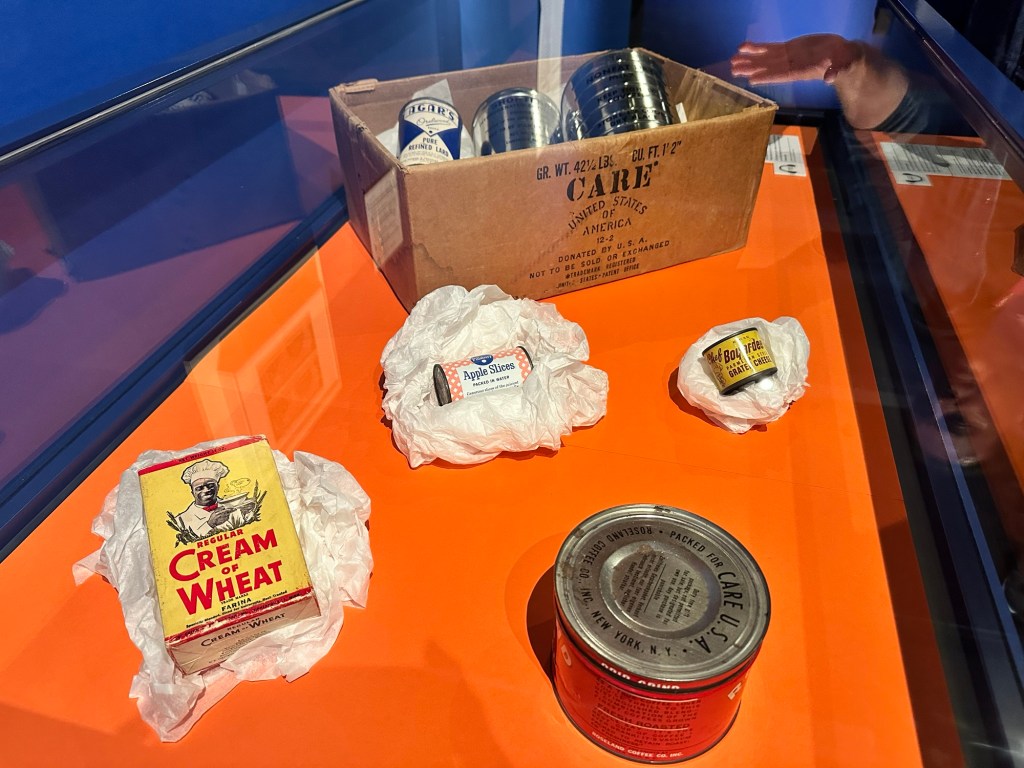
The Soviets were trying to starve the West Berliners into submission, but the US, France and Great Britain began airlifting tons of food, coal, medicines and essential supplies to the people of West Berlin. The west Berliners were surprised that the people they were shooting at, just a few years earlier were now protecting them. That was the start of the strong friendship between Germany and the USA.
One American pilot decided to make small parachutes for rations, starting the “candy bombing” runs represented by the artwork on this bear.
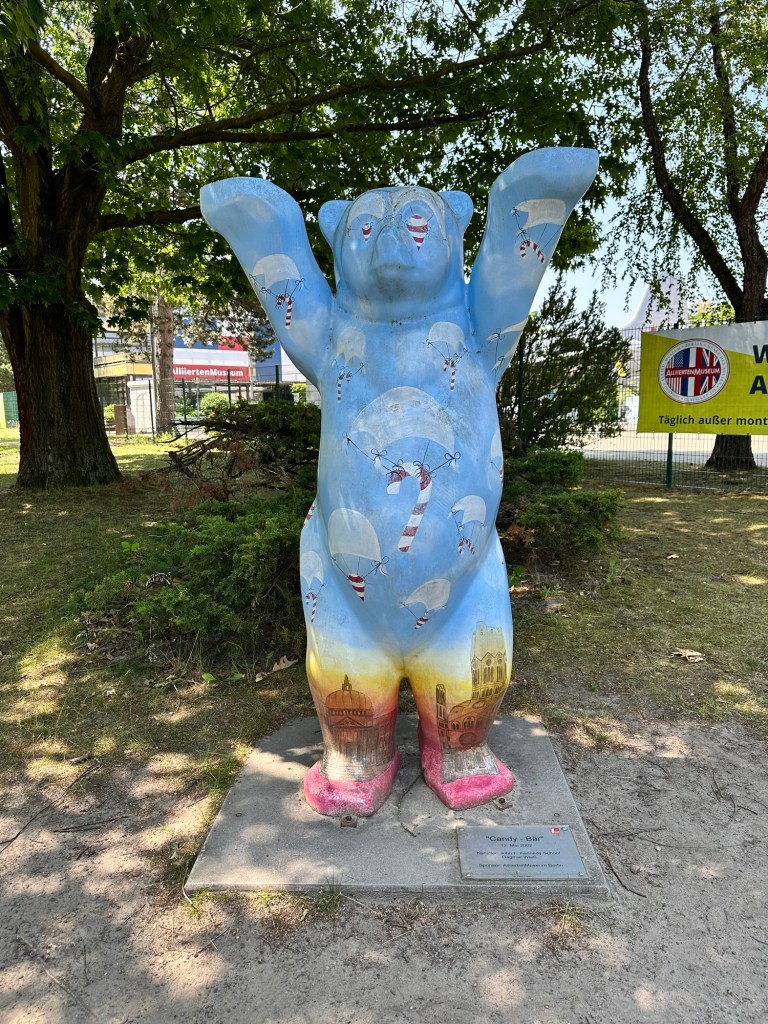
Because France and Great Britain had been badly damaged by WWII , most of the aid came from the USA.
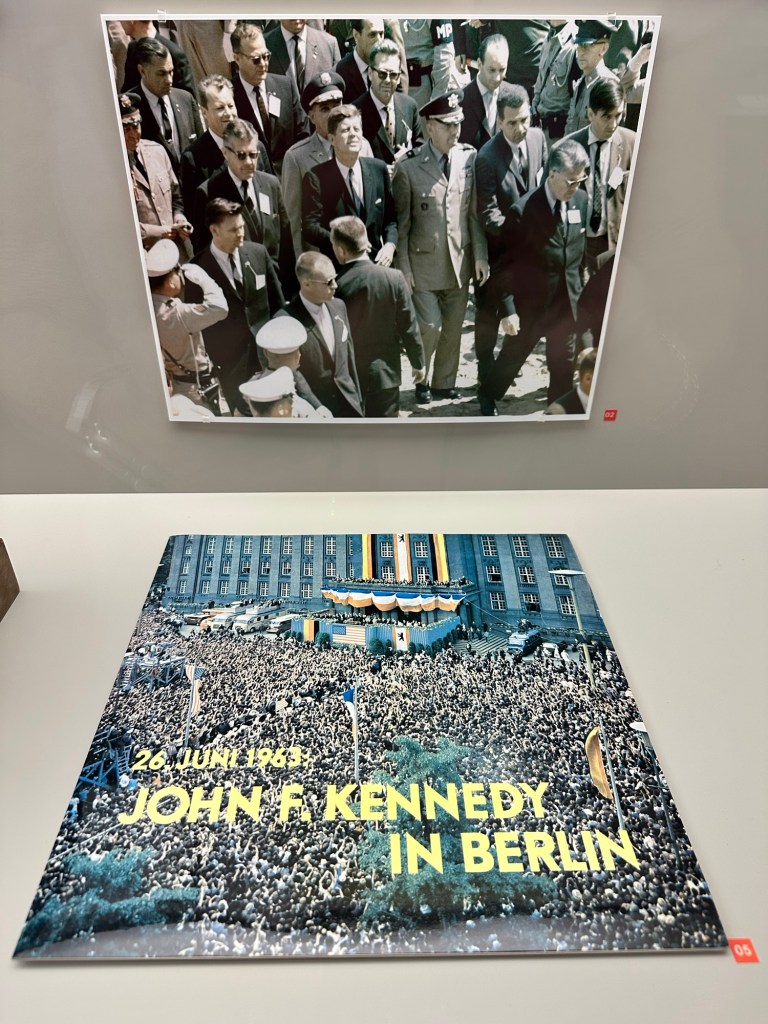
Years later, when the Berliners were feeling isolated and fearful, JFK visited. Although he only spent 8 hours in Berlin, his speech meant the world to the people of West Berlin:
“Two thousand years ago, the proudest boast was civis romanus sum [“I am a Roman citizen”]. Today, in the world of freedom, the proudest boast is “Ich bin ein Berliner!”… All free men, wherever they may live, are citizens of Berlin, and therefore, as a free man, I take pride in the words “Ich bin ein Berliner!”
I was surprised that Ronald Reagan was not as revered, so I asked Alex, our local guide about it. He told me that there is a plaque at the Brandenburg Gate for Reagan, but at the time he gave the “tear down the wall” speech, most Berliners thought it was an impossibility and that Reagan was just a “crazy old actor”.
At the American Museum, we saw the REAL checkpoint Charlie building, moved to this site when the wall came down. (It was one of three checkpoints: Alpha, Bravo, Charlie). These days, what was once barracks for American troops, have been transformed into condos.

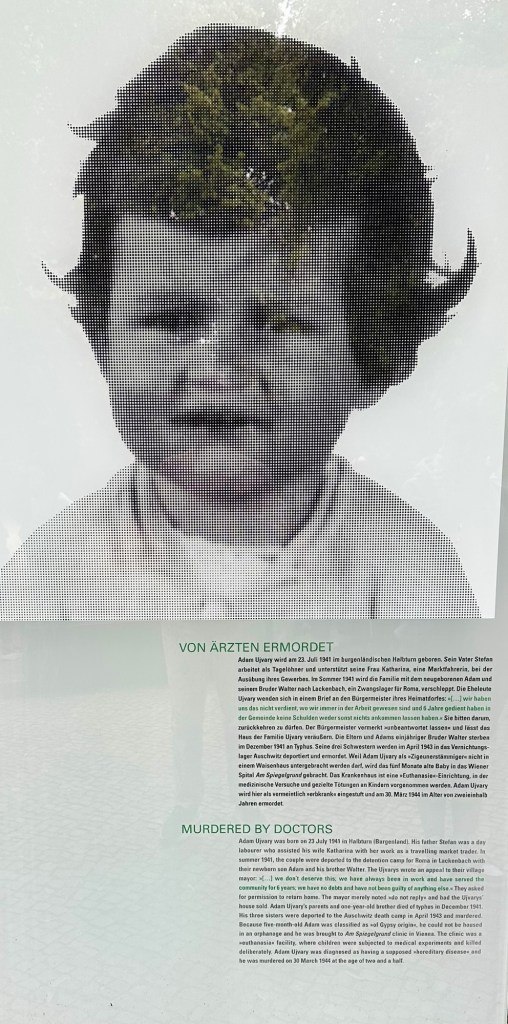
To end this sobering post, here is a photo from the Sinti and Roma (Gypsy) memorial.
This child was separated from his parents, who had been employed, and had never been in trouble with the law. Their only “crime” —being born to the wrong parents.

 Destination NOW
Berlin really is a beautiful city and there is so much history. It is sobering to realize the lasting effects of WWII well into recent history.
Diana
LikeLike
It is amazing how much I didn’t know about WWII. I thought I was up on what had happened but I had no idea what the Czechs experienced.
LikeLiked by 1 person