
Well, for the very first time, Alejo has given us misinformation. He told us we wouldn’t have internet access in the coffee triangle because WiFi comes and goes. That may be true for some of my fellow travelers, but so far, the WiFi in my room has been great. If it weren’t, I would use my T-Mobile connection to access the internet. It is excellent and, unlike Verizon, it’s FREE.
Before I launch into the stories of two neighborhoods, a little background information is necessary.
Colombia organizes its cities into “levels” for economic reasons. Those having the poorest infrastructure, generally also have the poorest residents. Their neighborhoods are designated levels 1 and 2. These residents don’t have to pay taxes or for utilities, mass transit or public education. Sometimes subsidies are provided. Those who live in levels 3 and 4 pay taxes, are charged for utilities and may have access to both private and public schools. Levels 5 and 6 are the richest areas, with the best infrastructure—the best roads, hospitals, shopping centers, private schools etc. Although these residents could send their children to free public schools, none are located there nor do mass transit lines go to those areas, because the people living there wouldn’t use it.
Unlike the US, where the rich live at higher elevations to take advantage of better views, in Colombia the poor live up the sides of the mountains. It is difficult to get emergency vehicles into those neighborhoods because roads are either poor or nonexistent.
Both comuna 8 and 13 are level 1 areas. Both have been affected by the extreme violence that has plagued Colombia. We visited The Hill of Values, which is in a level 1 area. It’s a recycling plant organized by former paramilitary members. We met one of the founders, who after he demobilized, wanted to “make amends” to the community he once terrorized. Take a look at what he and other former paramilitary members have created.

This terraced garden produces food that is free to the neighborhood. People are allowed to help themselves to fresh vegetables and herbs.
In addition to the recycling center and the garden, the group hosts educational events. Its goals are to raise awareness about environmental best practices, offer local youths an alternative to drugs and violence and foster understanding between Colombians and visitors.

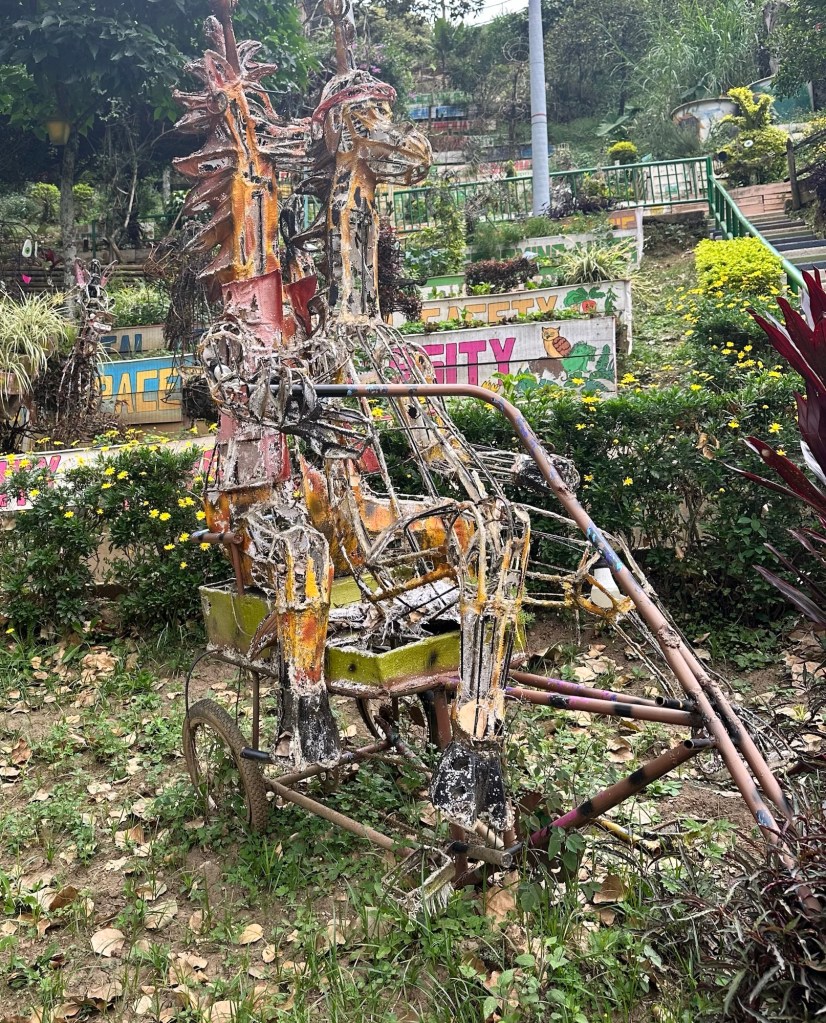
Look at the whimsical creatures they made from collected materials they transformed into sculptures. I was awed by their creativity and artistic ability. The photo below doesn’t do justice to the magnificence of the two giraffes on a bicycle. Just looking at it made me smile.
The recycling center receives funding from the OAT Foundation, which allowed the organization to purchase a solid waste compactor. Bundles of compacted trash are not visually appealing, instead I’ll share another photo of the very charming garden.

After our tour, we had a delicious lunch at the recycling center’s community room with some of the workers.
I’m not confident that I’m getting everything 100% right—hey, I already admitted in an earlier post that my memory sucks— but I think the most salient points are pretty accurate.
Comuna 13 was not on the itinerary, but Alejo made schedule changes to make time to visit an area that has been transformed into an incredible community. Not only that, but he also asked his friend Christian to be our guide,starting with a visit to Christian’s home.

Colombians add floors to their dwellings when they have the money and the time to do so. Christian and his wife and son live here with Christian’s parents occupying the floor below. The recently added top floor is a cafe with a spectacular view.
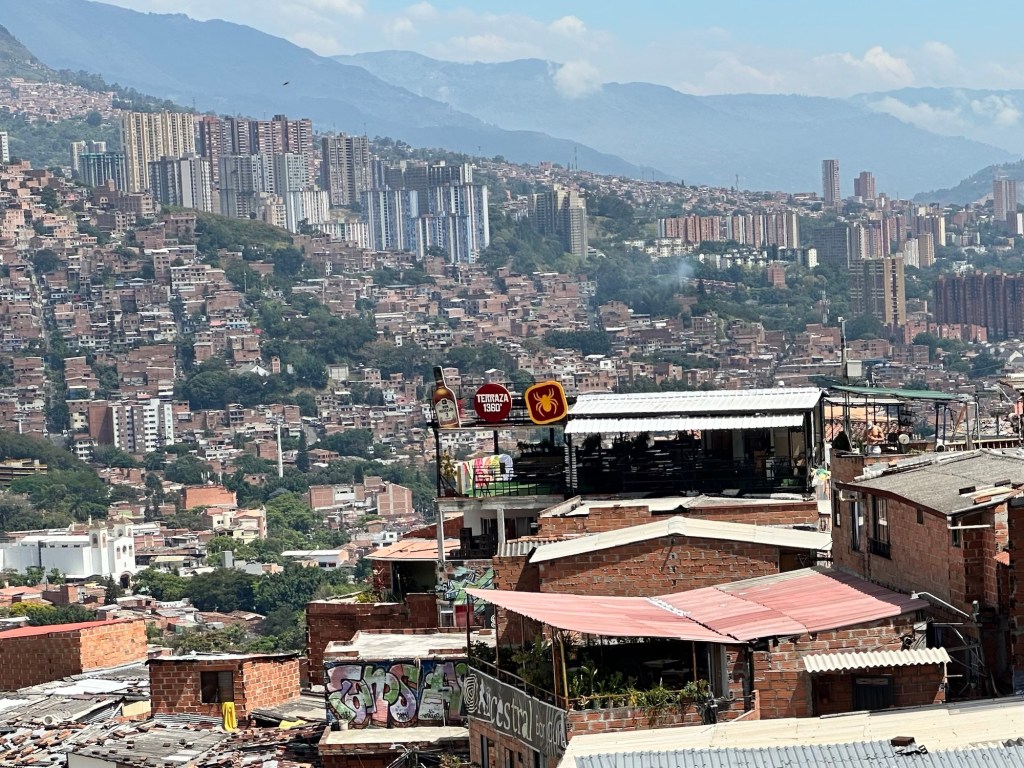
The Wall Street Journal sponsored a contest in which they searched for the most innovative city in the world. The three finalists were Medellín, Tel Aviv and NYC. One of the key criterion was the use of technology to help poor residents.
Although we all heard about the violence and terrorism in Medellín, what was not as widely publicized was the election of a former math professor as the mayor in 2003.
The mayor recognized that most of the terrorists were people without opportunities. In fact, comuna 13 was one of Pablo Escobar’s favorite areas for recruiting teenagers. When you feel isolated, are struggling to survive, and have no hope for the future, you become very vulnerable. Plus, if you got killed, Pablo promised to take care of your family, which was not the case if you joined the guerillas, paramilitaries or gangs.
The mayor started a program of social inclusion by building cable cars so that the people on the mountainside could have transportation to the jobs on the flat, lower part of the city. Working with an architect to create green areas for “library parks” in the lowest income areas, where computers and classrooms were made available.
Because there were some suicides from the cable car stations, Colombia established on site counseling centers, staffed with professionals who offered free sessions. We have so much to learn from other cultures!

What probably helped Medellín to win the contest were the external escalators. Has anyone seen escalators outside of a building before? I sure hadn’t until I watched the 2024 amazing race episode. On the show, it looked like there was only one escalator. Nope. There are countless escalators, so described because I forgot to count them. Covering the escalators are solar panels which provide protection from the elements and produce the energy to run the escalators.
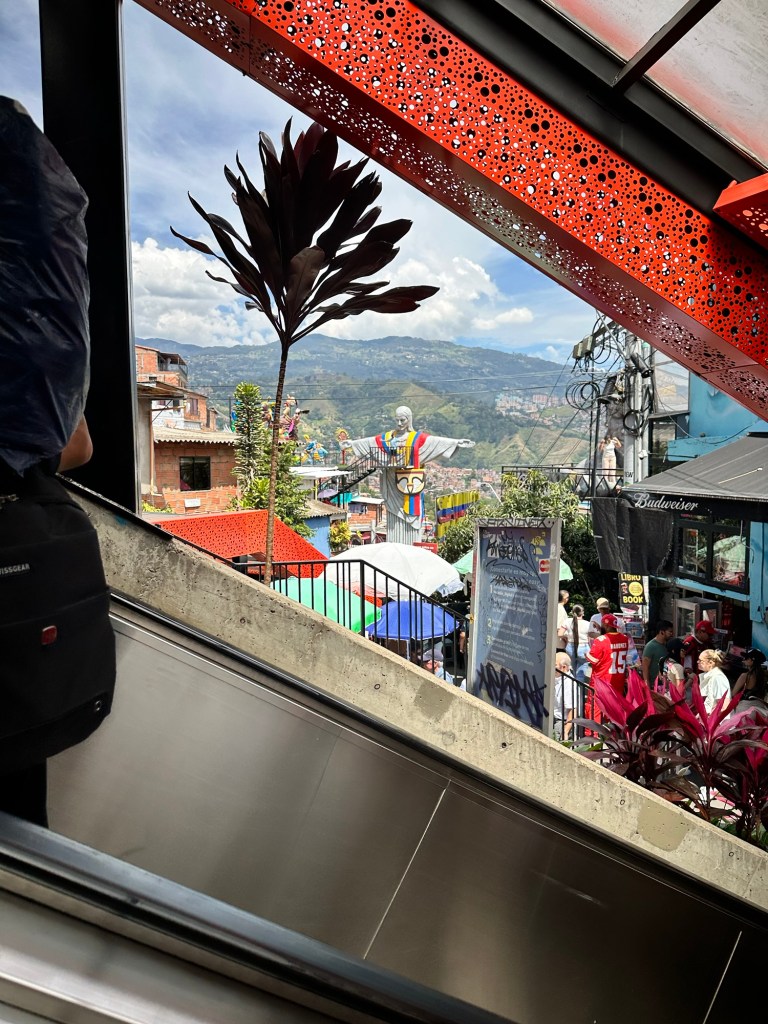
These escalators were funded by Colombia’s Utility Company, EPM, which pays for other social projects.
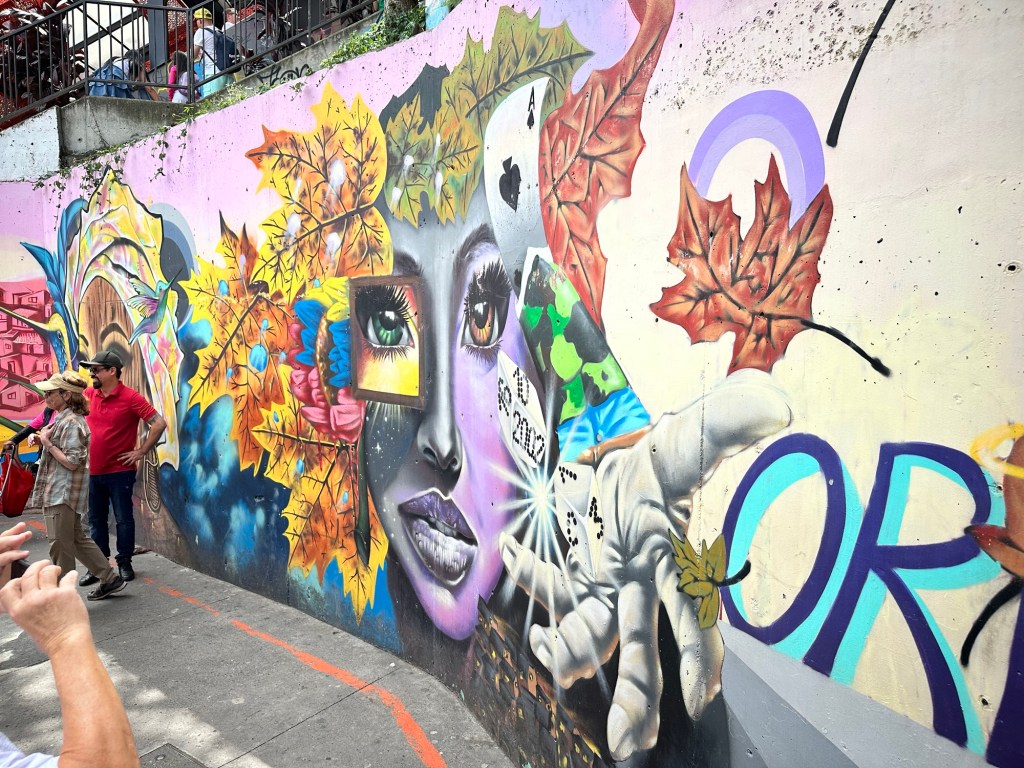
Although we didn’t see the “Amazing Race mural” we saw lots and lots of exquisite street art, with Pachamama featured on several.
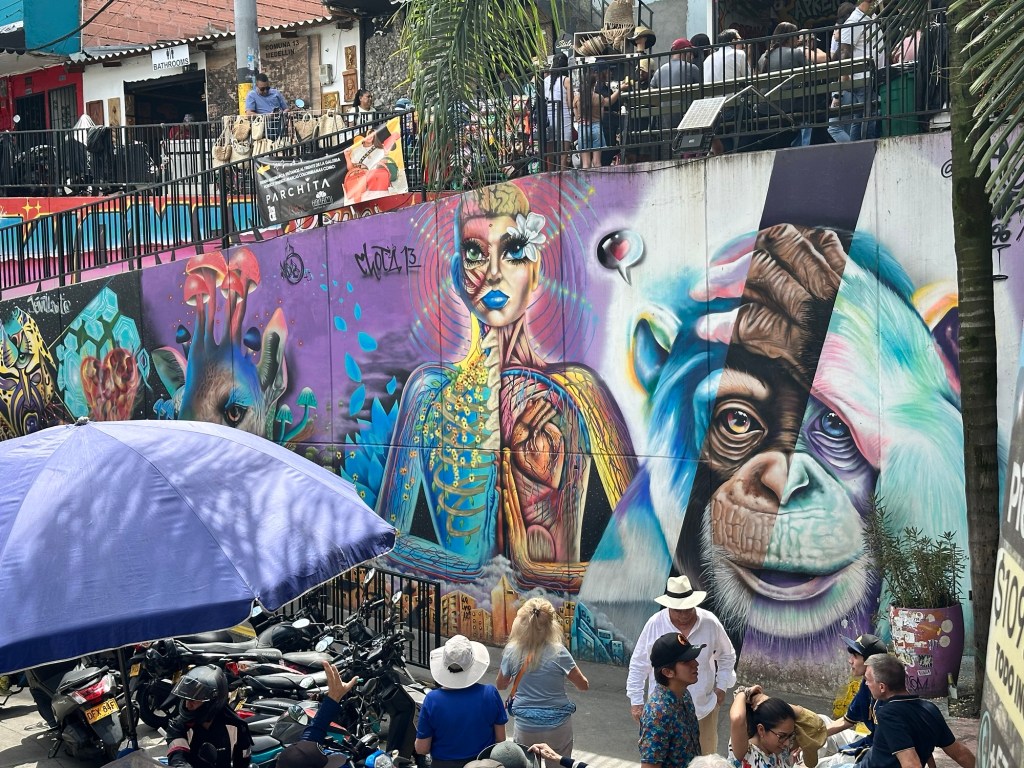
We are at the airport now, so once again, I will press “publish” and hope for the best.
By the way, Alejo was right about the WiFi. I was the only one with good connectivity. I must have just got lucky.

 Destination NOW
What a wonderful example of infrastructure and planning helping all the residents, I feel the US would have much to learn. The escalators powered by solar panels is just the coolest idea . Diana
LikeLike
What is encouraging is being in a country that has been through terrible times, but appears to have emerged stronger and better
LikeLike