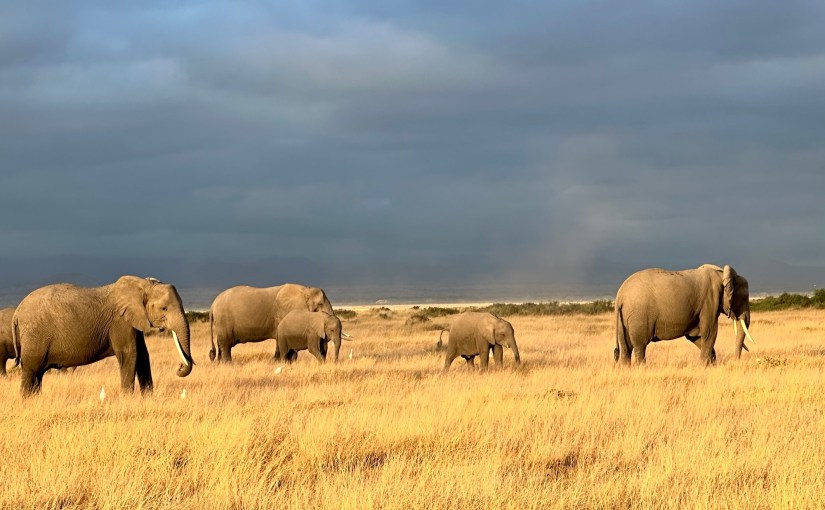
Warning: This might not be a good post to read to children.
Yet another reason I choose to travel with OAT is the opportunity to learn about the culture of the places we visit. I also love that a portion of our payment for the trip goes back to the communities with whom we interact.

Our morning in a Maasai village was VERY educational. So, of course I feel compelled to share what I learned with you.
Did you ever wonder how you get goats to practice birth control? Let this Maasai chief show you. That yellow barrier strapped behind the goat’s forelegs stops his “love potion” from reaching its intended target.

I confess that I was slightly confused. I thought it was a GOOD thing to have lots of goats and sheep. Seleman, our wonderful trip leader, explained that for goats, like humans, timing is everything in life. The Maasai want to make sure baby goats are born when their likelihood of survival is maximized, so when the timing is right, the shield comes off.
Next the Assistant Chief explained (in perfect English) the tribal hierarchy. He described some of the Maasai rituals, the most memorable (to me) being circumcision. It is performed in public, without anesthesia, on a group of 12 to 14 year old boys. If they don’t cry out or even flinch, they are deemed worthy to become warriors. After surviving the ritual, the group goes into the bush for three months. When they return to the tribe they are then considered to be men.

Before climate change decimated their herd of cattle, reducing it from 290 to 10, the Maasai used to drink cow’s blood every morning. They made a shallow incision into the cow’s jugular, collecting at least a liter before they stuffed the cow’s wound with herbs.
If you ever doubt the impact that one amazing woman can have, let me introduce you to Lucy. For the past 13 years, Lucy has visited over 100 villages, providing health education, including speaking out against what WE call FGM ( female genital mutilation). What THEY call “the cut” was deeply imbedded in the culture and traditions. They believed undergoing this public procedure transformed a girl into a woman, and thus enabled her to be married. Like circumcision, removal of the clitorus and labia was done without anesthesia, by a “midwife” and women were expected to endure the pain without crying out. Lucy underwent “the cut” when she was 14. (She admitted to crying and screaming).

Although the government banned FGM in 2003, there was no follow up, so the practice continued. It certainly wasn’t easy, but after years of hard work, Lucy succeeded in eliminating FGM for about 99% of the girls in the villages she visited.
Lucy understood she had to “humble herself” in order to get her message across. To ME, however, Lucy is the embodiment of Katy Perry’s song “Roar”, especially these lines:
“ You held me down, but I got up, already brushing off the dust, I went from zero to my own hero…
I am the champion and you’re gonna hear me ROAR”
After the Maasai village visit, we headed to an elementary school that has been a recipient of funds from OAT’s Grand Circle’s foundation.
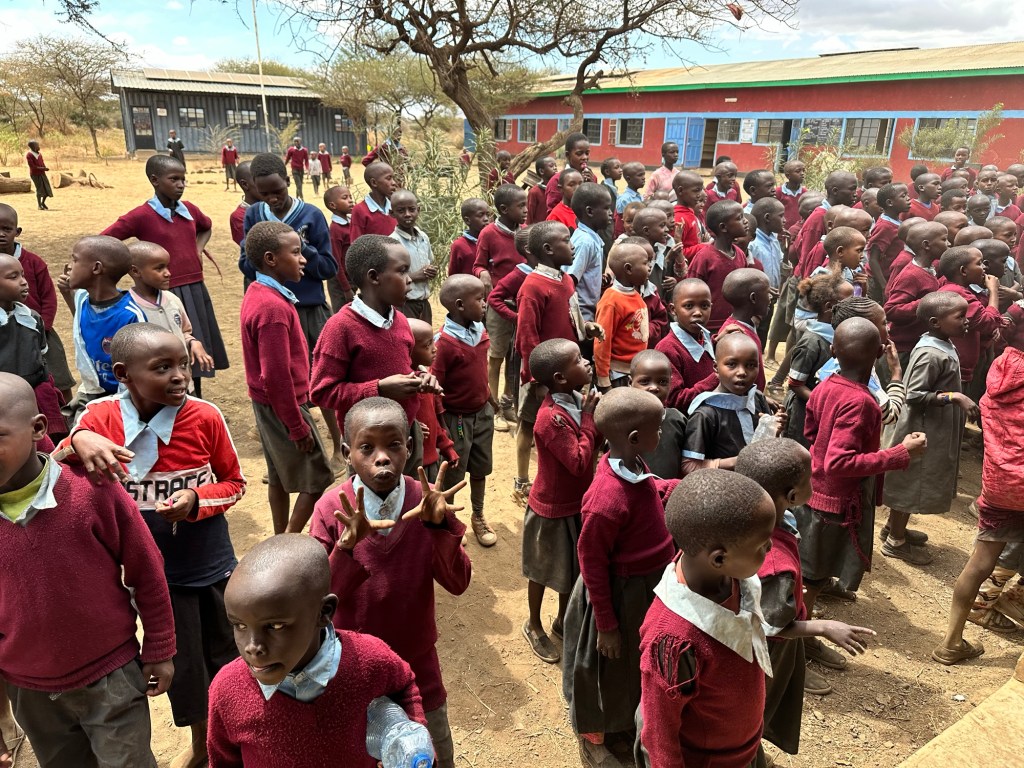
There are only 12 teachers for 183 girls and 230 boys. That’s quite a teacher/student ratio! .
While there, we learned how the Foundation‘s money was used. The first purchase was a copy machine, so the teachers wouldn’t have to walk for 45 minutes to the closest copier.
Under construction were bathrooms with flush toilets that will replace the two squat toilets currently being shared by all the students (and that some of us used during our visit).
During our interaction with the children, we told them a little about ourselves, where we were from (notice the map of the USA on the wall) and what our occupations were.

Fellow traveler Kalpana was by far the most inspirational. She told the students that she had attended a school just like theirs when she was growing up in India. Her hard work enabled her to become a doctor. Kalpana encouraged the kids to study, work hard and dream big.
I know, I know. I lured you in with that elephant photo atop this post. We will get to the elephants, cheetahs, lions and monkeys…and that post WILL be suitable to read to the kiddies. I promise, but first I wanted to share these meaningful and inspiring moments.
I’ll end this post with a photo of our group hanging out in a baobab tree.


 Destination NOW
When we were in Kenya in the late ’80’s, we were told that Maasai girls were married at about the age of 10 or 11. Our daughter was 12, and I was horrified. Do you know if that is still the case?
LikeLike
Hi Shelly, I have been reading your posts. They are great. I have traveled with OAT for several years. I saw that you recently started traveling with your CPAP machine. What do you do about the distilled water? That my big dilemma. I am leaving for the French Impressions trip next Sunday. I took a lot of notes on you posts. Thank you in advance. Leslie Leb
LikeLike
Lucy is 33 and still unmarried.
The lack of cows has actually been a good thing for young women because there isn’t any “money” for a bride price.
LikeLike
Hi Leslie, I’m so glad you’re enjoying my posts. Thanks for letting me know. Loire Valley exceeded my expectations. I LOVED it. Regarding the CPAP machine, I just used bottled water of which there was always plenty. Sent from my iPhone
LikeLike