Carcassonne

Sometimes you need to let the bliss sink in, and boy oh boy, am I ever blissful right now!

Yes, we’ve done a lot during our stay in Carcassonne, and I will eventually talk about that, but right now I am thoroughly enjoying the perfect weather and the after effects of a wonderful lunch in a nearby French vineyard/winery, Chateau Auzias.

After the vineyard tour, we were given 4 bottles of wine to taste, plus measuring equipment so that we could concoct our own blend using whatever combo of the 4 we desired. When departure time rolled around, we were presented with our blended wine to take home. I liked their Cabernet franc so much, I decided not to muck it up with Merlot or either of the two Syrah varietals, so I was glad that taking one of the vineyard’s regular products was an option.

As you can see from all the smiling faces, a good time was had by all. Especially me.

Okay, so that was the sum total of YESTERDAY’S blogging.

TODAY we are leaving the countryside, traveling by train to spend three days in Lyon, then finishing the trip in Paris. But before we move on to the big cities, let me tell you about our last medieval town.

Carcassonne’s most prominent feature is its huge castle, which dominates the landscape.

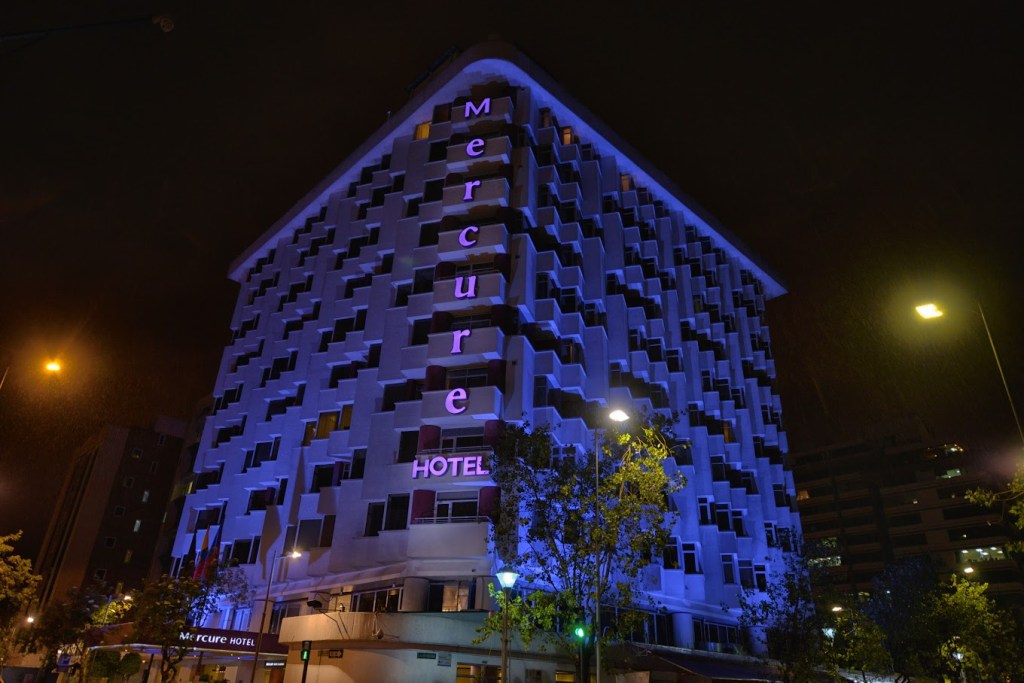
I was lucky enough to score a hotel room with a balcony, so I was treated to this spectacular view (of a portion) of the castle, which is beautifully illuminated at night. The plant you see in the following photo is the wonderfully scented jasper hanging from my balcony. ( my cell phone’s zoom can only do so much…)

The castle is so enormous, it was difficult to fit it all into one photo, until I visited Tribe restaurant during one of our “free” evenings. The food was every bit as great as its view. A bonus: the restaurant is owned by an Australian, so they have both French and English menus, AND it is really close to Les Chevaliers, our hotel.

Every castle should have a good story and this castle is no exception. Let me introduce you to Lady Carcas, whose statue at the main entrance greets visitors.

This Saracen princess is credited with saving the city from Charlemagne, who tried to starve the inhabitants into submission by surrounding it for five years. Although they were almost out of food, Princess Carcas decided to feed the remaining wheat to their last pig, then catapult the fattened animal over the city walls into the enemy camp. According to the legend, when Charlemagne saw the splattered remains of the well fed pig in the middle of his camp, he figured the Muslims still had plenty of food. What’s a warrior to do but pack up and head for home, which is exactly what he did. Lady Carcas was so excited by their departure, she ordered all the church bells to be rung. Upon hearing the bells, a soldier exclaimed “Carcas rings”, but he said it in French “Carcas sonne”, and that’s how the city got its name. Or so the legend claims.

Check out the fortress’s outer ramparts. This photo was taken from the inner, and higher, protective wall.

If the invaders are able to breach the first wall, they still have to make it over the moat and past the aptly named “kill hole” .

You can see why a siege was preferable to a full blown attack on what sure looks like an impenetrable fortress.

At the start of the tour, you are given an audio guide, then watch an introductory multi media show projected onto a wall.

The rooms inside the living quarters were transformed over the centuries by its various inhabitants: Romans, Saracens, and Christians.

We ended our visit with a walk around the ramparts, which was an excellent vantage point for viewing both the countryside and the interior of the fortress.

Our guide told us the fortress currently has 55 inhabitants. Although during our ramparts walk, we viewed several lovely residences, with gorgeous gardens, I certainly wouldn’t want to live in a place overrun by tourists. (Do they even have WiFi?)

Laetitia cautioned us that there was some up and down on uneven steps on the ramparts walk, but Nancy and I didn’t find it at all challenging.

In retrospect, I wish I had spent most of the day within the castle walls, but we had so much fun on our boat ride in Angers, we decided to give the afternoon Carcassonne canal ride a try. Big mistake. It was crowded, hot, and boring. The lack of photos from the boat ride tells you everything you need to know.

But that happens with travel. Sometimes you hit and sometimes you miss.

On to the cities…

Sarlat

I loved Sarlat so much, I decided to skip Saturday’s optional trip to Rocamadouer so I could experience the market and spend an unstructured day in this delightful medieval town.

On our first day, we had a guided tour during which we learned Sarlat was founded in the 800’s by Benedictine monks who chose the location because of its water supply.

The well built by the Benedictines

Back in those days the church was all powerful, so the abbot ruled the city until he was accidentally killed by one of the monks. He had the misfortune to be standing right behind the actual target, who ducked at exactly the right minute. Then this war happened, that war happened, the rich got richer…and here we are today, viewing a statue that looks a whole lot like Mick Jagger. (Actually that’s not exactly what the guide said, but it’s about all I remember.)

In addition to being market day, Saturday is also the day that you can take a glass elevator to the top of what was once a cathedral, but has since been repurposed into an indoor market.

The indoor market

We weren’t able to get out of the glass elevator, but that’s okay because we still had a panoramic view. We saw a whole lot of rooftops and the nearby church — yes another one, close by, because a town can never have too many churches.

One of our days in Sarlat was spent visiting the nearby Lascaux Caves. The original cave, which dates back more than 25,000 years, was closed off because carbon dioxide from tourists’ breath was endangering the cave paintings. Instead, replicas have been built, and Lascaux 4, the one we toured, has been faithfully reproduced BUT, it is even better, because of the added museum which has a multimedia show.

Our guide explained that these artists were thought to use sticks with horsehairs for paint brushes, moss as sponges, and tubes from which they spit pigment —a precursor of spray paint?

We had a delightful lunch in Uzerche, where Laetitia took this group photo.

We also visited Commarque Castle, which is slowly being restored by the son of the former mayor, who was killed when the son was a year old because of the mayor’s activities with the resistance.

Although much of the castle is in ruins, you can still climb up and visit the restored section, so of course, I did.

Time to move on. Next stop, Carcassone.

Angers

Sometimes I don’t know I want to visit a place until I get there. That certainly was the case for Angers. I know, I know, the name of the city sounds like a hostile emotion. But the French don’t say it the way it’s spelled. THEY say “Ahn-geee”. Better, right?

Our three days in this very walkable city whipped by, and was a very nice balance between included activities and free time. After a guided tour of the city, during our free afternoon several of us decided to go rollin’ on the river.

In addition to champagne (some of us had TWO glasses) our ride included entertainment. This fine fellow serenaded us while playing his vintage accordion.

We didn’t have the river to ourselves. Because the Olympic Torch was passing thru the city, four military boats were on patrol. We saluted each and every one of them with champagne glasses held aloft.

Finishing our ride across from the fortress/ castle, made it very easy for us to fit in a visit to the famous Apocalypse Tapestry.

Yes, another huge tapestry, but this one really IS a traditionally constructed piece, unlike the one in Bayeux. A predecessor to today’s comic books and graphic novels, it relates the battle between good and evil from the last book of the Old Testament to a largely illiterate population.

I was impressed with the beautiful gardens surrounding the castle, but these were nothing compared to the ones at the Chateau Villandry. The following photo shows only a small portion of the Chateau’s beautiful gardens.

If given the choice, I think I would have much preferred to be a Noble instead of a king. The nobles and ministers’ homes were much more “livable”, at least to me.

Although it isn’t obvious from the above photo, the Chateau de Villandry is surrounded by a moat.

Villandry has been in the same family since 1906, when it was purchased by Joachim Carvallo and wife Ann Coleman Carvallo. They met in a Paris research laboratory. Ann, an American heiress from Lebanon, Pa, supplied the funds for the purchase and modernization of the chateau.

Unlike Fontainebleau, you didn’t walk through one room to get to another, and this one was modernized to include bathrooms off the bedrooms.

Art from Joachim’s homeland, Spain, was exhibited throughout the chateau. How many museums have portraits of a severed head? Fortunately, this picture was not hanging in a bedroom!

Before we departed Angers, we were able to witness the Olympic Torch being carried through the city.

Our luck continued… we got to stay overnight in an honest to goodness, genuine chateau that was built in 1790 by the Duke of Limousin!

My room was the very comfortable Renoir Suite on the third floor. How gorgeous is that?!

Fortunately, the suite was updated to include walls and a door, plus a modern bathroom with both tub and shower.

My new friends, Garry and Donna posed with me for a photo with our knight in shining armor. I decided to name him Walter the Bold, although Walter the short would have worked too.

This was our only “one night stand”. We are now on our way to Sarlat, a medieval town known for great food and fine wine.

Normandy

For many Americans, Memorial Day signifies the start of beach and barbecue season. After visiting Normandy, however, Memorial Day will forever retain its original significance for me. Henceforth, it will always be a solemn day of remembrance for those who have fallen in battle. Because of them, I’m allowed to live the life of freedom that I treasure.

Here’s Eisenhower’s message to the troops, which was reproduced in the museum at the American Cemetery.

The amount of creative thinking and planning that went into the invasion was mind boggling. We learned that the BBC sent out a request for photos taken during vacations on the coast of France, plus any maps or post cards that could help create visuals of the coastline. They received over 10 million responses, but these obviously had no information about the fortifications, so pilots were sent on reconnaissance missions. The local resistance, in addition to blowing up bridges and messing up supply routes, also provided key information to the allied forces.

Before going into battle, soldiers were given three options for their dog tags: they could declare themselves Christians or Jews, or leave the designation blank. If Christian or undeclared, their graves were marked with a cross. Jews were designated by a star, however many Jews chose to be undeclared in case they got captured. The fear was if it was known they were Jewish, they’d be less likely to survive.

At the American Cemetery, preparations were underway for the 80th anniversary commemoration ceremony, which will be attended by dignitaries from around the world. I was surprised to see that the American Cemetery will be part of the upcoming Olympics.

The eternal flame at the cemetery

The weather was perfect during our visit to Omaha Beach. The Allies weren’t as lucky.

The plan was to have paratroopers and Army Rangers land behind German fortifications when the troops arrived at the beach, but gale force winds blew them off course. Instead they ended up being targets for both enemy and friendly fire.

These are exhibits in the Airborne Museum.

OAT arranged for us to have time with the museum curator, who showed us this violin one of the German soldiers made for the American in charge of the prison camp.

Knowing what goes into making a violin, I was incredulous. Clearly, this skilled woodworker had an excellent relationship with the camp commander, because he was allowed access to sharp instruments that could have served as weapons.

Add this to one of the MANY things I didn’t know before this trip: Germans remained in the POW camps till 1948. Most of the prisoners either stayed in France, and married their French girlfriends or emigrated to the USA.

I’ll end with a happy story. The parachutist shown hanging from the church steeple survived. He was cut down by German soldiers hiding in the church, and held as a hostage so the church wouldn’t be bombed.

No time to proof read, so fingers crossed that my iPhone didn’t make any crazy substitutions.

Fontainbleau

I was totally surprised by how much I am loving OAT’s pre-trip to Fontainebleau and Bayeux. We spend three nights in each place, at centrally located hotels. Both are very walkable, and the best part? Even I haven’t gotten lost!

Obviously, the draw for Fontainebleau is the chateau. One of many royal residences, it is the biggest, with 1,500 VERY ornate rooms spread over three floors. Just about every square inch of the areas open to the public —parts of the first and second floors of the main building — is completely covered with some form of art work.

Check out the chateau’s floor plan: you walk THROUGH each room to get to the next. This was similar to the design of Schonbrunn, the Hapsburg’s summer palace in Vienna. I guess royalty didn’t mind a lack of privacy. Yes, there are huge doors on either side of the room, but think about this: What happens if you need to get to a room, but the door to the room before it is closed? Do you have to go all the way around? Those hallways are really, really LONG!

Take a look at Napoleon’s second wife’s bedroom—Marie Louise, the Austrian princess he married after he dumped Josephine. You see that railing around the bed? No one was allowed inside the railing, without her permission. I guess the doors weren’t enough.

Napoleon’s bedroom was a few rooms down from Marie Louise’s. His was the only one of the MANY beds I saw that had steps along side it. Was the precursor of today’s doggie stairs?

The library was my favorite room.

Are you wondering how people were able to find each other? They didn’t have intercoms or cell phones, which is probably a good thing. I have enough trouble finding mine and I have 1,490 fewer rooms.

One last room before we head outside: the ballroom. Notice the balcony at the back. I’ll bet that’s where the moms sat so they could keep an eye on their daughters. The alcoves, I suspect, was where the ladies sat, waiting to be asked to dance.

Although the weather report predicted rain, we were unbelievably lucky to have perfect weather, which allowed me to thoroughly enjoy the wonderful grounds surrounding the chateau.

The gardens stretch as far as I could see, until they reach the forest.

After all that opulence and sensory overload, the serenity of the English and French gardens provided a needed respite.

I loved the whimsical statues scattered throughout the gardens.

This, I was told, is a sphinx. It was quite unlike anything I’d seen in Egypt, but our guide explained that the French take inspiration from other countries, then add their own touches.

Garry took the group photo of Marie, Susan, me, Jim and James. Donna and Kathy didn’t join us during our free afternoon.

On the drive to Bayeux, we stopped at Giverny, home of Claude Monet. Like Barbizon, it is a tiny village that art enthusiasts visit. Unlike Barbizon, it was really crowded.

Although it was too early in the season for many water lilies to be in bloom, there were plenty of other gorgeous perennials to enjoy.

It is easy to see where Monet found inspiration for his art.

After enjoying the lily pond and the gardens, we were able to tour Monet’s home.

Like Fontainebleau, the walls were covered with artwork.

For some reason, however, I didn’t find the artwork overwhelming.

Clearly, I prefer the simple life. I’d much rather wake up in a bedroom like Monet’s than any of the ones I saw in Fontainebleau!

Monet’s studio is now the gift shop. It was huge, with lots of natural light. Reproductions of his water lilies were stretched across two of the walls.

Next post—Bayeux.

Helpful Hints For Travel to Japan

I am extremely grateful for the assistance I’ve received from the “Friends of Oat” Facebook page. This post is my way of giving back. Although I wrote it primarily for OAT travelers, I hope that others planning to visit Japan might find some of these hints helpful.

Packing

Pack light: Hotel rooms are TINY, so there really isn’t much room to store clothes or luggage. Here’s another reason to pack light–there are no porters in Japan, so you will be handling your own bags.

My room in Kanazawa , which was actually quite a bit larger than the ones in Tokyo and Kyoto

Doing Carry-on Only isn’t as hard as it might seem, because every hotel had laundry facilities on site. In our Tokyo hotel, you could watch your laundry’s progress on your room’s TV. Which I did. From my bed. I wasn’t worried that someone would take my laundry out and dump it on the floor, because first, the Japanese are way too polite to do something like that and second, the machine locked with a code that you input.

The Kanazawa hotel had a washer and dryer in the room, complete with a squirt bottle loaded with detergent. Despite the plastic card with instructions in both English and Japanese, it was a slight challenge for me to figure out how the damn thing worked. In fact, I’m not exactly sure what I did, but hey, the clothes came out clean.

You don’t have to pack pajamas, because Japanese hotels provide them. At least the ones OAT uses did. Every day there would be fresh pajamas neatly folded on my bed. Although I had a single room, I still got two pairs of pajamas!

Every hotel had a REAL hair dryer…not one of those awful ones attached to the wall. You know, the ones that you have to keep a finger on the button or else it shuts off?

I had heard that some hotels have onsens, which are sorta like hot tubs/whirlpools except the source of water and heat is the naturally occurring hot springs. I definitely wanted to experience THAT, so I dutifully packed a bathing suit and cover up. That was totally unnecessary, because the onsens have many rules, one of which is you either go naked or you don’t go. Take a look.

I guess at some point, someone must have tried to dye their hair or wash their clothes in the onsen, otherwise why the need to print the prohibition?

Another unnecessary item that I packed was a water bottle. All the hotels provided bottled water, plus the water in Japan is not only safe to drink, it also tastes good. I simply refilled the hotel’s water bottles from the tap, and never used the one I brought.

Gadgets

There isn’t much counter space in the bathrooms so hanging toiletries bags make life easier, at least while using the bathroom.

Although some hotels had conveniently located outlets, that was not universally true, so I was glad that I brought my handy dandy plug thingie that I got from Amazon. Because my phone is now my camera, the battery doesn’t last all day, so I bought that black mini portable charger, also from Amazon.

The manicure scissors I brought were useful for cutting off the plastic ties that were affixed to our luggage every time we had our bigger bags shipped. The bullet train doesn’t have much storage space, so we were told to pack a small bag to tide us over until the rest of our luggage arrived. That happened twice on the main trip and once on the post trip. Additionally, some of the plastic packaging on snacks was difficult to open, so my manicure scissors spared my teeth!

My packing cubes functioned as bureau drawers in these bureau-less and closet-less rooms. Yep, I just put them on the floor. in the narrow space between the bed and the window.

The OAT backpack folded up to almost nothing in my carry on. It made a great day pack, and provided extra space for purchases.

Shopping

I normally don’t shop while I am on a trip, but the exchange rate was so favorable, and the items were so unique, I found myself buying lots of little gifts — in department stores, in little handicraft shops, you name a place and it is highly likely that I found something interesting to buy there.

Language

English is not commonly spoken, but Google translate made it much easier to communicate. I simply typed in what I wanted to say and showed the Japanese translation when I needed help. In museums without English explanations, I pointed the camera at the Japanese words and Google delivered a translation like the one below.

Screenshot

Money

I learned from the Friends of OAT Facebook page not to bother with Japanese Bank’s ATMs when I needed cash. Instead, I went to either Lawson’s or 7 11, which are EVERYWHERE. I was beyond relieved when I saw that English instructions are provided. The exchange rates are good, and the cost for withdrawing money is reasonable. Although you can use your credit card in most places, it is good to have cash for the markets and smaller gift shops. A bonus–both places sell ice cream, chocolate and other snacks.

Mass transit

I’m sure that once you get the hang of it, mass transit is easy to use. Let’s put it this way, I was VERY grateful that our guide took care of determining how we would get from point A to point B. What is wonderful about Japan is one transit card can be used on just about everything: buses, trams, trains (but not bullet trains). The neck holder our guide gave us made getting through the turnstiles VERY easy.

It’s a wonderful trip. Rumor has it that OAT is developing another trip to Japan. I certainly am considering a return trip, but in the fall to see the gorgeous colors that were displayed in this photo of a poster.

Happy travels!

Kyoto, On Our Own

First, let me say “on our own” is a misnomer. I COULD have been on my own during “free” time, but Mori was working overtime, organizing wonderful activities for us. I will admit, I skipped two evening activities because I needed a rest. (Damn, we were ACTIVE during the day!) I believe the Energizer Bunny’s Team of Renee, Ruth, and Janis did EVERYTHING, but unfortunately they’re not writing this blog, so you’ll only see and hear about the activities I took part in.

Our first night adventure in Kyoto started in the hotel bar. It was a rainy night, so we correctly figured we needed some fortifications before our tour of the train station.

During my lifetime, I have certainly been in many train stations, but never have I seen seen anything quite like this one! The architecture is stunning, the lighting is spectacular—it is a visual feast!

Unlike most escalators, which require you to walk around to the opposite side on each floor, this one went straight up, and parts of it were outside the building.

Notice how clean everything is? No trash ANYWHERE!

We were able to see the Kyoto tower from the covered part of the rooftop. I thought that the raindrops on the window gave the tower an impressionistic feel.

It isn’t obvious from the still photos, but we were treated to a light show as we walked along the corridor.

Can you see the two people walking down the stairway upon which images are being projected? Here’s a hint–look for the umbrellas.

This is the site of one of twenty one immersive multimedia installations created by Naked, a digital art collective. If you want to learn more, check out their website: https://en.japantravel.com/kyoto/naked-garden-one-kyoto/69924

We returned the following night, when the weather was better, to listen to the pianist while we watched the light show. If you would like the full effect, just hop over to YouTube to watch and listen to the video. (Click on the underlined word)

The photo is a screen shot from the video and admittedly is a poor substitute, but uploading a video into WordPress takes forever.

In the previous post I mentioned that Nijo Castle was also a site for a Naked installation, and THIS one was even more sensational!

The castle walls became digital displays with changing graphics. You know the drill: if you want to experience the full effect of the “Naked” show, click on YouTube.

But wait— there’s more! The garden and the buildings were also beautifully illuminated.

There were so many gorgeous sights–it was hard to decide which ones to include in this post.

And if that wasn’t enough, there was even a “ special effects” machine, pumping out fog.

Our extras weren’t just limited to night time activities. We also had adventures with Mori during free afternoons. Sometimes, the bus drivers recommended stops along the way at places they thought we would enjoy.

That’s another wonderful aspect of Japanese culture. People take pride in their work, regardless of what it is. Everyone’s contribution is valued.

Earlier in the trip, we stopped at a store selling fruits and vegetables. On the wall were photos of the farmers who grew the store’s products. Talk about a personalized approach!

Notice the white gloves our bus driver is wearing and how he is dressed?

This particular driver suggested these two additional stops enroute to a planned activity. I won’t bother with the names of the temples because they are long and totally forgettable, at least by me. But what is seared into my brain are the temple grounds with its flowering trees.

We didn’t have time to participate in the Buddhist ceremony, but I peeked inside and was impressed that they thoughtfully provided chairs for those unable to sit on the floor.

The second temple contained 1001 statues of the Buddhist Deity Kannon. What is interesting is that all of the statues are slightly different, which initially led me to believe that the statues represented DIFFERENT Buddhas. Then I read the brochure.

Here’s what else I learned. 124 of the statues were made in the 12th century, when the temple was founded and the remaining 876 were made in the 13th century when the temple was renovated. The statues are all made of Japaneses cypress, so I’m guessing they have been covered with gold leaf.

We weren’t allowed to take photos inside the temple, but hanging on a wall outside was this poster,

which will give you a very rough idea of what the temple was like. It was slightly longer than a football field (According to the brochure, the length is 120 meters, for those of you fluent in metric). We walked in front of the statues, along a PACKED narrow corridor. It wasn’t tragic that I couldn’t take a photo inside–it would have been an impossible shot anyway.

On our last afternoon in Kyoto, we set out for the Philosopher’s Path. Although we never made it there — we got a little lost– we instead had a had a delightful adventure, walking along an old railroad track, during which we saw an abundance of blooming trees and Japanese taking advantage of the photo ops the beautiful day offered.

As Mori was trying to figure out how to get us back to the hotel, some of us wandered around and discovered this rather unusual sculpture in front of one of the art museums. Sorry, there wasn’t enough time to figure out what it was trying to communicate, but then, it is ART. It can be anything you want it to be.

Next stop: Hiroshima, for the ten of us taking the post trip, but before we leave, here’s one last photo of the Kyoto tower when it WASN’T raining.

OAT’s Kyoto Itinerary

There was so much to see and do in Kyoto, I decided Kyoto required two posts. This one describes the “official” OAT activities. The next post is all the “extras” sweet Mori made sure we experienced.

After Covid cancelled my 2020 Japan trip, I comforted myself with an on-line “tour” of Kyoto. From that, I got the mistaken impression that Kyoto was a rather compact city with all of the sights clustered together.

I was TOTALLY unprepared for how big Kyoto is and how scattered the points of interest are.

My iPhone photos will give you a rough idea of how much ground OAT’s itinerary covered during our 5 day stay. I was very grateful that Mori handled all of the logistics.

The Shinkansen brought us swiftly and smoothly to Kyoto. Because we had ridden the bullet train from Tokyo to Kanazawa, we were familiar with the drill: you pack a small overnight bag to tide you over until the larger luggage ( which was shipped) arrives a day later. The bullet train is super comfortable, but storage space is quite limited.

I was glad that I was traveling with only a backpack, because unlike our arrival in Kanazawa, in Kyoto we had to swim through an ocean of humanity to get through the train station.

I’m wondering what was easier to follow—Taco, or my gray head sticking up above the crowd.

What a multisensory extravaganza the Kyoto train station was! We were bombarded with sounds, sights and wonderful smells, but as you’ll see in a later post, it is even more thrilling at night, so no more daytime station photos.

But first, here’s a whirlwind tour of my favorite things on OAT’s itinerary, which successfully hit Kyoto’s traditional hot spots.

The majestic Arashiyama Bamboo Forest

It is hard to describe the peaceful feeling one gets while walking through these towering plants.

Cemetery beside the bamboo forest

The Tenryu-ji Temple

A brief stroll away from the forest was a beautiful garden and Buddhist temple. We were so excited to see the cherry blossoms were starting to open.

I managed to pitch a coin right into the ring in front of the frog. I keep making the same wish. One of these times it should work.

Kinkaku-ji Temple (Temple of the Golden Pavilion)

The original temple was constructed around 1400, but was rebuilt in the 1950’s after it was burned to the ground by a crazed monk.

Wasn’t it fitting that the phoenix atop the temple was the only part of the original that managed to arise from the ashes of the burned building?

Nijo Castle

We toured the interior of Nijo Castle, but we weren’t allowed to take photos. That’s okay. I found the exterior far more compelling—especially at night (and yes, you are going to have to wait for a future post to see how glorious it is).

Nara

India has its sacred cows; Japan has its deer.

Kathleen is bowing to the sacred deer

Todaiji Temple

This is the home of the world’s largest wooden Buddha.

He was so enormous, it was difficult to photograph him. Besides, we’ve all seen Buddha photos.

As you may have noticed from earlier posts, I’m rather fond of the Guardians. Even though this one has a fierce facial expression, he’s holding a scroll and pen, so how scary can he be? Maybe his message is “the pen is mightier than the sword”?

This next photo requires an explanation, but first take a look and see if you can figure out what is happening.

There is a wooden block in the temple, with an opening that supposedly is the size of Buddha’s nose (the statue, not the human). The belief is that anyone able to squeeze through Buddha’s nose (or the passage) would have a good life. I’m pleased to say that although he initially struggled, Mori made it thru.

Zen Temple

After walking alongside this beautiful river, we climbed 200 steps ( I didn’t count; I took Mori’s word for it) to meet a zen master, with whom we meditated.

We left, totally at peace, feeling “zero”. It’s fortunate that l learned to let go, because that hat on my head and I were soon to go our separate ways.

Fushimi Inari Shrine

After experiencing Buddhism, we moved on to the famous Shinto shrine with its beautiful vermillion Torii Gates.

We didn’t have time to climb to the top, so this map will have to suffice to give you an idea of the immensity of the shrine.

When Christo did “The Gates” in NYC’s Central Parking 2005, Mike and I spent an enjoyable February afternoon strolling through them. Could Christo have gotten his inspiration from Japan? I think he did.

Sushi Making

I will say up front that raw fish wrapped in seaweed does not meet my definition of delicious. Still, I was determined to keep an open mind. I was quite happy to learn that we had a vegetable option.

My son Greg would have loved the discussion about knives and whet stones.

Okay, so maybe it didn’t look like much, but it sure was tasty.

What better way to end this post than with a photo of a beautiful blossom…

and a group shot taken after our farewell dinner. Sadly, Mary, Jim, Kathleen and Cathy, weren’t joining us on the post trip to Hiroshima.

Hakone, Part 1

Every time I think this trip couldn’t possibly get better, it does.

On our bus ride to Hakone, we were treated to multiple views of the elusive Mt Fuji. We watched as it progressed from crystal clear to cloudy.

10:30 AM at the rest stop
The clouds started rolling in around 3 PM.
3:30 PM. Our driver took us to this special look out that gave us a phenomenal view of the mountain.

Although it is wasn’t on the itinerary, I had told Mori I really wanted to experience the Open Air Museum in Hakone and he made it happen. Turns out 12 out of the 14 of us wanted to visit. We made the most of our hour at the museum. Here are a few of my favorites.

It may not look like much from the outside but wait till you step inside.

But there was so much more to see, like this piece which was inspired by the myth of Narcissus.

The sculpture was trying to view her reflection in the water, but her tears were blurring her image.
Can you believe how perfectly balanced that sculpture is? And check out the gorgeous setting.

We lucked out with the weather because our second day in Hakone was rainy.

On the Road to Abu Simbel

To acclimate us for the end of our leisurely float up the Nile, we used less luxurious modes of transportation to visit the town of Daraw. We’d been ferried across the Nile by small boats before, but this was our first time in the back of a pick up truck. The truck was covered, but there was such little headroom, I could barely sit upright. And no, that’s not a canvas top to the truck. It’s metal. If you’re wondering how I know, let’s just say there were more than a few bumps in the road.

You see all modes of transportation in Daraw: bikes, motorcycles, trucks, donkeys, tuk tuks, just about everything except cars.

Most OAT groups tour the livestock market, but because there are no markets on the day we were there, we visited the local entrepreneur. One of his many businesses is a “livestock hotel”. Hey, if you don’t sell all your animals on the first market day, you need someplace for them to stay, right?

Another of his businesses resembled a mini petting zoo, which we greatly enjoyed. I’d been warned that camels spit. After being taught a lesson by that rambunctious water buffalo a few days earlier, I kept my distance. Bobbie and I decided it was time to let others interact with the babies.

This camel bumped Jeanne in the head multiple times
There was significant bonding between Bill and baby donkey. We expected him to start negotiating a purchase price.

Next stop, shopping—and eating—in the marketplace. Mohamed purchased Falafel for us to sample. We had just watched as the street vendor was making it. I don’t know that I would have been brave enough to eat food from a street vendor if I were on my own, but with Mohamed choosing the vendor, I felt perfectly safe.

It felt like we were on the Amazing Race when Mohamed instructed us to search for, and purchase, specific fruits and vegetables with the 20 Egyptian pounds, (about $.62 in US currency) he gave us. We were all so focused on our task, there were no photos of the adventure. I foolishly pointed at potatoes and waved my 20 pound note. Any idea how many potatoes that amount would buy? A whole lot. A whole HEAVY lot. Good thing I’ve been going to the Y.
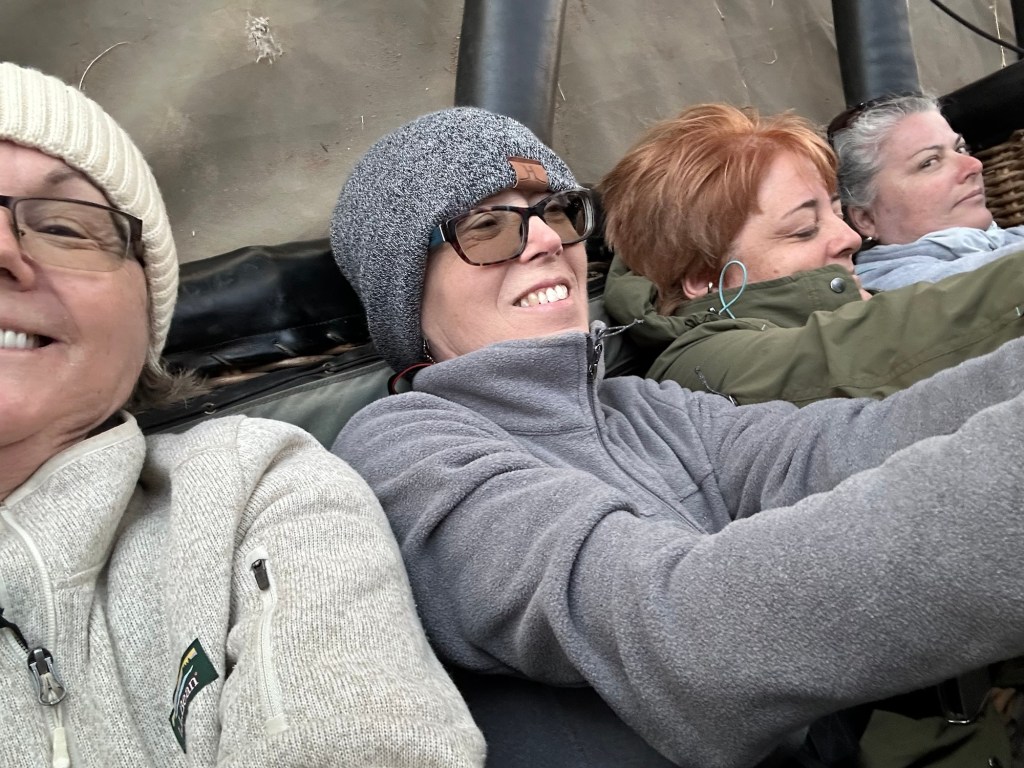
Bobbie, on the other hand, was a smart shopper. She purchased the required peppers, but she negotiated skillfully enough to be able to buy bread for us all. It was delicious and still warm from the oven.

Our last stop before leaving our beloved dahabiya was “Nile Beach”, where are some of us were perfectly content to just stick our feet in the water. Others, namely, Marianne and John, were far more adventurous.

Our “farewell” dinner was even more spectacular than the other meals we’d enjoyed. We were sad to say goodbye to the crew that took such good care of us.
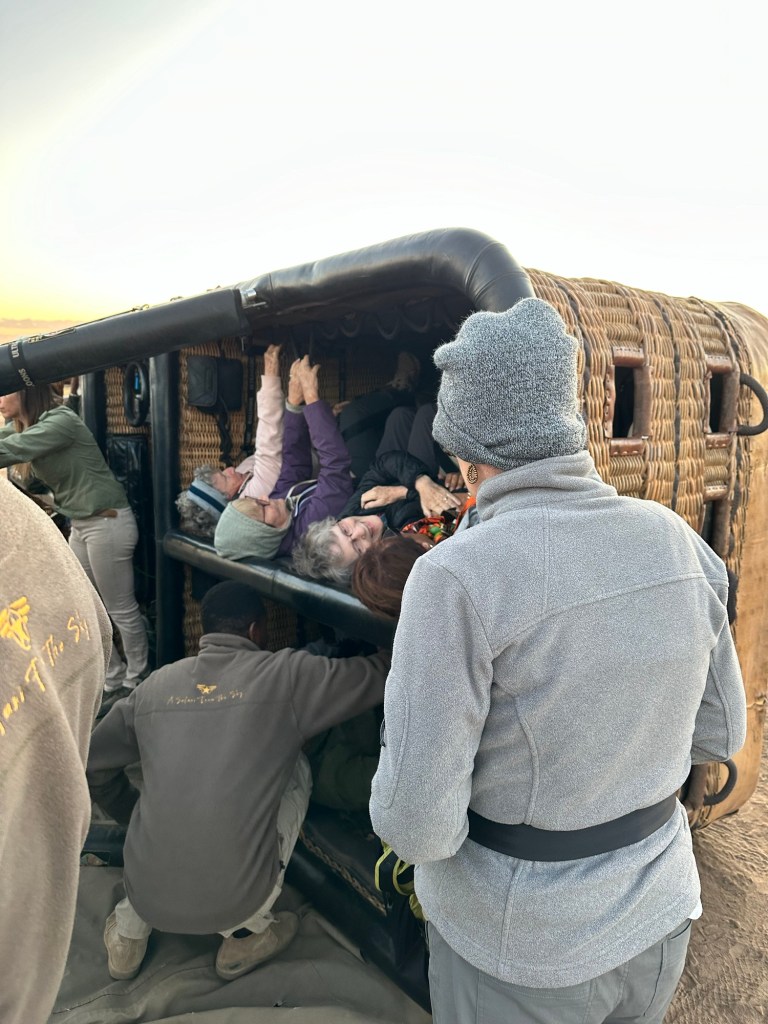
16 crew members for 9 passengers. Was the service outstanding? You bet!

We all got a surprise when we returned to our cabins. We each got a unique Egyptian creature waiting for us on our beds. I’ve seen towel art before, but these were, by far, the most creative. My favorites were the crocodile and the cobra. ( I got a scorpion).
How to describe the ride from Aswan to Abu Simbel? Three hours of sand, sand, and more sand with high tension wire strung along the roadside, delivering electricity from the dam to the populations further north. We needed to get closer to Abu Simbel for the landscape to change.

We stopped midway in our journey for a bathroom break. I think the term “food desert” was coined here. If it wasn’t, then it should have been. The “snack bar” could be best described as “selection-challenged”, but if you’re looking for potato chips, or packaged mystery snacks, you’ll be very happy.

Our group thought we’d seen so many temples and tombs, there was little left for us to see. Boy, were we wrong! The size of the 4 statues of Ramses 2’s temple ALONE was jaw dropping. But to think that this entire temple was MOVED block by block to the higher ground on which it currently stands, is truly hard to believe. Why is as that done? If it hadn’t been moved, it would now be well below the waters of Lake Nassar.

Back in the 60’s, 50 nations cooperated to rescue several temples threatened to be submerged by the creation of the High Dam at Aswan. To me, the engineering that went into the move was as awe inspiring as the temples.

But wait—there’s more to say about this temple. The ancient Egyptians were so knowledgeable about engineering and astronomy that in the 1200’s BC, they were able to construct this temple so that twice a year, on February 22 and October 22, the sun shone all the way through the temple to illuminate three of the four statues in the inner sanctum. The fourth statue is of Ptah, the god of the underworld, who was intentionally left in darkness. Two of the others represent different versions of Ra, the son god. Bet you can’t guess who was the last statue to be bathed in sunlight. None other than Ramses 2. Clearly he didn’t have a self esteem problem.

That black area falling across their laps is a shadow

Next to Ramses 2’s monument to himself, he built a temple honoring his favorite wife, Nefertari. Remember her? We visited her tomb in the Valley of the Queens.

That old goat lived well into his nineties, acquiring wives and children ( rumored to number approximately 200) along the way. Good thing he lived BEFORE viagra was invented! Of all his women, (thought to number about 100, if you include concubines and mistresses) Nefertari was his favorite—the only one who got her very own temple next to his. There is only one statue of her on the facade. The other five are, of course, of her husband, who was also known as “the Great” (probably self proclaimed).

That random guy standing in front of Nefertari gives you an idea of the scale of these statues.

We only spent one night at the beautiful Seti Hotel in Abu Simbel. Can you see why we were reluctant to leave? The multi-level pool had a swim up bar; each room had a private balcony facing the Nile. It was SO very peaceful.

Before we left for the light show at the temples, we met Hassan, who enlightened us about Nubian culture and history. He also entertained us by playing instruments that were the forerunners of our guitar, banjo and harp.

In 1976, when Hassan visited his cousin in San Francisco, he was invited to play with what he described as “ a small folk group” —the Grateful Dead.

Once again, you had to be there to appreciate how wonderful it was to be sitting under the stars, watching a multimedia show projected onto the temple walls. I didn’t take any shots while the show was ongoing, but did so after, and used that shot the heading for this post.

I truly appreciate everyone’s comments on my blog posts. It almost feels like I’m having a conversation with my friends. Although I know who comments on Facebook and Linked in, many of the comments on WordPress are coming through anonymously. If I didn’t respond to you, that’s why.