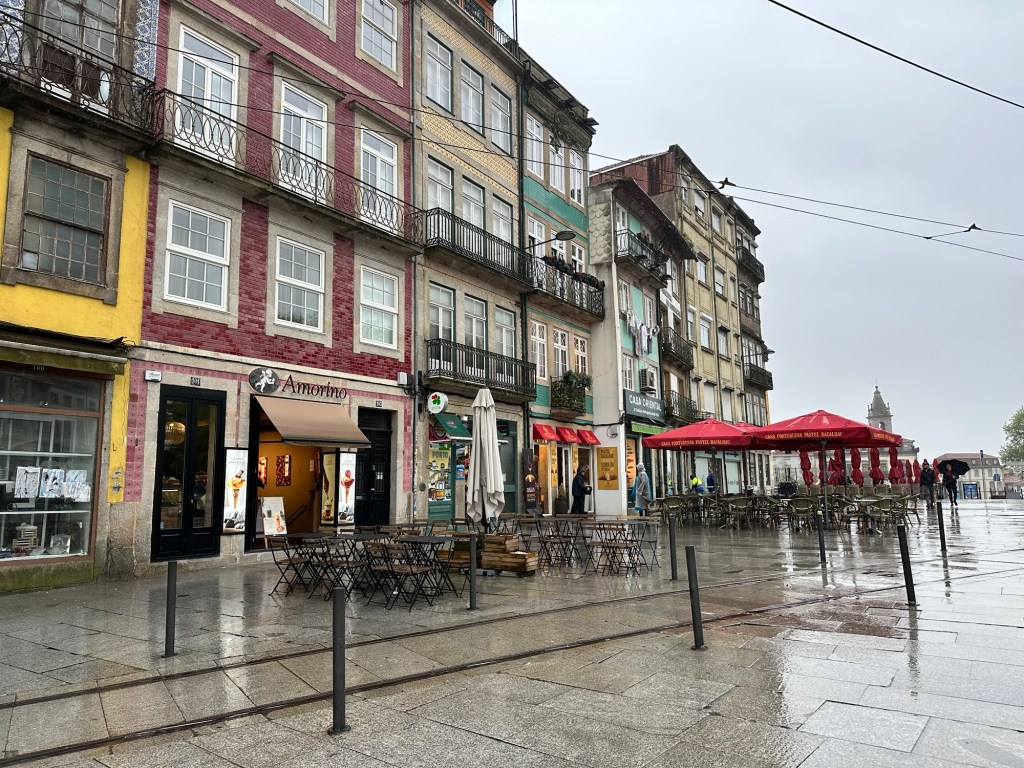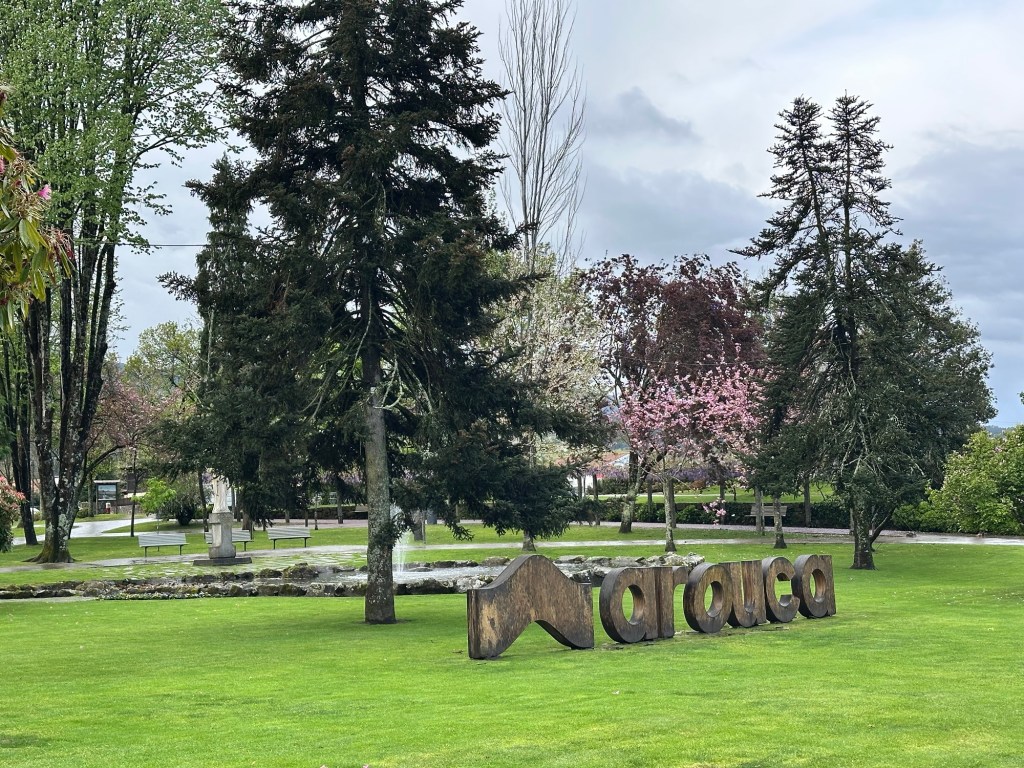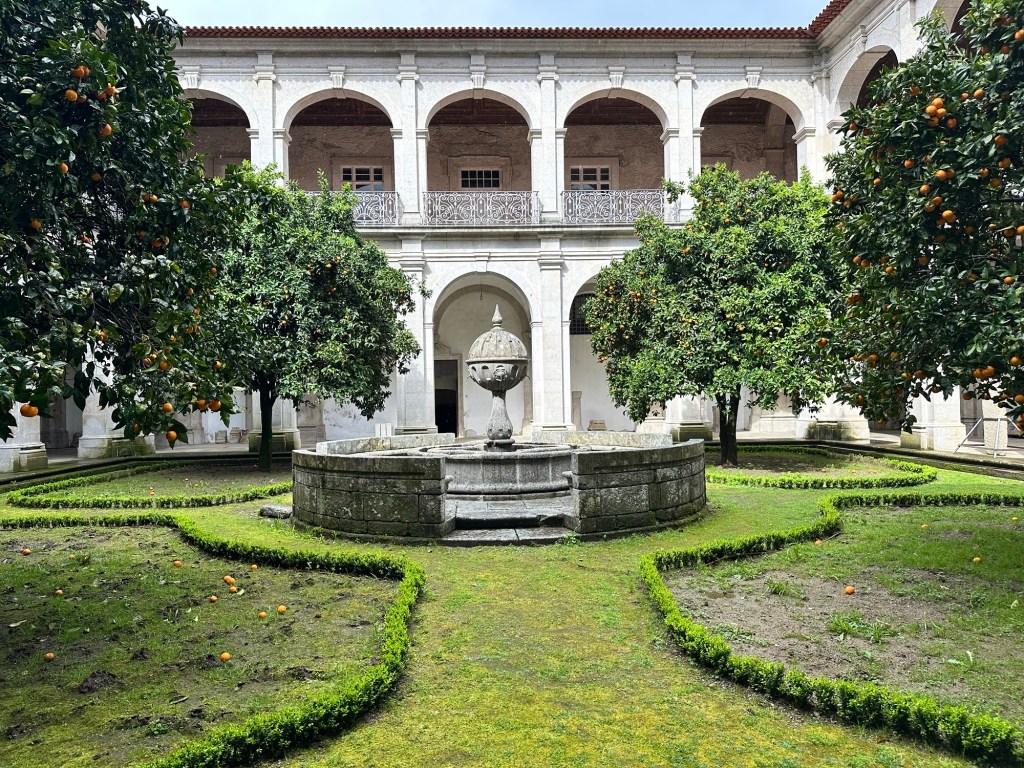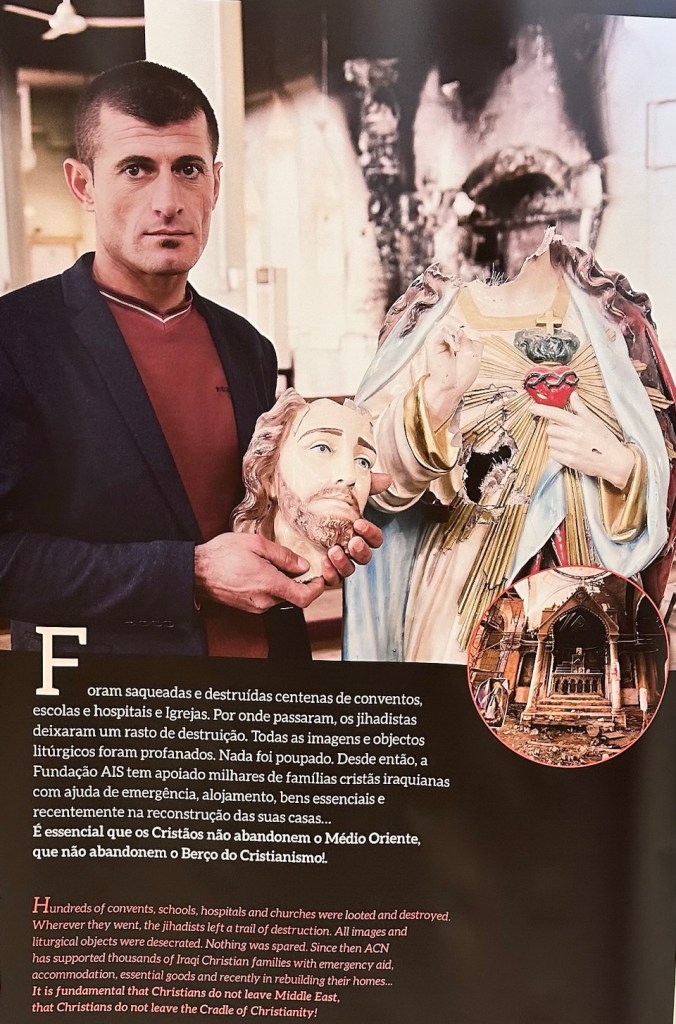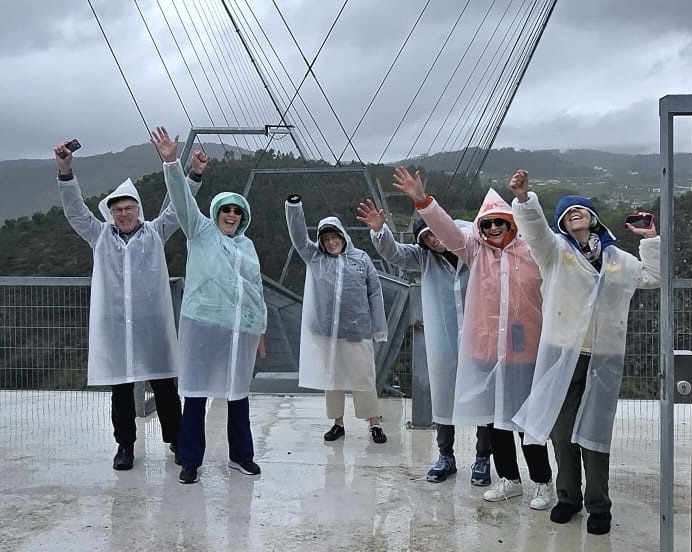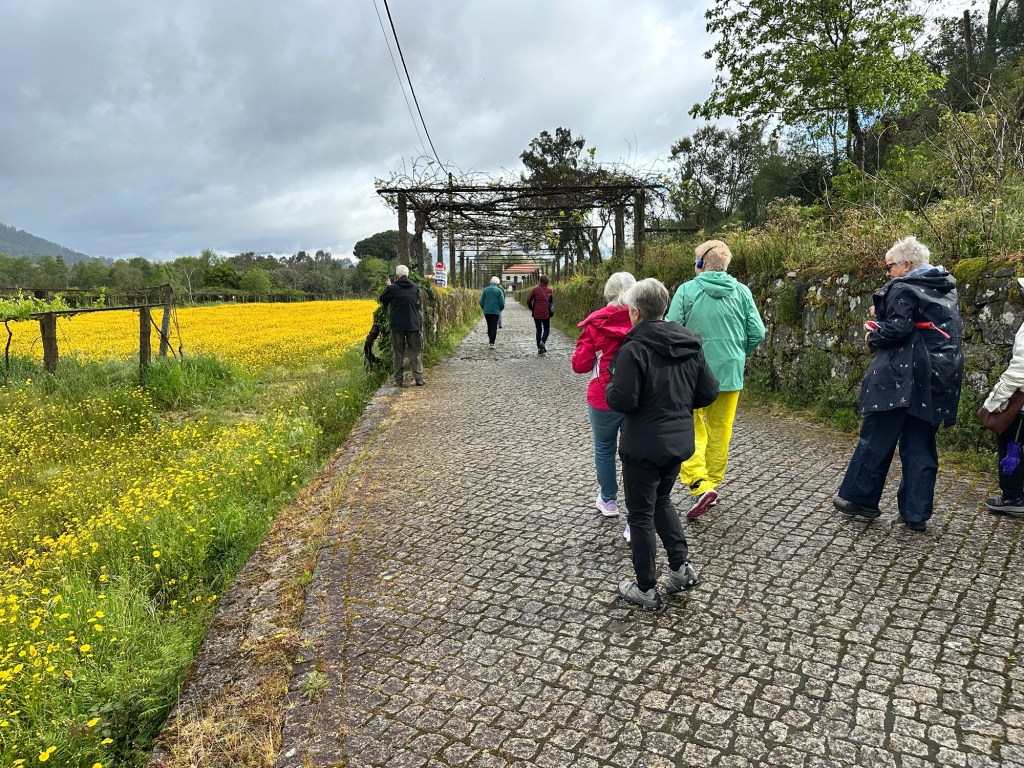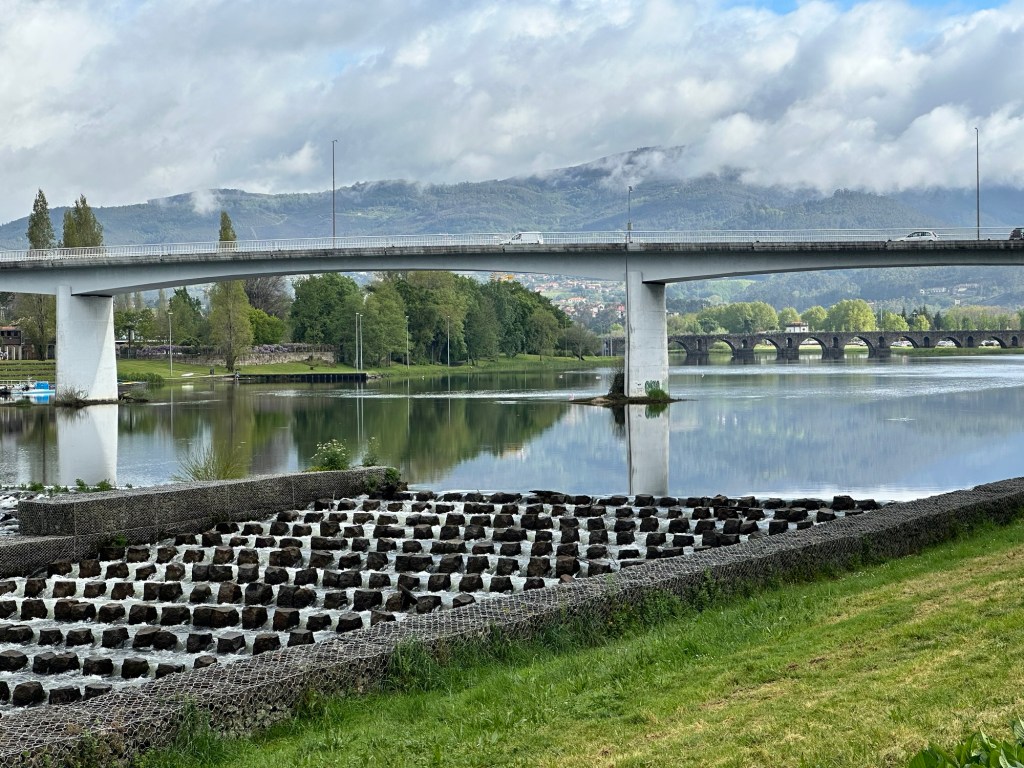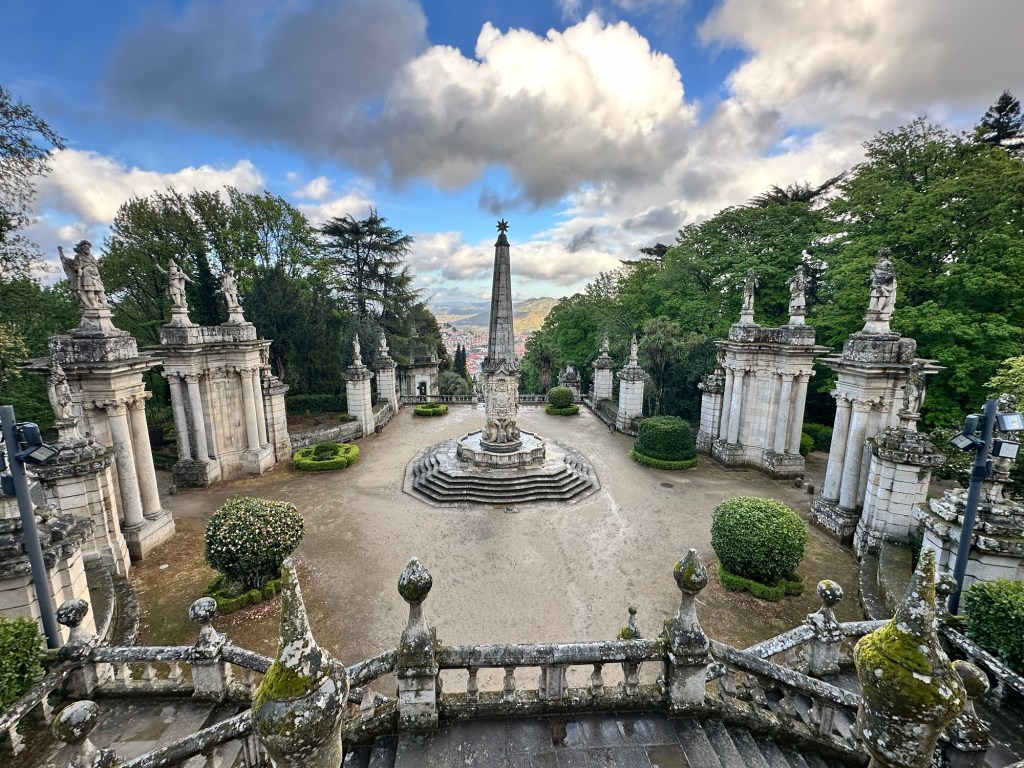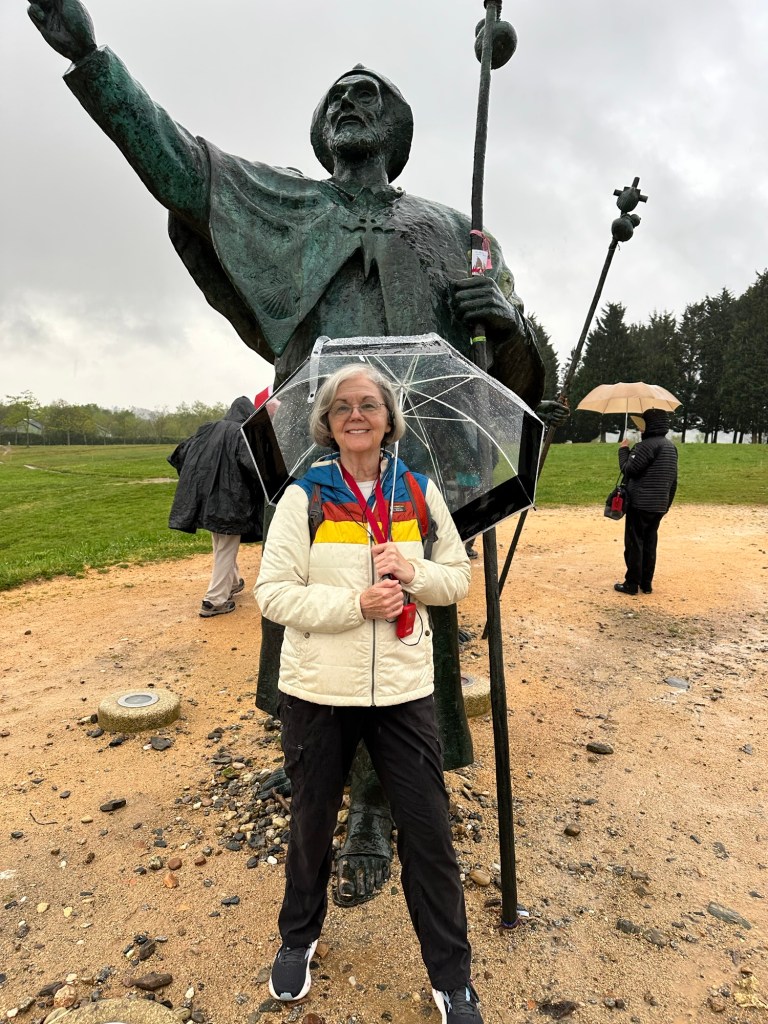
I didn’t know until I got there that Galicia normally gets an abundance of rain, which is why it is such a lush, green region. I THOUGHT I was adequately prepared for wet weather, because I had packed two hooded jackets, fleece lined pants and silk long underwear, but I forgot the most important item: zapatos impermeables (waterproof shoes). Luckily, our hotel was across from a sports store that carried waterproof sketchers in my size. Prior to that purchase, however, (as I mentioned in an earlier post), we walked the last five kilometers of the Camino in a downpour. Let me tell ya, medieval cobblestone streets retain lots of water between those rocks!
I bought the umbrella in Bilbao when my luggage was lost.
I had the full Pilgrim experience; I was soaked and completely miserable. It was definitely NOT one would consider a spiritual feeling. By the time we got to the hotel, my feet were so wet, I had to dry them with a towel. On a positive note—the hotel had a heated towel bar in the bathroom, but sadly it only functioned between 7 and 11 pm. Still, that was long enough to dry out my sodden socks, clothes and backpack.
If someone forced me (at gunpoint) to choose between walking El Camino or running with the bulls, that day I would have taken my chances with the bulls. (I would have carefully chosen a stretch that allowed for a speedy exit.) But, then again, if I had done so, I would not have earned the right to sport one of these lovely pilgrim tattoos.
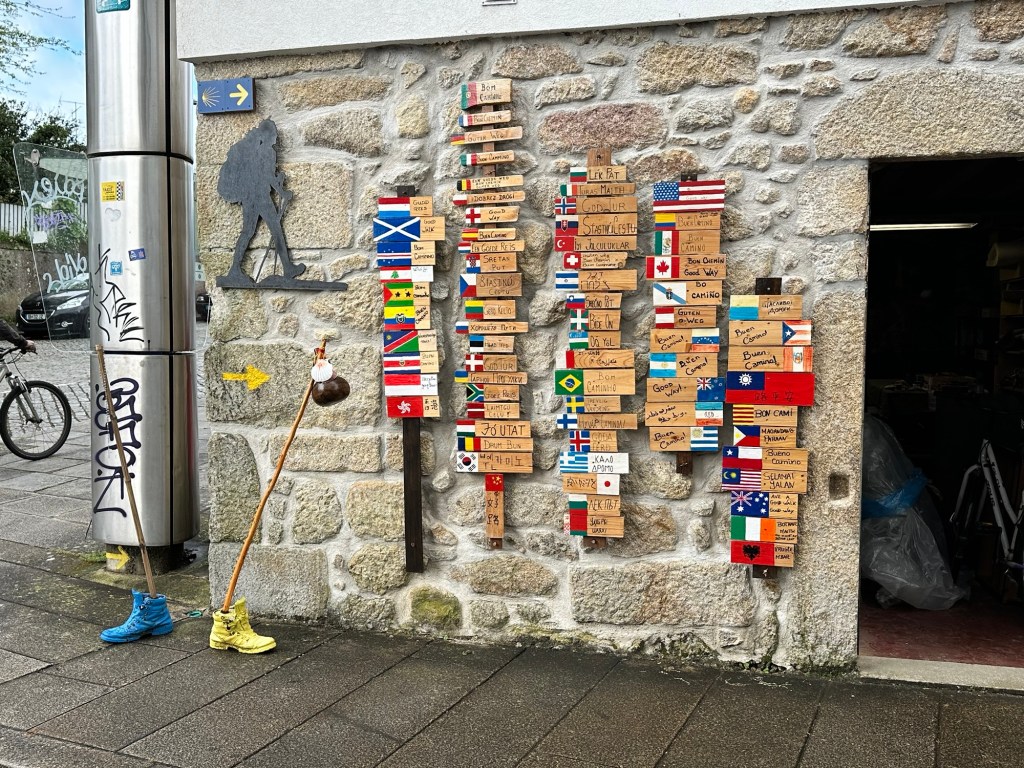
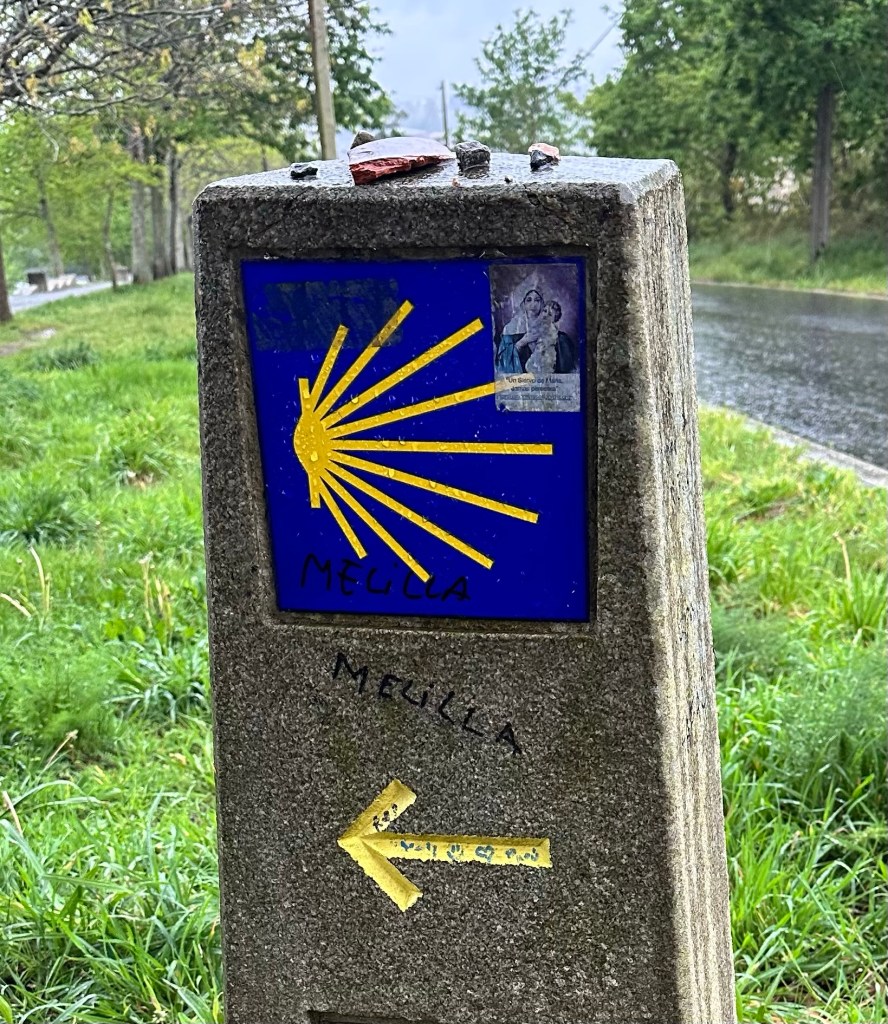
It’s hard to get lost on El Camino because the scallop shells point the way. They are EVERYWHERE. This sign also marks distance from the start of the French Way —4,790 kilometers—of which we did about 32 KM, or less than 10%
Before this trip, I had thought that there was ONE El Camino. NOW I know there are several: The French, the Portuguese, — we walked segments of both—the Via de la Plata (silver way), the Camino del Norte, the Primitive Way, to name a few. Regardless of which Camino you select, the destination is the same, the Cathedral of Saint James (Santiago).
Beneath that yellow umbrella is our local guide, Marian, regaling us with the legend of St James. WE were a shivering mass, huddled together under a nearby portico.
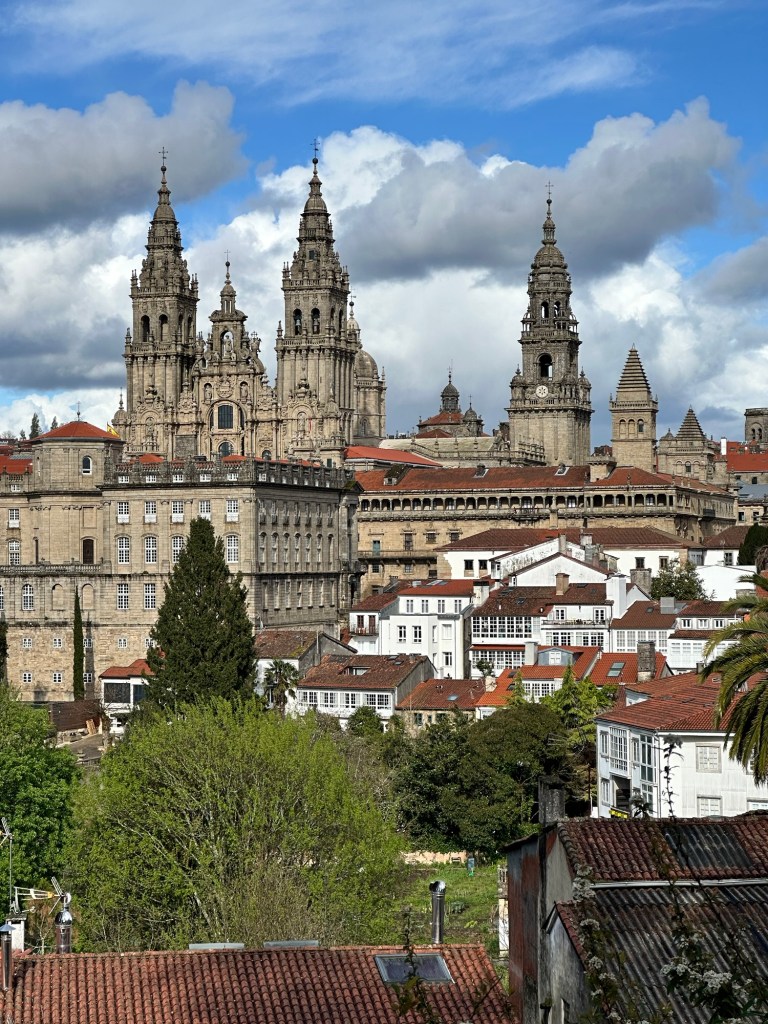
The cathedral from a different vantage point, a public park. Photo taken in between showers.
With all the wind and rain, I couldn’t take notes, so I’m operating strictly on memory. Here’s the part of the legend that I recall: a peasant (fisherman? shepherd? Some random guy?) in the first century (around 820 AD) saw a light shining down from the heavens several nights in a row, in the exact same spot. He recognized it as a message from God instructing him to dig, and when he did, he discovered the bones of a skeleton who had been beheaded. The church leaders made a rather large leap of faith and deduced that since St James had been beheaded, the skeleton must be that apostle. Over the ensuing centuries a cathedral was built and over time, the city of Santiago de Compostela grew around the cathedral.
Back then, pilgrims made the journey for religious reasons, to get a plenary indulgence (skip purgatory) or to avoid jail time. Yes, you read that right. Marian explained that people who committed minor crimes back then were given a choice…walk several hundred miles or go to jail.
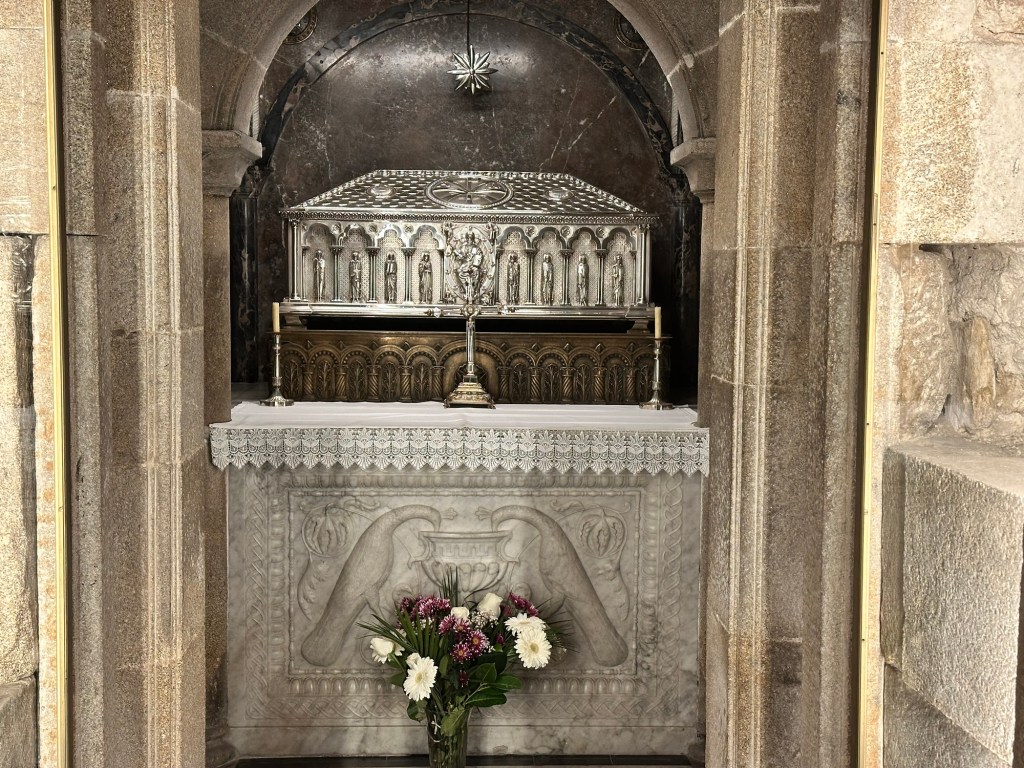
Fast forward a few centuries—today’s visitors can view this silver box that contains what the faithful believe is St James bones,
and can admire the cathedral’s beautiful interior.
My cell phone’s zoom isn’t very powerful, so I’ll describe the central image of the main altar. It’s St. James, riding a horse and brandishing a sword, which wasn’t exactly how the apostles were described in the Bible.
Santiago’s old town is a maze of narrow cobblestone streets, filled with restaurants, bars and souvenir shops, so after our first day in Santiago, I’d seen enough of the city. I welcomed the opportunity to spend the day in Pontevedra and Combarro on an optional trip OAT offered.
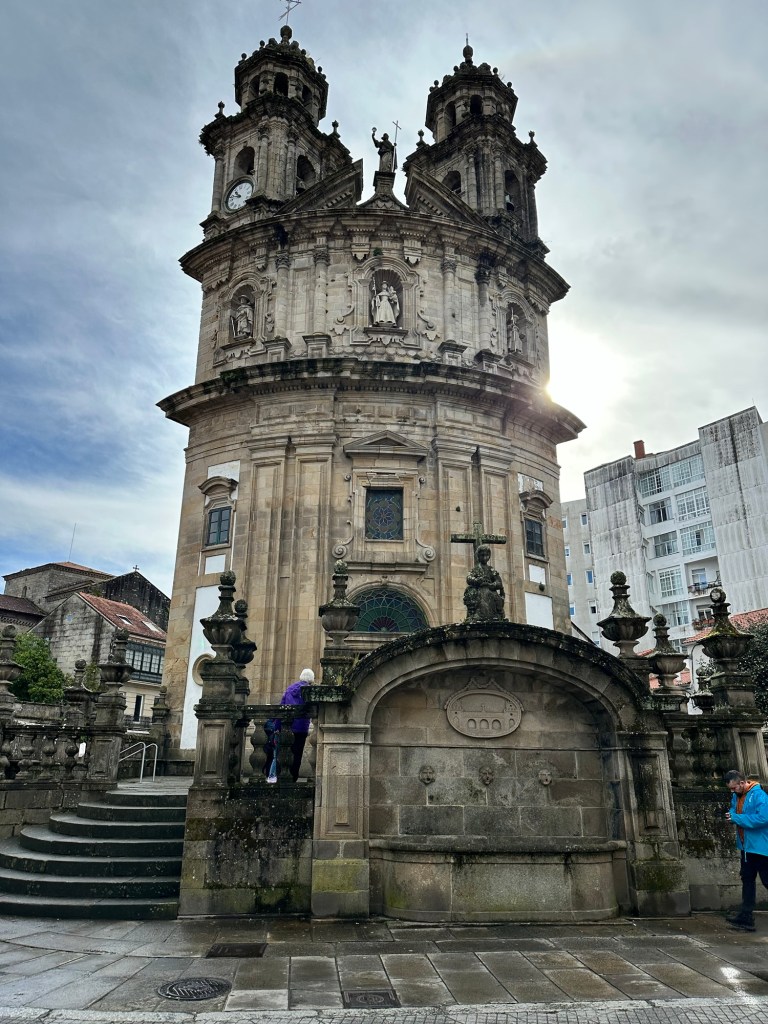
Pontevedra, founded by the Romans, gave us a break from the crowded streets of Santiago. It is also the site of an unusual church, with a floor shaped like a scallop shell. Or so I was told.
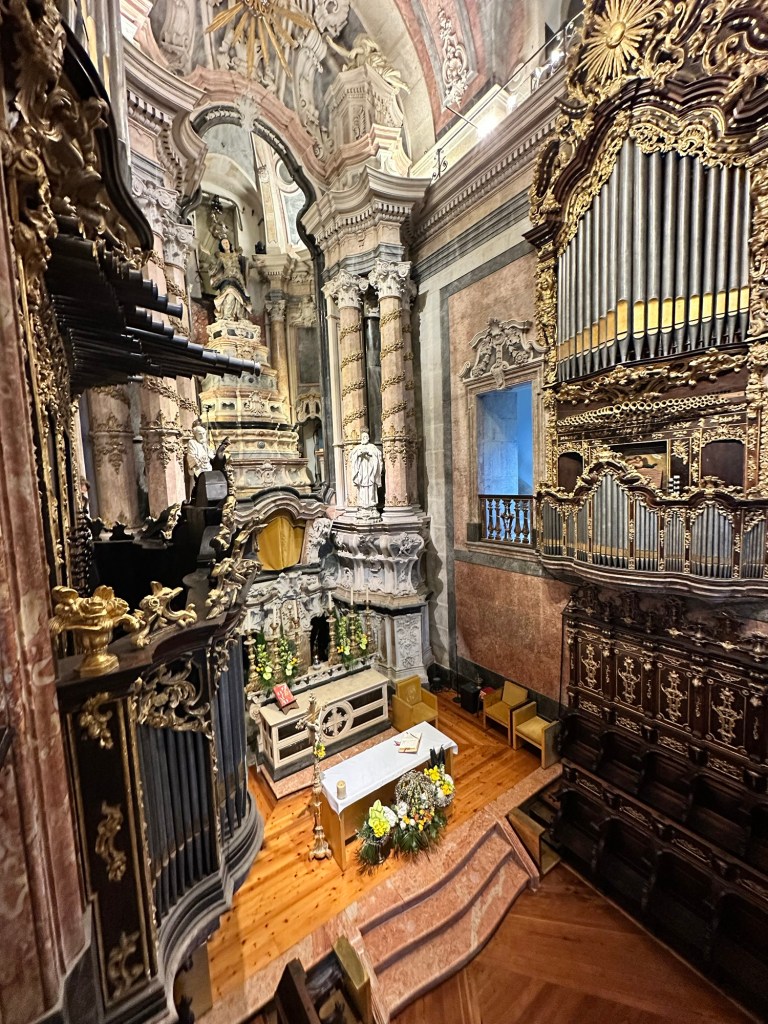
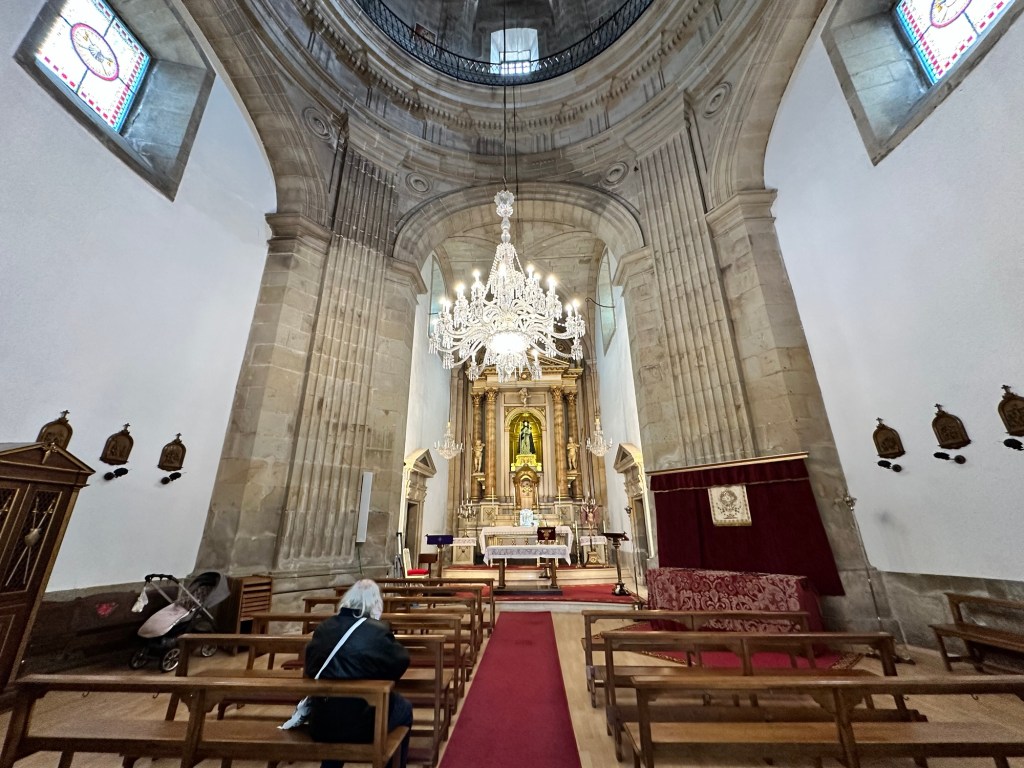
I’ll be honest. The church was clearly round, unlike any I’ve ever seen before. But I wasn’t able to pick up any resemblance to a scallop shell in the interior. Take a look. Maybe you’ll have better luck.
Despite the intermittent showers, it was a delightful day.
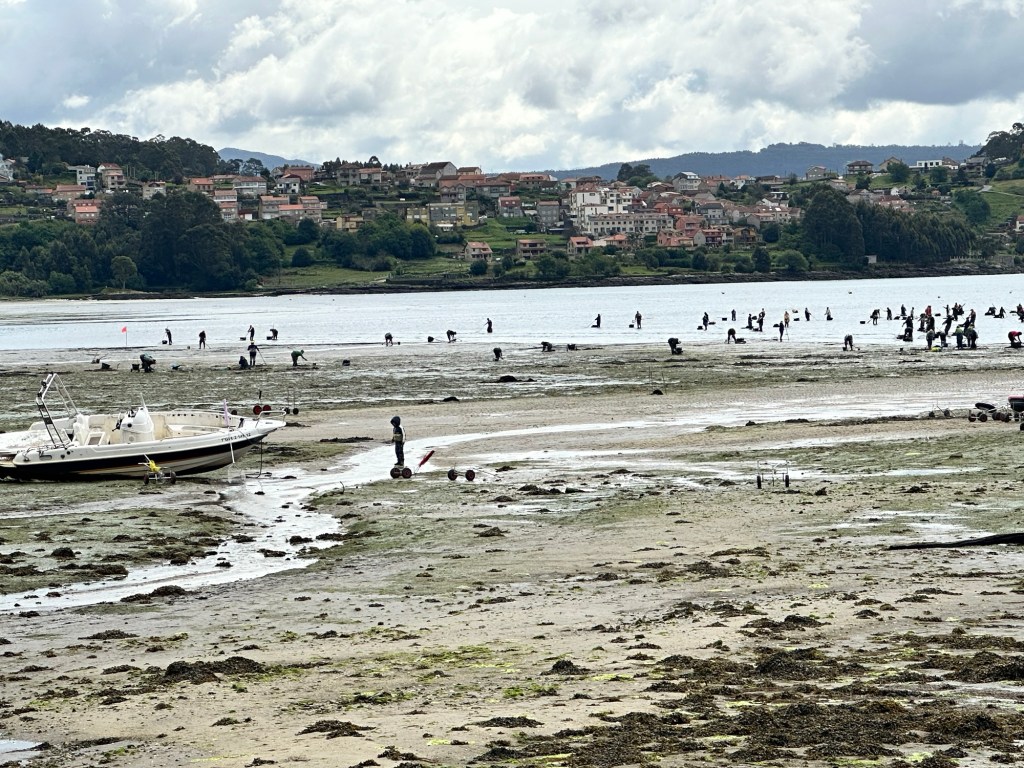
Combarro reminded me of Southeastern Massachusetts. I recall watching Sandy, my sister, digging up clams and quahogs with her toes in Mattapoisett bay.
Here in Combarro, it’s a highly regulated business, with strictly enforced limits on what can be harvested.
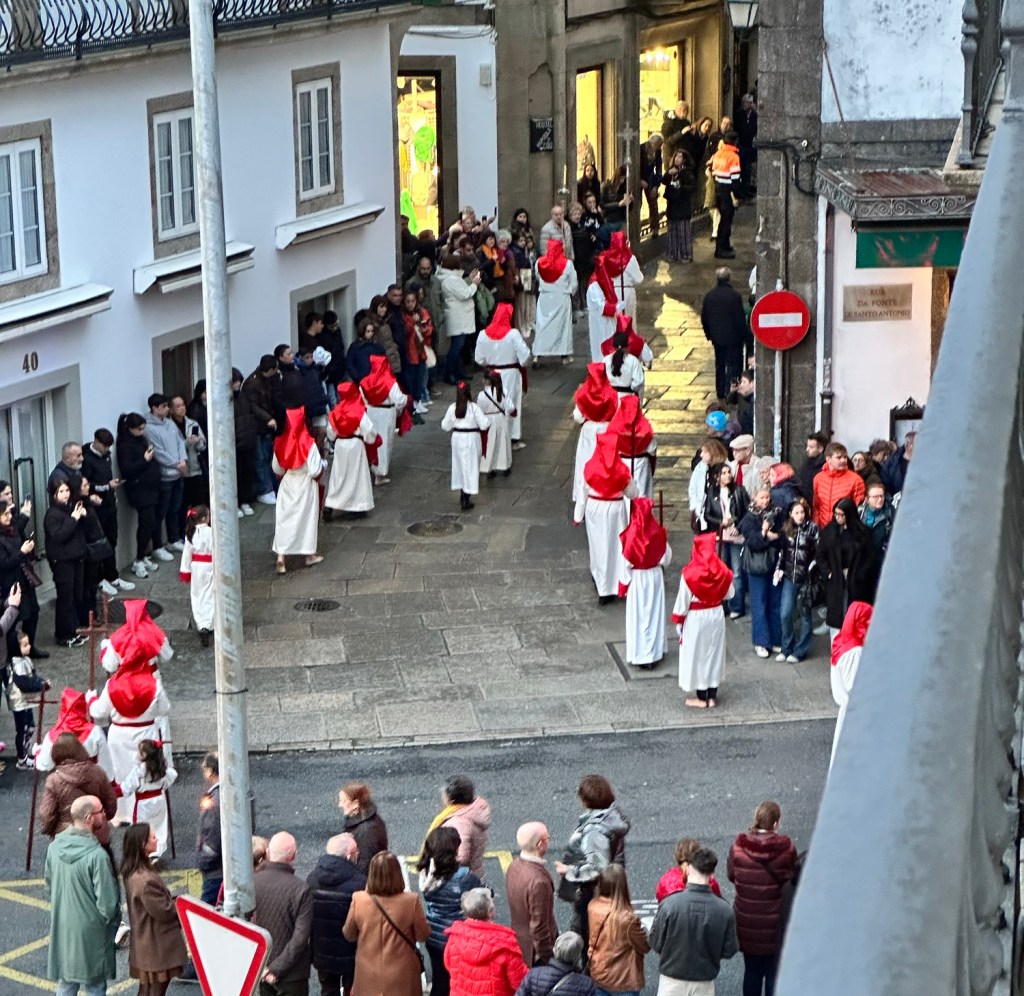
Our day ended with a pleasant surprise—a procession outside our hotel. I was already in my jammies, but when I heard the drums, I dashed onto my balcony to take this photo.
Fortunately, our trip leader was on the street and sent us a video.
Is it just me or does that statue of Jesus make it look like he needs a foundational garment?
When I booked this trip, I had no idea that I’d be in Spain for Semana Santa, or as we call it in the USA, Holy Week.
I will confess our group was more than a little surprised to see what looked like (to us) the Ku Klux Klan everywhere. But no, these are the different “brotherhoods” who hold processions every evening during Holy Week.
Their version of action figures were in shop windows.
Members of my family will not be shocked to learn that I accidentally stumbled into a church where one brotherhood was assembling. I had wanted to see the interior of the Church of San Isidoro after I learned this door was where you entered to get “indulgences”.
For those who didn’t spend your youth in Catholic school, I will explain. Indulgences are sorta like a “get out of jail free” card. You give the church a sum of money, and regardless of the sins you committed, indulgences get you on the escalator to heaven. Fortunately, the middle ages were chock full of sinners. How else do you think the church could afford all that art and gold stuff?
Can you imagine my surprise when I opened the door to find a PACKED church? EVERY bloody pew was filled with people wearing the same color coordinated outfit. My cream jacket stood out in a sea of purple, so when the door creaked open, and the assembled all turned to stare, it was easy to figure out who really didn’t belong.
I wasn’t gauche enough to take a photo then. I waited till they were all almost out the door. Hey, I wanted my friends back home to share in the experience. So here ya go.
Notice that THIS brotherhood allowed sisters to join in the fun, but instead of hoods, they wore a “thingie” to hold their mantillas high atop their heads. Also notice, they were at the very end of the procession.
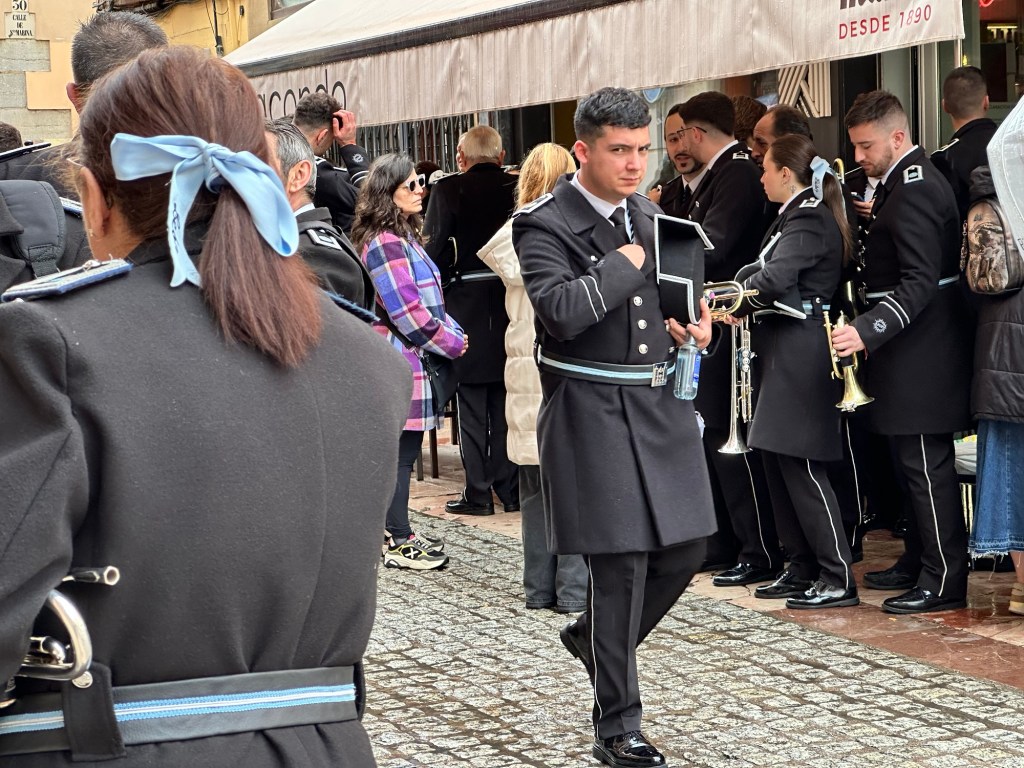
As I exited the church, I spotted some people wearing uniforms, carrying instruments, so I followed them to their assembly point — a bar.
Doing so earned me a primo spot when they started to play. I haven’t quite mastered the ability to imbed a link, but if you click below you should get a feel for Holy Week in Leon.
Despite the mob scene, fellow traveler Camille managed to spot me in the crowd. Equally surprising, I heard her call my name.
Somehow, in spite of the madness, four of us managed to link up with Shahin, our trip leader, who took the photo of Loren, me, Sheldon and Camille atop this post.
Before we went bar hopping, we saw a man standing in front of a building, swinging around a silver incense container, so we HAD to go inside. Much to our surprise, we found these elaborate “floats” that the devout carry on their shoulders during processions.
This is only ONE of many floats stored in the building
Sorry, there are no photos of our bar hopping extravaganza. We were far too busy drinking “lemonada”— red wine, lemons, cinnamon and seltzer water— León’s official “Holy Week drink, to take pictures
Our second day in the area was spent outside of León in the little village of Morgovejo, for what OAT calls a “Day in the Life” , another unique feature of OAT travel. We spend time with local inhabitants, visiting them in their homes, sometimes participating in their daily activities.
Carmín teaching us how to make cheese
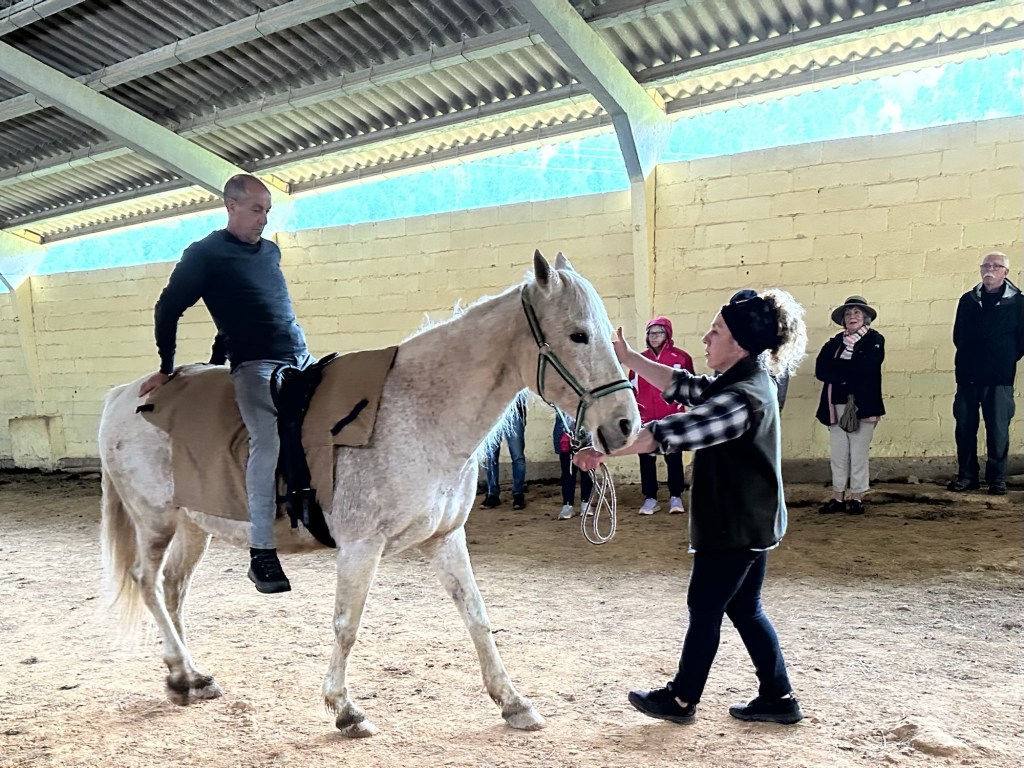
During our visit, Carmen showed us how she works with disabled children and adults, using a horse she rescued and trained. Her partner, Emelio demonstrated the various exercises that can be done by riding bareback .
Emilio demonstrating stretches.
The farm has horses, sheep, goats and dogs. Some of us were thrilled to be able to hold this baby lamb.
León was a fantastic stop, and it was over far too quickly. Next stop — Santiago de Compostela, the final destination of pilgrims on “The Way”.
One of the many reasons I absolutely love traveling with OAT is the company finds experiences I would never have discovered on my own.
For example, en route to León we made two delightful stops. The first was at an archaeological lab in Ubide, where Michaela, an Australian osteoarcheologist, fascinated us with stories about her dig at the Roncesvalles burial pit.
Can you figure out which one is Michaela? Hint: she doesn’t have gray hair. She’s in the back row, directly behind me.
It was truly amazing how much can be learned from bones. So far, they have dug down to the level of the Napoleonic wars, where they found an older soldier, whose jacket was used as a shroud. His jacket’s button is shown in the top right of the following photo. Can you see the Spanish word “Rey” (king)?
Because of his skeleton’s position in the pit, his age, his wound and the button, the archaeologists deduced the bones belonged to a high ranking member of the Spanish army who died fighting against Napoleon.
When the archaeologists reach the bottom of the pit, legend has it they will find a horse, a horn and the exploded head of Roland, a member of Charlemagne’s army, who was immortalized in the “Song of Roland”.
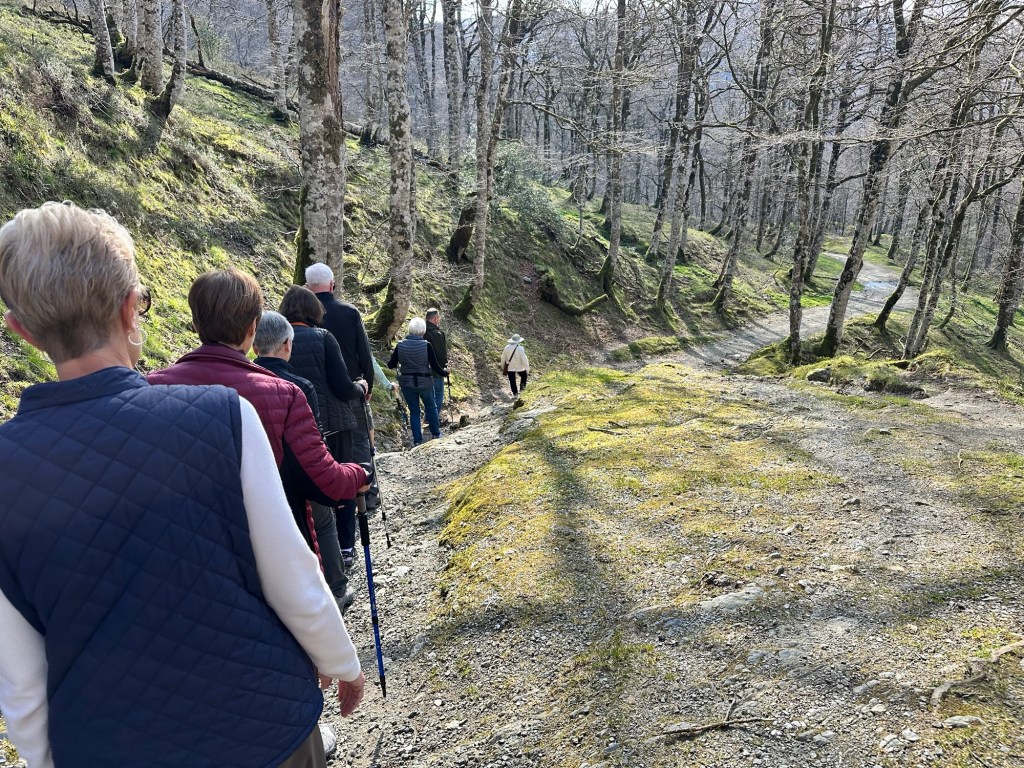
After he sacked Pamplona, Charlemagne headed back to France, using the route we followed through Roncesvalles (now part of El Camino). As you can see, the path through the forest is very narrow, so the soldiers had to travel single file, making them easy targets for the more than slightly annoyed Saracens.
For those of you who never read “The Song of Roland” and have no desire to ever do so, here’s the scoop. When Roland sounded the horn to warn Charlemagne of the attack, he blew so hard, the legend claims that he literally blew his brains out.
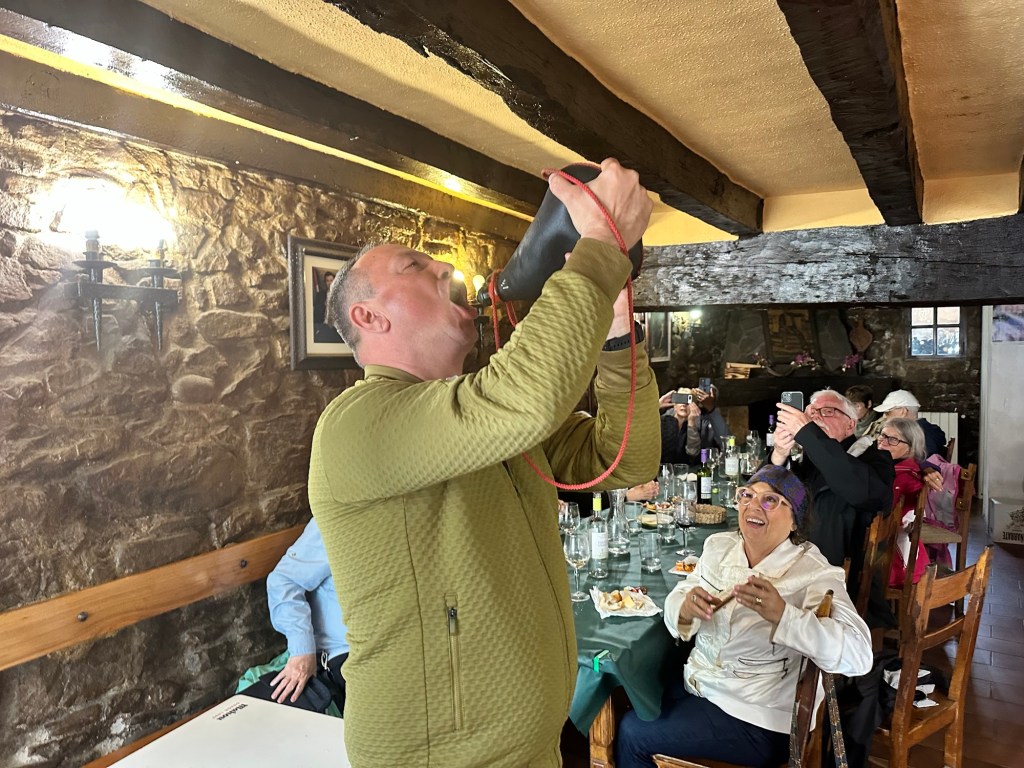
Our lunch was at a charming tavern along our route. This trip IS turning me into a “day drinker”, but it hasn’t come to THIS, at least not yet.
Shahin, demonstrating how to shoot red wine directly into your mouth
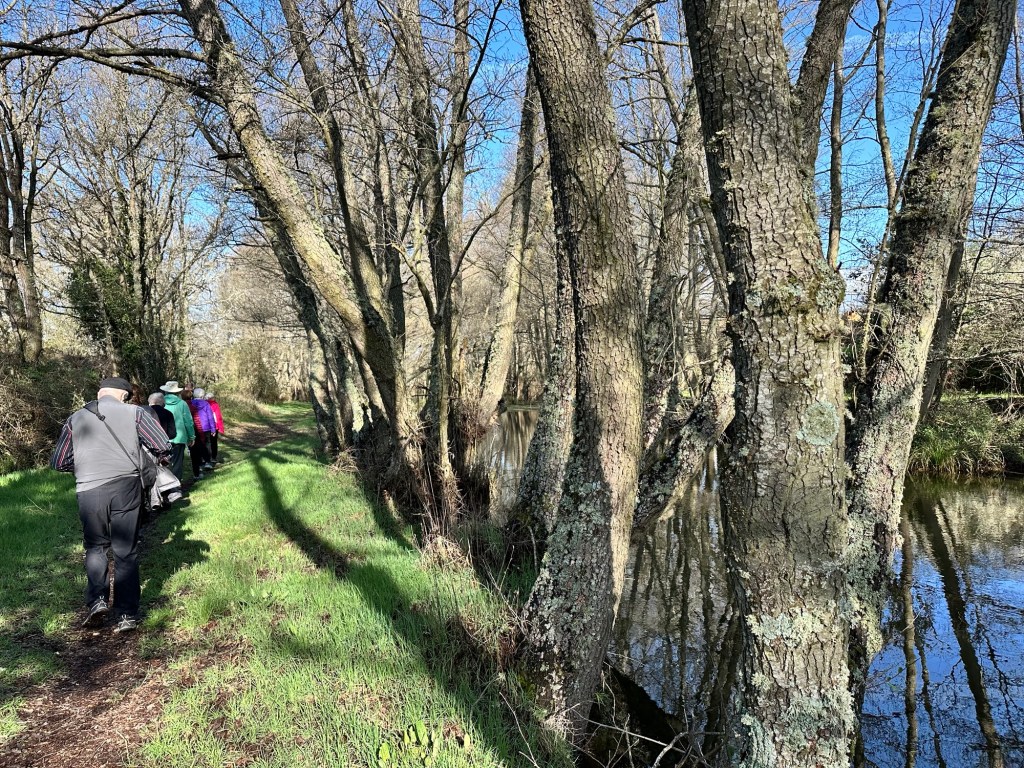
We were able to walk off some of our lunch’s calories when we reached the next stretch of our “El Camino” experience. This time, we walked through the medieval village of Castrojeriz, population about 100.
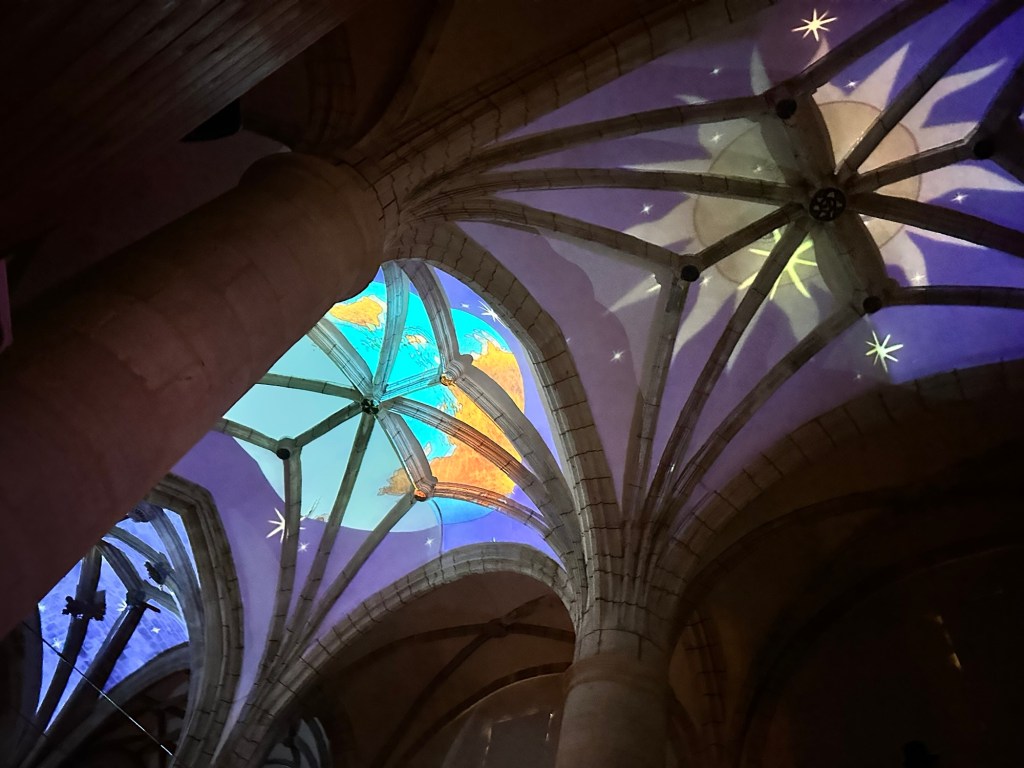
Had I been on my own, I would have walked right by this church and missed its amazing multimedia shows, including the story of creation, which was projected onto the ceiling.
If we were REAL pilgrims, walking El Camino, it would have taken us anywhere from three to about seven days to walk from León to Santiago. Instead, the 3.5 hour bus ride took us a day, because of our multiple stops.
The first stop was in Astorga, to view the castle and cathedral designed by Gaudi.
Unfortunately, the building didn’t open until 10, so we weren’t able to go inside, but don’t you agree that the outside was pretty spectacular?
The entrance to the palace is on this side. Can you believe the number of windows? On the left (barely visible) is the cathedral.
We weren’t able to linger because we didn’t want to be late for our visit to the beekeeper. To get to there, we strolled along the river for about a half a mile.
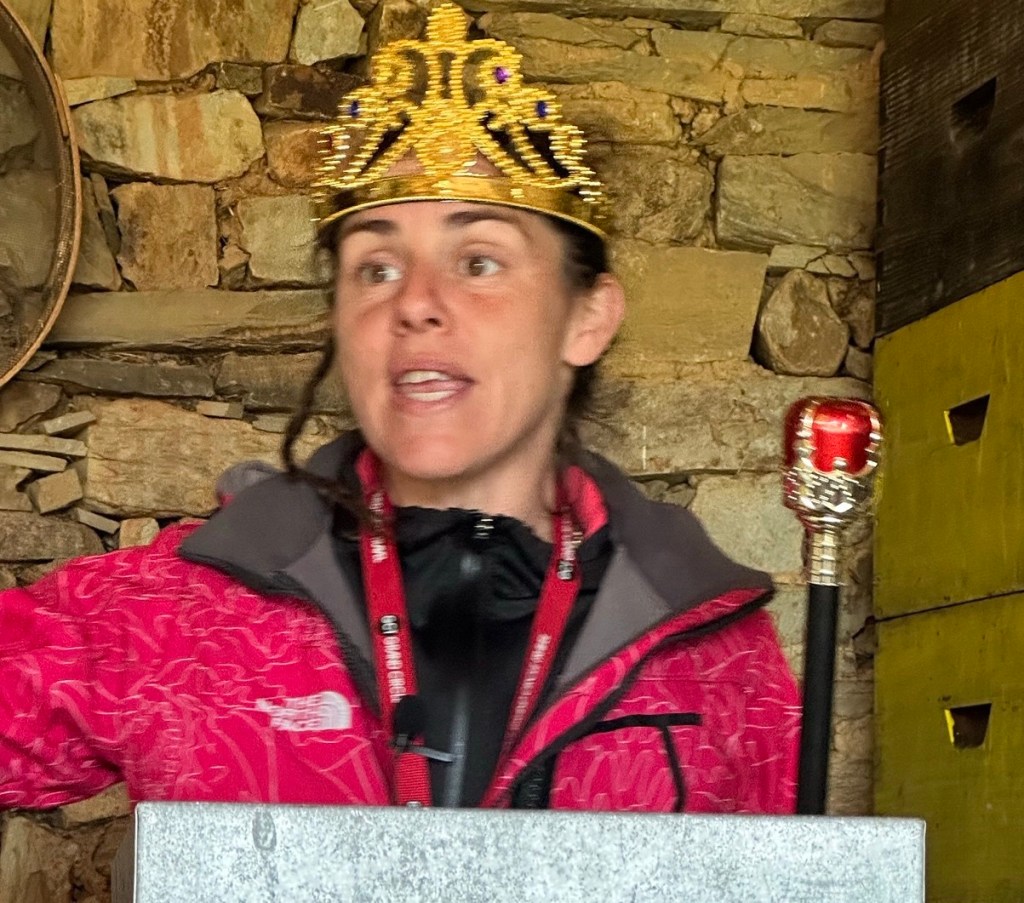
This very animated and entertaining young woman gave us the adult version of her presentation for school children.
The Queen beeThe drone
Did you know that you should never put honey in the microwave because it destroys the beneficial enzymes? Or that you should never use a metal spoon to remove honey from its container— only use wood? (sorry, I don’t remember the reason).
After all that learning, we were ready for lunch in the village.
This building dates back to the 1750’s; it was the home of a merchant who conducted trade between the coast and León.
We were very fortunate to have such great weather during this area’s rainy season.
But our luck was about to end. For the last stretch of El Camino, we had an “authentic” pilgrim experience. We walked to the cathedral in a downpour.
That smile on my face was VERY short lived. I neglected to pack waterproof shoes, so by the time we finished our 5 kilometer walk and got to our hotel my shoes, socks and all 10 toes were soaking, sopping wet. Good thing I know how to say “I want to buy waterproof shoes” in Spanish!
Looks like the weather goddess is sending more of the same for our time in Santiago and Portugal. But at least with my new 100% waterproof Sketchers, my feet will be dry!
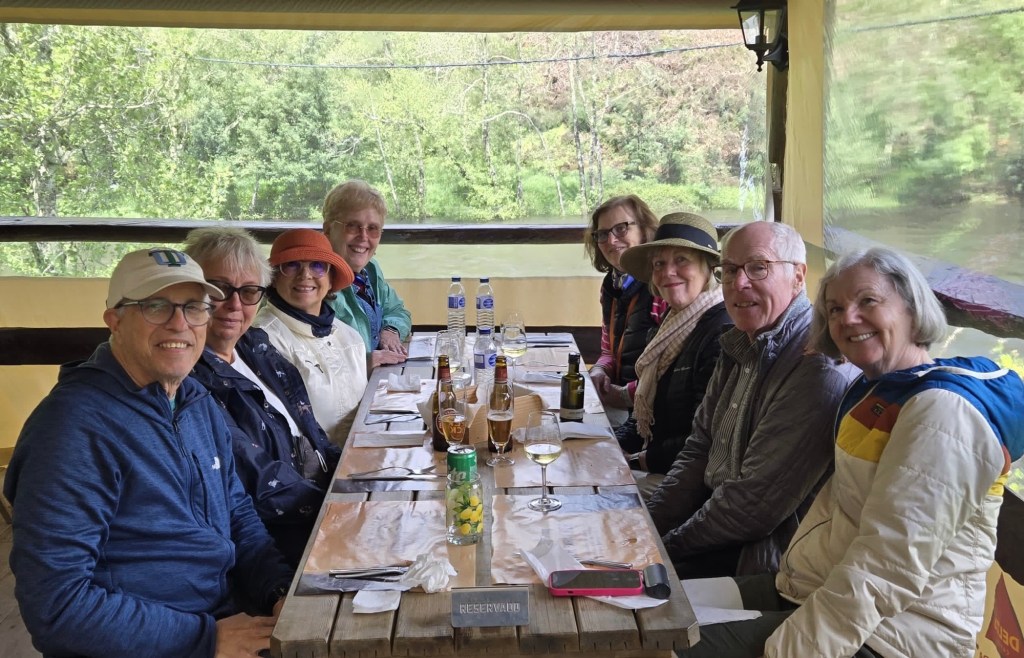
After the day we had, we decided we all needed at least one glass of wine — perhaps more. How lucky am I to be with such a great group of people!
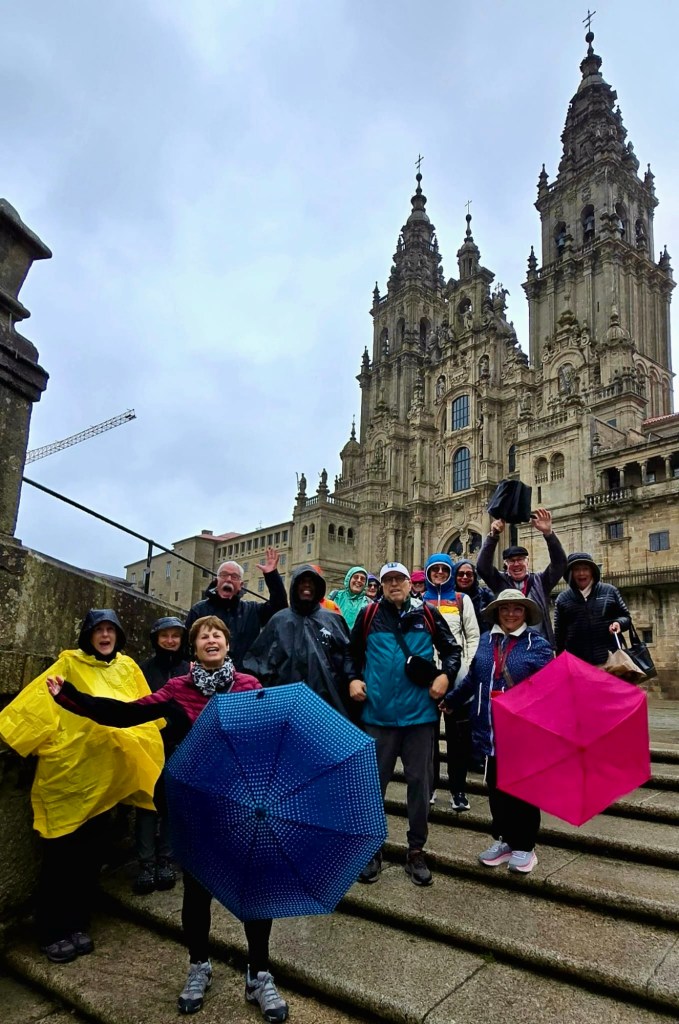
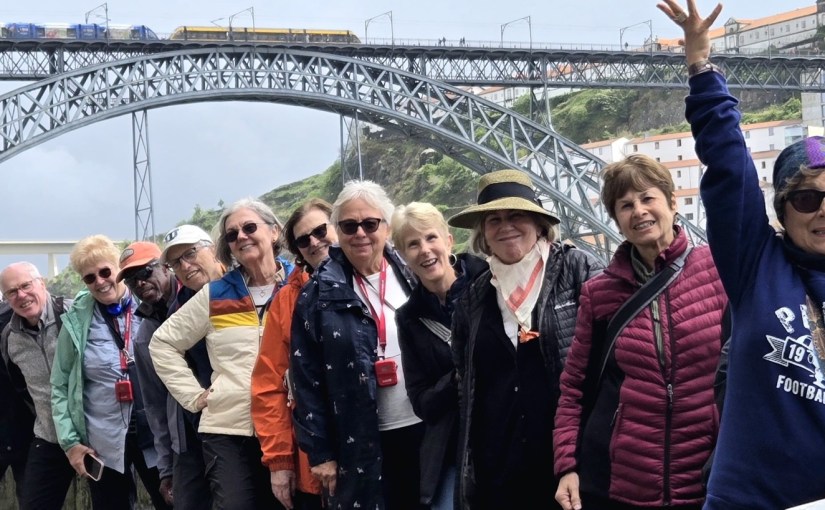
Briefly, the rain stopped, allowing Shahin to take this group photo.
If you think this post is covering a lot of ground, you’d be right. In just two days, we have visited three very different locations! The header of this post is a photo of the group as we started our walk on el Camino, but I’m getting ahead of myself. Before that…
En route to Pamplona, we stopped in the charming seaside town of San Sebastián.
Although the morning started out cloudy, before too long, the mists disappeared, just in time for us to thoroughly enjoy our walk along the beach.
The Miramar Palace, where former kings and queens spent their summers, overlooks this big, beautiful beach, and is now an events center for weddings and conferences.
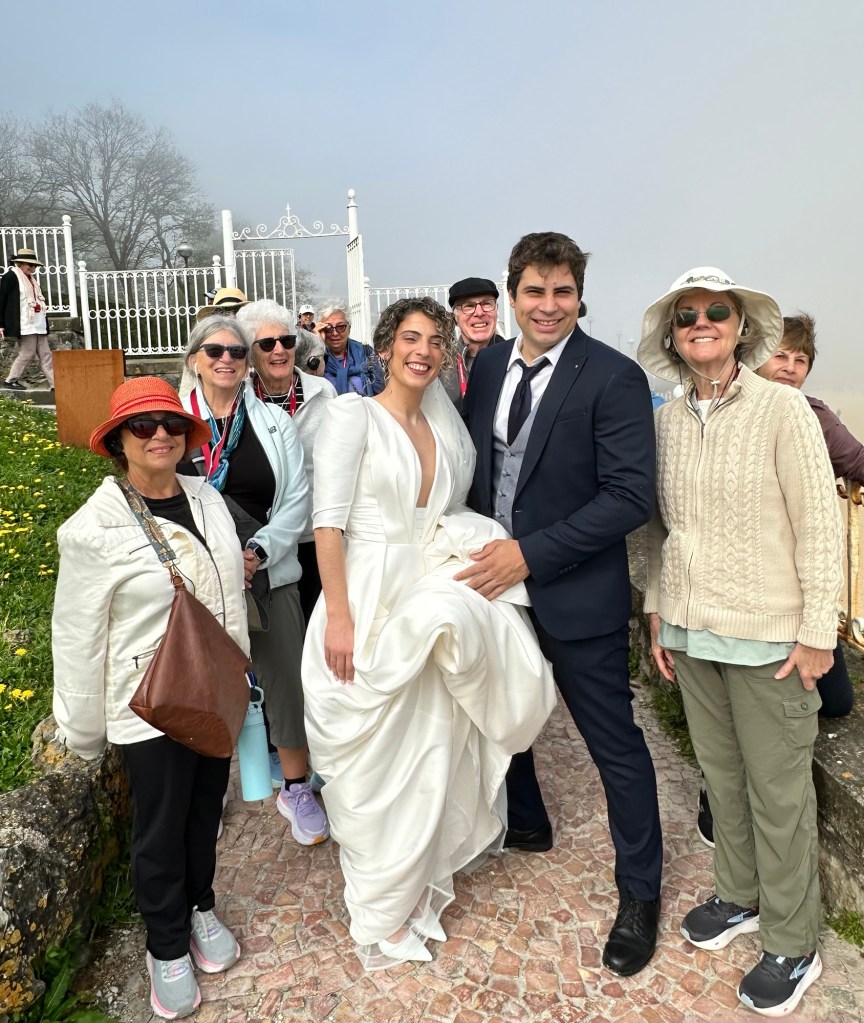
We didn’t crash the wedding—just the photo shoot
I’ve seen elaborate sand sculptures, but this was the first time I saw sand “art” being created.
We had just enough time in San Sebastián for a delightful multi-course lunch at The Morgan Kompany, ( no, that’s not a typo, and yes, it is a restaurant). I barely had enough time to find a Christmas ornament for my sister. It’s one of my travel traditions— to find something Sue can hang on her tree from every country I visit.
We arrived in Pamplona late in the afternoon, checked in to the hotel, then walked through the nearby gardens. Notice how clean everything is?
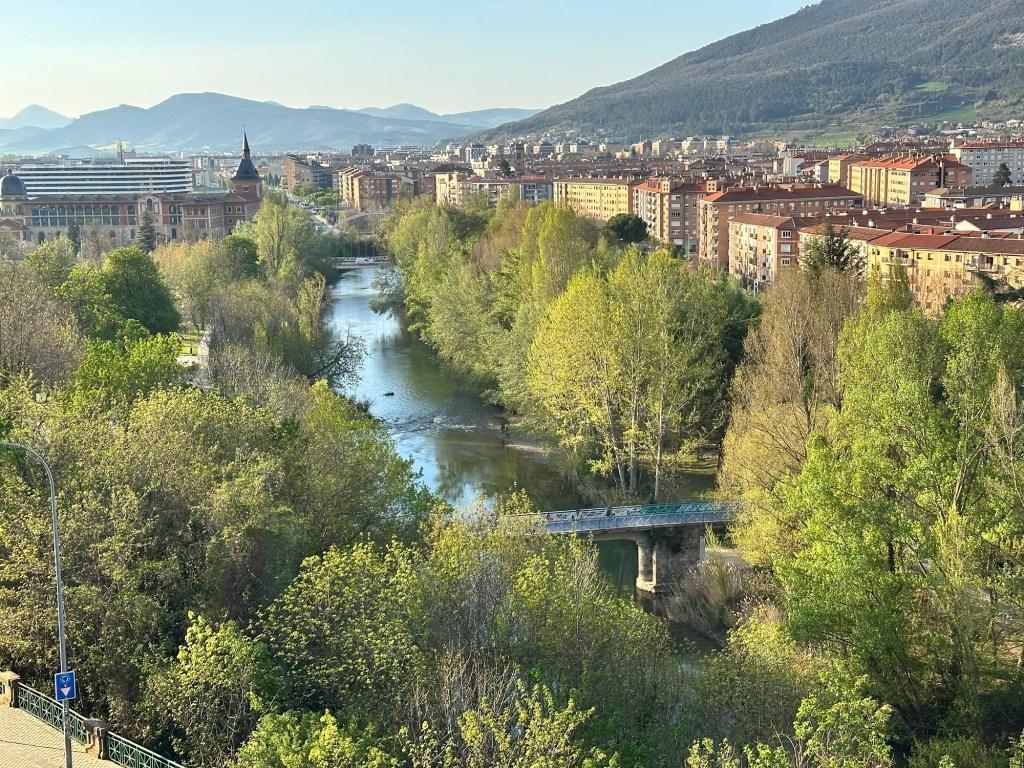
Our stroll took us to the city wall, where we were able to enjoy this panoramic view.
Spaniards eat dinner around 9 or 10 PM, which according to my American digestive system is FAR too late.
We didn’t spend much time in Pamplona, because the next morning we traveled to Roncesvalles, where we started our El Camino experience. The mountains in the background of the header photo are the Pyrenees which form a natural border between France and Spain. In that photo, some of us are holding our El Camino passports aloft. We collected three stamps on this walk.
I didn’t have a walking pole, so I brought my umbrella, which helped me cross a muddy, slippery stream.
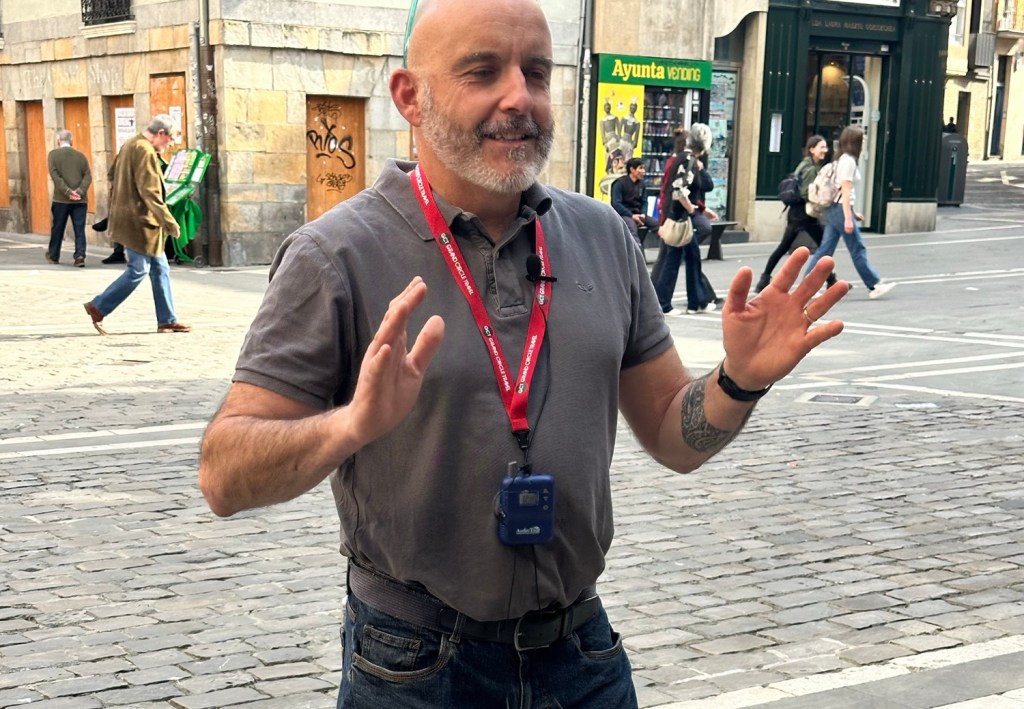
For our last afternoon in Pamplona, we met Gonzalo,
who has run with the bulls multiple times. He finally hung up his running shoes after his injuries resulted in a 10 day coma.
As we walked the half mile route from corral to bull ring, he filled us in on little known facts (at least to me) about the Festival of San Fermin. That’s the official name for the insane practice known as running with the bulls.
Six bulls per day do the run, accompanied by six steer ( castrated bulls)
The same six steer do the run for SEVEN consecutive days, but the six bulls change every day, because they get finished off when they reach the bull ring. This festival is the only time bull fights are held in Pamplona.
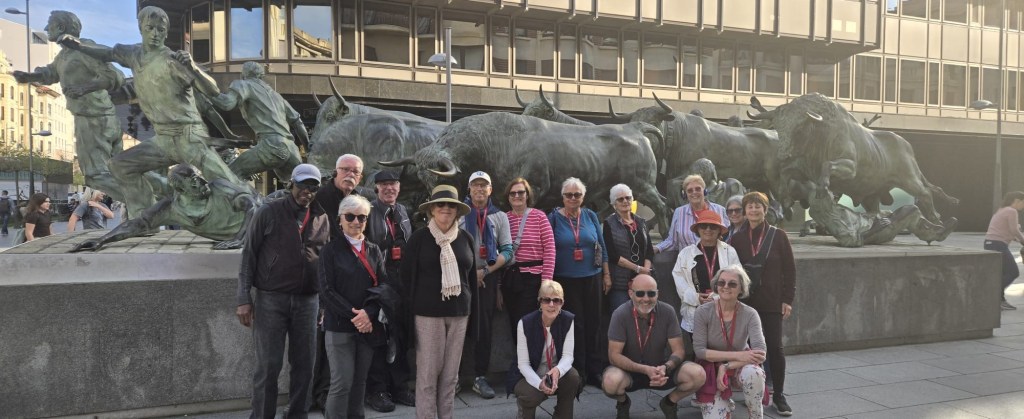
Before 7 AM, runners congregate in front of the statue of Saint Fermin (maybe he existed, maybe he didn’t) to sing a song three times at prescribed intervals before the bulls are released at 8 AM.
According to Gonzalo, runners need to arrive early to get a good spot for the run. If you are interested in viewing the madness, and hearing the song, here’s the link to the YouTube video. https://youtu.be/hDyQ0cUXk9g?si=rN20ZM45hAZ_CW_i
During the 7 day festival 42 bulls run. Each one costs between nine and fifteen THOUSAND Euros.
It takes the frightened bulls about two minutes to run the half mile route. No runner is fast enough to do the entire route, because once the bulls get in front of you, you’re done with the race.
If a runner gets gored or trampled all medical care is free. If you are NOT a runner and fall down because you’re drunk, you are responsible for the medical costs. And let me tell ya, there is a whole lot of drinking during those seven days!
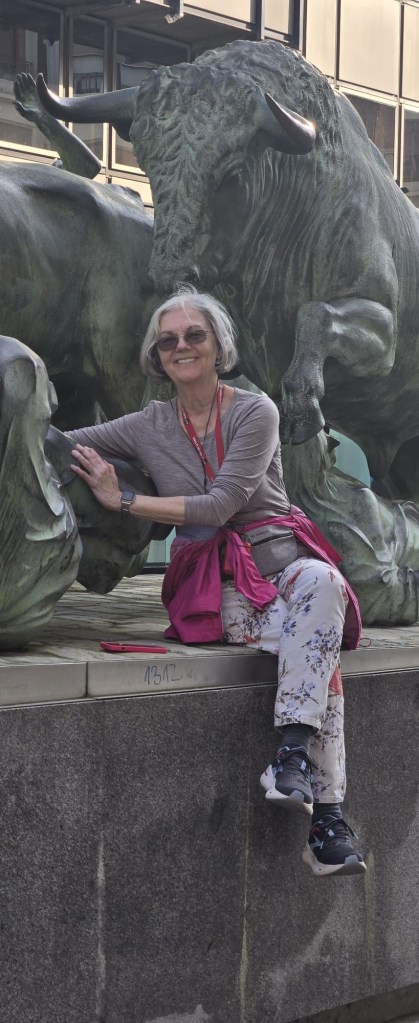
This is as close as I will ever get to a bull run, because I KNOW what would happen!
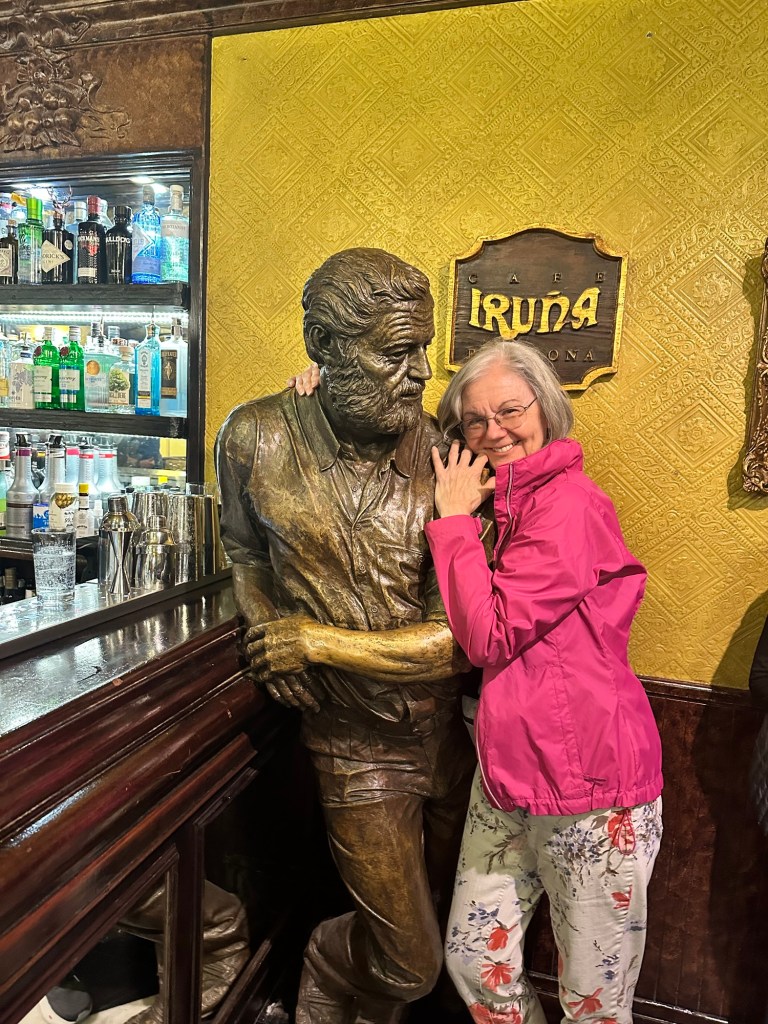
Our last stop was at Hemingway’s favorite bar, where we enjoyed churros and chocolate.
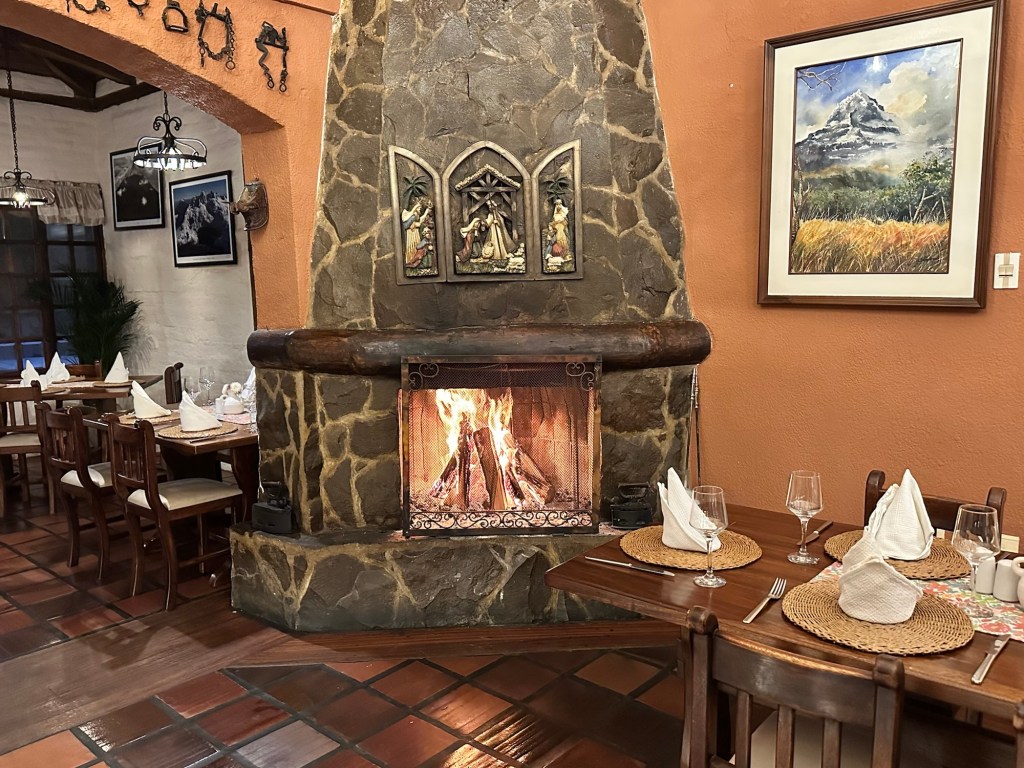
By the end of Day 2 of our Ecuador post trip, we had arrived at the Hacienda Abraspungo, the second of our one night stays—not to be confused with one night stands—which if that’s what you were expecting this post to be about, you’ll be very disappointed.
The restaurant at the hacienda
For the remainder of our week in Ecuador, we will be spending three nights in Cuenca, then flying back to Quito for our final two nights.
Getting from Cartagena to our hotel in Quito was a whole day slog, not made easier by our stop at Bogota airport, where clear signage in either language was sadly lacking.
At Bogota airport, I managed to get separated from my fellow travelers, however I know enough Spanish to say, “please, can you help me? Where is the gate for the flight to Quito”. The bad part was the people I asked thought I was fluent, so they launched into this rapid explanation, using BIG words. Fortunately, when I told them I only knew a few words and understood Spanish like a 3 year old child, they switched to body language, which I have completely mastered.
By the time we arrived at our Quito hotel, around 8 PM, we were all pretty tired, so barely had enough energy for dinner.
Although we had two more transit days, they have been in a very comfortable, small bus. We made multiple, interesting stops along the way, and the scenery has been spectacular.
We were incredibly lucky to be able to clearly see Cotopaxi, the highest active volcano in Ecuador. Much like Mt Fuji (and me) it usually has its head in the clouds. Our excellent bus driver knew the exact spot for a great photo op and that’s what you’re looking at atop this post.
Our drive along the PanAmerican Highway was lovely. Did you know you can get from Alaska to Tierra del Fuego by driving its full 16,000 miles? We are only doing a short stretch, along the Avenue of the Volcanoes (there are about 250 volcanoes in Ecuador; fortunately most are inactive).
The countryside is beautiful, but I was unable to capture the grandeur of the mountains, volcanoes and rolling emerald colored hills from the bus. Too many reflections from the windows. Just imagine driving through the Rockies on a perfect spring day.
This photo was taken when we stopped to get a shot of Chimborazo, which rises 20,000 feet above sea level. I know, it looks a lot like Cotopaxi, but for us, it was a real thrill.
Chimborazo
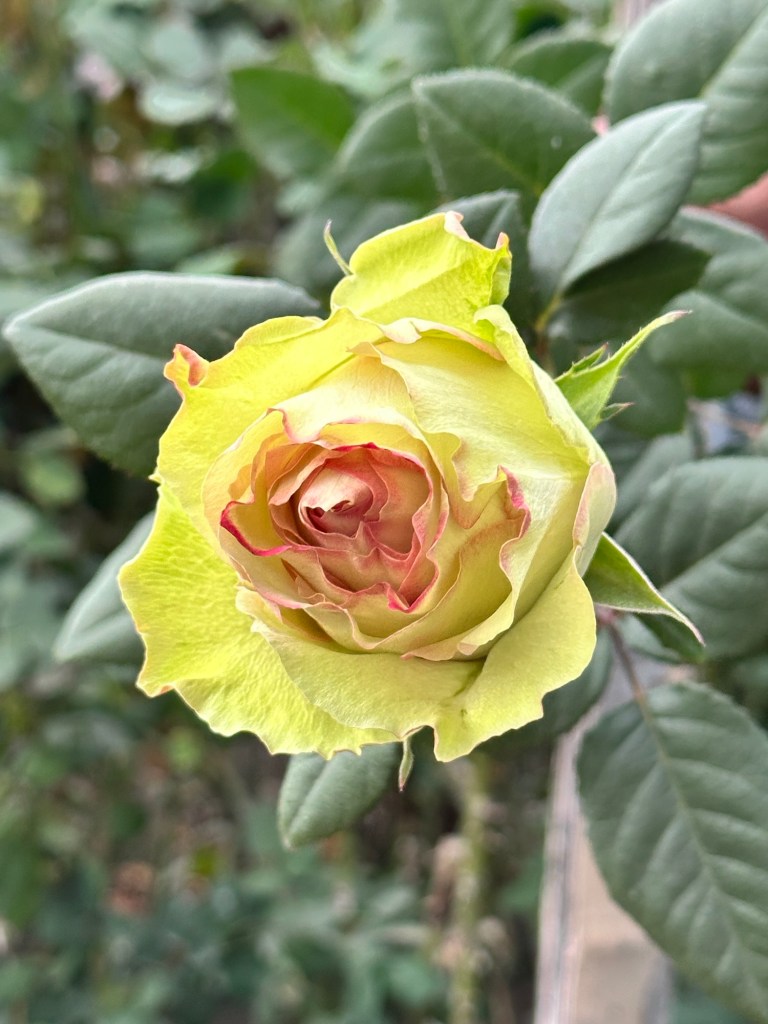
Like the Road Scholar trip Mike and I took to Ecuador in 2012, OAT itineraries include a visit to a rose farm. With 12 hours of direct sunlight most days, Ecuador is able to produce a mind boggling variety of incredible, long stemmed roses.
Rose exportation provided (for the first time) employment to many Ecuadorian women. They are able to bring their children to the worksite, which provides daycare. They are paid the minimum wage, which is $470 per month. The US dollar is Ecuador’s currency, so no “exchange math” is required to figure out that’s not a whole lot of money.
The first rose variety I saw on our tour was named Sandy, so I immediately thought of the wonderful sister I had lost, and although it was a struggle, I managed to hold back the tears.
Sandy
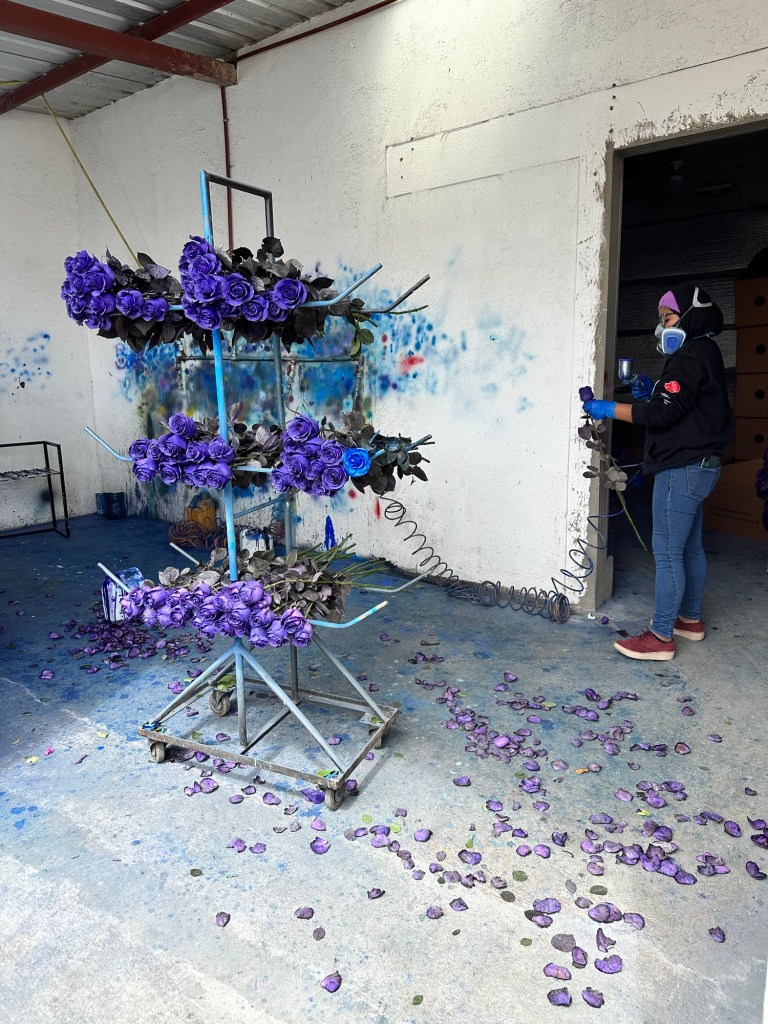
If you’re having a special event and can’t find a hue that compliments your color scheme, no problem. The roses can be sprayed to your specifications. Think I’m kidding? Take a look.
We met indigenous people at our next stops. The first is an artist, who, like Grandma Moses, is self taught. We were all given the opportunity to paint on goatskin, and once again, I produced a masterpiece I think is worthy to hang on the wall in any second grade classroom.
Notice the two condors, representing the heavens, and the snake, representing the underworld. Where’s the representative of the earth—the puma—you ask? Well, sadly the puma didn’t move fast enough, so he’s buried under the lava flow.
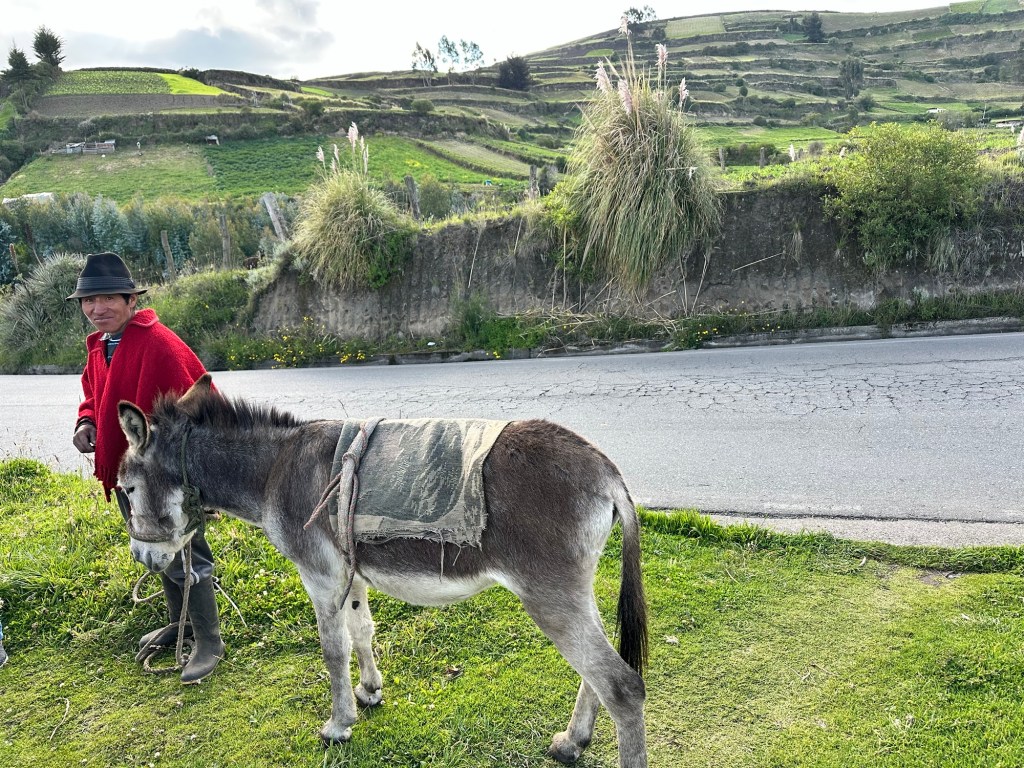
Take another look at the photo of Chimborazo. That’s where this man and his donkey climb twice a week to carve huge blocks of ice, which they carry down the mountain and sell to businesses in nearby Riobamba. When we were there, the volcano was hidden by the clouds.
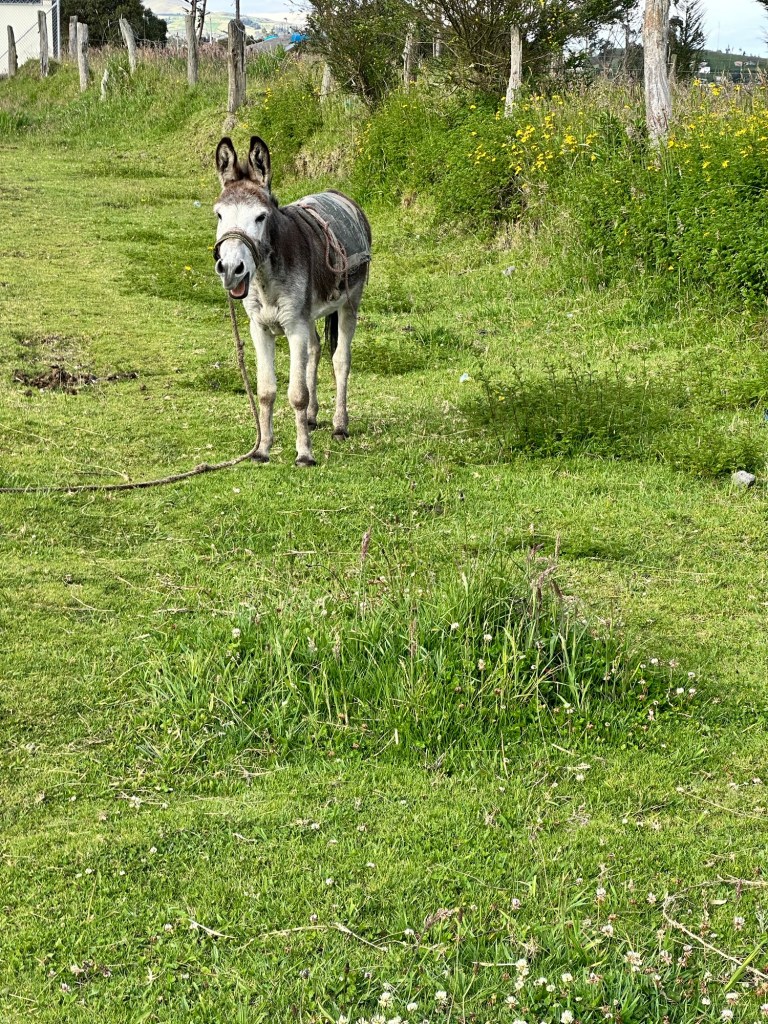
There is no such thing as too many donkey photos, is there? I should have done a video because he was braying loudly.
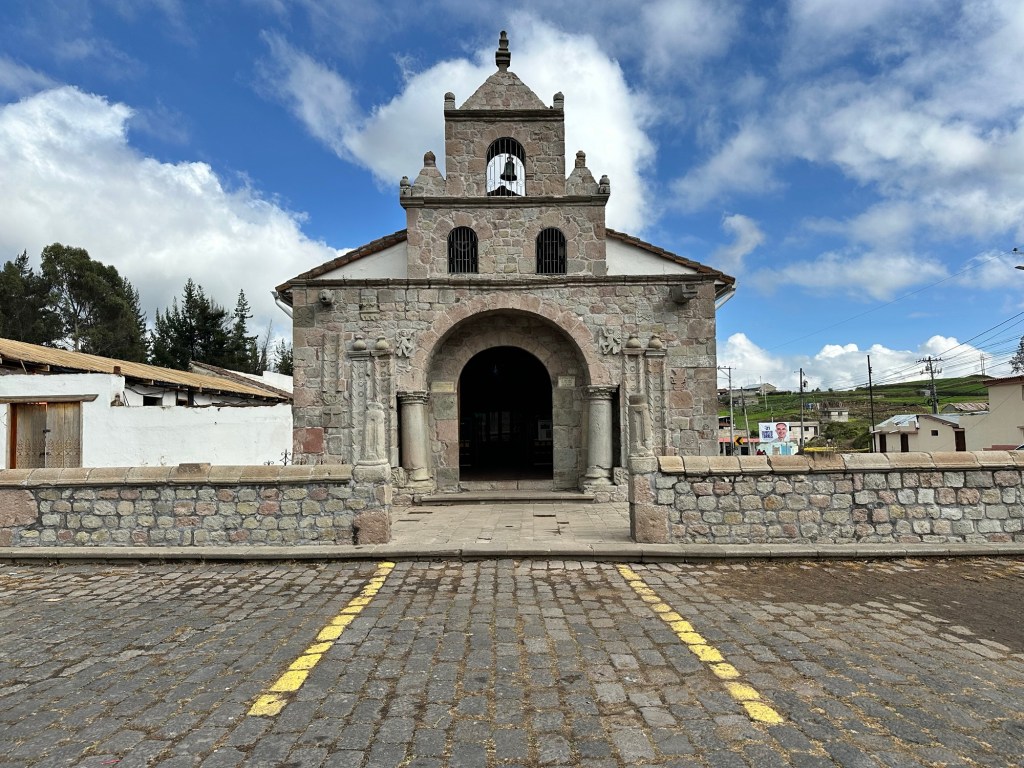
The Spaniards brought Catholicism to the areas they conquered, because that’s what Jesus told them to do in his sermon on the Mount. It went something like this:. “Blessed are they who steal the gold from the people they enslave, for they get to be heroes in their home land.”
Unfortunately, Jesus didn’t warn them about the Evangelicals from the US. The Evangelicals built schools and clinics; they translated the Bible into the native language. They also gave free radios to all indigenous, so they could easily preach and be heard by all. Most of the locals converted, which is probably why this church had to get creative when they found the collection plates contained more dust than dollars.
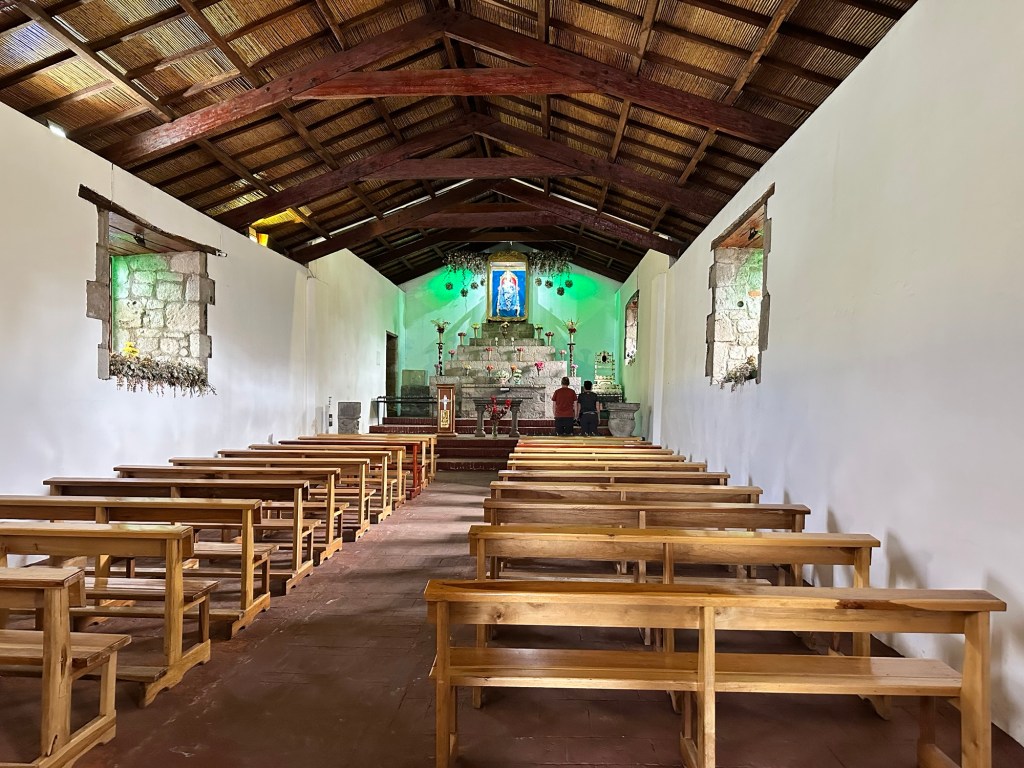
Built in 1534, it was the very first church the Spaniards built in Ecuador. Take a look inside.
Looks pretty standard, right? But wait. You haven’t seen the vestibule yet. This is the creative section.
Those of you with sharp eyes have probably noticed the coffee pot in the lower left hand corner. My lens wasn’t wide enough to capture the tables and chairs directly across.
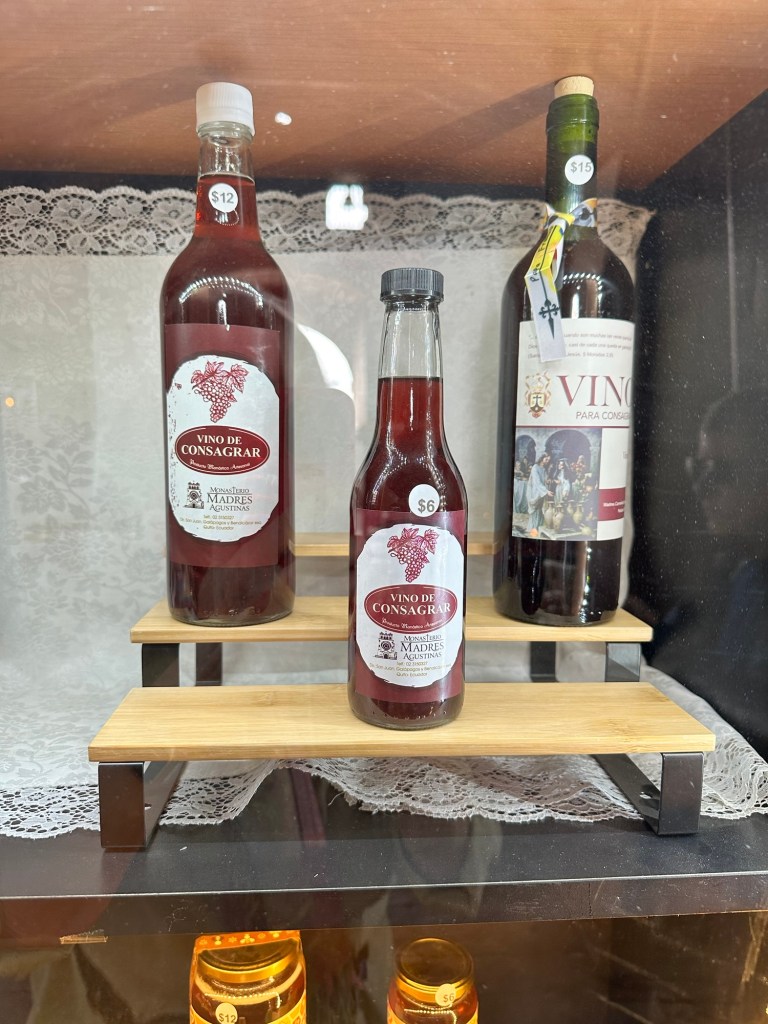
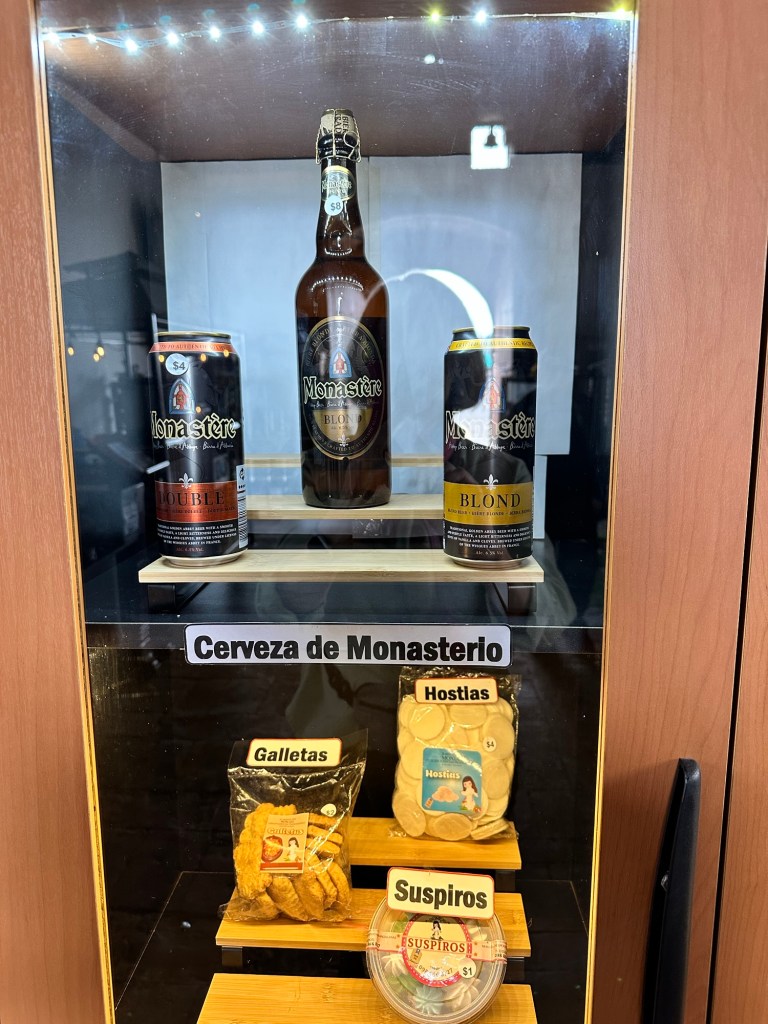
But if you need more than coffee to get you through Mass, not to worry. There are OTHER beverages from which you can choose.
In addition to beer and wine, you can also buy “holy water” . You all know what bottled water without a label looks like, so I didn’t bother to include a photo.
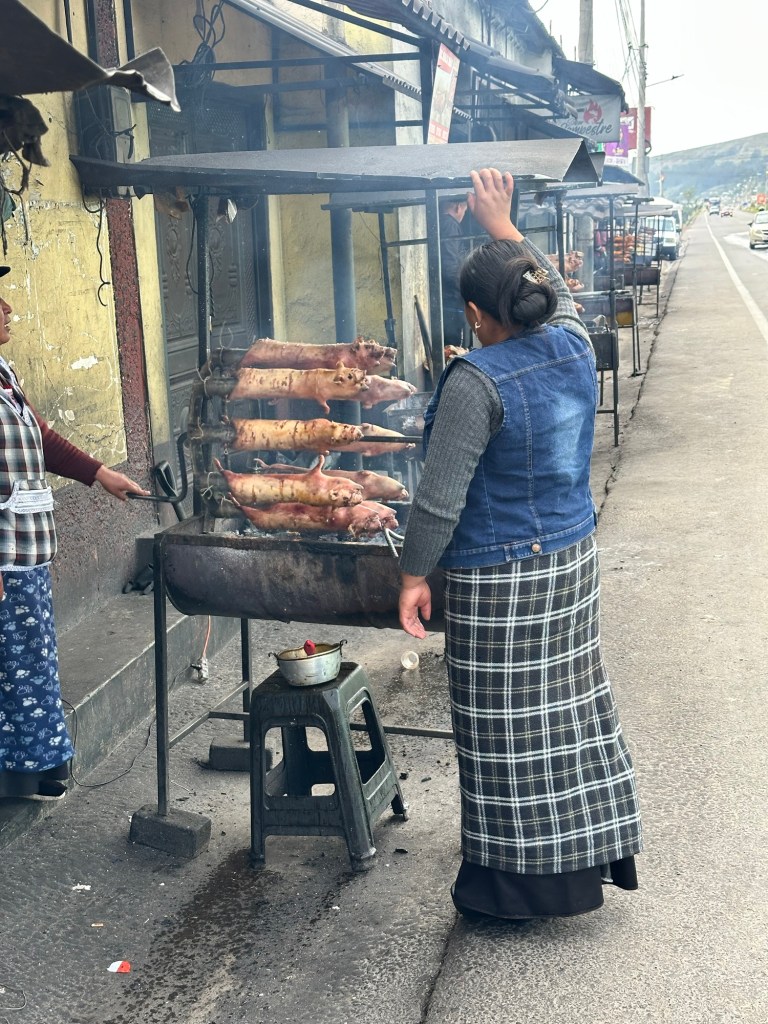
Before the animal lovers get their shorts in a knot over this next photo, let me remind you, Costco uses a similar cooking method, they just rotate chickens instead of guinea pigs. And they remove the heads first.
This road side cuy producer sells about 40 cooked guinea pigs a day! Cuy is considered a delicacy here in Ecuador, and will set you back about $50 if you ordered it in a restaurant.
After Covid, Ecuador’s railroads went out of business, including the famous one that traveled up the devil’s nose.
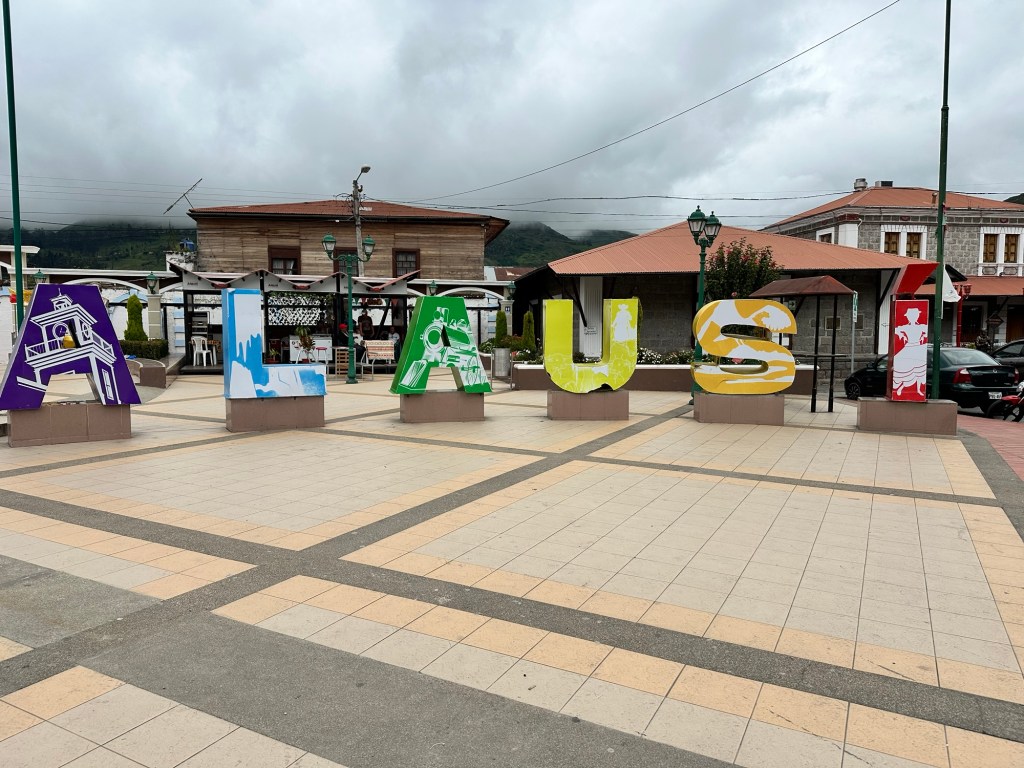
We visited the now closed train station in Alausi, then proceeded up the mountain, into the clouds, for lunch with the indigenous people.
As we climbed higher and higher, the cloud cover was so complete, I was convinced we wouldn’t be able to see El nariz del Diablo (the devil’s nose), but we continued to have phenomenal luck. Not only did we see the Devil’s schnoz, ( it’s the mountain on the right)
we also saw the train tracks leading up to the zig zag route.
We have been rocking and rolling along mountain roads, so once again, I will push PUBLISH and hope for the best.
I first visited Cartagena in 2010, when Mike, Greg and I took an Oceania cruise through the Panama Canal. I was immediately charmed by this fascinating city, and became determined to return to Cartagena and to explore more of Colombia.
For most of the ports, we opted to go off on our own, rather than take a cruise sponsored tour. That was the case in Cartagena, where we were able to cover most of the high points in the old city, during our too brief time in port.
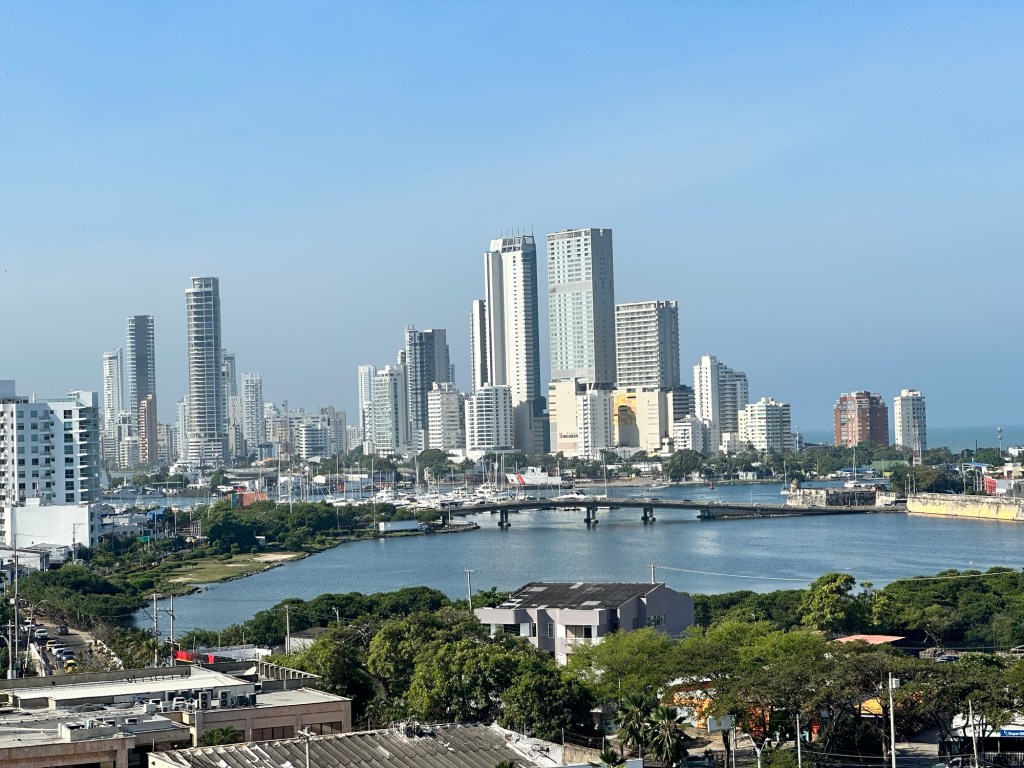
Here is what the “new” section of Cartagena looked like in 2010.
Fast forward to 2025. Both photos were taken from the enormous fort the Spaniards built to protect the area from pirates. Can you tell which photo was taken with a camera, and which was taken with my iPhone?
It is possible to travel from the top of the fort to the bottom through narrow, low tunnels. When we visited in 2010, we attempted to do just that, but as we approached the exit, our guide discovered it was flooded, so we had to walk ALL the way back to the top. Poor Mike was unable to stand upright!
I know many people have strong opinions about cruises versus land travel. It was interesting to experience both in the same city. Although vastly different, I discovered I thoroughly enjoyed both, but for very different reasons. As with everything in life, both travel modes have advantages.
When we cruised, we always opted for a smaller ship, chosen for its fabulous itinerary. Cruising allowed us to unpack once, travel while we slept and awaken someplace great every single day. It provided us with a taste of many different areas, so we could determine which country we might want to explore in more depth in the future. And, if you happened to get sick, or have an accident, the ship had a fully equipped medical center on board. But your time in port is limited; you normally have to be back aboard the ship around 5PM, unless you chose a cruise that spent more than one night in a particular port. And there ain’t many of those.
For the OAT land trip, we spent three nights in Cartagena, which allowed us to slow down and savor our time there . We saw SOME of the areas we visited on our whirlwind day in 2010, like the former convent of the Sisters of the Poor Clares, but instead of just driving by it, Leslie ( another new friend) and I went to the bar to watch the sunset.
Those of you who read my pre-trip post may recall the special drinks and the tours of the former convent described on the hotel’s website. Well, although getting lost while searching for the rooftop bar allowed us to see a whole lot of the convent, it certainly didn’t qualify as a tour (they don’t give them any more), and although my pisco sour was delicious, it didn’t have what the website called “magical” properties.
What the rooftop bar DID have was a DJ, and lots of young people, staring at their phones.
So, we took our sunset photos, admired the view, and that pisco sour? It was consumed in a quiet, “historical” bar on the first floor.
The view of the ocean, and the only spot at the bar from which you can see the sunset.
Remember the popular image of Colombia as a dangerous place? Well, Leslie and I were perfectly comfortable walking the streets at night and when he noticed we were hopelessly lost, this sweet young Colombian approached us, offered help and walked us back to our hotel.
This was a very common experience: a waitress chased me down the street because I had left my hat in the restaurant, street vendors accepted your “no, gracias” when they approached you, but then engaged you in conversation so they could practice speaking English. Everyone we encountered was friendly, gracious and oh so welcoming.
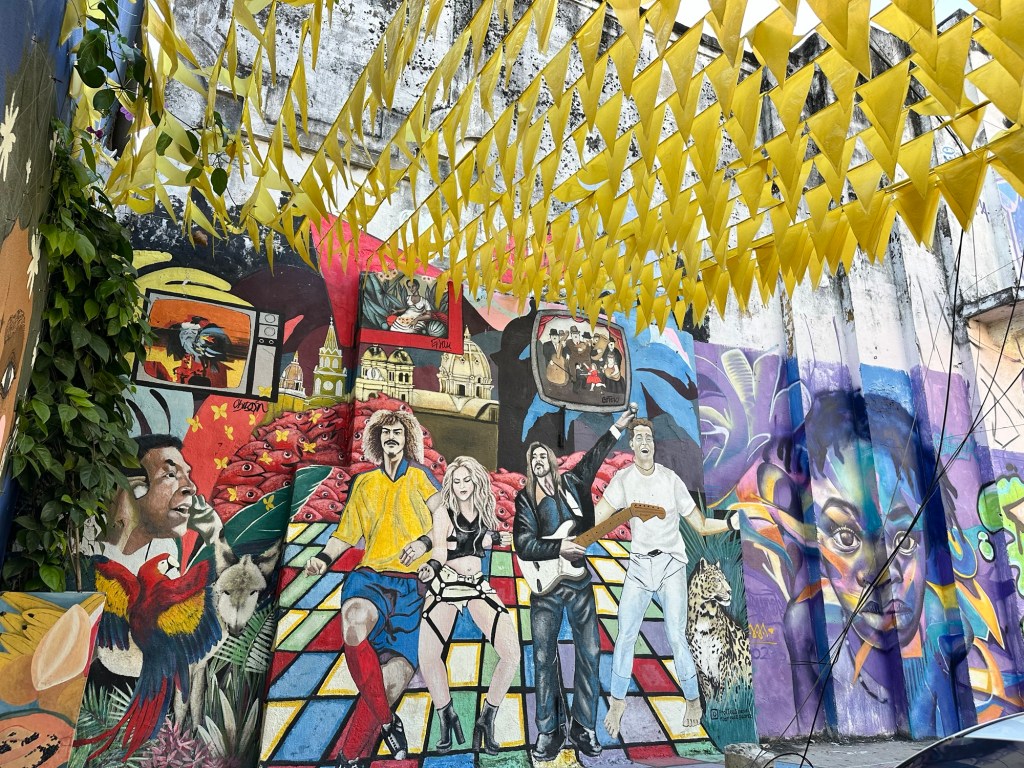
As you have seen in my earlier posts, the streets of Colombia are very colorful , and Cartagena is no exception.
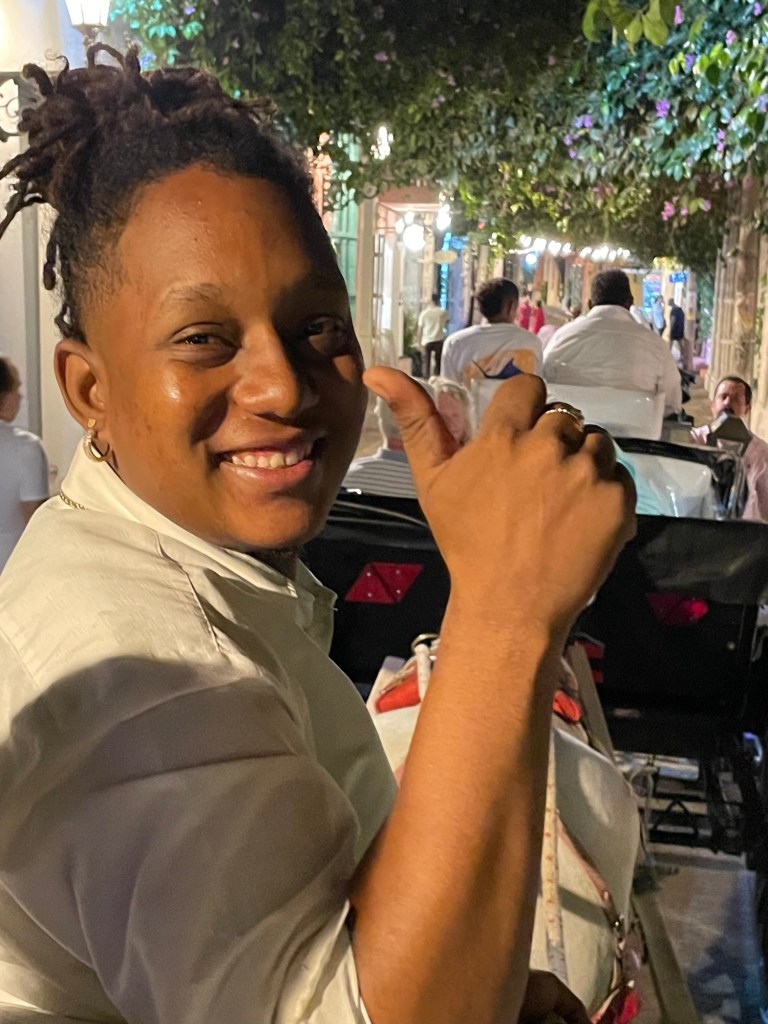
The woman in the black leather “bondage” outfit is Shakira, who has an apartment in Cartagena, overlooking the ocean. Our carriage driver pointed it out as we rode along the ocean on our way to our farewell dinner. He also claimed he was Shakira’s novio ( boyfriend— see, those Spanish lessons DID come in handy!)
Did you know that Colombia was the inspiration for Disney’s movie, Encanto? I sure didn’t.
Sorry, the sun was in the wrong spot when I took this photo. Anyone who saw the movie will recognize the cartoon character immortalized on the wall, but did you know her image was based on an actual resident of Colombia?
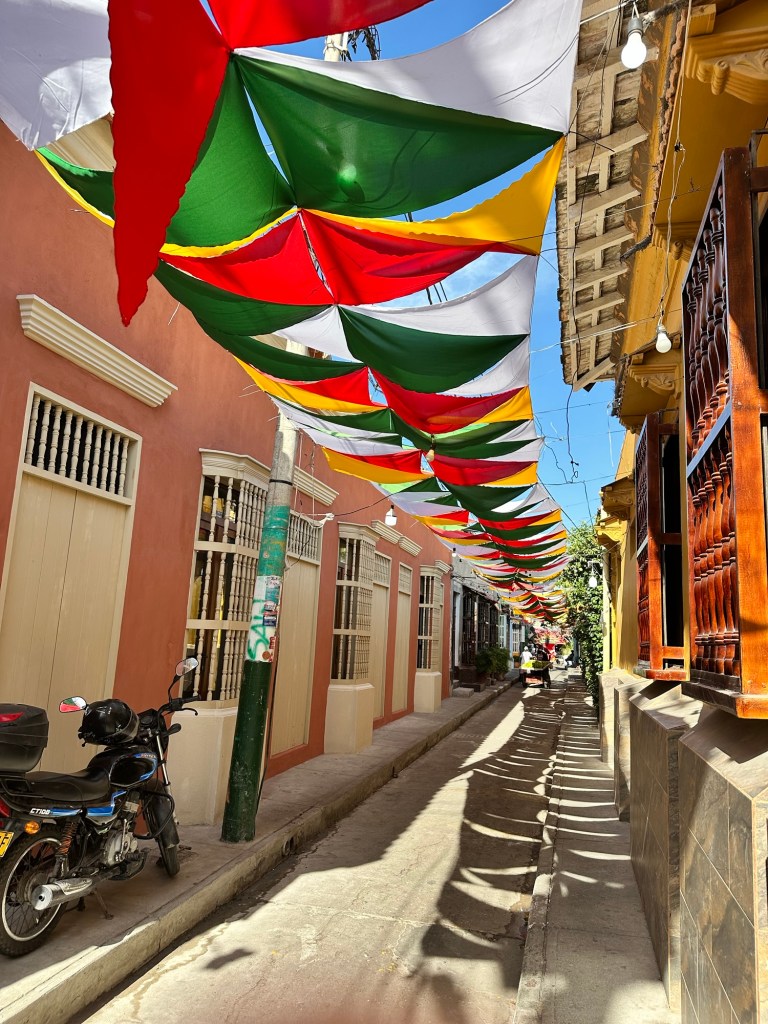
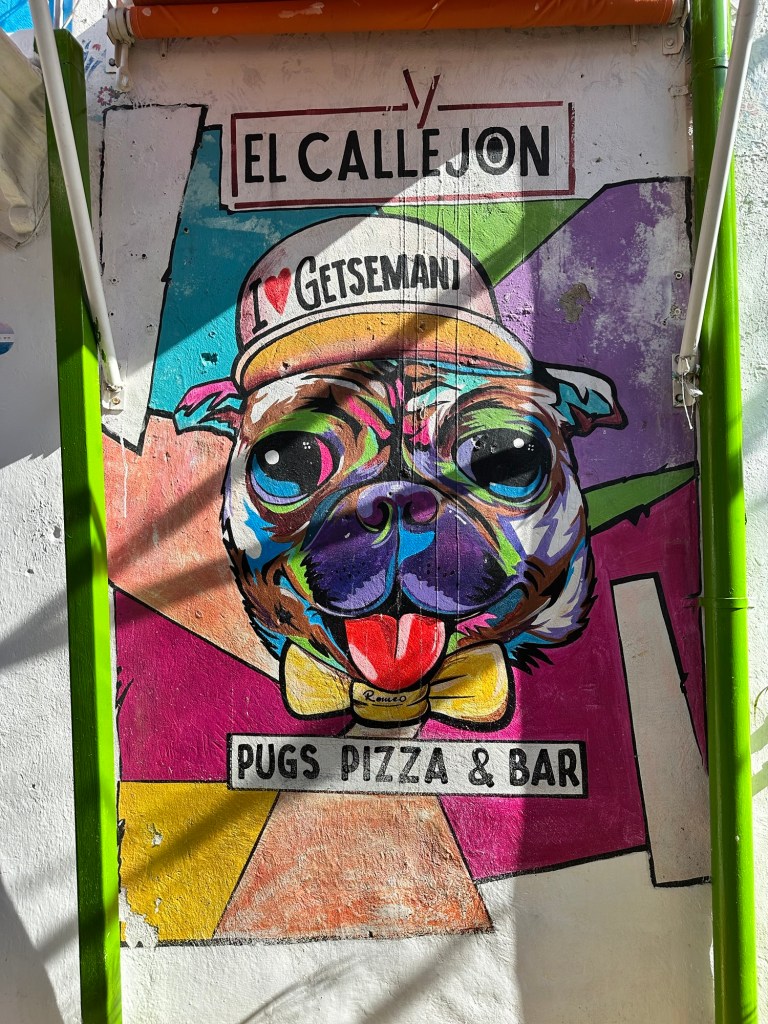
There was so much to see in the neighborhood of Getsemaní, I had difficulty choosing the most compelling street image, so I decided to include several.
During our trip we experienced MANY different modes of transportation- boats, metro system, cable cars, jeeps, tuk tuks and best of all, the PARTY bus,
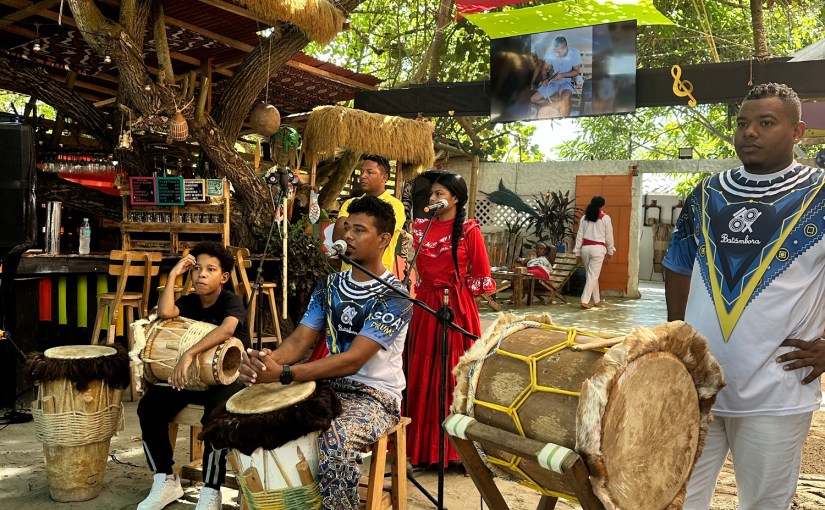
which came fully equipped with live music, so we were serenaded all the way to Bocavilla, an African Colombian community located on the beach.
Our musicians played European, African and Caribbean instruments
While in Bocavilla, we had drumming and dance lessons which were SO much fun! The musicians and dancers were students at a school established to preserve their African/Caribbean culture.
Seven of us are at the airport heading off to Quito for a week in Ecuador, so it’s time to press publish and hope for the best.
Jean’s and my Alaskan adventure is off to a fantastic start. Our direct flight from Newark to Anchorage was exactly what we hoped it would be—uneventful. Best part: the seat between us was unoccupied, which, for an 8 hour flight is a real bonus.
We spent the night at the Historic Anchorage Hotel, chosen because of its proximity to the train station. When I asked the 30-something woman at the front desk for directions to the train station, she said “it’s either a short cab ride or an ARDUOUS walk to the train station and you need to be there an hour before your 6:45AM departure.” Well, the last thing Jean and I wanted at 5:45 AM was anything that could even remotely be described as arduous. That morning, when I spotted the taxi outside our hotel, I told the 60-something driver we wanted to go to the train station. She pointed to a building in the distance and said, “ There it is”. Talk about an “ah ha moment”! The young clerk looked at us and saw two feeble old ladies incapable of walking very far. The taxi driver, who was closer to our age, saw two competent, healthy women perfectly capable of handling our luggage the .4 mile (I googled it) between hotel and station. And we did. So there, young desk clerk!
And what a train ride it was. Absolutely spectacular! We opted for the gold dome service, which was $129 more expensive than the adventure class, but it was SO worth it.

Not only do you get an almost 360 degree view, you also get a fantastic sit down breakfast, with a choice of four entrees, and access to a viewing platform that allows you to take “glass-free” photos.
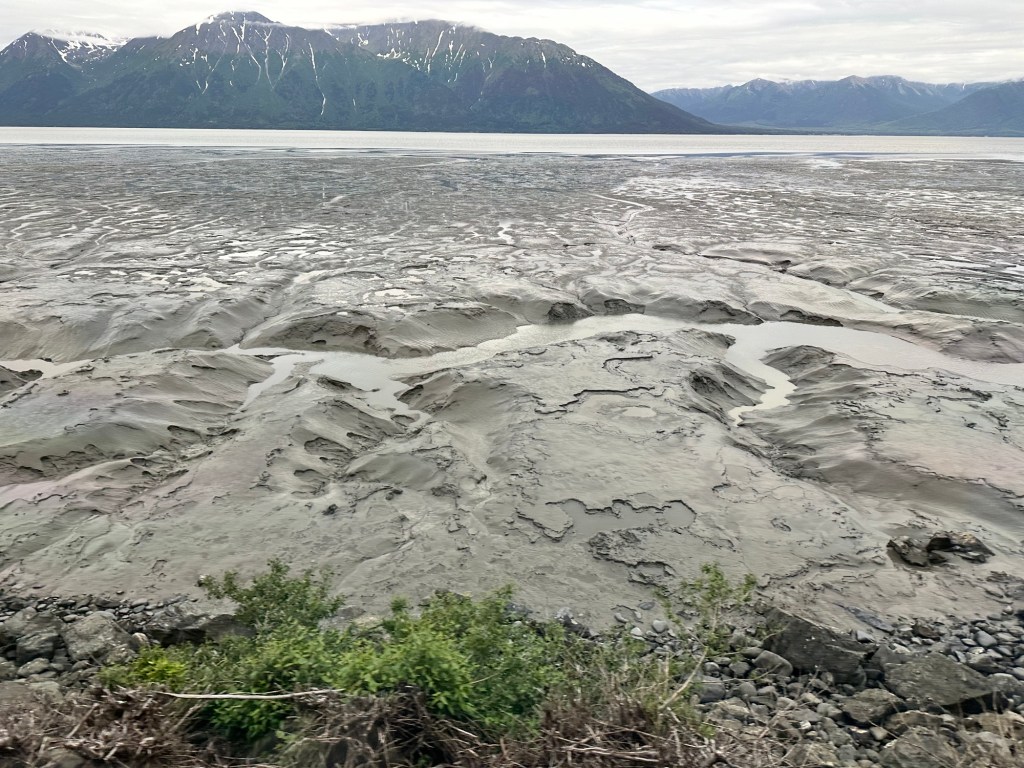
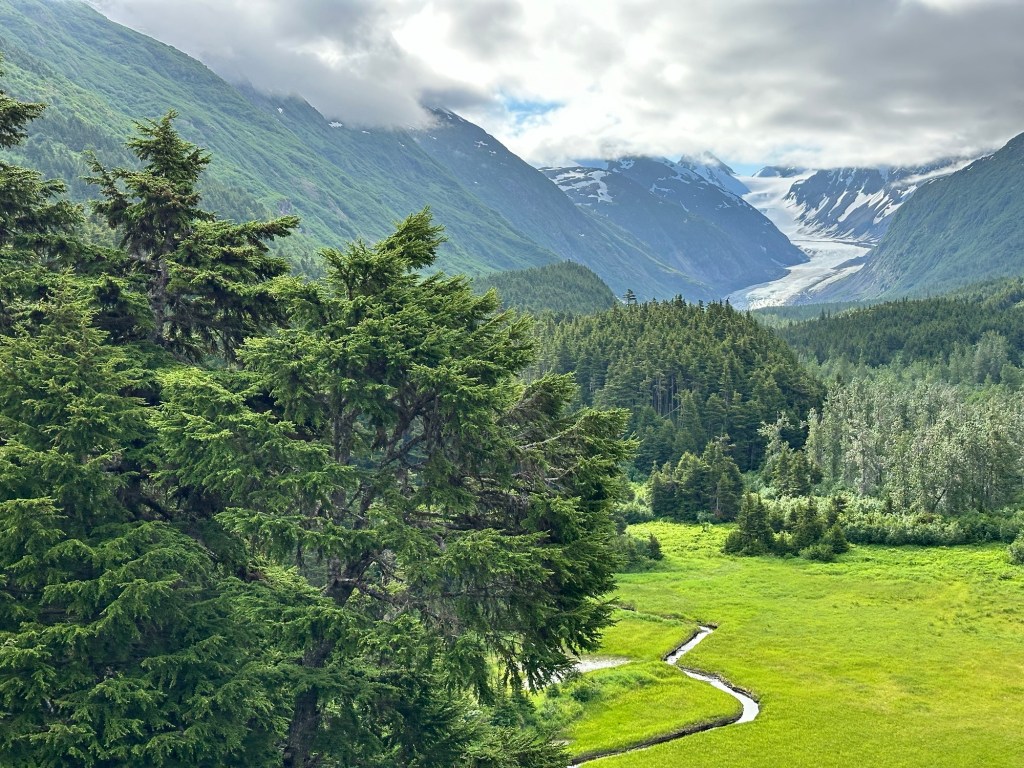
Who knew? Those innocent looking mud flats are actually quite dangerous. The volcanic soil acts like quicksand, then turns into a concrete- like substance, trapping the unwary.
We saw our first glacier on our train ride.
Yet another welcome surprise—the train and Viking coordinated delivery of our luggage, so we were able to walk from the train to the ship unimpeded.
Check in was a breeze. Viking allowed us to print a boarding pass before we left home, so we were aboard the ship in a matter of minutes.
We quickly made an early dinner reservation at the Chef’s Table, one of Viking’s two specialty restaurants, for our first night on board.
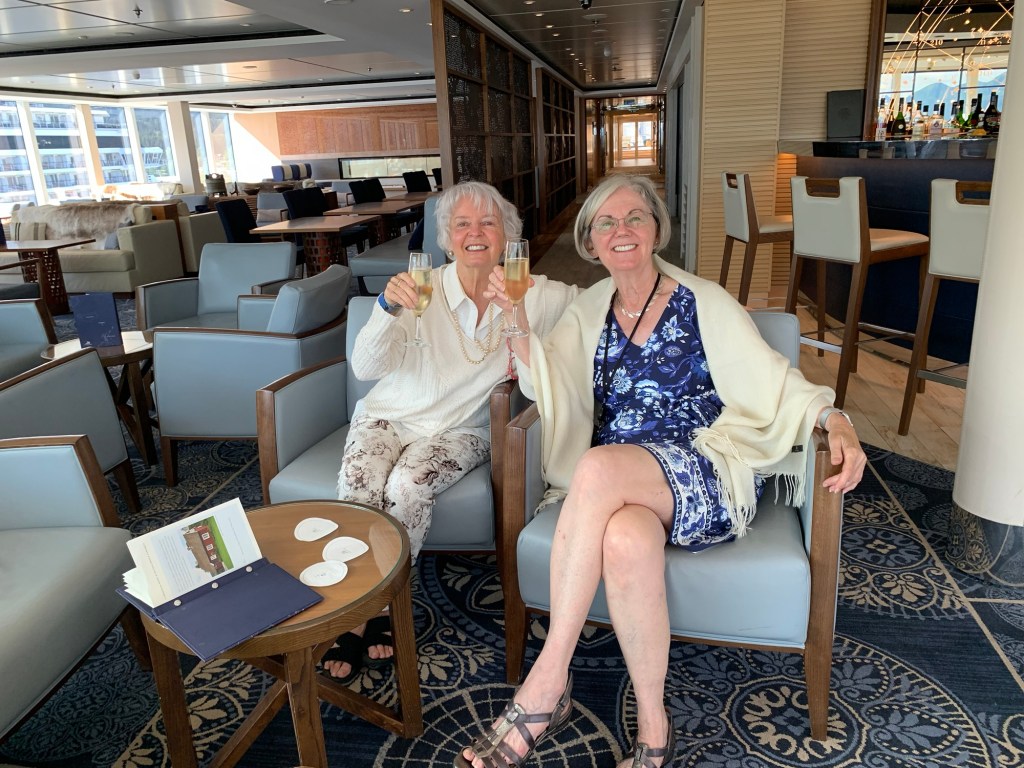
Maybe we shouldn’t have had that glass of Prosecco before dinner…
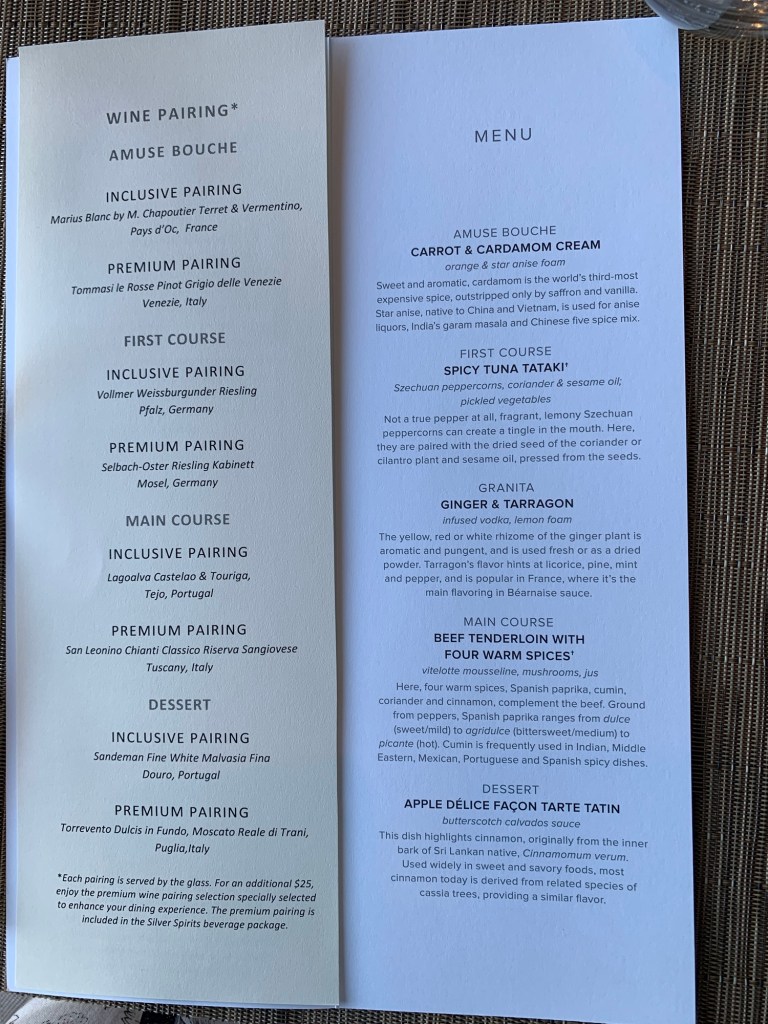
It is a 5 course, fixed menu with every entree paired with a complimentary wine. Obey, our waiter from Zimbabwe, described each course and explained that the accompanying wine heightens the dining experience.
I won’t bore you with too many food photos, but I HAD to show one example of how beautifully the courses are presented.
We had an early morning departure for Wednesday’s Kenai (pronounced KEEN-eye) Fiords cruise so we were in bed by 8 PM.
Most of Wednesday was overcast and chilly, but we didn’t mind because we were dressed appropriately.
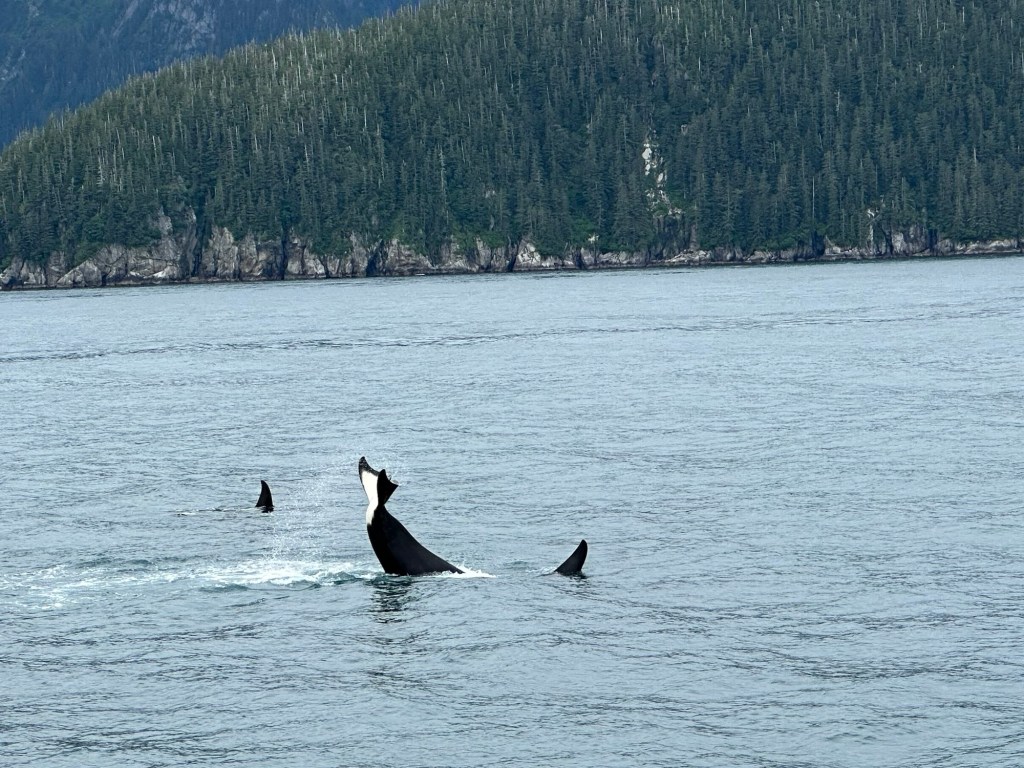
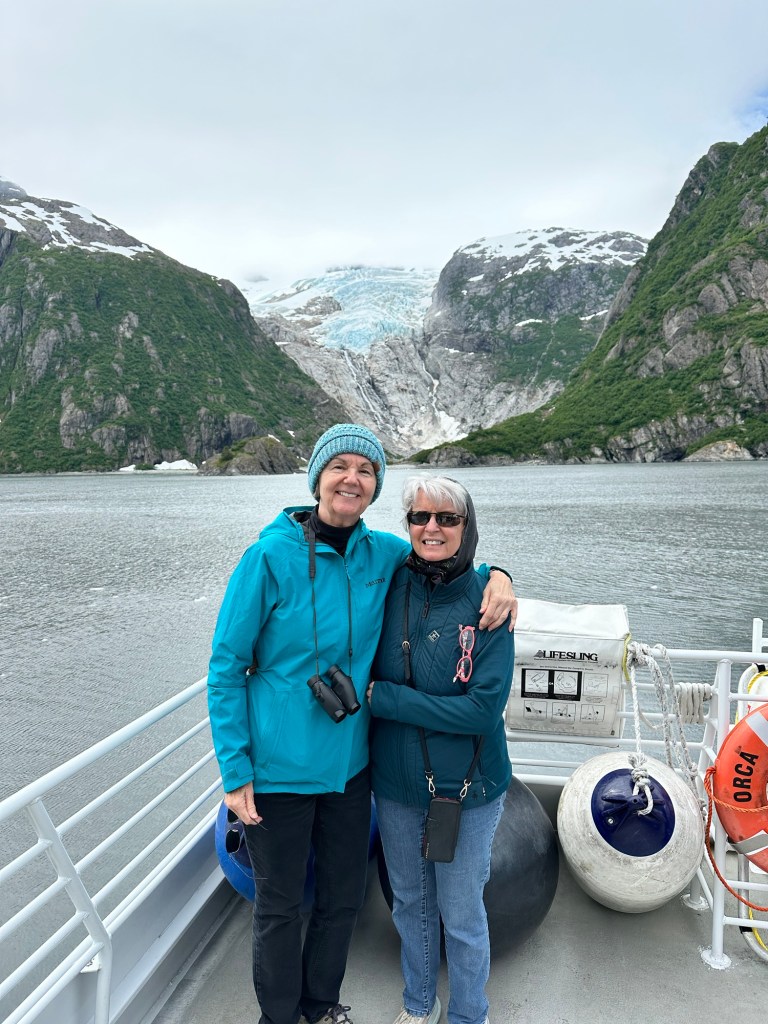
We saw humpbacks and orcas,
sea lions, puffins, otters and bald eagles.
Unfortunately, I wasn’t fast enough to capture the whales breaching, but I got a lot of good tail shots.
Not everyone was as fascinated by the wildlife. While I was outside, trying to get the perfect shot, Jean photographed this woman taking what our Dutch table mates described as a “very expensive nap”. But she wasn’t the only entertaining Homo sapiens on the cruise.
We all loved watching this young man groovin to music only he could hear. What was he listening to, we all wanted to know. Beyoncé ( Jean asked…)
All in all, it was a tremendous first day.
We had heard about the Seward Mountain Marathon, so expected to see crowds of people after we got off the ship at 2 PM, but nope. We walked from the dock to the cruise terminal without seeing many people at all.
Thursday in Valdez, will be a “self guided” tour, so Jean and I decided to stay up late, to enjoy the fantastic music (and dance) on the deck, by the pool.
Initially, I expected to do one post for both Kanazawa and Kyoto. I had never heard of Kanazawa before, so hadn’t realized how much there was to see in that lovely little town. Everywhere I looked, there was something that was jaw dropping gorgeous.
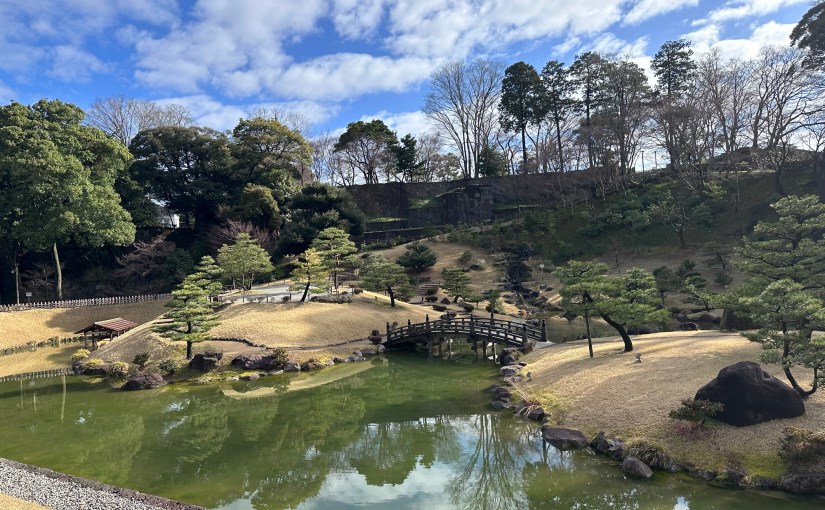
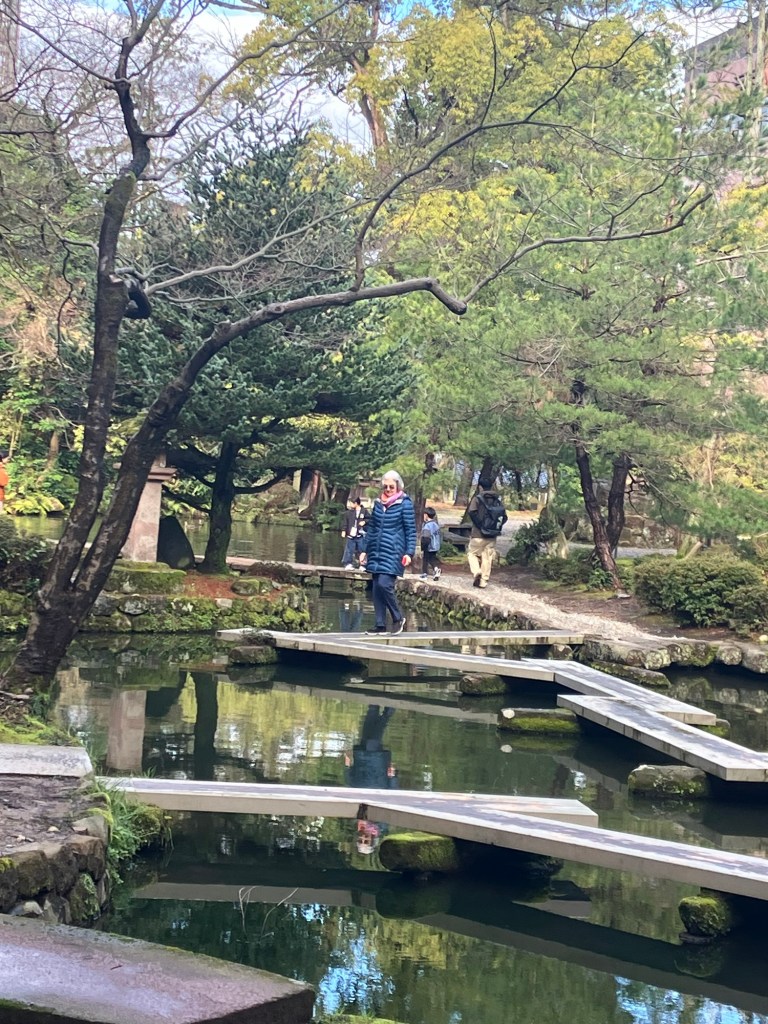
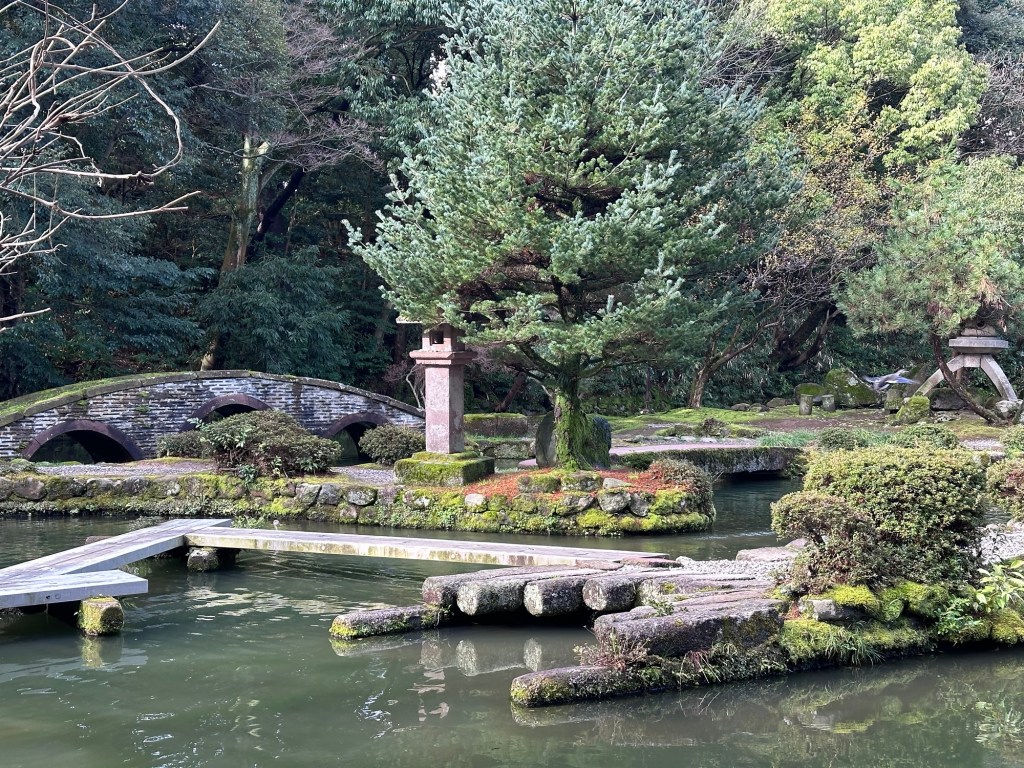
It was raining off and on, but that minor inconvenience didn’t dampen our enjoyment of the beautiful Kenrokuen Gardens.
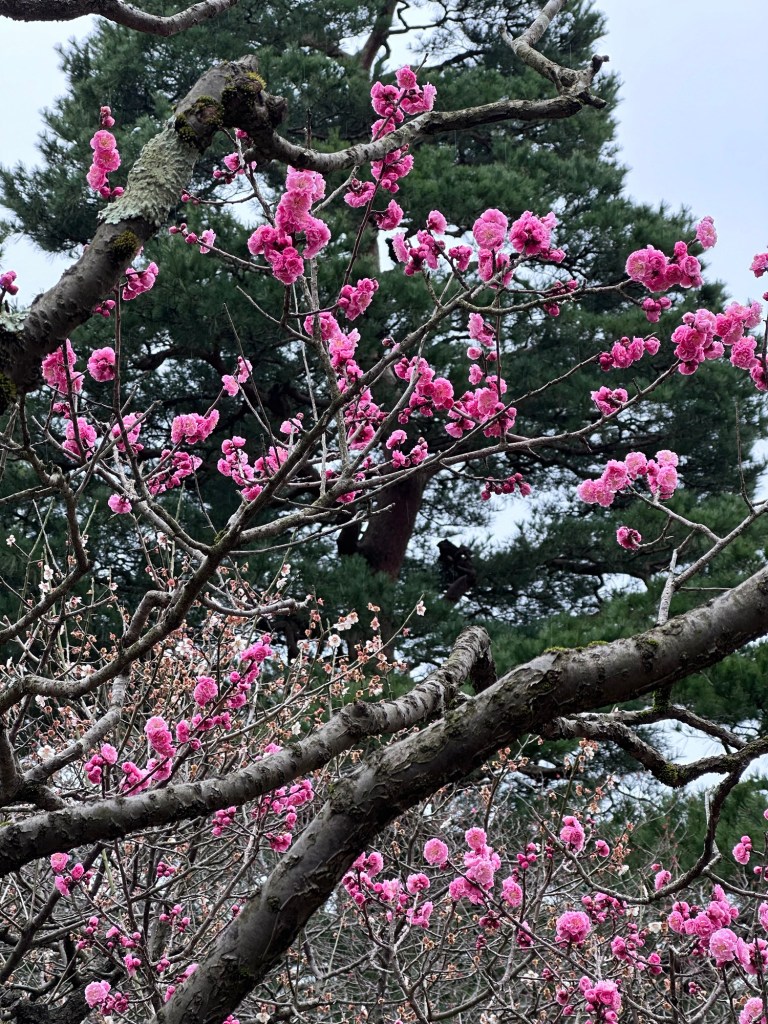
Although it was too early for Kanazawa’s cherry blossoms, the plum trees were a brilliant rosy pink, contrasting nicely against the gray skies.
We realized how lucky we were to view the gardens with such perfect lighting. A sunny day would have washed out the contrast.
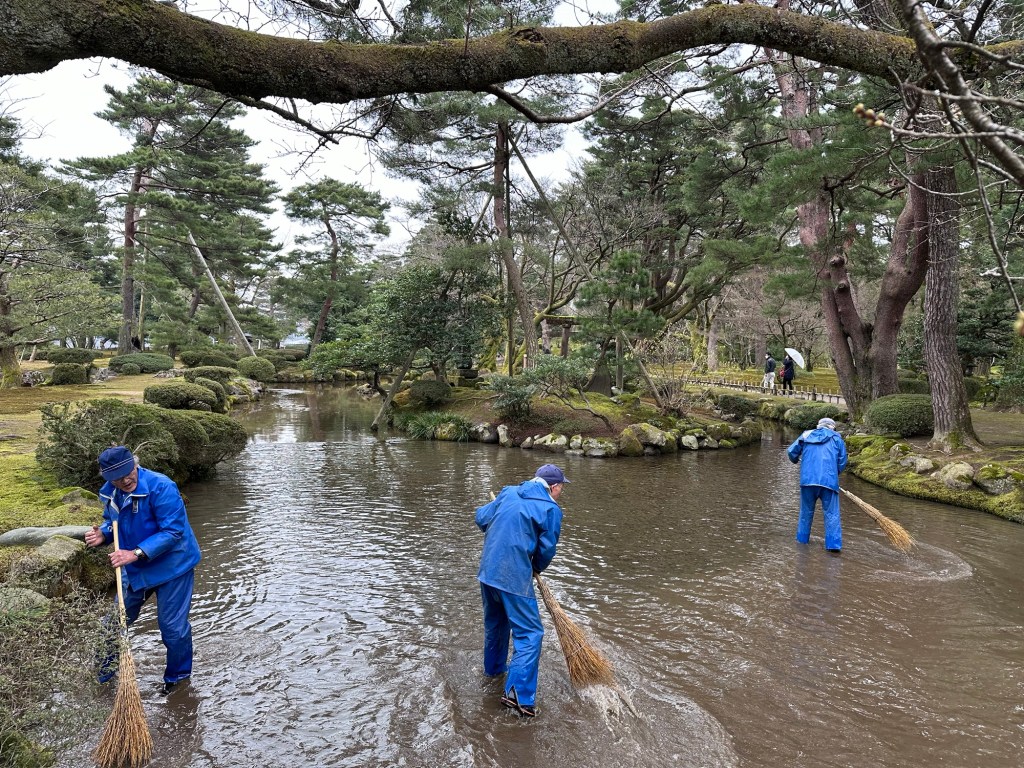
How does it stay so pristine, you ask? Different cultures have different priorities. The Japanese value beauty, harmony, and cleanliness. Shared spaces are important to them. As you can see, their resources align with their values.
We are lucky that photography is one of Mori’s interests. He was always scouting out great locations for group photos.
One of the many things I love about our group is the way we all look out for each other. Notice how Mike and Bobbi are making sure Cathy doesn’t fall off the bridge. At least I think that’s what they were doing. Either that, or their attempt to push her into the water was unsuccessful.
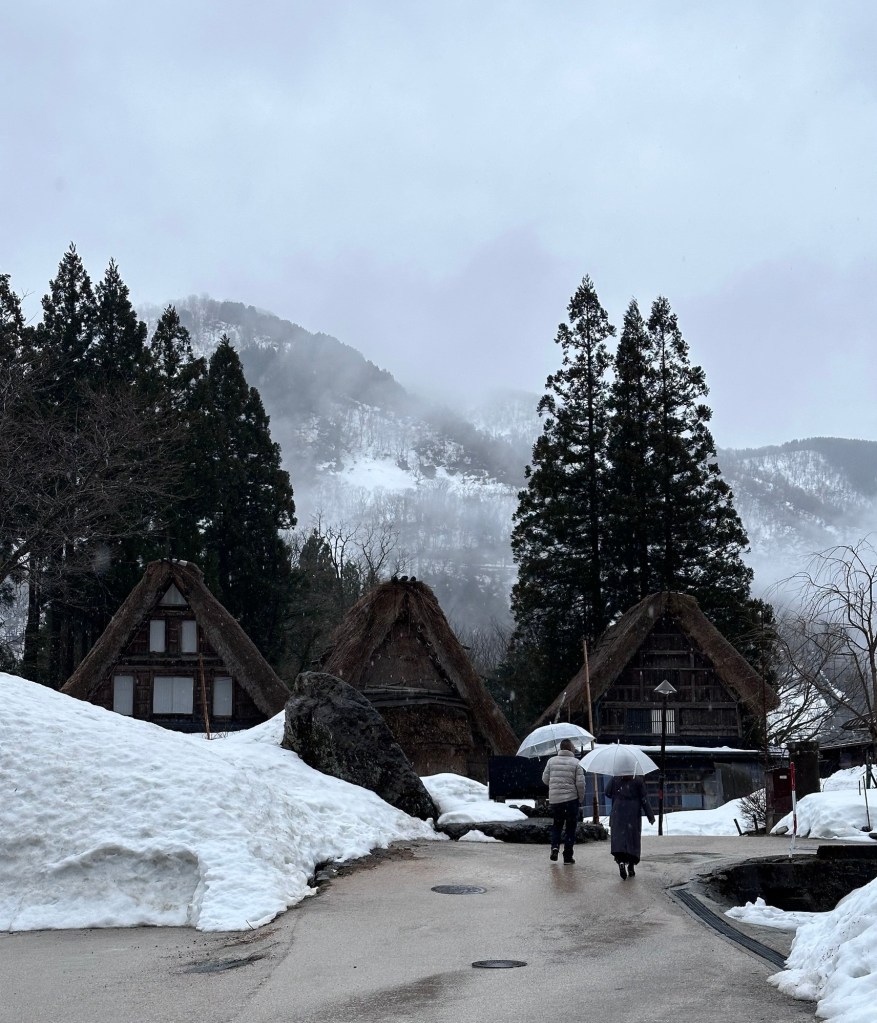
For one of our “Kanazawa” days, we were given the option to visit Gokayama, which is about an hour’s drive away, up into the snowy mountains. The view was lovely and the gift shop was even lovelier, which is good news for the folks back home.
After visiting this village, we spent the rest of the day making ( and eating) mochi, learning how to make traditional Japanese paper, and watching a traditional dance.
I hope my exquisite creations survive the trip home.
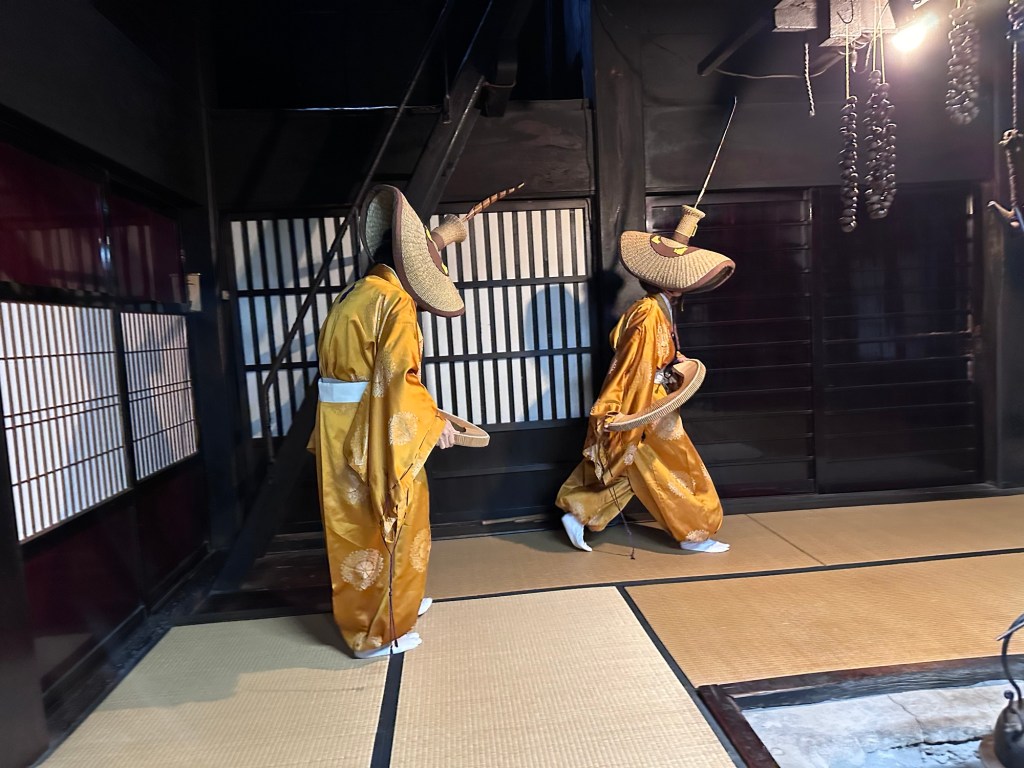
The traditional dance performance was set in an authentic, historic Japanese house. Yes, I know that house had an intriguing history, however, it was so bloody cold in there, all I could think about was getting back on the bus. Sorry. You’re not getting any house history from me.
The traditional dance
Mori managed to find us fantastic restaurants everywhere we went, and Kanazawa was no exception. We liked shabu shabu so much, we were delighted to experience it again. This sweet TINY restaurant was quiet, beautiful, inexpensive, and best of all, the food was delicious.
Ruth, Renee, Janis and I had this little alcove all to ourselves.
That evening was an “on your own” dinner, so feeling adventurous, Kathleen and Cathy opted for a restaurant with a more esoteric menu.
Before leaving Kanazawa, we split into four groups to visit the home of a Japanese family, where we were treated to different activities, like calligraphy, and origami. Some groups sampled saki and tried on kimonos. The luckiest groups managed to do all of the above.
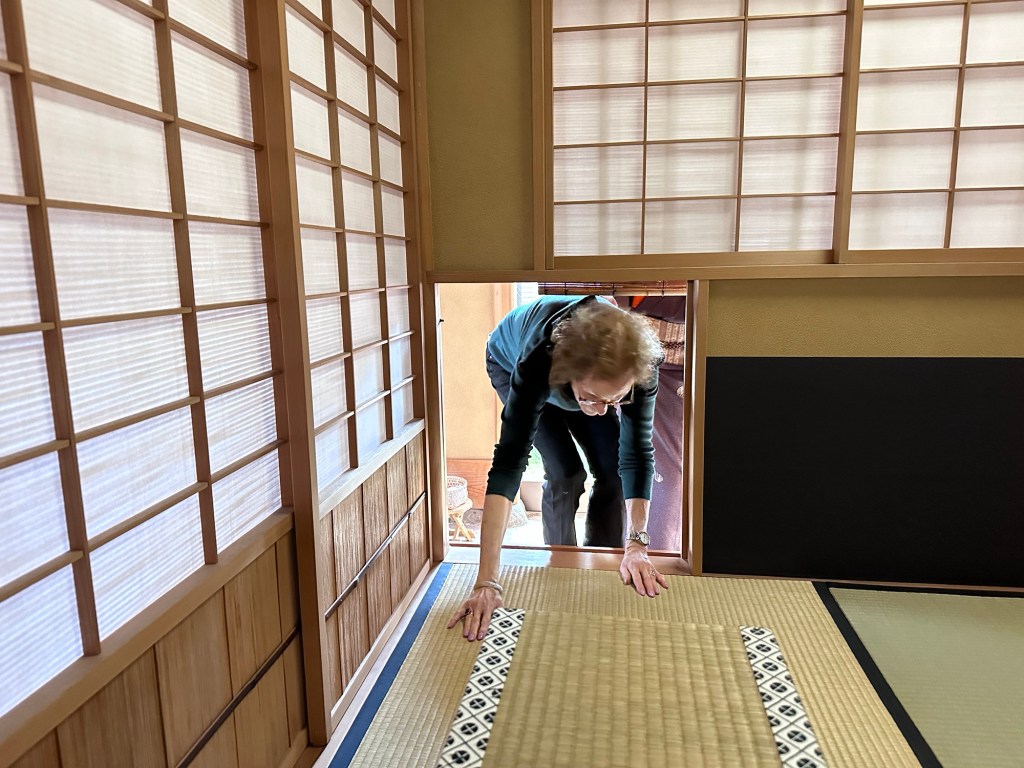
My group experienced the formal tea service at an authentic tea house. We entered the room the way the samourai did, crawling through a tiny space that we dubbed the “doggie door”.
Here’s Patsy, demonstrating the graceful way to enter the tea room. Like the Samourai, the door’s size forced her to leave all her weapons behind.
We had just enough time before we took the bullet train to Kyoto to visit the shrine a few blocks from our hotel. As usual, the paparazzi was stalking me as I strolled the park.
Photo by Bobbi
Some of the group went with Mori to visit the shrine the night we arrived. I was too exhausted, so I was glad that I had time for this early morning visit.
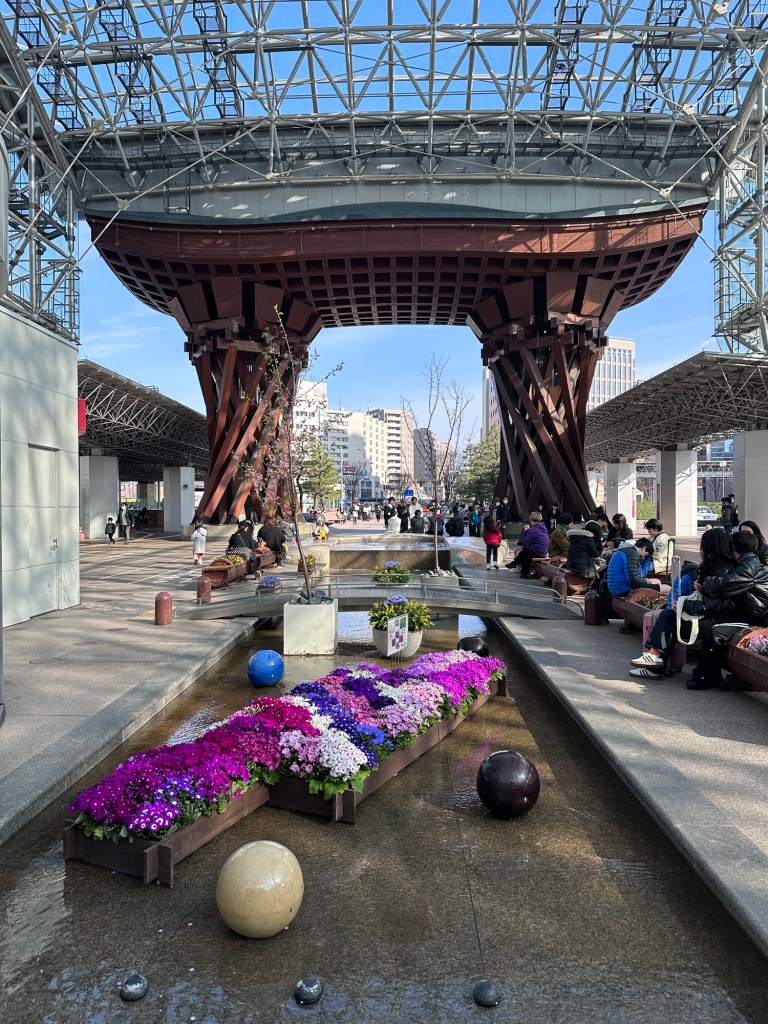
I’ll end with this photo of the Kanazawa train station. and if you think this station is beautiful, you ain’t see nothin yet! Just wait till my Kyoto post!
To acclimate us for the end of our leisurely float up the Nile, we used less luxurious modes of transportation to visit the town of Daraw. We’d been ferried across the Nile by small boats before, but this was our first time in the back of a pick up truck. The truck was covered, but there was such little headroom, I could barely sit upright. And no, that’s not a canvas top to the truck. It’s metal. If you’re wondering how I know, let’s just say there were more than a few bumps in the road.
You see all modes of transportation in Daraw: bikes, motorcycles, trucks, donkeys, tuk tuks, just about everything except cars.
Most OAT groups tour the livestock market, but because there are no markets on the day we were there, we visited the local entrepreneur. One of his many businesses is a “livestock hotel”. Hey, if you don’t sell all your animals on the first market day, you need someplace for them to stay, right?
Another of his businesses resembled a mini petting zoo, which we greatly enjoyed. I’d been warned that camels spit. After being taught a lesson by that rambunctious water buffalo a few days earlier, I kept my distance. Bobbie and I decided it was time to let others interact with the babies.
This camel bumped Jeanne in the head multiple timesThere was significant bonding between Bill and baby donkey. We expected him to start negotiating a purchase price.
Next stop, shopping—and eating—in the marketplace. Mohamed purchased Falafel for us to sample. We had just watched as the street vendor was making it. I don’t know that I would have been brave enough to eat food from a street vendor if I were on my own, but with Mohamed choosing the vendor, I felt perfectly safe.
It felt like we were on the Amazing Race when Mohamed instructed us to search for, and purchase, specific fruits and vegetables with the 20 Egyptian pounds, (about $.62 in US currency) he gave us. We were all so focused on our task, there were no photos of the adventure. I foolishly pointed at potatoes and waved my 20 pound note. Any idea how many potatoes that amount would buy? A whole lot. A whole HEAVY lot. Good thing I’ve been going to the Y.
Bobbie, on the other hand, was a smart shopper. She purchased the required peppers, but she negotiated skillfully enough to be able to buy bread for us all. It was delicious and still warm from the oven.
Our last stop before leaving our beloved dahabiya was “Nile Beach”, where are some of us were perfectly content to just stick our feet in the water. Others, namely, Marianne and John, were far more adventurous.
Look how clear the water in the Nile is! Marianne and John are going skiing after they leave us. Photo by Susan Burke
Our “farewell” dinner was even more spectacular than the other meals we’d enjoyed. We were sad to say goodbye to the crew that took such good care of us.
16 crew members for 9 passengers. Was the service outstanding? You bet!
We all got a surprise when we returned to our cabins. We each got a unique Egyptian creature waiting for us on our beds. I’ve seen towel art before, but these were, by far, the most creative. My favorites were the crocodile and the cobra. ( I got a scorpion).
Crocodile Cobra
How to describe the ride from Aswan to Abu Simbel? Three hours of sand, sand, and more sand with high tension wire strung along the roadside, delivering electricity from the dam to the populations further north. We needed to get closer to Abu Simbel for the landscape to change.
We stopped midway in our journey for a bathroom break. I think the term “food desert” was coined here. If it wasn’t, then it should have been. The “snack bar” could be best described as “selection-challenged”, but if you’re looking for potato chips, or packaged mystery snacks, you’ll be very happy.
Our group thought we’d seen so many temples and tombs, there was little left for us to see. Boy, were we wrong! The size of the 4 statues of Ramses 2’s temple ALONE was jaw dropping. But to think that this entire temple was MOVED block by block to the higher ground on which it currently stands, is truly hard to believe. Why is as that done? If it hadn’t been moved, it would now be well below the waters of Lake Nassar.
Back in the 60’s, 50 nations cooperated to rescue several temples threatened to be submerged by the creation of the High Dam at Aswan. To me, the engineering that went into the move was as awe inspiring as the temples.
But wait—there’s more to say about this temple. The ancient Egyptians were so knowledgeable about engineering and astronomy that in the 1200’s BC, they were able to construct this temple so that twice a year, on February 22 and October 22, the sun shone all the way through the temple to illuminate three of the four statues in the inner sanctum. The fourth statue is of Ptah, the god of the underworld, who was intentionally left in darkness. Two of the others represent different versions of Ra, the son god. Bet you can’t guess who was the last statue to be bathed in sunlight. None other than Ramses 2. Clearly he didn’t have a self esteem problem.
That black area falling across their laps is a shadow
Next to Ramses 2’s monument to himself, he built a temple honoring his favorite wife, Nefertari. Remember her? We visited her tomb in the Valley of the Queens.
That old goat lived well into his nineties, acquiring wives and children ( rumored to number approximately 200) along the way. Good thing he lived BEFORE viagra was invented! Of all his women, (thought to number about 100, if you include concubines and mistresses) Nefertari was his favorite—the only one who got her very own temple next to his. There is only one statue of her on the facade. The other five are, of course, of her husband, who was also known as “the Great” (probably self proclaimed).
That random guy standing in front of Nefertari gives you an idea of the scale of these statues.
We only spent one night at the beautiful Seti Hotel in Abu Simbel. Can you see why we were reluctant to leave? The multi-level pool had a swim up bar; each room had a private balcony facing the Nile. It was SO very peaceful.
Before we left for the light show at the temples, we met Hassan, who enlightened us about Nubian culture and history. He also entertained us by playing instruments that were the forerunners of our guitar, banjo and harp.
In 1976, when Hassan visited his cousin in San Francisco, he was invited to play with what he described as “ a small folk group” —the Grateful Dead.
Once again, you had to be there to appreciate how wonderful it was to be sitting under the stars, watching a multimedia show projected onto the temple walls. I didn’t take any shots while the show was ongoing, but did so after, and used that shot the heading for this post.
I truly appreciate everyone’s comments on my blog posts. It almost feels like I’m having a conversation with my friends. Although I know who comments on Facebook and Linked in, many of the comments on WordPress are coming through anonymously. If I didn’t respond to you, that’s why.
Thanks so much for the words of encouragement from all who commented on my last post, either here, on Facebook or on LinkedIn. It was great to hear from so many friends. I had no idea you were reading my blog, because unless someone comments, I don’t know who my audience is. Your very kind messages motivated me to continue writing about October’s trip.
Yugoslavia was once made up of 6 countries, and on my recent Overseas Adventure Travel (OAT) trip, I visited four of them: Croatia, Montenegro, Bosnia &Herzegovina and Slovenia. I tell you–we are SO very lucky to be able to travel in the USA for thousands of miles without ever having to show our passport. On this trip, we had multiple border crossings, and although our guides knew the tricks to make it as painless as possible (which crossing was less busy, what time is best to cross), it still was an inconvenience that I’m glad is not part of our daily lives.
After 7 of us finished the pre-trip to Albania, we drove through Montenegro to a parking lot by the border where our Albanian guide said goodbye, and Antonia, our guide for the main trip, greeted us (literally) with open arms. How lucky were we to get this dynamo for our tour leader! She was funny, creative, attentive, and so very joyous. She started out by giving us the good news that we were staying at a different hotel in Dubrovnik, a five star, because our original (4 star) hotel was still being renovated. As the millennials would say, “OMG”! The Valamar President Hotel was truly magnificent–right on the ocean, with spectacular views of the sunset. Here’s an example of one.
Scott and Gretta, two of my favorite fellow travelers. Scott had the foresight to bring a corkscrew and glasses on the bus so that we could enjoy the wine we bought along the way. It made those very long bus trips quite entertaining!
Prior to embarking on the trip, I had googled the original hotel’s location (I know, I’m obsessive/compulsive) and was slightly disappointed because it seemed quite far from the old city. I got over that disappointment real fast, because it was so easy to get to and from our new, improved hotel, (which happened to be in the same area as the original one). We were given a free pass, the buses ran frequently, and we got off right in front of our hotel. By the way, did I mention our hotel was magnificent?
When we arrived at the hotel, we were joined by the 9 remaining members of our group who opted not to take the pre-trip, including my dear friend Augusta.
One of Dubrovnik’s big attractions is walking along the city walls, which we did on our second day in the old town.
It isn’t obvious from this photo, but there was a lot of up and down along the wall, with very uneven steps. But don’t let the following photo dissuade you from exploring the ramparts. One of our fellow travelers, who is in her 80’s, managed to climb up and down without a problem. I found that truly inspiring–and very encouraging for someone who is hoping to be traveling well into HER 80’s. (In case you have’t guessed, that someone would be me).
That evening, dinner was “on our own”. Antonia walked us along a beautiful path that hugged the ocean which was lined with fantastic restaurants, telling us a little about each as we passed. When she said, “This one makes the best gin and tonics in all of Croatia”, Augusta and I knew we had found our place. What made it the best? Not only was the drink served in a beautiful glass, but the creation of it was something to behold. (click on the underlined words if you want to watch our waiter construct that masterpiece).
Dinner by the sea was delightful, and the Croatian sunsets were consistently magnificent.
But the most memorable part of our time in Croatia was the talk given by a woman who had lived in Dubrovnik during the Balkan war. At that time, she was in her early 20’s. Overnight, her life changed. She had been a carefree young woman until, after a night on the town with friends, she was awakened by the sound of bombs dropping. One might expect her talk to have been depressing. It was not. It was actually an inspiring story about the resilience of the Croatian people as they learned how to survive for three months without water and electricity. She told us she quickly learned what was really important, and it wasn’t money. ”What good was it to have money, if there was nothing you could buy”, she asked.
Photo by Mark Burgunder Sr.
Her talk took place in what was once Napoleon’s fort, and is now a museum housing memorabilia and information about the Serbian and Montenegrin attacks on Dubrovnik, a World Heritage site.
In case you’re wondering about the picture of the soldier on her right, that’s Orlando. His statue currently is located in the main square, where in days of old, decrees were read and citizens would gather to be entertained by watching the bad guys get their just punishment. (Don’t judge–they didn’t have TV or the internet back then).
This is what Orlando looks like now. It’s hard to see him, or his all important elbow, because there is a protective barrier surrounding the statue. At some point, he will be removed to have the statue version of a spa treatment, and will be returned, thoroughly restored and rejuvenated..
So who was he, and why did I mention his elbow? Well, legend has it that Orlando was a nephew of Charlemagne. Perhaps you know him by his alias, Roland? More importantly, his right arm, from fingertip to elbow, was used to measure fabric, which was traded in that very square. Why his forearm? I have no idea. It certainly makes as much sense as the inches, feet and yards WE use. By the way, there are only three non-metric countries on this planet: the USA, Liberia and Myanmar (so we are in good company, indeed). Saturday Night Live did a hilarious skit about our use of the “imperial” system. But I digress…
Our return to Dubrovnik’s center via the tram gave us this phenomenal view. By the time we made it to town, however, I had seen enough of the walled city and was more than ready to return to relax on our hotel’s private beach. Little secret: it’s hot in town, and crowded, so I was grateful for free time, my bus ticket and my luxurious hotel.
It may be difficult to see on the map atop this post, but Croatia is rather oddly shaped. The non-French say it is shaped like a bird in flight. To the French it looks like a croissant. To me, it resembles a gerrymandered voting district. Can you see that little gap that gives Bosnia & Herzegovina access to the ocean? Because of that gap, someone traveling just a few miles north from Dubrovnik could be subject to TWO border crossings: leaving Croatia to enter Bosnia, then again when reentering Croatia, and it would happen again when they did their return trip.
While in Dubrovnik, we took a day trip to lovely Kotor, Montenegro, then headed for three nights in Sarajevo, Bosnia, after which we returned to Croatia for 6 more days before heading to Slovenia, for three nights, then heading home. Got that? I don’t have the energy to fit all of that into one post, and you probably wouldn’t want to read one that long anyway, so this post only focuses on Croatia and Montenegro.
Our day trip to Kotor started with a breathtakingly beautiful ride on our private boat. I think it was during that ride that someone dubbed Antonia “the child with power”.
Kotor is a lovely medieval city with palaces, restaurants, gift shops, and like other medieval towns, it had its share of stories and legends, which I promptly forgot. What I didn’t forget was the women we encountered, holding the banner that says “We remember the Morinj camp”, which is where Croatian prisoners were held in deplorable conditions from 1991 until 1992. The banners act as an acknowledgement and an apology for Montenegro’s role in the Balkan War. I found that rather refreshing.
Are you ready for a break from war talk? Instead, let me tell you about Karanic, the Croatian village we visited on our way to Zagreb. OAT trips usually include”a day in the life” of the country’s inhabitants, but this was the first time the “day in the life” included an overnight stay. These encounters are designed to provide an opportunity to see non-tourist areas and get exposure to different aspects of the local culture.
Our group, at Karanic, with Dennis, our host.
I wasn’t quite sure what to expect, but our accommodations exceeded anything I could imagine. The home had sufficient rooms for us all, each with a private bath (whew).
The food was delicious. Some of us helped with the cooking–others captured the moments via cell phone photography.
Karanac was a nice interlude before our stay in Zagreb. When we arrived at our hotel, we noticed it was filled with men wearing team shirts. Unbeknownst to me, we were sharing the lobby with the 2018 World Cup champion football team. This became apparent when we passed a building that was plastered with a photo of the guys we had just seen in the lobby. If only I were a sports fan…
Zagreb had experienced an earthquake in 2020, so some of the buildings were still being repaired. Still, as you can see, the city offers something for everyone. I can’t offer commentary on these attractions, because I didn’t sample any of them.
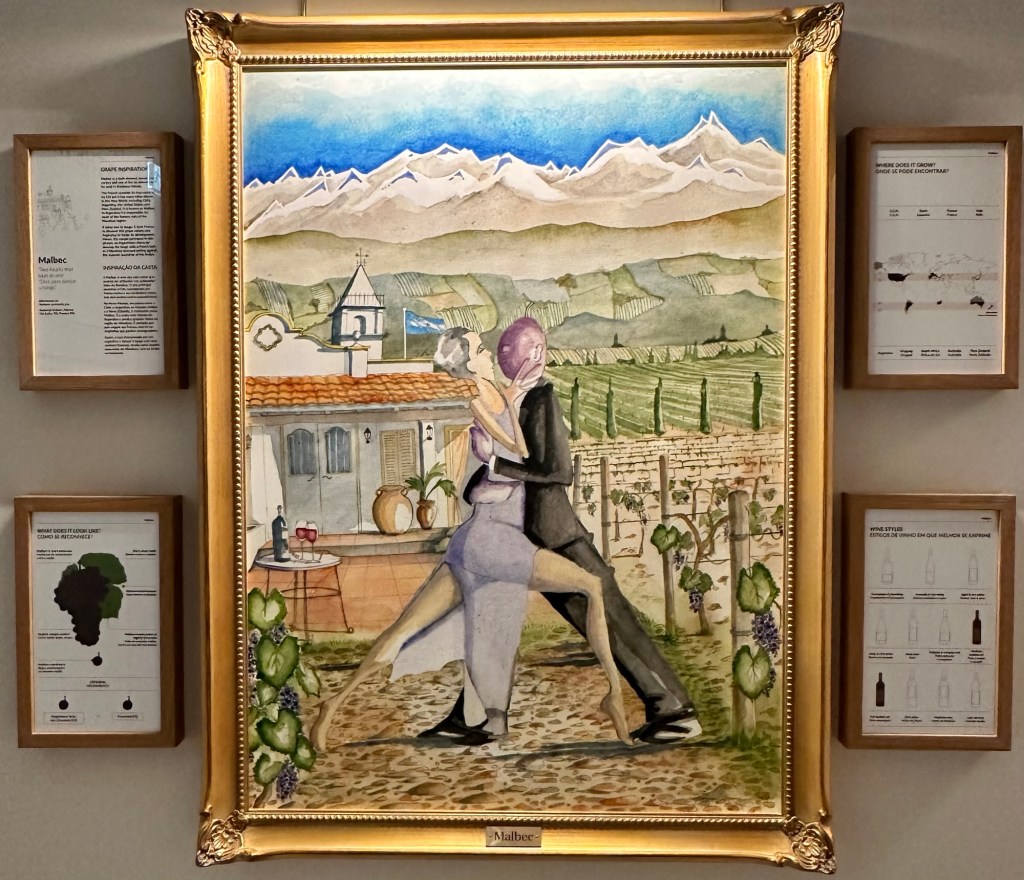
What I CAN tell you is the Bornstein Winery is not to be missed. It was educational, delicious, and oh so much fun! Six of us visited there during our free time. Who knew that a Croatian immigrant took zinfandel vines to California many years ago?
There is a whole lot more I can say about Croatia, and the other countries on this fabulous trip. Maybe someday I will, but right now, it’s time to prepare for the next adventure. I hope you’ll come along!