Up until day 7 and 8, we had been incredibly lucky. Although it rained periodically, it seemed to happen only when we were on the bus, in a restaurant, or back in the hotel. Until La Fortuna. That was where our fortunes changed.
It was impossible to see the Arenal Volcano during our morning hike,
but I took pictures when Mike, Augusta and I were here in February of 2007. Back then, it was quite active. We were even able to see the bright red lava flows at night from our hotel room.
When we walked in the National Park, it was raining so hard, even my underwear was soaked, despite wearing a rain jacket. These days, if it’s not fun, I ain’t doing it, so halfway through the hike, 5 of us returned to the bus.
Marianne got creative. She took a black plastic shopping bag and with Edwin’s help, made holes in the sides so she could stick her arms through to keep her red jacket dry.
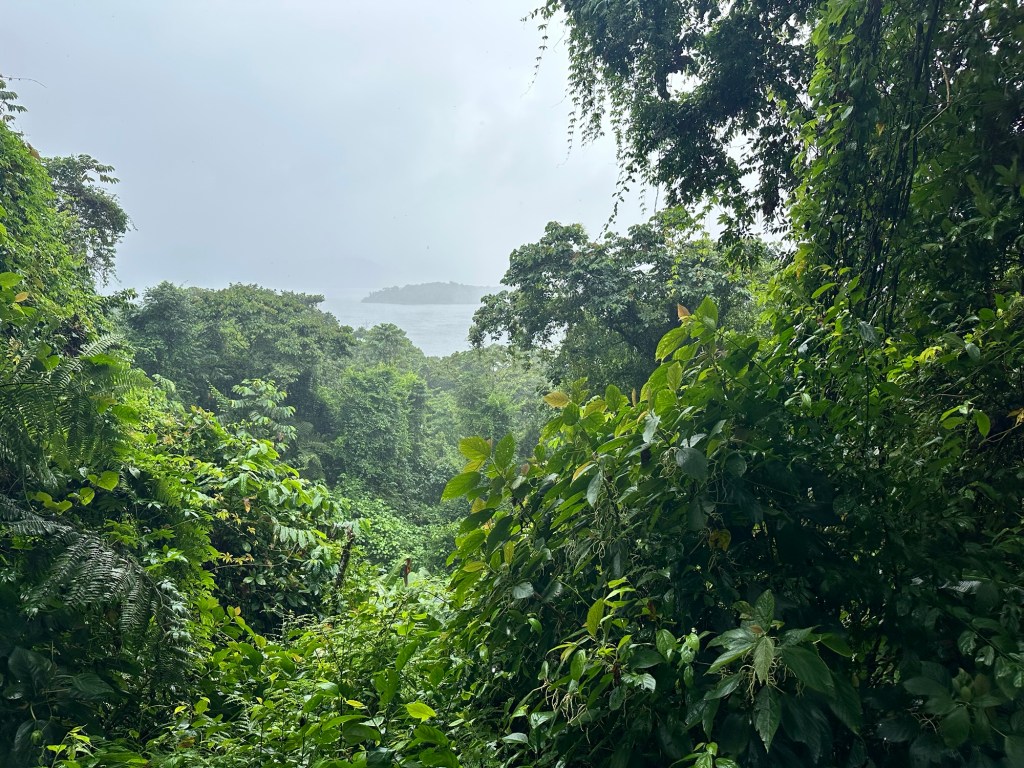
Those of us who chose to forgo the hike DID get to see Lake Arenal from the bus as we were leaving the park. Sorta.
Here’s the 2007 view.
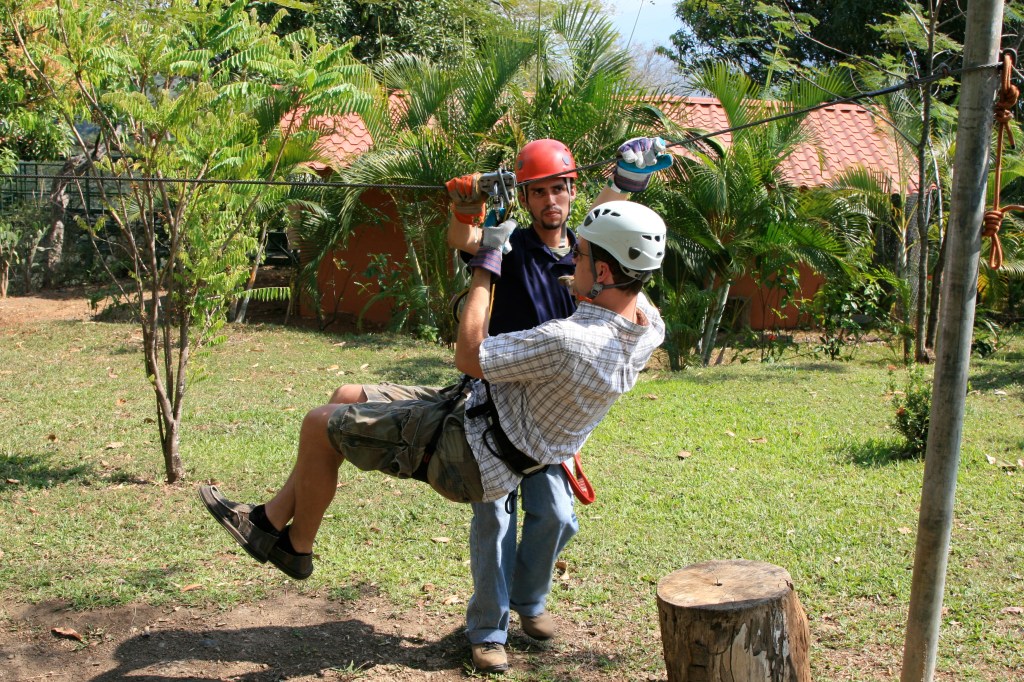
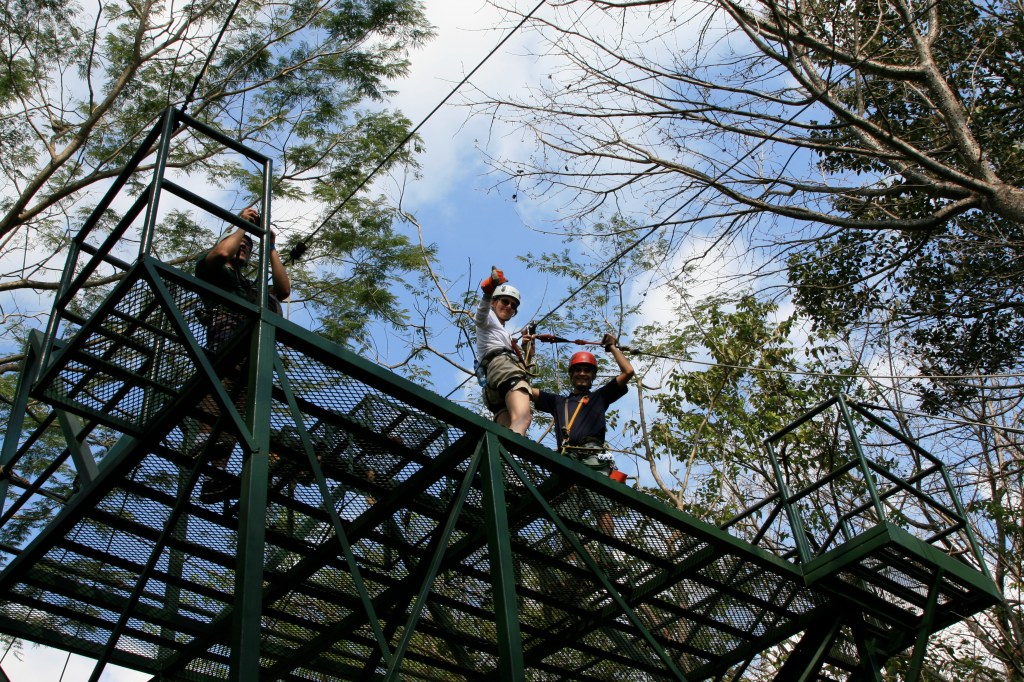
Some brave souls decided to go zip lining despite the rain. Having ziplined twice before, I opted to return to the hotel. Had I known about the Tarzan swing, I might have made a different decision. But probably not.
Les, on the zip line.
Marianne, channeling her inner Tarzan. Jane??
Costa Rica has micro climates, so although it was pouring a few miles away, it wasn’t raining at our hotel. I walked the grounds, where I discovered multiple private hot tubs. Oh, to be with that special someone on a sunny day!
On our second day in La Fortuna, we cruised the Rio Frio, to search for wildlife.
I briefly regretted not bringing my camera, but I was very grateful for my binoculars.
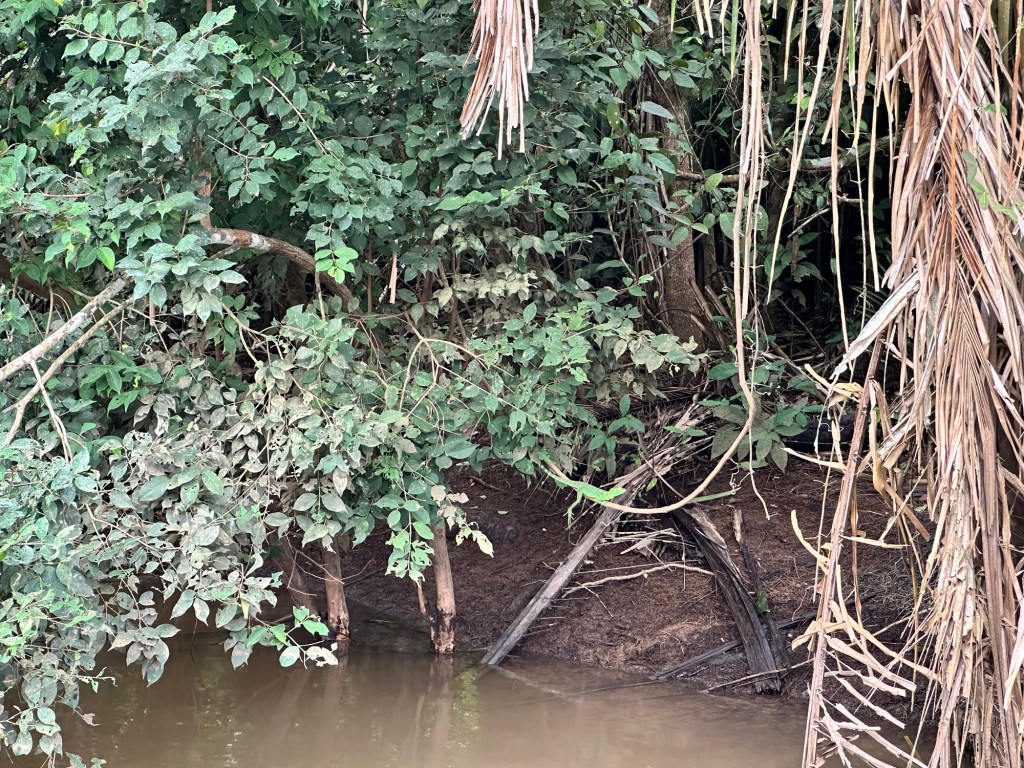
Even with binoculars, it was NOT easy to spot the wildlife.
Were you able to find the “Jesus Christ” lizard in the first photo? For the second photo, I used my phone’s zoom, which is clearly not as powerful as my camera’s.
Why Jesus Christ lizard? Because the basilisk lizard (official name) looks as if he can walk (run) across water.
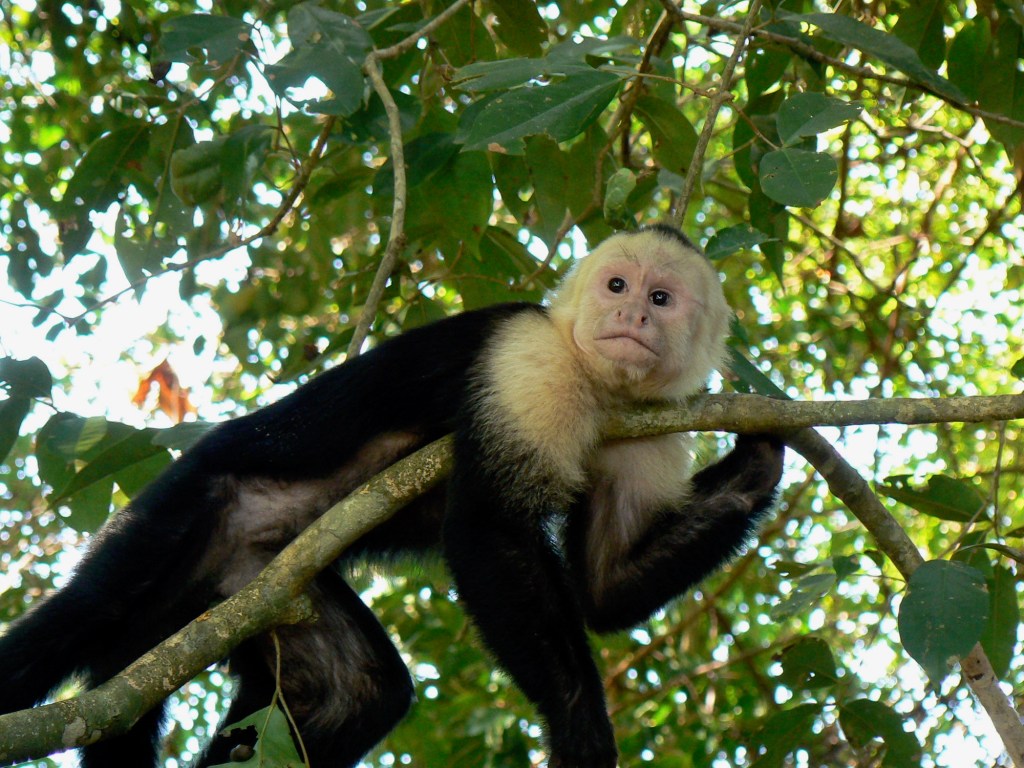
Check out the difference in quality of these monkey photos. The first was taken with a phone, (by one of the other travelers); the second is from the 2007 trip with my Panasonic LUMIX, way before cellphones had cameras.
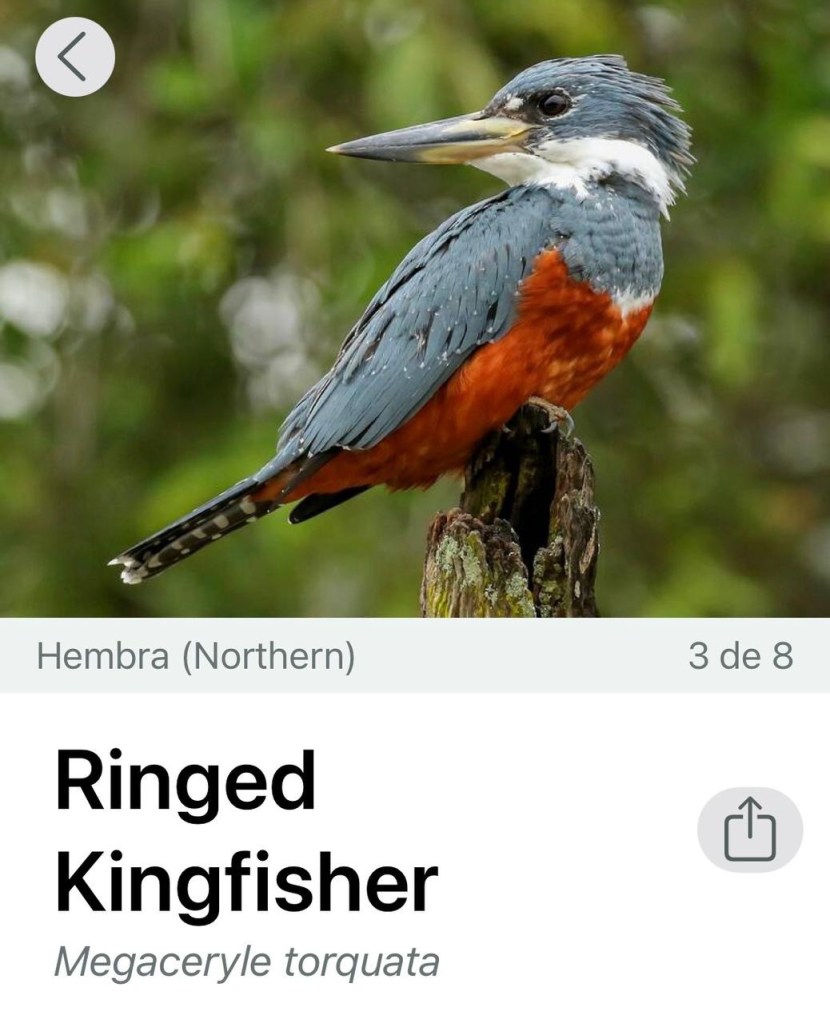
Our guide posted photos of the birds we saw in WhatsApp. Of all the birds we observed, the kingfisher was my favorite.
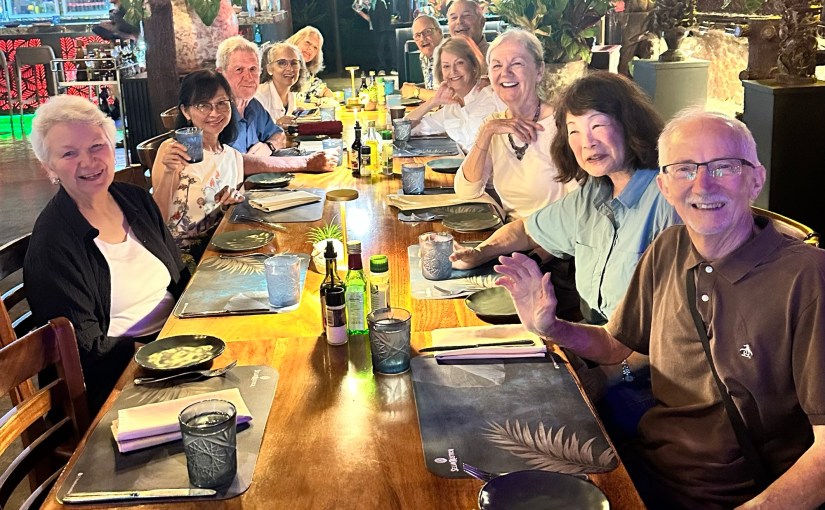
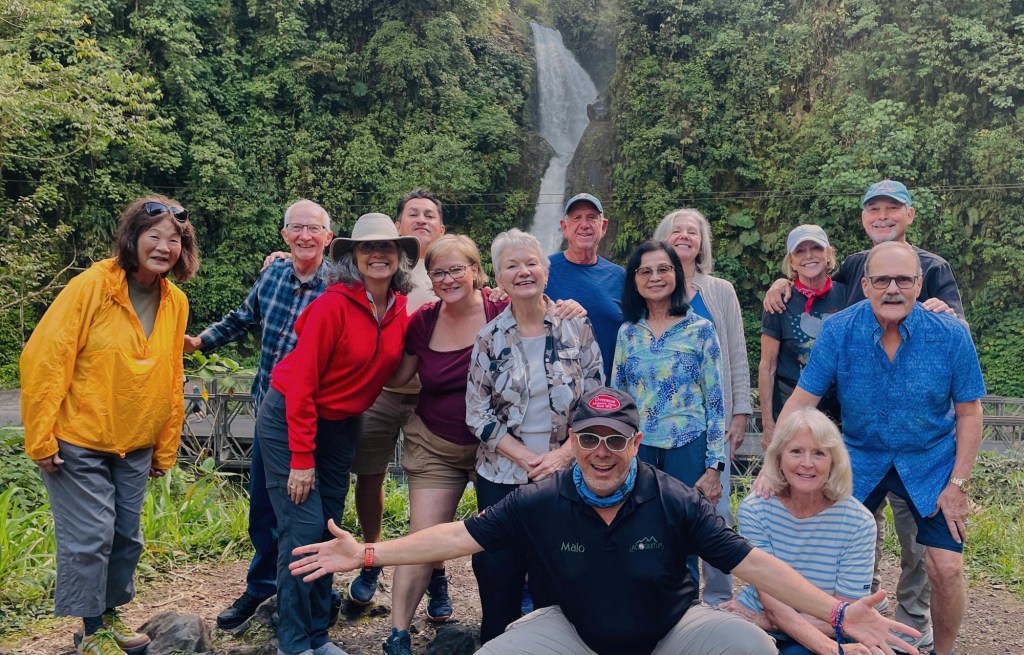
Before our cruise ended, we made it to the Costa Rica/ Nicaragua border, where Malo took this photo of our wonderful group.
My very favorite highlight of our time in La Fortuna was our dinner at Selva Rustica. Raul, our bus driver, offered to take us to and from the restaurant, which was a very good thing because it was raining heavily ALL evening.
We all agreed that this was the best meal of the entire trip, so far. Sorry, Malo. From now on, we are going with Raul’s restaurant recommendations. Although we each ordered something different, we were all very happy with our choices. My grilled tuna atop vegetables and potatoes was heavenly.
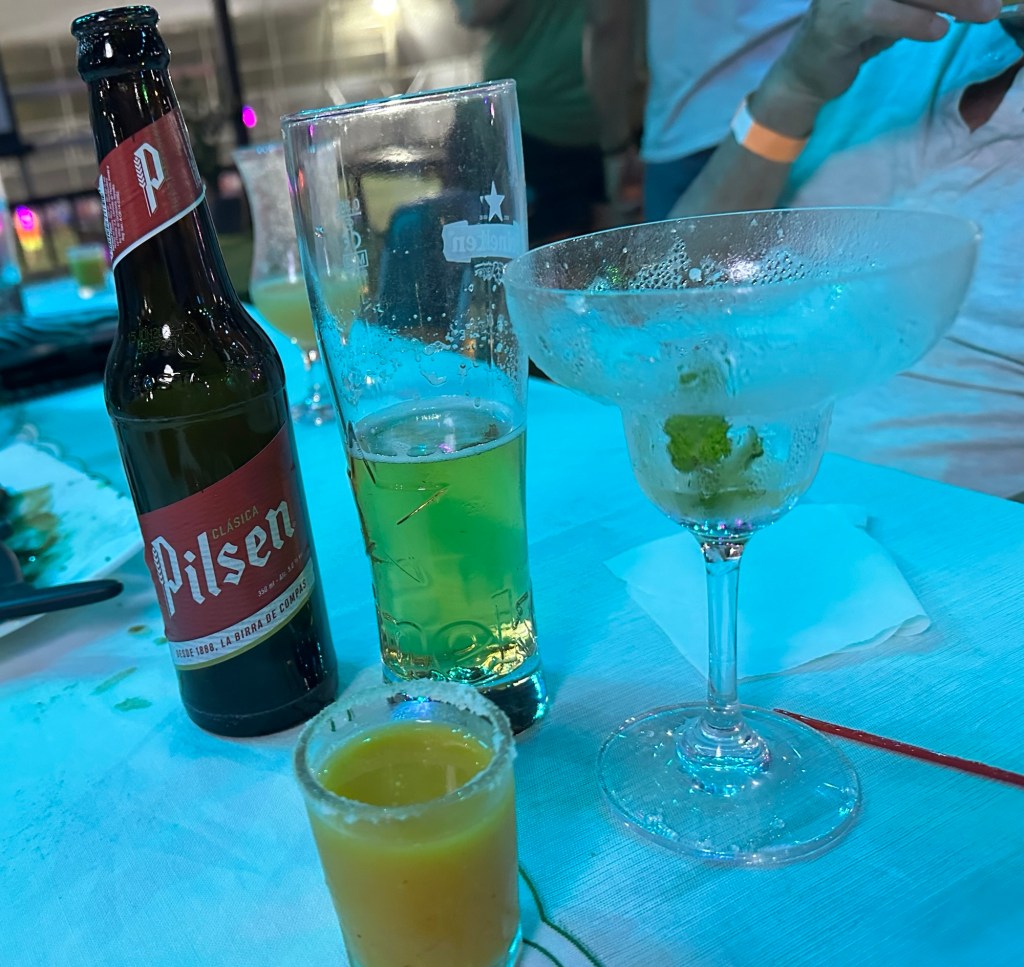
Have you ever had a flaming margarita? With a blue Jell-O shot in the bottom of the glass? Neither had I. This was definitely a video worthy experience. Thanks to Phil for capturing the moment.
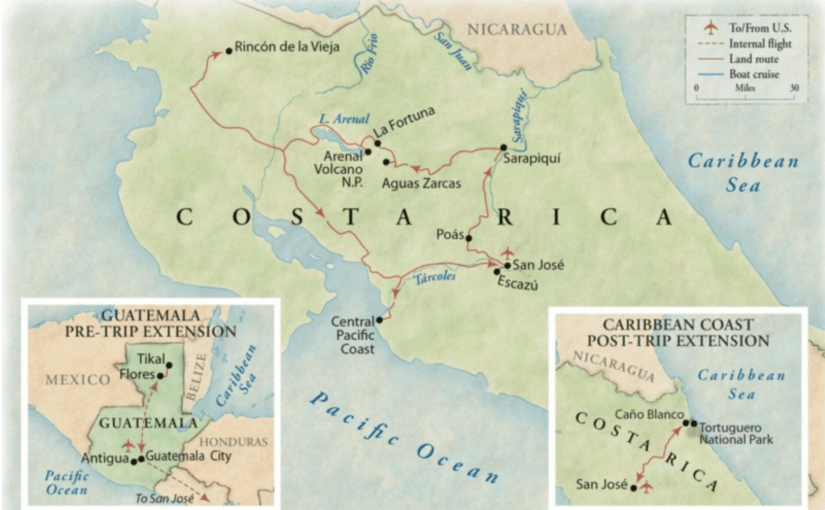
As you can see from the map, we are traveling throughout Costa Rica during OAT’s Pura Vida tour.
This means we need to move from one place to another every two days.
On day 5, we departed from Sarapiqui after lunch, which gave us time in the morning to visit Tirimbina, and walk across its quarter mile suspension bridge over the Sarapiqui River.
TWICE. Over and back.
I have to tell you, the shaking and swaying reminded me of car rides during my childhood. Even without all the smoke from my parents’ cigarettes, that continual motion almost made me feel carsick! But was I glad I did it? Hell yes.
After our stroll, we had free time until lunch, so I plopped myself in the “bird” area to enjoy the wildlife.
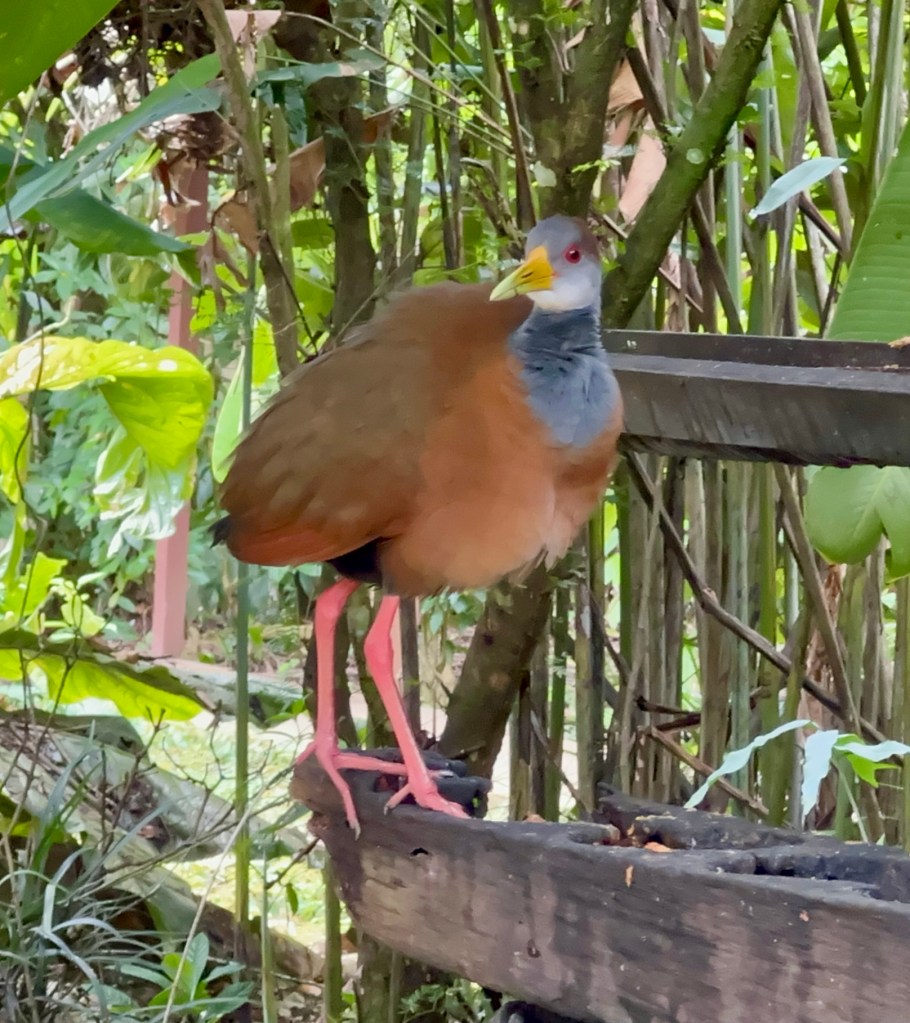
This gray cowled wood rail was HUGE, and unafraid. He stared right at me in between bites of papaya. He was probably thinking “ if she even tries to bother me, I’ll just peck her eyes out”.
Were you impressed that I knew the name of the bird? Don’t be. I sent that photo to Malo, who identified it for me.
During lunch, we were all grateful to be under the roof watching the torrential rainfall. How lucky were we that we weren’t rafting during the downpour. Yes, I know we were already soaked, but at least the sun was out, so we had a warm respite between rapids.
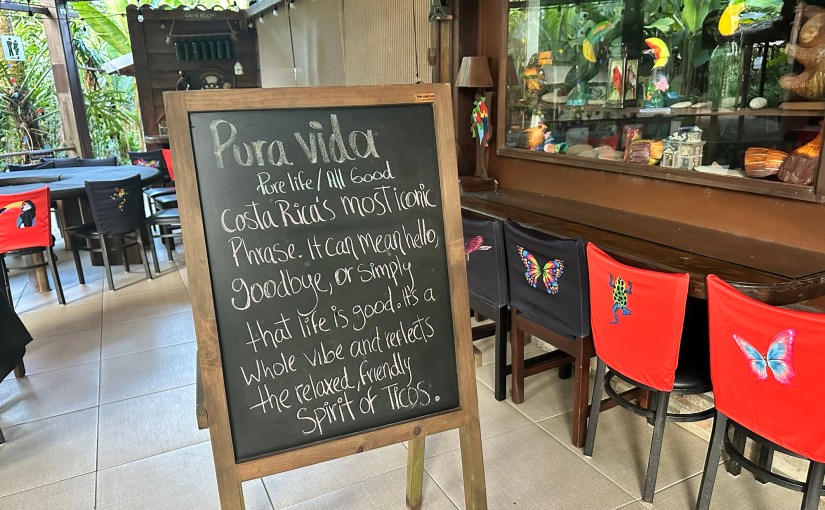
Our lodge in Sarapiqui was full of signs, but this one was my favorite:
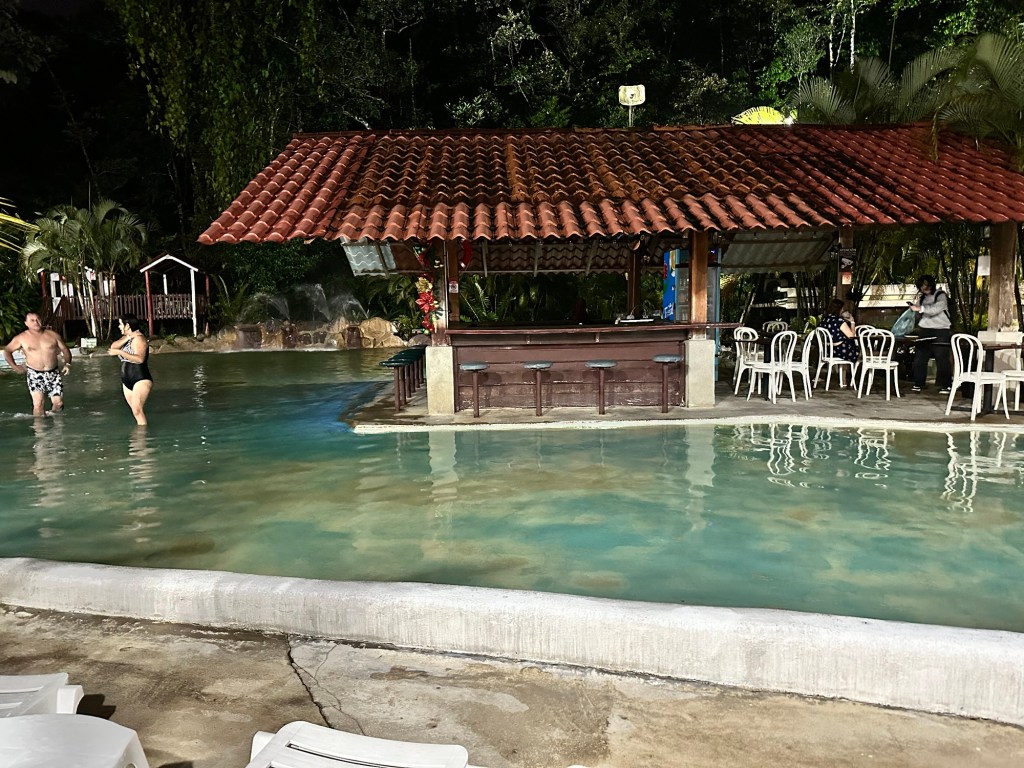
Our next hotel, in Aguas Zarcas, had multiple pools, supposedly at different temperatures, but they all felt lukewarm to me. Still, it sure was pretty at night.
On day 6, Malo led us on an optional tour of the property, where the non-Florida natives were thrilled to watch this heron check out a potential tilapia breakfast. He looked like a human, staring into a lobster tank, trying to choose one for dinner.
This was a very educational walk. We learned that bats sleep rolled up in leaves like this one. How did Malo know? The bat makes three holes in the leaves— all in a row.
During our stay in Aguas Zarcas, we made two trips to the local grocery store—the first was on the way to the hotel, where I stocked up on wine. Hey, who knows if I’ll have another opportunity?
I know my friend Anthony is probably horrified by my choices. My criteria? It had to have a screw top. It’s times like this that I’m grateful for my unsophisticated palate.
Fortunately, we made a return trip to the grocery store the next day to buy ingredients for our home visit.
By then, I had washed my hair with the only option provided by the hotel. Let me assure you, the outcome was NOT attractive, so I was glad to have the chance to buy real shampoo.
One of OAT’S distinguishing features is the home visit, where we visit with a family, share a meal, and sometimes help prepare it. This was one of those times.
I opted for salad duty where I’m pleased to report I excelled at chopping lettuce.
As a bonus, our host’s daughter Natasha danced for us, with son Damien performing the role of DJ and boom box operator.
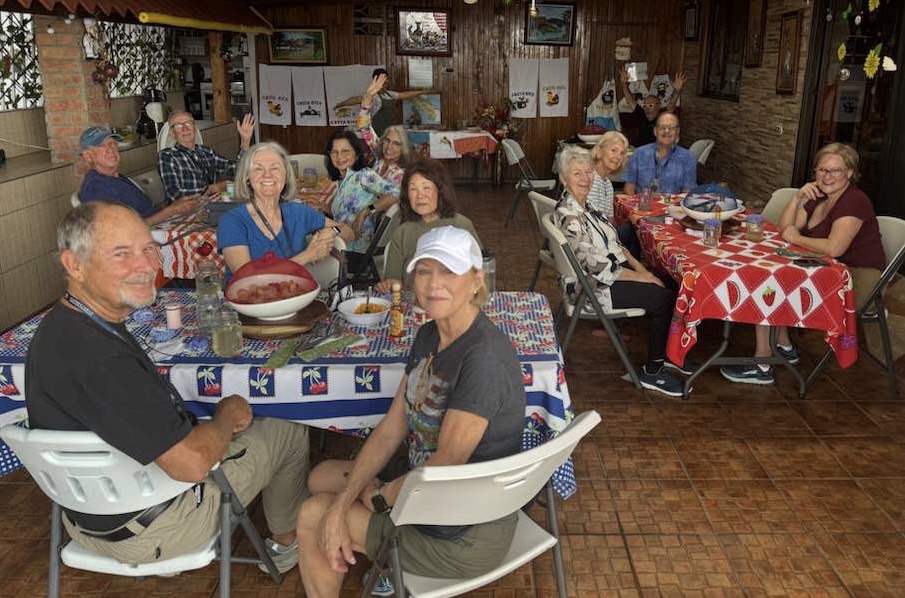
We ended our visit with a group photo.
Our hostess and family posing with us
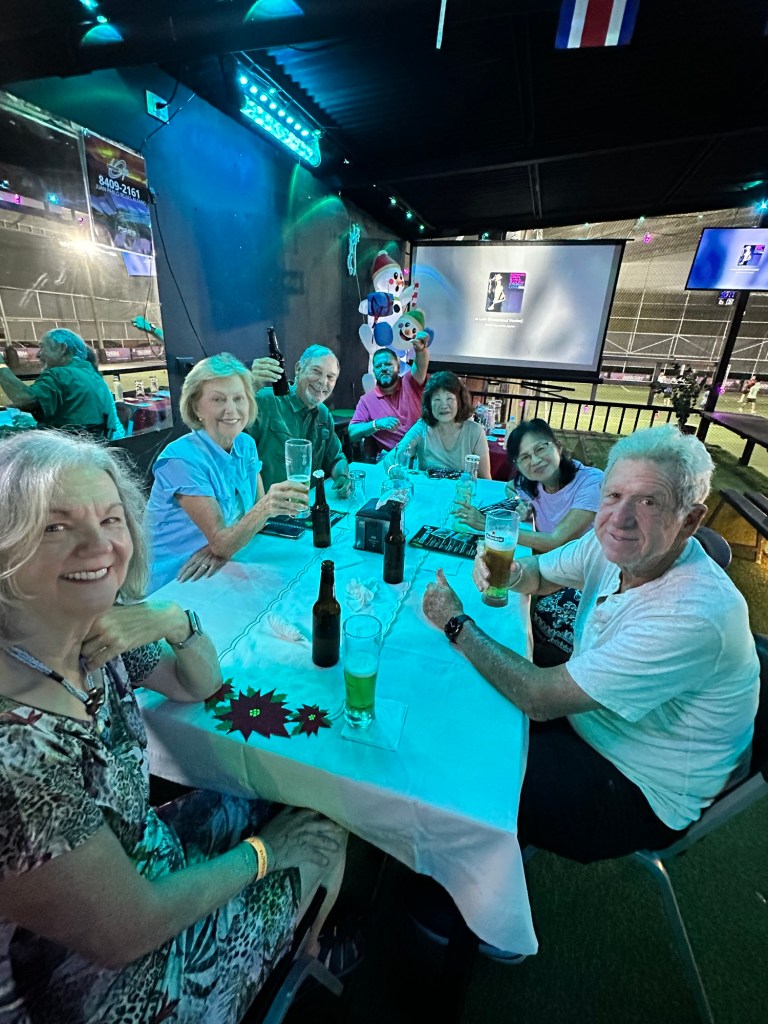
Our final event was dinner in town, at a karaoke place. Sadly, the words never appeared on the screen, so we were unable to sing along.
Cynthia, Marianne, Lester, Randy, Cindy, Esther. Where was Edwin?Me, Jo-Lynne, Mike, Joleen, Lee Fa, Phil. photo by Randy
Because dinners were not served together, and the food took a looong time to arrive, we all got a free drink. My friend Phil and I got to choose another drink because we were served last and didn’t get the barbecue ribs we had ordered. My margarita was delicious, as was the small drink we all received.
After “before dinner wine” (happy hour back at our hotel), a half a bottle of beer, a frozen mango margarita and the little “mystery” drink, I was feeling absolutely NO pain.
Jo-Lynne and I were ready to “party hearty”, but the rest of the group wanted to go to bed, so we were saved from embarrassing ourselves. At least so far. We still have another 10 days.
Remember how everyone tells new moms “once you see your new baby, you forget all about the pain of childbirth”? Yeah, well for me, THAT never happened — which is one of the reasons Greg is my only child.
The pain of getting to a trip, now THAT’S a different story. Once I arrive at my destination, any flight challenges — delays, cancelled flights, jet lag—all those “minor inconveniences” are instantly forgotten. (Thank you, Joann)
Our first day in Sarapiqui was picture perfect. The accommodations were a bit rustic, but comfortable, wildlife was abundant, and the location was ideal. I was able to walk to the nearby Sarapiqui River, which was FAR calmer than upstream, giving me a false picture of what our raft trip was going to be like.
Not too bad, right?
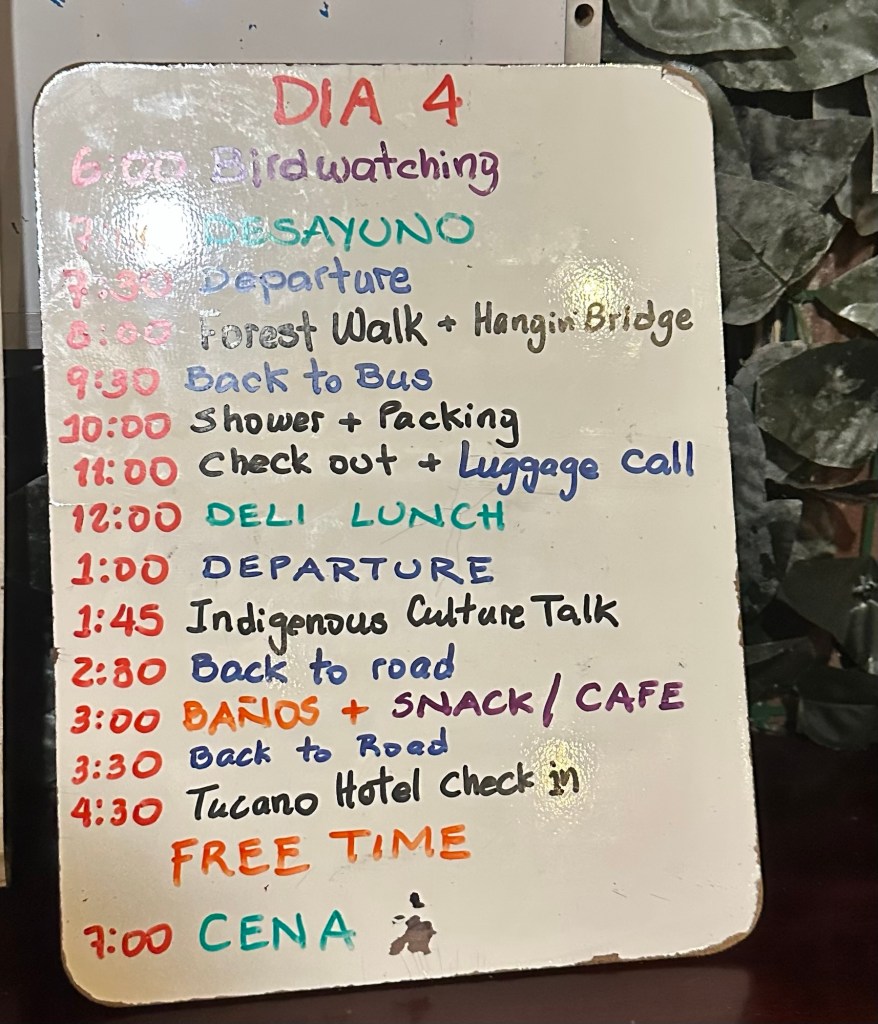
But let’s not get ahead of ourselves. Our morning began at 6AM with birdwatching and listening.
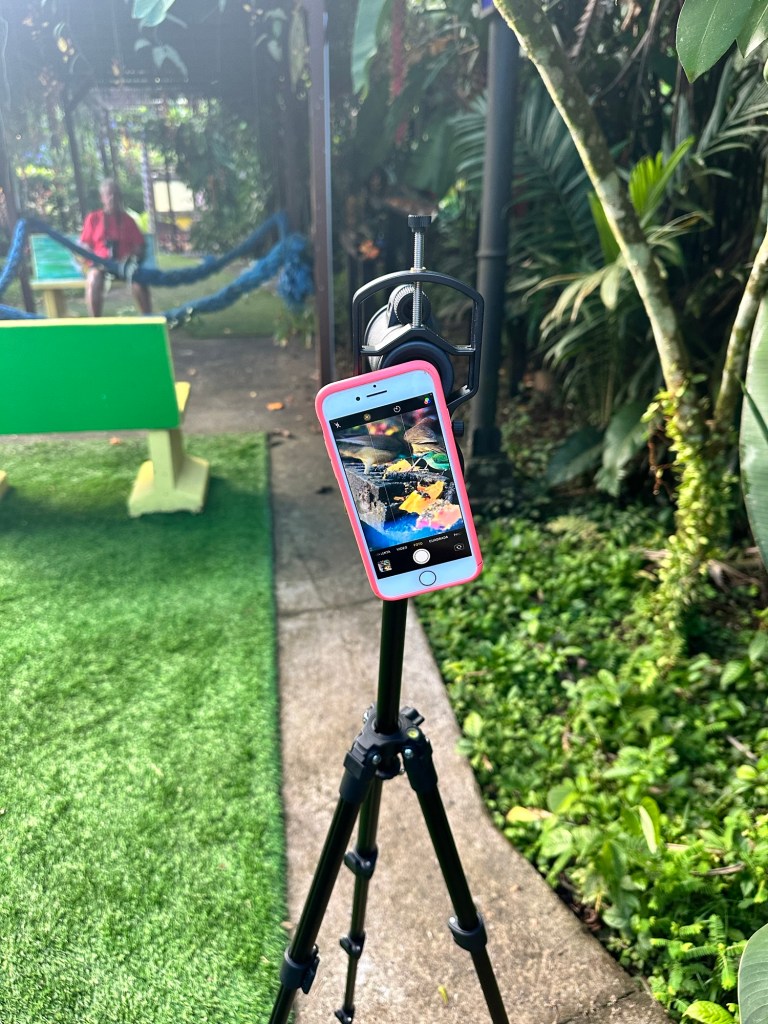
It made me regret that I hadn’t brought my camera, because a cell phone just doesn’t do it—unless, of course, you are as prepared as our guide, Malo was.
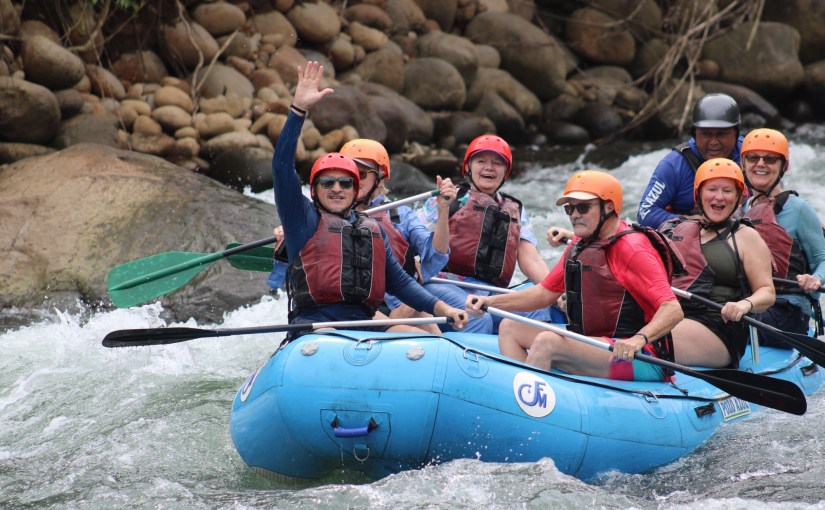
After breakfast, we were ready to start our rafting adventure. We expected to get wet, so I stored my cell phone with the change of clothes I brought. Not a problem, because the rafting company had photographers stationed along the river.
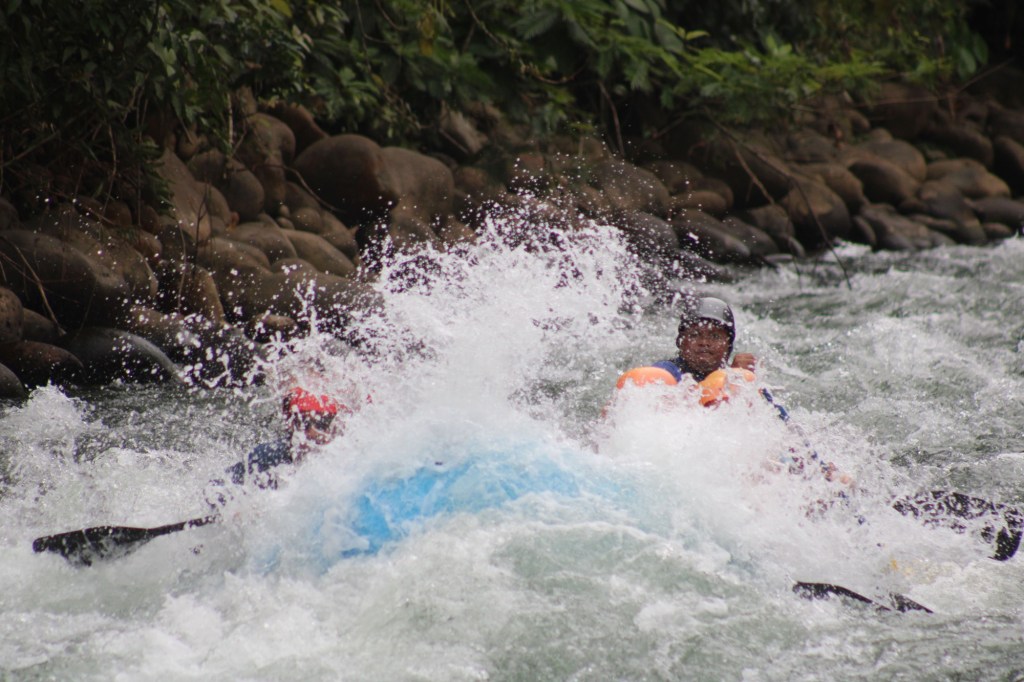
At the start of our trip, the water was moving fast, but the “rapids” certainly looked manageable.
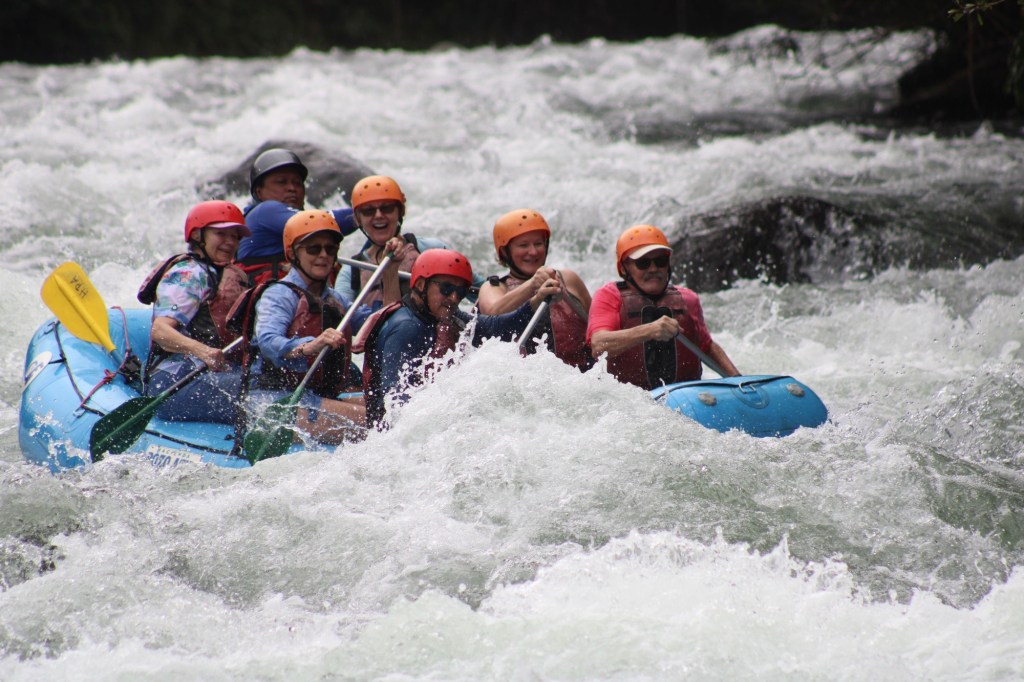
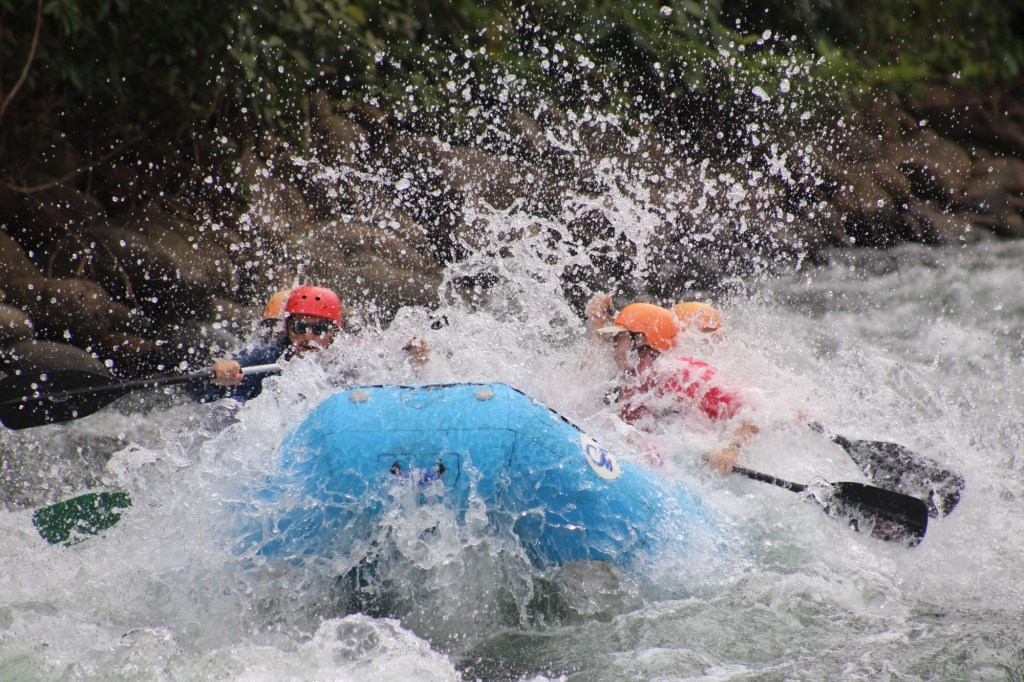
That quickly changed! The following photos were taken by the rafting company from their vantage point on dry land.
Yes, we were on that raft. Here’s proof.
We were quite pleased with ourselves that we had made it thru. What we DIDN’T know was there were many, many more rapids before our journey ended.
Across from me is 83 year old Esther, who was a trooper, smiling even though during our 1.5 hour journey, she almost fell into the river.
Her daughter Cindy is in front of me. We had quite a rhythm going, even after our helmets smashed together during our transit thru one of the rapids.
Although you can’t tell from the above photo, we were all completely soaked. We are smiling because we knew that dry clothes were waiting for us.
That was quite enough adventure for me, so I spent the afternoon hanging out by the pool, with Randy and Cindy, instead of touring a pineapple plantation.
This will give you and idea of what our second day in Sarapiqui will be like.
On to two days in Chachagua, where Malo tells us we will be able to enjoy the hot springs.
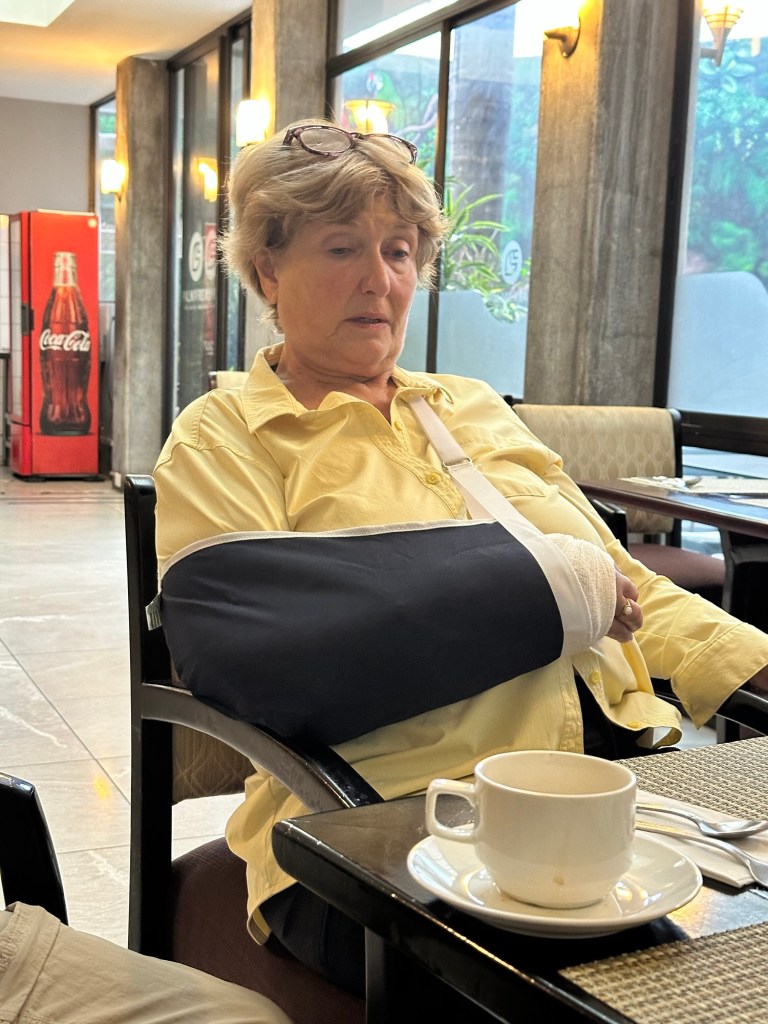
Remember when I said yesterday’s travel challenges were a minor inconvenience? Well, my new friend, Betty, experienced a MAJOR inconvenience. Last night she fell, broke her right wrist, is having surgery today, and has to return home tomorrow. It’s unfortunate for her, very sad for me, because I liked her instantly.
MY luck began to change as soon as I arrived in San Jose. I was able to join the group for the 3 PM tour of the National Theater because Alex, my wonderful taxi driver, was able to calculate how long it would take to bring me to the hotel (in bumper to bumper traffic), allow me to check in and drop my bags in my room, and drive me to the theater. I arrived 3 minutes before the theater tour started.
If anyone is ever in San Jose, and needs a driver, here’s Alex’s contact info.
Alex’s phone number. I highly recommend him!
Along the way, Alex pointed out interesting buildings. He also confirmed my memory of San Jose as being a city without high risers. These skyscrapers were all built within the last 8-10 years.
Our group is super friendly and welcoming. THEY all had to learn ONE name, but I had to learn 13. Yes, originally our group numbered 15, but one person canceled before the tour started, But I digress. Back to the Theater tour.
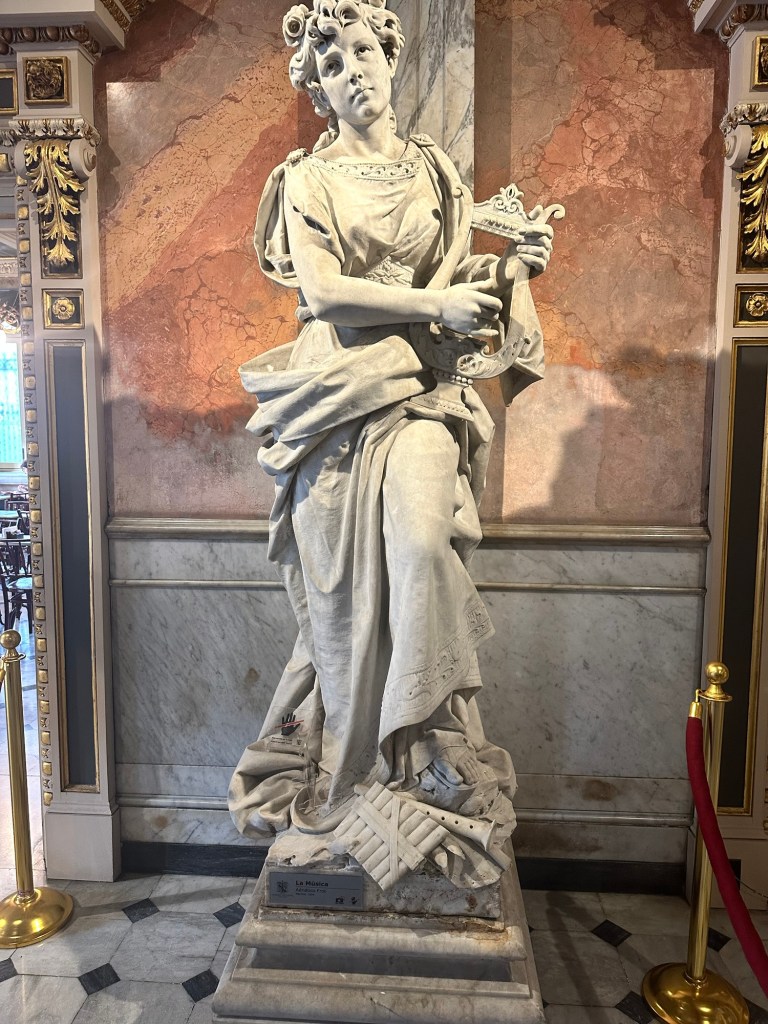
Our National Theater guide explained that this statue was originally on the roof of the theater, but was brought inside to protect it from the ravages of weather, which was causing the marble to become discolored.
The top floor houses this salon, where the rich and famous hung out after enjoying the evening’s production. It isn’t obvious from the photos, but the marble on this interior statue is pristine and glowing.
The National Theater was built in the 1800’s when Costa Rica was rolling in coffee profits. Back then, rich coffee growers sent their offspring to be educated in Europe. When their children returned, they brought with them memories of the art and culture they had experienced. These memories culminated in the creation of the National Theater.
Our second day began with a tour of a small coffee finca (farm). To be honest, after staying at the Colombian coffee plantation for three nights, I wasn’t as interested in the production aspect, so instead I took photos. Here’s a shot of two members of my group picking beans
Mike and Jo-Lynne
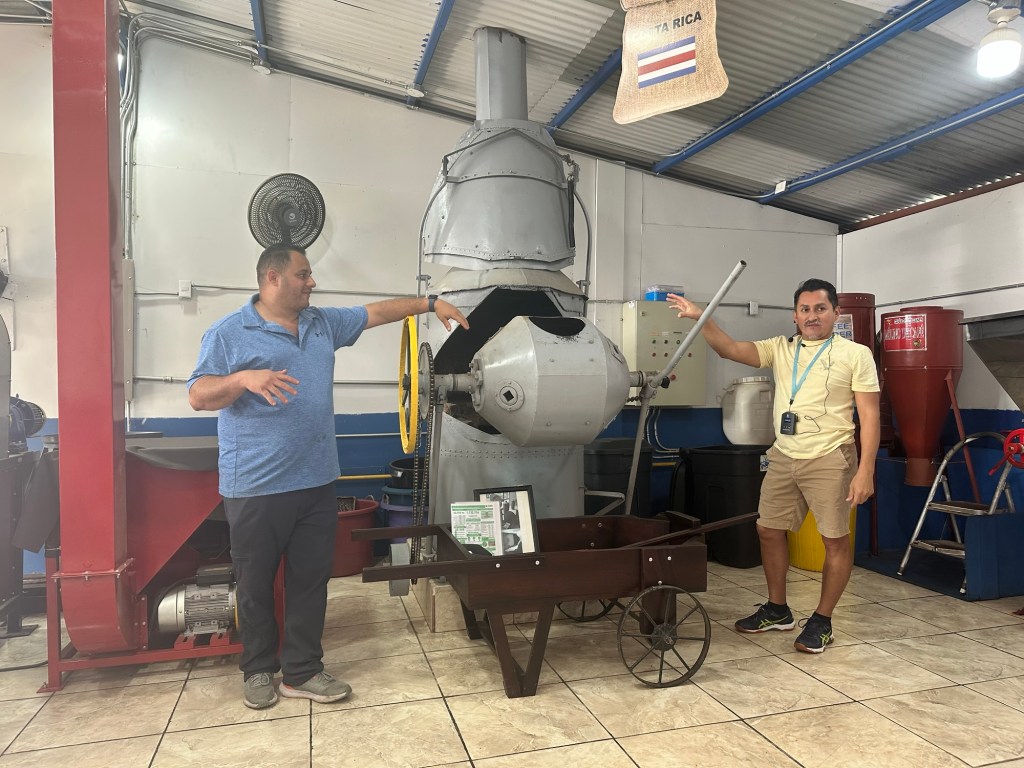
Edwin was born in El Salvador, but grew up in LA. Because Malo was up most of the night helping Betty, Edwin stepped in and translated for us.
Edwin is on the right. This is an “antique” piece of equipment
We are lucky to have Edwin with us. He and his wife, Cindy are much younger than the typical OAT traveler. That’s because Cindy’s mom, Esther, invited them to accompany her.
After lunch at the finca,
we headed to Sarapiqui, which gave us the opportunity to enjoy the beautiful Costa Rican countryside. It is impossible to capture the grandeur of our drive, but that didn’t stop me from trying.
Supposedly, it was a three hour drive, with a couple of stops, but the time went by very quickly.
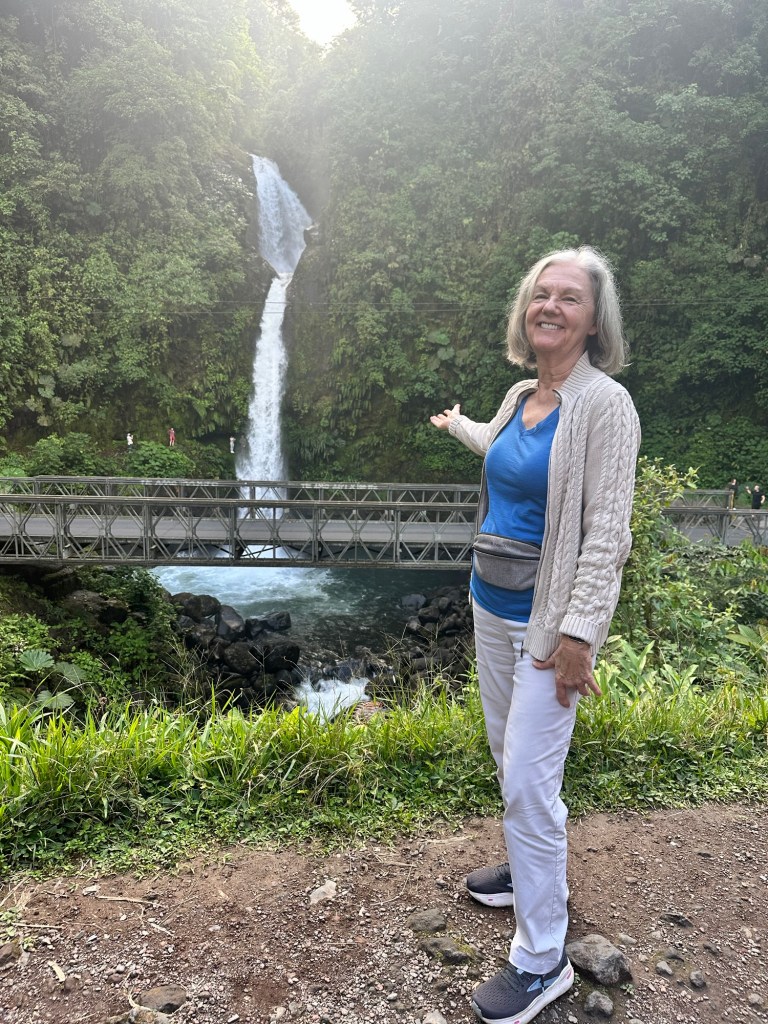
One of our stops was for a photo op by a waterfall.
This one’s for YOU, Jean.
I’ll end with a video of our other stop where we enjoyed sampling Agua Dulce while we watched the birds.
It’s a beautiful morning in Managua, Nicaragua. What, you don’t see Managua on the map atop this post? That’s because some of the best laid plans often go astray. (Like some women I know).
Normally when I do a group tour, I go in a day early to allow time for things to go wrong. Not this time, which pretty much guaranteed that everything that could go wrong, did.
I kept channeling my friend Joann, who I met on my recent India trip, by repeating “ it’s just a minor inconvenience”. I said that a lot!
The minor inconveniences started with an hour and a half delay at Newark airport because of electrical problems. Then, we were unable to land in San Jose because of poor visibility. After circling long enough to necessitate refueling, we flew to Managua and sat on the plane hoping for a break in the weather in San Jose. We waited long enough for the flight crew to surpass their maximum working hours, and no other crew was available, so the flight was canceled.
The crew handed out immigration paperwork that had to be completed, plus a list of hotels with phone numbers, but no other information. I tried to do my own search, for hotels near the airport, but the internet wasn’t working. ( I wasn’t the only one with cell phone challenges!) when my phone wouldn’t work, a very kind man sitting behind me handed me his phone, already dialed to the Hyatt, and he told me they had available rooms.
Because the plane was full, I had gate checked my bag in Newark. It was my act of kindness for the day. BIG mistake. I suspect the luggage handlers translated “priority” to mean “grab me last”. And they did.
Although The Best Western was across the street from the terminal, United didn’t put it on the list or provide its phone numbers, so instead I took a taxi to the Hyatt, which was about 20 minutes away. Before we left , we were told repeatedly to arrive at the airport 3 hours before our 10 AM flight.
One of the positive aspects of having sleep problems is my body has figured out how to get by on much less sleep. By the time we (yes, “we” because by then I had a companion. Little Kayla was looking lost, so I invited her to hop into my cab), it was 2 AM local time, 3 AM my body time when I finally got to bed. I awoke at 6 AM, just in time to enjoy the included breakfast.
Upon arriving at the airport I discovered our flight was delayed until 12:20. No one was at the United desk, so I found myself a seat, and reminded myself things could have been far, far worse. Noise canceling headset with music loaded onto my phone drowned out the screaming kid and allowed me to mentally transport myself to my happy place.
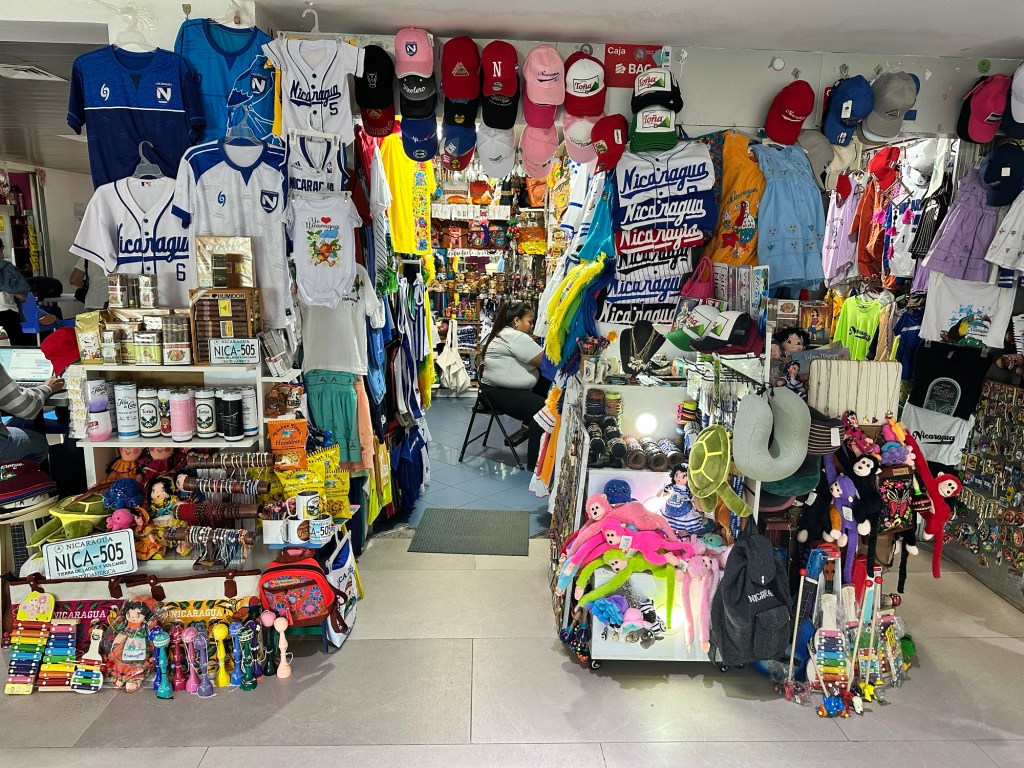
No, this is definitely NOT my “happy place”. Don’t worry, no one will be getting a gift from here!
I’ll miss the first day of the trip, including the welcome lunch and a tour of the National Theater because I won’t arrive into San Jose until a little after 1 PM. That is, if everything goes according to plan, which it hasn’t so far.
Luckily, I’ve been to Costa Rica twice before this trip. The first time was in February, 2007, with Mike and my friend Augusta. We traveled with Elderhostel, which is now known as Road Scholar. I’ll be trodding over familiar ground – in 2007, we started in San Jose, then visited Poas, Sarapiqui, La Fortuna and Arenal. It will be interesting to see the impact time has had on the areas I’m revisiting. Of course, that’s assuming that I REMEMBER what it was like in 2007, which is a pretty big assumption indeed.
Poas Volcano from 2007 visit
The second time was in January of 2010, which is when Mike, Greg and I cruised through the Panama Canal with Oceania. We only were in Puntarenas for one day, so we hired a guide who took us for a walk through a forest, then we went zip lining. That first platform was REALLY far away and I will admit to being terrified that I would get stuck midway, and have to rely on my upper body strength to pull myself the rest of the way. Fortunately, that didn’t happen, because back then my upper body strength was non-existent.
Practicing zip liningOn my way. I was NOT moving slowlySuccess! I couldn’t even SEE the landing zone.
This itinerary includes zip lining, horseback riding and rafting. Although not specifically mentioned in the itinerary, I’m assuming we will have a chance to take advantage of the hot springs near the volcanoes. I’ll admit, if I was missing one of these activities, I’d be thoroughly bummed.
August thru October is traditionally the “rainy season”, with November being the transition month leading to December’s dryer weather. ThIs year’s 10 day weather report is predicting rain almost every day. Perhaps the rain will be gentle, cooling us off when the temperature soars into the 80’s. We shall see.
Time to see if anyone is at the United desk.
Next post will probably be from Sarapiqui. And yes, despite all the minor inconveniences, I still feel pretty damn lucky to be on this trip!
We didn’t know the impact of the Air Canada strike until we left Halifax for Baddeck ( Pronounced ba-DECK). Our group has shrunk from 40 to only 26.
I know, I’ve completely skipped over Halifax. It’s not that I didn’t love the city. I did. It’s because we are spending our final two days there, so if time and energy permit, I will post about Halifax when we return there.
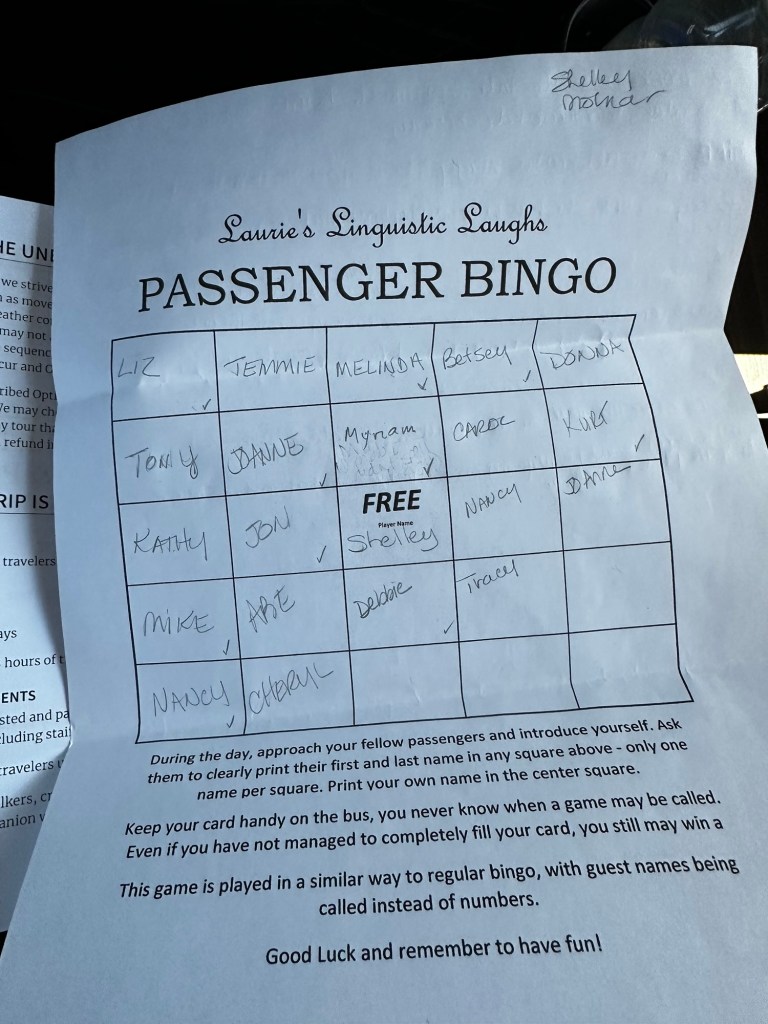
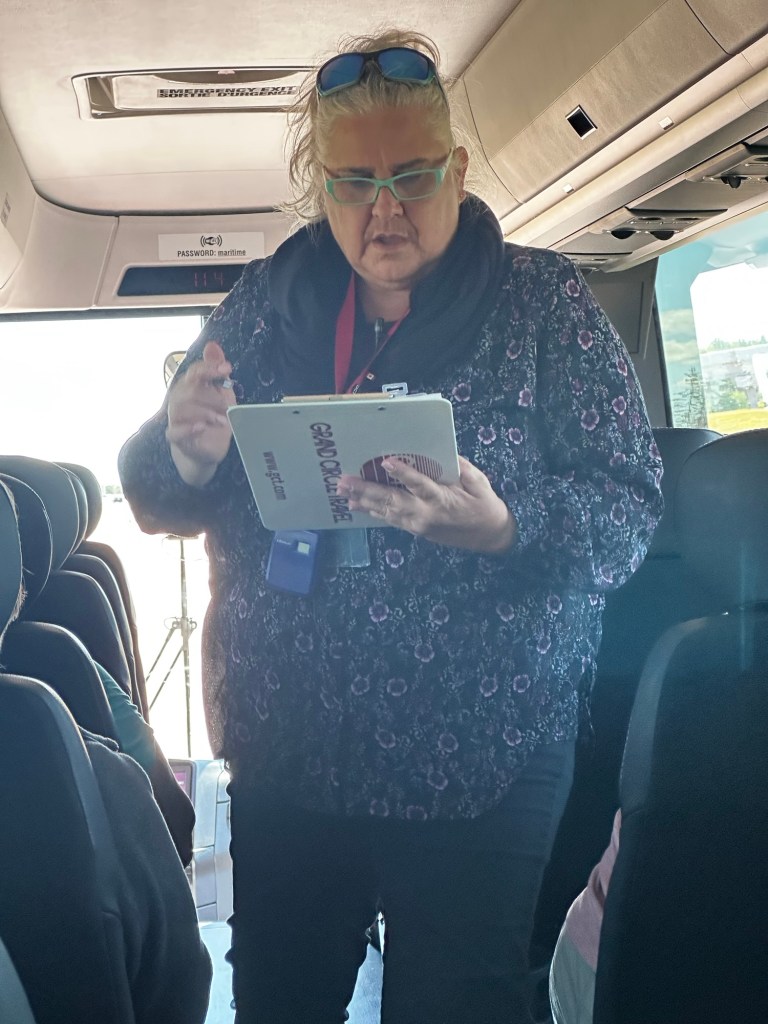
Laurie, our amazing trip leader, has devised a very creative way to break the ice and to keep us entertained during our bus ride. We are going to be playing “Passenger Bingo” for PRIZES! I don’t care if the prize is a rusted tricycle, with a wheel missing. If it’s a contest, I’m in it to win it. That’s just my nature.
Since I started this post, we have completed THREE different games, and I’m quite proud to say I was the winner of the first, which was a challenge to name all of the 14 people that did NOT make it to Halifax. Nailed it!
Laurie, our hard working, creative trip leader
But back to Baddeck. As usual, our drive to the next city was broken up by interesting stops, starting with the Millbrook Cultural and Heritage Center.
Glooscap, a mythical figure
There, we learned about the indigenous people who had inhabited the land for over 13,000 years, ( according to archaeological digs) the Mi’kmaq (pronounced mig-MAH).
Apparently, the French and the indigenous had a positive relationship; not so, with the British, which was probably why we fought the French AND Indian War.
The indigenous were given identity numbers by the Canadian government, with the final number indicating how many children were in the family. That made it easier for the government to find the children, take them from their families and force them to attend government run boarding schools. The schools were designed to wipe out the indigenous language and culture. Over 176,000 children between the ages of 4 and 16 were taken from their families. Of that number there were over 6,000 recorded deaths from disease, abuse and suicide. Before anyone thinks that the mistreatment of indigenous children happened centuries ago, I need to inform you that the last school closed in 1998 in Manitoba.
This speech was given during Canada’s 100 year anniversary.
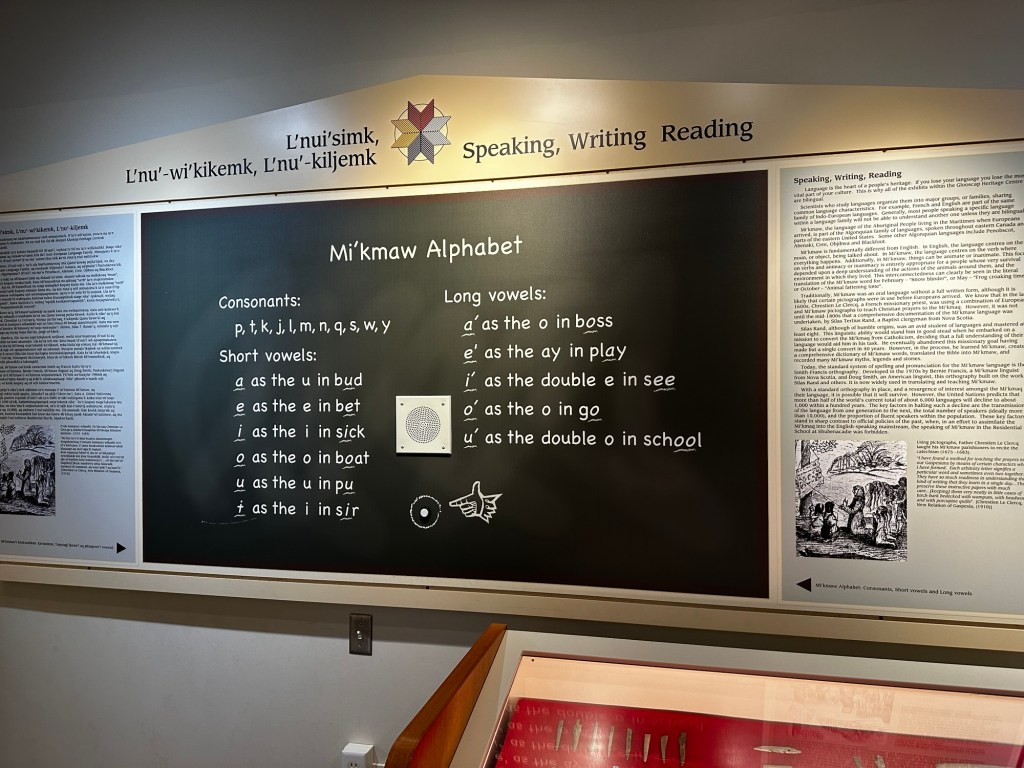
We learned that the Mi’mkaq language is a tonal one.
Depending on how you elongate the vowels, the same word could mean:
I love you OR I want to hurt you OR I want to throw you in the fire. THAT word could start some serious misunderstandings!
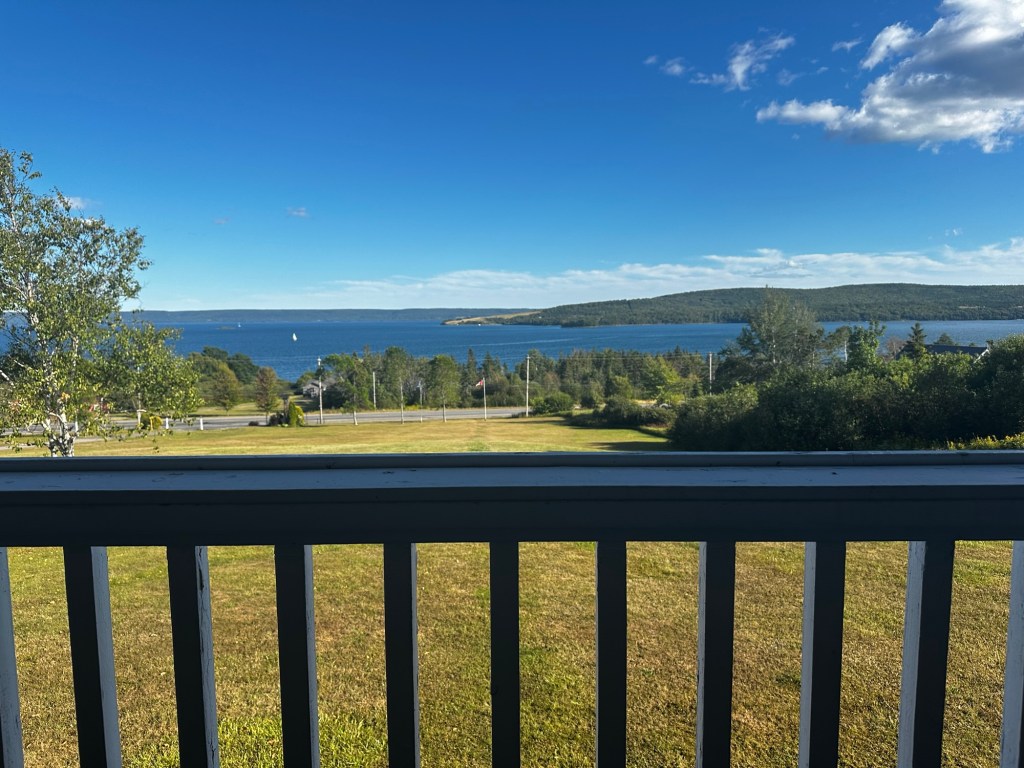
We spent our three nights in Baddeck at the Silver Dart Lodge, which overlooked a beautiful lake.
Laurie was initially concerned that we would find the Lodge too “rustic”. Instead, we all agreed it was absolutely charming. Because of the volume of business Grand Circle does with the lodge, we all got rooms facing the lake.
This spectacular view is what I saw from the lovely deck outside my room, the perfect place for happy hour. How great was THAT? It took all three nights for me to finish the wine that I was not allowed to drink on the bus.
The area is so beautiful that Alexander Graham Bell and his wife, Mabel built their summer home in Baddeck. Their “castle” wasn’t visible from the museum bearing his name, but there was plenty of other “stuff” to see.
I had no idea that Alexander Graham Bell taught deaf students in Boston or that Mabel became deaf at the age of 5 after a bout with scarlet fever.
I also didn’t know that Bell’s parents immigrated to the USA from Scotland after two of their sons died from tuberculosis. They didn’t want to chance losing their last son.
We all know about his invention of the telephone , but I wasn’t aware of his interest in aviation and hydrofoils until I visited the museum.
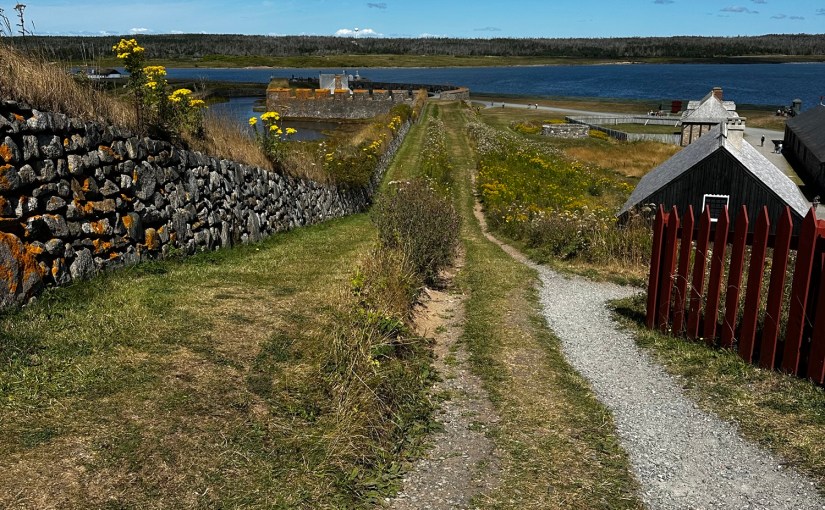
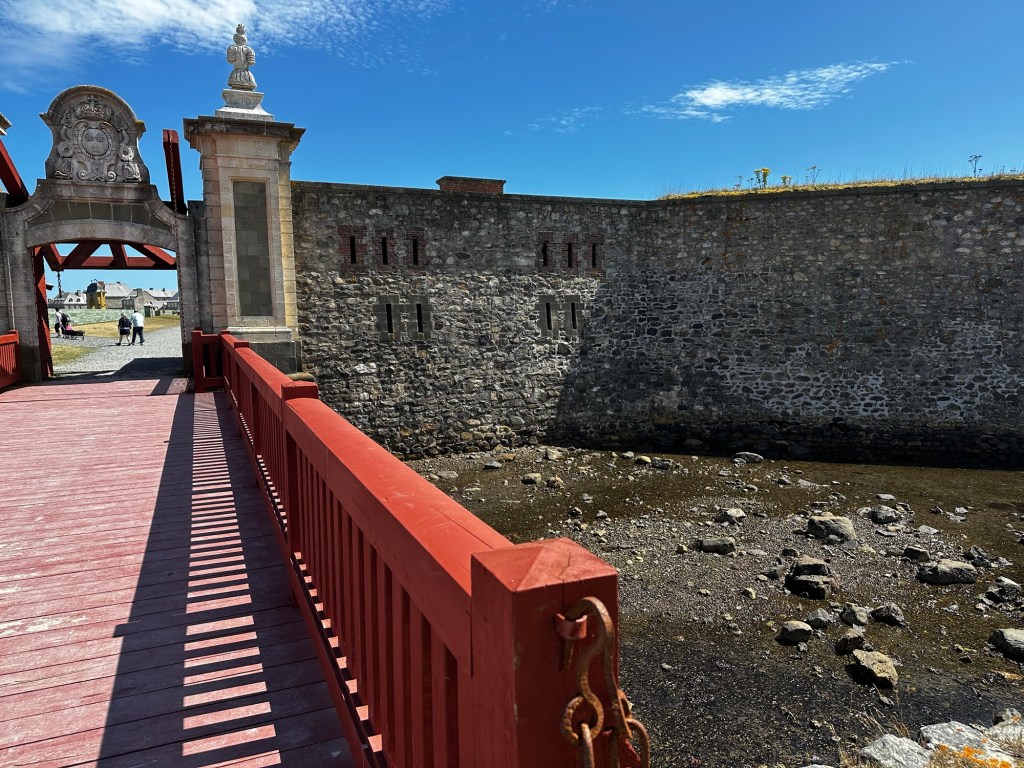
We spent the next day touring the fortress at Louisbourg, where I was once again reminded of my educational deficiencies. Why did I never learn that in 1745 a group of untrained “ soldiers” from New England successfully took the fortress in 6 weeks time? You see, the French had expected all attacks would come from the sea, so that area was heavily fortified and protected. But the 6,000 ragtag New Englanders didn’t know the rules of engagement, and they were undaunted by forests or swamps, so they attacked from the land, which was unprotected.
The entrance to Louisbourg
The crown decided to return the fort to the French in 1749 exchange for Madras, India which was a source of extreme irritation to the New Englanders. They had lost about 900 men capturing the fort.
In 1758, the British determined that they wanted Louisbourg after all, so they laid siege the “professional” way, by sea, without the help of the New Englanders, and guess what? It took them a WHOLE lot longer.
This time they completely destroyed the fortress, so what exists today is a reconstruction, based on documents and plans that were preserved off site.
The view from the protective wall
Like Williamsburg, Sturbridge Village, and Plymouth Plantation, re-enactors in period costumes demonstrate what life was like in the 1700s.
I particularly enjoyed watching a prisoner being marched through town to the iron collar.
All of the neighbors were invited to ridicule the prisoner as he made the “walk of shame“ to the center of town.
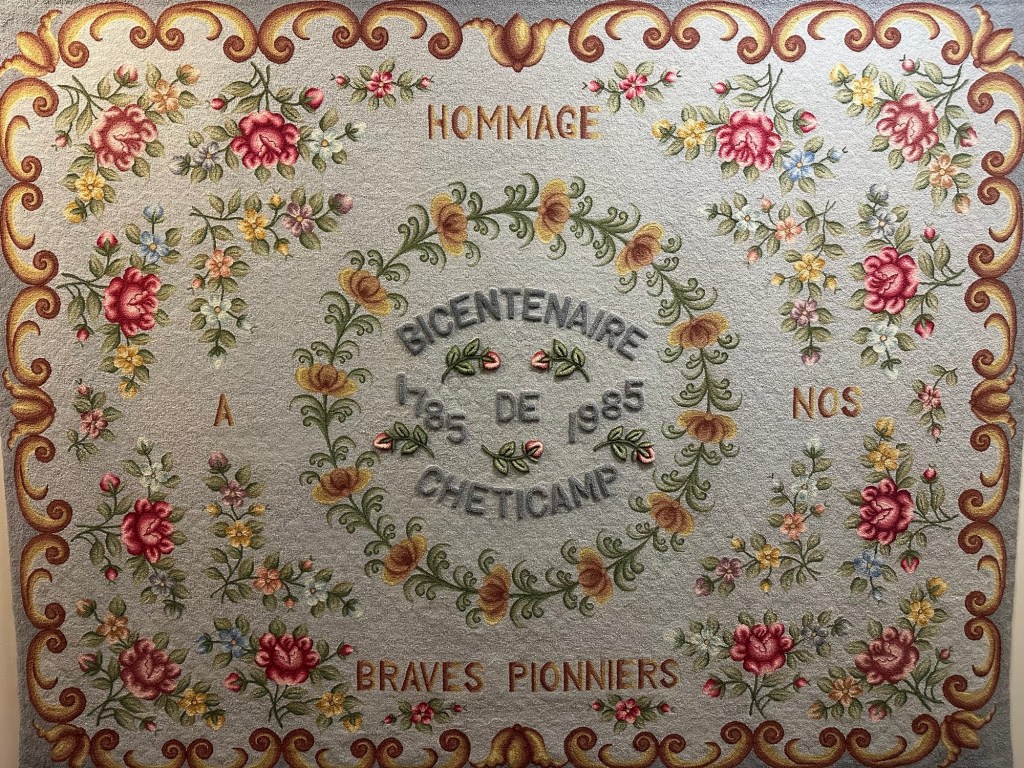
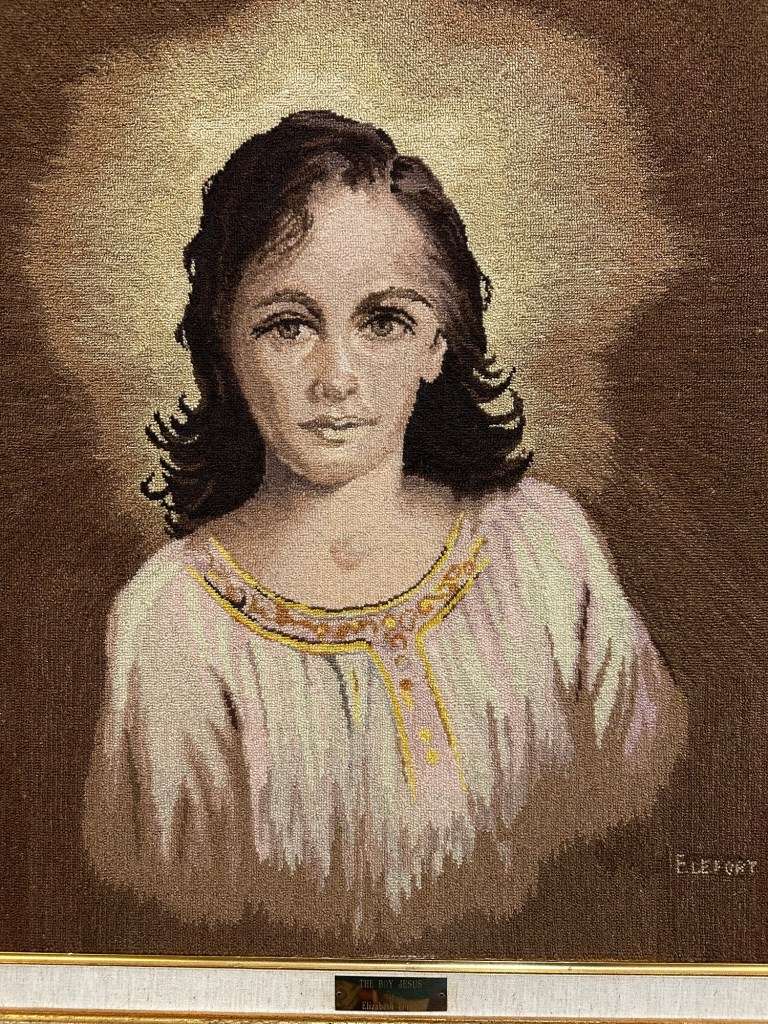
Our final day was to be spent traveling along the Cabot Trail. Because of climate change ( yeah, the Canadians don’t think it’s a “hoax”), all the trails are closed to hikers. The risk of fire is too great. So, instead we were going to drive the entire route, after stopping to visit a church and a hooker museum. Don’t get excited. It was a museum for RUGS not ladies of the night.
You might think that rug on the right is supposed to be a young Liz Taylor, but the sign next to it explained it was actually a youthful Jesus.
While in the museum, Josh discovered there was a problem with the bus, so we had to hang out long enough that the full trip along the Cabot Trail was impossible.
We were lucky to have Laurie as our trip leader, who decided to treat us all to coffee and pastry at the shop up the street. Instead of doing the full route, we ended up stopping at a beautiful little beach
Our last night was spent at a ceilidh (pronounced Kay-Lee).
Although there is so much more to say about Baddeck, this post is already quite long, so I’ll stop.
As usual, I was so busy having fun that my blogging got WAY behind my travels. I’m home now, getting ready to hit the road again, and I realized that if I don’t do a post about this trip, I will probably forget where I was and what I did. I have lost count of the number of times I’ve had to look up something on my blog to jog my memory. Oh, a mind is a terrible thing to lose.
As I mentioned in earlier posts, the pre-trip to Berlin was fantastic. We had one more stop, in Dresden, before we joined the rest of the group in Prague for the main trip.
It was hard to believe that so much of Dresden was destroyed by Allied bombs during WWII.
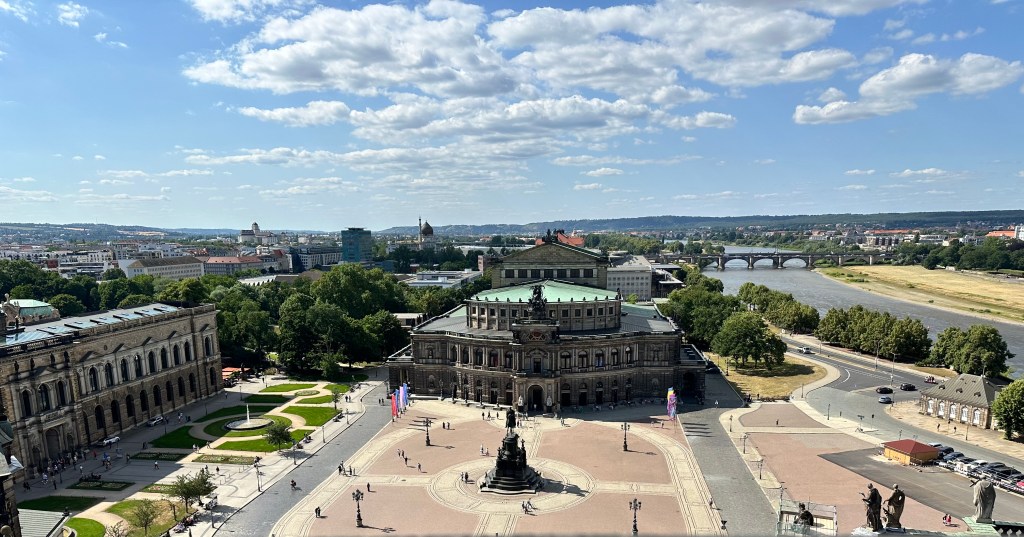
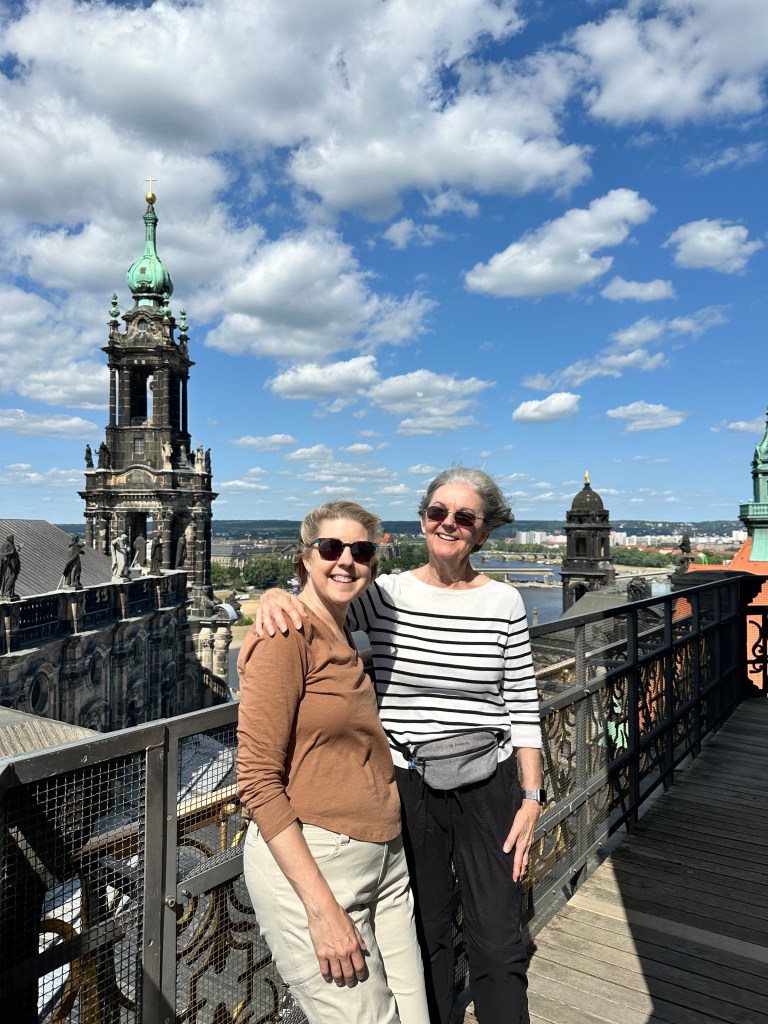
As usual, Barb and I found a high point in the castle that afforded us an excellent panoramic view of this delightful city.
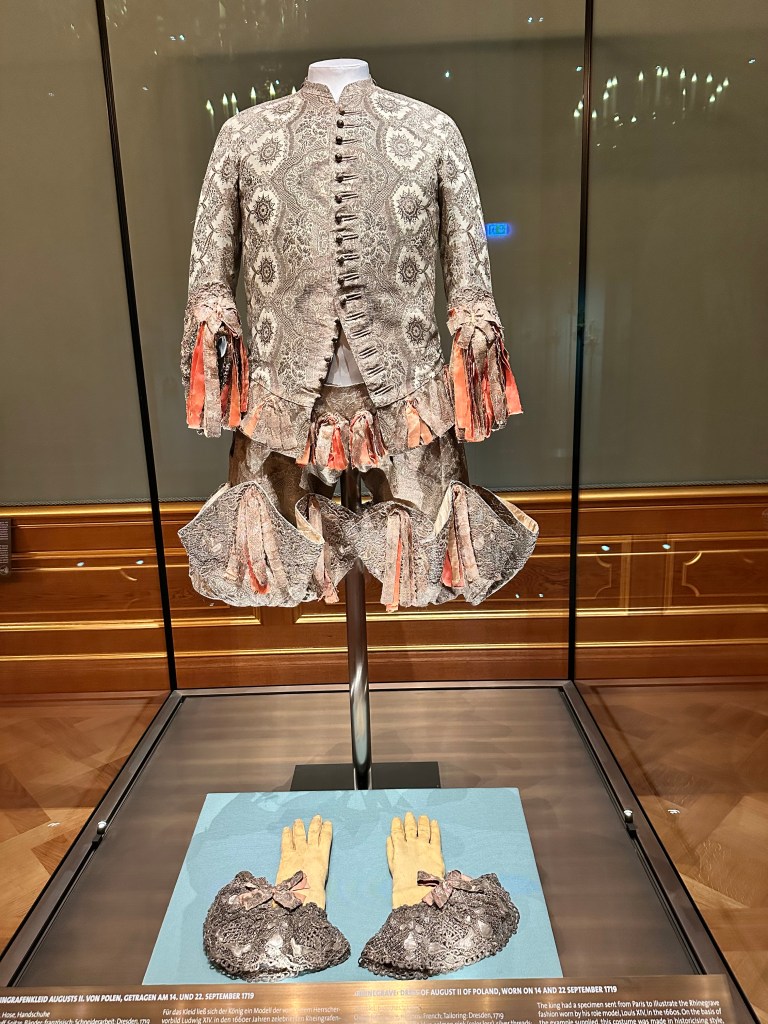
In addition to climbing the Castle tower, we also toured the Castle Museum. All I could think about when I saw the exhibits, was how many people must have died, either from starvation or in battle, for royalty to collect all these gold do-dads and fancy clothes.
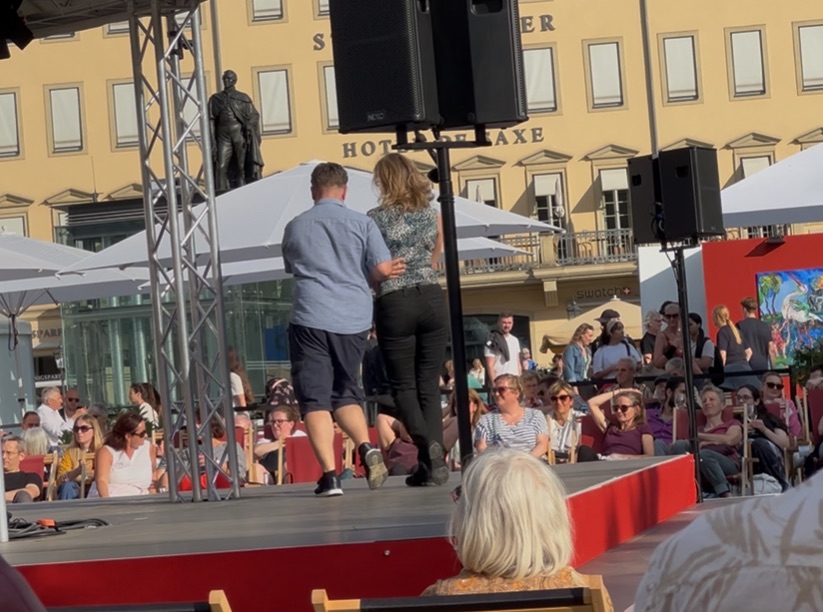
During the two evenings that we spent in Dresden, we enjoyed people watching in the main square, where there was live music and dancing.
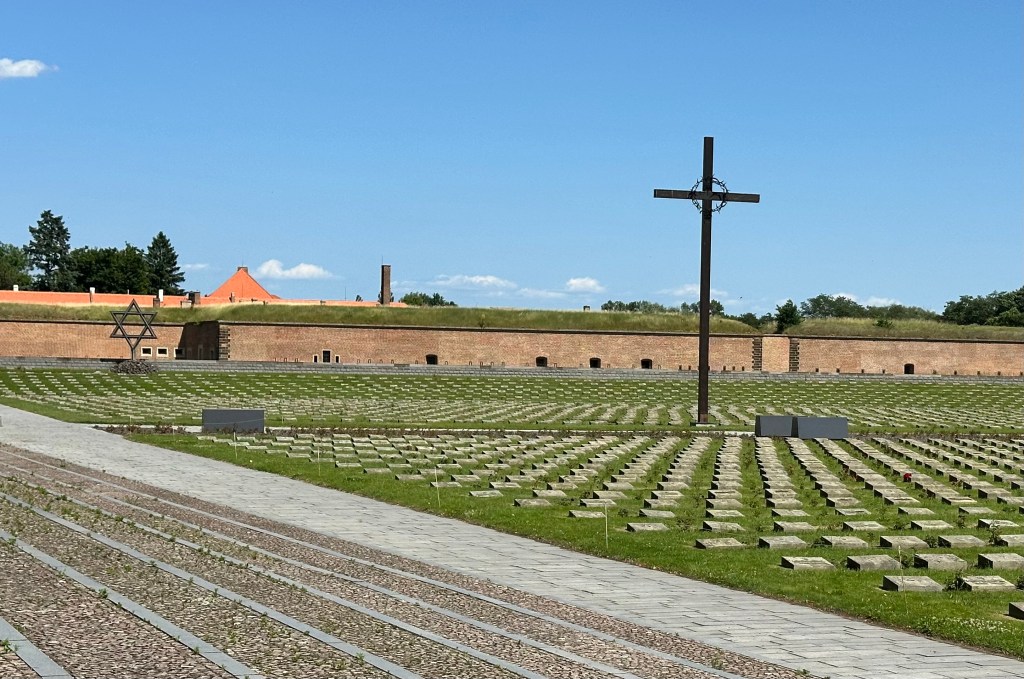
On our way to Prague, we stopped at Terazin, which was a Gestapo prison during WWII. It was sobering to see how widespread cruelty to other humans is.
Prague I visited Prague for the first time in 2014 with Vermont Bike Trips. Although I did see some of the same sights again, like the Charles Bridge, the astronomical clock and the castle,
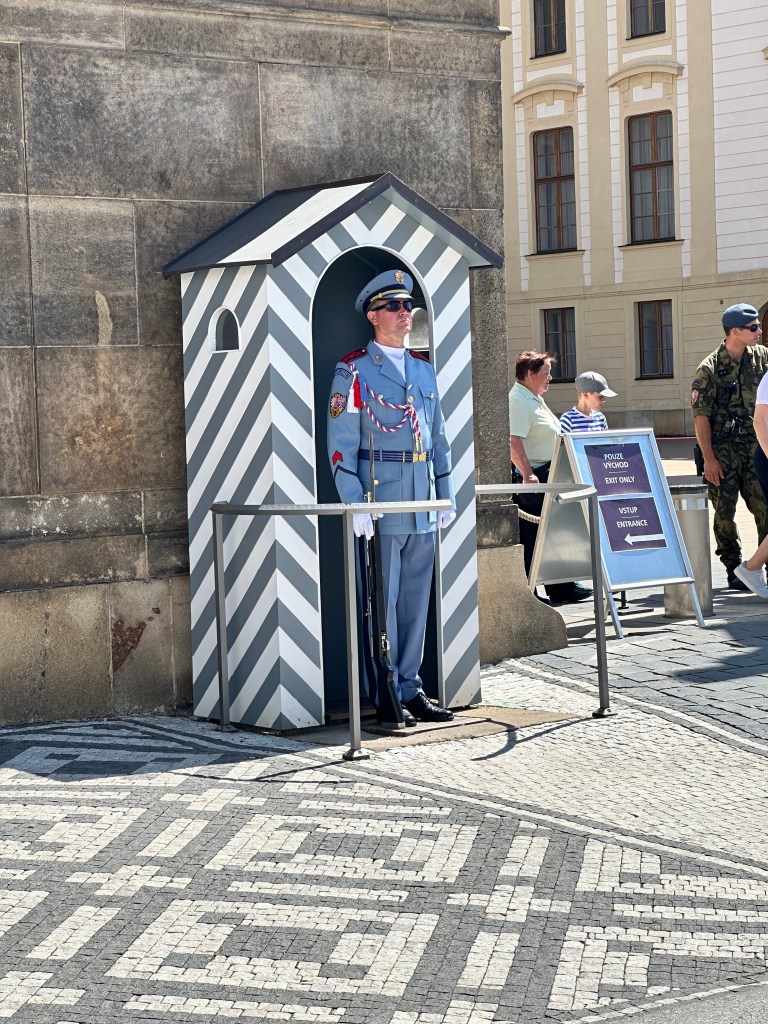
This soldier didn’t move at all, which led us to question whether he was real, or a mannequin. Turns out, he was VERY real, but capable of complete stillness.
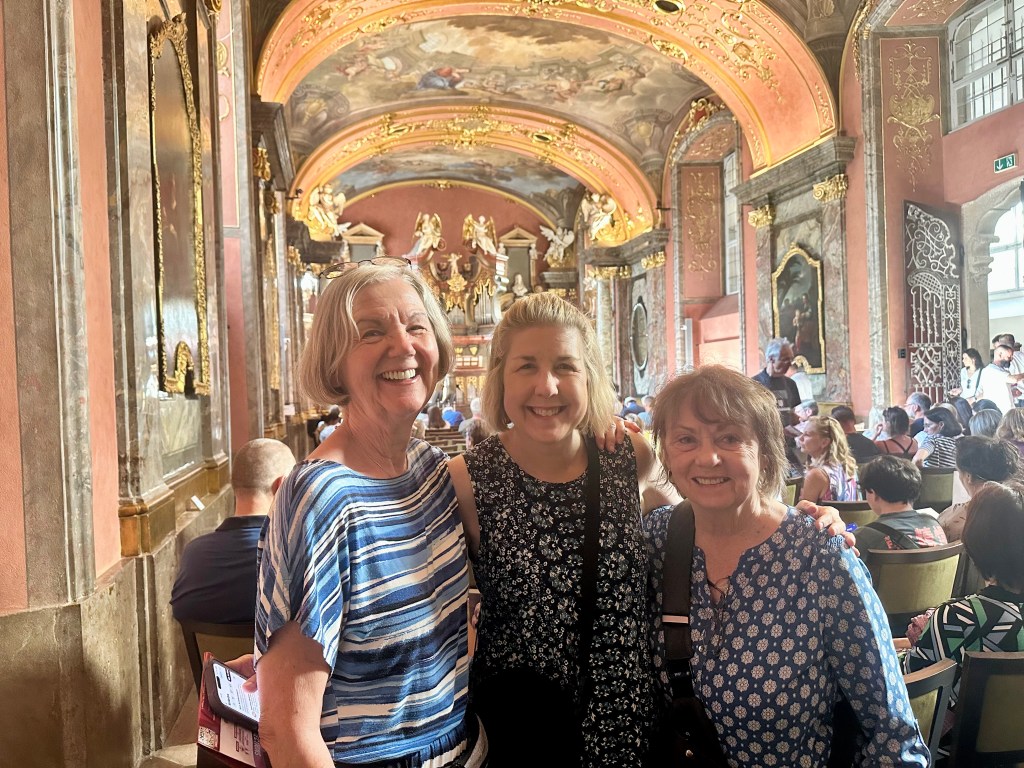
there were many new experiences, such as the delightful concert in the Mirror Chapel.
I love the blend of scheduled and unscheduled time on OAT trips.The free time allowed us to attend the concert and have dinner at the Blue Duckling, which was recommended by our dear friend Elena.
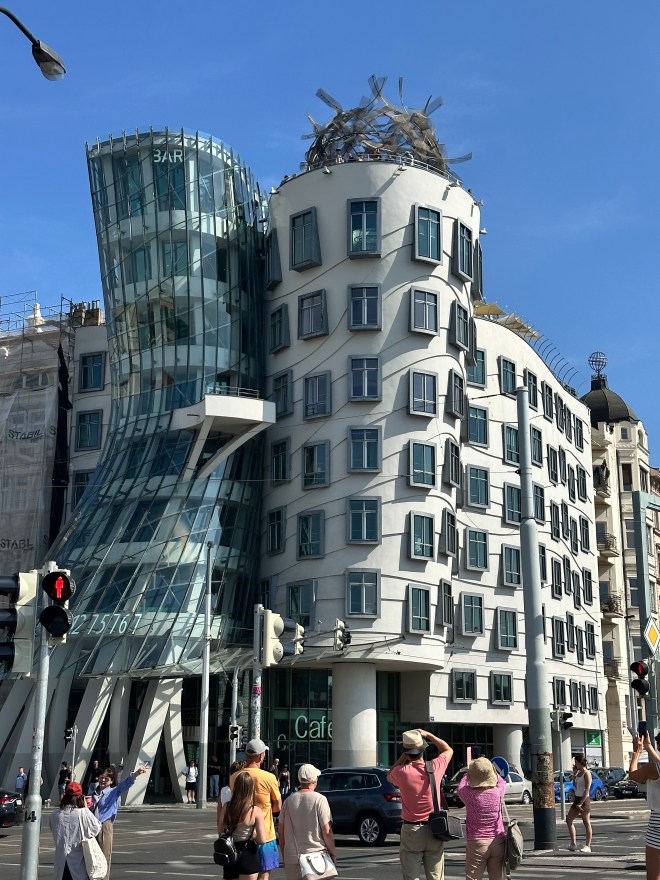
I recalled visiting the “Fred and Ginger” building on my VBT trip, and I enjoyed it enough to return. It has since been renamed The Dancing House. (Fred and Ginger was deemed “too American” a title).
When I visited in 2014, There was no elevator–but the walk up the stairs had lots of “interesting” art on the walls, such as this magazine cover.
Now, an elevator whisks you to the bar on the top floor, and if you want to go into the “hat” to enjoy the view, you now have to pay for that privilege.
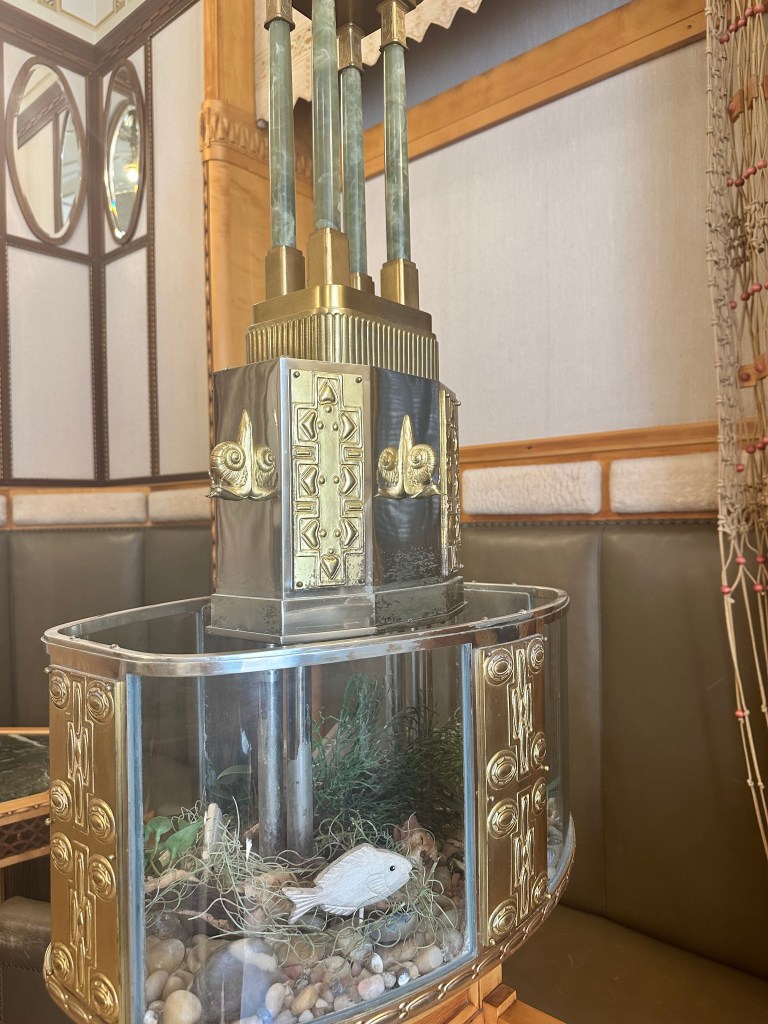
The hotel that OAT chose, the K+K Hotel, was centrally located and was quite beautifully decorated, with a quirky elevator that motivated me to take the stairs.
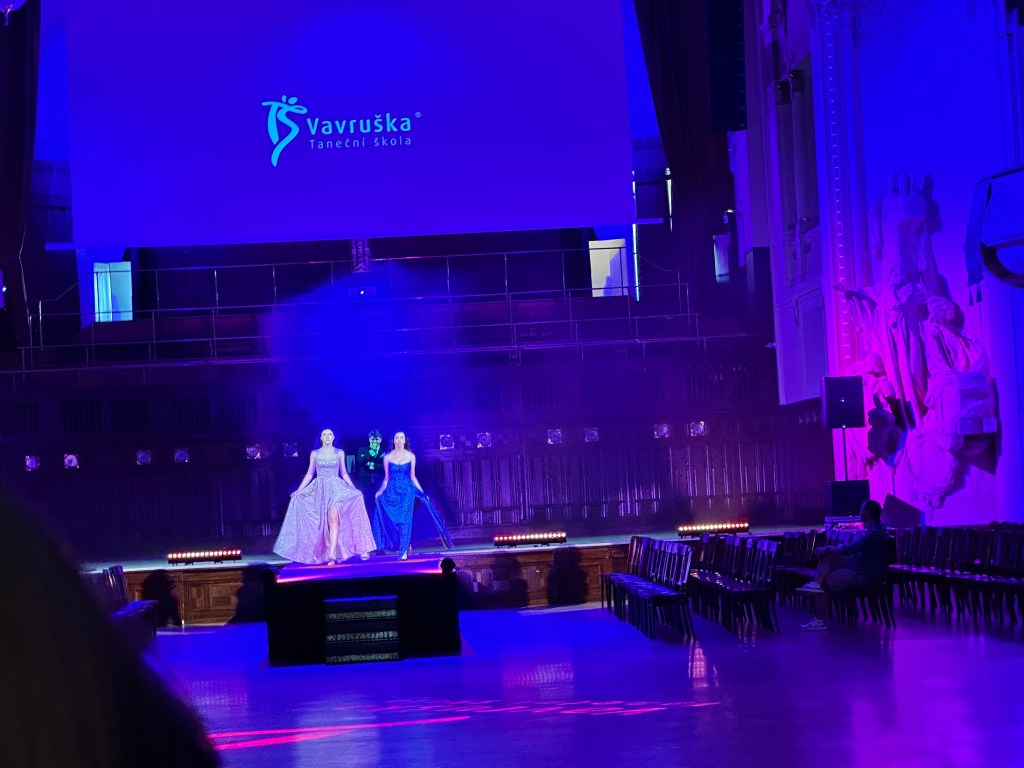
If Art Deco is your “thing” be sure to tour the Municipal House, which is LOADED with art deco treasures.
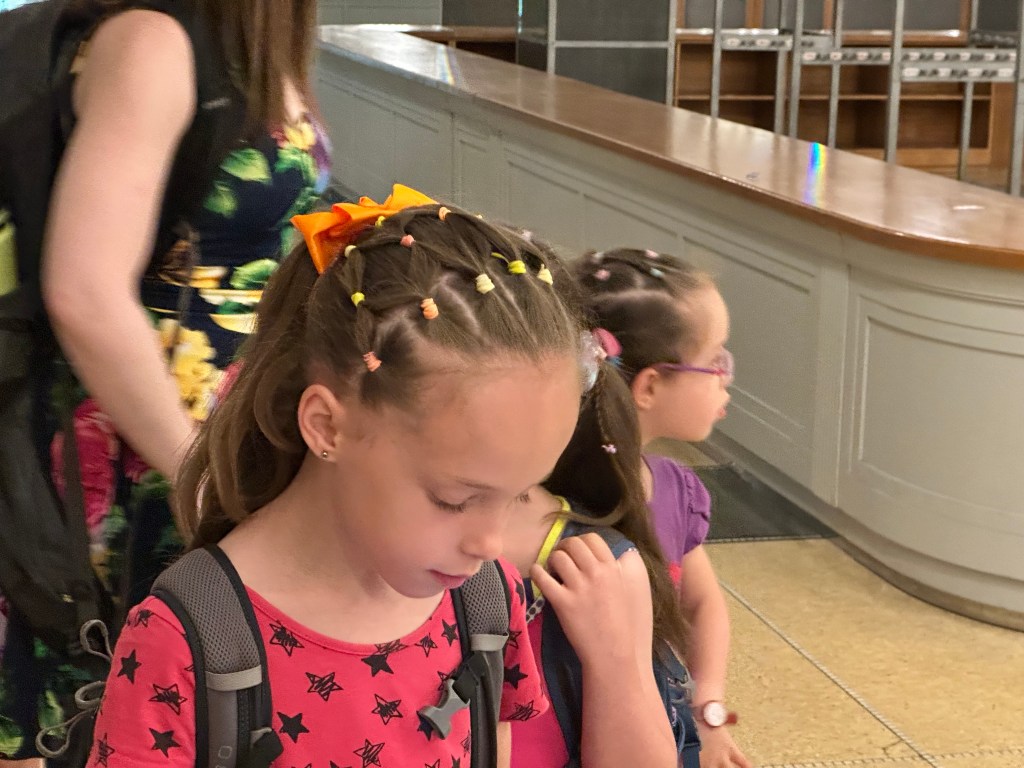
We were lucky enough to be there to catch a fashion show rehearsal, but I found the hairdos of the three little girls on the tour equally fascinating. I can’t imagine how long it took their mom to create those designs on her little girls’ heads!
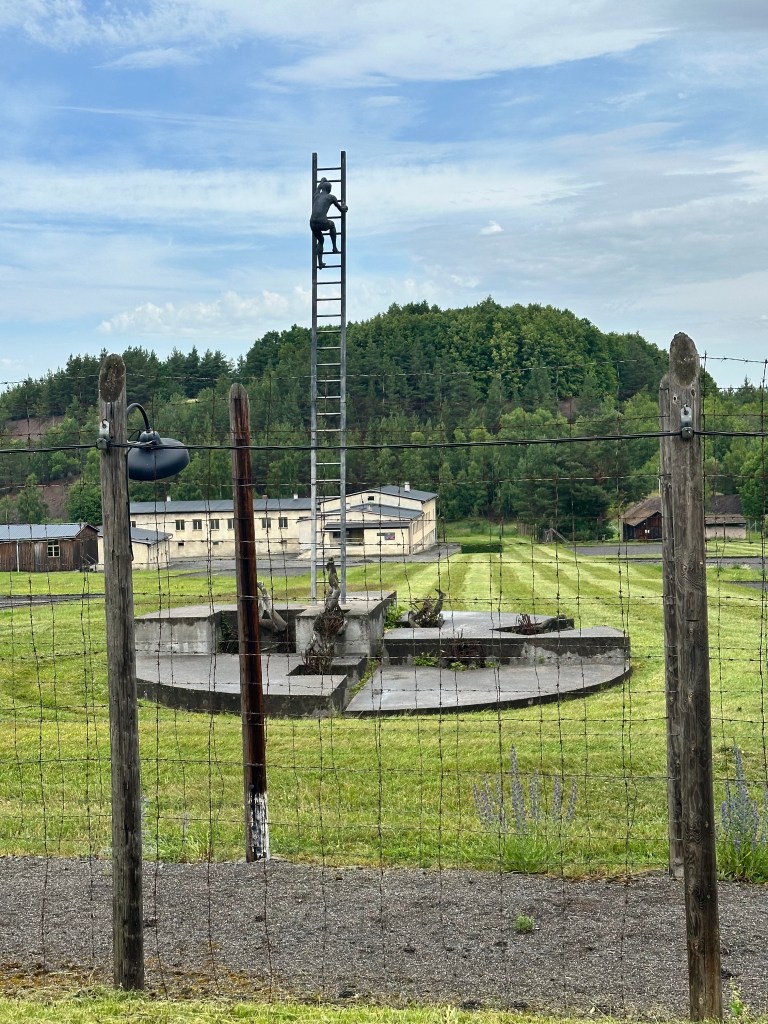
After three days in Prague, it was time to move on to Cesky Krumlov, but on the way, we had another grim stop, this time to a Soviet prison camp in Vojna. It was originally build by German POWs as a labor camp near the uranium mines, but then transitioned into a Communist labor camp for political prisoners. The poor Czech people were getting hammered from extremes on the left and the right!
I visited Cesky Krumlov with VBT, but the emphasis was clearly on biking. It was nice to have time to explore the city on foot. Because I have discovered I have a strong preference for the OAT itinerary, I’ve decided that my biking days are over.
The hotel that OAT chose, the Ebersbach was perfectly located, so that we could walk everywhere. The included breakfast sucked, but the location was perfect and my room was lovely.
OAT gave us a voucher for entry into 5 area museums and enough free time for us to enjoy them on our own. Barb and I visited four of them, skipping the monastery.
Of course, after we had visited the Castle Museum, we had to climb to the top of the tower for a panoramic view.
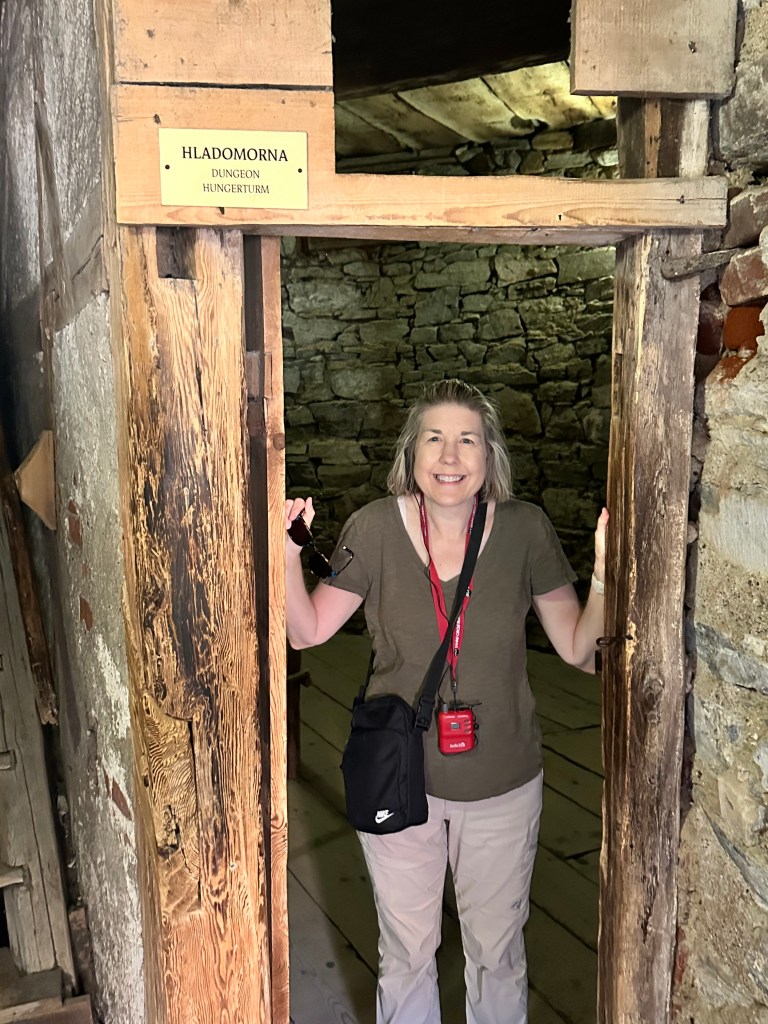
Let me tell ya, it was NOT an easy climb up those narrow, uneven stairs. Barb stopped to explore the dungeon and I caught my breath while I was taking her photo.
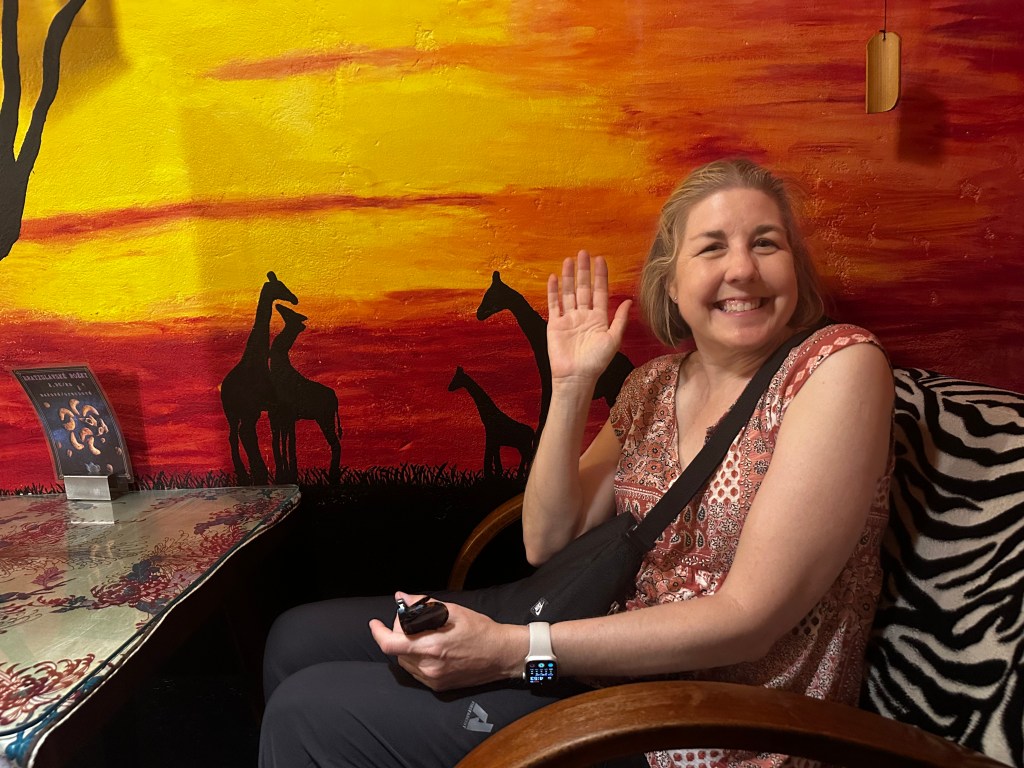
Bratislava The next country we visited after our adventure in Slavonice, was Slovakia. I absolutely LOVED Bratislava. Where else can you have tea in a bomb shelter that has themed rooms? Can you tell that Barb and I were in the “Africa” room?
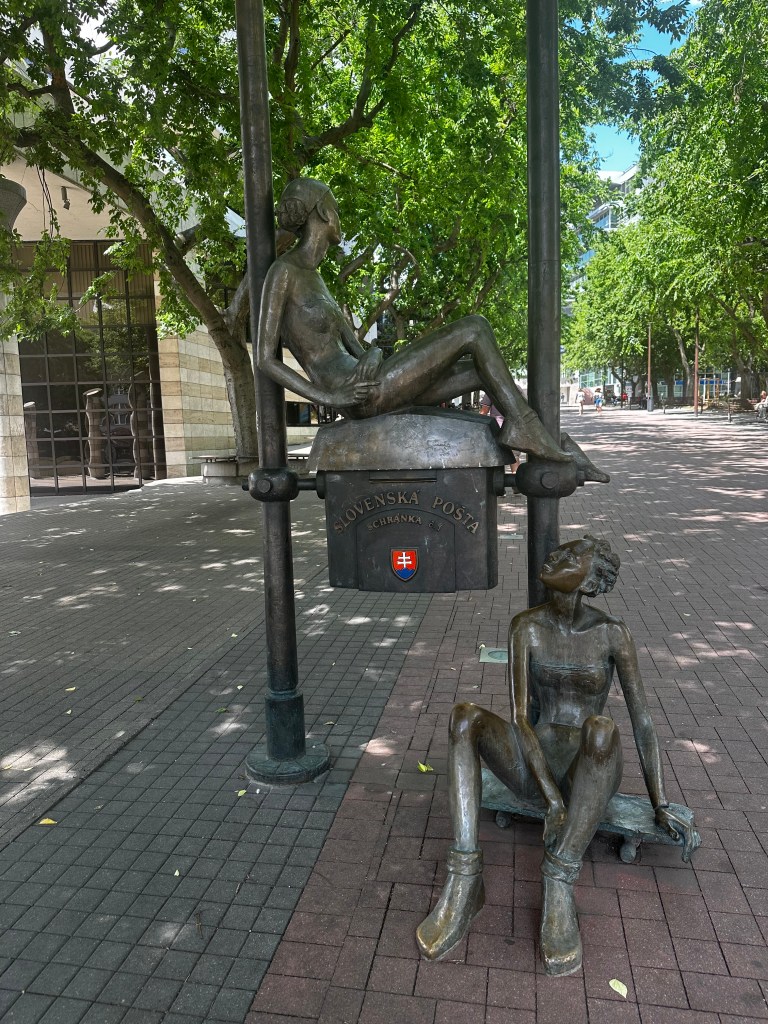
Whimsical art was EVERYWHERE in Bratislava. Check out their postal box. Now THAT’S creative.
I LOVED the Slovakian sense of humor!
As usual, our drive to Budapest was broken up by an interesting stop. This time, we visited Roman ruins at Carnuntum. Mike would have been in his glory here, but since I didn’t have him to explain the historical impact of this site, I had to rely on our guide and the signage.
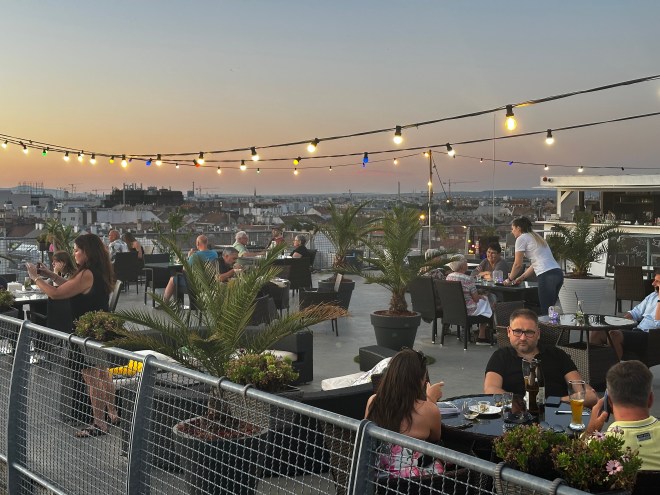
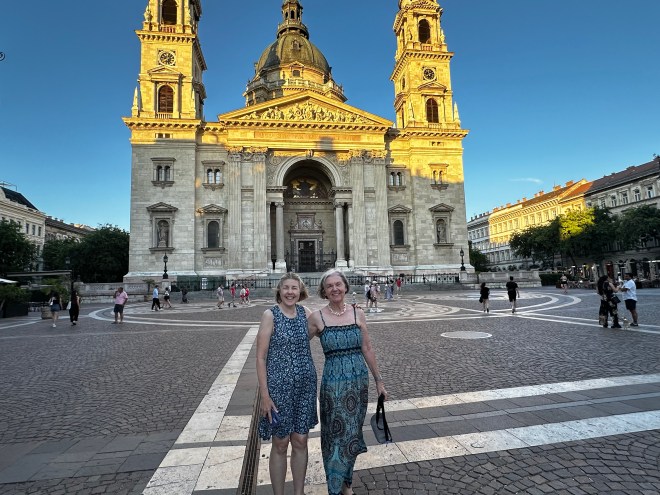
Budapest It is almost time for me to leave for the airport for the next trip, so Budapest will not get the attention it deserves. What a wonderful city! Not only was the Hotel President Budapest well located, but the delightful rooftop bar was the perfect gathering spot from which to watch the sun set.
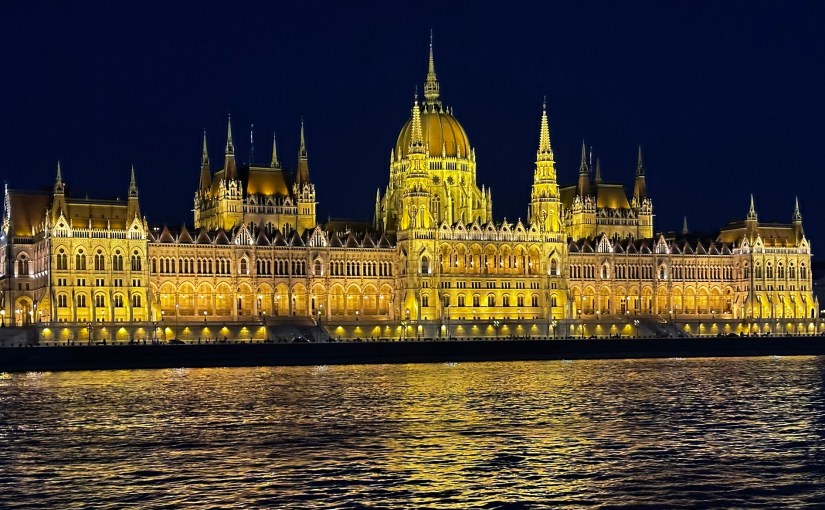
Speaking of sunset, we also experienced the Danube by night. The photo atop this post was taken on our evening cruise.
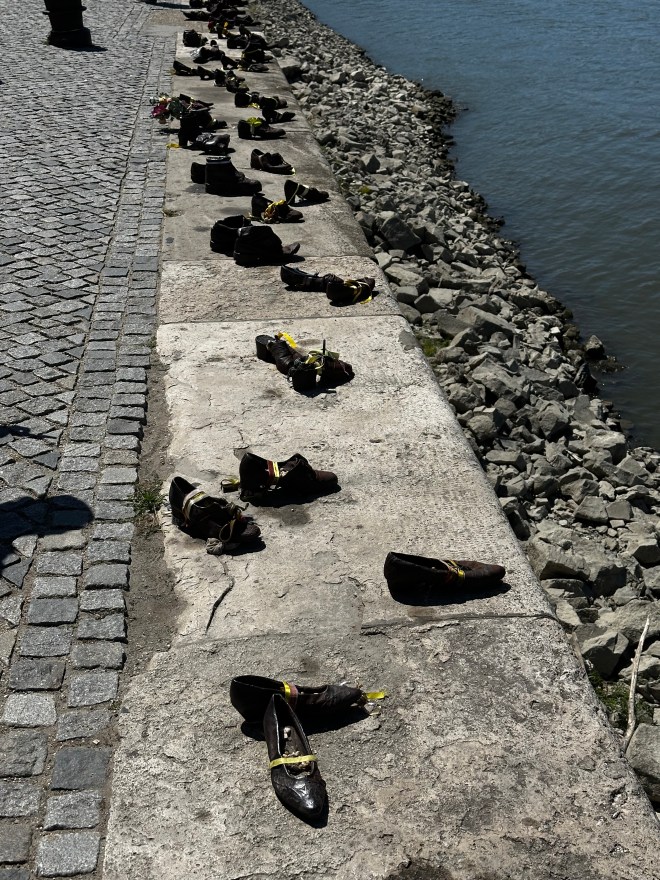
As was the case with the other countries we visited, Hungarians don’t shy away from the hard lessons of the past. This shoe monument memorializes the Jews that were forced to line up along the Danube, strip naked (during the winter) and hold hands. The Hungarian Nazis wanted to conserve bullets, so they only shot the second or third person, and because they were holding hands the others were pulled into the water by the ones that had been shot.
We were able to walk just about everywhere, which is probably why I didn’t gain my usual 5 “trip” pounds.
I have been lucky to find interesting companions on all my OAT trips. And this was no exception. For one of our nights in Budapest, Barb and I had dinner at a nearby restaurant with our new buddies, Linda, Marleen and Gail.
I had expected more reverence to be shown to Ronald Reagan because of his “Mr Gorbachev, tear down the wall”speech. FINALLY, as we were getting ready to head for home, we encountered a statue in his honor.
After he stole my hat, Ron got a little free with his hands, so I had to give him a karate chop.
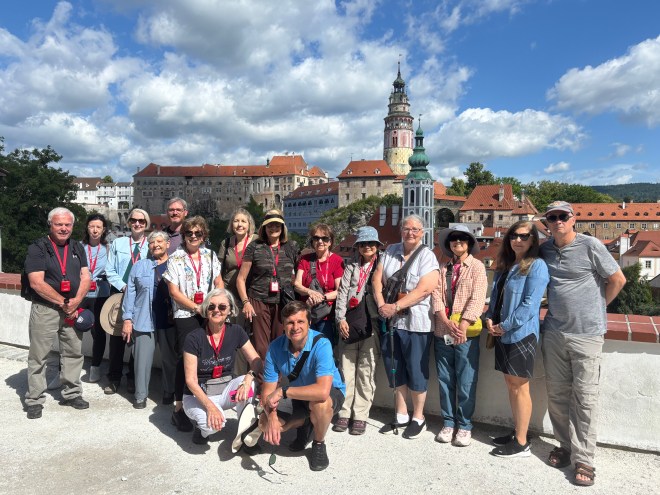
I’ll end this saga with a group photo. Next trip— Canada. I hope you’ll come along!
Our group: front me and Tomas Back row:Bill, Gail, Brenda, Jan, Brian, Diane, Barb, Marleen, Linda, Amy, Darlene, Patty, Lynn and Greg
What? You never hear of Slavonice? Neither had I, until this trip. Centuries ago, however, Slavonice was a “happening” place. On the road between Prague and Vienna, it was a popular overnight stopping point for travelers.
Check out the “graffiti” that still exists on the buildings in “old town”.
One of the reasons I keep choosing to travel with OAT is because of hidden gems like Slavonice, places I would NEVER have discovered on my own.
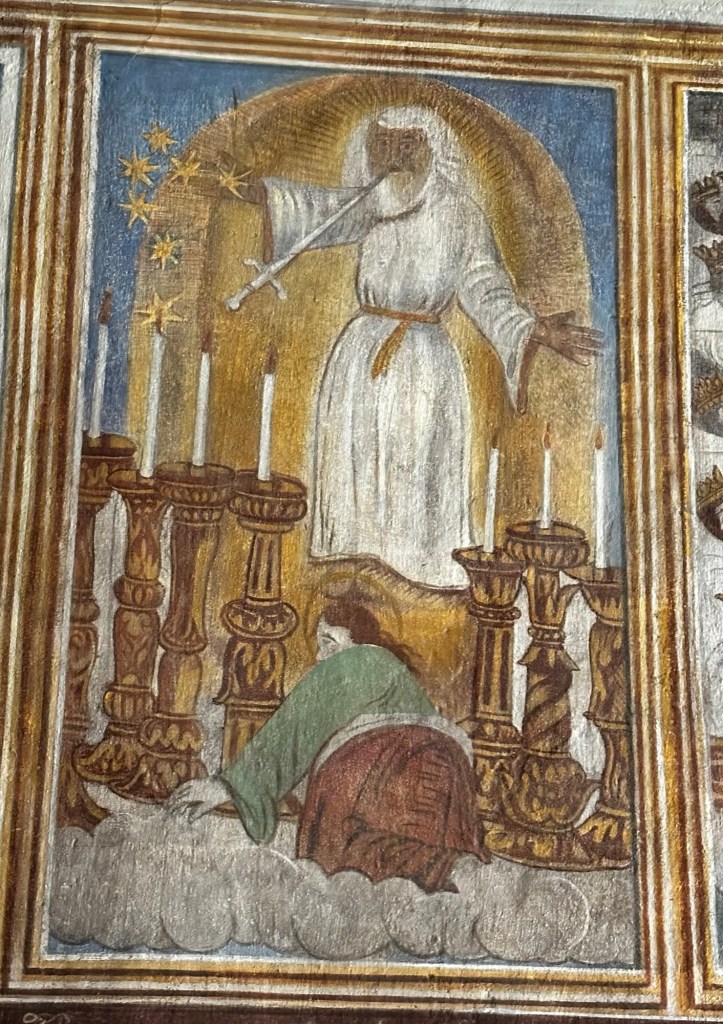
We were able to visit a beautiful restored building that was once used as a gathering place for the Lutherans. Supposedly this artwork illustrates that Jesus’ word is more powerful than the sword. Clearly this artwork was done well before both world wars.
Can you believe the ceiling in this building? How did they DO that?
We were the only guests in a lovely little hotel in old town, complete with a restaurant and wine cellar.
Here is Pavel, the owner, chef, wine merchant, cleaning crew, sommelier, ( he’s EVERYTHING!) greeting Tomas, our guide and welcoming us to his hotel.
Our first evening was memorable indeed. The town lost electricity during a hailstorm and with roads flooded, Pavel had to figure out how he was going to feed us. Fortunately, his wine cellar was very well stocked, so in addition to soup and bread we were offered unlimited beverages. SOME of us took FULL advantage of what life had thrown our way.
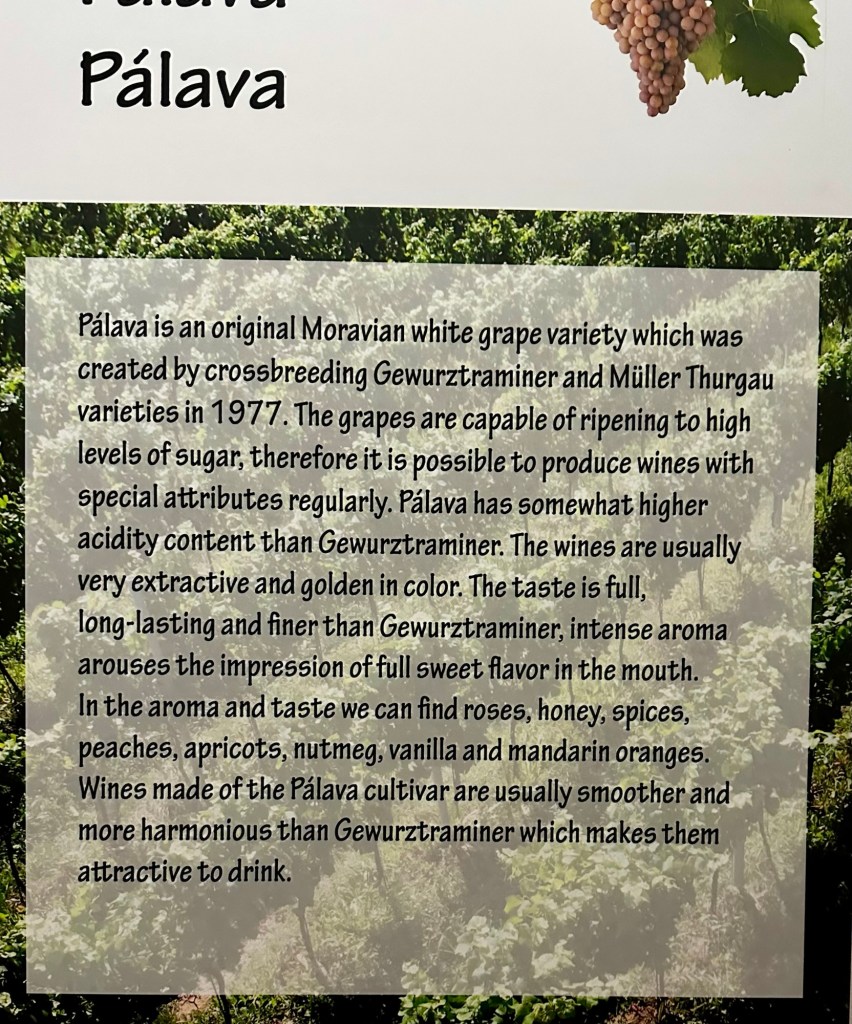
I took these photos of posters outside my room especially for my favorite sommelier (he knows who he is).
We were lucky that the 13th century wine cellar didn’t flood. The water from the storm that DID make it into the building had receded enough for us to enjoy a wine tasting on the second night of our stay.
The fact that the ceiling was dripping on us didn’t dampen our spirits one bit.
Yes, we are all bundled up— it was COLD in the centuries old basement.
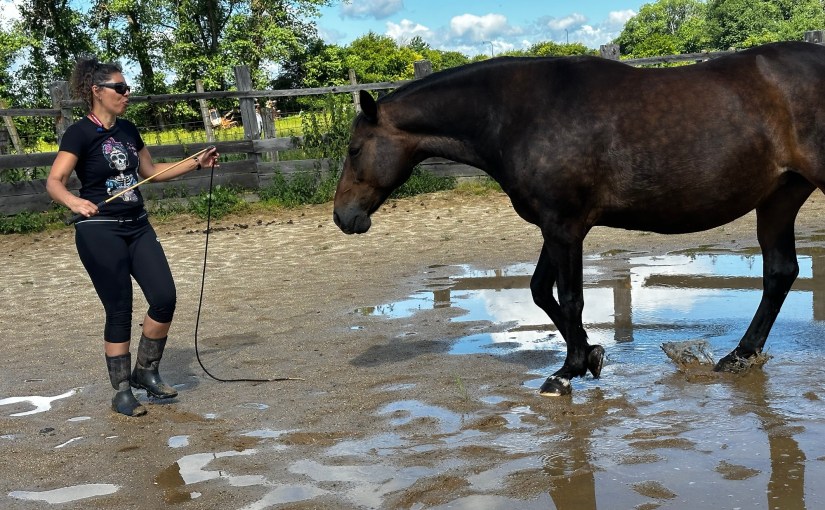
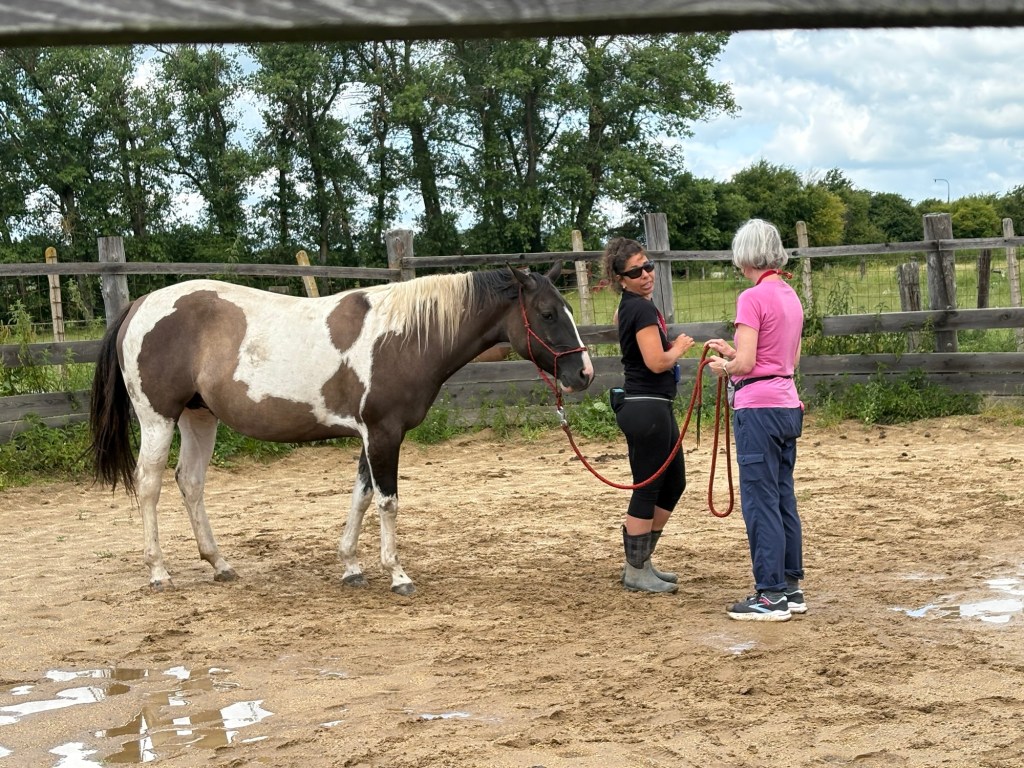
But once again, I’m getting ahead of myself, talking about dinner before describing our “day in the life” experience at a farm about an hour’s drive from Slavonice. Olga, our host, runs a horse farm.
Like my wonderful cousin Kristy, she provides a home for horses that can no longer be ridden. Her oldest horse is 30, which is significantly more than the average life span of a horse.
In addition to breeding horses, Olga also works with horses that are thought to be “difficult”. She demonstrated how she communicates with them using only her eyes and fingers. When she asked for a volunteer to learn the technique, I thought I was going to have lots of competition. I thought wrong.
Could the amount of water and mud have been the reason for my companions reluctance?
Being the ONLY volunteer, I got to get up close and personal with this magnificent creature, who was once thought to be “difficult”.
Olga is demonstrating the proper shoulder technique to get the horse to follow you. Nailed it!
Yes, our day time activities were fantastic, but there was even more awaiting us.
That night, we had the PLANNED dinner at the hotel,
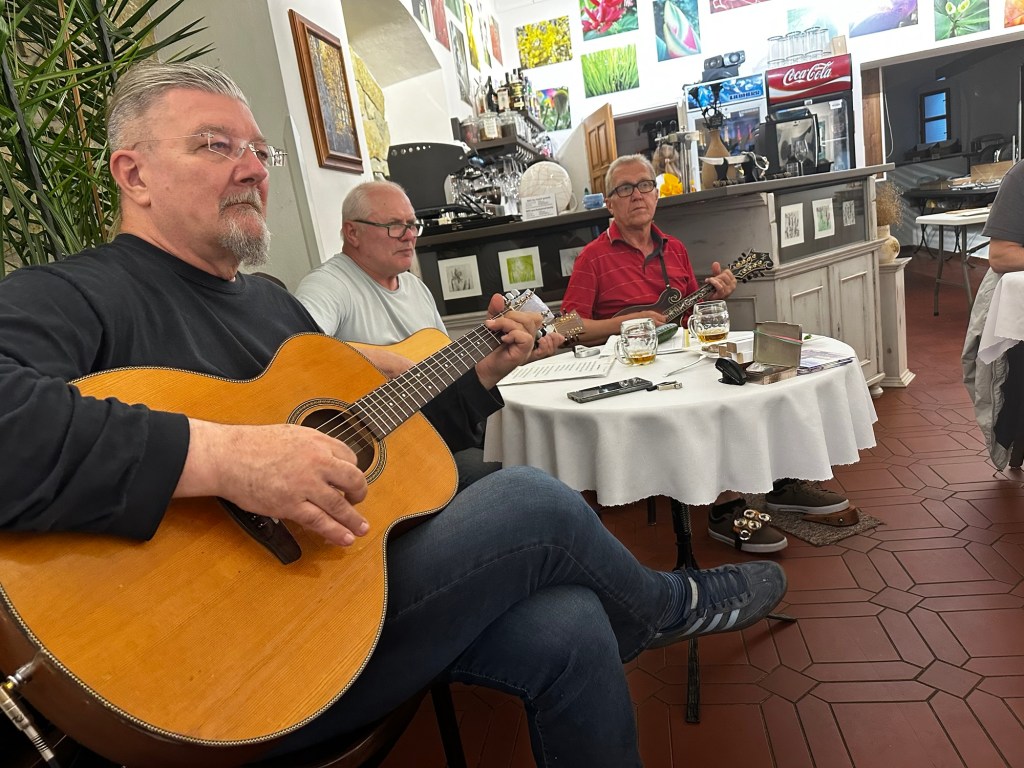
complete with local musicians who got us singing along to “Country Roads” and “Roll out the barrel”.
Of course, the wine flowed freely, but the show stopper was when our host used a sword as his bottle opener.
On to Bratislava. Yes, I know. Add Cesky Krumlov to the list of places I’ve skipped over.
What a delightful surprise our lunch stop in Pisek turned out to be!
This blog is not a chronological record of my OAT itinerary. It continues to be whatever I feel like writing about. And I feel like writing about this sweet little undiscovered town.
We’ve been to Dresden, which was our final stop on the pre-trip, then we spent the first three days of the main trip in Prague. Both of these fascinating cities deserve posts of their own, and I’ll get to them eventually. There have just been far too many distractions for me to give them the attention they deserve.
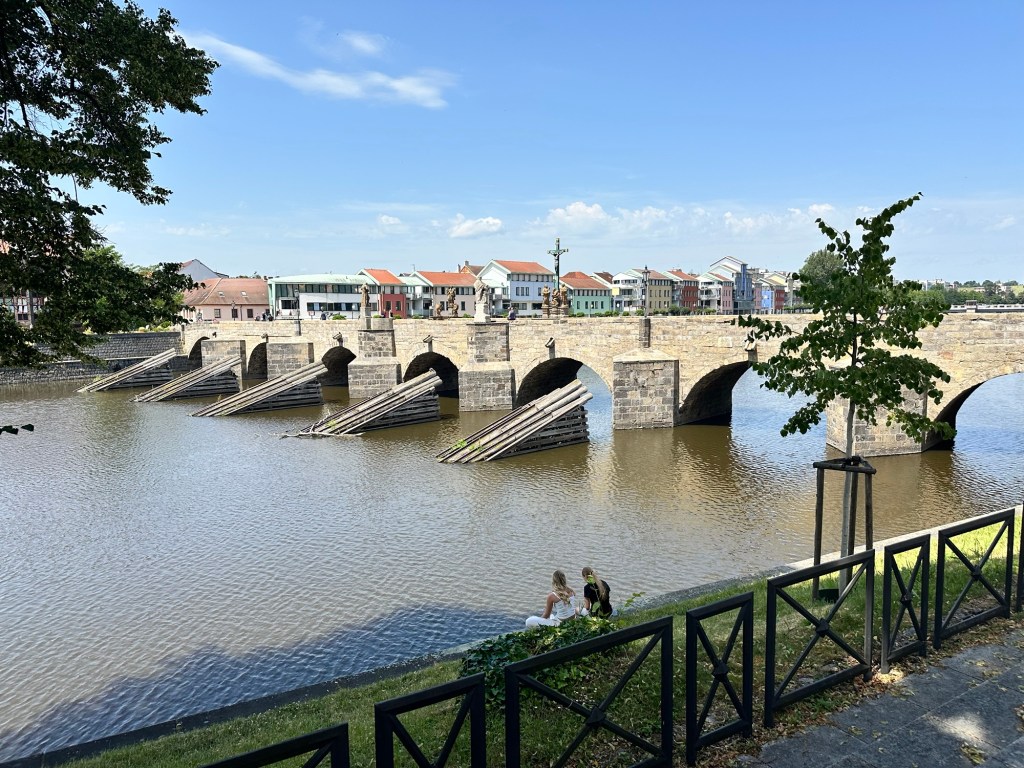
Pisek is quite beautiful. Its old stone bridge predates Prague’s Charles Bridge by at least a century. Somehow, the bridge managed to survive several centuries worth of floods. The statues on the bridge weren’t so lucky. The originals were damaged and have since been repaired or replaced.
Don’t be fooled. Pisak also has MODERN attractions, like this one. I’ve seen pedal bars in Nashville, but I never have seen a Prosecco van. What a great concept!
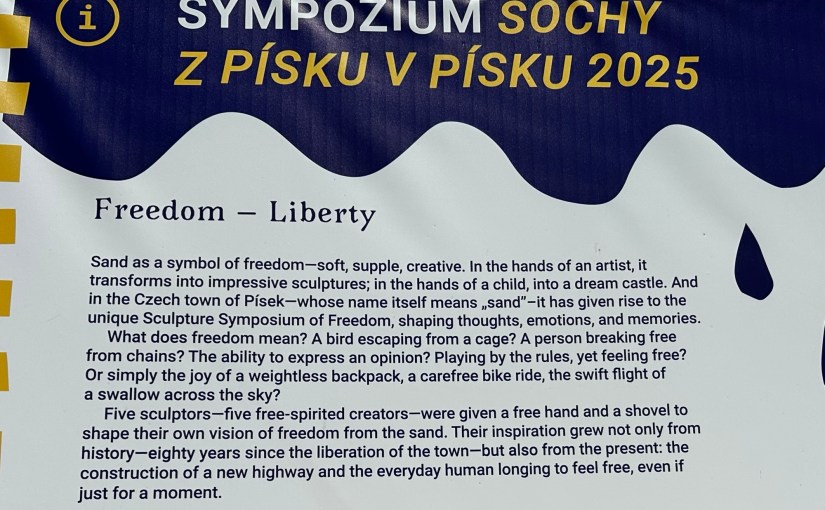
Despite this vehicle’s obvious appeal, I found the sand sculptures even more compelling.
The header on this post describes the theme for this year’s sand sculptures — Freedom and Liberty, intended to commemorate the town’s 80th anniversary of their liberation after World War 2.
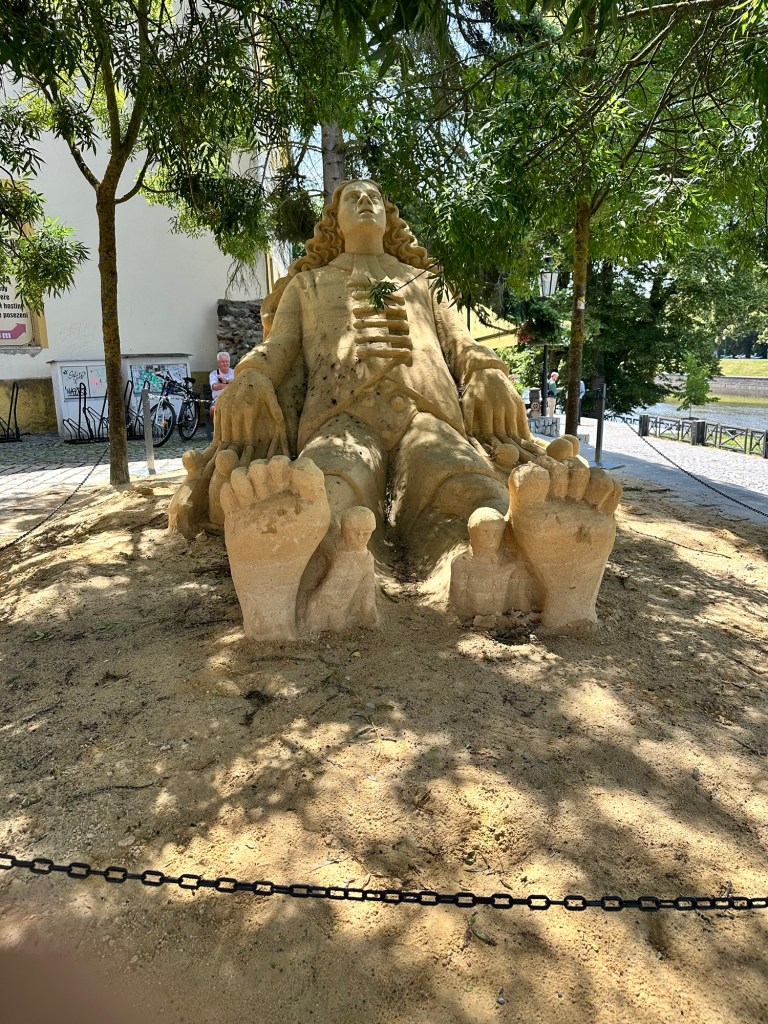
Did you recognize Gulliver, struggling to break free?
Lady Liberty has packed her bags. I’m hoping she’s not leaving the USA.
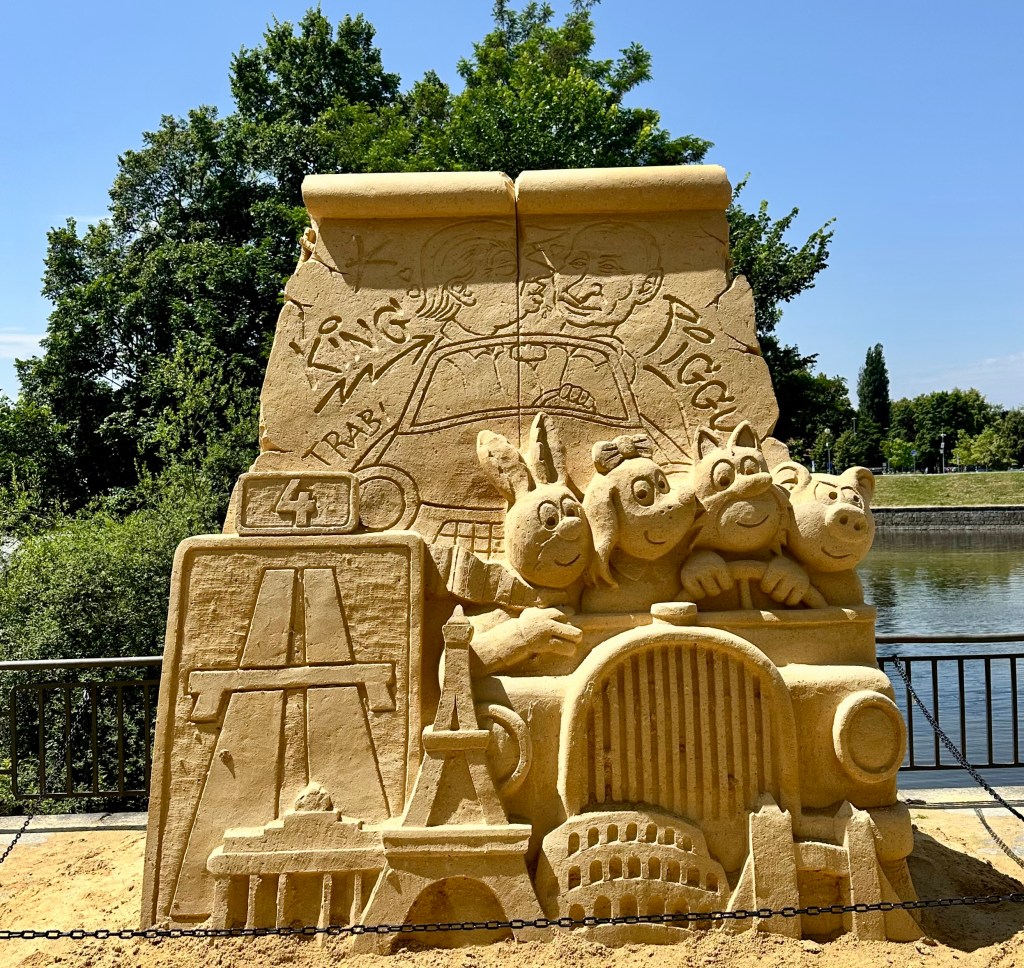
To me, the most compelling sculpture was this one, especially after being in Berlin. What a powerful demonstration of how much JFK’s words meant to the people in this part of our planet. .
Then I took a good look at the front of the sculpture. It shows Putin driving a car manufactured in East Germany by the Soviets. The Trabant had an engine that was likened to a lawn mower—about as powerful and just as smelly. East Germans would use trabants to escape to the Czech Republic, and then abandon the car in the street.
Take a close look at who is kissing up to Putin. Clearly he is not in the driver’s seat.
If you don’t recognize the iconic hair style, the sculptor has given us a hint. He has “king” written alongside his image. ( I would have added “wannabe” before the word “king”).
Why is it that Europeans can see so clearly what many Americans cannot? Perhaps because they have lived through Facism and Communism, they have a deep understanding of how fragile democracy can be and how important it is to preserve it, in every means possible, including the creation of sand sculptures.
My last post was about Berlin’s tragic past, and how frightening it is to recognize parallels to what is happening in the world now.
Today’s post is about Berlin’s glorious present and how it is making me optimistic about the future for our entire planet.
First, many thanks to my dear friend Chris and her wonderful sister Claudia for their very helpful suggestions on how to best use our time in Berlin. Thanks to them, we knew we needed to get tickets for the Reichstag tour at least a month in advance. For those of you not lucky enough to know Chris or Claudia, here’s the link for the free tour, in English: https://www.bundestag.de/en/visittheBundestag/dome/tours
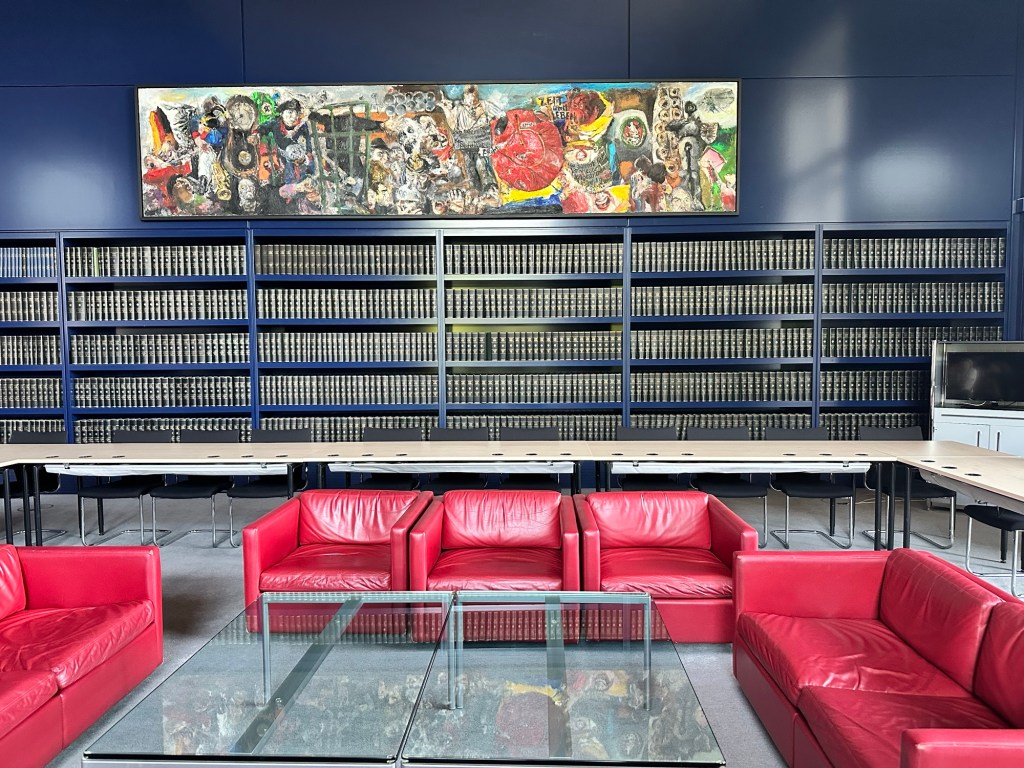
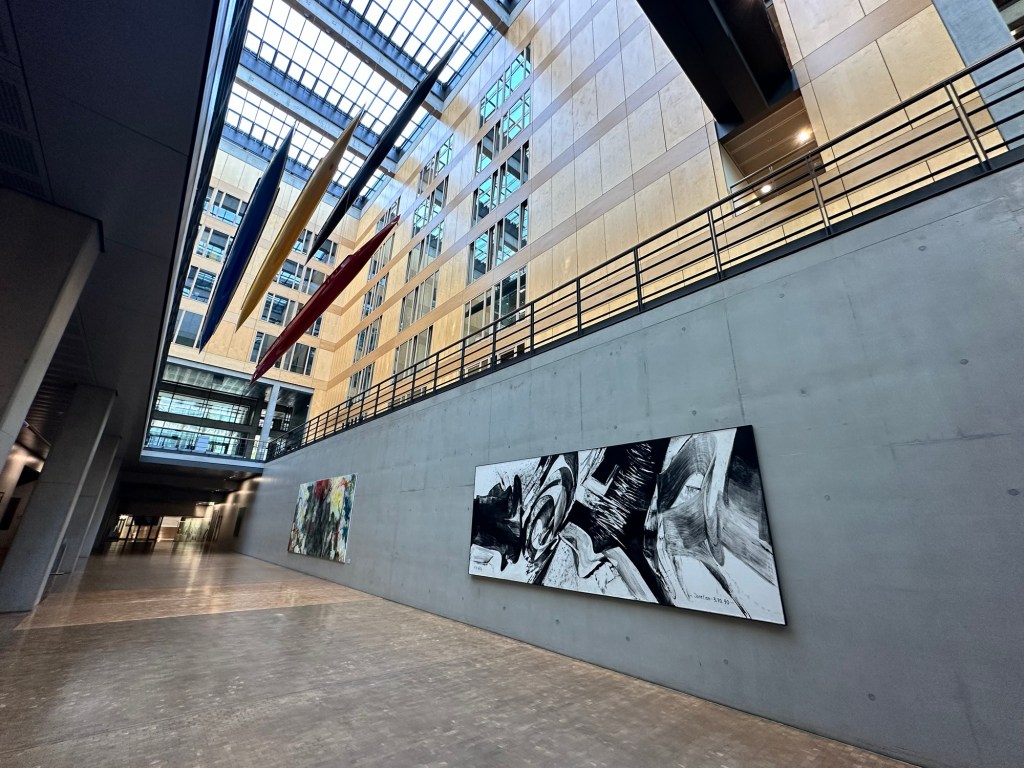
The Bundestag building itself is architecturally gorgeous, filled with interesting artwork.
Our guide was a retired lawyer, who explained that although, prior to Hitler’s rise to power, Germany considered itself a democracy, it really wasn’t, because half of the population wasn’t allowed to vote. I wish I could remember her exact words because she said it far more elegantly than my paraphrase, but here’s the gist of her comments regarding women voters: They expected women to be grateful when they “gave” us the right we had been denied for so many years.
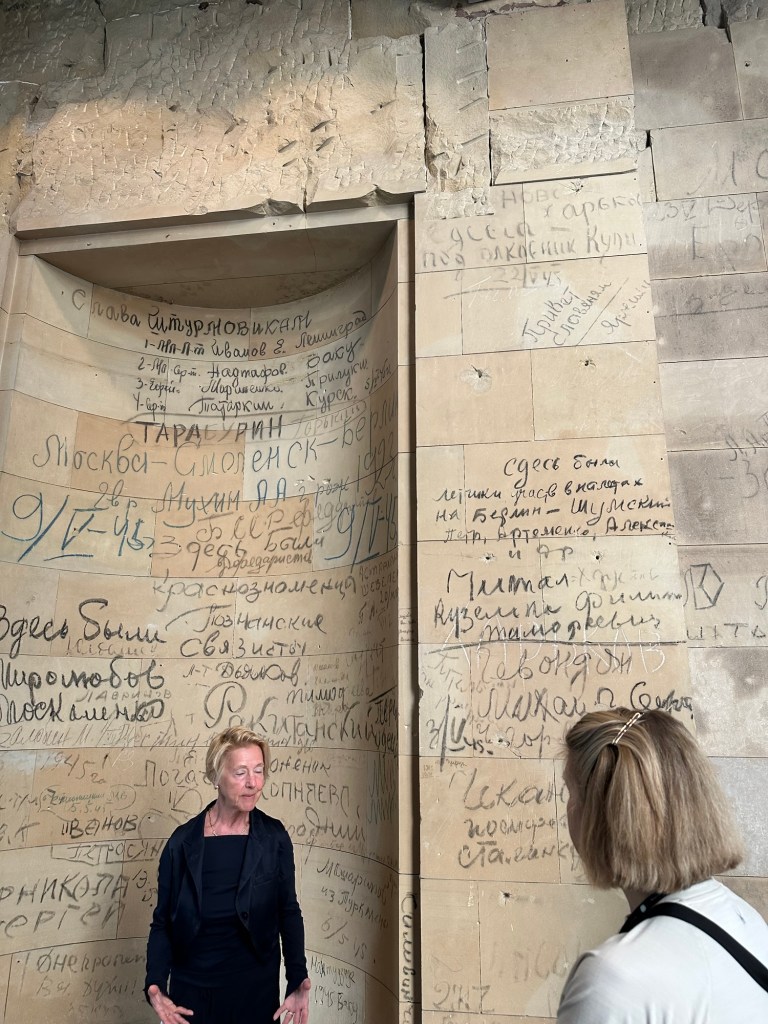
Here she is, explaining why the Russian soldiers’ graffiti in the Reichstag was preserved when the building was reconstructed after unification. (Once again, not a direct quote, just what I remembered her saying).
Imagine you are a young Russian soldier who spent the last few months being shot at and bombed. You have survived so far. You reach Berlin, but are still not safe. You want to leave your mark so that others recognize that you once existed.
The Germans left the graffiti so, to me, it has become a symbol of the compassion the Berliners felt for young Russian boys who were drafted and forced to kill young German boys.
She also gave us information about the way the German government currently operates, but because I wasn’t as interested, I promptly forgot everything she said.
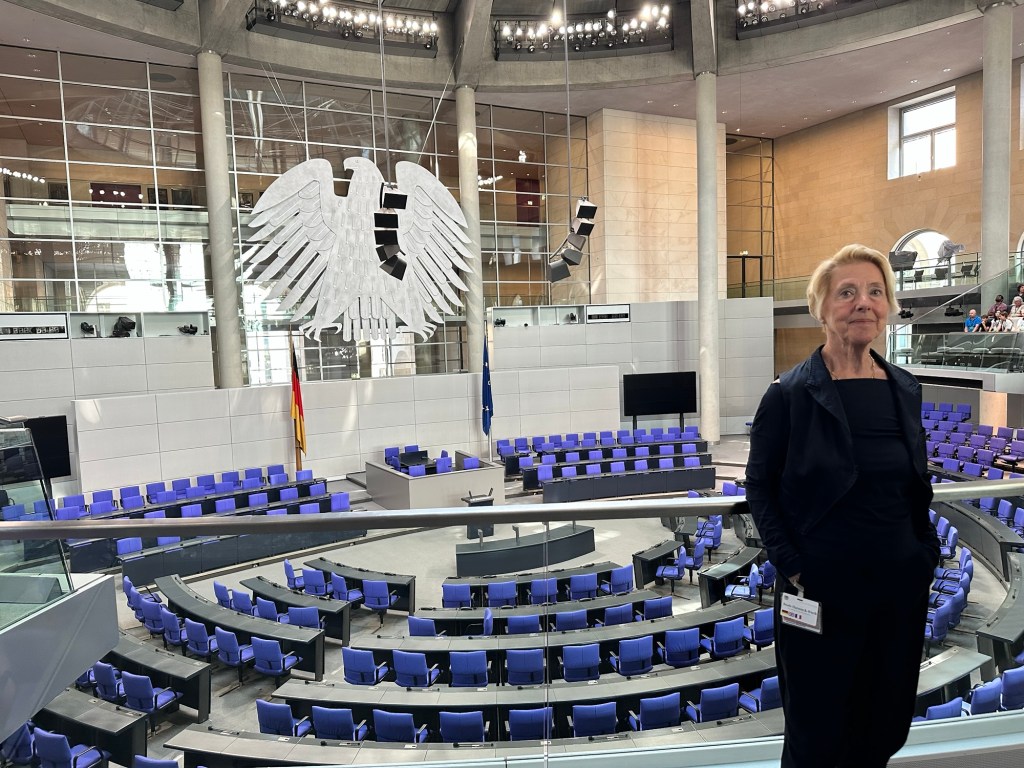
I was, however, fascinated by the eagle on the wall behind her. That eagle hung in Bonn, when it was the capital of West Germany. It was installed at the reconstructed Reichstag after reunification.
I was also fascinated by the interior view of the dome from the parliamentary meeting room.
After the 90 minute guided tour, we were able to enter the dome and walk up the spiral ramp to the top.
The mirrors in the center reflect light into the building below.
I found it fascinating that the dome is completely open. What happens when it rains or snows? Inquiring minds want to know, so I asked one of the guards. He told me the top remains completely open, but rain only falls on the very top level, where drains capture it and carry it out of the building. Damn, those Germans are great at engineering!
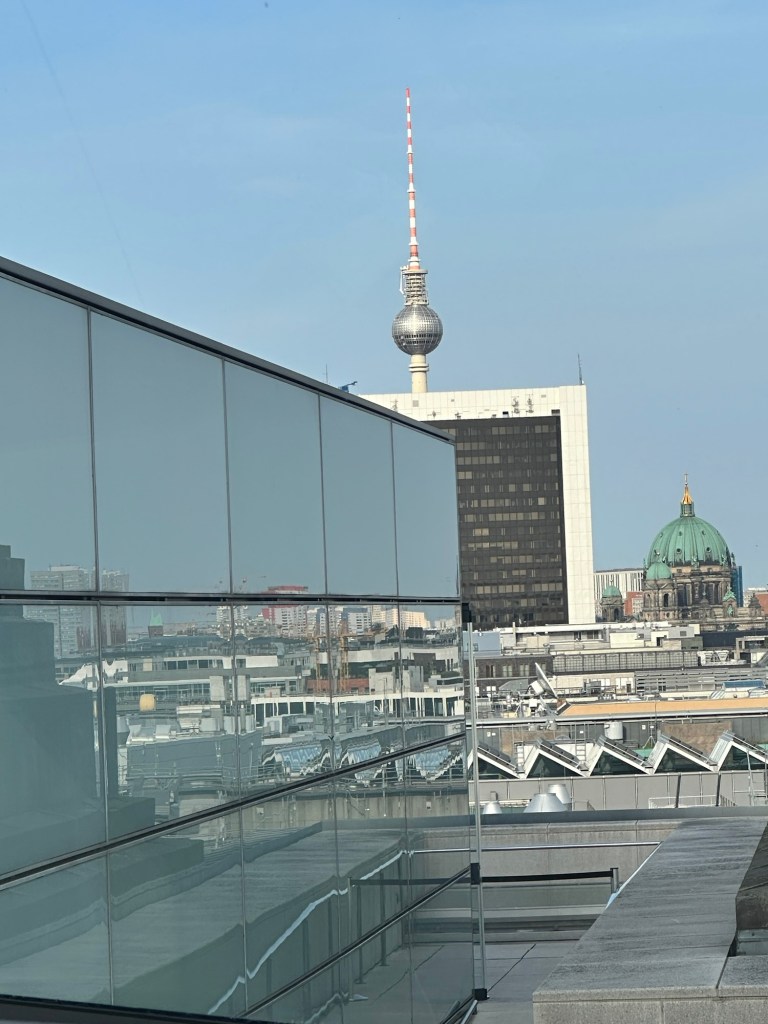
From the Reichstag dome, we were able to see the TV tower. It was the proud creation of the Soviets in East Berlin, intended to demonstrate the superiority of Soviet construction. After reunification, however, the world had access to Stasi documents that showed most of the materials used to build the tower had to be imported from the west.
During our city tours both guides talked about the symbol of Christianity (a cross) appearing on this godless tower. We were completely mystified, because it was impossible for us to visualize anything that remotely resembled a cross. FINALLY, during our stroll around the dome, the sun was in the right position, so I hope my photo allows YOU to see it too.
If my personal astrophysicist had been by my side, he would have explained the scientific principles behind the phenomenon. Instead, I went with Barb’s explanation: it is magic.
Anyone who has read any of my prior posts knows that I cannot resist a tower, mountain, high point—anything that offers a panoramic view. Berlin has several, and we took advantage of every single one that we could find.
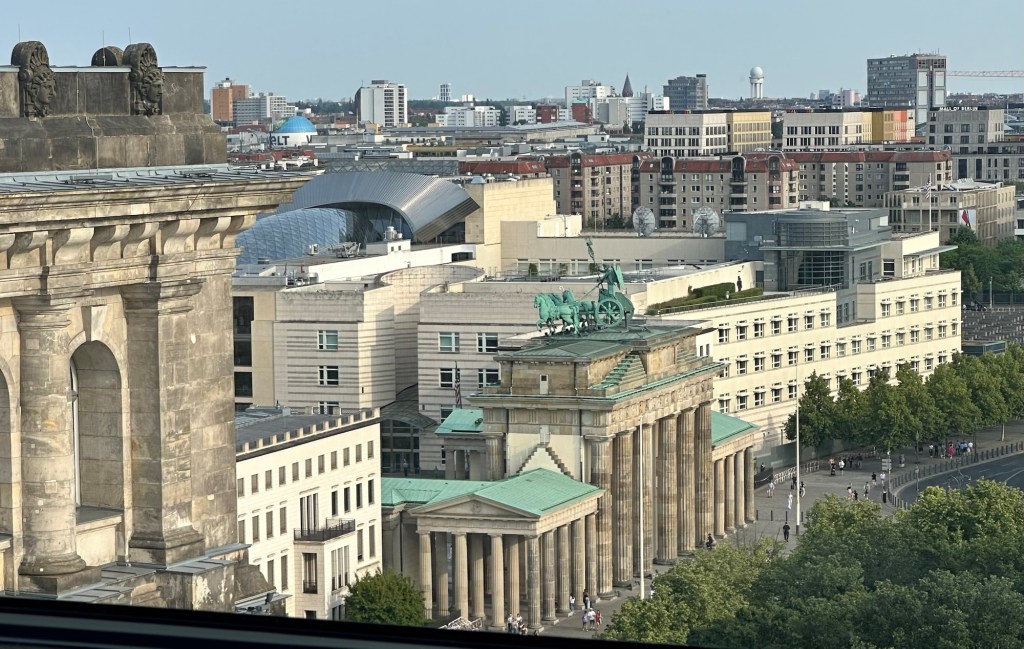
The view of the Brandenburg Gate from the dome
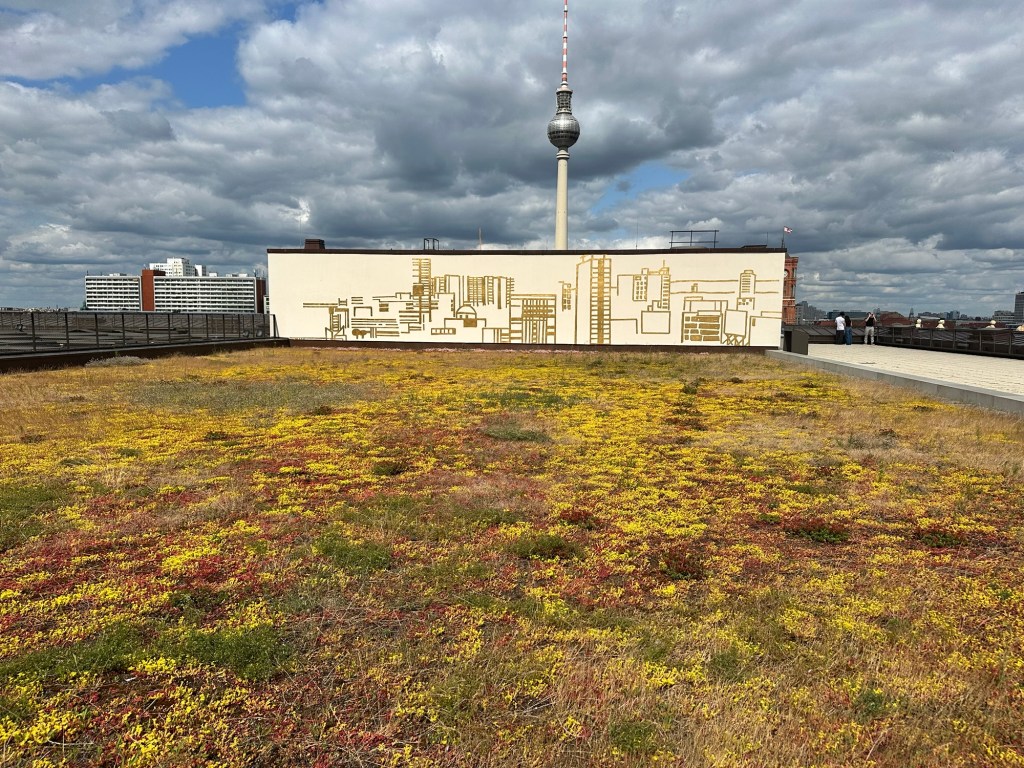
Our OAT trip leader suggested we visit the Humboldt Forum’s rooftop. In addition to the delightful cafe,
we were treated to another vantage point of the city.
Notice the roof of the Humboldt is planted with grasses and flowers.
The city was environmentally aware, which was so very encouraging to me.
None of the median strips were mowed. Instead, grasses and weeds were allowed to grow unhindered to protect and feed the bees.
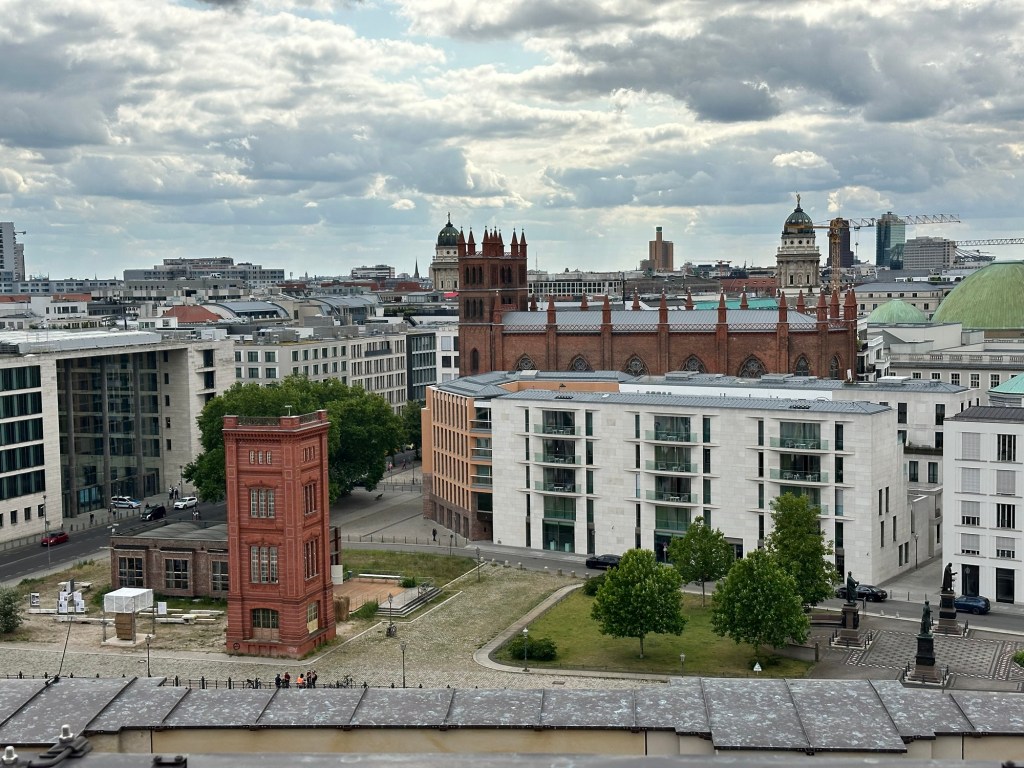
From our vantage point on the roof, we could see the sustainability display. That’s the reddish tower in the photo below, in which reclaimed materials were used to fashion new structures.
We ended our night with a laser show at the Reichstag, which was created to commemorate the 30th anniversary of Christo’s art project.
With travel, sometimes you hit and sometimes you miss. The laser show was definitely a miss, but the sunset was lovely.
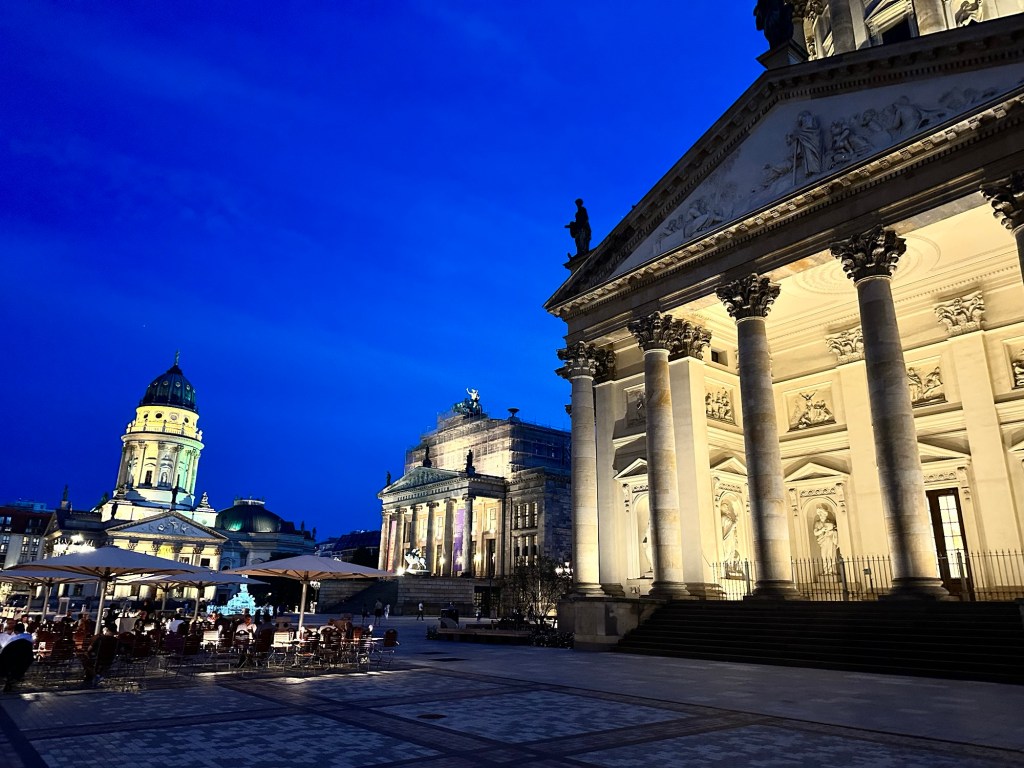
And the walk to the hotel gave us the opportunity to see Berlin buildings illuminated.