Every time I think this trip couldn’t possibly get better, it does.
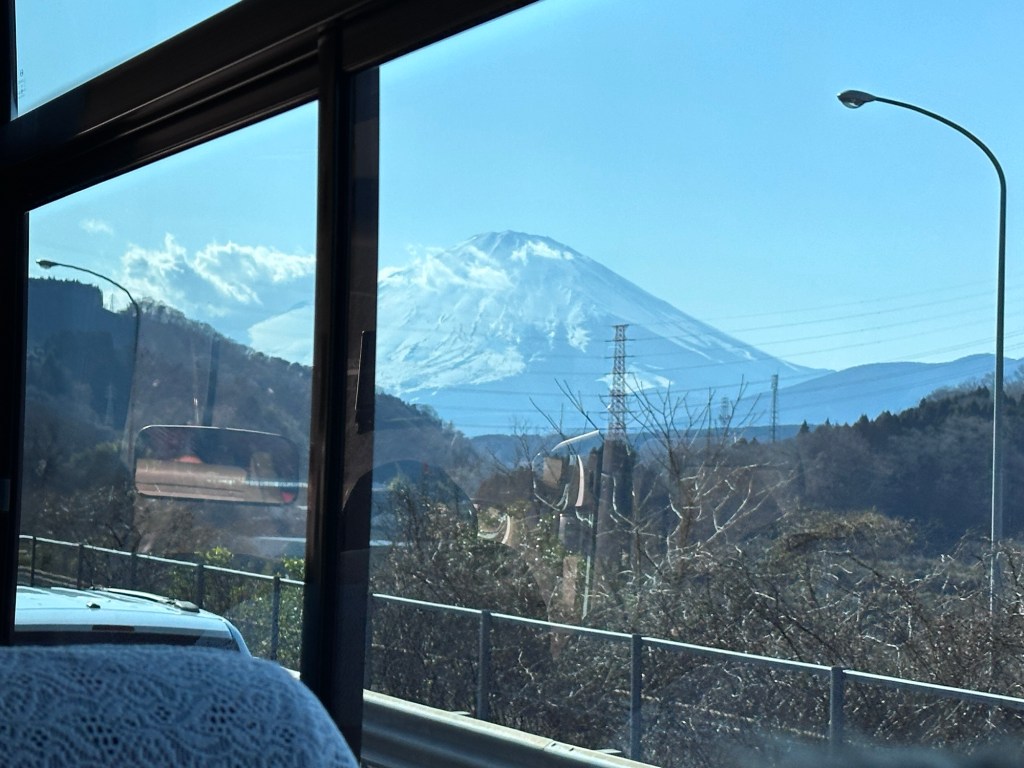
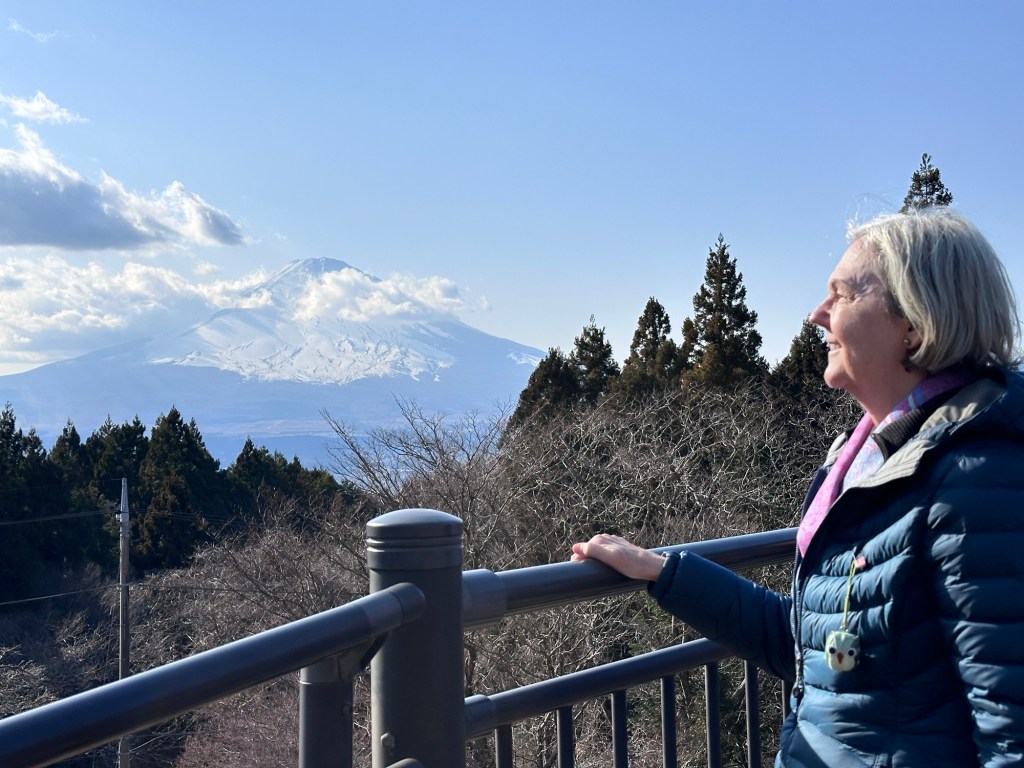
On our bus ride to Hakone, we were treated to multiple views of the elusive Mt Fuji. We watched as it progressed from crystal clear to cloudy.
10:30 AM at the rest stopThe clouds started rolling in around 3 PM. 3:30 PM. Our driver took us to this special look out that gave us a phenomenal view of the mountain.
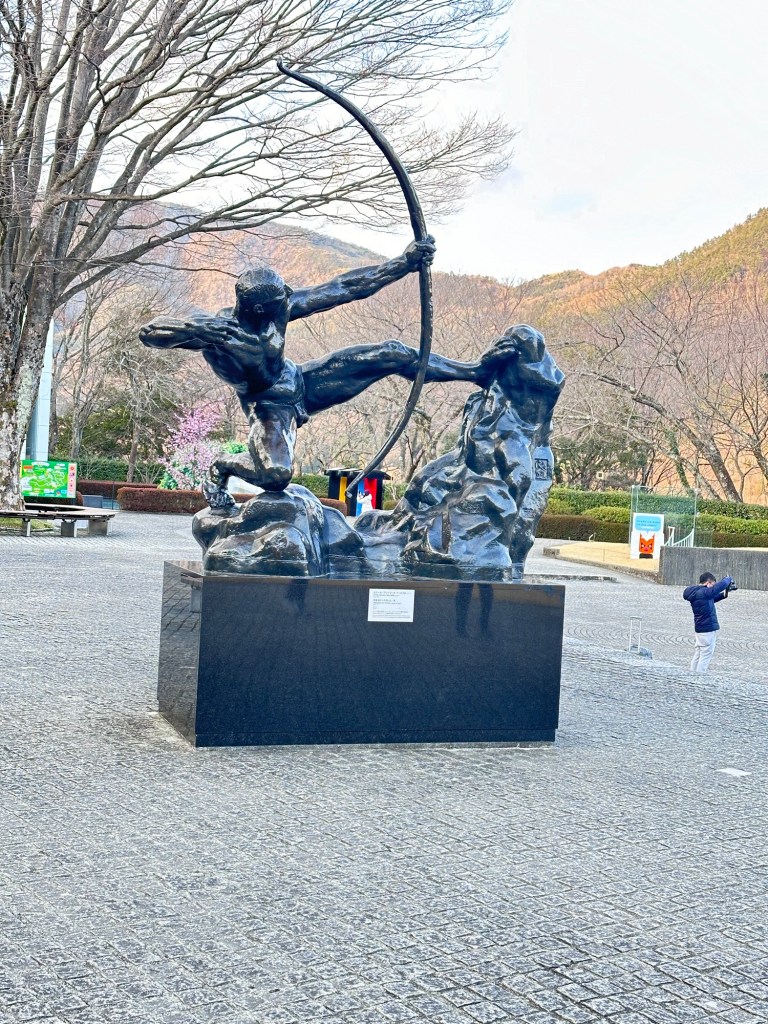
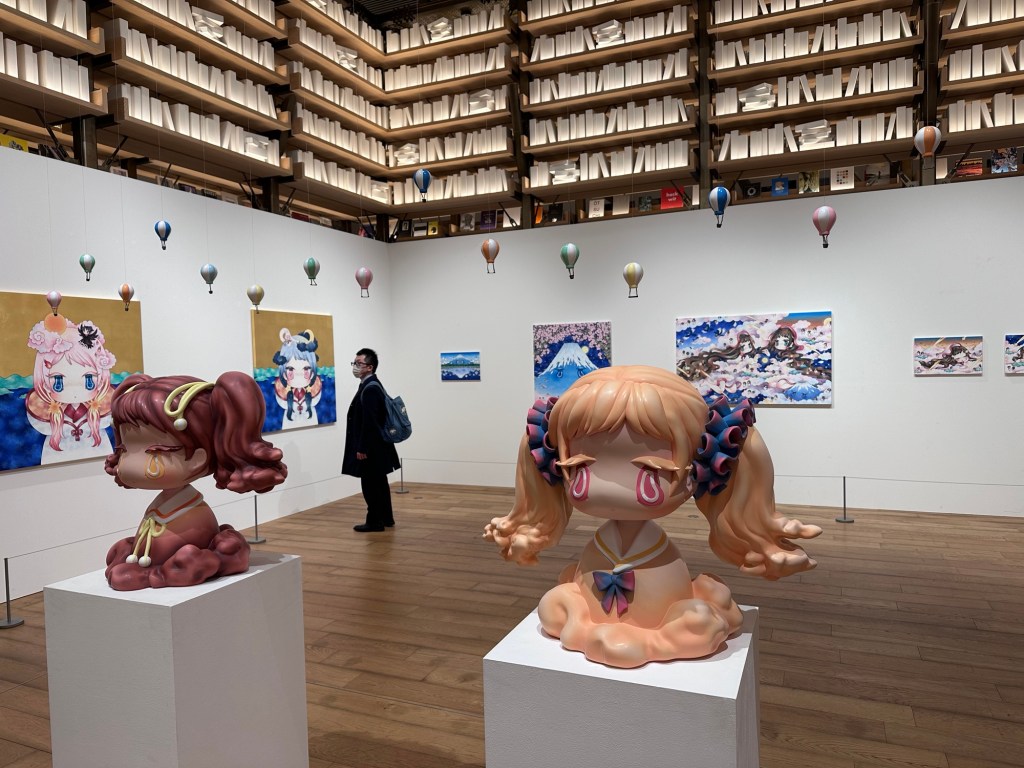
Although it is wasn’t on the itinerary, I had told Mori I really wanted to experience the Open Air Museum in Hakone and he made it happen. Turns out 12 out of the 14 of us wanted to visit. We made the most of our hour at the museum. Here are a few of my favorites.
It may not look like much from the outside but wait till you step inside.
But there was so much more to see, like this piece which was inspired by the myth of Narcissus.
The sculpture was trying to view her reflection in the water, but her tears were blurring her image.Can you believe how perfectly balanced that sculpture is? And check out the gorgeous setting.
We lucked out with the weather because our second day in Hakone was rainy.
Let’s get real here. After action packed days, how much night life do you think this jet lagged group experienced? If you’re looking for bar hopping photos, you’ve come to the wrong blog. At our ages, we are quite abit more sedate—at least so far. But we did still manage to pack in quite a bit AND be in our jammies before 10:00 PM. Here are just a few highlights.
Shopping Centers
You might think shopping centers are not very exciting. I would encourage you to think again. You see, SOME shopping centers in Tokyo have outdoor platforms which offer SPECTACULAR views, like this one, which overlooks the Imperial Palace.
Although can’t see the Imperial Palace, it is just inside that white wall and moat.Do a 180, and THIS is what you see.
A vertical mall is the best way I can describe Tokyo’s shopping centers.
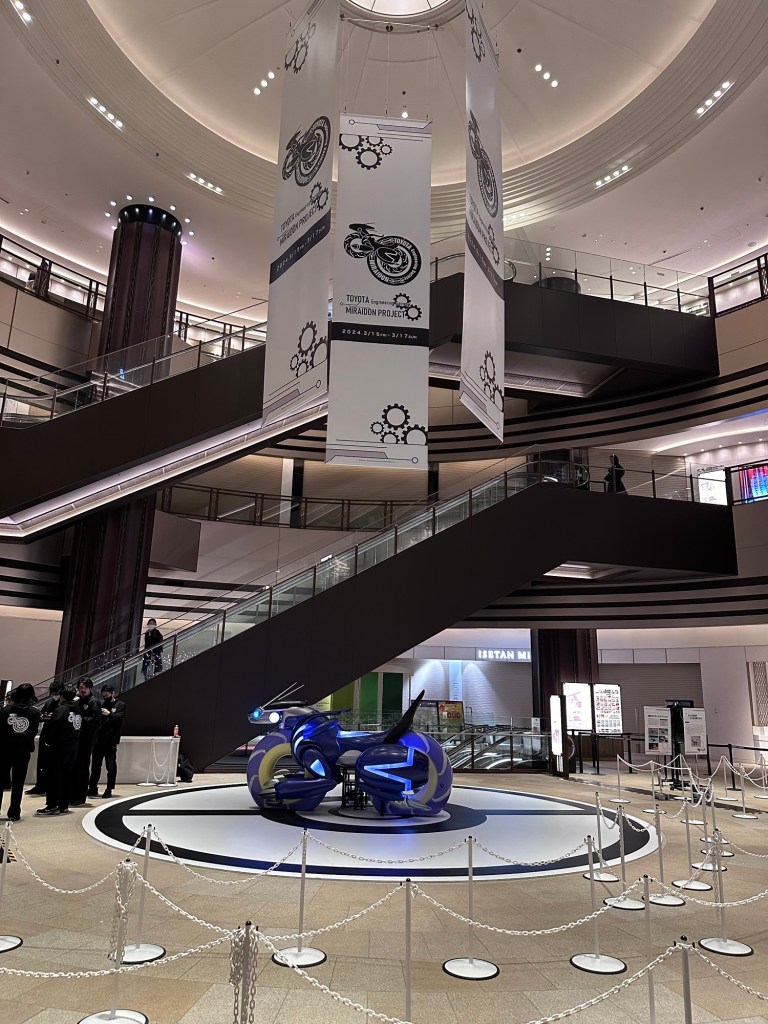
This one featured a particularly eye-catching mystery object. (At least it was a mystery to ME)
Having no clue what it was, I reached out to my Japan expert, 9 year old Oliver, who knew immediately that it Miraidon. Still in the dark, I consulted Ms Google, who offered further enlightenment. You are looking at a Pokémon character, which is also a drivable vehicle!
An up close view of Miraidon.
For those who wish to learn more, here’s the link.
The “malls” also house an abundance of restaurants. Our very congenial group has gotten quite efficient at selecting dining venues despite what has been a mind boggling selection. One night we had one of our best meals ever—delicious Wagyu beef. With our beverage of choice (mine was an alcoholic lemonade) my cost was $20.20 TOTAL ( I already checked my credit card online).
Sorry, no food photos. Did I mention my lemonade had alcohol in it? Knowing that, what do you think are the odds that I forgot a few possessions in the restaurant? Fortunately, a member of our group was on “baby sitting” duty that night.
I DID grab a quick shot of one of the floors while riding the escalator down. Why? Who knows. Blame it on the lemonade.
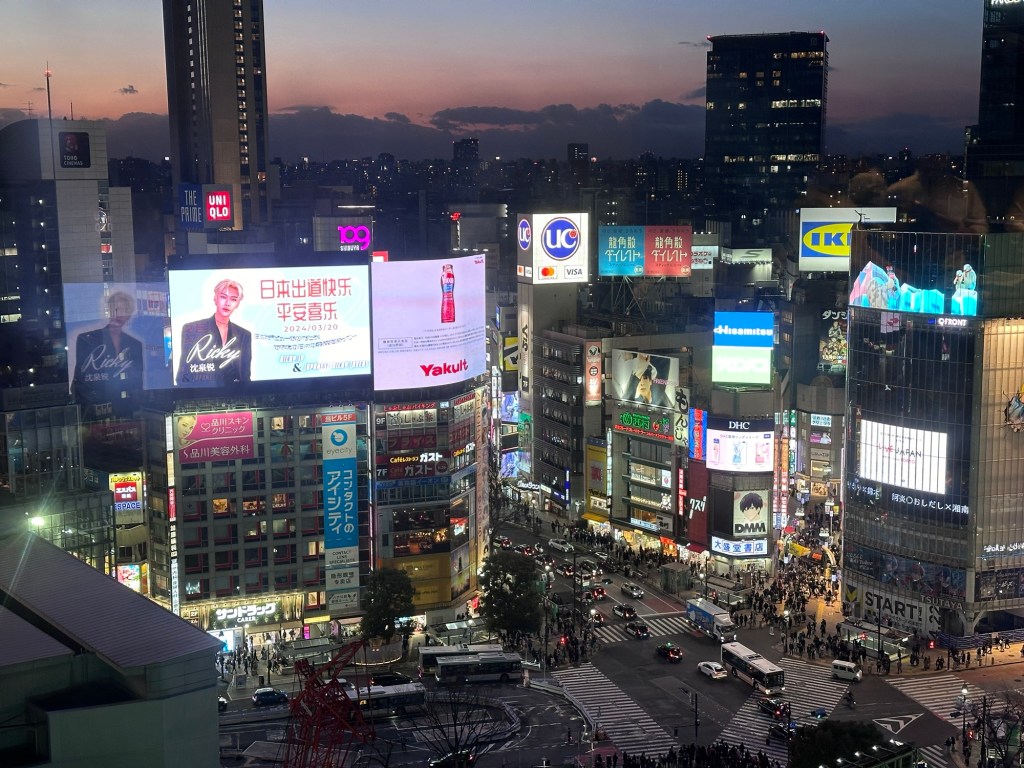
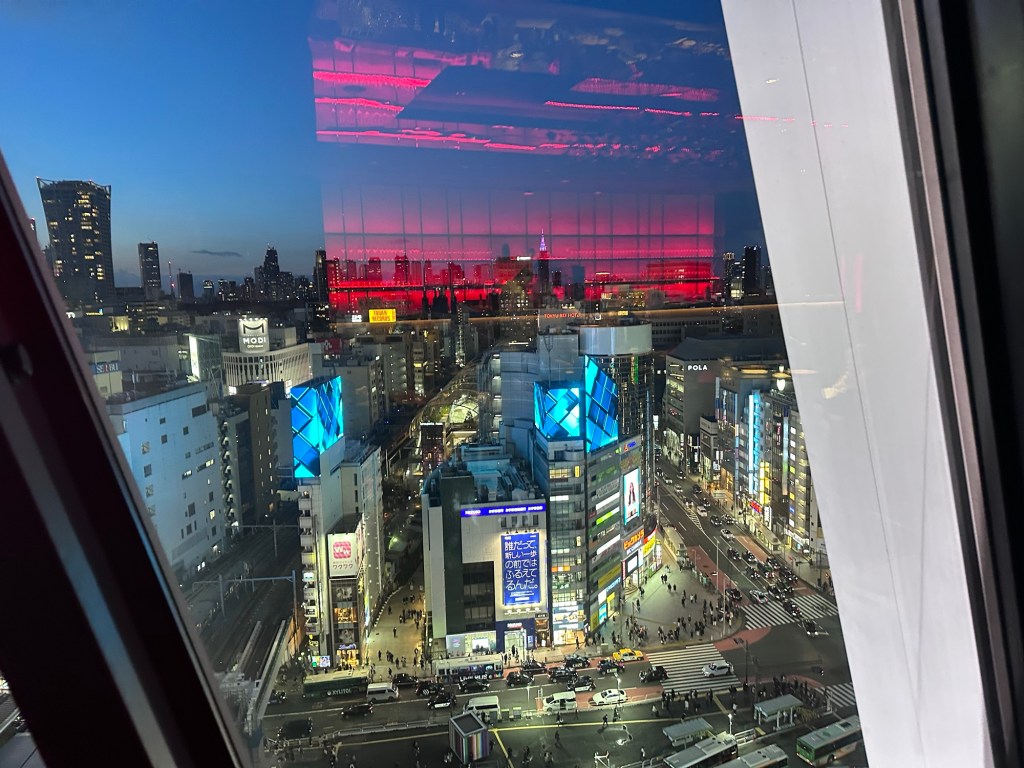
After visiting the famous Shibuya Crossing, four of us decided it was time for some fine dining, so we chose a restaurant with great food AND an equally wonderful view.
5 PM 6 PM6:30 PM, with restaurant’s interior reflected on glass
Mass transit experiences
I’d heard that Tokyo’s system is easy to use. Maybe it is, if you have no other options, but WE were lucky to have Mori, who gave us a tutorial on how to get from point A to point B. ( if truth be told, he needed to do it more than once for our group).
Mori very thoughtfully purchased subway cards for us, preloaded with enough credits to allow multiple subway rides. The expandable carrier he gave us is a major stress reducer for someone like me. Without it, I would have been frantically searching through purse and pockets every time I approached the turnstile.
Light show
Tokyo’s government building in Shinjuku is the largest projection mapping site in the world. It’s a free 10 minute show, playing every night between 7 and 9 PM.
Cruising the streets
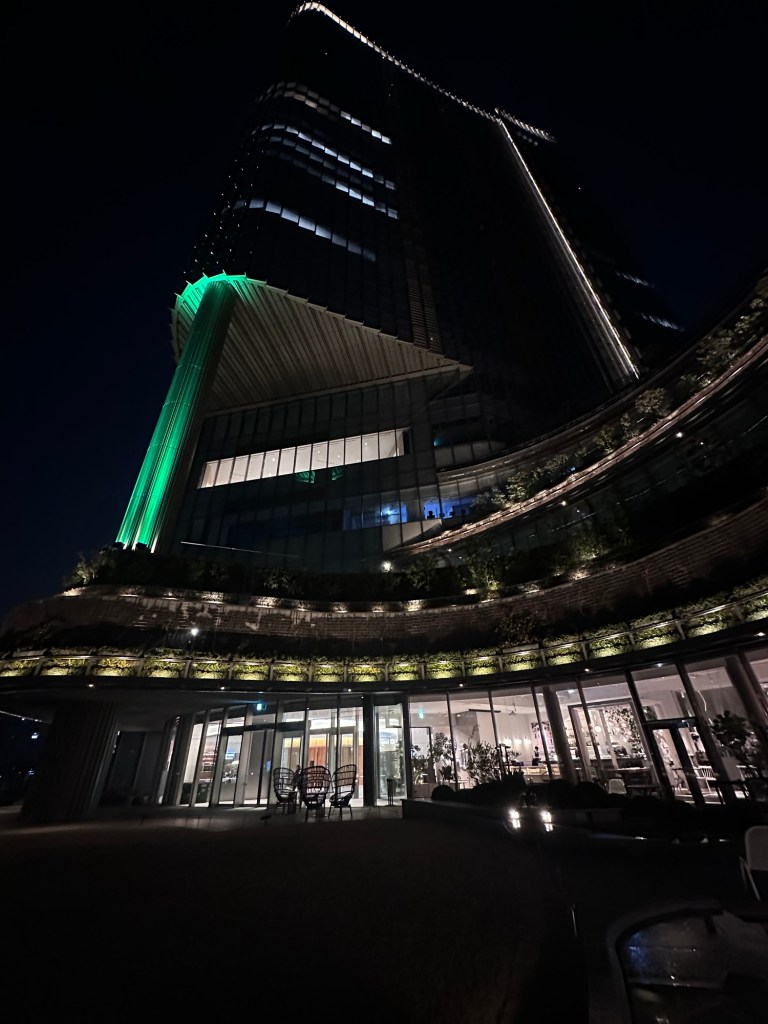
Streets are clean and safe and the architecture is breathtakingly beautiful at night.
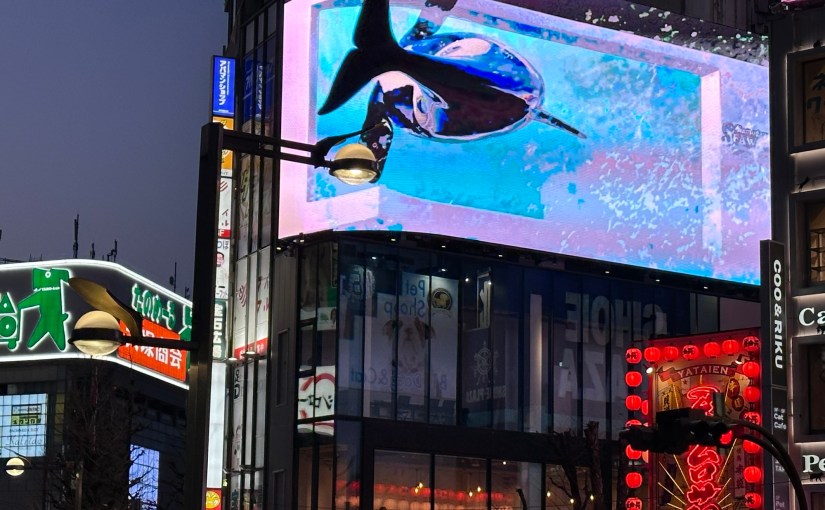
It might not be obvious from the photo below and the header on this post, but the video playing on the billboard is three dimensional. I was so mesmerized, it was time to cross the street before I thought “ Damn, I should video this for the folks back home”.
Remember the splurge meal I mentioned earlier in this post? What better way to end than with a photo of my dessert and Sally’s empty champagne glass? Maybe a photo of the 4 party girls taking mass transit home might be better, so I’ll throw them both in.
No only does Mori make sure we take the right train, he also is our photography pro.
Okay, so we may have gotten off to a rough start, but man oh man, Tokyo is so WORTH the 14 hours of travel (even with a three hour flight delay).
Seven of us eager beavers arrived a day before the pre-trip started, so usually that would mean we’d be on our own for the arrival night and first day.
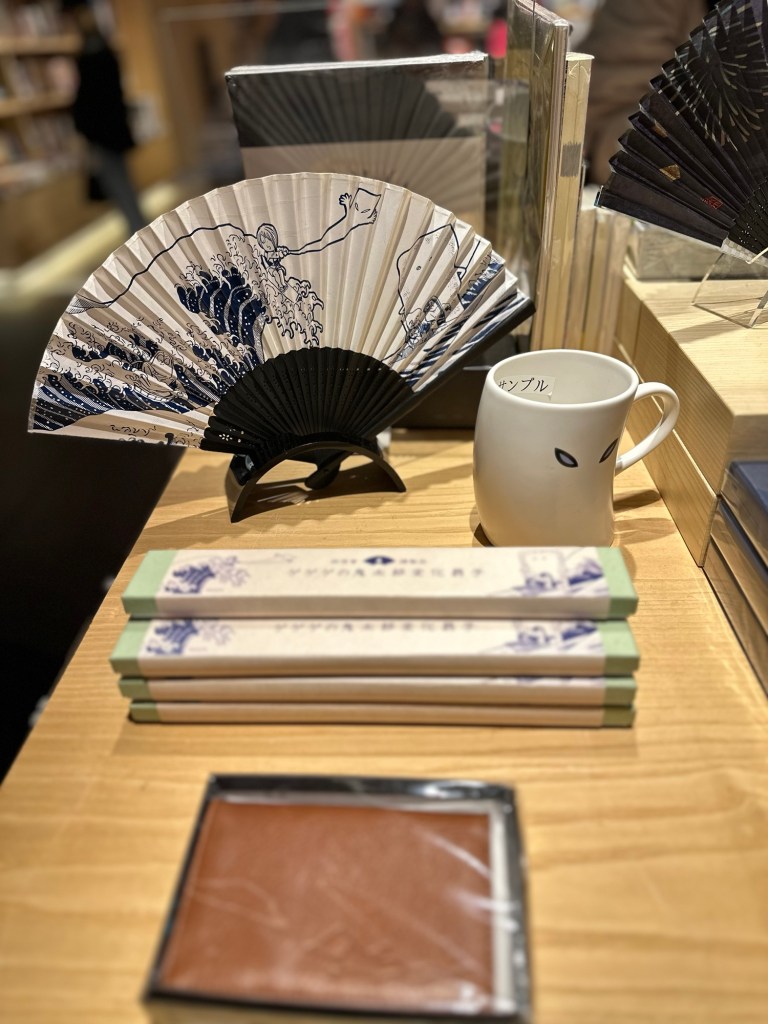
Did I mention that we hit the travel guide jack pot when we got Mori? We were delighted to see him waiting for us at the hotel, to take us to dinner. First, we helped shake off jet lag by walking to the Ginza area, ending up at the Ginza Six mall. And what a mall it was! Feast your eyes on some of the beautifully unique goods for sale here.
The mall had an abundance of restaurants featuring cuisine from all over the world.
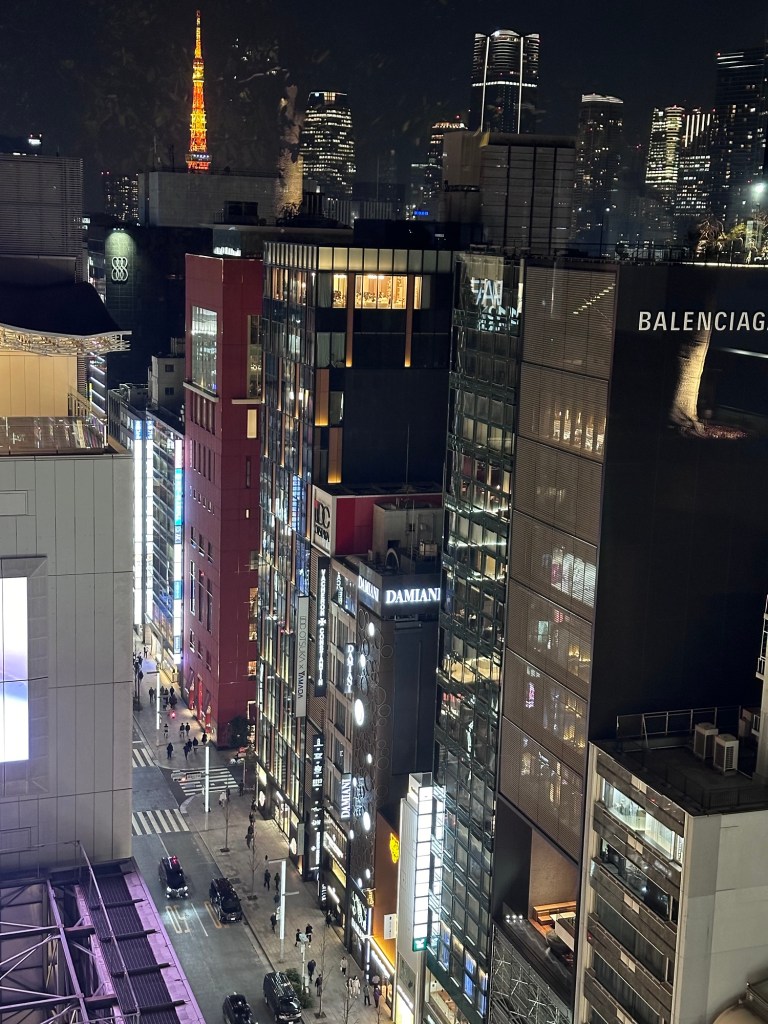
My favorite mall feature, however, was the rooftop garden that offered a spectacular view of the street below.
Despite the abundance of options at the mall, we decided to go for an authentic Japanese dinner of ramen noodles, pot stickers and beer —for about $10—at a tiny restaurant on one of the side streets, where we all sat at the counter. If anyone has ever seen The Midnight Diner, you would understand why we felt like we had wandered onto its set.
By the time we returned to our hotel, we were all more than ready for bed.
When I awoke I thought I had vanquished jet lag. Then I looked at the clock. 11:30 PM. Damn. After trying mightily to fall back asleep, at 2:30 AM I admitted defeat and popped a sleeping pill, which powered me through Saturday’s morning events.
As Mori suggested, we headed out early for the local “fish” market near our hotel. Although they certainly had plenty of fish, I was pleased to see they had a whole lot more. The ceramics were gorgeous, the paper place mats were beautifully painted, kitchen equipment was plentiful AND you could even get dried grasshoppers, if that was your thing!
As it got later, the crowds at the market got bigger, so we decided it was time for the peace and serenity of the “nearby” Hama-Riku Garden. But of course, we took a couple of wrong turns and ended up discovering this gorgeous temple.
The cards give instructions on the correct way to offer incense.
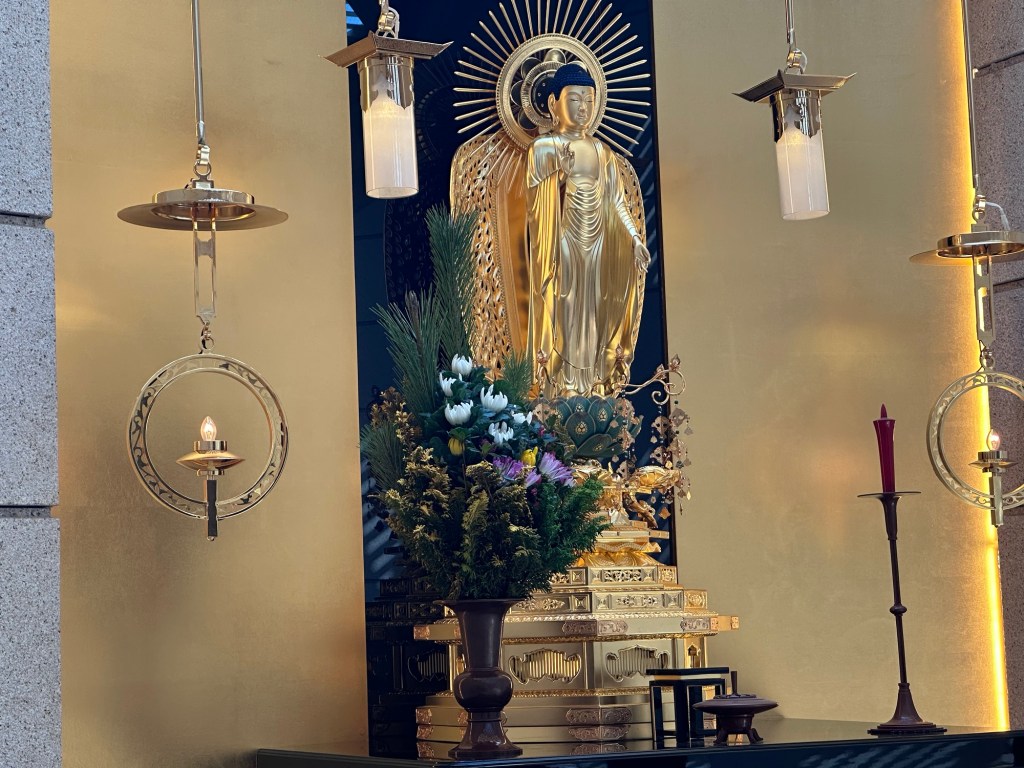
The Tsukili Hongwanji’s main hall houses the Amida Buddha. Sorry, I didn’t want to be disrespectful so I contented myself with this one quick photo. Trust me when I tell you Amida Buddha is beautiful.
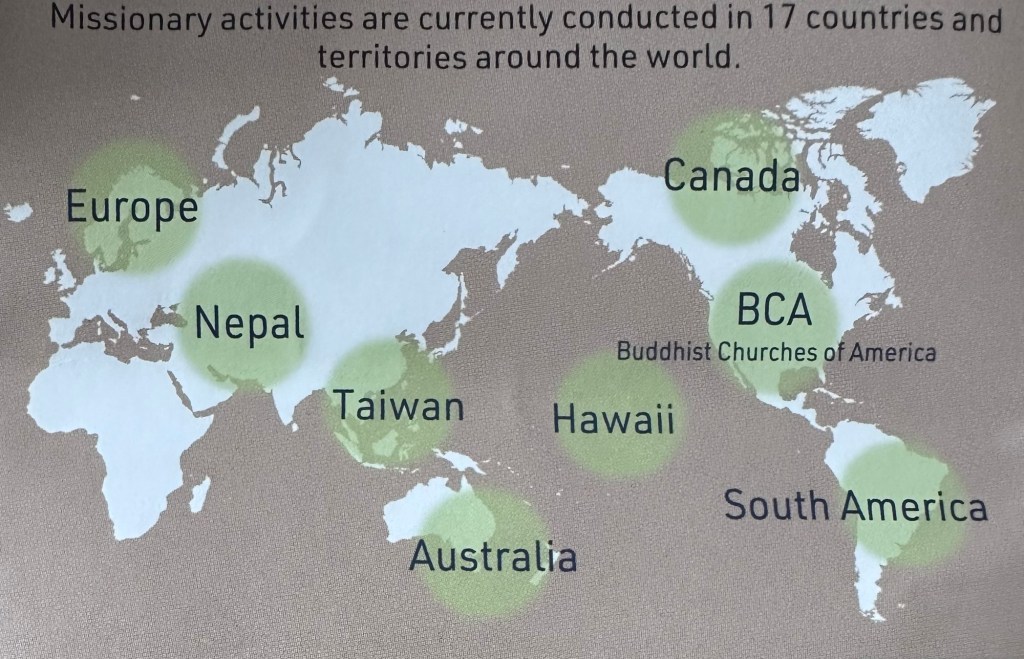
I remember as a child, growing up in a Catholic school environment, I was urged to give my money to “purchase” a pagan baby in Japan. It tickled me to see that the Buddhists have missionary activities in the USA. I wonder if Japanese kids are trying to save the “ heathen” Christian children in the USA?
After leaving the main hall, we purified ourselves before entering the more intimate, empty hall.
A lovely Japanese lady demonstrated the proper purification method which Janis and Ruth performed
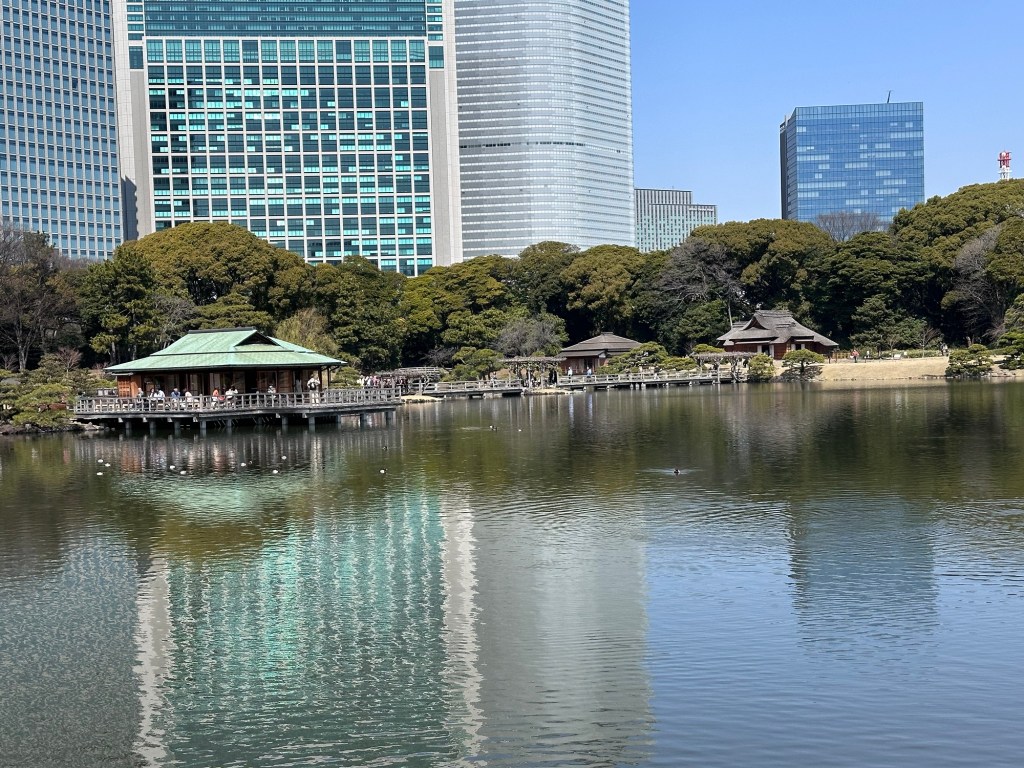
Relaxed and refreshed ( and purified) after our unplanned detour, we were ready for the Gardens.
Upon arrival, we learned there was a tour in English starting shortly. How lucky were we to get this fantastic guide! She provided the history of the gardens from the Shogun era (the mid 1600’s), to the Meiji restoration, then up to post WWII , when the emperor’s property was given to the municipal government. (She used visual aids, and rewarded those who gave correct answers to her questions.)
We learned that the property was originally a fort, until the Shogun decided to build a hunting ground for his falcons.
Throughout the grounds, canals brought in salt water from the nearby bay, attracting wild duck for the falcons to catch.
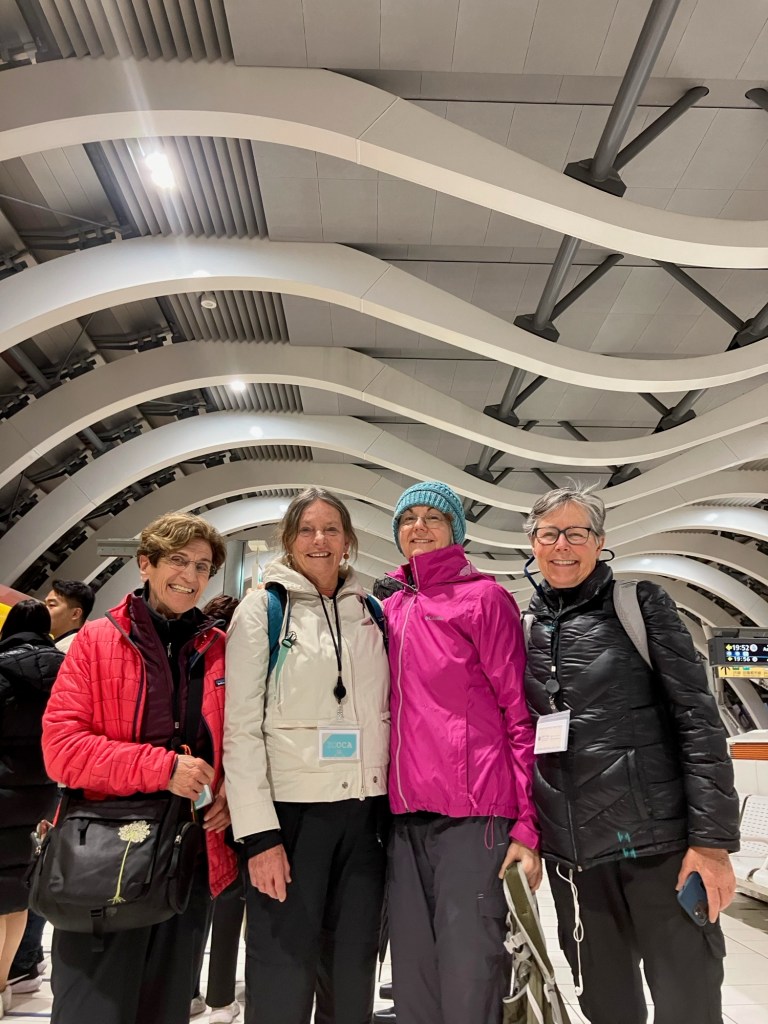
The traveling buddies: me, Kris, Janis, Ruth and Patsy. I scrunched down so I wouldn’t look “freakishly tall” as my dear friend Elena described it.
There’s so much more to say about our second day, but we are getting ready to start day 3 in this glorious city…more to follow.
I feel SO very lucky to have the privilege to experience this vibrant city. And I’m SO glad I decided to arrive 4 days before the start of the main trip!
I’ll admit it, I’m super excited to be on my way to Tokyo. This is the third time since 2019 I’ve booked a trip to Japan. I don’t have to tell anyone why a trip ANYWHERE in 2020 wasn’t happening. And it wasn’t much better in 2021, when Omicron surfaced. My Grammy always said, “the third time never fails”, and I’m REALLY hoping that this time the old girl is right. You see, right now my travel buddy Kris, and I are experiencing a bit of a kerfluffle. Our plane has had technical problems that United was unable to fix, so we have all deplaned and are sitting in the terminal while we await our fate.
A business class ticket allows you to board early, so I had plenty of time to blog while the rest of the plane boarded initially. This is what I wrote 2 hours ago, when I thought we were on our way:
It’s a 14 hour trip, so I decided to live large and booked business class. The price fluctuated between $10,000 (when I booked) and $20,000 ( a month ago), so I used all of my miles (and Mike’s) and transferred points from my Chase Sapphire Reserve account to reach the 400,000 points required for round trip business class flights. It was clear that transferring points is far better than using the points as cash. 400,000 points would get me $4,000 in cash that I could put toward the $10,000 ticket. You don’t have to be a financial wizard to figure out which would be the better deal.
I love being able to stretch out. Once we are airborne I plan on laying flat.
The map atop this post shows most, but not all of our itinerary. The majority of our group of 14 elected to do the 3 day post trip to Hiroshima, which couldn’t fit on the photo.
Our wonderful guide, Mori, has been communicating with us already via WhatsApp. He sent us this map, with the good news that we should have a wonderful cherry blossom show in Kyoto.
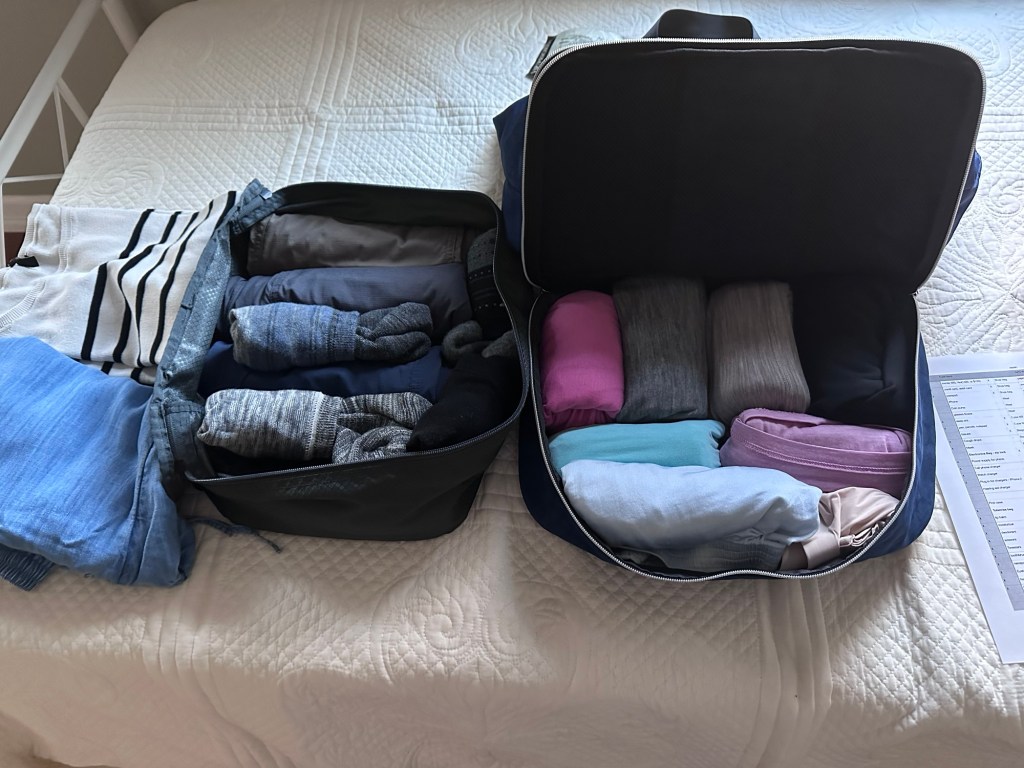
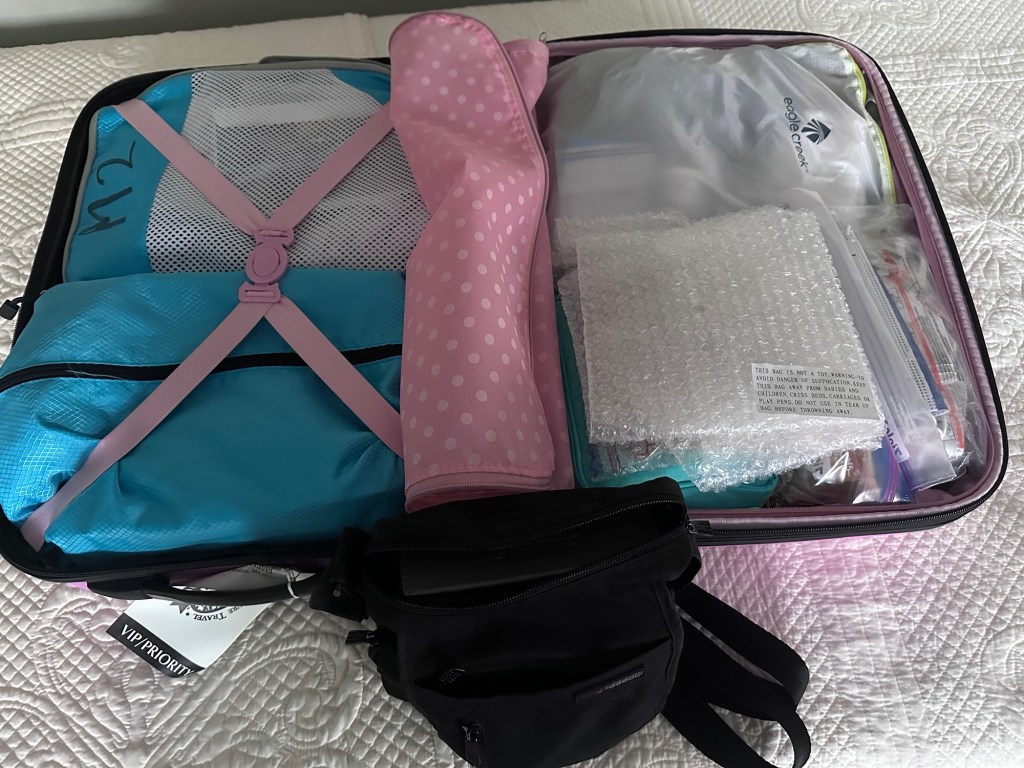
We had been warned to pack lightly, partly because hotel rooms are small by US standards and partly because we need to only take an overnight bag on the bullet train. (Our larger luggage will be transported by van). I was glad to learn that some hotels have laundry facilities on site, so opted to do carry on only, and it looks like this:
With business, you can carry on TWO bags, plus a purse.
For this trip I used packing cubes (the bottom of my blue bag is a detachable packing cube) and a combo of rolling and folding.
Cube on right is bottom of bagOther cube goes inside
We shall see how wrinkled the contents are after I arrive and whether one method produces superior results.
The biggest challenge has been weather uncertainty. I didn’t decide till this morning which coat I’d be taking, finally settling on my down coat with a hood.
Because I booked my own flight, I didn’t get an included transfer from airport to hotel. I could have purchased one from OAT for $150 one way.
Mori told me I could get a taxi for about $50, or take mass transit for less than $5. We shall see how adventurous I feel when we land. If I’m not jet lagged I will likely be up for the adventure option, but if I’m feeling crappy, it will be taxi.
Such is the world of travel. You have to be ready to expect the unexpected. Fortunately, this is a chill crowd. No nastiness. People patiently waiting, even the kids.
What will become of our heroines???
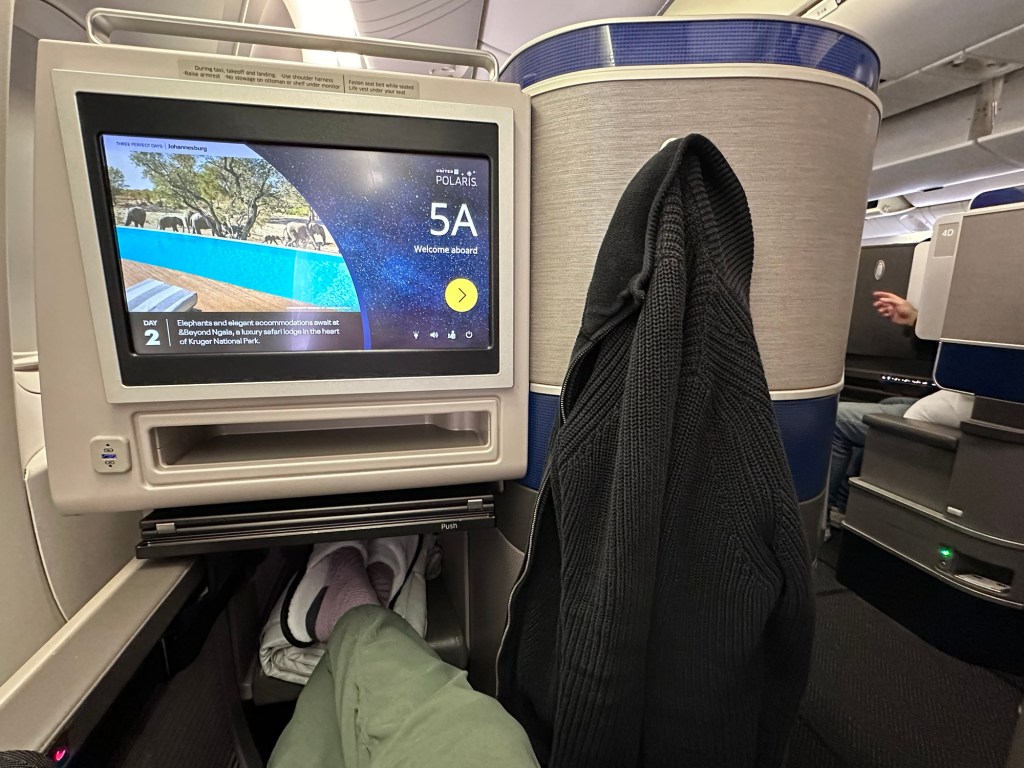
I’m not going to leave you with a cliff hanger. They finally fixed the problem and we were able to reboard, so I’m back all comfy in seat 5A, just almost 3 hours later. Let me tell ya, that Tokyo taxi option is looking better and better.
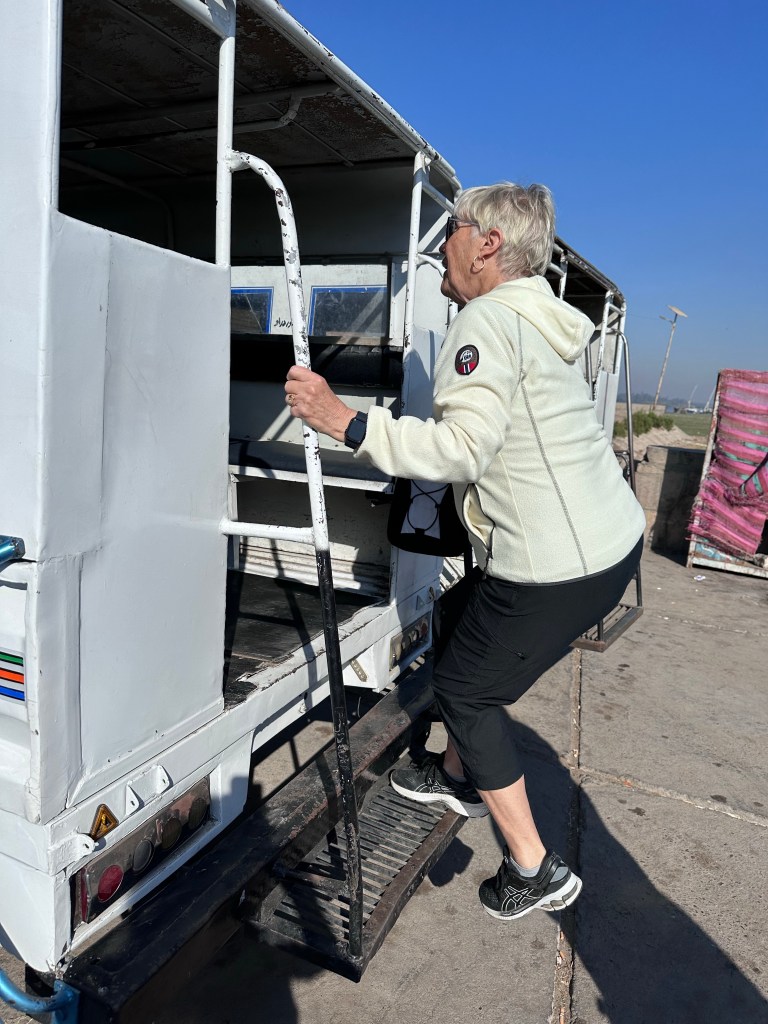
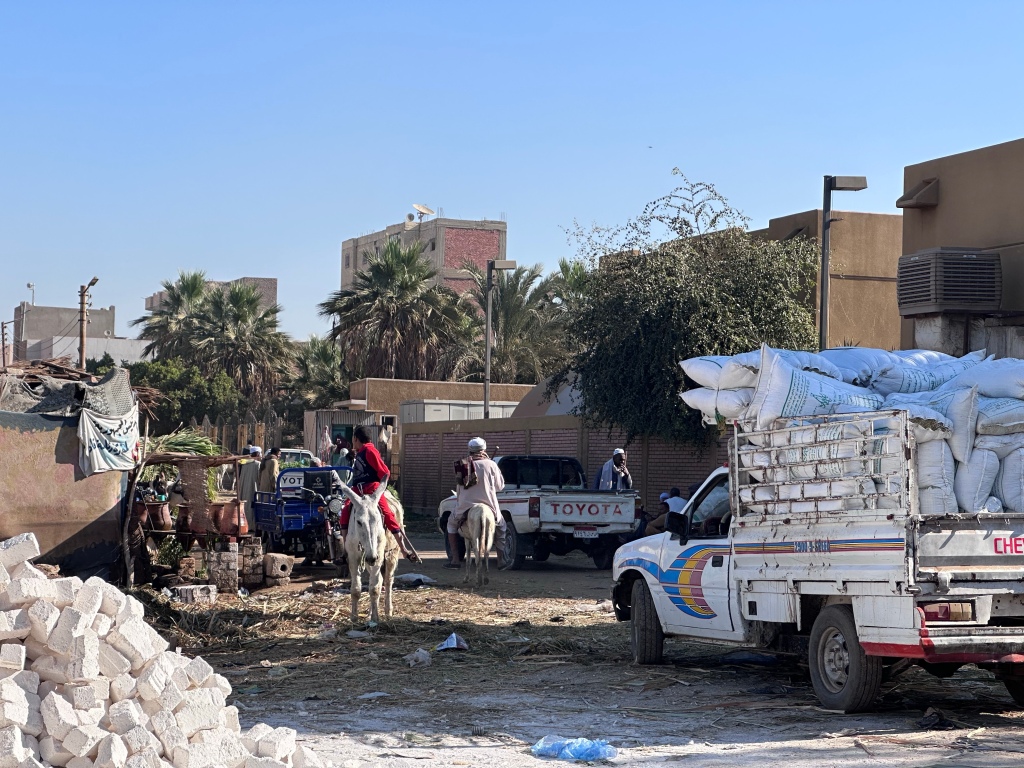
To acclimate us for the end of our leisurely float up the Nile, we used less luxurious modes of transportation to visit the town of Daraw. We’d been ferried across the Nile by small boats before, but this was our first time in the back of a pick up truck. The truck was covered, but there was such little headroom, I could barely sit upright. And no, that’s not a canvas top to the truck. It’s metal. If you’re wondering how I know, let’s just say there were more than a few bumps in the road.
You see all modes of transportation in Daraw: bikes, motorcycles, trucks, donkeys, tuk tuks, just about everything except cars.
Most OAT groups tour the livestock market, but because there are no markets on the day we were there, we visited the local entrepreneur. One of his many businesses is a “livestock hotel”. Hey, if you don’t sell all your animals on the first market day, you need someplace for them to stay, right?
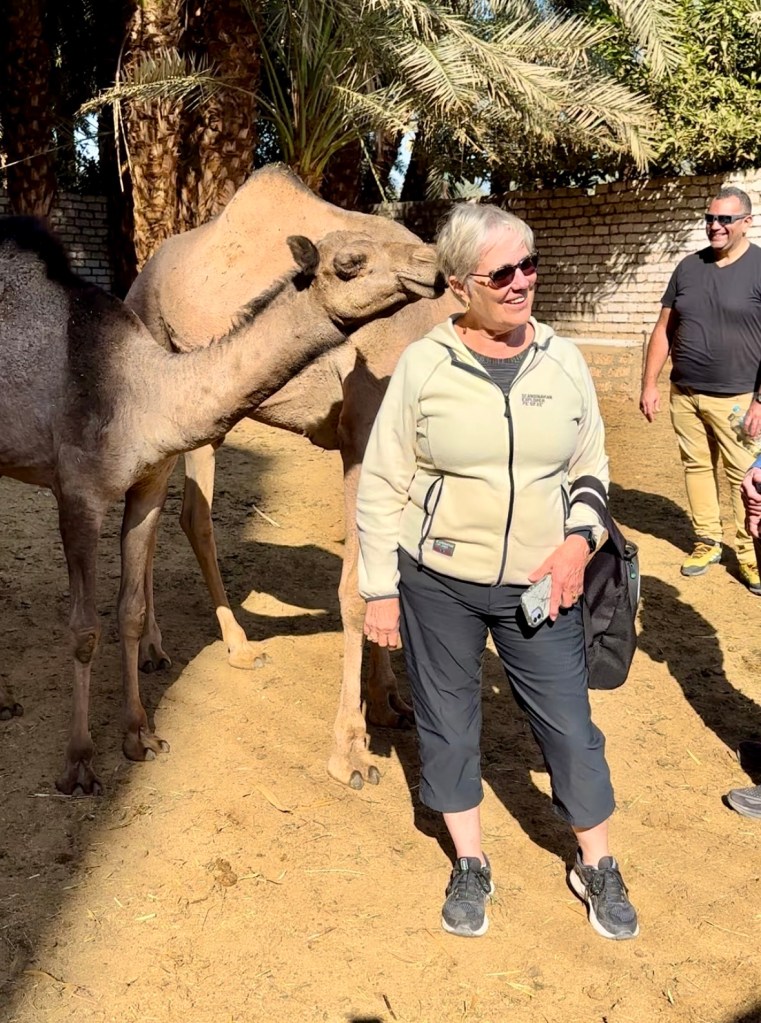
Another of his businesses resembled a mini petting zoo, which we greatly enjoyed. I’d been warned that camels spit. After being taught a lesson by that rambunctious water buffalo a few days earlier, I kept my distance. Bobbie and I decided it was time to let others interact with the babies.
This camel bumped Jeanne in the head multiple timesThere was significant bonding between Bill and baby donkey. We expected him to start negotiating a purchase price.
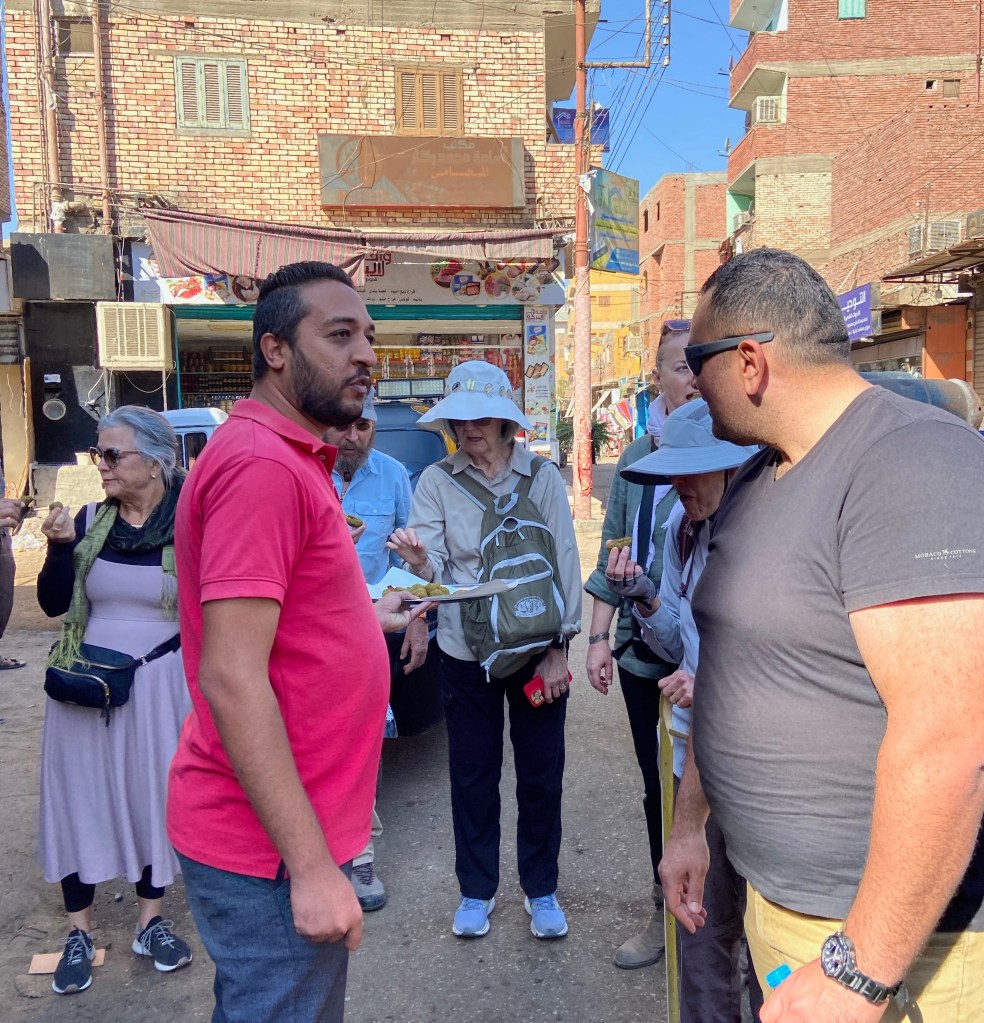
Next stop, shopping—and eating—in the marketplace. Mohamed purchased Falafel for us to sample. We had just watched as the street vendor was making it. I don’t know that I would have been brave enough to eat food from a street vendor if I were on my own, but with Mohamed choosing the vendor, I felt perfectly safe.
It felt like we were on the Amazing Race when Mohamed instructed us to search for, and purchase, specific fruits and vegetables with the 20 Egyptian pounds, (about $.62 in US currency) he gave us. We were all so focused on our task, there were no photos of the adventure. I foolishly pointed at potatoes and waved my 20 pound note. Any idea how many potatoes that amount would buy? A whole lot. A whole HEAVY lot. Good thing I’ve been going to the Y.
Bobbie, on the other hand, was a smart shopper. She purchased the required peppers, but she negotiated skillfully enough to be able to buy bread for us all. It was delicious and still warm from the oven.
Our last stop before leaving our beloved dahabiya was “Nile Beach”, where are some of us were perfectly content to just stick our feet in the water. Others, namely, Marianne and John, were far more adventurous.
Look how clear the water in the Nile is! Marianne and John are going skiing after they leave us. Photo by Susan Burke
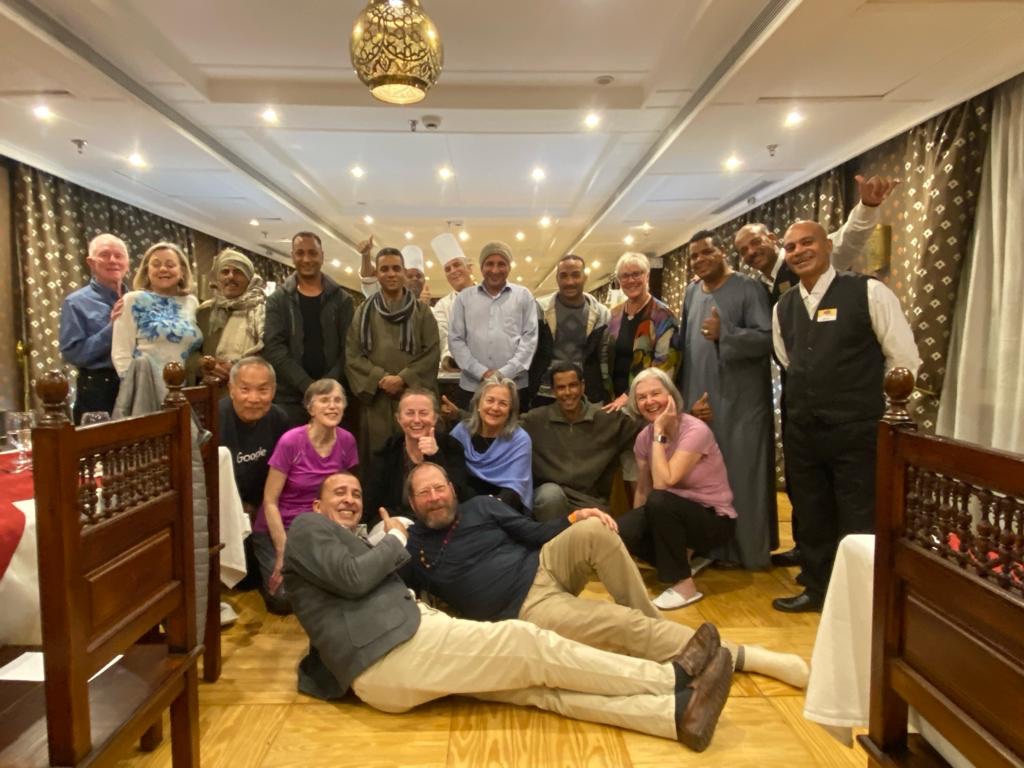
Our “farewell” dinner was even more spectacular than the other meals we’d enjoyed. We were sad to say goodbye to the crew that took such good care of us.
16 crew members for 9 passengers. Was the service outstanding? You bet!
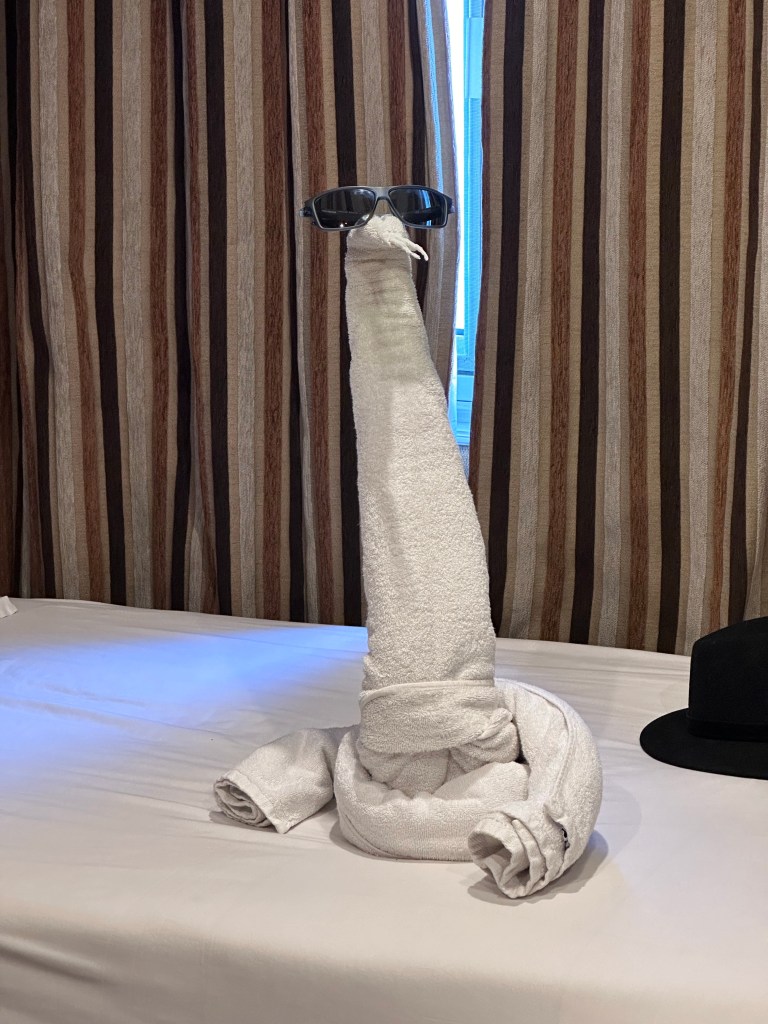
We all got a surprise when we returned to our cabins. We each got a unique Egyptian creature waiting for us on our beds. I’ve seen towel art before, but these were, by far, the most creative. My favorites were the crocodile and the cobra. ( I got a scorpion).
Crocodile Cobra
How to describe the ride from Aswan to Abu Simbel? Three hours of sand, sand, and more sand with high tension wire strung along the roadside, delivering electricity from the dam to the populations further north. We needed to get closer to Abu Simbel for the landscape to change.
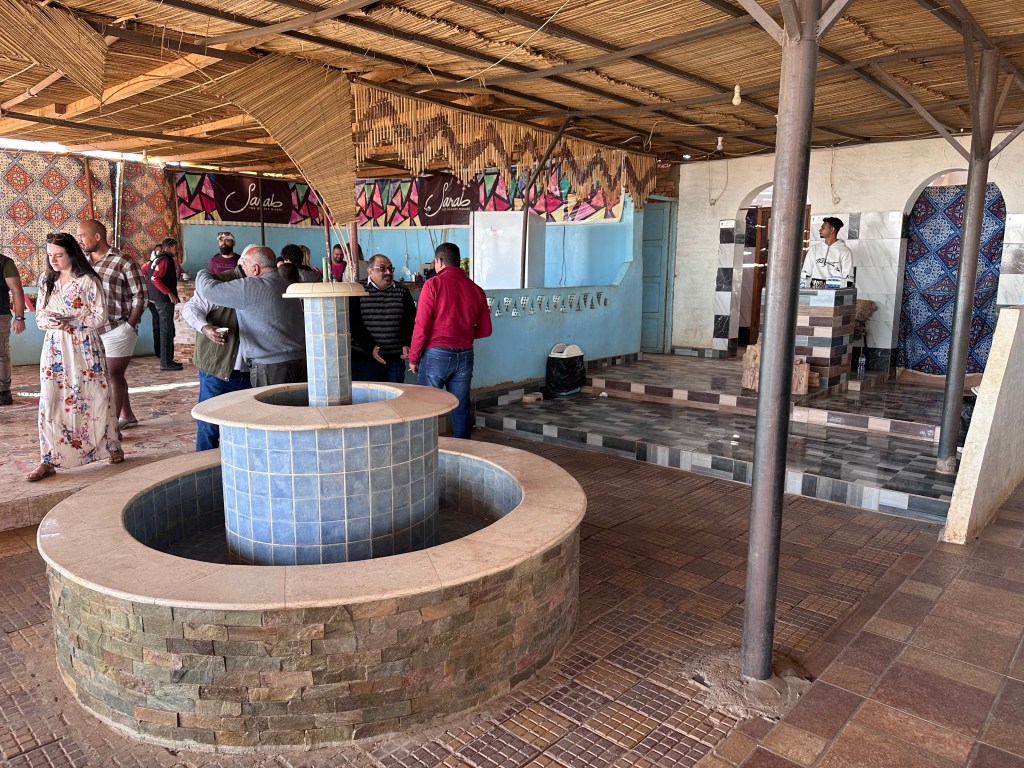
We stopped midway in our journey for a bathroom break. I think the term “food desert” was coined here. If it wasn’t, then it should have been. The “snack bar” could be best described as “selection-challenged”, but if you’re looking for potato chips, or packaged mystery snacks, you’ll be very happy.
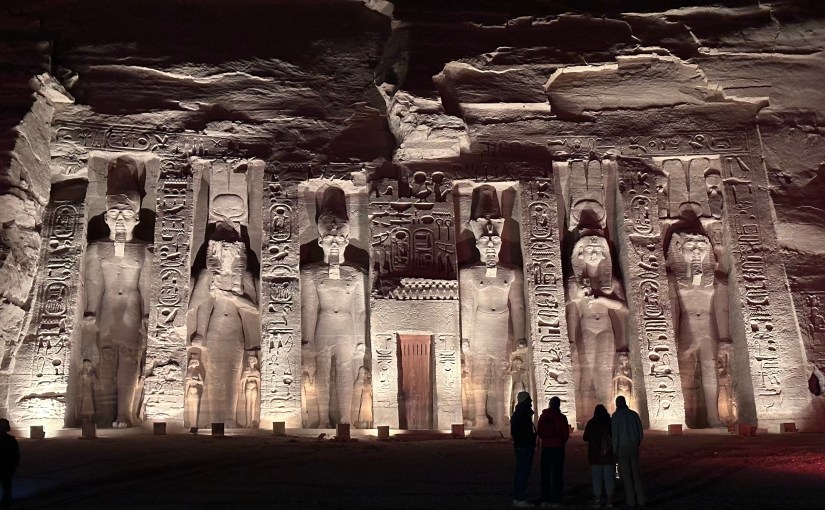
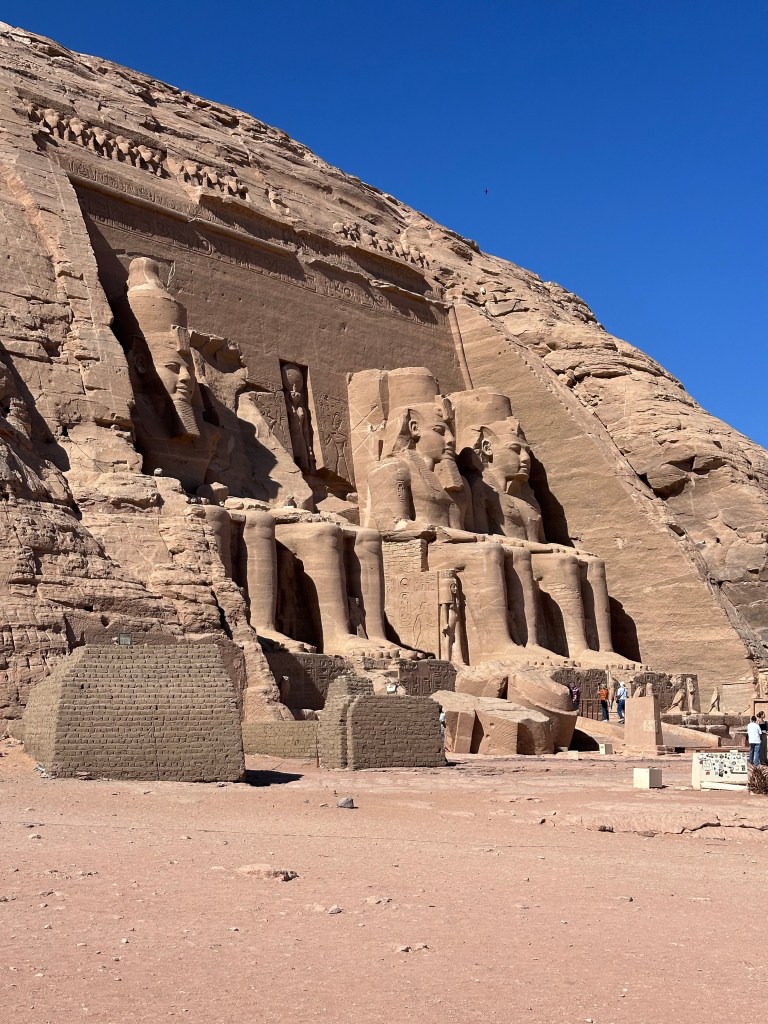
Our group thought we’d seen so many temples and tombs, there was little left for us to see. Boy, were we wrong! The size of the 4 statues of Ramses 2’s temple ALONE was jaw dropping. But to think that this entire temple was MOVED block by block to the higher ground on which it currently stands, is truly hard to believe. Why is as that done? If it hadn’t been moved, it would now be well below the waters of Lake Nassar.
Back in the 60’s, 50 nations cooperated to rescue several temples threatened to be submerged by the creation of the High Dam at Aswan. To me, the engineering that went into the move was as awe inspiring as the temples.
But wait—there’s more to say about this temple. The ancient Egyptians were so knowledgeable about engineering and astronomy that in the 1200’s BC, they were able to construct this temple so that twice a year, on February 22 and October 22, the sun shone all the way through the temple to illuminate three of the four statues in the inner sanctum. The fourth statue is of Ptah, the god of the underworld, who was intentionally left in darkness. Two of the others represent different versions of Ra, the son god. Bet you can’t guess who was the last statue to be bathed in sunlight. None other than Ramses 2. Clearly he didn’t have a self esteem problem.
That black area falling across their laps is a shadow
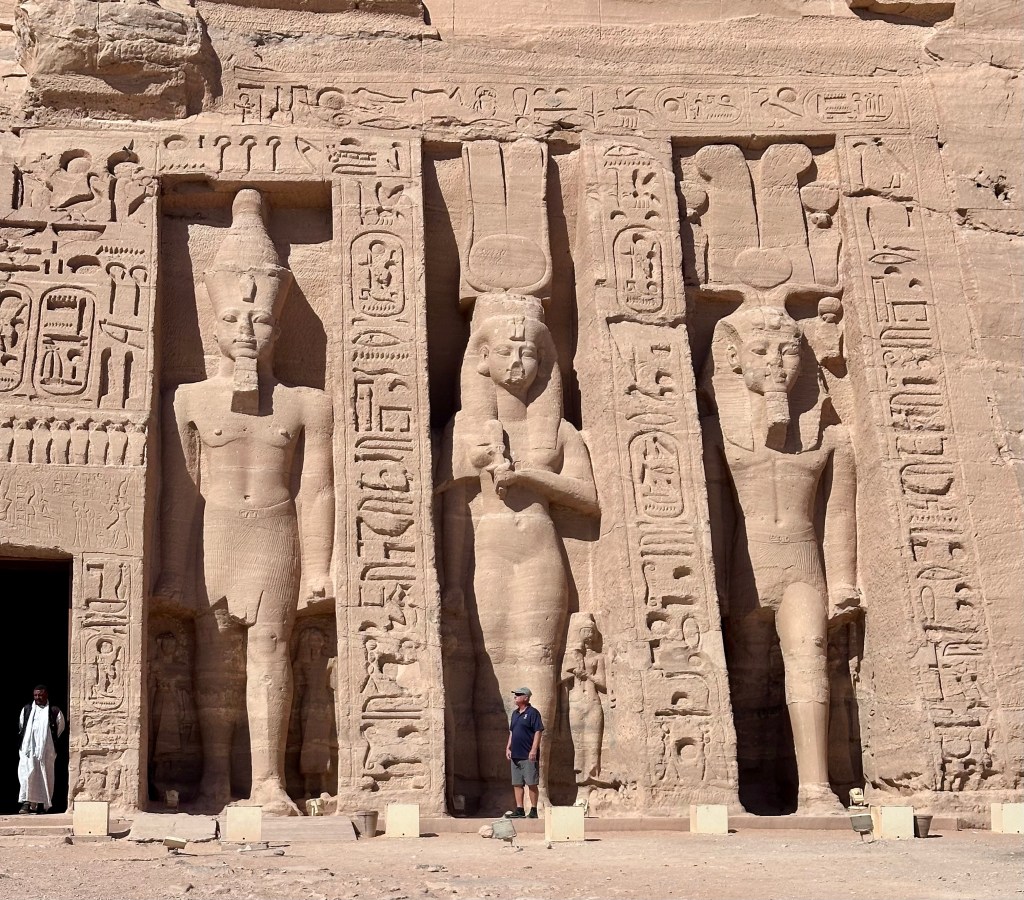
Next to Ramses 2’s monument to himself, he built a temple honoring his favorite wife, Nefertari. Remember her? We visited her tomb in the Valley of the Queens.
That old goat lived well into his nineties, acquiring wives and children ( rumored to number approximately 200) along the way. Good thing he lived BEFORE viagra was invented! Of all his women, (thought to number about 100, if you include concubines and mistresses) Nefertari was his favorite—the only one who got her very own temple next to his. There is only one statue of her on the facade. The other five are, of course, of her husband, who was also known as “the Great” (probably self proclaimed).
That random guy standing in front of Nefertari gives you an idea of the scale of these statues.
We only spent one night at the beautiful Seti Hotel in Abu Simbel. Can you see why we were reluctant to leave? The multi-level pool had a swim up bar; each room had a private balcony facing the Nile. It was SO very peaceful.
Before we left for the light show at the temples, we met Hassan, who enlightened us about Nubian culture and history. He also entertained us by playing instruments that were the forerunners of our guitar, banjo and harp.
In 1976, when Hassan visited his cousin in San Francisco, he was invited to play with what he described as “ a small folk group” —the Grateful Dead.
Once again, you had to be there to appreciate how wonderful it was to be sitting under the stars, watching a multimedia show projected onto the temple walls. I didn’t take any shots while the show was ongoing, but did so after, and used that shot the heading for this post.
I truly appreciate everyone’s comments on my blog posts. It almost feels like I’m having a conversation with my friends. Although I know who comments on Facebook and Linked in, many of the comments on WordPress are coming through anonymously. If I didn’t respond to you, that’s why.
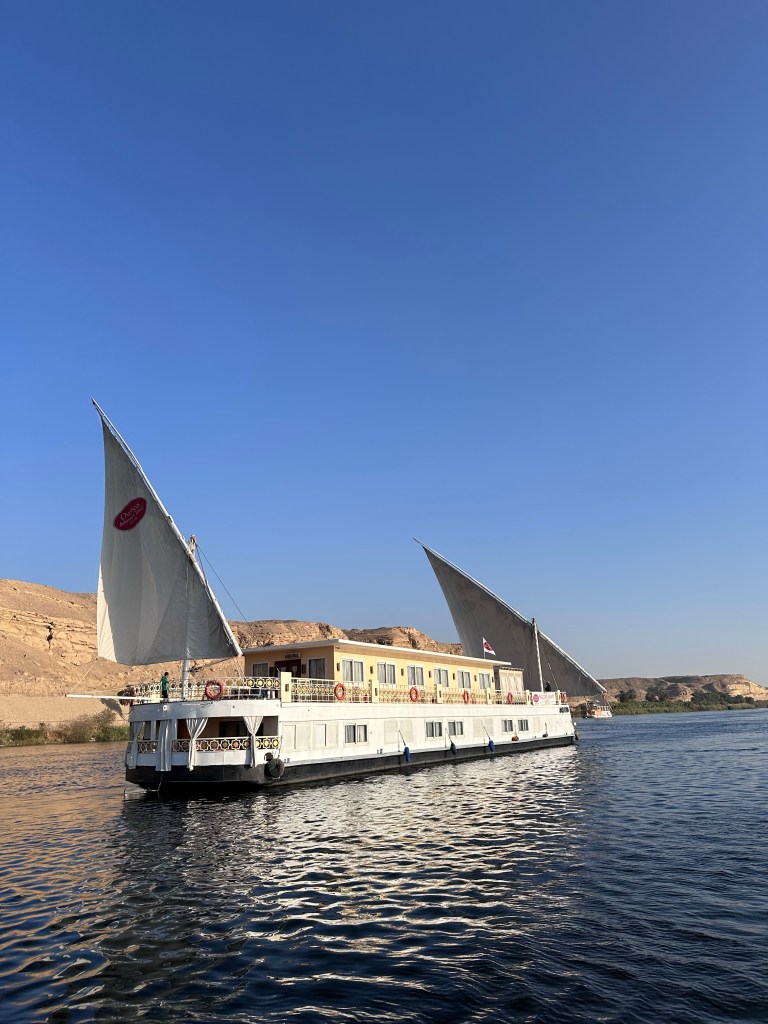
I felt like Egyptian royalty, floating up the Nile in our private dahabiya. It’s mind boggling to think that the pharaohs used this mode of transportation centuries ago, when they traveled between their two capitals. Memphis no longer exists, but Thebes still does, except the Greeks changed its name to Luxor.
The dahabiya is certainly is a very comfortable way to travel. Of course, the pharaohs took months to make their journeys, stopping to visit temples along the way. We also are visiting temples, but our river trip only lasts five days.
Although the sails of our boat were unfurled, it was strictly for a photo op. The photo above was taken from the tugboat that pulled us upstream. It is illegal for dahabiyas to have motors because the Egyptian government wants to preserve this ancient mode of transportation. I’m glad they didn’t insist that the tugboat be replaced by a rowboat!
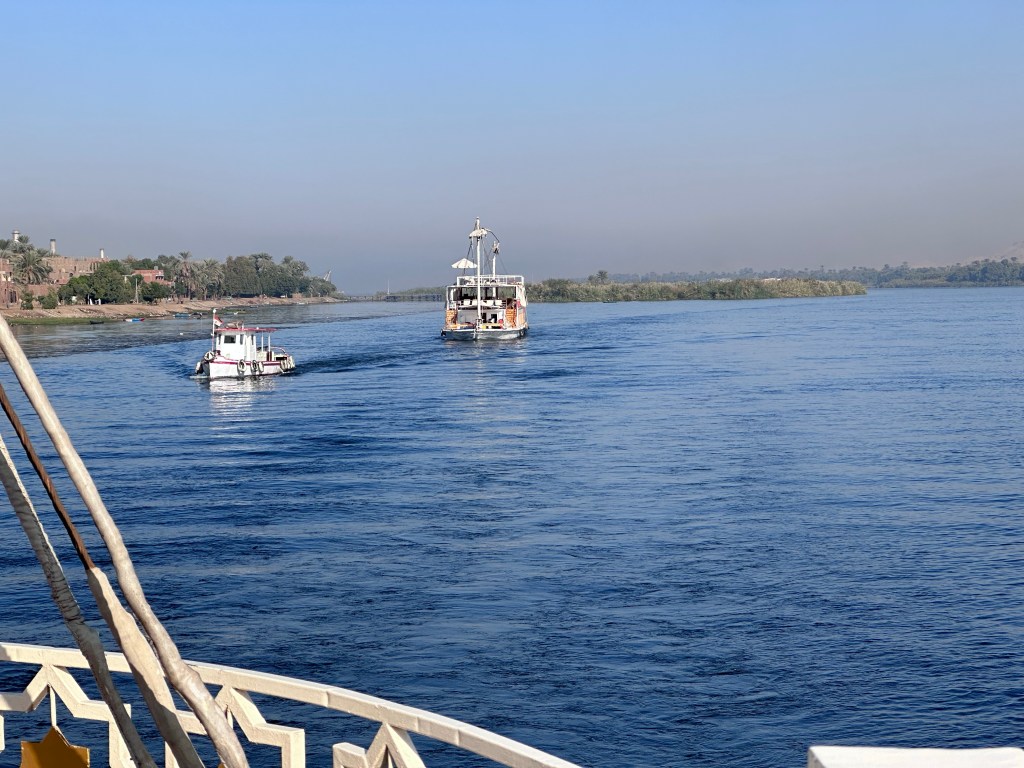
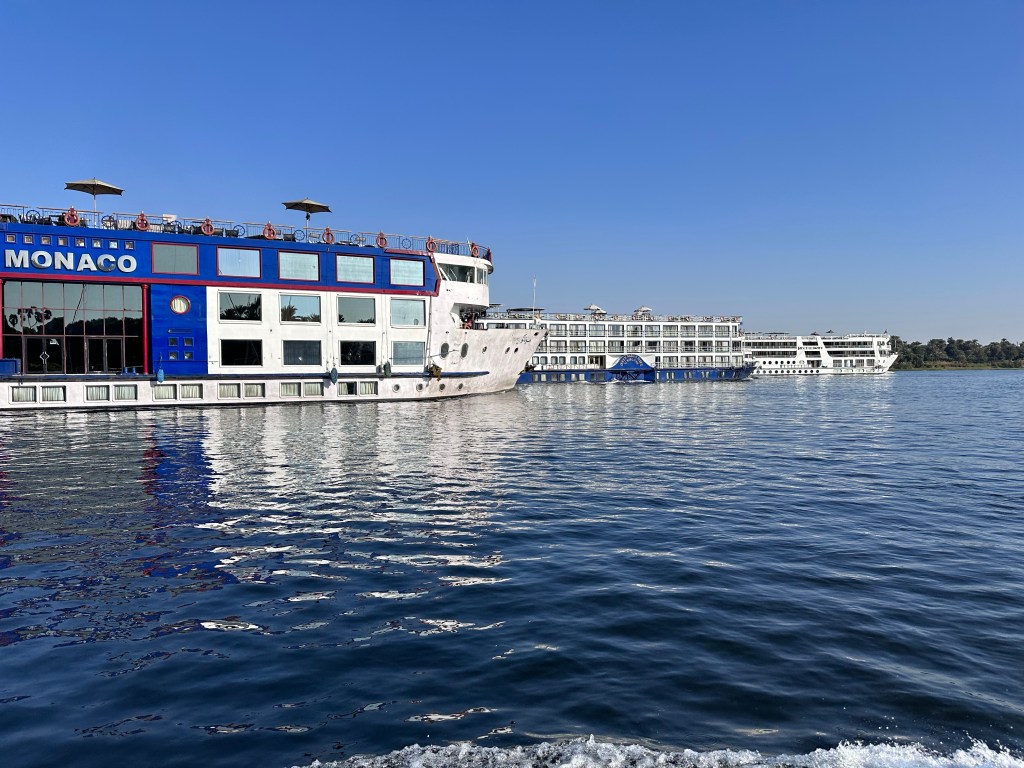
To show you what that looks like, I took the photo below from the back of our dahabiya. The larger boats, and we saw many of them on the river, are allowed to have motors.
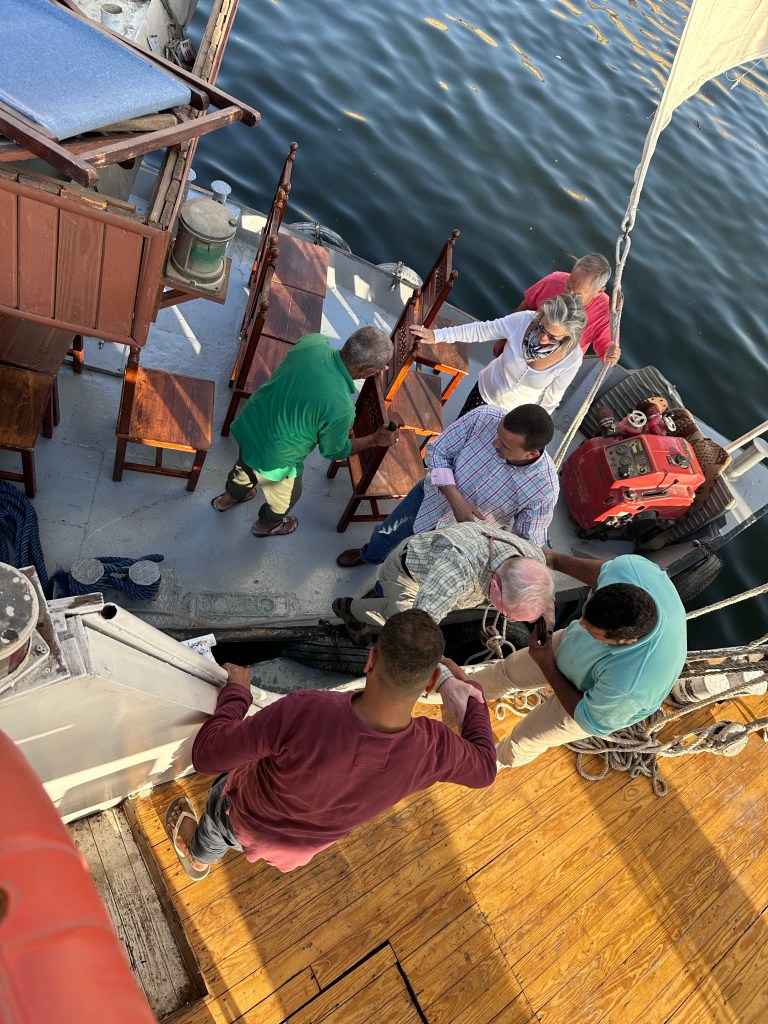
We had lots of help climbing from the tug back onto our dahabiya
The Nile starts in Lake Victoria, and flows into the Mediterranean. That means when we travel south, we are going up the river, the opposite of what we are used to. Back in the day, the southern part of Egypt was known as the Upper Kingdom, with the Lower Kingdom extending to the shores of the Mediterranean.
To visit the temples, we had to disembark and when we did it felt like we were walking the gauntlet. The street vendors were laying in wait. “Hey lady, only $5”,or “Welcome to Alaska” which we heard at multiple sites. I didn’t dare take a photo of the chaotic scene. Instead, I focused on walking quickly, avoiding eye contact. It was difficult. I felt I was being rude by ignoring their greetings. After being bamboozled once however, I toughen up.
Was it worth it? Yes! The temples were an oasis of serenity and peace. Although we saw other, larger ships on the Nile, we were the only ones visiting the small temple of Khnum in Esna. Mohammed, our guide, knew the schedule well enough to plan our arrival after the larger ships had departed and before the afternoon ones arrived.
.
We were able to watch centuries of dirt and muck being cleaned from the temple walls. Mohamed told us that only recently have women been allowed to do restoration work.
Yes, the Sistine chapel’s ceiling is a masterpiece, but the ceilings of Egyptian temples are equally breathtaking. Not only that, but they were painted centuries earlier.
If you were standing below, looking up, this is what you would see. Check out the tops of the columns. Each one is different. It’s difficult to see in the photo, but the hieroglyphics between the columns are depicting the various phases of the moon, something my astronomer husband would have greatly enjoyed.
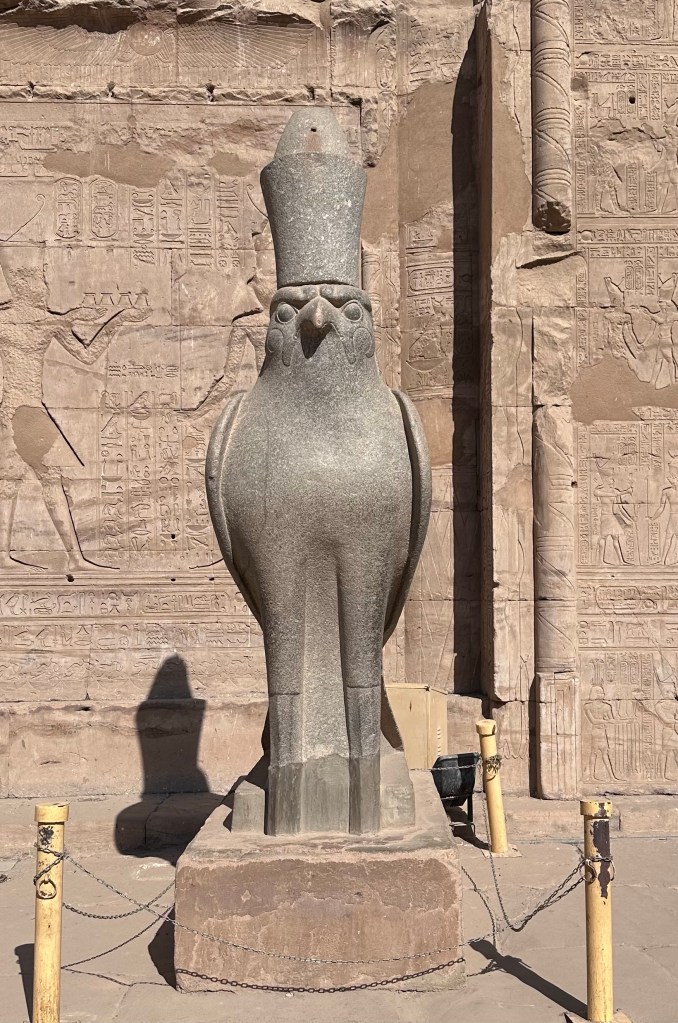
The next day’s temple was in Edfu. It is dedicated to Horus, the son of Isis and Osiris. Horus’ parents were both brother and sister and husband and wife, which might explain why their offspring had the head of a falcon. Sometimes, as in the statue below, he’s depicted as all bird, but on the temple walls, the carvings show him with a human body.
Horus, outside his temple’s inter sanctuary. His angry look was designed to keep the common folk out of the sacred spaces. On his head are the crowns of Egypt’s upper and lower kingdoms
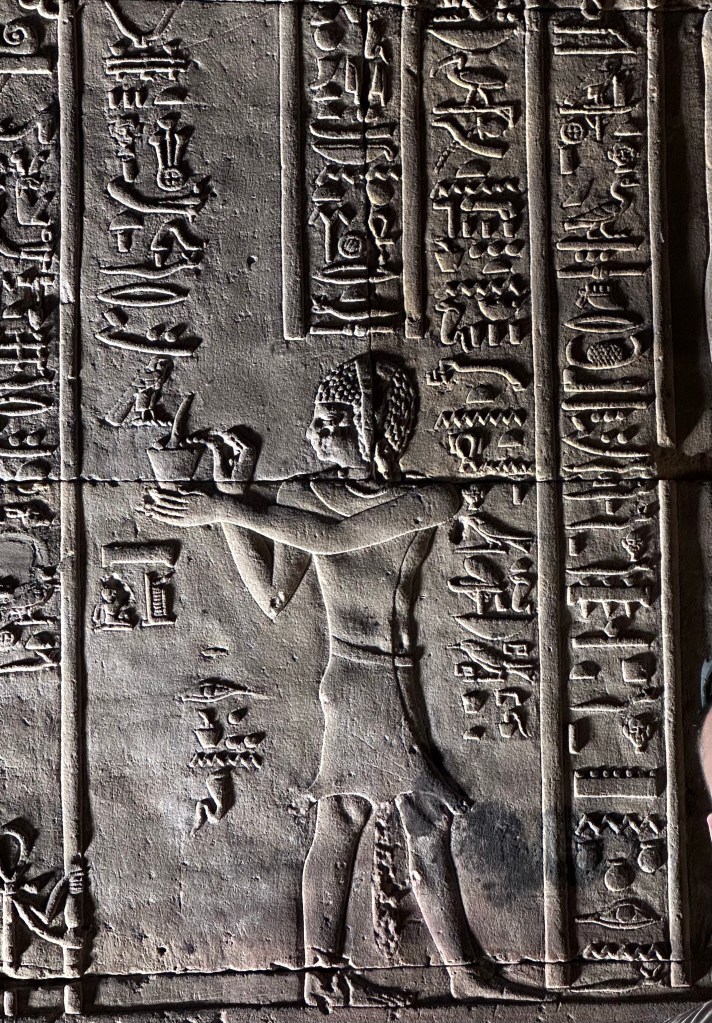
Like medieval churches, the temple walls are used to tell a story. Here’s the Cliff Notes version of a rather long legend. Osiris was killed by his jealous brother Seth, who chopped him up and scattered the pieces all over Egypt, but Isis found the pieces and (unlike Humpty Dumpty) put Osiris back together again, except for one key piece—his most prized possession. (I hope I don’t have to spell it out for you. ) Anyway, Horus was determined to get revenge for his uncle’s dastardly deed. The two of them fought an epic battle. Although Horus won, during the battle he lost one eye, which then magically came to life. To this day, Horus’ eye is a symbol of healing and well-being.
Our guide claims the following wall carving represents incense being burned. The ladies in the group decided it was actually Osiris’ missing member. You decide who had the better interpretation.
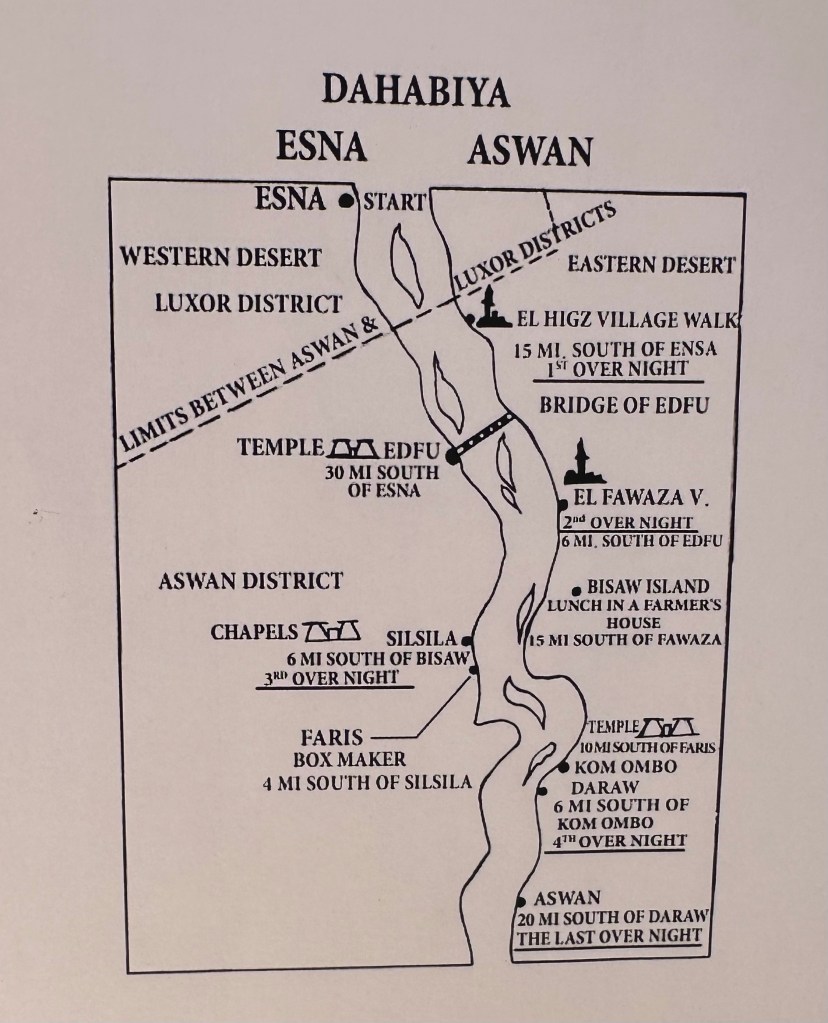
As you can see from the visual of our 5 day journey, we took a temple break to visit a farm on Bishaw Island, where we met members of the village and had lunch in the home of the very charming Sayed.
In the USA, we can step back in time by visiting Plymouth Plantation or Williamsburg, where people dress up in period costumes and demonstrate how different tasks were performed during colonial days.
THIS was authentic. It might look like the village women are making wood fired pizza, but they are actually baking a day’s worth of bread. Sour dough. The loaves all came out perfectly.
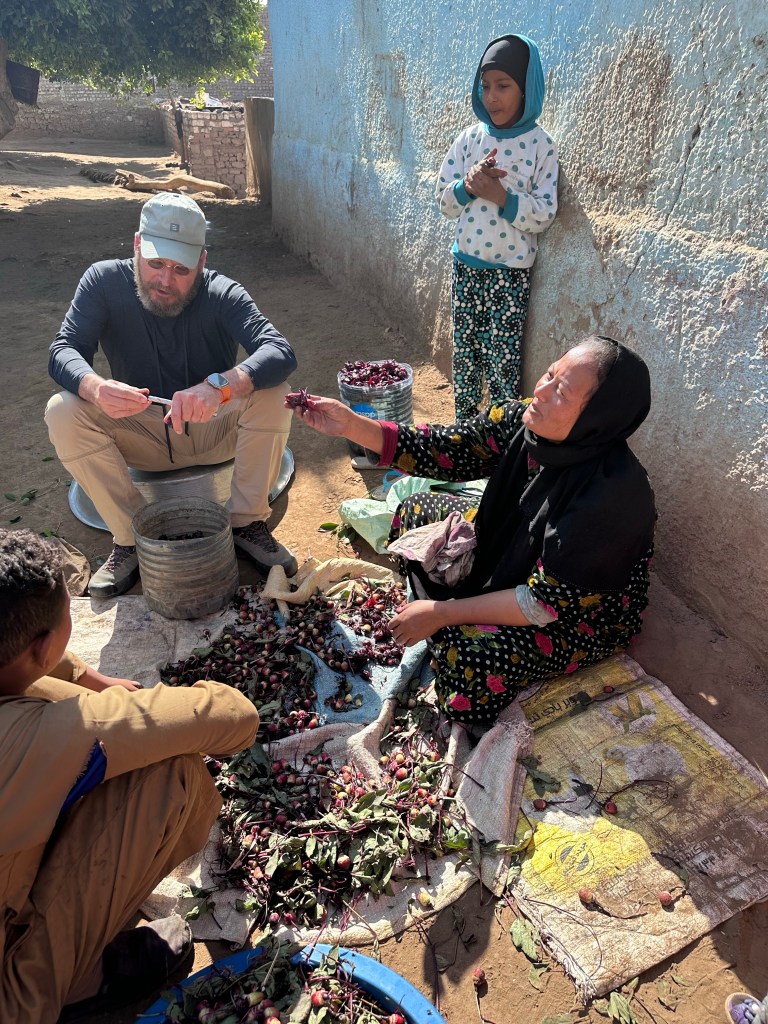
Bill was recruited to help remove seeds from hibiscus, which is used to make tea. He was a natural; in fact, he did such a good job, I was wondering if he’d be allowed to leave.
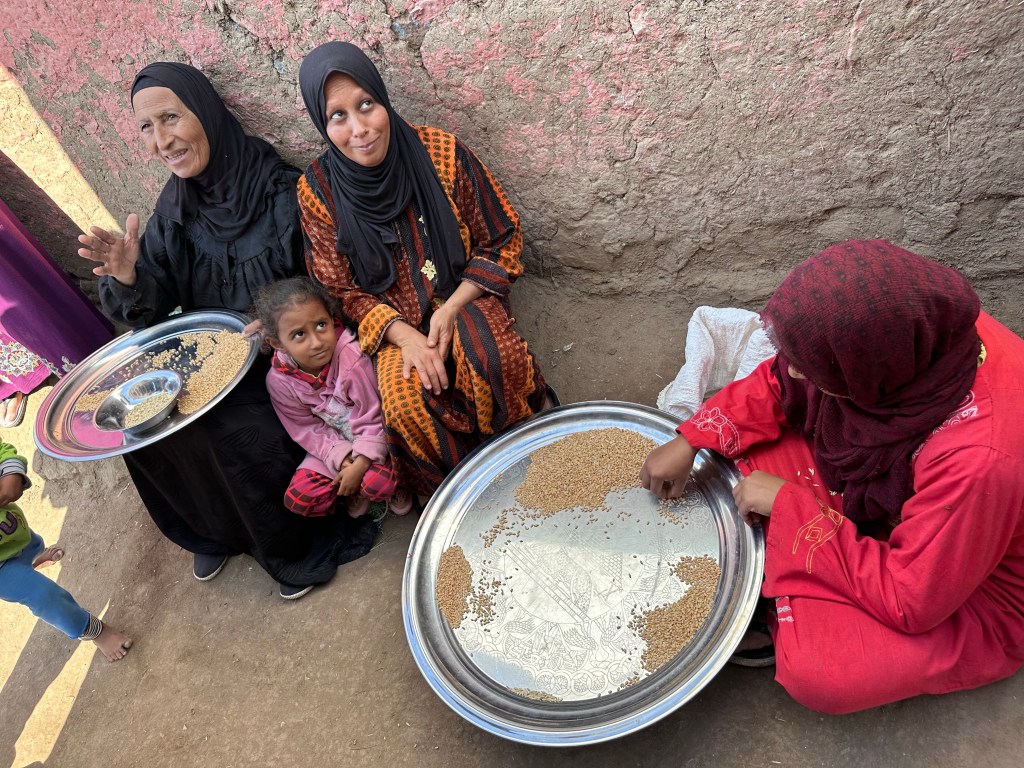
What are these women doing, you ask? Well, they are making sure there are no barley grains among the wheat. Why? I have no idea, and no one thought to ask.
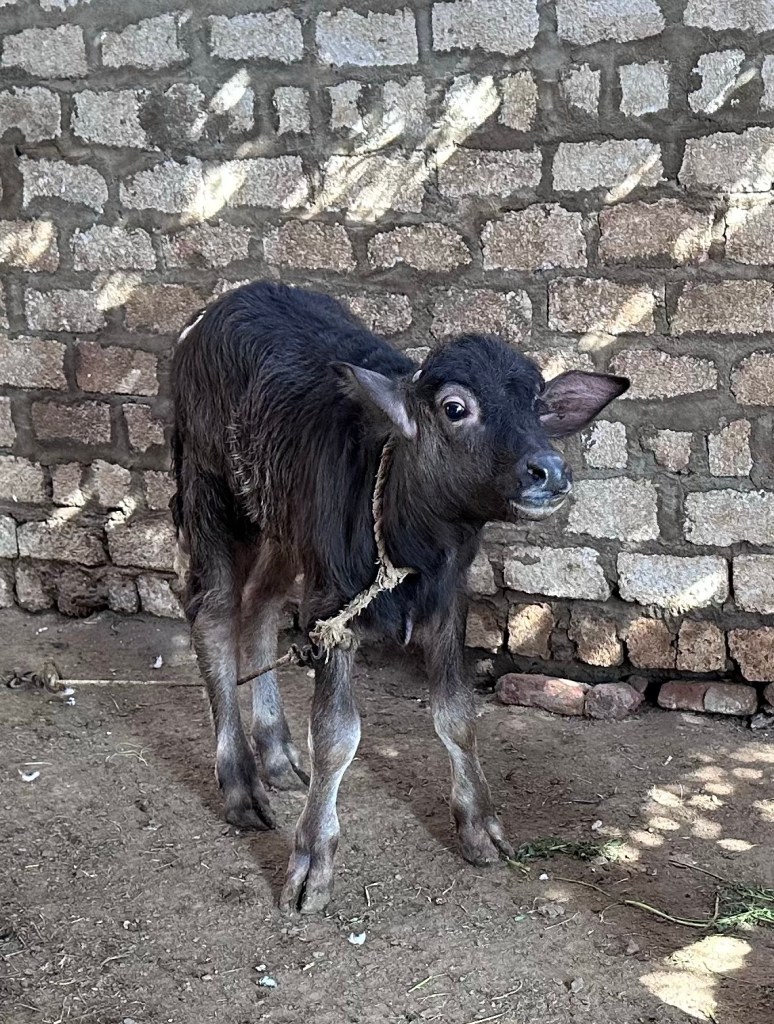
Yes, this baby water buffalo is adorable. Especially when he is tied up. He wasn’t when we entered the enclosure, so he was able to charge at us, first at Bobbie, then when she moved aside, he came at me, either trying to bite or kiss my leg. The only thing I know for sure is the Bobbie and I were left with water buffalo lip smears all over our pants.
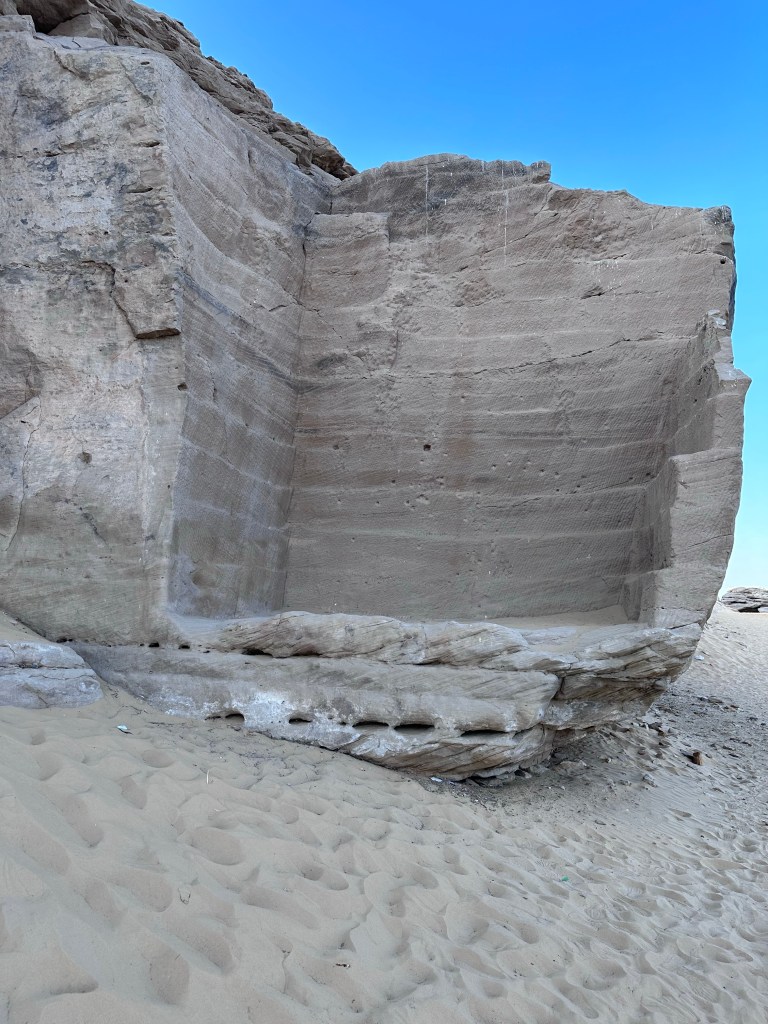
Our next stop was far more tame. We visited the quarry from which the pyramids’ sandstone building blocks were cut, then floated down the Nile. That block must have been enormous! I should have had someone stand beside it for scale.
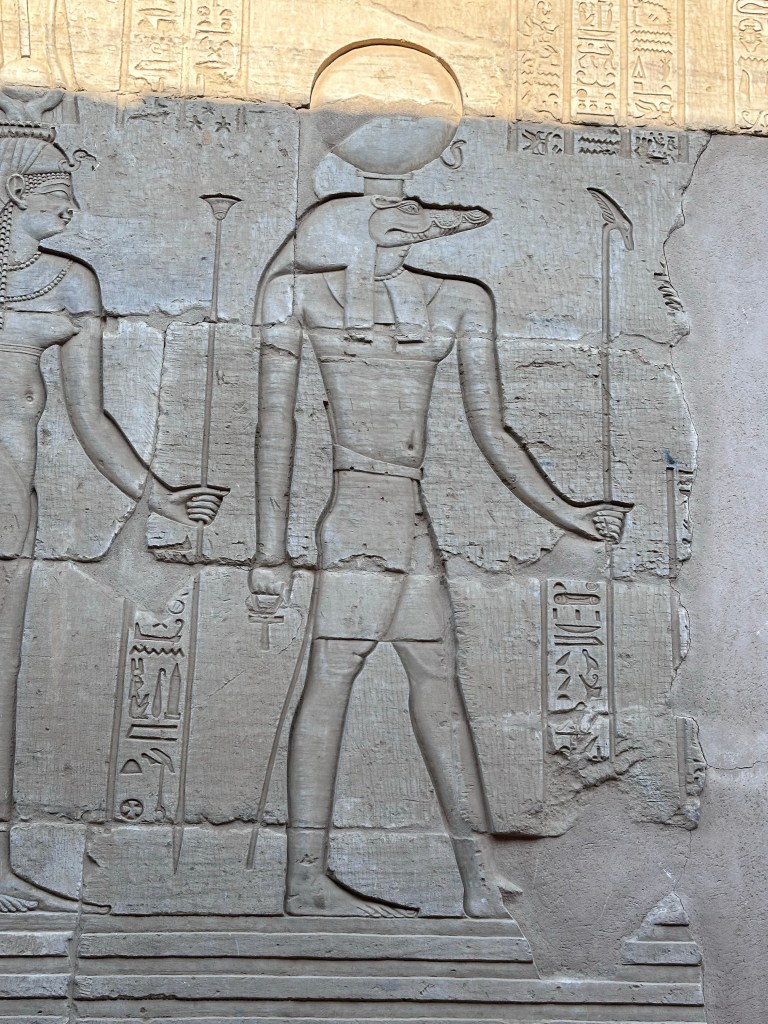
Our final temple (for the cruise part of our adventure) was Kom Ombo, which was again timed to ensure that we avoided the crowds (at least of tourists—not of street vendors). This temple is unique in that it was dedicated to two gods: Sobek, who has the head of a crocodile, and Horus, the falcon, shown here with his human body.
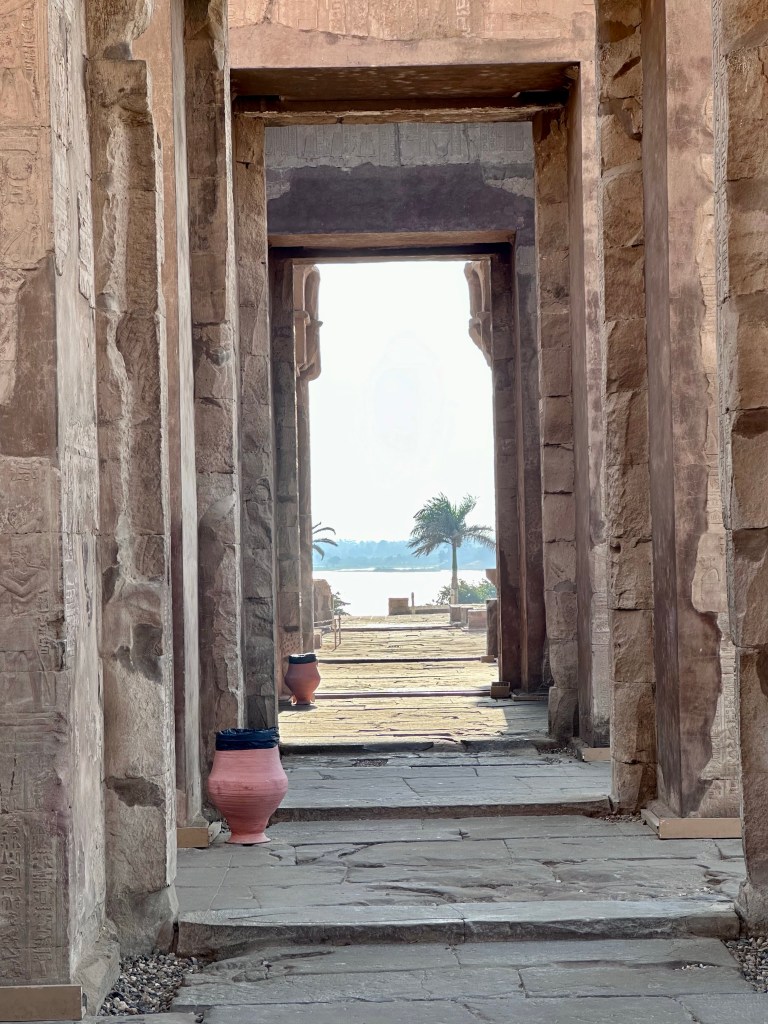
The view of the Nile from inside Kom Ombo
Now here’s something you don’t see every day— mummified crocodiles. A live crocodile, believed to be the earthly incarnation of Sobek, was kept in a pit in the temple. When it died, it was mummified and replaced with another.
Although we have another day on our wonderful dabahiya, this post is already quite long, so I’ll end it with a sneak preview of tomorrow’s activity. Not another temple—tomorrow we go to the livestock market. Let’s see if another animal wants to get up close and personal with me!
I was awakened from a deep sleep by Jeanne, who was standing at the foot of my bed, shaking my leg. That was strange, given that we weren’t rooming together. Was it a dream? Nope. It seems I managed to sleep thru my 4AM wake up call, my cell phone alarm, and numerous text messages. They say there’s one in every group, and this time it was me.
Fortunately, I had arrived early for every other meeting, so my group knew I wasn’t t just being an inconsiderate jerk. At least not this time. They were concerned that something bad had happened to me. Was I dead? (I probably looked like I was). Did I meet with foul play? (No). Was I unconscious? (Sorta). What happened was I woke up at 2:35 but made the mistake of not getting up then. Lesson learned. Next time, I’ll grab my phone and do wordle, read email, check Facebook until it is time to leave.
Good thing I had packed almost everything for our flight to Luxor the night before, and laid out my clothes, so with Jeanne’s help, instead of being on the bus at 4:45 AM, my butt was in my seat at 4:52 AM. I’m quite proud to say that those 7 minutes also included the elevator ride all the way down from the 17th floor. Still, l felt bad for keeping the others waiting.
Normally, I put my empty backpack into my carryon, but because I stuffed my toiletries into my carryon (so I could brush my teeth at the airport), I needed to pull out my backpack and allocate the carryon contents between two bags.
Well, I almost left my carryon at security. I was at the check in desk when I realized I should have THREE bags, not two. Yes, you put ALL luggage, including your checked bag thru the X-ray machines, before you arrive at the check in counter to get your boarding pass. Then your carryon goes thru security again, after you dropped off your checked luggage.
Maybe when I get home I’ll do a post about my “interesting” airport experiences, of which, so far, there have been several, especially in Jordan where I got intimately acquainted with security coming and going.
There is far too much to say about Luxor to dwell on my rocky start, so I’ll move on. .
Did you know that 1/3 of the world’s antiquities are in Luxor? And that Luxor was once known as Thebes? I hope those are trivia questions some day.
The reason we had such an early start was so that we could go straight from the airport to the Temple of Karnak, then on to lunch before checking in to our hotel.
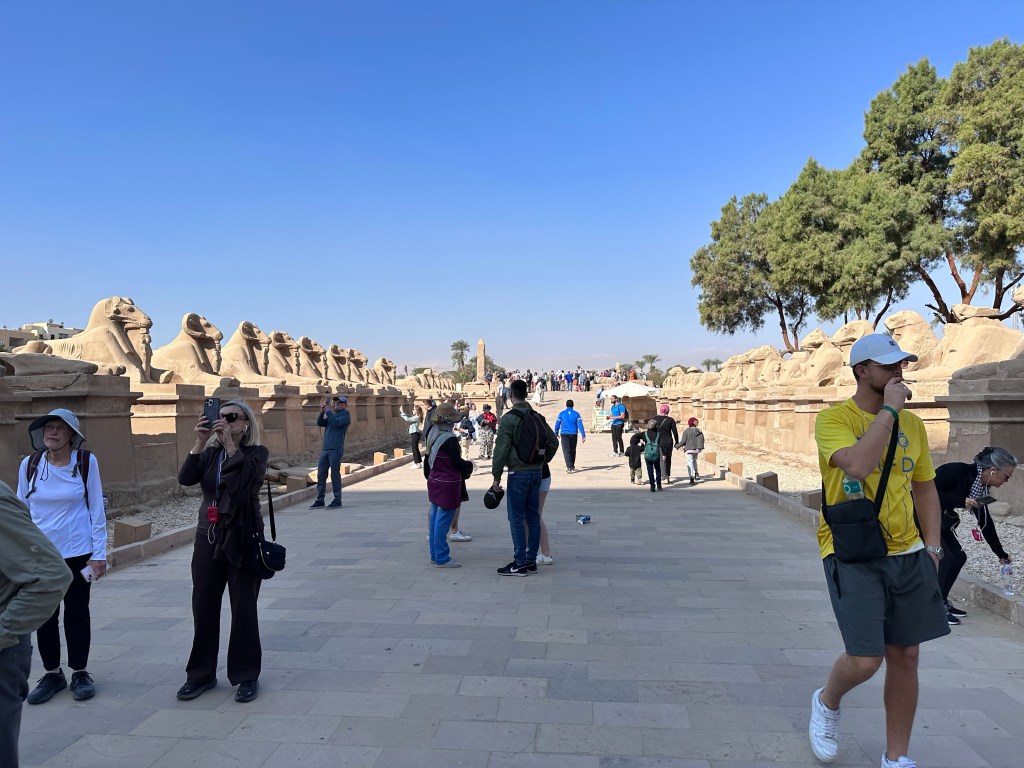
At one time this avenue united the Karnak and Luxor temples. Notice the rams head sphinxes that lined the avenue.
Just about everyone has seen photos of Egypt’s temples and tombs, right? But let me tell you, it just isn’t the same. You really DO have to be there to appreciate the immensity of these structures.
Although it looks crowded, and certainly felt that way, this is about half of what the crowds normally are at this time of year.
If you walk counterclockwise around this beetle (scarab) seven times, your wish is supposed to be granted. I had nothing better to do, so why not?
I’ll admit it, by the 7th time around I was starting to feel a little dizzy. But if I get my wish, it will be well worth it.
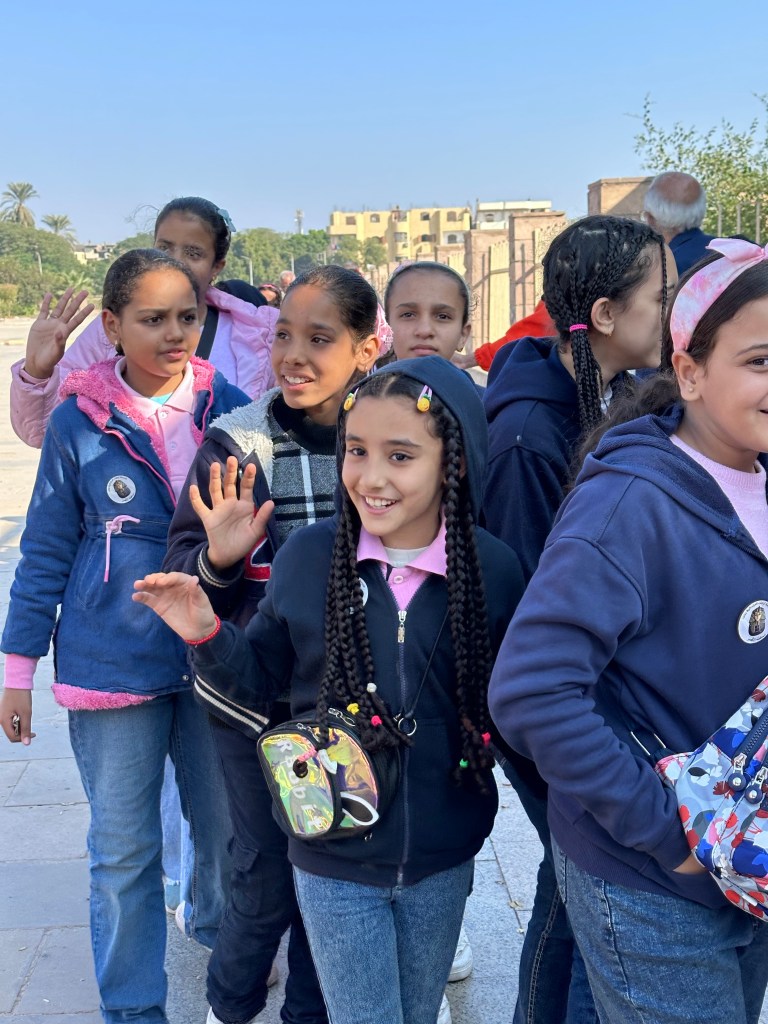
Lots of school groups were touring Karnak Temple that day. As was our experience in Jordan, the children were adorable and oh so friendly. They blew kisses, waved, shouted “hello” “how are you” and “welcome”.
That evening, five of us had dinner at the home of Mansour and Azza. We were joined by their two gorgeous daughters-in-law and their two very outgoing and entertaining granddaughters.
It was the perfect way to end our first evening in Luxor.
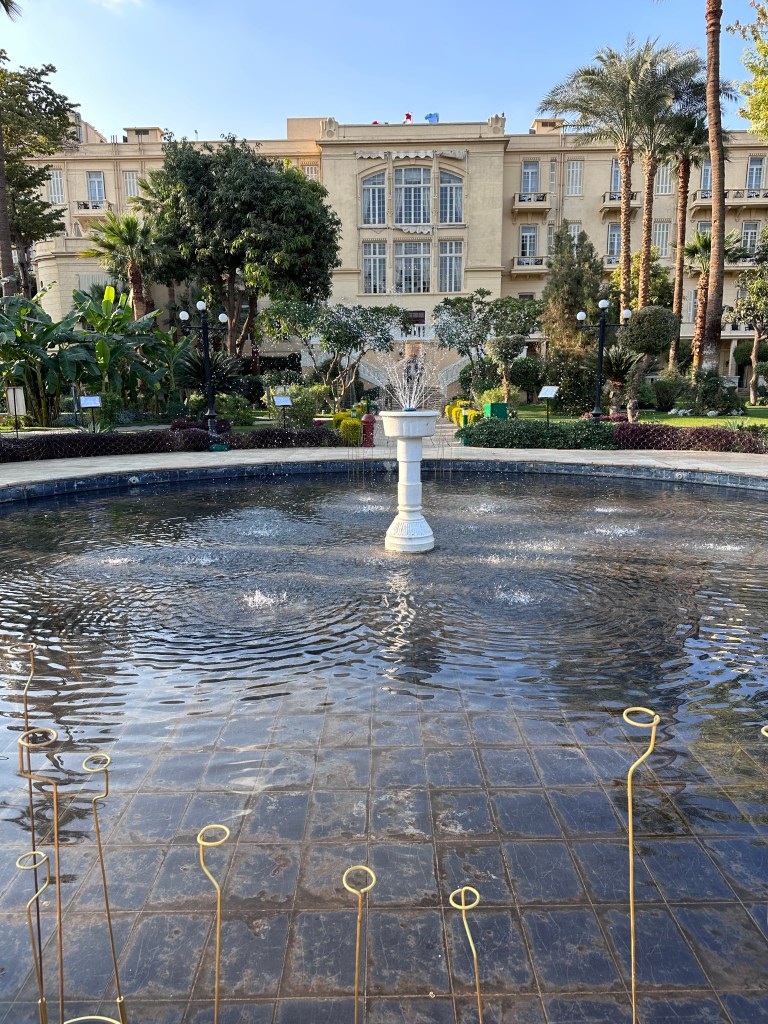
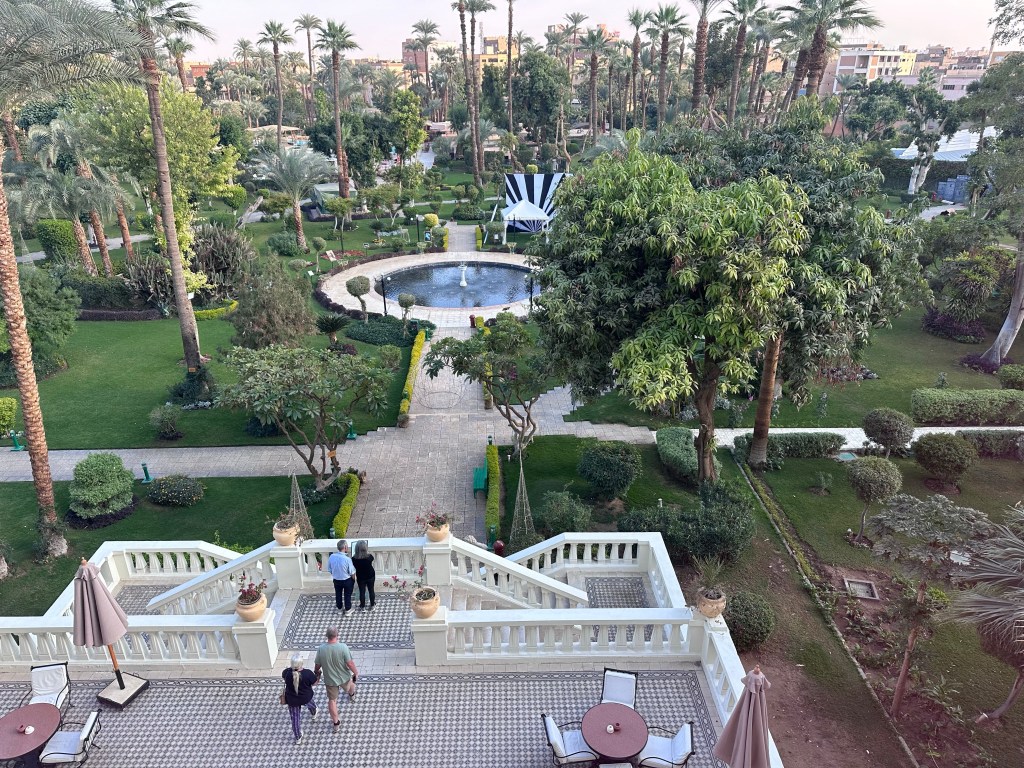
We spent two nights at the historic Winter Palace Hotel. Besides us, other famous guests included Jackie Onassis, Princess Diana, Henry Kissinger, Al Gore and Richard Gere.
On our free afternoon, Jeanne and I enjoyed a glass of wine in the gorgeous gardens. Helpful hint: if you’re going to drink the local Egyptian wine, go for the white.
Our second full day was spent exploring the Valley of the Kings in the morning, and the Valley of the Queens in the afternoon.
The Temple of Queen Hatshepsut, Egypt’s first female ruler, was our first stop on the way to the valley of the Kings. According to historians, her reign was quite successful—no wars, a prosperous economy, but that didn’t stop her successors from trying to completely erase her from history.
Fortunately, archaeologists were able to recreate her story by studying the empty spaces on the walls, and the remaining, very faint outlines.
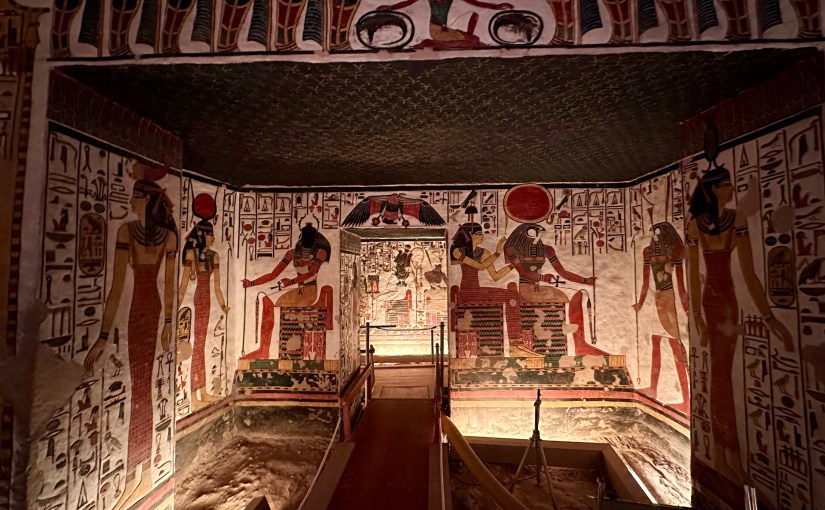
On our visits to the Valleys of the Kings and Queens, we explored the tombs of Ramses 1, 3, 4 , King Tut and Queen Nefertari (wife of Ramses the Great, also known as Ramses 2). All were spectacular, covered with vibrant hieroglyphics, but Tut’s tomb was unique in that his actual body—with face and feet exposed—is still in his tomb.
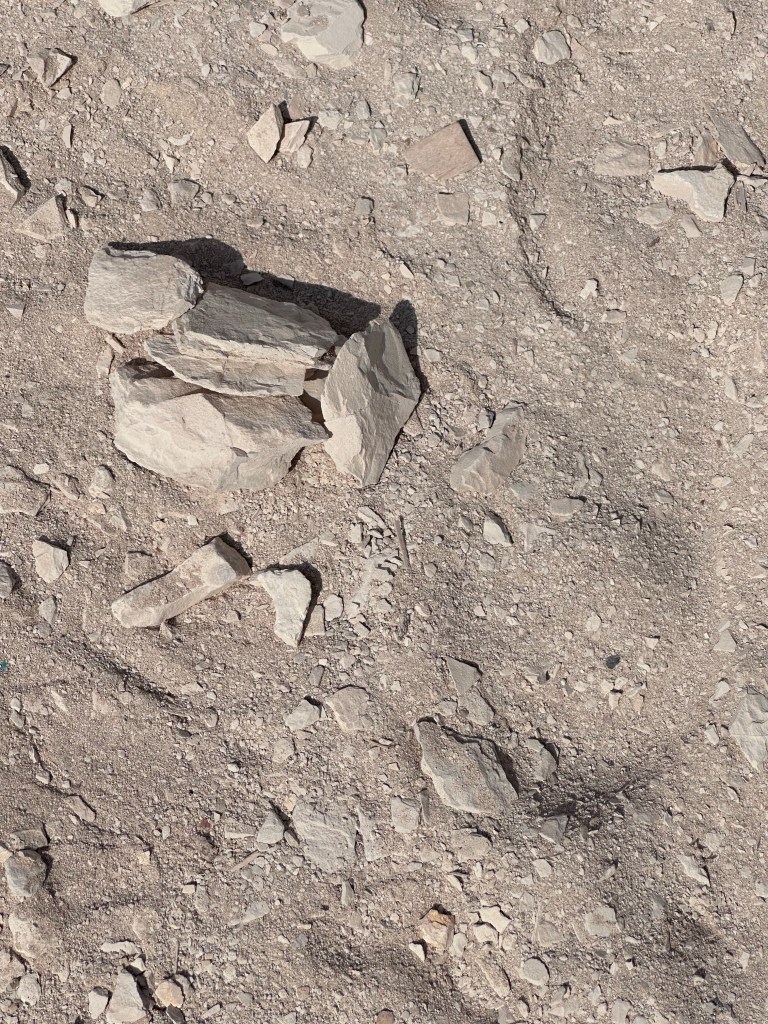
I had originally planned to leave Mike’s ashes inside King Tut’s tomb, but then I thought the caretakers might sweep him up, so I went with Plan B. I dug a little hole in the ground outside Tut’s tomb, inserted the ashes, then constructed this little pyramid atop them using stones lying nearby.
Okay, so maybe it doesn’t look like much, but I didn’t take 20 years to build it and I didn’t have the help of thousands of workers.
By the time we’d finished with the tombs, we were all too tired to tour the Temple of Luxor. It was just down the street from our hotel, so I caught a glimpse of the outside at night when it was lit up. That was good enough for me.
Our final Luxor activity was an optional one—a balloon ride over the Valley of the Kings. Only 4 of us were willing to endure yet another early morning departure (5AM). THIS time I was early!
To get to the balloon site, we had to cross the Nile by boat. Well, there were many boats lined up at the pier. To reach our boat, we had to climb through other boats. In one instance, it felt like we were walking “the plank”. But there was a reward. Take a look at what we got for our efforts. Yes indeed, that is a Twinkie in my hand. I hadn’t seen one of those in decades; it was so long ago, they came two in a package! No, I didn’t eat it, but it did make me smile.
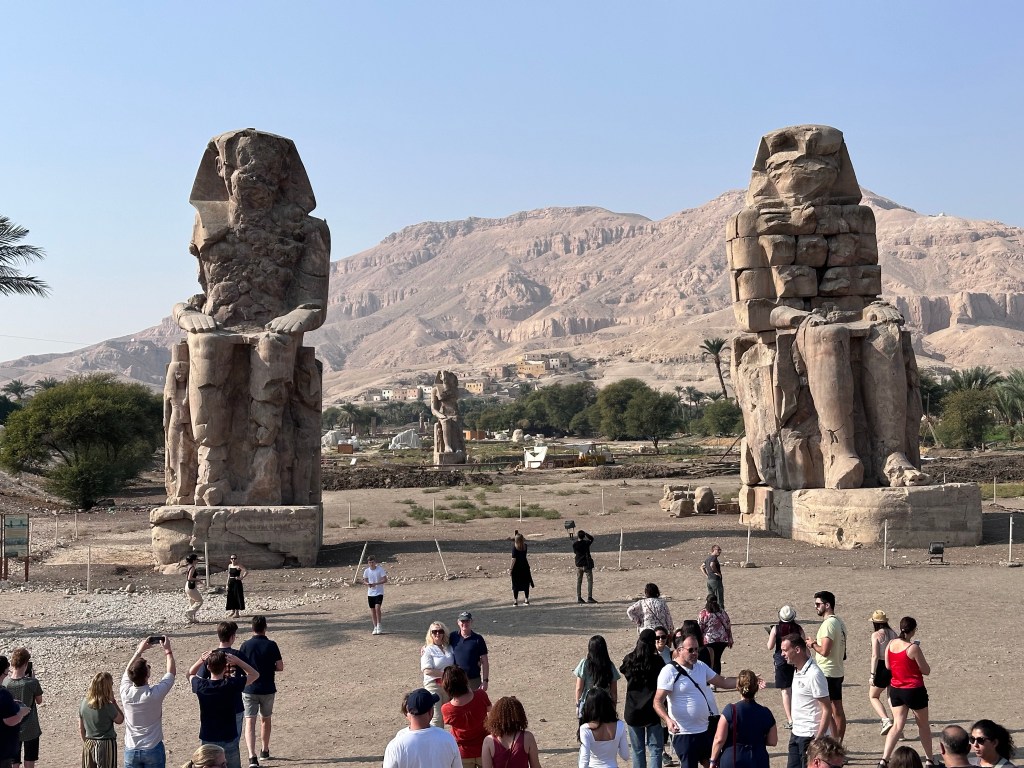
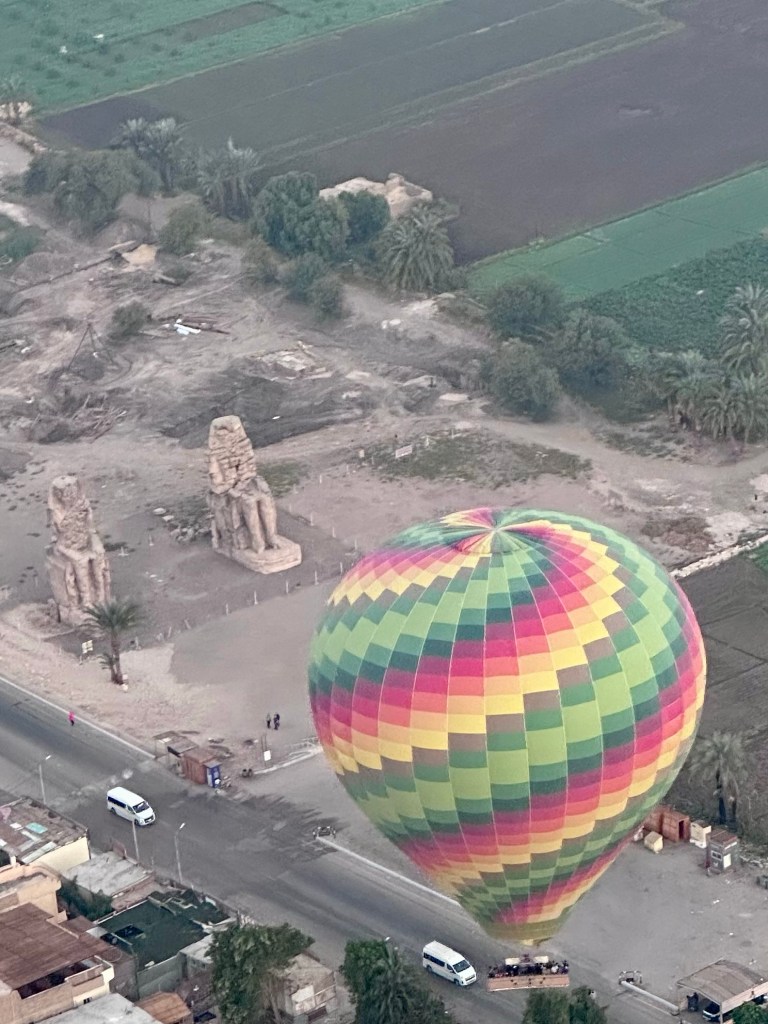
The day before our balloon ride , we had seen these statues of Amenhotep III from the ground.
Here is the aerial view.
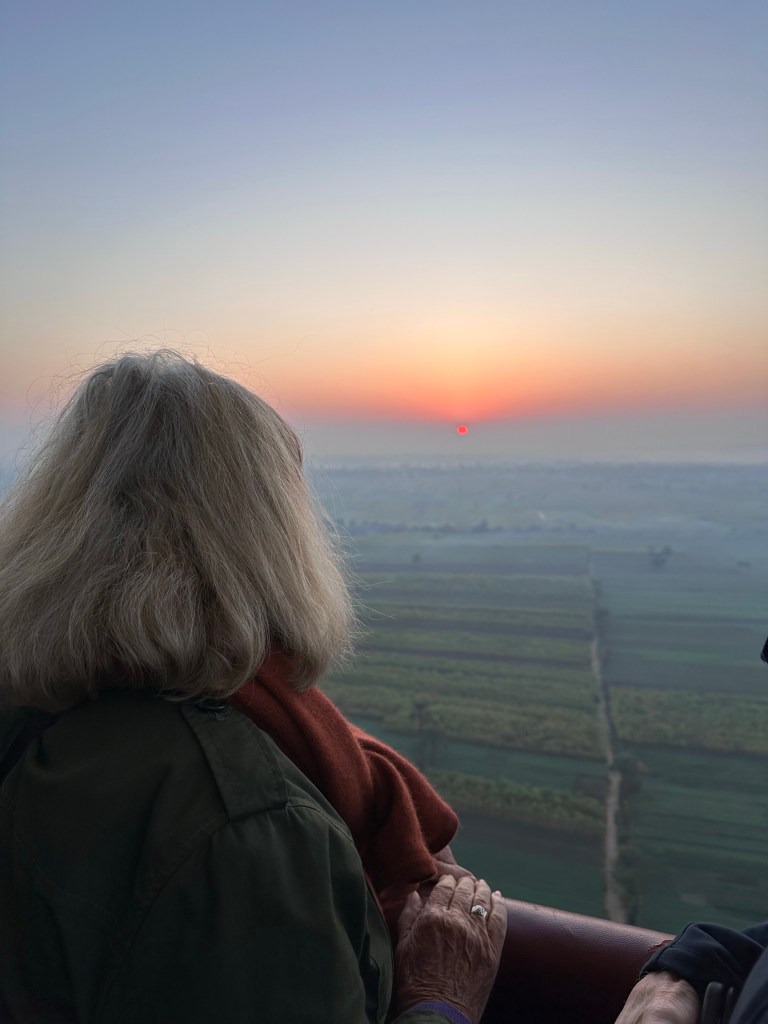
It was a spectacular sunrise
Next post will be about our 5 day cruise on the Nile.
Cairo is a complete sensory assault, especially after the serenity of Petra. The noise of thousands of horns blaring reminds me of a Las Vegas casino. Smoking is allowed EVERYWHERE, so the smell of cigarette smoke is omnipresent. On the positive side, however, the people are quite lovely and gracious, going out of their way to make us feel welcome. In this Muslim country, we were frequently greeted on December 25th with “ Merry Christmas”. If one must stereotype huge populations of individuals, why not picture Muslims the way we are experiencing them on this trip — as friendly, kind, helpful and warm, instead of envisioning all of them being like the small minority we see on the nightly news?
But enough of that. Let’s get to the magnificent sights from our first full day in Cairo.
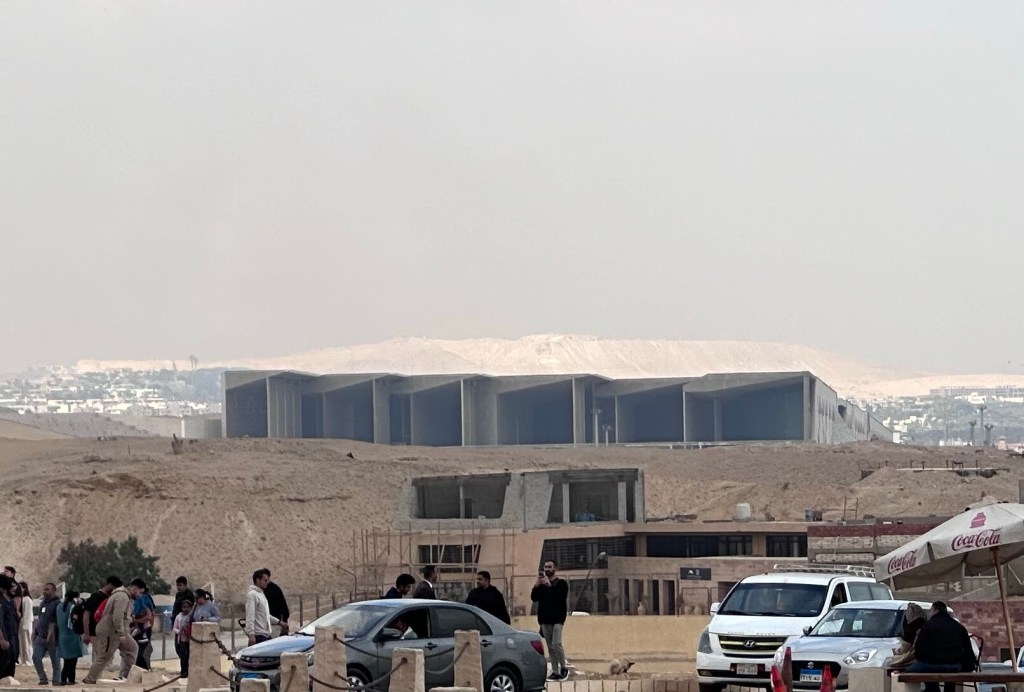
Unfortunately, the GEM, the new museum, is still not finished. It was started in 2010, but has been delayed by wars, covid, the Arab Spring. The Egyptians were hopeful that it would be completed by November 2022, the 100th anniversary of the discovery of King Tut’s tomb. Maybe next year? Or the year after?
The new museum, as seen from the pyramids. These two major attractions are within walking distance of each other.
Many treasures have been removed from the “old” Cairo Museum to the “new”, unfinished one. Still, there was no shortage of truly spectacular objects in the old museum. In fact, it was hard for me to imagine how more artifacts could have fit into the available space. I actually was glad that there was less to see; it was less overwhelming.
After having the sites pretty much to ourselves in Jordan, we weren’t used to having to wait to view or get a clear shot of a particular object. Even so, it wasn’t bad because the number of visitors was about a third of the normal amount for this time of year, according to Mohammed, our guide.
Once again, I’m not going to post the usual photos of famous items everyone has already seen, like Tut’s gold death mask. Instead, these are a select few of the objects that caught MY interest.
How in the world did they ever get those tomb paintings to line up so perfectly? Well, this unfinished segment shows us. This is the Egyptian equivalent of our graph paper, but drawn on the wall. By the time the wall is completed, those guide lines will have been covered up, painted or plastered over.
Talk about aging well! This papyrus, found in one of the tombs is thousands of years old. The colors are vibrant and the papyrus shows absolutely no sign of wear.
Ever wonder about those strange “things” hanging from the pharaohs’ chins? I sure have. Mohammed explained they are made from goat hair, and held in place by strings attached to the headdress. Why? Well, because the ancient Egyptians thought the gods had similar beards, and the pharaohs wanted to appear Godlike. (Interestingly enough, the Egyptians refer to their leaders as Kings; pharaoh is just one of the king’s 5 titles).
In case you’re wondering, this is King Khafre, the builder of the middle pyramid in Giza.
From the side view, you can see Horus, the falcon god, spreading his wings around the king’s head to protect him.
Carved on the side of the throne are papyrus and lotus which symbolizes the unification of the upper and lower kingdoms of Egypt.
The statue below represents a member of the working class. Look carefully. In addition to carrying something in his hands, he’s also wearing a backpack! I’ll bet it was this planet’s first.
One more photo, before we move on to the pyramids in Giza. Take a look at the eyes of the “seated scribe”. They are made of crystal and are amazingly lifelike, when you see them “in person”. This statue and the one above are carved from wood.
We ended our first full day with a delicious dinner at a restaurant across the street from our hotel. I was particularly grateful for our guide and our security guard who helped us avoid getting run over on our way back to the hotel. No photos of that particular adventure, but I did take one of the view from our restaurant.
Old and new structures separated by the Nile.
Our last day in Cairo was spent visiting the pyramids at Giza in the morning and at Saqqara in the afternoon. We were supposed to have the afternoon free, but because all 9 of us wanted to see Saqqara, Mohammed changed the itinerary to accommodate us. Now, that’s a great guide.
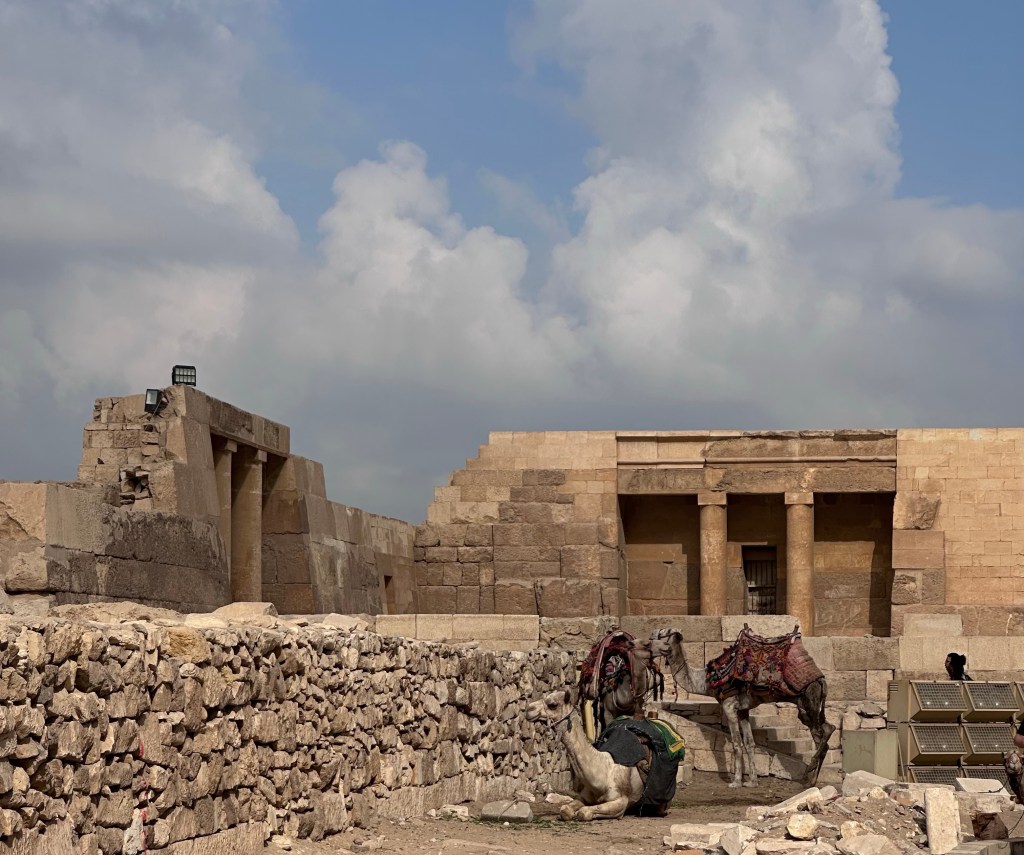
Everyone has seen Cheop’s pyramid, which is the largest of the three great pyramids of Giza. But those aren’t the ONLY pyramids—just the most spectacular. They aren’t even the only tombs. Take a look at these, which are close to the great pyramids. These tombs were for lesser beings, like the pharaoh’s administrators.
I found myself quite taken with the camels and spent as much time gazing at them as I did at the pyramids. They have such expressive faces!
Check out the tattoos on the camel on the right. these two were engaged in some very deep communication
Giza was even more chaotic than Cairo. Fortunately Mohammed prepared us for what to expect. He explained that the helpful men who offer to take your photo expect to be paid. There were so MANY of them! It was hard for me not to engage with the friendly young men, but I heeded Mohammed’s warning. Most wanted me to hold my hand up so that it looked like I was touching the pyramid’s top.
When we moved away from the craziness of Giza to get a panoramic view at a quieter site, we discovered this young man taking a more creative approach.
Our final stop before heading back to our hotel was to view Egypt’s very first pyramid, the step pyramid at Saqqara. We didn’t have much time at the site so we had to choose between entering the pyramid or visiting Serapeum, the tomb for the sacred bulls. I chose the latter.
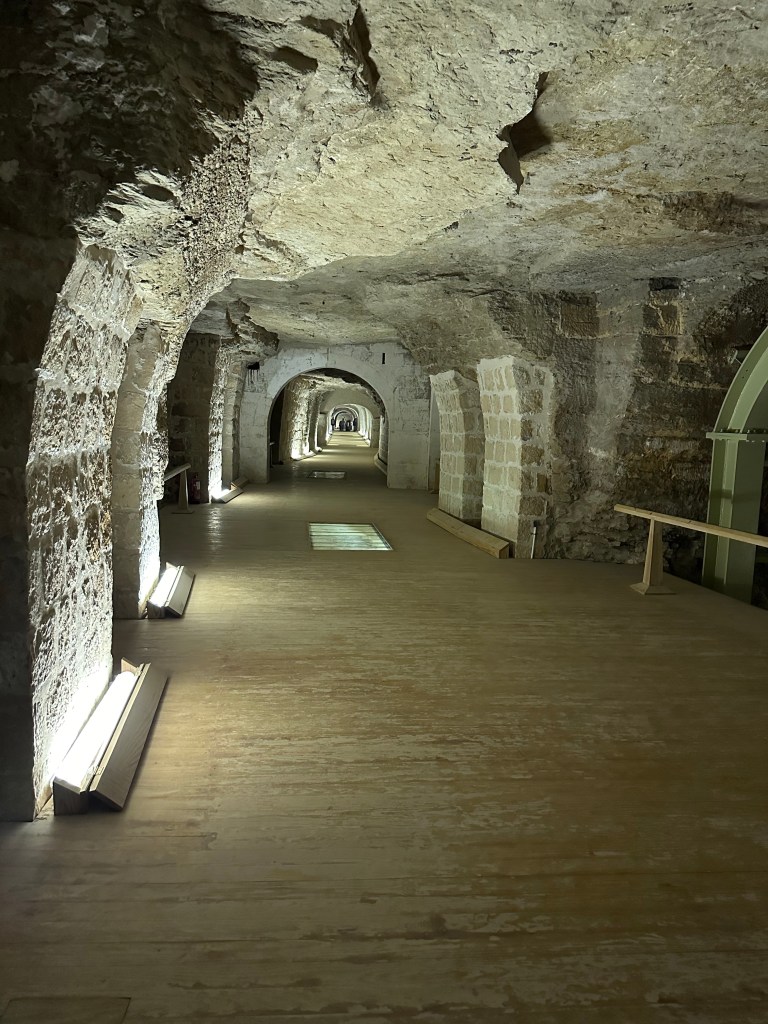
The serapeum is an underground structure with huge sarcophagi located in each alcove.
The Egyptians worshiped one bull at a time. When it died, it was mummified and placed in one of the 24 sarcophagi. Unfortunately, the site had been looted, so there is nothing left to see other than the immense sarcophagi.
The step pyramid as seen from the serapeum
It was a tiring day, and we have to be on the van at 4:45 tomorrow morning to catch our flight to Luxor, so it is time to press “publish” and hope for the best.
Just about everyone has seen a photo of Petra’s Treasury. To be honest, that structure was my #1 reason for visiting Jordan. And yes, the Treasury is quite magnificent. But there is SO much more to Petra. So, despite taking many photos of the Treasury, I’m not going to post any in this blog. If you want to see what it looks like, just ask Ms. Google.
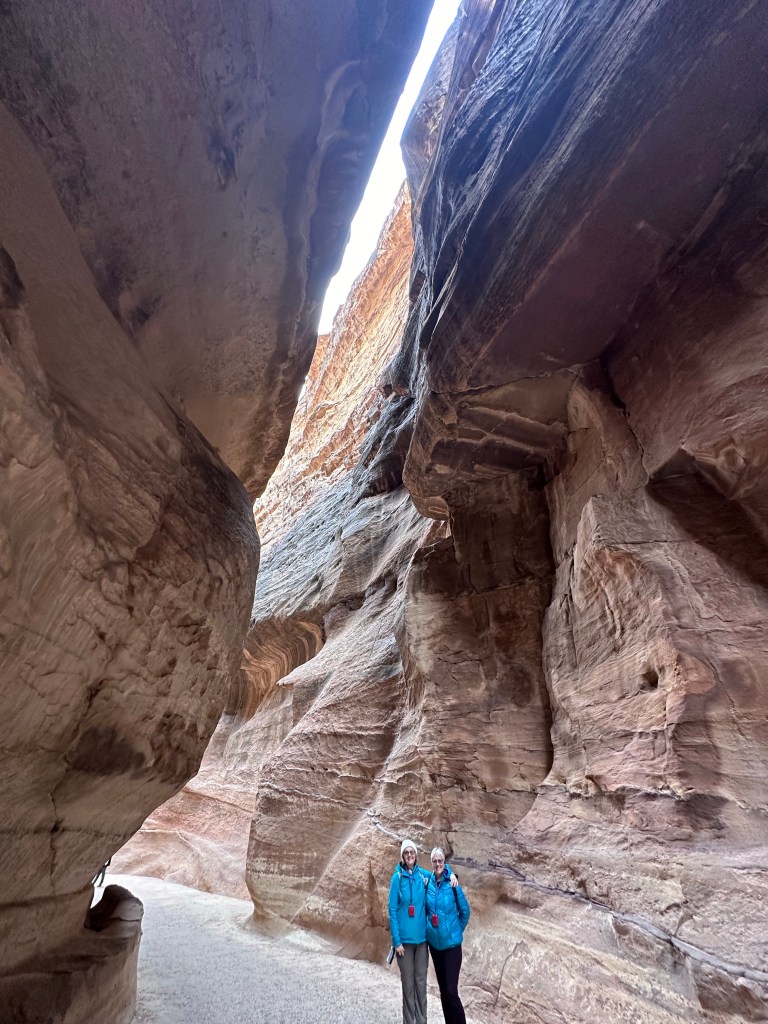
The Treasury is a little more than a mile from the entrance. Although there are several options for getting there—golf cart, horse or donkey—Hisham, our guide, told us the very best way is on foot. That way, you can take your time and truly experience Petra’s magic. There are incredible rock formations everywhere, both naturally occurring and man made. Hisham did an excellent job drawing our attention to both, like this formation that resembles an elephant,
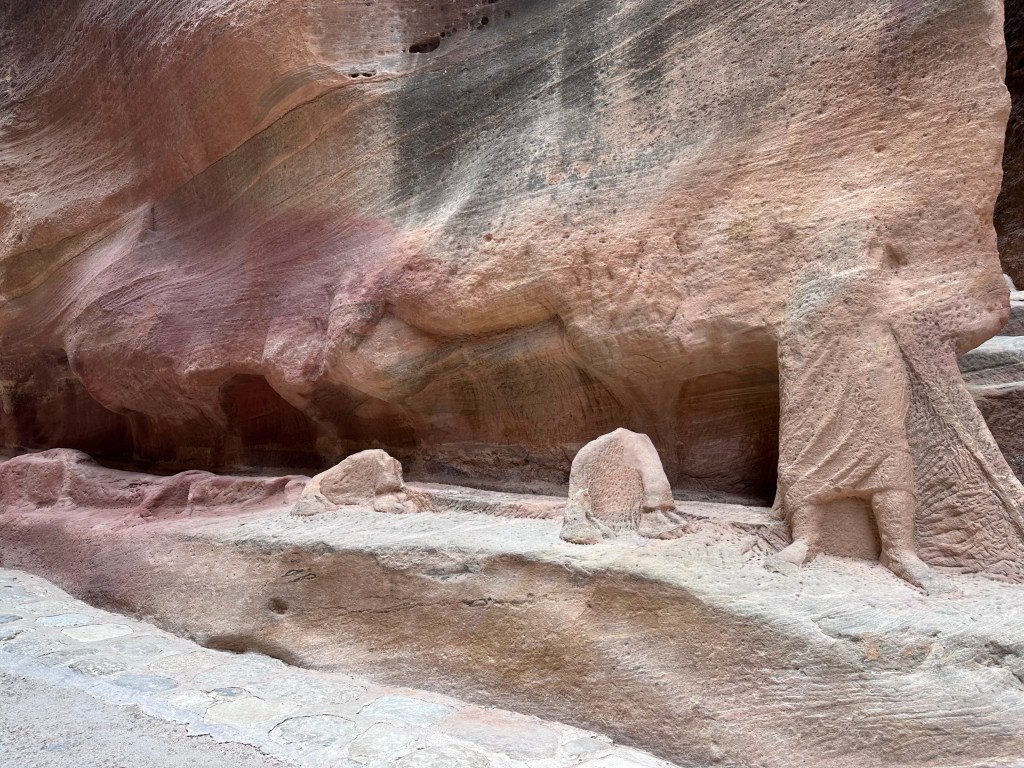
and this Nabatean carving of a camel driver leading his herd into the city. All that remains are the legs of the man, and some parts of the camels, still it was wonderful to see. And look at those glorious colors!
Can you spot the camels feet ( Hooves? Paws? Whatever camels have at the end of their legs)?
I could go on and on about Petra, and I will. For a little while, at least. It is far, far bigger than I ever expected.
In the morning, it was cold enough for jackets, sweaters and hats, but by afternoon, Jeanne and I had shed a couple of layers.
Two members of our group, Paulina and Bill are travel guides in Moab, Utah. In fact, if you want to see the highlights of Arches, Canyonlands and Dead Horse Point, contact Paulina (moabinaday.com)—it’s her company, and she’s terrific. There WILL be a Moab visit and blog post before the end of 2024. I promise.
But back to Petra…even Paulina, who lives in Moab, ( and is a geologist) was blown away by the colors, the canyons, the enormity and the unbelievable carvings of Petra. Now that’s saying something.
I love the color of this structure!
Petra is strategically located between the Mediterranean, the Red Sea, and Yemen, which places it right smack dab in the middle of both the Silk and Spice Roads.
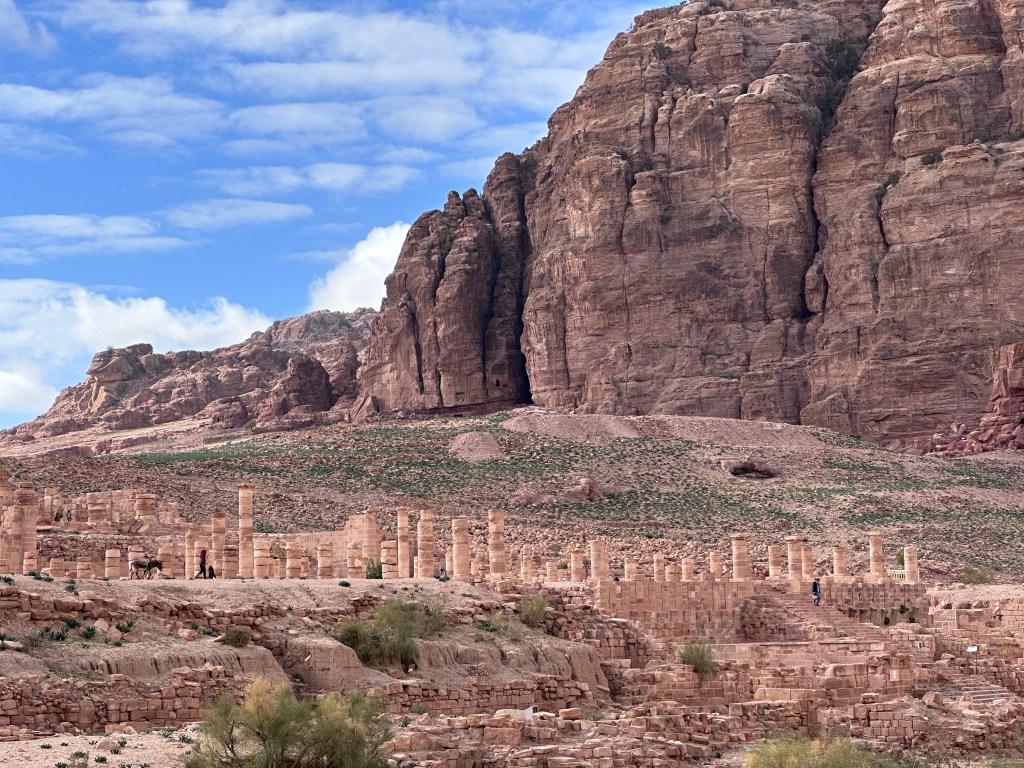
The Nabateans could offer the caravans food, shelter and safety. And the traders could make the Nabateans very wealthy. The Nabateans had a good thing going, at least until the Romans came along in 106 AD, and conquered them. As usual, the Romans had to leave their mark, so of course Petra has Roman ruins. Yet another fact that I never knew. I hope it comes up in Trivia one of these days.
Roman Temple
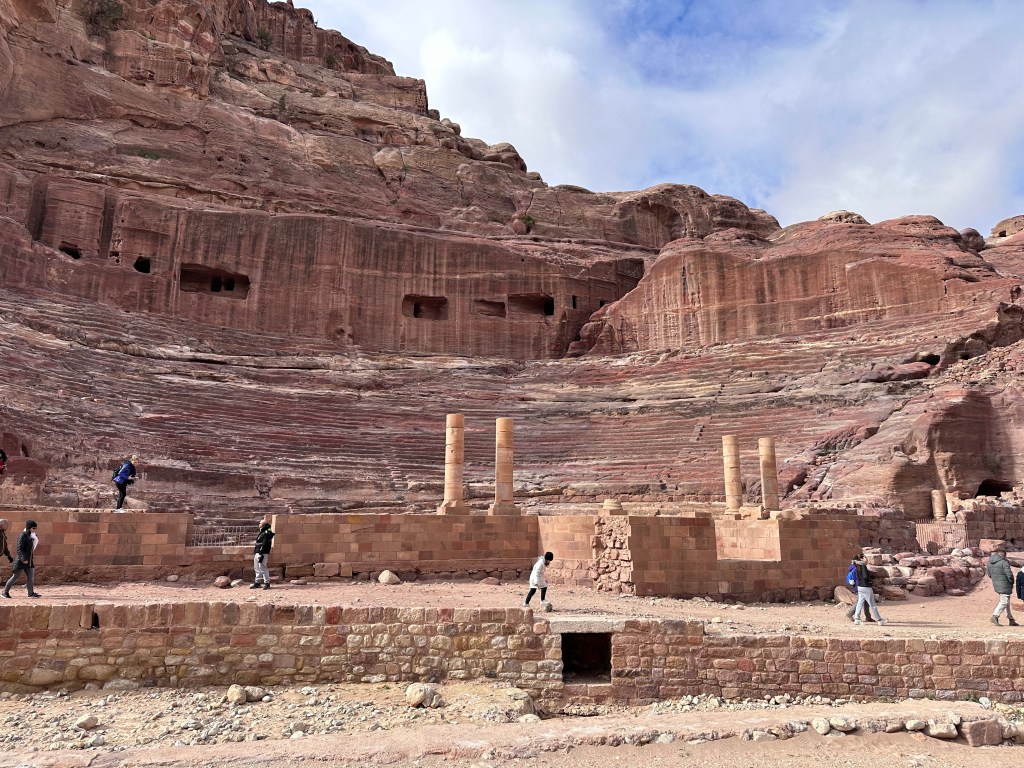
This was a Nabatean theater, which the Romans took over. Did they add the columns? I forgot to ask.
After lunch, we were given several options. We could go back to the hotel or climb to the monastery, the Royal Tombs or the High Place of Sacrifice. The Monastery was 950 steps. I don’t remember how high the other two were, just that they were significantly less than 950. I knew we still had to walk almost 3 miles to get back to the hotel, so the Royal Tombs it was.
It was impossible to get all of the royal tombs into one shot, so the photo atop this post gives you a view of another section.
Before your eyes glaze over, I’ll post one last photo of Petra then move on to some of the other fantastic, but little known (at least to me) highlights of Jordan.
The view from the Royal Tombs
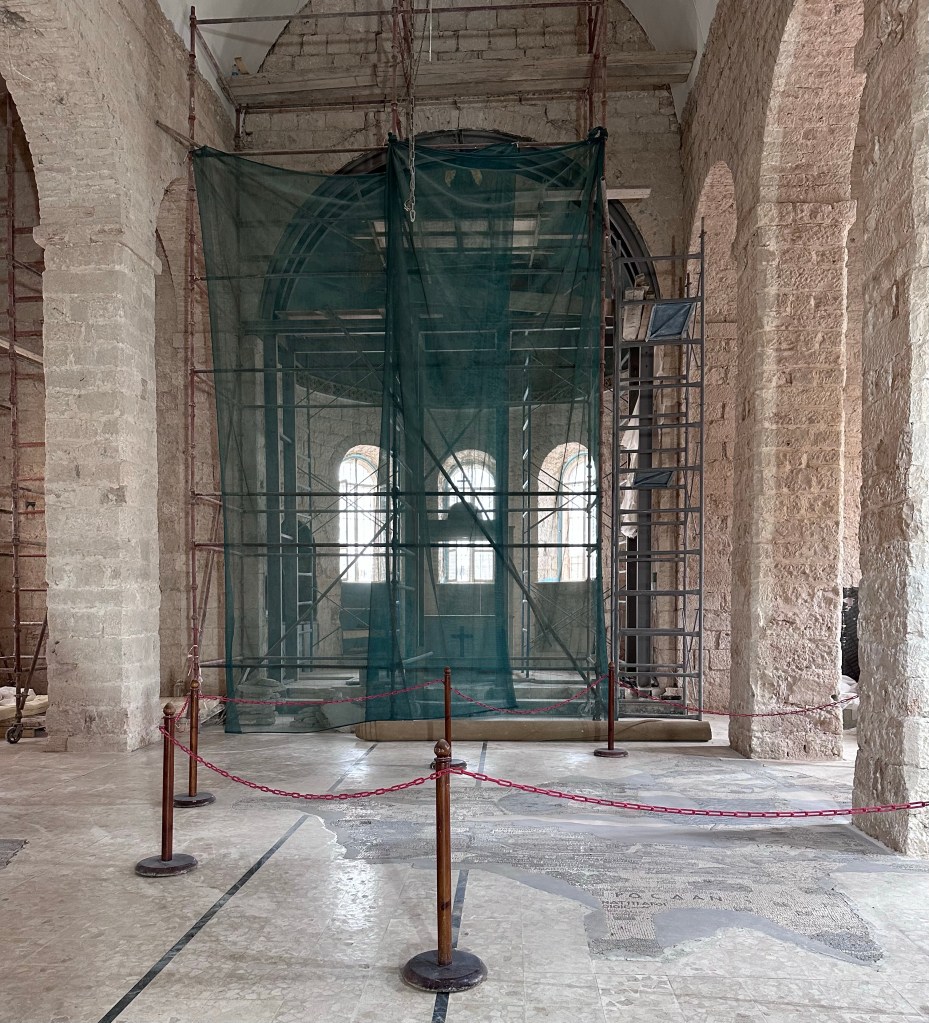
When we left Amman, Hisham gave us the option of following the regular itinerary or paying a bit more, and making a detour to the Dead Sea. Our very compatible group unanimously opted for the Dead Sea detour. But first, we followed the proscribed itinerary, stopping to view the mosaic on the floor of St George’s Church in Madaba.
The church is being renovated, but we were still able to view the mosaic, which is encircled by the red chain. Fortunately, the graphic of the map, in the visitor’s center was much easier to read, perhaps because there weren’t columns in the middle of it.
Hisham, explaining the significance of various sites in the map.
Next stop was to a mosaics workshop where we watched items being created. .
In ancient times, the craftsmen scoured the area, searching for rocks of the right colors; these days, it’s much easier. They simply visit the granite countertops place, and collect the scraps.
For the rest of the day, I felt like we were journeying through the Old Testament. Take another look at the names on the map above. Am I the only one who kept hearing “Joshua at the battle of Jericho, and the walls came tumbling down” over and over in my head?
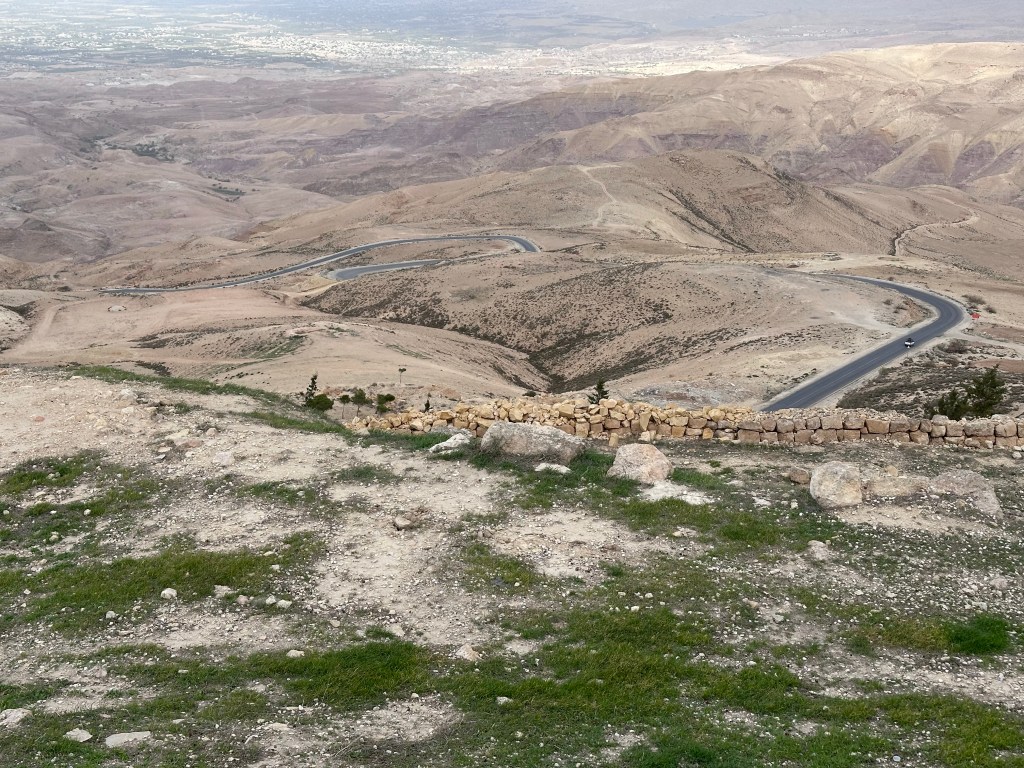
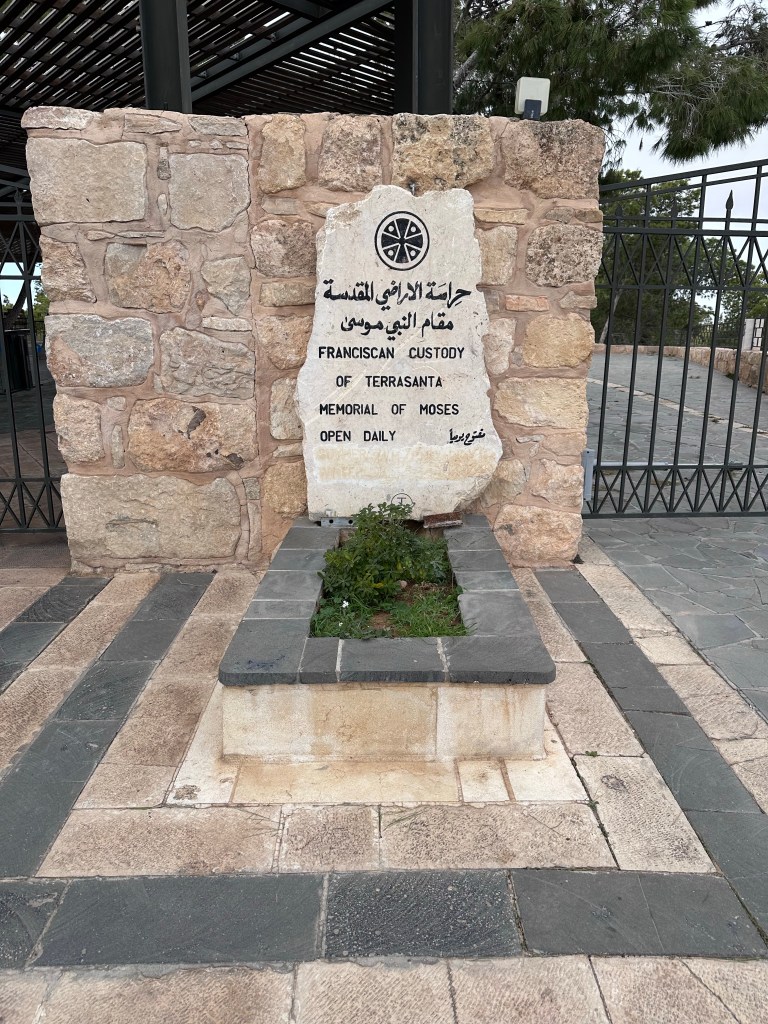
Just like Moses, we were able to gaze at the land of milk and honey from Mount Nebo, except back then, there wasn’t t a road running thru the landscape. Maybe it looked more promising thousands of years ago.
It was incredibly windy atop the mountain,
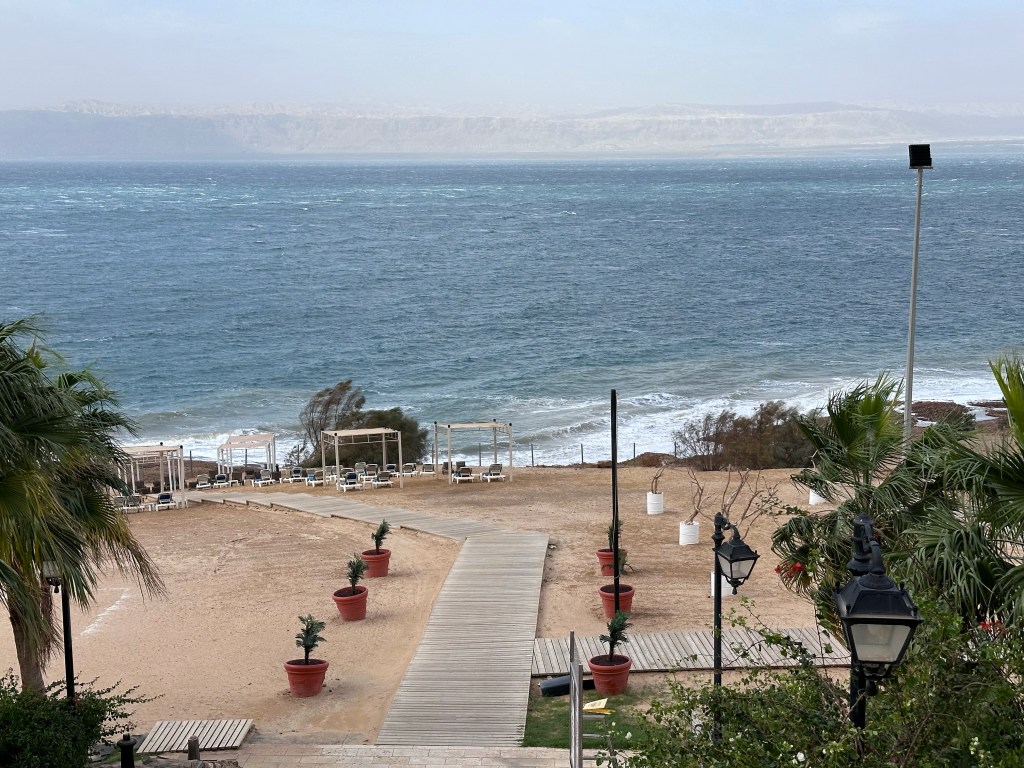
and that wind was responsible for the whitecaps on the Dead Sea. It was so rough, we weren’t allowed to go into the water. Undaunted, I decided to sit on the little pier, dangle my legs, and take a photo. I’m a Massachusetts girl, so I mistakenly thought the tide was creating the waves and the “tide” was going out. Suddenly a strong gust of wind pushed the water over the pier. So, no photo. Luckily, the lack of moisture in the air meant my pants dried rather quickly.
Although we weren’t able to go into the sea, we DID experience what it would have been to float in it like when we used the salt water pool in the Crown Plaza resort. It was quite an experience! Again, no photos, except this one of the view of the Dead Sea from the resort patio.
We took an elevator down to the beach, but still had to walk down—and then up— the equivalent (according to my Apple Watch) of 9 flights of stairs
The rest of the drive, through the Jordan Mountains, was gorgeous.
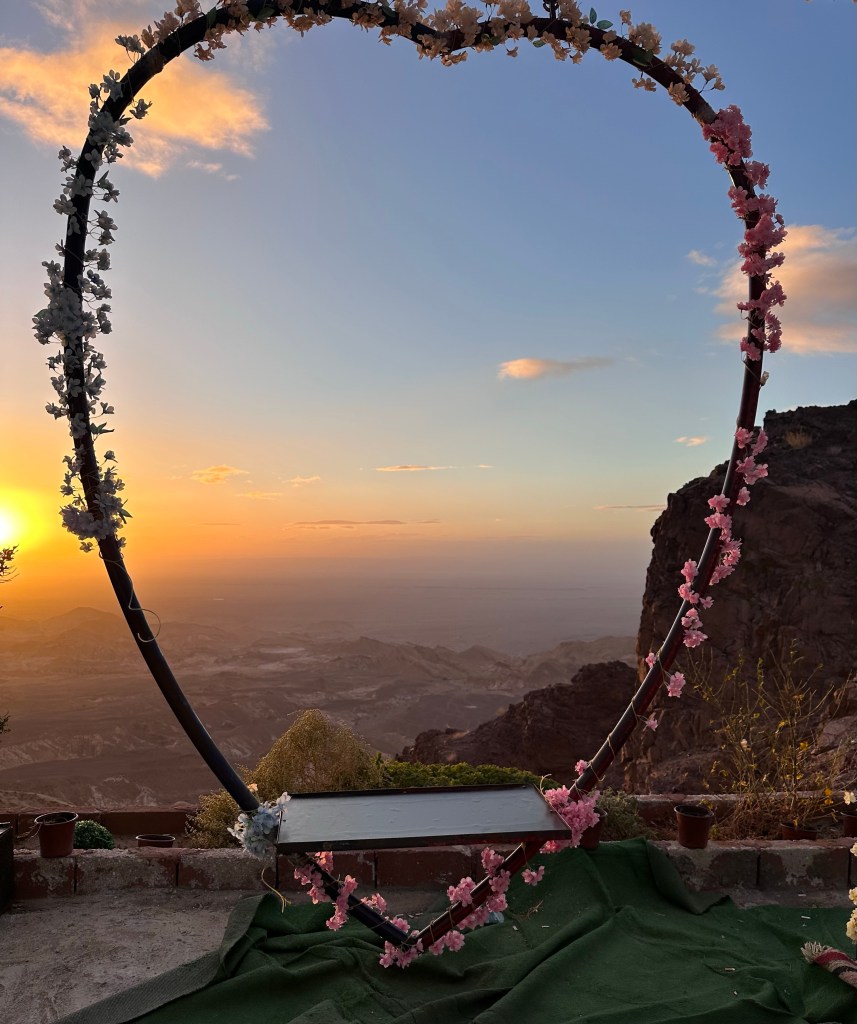
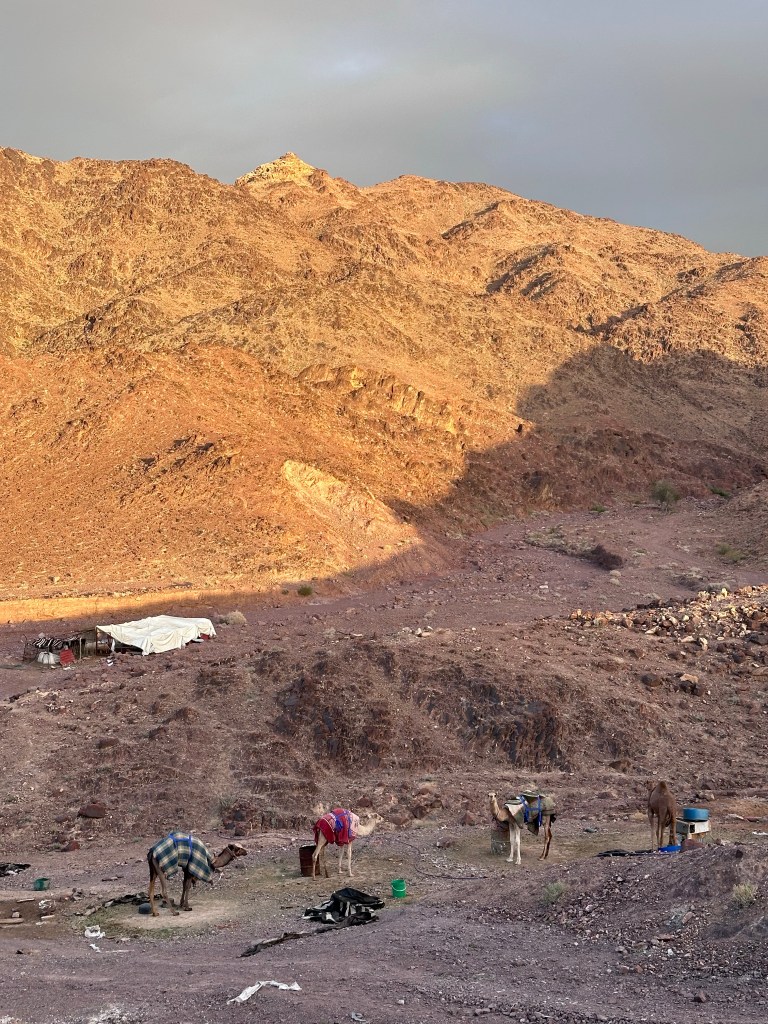
Roadside stop. For 1 dinar, you can sit on the swing and get your photo taken. I preferred the view of the sunset. Bedouin camp
This morning, We departed from our hotel at 4:30 AM for the 3 hour drive to the Amman airport. We should be in Cairo before 1 PM today.
The van has WiFi, so I’m writing this as we bump along dark deserted streets toward the King’s Highway. Nothing to see, except the glow from my fellow passengers’ iPhones.
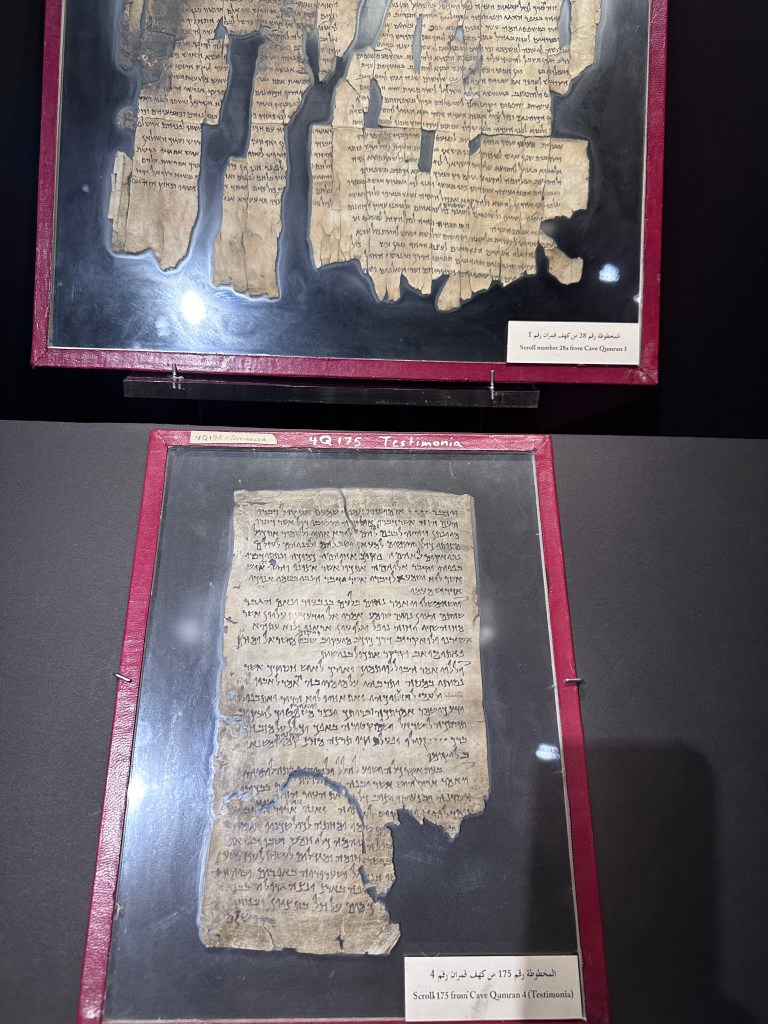
Remember learning about the “Dark Ages” in school? Well, come to find out, it wasn’t dark everywhere. In the Muslim world, for instance, the “Golden Ages” is a more apt description. Don’t believe me? Then come to the magnificent Jordan Museum. In addition to archaeological treasures, like Dead Sea Scrolls, the museum has a wonderful short video about the many significant contributions Muslims made to the world during Europe’s dark days, plus several interactive, multi-media displays.
Even if Amman isn’t on your bucket list (although Jordan should be) you can still experience some of the museum’s wonders by visiting this website ( if the link doesn’t work type in 1001inventions.com. )
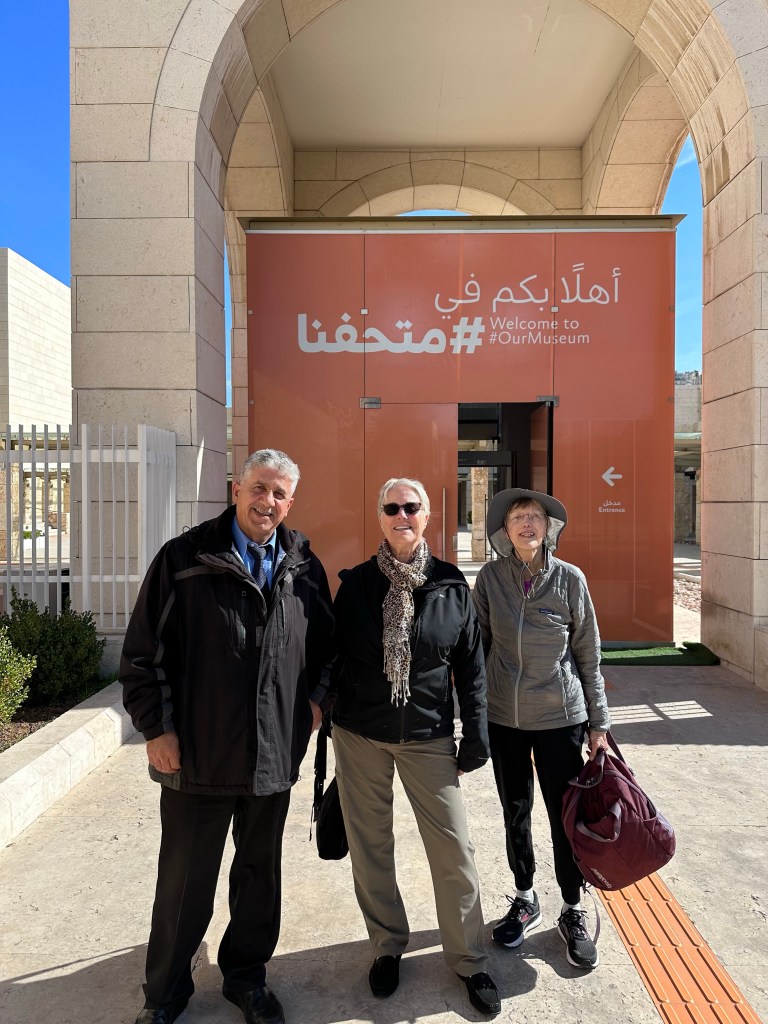
The Jordan Museum was not part of the OAT tour, however my friend Jeanne and I arrived a day early, so we had free time to explore before we met up with Hisham, our trip leader. My virtual travel buddy, Esther, who I hope to meet in person someday, had highly recommended the Jordan Museum, and I’m so very glad she did.
For those who like antiquities, the first floor has plenty of pottery and jewelry, plus something you don’t see in most museums— Dead Sea Scrolls
The upper floor has the video and the interactive displays that delighted me. Bet you can’t guess what this elephant contraption is.
Believe it or not, this is a replica of an 800 year old clock. “ The large clock uses Greek water-raising technology, an Indian elephant, an Egyptian phoenix, Arabian figures and Chinese dragons, to celebrate the diversity of the world”. ( description courtesy of the website).
The Crowne Plaza Hotel linked us up with Sam, who drove us to the museum, waited for us for over an hour and drove us back, for about $45 total. Best of all, there was no extra charge for Sam’s great commentary, delivered on the way to and from the museum.
Sam, Jeanne and Bobbie
The area around our hotel is definitely NOT conducive to walking, however that didn’t stop Bobbie and me from venturing out for lunch at Kabob Express, where our language barrier resulted in our ordering one lunch instead of two. (It turned out fine, because there was still food left over even after we’d both had our fill). Would I recommend it? Well, it was close to the hotel, they accepted credit cards, you got a lot of satisfying food for your money— and as my dad used to say, “it filled the hole”.
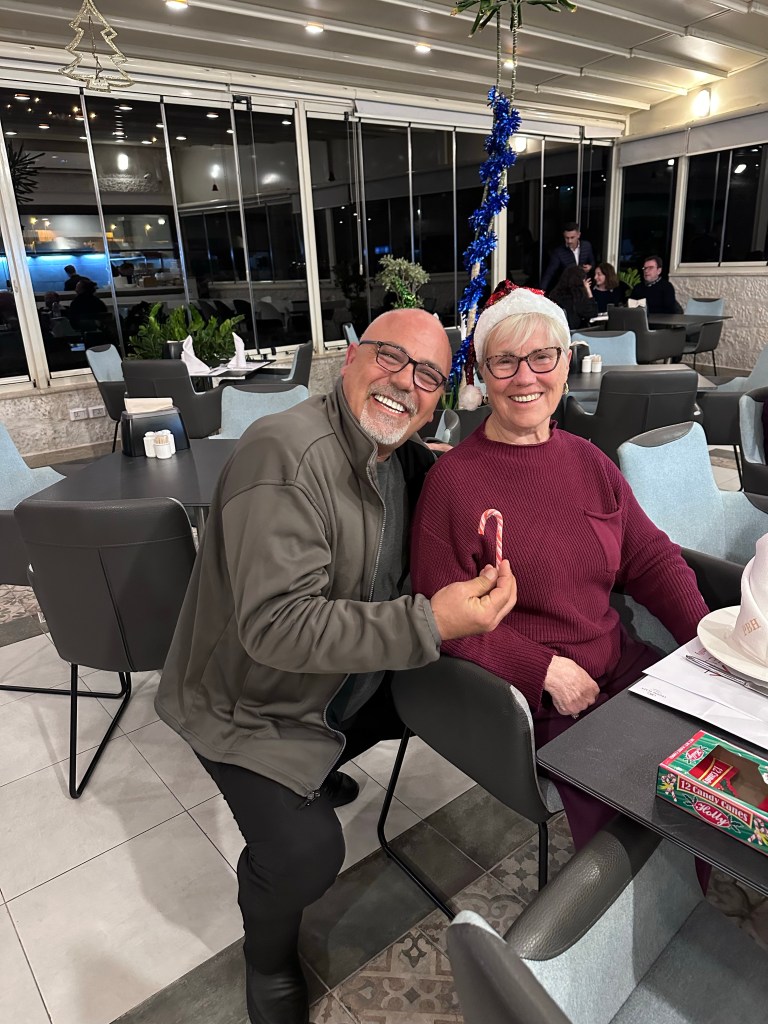
Jeanne, Bobbie and I met the remaining 4 travelers at our dinner, in the hotel restaurant. One of the reasons I enjoy traveling with OAT is the small group size allows you to really get to know your traveling companions, who are usually interesting, curious, friendly and seasoned travelers. This group is certainly all that, and more.
On our tour’s first full day, we visited Amman’s most important sites: the Citadel, which is located atop one of Amman’s seven hills, and the Roman theater; both have on site museums, which we explored.
The sites weren’t crowded at all, so you could take your time perfecting your next instagram post. And believe me, this couple did.
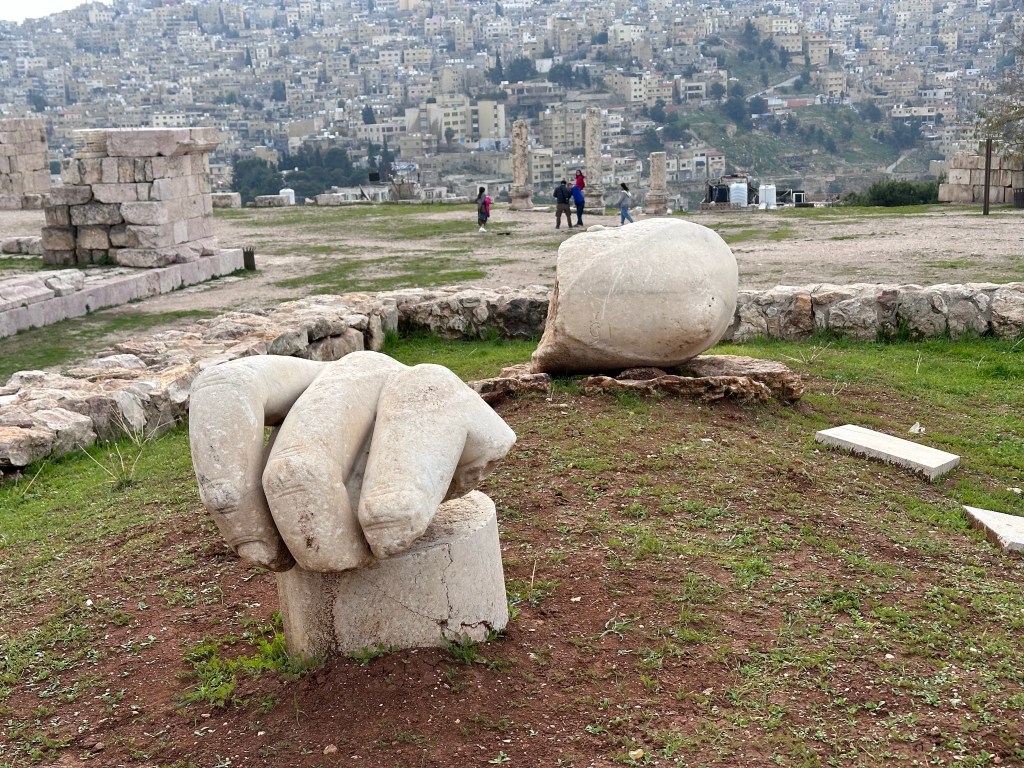
It was easy to get whatever shot you desired, like these fingers and an elbow from what was once a 42 foot statue of Hercules. You can also get a feel for the old section of Amman, which appears in the background.
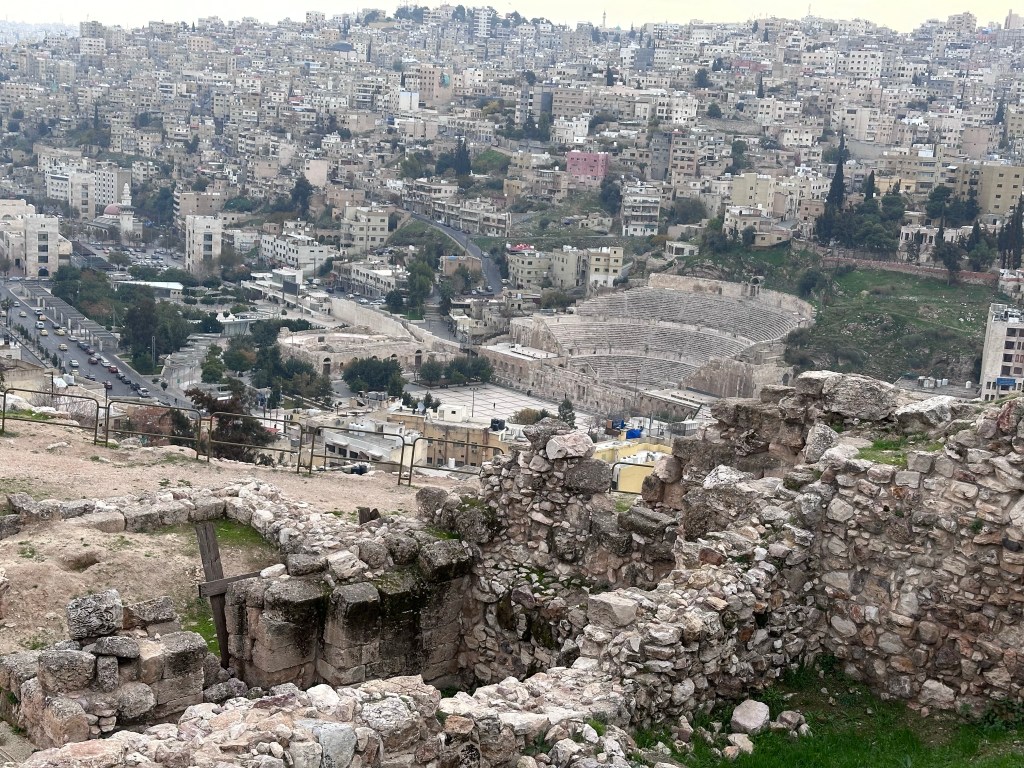
Check out this great view of the Roman theater from the Citadel. The theater is so large, this was the only way to get all three tiers of it into one shot.
Here at the theater, the preferred photo op was to plop your toddler atop the front pedestal and then give the child directions on exactly how to pose. This little girl was having none of that.
Notice the special seats carved from stone in the first tier, right behind her? Those were the royals’ (Caesar’s) box seats. Way up high, in the nose bleed seats was where the women and slaves were relegated.
So, of course we ladies had to do something about that!
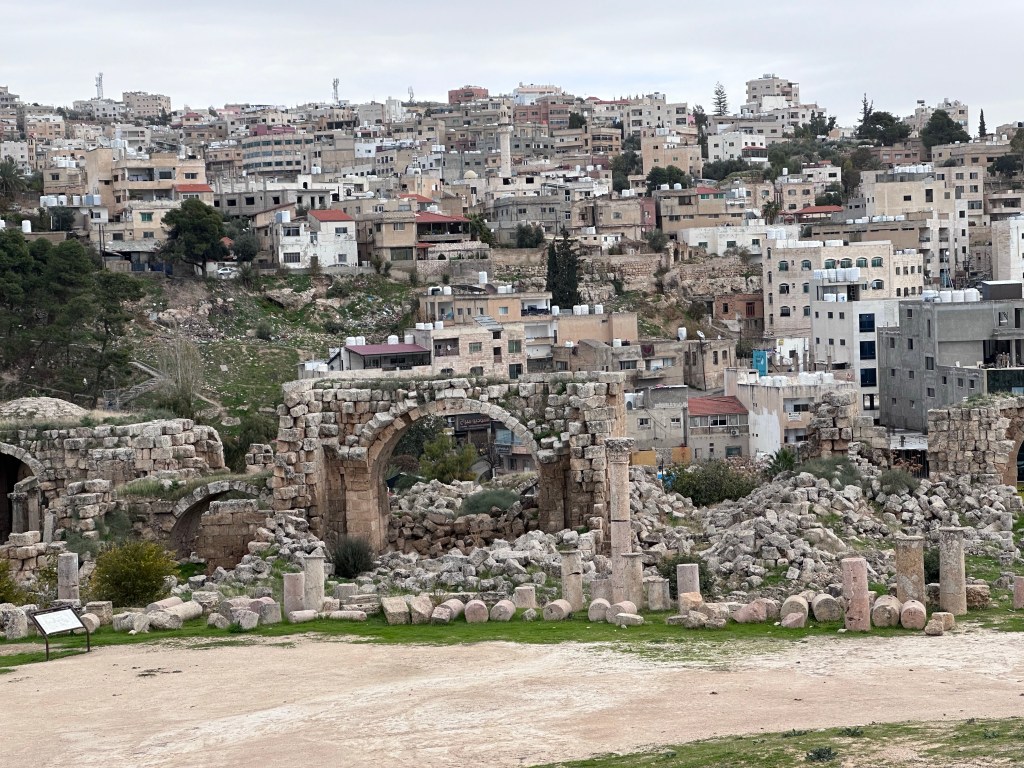
We spent our last day in Amman driving about an hour north to Jerash. Don’t feel bad if you’d never heard of it. Neither had I, before this trip.
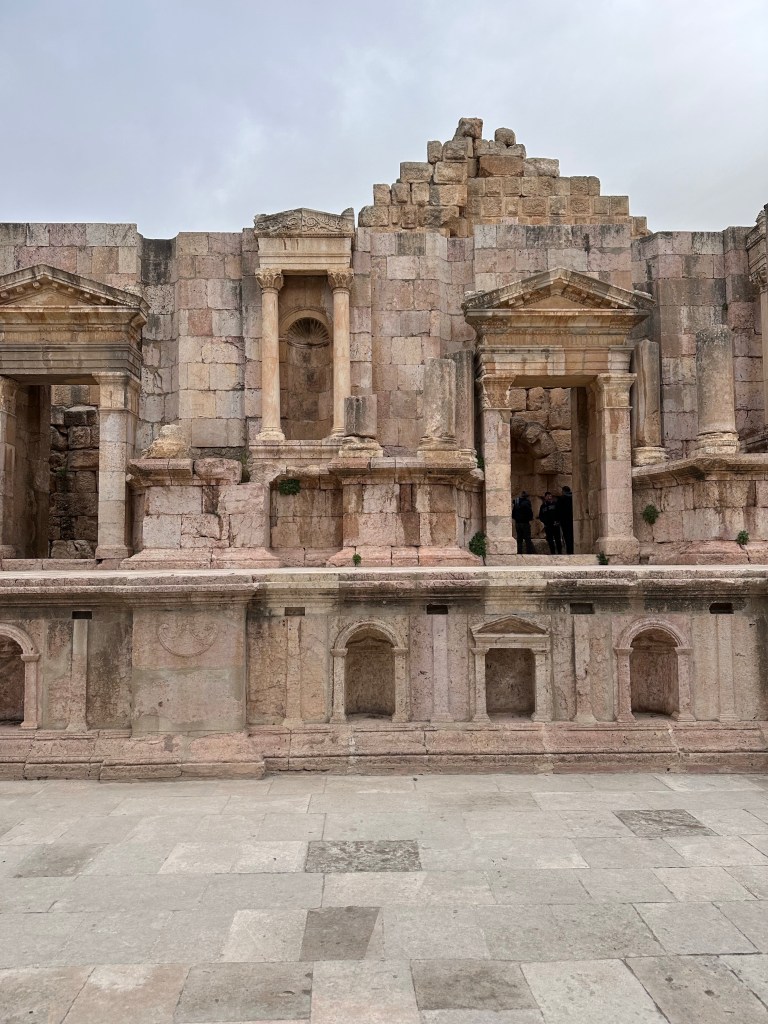
Despite having been partially destroyed by the earthquake of 749, it is still one of the best preserved Greco-Roman cities, as interesting as Ephesus to me.
This is normally the high season, with thousands of daily visitors, but because of the fighting between Israel and Hamas, we had the site almost to ourselves. Although I am so sorry for the Jordanian people who make their living in the tourist trade, I am even more sorry for all the Palestinian and Israeli victims of this horrible war.
Hadrian’s Gate, outside of the cityStill a work in progress, these stones are sitting on the ground, waiting to be fitted together. View of the oval forum from one of the templesThe theater, with incredible acoustics brought about by the series of niches. They didn’t need microphonesGood thing because they hadn’t been invented yet.
We will be leaving shortly for our dinner with a Jordanian family in their home. Tomorrow we travel to Petra, stopping at the Dead Sea along the way.