We didn’t know the impact of the Air Canada strike until we left Halifax for Baddeck ( Pronounced ba-DECK). Our group has shrunk from 40 to only 26.
I know, I’ve completely skipped over Halifax. It’s not that I didn’t love the city. I did. It’s because we are spending our final two days there, so if time and energy permit, I will post about Halifax when we return there.
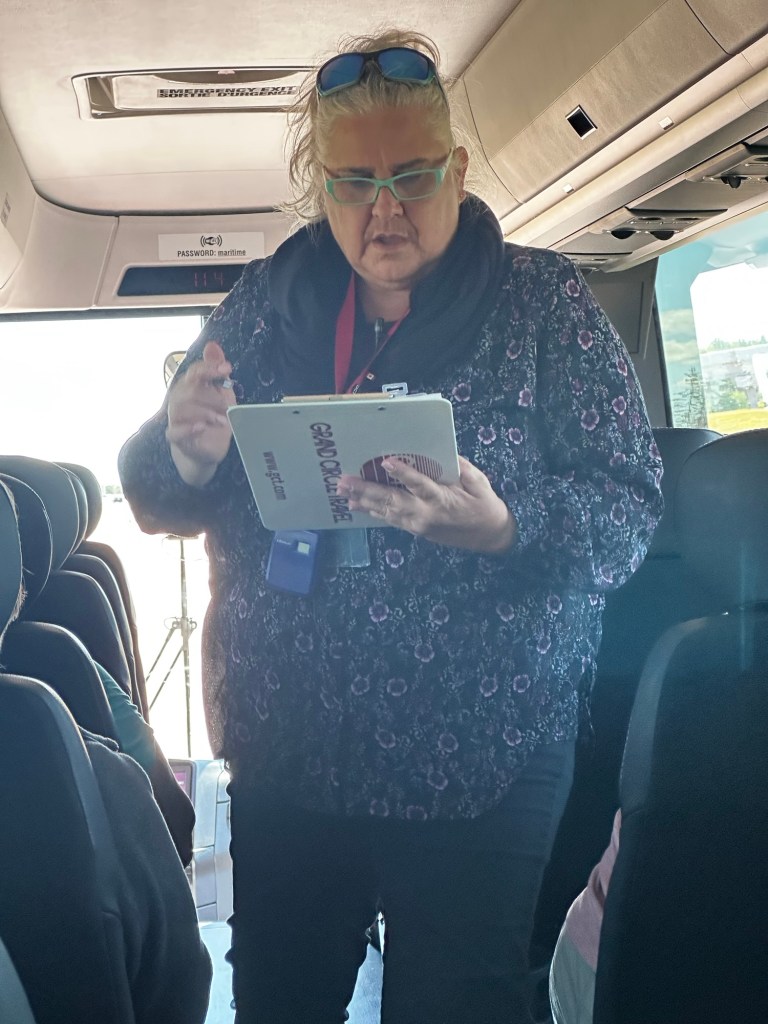
Laurie, our amazing trip leader, has devised a very creative way to break the ice and to keep us entertained during our bus ride. We are going to be playing “Passenger Bingo” for PRIZES! I don’t care if the prize is a rusted tricycle, with a wheel missing. If it’s a contest, I’m in it to win it. That’s just my nature.
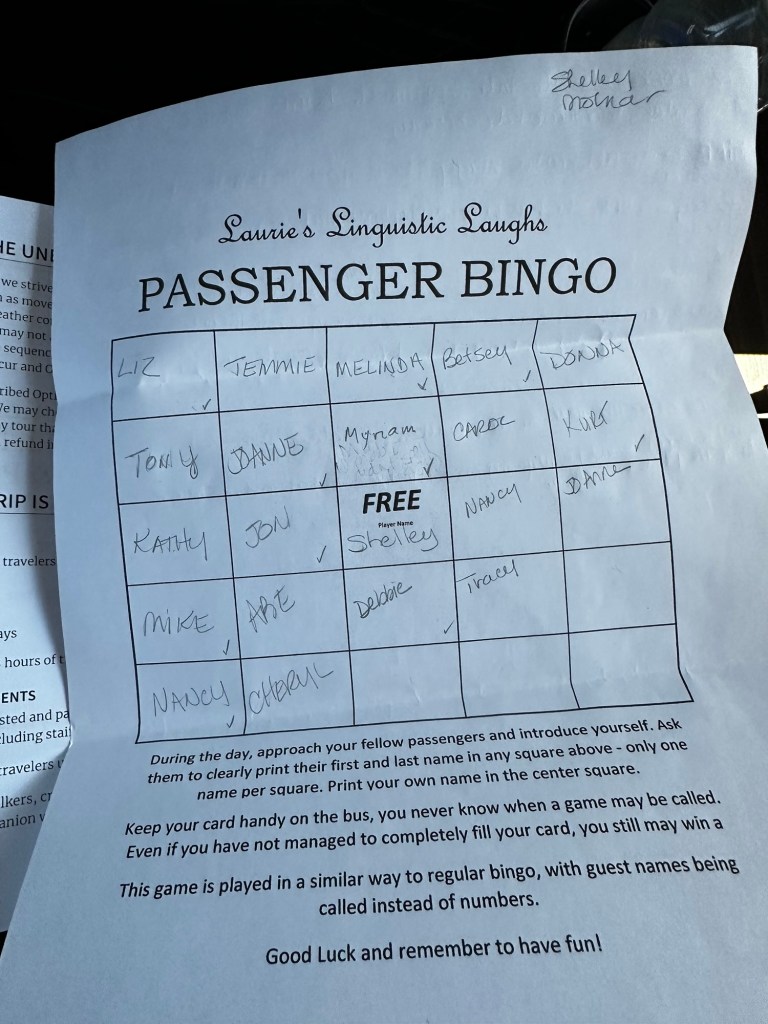
Since I started this post, we have completed THREE different games, and I’m quite proud to say I was the winner of the first, which was a challenge to name all of the 14 people that did NOT make it to Halifax. Nailed it!
But back to Baddeck. As usual, our drive to the next city was broken up by interesting stops, starting with the Millbrook Cultural and Heritage Center.

There, we learned about the indigenous people who had inhabited the land for over 13,000 years, ( according to archaeological digs) the Mi’kmaq (pronounced mig-MAH).
Apparently, the French and the indigenous had a positive relationship; not so, with the British, which was probably why we fought the French AND Indian War.
The indigenous were given identity numbers by the Canadian government, with the final number indicating how many children were in the family. That made it easier for the government to find the children, take them from their families and force them to attend government run boarding schools. The schools were designed to wipe out the indigenous language and culture. Over 176,000 children between the ages of 4 and 16 were taken from their families. Of that number there were over 6,000 recorded deaths from disease, abuse and suicide. Before anyone thinks that the mistreatment of indigenous children happened centuries ago, I need to inform you that the last school closed in 1998 in Manitoba.
This speech was given during Canada’s 100 year anniversary.

We learned that the Mi’mkaq language is a tonal one.
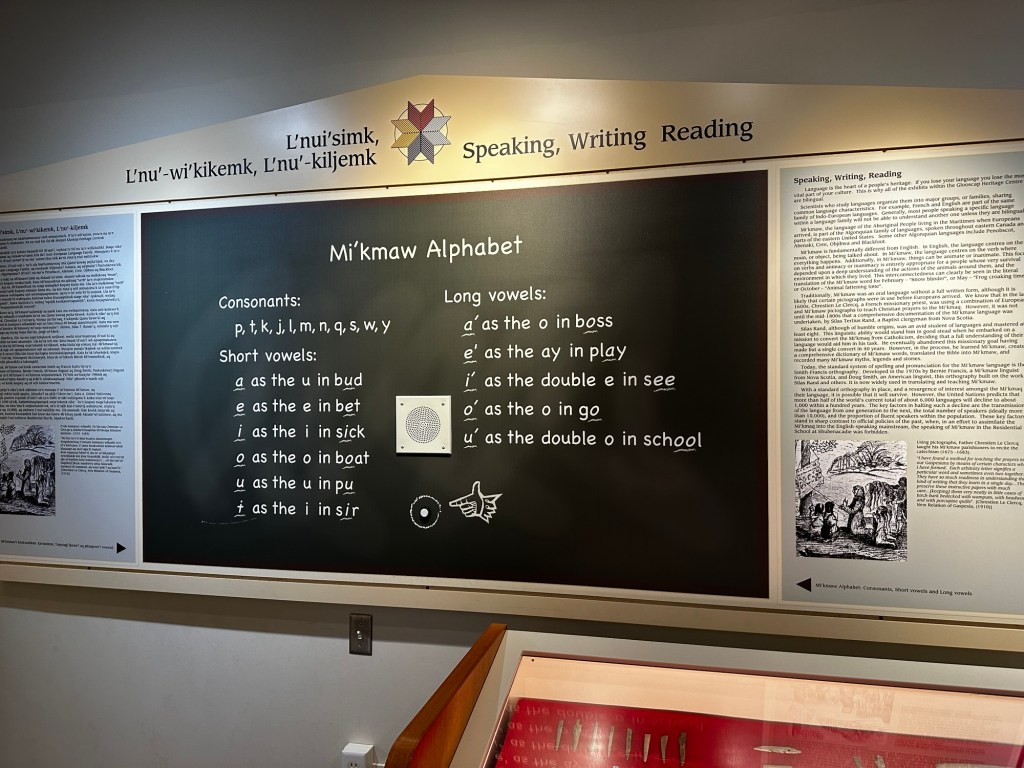
Depending on how you elongate the vowels, the same word could mean:
I love you OR I want to hurt you OR I want to throw you in the fire. THAT word could start some serious misunderstandings!
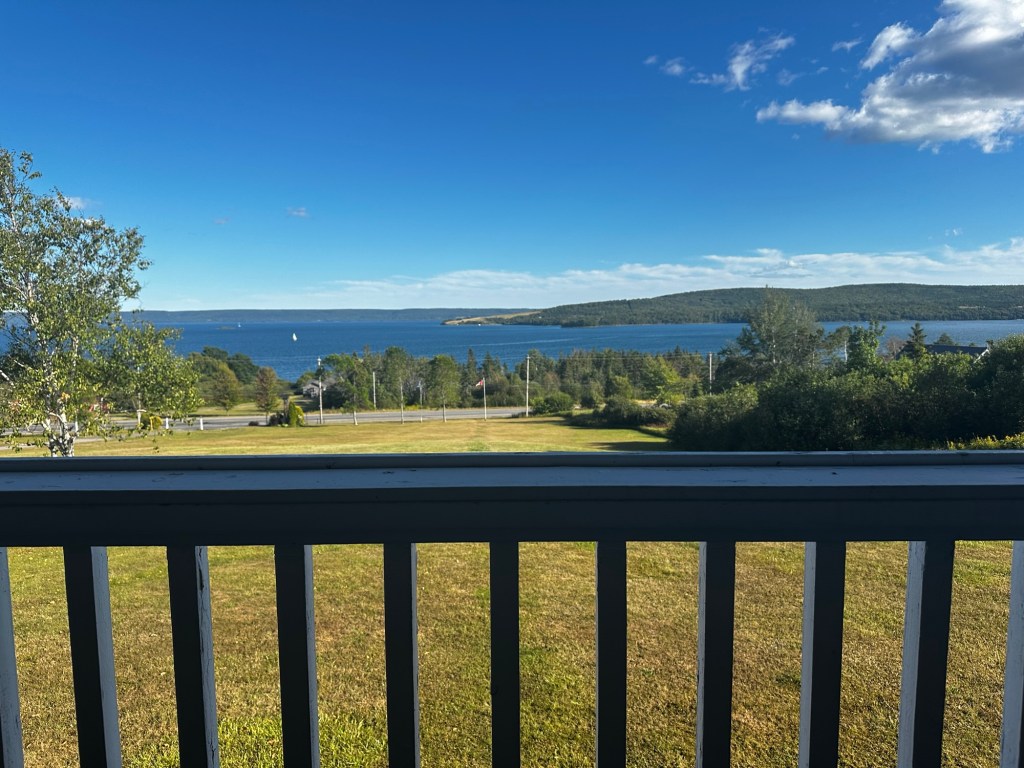
We spent our three nights in Baddeck at the Silver Dart Lodge, which overlooked a beautiful lake.
Laurie was initially concerned that we would find the Lodge too “rustic”. Instead, we all agreed it was absolutely charming. Because of the volume of business Grand Circle does with the lodge, we all got rooms facing the lake.
This spectacular view is what I saw from the lovely deck outside my room, the perfect place for happy hour. How great was THAT? It took all three nights for me to finish the wine that I was not allowed to drink on the bus.
The area is so beautiful that Alexander Graham Bell and his wife, Mabel built their summer home in Baddeck. Their “castle” wasn’t visible from the museum bearing his name, but there was plenty of other “stuff” to see.
I had no idea that Alexander Graham Bell taught deaf students in Boston or that Mabel became deaf at the age of 5 after a bout with scarlet fever.
I also didn’t know that Bell’s parents immigrated to the USA from Scotland after two of their sons died from tuberculosis. They didn’t want to chance losing their last son.
We all know about his invention of the telephone , but I wasn’t aware of his interest in aviation and hydrofoils until I visited the museum.

We spent the next day touring the fortress at Louisbourg, where I was once again reminded of my educational deficiencies. Why did I never learn that in 1745 a group of untrained “ soldiers” from New England successfully took the fortress in 6 weeks time? You see, the French had expected all attacks would come from the sea, so that area was heavily fortified and protected. But the 6,000 ragtag New Englanders didn’t know the rules of engagement, and they were undaunted by forests or swamps, so they attacked from the land, which was unprotected.
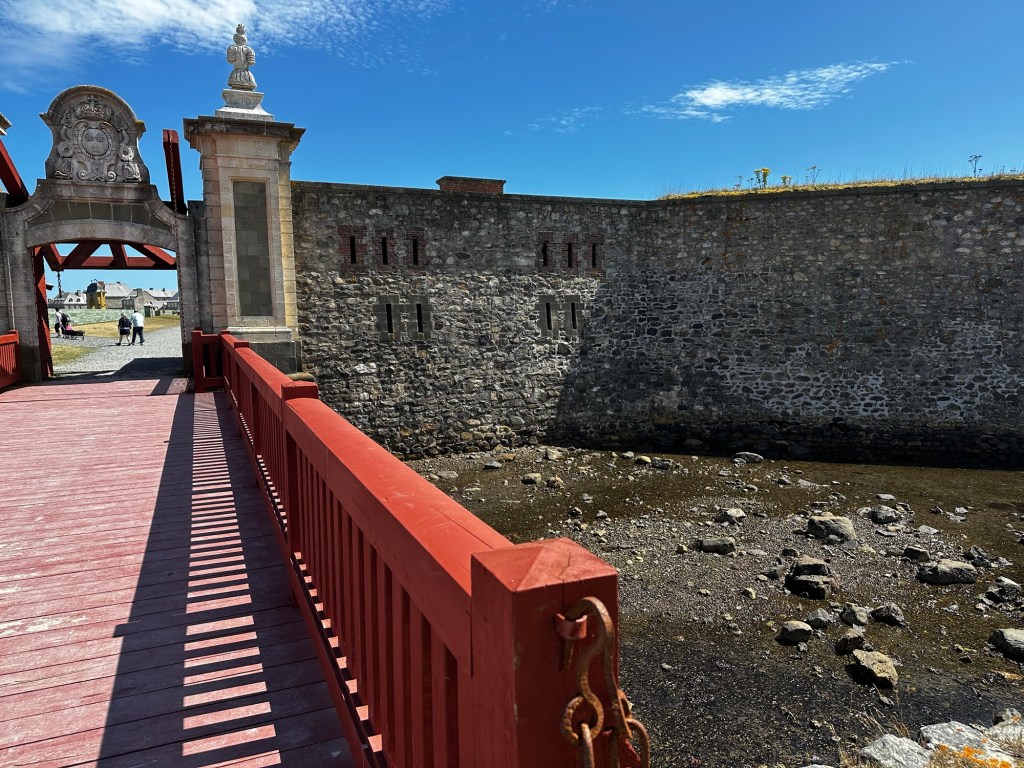
The crown decided to return the fort to the French in 1749 exchange for Madras, India which was a source of extreme irritation to the New Englanders. They had lost about 900 men capturing the fort.
In 1758, the British determined that they wanted Louisbourg after all, so they laid siege the “professional” way, by sea, without the help of the New Englanders, and guess what? It took them a WHOLE lot longer.
This time they completely destroyed the fortress, so what exists today is a reconstruction, based on documents and plans that were preserved off site.

Like Williamsburg, Sturbridge Village, and Plymouth Plantation, re-enactors in period costumes demonstrate what life was like in the 1700s.
I particularly enjoyed watching a prisoner being marched through town to the iron collar.
All of the neighbors were invited to ridicule the prisoner as he made the “walk of shame“ to the center of town.

Our final day was to be spent traveling along the Cabot Trail. Because of climate change ( yeah, the Canadians don’t think it’s a “hoax”), all the trails are closed to hikers. The risk of fire is too great. So, instead we were going to drive the entire route, after stopping to visit a church and a hooker museum. Don’t get excited. It was a museum for RUGS not ladies of the night.
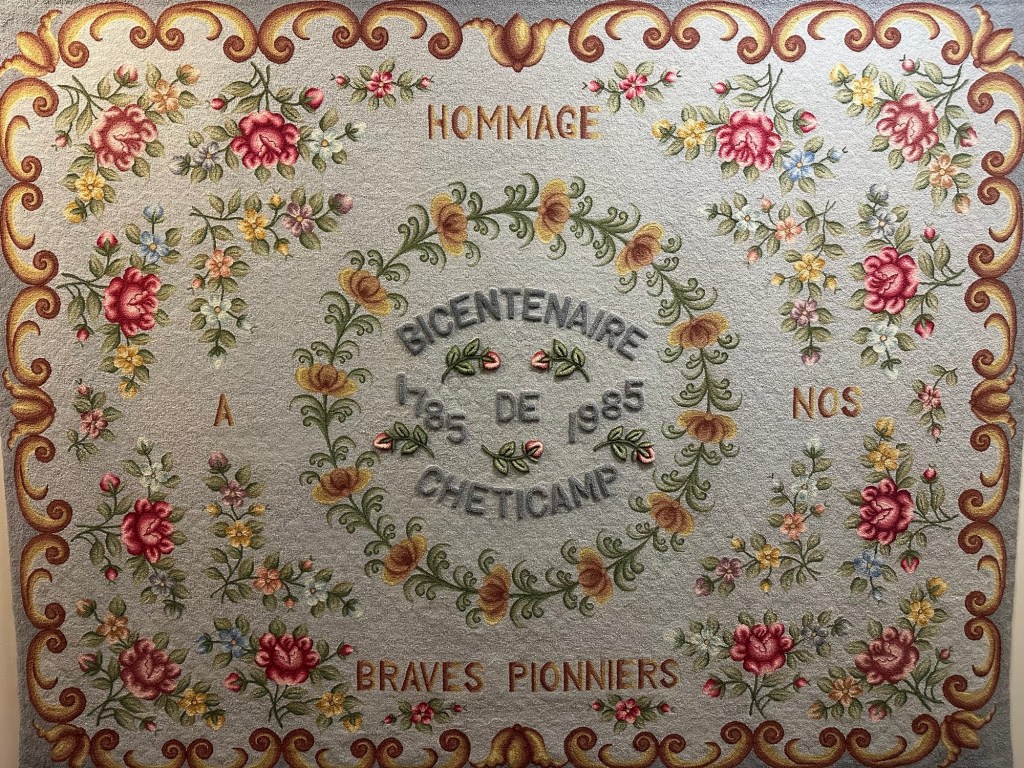

While in the museum, Josh discovered there was a problem with the bus, so we had to hang out long enough that the full trip along the Cabot Trail was impossible.
We were lucky to have Laurie as our trip leader, who decided to treat us all to coffee and pastry at the shop up the street. Instead of doing the full route, we ended up stopping at a beautiful little beach
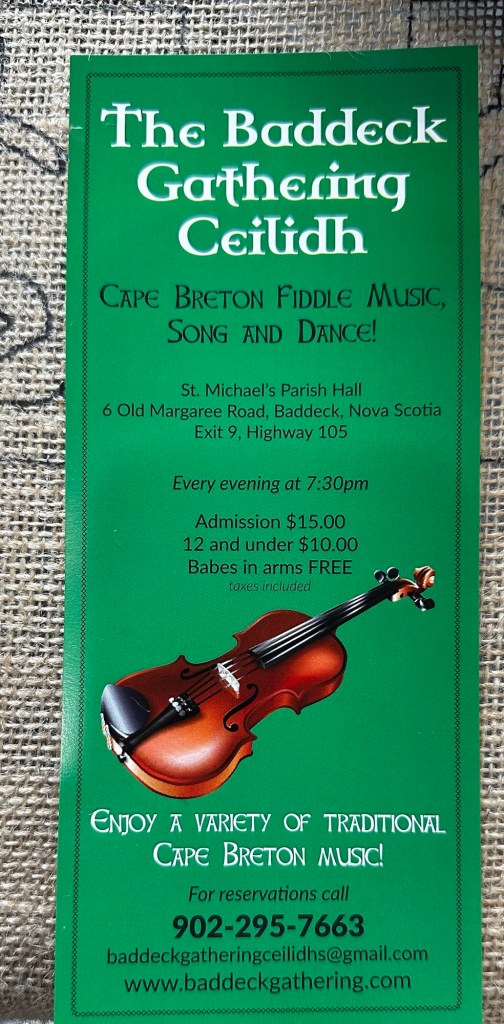
Our last night was spent at a ceilidh (pronounced Kay-Lee).
Although there is so much more to say about Baddeck, this post is already quite long, so I’ll stop.
 Destination NOW