Sometimes I don’t know I want to visit a place until I get there. That certainly was the case for Angers. I know, I know, the name of the city sounds like a hostile emotion. But the French don’t say it the way it’s spelled. THEY say “Ahn-geee”. Better, right?
Our three days in this very walkable city whipped by, and was a very nice balance between included activities and free time. After a guided tour of the city, during our free afternoon several of us decided to go rollin’ on the river.
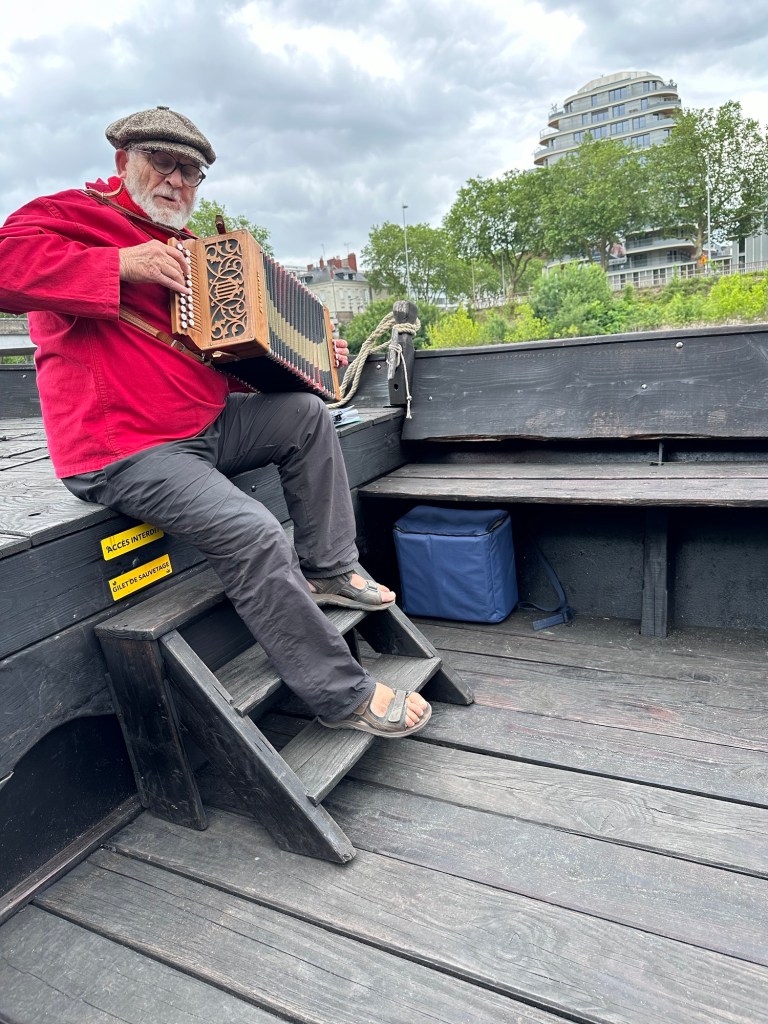
In addition to champagne (some of us had TWO glasses) our ride included entertainment. This fine fellow serenaded us while playing his vintage accordion.
We didn’t have the river to ourselves. Because the Olympic Torch was passing thru the city, four military boats were on patrol. We saluted each and every one of them with champagne glasses held aloft.
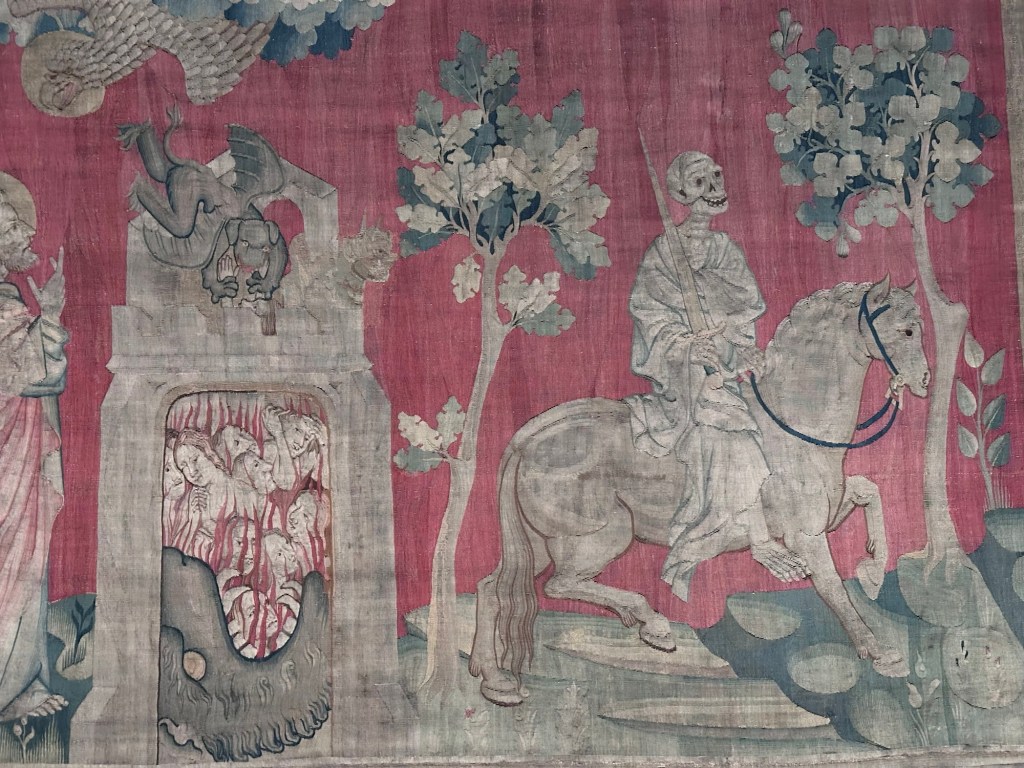
Finishing our ride across from the fortress/ castle, made it very easy for us to fit in a visit to the famous Apocalypse Tapestry.
Yes, another huge tapestry, but this one really IS a traditionally constructed piece, unlike the one in Bayeux. A predecessor to today’s comic books and graphic novels, it relates the battle between good and evil from the last book of the Old Testament to a largely illiterate population.
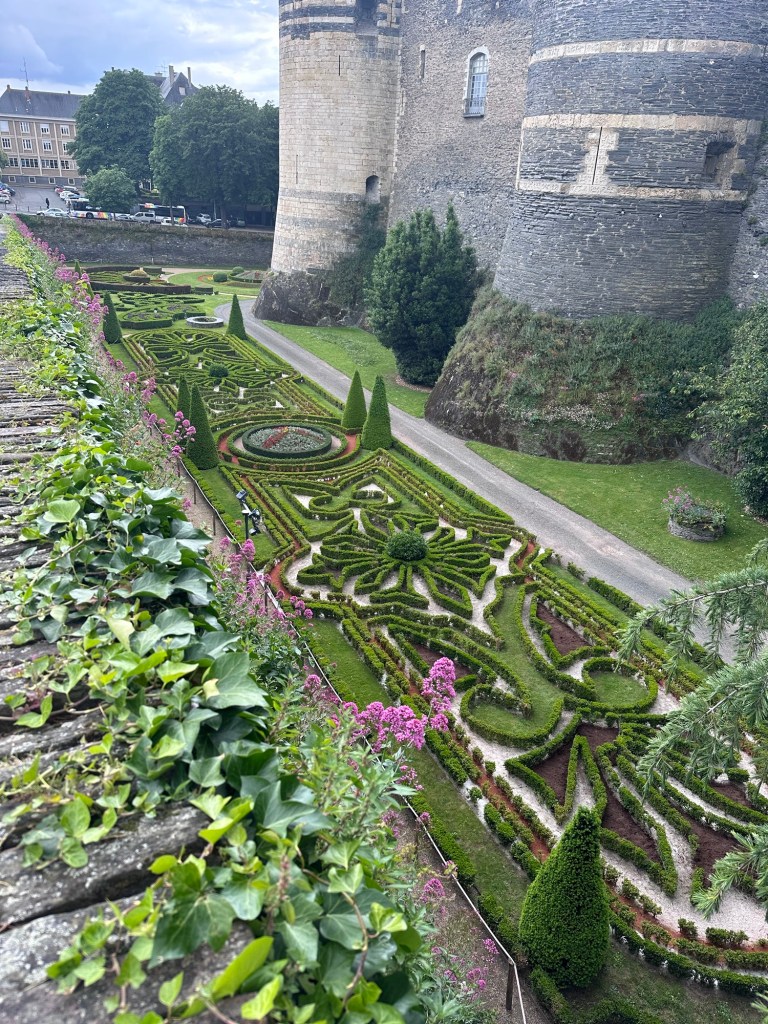
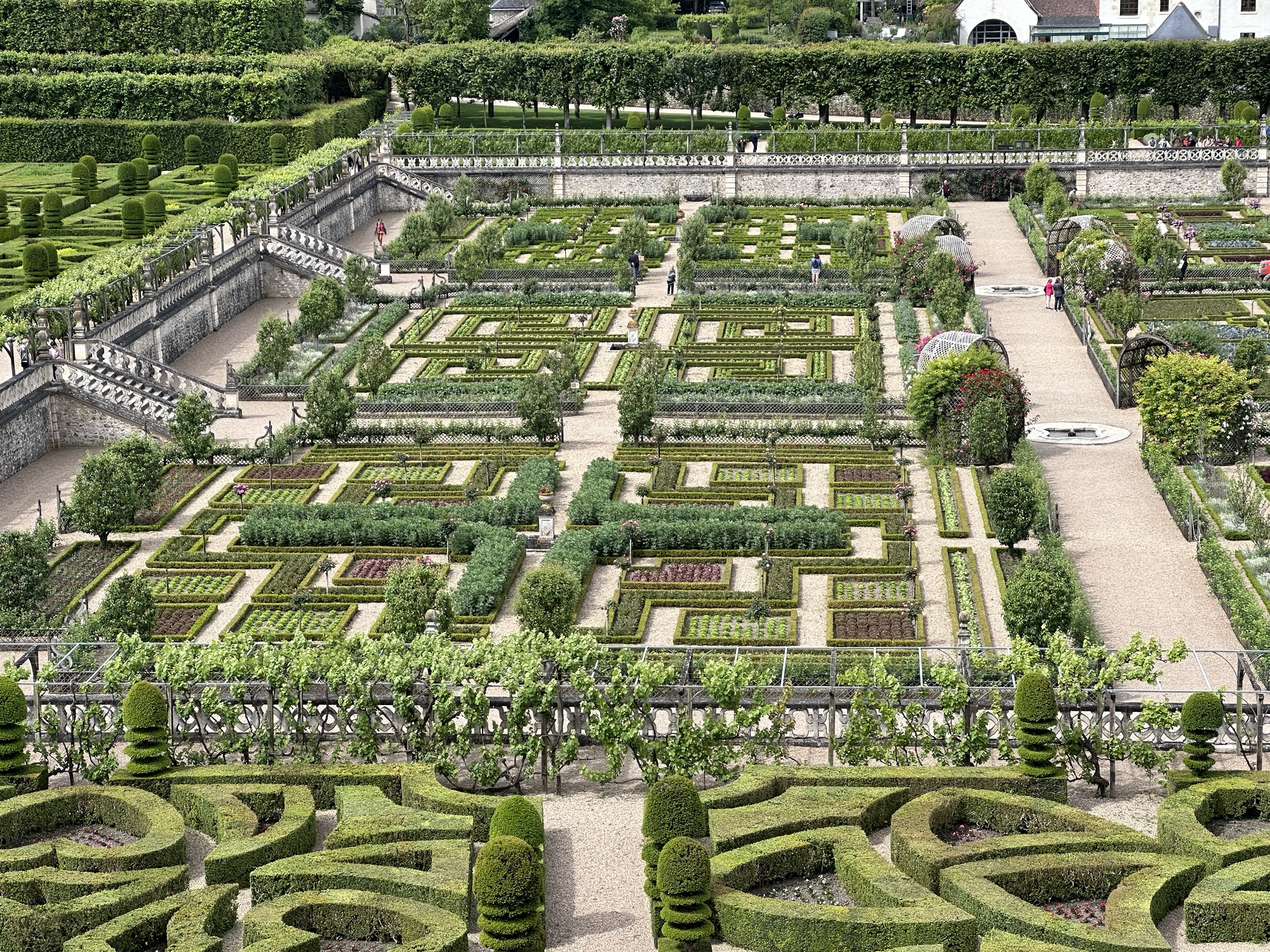
I was impressed with the beautiful gardens surrounding the castle, but these were nothing compared to the ones at the Chateau Villandry. The following photo shows only a small portion of the Chateau’s beautiful gardens.
If given the choice, I think I would have much preferred to be a Noble instead of a king. The nobles and ministers’ homes were much more “livable”, at least to me.
Although it isn’t obvious from the above photo, the Chateau de Villandry is surrounded by a moat.
Villandry has been in the same family since 1906, when it was purchased by Joachim Carvallo and wife Ann Coleman Carvallo. They met in a Paris research laboratory. Ann, an American heiress from Lebanon, Pa, supplied the funds for the purchase and modernization of the chateau.
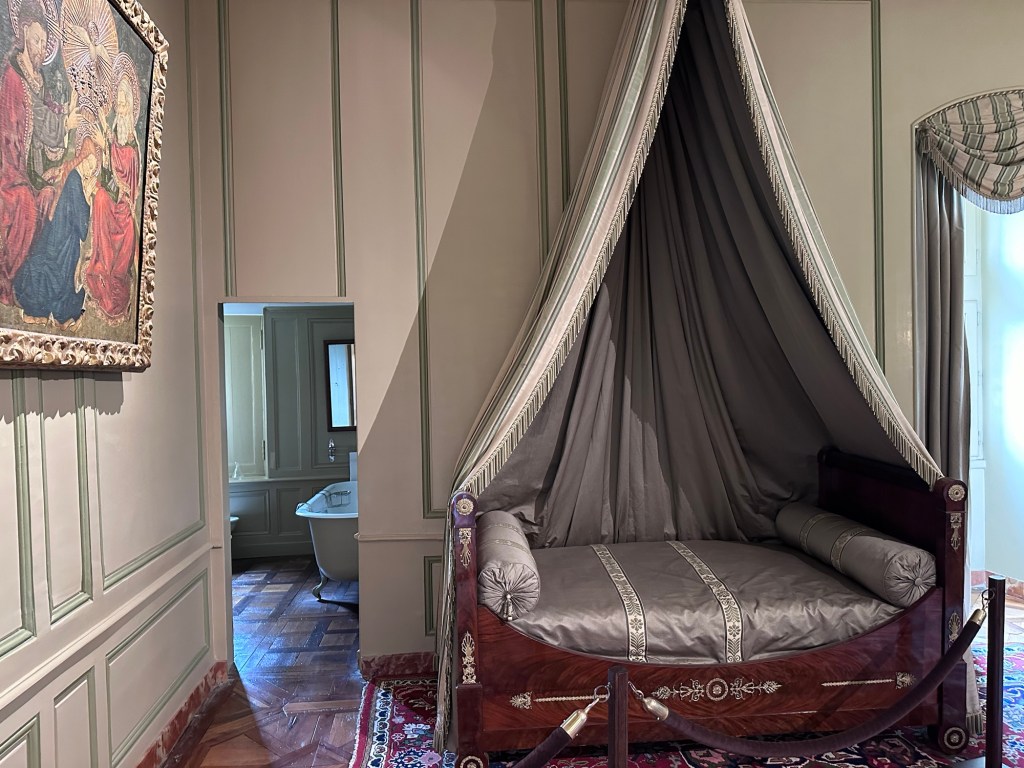
Unlike Fontainebleau, you didn’t walk through one room to get to another, and this one was modernized to include bathrooms off the bedrooms.
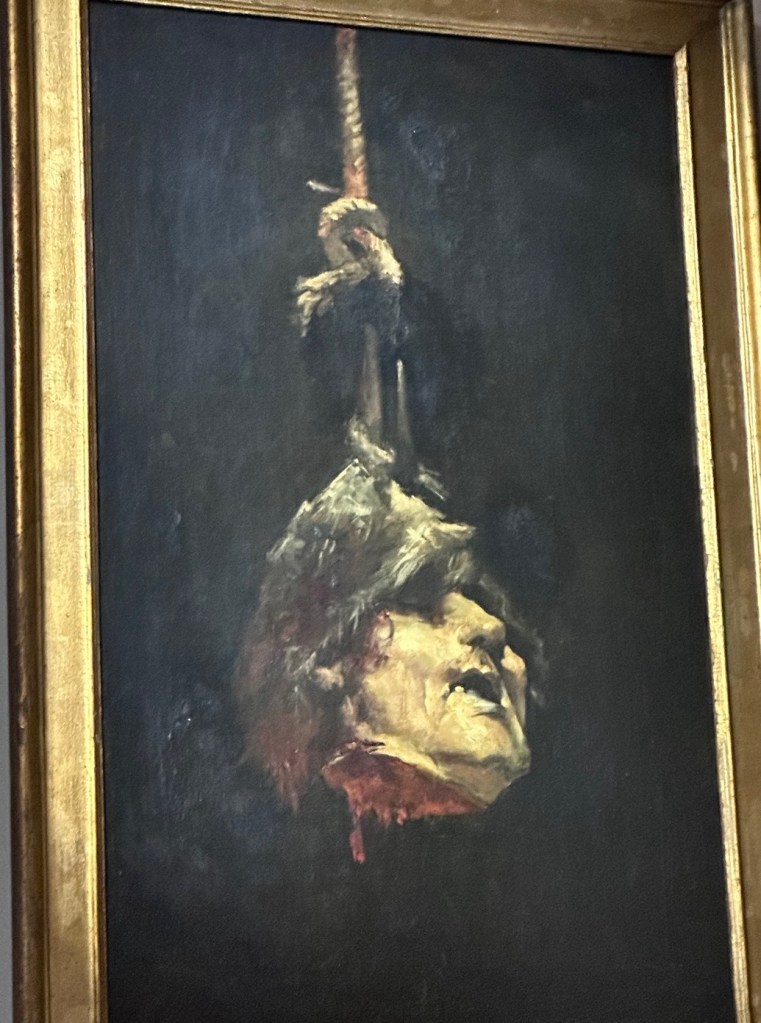
Art from Joachim’s homeland, Spain, was exhibited throughout the chateau. How many museums have portraits of a severed head? Fortunately, this picture was not hanging in a bedroom!
Before we departed Angers, we were able to witness the Olympic Torch being carried through the city.
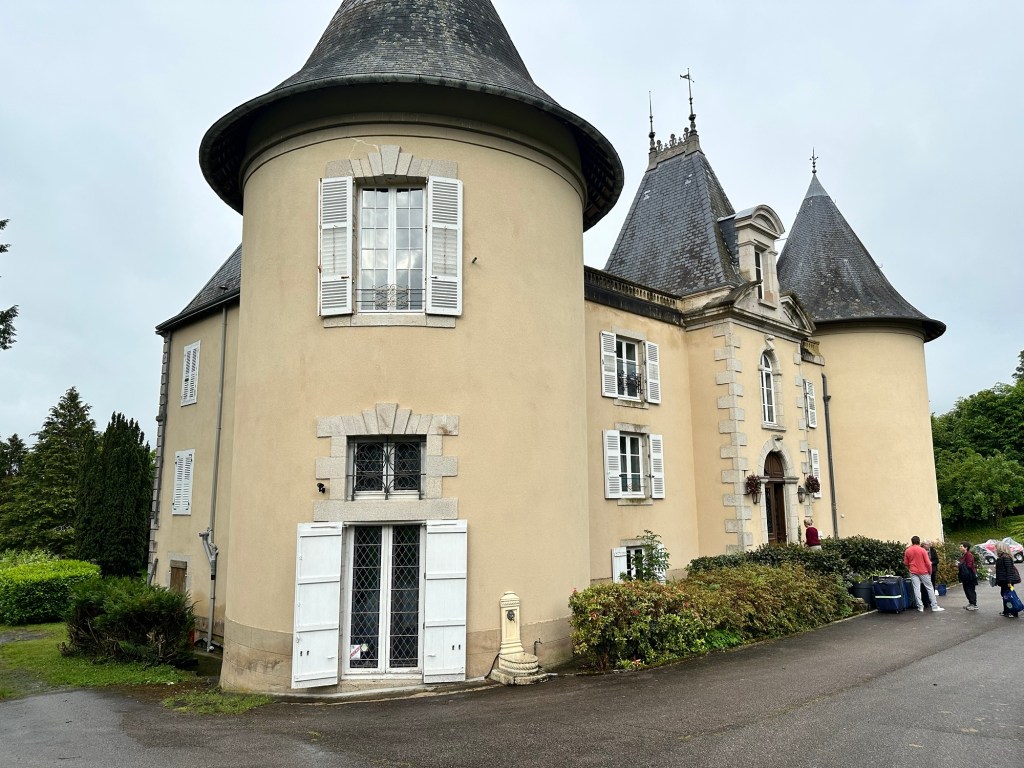
Our luck continued… we got to stay overnight in an honest to goodness, genuine chateau that was built in 1790 by the Duke of Limousin!
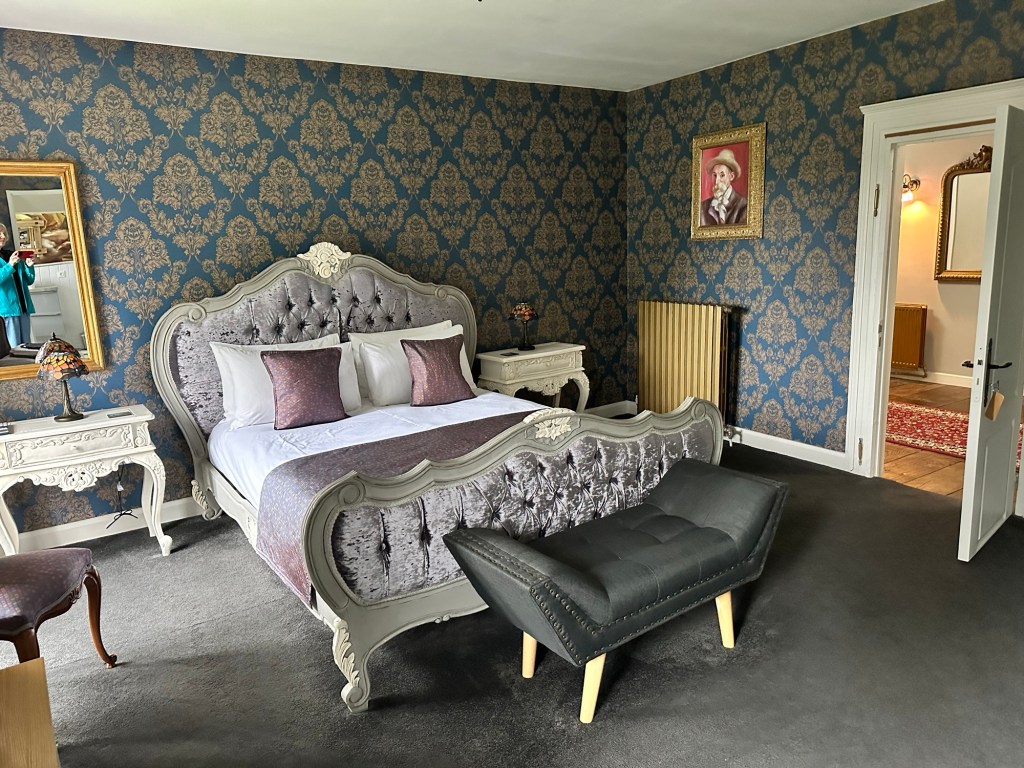
My room was the very comfortable Renoir Suite on the third floor. How gorgeous is that?!
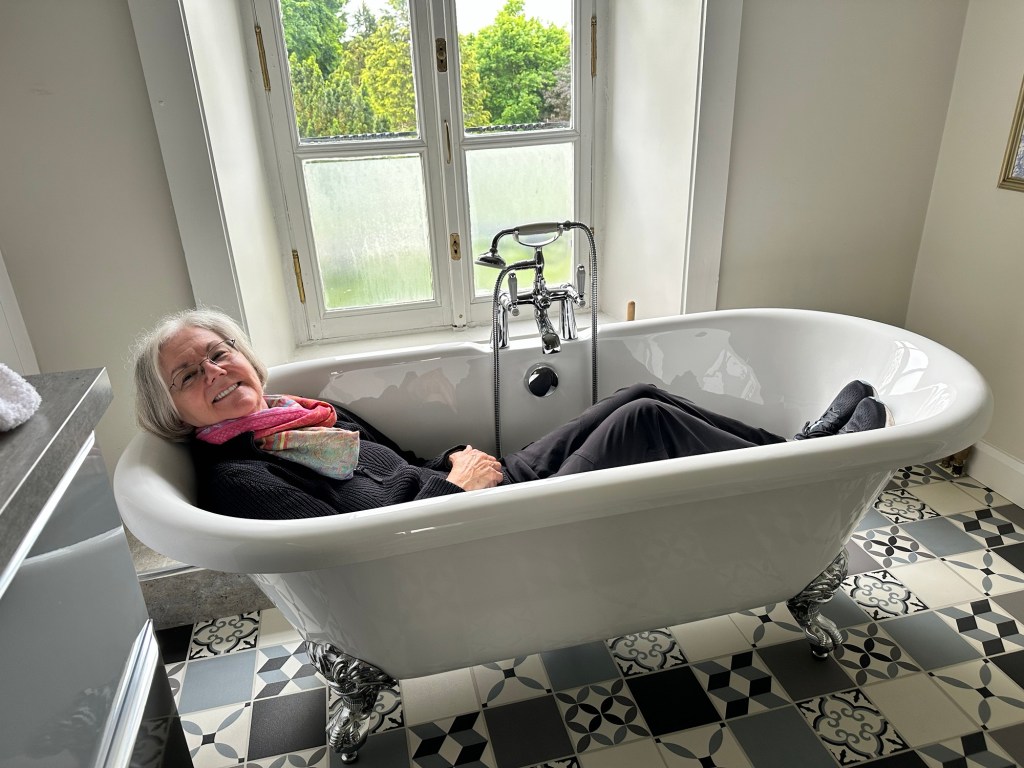
Fortunately, the suite was updated to include walls and a door, plus a modern bathroom with both tub and shower.
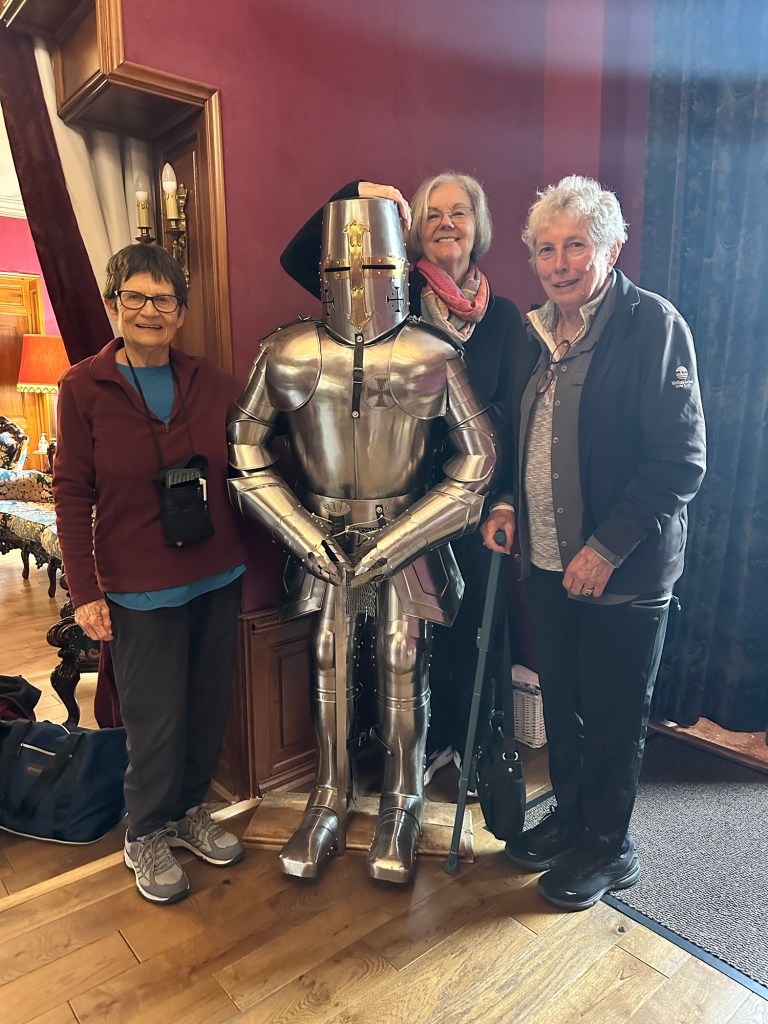
My new friends, Garry and Donna posed with me for a photo with our knight in shining armor. I decided to name him Walter the Bold, although Walter the short would have worked too.
This was our only “one night stand”. We are now on our way to Sarlat, a medieval town known for great food and fine wine.
I was totally surprised by how much I am loving OAT’s pre-trip to Fontainebleau and Bayeux. We spend three nights in each place, at centrally located hotels. Both are very walkable, and the best part? Even I haven’t gotten lost!
Obviously, the draw for Fontainebleau is the chateau. One of many royal residences, it is the biggest, with 1,500 VERY ornate rooms spread over three floors. Just about every square inch of the areas open to the public —parts of the first and second floors of the main building — is completely covered with some form of art work.
Check out the chateau’s floor plan: you walk THROUGH each room to get to the next. This was similar to the design of Schonbrunn, the Hapsburg’s summer palace in Vienna. I guess royalty didn’t mind a lack of privacy. Yes, there are huge doors on either side of the room, but think about this: What happens if you need to get to a room, but the door to the room before it is closed? Do you have to go all the way around? Those hallways are really, really LONG!
Take a look at Napoleon’s second wife’s bedroom—Marie Louise, the Austrian princess he married after he dumped Josephine. You see that railing around the bed? No one was allowed inside the railing, without her permission. I guess the doors weren’t enough.
Napoleon’s bedroom was a few rooms down from Marie Louise’s. His was the only one of the MANY beds I saw that had steps along side it. Was the precursor of today’s doggie stairs?
The library was my favorite room.
Are you wondering how people were able to find each other? They didn’t have intercoms or cell phones, which is probably a good thing. I have enough trouble finding mine and I have 1,490 fewer rooms.
One last room before we head outside: the ballroom. Notice the balcony at the back. I’ll bet that’s where the moms sat so they could keep an eye on their daughters. The alcoves, I suspect, was where the ladies sat, waiting to be asked to dance.
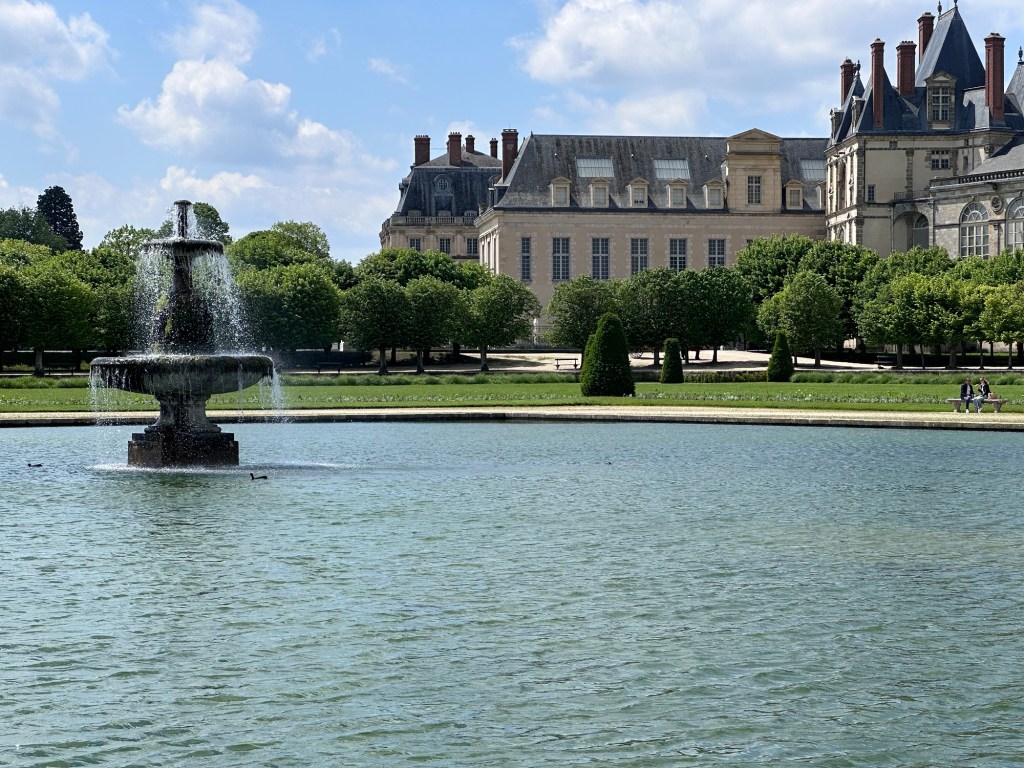
Although the weather report predicted rain, we were unbelievably lucky to have perfect weather, which allowed me to thoroughly enjoy the wonderful grounds surrounding the chateau.
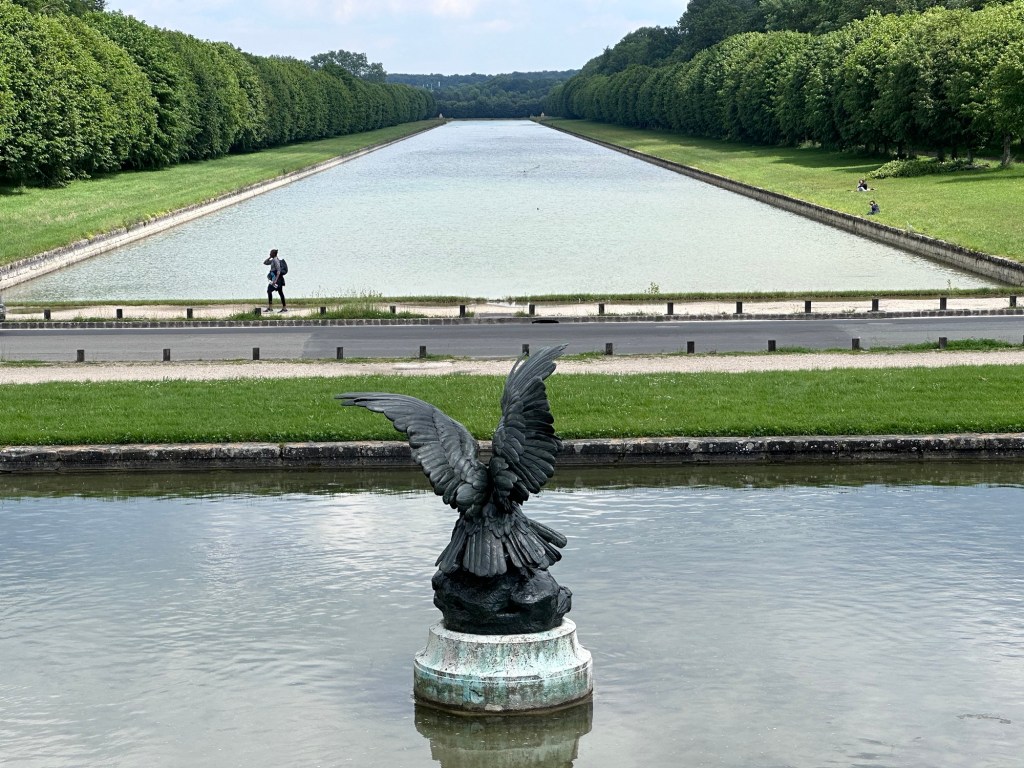
The gardens stretch as far as I could see, until they reach the forest.
After all that opulence and sensory overload, the serenity of the English and French gardens provided a needed respite.
I loved the whimsical statues scattered throughout the gardens.
This, I was told, is a sphinx. It was quite unlike anything I’d seen in Egypt, but our guide explained that the French take inspiration from other countries, then add their own touches.
Garry took the group photo of Marie, Susan, me, Jim and James. Donna and Kathy didn’t join us during our free afternoon.
On the drive to Bayeux, we stopped at Giverny, home of Claude Monet. Like Barbizon, it is a tiny village that art enthusiasts visit. Unlike Barbizon, it was really crowded.
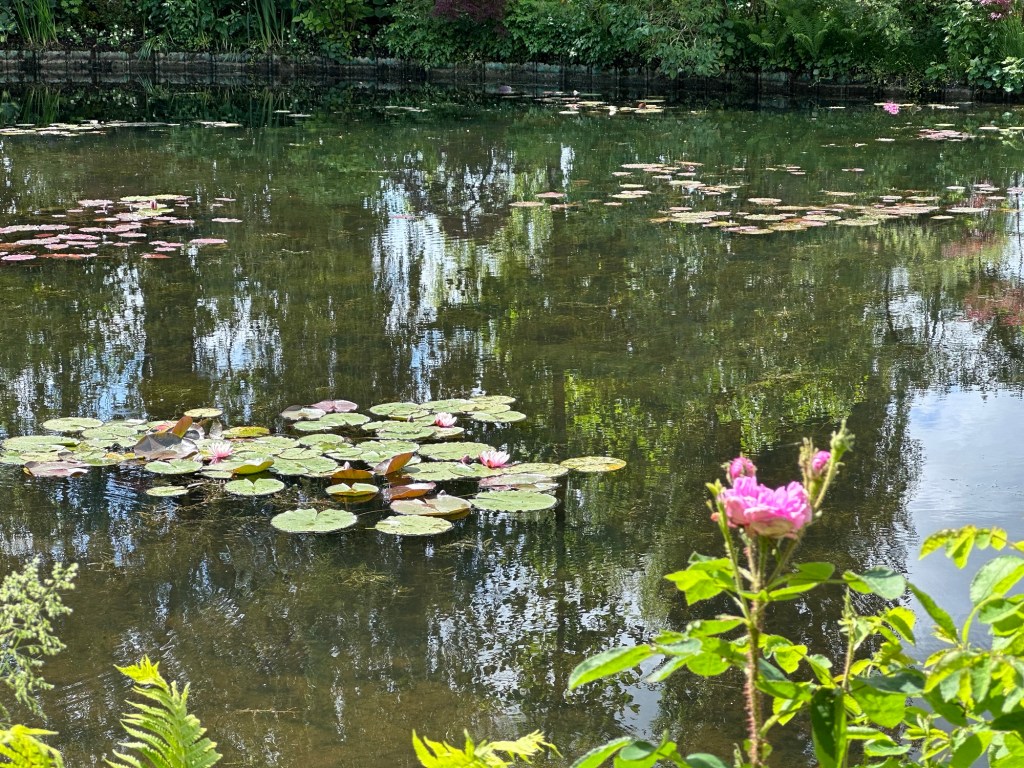
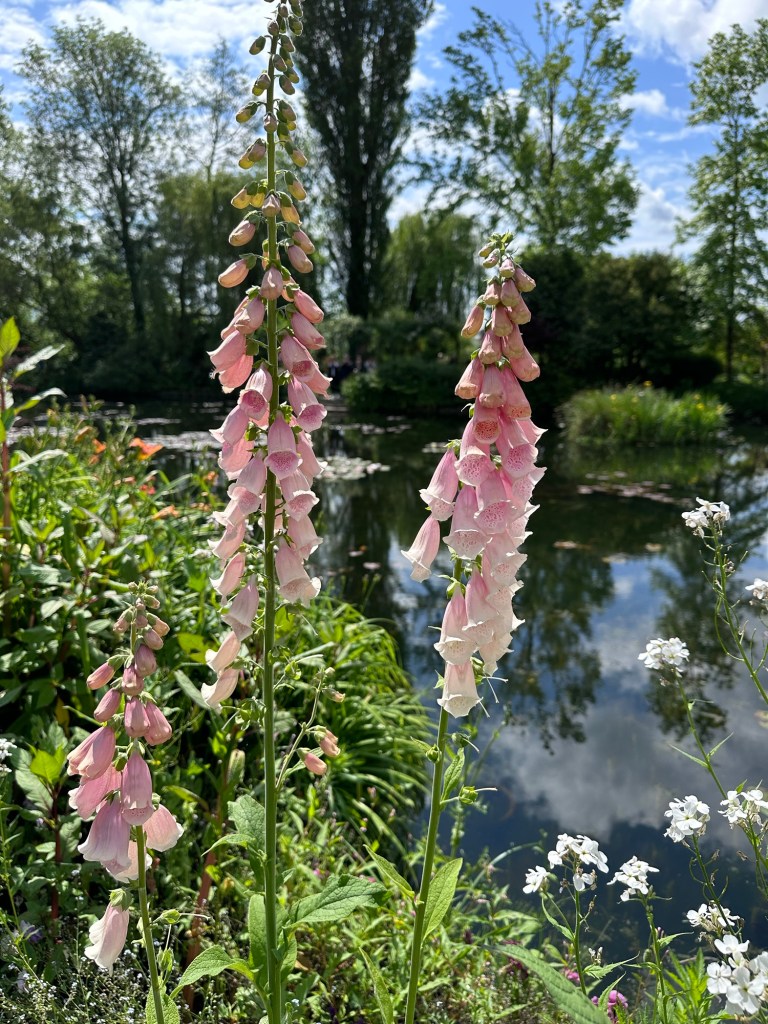
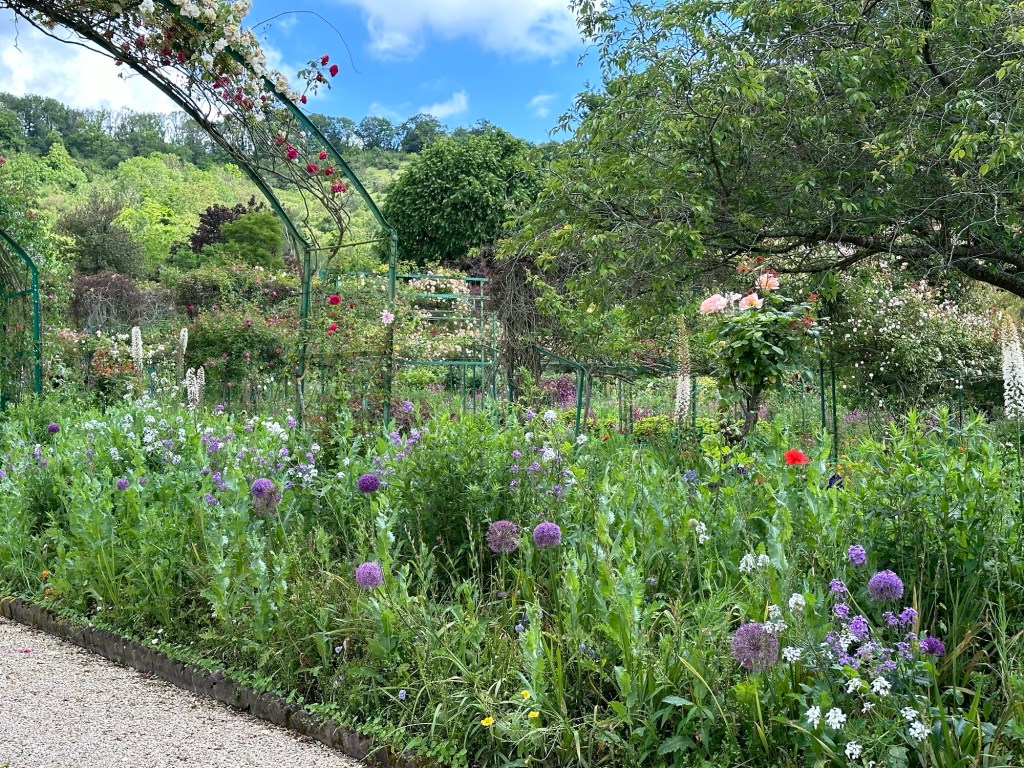
Although it was too early in the season for many water lilies to be in bloom, there were plenty of other gorgeous perennials to enjoy.
It is easy to see where Monet found inspiration for his art.
After enjoying the lily pond and the gardens, we were able to tour Monet’s home.
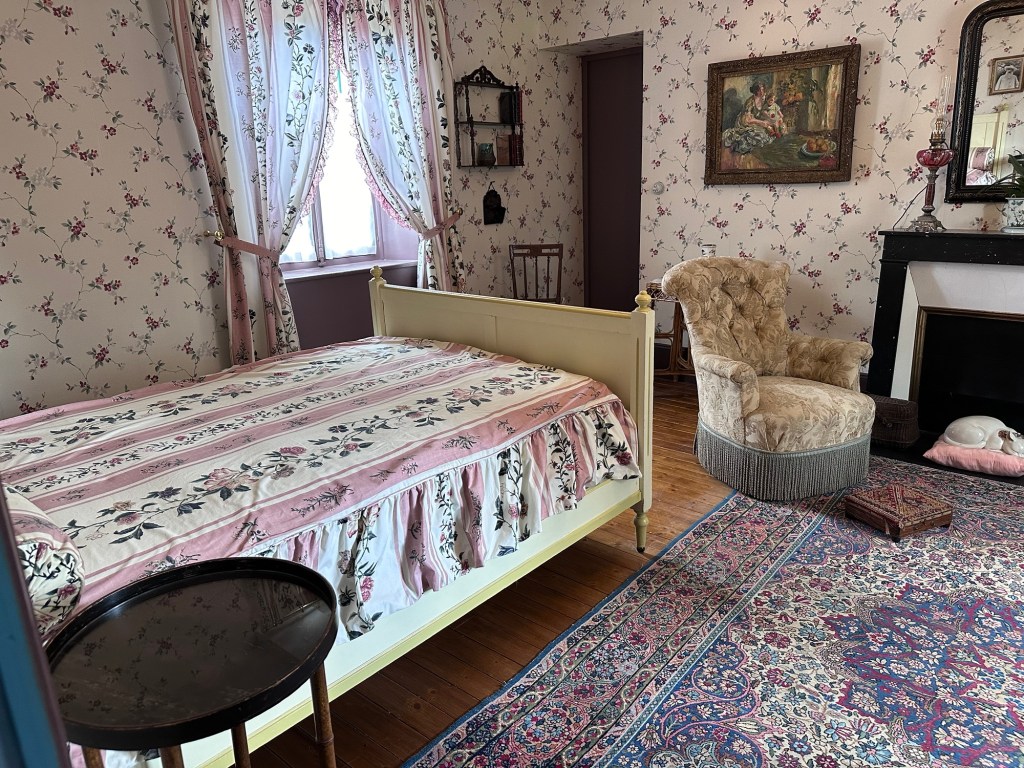
Like Fontainebleau, the walls were covered with artwork.
For some reason, however, I didn’t find the artwork overwhelming.
Clearly, I prefer the simple life. I’d much rather wake up in a bedroom like Monet’s than any of the ones I saw in Fontainebleau!
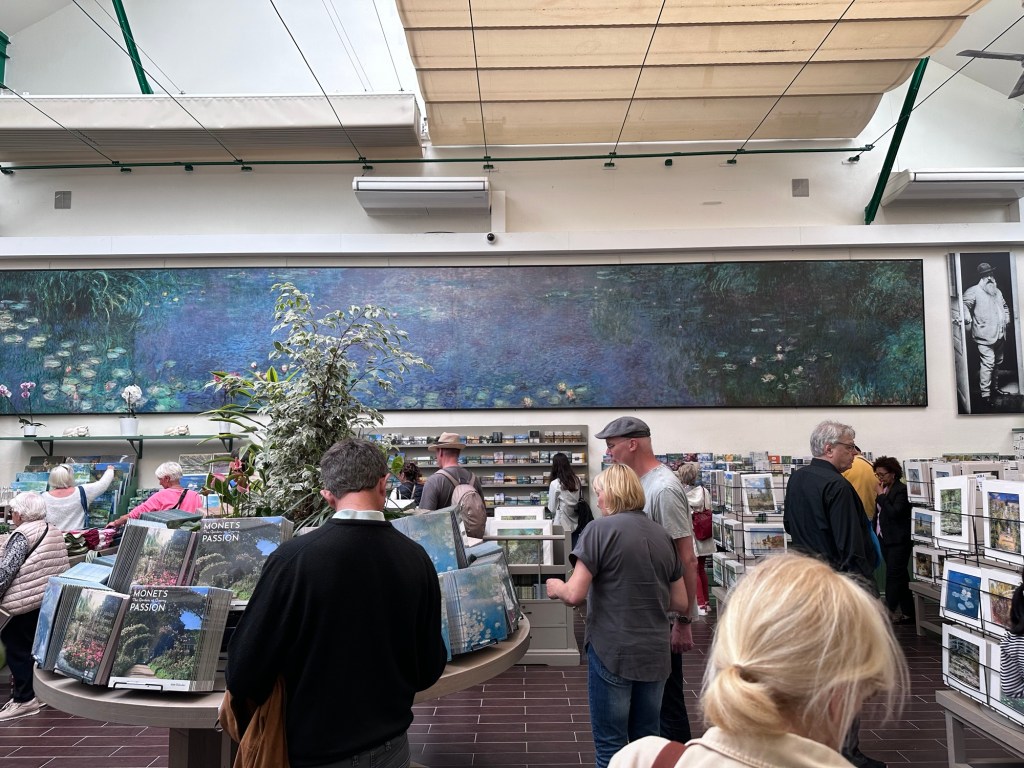
Monet’s studio is now the gift shop. It was huge, with lots of natural light. Reproductions of his water lilies were stretched across two of the walls.
I am extremely grateful for the assistance I’ve received from the “Friends of Oat” Facebook page. This post is my way of giving back. Although I wrote it primarily for OAT travelers, I hope that others planning to visit Japan might find some of these hints helpful.
Packing
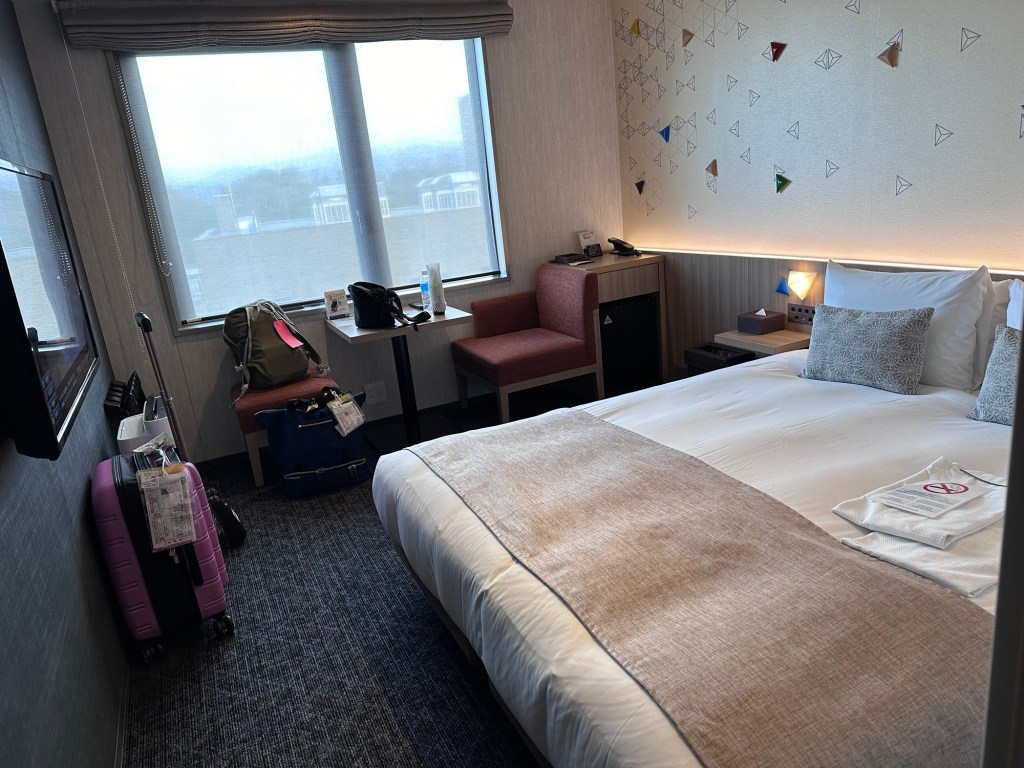
Pack light: Hotel rooms are TINY, so there really isn’t much room to store clothes or luggage. Here’s another reason to pack light–there are no porters in Japan, so you will be handling your own bags.
My room in Kanazawa , which was actually quite a bit larger than the ones in Tokyo and Kyoto
Doing Carry-on Only isn’t as hard as it might seem, because every hotel had laundry facilities on site. In our Tokyo hotel, you could watch your laundry’s progress on your room’s TV. Which I did. From my bed. I wasn’t worried that someone would take my laundry out and dump it on the floor, because first, the Japanese are way too polite to do something like that and second, the machine locked with a code that you input.
The Kanazawa hotel had a washer and dryer in the room, complete with a squirt bottle loaded with detergent. Despite the plastic card with instructions in both English and Japanese, it was a slight challenge for me to figure out how the damn thing worked. In fact, I’m not exactly sure what I did, but hey, the clothes came out clean.
You don’t have to pack pajamas, because Japanese hotels provide them. At least the ones OAT uses did. Every day there would be fresh pajamas neatly folded on my bed. Although I had a single room, I still got two pairs of pajamas!
Every hotel had a REAL hair dryer…not one of those awful ones attached to the wall. You know, the ones that you have to keep a finger on the button or else it shuts off?
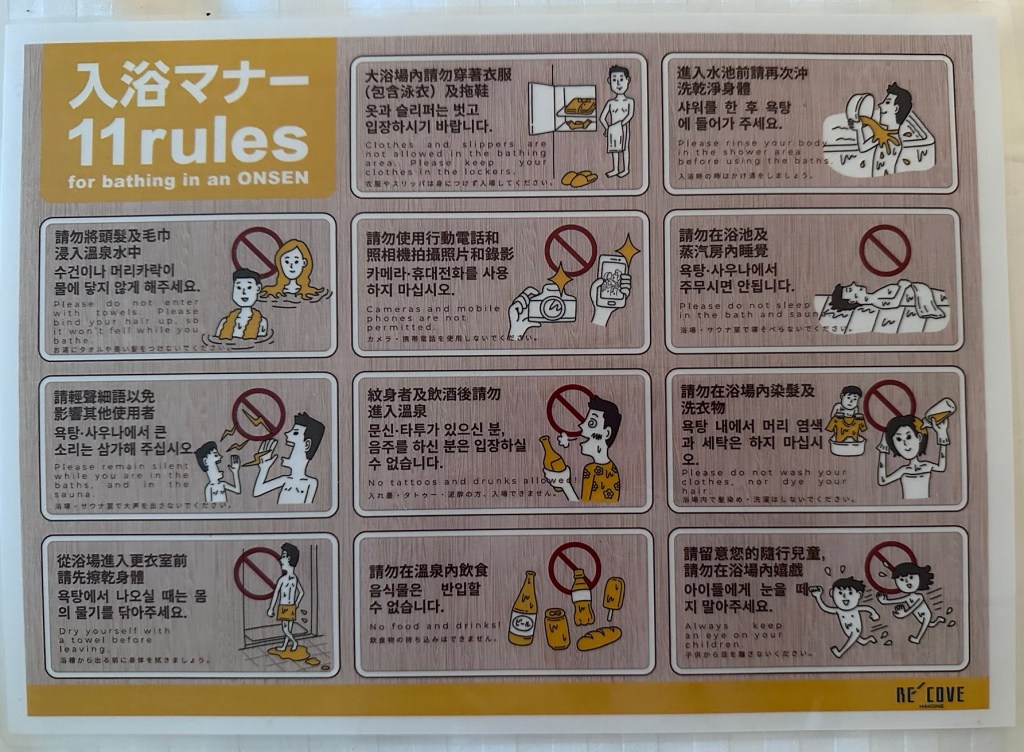
I had heard that some hotels have onsens, which are sorta like hot tubs/whirlpools except the source of water and heat is the naturally occurring hot springs. I definitely wanted to experience THAT, so I dutifully packed a bathing suit and cover up. That was totally unnecessary, because the onsens have many rules, one of which is you either go naked or you don’t go. Take a look.
I guess at some point, someone must have tried to dye their hair or wash their clothes in the onsen, otherwise why the need to print the prohibition?
Another unnecessary item that I packed was a water bottle. All the hotels provided bottled water, plus the water in Japan is not only safe to drink, it also tastes good. I simply refilled the hotel’s water bottles from the tap, and never used the one I brought.
Gadgets
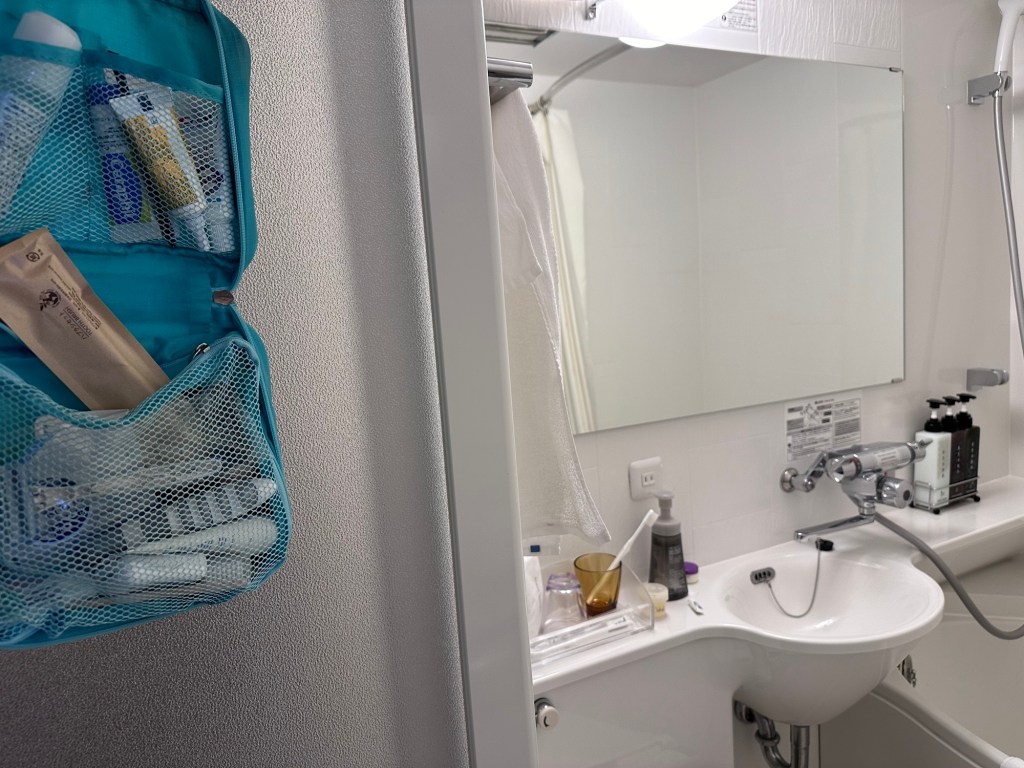
There isn’t much counter space in the bathrooms so hanging toiletries bags make life easier, at least while using the bathroom.
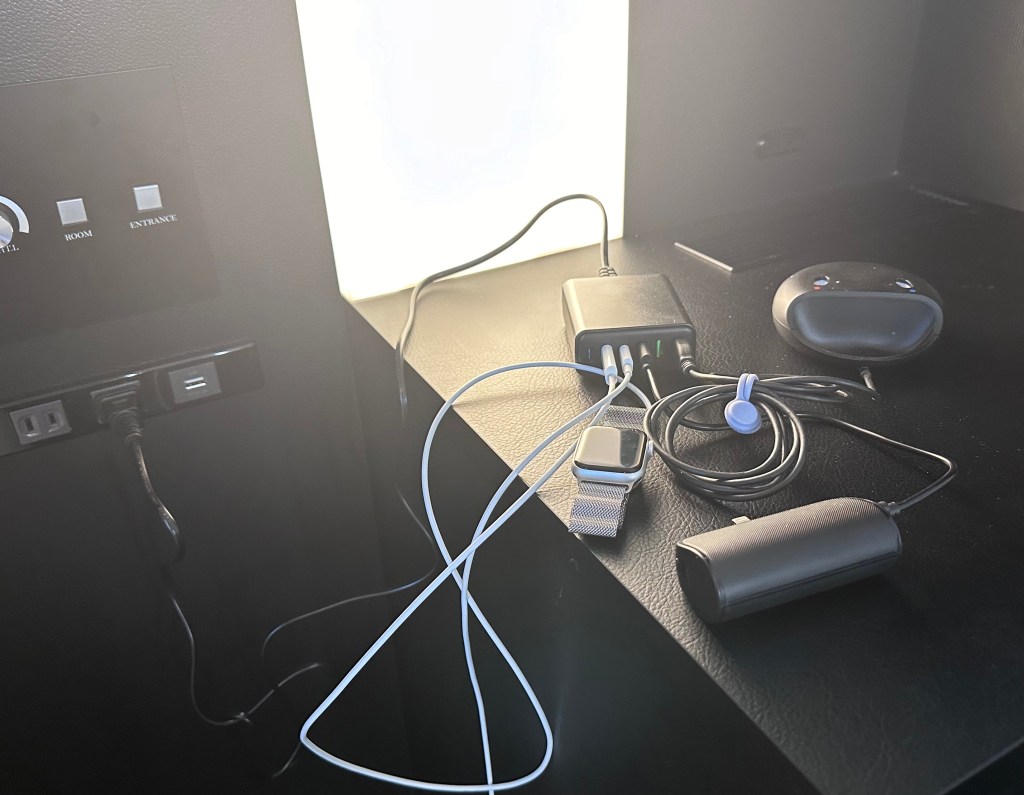
Although some hotels had conveniently located outlets, that was not universally true, so I was glad that I brought my handy dandy plug thingie that I got from Amazon. Because my phone is now my camera, the battery doesn’t last all day, so I bought that black mini portable charger, also from Amazon.
The manicure scissors I brought were useful for cutting off the plastic ties that were affixed to our luggage every time we had our bigger bags shipped. The bullet train doesn’t have much storage space, so we were told to pack a small bag to tide us over until the rest of our luggage arrived. That happened twice on the main trip and once on the post trip. Additionally, some of the plastic packaging on snacks was difficult to open, so my manicure scissors spared my teeth!
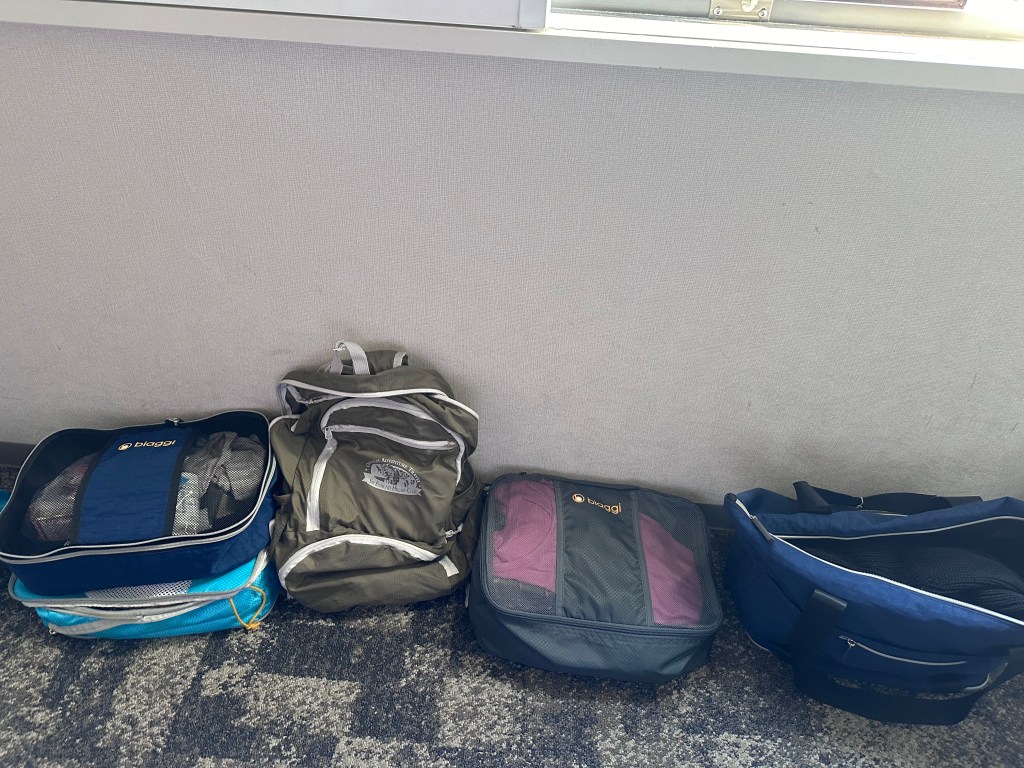
My packing cubes functioned as bureau drawers in these bureau-less and closet-less rooms. Yep, I just put them on the floor. in the narrow space between the bed and the window.
The OAT backpack folded up to almost nothing in my carry on. It made a great day pack, and provided extra space for purchases.
Shopping
I normally don’t shop while I am on a trip, but the exchange rate was so favorable, and the items were so unique, I found myself buying lots of little gifts — in department stores, in little handicraft shops, you name a place and it is highly likely that I found something interesting to buy there.
Language
English is not commonly spoken, but Google translate made it much easier to communicate. I simply typed in what I wanted to say and showed the Japanese translation when I needed help. In museums without English explanations, I pointed the camera at the Japanese words and Google delivered a translation like the one below.
Screenshot
Money
I learned from the Friends of OAT Facebook page not to bother with Japanese Bank’s ATMs when I needed cash. Instead, I went to either Lawson’s or 7 11, which are EVERYWHERE. I was beyond relieved when I saw that English instructions are provided. The exchange rates are good, and the cost for withdrawing money is reasonable. Although you can use your credit card in most places, it is good to have cash for the markets and smaller gift shops. A bonus–both places sell ice cream, chocolate and other snacks.
Mass transit
I’m sure that once you get the hang of it, mass transit is easy to use. Let’s put it this way, I was VERY grateful that our guide took care of determining how we would get from point A to point B. What is wonderful about Japan is one transit card can be used on just about everything: buses, trams, trains (but not bullet trains). The neck holder our guide gave us made getting through the turnstiles VERY easy.
It’s a wonderful trip. Rumor has it that OAT is developing another trip to Japan. I certainly am considering a return trip, but in the fall to see the gorgeous colors that were displayed in this photo of a poster.
There was so much to see and do in Kyoto, I decided Kyoto required two posts. This one describes the “official” OAT activities. The next post is all the “extras” sweet Mori made sure we experienced.
After Covid cancelled my 2020 Japan trip, I comforted myself with an on-line “tour” of Kyoto. From that, I got the mistaken impression that Kyoto was a rather compact city with all of the sights clustered together.
I was TOTALLY unprepared for how big Kyoto is and how scattered the points of interest are.
My iPhone photos will give you a rough idea of how much ground OAT’s itinerary covered during our 5 day stay. I was very grateful that Mori handled all of the logistics.
The Shinkansen brought us swiftly and smoothly to Kyoto. Because we had ridden the bullet train from Tokyo to Kanazawa, we were familiar with the drill: you pack a small overnight bag to tide you over until the larger luggage ( which was shipped) arrives a day later. The bullet train is super comfortable, but storage space is quite limited.
I was glad that I was traveling with only a backpack, because unlike our arrival in Kanazawa, in Kyoto we had to swim through an ocean of humanity to get through the train station.
Photo by ReneePhoto by Mike
I’m wondering what was easier to follow—Taco, or my gray head sticking up above the crowd.
What a multisensory extravaganza the Kyoto train station was! We were bombarded with sounds, sights and wonderful smells, but as you’ll see in a later post, it is even more thrilling at night, so no more daytime station photos.
But first, here’s a whirlwind tour of my favorite things on OAT’s itinerary, which successfully hit Kyoto’s traditional hot spots.
The majestic Arashiyama Bamboo Forest
It is hard to describe the peaceful feeling one gets while walking through these towering plants.
Cemetery beside the bamboo forest
The Tenryu-ji Temple
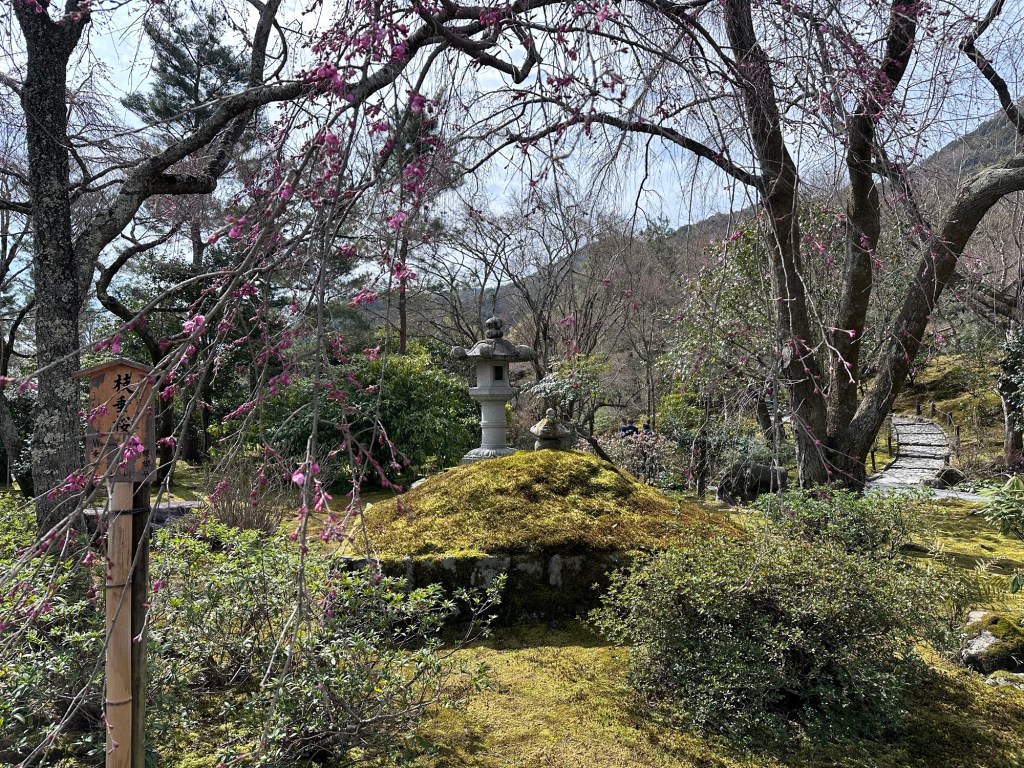
A brief stroll away from the forest was a beautiful garden and Buddhist temple. We were so excited to see the cherry blossoms were starting to open.
I managed to pitch a coin right into the ring in front of the frog. I keep making the same wish. One of these times it should work.
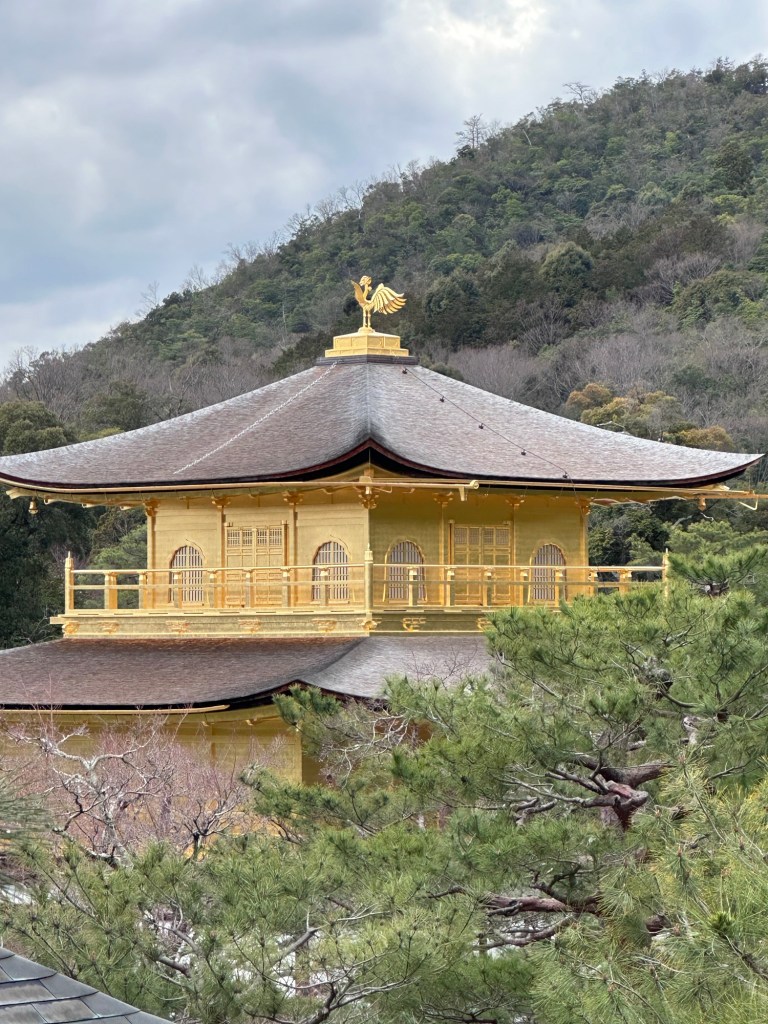
Kinkaku-ji Temple (Temple of the Golden Pavilion)
The original temple was constructed around 1400, but was rebuilt in the 1950’s after it was burned to the ground by a crazed monk.
Wasn’t it fitting that the phoenix atop the temple was the only part of the original that managed to arise from the ashes of the burned building?
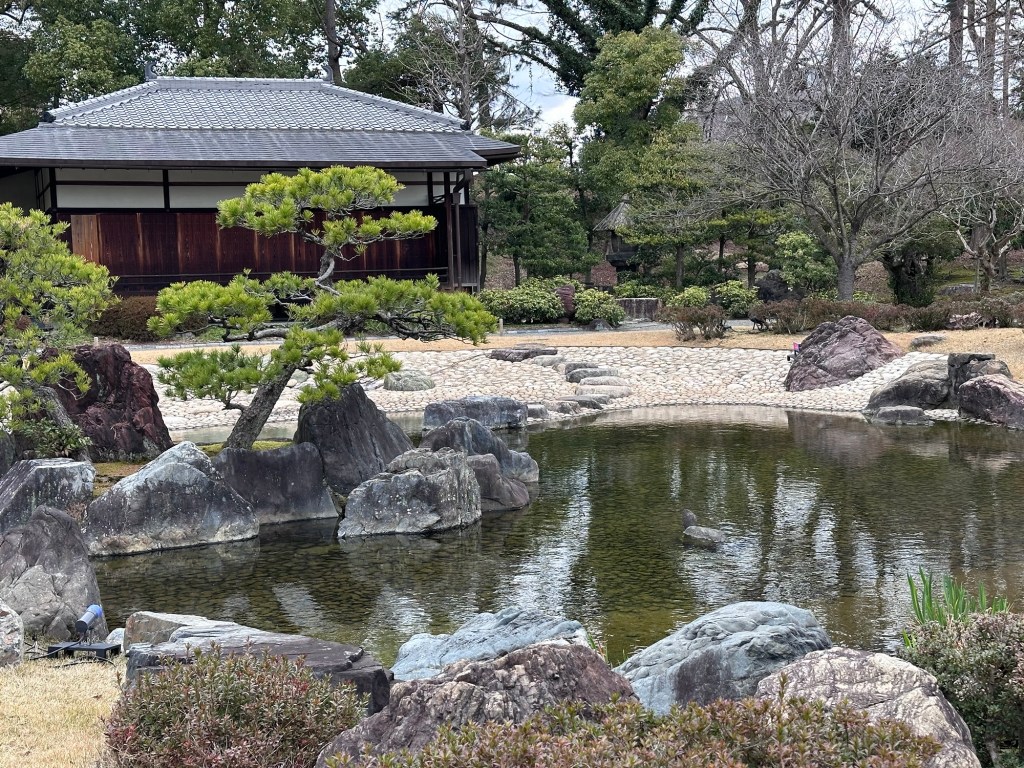
Nijo Castle
We toured the interior of Nijo Castle, but we weren’t allowed to take photos. That’s okay. I found the exterior far more compelling—especially at night (and yes, you are going to have to wait for a future post to see how glorious it is).
Nara
India has its sacred cows; Japan has its deer.
Kathleen is bowing to the sacred deer
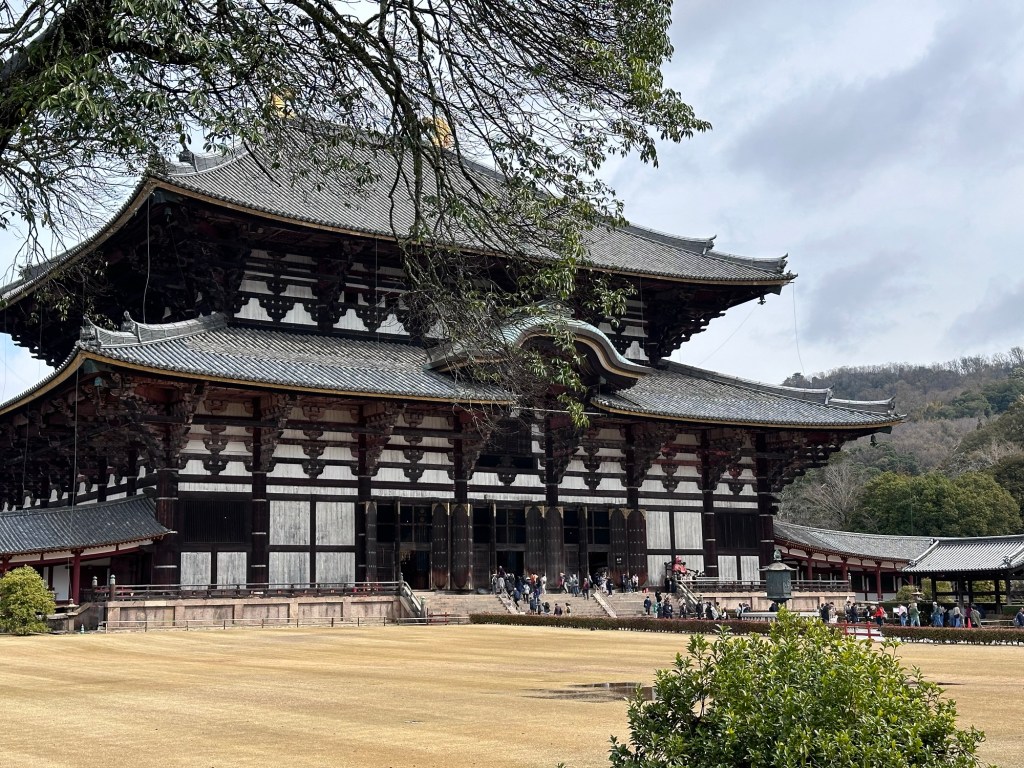
Todaiji Temple
This is the home of the world’s largest wooden Buddha.
He was so enormous, it was difficult to photograph him. Besides, we’ve all seen Buddha photos.
As you may have noticed from earlier posts, I’m rather fond of the Guardians. Even though this one has a fierce facial expression, he’s holding a scroll and pen, so how scary can he be? Maybe his message is “the pen is mightier than the sword”?
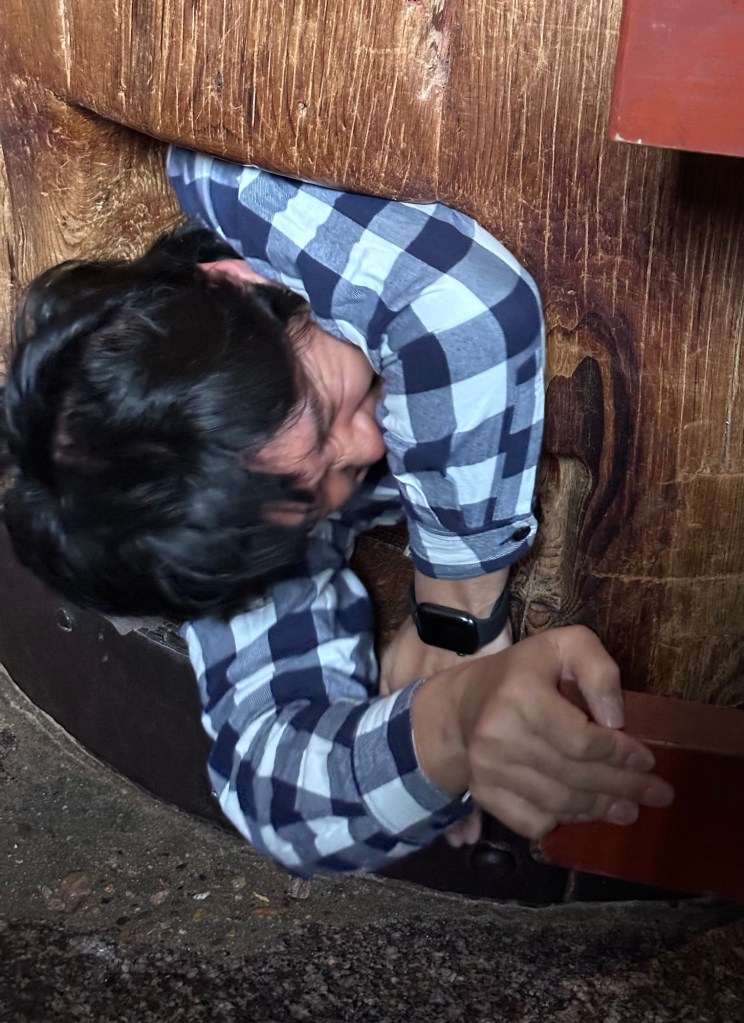
This next photo requires an explanation, but first take a look and see if you can figure out what is happening.
There is a wooden block in the temple, with an opening that supposedly is the size of Buddha’s nose (the statue, not the human). The belief is that anyone able to squeeze through Buddha’s nose (or the passage) would have a good life. I’m pleased to say that although he initially struggled, Mori made it thru.
Zen Temple
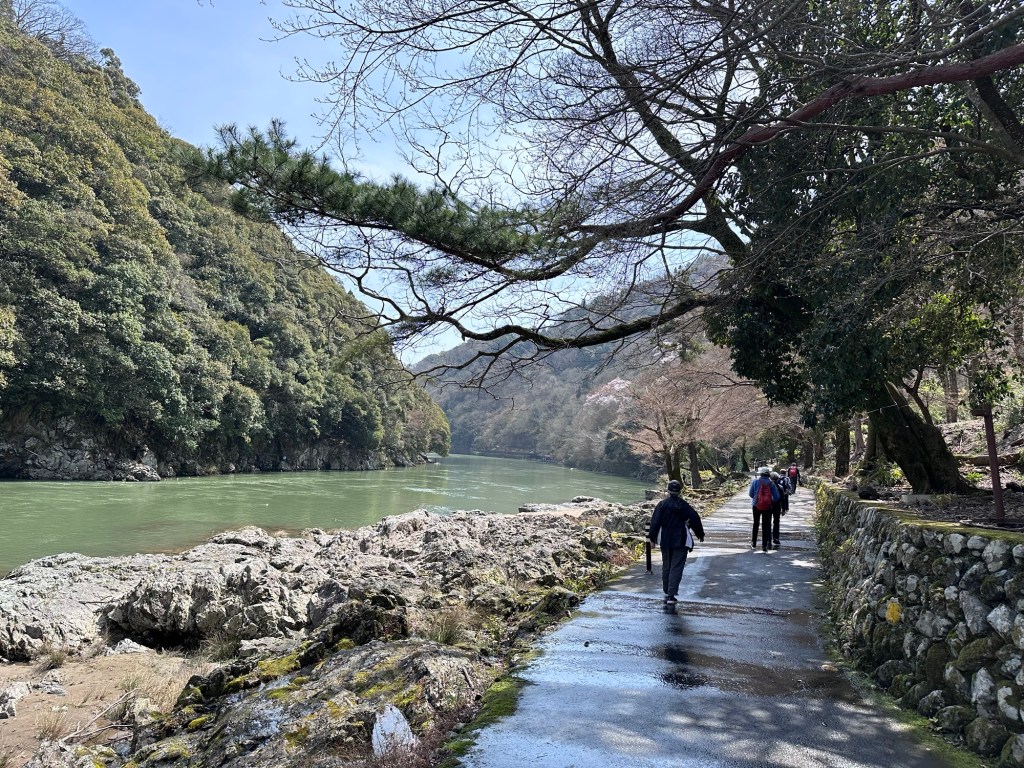
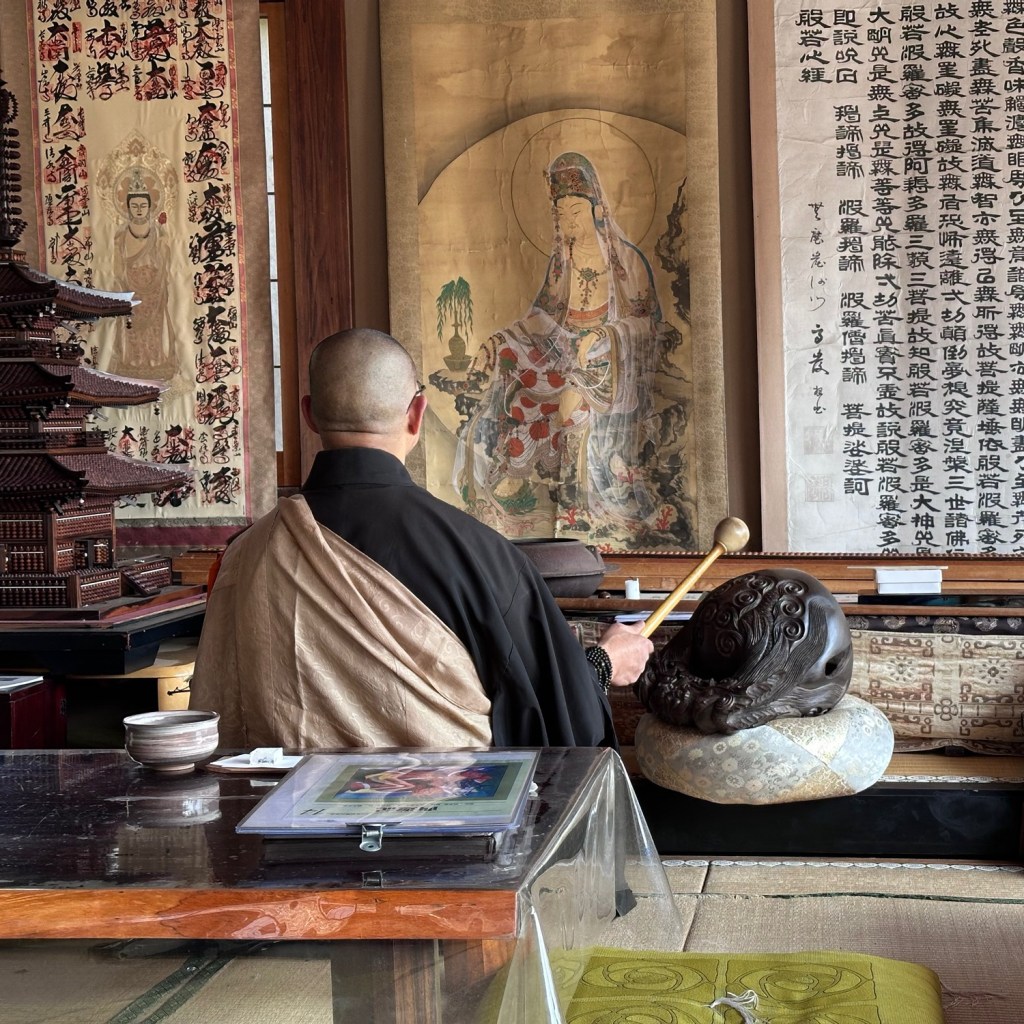
After walking alongside this beautiful river, we climbed 200 steps ( I didn’t count; I took Mori’s word for it) to meet a zen master, with whom we meditated.
We left, totally at peace, feeling “zero”. It’s fortunate that l learned to let go, because that hat on my head and I were soon to go our separate ways.
Fushimi Inari Shrine
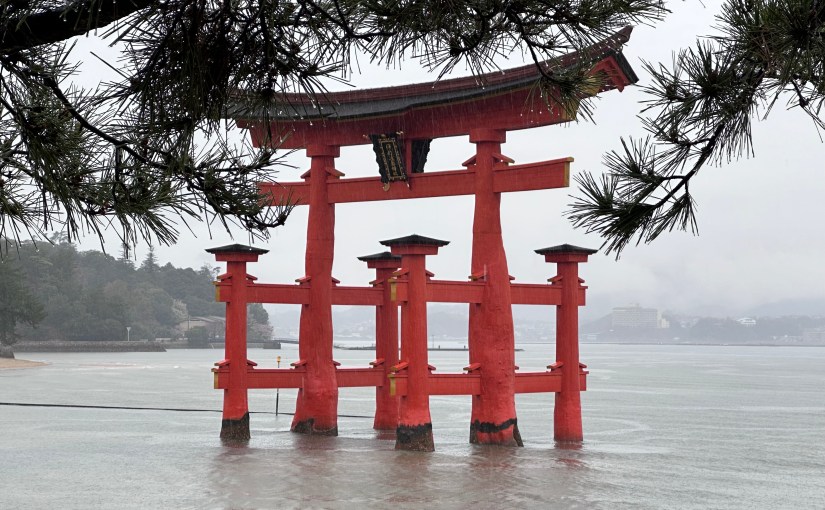
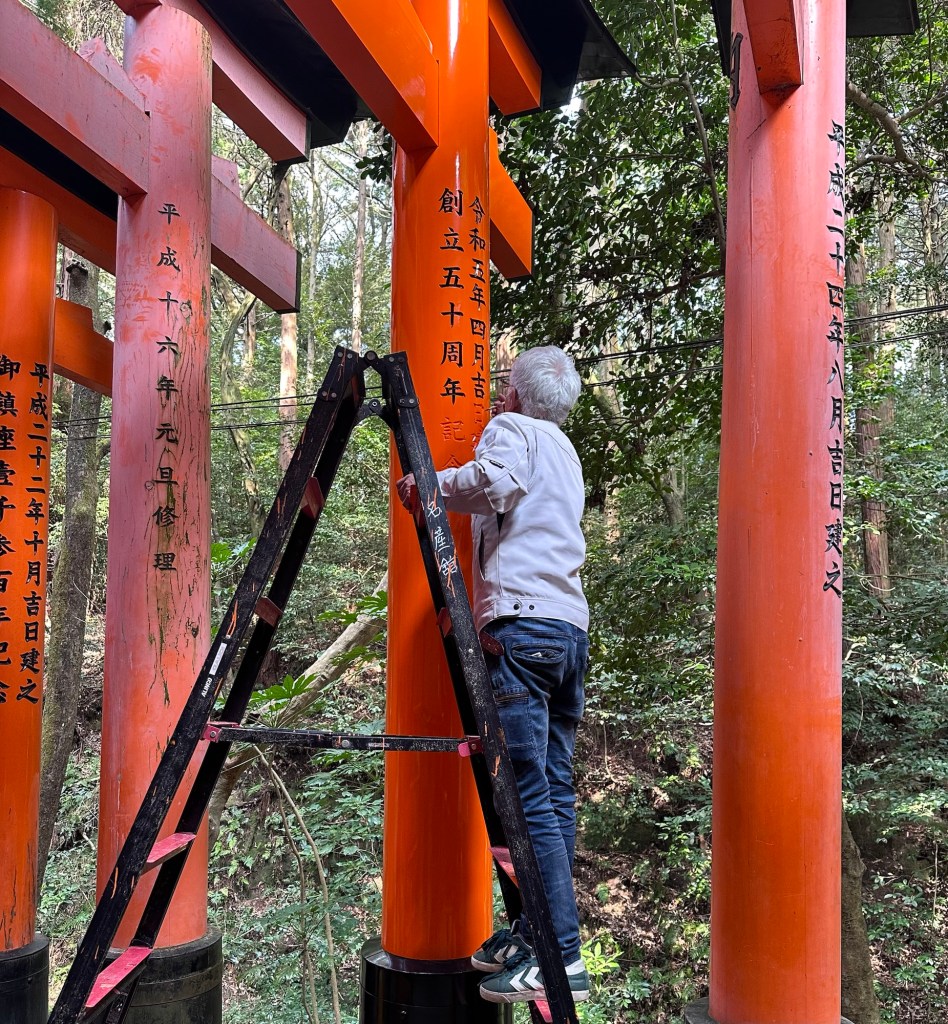
After experiencing Buddhism, we moved on to the famous Shinto shrine with its beautiful vermillion Torii Gates.
We didn’t have time to climb to the top, so this map will have to suffice to give you an idea of the immensity of the shrine.
When Christo did “The Gates” in NYC’s Central Parking 2005, Mike and I spent an enjoyable February afternoon strolling through them. Could Christo have gotten his inspiration from Japan? I think he did.
Sushi Making
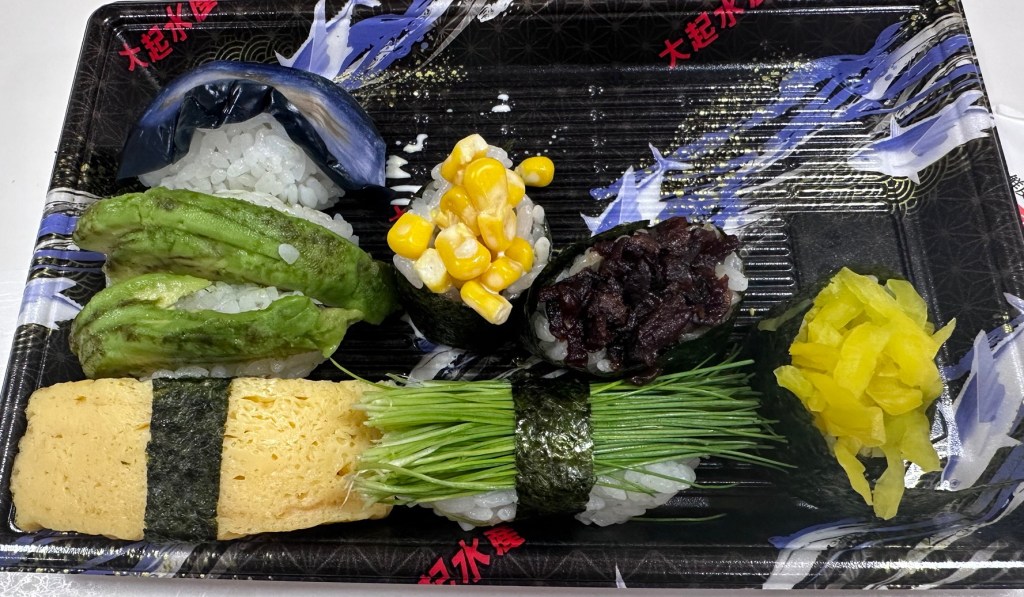
I will say up front that raw fish wrapped in seaweed does not meet my definition of delicious. Still, I was determined to keep an open mind. I was quite happy to learn that we had a vegetable option.
My son Greg would have loved the discussion about knives and whet stones.
Our ingredients The finished product
Okay, so maybe it didn’t look like much, but it sure was tasty.
What better way to end this post than with a photo of a beautiful blossom…
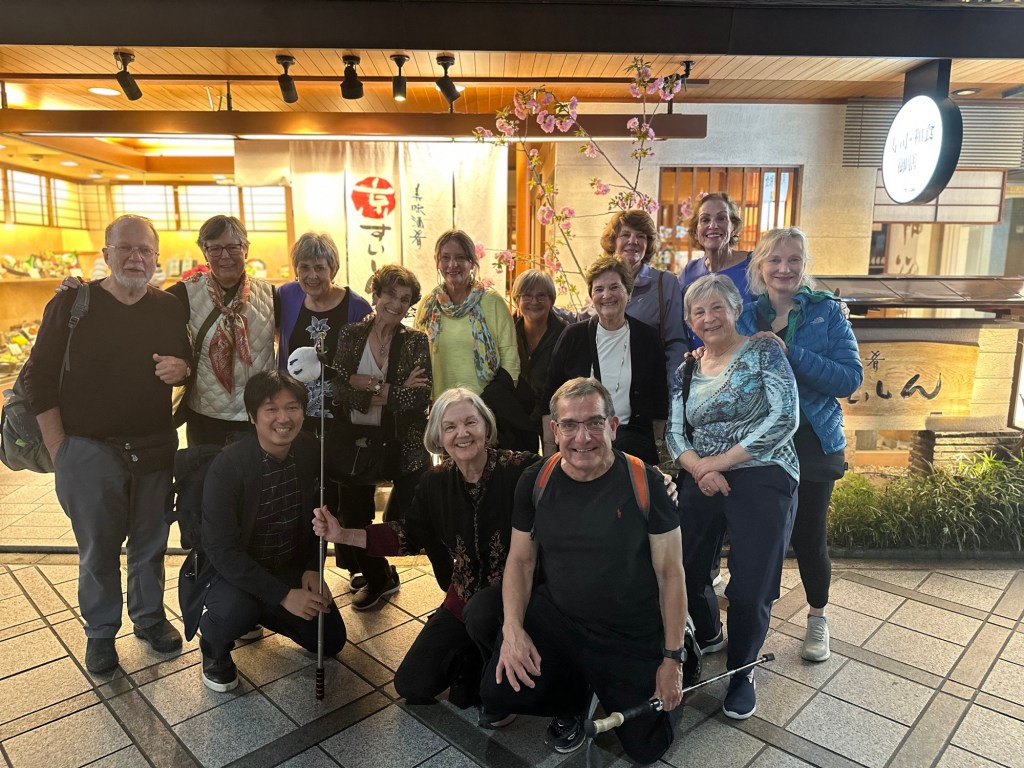
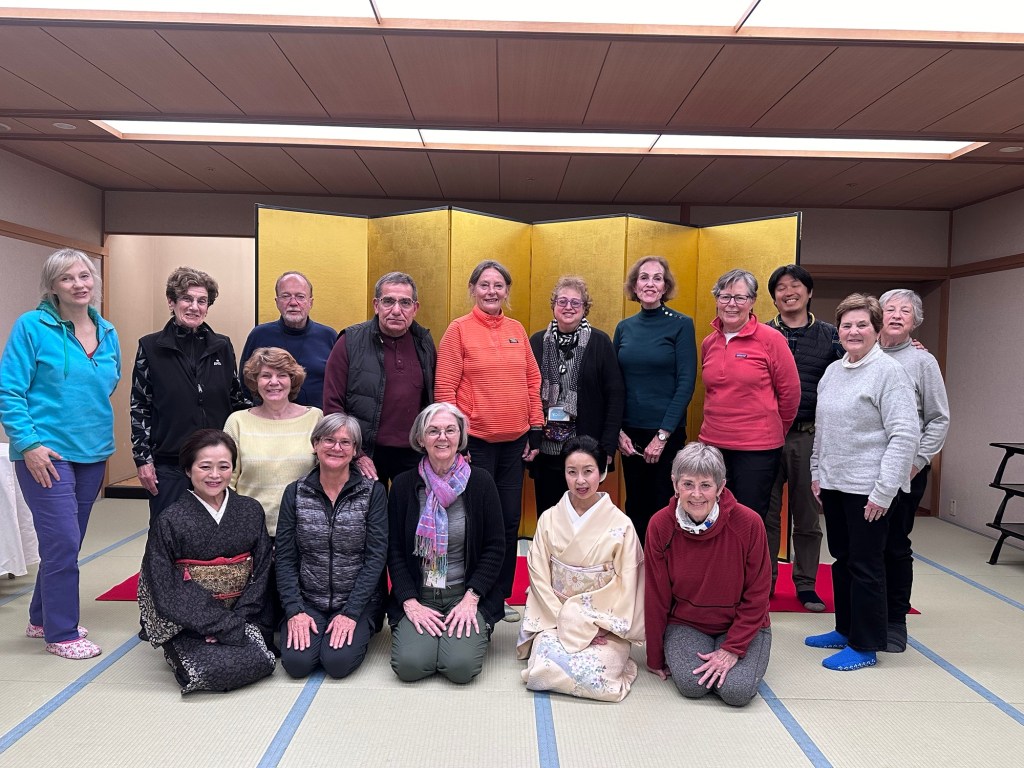
and a group shot taken after our farewell dinner. Sadly, Mary, Jim, Kathleen and Cathy, weren’t joining us on the post trip to Hiroshima.
When you think of Japan, what comes to mind? For me, it was all about the cherry blossoms and the Geishas. Sumo Wrestling? Drumming? Karaoke? Not so much. But I kept an open mind, and I’m so glad I did. Frequently, on OAT trips, I didn’t know I wanted to see something until I got there.
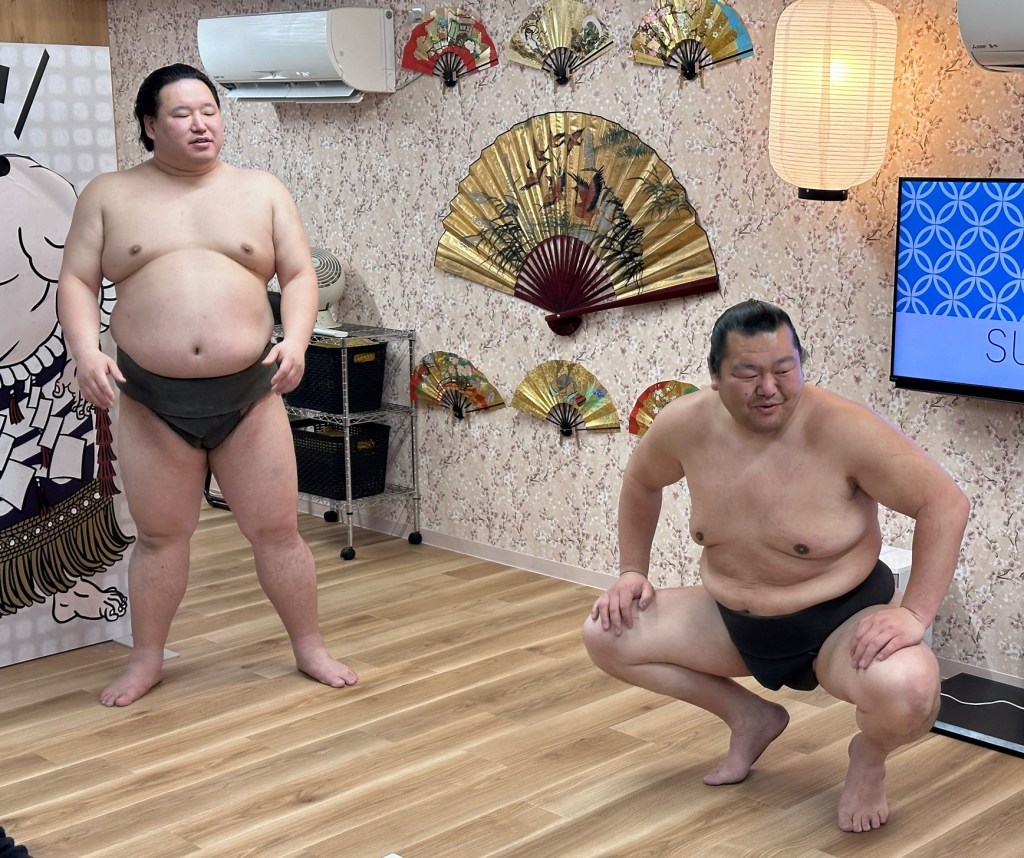
Take, for instance, sumo wrestlers. These guys put on quite a show for us. I hadn’t expected them to be so funny! While demonstrating the forbidden moves—poking their opponent’s eyes—a fake eyeball popped out and rolled on the floor.
Sumos have “stage names”, like US wrestlers Who can resist a photo op with nearly naked men? They’re heavy, but muscular and very fit.Our group is now complete. 5 more joined for the main trip.
It wasn’t just laughs, though. We also learned quite a bit about the sport. Some of the sumo wrestlers are recruited from the ranks of “troubled” boys, usually around the time they turn 15, providing a constructive use of all that testosterone.
Their careers last about 20 years, which means they retire from wrestling in their mid to late 30’s, similar to the career span of professional athletes in the USA.
Renee and I (because of our insurance backgrounds) immediately had questions about the impact of all that extra weight on life expectancy. We learned that sumo wrestlers, on average, live 10 years less than most Japanese. As one would expect, diabetes, joint problems, head injuries and other medical issues are responsible for decreased longevity.
Like our time with the wrestlers, we were offered a “hands on” experience at a subsequent cultural event —drumming. And boy, did we get into it! We were like a bunch of pre-teen boys, wildly pounding away.
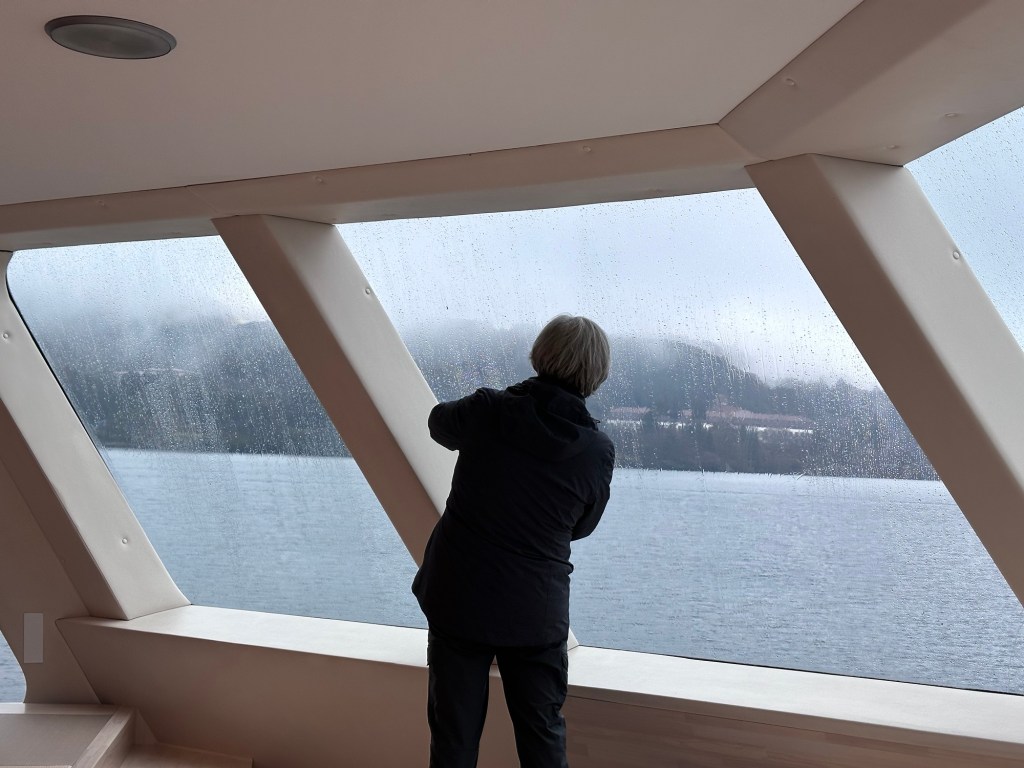
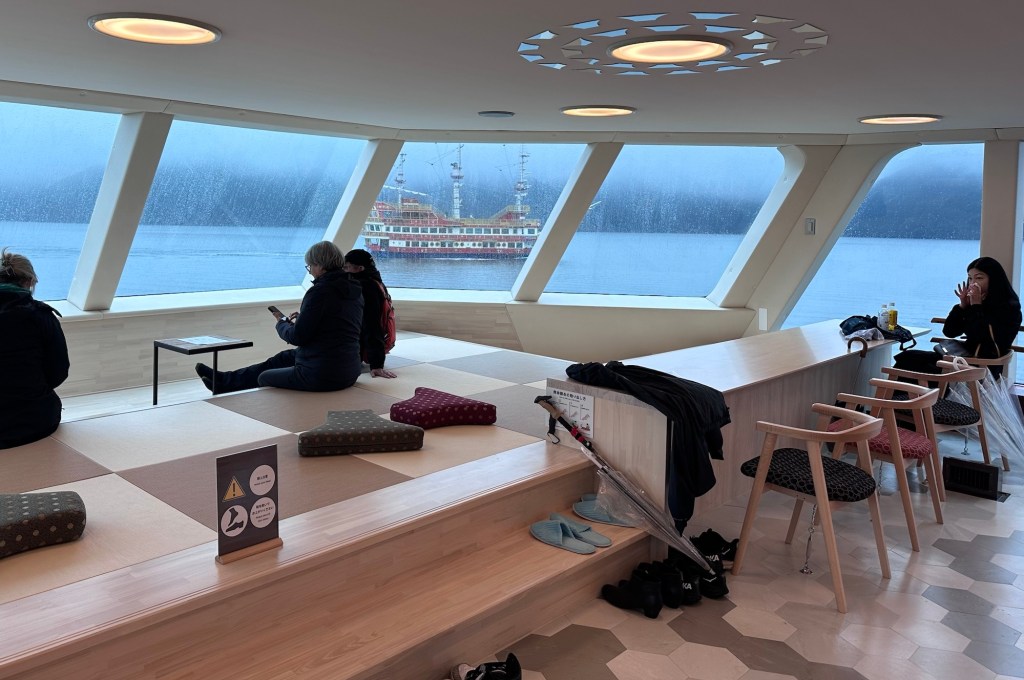
It was raining off and on during our second day in Hakone, but we didn’t mind. Our day was filled with indoor cultural experiences, starting with a boat ride across the lake to visit a woodworking master.
Renee, attempting to get the perfect exterior shotI was more captivated by the plush interior and the “pirate”ship
I’m not normally a shopper, but this master craftsman’s work was so exquisite and so unusual, I had to buy a couple of his smaller pieces. Partly because of the prices and partly because traveling with carry on, my purchasing power was severely limited.
Next up was shabu shabu for lunch ( Japan’s version of fondue),
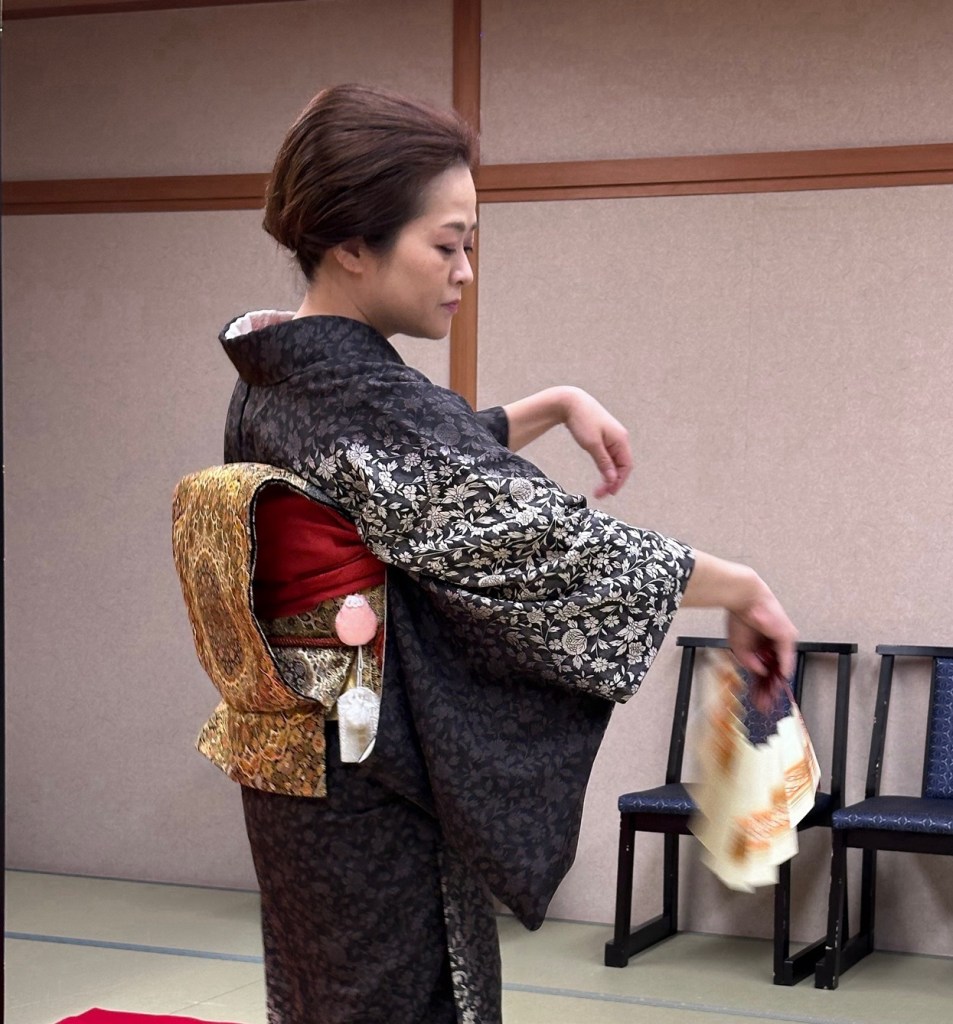
followed by a delightful encounter with these two lovely geishas, who danced and played a traditional instrument to demonstrate how they entertain clients.
During the question and answer period, they dispelled many misconceptions about geishas.
Unlike the book and movie “Memoirs of a Geisha” would have you believe, geishas are not prostitutes, nor are young girls sold to geisha houses. Although they admitted those things might have happened many years ago, the practice was not widespread even back then.
I never would have guessed there is a geisha union that clients contact when they want to book a geisha for an event. Geisha musicians are the highest paid, and if a client wants them to paint their faces white, and don wigs to create that traditional hairdo, it costs extra. An event normally lasts about two hours, with geishas sometimes attending two parties per night.
Curious about that big padded thingie on their back? I sure was. Well, they don’t carry a purse, so they need SOME PLACE to store their cell phone, right? Think of it as a Geisha backpack. I couldn’t believe all the stuff they pulled out to show us!
Because Hakone is noted for its hot springs, many hotels have onsens on site, and our hotel was no exception.
Men and women have separate areas, because everyone is naked in the onsen. During our stay, Kris , Janis and I experienced different pools, both inside and out, during our multiple visits. Since this is not an X-rated blog, there are no photos of the three of us frolicking in the onsen. Plus it’s against the rules. . .
Did I mention Japanese are very good at following rules? They are much better than Americans, which is probably why the laminated card in our rooms included English translations.
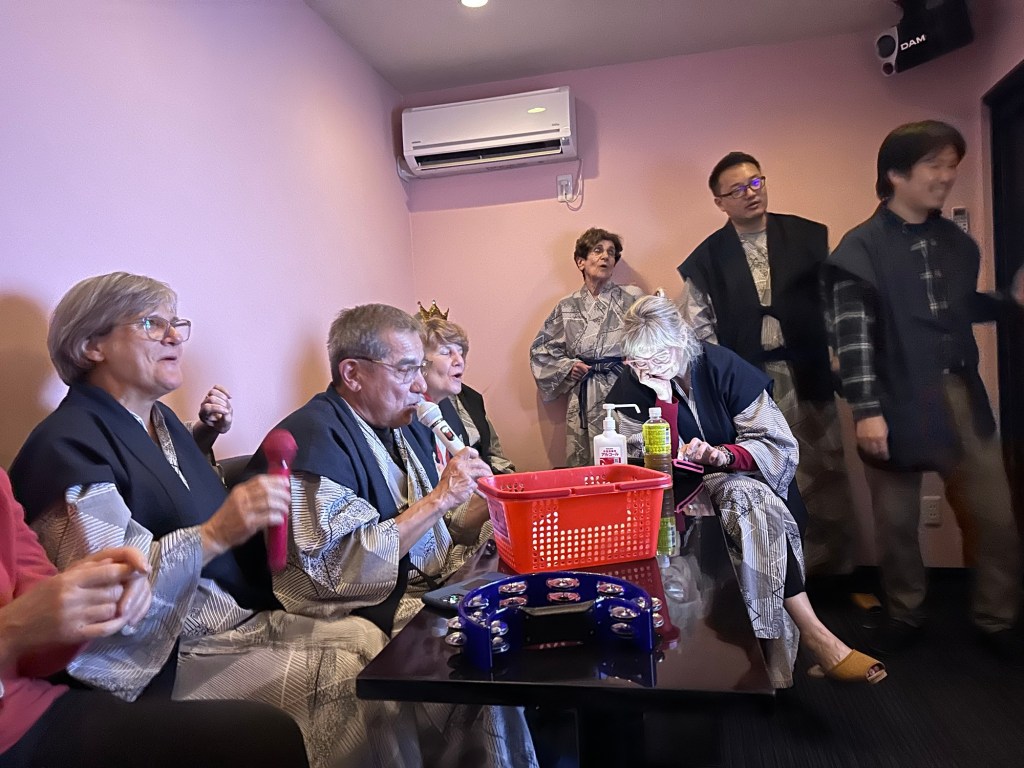
I’m going to end this post with our final Hakone activity—karaoke. My only prior experience with karaoke was at a bar, where individuals performed solo. The Japanese do it differently. It’s a group sing-along in a tiny room. Yep, the room isn’t much bigger than what you see in the photo below.
What a bonding experience! I’ll admit, it helps if you downed some sake (or wine) beforehand, which we all did, to celebrate Kathleen‘s birthday.
Wondering about that red basket? It held the microphones.
I was awakened from a deep sleep by Jeanne, who was standing at the foot of my bed, shaking my leg. That was strange, given that we weren’t rooming together. Was it a dream? Nope. It seems I managed to sleep thru my 4AM wake up call, my cell phone alarm, and numerous text messages. They say there’s one in every group, and this time it was me.
Fortunately, I had arrived early for every other meeting, so my group knew I wasn’t t just being an inconsiderate jerk. At least not this time. They were concerned that something bad had happened to me. Was I dead? (I probably looked like I was). Did I meet with foul play? (No). Was I unconscious? (Sorta). What happened was I woke up at 2:35 but made the mistake of not getting up then. Lesson learned. Next time, I’ll grab my phone and do wordle, read email, check Facebook until it is time to leave.
Good thing I had packed almost everything for our flight to Luxor the night before, and laid out my clothes, so with Jeanne’s help, instead of being on the bus at 4:45 AM, my butt was in my seat at 4:52 AM. I’m quite proud to say that those 7 minutes also included the elevator ride all the way down from the 17th floor. Still, l felt bad for keeping the others waiting.
Normally, I put my empty backpack into my carryon, but because I stuffed my toiletries into my carryon (so I could brush my teeth at the airport), I needed to pull out my backpack and allocate the carryon contents between two bags.
Well, I almost left my carryon at security. I was at the check in desk when I realized I should have THREE bags, not two. Yes, you put ALL luggage, including your checked bag thru the X-ray machines, before you arrive at the check in counter to get your boarding pass. Then your carryon goes thru security again, after you dropped off your checked luggage.
Maybe when I get home I’ll do a post about my “interesting” airport experiences, of which, so far, there have been several, especially in Jordan where I got intimately acquainted with security coming and going.
There is far too much to say about Luxor to dwell on my rocky start, so I’ll move on. .
Did you know that 1/3 of the world’s antiquities are in Luxor? And that Luxor was once known as Thebes? I hope those are trivia questions some day.
The reason we had such an early start was so that we could go straight from the airport to the Temple of Karnak, then on to lunch before checking in to our hotel.
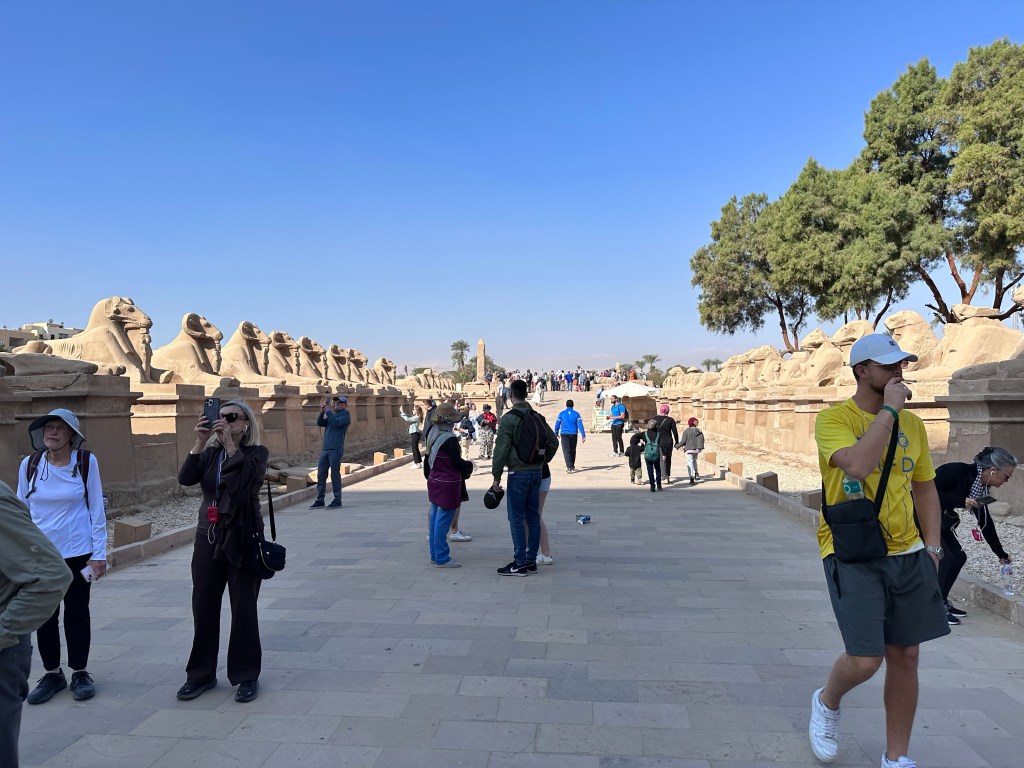
At one time this avenue united the Karnak and Luxor temples. Notice the rams head sphinxes that lined the avenue.
Just about everyone has seen photos of Egypt’s temples and tombs, right? But let me tell you, it just isn’t the same. You really DO have to be there to appreciate the immensity of these structures.
Although it looks crowded, and certainly felt that way, this is about half of what the crowds normally are at this time of year.
If you walk counterclockwise around this beetle (scarab) seven times, your wish is supposed to be granted. I had nothing better to do, so why not?
I’ll admit it, by the 7th time around I was starting to feel a little dizzy. But if I get my wish, it will be well worth it.
Lots of school groups were touring Karnak Temple that day. As was our experience in Jordan, the children were adorable and oh so friendly. They blew kisses, waved, shouted “hello” “how are you” and “welcome”.
That evening, five of us had dinner at the home of Mansour and Azza. We were joined by their two gorgeous daughters-in-law and their two very outgoing and entertaining granddaughters.
It was the perfect way to end our first evening in Luxor.
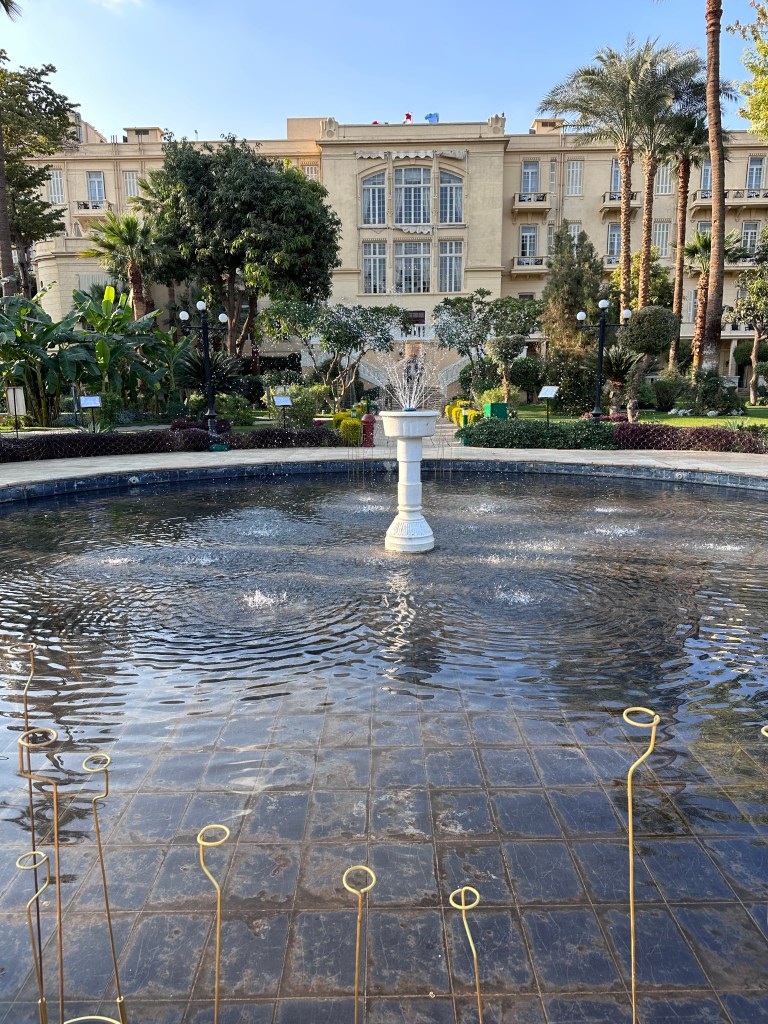
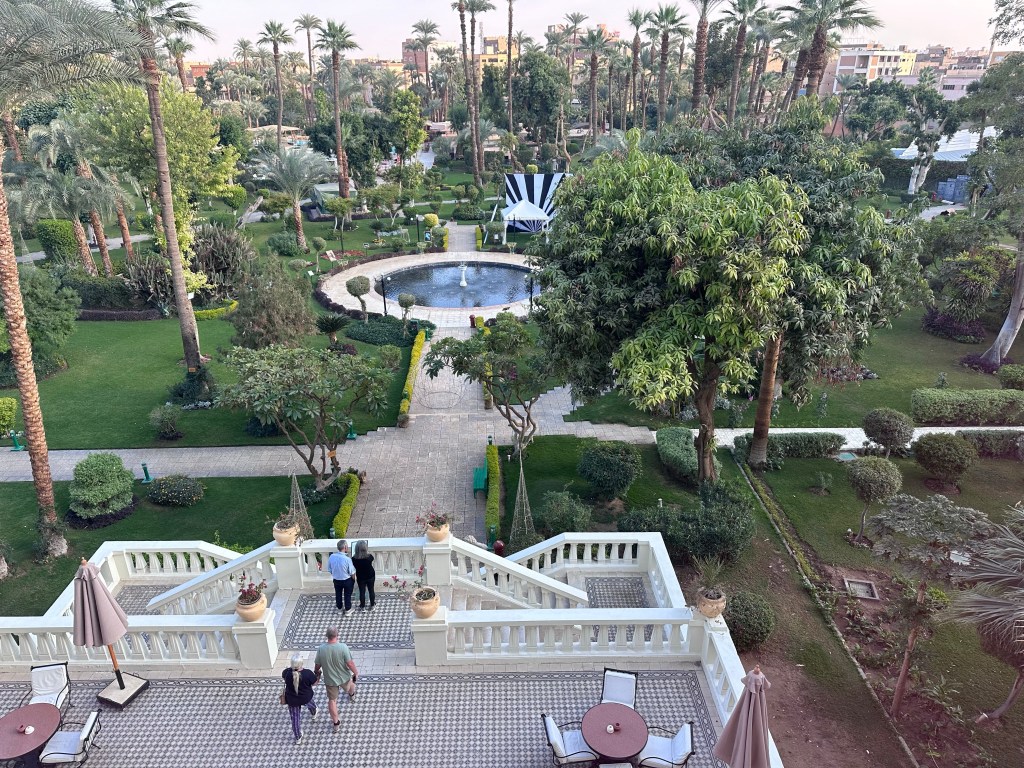
We spent two nights at the historic Winter Palace Hotel. Besides us, other famous guests included Jackie Onassis, Princess Diana, Henry Kissinger, Al Gore and Richard Gere.
On our free afternoon, Jeanne and I enjoyed a glass of wine in the gorgeous gardens. Helpful hint: if you’re going to drink the local Egyptian wine, go for the white.
Our second full day was spent exploring the Valley of the Kings in the morning, and the Valley of the Queens in the afternoon.
The Temple of Queen Hatshepsut, Egypt’s first female ruler, was our first stop on the way to the valley of the Kings. According to historians, her reign was quite successful—no wars, a prosperous economy, but that didn’t stop her successors from trying to completely erase her from history.
Fortunately, archaeologists were able to recreate her story by studying the empty spaces on the walls, and the remaining, very faint outlines.
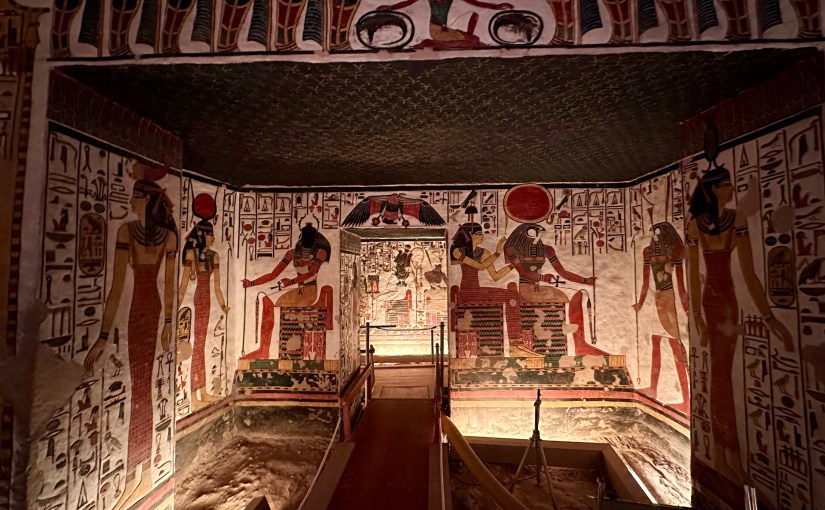
On our visits to the Valleys of the Kings and Queens, we explored the tombs of Ramses 1, 3, 4 , King Tut and Queen Nefertari (wife of Ramses the Great, also known as Ramses 2). All were spectacular, covered with vibrant hieroglyphics, but Tut’s tomb was unique in that his actual body—with face and feet exposed—is still in his tomb.
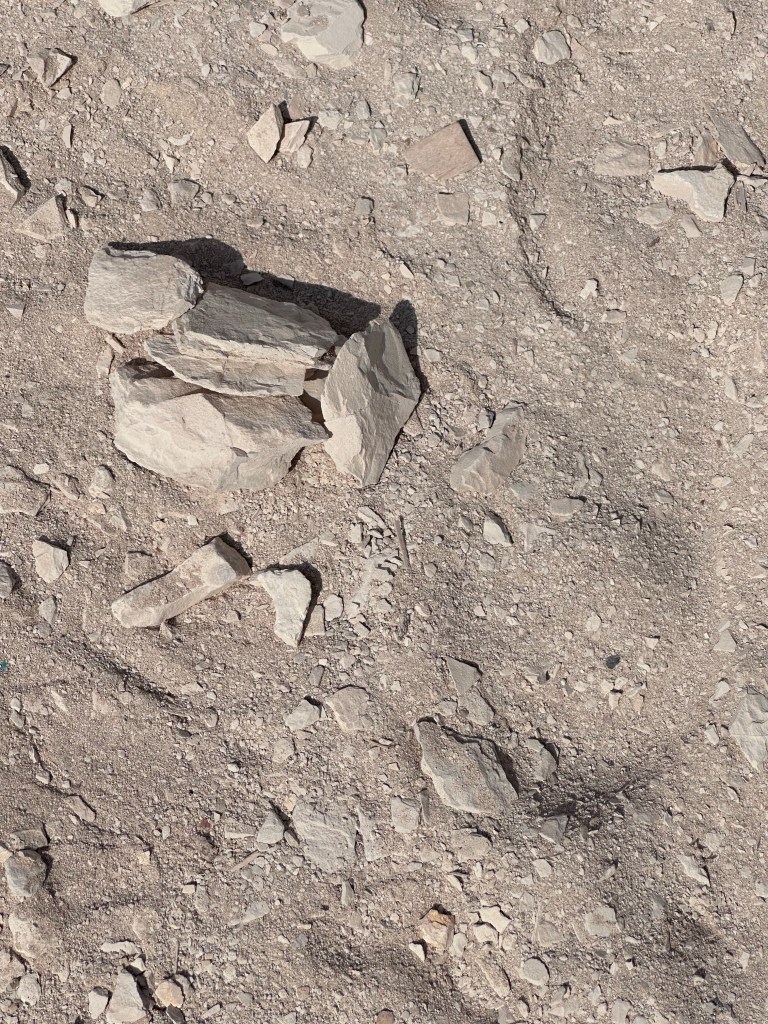
I had originally planned to leave Mike’s ashes inside King Tut’s tomb, but then I thought the caretakers might sweep him up, so I went with Plan B. I dug a little hole in the ground outside Tut’s tomb, inserted the ashes, then constructed this little pyramid atop them using stones lying nearby.
Okay, so maybe it doesn’t look like much, but I didn’t take 20 years to build it and I didn’t have the help of thousands of workers.
By the time we’d finished with the tombs, we were all too tired to tour the Temple of Luxor. It was just down the street from our hotel, so I caught a glimpse of the outside at night when it was lit up. That was good enough for me.
Our final Luxor activity was an optional one—a balloon ride over the Valley of the Kings. Only 4 of us were willing to endure yet another early morning departure (5AM). THIS time I was early!
To get to the balloon site, we had to cross the Nile by boat. Well, there were many boats lined up at the pier. To reach our boat, we had to climb through other boats. In one instance, it felt like we were walking “the plank”. But there was a reward. Take a look at what we got for our efforts. Yes indeed, that is a Twinkie in my hand. I hadn’t seen one of those in decades; it was so long ago, they came two in a package! No, I didn’t eat it, but it did make me smile.
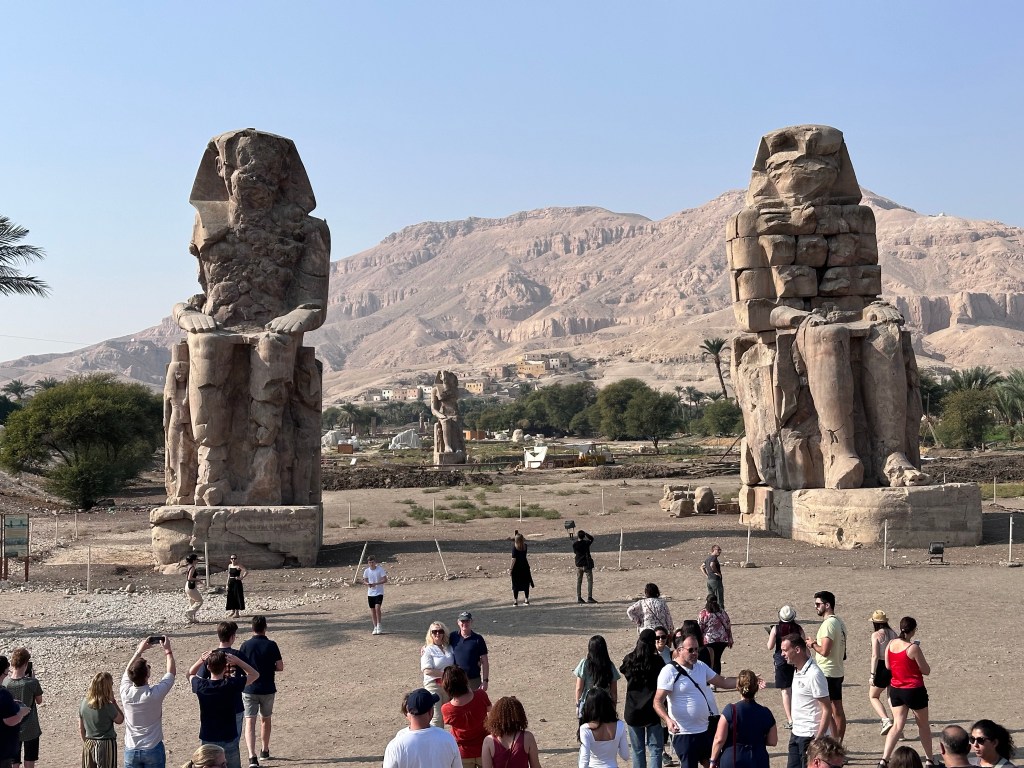
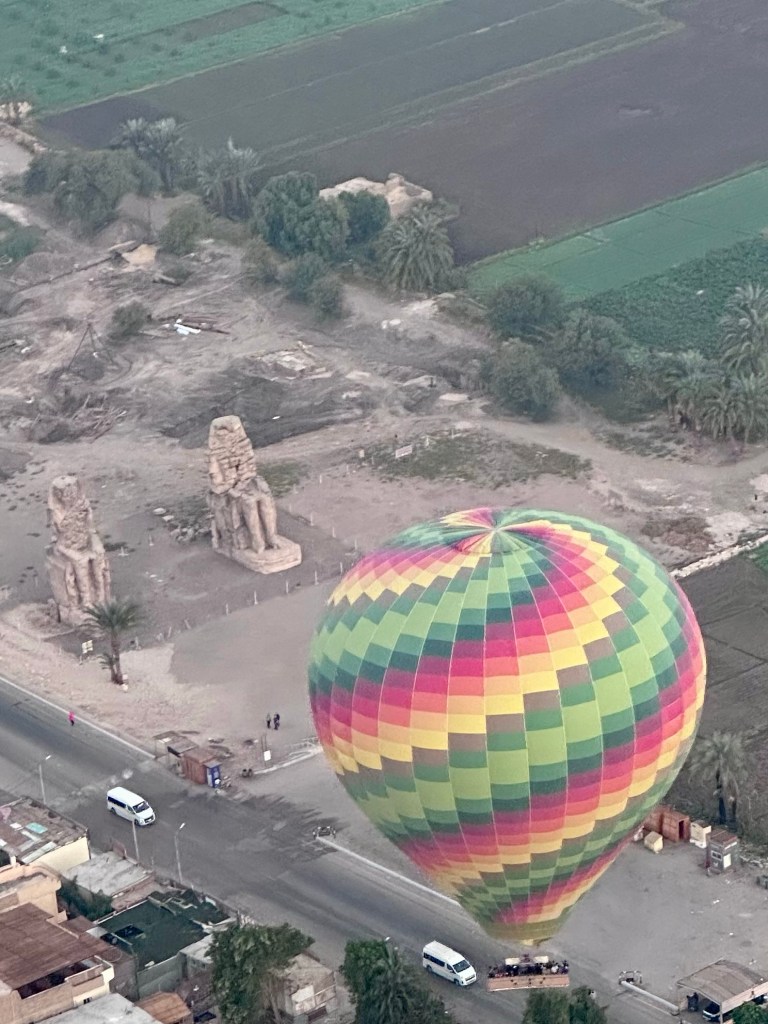
The day before our balloon ride , we had seen these statues of Amenhotep III from the ground.
Here is the aerial view.
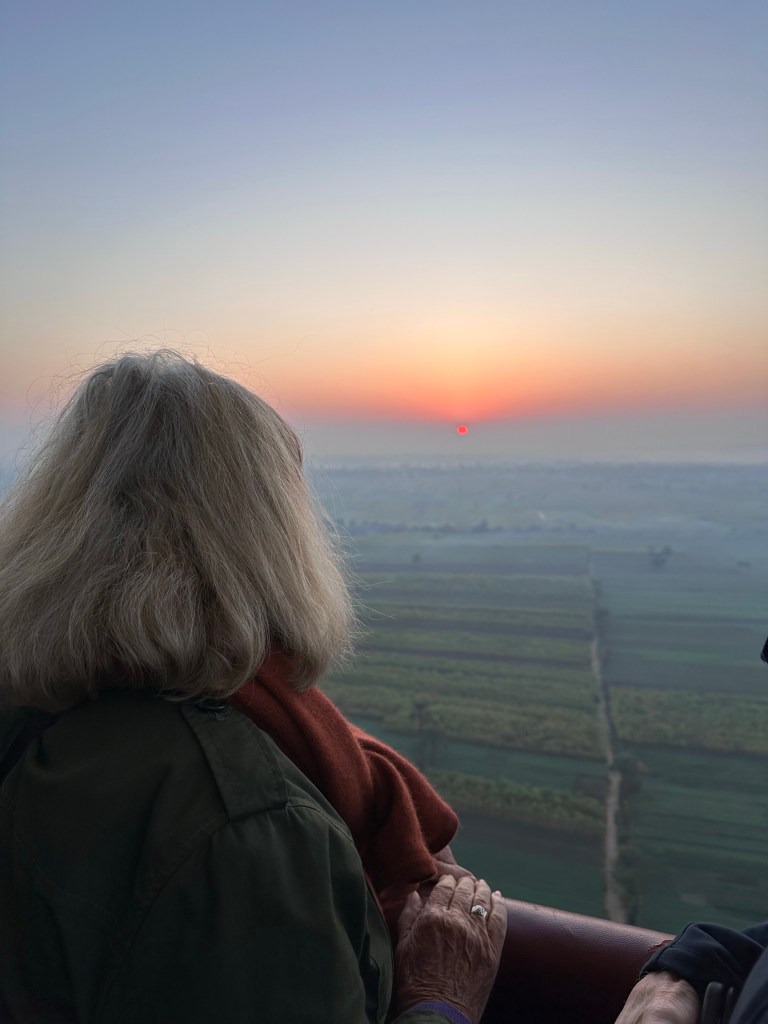
It was a spectacular sunrise
Next post will be about our 5 day cruise on the Nile.
Remember learning about the “Dark Ages” in school? Well, come to find out, it wasn’t dark everywhere. In the Muslim world, for instance, the “Golden Ages” is a more apt description. Don’t believe me? Then come to the magnificent Jordan Museum. In addition to archaeological treasures, like Dead Sea Scrolls, the museum has a wonderful short video about the many significant contributions Muslims made to the world during Europe’s dark days, plus several interactive, multi-media displays.
Even if Amman isn’t on your bucket list (although Jordan should be) you can still experience some of the museum’s wonders by visiting this website ( if the link doesn’t work type in 1001inventions.com. )
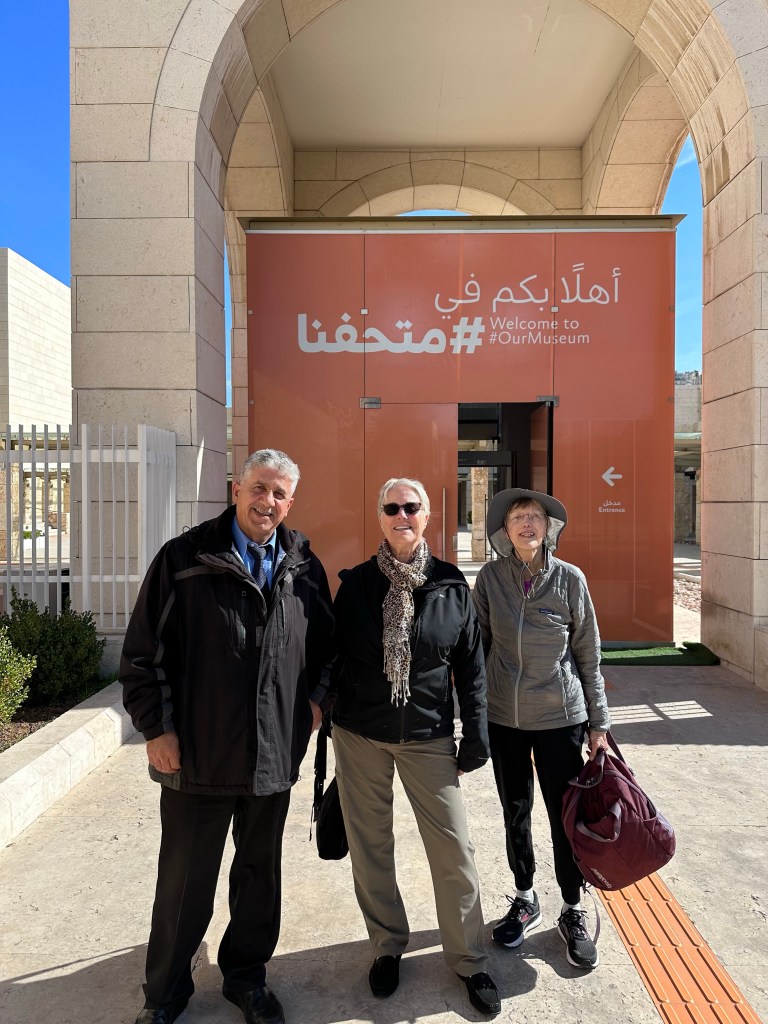
The Jordan Museum was not part of the OAT tour, however my friend Jeanne and I arrived a day early, so we had free time to explore before we met up with Hisham, our trip leader. My virtual travel buddy, Esther, who I hope to meet in person someday, had highly recommended the Jordan Museum, and I’m so very glad she did.
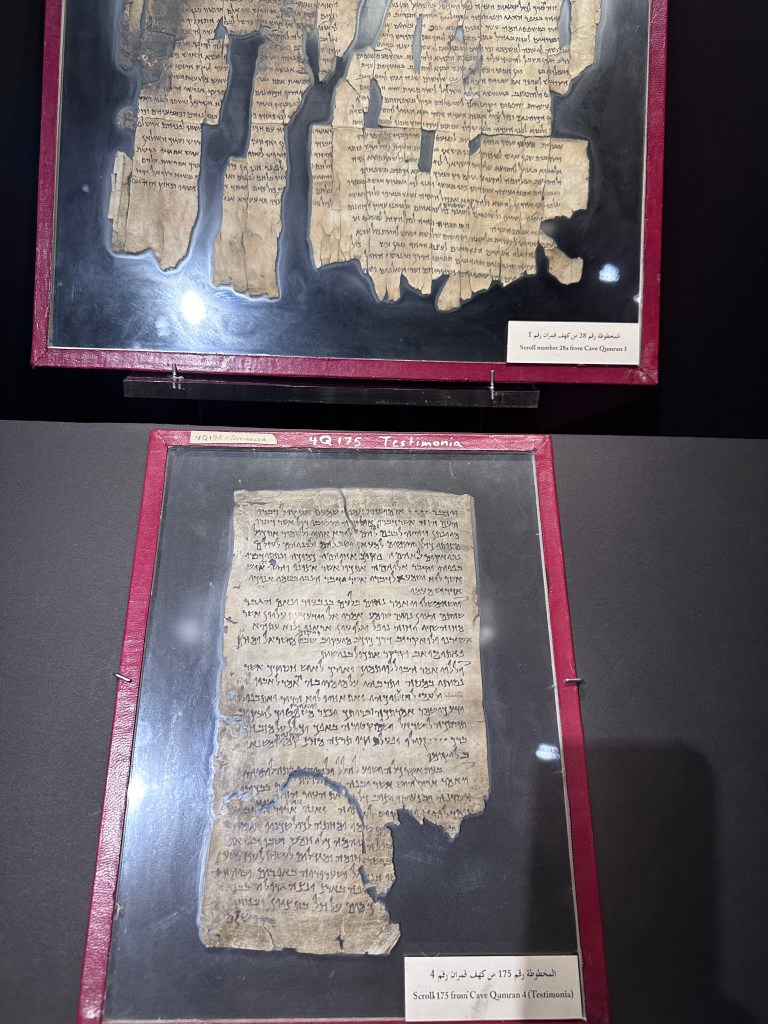
For those who like antiquities, the first floor has plenty of pottery and jewelry, plus something you don’t see in most museums— Dead Sea Scrolls
The upper floor has the video and the interactive displays that delighted me. Bet you can’t guess what this elephant contraption is.
Believe it or not, this is a replica of an 800 year old clock. “ The large clock uses Greek water-raising technology, an Indian elephant, an Egyptian phoenix, Arabian figures and Chinese dragons, to celebrate the diversity of the world”. ( description courtesy of the website).
The Crowne Plaza Hotel linked us up with Sam, who drove us to the museum, waited for us for over an hour and drove us back, for about $45 total. Best of all, there was no extra charge for Sam’s great commentary, delivered on the way to and from the museum.
Sam, Jeanne and Bobbie
The area around our hotel is definitely NOT conducive to walking, however that didn’t stop Bobbie and me from venturing out for lunch at Kabob Express, where our language barrier resulted in our ordering one lunch instead of two. (It turned out fine, because there was still food left over even after we’d both had our fill). Would I recommend it? Well, it was close to the hotel, they accepted credit cards, you got a lot of satisfying food for your money— and as my dad used to say, “it filled the hole”.
Jeanne, Bobbie and I met the remaining 4 travelers at our dinner, in the hotel restaurant. One of the reasons I enjoy traveling with OAT is the small group size allows you to really get to know your traveling companions, who are usually interesting, curious, friendly and seasoned travelers. This group is certainly all that, and more.
On our tour’s first full day, we visited Amman’s most important sites: the Citadel, which is located atop one of Amman’s seven hills, and the Roman theater; both have on site museums, which we explored.
The sites weren’t crowded at all, so you could take your time perfecting your next instagram post. And believe me, this couple did.
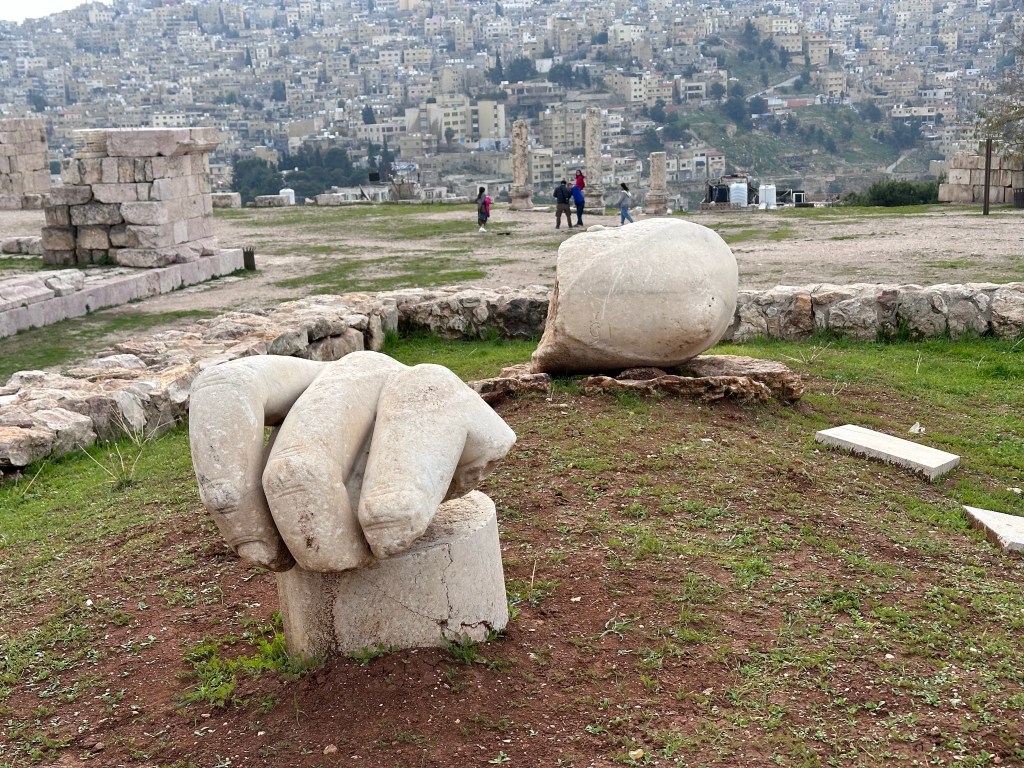
It was easy to get whatever shot you desired, like these fingers and an elbow from what was once a 42 foot statue of Hercules. You can also get a feel for the old section of Amman, which appears in the background.
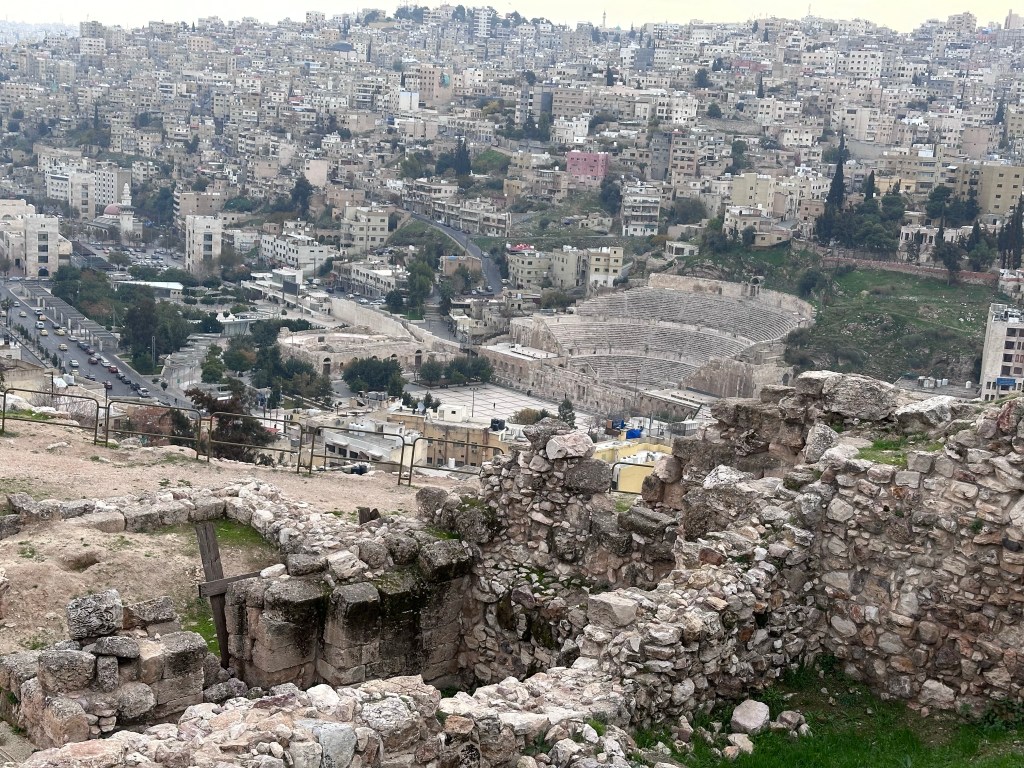
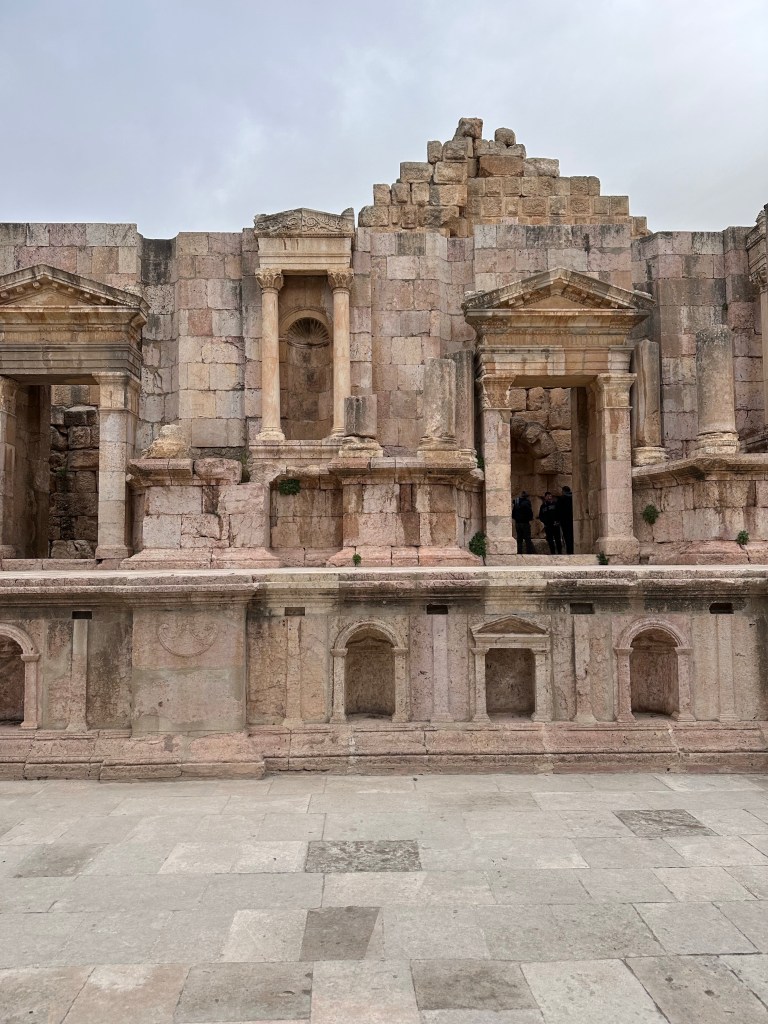
Check out this great view of the Roman theater from the Citadel. The theater is so large, this was the only way to get all three tiers of it into one shot.
Here at the theater, the preferred photo op was to plop your toddler atop the front pedestal and then give the child directions on exactly how to pose. This little girl was having none of that.
Notice the special seats carved from stone in the first tier, right behind her? Those were the royals’ (Caesar’s) box seats. Way up high, in the nose bleed seats was where the women and slaves were relegated.
So, of course we ladies had to do something about that!
We spent our last day in Amman driving about an hour north to Jerash. Don’t feel bad if you’d never heard of it. Neither had I, before this trip.
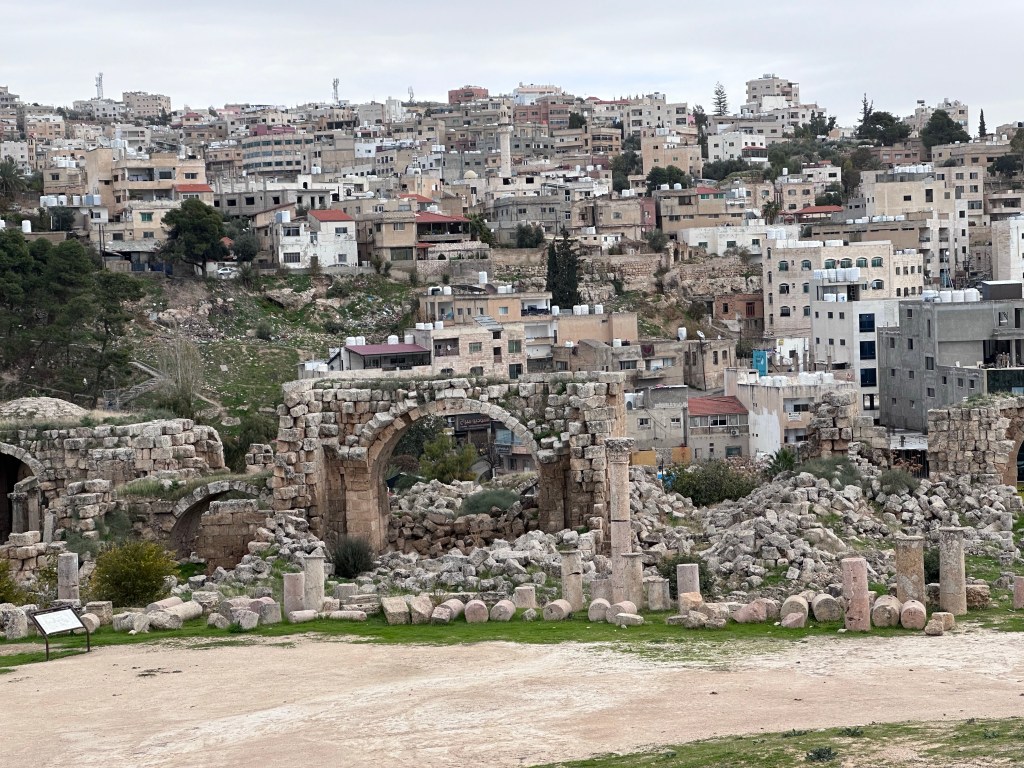
Despite having been partially destroyed by the earthquake of 749, it is still one of the best preserved Greco-Roman cities, as interesting as Ephesus to me.
This is normally the high season, with thousands of daily visitors, but because of the fighting between Israel and Hamas, we had the site almost to ourselves. Although I am so sorry for the Jordanian people who make their living in the tourist trade, I am even more sorry for all the Palestinian and Israeli victims of this horrible war.
Hadrian’s Gate, outside of the cityStill a work in progress, these stones are sitting on the ground, waiting to be fitted together. View of the oval forum from one of the templesThe theater, with incredible acoustics brought about by the series of niches. They didn’t need microphonesGood thing because they hadn’t been invented yet.
We will be leaving shortly for our dinner with a Jordanian family in their home. Tomorrow we travel to Petra, stopping at the Dead Sea along the way.
On our return to the Republic of Ireland, we made one last stop in Northern Ireland, to the walled city of Derry, where we visited the Museum of Free Derry for a history lesson.
On January 30,1972, inspired by the civil rights marches and peace protests that occurred in the USA, about 15,000 Catholics staged a march to call attention to the discrimination they were experiencing. British soldiers shot indiscriminately into the crowd, killing 14 unarmed protesters. The day after what became known as Bloody Sunday, 2,000 men joined the IRA, which up until that time had not been very active.
Although attempts were made to portray the peaceful marchers as terrorists, a film crew was there, recorded what actually happened, and smuggled the film out (in their underwear!) to the Republic of Ireland where it was broadcast around the world. Despite the visual evidence to the contrary, the false narrative that some march participants were terrorists persisted until 2016, when an inquiry finally revealed the truth. The result was a long overdue apology by Britain’s prime minister, David Cameron. An excellent video in the Museum shows the huge emotional impact that historic apology had on the people of Derry. Sadly, the guilty soldiers still have not been brought to justice.
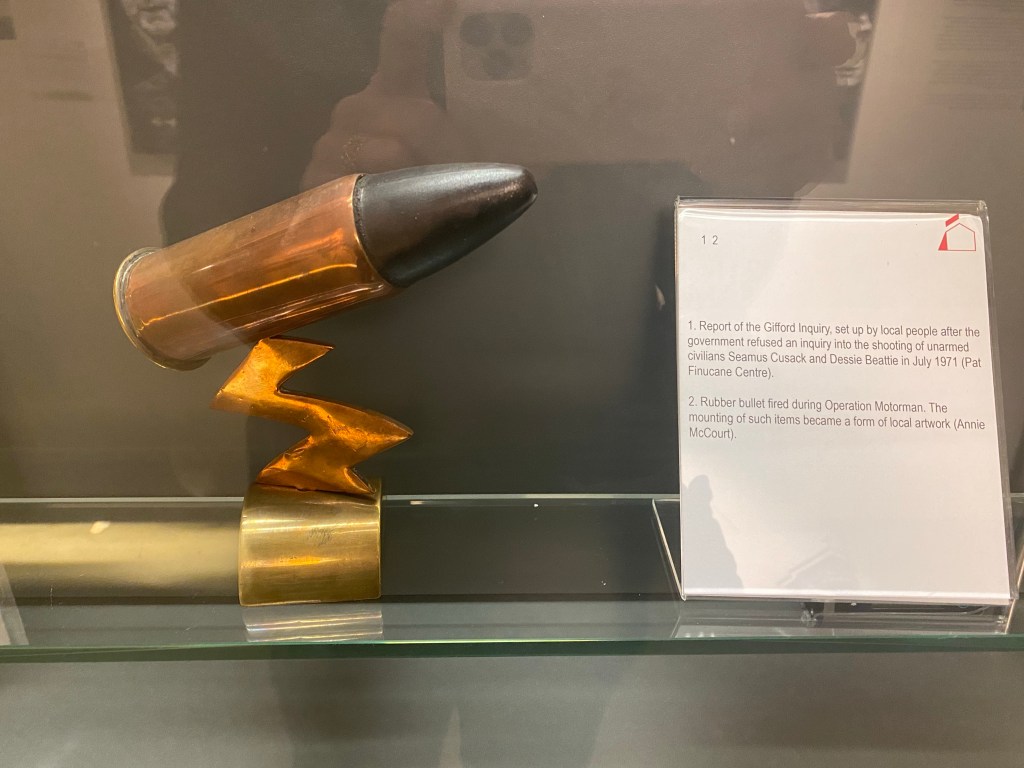
While on the Black Cab tour in Belfast, our driver showed us the size of rubber bullets that were used for crowd control. These were fired on Bloody Sunday, and contributed to the injuries many protestors suffered. Can you imagine being hit by one of these?
We couldn’t leave Derry without touring its city walls, and learning about its history, most of which I promptly forgot. Of course, the wall had the requisite cannons, strategically interspersed.
Our border crossing into the Republic of Ireland was seamless. No check points, no guards, no showing of passports, just a change of currency, back to the Euro. Ireland has sworn that it will never have a border dividing it again. Boris Johnson declared the Irish Sea will be the border, but many wonder exactly how that will work post Brexit. No one quite knows.
And now for a little perspective: the population of Northern Ireland is a wee bit under 2 million. The population of The Republic of Ireland is almost 5 million. Compare that to the population on NYC, which is over 8 million, and you can understand why much of this glorious island is comprised of rolling green hills and picturesque landscapes, perfect for raising sheep.
Typical view from my bus window.
Which brings me to the next subject: the Irish Diaspora. We all know that millions of Irish left during the potato famine, but I never knew that many lost their homes when they were evicted.
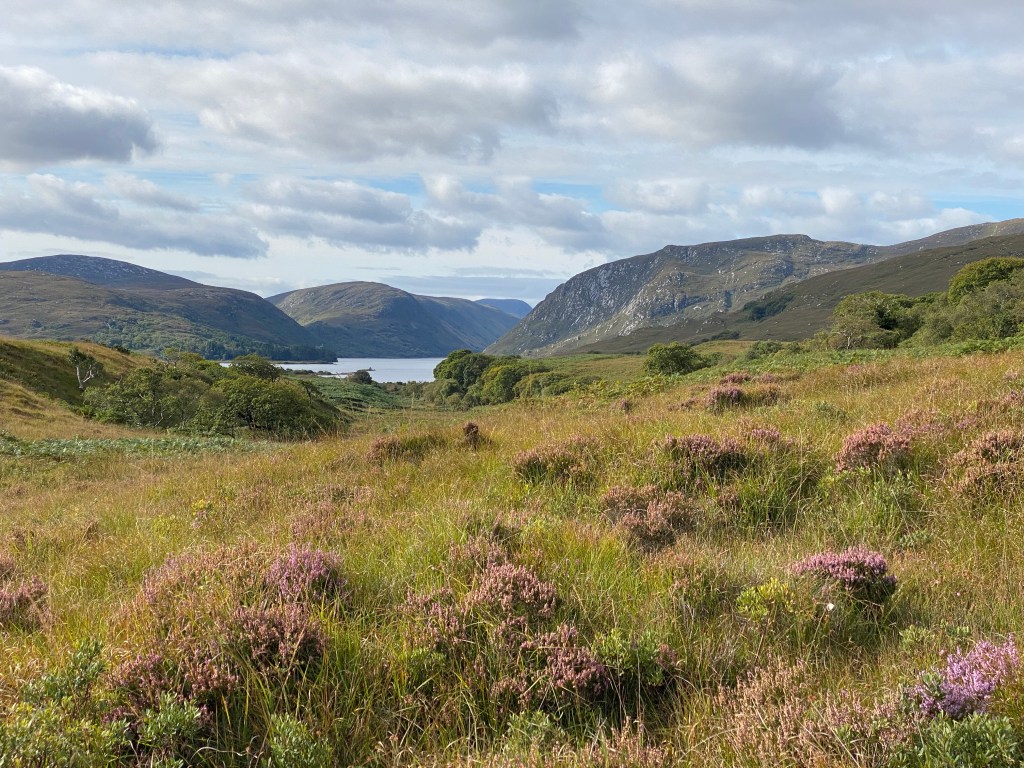
This beautiful castle was built by John Adair, who evicted 244 of his Irish tenants because he thought raising sheep would be more profitable than allowing his tenants to continue farming. By the way, the Irish became tenants on their own land, after Oliver Cromwell conquered them, and seized their property so he could use the land as payment to his soldiers.
Adair was the first of three owners of Glenveagh. The third, Henry McIlhenny, was an Irish American. His grandfather, John McIlhenny settled in Philadelphia, where he became very wealthy from his invention—the coin operated gas meter. Henry was an art aficionado, who donated his family’s extensive collection to the Philadelphia Museum of Art. His generosity extended to Ireland, when he donated the castle and its gardens as a gift to the nation. It is now a national park.
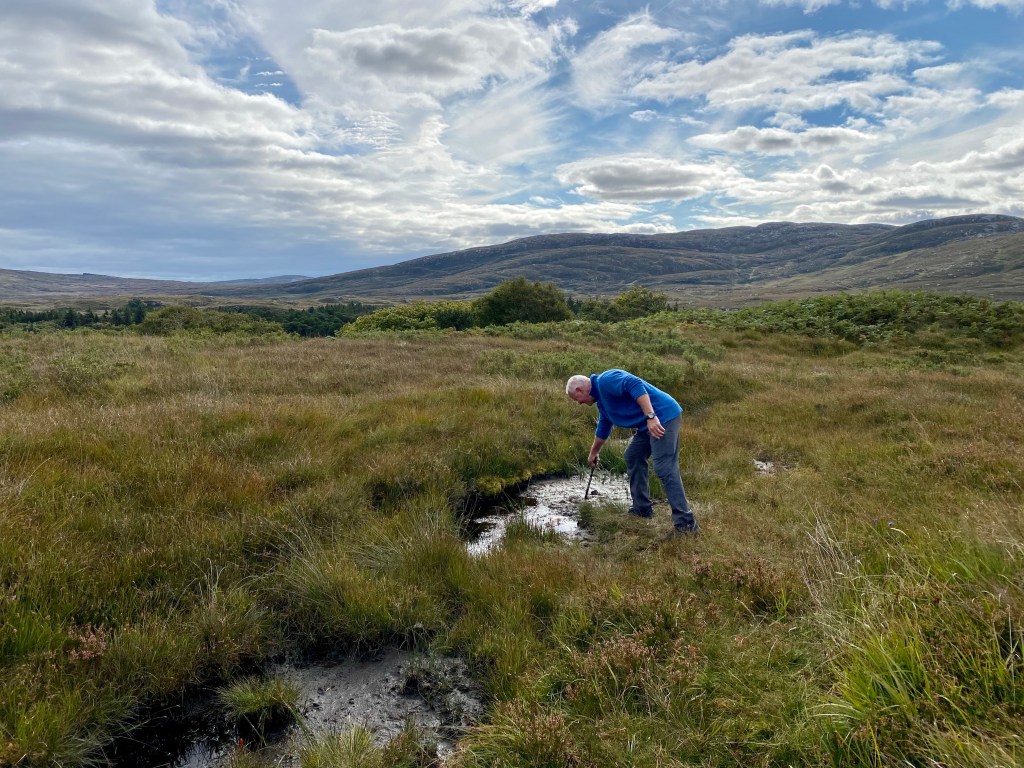
Touring the grounds of Glenveagh with a naturalist, who demonstrated the depth of the bogs, and explained why the people sacrificed in the bogs were so well preserved.
I had originally planned to write a bit about Donegal, but that will have to wait for a future post, because I have run out of time.
We’ve thoroughly enjoyed our time in this island’s two capitols: Dublin and Belfast. But now it’s time for a change of pace, so we hit the road to experience the castles and cliffs of the beautiful Irish countryside.
We departed from Belfast by way of the “leafy suburbs”. As is the case in most countries, the wealthier areas were spared the violence and disruption of “the troubles” discussed in earlier posts. The beautiful homes facing the water were much like those in many of the wealthier neighborhoods in the USA.
At one time, oh so many years ago, I could never have imagined that I’d be taking a bus tour. But let me tell you, at this stage in my life, it’s a great way to travel. No getting lost, no speeding tickets, no fruitless searches for rest rooms. It’s all taken care of. All I have to do is sit back, gaze out the window and chat with my fellow travelers.
Our group
We really lucked out, with a huge, comfortable bus for only 11 of us, and a delightful driver, Michael, who clearly loves his job. The repartee between Joe and Michael keeps all of us entertained and laughing.
Our drive to Ballycastle was broken up with multiple stops. At the first one, Joe, our guide, pointed out that this white rock is composed of the exact same material as the White Cliffs of Dover. About 350 million years ago, this very rock was being formed somewhere south of the equator. I don’t know about you, but I find that little fact fascinating. I’m sure my geologist neighbor, Ed, would agree. He would undoubtedly have been able to identify the dark streaks in the rock as flint, which was highly prized for its sharpness, and its fire making properties.
Our route along the Antrim coast took us past picturesque little fishing villages like this one.
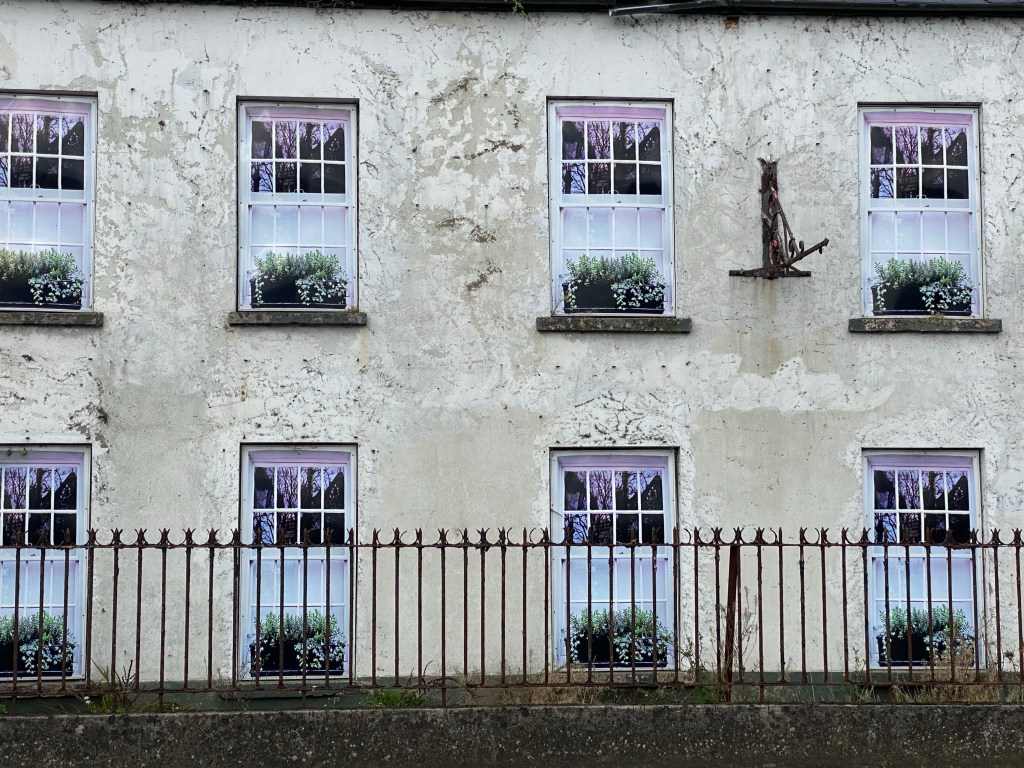
I loved that the windows of this vacant building were painted to look like they were festooned with flower boxes.
Our final stop before Ballycastle was at the Glenariff Forest Park, which gave us the opportunity to get out of the bus and stroll along the river to our restaurant.
One of the waterfalls in Glenariff Forest
Ballycastle’s Marine Hotel was a bit quirky, but the entire staff was so friendly and accommodating, and the location across from the beach was fantastic.
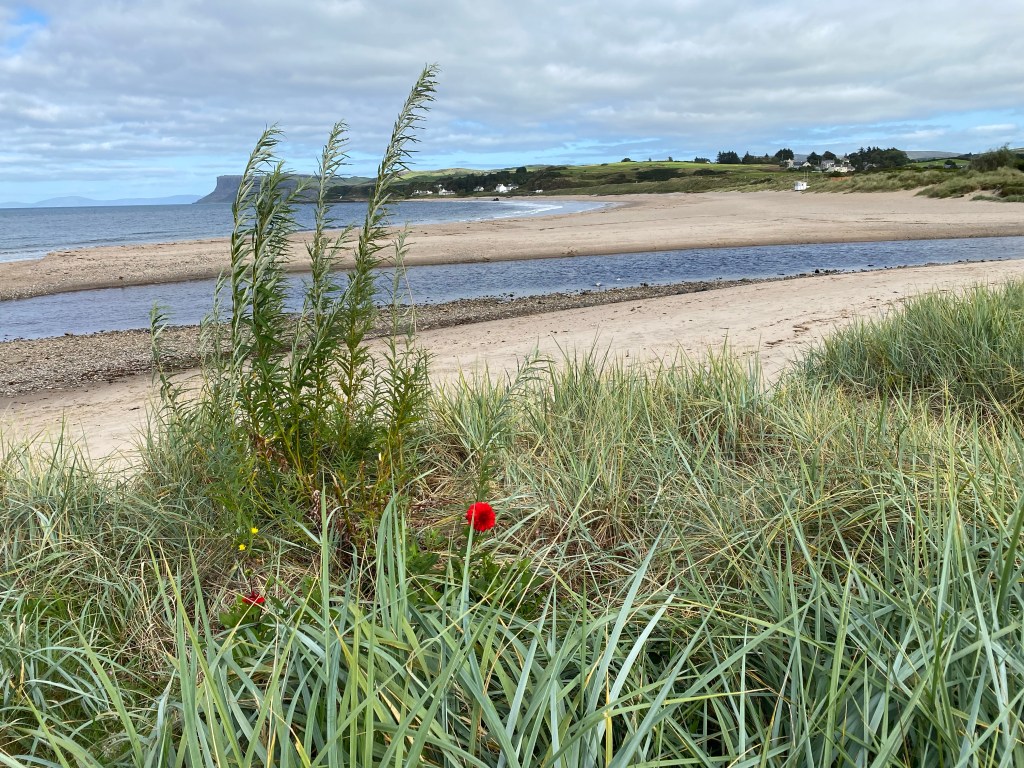
Because the weather was so wonderful, we couldn’t resist a walk along the beach, before we strolled into town for a delicious and inexpensive dinner at the Anzac Restaurant.
Ballycastle was the perfect jumping off point for the following day’s excursions to Dunluce Castle and The Giants Causeway. Although Dunluce Castle is in ruins, you get a feel for what life was like way back in the 1600’s. The castle was built high on a cliff, surrounded by water, with access only via a drawbridge. Clearly, those were scary times!
Joe quickly figured out that Janet and I are the walkers in this group, so he always made sure to tell us about more challenging hikes. The Giant’s Causeway offers several trails, plus a shuttle bus for those who prefer to ride. We chose the red course, labeled the most difficult, because of the spectacular views Joe promised us. He was right!
Even if you do opt for the easier trail, the scenery is still pretty dramatic, especially if you are intrigued by rocks, volcanic activity and ocean views.
Our last stop in Northern Ireland will be Derry —or Londonderry, if you are aligned with the British, or the Protestants, before heading back into the Republic of Ireland and to our hotel in Donegal.
We left the Republic of Ireland, crossing into Northern Ireland two days ago, just in time to get our first experience with legendary Irish weather. Our walking tour was soggy, and although we were undaunted, we were grateful when our Tour Leader took us on a quick detour into the nearby mall. Not only did we get a chance to dry off, we also ascended to the mall’s top floor to take in this magnificent view.
Okay, so maybe THAT day’s view wasn’t all that magnificent, but you have to admit, it is pretty cool to have a glass dome atop a shopping mall. The next day’s panoramic view was significantly better because we were higher up, and the weather cooperated.
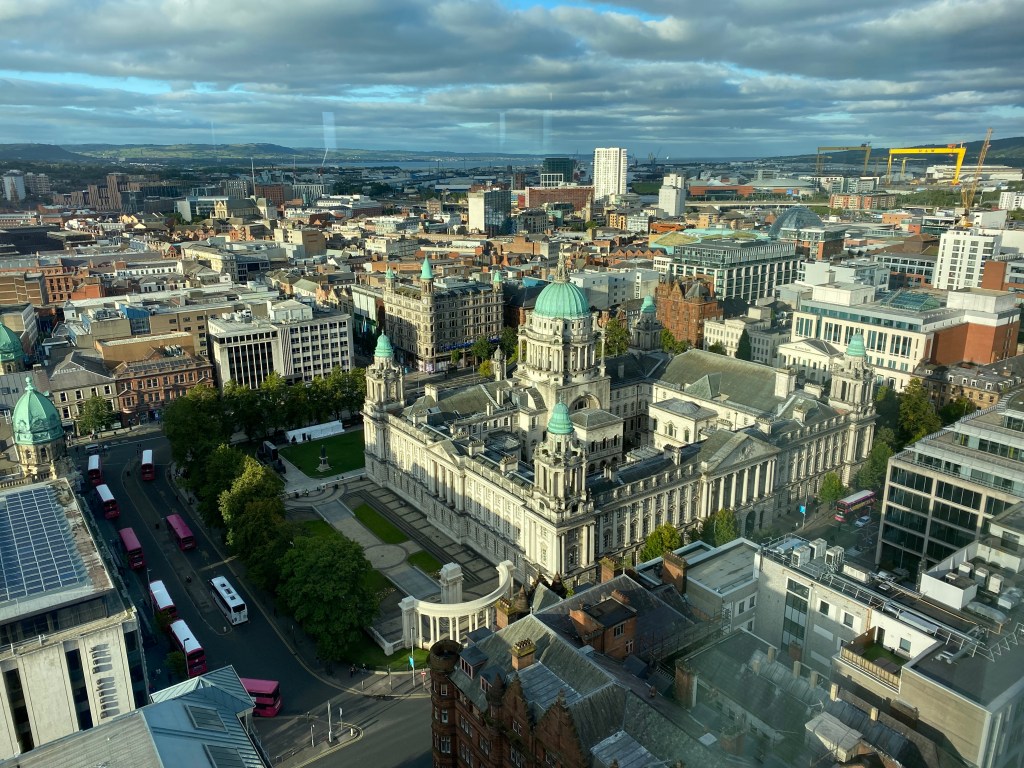
This photo was taken from the Grand Central Hotel’s cocktail lounge. No, we didn’t have a drink there, because I suspect the cost of a cocktail would have been as much as our full dinner at a nearby pub. Joe, our tour leader, took us there for a “ gawk”, and that’s exactly what we did.
Although the city is lovely, and I have many photos to prove that, the real highlight of our time in Belfast was our visit to The Felon’s Club. We spent the morning with three men who, back in the day, were formerly enemies: a loyalist, a British soldier, and an IRA member. They each told us a little about themselves, their backgrounds, their activities during “the troubles”, their time in prison and what their lives are like today. It was a riveting discussion that was particularly relevant now, given the divisiveness we are currently experiencing in our own country. What was encouraging was where they are NOW. All three have been working toward reconciliation and educating others about “the troubles”. All three are committed to the peace process.
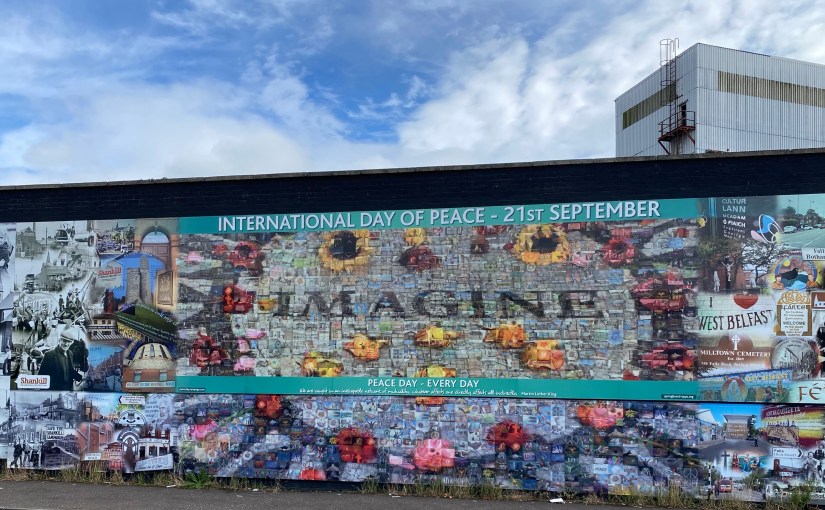
I had forgotten the important role George Mitchell and Bill Clinton played during peace negotiations. One key element of the negotiations was a referendum (with no date specified) on whether or not Ireland should be reunited. When asked if the referendum were held today, only the former member of the IRA was able to say for sure how he would vote. The other two wanted to know more about the impact the change would have on their lives. Their focus was on the issues, not on former identities as a member of a particular group. I would have loved to spend more time with them, but our Black Cab Tour was scheduled, so off we went to view the murals painted on Belfast’s walls.
During our tour, the final song from the Broadway musical “Hamilton” kept playing in my head: “Who lives, who dies, who tells our story”.
In the photo below, our cab driver is holding a rubber bullet, to show us how huge they were. He then pointed out the names of civilians, carved into the wall, who died after being hit by rubber bullets. By telling their stories, the black cab drivers and the members of the Felons Club are keeping their memories alive.
The afternoon was spent at the Titanic Museum, an experiential museum, where another sad story was told—not only about those who went down with the ship. We also learned about the workers who built the ship.
It was a rather poignant day, so we were only too glad the sun was shining as we walked back to our hotel.
We are all quite happy that we were leaving Belfast BEFORE King Charles III arrived. Yes, I know it is a historic event, but the crowds and traffic might have made it difficult to see as much as we did.