Southern India — Kerala

Name changes confuse me. I find myself slipping and saying Bombay instead of Mumbai. Even after spending time in Southern India, I’m not sure whether I should be saying Cochin or Kochi. I heard both. Maybe it doesn’t matter.

What DOES matter is the dramatic contrast between northern and Southern India! In the north, horn honking is encouraged. MANY of the vehicles we passed had signs like the one below on the back of their vehicles.

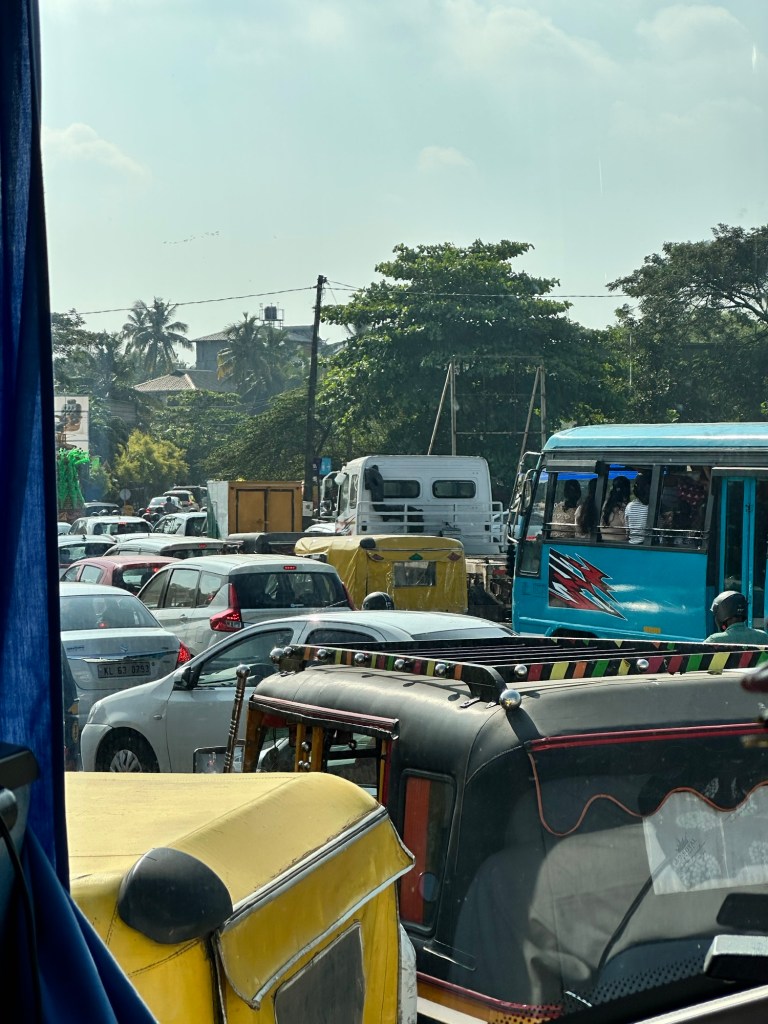
In southern India it was blissfully quiet. Although traffic wasn’t AS bad as it as in the north, there still were some interesting moments. Just no horn honking.
The south is so CLEAN! In the north, people drop their trash wherever—in the street, along highways, in parks, on lawns, inside buildings. It’s EVERYWHERE.

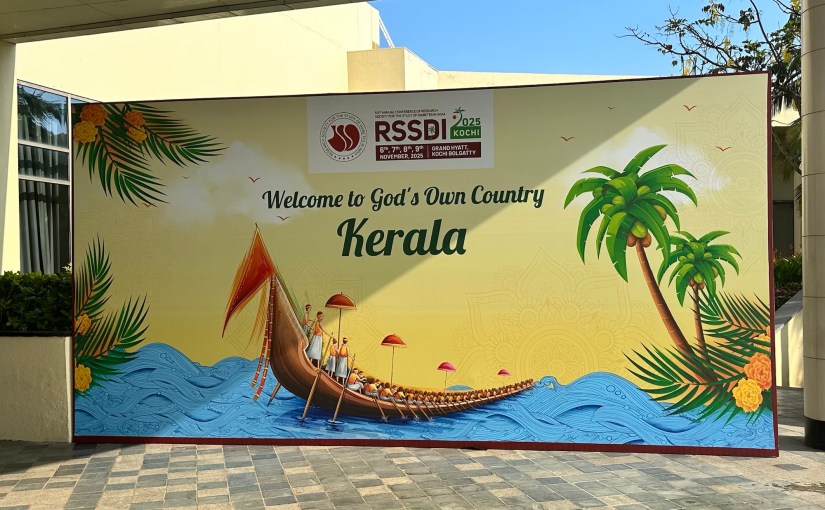
In the state of Kerala, they have either mastered the art of trash collection, or their residents actually CARE about their cities, or it truly IS God’s Country. Take your pick.

Although the itinerary showed us spending four days in Kerala, our first day was spent almost entirely traveling from Udaipur to Kochi, including a stop in Bangalore to change planes, and grab some airport food for lunch. Colonel Sanders has made his way to India, but I discovered that Starbucks offered fantastic sandwiches—better than we get in the USA, and probably cheaper. ( I still haven’t quite mastered exchange rate math). Good thing I ate because our flight was delayed, and we didn’t get to our hotel in Kochi until almost 6:30 PM.

What was great was that Tauck got us rooms with access to the club room. What was not so great was that the club room closed at 7 PM. Despite that, I managed to consume two glasses of white wine and sufficient food to make dinner unnecessary. It’s amazing what you can accomplish when you’re highly motivated.

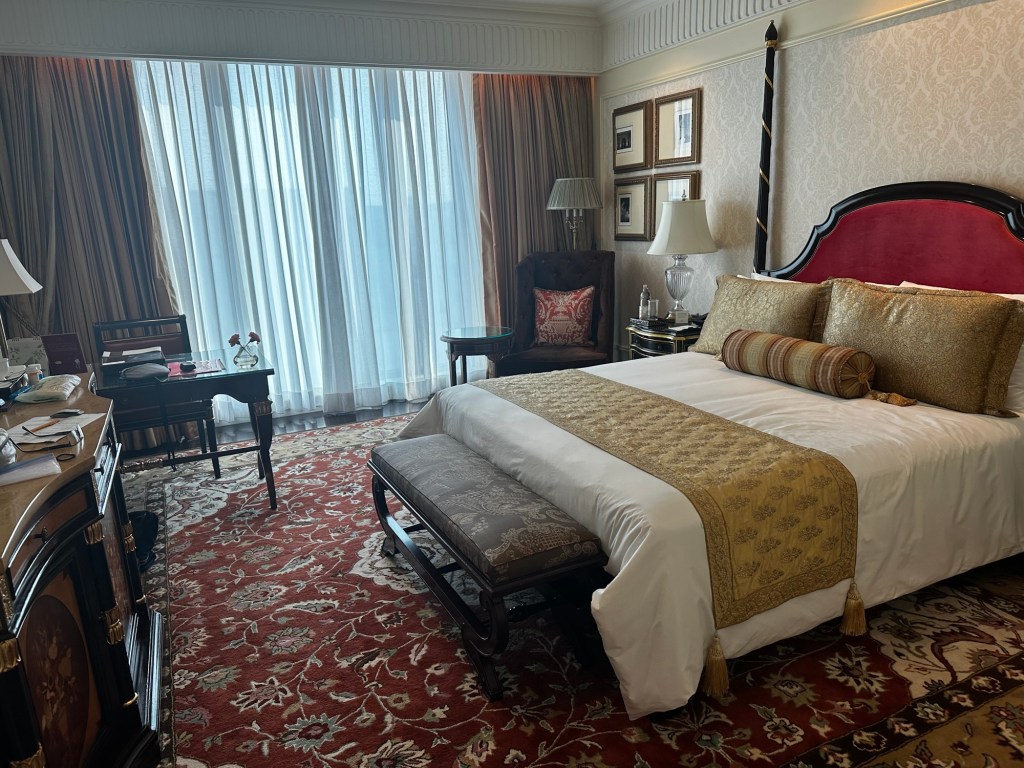
This is the only American hotel we are frequenting during our trip— a Hyatt Regency overlooking the bay leading out to the Arabian Sea.
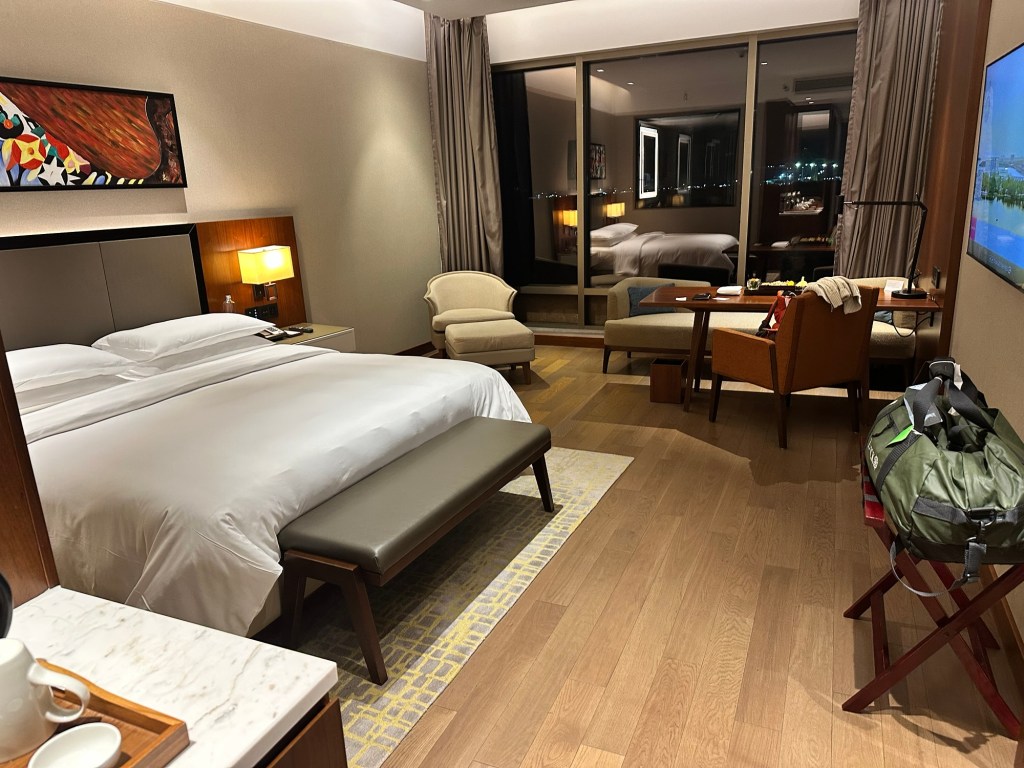
The curtains open automatically when you enter your room. I never bothered to learn how to close them, because I loved the magnificent view.

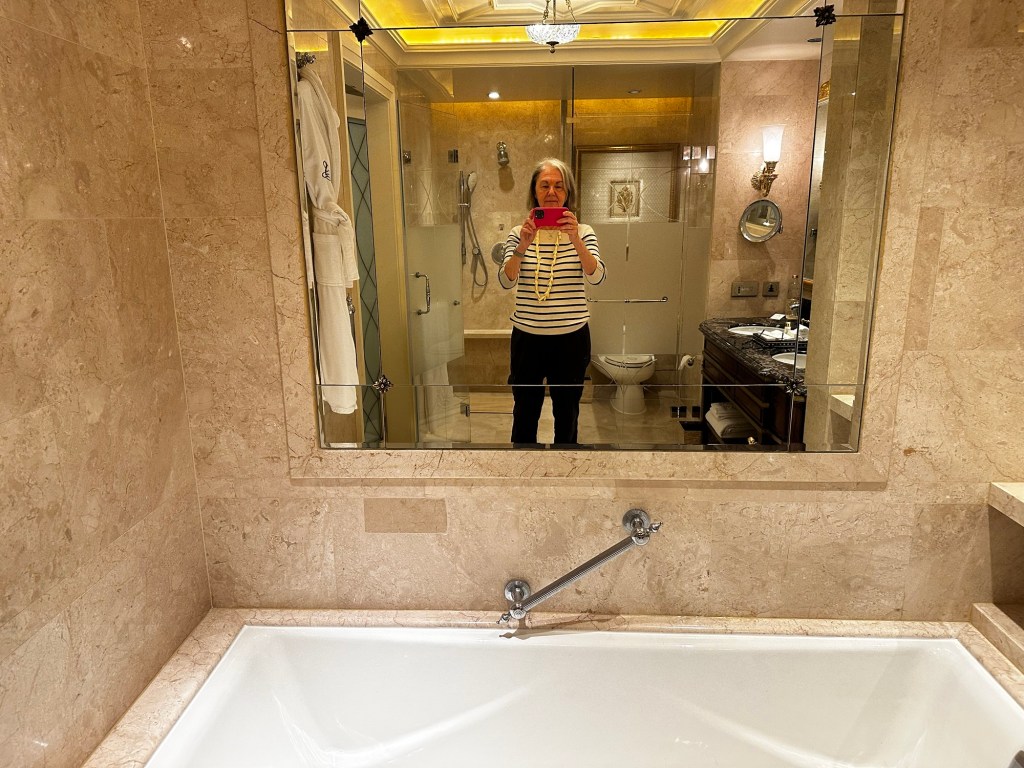
Of course, if you get tired of watching the river flow, you can always turn your head to look at the window into the bathroom. I wasn’t sharing a room, but those who were could watch their roommate do whatever they needed to do in the bathroom, without leaving the comfort of their bed.

Our second, and final day in Kochi, we were treated to a cooking demonstration by a woman who was discovered by The NY Times several years ago. Check out how her home is equipped, with tv screens, so you can watch while you theoretically master her technique. I imagine that before The NY Times discovered her, her kitchen looked very different.
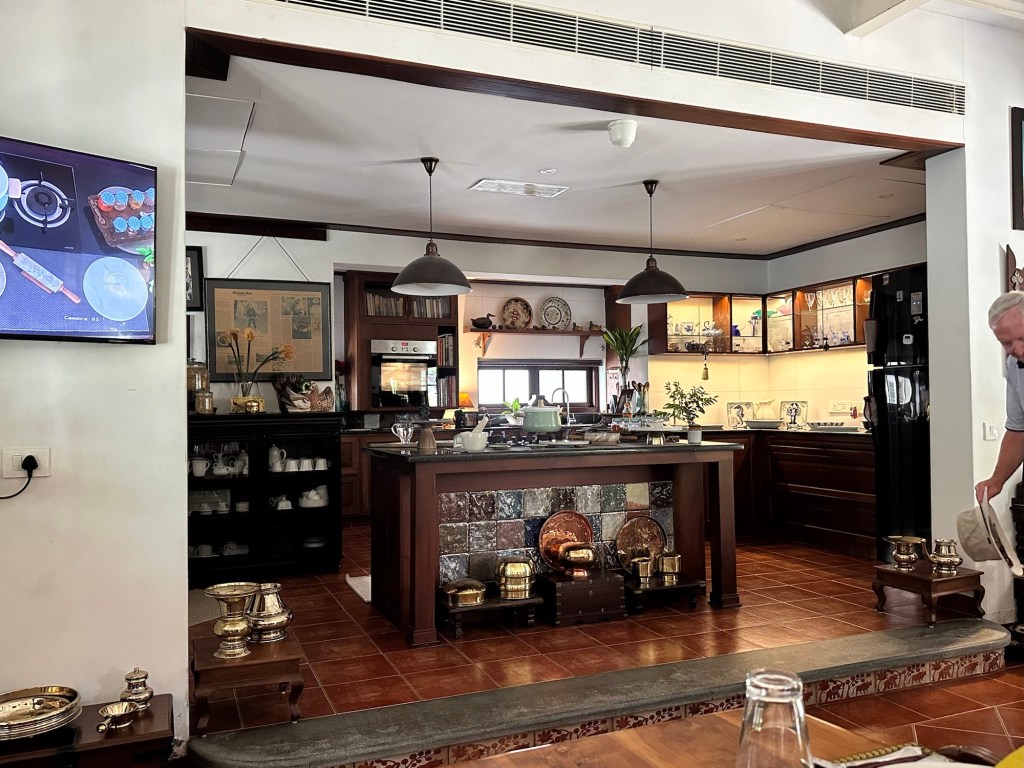
In addition to her cooking commentary, Nimmy shared details about her marriage, including the fight she had with her husband that morning. She was QUITE entertaining!

Sue, me, Joann, Nimmy, Gloria and Don

Next up was a tour of a palace, synagogue and church, plus an opportunity to shop a bit.

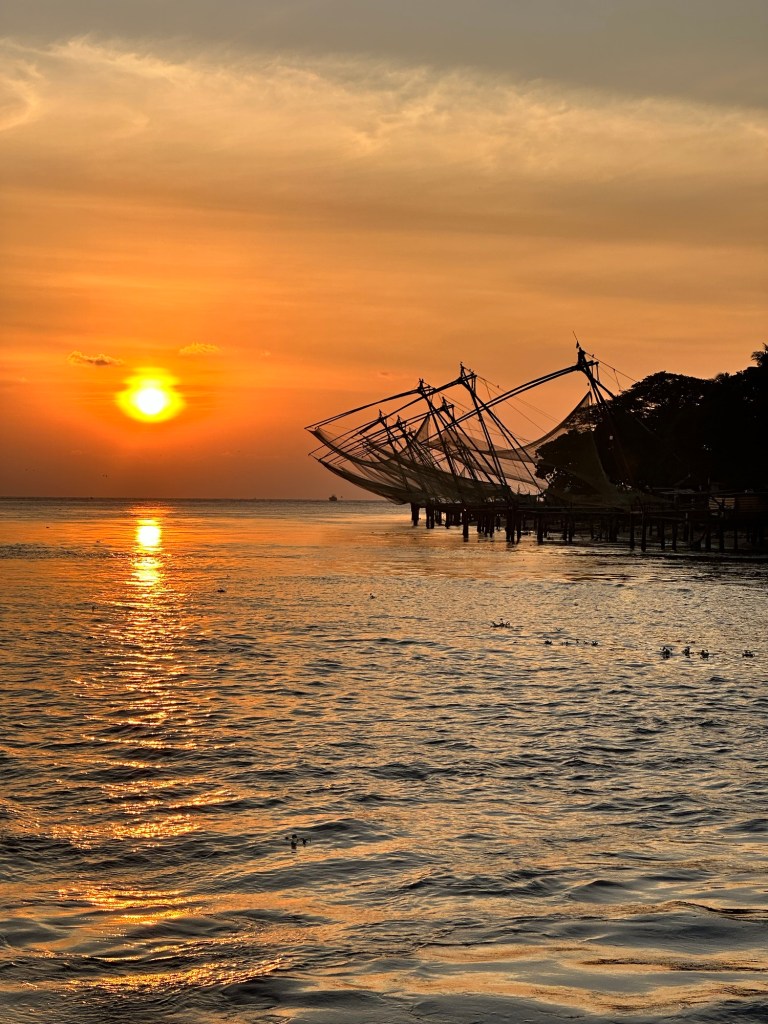
We all thoroughly enjoyed the boat ride back, just in time to catch this spectacular sunset by the fishing nets.
Because we had a reasonable departure time (9AM the next morning), Gloria, Sue and I decided to try the restaurant on the top floor of the hotel.

Our final two days in the south were spent at the Kumarakom Resort. We drove about 2.5 hours to get to the houseboats that took us the final three hours of our journey.

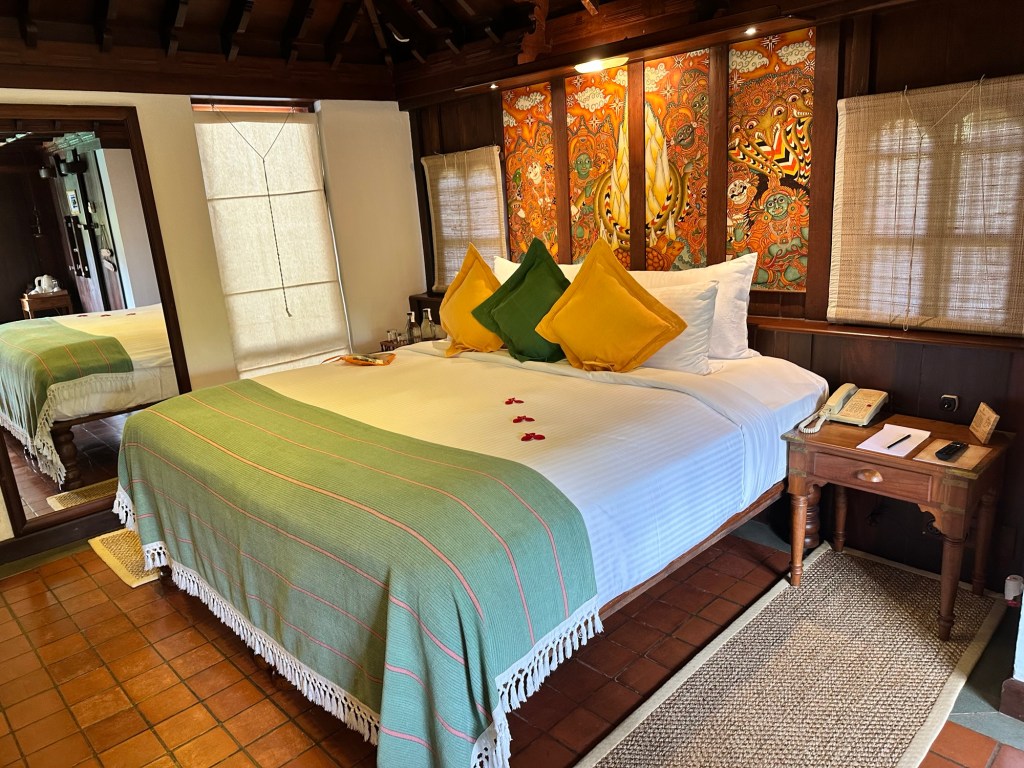
Although we didn’t STAY on the houseboat, we certainly COULD have. Take a look at this luxurious bedroom. Instead, our houseboat experience included a delicious lunch on board.

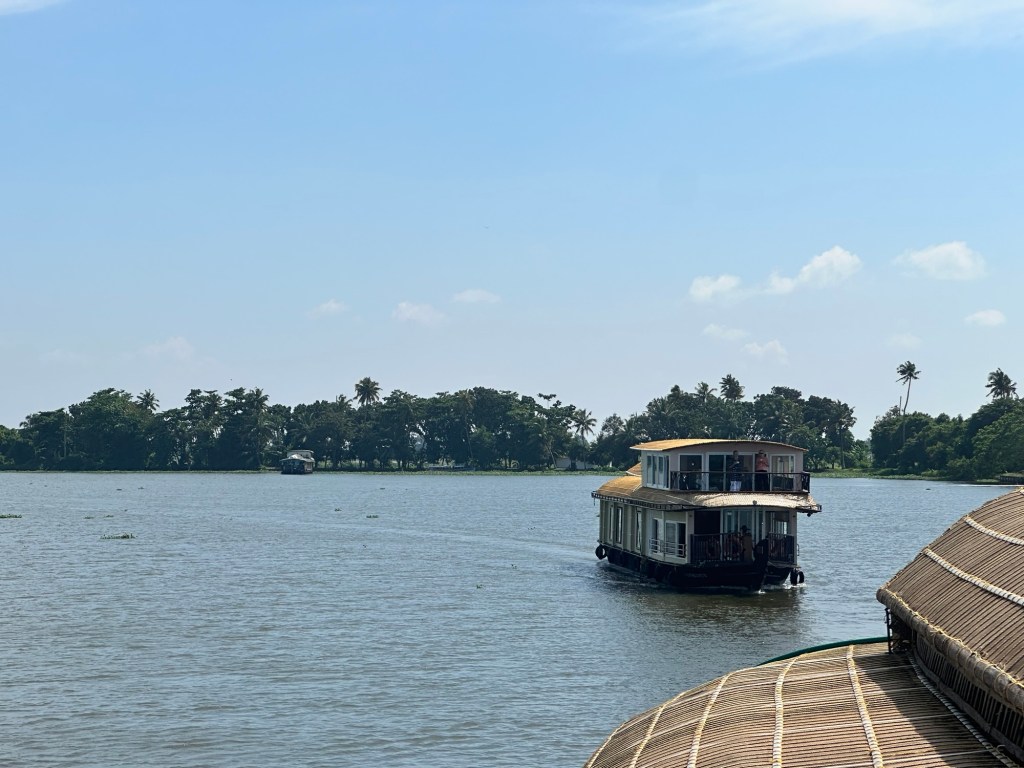
Jennifer, our trip leader was on the second houseboat, but somehow she managed to convince the crew to pick up speed. It felt like we were on the Amazing Race. When her boat passed us, we decided that she and Whitney had complementary strengths that would have undoubtedly made them a winning team!
The Kumarakom resort was exactly what I needed at this point in the trip. I thoroughly appreciated the opportunity to slow down and completely relax for two days.

Once again, I had a magnificent room. But this time it was adjacent to what was called a meandering pool. I could meander across the way to visit with fellow travelers, so I did.
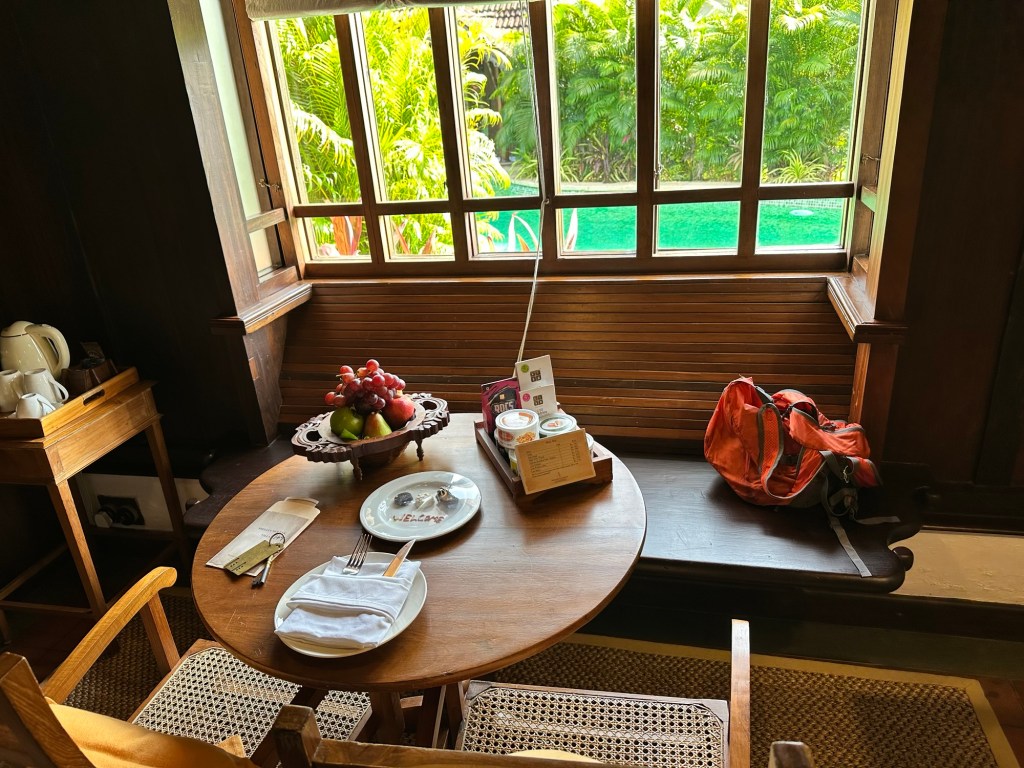
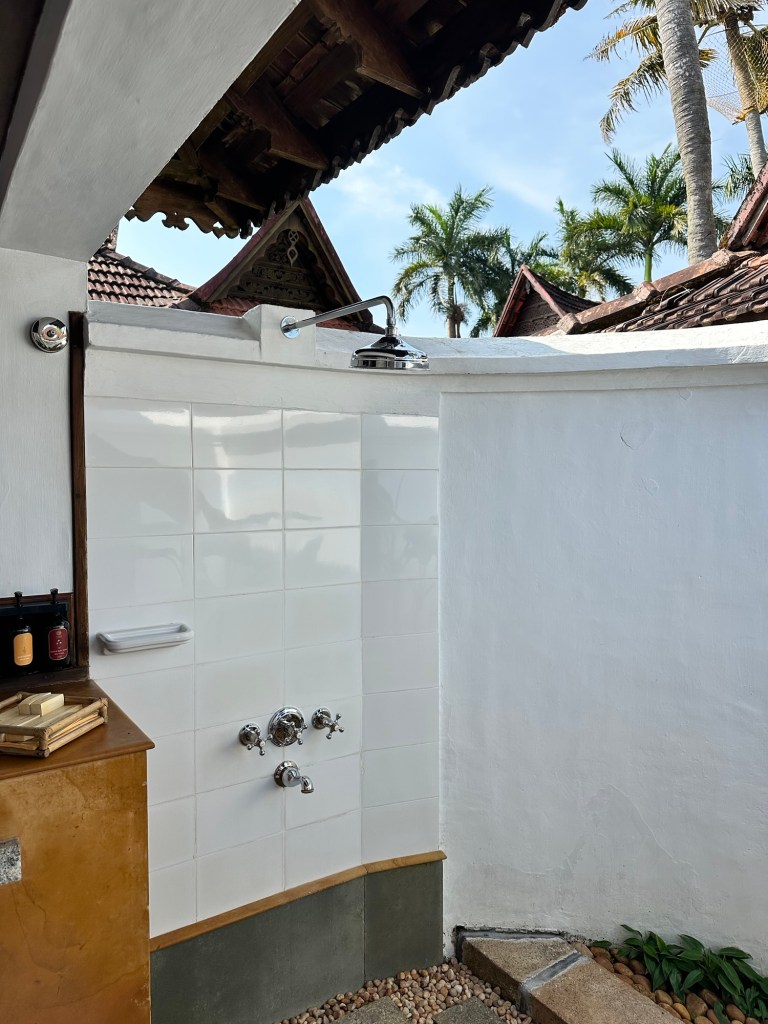
I loved the outdoor bathroom with the open air shower. I’d had one in Nepal and one in Colombia when traveling with OAT, so was used to showering in the open air.

Both nights, we were treated to outdoor cultural shows before dinner. This lovely young lady did a traditional dance,

The young men demonstrated martial arts, kicking and twirling swords and spears at each other. One segment of the show reminded me of majorettes performing in one of those old talent shows ( was it Ted Mack’s amateur hour?) See what you think.

Before the performances began, we got to drink wine and watch the sky change colors.

Pretty magnificent, wouldn’t you say?

On our last day, our group visited two villages alongside the river, waving to villagers along the way.

The experience was similar to what OAT calls “A Day in the Life”, where we visited two farming families, viewed their home and were invited to participate in activities. Gloria climbed for coconuts,

Was he getting ready to “goose” her?

Susie made coir rope from coconut fiber

Some of us got to play “dress up”
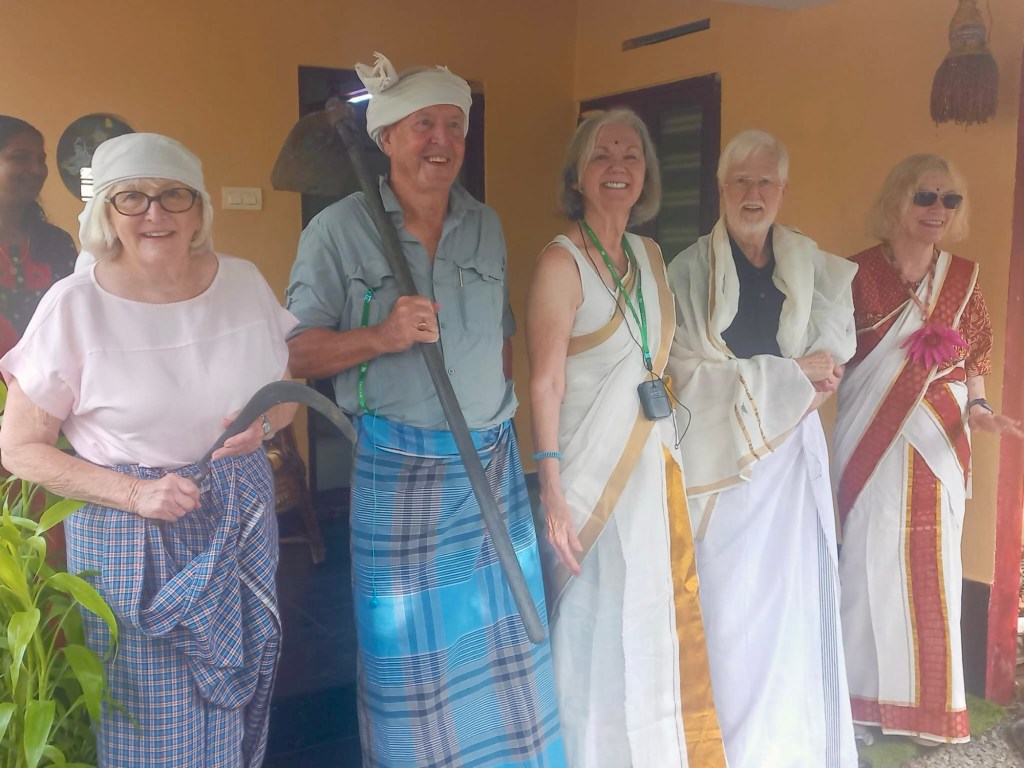
Pam and Jeff were dressed as a farming couple, Pat, Bill and I were getting married. Hey, back in the day, men could have multiple wives. At least Pat and I get along well!

Only three days left on the trip, all of which will be spent in Mumbai/Bombay, before our long flight home.

Delhi On My Own

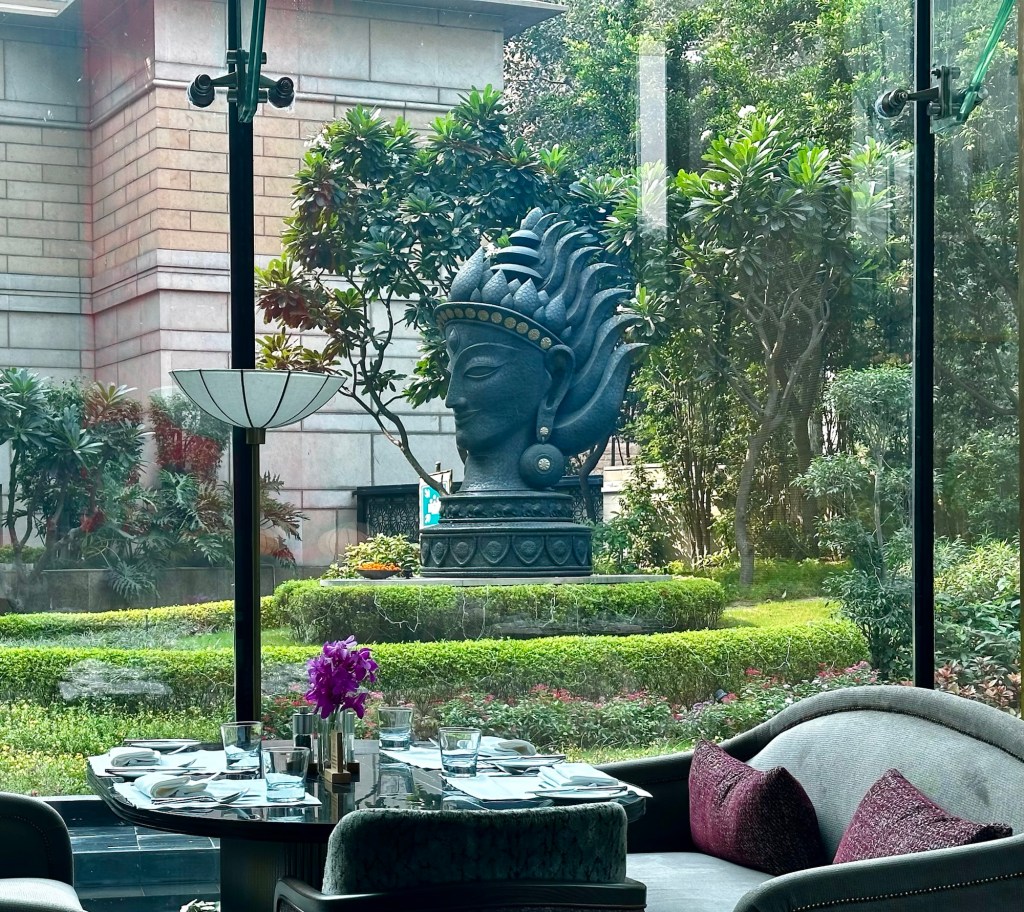
Oh my God! Or should I say “Oh my Buddha”? I think I just stumbled into Paradise.

For the price of a mediocre hotel room in New York I got all this:

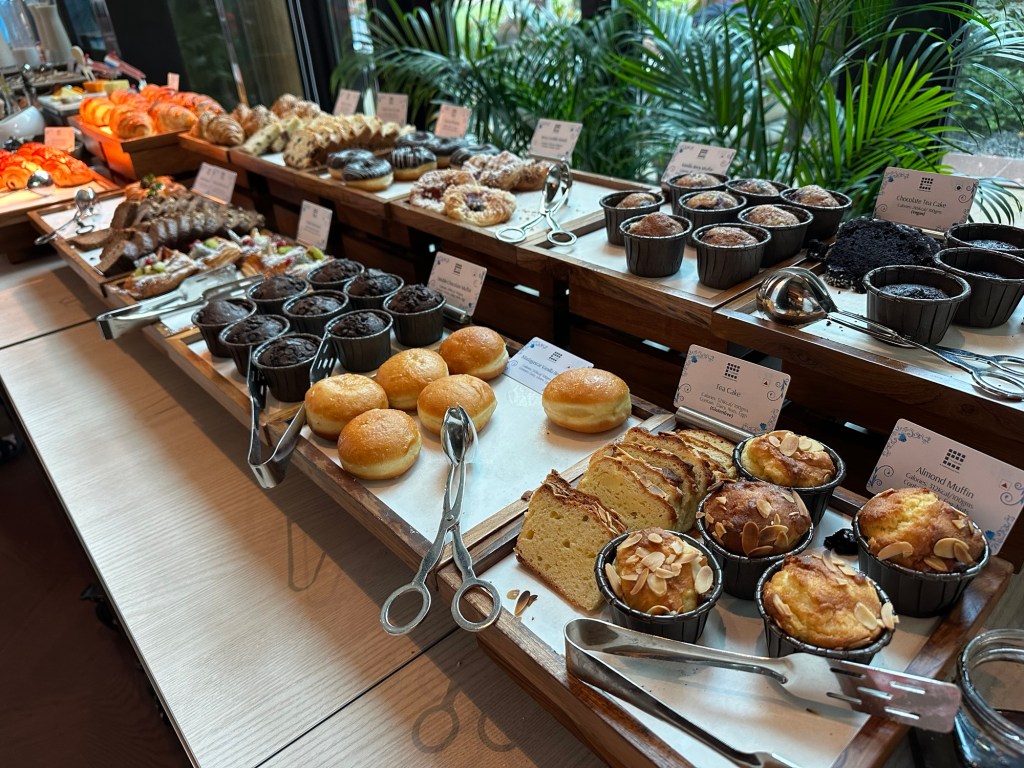
PLUS an included breakfast! And what a breakfast it IS!

That is just a small sample of the delights offered at the buffet.

I’ll be lucky if I only gain my usual 5 trip pounds!

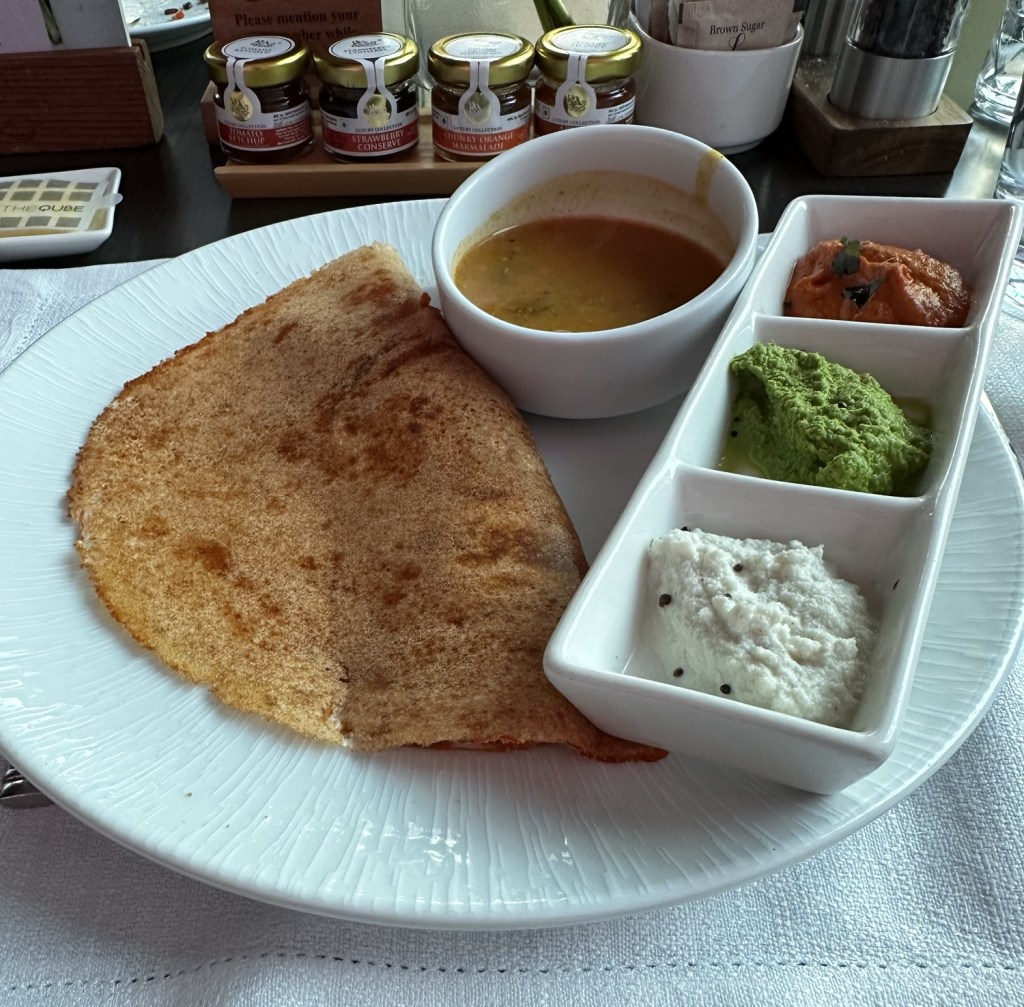
My Indian friends have introduced me to their wonderful cuisine, but I can’t remember the names of my favorite foods. The dish on the right is called Doha—at least that’s what I THINK it’s called. Here’s my problem: The Indians here are all very soft spoken. Throw in their accent and my piss poor hearing, and I’m challenged to understand what I’m being told.

The service is truly amazing. I’ve been “namasted” countless times since arrival. When you ask for directions, the staff doesn’t just point, they ESCORT you to wherever you want to go. Good thing, because I never, ever would have found the ATM. It’s in the basement, down three flights, and behind an unmarked door.

I’ve toured the spa and used the exercise facility, and enjoyed the infinity pool on the 11th floor. I figure I should take advantage of the pool while I can still fit into my bathing suit!

Never before have I been given a cooler with cold cloths and drinks. In fact, at some hotels in my past, I was lucky to get a chair and a towel.

The bathrobe and the covered chair were not made for jumbo sized Americans, but I’ve learned to scrunch.

What a great way to get over jet lag!

TWO photos of me in this post. (You happy, Jean? These are for you. You see, I DO take requests).

I have NO desire to leave this heaven on earth today. Tomorrow, I have a Bollywood class before the official start of the tour. That’s why I needed to go to the ATM. The 1 hour Bollywood class is 3,800 rupees, or about $44, and they wanted cash.

The concierge wasn’t able to hide his surprise when I told him that’s what I wanted to do. I guess they don’t get many requests for Bollywood classes. At least not from someone my age.

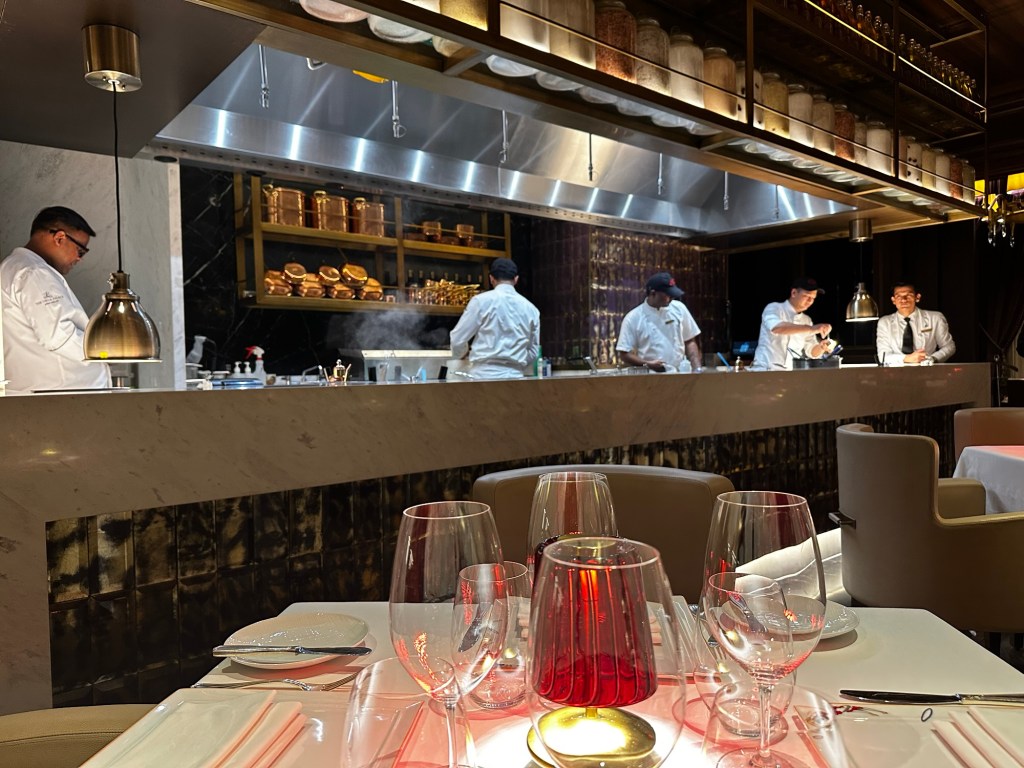
I loved the breakfast buffet so much, I decided to return to the same restaurant for lunch. The food was so beautifully presented, I wanted to sample EVERYTHING, which meant I made a colossal pig of myself. So much so, that I was really not in the mood for a big dinner. Although Le Cirque’s menu shows only prix fixe options, I inquired, and I was allowed to order only the soup of the day and a glass of wine. I didn’t even have a reservation! Good thing they aim to please at this hotel.

My table at Le Cirque

Tomorrow I hope to complete my transition to India time. I leave for my Bollywood class at 9:30 AM returning in time for lunch and to meet my new travel buddies at 1:30 PM.

Baddeck, Canada

We didn’t know the impact of the Air Canada strike until we left Halifax for Baddeck ( Pronounced ba-DECK). Our group has shrunk from 40 to only 26.

I know, I’ve completely skipped over Halifax. It’s not that I didn’t love the city. I did. It’s because we are spending our final two days there, so if time and energy permit, I will post about Halifax when we return there.

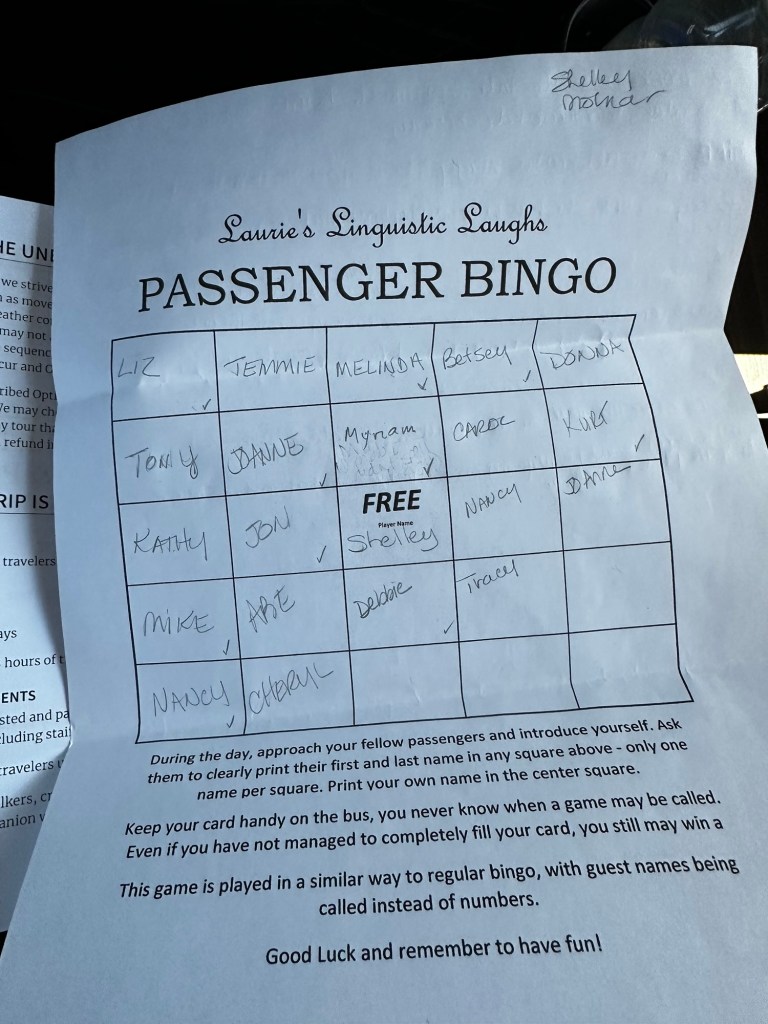
Laurie, our amazing trip leader, has devised a very creative way to break the ice and to keep us entertained during our bus ride. We are going to be playing “Passenger Bingo” for PRIZES! I don’t care if the prize is a rusted tricycle, with a wheel missing. If it’s a contest, I’m in it to win it. That’s just my nature.

Since I started this post, we have completed THREE different games, and I’m quite proud to say I was the winner of the first, which was a challenge to name all of the 14 people that did NOT make it to Halifax. Nailed it!

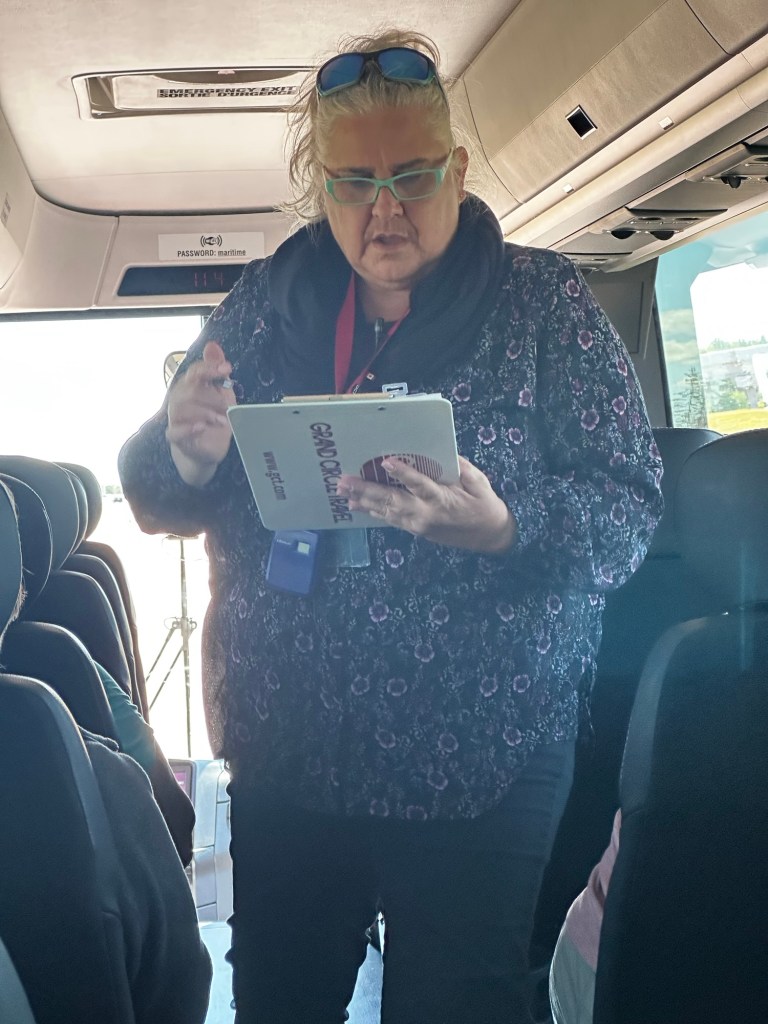
Laurie, our hard working, creative trip leader

But back to Baddeck. As usual, our drive to the next city was broken up by interesting stops, starting with the Millbrook Cultural and Heritage Center.

Glooscap, a mythical figure

There, we learned about the indigenous people who had inhabited the land for over 13,000 years, ( according to archaeological digs) the Mi’kmaq (pronounced mig-MAH).

Apparently, the French and the indigenous had a positive relationship; not so, with the British, which was probably why we fought the French AND Indian War.

The indigenous were given identity numbers by the Canadian government, with the final number indicating how many children were in the family. That made it easier for the government to find the children, take them from their families and force them to attend government run boarding schools. The schools were designed to wipe out the indigenous language and culture. Over 176,000 children between the ages of 4 and 16 were taken from their families. Of that number there were over 6,000 recorded deaths from disease, abuse and suicide. Before anyone thinks that the mistreatment of indigenous children happened centuries ago, I need to inform you that the last school closed in 1998 in Manitoba.

This speech was given during Canada’s 100 year anniversary.

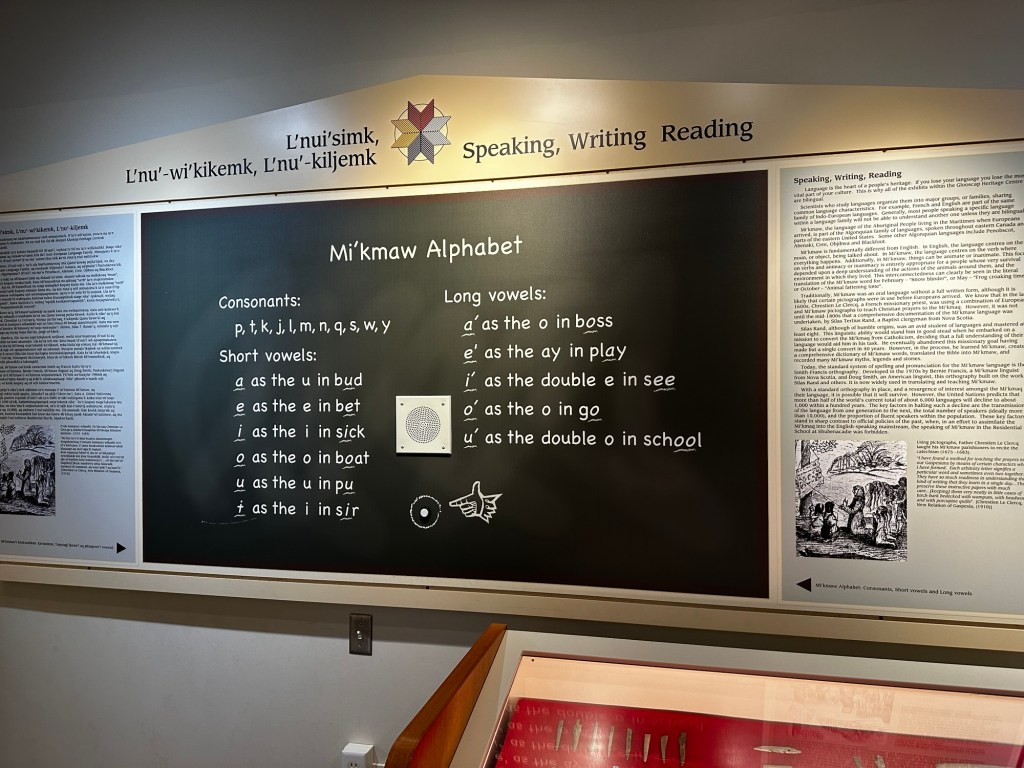
We learned that the Mi’mkaq language is a tonal one.

Depending on how you elongate the vowels, the same word could mean:

I love you OR I want to hurt you OR I want to throw you in the fire. THAT word could start some serious misunderstandings!

We spent our three nights in Baddeck at the Silver Dart Lodge, which overlooked a beautiful lake.

Laurie was initially concerned that we would find the Lodge too “rustic”. Instead, we all agreed it was absolutely charming. Because of the volume of business Grand Circle does with the lodge, we all got rooms facing the lake.

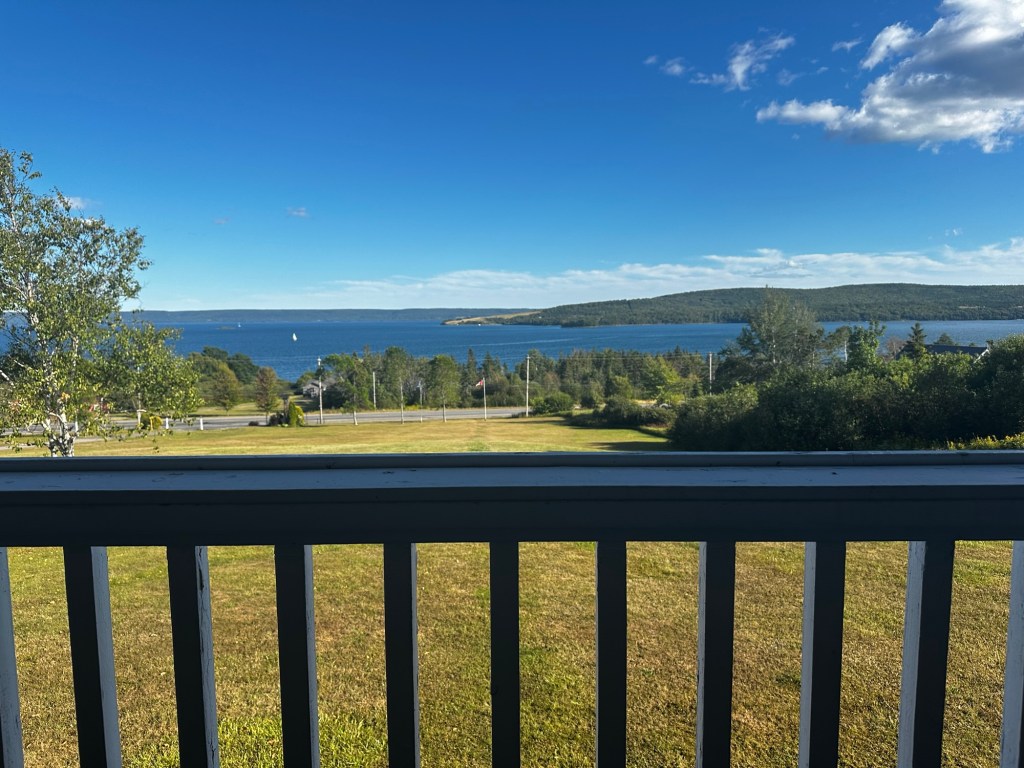
This spectacular view is what I saw from the lovely deck outside my room, the perfect place for happy hour. How great was THAT? It took all three nights for me to finish the wine that I was not allowed to drink on the bus.

The area is so beautiful that Alexander Graham Bell and his wife, Mabel built their summer home in Baddeck. Their “castle” wasn’t visible from the museum bearing his name, but there was plenty of other “stuff” to see.

I had no idea that Alexander Graham Bell taught deaf students in Boston or that Mabel became deaf at the age of 5 after a bout with scarlet fever.

I also didn’t know that Bell’s parents immigrated to the USA from Scotland after two of their sons died from tuberculosis. They didn’t want to chance losing their last son.

We all know about his invention of the telephone , but I wasn’t aware of his interest in aviation and hydrofoils until I visited the museum.

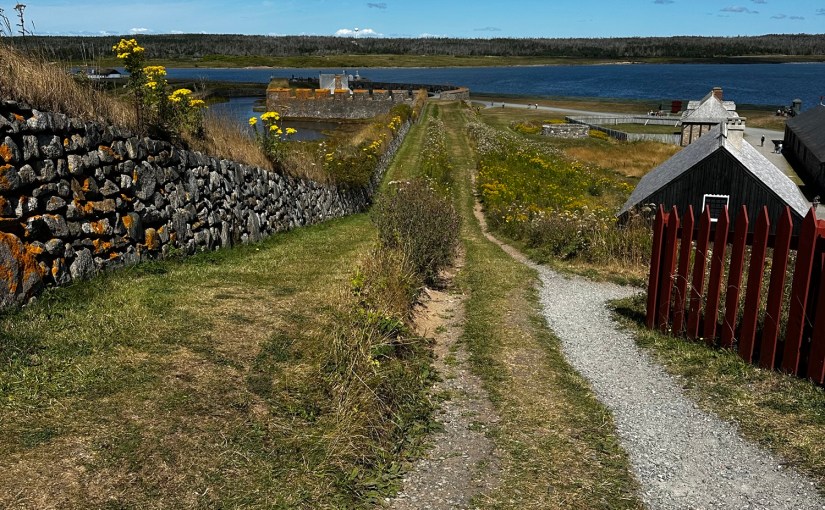
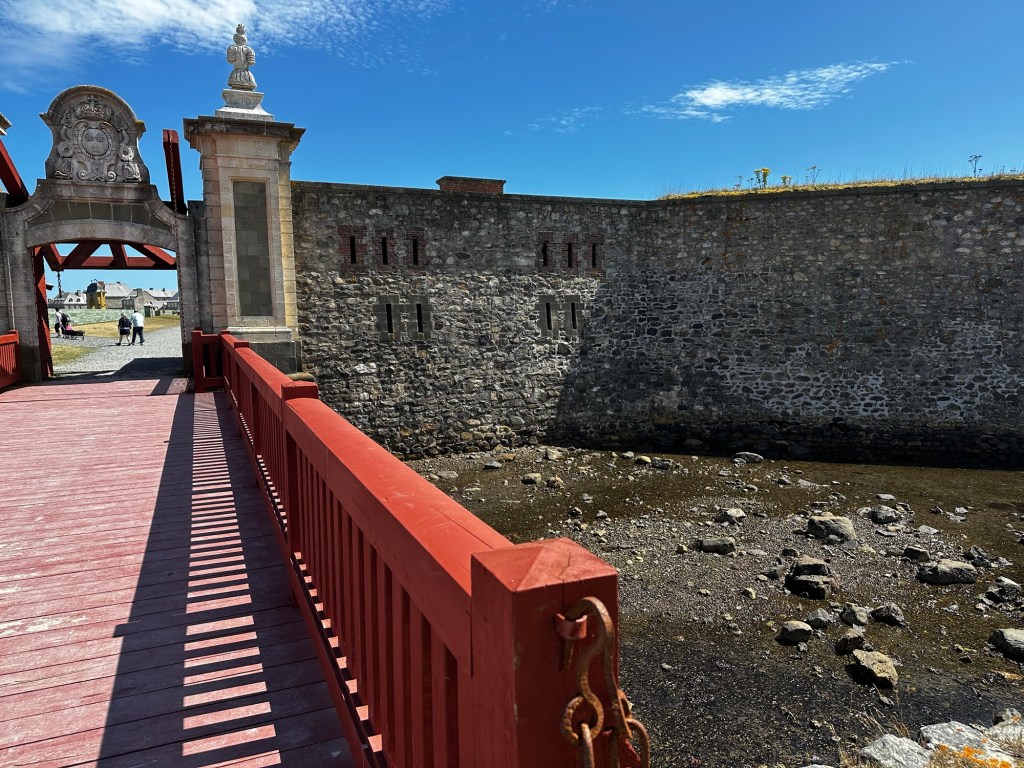
We spent the next day touring the fortress at Louisbourg, where I was once again reminded of my educational deficiencies. Why did I never learn that in 1745 a group of untrained “ soldiers” from New England successfully took the fortress in 6 weeks time? You see, the French had expected all attacks would come from the sea, so that area was heavily fortified and protected. But the 6,000 ragtag New Englanders didn’t know the rules of engagement, and they were undaunted by forests or swamps, so they attacked from the land, which was unprotected.

The entrance to Louisbourg

The crown decided to return the fort to the French in 1749 exchange for Madras, India which was a source of extreme irritation to the New Englanders. They had lost about 900 men capturing the fort.

In 1758, the British determined that they wanted Louisbourg after all, so they laid siege the “professional” way, by sea, without the help of the New Englanders, and guess what? It took them a WHOLE lot longer.

This time they completely destroyed the fortress, so what exists today is a reconstruction, based on documents and plans that were preserved off site.

The view from the protective wall

Like Williamsburg, Sturbridge Village, and Plymouth Plantation, re-enactors in period costumes demonstrate what life was like in the 1700s.

I particularly enjoyed watching a prisoner being marched through town to the iron collar.

All of the neighbors were invited to ridicule the prisoner as he made the “walk of shame“ to the center of town.

Our final day was to be spent traveling along the Cabot Trail. Because of climate change ( yeah, the Canadians don’t think it’s a “hoax”), all the trails are closed to hikers. The risk of fire is too great. So, instead we were going to drive the entire route, after stopping to visit a church and a hooker museum. Don’t get excited. It was a museum for RUGS not ladies of the night.

While in the museum, Josh discovered there was a problem with the bus, so we had to hang out long enough that the full trip along the Cabot Trail was impossible.

We were lucky to have Laurie as our trip leader, who decided to treat us all to coffee and pastry at the shop up the street. Instead of doing the full route, we ended up stopping at a beautiful little beach

Our last night was spent at a ceilidh (pronounced Kay-Lee).

Although there is so much more to say about Baddeck, this post is already quite long, so I’ll stop.

Slavonice, Czech Republic

What? You never hear of Slavonice? Neither had I, until this trip. Centuries ago, however, Slavonice was a “happening” place. On the road between Prague and Vienna, it was a popular overnight stopping point for travelers.

Check out the “graffiti” that still exists on the buildings in “old town”.

One of the reasons I keep choosing to travel with OAT is because of hidden gems like Slavonice, places I would NEVER have discovered on my own.

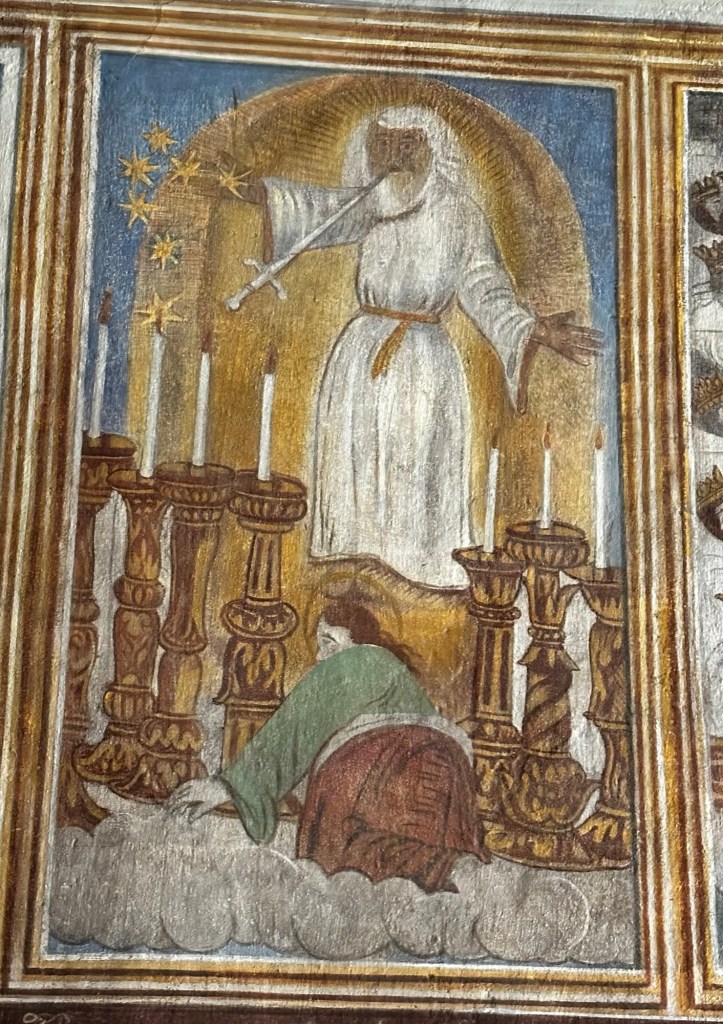
We were able to visit a beautiful restored building that was once used as a gathering place for the Lutherans. Supposedly this artwork illustrates that Jesus’ word is more powerful than the sword. Clearly this artwork was done well before both world wars.

Can you believe the ceiling in this building? How did they DO that?

We were the only guests in a lovely little hotel in old town, complete with a restaurant and wine cellar.

Here is Pavel, the owner, chef, wine merchant, cleaning crew, sommelier, ( he’s EVERYTHING!) greeting Tomas, our guide and welcoming us to his hotel.

Our first evening was memorable indeed. The town lost electricity during a hailstorm and with roads flooded, Pavel had to figure out how he was going to feed us. Fortunately, his wine cellar was very well stocked, so in addition to soup and bread we were offered unlimited beverages. SOME of us took FULL advantage of what life had thrown our way.

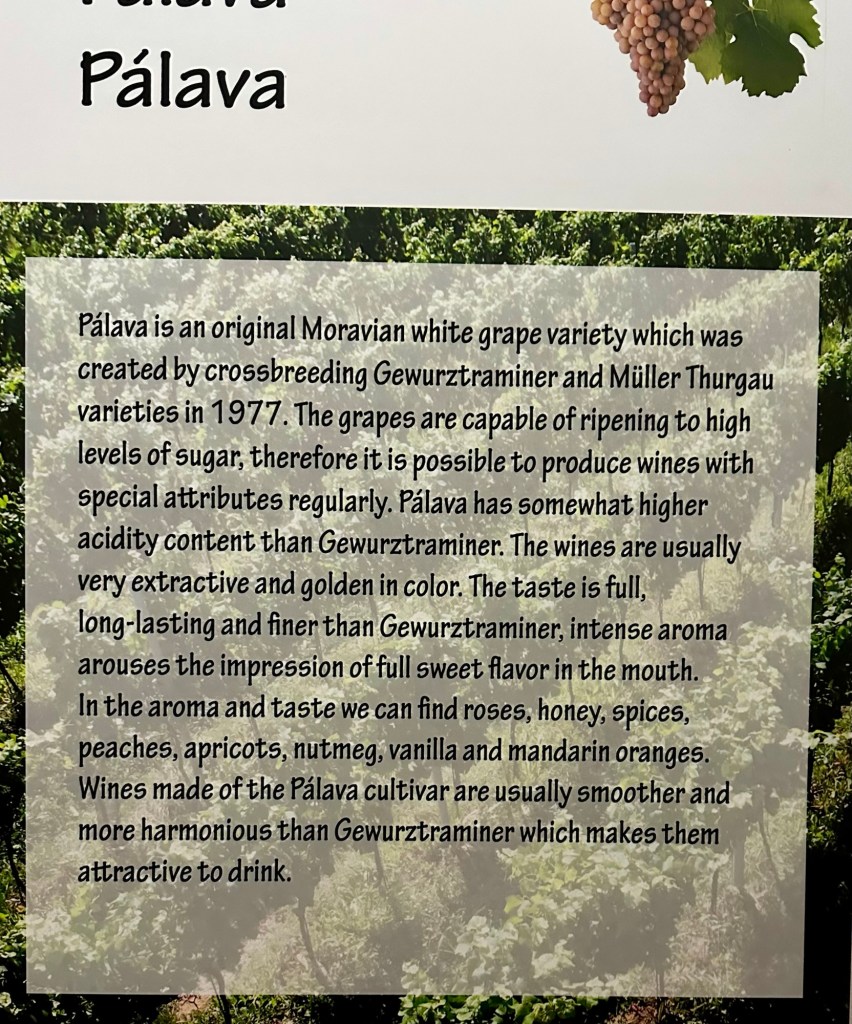
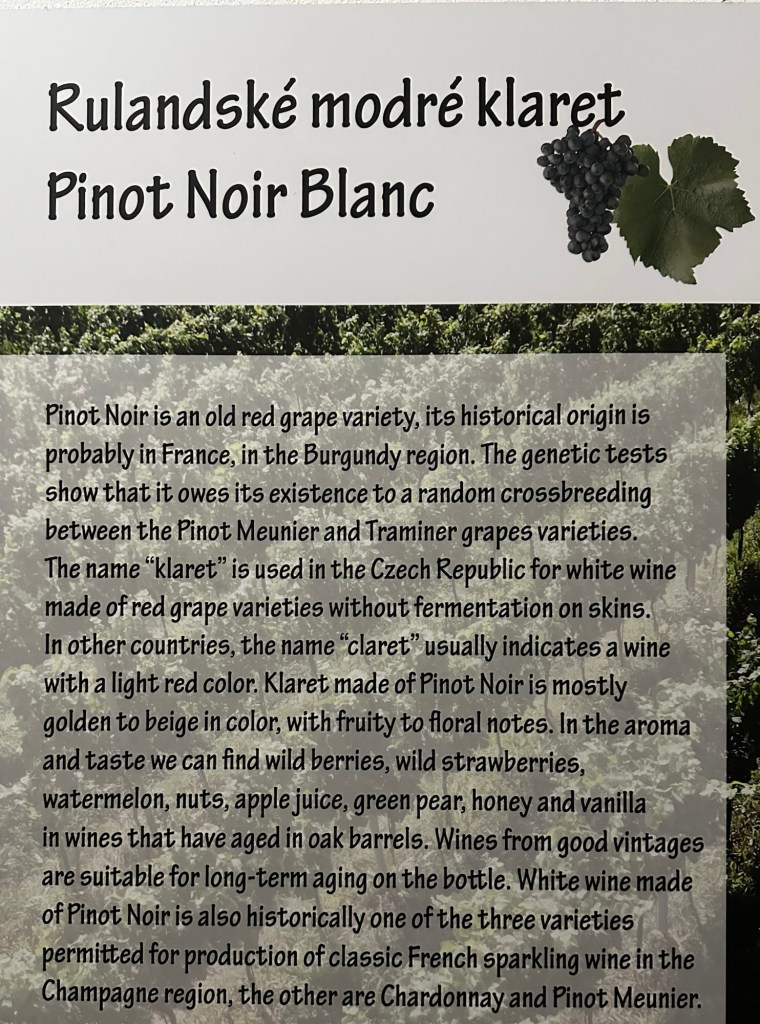
I took these photos of posters outside my room especially for my favorite sommelier (he knows who he is).

We were lucky that the 13th century wine cellar didn’t flood. The water from the storm that DID make it into the building had receded enough for us to enjoy a wine tasting on the second night of our stay.

The fact that the ceiling was dripping on us didn’t dampen our spirits one bit.

Yes, we are all bundled up— it was COLD in the centuries old basement.

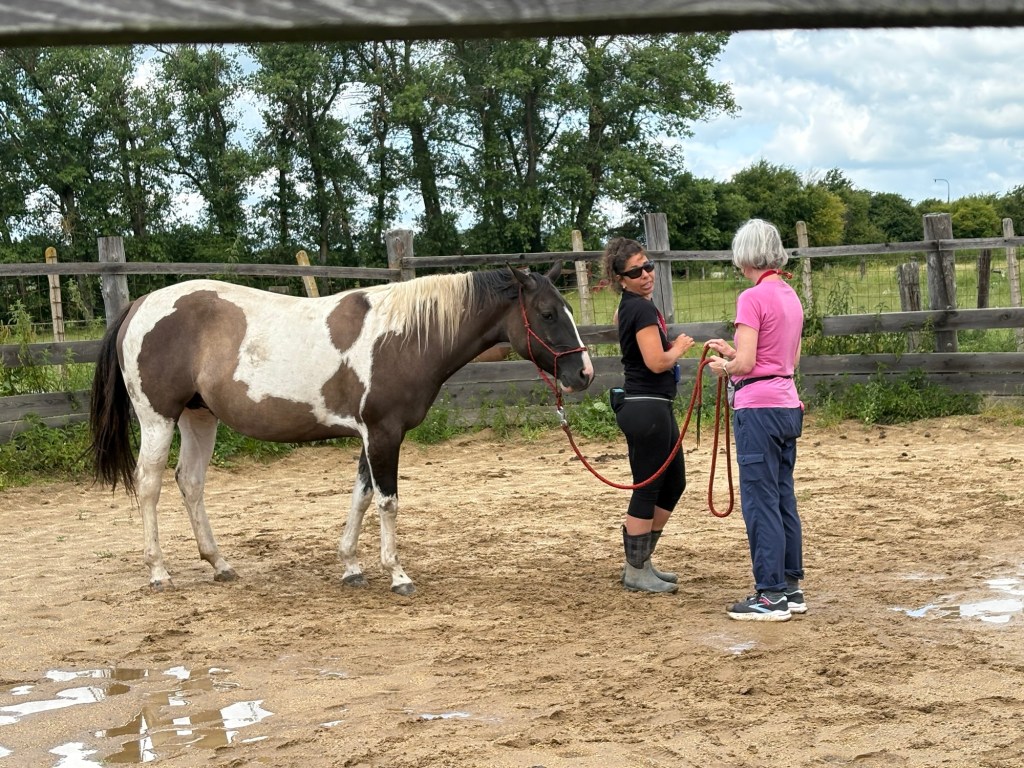
But once again, I’m getting ahead of myself, talking about dinner before describing our “day in the life” experience at a farm about an hour’s drive from Slavonice. Olga, our host, runs a horse farm.

Like my wonderful cousin Kristy, she provides a home for horses that can no longer be ridden. Her oldest horse is 30, which is significantly more than the average life span of a horse.

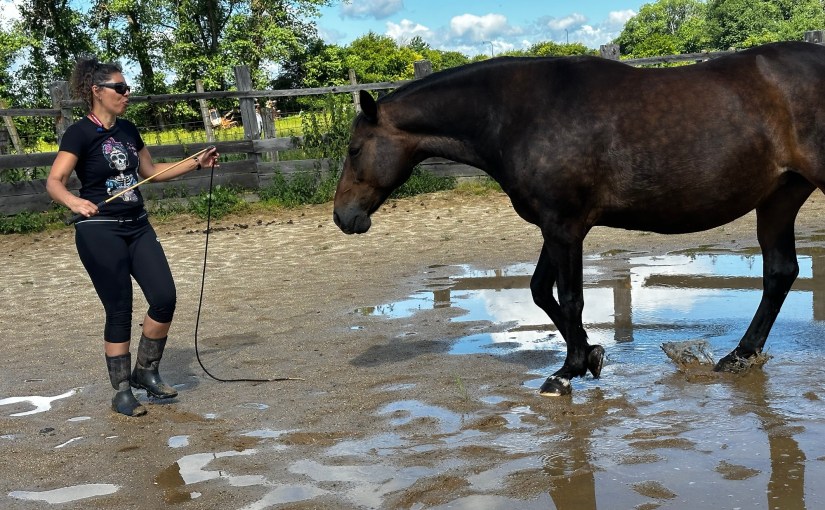
In addition to breeding horses, Olga also works with horses that are thought to be “difficult”. She demonstrated how she communicates with them using only her eyes and fingers. When she asked for a volunteer to learn the technique, I thought I was going to have lots of competition. I thought wrong.

Could the amount of water and mud have been the reason for my companions reluctance?

Being the ONLY volunteer, I got to get up close and personal with this magnificent creature, who was once thought to be “difficult”.

Olga is demonstrating the proper shoulder technique to get the horse to follow you. Nailed it!

Yes, our day time activities were fantastic, but there was even more awaiting us.

That night, we had the PLANNED dinner at the hotel,

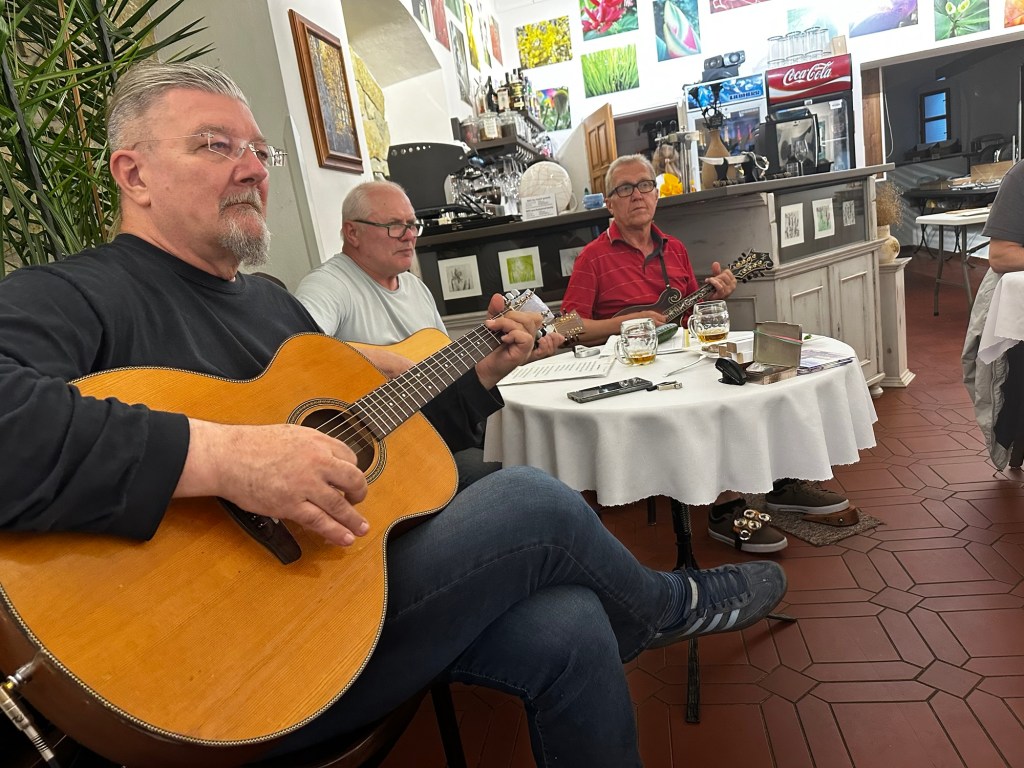
complete with local musicians who got us singing along to “Country Roads” and “Roll out the barrel”.

Of course, the wine flowed freely, but the show stopper was when our host used a sword as his bottle opener.

On to Bratislava. Yes, I know. Add Cesky Krumlov to the list of places I’ve skipped over.

Pisek, Czech Republic

What a delightful surprise our lunch stop in Pisek turned out to be!

This blog is not a chronological record of my OAT itinerary. It continues to be whatever I feel like writing about. And I feel like writing about this sweet little undiscovered town.

We’ve been to Dresden, which was our final stop on the pre-trip, then we spent the first three days of the main trip in Prague. Both of these fascinating cities deserve posts of their own, and I’ll get to them eventually. There have just been far too many distractions for me to give them the attention they deserve.

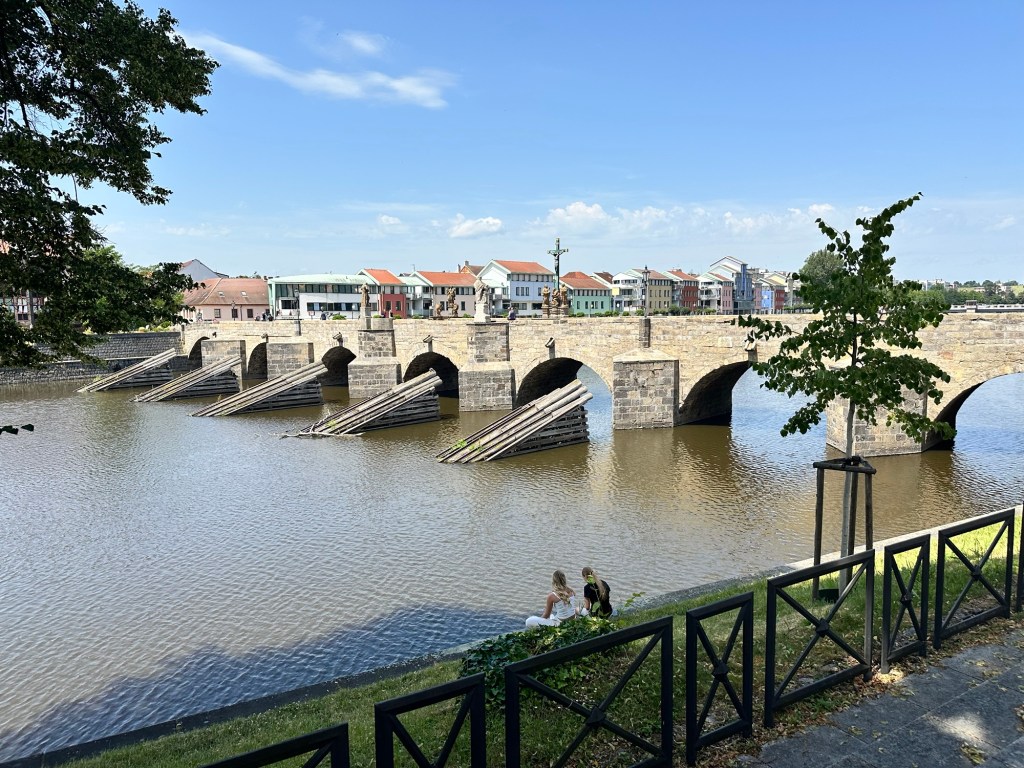
Pisek is quite beautiful. Its old stone bridge predates Prague’s Charles Bridge by at least a century. Somehow, the bridge managed to survive several centuries worth of floods. The statues on the bridge weren’t so lucky. The originals were damaged and have since been repaired or replaced.

Don’t be fooled. Pisak also has MODERN attractions, like this one. I’ve seen pedal bars in Nashville, but I never have seen a Prosecco van. What a great concept!

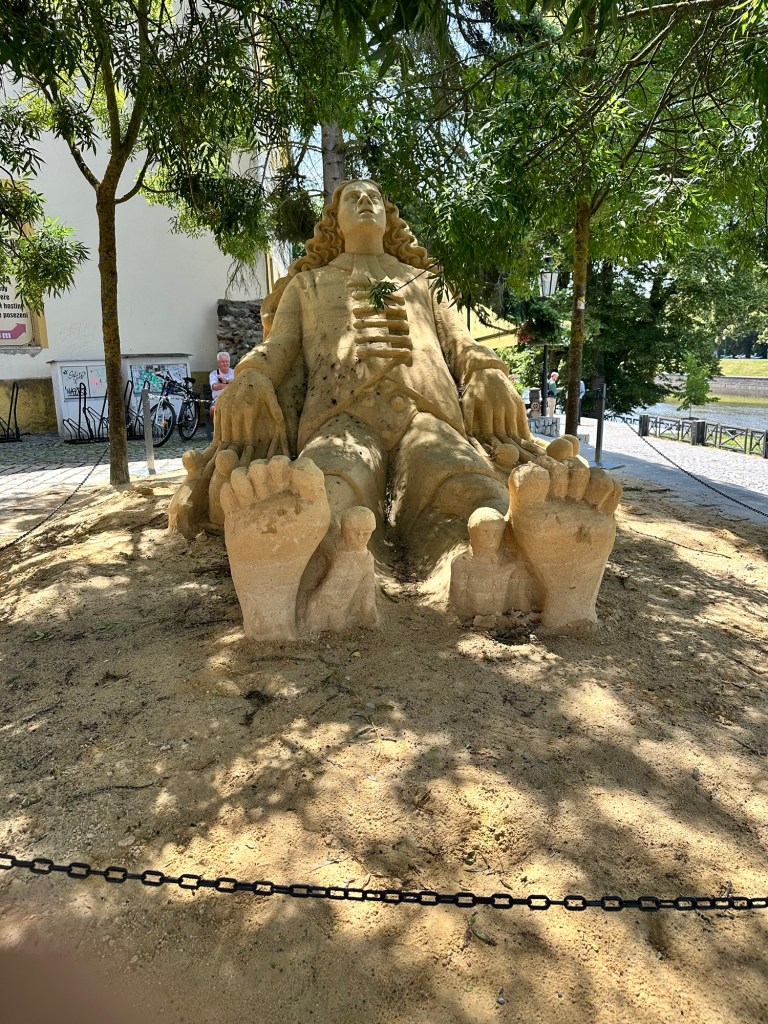
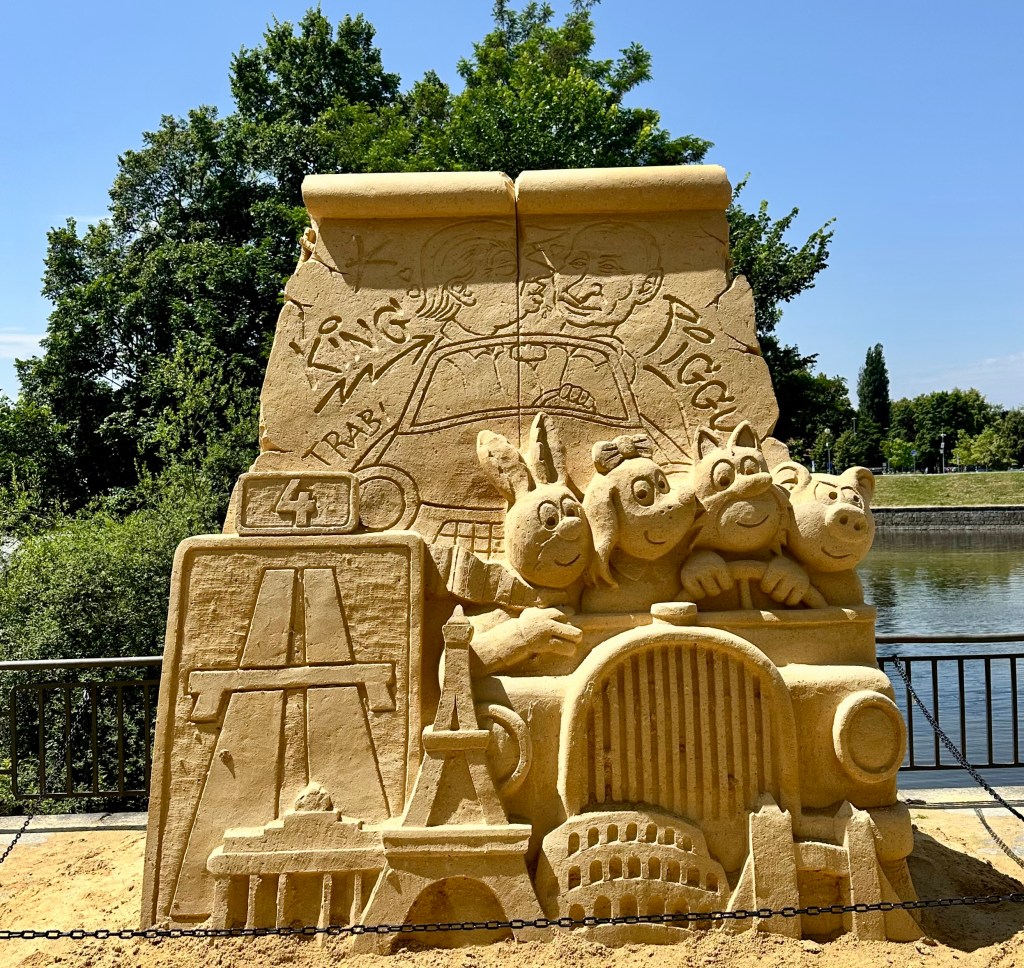
Despite this vehicle’s obvious appeal, I found the sand sculptures even more compelling.

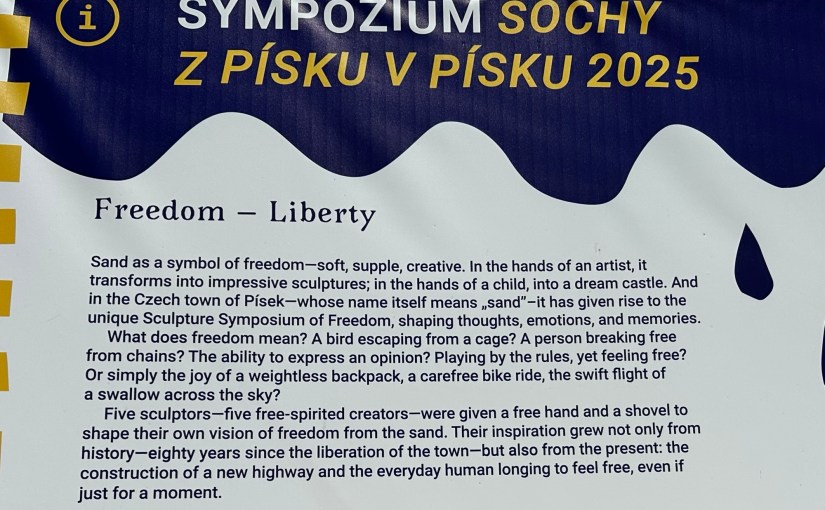
The header on this post describes the theme for this year’s sand sculptures — Freedom and Liberty, intended to commemorate the town’s 80th anniversary of their liberation after World War 2.

Did you recognize Gulliver, struggling to break free?

Lady Liberty has packed her bags. I’m hoping she’s not leaving the USA.

To me, the most compelling sculpture was this one, especially after being in Berlin. What a powerful demonstration of how much JFK’s words meant to the people in this part of our planet. .

Then I took a good look at the front of the sculpture. It shows Putin driving a car manufactured in East Germany by the Soviets. The Trabant had an engine that was likened to a lawn mower—about as powerful and just as smelly. East Germans would use trabants to escape to the Czech Republic, and then abandon the car in the street.

Take a close look at who is kissing up to Putin. Clearly he is not in the driver’s seat.

If you don’t recognize the iconic hair style, the sculptor has given us a hint. He has “king” written alongside his image. ( I would have added “wannabe” before the word “king”).

Why is it that Europeans can see so clearly what many Americans cannot? Perhaps because they have lived through Facism and Communism, they have a deep understanding of how fragile democracy can be and how important it is to preserve it, in every means possible, including the creation of sand sculptures.

Goodbye Berlin

My last post was about Berlin’s tragic past, and how frightening it is to recognize parallels to what is happening in the world now.

Today’s post is about Berlin’s glorious present and how it is making me optimistic about the future for our entire planet.

First, many thanks to my dear friend Chris and her wonderful sister Claudia for their very helpful suggestions on how to best use our time in Berlin. Thanks to them, we knew we needed to get tickets for the Reichstag tour at least a month in advance. For those of you not lucky enough to know Chris or Claudia, here’s the link for the free tour, in English: https://www.bundestag.de/en/visittheBundestag/dome/tours

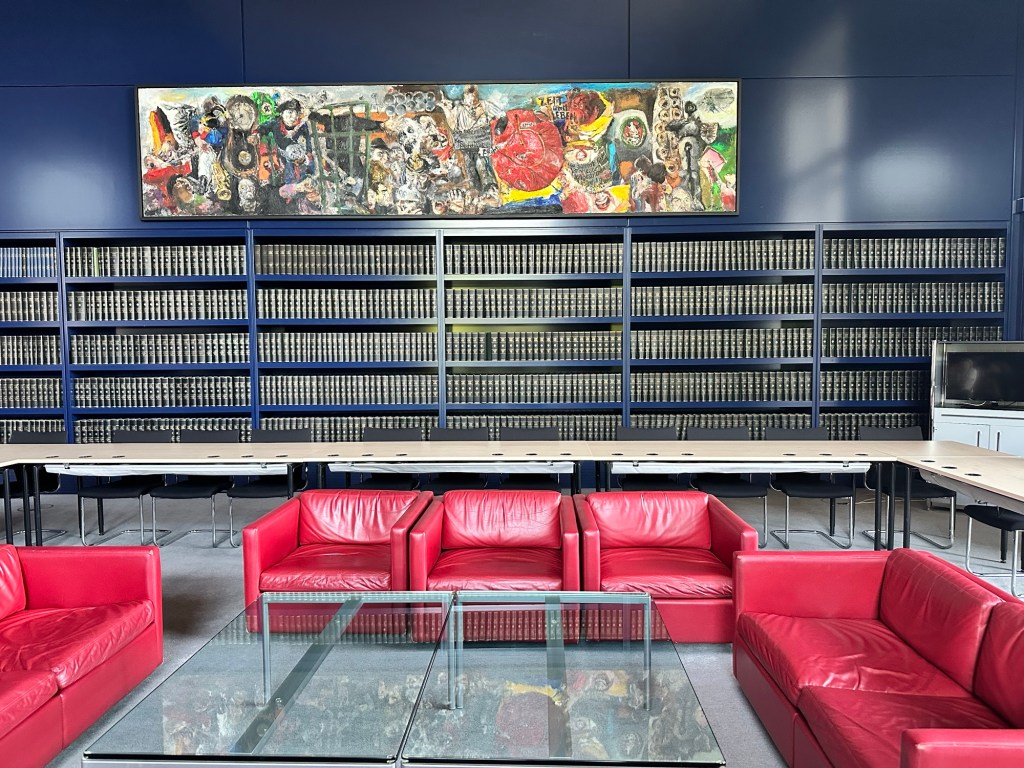
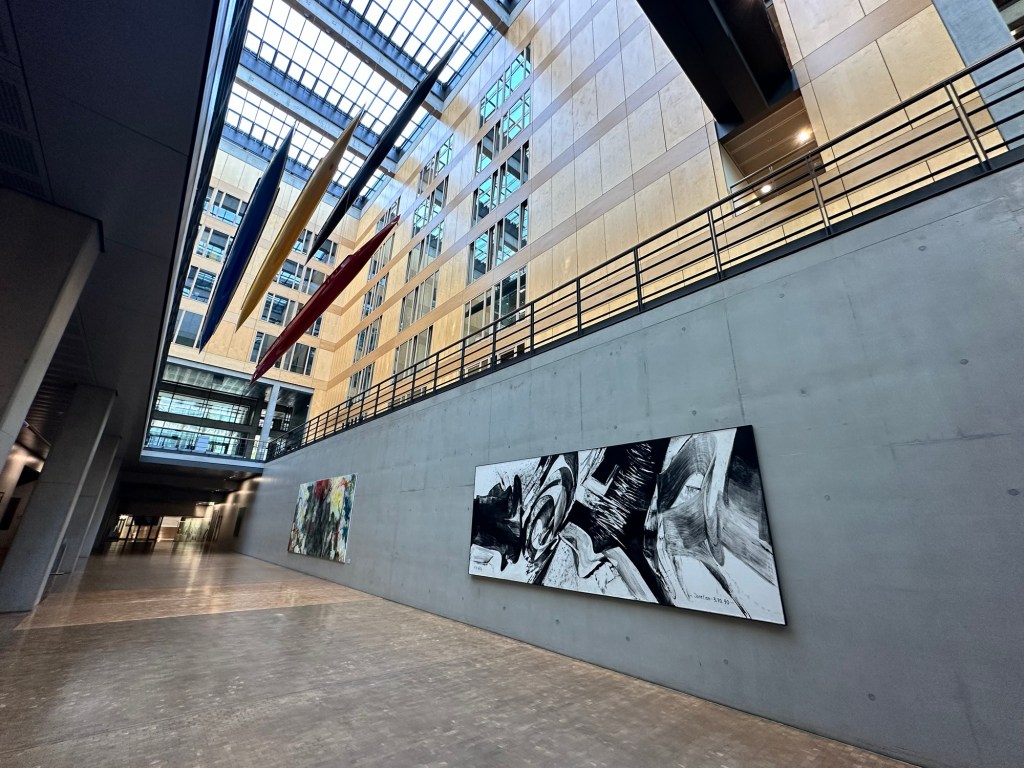
The Bundestag building itself is architecturally gorgeous, filled with interesting artwork.

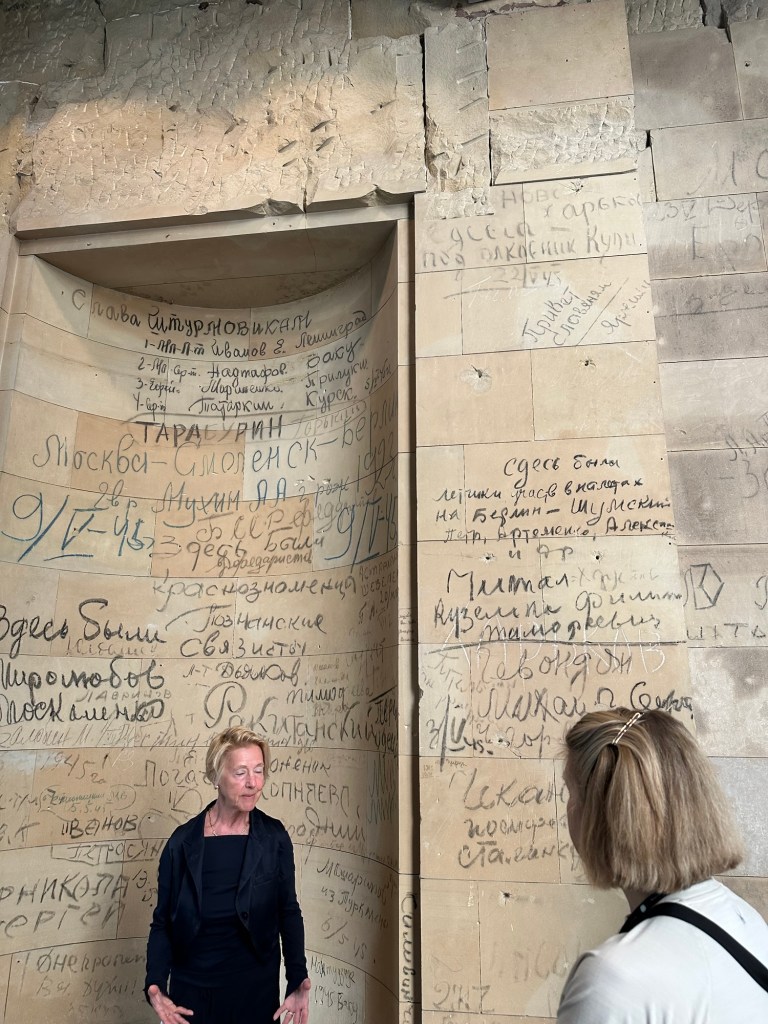
Our guide was a retired lawyer, who explained that although, prior to Hitler’s rise to power, Germany considered itself a democracy, it really wasn’t, because half of the population wasn’t allowed to vote. I wish I could remember her exact words because she said it far more elegantly than my paraphrase, but here’s the gist of her comments regarding women voters: They expected women to be grateful when they “gave” us the right we had been denied for so many years.

Here she is, explaining why the Russian soldiers’ graffiti in the Reichstag was preserved when the building was reconstructed after unification. (Once again, not a direct quote, just what I remembered her saying).

Imagine you are a young Russian soldier who spent the last few months being shot at and bombed. You have survived so far. You reach Berlin, but are still not safe. You want to leave your mark so that others recognize that you once existed.

The Germans left the graffiti so, to me, it has become a symbol of the compassion the Berliners felt for young Russian boys who were drafted and forced to kill young German boys.

She also gave us information about the way the German government currently operates, but because I wasn’t as interested, I promptly forgot everything she said.

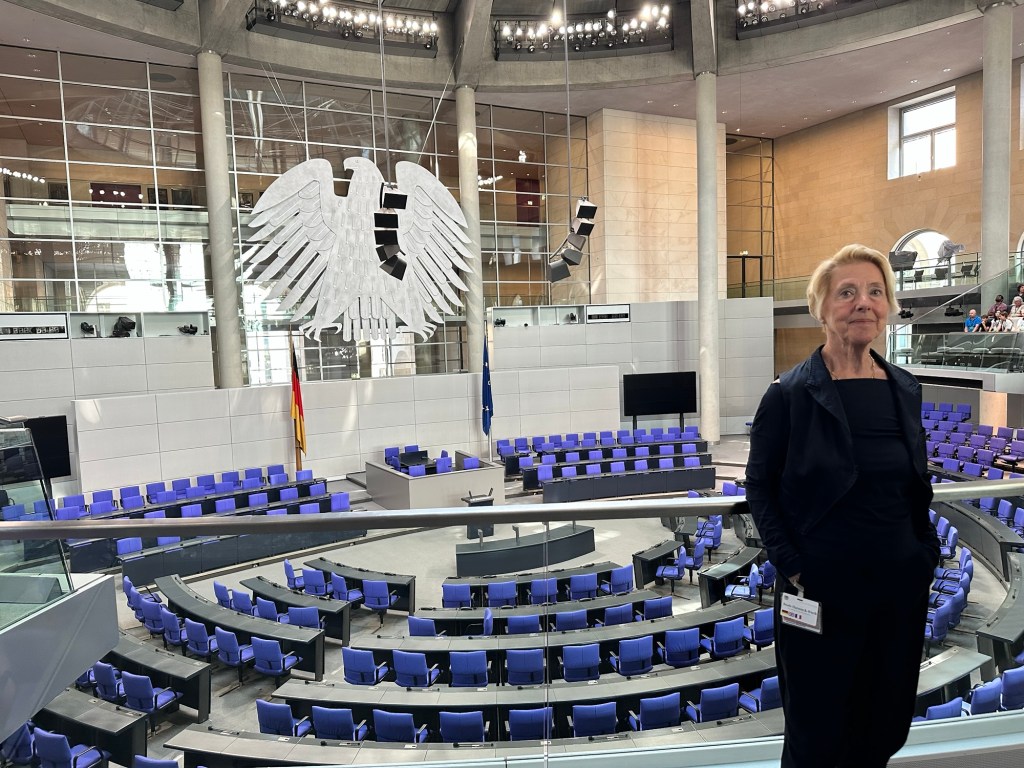
I was, however, fascinated by the eagle on the wall behind her. That eagle hung in Bonn, when it was the capital of West Germany. It was installed at the reconstructed Reichstag after reunification.

I was also fascinated by the interior view of the dome from the parliamentary meeting room.

After the 90 minute guided tour, we were able to enter the dome and walk up the spiral ramp to the top.

The mirrors in the center reflect light into the building below.

I found it fascinating that the dome is completely open. What happens when it rains or snows? Inquiring minds want to know, so I asked one of the guards. He told me the top remains completely open, but rain only falls on the very top level, where drains capture it and carry it out of the building. Damn, those Germans are great at engineering!

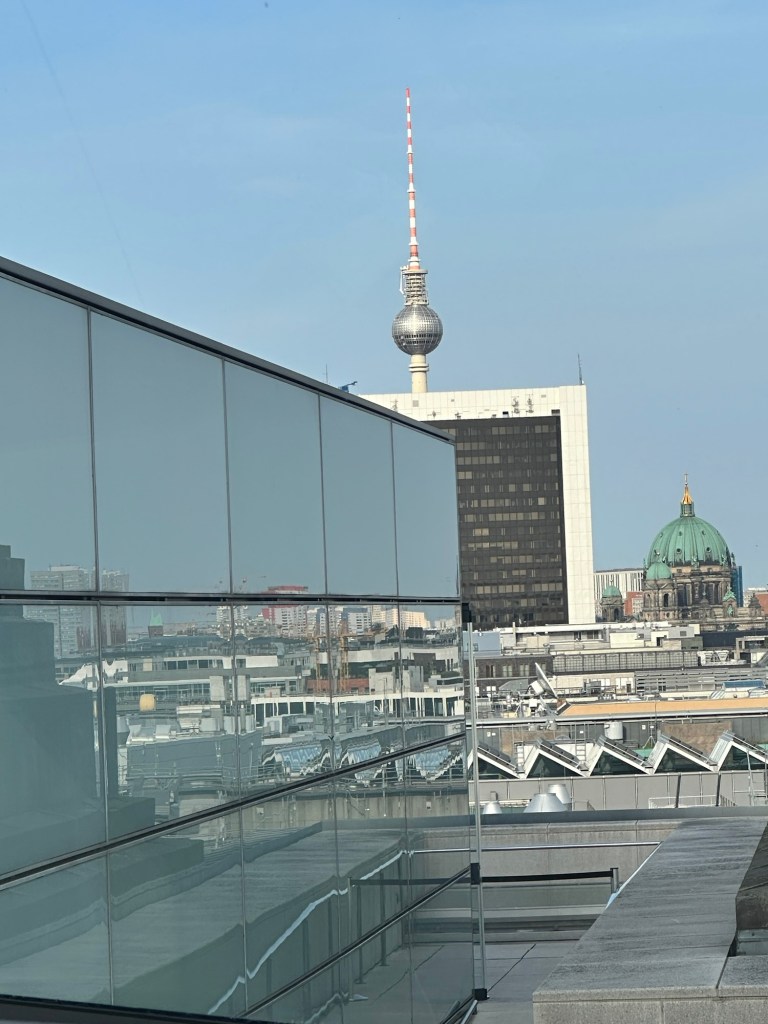
From the Reichstag dome, we were able to see the TV tower. It was the proud creation of the Soviets in East Berlin, intended to demonstrate the superiority of Soviet construction. After reunification, however, the world had access to Stasi documents that showed most of the materials used to build the tower had to be imported from the west.

During our city tours both guides talked about the symbol of Christianity (a cross) appearing on this godless tower. We were completely mystified, because it was impossible for us to visualize anything that remotely resembled a cross. FINALLY, during our stroll around the dome, the sun was in the right position, so I hope my photo allows YOU to see it too.

If my personal astrophysicist had been by my side, he would have explained the scientific principles behind the phenomenon. Instead, I went with Barb’s explanation: it is magic.

Anyone who has read any of my prior posts knows that I cannot resist a tower, mountain, high point—anything that offers a panoramic view. Berlin has several, and we took advantage of every single one that we could find.

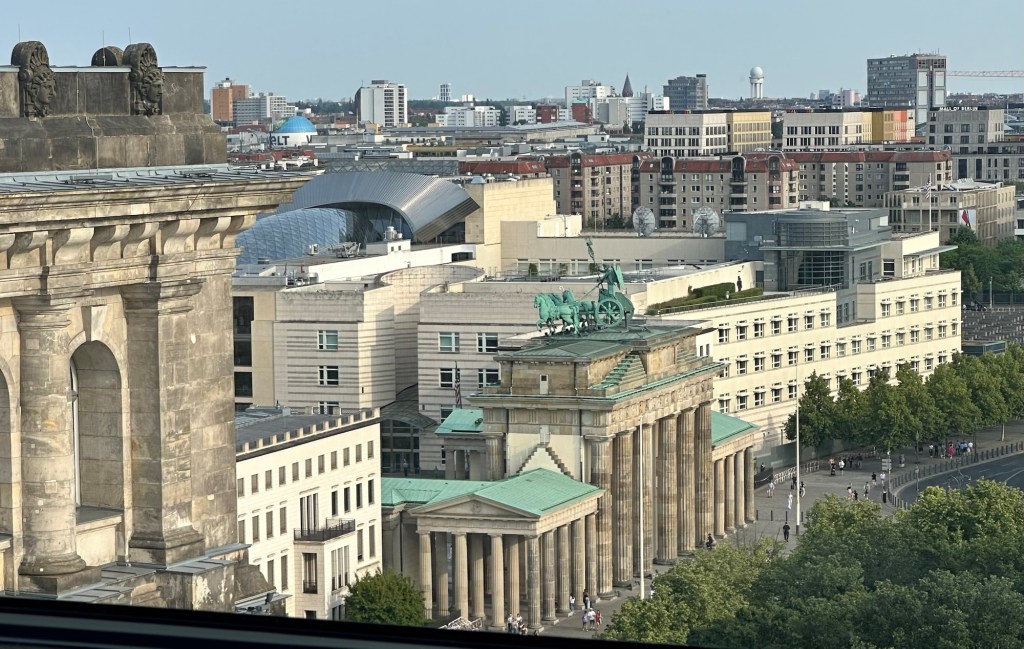
The view of the Brandenburg Gate from the dome

Our OAT trip leader suggested we visit the Humboldt Forum’s rooftop. In addition to the delightful cafe,

we were treated to another vantage point of the city.

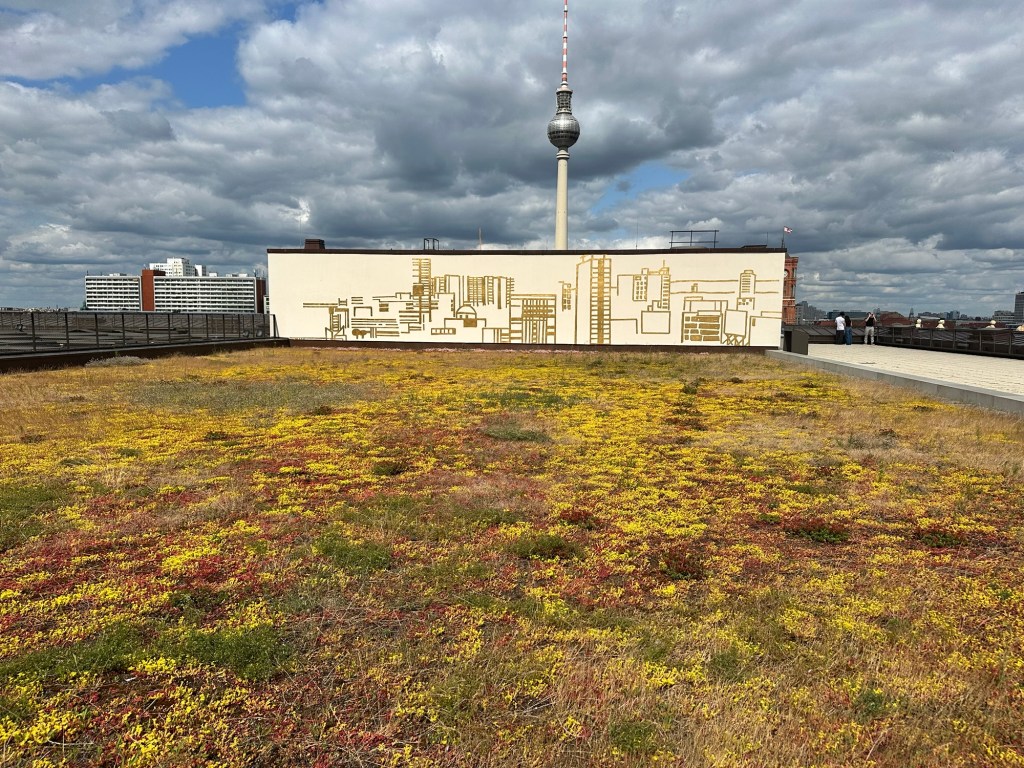
Notice the roof of the Humboldt is planted with grasses and flowers.

The city was environmentally aware, which was so very encouraging to me.

None of the median strips were mowed. Instead, grasses and weeds were allowed to grow unhindered to protect and feed the bees.

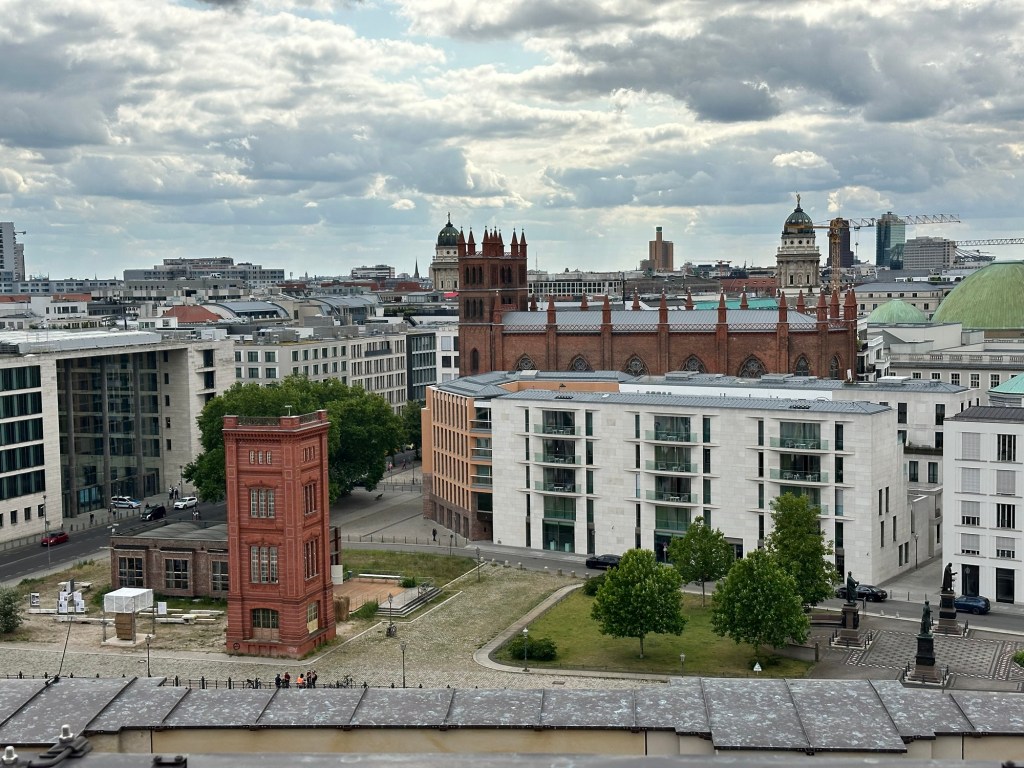
From our vantage point on the roof, we could see the sustainability display. That’s the reddish tower in the photo below, in which reclaimed materials were used to fashion new structures.

We ended our night with a laser show at the Reichstag, which was created to commemorate the 30th anniversary of Christo’s art project.

With travel, sometimes you hit and sometimes you miss. The laser show was definitely a miss, but the sunset was lovely.

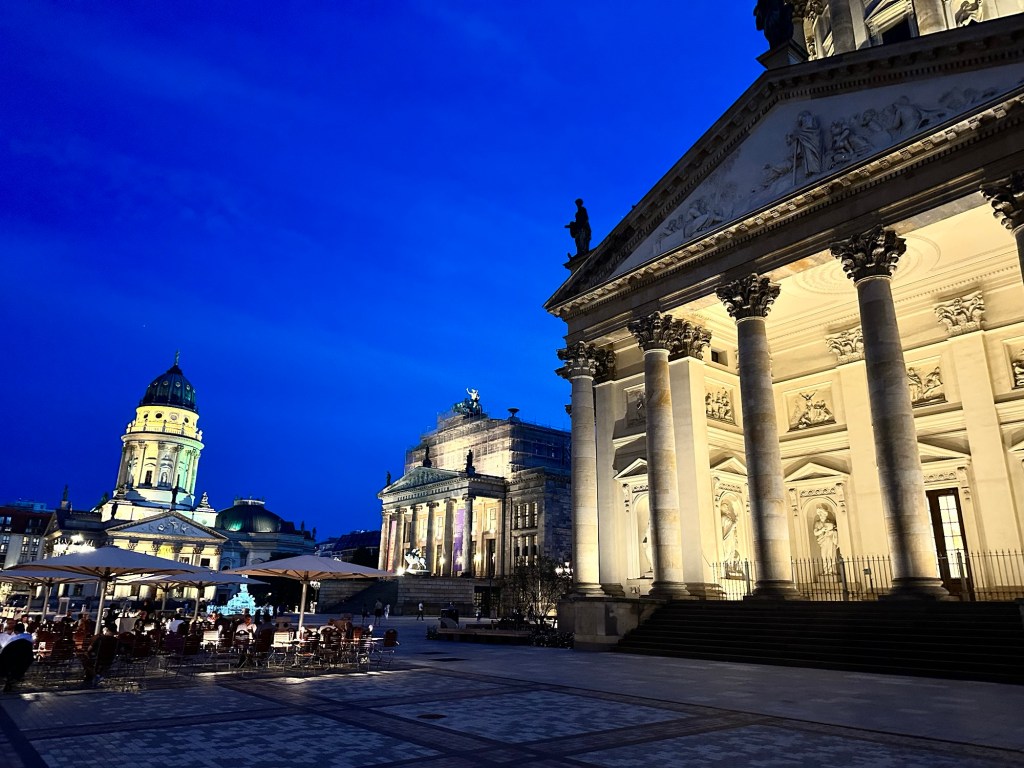
And the walk to the hotel gave us the opportunity to see Berlin buildings illuminated.

Berlin, Day 2

What a difference a good night’s sleep makes! Barb and I managed to fight off jet lag and stay awake until after 8 PM on our arrival day, so when we awoke on day 2, we were energized.

We left our hotel at 10 AM, completely prepared for whatever the day would throw at us. Sun, rain, high winds, pestilence…we were ready!

Here are some highlights of our next 12 hours.

Believe it or not, these blocks of varying heights are the Holocaust Memorial. Don’t ask me what they symbolize. Our diligent search for an explanation didn’t turn up a single plaque anywhere.

Yesterday while riding the HOHO, we saw many important buildings. Did either of us remember anything about them? Well, we DID remember seeing them, but that’s about it.

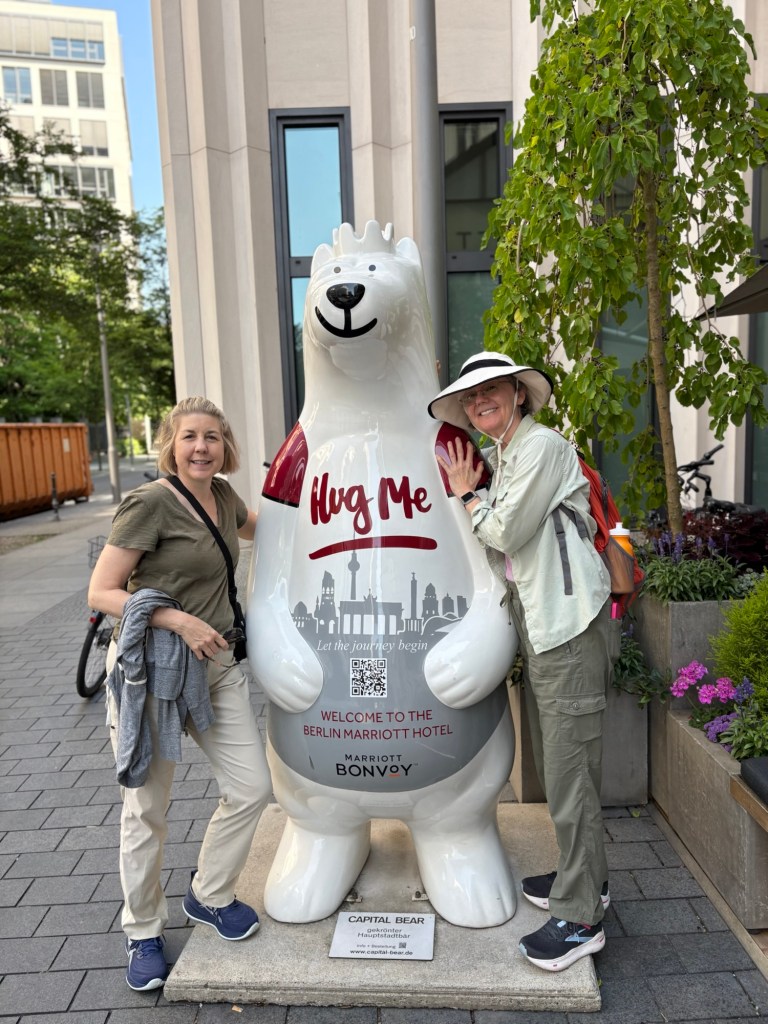
The Berliners are very fond of domes…and columns…and bears.

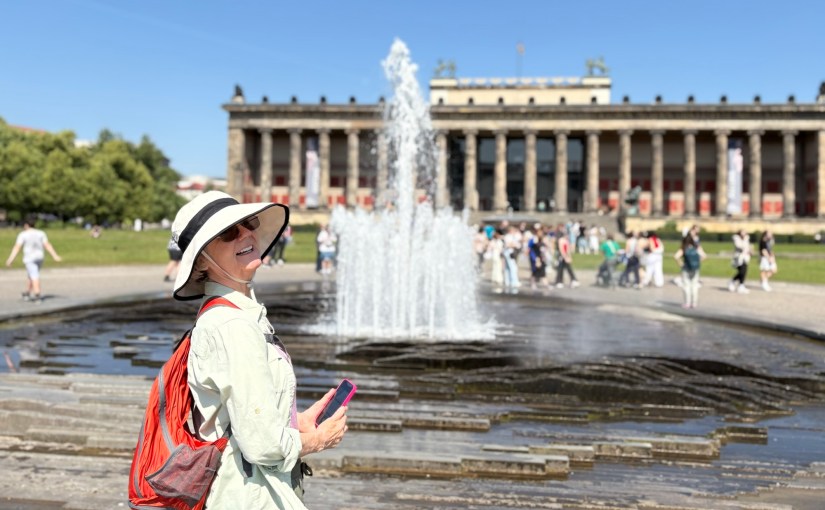
We thoroughly enjoyed Museum Island, even though we only visited one —the Neues Museum. Let’s face it: we have pretty fantastic museums in New York, Boston and DC. Still, the Neues Museum had some artifacts that were really spectacular. Click on the image if you want to see more.

Did you see the little Lego figure in the boat? It’s good to know museum staff members have a sense of humor.

One advantage to traveling on foot is you can stop to enjoy your surroundings. And we did. Frequently. But we still managed to walk almost 10 miles, according to my Apple Watch.

What is it about men and cars? if a hood is open, they simply HAVE to gaze inside.

I had no idea there were so many bridges in Berlin. Yesterday’s HOHO audio guide claimed that Berlin has more bridges than Venice!

I’m sure this tower commemorates some victory, but I can’t recall which one. Not a problem, because I’ll bet you really don’t care either.

The museum on the ground floor contains tiny reproductions of famous buildings from around the world, like the Roman colosseum, the Statue of Liberty and the Brandenburg Gate.

The first viewing platform has gorgeous mosaics, depicting humans attacking each other. I’m gonna take a wild guess and speculate that the artist wasn’t a woman.

The BEST part is you can climb to the tower’s top for a panoramic view of Berlin. Was it worth climbing 282 steps (I counted) up a spiral staircase?

We had a few hours till we were due to board our boat for our sunset river cruise, so we ambled along the Tiergarten, a beautiful oasis in the midst of all the concrete and high rises.

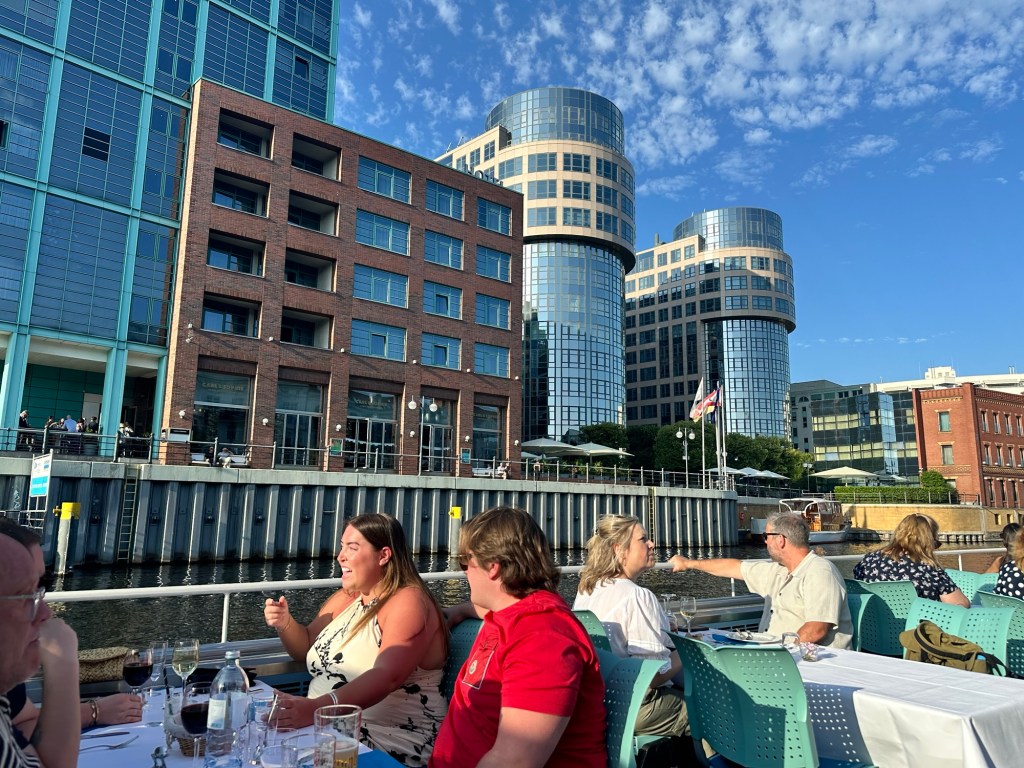
How was the boat ride? Well, it was a beautiful evening, the wine was unlimited, the 4 course meal was delicious, and we got to see Berlin from a different vantage point.

As usual, my posts are done on the fly, and lag a bit behind my activity.

Barb and I are completing our final “on our own” activity and will be joining the group tour later this PM.

Santiago de Compostela

I didn’t know until I got there that Galicia normally gets an abundance of rain, which is why it is such a lush, green region. I THOUGHT I was adequately prepared for wet weather, because I had packed two hooded jackets, fleece lined pants and silk long underwear, but I forgot the most important item: zapatos impermeables (waterproof shoes). Luckily, our hotel was across from a sports store that carried waterproof sketchers in my size. Prior to that purchase, however, (as I mentioned in an earlier post), we walked the last five kilometers of the Camino in a downpour. Let me tell ya, medieval cobblestone streets retain lots of water between those rocks!

I bought the umbrella in Bilbao when my luggage was lost.

I had the full Pilgrim experience; I was soaked and completely miserable. It was definitely NOT one would consider a spiritual feeling. By the time we got to the hotel, my feet were so wet, I had to dry them with a towel. On a positive note—the hotel had a heated towel bar in the bathroom, but sadly it only functioned between 7 and 11 pm. Still, that was long enough to dry out my sodden socks, clothes and backpack.

If someone forced me (at gunpoint) to choose between walking El Camino or running with the bulls, that day I would have taken my chances with the bulls. (I would have carefully chosen a stretch that allowed for a speedy exit.) But, then again, if I had done so, I would not have earned the right to sport one of these lovely pilgrim tattoos.

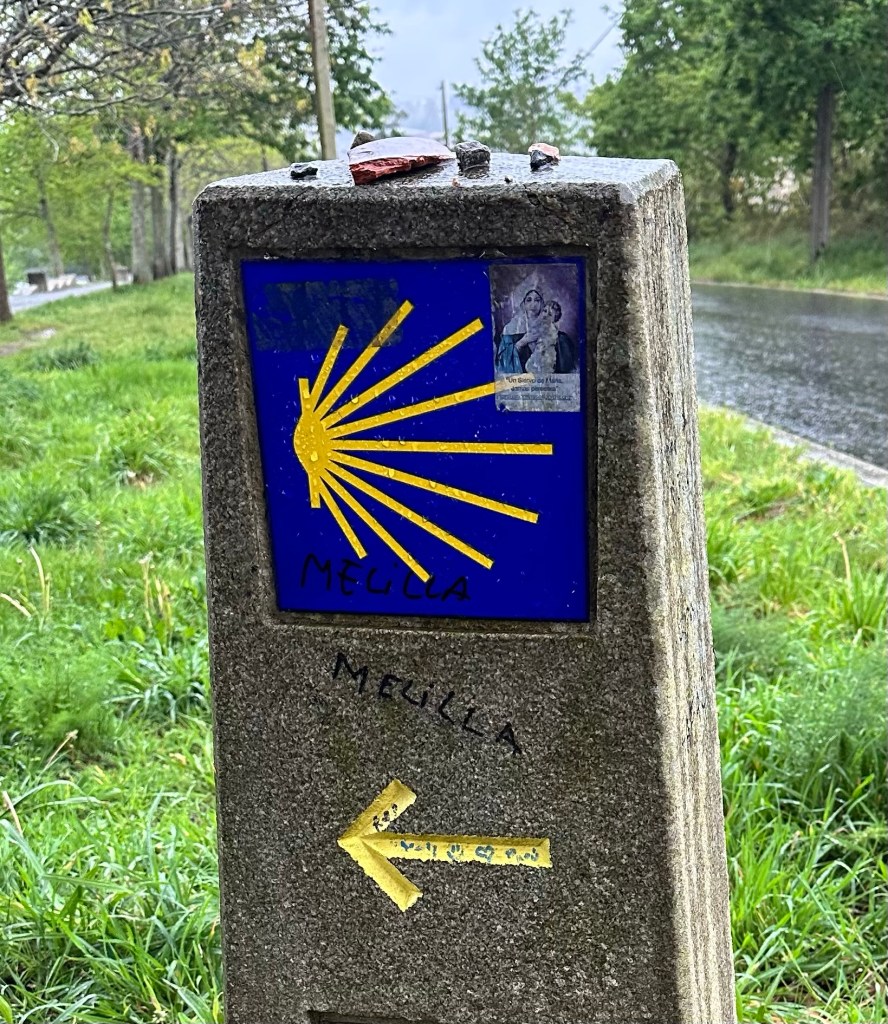
Before this trip, I had thought that there was ONE El Camino. NOW I know there are several: The French, the Portuguese, — we walked segments of both—the Via de la Plata (silver way), the Camino del Norte, the Primitive Way, to name a few. Regardless of which Camino you select, the destination is the same, the Cathedral of Saint James (Santiago).

Beneath that yellow umbrella is our local guide, Marian, regaling us with the legend of St James. WE were a shivering mass, huddled together under a nearby portico.

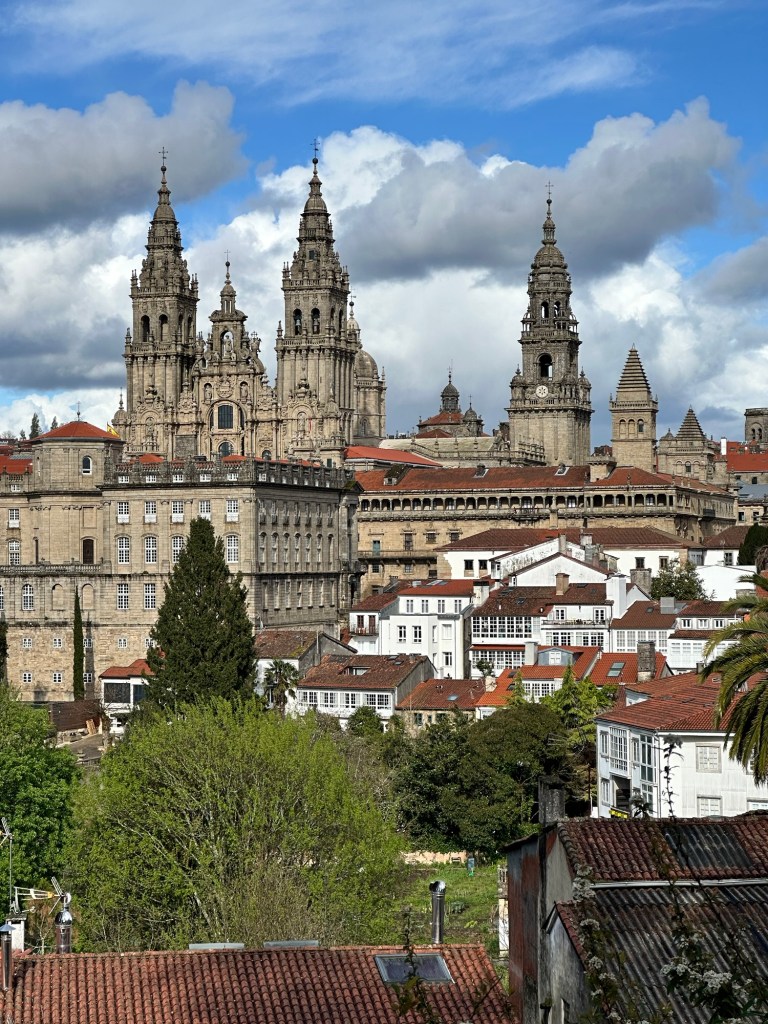
The cathedral from a different vantage point, a public park. Photo taken in between showers.

With all the wind and rain, I couldn’t take notes, so I’m operating strictly on memory. Here’s the part of the legend that I recall: a peasant (fisherman? shepherd? Some random guy?) in the first century (around 820 AD) saw a light shining down from the heavens several nights in a row, in the exact same spot. He recognized it as a message from God instructing him to dig, and when he did, he discovered the bones of a skeleton who had been beheaded. The church leaders made a rather large leap of faith and deduced that since St James had been beheaded, the skeleton must be that apostle. Over the ensuing centuries a cathedral was built and over time, the city of Santiago de Compostela grew around the cathedral.

Back then, pilgrims made the journey for religious reasons, to get a plenary indulgence (skip purgatory) or to avoid jail time. Yes, you read that right. Marian explained that people who committed minor crimes back then were given a choice…walk several hundred miles or go to jail.

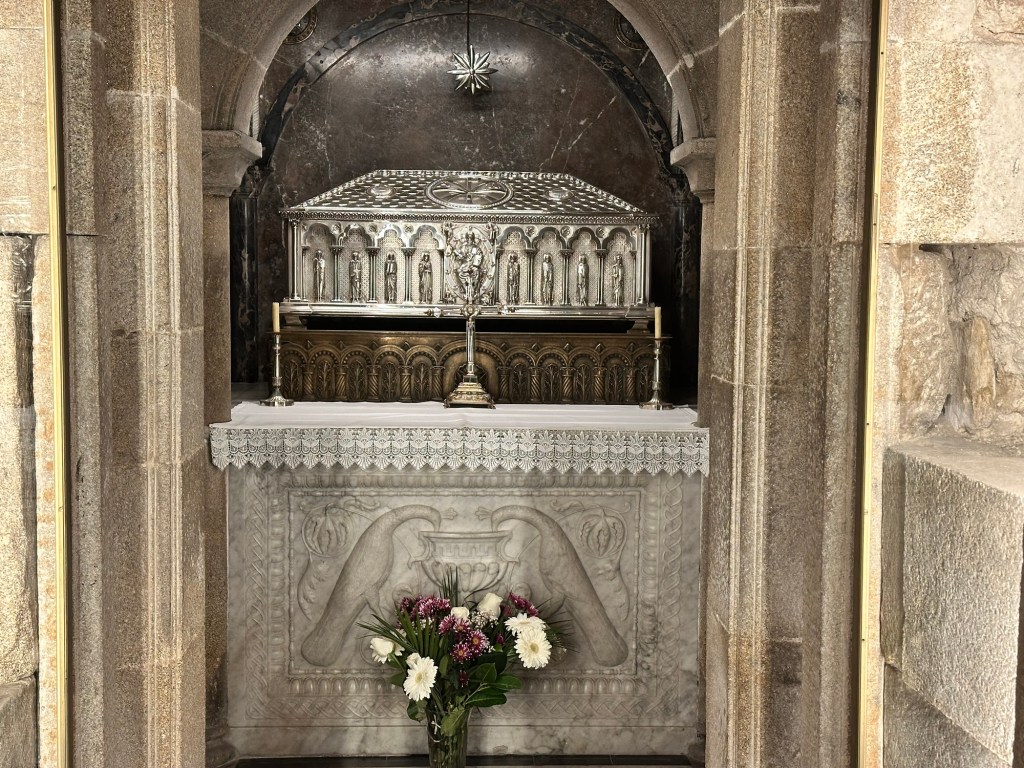
Fast forward a few centuries—today’s visitors can view this silver box that contains what the faithful believe is St James bones,

and can admire the cathedral’s beautiful interior.

My cell phone’s zoom isn’t very powerful, so I’ll describe the central image of the main altar. It’s St. James, riding a horse and brandishing a sword, which wasn’t exactly how the apostles were described in the Bible.

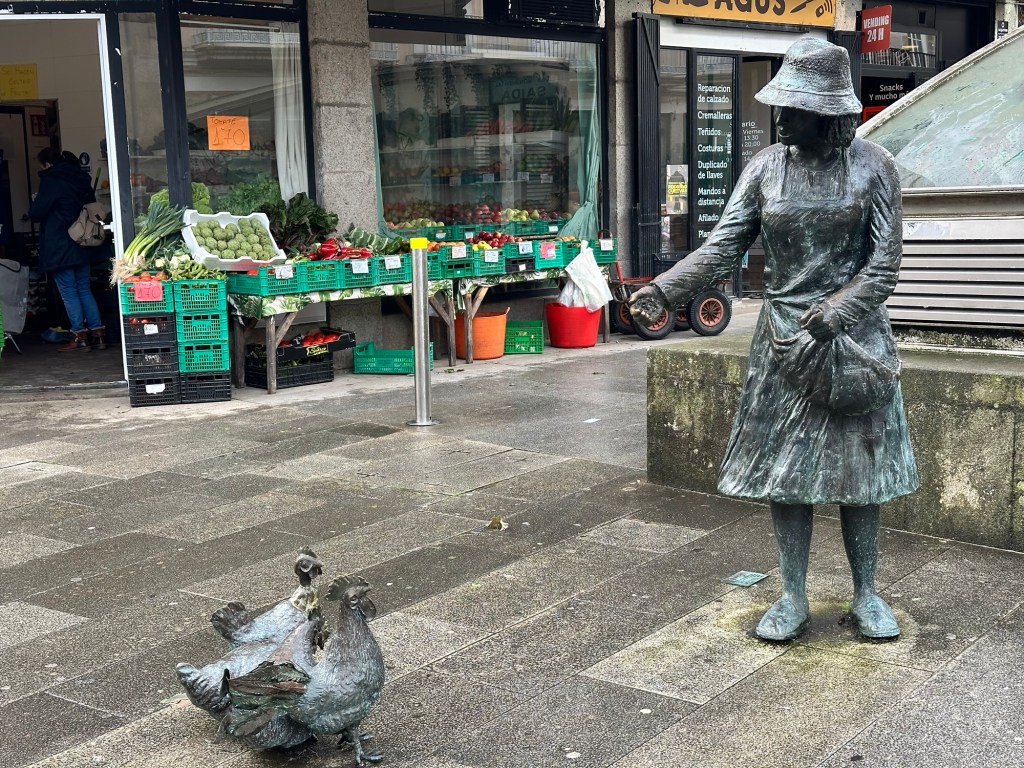
Santiago’s old town is a maze of narrow cobblestone streets, filled with restaurants, bars and souvenir shops, so after our first day in Santiago, I’d seen enough of the city. I welcomed the opportunity to spend the day in Pontevedra and Combarro on an optional trip OAT offered.

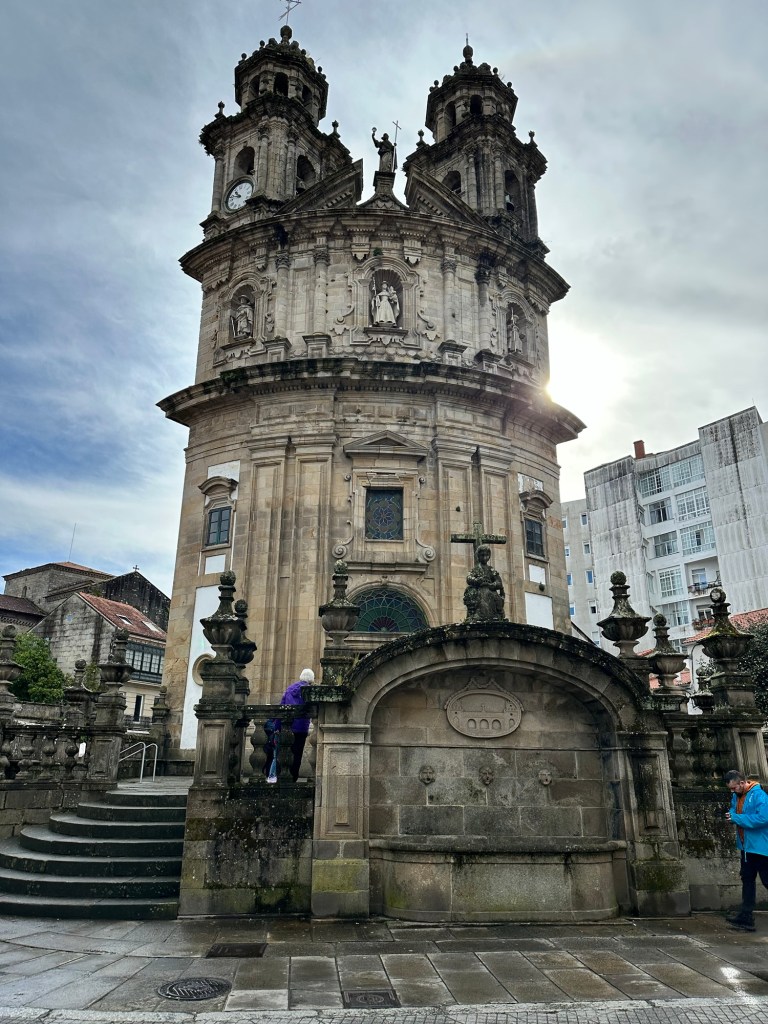
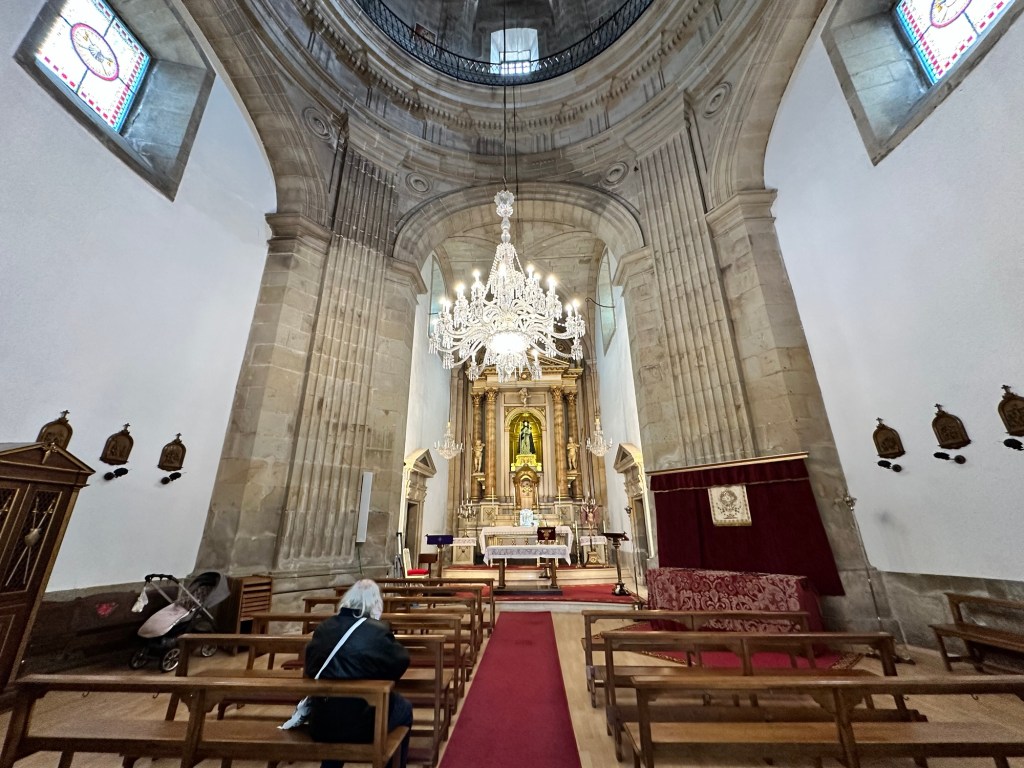
Pontevedra, founded by the Romans, gave us a break from the crowded streets of Santiago. It is also the site of an unusual church, with a floor shaped like a scallop shell. Or so I was told.

I’ll be honest. The church was clearly round, unlike any I’ve ever seen before. But I wasn’t able to pick up any resemblance to a scallop shell in the interior. Take a look. Maybe you’ll have better luck.

Despite the intermittent showers, it was a delightful day.

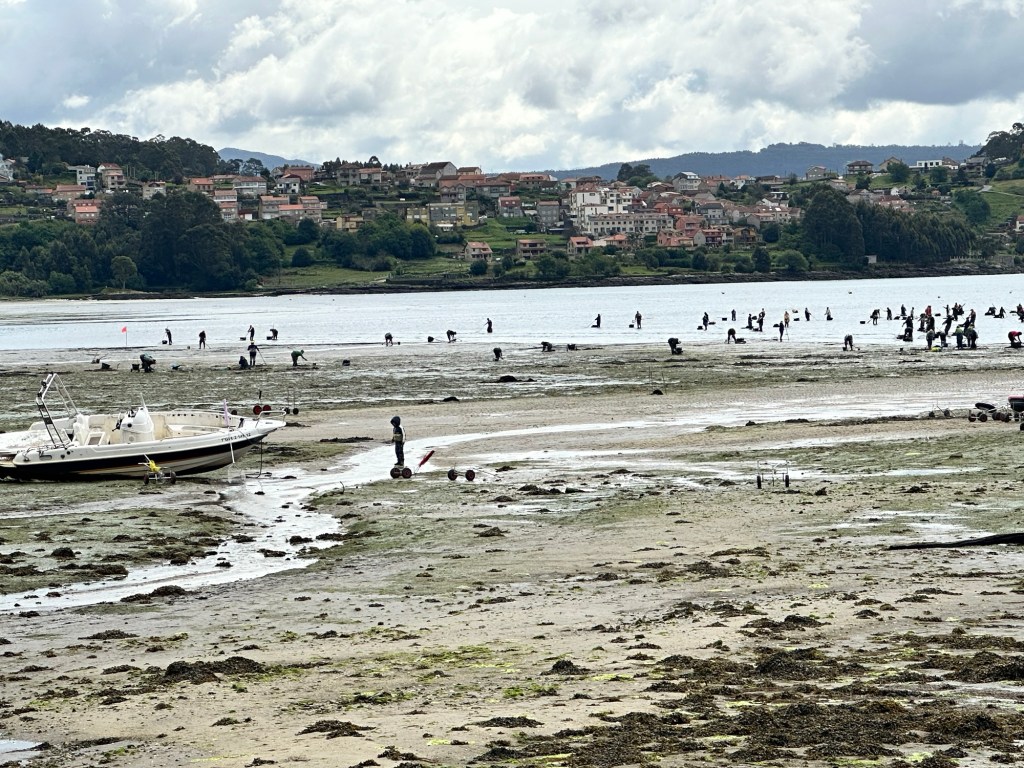
Combarro reminded me of Southeastern Massachusetts. I recall watching Sandy, my sister, digging up clams and quahogs with her toes in Mattapoisett bay.

Here in Combarro, it’s a highly regulated business, with strictly enforced limits on what can be harvested.

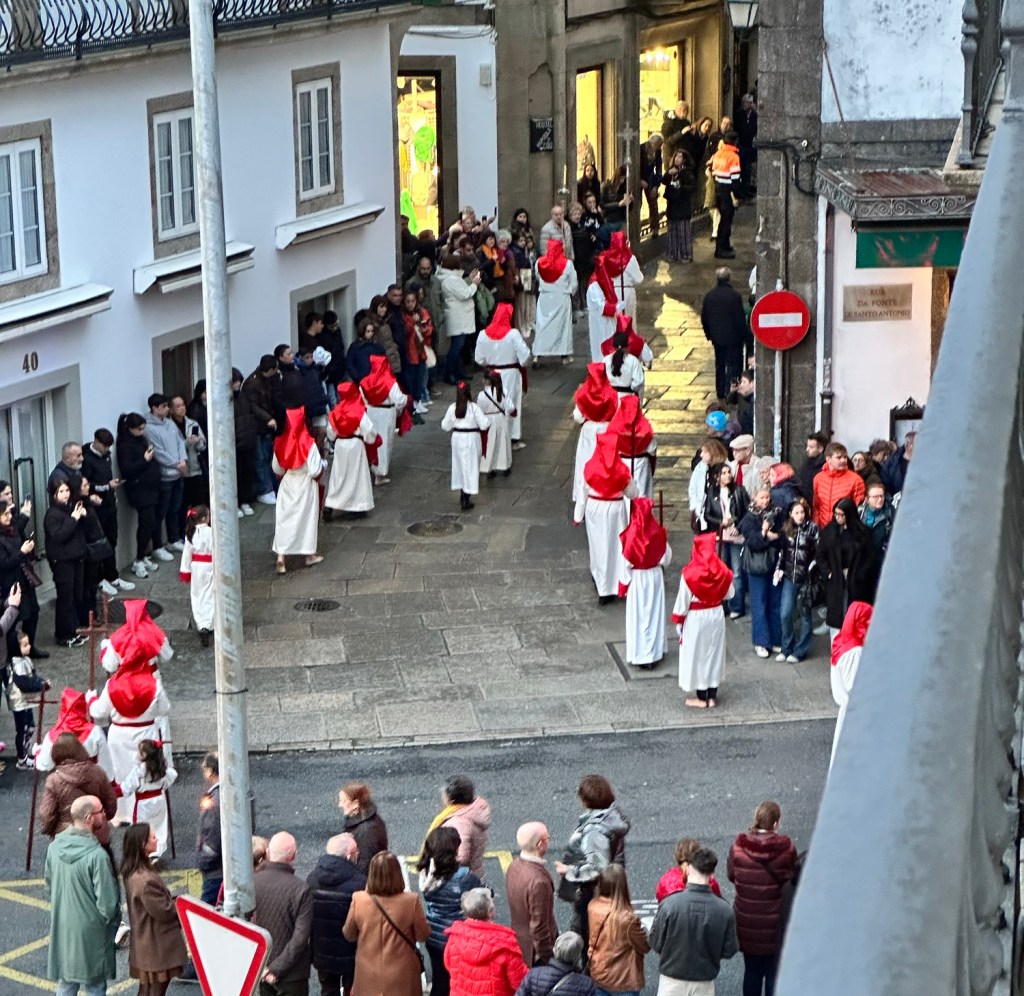
Our day ended with a pleasant surprise—a procession outside our hotel. I was already in my jammies, but when I heard the drums, I dashed onto my balcony to take this photo.

Fortunately, our trip leader was on the street and sent us a video.

Is it just me or does that statue of Jesus make it look like he needs a foundational garment?

Next stop, Portugal for 5 days, then home.
Street Art in Cuenca

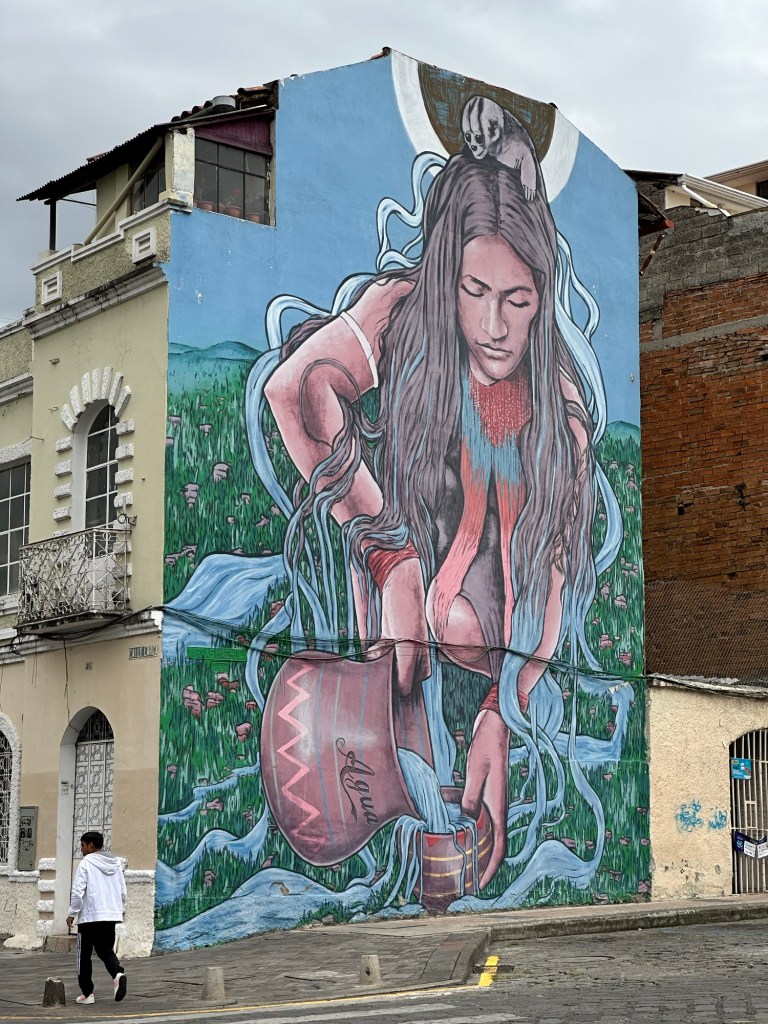
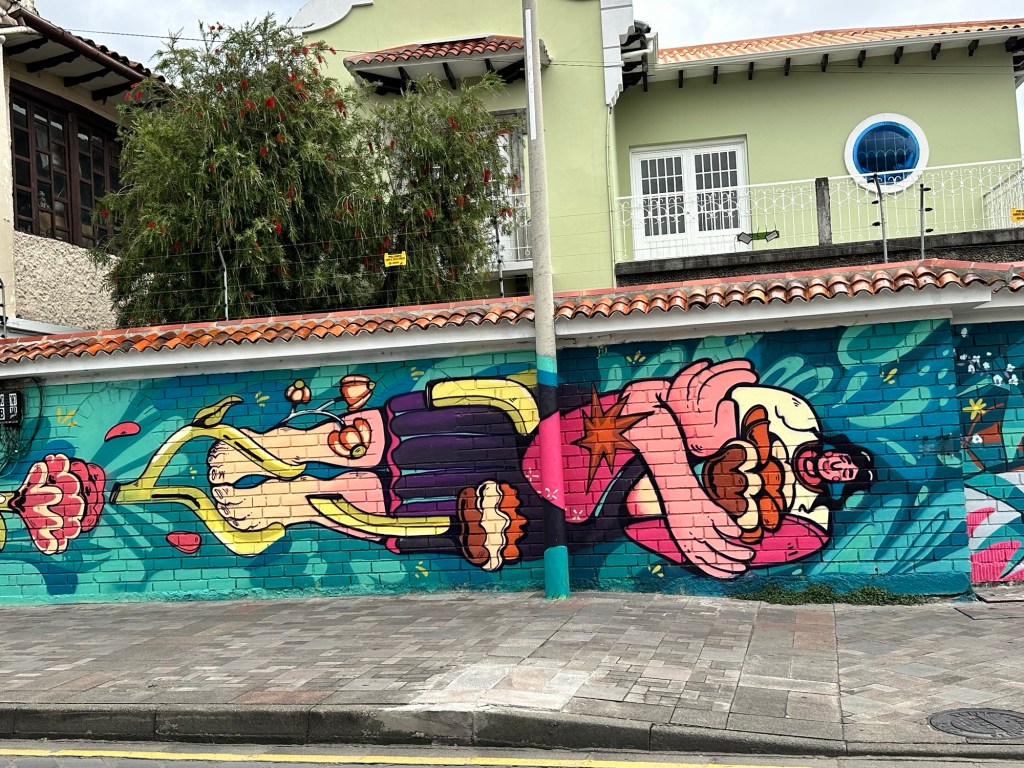
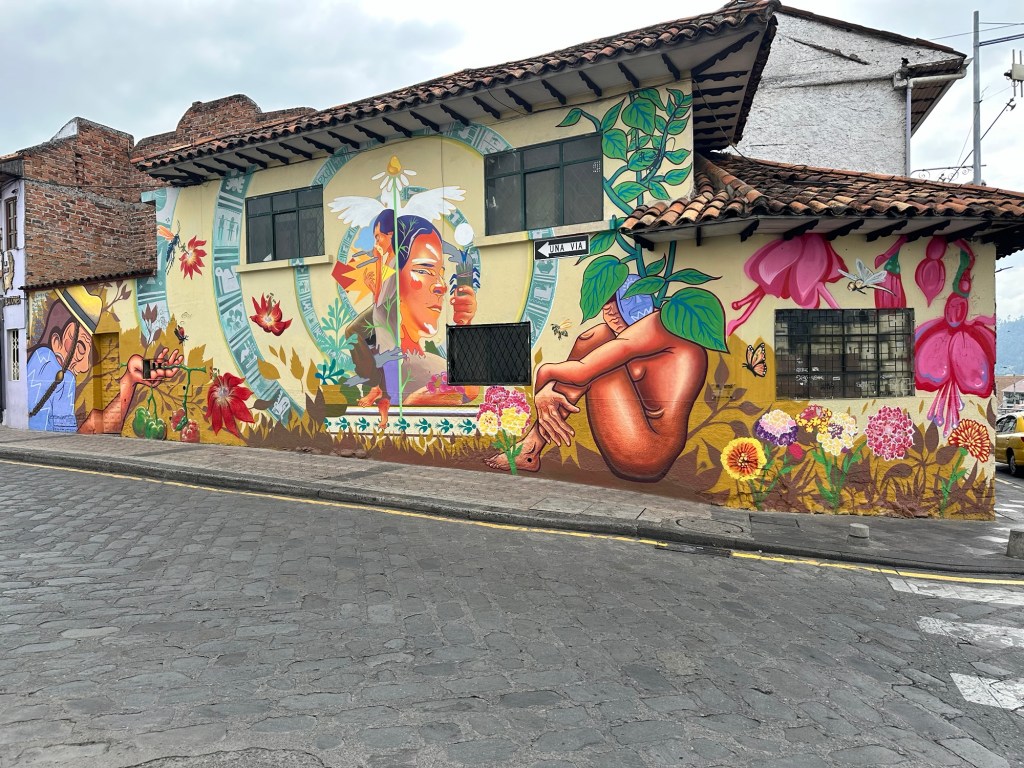
On our last day in Cuenca, we were free to spend the morning exploring on our own. I walked to the Pumapungo Museum, which is about a mile from the hotel, along La Calle Larga. I was wishing my buddy Elsie had taken the post trip with me, because she would have enjoyed the street art as much as I did. So Elsie, this one’s for you. No narrative, just visuals.

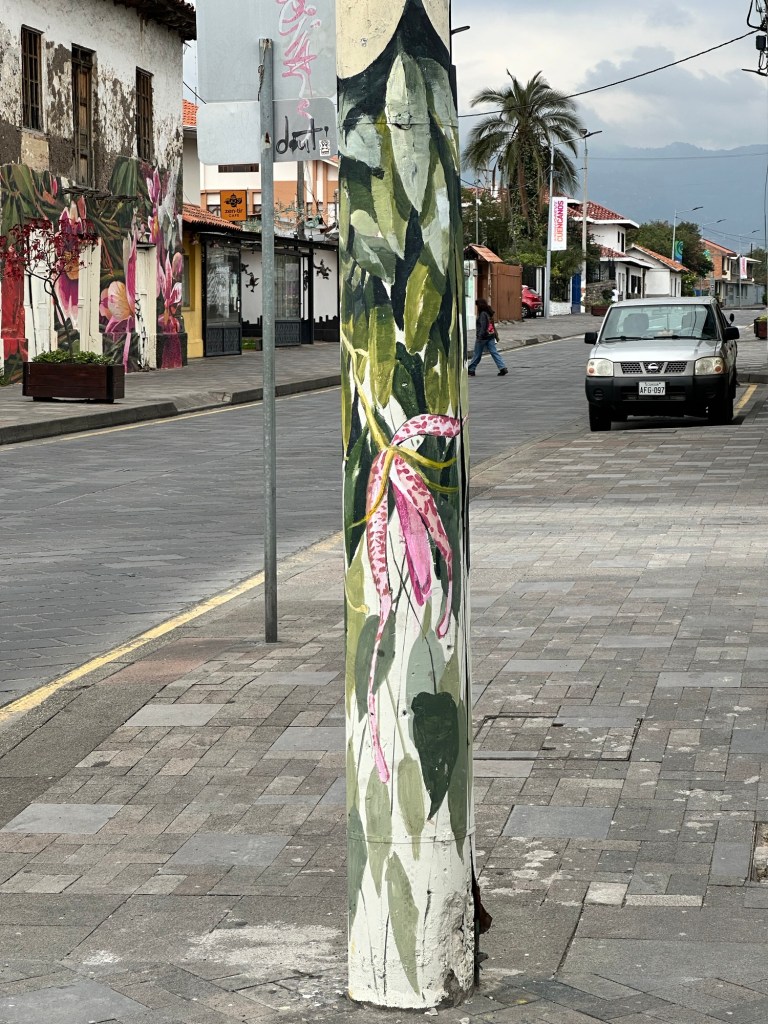
They even paint the poles!

I’m not sure why this art was defaced with graffiti. I thought there were rules.

Cartagena, Then and Now

I first visited Cartagena in 2010, when Mike, Greg and I took an Oceania cruise through the Panama Canal. I was immediately charmed by this fascinating city, and became determined to return to Cartagena and to explore more of Colombia.

For most of the ports, we opted to go off on our own, rather than take a cruise sponsored tour. That was the case in Cartagena, where we were able to cover most of the high points in the old city, during our too brief time in port.

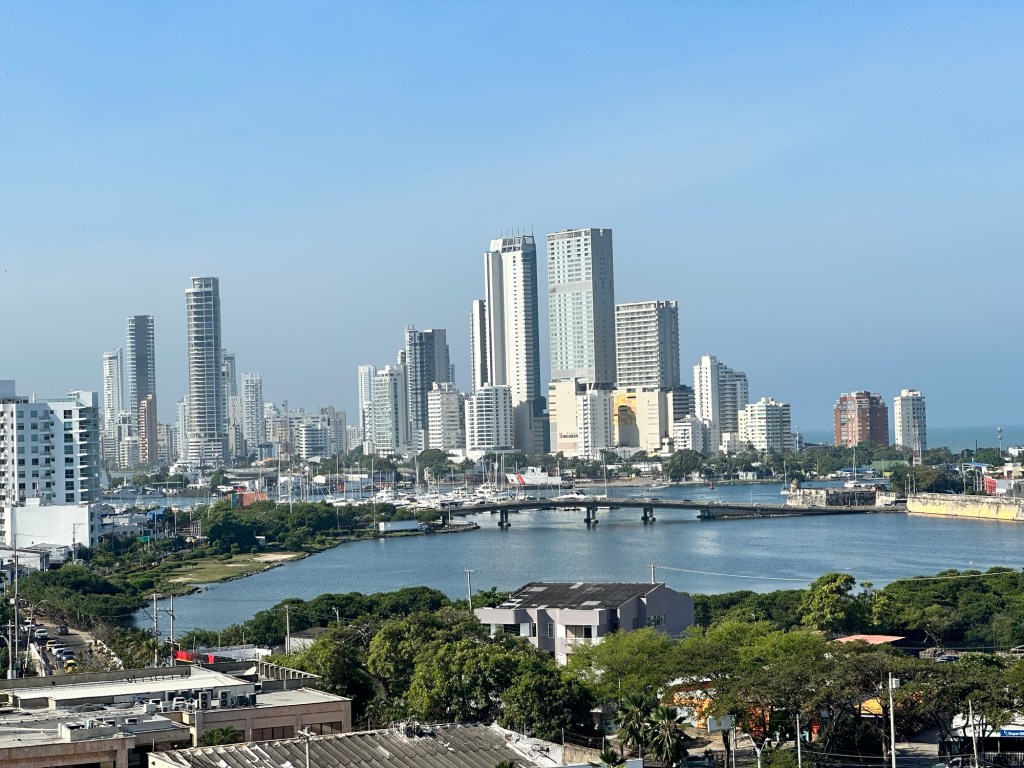
Here is what the “new” section of Cartagena looked like in 2010.

Fast forward to 2025. Both photos were taken from the enormous fort the Spaniards built to protect the area from pirates. Can you tell which photo was taken with a camera, and which was taken with my iPhone?

It is possible to travel from the top of the fort to the bottom through narrow, low tunnels. When we visited in 2010, we attempted to do just that, but as we approached the exit, our guide discovered it was flooded, so we had to walk ALL the way back to the top. Poor Mike was unable to stand upright!

I know many people have strong opinions about cruises versus land travel. It was interesting to experience both in the same city. Although vastly different, I discovered I thoroughly enjoyed both, but for very different reasons. As with everything in life, both travel modes have advantages.

When we cruised, we always opted for a smaller ship, chosen for its fabulous itinerary. Cruising allowed us to unpack once, travel while we slept and awaken someplace great every single day. It provided us with a taste of many different areas, so we could determine which country we might want to explore in more depth in the future. And, if you happened to get sick, or have an accident, the ship had a fully equipped medical center on board. But your time in port is limited; you normally have to be back aboard the ship around 5PM, unless you chose a cruise that spent more than one night in a particular port. And there ain’t many of those.

For the OAT land trip, we spent three nights in Cartagena, which allowed us to slow down and savor our time there . We saw SOME of the areas we visited on our whirlwind day in 2010, like the former convent of the Sisters of the Poor Clares, but instead of just driving by it, Leslie ( another new friend) and I went to the bar to watch the sunset.

Those of you who read my pre-trip post may recall the special drinks and the tours of the former convent described on the hotel’s website. Well, although getting lost while searching for the rooftop bar allowed us to see a whole lot of the convent, it certainly didn’t qualify as a tour (they don’t give them any more), and although my pisco sour was delicious, it didn’t have what the website called “magical” properties.

What the rooftop bar DID have was a DJ, and lots of young people, staring at their phones.

So, we took our sunset photos, admired the view, and that pisco sour? It was consumed in a quiet, “historical” bar on the first floor.

The view of the ocean, and the only spot at the bar from which you can see the sunset.

Remember the popular image of Colombia as a dangerous place? Well, Leslie and I were perfectly comfortable walking the streets at night and when he noticed we were hopelessly lost, this sweet young Colombian approached us, offered help and walked us back to our hotel.

This was a very common experience: a waitress chased me down the street because I had left my hat in the restaurant, street vendors accepted your “no, gracias” when they approached you, but then engaged you in conversation so they could practice speaking English. Everyone we encountered was friendly, gracious and oh so welcoming.

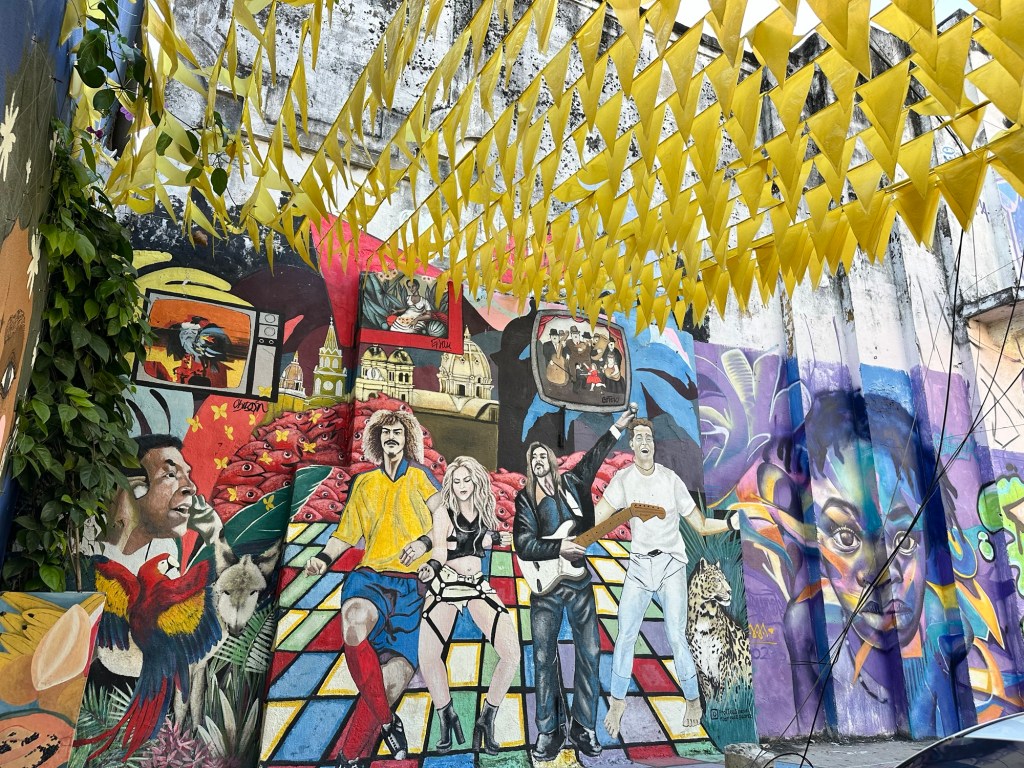
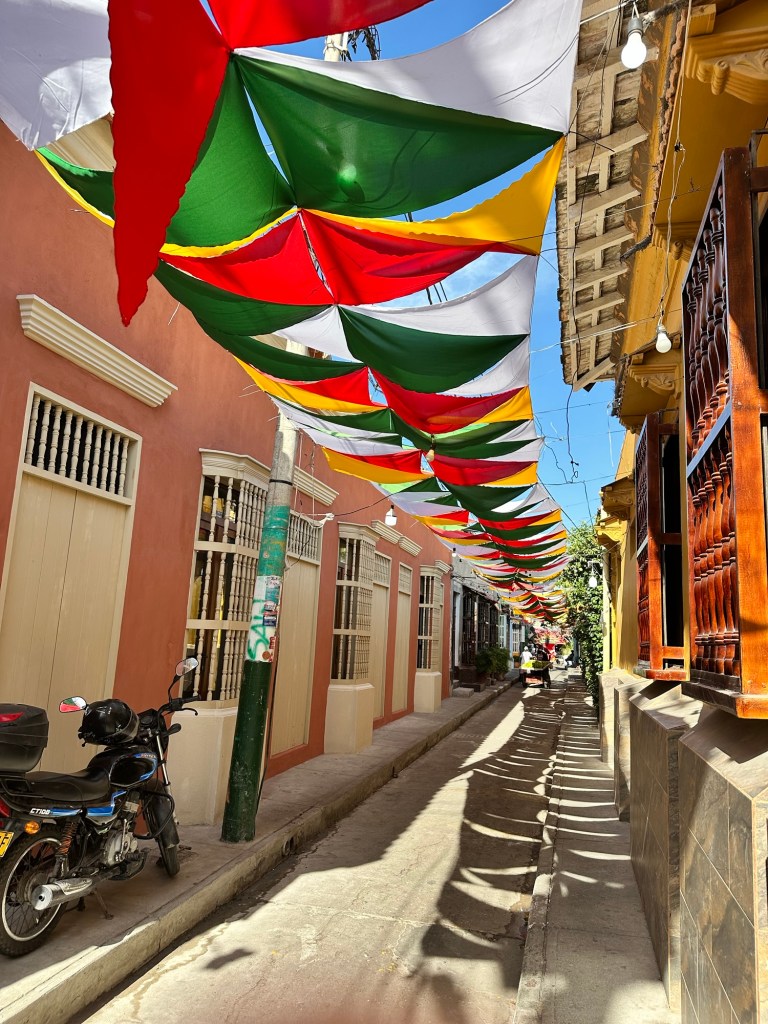
As you have seen in my earlier posts, the streets of Colombia are very colorful , and Cartagena is no exception.

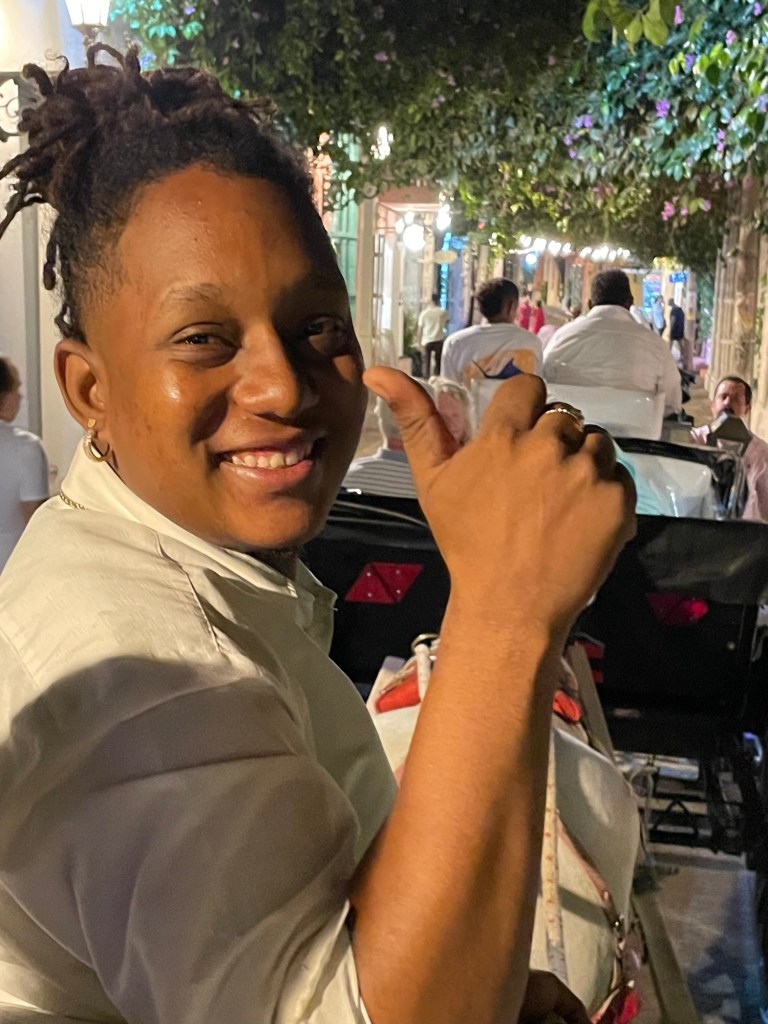
The woman in the black leather “bondage” outfit is Shakira, who has an apartment in Cartagena, overlooking the ocean. Our carriage driver pointed it out as we rode along the ocean on our way to our farewell dinner. He also claimed he was Shakira’s novio ( boyfriend— see, those Spanish lessons DID come in handy!)

Did you know that Colombia was the inspiration for Disney’s movie, Encanto? I sure didn’t.

Sorry, the sun was in the wrong spot when I took this photo. Anyone who saw the movie will recognize the cartoon character immortalized on the wall, but did you know her image was based on an actual resident of Colombia?

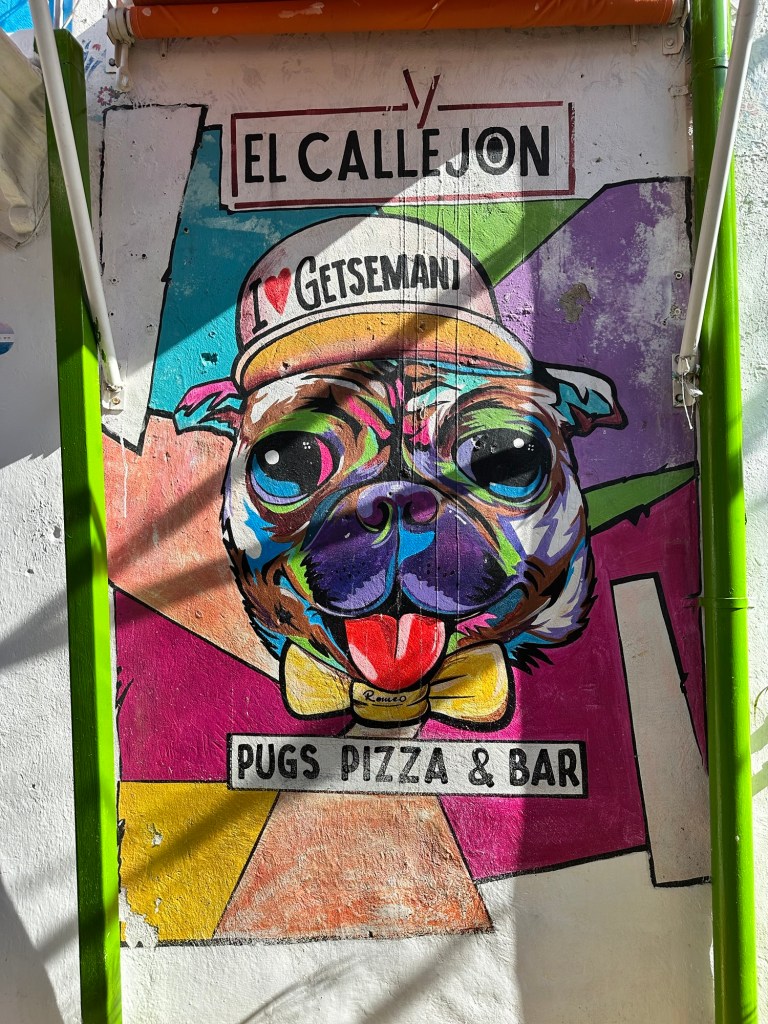
There was so much to see in the neighborhood of Getsemaní, I had difficulty choosing the most compelling street image, so I decided to include several.

During our trip we experienced MANY different modes of transportation- boats, metro system, cable cars, jeeps, tuk tuks and best of all, the PARTY bus,

which came fully equipped with live music, so we were serenaded all the way to Bocavilla, an African Colombian community located on the beach.

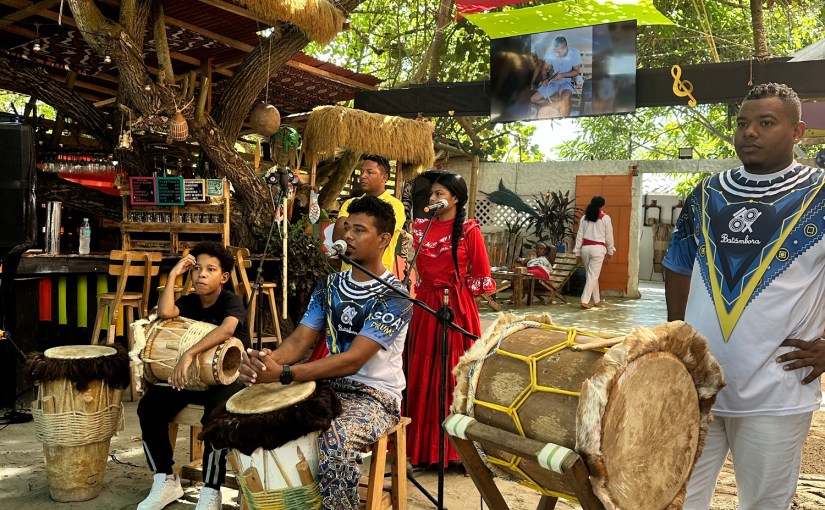
Our musicians played European, African and Caribbean instruments

While in Bocavilla, we had drumming and dance lessons which were SO much fun! The musicians and dancers were students at a school established to preserve their African/Caribbean culture.

Seven of us are at the airport heading off to Quito for a week in Ecuador, so it’s time to press publish and hope for the best.