Okay, this post is for those of us who might not have paid a whole lot of attention in World History class. I say “us” because I clearly had other things on my mind (boys? My hair? ) while we were learning about battles and trenches and bombs.
But it’s never too late to learn, so we can all play catch up together.
Bayeux, which I had never heard of until this trip, is a charming little town with beautifully preserved Medieval buildings. The inhabitants got word to the Allies, after the Normandy invasion, that all the Germans had evacuated, so the town was never bombed during World War Two.
Its proximity to the beaches of Normandy meant that Bayeux was the first town to be liberated by the Allies, and served as the capital of France until Paris was freed.
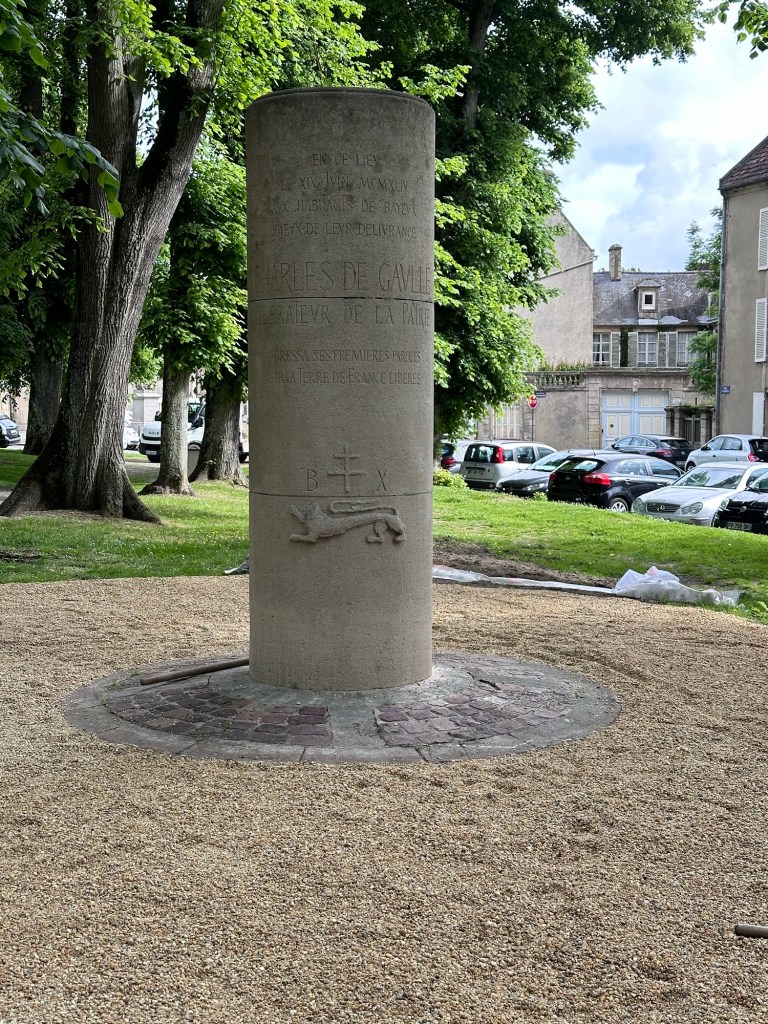
Charles DeGaulle gave his first speech on the soil of Free France in this Bayeux Park.
To celebrate the 80th anniversary of D Day, many of the store fronts in the town were painted with these colorful murals.
I know conventional wisdom claims that the French are unfriendly, but that certainty has not been my experience, at least so far. American flags are EVERYWHERE.
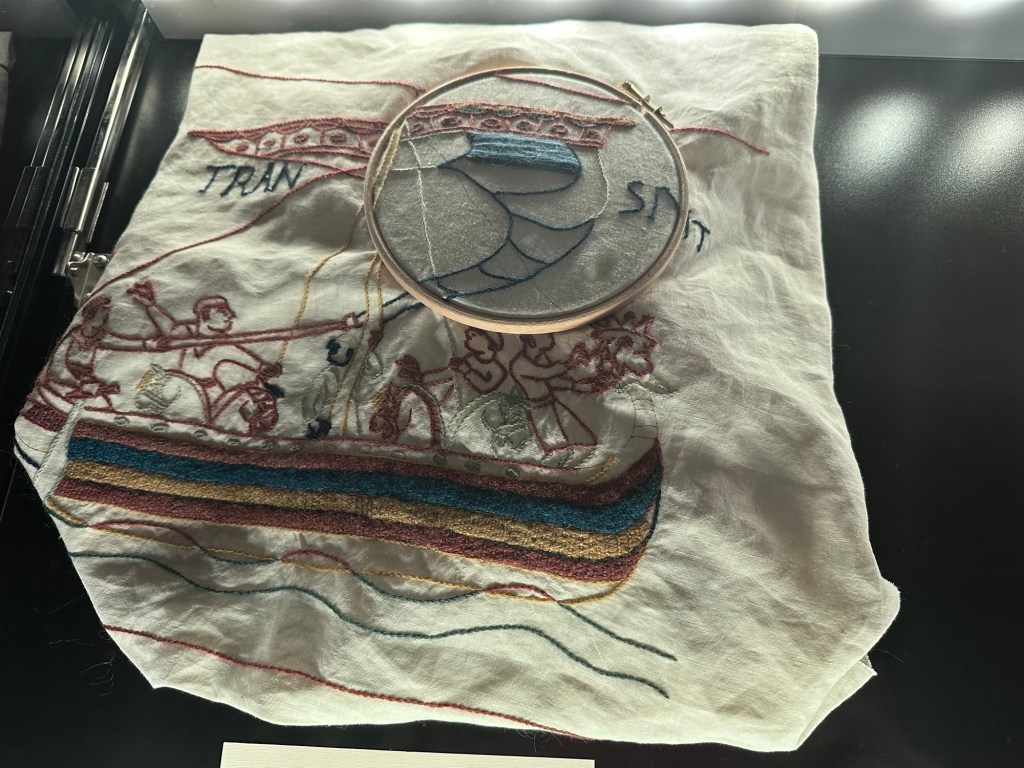
Another of Bayeux’s claim to fame is their “tapestry” ( actually an embroidery) on linen which stretches for 70 meters (or about 230 feet.)
It tells the story of how William “the bastard” became William “the conqueror”, which, of course, required lots of dead bodies.
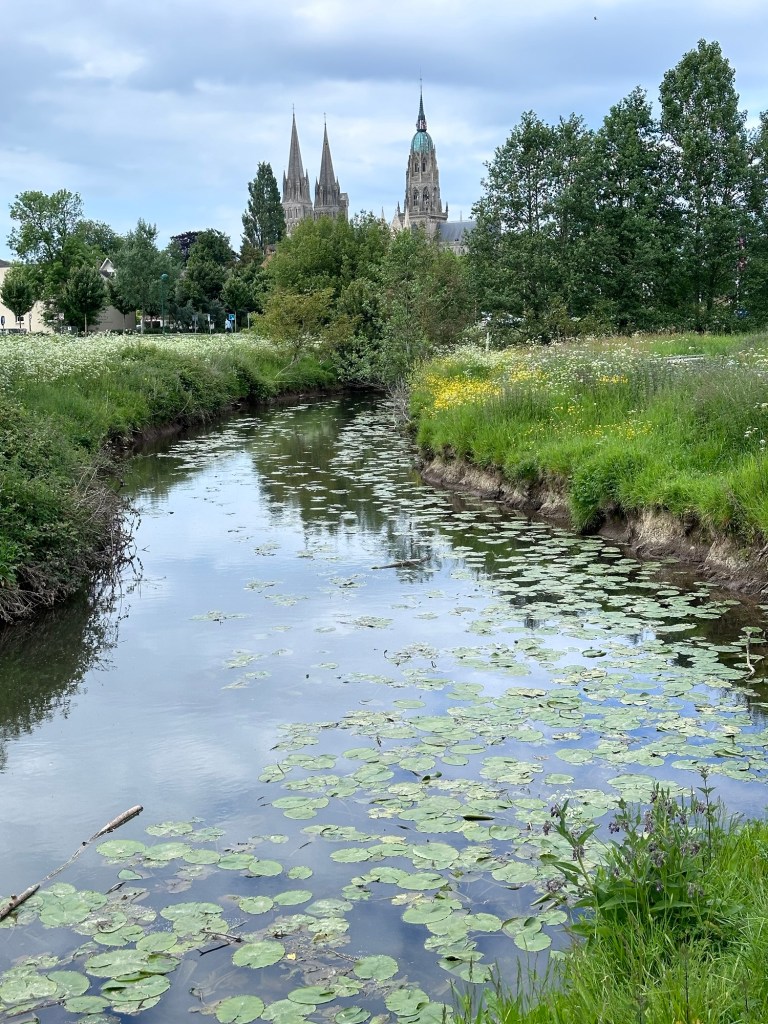
When I was a college student in Boston, the Citgo sign above Kenmore Square always helped me find my way home. The Bayeux cathedral performed a similar function.
Thanks to that landmark, I was able to wander freely, knowing I would eventually find my way back.
The cathedral, After D dayToday
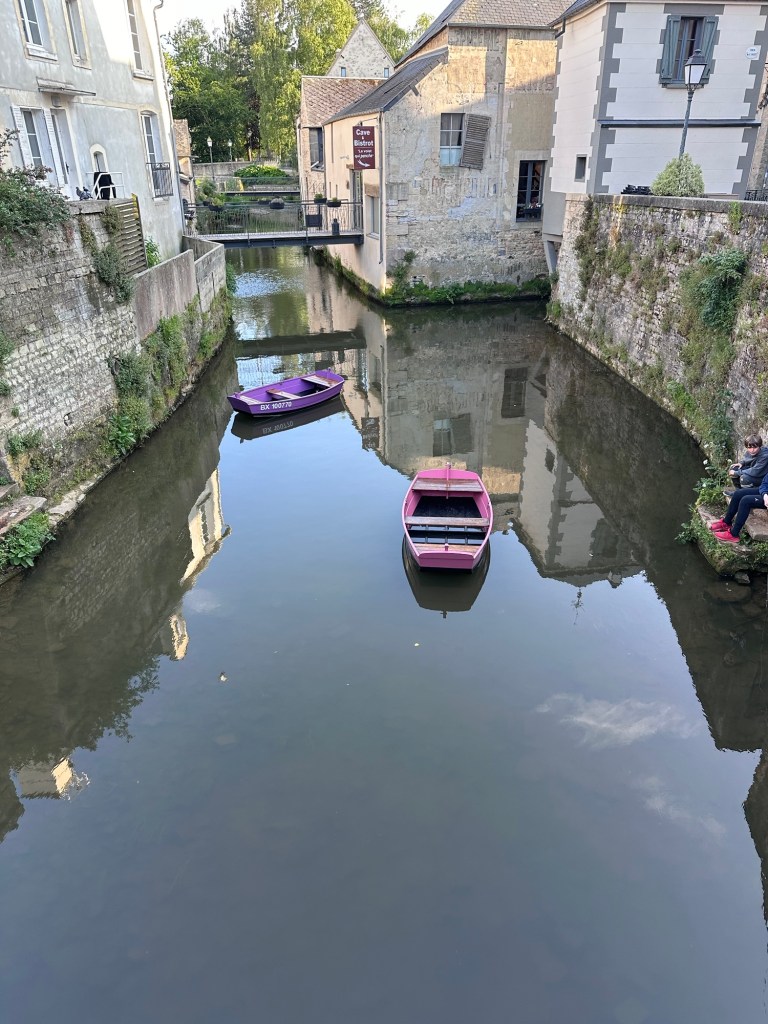
It stayed light in Bayeux till almost 10 PM, which allowed us to take long evening walks along the river’s banks.
Photo taken just a little before 8 PM
I’m so grateful to have spent three days in this wonderful little town!
I was totally surprised by how much I am loving OAT’s pre-trip to Fontainebleau and Bayeux. We spend three nights in each place, at centrally located hotels. Both are very walkable, and the best part? Even I haven’t gotten lost!
Obviously, the draw for Fontainebleau is the chateau. One of many royal residences, it is the biggest, with 1,500 VERY ornate rooms spread over three floors. Just about every square inch of the areas open to the public —parts of the first and second floors of the main building — is completely covered with some form of art work.
Check out the chateau’s floor plan: you walk THROUGH each room to get to the next. This was similar to the design of Schonbrunn, the Hapsburg’s summer palace in Vienna. I guess royalty didn’t mind a lack of privacy. Yes, there are huge doors on either side of the room, but think about this: What happens if you need to get to a room, but the door to the room before it is closed? Do you have to go all the way around? Those hallways are really, really LONG!
Take a look at Napoleon’s second wife’s bedroom—Marie Louise, the Austrian princess he married after he dumped Josephine. You see that railing around the bed? No one was allowed inside the railing, without her permission. I guess the doors weren’t enough.
Napoleon’s bedroom was a few rooms down from Marie Louise’s. His was the only one of the MANY beds I saw that had steps along side it. Was the precursor of today’s doggie stairs?
The library was my favorite room.
Are you wondering how people were able to find each other? They didn’t have intercoms or cell phones, which is probably a good thing. I have enough trouble finding mine and I have 1,490 fewer rooms.
One last room before we head outside: the ballroom. Notice the balcony at the back. I’ll bet that’s where the moms sat so they could keep an eye on their daughters. The alcoves, I suspect, was where the ladies sat, waiting to be asked to dance.
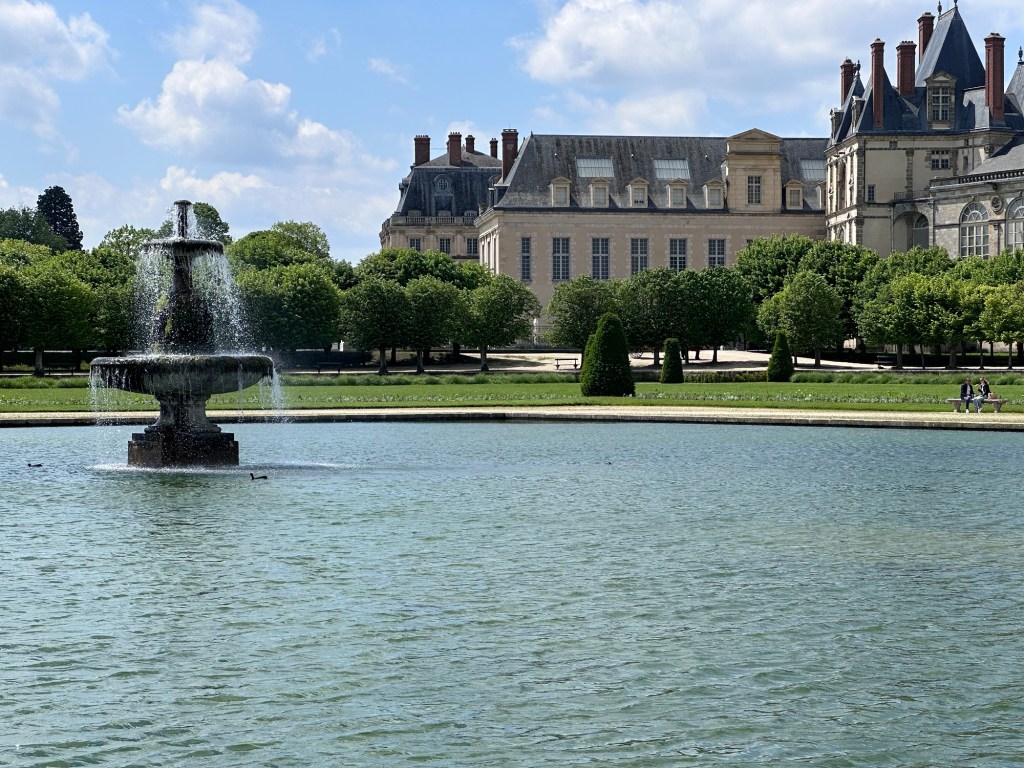
Although the weather report predicted rain, we were unbelievably lucky to have perfect weather, which allowed me to thoroughly enjoy the wonderful grounds surrounding the chateau.
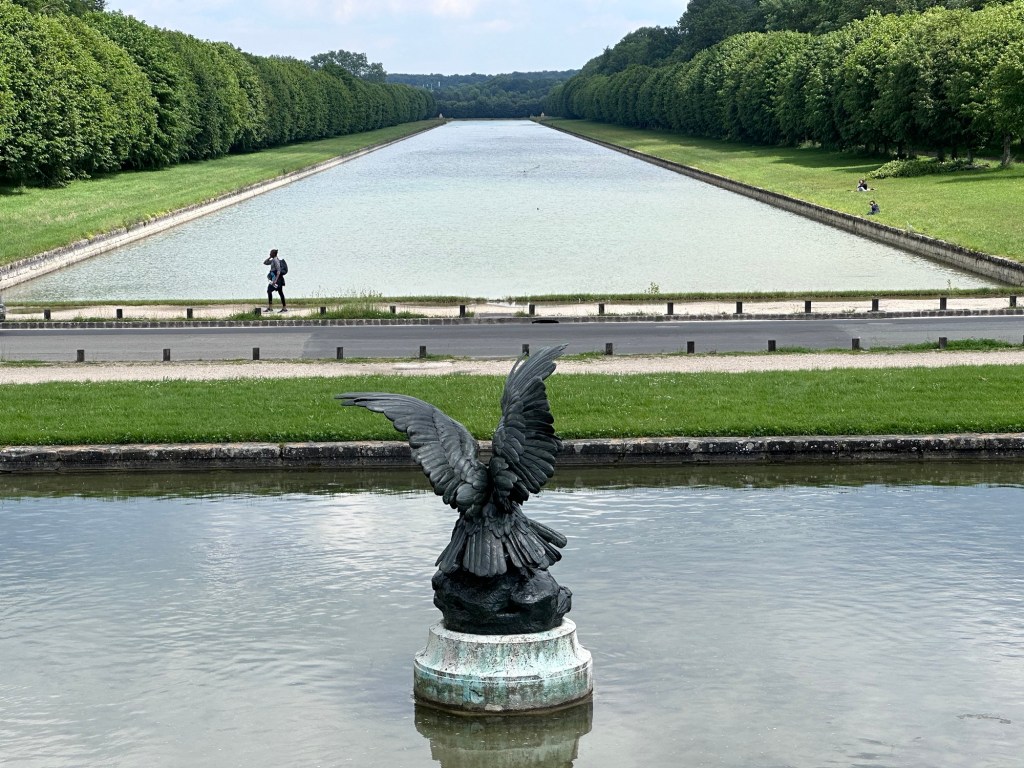
The gardens stretch as far as I could see, until they reach the forest.
After all that opulence and sensory overload, the serenity of the English and French gardens provided a needed respite.
I loved the whimsical statues scattered throughout the gardens.
This, I was told, is a sphinx. It was quite unlike anything I’d seen in Egypt, but our guide explained that the French take inspiration from other countries, then add their own touches.
Garry took the group photo of Marie, Susan, me, Jim and James. Donna and Kathy didn’t join us during our free afternoon.
On the drive to Bayeux, we stopped at Giverny, home of Claude Monet. Like Barbizon, it is a tiny village that art enthusiasts visit. Unlike Barbizon, it was really crowded.
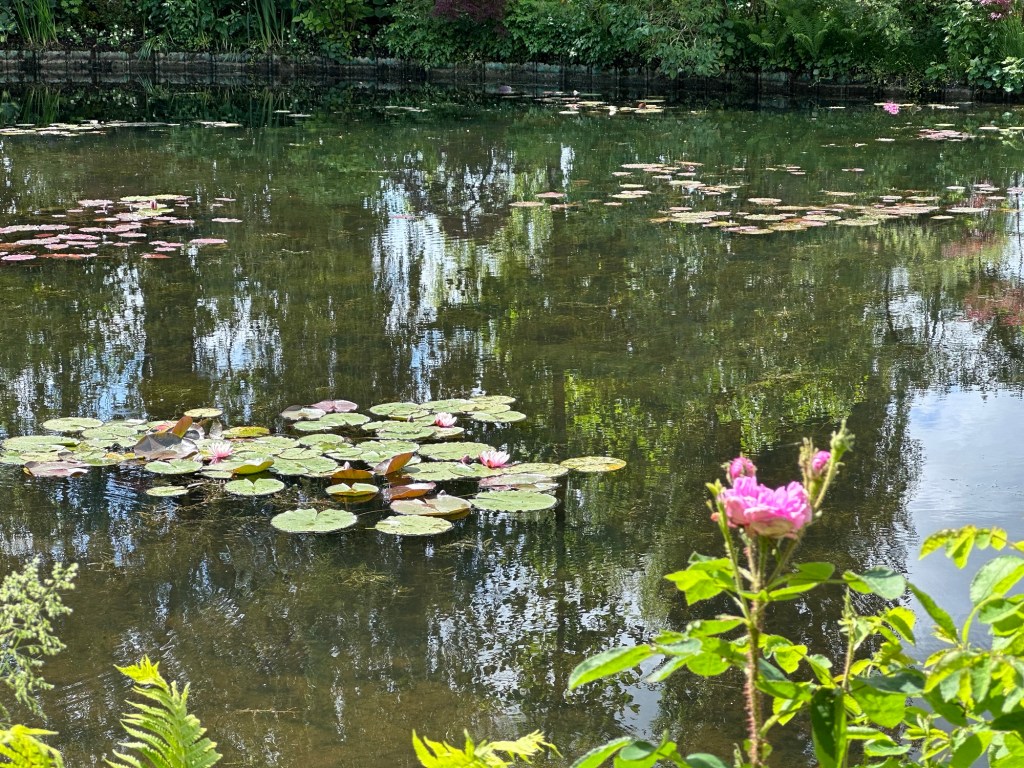
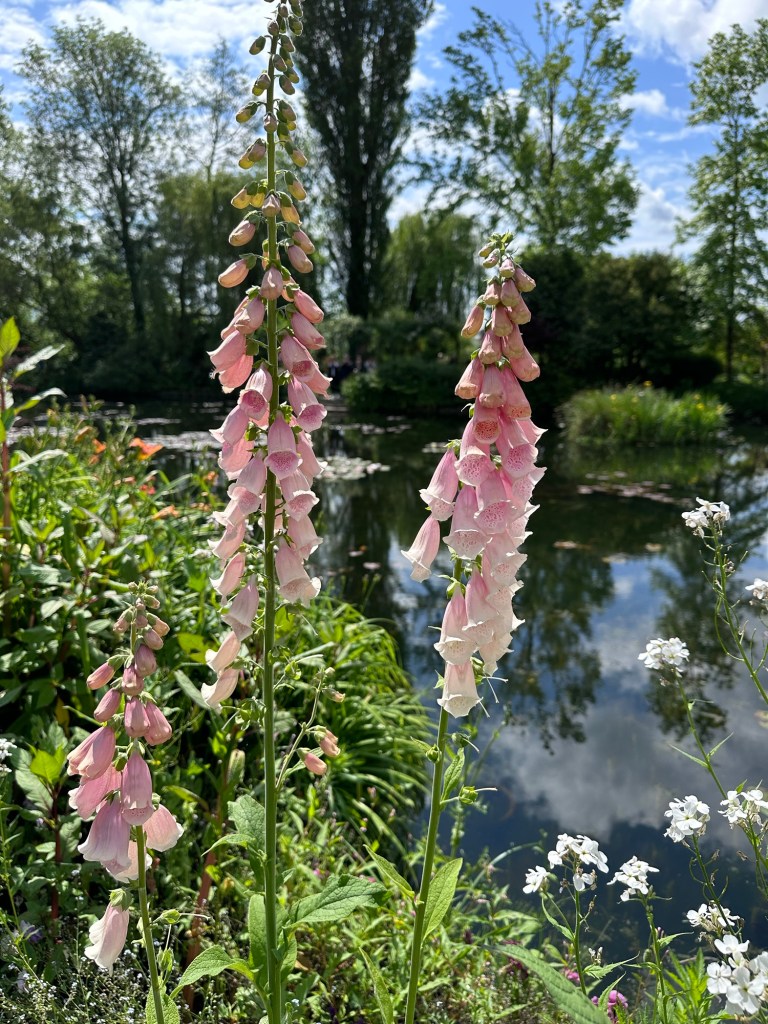
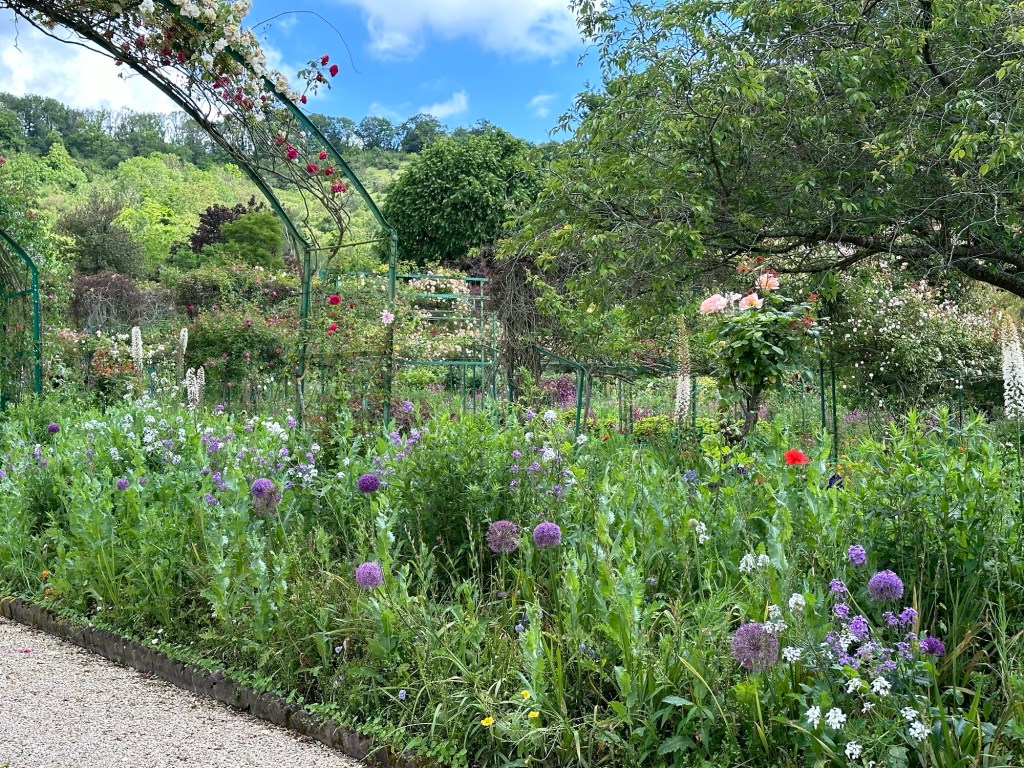
Although it was too early in the season for many water lilies to be in bloom, there were plenty of other gorgeous perennials to enjoy.
It is easy to see where Monet found inspiration for his art.
After enjoying the lily pond and the gardens, we were able to tour Monet’s home.
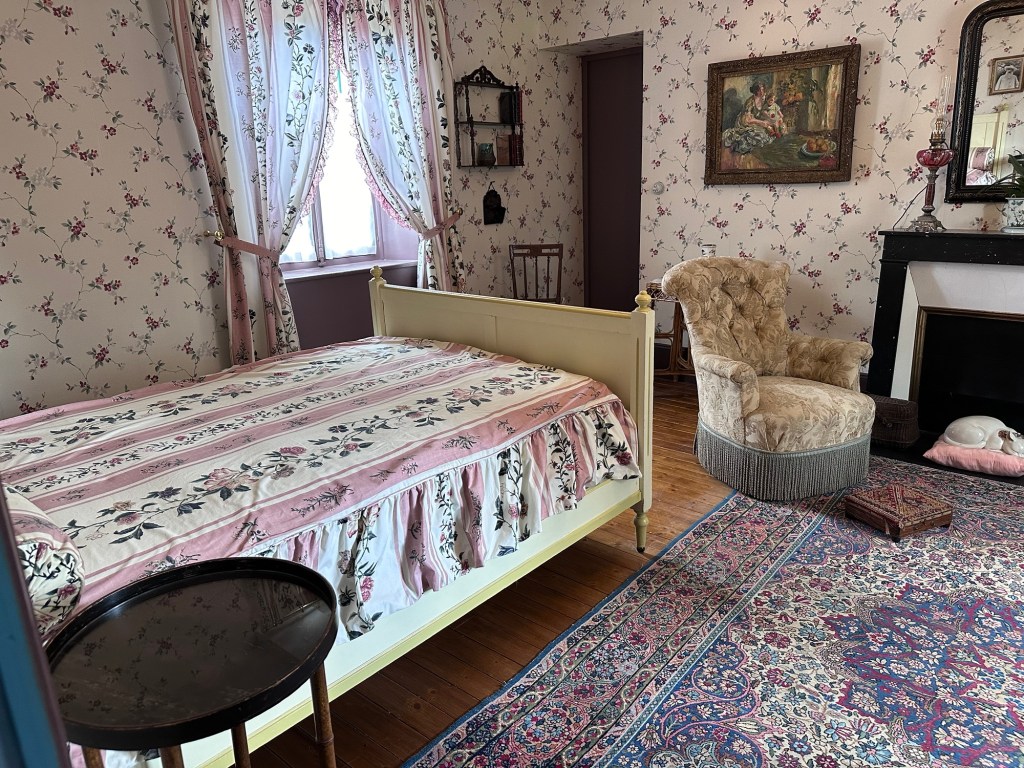
Like Fontainebleau, the walls were covered with artwork.
For some reason, however, I didn’t find the artwork overwhelming.
Clearly, I prefer the simple life. I’d much rather wake up in a bedroom like Monet’s than any of the ones I saw in Fontainebleau!
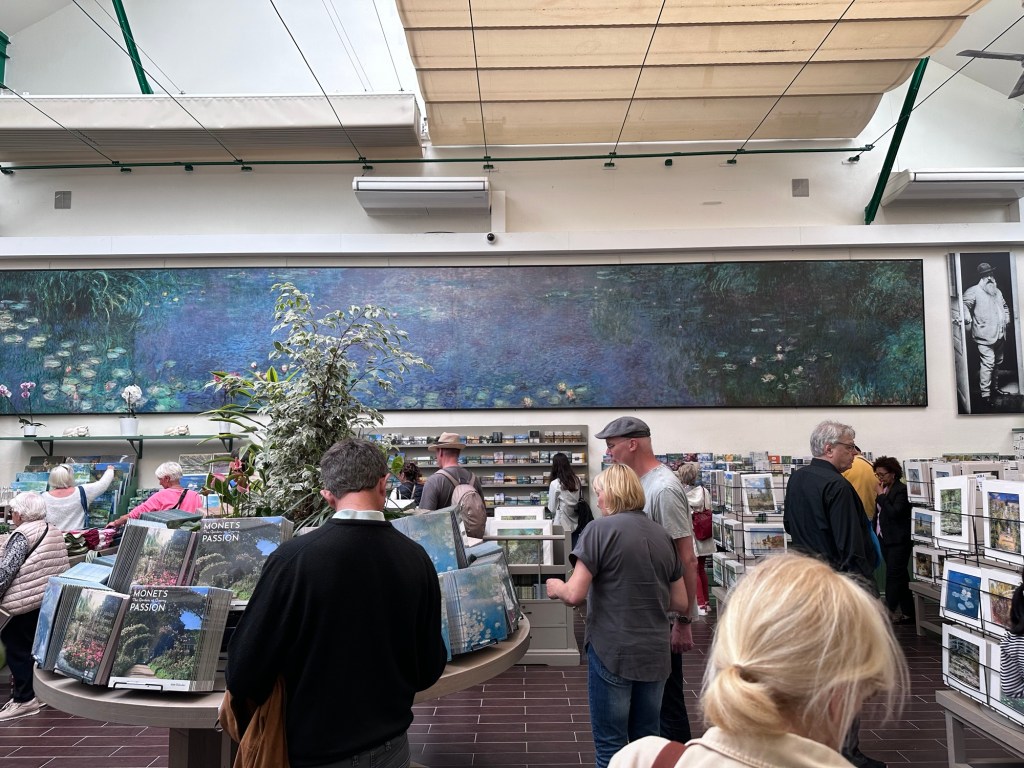
Monet’s studio is now the gift shop. It was huge, with lots of natural light. Reproductions of his water lilies were stretched across two of the walls.
Some people join bereavement groups. Me, I travel. As you can see from the map, this OAT trip’s itinerary will include Paris, of course, but there’s a whole lot more, including places I’d never heard of before. The last time I was in Paris was in 1976 while Mike and I were traveling through Europe on our honeymoon, so this return will undoubtedly be bittersweet.
There are 8 of us on the pre-trip to Fontainebleau; we will meet up with the remaining 8 in 6 days when we start the main trip in Angers.
I was surprised to discover the flight cost for business class was only a couple of hundred dollars more than economy plus. I’m never going to figure out airline pricing! Booking on my own, rather than thru OAT was more than $2,000 cheaper! Sometimes that happens. Ah, the power of the internet.
It was well worth $200+ to choose business over economy plus, just to have a single seat with window on one side and aisle on the other. No climbing over, to get to the bathroom, from my lay flat bed. The additional benefit is luggage is tagged “priority”, so it is among the first to be taken off the plane. Although normally I try to do carry on only, this will be my first trip with a CPAP machine, so I decided to pack it in my duffle, take additional clothes and not worry about laundry during the trip. I couldn’t believe how quickly both my luggage and I were off the plane. We landed at 7:45 AM and I was thru passport control, in the taxi, leaving the airport by 8:30. That’s even including the time I stopped to brush my teeth!
After the 13 hour flights to and from Japan, I expected the seven and a half hour flight to be easy. And it was. Still, I’m taking it slower than I did in my younger days to adjust to the 6 hour time difference.
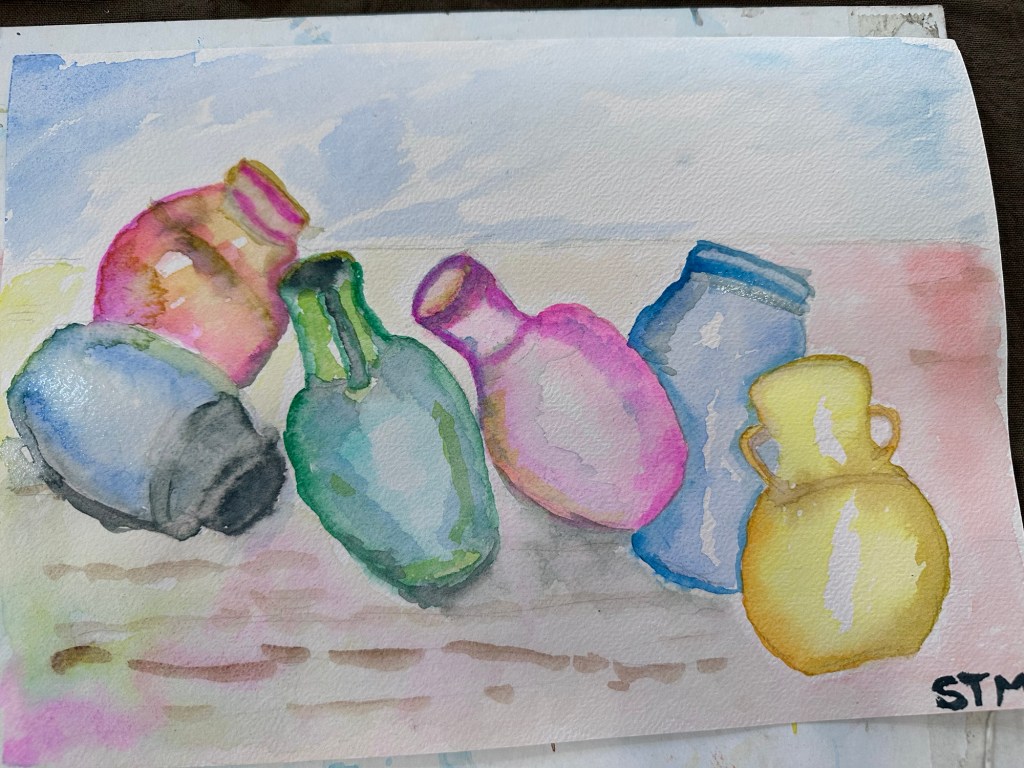
We started our first full day of the pre-trip in Barbizon, with a watercolor lesson. Patricia, our teacher, very kindly declared our efforts were “tres bien”. (She didn’t add “for a bunch of first graders’, but I’ll bet she thought it). But that’s okay. We all had great fun.
I’ve decided my two masterpieces are definitely refrigerator-worthy. If asked, I’ll just say my son did them when he was seven.
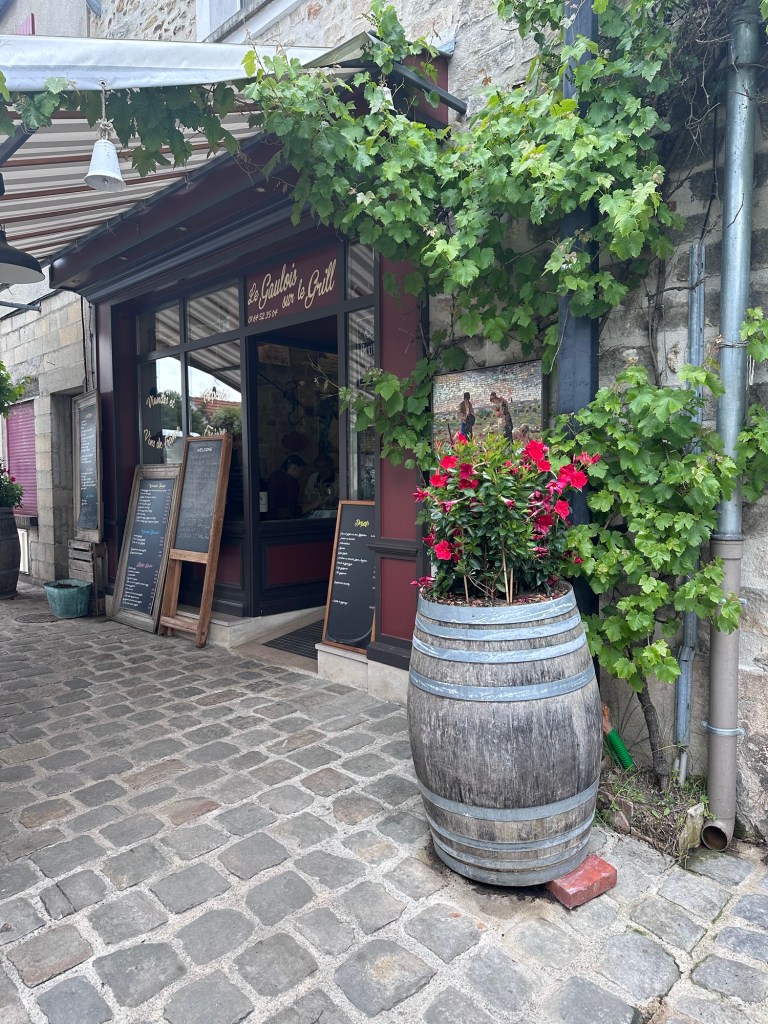
I found the tiny town of Barbizon completely charming— full of architecturally interesting buildings and art where you’d least expect to see it. Mounted on many of the buildings, for example, were mosaics of famous paintings, like “the Angelus” by Millet
The lunch placeWhat sculptors do when a tree dies
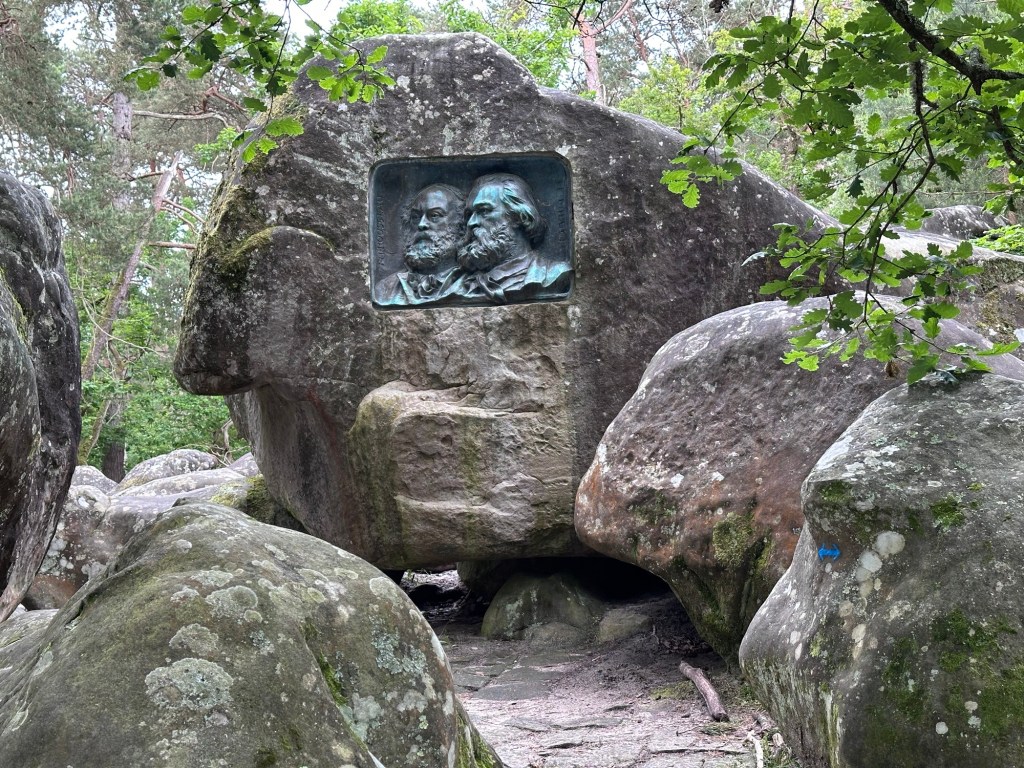
Our post lunch stroll took us through the forest where the painters would hang out, waiting for inspiration to strike. Clearly it did, otherwise they wouldn’t have gotten this honorary plaque attached to one of the forest’s many boulders. (That’s Millet and Rousseau, in case you’re wondering).
My favorite rock formation, however, was this naturally occurring one — can you see the elephant?
We had a few minutes before our taxi picked us up to return us to our hotel in Fontainebleau, so we took a quick turn thru a nearby sculpture garden. It wasn’t as grand as Hakone’s Open Air Museum, but then, what is? Still, these pieces are pretty delightful!
After returning to the hotel, Marie, our trip leader, had a final surprise for us. We gathered in the lobby to experience the impressionists’ favorite drink, (and supposedly the cause of some of their mental problems, )Absinthe.
You don’t just dump absinthe into a glass. Oh no. There is a process. You carefully pour the liquor into an ice filled glass, next placing a sugar cube (like so) upon a specially designed spoon, then slowly pour cold water on the sugar cube so that it dissolves and seeps through the spoon’s holes into the drink. I enjoyed the experience, but red wine is still my beverage of choice.
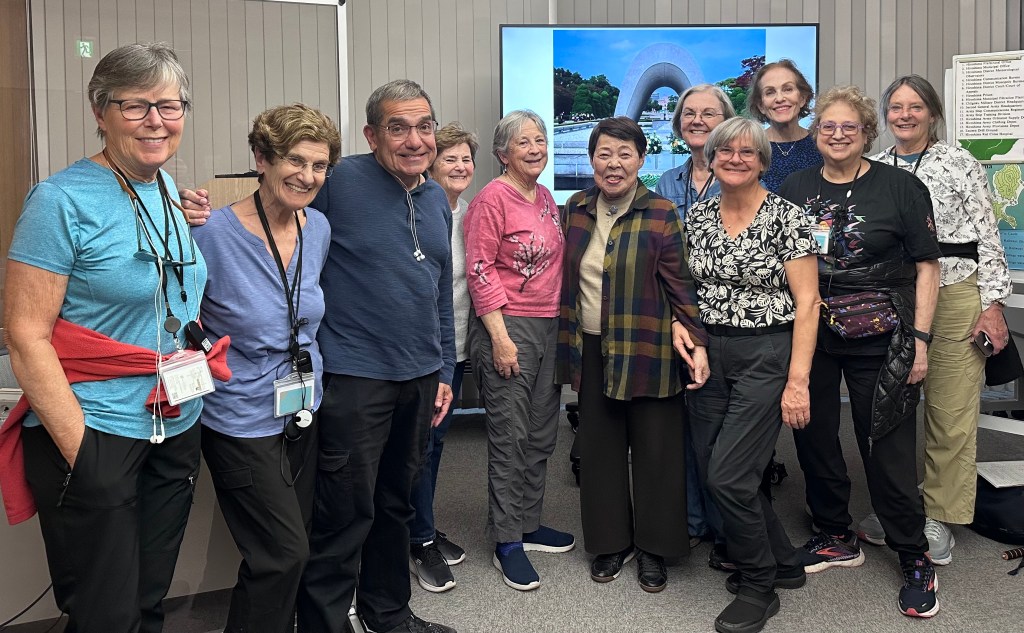
Once again, the composition of our group changed, as we said goodbye to Mary, Jim, Kathleen and Cathy. We were all sorry that they weren’t continuing on the Hiroshima post-trip with us because they had been such wonderful fellow travelers. OAT’s small group size is very conducive to forming strong friendships.
I love that OAT allows us to customize our trips. Nine of us (Mike, Renee, Ruth, Patsy, Janis, Mary, Jim, Kris and I) opted to do both the pre and post trips, which gave us three additional nights in Tokyo, and three nights in Hiroshima. Cathy and Kathleen only opted for the main trip. Bobbie, Ilene and Joan chose the post trip. Joan was the most adventurous of our group. extending her stay by traveling independently for several days, visiting islands off the coast of Japan.
Once again, the very clean, comfortable bullet train whisked us from Kyoto to Hiroshima in time for lunch, after which we spent the afternoon at the Peace Memorial. Although I watched a video in the Peace Memorial Museum, I couldn’t bear to view the exhibits showing the human devastation from the bomb and its aftermath.
Just seeing the destruction of the buildings was heartbreaking enough. I quickly exited the building, preferring instead to enjoy the gorgeous afternoon in the park, which was filled with beautiful memorial sculptures. Completed in 1954, the park was rightfully designated as a “National Place of Scenic Beauty”.
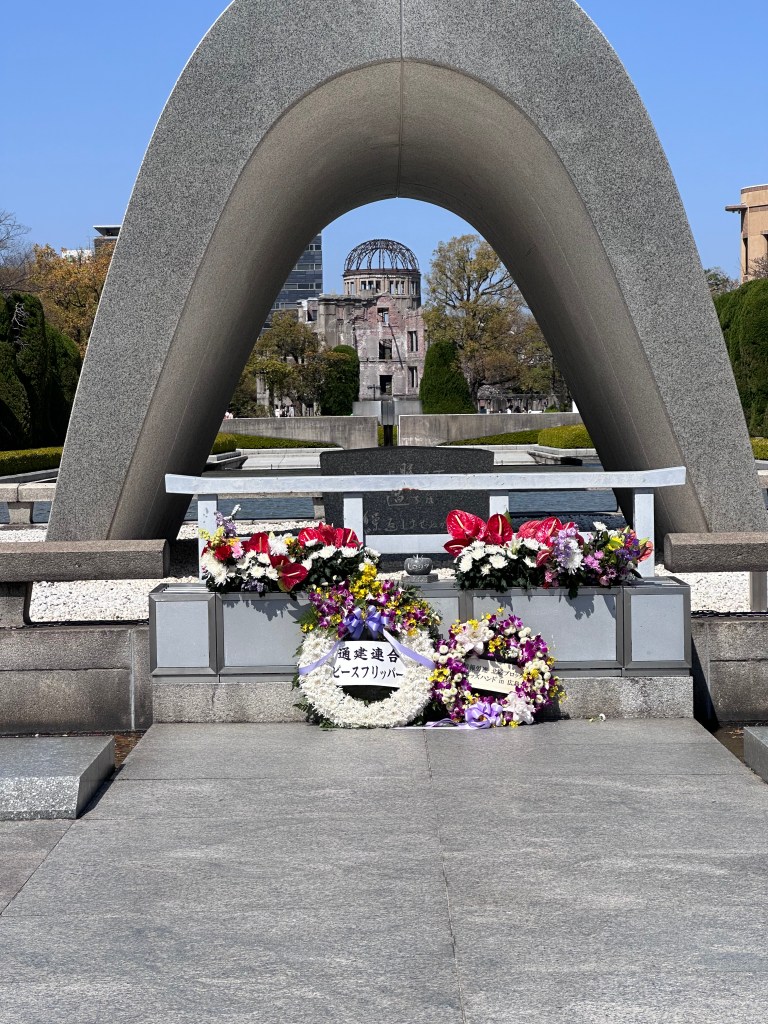
The arch of the Cenotaph for the atomic bomb victims is strategically placed to frame the remains of the dome building, the only structure that was left standing after the bombing. Unfortunately, my cell phone camera was unable to the entire memorial including the Flame of Peace, so instead, I’m providing a description from Japan’s tourism site:
“The base of the sculpture represents two wrists joined together, and the two wings on either side represent two palms facing upwards to the sky. It was designed both to console the souls of the thousands who died begging for water and to express the hopes for the abolition of nuclear weapons and the realization of lasting world peace. The flame at the top was lit on August 1, 1964, and has been burning ever since in protest of nuclear weapons, and will continue to burn until there are no nuclear weapons left on earth.
Poignant sculptures are plentiful in memorial park. This one needs no explanation.
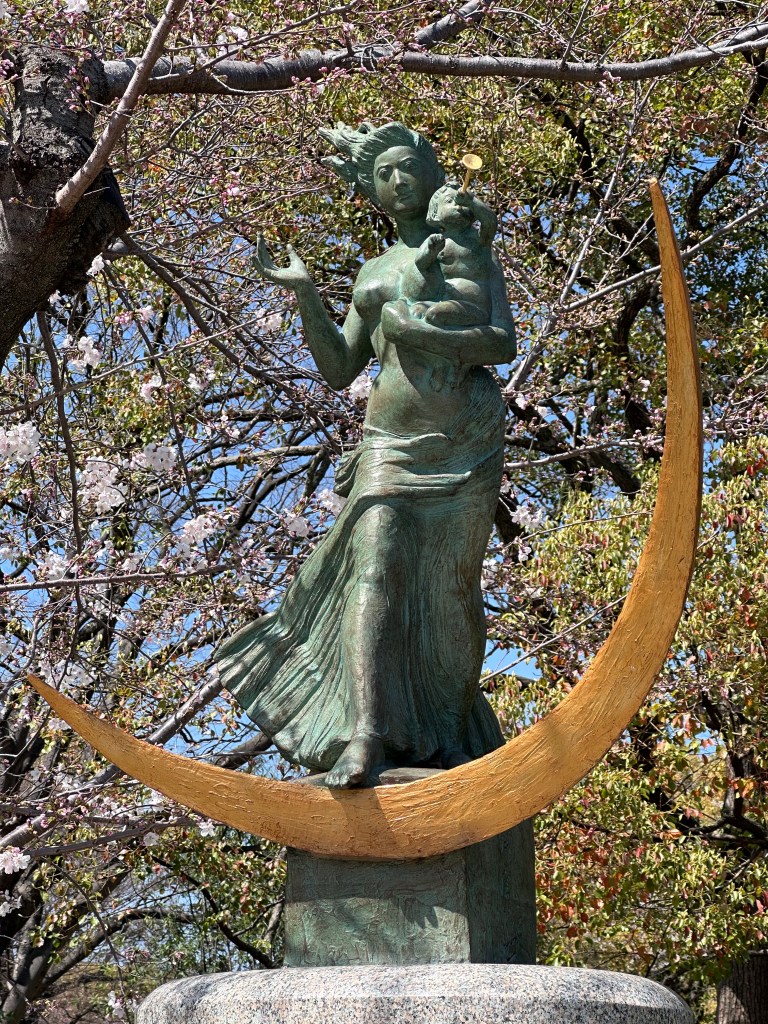
A plaque at the base of the following statue, entitled “Statue of a Prayer for Peace” explains the artist’s intent: “From parent to child, not yesterday but tomorrow, the crescent moon will become a full moon. I want to sound the trumpet for peace in the search for a new future.”
My favorite sculpture is the Children’s Peace Monument, which was inspired by the death of a young girl exposed to radiation when she was two years old. Ten years later she died from leukemia. The inscription by the statue tells the story of the monument’s creation: “Sadako’s untimely death compelled her classmates to begin a call for the construction of a monument for all the children who died due to the atomic bomb. Built with contributions from more than 3,200 schools in Japan and donors in nine countries, the Children’s Monument was unveiled on May 5, 1958.”
“A young girl lifts a golden crane entrusted with dreams for a peaceful future. Figures of a boy and girl are located on the sides of the monument. This is our cry. This is our prayer for building peace in this world”.
The paper cranes adjacent to the sculpture are a symbol of peace. Each year, millions of paper cranes, sent with a wish for peace, arrive at the monument.
After exploring the park, we met with woman who was 6 years old on August 6, 1945, when the bomb dropped. She shared her family’s experiences with us, translation courtesy of Mori. What struck me was she had no animosity toward Americans. Instead she remembered that the US was one of the first countries to help rebuild Japan after the war ended. Yes, the Americans of the 40’s and ’50s truly were the greatest generation. Maybe at some point, we will find our way back to being the compassionate country of our parents, grandparents and great grandparents.
I was impressed that the Museum presented a balanced view, not shying away from their role in the war.
We all have heard about kamikaze pilots, but I was unaware that there were also suicide boats, manned by boys in their teens. The boys aimed their boats at enemy ships, dropped a depth charge in front of the ship, and died when the depth charge exploded.
This was an especially sobering afternoon, given what is currently happening in our world. It brought to mind that song from the ’60s, “Where have all the flowers gone”, especially the refrain “When will they ever learn.” Fortunately, the rest of our time in Hiroshima was centered in the present, which was rather joyous.
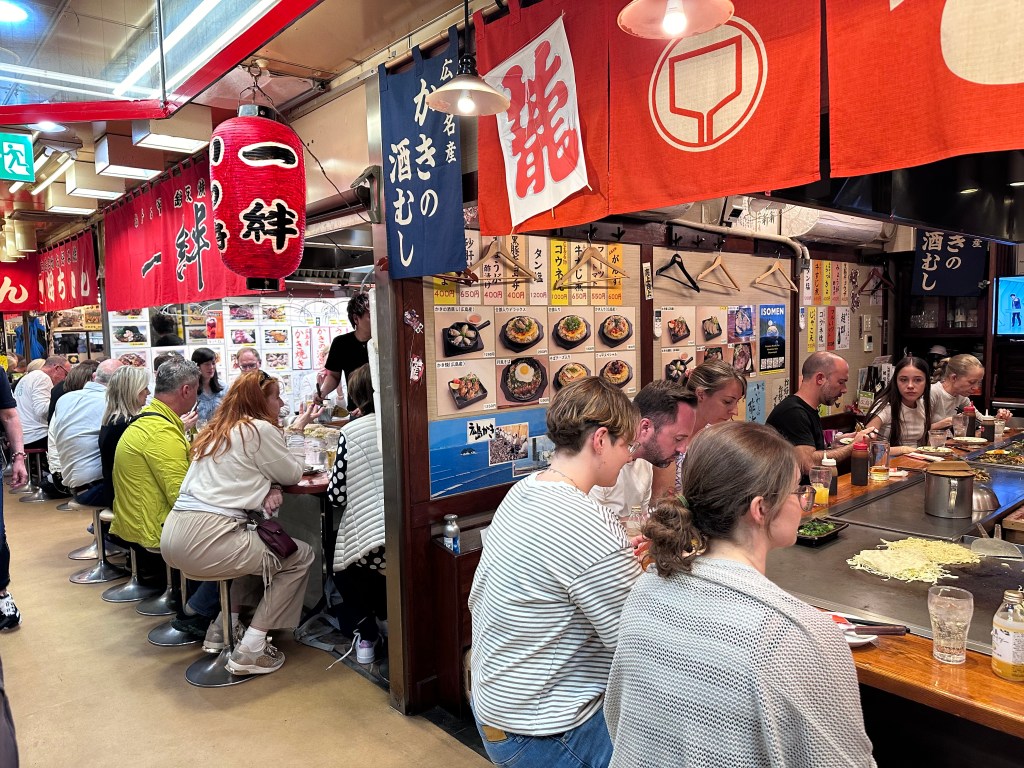
That night, Mori took us to a restaurant that was a completely different experience, at least it was for me. I’m not sure what the food, or the restaurant were called, but it was quite delicious and VERY popular.
Our day was not yet done, because Mori took us on another night walk, this time to the beautiful Shukkeien Garden. Although the garden was destroyed by the bomb, subsequent fires and earthquakes, the Kokokyo Bridge, seen in the photo below, survived.
What an oasis of peace and serenity the garden is, surrounded by the modern city of Hiroshima.
Whew. And that was only Day 1. Given that this post is getting rather long, and there are still many photos I’d like to share, I’ve come to realize Hiroshima needs to be two posts. Plus, I’m still jet lagged and have a severe energy deficit.
I am extremely grateful for the assistance I’ve received from the “Friends of Oat” Facebook page. This post is my way of giving back. Although I wrote it primarily for OAT travelers, I hope that others planning to visit Japan might find some of these hints helpful.
Packing
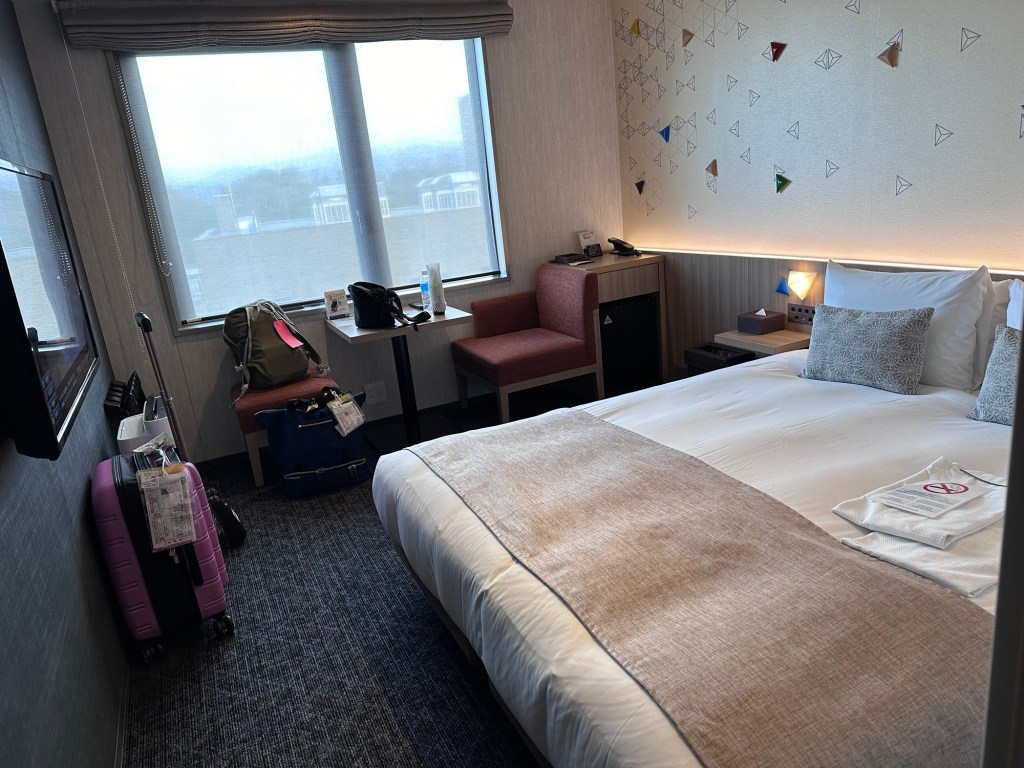
Pack light: Hotel rooms are TINY, so there really isn’t much room to store clothes or luggage. Here’s another reason to pack light–there are no porters in Japan, so you will be handling your own bags.
My room in Kanazawa , which was actually quite a bit larger than the ones in Tokyo and Kyoto
Doing Carry-on Only isn’t as hard as it might seem, because every hotel had laundry facilities on site. In our Tokyo hotel, you could watch your laundry’s progress on your room’s TV. Which I did. From my bed. I wasn’t worried that someone would take my laundry out and dump it on the floor, because first, the Japanese are way too polite to do something like that and second, the machine locked with a code that you input.
The Kanazawa hotel had a washer and dryer in the room, complete with a squirt bottle loaded with detergent. Despite the plastic card with instructions in both English and Japanese, it was a slight challenge for me to figure out how the damn thing worked. In fact, I’m not exactly sure what I did, but hey, the clothes came out clean.
You don’t have to pack pajamas, because Japanese hotels provide them. At least the ones OAT uses did. Every day there would be fresh pajamas neatly folded on my bed. Although I had a single room, I still got two pairs of pajamas!
Every hotel had a REAL hair dryer…not one of those awful ones attached to the wall. You know, the ones that you have to keep a finger on the button or else it shuts off?
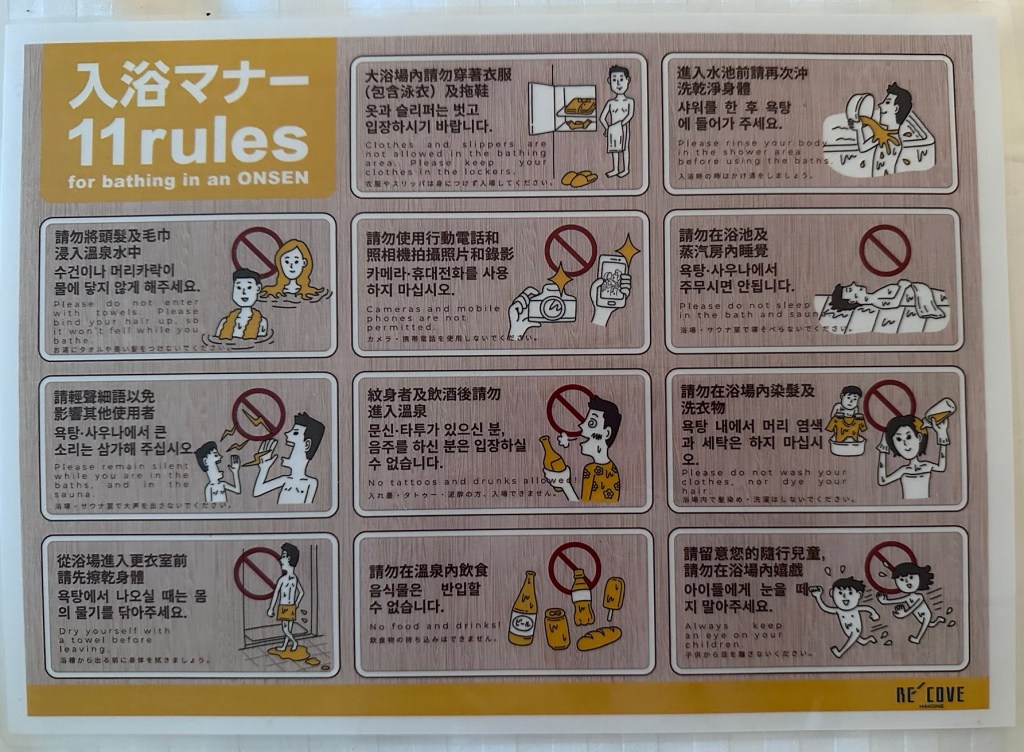
I had heard that some hotels have onsens, which are sorta like hot tubs/whirlpools except the source of water and heat is the naturally occurring hot springs. I definitely wanted to experience THAT, so I dutifully packed a bathing suit and cover up. That was totally unnecessary, because the onsens have many rules, one of which is you either go naked or you don’t go. Take a look.
I guess at some point, someone must have tried to dye their hair or wash their clothes in the onsen, otherwise why the need to print the prohibition?
Another unnecessary item that I packed was a water bottle. All the hotels provided bottled water, plus the water in Japan is not only safe to drink, it also tastes good. I simply refilled the hotel’s water bottles from the tap, and never used the one I brought.
Gadgets
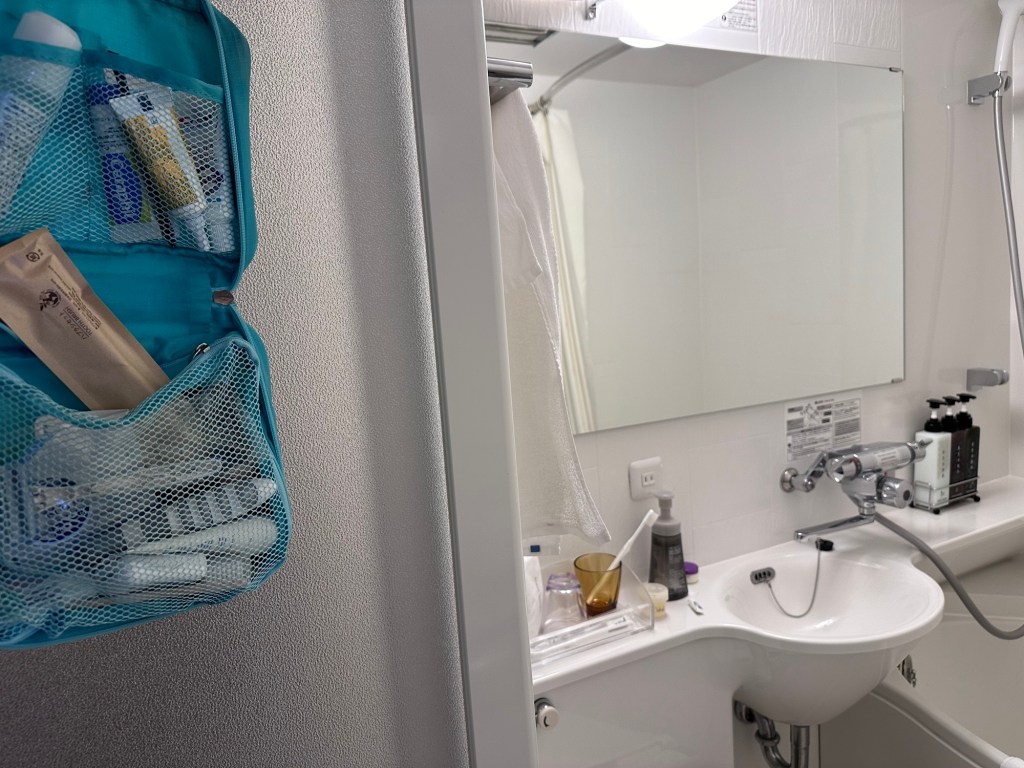
There isn’t much counter space in the bathrooms so hanging toiletries bags make life easier, at least while using the bathroom.
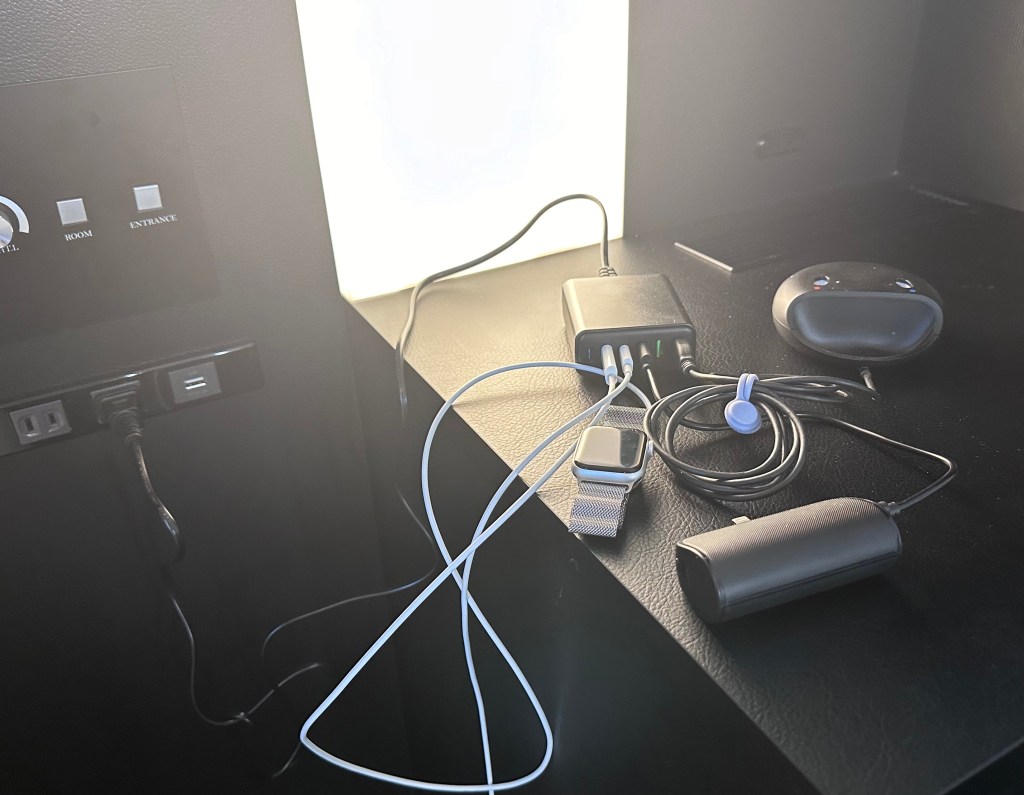
Although some hotels had conveniently located outlets, that was not universally true, so I was glad that I brought my handy dandy plug thingie that I got from Amazon. Because my phone is now my camera, the battery doesn’t last all day, so I bought that black mini portable charger, also from Amazon.
The manicure scissors I brought were useful for cutting off the plastic ties that were affixed to our luggage every time we had our bigger bags shipped. The bullet train doesn’t have much storage space, so we were told to pack a small bag to tide us over until the rest of our luggage arrived. That happened twice on the main trip and once on the post trip. Additionally, some of the plastic packaging on snacks was difficult to open, so my manicure scissors spared my teeth!
My packing cubes functioned as bureau drawers in these bureau-less and closet-less rooms. Yep, I just put them on the floor. in the narrow space between the bed and the window.
The OAT backpack folded up to almost nothing in my carry on. It made a great day pack, and provided extra space for purchases.
Shopping
I normally don’t shop while I am on a trip, but the exchange rate was so favorable, and the items were so unique, I found myself buying lots of little gifts — in department stores, in little handicraft shops, you name a place and it is highly likely that I found something interesting to buy there.
Language
English is not commonly spoken, but Google translate made it much easier to communicate. I simply typed in what I wanted to say and showed the Japanese translation when I needed help. In museums without English explanations, I pointed the camera at the Japanese words and Google delivered a translation like the one below.
Screenshot
Money
I learned from the Friends of OAT Facebook page not to bother with Japanese Bank’s ATMs when I needed cash. Instead, I went to either Lawson’s or 7 11, which are EVERYWHERE. I was beyond relieved when I saw that English instructions are provided. The exchange rates are good, and the cost for withdrawing money is reasonable. Although you can use your credit card in most places, it is good to have cash for the markets and smaller gift shops. A bonus–both places sell ice cream, chocolate and other snacks.
Mass transit
I’m sure that once you get the hang of it, mass transit is easy to use. Let’s put it this way, I was VERY grateful that our guide took care of determining how we would get from point A to point B. What is wonderful about Japan is one transit card can be used on just about everything: buses, trams, trains (but not bullet trains). The neck holder our guide gave us made getting through the turnstiles VERY easy.
It’s a wonderful trip. Rumor has it that OAT is developing another trip to Japan. I certainly am considering a return trip, but in the fall to see the gorgeous colors that were displayed in this photo of a poster.
First, let me say “on our own” is a misnomer. I COULD have been on my own during “free” time, but Mori was working overtime, organizing wonderful activities for us. I will admit, I skipped two evening activities because I needed a rest. (Damn, we were ACTIVE during the day!) I believe the Energizer Bunny’s Team of Renee, Ruth, and Janis did EVERYTHING, but unfortunately they’re not writing this blog, so you’ll only see and hear about the activities I took part in.
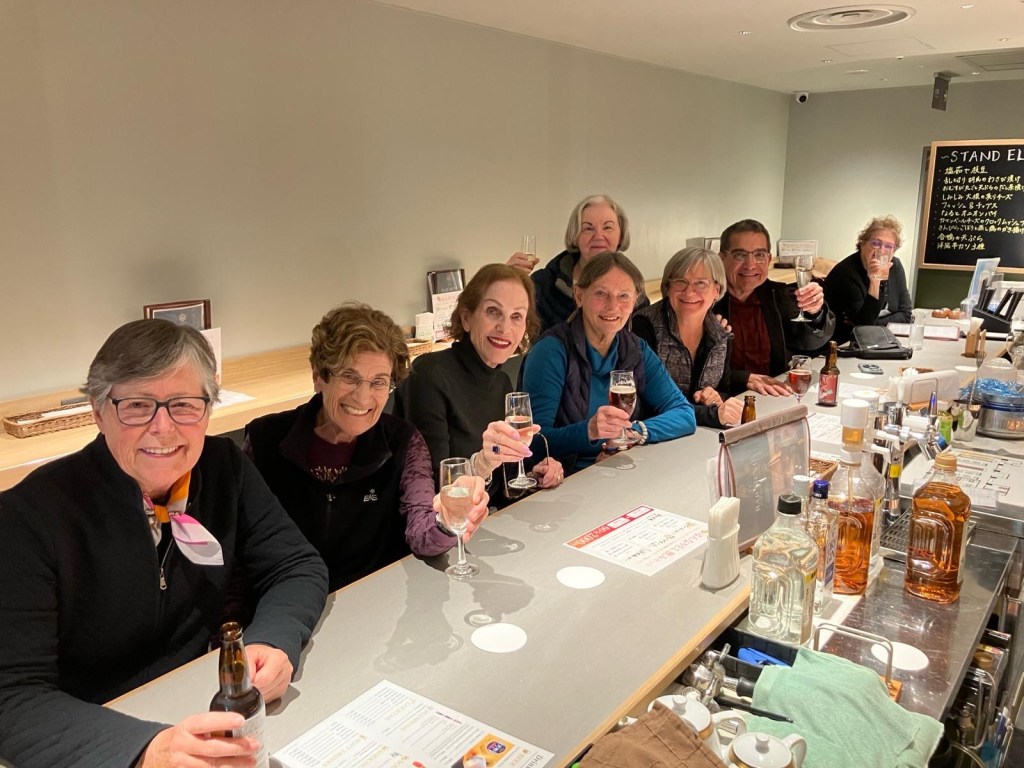
Our first night adventure in Kyoto started in the hotel bar. It was a rainy night, so we correctly figured we needed some fortifications before our tour of the train station.
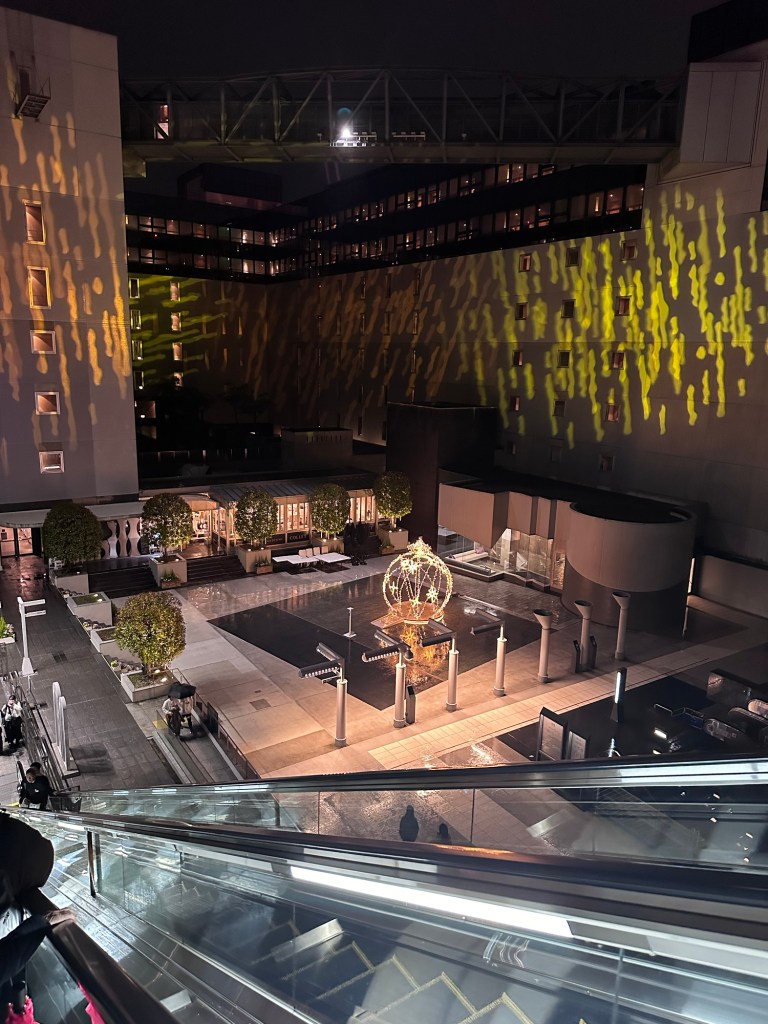
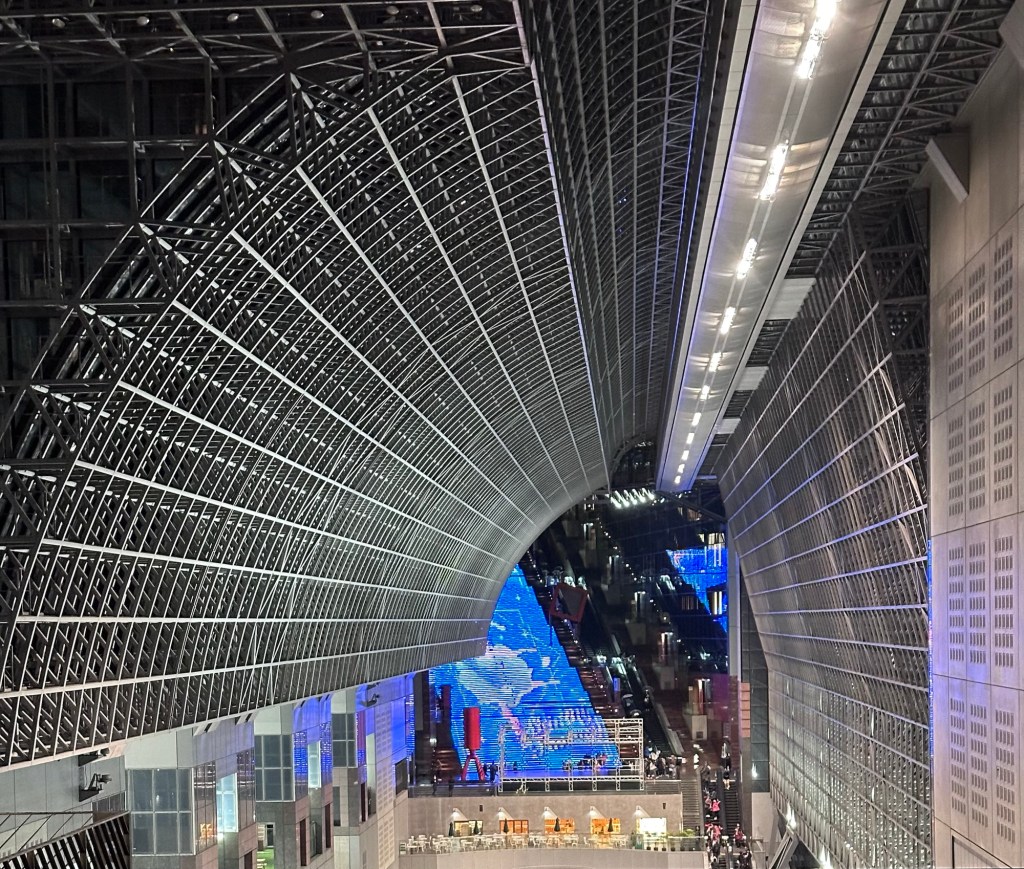
During my lifetime, I have certainly been in many train stations, but never have I seen seen anything quite like this one! The architecture is stunning, the lighting is spectacular—it is a visual feast!
Unlike most escalators, which require you to walk around to the opposite side on each floor, this one went straight up, and parts of it were outside the building.
Notice how clean everything is? No trash ANYWHERE!
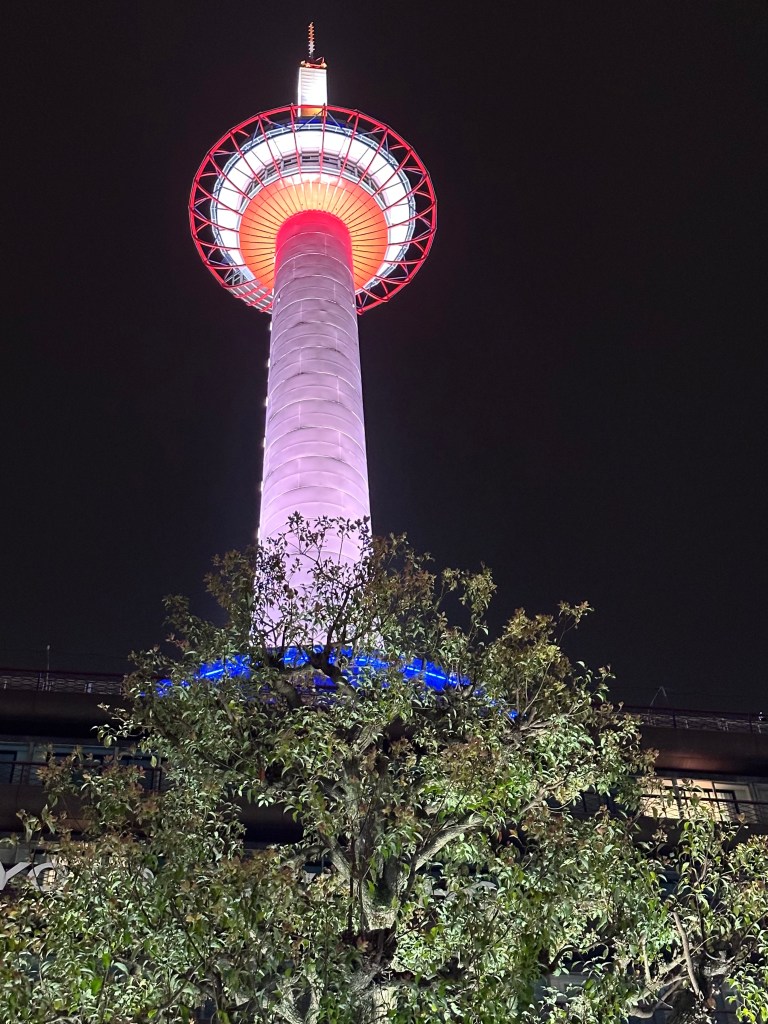
We were able to see the Kyoto tower from the covered part of the rooftop. I thought that the raindrops on the window gave the tower an impressionistic feel.
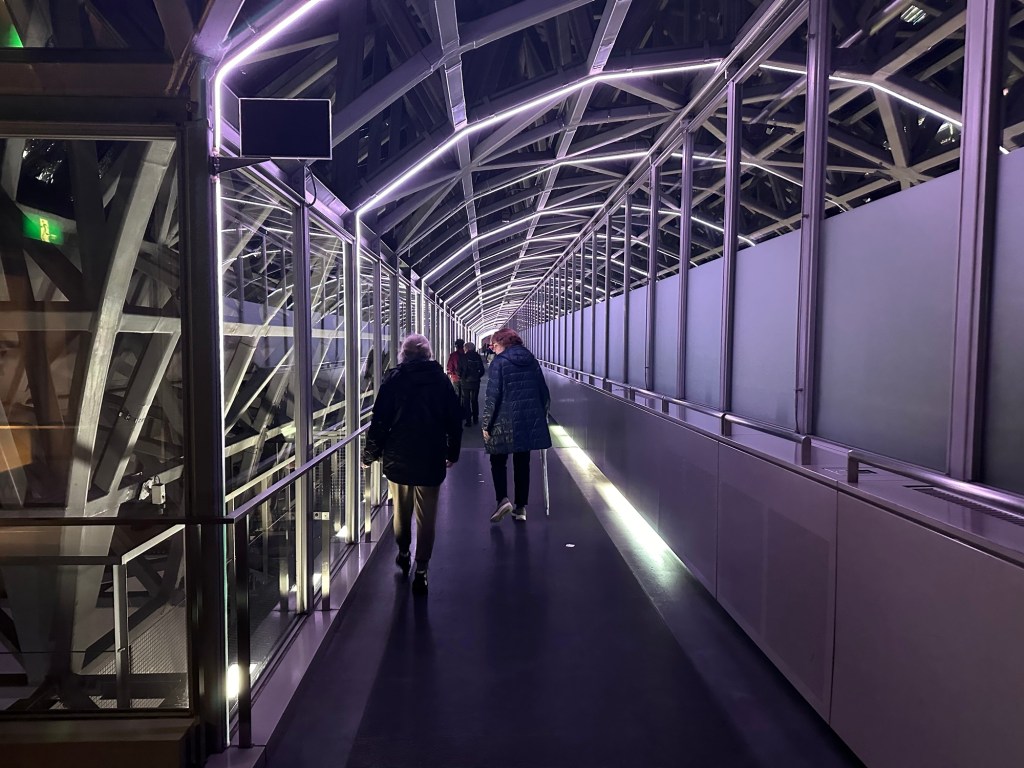
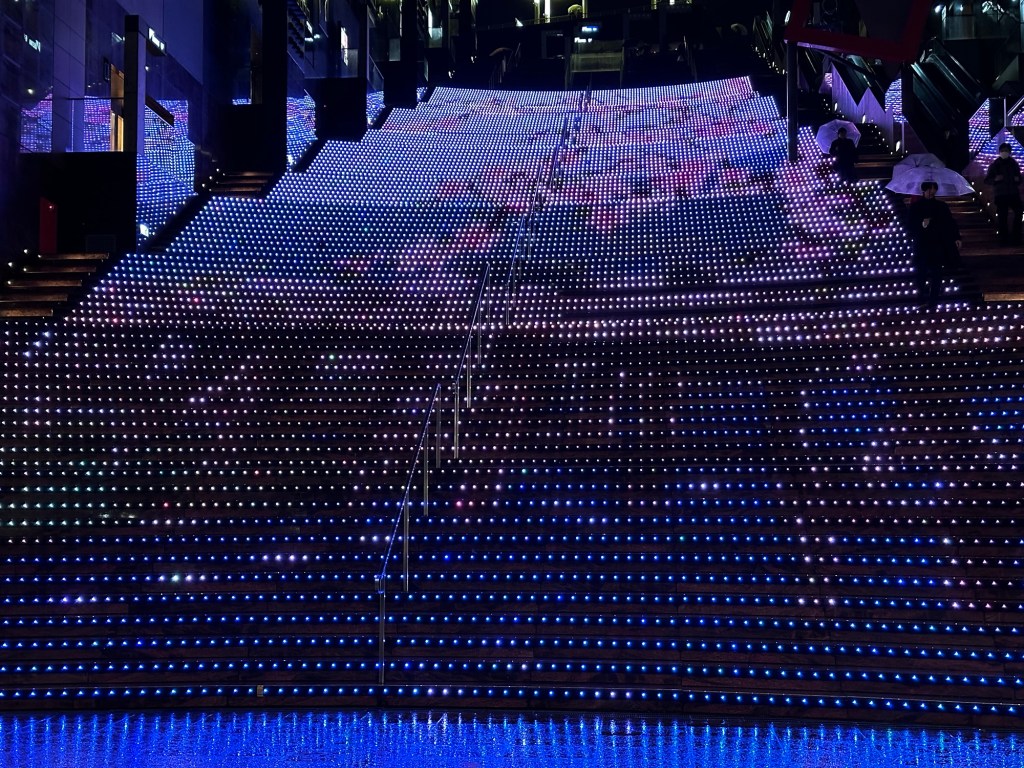
It isn’t obvious from the still photos, but we were treated to a light show as we walked along the corridor.
Can you see the two people walking down the stairway upon which images are being projected? Here’s a hint–look for the umbrellas.
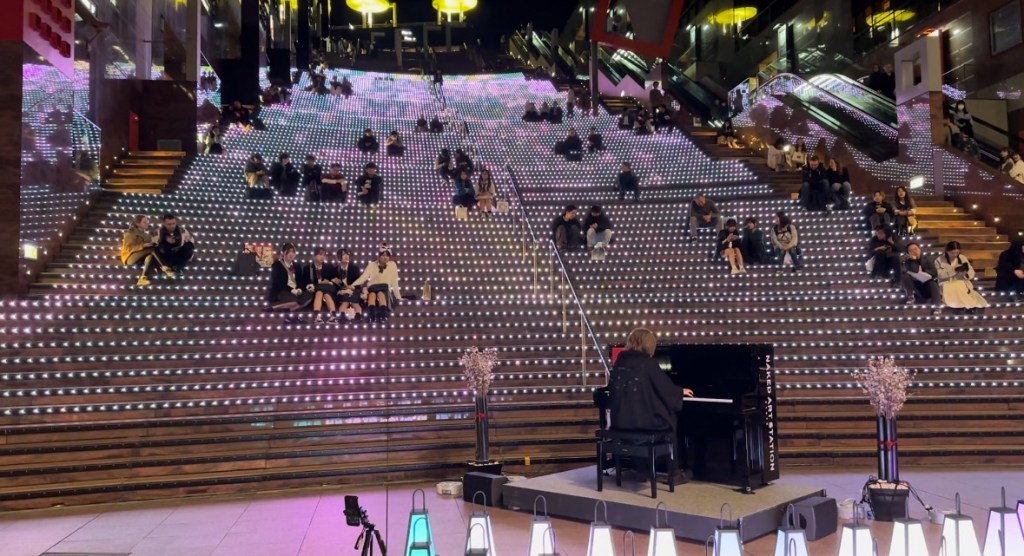
We returned the following night, when the weather was better, to listen to the pianist while we watched the light show. If you would like the full effect, just hop over to YouTube to watch and listen to the video. (Click on the underlined word)
The photo is a screen shot from the video and admittedly is a poor substitute, but uploading a video into WordPress takes forever.
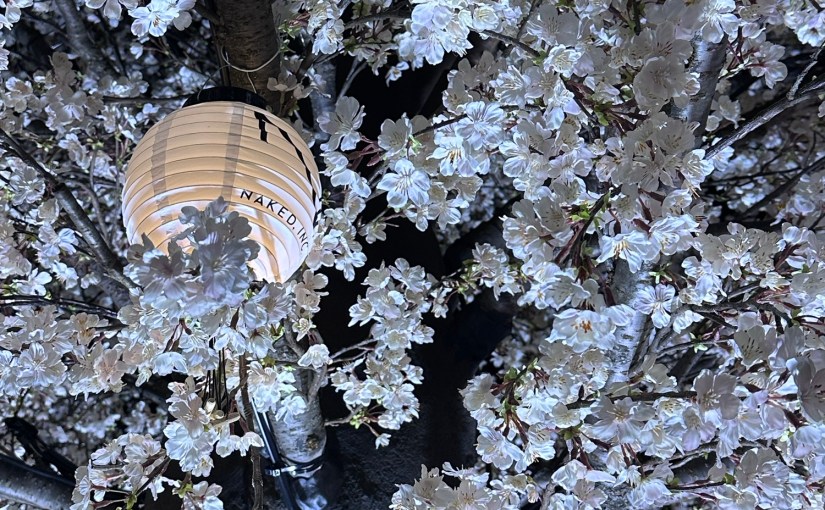
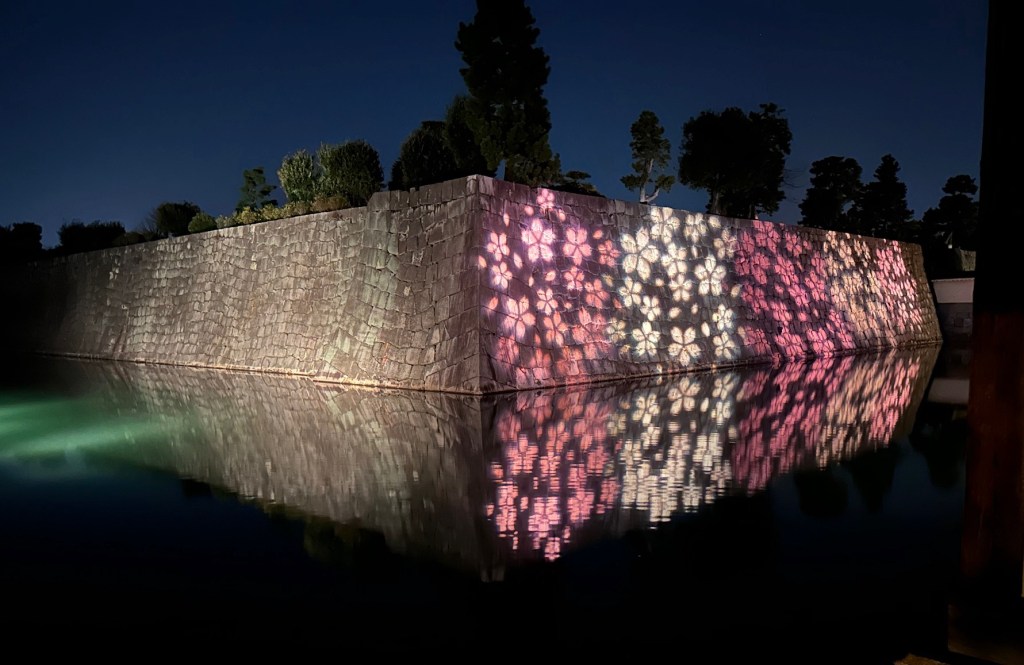
In the previous post I mentioned that Nijo Castle was also a site for a Naked installation, and THIS one was even more sensational!
The castle walls became digital displays with changing graphics. You know the drill: if you want to experience the full effect of the “Naked” show, click on YouTube.
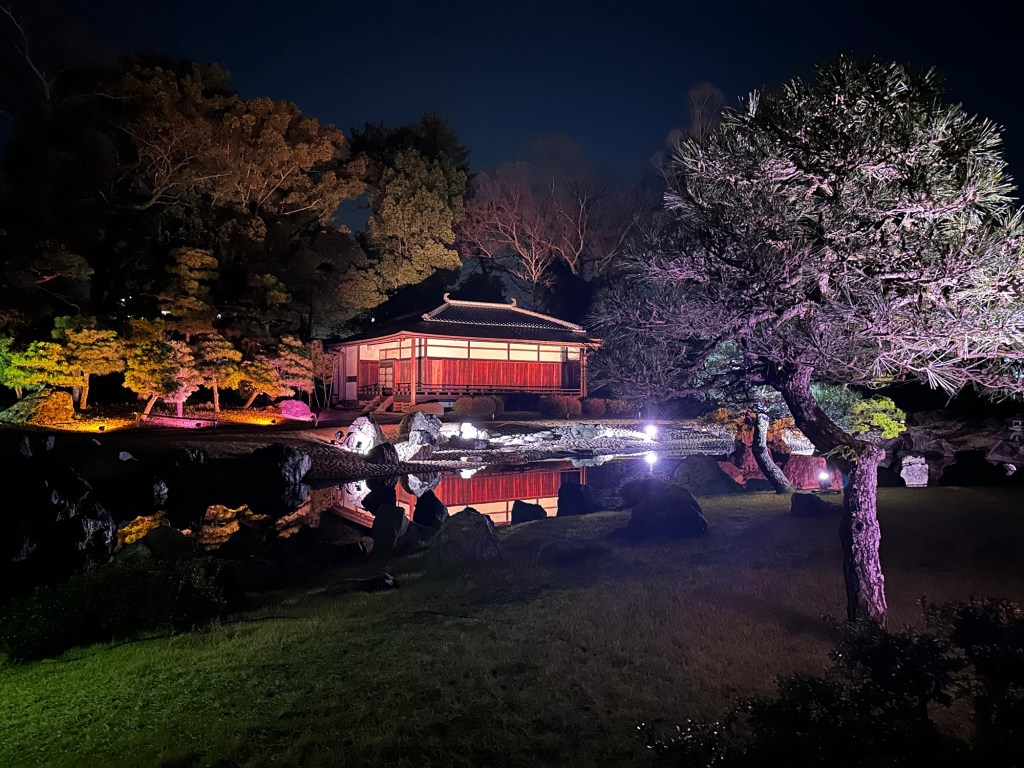
But wait— there’s more! The garden and the buildings were also beautifully illuminated.
There were so many gorgeous sights–it was hard to decide which ones to include in this post.
And if that wasn’t enough, there was even a “ special effects” machine, pumping out fog.
Our extras weren’t just limited to night time activities. We also had adventures with Mori during free afternoons. Sometimes, the bus drivers recommended stops along the way at places they thought we would enjoy.
That’s another wonderful aspect of Japanese culture. People take pride in their work, regardless of what it is. Everyone’s contribution is valued.
Earlier in the trip, we stopped at a store selling fruits and vegetables. On the wall were photos of the farmers who grew the store’s products. Talk about a personalized approach!
Notice the white gloves our bus driver is wearing and how he is dressed?
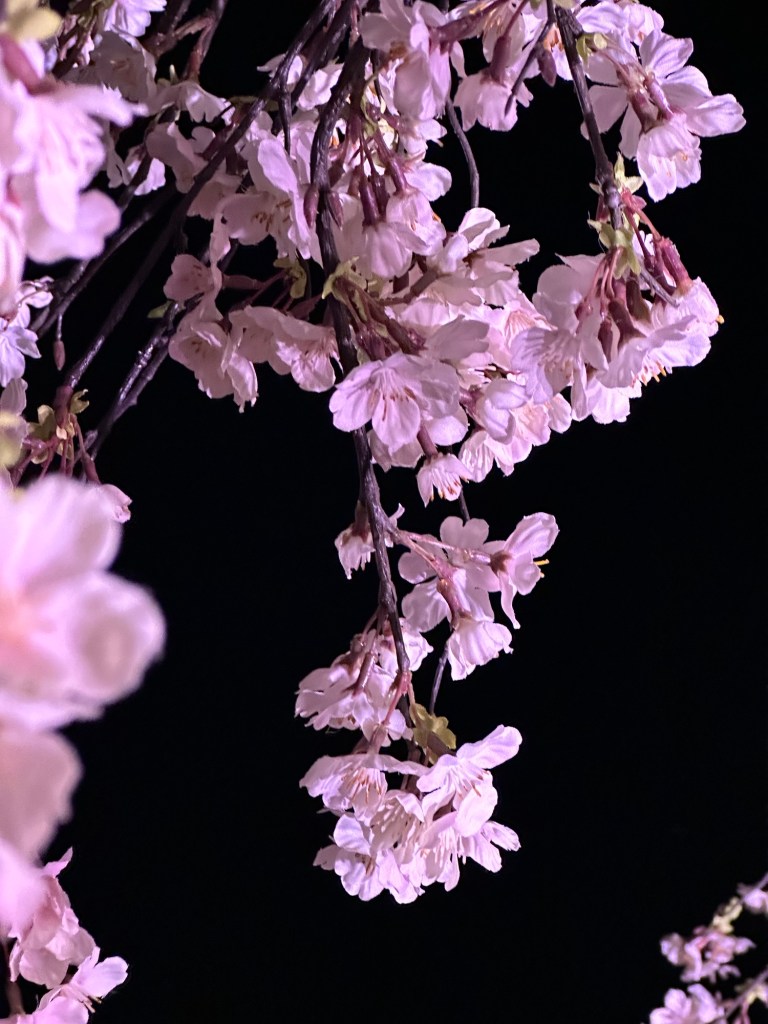
This particular driver suggested these two additional stops enroute to a planned activity. I won’t bother with the names of the temples because they are long and totally forgettable, at least by me. But what is seared into my brain are the temple grounds with its flowering trees.
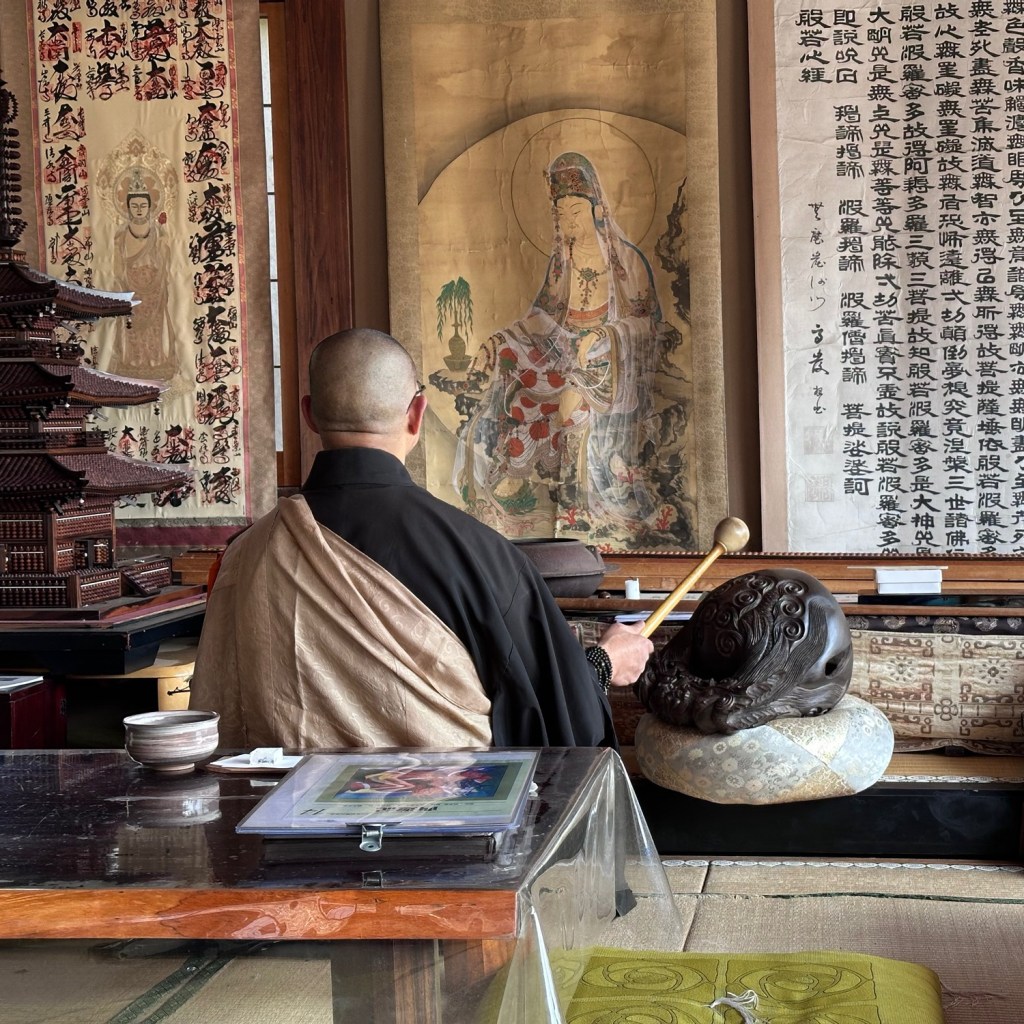
We didn’t have time to participate in the Buddhist ceremony, but I peeked inside and was impressed that they thoughtfully provided chairs for those unable to sit on the floor.
The second temple contained 1001 statues of the Buddhist Deity Kannon. What is interesting is that all of the statues are slightly different, which initially led me to believe that the statues represented DIFFERENT Buddhas. Then I read the brochure.
Here’s what else I learned. 124 of the statues were made in the 12th century, when the temple was founded and the remaining 876 were made in the 13th century when the temple was renovated. The statues are all made of Japaneses cypress, so I’m guessing they have been covered with gold leaf.
We weren’t allowed to take photos inside the temple, but hanging on a wall outside was this poster,
which will give you a very rough idea of what the temple was like. It was slightly longer than a football field (According to the brochure, the length is 120 meters, for those of you fluent in metric). We walked in front of the statues, along a PACKED narrow corridor. It wasn’t tragic that I couldn’t take a photo inside–it would have been an impossible shot anyway.
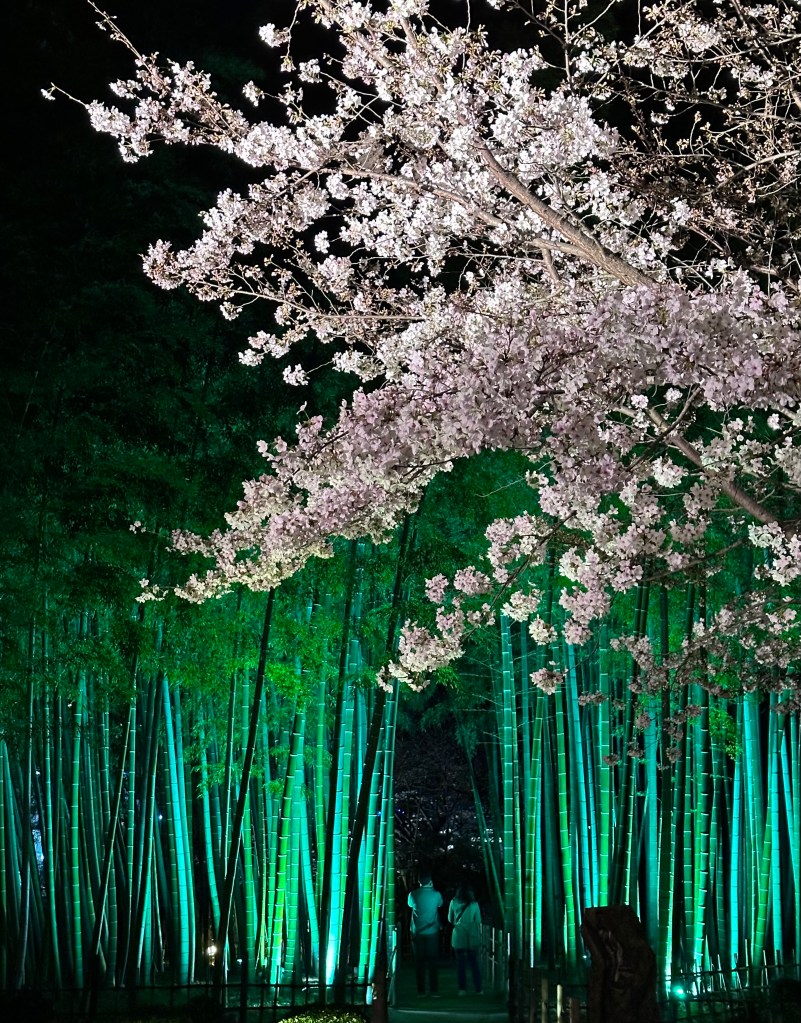
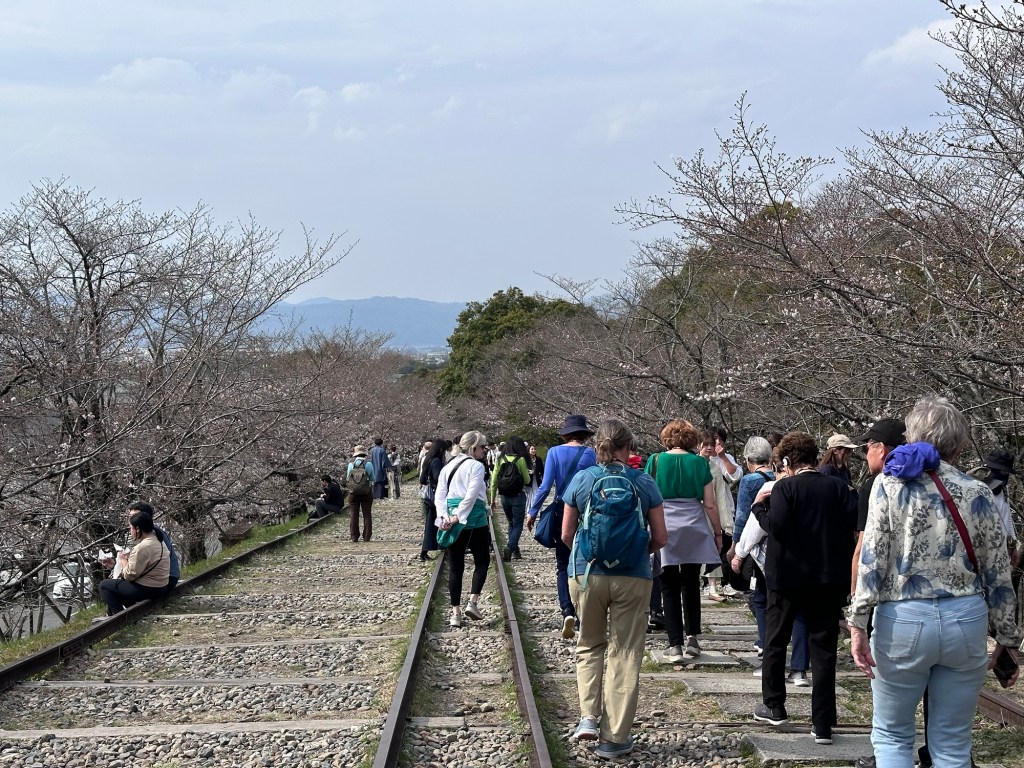
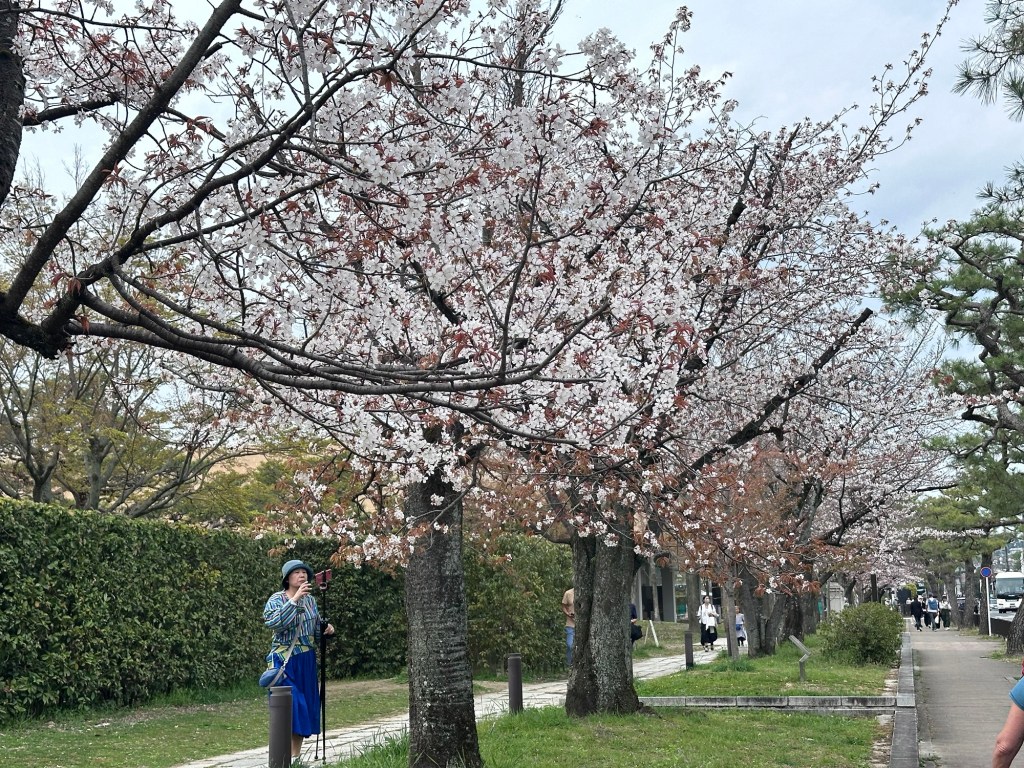
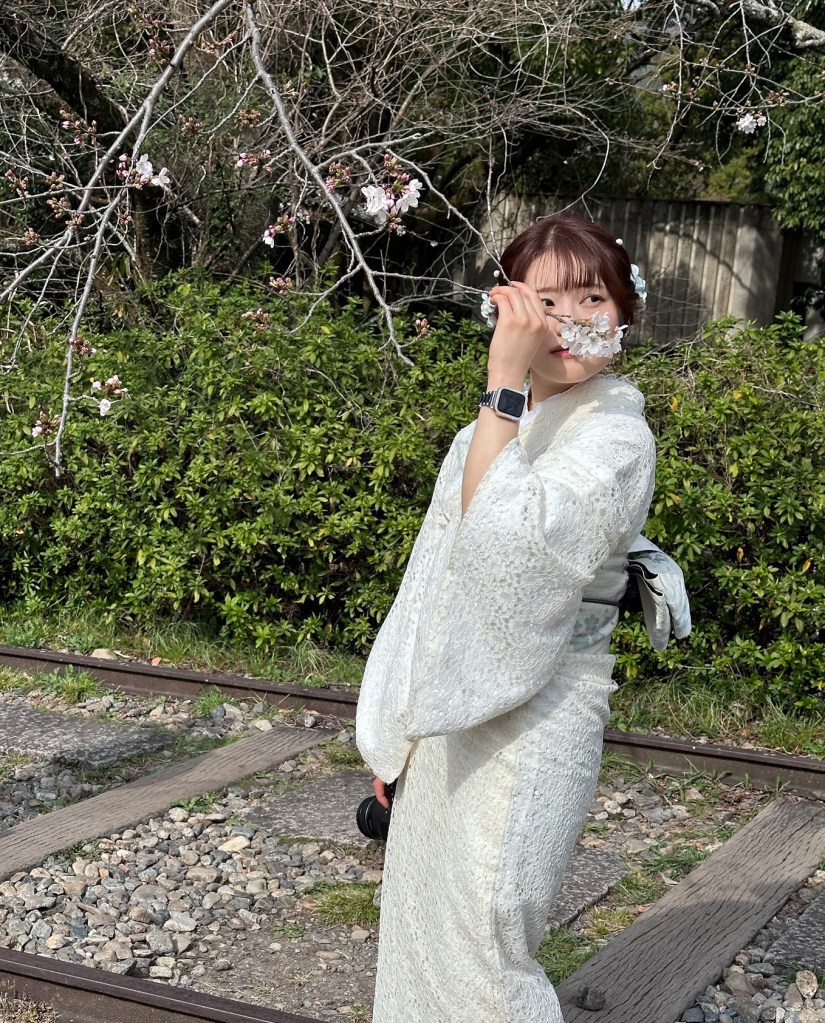
On our last afternoon in Kyoto, we set out for the Philosopher’s Path. Although we never made it there — we got a little lost– we instead had a had a delightful adventure, walking along an old railroad track, during which we saw an abundance of blooming trees and Japanese taking advantage of the photo ops the beautiful day offered.
As Mori was trying to figure out how to get us back to the hotel, some of us wandered around and discovered this rather unusual sculpture in front of one of the art museums. Sorry, there wasn’t enough time to figure out what it was trying to communicate, but then, it is ART. It can be anything you want it to be.
Next stop: Hiroshima, for the ten of us taking the post trip, but before we leave, here’s one last photo of the Kyoto tower when it WASN’T raining.
There was so much to see and do in Kyoto, I decided Kyoto required two posts. This one describes the “official” OAT activities. The next post is all the “extras” sweet Mori made sure we experienced.
After Covid cancelled my 2020 Japan trip, I comforted myself with an on-line “tour” of Kyoto. From that, I got the mistaken impression that Kyoto was a rather compact city with all of the sights clustered together.
I was TOTALLY unprepared for how big Kyoto is and how scattered the points of interest are.
My iPhone photos will give you a rough idea of how much ground OAT’s itinerary covered during our 5 day stay. I was very grateful that Mori handled all of the logistics.
The Shinkansen brought us swiftly and smoothly to Kyoto. Because we had ridden the bullet train from Tokyo to Kanazawa, we were familiar with the drill: you pack a small overnight bag to tide you over until the larger luggage ( which was shipped) arrives a day later. The bullet train is super comfortable, but storage space is quite limited.
I was glad that I was traveling with only a backpack, because unlike our arrival in Kanazawa, in Kyoto we had to swim through an ocean of humanity to get through the train station.
Photo by ReneePhoto by Mike
I’m wondering what was easier to follow—Taco, or my gray head sticking up above the crowd.
What a multisensory extravaganza the Kyoto train station was! We were bombarded with sounds, sights and wonderful smells, but as you’ll see in a later post, it is even more thrilling at night, so no more daytime station photos.
But first, here’s a whirlwind tour of my favorite things on OAT’s itinerary, which successfully hit Kyoto’s traditional hot spots.
The majestic Arashiyama Bamboo Forest
It is hard to describe the peaceful feeling one gets while walking through these towering plants.
Cemetery beside the bamboo forest
The Tenryu-ji Temple
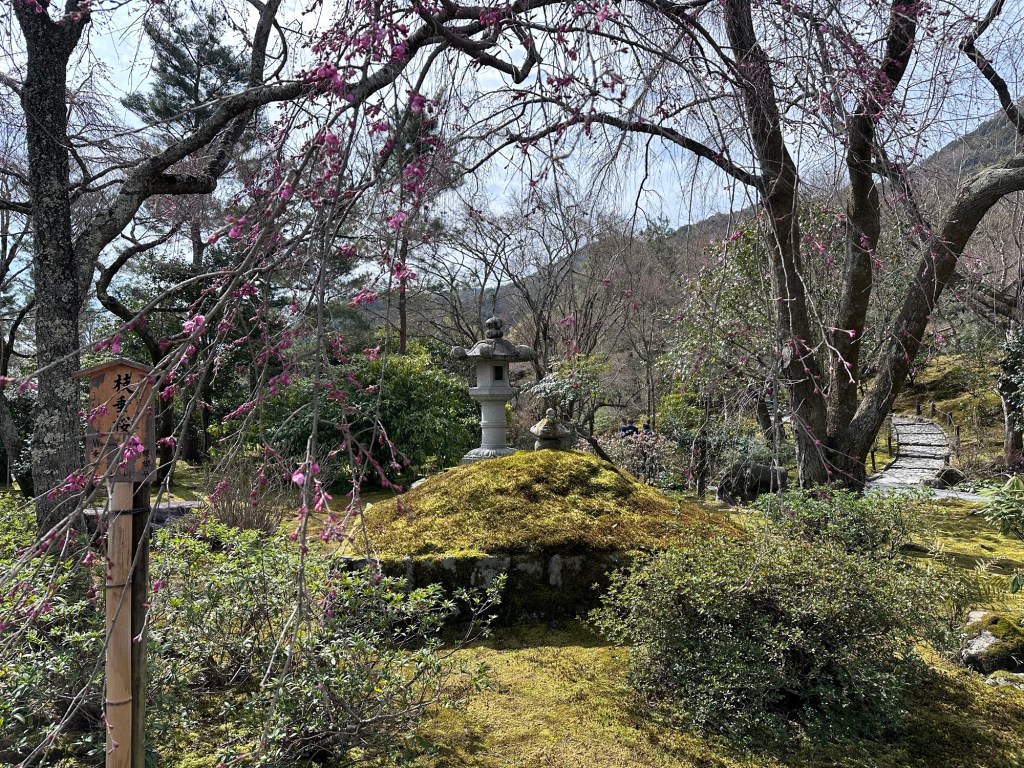
A brief stroll away from the forest was a beautiful garden and Buddhist temple. We were so excited to see the cherry blossoms were starting to open.
I managed to pitch a coin right into the ring in front of the frog. I keep making the same wish. One of these times it should work.
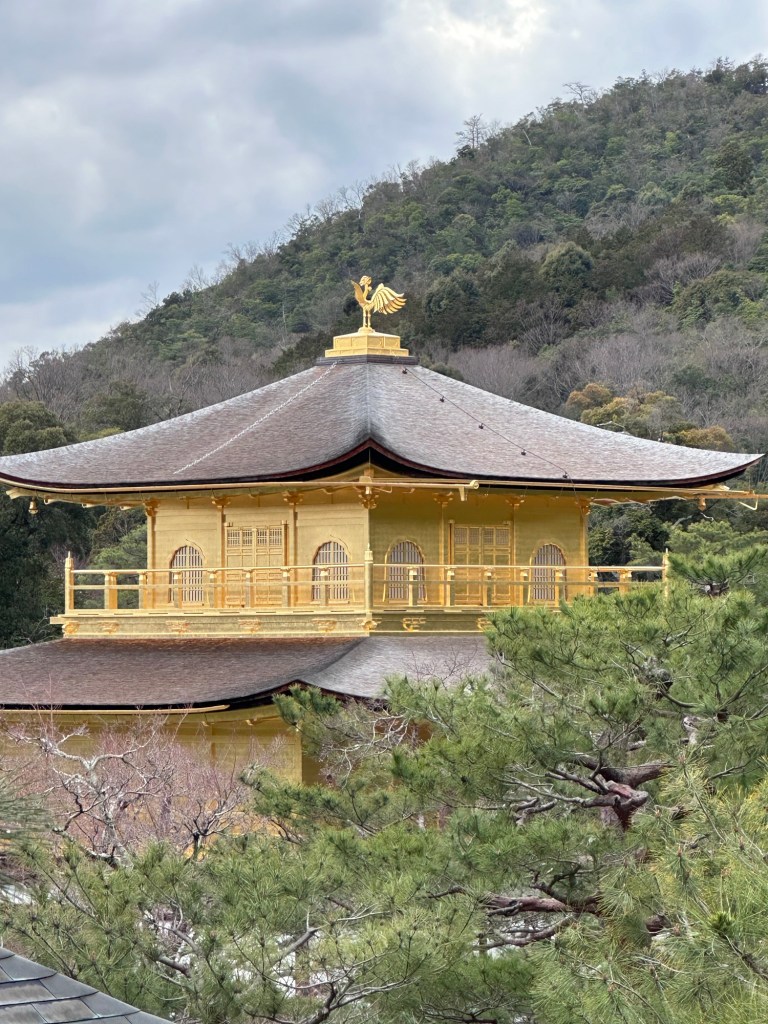
Kinkaku-ji Temple (Temple of the Golden Pavilion)
The original temple was constructed around 1400, but was rebuilt in the 1950’s after it was burned to the ground by a crazed monk.
Wasn’t it fitting that the phoenix atop the temple was the only part of the original that managed to arise from the ashes of the burned building?
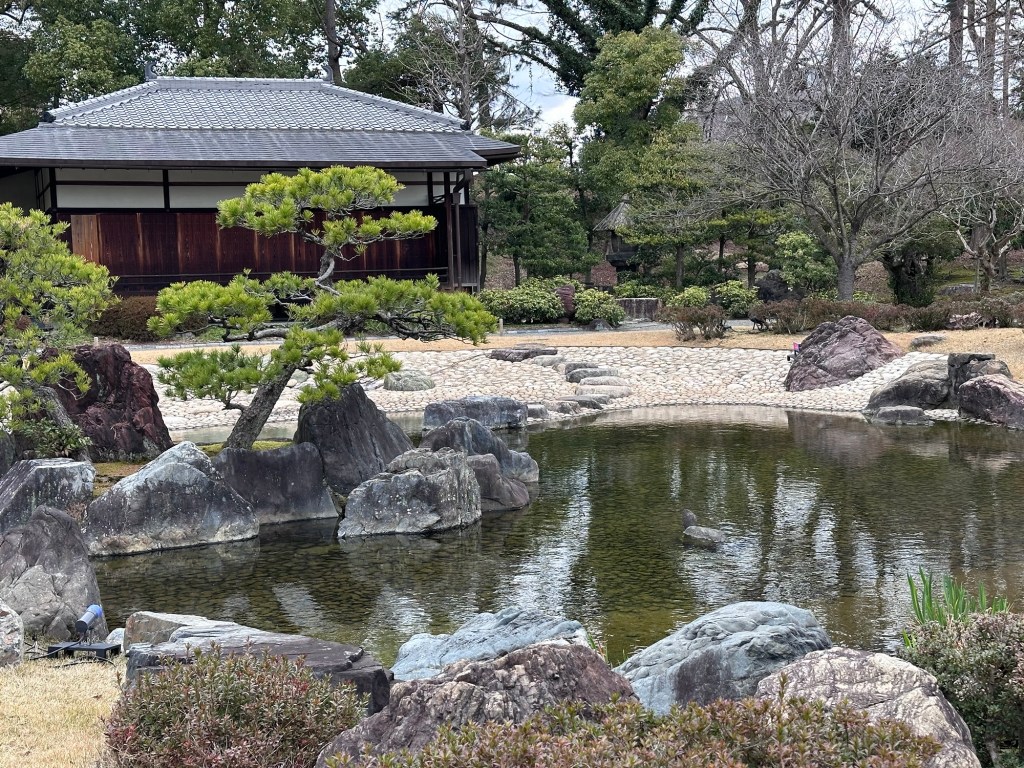
Nijo Castle
We toured the interior of Nijo Castle, but we weren’t allowed to take photos. That’s okay. I found the exterior far more compelling—especially at night (and yes, you are going to have to wait for a future post to see how glorious it is).
Nara
India has its sacred cows; Japan has its deer.
Kathleen is bowing to the sacred deer
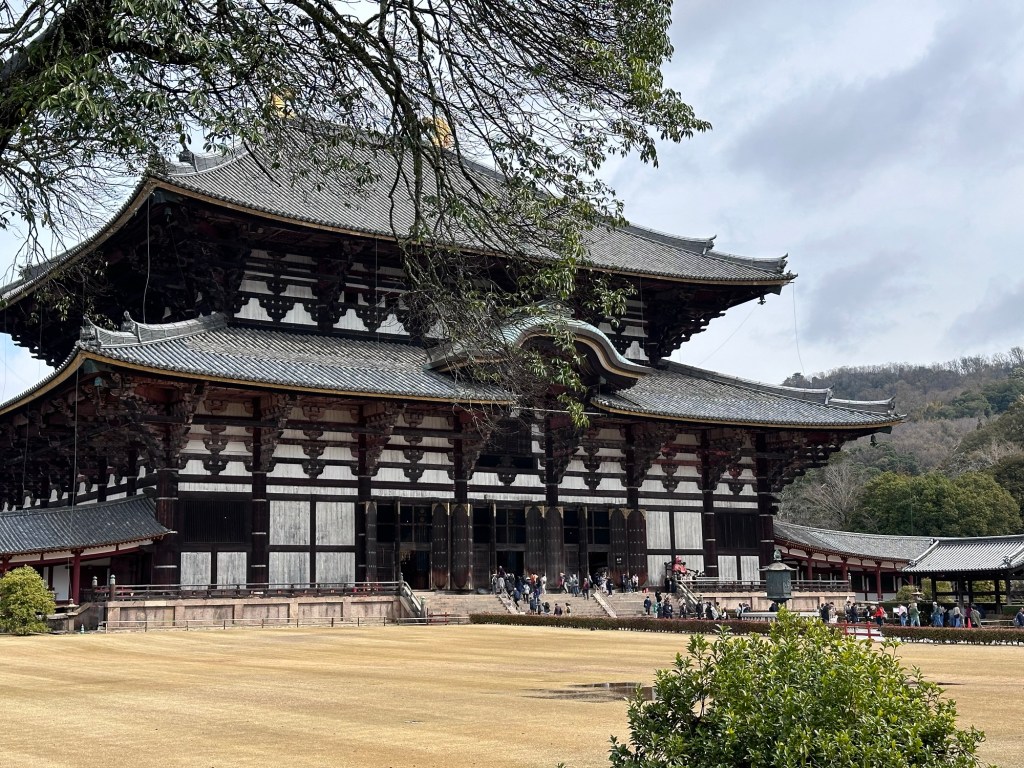
Todaiji Temple
This is the home of the world’s largest wooden Buddha.
He was so enormous, it was difficult to photograph him. Besides, we’ve all seen Buddha photos.
As you may have noticed from earlier posts, I’m rather fond of the Guardians. Even though this one has a fierce facial expression, he’s holding a scroll and pen, so how scary can he be? Maybe his message is “the pen is mightier than the sword”?
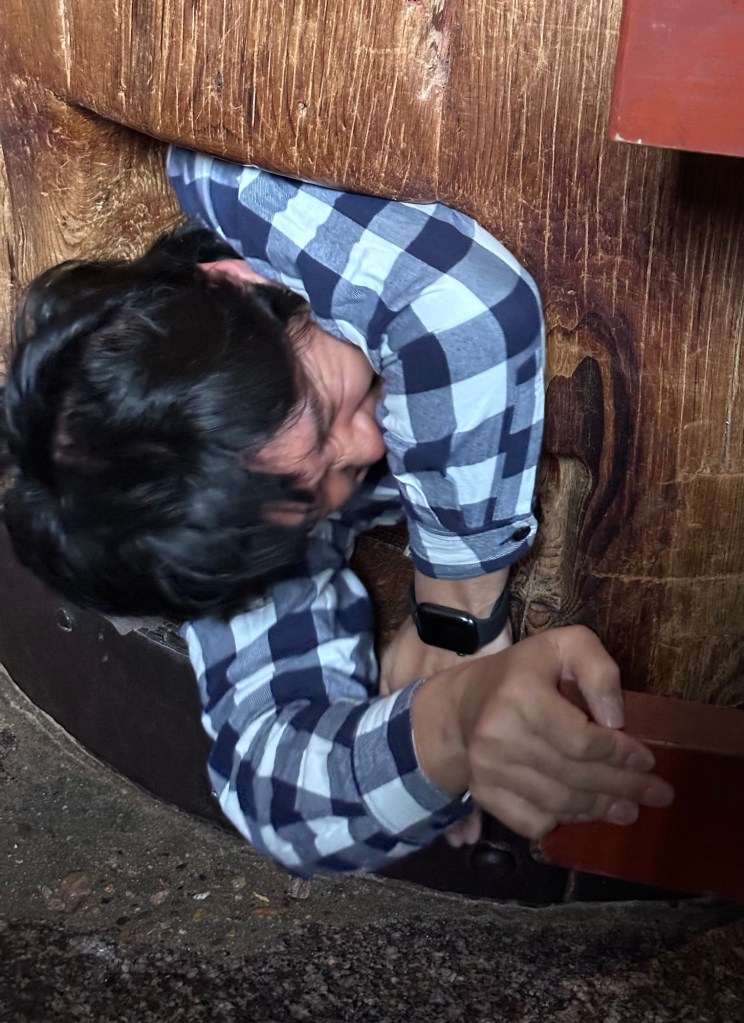
This next photo requires an explanation, but first take a look and see if you can figure out what is happening.
There is a wooden block in the temple, with an opening that supposedly is the size of Buddha’s nose (the statue, not the human). The belief is that anyone able to squeeze through Buddha’s nose (or the passage) would have a good life. I’m pleased to say that although he initially struggled, Mori made it thru.
Zen Temple
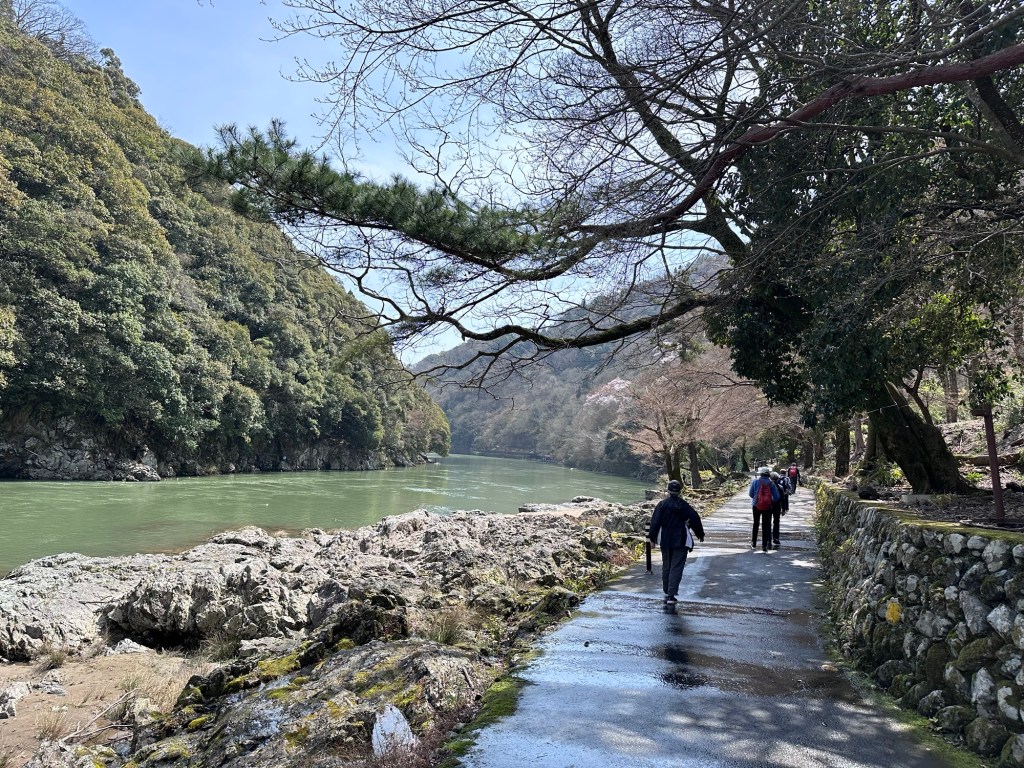
After walking alongside this beautiful river, we climbed 200 steps ( I didn’t count; I took Mori’s word for it) to meet a zen master, with whom we meditated.
We left, totally at peace, feeling “zero”. It’s fortunate that l learned to let go, because that hat on my head and I were soon to go our separate ways.
Fushimi Inari Shrine
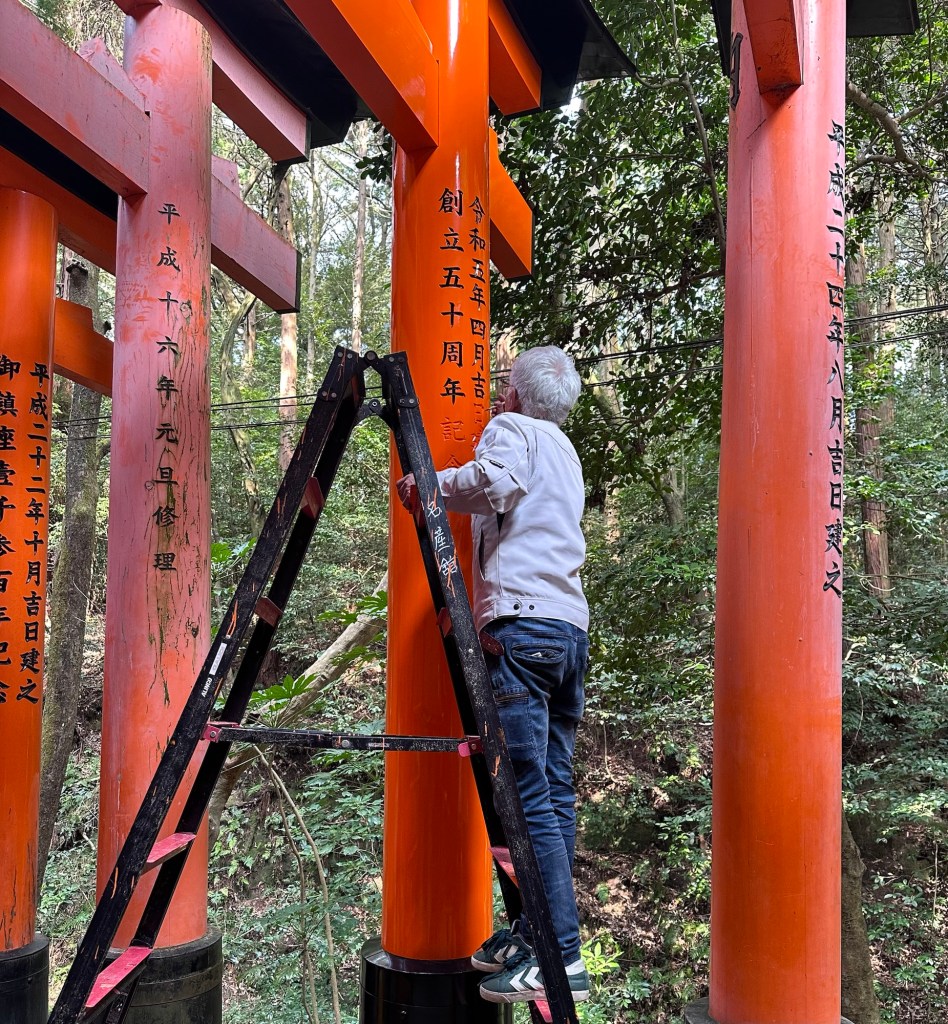
After experiencing Buddhism, we moved on to the famous Shinto shrine with its beautiful vermillion Torii Gates.
We didn’t have time to climb to the top, so this map will have to suffice to give you an idea of the immensity of the shrine.
When Christo did “The Gates” in NYC’s Central Parking 2005, Mike and I spent an enjoyable February afternoon strolling through them. Could Christo have gotten his inspiration from Japan? I think he did.
Sushi Making
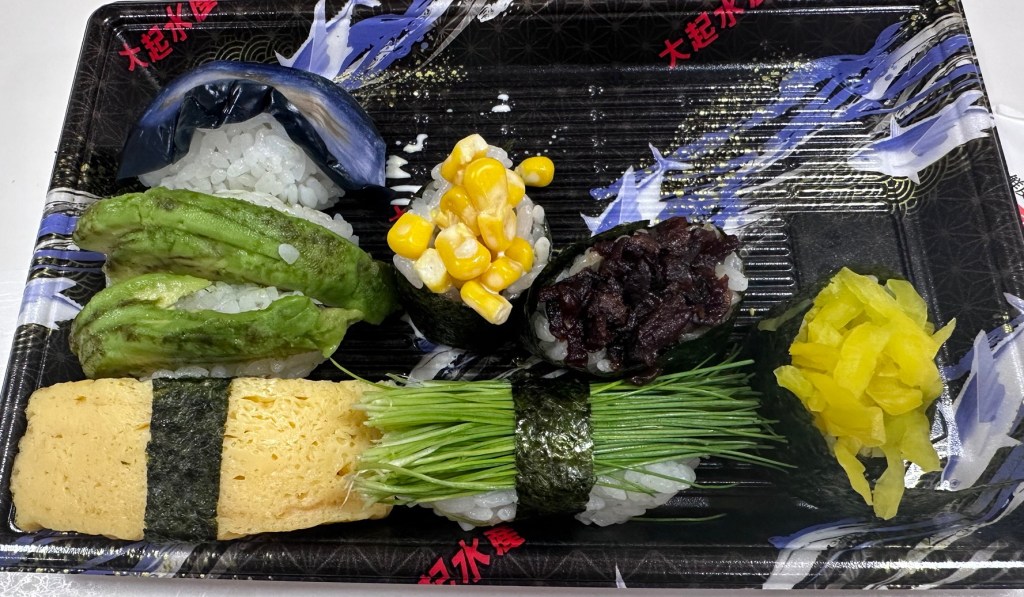
I will say up front that raw fish wrapped in seaweed does not meet my definition of delicious. Still, I was determined to keep an open mind. I was quite happy to learn that we had a vegetable option.
My son Greg would have loved the discussion about knives and whet stones.
Our ingredients The finished product
Okay, so maybe it didn’t look like much, but it sure was tasty.
What better way to end this post than with a photo of a beautiful blossom…
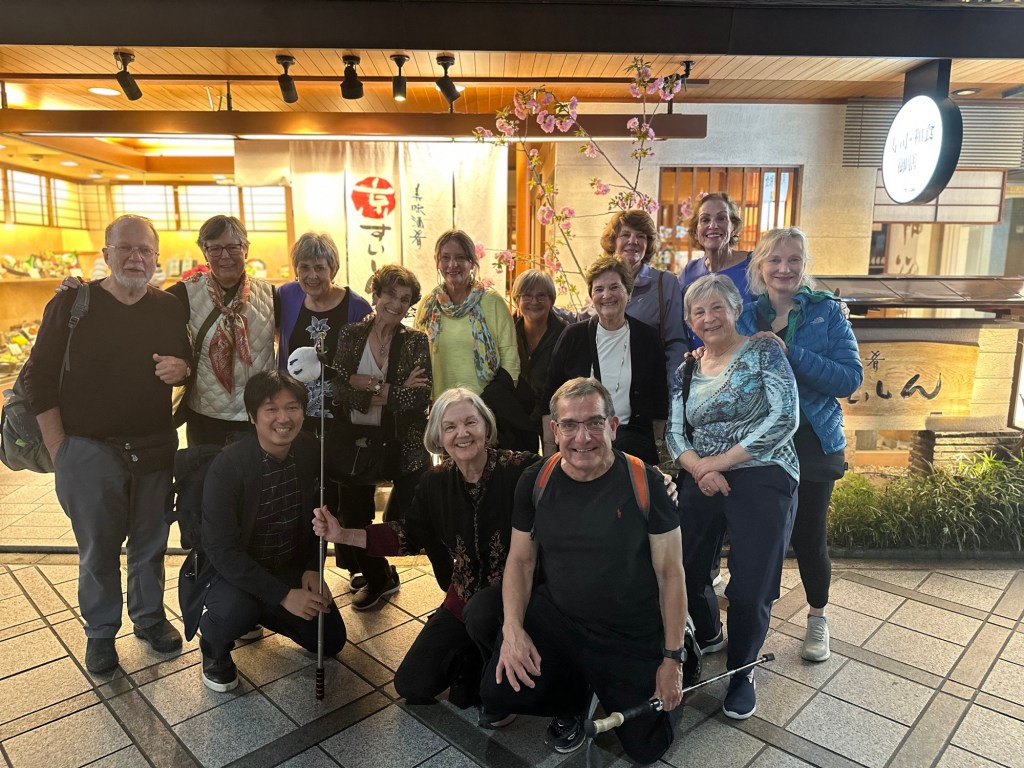
and a group shot taken after our farewell dinner. Sadly, Mary, Jim, Kathleen and Cathy, weren’t joining us on the post trip to Hiroshima.
Initially, I expected to do one post for both Kanazawa and Kyoto. I had never heard of Kanazawa before, so hadn’t realized how much there was to see in that lovely little town. Everywhere I looked, there was something that was jaw dropping gorgeous.
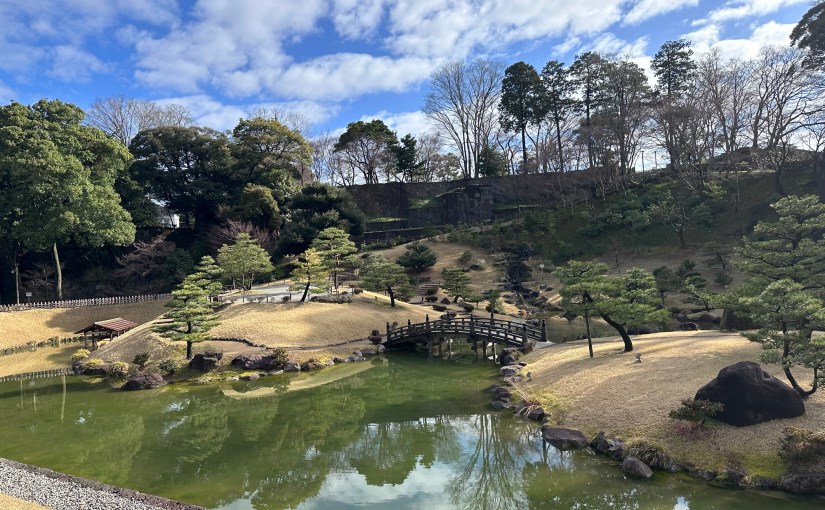
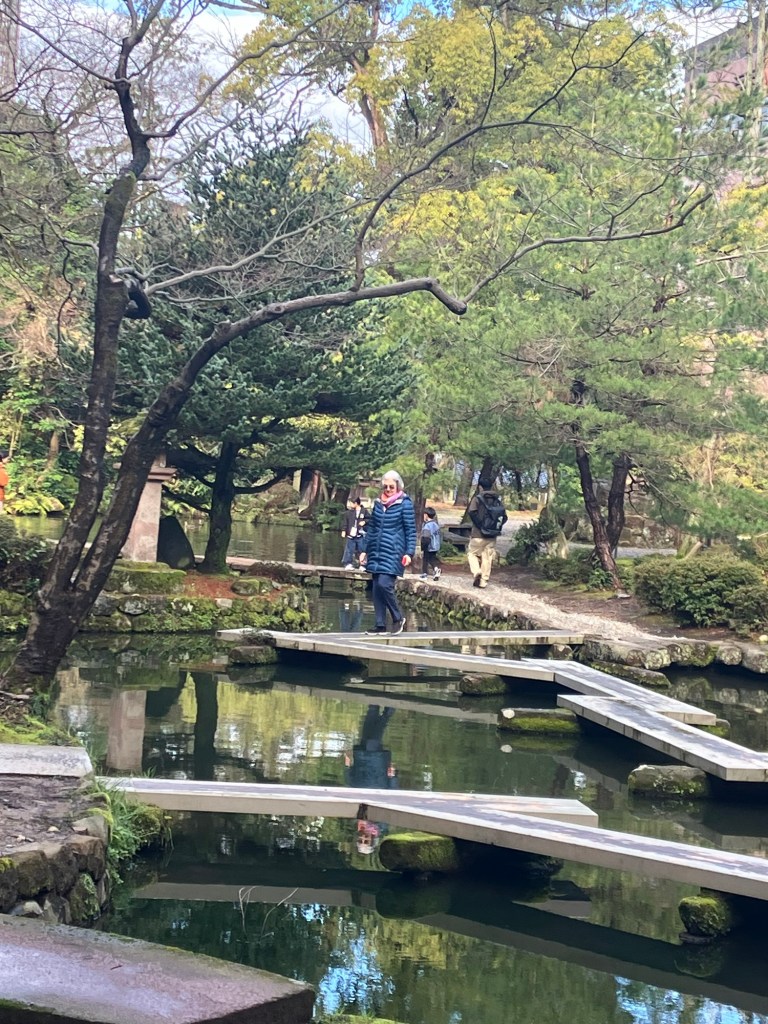
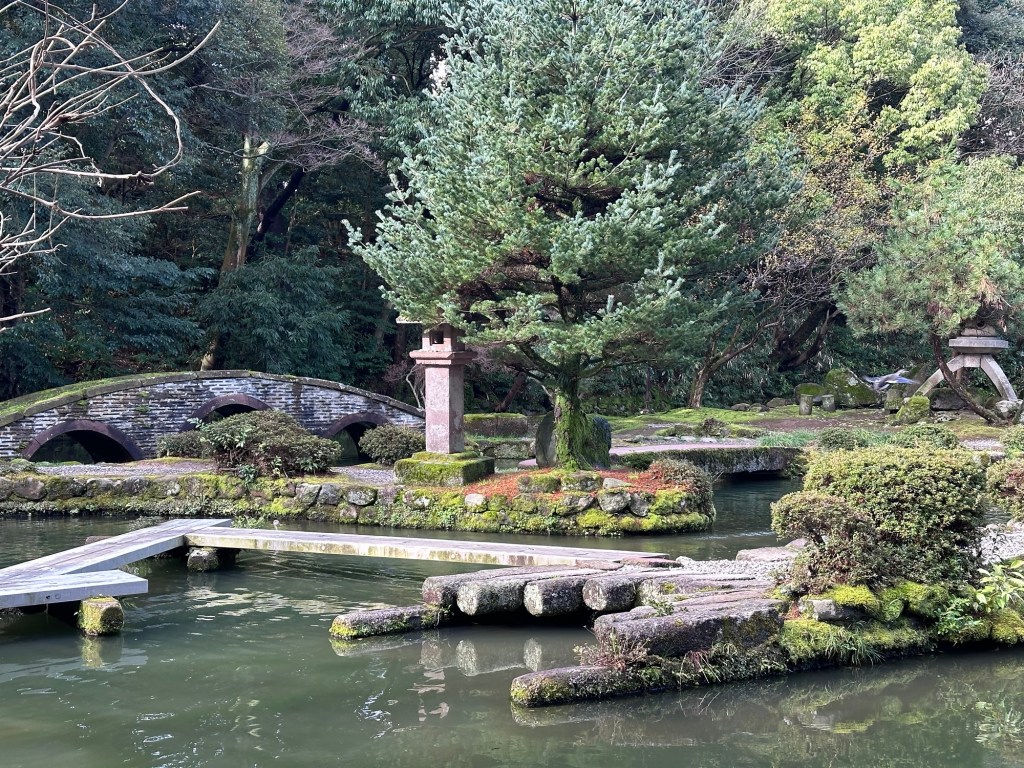
It was raining off and on, but that minor inconvenience didn’t dampen our enjoyment of the beautiful Kenrokuen Gardens.
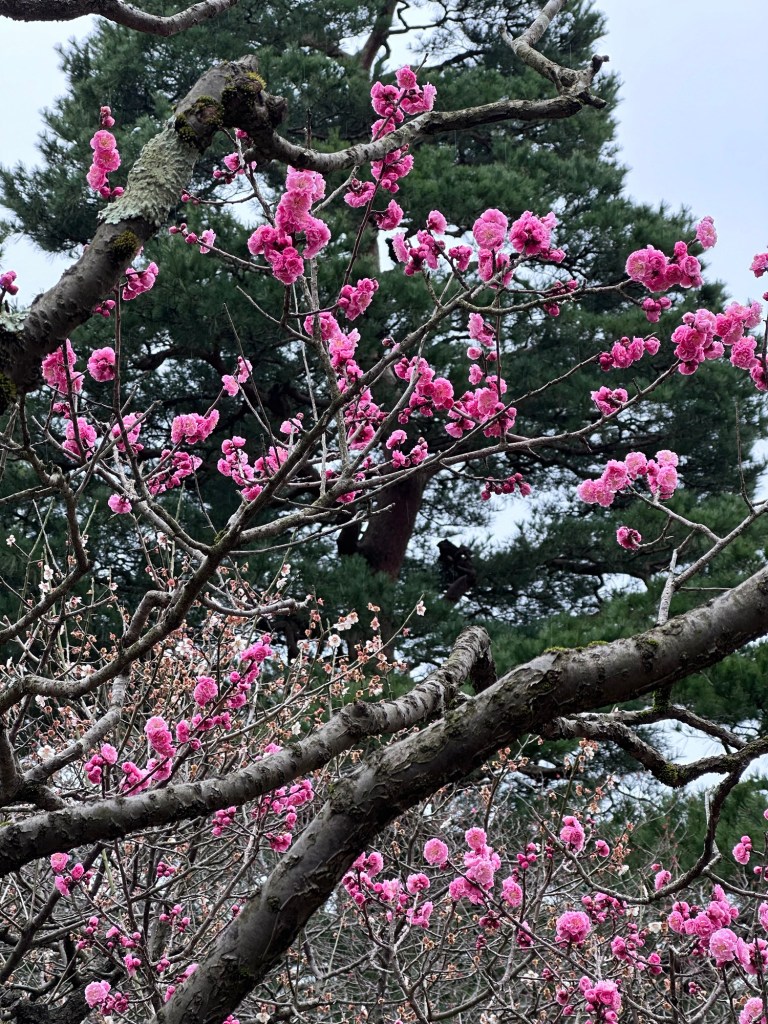
Although it was too early for Kanazawa’s cherry blossoms, the plum trees were a brilliant rosy pink, contrasting nicely against the gray skies.
We realized how lucky we were to view the gardens with such perfect lighting. A sunny day would have washed out the contrast.
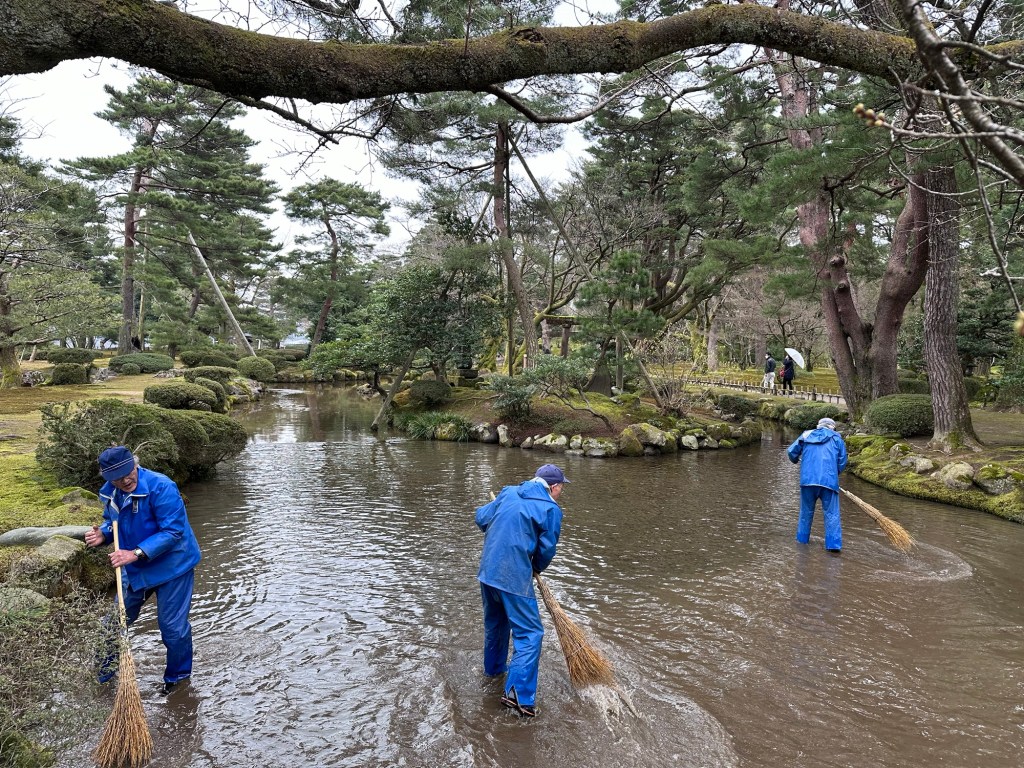
How does it stay so pristine, you ask? Different cultures have different priorities. The Japanese value beauty, harmony, and cleanliness. Shared spaces are important to them. As you can see, their resources align with their values.
We are lucky that photography is one of Mori’s interests. He was always scouting out great locations for group photos.
One of the many things I love about our group is the way we all look out for each other. Notice how Mike and Bobbi are making sure Cathy doesn’t fall off the bridge. At least I think that’s what they were doing. Either that, or their attempt to push her into the water was unsuccessful.
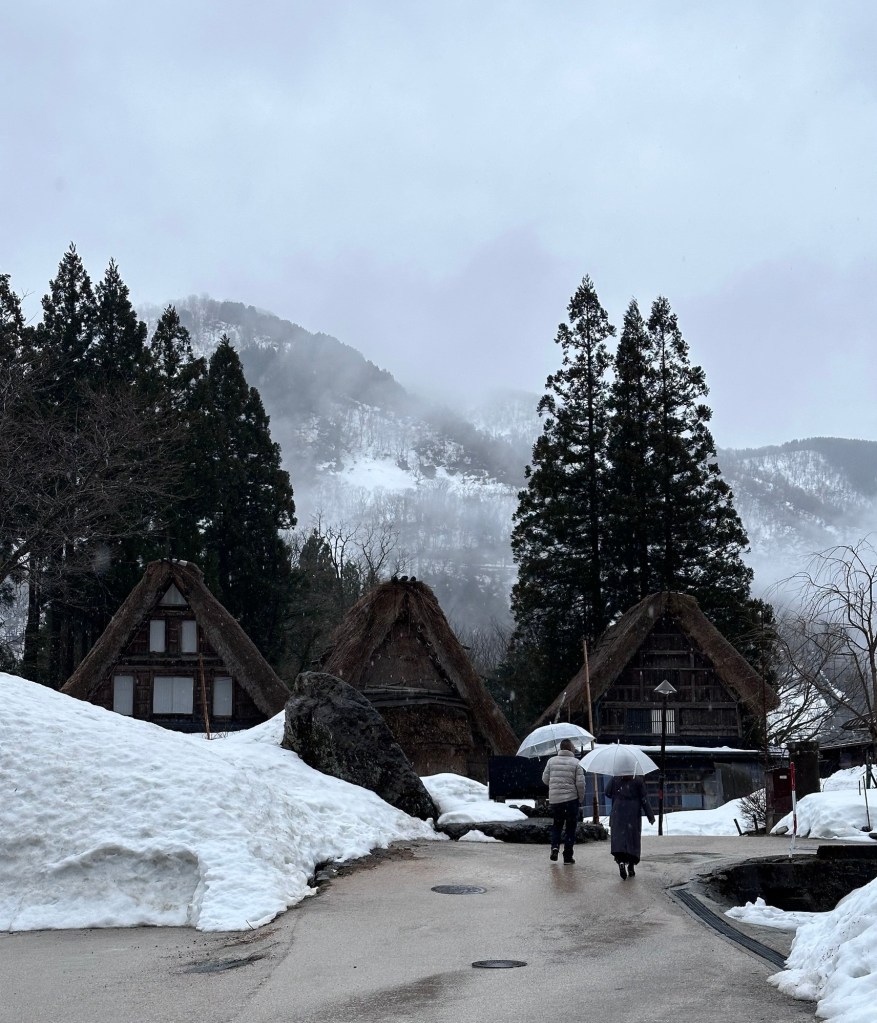
For one of our “Kanazawa” days, we were given the option to visit Gokayama, which is about an hour’s drive away, up into the snowy mountains. The view was lovely and the gift shop was even lovelier, which is good news for the folks back home.
After visiting this village, we spent the rest of the day making ( and eating) mochi, learning how to make traditional Japanese paper, and watching a traditional dance.
I hope my exquisite creations survive the trip home.
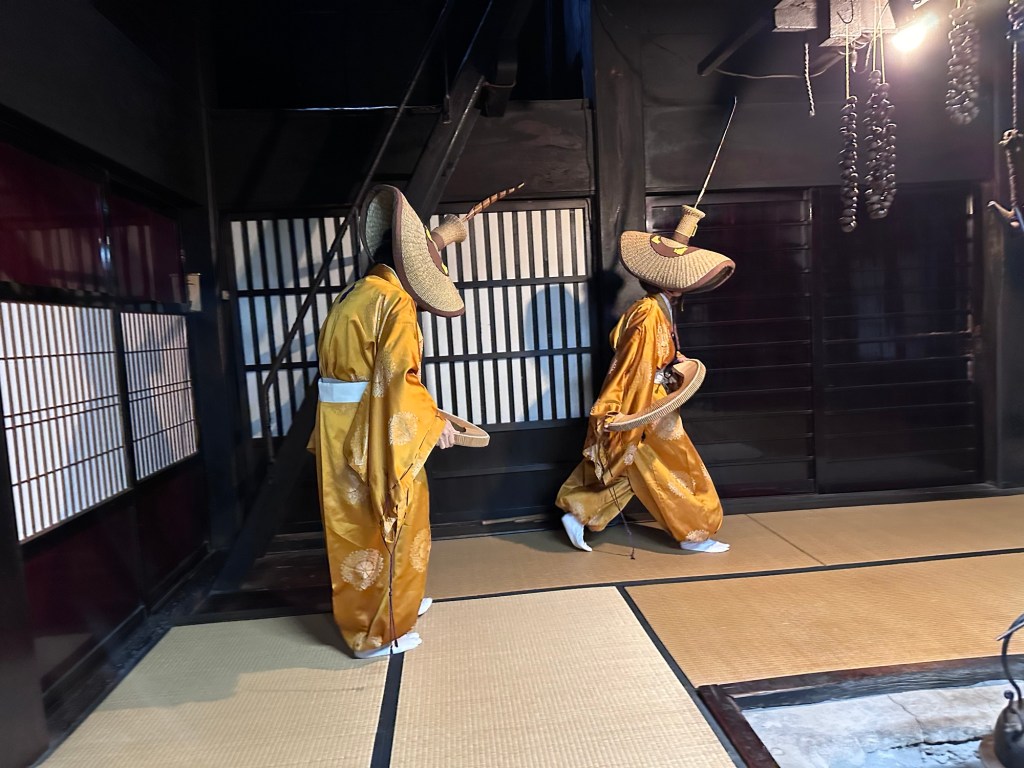
The traditional dance performance was set in an authentic, historic Japanese house. Yes, I know that house had an intriguing history, however, it was so bloody cold in there, all I could think about was getting back on the bus. Sorry. You’re not getting any house history from me.
The traditional dance
Mori managed to find us fantastic restaurants everywhere we went, and Kanazawa was no exception. We liked shabu shabu so much, we were delighted to experience it again. This sweet TINY restaurant was quiet, beautiful, inexpensive, and best of all, the food was delicious.
Ruth, Renee, Janis and I had this little alcove all to ourselves.
That evening was an “on your own” dinner, so feeling adventurous, Kathleen and Cathy opted for a restaurant with a more esoteric menu.
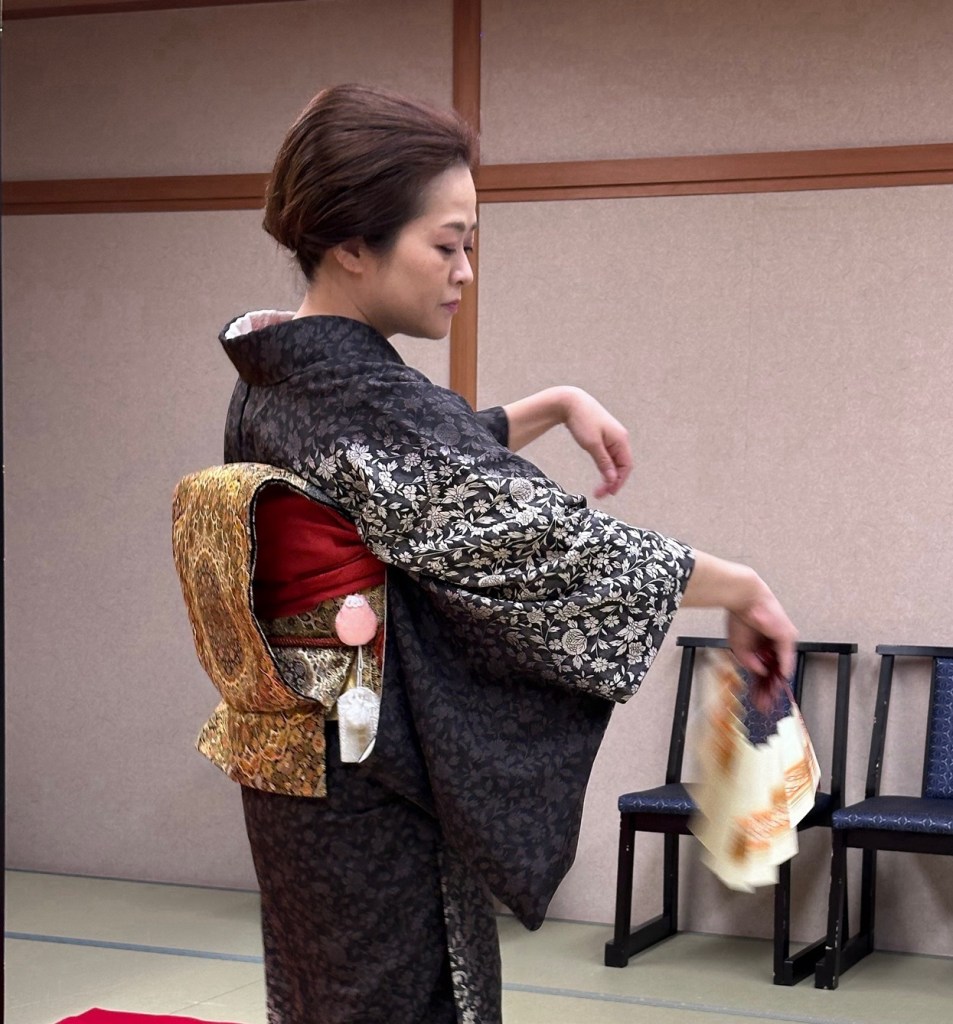
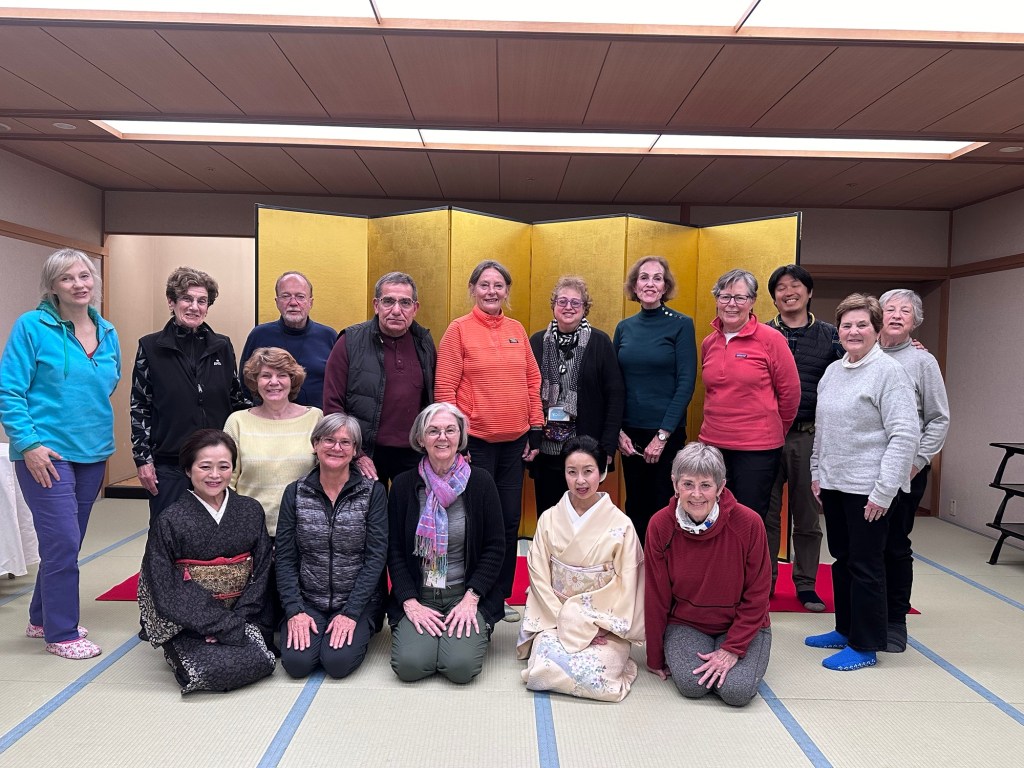
Before leaving Kanazawa, we split into four groups to visit the home of a Japanese family, where we were treated to different activities, like calligraphy, and origami. Some groups sampled saki and tried on kimonos. The luckiest groups managed to do all of the above.
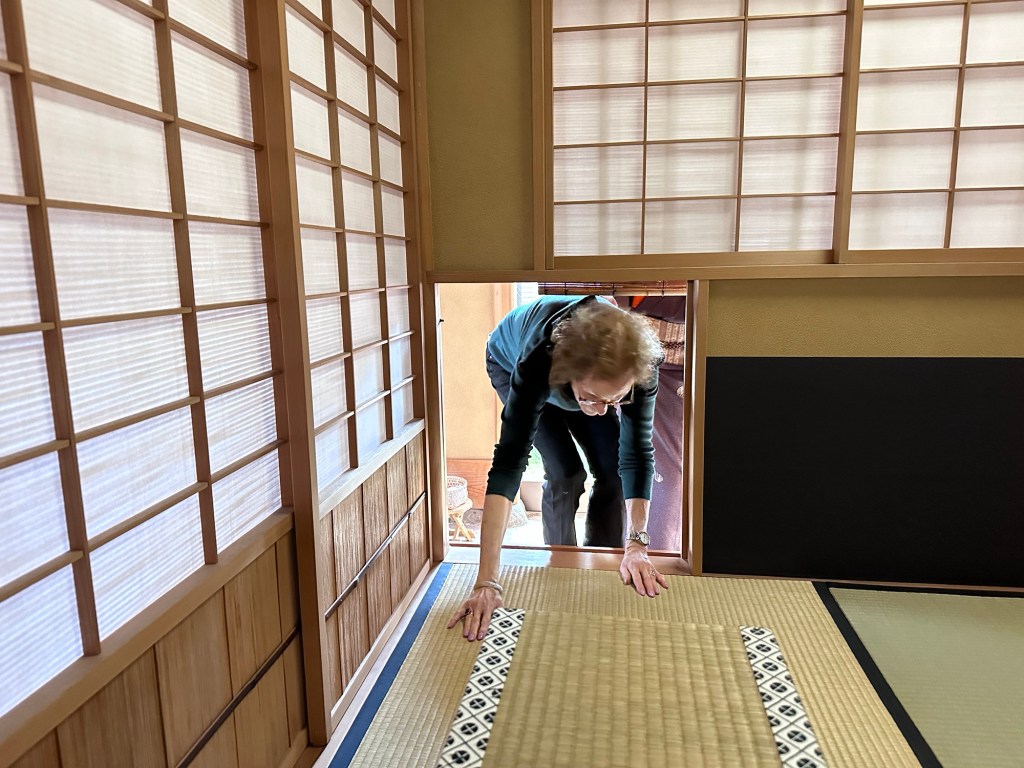
My group experienced the formal tea service at an authentic tea house. We entered the room the way the samourai did, crawling through a tiny space that we dubbed the “doggie door”.
Here’s Patsy, demonstrating the graceful way to enter the tea room. Like the Samourai, the door’s size forced her to leave all her weapons behind.
We had just enough time before we took the bullet train to Kyoto to visit the shrine a few blocks from our hotel. As usual, the paparazzi was stalking me as I strolled the park.
Photo by Bobbi
Some of the group went with Mori to visit the shrine the night we arrived. I was too exhausted, so I was glad that I had time for this early morning visit.
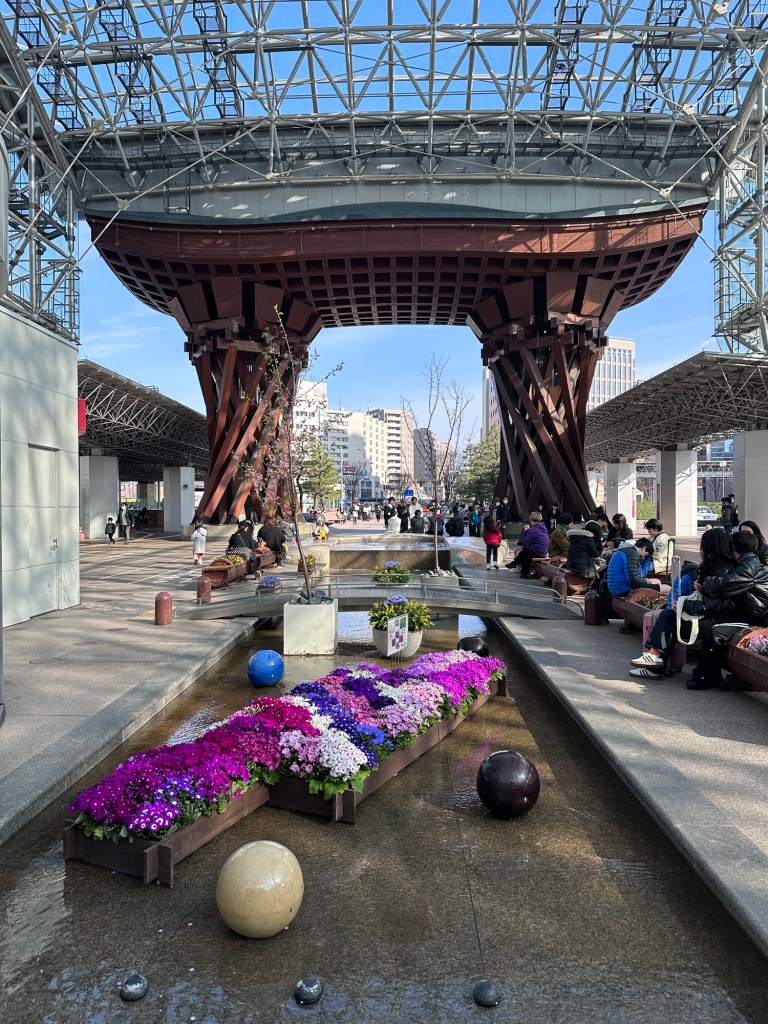
I’ll end with this photo of the Kanazawa train station. and if you think this station is beautiful, you ain’t see nothin yet! Just wait till my Kyoto post!
When you think of Japan, what comes to mind? For me, it was all about the cherry blossoms and the Geishas. Sumo Wrestling? Drumming? Karaoke? Not so much. But I kept an open mind, and I’m so glad I did. Frequently, on OAT trips, I didn’t know I wanted to see something until I got there.
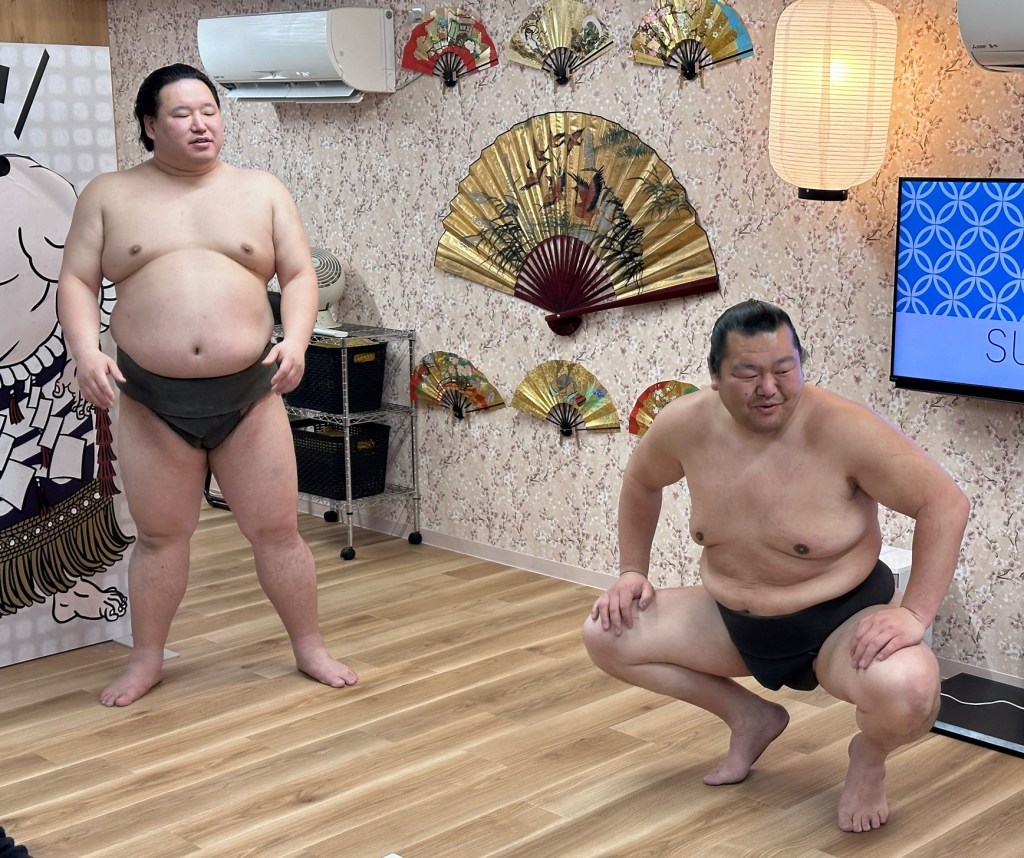
Take, for instance, sumo wrestlers. These guys put on quite a show for us. I hadn’t expected them to be so funny! While demonstrating the forbidden moves—poking their opponent’s eyes—a fake eyeball popped out and rolled on the floor.
Sumos have “stage names”, like US wrestlers Who can resist a photo op with nearly naked men? They’re heavy, but muscular and very fit.Our group is now complete. 5 more joined for the main trip.
It wasn’t just laughs, though. We also learned quite a bit about the sport. Some of the sumo wrestlers are recruited from the ranks of “troubled” boys, usually around the time they turn 15, providing a constructive use of all that testosterone.
Their careers last about 20 years, which means they retire from wrestling in their mid to late 30’s, similar to the career span of professional athletes in the USA.
Renee and I (because of our insurance backgrounds) immediately had questions about the impact of all that extra weight on life expectancy. We learned that sumo wrestlers, on average, live 10 years less than most Japanese. As one would expect, diabetes, joint problems, head injuries and other medical issues are responsible for decreased longevity.
Like our time with the wrestlers, we were offered a “hands on” experience at a subsequent cultural event —drumming. And boy, did we get into it! We were like a bunch of pre-teen boys, wildly pounding away.
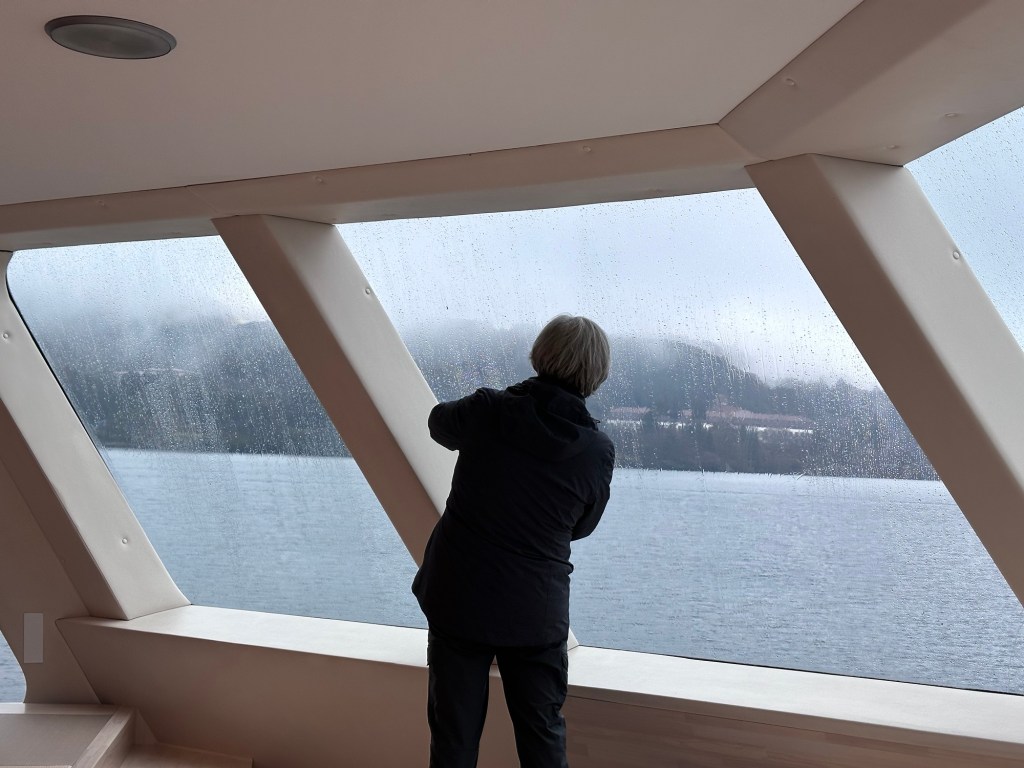
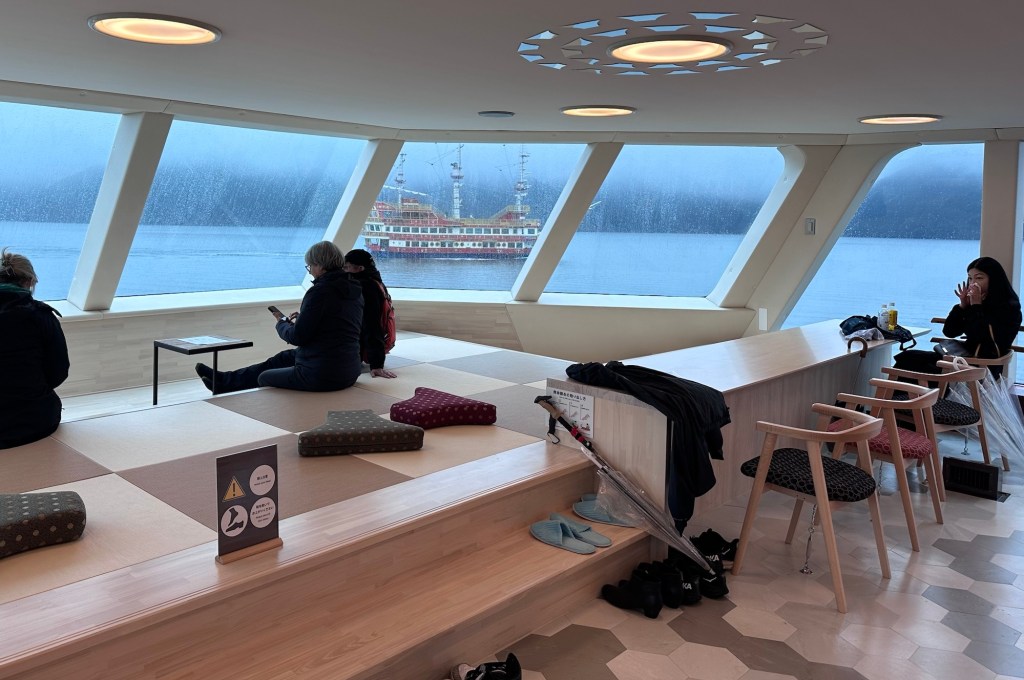
It was raining off and on during our second day in Hakone, but we didn’t mind. Our day was filled with indoor cultural experiences, starting with a boat ride across the lake to visit a woodworking master.
Renee, attempting to get the perfect exterior shotI was more captivated by the plush interior and the “pirate”ship
I’m not normally a shopper, but this master craftsman’s work was so exquisite and so unusual, I had to buy a couple of his smaller pieces. Partly because of the prices and partly because traveling with carry on, my purchasing power was severely limited.
Next up was shabu shabu for lunch ( Japan’s version of fondue),
followed by a delightful encounter with these two lovely geishas, who danced and played a traditional instrument to demonstrate how they entertain clients.
During the question and answer period, they dispelled many misconceptions about geishas.
Unlike the book and movie “Memoirs of a Geisha” would have you believe, geishas are not prostitutes, nor are young girls sold to geisha houses. Although they admitted those things might have happened many years ago, the practice was not widespread even back then.
I never would have guessed there is a geisha union that clients contact when they want to book a geisha for an event. Geisha musicians are the highest paid, and if a client wants them to paint their faces white, and don wigs to create that traditional hairdo, it costs extra. An event normally lasts about two hours, with geishas sometimes attending two parties per night.
Curious about that big padded thingie on their back? I sure was. Well, they don’t carry a purse, so they need SOME PLACE to store their cell phone, right? Think of it as a Geisha backpack. I couldn’t believe all the stuff they pulled out to show us!
Because Hakone is noted for its hot springs, many hotels have onsens on site, and our hotel was no exception.
Men and women have separate areas, because everyone is naked in the onsen. During our stay, Kris , Janis and I experienced different pools, both inside and out, during our multiple visits. Since this is not an X-rated blog, there are no photos of the three of us frolicking in the onsen. Plus it’s against the rules. . .
Did I mention Japanese are very good at following rules? They are much better than Americans, which is probably why the laminated card in our rooms included English translations.
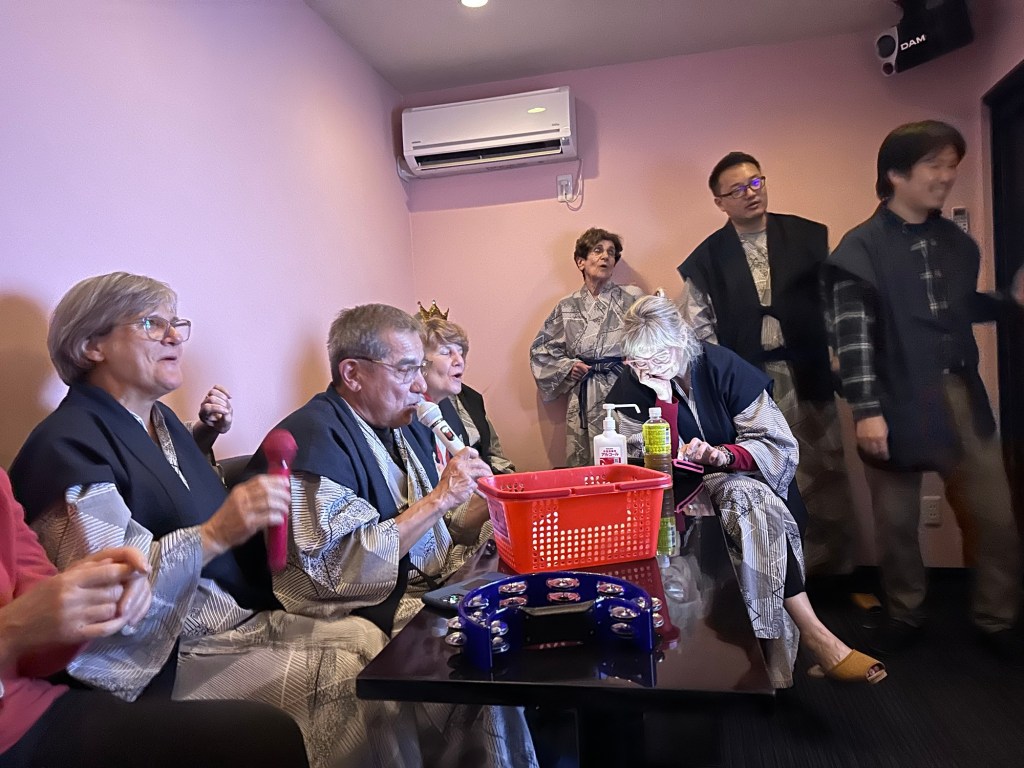
I’m going to end this post with our final Hakone activity—karaoke. My only prior experience with karaoke was at a bar, where individuals performed solo. The Japanese do it differently. It’s a group sing-along in a tiny room. Yep, the room isn’t much bigger than what you see in the photo below.
What a bonding experience! I’ll admit, it helps if you downed some sake (or wine) beforehand, which we all did, to celebrate Kathleen‘s birthday.
Wondering about that red basket? It held the microphones.
Every time I think this trip couldn’t possibly get better, it does.
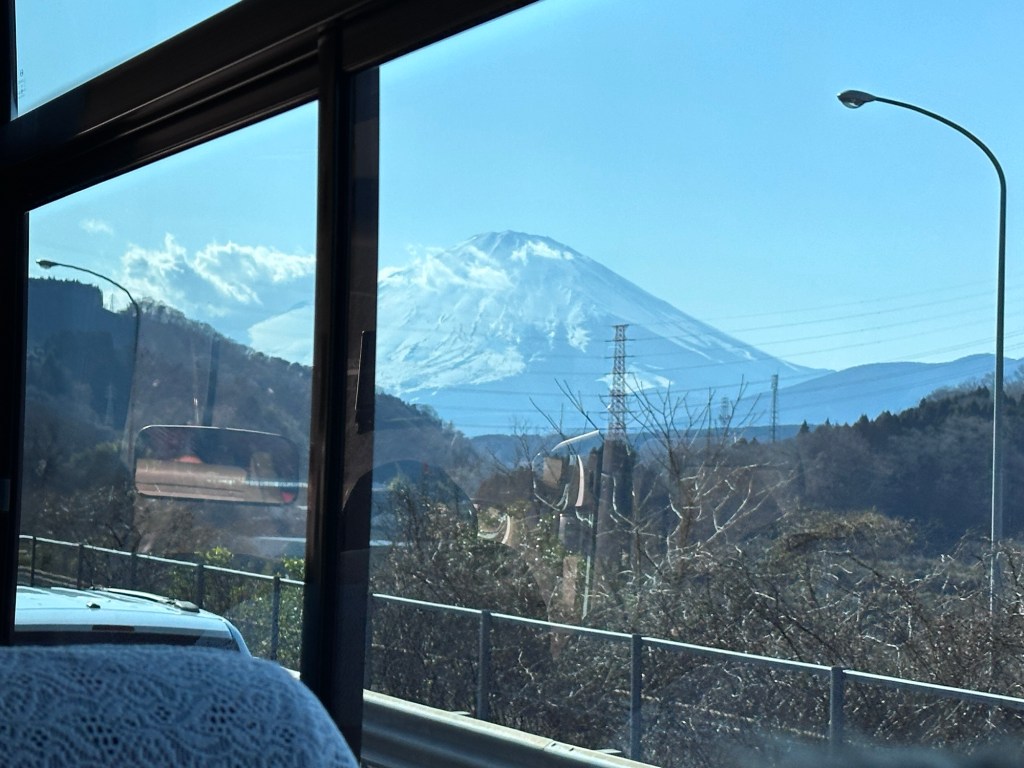
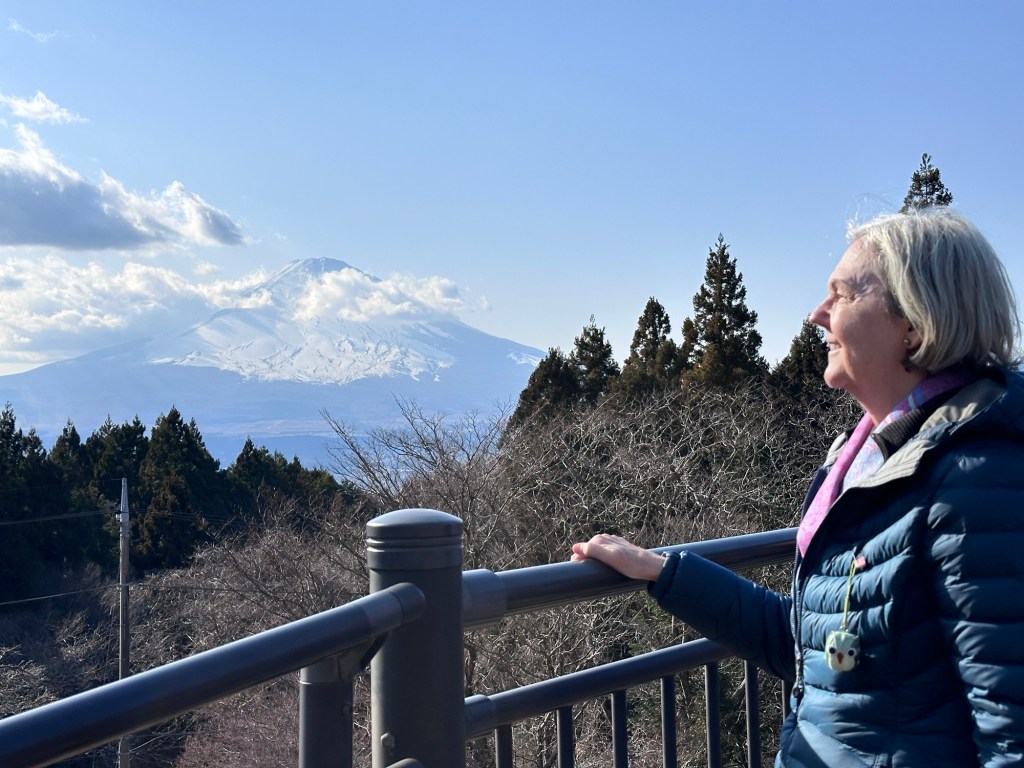
On our bus ride to Hakone, we were treated to multiple views of the elusive Mt Fuji. We watched as it progressed from crystal clear to cloudy.
10:30 AM at the rest stopThe clouds started rolling in around 3 PM. 3:30 PM. Our driver took us to this special look out that gave us a phenomenal view of the mountain.
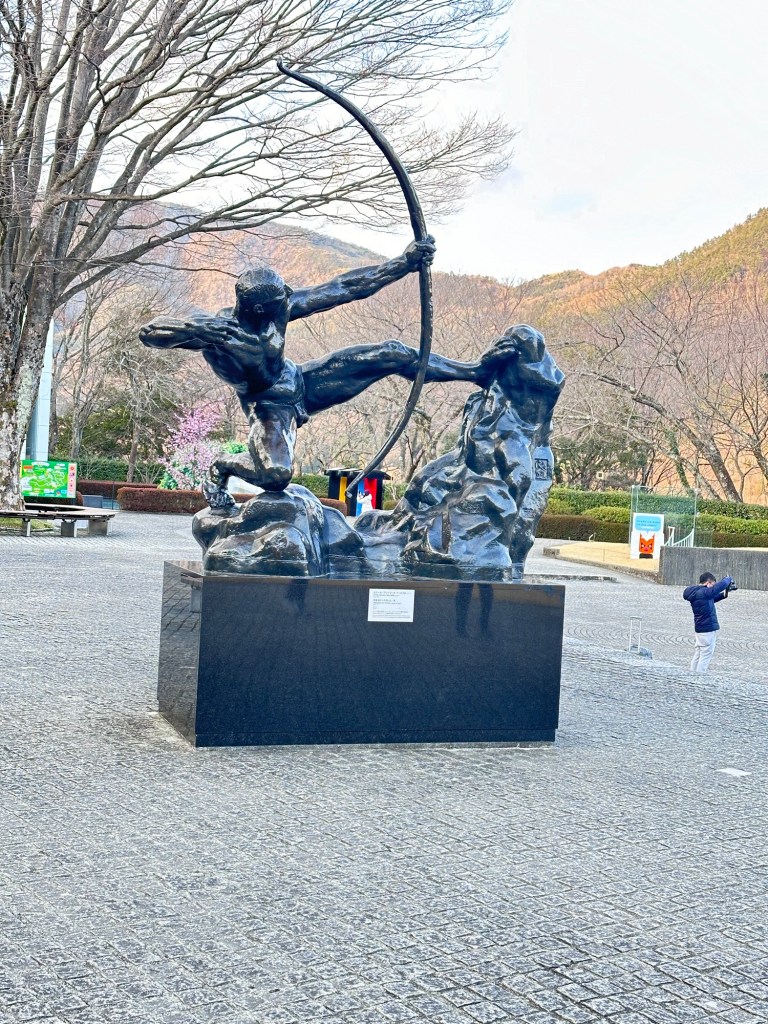
Although it is wasn’t on the itinerary, I had told Mori I really wanted to experience the Open Air Museum in Hakone and he made it happen. Turns out 12 out of the 14 of us wanted to visit. We made the most of our hour at the museum. Here are a few of my favorites.
It may not look like much from the outside but wait till you step inside.
But there was so much more to see, like this piece which was inspired by the myth of Narcissus.
The sculpture was trying to view her reflection in the water, but her tears were blurring her image.Can you believe how perfectly balanced that sculpture is? And check out the gorgeous setting.
We lucked out with the weather because our second day in Hakone was rainy.
































































 Destination NOW