Spain and Portugal Adventure Travel

The photo above shows the itinerary for this trip. Ignore the boxes. I’m not doing a pre or post trip this time.

The name of my favorite tour company is Overseas ADVENTURE Travel, and so far, it’s living up to its name! The tour promises participants will have “learning and discovery” experiences and so far I’ve had both.

I now know how to shop for ropa interior (underwear), how to translate sizes (take your US size and add 32, so a size 8 becomes size 40). I learned to never EVER buy “Brazilian” underwear, how to pay for a bus ticket to the airport (credit card, paid ON the bus) how to get thru the “Do Not Enter” doors at Bilbao airport ( wait for someone to leave and dash thru).

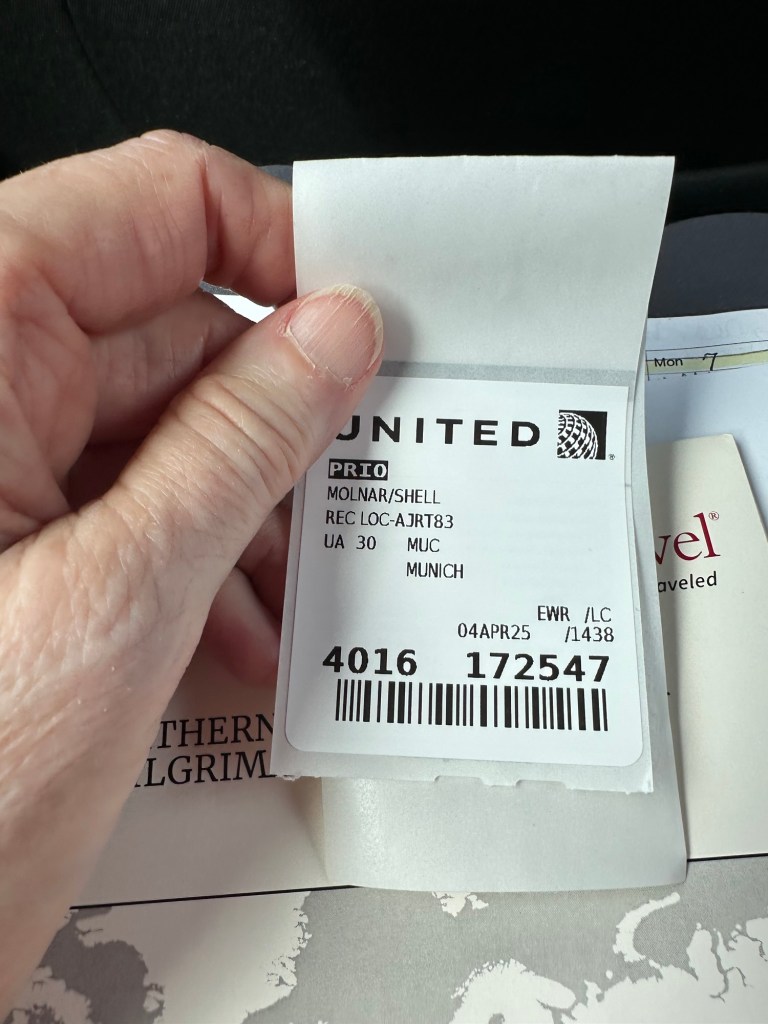
I came to this knowledge when I arrived in Bilbao and my AirTag told me my luggage was still in Munich.

Why, oh why did I check luggage? Well…

In the past, connections in parts of Europe, especially Germany, have been a tad unpleasant. I hate it when my plane parks far from the terminal. I have to walk down the rollaway stairs, carrying luggage, then get stuffed into a bus, which drives for 5 to 10 minutes to get to the terminal. On past occasions, the escalators weren’t working, so I had to carry my bags up several flights of stairs.

As a bonus, if I checked a bag, I could bring enough clothes so I wouldn’t have to do laundry. I would also have room for a bathing suit so I could enjoy any hot tubs I encounter along the way. Checked bag it was. Thankfully, I had the presence of mind to include my AirTag, just in case.

I’ll admit it. I was feeling a little smug while I was walking down 4 flights of stairs (with only a light backpack) to the crowded bus that would drive us to the plane that would take us to Bilbao. That feeling was QUITE short lived!

But at least I had the good sense to arrive a day before the tour started, because I spent HOURS of my first afternoon on the phone getting bounced between United ( Newark departure) and Lufthansa (Bilbao arrival). I’ll spare you the details, mainly because I don’t want to relive them, and also because they are bone crushingly boring.

But I WILL share this important tip: ALWAYS check your baggage receipt. Had I done so in Newark, I would have noticed that it said “Munich”, not Bilbao. So because I missed that important detail, it was determined that I was at fault and my bag would NOT be delivered to the hotel. Instead, I would have to go to the airport to fetch it.

And here’s another tip: ask to speak to a supervisor or manager as soon as you hear the same unhelpful info for the second time. I certainly wish I had.

Just about every situation has an upside, if you look hard enough. So I did. Here’s what I came up with: In addition to my various “learnings” described earlier, I might not otherwise have been out so early on a Sunday morning. I LOVED my early morning walk and I felt like such a big girl riding the bus all by myself.

Plus, I got to buy a Disney tee shirt that doubles as a nightgown. In case you don’t read backwards, that says “Ratatouille”. NO photos of Brazilian “ropa interior”. You’re welcome.

I was back early enough from my airport jaunt to join my new friends Pam, Barbara and Camille for a walk along the river.

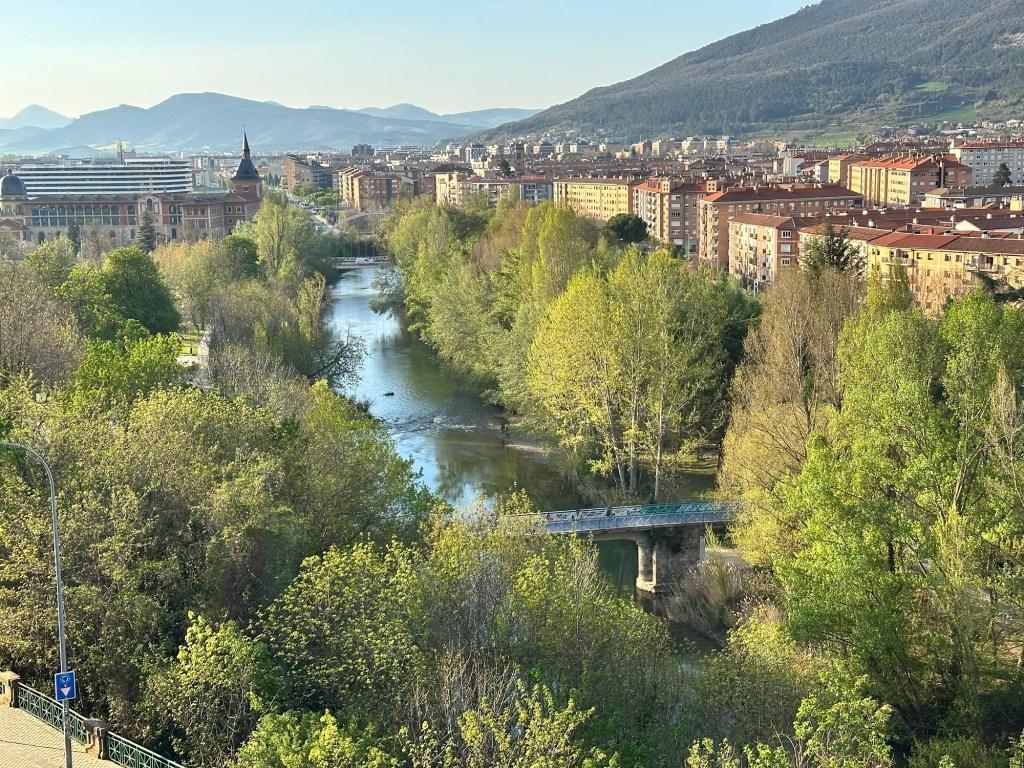
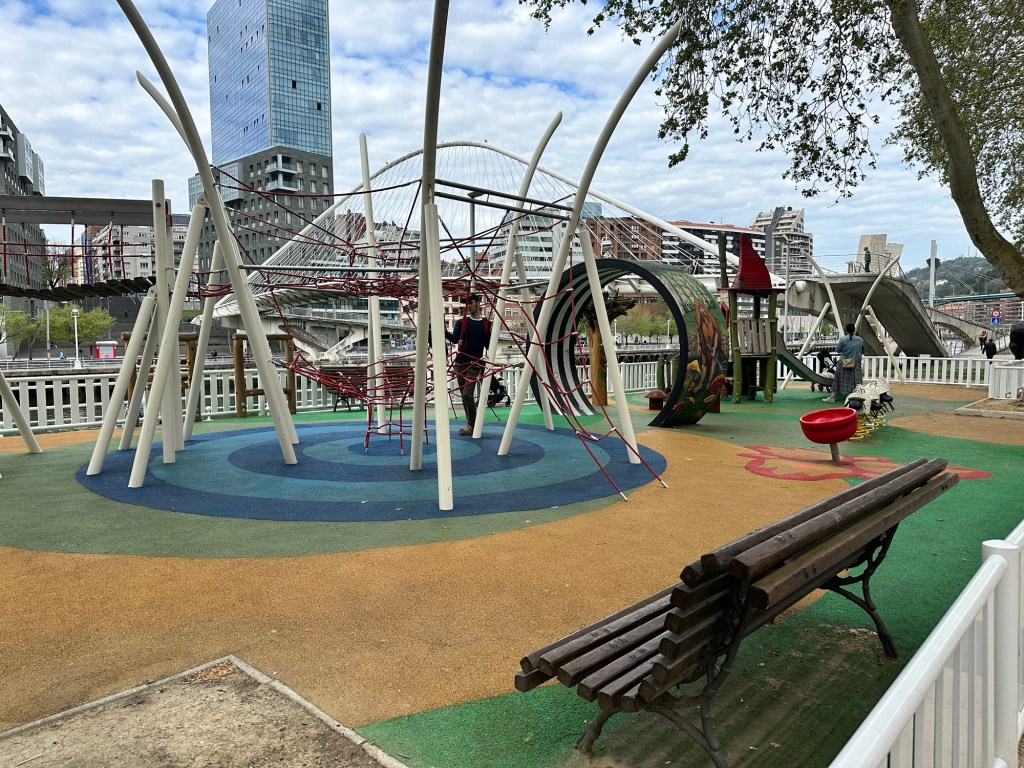
Bilbao is a WONDERFUL city, with lots of green space, playgrounds, artworks and pedestrian walkways.

The playgrounds had unusual, imaginative structures
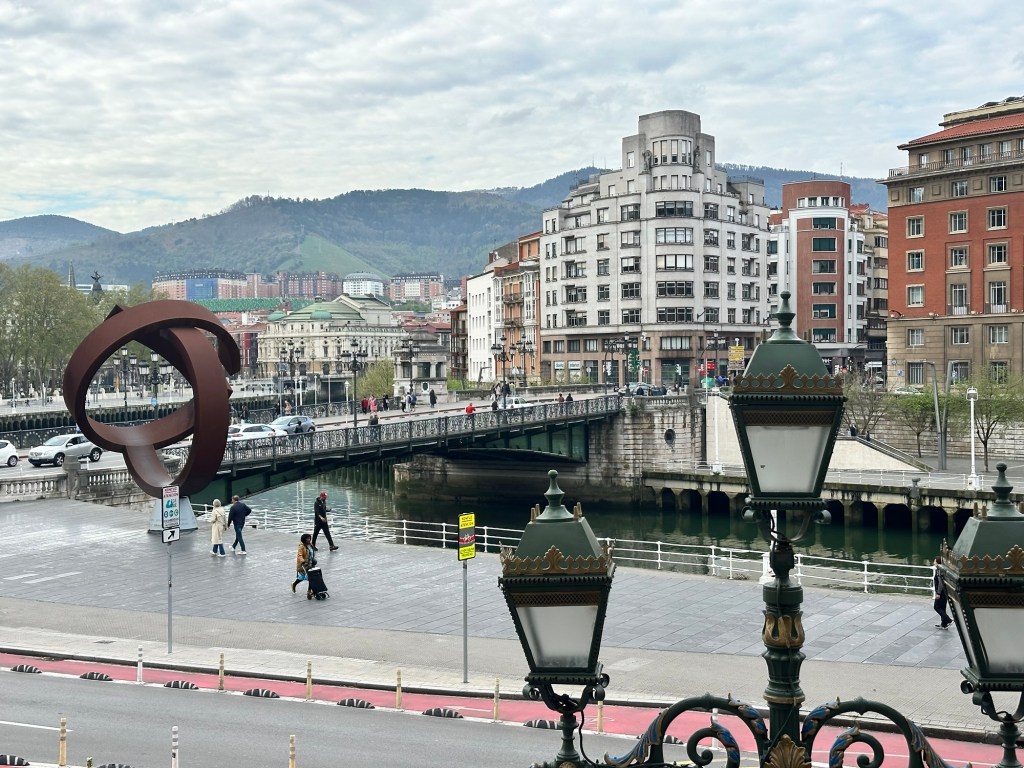
The many bridges are all beautiful in different ways.

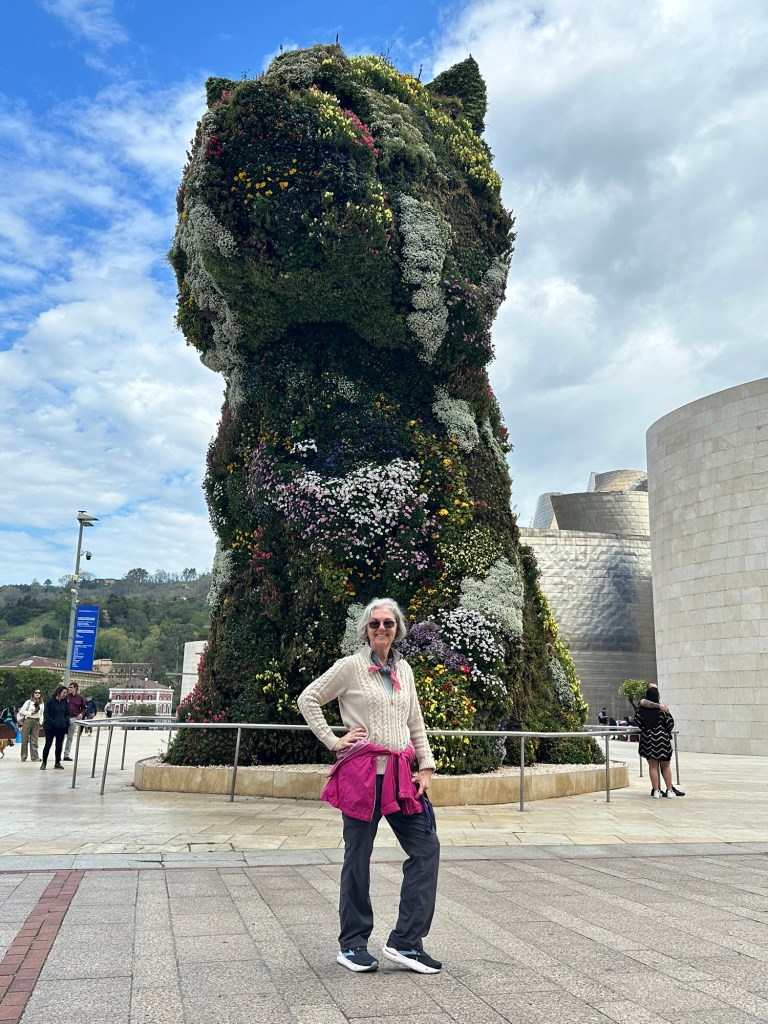
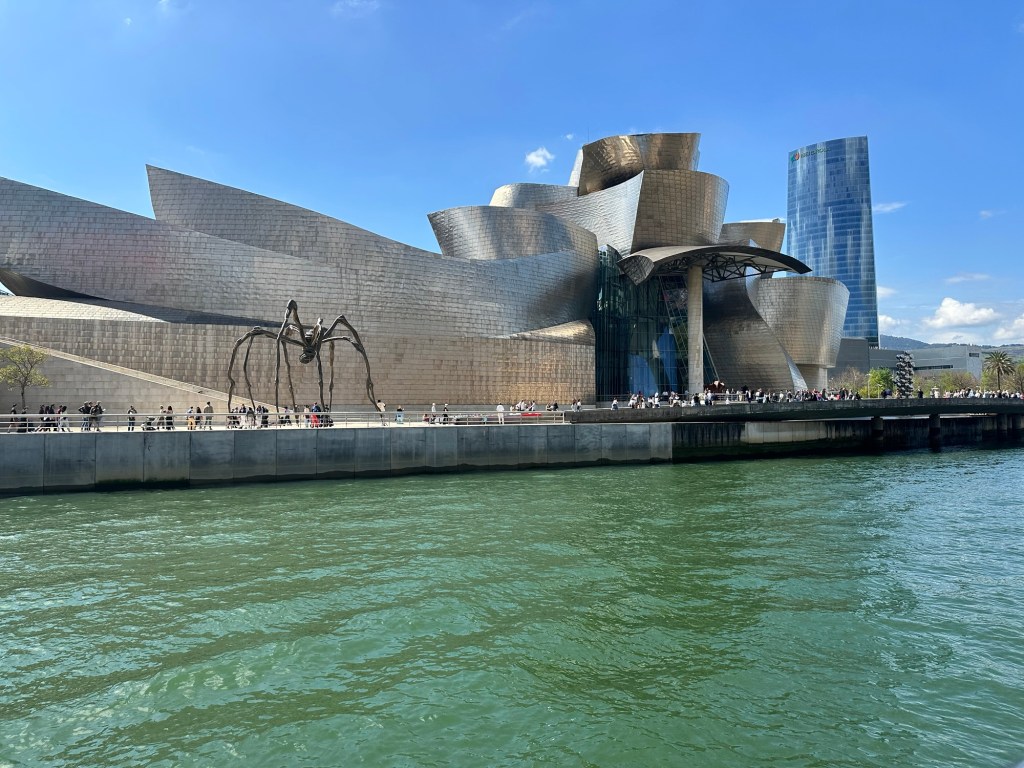
The other three ladies wanted to explore churches and cathedrals, but since I’ve already exceeded my lifetime quota for such structures, I ambled on down to the Guggenheim. I had just enough time before our afternoon boat ride to explore the exterior of this amazing building.

Yes, that puppy is made entirely of different flowers
I took another photo of this sculpture from the boat. Which do you prefer?

I highly recommend the 1 hour boat ride for anyone who is interested in architecture. There is a QR code on the back of all seats on the boat. If you scan it with your phone, you have access to a narrative (in your chosen language), describing what you are viewing while you pass by on the boat ride.

The Guggenheim as seen from the boat, coming
And going

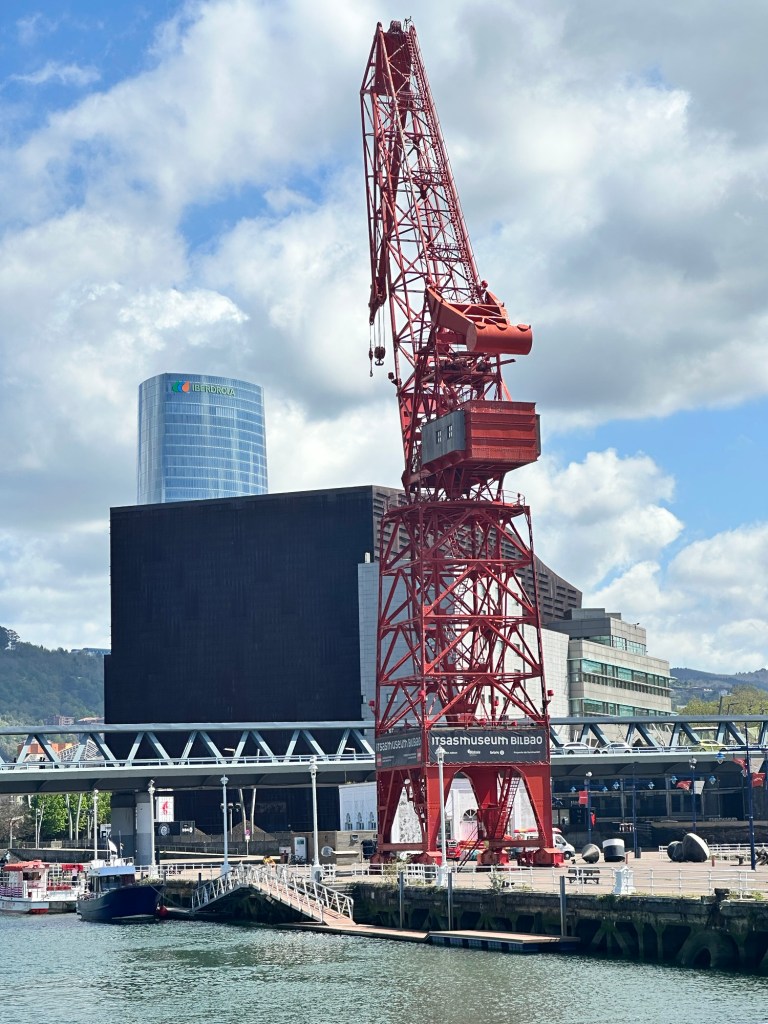
There was a “girl from Ipanema” type of story about this crane. I THINK it went something like this: Everything would stop so that men could stare when a certain young girl came across the river 4x a day to operate the crane. They should have written a song…
There was a whole lot more to day 1, but I’ve done enough blogging for today.
Caja National Park

Yesterday’s quick post was done especially for my fellow traveler Elsie; today’s is done for my other friend, nature-loving Leslie. Do you two have any idea how much Joyce, JC, Gail, Eric and I ALL wish you two had taken the post trip with us?

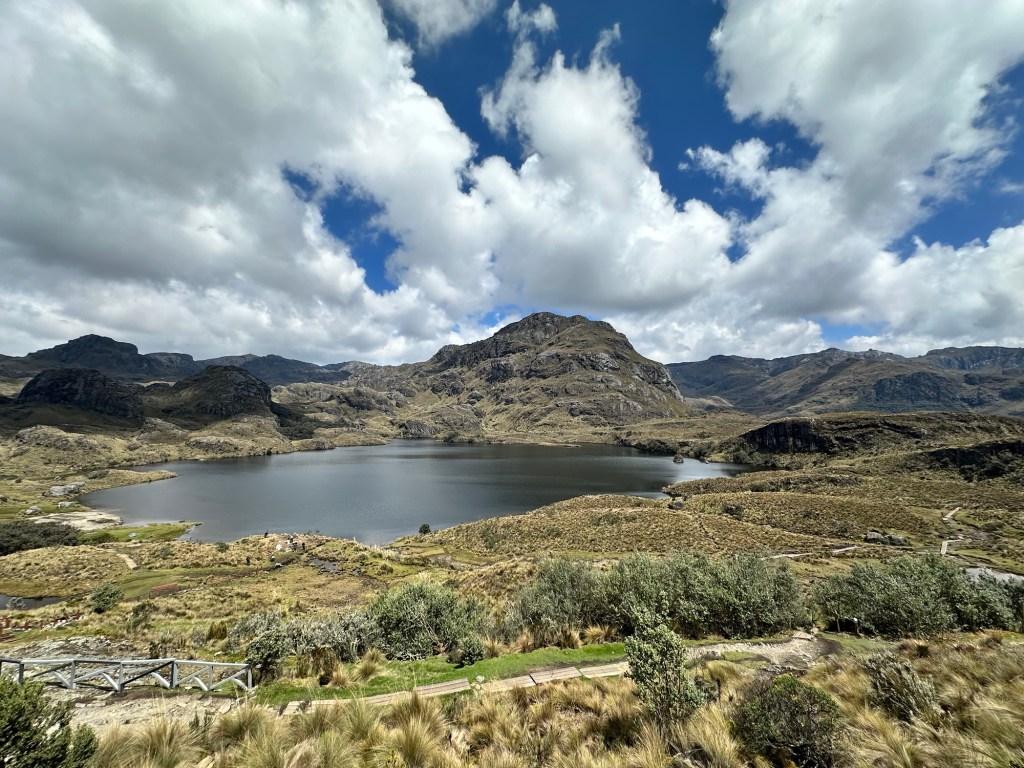
We spent a full day communicating with nature in Caja National Park. Getting there and back was a visual feast, made even better because we were viewing it from a very comfortable bus.

Take a close look at the structure on the left. Can you see the profile of a man?

On the right is a rock formation resembling the Virgin Mary, or so I was told.

Our guide shared a story about a pilgrimage that thousands made, years ago, to view this rock . Sadly, I have forgotten the details. I think it might have had something to do with the rock coming to life and speaking to a hiker, but I’m not positive.

Just in case you have difficulty finding the “Mary” Rock, I’ve provided assistance.

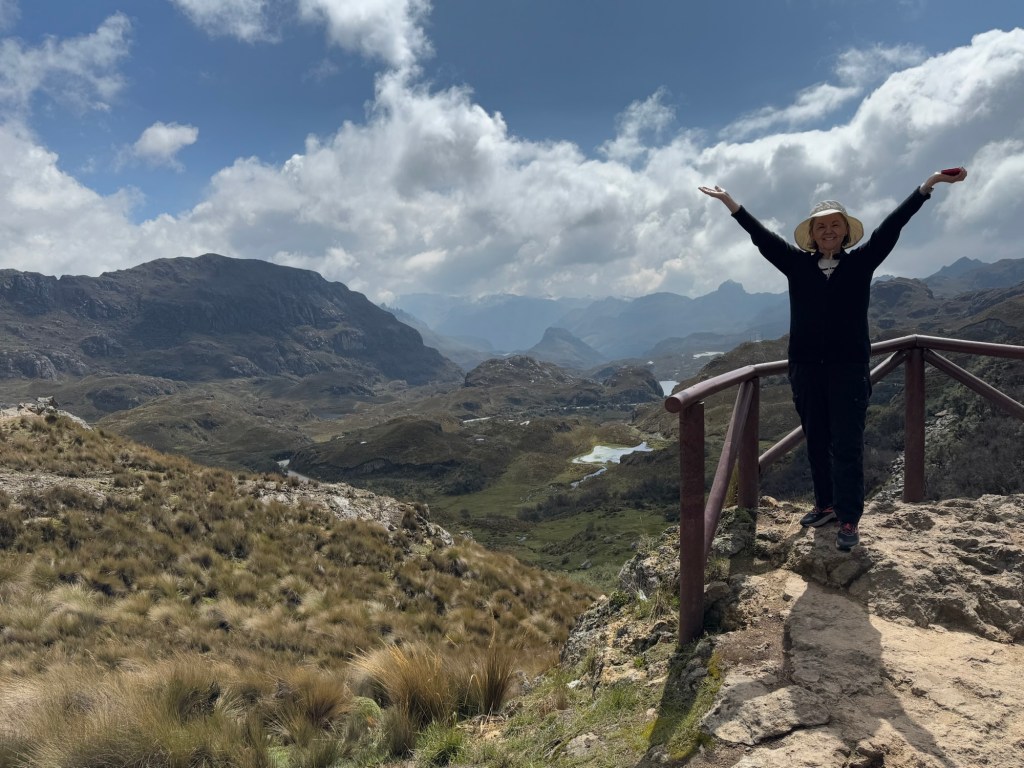
When we reached the park, we started our hike at the highest elevation, 13,760 feet, and walked down from there. Of course, what goes down, also has to come back UP.

Can you see the chunk of ice in the lake? By midday, it will have completely melted but will freeze again in the evening.

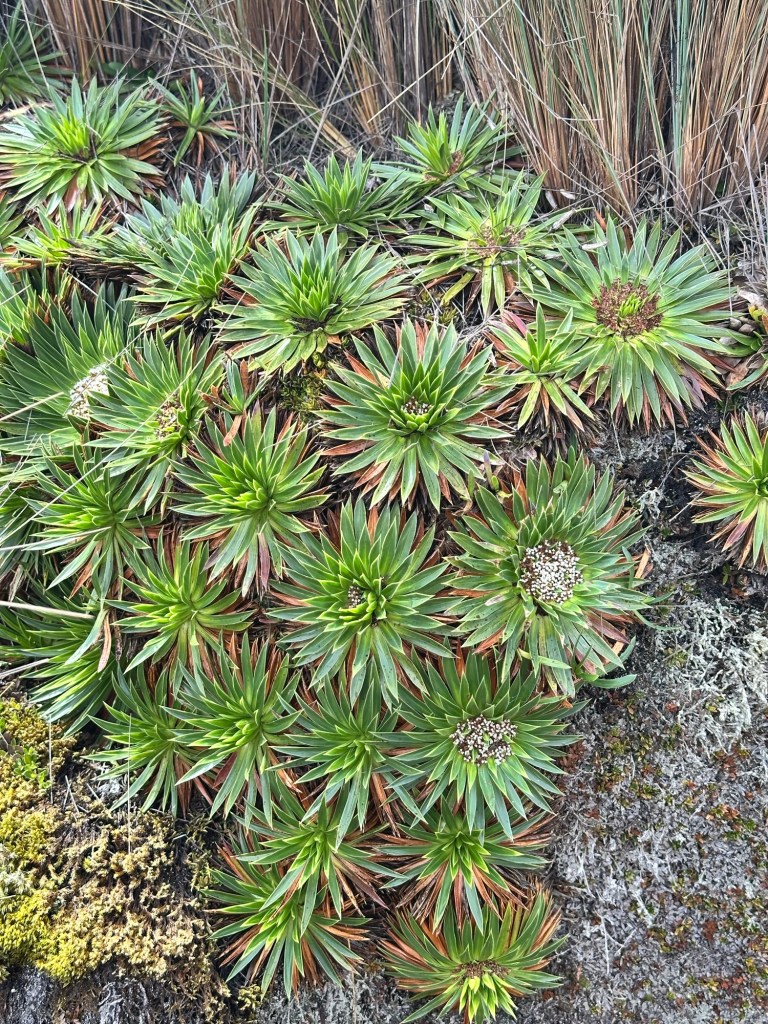
Juan, our naturalist, accompanied us, pointing out the various plants that are able to flourish with 12 hours of frigid temperatures followed by 12 hours of heat.

Those tiny white flowers are valerian, from which Valium is made.

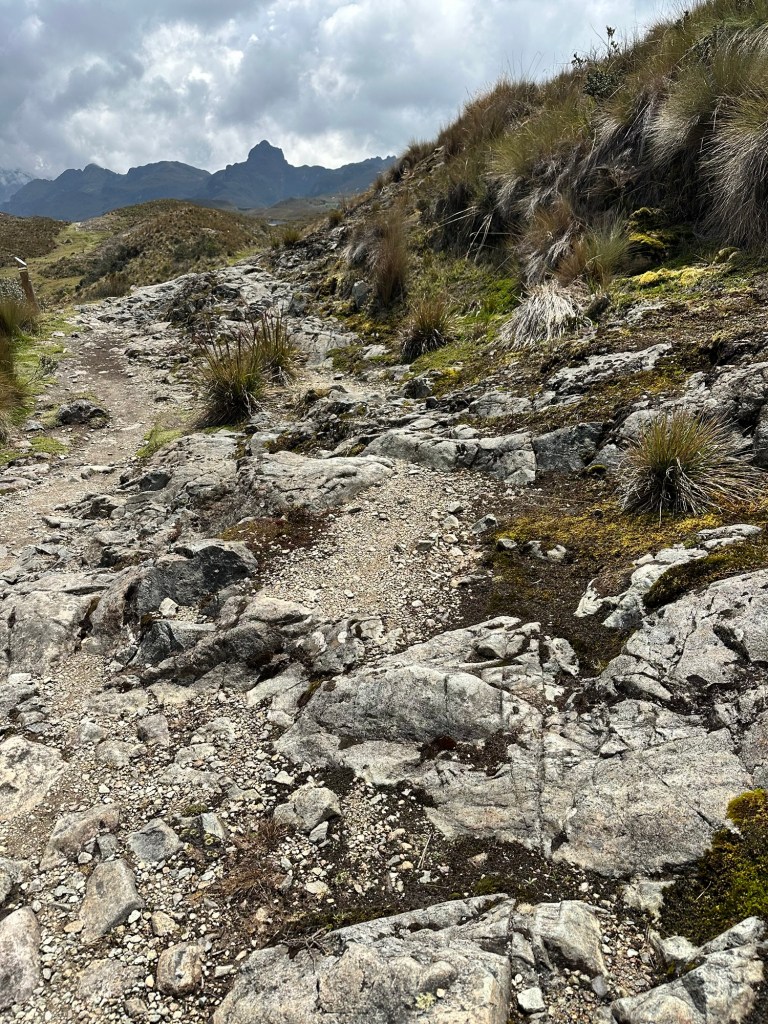
The trail we hiked was once used by the Incas. Centuries later the drug dealers used similar trails, to carry Colombian cocaine to Guayaquil, on Ecuador’s coast, from which it is shipped around the world.

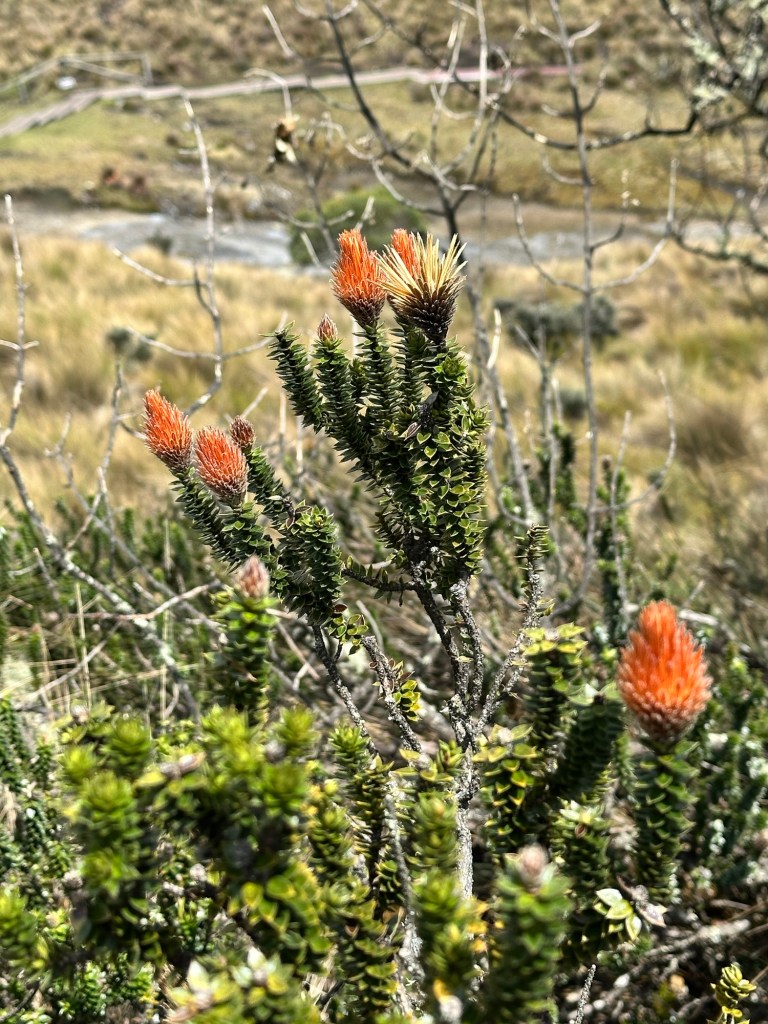
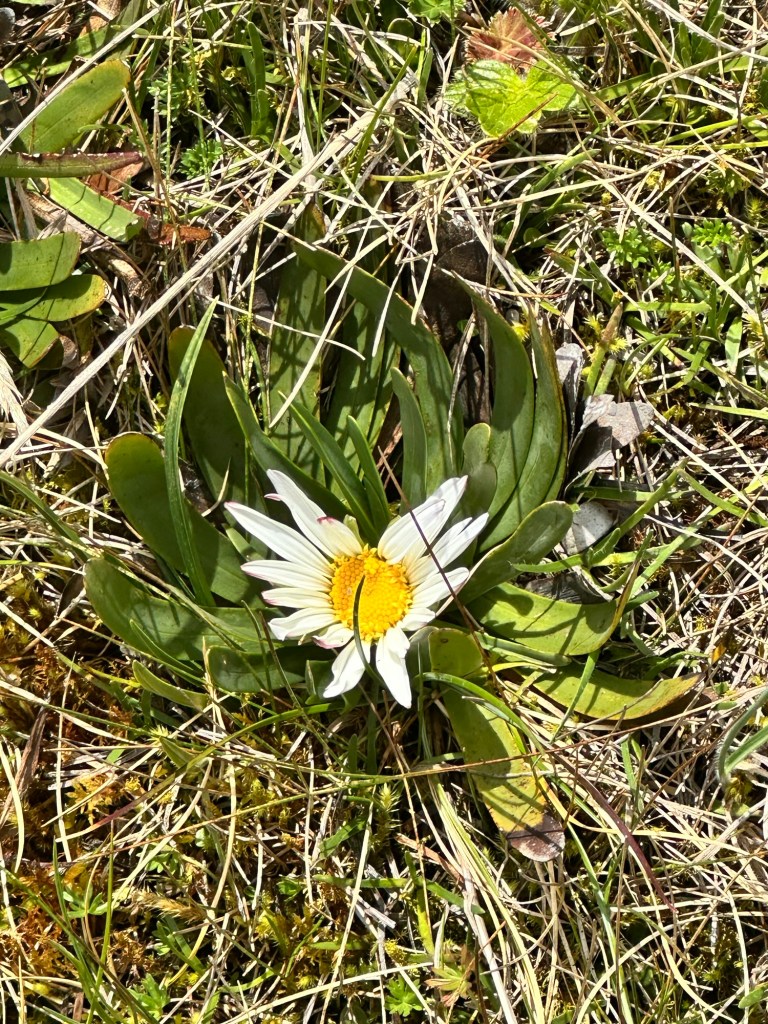
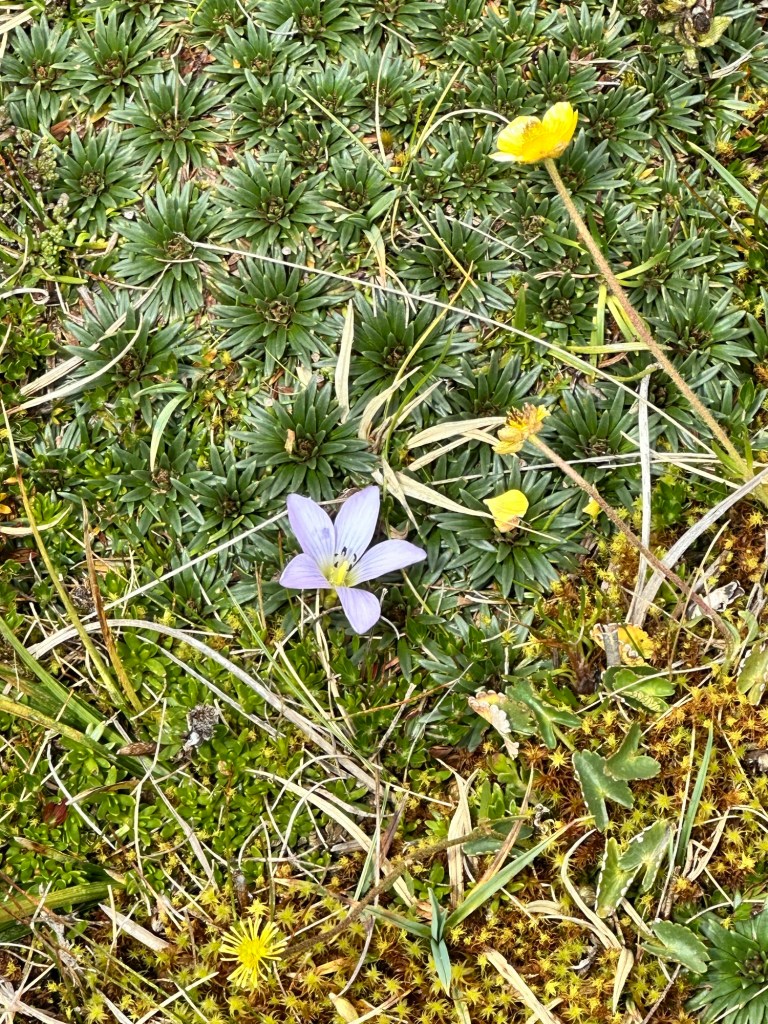
It’s amazing how many different plants are able to survive in the Andes. Take a look. Many have medicinal properties.

It’s impossible to capture the grandeur of the scenery with a cellphone camera, but that didn’t stop me from trying.

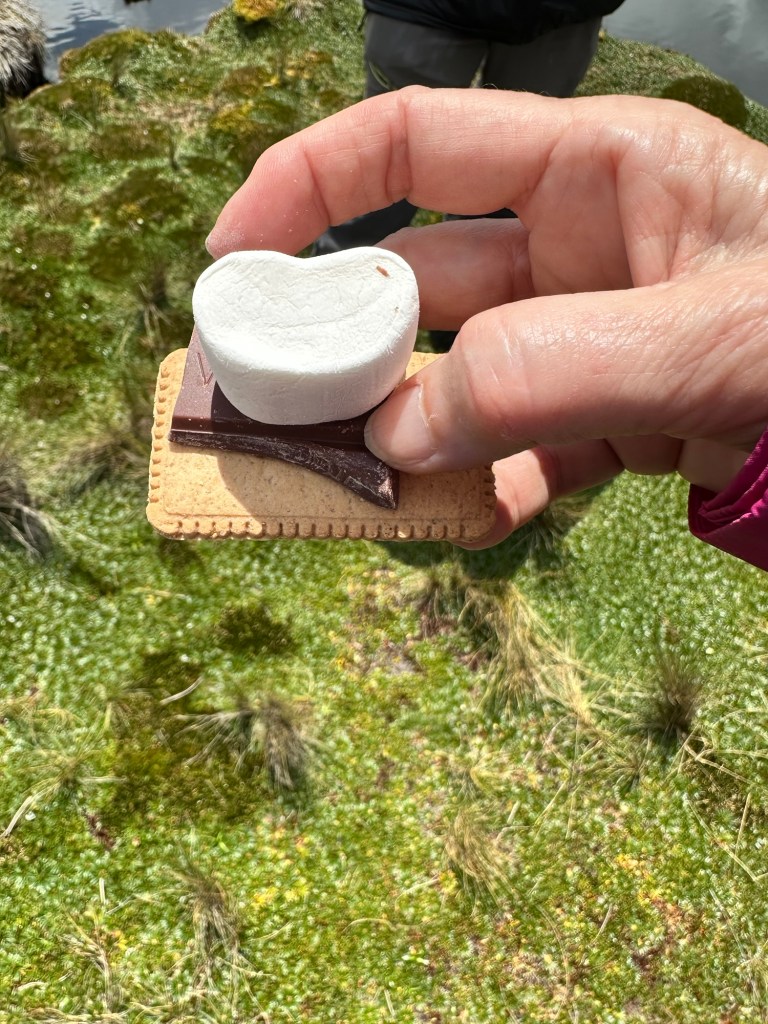
You might have noticed in the earlier photo that Juan was carrying a plastic bag. Want to know what it contained?

Ingredients for S’mores, of course. But the environmentally friendly kind. No fire.

Street Art in Cuenca

On our last day in Cuenca, we were free to spend the morning exploring on our own. I walked to the Pumapungo Museum, which is about a mile from the hotel, along La Calle Larga. I was wishing my buddy Elsie had taken the post trip with me, because she would have enjoyed the street art as much as I did. So Elsie, this one’s for you. No narrative, just visuals.

They even paint the poles!

I’m not sure why this art was defaced with graffiti. I thought there were rules.

Cuenca, at Last!

If you like history, nature, handicrafts, museums, architecture, great restaurants, quaint coffee shops and shopping all within walking distance — come to Cuenca, because it has it all! Initially, I thought I could do one post for our three days in Cuenca, but I have since realized that’s impossible. So here’s episode one.

As usual, OAT has us staying in a strategically located boutique hotel. Once a private home for a large family, all the rooms are clustered around a central courtyard, which is now the reception area and restaurant.

Because this area was declared a world heritage site in 1999, the buildings have all been preserved, but many have been converted into hotels, restaurants, and shops.

One woman decided to rent her home, complete with all its furnishings; it is now a restaurant.

Before dinner, Lorena took us on a quick tour. What made this especially interesting was knowing this was how the former owner lived! Take a look at the opulence of just two of her rooms.

On our first morning in Cuenca, we enjoyed a walking tour of the city. Of course, the cathedral occupies a prominent spot on the main square. As you have probably guessed, the header of this post is a photo I took of the cathedral at night from the Negroni Restaurant.
My friend Jeanne always lights a candle for her husband whenever she visits a church, so I decided to light one for both our husbands. See that bottom row? My $1 coin lit that ENTIRE row of electric candles—sufficient to cover ALL the loved ones we both recently lost!

And yes, you read that last line right. I deposited a $1 US COIN. No longer will you lie awake at night wondering “whatever happened to all those $1.00 coins the US minted years ago that Americans refused to use”? We exported them to Ecuador, and from the worn looks of them, they are widely used.

During our walking tour, Lorena pointed out the entrance to the cathedral tower, so naturally, during our free time, I spent the $1.50 admission fee and climbed to the top. You can get a decent view of the square from the first landing.

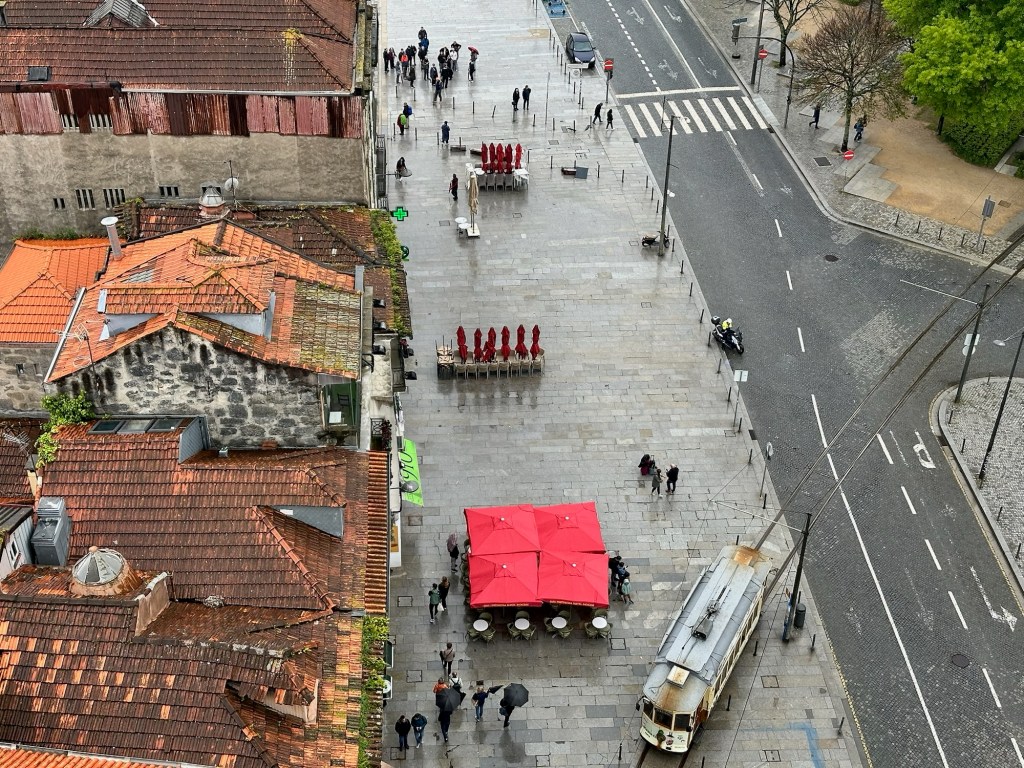
Take a look at the umbrellas atop the building in the next photo. That’s Negroni Restaurant—it has great food, but it’s a bit of a challenge to find. Eric, Gail and I had dinner there on our “free” night. It took us a while to figure out you had to enter a clothing store, walk to the revealing women’s tops section, which is where the elevator hides out, then ride to the top floor.

I climbed all 162 of the tower’s spiraled stairs. My reward? This panoramic view of the surrounding area.

I pretended I couldn’t understand Spanish, so I ignored the sign that said “for your safety, seniors keep off” and claimed right up those metal bleachers.

SOME people might have noticed those menacing storm clouds, but my family won’t be surprised to learn I wasn’t one of them. Did I seek shelter? Go back to the hotel to get my umbrella or raincoat? I think we all know the answer to that.

Instead, I decided to support the local economy by buying gifts for friends and family.

So far, we had been unbelievably lucky with the weather. Up until Cuenca, the two times the heavens opened, we had been on the bus, and by the time we arrived at our destination, the sun was shining brightly. Not this time. I got SOAKED!

Cuenca gets most of its electricity from hydroelectric power, so last year’s drought had a severe impact on the city. When it rains, people here rejoice. So, of course I rejoiced along with them.

We have a flight tonight, so the next episode of Cuenca will probably be written at the airport…

Ecuador, on the Road to Cuenca

By the end of Day 2 of our Ecuador post trip, we had arrived at the Hacienda Abraspungo, the second of our one night stays—not to be confused with one night stands—which if that’s what you were expecting this post to be about, you’ll be very disappointed.

The restaurant at the hacienda

For the remainder of our week in Ecuador, we will be spending three nights in Cuenca, then flying back to Quito for our final two nights.

Getting from Cartagena to our hotel in Quito was a whole day slog, not made easier by our stop at Bogota airport, where clear signage in either language was sadly lacking.

At Bogota airport, I managed to get separated from my fellow travelers, however I know enough Spanish to say, “please, can you help me? Where is the gate for the flight to Quito”. The bad part was the people I asked thought I was fluent, so they launched into this rapid explanation, using BIG words. Fortunately, when I told them I only knew a few words and understood Spanish like a 3 year old child, they switched to body language, which I have completely mastered.

By the time we arrived at our Quito hotel, around 8 PM, we were all pretty tired, so barely had enough energy for dinner.

Although we had two more transit days, they have been in a very comfortable, small bus. We made multiple, interesting stops along the way, and the scenery has been spectacular.

We were incredibly lucky to be able to clearly see Cotopaxi, the highest active volcano in Ecuador. Much like Mt Fuji (and me) it usually has its head in the clouds. Our excellent bus driver knew the exact spot for a great photo op and that’s what you’re looking at atop this post.

Our drive along the PanAmerican Highway was lovely. Did you know you can get from Alaska to Tierra del Fuego by driving its full 16,000 miles? We are only doing a short stretch, along the Avenue of the Volcanoes (there are about 250 volcanoes in Ecuador; fortunately most are inactive).

The countryside is beautiful, but I was unable to capture the grandeur of the mountains, volcanoes and rolling emerald colored hills from the bus. Too many reflections from the windows. Just imagine driving through the Rockies on a perfect spring day.

This photo was taken when we stopped to get a shot of Chimborazo, which rises 20,000 feet above sea level. I know, it looks a lot like Cotopaxi, but for us, it was a real thrill.

Chimborazo

Like the Road Scholar trip Mike and I took to Ecuador in 2012, OAT itineraries include a visit to a rose farm. With 12 hours of direct sunlight most days, Ecuador is able to produce a mind boggling variety of incredible, long stemmed roses.

Rose exportation provided (for the first time) employment to many Ecuadorian women. They are able to bring their children to the worksite, which provides daycare. They are paid the minimum wage, which is $470 per month. The US dollar is Ecuador’s currency, so no “exchange math” is required to figure out that’s not a whole lot of money.

The first rose variety I saw on our tour was named Sandy, so I immediately thought of the wonderful sister I had lost, and although it was a struggle, I managed to hold back the tears.

Sandy

If you’re having a special event and can’t find a hue that compliments your color scheme, no problem. The roses can be sprayed to your specifications. Think I’m kidding? Take a look.

We met indigenous people at our next stops. The first is an artist, who, like Grandma Moses, is self taught. We were all given the opportunity to paint on goatskin, and once again, I produced a masterpiece I think is worthy to hang on the wall in any second grade classroom.

Notice the two condors, representing the heavens, and the snake, representing the underworld. Where’s the representative of the earth—the puma—you ask? Well, sadly the puma didn’t move fast enough, so he’s buried under the lava flow.

Take another look at the photo of Chimborazo. That’s where this man and his donkey climb twice a week to carve huge blocks of ice, which they carry down the mountain and sell to businesses in nearby Riobamba. When we were there, the volcano was hidden by the clouds.

There is no such thing as too many donkey photos, is there? I should have done a video because he was braying loudly.

The Spaniards brought Catholicism to the areas they conquered, because that’s what Jesus told them to do in his sermon on the Mount. It went something like this:. “Blessed are they who steal the gold from the people they enslave, for they get to be heroes in their home land.”

Unfortunately, Jesus didn’t warn them about the Evangelicals from the US. The Evangelicals built schools and clinics; they translated the Bible into the native language. They also gave free radios to all indigenous, so they could easily preach and be heard by all. Most of the locals converted, which is probably why this church had to get creative when they found the collection plates contained more dust than dollars.

Built in 1534, it was the very first church the Spaniards built in Ecuador. Take a look inside.

Looks pretty standard, right? But wait. You haven’t seen the vestibule yet. This is the creative section.

Those of you with sharp eyes have probably noticed the coffee pot in the lower left hand corner. My lens wasn’t wide enough to capture the tables and chairs directly across.

But if you need more than coffee to get you through Mass, not to worry. There are OTHER beverages from which you can choose.

In addition to beer and wine, you can also buy “holy water” . You all know what bottled water without a label looks like, so I didn’t bother to include a photo.

Before the animal lovers get their shorts in a knot over this next photo, let me remind you, Costco uses a similar cooking method, they just rotate chickens instead of guinea pigs. And they remove the heads first.

This road side cuy producer sells about 40 cooked guinea pigs a day! Cuy is considered a delicacy here in Ecuador, and will set you back about $50 if you ordered it in a restaurant.

After Covid, Ecuador’s railroads went out of business, including the famous one that traveled up the devil’s nose.

We visited the now closed train station in Alausi, then proceeded up the mountain, into the clouds, for lunch with the indigenous people.

As we climbed higher and higher, the cloud cover was so complete, I was convinced we wouldn’t be able to see El nariz del Diablo (the devil’s nose), but we continued to have phenomenal luck. Not only did we see the Devil’s schnoz, ( it’s the mountain on the right)

we also saw the train tracks leading up to the zig zag route.

We have been rocking and rolling along mountain roads, so once again, I will push PUBLISH and hope for the best.

Cartagena, Then and Now

I first visited Cartagena in 2010, when Mike, Greg and I took an Oceania cruise through the Panama Canal. I was immediately charmed by this fascinating city, and became determined to return to Cartagena and to explore more of Colombia.

For most of the ports, we opted to go off on our own, rather than take a cruise sponsored tour. That was the case in Cartagena, where we were able to cover most of the high points in the old city, during our too brief time in port.

Here is what the “new” section of Cartagena looked like in 2010.

Fast forward to 2025. Both photos were taken from the enormous fort the Spaniards built to protect the area from pirates. Can you tell which photo was taken with a camera, and which was taken with my iPhone?

It is possible to travel from the top of the fort to the bottom through narrow, low tunnels. When we visited in 2010, we attempted to do just that, but as we approached the exit, our guide discovered it was flooded, so we had to walk ALL the way back to the top. Poor Mike was unable to stand upright!

I know many people have strong opinions about cruises versus land travel. It was interesting to experience both in the same city. Although vastly different, I discovered I thoroughly enjoyed both, but for very different reasons. As with everything in life, both travel modes have advantages.

When we cruised, we always opted for a smaller ship, chosen for its fabulous itinerary. Cruising allowed us to unpack once, travel while we slept and awaken someplace great every single day. It provided us with a taste of many different areas, so we could determine which country we might want to explore in more depth in the future. And, if you happened to get sick, or have an accident, the ship had a fully equipped medical center on board. But your time in port is limited; you normally have to be back aboard the ship around 5PM, unless you chose a cruise that spent more than one night in a particular port. And there ain’t many of those.

For the OAT land trip, we spent three nights in Cartagena, which allowed us to slow down and savor our time there . We saw SOME of the areas we visited on our whirlwind day in 2010, like the former convent of the Sisters of the Poor Clares, but instead of just driving by it, Leslie ( another new friend) and I went to the bar to watch the sunset.

Those of you who read my pre-trip post may recall the special drinks and the tours of the former convent described on the hotel’s website. Well, although getting lost while searching for the rooftop bar allowed us to see a whole lot of the convent, it certainly didn’t qualify as a tour (they don’t give them any more), and although my pisco sour was delicious, it didn’t have what the website called “magical” properties.

What the rooftop bar DID have was a DJ, and lots of young people, staring at their phones.

So, we took our sunset photos, admired the view, and that pisco sour? It was consumed in a quiet, “historical” bar on the first floor.

The view of the ocean, and the only spot at the bar from which you can see the sunset.

Remember the popular image of Colombia as a dangerous place? Well, Leslie and I were perfectly comfortable walking the streets at night and when he noticed we were hopelessly lost, this sweet young Colombian approached us, offered help and walked us back to our hotel.

This was a very common experience: a waitress chased me down the street because I had left my hat in the restaurant, street vendors accepted your “no, gracias” when they approached you, but then engaged you in conversation so they could practice speaking English. Everyone we encountered was friendly, gracious and oh so welcoming.

As you have seen in my earlier posts, the streets of Colombia are very colorful , and Cartagena is no exception.

The woman in the black leather “bondage” outfit is Shakira, who has an apartment in Cartagena, overlooking the ocean. Our carriage driver pointed it out as we rode along the ocean on our way to our farewell dinner. He also claimed he was Shakira’s novio ( boyfriend— see, those Spanish lessons DID come in handy!)

Did you know that Colombia was the inspiration for Disney’s movie, Encanto? I sure didn’t.

Sorry, the sun was in the wrong spot when I took this photo. Anyone who saw the movie will recognize the cartoon character immortalized on the wall, but did you know her image was based on an actual resident of Colombia?

There was so much to see in the neighborhood of Getsemaní, I had difficulty choosing the most compelling street image, so I decided to include several.

During our trip we experienced MANY different modes of transportation- boats, metro system, cable cars, jeeps, tuk tuks and best of all, the PARTY bus,

which came fully equipped with live music, so we were serenaded all the way to Bocavilla, an African Colombian community located on the beach.

Our musicians played European, African and Caribbean instruments

While in Bocavilla, we had drumming and dance lessons which were SO much fun! The musicians and dancers were students at a school established to preserve their African/Caribbean culture.

Seven of us are at the airport heading off to Quito for a week in Ecuador, so it’s time to press publish and hope for the best.

The Coffee Triangle

Once again, my blogging is way behind our actual travel. Because there is so much to see and do, I blog when I can’t sleep, while waiting at an airport or on bus rides through boring areas, and let me tell ya, Colombia doesn’t have many of those! Take a look at the sun god holding the indigenous people along his arm and in his hand.

If you aren’t paying attention, you’ll miss the art carved into rocks along the roadside, which would be a pity.

Our three nights in the coffee triangle were spent in a lovely boutique hotel, Bosques del Saman. Alejo described it as “simple”, but it had everything this simple girl needed: a balcony for happy hour with my new buddies (my room is on the right, and yes, those are hammocks).

A pool, and a “warm” tub…

Okay, so the whirlpool didn’t whirl very much, and it had a bit of debris in it, but it also had a skimmer leaning against the tree. Like “the lord”, Pachamama helps those who help themselves, so this girl got skimming. Sorry, no photos of the action.

When I discovered my room contained three beds, I thought it was a bit of overkill. Turns out, Goldilocks’ grandma, Silverlocks, was very grateful she had a choice. When she discovered Papa Bear’s bed was too hard, she quickly moved to Mama Bear’s, and it was just right!

At breakfast, I just enjoyed the fabulous coffee, without thinking about how much work goes into planting, picking, sorting, and roasting the beans, but over the next two days, I certainly found out. It is quite a complex process!

To get to the coffee farm, OAT made the experience authentic by transporting us over the winding, bumpy roads in the backs of Willys jeeps.

Alejo told us we were allowed to stand up, so we did, while holding on for dear life.

Like the contestants on the amazing race, we had the opportunity to pick coffee beans. Fortunately, it wasn’t a contest, because I would have lost.

Even the bad, over ripened brown berries are picked, because if they are allowed to fall on the ground, they become shelters for beetles that will ultimately destroy surrounding coffee plants. Not to worry, these bad boys get picked out during one of the multiple sorting processes.

Okay, so here’s the Readers Digest version of coffee’s history. It was discovered in Abyssinia, (now Ethiopia), in the town of Cafa, from which it got its name. Shepherds noticed that after sheep ate the red berries from a particular bush, they became quite energized. The shepherds, being curious, utilized the scientific method to determine the properties of this magical berry. Soon, the monks got involved to see if something sinful was happening. Because at that time there were no books to burn, they threw the beans into the nearest fire. Intrigued by the smell, they plopped the burnt berries into water. And that’s how coffee got its start.

When the Arabs gained control of the area, around 8 AD, they liked to socialize with this non-alcoholic drink. That’s how Arabica, which today is thought to be the highest quality coffee, got its name.

In the 1600, along with the diseases that decimated the indigenous populations, the Europeans brought coffee to South America. Fast forward to 2025, and coffee today looks like this.

Hey, didn’t I tell you it was going to be the Reader’s Digest version? If you want to know more, ask Ms Google, cuz I’m on vacation.

At the coffee farm, we learned that the inferior beans aren’t thrown out. Instead they are “ burnt” to mask its poor flavor, producing “dark roast” and robusto coffee.

We didn’t just learn about coffee. The two male turkeys decided the owners explanation about coffee production wasn’t exciting enough, so they staged a demonstration of “gang bang” techniques, turkey style, on that poor little female. Or was it the Colombian version of a ménage a troi? None of us were certain, but we were all definitely entertained.

We also had the opportunity to communicate with nature by hiking in the Cócora Valley.

Alejo explained our options: We could relax at the cafe, rather than hike, go slowly with him to viewpoint 1, or walk further and faster to viewpoint 2. Being somewhat cocky, I assumed that of course, l would be power walking to viewpoint #2. What I neglected to take into consideration was that we were already starting at 8,000 feet above sea level. Talk about being humbled!

On a positive note, us slow pokes were able to savor the scenery, which was indeed breathtaking. or were we just out of breath?

These are just some of the highlights of our fantastic time in the coffee triangle. As you’ve probably guessed, I’ve been loving my time in Colombia!

Comunas 8 and 13: A Tale of Two Neighborhoods

Well, for the very first time, Alejo has given us misinformation. He told us we wouldn’t have internet access in the coffee triangle because WiFi comes and goes. That may be true for some of my fellow travelers, but so far, the WiFi in my room has been great. If it weren’t, I would use my T-Mobile connection to access the internet. It is excellent and, unlike Verizon, it’s FREE.

Before I launch into the stories of two neighborhoods, a little background information is necessary.

Colombia organizes its cities into “levels” for economic reasons. Those having the poorest infrastructure, generally also have the poorest residents. Their neighborhoods are designated levels 1 and 2. These residents don’t have to pay taxes or for utilities, mass transit or public education. Sometimes subsidies are provided. Those who live in levels 3 and 4 pay taxes, are charged for utilities and may have access to both private and public schools. Levels 5 and 6 are the richest areas, with the best infrastructure—the best roads, hospitals, shopping centers, private schools etc. Although these residents could send their children to free public schools, none are located there nor do mass transit lines go to those areas, because the people living there wouldn’t use it.

Unlike the US, where the rich live at higher elevations to take advantage of better views, in Colombia the poor live up the sides of the mountains. It is difficult to get emergency vehicles into those neighborhoods because roads are either poor or nonexistent.

Both comuna 8 and 13 are level 1 areas. Both have been affected by the extreme violence that has plagued Colombia. We visited The Hill of Values, which is in a level 1 area. It’s a recycling plant organized by former paramilitary members. We met one of the founders, who after he demobilized, wanted to “make amends” to the community he once terrorized. Take a look at what he and other former paramilitary members have created.

This terraced garden produces food that is free to the neighborhood. People are allowed to help themselves to fresh vegetables and herbs.

In addition to the recycling center and the garden, the group hosts educational events. Its goals are to raise awareness about environmental best practices, offer local youths an alternative to drugs and violence and foster understanding between Colombians and visitors.

Look at the whimsical creatures they made from collected materials they transformed into sculptures. I was awed by their creativity and artistic ability. The photo below doesn’t do justice to the magnificence of the two giraffes on a bicycle. Just looking at it made me smile.

The recycling center receives funding from the OAT Foundation, which allowed the organization to purchase a solid waste compactor. Bundles of compacted trash are not visually appealing, instead I’ll share another photo of the very charming garden.

After our tour, we had a delicious lunch at the recycling center’s community room with some of the workers.

I’m not confident that I’m getting everything 100% right—hey, I already admitted in an earlier post that my memory sucks— but I think the most salient points are pretty accurate.

Comuna 13 was not on the itinerary, but Alejo made schedule changes to make time to visit an area that has been transformed into an incredible community. Not only that, but he also asked his friend Christian to be our guide,starting with a visit to Christian’s home.

Colombians add floors to their dwellings when they have the money and the time to do so. Christian and his wife and son live here with Christian’s parents occupying the floor below. The recently added top floor is a cafe with a spectacular view.

The red roof on the lower right is the cafe. Photo taken from comuna 13 escalator.

The Wall Street Journal sponsored a contest in which they searched for the most innovative city in the world. The three finalists were Medellín, Tel Aviv and NYC. One of the key criterion was the use of technology to help poor residents.

Although we all heard about the violence and terrorism in Medellín, what was not as widely publicized was the election of a former math professor as the mayor in 2003.

The mayor recognized that most of the terrorists were people without opportunities. In fact, comuna 13 was one of Pablo Escobar’s favorite areas for recruiting teenagers. When you feel isolated, are struggling to survive, and have no hope for the future, you become very vulnerable. Plus, if you got killed, Pablo promised to take care of your family, which was not the case if you joined the guerillas, paramilitaries or gangs.

The mayor started a program of social inclusion by building cable cars so that the people on the mountainside could have transportation to the jobs on the flat, lower part of the city. Working with an architect to create green areas for “library parks” in the lowest income areas, where computers and classrooms were made available.

Because there were some suicides from the cable car stations, Colombia established on site counseling centers, staffed with professionals who offered free sessions. We have so much to learn from other cultures!

What probably helped Medellín to win the contest were the external escalators. Has anyone seen escalators outside of a building before? I sure hadn’t until I watched the 2024 amazing race episode. On the show, it looked like there was only one escalator. Nope. There are countless escalators, so described because I forgot to count them. Covering the escalators are solar panels which provide protection from the elements and produce the energy to run the escalators.

The view from one of the escalators

These escalators were funded by Colombia’s Utility Company, EPM, which pays for other social projects.

Although we didn’t see the “Amazing Race mural” we saw lots and lots of exquisite street art, with Pachamama featured on several.

We are at the airport now, so once again, I will press “publish” and hope for the best.

By the way, Alejo was right about the WiFi. I was the only one with good connectivity. I must have just got lucky.

Medellín, Colombia

Talk about contrasts! Medellín and Bogotá are both surrounded by mountains, and they both have big city traffic, but the differences between the two cities are dramatic. Bogotá just oozes old world charm, with many lovely colonial structures, as you can see from the photo of the street outside our hotel.

In Medellín, old buildings were either bombed during the drug wars or torn down to make room for new construction, or both. It is very much a modern city. This will be our shortest stay — only two nights — at the Novotel, which is attached to a large, glitzy mall full of restaurants and upscale stores.

Although Bogotá is only 145 miles from Medellín, it would take over 9 hours to drive, because the roads are so winding, so we flew. We arrived in time to visit The Hill of Values, which was SO interesting, it deserves a post of its own, probably after I return home. The rest of the afternoon was spent at the Museo de Antioquia. Viewers of the March 2024 Amazing Race may recognize the Museum’s Plaza, filled with Botero’s sculptures. It was one of the Road Blocks that the contestants had to overcome.

The third floor of the museum is completely filled with Botero’s art. How lucky were we to have Alejo explain the artwork to us.! I gained a whole new perspective. For example, his subjects aren’t fat, they’re just voluminous. Botero admired the old masters, so he would copy one of their pieces, but give it a new twist. Sometimes he increased the volume of a particular area, like the butt and legs, then made the hands or head unusually small. Unlike the Botero museum in Bogotá, you are not allowed to take pictures, and in Medellín there is an entrance fee. Here’s the backstory. Botero offered to donate his art to the city of Medellín, but the red tape was taking so long that when Bogotá expressed an interest, he decided to donate to them instead, and voila, the Botero Museum described in my last post was created. Once that happened, Medellín saw the light, reached out to Botero, and now the third floor of the Antioquia Museum is exclusively dedicated to his art.

We spent our one full day in the Medellín area visiting Guatapé, another Amazing Race site. It was so much FUN! The entire area bursts with color. Alejo arranged for us to meet with one of the artists (and his son) who created the colorful zocalos for which the town is noted.

Although it is difficult to see in the photo, many zocalos are three dimensional. Why are the murals placed so close to the ground and why do the figures protrude slightly? The artist offered possible reasons:

1. To stop chickens from pecking at the animal dung used to construct the walls.

2. To stop the dogs from lifting their legs and peeing on their homes

3. To discourage macho men from leaning against the walls.

Who knows what the real reason was? The end result was pretty fantastic.

This street is actually a replica, recreated from photos of the one that was destroyed, with a few whimsical additions.

Aren’t the umbrellas delightful?

Like other towns I’ve visited, tuk tuks offer an easy way to see the city.

So that we could experience EVERY mode of transportation, we took a boat ride on the reservoir, where we cruised by one of Pablo Escobar’s houses— currently in ruins and being used for paint ball competitions.

No, we did NOT ride in “car boats”. We took a vessel similar to the one used by the Amazing Race contestants.

We sailed by the monolith the contestants had to climb to get their next clue. Although it’s hard to see, there are 660 stairs built into a cleft on the rock. No, we didn’t climb it—Alejo told us.

Our final day in Medellin was not on th itinerary—Alejo moved things around so that we could try additional modes of transportation and visit Comuna Thirteen.

But first, we experienced how most Colombians spend Sunday mornings. The cities close the main streets to traffic so that families can stroll, skate, bike, run. Not what comes to mind when you think of Colombia, is it?

We will be flying to the coffee region, so I will be without internet access for three days. That means you’ll just have to wait till we reach Cartagena for a description of our wonderful visit to Comuna Thirteen. No time to proof read, so if something doesn’t sound right, blame Siri.

Bogotá, Colombia, Part 2

I wish my memory functioned the way it used to. I’m lucky if I retain 20% of what I’ve learned, and boy, have I ever learned a lot during my four days in Bogotá!

On our walking tour, our local guide shared interesting facts about Simon Bolivar that didn’t quite make it into our history books. He was only 19 when his wife died; she made him promise never to marry again, but she forgot to mention lovers. That was probably a good thing, because one of his lovers, Manuelita Saenz saved his life. Her house was down the street from his, close enough to allow them to use candles to schedule rendezvous times. She was watching for his signal when she saw a large group of heavily armed men in the mountains heading toward his house, so she quickly rushed Bolivar to safety. Manuelita’s house is now a museum very close to our hotel, but unfortunately, I didn’t have enough time to visit it.

Instead, I spent some of my “on your own” time in two of the several free museums in Bogotá funded by the National Bank. The original source of that money, however, was the USA. No, not from foreign aid money. It was from a lawsuit Colombia initiated against USA over the Panama Canal. And we lost so we had to pay just under $ 30 million to Columbia. At one time, thanks to Simon Bolivar, Colombia included what is now Panama, Venezuela, Ecuador and Peru.

Both museums had beautiful central courtyards surrounded by exhibition rooms.

Botero definitely had a fascination with big butts and legs.

In fact, ALL of his subjects were very well fed. The painting that follows is entitled “Woman with a parrot” which was not the first thing I noticed.

But I digress. Back to the walking tour. Cama, our local guide, took us to the Gold Museum, where we learned that back in pre Spanish times, gold was valued for spiritual reasons. Like many other cultures, the indigenous people were sun worshipers. They believed the more gold you could load onto your body, the closer you were to the sun god.

The object below is considered one of the most important in the museum. It shows the leader on a raft, surrounded by followers who were tossing gold objects into the lake as offerings to the sun god.

Many of the objects in the gold museum were saved from the Spaniards because they had been tossed into bodies of water. Others were discovered in gardens because the owners buried them to keep them from being stolen and after they were killed, if there were any survivors, they couldn’t find the buried “treasures”.

Although we were supposed to be on our own after lunch, Alejo had thoughtfully arranged transportation to Monserrate and Cama graciously accompanied us.

In my opinion, Monserrate is a much better choice than the salt cathedral. We rode a cable car to the summit. Although there weren’t many people at the bottom of the mountain, Cama asked the cable operator about the number of people at the summit, and wisely advised us to purchase “skip the line” tickets. Good thing, because the line to descend was so long, we would have been standing there for hours!

At Monserrate, we got a spectacular view of the city. But wait, there’s more! The church was very different from any that I had ever been in. When you enter a church, what do you normally see? A huge cross, with a very European Jesus hanging from it, right? Take a look at THIS church.

Here’s a close up. Don’t you think it’s far more realistic depiction of Jesus? I suspect back then, his skin was more of a Middle Eastern color.

The photo for this post’s banner is one of the church’s stained glass windows. Take a close look, because it has something I have never, ever seen on ANY church’s window (trust me, I’ve visited countless churches) and don’t expect to ever see it again. Who can spot it? I’ll give you a hint. Look near the top.

The LAST unique aspect of the church that I noticed was the “miracle area”, where people thanked “El Señor” for granting their wishes by buying a plaque. Notice the one from Luis Fernando Rendón thanking El Señor for making it possible for him to move to New York and for giving him health and strength to care for his family. It’s the gold one in the photo below.

Here’s a photo that Cama took of 11 of the 15 of us on the tour.

Although OAT offered an optional tour, not enough of the group chose to take it, so instead, we got another unstructured day. Elsie and decided to take the free graffiti tour, and it was FANTASTIC!

I had no idea that Bogotá has 6000 kilometers of “legal” street art, with another 1000 of “illegal” (unapproved). The tour was conducted by an artist who showed us one of his works. It depicts a creation myth. I don’t remember ALL of the story, but here’s the gist.

These two will be perpetually young so long as they stay faithful. When the man notices his skin is getting wrinkled, he realizes he’d been betrayed, so he killed his rival. Sorry, I don’t remember how the emerald and the snake tied in to the myth, but they did. And I remember the man ultimately committed suicide. Once again, it was all HER fault.

The next one was commissioned by Peru, as an act of reconciliation. For what, I don’t recall.

The words read “No one is illegal. Strength in unity”.

I love this next one of five young indigenous girls (I could only get four into the photo).

The artists asked them about their hopes for their future, and as they were thinking about their dreams, they smiled. The artists captured that moment in a photo and that became their model for this mural.

There was a whole lot more art, and MUCH more interesting narrative, but this post is getting rather long. Our next to the last stop was on a bridge, where our artist guide took this photo. The tall structure in the background is significant because it is the highest building in Colombia, completely empty, because it is tilting, like the tower in Pisa. It is also significant because a graffiti artist has placed his “tag” on the very top of the building. And if you want to know more about the interaction among graffiti, music, and common words in our culture, you’ll just have to take the tour.

I’ll close with photos of the newest artists

And their work

Hey, it ain’t as easy as you might think!