Whoever said “All good things must come to an end” was certainly right about this trip. It has been abso-bloody- lutely FANTASTIC. Every time I thought it couldn’t possibly get any better it DID.
Our four days in the Falklands were magical!
Here are some highlights, not in any particular order:
Eating in unusual spots:
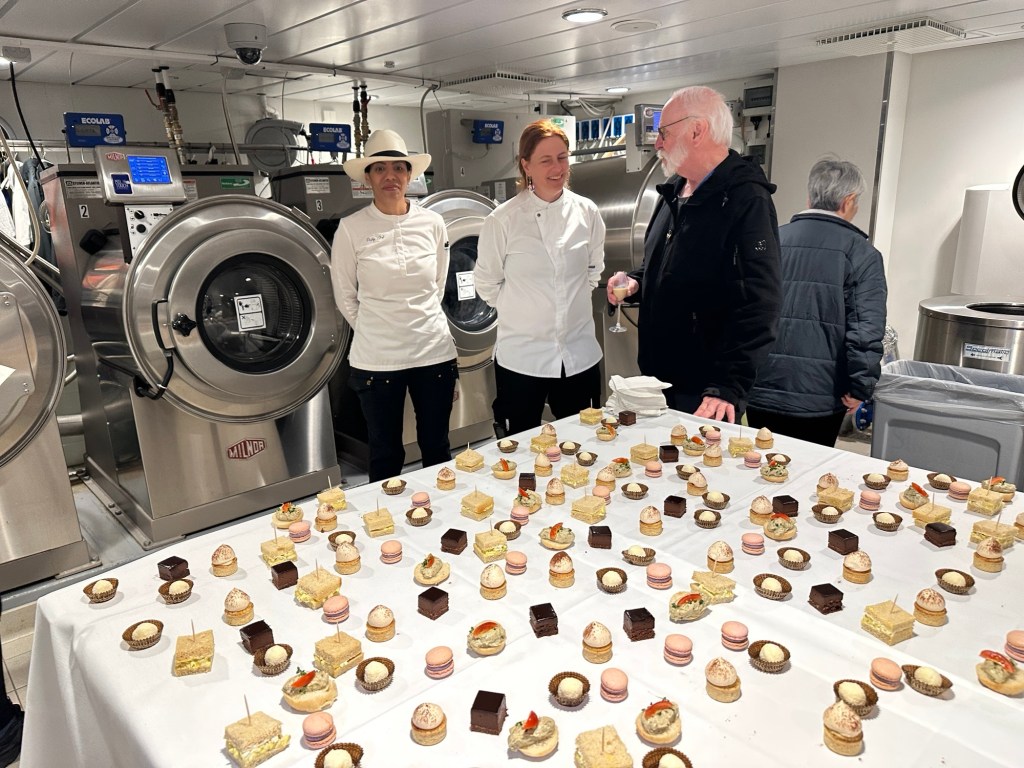
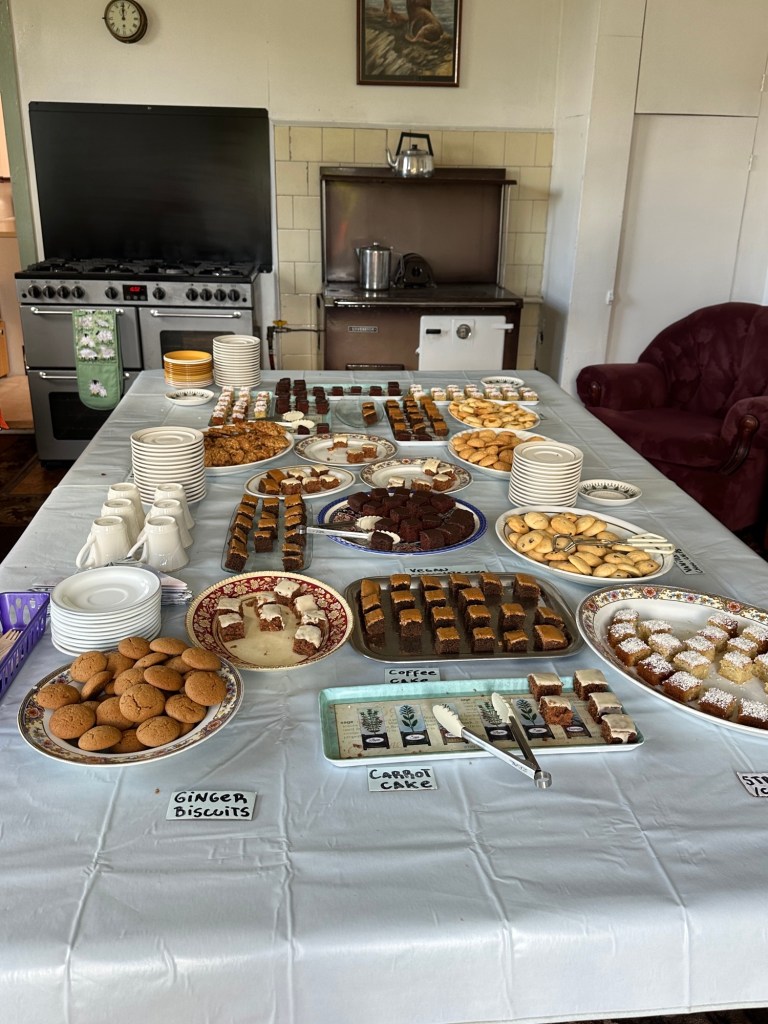
Tea in the ship’s laundry room, and in a beautiful little cottage after a hike,
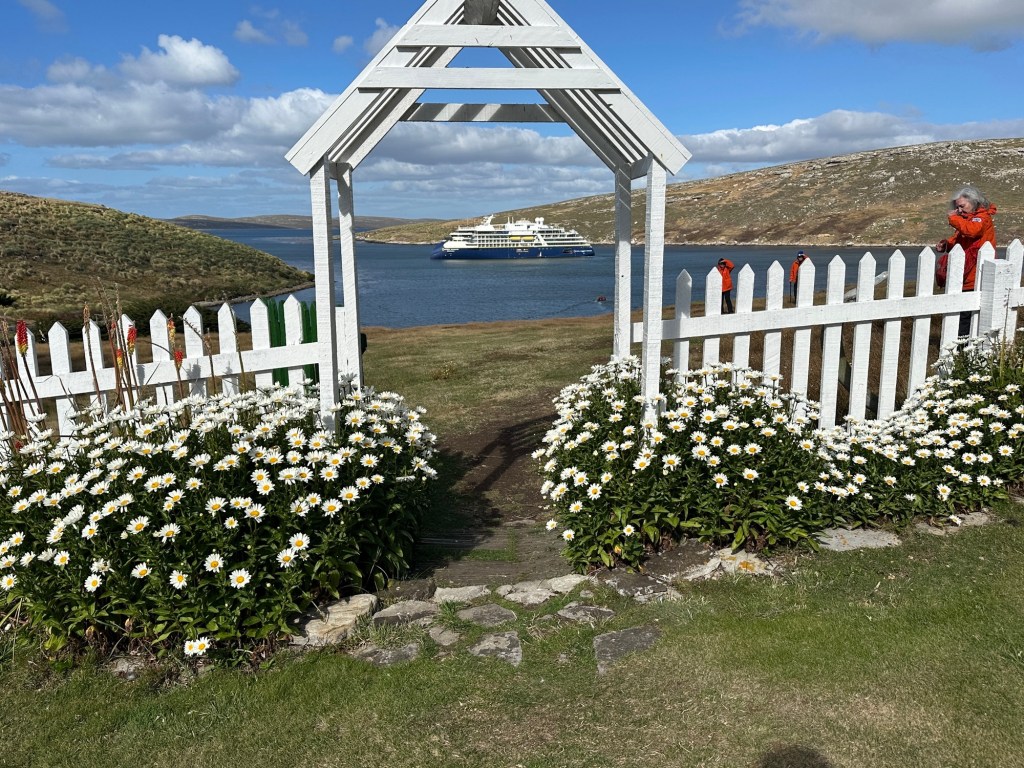
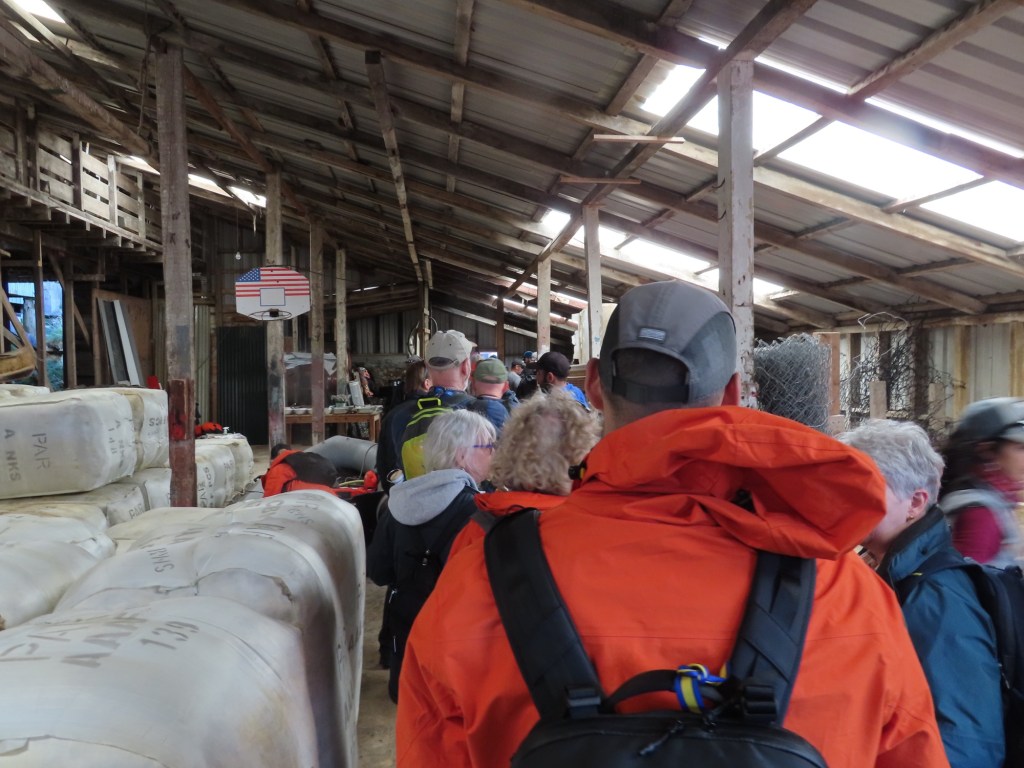
the garden outside the cottage, and in line for the barbecue at a different venue, on a sheep farm.
Sorry, no photos of the barbecue. My hands were full of delicious food, and then I was so caught up in the moment, I forgot to take a picture.
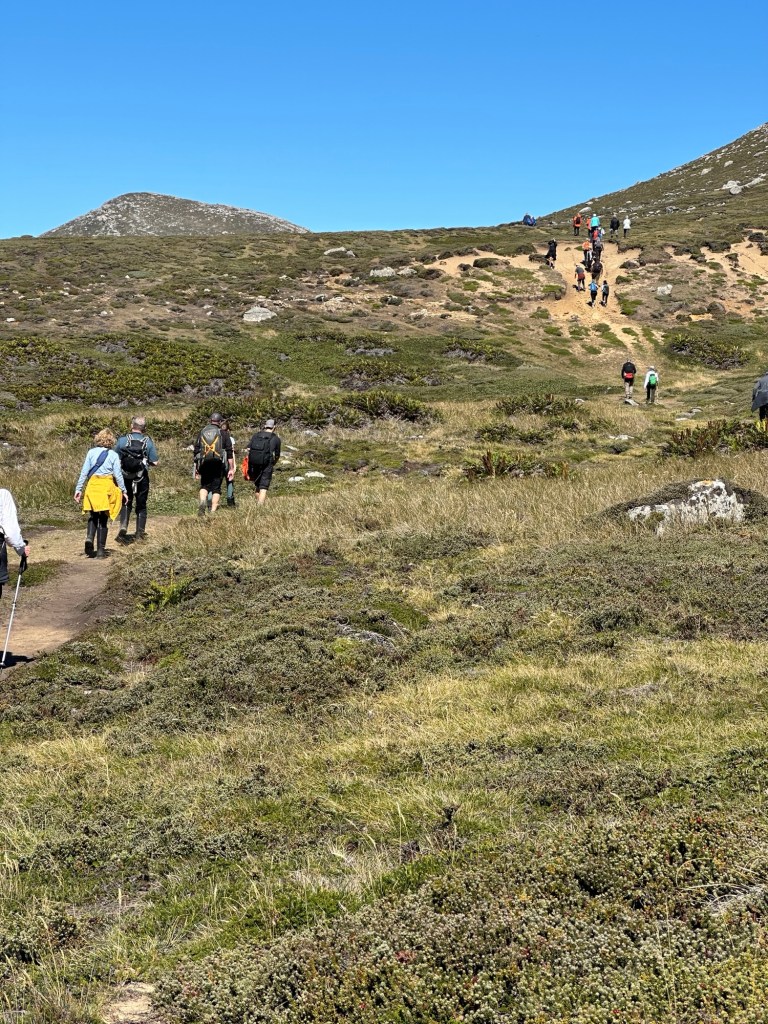
Hiking, hiking and MORE hiking
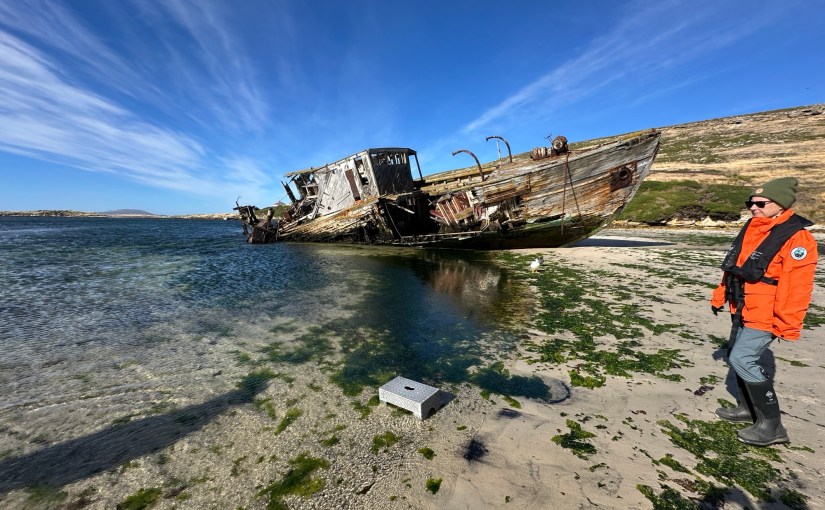
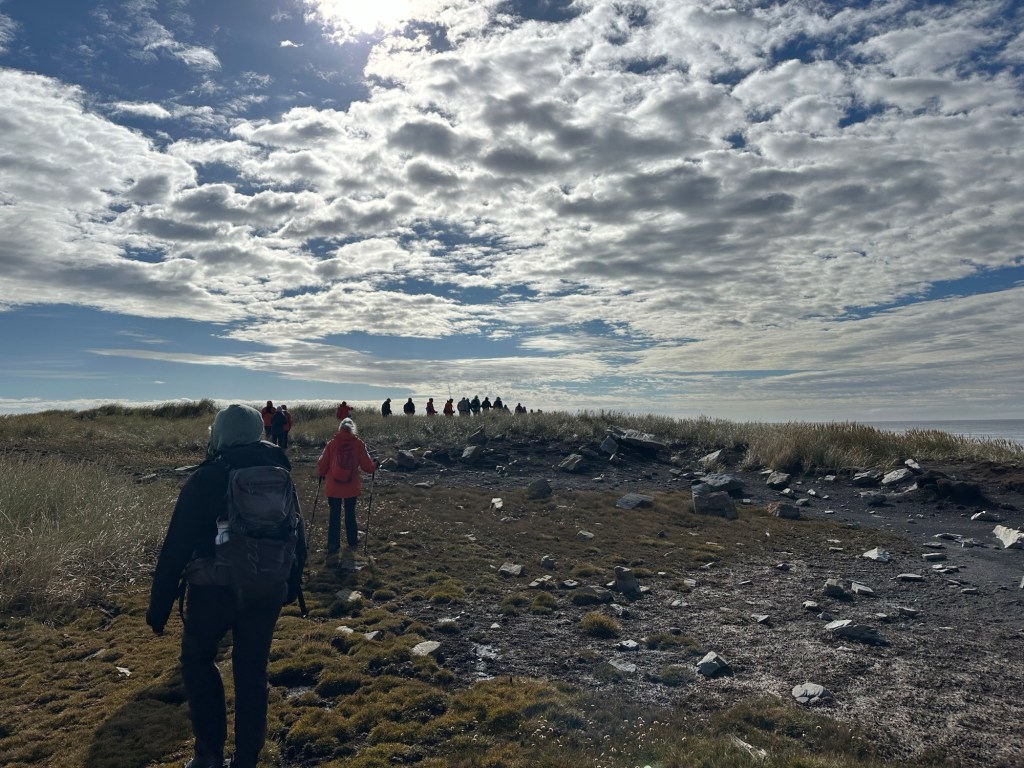
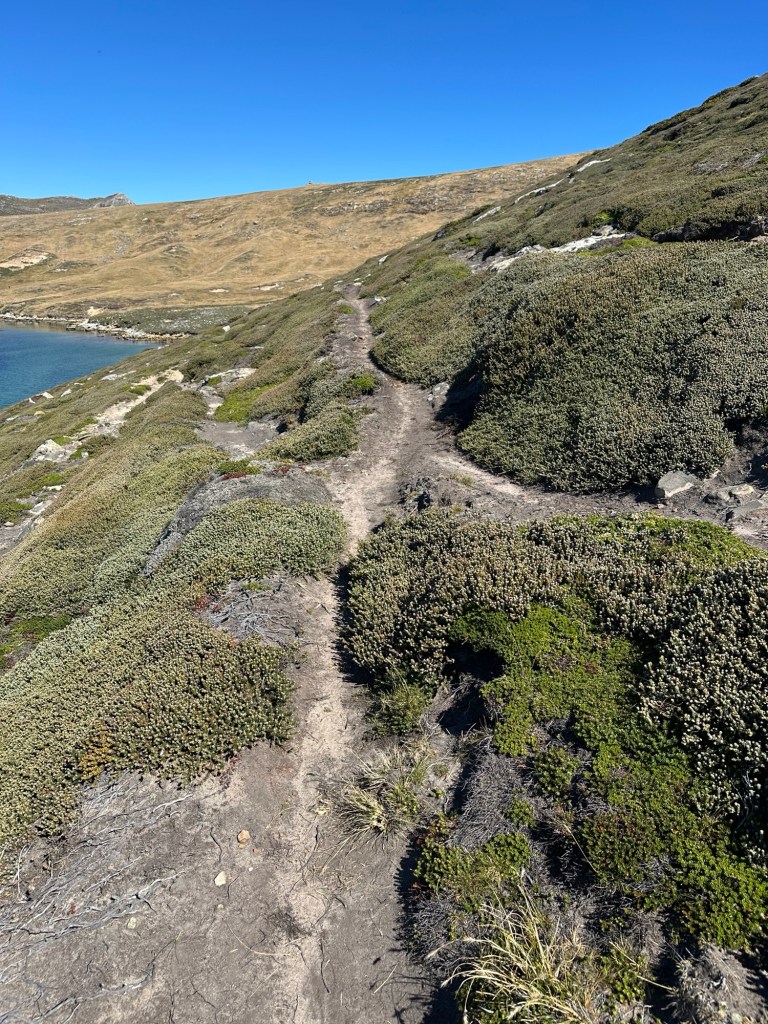
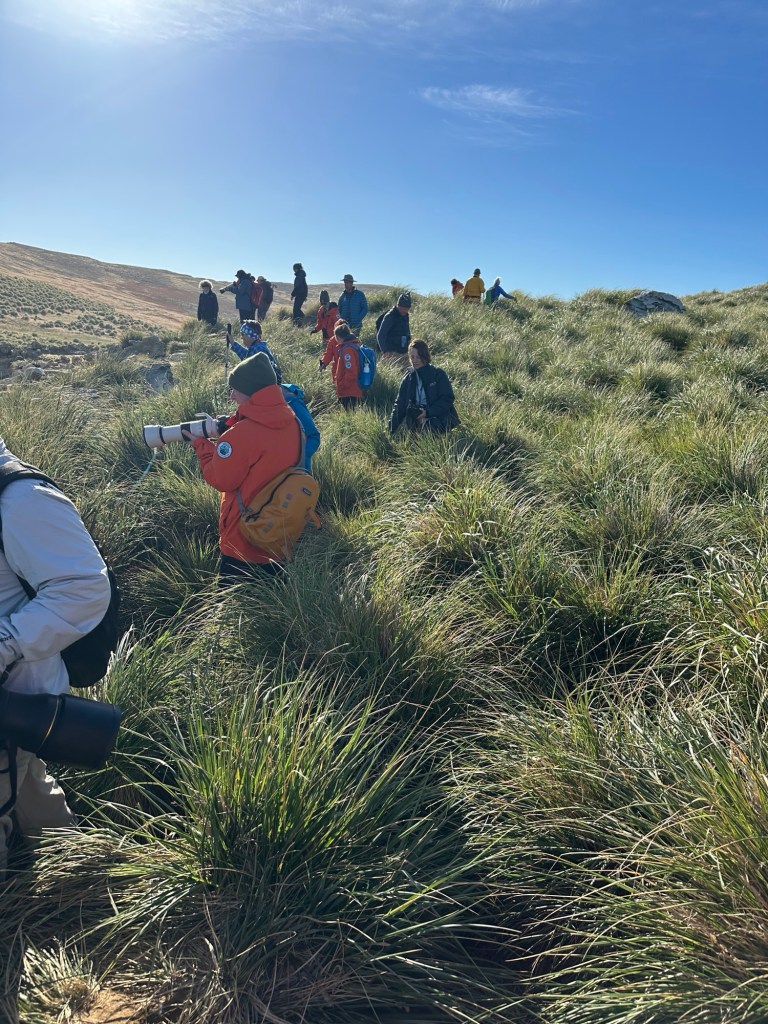
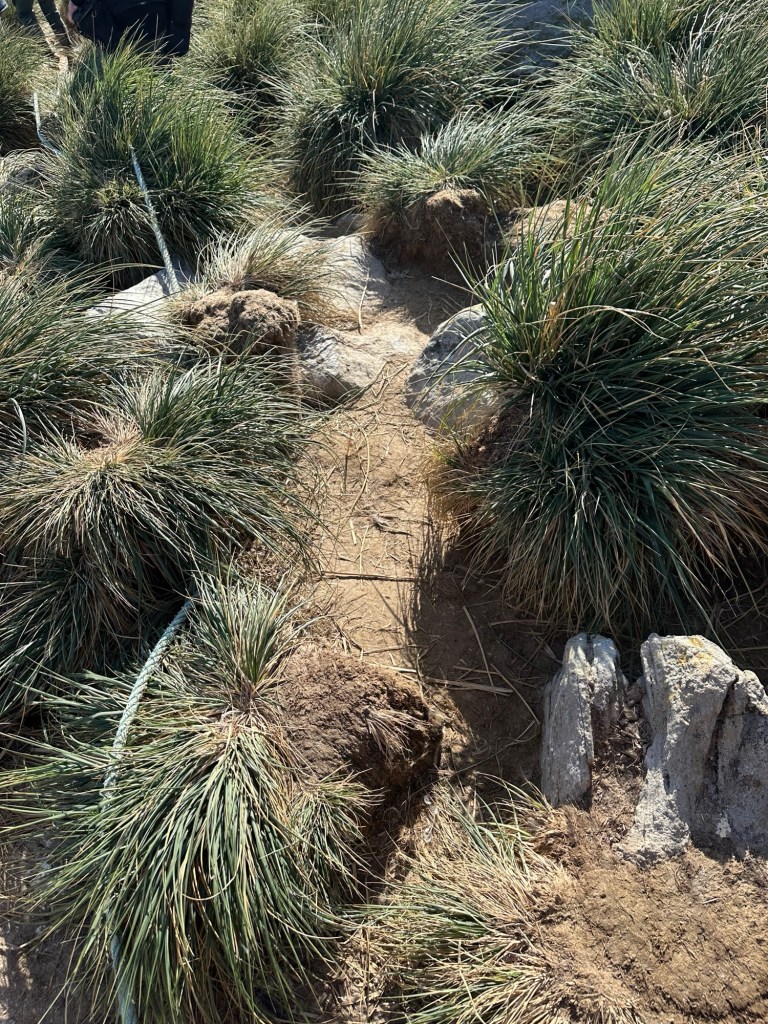
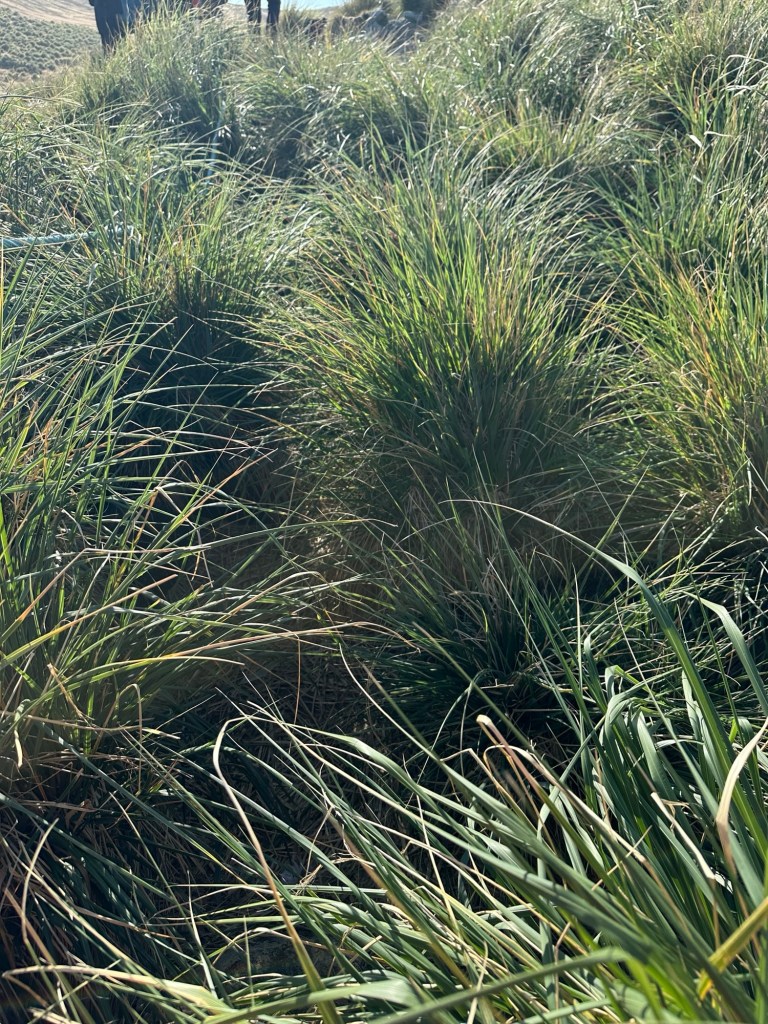
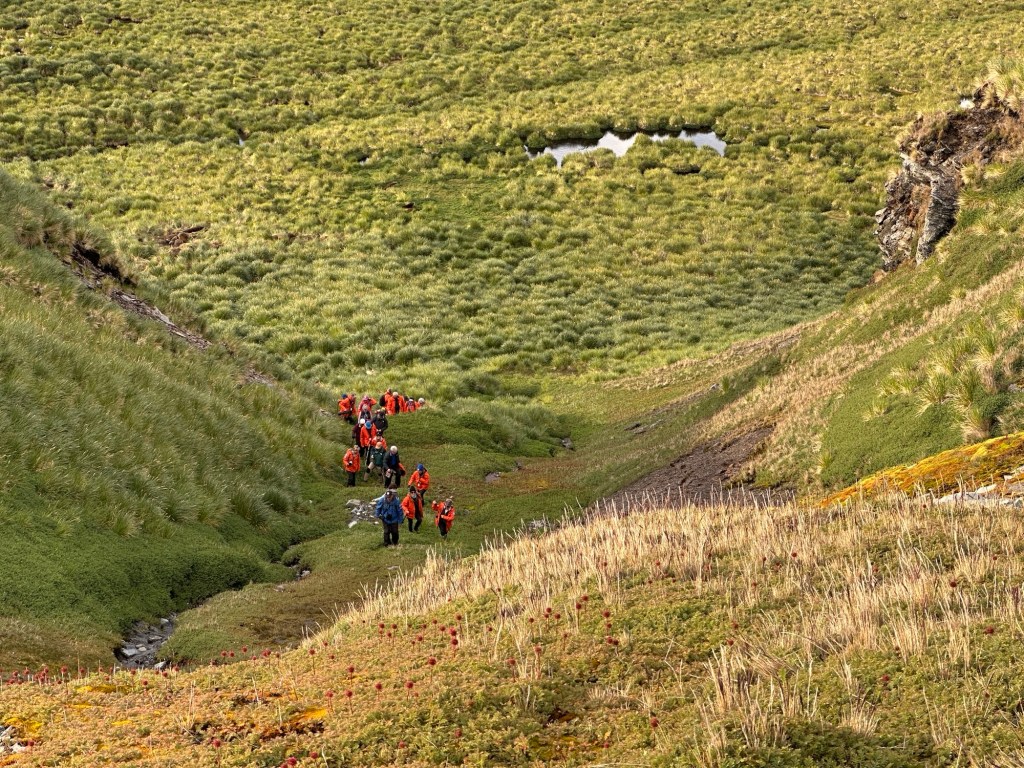
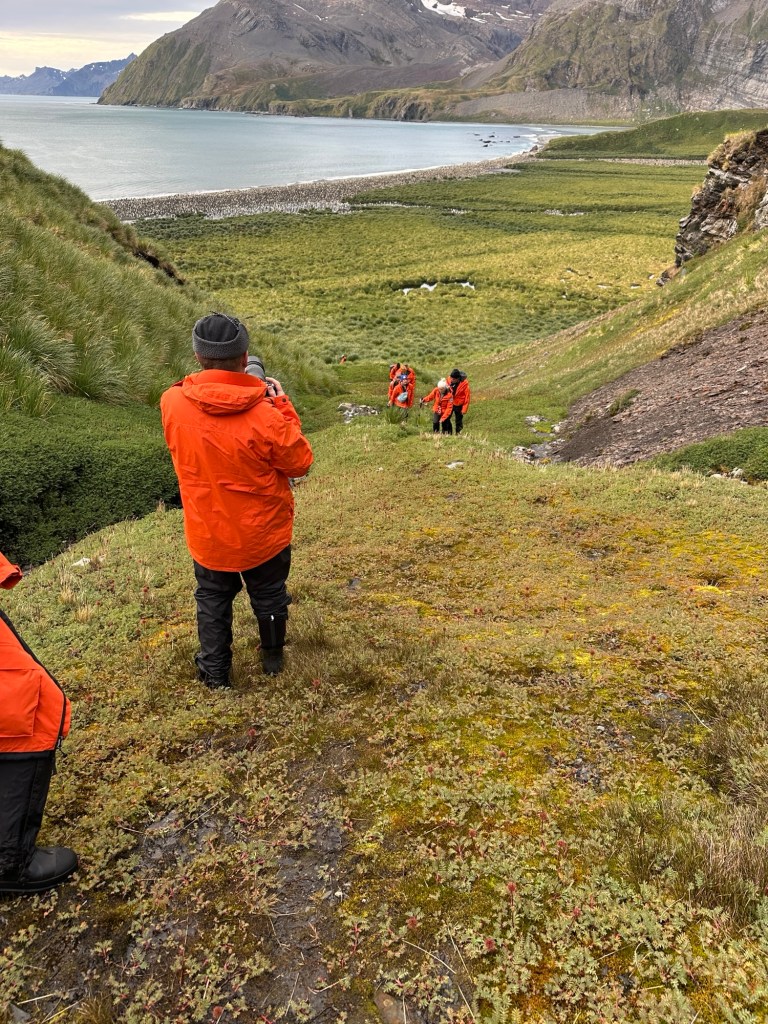
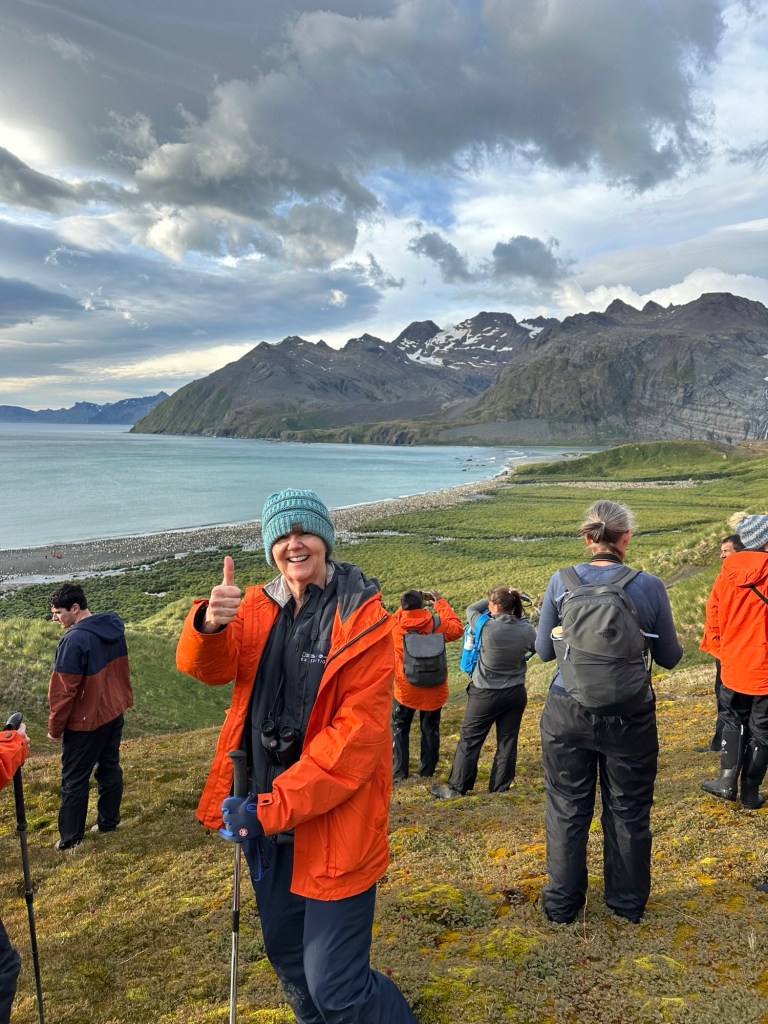
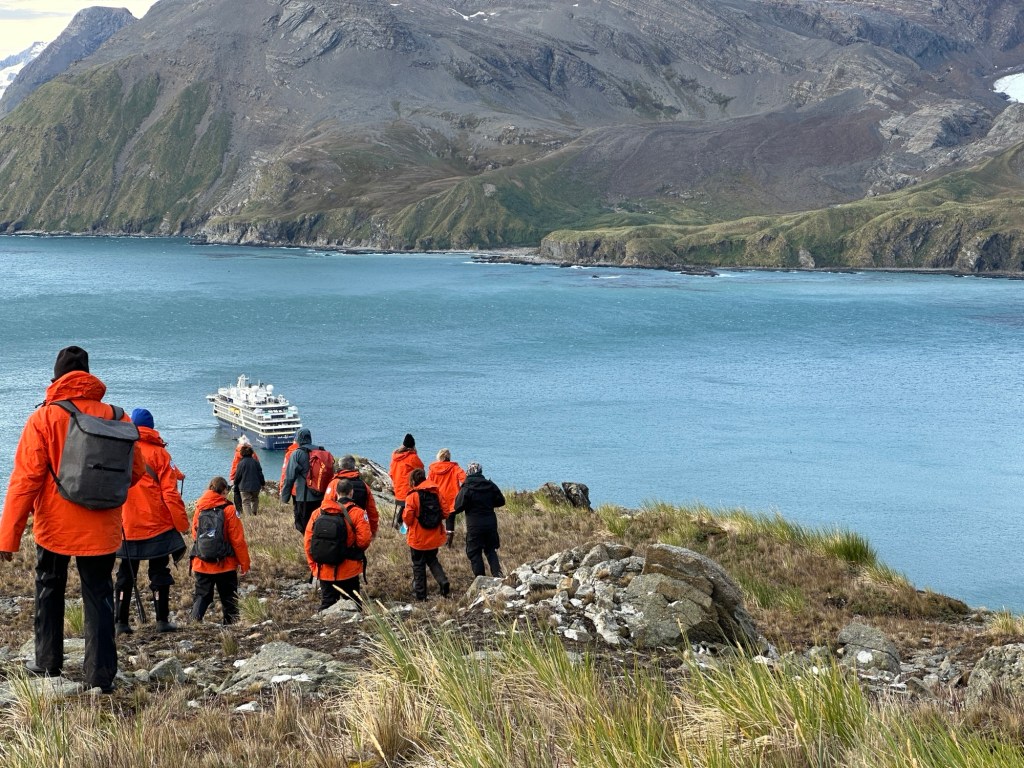
No challenges on this particular hike.But THIS one had a LOT of ups and downs Oh my god-where did everyone go? The grass made it hard to find the trail And when we DID find the trail, we could see the ground was uneven and studded with rocks, some of which moved when you stepped on them!
Wonderful friendships
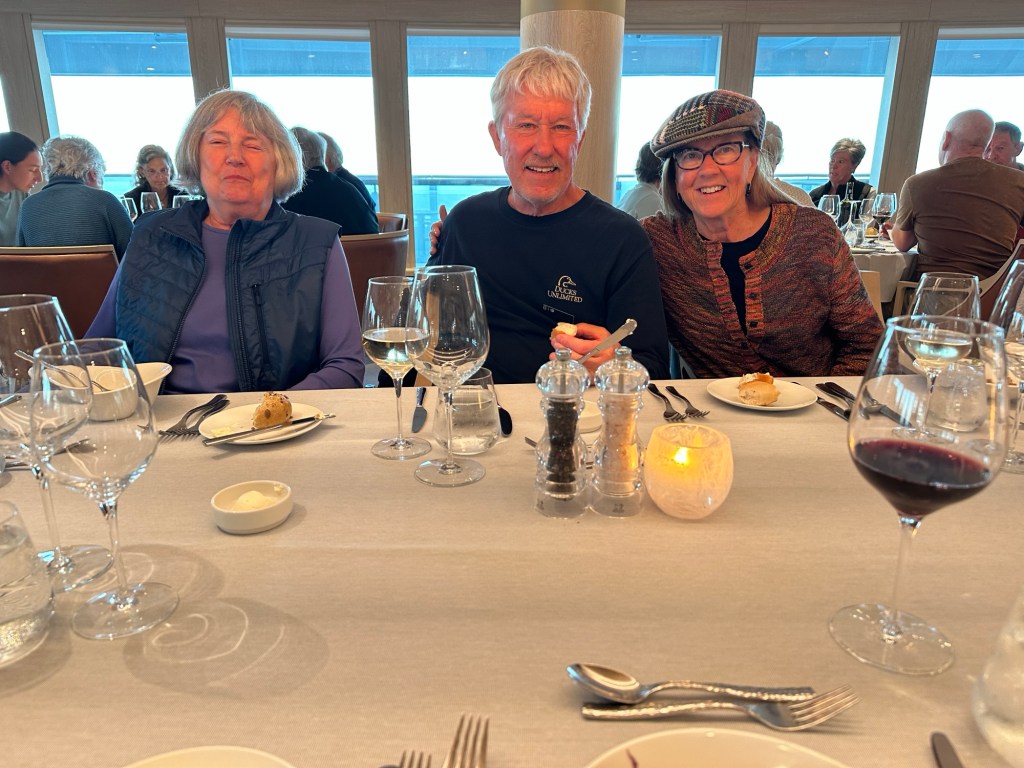
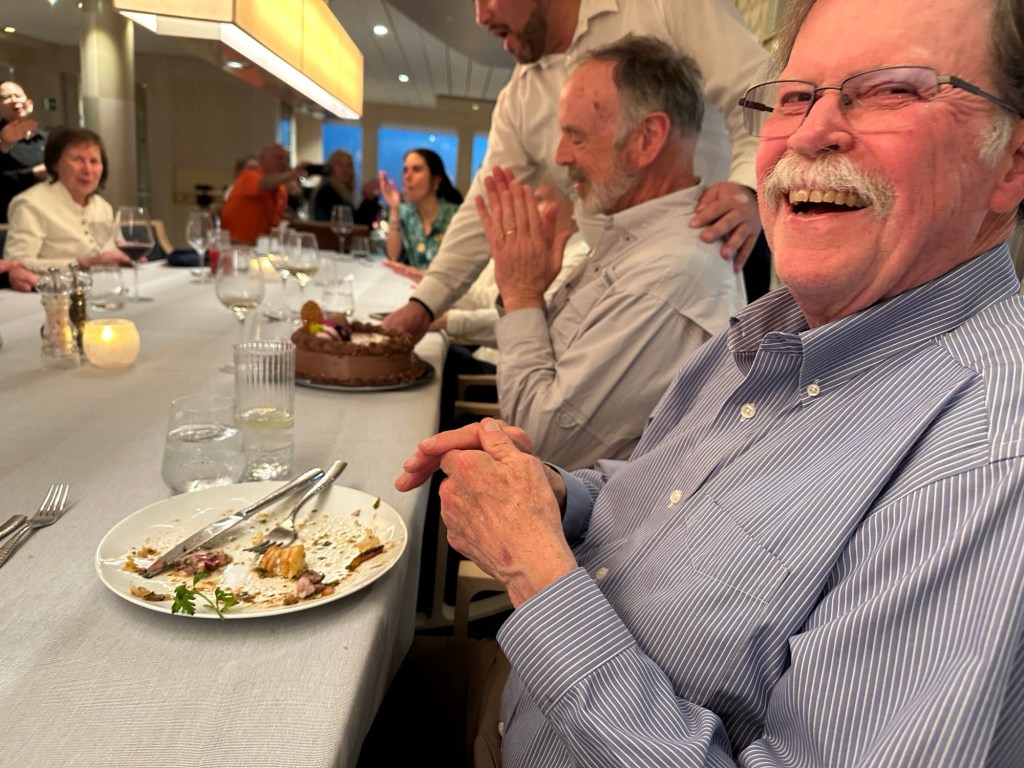
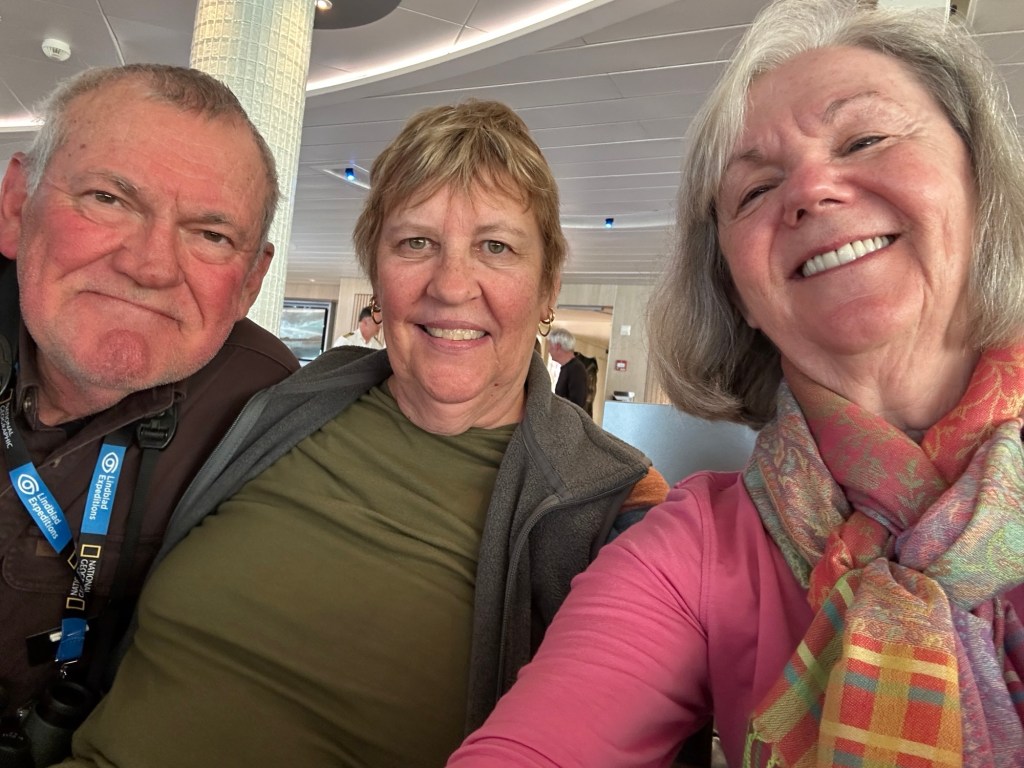
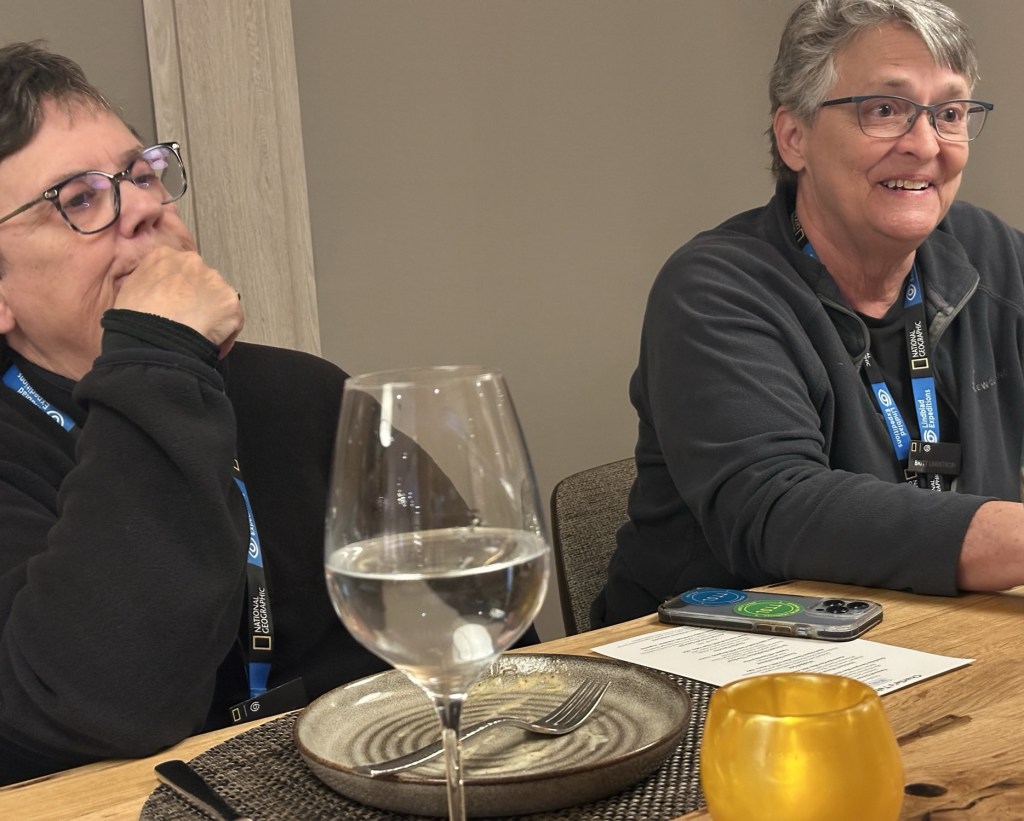
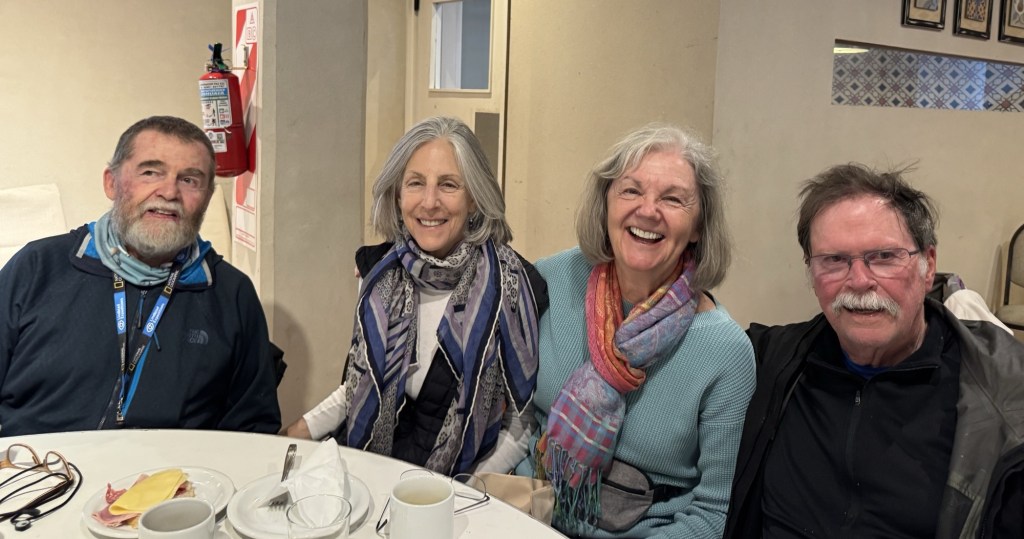
I wasn’t able to find photos of ALL the friends I made on this trip, but here are a few of my favorites:
Mo and GregMary, Dennis & DeniseMarc Bruce, Chris & meLinda and BrittMe, Dorothy and KarenTom, Patricia, me, Marc
Interesting Sights
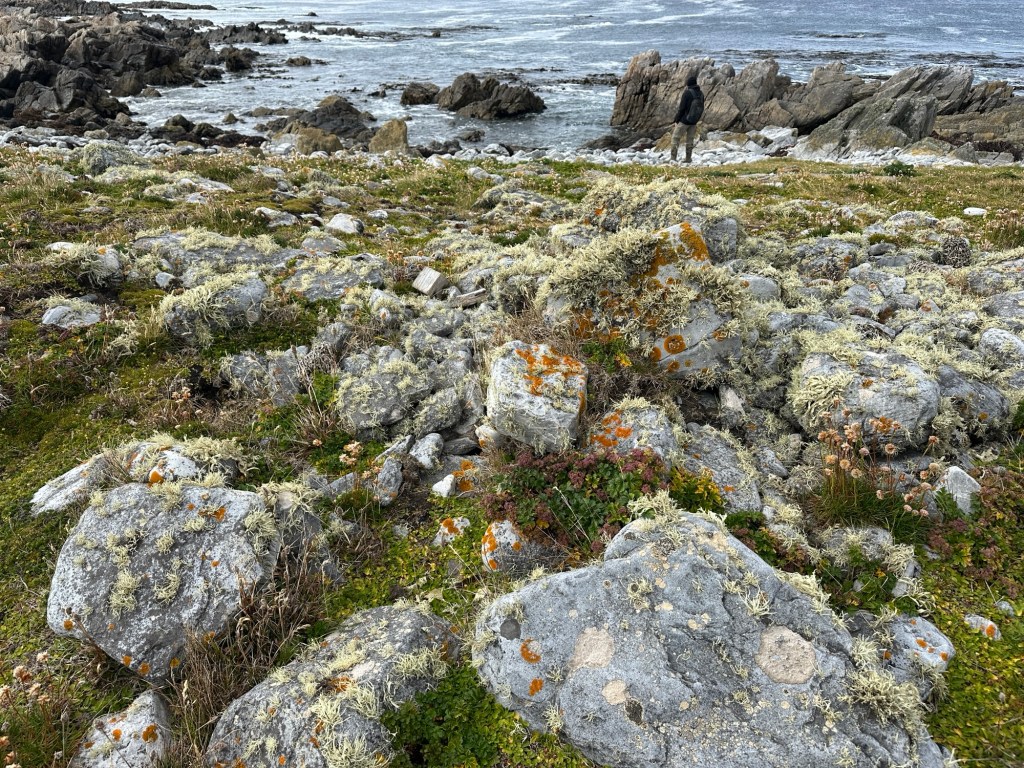
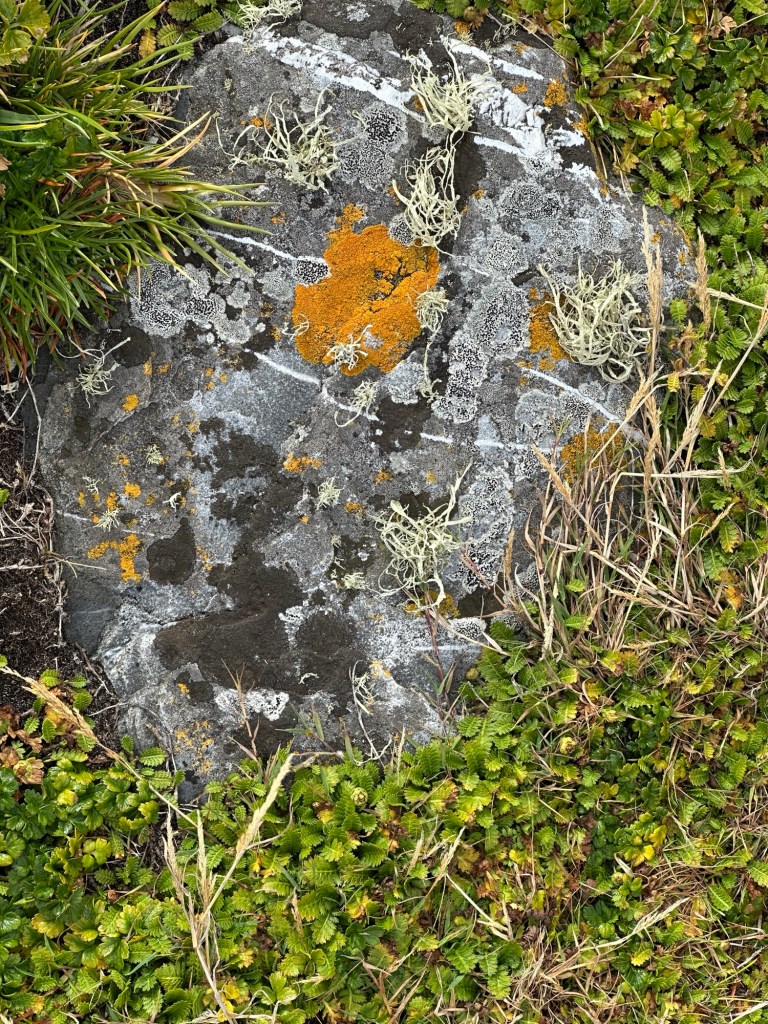
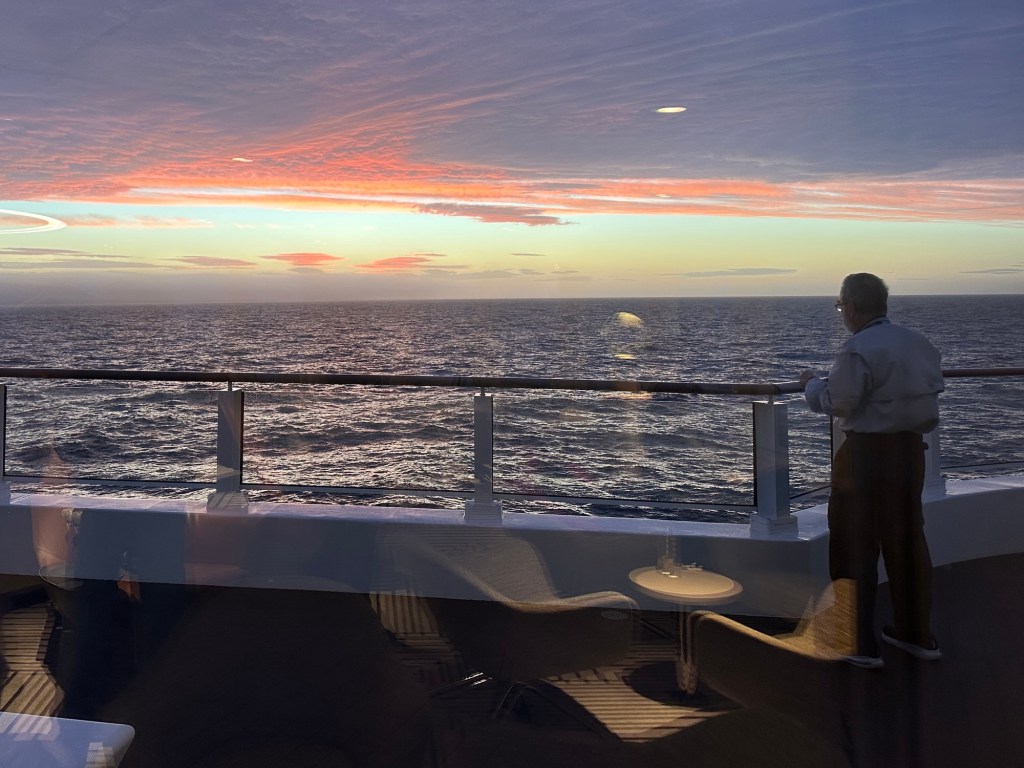
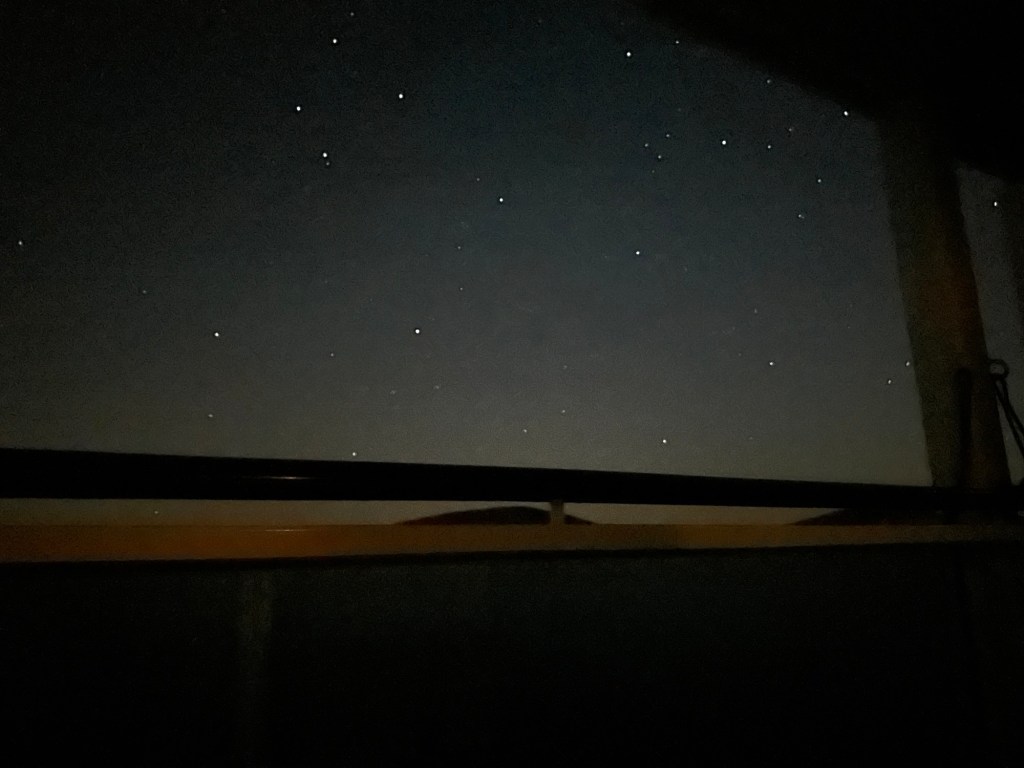
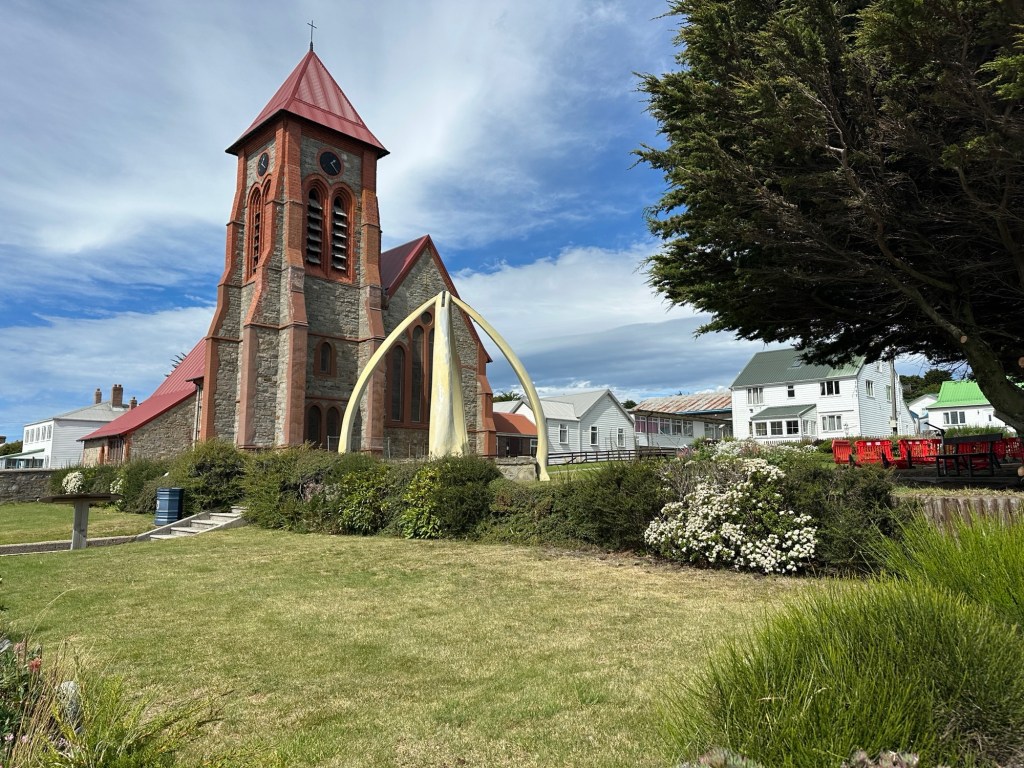
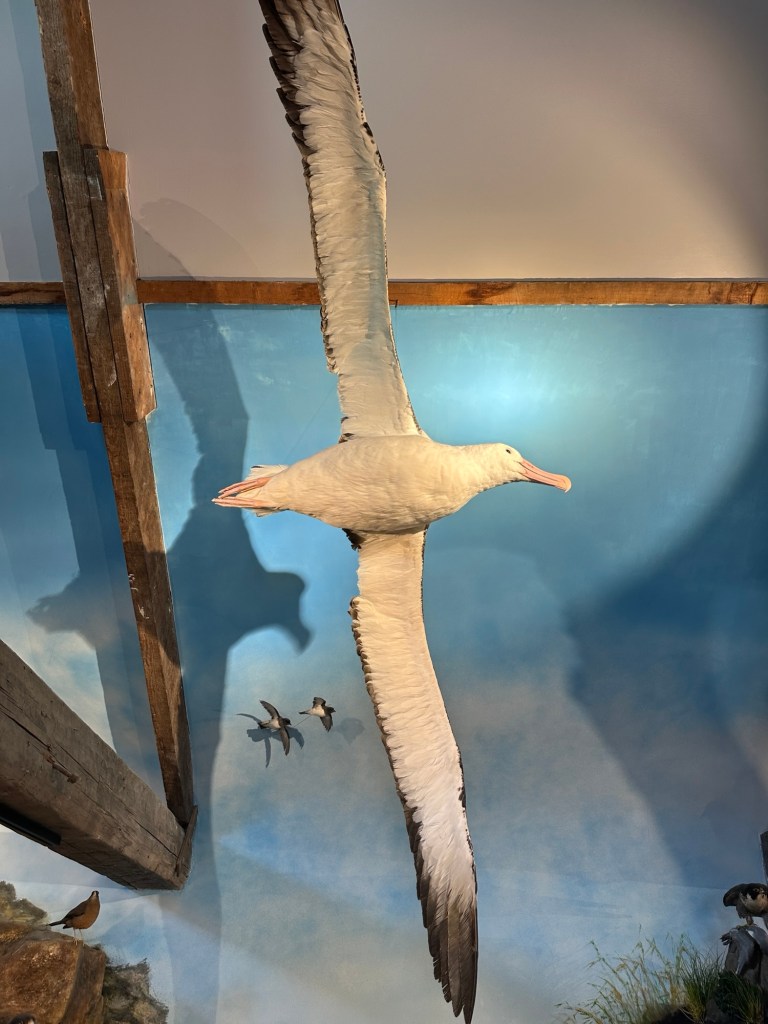
Lichen on rocks Dennis the naturalist told us ALL about them. Sadly, I completely forgot everything he said. One of many beautiful sunsetsSorry that my phone couldn’t capture the grandeur of dark skiedStanley ChirchStanley Museum
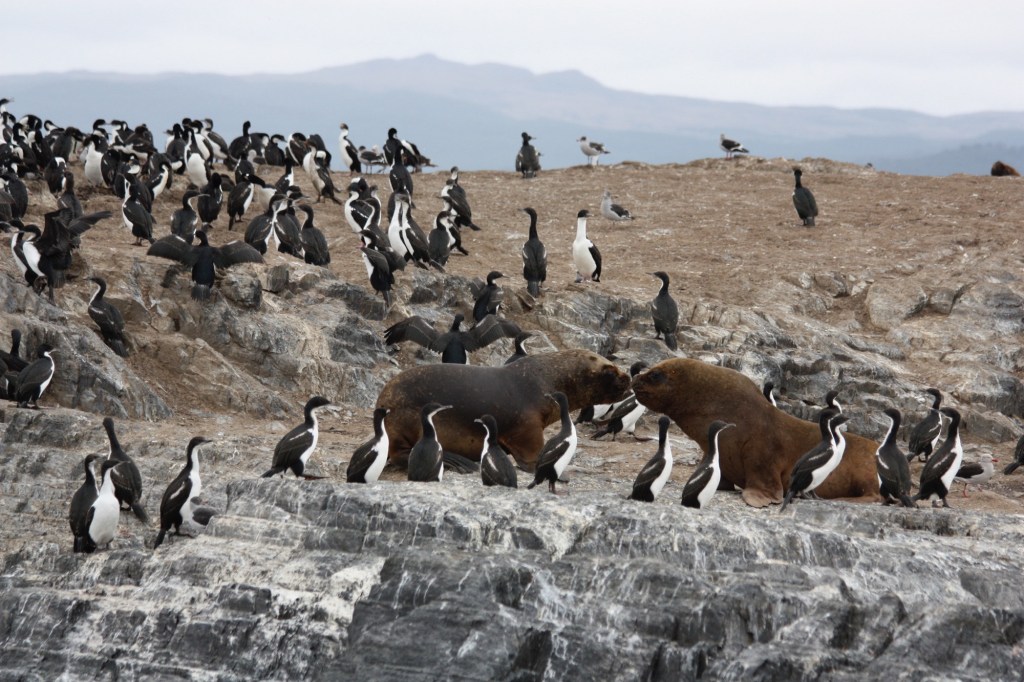
Animals animals and MORE animals

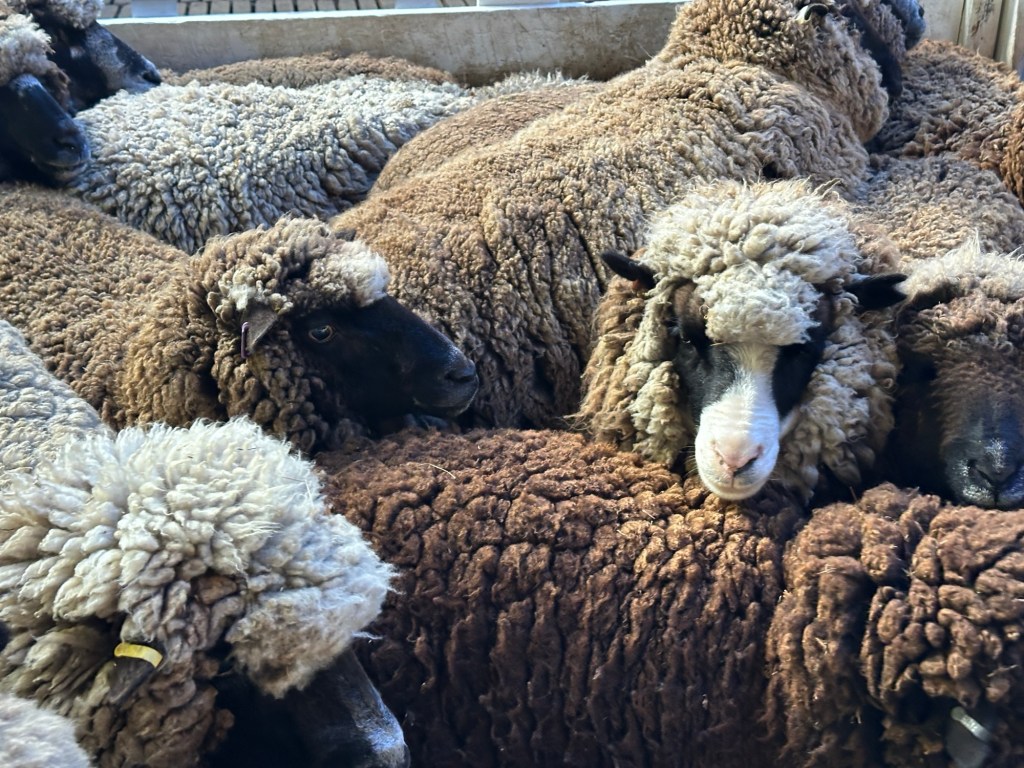
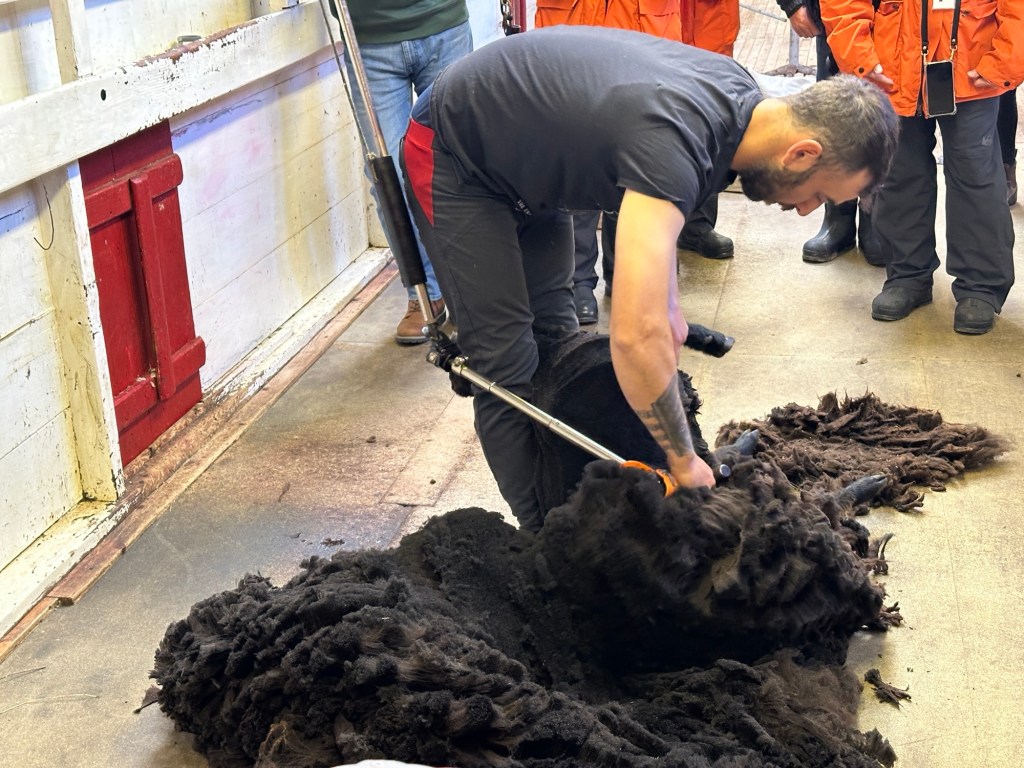
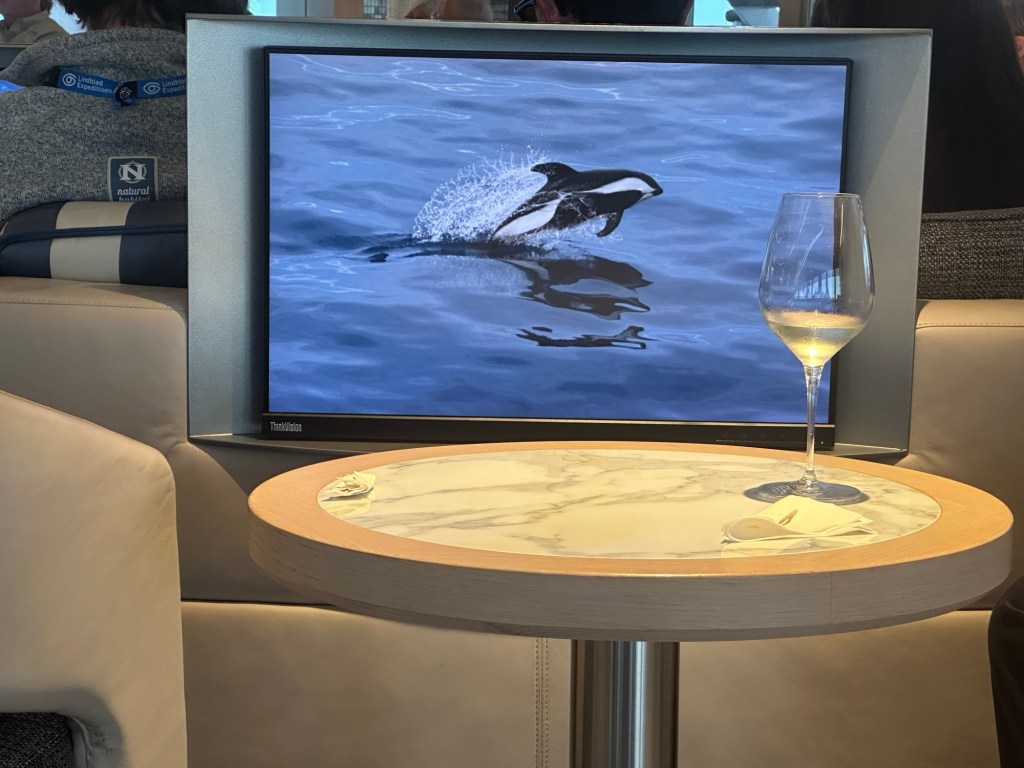
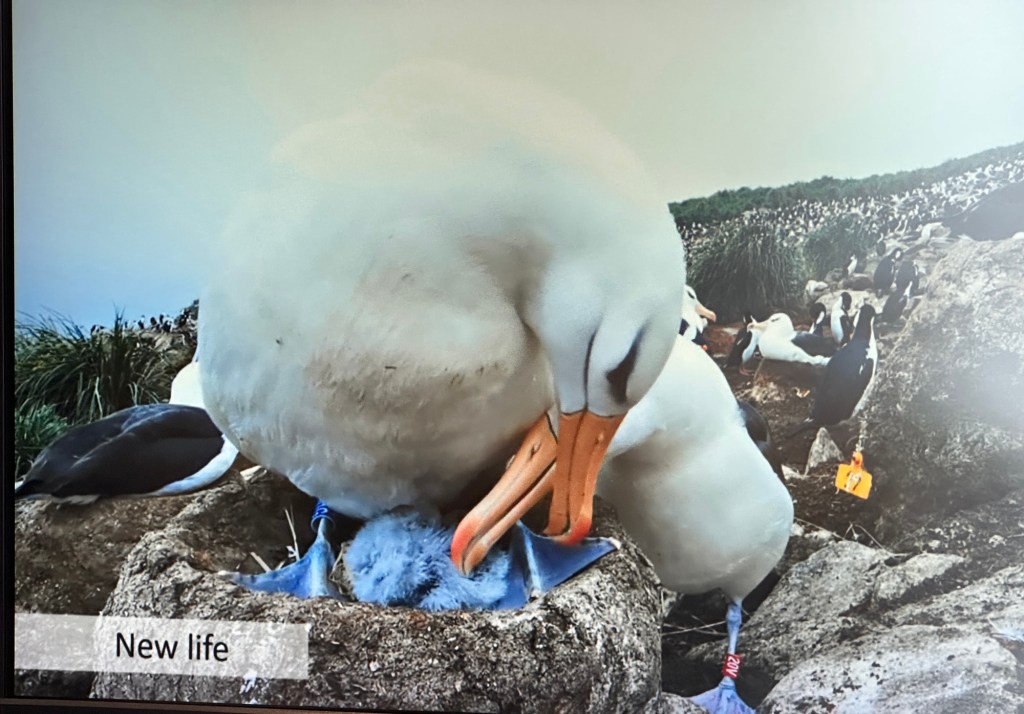
Some unexpectedSheep shearing demoSome photos were captured during lounge lectures Better than any I took! I have numerous videos that I may post on YouTube when I get home, but in the meantime, here’s a favorite.
Partying down with the ship’s staff
On our last night in the Falklands, as we set sail for Ushuaia, the ship’s staff put on a very joyous show for us.
Most of the ship’s staff are Philippine, so they dressed up in traditional costumes and danced around the room, to the delight of all.
To end the evening, we were all invited to shake our booties, and we DID.
Our last night, we were able to thank our hard working staff:
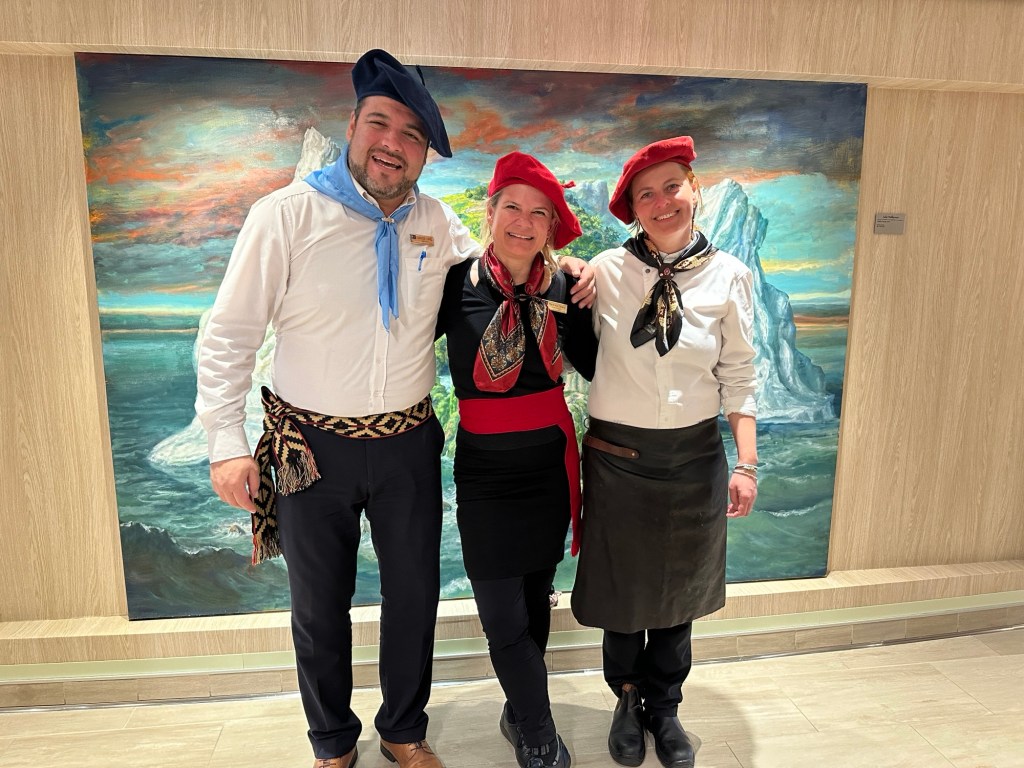
Carlos, Marketa and Chef Sarah who were responsible for the wonderful meals ( and my considerable weight gain!)
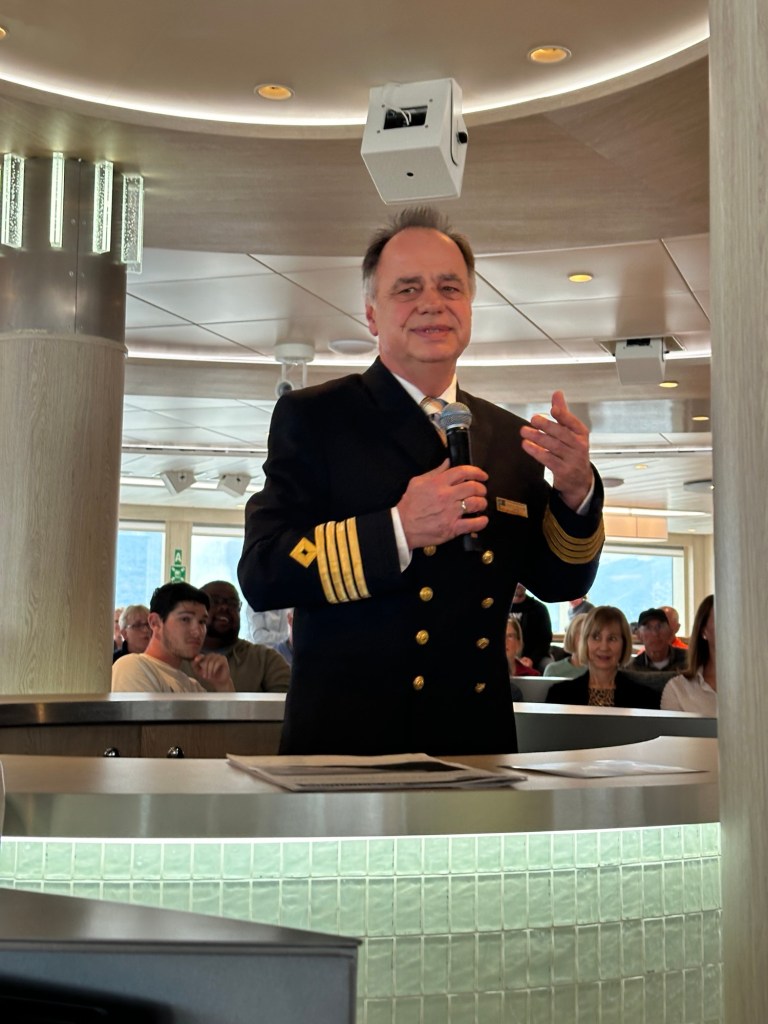
And our captain, who was Scandinavian and therefore had an unpronounceable name spelled with unrecognizable letters.
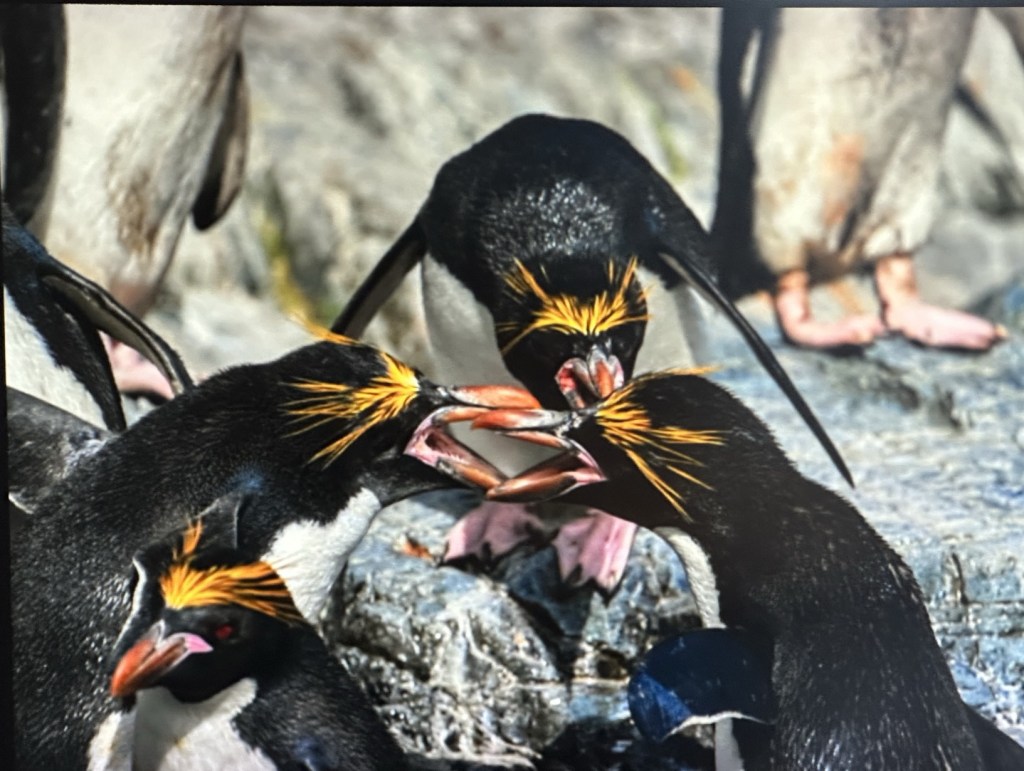
I think he might have been with the penguins too long. Do you think he’s adopted the macaroni penguin’s hairdo?
Okay, so now you’ve heard about our wonderful experiences on the trip. My next post will be about Ushuaia and our return home.
If you’ve been following along, by now you should have a really good idea why someone would choose to visit the Antarctic Circle. You’ve heard about the hikes, the zodiac cruises, the animal sightings. I haven’t said much about the sea days, and they are equally fantastic.
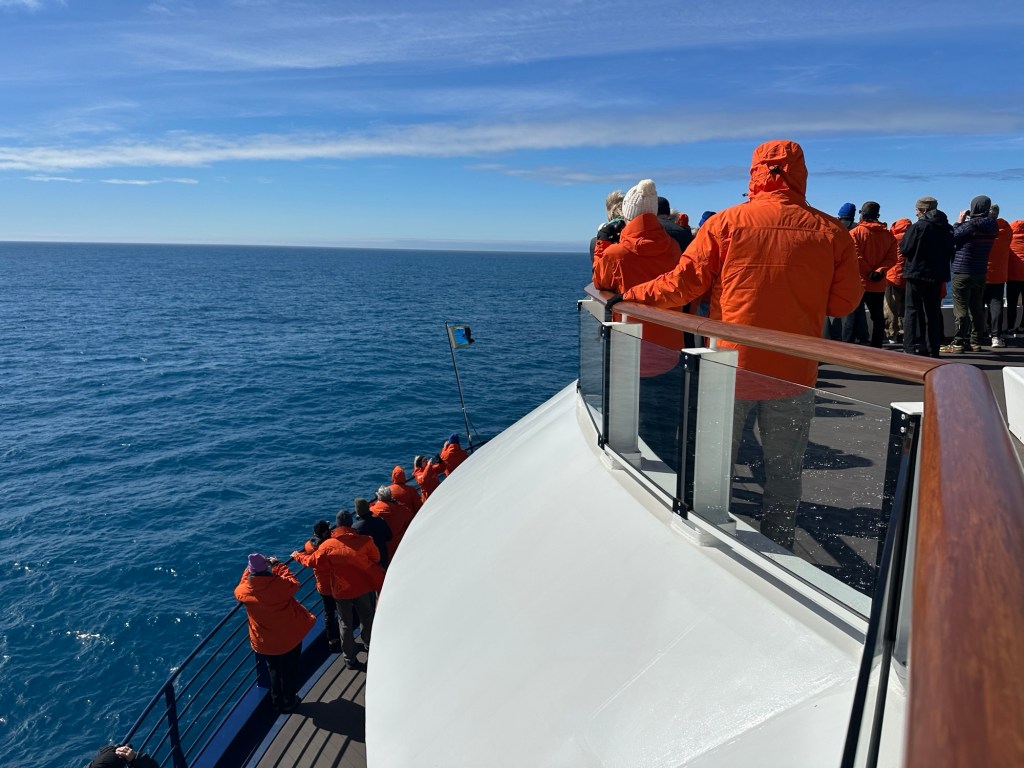
Multiple decks provide plenty of viewing opportunities
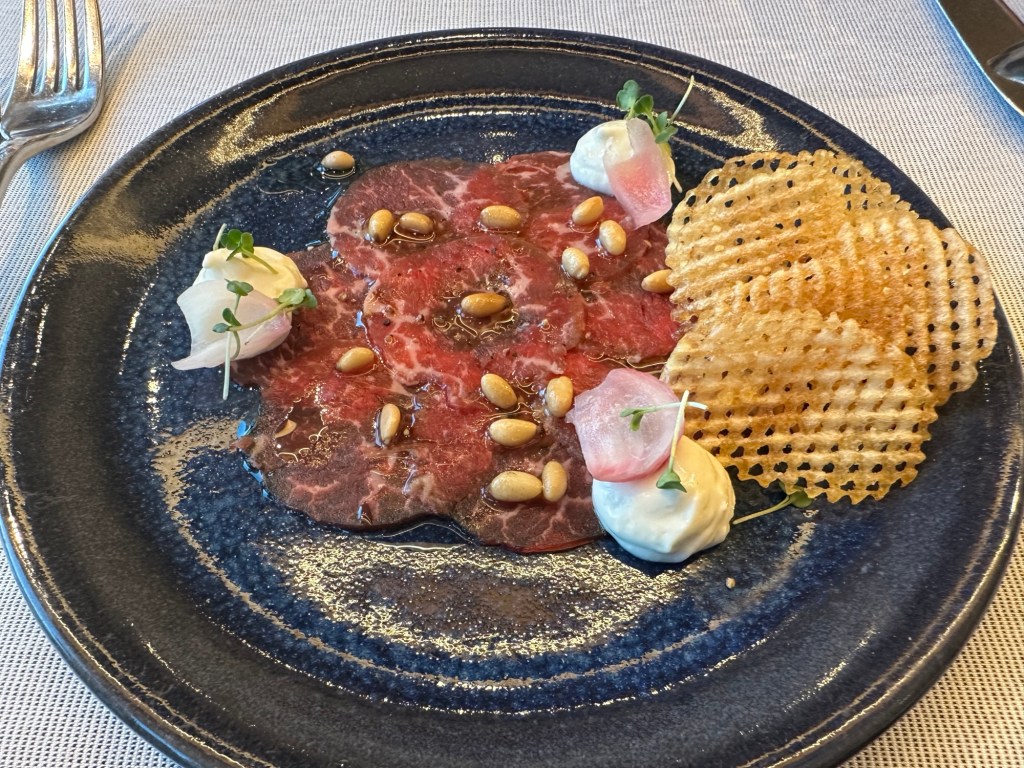
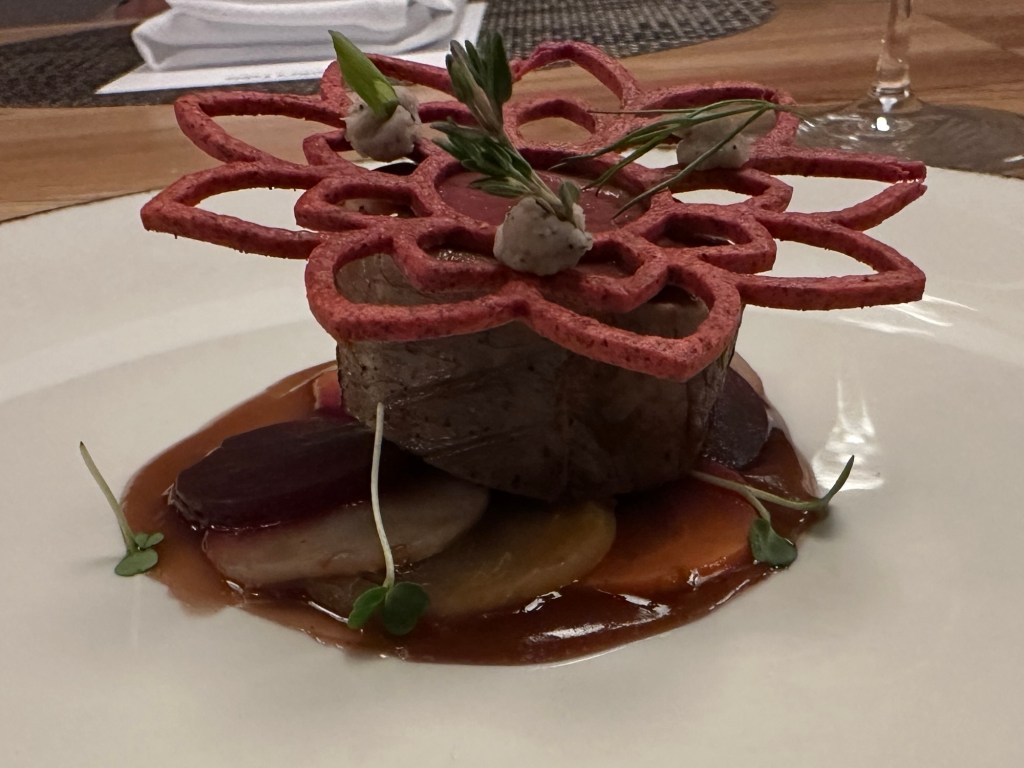
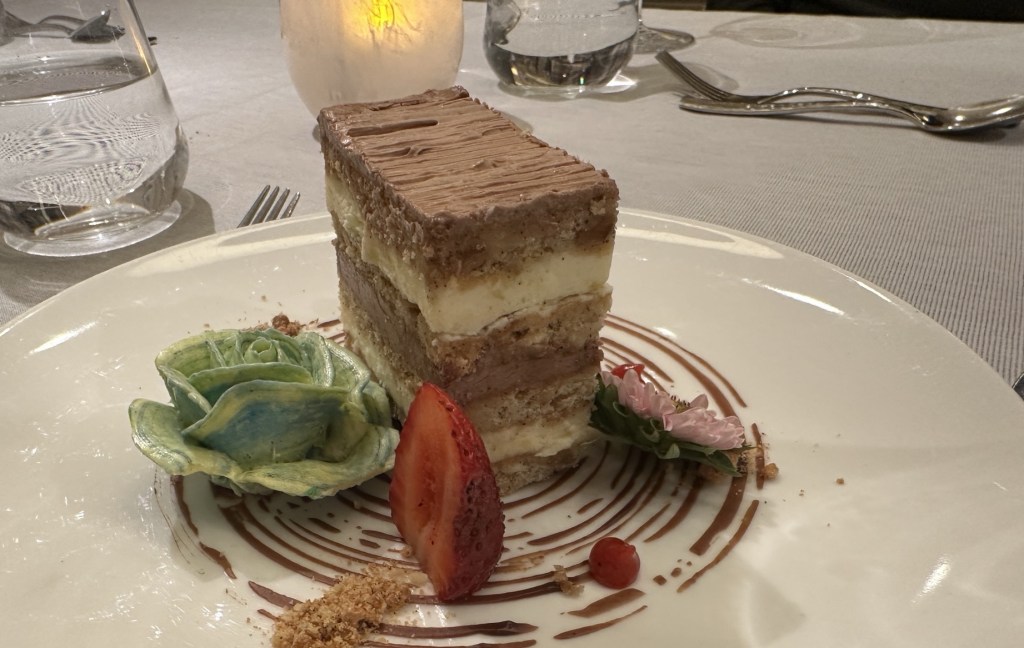
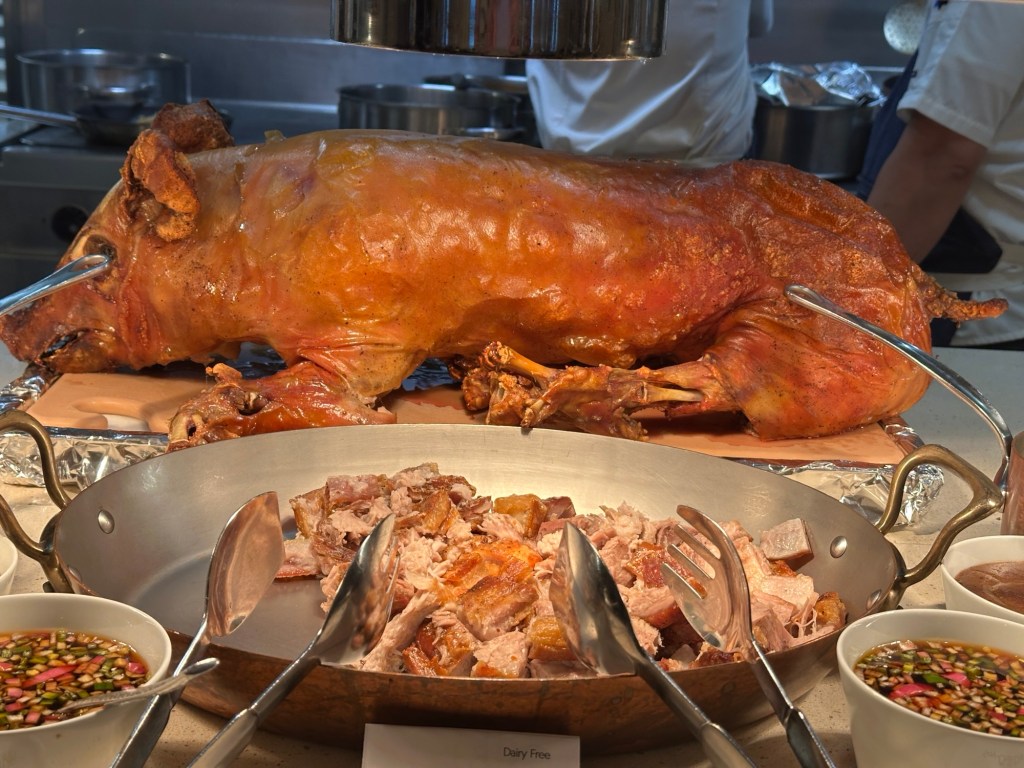
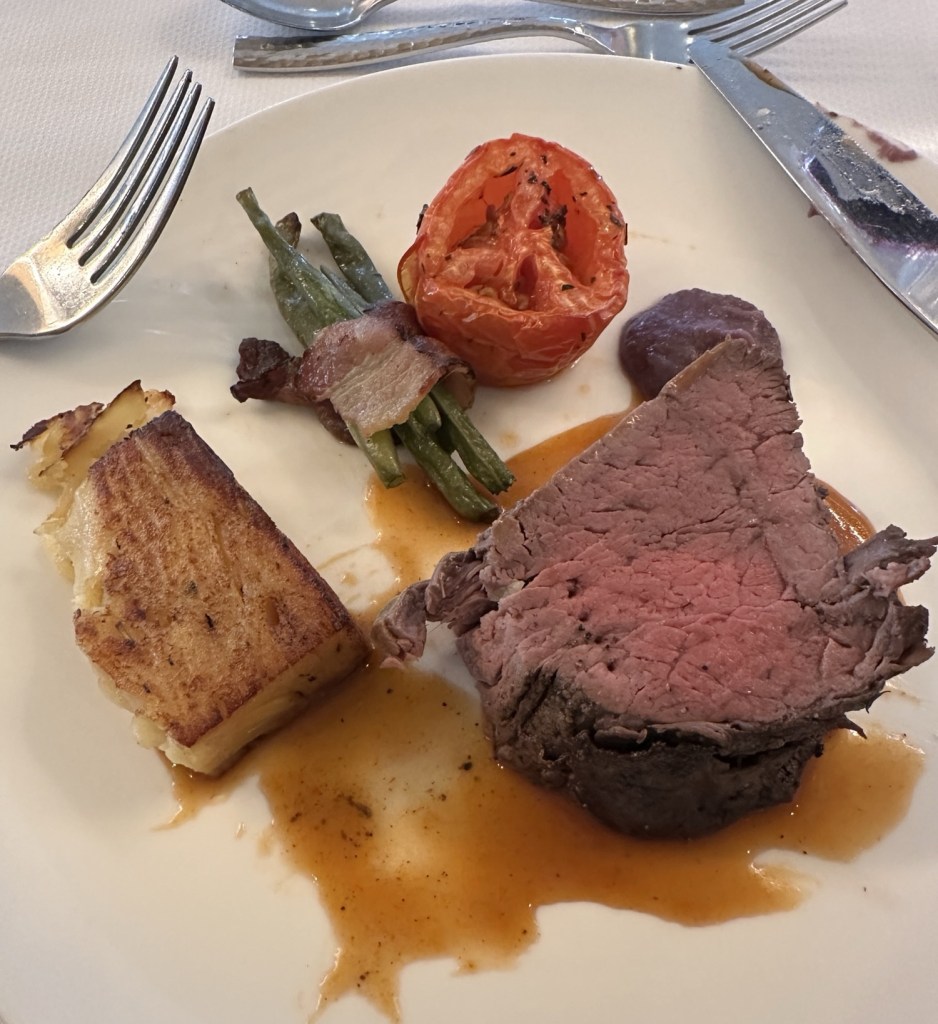
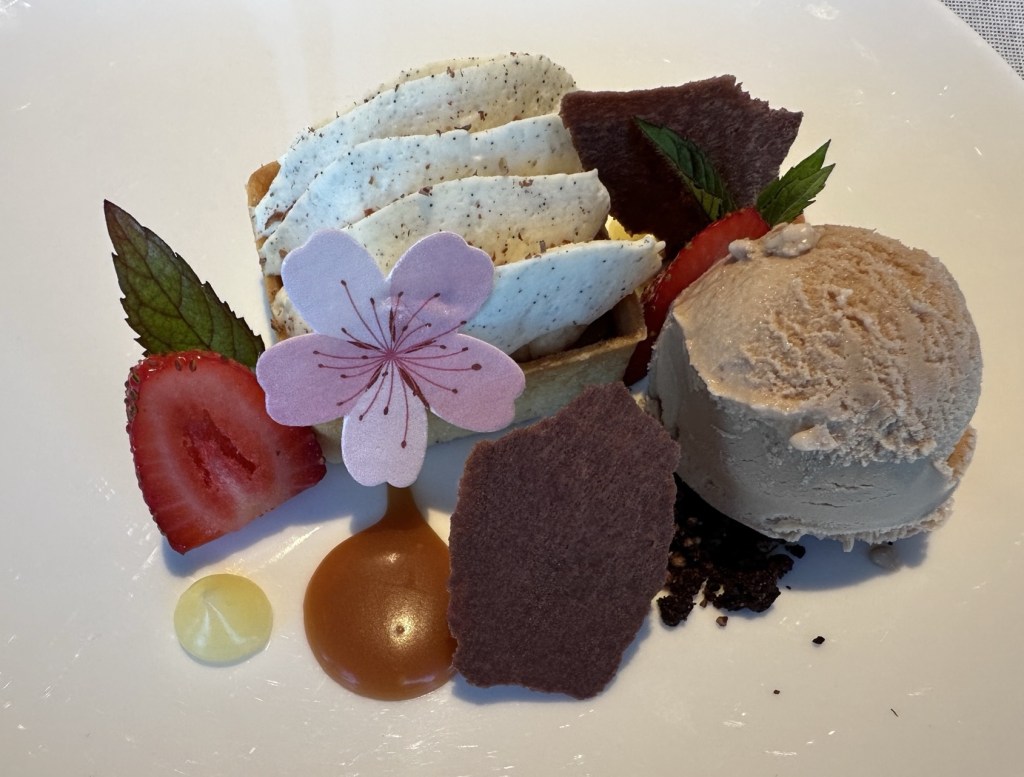
Let’s start out with the food. The variety is mind boggling. I’m a picky eater, but I’ve gotta tell you, every meal has tasted delicious and looked beautiful! Here’s a small sample.
Can you tell I really like desserts?
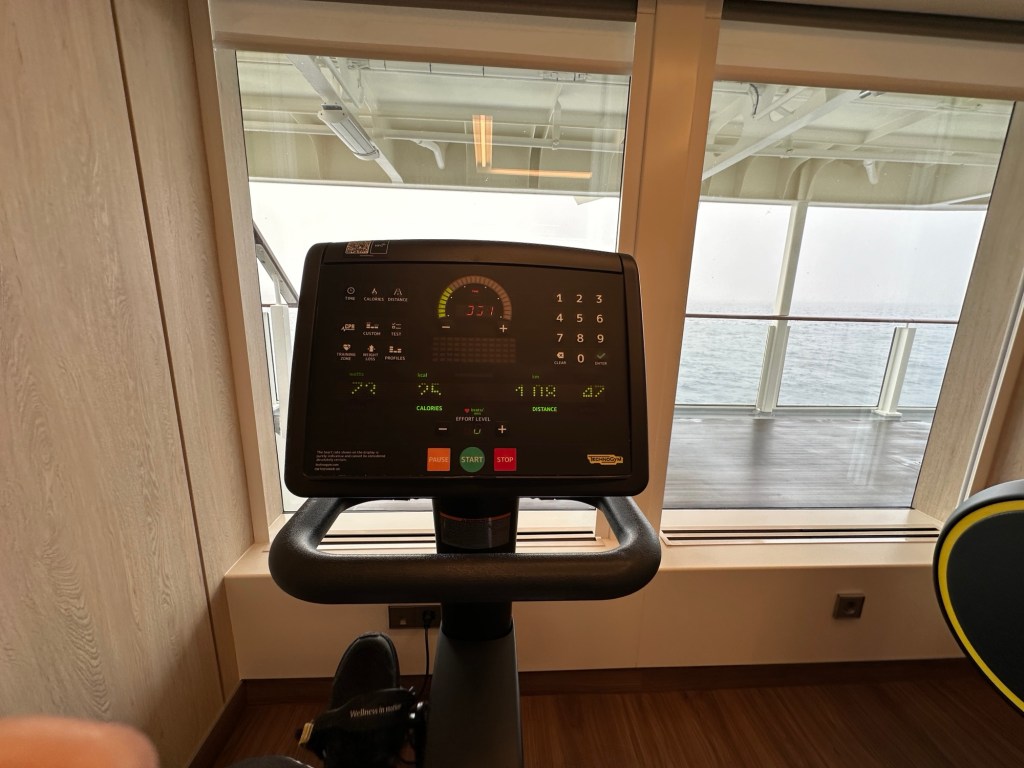
Of course, if anyone wants to return home sporting less than an additional ten pounds, there is a fully equipped gym on Deck 7.
I favored the recumbent bike, although I will admit, I didn’t use it as much as I should have.
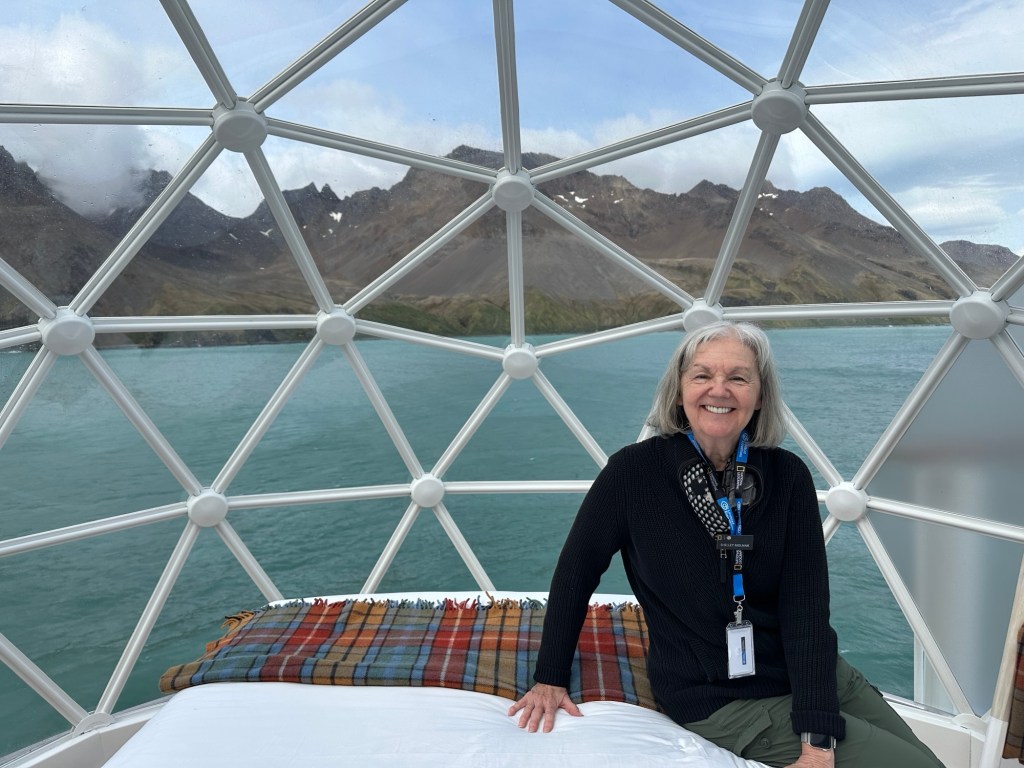
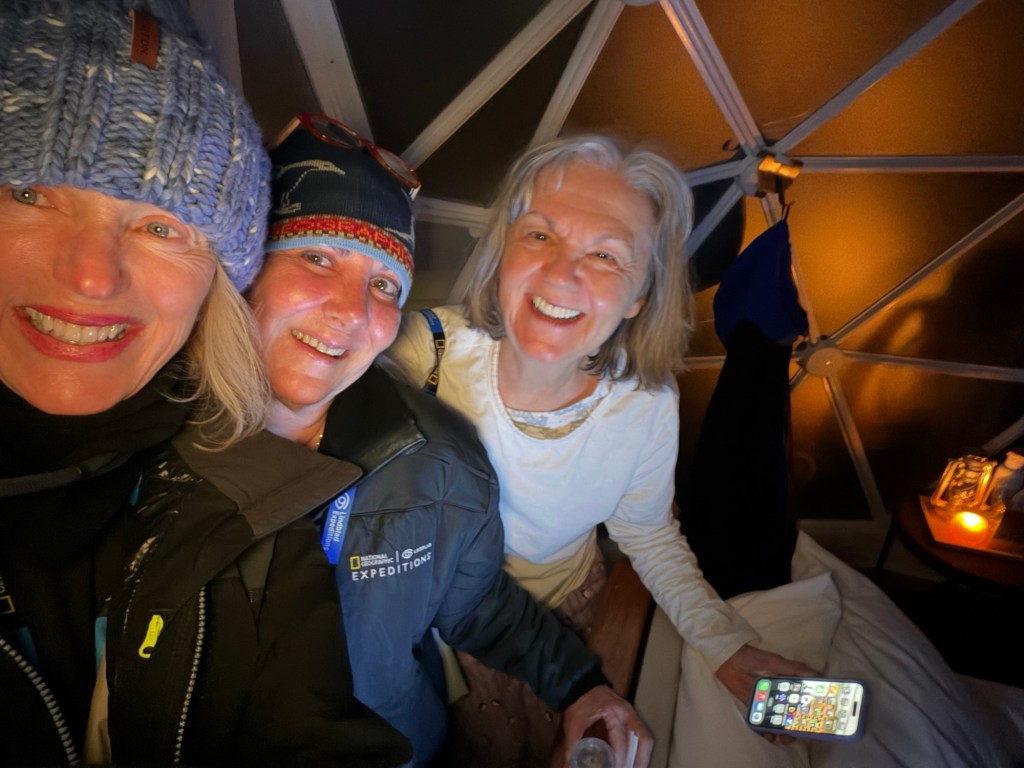
I didn’t utilize the igloo on a sea day, but those days gave me time to write about them. There are TWO of these structures on deck 8. Those who want to spend a night in the igloo make a request, and if demand is high, a lottery determines who has access.
Fortunately, I had the presence of mind to have a photo of the interior taken before it got too dark.
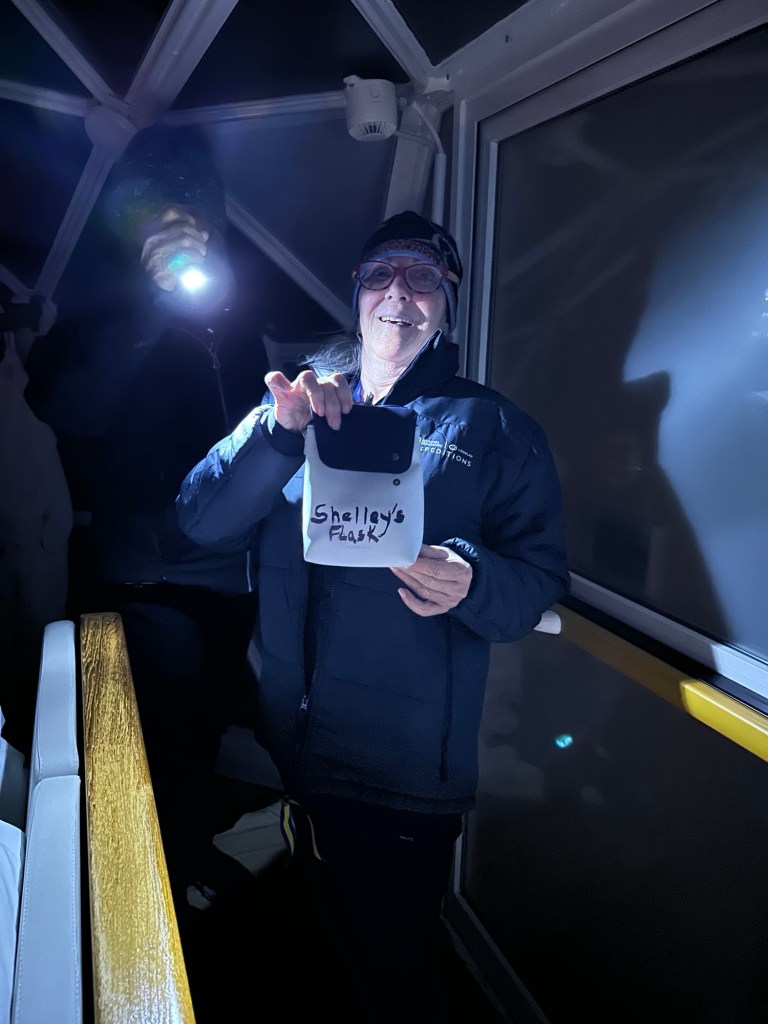
I had been joking with my two new friends that I expected them to bring me a flask, sort of like the Saint Bernards dogs do in Switzerland.
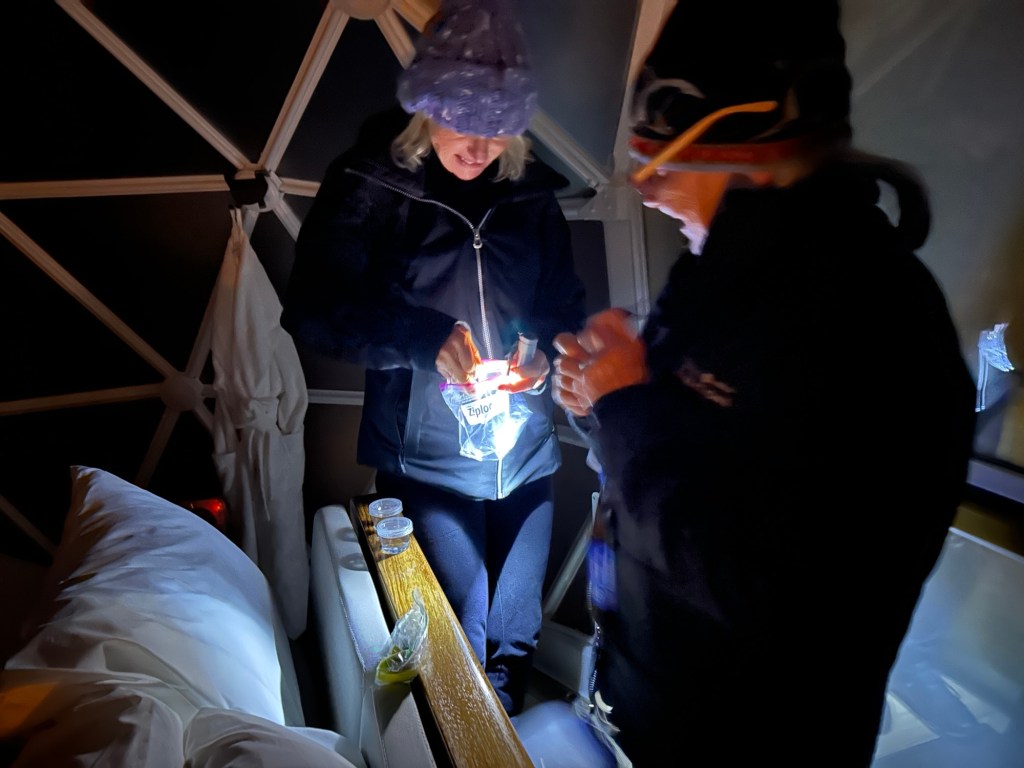
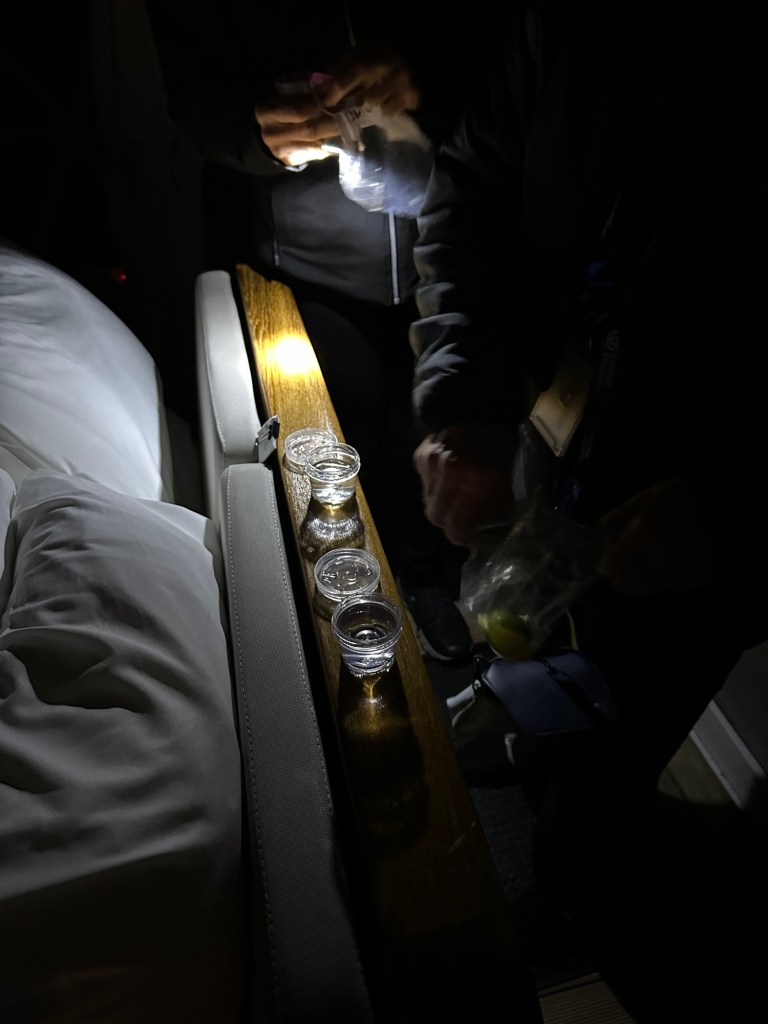
Not only did they visit, but they brought three shots of tequila, salt, and limes so that we could have a proper toast
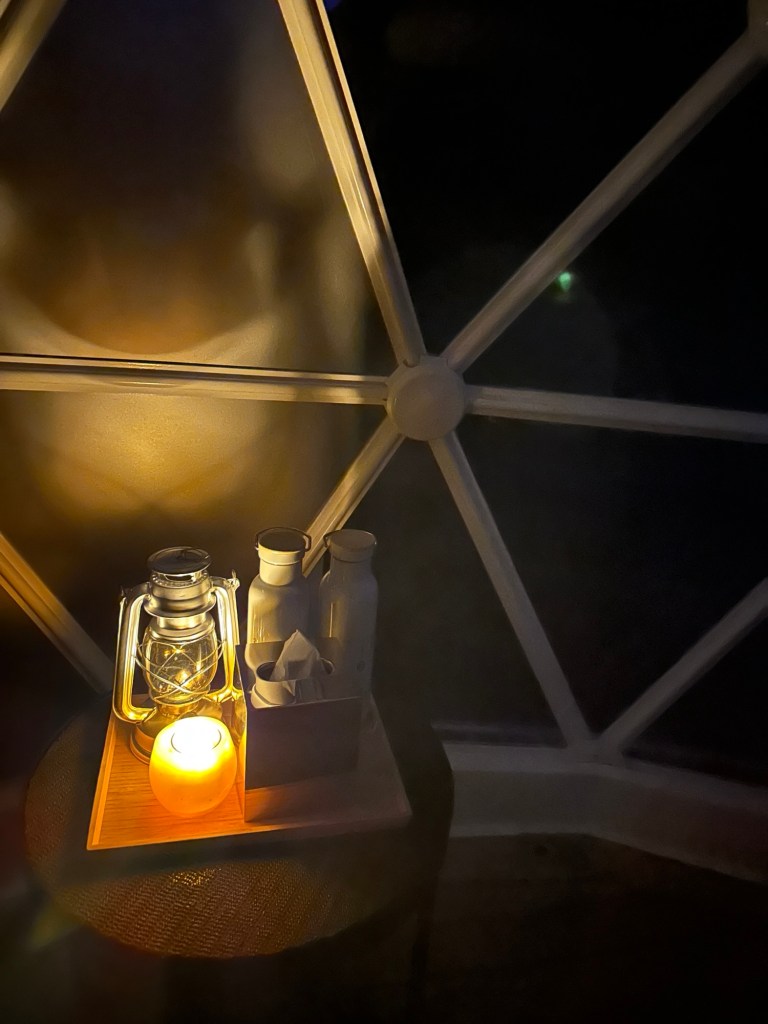
The bed’s headboard was transformed into a bar. You might be able to see that it took all three cell phones to generate enough light for our selfie. Of course, if I had been more observant, I would have noticed the lantern inside the igloo. I am probably the least observant person on this ship!
So, what was the experience like? Was it too cold? Too bright?
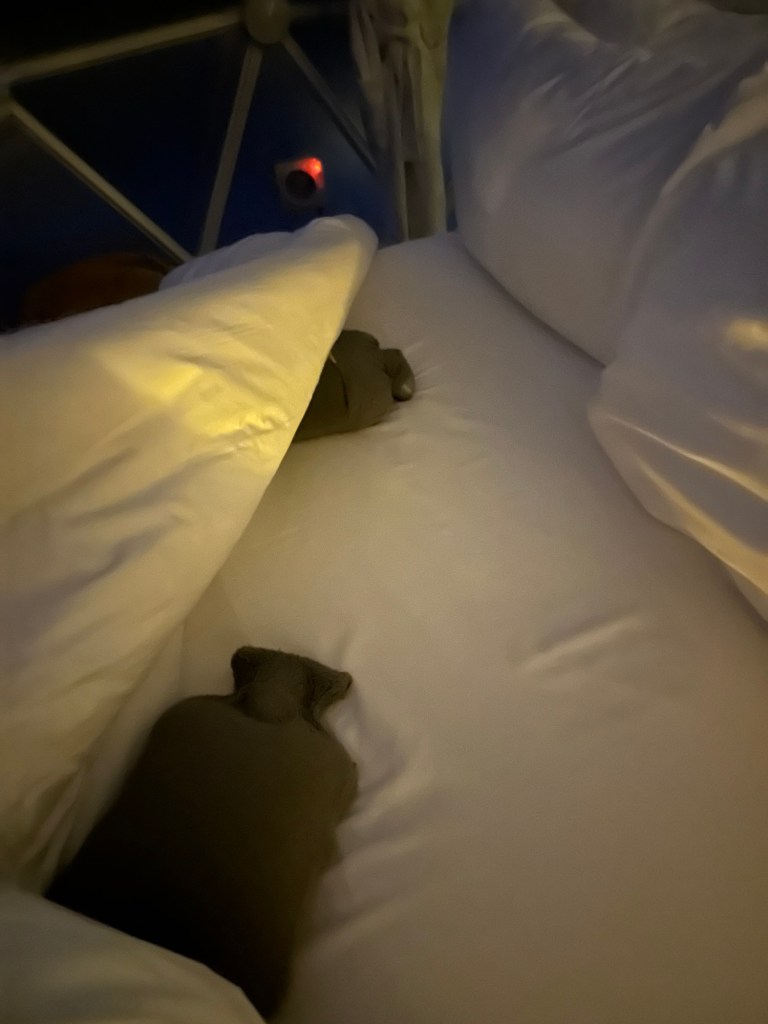
It was toasty warm, because the floor of the igloo is heated and hot water bottles are placed in the bed. And you can see for yourself that it was plenty dark. I will confess, however that when I was awakened by the howling wind and the rough seas, I gave it a half an hour to see if I could fall back asleep. When I couldn’t, I decided it would be wise to return to my cabin on a lower, more central deck.
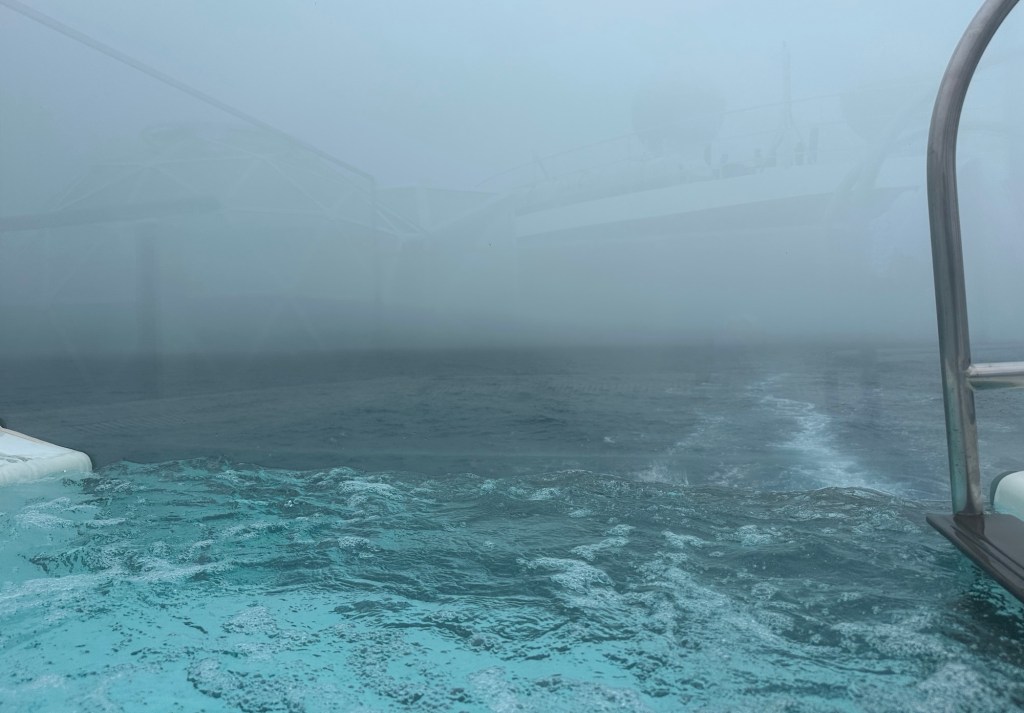
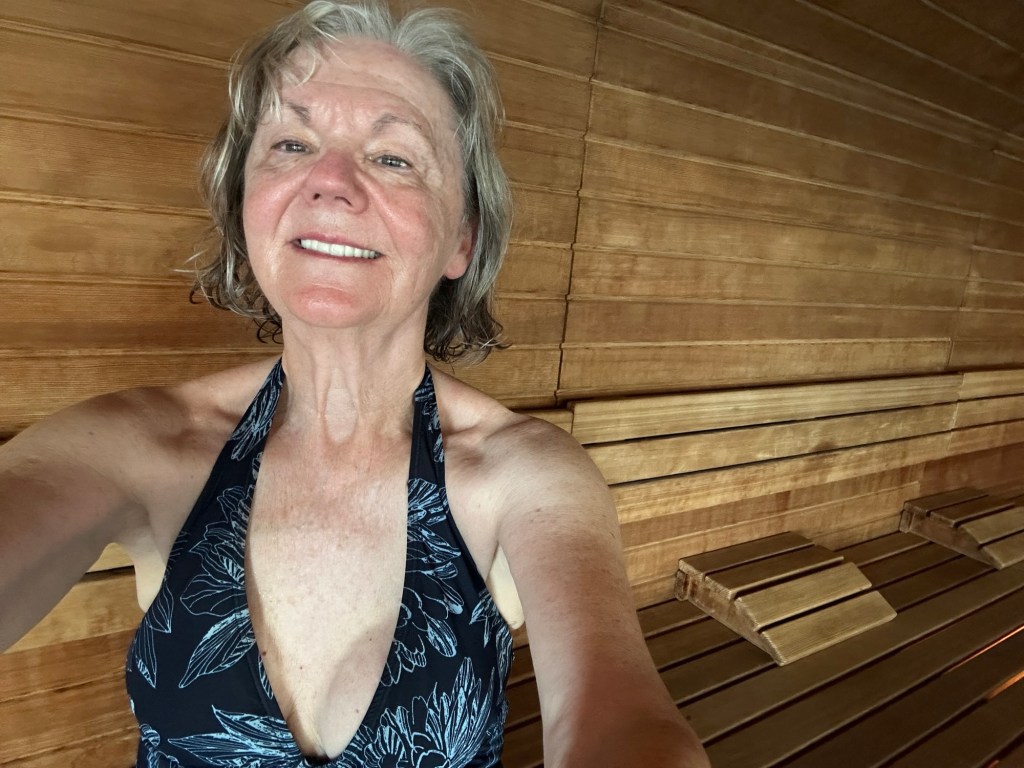
My plan to use the infinity/ whirlpool right outside the igloo was revised. I HAVE used it and the sauna multiple times, but always during the day, when I can gaze out into the ocean. With the whirlpool running, it looks like I’m IN the ocean, doesn’t it? The light blue water is the whirlpool. The darker blue is the ocean, and the plexiglass separating the two is invisible.
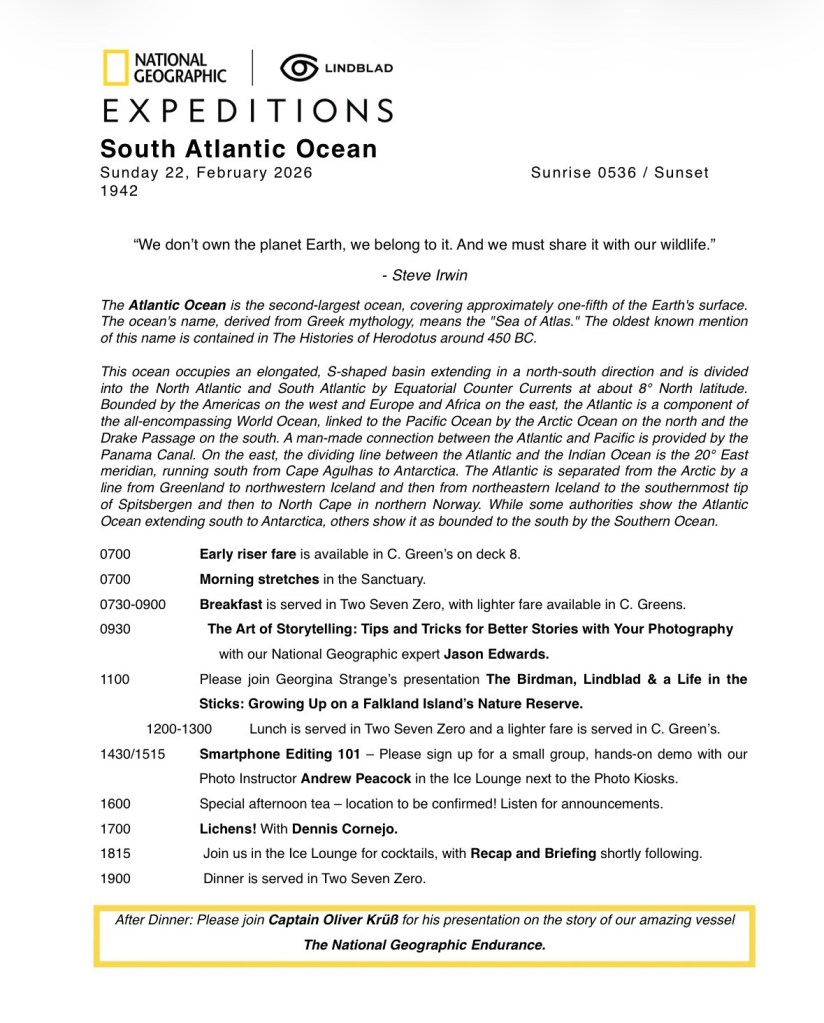
Here’s a description of our activities for our second sea day.
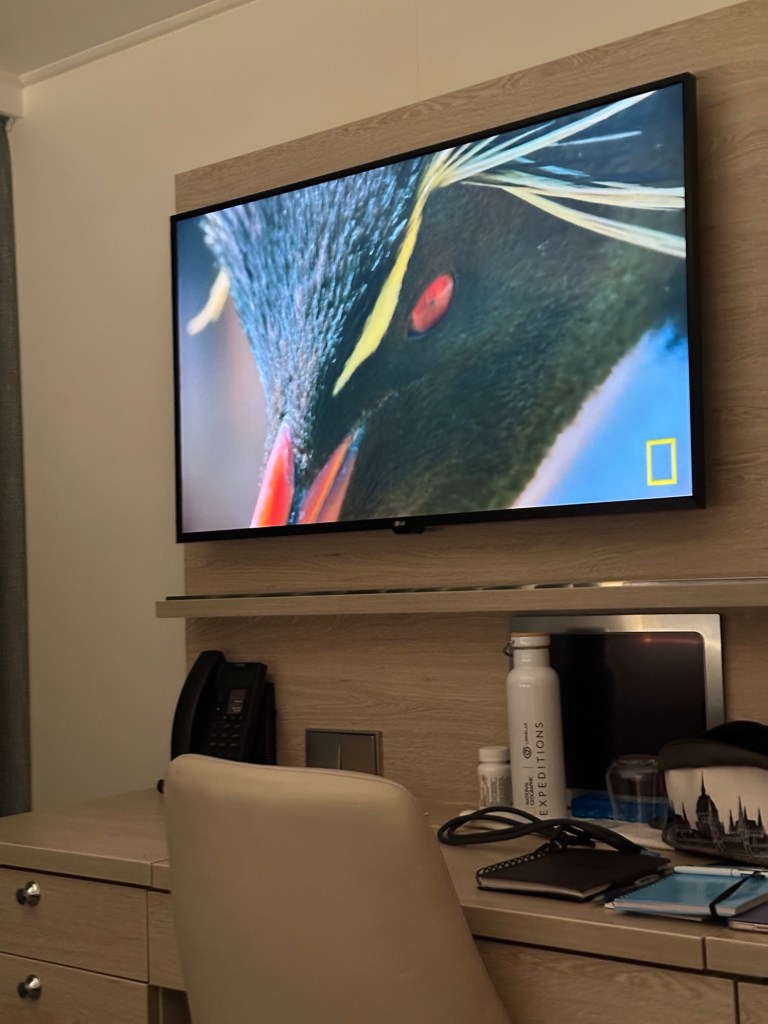
Let’s say you’re too tired to go to the lounge for a talk. Hey, it happens. You can view the talk on the TV in your room, from the comfort of your bed.
On our last day in the South Georgia Islands, we were given a choice. We could either replicate Shackleton’s route to the Grytviken whaling station, starting from Fortuna Bay, OR we could take a zodiac ride. You’ve probably guessed which one I chose, but in case you didn’t, here’s a visual.
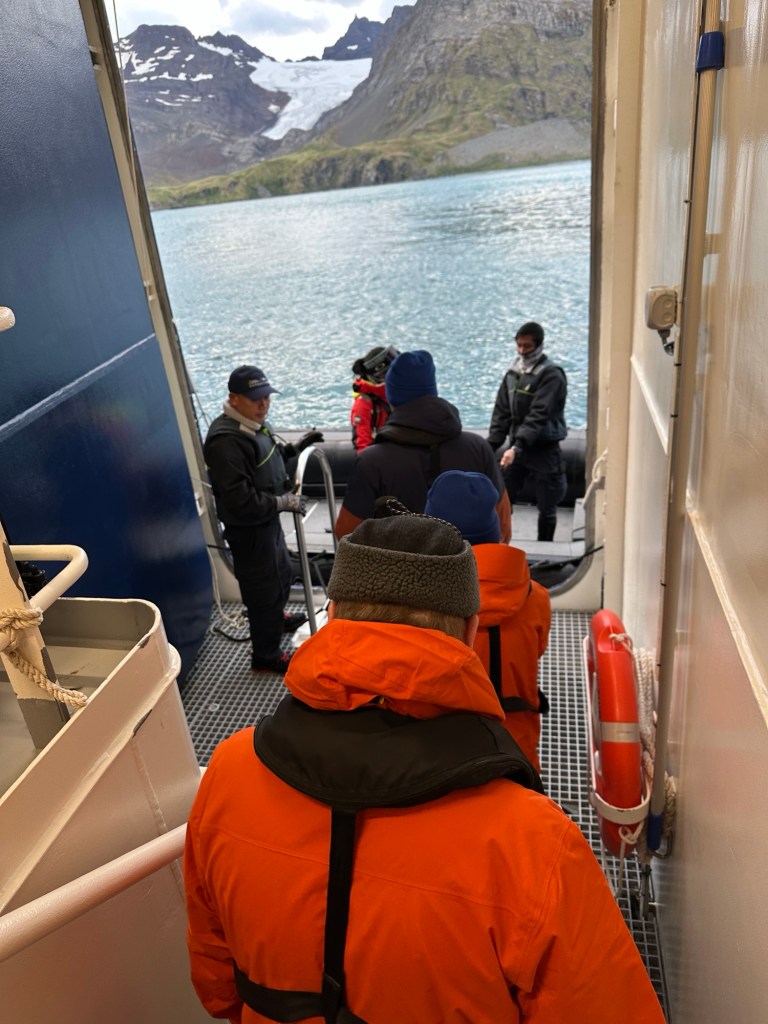
Climbing into the zodiac
Boris, our cruise director, was quite specific in his description of the hike: “ It is about 4 miles long, and VERY steep. You will be ascending about 1000 feet. You can take water with you, but no food. And there are no bathrooms, so control your water consumption. Once you get dropped off, there is NO turning back, so be absolutely sure you can make it. The boat will pick you up at the whaling station”.
My interpretation, although he didn’t specifically SAY it, was “you could die”. And I probably WOULD have.
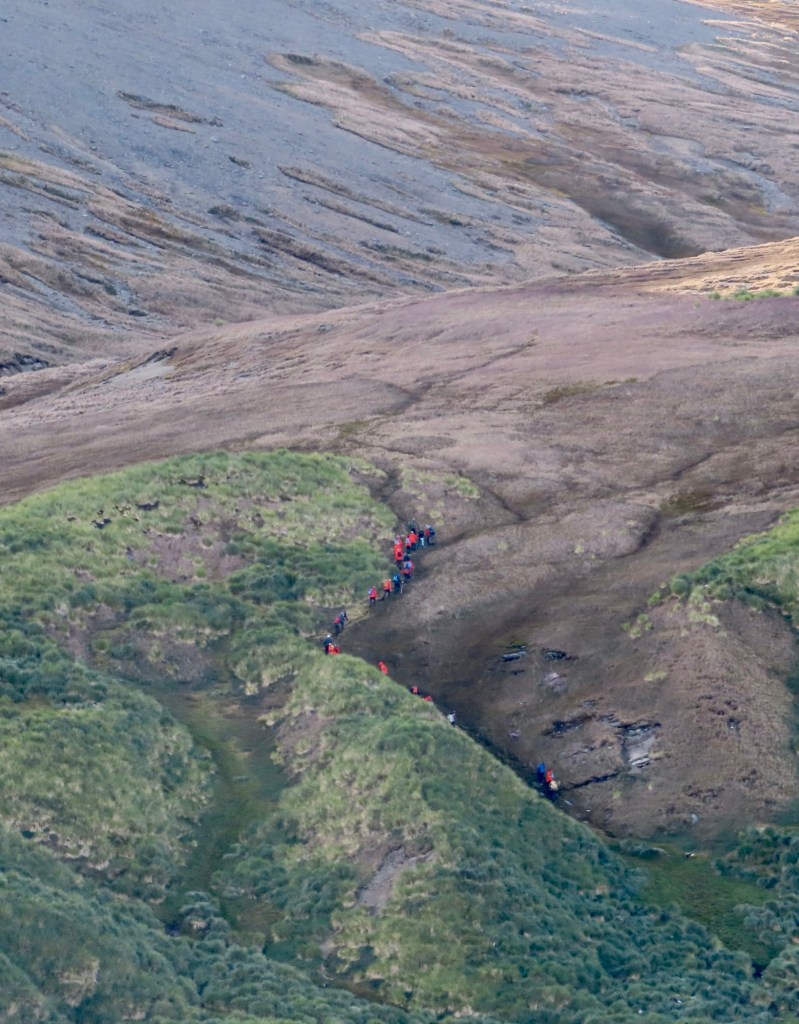
The start of Shackleton’s trail. The hikers are the orange and blue dots.
Despite his dire description of the event, 30 people signed up for the hike. After sleeping on it, six people changed their minds, so 24 of my cruise mates, including my hero Paul, (who helped me up when I fell, on an earlier hike,) and my kayak buddy, Marc (who is my age) made the trek.
They made it!
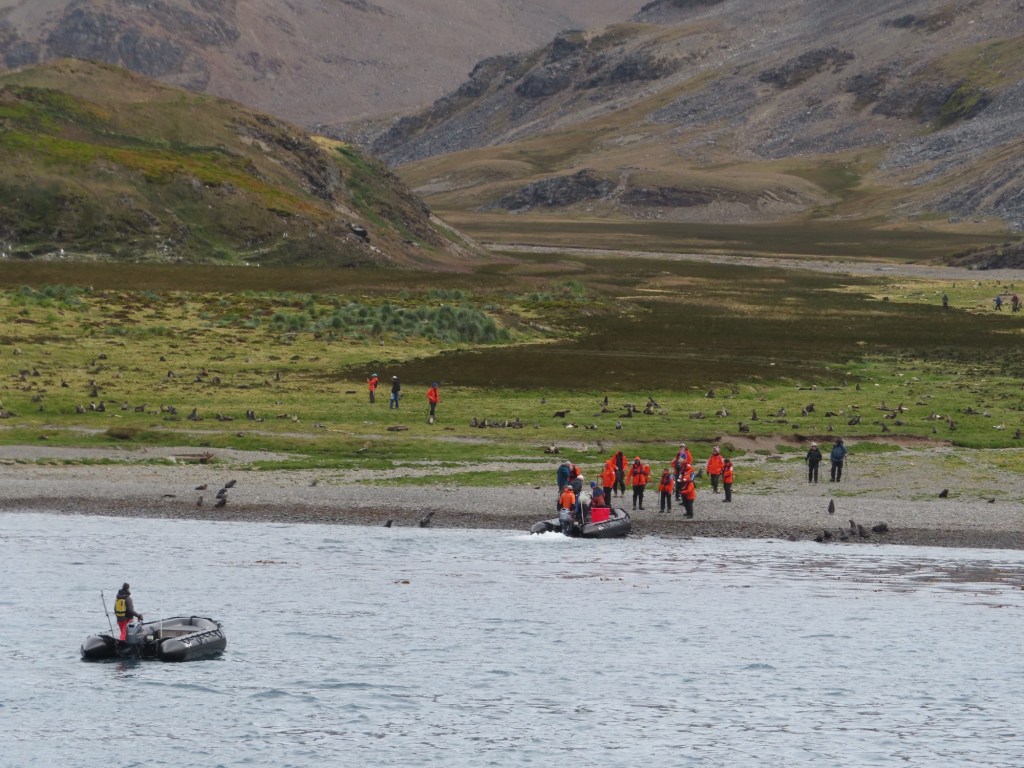
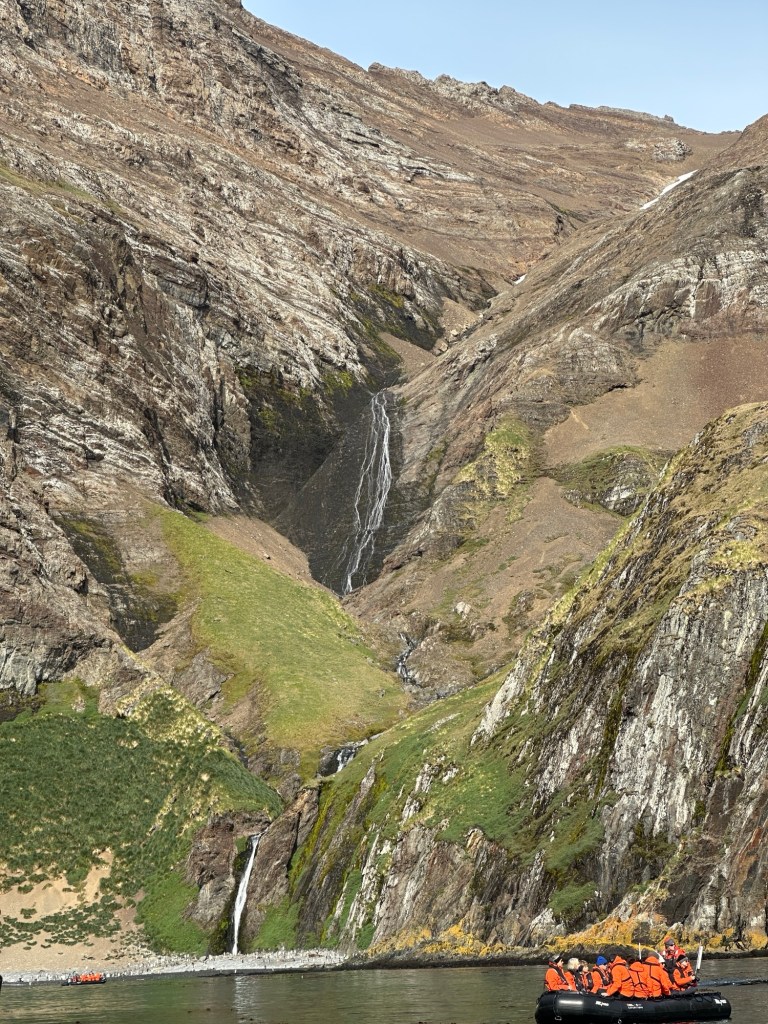
As for me, I went on an absolutely fantastic zodiac cruise, where we saw waterfalls,
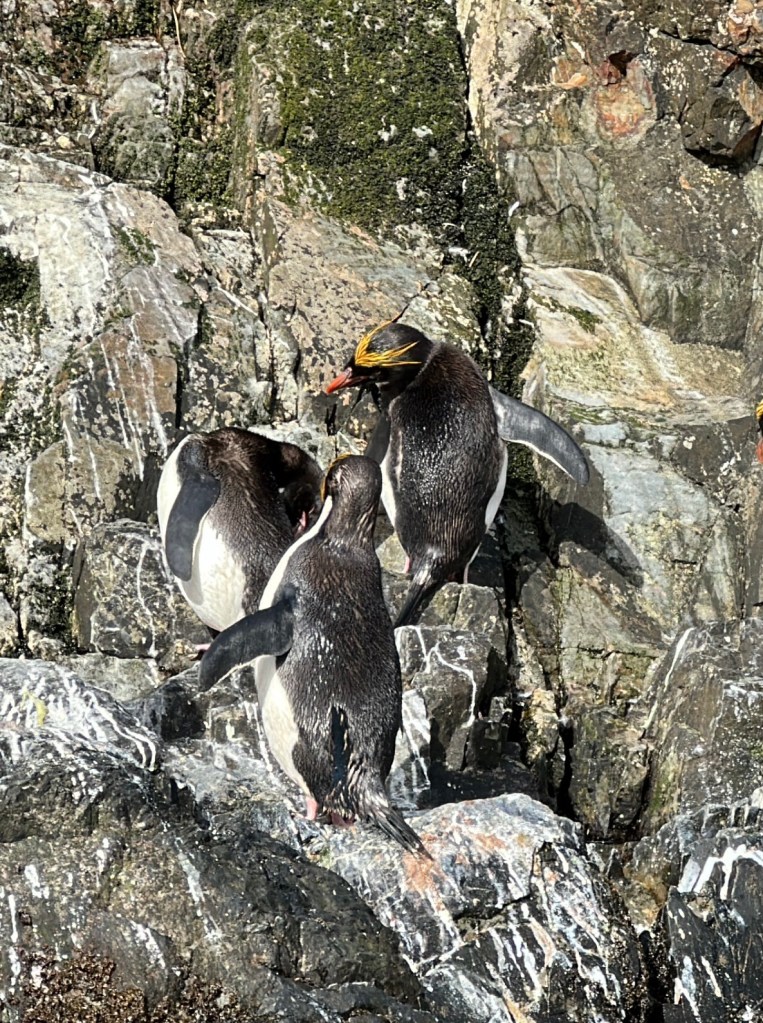
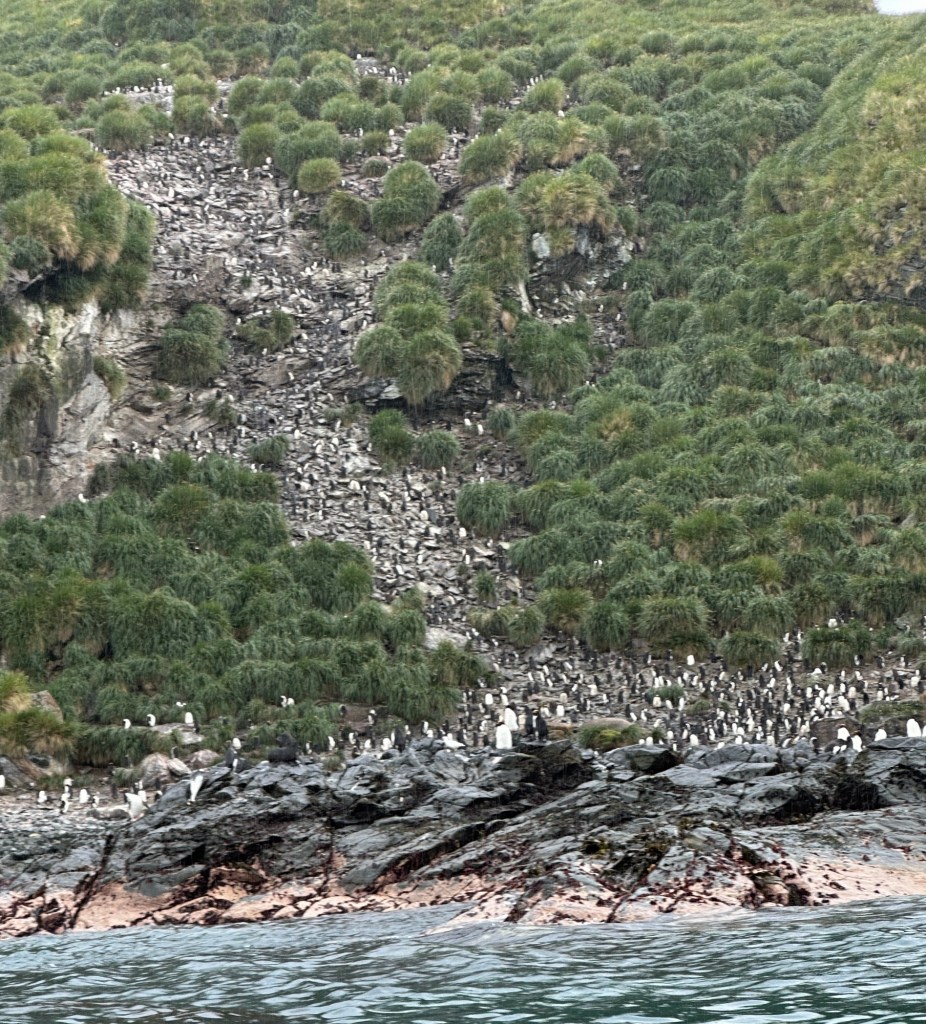
Macaroni Penguins,
Here’s a close up of these adorable little guys
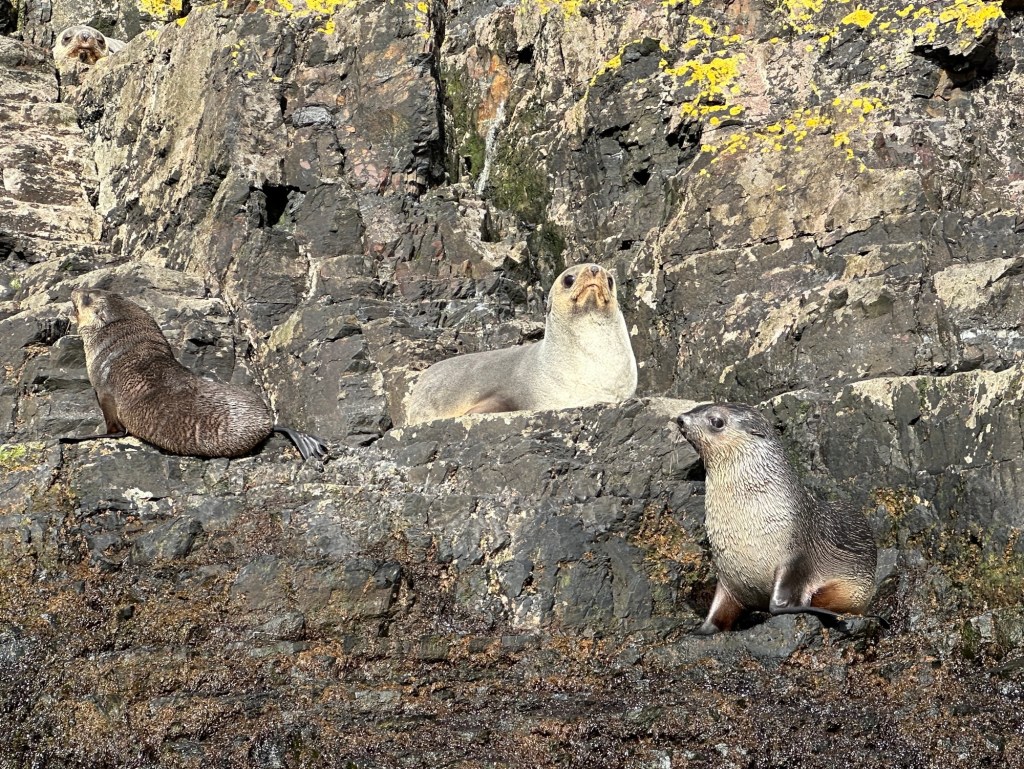
fur seals,
Equally cute, so they get a close up too.
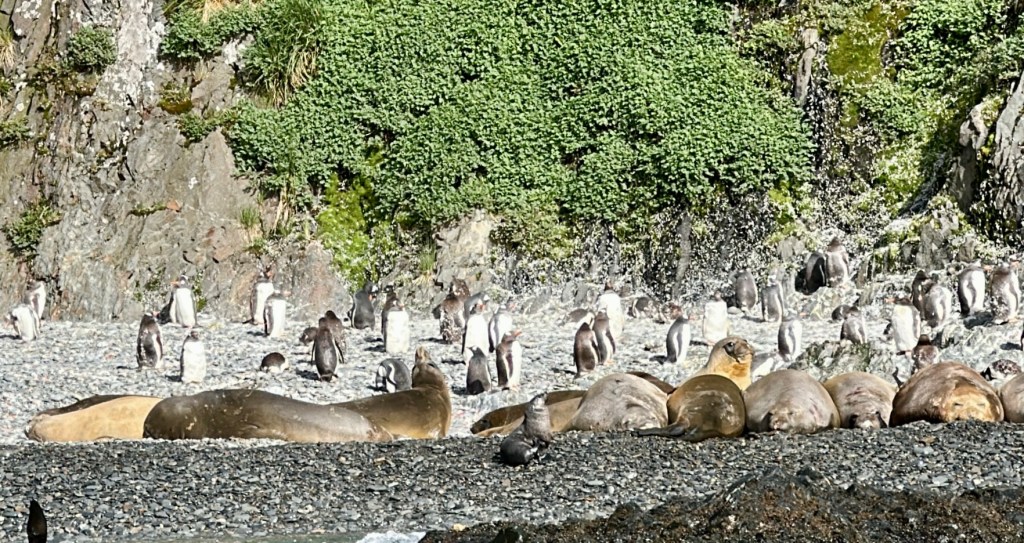
and elephant seals
No close up for THESE guys
It was a perfect zodiac cruise. Once again, we were blessed with ideal weather. But wait, there’s more…
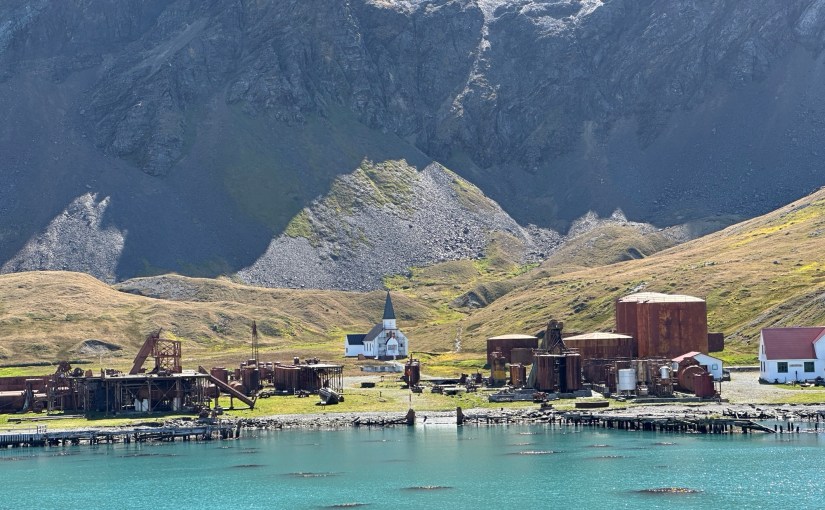
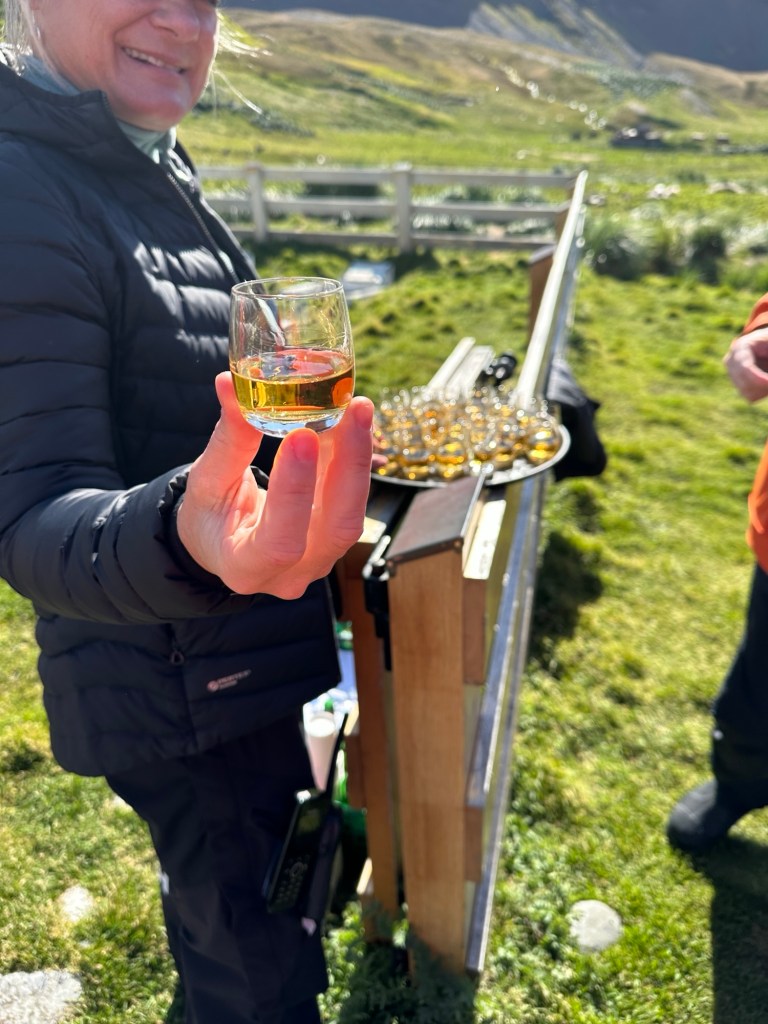
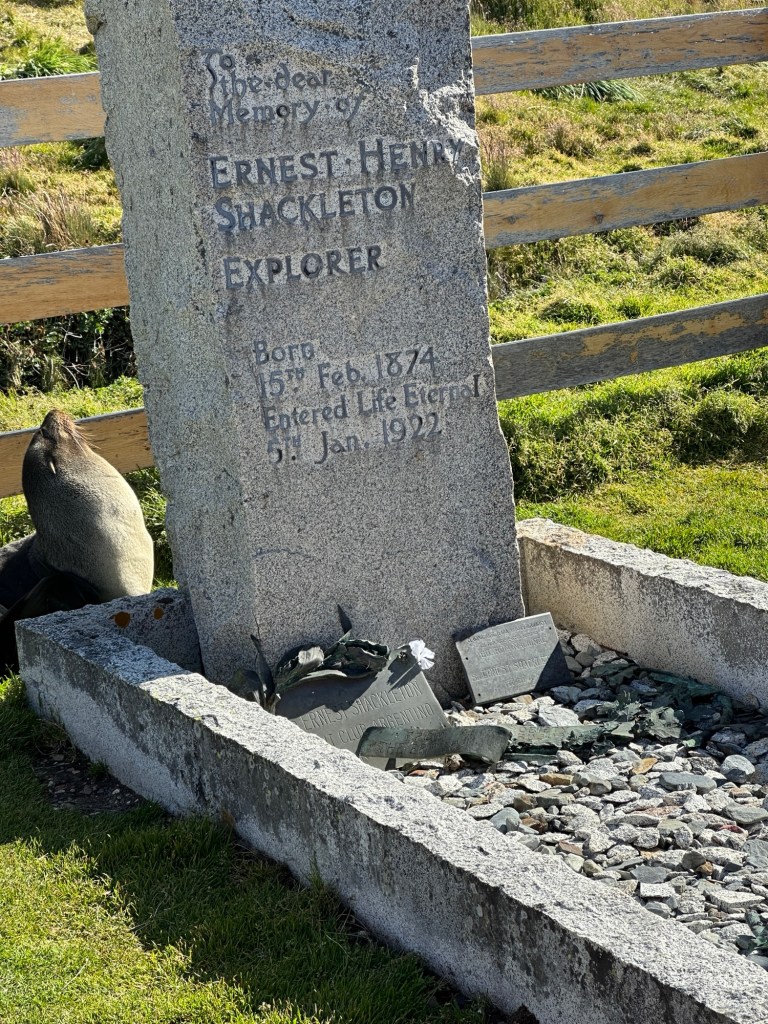
While at the Grytviken whaling station, we toasted Shackleton at his gravesite,
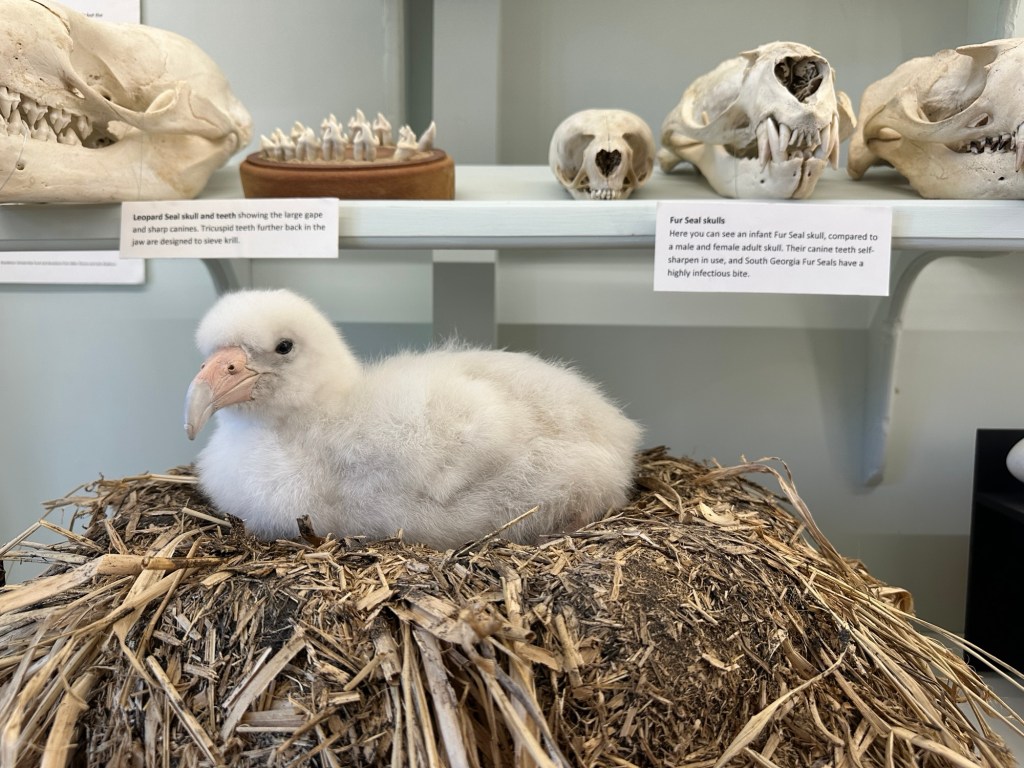
visited the museum,
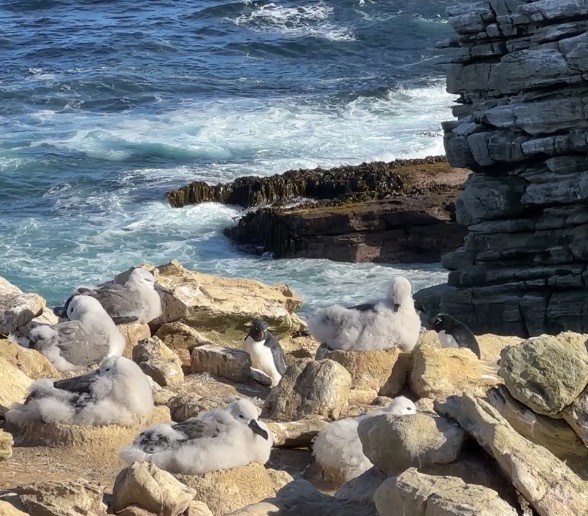
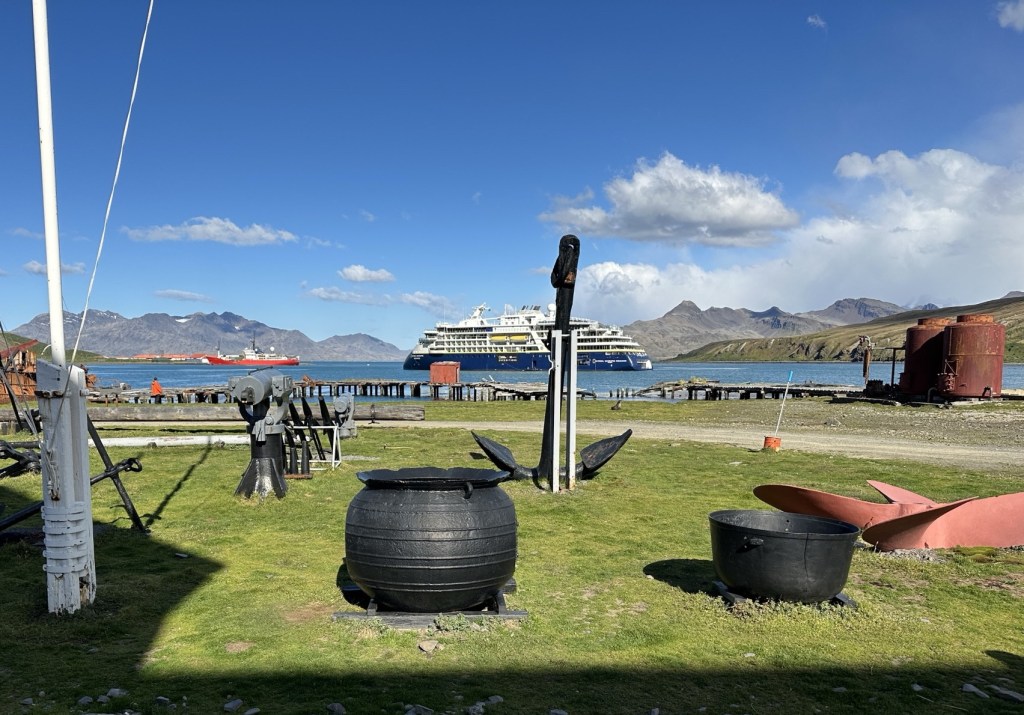
Baby albatrossArtifacts outside
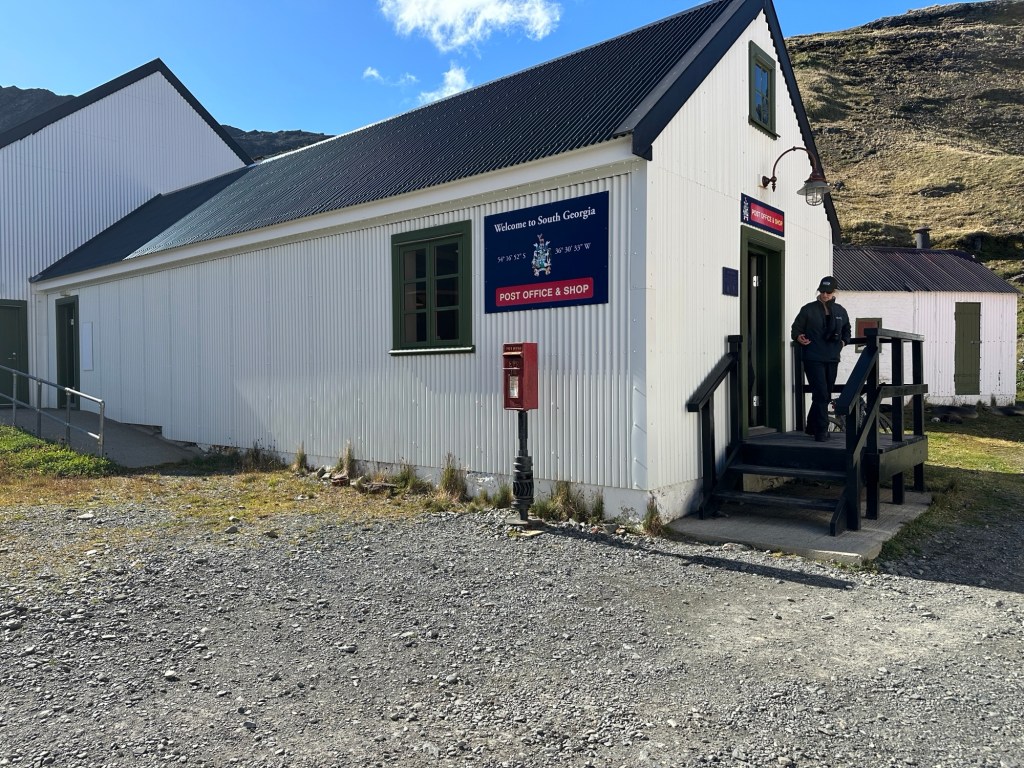
and were able to send postcards from the only post office we had encountered, so far.
We set sail for the Falklands in the afternoon, and spent the next two days at sea.
I’m not going to describe the seas as rough. Let’s just say I was extremely grateful for my patch.
As the young ‘uns would say, “O.M.G., the South Georgia Islands are AWESOME”!
Lucky me. I got to spend FOUR whole days there.
I had expected rain the entire time we were there, because I believed the weather reports, but we lucked out.
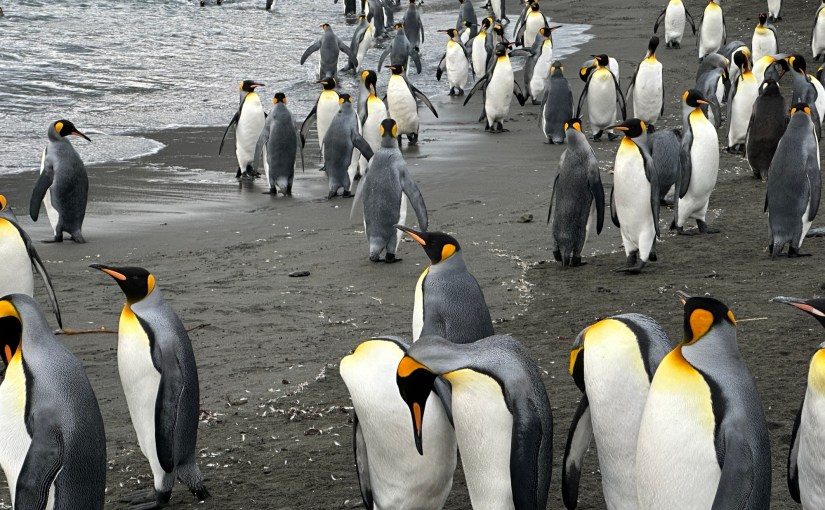
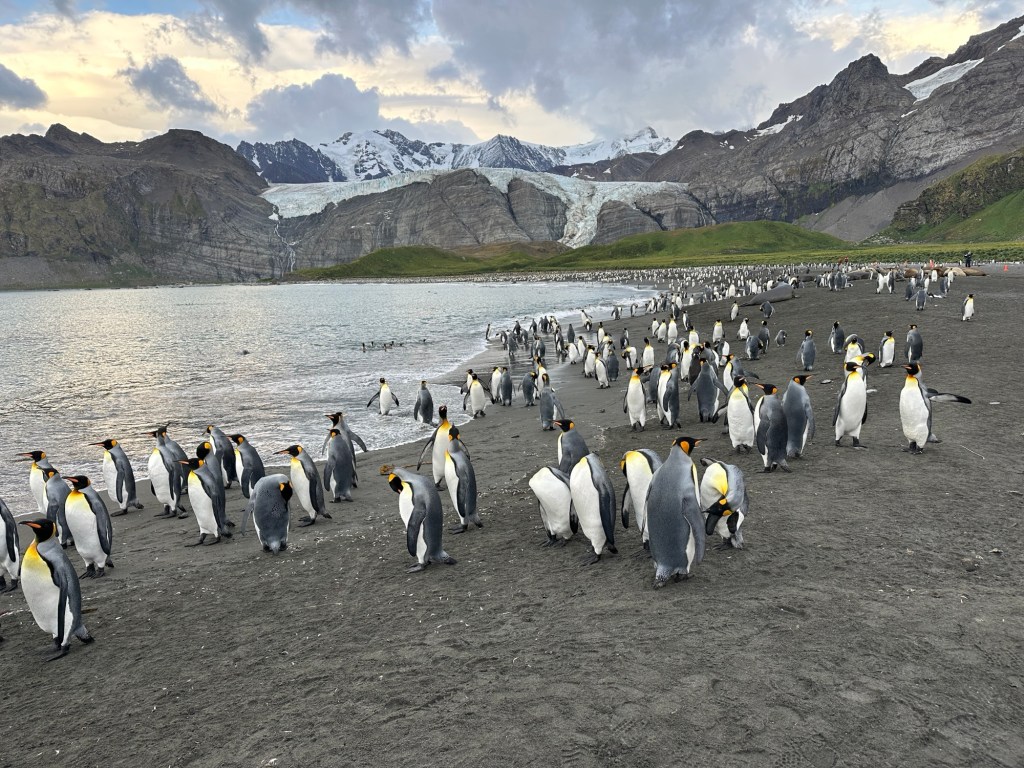
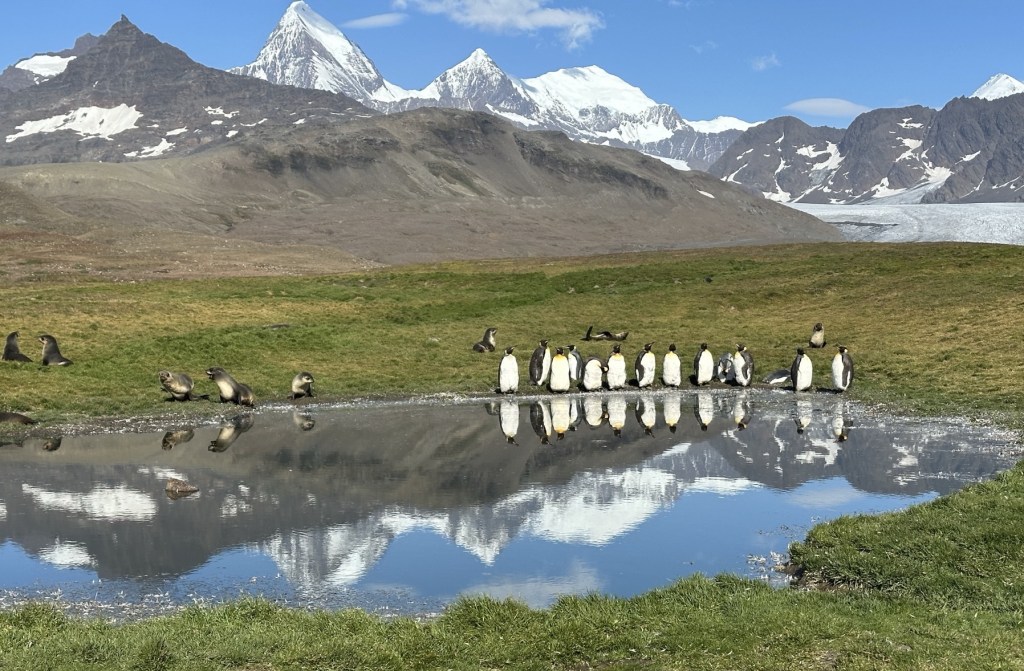
Yes, I DID get up at 4:45 AM, on the first morning to ensure we beat the drizzle. It was SO worth it. The King Penguins are also early risers, so the welcoming committee was out in full force to greet us .
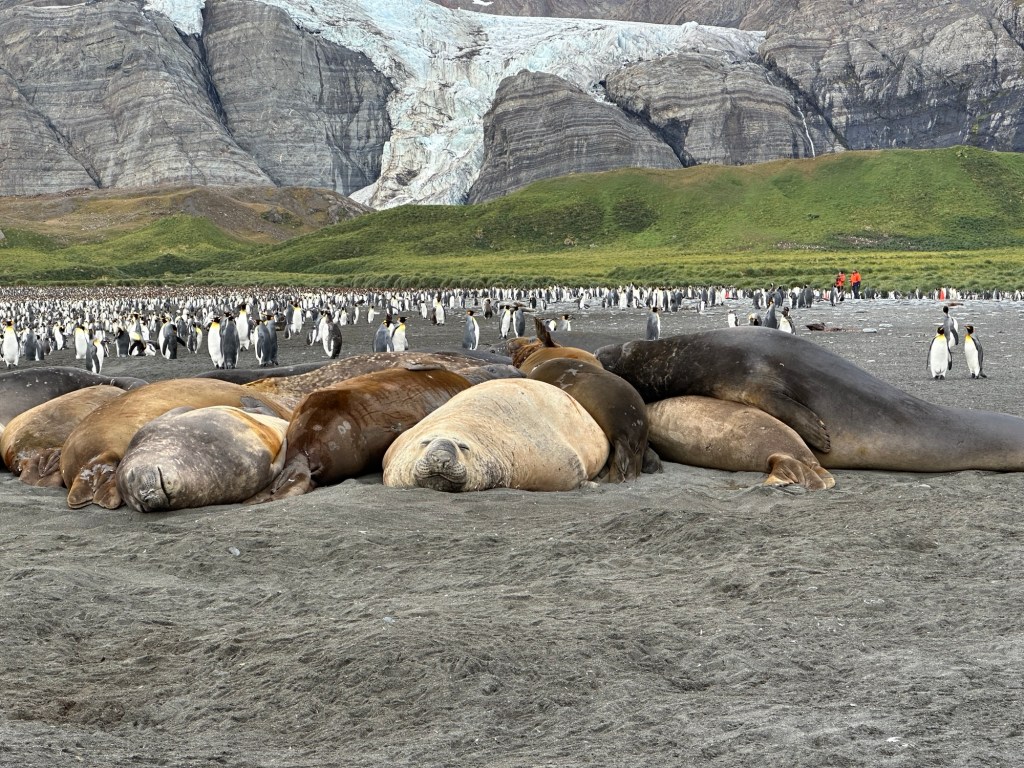
As a bonus, we also saw elephant seals tussling. We later learned that it was because they were roughly the same size. Usually, they can visually determine which one is bigger, ( and thus the winner, who will get all the “girls”) so no need for contact sport. As Ella, our seal expert explained, elephant seals are lovers, not fighters.
Mostly, they like to “wallow” next to each other.
Some of us opted for a two hour, two mile hike, with about a four hundred foot elevation.
That it took two hours to cover two miles SHOULD have been the tipoff that this was not going to be a stroll in the park. But as Elvis once famously sang “ fools rush in where angels fear to tread”.
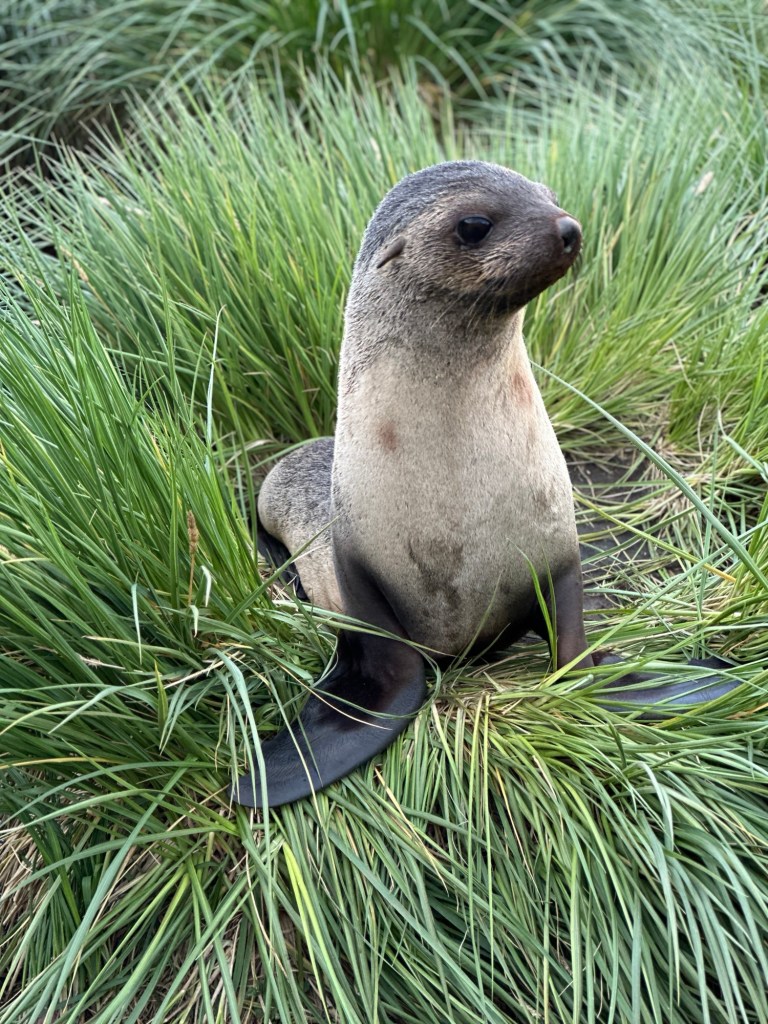
Those that know me, will instantly know which term applies to me. My reward? Seeing little guys like this one hiding out along the way.
We started at the beach, way, WAY below. Though the grassy part looked pretty benign, it wasn’t. It was very spongy, but looked deceptively solid. Then you stepped on it and SANK varying degrees. Still, I was glad I did the hike. Not bad for a soon to be 77 year old!
The hardest part, by far, was the descent. Let me tell ya, the next day my thighs were screaming “ What were ya thinkin”? This was an ARDUOUS hike. (My friend Jean will get that reference!).
Our afternoon zodiac cruise was equally spectacular. the photo below just doesn’t do it justice.
So, when we were offered the opportunity to do ANOTHER hike on day 3, this fool ignored the pain in her thighs and continued to “rush in”.
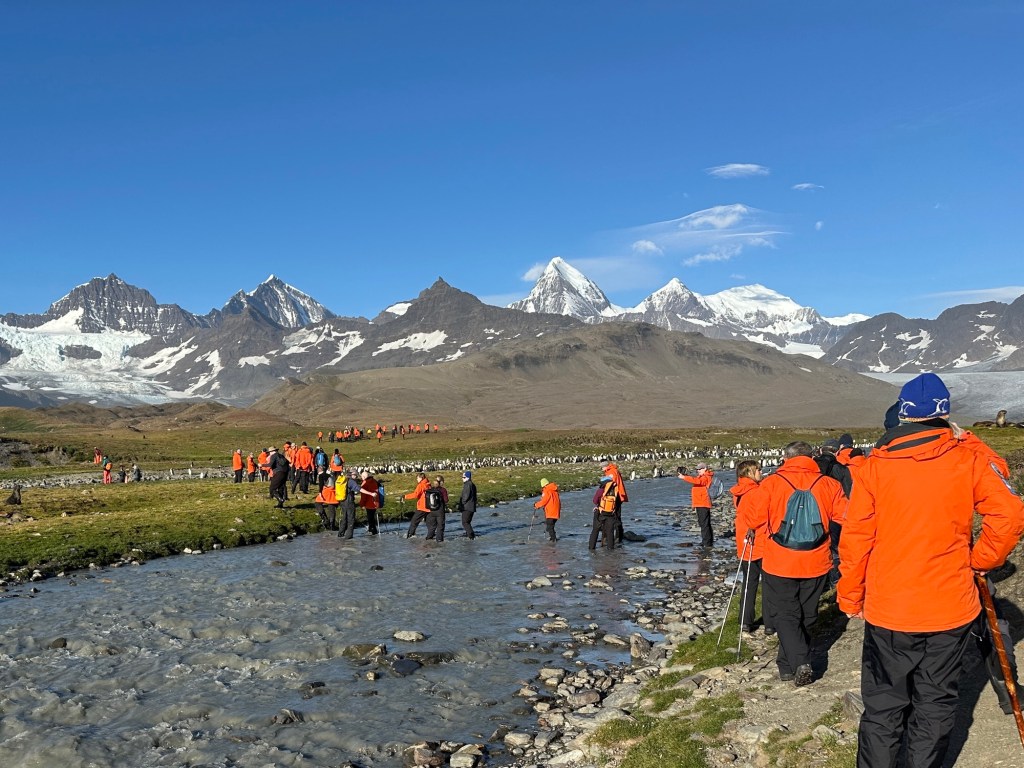
Although the second hike was definitely not as “arduous” as the first, it was not without its challenges. We needed to cross a glacial stream both coming AND going.
Once again, it looked deceptively simple. Once again, it was not. You see, the glacial melt randomly deposited many different sized rocks in the stream bed. Some moved unexpectedly when you placed your foot upon it. That’s why members of the crew were standing in the stream to help us across. I was happy to “volunteer” to perform a VERY important safety drill. When I stepped on one of those moveable rocks, I pitched backwards, almost pulling one of the naturalists into the stream with me. Fortunately, the crew member behind me grabbed my butt and shoved me upright. Sadly, that memorable event was not captured on video. Instead, I offer some photos as an alternative.
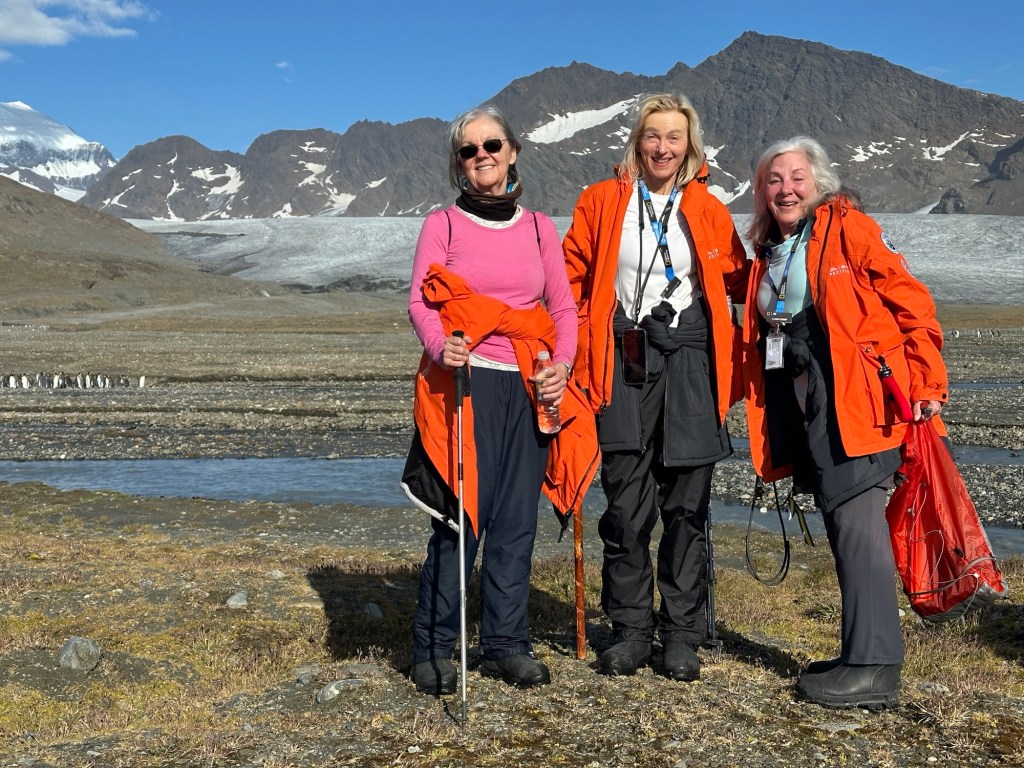
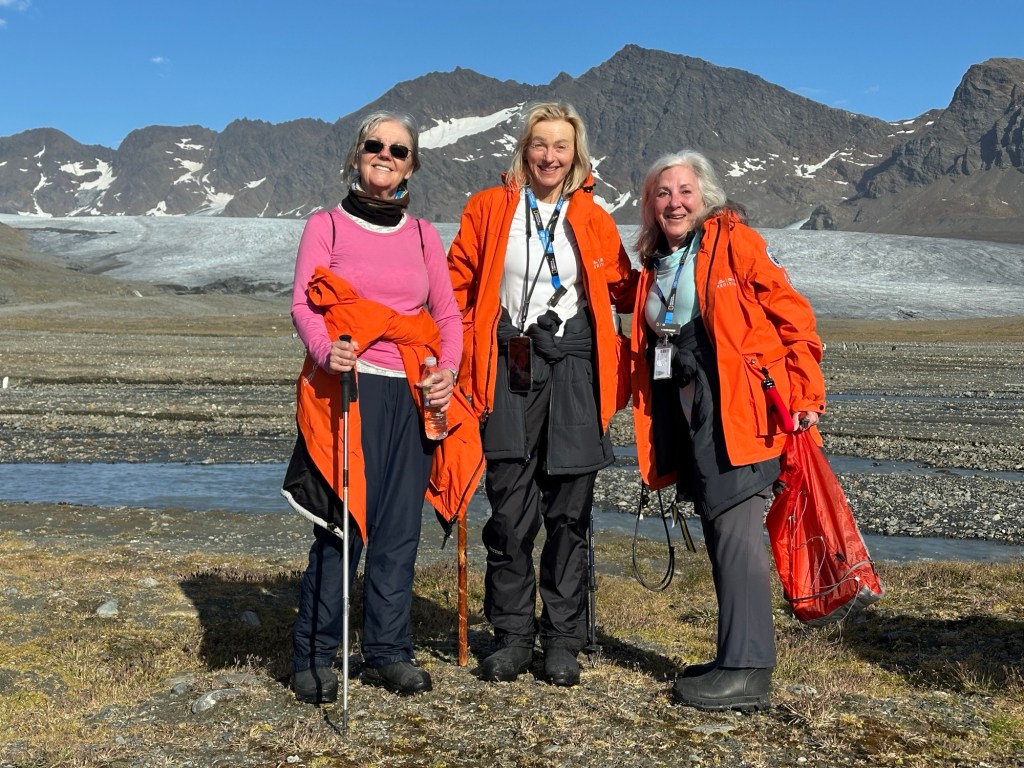
The next excitement for the day was when a fur seal charged at me, with teeth bared. No video of THAT exchange either. But I DO have a photo of me with my two new friends, Dorothy and Karen.
I have so many fantastic videos, I could easily make your eyes glaze over and have you mutter “enough, already”. I’m a wildlife nerd, and for ME, I can never have enough of these charming creatures.
I LOVED watching these penguins “porposing” through the water:
One more video and then I’ll stop.
We encountered a bit of a “traffic jam” while waiting for the zodiac to return us to the ship.
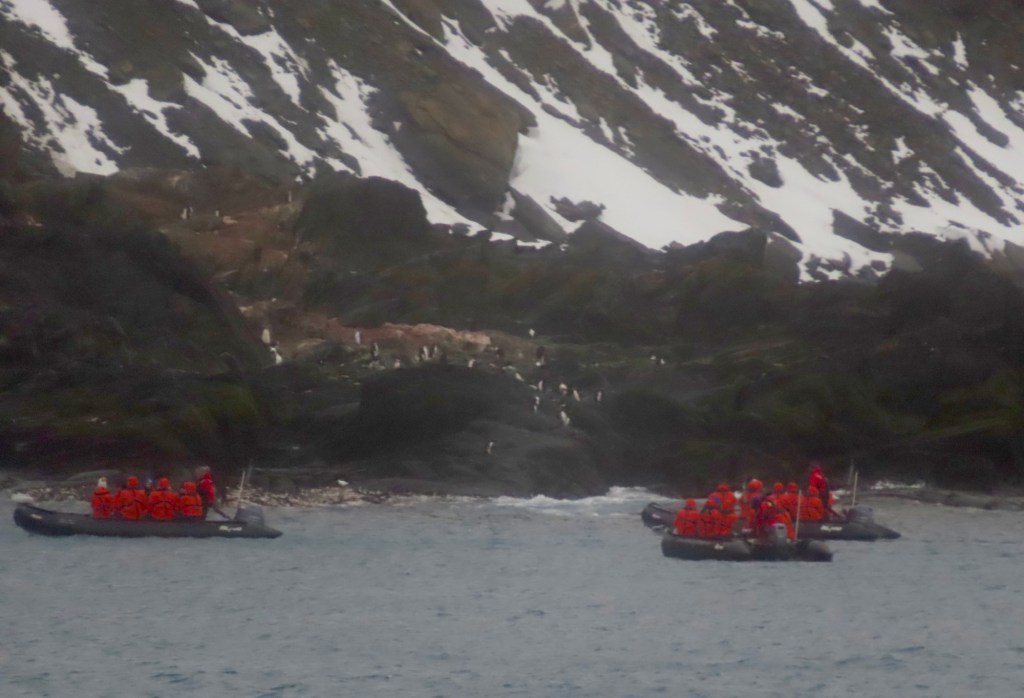
I’m at the point in my life where if I think I’m not going to enjoy the experience, I’m not going to do it. Our last day in Antarctica ( before heading to South Georgia Islands) was one of those days. Riding in a zodiac when the sea is choppy, the sky leaden, with the wind blowing is definitely not my idea of a good time. Especially when I can watch the action from a warm, gorgeous ship. If this had been my first trip to Antarctica, I might have made a different choice. But it wasn’t, so I didn’t.
Unfortunately, Ernest Shackleton’s crew had no choice. After their ship, the Endurance, (that’s also the name of MY ship) was crushed by ice, they slowly made their way to Elephant Island. Most of the crew waited patiently for almost 5 months until Shackleton and his 5 companions could reach South Georgia to find help at one of the whaling stations.
That’s the reader’s digest version of Shackleton’s voyage.
Needless to say, their cuisine didn’t look quite like what we’ve been eating.
But I digress…back to Elephant Island.
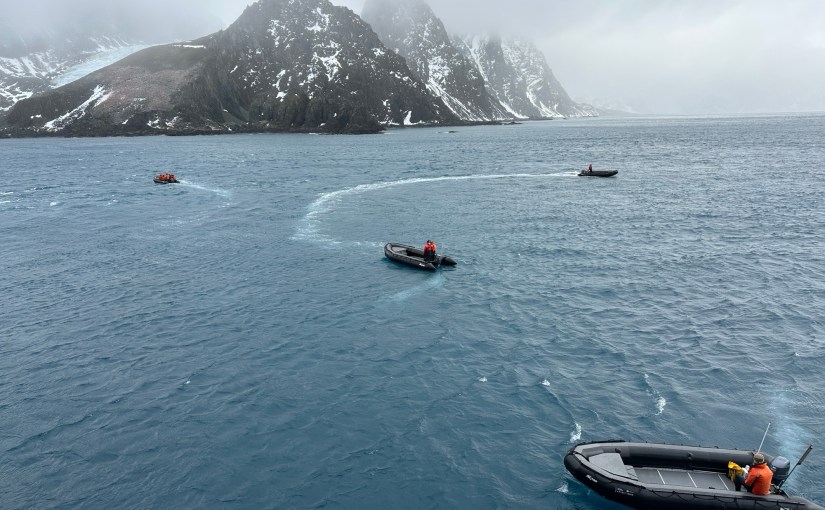
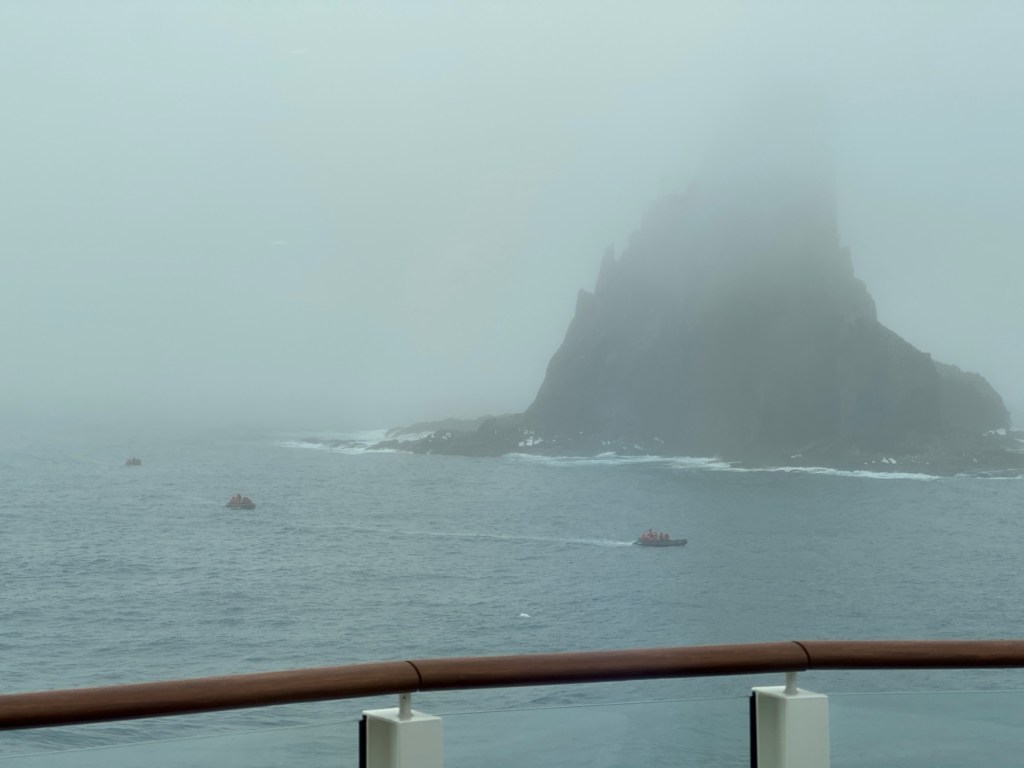
I took the above photo from the ship. Those white dots that you see on the shore are penguins. They are certainly cute to watch, but I’ve already done that, and with another two weeks left on the cruise, I’m sure I’ll be seeing more.
It might not look rough, but remember, that video was shot from my balcony on deck 5. Why can you see two zodiacs containing only 1 passenger, you ask? Well those are members of the crew, standing ready to pluck someone from the frigid waters, just in case the seas started to REALLY rock n roll.
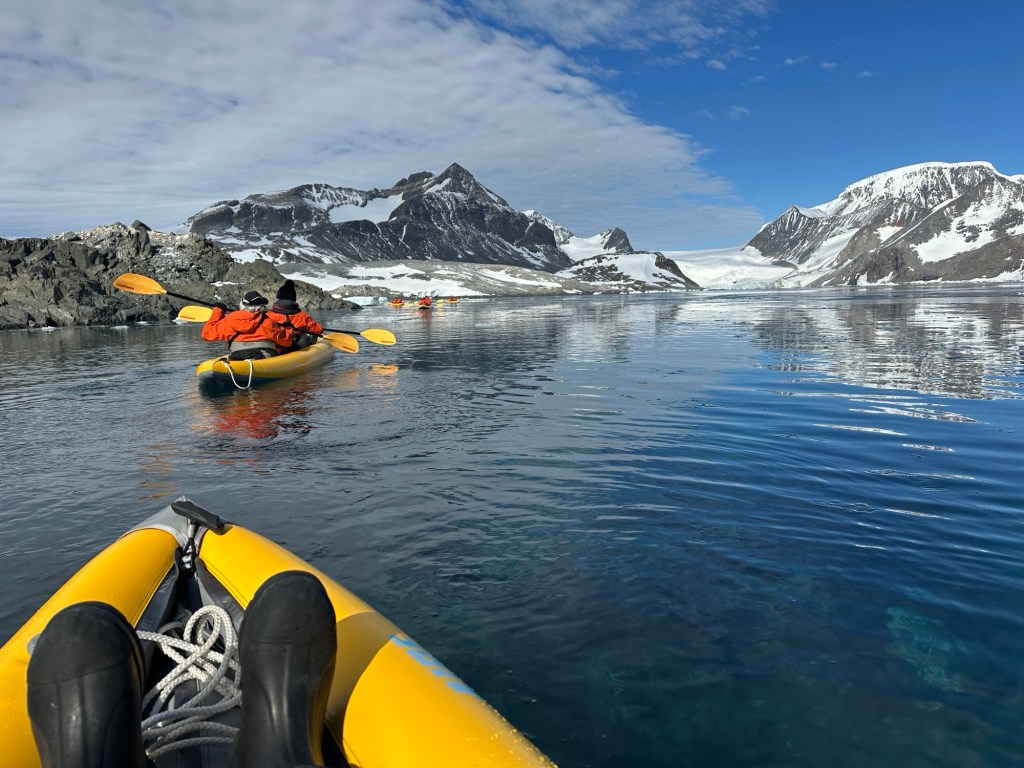
Compare that to the day before, taken from my kayak.
Now THAT experience was absolutely wonderful. What is not obvious from the photo was there were patches of surface ice. We had to break thru it with our paddles, which was a bit of a workout. A very NECESSARY workout, given the way I’ve been eating. Thank goodness for elastic waistbands!
I was very lucky to be paddling with an experienced kayaker, who was steering us through the icebergs.
Was kayaking the origin of the term “back seat driver?”
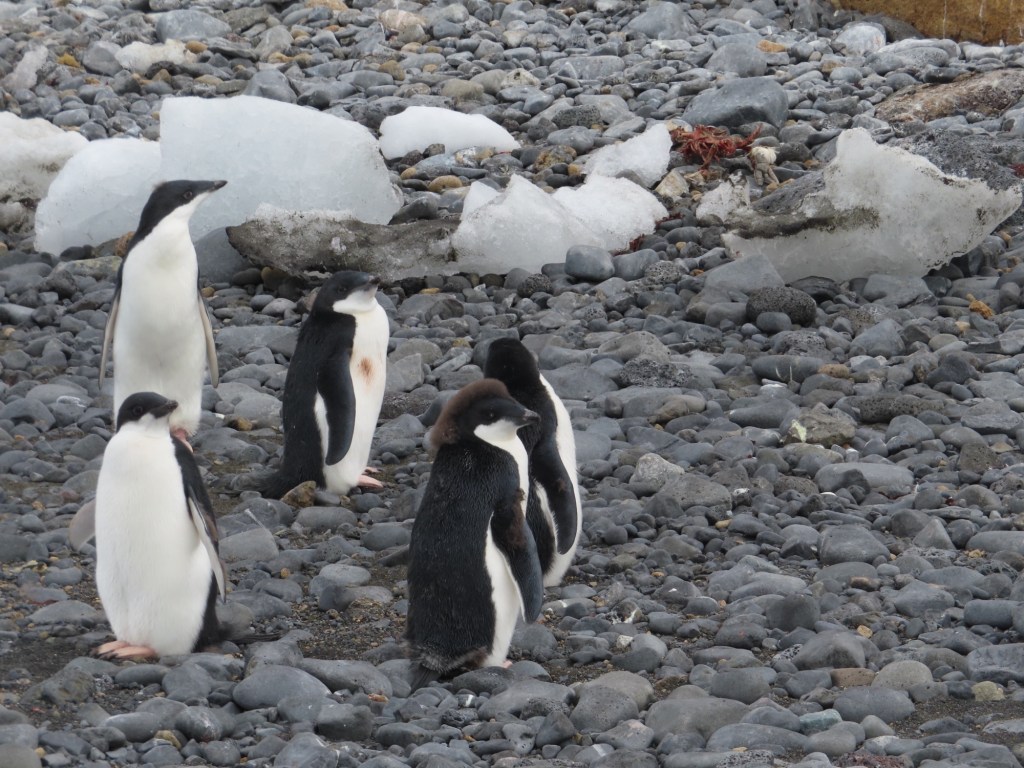
Marc was able to get us close enough to the nearby island so that I could get my first shots of Adélie penguins.
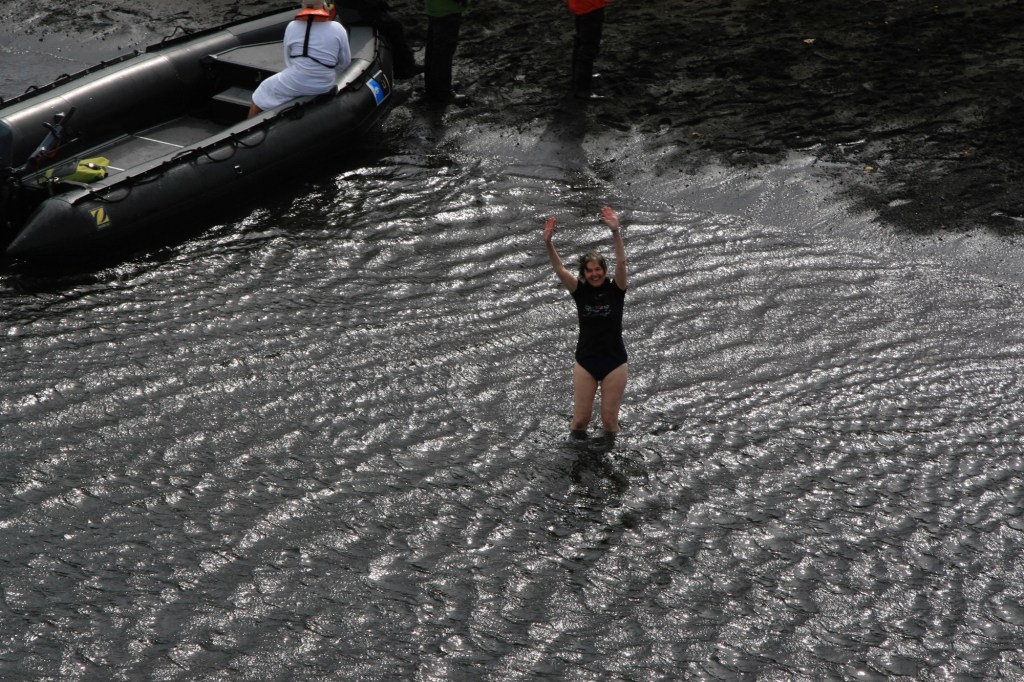
I was NOT as enthusiastic about the next activity, the polar plunge, but many of my shipmates were.
I figured once was quite enough. When Greg and I did it in 2011, we had to walk into the water, then return to the beach, and ride a zodiac all the way back to the ship. The 2026 version looked to be a whole lot better, given that the hot tubs and sauna were just a short elevator ride away.
We didn’t have a ship photographer capturing our moment, but Mike chose not to participate, so he was able to do the honors. My mother’s comment? “Mike’s the only one of you that has any sense”. Thanks, mom.
So let’s get back to 2026.
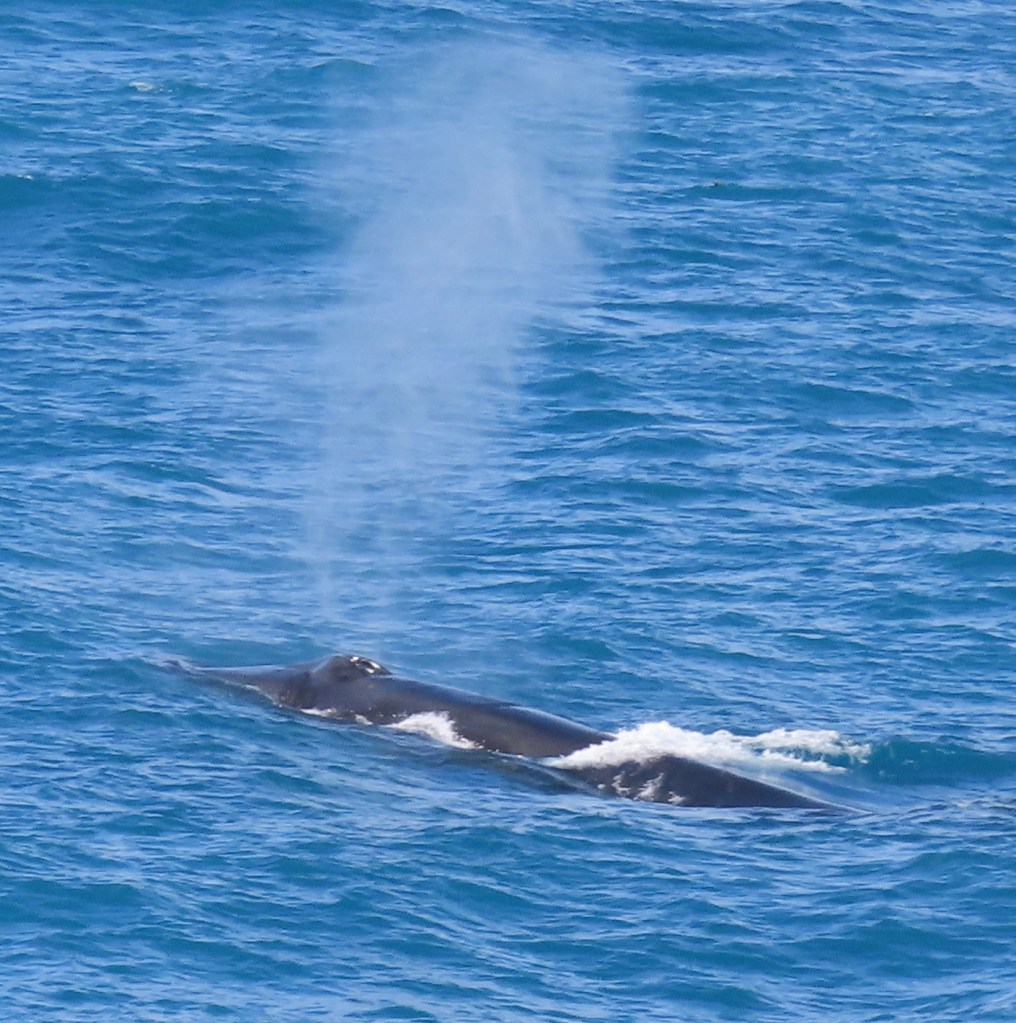
You don’t need to be on shore or in a zodiac to see wondrous sights. As we were traveling to Point Wild, we came across a massive pod of blue whales. Unfortunately, they stay mostly underwater, so the only way to know of their existence was spotting their “blows”.
This was as good as Icould get, but undoubtedly those with powerful lenses did a whole lot better.
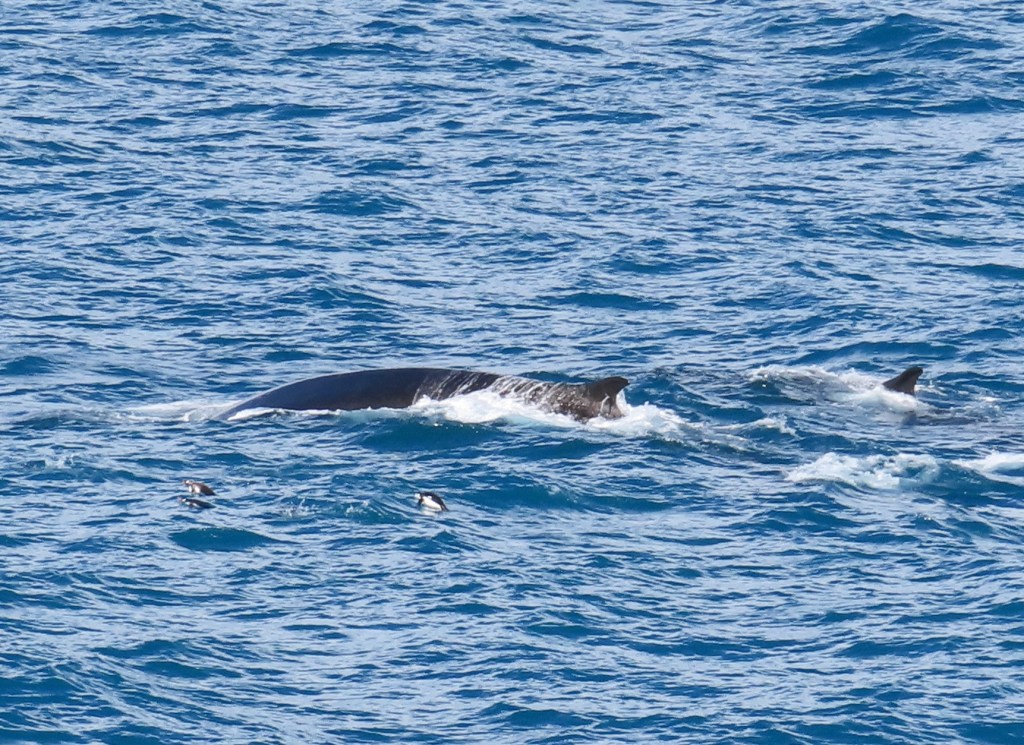
I liked this photo because you can see the tiny penguins swimming alongside the blue whales.
The weather alongside Elephant Island changed yet again from the brief sunny interlude during our whale watch,
to a progressively cloudier and foggier setting.
That didn’t stop some of my more determined cruise mates from getting into zodiacs to see what they could see at the historic Wild Point. Me, I decided to hear about it at the evening recap.
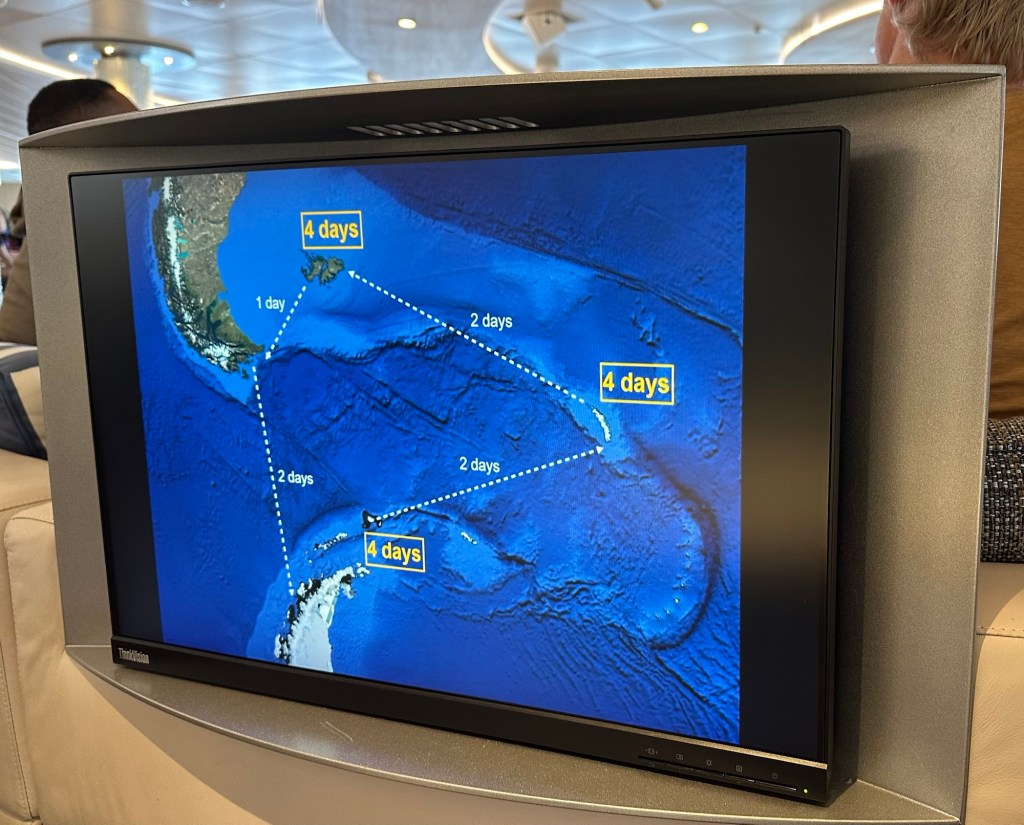
We have made it through the Drake Passage and are spending 4 days on the Antarctic Peninsula before heading to the South Georgia Islands.
Here’s the visual that I frequently consult, because I’m already losing track of time.
Fortunately both my iPhone and camera date stamp all my photos so if I ever need to tell what I did when, I can always consult my photos.
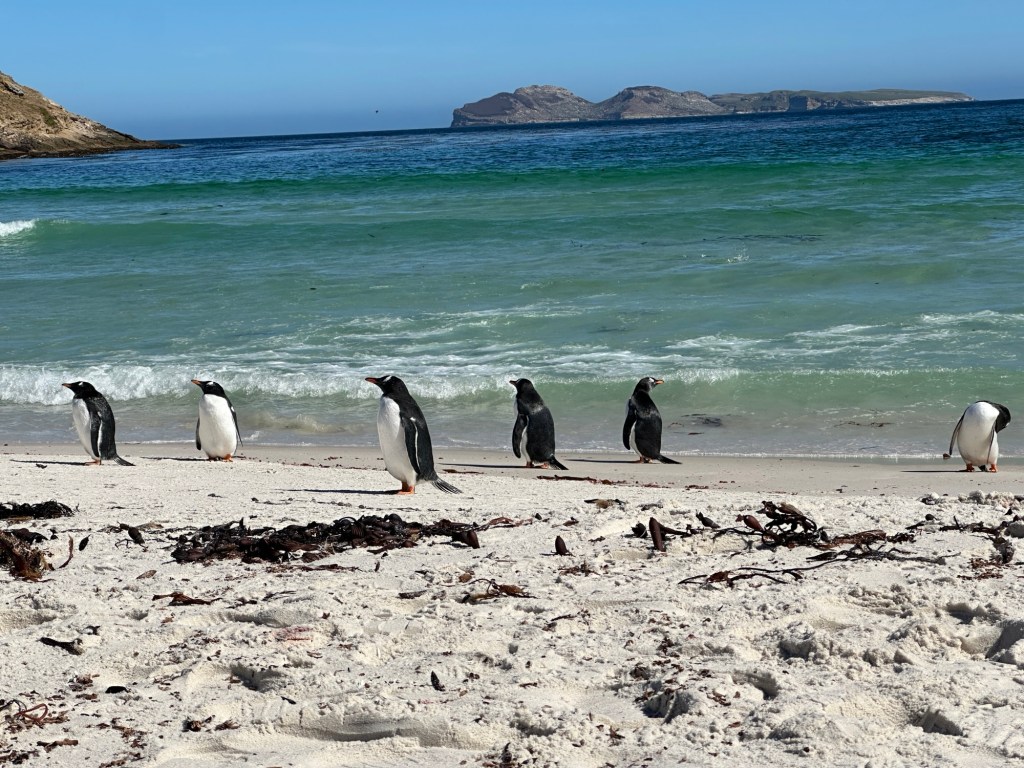
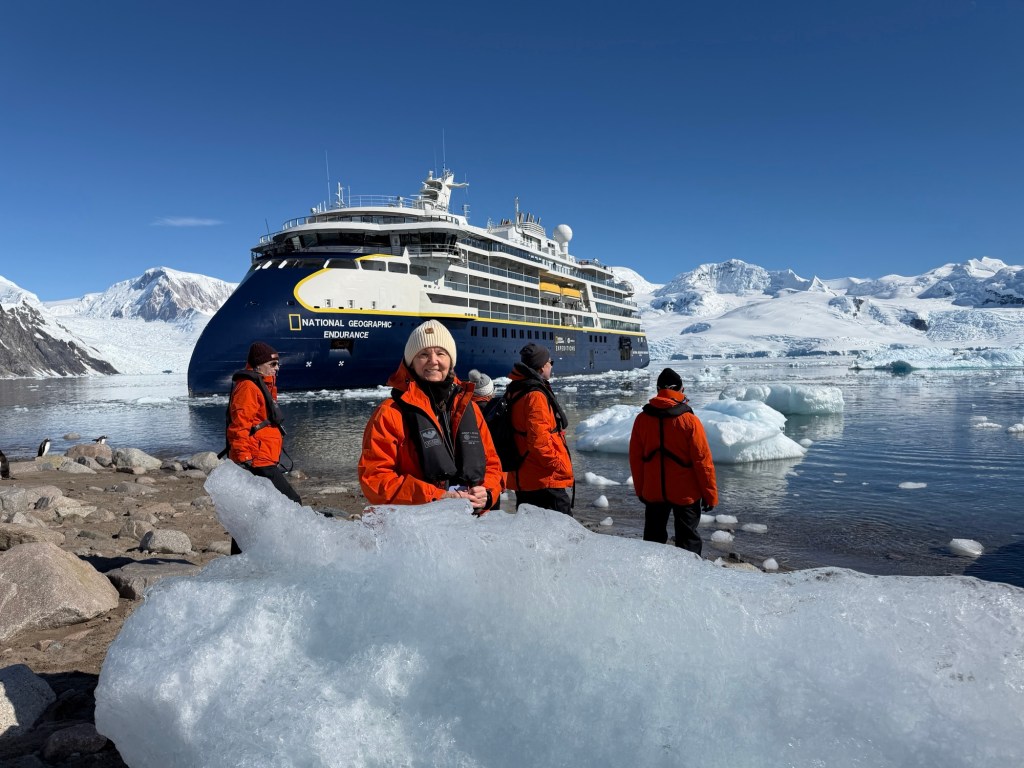
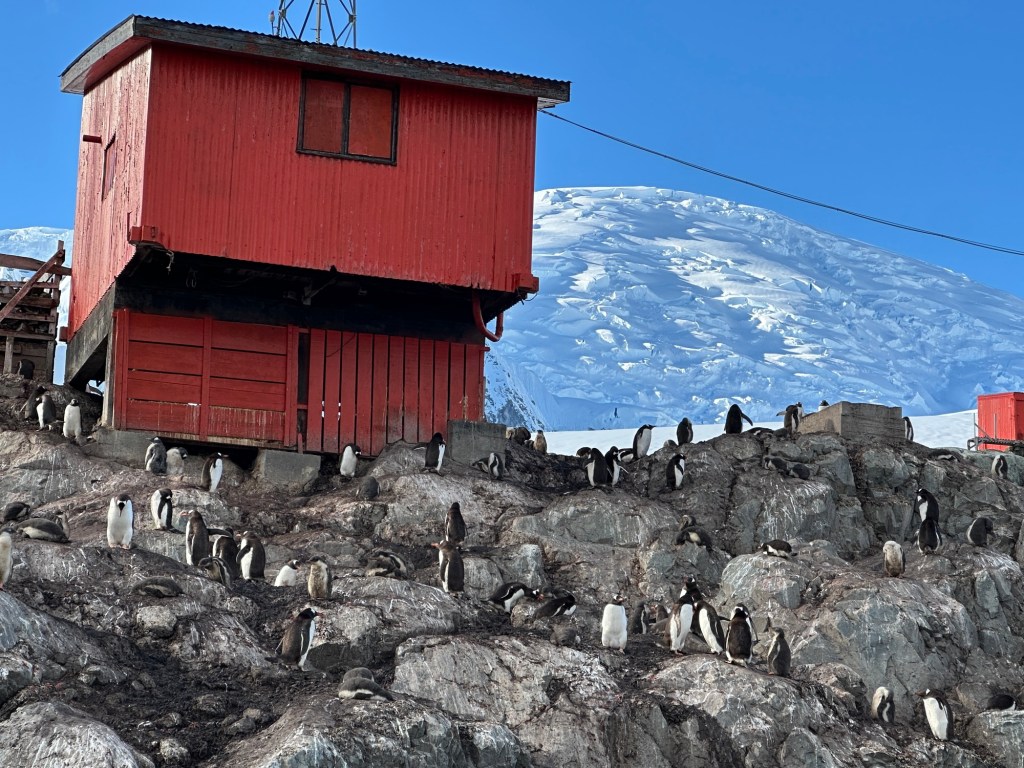
One of our landings, at a gentoo penguin colonyPhotos of me by my new friend, Sue
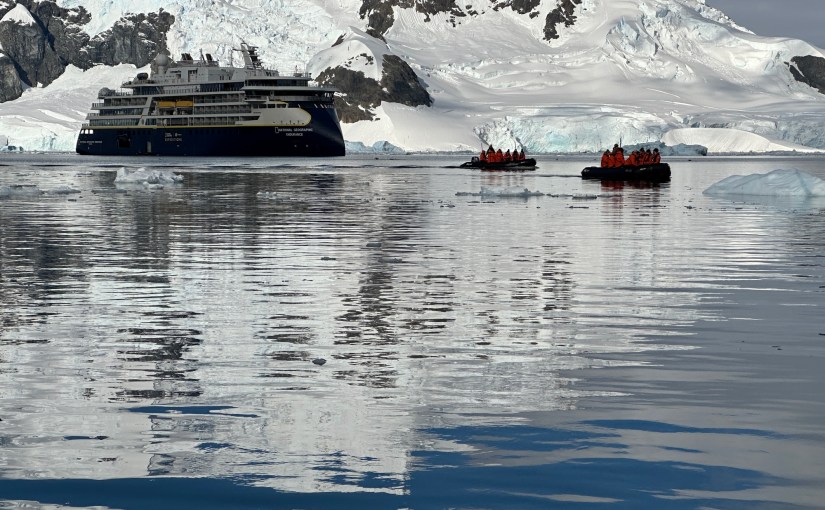
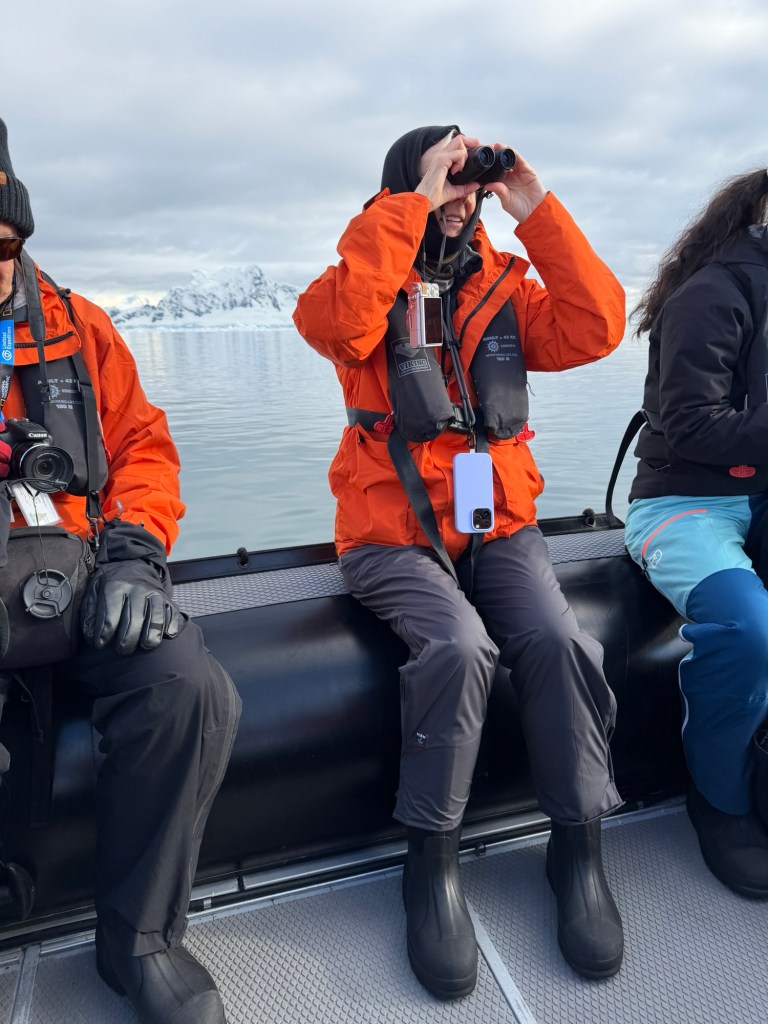
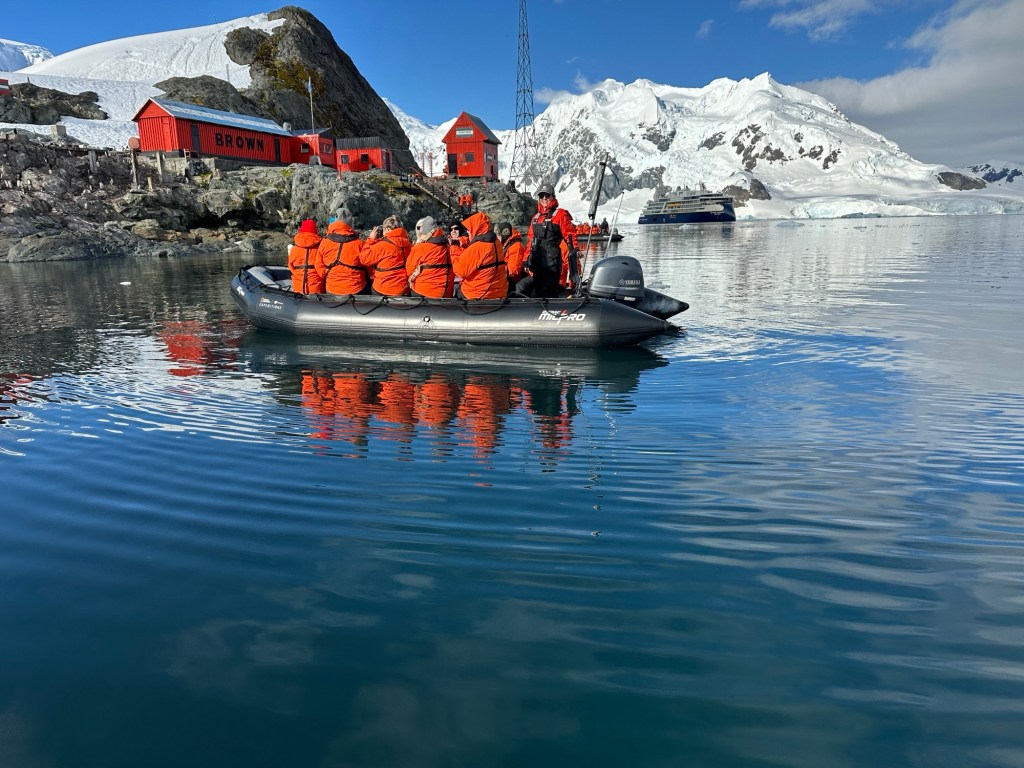
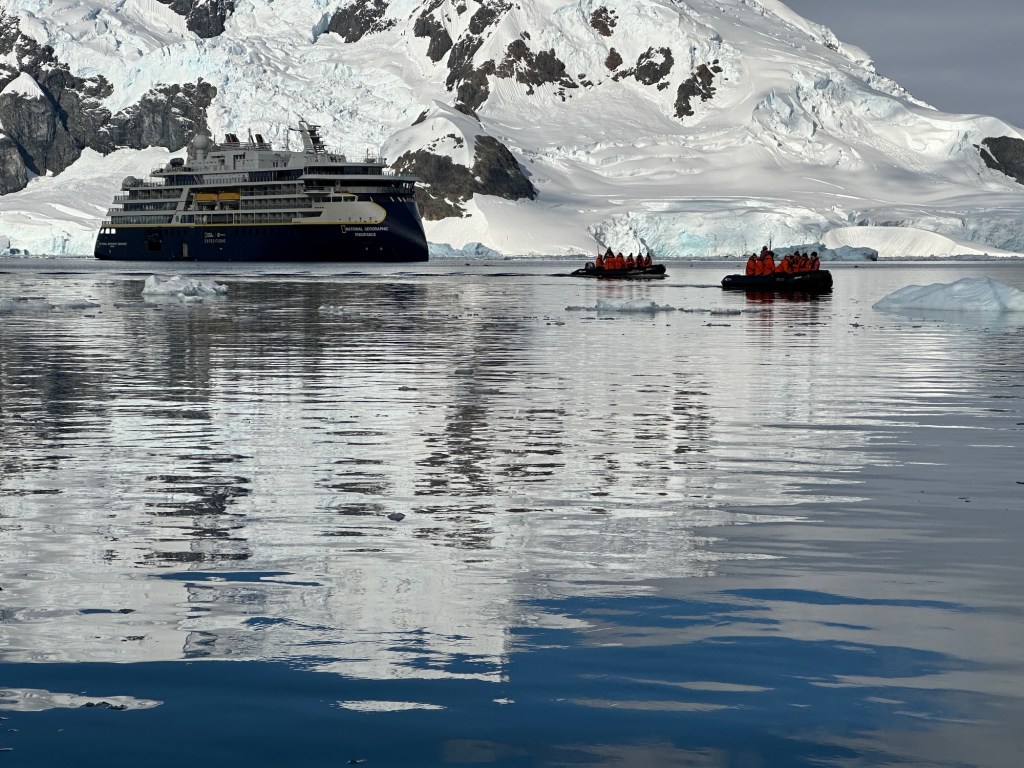
There are 140 passengers aboard our ship. Because Antarctica only allows no more than 100 people ashore at a time, half of the group is on land, while the other half cruises around in the zodiacs looking for wildlife.
For efficiency in boarding and disembarking, the passengers are further subdivided into four groups of 35. I’m in the albatross group, which will be kayaking at 10:30 today. Because the kayaks hold two people, we all needed to buddy up. As luck would have it, my partner has his own kayaks back home in Massachusetts, so his skill level far exceeds mine. We all know THAT particular bar is REALLY low. Because he’s in the Gentoo group, he was all too happy to trade his 8:30 departure for my later one. As a bonus, I’ll bet it will be warmer then.
I hope to be able to take a video of that experience, but while I am trying to work off the great food and even greater wine on the gym’s exercise bike, I’ll share some of prior days photos.
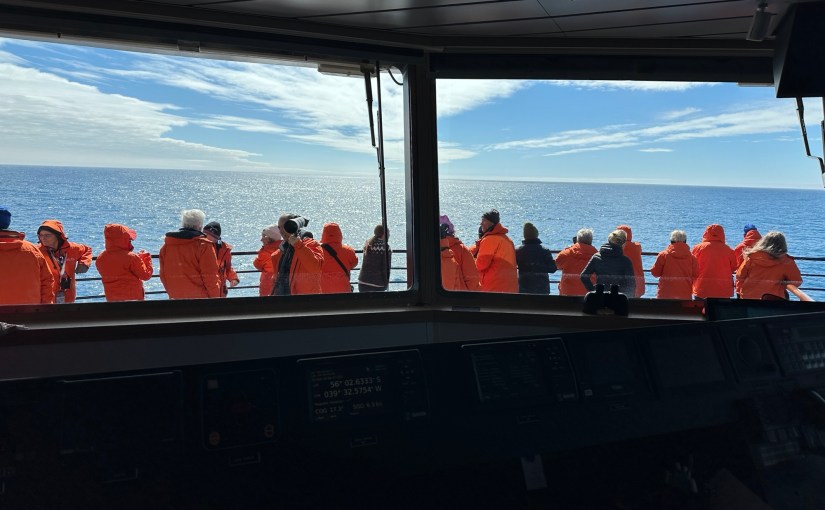
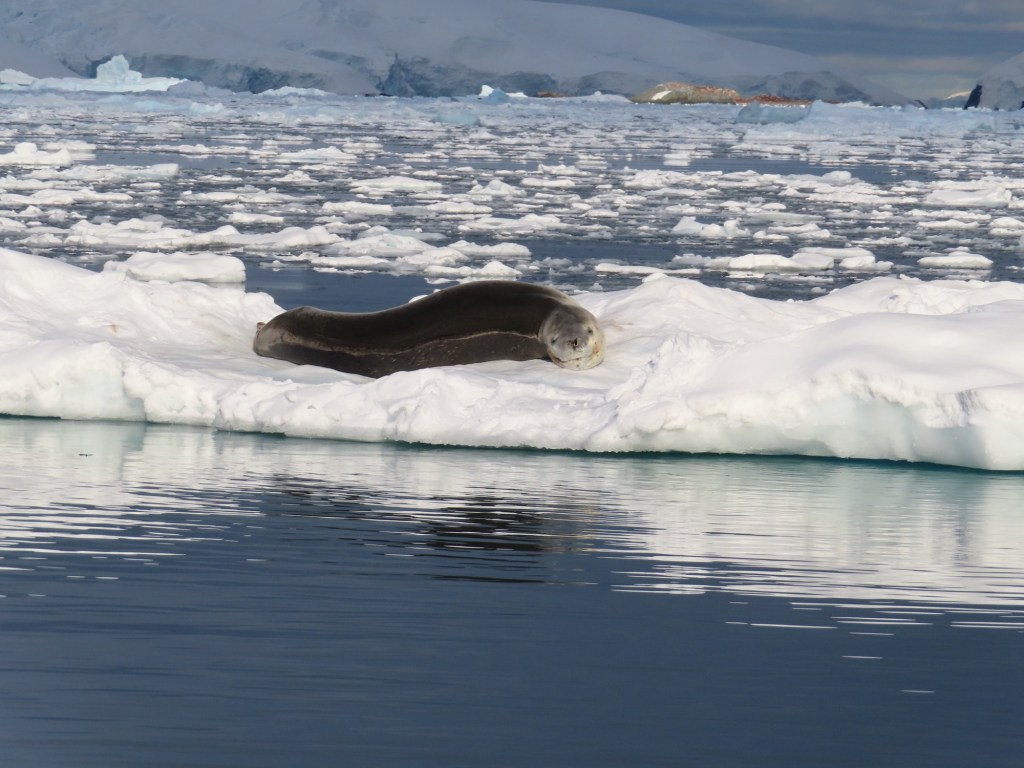
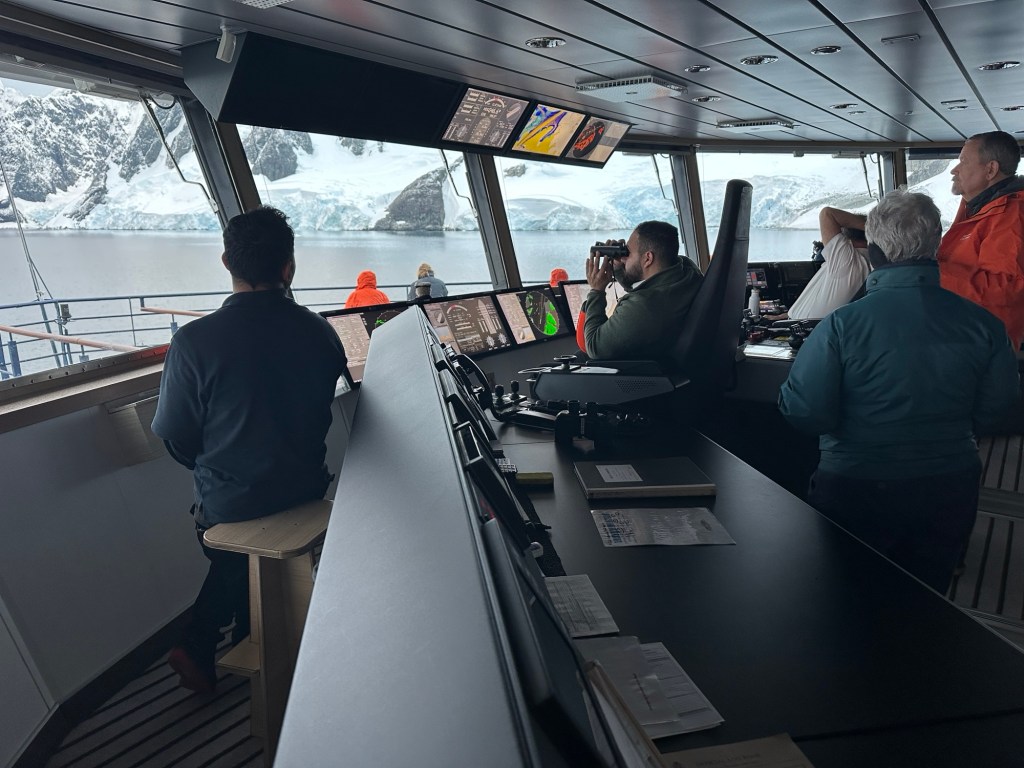
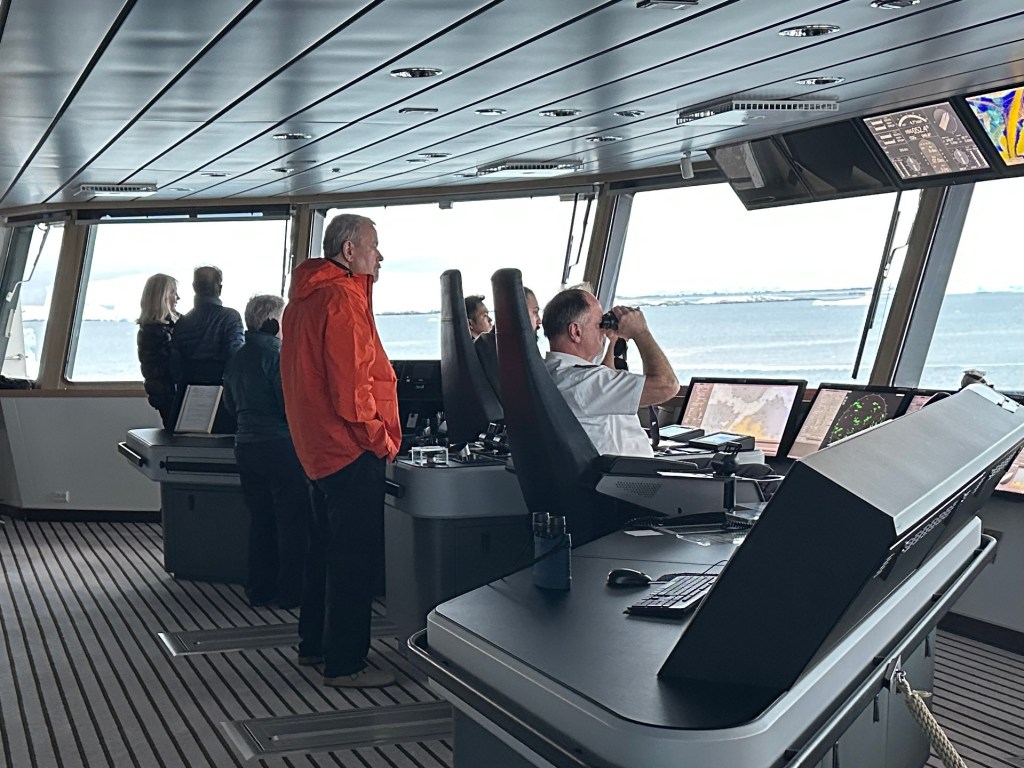
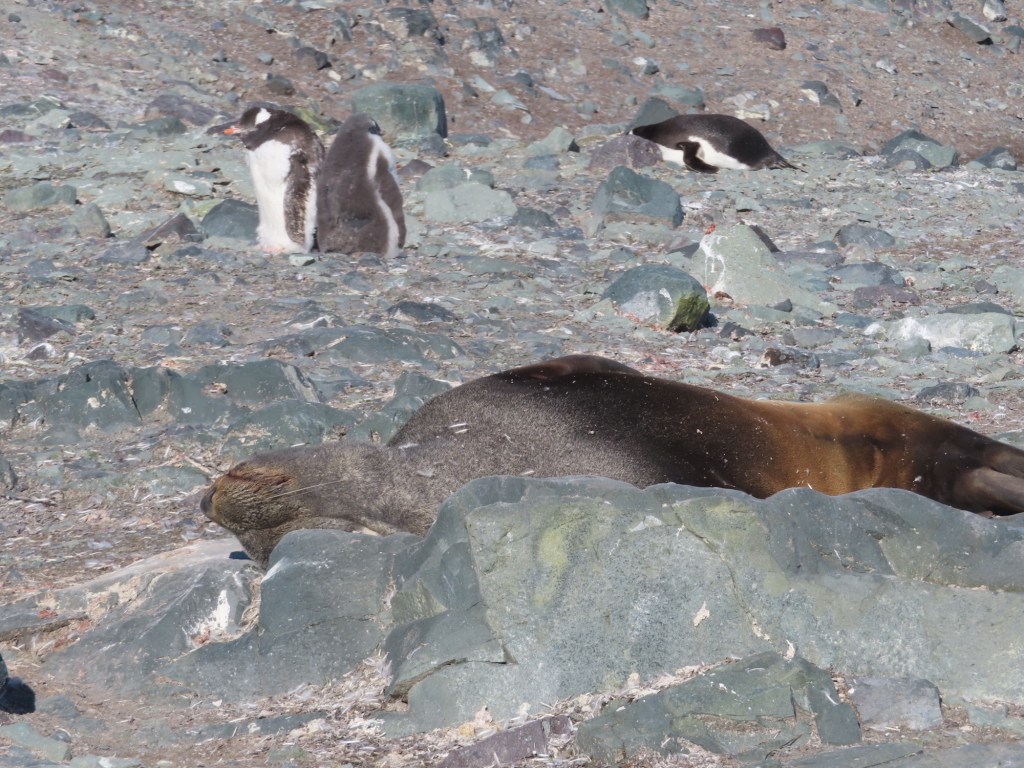
We spotted this seal on one of our zodiac cruisesThe view from the bridge. Passengers can hang with captain and crew whenever they want
Well, I TRIED to insert videos of the whales that we saw from the bridge, the penguins and birds from our zodiac cruises, but WiFi isn’t cooperating, so I’ll do that when I get home.
It’s pretty amazing that I’m able to have ANY connectivity here at the bottom of our planet.
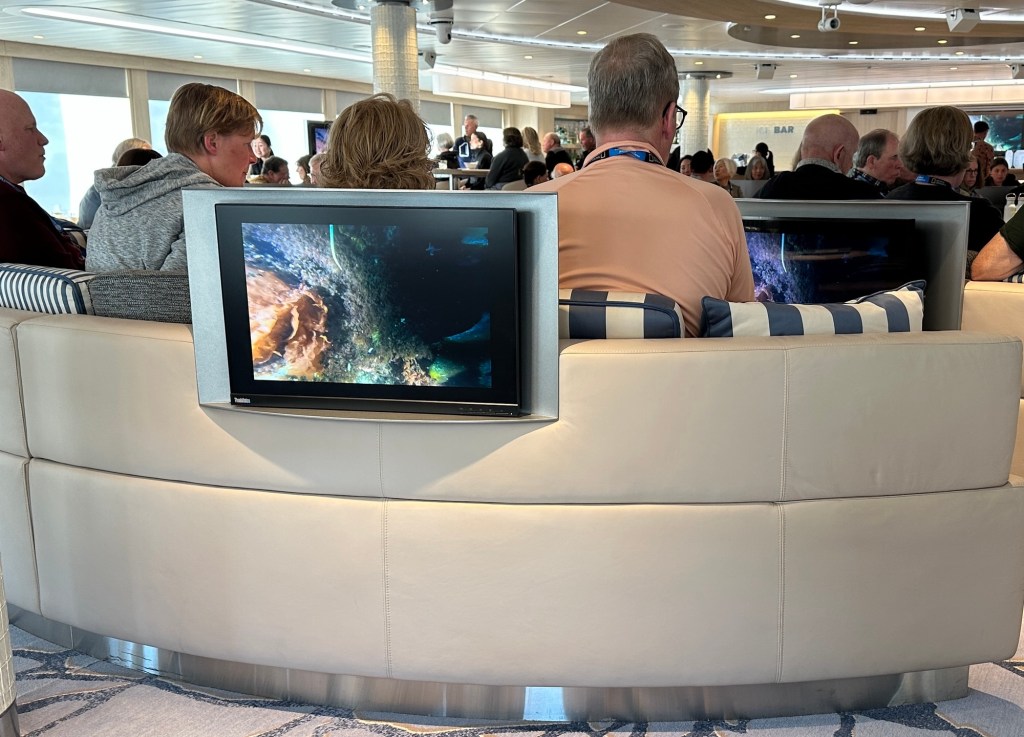
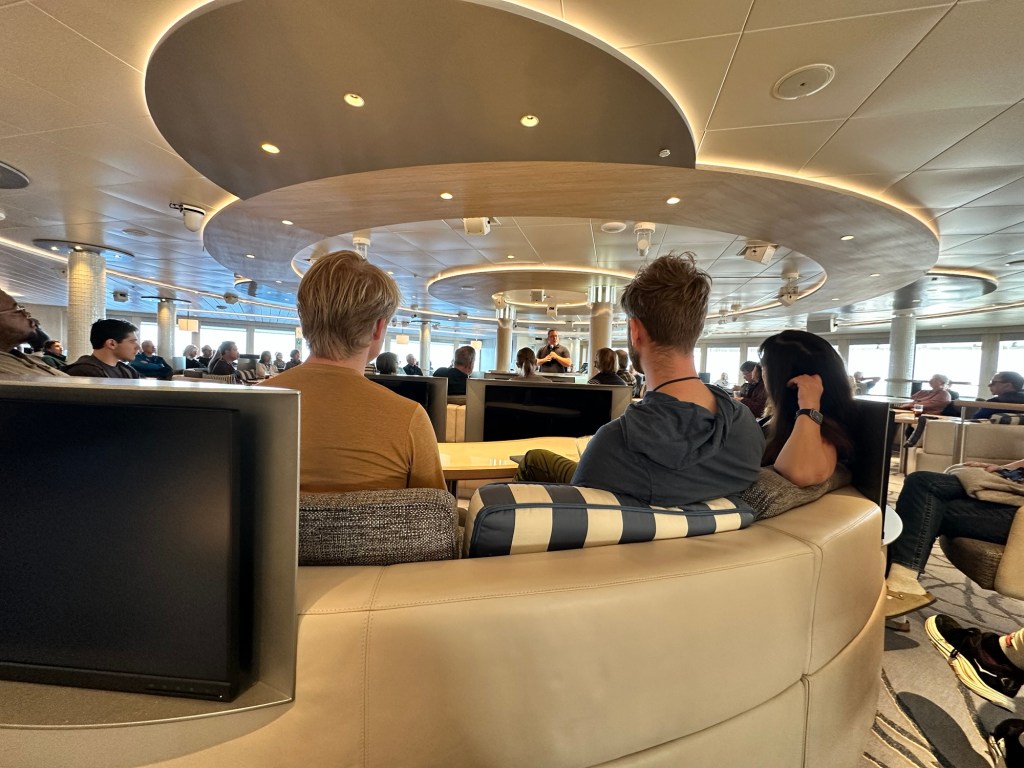
Every evening we gather in the lounge for a recap of the day’s activities. Of course, because the talk is in the lounge, we are a very jolly audience, because we can have whatever beverage we desire, and quantities are not limited.
There are so many screens scattered throughout the lounge, every seat is a great seat!
I have time to share a couple more shots before I need to gear up for my kayak adventure.
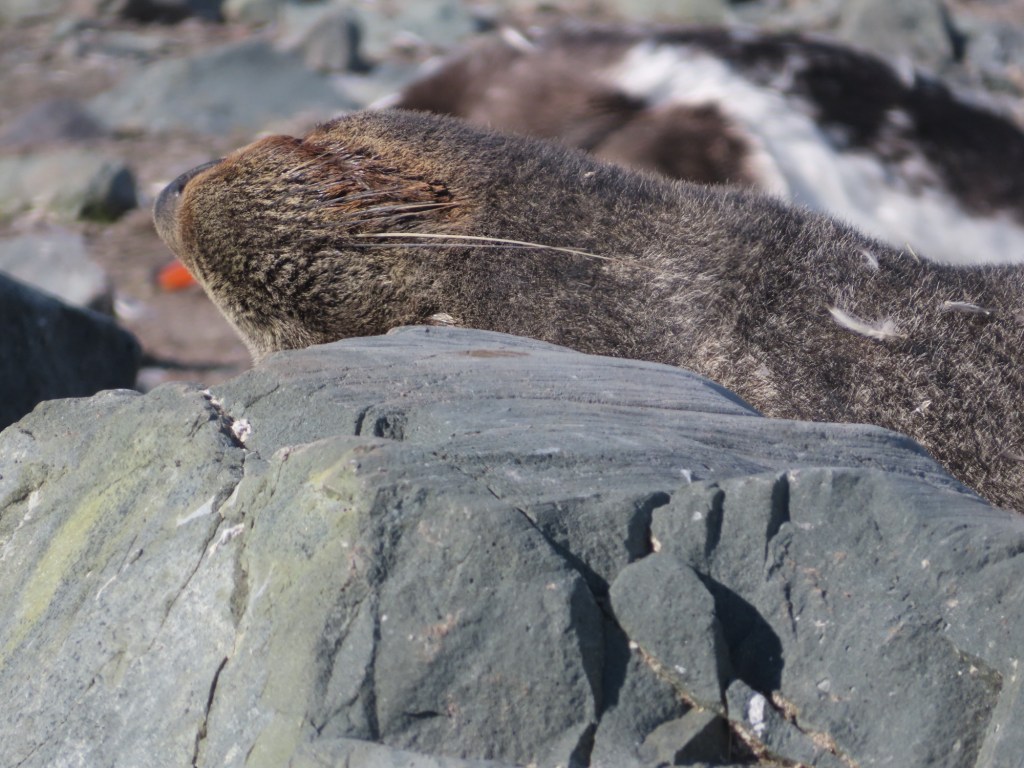
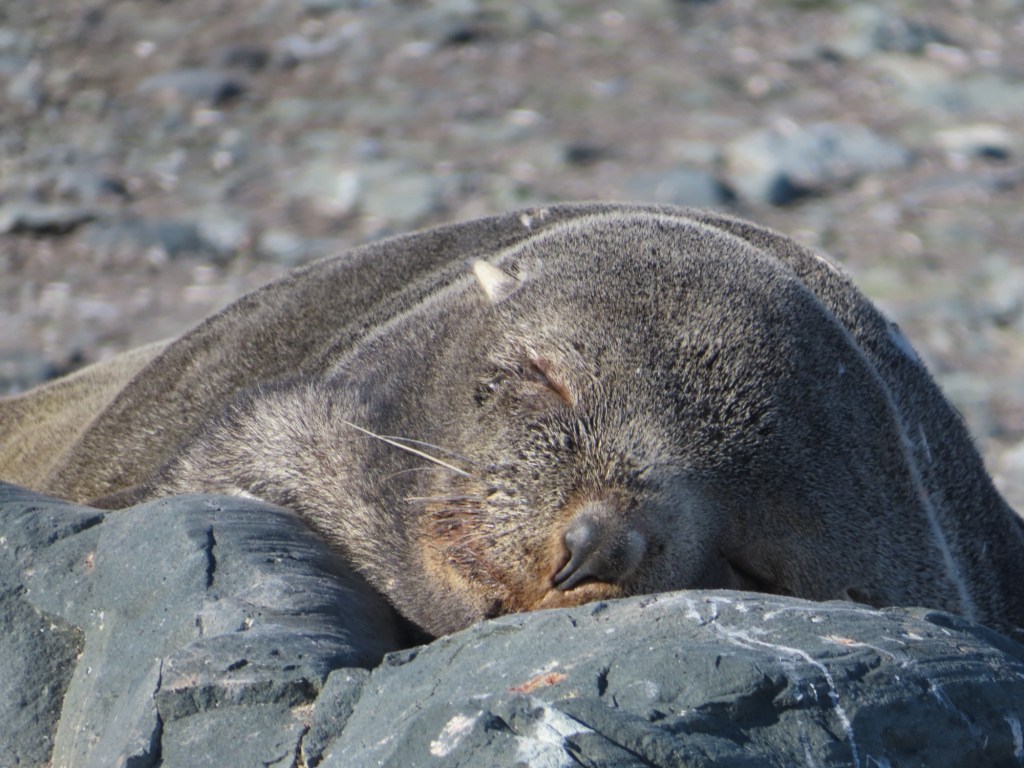
I SO wanted that seal to pick his head up!
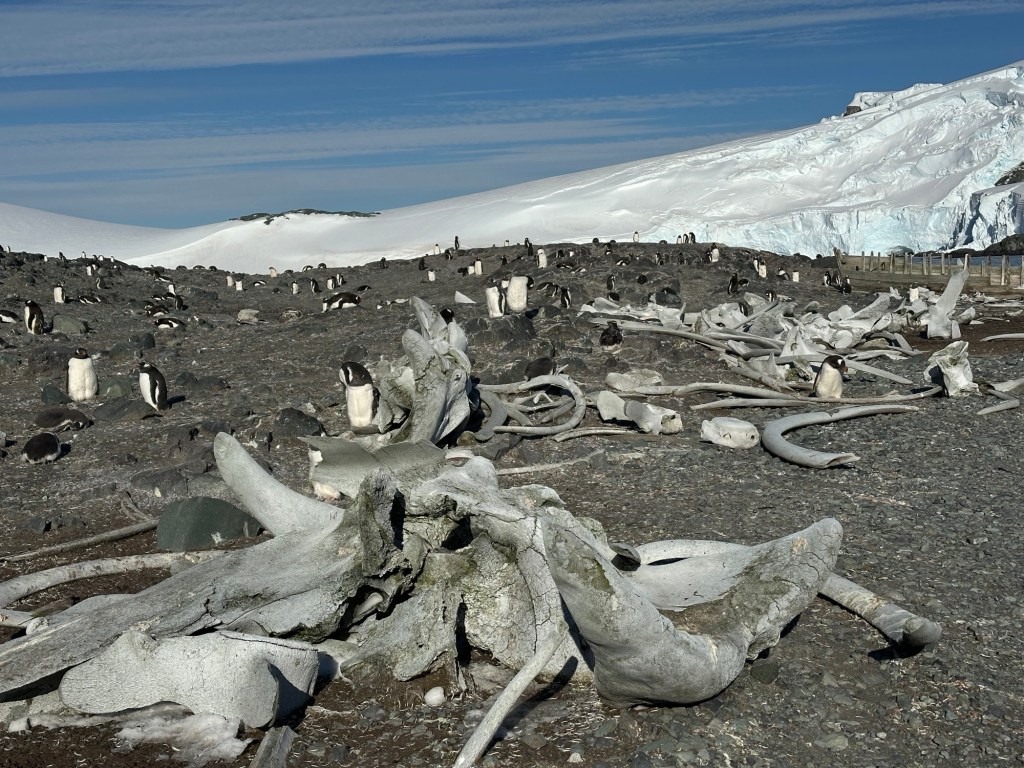
Bones from a blue whale from back when whalers were hunting them
Our flight to Ushuaia took off at 11:20, an hour and a half late. Okay, so maybe we got off to a bit of a rocky start.
Did we really need to leave the hotel at 7AM, to spend over 3 hours in a domestic airport that only had unappealing snacks? After we landed in Ushuaia, I realized it was truly a minor inconvenience, soon to be forgotten.
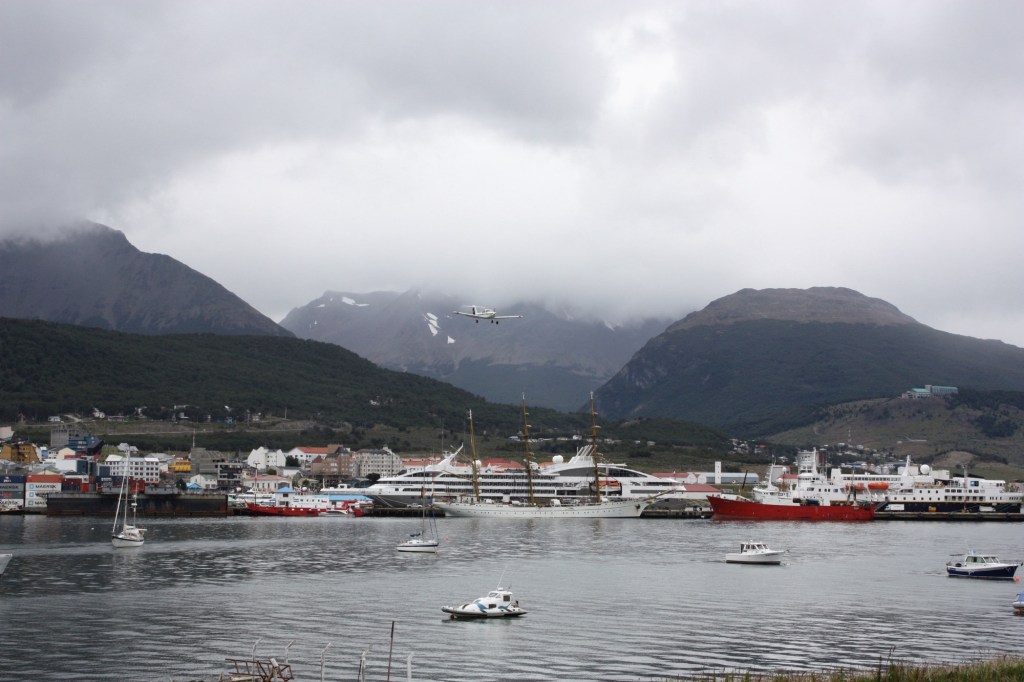
The above photo was taken on our 2011 trip, but the experience hasn’t changed at all. It was every bit as harrowing as the first time. We popped through dense clouds, in between the mountains, to make a bumpy, rather exciting landing.
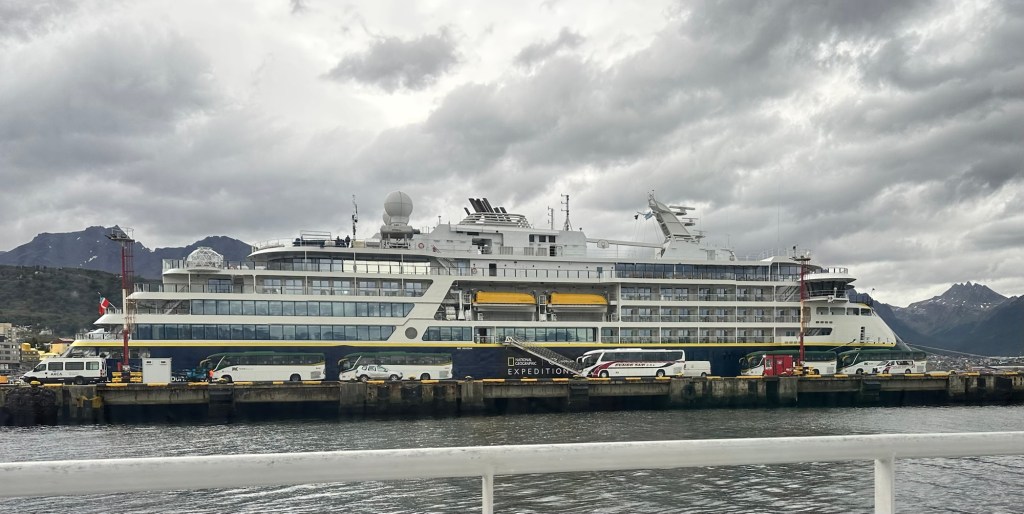
But enough about the downside of travel. The Endeavor, our ship is exquisite!
While it was being cleaned and readied for our arrival, we had a late lunch, while we cruised thru the Beagle Channel on a catamaran.
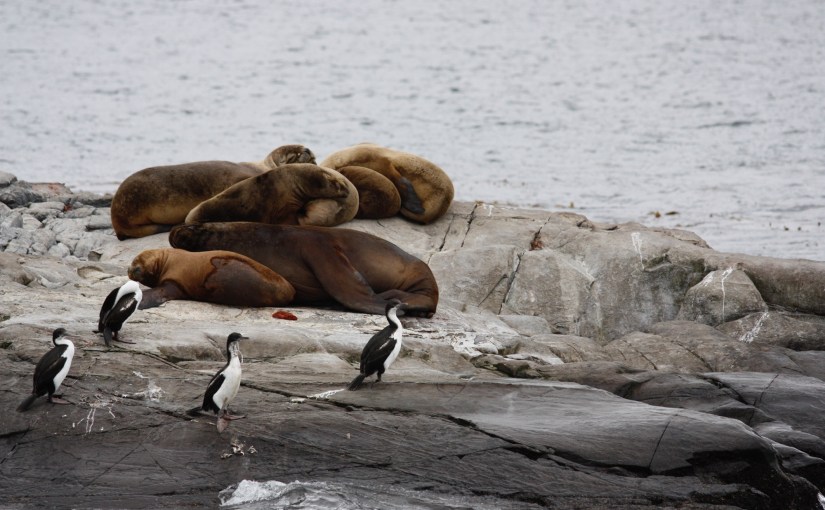
I didn’t take any photos, because I knew I couldn’t top the ones from 2011. Today, 15 years later, I didn’t see a single seal, which made me sad. I hope climate change didn’t do them in—perhaps they were just frolicking elsewhere.
Everyone that I have met so far, both in the hotel and on the ship, is really friendly, interesting, and well traveled. I am delighted that I will have time to get to know many of them over the coming weeks.
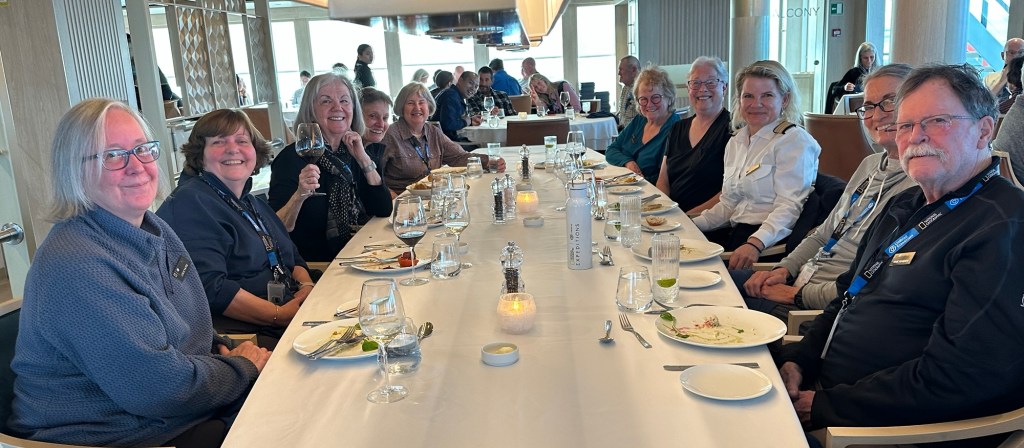
The ship’s management very thoughtfully arranged for us single travelers to meet for dinner. Marc from Boston is the only man traveling solo. He doesn’t seem to mind being outnumbered.
So many people have asked me “ what do you do on a trip like that”?
Well, there is no shortage of activities. So far, I’ve missed the 7AM stretching class, and I haven’t made it to the gym or sauna, but I plan to take advantage of all of them really soon.
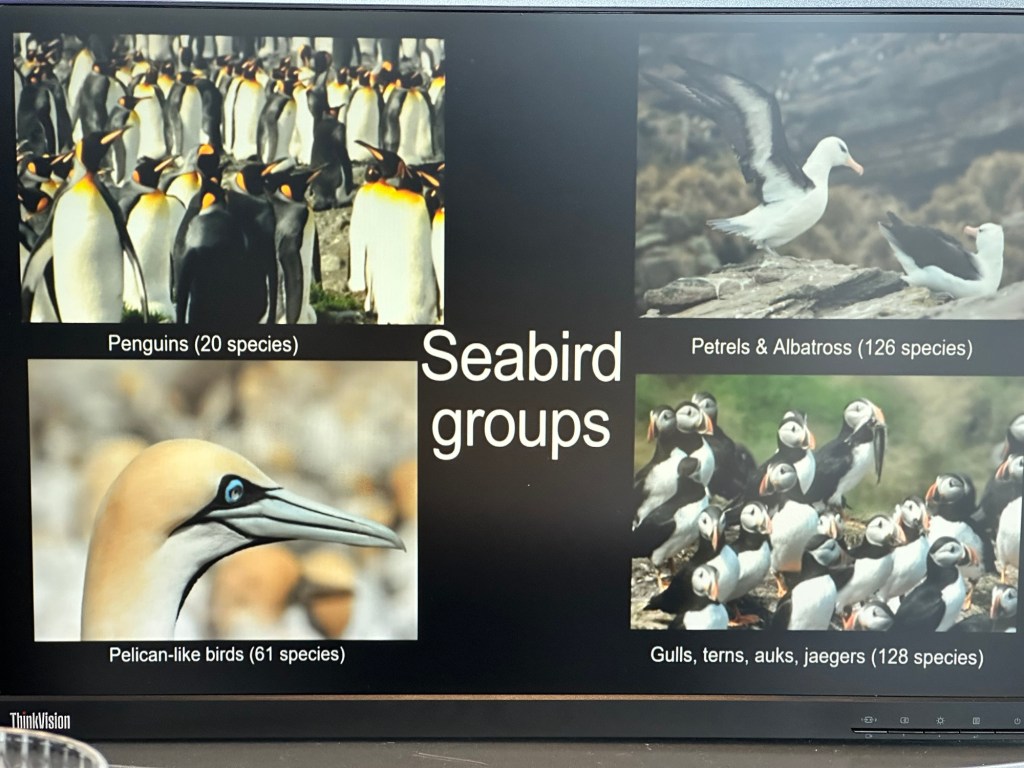
I HAVE attended the very informative lectures, such as this one on Seabirds. This lecture focused on petrels and albatross. Quite honestly, I don’t really care about the 126 different species! Fortunately, meither did the lecturer.
I won’t bore you with the details, other than to tell you that the way to differentiate between those two species is by the number of nostrils they have. If you want to know more, you have to either come on an Antarctica cruise or ask me yourself.
Tomorrow we expect to be clear of the Drake, and will be able to enjoy our first landing on Antártica.
When we traveled to Antarctica in 2011, we went via Santiago. This time, I am flying to Ushuaia through Buenos Aires.
My journey started in Newark. I was amazed at how empty Newark’s airport was. I left home slightly before 11 AM; by 11:50 I had checked my bag, been through security, changed into my Houston/Buenos Aires clothes in the Polaris lounge bathroom and was enjoying the excellent buffet.
My first flight was to Houston. Because I used miles and points to book my flight, I traveled business class for both segments. Let me tell ya, domestic business class isn’t worth it. International business class, however, DEFINITELY is!
I normally sit on the aisle, but for the Houston flight, I had a window seat. Sadly, when the flight attendant attempted to pass me my lunch tray, I managed to knock a full glass of red wine over myself and the very gracious man sitting next to me. But in my defense, the passenger in the seat in front of me had his seat all the way back, so the clearance was really tight.
As luck would have it, my friend Sharmon’s younger daughter, Sol flew from San Francisco to Buenos Aires and we both had a stop in Houston around the same time. We were on the same flight from Houston to Buenos Aires, so we hung out in the United Club. The time went by MUCH faster because we spent the two hour layover catching up.
I almost didn’t recognize Sweet Sol, because the last time I saw her, she had long blondish hair, no glasses, and wasn’t wearing a mask. She pretended not to notice I smelled like the frat house the morning after a wild party. But then again, stale wine doesn’t smell as bad as stale beer.
Because Sol holds dual citizenship, she was able to whisk thru passport control WAY ahead of me. It took over an hour for me to get thru. HELPFUL HINT: if you’re coming to Argentina, visit the bathroom BEFORE getting in the passport control line. Don’t ask how I came to that conclusion. Let’s just say I was jiggling a lot.
I’d been to Buenos Aires twice before, so I didn’t feel compelled to see Evita’s grave or the Opera House. Instead I figured I’d enjoy the beautiful hotel, and I certainly did.
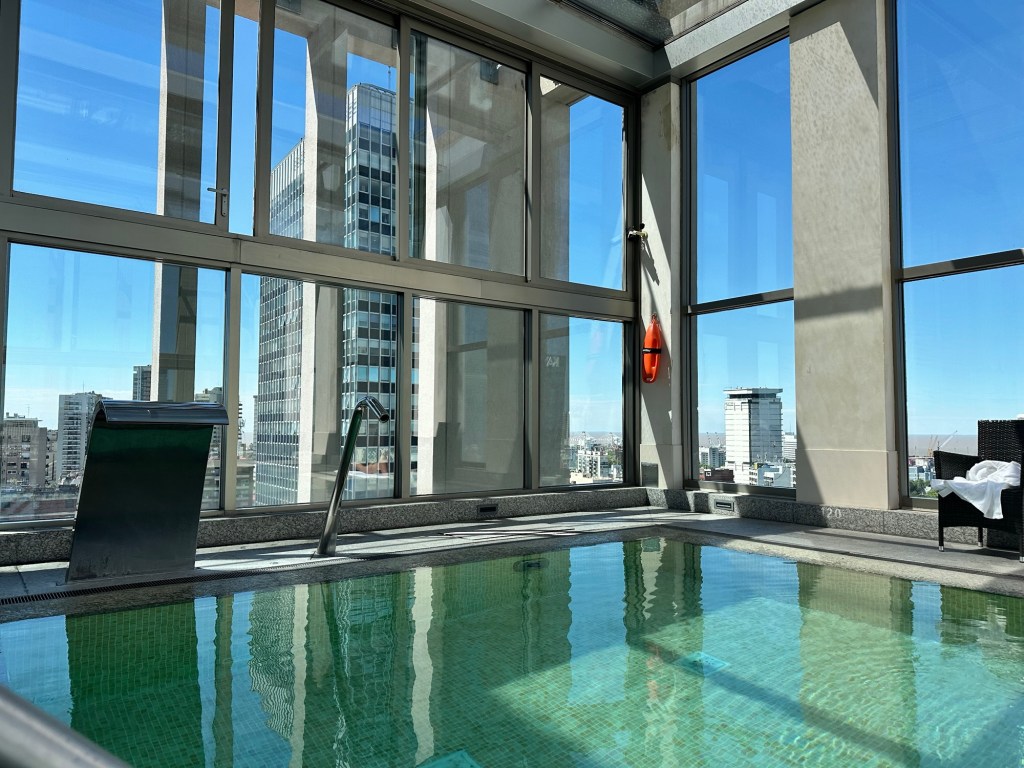
Check out the rooftop pool:
The view was so spectacular, and the pool was so glorious, I used it on Friday AND Saturday.
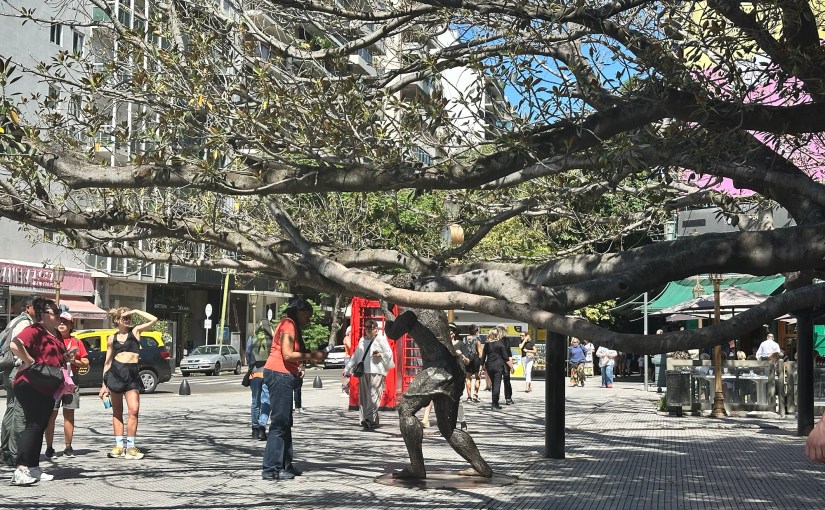
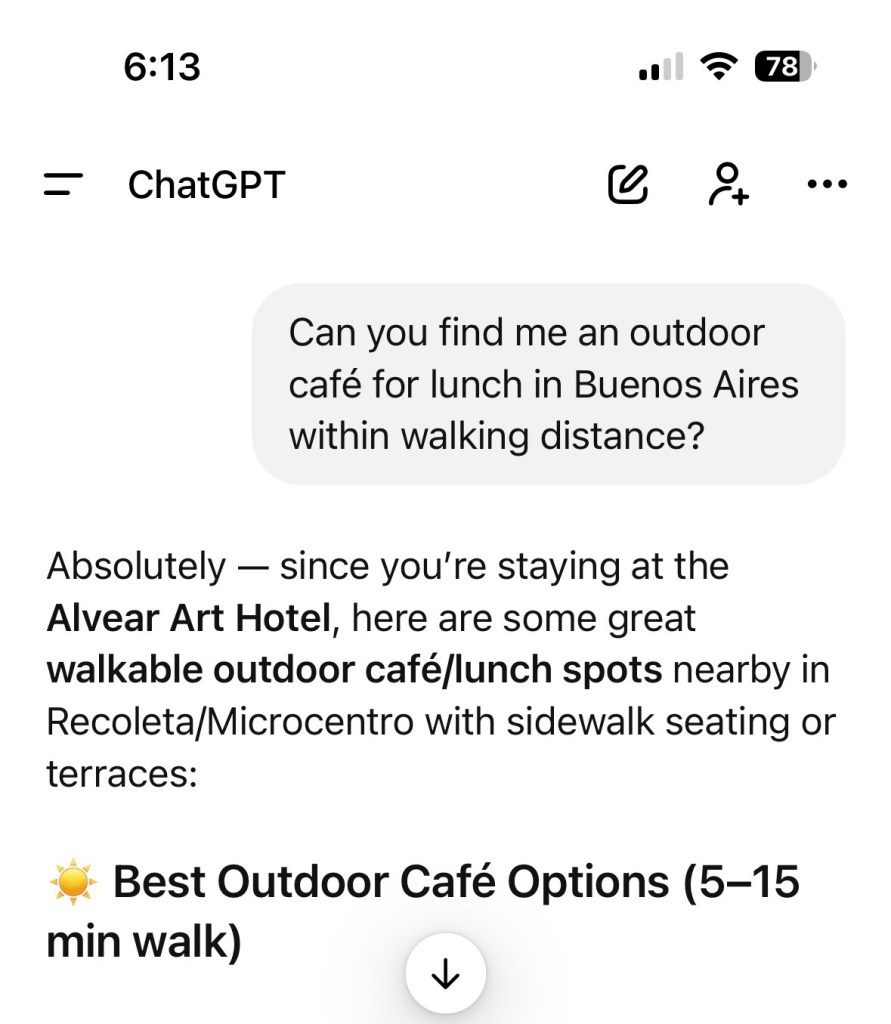
My son Greg clued me in to the wonders of ChatGPT. So, when I was unable to find any cafes full of people having lunch outside near Alvear Art Hotel, I asked ChatGPT.
I ended up choosing a delightful cafe about a mile away, which allowed me to stroll thru some very interesting streets.
Waiting for the elevator before tonight’s information session, I met Leslie, another solo traveler. Like me, she’s a widow who is comfortable traveling alone. Her cabin will be across the hall from me.
We had a lovely cocktail “hour”. I’ll admit that our table was having so much fun, we had to be asked to leave! And yes, we closed the place down.
Probably a good thing because we have to be on the bus by 7AM tomorrow. I had hoped for a later departure because Buenos Aires is much closer to Ushuaia than Santiago. But nope. Same departure time as it was in 2011.
Who knows whether I’ll have connectivity once I board the ship, so I’m sending this off now.
Yes, indeed, I’m excited and thrilled that I have already discovered such congenial travel mates.
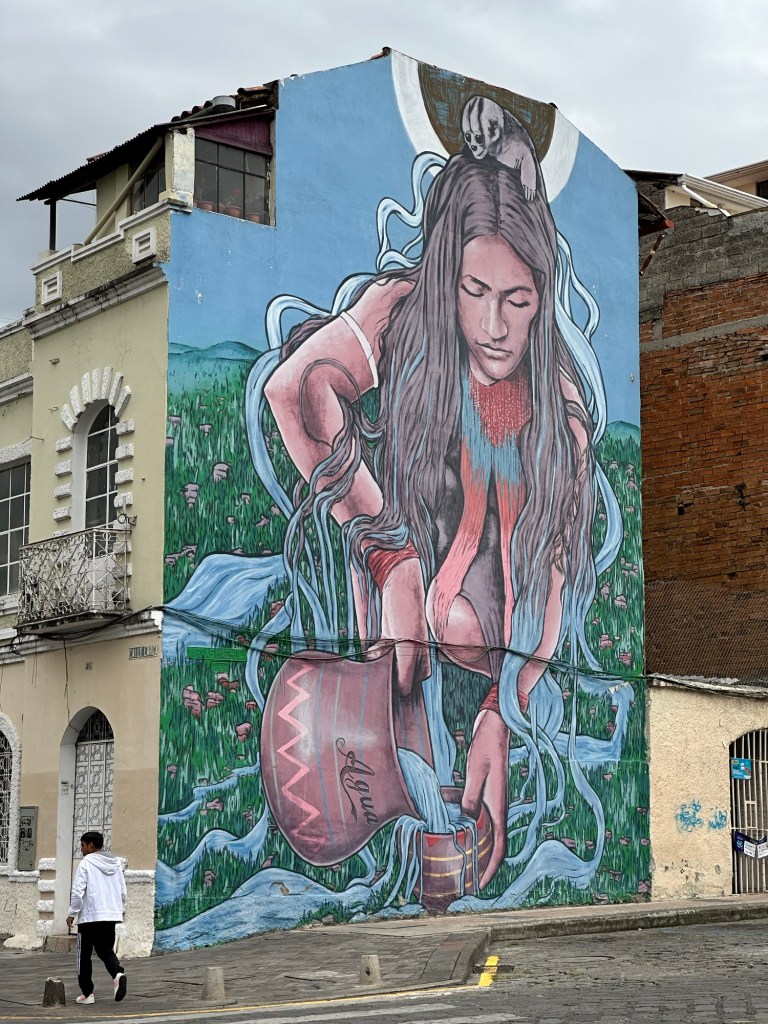
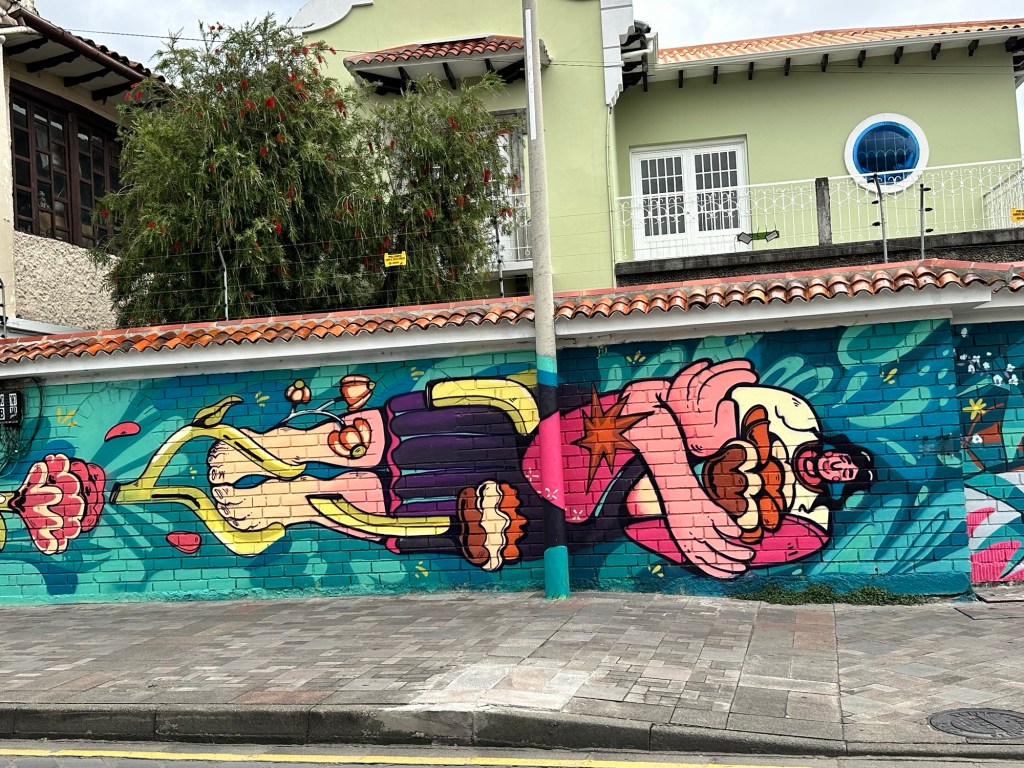
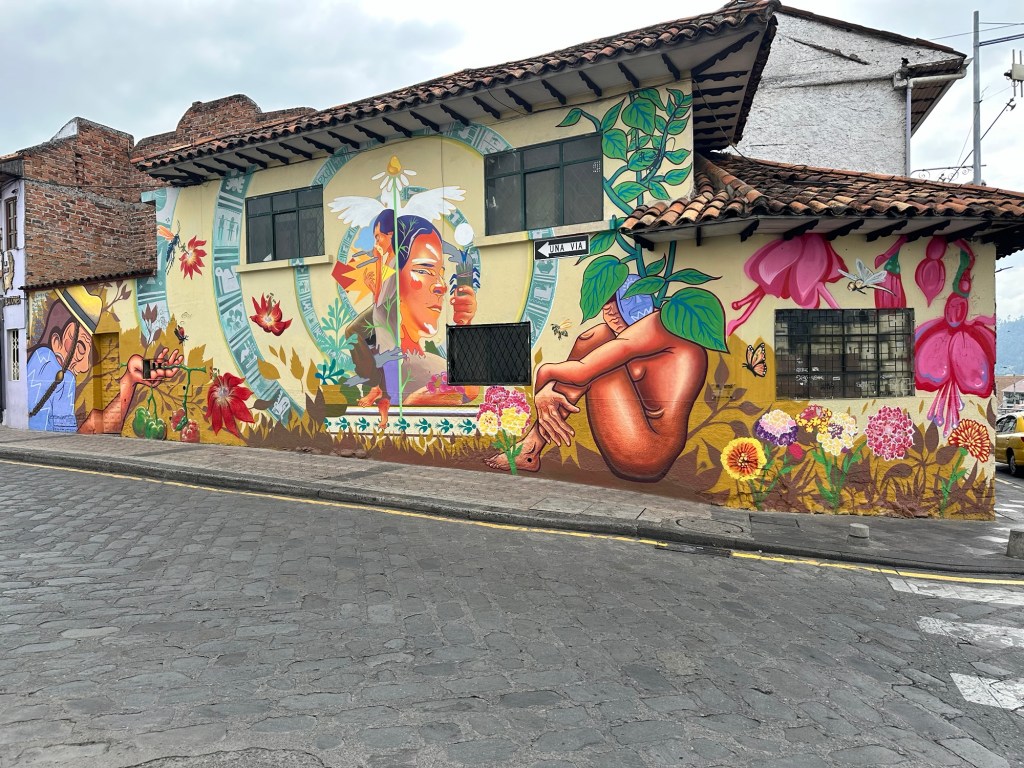
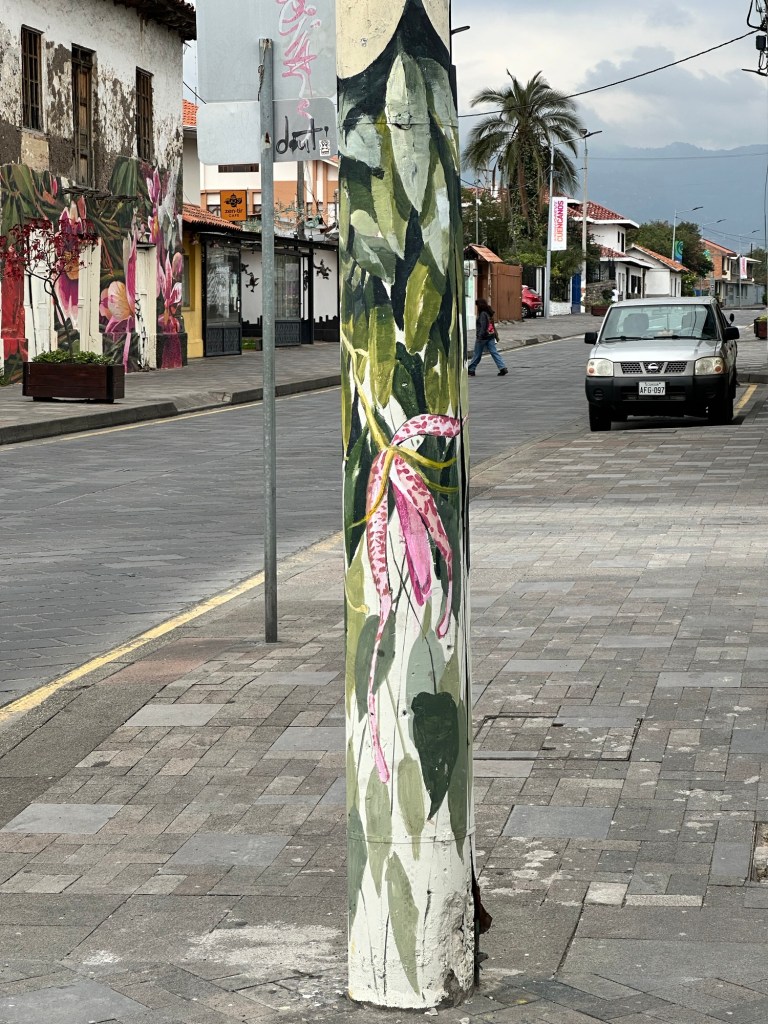
On our last day in Cuenca, we were free to spend the morning exploring on our own. I walked to the Pumapungo Museum, which is about a mile from the hotel, along La Calle Larga. I was wishing my buddy Elsie had taken the post trip with me, because she would have enjoyed the street art as much as I did. So Elsie, this one’s for you. No narrative, just visuals.
They even paint the poles!
I’m not sure why this art was defaced with graffiti. I thought there were rules.
If you like history, nature, handicrafts, museums, architecture, great restaurants, quaint coffee shops and shopping all within walking distance — come to Cuenca, because it has it all! Initially, I thought I could do one post for our three days in Cuenca, but I have since realized that’s impossible. So here’s episode one.
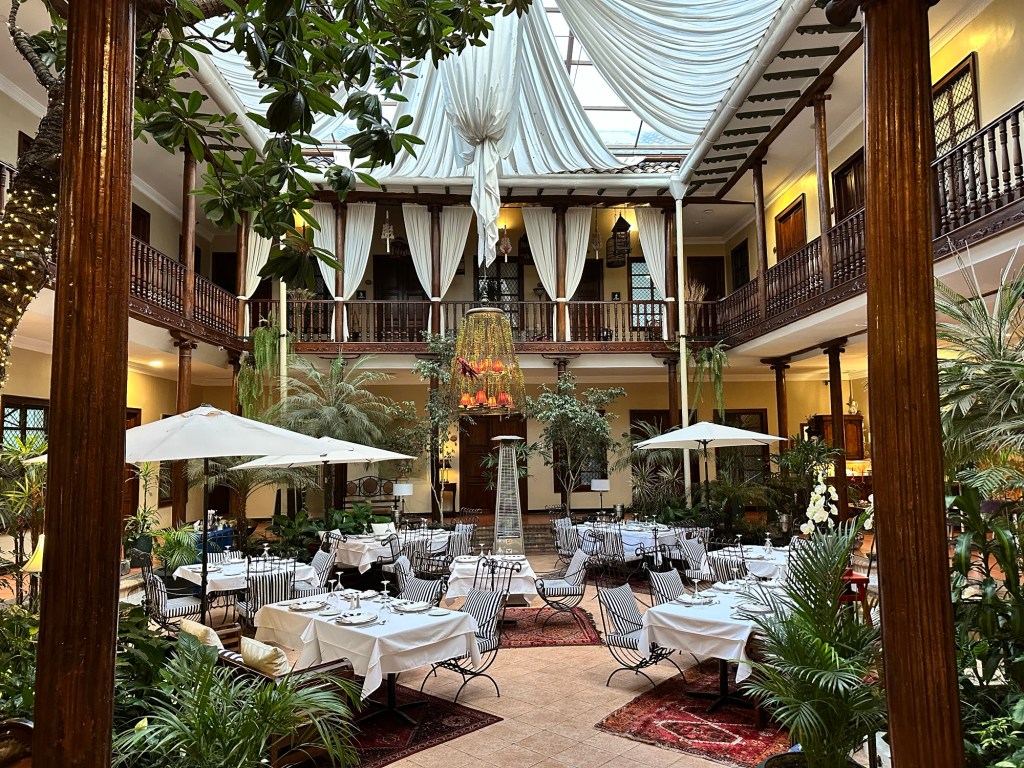
As usual, OAT has us staying in a strategically located boutique hotel. Once a private home for a large family, all the rooms are clustered around a central courtyard, which is now the reception area and restaurant.
Because this area was declared a world heritage site in 1999, the buildings have all been preserved, but many have been converted into hotels, restaurants, and shops.
One woman decided to rent her home, complete with all its furnishings; it is now a restaurant.
Before dinner, Lorena took us on a quick tour. What made this especially interesting was knowing this was how the former owner lived! Take a look at the opulence of just two of her rooms.
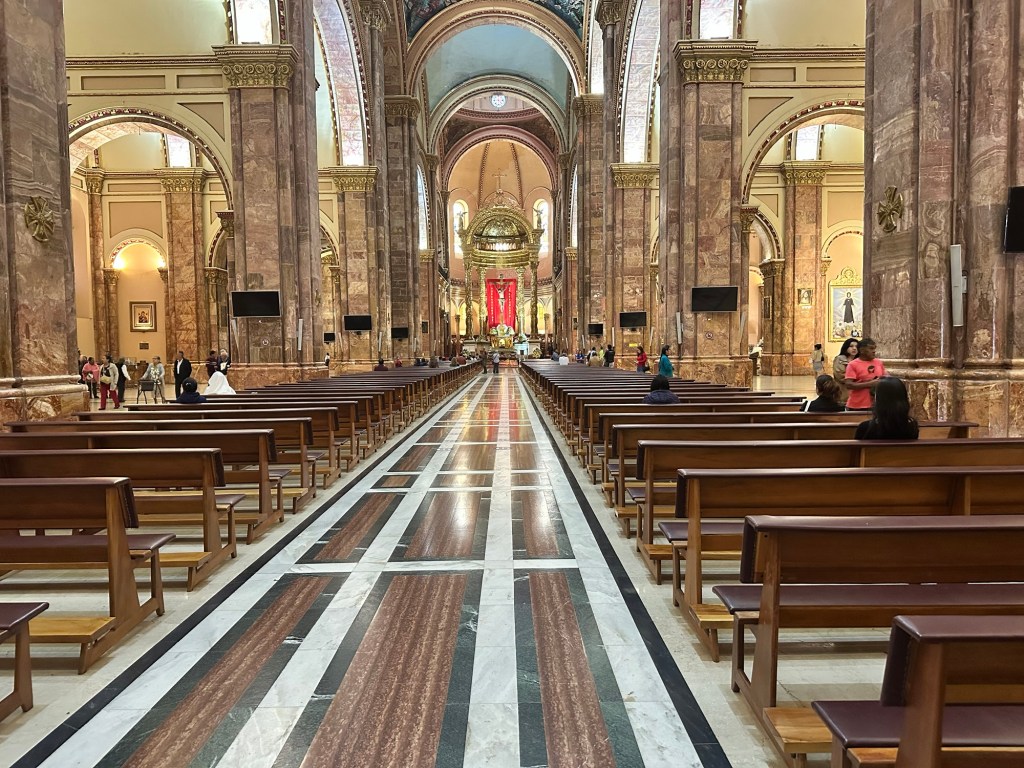
On our first morning in Cuenca, we enjoyed a walking tour of the city. Of course, the cathedral occupies a prominent spot on the main square. As you have probably guessed, the header of this post is a photo I took of the cathedral at night from the Negroni Restaurant.
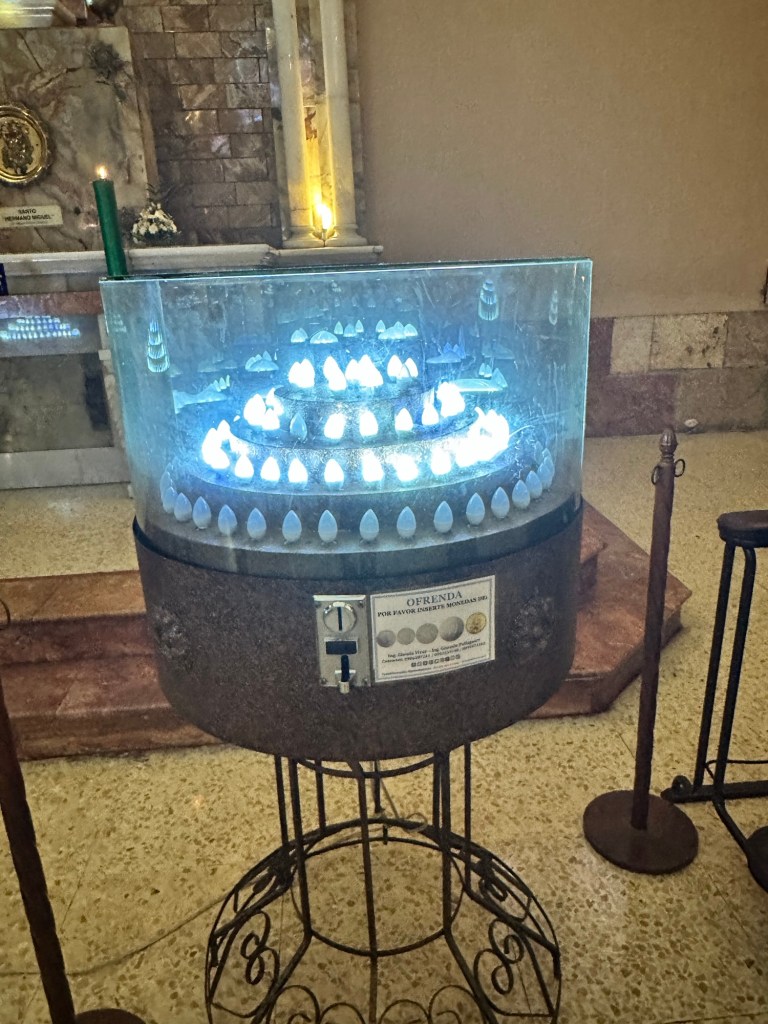
My friend Jeanne always lights a candle for her husband whenever she visits a church, so I decided to light one for both our husbands. See that bottom row? My $1 coin lit that ENTIRE row of electric candles—sufficient to cover ALL the loved ones we both recently lost!
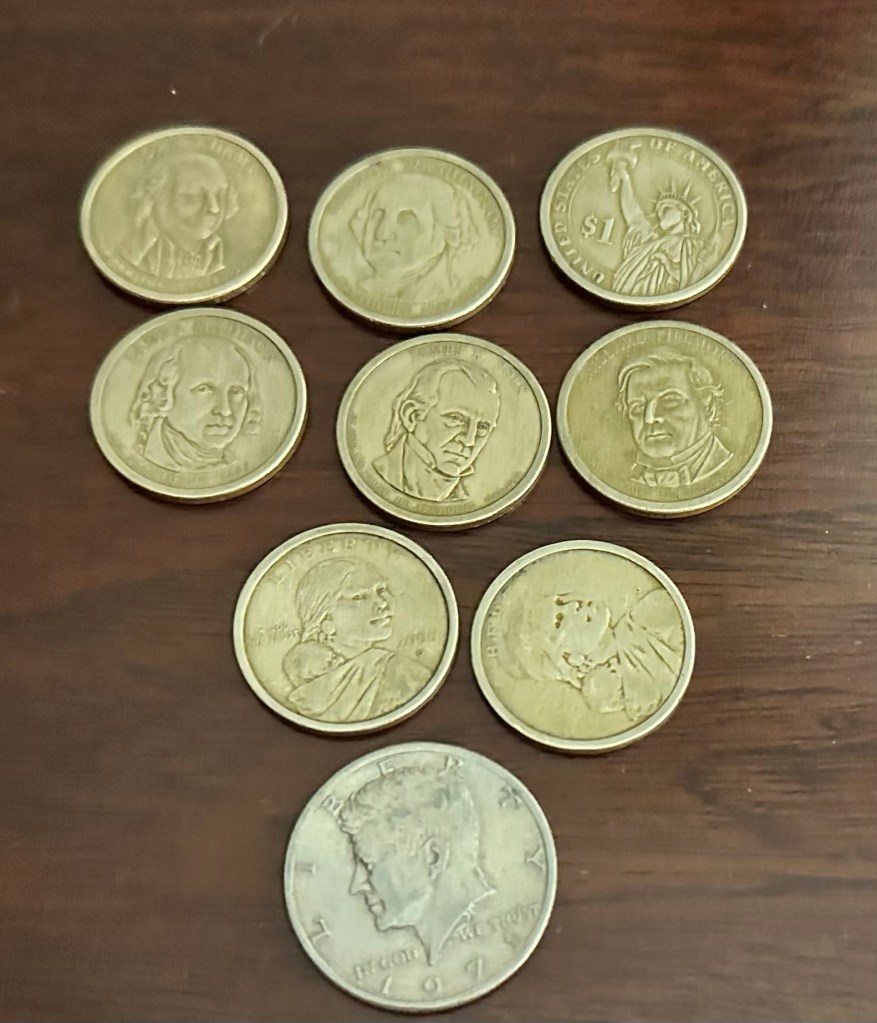
And yes, you read that last line right. I deposited a $1 US COIN. No longer will you lie awake at night wondering “whatever happened to all those $1.00 coins the US minted years ago that Americans refused to use”? We exported them to Ecuador, and from the worn looks of them, they are widely used.
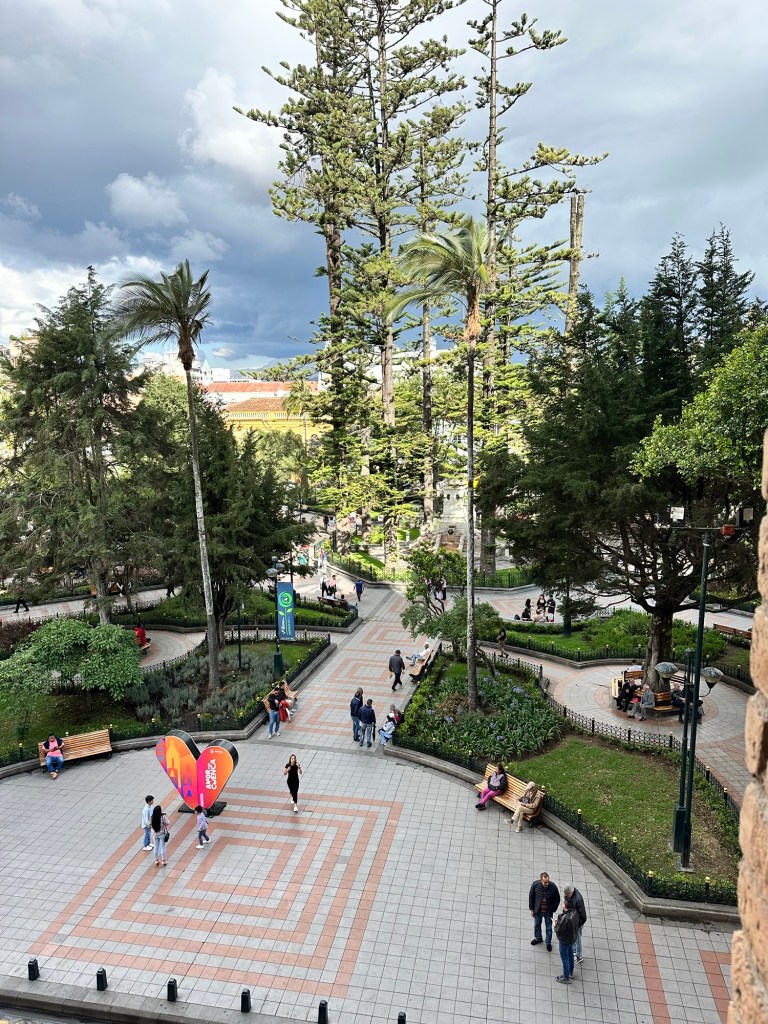
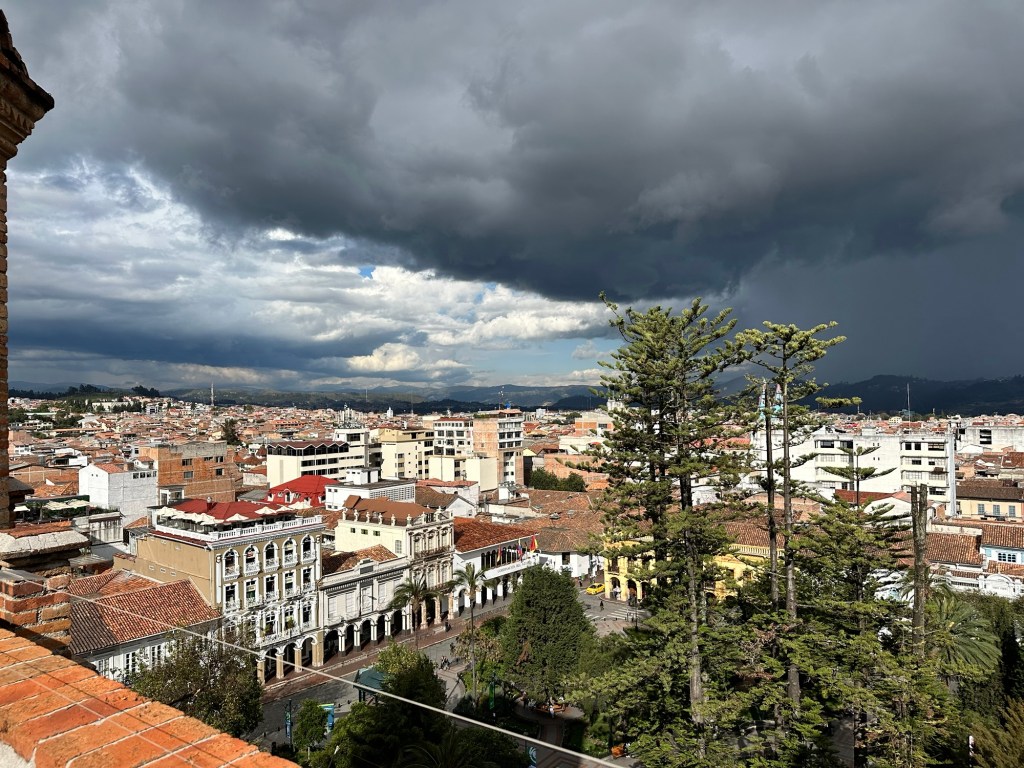
During our walking tour, Lorena pointed out the entrance to the cathedral tower, so naturally, during our free time, I spent the $1.50 admission fee and climbed to the top. You can get a decent view of the square from the first landing.
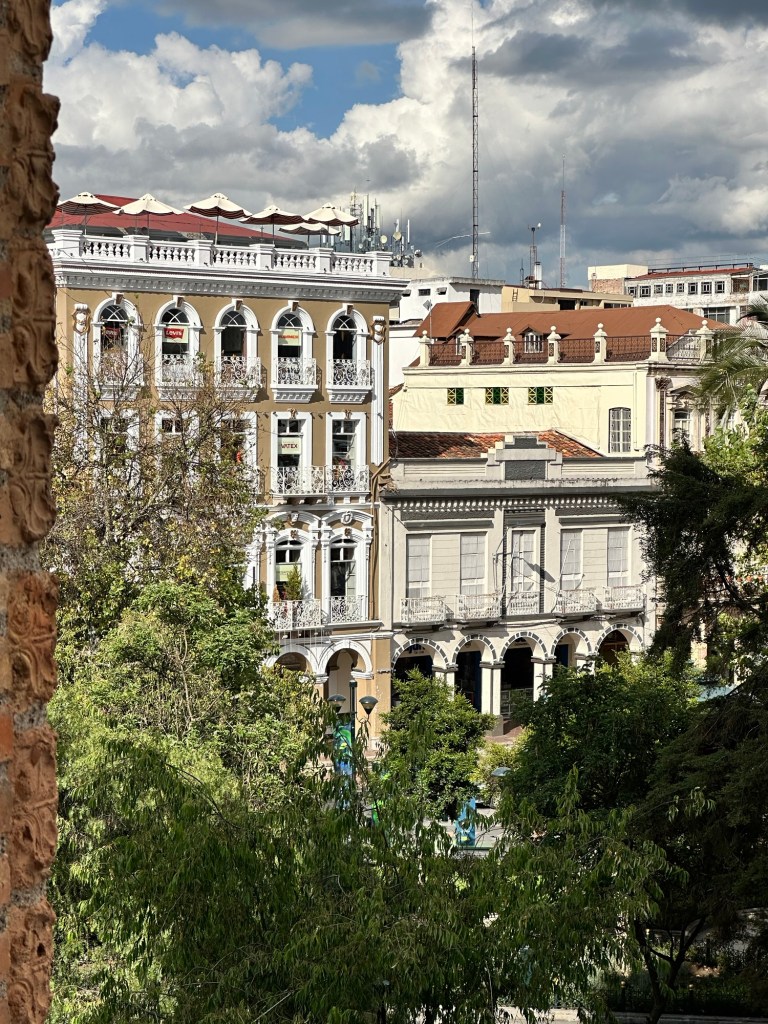
Take a look at the umbrellas atop the building in the next photo. That’s Negroni Restaurant—it has great food, but it’s a bit of a challenge to find. Eric, Gail and I had dinner there on our “free” night. It took us a while to figure out you had to enter a clothing store, walk to the revealing women’s tops section, which is where the elevator hides out, then ride to the top floor.
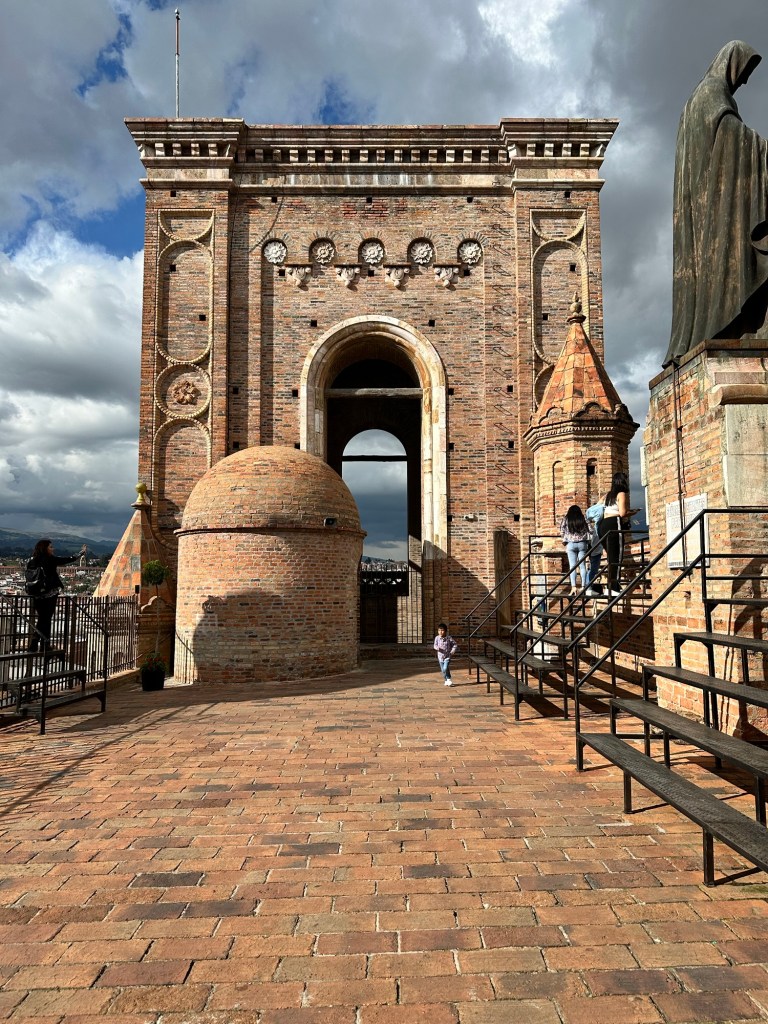
I climbed all 162 of the tower’s spiraled stairs. My reward? This panoramic view of the surrounding area.
I pretended I couldn’t understand Spanish, so I ignored the sign that said “for your safety, seniors keep off” and claimed right up those metal bleachers.
SOME people might have noticed those menacing storm clouds, but my family won’t be surprised to learn I wasn’t one of them. Did I seek shelter? Go back to the hotel to get my umbrella or raincoat? I think we all know the answer to that.
Instead, I decided to support the local economy by buying gifts for friends and family.
So far, we had been unbelievably lucky with the weather. Up until Cuenca, the two times the heavens opened, we had been on the bus, and by the time we arrived at our destination, the sun was shining brightly. Not this time. I got SOAKED!
Cuenca gets most of its electricity from hydroelectric power, so last year’s drought had a severe impact on the city. When it rains, people here rejoice. So, of course I rejoiced along with them.
We have a flight tonight, so the next episode of Cuenca will probably be written at the airport…









 Destination NOW