Helpful Hints-Northern Spain and Portugal

This post is for all the wonderful OAT travelers who took the time to post on Friends of Overseas Adventure’s Facebook page. I benefited greatly from your advice and hints, so this is my way of giving back. My apologies to regular subscribers who might not find this post very interesting. BUT if others traveling to the Northern Iberian Peninsula in the spring find these hints helpful, well that’s a bonus.

I took the “Northern Spain and Portugal: Pilgrimage into the Past” trip in April of 2025. My departure didn’t offer pre or post trips so this information only applies to the main trip.

  • I wore a mask on flights to Bilbao, but didn’t on the return trip. Big mistake. I’m quarantining now, which is why I have plenty of time to write this post.
  • The OAT trip started in Bilbao, which is an absolutely fantastic city. If you are able to do so, I highly recommend arriving a day or two early.
  • If you are changing planes, and you are checking luggage, be sure to carefully examine your luggage receipt. I didn’t and I wasted almost a half a day tracking down my bag, which was left in Munich. I’m so very glad I used an AirTag!
  • Although Bilbao is a very walkable city, the bus system is excellent. Best of all, busses are frequent and easy to use. No special card is required. You simply get on the bus and pay with your credit card. Easy, and CHEAP!
  • The Guggenheim is closed on Mondays, however, the OAT itinerary has sufficient free time built in. If your trip has the museum scheduled on a Monday, you still can visit at another time. Even if you are not a museum aficionado, the architecture of the building is pretty spectacular. It’s also worth walking around outside the museum to view the sculptures.
  • All of the hotels OAT chose were centrally located, which made it very easy for anyone who wanted to explore on their own.
    Here is the list of the hotels we used:
    **Hotel Abando, Bilbao
    **Hotel Tres Reyes, Pamplona
    **Alfonso V, Leon
    **Hotel Compostela, Santiago
    **Lamego Hotel, Lamego
    **Turim Oporto Hotel, Porto
  • If you don’t want to wash your hair and body with the same soap, or you don’t like to use the bottles attached to the wall, bring your own.
  • Most of the hotels’ hair dryers were attached to the wall, and you needed to keep your finger on the button to get the dryer to operate. That can be uncomfortable if you have arthritis in your hands. Someone suggested bringing duct tape to keep the button down. Of course, I didn’t recall that hint until I was on the trip, staring at the button!
  • The hair dryer in the Lemigo Hotel died after a couple of minutes use. After resting for a few minutes, it could be used again. (Others had a similar experience). Fortunately that didn’t happen in Santiago, where I used the hair dryer on my sodden shoes.
  • Apparently, Northern Spain normally gets a lot of rain. During our visit, we mainly experienced intermittent showers. Keep in mind the unevenness of cobblestones results in lots of puddles, and sometimes those puddles are DEEP. Oh and by the way, those cobblestones are very slippery when wet.
  • We all got drenched on our walk into Santiago. Fortunately, our hotel had a heated towel bar. After being convinced that I was a complete idiot for being unable to get the heat turned on, I swallowed my pride, asked for help at the front desk and learned that the heat is centrally controlled and doesn’t turn on till 7:30 PM.
  • The only option our team leader gave us to do laundry was at the hotels, but it was rather expensive, especially with the terrible exchange rate. We were there when the tariffs went into effect, so what was once a strong dollar had plummeted.
    The heated towel bar was perfect for drying laundry. Santiago was the only hotel with that option, and it was roughly midway through the trip, so keep that in mind if you are rinsing out clothes.
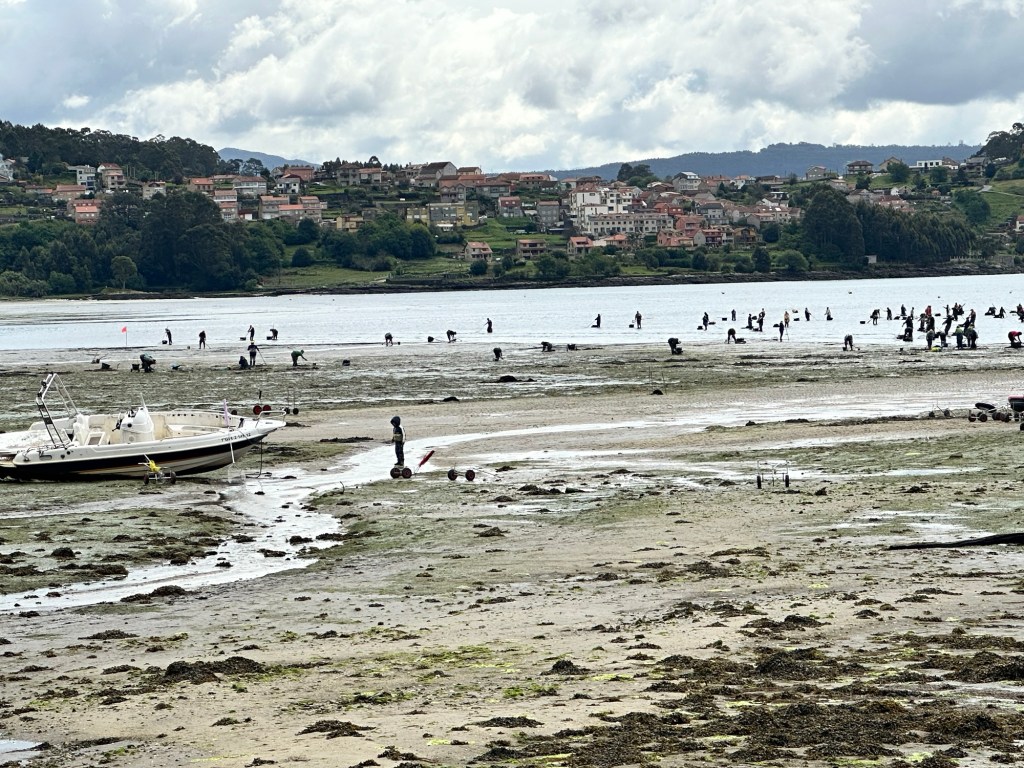
  • The optional excursion offered during our time in Santiago was okay. If you didn’t grow up by the ocean (I did), it might be great because you got to watch locals digging up clams and mussels, something my family did on a regular basis. The lunch was fantastic and although I was glad I went, if you can only choose one optional, I would recommend the one in Portugal if you are a walker and love nature.
  • After the optional trip, we returned to Santiago in time to visit the Pilgrim Museum, which had been closed the day before. Unfortunately it was closed again, for unspecified “technical” reasons. Too bad, because the members of our group who didn’t take the optional, visited the Pilgrim’s Museum that morning and said it was worthwhile.
  • It was way too cold to use an outdoor pool, and although the Lemigo hotel had an indoor pool, you had to pay 20 Euros per person, per day to use it (and the gym). None of us thought it was worth it. The outdoor pool is free and lovely, so if you go when the weather is warm, it might be worth packing a bathing suit.
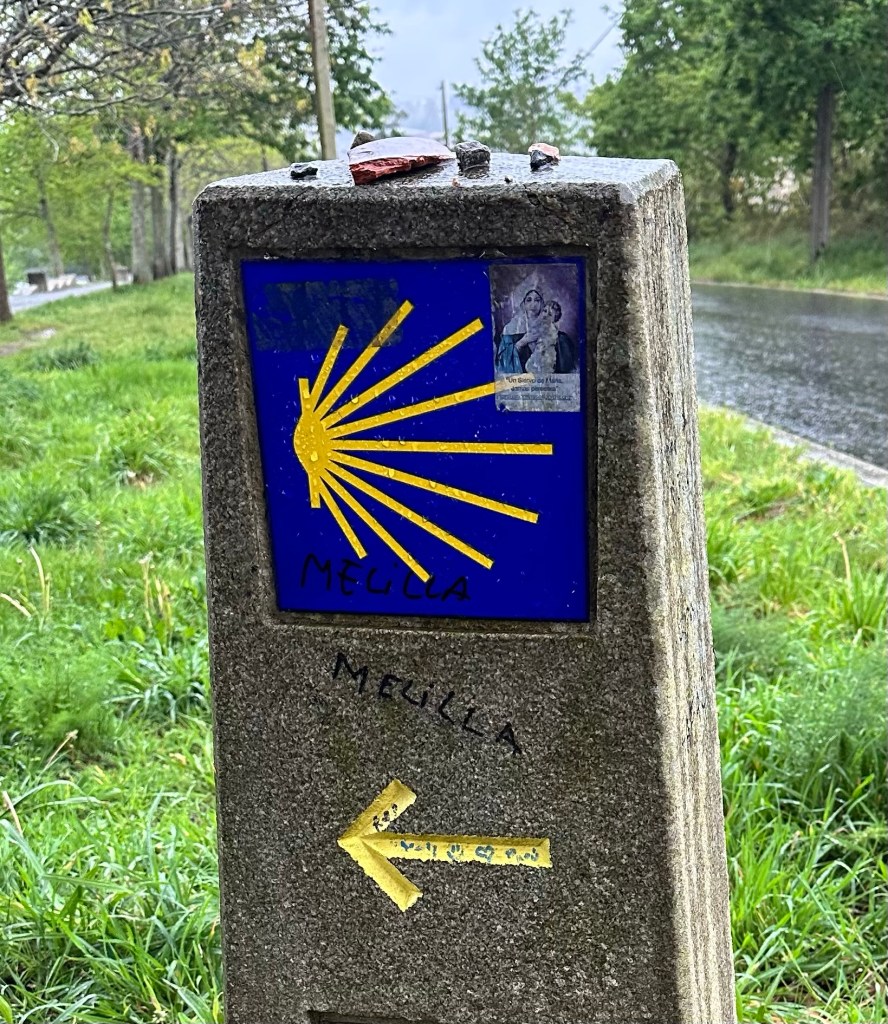
  • Be sure to get your Pilgrim’s Passport stamped! Mine is the header of this post.
  • Portugal was fantastic! Because Porto has been discovered, you may want to make dinner reservations while you are still in Spain. Check with your TL to make sure you have the correct schedule, because sometimes the TLs have plans that are not part of the official itinerary.
  • My post about Porto provides the name of a wonderful restaurant close to our hotel. Rather than repeat what I wrote elsewhere, just click on the link to get the name of the restaurant and other sights that you can do in your free time. It also includes a description of the optional trip.
  • I wasn’t able to visit the Porto Library because it requires tickets for the timed entry, and no tickets were available while we were in Porto. Two of our traveling companions stayed an extra day in Porto and were able to visit the library. Based on their photos, it was quite wonderful!
  • I thoroughly enjoyed the WOW Museum complex. I bought a day pass for 40 Euros because I wanted to visit three museums and separate entries were each 20 Euros.
  • I have done posts for each place we visited, so if you want more info, check out the post that interests you. Those posts include photos.

Happy travels! Next trip is in June.

Santiago de Compostela

I didn’t know until I got there that Galicia normally gets an abundance of rain, which is why it is such a lush, green region. I THOUGHT I was adequately prepared for wet weather, because I had packed two hooded jackets, fleece lined pants and silk long underwear, but I forgot the most important item: zapatos impermeables (waterproof shoes). Luckily, our hotel was across from a sports store that carried waterproof sketchers in my size. Prior to that purchase, however, (as I mentioned in an earlier post), we walked the last five kilometers of the Camino in a downpour. Let me tell ya, medieval cobblestone streets retain lots of water between those rocks!
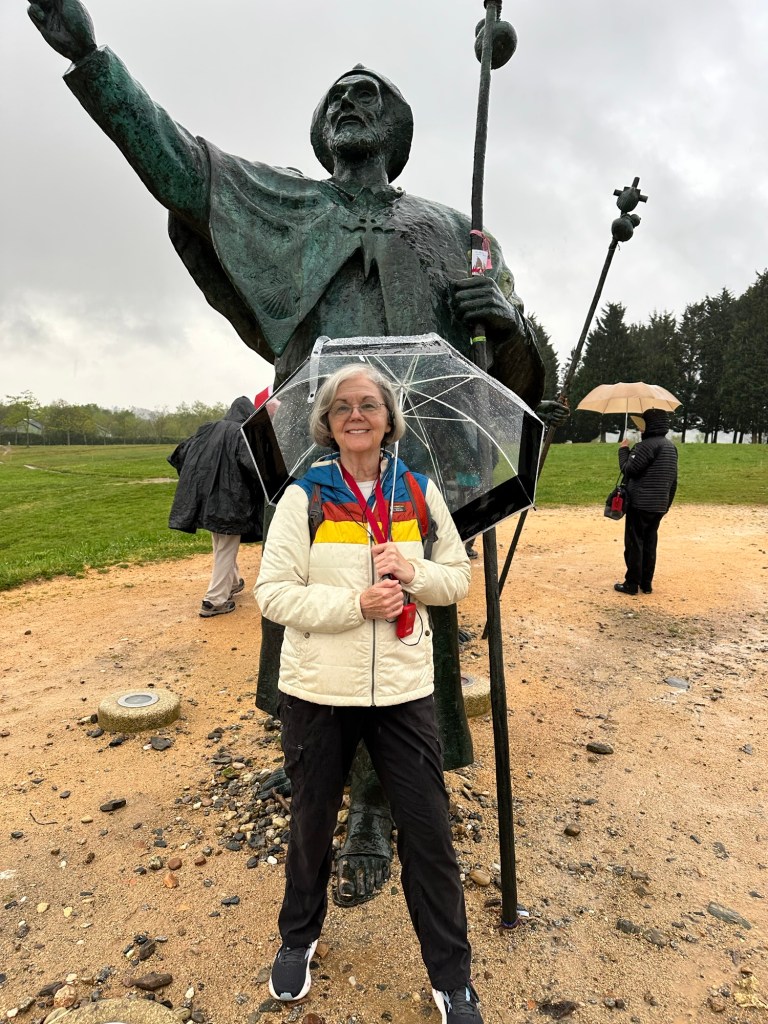
I bought the umbrella in Bilbao when my luggage was lost.

I had the full Pilgrim experience; I was soaked and completely miserable. It was definitely NOT one would consider a spiritual feeling. By the time we got to the hotel, my feet were so wet, I had to dry them with a towel. On a positive note—the hotel had a heated towel bar in the bathroom, but sadly it only functioned between 7 and 11 pm. Still, that was long enough to dry out my sodden socks, clothes and backpack.

If someone forced me (at gunpoint) to choose between walking El Camino or running with the bulls, that day I would have taken my chances with the bulls. (I would have carefully chosen a stretch that allowed for a speedy exit.) But, then again, if I had done so, I would not have earned the right to sport one of these lovely pilgrim tattoos.

Before this trip, I had thought that there was ONE El Camino. NOW I know there are several: The French, the Portuguese, — we walked segments of both—the Via de la Plata (silver way), the Camino del Norte, the Primitive Way, to name a few. Regardless of which Camino you select, the destination is the same, the Cathedral of Saint James (Santiago).

Beneath that yellow umbrella is our local guide, Marian, regaling us with the legend of St James. WE were a shivering mass, huddled together under a nearby portico.

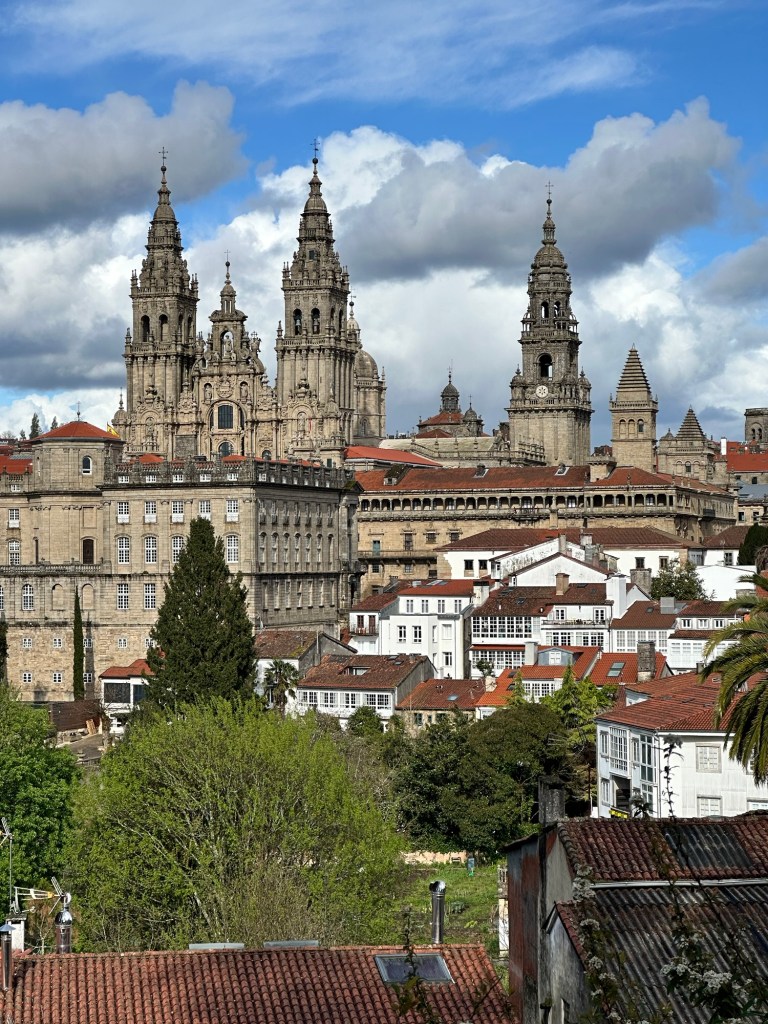
The cathedral from a different vantage point, a public park. Photo taken in between showers.

With all the wind and rain, I couldn’t take notes, so I’m operating strictly on memory. Here’s the part of the legend that I recall: a peasant (fisherman? shepherd? Some random guy?) in the first century (around 820 AD) saw a light shining down from the heavens several nights in a row, in the exact same spot. He recognized it as a message from God instructing him to dig, and when he did, he discovered the bones of a skeleton who had been beheaded. The church leaders made a rather large leap of faith and deduced that since St James had been beheaded, the skeleton must be that apostle. Over the ensuing centuries a cathedral was built and over time, the city of Santiago de Compostela grew around the cathedral.

Back then, pilgrims made the journey for religious reasons, to get a plenary indulgence (skip purgatory) or to avoid jail time. Yes, you read that right. Marian explained that people who committed minor crimes back then were given a choice…walk several hundred miles or go to jail.

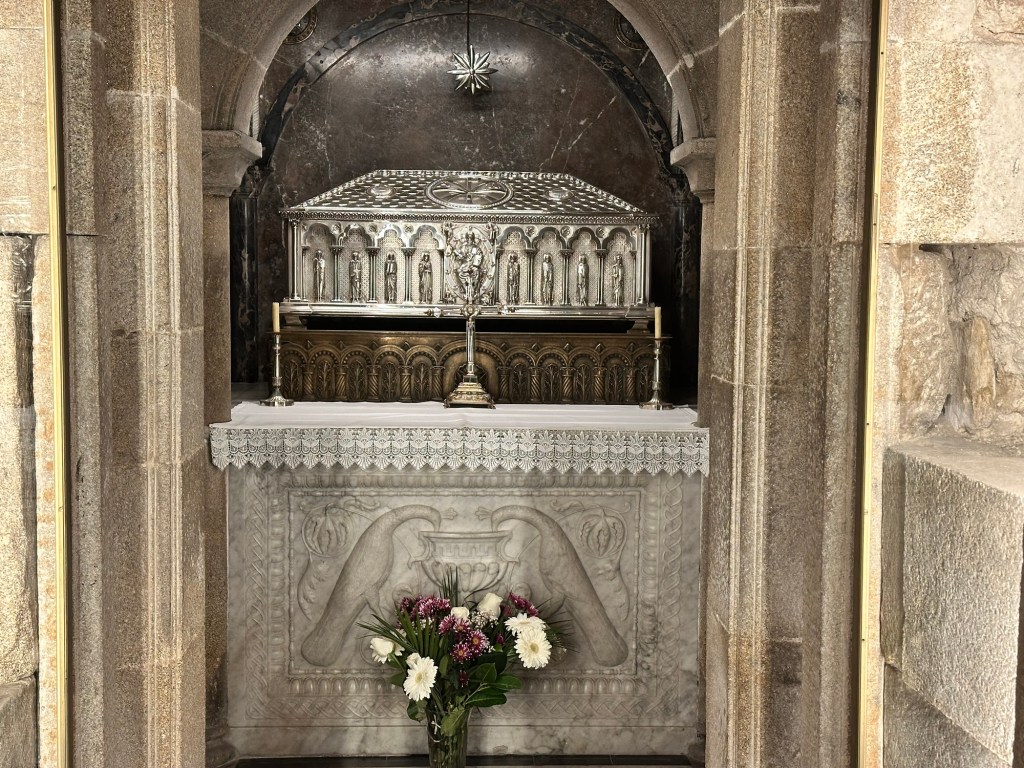
Fast forward a few centuries—today’s visitors can view this silver box that contains what the faithful believe is St James bones,

and can admire the cathedral’s beautiful interior.

My cell phone’s zoom isn’t very powerful, so I’ll describe the central image of the main altar. It’s St. James, riding a horse and brandishing a sword, which wasn’t exactly how the apostles were described in the Bible.

Santiago’s old town is a maze of narrow cobblestone streets, filled with restaurants, bars and souvenir shops, so after our first day in Santiago, I’d seen enough of the city. I welcomed the opportunity to spend the day in Pontevedra and Combarro on an optional trip OAT offered.

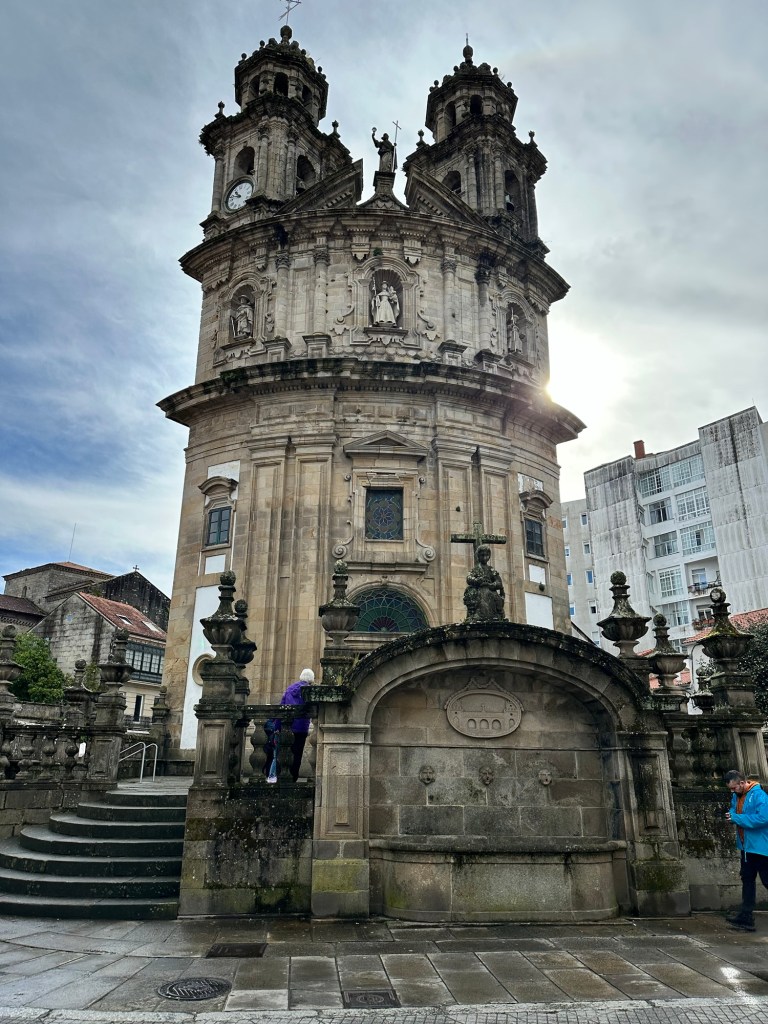
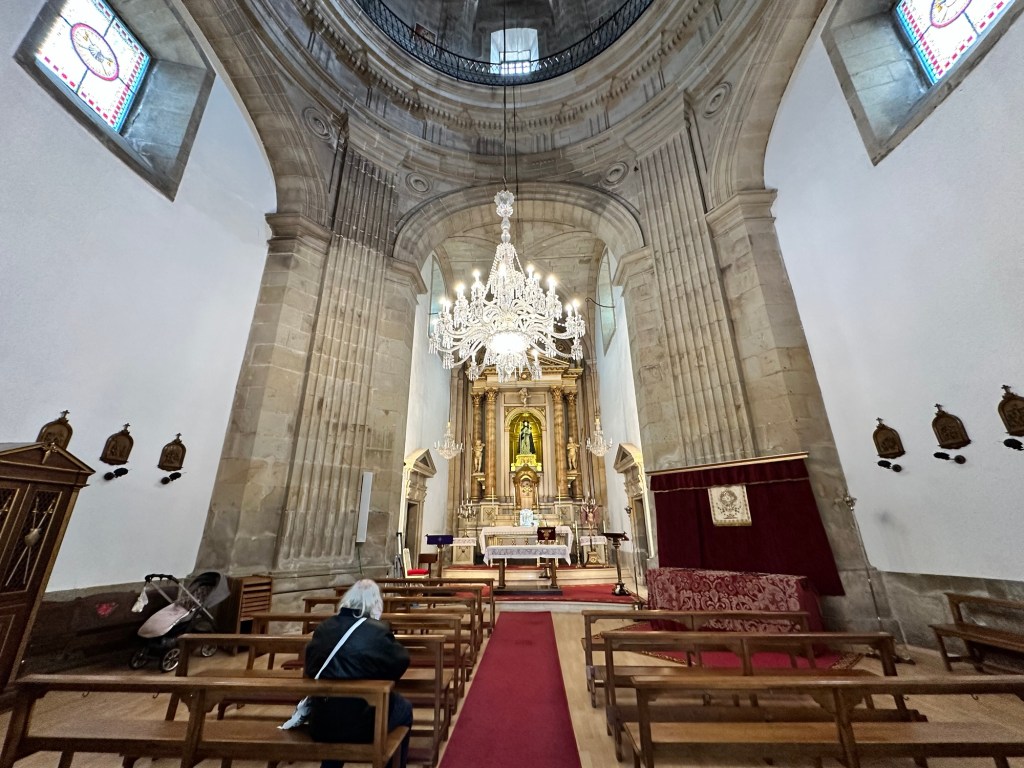
Pontevedra, founded by the Romans, gave us a break from the crowded streets of Santiago. It is also the site of an unusual church, with a floor shaped like a scallop shell. Or so I was told.

I’ll be honest. The church was clearly round, unlike any I’ve ever seen before. But I wasn’t able to pick up any resemblance to a scallop shell in the interior. Take a look. Maybe you’ll have better luck.

Despite the intermittent showers, it was a delightful day.

Combarro reminded me of Southeastern Massachusetts. I recall watching Sandy, my sister, digging up clams and quahogs with her toes in Mattapoisett bay.

Here in Combarro, it’s a highly regulated business, with strictly enforced limits on what can be harvested.

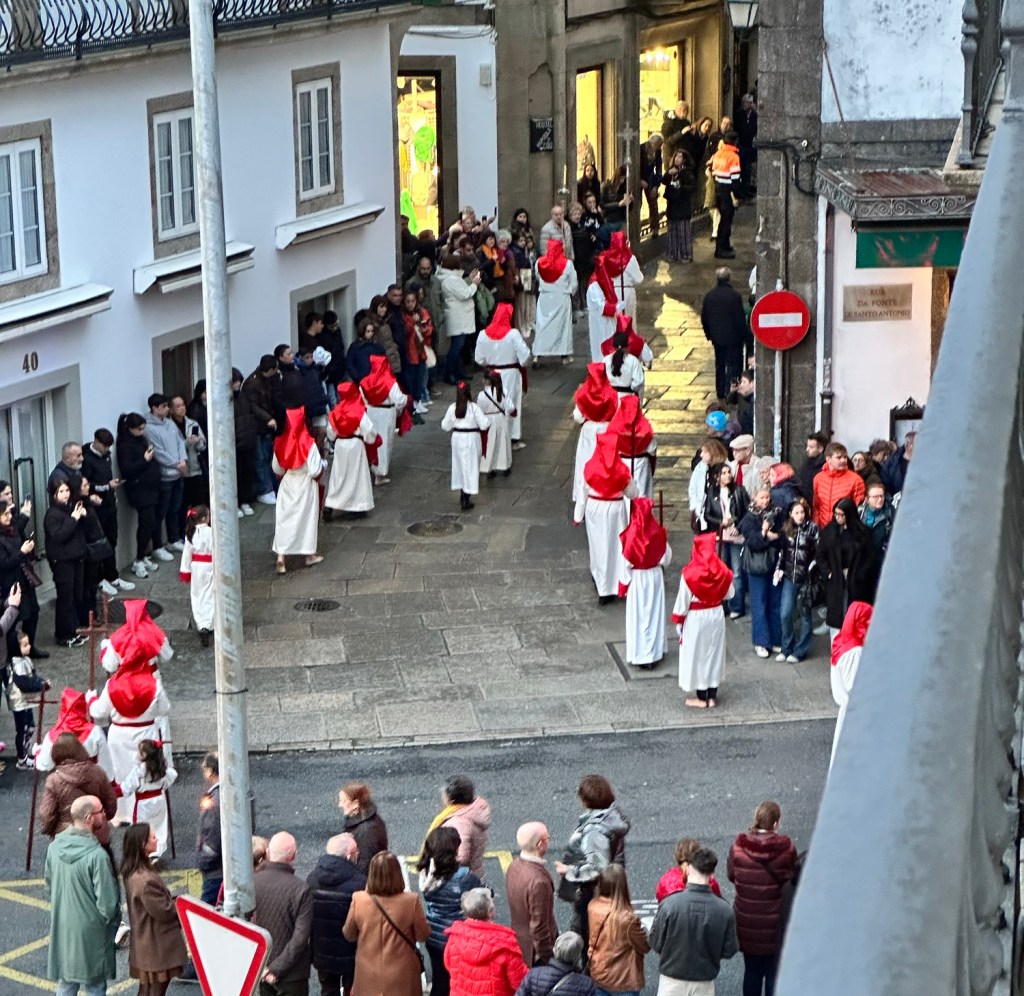
Our day ended with a pleasant surprise—a procession outside our hotel. I was already in my jammies, but when I heard the drums, I dashed onto my balcony to take this photo.

Fortunately, our trip leader was on the street and sent us a video.

Is it just me or does that statue of Jesus make it look like he needs a foundational garment?

Next stop, Portugal for 5 days, then home.

Stops Along the Way

One of the many reasons I absolutely love traveling with OAT is the company finds experiences I would never have discovered on my own.

For example, en route to León we made two delightful stops. The first was at an archaeological lab in Ubide, where Michaela, an Australian osteoarcheologist, fascinated us with stories about her dig at the Roncesvalles burial pit.

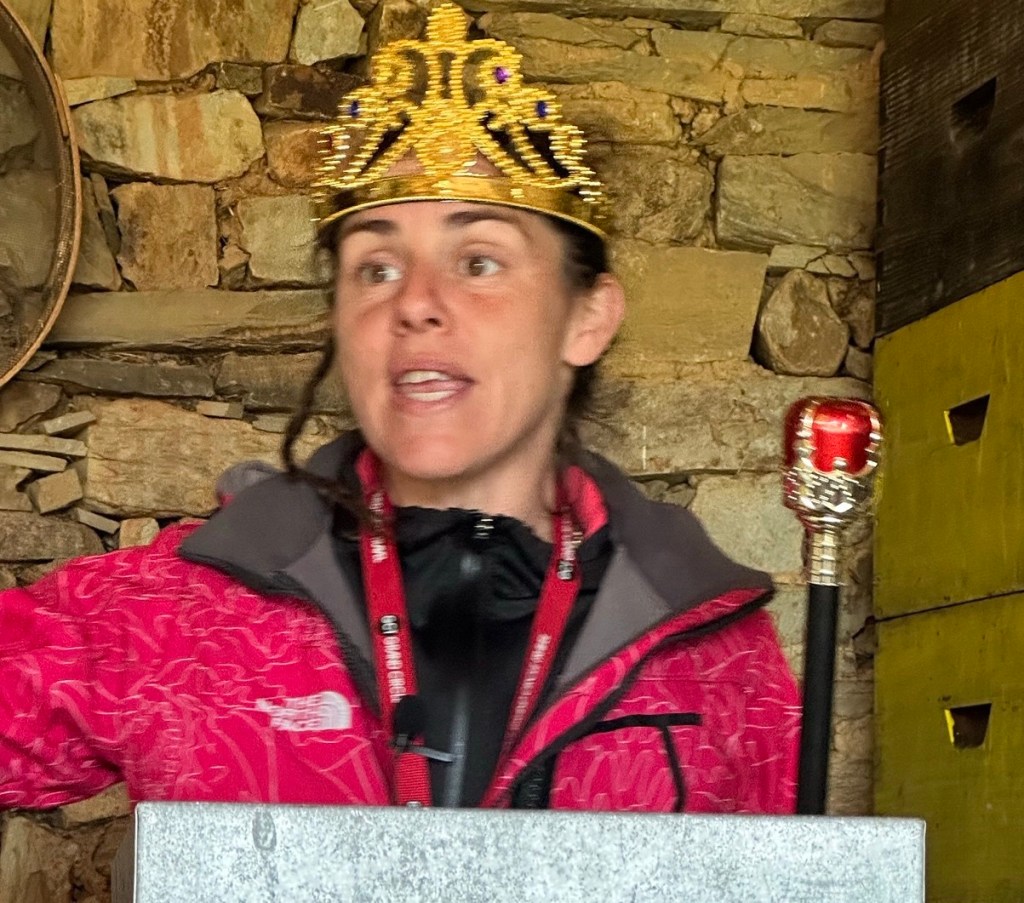
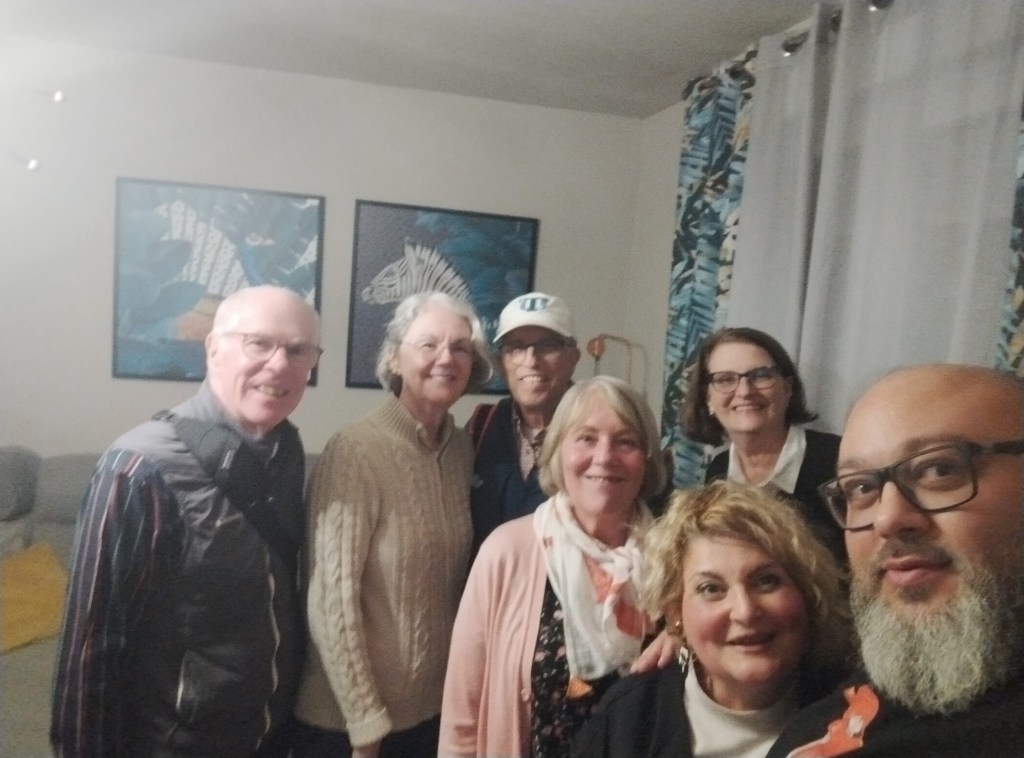
Can you figure out which one is Michaela?
Hint: she doesn’t have gray hair.
She’s in the back row, directly behind me.

It was truly amazing how much can be learned from bones. So far, they have dug down to the level of the Napoleonic wars, where they found an older soldier, whose jacket was used as a shroud. His jacket’s button is shown in the top right of the following photo. Can you see the Spanish word “Rey” (king)?

Because of his skeleton’s position in the pit, his age, his wound and the button, the archaeologists deduced the bones belonged to a high ranking member of the Spanish army who died fighting against Napoleon.

When the archaeologists reach the bottom of the pit, legend has it they will find a horse, a horn and the exploded head of Roland, a member of Charlemagne’s army, who was immortalized in the “Song of Roland”.

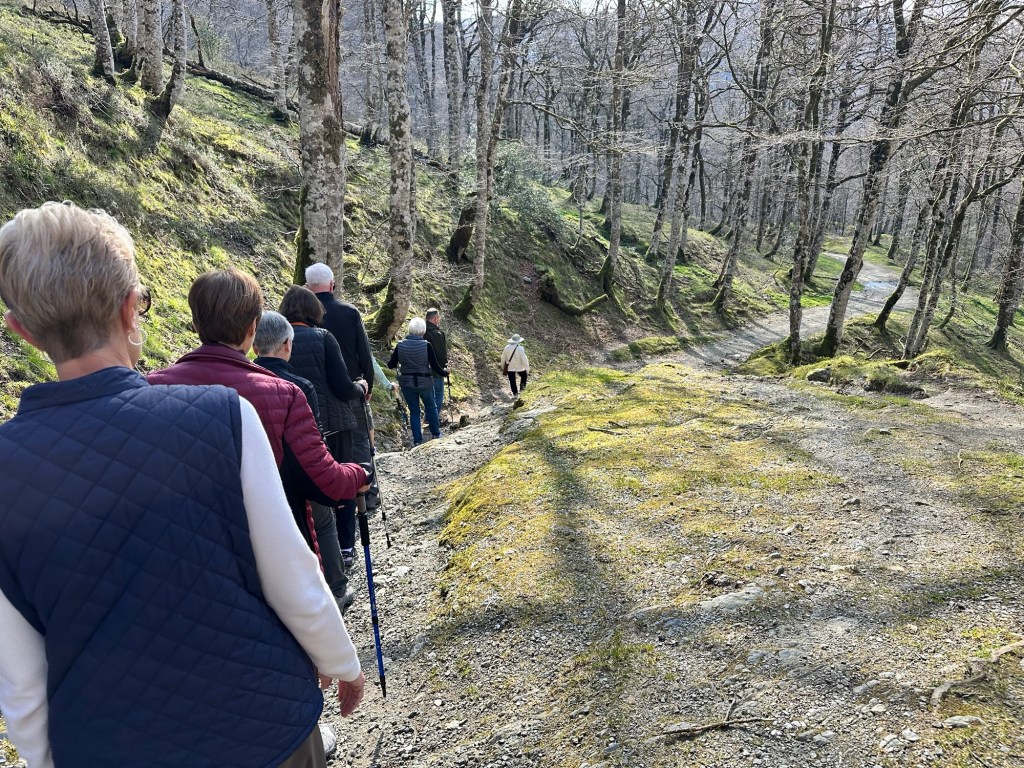
After he sacked Pamplona, Charlemagne headed back to France, using the route we followed through Roncesvalles (now part of El Camino). As you can see, the path through the forest is very narrow, so the soldiers had to travel single file, making them easy targets for the more than slightly annoyed Saracens.

For those of you who never read “The Song of Roland” and have no desire to ever do so, here’s the scoop. When Roland sounded the horn to warn Charlemagne of the attack, he blew so hard, the legend claims that he literally blew his brains out.

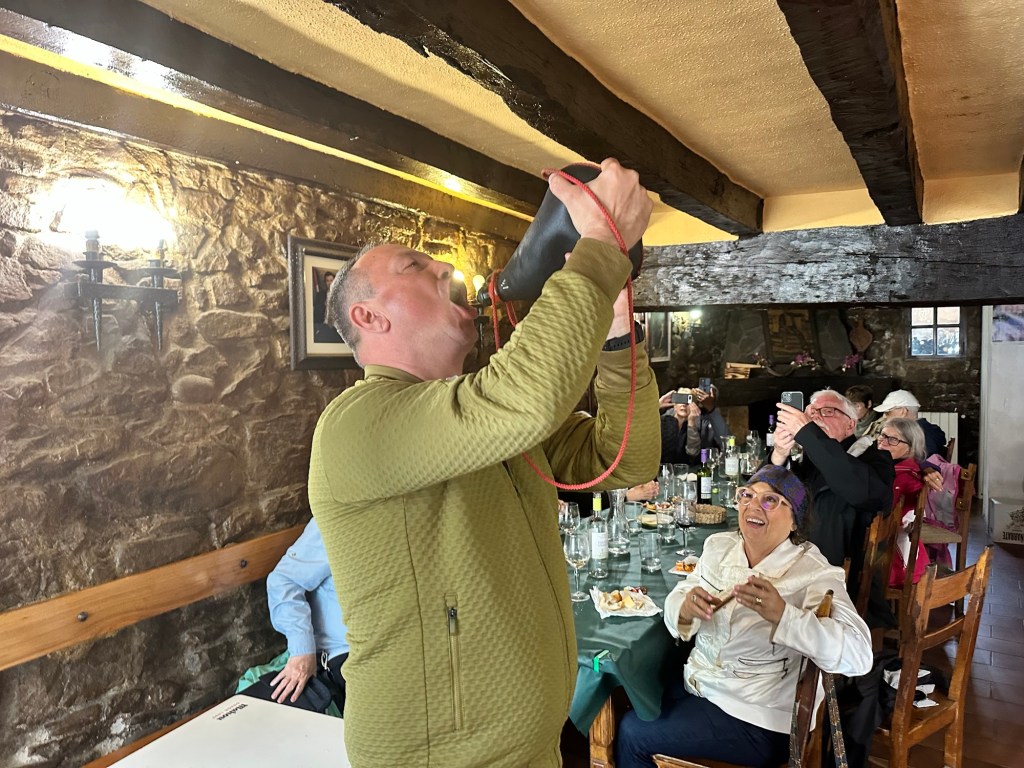
Our lunch was at a charming tavern along our route. This trip IS turning me into a “day drinker”, but it hasn’t come to THIS, at least not yet.

Shahin, demonstrating how to shoot red wine directly into your mouth

We were able to walk off some of our lunch’s calories when we reached the next stretch of our “El Camino” experience. This time, we walked through the medieval village of Castrojeriz, population about 100.

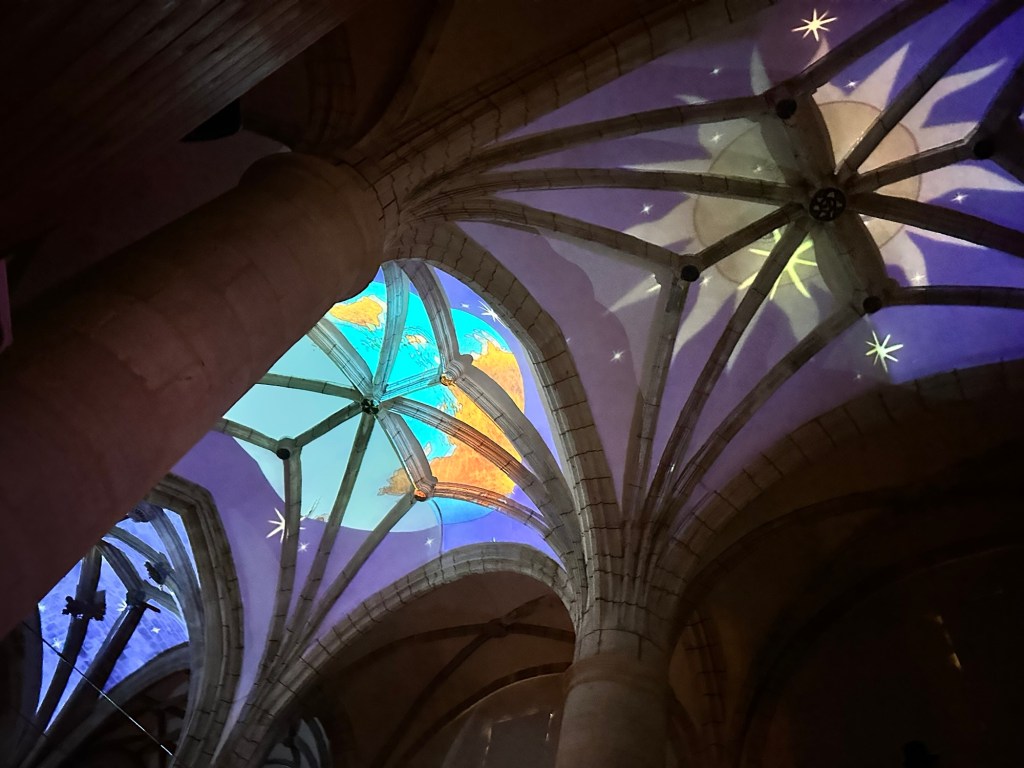
Had I been on my own, I would have walked right by this church and missed its amazing multimedia shows, including the story of creation, which was projected onto the ceiling.

If we were REAL pilgrims, walking El Camino, it would have taken us anywhere from three to about seven days to walk from León to Santiago. Instead, the 3.5 hour bus ride took us a day, because of our multiple stops.

The first stop was in Astorga, to view the castle and cathedral designed by Gaudi.

Unfortunately, the building didn’t open until 10, so we weren’t able to go inside, but don’t you agree that the outside was pretty spectacular?

The entrance to the palace is on this side. Can you believe the number of windows?
On the left (barely visible) is the cathedral.

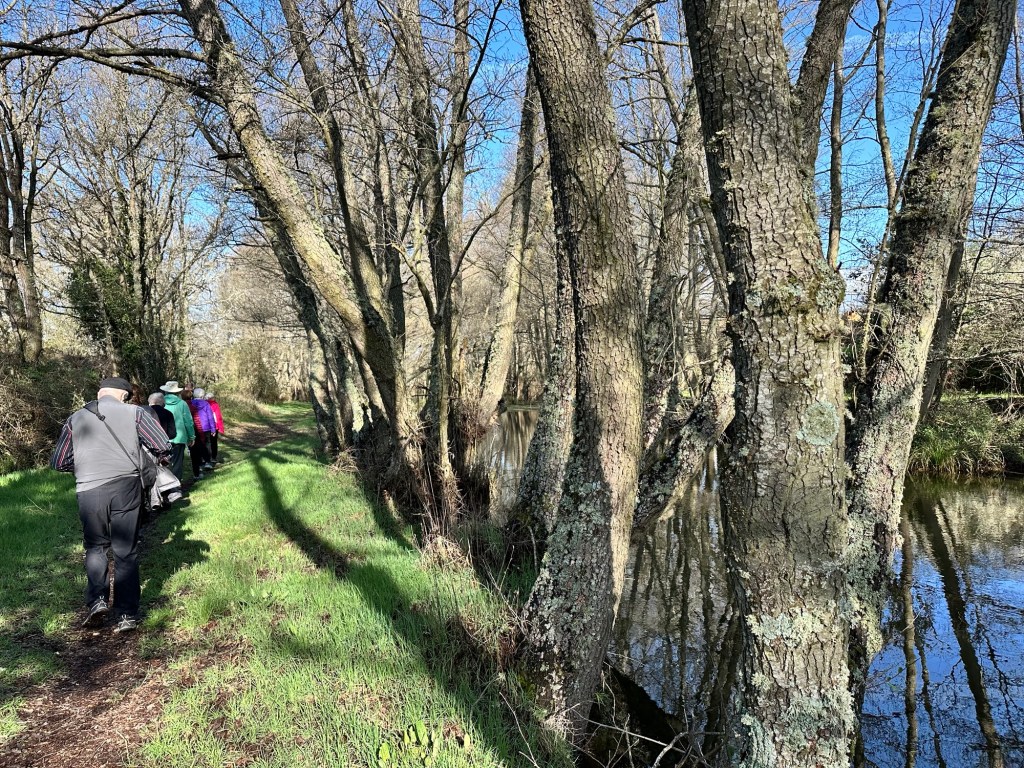
We weren’t able to linger because we didn’t want to be late for our visit to the beekeeper. To get to there, we strolled along the river for about a half a mile.

This very animated and entertaining young woman gave us the adult version of her presentation for school children.

Did you know that you should never put honey in the microwave because it destroys the beneficial enzymes? Or that you should never use a metal spoon to remove honey from its container— only use wood? (sorry, I don’t remember the reason).

After all that learning, we were ready for lunch in the village.

This building dates back to the 1750’s; it was the home of a merchant who conducted trade between the coast and León.

We were very fortunate to have such great weather during this area’s rainy season.

But our luck was about to end. For the last stretch of El Camino, we had an “authentic” pilgrim experience. We walked to the cathedral in a downpour.

That smile on my face was VERY short lived. I neglected to pack waterproof shoes, so by the time we finished our 5 kilometer walk and got to our hotel my shoes, socks and all 10 toes were soaking, sopping wet. Good thing I know how to say “I want to buy waterproof shoes” in Spanish!

Looks like the weather goddess is sending more of the same for our time in Santiago and Portugal. But at least with my new 100% waterproof Sketchers, my feet will be dry!

After the day we had, we decided we all needed at least one glass of wine — perhaps more. How lucky am I to be with such a great group of people!

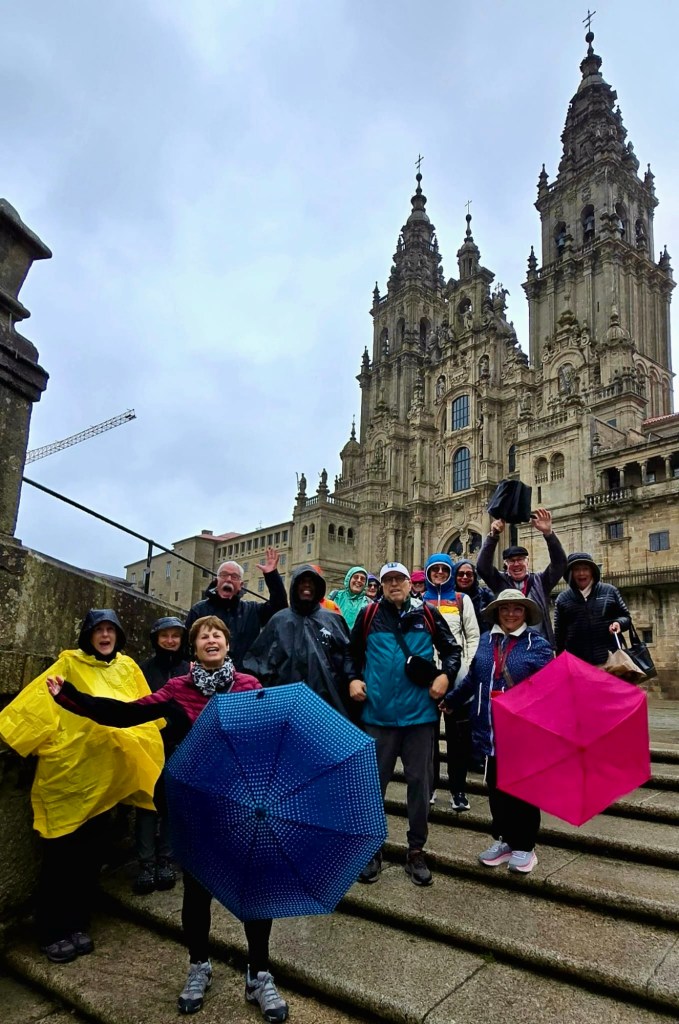
Briefly, the rain stopped, allowing Shahin to take this group photo.

San Sebastián, Pamplona and Roncesvalles

If you think this post is covering a lot of ground, you’d be right. In just two days, we have visited three very different locations! The header of this post is a photo of the group as we started our walk on el Camino, but I’m getting ahead of myself. Before that…

En route to Pamplona, we stopped in the charming seaside town of San Sebastián.

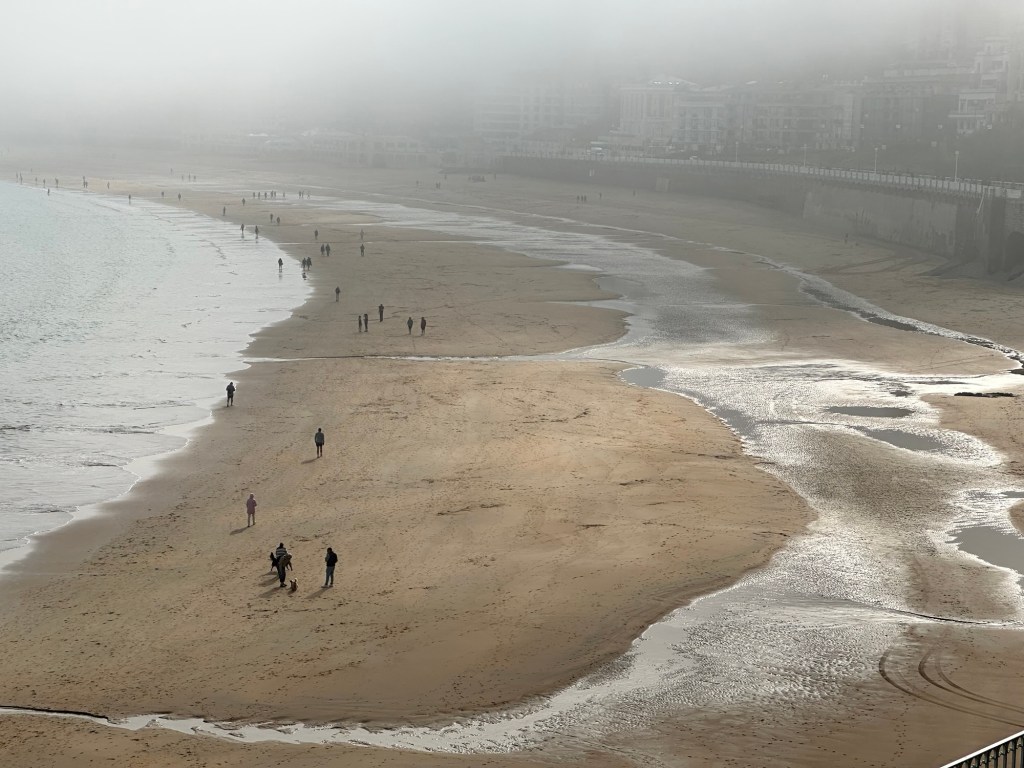
Although the morning started out cloudy, before too long, the mists disappeared, just in time for us to thoroughly enjoy our walk along the beach.

The Miramar Palace, where former kings and queens spent their summers, overlooks this big, beautiful beach, and is now an events center for weddings and conferences.

I’ve seen elaborate sand sculptures, but this was the first time I saw sand “art” being created.

We had just enough time in San Sebastián for a delightful multi-course lunch at The Morgan Kompany, ( no, that’s not a typo, and yes, it is a restaurant). I barely had enough time to find a Christmas ornament for my sister. It’s one of my travel traditions— to find something Sue can hang on her tree from every country I visit.

We arrived in Pamplona late in the afternoon, checked in to the hotel, then walked through the nearby gardens. Notice how clean everything is?

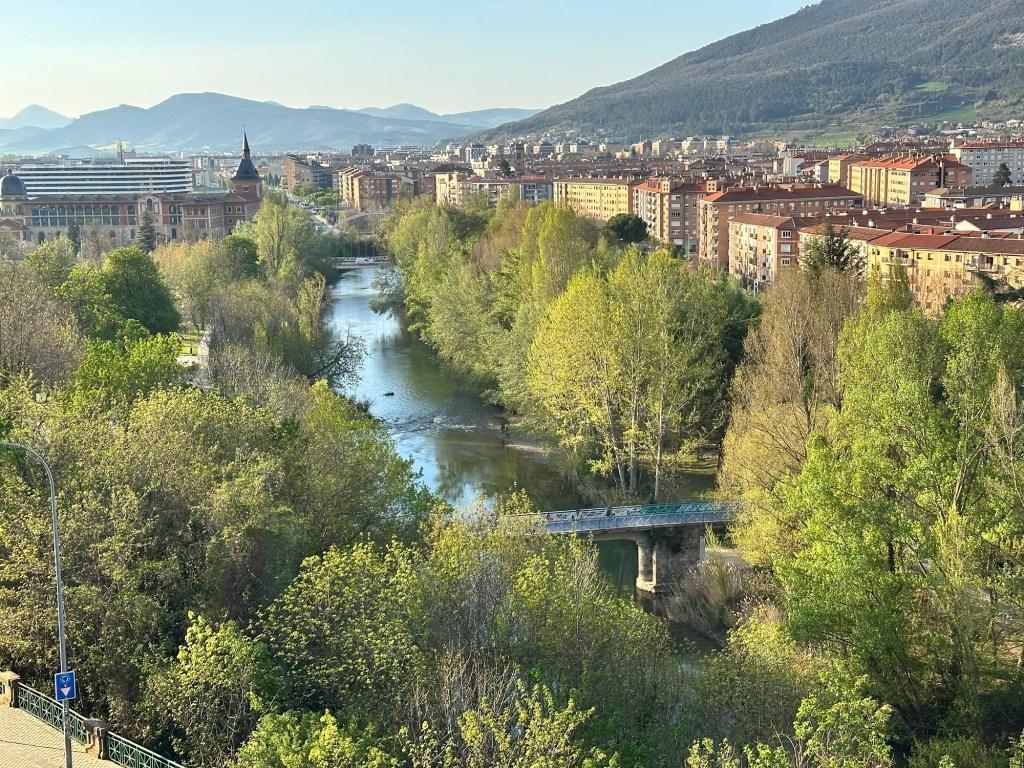
Our stroll took us to the city wall, where we were able to enjoy this panoramic view.

Spaniards eat dinner around 9 or 10 PM, which according to my American digestive system is FAR too late.

We didn’t spend much time in Pamplona, because the next morning we traveled to Roncesvalles, where we started our El Camino experience. The mountains in the background of the header photo are the Pyrenees which form a natural border between France and Spain. In that photo, some of us are holding our El Camino passports aloft. We collected three stamps on this walk.

I didn’t have a walking pole, so I brought my umbrella, which helped me cross a muddy, slippery stream.

For our last afternoon in Pamplona, we met Gonzalo,

who has run with the bulls multiple times. He finally hung up his running shoes after his injuries resulted in a 10 day coma.

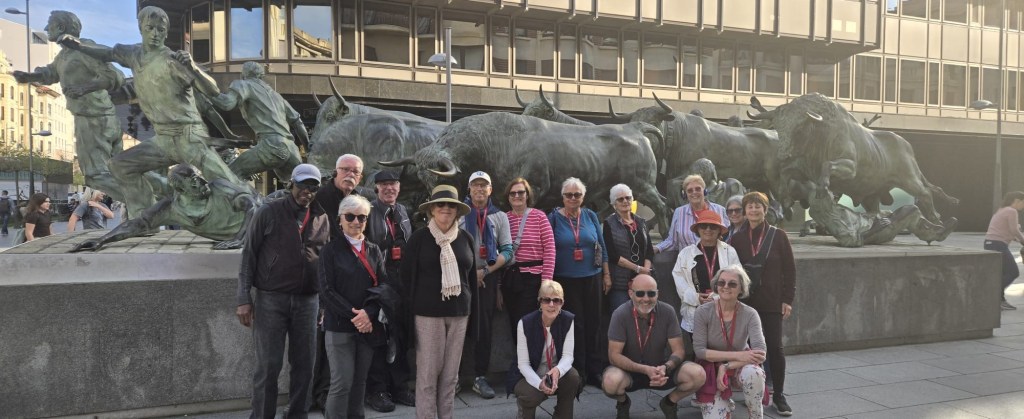
As we walked the half mile route from corral to bull ring, he filled us in on little known facts (at least to me) about the Festival of San Fermin. That’s the official name for the insane practice known as running with the bulls.

  • Six bulls per day do the run, accompanied by six steer ( castrated bulls)
  • The same six steer do the run for SEVEN consecutive days, but the six bulls change every day, because they get finished off when they reach the bull ring. This festival is the only time bull fights are held in Pamplona.
  • Before 7 AM, runners congregate in front of the statue of Saint Fermin (maybe he existed, maybe he didn’t) to sing a song three times at prescribed intervals before the bulls are released at 8 AM.
  • According to Gonzalo, runners need to arrive early to get a good spot for the run. If you are interested in viewing the madness, and hearing the song, here’s the link to the YouTube video. https://youtu.be/hDyQ0cUXk9g?si=rN20ZM45hAZ_CW_i
  • During the 7 day festival 42 bulls run. Each one costs between nine and fifteen THOUSAND Euros.
  • It takes the frightened bulls about two minutes to run the half mile route. No runner is fast enough to do the entire route, because once the bulls get in front of you, you’re done with the race.
  • If a runner gets gored or trampled all medical care is free. If you are NOT a runner and fall down because you’re drunk, you are responsible for the medical costs. And let me tell ya, there is a whole lot of drinking during those seven days!

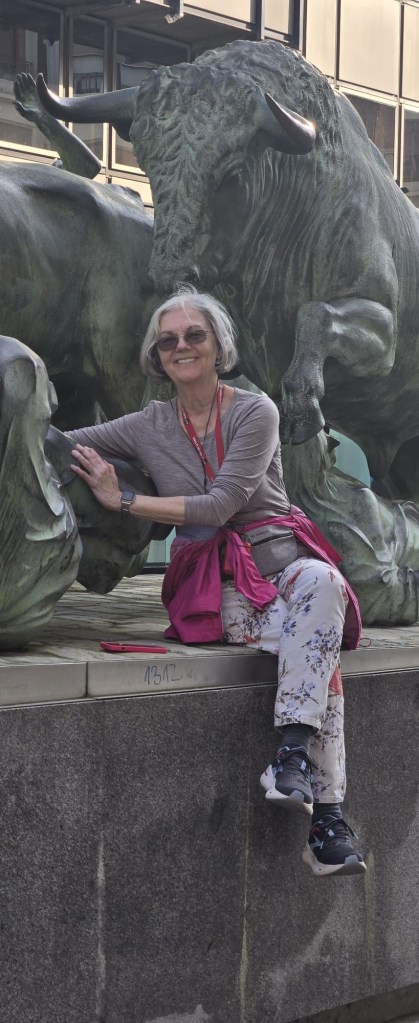
This is as close as I will ever get to a bull run, because I KNOW what would happen!

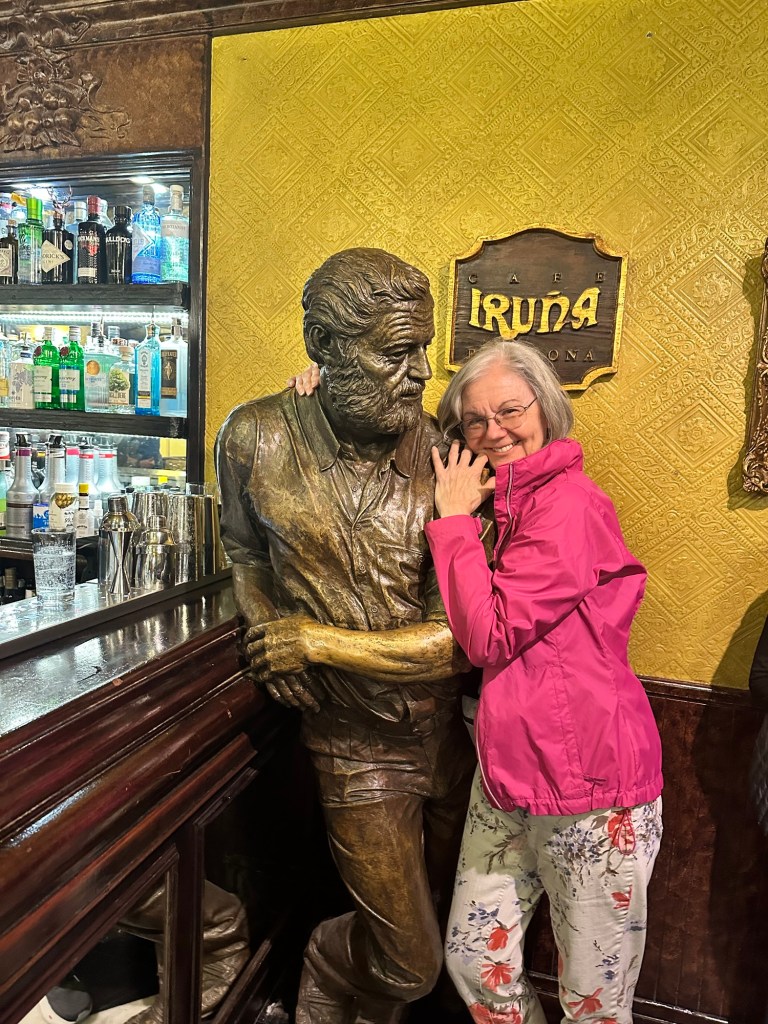
Our last stop was at Hemingway’s favorite bar, where we enjoyed churros and chocolate.

Yes, it was a VERY full day!

Bilbao and Guernica

When I told my friend (and of course by now, I’ve forgotten which one) that I was going to Bilbao, she said that she’d visited years ago and that it was “very industrial”. Indeed it was. Shipbuilding and mining produced so much pollution that, according to our trip leader, when his mother hung laundry out to dry, it would become gray tinged. But what a difference a couple of decades and a natural disaster can make.

In August of 1983, two weeks of torrential rainfall produced flooding that devastated the area. Fortunately, the city’s leaders were able to turn that disaster into an opportunity. They determined rebuilding would focus on what would benefit the entire community. They decided that emphasizing CULTURE and infrastructure would be the key to Bilbao’s future.

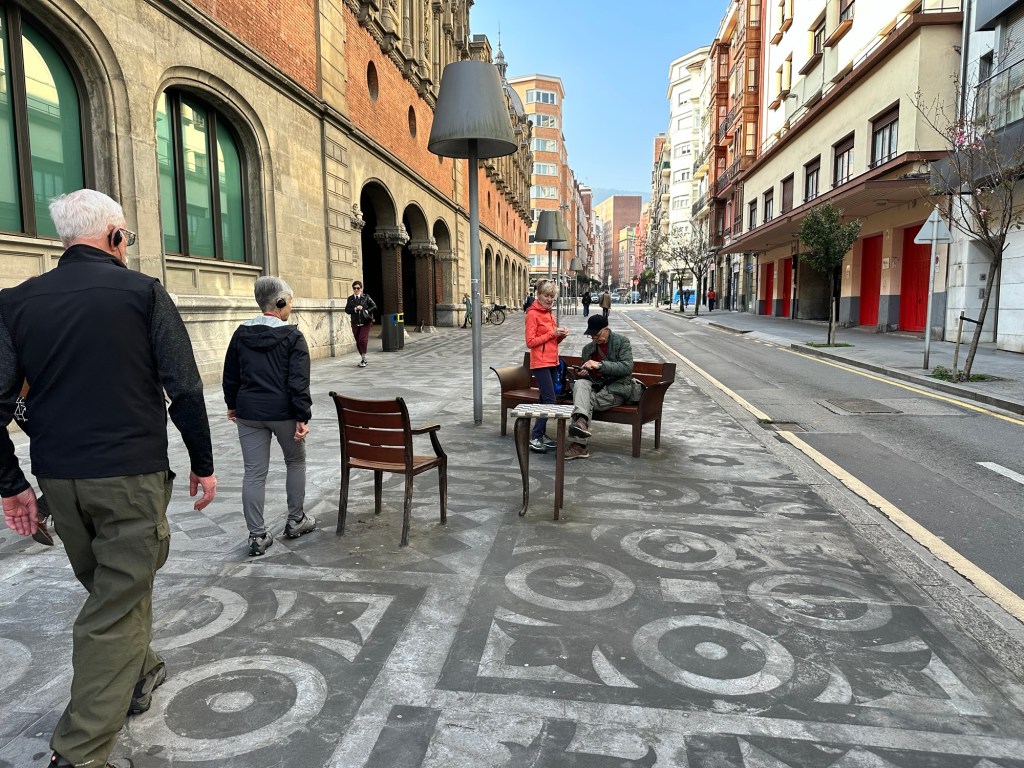
And what a magnificent city it is now! In addition to the wonderful green spaces and playgrounds mentioned in an earlier post, Bilbao also has a huge sports stadium, a concert hall, a metro, tram —and my personal favorite —an incredible building known affectionately as “the living room”.

The pavement leading to the entrance has been designed to look like a carpet. Notice the street lights resemble table lamps and the benches look like living room furniture.

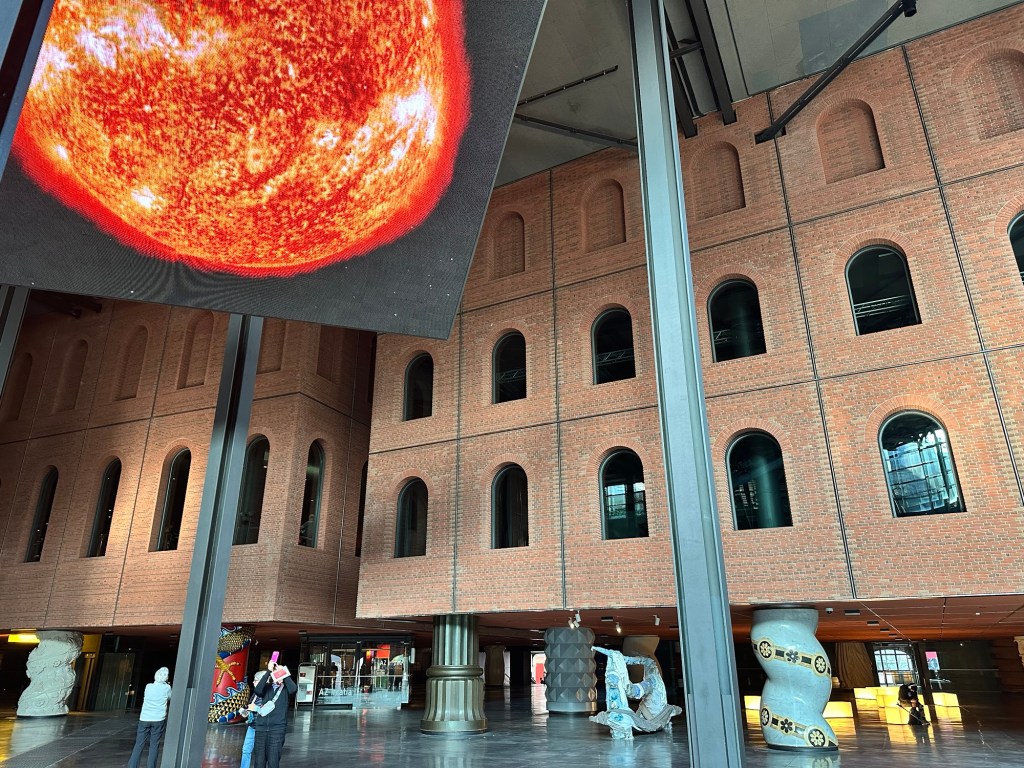
Originally built in 1909, the building was abandoned in the 1970’s and was almost demolished. Instead, it now is a “culture and leisure center” housing a gym, with a pool,

That’s the ceiling. If you’re on the ground floor, you can look up and watch people swim!

a library, an auditorium, a restaurant, showrooms, shops and in the basement (which we didn’t visit) a multiplex cinema.

Other notable Bilbao sights:

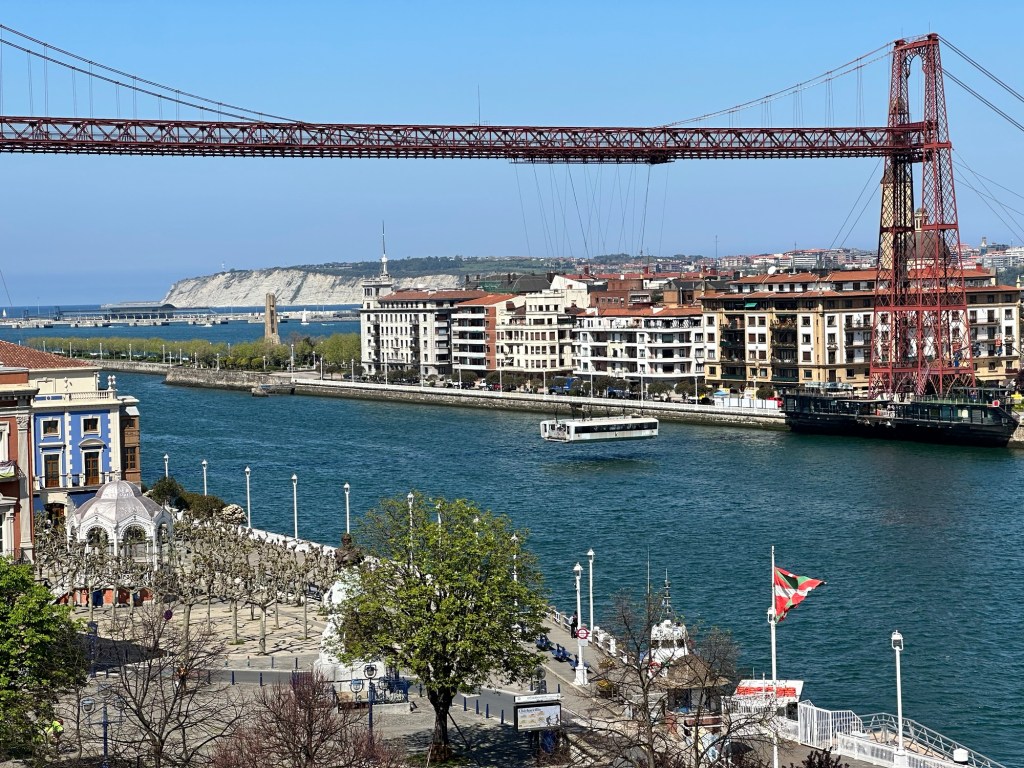
The Vizcaya Bridge was designed by one of Eiffel’s associates, Alberto Palacio

I was SO excited when our trip leader told us we’d be walking across this bridge. Elevators could take us to the top, so I was ready for the adventure. You can only imagine the depth of my disappointment when I realized he was just joking.

Instead we rode across on this “transporter. It dangled from wires attached to the structure that I thought we’d be strolling across. It skimmed just above the river. Later, we visited a cathedral atop a hill, from which we could view the mouth of the river, the Atlantic, and those cliffs.

This was not our only panoramic view. Later, we rode Bilbao’s funicular to a cafe where we enjoyed a glass of wine and this spectacular view.

The Guggenheim is to the left of the red bridge and in front of the skyscraper

I could have spent a whole lot more time in Bilbao, but the next morning, we walked through the city of Guernica, which was destroyed during World War II.

Our group in front of a replica of Picasso’s famous painting
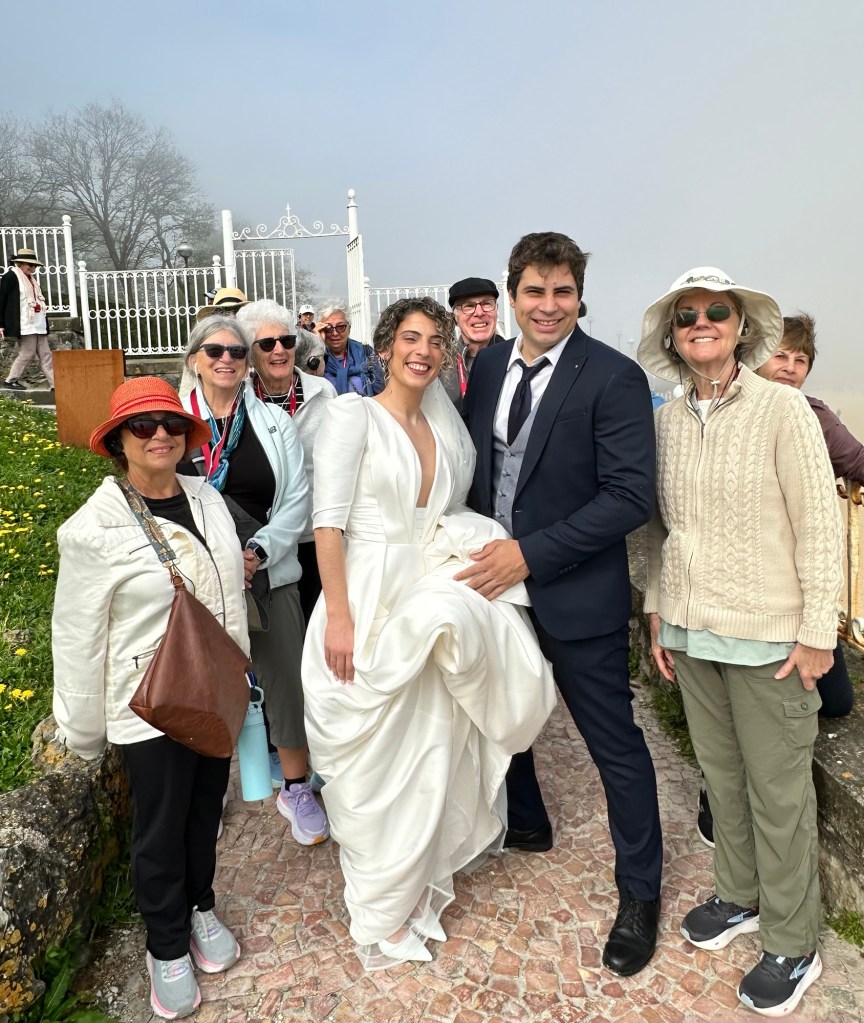
The latest recruit, ready to fight for democracy in her own country

Fortunately, we had “free time” in the afternoon, so most of us spent it inside the Guggenheim. The architecture is absolutely spectacular!

This in no way captures the grandeur of the space or my favorite piece, “Shuttlecock”

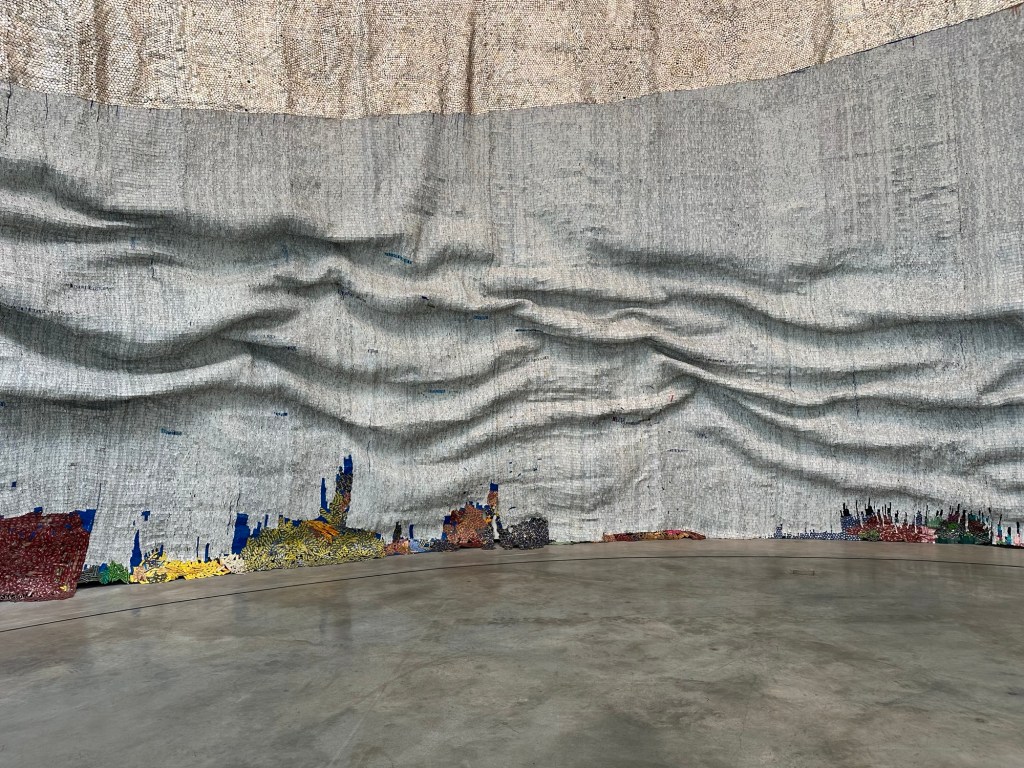
I also loved art made from “reclaimed” objects, like these pieces of cars,

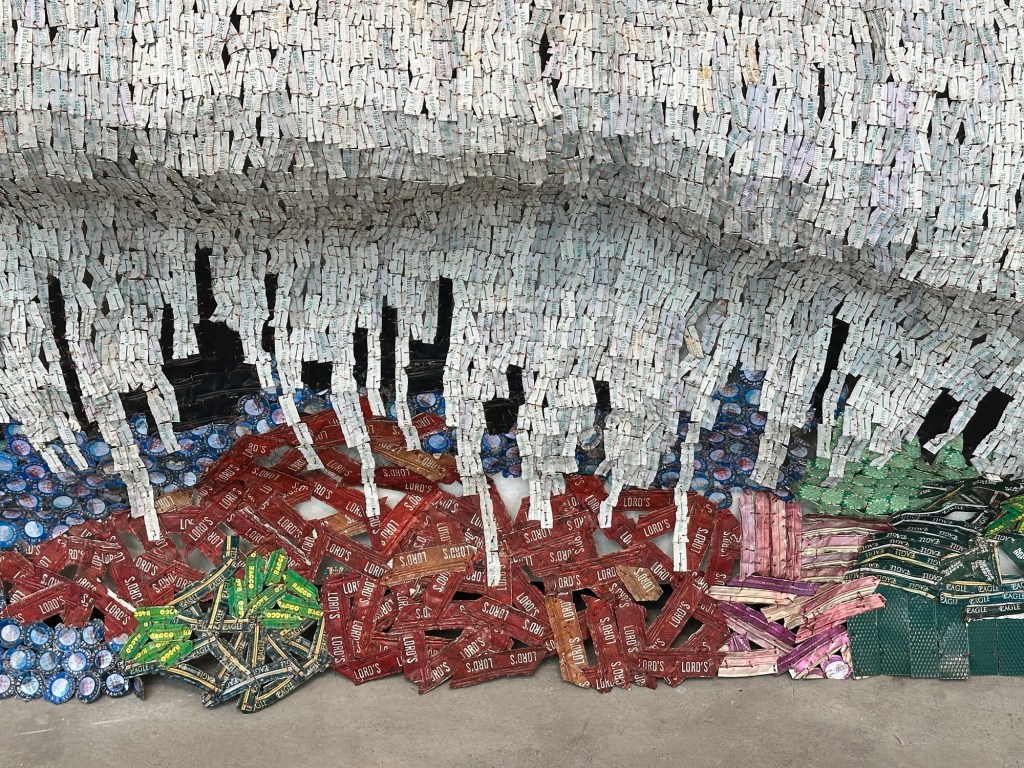
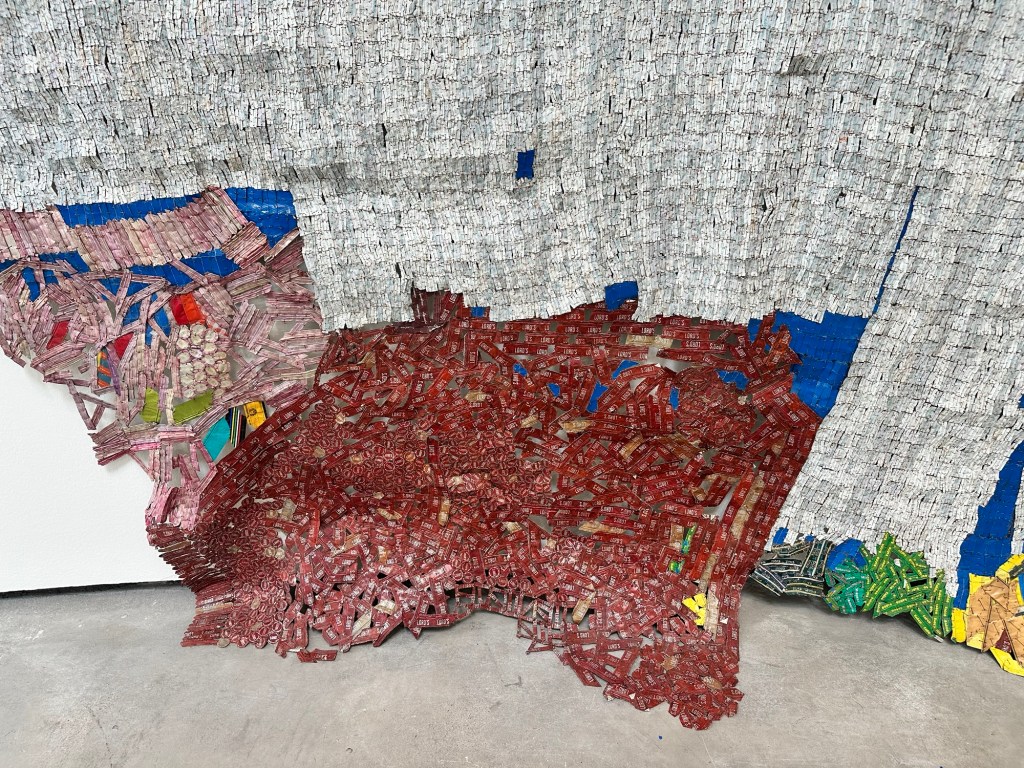
and flattened bottle caps with wrappers from liquor bottles

Here are some “close ups” of the piece so you can see the intricacies. It’s a WOW.

That evening, we broke up into three groups of five for a “home hosted” dinner.

Blanca and David were absolutely delightful hosts, and the dinner was spectacular. Although their English was at the level of my Spanish, we were able to communicate. I think the wine and the chocolate liqueur might have helped.

Later, I learned that Shahin put me in this group because he overheard me speaking to a tattooed Spanish biker that we met when we stopped to admire the Bay of Biscay. He figured that ONE of us needed to know a little Spanish. And in MY case, it is DAMN little, but it was enough.

We are on the bus now heading to Pamplona, with a stop in San Sebastián. It looks like our run of perfect weather is about to end.

Spectacular Seville

So what if it rains in Spain? Seville is still glorious! I LOVE this city. Yes, we did get caught in a cloudburst or two, or three, but that just made us appreciate the sun even more.

High winds prevented us from entering the Plaza de España at the scheduled time, but we got lucky.  As we were leaving Seville, JuanJo noticed that the plaza had been reopened, so off we went. Because we were there so early, we had the plaza to ourselves.

256A8C24-FB3F-406F-BB70-783D6A55D076

JuanJo explaining the significance of the tiles in the Plaza de España

What made Sevilla so wonderful?  Well, the city preserved the incredibly beautiful buildings from the 1929 World Exposition.  The architecture is beautiful— even better than Disney World!


D81CB76A-017D-4AFB-B361-3E39C9ADF5FB

For the history lovers, a visit to the Cathedral is a must.

25A5FF6A-984E-4C76-8B10-C0243FFB2D4E
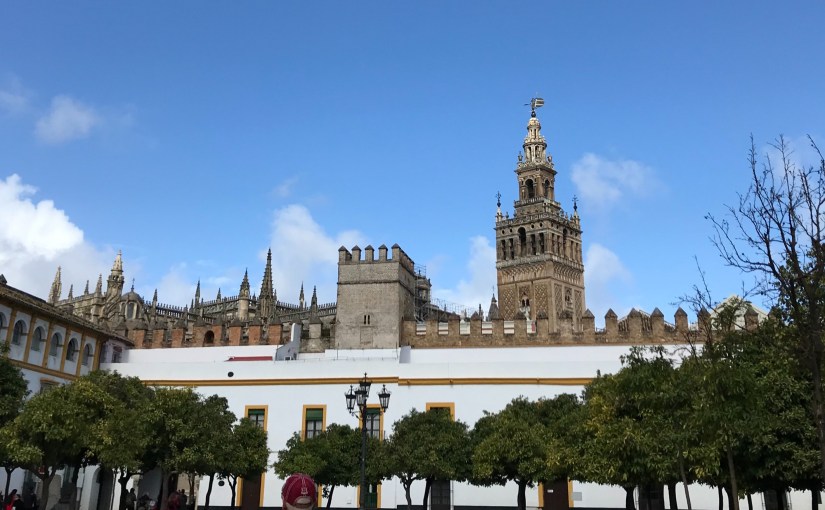
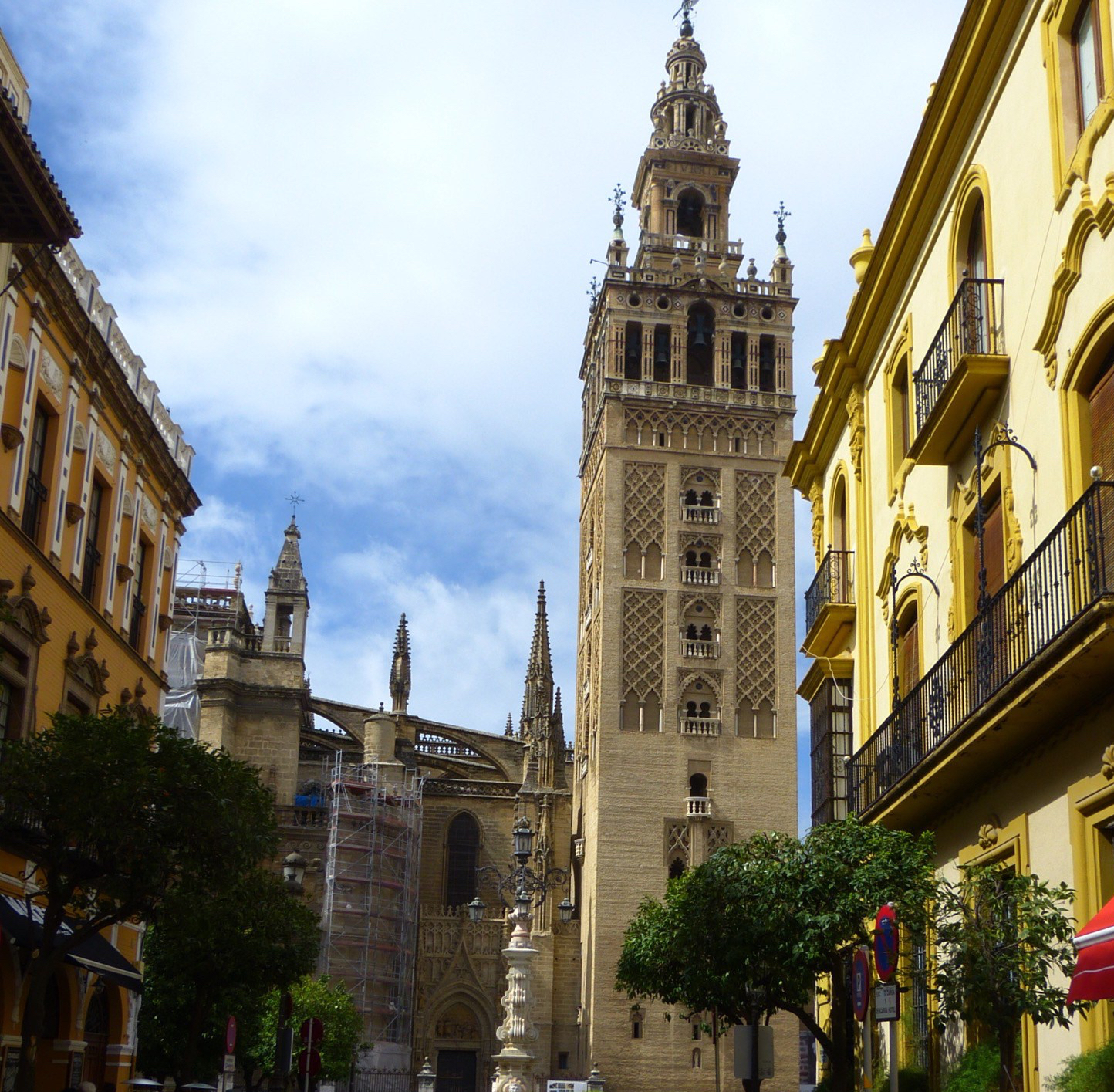
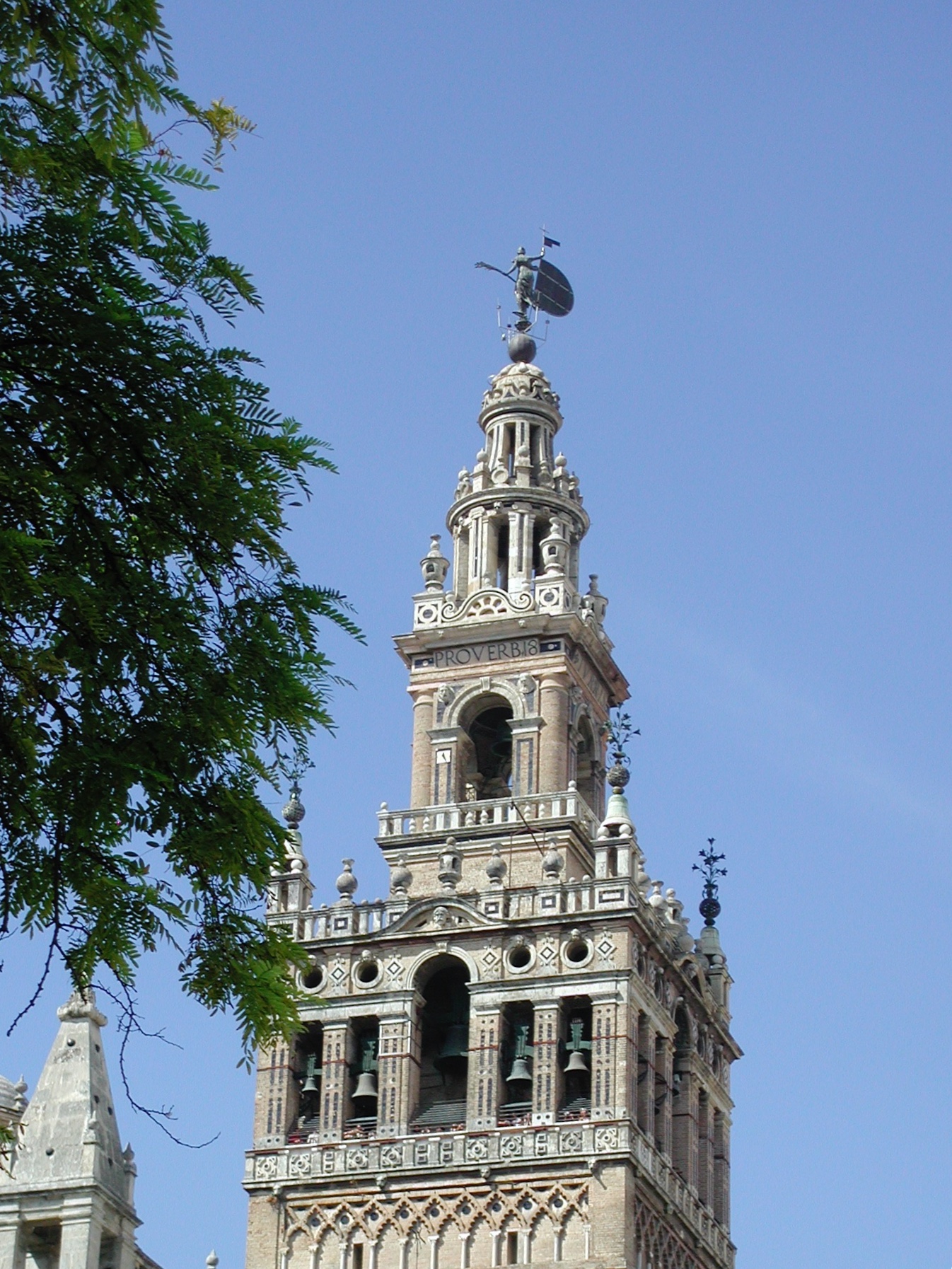
Yet another recycled mosque, with a minaret converted to  bell tower.  This one has a Phoenician goddess atop

419803B4-9E41-4605-83B1-45A2D28ADD50

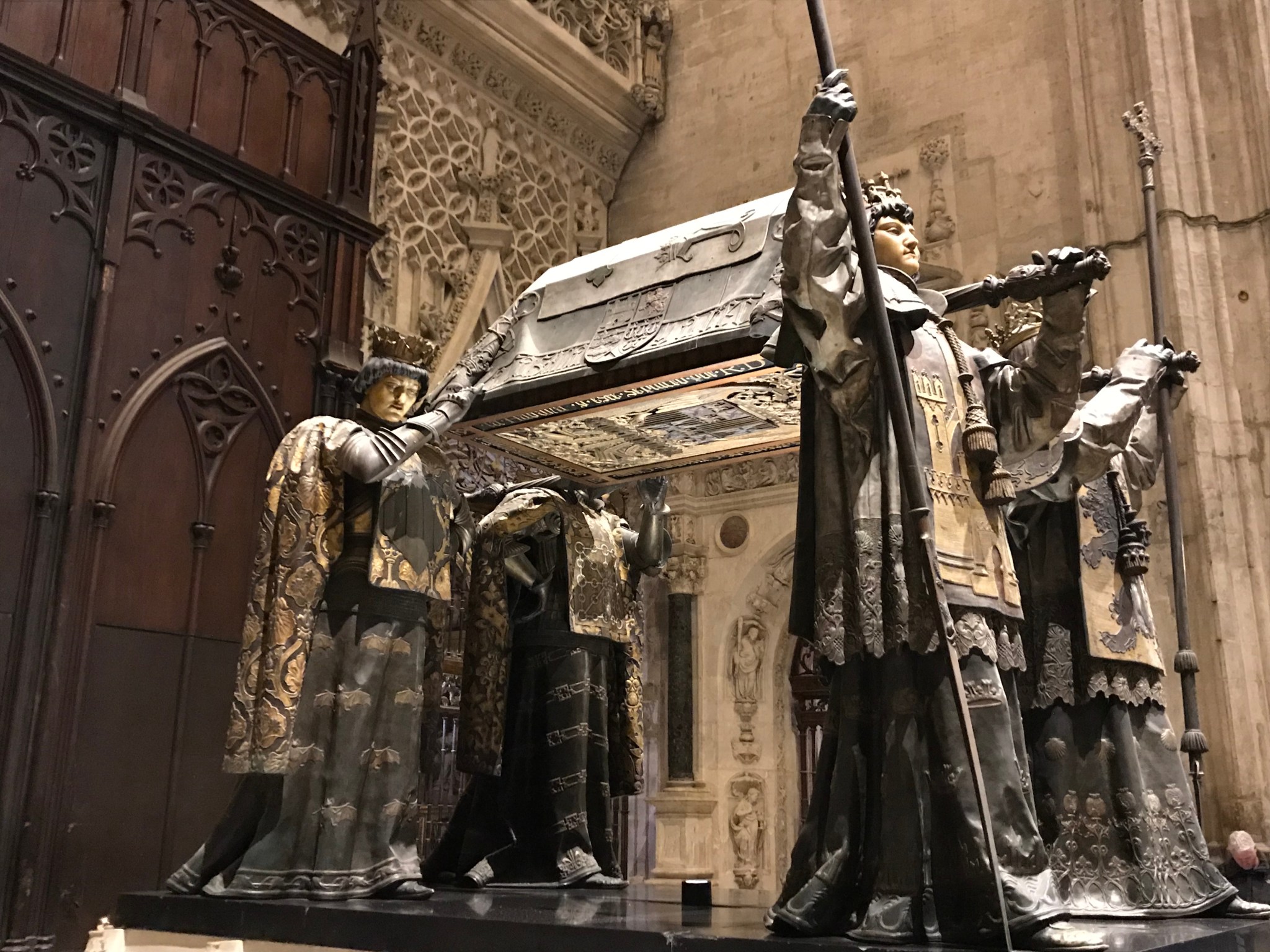
It is here that you will find the massive tomb of Columbus.  And yes, he really IS in that big box.  National Geographic did a story about the DNA analysis that was performed on the box’s contents.  It matched the DNA of Chris’ son and brother.  (There had been some doubt about who those bones REALLY belonged to).

5FDE7D1C-A16F-40B8-801E-82FA4C0ABBFC


The people standing beside the tomb will give you an idea of how enormous this memorial is.

Columbus set sail for the new world from Seville, and it was here that he (and others) brought all the gold plundered from south and Central America.

49FC7798-DFD5-4131-A16C-47D83AB439BD
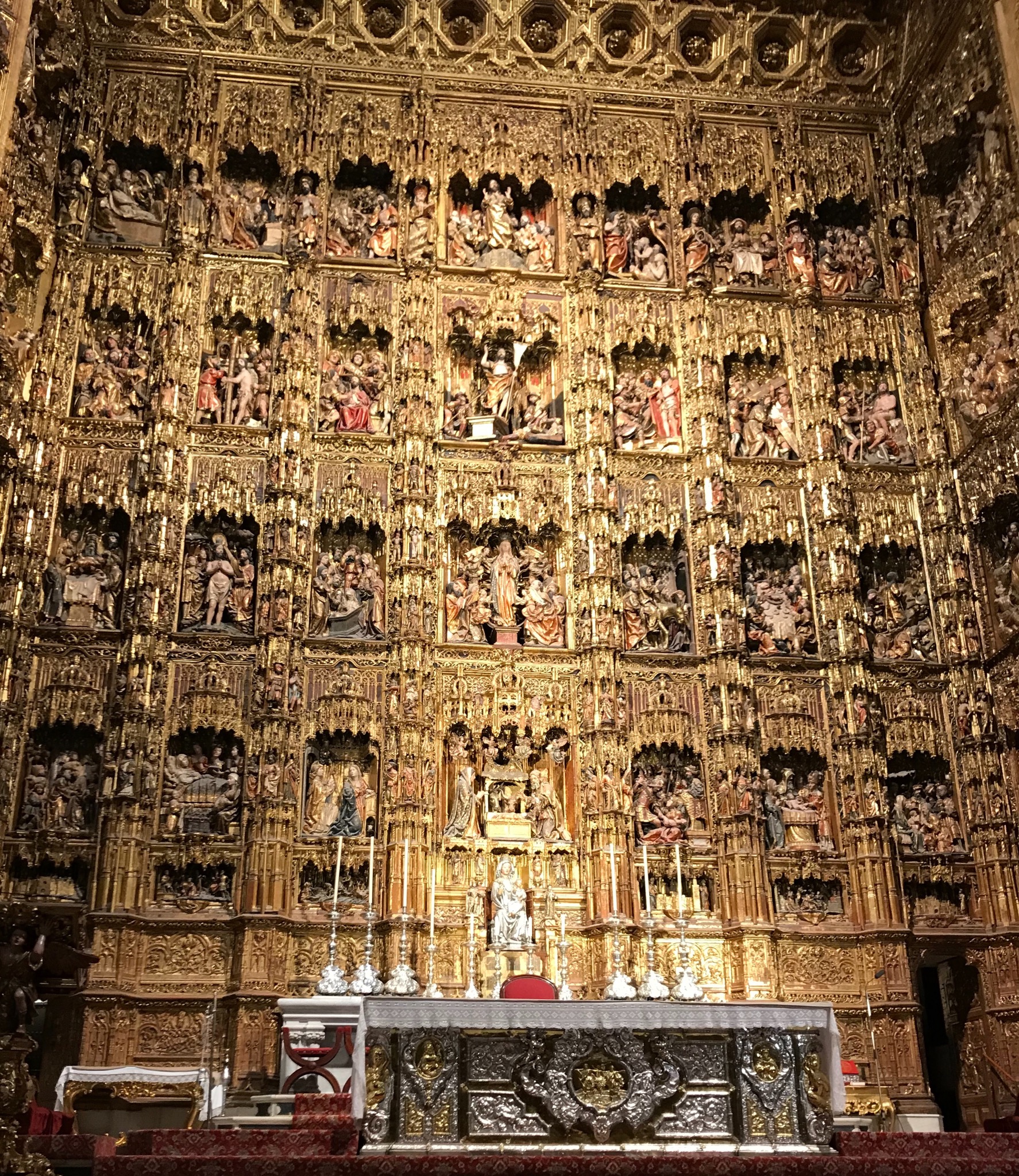
It was impossible to capture ALL of the grandeur of the main altar in a photo

Seville has its legendary martyrs.  Justa and Rufina, two sisters, are honored with a stained glass window and in a painting.

Their story?  They refused to sell their pottery for a pagan festival, so after much crockery breakage, (on both sides), the sisters were imprisoned, stretched on the rack, made to walk barefoot to the nearest mountain range without water or granola  bars.  Justa died of hunger and thirst
but Rufina hung in, only to be tossed to the lions.

As you can see from the painting, the lion didn’t finish her off.  Finally, she was either strangled or beheaded (or both, it isn’t clear).  It was hard to keep a good woman down back then!

5BFFD403-9B80-453B-A8C2-3E6587E51253

If history and religion doesn’t do it for you, not to worry.  Seville offers much more:

Cobblestone streets lined with shops and restaurants,

0D6DFC0F-51B6-428D-9960-5A57919529CD

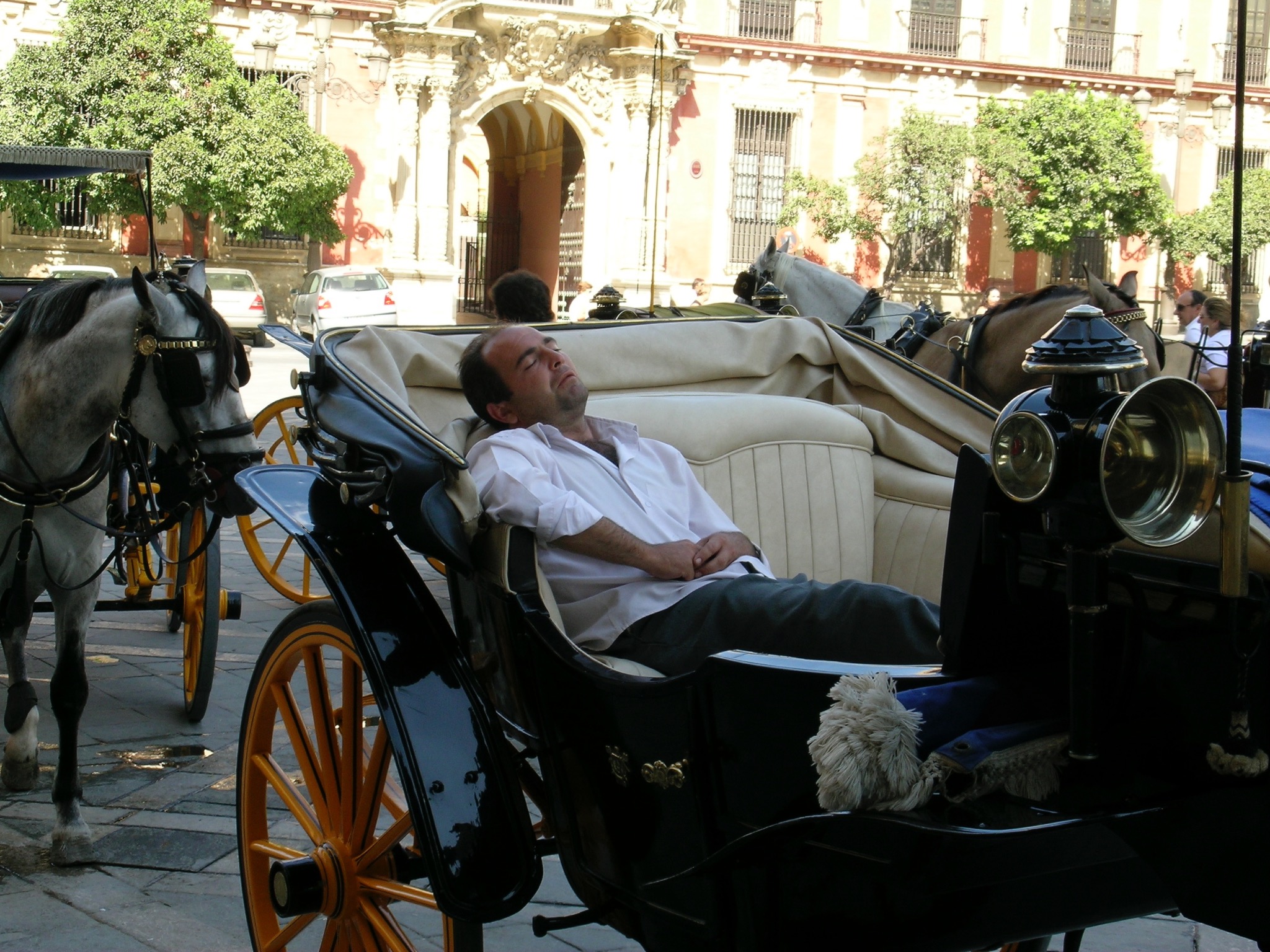
Carriage rides around the old town,

89562CFF-C888-49CB-A5A8-450694E79971

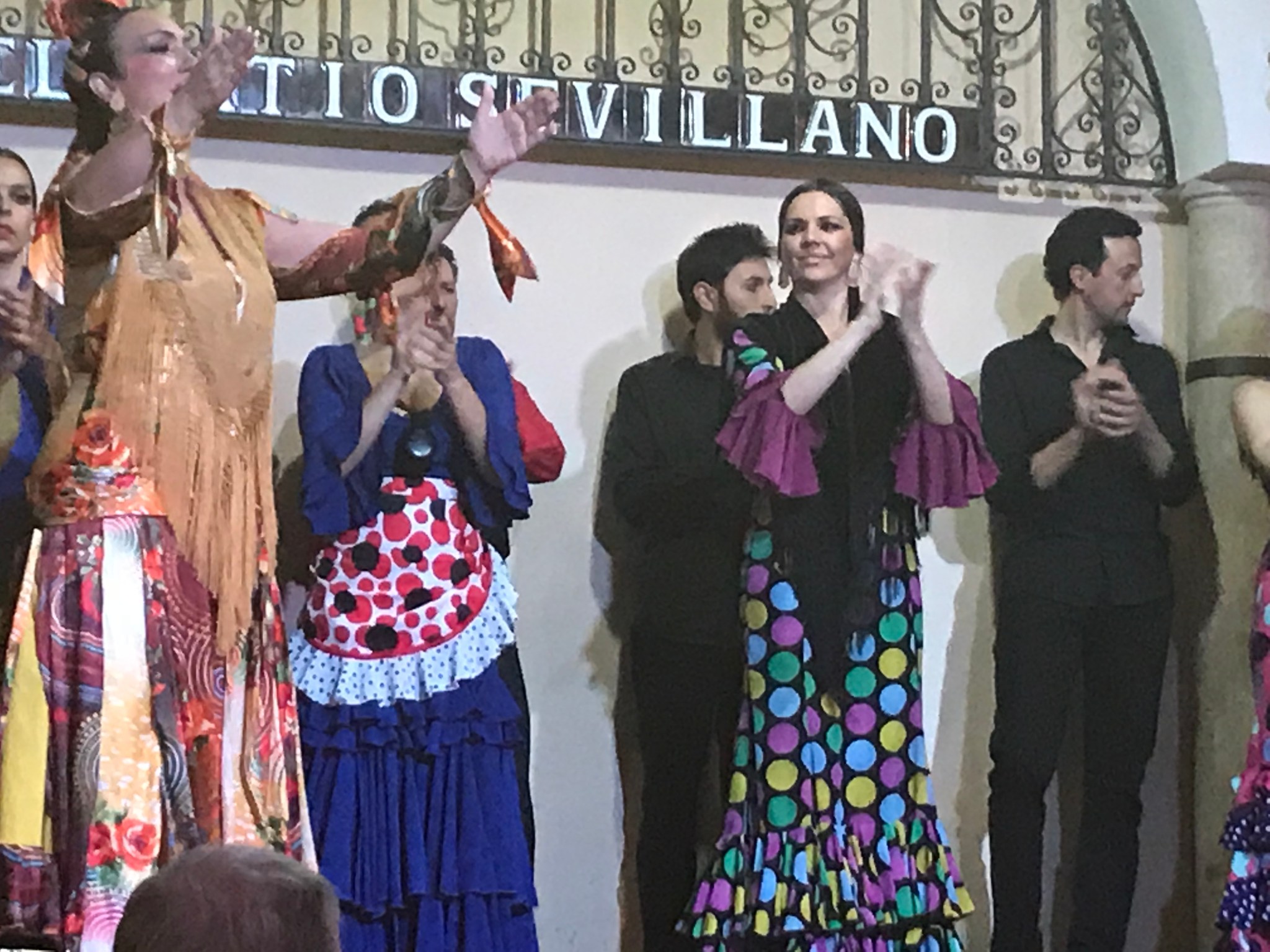
and FLAMENCO!

41861862-64C8-4795-88B7-3494BCAAD211

We weren’t here long enough.  Seems like I’m saying that a lot on this trip.

Next stop, Portugal.

Spain Smorgasbord

By the 8th day of our Grand Circle tour, we had visited Madrid, Toledo, Granada, Cordoba, and Torremolinos, with a side trip to the very British Gibraltar. Next on our itinerary was Malaga, but Mike and I decided to engage in an Australian tradition and “Chuck A Sickie”. For those of you that didn’t have the pleasure of spending two weeks with an Australian Global Volunteer, that term roughly translates to “Playing Hooky”.

Although the Costa del Sol averages over 300 days of sunshine per year, today was the first time I needed to wear my sun hat.

I’m sure our fellow travelers had a perfectly marvelous day enjoying the sights of Malaga, and the home hosted lunch in a nearby village as much as Mike and I enjoyed spending the morning strolling along the beach, taking in sights like this.

I would have loved to see what this tribute to Elvis looked like before the rain decapitated him.

But what about those other glorious cities?  Don’t worry, I’ll do a little flashback, with visuals.

We got just enough of a taste to determine that one of these days, we will be back to those lovely cities, and next time, we will linger.  

Our time in Toledo was limited to a few hours enroute to Granada. The old city sits 6 escalator rides above the new city, and let me tell you, we were all very grateful we didn’t have to climb all the way up the hill in the rain.

9EC9D2D3-D3E3-4239-9EA4-B8A19B2B2A8C

89F0FDF4-3849-4C49-9C3B-456075D8304B
Even after we arrived at the “top”, we still had some hills to climb.

Our stroll through Toledo’s Jewish quarter ended at the oldest synagogue in Europe. This unique building was constructed by Moors, because at that time they were reputed to be the best builders.   Of course, they were not familiar with synagogue construction, so the Jews ended up with a building that had a distinctive Muslim flavor.

E8355D59-2D68-482E-811D-B74CD818E62B
Notice the cross?  This building is a reminder that at one time, all three religions were able to peacefully coexist—pre Ferdinand and Isabella reign.

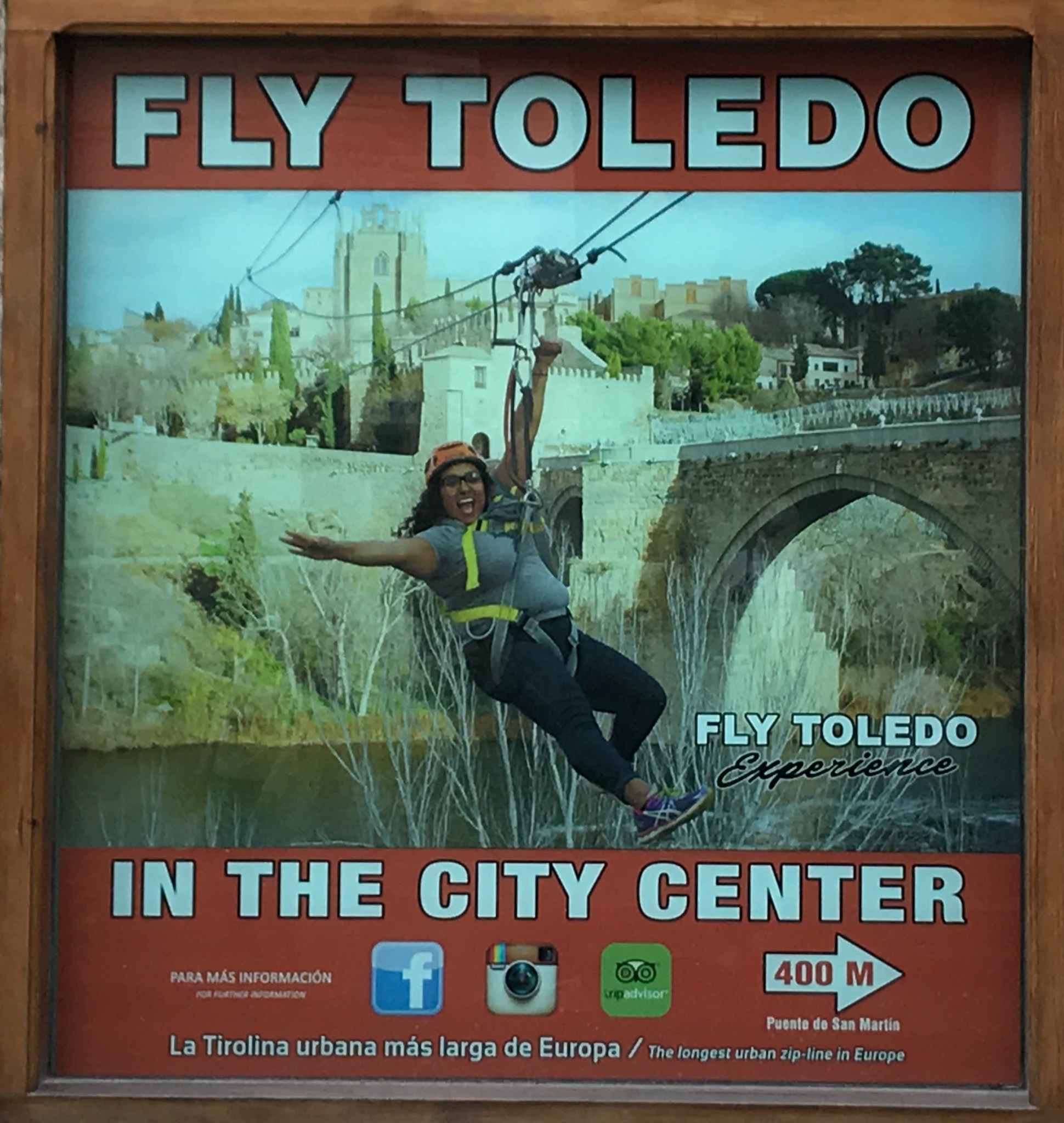
For anyone planning a trip to Toledo, please be aware it is much more than amazing history, great food and panoramic vistas.  Thrill seekers, take a look.

46619F4D-03D6-4F01-A66F-07326B9C9868
Maybe next time, if it isn’t raining…

One of the many things that I love about traveling with Grand Circle and OAT is the unexpected stops along the way.  We had a bathroom and refreshment break in Puerto Lápice, a little village in Castille La Mancha, where we discovered a three room Don Quixote museum.

Because I spent so much time in the museum, I had to order my glass of wine “to go”, which I proudly did in Spanish.   An important phrase: “para llevar”.  But the effect was spoiled, just a bit, when the bartender started speaking to me in perfect English.

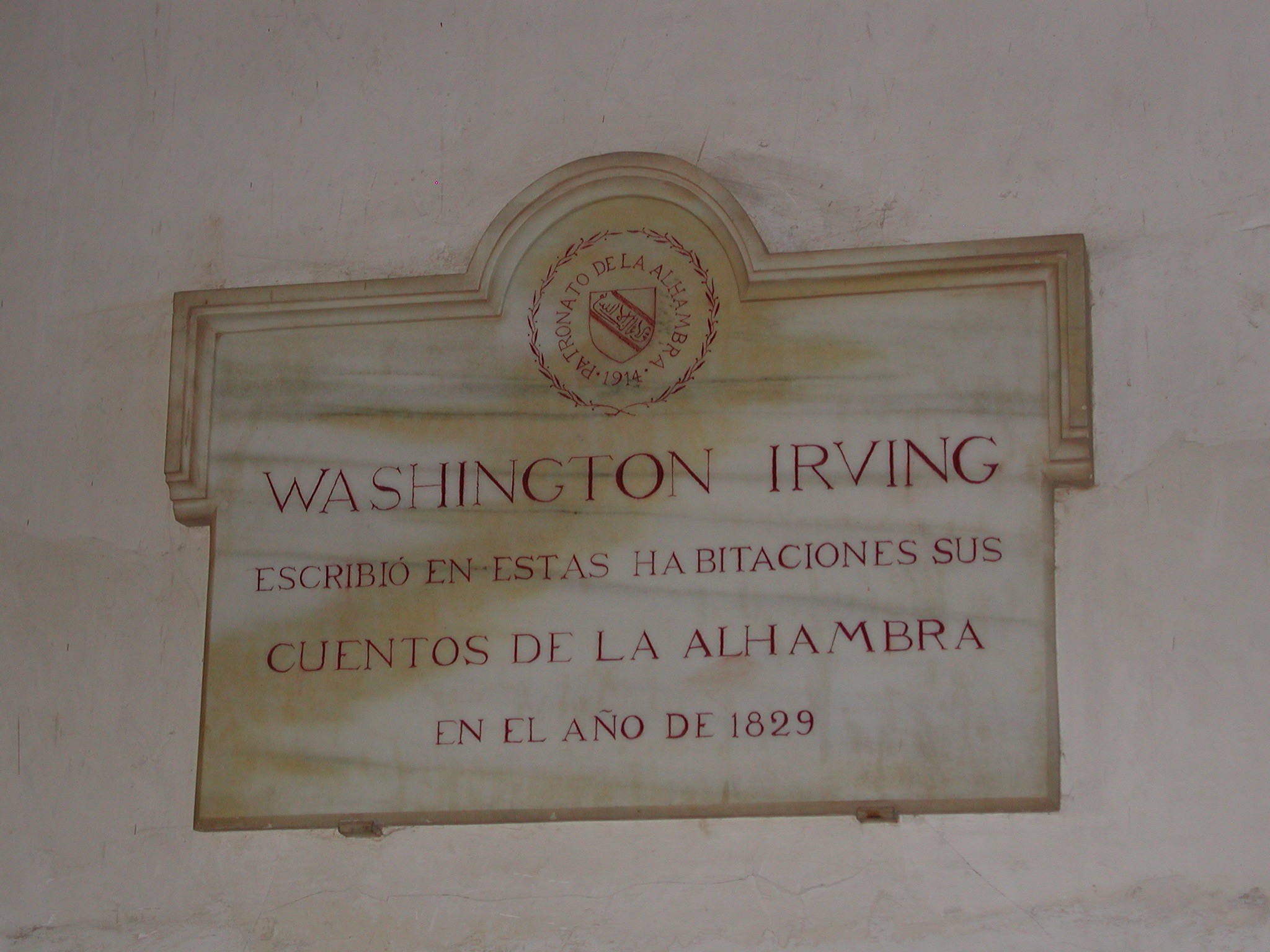
Not surprisingly, most of our time in Granada was spent at the Alhambra.  Okay, so we all know that Washington Irving wrote “The Legend of Sleepy Hollow”, but how many know that he also was instrumental in saving the Alhambra from being destroyed?  His “Tales of the Alhambra” caused the Spaniards to take a second look at what is now the most visited attraction in Spain.

8BD8360A-0680-40C5-8408-24C7B789D61B

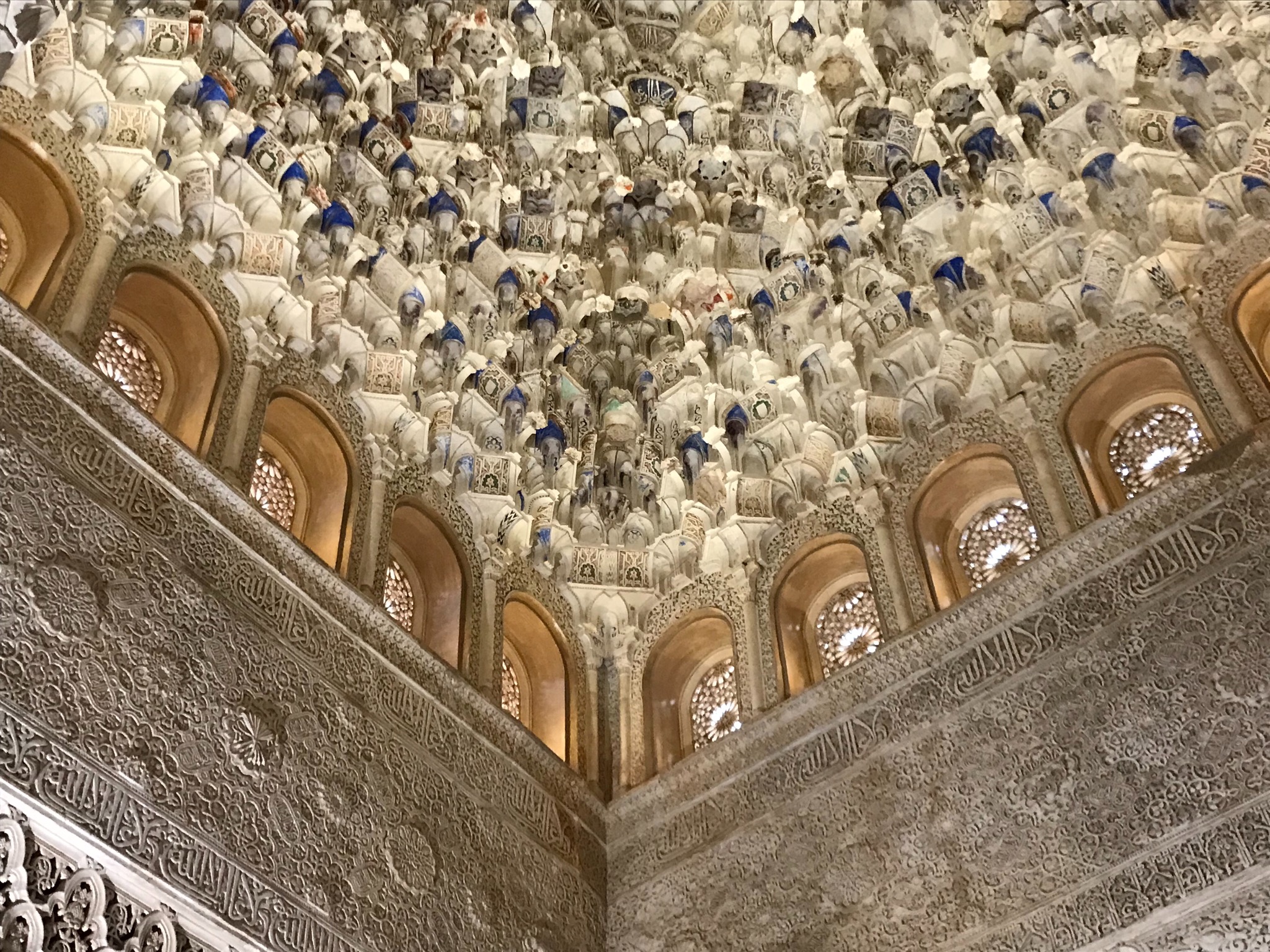
Alhambra ( Al = “the” in Arabic ) is a palace, a fortress, a small city, overlooking Granada.  Unfortunately, when Napoleon conquered Spain, his soldiers removed all of the furniture, rugs and tapestries, ( I believe the correct term is “looted”) but the walls, ceilings and courtyards give you a hint of the grandeur that once existed.   Check out the ceiling in the women’s quarters.

2AB5FE22-54F8-48E9-B303-86F089D73F56

The exteriors of Moorish buildings were very plain. All of the ornamentation was inside, in the private spaces, like these beautiful courtyards.

3B9BD482-0553-4434-B6B1-5387F5DA6524

D851FED7-4EA0-4DDA-8E1D-35E1EB136BB3

The Moors ruled Spain for almost 800 years, and their impact on the Spanish language continues today.  Many places begin with “Gua”, like Guadalcanal, Guatemala, Guanajuato — all derived from the Arabic word for water.

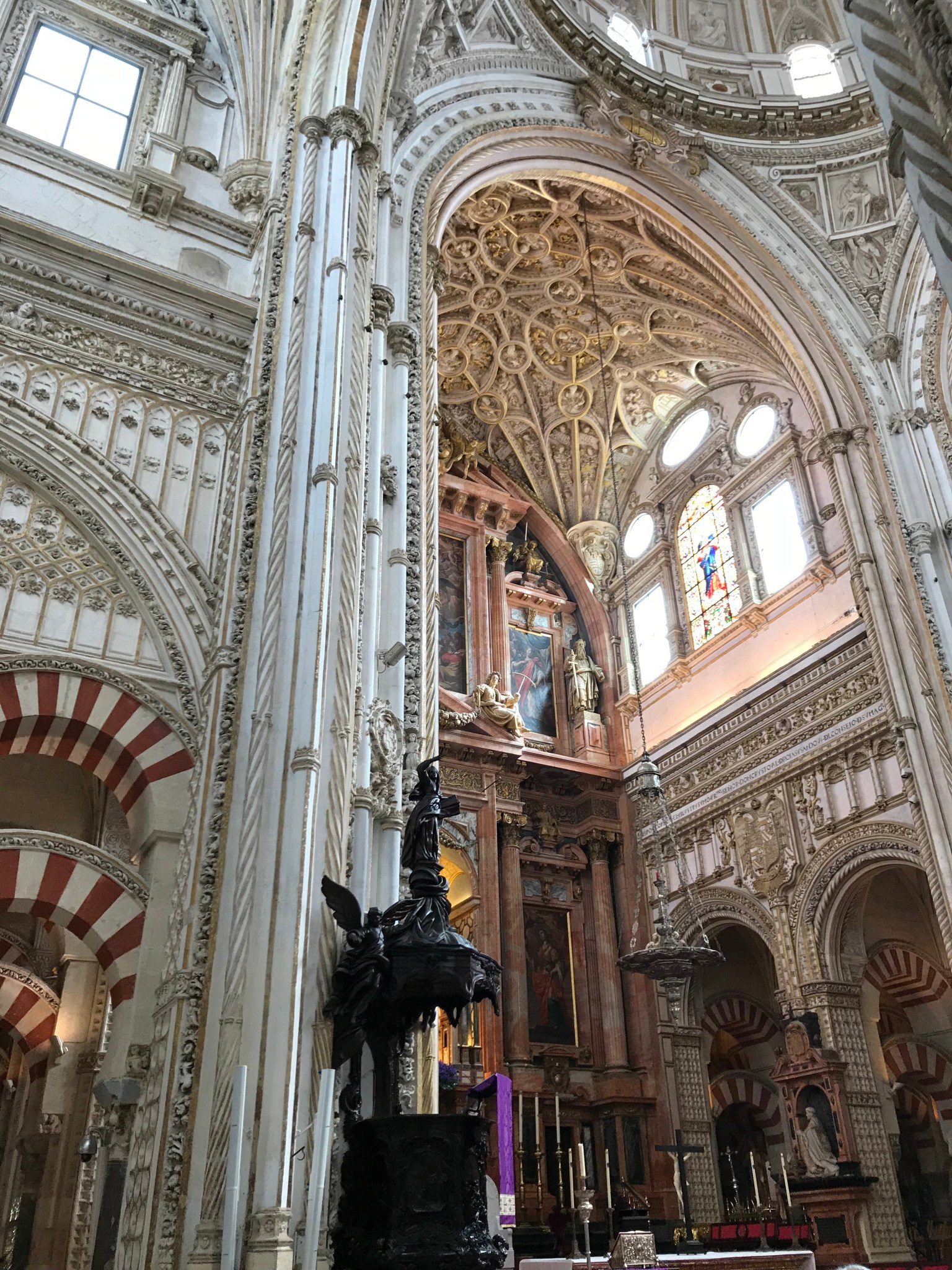
Another city with beautiful Moslem architecture is Cordoba.  The Roman temple/Church/Mosque/Cathedral is an architectural wonder.  Walking through its spacious interior, you literally travel through time, starting with the preserved Roman tiles, below the existing floor—

117fd81f-1304-4e2e-ab39-d92f33fc3642.jpeg

to the former mosque, built with recycled columns, which was wisely preserved by the Catholics —

F1D76363-86F6-4785-A5CB-FEF95BD600DDAED4DACB-5FD1-4B6C-B160-81D0ECCFEEF4

and now is in the center of the mosque.

6AA5DFC2-3591-4072-A721-B998D76F6B2C
In this photo, you can see the Mosque’s red and white arches next to the cathedral’s main altar.

Cordoba is magnificent!

888B3959-5065-4EB2-A63B-EE68B3F22773
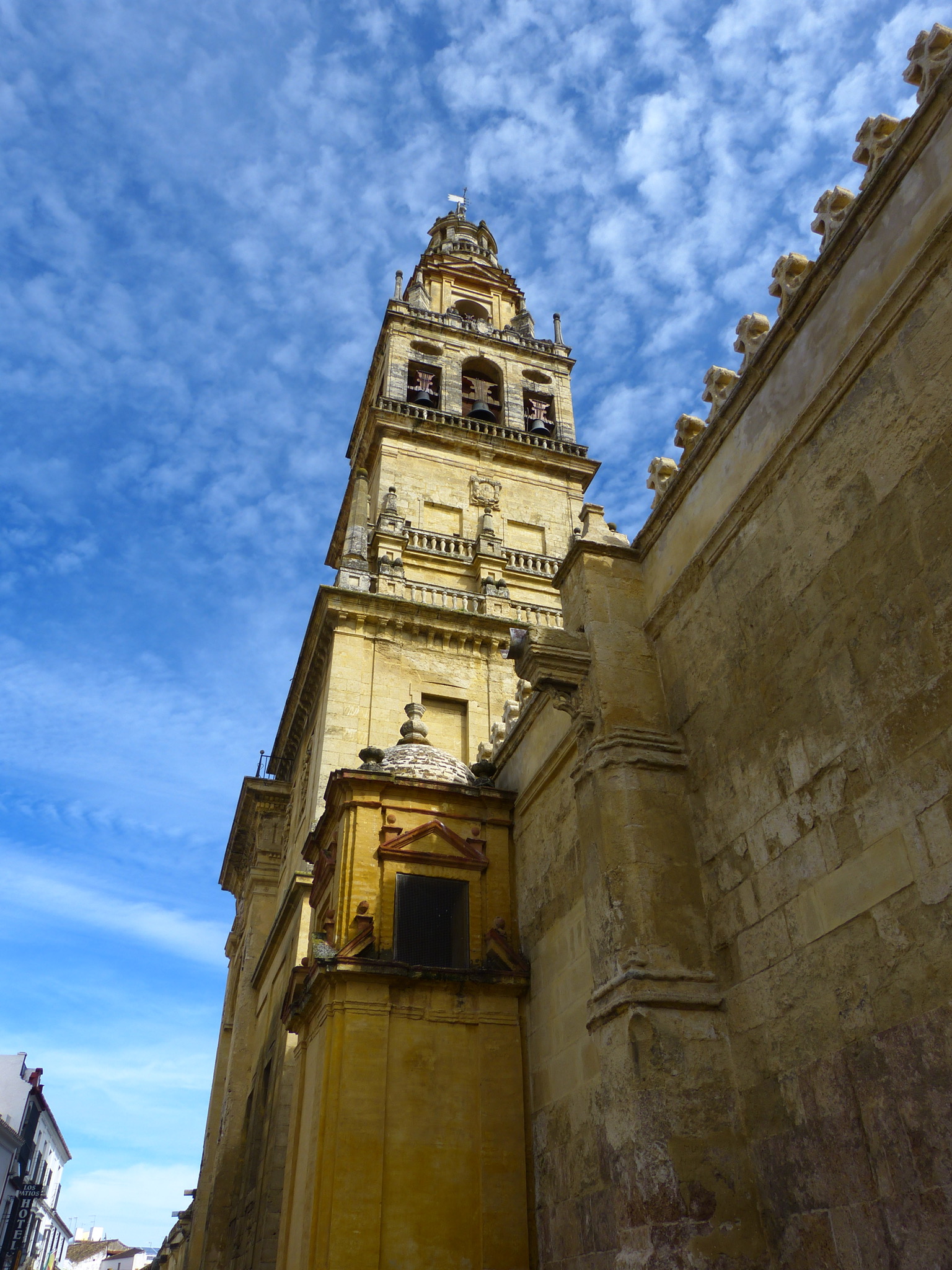
The church’s bell tower was constructed around the minaret.

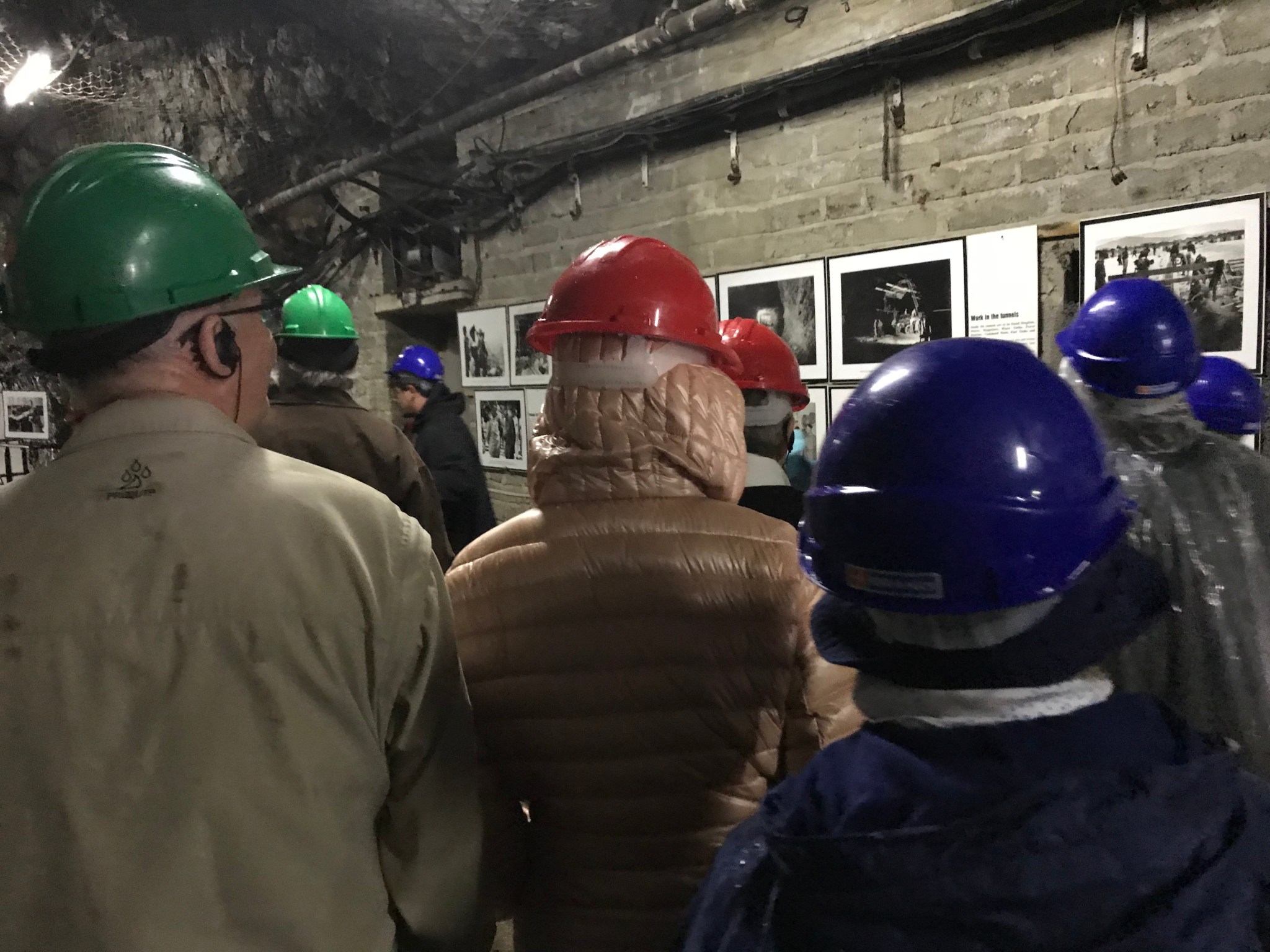
I guess some place has to be the least favorite, and for me, Gibraltar gets that honor.  Maybe it was because the limestone WW2 tunnels were dripping water, and were dark and gloomy,

10D2E378-922D-4EE3-8D99-55E710F3883D
One of the few places that wasn’t too dark or wet to photograph

as was the weather.

888F2622-ECC9-49EB-A7C9-442007396075

Whatever the reason, I was not as wowed as I was by the other places we’d visited.  Even the Barbary apes were a disappointment.  We only saw four.

78E241BD-2388-4088-9601-C9A028433F2BTwo more days in Spain, three in Portugal, and then we are back to the USA.