Sometimes I don’t know I want to visit a place until I get there. That certainly was the case for Angers. I know, I know, the name of the city sounds like a hostile emotion. But the French don’t say it the way it’s spelled. THEY say “Ahn-geee”. Better, right?
Our three days in this very walkable city whipped by, and was a very nice balance between included activities and free time. After a guided tour of the city, during our free afternoon several of us decided to go rollin’ on the river.
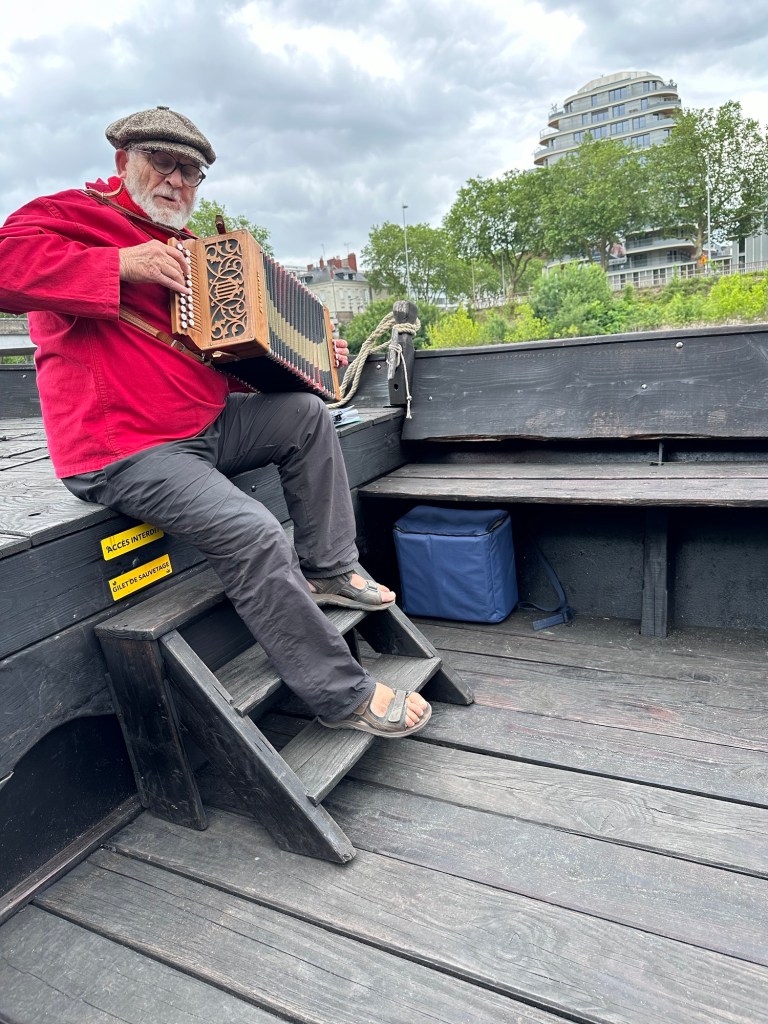
In addition to champagne (some of us had TWO glasses) our ride included entertainment. This fine fellow serenaded us while playing his vintage accordion.
We didn’t have the river to ourselves. Because the Olympic Torch was passing thru the city, four military boats were on patrol. We saluted each and every one of them with champagne glasses held aloft.
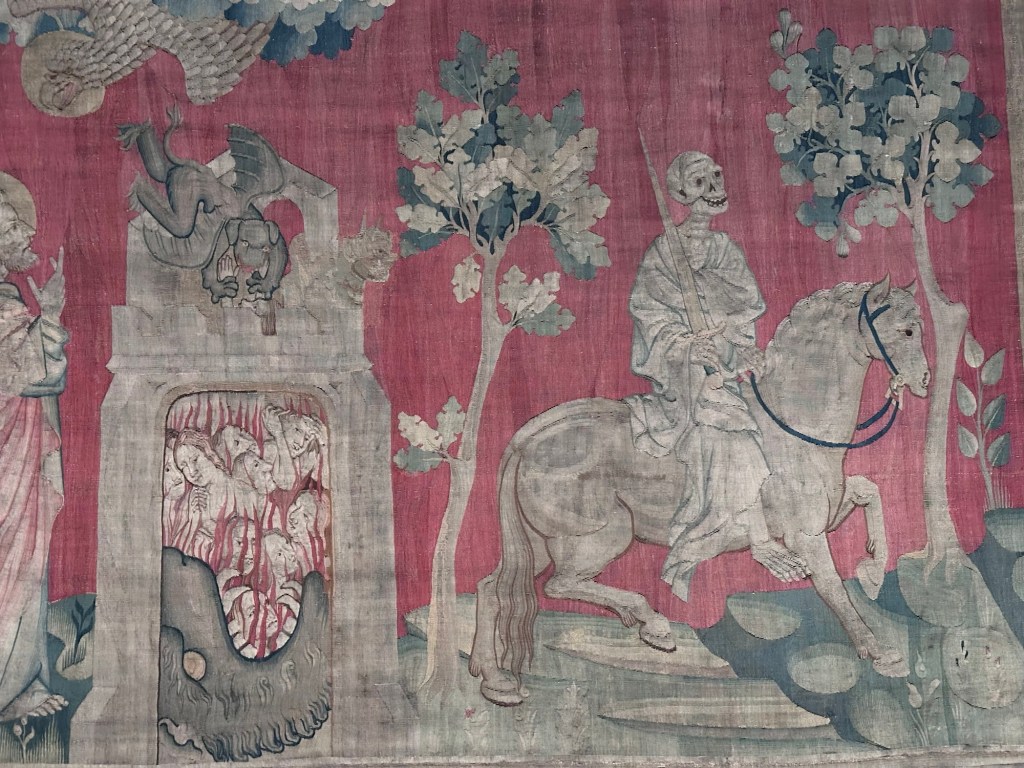
Finishing our ride across from the fortress/ castle, made it very easy for us to fit in a visit to the famous Apocalypse Tapestry.
Yes, another huge tapestry, but this one really IS a traditionally constructed piece, unlike the one in Bayeux. A predecessor to today’s comic books and graphic novels, it relates the battle between good and evil from the last book of the Old Testament to a largely illiterate population.
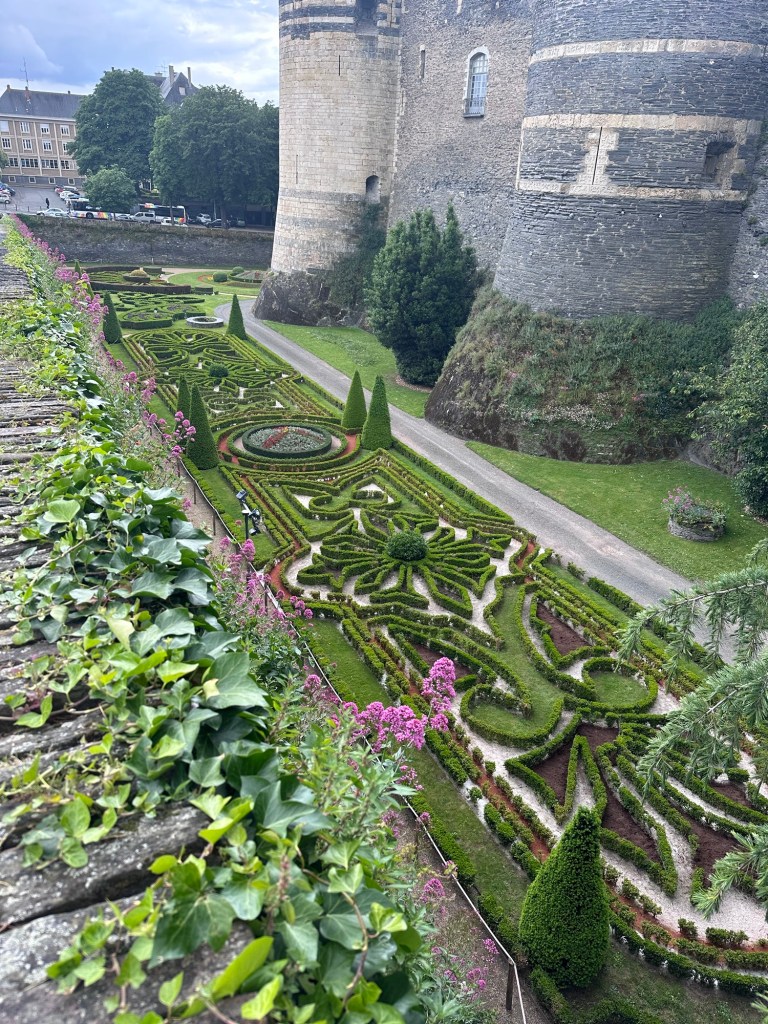
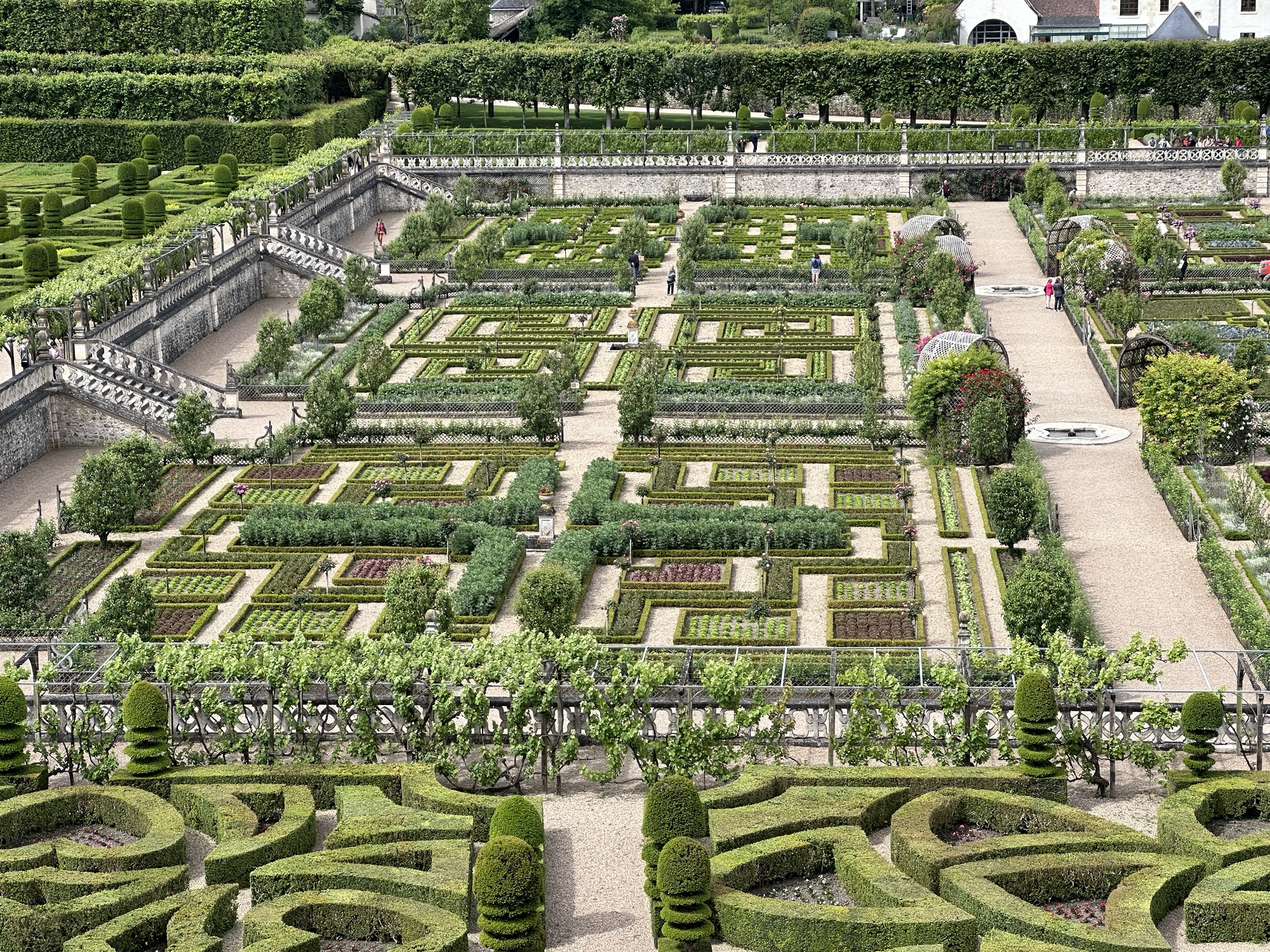
I was impressed with the beautiful gardens surrounding the castle, but these were nothing compared to the ones at the Chateau Villandry. The following photo shows only a small portion of the Chateau’s beautiful gardens.
If given the choice, I think I would have much preferred to be a Noble instead of a king. The nobles and ministers’ homes were much more “livable”, at least to me.
Although it isn’t obvious from the above photo, the Chateau de Villandry is surrounded by a moat.
Villandry has been in the same family since 1906, when it was purchased by Joachim Carvallo and wife Ann Coleman Carvallo. They met in a Paris research laboratory. Ann, an American heiress from Lebanon, Pa, supplied the funds for the purchase and modernization of the chateau.
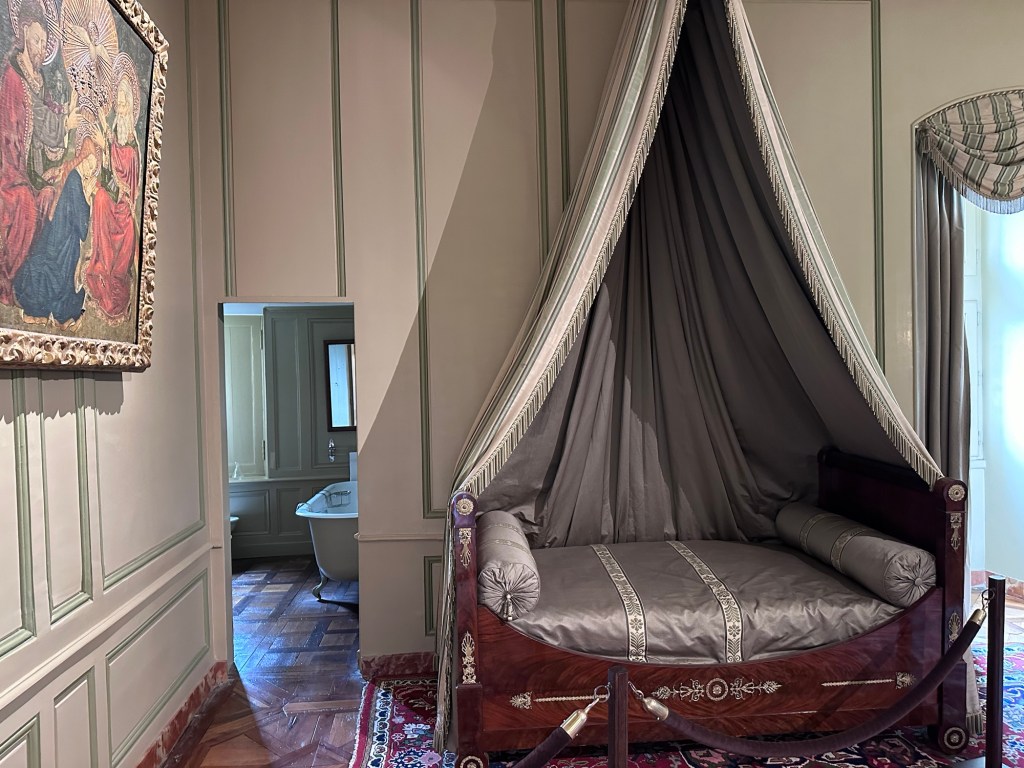
Unlike Fontainebleau, you didn’t walk through one room to get to another, and this one was modernized to include bathrooms off the bedrooms.
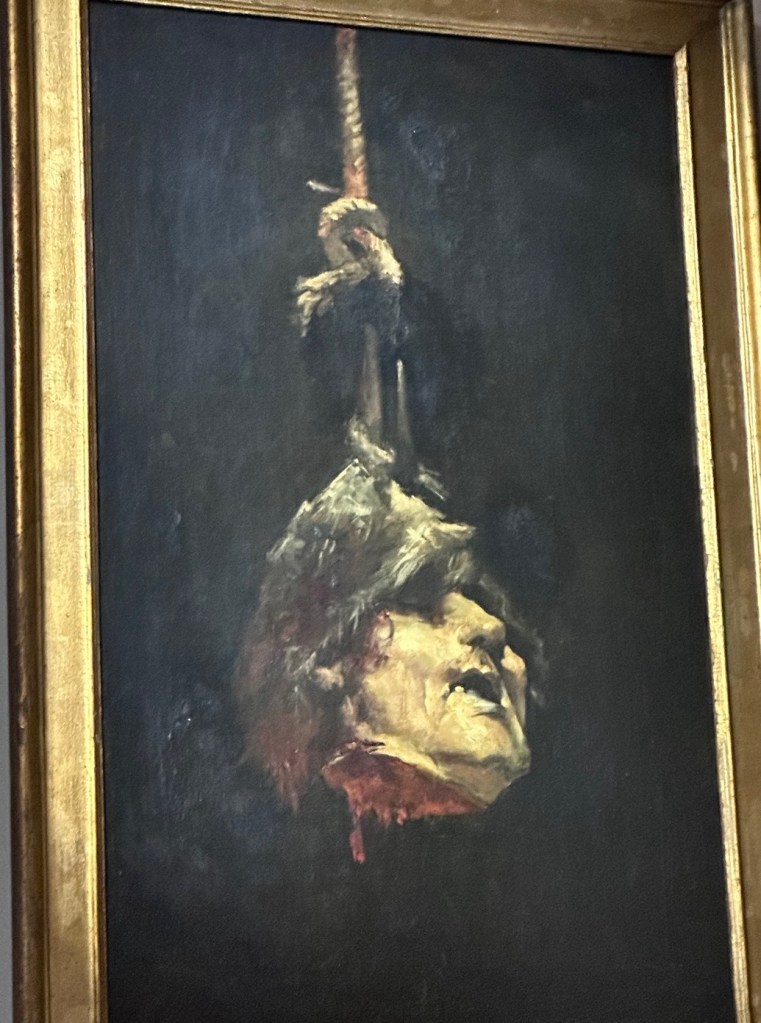
Art from Joachim’s homeland, Spain, was exhibited throughout the chateau. How many museums have portraits of a severed head? Fortunately, this picture was not hanging in a bedroom!
Before we departed Angers, we were able to witness the Olympic Torch being carried through the city.
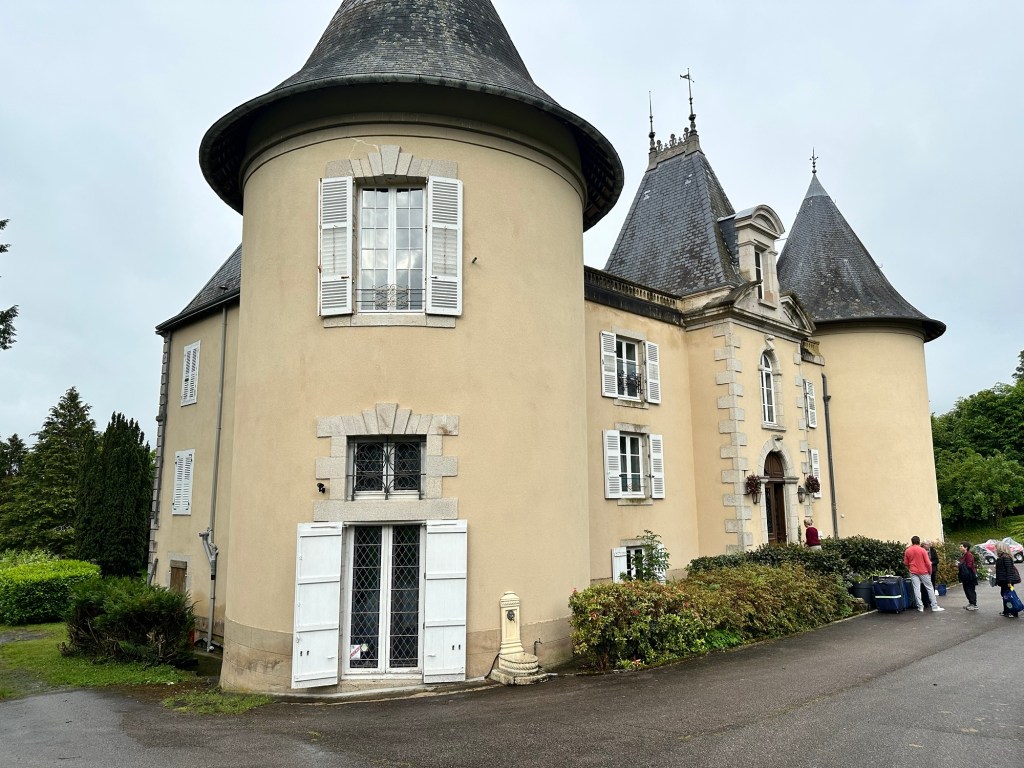
Our luck continued… we got to stay overnight in an honest to goodness, genuine chateau that was built in 1790 by the Duke of Limousin!
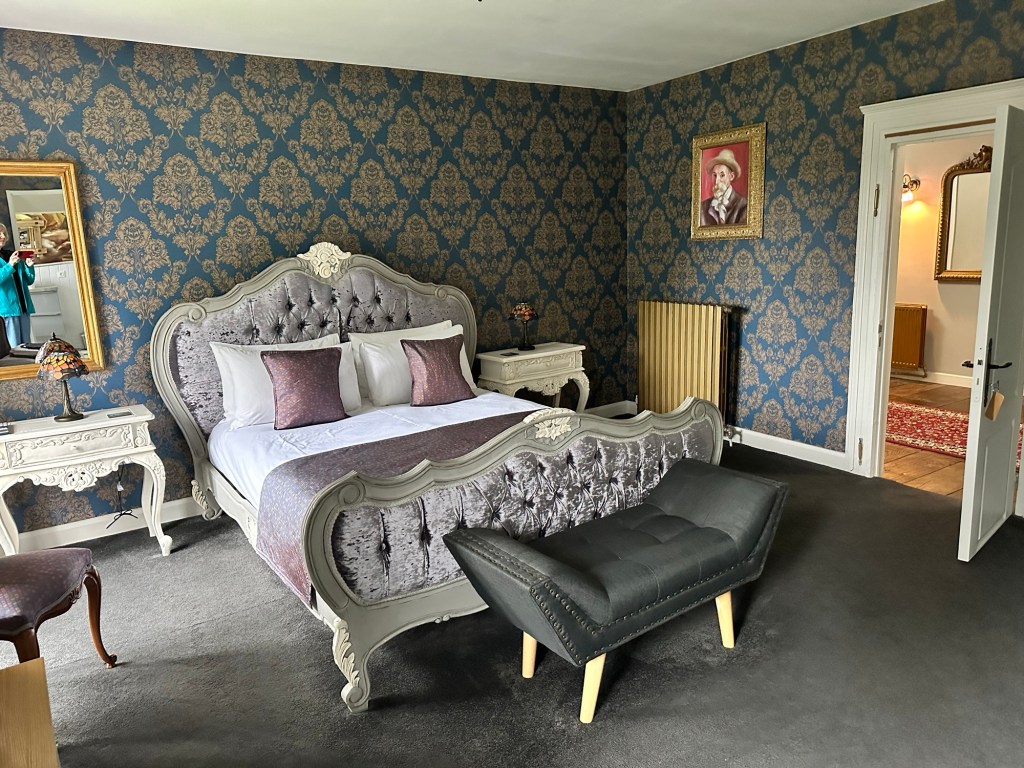
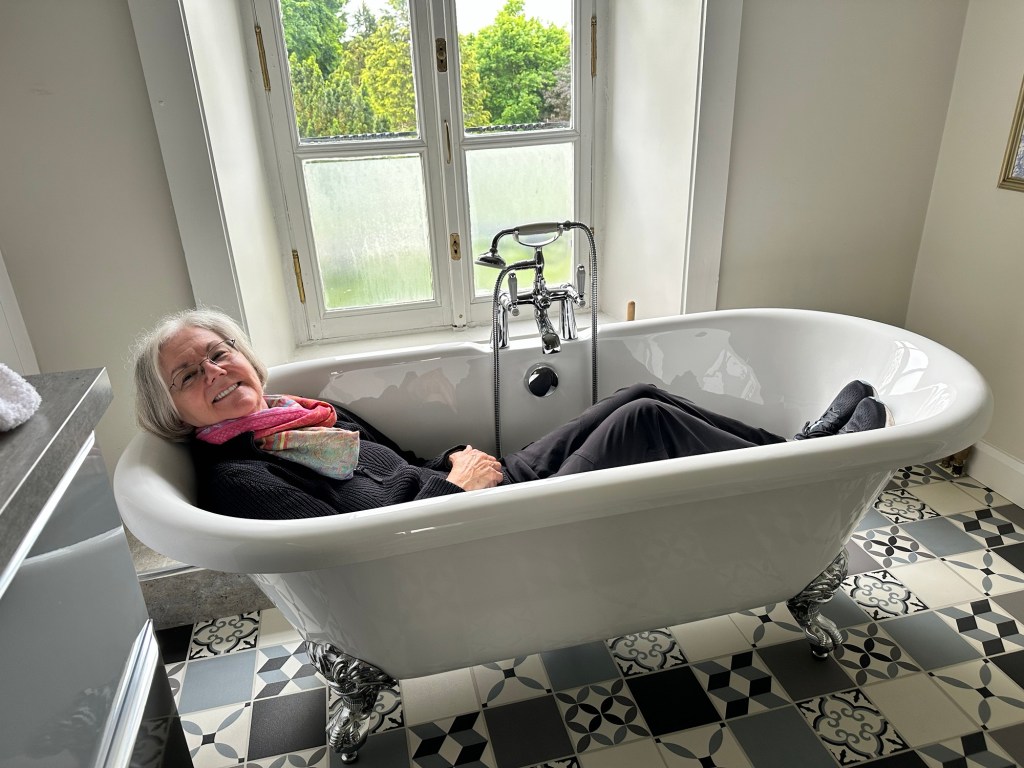
My room was the very comfortable Renoir Suite on the third floor. How gorgeous is that?!
Fortunately, the suite was updated to include walls and a door, plus a modern bathroom with both tub and shower.
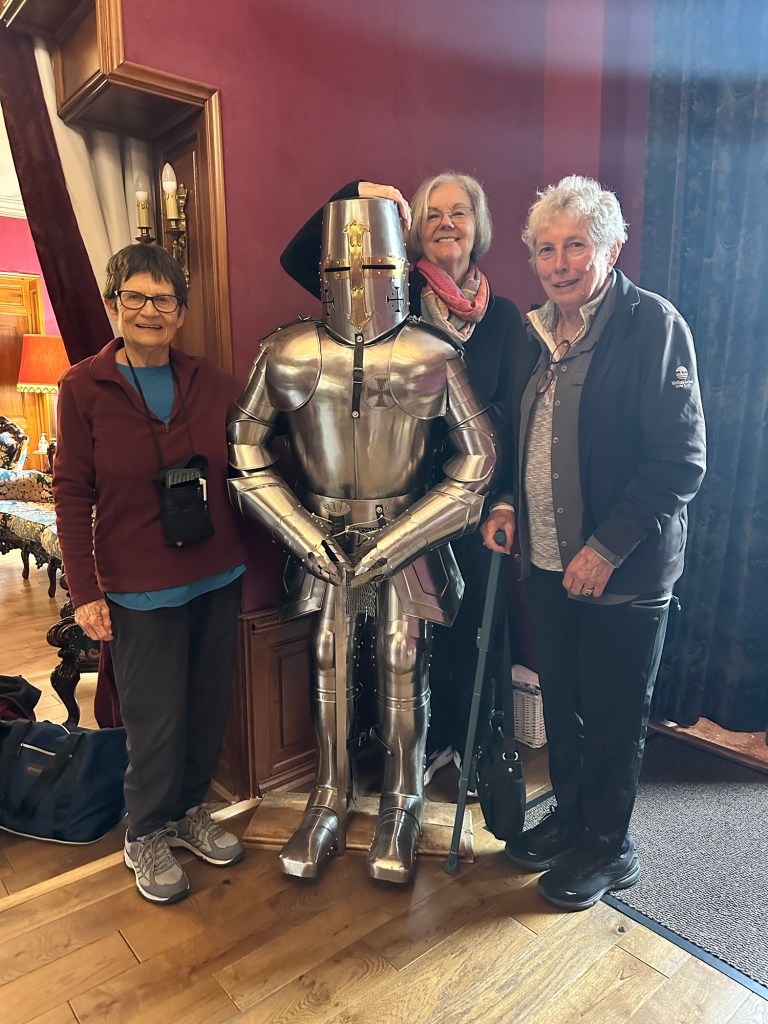
My new friends, Garry and Donna posed with me for a photo with our knight in shining armor. I decided to name him Walter the Bold, although Walter the short would have worked too.
This was our only “one night stand”. We are now on our way to Sarlat, a medieval town known for great food and fine wine.
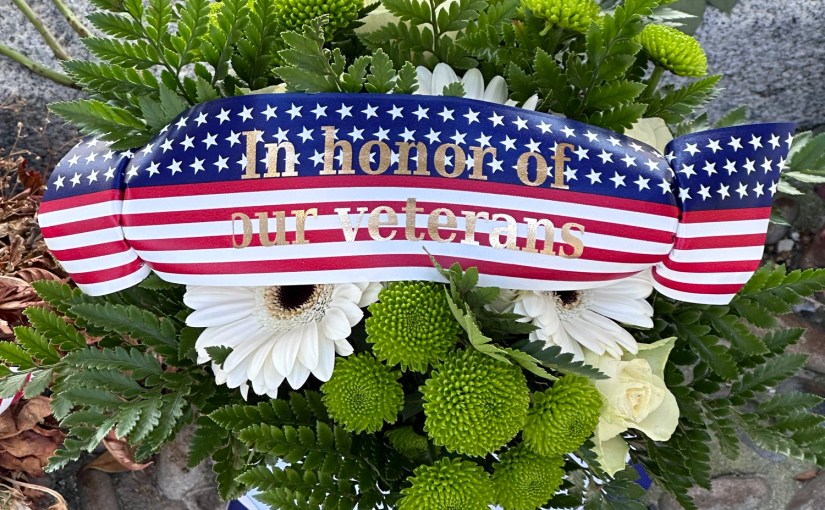
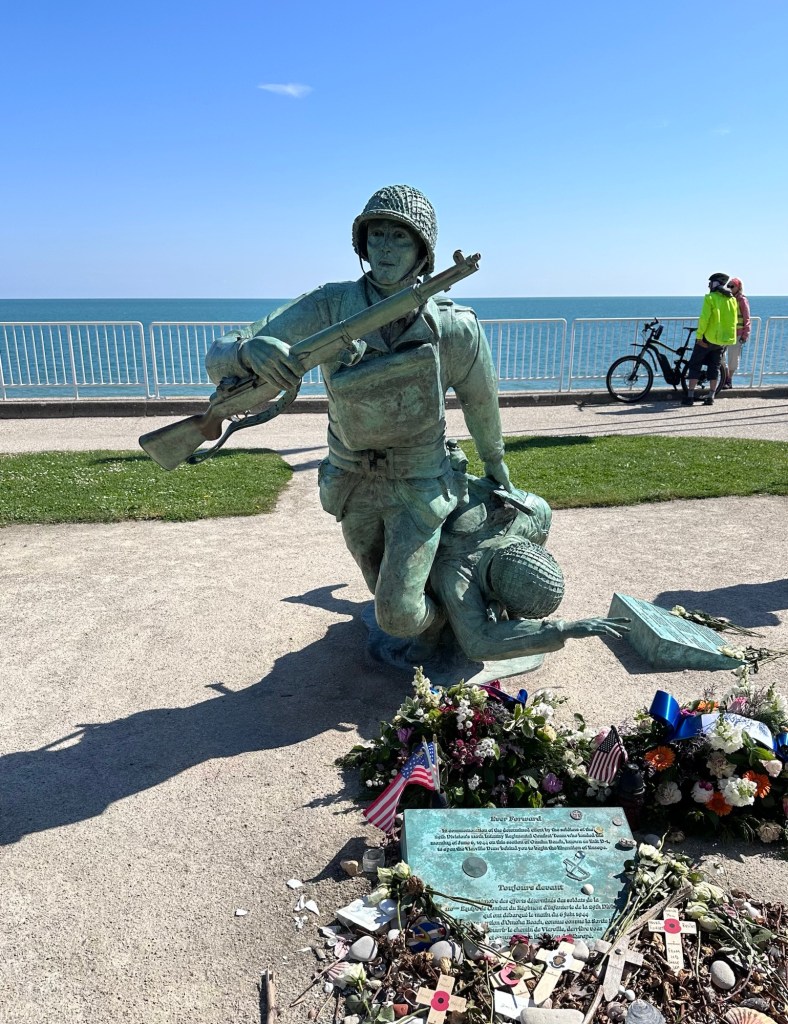
For many Americans, Memorial Day signifies the start of beach and barbecue season. After visiting Normandy, however, Memorial Day will forever retain its original significance for me. Henceforth, it will always be a solemn day of remembrance for those who have fallen in battle. Because of them, I’m allowed to live the life of freedom that I treasure.
Here’s Eisenhower’s message to the troops, which was reproduced in the museum at the American Cemetery.
The amount of creative thinking and planning that went into the invasion was mind boggling. We learned that the BBC sent out a request for photos taken during vacations on the coast of France, plus any maps or post cards that could help create visuals of the coastline. They received over 10 million responses, but these obviously had no information about the fortifications, so pilots were sent on reconnaissance missions. The local resistance, in addition to blowing up bridges and messing up supply routes, also provided key information to the allied forces.
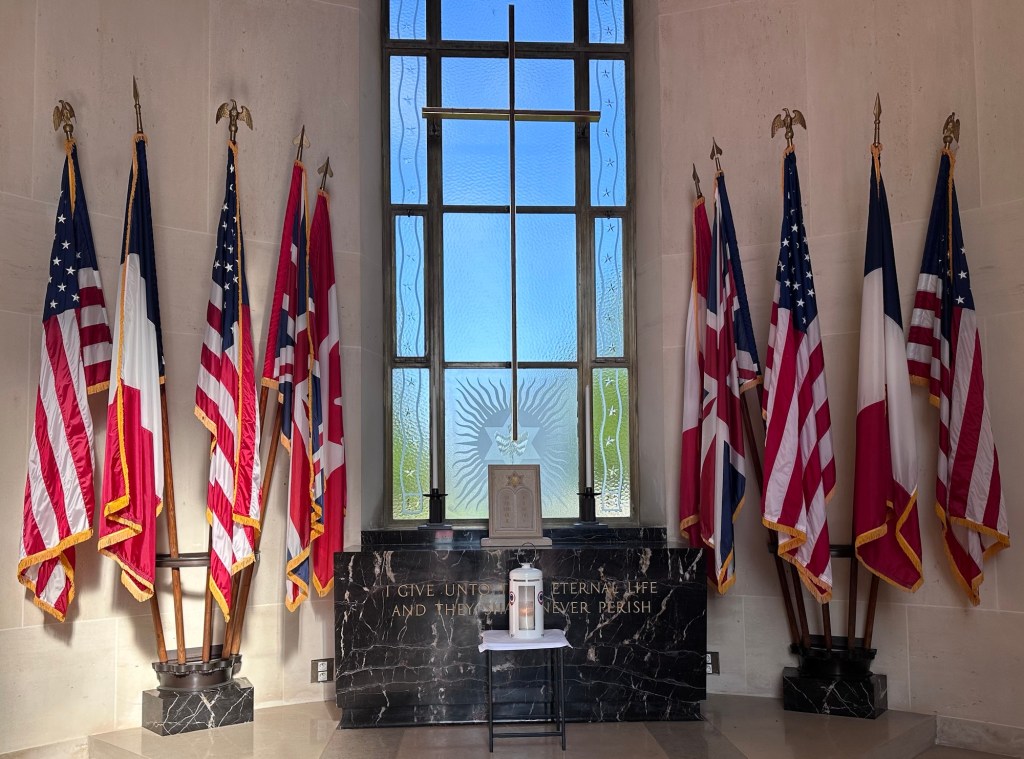
Before going into battle, soldiers were given three options for their dog tags: they could declare themselves Christians or Jews, or leave the designation blank. If Christian or undeclared, their graves were marked with a cross. Jews were designated by a star, however many Jews chose to be undeclared in case they got captured. The fear was if it was known they were Jewish, they’d be less likely to survive.
At the American Cemetery, preparations were underway for the 80th anniversary commemoration ceremony, which will be attended by dignitaries from around the world. I was surprised to see that the American Cemetery will be part of the upcoming Olympics.
The eternal flame at the cemetery
The weather was perfect during our visit to Omaha Beach. The Allies weren’t as lucky.
The plan was to have paratroopers and Army Rangers land behind German fortifications when the troops arrived at the beach, but gale force winds blew them off course. Instead they ended up being targets for both enemy and friendly fire.
These are exhibits in the Airborne Museum.
OAT arranged for us to have time with the museum curator, who showed us this violin one of the German soldiers made for the American in charge of the prison camp.
Knowing what goes into making a violin, I was incredulous. Clearly, this skilled woodworker had an excellent relationship with the camp commander, because he was allowed access to sharp instruments that could have served as weapons.
Add this to one of the MANY things I didn’t know before this trip: Germans remained in the POW camps till 1948. Most of the prisoners either stayed in France, and married their French girlfriends or emigrated to the USA.
I’ll end with a happy story. The parachutist shown hanging from the church steeple survived. He was cut down by German soldiers hiding in the church, and held as a hostage so the church wouldn’t be bombed.
No time to proof read, so fingers crossed that my iPhone didn’t make any crazy substitutions.
Okay, this post is for those of us who might not have paid a whole lot of attention in World History class. I say “us” because I clearly had other things on my mind (boys? My hair? ) while we were learning about battles and trenches and bombs.
But it’s never too late to learn, so we can all play catch up together.
Bayeux, which I had never heard of until this trip, is a charming little town with beautifully preserved Medieval buildings. The inhabitants got word to the Allies, after the Normandy invasion, that all the Germans had evacuated, so the town was never bombed during World War Two.
Its proximity to the beaches of Normandy meant that Bayeux was the first town to be liberated by the Allies, and served as the capital of France until Paris was freed.
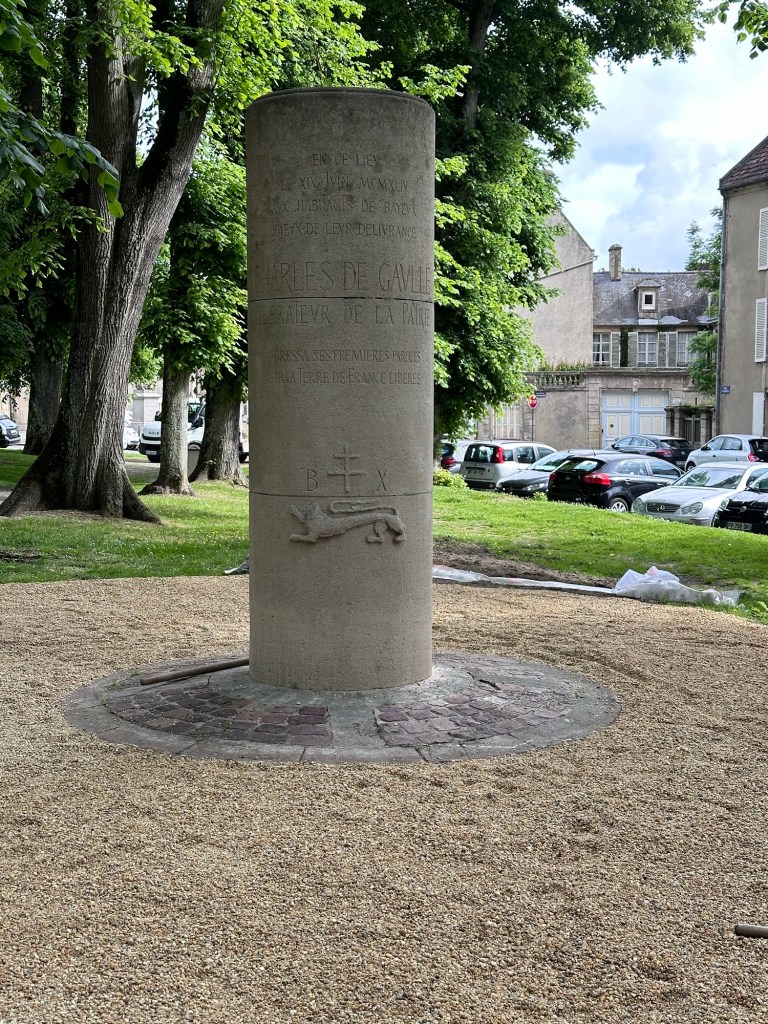
Charles DeGaulle gave his first speech on the soil of Free France in this Bayeux Park.
To celebrate the 80th anniversary of D Day, many of the store fronts in the town were painted with these colorful murals.
I know conventional wisdom claims that the French are unfriendly, but that certainty has not been my experience, at least so far. American flags are EVERYWHERE.
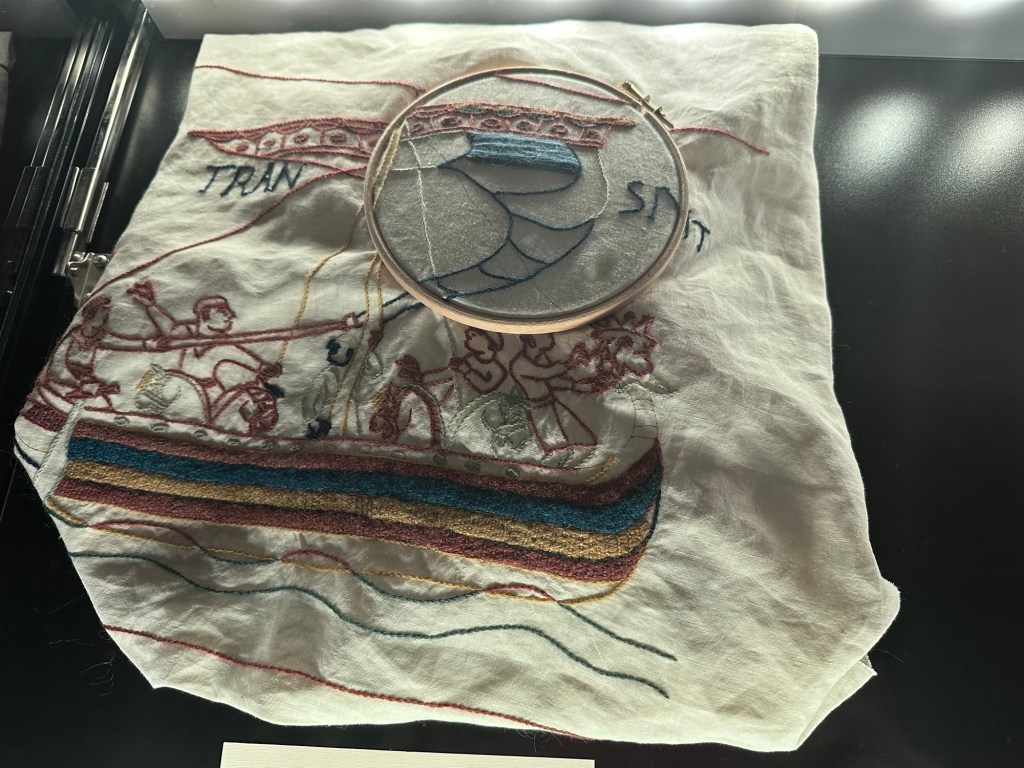
Another of Bayeux’s claim to fame is their “tapestry” ( actually an embroidery) on linen which stretches for 70 meters (or about 230 feet.)
It tells the story of how William “the bastard” became William “the conqueror”, which, of course, required lots of dead bodies.
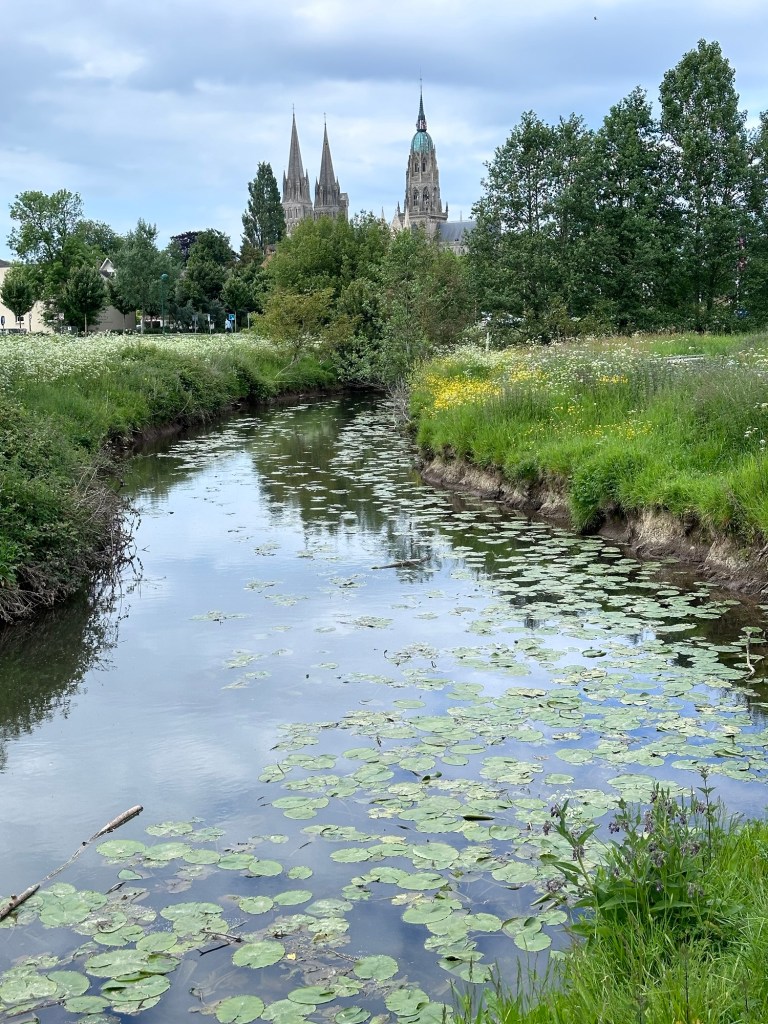
When I was a college student in Boston, the Citgo sign above Kenmore Square always helped me find my way home. The Bayeux cathedral performed a similar function.
Thanks to that landmark, I was able to wander freely, knowing I would eventually find my way back.
The cathedral, After D dayToday
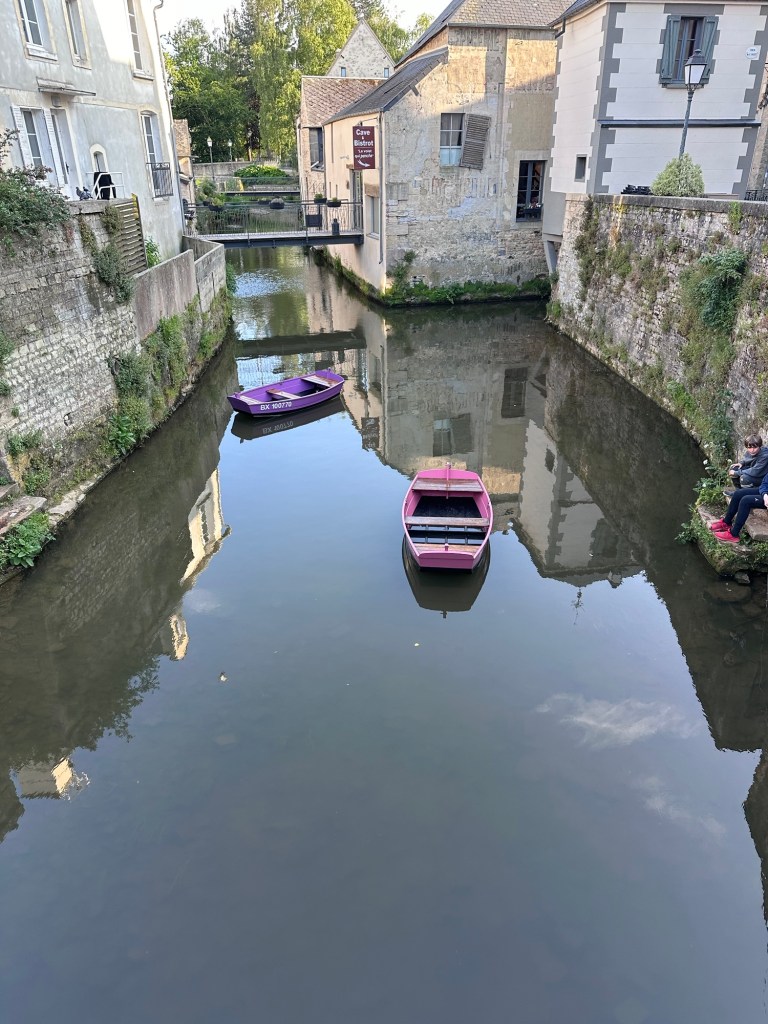
It stayed light in Bayeux till almost 10 PM, which allowed us to take long evening walks along the river’s banks.
Photo taken just a little before 8 PM
I’m so grateful to have spent three days in this wonderful little town!
I was totally surprised by how much I am loving OAT’s pre-trip to Fontainebleau and Bayeux. We spend three nights in each place, at centrally located hotels. Both are very walkable, and the best part? Even I haven’t gotten lost!
Obviously, the draw for Fontainebleau is the chateau. One of many royal residences, it is the biggest, with 1,500 VERY ornate rooms spread over three floors. Just about every square inch of the areas open to the public —parts of the first and second floors of the main building — is completely covered with some form of art work.
Check out the chateau’s floor plan: you walk THROUGH each room to get to the next. This was similar to the design of Schonbrunn, the Hapsburg’s summer palace in Vienna. I guess royalty didn’t mind a lack of privacy. Yes, there are huge doors on either side of the room, but think about this: What happens if you need to get to a room, but the door to the room before it is closed? Do you have to go all the way around? Those hallways are really, really LONG!
Take a look at Napoleon’s second wife’s bedroom—Marie Louise, the Austrian princess he married after he dumped Josephine. You see that railing around the bed? No one was allowed inside the railing, without her permission. I guess the doors weren’t enough.
Napoleon’s bedroom was a few rooms down from Marie Louise’s. His was the only one of the MANY beds I saw that had steps along side it. Was the precursor of today’s doggie stairs?
The library was my favorite room.
Are you wondering how people were able to find each other? They didn’t have intercoms or cell phones, which is probably a good thing. I have enough trouble finding mine and I have 1,490 fewer rooms.
One last room before we head outside: the ballroom. Notice the balcony at the back. I’ll bet that’s where the moms sat so they could keep an eye on their daughters. The alcoves, I suspect, was where the ladies sat, waiting to be asked to dance.
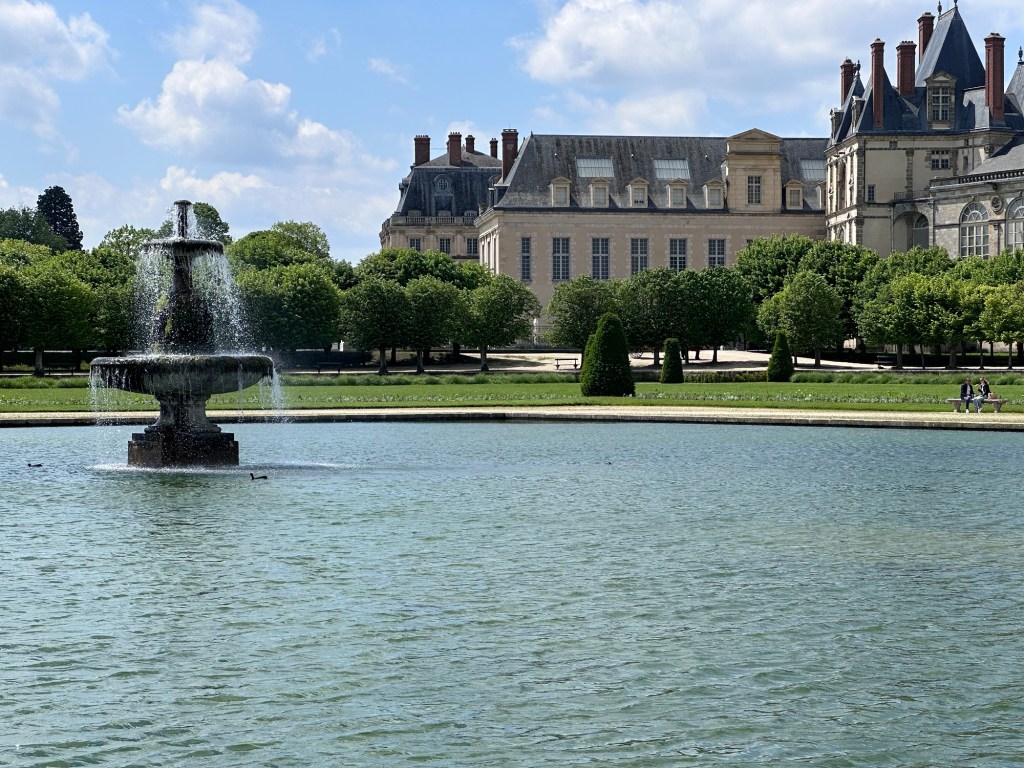
Although the weather report predicted rain, we were unbelievably lucky to have perfect weather, which allowed me to thoroughly enjoy the wonderful grounds surrounding the chateau.
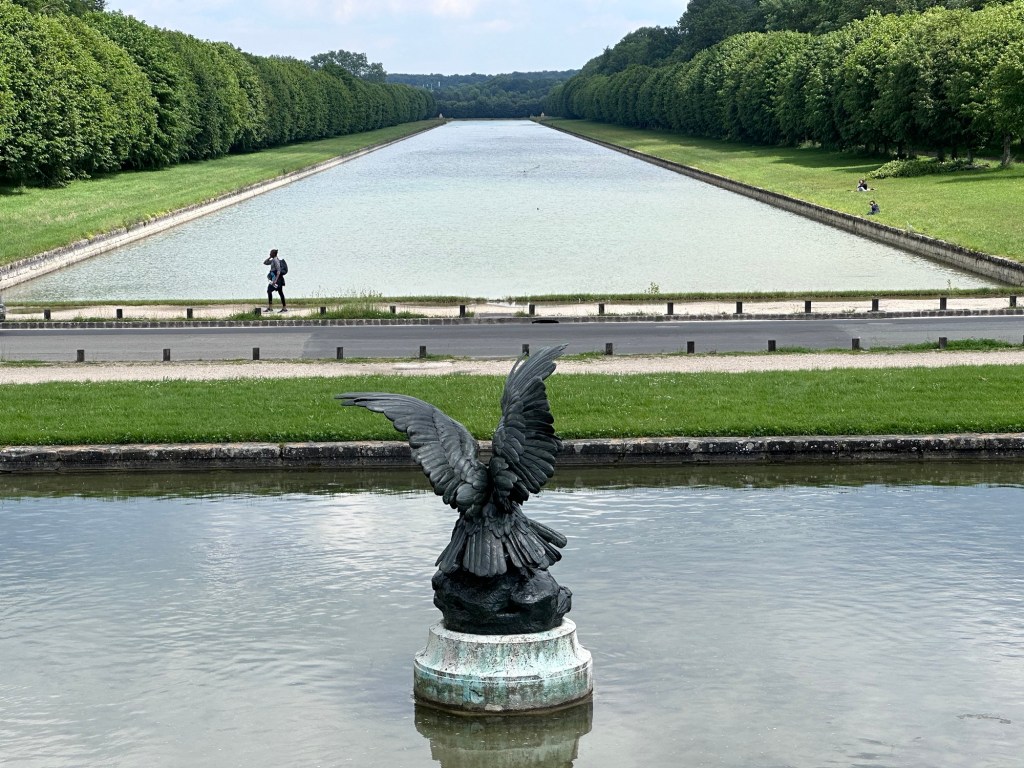
The gardens stretch as far as I could see, until they reach the forest.
After all that opulence and sensory overload, the serenity of the English and French gardens provided a needed respite.
I loved the whimsical statues scattered throughout the gardens.
This, I was told, is a sphinx. It was quite unlike anything I’d seen in Egypt, but our guide explained that the French take inspiration from other countries, then add their own touches.
Garry took the group photo of Marie, Susan, me, Jim and James. Donna and Kathy didn’t join us during our free afternoon.
On the drive to Bayeux, we stopped at Giverny, home of Claude Monet. Like Barbizon, it is a tiny village that art enthusiasts visit. Unlike Barbizon, it was really crowded.
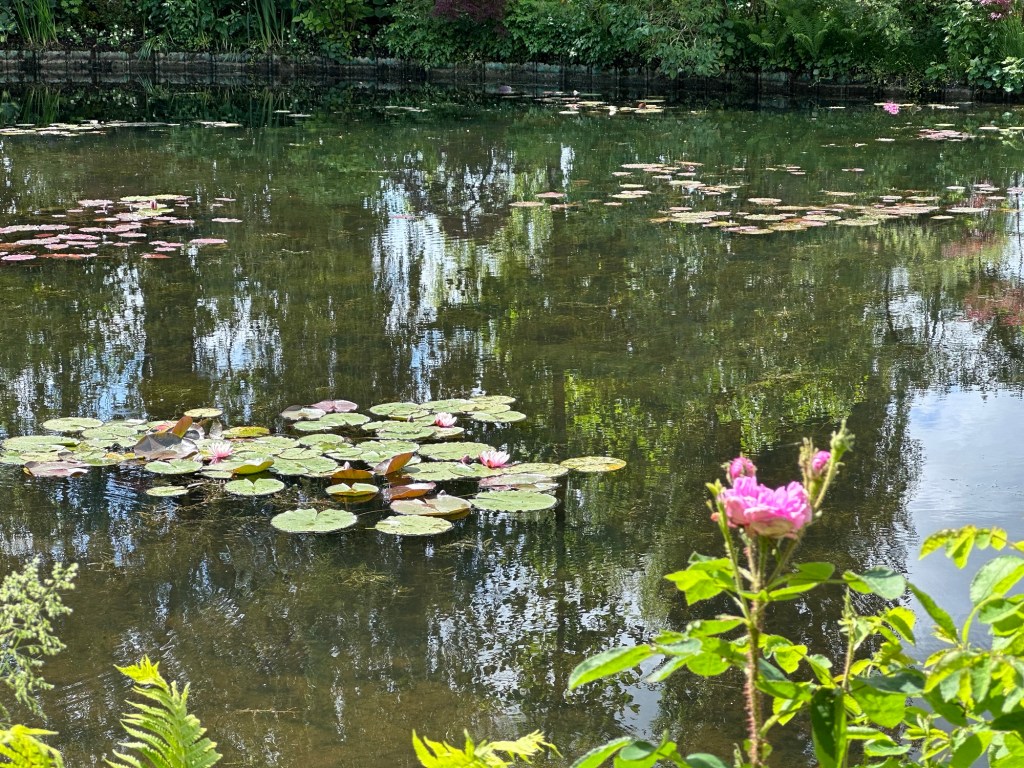
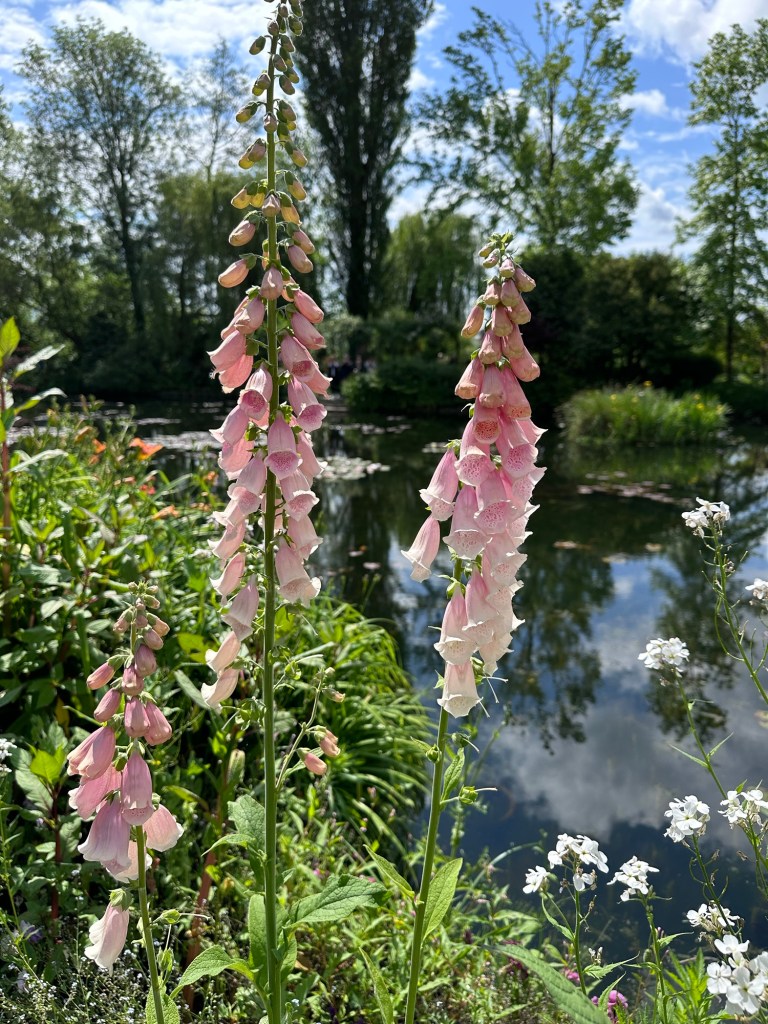
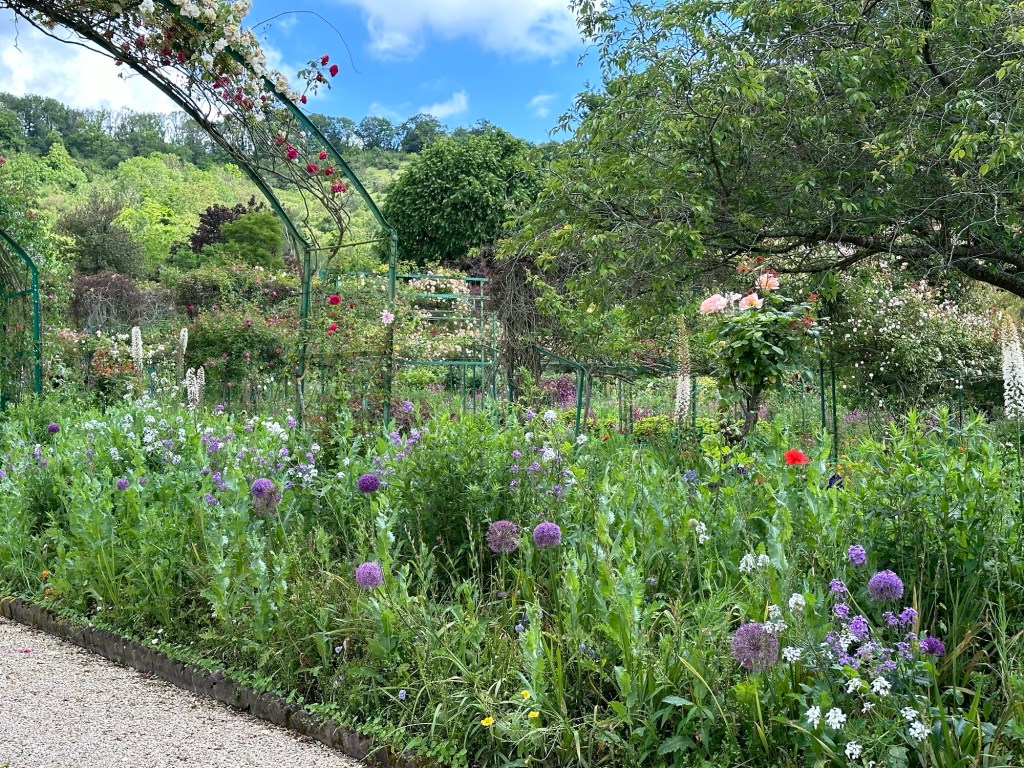
Although it was too early in the season for many water lilies to be in bloom, there were plenty of other gorgeous perennials to enjoy.
It is easy to see where Monet found inspiration for his art.
After enjoying the lily pond and the gardens, we were able to tour Monet’s home.
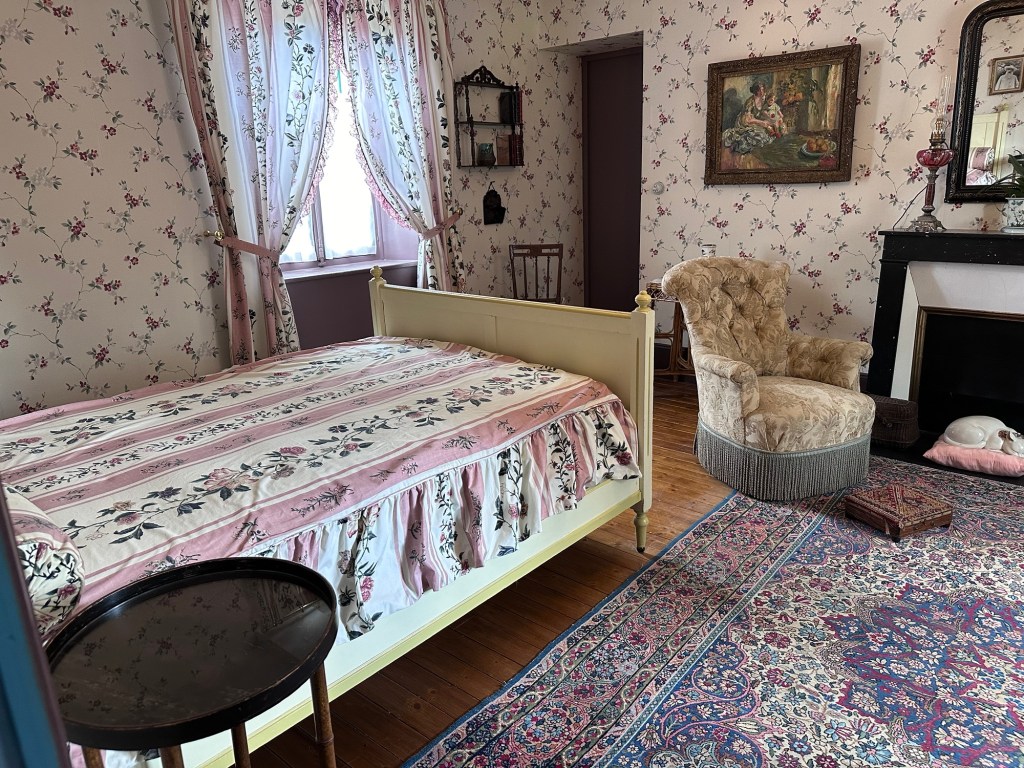
Like Fontainebleau, the walls were covered with artwork.
For some reason, however, I didn’t find the artwork overwhelming.
Clearly, I prefer the simple life. I’d much rather wake up in a bedroom like Monet’s than any of the ones I saw in Fontainebleau!
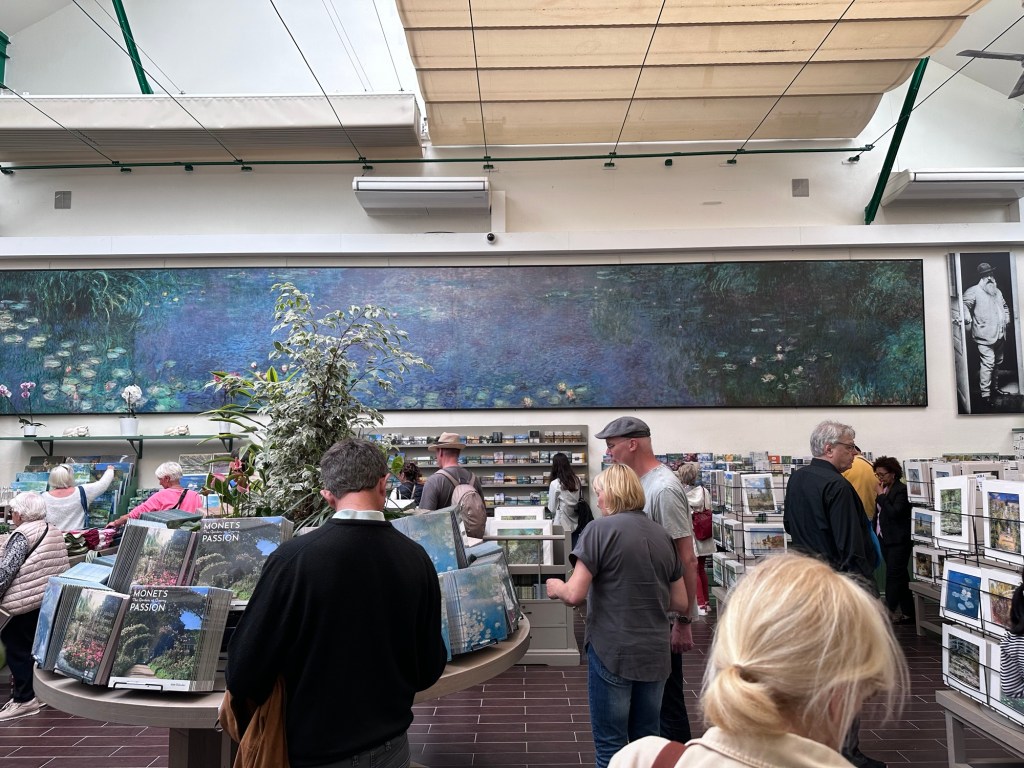
Monet’s studio is now the gift shop. It was huge, with lots of natural light. Reproductions of his water lilies were stretched across two of the walls.
Some people join bereavement groups. Me, I travel. As you can see from the map, this OAT trip’s itinerary will include Paris, of course, but there’s a whole lot more, including places I’d never heard of before. The last time I was in Paris was in 1976 while Mike and I were traveling through Europe on our honeymoon, so this return will undoubtedly be bittersweet.
There are 8 of us on the pre-trip to Fontainebleau; we will meet up with the remaining 8 in 6 days when we start the main trip in Angers.
I was surprised to discover the flight cost for business class was only a couple of hundred dollars more than economy plus. I’m never going to figure out airline pricing! Booking on my own, rather than thru OAT was more than $2,000 cheaper! Sometimes that happens. Ah, the power of the internet.
It was well worth $200+ to choose business over economy plus, just to have a single seat with window on one side and aisle on the other. No climbing over, to get to the bathroom, from my lay flat bed. The additional benefit is luggage is tagged “priority”, so it is among the first to be taken off the plane. Although normally I try to do carry on only, this will be my first trip with a CPAP machine, so I decided to pack it in my duffle, take additional clothes and not worry about laundry during the trip. I couldn’t believe how quickly both my luggage and I were off the plane. We landed at 7:45 AM and I was thru passport control, in the taxi, leaving the airport by 8:30. That’s even including the time I stopped to brush my teeth!
After the 13 hour flights to and from Japan, I expected the seven and a half hour flight to be easy. And it was. Still, I’m taking it slower than I did in my younger days to adjust to the 6 hour time difference.
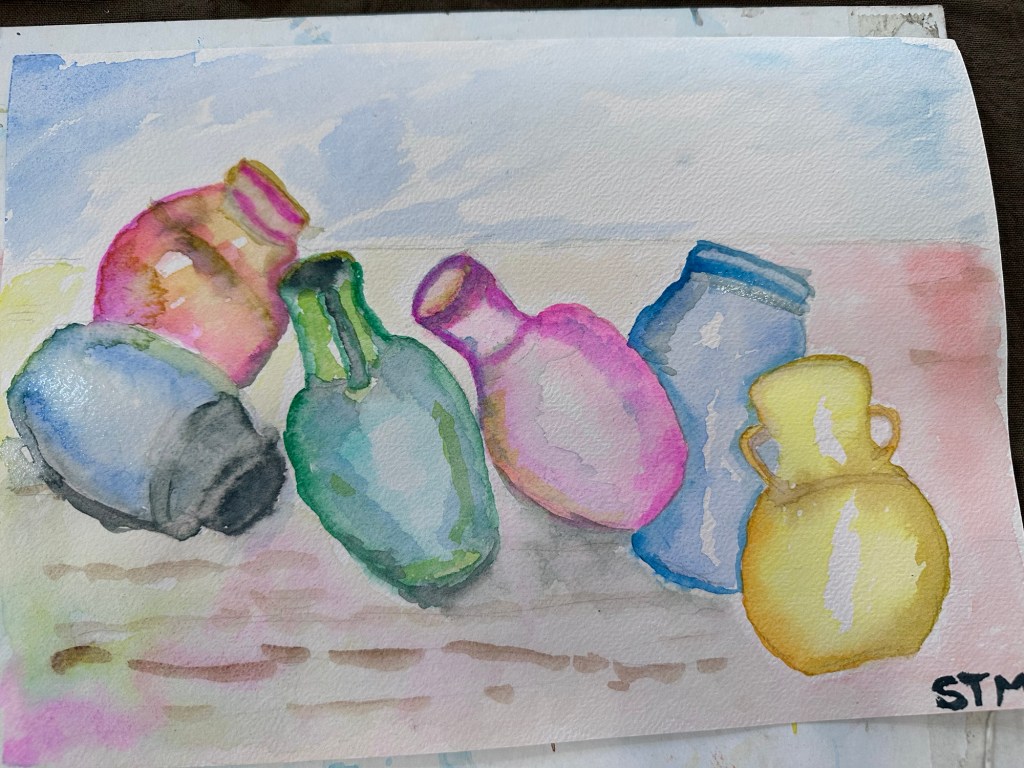
We started our first full day of the pre-trip in Barbizon, with a watercolor lesson. Patricia, our teacher, very kindly declared our efforts were “tres bien”. (She didn’t add “for a bunch of first graders’, but I’ll bet she thought it). But that’s okay. We all had great fun.
I’ve decided my two masterpieces are definitely refrigerator-worthy. If asked, I’ll just say my son did them when he was seven.
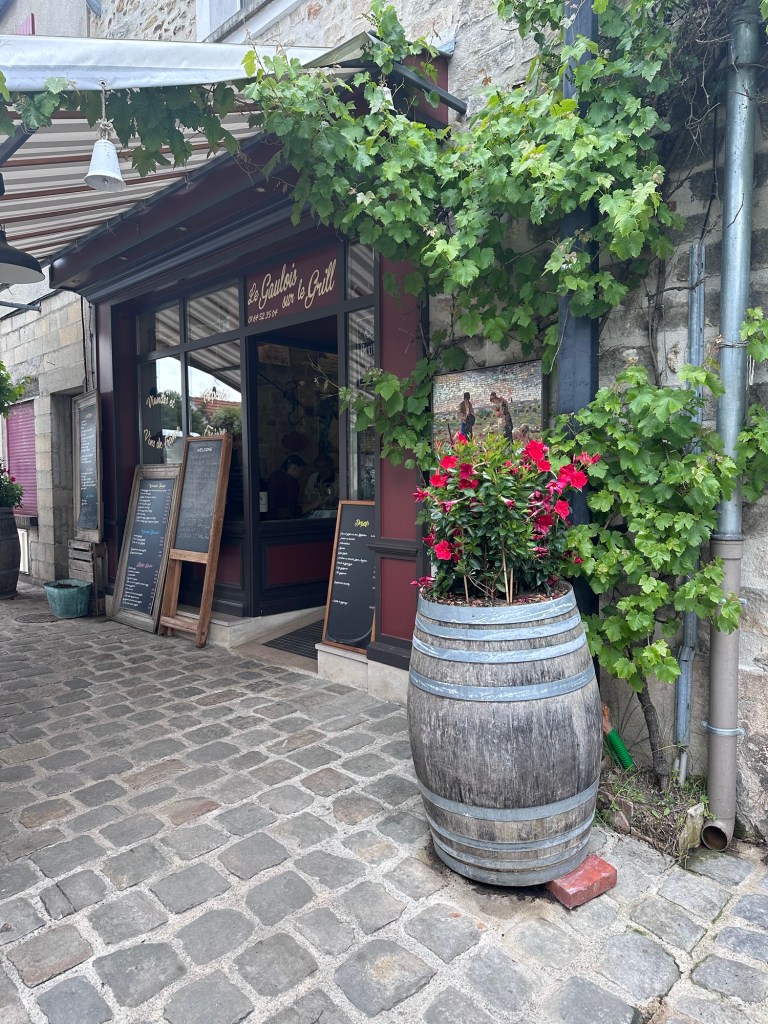
I found the tiny town of Barbizon completely charming— full of architecturally interesting buildings and art where you’d least expect to see it. Mounted on many of the buildings, for example, were mosaics of famous paintings, like “the Angelus” by Millet
The lunch placeWhat sculptors do when a tree dies
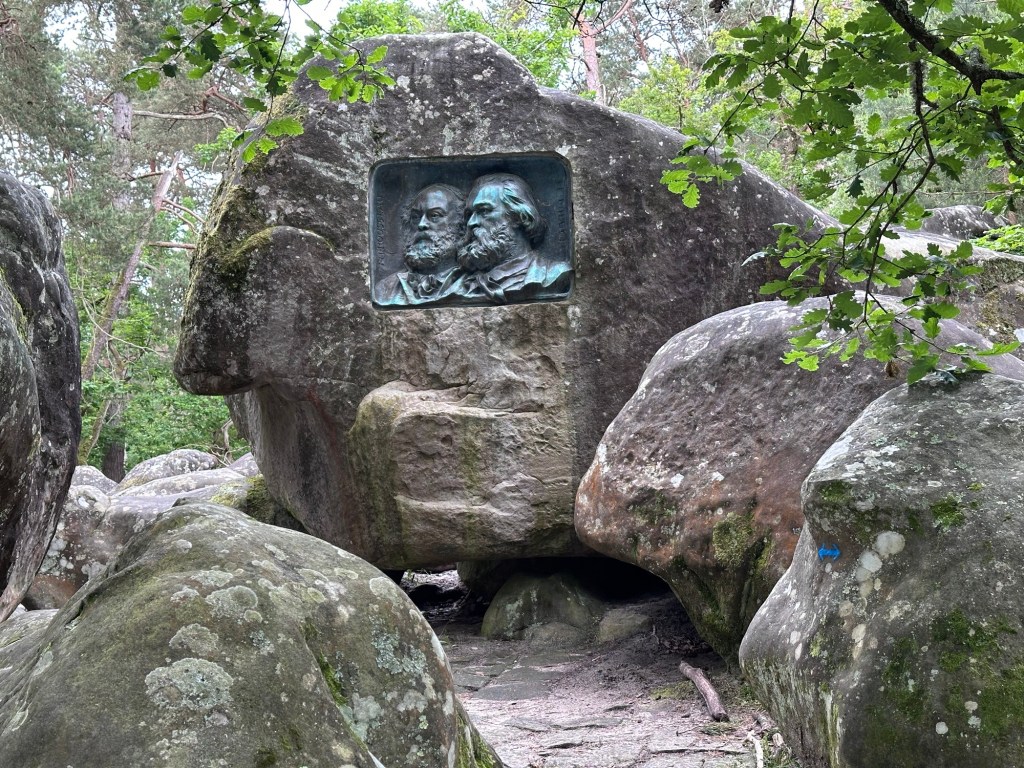
Our post lunch stroll took us through the forest where the painters would hang out, waiting for inspiration to strike. Clearly it did, otherwise they wouldn’t have gotten this honorary plaque attached to one of the forest’s many boulders. (That’s Millet and Rousseau, in case you’re wondering).
My favorite rock formation, however, was this naturally occurring one — can you see the elephant?
We had a few minutes before our taxi picked us up to return us to our hotel in Fontainebleau, so we took a quick turn thru a nearby sculpture garden. It wasn’t as grand as Hakone’s Open Air Museum, but then, what is? Still, these pieces are pretty delightful!
After returning to the hotel, Marie, our trip leader, had a final surprise for us. We gathered in the lobby to experience the impressionists’ favorite drink, (and supposedly the cause of some of their mental problems, )Absinthe.
You don’t just dump absinthe into a glass. Oh no. There is a process. You carefully pour the liquor into an ice filled glass, next placing a sugar cube (like so) upon a specially designed spoon, then slowly pour cold water on the sugar cube so that it dissolves and seeps through the spoon’s holes into the drink. I enjoyed the experience, but red wine is still my beverage of choice.
Thanks so much for the words of encouragement from all who commented on my last post, either here, on Facebook or on LinkedIn. It was great to hear from so many friends. I had no idea you were reading my blog, because unless someone comments, I don’t know who my audience is. Your very kind messages motivated me to continue writing about October’s trip.
Yugoslavia was once made up of 6 countries, and on my recent Overseas Adventure Travel (OAT) trip, I visited four of them: Croatia, Montenegro, Bosnia &Herzegovina and Slovenia. I tell you–we are SO very lucky to be able to travel in the USA for thousands of miles without ever having to show our passport. On this trip, we had multiple border crossings, and although our guides knew the tricks to make it as painless as possible (which crossing was less busy, what time is best to cross), it still was an inconvenience that I’m glad is not part of our daily lives.
After 7 of us finished the pre-trip to Albania, we drove through Montenegro to a parking lot by the border where our Albanian guide said goodbye, and Antonia, our guide for the main trip, greeted us (literally) with open arms. How lucky were we to get this dynamo for our tour leader! She was funny, creative, attentive, and so very joyous. She started out by giving us the good news that we were staying at a different hotel in Dubrovnik, a five star, because our original (4 star) hotel was still being renovated. As the millennials would say, “OMG”! The Valamar President Hotel was truly magnificent–right on the ocean, with spectacular views of the sunset. Here’s an example of one.
Scott and Gretta, two of my favorite fellow travelers. Scott had the foresight to bring a corkscrew and glasses on the bus so that we could enjoy the wine we bought along the way. It made those very long bus trips quite entertaining!
Prior to embarking on the trip, I had googled the original hotel’s location (I know, I’m obsessive/compulsive) and was slightly disappointed because it seemed quite far from the old city. I got over that disappointment real fast, because it was so easy to get to and from our new, improved hotel, (which happened to be in the same area as the original one). We were given a free pass, the buses ran frequently, and we got off right in front of our hotel. By the way, did I mention our hotel was magnificent?
When we arrived at the hotel, we were joined by the 9 remaining members of our group who opted not to take the pre-trip, including my dear friend Augusta.
One of Dubrovnik’s big attractions is walking along the city walls, which we did on our second day in the old town.
It isn’t obvious from this photo, but there was a lot of up and down along the wall, with very uneven steps. But don’t let the following photo dissuade you from exploring the ramparts. One of our fellow travelers, who is in her 80’s, managed to climb up and down without a problem. I found that truly inspiring–and very encouraging for someone who is hoping to be traveling well into HER 80’s. (In case you have’t guessed, that someone would be me).
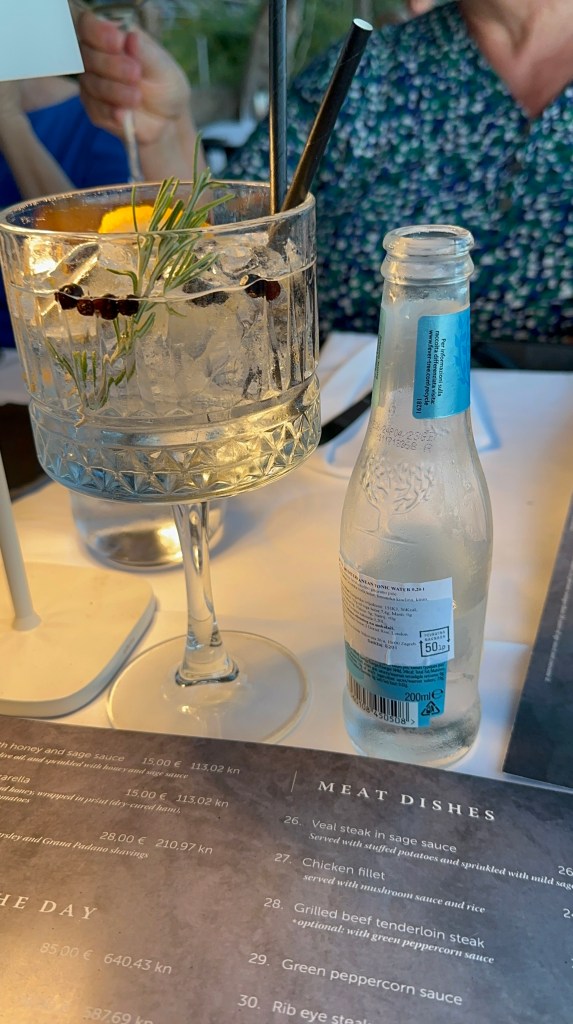
That evening, dinner was “on our own”. Antonia walked us along a beautiful path that hugged the ocean which was lined with fantastic restaurants, telling us a little about each as we passed. When she said, “This one makes the best gin and tonics in all of Croatia”, Augusta and I knew we had found our place. What made it the best? Not only was the drink served in a beautiful glass, but the creation of it was something to behold. (click on the underlined words if you want to watch our waiter construct that masterpiece).
Dinner by the sea was delightful, and the Croatian sunsets were consistently magnificent.
But the most memorable part of our time in Croatia was the talk given by a woman who had lived in Dubrovnik during the Balkan war. At that time, she was in her early 20’s. Overnight, her life changed. She had been a carefree young woman until, after a night on the town with friends, she was awakened by the sound of bombs dropping. One might expect her talk to have been depressing. It was not. It was actually an inspiring story about the resilience of the Croatian people as they learned how to survive for three months without water and electricity. She told us she quickly learned what was really important, and it wasn’t money. ”What good was it to have money, if there was nothing you could buy”, she asked.
Photo by Mark Burgunder Sr.
Her talk took place in what was once Napoleon’s fort, and is now a museum housing memorabilia and information about the Serbian and Montenegrin attacks on Dubrovnik, a World Heritage site.
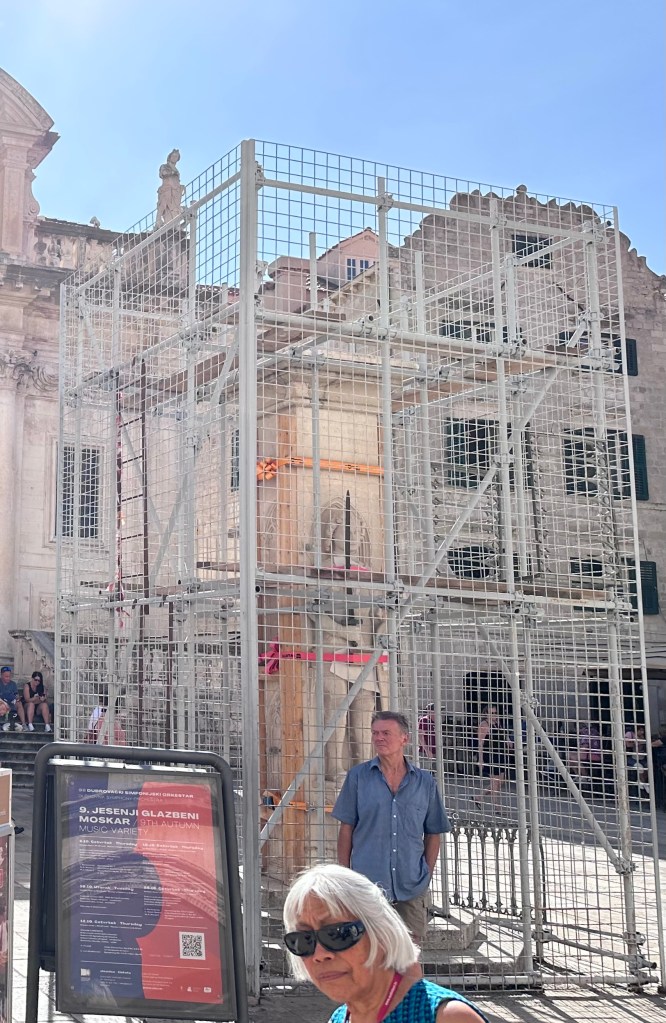
In case you’re wondering about the picture of the soldier on her right, that’s Orlando. His statue currently is located in the main square, where in days of old, decrees were read and citizens would gather to be entertained by watching the bad guys get their just punishment. (Don’t judge–they didn’t have TV or the internet back then).
This is what Orlando looks like now. It’s hard to see him, or his all important elbow, because there is a protective barrier surrounding the statue. At some point, he will be removed to have the statue version of a spa treatment, and will be returned, thoroughly restored and rejuvenated..
So who was he, and why did I mention his elbow? Well, legend has it that Orlando was a nephew of Charlemagne. Perhaps you know him by his alias, Roland? More importantly, his right arm, from fingertip to elbow, was used to measure fabric, which was traded in that very square. Why his forearm? I have no idea. It certainly makes as much sense as the inches, feet and yards WE use. By the way, there are only three non-metric countries on this planet: the USA, Liberia and Myanmar (so we are in good company, indeed). Saturday Night Live did a hilarious skit about our use of the “imperial” system. But I digress…
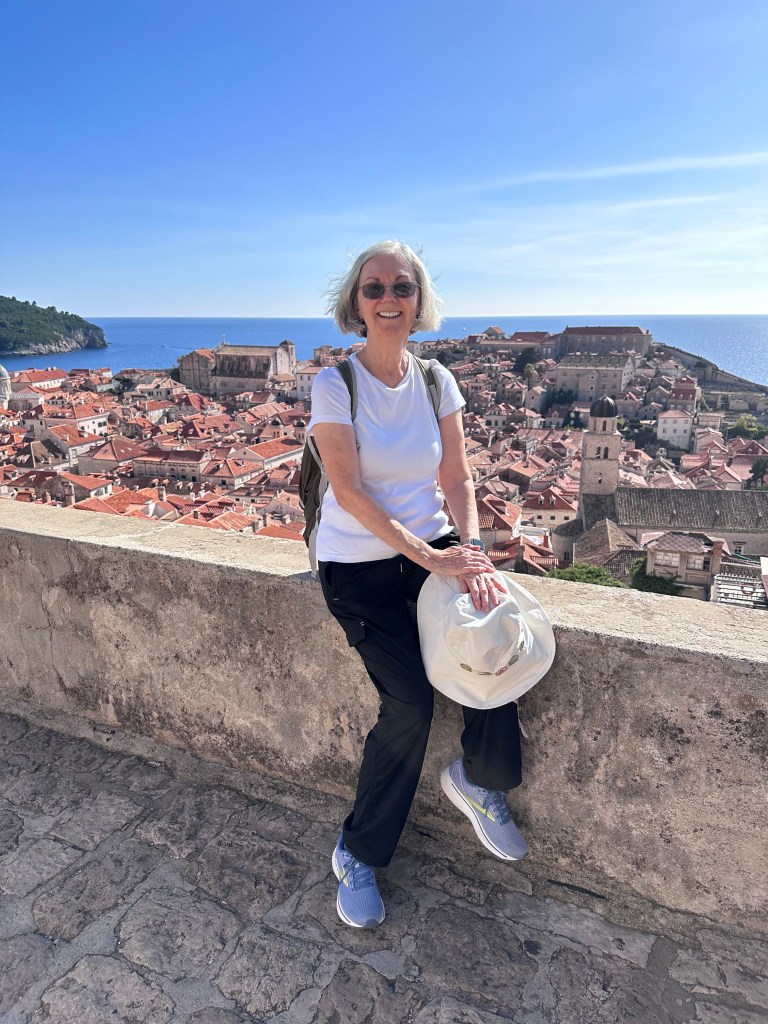
Our return to Dubrovnik’s center via the tram gave us this phenomenal view. By the time we made it to town, however, I had seen enough of the walled city and was more than ready to return to relax on our hotel’s private beach. Little secret: it’s hot in town, and crowded, so I was grateful for free time, my bus ticket and my luxurious hotel.
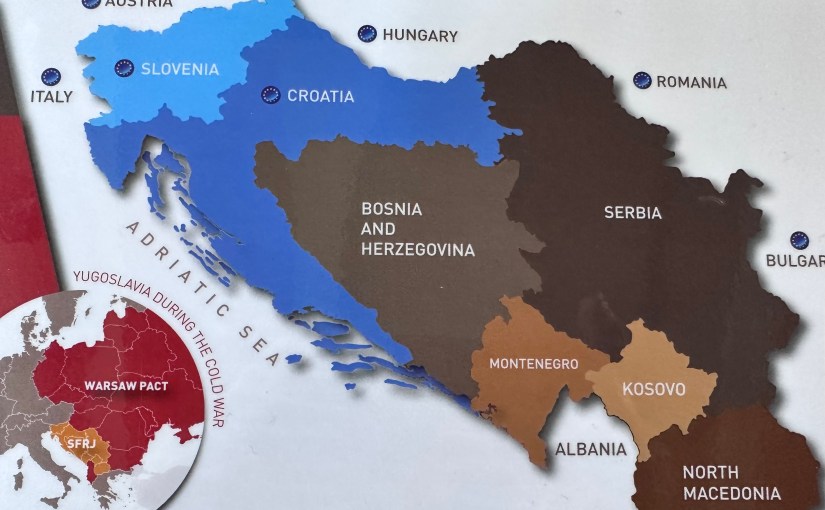
It may be difficult to see on the map atop this post, but Croatia is rather oddly shaped. The non-French say it is shaped like a bird in flight. To the French it looks like a croissant. To me, it resembles a gerrymandered voting district. Can you see that little gap that gives Bosnia & Herzegovina access to the ocean? Because of that gap, someone traveling just a few miles north from Dubrovnik could be subject to TWO border crossings: leaving Croatia to enter Bosnia, then again when reentering Croatia, and it would happen again when they did their return trip.
While in Dubrovnik, we took a day trip to lovely Kotor, Montenegro, then headed for three nights in Sarajevo, Bosnia, after which we returned to Croatia for 6 more days before heading to Slovenia, for three nights, then heading home. Got that? I don’t have the energy to fit all of that into one post, and you probably wouldn’t want to read one that long anyway, so this post only focuses on Croatia and Montenegro.
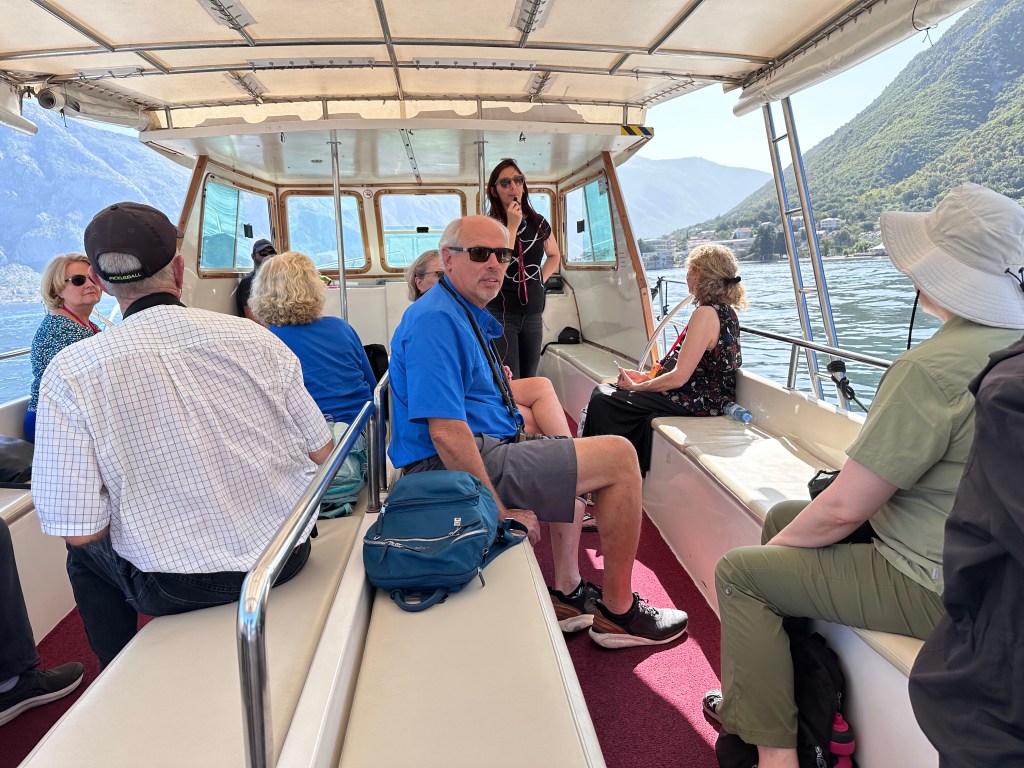
Our day trip to Kotor started with a breathtakingly beautiful ride on our private boat. I think it was during that ride that someone dubbed Antonia “the child with power”.
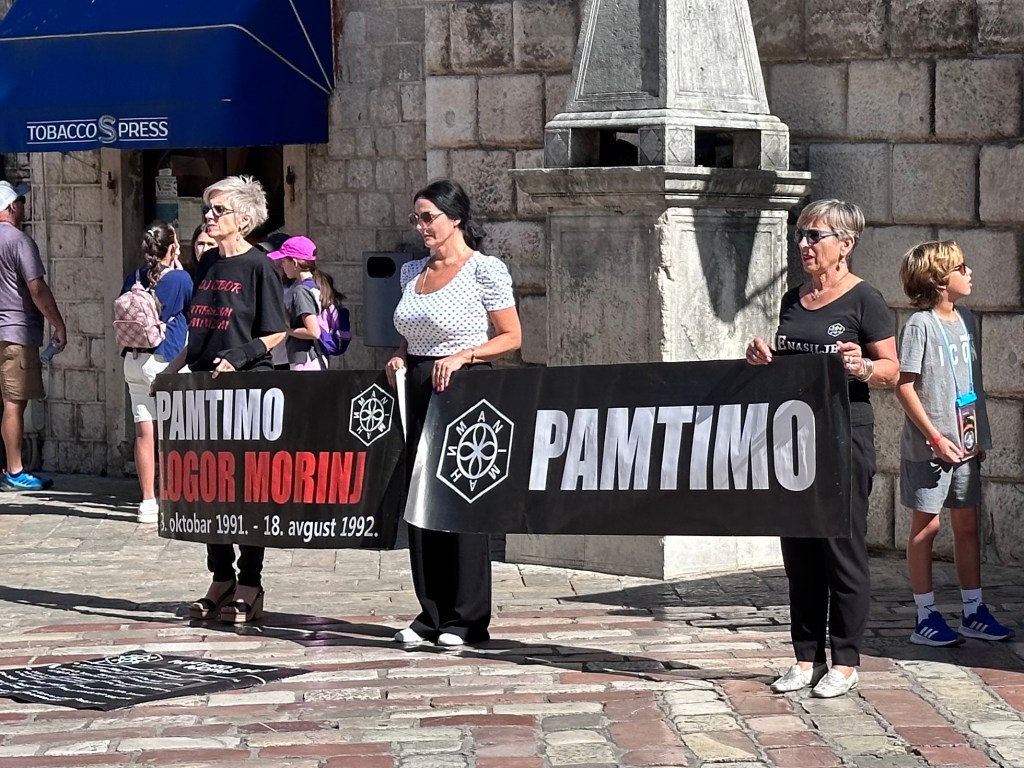
Kotor is a lovely medieval city with palaces, restaurants, gift shops, and like other medieval towns, it had its share of stories and legends, which I promptly forgot. What I didn’t forget was the women we encountered, holding the banner that says “We remember the Morinj camp”, which is where Croatian prisoners were held in deplorable conditions from 1991 until 1992. The banners act as an acknowledgement and an apology for Montenegro’s role in the Balkan War. I found that rather refreshing.
Are you ready for a break from war talk? Instead, let me tell you about Karanic, the Croatian village we visited on our way to Zagreb. OAT trips usually include”a day in the life” of the country’s inhabitants, but this was the first time the “day in the life” included an overnight stay. These encounters are designed to provide an opportunity to see non-tourist areas and get exposure to different aspects of the local culture.
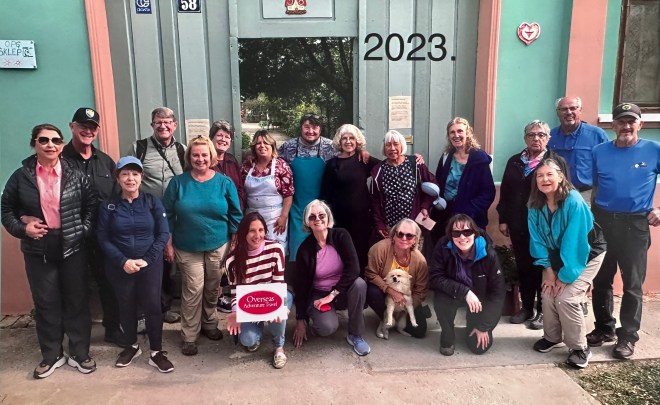
Our group, at Karanic, with Dennis, our host.
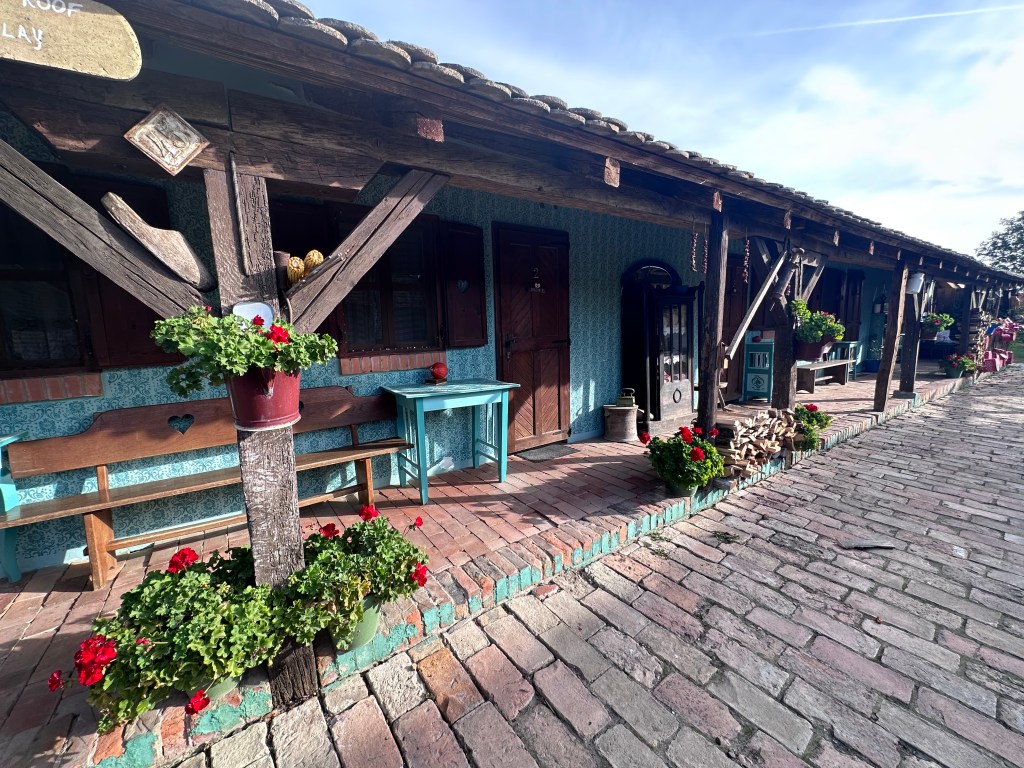
I wasn’t quite sure what to expect, but our accommodations exceeded anything I could imagine. The home had sufficient rooms for us all, each with a private bath (whew).
The food was delicious. Some of us helped with the cooking–others captured the moments via cell phone photography.
Karanac was a nice interlude before our stay in Zagreb. When we arrived at our hotel, we noticed it was filled with men wearing team shirts. Unbeknownst to me, we were sharing the lobby with the 2018 World Cup champion football team. This became apparent when we passed a building that was plastered with a photo of the guys we had just seen in the lobby. If only I were a sports fan…
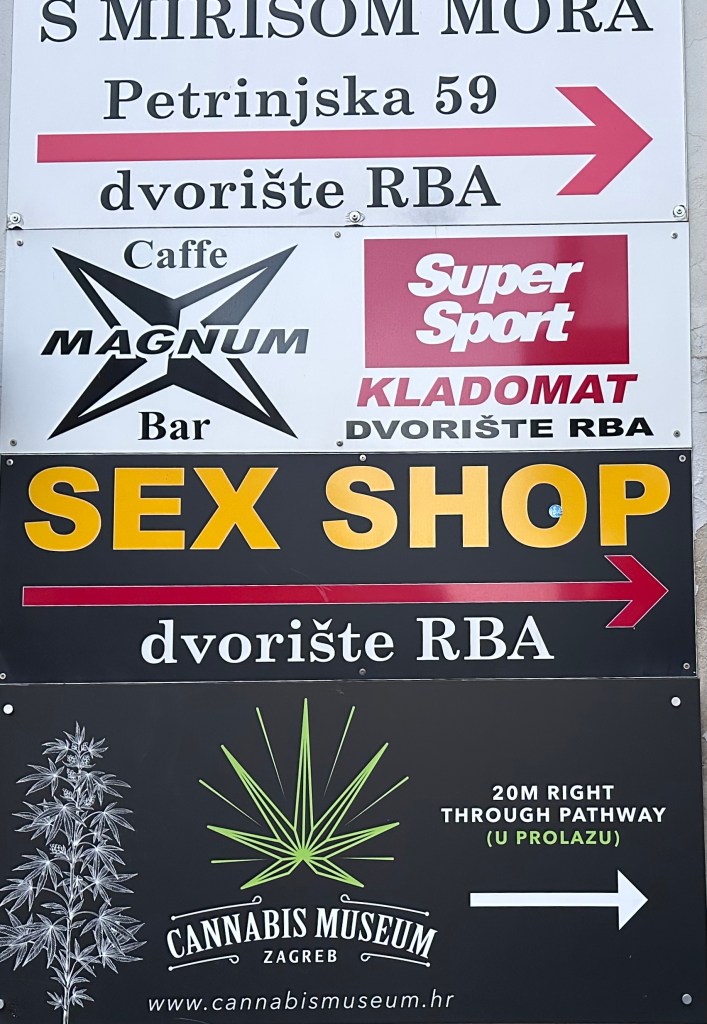
Zagreb had experienced an earthquake in 2020, so some of the buildings were still being repaired. Still, as you can see, the city offers something for everyone. I can’t offer commentary on these attractions, because I didn’t sample any of them.
What I CAN tell you is the Bornstein Winery is not to be missed. It was educational, delicious, and oh so much fun! Six of us visited there during our free time. Who knew that a Croatian immigrant took zinfandel vines to California many years ago?
There is a whole lot more I can say about Croatia, and the other countries on this fabulous trip. Maybe someday I will, but right now, it’s time to prepare for the next adventure. I hope you’ll come along!
I spent the majority of my first full day in Tirana walking around the city, exploring two of the attractions recommended in my OAT Final Documents booklet. First stop was at the Komiteti-Kafe Museum for an “American coffee” and a look at what was described as Soviet Era artifacts. I don’t know whether what I found qualified as Soviet “stuff”. It appeared much too whimsical and colorful, two adjectives that I suspect were never used to describe the USSR.
I probably wouldn’t put the coffee shop on a list of top attractions, but the walk getting there and back was fun. Tirana has lots of green space, bike lanes and pedestrian walkways— and I do love to explore on foot.
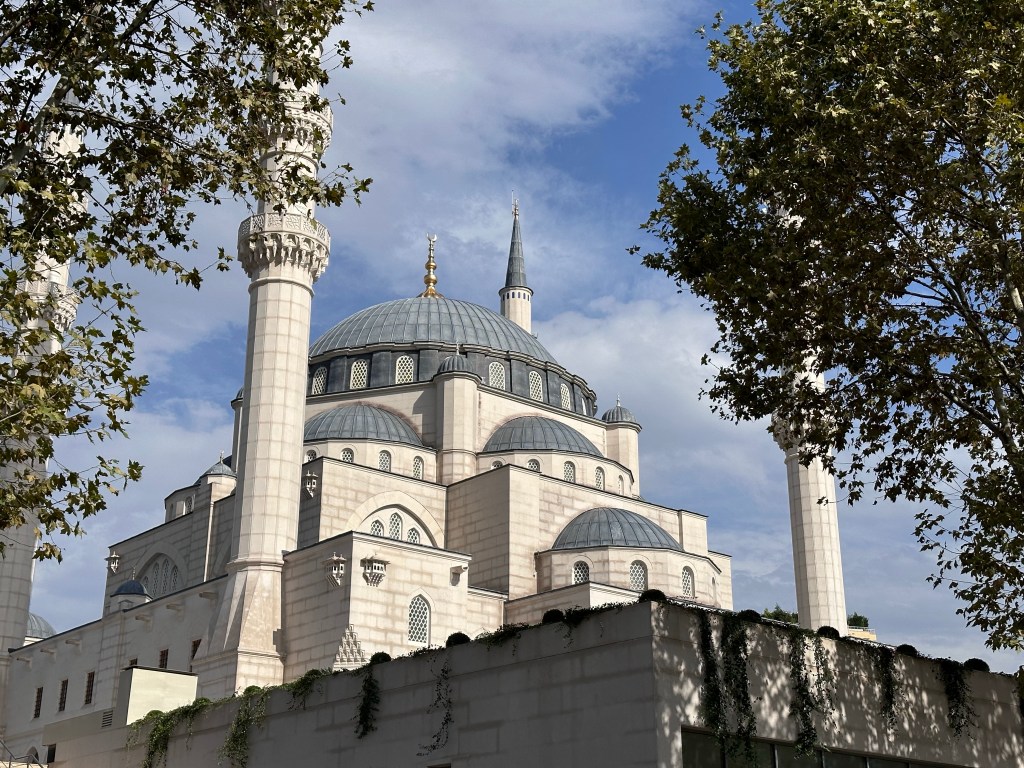
I had to get closer to the beautiful mosque appearing in the distance. A gift from the Turkish government, it is, and will remain, closed until Erdogan arrives for a dedication ceremony.
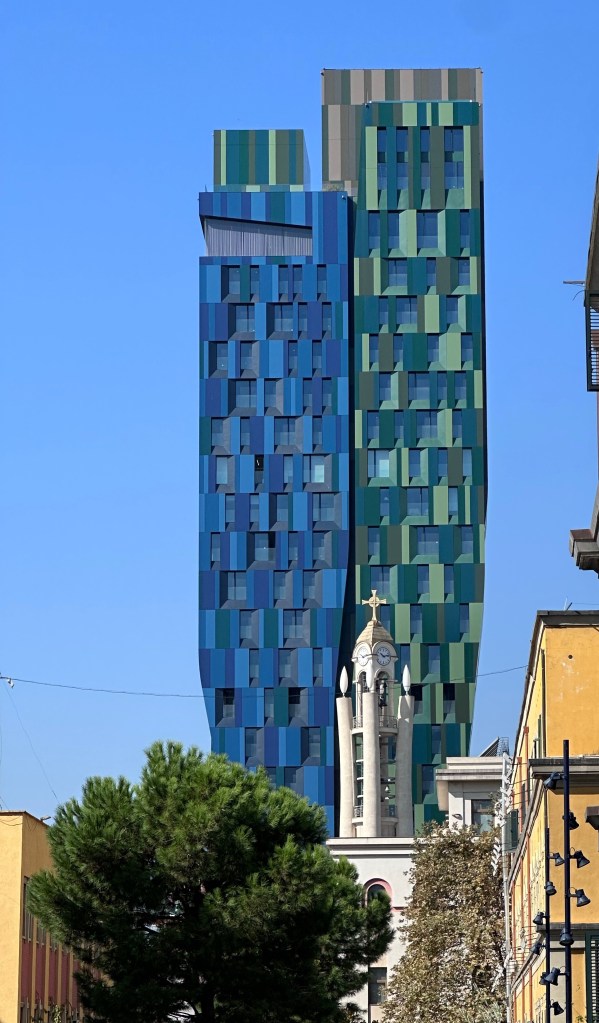
Man oh man, Tirana is BOOMING! Lots of new construction everywhere. During the ride from the airport, I noticed the very drab, but functional architecture, presumably from the Soviet era. The current construction is colorful, joyous and oh, so interesting!
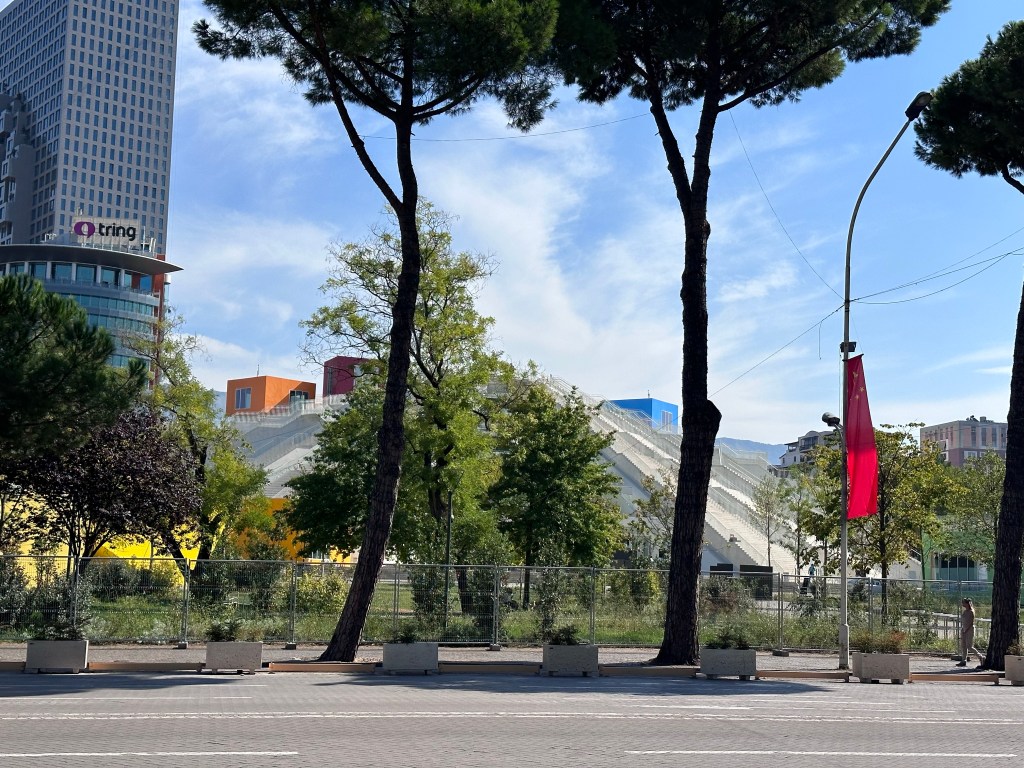
I had no idea what this building would become until our tour on my second day with our pre-trip guide. Ilir took us along a different street. He told us the colored squares will become classrooms in this future digital center.
It is difficult to see the pyramid behind the trees. If you’d like a better view and a history of the pyramid, click here. https://en.m.wikipedia.org/wiki/Pyramid_of_Tirana. The steps were added to allow people to safely climb to the top. Previously they were clambering up the smooth sides, then sliding down!
One advantage to being on your own is you can stop to take photos whenever you like, and I liked to do that a lot. I loved this bridge. While on it, you have access to free wi-fi, which I didn’t need because I had switched to TMobile. Unlike Verizon, international access is free for everything except voice calls. (Thanks to the Facebook page “Friends of OAT” for educating me about internet access outside of the USA). Knowing I could consult google maps whenever I wanted enabled me to wander freely without fear of getting lost.
As I made my way to the Sali Shijaku House (OAT’s other recommendation), I walked thru Tirana’s Castle, which was taken over by the Topani family in 1798. I had seen the Topani name everywhere, most prominently at the nearby mall entrance, and wondered what the word meant. A plaque before the castle explained that Topani is the name of a noble family “rich and educated with strong ties to the Ottoman Empire and the west which they used to help the country while it took the independence road.” The plaque goes on to explain the rivalry between the Topanis and the Barginis which was ultimately resolved by intermarriage. Just think, if the Montagues and Capulets had used intermarriage to resolve their disputes Shakespeare wouldn’t have had material for Romeo and Juliet.
Not much remains of the original castle structure other than these walls and something called a “Bailey”. (You won’t see a photo of the Bailey because I have no idea what it is). Walking thru that arch brings you to a walkway with lovely shops and an abundance of restaurants, one of which I chose for lunch.
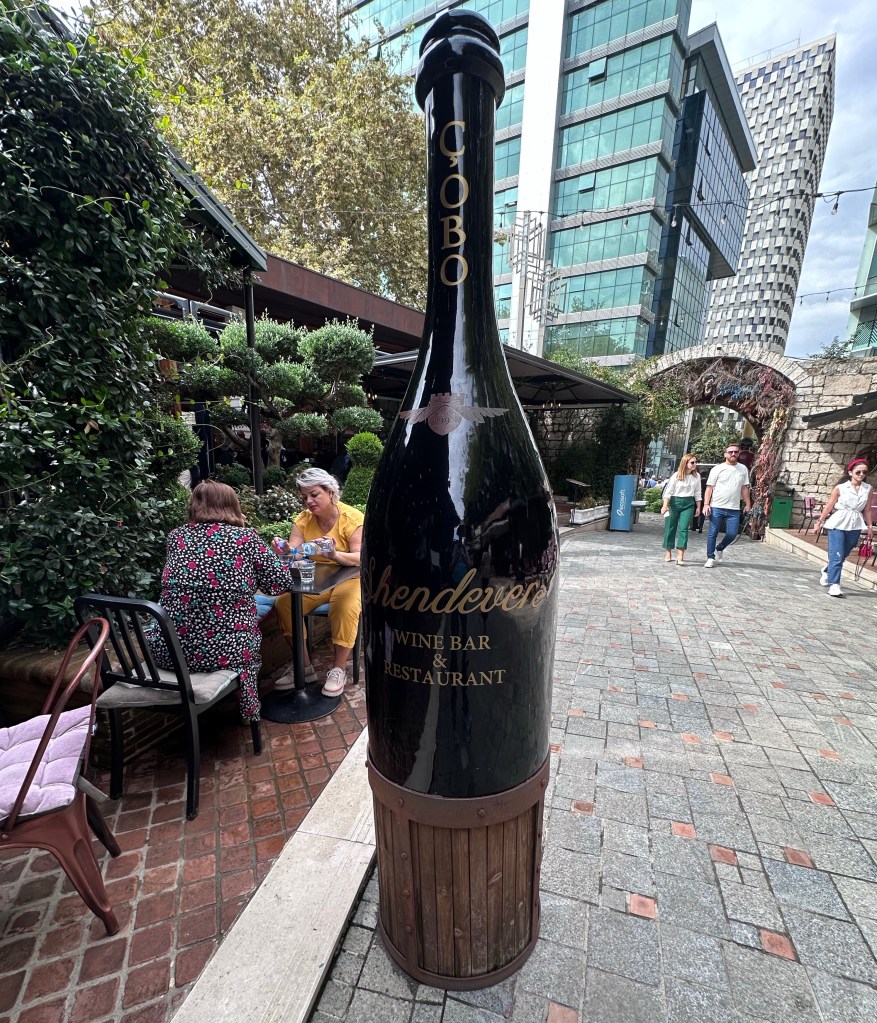
I had a wonderful inexpensive lunch with a glass of sparkling wine at this restaurant.
But back to the home of the artist Sali Shijaku, my second destination. After exploring his residence, which is filled with his paintings, I sat in the garden and enjoyed the ambiance while sipping a cup of tea. It’s hard to believe that over the years, this 300 year old structure has been a hospital, women’s prison and military building.
Some other sights from my walk thru Tirana:
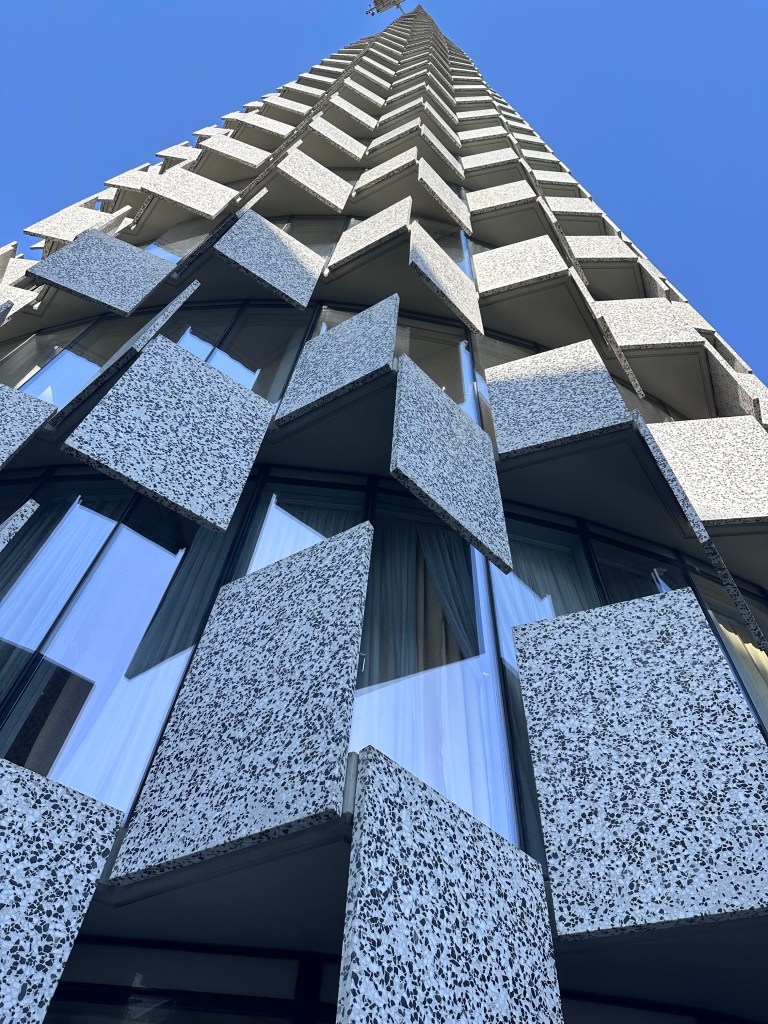
Topani Mall across from our hotel. Although not colorful, this building’s three dimensional structure appealed to me. The new building towers over the old church tower.
After exploring, I returned to the hotel to meet 4 of my traveling companions. After a brief walk with our guide, we got to know each other over dinner at Roxana Tuna House. As is often the case on OAT trips, they are all friendly and so very interesting. That’s another reason I enjoy traveling with OAT—congenial companions. We will meet the last couple tomorrow because they encountered flight delays.
Time to stop babbling about this wonderful city and get some rest.
2020 was supposed to be Mike’s and my biggest travel year ever. It feels like a lifetime ago that we booked trips to Croatia, Germany, Japan and Egypt. We (more likely the optimist of this twosome) were so confident that covid would be over in several months that we didn’t take a cash refund. Instead we opted for travel credits with bonus incentives.
Fast forward three and a half years. I’m now working my way through those credits, beginning with this trip to Eastern Europe, which starts with OAT’s pre-trip to Tirana, Albania.
One of the many reasons I enjoy traveling with Overseas Adventure Travel (OAT) is the ability to customize my trip. I figure if I’m going to subject my body and my money to a cross Atlantic flight, I’m going to stay for as long as I can, so in addition to the pre-trip, I decided to fly in a day early to get acclimated.
So far, everything has gone smoothly, starting with a great experience on Austrian Air. Passport control at Tirana’s airport was incredibly efficient. You scan your passport, which opens a gate, then get your picture taken, which opens a second gate and you’re DONE. It was so FAST. But the time I gained at passport control, I lost in bumper to bumper traffic on the way to the Oxford hotel. It took over an hour to go 11 miles, making me feel like I was back in Houston, Texas. The timing actually worked out fine, because by the time I got to the hotel, I only had to wait about 10 minutes for my room to be ready.
The room is small, but lovely, with a shower that makes the standard size in cruises look huge by comparison. I suspect I’ll be missing Mike even more than usual tomorrow morning, because when we traveled, he always showered first, figuring out how the fixtures worked, and setting the temperature just right for me. (It’s always those little things that do you in when you lose your spouse).
Take a look—no need for a bidet in this bathroom. All you have to do is swivel and lift your butt. That is, if you can figure out which faucet turns on which of the two shower heads. Yes, tomorrow will indeed be interesting because there’s not a lot of room for error. Fortunately we learned the ‘towel on the shower floor’ trick because I’ll bet that marble makes the floor extremely slippery when wet! I just hope that floor drain isn’t clogged!
But enough bathroom humor. What about the town, you ask? I remember Laura, our guide in Patagonia telling us, “There’s no such thing as bad weather; only inappropriate clothing choices.” Fortunately, I packed appropriately, and checked the weather so I wasn’t daunted by the rain. It also helps that the Oxford is perfectly located—right across from a mall ( where I bought 3 liters of water for less than $1), close to ATMS, cafes and restaurants, squares and sights. I love the art on the sides of buildings.
Wonder which of these books would be banned in America? This is a very strange image. What is the artist trying to say?
I was surprised that George W Bush had a major street named after him in Tirana. I recall the people in Africa revered him because of his involvement during the AIDS crisis. But Albania? Clearly he has his admirers—and some detractors— who covered his name with stickers.
Tirana is full of surprises—here’s another: The Italian Institute of Culture building. I know from experience that Albanians make fantastic Italian food. My favorite Italian restaurant is run by Albanians. Clearly there is a bond between those two countries that I will explore with my guide when I meet him tomorrow.
What’s with that zig-zaggy structure in front of the building? Is it a picnic table? A runway? An altar for sacrificing virgins?
This area was once part of the Ottoman Empire, so I was not surprised when I passed a mosque just in time for the call to prayer. If you want to check out the weather and share in the mosque experience, here’s the YouTube link. I wasn’t successful uploading the video to WordPress. Maybe this will work. https://youtube.com/shorts/RXIjSq3ElqM?si=BxfwMJnXN6hBMHFd
On the MAIN trip, which starts on Sunday, we will travel to Croatia, Montenegro, Bosnia & Herzegovina, ending up in Slovenia. My friend Augusta will be joining me in Dubrovnik for the main trip. She frequently traveled with Mike and me in the past, prompting one of our fellow travelers to dub Mike “the man who travels with two wives”.
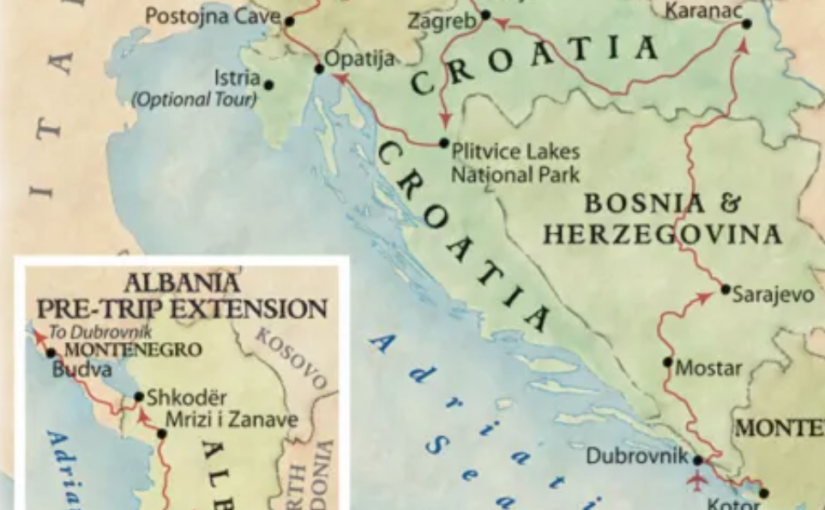
Below is a visual of our journey through some of the former Yugoslavian countries.
Tomorrow or Wednesday, I will connect with the 6 travelers that opted for the pre-trip, then on Sunday, we will join with the remaining 9 travelers in our group of 16.
First, let me say that right now I’m having an absolutely wonderful time. I’m with great friends, the sun is shining, we are drinking Prosecco. It doesn’t get much better than this.
Yesterday, however, was a different experience. You know that old saying, “you ain’t seen nothing yet?” Well, that’s what came to mind when we arrived in Palermo. Remember the bad food in Ortigia? The 59 steps in Modica? The “terrifying” ride? Well, we got ‘em all in Palermo, and then some.
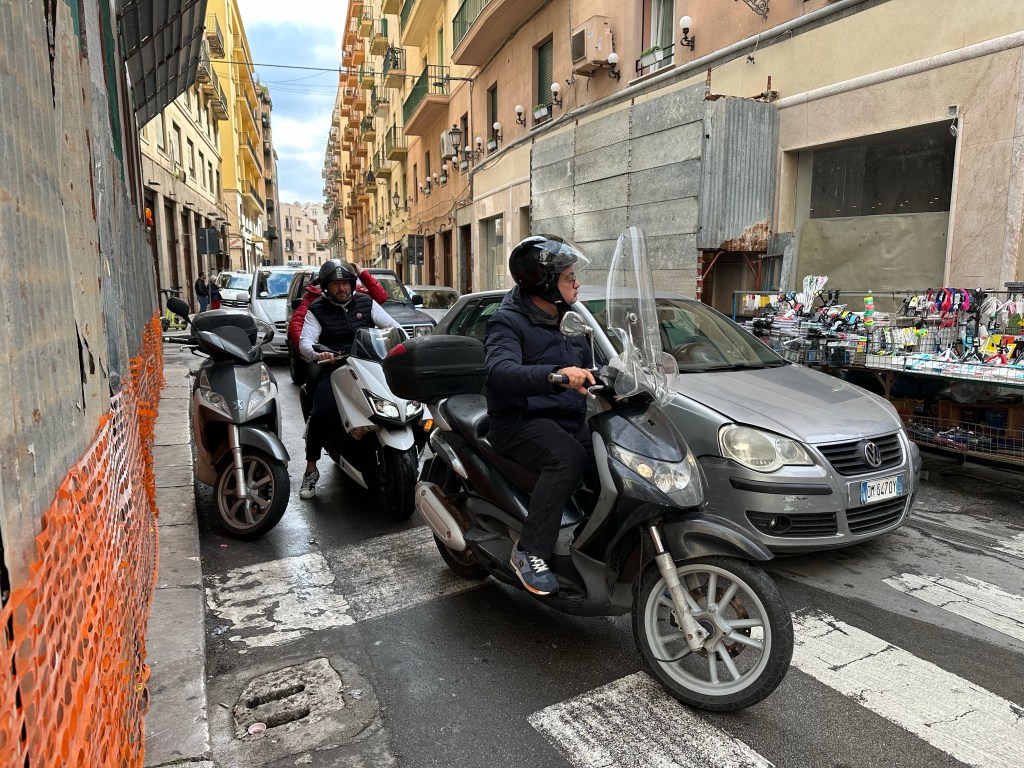
That scary ride I described in my last post? Well, yes, that road was indeed narrow and winding, but it wasn’t lined with trash cans, and there were no motorbikes, pedestrians or oncoming traffic on it. Palermo had all that — and more. I would still be recovering from PTSD if I’d been driving, or if Mike had been driving, one of us would probably have filed for divorce. But once again, Diane amazed us all with her calm, proficient driving.
It was MUCH worse than this. People were also flying by on scooters.
After driving down what WE would call alleys, but Italians call streets, we arrived at the “meeting point”. We succeeded in effectively blocking traffic, while we waited for Giovanni to find us. He then guided three of us (with our luggage) to the “bed and breakfast”, leaving Diane blocking traffic until he could return to guide her to a parking lot.
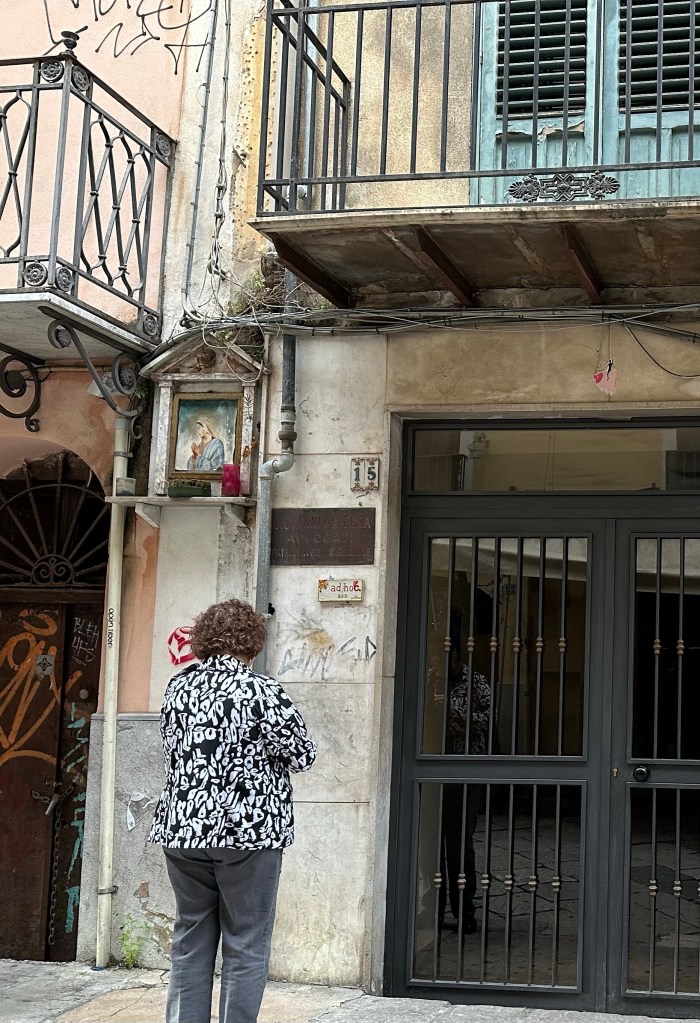
Entrance to Ad Hoc Rooms
Meanwhile, our three heroines were confronted with 59 steps (the exact number of steps as Modica—if my grandmother had been alive she would have called her bookie to “play” that number). Once again, I was grateful to the exercises classes at the Y, because we carried our own bags —and my two weigh about 27 pounds. But the best is yet to come. After our trek, we discovered that Sally and I were not only sharing a room, we were also sharing a bed. Fortunately king sized, but still.
I’ll confess, I was NOT happy. (Neither was Sally). For a brief period, I turned into the Ugly American, muttering, frowning and using my phone to search for alternative lodging. But the thought of carrying those bags DOWN 59 steps, and then someplace else gave us all pause.
My three traveling companions found solace in the cafe across the street, while I, knowing how drunk I would get on an empty stomach, dug into the cheese and salami we’d brought with us. Lo and behold, when I tried to join them, I discovered I couldn’t unlock the lobby’s front door. And I was alone. All alone.
The instructions SHOULD have read “push the button in the middle, wait till the light stops circling and forms an upside down horse shoe shape, grab the handle, then PULL.
After trying every single combo I could think of, except the correct one, I finally called Karen, who willingly walked up those 59 steps to rescue me. I owe her BIG time!
Our dinner that night could not be described as delicious, but the chef acknowledged the lack of culinary excellence by offering us free lemoncello. We ended a rather challenging day on a positive note, and after a good night’s sleep, everything seemed MUCH better!
Time for some photos of the GOOD stuff:
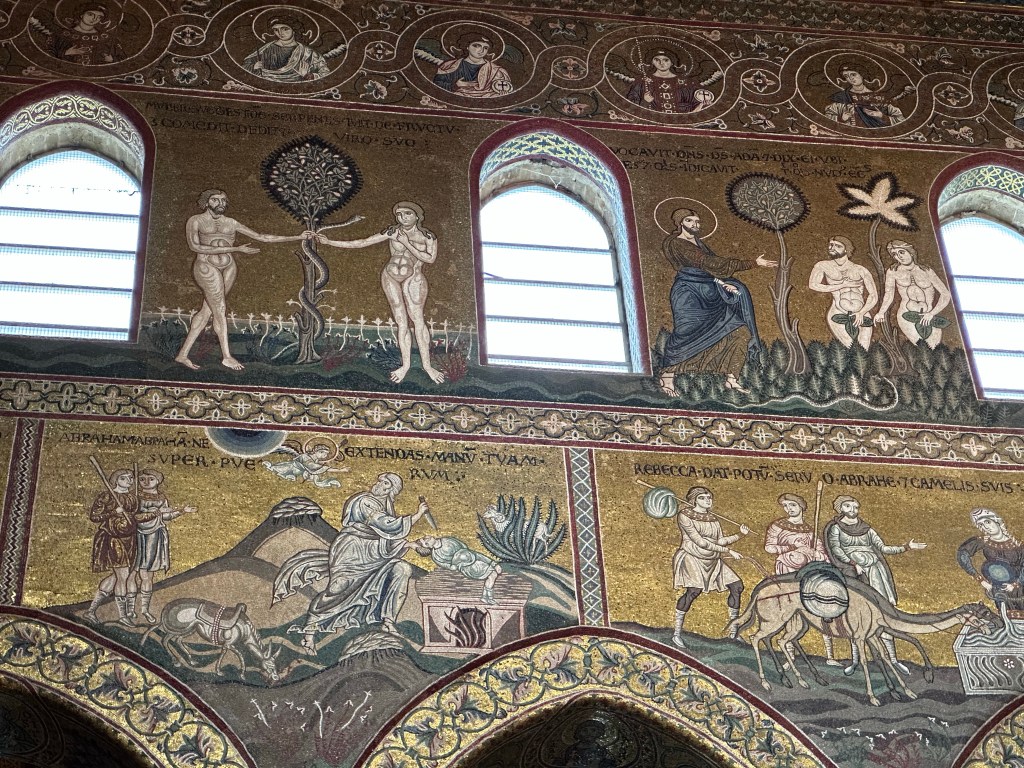
The main altar in the cathedral at Monreale
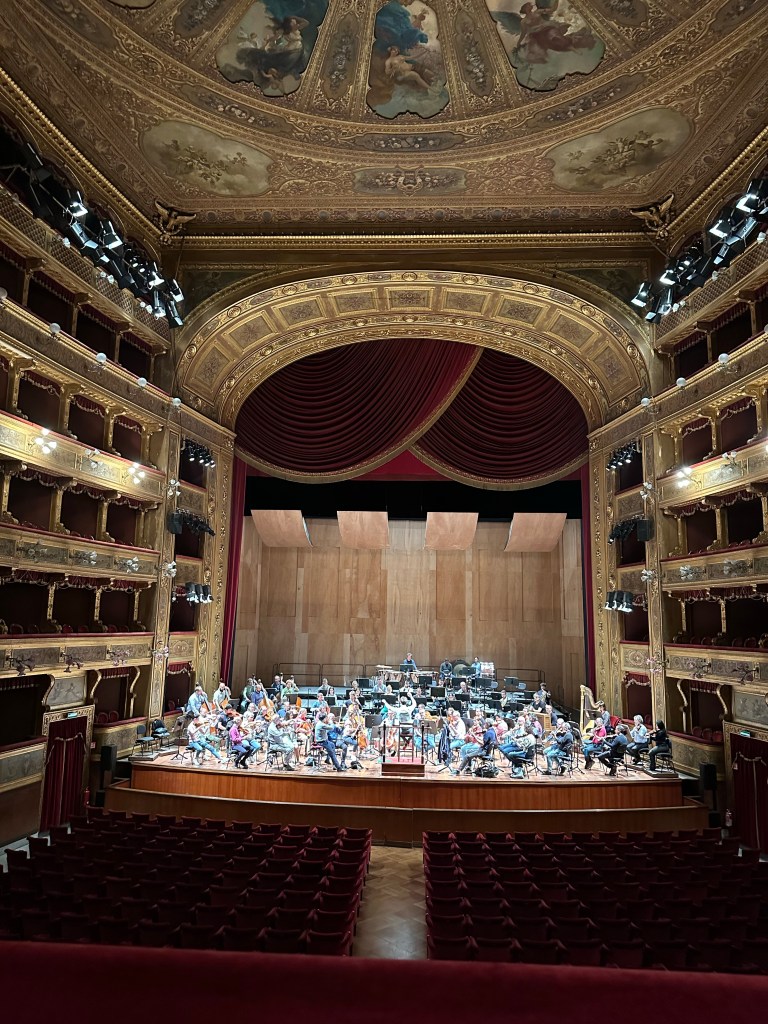
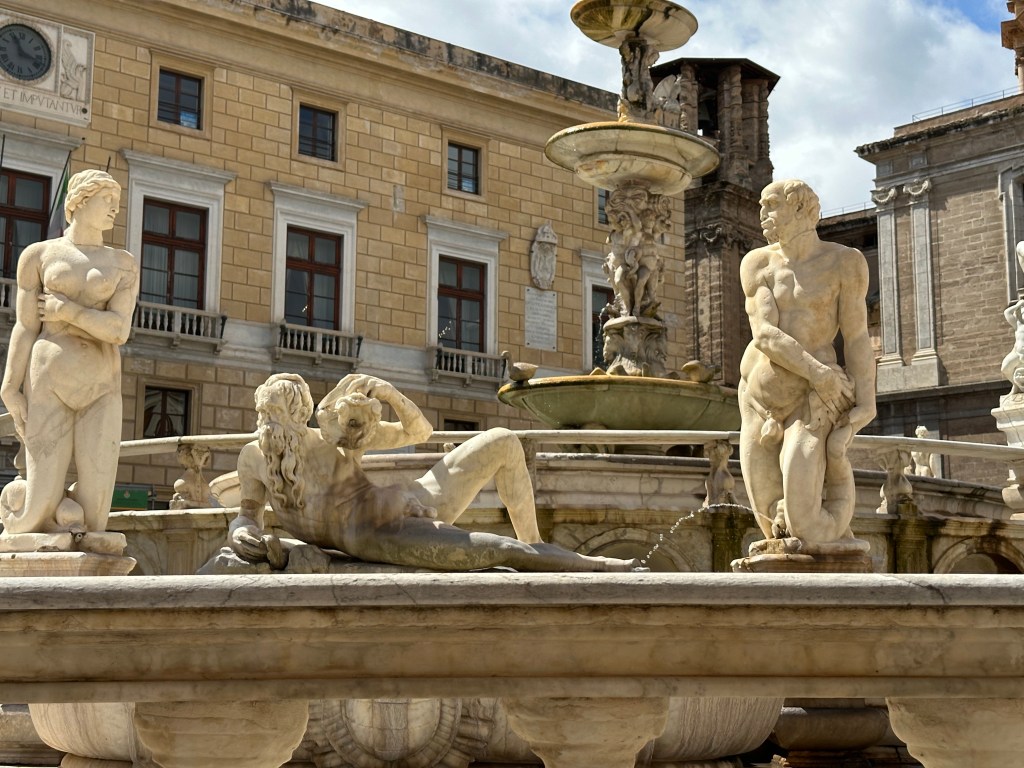
Mosaics along the walls visualize biblical stories. Check out Eve telling Adam to eat the apple so he’d get smarter, Adam and Eve modeling the latest fig leaf fashions, Abraham getting ready to kill his son and Rebecca at the well. The view of Palermo from MonrealeThe best seats in the house are, of course, in the “royal box”. We got a glimpse during our tour of Teatro Massimo, the third largest opera house in Europe. This fountain was created in Florence and reassembled here in Palermo. Check out the expressions on the statues’ faces.
On our return to the Republic of Ireland, we made one last stop in Northern Ireland, to the walled city of Derry, where we visited the Museum of Free Derry for a history lesson.
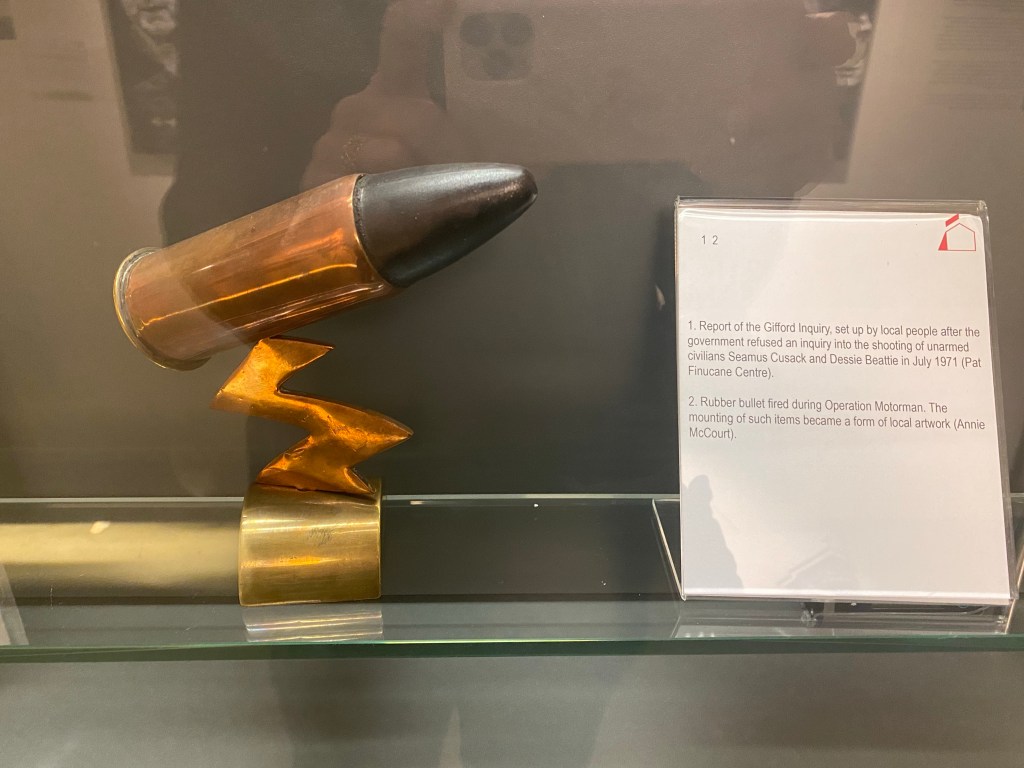
On January 30,1972, inspired by the civil rights marches and peace protests that occurred in the USA, about 15,000 Catholics staged a march to call attention to the discrimination they were experiencing. British soldiers shot indiscriminately into the crowd, killing 14 unarmed protesters. The day after what became known as Bloody Sunday, 2,000 men joined the IRA, which up until that time had not been very active.
Although attempts were made to portray the peaceful marchers as terrorists, a film crew was there, recorded what actually happened, and smuggled the film out (in their underwear!) to the Republic of Ireland where it was broadcast around the world. Despite the visual evidence to the contrary, the false narrative that some march participants were terrorists persisted until 2016, when an inquiry finally revealed the truth. The result was a long overdue apology by Britain’s prime minister, David Cameron. An excellent video in the Museum shows the huge emotional impact that historic apology had on the people of Derry. Sadly, the guilty soldiers still have not been brought to justice.
While on the Black Cab tour in Belfast, our driver showed us the size of rubber bullets that were used for crowd control. These were fired on Bloody Sunday, and contributed to the injuries many protestors suffered. Can you imagine being hit by one of these?
We couldn’t leave Derry without touring its city walls, and learning about its history, most of which I promptly forgot. Of course, the wall had the requisite cannons, strategically interspersed.
Our border crossing into the Republic of Ireland was seamless. No check points, no guards, no showing of passports, just a change of currency, back to the Euro. Ireland has sworn that it will never have a border dividing it again. Boris Johnson declared the Irish Sea will be the border, but many wonder exactly how that will work post Brexit. No one quite knows.
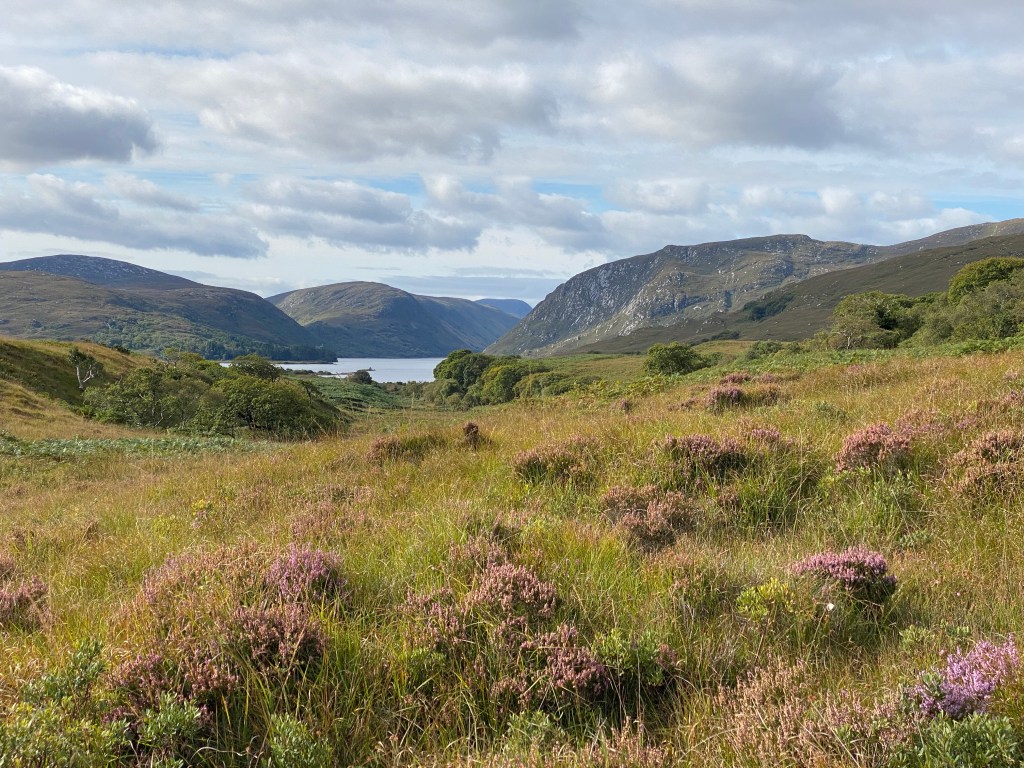
And now for a little perspective: the population of Northern Ireland is a wee bit under 2 million. The population of The Republic of Ireland is almost 5 million. Compare that to the population on NYC, which is over 8 million, and you can understand why much of this glorious island is comprised of rolling green hills and picturesque landscapes, perfect for raising sheep.
Typical view from my bus window.
Which brings me to the next subject: the Irish Diaspora. We all know that millions of Irish left during the potato famine, but I never knew that many lost their homes when they were evicted.
This beautiful castle was built by John Adair, who evicted 244 of his Irish tenants because he thought raising sheep would be more profitable than allowing his tenants to continue farming. By the way, the Irish became tenants on their own land, after Oliver Cromwell conquered them, and seized their property so he could use the land as payment to his soldiers.
Adair was the first of three owners of Glenveagh. The third, Henry McIlhenny, was an Irish American. His grandfather, John McIlhenny settled in Philadelphia, where he became very wealthy from his invention—the coin operated gas meter. Henry was an art aficionado, who donated his family’s extensive collection to the Philadelphia Museum of Art. His generosity extended to Ireland, when he donated the castle and its gardens as a gift to the nation. It is now a national park.
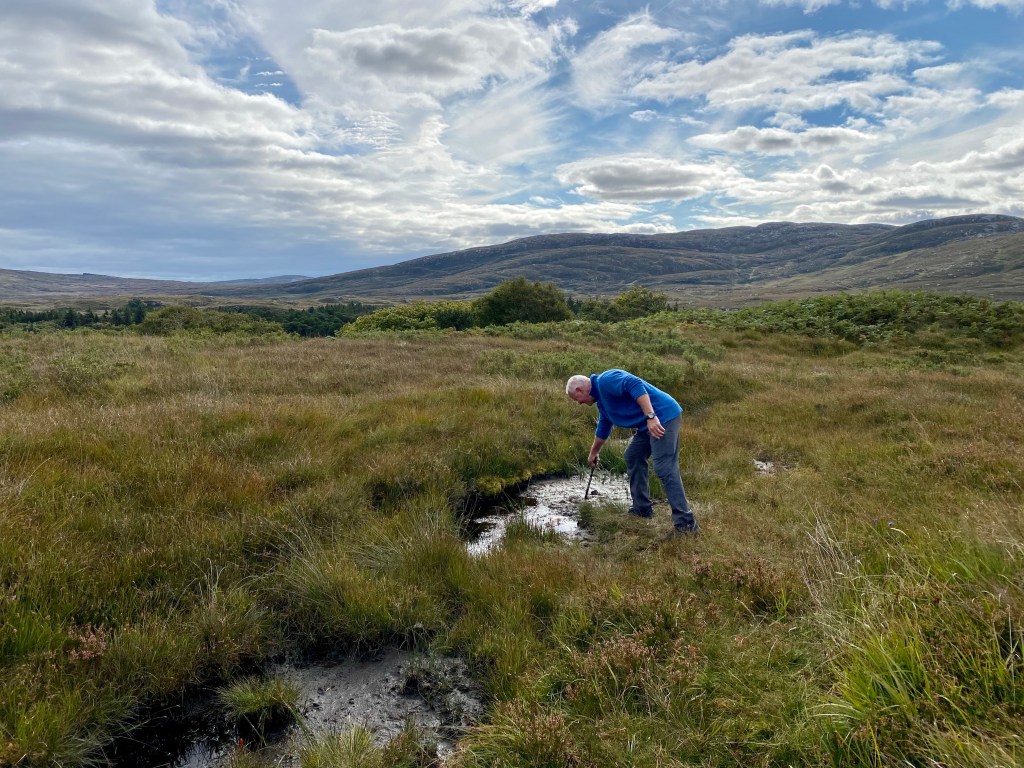
Touring the grounds of Glenveagh with a naturalist, who demonstrated the depth of the bogs, and explained why the people sacrificed in the bogs were so well preserved.
I had originally planned to write a bit about Donegal, but that will have to wait for a future post, because I have run out of time.




















































 Destination NOW