Ouarzazate

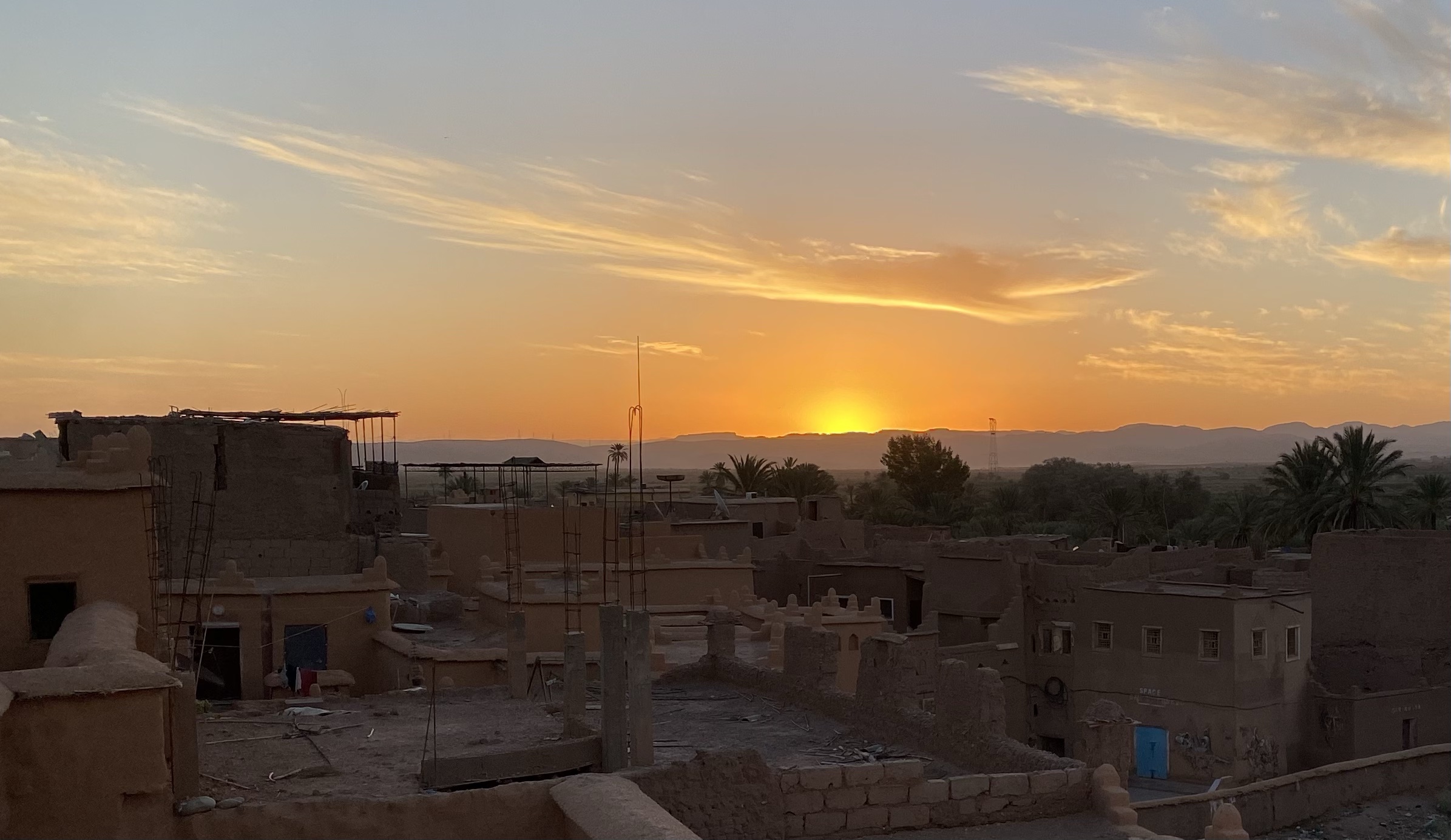
I know you are probably wondering how in the world to pronounce the name of this Moroccan city. Well, wonder no more. “Ou” sounds like our “W”, so when you come to Morocco and want to stay near the movie set for Game of Thrones, book a riad in “ WAR-za-zat”.

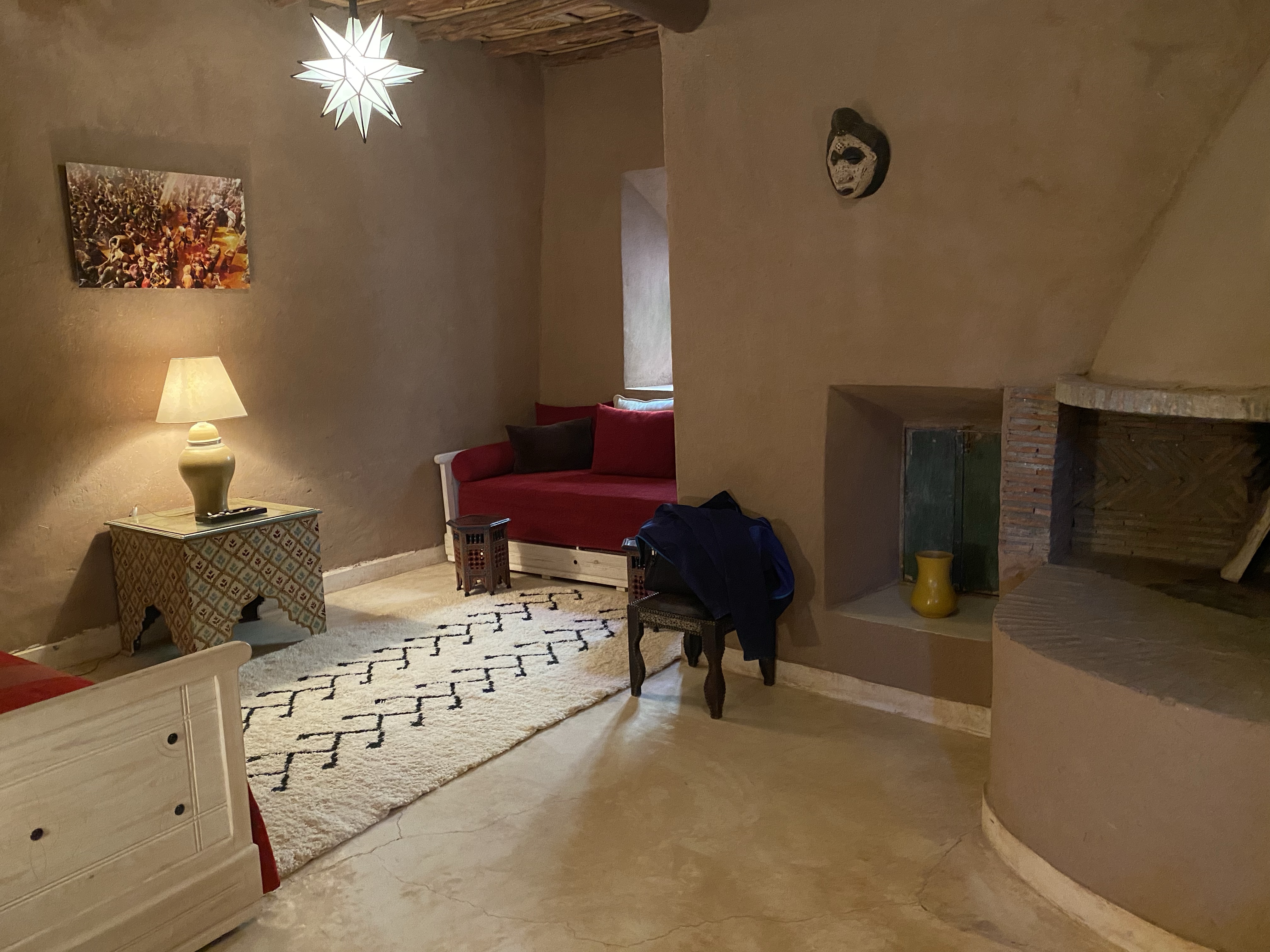
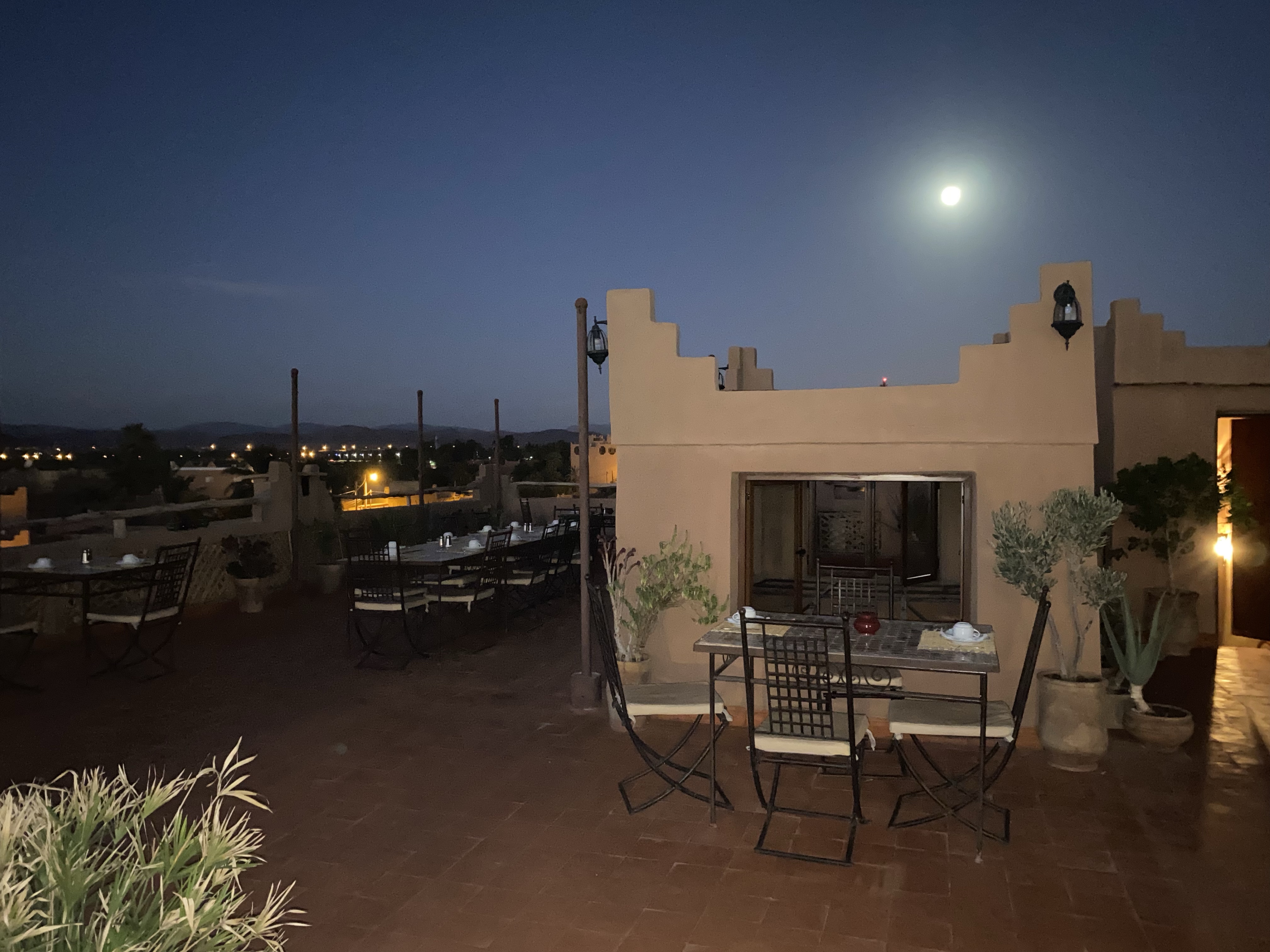
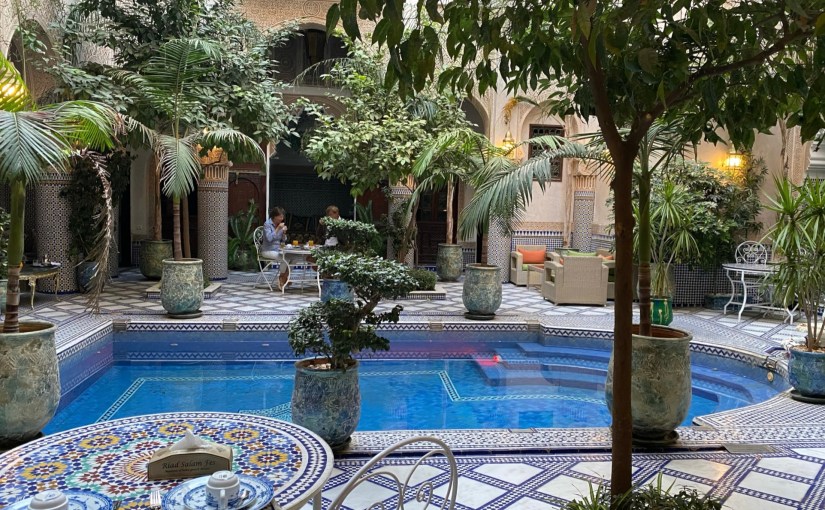
We spent two nights in Ouarzazate, staying at the beautiful Dar Kalifa. During the 1900’s our riad was the court house of Pasha Glaoui. This very powerful Bedouin chieftain was France’s ally against Sultan Mohammed V, and was instrumental in getting the Sultan exiled to Madagascar in 1953.

Unfortunately for France and the Pasha, the Sultan was beloved by many Moroccans. His removal resulted in unrest and uprisings in Morocco. As a result, de Gaulle reinstated Mohammed V (who changed his title from sultan to king) in 1956; simultaneously Morocco gained its independence. Pasha Glaoui had clearly made the wrong choice. So what became of this traitor? He traveled to Paris, knelt at the feet of in submission to Mohammed V, who forgave him. Their actions reunited the warring factions and made it easier for Mohammed V to regain his throne. Glaoui died of cancer in 1956, Mohammed V died in 1961.

I have to admit, it was pretty thrilling to think about all the history that must have taken place within the walls of our riad. It isn’t easy to find—you walk along some narrow passages to get there, but it is worth the walk to discover this spectacular dwelling.

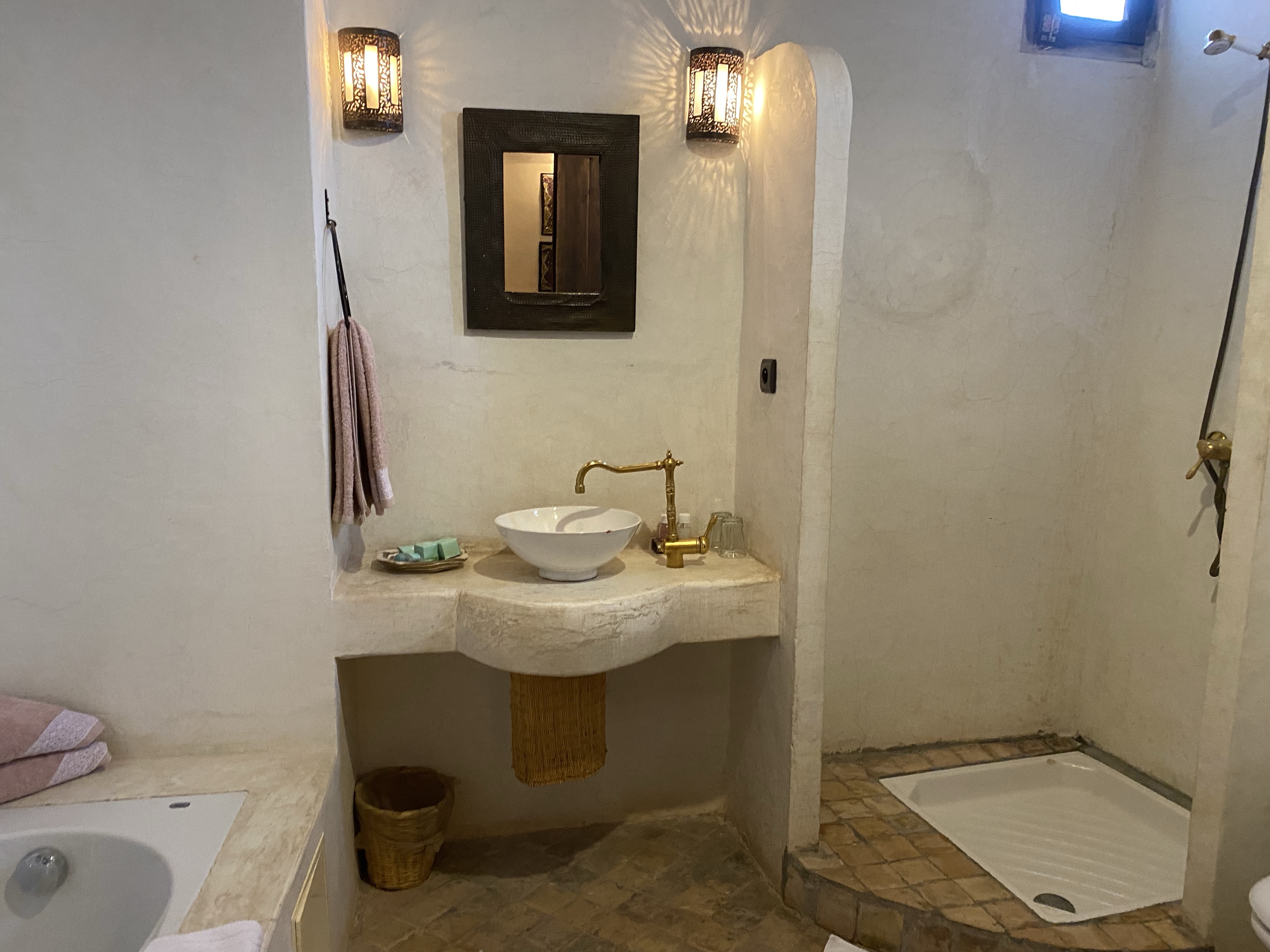
Be forewarned: there are MANY steps in Dar Kalifa, and they all seem to be a different size.

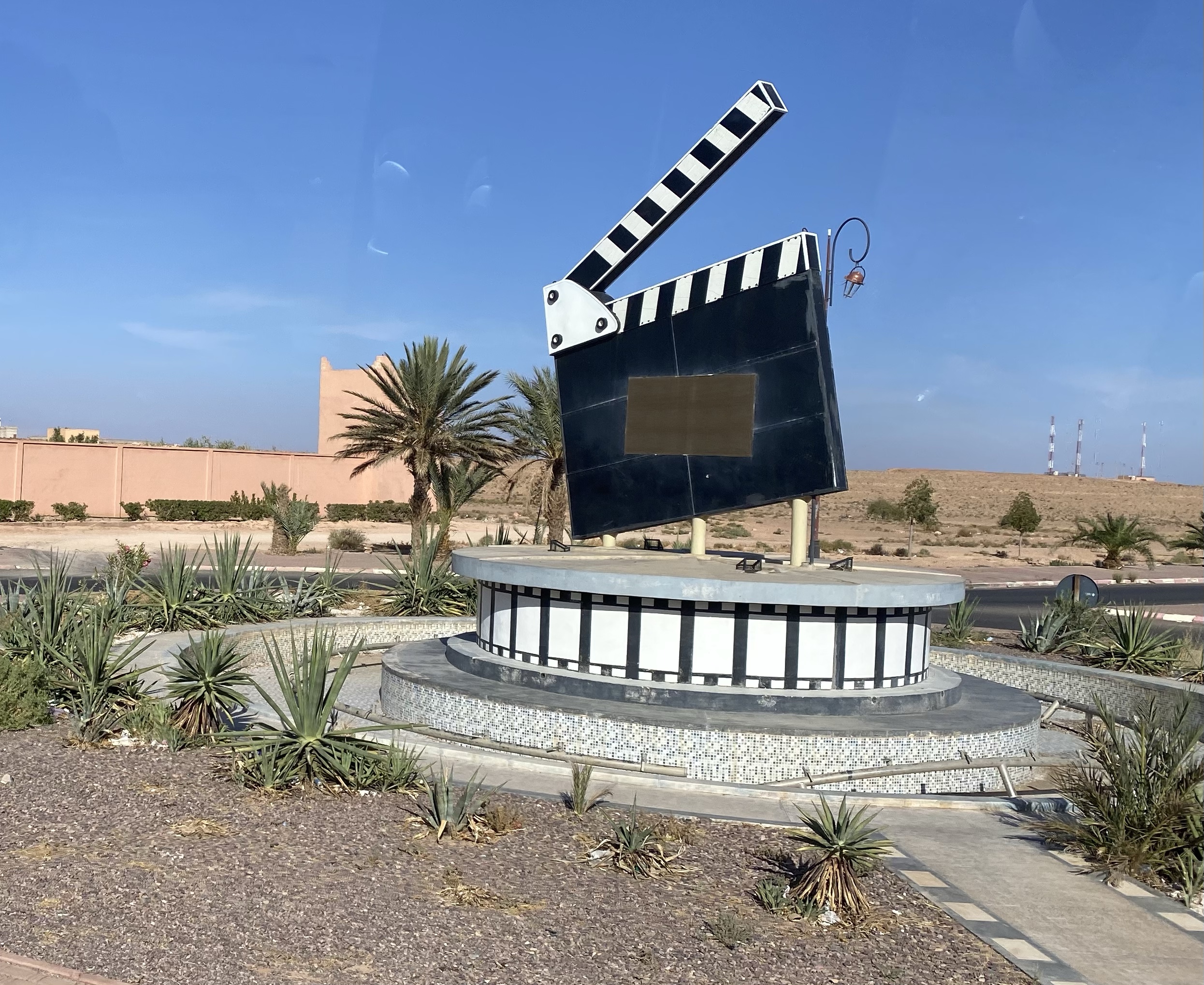
Can you guess why Ouarzazate’s nickname is WallyWood? The dramatic scenery and the perfect lighting from sun filled days have made it a favorite spot for film makers.

Many of the locals work as “extras” in movies like Gladiator. Our local guide, Mohammed has been in several movies. Here’s his picture, so you can look for him in Season 4 of Game of Thrones.
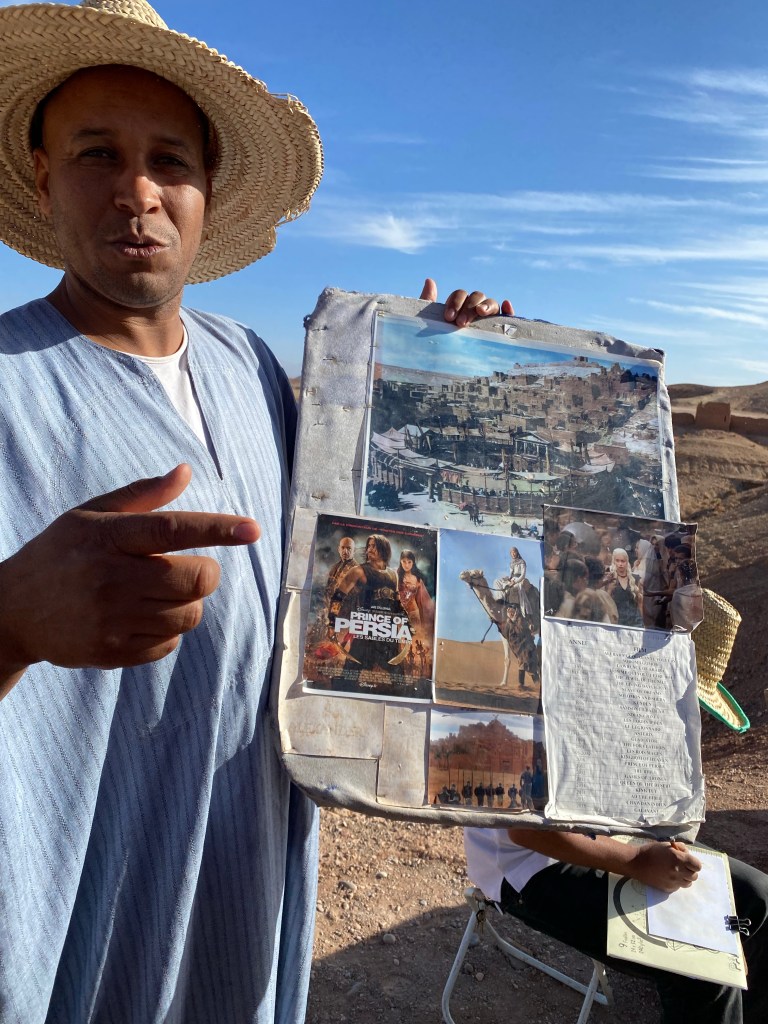
Mohammed with his visual resume

Mohammed never had the opportunity to attend school. He spent his childhood ferrying tourists across the river on his donkey. Although he was never taught to read and write, he became fluent in English, French, Spanish and a few other languages, by listening to tourists he transported. I find that amazing—what an impressive and intelligent man!

Mohammed’s children: 2 girls, aged 13 and 6 and 1 boy aged 10, all attend school, and are teaching their dad to read. Mohammed told us he thought his family was complete, but his “coronavirus baby” arrived 8 months ago!

Most tourists visiting the area want to spend time in Ait Benhaddou, stopping at one of the two studios in town. Before Covid, Mohammed told us during high season Ait Benhaddou received more than 1,000 tourists per day.
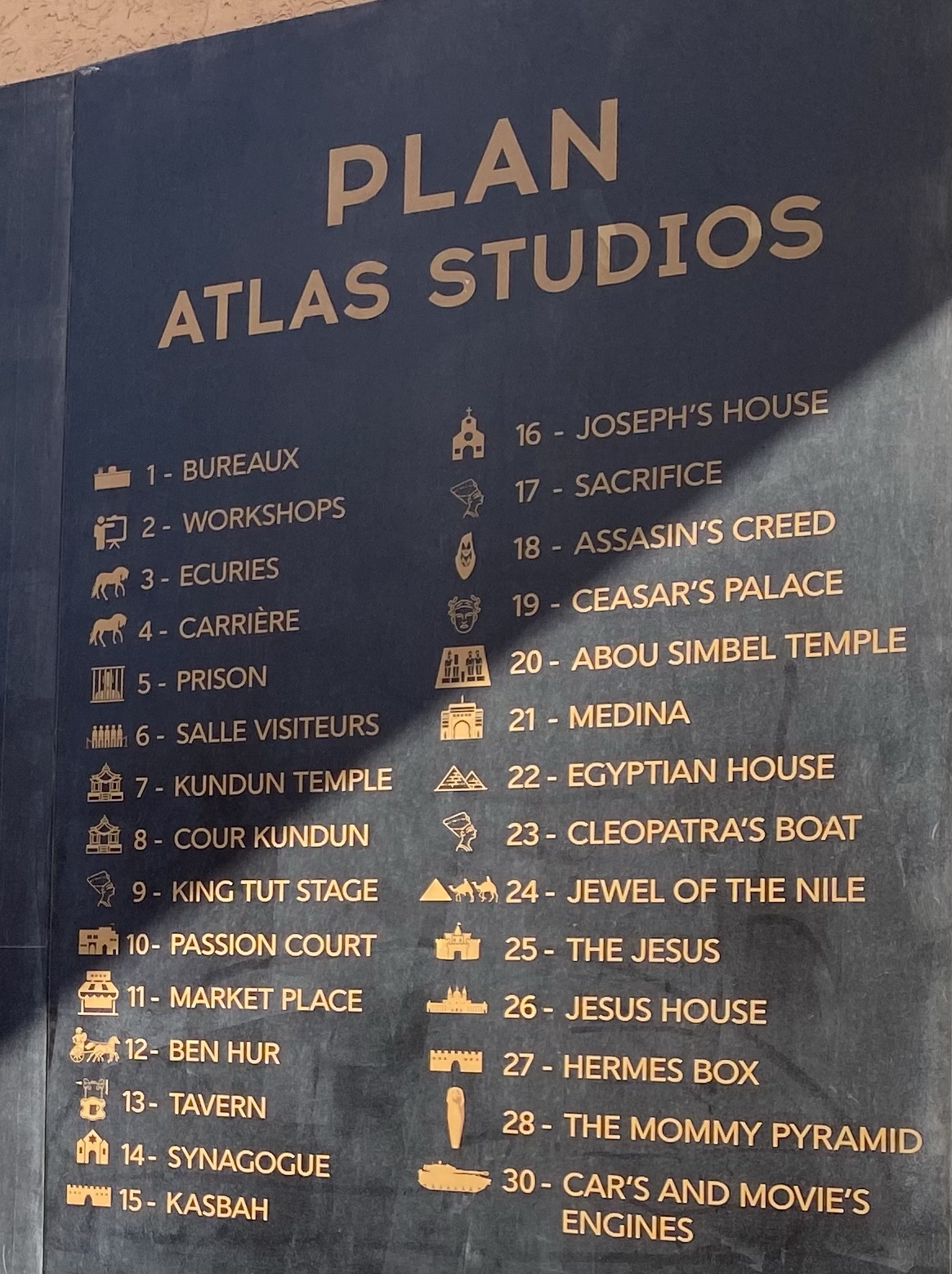
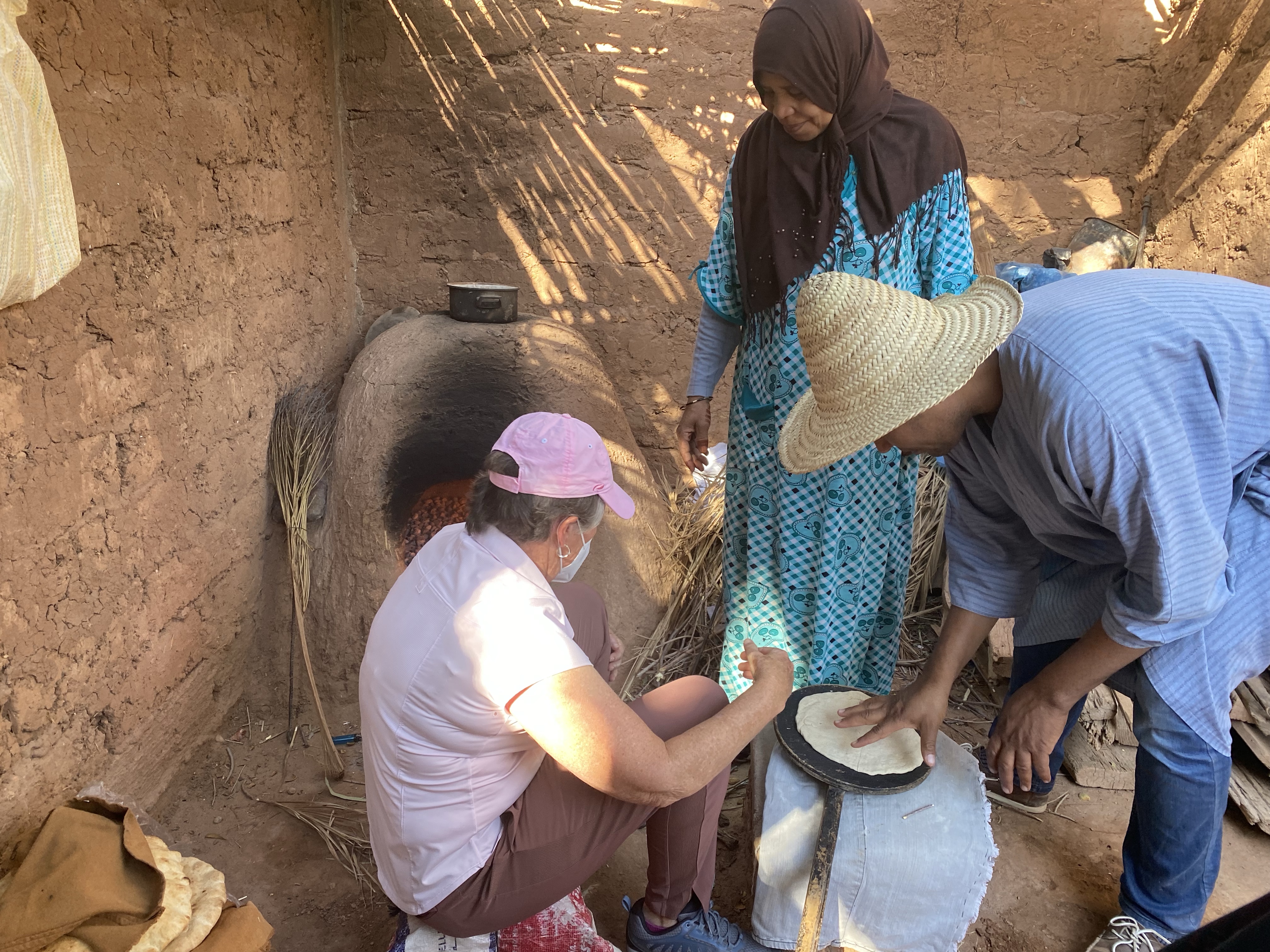
Instead, we visited Asfalou Village, for what OAT calls “A Day in the Life”. There, we spent the morning with an extended family, visit their home, learning how the women make bread and the men make bricks.
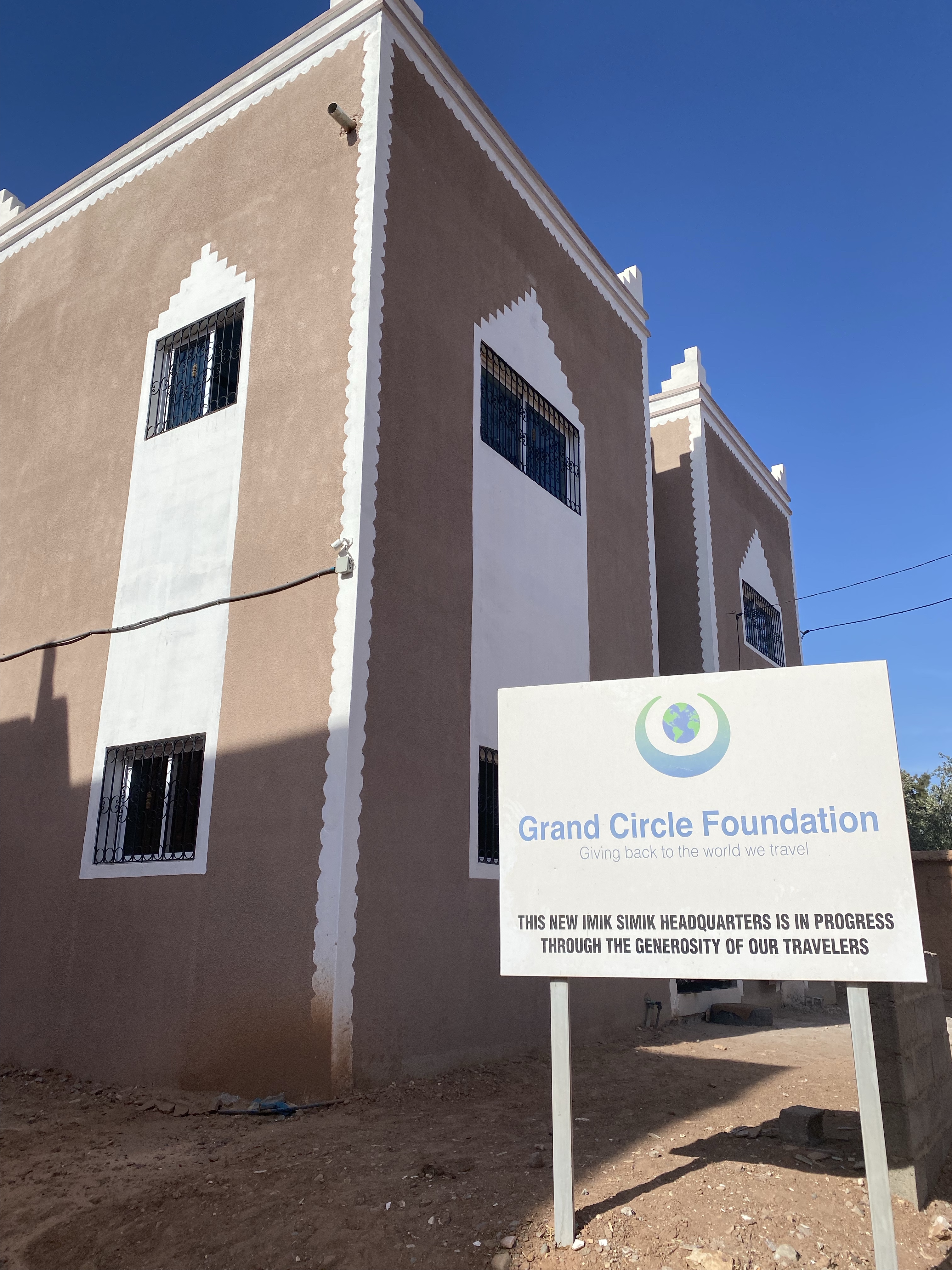
For the afternoon, we visited the Women’s Association, a beneficiary of the Grand Circle Foundation. The Association’s objectives are to build women’s self confidence and to empower them. The women learn to bake cookies, which are sold to hotels and to tourists. We sampled some during our visit and they were so delicious, we all bought more.

While there, we all decorated our bodies with henna—even the men.
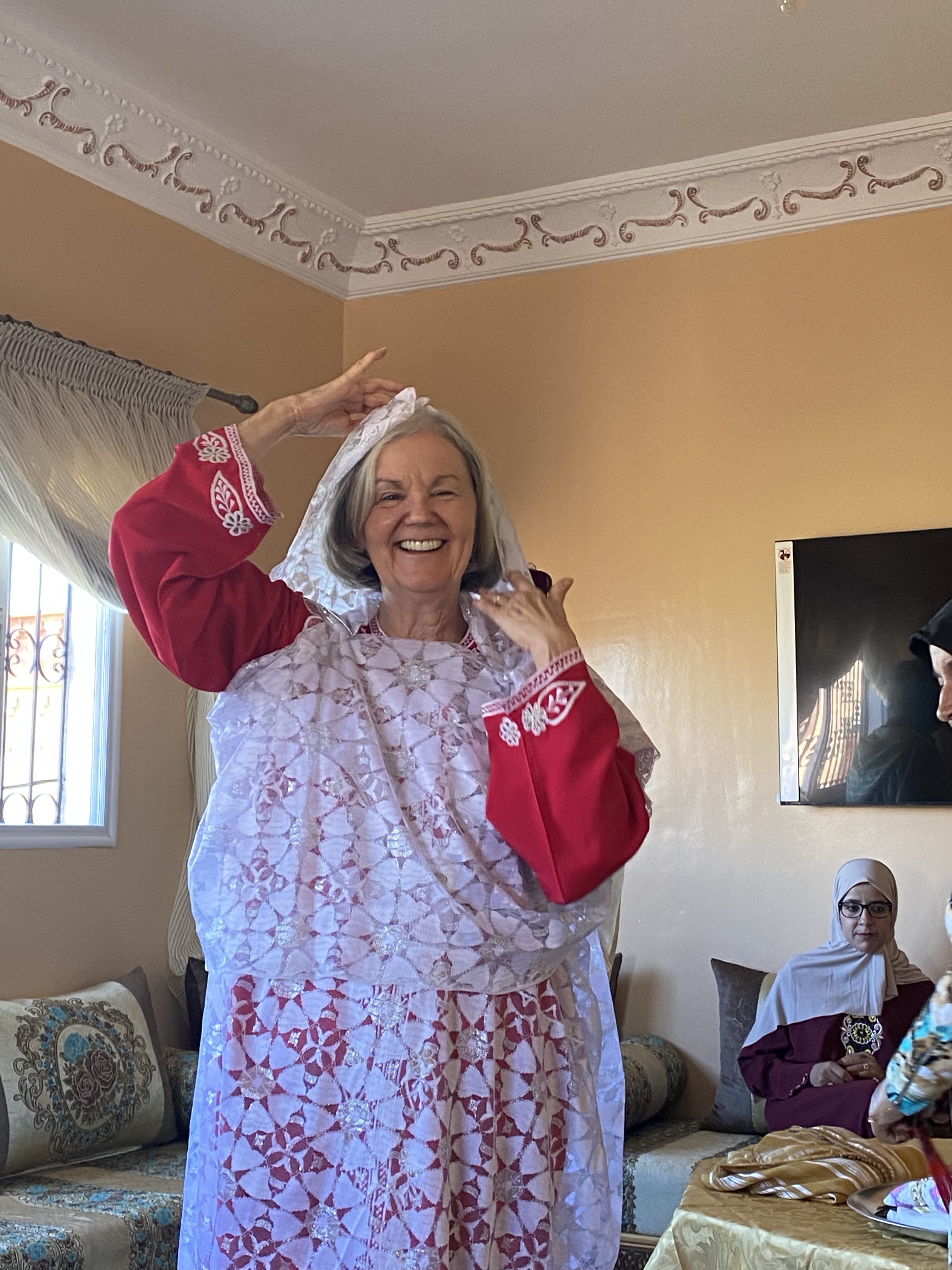
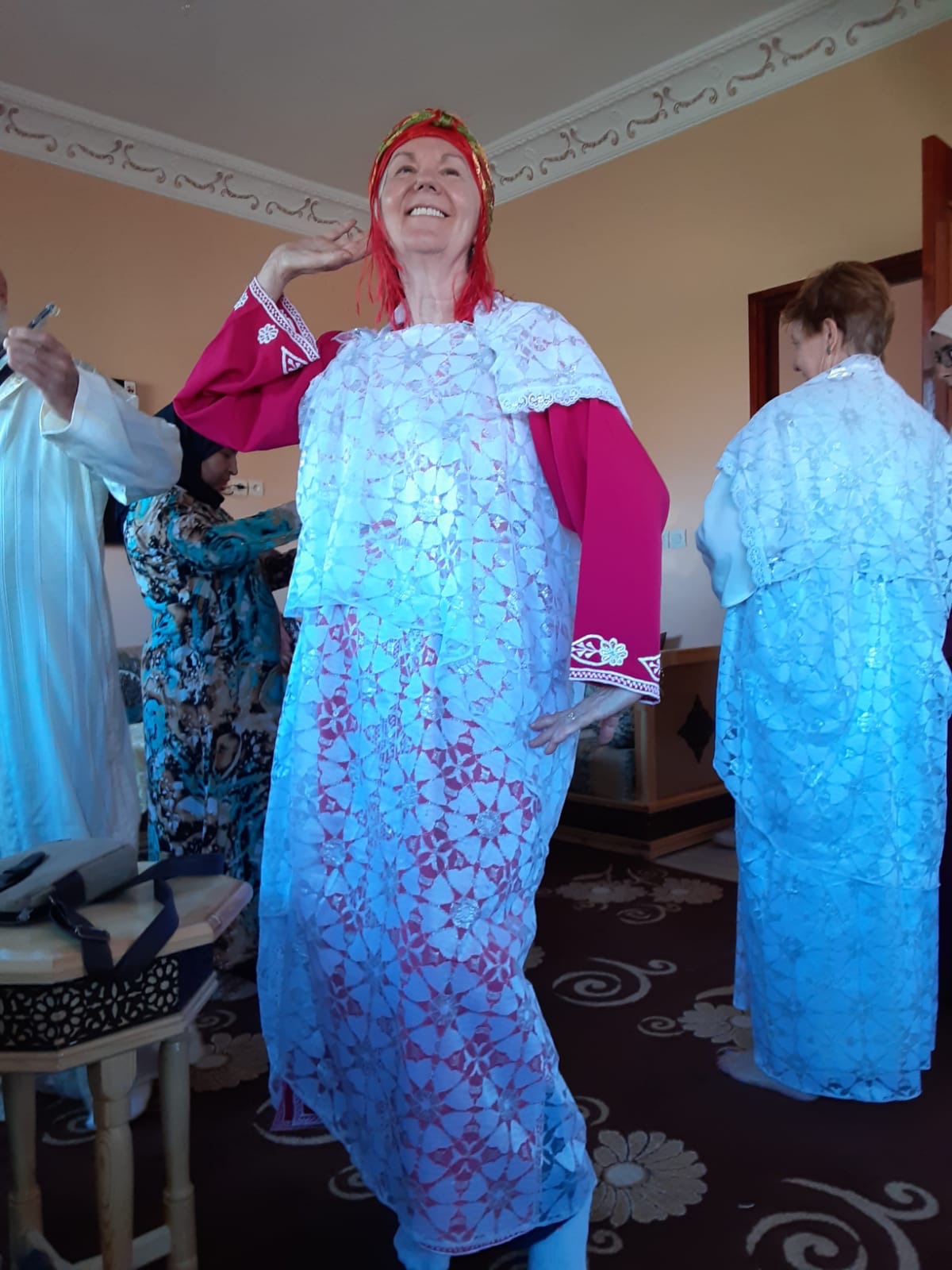
But the highlight, for me at least, was playing dress up. Unfortunately, my first choice for spouse was feeling under the weather that day, so I had to go with a substitute for this Berber wedding.
For you movie buffs, I’ll end with a list of some of the movies and TV shows filmed in this area.

  • Lawrence of Arabia (1962) Sodom and Gomorrah (1962) The Man Who Wished To Be King (1975)
  • The Message (1976)
  • Jesus of Nazareth (1977) Bandits, Bandits (1981)
  • The Diamond of the Nile (1985)
  • Killing is not playing (1987) The Last Temptation of Christ (1988)
  • Tea in the Sahara (1990) Kundun (1997)
  • The Mummy (1999)
  • Gladiator (2000)
  • Alexander (2004)
  • Kingdom of Heaven (2005) Babel (2006)
  • Prince of Persia: The Sands of Time (2010)
  • Game of Thrones (season 3, 2013)
  • Game of Thrones (season 4)

For the curious—the photo at the top of this post shows the artist doing paintings using a sort of “invisible ink”. He heats the paper over the flame to make the colors appear. This “invisible ink” , used for secret messages sent during French occupation, has been repurposed!

The Sahara

Once again, my image of what the Sahara Desert would be like only slightly reflects reality.

I didn’t expect to find this very productive farm amidst sand dunes.

The farmer’s father, once a member of a nomadic tribe, used ancient techniques to find water. The family hand dug two wells: one with salty water and the other with “sweet” water for drinking. They combine water from both wells for irrigation and livestock.

Farmer and friends. How many do you recognize? One outfit (caftan and scarf) was purchased in the Rissani market for about $20 US.

You might recognize Goldie from an earlier post. She given to me by Bonnie, my grand-niece, before the start of our trip. Photos of Goldie’s escapades have been making their way back to Massachusetts on a regular basis.

As you can see, one of the farmer’s goats was quite taken with Goldie.

Our camp was very comfortable. Although we didn’t have Wi-Fi, cellular service surprisingly, is available in the desert.

I expected the sunrises and sunsets to be jaw dropping, and they were. What I didn’t expect was to be drinking wine while watching the sun go down.

Mike went to another dune to take this shot of our group
Kris, Burke and Mike after the sun had set.
Sunrise, by the camp

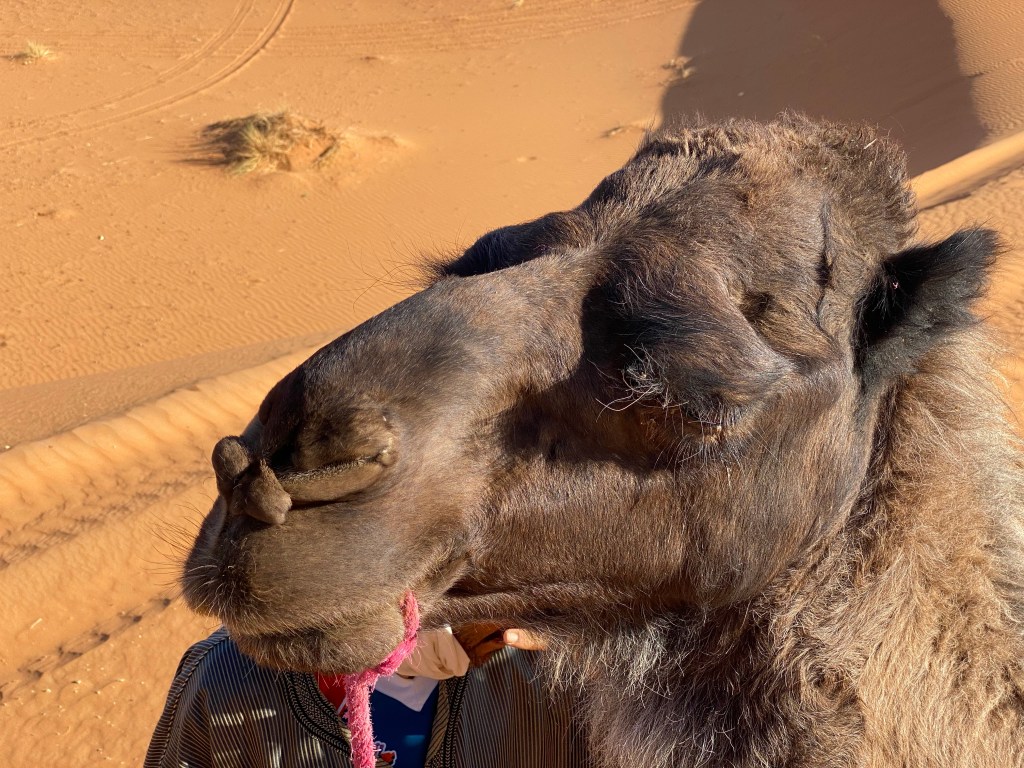
Of course, a visit to the Sahara wouldn’t be complete without a camel ride.

Check out the eyelashes!

But who would have expected to find this swimming pool in the desert?

For 100 dirhams you can use the pool, get a non-alcoholic drink and use a towel.

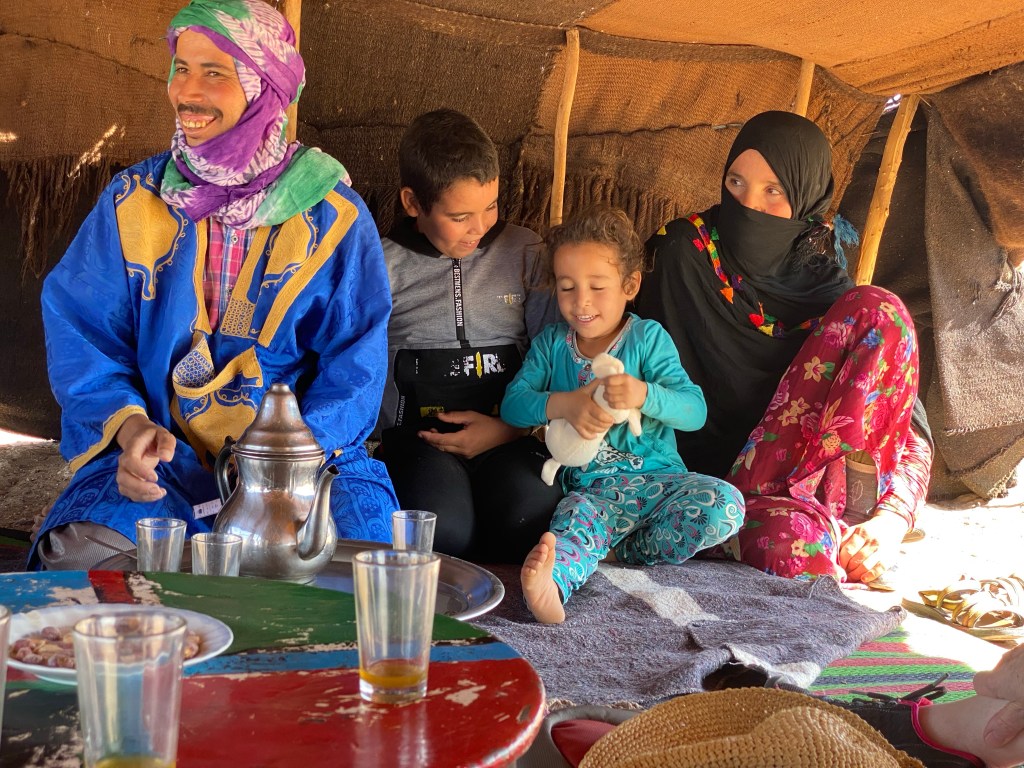
We also visited another nomadic family. Unlike the farmer, this family doesn’t own the land they are living on.

According to Moroccan law, if someone can find 12 witnesses to attest that the family has lived on the land for 10 years, then the squatters become landowners. The catch? The 12 witnesses have to be around when the 10 years commence.

Say good-bye to Goldie. She found a new little girl to love.

There is so much more to say about this incredible experience, but I’m going to stop now and invite you to put the Sahara on YOUR bucket list.

On The Road Again

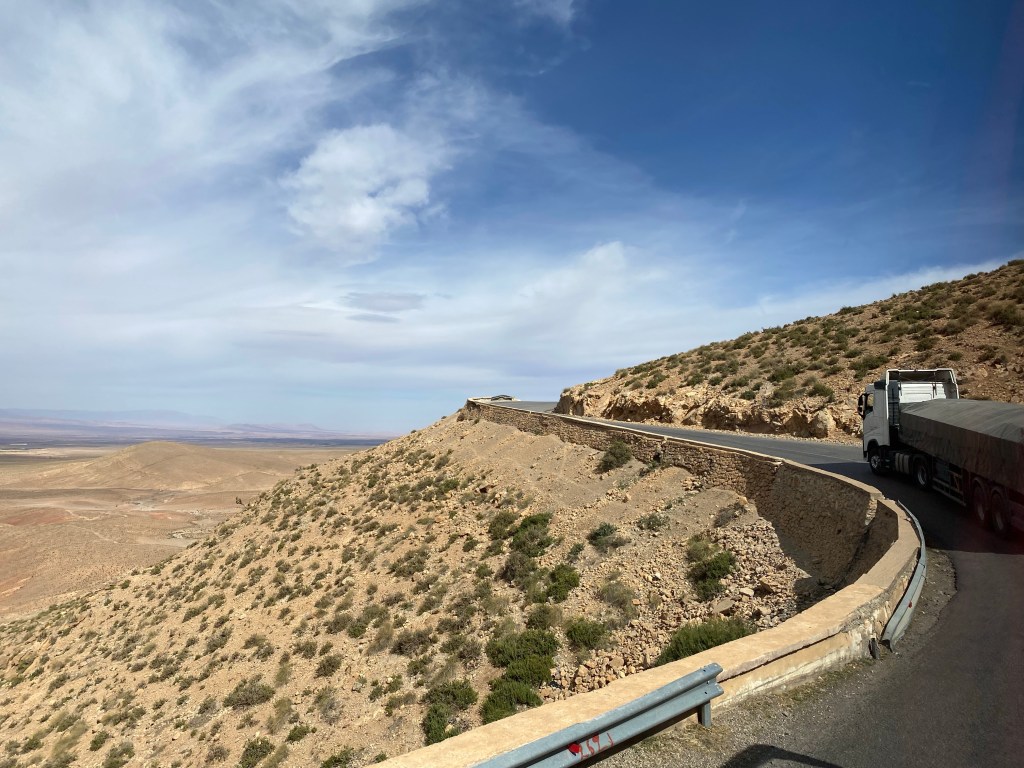
Who knew that driving all day could be so delightful? The scenery between Fes and the Sahara is varied and spectacular. It also doesn’t hurt that the nine of us are traveling in a bus that could transport more than forty passengers. We are up high, so we all get panoramic views.

This photo was taken from the window of the bus.

We had several stops along the way, including an opportunity to stroll through a forest.

Mike provides scale, to give an idea of the size of this Lebanon cedar.

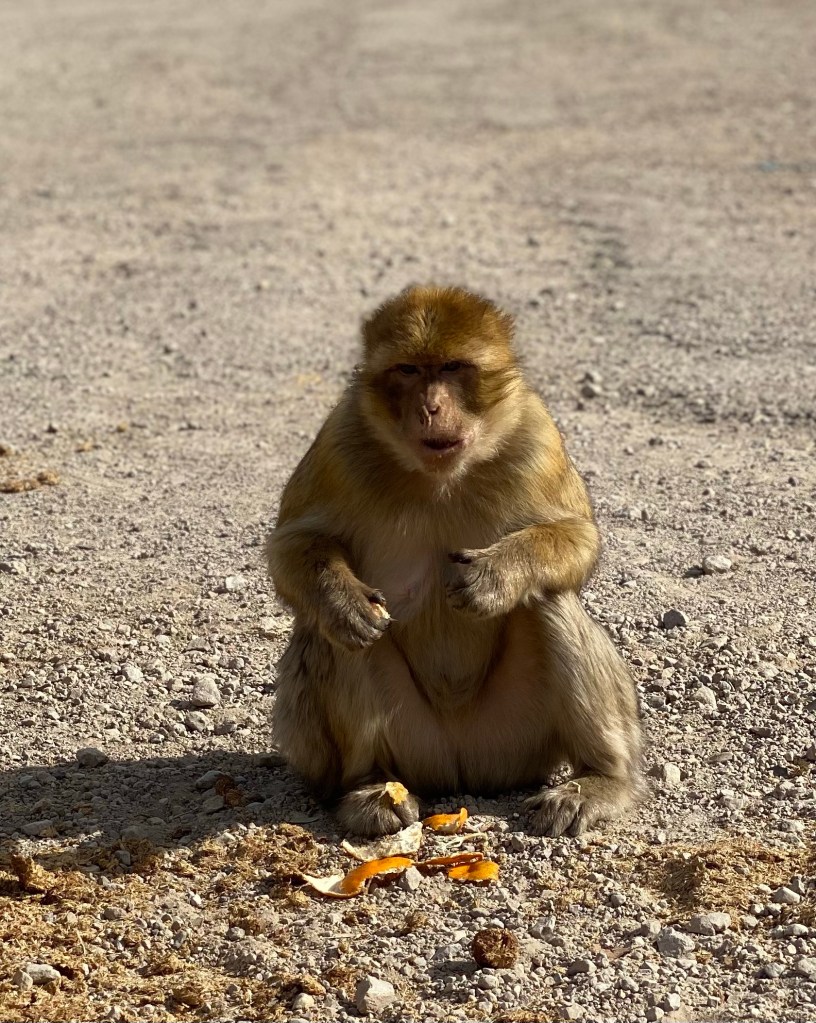
My favorite stop, however, was our visit with the Barbary monkeys.

Don’t even THINK about touching that tangerine!
This monkey was much friendlier. She was fine as long as I was at her level, but when I stood up, I frightened her and she scampered off.

The hotel where we stopped for lunch had this beautiful map, which included our departure and destination, and stops along the way. I’d mark our route out for you, but it is too difficult to do on an iPhone. But I’ll give you a rough idea of our route: we started at Fes, on the top, by the palm trees and ended in what the map calls ‘Arfoud’, (Erfoud) near the bottom. Ultimate destination: off the map on the bottom, near the camels.

Outside of major cities, Morocco has few traffic lights. Instead, they have numerous traffic circles, (if you’re from Massachusetts the correct name is ‘rotaries’. We Massachusetts natives have our own special language).

I particularly liked the circle in Midelt, which highlights their #1 product. Can you guest what it is?

If you guessed “surgical masks” , you’d be wrong. Mostafa had our driver (Mohammed) go around the circle twice so we could all snap a photo of the “Big Apple”.

Our stay was at a lovely hotel close to the Sahara Desert. Although I am so sorry for the Moroccans working in tourism, I must confess it HAS been rather nice having these beautiful hotels and pools all to ourselves.

Most people would be delighted to see that huge, luminous full moon. Not us. Why? We were hoping for dark desert skies for our resident astronomer’s lecture the following night.

If you’re wondering why in the world I’m blogging rather than experiencing the majesty of Morocco, fear not. This is being written while on the bus heading to Ouarzazate. I’m using Verizon’s Travel Pass for internet connectivity. And I’m looking up from my phone frequently. And yes, as usual, my blog is several days behind our experiences.

Helpful Hints for the OAT Morocco Trip

We still have 6 days before our trip ends, but some members of the “Friends of OAT” Facebook page will be traveling to Morocco soon, and have asked for hints. This post is especially for you, but I hope it will be useful to others as well.

Options

  • Pre-trip to Chefchaouen- if it is offered, don’t miss it!
  • Optional trip to Tetouan – I’d pass on this one and spend time in Chefchaouen instead. You’ll see plenty of medinas and mellahs on the main trip. If you’re lucky, your guide will do what ours did, and take the slow, scenic route to Tangier.
  • Optional trip to Volubilis and Meknes – we enjoyed it, despite having seen mosaics in Sicily and ruins in Ephesus. Full disclosure: we are ancient history nerds.

Packing

  • The weather in October has been perfect so far. All that we’ve really needed is a light jacket. I will confess to wearing my heavier pants for the sunrise in the desert. I packed ‘em, so I’m using ‘em.
  • I didn’t bring shorts because I had read wearing them would be culturally insensitive. Having seen young Muslim women with all kinds of outfits, I have concluded shorts would have been okay in many places ( but not all).
  • I was prepared to be taking off my shoes frequently, so only packed slip- ons, no sneakers. The number of times I’ve had to remove my shoes – one.
  • Most of the riads and hotels have lovely pools, so it is a good idea to bring a bathing suit, especially when you are in the Sahara. We just got back from a very refreshing hour at a hotel pool located about 15 minutes from our tent.
  • So far, everywhere we’ve stayed has had a hairdryer. Some are attached to the wall; others are like what we use at home.
  • I thought I’d be rinsing clothes out in the sink. That would have worked out fine, but I had no place to hang them. I suspect our riad would frown upon my hanging my “small” (as they say in Africa) from their balcony.
  • Laundry service is available in Fes, Ouarzazate and Marrakech. So far, we have used the service in Fes. It was convenient, inexpensive and well done.
  • At times, it would have been nice to have my LUMIX 150 with its zoom. But those times were unpredictable, and I wouldn’t have wanted to carry it with me all the time. Bottom line? My iPhone takes photos that generally meet my needs, so I was fine leaving my camera at home. For the true photographers out there (we have one in our group), carrying the camera is well worth the additional weight.

Food

The food has been great. No one in the group has had digestive problems. Most of us have avoided uncooked vegetables, but one couple, who has lived all over the world, has been eating everything without any issues. Me, I take no chances. I eat what Mostafa, our guide, tells us is safe.

Miscellaneous

  • I didn’t need to bring packs of tissues. Every bathroom, so far, has had an adequate supply of toilet paper. Be sure to drop the used paper on the waste basket. Don’t flush it.
  • I brought Vicks VapoRub for the tannery visit. A little dab under each nostril helped to block the stench.
  • So far, it has been easy to charge phones everywhere, including the Sahara .
  • You CAN get cell service in the desert. Just no Wi-Fi
  • Be sure to bring a back pack. I also brought the bag my sketchers came in as a small backpack. I have used it more times than you can imagine.
  • If you want good quality scarves, buy from the weaving shop on Fes. If you don’t care about quality, then you can get a great deal in the market in Rissani. I did both.
  • I also bought a caftan in the Rissani market. It has been perfect for the desert! There will be photos in future posts. I’m not pressing my luck by uploading big files.

I feel so very fortunate to be on this trip. Perfect weather, great food, breathtaking scenery, once in a lifetime activities, welcoming, friendly Moroccans, congenial travel companions and excellent guide. Who could ask for anything more?

Two Days in Rabat

Bing Crosby and Bob Hope would have been envious of our mode of transportation from Tangier to Rabat. But then, their movie, “The Road to Morocco” wouldn’t have been as funny.

Morocco’s bullet train’s speed can exceed 200 MPH

We departed from, and arrived at, futuristic train stations. It seems the current king has a fondness for all things modern: transportation, art, buildings, customs.

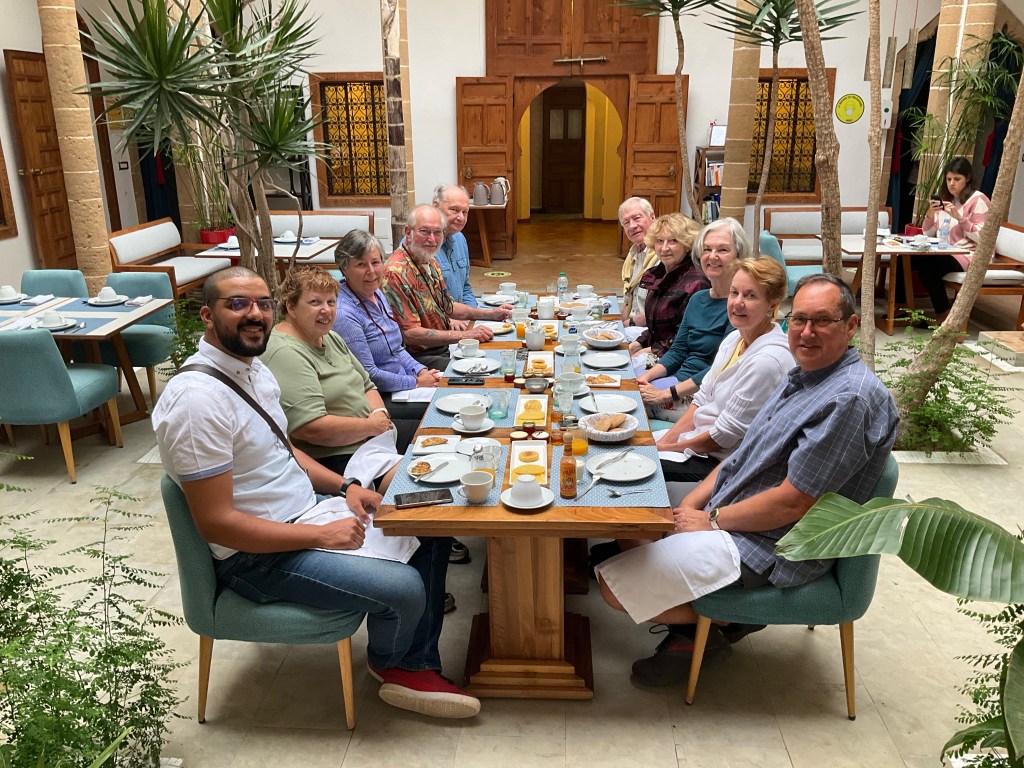
As was the case in Chefchaouen, our riad in the Medina was unique and lovely. It gave us a taste of what life was like 500 years ago, when this was a private house inhabited by an extended family.

Breakfast at Riad Kalaa

During our time in Rabat, we covered a lot of ground, visiting all of the “must see” sights.

The Rabat royal palace entrance gate, which we could only view from a distance.
The tour group ahead of us modeling the approved distance.
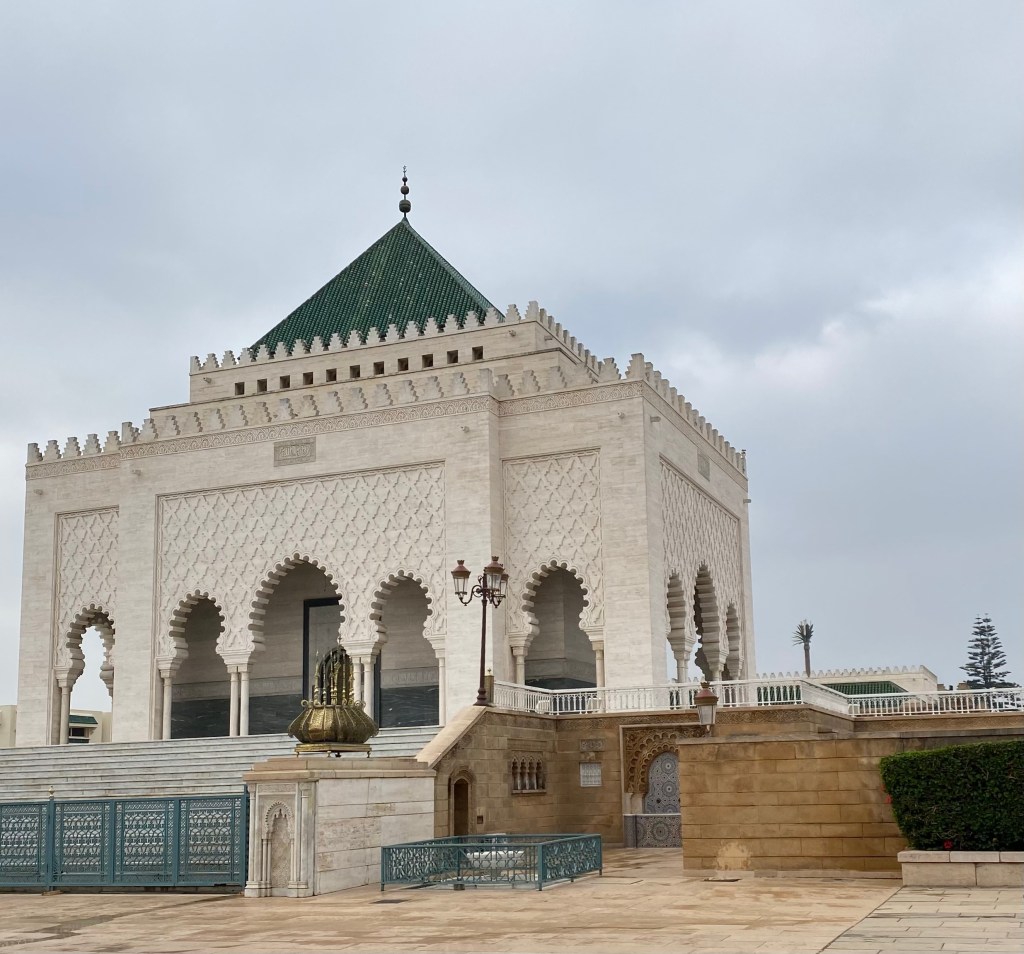
Mohammed V and Hassan II mausoleum

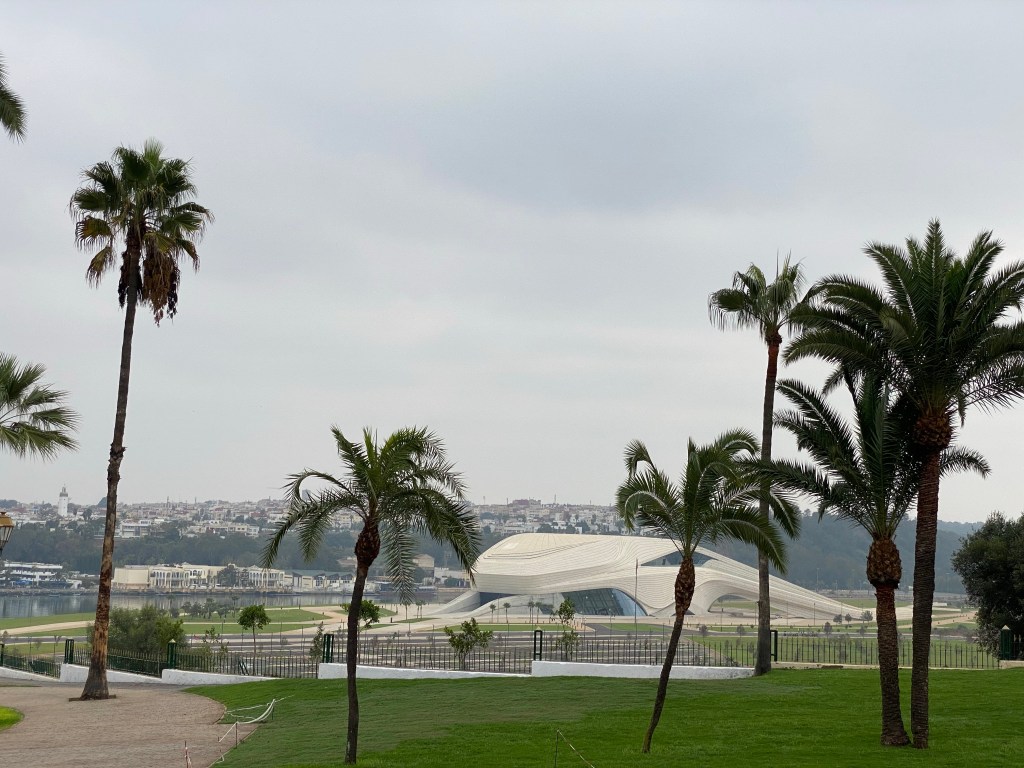
Rabat is a compelling mix of old and new. Their opera house which will be opening shortly is architecturally wondrous, and can be seen when you visit the mausoleum.

It isn’t as large as Sydney’s but is just as beautiful.

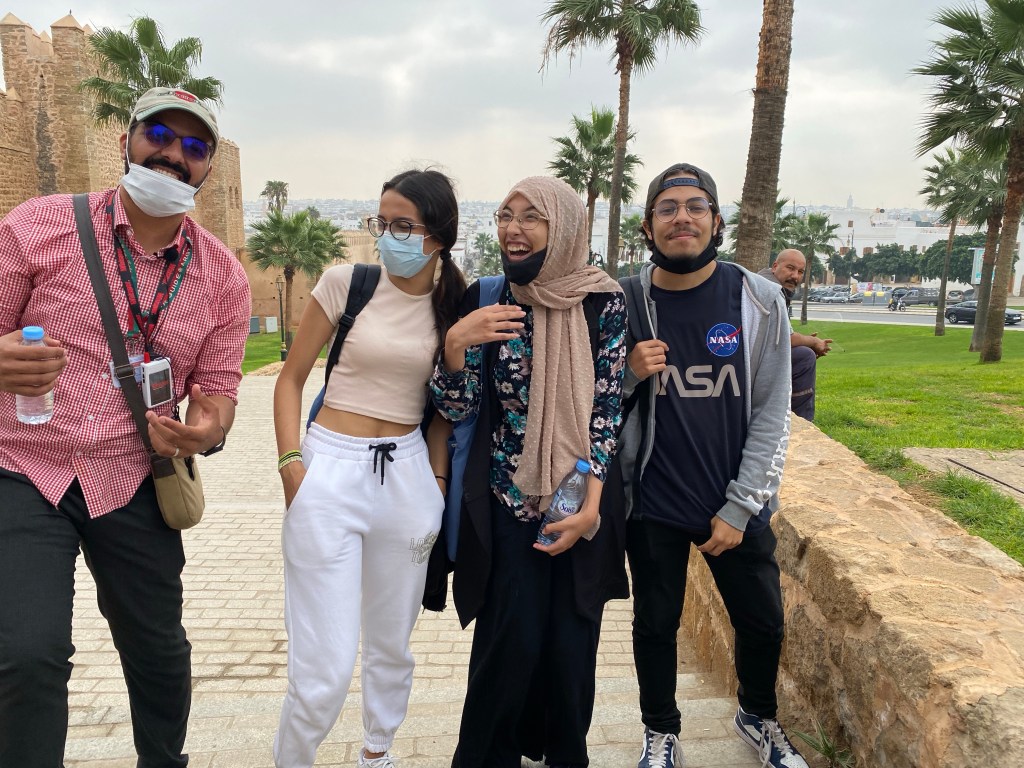
While visiting Rabat’s casbah, we encountered these three architectural students. To me, they exemplified Morocco’s respect for the old and acceptance of the new.

Photo bombed by our guide, Mostafa.

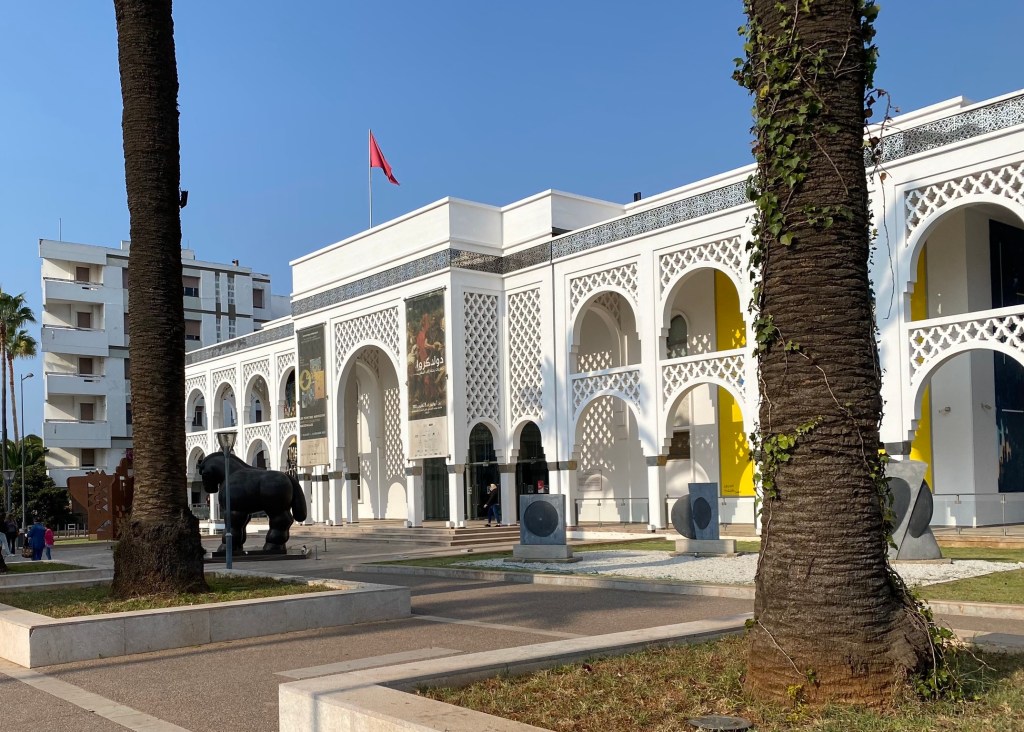
Four of us visited the Museum of Modern Art, and because of COVID, we had the place pretty much to ourselves.

To me, the building was as beautiful and as interesting as what was on the walls.

The Art Museum in the new section of Rabat
One of my favorite paintings
I don’t know why, but this one seemed to capture the COVID feeling

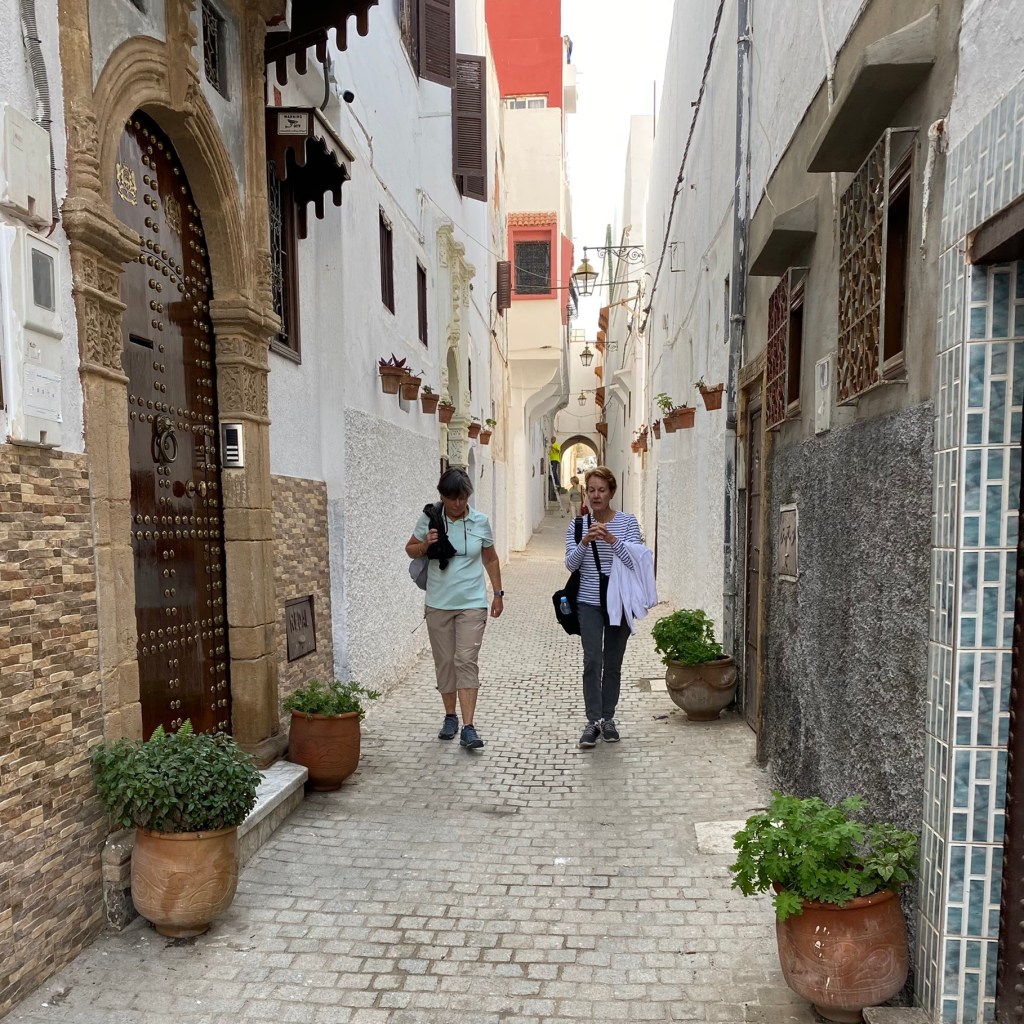
Rabat’s small Medina was good practice for what lies ahead.

Narrow, winding alleys
Here’s a familiar face, greeting us at the restaurant in the Medina
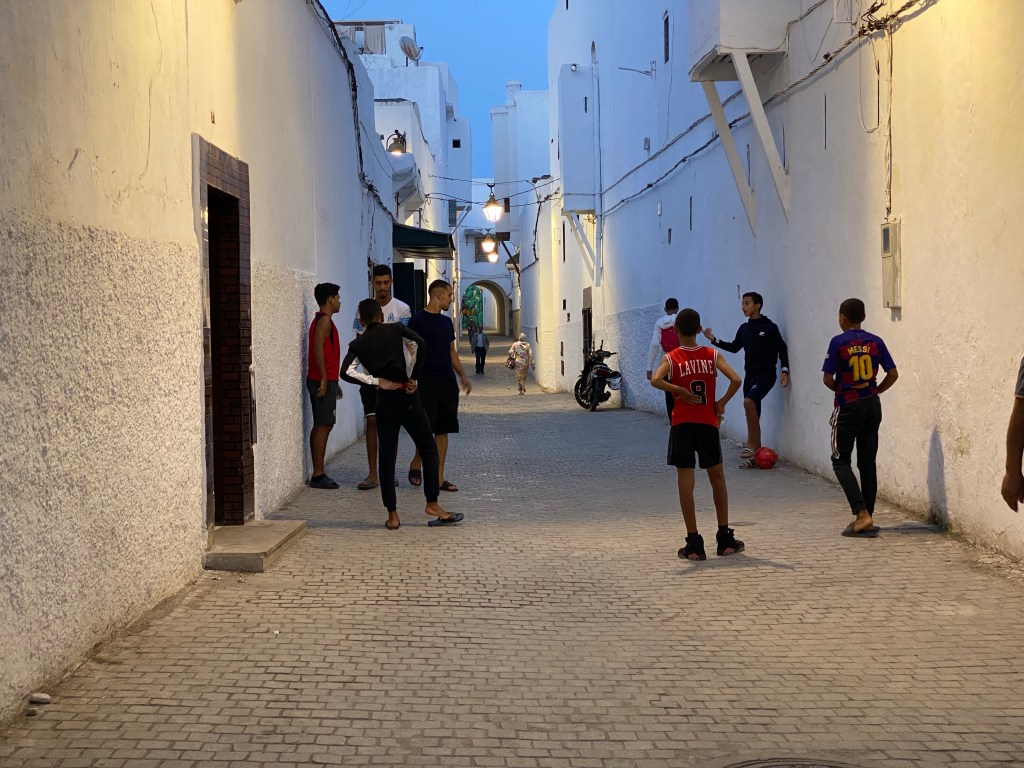
Football is popular throughout the world. Who needs a field when you have an alley?

The weather in Morocco has been PERFECT. We have been to the coolest part of the tour already ( according to weather.com) and a light jacket was more than sufficient.

Next stop, Fed

Damn autocorrect. It should be FES!

Fes: Did a Sultán Sleep Here?

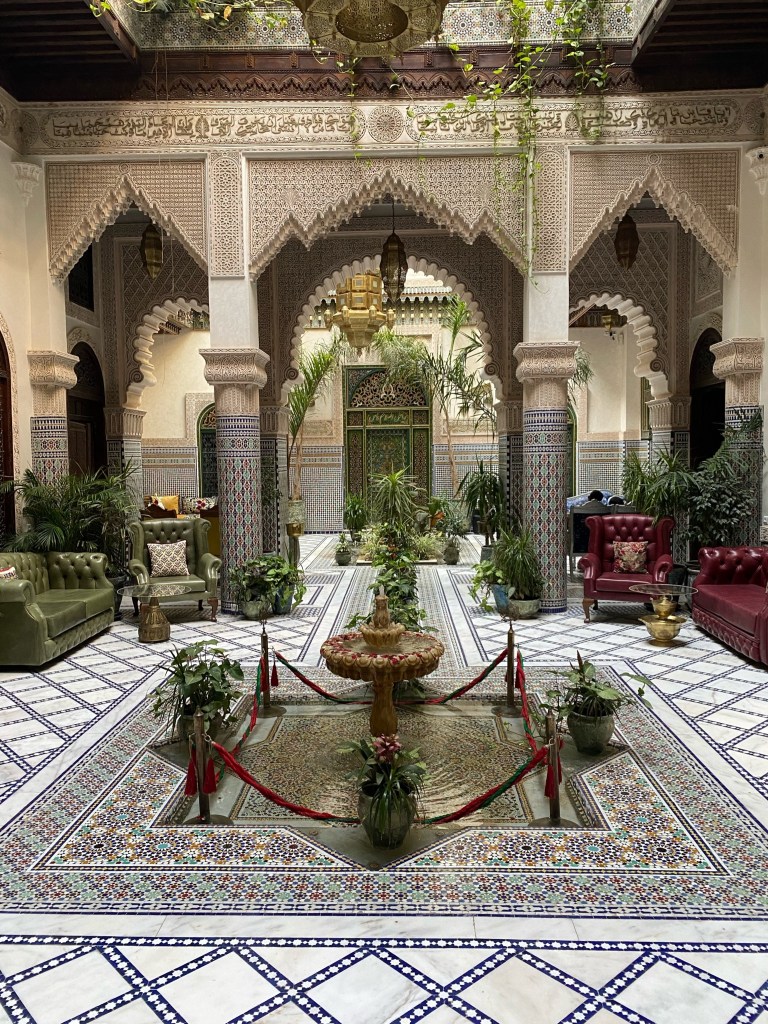
There is oh so much to say about Fes, but it will have to wait till we get back to New Jersey. Instead, this post will focus solely on the incredible Riad Salaam Fes.

Although the neighborhood dates back to the ninth century, our riad is far more modern than that. Built in the seventeenth century, it is still owned by the same family. It WAS restored about thirty years ago, so like the country of Morocco, it successfully melds the old with the new. Even though the ceilings are high, and the courtyards cool the building, our room is equipped with air conditioning.

If you have ever visited the Alhambra, wouldn’t you agree that this riad resembles that beautiful fortress in Granada? The best part—our riad has all the modern conveniences, like up to date bathrooms and wifi.

It is not surprising that it took 16 years to complete the restoration. The attention to detail is mind boggling.

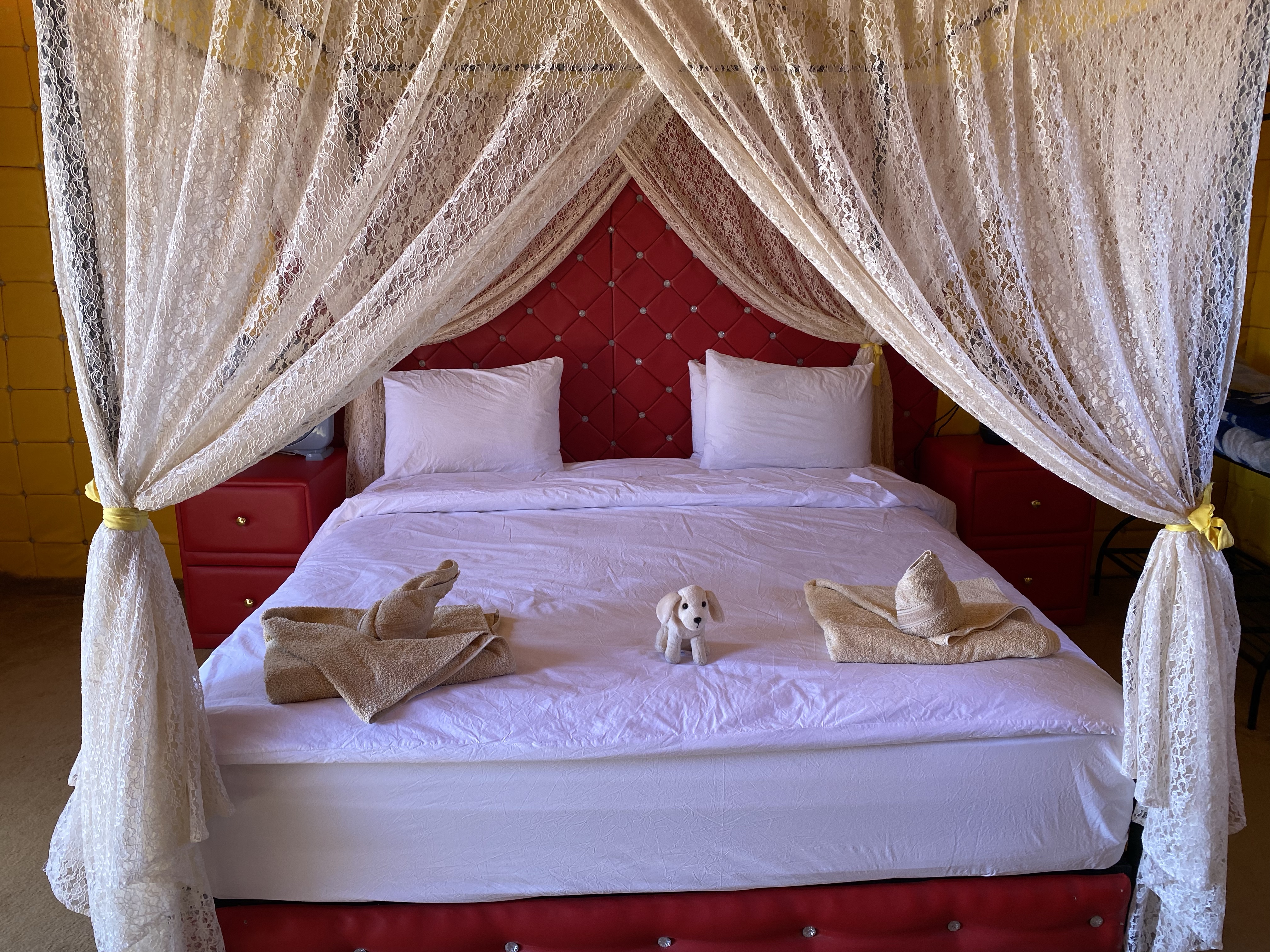
Check out our room. I ask you, is this not a bed befitting a sultan?

Half of the room. I couldn’t fit the sitting area into one photo.

Another modern convenience? A liquor license. Yes, in some Moroccan cities, you CAN enjoy wine and beer.

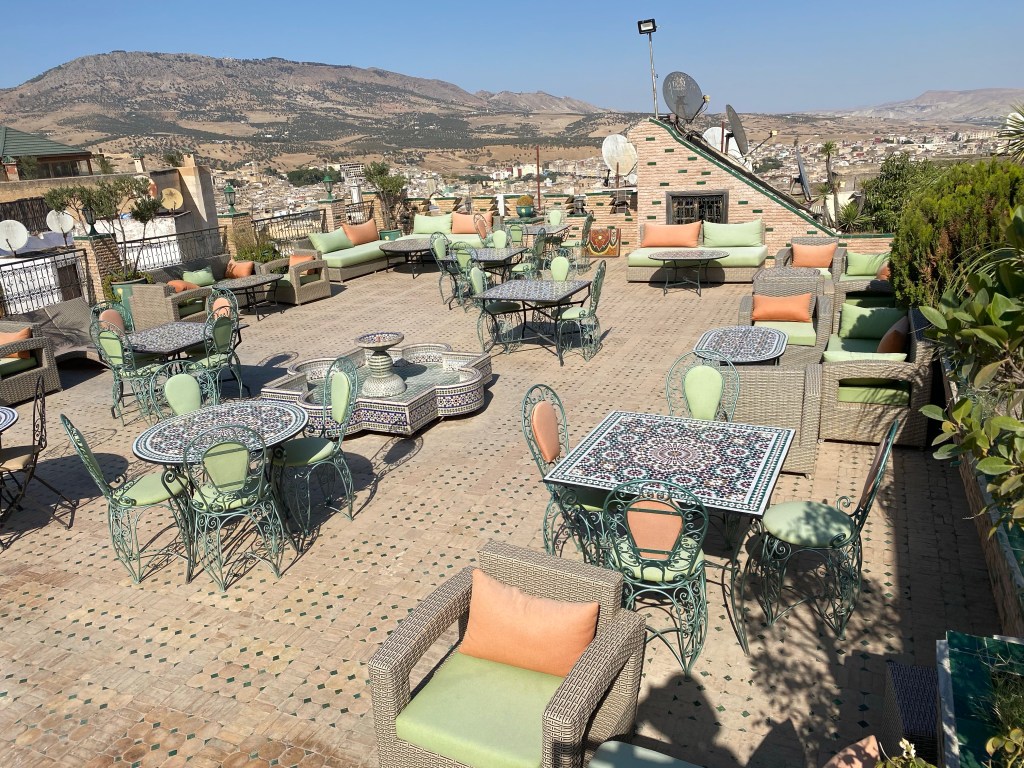
The panoramic view from the rooftop terrace, taken earlier in the day. No photos from our “happy hour”. By then, it was too dark and we were far too busy drinking to stop for a photo op.

You notice I said SOME Moroccan cities allow alcohol? Well, get ready for a story. When we arrived in Casablanca, Mostafa suggested that we buy wine there because it would not be available in Chefchaouen. Only problem: the Casablanca wine store was closed because of some sort of a COVID violation. Successfully reading the mood of the group, Mostafa went on a mission to get us some wine. On our way to Chefchaouen, we made a slight detour to Kenitra, coming up empty at three locations before Mostafa decided to change tactics. He started calling around to all his friends until he found one willing to purchase wine for us and deliver it to our riad. Is that not a truly dedicated and professional tour guide? We all feel very lucky to have him.

Bacchus smiled upon us in Rabat, where we were able to purchase a sufficient supply for our stays in the desert and Marrakech. Because both Rabat and Fes allow alcohol to be served, we couldn’t BYOB in those cities. Our Rabat purchases are sealed and stowed in the bus, to emerge as the need arises.

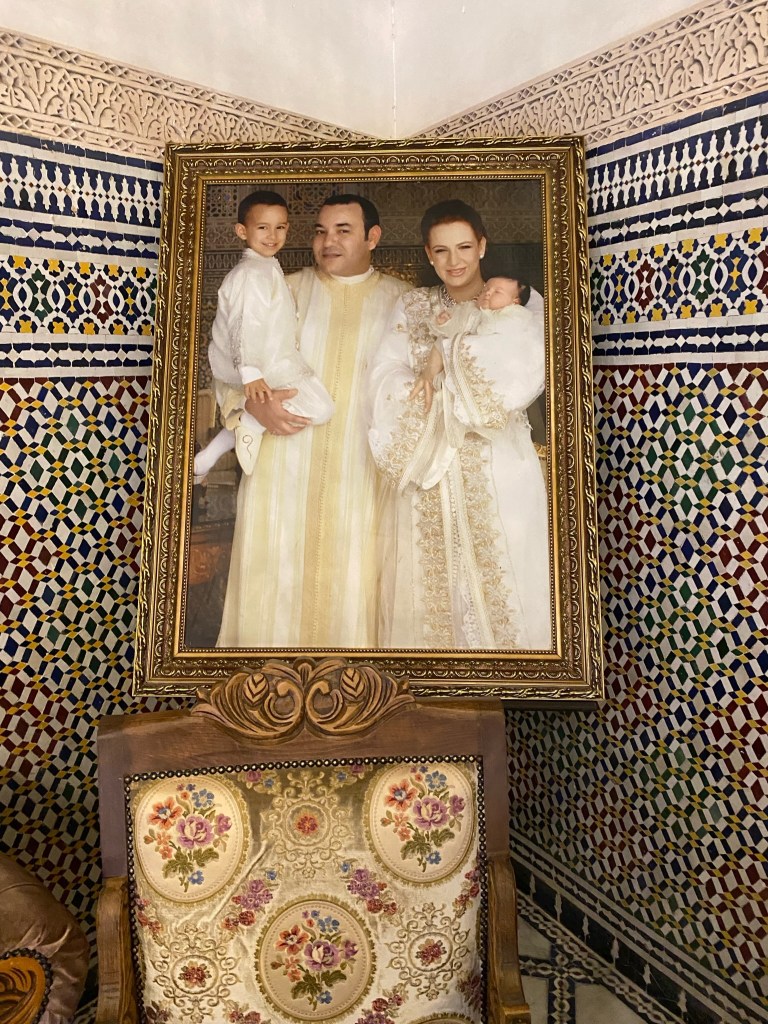
What better way to end this post than with a photo of Mohammed VI and his family?

So, did a sultan sleep in Fes? The answer is definitely yes. Not only was Fes once a capital city, but the King is here now!

On the Road to Rabat

I love that OAT allows their guides the flexibility to modify the itinerary. Yesterday, instead of driving directly to Tangier, we took the scenic route. We returned to Tetouan, driving through the lovely modern section, then along the coast, stopping in the resort of Smir.

It was off season, so all the shops and restaurants were closed, still it was easy to see why Smir would be a popular vacation spot. Sadly, the self cleaning, solar public toilet was also closed, so no video of its operation. You’ll just have to use your imagination.

Until this trip, I had no idea that Spain retained control of two cities in Morocco. Ceuta is almost directly across from Gibraltar, so ships passing through the Straits have to pay Spain for the use of that passage. We were able to see Ceuta off in the distance from a roadside stop, but weren’t able to visit this heavily guarded border.

The other Spanish city, for those with inquiring minds, is Melilla. You can Google it.

We stopped to catch a glimpse of the Rock of Gibraltar, but it was only visible through binoculars, so again, no photo, but that’s okay, because Tangier is more visually compelling.

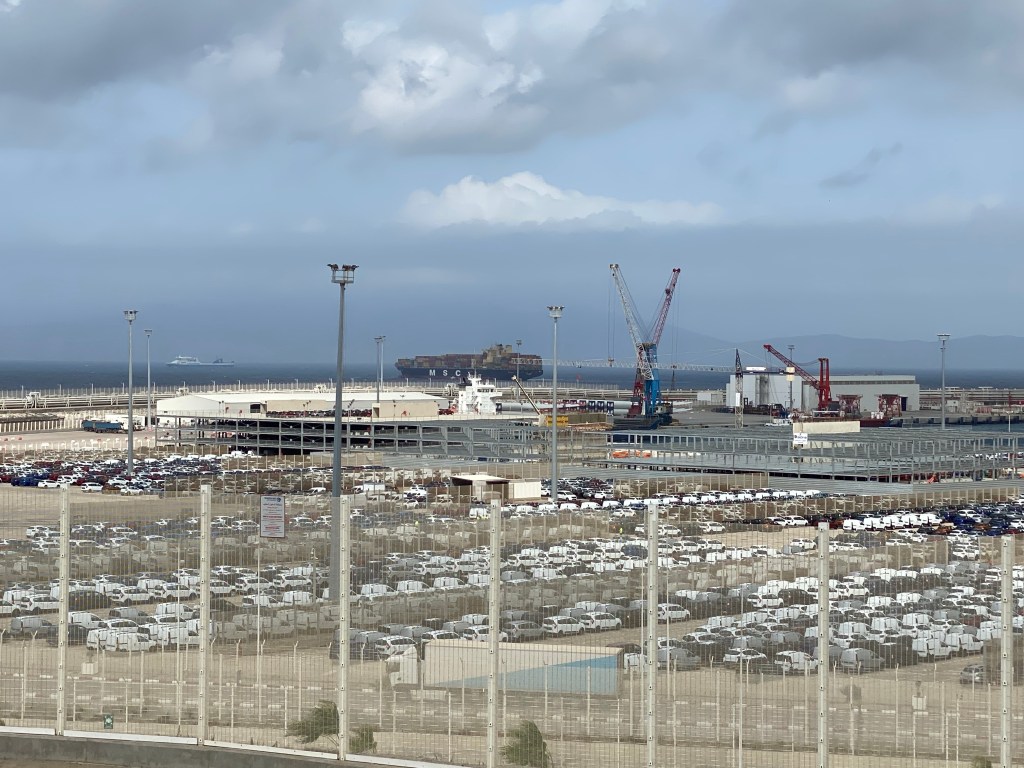
Morocco is definitely a country on the move. Their new port in Tangier is the largest in Africa and is shipping out huge quantities of cars every day. We were able to view some of the Renaults and Peugeots manufactured in Morocco from a distance.

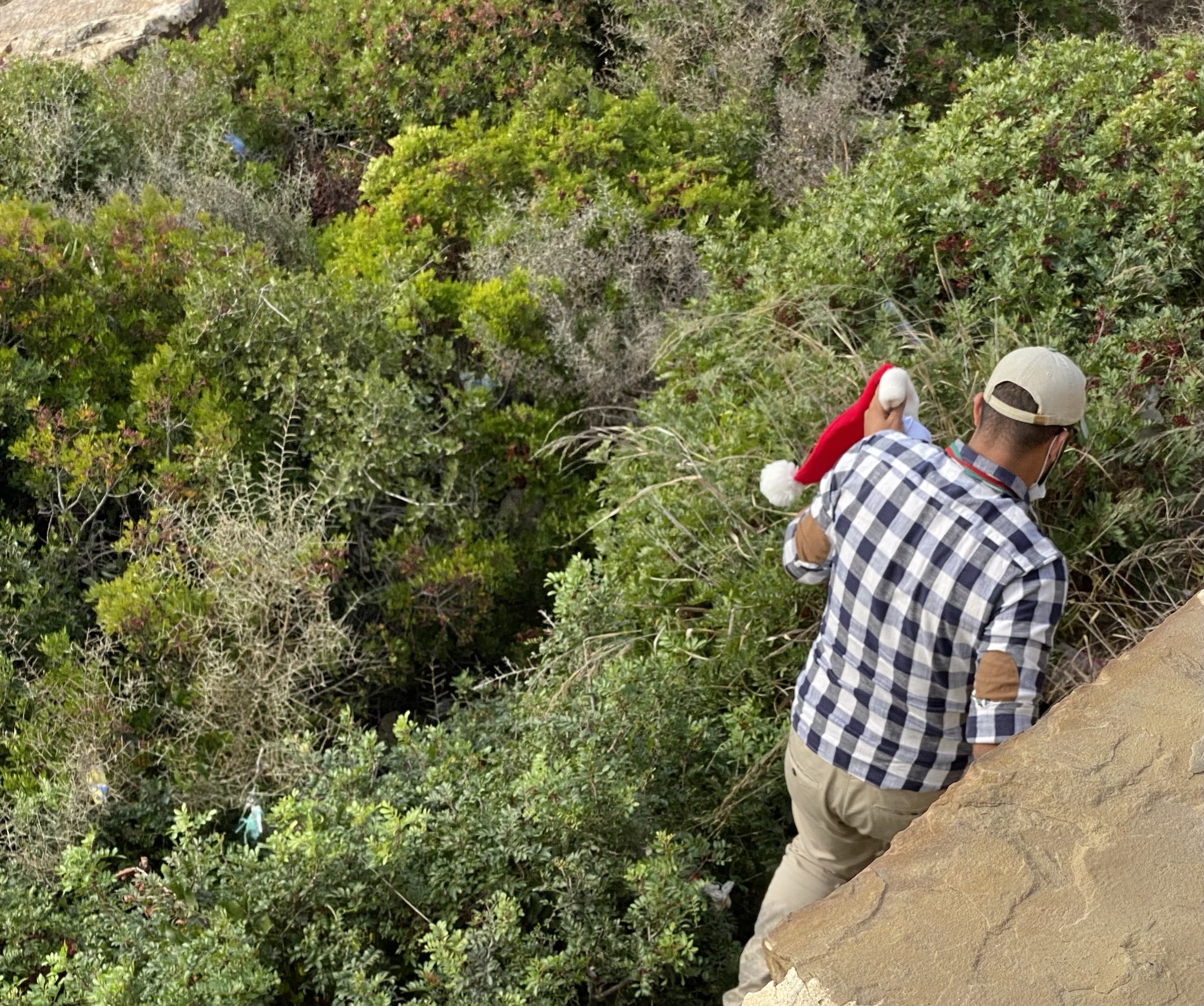
Our drive took us to the very windy spot where the Mediterranean and Atlantic Ocean meet. Dave’s elf hat was on his head long enough for this shot to be taken before it went sailing over the cliff. And yes, it WAS a very steep cliff, but fortunately Mostafa is athletic, and heroically retrieved Dave’s hat.

Before the trip, I’d been warned that Tangier was dirty, crowded and a somewhat scary place. That may have been the case years ago, but it was not our experience.

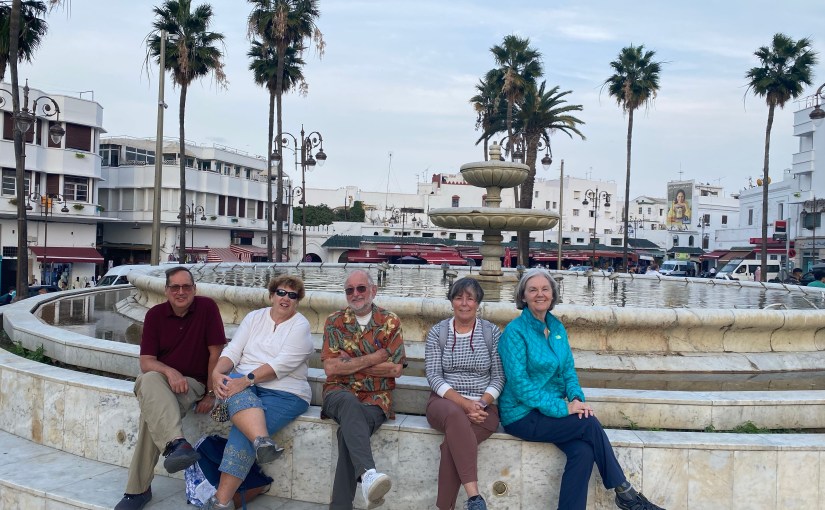
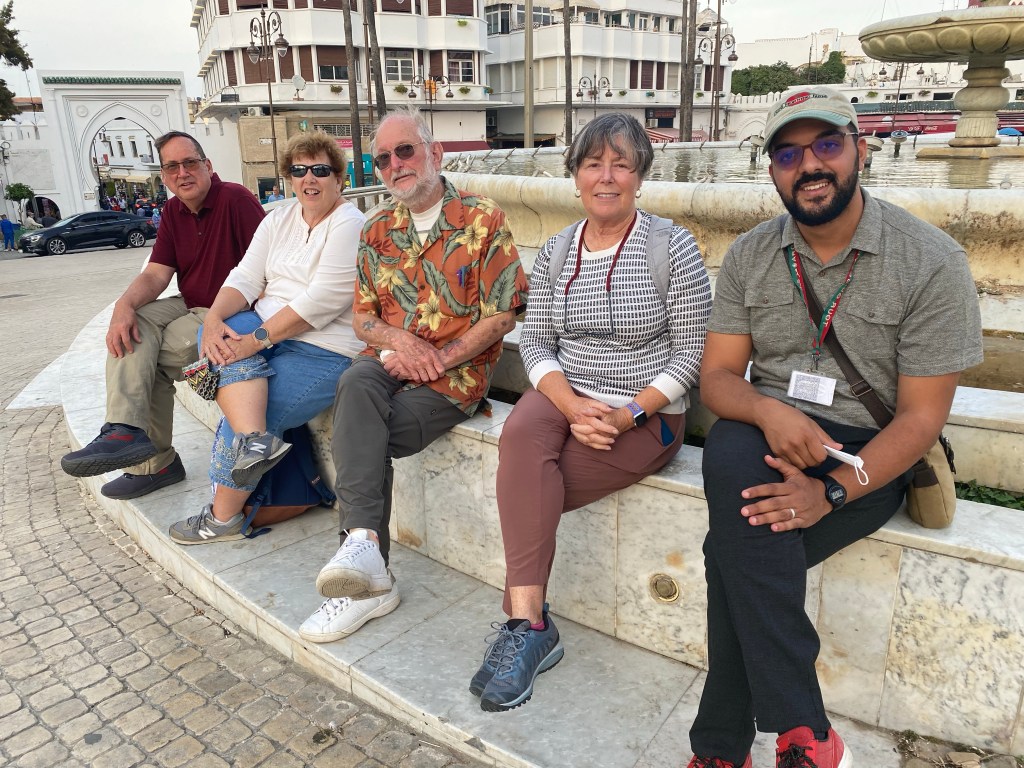
Relaxing in the square in the medina

We walked up a very steep hill to visit the old Portuguese fortress and were rewarded with several spectacular views.

On our way to the fortress
Tangier’s old port can be seen from the fortress

Morocco really treasures their long, positive relationship with the USA. Our visit to the American legation offered further proof.

I sure hope this comes up as a trivia question one of these days!

As usual, my posts lag behind our experiences. Tomorrow we leave Rabat for Fes. Forgive any typos…no time to proofread.

Three Nights in Chefchaouen

It would not be accurate to say we spent three DAYS in Chefchaouen because during our stay, we spent one day in a local northern village and another in Tetouan.

I can understand why other OAT travelers are so enthusiastic about this pre-trip. (For non-OAT travelers, OAT always offered the opportunity to add additional days before and after their main trips). The scenery is beautiful, the food is wonderful and inexpensive, the accommodations are gorgeous, and the people are so happy to see American visitors. As we were walking through the Medina, the locals were yelling “welcome”, “hello”, and different phrases, including “happy wife, happy life”.

Moroccans are very proud that their country was the first to recognize the brand new United States right after we achieved independence.

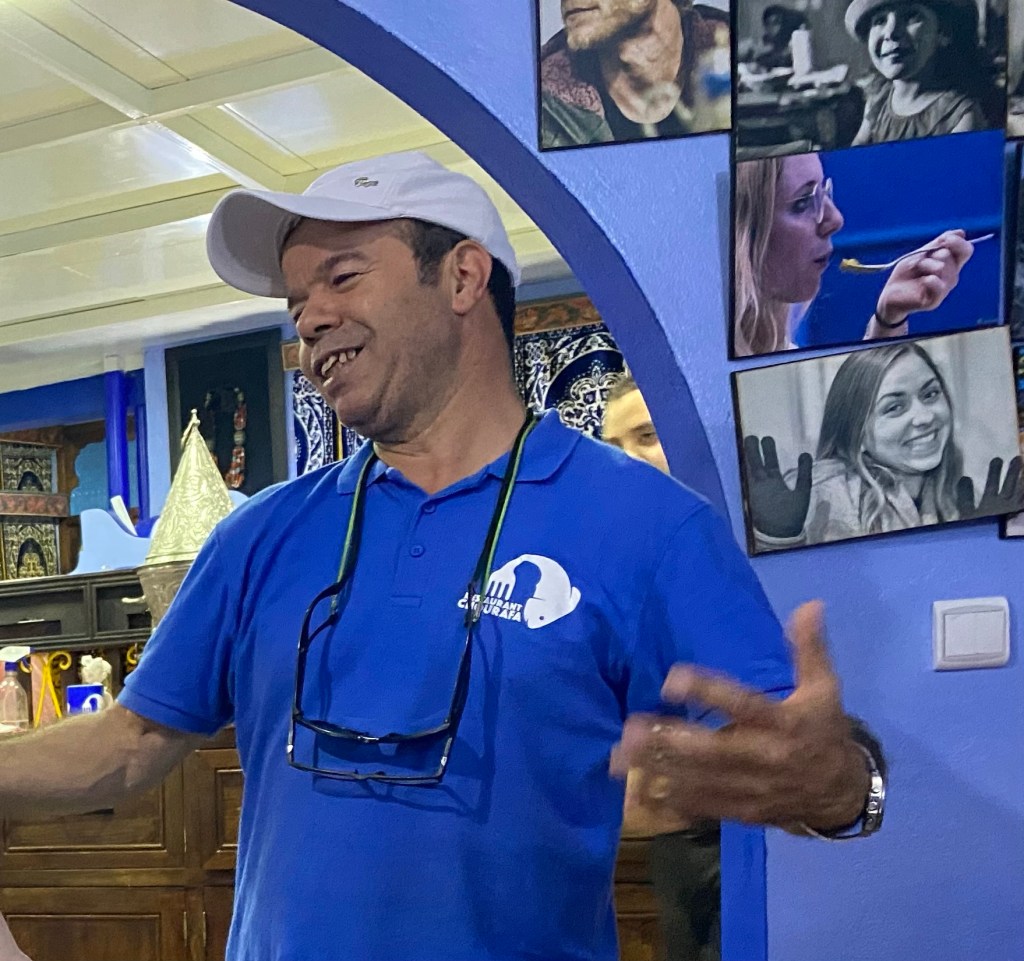
At Chourafa, the owner told us that Eisenhower stayed in that very dwelling during World War II, back before it was transformed from a private house to a restaurant.

Owner of Chourafa, entertaining us with his stories.

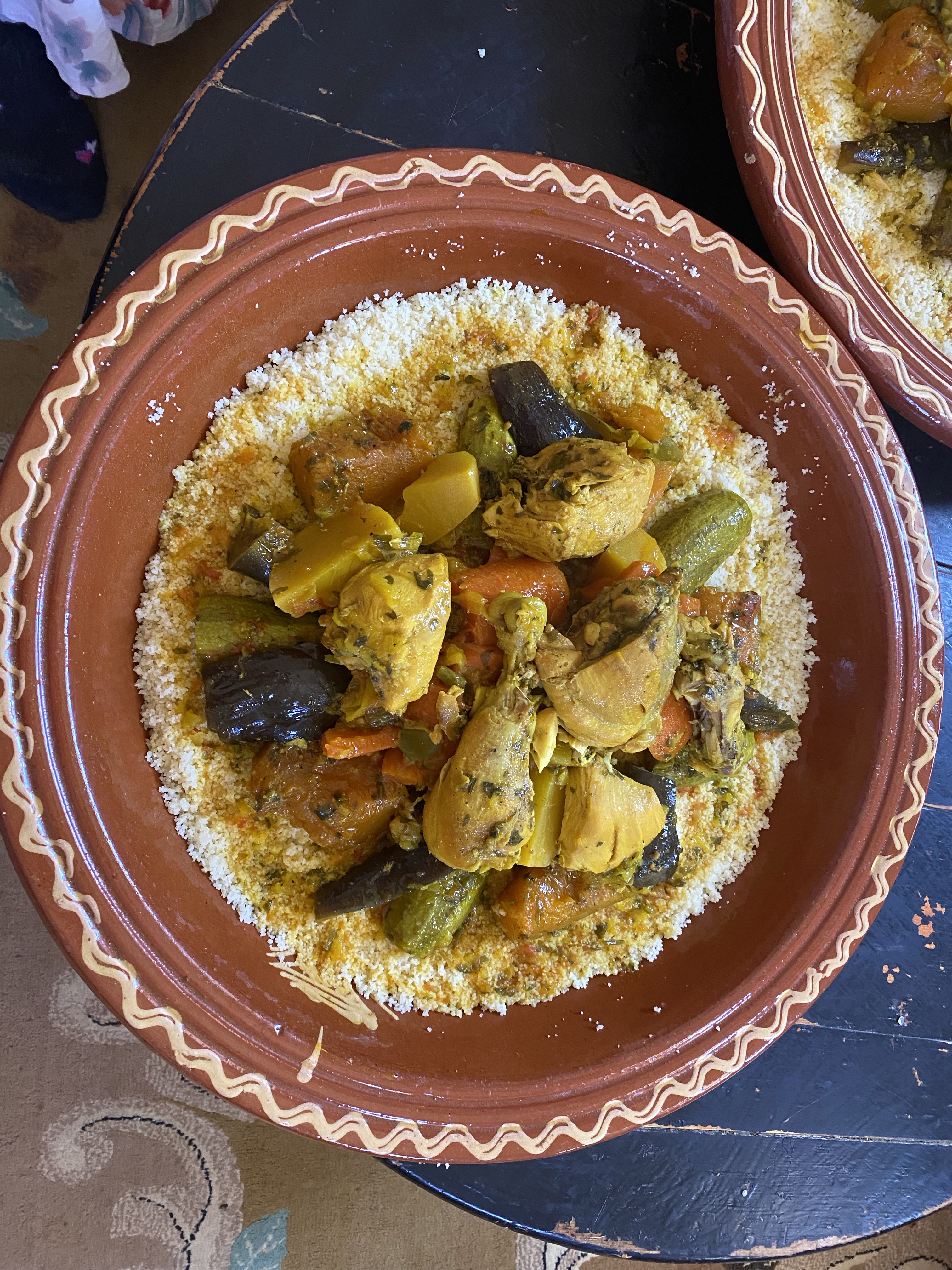
One feature of OAT is home visits, where we have the opportunity to spend time with a local family, sharing a meal and learning about their day to day lives. Our visit was with Mohammed, his lovely wife Ishhane, and their two daughters, where we enjoyed this fabulous feast made from ingredients grown on their farm in a little village so remote even Google hasn’t found it!

Tagine
Kris and Ishhane with their assistant. Mohammed and his family built their house, including this kitchen.

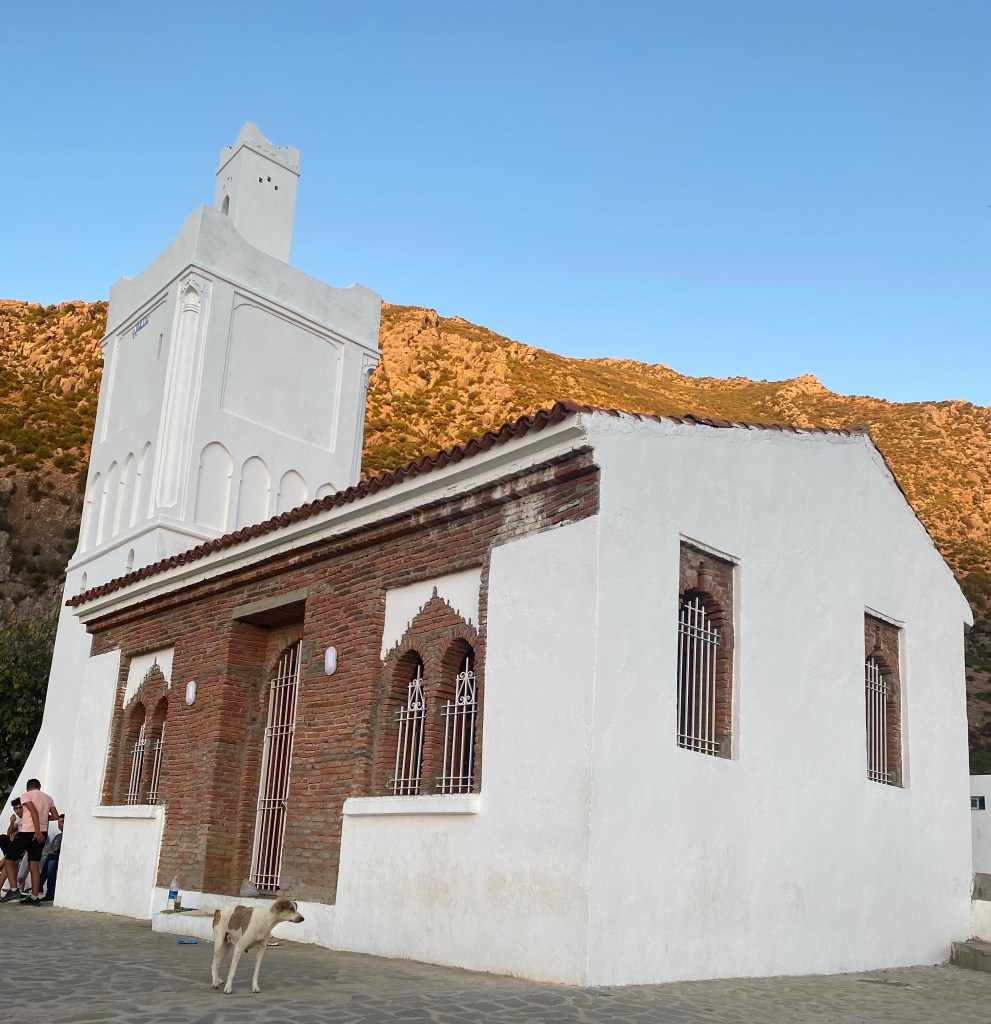
It’s good we were so well fed, because after we left the village to return to Chefchaouen, we did a LOT of walking. It is a bit of a hike to get to Boulazaafar, the mosque that overlooks the city. Built by the Spaniards in the 1930’s as a way to make up both for the expulsion of Muslims after the fall of Andalusia in the late 1400’s, and for the Spanish invasions during the late 1800’s, it has never been used. Understandably, the Moroccans were a bit suspicious of the Spanish military’s attempt to make friends. Maybe they heard about the Trojan horse?

Okay, so it isn’t Hagia Sophia, but the location is pretty spectacular.

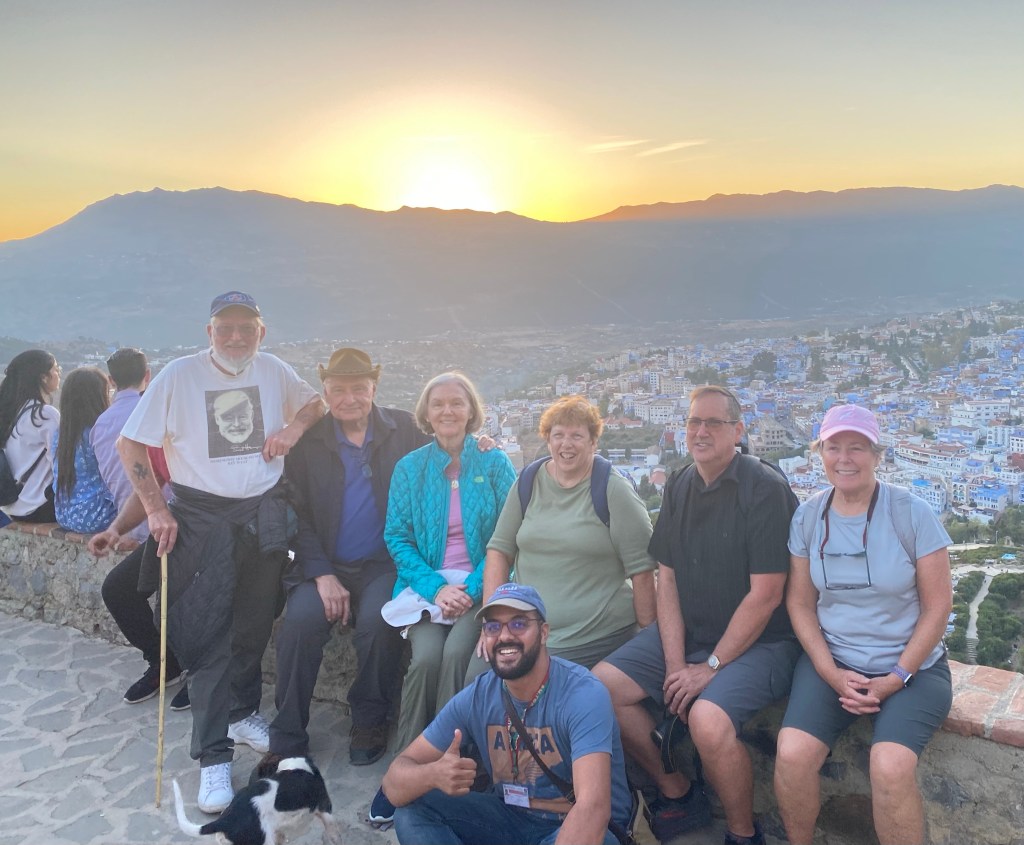
It is SO worth the 30 minute uphill stroll to get there in time to watch the sun drop behind the mountains.

From that vantage point, we could hear the call to prayer issuing forth from the 30+ mosques scattered throughout city.

Most of the other hikers were a bit younger than we were, by roughly 4 or 5 decades
Another view of Chefchaouen: Different centuries coexisting. Women are doing their laundry in the stream and taking photos with their cell phones.

We were offered an optional trip to Tetouan, which all of us, except Mike took. Although the scenery on the drive was spectacular, in retrospect, I think I would have preferred to spend that time in Chefchaouen instead.

The optional tour consisted of a stop in a small Roman Museum, a walk by the palace, and through the Medina, the Jewish quarter and mella, and a seafood lunch in a restaurant across from the beach. Although enjoyable, I’d had similar experiences on other tours, so for me, additional time in Chefchaouen would have been preferable.

Next stop, Tangiers!

Chefchaouen

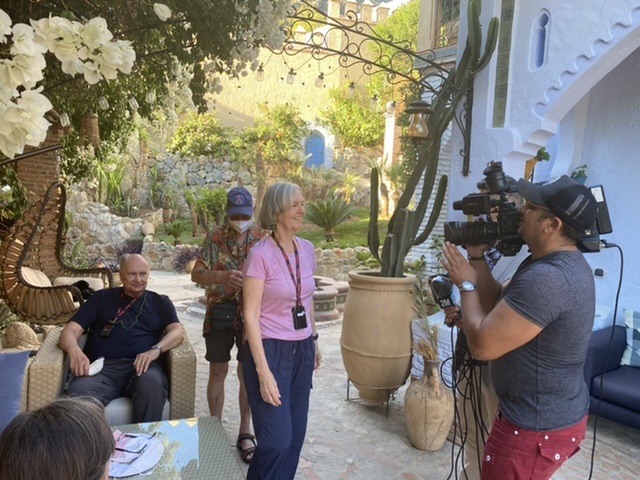
Talk about feeling welcome! The Moroccans were so excited that American tourists were visiting, they sent a camera crew to interview us. So, fellow OAT travelers in Morocco (I know you’re out there), tune in to channel 2 news tonight to see whether we survived the cutting room floor.

It was easy to be enthusiastic about Morocco. The people we have encountered have been so helpful and welcoming and our Riad, Dar Echchaouen, located in the old city, is over the top gorgeous,

If you’re wondering about the dog, he’s with me. Bonnie, my grandniece thought he should come along, so “Goldie” may be showing up in future travel shoots.

And now some history: Chefchaouen was created to be a secure refuge in the Rif Mountains for Muslims and Jews that Ferdinand and Isabella expelled from Spain.
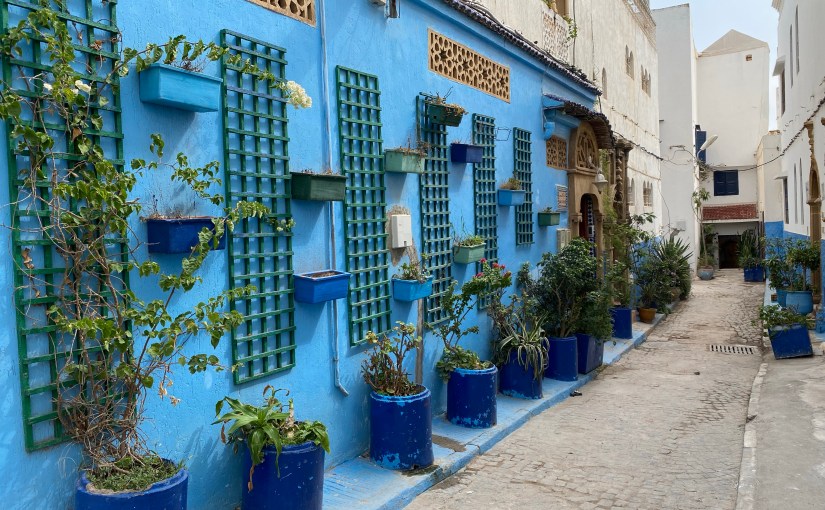
First question: Why is Chefchaouen known as the Blue Pearl of Morocco? Take a look for the answer.

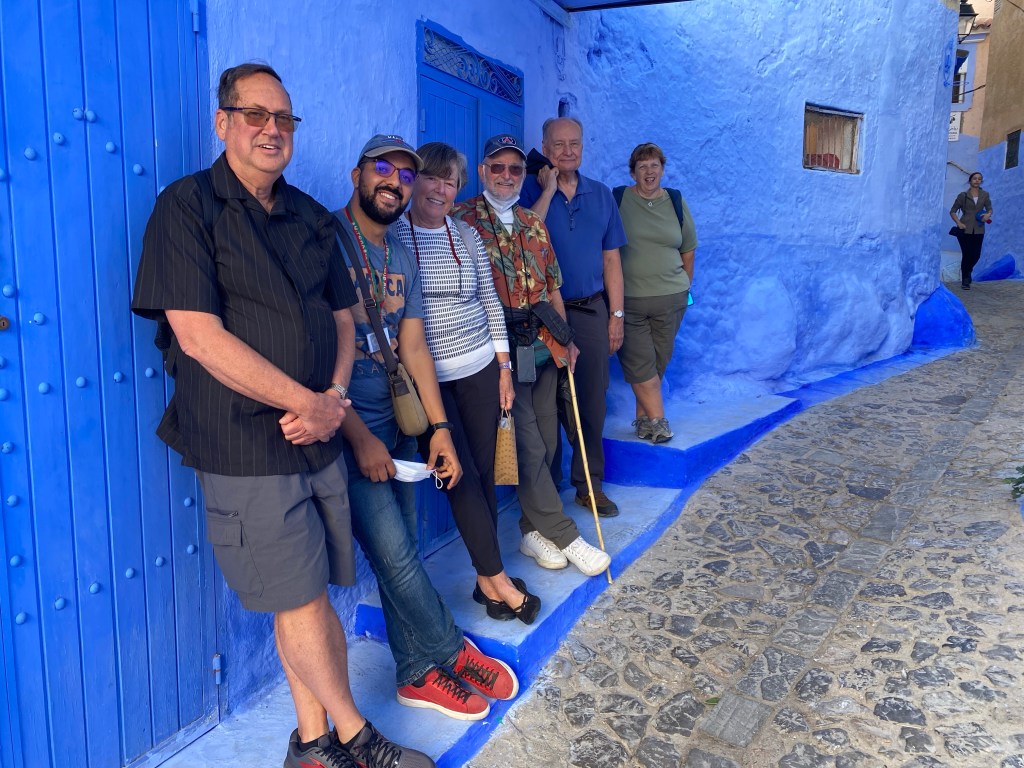
Dave, Mostafa, Kris, Tony, Mike, Terri
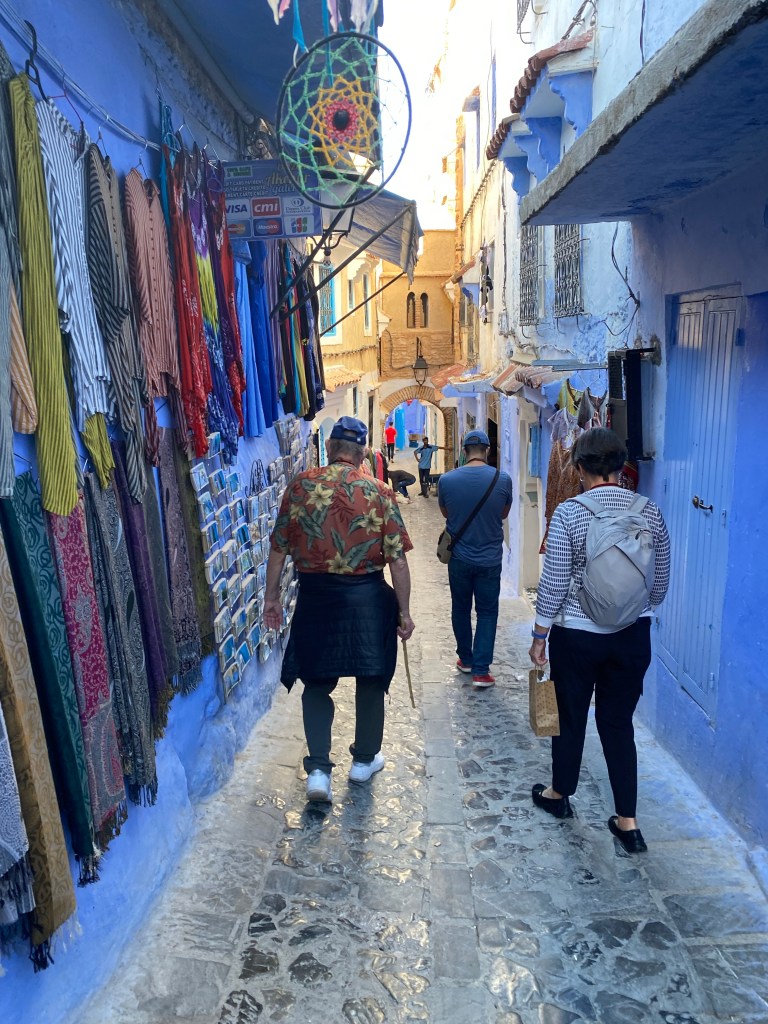
The Medina

Next question—exactly WHY are so many of the buildings blue? Was it because it was easy to extract blue from a particular blue plant or mineral that was plentiful during the 1400’s? Was it because the color blue was thought to ward off evil spirits? Or did a former ruler just favor that particular hue?

If this were a multiple choice test, the answer would be “none of the above”. Buildings in Chefchaouen were painted blue in the early 2000’s to make the city attractive to tourists. And it worked! At least until Covid.

Hints for Future Travelers

To be on the safe side, unless you are flying non-stop to Morocco, get a PCR test. One member of our group was unable to board his Delta flight in Denver, which stopped in Paris, because he hadn’t had a PCR test. Interestingly, another member of the group flew from Denver on an earlier Delta flight and wasn’t asked to show proof (which was fortunate because she also hadn’t been tested). Both were fully vaccinated and showed their cards. The end result was Dave flew out a day later and met up with us late last night in Chefchaouen. Because he had purchased his air from OAT, they took care of his transportation from Casablanca to our riad. The moral of the story: it is better to have a test and not need it, than to have a “Dave adventure”.

And now the weather report for October travelers: it is glorious! Chefchaouen is warm during the day and cool enough for a sweater or light jacket in the morning and at night. Of course, this is only our third day here.
Morocco, FINALLY!

When we signed up for this Overseas Adventure Travel trip in August of 2019, the world was certainly a different place. Even 20 months after shutdown, Covid STILL has a significant impact on our daily lives. I will admit, we had some reservations about leaving home, even after being fully vaccinated, but through Facebook, I was able to connect with Rocky and Julie who traveled to Morocco with OAT in September. They kindly “friended” me, and because of their photos and posts, we felt comfortable forging ahead. My goal is to do likewise, but rather than posting on Facebook, I’ll be communicating via this blog. So, if you want to tag along with us to see whether you’d feel safe visiting Morocco, just sign up and you’ll get a notification via email whenever I post.

This first post might be boring for those who are not planning to become future Morocco travelers. It’s really a compilation of information I would have found helpful, prior to leaving home.

Getting there

Initially, we were flying to Casablanca via Paris on Air France, stopping in Paris for four days. Although we normally enjoy being on our own, because of Covid, we realized that we wanted the comfort of having a guide look out for us. Plus, with different countries having different rules, we figured those four days were a complication we could do without, so I hit the internet, to determine whether it was possible to get from JFK to Casablanca non-stop.

The only non-stop I could find was via Royal Air Maroc, which has one daily round-trip flight. It is a codeshare with American Airlines, but unfortunately OAT does not have an agreement with those airlines, so we were on our own. I’ll be honest—it was a little complicated, because with the code share, we had two different flight and booking numbers, and two different customer service phone lines. AND, although we booked and paid through the American site, we couldn’t use that site to select our seats. We also were unable to check in on-line, and print our boarding passes, something we normally do. A hassle, yes, but we avoided changing planes in Paris, and we arrived in Casablanca seven hours earlier than we would have if we’d stayed with Air France.

Royal Air Maroc

Our flight was scheduled to leave JFK at 8:40 PM, so we left our house at 3:45 PM because of NY traffic. It took almost 2 hours to get to the airport, but checking in and getting through security was relatively easy.

Our flight would arrive in Casablanca at 8:30 AM local time, 3:30 AM our bodies’ time. (It actually departed and arrived on time!) Knowing how poorly I do with sleep deprivation and jet lag, (picture a toddler who needs a nap) we decided to book business class on the way over so we could stretch out and sleep.

Business Class also included admission to the Primeclass Lounge in terminal 1. I’m not sure if Covid is responsible for the food offerings, but let’s just say that particular perk was not a selling feature.

Like USA Airlines, Air Maroc has lay flat seats in business class

I was surprised that dinner was provided on an 8:40 PM departure. In fact, I thought the appetizer was the whole deal and it was enough for me, so I skipped the hot entree. All I can tell you is there were three choices. We also got a decent breakfast.
The business class perks that WERE selling features were a special line in passport control and priority luggage handling, so it was waiting for us when we arrived in baggage claim. In fact, the whole process went so fast and so smoothly, we were off the plane, through passport control, baggage claim and customs, had gotten money at the ATM and were outside the terminal in 25 minutes.
To make the cost reasonable, we opted for economy on the way back. I promise to report on THAT flight too, so you, dear reader, will know what to expect from each option, should Air Maroc be in your future. Our return flight departs shortly before 1:00 PM, versus 7:30 AM (the Air France option), so we should be rested enough to deal with whatever version of economy Air Maroc offers.

Arrival

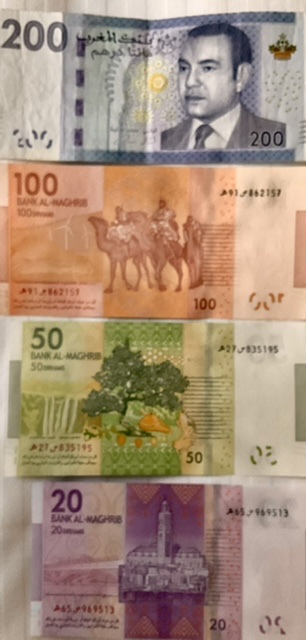
Our hotel, the Radisson Blu, arranged for a car to pick us up at the airport. The cost was 500 MAD and we were able to pay with our credit card. Our guide had warned us that only passengers are allowed inside the terminal, so we knew to look outside for our driver, right after we hit the airport ATM for some local currency. He also told us the most we could withdraw is 2000 MAD, ($235.22) delivered in 100 and 200 bills, so we were prepared for that.
It took about an hour to get from the airport to the hotel, because of traffic and a couple of accidents.

Mohammed VI’s image is on the front of all bills, but the reverse varies. The hotel changed a large bill for us

Packing

Mostafa, our guide, sent us a wonderful welcome email, full of useful information, like where we would be able to have laundry done, (Fes, Ourazazade and Marrakech), and what to pack (bathing suit and hairdryer, among other essentials.) For a while, we seriously considered traveling with carry on only. After very carefully reading the luggage allowances on Royal Air Maroc’s website, I became concerned that ONE carry on meant just that, with no “personal item” allowed. We would have been really bummed if we had eliminated things that we wanted to bring, only to learn at the airport that one of our two carry-ons would have to be checked. So, out came the duffle, and in went more ”stuff”. Mike was able to easily include his laser pointer and binoculars, in anticipation of the dark skies in the Sahara. He’s an astrophysicist, so interested fellow travelers can look forward to a professional explanation of what we are seeing in the heavens.

Map

The image at the top of this post was created courtesy of Google maps. The cities we will be visiting are listed in order, with the blue pins giving you an idea of the ground we will be covering. Are any map aficionados out there? If so, this link will allow you to get additional information about the cities we are visiting by clicking on the blue pins.
https://goo.gl/maps/Np8GEL1ripWqEgx57

For the past two years, we have been “Wishin’ and hopin’ and thinkin’ and prayin’, plannin’ and dreamin’ “ about traveling to Morocco. (Who remembers that song? Extra credit if you remember who sang it.) Right now, dreamin’ is Mike’s choice, but I’m going to check out the pool so I’ll be sunnin’ and swimmin’.