I wish my memory functioned the way it used to. I’m lucky if I retain 20% of what I’ve learned, and boy, have I ever learned a lot during my four days in Bogotá!
On our walking tour, our local guide shared interesting facts about Simon Bolivar that didn’t quite make it into our history books. He was only 19 when his wife died; she made him promise never to marry again, but she forgot to mention lovers. That was probably a good thing, because one of his lovers, Manuelita Saenz saved his life. Her house was down the street from his, close enough to allow them to use candles to schedule rendezvous times. She was watching for his signal when she saw a large group of heavily armed men in the mountains heading toward his house, so she quickly rushed Bolivar to safety. Manuelita’s house is now a museum very close to our hotel, but unfortunately, I didn’t have enough time to visit it.
Instead, I spent some of my “on your own” time in two of the several free museums in Bogotá funded by the National Bank. The original source of that money, however, was the USA. No, not from foreign aid money. It was from a lawsuit Colombia initiated against USA over the Panama Canal. And we lost so we had to pay just under $ 30 million to Columbia. At one time, thanks to Simon Bolivar, Colombia included what is now Panama, Venezuela, Ecuador and Peru.
Both museums had beautiful central courtyards surrounded by exhibition rooms.

Botero definitely had a fascination with big butts and legs.
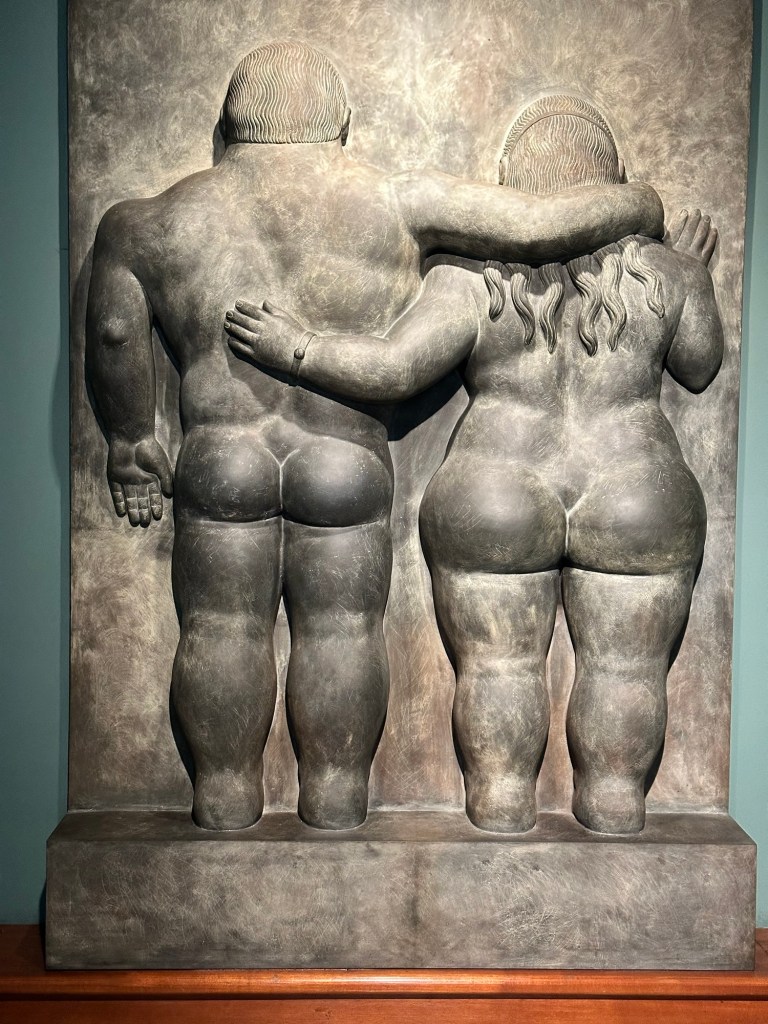
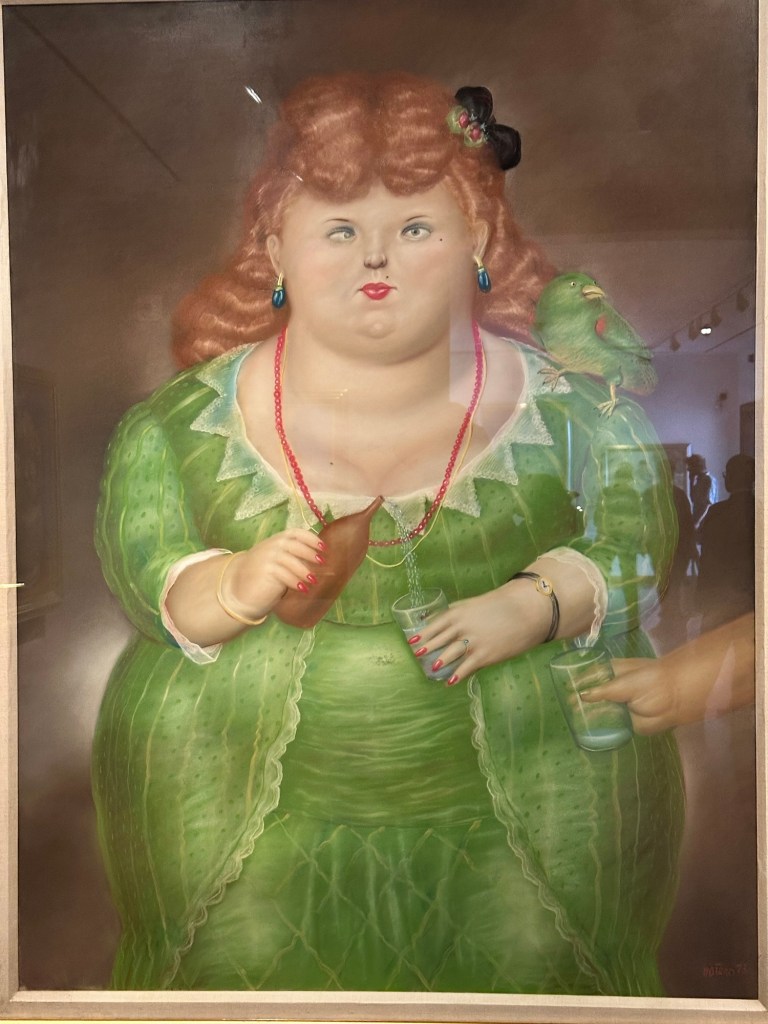
In fact, ALL of his subjects were very well fed. The painting that follows is entitled “Woman with a parrot” which was not the first thing I noticed.
But I digress. Back to the walking tour. Cama, our local guide, took us to the Gold Museum, where we learned that back in pre Spanish times, gold was valued for spiritual reasons. Like many other cultures, the indigenous people were sun worshipers. They believed the more gold you could load onto your body, the closer you were to the sun god.
The object below is considered one of the most important in the museum. It shows the leader on a raft, surrounded by followers who were tossing gold objects into the lake as offerings to the sun god.

Many of the objects in the gold museum were saved from the Spaniards because they had been tossed into bodies of water. Others were discovered in gardens because the owners buried them to keep them from being stolen and after they were killed, if there were any survivors, they couldn’t find the buried “treasures”.
Although we were supposed to be on our own after lunch, Alejo had thoughtfully arranged transportation to Monserrate and Cama graciously accompanied us.
In my opinion, Monserrate is a much better choice than the salt cathedral. We rode a cable car to the summit. Although there weren’t many people at the bottom of the mountain, Cama asked the cable operator about the number of people at the summit, and wisely advised us to purchase “skip the line” tickets. Good thing, because the line to descend was so long, we would have been standing there for hours!
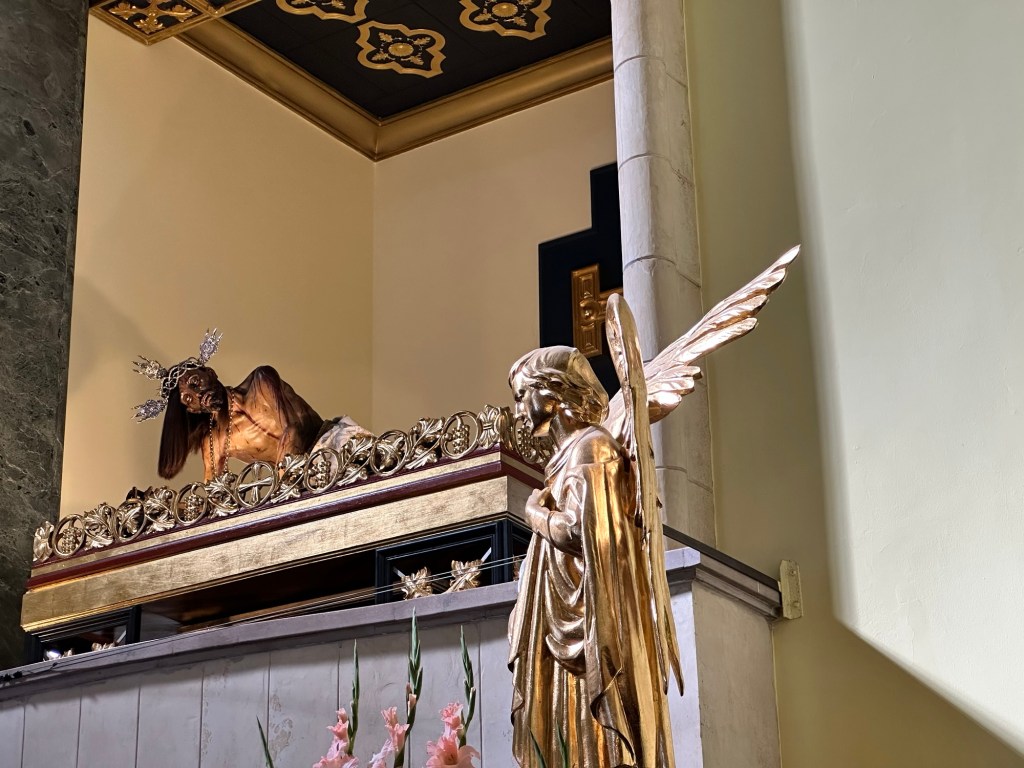
At Monserrate, we got a spectacular view of the city. But wait, there’s more! The church was very different from any that I had ever been in. When you enter a church, what do you normally see? A huge cross, with a very European Jesus hanging from it, right? Take a look at THIS church.
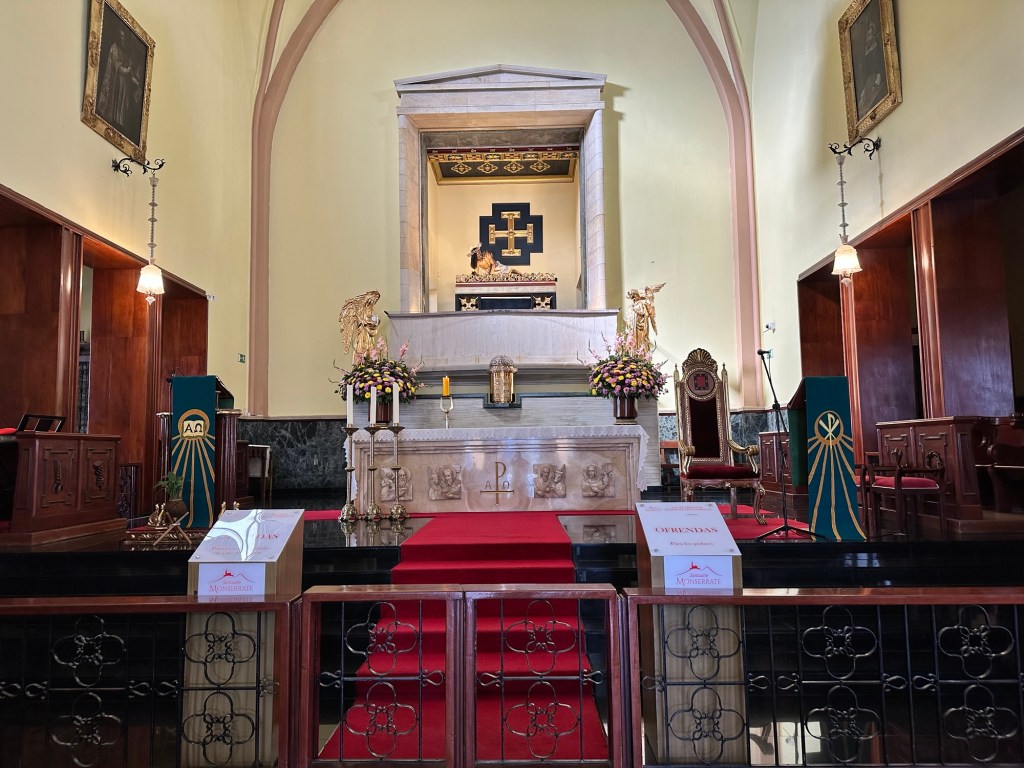
Here’s a close up. Don’t you think it’s far more realistic depiction of Jesus? I suspect back then, his skin was more of a Middle Eastern color.
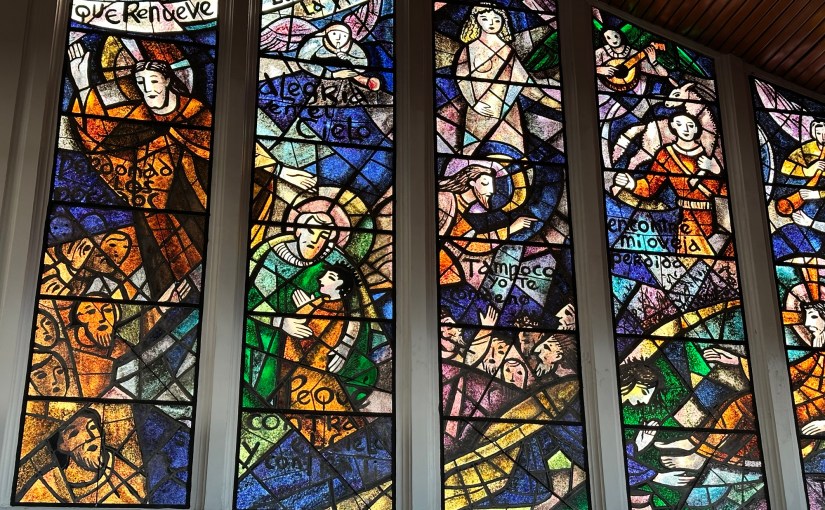
The photo for this post’s banner is one of the church’s stained glass windows. Take a close look, because it has something I have never, ever seen on ANY church’s window (trust me, I’ve visited countless churches) and don’t expect to ever see it again. Who can spot it? I’ll give you a hint. Look near the top.
The LAST unique aspect of the church that I noticed was the “miracle area”, where people thanked “El Señor” for granting their wishes by buying a plaque. Notice the one from Luis Fernando Rendón thanking El Señor for making it possible for him to move to New York and for giving him health and strength to care for his family. It’s the gold one in the photo below.

Here’s a photo that Cama took of 11 of the 15 of us on the tour.

Although OAT offered an optional tour, not enough of the group chose to take it, so instead, we got another unstructured day. Elsie and decided to take the free graffiti tour, and it was FANTASTIC!
I had no idea that Bogotá has 6000 kilometers of “legal” street art, with another 1000 of “illegal” (unapproved). The tour was conducted by an artist who showed us one of his works. It depicts a creation myth. I don’t remember ALL of the story, but here’s the gist.
These two will be perpetually young so long as they stay faithful. When the man notices his skin is getting wrinkled, he realizes he’d been betrayed, so he killed his rival. Sorry, I don’t remember how the emerald and the snake tied in to the myth, but they did. And I remember the man ultimately committed suicide. Once again, it was all HER fault.
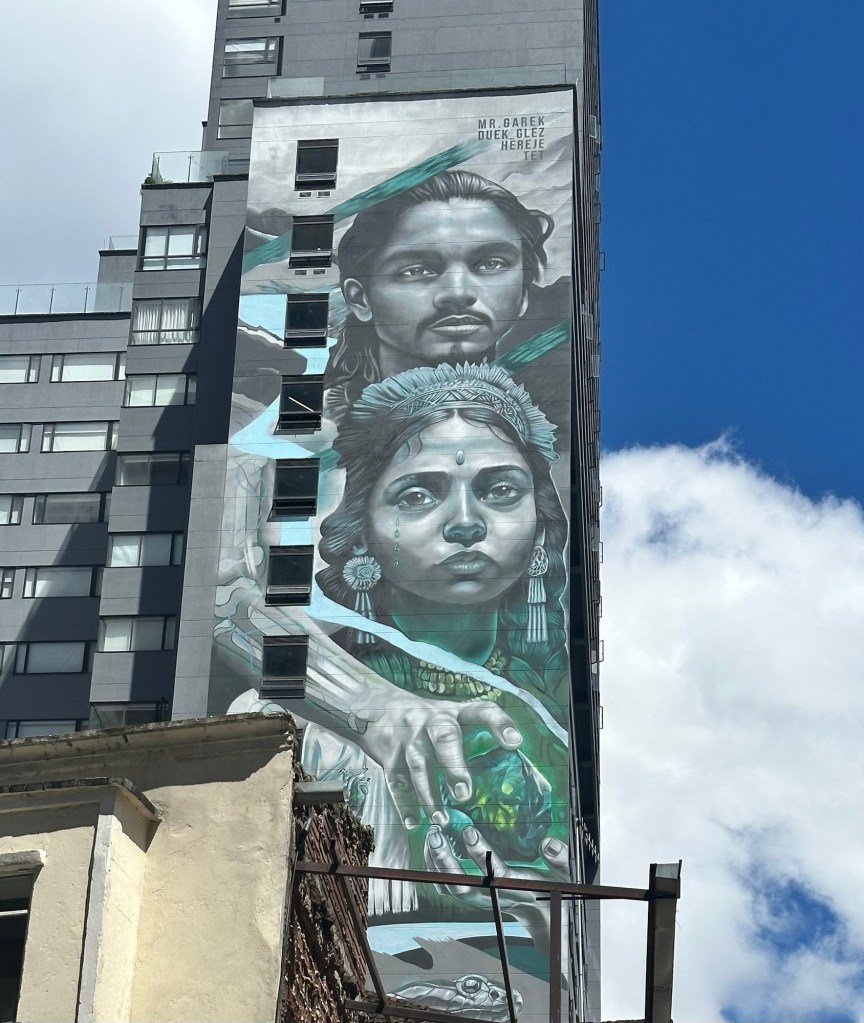
The next one was commissioned by Peru, as an act of reconciliation. For what, I don’t recall.

The words read “No one is illegal. Strength in unity”.
I love this next one of five young indigenous girls (I could only get four into the photo).
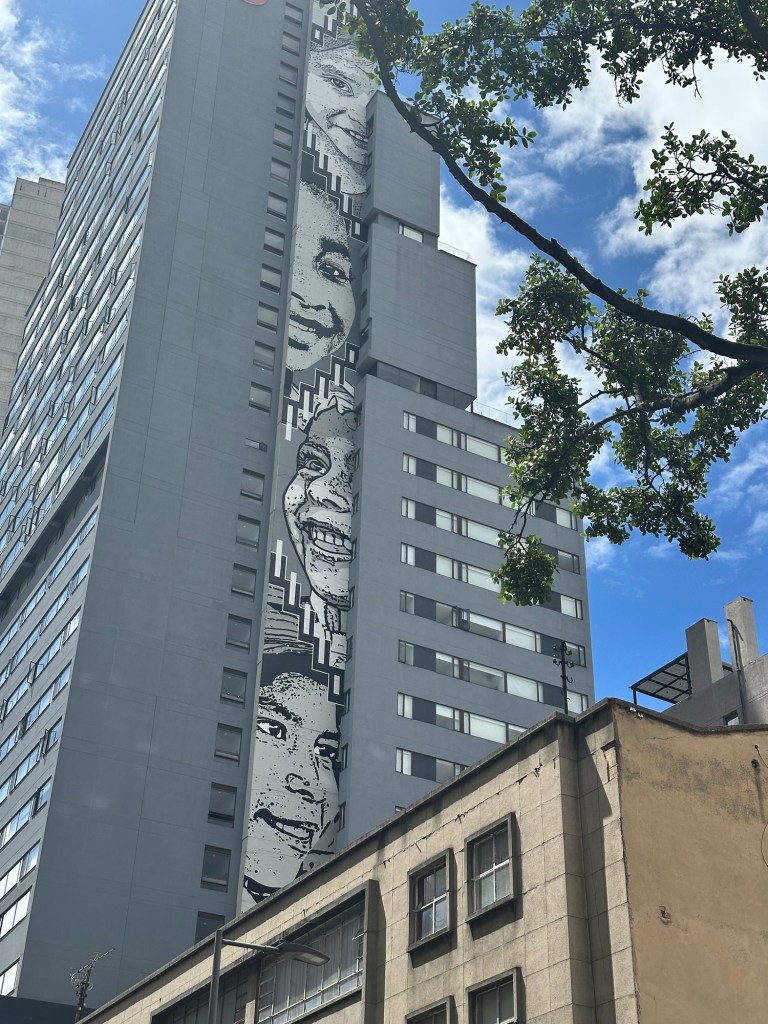
The artists asked them about their hopes for their future, and as they were thinking about their dreams, they smiled. The artists captured that moment in a photo and that became their model for this mural.
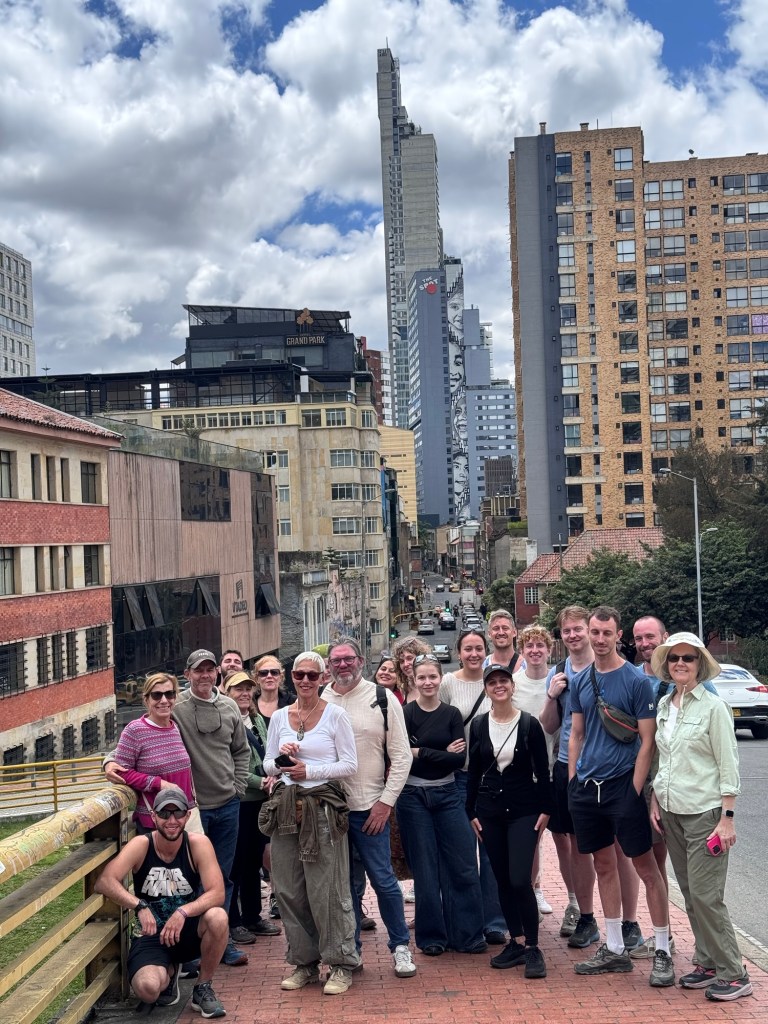
There was a whole lot more art, and MUCH more interesting narrative, but this post is getting rather long. Our next to the last stop was on a bridge, where our artist guide took this photo. The tall structure in the background is significant because it is the highest building in Colombia, completely empty, because it is tilting, like the tower in Pisa. It is also significant because a graffiti artist has placed his “tag” on the very top of the building. And if you want to know more about the interaction among graffiti, music, and common words in our culture, you’ll just have to take the tour.
I’ll close with photos of the newest artists
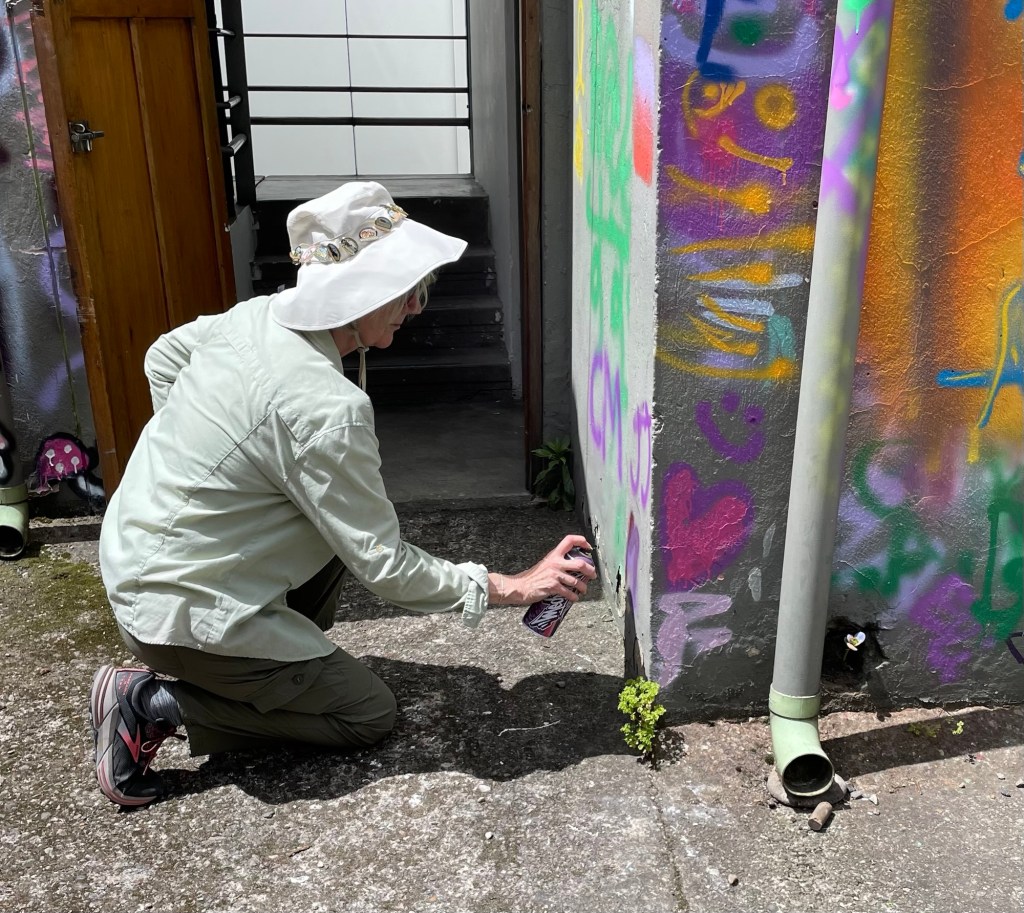

And their work

Hey, it ain’t as easy as you might think!

 Destination NOW
Okay, I’m going to guess the bare breast?
I love Botero’s art and would love to see some of his paintings and/or sculptures in person. Speaking of persons, it looks like you have quite a mix of ages in your tour group.
LikeLike
YES! You are very observant.
Actually, everyone is over 60. We were all able to use the speedy line in passport control for those over 60.
LikeLike
Oh, right. I got your group picture mixed up with the picture of you with the artists.
LikeLike