Maasai Culture

Warning: This might not be a good post to read to children.

Yet another reason I choose to travel with OAT is the opportunity to learn about the culture of the places we visit. I also love that a portion of our payment for the trip goes back to the communities with whom we interact.

Our morning in a Maasai village was VERY educational. So, of course I feel compelled to share what I learned with you.

Did you ever wonder how you get goats to practice birth control? Let this Maasai chief show you. That yellow barrier strapped behind the goat’s forelegs stops his “love potion” from reaching its intended target.

I confess that I was slightly confused. I thought it was a GOOD thing to have lots of goats and sheep. Seleman, our wonderful trip leader, explained that for goats, like humans, timing is everything in life. The Maasai want to make sure baby goats are born when their likelihood of survival is maximized, so when the timing is right, the shield comes off.

Next the Assistant Chief explained (in perfect English) the tribal hierarchy. He described some of the Maasai rituals, the most memorable (to me) being circumcision. It is performed in public, without anesthesia, on a group of 12 to 14 year old boys. If they don’t cry out or even flinch, they are deemed worthy to become warriors. After surviving the ritual, the group goes into the bush for three months. When they return to the tribe they are then considered to be men.

Before climate change decimated their herd of cattle, reducing it from 290 to 10, the Maasai used to drink cow’s blood every morning. They made a shallow incision into the cow’s jugular, collecting at least a liter before they stuffed the cow’s wound with herbs.

If you ever doubt the impact that one amazing woman can have, let me introduce you to Lucy. For the past 13 years, Lucy has visited over 100 villages, providing health education, including speaking out against what WE call FGM ( female genital mutilation). What THEY call “the cut” was deeply imbedded in the culture and traditions. They believed undergoing this public procedure transformed a girl into a woman, and thus enabled her to be married. Like circumcision, removal of the clitorus and labia was done without anesthesia, by a “midwife” and women were expected to endure the pain without crying out. Lucy underwent “the cut” when she was 14. (She admitted to crying and screaming).

Although the government banned FGM in 2003, there was no follow up, so the practice continued. It certainly wasn’t easy, but after years of hard work, Lucy succeeded in eliminating FGM for about 99% of the girls in the villages she visited.

Lucy understood she had to “humble herself” in order to get her message across. To ME, however, Lucy is the embodiment of Katy Perry’s song “Roar”, especially these lines:

“ You held me down, but I got up, already brushing off the dust, I went from zero to my own hero…

I am the champion and you’re gonna hear me ROAR”

After the Maasai village visit, we headed to an elementary school that has been a recipient of funds from OAT’s Grand Circle’s foundation.
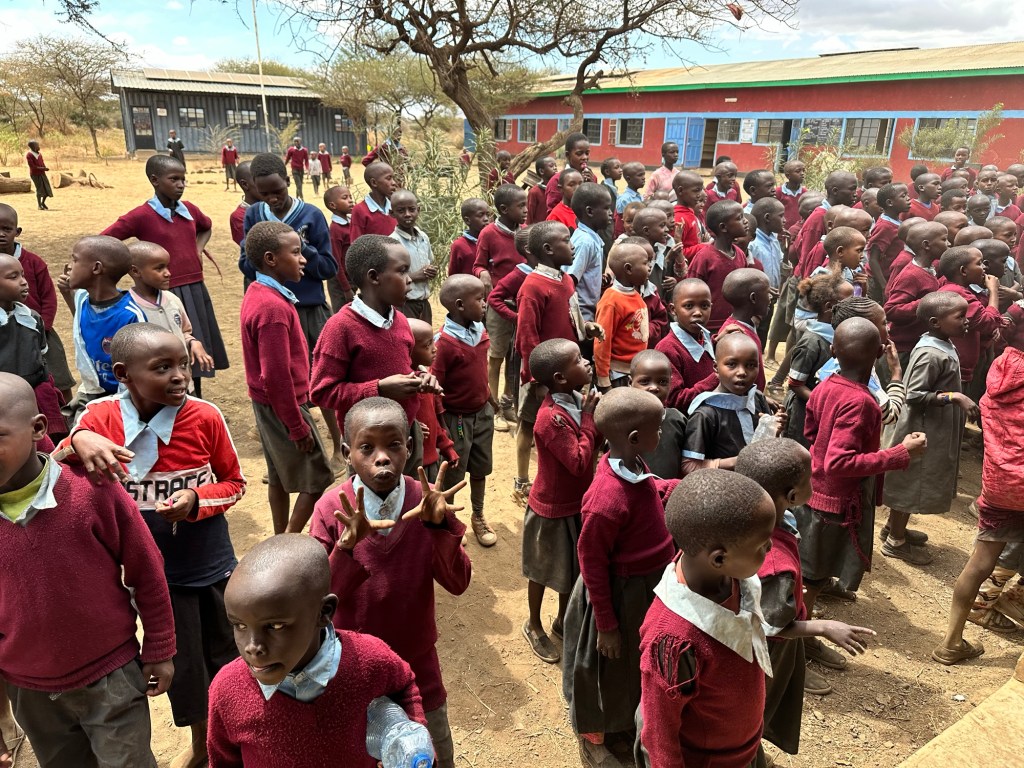
There are only 12 teachers for 183 girls and 230 boys. That’s quite a teacher/student ratio! .

While there, we learned how the Foundation‘s money was used. The first purchase was a copy machine, so the teachers wouldn’t have to walk for 45 minutes to the closest copier.

Under construction were bathrooms with flush toilets that will replace the two squat toilets currently being shared by all the students (and that some of us used during our visit).

During our interaction with the children, we told them a little about ourselves, where we were from (notice the map of the USA on the wall) and what our occupations were.

Fellow traveler Kalpana was by far the most inspirational. She told the students that she had attended a school just like theirs when she was growing up in India. Her hard work enabled her to become a doctor. Kalpana encouraged the kids to study, work hard and dream big.

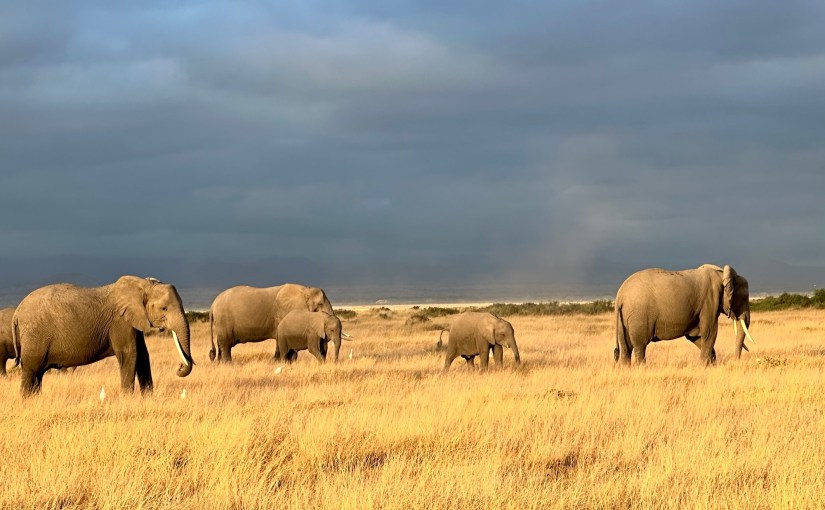
I know, I know. I lured you in with that elephant photo atop this post. We will get to the elephants, cheetahs, lions and monkeys…and that post WILL be suitable to read to the kiddies. I promise, but first I wanted to share these meaningful and inspiring moments.

I’ll end this post with a photo of our group hanging out in a baobab tree.

RWANDA, KENYA & TANZANIA

I have wanted to see gorillas in their natural habitat for decades, ever since I saw the movie about Dian Fosse’s life. If I’m lucky, my dream will soon be coming true.

In a few weeks, I’ll be leaving for five days in Rwanda. This is the pre-trip OAT offers before their main trip to Kenya and Tanzania. The maximum amount of time that any group is allowed to spend with the gorillas is one hour. But that’s not guaranteed. If the gorillas become agitated, they could retreat into the bush before the hour elapses.

According to the documentation that I received from OAT, there are eight of us on the pre-trip. A ninth traveler will be joining us in Nairobi at the start of the main trip, so it’s a nice small group, composed of two couples and four women traveling solo. At least that’s what I’m guessing, from last names and geographic areas.

I have to tell you, getting to and from that part of Africa is not easy. My flight from Newark to Kigali leaves after midnight, stops for about an hour in Istanbul, and doesn’t arrive in Kigali until 1 AM the following day.

Okay, confession time. I screwed up. Originally I booked a one night early arrival into Kigali. When I got my flight information and saw I was landing the next day, I canceled the early arrival. It took me a while to realize that I HAD to book that early arrival, otherwise I’d be sitting in the lobby from around 1 AM until a room for that day was available. Not fun. By the time I figured this out, it was less than 90 days before departure, so I called OAT to rebook that room. That’s when I learned that OAT doesn’t allow changes within the 90 days before departure. Internet to the rescue. I booked directly with the hotel. They are going to keep me in the SAME room that I would get with OAT (which happens to be an upgraded room, at no additional cost), AND they are meeting me at the airport and transporting me to the hotel at no additional charge. I love it when my stupidity actually turns into a good thing.

For the return trip, I will be flying out of Kilimanjaro, Tanzania, leaving at 2:30 AM, and arriving in Istanbul around noon. Because I’m hoping to sleep on the plane for BOTH flights, I decided to fly business class with Turkish Air. The OAT flight department was able to find me a reasonably priced flight as long as I stayed two nights in Istanbul. Such a deal!

While in Africa, we will be flying in small planes, so OAT supplied us with duffles, specially constructed to ensure that everyone’s luggage can fit onto the plane.  When Mike and I went on OAT’s Ultimate Africa trip in 2014, we received similar duffels, which I decorated with sharpies, including–much to his surprise– Mike’s.  After the trip, I gifted my duffel to my sister, Sandy, so new project!

The decorations made it easy to spot our bags, which was very helpful, because other OAT trips were leaving from the same hotel. Not only were we able to differentiate our bags from others in the trip, we were also able to make sure OUR bags were on the RIGHT trip!

Yes, I know it looks like the bag was decorated by a not very talented six year old. But you have to admit, no one else will have a duffle that even REMOTELY looks anything like this.

OAT’s documentation included confirmation of the hotels and lodges, so I checked them out on line. I couldn’t believe that almost all accommodations have swimming pools, so I added a bathing suit to my packing list.

I am beyond excited about this trip! I hope you’ll travel vicariously with me. The next post will be from Africa. The map at the top of this post shows where we will be visiting.

Touring Africa via the movies

To me, travel consists of three almost equally delightful phases:

  • Phase One – anticipation and preparation
  • Phase Two – the trip itself
  • Phase Three – recollection – reliving the experiences through photos and the memories imbedded in my brain.

Right now I am deeply into Phase One, learning as much as I can about the countries we will be visiting, and how best to prepare for the trip itself.

OAT, like Road Scholar, sends an excellent package of preliminary materials.  These include what you need to know about the climate, what to pack, visa requirements,  necessary immunizations, currencies used in each country, plus a list of books and movies for us Phase One enthusiasts.

Not surprisingly, the movie list included Born Free, Out of Africa, Gorillas in the Mist, the African Queen, Hotel Rwanda, many of which I had already seen.  One title I had never encountered was The First Grader, produced by National Geographic Entertainment.  It tells the story of Maruge, a former Mau Mau warrior who went to school for the first time at the age of 84.  Even though we aren’t going to Kenya, it still is about Africa, and the movie intrigued me, so I borrowed the DVD from the local library.

first grader

What a wonderful movie!  It is actually two stories.  The first tells of Maruge’s determination to take advantage of Kenya’s offer of free education for all, and the obstacles he had to surmount to achieve his goal.   The second, through flashbacks, chronicles the Mau Mau uprising in the early 1950’s and the British brutality during that period of colonialism.

I’m so glad I got the DVD because it includes “bonus features”: a short documentary starring the real Maruge and Teacher Jane, interviews with the director, and a peek behind the scenes while the movie was being made. I enjoyed these bonus features as much as the movie, and after watching them, I appreciated the movie even more, because as indicated by the interviews and documentary, the movie didn’t embellish or invent — it  just told Maruge’s  story.

The movie was shot on location in Kenya, using an actual village school.  Only one main character, Teacher Jane, is British.  The rest are Kenyans–some are actors, but the children are all the students at that school, and the “movie” villagers are actual villagers.  The kids are truly amazing!  They had never seen TV or movies before, so they were just going about their normal activities, doing what the “teacher” (the director) told them to do.  One sweet little girl was instructed to go over to Maruge to ask him if he was okay.  When he responded, she said “when I grow up, I am going to be a doctor so I can make you feel better”.   The director wisely kept this unscripted exchange, but because they spoke in their native language, he added English subtitles.  Uplifting?  Definitely.

How I could have possibly missed the 2010 movie Invictus is beyond me. It was nominated for multiple awards, was directed by Clint Eastwood and starred Morgan Freeman and Matt Damon.  But I did.  Again, my local library came to the rescue.  This was another thoroughly enjoyable movie and for the other 10 people on the planet that also missed it–here’s what it’s about: Nelson Mandela recognizes the healing power of rugby.  The Springboks, South Africa’s team, represented apartheid to the black majority and when Mandela came to power they argued that the name and the team colors should be changed.  Mandela not only persuaded his countrymen to retain both, but he also actively supported the team in the 1995 world cup competition.  This is another uplifting movie about the triumph of the human spirit, and the healing nature of forgiveness.

Movies that didn’t make the list, and at least in MY opinion should have are the two The Gods Must Be Crazy movies.  Filmed in Botswana and South Africa, they tell the story of Bushmen encountering the oddities of the modern world.  Sweet, funny and thoroughly entertaining, it is also available on HBO.

crazy

As you may have suspected, I have a weakness for uplifting, feel good movies!