Bogotá, Colombia, Part 2

I wish my memory functioned the way it used to. I’m lucky if I retain 20% of what I’ve learned, and boy, have I ever learned a lot during my four days in Bogotá!

On our walking tour, our local guide shared interesting facts about Simon Bolivar that didn’t quite make it into our history books. He was only 19 when his wife died; she made him promise never to marry again, but she forgot to mention lovers. That was probably a good thing, because one of his lovers, Manuelita Saenz saved his life. Her house was down the street from his, close enough to allow them to use candles to schedule rendezvous times. She was watching for his signal when she saw a large group of heavily armed men in the mountains heading toward his house, so she quickly rushed Bolivar to safety. Manuelita’s house is now a museum very close to our hotel, but unfortunately, I didn’t have enough time to visit it.

Instead, I spent some of my “on your own” time in two of the several free museums in Bogotá funded by the National Bank. The original source of that money, however, was the USA. No, not from foreign aid money. It was from a lawsuit Colombia initiated against USA over the Panama Canal. And we lost so we had to pay just under $ 30 million to Columbia. At one time, thanks to Simon Bolivar, Colombia included what is now Panama, Venezuela, Ecuador and Peru.

Both museums had beautiful central courtyards surrounded by exhibition rooms.

Botero definitely had a fascination with big butts and legs.
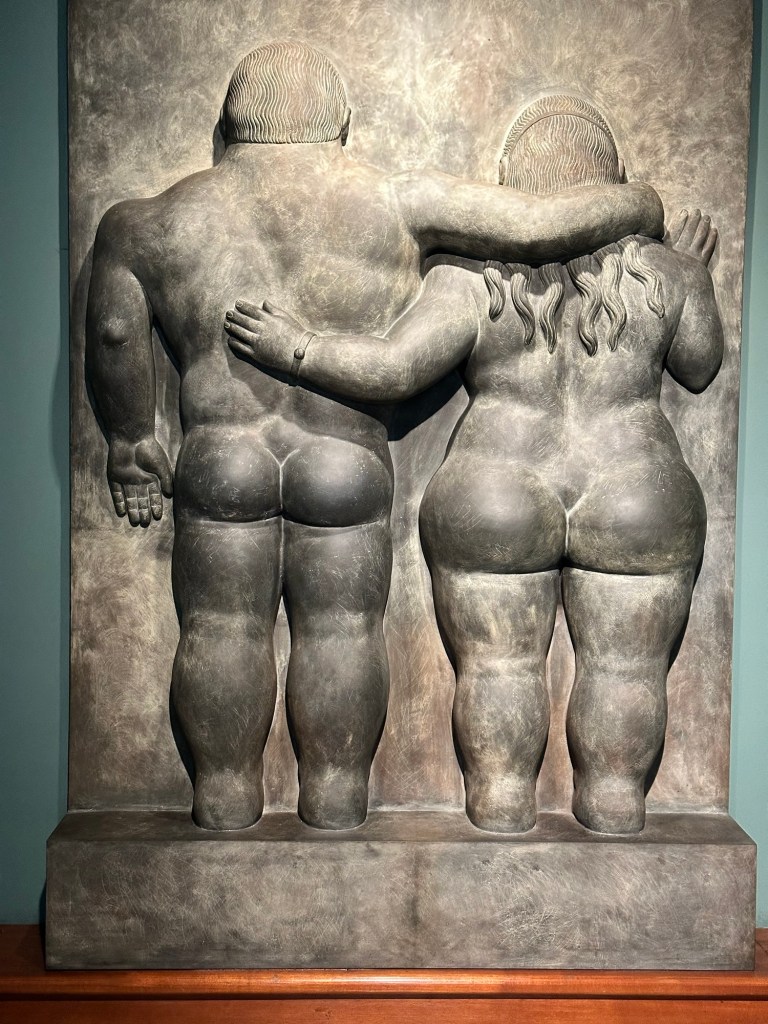
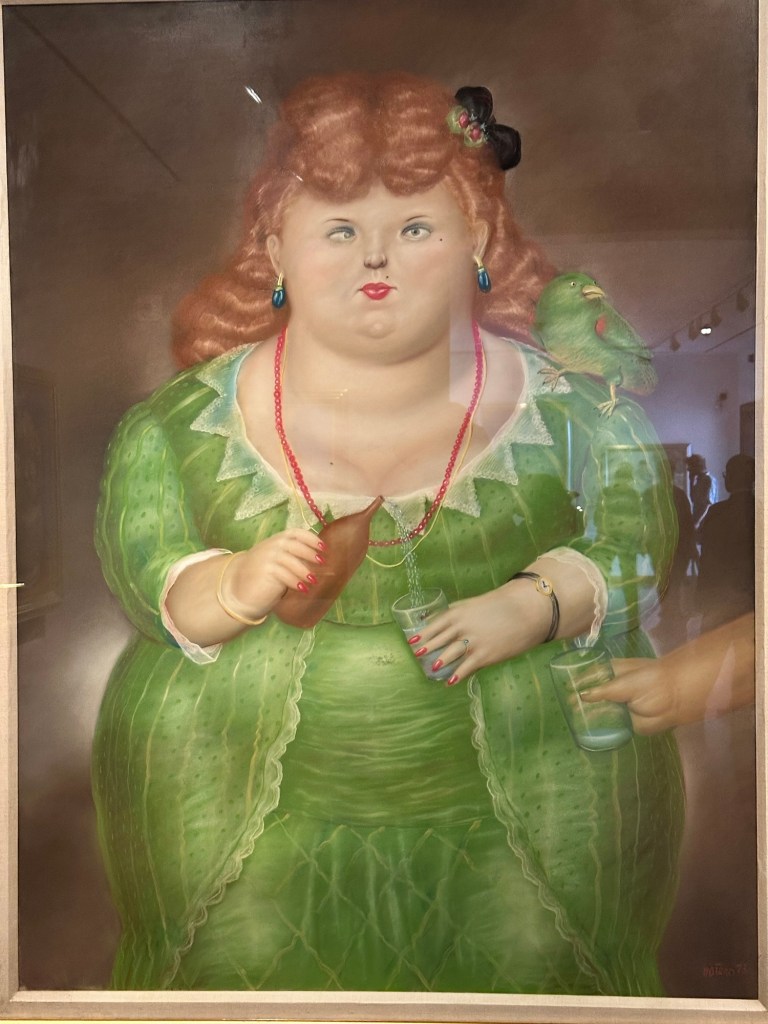
In fact, ALL of his subjects were very well fed. The painting that follows is entitled “Woman with a parrot” which was not the first thing I noticed.
But I digress. Back to the walking tour. Cama, our local guide, took us to the Gold Museum, where we learned that back in pre Spanish times, gold was valued for spiritual reasons. Like many other cultures, the indigenous people were sun worshipers. They believed the more gold you could load onto your body, the closer you were to the sun god.

The object below is considered one of the most important in the museum. It shows the leader on a raft, surrounded by followers who were tossing gold objects into the lake as offerings to the sun god.

Many of the objects in the gold museum were saved from the Spaniards because they had been tossed into bodies of water. Others were discovered in gardens because the owners buried them to keep them from being stolen and after they were killed, if there were any survivors, they couldn’t find the buried “treasures”.

Although we were supposed to be on our own after lunch, Alejo had thoughtfully arranged transportation to Monserrate and Cama graciously accompanied us.

In my opinion, Monserrate is a much better choice than the salt cathedral. We rode a cable car to the summit. Although there weren’t many people at the bottom of the mountain, Cama asked the cable operator about the number of people at the summit, and wisely advised us to purchase “skip the line” tickets. Good thing, because the line to descend was so long, we would have been standing there for hours!

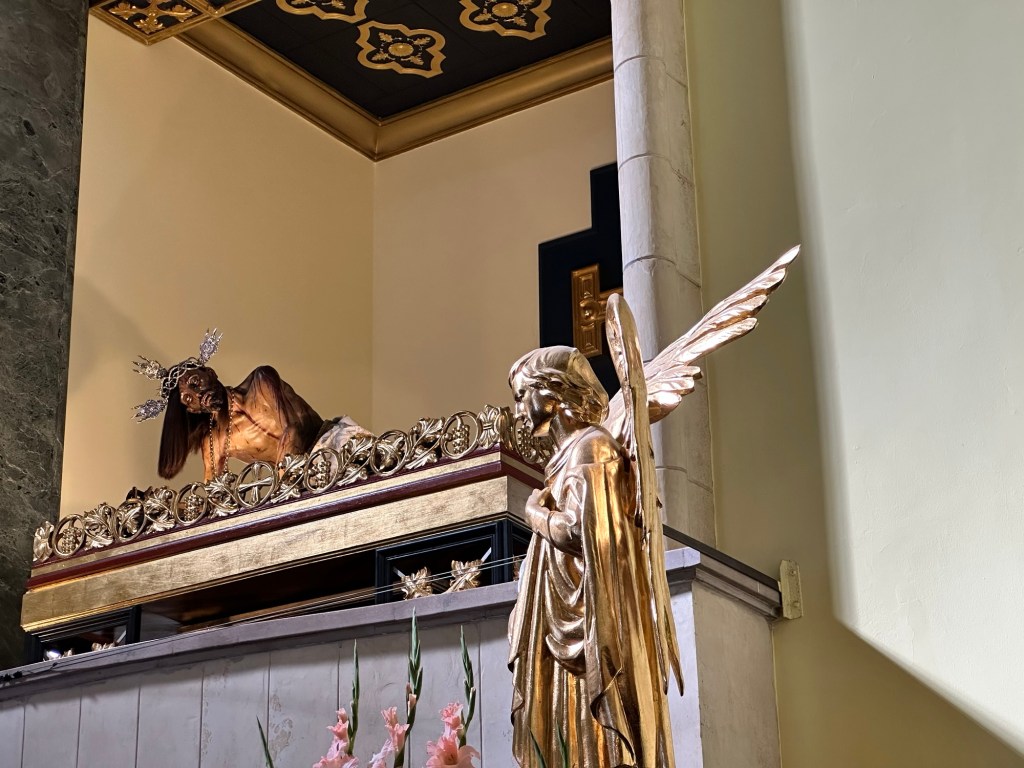
At Monserrate, we got a spectacular view of the city. But wait, there’s more! The church was very different from any that I had ever been in. When you enter a church, what do you normally see? A huge cross, with a very European Jesus hanging from it, right? Take a look at THIS church.
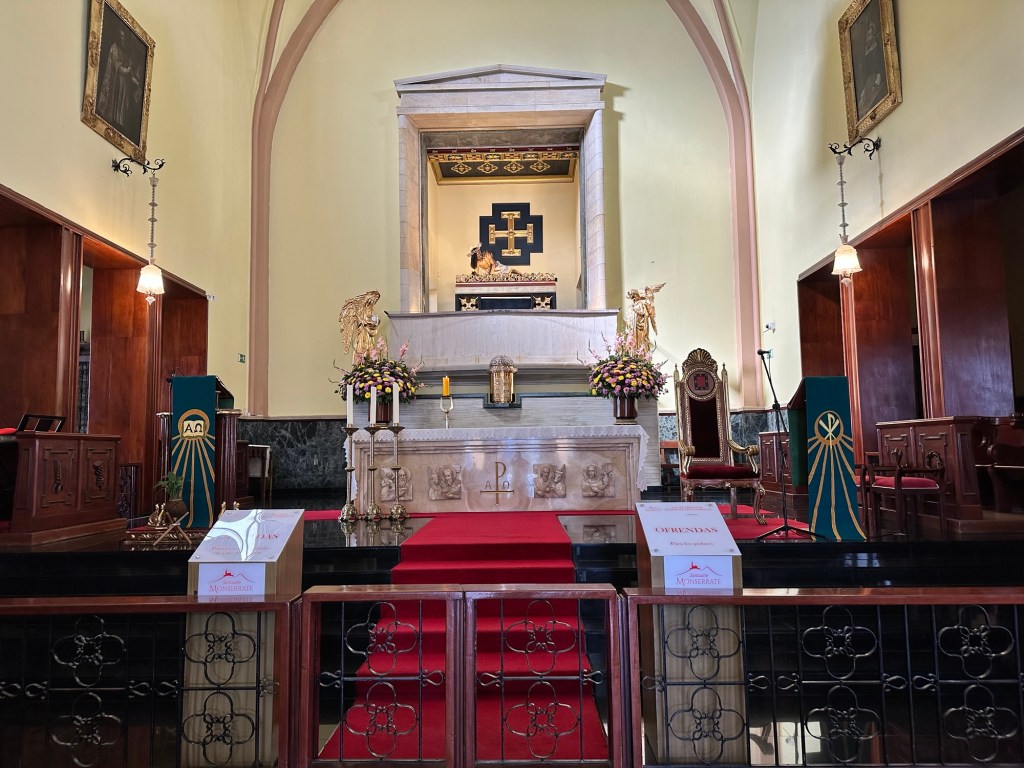
Here’s a close up. Don’t you think it’s far more realistic depiction of Jesus? I suspect back then, his skin was more of a Middle Eastern color.
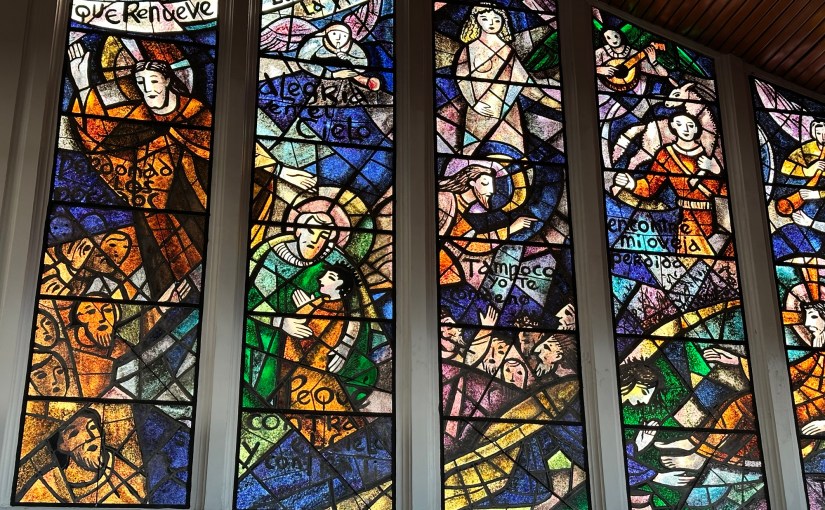
The photo for this post’s banner is one of the church’s stained glass windows. Take a close look, because it has something I have never, ever seen on ANY church’s window (trust me, I’ve visited countless churches) and don’t expect to ever see it again. Who can spot it? I’ll give you a hint. Look near the top.

The LAST unique aspect of the church that I noticed was the “miracle area”, where people thanked “El Señor” for granting their wishes by buying a plaque. Notice the one from Luis Fernando Rendón thanking El Señor for making it possible for him to move to New York and for giving him health and strength to care for his family. It’s the gold one in the photo below.

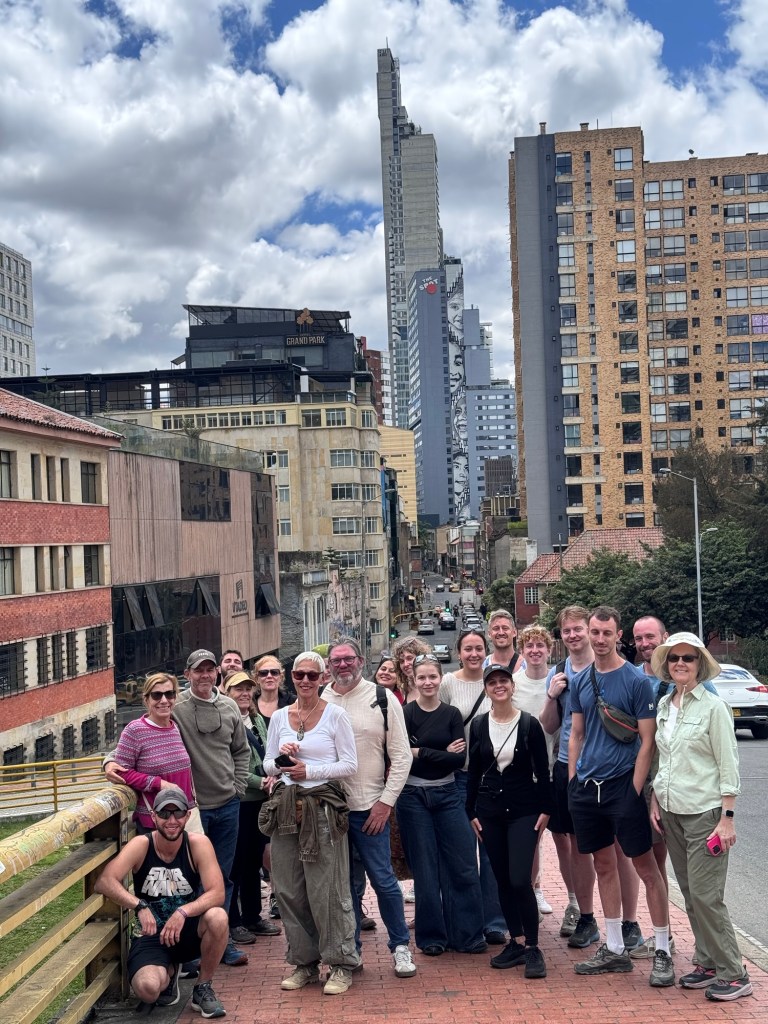
Here’s a photo that Cama took of 11 of the 15 of us on the tour.

Although OAT offered an optional tour, not enough of the group chose to take it, so instead, we got another unstructured day. Elsie and decided to take the free graffiti tour, and it was FANTASTIC!

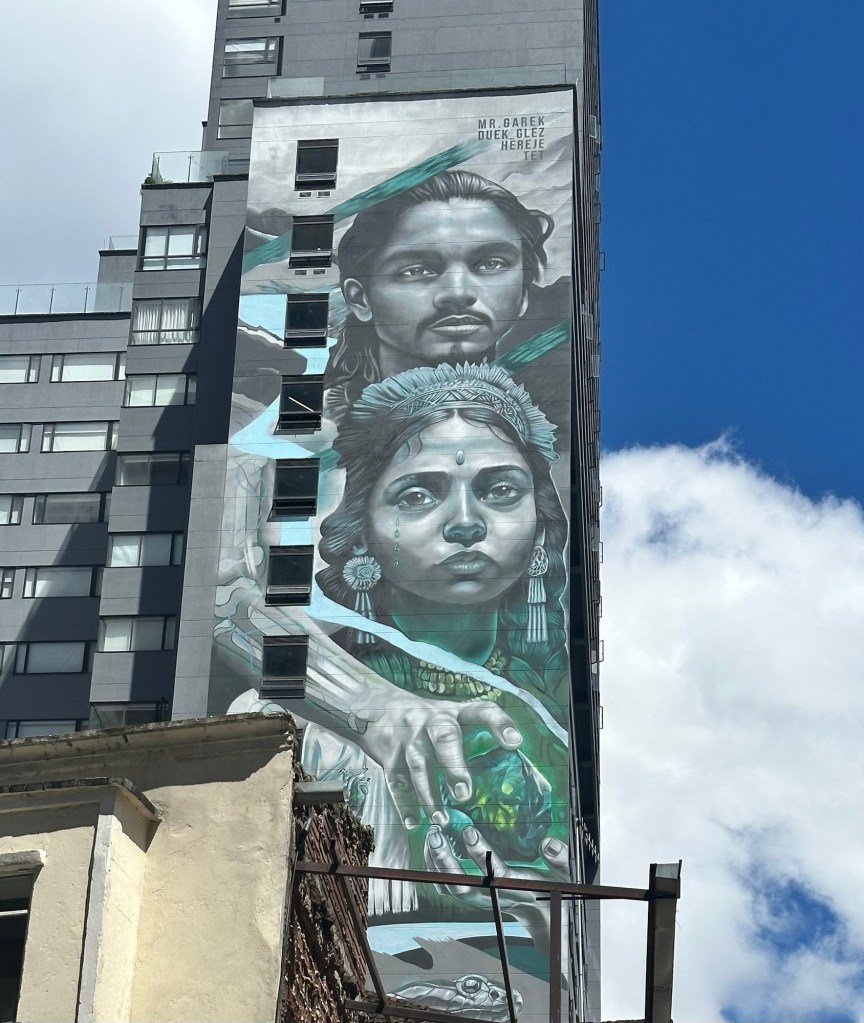
I had no idea that Bogotá has 6000 kilometers of “legal” street art, with another 1000 of “illegal” (unapproved). The tour was conducted by an artist who showed us one of his works. It depicts a creation myth. I don’t remember ALL of the story, but here’s the gist.

These two will be perpetually young so long as they stay faithful. When the man notices his skin is getting wrinkled, he realizes he’d been betrayed, so he killed his rival. Sorry, I don’t remember how the emerald and the snake tied in to the myth, but they did. And I remember the man ultimately committed suicide. Once again, it was all HER fault.
The next one was commissioned by Peru, as an act of reconciliation. For what, I don’t recall.

The words read “No one is illegal. Strength in unity”.

I love this next one of five young indigenous girls (I could only get four into the photo).
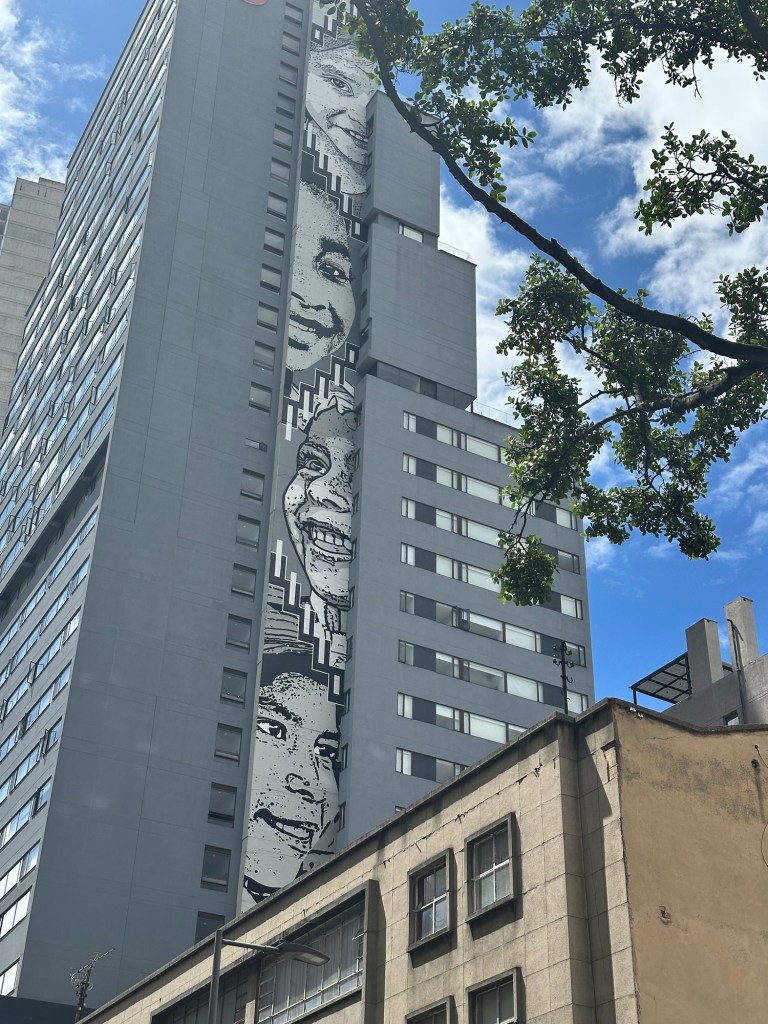
The artists asked them about their hopes for their future, and as they were thinking about their dreams, they smiled. The artists captured that moment in a photo and that became their model for this mural.

There was a whole lot more art, and MUCH more interesting narrative, but this post is getting rather long. Our next to the last stop was on a bridge, where our artist guide took this photo. The tall structure in the background is significant because it is the highest building in Colombia, completely empty, because it is tilting, like the tower in Pisa. It is also significant because a graffiti artist has placed his “tag” on the very top of the building. And if you want to know more about the interaction among graffiti, music, and common words in our culture, you’ll just have to take the tour.
I’ll close with photos of the newest artists
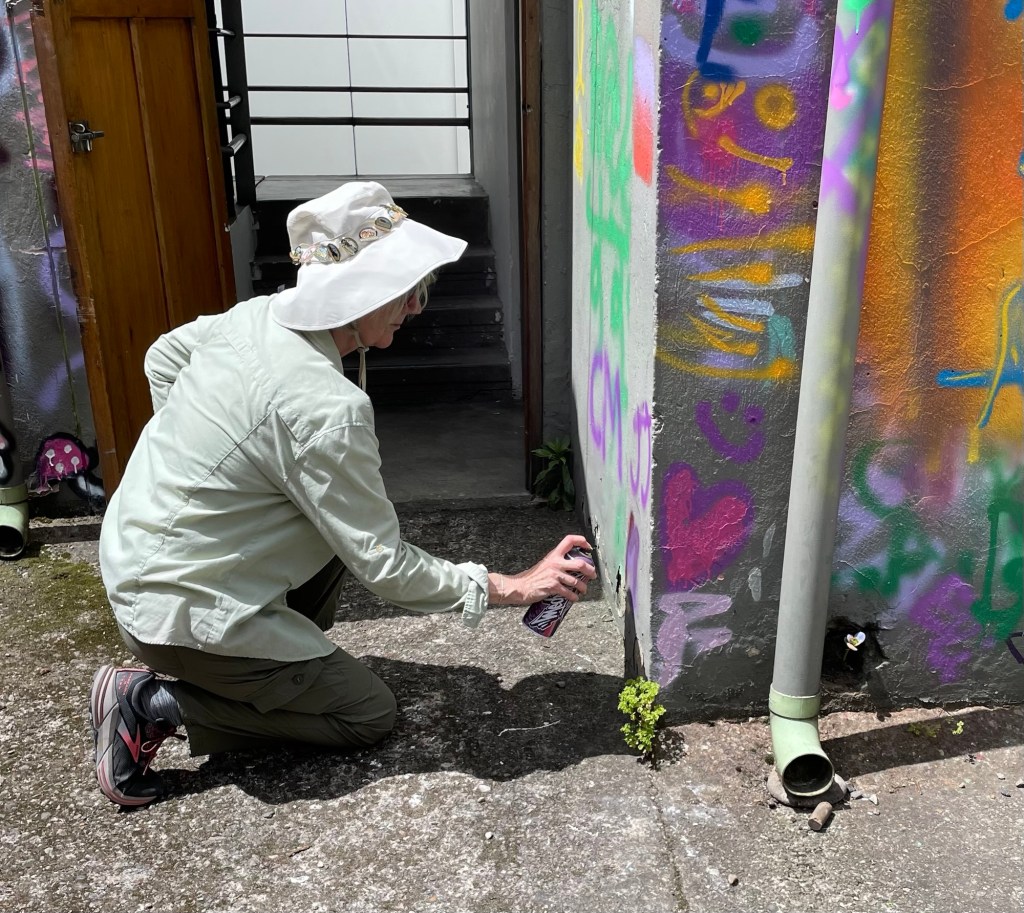
And their work

Hey, it ain’t as easy as you might think!
Bogotá, Colombia – Arrival

After I learned our governor had declared a state of emergency, because of the anticipated snowstorm, I was very glad I had booked a room at the Hampton Inn near JFK. My reason? My flight was scheduled to depart at 6:30 the following morning. Why JFK and why so early? It was a direct flight and whenever possible, I avoid changing planes.

I wanted to increase the odds that my driver would get home safely, so I had him pick me up two hours earlier than originally planned.

Despite my earlier departure, I still had sufficient time to fix my clogged toilet, thanks to a tip my friend Susan gave me: fill a container with really hot water, then dump it fast and hard, and although it wasn’t part of her instructions, I kept working that damn plunger till all was right with the world…and my toilet. Bet you weren’t expecting a plumbing tip in a travel blog. You’re welcome.

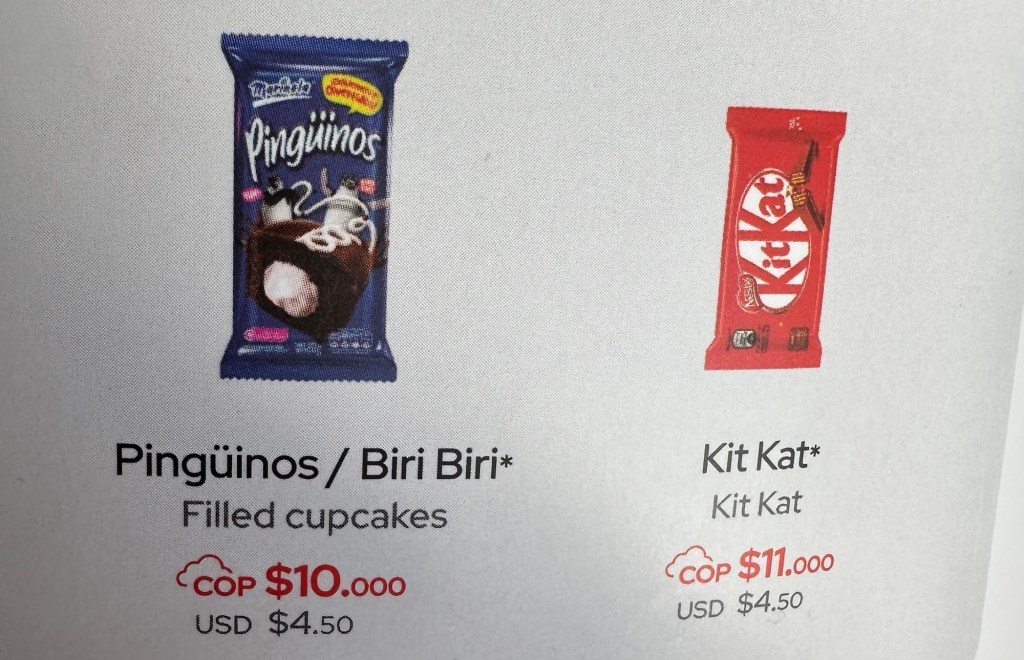
About the surprisingly “low cost” to upgrade to Avianca’s business class, I mentioned in my last post? After having experienced it, I’d say “fairly priced” is a more accurate description. Think economy, but with bigger, more comfy seats in the first three rows of the plane. Had I known the food was going to be so bad, I would have packed more than a bag of cashews and chocolate. But look at what you could choose to buy if you were flying in economy. Hostess cupcakes have been revived and given a new name!

To me, what the upgrade offered that was more valuable were the priority lines for check in and security. I couldn’t believe how crowded Terminal 4 was at 4:15 AM!

Although business class ordinarily comes with lounge access, the earliest opening time was 5 AM. I had just received an email from Avianca telling me boarding started at 5:31AM. Wrong! The plane was late, and there were no updates from Avianca until we were told to board at 7:30. Damn. I could have been in the lounge, having breakfast after all.

There is something exhilarating about flying into sunshine after leaving a frigid, snow covered area. The traumas of travel just melt away. All is forgiven once you reach your destination and you find it is even better than the photos portrayed. Our hotel, De La Opera, is in Candelaria, a delightful section of Bogota.

On my first night in Columbia, my new friend, Elsie, and I walked to dinner at Aquelarria, which is about 6 blocks from our hotel. I’m so glad she also chose to arrive before the tour started because it gave us a chance to get acquainted. She has her PhD in Cultural Anthropology, is fluent in Spanish, and lives near Carlsbad (where my brother John lives).

Dinner was delicious and SO inexpensive. If you like murals of bare breasted women frolicking on the walls, this is the place to be.

So what did I do on my early arrival day, you ask? Before leaving home, I booked a tour through “Get Your Guide” to the Salt Cathedral, which has been described as Columbia’s first (and so far, only) wonder of the world. To get to this “wonder” , you’re looking at about a two hour drive EACH way in heavy traffic.

I didn’t realize it was a private tour, with a young woman whose English is about as advanced as my Spanish. Needless to say, conversation was extremely limited on our 2 hour drive. Did I mention that Bogotá is enormous and the traffic is much like what one encounters in most big cities?

Although I was promised a guide, what I actually got was a driver, because that’s about all she did. But she did it extremely well, which is something, given Bogotá’s traffic (and other drivers). The online description said the tour included “skip the line” tickets, which sounded good to me. What it meant was we stopped at a little gift shop near the attraction where I got to pay about three times the price I would have paid. When I arrived at the Salt Cathedral, I discovered there was no line and I saw what the price should have been. Okay, so I contributed to the local economy.

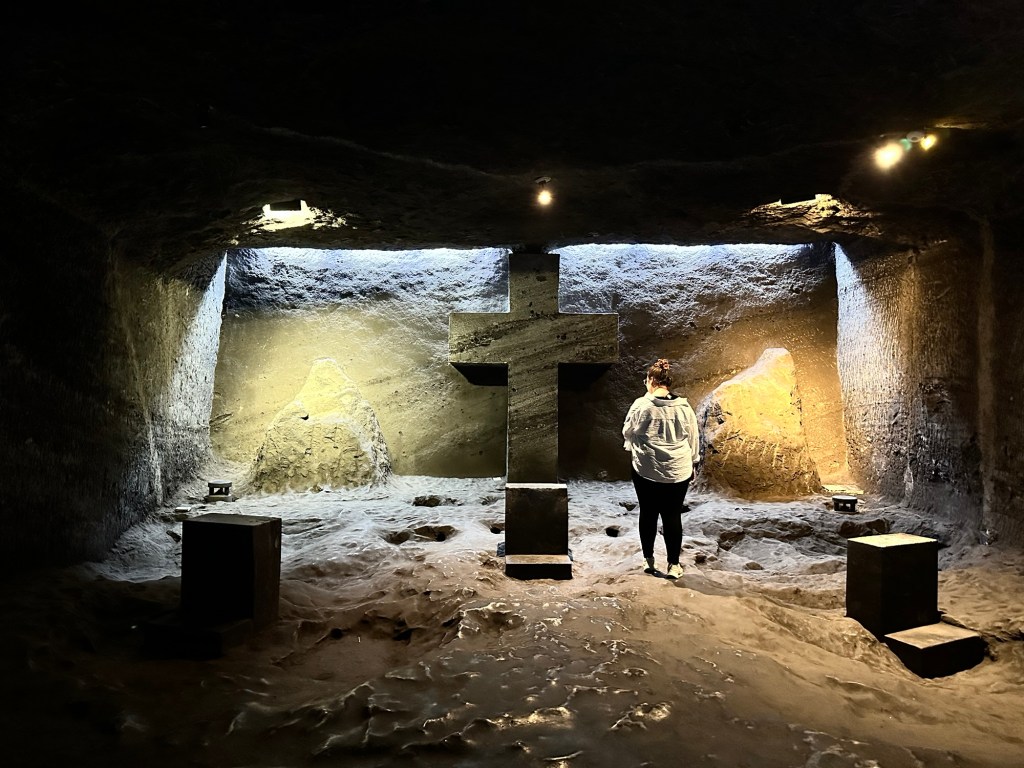
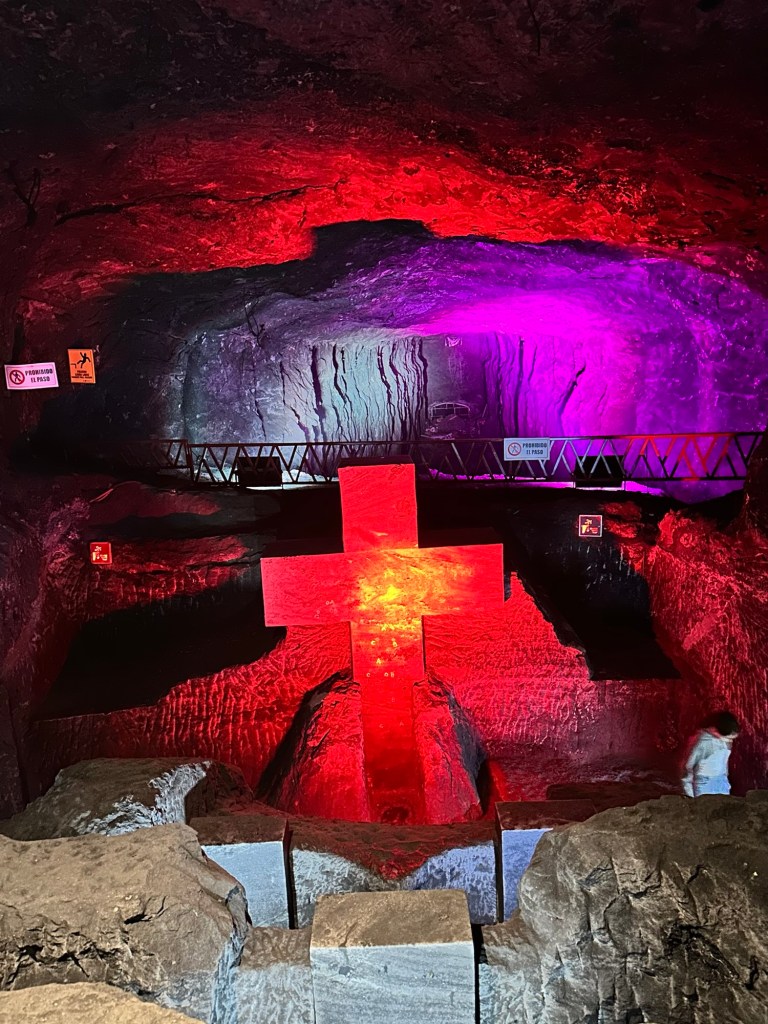
After all that, I expected the Salt Cathedral to be breath taking. It wasn’t. Of course, if your thing is walking along dimly lit corridors on the uneven ground of an old salt mine, you’ll be enthralled. Before you get to the “cathedral”, you walk along “stations of the cross” that are essentially stone crosses carved in alcoves.

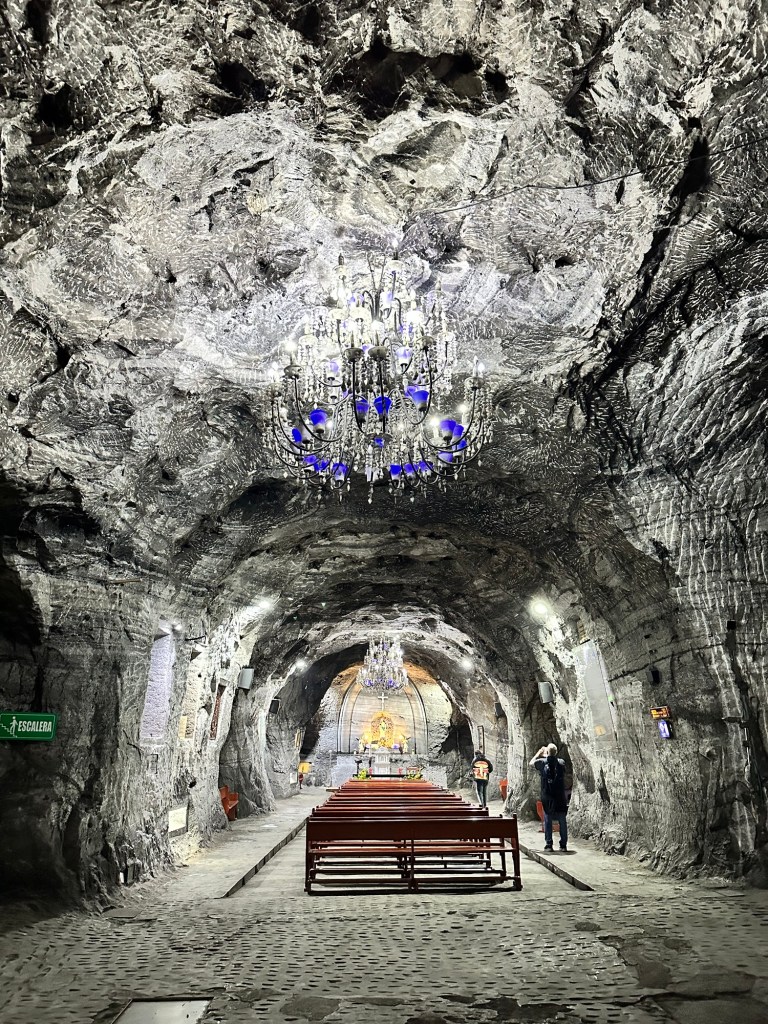
Occasionally the lighting in the alcove varied. But that was it. Eventually you got to the main event, the cathedral, and it was indeed lovely.

Had the cathedral been a 15 minute drive away, I would have given it a rave review. But it wasn’t, so I didn’t.

To me, the best part of the experience was the 3D video about the history of the salt mine near the very end of the corridors.

The rest of the tunnel was jammed packed with souvenir shops and places to get snacks. I skipped the gift shops ( sorry, Sue), but bought an ice cream cone at one of the snack alcoves.

After 2 hours in the salt mine, I was ready to emerge, but how? The signage can best be described as fairly nonexistent, so I asked someone. In Spanish. Yes, those on line lessons really paid off. I even understood her when she told me I could either go back the way I came or wait for the train. Given that I had taken multiple wrong turns on the way down, the train was clearly the best option for me. I even was able to ask someone if I was in the right line, and he understood me!

By the time I got back to the hotel, it was too late to do anything other than get ready for dinner. Elsie, with the help of Alejo, our guide, had organized dinner at a nearby restaurant. Most of the group had arrived and decided to join us for what turned out to be a delightful evening.

Our first official day will include a walking tour of Bogotá, then free time in the afternoon during which we can either go off on our own or visit Monserrate, which our guide thoughtfully arranged transportation for us.

South American Travel Therapy

How will I fill the hole in my heart from losing Mike and Sandy? It was unwitting, but the healing process has been helped by my book club’s selection of “The Collected Regrets of Clover”. The main character (Clover) is a death doula. Although I didn’t relate to her personality, I definitely DID appreciate her discussion of death and what to do to make that inevitable passage more comfortable for a loved one. How I wish I had read it two years ago!

Here are some lines that really resonated for me: “When someone has always been there for you, it’s easy to assume they always will be. And then, one day, they’re not.”
“Some people believe that the spirits of loved ones stay with you even after they die, so you can still chat with them whenever you like.”

Whenever I find myself regretting things that I should have done differently during my 47 years with Mike, the following line brings me comfort. “You know, from what you’ve told me about him, it doesn’t sound like there’d be any issue of him forgiving you. Maybe it’s more a question of you forgiving yourself?”
Like me, Clover discovers traveling can help her assuage her grief. That’s how I’ll be spending a good part of 2025, as you’ve probably guessed from the title of this post. Some of my travel will be to places I’ve already visited with Mike, as is the case with my first trip in 2025, to Columbia and Ecuador.

Okay, I’ll admit it. I’m very excited about this trip, which is why I’m blogging about it pre-departure. In January of 2010, Mike, Greg and I took an Oceania cruise through the Panama Canal. Our only stop in Columbia was in Cartagena. As is the case with many cruises, we were only in port for less than a day, which was definitely not enough time to savor this lovely city. But one advantage to traveling by ship is the spectacular view of the city as we pulled into and out of the harbor. Here’s a photo from a vantage point that I don’t expect to replicate on my land trip with OAT.

One of the many reasons I continue to choose Overseas Adventure Travel is the ability to customize my tour by adding pre and/or post trips. Initially, I had considered taking the pretrip to Bolivia, but the flights and connections were pretty dreadful, and I learned from the very helpful Facebook page “Friends of Overseas Adventure Travel” that some people struggled with altitude sickness while in Bolivia. Bogota is fairly high up too, but by arriving a day before the tour starts, I figure I can load up on coca tea. Yes, you can make cocaine from those very same leaves, and no, I’m not bringing any home with me. During our trip to Peru in 2009, we discovered the miraculous properties of coca tea, which helped us adjust to the altitude in Machu Picchu and Cusco. Before departure, OAT’s trip leaders always send us an email chock full of helpful information. Alejo also sent a second email to the five of us that are arriving early with suggested activities, restaurant recommendations and he confirmed that coca tea is available at our hotel.

I love OAT’s small group size. Of the 15 of us on the main trip, 5 are men and 10 are women. Three have matching last names, and although the remainder don’t, that doesn’t necessarily mean they are all traveling solo. Sometimes two friends are traveling together, and if it is a relatively new relationship for a man and a woman, they tend want to go off by themselves. Fortunately, at least so far, I’ve encountered a number of interesting, friendly OAT travelers who have been excellent travel buddies, which makes the trip far more fun. Some that I’ve met (both when Mike and I traveled together and since I’ve traveled solo) continue to be friends. In fact, some will be with me on trips planned for 2026. But let’s not get ahead of ourselves. Back to 2025.

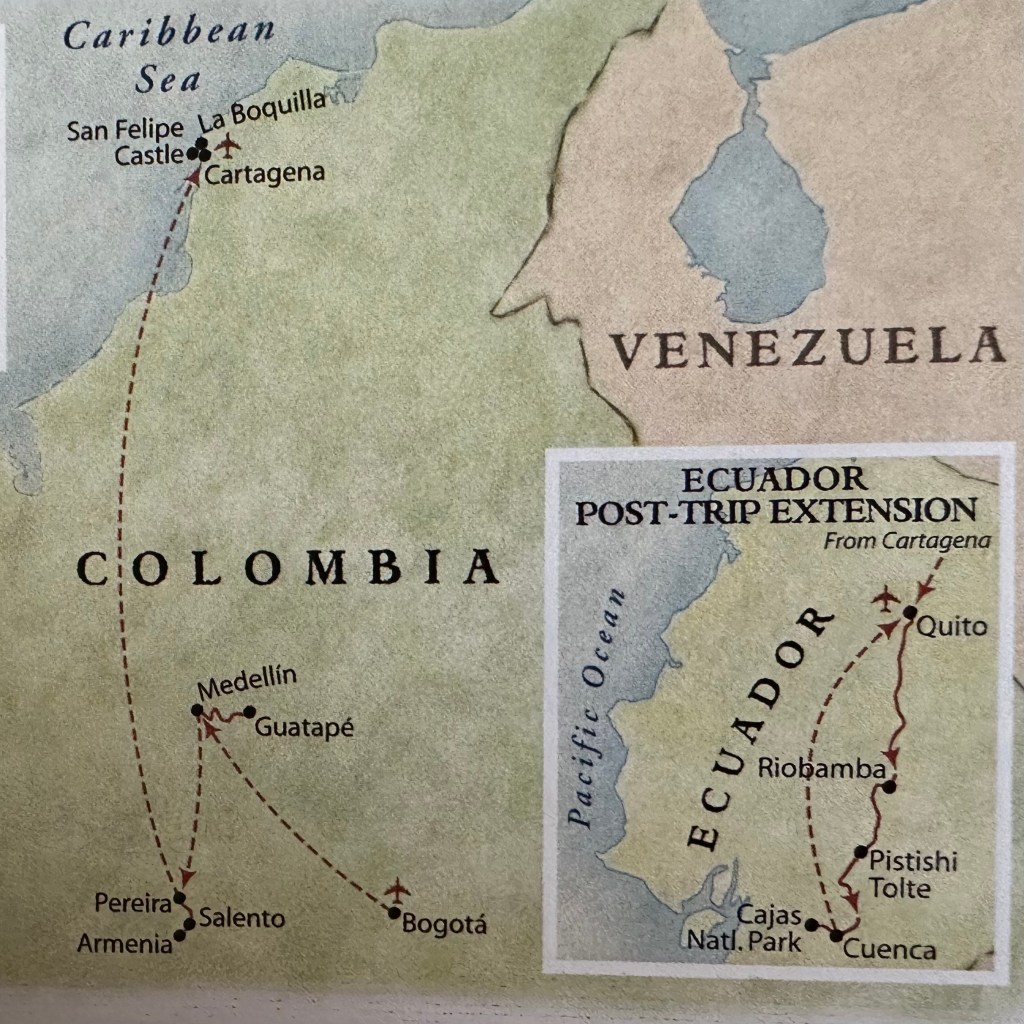
When I learned that Columbia was one of the countries featured on the 2024 Amazing Race, I streamed those two episodes to get a sneak peek at what I might expect. Like the contestants, we will be traveling to Bogota, Medellin, Guatepé and the coffee growing area. I double checked the OAT itinerary, and sure enough, we will also hit many of the same highlights. For the map enthusiasts (and Mike turned me into one…) here’s where we will be, starting in Bogota.

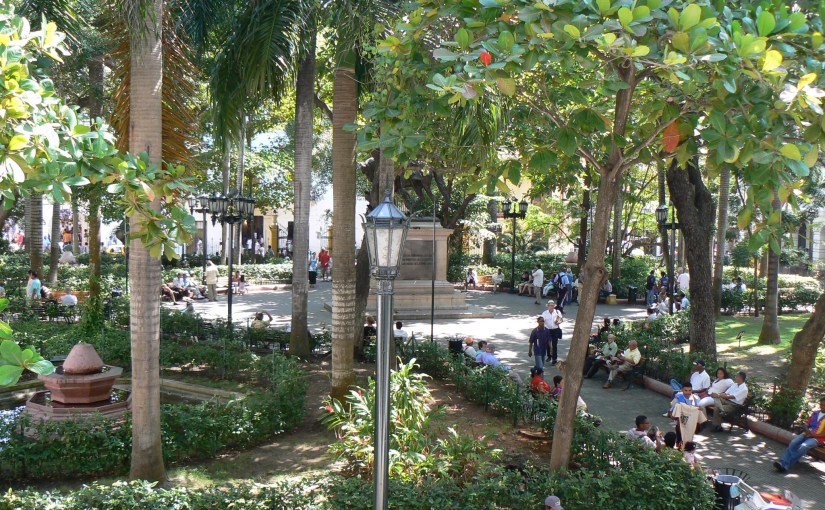
Luckily, we have three nights in Cartagena, so this will be my chance to get that “savoring’ in that I missed during our brief time in port. The photo atop this post I took when we were in Cartagena 15 years ago. Not what you envision when you think of Columbia, is it?

Our hotels are a nice mix of big city locations and smaller boutiques. Because so many people have warned me about the dangers of traveling in Columbia, I thought I’d share photos of where we will be staying. Our hotel in Bogota appears to be centrally located, in a lovely walkable area.

Hotel de la Opera
Bogota

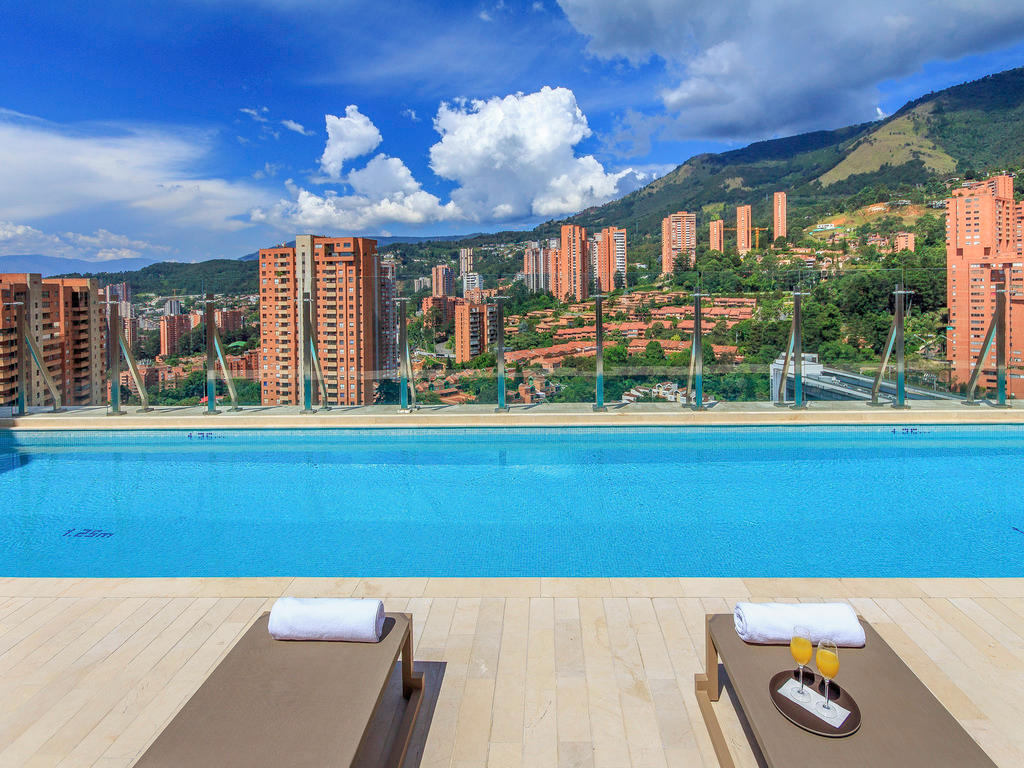
All of our hotels have pools; the ones in Medellin and Cartagena are on the rooftop, affording guests a panoramic view of the surrounding area.

Novotel Medellin

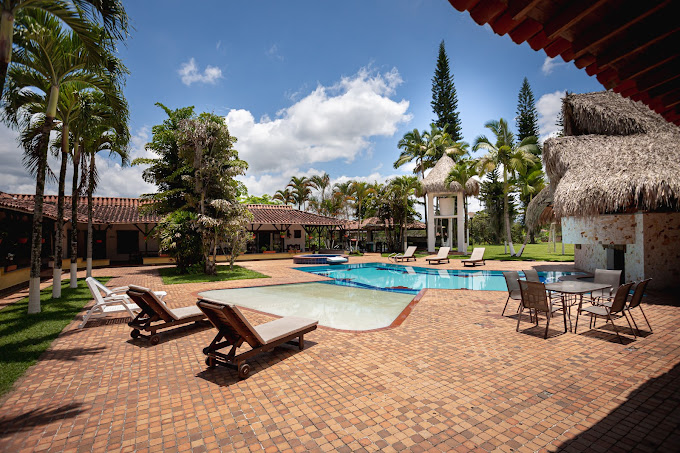
Our small boutique hotel in the coffee triangle will be a nice change from the two big cities, as you can see from the photo below. We will spend three nights in Pereira. Bosques, by the way, is the Spanish word for forests. I have no idea what Saman means. Probably just the name of the area.

Hotel Bosques del Saman

I don’t know if you can tell from the photo below, but the ocean is visible from Cartagena’s rooftop pool. An additional claim to fame for the Bantu Hotel is that it is just 300 meters from the Hotel Santa Clara. (For those who don’t relate well to the metric system, Ms Google tells us that 300 meters equates to a 4 minute walk ) . Why is that important? Well, in 1621 The Hotel Santa Clara was a convent for the nuns known as the Poor Clares. When Sofitel transformed it into an upscale hotel in the 1990’s, they wisely kept the crypts, wells, confessionals and gardens which should make their “30 minute free legendary tour with the hotel Butlers” really interesting. Is the tour only available to hotel guests? I don’t know, but I can assure you that I WILL find out, and I’ll certainly report back.

Bantu Hotel

As one would expect, the Santa Clara Hotel has world renown restaurants. The 1621 is reputed to have a “creative” tasting menu –(is that a synonym for really, really expensive? )– but I expect I will only be able to afford a drink at the hotel bar. Check out the hotel’s on-line description of this “magical” bar:
The atmosphere becomes more magical when the sun begins coming down and the golden and orange sunlight offers an unrepeatable spectacle for your senses.
This place, surrounded by an enchanting aura, welcomes its visitors with shelves full of old jars. Upon arrival, the outpours of exotic herbs and spices mix in the air, taking you to a time of ancient secrets and forgotten magic. The menu is truly a masterpiece, offering a selection of potions and concoctions carefully prepared. You can find a wide variety of “Elixir” –a mix of ginseng and lavender– as well as the “potion of remedies for the soul”. Each drink is a unique sensorial experience with dazzling presentations and seducing flavors. The bar is located outdoors on the terrace of the hotel’s third floor, offering the best view of the Caribbean Sea. Botika Bar recreates the concept of the old pharmacies, where artisans would experiment and prepare medicines by combining plants and minerals to discover masterful formulas with healing properties.

How could I pass up such a spiritual experience? I sure hope I’ll be able to entice at least ONE of the “friends I haven’t met yet” to join me for a “unique sensorial experience with dazzling presentations”.

After imbibing potions that will heal the soul, I and 6 fellow travelers will be flying to Quito for the 7 day post trip. Although Mike and I had been to Ecuador in January of 2012, we stayed at an ecolodge in the Amazon jungle and then were on a boat traveling from island to island in the Galapagos. The only overlap between the two trips will be our time Quito.

While in Columbia, I will be spending 13 nights in 4 hotels; In Ecuador, it will be 7 nights in 3 hotels, but our time in Quito will be split into a 1 night stay, upon arrival, and a 2 night stay upon departure. Let’s see how THAT shakes out. It will definitely be a test of my packing skills!

To prepare for my visit, I have been taking language lessons through two on line apps. Although Duolingo’s app is helpful, I found that Busuu (recommended by my multi-lingual friend Chris) teaches me words and phrases that I am more apt to use. Here are some examples of actual lessons:
“Dar la vuelta al mundo” means to travel around the world, but a literal translation is something like “to give the return to the world”, which would have completely befuddled me. Duolingo tends to introduce phrases that can easily translate into English like “mi tio estudia la actividad del cerebro de los gatos”, which means “My uncle studies the activity of the brains of the cats”. I’m just guessing that the idioms from Busuu will be used more frequently. But we shall see. One can never predict how many cat brain enthusiasts one might meet!

Busuu has me engaging with native speakers in Spain who are learning English. I correct their work and they correct mine. Of course, some of my teachers are young kids, but hey, that way I’ll learn all the cool words! Should I teach them “yo mama”? Both apps have free and paid versions. Busuu wears you down with lots of advertising on their “free app”, but I kept ignoring the invitations to buy until the price reduced to about $60 for the year.

Time to get back to trip details. The participants on the OAT Facebook page frequently ask questions about whether it is better to purchase air through OAT or to book your own flight. I’ve done both, but this time, I discovered that if I booked directly with Avianca, for a mere $427 more, round trip, I could upgrade to business class AND choose my seat AND get direct flights from and to JFK! I’ll be flying for the first time with Avianca, so I have no idea what business class is like, but I certainly will let you know.

Adios por ahora.