Lyon

Mike and I visited Lyon and Paris in 1976. Although I vividly remember Paris: visiting the Louvre, Napoleon’s Tomb, Notre Dame and the Eiffel Tower, I have absolutely NO memory of Lyon. There was never anything that kindled even a little spark of recognition.
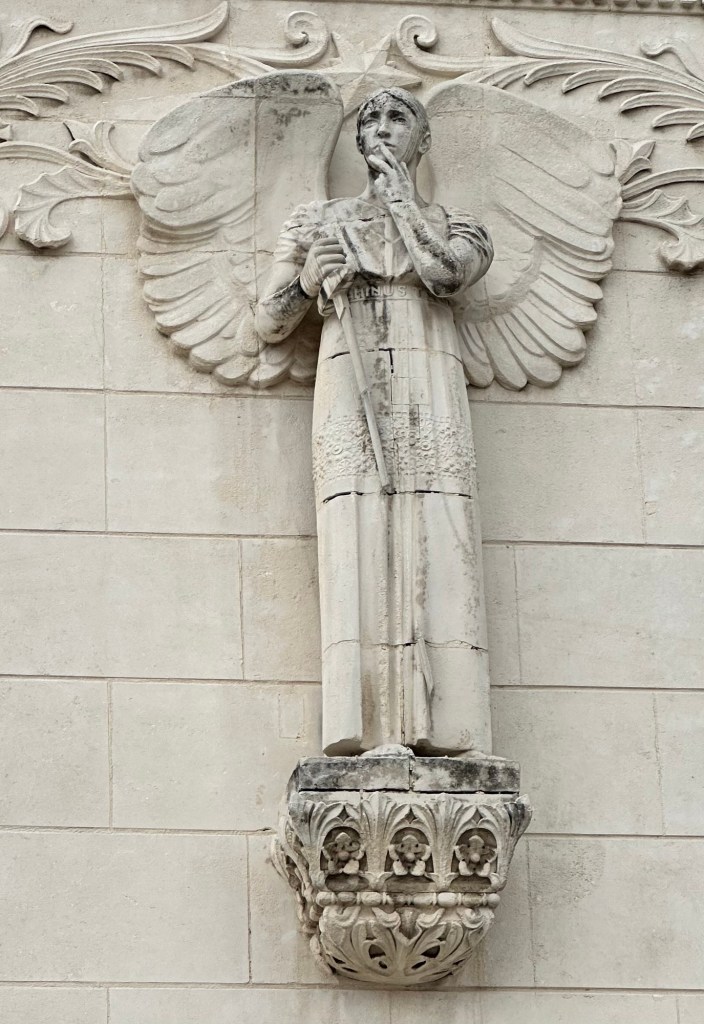
Looks like I’m not the only one with a memory problem.

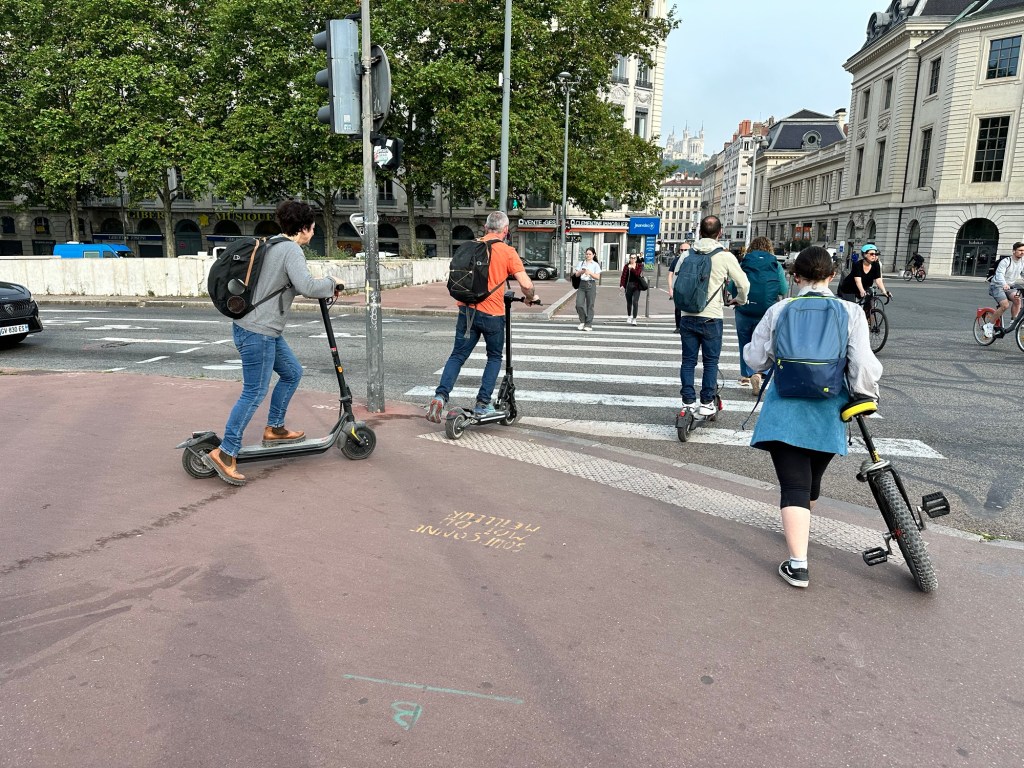
Our hotel is a short block from the Rhône River, and within walking distance to the old city. People in Lyon use EVERY mode of transportation—bikes, unicycles, scooters, so you aren’t just dodging cars, buses and motorcycles when you cross the street.
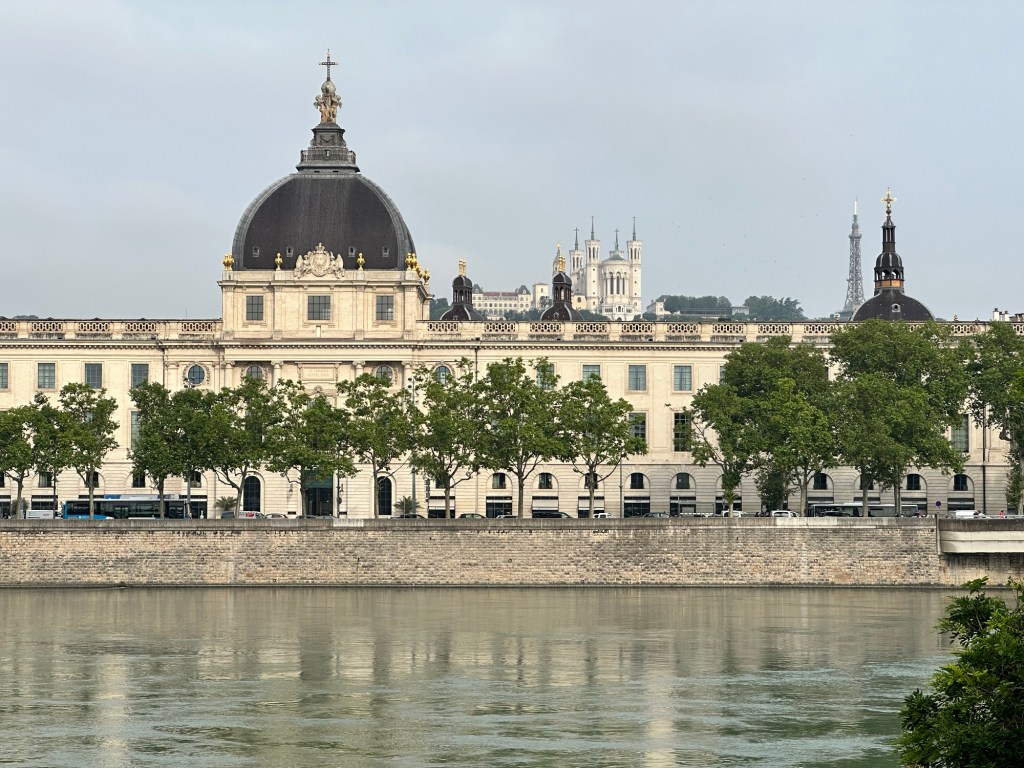
It is difficult to get lost in Lyon, even for me. From the river banks, it is easy to find three important landmarks. The black domes are atop the Hotel Dieu. Now a luxury hotel, from the late 1400’s until 2010, that large building was a hospital. The white building to the right (in the distance) is the cathedral and barely visible, on the far right, behind the dome is a fake Eiffel Tower.
Now why would there be a second Eiffel Tower? Well, back in the day, tourists would visit the outskirts of Lyon, but never bothered to visit the city proper. So, knowing how poorly educated people are about geography, the town fathers rightfully guessed that people were aware that there was an Eiffel Tower in France, but had no idea in which city it was located. Voila! The tourists did indeed come into the city center to view the “imposter” tower. And a tourist trap was born. Clearly that was well before the advent of Ms Google.

The “tourist trap” needed a better photo, so here it is.

We took the funicular up to the cathedral. I know, yet ANOTHER church. But this one had some rather interesting features.
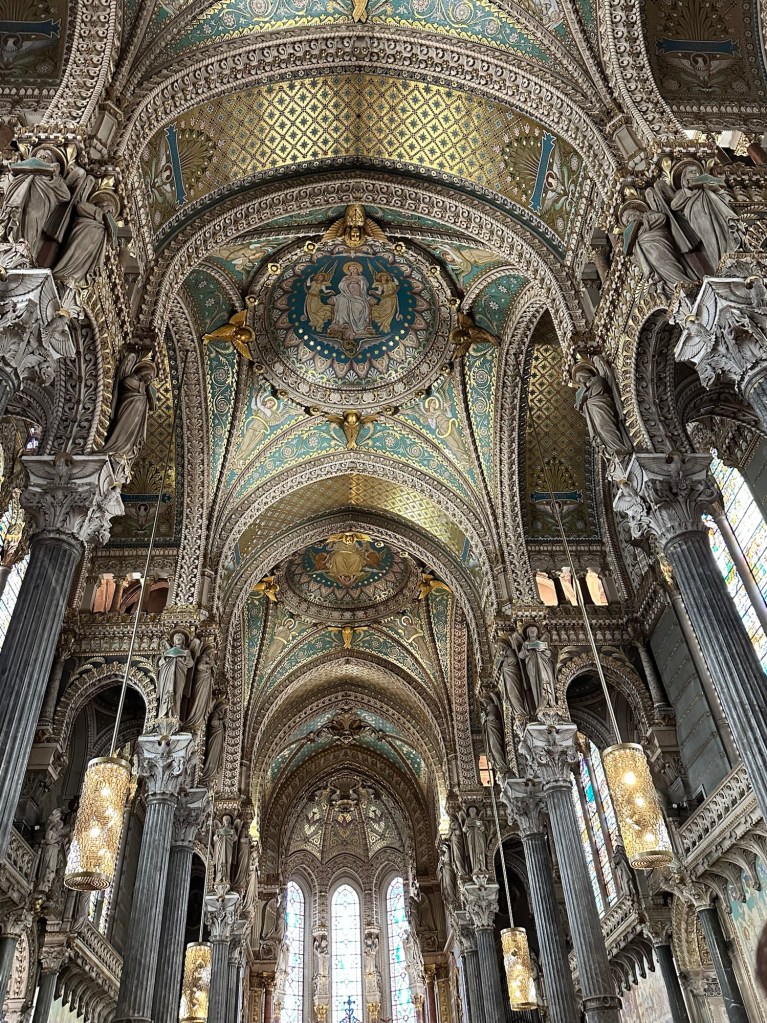
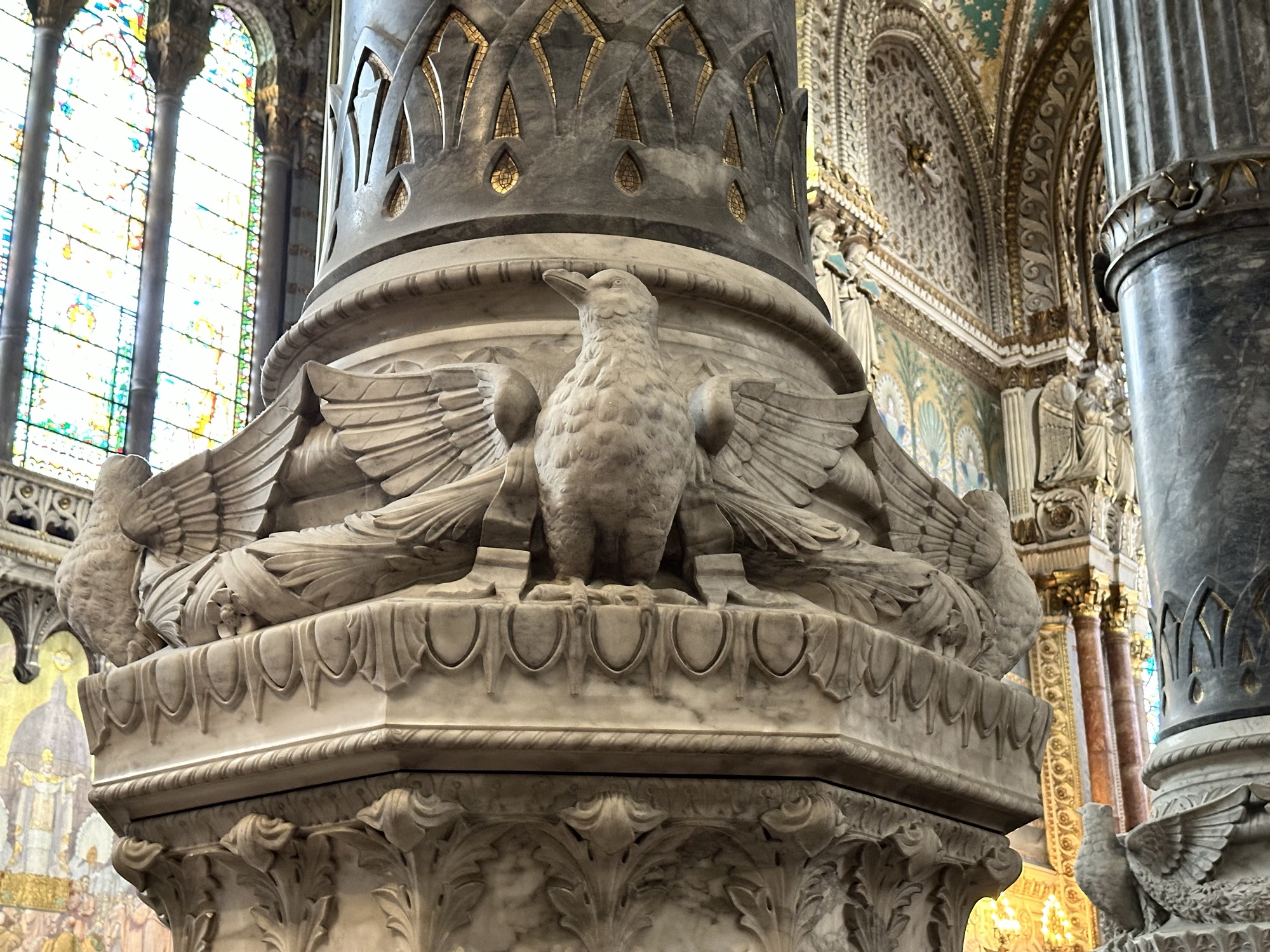
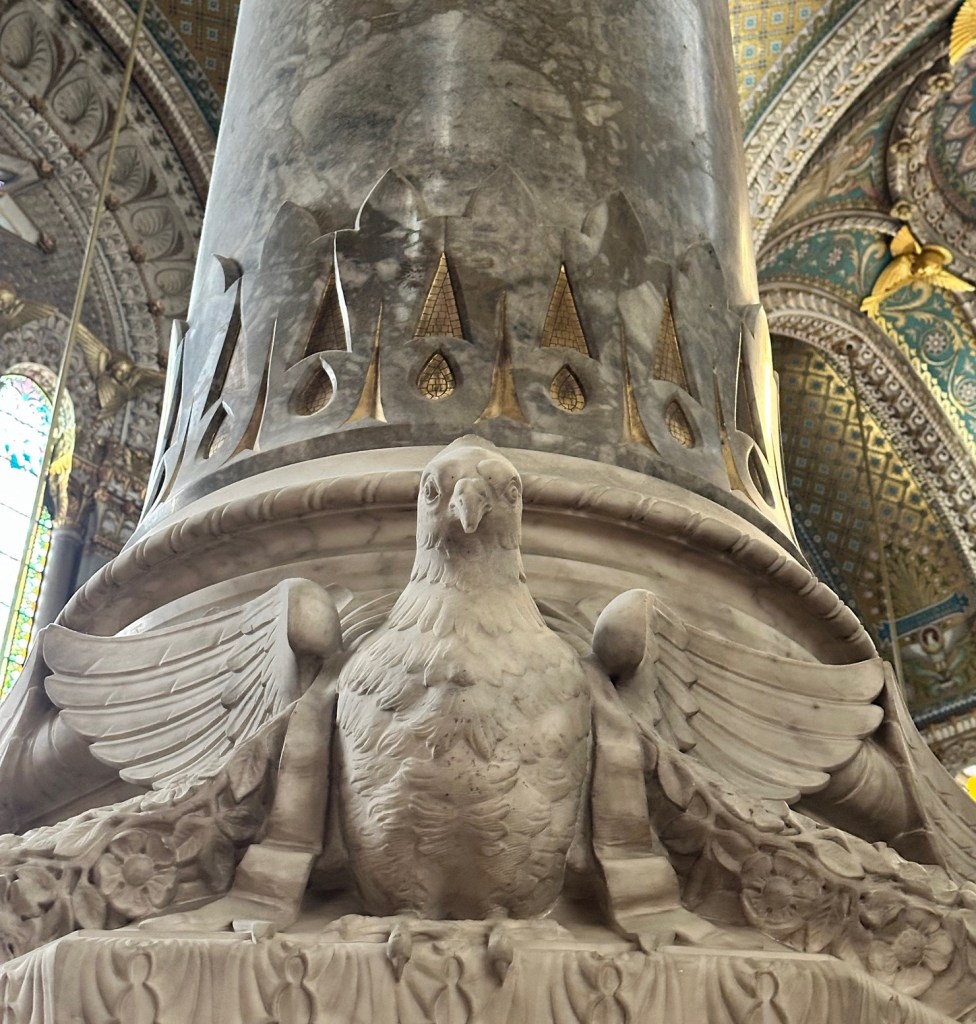
Check out the number of columns in this cathedral—and how ornately decorated they are, with different statues standing on the top. At the base of each pillar are birds, all slightly different. Some of them are looking straight at you, others have their beaks lifted at varying angles. Admit it—have you EVER seen birds on a church column? On the INSIDE of a church, that is. I sure hadn’t. Perhaps they symbolize the Holy Ghost?
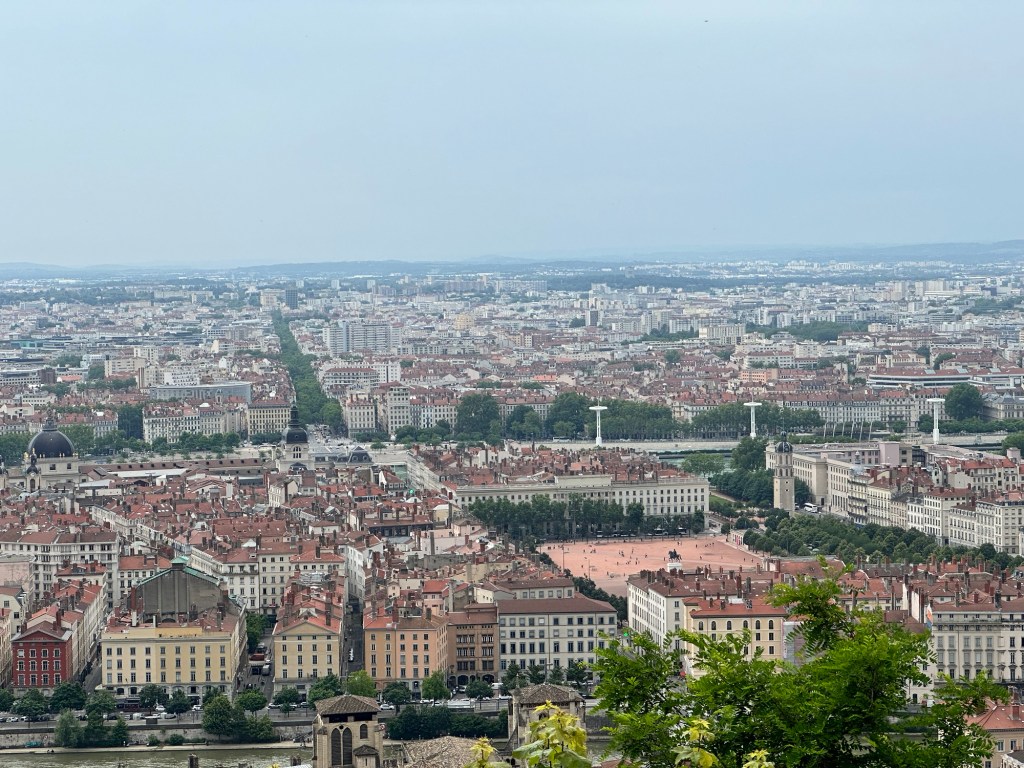
Before we descended, we had to check out the incredible view. More later about the three white towers in the distance .
During our time in Lyon, we had two scheduled activities. The first, a food tour, brought us through the old city, and consisted of tasting stops at a chocolate shop, a bouchon and a pastry store. The food wasn’t wonderful ( fish soufflé at the bouchon, overly sweet pie at the pastry stop) but the guide was.

Our local guide explained that the hospital (now Hotel Dieu) was located at what was once the border to France. At that time, our hotel would have been in Germany! Why was a hospital located there? So that the medical team could examine all travelers before they were allowed to enter France.

The second tour which focused on the Resistance, took us to a different part of Lyon. This tour consisted of walking up and down narrow cobblestone streets to view plaques affixed to various buildings.
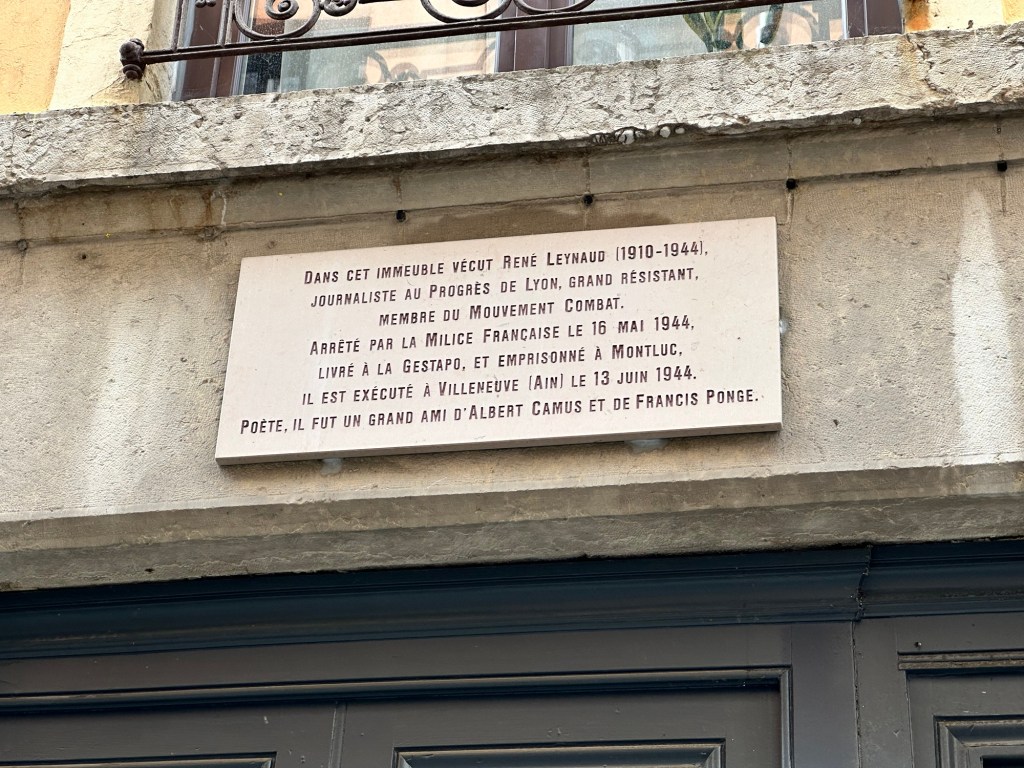
We also went thru passages the resistance workers took to evade the Gestapo. Now the buildings are covered with graffiti and the passageways are entrances to apartments and function as storage areas for trash cans. The walk was uninspiring, however once again, the guide was great. Although I was listening intently to her description of the mind sets of the French during World War II, I found myself more interested in the abundant street art than the plaques.

Take a look.

I initially thought someone stuffed a funky gorilla into a hole in this building, so of course I had to examine more closely. This very talented artist somehow achieved a three dimensional effect on a flat building wall. Wow.

When the guide asked if there were any questions, did I ask about Marshall Petain or the Vichy French? Hell no, I wanted to know what kind of business had paintings of “come thither” women in the windows.
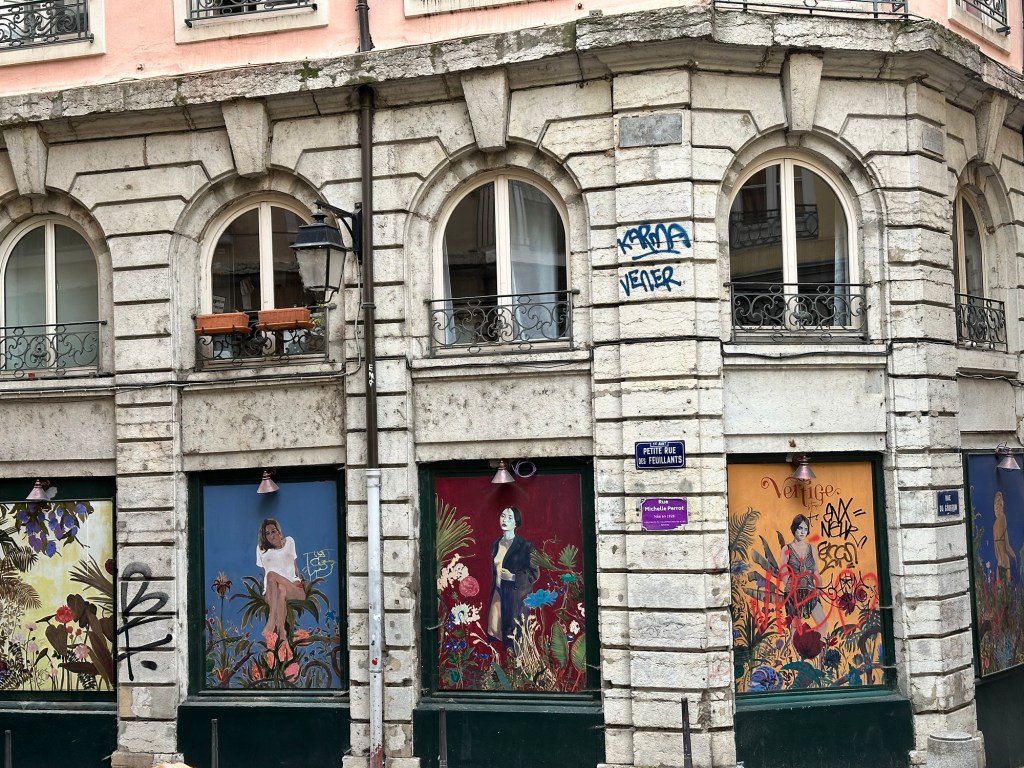
The answer: a strip club. And now more street art.
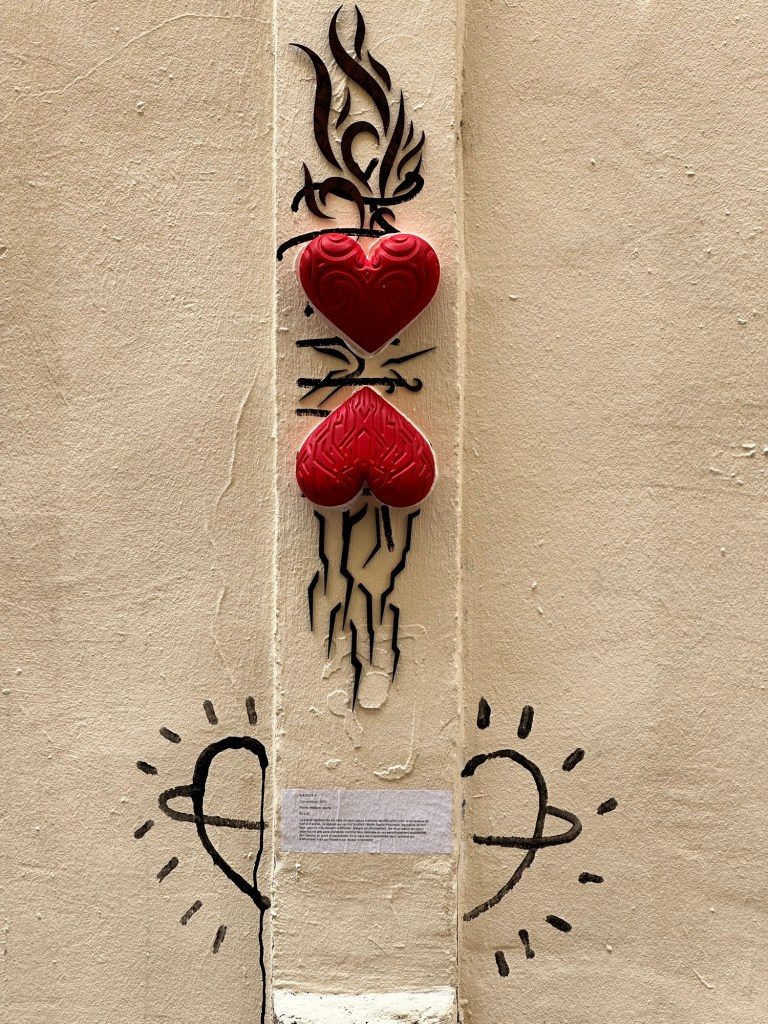
Ms Google translated the artist’s intent, which was written in French below the artwork. Here’s the “ readers digest” version. The hearts, facing each other, have different motifs. Despite differences, the two hearts can find understanding and coexist.

Believe it or not, the above is a message to Macron. The words “straight into the wall” doesn’t mean anything to me, but apparently the French get it.

Lyon is a very walkable city so I did some solitary exploring. Remember those white towers visible from the Cathedral ? Lyon had hoped to be selected to host the Summer Olympics, so a swimming complex was built. I’m not sure what the function of the towers was because they seemed too high ( to me ) to be diving platforms. But then, I’ve never seen Olympic diving platforms other than on TV, so maybe they were.

Unfortunately, Lyon wasn’t chosen, but at least the residents ended up with a great place to cool off during the hot summer months.

In front of the towers is a skate park, where I watched a young man perform amazing feats on his bicycle.

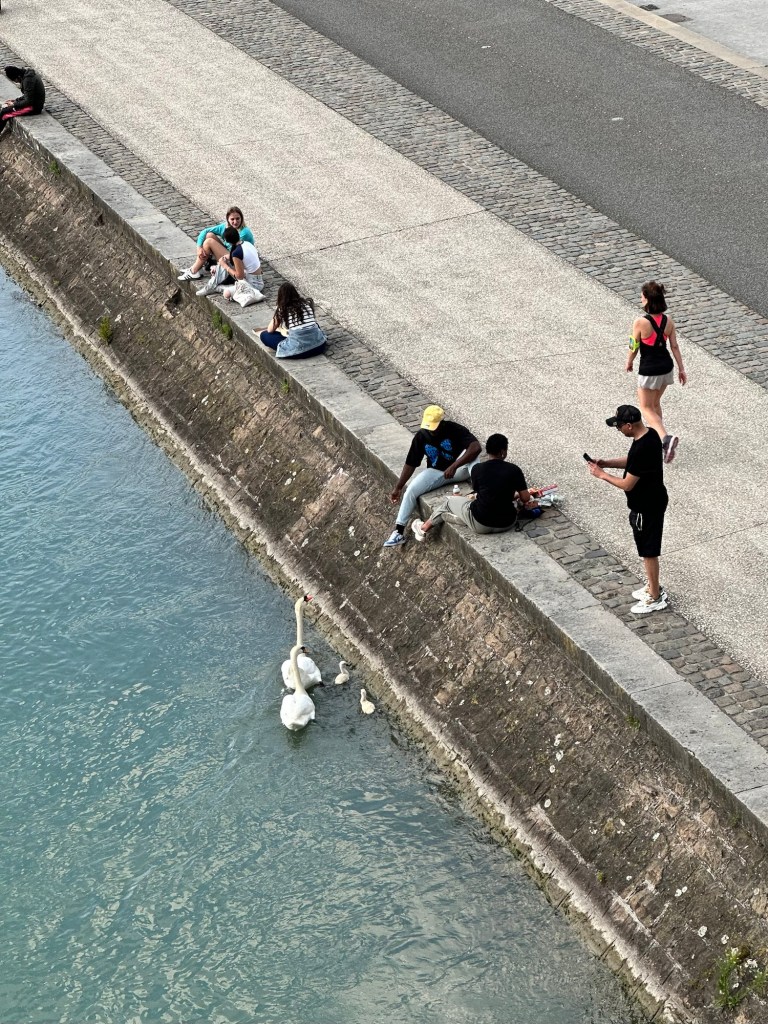
The river banks were a favorite gathering spot for people AND swans.
Next stop, Paris, via the high speed train.
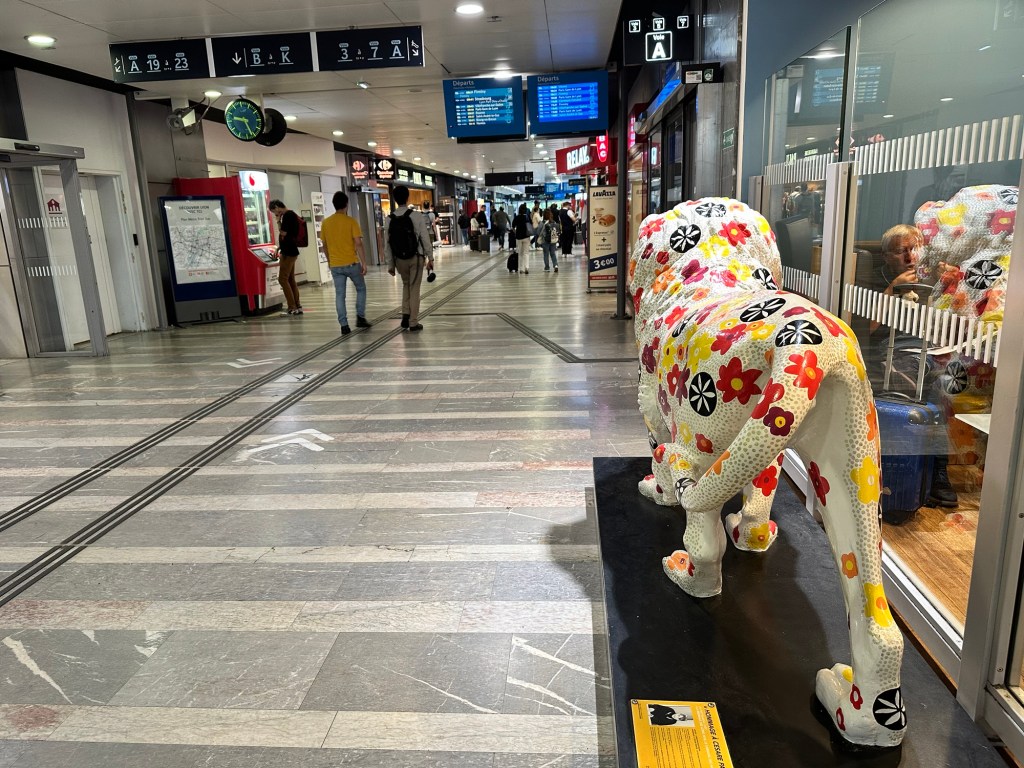
Lyon train station

Paris

What can I say about Paris? Our time there was very short – just a day and a half. But I didn’t regret not staying longer. Instead, I figure at some future time, I’ll visit Paris on my own for several days, probably at a less popular time of the year, when the city isn’t crowded and the weather is less beautiful.

I really didn’t want to spend a gorgeous day wandering through a museum when I could be strolling down the Champs Elysees. And that’s exactly what I did on our only full day in Paris.

Photo by Jean

But first, let me tell you about our arrival.

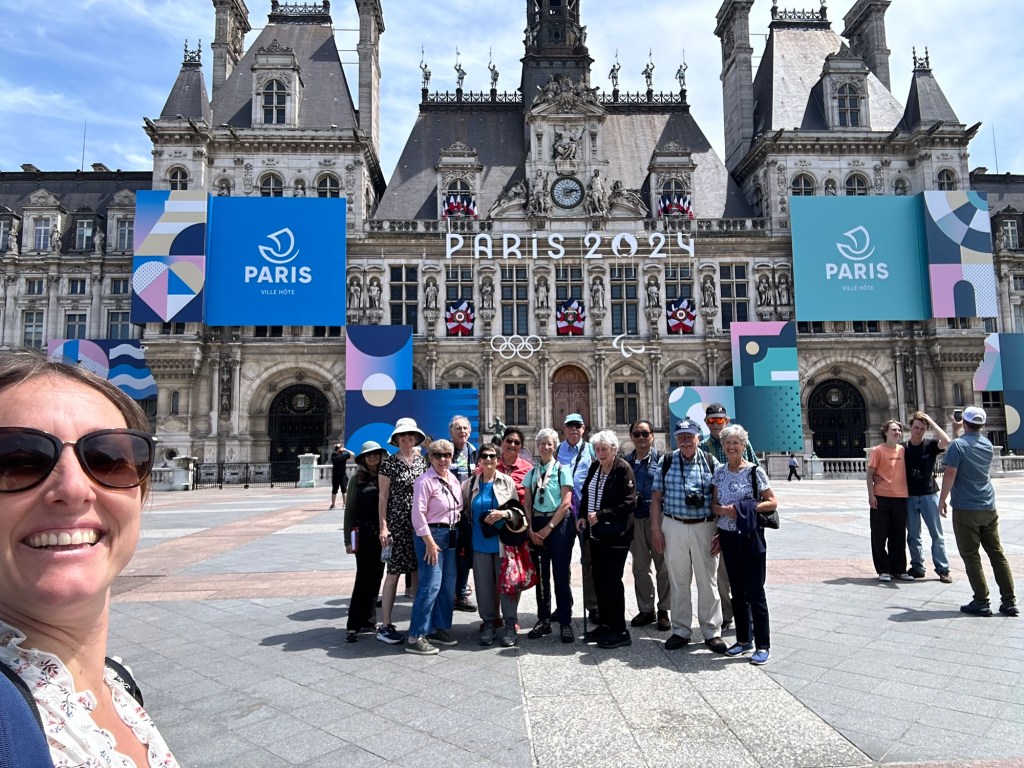
Laetitia took this selfie.

Our train from Lyon pulled into the Paris station in time for a late lunch (or in my case, a glass of wine and appetizers, because I ate on the train). Some of us were lucky to have Laetitia, our very lovely tour guide, join us. Side note: despite being 4 months pregnant, Laetitia had boundless energy. I figure our group was perfect training for future class trips with her child, except a bunch of elementary school kids will probably be much easier to manage.

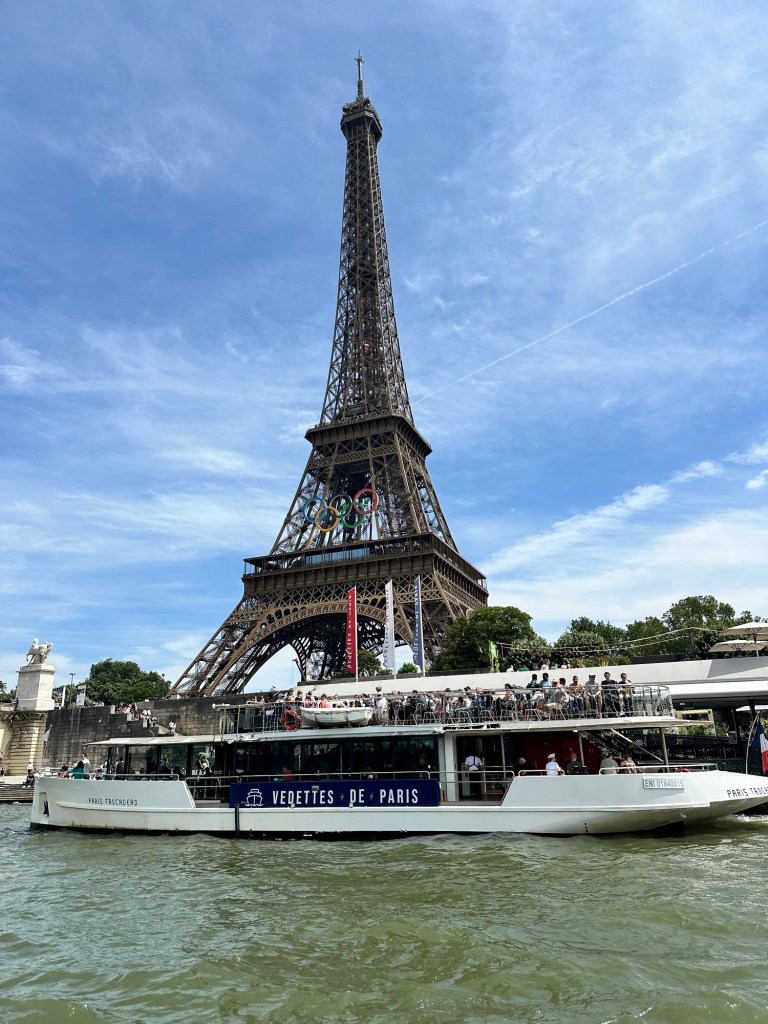
During the afternoon, we experienced two different modes of transportation: the metro system and a boat ride on the Seine.

Richard very graciously gave us a demonstration of what not to do on the metro. Unlike elevators, metro doors do NOT reopen when you stick your hand between them. Fortunately, a metro worker responded to our shouts and Richard was able to get on board, with his hand still attached to his body.

We were never able to figure out what Annie (Richard’s companion) did wrong trying to get thru the turnstile, but a French woman took pity on her, put her arm around Annie, and they went thru the turnstile together. So much for the stereotype of the unfriendly French!

Luckily the boat ride was very relaxing and mishap free.

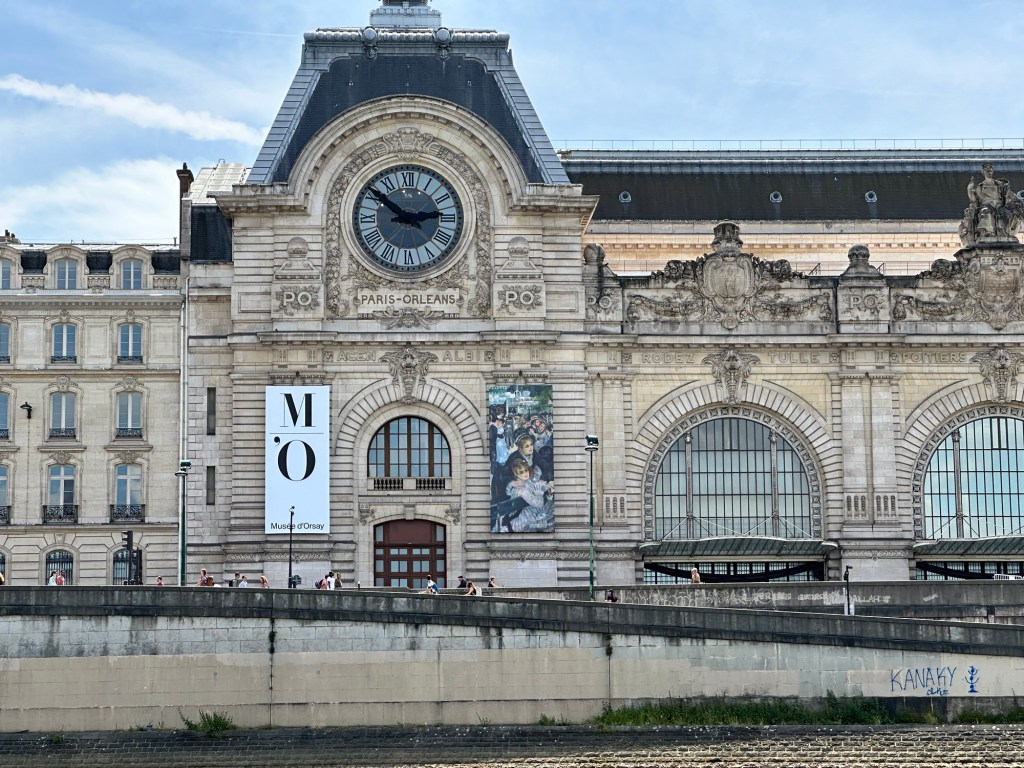
These are just a few of the landmarks we saw on the boat ride.

For our last “dinner on our own, Nancy, Steve and I walked through the neighborhood in search of a suitable restaurant. There were lots but most were jammed with young adults smoking and drinking beer.

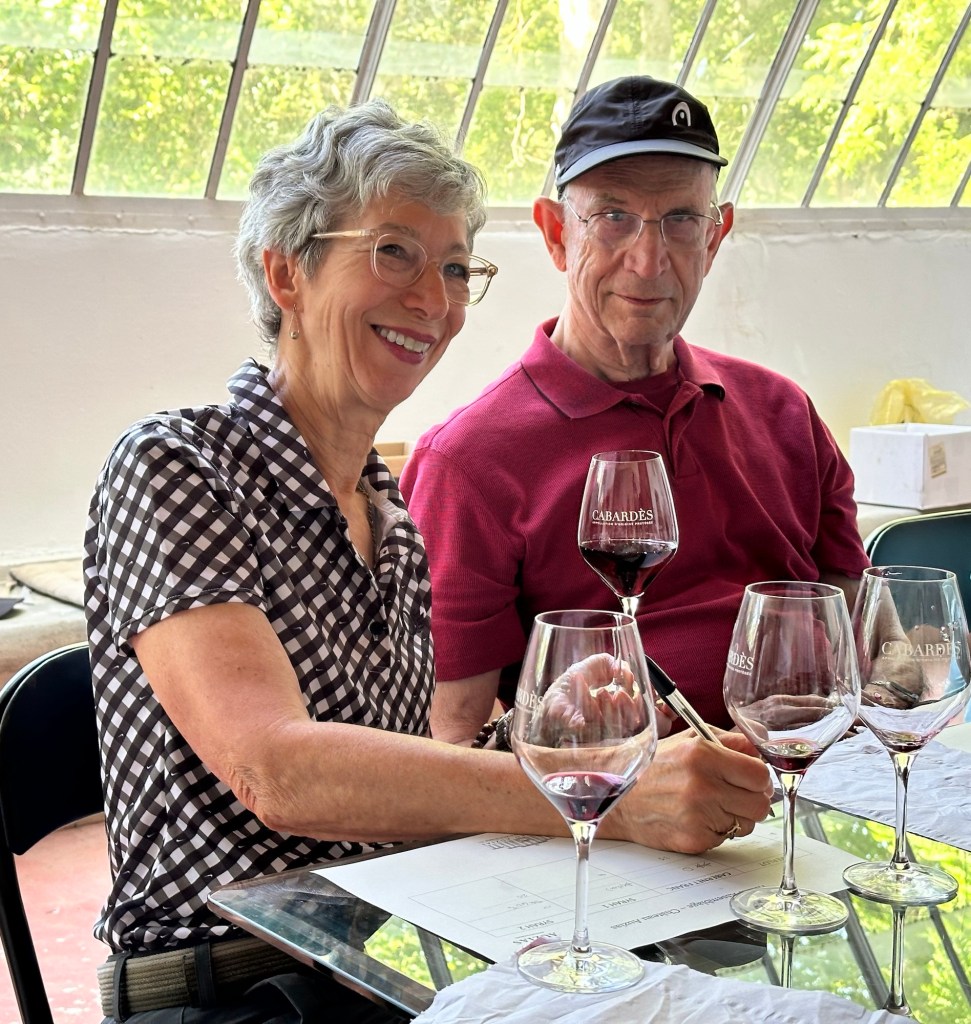
Photo of Steve and Nancy taken at the winery—NOT at dinner.

We finally settled on a delightful cafe, where we enjoyed a fabulous dinner, seated by a large open window. When Steve asked me if I knew where the hotel was, I responded with my usual answer: “I have no idea”. He then pointed to a HOTEL sign about three buildings away, thereby confirming I had the very worst sense of direction of anyone on the trip.

I was very grateful that Jean and Jim had a similar vision of the perfect last day in Paris, because if I didn’t have them guiding me, odds are I’d still be wandering around the city, looking for our hotel.

Jim and Jean

Our hotel wasn’t far from the Bastille metro stop, so that was our starting point for our Sunday adventure.

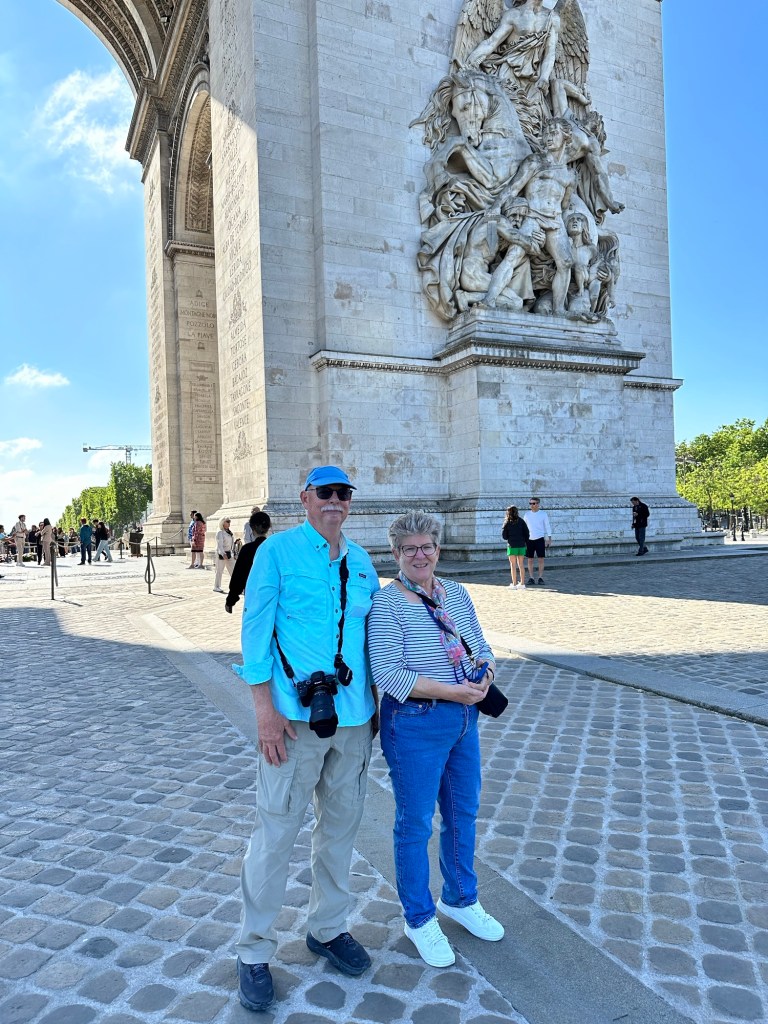
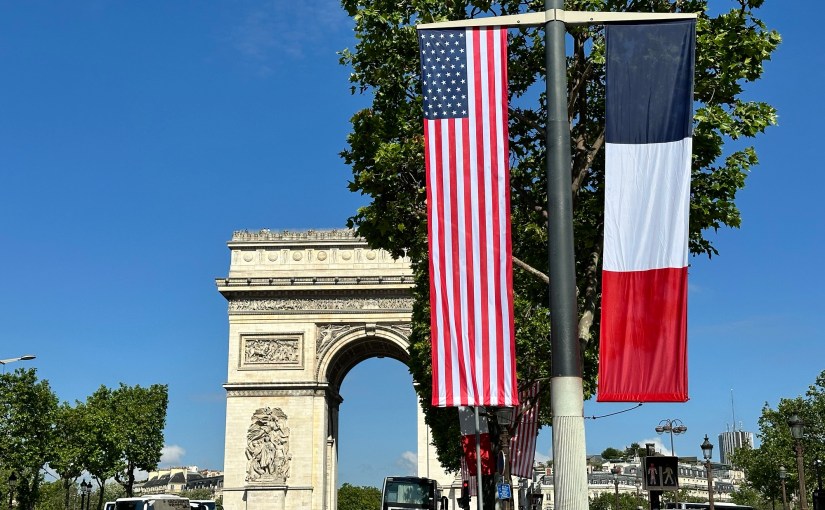
Because of the upcoming summer Olympics, several metro stops were blocked, so we rode to the Charles de Gaulle stop and backtracked to visit the Arc de Triomphe.

The Arc’s chaotic traffic circle is where I channeled my inner Grammy (my family knows what I mean) and convinced my travel companions to brave the oncoming traffic, rather than use the pedestrian tunnel.

We decided our RETURN trip would be less exciting, so smartened up and used the tunnel.

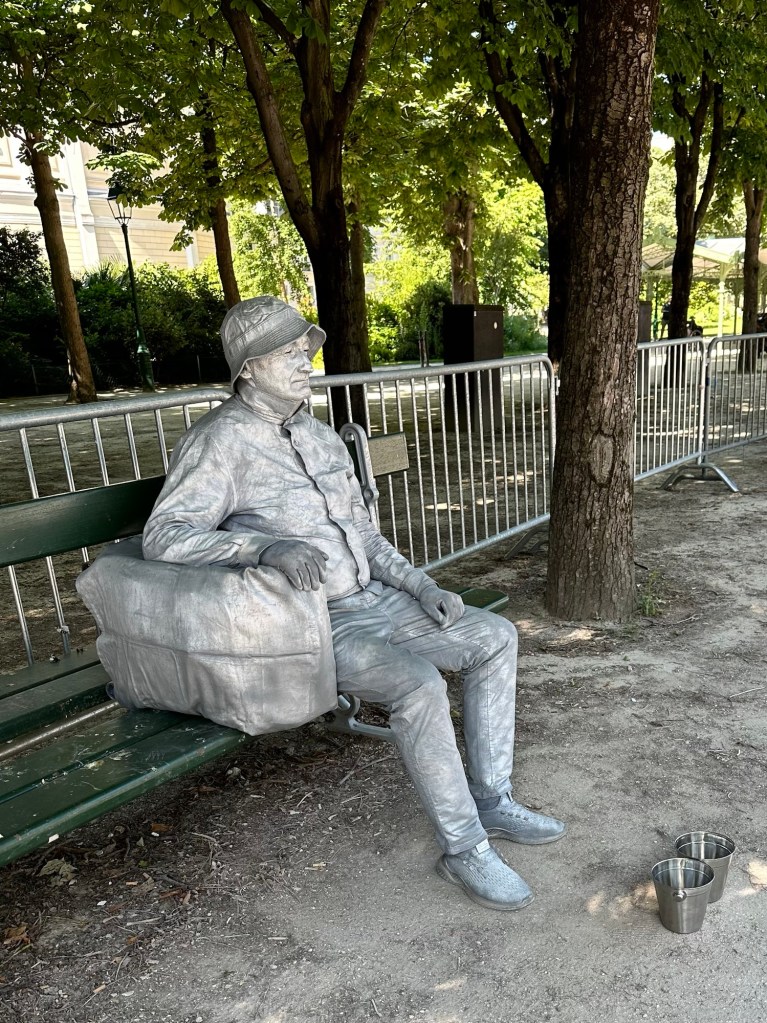
There were so many beautiful, whimsical sights along the way. Here are just a few:

These gold medallions swayed in the breeze and sparkled in the sun.

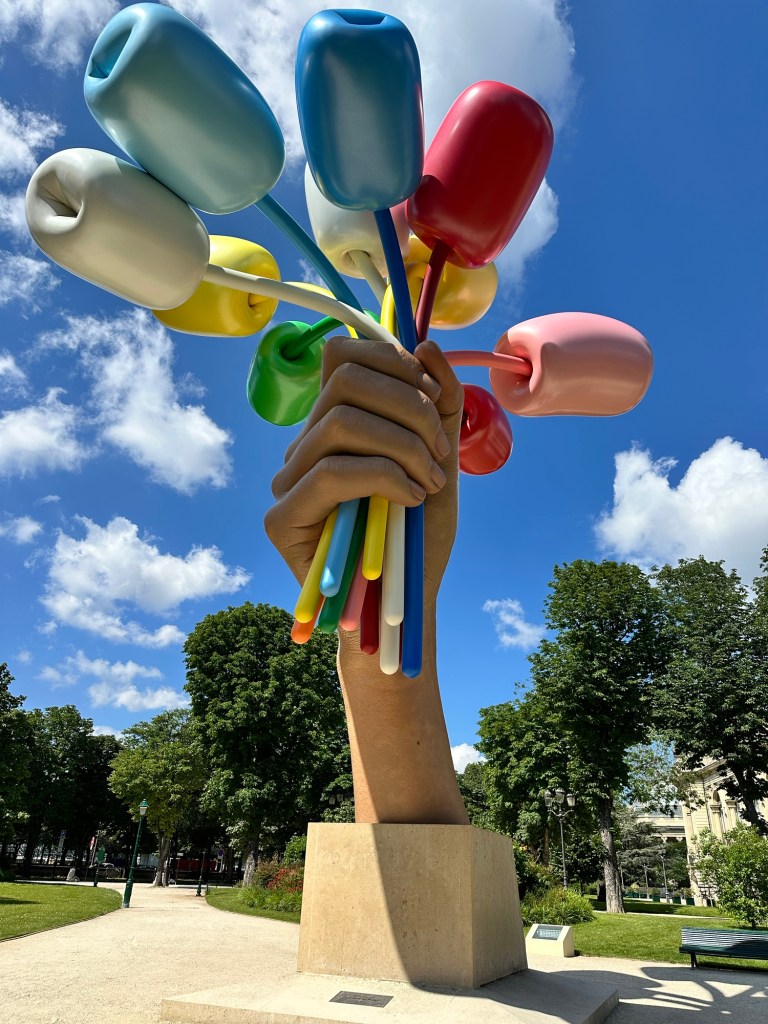
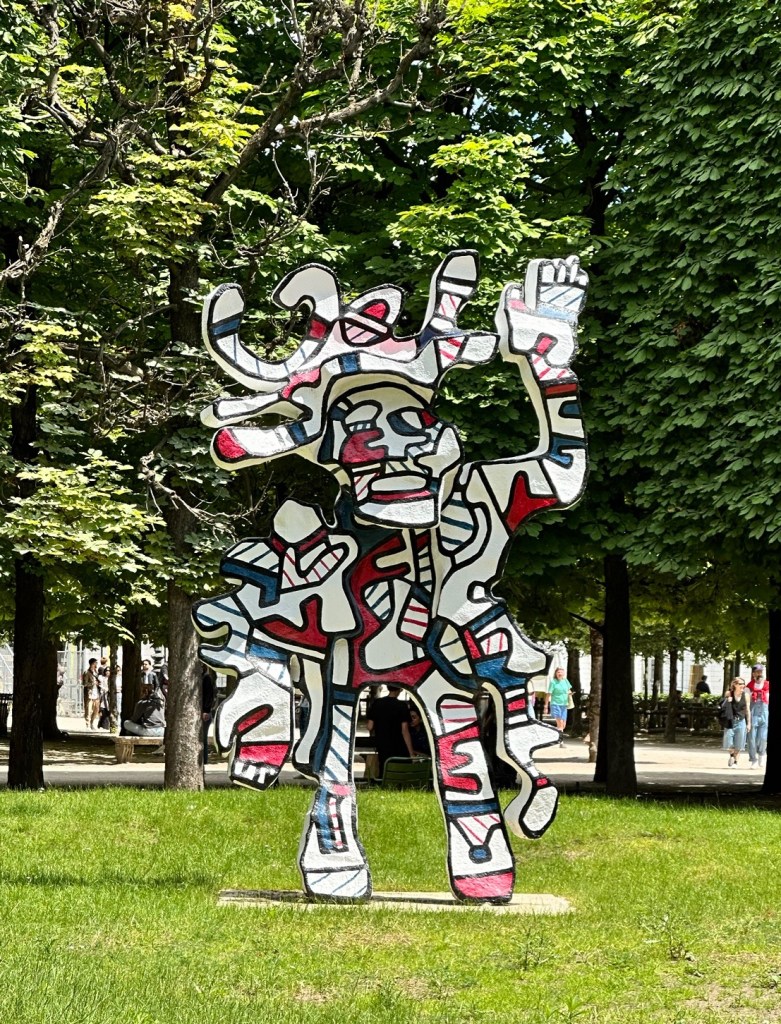
This sculpture reminded me of Seward Johnson’s work in New Jersey’s Grounds for Sculpture.

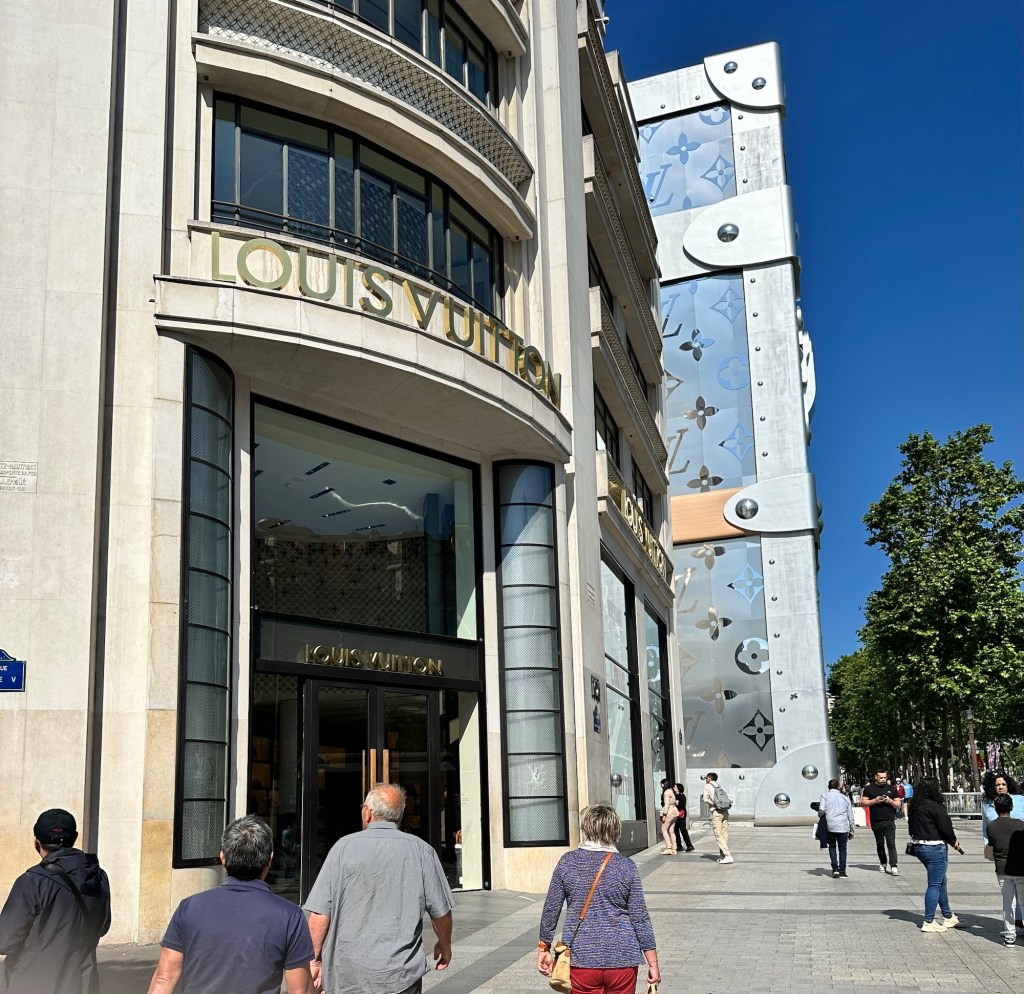
Of course, all the high end stores lined both sides of the Champs Elysees. I found the Vuitton store particularly clever, because because part of the building was designed to look like their signature bag.

We spent the day meandering aimlessly, stopping whenever we felt like it, taking detours to side streets, having lunch outside in a quiet, smoke free cafe. It was heavenly!

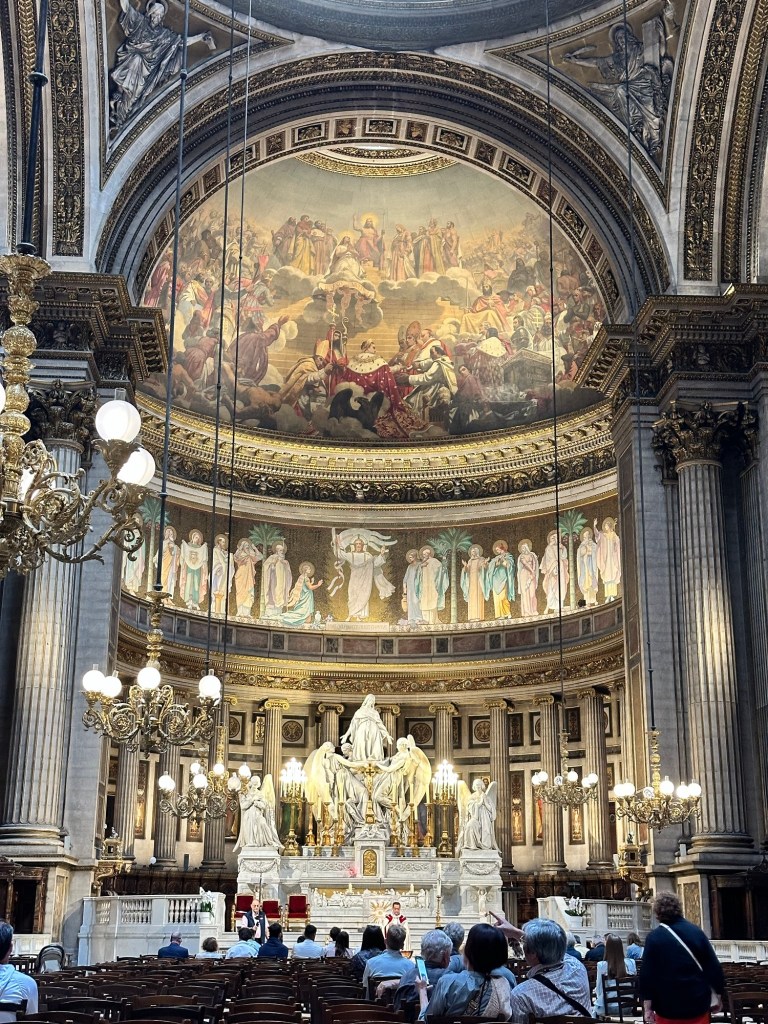
What Jean thought might be Pantheon, was actually the Church of Mary Magdalene. Even though the church bears her name, you’ll see that Napoleon got the top center spot in the artwork, and the most brilliant clothing. Everyone’s eye is naturally drawn to the red robe, right? Even Jesus’s clothes look like they could use a wash, compared to Napoleon’s. You might have to zoom in to get the full effect. I guess every age and culture has its Narcissists.

The prep work for the summer Olympics was visible everywhere, but we still managed to find some unsullied vistas.

By the time we reached the Louvre, we were ready to hop on the metro. There was wine to be shared, and the hotel was the perfect gathering spot!

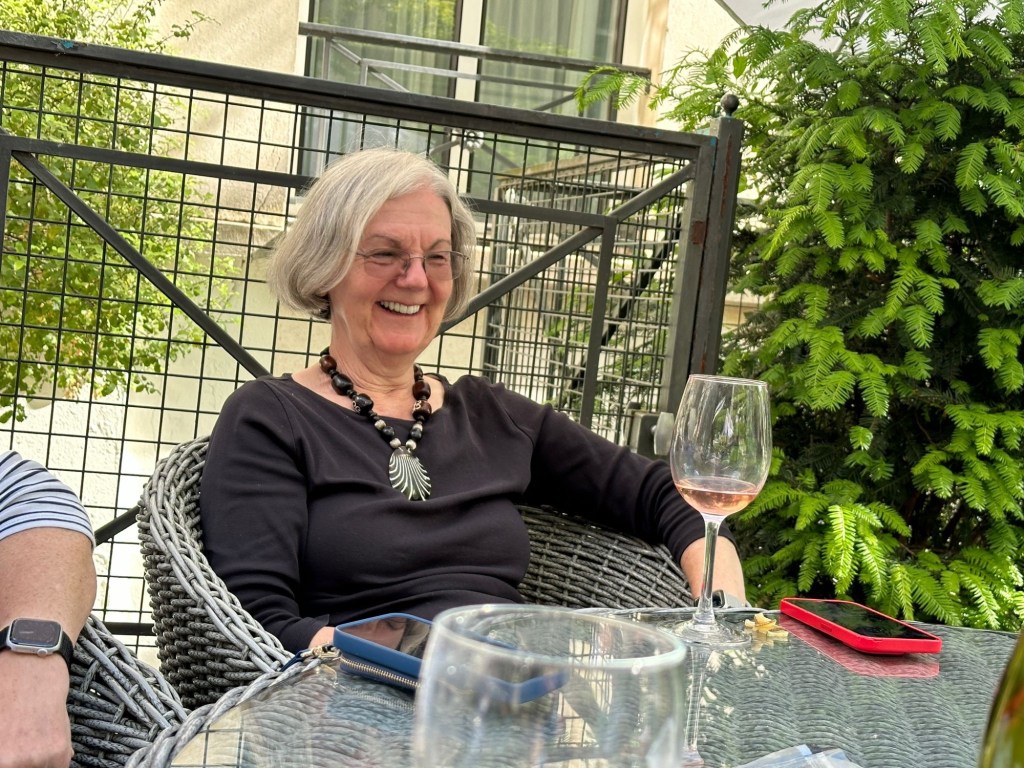
How many bottles of wine are on that table?
Photo by Nancy

It was sad to say goodbye to the wonderful friends I made on the trip, but it’s good to be home again.
Carcassonne

Sometimes you need to let the bliss sink in, and boy oh boy, am I ever blissful right now!

Yes, we’ve done a lot during our stay in Carcassonne, and I will eventually talk about that, but right now I am thoroughly enjoying the perfect weather and the after effects of a wonderful lunch in a nearby French vineyard/winery, Chateau Auzias.

After the vineyard tour, we were given 4 bottles of wine to taste, plus measuring equipment so that we could concoct our own blend using whatever combo of the 4 we desired. When departure time rolled around, we were presented with our blended wine to take home. I liked their Cabernet franc so much, I decided not to muck it up with Merlot or either of the two Syrah varietals, so I was glad that taking one of the vineyard’s regular products was an option.

As you can see from all the smiling faces, a good time was had by all. Especially me.

Okay, so that was the sum total of YESTERDAY’S blogging.

TODAY we are leaving the countryside, traveling by train to spend three days in Lyon, then finishing the trip in Paris. But before we move on to the big cities, let me tell you about our last medieval town.

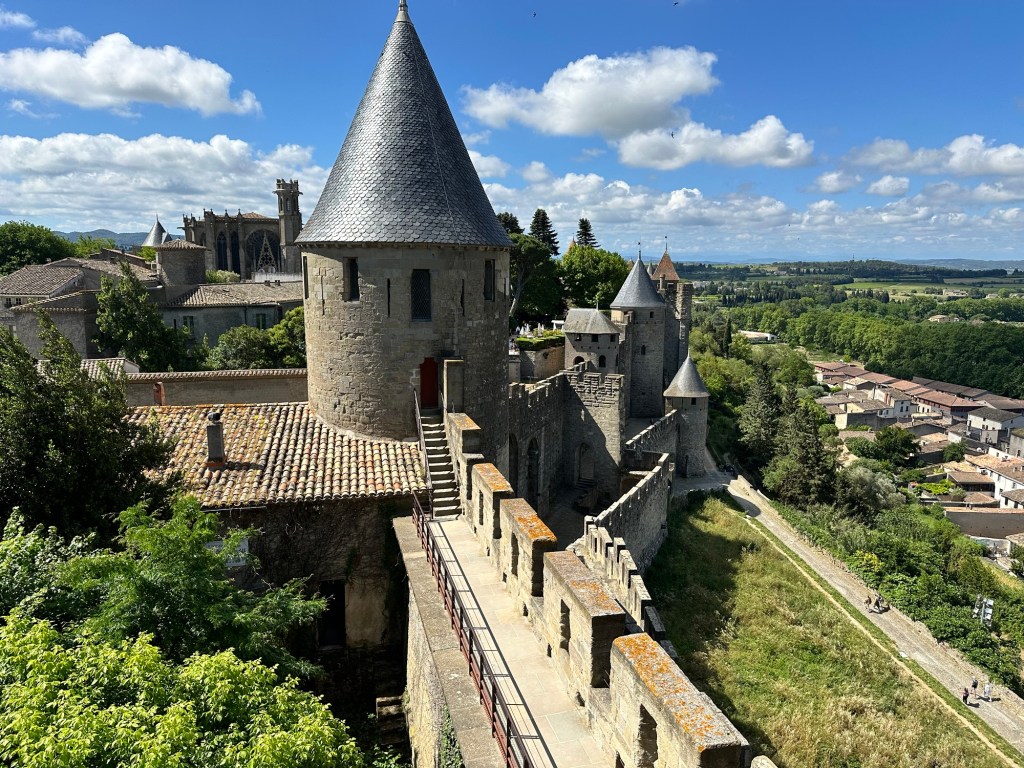
Carcassonne’s most prominent feature is its huge castle, which dominates the landscape.

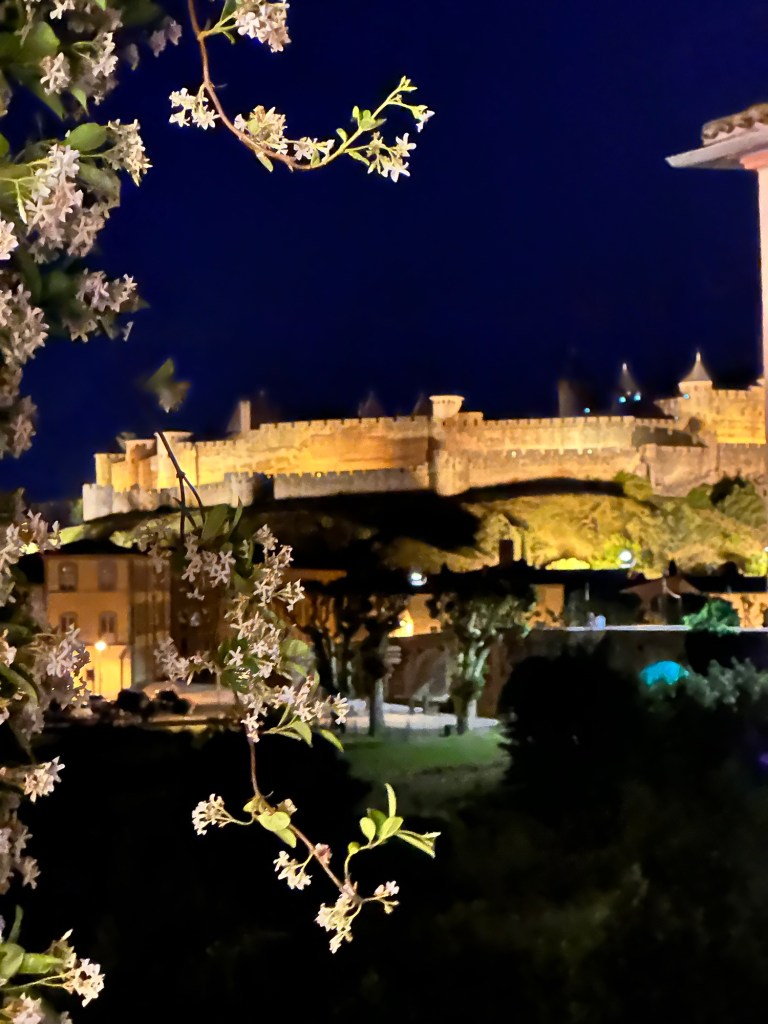
I was lucky enough to score a hotel room with a balcony, so I was treated to this spectacular view (of a portion) of the castle, which is beautifully illuminated at night. The plant you see in the following photo is the wonderfully scented jasper hanging from my balcony. ( my cell phone’s zoom can only do so much…)

The castle is so enormous, it was difficult to fit it all into one photo, until I visited Tribe restaurant during one of our “free” evenings. The food was every bit as great as its view. A bonus: the restaurant is owned by an Australian, so they have both French and English menus, AND it is really close to Les Chevaliers, our hotel.

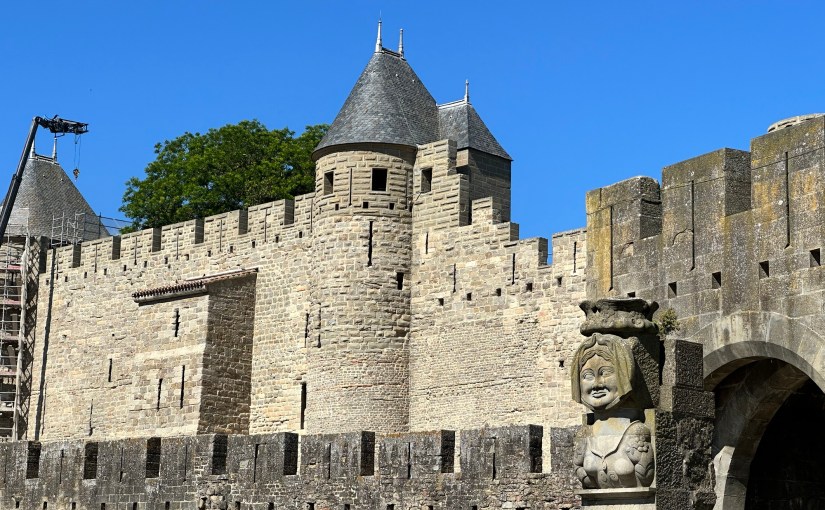
Every castle should have a good story and this castle is no exception. Let me introduce you to Lady Carcas, whose statue at the main entrance greets visitors.

This Saracen princess is credited with saving the city from Charlemagne, who tried to starve the inhabitants into submission by surrounding it for five years. Although they were almost out of food, Princess Carcas decided to feed the remaining wheat to their last pig, then catapult the fattened animal over the city walls into the enemy camp. According to the legend, when Charlemagne saw the splattered remains of the well fed pig in the middle of his camp, he figured the Muslims still had plenty of food. What’s a warrior to do but pack up and head for home, which is exactly what he did. Lady Carcas was so excited by their departure, she ordered all the church bells to be rung. Upon hearing the bells, a soldier exclaimed “Carcas rings”, but he said it in French “Carcas sonne”, and that’s how the city got its name. Or so the legend claims.

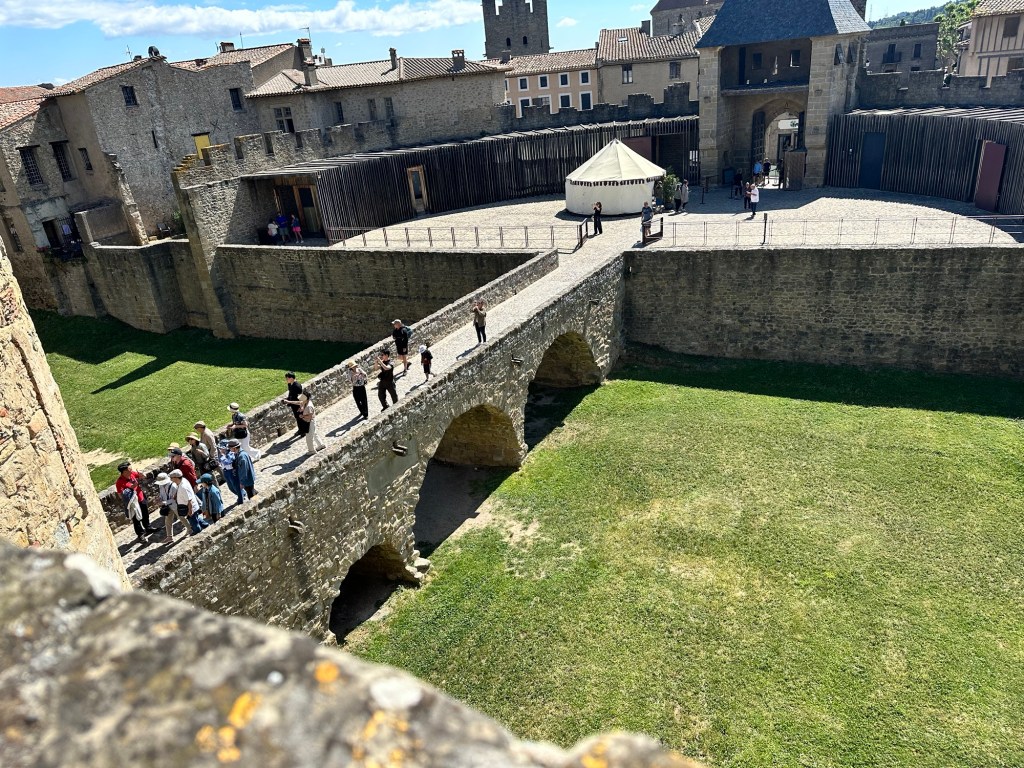
Check out the fortress’s outer ramparts. This photo was taken from the inner, and higher, protective wall.

If the invaders are able to breach the first wall, they still have to make it over the moat and past the aptly named “kill hole” .

You can see why a siege was preferable to a full blown attack on what sure looks like an impenetrable fortress.

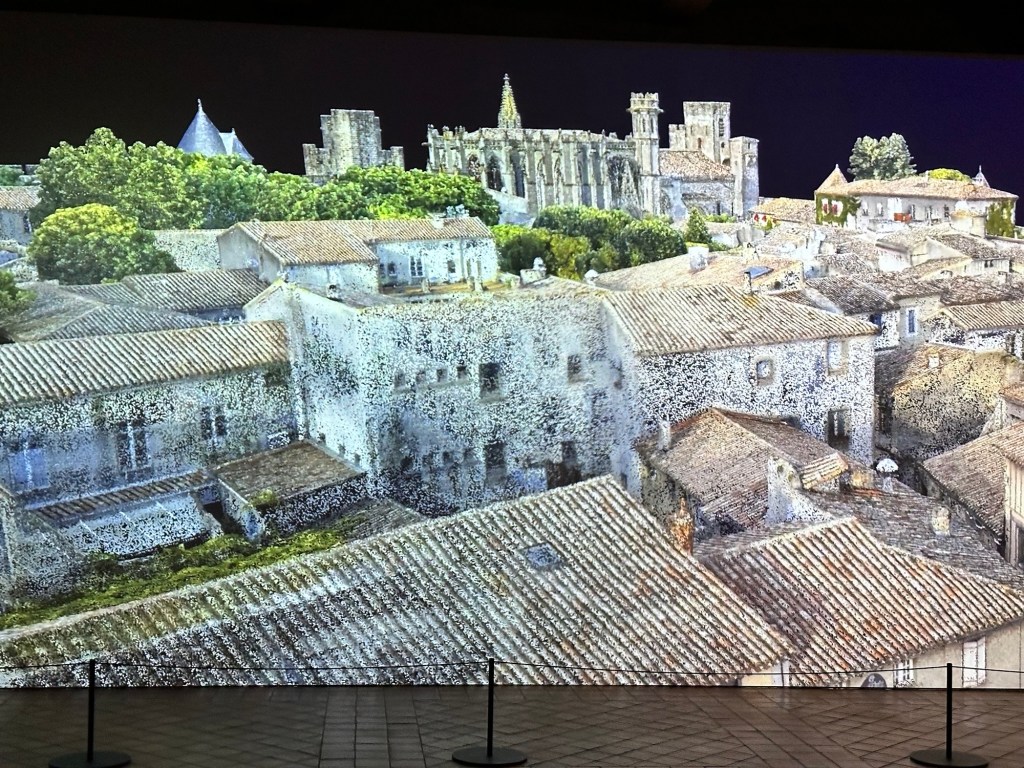
At the start of the tour, you are given an audio guide, then watch an introductory multi media show projected onto a wall.

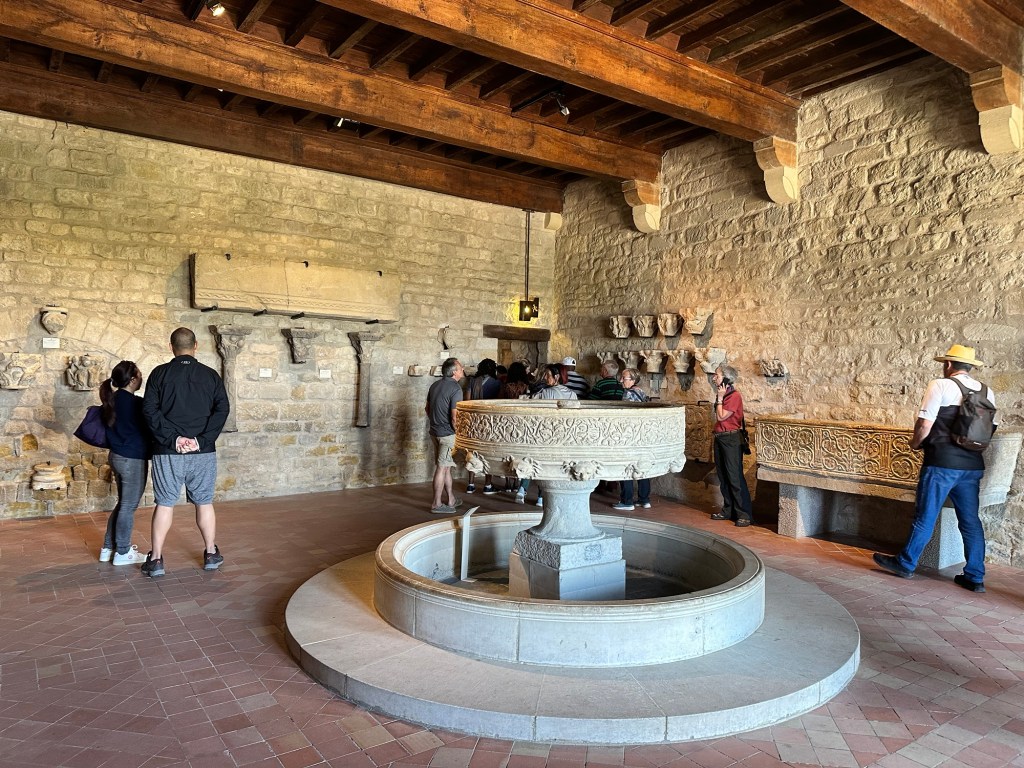
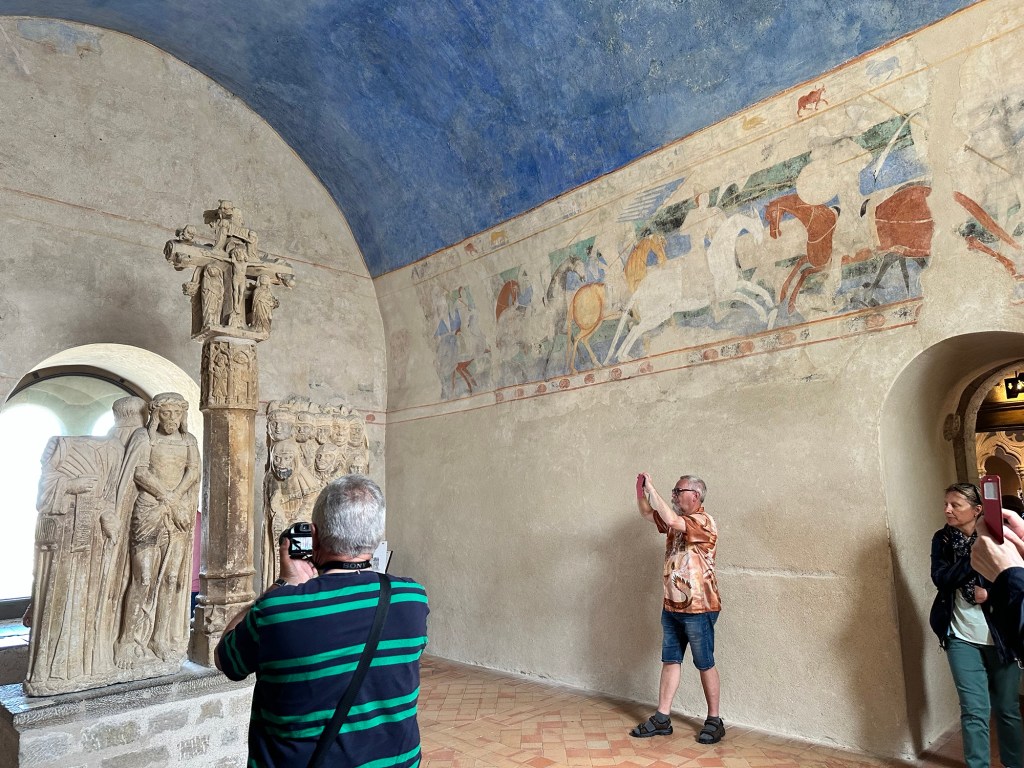
The rooms inside the living quarters were transformed over the centuries by its various inhabitants: Romans, Saracens, and Christians.

We ended our visit with a walk around the ramparts, which was an excellent vantage point for viewing both the countryside and the interior of the fortress.

Our guide told us the fortress currently has 55 inhabitants. Although during our ramparts walk, we viewed several lovely residences, with gorgeous gardens, I certainly wouldn’t want to live in a place overrun by tourists. (Do they even have WiFi?)

Laetitia cautioned us that there was some up and down on uneven steps on the ramparts walk, but Nancy and I didn’t find it at all challenging.

In retrospect, I wish I had spent most of the day within the castle walls, but we had so much fun on our boat ride in Angers, we decided to give the afternoon Carcassonne canal ride a try. Big mistake. It was crowded, hot, and boring. The lack of photos from the boat ride tells you everything you need to know.

But that happens with travel. Sometimes you hit and sometimes you miss.

On to the cities…

Albi, On the Way to Carcassonne

There is no end to the surprises on this trip. Our itinerary indicated that we would stop for lunch along the way to Carcassonne, in Albi, another town I’d never known existed prior to this trip.

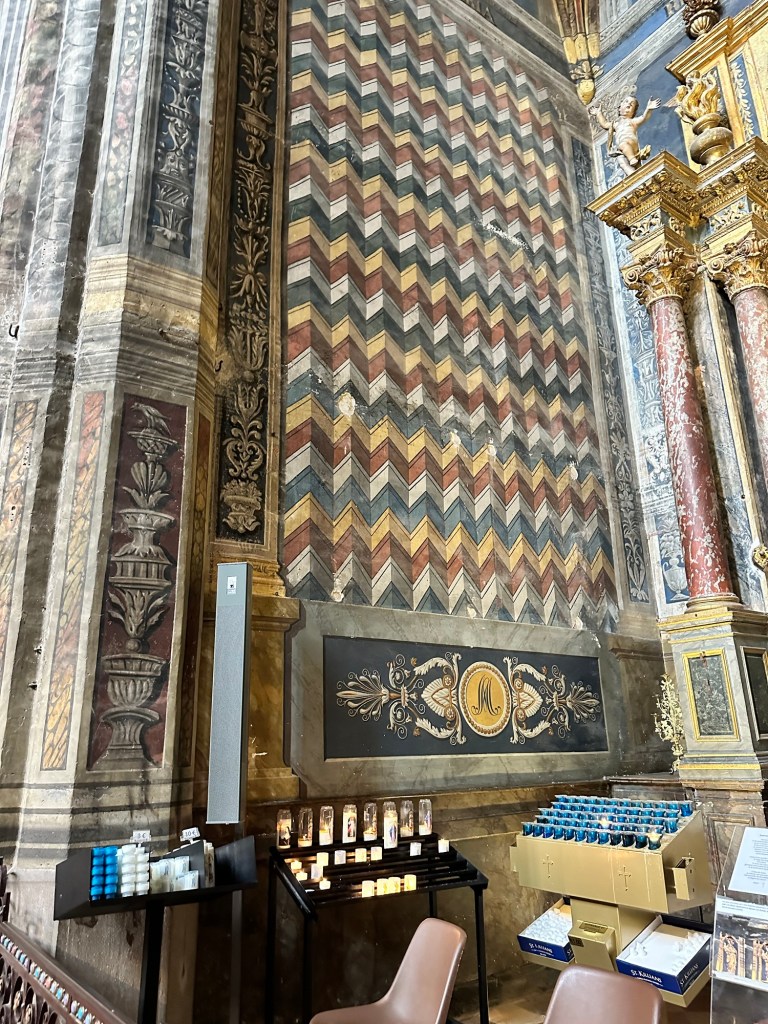
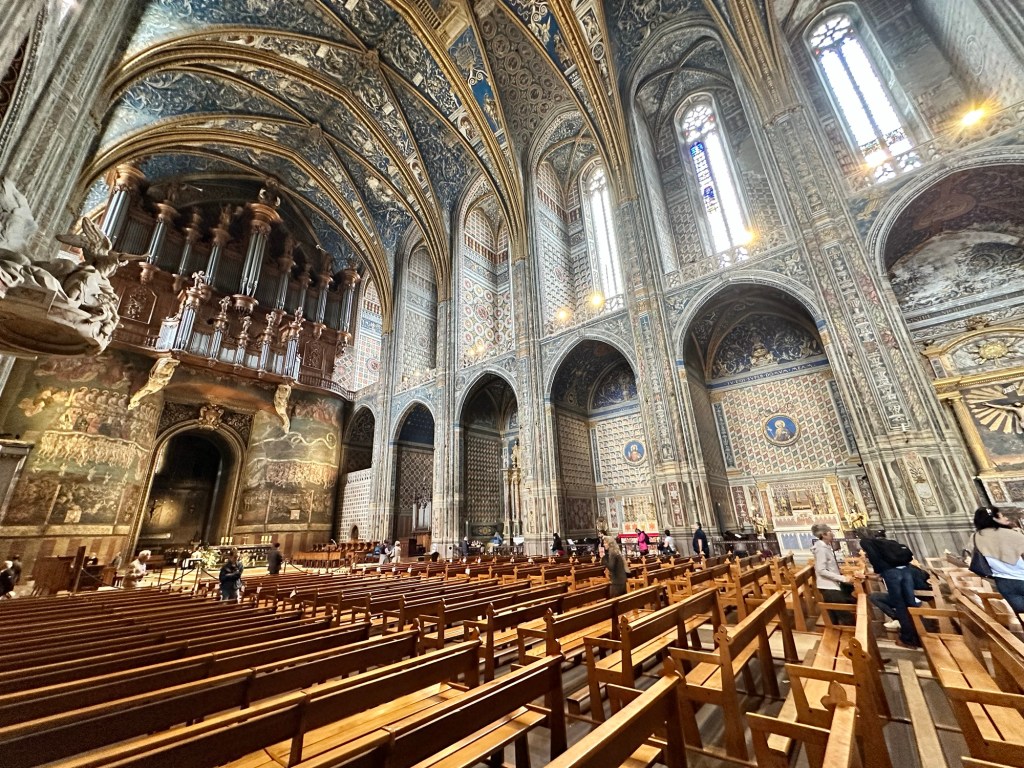
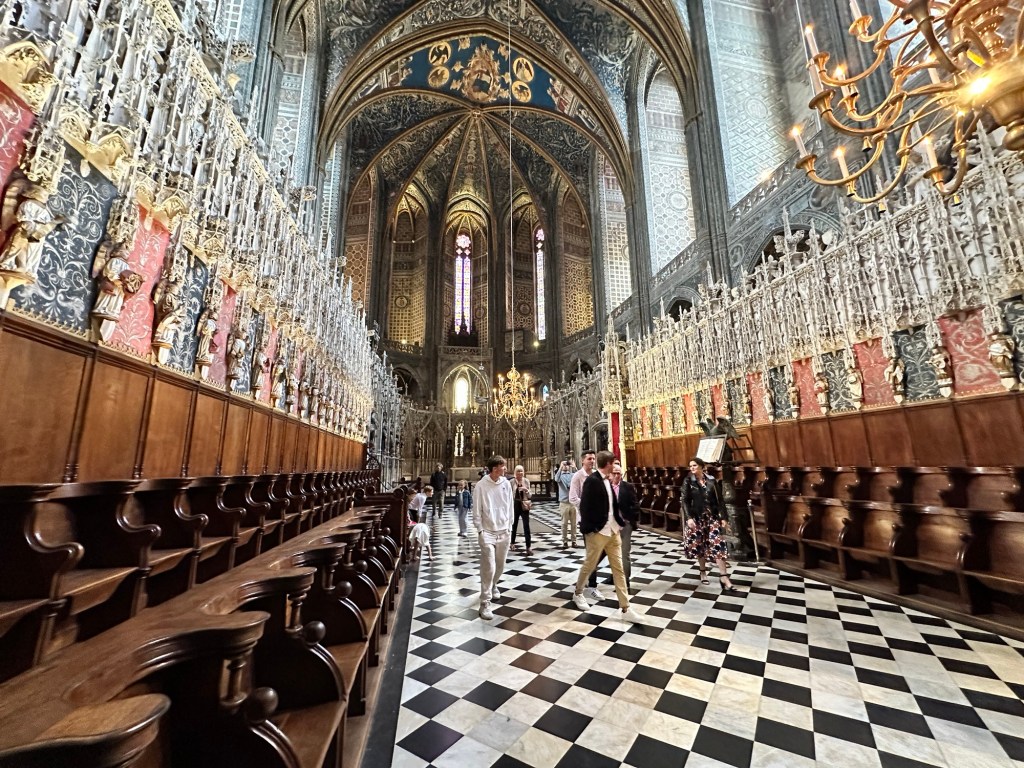
It was no surprise to find a cathedral in a small town, but what WAS jaw dropping was the artwork on the walls. Let me tell you, I’ve certainly seen more than my fair share of churches, chapels and cathedrals, but I have never, EVER seen artwork quite like this!

Every square inch of this massive building was covered with art. What caught MY eye were the geometric optical illusions. I tried to find out when they were painted, but the internet let me down.

If you’d like a better view of any of the photos, just click on it, but I’m telling you right now, you really DID have to be there. It was impossible to capture the grandeur of St Cecelia’s cathedral.

Cecelia, by the way, is depicted by the statue in the bottom photo. She was one of the virgin martyrs, forced to marry a pagan. Unlike the other virgin martyrs, she converted her husband by convincing him that an angel was standing over him, and would punish him if he tried to consummate the marriage. It isn’t clear who killed her, but it wasn’t her husband.

More surprises: the town created a Toulouse Lautrec museum out of what was once a fortress/ bishop’s residence/ inquisition site. That’s what happens when something in Europe is built in the 1200’s. It gets repurposed multiple times.

As with other fortresses, the site was originally chosen for its altitude and its proximity to water.

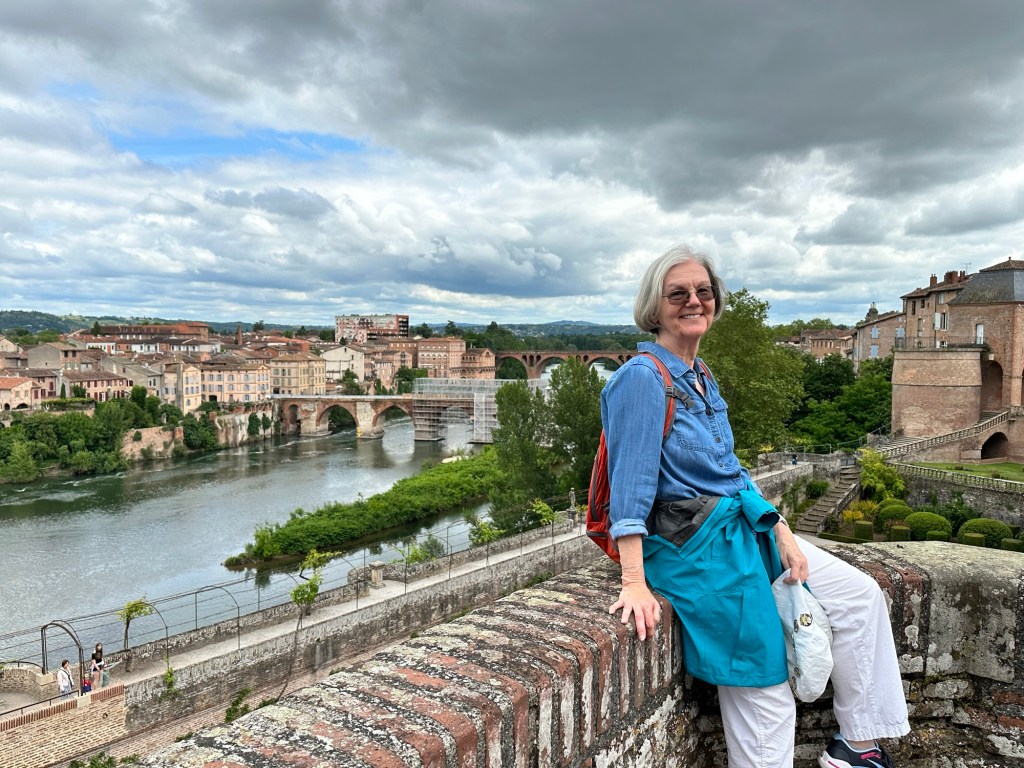
(My friend Jean requested more people photos, especially ones with me in them, so the above shot’s for her.)

Check out the sky if you want an explanation for my wardrobe: I was ready for ANYTHING: rain, sun, wind, pestilence…

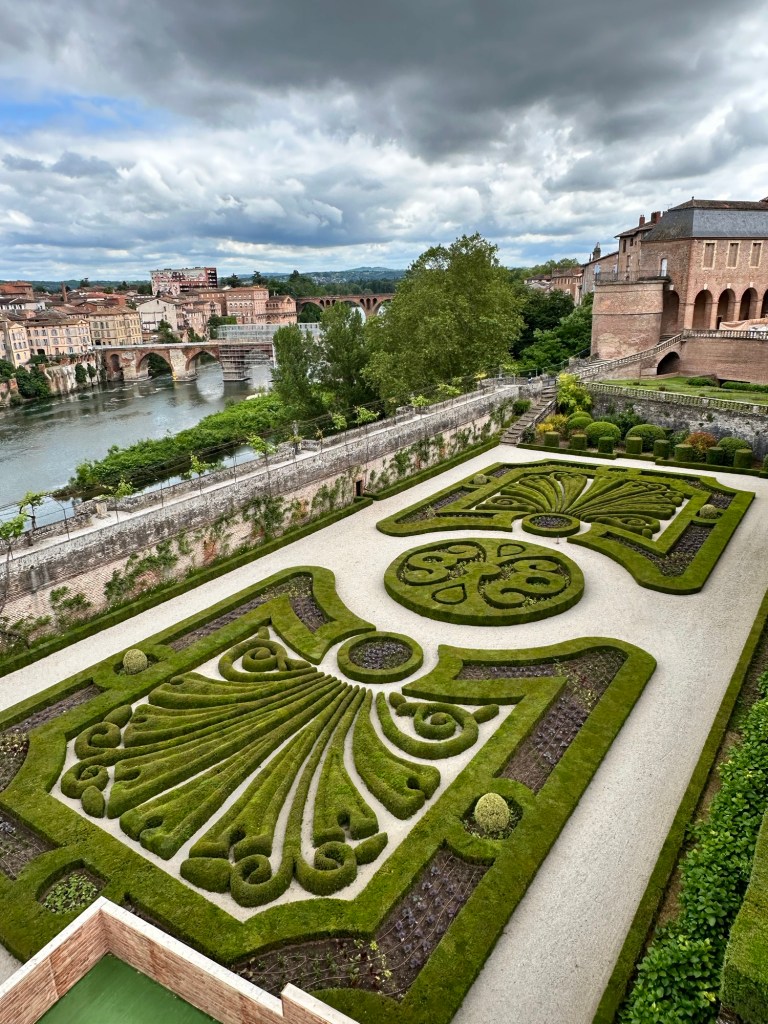
Now take a look at what was under the wall I’m sitting on. Pretty magnificent, wouldn’t you say?

The museum doesn’t look that impressive from the outside. In fact, it looks a little strange, but I guess that’s to be expected for an 800+ year old building that has served so many different purposes.

But inside is quite a WOW.

I was particularly taken with this passageway built to link two buildings together. The ceiling creates another optical illusion when you stand at one end and look up. I got a little dizzy trying to make this shot come out straight!

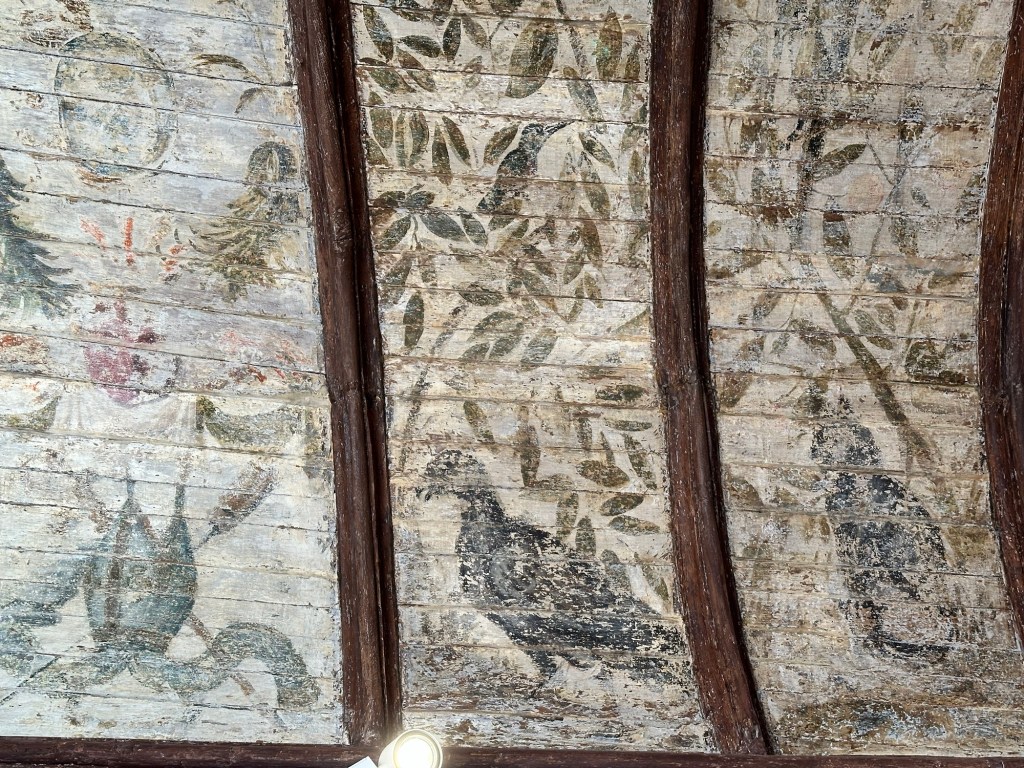
Each section was covered with images of plants and animals.

This artwork was a bit faded, probably because the passage was lined with windows on both sides, but you get the idea.

I couldn’t help but wonder whether the victims of the inquisition marched through this hallway on their way to the torture chambers, or whether this hallway was part of the bishop’s commute between his residence and the courts, where he decided which punishment to mete out to the infidels, in God name, of course.

I’ve rambled on and on about the building, but haven’t talked much about the art inside. There’s a reason. I’ve seen better Toulouse Lautrec artwork in New York, Boston, and in art books, so the art display was a bit disappointing. I did find one that I particularly liked.

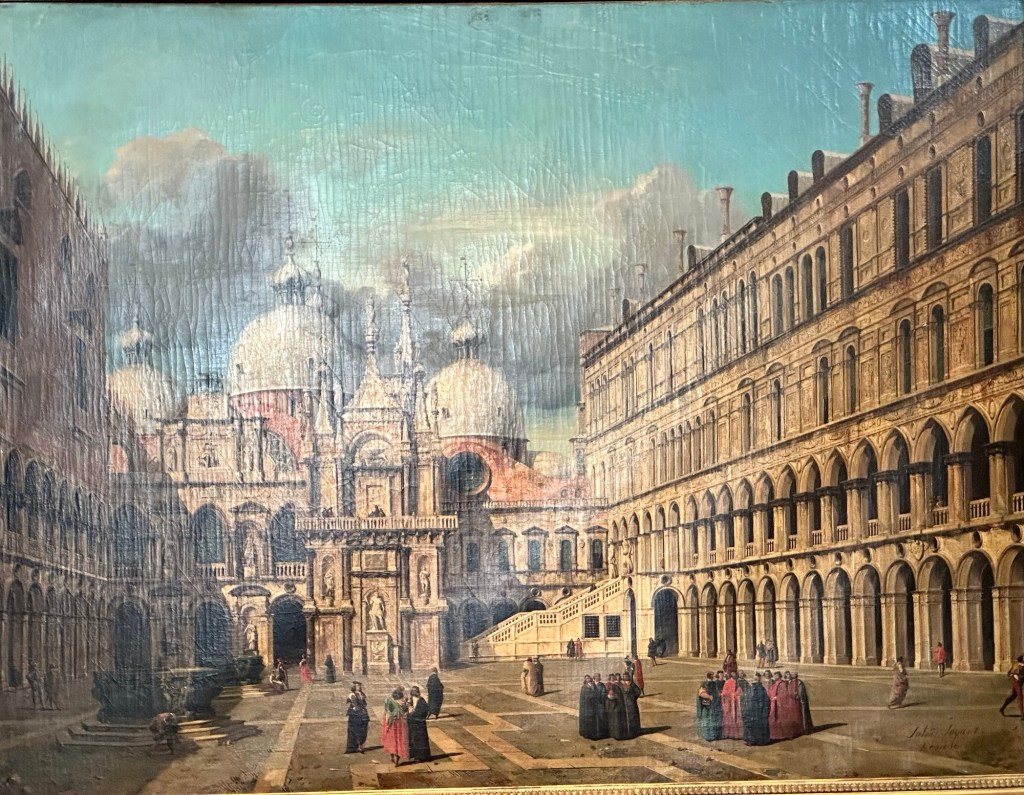
The museum contained OTHER artists’ work, including this one that I found rather captivating.

We only had less than an hour after lunch to check out the museum ( and revisit the cathedral, if so inclined), so I didn’t buy the audio guide, which means I have absolutely no idea where this painting was meant to represent. But I liked it, and that’s enough for me.

Looks like Carcassonne is going to get its OWN post, yet another surprise, at least to me. I never imagined I’d have so much to say about a lunch stop!

Here’s a sneak preview— the view from my Carcassonne hotel room’s balcony.

Sarlat

I loved Sarlat so much, I decided to skip Saturday’s optional trip to Rocamadouer so I could experience the market and spend an unstructured day in this delightful medieval town.

On our first day, we had a guided tour during which we learned Sarlat was founded in the 800’s by Benedictine monks who chose the location because of its water supply.

The well built by the Benedictines

Back in those days the church was all powerful, so the abbot ruled the city until he was accidentally killed by one of the monks. He had the misfortune to be standing right behind the actual target, who ducked at exactly the right minute. Then this war happened, that war happened, the rich got richer…and here we are today, viewing a statue that looks a whole lot like Mick Jagger. (Actually that’s not exactly what the guide said, but it’s about all I remember.)

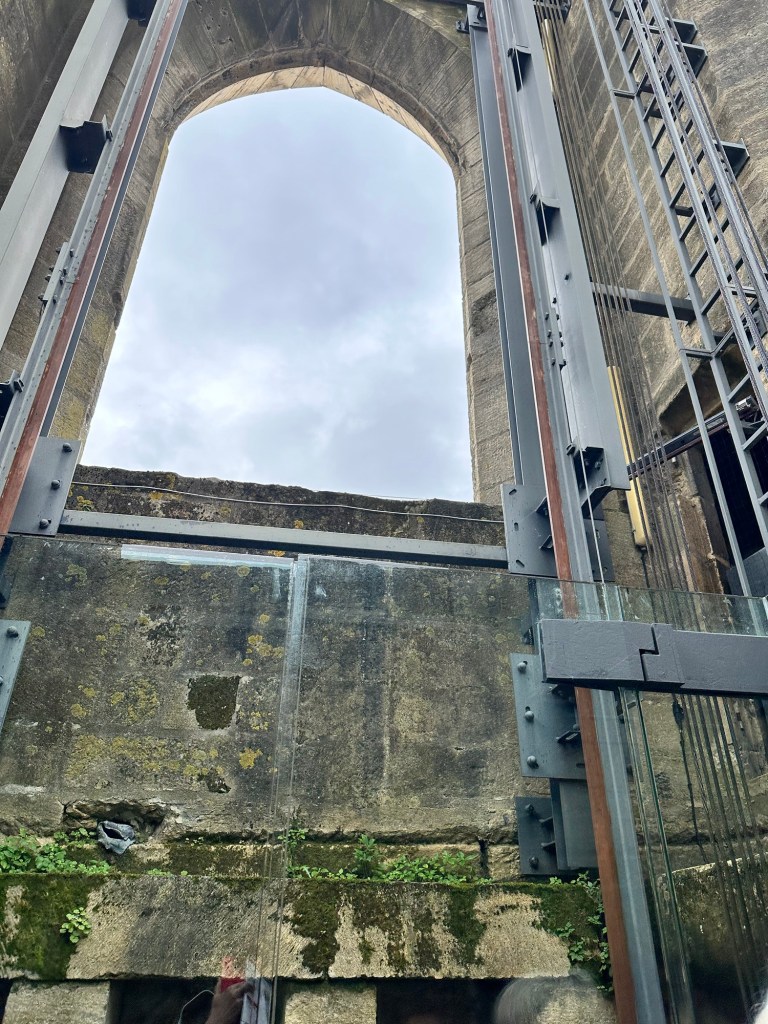
In addition to being market day, Saturday is also the day that you can take a glass elevator to the top of what was once a cathedral, but has since been repurposed into an indoor market.

The indoor market

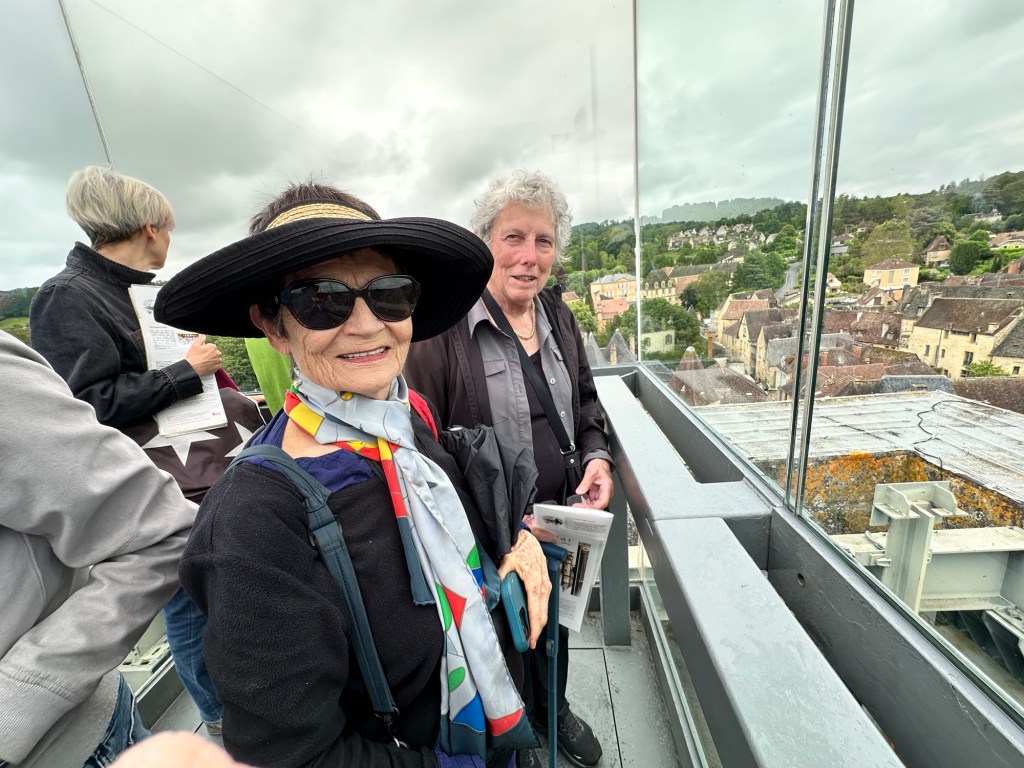
We weren’t able to get out of the glass elevator, but that’s okay because we still had a panoramic view. We saw a whole lot of rooftops and the nearby church — yes another one, close by, because a town can never have too many churches.

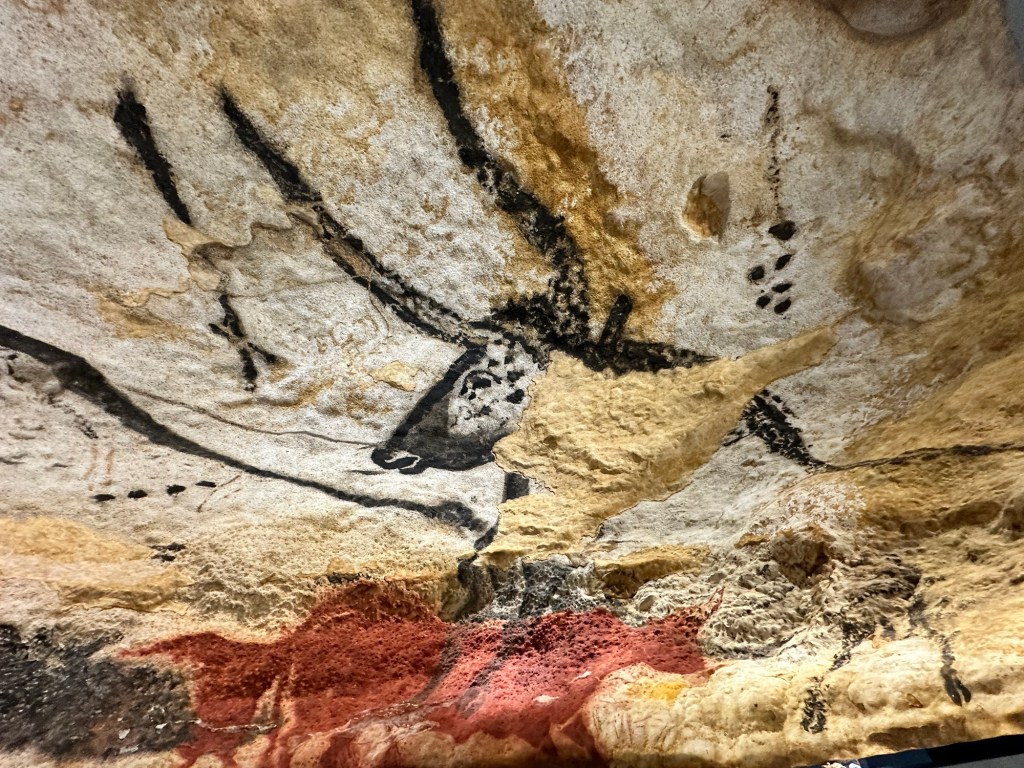
One of our days in Sarlat was spent visiting the nearby Lascaux Caves. The original cave, which dates back more than 25,000 years, was closed off because carbon dioxide from tourists’ breath was endangering the cave paintings. Instead, replicas have been built, and Lascaux 4, the one we toured, has been faithfully reproduced BUT, it is even better, because of the added museum which has a multimedia show.

Our guide explained that these artists were thought to use sticks with horsehairs for paint brushes, moss as sponges, and tubes from which they spit pigment —a precursor of spray paint?

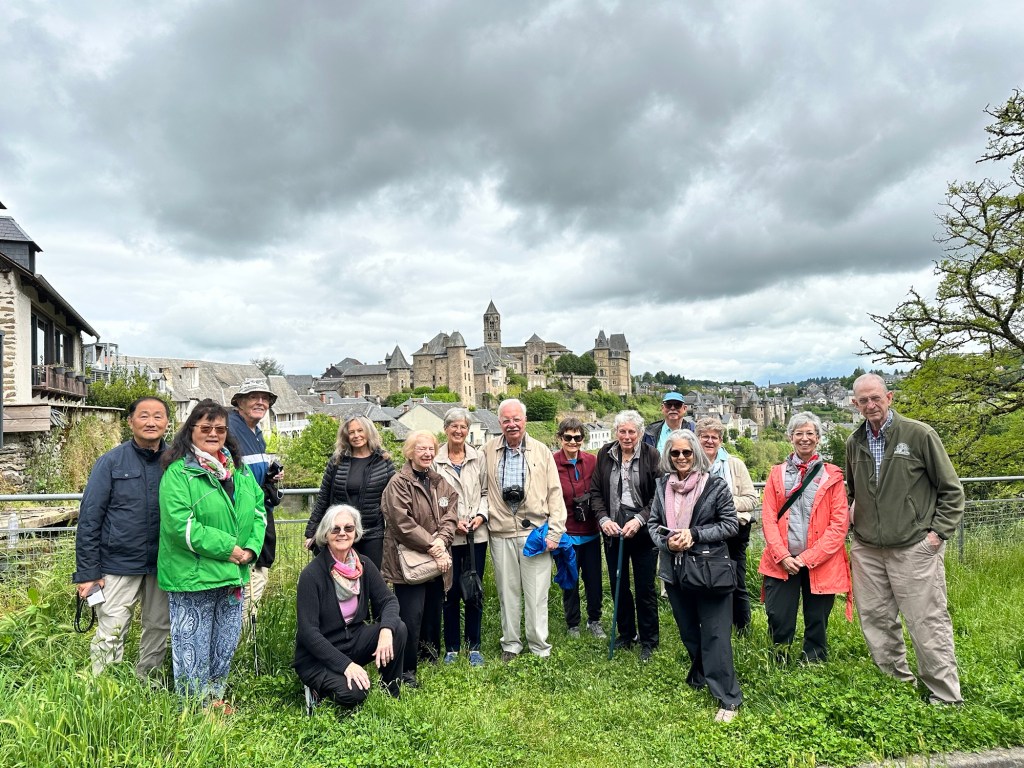
We had a delightful lunch in Uzerche, where Laetitia took this group photo.

We also visited Commarque Castle, which is slowly being restored by the son of the former mayor, who was killed when the son was a year old because of the mayor’s activities with the resistance.

Although much of the castle is in ruins, you can still climb up and visit the restored section, so of course, I did.

Time to move on. Next stop, Carcassone.

Angers

Sometimes I don’t know I want to visit a place until I get there. That certainly was the case for Angers. I know, I know, the name of the city sounds like a hostile emotion. But the French don’t say it the way it’s spelled. THEY say “Ahn-geee”. Better, right?

Our three days in this very walkable city whipped by, and was a very nice balance between included activities and free time. After a guided tour of the city, during our free afternoon several of us decided to go rollin’ on the river.

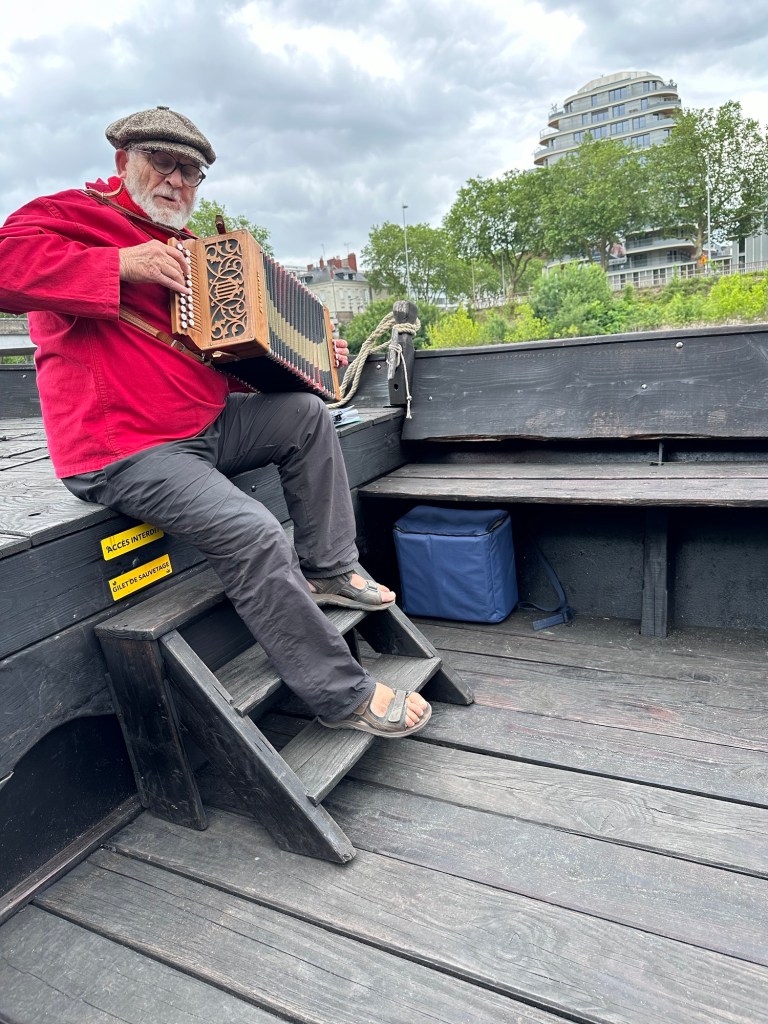
In addition to champagne (some of us had TWO glasses) our ride included entertainment. This fine fellow serenaded us while playing his vintage accordion.

We didn’t have the river to ourselves. Because the Olympic Torch was passing thru the city, four military boats were on patrol. We saluted each and every one of them with champagne glasses held aloft.

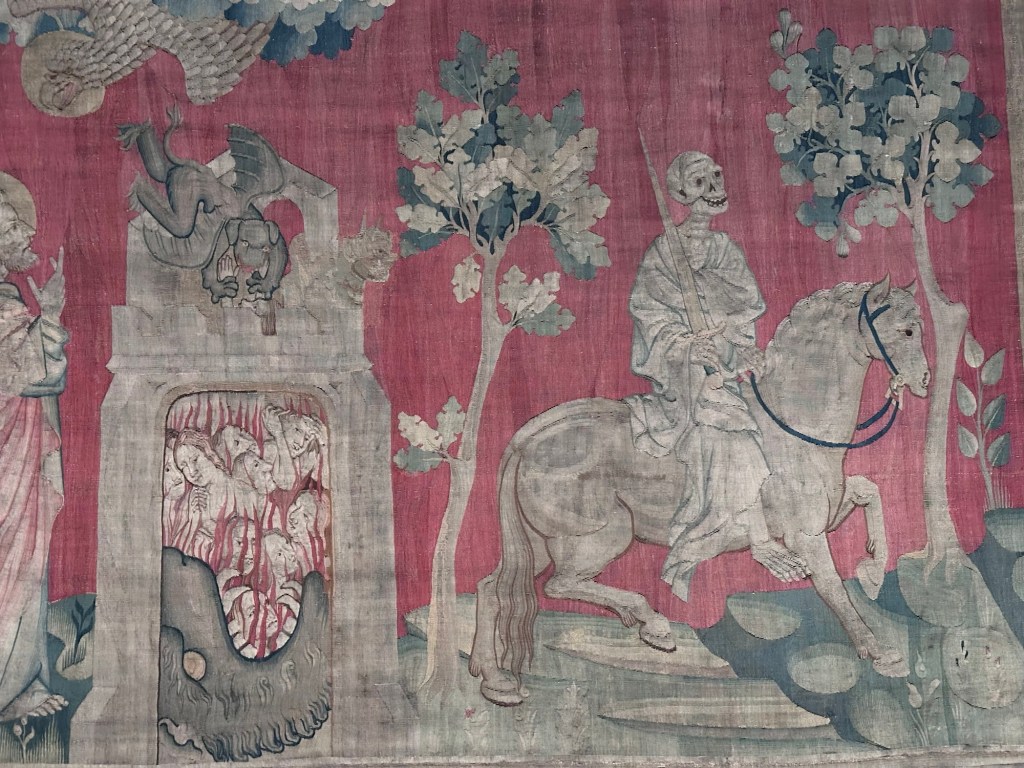
Finishing our ride across from the fortress/ castle, made it very easy for us to fit in a visit to the famous Apocalypse Tapestry.

Yes, another huge tapestry, but this one really IS a traditionally constructed piece, unlike the one in Bayeux. A predecessor to today’s comic books and graphic novels, it relates the battle between good and evil from the last book of the Old Testament to a largely illiterate population.

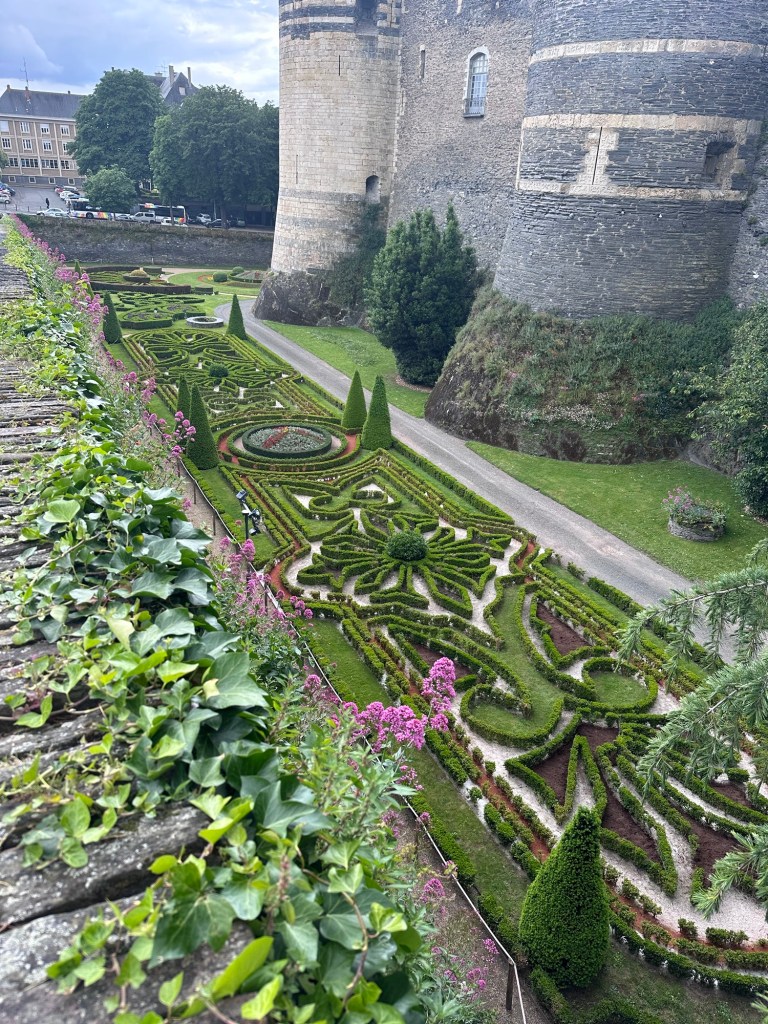
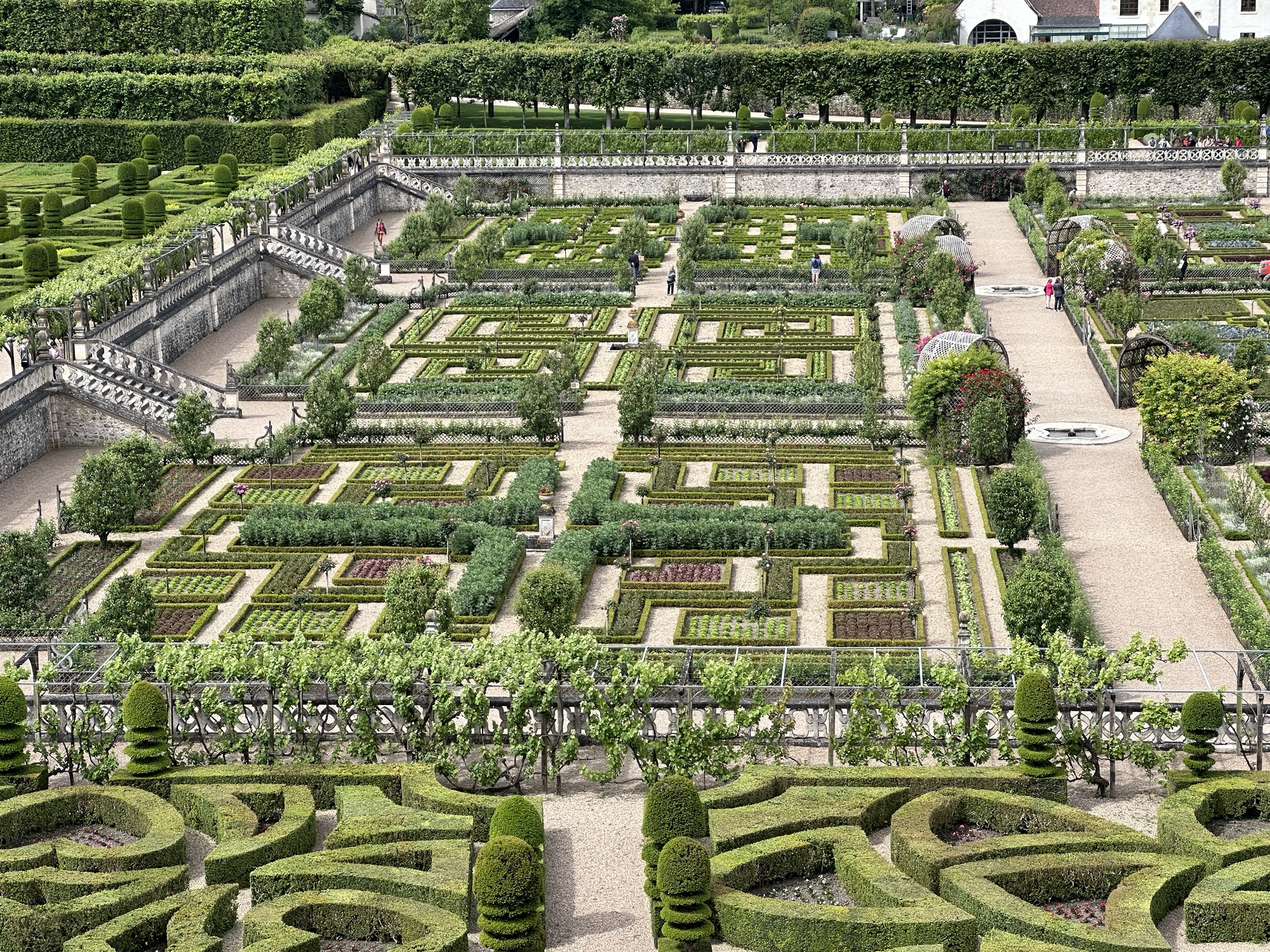
I was impressed with the beautiful gardens surrounding the castle, but these were nothing compared to the ones at the Chateau Villandry. The following photo shows only a small portion of the Chateau’s beautiful gardens.

If given the choice, I think I would have much preferred to be a Noble instead of a king. The nobles and ministers’ homes were much more “livable”, at least to me.

Although it isn’t obvious from the above photo, the Chateau de Villandry is surrounded by a moat.

Villandry has been in the same family since 1906, when it was purchased by Joachim Carvallo and wife Ann Coleman Carvallo. They met in a Paris research laboratory. Ann, an American heiress from Lebanon, Pa, supplied the funds for the purchase and modernization of the chateau.

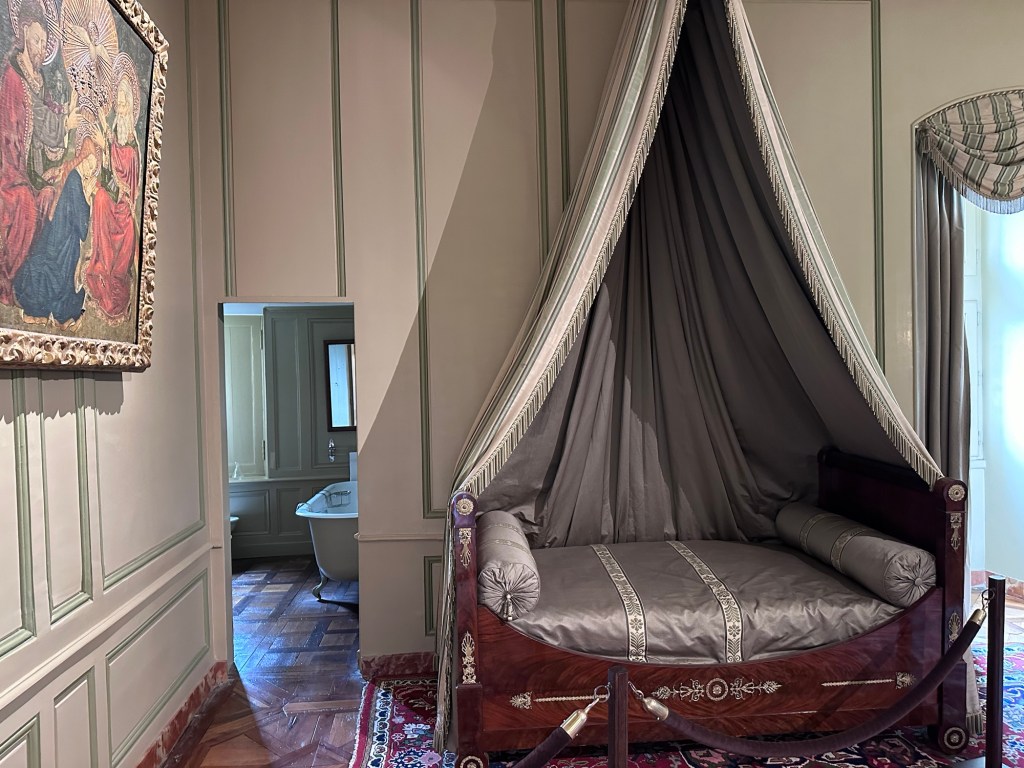
Unlike Fontainebleau, you didn’t walk through one room to get to another, and this one was modernized to include bathrooms off the bedrooms.

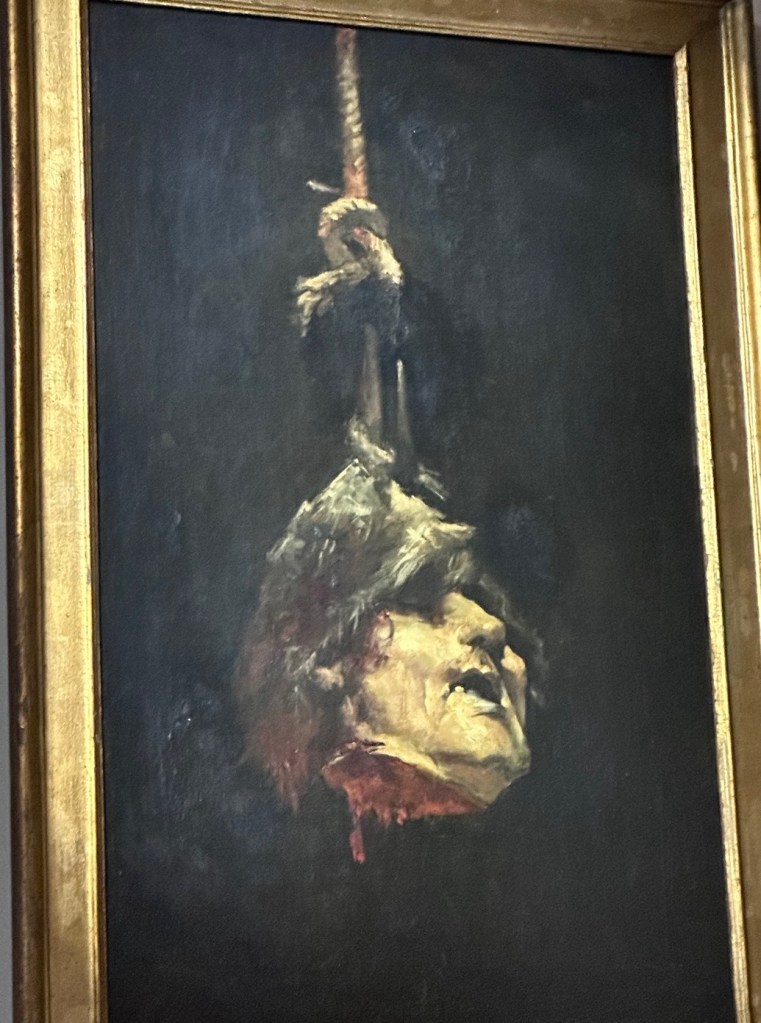
Art from Joachim’s homeland, Spain, was exhibited throughout the chateau. How many museums have portraits of a severed head? Fortunately, this picture was not hanging in a bedroom!

Before we departed Angers, we were able to witness the Olympic Torch being carried through the city.

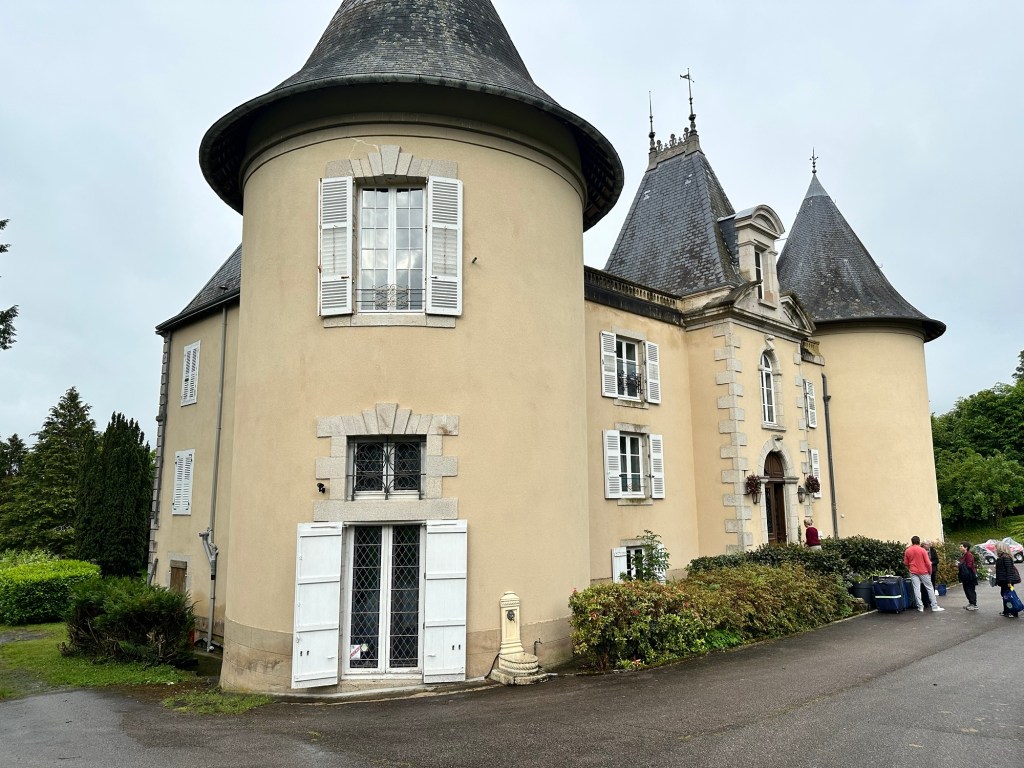
Our luck continued… we got to stay overnight in an honest to goodness, genuine chateau that was built in 1790 by the Duke of Limousin!

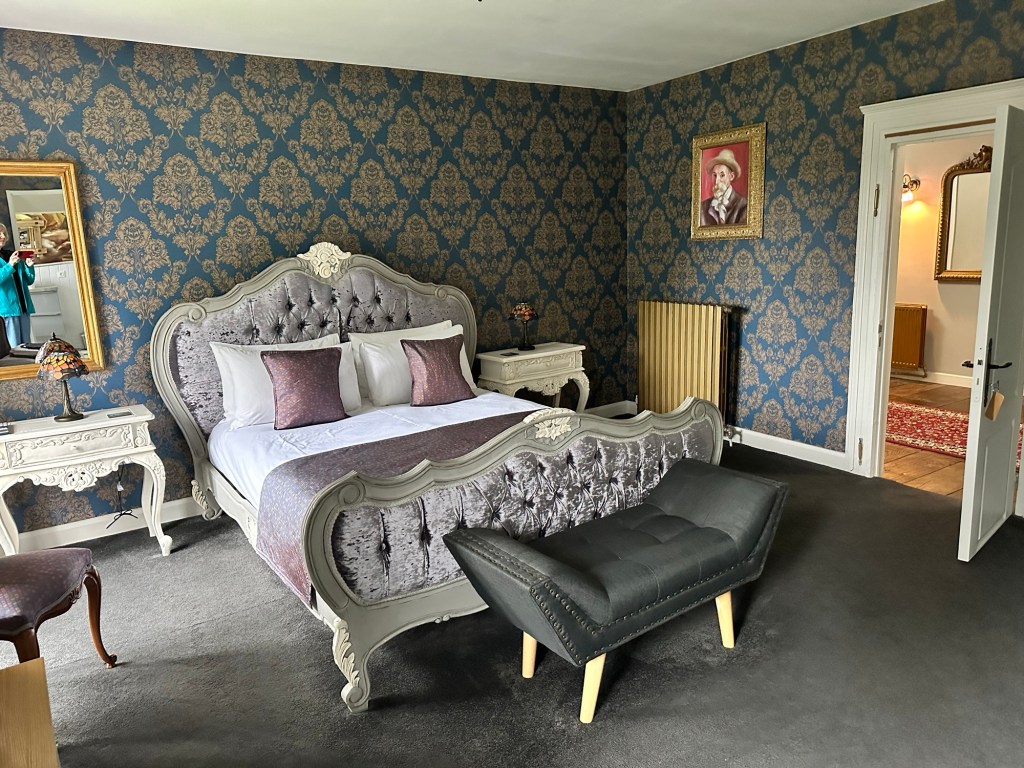
My room was the very comfortable Renoir Suite on the third floor. How gorgeous is that?!

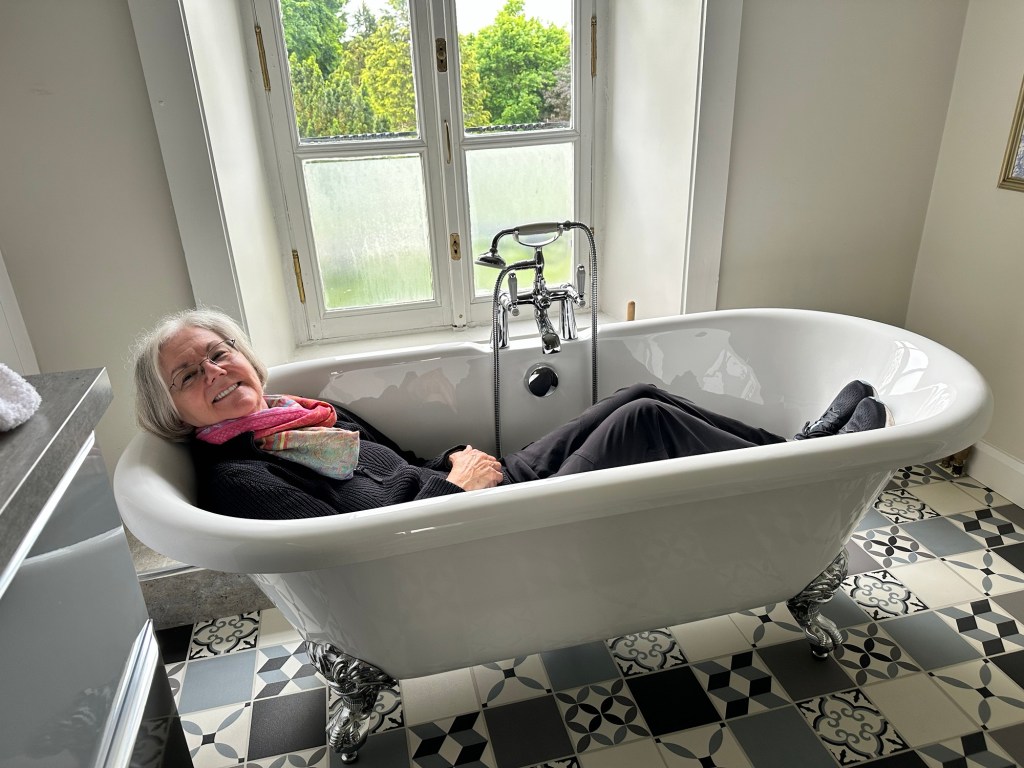
Fortunately, the suite was updated to include walls and a door, plus a modern bathroom with both tub and shower.

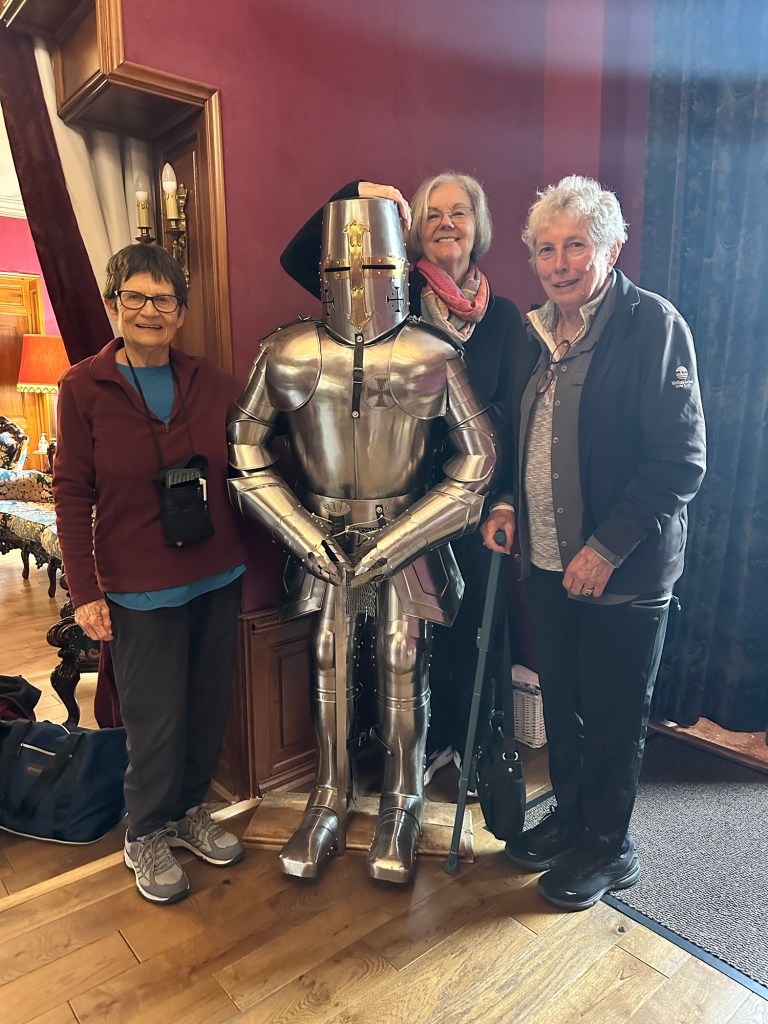
My new friends, Garry and Donna posed with me for a photo with our knight in shining armor. I decided to name him Walter the Bold, although Walter the short would have worked too.

This was our only “one night stand”. We are now on our way to Sarlat, a medieval town known for great food and fine wine.

Normandy

For many Americans, Memorial Day signifies the start of beach and barbecue season. After visiting Normandy, however, Memorial Day will forever retain its original significance for me. Henceforth, it will always be a solemn day of remembrance for those who have fallen in battle. Because of them, I’m allowed to live the life of freedom that I treasure.

Here’s Eisenhower’s message to the troops, which was reproduced in the museum at the American Cemetery.

The amount of creative thinking and planning that went into the invasion was mind boggling. We learned that the BBC sent out a request for photos taken during vacations on the coast of France, plus any maps or post cards that could help create visuals of the coastline. They received over 10 million responses, but these obviously had no information about the fortifications, so pilots were sent on reconnaissance missions. The local resistance, in addition to blowing up bridges and messing up supply routes, also provided key information to the allied forces.

Before going into battle, soldiers were given three options for their dog tags: they could declare themselves Christians or Jews, or leave the designation blank. If Christian or undeclared, their graves were marked with a cross. Jews were designated by a star, however many Jews chose to be undeclared in case they got captured. The fear was if it was known they were Jewish, they’d be less likely to survive.

At the American Cemetery, preparations were underway for the 80th anniversary commemoration ceremony, which will be attended by dignitaries from around the world. I was surprised to see that the American Cemetery will be part of the upcoming Olympics.

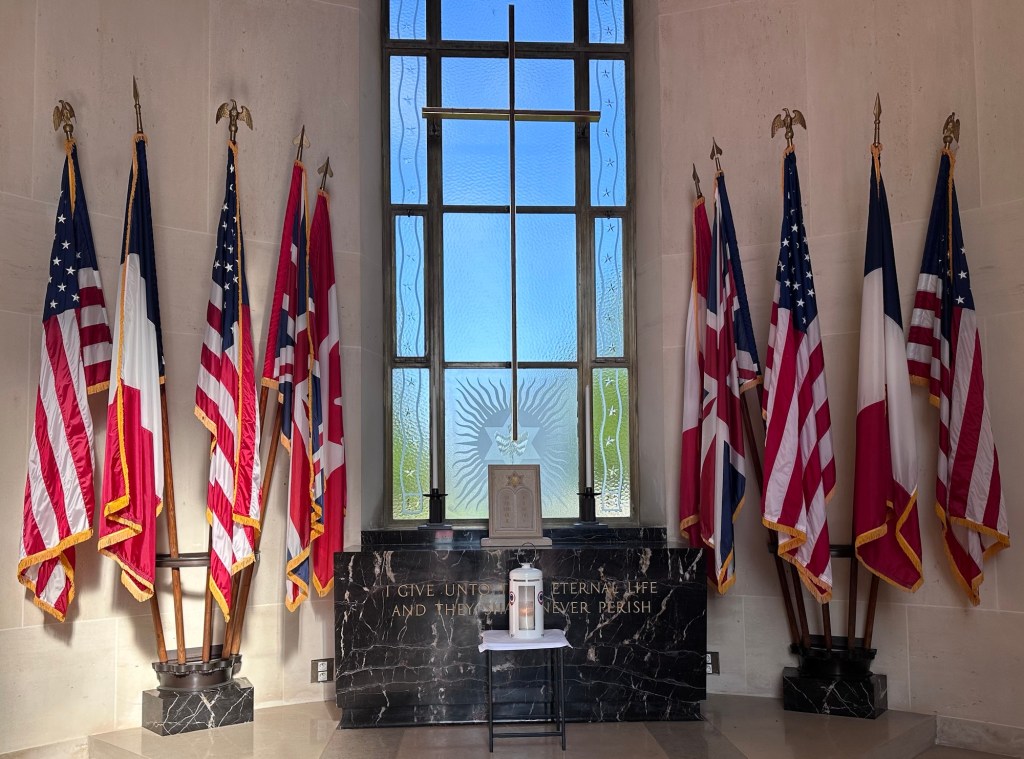
The eternal flame at the cemetery

The weather was perfect during our visit to Omaha Beach. The Allies weren’t as lucky.

The plan was to have paratroopers and Army Rangers land behind German fortifications when the troops arrived at the beach, but gale force winds blew them off course. Instead they ended up being targets for both enemy and friendly fire.

These are exhibits in the Airborne Museum.

OAT arranged for us to have time with the museum curator, who showed us this violin one of the German soldiers made for the American in charge of the prison camp.

Knowing what goes into making a violin, I was incredulous. Clearly, this skilled woodworker had an excellent relationship with the camp commander, because he was allowed access to sharp instruments that could have served as weapons.

Add this to one of the MANY things I didn’t know before this trip: Germans remained in the POW camps till 1948. Most of the prisoners either stayed in France, and married their French girlfriends or emigrated to the USA.

I’ll end with a happy story. The parachutist shown hanging from the church steeple survived. He was cut down by German soldiers hiding in the church, and held as a hostage so the church wouldn’t be bombed.

No time to proof read, so fingers crossed that my iPhone didn’t make any crazy substitutions.

Bayeux

Okay, this post is for those of us who might not have paid a whole lot of attention in World History class. I say “us” because I clearly had other things on my mind (boys? My hair? ) while we were learning about battles and trenches and bombs.

But it’s never too late to learn, so we can all play catch up together.

Bayeux, which I had never heard of until this trip, is a charming little town with beautifully preserved Medieval buildings. The inhabitants got word to the Allies, after the Normandy invasion, that all the Germans had evacuated, so the town was never bombed during World War Two.

Its proximity to the beaches of Normandy meant that Bayeux was the first town to be liberated by the Allies, and served as the capital of France until Paris was freed.

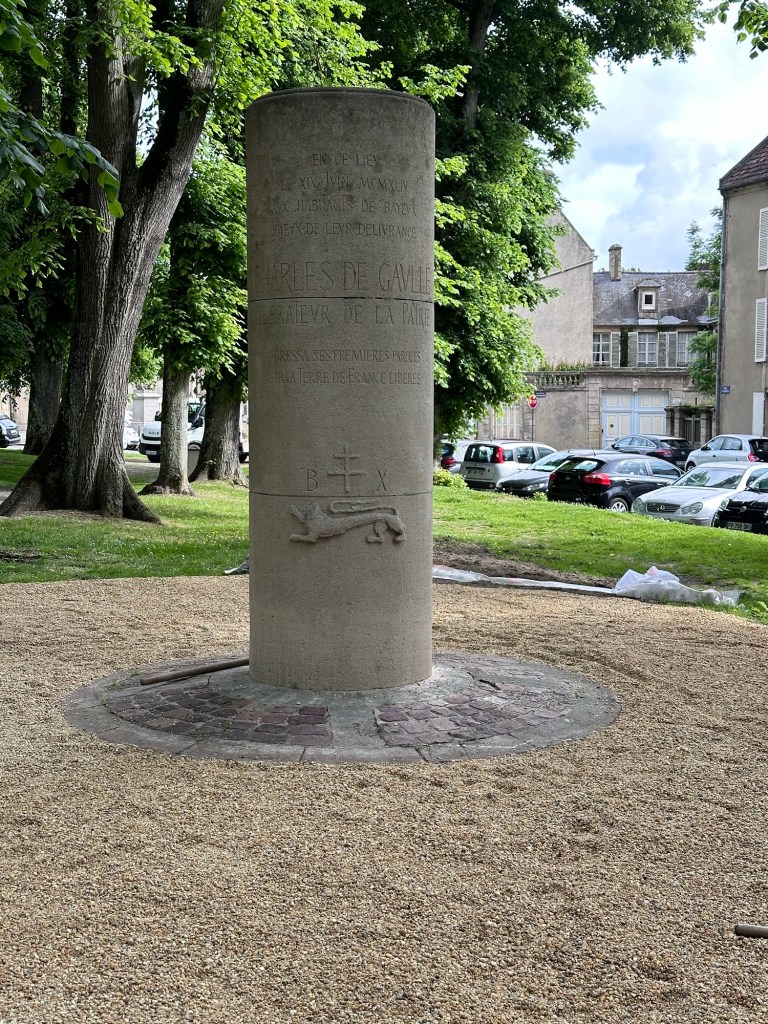
Charles DeGaulle gave his first speech on the soil of Free France in this Bayeux Park.

To celebrate the 80th anniversary of D Day, many of the store fronts in the town were painted with these colorful murals.

I know conventional wisdom claims that the French are unfriendly, but that certainty has not been my experience, at least so far. American flags are EVERYWHERE.

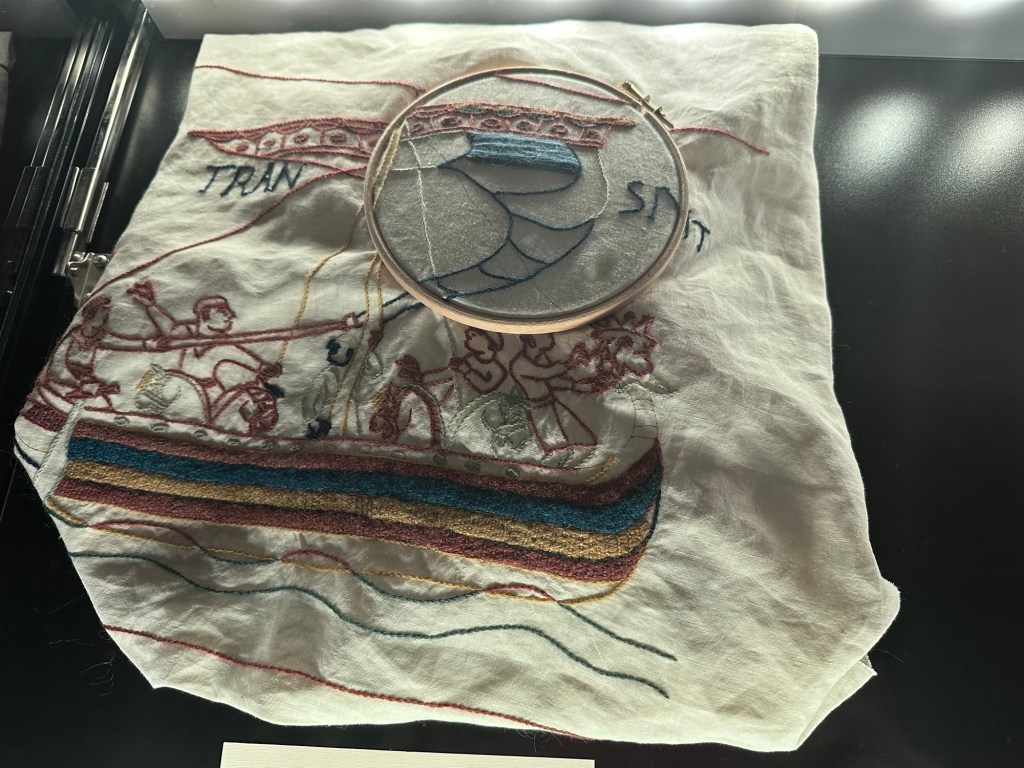
Another of Bayeux’s claim to fame is their “tapestry” ( actually an embroidery) on linen which stretches for 70 meters (or about 230 feet.)

It tells the story of how William “the bastard” became William “the conqueror”, which, of course, required lots of dead bodies.

When I was a college student in Boston, the Citgo sign above Kenmore Square always helped me find my way home. The Bayeux cathedral performed a similar function.

Thanks to that landmark, I was able to wander freely, knowing I would eventually find my way back.

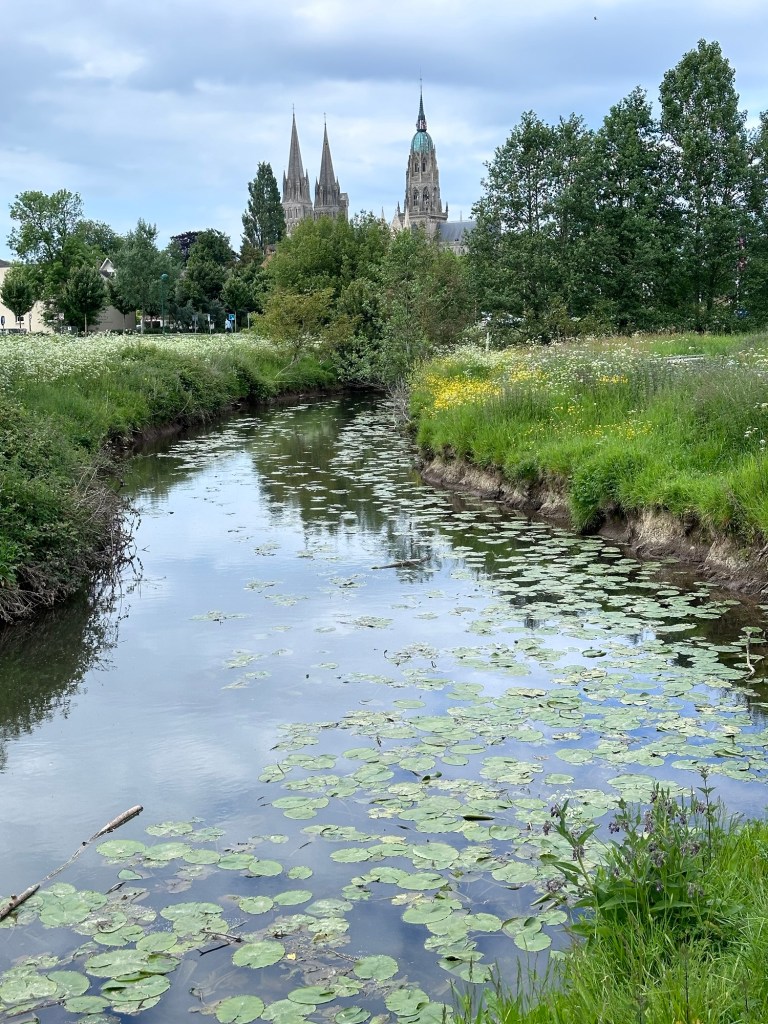
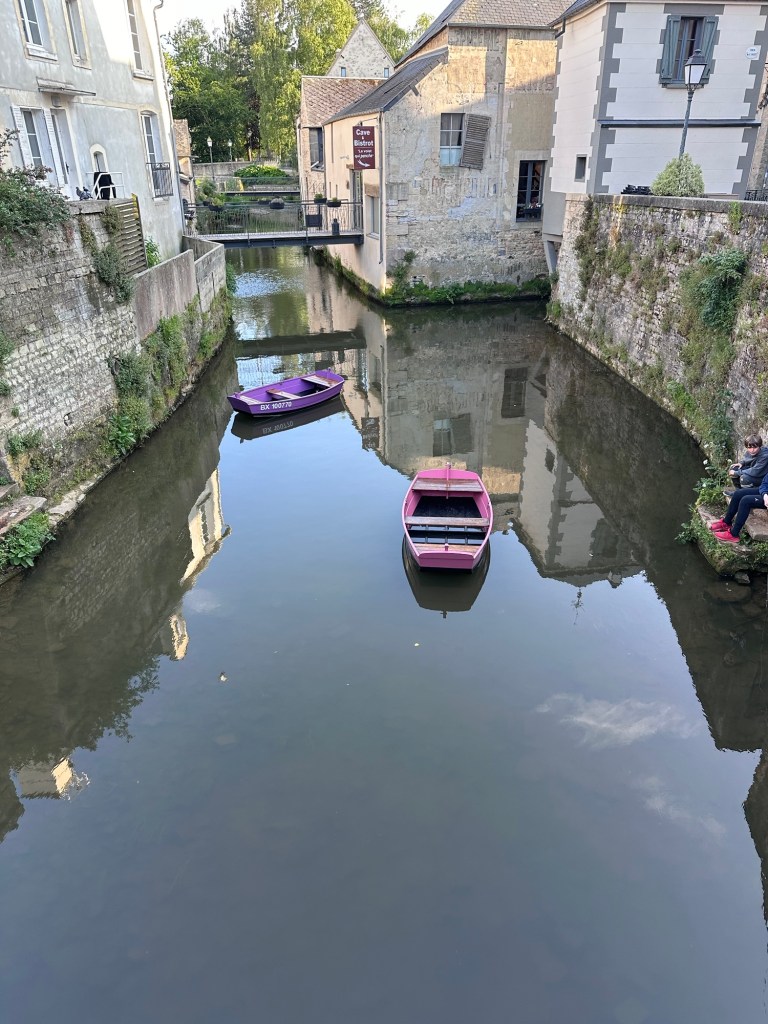
It stayed light in Bayeux till almost 10 PM, which allowed us to take long evening walks along the river’s banks.

Photo taken just a little before 8 PM

I’m so grateful to have spent three days in this wonderful little town!

Fontainbleau

I was totally surprised by how much I am loving OAT’s pre-trip to Fontainebleau and Bayeux. We spend three nights in each place, at centrally located hotels. Both are very walkable, and the best part? Even I haven’t gotten lost!

Obviously, the draw for Fontainebleau is the chateau. One of many royal residences, it is the biggest, with 1,500 VERY ornate rooms spread over three floors. Just about every square inch of the areas open to the public —parts of the first and second floors of the main building — is completely covered with some form of art work.

Check out the chateau’s floor plan: you walk THROUGH each room to get to the next. This was similar to the design of Schonbrunn, the Hapsburg’s summer palace in Vienna. I guess royalty didn’t mind a lack of privacy. Yes, there are huge doors on either side of the room, but think about this: What happens if you need to get to a room, but the door to the room before it is closed? Do you have to go all the way around? Those hallways are really, really LONG!

Take a look at Napoleon’s second wife’s bedroom—Marie Louise, the Austrian princess he married after he dumped Josephine. You see that railing around the bed? No one was allowed inside the railing, without her permission. I guess the doors weren’t enough.

Napoleon’s bedroom was a few rooms down from Marie Louise’s. His was the only one of the MANY beds I saw that had steps along side it. Was the precursor of today’s doggie stairs?

The library was my favorite room.

Are you wondering how people were able to find each other? They didn’t have intercoms or cell phones, which is probably a good thing. I have enough trouble finding mine and I have 1,490 fewer rooms.

One last room before we head outside: the ballroom. Notice the balcony at the back. I’ll bet that’s where the moms sat so they could keep an eye on their daughters. The alcoves, I suspect, was where the ladies sat, waiting to be asked to dance.

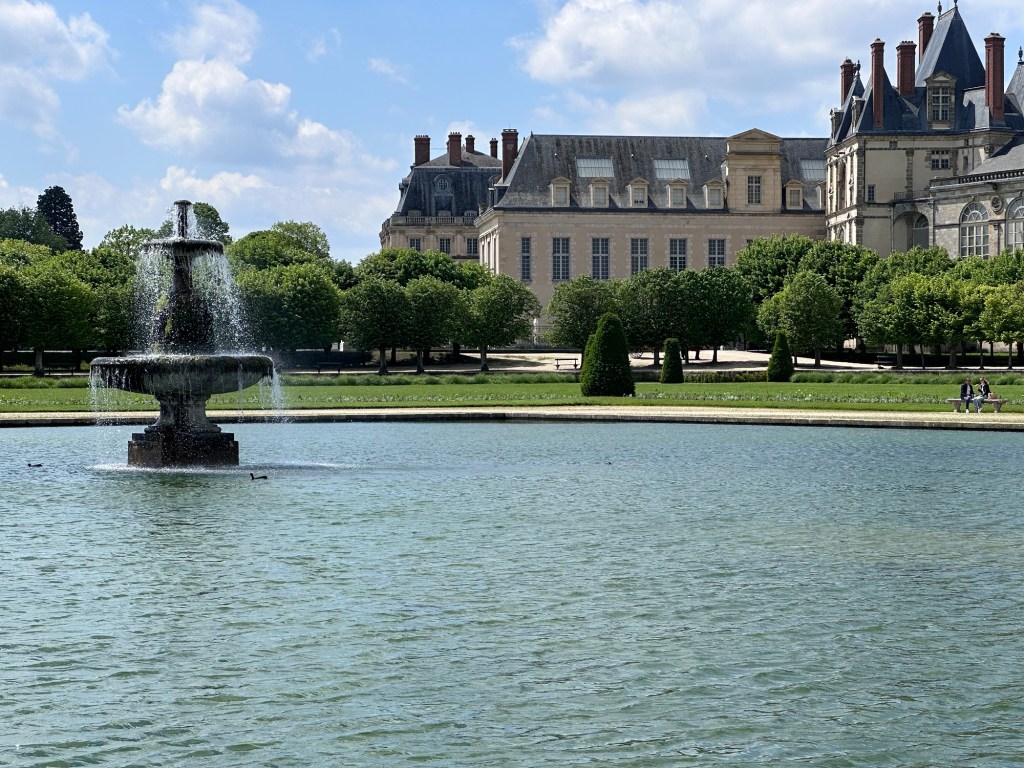
Although the weather report predicted rain, we were unbelievably lucky to have perfect weather, which allowed me to thoroughly enjoy the wonderful grounds surrounding the chateau.

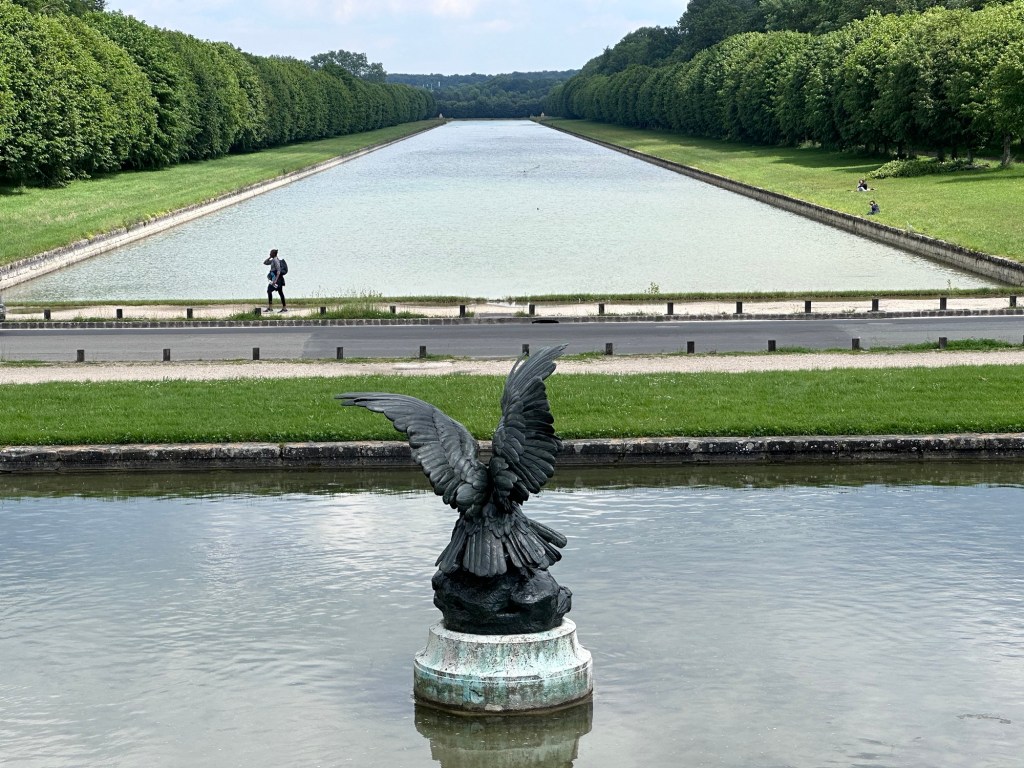
The gardens stretch as far as I could see, until they reach the forest.

After all that opulence and sensory overload, the serenity of the English and French gardens provided a needed respite.

I loved the whimsical statues scattered throughout the gardens.

This, I was told, is a sphinx. It was quite unlike anything I’d seen in Egypt, but our guide explained that the French take inspiration from other countries, then add their own touches.

Garry took the group photo of Marie, Susan, me, Jim and James. Donna and Kathy didn’t join us during our free afternoon.

On the drive to Bayeux, we stopped at Giverny, home of Claude Monet. Like Barbizon, it is a tiny village that art enthusiasts visit. Unlike Barbizon, it was really crowded.

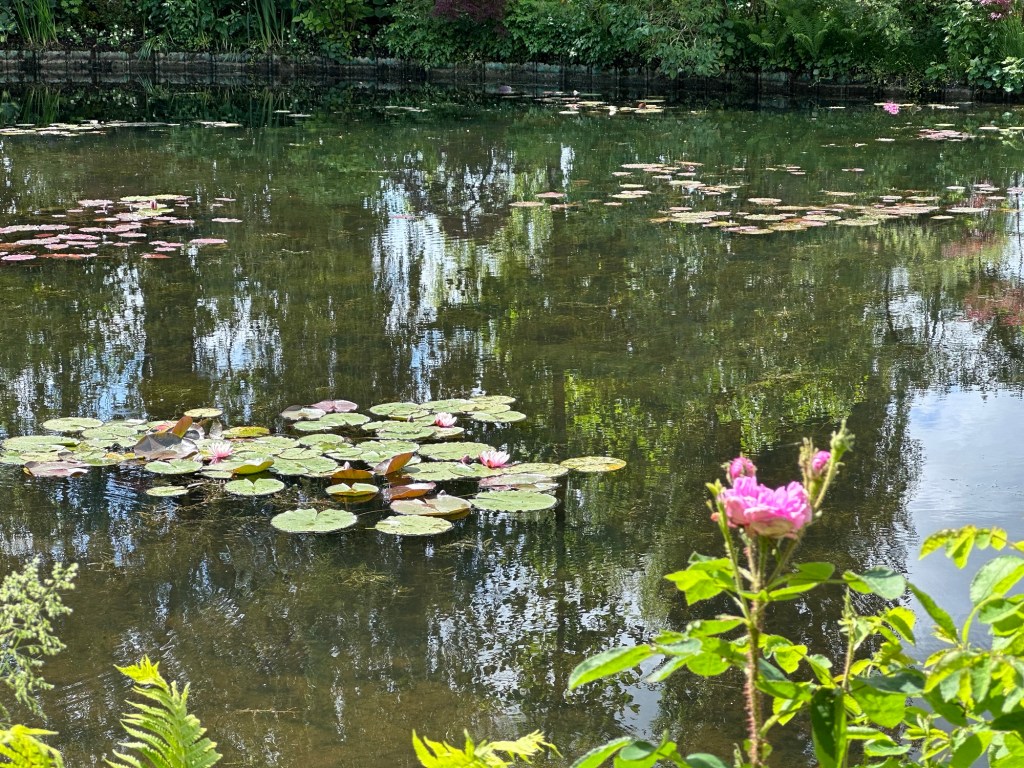
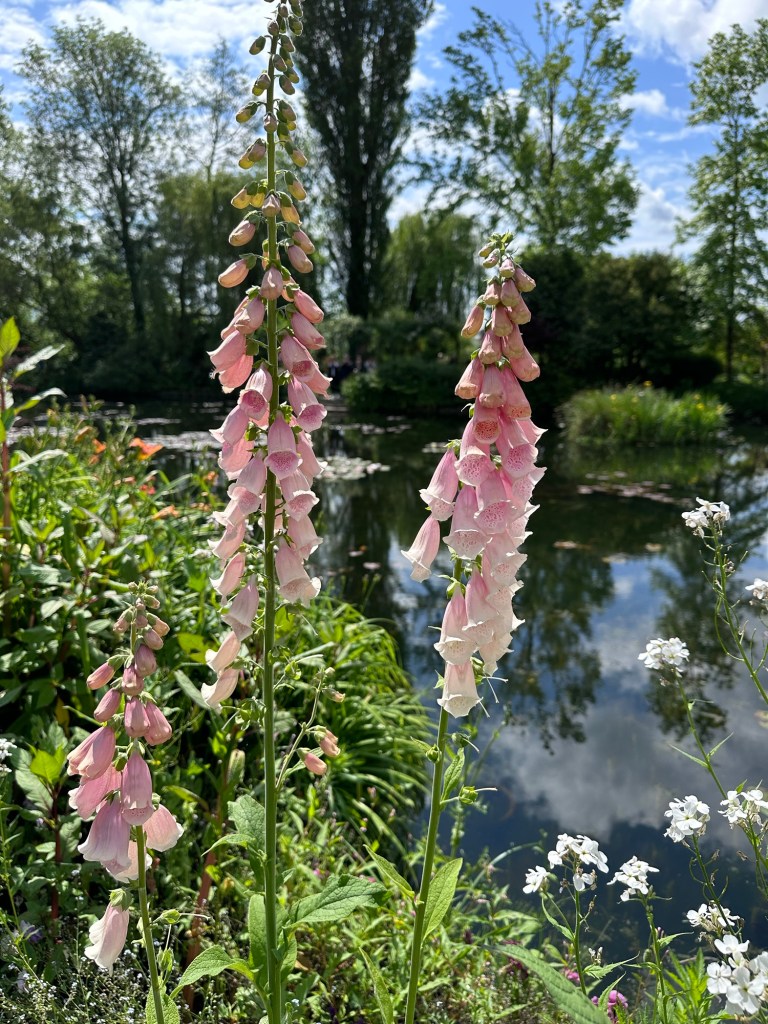
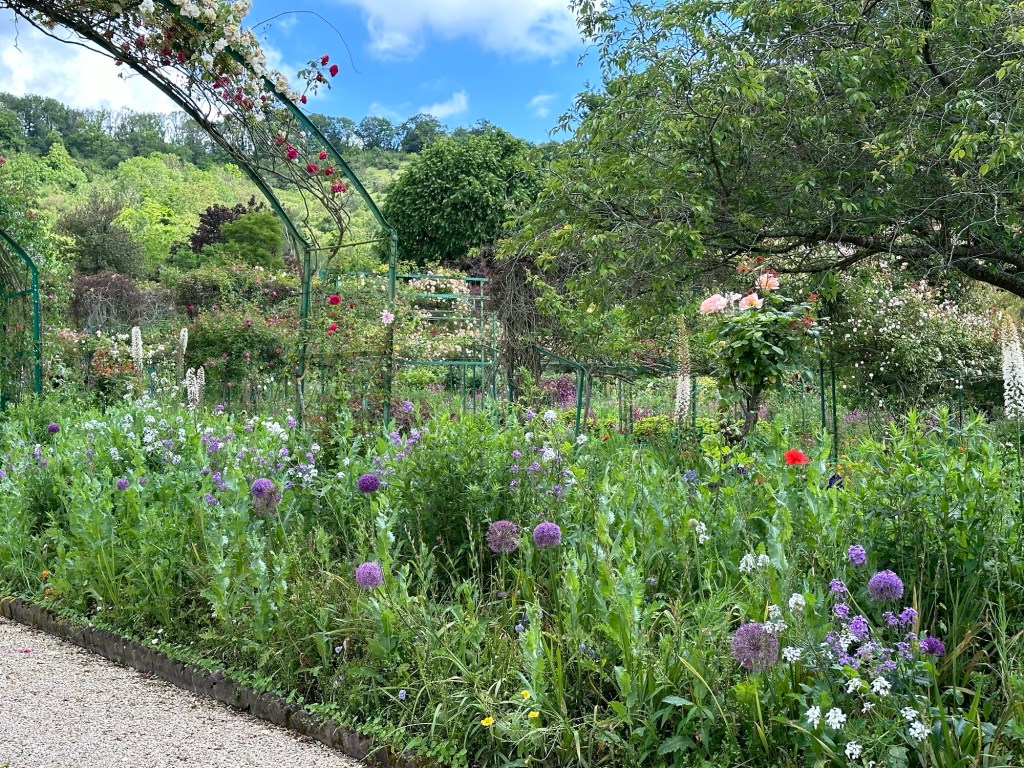
Although it was too early in the season for many water lilies to be in bloom, there were plenty of other gorgeous perennials to enjoy.

It is easy to see where Monet found inspiration for his art.

After enjoying the lily pond and the gardens, we were able to tour Monet’s home.

Like Fontainebleau, the walls were covered with artwork.

For some reason, however, I didn’t find the artwork overwhelming.

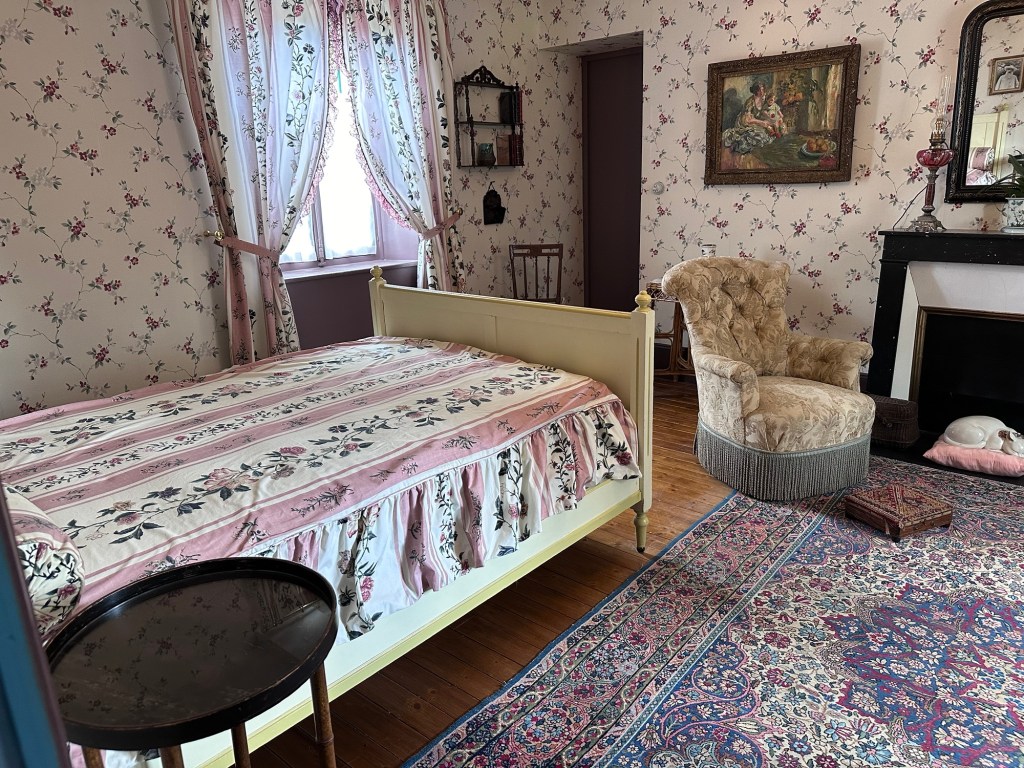
Clearly, I prefer the simple life. I’d much rather wake up in a bedroom like Monet’s than any of the ones I saw in Fontainebleau!

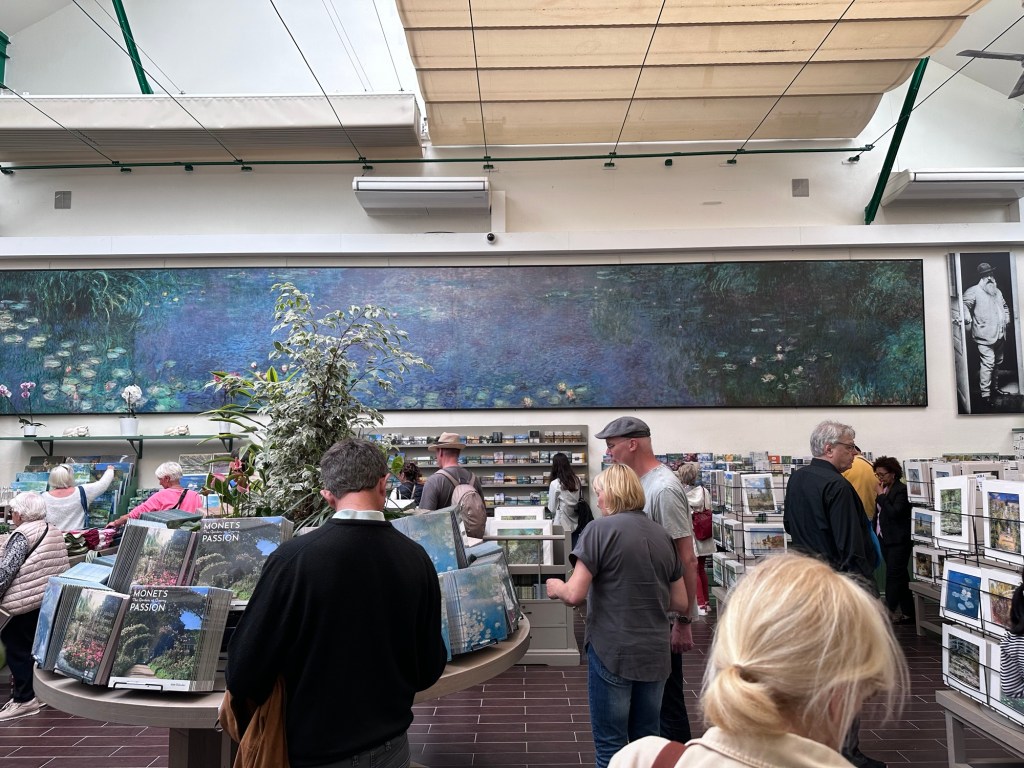
Monet’s studio is now the gift shop. It was huge, with lots of natural light. Reproductions of his water lilies were stretched across two of the walls.

Next post—Bayeux.

French Impressions

Some people join bereavement groups. Me, I travel. As you can see from the map, this OAT trip’s itinerary will include Paris, of course, but there’s a whole lot more, including places I’d never heard of before. The last time I was in Paris was in 1976 while Mike and I were traveling through Europe on our honeymoon, so this return will undoubtedly be bittersweet.

There are 8 of us on the pre-trip to Fontainebleau; we will meet up with the remaining 8 in 6 days when we start the main trip in Angers.

I was surprised to discover the flight cost for business class was only a couple of hundred dollars more than economy plus. I’m never going to figure out airline pricing! Booking on my own, rather than thru OAT was more than $2,000 cheaper! Sometimes that happens. Ah, the power of the internet.

It was well worth $200+ to choose business over economy plus, just to have a single seat with window on one side and aisle on the other. No climbing over, to get to the bathroom, from my lay flat bed. The additional benefit is luggage is tagged “priority”, so it is among the first to be taken off the plane. Although normally I try to do carry on only, this will be my first trip with a CPAP machine, so I decided to pack it in my duffle, take additional clothes and not worry about laundry during the trip. I couldn’t believe how quickly both my luggage and I were off the plane. We landed at 7:45 AM and I was thru passport control, in the taxi, leaving the airport by 8:30. That’s even including the time I stopped to brush my teeth!

After the 13 hour flights to and from Japan, I expected the seven and a half hour flight to be easy. And it was. Still, I’m taking it slower than I did in my younger days to adjust to the 6 hour time difference.

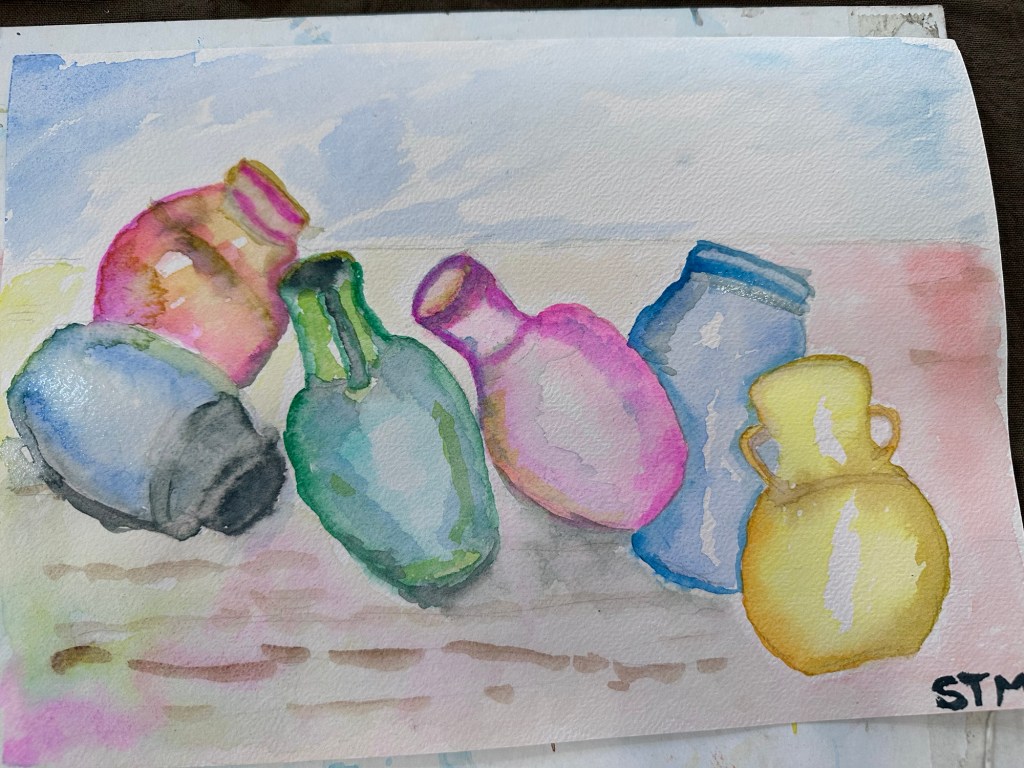
We started our first full day of the pre-trip in Barbizon, with a watercolor lesson. Patricia, our teacher, very kindly declared our efforts were “tres bien”. (She didn’t add “for a bunch of first graders’, but I’ll bet she thought it). But that’s okay. We all had great fun.

I’ve decided my two masterpieces are definitely refrigerator-worthy. If asked, I’ll just say my son did them when he was seven.

I found the tiny town of Barbizon completely charming— full of architecturally interesting buildings and art where you’d least expect to see it. Mounted on many of the buildings, for example, were mosaics of famous paintings, like “the Angelus” by Millet

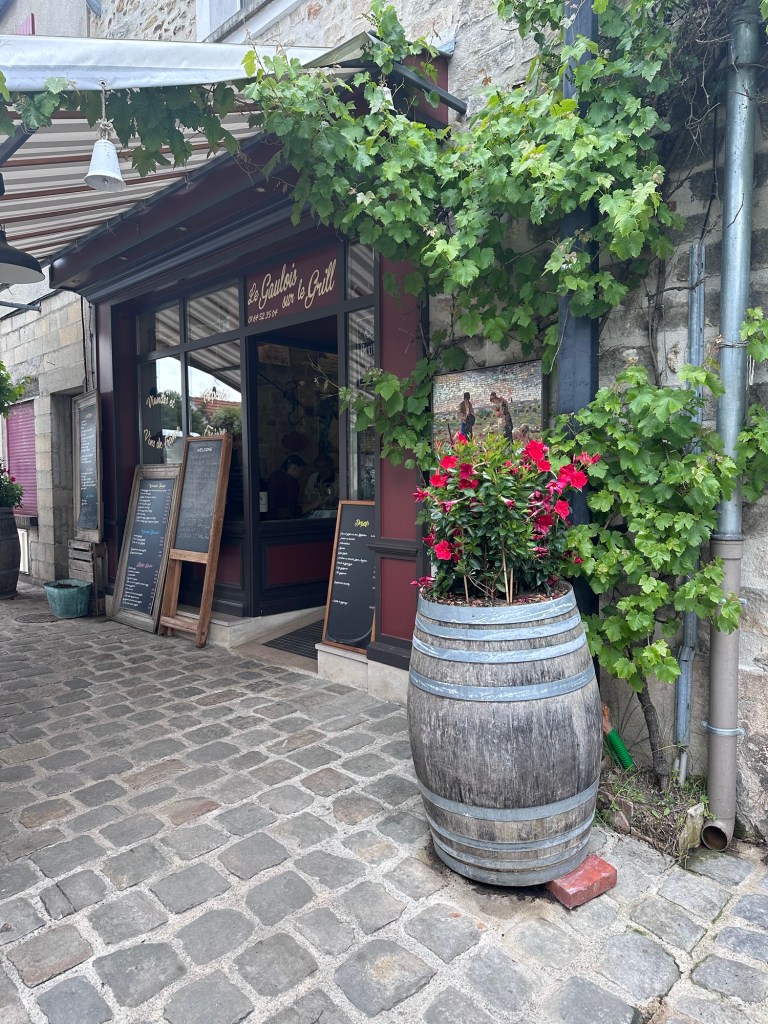
The lunch place
What sculptors do when a tree dies

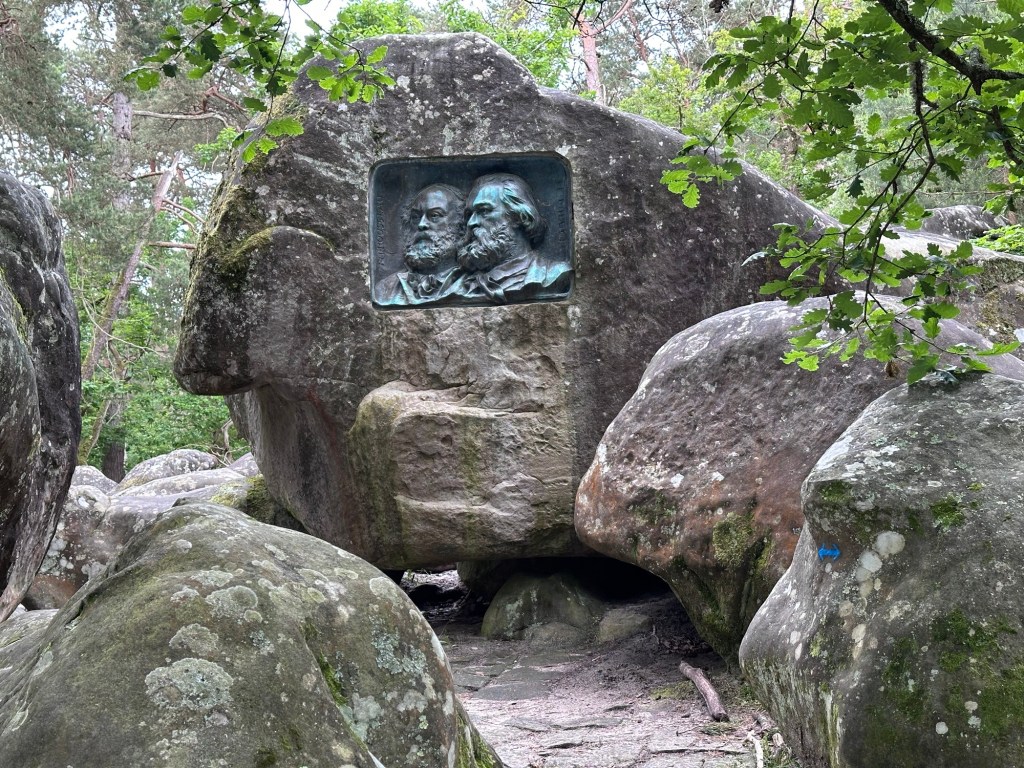
Our post lunch stroll took us through the forest where the painters would hang out, waiting for inspiration to strike. Clearly it did, otherwise they wouldn’t have gotten this honorary plaque attached to one of the forest’s many boulders. (That’s Millet and Rousseau, in case you’re wondering).

My favorite rock formation, however, was this naturally occurring one — can you see the elephant?

We had a few minutes before our taxi picked us up to return us to our hotel in Fontainebleau, so we took a quick turn thru a nearby sculpture garden. It wasn’t as grand as Hakone’s Open Air Museum, but then, what is? Still, these pieces are pretty delightful!

After returning to the hotel, Marie, our trip leader, had a final surprise for us. We gathered in the lobby to experience the impressionists’ favorite drink, (and supposedly the cause of some of their mental problems, )Absinthe.

You don’t just dump absinthe into a glass. Oh no. There is a process. You carefully pour the liquor into an ice filled glass, next placing a sugar cube (like so) upon a specially designed spoon, then slowly pour cold water on the sugar cube so that it dissolves and seeps through the spoon’s holes into the drink. I enjoyed the experience, but red wine is still my beverage of choice.